EP4372509A1 - Map data generation device, movable apparatus management device, storage medium, map data generation method, and movable apparatus management method - Google Patents
Map data generation device, movable apparatus management device, storage medium, map data generation method, and movable apparatus management method Download PDFInfo
- Publication number
- EP4372509A1 EP4372509A1 EP23203474.4A EP23203474A EP4372509A1 EP 4372509 A1 EP4372509 A1 EP 4372509A1 EP 23203474 A EP23203474 A EP 23203474A EP 4372509 A1 EP4372509 A1 EP 4372509A1
- Authority
- EP
- European Patent Office
- Prior art keywords
- movable apparatus
- space
- map data
- predetermined
- data
- Prior art date
- Legal status (The legal status is an assumption and is not a legal conclusion. Google has not performed a legal analysis and makes no representation as to the accuracy of the status listed.)
- Withdrawn
Links
Images




Classifications
-
- G—PHYSICS
- G06—COMPUTING OR CALCULATING; COUNTING
- G06F—ELECTRIC DIGITAL DATA PROCESSING
- G06F16/00—Information retrieval; Database structures therefor; File system structures therefor
- G06F16/20—Information retrieval; Database structures therefor; File system structures therefor of structured data, e.g. relational data
- G06F16/29—Geographical information databases
-
- G—PHYSICS
- G05—CONTROLLING; REGULATING
- G05D—SYSTEMS FOR CONTROLLING OR REGULATING NON-ELECTRIC VARIABLES
- G05D1/00—Control of position, course, altitude or attitude of land, water, air or space vehicles, e.g. using automatic pilots
- G05D1/02—Control of position or course in two dimensions
- G05D1/021—Control of position or course in two dimensions specially adapted to land vehicles
- G05D1/0268—Control of position or course in two dimensions specially adapted to land vehicles using internal positioning means
- G05D1/0274—Control of position or course in two dimensions specially adapted to land vehicles using internal positioning means using mapping information stored in a memory device
-
- G—PHYSICS
- G01—MEASURING; TESTING
- G01C—MEASURING DISTANCES, LEVELS OR BEARINGS; SURVEYING; NAVIGATION; GYROSCOPIC INSTRUMENTS; PHOTOGRAMMETRY OR VIDEOGRAMMETRY
- G01C21/00—Navigation; Navigational instruments not provided for in groups G01C1/00 - G01C19/00
- G01C21/38—Electronic maps specially adapted for navigation; Updating thereof
- G01C21/3804—Creation or updating of map data
- G01C21/3807—Creation or updating of map data characterised by the type of data
- G01C21/383—Indoor data
-
- G—PHYSICS
- G01—MEASURING; TESTING
- G01C—MEASURING DISTANCES, LEVELS OR BEARINGS; SURVEYING; NAVIGATION; GYROSCOPIC INSTRUMENTS; PHOTOGRAMMETRY OR VIDEOGRAMMETRY
- G01C21/00—Navigation; Navigational instruments not provided for in groups G01C1/00 - G01C19/00
- G01C21/38—Electronic maps specially adapted for navigation; Updating thereof
- G01C21/3804—Creation or updating of map data
- G01C21/3833—Creation or updating of map data characterised by the source of data
- G01C21/3841—Data obtained from two or more sources, e.g. probe vehicles
-
- G—PHYSICS
- G01—MEASURING; TESTING
- G01C—MEASURING DISTANCES, LEVELS OR BEARINGS; SURVEYING; NAVIGATION; GYROSCOPIC INSTRUMENTS; PHOTOGRAMMETRY OR VIDEOGRAMMETRY
- G01C21/00—Navigation; Navigational instruments not provided for in groups G01C1/00 - G01C19/00
- G01C21/38—Electronic maps specially adapted for navigation; Updating thereof
- G01C21/3885—Transmission of map data to client devices; Reception of map data by client devices
-
- G—PHYSICS
- G05—CONTROLLING; REGULATING
- G05D—SYSTEMS FOR CONTROLLING OR REGULATING NON-ELECTRIC VARIABLES
- G05D1/00—Control of position, course, altitude or attitude of land, water, air or space vehicles, e.g. using automatic pilots
- G05D1/02—Control of position or course in two dimensions
- G05D1/021—Control of position or course in two dimensions specially adapted to land vehicles
- G05D1/0212—Control of position or course in two dimensions specially adapted to land vehicles with means for defining a desired trajectory
-
- G—PHYSICS
- G05—CONTROLLING; REGULATING
- G05D—SYSTEMS FOR CONTROLLING OR REGULATING NON-ELECTRIC VARIABLES
- G05D1/00—Control of position, course, altitude or attitude of land, water, air or space vehicles, e.g. using automatic pilots
- G05D1/20—Control system inputs
- G05D1/22—Command input arrangements
- G05D1/221—Remote-control arrangements
- G05D1/222—Remote-control arrangements operated by humans
- G05D1/224—Output arrangements on the remote controller, e.g. displays, haptics or speakers
- G05D1/2244—Optic
- G05D1/2245—Optic providing the operator with a purely computer-generated representation of the environment of the vehicle, e.g. virtual reality
- G05D1/2246—Optic providing the operator with a purely computer-generated representation of the environment of the vehicle, e.g. virtual reality displaying a map of the environment
-
- G—PHYSICS
- G05—CONTROLLING; REGULATING
- G05D—SYSTEMS FOR CONTROLLING OR REGULATING NON-ELECTRIC VARIABLES
- G05D1/00—Control of position, course, altitude or attitude of land, water, air or space vehicles, e.g. using automatic pilots
- G05D1/20—Control system inputs
- G05D1/24—Arrangements for determining position or orientation
- G05D1/242—Means based on the reflection of waves generated by the vehicle
-
- G—PHYSICS
- G05—CONTROLLING; REGULATING
- G05D—SYSTEMS FOR CONTROLLING OR REGULATING NON-ELECTRIC VARIABLES
- G05D1/00—Control of position, course, altitude or attitude of land, water, air or space vehicles, e.g. using automatic pilots
- G05D1/20—Control system inputs
- G05D1/24—Arrangements for determining position or orientation
- G05D1/246—Arrangements for determining position or orientation using environment maps, e.g. simultaneous localisation and mapping [SLAM]
- G05D1/2464—Arrangements for determining position or orientation using environment maps, e.g. simultaneous localisation and mapping [SLAM] using an occupancy grid
-
- G—PHYSICS
- G06—COMPUTING OR CALCULATING; COUNTING
- G06V—IMAGE OR VIDEO RECOGNITION OR UNDERSTANDING
- G06V20/00—Scenes; Scene-specific elements
- G06V20/50—Context or environment of the image
- G06V20/56—Context or environment of the image exterior to a vehicle by using sensors mounted on the vehicle
-
- G—PHYSICS
- G06—COMPUTING OR CALCULATING; COUNTING
- G06V—IMAGE OR VIDEO RECOGNITION OR UNDERSTANDING
- G06V20/00—Scenes; Scene-specific elements
- G06V20/60—Type of objects
- G06V20/64—Three-dimensional [3D] objects
-
- G—PHYSICS
- G05—CONTROLLING; REGULATING
- G05D—SYSTEMS FOR CONTROLLING OR REGULATING NON-ELECTRIC VARIABLES
- G05D2109/00—Types of controlled vehicles
- G05D2109/10—Land vehicles
-
- G—PHYSICS
- G05—CONTROLLING; REGULATING
- G05D—SYSTEMS FOR CONTROLLING OR REGULATING NON-ELECTRIC VARIABLES
- G05D2111/00—Details of signals used for control of position, course, altitude or attitude of land, water, air or space vehicles
- G05D2111/10—Optical signals
- G05D2111/17—Coherent light, e.g. laser signals
Definitions
- the present invention relates to a map data generation device, a movable apparatus management device, a storage medium, a map data generation method, and a movable apparatus management method.
- autonomous mobile robots which autonomously move at various places, such as office buildings, residences, and distribution centers, and perform a predetermined operation such as work are being developed.
- movable apparatuses autonomously move in a space and perform a predetermined operation, they need a map of the space.
- Japanese Patent Laid-Open No. 2021-77053 discloses a map information providing system.
- This map information providing system includes a database, an image data generation unit, and a data transmission/reception unit.
- the database stores three-dimensional point cloud data related to an area where an autonomous mobile device travels.
- the image data generation unit generates two-dimensional planar image data by cutting out two-dimensional point cloud data of a height designated by the autonomous mobile device from the three-dimensional point cloud data read from the database.
- the data transmission/reception unit can transmit two-dimensional planar image data or point cloud data generated by the image data generation unit to the autonomous mobile device.
- the map described above may not be able to contribute to smooth operation performed by a movable apparatus which autonomously moves.
- a map data generation device includes at least one processor or circuit configured to function as: an operation data reception unit configured to receive operation data indicating results of a movable apparatus autonomously moving in a space and performing a predetermined operation; and a map data generation unit configured to generate map data which is used when the movable apparatus autonomously moves in the space and performs the predetermined operation on the basis of the operation data.
- Fig. 1 is a view showing an example of a map data generation system according to an embodiment.
- a map data generation system 100 includes a movable apparatus 1-1 and so on to a movable apparatus 1-k (k: an integer of 1 or larger), an information processing device 2, and a user terminal 3.
- the movable apparatus 1-1 and so on to the movable apparatus 1-k are autonomous mobile robots, automatic guided vehicles (AGV), or the like performing a predetermined operation such as cleaning or luggage transportation in a space inside a building such as an office building.
- a sensor is mounted in each of the movable apparatus 1-1 and so on to the movable apparatus 1-k, and they autonomously move in a space by ascertaining the space around themselves with this sensor.
- this sensor is a two-dimensional or three-dimensional light detection and ranging (LIDAR) or a stereo camera.
- LIDAR ascertains the position, the dimensions, the shape, and the like of each of objects present in a space by measuring the distance to each point on each of the objects present in the space and generating point cloud data.
- a stereo camera ascertains the position, the dimensions, the shape, and the like of each of objects present in a space by measuring the distance to each point on each of the objects present in the space on the basis of a triangulation method and generating a set of feature points.
- the movable apparatus 1-1 includes a movable apparatus management device 10-1 shown in Fig. 2 .
- the movable apparatus 1-k includes a movable apparatus management device 10-k shown in Fig. 2 .
- the movable apparatus management device 10-1 generates operation data indicating results obtained by causing the movable apparatus 1-1 to autonomously move in a space and perform a predetermined operation.
- the movable apparatus management device 10-1 receives map data which is used when the movable apparatus 1-1 is caused to autonomously move in a space and perform a predetermined operation and is generated on the basis of the operation data. Details of the movable apparatus management device 10-1 and so on to the movable apparatus management device 10-k will be described below.
- the movable apparatus management device 10-1 may not be mounted in the movable apparatus 1-1.
- the movable apparatus management device 10-1 may be mounted in an apparatus other than the movable apparatus 1-1 or may be one independent apparatus.
- the movable apparatus management device 10-k may not be mounted in the movable apparatus 1-k.
- the movable apparatus management device 10-k may be mounted in an apparatus other than the movable apparatus 1-k or may be one independent apparatus.
- the movable apparatus 1-1 will be described as an example.
- the movable apparatus management device 10-1 and so on to the movable apparatus management device 10-k are described, the movable apparatus 1-k will be described as an example.
- the information processing device 2 is installed in a data center. As shown in Fig. 1 , the information processing device 2 includes a map data generation device 21, a communication device 22, an input device 23, and a display device 24.
- the map data generation device 21 generates the map data on the basis of the operation data described above and transmits the map data to the movable apparatus 1-1 or so on to the movable apparatus 1-k. Details of the map data generation device 21 will be described below.
- the communication device 22 realizes communication between the information processing device 2 and the movable apparatus 1-1 and so on to the movable apparatus 1-k or the user terminal 3.
- the input device 23 is a mouse or a keyboard, which is used for inputting data, an instruction, or the like to the information processing device 2.
- the display device 24 is a display, which displays information presented to a user or the like of the information processing device 2.
- the user terminal 3 is a computer installed in a management base at a place different from the data center.
- the user terminal 3 is used for operating the information processing device 2 from the management base at a place different from the data center.
- the management base can be installed at an arbitrary place and may be installed at the same place as the data center, for example.
- Fig. 2 is a view showing an example of a hardware constitution of the movable apparatus management device according to the embodiment.
- the movable apparatus management device 10-1 includes a central processing unit (CPU) 101-1, a random access memory (RAM) 102-1, a read only memory (ROM) 103-1, a memory 104-1, and a bus 105-1.
- CPU central processing unit
- RAM random access memory
- ROM read only memory
- the CPU 101-1 realizes each of the functions of the movable apparatus management device 10-1 by reading and executing a program.
- the RAM 102-1 is a recording medium in which the program read and executed by the CPU 101-1 is temporarily developed.
- the ROM 103-1 is a recording medium in which the program read and executed by the CPU 101-1 is saved.
- the memory 104-1 is a recording medium in which the operation data and the like are saved.
- the bus 105-1 connects the CPU 101-1, the RAM 102-1, the ROM 103-1, and the memory 104-1 in a form in which they can communicate with each other.
- Fig. 3 is a view showing an example of a hardware constitution of a map data generation device according to the embodiment.
- the map data generation device 21 includes a CPU 201, a RAM 202, a ROM 203, a memory 204, and a bus 205.
- the CPU 201 realizes each of the functions of the map data generation device 21 by reading and executing a program.
- the RAM 202 is a recording medium in which the program read and executed by the CPU 201 is temporarily developed.
- the ROM 203 is a recording medium in which the program read and executed by the CPU 201 is saved.
- the memory 204 is a recording medium in which the map data and the like are saved.
- the bus 205 connects the CPU 201, the RAM 202, the ROM 203, and the memory 204 in a form in which they can communicate with each other.
- Fig. 4 is a view showing an example of a software constitution of the movable apparatus management device according to the embodiment.
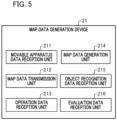
- Fig. 5 is a view showing an example of a software constitution of the map data generation device according to the embodiment.
- the movable apparatus management device 10-1 includes a movable apparatus data transmission unit 11-1, an initial map data reception unit 12-1, an operation data generation unit 13-1, an operation data transmission unit 14-1, a map data reception unit 15-1, an object recognition unit 16-1, and an object recognition data transmission unit 17-1.
- the map data generation device 21 includes a movable apparatus data reception unit 211, a map data transmission unit 212, an operation data reception unit 213, a map data generation unit 214, an object recognition data reception unit 215, and an evaluation data reception unit 216.
- the movable apparatus data transmission unit 11-1 transmits movable apparatus data indicating information capable of identifying the movable apparatus 1-1 to the map data generation device 21. Examples of such information include at least one combination of numerals, alphabetical characters, symbols, and the like unique to the movable apparatus 1-1.
- the movable apparatus data reception unit 211 receives the movable apparatus data from the movable apparatus management device 10-1.
- the map data transmission unit 212 transmits initial map data which is used when the movable apparatus 1-1 autonomously moves in a space to the movable apparatus management device 10-1.
- the initial map data is data expressing the inside of a space as point cloud data or a set of feature points and is map data determined to be used by the movable apparatus 1-1 until the movable apparatus data is received.
- the initial map data reception unit 12-1 receives the initial map data from the map data generation device 21.
- the operation data generation unit 13-1 generates operation data indicating at least a part of results obtained by causing the movable apparatus 1-1 to autonomously move in a space and perform a predetermined operation. At this time, the movable apparatus 1-1 autonomously moves using the initial map data and performs a predetermined operation.
- the operation data indicates results of the movable apparatus 1-1 autonomously moving in a space in its entirety or a part of a space and performing a predetermined operation.
- the operation data may indicate at least one of a path through which the movable apparatus 1-1 moves in a space and a region in which the movable apparatus 1-1 performs a predetermined operation in a space.
- the operation data generation unit 13-1 may generate operation data indicating the number of times of stops during a predetermined period when the movable apparatus 1-1 autonomously moves in a space and performs a predetermined operation.
- the operation data generation unit 13-1 may generate operation data indicating positions of stops during a predetermined period when the movable apparatus 1-1 autonomously moves in a space and performs a predetermined operation.
- the operation data generation unit 13-1 may generate operation data indicating times for stops during a predetermined period when the movable apparatus 1-1 autonomously moves in a space and performs a predetermined operation.
- the operation data generation unit 13-1 may judge that the cause of a stop of the movable apparatus 1-1 is a person, an animal, the movable apparatus 1-2 or so on to the movable apparatus 1-k, or the like. Further, if it is judged that the cause of a stop of the movable apparatus 1-1 is a person, an animal, the movable apparatus 1-2 or so on to the movable apparatus 1-k, or the like, the operation data generation unit 13-1 may not count it as the number of times of stops during a predetermined period when the movable apparatus 1-1 autonomously moves in a space and performs a predetermined operation.
- the operation data generation unit 13-1 may not recognize it as the positions of stops during a predetermined period when the movable apparatus 1-1 autonomously moves in a space and performs a predetermined operation. In addition, if it is judged in this manner, the operation data generation unit 13-1 may not recognize it as the times for stops during a predetermined period when the movable apparatus 1-1 autonomously moves in a space and performs a predetermined operation.
- the operation data generation unit 13-1 may generate operation data indicating the number of times of deviations from a predetermined path and detours during a predetermined period.
- the operation data generation unit 13-1 may generate operation data indicating positions of deviations from a predetermined path and detours during a predetermined period.
- the operation data generation unit 13-1 may generate operation data indicating times for deviations from a predetermined path and detours during a predetermined period.
- the predetermined period described above may have a length shorter than a time during which a movable apparatus autonomously moves in a space and ends performance of a predetermined operation. If the predetermined period has such a length, the map data generation system 100 can immediately transmit suitable map data to the movable apparatus 1-1 which cannot smoothly move in a space.
- the predetermined period described above may have a length equal to or longer than a time during which a movable apparatus autonomously moves in a space and ends performance of a predetermined operation. If the predetermined period has such a length, the map data generation system 100 can generate more suitable map data on the basis of results of the movable apparatus 1-1 which has completed a predetermined operation in a space and can transmit it to the movable apparatus 1-1.
- the operation data transmission unit 14-1 transmits the operation data to the map data generation device 21 and the user terminal 3.
- the object recognition unit 16-1 performs object recognition processing of recognizing an object different from the movable apparatus 1-1 moving in a space and generates object recognition data indicating results of the object recognition processing.
- the said object different from the movable apparatus 1-1 is a person or the movable apparatus 1-2 or so on to the movable apparatus 1-k, for example.
- the object recognition unit 16-1 uses an arbitrary technology in order to recognize an object different from the movable apparatus 1-1.
- the object recognition unit 16-1 may use a machine learning model in order to recognize a person or may use an optical flow in order to recognize the movable apparatus 1-2 or so on to the movable apparatus 1-k.
- the object recognition data transmission unit 17-1 transmits the object recognition data to the map data generation device 21 and the user terminal 3.
- the user terminal 3 receives the operation data and the object recognition data from the movable apparatus management device 10-1. Next, the user terminal 3 generates evaluation data indicating evaluation of a user with respect to results of the movable apparatus 1-1 autonomously moving in a space and performing a predetermined operation.
- the evaluation data is generated on the basis of information input to the user terminal 3 by a user who has referred to contents indicated by the operation data. Further, the user terminal 3 transmits the evaluation data to the map data generation device 21.
- the operation data reception unit 213 receives the operation data from the map data generation device 21.
- the operation data reception unit 213 may receive operation data indicating the number of times of stops during a predetermined period when the movable apparatus 1-1 autonomously moves in a space and performs a predetermined operation.
- the operation data reception unit 213 may receive operation data indicating positions of stops during a predetermined period when the movable apparatus 1-1 autonomously moves in a space and performs a predetermined operation.
- the operation data reception unit 213 may receive operation data indicating times for stops during a predetermined period when the movable apparatus 1-1 autonomously moves in a space and performs a predetermined operation.
- the operation data reception unit 213 may receive operation data indicating the number of times of deviations from a predetermined path and detours during a predetermined period. Alternatively, the operation data reception unit 213 may receive operation data indicating positions of deviations from a predetermined path and detours during a predetermined period. Alternatively, the operation data reception unit 213 may receive operation data indicating times for deviations from a predetermined path and detours during a predetermined period.
- the object recognition data reception unit 215 receives the object recognition data from the map data generation device 21.
- the evaluation data reception unit 216 receives the evaluation data from the map data generation device 21.
- the map data generation unit 214 generates map data which is used when the movable apparatus 1-1 autonomously moves in a space and performs a predetermined operation on the basis of the operation data. For example, the map data generation unit 214 generates the map data by processing in which positions of points included in point cloud data, feature points included in a set, and the like are moved on one smooth surface; processing in which some of the feature points and the like are deleted; or the like.
- the map data generation unit 214 may generate the map data on the basis of at least one of the object recognition data and the evaluation data. For example, if the object recognition data indicates that a new object has been recognized in a space, the map data generation unit 214 reflects the object in the map indicated by the map data.
- the map data generation unit 214 generates map data indicating a map expressing the region in more detail.
- the map data generation unit 214 may generate map data indicating a map in which accuracy of the map of the region is lowered.
- the map data indicates a map allowing the movable apparatus 1-1 to ascertain the position, the dimensions, the shape, and the like of each of objects present in a space without any problem when the movable apparatus 1-1 autonomously moves in the space and performs a predetermined operation.
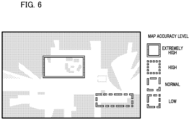
- Fig. 6 is a view showing an example of a map indicated by the map data according to the embodiment.
- the white region shown in Fig. 6 indicates a space inside a building.
- the dot-hatching region shown in Fig. 6 indicates the outside of the building.
- the region surrounded by the horizontal hatching lines shown in Fig. 6 is at an "extremely-high" map accuracy level which is the highest in four stages.
- the region surrounded by the diagonal hatching lines from the right upper side to the left lower side shown in Fig. 6 is at a "high" map accuracy level which is the second highest in the four stages.
- the region surrounded by the diagonal hatching lines from the left upper side to the right lower side shown in Fig. 6 is at a "normal” map accuracy level which is the third highest in the four stages.
- the region surrounded by the vertical hatching lines shown in Fig. 6 is at a "low” map accuracy level which is the lowest in the four stages.
- the said map accuracy is accuracy of boundaries inside a space of a building expressed by a map and is quantified based on the fineness of an occupancy grid.
- An occupancy grid is used for the movable apparatus 1-1 autonomously moving in a space of a building and performing a predetermined operation when a map indicated by the map data and results of a space ascertained by a sensor mounted in the movable apparatus 1-1 are verified.
- the fineness of an occupancy grid may be independently set for each direction defined inside a two-dimensional or three-dimensional space.
- a plurality of occupancy grids may be set while varying the fineness in the same region or may be managed by applying a different color for each fineness.
- the map data generation unit 214 may generate a map in which at least a part of the accuracy is adjusted as necessary or may generate map data indicating the map. In addition, if it is judged that results indicated by the operation data have not reached a predetermined level, the map data generation unit 214 may generate a map having the higher accuracy or may generate map data indicating the map.
- the map data generation unit 214 may further generate, on the basis of the map data, path data indicating a path for autonomous movement in a space when the movable apparatus 1-1 autonomously moves in the space and performs a predetermined operation.
- the map data generation unit 214 generates the path data on the basis of at least one of the number of the points described above or feature points, the density, the distribution in a space, and the like.
- the map data generation unit 214 may further generate, on the basis of the map data, region data indicating a region in which a predetermined operation ought to be performed in a space when the movable apparatus 1-1 autonomously moves in the space and performs a predetermined operation.
- the map data generation unit 214 generates the region data on the basis of at least one of the number of the points described above or feature points, the density, the distribution in a space, and the like.
- the map data transmission unit 212 transmits the map data to the movable apparatus management device 10-1. In addition, if the path data has been generated, the map data transmission unit 212 transmits the path data to the movable apparatus management device 10-1. In addition, if the region data has been generated, the map data transmission unit 212 transmits the region data to the movable apparatus management device 10-1.
- the map data reception unit 15-1 receives the map data which is used when the movable apparatus 1-1 is caused to autonomously move in a space and perform a predetermined operation and is generated on the basis of the operation data. In addition, if the path data is transmitted, the map data reception unit 15-1 receives the path data from the map data generation device 21. In addition, if the region data is transmitted, the map data reception unit 15-1 receives the region data from the map data generation device 21.
- Fig. 7 is a sequence diagram showing an example of processing performed by the map data generation system according to the embodiment.
- the processing shown in Fig. 7 is performed if results of the object recognition processing of recognizing an object different from the movable apparatus 1-1 moving in a space are reflected in the map data.
- the processing shown in Fig. 7 is performed if evaluation of a user with respect to results of the movable apparatus 1-1 autonomously moving in a space and performing a predetermined operation are reflected in the map data.
- Step S701 the movable apparatus data transmission unit 11-1 transmits the movable apparatus data.
- Step S702 the movable apparatus data reception unit 211 receives the movable apparatus data.
- Step S703 the map data transmission unit 212 transmits the initial map data.
- Step S704 the initial map data reception unit 12-1 receives the initial map data.
- Step S705 the movable apparatus management device 10-1 generates the operation data and the object recognition data. Specifically, the operation data generation unit 13-1 generates the operation data. In addition, the object recognition unit 16-1 generates the object recognition data.
- Step S706 the movable apparatus management device 10-1 transmits the operation data and the object recognition data. Specifically, the operation data transmission unit 14-1 transmits the operation data. In addition, the object recognition data transmission unit 17-1 transmits the object recognition data.
- Step S707 the user terminal 3 receives the operation data and the object recognition data.
- Step S708 the map data generation device 21 receives the operation data and the object recognition data.
- Step S709 the user terminal 3 generates and transmits the evaluation data.
- Step S710 the evaluation data reception unit 216 receives the evaluation data.
- Step S711 the map data generation unit 214 generates the map data.
- Step S712 the map data transmission unit 212 transmits the map data.
- Step S713 the map data reception unit 15-1 receives the map data.
- the movable apparatus management device 10-1 may not generate the object recognition data in Step S705. In this case, the movable apparatus management device 10-1 does not transmit the object recognition data to the map data generation device 21 in Step S706. In addition, in this case, the map data generation device 21 does not receive the object recognition data in Step S708 and generates the map data not based on the object recognition data in Step S711.
- the movable apparatus management device 10-1 may not transmit the operation data and the object recognition data to the user terminal 3 in Step S706.
- the user terminal 3 does not receive the operation data and the object recognition data from the movable apparatus management device 10-1 in Step S707 and does not perform processing of generating the evaluation data in Step S709 and transmitting it to the map data generation device 21.
- the map data generation device 21 does not receive the evaluation data from the user terminal 3 in Step S710 and generate the map data not based on the evaluation data in Step S711.
- Fig. 8 is a sequence diagram showing another example of processing performed by the map data generation system according to the embodiment.
- processing shown in Fig. 8 is performed if there is a probability that the movable apparatus 1-1 cannot smoothly move in a space and it is desirable to immediately generate more suitable map data and transmit it to the movable apparatus 1-1.
- the predetermined period described above has a length shorter than a time during which the movable apparatus 1-1 autonomously moves in a space and ends performance of a predetermined operation.
- the processing shown in Fig. 8 is performed, although there is a probability that the movable apparatus 1-1 cannot smoothly move in a space, if it is desirable to generate more suitable map data and transmit it to the movable apparatus 1-1 after the movable apparatus 1-1 has completed a predetermined operation once in the space.
- the predetermined period described above has a length equal to or longer than a time during which the movable apparatus 1-1 autonomously moves in a space and ends performance of a predetermined operation.
- Step S801 the movable apparatus data transmission unit 11-1 transmits the movable apparatus data.
- Step S802 the movable apparatus data reception unit 211 receives the movable apparatus data.
- Step S803 the map data transmission unit 212 transmits the initial map data.
- Step S804 the initial map data reception unit 12-1 receives the initial map data.
- Step S805 the operation data generation unit 13-1 generates the operation data.
- Step S806 the operation data transmission unit 14-1 judges whether or not at least one of the number of times of stops, positions, and times during a predetermined period; and the number of times, positions, and times for deviations from a predetermined path and detours during a predetermined period satisfies predetermined conditions.
- Step S806 the operation data transmission unit 14-1 causes the processing to proceed to Step S807.
- Step S806 NO
- the operation data transmission unit 14-1 causes the processing to proceed to Step S808.
- Step S807 the operation data transmission unit 14-1 transmits the operation data.
- Step S808 the movable apparatus management device 10-1 ends the processing.
- Step S809 the operation data reception unit 213 receives the operation data.
- Step S810 the map data generation unit 214 generates the map data.
- Step S811 the map data transmission unit 212 transmits the map data.
- Step S812 the map data reception unit 15-1 receives the map data.
- a computer program realizing the function of the embodiments described above may be supplied to the map data generation device and the like through a network or various storage media. Then, a computer (or a CPU, an MPU, or the like) of the map data generation device and the like may be configured to read and perform the program. In such a case, the program and the storage medium storing the program configure the present invention.
- the present invention includes those realized using at least one processor or circuit configured to function of the embodiments explained above.
- a plurality of processors may be used for distributed processing.
- a map data generation device includes an operation data reception unit configured to receive operation data indicating results of a movable apparatus autonomously moving in a space and performing a predetermined operation, and a map data generation unit configured to generate map data which is used when the movable apparatus autonomously moves in the space and performs the predetermined operation on the basis of the operation data.
Landscapes
- Engineering & Computer Science (AREA)
- Radar, Positioning & Navigation (AREA)
- Remote Sensing (AREA)
- General Physics & Mathematics (AREA)
- Physics & Mathematics (AREA)
- Automation & Control Theory (AREA)
- Aviation & Aerospace Engineering (AREA)
- Theoretical Computer Science (AREA)
- Multimedia (AREA)
- Databases & Information Systems (AREA)
- Data Mining & Analysis (AREA)
- General Engineering & Computer Science (AREA)
- Control Of Position, Course, Altitude, Or Attitude Of Moving Bodies (AREA)
- Instructional Devices (AREA)
- Traffic Control Systems (AREA)
Abstract
Description
- The present invention relates to a map data generation device, a movable apparatus management device, a storage medium, a map data generation method, and a movable apparatus management method.
- Currently, autonomous mobile robots which autonomously move at various places, such as office buildings, residences, and distribution centers, and perform a predetermined operation such as work are being developed. When such movable apparatuses autonomously move in a space and perform a predetermined operation, they need a map of the space.
- In addition, regarding a technology of providing such a map to movable apparatus which autonomously move, for example,
Japanese Patent Laid-Open No. 2021-77053 - This map information providing system includes a database, an image data generation unit, and a data transmission/reception unit. The database stores three-dimensional point cloud data related to an area where an autonomous mobile device travels.
- The image data generation unit generates two-dimensional planar image data by cutting out two-dimensional point cloud data of a height designated by the autonomous mobile device from the three-dimensional point cloud data read from the database. The data transmission/reception unit can transmit two-dimensional planar image data or point cloud data generated by the image data generation unit to the autonomous mobile device.
- However, if specifications of a movable apparatus, features of a space in which the movable apparatus moves, features of an operation performed by the movable apparatus in the space, and the like are not sufficiently taken into consideration, the map described above may not be able to contribute to smooth operation performed by a movable apparatus which autonomously moves.
- A map data generation device according to an aspect of the present invention includes at least one processor or circuit configured to function as: an operation data reception unit configured to receive operation data indicating results of a movable apparatus autonomously moving in a space and performing a predetermined operation; and a map data generation unit configured to generate map data which is used when the movable apparatus autonomously moves in the space and performs the predetermined operation on the basis of the operation data.
- Further features of the present invention will become apparent from the following description of embodiments with reference to the attached drawings.
-
-
Fig. 1 is a view showing an example of a map data generation system according to an embodiment. -
Fig. 2 is a view showing an example of a hardware constitution of a movable apparatus management device according to the embodiment. -
Fig. 3 is a view showing an example of a hardware constitution of a map data generation device according to the embodiment. -
Fig. 4 is a view showing an example of a software constitution of the movable apparatus management device according to the embodiment. -
Fig. 5 is a view showing an example of a software constitution of the map data generation device according to the embodiment. -
Fig. 6 is a view showing an example of a map indicated by map data according to the embodiment. -
Fig. 7 is a sequence diagram showing an example of processing performed by the map data generation system according to the embodiment. -
Fig. 8 is a sequence diagram showing another example of processing performed by the map data generation system according to the embodiment. - Hereinafter, with reference to the accompanying drawings, favorable modes of the present invention will be described using Embodiments. In each diagram, the same reference signs are applied to the same members or elements, and duplicate description will be omitted or simplified.
-
Fig. 1 is a view showing an example of a map data generation system according to an embodiment. As shown inFig. 1 , a mapdata generation system 100 includes a movable apparatus 1-1 and so on to a movable apparatus 1-k (k: an integer of 1 or larger), aninformation processing device 2, and auser terminal 3. - For example, the movable apparatus 1-1 and so on to the movable apparatus 1-k are autonomous mobile robots, automatic guided vehicles (AGV), or the like performing a predetermined operation such as cleaning or luggage transportation in a space inside a building such as an office building. A sensor is mounted in each of the movable apparatus 1-1 and so on to the movable apparatus 1-k, and they autonomously move in a space by ascertaining the space around themselves with this sensor.
- For example, this sensor is a two-dimensional or three-dimensional light detection and ranging (LIDAR) or a stereo camera. A LIDAR ascertains the position, the dimensions, the shape, and the like of each of objects present in a space by measuring the distance to each point on each of the objects present in the space and generating point cloud data.
- A stereo camera ascertains the position, the dimensions, the shape, and the like of each of objects present in a space by measuring the distance to each point on each of the objects present in the space on the basis of a triangulation method and generating a set of feature points.
- The movable apparatus 1-1 includes a movable apparatus management device 10-1 shown in
Fig. 2 . Similarly, the movable apparatus 1-k includes a movable apparatus management device 10-k shown inFig. 2 . The movable apparatus management device 10-1 generates operation data indicating results obtained by causing the movable apparatus 1-1 to autonomously move in a space and perform a predetermined operation. - In addition, the movable apparatus management device 10-1 receives map data which is used when the movable apparatus 1-1 is caused to autonomously move in a space and perform a predetermined operation and is generated on the basis of the operation data. Details of the movable apparatus management device 10-1 and so on to the movable apparatus management device 10-k will be described below.
- The movable apparatus management device 10-1 may not be mounted in the movable apparatus 1-1. For example, the movable apparatus management device 10-1 may be mounted in an apparatus other than the movable apparatus 1-1 or may be one independent apparatus.
- Similarly, the movable apparatus management device 10-k may not be mounted in the movable apparatus 1-k. For example, the movable apparatus management device 10-k may be mounted in an apparatus other than the movable apparatus 1-k or may be one independent apparatus.
- In the following description, if the movable apparatus 1-1 and so on to the movable apparatus 1-k are described, the movable apparatus 1-1 will be described as an example. In addition, in the following description, if the movable apparatus management device 10-1 and so on to the movable apparatus management device 10-k are described, the movable apparatus 1-k will be described as an example.
- For example, the
information processing device 2 is installed in a data center. As shown inFig. 1 , theinformation processing device 2 includes a mapdata generation device 21, acommunication device 22, aninput device 23, and adisplay device 24. - The map
data generation device 21 generates the map data on the basis of the operation data described above and transmits the map data to the movable apparatus 1-1 or so on to the movable apparatus 1-k. Details of the mapdata generation device 21 will be described below. - The
communication device 22 realizes communication between theinformation processing device 2 and the movable apparatus 1-1 and so on to the movable apparatus 1-k or theuser terminal 3. For example, theinput device 23 is a mouse or a keyboard, which is used for inputting data, an instruction, or the like to theinformation processing device 2. For example, thedisplay device 24 is a display, which displays information presented to a user or the like of theinformation processing device 2. - For example, the
user terminal 3 is a computer installed in a management base at a place different from the data center. Theuser terminal 3 is used for operating theinformation processing device 2 from the management base at a place different from the data center. The management base can be installed at an arbitrary place and may be installed at the same place as the data center, for example. - Next, a hardware constitution of the movable apparatus management device according to the embodiment will be described with reference to
Fig. 2. Fig. 2 is a view showing an example of a hardware constitution of the movable apparatus management device according to the embodiment. As shown inFIG. 2 , the movable apparatus management device 10-1 includes a central processing unit (CPU) 101-1, a random access memory (RAM) 102-1, a read only memory (ROM) 103-1, a memory 104-1, and a bus 105-1. - The CPU 101-1 realizes each of the functions of the movable apparatus management device 10-1 by reading and executing a program. The RAM 102-1 is a recording medium in which the program read and executed by the CPU 101-1 is temporarily developed.
- The ROM 103-1 is a recording medium in which the program read and executed by the CPU 101-1 is saved. The memory 104-1 is a recording medium in which the operation data and the like are saved. The bus 105-1 connects the CPU 101-1, the RAM 102-1, the ROM 103-1, and the memory 104-1 in a form in which they can communicate with each other.
- Next, a hardware constitution of the map
data generation device 21 according to the embodiment will be described with reference toFig. 3. Fig. 3 is a view showing an example of a hardware constitution of a map data generation device according to the embodiment. As shown inFig. 3 , the mapdata generation device 21 includes aCPU 201, aRAM 202, aROM 203, amemory 204, and abus 205. - The
CPU 201 realizes each of the functions of the mapdata generation device 21 by reading and executing a program. TheRAM 202 is a recording medium in which the program read and executed by theCPU 201 is temporarily developed. - The
ROM 203 is a recording medium in which the program read and executed by theCPU 201 is saved. Thememory 204 is a recording medium in which the map data and the like are saved. Thebus 205 connects theCPU 201, theRAM 202, theROM 203, and thememory 204 in a form in which they can communicate with each other. - Next, a software constitution of the movable apparatus management device and a software constitution of the map data generation device according to the embodiment will be described with reference to
Figs. 4 and5 .Fig. 4 is a view showing an example of a software constitution of the movable apparatus management device according to the embodiment.Fig. 5 is a view showing an example of a software constitution of the map data generation device according to the embodiment. - As shown in
Fig. 4 , the movable apparatus management device 10-1 includes a movable apparatus data transmission unit 11-1, an initial map data reception unit 12-1, an operation data generation unit 13-1, an operation data transmission unit 14-1, a map data reception unit 15-1, an object recognition unit 16-1, and an object recognition data transmission unit 17-1. - As shown in
Fig. 5 , the mapdata generation device 21 includes a movable apparatusdata reception unit 211, a mapdata transmission unit 212, an operationdata reception unit 213, a mapdata generation unit 214, an object recognitiondata reception unit 215, and an evaluationdata reception unit 216. - The movable apparatus data transmission unit 11-1 transmits movable apparatus data indicating information capable of identifying the movable apparatus 1-1 to the map
data generation device 21. Examples of such information include at least one combination of numerals, alphabetical characters, symbols, and the like unique to the movable apparatus 1-1. The movable apparatusdata reception unit 211 receives the movable apparatus data from the movable apparatus management device 10-1. - The map
data transmission unit 212 transmits initial map data which is used when the movable apparatus 1-1 autonomously moves in a space to the movable apparatus management device 10-1. The initial map data is data expressing the inside of a space as point cloud data or a set of feature points and is map data determined to be used by the movable apparatus 1-1 until the movable apparatus data is received. The initial map data reception unit 12-1 receives the initial map data from the mapdata generation device 21. - The operation data generation unit 13-1 generates operation data indicating at least a part of results obtained by causing the movable apparatus 1-1 to autonomously move in a space and perform a predetermined operation. At this time, the movable apparatus 1-1 autonomously moves using the initial map data and performs a predetermined operation.
- For example, the operation data indicates results of the movable apparatus 1-1 autonomously moving in a space in its entirety or a part of a space and performing a predetermined operation. In addition, for example, the operation data may indicate at least one of a path through which the movable apparatus 1-1 moves in a space and a region in which the movable apparatus 1-1 performs a predetermined operation in a space.
- In addition, the operation data generation unit 13-1 may generate operation data indicating the number of times of stops during a predetermined period when the movable apparatus 1-1 autonomously moves in a space and performs a predetermined operation. Alternatively, the operation data generation unit 13-1 may generate operation data indicating positions of stops during a predetermined period when the movable apparatus 1-1 autonomously moves in a space and performs a predetermined operation.
- Alternatively, the operation data generation unit 13-1 may generate operation data indicating times for stops during a predetermined period when the movable apparatus 1-1 autonomously moves in a space and performs a predetermined operation.
- In addition, the operation data generation unit 13-1 may judge that the cause of a stop of the movable apparatus 1-1 is a person, an animal, the movable apparatus 1-2 or so on to the movable apparatus 1-k, or the like. Further, if it is judged that the cause of a stop of the movable apparatus 1-1 is a person, an animal, the movable apparatus 1-2 or so on to the movable apparatus 1-k, or the like, the operation data generation unit 13-1 may not count it as the number of times of stops during a predetermined period when the movable apparatus 1-1 autonomously moves in a space and performs a predetermined operation.
- Similarly, if it is judged in this manner, the operation data generation unit 13-1 may not recognize it as the positions of stops during a predetermined period when the movable apparatus 1-1 autonomously moves in a space and performs a predetermined operation. In addition, if it is judged in this manner, the operation data generation unit 13-1 may not recognize it as the times for stops during a predetermined period when the movable apparatus 1-1 autonomously moves in a space and performs a predetermined operation.
- Alternatively, the operation data generation unit 13-1 may generate operation data indicating the number of times of deviations from a predetermined path and detours during a predetermined period. Alternatively, the operation data generation unit 13-1 may generate operation data indicating positions of deviations from a predetermined path and detours during a predetermined period. Alternatively, the operation data generation unit 13-1 may generate operation data indicating times for deviations from a predetermined path and detours during a predetermined period.
- In addition, the predetermined period described above may have a length shorter than a time during which a movable apparatus autonomously moves in a space and ends performance of a predetermined operation. If the predetermined period has such a length, the map
data generation system 100 can immediately transmit suitable map data to the movable apparatus 1-1 which cannot smoothly move in a space. - Alternatively, the predetermined period described above may have a length equal to or longer than a time during which a movable apparatus autonomously moves in a space and ends performance of a predetermined operation. If the predetermined period has such a length, the map
data generation system 100 can generate more suitable map data on the basis of results of the movable apparatus 1-1 which has completed a predetermined operation in a space and can transmit it to the movable apparatus 1-1. - The operation data transmission unit 14-1 transmits the operation data to the map
data generation device 21 and theuser terminal 3. - The object recognition unit 16-1 performs object recognition processing of recognizing an object different from the movable apparatus 1-1 moving in a space and generates object recognition data indicating results of the object recognition processing. The said object different from the movable apparatus 1-1 is a person or the movable apparatus 1-2 or so on to the movable apparatus 1-k, for example.
- In addition, the object recognition unit 16-1 uses an arbitrary technology in order to recognize an object different from the movable apparatus 1-1. For example, the object recognition unit 16-1 may use a machine learning model in order to recognize a person or may use an optical flow in order to recognize the movable apparatus 1-2 or so on to the movable apparatus 1-k. The object recognition data transmission unit 17-1 transmits the object recognition data to the map
data generation device 21 and theuser terminal 3. - The
user terminal 3 receives the operation data and the object recognition data from the movable apparatus management device 10-1. Next, theuser terminal 3 generates evaluation data indicating evaluation of a user with respect to results of the movable apparatus 1-1 autonomously moving in a space and performing a predetermined operation. - For example, the evaluation data is generated on the basis of information input to the
user terminal 3 by a user who has referred to contents indicated by the operation data. Further, theuser terminal 3 transmits the evaluation data to the mapdata generation device 21. - The operation
data reception unit 213 receives the operation data from the mapdata generation device 21. In addition, the operationdata reception unit 213 may receive operation data indicating the number of times of stops during a predetermined period when the movable apparatus 1-1 autonomously moves in a space and performs a predetermined operation. - Alternatively, the operation
data reception unit 213 may receive operation data indicating positions of stops during a predetermined period when the movable apparatus 1-1 autonomously moves in a space and performs a predetermined operation. Alternatively, the operationdata reception unit 213 may receive operation data indicating times for stops during a predetermined period when the movable apparatus 1-1 autonomously moves in a space and performs a predetermined operation. - Alternatively, the operation
data reception unit 213 may receive operation data indicating the number of times of deviations from a predetermined path and detours during a predetermined period. Alternatively, the operationdata reception unit 213 may receive operation data indicating positions of deviations from a predetermined path and detours during a predetermined period. Alternatively, the operationdata reception unit 213 may receive operation data indicating times for deviations from a predetermined path and detours during a predetermined period. - The object recognition
data reception unit 215 receives the object recognition data from the mapdata generation device 21. The evaluationdata reception unit 216 receives the evaluation data from the mapdata generation device 21. - The map
data generation unit 214 generates map data which is used when the movable apparatus 1-1 autonomously moves in a space and performs a predetermined operation on the basis of the operation data. For example, the mapdata generation unit 214 generates the map data by processing in which positions of points included in point cloud data, feature points included in a set, and the like are moved on one smooth surface; processing in which some of the feature points and the like are deleted; or the like. - In addition, in addition to the operation data, the map
data generation unit 214 may generate the map data on the basis of at least one of the object recognition data and the evaluation data. For example, if the object recognition data indicates that a new object has been recognized in a space, the mapdata generation unit 214 reflects the object in the map indicated by the map data. - In addition, for example, if the evaluation data indicates that a predetermined operation in a particular region in a space is insufficient, the map
data generation unit 214 generates map data indicating a map expressing the region in more detail. - In addition, for example, if the evaluation data indicates that a predetermined operation in a particular region in a space is sufficient, the map
data generation unit 214 may generate map data indicating a map in which accuracy of the map of the region is lowered. - The map data indicates a map allowing the movable apparatus 1-1 to ascertain the position, the dimensions, the shape, and the like of each of objects present in a space without any problem when the movable apparatus 1-1 autonomously moves in the space and performs a predetermined operation.
-
Fig. 6 is a view showing an example of a map indicated by the map data according to the embodiment. The white region shown inFig. 6 indicates a space inside a building. The dot-hatching region shown inFig. 6 indicates the outside of the building. The region surrounded by the horizontal hatching lines shown inFig. 6 is at an "extremely-high" map accuracy level which is the highest in four stages. - The region surrounded by the diagonal hatching lines from the right upper side to the left lower side shown in
Fig. 6 is at a "high" map accuracy level which is the second highest in the four stages. The region surrounded by the diagonal hatching lines from the left upper side to the right lower side shown inFig. 6 is at a "normal" map accuracy level which is the third highest in the four stages. The region surrounded by the vertical hatching lines shown inFig. 6 is at a "low" map accuracy level which is the lowest in the four stages. - For example, the said map accuracy is accuracy of boundaries inside a space of a building expressed by a map and is quantified based on the fineness of an occupancy grid. An occupancy grid is used for the movable apparatus 1-1 autonomously moving in a space of a building and performing a predetermined operation when a map indicated by the map data and results of a space ascertained by a sensor mounted in the movable apparatus 1-1 are verified.
- In addition, the fineness of an occupancy grid may be independently set for each direction defined inside a two-dimensional or three-dimensional space. Moreover, a plurality of occupancy grids may be set while varying the fineness in the same region or may be managed by applying a different color for each fineness.
- In consideration of contents related to the map accuracy described above, the map
data generation unit 214 may generate a map in which at least a part of the accuracy is adjusted as necessary or may generate map data indicating the map. In addition, if it is judged that results indicated by the operation data have not reached a predetermined level, the mapdata generation unit 214 may generate a map having the higher accuracy or may generate map data indicating the map. - In addition, the map
data generation unit 214 may further generate, on the basis of the map data, path data indicating a path for autonomous movement in a space when the movable apparatus 1-1 autonomously moves in the space and performs a predetermined operation. For example, the mapdata generation unit 214 generates the path data on the basis of at least one of the number of the points described above or feature points, the density, the distribution in a space, and the like. - In addition, the map
data generation unit 214 may further generate, on the basis of the map data, region data indicating a region in which a predetermined operation ought to be performed in a space when the movable apparatus 1-1 autonomously moves in the space and performs a predetermined operation. For example, the mapdata generation unit 214 generates the region data on the basis of at least one of the number of the points described above or feature points, the density, the distribution in a space, and the like. - The map
data transmission unit 212 transmits the map data to the movable apparatus management device 10-1. In addition, if the path data has been generated, the mapdata transmission unit 212 transmits the path data to the movable apparatus management device 10-1. In addition, if the region data has been generated, the mapdata transmission unit 212 transmits the region data to the movable apparatus management device 10-1. - The map data reception unit 15-1 receives the map data which is used when the movable apparatus 1-1 is caused to autonomously move in a space and perform a predetermined operation and is generated on the basis of the operation data. In addition, if the path data is transmitted, the map data reception unit 15-1 receives the path data from the map
data generation device 21. In addition, if the region data is transmitted, the map data reception unit 15-1 receives the region data from the mapdata generation device 21. - Next, an example of processing performed by the map
data generation system 100 will be described with reference toFig. 7. Fig. 7 is a sequence diagram showing an example of processing performed by the map data generation system according to the embodiment. - In addition, the processing shown in
Fig. 7 is performed if results of the object recognition processing of recognizing an object different from the movable apparatus 1-1 moving in a space are reflected in the map data. Alternatively, the processing shown inFig. 7 is performed if evaluation of a user with respect to results of the movable apparatus 1-1 autonomously moving in a space and performing a predetermined operation are reflected in the map data. - In Step S701, the movable apparatus data transmission unit 11-1 transmits the movable apparatus data.
- In Step S702, the movable apparatus
data reception unit 211 receives the movable apparatus data. - In Step S703, the map
data transmission unit 212 transmits the initial map data. - In Step S704, the initial map data reception unit 12-1 receives the initial map data.
- In Step S705, the movable apparatus management device 10-1 generates the operation data and the object recognition data. Specifically, the operation data generation unit 13-1 generates the operation data. In addition, the object recognition unit 16-1 generates the object recognition data.
- In Step S706, the movable apparatus management device 10-1 transmits the operation data and the object recognition data. Specifically, the operation data transmission unit 14-1 transmits the operation data. In addition, the object recognition data transmission unit 17-1 transmits the object recognition data.
- In Step S707, the
user terminal 3 receives the operation data and the object recognition data. - In Step S708, the map
data generation device 21 receives the operation data and the object recognition data. - In Step S709, the
user terminal 3 generates and transmits the evaluation data. - In Step S710, the evaluation
data reception unit 216 receives the evaluation data. - In Step S711, the map
data generation unit 214 generates the map data. - In Step S712, the map
data transmission unit 212 transmits the map data. - In Step S713, the map data reception unit 15-1 receives the map data.
- The movable apparatus management device 10-1 may not generate the object recognition data in Step S705. In this case, the movable apparatus management device 10-1 does not transmit the object recognition data to the map
data generation device 21 in Step S706. In addition, in this case, the mapdata generation device 21 does not receive the object recognition data in Step S708 and generates the map data not based on the object recognition data in Step S711. - In addition, the movable apparatus management device 10-1 may not transmit the operation data and the object recognition data to the
user terminal 3 in Step S706. In this case, theuser terminal 3 does not receive the operation data and the object recognition data from the movable apparatus management device 10-1 in Step S707 and does not perform processing of generating the evaluation data in Step S709 and transmitting it to the mapdata generation device 21. - In addition, in this case, the map
data generation device 21 does not receive the evaluation data from theuser terminal 3 in Step S710 and generate the map data not based on the evaluation data in Step S711. - Next, another example of processing performed by the map
data generation system 100 will be described with reference toFig. 8. Fig. 8 is a sequence diagram showing another example of processing performed by the map data generation system according to the embodiment. - In addition, the processing shown in
Fig. 8 is performed if there is a probability that the movable apparatus 1-1 cannot smoothly move in a space and it is desirable to immediately generate more suitable map data and transmit it to the movable apparatus 1-1. - In this case, the predetermined period described above has a length shorter than a time during which the movable apparatus 1-1 autonomously moves in a space and ends performance of a predetermined operation. In addition, in this case, it is preferable that the predetermined period described above be short as much as possible within a range in which operation data having an appropriate amount of data can be secured.
- Alternatively, the processing shown in
Fig. 8 is performed, although there is a probability that the movable apparatus 1-1 cannot smoothly move in a space, if it is desirable to generate more suitable map data and transmit it to the movable apparatus 1-1 after the movable apparatus 1-1 has completed a predetermined operation once in the space. In this case, the predetermined period described above has a length equal to or longer than a time during which the movable apparatus 1-1 autonomously moves in a space and ends performance of a predetermined operation. - In Step S801, the movable apparatus data transmission unit 11-1 transmits the movable apparatus data.
- In Step S802, the movable apparatus
data reception unit 211 receives the movable apparatus data. - In Step S803, the map
data transmission unit 212 transmits the initial map data. - In Step S804, the initial map data reception unit 12-1 receives the initial map data.
- In Step S805, the operation data generation unit 13-1 generates the operation data.
- In Step S806, the operation data transmission unit 14-1 judges whether or not at least one of the number of times of stops, positions, and times during a predetermined period; and the number of times, positions, and times for deviations from a predetermined path and detours during a predetermined period satisfies predetermined conditions.
- If it is judged that at least one of the number of times of stops and the like during a predetermined period, and the number of times and the like of deviations from a predetermined path and detours during a predetermined period satisfies the predetermined conditions (Step S806: YES), the operation data transmission unit 14-1 causes the processing to proceed to Step S807.
- On the other hand, if it is judged that any of the number of times of stops and the like during a predetermined period, and the number of times and the like of deviations from a predetermined path and detours during a predetermined period does not satisfy the predetermined conditions (Step S806: NO), the operation data transmission unit 14-1 causes the processing to proceed to Step S808.
- In Step S807, the operation data transmission unit 14-1 transmits the operation data.
- In Step S808, the movable apparatus management device 10-1 ends the processing.
- In Step S809, the operation
data reception unit 213 receives the operation data. - In Step S810, the map
data generation unit 214 generates the map data. - In Step S811, the map
data transmission unit 212 transmits the map data. - In Step S812, the map data reception unit 15-1 receives the map data.
- While the present invention has been described with reference to exemplary embodiments, it is to be understood that the invention is not limited to the disclosed exemplary embodiments. The scope of the following claims is to be accorded the broadest interpretation to encompass all such modifications and equivalent structures and functions.
- In addition, as a part or the whole of the control according to the embodiments, a computer program realizing the function of the embodiments described above may be supplied to the map data generation device and the like through a network or various storage media. Then, a computer (or a CPU, an MPU, or the like) of the map data generation device and the like may be configured to read and perform the program. In such a case, the program and the storage medium storing the program configure the present invention.
- Alternatively, for example, the present invention includes those realized using at least one processor or circuit configured to function of the embodiments explained above. A plurality of processors may be used for distributed processing.
- This application claims the benefit of
Japanese Patent Application No. 2022- 182489
In order to provide a map which can contribute to performance of smooth operation of a movable apparatus which autonomously moves to the movable apparatus, a map data generation device includes an operation data reception unit configured to receive operation data indicating results of a movable apparatus autonomously moving in a space and performing a predetermined operation, and a map data generation unit configured to generate map data which is used when the movable apparatus autonomously moves in the space and performs the predetermined operation on the basis of the operation data.
Claims (19)
- A map data generation device comprising:
at least one processor or circuit configured to function as:an operation data reception unit configured to receive operation data indicating results of a movable apparatus autonomously moving in a space and performing a predetermined operation; anda map data generation unit configured to generate map data which is used when the movable apparatus autonomously moves in the space and performs the predetermined operation on the basis of the operation data. - The map data generation device according to claim 1,
wherein the operation data reception unit receives the operation data indicating at least one of the number of times of stops during a predetermined period when the movable apparatus autonomously moves in the space and performs the predetermined operation, positions of stops during the predetermined period, times for stops during the predetermined period, the number of times of deviations from a predetermined path and detours during the predetermined period, positions of deviations from the predetermined path and detours during the predetermined period, and times for deviations from the predetermined path and detours during the predetermined period. - The map data generation device according to claim 2,
wherein the predetermined period has a length shorter than a time during which the movable apparatus autonomously moves in the space and ends performance of the predetermined operation. - The map data generation device according to claim 2,
wherein the predetermined period has a length equal to or longer than a time during which the movable apparatus autonomously moves in the space and ends performance of the predetermined operation. - The map data generation device according to claim 1,
wherein the operation data reception unit receives the operation data indicating at least a part of results of the movable apparatus autonomously moving in the space and performing the predetermined operation. - The map data generation device according to claim 1,
wherein the map data generation unit further generates, on the basis of the map data, at least one of path data indicating a path for autonomous movement in the space when the movable apparatus autonomously moves in the space and performs the predetermined operation, and region data indicating a region in which the predetermined operation is to be performed in the space when the movable apparatus autonomously moves in the space and performs the predetermined operation. - The map data generation device according to claim 1,wherein the at least one processor or circuit is further configured to function as:
an object recognition data reception unit configured to receive object recognition data indicating results of object recognition processing of recognizing an object different from the movable apparatus, andthe map data generation unit generates the map data on the basis of the object recognition data. - The map data generation device according to claim 1,wherein the at least one processor or circuit is further configured to function as:
an evaluation data reception unit configured to receive evaluation data indicating evaluation of a user with respect to results of the movable apparatus autonomously moving in the space and performing the predetermined operation, andthe map data generation unit generates the map data on the basis of the evaluation data. - A movable apparatus management device comprising:
at least one processor or circuit configured to function as:an operation data generation unit configured to generate operation data indicating results obtained by causing a movable apparatus to autonomously move in a space and perform a predetermined operation;an operation data transmission unit configured to transmit the operation data; anda map data reception unit configured to receive map data which is used when the movable apparatus is caused to autonomously move in the space and perform the predetermined operation and is generated on the basis of the operation data. - The movable apparatus management device according to claim 9,
wherein the operation data generation unit generates the operation data indicating at least one of the number of times of stops during a predetermined period when the movable apparatus autonomously moves in the space and performs the predetermined operation, positions of stops during the predetermined period, times for stops during the predetermined period, the number of times of deviations from a predetermined path and detours during the predetermined period, positions of deviations from the predetermined path and detours during the predetermined period, and times for deviations from the predetermined path and detours during the predetermined period. - The movable apparatus management device according to claim 10,
wherein the predetermined period has a length shorter than a time during which the movable apparatus autonomously moves in the space and ends performance of the predetermined operation. - The movable apparatus management device according to claim 10,
wherein the predetermined period has a length equal to or longer than a time during which the movable apparatus autonomously moves in the space and ends performance of the predetermined operation. - The movable apparatus management device according to claim 9,
wherein the operation data generation unit generates the operation data indicating at least a part of results of the movable apparatus autonomously moving in the space and performing the predetermined operation. - The movable apparatus management device according to claim 9,
wherein the map data reception unit further receives at least one of path data indicating a path for autonomous movement in the space when the movable apparatus autonomously moves in the space and performs the predetermined operation, and region data indicating a region in which the predetermined operation is to be performed in the space when the movable apparatus autonomously moves in the space and performs the predetermined operation. - The movable apparatus management device according to claim 9,
wherein the at least one processor or circuit is further configured to function as:an object recognition unit configured to perform object recognition processing of recognizing an object different from the movable apparatus moving in the space, and generate object recognition data indicating results of the object recognition processing; andan object recognition data transmission unit configured to transmit the object recognition data. - A non-transitory computer-readable storage medium storing a computer program including instructions for performing following processes:receiving operation data indicating results of a movable apparatus autonomously moving in a space and performing a predetermined operation; andgenerating map data which is used when the movable apparatus autonomously moves in the space and performs the predetermined operation on the basis of the operation data.
- A non-transitory computer-readable storage medium storing a computer program including instructions for performing following processes:generating operation data indicating results obtained by causing a movable apparatus to autonomously move in a space and perform a predetermined operation;transmitting the operation data; andreceiving map data which is used when the movable apparatus is caused to autonomously move in the space and perform the predetermined operation and is generated on the basis of the operation data.
- A map data generation method comprising:receiving operation data indicating results of a movable apparatus autonomously moving in a space and performing a predetermined operation; andgenerating map data which is used when the movable apparatus autonomously moves in the space and performs the predetermined operation on the basis of the operation data.
- A movable apparatus management method comprising:generating operation data indicating results obtained by causing a movable apparatus to autonomously move in a space and perform a predetermined operation;transmitting the operation data; andreceiving map data which is used when the movable apparatus is caused to autonomously move in the space and perform the predetermined operation and is generated on the basis of the operation data.
Applications Claiming Priority (1)
| Application Number | Priority Date | Filing Date | Title |
|---|---|---|---|
| JP2022182489A JP2024071949A (en) | 2022-11-15 | 2022-11-15 | Map data generating device, mobile object management device, map data generating program, mobile object management program, map data generating method, and mobile object management method |
Publications (1)
| Publication Number | Publication Date |
|---|---|
| EP4372509A1 true EP4372509A1 (en) | 2024-05-22 |
Family
ID=88412506
Family Applications (1)
| Application Number | Title | Priority Date | Filing Date |
|---|---|---|---|
| EP23203474.4A Withdrawn EP4372509A1 (en) | 2022-11-15 | 2023-10-13 | Map data generation device, movable apparatus management device, storage medium, map data generation method, and movable apparatus management method |
Country Status (4)
| Country | Link |
|---|---|
| US (1) | US20240160215A1 (en) |
| EP (1) | EP4372509A1 (en) |
| JP (1) | JP2024071949A (en) |
| CN (1) | CN118049987A (en) |
Citations (6)
| Publication number | Priority date | Publication date | Assignee | Title |
|---|---|---|---|---|
| CN109903367A (en) * | 2017-12-07 | 2019-06-18 | 北京京东尚科信息技术有限公司 | Construct the method, apparatus and computer readable storage medium of map |
| JP2021077053A (en) | 2019-11-08 | 2021-05-20 | 東日本旅客鉄道株式会社 | Map information providing system for autonomous moving device and autonomous moving device |
| EP3563265B1 (en) * | 2016-12-30 | 2021-06-02 | DeepMap Inc. | High definition map updates |
| KR20210106162A (en) * | 2020-02-20 | 2021-08-30 | 주식회사 케이티 | Autonomous robot, location estimation server of autonomous robot and location estimation or autonomous robot using the same |
| US20210325898A1 (en) * | 2020-04-21 | 2021-10-21 | Micron Technology, Inc. | Using drone data to generate high-definition map for autonomous vehicle navigation |
| JP2022182489A (en) | 2021-05-28 | 2022-12-08 | 株式会社オートネットワーク技術研究所 | Connectors and connector assemblies |
Family Cites Families (3)
| Publication number | Priority date | Publication date | Assignee | Title |
|---|---|---|---|---|
| US10859682B2 (en) * | 2017-12-07 | 2020-12-08 | Ouster, Inc. | Telematics using a light ranging system |
| US11474519B2 (en) * | 2018-02-26 | 2022-10-18 | Nvidia Corporation | Systems and methods for computer-assisted shuttles, buses, robo-taxis, ride-sharing and on-demand vehicles with situational awareness |
| US11768504B2 (en) * | 2020-06-10 | 2023-09-26 | AI Incorporated | Light weight and real time slam for robots |
-
2022
- 2022-11-15 JP JP2022182489A patent/JP2024071949A/en active Pending
-
2023
- 2023-10-13 EP EP23203474.4A patent/EP4372509A1/en not_active Withdrawn
- 2023-10-20 US US18/490,830 patent/US20240160215A1/en active Pending
- 2023-11-14 CN CN202311513105.2A patent/CN118049987A/en not_active Withdrawn
Patent Citations (6)
| Publication number | Priority date | Publication date | Assignee | Title |
|---|---|---|---|---|
| EP3563265B1 (en) * | 2016-12-30 | 2021-06-02 | DeepMap Inc. | High definition map updates |
| CN109903367A (en) * | 2017-12-07 | 2019-06-18 | 北京京东尚科信息技术有限公司 | Construct the method, apparatus and computer readable storage medium of map |
| JP2021077053A (en) | 2019-11-08 | 2021-05-20 | 東日本旅客鉄道株式会社 | Map information providing system for autonomous moving device and autonomous moving device |
| KR20210106162A (en) * | 2020-02-20 | 2021-08-30 | 주식회사 케이티 | Autonomous robot, location estimation server of autonomous robot and location estimation or autonomous robot using the same |
| US20210325898A1 (en) * | 2020-04-21 | 2021-10-21 | Micron Technology, Inc. | Using drone data to generate high-definition map for autonomous vehicle navigation |
| JP2022182489A (en) | 2021-05-28 | 2022-12-08 | 株式会社オートネットワーク技術研究所 | Connectors and connector assemblies |
Also Published As
| Publication number | Publication date |
|---|---|
| US20240160215A1 (en) | 2024-05-16 |
| JP2024071949A (en) | 2024-05-27 |
| CN118049987A (en) | 2024-05-17 |
Similar Documents
| Publication | Publication Date | Title |
|---|---|---|
| US10203701B2 (en) | Dynamic task allocation in an autonomous multi-UAV mission | |
| CN111624622B (en) | Obstacle detection method and device | |
| US20190355145A1 (en) | Precision mapping using autonomous devices | |
| CN110470308B (en) | Obstacle avoidance system and method | |
| CN112085041B (en) | Training method and training device of neural network and electronic equipment | |
| EP4040247A1 (en) | Collaboration between humans and autonomous machines | |
| Ramachandran et al. | Information correlated Lévy walk exploration and distributed mapping using a swarm of robots | |
| US20240066698A1 (en) | Real-time motion and path planner for robots | |
| KR102467890B1 (en) | Method and apparatus for providing information about items related to a drawing using a neural network by a sever | |
| KR102180036B1 (en) | Method for generating predicted path data of objects, apparatus therefor, and unmanned ground vehicle | |
| US12379733B2 (en) | Control device and control method | |
| AU2023420759A1 (en) | Obstacle detection method and apparatus for robot, and medium and electronic device | |
| KR102890784B1 (en) | Method and System for Realizing Digital Twin for Warehouse Using 2D Semantic Map and Object Modeling | |
| EP3639807A1 (en) | Guide stick for blind and guide method for blind | |
| JP7609285B2 (en) | Information processing device, communication system, identification method, and program | |
| KR102776079B1 (en) | Robot control device and system for real-time control of multiple mobile robots to collabolatively perform a single task, and method for controlling robot | |
| CN108292138A (en) | Random map knows formula stereo vision sensor model | |
| CN111027413A (en) | Remote multi-station object detection method, system and storage medium | |
| EP4372509A1 (en) | Map data generation device, movable apparatus management device, storage medium, map data generation method, and movable apparatus management method | |
| KR102292733B1 (en) | System and method for allocating artificial intelligence model for autonomous driving of a plurality of mobile robots in an asynchronous distributed manner | |
| WO2019171491A1 (en) | Mobile body control device, mobile body, mobile body control system, mobile body control method, and recording medium | |
| KR102140336B1 (en) | Method, apparatus and computer program for generating vehicle path to avoid collision | |
| CN112445220A (en) | Control method and device for automatic guided vehicle, storage medium and electronic equipment | |
| KR102640618B1 (en) | Method, device and system for verifying construction error based on 3d scanner | |
| Mukhopadhyay et al. | Home automation and grid mapping technology using IoT |
Legal Events
| Date | Code | Title | Description |
|---|---|---|---|
| PUAI | Public reference made under article 153(3) epc to a published international application that has entered the european phase |
Free format text: ORIGINAL CODE: 0009012 |
|
| STAA | Information on the status of an ep patent application or granted ep patent |
Free format text: STATUS: THE APPLICATION HAS BEEN PUBLISHED |
|
| AK | Designated contracting states |
Kind code of ref document: A1 Designated state(s): AL AT BE BG CH CY CZ DE DK EE ES FI FR GB GR HR HU IE IS IT LI LT LU LV MC ME MK MT NL NO PL PT RO RS SE SI SK SM TR |
|
| STAA | Information on the status of an ep patent application or granted ep patent |
Free format text: STATUS: REQUEST FOR EXAMINATION WAS MADE |
|
| STAA | Information on the status of an ep patent application or granted ep patent |
Free format text: STATUS: EXAMINATION IS IN PROGRESS |
|
| 17P | Request for examination filed |
Effective date: 20241122 |
|
| RBV | Designated contracting states (corrected) |
Designated state(s): AL AT BE BG CH CY CZ DE DK EE ES FI FR GB GR HR HU IE IS IT LI LT LU LV MC ME MK MT NL NO PL PT RO RS SE SI SK SM TR |
|
| 17Q | First examination report despatched |
Effective date: 20241219 |
|
| STAA | Information on the status of an ep patent application or granted ep patent |
Free format text: STATUS: THE APPLICATION HAS BEEN WITHDRAWN |
|
| 18W | Application withdrawn |
Effective date: 20250411 |