EP4372359A1 - System and method for predicting strength of multi-layered material - Google Patents
System and method for predicting strength of multi-layered material Download PDFInfo
- Publication number
- EP4372359A1 EP4372359A1 EP23824132.7A EP23824132A EP4372359A1 EP 4372359 A1 EP4372359 A1 EP 4372359A1 EP 23824132 A EP23824132 A EP 23824132A EP 4372359 A1 EP4372359 A1 EP 4372359A1
- Authority
- EP
- European Patent Office
- Prior art keywords
- layer
- multilayer material
- strength
- value
- cycle
- Prior art date
- Legal status (The legal status is an assumption and is not a legal conclusion. Google has not performed a legal analysis and makes no representation as to the accuracy of the status listed.)
- Pending
Links
Images

Classifications
-
- G—PHYSICS
- G01—MEASURING; TESTING
- G01N—INVESTIGATING OR ANALYSING MATERIALS BY DETERMINING THEIR CHEMICAL OR PHYSICAL PROPERTIES
- G01N3/00—Investigating strength properties of solid materials by application of mechanical stress
- G01N3/08—Investigating strength properties of solid materials by application of mechanical stress by applying steady tensile or compressive forces
-
- G—PHYSICS
- G06—COMPUTING OR CALCULATING; COUNTING
- G06F—ELECTRIC DIGITAL DATA PROCESSING
- G06F30/00—Computer-aided design [CAD]
- G06F30/20—Design optimisation, verification or simulation
- G06F30/23—Design optimisation, verification or simulation using finite element methods [FEM] or finite difference methods [FDM]
-
- G—PHYSICS
- G06—COMPUTING OR CALCULATING; COUNTING
- G06F—ELECTRIC DIGITAL DATA PROCESSING
- G06F30/00—Computer-aided design [CAD]
- G06F30/10—Geometric CAD
- G06F30/17—Mechanical parametric or variational design
-
- G—PHYSICS
- G01—MEASURING; TESTING
- G01N—INVESTIGATING OR ANALYSING MATERIALS BY DETERMINING THEIR CHEMICAL OR PHYSICAL PROPERTIES
- G01N2203/00—Investigating strength properties of solid materials by application of mechanical stress
- G01N2203/0058—Kind of property studied
- G01N2203/0069—Fatigue, creep, strain-stress relations or elastic constants
- G01N2203/0075—Strain-stress relations or elastic constants
-
- G—PHYSICS
- G01—MEASURING; TESTING
- G01N—INVESTIGATING OR ANALYSING MATERIALS BY DETERMINING THEIR CHEMICAL OR PHYSICAL PROPERTIES
- G01N2203/00—Investigating strength properties of solid materials by application of mechanical stress
- G01N2203/02—Details not specific for a particular testing method
- G01N2203/0202—Control of the test
- G01N2203/0212—Theories, calculations
-
- G—PHYSICS
- G01—MEASURING; TESTING
- G01N—INVESTIGATING OR ANALYSING MATERIALS BY DETERMINING THEIR CHEMICAL OR PHYSICAL PROPERTIES
- G01N2203/00—Investigating strength properties of solid materials by application of mechanical stress
- G01N2203/02—Details not specific for a particular testing method
- G01N2203/0202—Control of the test
- G01N2203/0212—Theories, calculations
- G01N2203/0214—Calculations a priori without experimental data
-
- G—PHYSICS
- G01—MEASURING; TESTING
- G01N—INVESTIGATING OR ANALYSING MATERIALS BY DETERMINING THEIR CHEMICAL OR PHYSICAL PROPERTIES
- G01N2203/00—Investigating strength properties of solid materials by application of mechanical stress
- G01N2203/02—Details not specific for a particular testing method
- G01N2203/0202—Control of the test
- G01N2203/0212—Theories, calculations
- G01N2203/0218—Calculations based on experimental data
-
- G—PHYSICS
- G01—MEASURING; TESTING
- G01N—INVESTIGATING OR ANALYSING MATERIALS BY DETERMINING THEIR CHEMICAL OR PHYSICAL PROPERTIES
- G01N2203/00—Investigating strength properties of solid materials by application of mechanical stress
- G01N2203/02—Details not specific for a particular testing method
- G01N2203/026—Specifications of the specimen
- G01N2203/0262—Shape of the specimen
- G01N2203/0278—Thin specimens
- G01N2203/0282—Two dimensional, e.g. tapes, webs, sheets, strips, disks or membranes
-
- G—PHYSICS
- G01—MEASURING; TESTING
- G01N—INVESTIGATING OR ANALYSING MATERIALS BY DETERMINING THEIR CHEMICAL OR PHYSICAL PROPERTIES
- G01N2203/00—Investigating strength properties of solid materials by application of mechanical stress
- G01N2203/02—Details not specific for a particular testing method
- G01N2203/026—Specifications of the specimen
- G01N2203/0298—Manufacturing or preparing specimens
-
- G—PHYSICS
- G06—COMPUTING OR CALCULATING; COUNTING
- G06F—ELECTRIC DIGITAL DATA PROCESSING
- G06F2111/00—Details relating to CAD techniques
- G06F2111/10—Numerical modelling
-
- G—PHYSICS
- G06—COMPUTING OR CALCULATING; COUNTING
- G06F—ELECTRIC DIGITAL DATA PROCESSING
- G06F2113/00—Details relating to the application field
- G06F2113/24—Sheet material
-
- G—PHYSICS
- G06—COMPUTING OR CALCULATING; COUNTING
- G06F—ELECTRIC DIGITAL DATA PROCESSING
- G06F2119/00—Details relating to the type or aim of the analysis or the optimisation
- G06F2119/02—Reliability analysis or reliability optimisation; Failure analysis, e.g. worst case scenario performance, failure mode and effects analysis [FMEA]
-
- G—PHYSICS
- G06—COMPUTING OR CALCULATING; COUNTING
- G06F—ELECTRIC DIGITAL DATA PROCESSING
- G06F2119/00—Details relating to the type or aim of the analysis or the optimisation
- G06F2119/14—Force analysis or force optimisation, e.g. static or dynamic forces
Definitions
- the present invention relates to a system and method for predicting the strength of multilayer materials, and more specifically, multilayer films.
- Polymeric films refer to non-fibrous flat plastic moldings with a thickness of 0.25 mm or less. They are lightweight, have good barrier properties, excellent transparency, and are relatively inexpensive, and are used in almost every field, including packaging, household products, electronics, automobiles, and aircrafts.
- the properties of the multilayer material cannot be derived by summing the properties of the individual films.
- multilayer material specimens are manufactured for each combination and evaluations are performed on the manufactured specimens. This method of manufacturing multilayer material specimens has the limitation that it is not only time-consuming to manufacture multilayer material specimens, but also difficult to evaluate all the different types of films and their properties.
- the object of the present disclosure is to provide a system or method for predicting the properties of a multilayer material, in particular its strength, during a simulation phase.
- the present disclosure provides a strength prediction system for multilayer materials.
- the present invention relates to a strength prediction system for a multilayer material with n films stacked (where n is an integer greater than or equal to 2) including: an input portion where one or more of the following is entered: elastic modulus (E k ) of each layer (k), Poisson's ratio ( ⁇ k ), Young's modulus (G k ), thickness (Z k ), stacking angle ( ⁇ k ), principal stress direction strength ([F] k ), and total thickness (h) of the multilayer material; a control portion that calculates the strength of a multilayer material by applying the values entered in the input portion; a display connected to the control portion; and a storage portion connected to the control portion.
- control portion is configured to perform the following steps:
- defining the strength value of a multilayer material from the calculated safety coefficient of each layer comprises extracting the smallest value of the safety coefficient for each calculated layer, and defining the smallest extracted value as the strength value of the multilayer material if the safety coefficient meets a preset Ultimate Laminate Failure (ULF) criterion.
- ULF Ultimate Laminate Failure
- control portion repeats a cycle including the step (a) to the step (d) n times, wherein the k+1 th cycle is performed by applying the value calculated in the k th cycle to the input value, and the strength at break of all n layers forming the multilayer material is selected as the strength of the multilayer material.
- k is an integer between 1 and n-1
- n is the number of layers comprising the multilayer material.
- control portion repeats a cycle including the step (a) to the step (d), and applies the value calculated in the k th cycle to the input value to perform the k+1 th cycle, and defines the value calculated in the k th cycle as the strength of the multilayer material if the strength of the multilayer material defined by comparing the value calculated in the k th cycle with the value calculated in the k+1 th cycle is no longer increasing.
- k is an integer between 1 and n-1
- n is the number of layers comprising the multilayer material.
- control portion calculating the stress of each layer based on the values entered in the input portion is done by the following steps:
- the present disclosure provides a strength prediction method for a multilayer material.
- the present invention relates to a strength prediction method for a multilayer material with n films stacked (where n is an integer greater than or equal to 2) including the following the steps:
- the step (e) comprises extracting the smallest value among the safety coefficients of each calculated layer, and defining the smallest extracted value as the strength value of the multilayer material if the safety coefficient meets a preset Ultimate Laminate Failure (ULF) criterion.
- ULF Ultimate Laminate Failure
- a cycle including the step (a) to the step (d) is repeated n times, wherein the k+1 th cycle is performed by applying the value calculated in the k th cycle to the input value, and the strength at break of all n layers forming the multilayer material is selected as the strength of the multilayer material.
- k is an integer between 1 and n-1
- n is the number of layers comprising the multilayer material.
- a cycle including the step (a) to the step (d) is repeated, wherein the k+1 th cycle is performed by applying the value calculated in the k th cycle to the input value, and the value calculated in the k th cycle is defined as the strength of the multilayer material if the strength of the multilayer material defined by comparing the value calculated in the k th cycle with the value calculated in the k+1 th cycle is no longer increasing.
- k is an integer between 1 and n-1
- n is the number of layers comprising the multilayer material.
- the aforementioned calculating the stress of each layer includes the following steps:
- a system and method for predicting the strength of a multilayer material can predict the properties of the multilayer material, in particular its strength, without manufacturing a multilayer material specimen.
- the present disclosure provides a strength prediction system for a multilayer material having n films stacked (where n is an integer greater than or equal to 2).
- a strength prediction system for a multilayer material includes an input portion where one or more of the following is entered: elastic modulus (E k ) of each layer (k), Poisson's ratio ( ⁇ k ), Young's modulus (G k ), thickness (Z k ), stacking angle ( ⁇ k ), principal stress direction strength ([F] k ), and total thickness (h) of the multilayer material;
- control portion is configured to perform the following steps: (a) calculate the stress of each layer based on the values entered in the input portion, (b) apply each layer's stacking angle ( ⁇ k ) to the stress in each layer to convert them to principal direction stress ([ ⁇ ] k ) of each layer, (c) configure the separately entered principal stress direction strength ([F] k ) of each layer as a strength discrimination parameter ([f] k ) that determines the strength of a multilayer material, (d) combine the principal direction stress ([ ⁇ ] k ) and the strength discrimination parameter ([f] k ) of each layer to calculate the safety coefficient of each layer, and (e) extract the smallest value among the safety coefficients of each calculated layer and defines it as a strength value of a multilayer material.
- the present disclosure provides a strength prediction method for a multilayer material.
- the present invention relates to a strength prediction method for a multilayer material with n films stacked (where n is an integer greater than or equal to 2) including:
- the process of predicting the strength of a multilayer material in the present disclosure is as follows.
- the input information includes one or more of the following: Elastic modulus in the mechanical direction (MD, 1) and Transverse Direction (TD, 2) of each layer (k) (E k 1,2 ), Poisson's ratio in the mechanical direction (1) and Transverse Direction (2) of each layer (k) ( ⁇ k 1,2 ), Shear modulus in the mechanical direction (1) and the transverse direction (2) of each layer (k) (G k 1,2 ), an angle ( ⁇ k ) of the mechanical direction (1) of each layer (k) with respect to the x-direction of the multilayer material, a thickness (Z k ) of each layer (k), and a total thickness (h) of the multilayer material.
- the input information includes a principal stress direction strength ([F] k ) of each layer.
- the principal stress direction strength ([F] k 1,2 ) of each layer entered separately is configured as a strength discrimination parameter ([f] k 1,2 ) to determine the strength of the multilayer material
- the safety coefficient (S k f ) of each layer is calculated by combining the principal direction stress ([ ⁇ ] k 1,2 ) and the strength discrimination parameter ([f] k 1,2 ).
- the Tsai-Wu criterion can be applied to calculate the safety coefficient (S k f ) of each layer, or the Maximum Stress criterion, Maximum Strain criterion, or Tsai-Hill criterion can be appropriately applied.
- the smallest value ((S k f ) min ) among the calculated safety coefficient (S k f ) of each layer is extracted and defined as the strength value ([ F ] i x,y ) of the multilayer material.
- the smallest value ((S k f ) min ) of the calculated safety coefficient of each layer is defined as the strength value of the multilayer material ([ F ] i x,y ), and if this value meets the preset Ultimate Laminate Failure (ULF) criteria, it is defined as the final strength value of the multilayer material ([ F ] u x,y ).
- the process of extracting the smallest value ((S k f ) min ) of the calculated safety coefficient (S k f ) of each layer and defining it as the strength value ([ F ] i x,y ) of the multilayer material can be categorized into the following three methods depending on how the ULF criteria is applied.
- the aforementioned steps of calculating the stress of each layer (step a) to calculating the safety coefficient of each layer (step d) are repeated once, and the smallest value ((S k f ) min ) of the calculated safety coefficient of each layer (S k f ) is extracted and defined as the strength value of the multilayer material ([ F ] i x,y ), If the defined strength value ([ F ] i x,y ) of the multilayer material meets the preset Ultimate Laminate Failure (ULF) criteria, it is defined as the final strength value of the multilayer material ([ F ] u x,y ). In this case, if any of the layers of the multilayer material breaks, the strength reflecting this is selected as the strength value of the final multilayer material.
- UPF Ultimate Laminate Failure
- the aforementioned steps of calculating the stress of each layer (step a) to calculating the safety coefficient of each layer (step d) are repeated n times, but the value calculated in the k th cycle is applied to the input value to perform the k+1 th cycle.
- the strength at break of all n layers forming the multilayer material is defined as the strength value of the multilayer material ([ F ] i x,y ), and if this value meets the preset ULF (Ultimate Laminate Failure) criteria, it is defined as the final strength value of the multilayer material ([ F ] u x,y ).
- k is an integer between 1 and n-1
- n is the number of layers comprising the multilayer material.
- the smallest value ((S k f ) min ) of the calculated safety coefficient (S k f ) of each layer is extracted and defined as the strength value ([ F ] i x,y ) of the multilayer material in that cycle.
- the final strength value of the multilayer material is selected to reflect the strength at which all the layers that make up the multilayer material break.
- the step of calculating the stress of each layer (step a) to the step of calculating the safety coefficient of each layer (step d) described above are repeated, but the value calculated in the k th cycle is applied to the input value to perform the k+1 th cycle, and if the strength of the multilayer material defined by comparing the value calculated in the k th cycle and the value calculated in the k+1 th cycle no longer increases, the value calculated in the k th cycle is defined as the strength of the multilayer material.
- k is an integer between 1 and n-1
- n is the number of layers comprising the multilayer material.
- the smallest value ((S k f ) min ) of the calculated safety coefficient (S k f ) of each layer is extracted and defined as the strength value ([ F ] i x,y ) of the multilayer material in that cycle.
- the strength of the layer that bears the maximum load among the layers comprising the multilayer material is selected as the final strength value of the multilayer material.
- the smallest value ((S k f ) min ) of the calculated safety coefficient (S k f ) of each layer is extracted and defined as the strength value ([ F ] i x,y )) of the multilayer material.
- the smallest value ((S k f ) min ) of the calculated safety coefficient of each layer is defined as the strength value ([ F ] i x,y ) of the multilayer material, which can be checked for compliance with a preset Ultimate Laminate Failure (ULF) criterion.
- ULF Ultimate Laminate Failure
- the value defined as the strength value of the multilayer material ([ F ] i x,y ) meets the preset Ultimate Laminate Failure (ULF) criteria, it is defined as the final strength value of the multilayer material ([ F ] u x,y ).
- the step of calculating the stress of each layer is entered with one or more of elastic modulus (E k ), Poisson's ratio ( ⁇ k ), Young's modulus (G k ), thickness (Z k ), stacking angle ( ⁇ k ), and total thickness (h) of the multilayer material, and can be performed as follows.
- the stiffness matrix ([Q] k 1,2 ) in the mechanical direction (1) and transverse direction (2) of each layer (k) is calculated, a compliance matrix ([S] k 1,2 ) for the stiffness matrix ([Q] k 1,2 ) in the mechanical direction (1) and the transverse direction (2) of each layer (k) is set, the stiffness matrix ([Q] k 1,2 ) of each layer (k) is reset by reflecting the stacking angle ( ⁇ k ) of each layer (k) in the stiffness matrix ([Q] k x,y ), and the stiffness matrix ([A] x,y , [B] x,y , [D] x,y ) of the multilayer material is calculated by receiving the thickness (Z k ) information of each layer (k) and using the reset stiffness matrix value.
- a compliance matrix [a] x,y , [b] x,y , [c] x,y , [d] x,y ) for the multilayer material stiffness matrix ([A] x,y , [B] x,y , [D] x,y ) is set.
- the compliance matrix for the arbitrary force (/F) and moment (/M) is used to calculate the mid-plane strain and curvature, and the calculated mid-plane strain and curvature, along with the thickness (Z k )of each layer, are used to calculate the strain in each layer.
- an arbitrary force (/F) and moment (/M) are hypothetical external forces that can be defined using the total thickness value to virtually apply a unit normal stress to a multilayer material.
- the mid-plane strains ( ⁇ 0 x,y ) and curvatures (k x,y,s ) are calculated, and using the mid-plane strains ( ⁇ 0 x,y ) and curvatures (k x,y,s ), and the thickness (Z k ) of each layer (k), the strain ( ⁇ k x,y ) of each layer (k) is calculated, and the stress ( ⁇ k x,y ) of each layer (k) is calculated using the strain and the stiffness matrix ([Q] k x,y ) of each layer (k). Then, the stacking angle ( ⁇ k
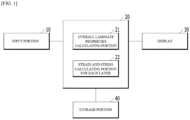
- FIG. 1 is a block diagram of a strength prediction system for a multilayer material according to a first embodiment of the present invention.
- the configuration of the strength prediction system of a multilayer material is configured by a user who includes: an input portion 10 for entering Elastic modulus of the Mechanical Direction (MD, hereinafter referred to as "1" and meaning principal direction) and the Transverse Direction (TD, hereinafter referred to as "2") of each layer (k) (E k 1,2 ), Poisson's ratio of the mechanical direction (1) and the transverse direction (2) of each layer (k) ( ⁇ k 1,2 ), Shear modulus of the mechanical direction (1) and the transverse direction (2) of each layer (k) (G k 1,2 ), angle of the mechanical direction (1) of each layer (k) with respect to the x-direction of the multilayer material ( ⁇ k ), thickness (Z k ) of each layer (k), and the like, a physical property output portion 21, 22, a control portion 20 connected to the input portion 10, a display 30 connected to the control portion 20, and a storage portion 40 connected to the control portion 20.
- MD Elastic modulus of the Mechanical Direction
- TD Transverse Direction
- the term multilayer material refers to a laminate having a stacked structure of two or more materials, which can mean a multilayer film of a polymer or the like, a composite material of dissimilar materials such as fiber reinforced plastics (FRP) and an aluminum pouch, or the like.
- the multilayer material may refer to a multilayer film.
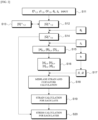
- FIGS. 2 and 3 are flowcharts of a method for predicting the strength of a multilayer material, according to one embodiment of the present invention.
- Equation 1 Equation 1 (S12).
- a compliance matrix ([S] k 1,2 ) for the stiffness matrix ([Q] k 1,2 ) in the mechanical direction (1) and transverse direction (2) of each layer (k) calculated in this way is set (S13).
- the stiffness matrix of the entire laminate is calculated as follows (S15).
- a compliance matrix ([a] x,y , [b] x,y , [c] x,y ,[d] x,y ) for the stiffness matrix of the multilayer material ([A] x,y , [B] x,y , [D] x,y ), which is the entire laminate calculated in this way, is set as shown in the following Equation 4 (S 16).
- Equation 5 is applied to find the strength in the x-direction of the multilayer material
- Equation 6 is applied to find the strength in the y-direction of the multilayer material.
- the calculated stress ( ⁇ k x,y ) of each layer (k) is converted into the principal direction stress ([ ⁇ ] k 1,2 ) of each layer using the layer-specific angle ( ⁇ k ) information (S21).
- the principal stress direction strength ([F] k 1,2 ) of each layer (k) is entered, for example, as follows (S22).
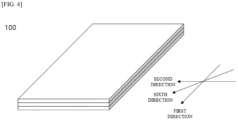
- the direction of each layer is as shown in FIG. 4 .
- the mechanical direction of the multilayer material 100 is set to First or x-direction
- the transverse direction is set to Second or y-direction
- the diagonal direction is set to Sixth or s-direction.
- Equation 11 is an example of applying the Tsai-Wu criterion.
- f k f 1 f 2 f 11 f 22 f 66 f 12 k
- Equation 12 f 12 ⁇ ⁇ 1 2 f 11 f 22 1 / 2
- the safety coefficient (S k f ) of each layer is calculated (S24). For example, applying the Tsai-Wu criterion method, the safety coefficient is calculated as shown in Equation 13 below.
- aS f 2 + bS f ⁇ 1 0
- a f 11 ⁇ 1 2 + f 22 ⁇ 2 2 + f 66 ⁇ 6 2 + 2 f 12 ⁇ 1 ⁇ 2
- b f 1 ⁇ 1 + f 2 ⁇ 2
- the safety coefficient of the broken layer can be defined as the strength value ([ F ] i x,y ) at the corresponding loading cycle (i) (S26).
- the strength in the x-direction of the multilayer material is derived by Equation 14.
- F ⁇ Xt i S fa k i min tensile strength
- F ⁇ XC i S fr ki min compressive strength
- F ⁇ yc i S fr k i min compressive strength
- the defined strength value ([ F ] i x,y ) is determined as the final strength of the multilayer material ([ F ] u x,y ) (S28).
- the ULF criterion is applicable by selecting any one of Examples 1 to 3 below (S27).
- the strength value of the multilayer material defined in S26 ([ F ] i x,y ) does not meet the ULF criteria, it is recalculated by adjusting the elastic modulus of the broken layer determined in the corresponding cycle (i) (S29).
- the inputs to the input portion are not immediately available, they can be derived through a conversion process using other property values.
- the elastic modulus (E k ) of each layer (k) and the Poisson's ratio ( ⁇ k ) of each layer (k) can be calculated from one or more of the following physical properties: first Lame constant ( ⁇ k ), shear modulus (G k ), and volumetric elastic modulus (K k ).
- first Lame constant ( ⁇ k ) first Lame constant
- shear modulus (G k ) shear modulus
- K k volumetric elastic modulus
- the elastic modulus (E k ) and Poisson's ratio ( ⁇ k ) can be converted using Equations 1 through 9 below.
- Equation 9 3 K k 1 ⁇ 2 V k , v k
Landscapes
- Physics & Mathematics (AREA)
- Engineering & Computer Science (AREA)
- Geometry (AREA)
- General Physics & Mathematics (AREA)
- Theoretical Computer Science (AREA)
- Computer Hardware Design (AREA)
- General Engineering & Computer Science (AREA)
- Evolutionary Computation (AREA)
- Mathematical Optimization (AREA)
- Analytical Chemistry (AREA)
- Mathematical Analysis (AREA)
- Computational Mathematics (AREA)
- Health & Medical Sciences (AREA)
- Life Sciences & Earth Sciences (AREA)
- Chemical & Material Sciences (AREA)
- Pure & Applied Mathematics (AREA)
- Biochemistry (AREA)
- General Health & Medical Sciences (AREA)
- Immunology (AREA)
- Pathology (AREA)
- Investigating Strength Of Materials By Application Of Mechanical Stress (AREA)
- Laminated Bodies (AREA)
Abstract
Description
- This application claims the benefit of priority based on
Korean Patent Application No. No. 10-2022-0071405, filed on June 13, 2022 - The present invention relates to a system and method for predicting the strength of multilayer materials, and more specifically, multilayer films.
- Polymeric films refer to non-fibrous flat plastic moldings with a thickness of 0.25 mm or less. They are lightweight, have good barrier properties, excellent transparency, and are relatively inexpensive, and are used in almost every field, including packaging, household products, electronics, automobiles, and aircrafts.
- However, there is a limitation that a single film alone cannot fulfill the complex properties required. In order to improve this, multilayer materials that are composed of two or more films stacked together are being developed.
- In the process of developing multilayer materials, the properties of the multilayer material, especially the strength, cannot be derived by summing the properties of the individual films. Conventionally, in order to evaluate the properties, especially the strength, of multilayer materials, multilayer material specimens are manufactured for each combination and evaluations are performed on the manufactured specimens. This method of manufacturing multilayer material specimens has the limitation that it is not only time-consuming to manufacture multilayer material specimens, but also difficult to evaluate all the different types of films and their properties.
- Therefore, there is a need for a method to predict the properties of multilayer materials, especially their strength, without directly manufacturing them.
- As described above, the object of the present disclosure is to provide a system or method for predicting the properties of a multilayer material, in particular its strength, during a simulation phase.
- To achieve the above objectives, the present disclosure provides a strength prediction system for multilayer materials.
In an exemplary embodiment, the present invention relates to a strength prediction system for a multilayer material with n films stacked (where n is an integer greater than or equal to 2) including: an input portion where one or more of the following is entered: elastic modulus (Ek) of each layer (k), Poisson's ratio (υk), Young's modulus (Gk), thickness (Zk), stacking angle (θk), principal stress direction strength ([F]k), and total thickness (h) of the multilayer material; a control portion that calculates the strength of a multilayer material by applying the values entered in the input portion; a display connected to the control portion; and a storage portion connected to the control portion. - In addition, the control portion is configured to perform the following steps:
- (a) calculate the stress of each layer based on the values entered in the input portion,
- (b) apply each layer's stacking angle (θk) to the stress in each layer to convert them to principal direction stress ([σ]k) of each layer,
- (c) configure the separately entered principal stress direction strength ([F]k) of each layer as a strength discrimination parameter ([f]k) that determines the strength of a multilayer material,
- (d) combine the principal direction stress ([σ]k) and the strength discrimination parameter ([f]k) of each layer to calculate the safety coefficient of each layer, and
- (e) extract the smallest value among the safety coefficients of each calculated layer and defines it as a strength value of a multilayer material.
- In a specific exemplary embodiment, defining the strength value of a multilayer material from the calculated safety coefficient of each layer comprises extracting the smallest value of the safety coefficient for each calculated layer, and defining the smallest extracted value as the strength value of the multilayer material if the safety coefficient meets a preset Ultimate Laminate Failure (ULF) criterion.
- In an exemplary embodiment, the control portion repeats a cycle including the step (a) to the step (d) n times, wherein the k+1th cycle is performed by applying the value calculated in the kth cycle to the input value, and the strength at break of all n layers forming the multilayer material is selected as the strength of the multilayer material. Here, k is an integer between 1 and n-1, and n is the number of layers comprising the multilayer material.
- In another exemplary embodiment, the control portion repeats a cycle including the step (a) to the step (d), and applies the value calculated in the kth cycle to the input value to perform the k+1th cycle, and defines the value calculated in the kth cycle as the strength of the multilayer material if the strength of the multilayer material defined by comparing the value calculated in the kth cycle with the value calculated in the k+1th cycle is no longer increasing. Here, k is an integer between 1 and n-1, and n is the number of layers comprising the multilayer material.
- In an exemplary embodiment, the control portion calculating the stress of each layer based on the values entered in the input portion is done by the following steps:
- applying the elastic modulus, Poisson's ratio, and Shear modulus of each input layer to derive the stiffness matrix ([Q]k) of each layer;
- resetting the stiffness matrix of each layer by reflecting the stacking angle (θk) of each layer in the derived stiffness matrix value;
- calculating the stiffness matrix of a multilayer material using the reset stiffness matrix value given the thickness (Zk) of each layer;
- setting the compliance matrix for the stiffness matrix of the calculated multilayer material;
- calculating the mid-plane strain and curvature using a compliance matrix for arbitrary forces (/F) and moments (/M);
- calculating the strain of each layer using the calculated mid-plane strain and curvature, and the thickness (Zk) of each layer; and
- calculating the stress of each layer by using the strain in each layer and the stiffness matrix ([Q]k) of each layer.
- In addition, the present disclosure provides a strength prediction method for a multilayer material.
- In an exemplary embodiment, the present invention relates to a strength prediction method for a multilayer material with n films stacked (where n is an integer greater than or equal to 2) including the following the steps:
- (a) calculating the stress of each layer by entering one or more of the following: elastic modulus (Ek), Poisson's ratio (υk), shear modulus (Gk), thickness (Zk), stacking angle (θk), and total thickness (h) of the multilayer material;
- (b) applying the stacking angle (θk) of each layer to the calculated stresses of each layer to convert it to the principal direction stress ([σ]k);
- (c) configuring the separately entered principal stress direction strengths ([F]k) of each layer as strength discrimination parameters ([f]k) that determine the strength of the multilayer material;
- (d) calculating the safety coefficient of each layer by combining the principal direction stress ([σ]k) and the strength discrimination parameter ([f]k) of each layer; and
- (e) extracting the smallest value among the safety coefficients of each calculated layer and defining it as the strength value of the multilayer material.
- In a specific exemplary embodiment, the step (e) comprises extracting the smallest value among the safety coefficients of each calculated layer, and defining the smallest extracted value as the strength value of the multilayer material if the safety coefficient meets a preset Ultimate Laminate Failure (ULF) criterion.
- In an exemplary embodiment, in the present invention, a cycle including the step (a) to the step (d) is repeated n times, wherein the k+1th cycle is performed by applying the value calculated in the kth cycle to the input value, and the strength at break of all n layers forming the multilayer material is selected as the strength of the multilayer material. Here, k is an integer between 1 and n-1, and n is the number of layers comprising the multilayer material.
- In another example, in the present invention, a cycle including the step (a) to the step (d) is repeated, wherein the k+1th cycle is performed by applying the value calculated in the kth cycle to the input value, and the value calculated in the kth cycle is defined as the strength of the multilayer material if the strength of the multilayer material defined by comparing the value calculated in the kth cycle with the value calculated in the k+1th cycle is no longer increasing. Here, k is an integer between 1 and n-1, and n is the number of layers comprising the multilayer material.
- In one example, the aforementioned calculating the stress of each layer includes the following steps:
- deriving the stiffness matrix ([Q]k) of each layer by applying the elastic modulus, Poisson's ratio, and Shear modulus of each input layer;
- resetting the stiffness matrix of each layer to reflect the stacking angle (θk) of each layer in the derived stiffness matrix value;
- calculating the stiffness matrix of a multilayer material using the reset stiffness matrix value, given the thickness (Zk) of each layer;
- setting the compliance matrix for the stiffness matrix of the calculated multilayer material;
- calculating the mid-plane strain and curvature using a compliance matrix for arbitrary forces (/F) and moments (/M);
- calculating the strain of each layer using the calculated mid-plane strain and curvature, and the thickness (Zk) of each layer; and
- calculating the stress of each layer by using the strain in each layer and the stiffness matrix ([Q]k) of each layer.
- According to the present disclosure, a system and method for predicting the strength of a multilayer material can predict the properties of the multilayer material, in particular its strength, without manufacturing a multilayer material specimen.
-
-
FIG. 1 is a block diagram of a property prediction system for a multilayer material according to a first embodiment of the present invention. -
FIGS. 2 and3 are flowcharts of a method for predicting the strength of a multilayer material, according to one embodiment of the present invention. -
FIG. 4 is a schematic diagram illustrating the orientation of a multilayer material. - The present disclosure provides a strength prediction system for a multilayer material having n films stacked (where n is an integer greater than or equal to 2).
- In an exemplary embodiment, a strength prediction system for a multilayer material according to the present invention includes an input portion where one or more of the following is entered: elastic modulus (Ek) of each layer (k), Poisson's ratio (υk), Young's modulus (Gk), thickness (Zk), stacking angle (θk), principal stress direction strength ([F]k), and total thickness (h) of the multilayer material;
- a control portion that calculates the strength of a multilayer material by applying the values entered in the input portion;
- a display connected to the control portion; and
- a storage portion connected to the control portion.
- In addition, the control portion is configured to perform the following steps: (a) calculate the stress of each layer based on the values entered in the input portion, (b) apply each layer's stacking angle (θk) to the stress in each layer to convert them to principal direction stress ([σ]k) of each layer, (c) configure the separately entered principal stress direction strength ([F]k) of each layer as a strength discrimination parameter ([f]k) that determines the strength of a multilayer material, (d) combine the principal direction stress ([σ]k) and the strength discrimination parameter ([f]k) of each layer to calculate the safety coefficient of each layer, and (e) extract the smallest value among the safety coefficients of each calculated layer and defines it as a strength value of a multilayer material.
- In addition, the present disclosure provides a strength prediction method for a multilayer material.
- In an exemplary embodiment, the present invention relates to a strength prediction method for a multilayer material with n films stacked (where n is an integer greater than or equal to 2) including:
- calculating the stress of each layer by entering one or more of the following: elastic modulus (Ek), Poisson's ratio (υk), shear modulus (Gk), thickness (Zk), stacking angle (θk), and total thickness (h) of the multilayer material (step a);
- applying the stacking angle (θk) of each layer to the calculated stresses of each layer to convert it to the principal direction stress ([σ]k) (step b);
- configuring the separately entered principal stress direction strengths ([F]k) of each layer as strength discrimination parameters ([f]k) that determine the strength of the multilayer material (step c);
- calculating the safety coefficient of each layer by combining the principal direction stress ([σ]k) and the strength discrimination parameter ([f]k) of each layer (step d); and
- extracting the smallest value among the safety coefficients of each calculated layer and defining it as the strength value of the multilayer material (step e).
- As an example, the process of predicting the strength of a multilayer material in the present disclosure is as follows.
- The input information includes one or more of the following: Elastic modulus in the mechanical direction (MD, 1) and Transverse Direction (TD, 2) of each layer (k) (Ek 1,2), Poisson's ratio in the mechanical direction (1) and Transverse Direction (2) of each layer (k) (υk 1,2), Shear modulus in the mechanical direction (1) and the transverse direction (2) of each layer (k) (Gk 1,2), an angle (θk) of the mechanical direction (1) of each layer (k) with respect to the x-direction of the multilayer material, a thickness (Zk) of each layer (k), and a total thickness (h) of the multilayer material. In addition, the input information includes a principal stress direction strength ([F]k) of each layer.
- First, using the input information, calculate the stress (σk x,y) of each layer (k). Then, apply the stacking angle (θk) of each layer to the calculated stress (σk x,y) to convert it to the principal direction stress ([σ]k 1,2) of each layer.
- In addition, the principal stress direction strength ([F]k 1,2) of each layer entered separately is configured as a strength discrimination parameter ([f]k 1,2) to determine the strength of the multilayer material, and the safety coefficient (Sk f) of each layer is calculated by combining the principal direction stress ([σ]k 1,2) and the strength discrimination parameter ([f]k 1,2). For example, the Tsai-Wu criterion can be applied to calculate the safety coefficient (Sk f) of each layer, or the Maximum Stress criterion, Maximum Strain criterion, or Tsai-Hill criterion can be appropriately applied.
- The smallest value ((Sk f)min) among the calculated safety coefficient (Sk f) of each layer is extracted and defined as the strength value ([
F ]i x,y) of the multilayer material. Here, the smallest value ((Sk f)min) of the calculated safety coefficient of each layer is defined as the strength value of the multilayer material ([F ]i x,y), and if this value meets the preset Ultimate Laminate Failure (ULF) criteria, it is defined as the final strength value of the multilayer material ([F ]u x,y). - The process of extracting the smallest value ((Sk f)min) of the calculated safety coefficient (Sk f) of each layer and defining it as the strength value ([
F ]i x,y) of the multilayer material can be categorized into the following three methods depending on how the ULF criteria is applied. - As in the first method, the aforementioned steps of calculating the stress of each layer (step a) to calculating the safety coefficient of each layer (step d) are repeated once, and the smallest value ((Sk f)min) of the calculated safety coefficient of each layer (Sk f) is extracted and defined as the strength value of the multilayer material ([
F ]i x,y), If the defined strength value ([F ]i x,y) of the multilayer material meets the preset Ultimate Laminate Failure (ULF) criteria, it is defined as the final strength value of the multilayer material ([F ]u x,y). In this case, if any of the layers of the multilayer material breaks, the strength reflecting this is selected as the strength value of the final multilayer material. - As in the second method, the aforementioned steps of calculating the stress of each layer (step a) to calculating the safety coefficient of each layer (step d) are repeated n times, but the value calculated in the kth cycle is applied to the input value to perform the k+1th cycle. The strength at break of all n layers forming the multilayer material is defined as the strength value of the multilayer material ([
F ]i x,y), and if this value meets the preset ULF (Ultimate Laminate Failure) criteria, it is defined as the final strength value of the multilayer material ([F ]u x,y). Here, k is an integer between 1 and n-1, and n is the number of layers comprising the multilayer material. For each cycle, the smallest value ((Sk f)min) of the calculated safety coefficient (Sk f) of each layer is extracted and defined as the strength value ([F ]i x,y) of the multilayer material in that cycle. In this case, the final strength value of the multilayer material is selected to reflect the strength at which all the layers that make up the multilayer material break. - As in the third method, the step of calculating the stress of each layer (step a) to the step of calculating the safety coefficient of each layer (step d) described above are repeated, but the value calculated in the kth cycle is applied to the input value to perform the k+1th cycle, and if the strength of the multilayer material defined by comparing the value calculated in the kth cycle and the value calculated in the k+1th cycle no longer increases, the value calculated in the kth cycle is defined as the strength of the multilayer material. Here, k is an integer between 1 and n-1, and n is the number of layers comprising the multilayer material. For each cycle, the smallest value ((Sk f)min) of the calculated safety coefficient (Sk f) of each layer is extracted and defined as the strength value ([
F ]i x,y) of the multilayer material in that cycle. In this case, the strength of the layer that bears the maximum load among the layers comprising the multilayer material is selected as the final strength value of the multilayer material. - In another exemplary embodiment, the smallest value ((Sk f)min) of the calculated safety coefficient (Sk f) of each layer is extracted and defined as the strength value ([
F ]i x,y)) of the multilayer material. In this case, the smallest value ((Sk f)min) of the calculated safety coefficient of each layer is defined as the strength value ([F ]i x,y) of the multilayer material, which can be checked for compliance with a preset Ultimate Laminate Failure (ULF) criterion. - If the value defined as the strength value of the multilayer material ([
F ]i x,y) meets the preset Ultimate Laminate Failure (ULF) criteria, it is defined as the final strength value of the multilayer material ([F ]u x,y). - Conversely, if the value defined as the strength value of the multilayer material ([
F ]i x,y) does not meet the preset Ultimate Laminate Failure (ULF) criteria, it is recalculated by adjusting the elastic modulus of the broken layer determined in that cycle. As a specific example, the elastic modulus of the broken layer is adjusted by applying a coefficient r to it. For example, in the case of r=0, it is assumed that the broken layer in that cycle has lost its stress-bearing capacity in that direction in the next loading cycle, and in the range of 0<r<1, it is assumed that the broken layer in that cycle has lost some of its stress-bearing capacity in the next loading cycle. At the same time, the strength of the broken layer is changed to infinity so that the same layer does not break in the next loading cycle. - In yet another embodiment, the step of calculating the stress of each layer (step a) is entered with one or more of elastic modulus (Ek), Poisson's ratio (υk), Young's modulus (Gk), thickness (Zk), stacking angle (θk), and total thickness (h) of the multilayer material, and can be performed as follows.
- First, the following information is input: Elastic modulus in the Mechanical direction (MD, 1) and Transverse Direction (TD, 2) of each layer (k) (Ek 1,2), Poisson's ratio in the Mechanical direction (1) and Transverse Direction (2) of each layer (k) (υk 1,2), Shear modulus in the mechanical direction (1) and transverse direction (2) of each layer (k) (Gk 1,2), angle (θk) of the mechanical direction (1) of each layer (k) to the x-direction of the multilayer material, thickness (Zk) of each layer (k), and total thickness (h) of the multilayer material.
- Using the elastic modulus (Ek 1,2), Poisson's ratio (υk 1,2), and shear modulus (Gk 1,2), the stiffness matrix ([Q]k 1,2) in the mechanical direction (1) and transverse direction (2) of each layer (k) is calculated, a compliance matrix ([S] k 1,2) for the stiffness matrix ([Q]k 1,2) in the mechanical direction (1) and the transverse direction (2) of each layer (k) is set, the stiffness matrix ([Q]k 1,2) of each layer (k) is reset by reflecting the stacking angle (θk) of each layer (k) in the stiffness matrix ([Q]k x,y), and the stiffness matrix ([A]x,y, [B]x,y, [D]x,y) of the multilayer material is calculated by receiving the thickness (Zk) information of each layer (k) and using the reset stiffness matrix value. Then, a compliance matrix ([a]x,y, [b]x,y, [c]x,y, [d]x,y) for the multilayer material stiffness matrix ([A]x,y, [B]x,y, [D]x,y) is set.
- Then, the compliance matrix for the arbitrary force (/F) and moment (/M) is used to calculate the mid-plane strain and curvature, and the calculated mid-plane strain and curvature, along with the thickness (Zk)of each layer, are used to calculate the strain in each layer.
- Specifically, an arbitrary force (/F) and moment (/M) are hypothetical external forces that can be defined using the total thickness value to virtually apply a unit normal stress to a multilayer material.
- Using the forces (/N) and moments (/M) and the compliance matrix ([a]x,y, [b]x,y, [c]x,y,[d]x,y) for the stiffness matrix ([A]x,y, [B]x,y, [D]x,y) of the multilayer material, the mid-plane strains (∈0 x,y) and curvatures (kx,y,s) are calculated, and using the mid-plane strains (∈0 x,y) and curvatures (kx,y,s), and the thickness (Zk) of each layer (k), the strain (εk x,y) of each layer (k) is calculated, and the stress (σk x,y) of each layer (k) is calculated using the strain and the stiffness matrix ([Q]k x,y) of each layer (k). Then, the stacking angle (θk) of each layer is applied to the calculated stress (σk x,y) to convert it to the principal direction stress ([σ]k 1,2) of each layer.
- The following drawings and exemplary embodiments will further illustrate the present invention, but are not intended to be limiting.
-
FIG. 1 is a block diagram of a strength prediction system for a multilayer material according to a first embodiment of the present invention. - As shown in
FIG. 1 , the configuration of the strength prediction system of a multilayer material according to the first embodiment of the present invention is configured by a user who includes: aninput portion 10 for entering Elastic modulus of the Mechanical Direction (MD, hereinafter referred to as "1" and meaning principal direction) and the Transverse Direction (TD, hereinafter referred to as "2") of each layer (k) (Ek 1,2), Poisson's ratio of the mechanical direction (1) and the transverse direction (2) of each layer (k) (υk 1,2), Shear modulus of the mechanical direction (1) and the transverse direction (2) of each layer (k) (Gk 1,2), angle of the mechanical direction (1) of each layer (k) with respect to the x-direction of the multilayer material (θk), thickness (Zk) of each layer (k), and the like, a physicalproperty output portion control portion 20 connected to theinput portion 10, adisplay 30 connected to thecontrol portion 20, and astorage portion 40 connected to thecontrol portion 20. - In the present dislcosure, the term multilayer material refers to a laminate having a stacked structure of two or more materials, which can mean a multilayer film of a polymer or the like, a composite material of dissimilar materials such as fiber reinforced plastics (FRP) and an aluminum pouch, or the like. For example, the multilayer material may refer to a multilayer film.
-
FIGS. 2 and3 are flowcharts of a method for predicting the strength of a multilayer material, according to one embodiment of the present invention. - Referring to
FIG. 2 , in a multilayer material having two or more materials stacked, - Elastic modulus in the mechanical direction (1) and transverse direction (2) of each layer (k) (Ek 1,2), Poisson's ratio in the mechanical direction (1) and transverse direction (2) of each layer (k) (υk 1,2), Shear modulus in the mechanical direction (1) and transverse direction (2) of each layer (k) (Gk 1,2), angle of each layer in the mechanical direction (1) with respect to the x-direction of the multilayer material (θk), and thickness of each layer (k) (Zk) are entered (
S 1 1). - Using the above elastic modulus (Ek 1,2), Poisson's ratio (υk 1,2), and shear modulus (Gk 1,2), the stiffness matrix ([Q]k 1,2) in the mechanical direction (1) and transverse direction (2) of each layer (k) is calculated as shown in the following Equation 1 (S12).

- A compliance matrix ([S]k 1,2) for the stiffness matrix ([Q]k 1,2) in the mechanical direction (1) and transverse direction (2) of each layer (k) calculated in this way is set (S13).
- Reflecting the stacking angle (θk) of each layer (k) in the stiffness matrix ([Q]k 1,2) derived above, the stiffness matrix ([Q]k x,y) of each layer (k) is reset as shown in the following Equation 2 (S14).

- Using the thickness information of each layer (k) and the reset stiffness matrix value, the stiffness matrix of the entire laminate, the multilayer material ([A]x,y, [B]x,y, [D]x,y), is calculated as follows (S15).

- A compliance matrix ([a]x,y, [b]x,y, [c]x,y,[d]x,y) for the stiffness matrix of the multilayer material ([A]x,y, [B]x,y, [D]x,y), which is the entire laminate calculated in this way, is set as shown in the following Equation 4 (S 16).

- In the present invention, in order to virtually apply a unit normal stress to the entire multilayer material, the total thickness value can be used to define the following Equation 5 or Equation 6 (S17). Here, Equation 5 is applied to find the strength in the x-direction of the multilayer material, and Equation 6 is applied to find the strength in the y-direction of the multilayer material.


- Using the input total force (/N) and total moment (/M) and the compliance matrix ([a]x,y, [b]x,y, [c]x,y,[d]x,y) for the stiffness matrix ([A]x,y, [B]x,y, [D]x,y), which is the entire laminate, the strains (∈0 x,y) and curvatures (kx,y,s) of the mid-plane are calculated as in Equation 7 (S 18).

- Using the strain (∈0 x,y) and curvature (kx,y,s) of the mid-plane and the thickness (Zk) of each layer (k) entered through the input portion, the strain (εk x,y) of each layer (k) is calculated as shown in the following Equation 8 (S19),

- Using the strain of each layer (k) and the stiffness matrix of each layer (k) ([Q]k x,y), the stress (σk x,y) of each layer (k) is calculated as shown in the following Equation 9 (S20).

- Next, referring to
FIG. 3 , the calculated stress (σk x,y) of each layer (k) is converted into the principal direction stress ([σ]k 1,2) of each layer using the layer-specific angle (θk) information (S21). Here, the followingEquation 10 is used.
- Separately, the principal stress direction strength ([F]k 1,2) of each layer (k) is entered, for example, as follows (S22).
- First direction tensile strength of each layer (k): Fk 1t, First direction compressive strength: Fk 1c
- Second direction tensile strength of each layer (k): Fk 2t, Second direction compressive strength: Fk 2c
- Sixth direction tensile strength of each layer (k): Fk 6, First-Second direction biaxial tensile strengths: Fk 12
- Here, the direction of each layer is as shown in
FIG. 4 . Referring toFIG. 4 , the mechanical direction of themultilayer material 100 is set to First or x-direction, the transverse direction is set to Second or y-direction, and the diagonal direction is set to Sixth or s-direction. - Using the input strength of each layer (k), the parameters for determining the strength of the entire multilayer material are configured as shown in
Equation 11 below (S23).Equation 11 below is an example of applying the Tsai-Wu criterion.
- Here, if the experimental biaxial tensile strength is not available, it can be assumed as shown in
Equation 12 below.
- Using the principal direction stress ([σ]k 1,2) and the strength discrimination parameter ([f]k 1,2) of each layer, the safety coefficient (Sk f) of each layer is calculated (S24). For example, applying the Tsai-Wu criterion method, the safety coefficient is calculated as shown in Equation 13 below.
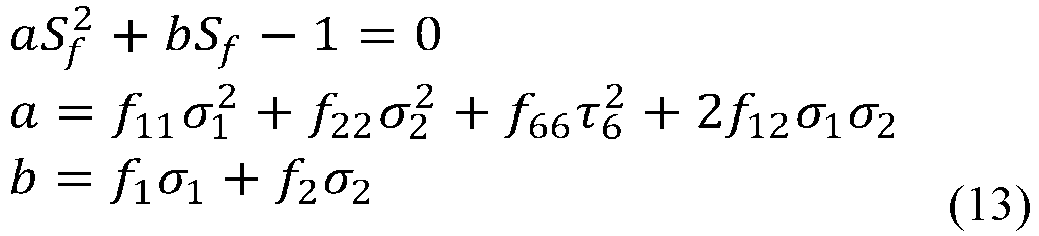
- Solving the quadratic equation in
Equation 12, two solutions for each layer (k) safety coefficient (Sk f) can be obtained, where the positive value (Sk fa) represents the tensile strength and the negative value (Sk fr) represents the compressive strength. By comparing the safety coefficient of each layer, the layer (ki) that exhibits the smallest safety coefficient can be defined as the broken layer (S25). - Here, the safety coefficient of the broken layer can be defined as the strength value ([
F ]i x,y) at the corresponding loading cycle (i) (S26). In this case, if a unit normal stress has been applied by Equation 5 in the previous step S17, the strength in the x-direction of the multilayer material is derived by Equation 14.
- Furthermore, if a unit normal stress is applied by Equation 6 in the
previous step S 17, the y-direction strength of the multilayer material is derived byEquation 15.
- If the result of that loading cycle meets the preset Ultimate Laminate Failure (ULF) criteria (S27), the defined strength value ([
F ]i x,y) is determined as the final strength of the multilayer material ([F ]u x,y) (S28). - If the ULF criterion is not met, the entire algorithm cycle is reapplied by performing steps S29 and S30.
- Here, the ULF criterion is applicable by selecting any one of Examples 1 to 3 below (S27).
- (Example 1) Loading cycle (i=1), when any one of the layers comprising the multilayer material breaks, the corresponding strength is selected as the final strength of the multilayer material.
- (Example 2) Loading cycle (i=n), when all layers (n) forming the multilayer material have been completely broken, the corresponding strength is selected as the final strength of the multilayer material.
- (Example 3) When comparing the result of the ith loading cycle with the result of the i+1th loading cycle, if the strength does not increase, the strength selected in the ith loading cycle is selected as the final strength.
- If the strength value of the multilayer material defined in S26 ([
F ]i x,y) does not meet the ULF criteria, it is recalculated by adjusting the elastic modulus of the broken layer determined in the corresponding cycle (i) (S29). In this case, a factor r is applied to the elastic modulus of the broken layer to adjust it. For example, in the case of r=0, it is assumed that the broken layer in that cycle has lost its stress-bearing capacity in that direction in the next loading cycle, and in the case of 0<r<1, it is assumed that the broken layer in that cycle has lost some of its stress-bearing capacity in the next loading cycle. - At the same time, the strength of the broken layer is changed to infinity so that the same layer does not break in the next loading cycle (S30).
- In yet another exemplary embodiment of the present invention, if the inputs to the input portion are not immediately available, they can be derived through a conversion process using other property values.
- In one exemplary embodiment, the elastic modulus (Ek) of each layer (k) and the Poisson's ratio (υk) of each layer (k) can be calculated from one or more of the following physical properties: first Lame constant (λk), shear modulus (Gk), and volumetric elastic modulus (Kk). For example, the elastic modulus (Ek) and Poisson's ratio (υk) can be converted using
Equations 1 through 9 below. - If the obtainable combination is (λk, Gk), then it is according to
Equation 1 below.
- If the obtainable combination is (λk, Ek), then it is according to Equation 2.

- If the obtainable combination is (λk, υk), then it is according to Equation 3.

- If the obtainable combination is (λk, Kk), then it is according to Equation 4.

- If the obtainable combination is (Gk, Ek), then it is according to Equation 5.

- If the obtainable combination is (Gk, υk), then it is according to Equation 6.

- If the obtainable combination is (Gk, Kk), then it is according to Equation 7.

- If the obtainable combination is (Kk, Ek), then it is according to Equation 8.

- If the obtainable combination is (Kk, υk), then it is according to Equation 9.

-
Equations 1 through 9 above are examples, and two or more equations can be combined as needed. -
- 10: INPUT PORTION
- 20: CONTROL PORTION
- 21: OVERALL LAMINATE PROPERTIES CALCULATING PORTION
- 22: EXPANSION COEFFICIENT AND DISTORTION CALCULATING PORTION
- 30: DISPLAY
- 40: STORAGE PORTION
- 100: MULTILAYER MATERIAL
Claims (10)
- A strength prediction system for a multilayer material with n films stacked, wherein n is an integer greater than or equal to 2, comprising:an input portion configured to accept one or more values; wherein the values include an elastic modulus of each layer, a Poisson's ratio, a Young's modulus, a thickness, a stacking angle, a principal stress direction strength, and a total thickness of a multilayer material;a control portion configured to calculate a strength of a multilayer material by applying the values entered in the input portion;a display connected to the control portion; anda storage portion connected to the control portion,wherein the control portion is configured to perform a cycle including: (a) calculating a stress of each layer based on the values entered in the input portion, (b) applying each layer's stacking angle to the stress in each layer to convert them to a principal direction stress of each layer, (c) configuring the separately entered principal stress direction strength of each layer as a strength discrimination parameter that determines the strength of a multilayer material, (d) combining the principal direction stress and the strength discrimination parameter of each layer to calculate a safety coefficient of each layer, and wherein the control portion is configured to extract a smallest value among the safety coefficients of each calculated layer and define the smallest value as a strength value of a multilayer material.
- The strength prediction system for the multilayer material of claim 1, wherein
the smallest value among the safety coefficients of each calculated layer is defined as the smallest extracted value as the strength value of the multilayer material if the safety coefficient meets a preset Ultimate Laminate Failure (ULF) criterion. - The strength prediction system for the multilayer material of claim 1, whereinthe control portion is configured to repeat the cycle including the steps (a) to (d) n times, wherein a k+1th cycle is performed by applying a value calculated in a kth cycle to an input value, and a strength at break of all n layers forming the multilayer material is selected as the strength of the multilayer material, whereink is an integer between 1 and n-1, and n is the number of layers comprising the multilayer material.
- The strength prediction system for the multilayer material of claim 1, whereinthe control portion is configured to repeat the cycle including the steps (a) to (d), andapply a value calculated in a kth cycle to an input value to perform a k+1th cycle, and defines the value calculated in the kth cycle as a strength of the multilayer material if the strength of the multilayer material defined by comparing the value calculated in the kth cycle with the value calculated in the k+1th cycle is no longer increasing, whereink is an integer between 1 and n-1, and n is the number of layers comprising the multilayer material.
- The strength prediction system for the multilayer material of claim 1, whereinthe control portion is configured to calculate the stress of each layer based on the values entered in the input portion byapplying an elastic modulus, a Poisson's ratio, and a Shear modulus of each input layer to derive a stiffness matrix of each layer;resetting the stiffness matrix of each layer by reflecting the stacking angle of each layer in the derived stiffness matrix value;calculating the stiffness matrix of a multilayer material using the reset stiffness matrix value given the thickness of each layer;setting a compliance matrix for the calculated stiffness matrix of a multilayer material;calculating a mid-plane strain and a curvature using the compliance matrix for arbitrary forces and moments;calculating a strain of each layer using the calculated mid-plane strain and curvature, and a thickness of each layer; andcalculating the stress of each layer by using the strain in each layer and the stiffness matrix of each layer.
- A strength prediction method for a multilayer material with n films stacked, wherein n is an integer greater than or equal to 2, comprising:(a) calculating a stress of each layer by entering one or more of the following values: an elastic modulus, a Poisson's ratio, a shear modulus, a thickness, a stacking angle, and a total thickness of a multilayer material;(b) applying a stacking angle of each layer to the calculated stresses of each layer to convert it to a principal direction stress;(c) configuring a separately entered principal stress direction strength of each layer as a strength discrimination parameter that determines a strength of the multilayer material;(d) calculating a safety coefficient of each layer by combining the principal direction stress and the strength discrimination parameter of each layer; andextracting a smallest value among the safety coefficients of each calculated layer and defining the smallest value as a strength value of the multilayer material.
- The strength prediction method for a multilayer material of claim 6, wherein the smallest value among the safety coefficients of each calculated layer is defined as the strength value of the multilayer material if the safety coefficient meets a preset Ultimate Laminate Failure (ULF) criterion.
- The strength prediction method for a multilayer material of claim 6, further comprising:repeating the steps (a) to (d) is repeated n times, whereina k+1th cycle is performed by applying a value calculated in a kth cycle to an input value, and a strength at break of all n layers forming the multilayer material is selected as the strength of the multilayer material, whereink is an integer between 1 and n-1, and n is the number of layers comprising the multilayer material.
- The strength prediction method for a multilayer material of claim 6, further comprising:repeating the steps (a) to (d), whereina k+1th cycle is performed by applying a value calculated in a kth cycle to an input value, andthe value calculated in the kth cycle is defined as the strength of the multilayer material if the strength of the multilayer material defined by comparing the value calculated in the kth cycle with the value calculated in the k+1th cycle is no longer increasing, whereink is an integer between 1 and n-1, and n is the number of layers comprising the multilayer material.
- The strength prediction method for a multilayer material of claim 6, wherein
the calculating the stress of each layer further comprises:deriving a stiffness matrix of each layer by applying an elastic modulus, a Poisson's ratio, and a Shear modulus of each input layer;resetting the stiffness matrix of each layer to reflect the stacking angle of each layer in the derived stiffness matrix value;calculating the stiffness matrix of a multilayer material using the reset stiffness matrix value, given the thickness of each layer;setting a compliance matrix for the calculated stiffness matrix of a multilayer material;calculating a mid-plane strain and a curvature using the compliance matrix for arbitrary forces and moments;calculating a strain of each layer using the calculated mid-plane strain and curvature, and the thickness of each layer; andcalculating the stress of each layer by using the strain in each layer and the stiffness matrix of each layer.
Applications Claiming Priority (2)
| Application Number | Priority Date | Filing Date | Title |
|---|---|---|---|
| KR1020220071405A KR20230171164A (en) | 2022-06-13 | 2022-06-13 | System and Method for Predicting Strength of multilayered Material |
| PCT/KR2023/007530 WO2023243914A1 (en) | 2022-06-13 | 2023-06-01 | System and method for predicting strength of multi-layered material |
Publications (2)
| Publication Number | Publication Date |
|---|---|
| EP4372359A1 true EP4372359A1 (en) | 2024-05-22 |
| EP4372359A4 EP4372359A4 (en) | 2025-01-08 |
Family
ID=89191578
Family Applications (1)
| Application Number | Title | Priority Date | Filing Date |
|---|---|---|---|
| EP23824132.7A Pending EP4372359A4 (en) | 2022-06-13 | 2023-06-01 | SYSTEM AND METHOD FOR PREDICTING STRENGTH OF MULTILAYER MATERIAL |
Country Status (6)
| Country | Link |
|---|---|
| US (1) | US20240427952A1 (en) |
| EP (1) | EP4372359A4 (en) |
| JP (1) | JP7740793B2 (en) |
| KR (1) | KR20230171164A (en) |
| CN (1) | CN118159827A (en) |
| WO (1) | WO2023243914A1 (en) |
Families Citing this family (1)
| Publication number | Priority date | Publication date | Assignee | Title |
|---|---|---|---|---|
| KR20250169861A (en) | 2024-05-27 | 2025-12-04 | 주식회사 엘지화학 | Multilayer Material Property Prediction apparatus and Method |
Family Cites Families (7)
| Publication number | Priority date | Publication date | Assignee | Title |
|---|---|---|---|---|
| JP4081330B2 (en) * | 2002-09-04 | 2008-04-23 | 横浜ゴム株式会社 | Mechanical property simulation method and mechanical property simulation apparatus for composite material |
| JP4459120B2 (en) | 2005-06-24 | 2010-04-28 | トヨタ自動車株式会社 | Laminated material analysis method |
| KR100927705B1 (en) | 2008-04-24 | 2009-11-18 | 한국기계연구원 | How to measure the stress-strain relationship in microstructures |
| KR101200167B1 (en) * | 2011-01-13 | 2012-11-13 | 한국항공우주산업 주식회사 | Analysis system and method for composite materials |
| JP2013097521A (en) | 2011-10-31 | 2013-05-20 | Toray Ind Inc | Strength analysis method for composite material |
| KR101677840B1 (en) * | 2015-04-03 | 2016-11-21 | 연세대학교 산학협력단 | Apparatus and method for assessment of flexible multi-layered thin film |
| KR20220071405A (en) | 2020-11-24 | 2022-05-31 | 김학철 | Agricultural support system and method using big data of smart farm |
-
2022
- 2022-06-13 KR KR1020220071405A patent/KR20230171164A/en active Pending
-
2023
- 2023-06-01 WO PCT/KR2023/007530 patent/WO2023243914A1/en not_active Ceased
- 2023-06-01 CN CN202380013314.2A patent/CN118159827A/en active Pending
- 2023-06-01 EP EP23824132.7A patent/EP4372359A4/en active Pending
- 2023-06-01 JP JP2024510371A patent/JP7740793B2/en active Active
- 2023-06-01 US US18/685,314 patent/US20240427952A1/en active Pending
Also Published As
| Publication number | Publication date |
|---|---|
| EP4372359A4 (en) | 2025-01-08 |
| JP2024532205A (en) | 2024-09-05 |
| JP7740793B2 (en) | 2025-09-17 |
| CN118159827A (en) | 2024-06-07 |
| US20240427952A1 (en) | 2024-12-26 |
| KR20230171164A (en) | 2023-12-20 |
| WO2023243914A1 (en) | 2023-12-21 |
Similar Documents
| Publication | Publication Date | Title |
|---|---|---|
| Kim et al. | Design optimization and manufacture of hybrid glass/carbon fiber reinforced composite bumper beam for automobile vehicle | |
| Lin et al. | Parametric study on the failure of fiber-reinforced composite laminates under biaxial tensile load | |
| Ahamed et al. | Ply-overlap hybrid technique for joining dissimilar composite materials | |
| US20240427952A1 (en) | System and Method for Predicting Strength of Multi-Layered Material | |
| KR102941304B1 (en) | Apparatus and method for predicting physical properties of multilayer materials | |
| Akhras et al. | Progressive failure analysis of thick composite plates using the spline finite strip method | |
| EP4209774A1 (en) | Device and method for predicting physical properties of multilayer material | |
| EP4202402A1 (en) | System and method for predicting physical properties of multilayer material | |
| Haj-Ali et al. | Three-dimensional micromechanics-based constitutive framework for analysis of pultruded composite structures | |
| EP4614381A1 (en) | System and method for reverse engineering strength of multi-layered material | |
| Bhadane et al. | Mathematical modeling of multilayered composite material to obtain in plane elastic constants | |
| Xu et al. | A simple methodology for predicting process-induced spring-in of curved composite parts | |
| Martínez et al. | Study of delamination in composites by using the serial/parallel mixing theory and a damage formulation | |
| Faggiani et al. | Optimization of Postbuckling-Stiffened Composite Aerostructures | |
| Katusele | Generating point cloud failure surface of polymeric unidirectional composites using virtual tests | |
| Bolzon et al. | Macroscopic response and decohesion models of metal-polymer laminates | |
| Parakhiya | Framework for generating failure surface through virtual testing of unidirectional polymeric composites | |
| EP4209773A1 (en) | System and method for predicting physical properties of multilayer material | |
| Gerin et al. | A FEM code for the geometric nonlinear analysis of laminated glass plates and curved shells | |
| Reinoso et al. | Damage simulations in composite structures in the presence of stress gradients | |
| Dumansky et al. | A design-experiment study of nonlinear properties of coal-plastic | |
| Niki | Shear-deformable hybrid finite element method for buckling analysis of composite thin-walled members | |
| Salas et al. | Controlling failure using structural fuses for predictable progressive failure of composite laminates | |
| Okeil et al. | Finite element modeling of mixed adhesive layer fracture mode for FRP web strengthening of steel bridges | |
| Marshall | Methods of Improving the Post Shear-Buckled Stiffness of Glare |
Legal Events
| Date | Code | Title | Description |
|---|---|---|---|
| STAA | Information on the status of an ep patent application or granted ep patent |
Free format text: STATUS: THE INTERNATIONAL PUBLICATION HAS BEEN MADE |
|
| PUAI | Public reference made under article 153(3) epc to a published international application that has entered the european phase |
Free format text: ORIGINAL CODE: 0009012 |
|
| STAA | Information on the status of an ep patent application or granted ep patent |
Free format text: STATUS: REQUEST FOR EXAMINATION WAS MADE |
|
| 17P | Request for examination filed |
Effective date: 20240214 |
|
| AK | Designated contracting states |
Kind code of ref document: A1 Designated state(s): AL AT BE BG CH CY CZ DE DK EE ES FI FR GB GR HR HU IE IS IT LI LT LU LV MC ME MK MT NL NO PL PT RO RS SE SI SK SM TR |
|
| REG | Reference to a national code |
Ref country code: DE Ref legal event code: R079 Free format text: PREVIOUS MAIN CLASS: G01N0003080000 Ipc: G06F0030230000 |
|
| A4 | Supplementary search report drawn up and despatched |
Effective date: 20241210 |
|
| RIC1 | Information provided on ipc code assigned before grant |
Ipc: G06F 119/14 20200101ALN20241204BHEP Ipc: G06F 119/02 20200101ALN20241204BHEP Ipc: G06F 113/24 20200101ALN20241204BHEP Ipc: G06F 111/10 20200101ALN20241204BHEP Ipc: G01N 3/08 20060101ALI20241204BHEP Ipc: G06F 30/23 20200101AFI20241204BHEP |
|
| DAV | Request for validation of the european patent (deleted) | ||
| DAX | Request for extension of the european patent (deleted) |