EP4372318A1 - Flight plan rules based conformity check - Google Patents
Flight plan rules based conformity check Download PDFInfo
- Publication number
- EP4372318A1 EP4372318A1 EP23207678.6A EP23207678A EP4372318A1 EP 4372318 A1 EP4372318 A1 EP 4372318A1 EP 23207678 A EP23207678 A EP 23207678A EP 4372318 A1 EP4372318 A1 EP 4372318A1
- Authority
- EP
- European Patent Office
- Prior art keywords
- flight plan
- predefined rules
- processor
- updated
- updated flight
- Prior art date
- Legal status (The legal status is an assumption and is not a legal conclusion. Google has not performed a legal analysis and makes no representation as to the accuracy of the status listed.)
- Pending
Links
Images


Classifications
-
- G—PHYSICS
- G01—MEASURING; TESTING
- G01C—MEASURING DISTANCES, LEVELS OR BEARINGS; SURVEYING; NAVIGATION; GYROSCOPIC INSTRUMENTS; PHOTOGRAMMETRY OR VIDEOGRAMMETRY
- G01C23/00—Combined instruments indicating more than one navigational value, e.g. for aircraft; Combined measuring devices for measuring two or more variables of movement, e.g. distance, speed or acceleration
-
- G—PHYSICS
- G08—SIGNALLING
- G08G—TRAFFIC CONTROL SYSTEMS
- G08G5/00—Traffic control systems for aircraft
- G08G5/20—Arrangements for acquiring, generating, sharing or displaying traffic information
- G08G5/21—Arrangements for acquiring, generating, sharing or displaying traffic information located onboard the aircraft
-
- G—PHYSICS
- G08—SIGNALLING
- G08G—TRAFFIC CONTROL SYSTEMS
- G08G5/00—Traffic control systems for aircraft
- G08G5/30—Flight plan management
- G08G5/34—Flight plan management for flight plan modification
-
- G—PHYSICS
- G08—SIGNALLING
- G08G—TRAFFIC CONTROL SYSTEMS
- G08G5/00—Traffic control systems for aircraft
- G08G5/50—Navigation or guidance aids
- G08G5/55—Navigation or guidance aids for a single aircraft
-
- G—PHYSICS
- G08—SIGNALLING
- G08G—TRAFFIC CONTROL SYSTEMS
- G08G5/00—Traffic control systems for aircraft
- G08G5/50—Navigation or guidance aids
- G08G5/59—Navigation or guidance aids in accordance with predefined flight zones, e.g. to avoid prohibited zones
-
- G—PHYSICS
- G08—SIGNALLING
- G08G—TRAFFIC CONTROL SYSTEMS
- G08G5/00—Traffic control systems for aircraft
- G08G5/70—Arrangements for monitoring traffic-related situations or conditions
- G08G5/74—Arrangements for monitoring traffic-related situations or conditions for monitoring terrain
Definitions
- Up-loaded flight plans may contain errors that go unnoticed by the crew. This may be especially true for complex flight plans with potentially hundreds of waypoints.
- the existing methodology requires the pilot not flying to review and validate the new flight plan before accepting it. It would be advantageous if a system and method existed to identify discontinuities and untenable segments with respect to characteristics of the aircraft.
- embodiments of the inventive concepts disclosed herein are directed to a system and method for receiving a flight plan or flight plan alteration, and comparing the flight plan to a set of rules and criteria defined generally for best practices, and / or specific to the aircraft.
- violations of the rules and criteria are communicated to crew members via visual indicia of such violations, including the relative severity.
- inventive concepts are not limited in their application to the arrangement of the components or steps or methodologies set forth in the following description or illustrated in the drawings.
- inventive concepts disclosed herein may be practiced without these specific details.
- well-known features may not be described in detail to avoid unnecessarily complicating the instant disclosure.
- inventive concepts disclosed herein are capable of other embodiments or of being practiced or carried out in various ways. Also, it is to be understood that the phraseology and terminology employed herein is for the purpose of description and should not be regarded as limiting.
- a letter following a reference numeral is intended to reference an embodiment of a feature or element that may be similar, but not necessarily identical, to a previously described element or feature bearing the same reference numeral (e.g., 1, 1a, 1b).
- reference numeral e.g. 1, 1a, 1b
- Such shorthand notations are used for purposes of convenience only, and should not be construed to limit the inventive concepts disclosed herein in any way unless expressly stated to the contrary.
- any reference to "one embodiment,” or “some embodiments” means that a particular element, feature, structure, or characteristic described in connection with the embodiment is included in at least one embodiment of the inventive concepts disclosed herein.
- the appearances of the phrase “in at least one embodiment” in the specification does not necessarily refer to the same embodiment.
- Embodiments of the inventive concepts disclosed may include one or more of the features expressly described or inherently present herein, or any combination or sub-combination of two or more such features.
- embodiments of the inventive concepts disclosed herein are directed to a system and method for receiving a flight plan or flight plan alteration, and comparing the flight plan to a set of rules and criteria defined generally for best practices, and / or specific to the aircraft. Violations of the rules and criteria are communicated to crew members via visual indicia of such violations, including the relative severity.
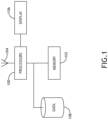
- the avionics system includes a processor 100, memory 102 connected to the processor 100 for storing processor executable code, a datalink device 104 for receiving flight plans and / or flight plan updates.
- the processor 100 is configured to receive a flight plan update and analyze the flight plan update according to a set of predefined rules stored in a data storage device 108.
- the processor 100 may receive the flight plan update from the memory 102 (i.e., a precomputed, stored flight plan), a portable memory device (i.e., a USB stick, etc.), from a remote source via the datalink device 104 (i.e., radio interfaces with specific protocols for communication with air traffic control, airline / commercial dispatchers, etc.), from an onboard personal electronic device via a wired interface (i.e., USB, Ethernet) or wireless interface (i.e., Bluetooth, WiFi) either with or without the use of an Avionics Interface Device.
- a wired interface i.e., USB, Ethernet
- wireless interface i.e., Bluetooth, WiFi
- the predefined rules may be generalized aviation best practices and / or specific to the aircraft.
- the processor 100 may identify path changes, and compare the path changes to predefined threshold. For example, the processor 100 identifies elevation changes within the flight plan update and compares a rate of elevation change with a general threshold or a specific threshold defined by the capabilities of the aircraft; furthermore, the elevation changes may be compared to some defined operational ceiling of the aircraft.
- the processor 100 may apply certain rules-based checks to elevation changes with respect to the rest of the flight plan. For example, the processor 100 may verify that the flight plan includes a climb to some maximum altitude and a corresponding descent to a landing field elevation at the destination. The processor 100 may identify some minimum safe altitude for each segment of a flight plan based a correlation to the local terrain.
- the processor 100 may identify altitude constraints associated with specific waypoints.
- the processor 100 may identify minimum altitude constraints and determine if the aircraft has sufficient performance metrics to meet those constraints; furthermore, the processor 100 may determine if the aircraft has sufficient performance to descend fast enough to descent constraints.
- the processor 100 may analyze the sequence of altitude changes defined by a flight plan. For example, it would be unusual for a flight plan to require a descent, then a climb again before another descent. The processor 100 may analyze the sequence of changes for progressively higher altitude constraints up to maximum cruise altitude, and progressively lower constraints until landing.
- the processor 100 identifies changes in direction defined by one or more new waypoints and compare an angular change in direction to a predefined threshold.
- the processor 100 may also identify any discontinuities in the flight plan generated by newly added waypoints.
- the processor 100 may analyze the flight plan update for threshold violations that may not be inherent in the flight plan update. For example, the processor 100 may determine an expected fuel reserve in light of the flight plan update and compare the expected fuel reserve to a threshold minimum and / or a change in the prior fuel reserve or more than some threshold (i.e., 5%). It may be appreciated that a change in expected fuel reserve beyond the predefined threshold, either a decrease or increase in fuel reserves, may indicate a significant error that should be investigated by the flight crew.
- an existing flight plan indicates 1000 pounds of fuel left at the destination, and a flight plan update results in the processor 100 predicting 800 pounds of fuel left at the destination, the flight crew should review the change before accepting.
- the flight plan update indicates 2000 pounds of fuel left at the destination, the flight crew should review the change before accepting because a legitimate flight plan change is unlikely to produce such a fuel savings; normally a flight plan update should not result in more than about a 5% change.
- otherwise valid updates to a flight plan may extend the duration of a flight. Where a flight plan update changes the arrival time (i.e., 9:30AM to 11:25AM), the added time may have a significant impact to fuel usage.
- the processor 100 may determine if a change to expected arrival time is beyond a predefined threshold.
- identified threshold violations or other problems with the received flight plan update may be visualized on a display 106 in data communication with the processor 100.
- the processor 100 may render a current flight, or some relevant portion or a current flight plan, and overlay changes to the current flight plan embodied in the flight plan update in a visual distinct way, such as via dashed lines.
- any elements of the flight plan update that exceed predefined thresholds, or otherwise violate the predefined rules may be rendered in a further visually distinct way, such as with color coding according to a severity metric (i.e., a minor discontinuity rendered in yellow while a substantial change in fuel reserves rendered in red).
- the processor 100 is configured to receive crew approval or rejection of the flight plan update, such as via a touch screen interface in the display device 106.
- the flight plan update may then be incorporated into the current flight plan, or replace the current flight.
- An avionics system receives 200 an uploaded flight plan or flight plan update, and performs 202 a plurality of rule-based checks on the flight plan.
- the flight plan or flight plan update is rendered along with a current flight plan in a visually distinct way.
- the system may then receive 204 crew approval.
- the avionics system may perform a procedural database update prior to performing 202 the plurality of rules-based checks.
- the rules may include checks for procedural validity; verifying that all procedures are valid. Current and procedural database updates occur every twenty-eight days, with interim updates every fourteen days. Even those updates may not be sufficient; the avionics system may update the procedural database to identify, for example, navions that are out of service, runways that are closed, taxiways that are closed, limitations at certain air traffic control facilities, lighting that's out of service, etc. The avionics system may then apply those checks for procedural validity according to rules in the plurality of rules-based checks.
- An avionics system may render an initial flight plan 300 including a plurality of waypoints 308 and corresponding segments 312, 314, 316, 318 between those waypoints 308.
- the avionics system may receive a new flight plan or updates to the initial flight plan 300, and render a combined flight plan 302, 304, 306 for review by the crew.
- the initial flight plan 300 and combined flight plans 302, 304, 306 are divided into segments 312, 314, 316, 318 and the segments 312, 314, 316, 318 are correlated such that alternative segments in the combined flight plans 302, 304, 306 are associated with a corresponding segment in the initial fight plan 300.
- the updated flight plan may define alternative segments 316, including alternative waypoints 310, interposed between existing waypoints 308; the alternative segments 316 are associated with an initial segment 318 of the initial flight plan 300 such that a crew member my select the initial segment 318 and both the initial segment 318 and alternative segments 316 are rendered to indicate both are selected. The crew may thereby easily review proposed changes to the initial flight plan 300, segment-by-segment.
- flight crew may select flight path segments 312, 314, 316, 318 to see a visual representation of changes embodied in the flight plan update. For example, when reviewing a flight plan update, a selected segment may be unchanged between the initial flight plan 300 and the flight plan update; the initial and updated segments 314 would overlap.
- the visual representations may be complementary such that when the initial and updated segments 314 overlap, they produce a characteristic visual display indicating no change (i.e., interleaved green and orange dashed line portions).
- the flight plan update embodies a change to a segment
- selecting the initial segment 318 would cause the initial segment 318 to be rendered in a style indicating that segment is part of the existing flight plan, while simultaneously rendering the alternative segments 316 in a different style indicating that segment is part of the flight plan update.
- the flight plan update becomes the existing flight plan once accepted by the flight crew.
- an avionics system may render the existing flight plan and flight plan update with the segments defining the threshold exceeding turn rendered in a style indicating that portion of the flight plan update violates one of the predefined rules. Furthermore, the avionics system may verify that new waypoints 412 define alternative segments within a tolerance for lateral offsets. For example, the avionics system may determine that the flight plan update defines an alternative segment that is laterally offset from the existing segment by some threshold (i.e., two hundred miles).
- an avionics system may render the new destination 408 and corresponding new segments in a stye highlighting the new destination 408 as a violation of one of the predefined rules.
- a flight plan update 404 may include a waypoint 410 (or removal of a waypoint) that creates a flight plan discontinuity
- an avionics system may render the waypoint 410 or discontinuous region in a stye highlighting a violation of one of the predefined rules. Discontinuities exist in a flight plan when, for example, the aircraft is cleared to a destination and the flight plan update puts in an approach procedure to get into the destination. The crew would have to interpret whether to go to the destination first and then go back to the start of the approach procedure or where in my flight plan to include the approach procedure. Highlighting those discontinuities allows the crew to resolved the error before executing the flight plan.
- the flight plan update 404 may include a waypoint 410 that does not exist in an onboard database; such waypoints rendered in a distinct style.
- Embodiments of the present disclosure validate a new flight plan or flight pan update before the flight plan update supplants the existing flight plan. Flight crew may continue to focus on the existing flight plan while the flight plan update is quickly validated.
Landscapes
- Engineering & Computer Science (AREA)
- Aviation & Aerospace Engineering (AREA)
- Physics & Mathematics (AREA)
- General Physics & Mathematics (AREA)
- Radar, Positioning & Navigation (AREA)
- Remote Sensing (AREA)
- Traffic Control Systems (AREA)
Abstract
Description
- Up-loaded flight plans may contain errors that go unnoticed by the crew. This may be especially true for complex flight plans with potentially hundreds of waypoints. The existing methodology requires the pilot not flying to review and validate the new flight plan before accepting it. It would be advantageous if a system and method existed to identify discontinuities and untenable segments with respect to characteristics of the aircraft.
- In one aspect, embodiments of the inventive concepts disclosed herein are directed to a system and method for receiving a flight plan or flight plan alteration, and comparing the flight plan to a set of rules and criteria defined generally for best practices, and / or specific to the aircraft.
- In a further aspect, violations of the rules and criteria are communicated to crew members via visual indicia of such violations, including the relative severity.
- It is to be understood that both the foregoing general description and the following detailed description are exemplary and explanatory only and should not restrict the scope of the claims. The accompanying drawings, which are incorporated in and constitute a part of the specification, illustrate exemplary embodiments of the inventive concepts disclosed herein and together with the general description, serve to explain the principles.
- The numerous advantages of the embodiments of the inventive concepts disclosed herein may be better understood by those skilled in the art by reference to the accompanying figures in which:
-
FIG. 1 shows a block diagram of a system for implementing an exemplary embodiment; -
FIG. 2 shows a flowchart of a method according to an exemplary embodiment; -
FIG. 3 shows a graphical representation of renderings according to an exemplary embodiment; -
FIG. 4 shows a graphical representation of renderings according to an exemplary embodiment; - Before explaining various embodiments of the inventive concepts disclosed herein in detail, it is to be understood that the inventive concepts are not limited in their application to the arrangement of the components or steps or methodologies set forth in the following description or illustrated in the drawings. In the following detailed description of embodiments of the instant inventive concepts, numerous specific details are set forth in order to provide a more thorough understanding of the inventive concepts. However, it will be apparent to one of ordinary skill in the art having the benefit of the instant disclosure that the inventive concepts disclosed herein may be practiced without these specific details. In other instances, well-known features may not be described in detail to avoid unnecessarily complicating the instant disclosure. The inventive concepts disclosed herein are capable of other embodiments or of being practiced or carried out in various ways. Also, it is to be understood that the phraseology and terminology employed herein is for the purpose of description and should not be regarded as limiting.
- As used herein a letter following a reference numeral is intended to reference an embodiment of a feature or element that may be similar, but not necessarily identical, to a previously described element or feature bearing the same reference numeral (e.g., 1, 1a, 1b). Such shorthand notations are used for purposes of convenience only, and should not be construed to limit the inventive concepts disclosed herein in any way unless expressly stated to the contrary.
- Further, unless expressly stated to the contrary, "or" refers to an inclusive or and not to an exclusive or. For example, a condition A or B is satisfied by anyone of the following: A is true (or present) and B is false (or not present), A is false (or not present) and B is true (or present), and both A and B are true (or present).
- In addition, use of "a" or "an" are employed to describe elements and components of embodiments of the instant inventive concepts. This is done merely for convenience and to give a general sense of the inventive concepts, and "a" and "an" are intended to include one or at least one and the singular also includes the plural unless it is obvious that it is meant otherwise.
- Also, while various components may be depicted as being connected directly, direct connection is not a requirement. Components may be in data communication with intervening components that are not illustrated or described.
- Finally, as used herein any reference to "one embodiment," or "some embodiments" means that a particular element, feature, structure, or characteristic described in connection with the embodiment is included in at least one embodiment of the inventive concepts disclosed herein. The appearances of the phrase "in at least one embodiment" in the specification does not necessarily refer to the same embodiment. Embodiments of the inventive concepts disclosed may include one or more of the features expressly described or inherently present herein, or any combination or sub-combination of two or more such features.
- Broadly, embodiments of the inventive concepts disclosed herein are directed to a system and method for receiving a flight plan or flight plan alteration, and comparing the flight plan to a set of rules and criteria defined generally for best practices, and / or specific to the aircraft. Violations of the rules and criteria are communicated to crew members via visual indicia of such violations, including the relative severity.
- Referring to
FIG. 1 , a block diagram of an avionics system for implementing an exemplary embodiment is shown. The avionics system includes aprocessor 100,memory 102 connected to theprocessor 100 for storing processor executable code, adatalink device 104 for receiving flight plans and / or flight plan updates. Theprocessor 100 is configured to receive a flight plan update and analyze the flight plan update according to a set of predefined rules stored in adata storage device 108. Theprocessor 100 may receive the flight plan update from the memory 102 (i.e., a precomputed, stored flight plan), a portable memory device (i.e., a USB stick, etc.), from a remote source via the datalink device 104 (i.e., radio interfaces with specific protocols for communication with air traffic control, airline / commercial dispatchers, etc.), from an onboard personal electronic device via a wired interface (i.e., USB, Ethernet) or wireless interface (i.e., Bluetooth, WiFi) either with or without the use of an Avionics Interface Device. - The predefined rules may be generalized aviation best practices and / or specific to the aircraft. In at least one embodiment, the
processor 100 may identify path changes, and compare the path changes to predefined threshold. For example, theprocessor 100 identifies elevation changes within the flight plan update and compares a rate of elevation change with a general threshold or a specific threshold defined by the capabilities of the aircraft; furthermore, the elevation changes may be compared to some defined operational ceiling of the aircraft. In at least one embodiment, theprocessor 100 may apply certain rules-based checks to elevation changes with respect to the rest of the flight plan. For example, theprocessor 100 may verify that the flight plan includes a climb to some maximum altitude and a corresponding descent to a landing field elevation at the destination. Theprocessor 100 may identify some minimum safe altitude for each segment of a flight plan based a correlation to the local terrain. - In at least one embodiment, the
processor 100 may identify altitude constraints associated with specific waypoints. Theprocessor 100 may identify minimum altitude constraints and determine if the aircraft has sufficient performance metrics to meet those constraints; furthermore, theprocessor 100 may determine if the aircraft has sufficient performance to descend fast enough to descent constraints. Also, theprocessor 100 may analyze the sequence of altitude changes defined by a flight plan. For example, it would be unusual for a flight plan to require a descent, then a climb again before another descent. Theprocessor 100 may analyze the sequence of changes for progressively higher altitude constraints up to maximum cruise altitude, and progressively lower constraints until landing. - Likewise, the
processor 100 identifies changes in direction defined by one or more new waypoints and compare an angular change in direction to a predefined threshold. Theprocessor 100 may also identify any discontinuities in the flight plan generated by newly added waypoints. - In at least one embodiment, the
processor 100 may analyze the flight plan update for threshold violations that may not be inherent in the flight plan update. For example, theprocessor 100 may determine an expected fuel reserve in light of the flight plan update and compare the expected fuel reserve to a threshold minimum and / or a change in the prior fuel reserve or more than some threshold (i.e., 5%). It may be appreciated that a change in expected fuel reserve beyond the predefined threshold, either a decrease or increase in fuel reserves, may indicate a significant error that should be investigated by the flight crew. - In one example, where an existing flight plan indicates 1000 pounds of fuel left at the destination, and a flight plan update results in the
processor 100 predicting 800 pounds of fuel left at the destination, the flight crew should review the change before accepting. Alternatively, where the flight plan update indicates 2000 pounds of fuel left at the destination, the flight crew should review the change before accepting because a legitimate flight plan change is unlikely to produce such a fuel savings; normally a flight plan update should not result in more than about a 5% change. Furthermore, otherwise valid updates to a flight plan may extend the duration of a flight. Where a flight plan update changes the arrival time (i.e., 9:30AM to 11:25AM), the added time may have a significant impact to fuel usage. Theprocessor 100 may determine if a change to expected arrival time is beyond a predefined threshold. - In at least one embodiment, identified threshold violations or other problems with the received flight plan update may be visualized on a
display 106 in data communication with theprocessor 100. In at least one embodiment, theprocessor 100 may render a current flight, or some relevant portion or a current flight plan, and overlay changes to the current flight plan embodied in the flight plan update in a visual distinct way, such as via dashed lines. Furthermore, any elements of the flight plan update that exceed predefined thresholds, or otherwise violate the predefined rules, may be rendered in a further visually distinct way, such as with color coding according to a severity metric (i.e., a minor discontinuity rendered in yellow while a substantial change in fuel reserves rendered in red). - In at least one embedment, the
processor 100 is configured to receive crew approval or rejection of the flight plan update, such as via a touch screen interface in thedisplay device 106. The flight plan update may then be incorporated into the current flight plan, or replace the current flight. - Referring to
FIG. 2 , a flowchart of a method according to an exemplary embodiment is shown. An avionics system receives 200 an uploaded flight plan or flight plan update, and performs 202 a plurality of rule-based checks on the flight plan. The flight plan or flight plan update is rendered along with a current flight plan in a visually distinct way. The system may then receive 204 crew approval. - In at least one embodiment, the avionics system may perform a procedural database update prior to performing 202 the plurality of rules-based checks. The rules may include checks for procedural validity; verifying that all procedures are valid. Current and procedural database updates occur every twenty-eight days, with interim updates every fourteen days. Even those updates may not be sufficient; the avionics system may update the procedural database to identify, for example, navions that are out of service, runways that are closed, taxiways that are closed, limitations at certain air traffic control facilities, lighting that's out of service, etc. The avionics system may then apply those checks for procedural validity according to rules in the plurality of rules-based checks.
- Referring to
FIG. 3 , a graphical representation of renderings according to an exemplary embodiment is shown. An avionics system may render aninitial flight plan 300 including a plurality ofwaypoints 308 andcorresponding segments waypoints 308. In at least one embodiment, the avionics system may receive a new flight plan or updates to theinitial flight plan 300, and render a combinedflight plan - In at east one embodiment, the
initial flight plan 300 and combined flight plans 302, 304, 306 are divided intosegments segments initial fight plan 300. For example, the updated flight plan may definealternative segments 316, includingalternative waypoints 310, interposed between existingwaypoints 308; thealternative segments 316 are associated with aninitial segment 318 of theinitial flight plan 300 such that a crew member my select theinitial segment 318 and both theinitial segment 318 andalternative segments 316 are rendered to indicate both are selected. The crew may thereby easily review proposed changes to theinitial flight plan 300, segment-by-segment. - In at least one embodiment, flight crew may select
flight path segments initial flight plan 300 and the flight plan update; the initial and updatedsegments 314 would overlap. In at least one embodiment, the visual representations may be complementary such that when the initial and updatedsegments 314 overlap, they produce a characteristic visual display indicating no change (i.e., interleaved green and orange dashed line portions). - By comparison, where the flight plan update embodies a change to a segment, selecting the
initial segment 318 would cause theinitial segment 318 to be rendered in a style indicating that segment is part of the existing flight plan, while simultaneously rendering thealternative segments 316 in a different style indicating that segment is part of the flight plan update. The flight plan update becomes the existing flight plan once accepted by the flight crew. - Referring to
FIG. 4 , a graphical representation of renderings according to an exemplary embodiment is shown. In one exemplary embodiment, where aflight plan update 400 includes anew waypoint 412 necessitating a turn at an existingwaypoint 406 of greater than some threshold value (i.e., 90°), an avionics system may render the existing flight plan and flight plan update with the segments defining the threshold exceeding turn rendered in a style indicating that portion of the flight plan update violates one of the predefined rules. Furthermore, the avionics system may verify thatnew waypoints 412 define alternative segments within a tolerance for lateral offsets. For example, the avionics system may determine that the flight plan update defines an alternative segment that is laterally offset from the existing segment by some threshold (i.e., two hundred miles). - In one exemplary embodiment, where a
flight plan update 402 includes anew destination 408, an avionics system may render thenew destination 408 and corresponding new segments in a stye highlighting thenew destination 408 as a violation of one of the predefined rules. A change in destination, unless intentional, should be flagged as a problem. - In one exemplary embodiment, where a
flight plan update 404 includes a waypoint 410 (or removal of a waypoint) that creates a flight plan discontinuity, an avionics system may render thewaypoint 410 or discontinuous region in a stye highlighting a violation of one of the predefined rules. Discontinuities exist in a flight plan when, for example, the aircraft is cleared to a destination and the flight plan update puts in an approach procedure to get into the destination. The crew would have to interpret whether to go to the destination first and then go back to the start of the approach procedure or where in my flight plan to include the approach procedure. Highlighting those discontinuities allows the crew to resolved the error before executing the flight plan. Furthermore, theflight plan update 404 may include awaypoint 410 that does not exist in an onboard database; such waypoints rendered in a distinct style. - Embodiments of the present disclosure validate a new flight plan or flight pan update before the flight plan update supplants the existing flight plan. Flight crew may continue to focus on the existing flight plan while the flight plan update is quickly validated.
- It is believed that the inventive concepts disclosed herein and many of their attendant advantages will be understood by the foregoing description of embodiments of the inventive concepts, and it will be apparent that various changes may be made in the form, construction, and arrangement of the components thereof without departing from the broad scope of the inventive concepts disclosed herein or without sacrificing all of their material advantages; and individual features from various embodiments may be combined to arrive at other embodiments. The forms herein before described being merely explanatory embodiments thereof, it is the intention of the following claims to encompass and include such changes. Furthermore, any of the features disclosed in relation to any of the individual embodiments may be incorporated into any other embodiment.
Claims (15)
- An avionics computer apparatus comprising:a display device;a data storage element; andat least one processor (100) in data communication with the data storage element, the display device, and a memory storing processor executable code for configuring the at least one processor to:receive an updated flight plan;retrieve a set of predefined rules from the data storage element;apply each of the set of predefined rules to the updated flight plan before the flight plan is accepted; andrender the updated flight plan on the display device,wherein any violations of the predefined rules are rendered in a visually distinct style.
- The avionics computer apparatus of Claim 1, wherein the at least one processor (100) is further configured to:retrieve an existing flight plan;correlate waypoints in the existing flight plan to corresponding waypoints in the updated flight plan; andrender the existing flight plan and the updated flight plan together, and preferably wherein the at least one processor is further configured to render the existing flight plan and the updated flight plan in visual distinct styles, and more preferably wherein visual distinct styles are defined to complement each other such that when segments of the existing flight plan and the updated flight plan entirely overlap, overlapping segments are visually distinct.
- The avionics computer apparatus of Claim 1 or 2, wherein predefined rules are specific to an aircraft type including the avionics system.
- The avionics computer apparatus of any preceding Claim, wherein:the at least one processor is further configured to update a procedural database; andat least one of the predefined rules includes reference to the procedural database.
- The avionics computer apparatus of any preceding Claim, wherein at least one of the predefined rules includes a minimum altitude defined by terrain features proximal to segments of the updated flight plan.
- A method comprising:receiving an updated flight plan;retrieving a set of predefined rules from a data storage element;applying each of the set of predefined rules to the updated flight plan before the flight plan is accepted; andrendering the updated flight plan on a display device,wherein:at least one of the predefined rules are specific to a present aircraft; andany violations of the predefined rules are rendered in a visually distinct style.
- The method of Claim 6, wherein at least one of the predefined rules includes a maximum change in a fuel reserve.
- The method of Claim 6 or 7, wherein at least one of the predefined rules includes a check that all waypoints are represented in an onboard database of waypoints.
- The method of any of Claims 6-8, further comprising updating a procedural database, wherein at least one of the predefined rules includes reference to the procedural database.
- The method of any of Claims 6-9, wherein at least one of the predefined rules includes a minimum altitude defined by terrain features proximal to segments of the updated flight plan, and preferably wherein at least one of the predefined rules includes a definition of continuous progressive altitude changes up to a cruising altitude and down to a landing altitude.
- An avionics system comprising:a display device;a data storage element; andat least one processor (100) in data communication with the data storage element, the display device, and a memory storing processor executable code for configuring the at least one processor to:receive an updated flight plan;retrieve a set of predefined rules from the data storage element;apply each of the set of predefined rules to the updated flight plan before the flight plan is accepted; andrender the updated flight plan on the display device,wherein any violations of the predefined rules are rendered in a visually distinct style.
- The avionics system of Claim 11, wherein the at least one processor (100) is further configured to:retrieve an existing flight plan;correlate waypoints in the existing flight plan to corresponding waypoints in the updated flight plan; andrender the existing flight plan and the updated flight plan together, each in a visually distinct style.
- The avionics system of Claim 11 or 12, wherein at least one of the predefined rules comprises a change to fuel usage check defining a maximum percentage change.
- The avionics system of any of Claims 11-13, wherein at least one of the predefined rules comprises a check for flight path discontinuities.
- The avionics system of any of Claims 11-14, wherein at least one of the predefined rules comprises a change to destination check; and/or wherein:the at least one processor (100) is further configured to update a procedural database; andat least one of the predefined rules includes reference to the procedural database; and/or wherein at least one of the predefined rules includes:a minimum altitude defined by terrain features proximal to segments of the updated flight plan; anda definition of continuous progressive altitude changes up to a cruising altitude and down to a landing altitude.
Applications Claiming Priority (1)
| Application Number | Priority Date | Filing Date | Title |
|---|---|---|---|
| US17/991,571 US12293671B2 (en) | 2022-11-21 | 2022-11-21 | Flight plan rules based conformity check |
Publications (1)
| Publication Number | Publication Date |
|---|---|
| EP4372318A1 true EP4372318A1 (en) | 2024-05-22 |
Family
ID=88690157
Family Applications (1)
| Application Number | Title | Priority Date | Filing Date |
|---|---|---|---|
| EP23207678.6A Pending EP4372318A1 (en) | 2022-11-21 | 2023-11-03 | Flight plan rules based conformity check |
Country Status (2)
| Country | Link |
|---|---|
| US (1) | US12293671B2 (en) |
| EP (1) | EP4372318A1 (en) |
Citations (1)
| Publication number | Priority date | Publication date | Assignee | Title |
|---|---|---|---|---|
| US20100030401A1 (en) * | 2008-07-31 | 2010-02-04 | Honeywell International Inc. | Flight deck communication and display system |
Family Cites Families (12)
| Publication number | Priority date | Publication date | Assignee | Title |
|---|---|---|---|---|
| US6289277B1 (en) * | 1999-10-07 | 2001-09-11 | Honeywell International Inc. | Interfaces for planning vehicle routes |
| WO2009051877A1 (en) * | 2007-07-30 | 2009-04-23 | Air Routing International, L.P. | Air travel coordination, communication and documentation system, method and computer program |
| US20090319100A1 (en) * | 2008-06-20 | 2009-12-24 | Honeywell International Inc. | Systems and methods for defining and rendering a trajectory |
| FR2973526B1 (en) * | 2011-03-29 | 2013-04-26 | Airbus Operations Sas | METHOD AND DEVICE FOR AUTOMATICALLY MANAGING THE VERTICAL PROFILE OF A FLIGHT PLAN OF AN AIRCRAFT |
| US9087450B2 (en) * | 2011-05-17 | 2015-07-21 | Innovative Solutions And Support, Inc. | Upgraded flight management system and method of providing the same |
| US8793038B1 (en) * | 2011-12-14 | 2014-07-29 | Rockwell Collins, Inc. | Providing preview information to facilitate flight plan selection |
| US10665114B2 (en) * | 2014-03-28 | 2020-05-26 | The Boeing Company | Aircraft fuel optimization analytics |
| US9443434B2 (en) * | 2014-09-30 | 2016-09-13 | The Boeing Company | Flight path discontinuities |
| EP3658456A4 (en) * | 2017-07-27 | 2021-04-21 | Skyryse, Inc. | SYSTEM AND METHOD FOR SITUATION ASSESSMENT, VEHICLE CONTROL AND / OR CONTINGENCY PLANNING |
| US20190108466A1 (en) * | 2017-10-06 | 2019-04-11 | Honeywell International Inc. | Systems and methods for continuously providing operational-efficiency data in real-time onboard an aircraft |
| US10854091B2 (en) * | 2018-07-03 | 2020-12-01 | Honeywell International Inc. | Energy management visualization methods and systems |
| US10867520B2 (en) * | 2018-08-14 | 2020-12-15 | The Boeing Company | System and method to modify an aircraft flight trajectory |
-
2022
- 2022-11-21 US US17/991,571 patent/US12293671B2/en active Active
-
2023
- 2023-11-03 EP EP23207678.6A patent/EP4372318A1/en active Pending
Patent Citations (1)
| Publication number | Priority date | Publication date | Assignee | Title |
|---|---|---|---|---|
| US20100030401A1 (en) * | 2008-07-31 | 2010-02-04 | Honeywell International Inc. | Flight deck communication and display system |
Also Published As
| Publication number | Publication date |
|---|---|
| US20240169843A1 (en) | 2024-05-23 |
| US12293671B2 (en) | 2025-05-06 |
Similar Documents
| Publication | Publication Date | Title |
|---|---|---|
| US12354486B2 (en) | Systems and methods for providing a trajectory planning engine for unmanned aircraft | |
| US11620688B2 (en) | Methods and systems for dynamically determining and adapting to cost impact during a flight | |
| EP3657472B1 (en) | Systems and methods for creating and using a contextual model applicable to predicting aircraft warning conditions and analyzing aircraft performance | |
| US8311686B2 (en) | Onboard airplane community noise and emissions monitor | |
| US20190108758A1 (en) | System and method for flight delay prediction | |
| EP3992946B1 (en) | Method and system for updating a flight plan | |
| US11682308B2 (en) | System and method for enhancing operator situational awareness of traffic diversion patterns and adapting thereto | |
| EP3796289A1 (en) | Advisory method and system for flight trajectory optimization | |
| US10154096B2 (en) | Method for integrating a new service into an avionics onboard system with open architecture of client-server type, in particular for an FIM manoeuvre service | |
| CN114677860A (en) | Decision support system for aircraft requiring emergency landing | |
| US20150279218A1 (en) | Aircraft fuel optimization analytics | |
| Bauranov et al. | Urban air mobility and manned eVTOLs: Safety implications | |
| EP3467729A1 (en) | Systems and methods for continuously providing operational-efficiency data in real-time onboard an aircraft | |
| US10569899B2 (en) | Method for controlling the restitution of alert(s) and/or system(s) reconfiguration procedure(s), related computer program product and control system | |
| US12159540B2 (en) | Method and system for updating a flight plan | |
| EP3404642B1 (en) | Minimum maneuverable altitude determination and display system and method | |
| EP3937152A1 (en) | Method and system for the updating of a flight plan | |
| US10891870B2 (en) | System and method for aiding the navigation of an aircraft within an airport | |
| EP4372318A1 (en) | Flight plan rules based conformity check | |
| US11249489B2 (en) | Method for determining a vertical path of an aircraft from its current position, associated computer program product and determining system | |
| Shmelova | Collaborative decision making in emergencies by the integration of deterministic, stochastic, and non-stochastic models | |
| US20180225978A1 (en) | Method and system for flight plan data transmission in an aircraft | |
| Brooker | Consistent and up-to-date aviation safety targets | |
| Bell | Developing standards for time-based sequencing & separation of aircraft | |
| Pschierer et al. | Next generation EFB applications |
Legal Events
| Date | Code | Title | Description |
|---|---|---|---|
| PUAI | Public reference made under article 153(3) epc to a published international application that has entered the european phase |
Free format text: ORIGINAL CODE: 0009012 |
|
| STAA | Information on the status of an ep patent application or granted ep patent |
Free format text: STATUS: THE APPLICATION HAS BEEN PUBLISHED |
|
| AK | Designated contracting states |
Kind code of ref document: A1 Designated state(s): AL AT BE BG CH CY CZ DE DK EE ES FI FR GB GR HR HU IE IS IT LI LT LU LV MC ME MK MT NL NO PL PT RO RS SE SI SK SM TR |
|
| STAA | Information on the status of an ep patent application or granted ep patent |
Free format text: STATUS: REQUEST FOR EXAMINATION WAS MADE |
|
| 17P | Request for examination filed |
Effective date: 20241122 |
|
| RBV | Designated contracting states (corrected) |
Designated state(s): AL AT BE BG CH CY CZ DE DK EE ES FI FR GB GR HR HU IE IS IT LI LT LU LV MC ME MK MT NL NO PL PT RO RS SE SI SK SM TR |
|
| STAA | Information on the status of an ep patent application or granted ep patent |
Free format text: STATUS: EXAMINATION IS IN PROGRESS |
|
| 17Q | First examination report despatched |
Effective date: 20250516 |