EP4372023A1 - Multiblock copolymer and preparation method therefor - Google Patents
Multiblock copolymer and preparation method therefor Download PDFInfo
- Publication number
- EP4372023A1 EP4372023A1 EP22876976.6A EP22876976A EP4372023A1 EP 4372023 A1 EP4372023 A1 EP 4372023A1 EP 22876976 A EP22876976 A EP 22876976A EP 4372023 A1 EP4372023 A1 EP 4372023A1
- Authority
- EP
- European Patent Office
- Prior art keywords
- group
- formula
- block copolymer
- substituted
- compound
- Prior art date
- Legal status (The legal status is an assumption and is not a legal conclusion. Google has not performed a legal analysis and makes no representation as to the accuracy of the status listed.)
- Pending
Links
- 238000002360 preparation method Methods 0.000 title abstract description 20
- 229920006030 multiblock copolymer Polymers 0.000 title abstract 3
- 150000001875 compounds Chemical class 0.000 claims description 126
- 229920001400 block copolymer Polymers 0.000 claims description 109
- 239000000178 monomer Substances 0.000 claims description 44
- -1 alkyl zinc alkoxide Chemical class 0.000 claims description 43
- 238000000034 method Methods 0.000 claims description 36
- 238000006243 chemical reaction Methods 0.000 claims description 33
- 239000004793 Polystyrene Substances 0.000 claims description 31
- 229920002223 polystyrene Polymers 0.000 claims description 30
- 229920000098 polyolefin Polymers 0.000 claims description 28
- 239000004711 α-olefin Substances 0.000 claims description 28
- 239000001257 hydrogen Substances 0.000 claims description 26
- 229910052739 hydrogen Inorganic materials 0.000 claims description 26
- LIKMAJRDDDTEIG-UHFFFAOYSA-N 1-hexene Chemical compound CCCCC=C LIKMAJRDDDTEIG-UHFFFAOYSA-N 0.000 claims description 22
- 229920002554 vinyl polymer Polymers 0.000 claims description 22
- 150000003623 transition metal compounds Chemical class 0.000 claims description 21
- VGGSQFUCUMXWEO-UHFFFAOYSA-N Ethene Chemical compound C=C VGGSQFUCUMXWEO-UHFFFAOYSA-N 0.000 claims description 20
- 239000005977 Ethylene Substances 0.000 claims description 20
- 150000004795 grignard reagents Chemical class 0.000 claims description 20
- 239000011701 zinc Substances 0.000 claims description 20
- 239000007818 Grignard reagent Substances 0.000 claims description 19
- 239000000203 mixture Substances 0.000 claims description 18
- 238000010539 anionic addition polymerization reaction Methods 0.000 claims description 17
- 125000003011 styrenyl group Chemical group [H]\C(*)=C(/[H])C1=C([H])C([H])=C([H])C([H])=C1[H] 0.000 claims description 17
- 229910052725 zinc Inorganic materials 0.000 claims description 17
- 125000006832 (C1-C10) alkylene group Chemical group 0.000 claims description 16
- 239000012986 chain transfer agent Substances 0.000 claims description 15
- 239000003505 polymerization initiator Substances 0.000 claims description 15
- 239000003054 catalyst Substances 0.000 claims description 13
- KWKAKUADMBZCLK-UHFFFAOYSA-N 1-octene Chemical compound CCCCCCC=C KWKAKUADMBZCLK-UHFFFAOYSA-N 0.000 claims description 12
- 125000004435 hydrogen atom Chemical group [H]* 0.000 claims description 12
- 238000003860 storage Methods 0.000 claims description 12
- 238000005227 gel permeation chromatography Methods 0.000 claims description 11
- 125000003903 2-propenyl group Chemical group [H]C([*])([H])C([H])=C([H])[H] 0.000 claims description 10
- 239000004215 Carbon black (E152) Substances 0.000 claims description 10
- 229930195733 hydrocarbon Natural products 0.000 claims description 10
- 125000000008 (C1-C10) alkyl group Chemical group 0.000 claims description 9
- 238000004458 analytical method Methods 0.000 claims description 9
- 125000005843 halogen group Chemical group 0.000 claims description 9
- ZGEGCLOFRBLKSE-UHFFFAOYSA-N 1-Heptene Chemical compound CCCCCC=C ZGEGCLOFRBLKSE-UHFFFAOYSA-N 0.000 claims description 8
- AFFLGGQVNFXPEV-UHFFFAOYSA-N 1-decene Chemical compound CCCCCCCCC=C AFFLGGQVNFXPEV-UHFFFAOYSA-N 0.000 claims description 8
- CRSBERNSMYQZNG-UHFFFAOYSA-N 1-dodecene Chemical compound CCCCCCCCCCC=C CRSBERNSMYQZNG-UHFFFAOYSA-N 0.000 claims description 8
- GQEZCXVZFLOKMC-UHFFFAOYSA-N 1-hexadecene Chemical compound CCCCCCCCCCCCCCC=C GQEZCXVZFLOKMC-UHFFFAOYSA-N 0.000 claims description 8
- HFDVRLIODXPAHB-UHFFFAOYSA-N 1-tetradecene Chemical compound CCCCCCCCCCCCC=C HFDVRLIODXPAHB-UHFFFAOYSA-N 0.000 claims description 8
- DCTOHCCUXLBQMS-UHFFFAOYSA-N 1-undecene Chemical compound CCCCCCCCCC=C DCTOHCCUXLBQMS-UHFFFAOYSA-N 0.000 claims description 8
- WSSSPWUEQFSQQG-UHFFFAOYSA-N 4-methyl-1-pentene Chemical compound CC(C)CC=C WSSSPWUEQFSQQG-UHFFFAOYSA-N 0.000 claims description 8
- VAMFXQBUQXONLZ-UHFFFAOYSA-N n-alpha-eicosene Natural products CCCCCCCCCCCCCCCCCCC=C VAMFXQBUQXONLZ-UHFFFAOYSA-N 0.000 claims description 8
- YWAKXRMUMFPDSH-UHFFFAOYSA-N pentene Chemical compound CCCC=C YWAKXRMUMFPDSH-UHFFFAOYSA-N 0.000 claims description 8
- 238000006467 substitution reaction Methods 0.000 claims description 6
- 125000006539 C12 alkyl group Chemical group [H]C([H])([H])C([H])([H])C([H])([H])C([H])([H])C([H])([H])C([H])([H])C([H])([H])C([H])([H])C([H])([H])C([H])([H])C([H])([H])C([H])([H])* 0.000 claims description 5
- 238000009826 distribution Methods 0.000 claims description 5
- TVMXDCGIABBOFY-UHFFFAOYSA-N n-Octanol Natural products CCCCCCCC TVMXDCGIABBOFY-UHFFFAOYSA-N 0.000 claims description 5
- 229940106006 1-eicosene Drugs 0.000 claims description 4
- FIKTURVKRGQNQD-UHFFFAOYSA-N 1-eicosene Natural products CCCCCCCCCCCCCCCCCC=CC(O)=O FIKTURVKRGQNQD-UHFFFAOYSA-N 0.000 claims description 4
- OWWRMMIWAOBBFK-UHFFFAOYSA-N 3,4-dimethylhex-1-ene Chemical compound CCC(C)C(C)C=C OWWRMMIWAOBBFK-UHFFFAOYSA-N 0.000 claims description 4
- YHQXBTXEYZIYOV-UHFFFAOYSA-N 3-methylbut-1-ene Chemical compound CC(C)C=C YHQXBTXEYZIYOV-UHFFFAOYSA-N 0.000 claims description 4
- LDTAOIUHUHHCMU-UHFFFAOYSA-N 3-methylpent-1-ene Chemical compound CCC(C)C=C LDTAOIUHUHHCMU-UHFFFAOYSA-N 0.000 claims description 4
- FMIDFXCVRGPJHZ-UHFFFAOYSA-N 4,4-diethylhex-1-ene Chemical compound CCC(CC)(CC)CC=C FMIDFXCVRGPJHZ-UHFFFAOYSA-N 0.000 claims description 4
- KLCNJIQZXOQYTE-UHFFFAOYSA-N 4,4-dimethylpent-1-ene Chemical compound CC(C)(C)CC=C KLCNJIQZXOQYTE-UHFFFAOYSA-N 0.000 claims description 4
- 150000001412 amines Chemical class 0.000 claims description 4
- 125000003277 amino group Chemical group 0.000 claims description 4
- 229940069096 dodecene Drugs 0.000 claims description 4
- 125000004093 cyano group Chemical group *C#N 0.000 claims description 3
- 125000002887 hydroxy group Chemical group [H]O* 0.000 claims description 3
- 125000000449 nitro group Chemical group [O-][N+](*)=O 0.000 claims description 3
- 125000003808 silyl group Chemical group [H][Si]([H])([H])[*] 0.000 claims description 3
- 229910052726 zirconium Inorganic materials 0.000 claims description 3
- WHXSMMKQMYFTQS-UHFFFAOYSA-N Lithium Chemical compound [Li] WHXSMMKQMYFTQS-UHFFFAOYSA-N 0.000 claims description 2
- 229910052744 lithium Inorganic materials 0.000 claims description 2
- 125000003396 thiol group Chemical group [H]S* 0.000 claims description 2
- 239000011342 resin composition Substances 0.000 abstract description 3
- YXFVVABEGXRONW-UHFFFAOYSA-N Toluene Chemical compound CC1=CC=CC=C1 YXFVVABEGXRONW-UHFFFAOYSA-N 0.000 description 30
- 230000000052 comparative effect Effects 0.000 description 29
- PPBRXRYQALVLMV-UHFFFAOYSA-N Styrene Chemical compound C=CC1=CC=CC=C1 PPBRXRYQALVLMV-UHFFFAOYSA-N 0.000 description 26
- UHOVQNZJYSORNB-MZWXYZOWSA-N benzene-d6 Chemical compound [2H]C1=C([2H])C([2H])=C([2H])C([2H])=C1[2H] UHOVQNZJYSORNB-MZWXYZOWSA-N 0.000 description 26
- VLKZOEOYAKHREP-UHFFFAOYSA-N n-Hexane Chemical compound CCCCCC VLKZOEOYAKHREP-UHFFFAOYSA-N 0.000 description 24
- FYYHWMGAXLPEAU-UHFFFAOYSA-N Magnesium Chemical compound [Mg] FYYHWMGAXLPEAU-UHFFFAOYSA-N 0.000 description 22
- RTZKZFJDLAIYFH-UHFFFAOYSA-N Diethyl ether Chemical compound CCOCC RTZKZFJDLAIYFH-UHFFFAOYSA-N 0.000 description 18
- 229940093470 ethylene Drugs 0.000 description 18
- UAEPNZWRGJTJPN-UHFFFAOYSA-N methylcyclohexane Chemical compound CC1CCCCC1 UAEPNZWRGJTJPN-UHFFFAOYSA-N 0.000 description 18
- 239000002904 solvent Substances 0.000 description 18
- 125000000217 alkyl group Chemical group 0.000 description 17
- 229940044603 styrene Drugs 0.000 description 15
- 229940100888 zinc compound Drugs 0.000 description 15
- 150000003752 zinc compounds Chemical class 0.000 description 15
- 238000005160 1H NMR spectroscopy Methods 0.000 description 14
- 229920001577 copolymer Polymers 0.000 description 13
- 229920000642 polymer Polymers 0.000 description 12
- 125000004432 carbon atom Chemical group C* 0.000 description 11
- 150000002431 hydrogen Chemical group 0.000 description 11
- 239000000243 solution Substances 0.000 description 11
- JIAARYAFYJHUJI-UHFFFAOYSA-L zinc dichloride Chemical compound [Cl-].[Cl-].[Zn+2] JIAARYAFYJHUJI-UHFFFAOYSA-L 0.000 description 11
- 239000003426 co-catalyst Substances 0.000 description 10
- 230000000704 physical effect Effects 0.000 description 10
- 239000011777 magnesium Substances 0.000 description 9
- 229910052749 magnesium Inorganic materials 0.000 description 9
- GYNNXHKOJHMOHS-UHFFFAOYSA-N methyl-cycloheptane Natural products CC1CCCCCC1 GYNNXHKOJHMOHS-UHFFFAOYSA-N 0.000 description 9
- 238000001644 13C nuclear magnetic resonance spectroscopy Methods 0.000 description 8
- LFQSCWFLJHTTHZ-UHFFFAOYSA-N Ethanol Chemical compound CCO LFQSCWFLJHTTHZ-UHFFFAOYSA-N 0.000 description 8
- WYURNTSHIVDZCO-UHFFFAOYSA-N Tetrahydrofuran Chemical compound C1CCOC1 WYURNTSHIVDZCO-UHFFFAOYSA-N 0.000 description 8
- 125000002947 alkylene group Chemical group 0.000 description 8
- CPOFMOWDMVWCLF-UHFFFAOYSA-N methyl(oxo)alumane Chemical class C[Al]=O CPOFMOWDMVWCLF-UHFFFAOYSA-N 0.000 description 8
- 238000007086 side reaction Methods 0.000 description 8
- 239000007795 chemical reaction product Substances 0.000 description 7
- 229910052736 halogen Inorganic materials 0.000 description 7
- 239000012535 impurity Substances 0.000 description 7
- 239000000463 material Substances 0.000 description 7
- UKODFQOELJFMII-UHFFFAOYSA-N pentamethyldiethylenetriamine Chemical compound CN(C)CCN(C)CCN(C)C UKODFQOELJFMII-UHFFFAOYSA-N 0.000 description 7
- 238000006116 polymerization reaction Methods 0.000 description 7
- 238000003756 stirring Methods 0.000 description 7
- 238000012546 transfer Methods 0.000 description 7
- 125000003118 aryl group Chemical group 0.000 description 6
- 239000000460 chlorine Substances 0.000 description 6
- 230000001965 increasing effect Effects 0.000 description 6
- 230000008569 process Effects 0.000 description 6
- 239000002516 radical scavenger Substances 0.000 description 6
- 239000011592 zinc chloride Substances 0.000 description 6
- HCHKCACWOHOZIP-UHFFFAOYSA-N Zinc Chemical compound [Zn] HCHKCACWOHOZIP-UHFFFAOYSA-N 0.000 description 5
- 150000001336 alkenes Chemical class 0.000 description 5
- 150000004703 alkoxides Chemical group 0.000 description 5
- 230000003197 catalytic effect Effects 0.000 description 5
- 229910052801 chlorine Inorganic materials 0.000 description 5
- 150000002367 halogens Chemical group 0.000 description 5
- 125000001183 hydrocarbyl group Chemical group 0.000 description 5
- JRZJOMJEPLMPRA-UHFFFAOYSA-N olefin Natural products CCCCCCCC=C JRZJOMJEPLMPRA-UHFFFAOYSA-N 0.000 description 5
- 239000002574 poison Substances 0.000 description 5
- 231100000614 poison Toxicity 0.000 description 5
- 239000000047 product Substances 0.000 description 5
- 239000007787 solid Substances 0.000 description 5
- 235000005074 zinc chloride Nutrition 0.000 description 5
- PBKONEOXTCPAFI-UHFFFAOYSA-N 1,2,4-trichlorobenzene Chemical compound ClC1=CC=C(Cl)C(Cl)=C1 PBKONEOXTCPAFI-UHFFFAOYSA-N 0.000 description 4
- ZAMOUSCENKQFHK-UHFFFAOYSA-N Chlorine atom Chemical compound [Cl] ZAMOUSCENKQFHK-UHFFFAOYSA-N 0.000 description 4
- UFHFLCQGNIYNRP-UHFFFAOYSA-N Hydrogen Chemical compound [H][H] UFHFLCQGNIYNRP-UHFFFAOYSA-N 0.000 description 4
- OKKJLVBELUTLKV-UHFFFAOYSA-N Methanol Chemical group OC OKKJLVBELUTLKV-UHFFFAOYSA-N 0.000 description 4
- 238000005481 NMR spectroscopy Methods 0.000 description 4
- VYPSYNLAJGMNEJ-UHFFFAOYSA-N Silicium dioxide Chemical compound O=[Si]=O VYPSYNLAJGMNEJ-UHFFFAOYSA-N 0.000 description 4
- 125000005234 alkyl aluminium group Chemical group 0.000 description 4
- 239000000539 dimer Substances 0.000 description 4
- 230000000694 effects Effects 0.000 description 4
- 239000003446 ligand Substances 0.000 description 4
- DLEDOFVPSDKWEF-UHFFFAOYSA-N lithium butane Chemical compound [Li+].CCC[CH2-] DLEDOFVPSDKWEF-UHFFFAOYSA-N 0.000 description 4
- MZRVEZGGRBJDDB-UHFFFAOYSA-N n-Butyllithium Substances [Li]CCCC MZRVEZGGRBJDDB-UHFFFAOYSA-N 0.000 description 4
- YLQBMQCUIZJEEH-UHFFFAOYSA-N tetrahydrofuran Natural products C=1C=COC=1 YLQBMQCUIZJEEH-UHFFFAOYSA-N 0.000 description 4
- XEKOWRVHYACXOJ-UHFFFAOYSA-N Ethyl acetate Chemical compound CCOC(C)=O XEKOWRVHYACXOJ-UHFFFAOYSA-N 0.000 description 3
- ZMANZCXQSJIPKH-UHFFFAOYSA-N Triethylamine Chemical compound CCN(CC)CC ZMANZCXQSJIPKH-UHFFFAOYSA-N 0.000 description 3
- 125000003342 alkenyl group Chemical group 0.000 description 3
- 230000008859 change Effects 0.000 description 3
- 230000001747 exhibiting effect Effects 0.000 description 3
- 238000001914 filtration Methods 0.000 description 3
- 239000003999 initiator Substances 0.000 description 3
- 238000005259 measurement Methods 0.000 description 3
- 125000001181 organosilyl group Chemical group [SiH3]* 0.000 description 3
- 125000001997 phenyl group Chemical group [H]C1=C([H])C([H])=C(*)C([H])=C1[H] 0.000 description 3
- 238000000425 proton nuclear magnetic resonance spectrum Methods 0.000 description 3
- 150000003839 salts Chemical class 0.000 description 3
- 238000001228 spectrum Methods 0.000 description 3
- 229920000428 triblock copolymer Polymers 0.000 description 3
- XLYOFNOQVPJJNP-UHFFFAOYSA-N water Substances O XLYOFNOQVPJJNP-UHFFFAOYSA-N 0.000 description 3
- WCFQIFDACWBNJT-UHFFFAOYSA-N $l^{1}-alumanyloxy(2-methylpropyl)aluminum Chemical compound CC(C)C[Al]O[Al] WCFQIFDACWBNJT-UHFFFAOYSA-N 0.000 description 2
- 125000006273 (C1-C3) alkyl group Chemical group 0.000 description 2
- QVLAWKAXOMEXPM-DICFDUPASA-N 1,1,1,2-tetrachloro-2,2-dideuterioethane Chemical compound [2H]C([2H])(Cl)C(Cl)(Cl)Cl QVLAWKAXOMEXPM-DICFDUPASA-N 0.000 description 2
- QPFMBZIOSGYJDE-QDNHWIQGSA-N 1,1,2,2-tetrachlorethane-d2 Chemical compound [2H]C(Cl)(Cl)C([2H])(Cl)Cl QPFMBZIOSGYJDE-QDNHWIQGSA-N 0.000 description 2
- NVZWEEGUWXZOKI-UHFFFAOYSA-N 1-ethenyl-2-methylbenzene Chemical compound CC1=CC=CC=C1C=C NVZWEEGUWXZOKI-UHFFFAOYSA-N 0.000 description 2
- JZHGRUMIRATHIU-UHFFFAOYSA-N 1-ethenyl-3-methylbenzene Chemical compound CC1=CC=CC(C=C)=C1 JZHGRUMIRATHIU-UHFFFAOYSA-N 0.000 description 2
- WHFHDVDXYKOSKI-UHFFFAOYSA-N 1-ethenyl-4-ethylbenzene Chemical compound CCC1=CC=C(C=C)C=C1 WHFHDVDXYKOSKI-UHFFFAOYSA-N 0.000 description 2
- YVSMQHYREUQGRX-UHFFFAOYSA-N 2-ethyloxaluminane Chemical compound CC[Al]1CCCCO1 YVSMQHYREUQGRX-UHFFFAOYSA-N 0.000 description 2
- JLBJTVDPSNHSKJ-UHFFFAOYSA-N 4-Methylstyrene Chemical compound CC1=CC=C(C=C)C=C1 JLBJTVDPSNHSKJ-UHFFFAOYSA-N 0.000 description 2
- NLXLAEXVIDQMFP-UHFFFAOYSA-N Ammonia chloride Chemical compound [NH4+].[Cl-] NLXLAEXVIDQMFP-UHFFFAOYSA-N 0.000 description 2
- IJGRMHOSHXDMSA-UHFFFAOYSA-N Atomic nitrogen Chemical compound N#N IJGRMHOSHXDMSA-UHFFFAOYSA-N 0.000 description 2
- 229920000089 Cyclic olefin copolymer Polymers 0.000 description 2
- 229910003865 HfCl4 Inorganic materials 0.000 description 2
- 229920002633 Kraton (polymer) Polymers 0.000 description 2
- CSNNHWWHGAXBCP-UHFFFAOYSA-L Magnesium sulfate Chemical compound [Mg+2].[O-][S+2]([O-])([O-])[O-] CSNNHWWHGAXBCP-UHFFFAOYSA-L 0.000 description 2
- 239000004743 Polypropylene Substances 0.000 description 2
- QQONPFPTGQHPMA-UHFFFAOYSA-N Propene Chemical group CC=C QQONPFPTGQHPMA-UHFFFAOYSA-N 0.000 description 2
- CDBYLPFSWZWCQE-UHFFFAOYSA-L Sodium Carbonate Chemical compound [Na+].[Na+].[O-]C([O-])=O CDBYLPFSWZWCQE-UHFFFAOYSA-L 0.000 description 2
- 125000002877 alkyl aryl group Chemical group 0.000 description 2
- XYLMUPLGERFSHI-UHFFFAOYSA-N alpha-Methylstyrene Chemical compound CC(=C)C1=CC=CC=C1 XYLMUPLGERFSHI-UHFFFAOYSA-N 0.000 description 2
- 125000003710 aryl alkyl group Chemical group 0.000 description 2
- UORVGPXVDQYIDP-UHFFFAOYSA-N borane Chemical compound B UORVGPXVDQYIDP-UHFFFAOYSA-N 0.000 description 2
- 229910052799 carbon Inorganic materials 0.000 description 2
- 238000012711 chain transfer polymerization Methods 0.000 description 2
- 238000004132 cross linking Methods 0.000 description 2
- HQWPLXHWEZZGKY-UHFFFAOYSA-N diethylzinc Chemical compound CC[Zn]CC HQWPLXHWEZZGKY-UHFFFAOYSA-N 0.000 description 2
- LZKNIGOCHYEBST-UHFFFAOYSA-N ethane;methanol;zinc Chemical compound [Zn].[CH2-]C.OC LZKNIGOCHYEBST-UHFFFAOYSA-N 0.000 description 2
- 238000002474 experimental method Methods 0.000 description 2
- 239000000706 filtrate Substances 0.000 description 2
- 239000007789 gas Substances 0.000 description 2
- PDPJQWYGJJBYLF-UHFFFAOYSA-J hafnium tetrachloride Chemical compound Cl[Hf](Cl)(Cl)Cl PDPJQWYGJJBYLF-UHFFFAOYSA-J 0.000 description 2
- 150000004820 halides Chemical class 0.000 description 2
- 238000010438 heat treatment Methods 0.000 description 2
- 150000002430 hydrocarbons Chemical class 0.000 description 2
- 238000011065 in-situ storage Methods 0.000 description 2
- NNPPMTNAJDCUHE-UHFFFAOYSA-N isobutane Chemical compound CC(C)C NNPPMTNAJDCUHE-UHFFFAOYSA-N 0.000 description 2
- VCPPTNDHEILJHD-UHFFFAOYSA-N lithium;prop-1-ene Chemical compound [Li+].[CH2-]C=C VCPPTNDHEILJHD-UHFFFAOYSA-N 0.000 description 2
- 229920003023 plastic Polymers 0.000 description 2
- 239000004033 plastic Substances 0.000 description 2
- 230000000379 polymerizing effect Effects 0.000 description 2
- 229920001155 polypropylene Polymers 0.000 description 2
- HJWLCRVIBGQPNF-UHFFFAOYSA-N prop-2-enylbenzene Chemical compound C=CCC1=CC=CC=C1 HJWLCRVIBGQPNF-UHFFFAOYSA-N 0.000 description 2
- 239000011541 reaction mixture Substances 0.000 description 2
- 229920005989 resin Polymers 0.000 description 2
- 239000011347 resin Substances 0.000 description 2
- 150000003440 styrenes Chemical group 0.000 description 2
- 125000001424 substituent group Chemical group 0.000 description 2
- JBQYATWDVHIOAR-UHFFFAOYSA-N tellanylidenegermanium Chemical compound [Te]=[Ge] JBQYATWDVHIOAR-UHFFFAOYSA-N 0.000 description 2
- 229910052723 transition metal Inorganic materials 0.000 description 2
- 150000003624 transition metals Chemical class 0.000 description 2
- OBETXYAYXDNJHR-SSDOTTSWSA-M (2r)-2-ethylhexanoate Chemical compound CCCC[C@@H](CC)C([O-])=O OBETXYAYXDNJHR-SSDOTTSWSA-M 0.000 description 1
- 125000004169 (C1-C6) alkyl group Chemical group 0.000 description 1
- CXENHBSYCFFKJS-OXYODPPFSA-N (Z,E)-alpha-farnesene Chemical compound CC(C)=CCC\C(C)=C\C\C=C(\C)C=C CXENHBSYCFFKJS-OXYODPPFSA-N 0.000 description 1
- RELMFMZEBKVZJC-UHFFFAOYSA-N 1,2,3-trichlorobenzene Chemical compound ClC1=CC=CC(Cl)=C1Cl RELMFMZEBKVZJC-UHFFFAOYSA-N 0.000 description 1
- NTBQZBPZGVORFH-UHFFFAOYSA-N 1-(3-chloropropyl)-4-ethenylbenzene Chemical compound ClCCCC1=CC=C(C=C)C=C1 NTBQZBPZGVORFH-UHFFFAOYSA-N 0.000 description 1
- HMUNWXXNJPVALC-UHFFFAOYSA-N 1-[4-[2-(2,3-dihydro-1H-inden-2-ylamino)pyrimidin-5-yl]piperazin-1-yl]-2-(2,4,6,7-tetrahydrotriazolo[4,5-c]pyridin-5-yl)ethanone Chemical compound C1C(CC2=CC=CC=C12)NC1=NC=C(C=N1)N1CCN(CC1)C(CN1CC2=C(CC1)NN=N2)=O HMUNWXXNJPVALC-UHFFFAOYSA-N 0.000 description 1
- YTDHOCZRXNHNKS-UHFFFAOYSA-N 2,6-dicyclohexylaniline Chemical compound NC1=C(C2CCCCC2)C=CC=C1C1CCCCC1 YTDHOCZRXNHNKS-UHFFFAOYSA-N 0.000 description 1
- VZSRBBMJRBPUNF-UHFFFAOYSA-N 2-(2,3-dihydro-1H-inden-2-ylamino)-N-[3-oxo-3-(2,4,6,7-tetrahydrotriazolo[4,5-c]pyridin-5-yl)propyl]pyrimidine-5-carboxamide Chemical compound C1C(CC2=CC=CC=C12)NC1=NC=C(C=N1)C(=O)NCCC(N1CC2=C(CC1)NN=N2)=O VZSRBBMJRBPUNF-UHFFFAOYSA-N 0.000 description 1
- VJJZJBUCDWKPLC-UHFFFAOYSA-N 3-methoxyapigenin Chemical compound O1C2=CC(O)=CC(O)=C2C(=O)C(OC)=C1C1=CC=C(O)C=C1 VJJZJBUCDWKPLC-UHFFFAOYSA-N 0.000 description 1
- JIGUICYYOYEXFS-UHFFFAOYSA-N 3-tert-butylbenzene-1,2-diol Chemical compound CC(C)(C)C1=CC=CC(O)=C1O JIGUICYYOYEXFS-UHFFFAOYSA-N 0.000 description 1
- QWFHFNGMCPMOCD-UHFFFAOYSA-N 6-bromopyridine-2-carbaldehyde Chemical compound BrC1=CC=CC(C=O)=N1 QWFHFNGMCPMOCD-UHFFFAOYSA-N 0.000 description 1
- OKTJSMMVPCPJKN-UHFFFAOYSA-N Carbon Chemical compound [C] OKTJSMMVPCPJKN-UHFFFAOYSA-N 0.000 description 1
- 239000004970 Chain extender Substances 0.000 description 1
- XDTMQSROBMDMFD-UHFFFAOYSA-N Cyclohexane Chemical compound C1CCCCC1 XDTMQSROBMDMFD-UHFFFAOYSA-N 0.000 description 1
- 229910000799 K alloy Inorganic materials 0.000 description 1
- 238000004639 Schlenk technique Methods 0.000 description 1
- CQOBPQFJCOIASA-UHFFFAOYSA-M [Cl-].[Mg+]CC1=CC=C(C=C)C=C1 Chemical compound [Cl-].[Mg+]CC1=CC=C(C=C)C=C1 CQOBPQFJCOIASA-UHFFFAOYSA-M 0.000 description 1
- 150000001338 aliphatic hydrocarbons Chemical class 0.000 description 1
- 125000003545 alkoxy group Chemical group 0.000 description 1
- 125000003282 alkyl amino group Chemical group 0.000 description 1
- 125000005103 alkyl silyl group Chemical group 0.000 description 1
- 125000000304 alkynyl group Chemical group 0.000 description 1
- OBETXYAYXDNJHR-UHFFFAOYSA-N alpha-ethylcaproic acid Natural products CCCCC(CC)C(O)=O OBETXYAYXDNJHR-UHFFFAOYSA-N 0.000 description 1
- PNEYBMLMFCGWSK-UHFFFAOYSA-N aluminium oxide Inorganic materials [O-2].[O-2].[O-2].[Al+3].[Al+3] PNEYBMLMFCGWSK-UHFFFAOYSA-N 0.000 description 1
- 235000019270 ammonium chloride Nutrition 0.000 description 1
- 125000000129 anionic group Chemical group 0.000 description 1
- 125000002178 anthracenyl group Chemical group C1(=CC=CC2=CC3=CC=CC=C3C=C12)* 0.000 description 1
- 239000007864 aqueous solution Substances 0.000 description 1
- 125000004104 aryloxy group Chemical group 0.000 description 1
- 239000012298 atmosphere Substances 0.000 description 1
- QVGXLLKOCUKJST-UHFFFAOYSA-N atomic oxygen Chemical compound [O] QVGXLLKOCUKJST-UHFFFAOYSA-N 0.000 description 1
- 230000008901 benefit Effects 0.000 description 1
- 230000015572 biosynthetic process Effects 0.000 description 1
- 229910000085 borane Inorganic materials 0.000 description 1
- 229910052795 boron group element Inorganic materials 0.000 description 1
- 229910052794 bromium Inorganic materials 0.000 description 1
- 125000000484 butyl group Chemical group [H]C([*])([H])C([H])([H])C([H])([H])C([H])([H])[H] 0.000 description 1
- 238000001460 carbon-13 nuclear magnetic resonance spectrum Methods 0.000 description 1
- 239000003153 chemical reaction reagent Substances 0.000 description 1
- WBLIXGSTEMXDSM-UHFFFAOYSA-N chloromethane Chemical compound Cl[CH2] WBLIXGSTEMXDSM-UHFFFAOYSA-N 0.000 description 1
- 238000004440 column chromatography Methods 0.000 description 1
- 238000001816 cooling Methods 0.000 description 1
- 238000007334 copolymerization reaction Methods 0.000 description 1
- 239000012043 crude product Substances 0.000 description 1
- 125000000753 cycloalkyl group Chemical group 0.000 description 1
- 238000000354 decomposition reaction Methods 0.000 description 1
- 230000007423 decrease Effects 0.000 description 1
- 229920000359 diblock copolymer Polymers 0.000 description 1
- 125000001664 diethylamino group Chemical group [H]C([H])([H])C([H])([H])N(*)C([H])([H])C([H])([H])[H] 0.000 description 1
- 125000002147 dimethylamino group Chemical group [H]C([H])([H])N(*)C([H])([H])[H] 0.000 description 1
- 229920001971 elastomer Polymers 0.000 description 1
- HQQADJVZYDDRJT-UHFFFAOYSA-N ethene;prop-1-ene Chemical group C=C.CC=C HQQADJVZYDDRJT-UHFFFAOYSA-N 0.000 description 1
- 125000001495 ethyl group Chemical group [H]C([H])([H])C([H])([H])* 0.000 description 1
- 230000003203 everyday effect Effects 0.000 description 1
- 239000000284 extract Substances 0.000 description 1
- 239000012065 filter cake Substances 0.000 description 1
- 229920001519 homopolymer Polymers 0.000 description 1
- 238000005984 hydrogenation reaction Methods 0.000 description 1
- 230000006872 improvement Effects 0.000 description 1
- 230000001939 inductive effect Effects 0.000 description 1
- 238000002347 injection Methods 0.000 description 1
- 239000007924 injection Substances 0.000 description 1
- 229910052500 inorganic mineral Inorganic materials 0.000 description 1
- 229910052740 iodine Inorganic materials 0.000 description 1
- 239000001282 iso-butane Substances 0.000 description 1
- GOWMLESNZYLVEP-UHFFFAOYSA-L magnesium 4-methylbenzenesulfonate chloride Chemical compound [Mg++].[Cl-].Cc1ccc(cc1)S([O-])(=O)=O GOWMLESNZYLVEP-UHFFFAOYSA-L 0.000 description 1
- 229910052943 magnesium sulfate Inorganic materials 0.000 description 1
- 235000019341 magnesium sulphate Nutrition 0.000 description 1
- NXPHGHWWQRMDIA-UHFFFAOYSA-M magnesium;carbanide;bromide Chemical compound [CH3-].[Mg+2].[Br-] NXPHGHWWQRMDIA-UHFFFAOYSA-M 0.000 description 1
- 238000004519 manufacturing process Methods 0.000 description 1
- 239000011159 matrix material Substances 0.000 description 1
- 239000011707 mineral Substances 0.000 description 1
- 235000010755 mineral Nutrition 0.000 description 1
- 239000012046 mixed solvent Substances 0.000 description 1
- 238000002156 mixing Methods 0.000 description 1
- 239000002808 molecular sieve Substances 0.000 description 1
- HUMMCEUVDBVXTQ-UHFFFAOYSA-N naphthalen-1-ylboronic acid Chemical compound C1=CC=C2C(B(O)O)=CC=CC2=C1 HUMMCEUVDBVXTQ-UHFFFAOYSA-N 0.000 description 1
- 125000001624 naphthyl group Chemical group 0.000 description 1
- 229910052757 nitrogen Inorganic materials 0.000 description 1
- 125000002347 octyl group Chemical group [H]C([*])([H])C([H])([H])C([H])([H])C([H])([H])C([H])([H])C([H])([H])C([H])([H])C([H])([H])[H] 0.000 description 1
- 210000000056 organ Anatomy 0.000 description 1
- 150000007524 organic acids Chemical class 0.000 description 1
- 125000000962 organic group Chemical group 0.000 description 1
- 239000003960 organic solvent Substances 0.000 description 1
- 239000001301 oxygen Substances 0.000 description 1
- 229910052760 oxygen Inorganic materials 0.000 description 1
- NFHFRUOZVGFOOS-UHFFFAOYSA-N palladium;triphenylphosphane Chemical compound [Pd].C1=CC=CC=C1P(C=1C=CC=CC=1)C1=CC=CC=C1.C1=CC=CC=C1P(C=1C=CC=CC=1)C1=CC=CC=C1.C1=CC=CC=C1P(C=1C=CC=CC=1)C1=CC=CC=C1.C1=CC=CC=C1P(C=1C=CC=CC=1)C1=CC=CC=C1 NFHFRUOZVGFOOS-UHFFFAOYSA-N 0.000 description 1
- 239000002243 precursor Substances 0.000 description 1
- 125000004076 pyridyl group Chemical group 0.000 description 1
- 150000003254 radicals Chemical class 0.000 description 1
- 238000012827 research and development Methods 0.000 description 1
- 229920006395 saturated elastomer Polymers 0.000 description 1
- 239000000741 silica gel Substances 0.000 description 1
- 229910002027 silica gel Inorganic materials 0.000 description 1
- 239000000377 silicon dioxide Substances 0.000 description 1
- URGAHOPLAPQHLN-UHFFFAOYSA-N sodium aluminosilicate Chemical compound [Na+].[Al+3].[O-][Si]([O-])=O.[O-][Si]([O-])=O URGAHOPLAPQHLN-UHFFFAOYSA-N 0.000 description 1
- 229910000029 sodium carbonate Inorganic materials 0.000 description 1
- 238000000859 sublimation Methods 0.000 description 1
- 230000008022 sublimation Effects 0.000 description 1
- 239000000126 substance Substances 0.000 description 1
- 239000000725 suspension Substances 0.000 description 1
- 238000003786 synthesis reaction Methods 0.000 description 1
- 238000009864 tensile test Methods 0.000 description 1
- 229920002725 thermoplastic elastomer Polymers 0.000 description 1
- 125000004149 thio group Chemical group *S* 0.000 description 1
- 239000013638 trimer Substances 0.000 description 1
- 125000000026 trimethylsilyl group Chemical group [H]C([H])([H])[Si]([*])(C([H])([H])[H])C([H])([H])[H] 0.000 description 1
- LFXVBWRMVZPLFK-UHFFFAOYSA-N trioctylalumane Chemical compound CCCCCCCC[Al](CCCCCCCC)CCCCCCCC LFXVBWRMVZPLFK-UHFFFAOYSA-N 0.000 description 1
- 238000005292 vacuum distillation Methods 0.000 description 1
- 125000000391 vinyl group Chemical group [H]C([*])=C([H])[H] 0.000 description 1
- IPSRAFUHLHIWAR-UHFFFAOYSA-N zinc;ethane Chemical compound [Zn+2].[CH2-]C.[CH2-]C IPSRAFUHLHIWAR-UHFFFAOYSA-N 0.000 description 1
Images


Classifications
-
- C—CHEMISTRY; METALLURGY
- C08—ORGANIC MACROMOLECULAR COMPOUNDS; THEIR PREPARATION OR CHEMICAL WORKING-UP; COMPOSITIONS BASED THEREON
- C08F—MACROMOLECULAR COMPOUNDS OBTAINED BY REACTIONS ONLY INVOLVING CARBON-TO-CARBON UNSATURATED BONDS
- C08F295/00—Macromolecular compounds obtained by polymerisation using successively different catalyst types without deactivating the intermediate polymer
-
- C—CHEMISTRY; METALLURGY
- C08—ORGANIC MACROMOLECULAR COMPOUNDS; THEIR PREPARATION OR CHEMICAL WORKING-UP; COMPOSITIONS BASED THEREON
- C08F—MACROMOLECULAR COMPOUNDS OBTAINED BY REACTIONS ONLY INVOLVING CARBON-TO-CARBON UNSATURATED BONDS
- C08F297/00—Macromolecular compounds obtained by successively polymerising different monomer systems using a catalyst of the ionic or coordination type without deactivating the intermediate polymer
- C08F297/02—Macromolecular compounds obtained by successively polymerising different monomer systems using a catalyst of the ionic or coordination type without deactivating the intermediate polymer using a catalyst of the anionic type
-
- C—CHEMISTRY; METALLURGY
- C08—ORGANIC MACROMOLECULAR COMPOUNDS; THEIR PREPARATION OR CHEMICAL WORKING-UP; COMPOSITIONS BASED THEREON
- C08F—MACROMOLECULAR COMPOUNDS OBTAINED BY REACTIONS ONLY INVOLVING CARBON-TO-CARBON UNSATURATED BONDS
- C08F4/00—Polymerisation catalysts
- C08F4/42—Metals; Metal hydrides; Metallo-organic compounds; Use thereof as catalyst precursors
- C08F4/44—Metals; Metal hydrides; Metallo-organic compounds; Use thereof as catalyst precursors selected from light metals, zinc, cadmium, mercury, copper, silver, gold, boron, gallium, indium, thallium, rare earths or actinides
- C08F4/60—Metals; Metal hydrides; Metallo-organic compounds; Use thereof as catalyst precursors selected from light metals, zinc, cadmium, mercury, copper, silver, gold, boron, gallium, indium, thallium, rare earths or actinides together with refractory metals, iron group metals, platinum group metals, manganese, rhenium technetium or compounds thereof
- C08F4/62—Refractory metals or compounds thereof
- C08F4/64—Titanium, zirconium, hafnium or compounds thereof
- C08F4/64003—Titanium, zirconium, hafnium or compounds thereof the metallic compound containing a multidentate ligand, i.e. a ligand capable of donating two or more pairs of electrons to form a coordinate or ionic bond
- C08F4/64006—Bidentate ligand
- C08F4/64041—Monoanionic ligand
- C08F4/64044—NN
-
- C—CHEMISTRY; METALLURGY
- C08—ORGANIC MACROMOLECULAR COMPOUNDS; THEIR PREPARATION OR CHEMICAL WORKING-UP; COMPOSITIONS BASED THEREON
- C08F—MACROMOLECULAR COMPOUNDS OBTAINED BY REACTIONS ONLY INVOLVING CARBON-TO-CARBON UNSATURATED BONDS
- C08F212/00—Copolymers of compounds having one or more unsaturated aliphatic radicals, each having only one carbon-to-carbon double bond, and at least one being terminated by an aromatic carbocyclic ring
- C08F212/02—Monomers containing only one unsaturated aliphatic radical
- C08F212/04—Monomers containing only one unsaturated aliphatic radical containing one ring
- C08F212/06—Hydrocarbons
- C08F212/08—Styrene
-
- C—CHEMISTRY; METALLURGY
- C08—ORGANIC MACROMOLECULAR COMPOUNDS; THEIR PREPARATION OR CHEMICAL WORKING-UP; COMPOSITIONS BASED THEREON
- C08F—MACROMOLECULAR COMPOUNDS OBTAINED BY REACTIONS ONLY INVOLVING CARBON-TO-CARBON UNSATURATED BONDS
- C08F2410/00—Features related to the catalyst preparation, the catalyst use or to the deactivation of the catalyst
- C08F2410/01—Additive used together with the catalyst, excluding compounds containing Al or B
Definitions
- the present invention relates to a multi-block copolymer and a method for preparing the same, and specifically, to a polyolefin-polystyrene-based multi-block copolymer including a polystyrene-based block and a polyolefin-based block, and a method for preparing the multi-block copolymer.
- a block copolymer is a material widely used not only in plastics for everyday use but also in high-tech devices, and thus the research and development has been actively conducted.
- styrene-olefin copolymer resins including both polyolefin-based (POs) blocks and polystyrene-based (PSs) blocks have excellent properties such as heat resistance, light resistance, elasticity, and the like, and thus are usefully used in a wide variety of technical fields.
- a polyolefin-polystyrene block copolymer for example, styrene-ethylene-butylene-styrene (SEES) or styrene-ethylenepropylene-styrene (SEPS) is currently has a market of hundreds of thousands of tons worldwide.
- SEES styrene-ethylene-butylene-styrene
- SEPS styrene-ethylenepropylene-styrene
- SEES polystyrene-ethylene-butylene-styrene
- SEES polystyrene-ethylenepropylene-styrene
- the SEES triblock copolymer exhibits thermoplastic elastomer properties since a hard polystyrene domain in the structure is separated from a soft poly(ethylene-co-1-butene) matrix and acts as a physical cross-linking site. Due to these properties, the SEES is being more widely used in product groups which require rubber and plastics, and the demand of the SEES is significantly increasing significantly as the scope of use thereof is gradually expanding.
- Patent Document 1 Korean Patent Laid-Open Publication No. 10-1657925
- An aspect of the present invention provides a multi-block copolymer including a polystyrene-based block and a polyolefin-based block, and more particularly, to a multi-block copolymer and a method for preparing the same which are capable of providing a resin composition with excellent compatibility and high impact strength due to a chain structure close to symmetry.
- a multi-block copolymer and a method for preparing the multi-block copolymer.
- a multi-block copolymer provided in the present invention exhibits excellent compatibility due to a chain structure close to symmetry, and thus may be usefully utilized in the preparation of a multi-block copolymer composition since a composition prepared by including the multi-block copolymer exhibits excellent impact strength.
- alkyl refers to a hydrocarbon moiety of a linear chain or a branched chain.
- alkyl means a hydrocarbon moiety of a linear chain or a branched chain.
- alkenyl means an alkenyl group of a linear chain or a branched chain.
- aryl preferably has 6 to 20 carbon atoms, and may specifically be phenyl, naphthyl, anthracenyl, pyridyl, dimethylanilinyl, anisolyl, and the like, but is not limited thereto.
- alkylaryl means an aryl group substituted by the alkyl group above.
- arylalkyl means an alkyl group substituted by the aryl group above.
- alkylsilyl may be silyl substituted with alkyl having 1 to 20 carbon atoms, for example, trimethylsilyl or triethylsilyl.
- alkylamino means an amino group substituted by the alkyl group above, for example, a dimethylamino group, a diethylamino group, and the like, but is not limited thereto.
- hydrocarbyl means a monovalent hydrocarbon group having 1 to 20 carbon atoms and consisting only of carbon and hydrogen, such as alkyl, aryl, alkenyl, alkynyl, cycloalkyl, alkylaryl or arylalkyl, regardless of the structure thereof.
- composition includes not only a reaction product and a decomposition product formed from materials of a corresponding composition, but also a mixture of materials including the corresponding composition.
- polymer refers to a polymer compound prepared by polymerizing monomers, whether of the same or different kinds.
- generic term “polymer” covers the term “homopolymer” which is commonly used to refer to a polymer prepared from only one kind of monomer and the term “interpolymer” as defined below.
- interpolymer refers to a polymer prepared by polymerizing at least two different kinds of monomers.
- a multi-block copolymer of the present invention includes a polystyrene-based block including a repeating unit derived from an aromatic vinyl-based monomer and a polyolefin-based block including a repeating unit derived from an ethylene and a repeating unit derived from an alpha-olefin-based monomer, wherein the multi-block copolymer satisfies the following conditions when a storage modulus G' according to temperatures and a loss modulus G" according to a temperatures as measured by a dynamic mechanical analysis method are plotted as a y-axis and an x-axis, respectively.
- the multi-block copolymer of the present invention is prepared using a specific transition metal compound of a novel structure as a catalyst as to be described later, and has a high weight average molecular weight value, which is an important factor in determining the physical properties of a copolymer, and the chain structure of the copolymer is close to symmetry.
- the multi-block copolymer of the present invention includes a polystyrene-based block including a repeating unit derived from an aromatic vinyl-based monomer and a polyolefin-based block including a repeating unit derived from an ethylene and a repeating unit derived from an alpha-olefin-based monomer, wherein the multi-block copolymer has a uniform polystyrene (PS) domain size since the chain structure of the copolymer is close to symmetry.
- PS polystyrene
- the multi-block copolymer of the present invention exhibits excellent compatibility with a polyolefin such as polypropylene since polyolefin-based blocks are uniformly distributed when a resin composition is prepared by blending the multi-block copolymer with the polyolefin such as polypropylene, and also exhibits excellent physical properties since physical cross-linking of a polysterene-based block region is homogeneously formed.
- the multi-block copolymer of the present invention is characterized in that a G'-G" plot satisfies the following conditions, wherein the G'-G" plot obtained by respectively plotting a storage modulus G' according to temperatures and a loss modulus G" according to temperatures as measured by a dynamic mechanical analysis method as a y-axis and an x-axis.
- the G'-G" plot may satisfy a) a slope at 130°C is 2.00 to 4.00, and b) a slope at 190°C is 3.00 to 5.00, and also a slope in the range of 2.00 to 5.00 in the range of 130°C to 250°C.
- a) the slope at 130°C of the G'-G" plot may specifically be 2.20 or greater, 2.40 or greater, 2.50 or greater, 3.80 or less, 3.60 or less, or 3.40 or less, and more specifically, may be 2.60 to 3.30.
- the slope at 190°C of the G'-G" plot may specifically be 3.00 or greater, 3.05 or greater, 3.10 or greater, 3.12 or greater, 4.80 or less, 4.70 or less, or 4.60 or less, and more specifically, may be 3.12 to 4.50.
- the G'-G" plot may specifically satisfy a slope in the range of 2.20 or greater, 2.40 or greater, 2.50 or greater, 4.80 or less, 4.70 or less, or 4.60 or less, and more specifically 2.60 to 4.50.
- the multi-block copolymer may have a slope at 130°C less than a slope at 190°C, and also, the multi-block copolymer may further satisfy the condition in which c) the difference between the slope at 130°C and the slope at 190°C is 0.50 to 2.00.
- c) the difference between the slope at 130°C and the slope at 190°C may specifically difference be 0.50 or greater, 0.52 or greater, 0.55 or greater, 0.57 or greater, 1.90 or less, 1.80 or less, or 1.70 or less, and more specifically, may be 0.55 to 1.65.
- the slope at 250°C of the G'-G" plot may be 3.00 to 4.80, specifically, 3.00 or greater, 3.05 or greater, 3.10 or greater, 3.13 or greater, or 3.15 to 4.80, 4.70 or less, 4.60 or less, 4.5 or less, or 4.40 or less, and more specifically, may be 3.15 to 4.50.
- an order-disorder temperature may be obtained using the G'-G" plot.
- a copolymer At temperatures equal to or lower than the order-disorder temperature (T ODT ), a copolymer exhibits an ordered state, and at temperatures equal to or higher than the order-disorder temperature (T ODT ), the copolymer exhibits a disordered state, and at the temperatures equal to or lower than the order-disorder temperature (T ODT ), a microdomain of the copolymer changes according to temperature, so that there is a change in the slope of the G'-G" plot. On the other hand, at the temperatures equal to or higher than the order-disorder temperature (T ODT ), there is no change in the slope of the G'-G" plot even with a change in temperature.
- the multi-block copolymer of the present invention is characterized in that a) the slope at 130°C, and b) the slope at 190°C of a G'-G" plot having the above properties satisfy the above ranges, and the multi-block copolymer of the present invention satisfying the above ranges may exhibit improved physical properties such as excellent elongation and tensile strength as well as a proper level of a 300% modulus value.
- the weight average molecular weight (MW) of the multi-block copolymer is 100,000 to 300,000 g/mol, and specifically, may be 105,000 g/mol or greater, 300,000 g/mol or less, or 250,000 g/mol or less, and more specifically, may be 120,000 to 200,000 g/mol.
- the molecular weight distribution (PDI) of the multi-block copolymer is 1.5 to 3.0, and specifically, may be 1.55 or greater, 1.6 or greater, 1.65 to 2.8, 2.6 or less, 2.5 or less, 2.3 or less, or 2.0 or less, and more specifically, may be 1.65 to 2.0.
- the molecular weight distribution is calculated from the ratio of (weight average molecular weight)/(number average molecular weight), and the weight average molecular weight and number average molecular weight are polystyrene conversion molecular weights analyzed by gel permeation chromatography (GPC).
- the multi-block copolymer of the present invention may further satisfy the molecular weight distribution (PDI) in addition to the slope conditions of the G'-G" plot.
- PDI molecular weight distribution
- the multi-block copolymer of the present invention necessarily includes a branch (branch) in which the polyolefin block of the multi-block copolymer is derived from a main chain, but includes fewer branches than a typical polyolefin-polystyrene-based block copolymer, specifically, a styrene-ethylene-butylene-styrene copolymer (SEES) and a styrene-ethylene-propylene-styrene copolymer (SEPS) prepared by two processes of typical anionic polymerization and hydrogenation reaction, while exhibiting excellent physical properties.
- branch in which the polyolefin block of the multi-block copolymer is derived from a main chain
- SEES styrene-ethylene-butylene-styrene copolymer
- SEPS styrene-ethylene-propylene-styrene copolymer
- the multi-block copolymer of the present invention is a polyolefin-polystyrene-based multi-block copolymer which includes a polystyrene-based block including a repeating unit derived from an aromatic vinyl-based monomer and a polyolefin-based block including a repeating unit derived from an ethylene and a repeating unit derived from an alpha-olefin-based monomer, wherein the alpha-olefin-based monomer may be a C5 to C20 alpha-olefin, specifically, a C5 to C14 alpha-olefin.
- the alpha-olefin may be one or more selected from the group consisting of 1-pentene, 3-methyl-1-butene, 1-hexene, 4-methyl-1-pentene, 3-methyl-1-pentene, 1-heptene, 1-octene, 1-decene, 1-undecene, 1-dodecene, 1-tetradecene, 1-hexadecene, 1-eicosene, 4,4-dimethyl-1-pentene, 4,4-diethyl-1-hexene, and 3,4-dimethyl-1-hexene, and more specifically, may be 1-hexene.
- the multi-block copolymer of the present invention may have the content of the repeating unit derived from the alpha-olefin-based monomer of 20 wt% to 40 wt% as measured by 1 H NMR (500 MHz, tetrachloroethane-d2, standard TMS) spectrum, and specifically, the content of the repeating unit derived from the alpha-olefin-based monomer may be 24 wt% or greater, 25 wt% or greater, 25.5 wt% or greater, 26 wt% or greater, 27 wt% or greater, 28 wt% to 39 wt%, 38 wt% or less, 37 wt% or less, 36 wt% or less, 35 wt% or less, 34 wt% or less, or 32.2 wt% or less, and more specifically, may be 28 wt% to 34 wt%.
- the multi-block copolymer may exhibit further excellent elongation and tensile strength.
- the aromatic vinyl-based monomer may be a C6 to C20 aromatic vinyl-based monomer.
- the aromatic vinyl-based monomer may be an aromatic vinyl-based monomer including ethylene substituted with a C6 to C20 aryl group, ethylene substituted with a phenyl group, and the like, specifically styrene, ⁇ -methyl styrene, vinyl toluene, alkyl styrene substituted with a C 1-3 alkyl group (e.g., o-methyl styrene, m-methyl styrene, p-methyl styrene, p-ethyl styrene, etc.) or styrene substituted with halogen, and more specifically styrene.
- the multi-block copolymer of the present invention may have the content of the repeating unit derived from the aromatic vinyl-based monomer of 15 wt% to 35 wt% as measured by 1 H NMR (500 MHz, tetrachloroethane-d2, standard TMS) spectrum, and specifically, the content of the repeating unit derived from the aromatic vinyl-based monomer may be 17 wt% or greater, 19 wt% or greater, 20 wt% or greater, 21 wt% or greater, 22 wt% or greater, 23 wt% or greater, 24 wt% to 33 wt%, 31 wt% or less, 30 wt%, 29 wt% or less, 28 wt% or less, or 27 wt% or less, and more specifically, may be 20 wt% to 27 wt%.
- the multi-block copolymer of the present invention may more specifically a polystyrene-poly(ethylene-co-1-hexene)-polystyrene block copolymer.
- a method for preparing a multi-block copolymer of the present invention includes (S1) preparing a polyolefin-based block by reacting ethylene and an alpha-olefin-based monomer using an organozinc compound as a chain transfer agent in the presence of a catalyst composition including a transition metal compound, and (S2) preparing a multi-block copolymer by reacting an aromatic vinyl-based monomer with the polyolefin-based block in the presence of an alkyl lithium compound and an amine-based compound.
- Step (S1) is a step of preparing a polyolefin-based block by reacting ethylene and an alpha-olefin-based monomer using an organozinc compound as a chain transfer agent in the presence of a catalyst composition including a transition metal compound.
- the transition metal catalyst is a catalyst for growing an olefin-based polymer through coordinative chain transfer polymerization, and may be a catalyst composition including a main catalyst, which is a transition metal, and a co-catalyst.
- the transition metal compound may be a compound represented by Formula 1 below.
- M may be Hf.
- R 1 to R 4 are each independently hydrogen, or a substituted or unsubstituted C1 to C20 alkyl group, wherein two or more adjacent ones thereof may be connected to each other and form a ring.
- R 1 and R 2 are each independently a C1 to C20 alkyl group, which are connected to each other and form a C5 to C20 aromatic ring, and R 3 and R 4 may be hydrogen.
- R 5 and R 6 are each independently hydrogen, or a substituted or unsubstituted C6 to C20 aryl group, wherein the substitution may performed by a C1 to C6 alkyl group.
- R 7 may each independently be a substituted or unsubstituted C4 to C20 alkyl group, a substituted or unsubstituted C4 to C20 cycloalkyl group, or a substituted or unsubstituted C6 to C20 aryl group.
- n may be 1 to 3, preferably 2.
- Y 1 and Y 2 may each independently be a C1 to C20 alkyl group.
- transition metal compound represented by Formula 1 above may be a compound represented by Formula 1a below.
- M, R 5 to R 7 , and Y 1 and Y 2 are the same as defined above.
- the transition metal compound represented by Formula 1 above may specifically be selected from the following compounds, but is not limited thereto. All transition metal compounds corresponding to Formula 1 are included in the present invention.
- the present invention provides a ligand compound represented by Formula 2 below.
- the transition metal compound of the present invention may be prepared by including a step of reacting a ligand compound represented by Formula 2 below and a compound represented by Formula 3 below.
- a step of reacting a ligand compound represented by Formula 2 below and a compound represented by Formula 3 below [Formula 3] M(Y 1 Y 2 ) 2
- R 1 to R 7 , M, and Y 1 and Y 2 are the same as defined above.
- the reaction may be performed by the following process.
- the organozinc compound is a material used as a chain transfer agent to induce chain transfer during the preparation in a polymerization reaction such that a copolymer is prepared, wherein the chain transfer agent may be a chain transfer agent for preparing a block copolymer by coordinative chain transfer polymerization.
- the co-catalyst may be a compound represented by Formula 4 below, and the compound represented by Formula 4 below may serve as a co-catalyst, a scavenger, or both.
- a compound represented by Formula 4 above is not particularly limited as long as it is alkylaluminoxane.
- Preferred examples include modified methylaluminoxane (MMAO), methylaluminoxane (MAO), ethylaluminoxane, isobutylaluminoxane, butylaluminoxane, and the like, and a particularly preferred compound may be modified methylaluminoxane (MMAO).
- the compound represented by Formula 4 above is a compound in the form of an oligomer generated by the reaction of alkyl aluminum and water, and when the compound is used as a co-catalyst, chain transfer is reduced. Therefore, a high molecular weight copolymer may be prepared, and the generation of homo-polyolefin as a side reaction may also be prevented. Therefore, in the end, a polyolefin-polystyrene-based multi-block copolymer exhibiting excellent physical properties such as high tensile strength may be prepared.
- the compound represented by Formula 4 above may inhibit chain transfer as described above, if a compound such as alkyl aluminum is used as a co-catalyst, chain transfer occurs a lot, so that the molecular weight of a copolymer is lowered and the generation of homo-polyolefin is increased, which may cause a problem in which the physical properties of a block copolymer are degraded.
- the chain transfer agent may include an organozinc compound represented by Formula 5 below, and specifically, the chain transfer agent may include 96 mol% or greater of the organozinc compound represented by Formula 5 below, and preferably the chain transfer agent may not include any side reaction products in addition to the organozinc compound represented by Formula 5 below.
- R 8 and R 10 may each independently be a single bond or a C1 to C10 alkylene group
- R 9 may be a C1 to C10 alkylene group or -SiR 11 R 12 -
- R 11 and R 12 may each be independently a C1 to C10 alkyl group.
- R 8 and R 10 may each independently be a single bond or a C1 alkylene group
- R 9 may be a C1 alkylene group or -SiR 11 R 12 -
- R 11 and R 12 may each independently be a C1 alkyl group.
- the organozinc compound represented by Formula 5 above may be one selected from the group consisting of organozinc compounds represented by Formulas 5-1 to 5-4, and preferably any one of Formulas 5-3 and 5-4.
- the chain transfer agent may include 97 mol% or greater of the organozinc compound Formula 5 above, more preferably 98 mol% or greater, or 99 mol% or greater, and most preferably, may not include any side reaction products in addition to the organozinc compound.
- the chain transfer agent does not include any side reaction products such as a dimer in addition to the organozinc compound represented by Formula 5, as well as impurities containing chlorine or magnesium. That is, the chain transfer agent may include only the organozinc compound represented by Formula 5 above.
- the organozinc compound represented by Formula 5 above As a chain transfer agent in the presence of a catalyst composition including a transition metal compound, the ethylene and the alpha-olefin-based monomer are inserted between zinc (Zn) and R 10 of the organozinc compound, so that polymerization may be performed.
- a polyolefin-based block is prepared by reacting ethylene and an alpha-olefin-based monomer using the compound of Formula 5 above as the organozinc compound, an olefin-based polymer block intermediate is prepared, and an example of the olefin-based polymer block intermediate may be represented by Formula 6 below.
- R 8 and R 10 may each independently be a single bond or a C1 to C10 alkylene group
- R 9 may be a C1 to C10 alkylene group or -SiR 11 R 12 -
- R 11 and R 12 may each independently be a C1 to C10 alkyl group
- PO may be an olefin-based polymer block.
- the organozinc compound may be prepared by a preparation method including steps of preparing a Grignard reagent containing a styrene moiety, and reacting the prepared Grignard reagent with a zinc compound to prepare an organozinc compound represented by Formula 5 above, and the organozinc compound may be alkyl zinc alkoxide.
- the organozinc compound represented by Formula 5 above prepared according to the preparation method of an organozinc compound is synthesized as a single compound, and thus does not include any side reaction products such as a dimer, and furthermore, does not include impurities containing chlorine, which may act as a catalytic poison, such as organic zinc chloride (R-Zn-Cl).
- an organozinc compound represented by Formula 5 above is prepared according to the preparation method of an organozinc compound, the organozinc compound is synthesized as a single compound, so that there is an effect in that synthesis reproducibility is excellent.
- the Grignard reagent containing a styrene moiety may be represented by Formula 7 below.
- R 8 and R 10 may each independently be a single bond or a C1 to C10 alkylene group
- R 9 may be a C1 to C10 alkylene group or -SiR 11 R 12 -
- R 11 and R 12 may each independently be a C1 to C10 alkyl group
- X may be a halogen group.
- R 8 and R 10 may each independently be a single bond or a C1 alkylene group
- R 9 may be a C1 alkylene group or -SiR 11 R 12 -
- R 11 and R 12 may each independently be a C1 alkyl group.
- the Grignard reagent containing a styrene moiety and represented by Formula 7 above may be one selected from the group consisting of Grignard reagents each containing a styrene moiety represented by Formulas 7-1 to 7-4 below.
- the Grignard reagent containing a styrene moiety and represented by Formula 7 above may be prepared through a reaction between a halide in which halide (-X) is substituted for R 8 and magnesium, specifically, magnesium powder or a magnesium metal.
- the Grignard reagent containing a styrene moiety and represented by Formula 7 above may be prepared through a reaction between a compound represented by Formula 8 below and magnesium, specifically, magnesium powder or a magnesium metal.
- R 8 and R 10 may each independently be a single bond or a C1 to C10 alkylene group
- R 9 may be a C1 to C10 alkylene group or -SiR 11 R 12 -
- R 11 and R 12 may each independently be a C1 to C10 alkyl group
- X may be a halogen group.
- R 8 and R 10 may each independently be a single bond or a C1 to C3 alkylene group
- R 9 may be a C1 to C3 alkylene group or -SiR 11 R 12 -
- R 11 and R 12 may each independently be a C1 to C3 alkyl group
- X may be a halogen group.
- R 8 and R 10 may each independently be a single bond or a C1 alkylene group
- R 9 may be a C1 alkylene group or -SiR 11 R 12 -
- R 11 and R 12 may each independently be a C1 alkyl group
- X may be one halogen group selected from the group consisting of Cl, Br, and I.
- a compound represented by Formula 8 above may be one selected from the group consisting of compounds represented by Formulas 8-1 to 8-4 below.
- the reaction between the compound represented by Formula 8 above and the magnesium powder or magnesium metal may be performed at an excessive mole percent of magnesium powder or magnesium metal to 1 mole of the compound represented by the Formula 8 above based on a mole percent, that is, at a mole percent of greater than 1 mole, and in this case, 50 mol% or greater, 60 mol% or greater, 70 mol% or greater, 80 mol% or greater, 90 mol% or greater, 95 mol% or greater, or 99 mol% or greater of the compound represented by Formula 8 above may be converted into a Grignard reagent containing a styrene moiety.
- the reaction between the compound represented by Formula 8 above and the magnesium powder or magnesium metal may be performed at a molar ratio of greater than 1:1 to 1:10, greater than 1:1 to 1:5, greater than 1:1 to 1:2, or 1:1.01 to 1:1.60 based on the molar ratio, and within this range, the conversion rate to the Grignard reagent containing a styrene moiety and represented by Formula 7 above is high, while the content of residual magnesium after the reaction is minimized to facilitate the removal of residual magnesium powder or magnesium metal.
- the zinc compound when preparing an organozinc compound, is required to be a zinc compound capable of inducing substitution of two organic groups of the same type with zinc based on zinc. Therefore, zinc chloride (ZnCl 2 ) may be easily considered, but when zinc chloride is used as a zinc compound, there is a problem in that impurities (e.g., alkyl zinc chloride) containing chlorine, which may act as a catalytic poison, remain. Therefore, in the present invention, alkyl zinc alkoxide is used as the zinc compound.
- impurities e.g., alkyl zinc chloride
- alkyl zinc alkoxide is used as the zinc compound.
- the alkyl group of the alkyl zinc alkoxide may be a C1 to C10 alkyl group, a C1 to C5 alkyl group, a C1 to C3 alkyl group, or an ethyl group
- the alkoxide group may be a C1 to C10 alkoxide group, a C1 to C5 alkoxide group, a C1 to C3 alkoxide group, or a methoxide group.
- the zinc compound may be ethyl zinc methoxide.
- the alkyl zinc alkoxide may be prepared from dialkyl zinc.
- the alkyl zinc alkoxide may be prepared by reacting dialkyl zinc with alcohol in-situ.
- the alkyl group of the dialkyl zinc may be the same as the alkyl group of the alkyl zinc alkoxide described above, and the alcohol may be an alcohol in which hydrogen is bonded to the alkoxide group of the alkyl zinc alkoxide described above.
- the alkyl zinc alkoxide when used as the zinc compound, during the reaction of the Grignard reagent and the zinc compound, a magnesium halide alkoxide is generated, which is an insoluble salt that is easily filtered, so that it is possible to prevent impurities from remaining.
- the reaction between the Grignard reagent and the zinc compound may be performed at a molar ratio of 10:1 to 1:10, 5:1 to 1:5, 3:1 to 1:3, 2:1 to 1:2, 1.5:1 to 1:1.5, or 1:1 based on the molar ratio, and within this range, the organozinc compound is synthesized as a single compound, and thus does not include any side reaction products such as a dimer, and does not include impurities containing chlorine, which may act as a catalytic poison, and has an effect of easily removing impurities containing magnesium, which may act as a catalytic poison.
- all the steps and all the reaction of the preparation method of the zinc compound may be performed in an organic solvent, and the reaction temperature and reaction pressure may be adjusted according to the purpose of increasing yield and purity.
- the preparation method of the zinc compound according to an embodiment of the present invention replaces a borane-based compound containing a typical styrene moiety with a Grignard reagent containing a styrene moiety, and replaces alkyl zinc or zinc chloride with alkyl zinc alkoxide, so that a catalytic poison may be completely removed.
- a compound in the form of a monomer with fully preserved end vinyl may be obtained as a single compound, so that not only the storage stability of a zinc compound is improved, but also the physical properties of a final compound are improved, and it is possible to achieve an effect of greatly reducing the production amount of diblock copolymers rather than a triblock copolymers.
- the catalyst composition may further include a compound represented by Formula 9 below, and the compound represented by Formula 9 above may serve as a co-catalyst, a scavenger, or both.
- Formula 9 [Al(R a )-O] m -
- a compound represented by Formula 9 above is not particularly limited as long as it is alkylaluminoxane.
- Preferred examples include modified methylaluminoxane (MMAO), methylaluminoxane (MAO), ethylaluminoxane, isobutylaluminoxane, butylaluminoxane, and the like, and a particularly preferred compound may be modified methylaluminoxane (MMAO).
- the compound represented by Formula 9 above is a compound in the form of an oligomer generated by the reaction of alkyl aluminum and water, and when the compound is used as a co-catalyst, chain transfer is reduced. Therefore, a high molecular weight copolymer may be prepared, and the generation of homo-polyolefin as a side reaction may also be prevented. Therefore, in the end, a polyolefin-polystyrene-based multi-block copolymer exhibiting excellent physical properties such as high tensile strength may be prepared.
- the compound represented by Formula 9 above may inhibit chain transfer as described above, if a compound such as alkyl aluminum is used as a co-catalyst, chain transfer occurs a lot, so that the molecular weight of a copolymer is lowered and the generation of homo-polyolefin is increased, which may cause a problem in which the physical properties of a block copolymer are degraded.
- a transition metal compound represented by Formula 1 and a compound represented by Formula 9 are used in combination, so that a multi-block copolymer satisfying the aforementioned conditions may be prepared.
- transition metal compound represented by Formula 1 above and the compound represented by Formula 9 above may also be used in a form supported in a carrier.
- a carrier silica or alumina may be used, but the carrier is not limited thereto.
- the catalyst composition may further include a compound represented by Formula 10 below.
- Formula 10 [Formula 10] [L-H] + [Z(A) 4 ] - or [L] + [Z(A) 4 ] -
- Step (S1) may be performed, for example, in a uniform solution state.
- a hydrocarbon solvent or olefin monomer itself may be used as a medium.
- the hydrocarbon solvent may be an aliphatic hydrocarbon solvent having 4 to 20 carbon atoms, specifically isobutane, hexane, cyclohexane, methylcyclohexane, and the like.
- the solvent may be used alone, or in combination of two or more thereof.
- the polymerization temperature of Step (S1) may vary depending on reaction materials, reaction conditions, and the like, but may specifically be 70 to 170°C, specifically 80 to 150°C, or 90 to 120°C. Within the above range, the solubility of a polymer may be increased and a catalyst may be thermally stabilized.
- Step (S1) may be performed in a batch, semi-continuous, or continuous manner, and may also be performed in two or more steps having different reaction conditions.
- a compound prepared by the above-described Step (S1) may serve as a precursor for preparing the polyolefin-polystyrene-based multi-block copolymer of the present invention by an anionic polymerization reaction of Step (S2) to be described later.
- the alpha-olefin-based monomer may be a C5 to C20 alpha-olefin, and specifically, may be a C5 to C14 alpha-olefin.
- the alpha-olefin may be one or more selected from the group consisting of 1-pentene, 3-methyl-1-butene, 1-hexene, 4-methyl-1-pentene, 3-methyl-1-pentene, 1-heptene, 1-octene, 1-decene, 1-undecene, 1-dodecene, 1-tetradecene, 1-hexadecene, 1-eicosene, 4,4-dimethyl-1-pentene, 4,4-diethyl-1-hexene, and 3,4-dimethyl-1-hexene, and more specifically, may be 1-hexene.
- Step (S2) is a step of preparing a multi-block copolymer by reacting an aromatic vinyl-based monomer with the polyolefin-based block in the presence of an anionic polymerization initiator.
- Step (S2) an aromatic vinyl-based monomer is continuously inserted between a zinc-carbon bond of (polyolefinyl) 2 Zn included in the compound formed by the above-described Step (S1), so that a polystyrene-based chain may be formed, and at the same time, a styrene group derived from a chain extender present at an end of the compound formed by Step (S1) may participate as a copolymerization site with the aromatic vinyl-based monomer to be connected to the polystyrene-based chain.
- a multi-block copolymer prepared through the above process may be easily quenched by the reaction of an end group with water, oxygen, or an organic acid, through which the multi-block copolymer is converted into an industrially useful polyolefin-polystyrene-based multi-block copolymer.
- the aromatic vinyl-based monomer may be a C6 to C20 aromatic vinyl-based monomer.
- the aromatic vinyl-based monomer may be an aromatic vinyl-based monomer including ethylene substituted with a C6 to C20 aryl group, ethylene substituted with a phenyl group, and the like, specifically styrene, ⁇ -methyl styrene, vinyl toluene, alkyl styrene substituted with a C 1-3 alkyl group (e.g., o-methyl styrene, m-methyl styrene, p-methyl styrene, p-ethyl styrene, etc.) or styrene substituted with halogen, and more specifically styrene.
- the anionic polymerization initiator may be an alkyl lithium compound represented by Formula 11 below.
- R 13 may be hydrogen, a C1 to C20 alkyl, a C3 to C20 cycloalky, or a substituted or unsubstituted C7 to C20 arylalkyl,
- R 13 to R 18 may each independently be hydrogen or a C1 to C20 alkyl, wherein a may be 1 or 2, and b may be 0 or 1.
- a may be an integer of 1 to 3, and b may be an integer of 0 to 3, and more specifically, a may be 1 or 2, and b may be an integer of 0 to 2, and even more specifically, a may be 1 or 2, and b may be 0 or 1.
- Am may specifically be represented by Formulas 13 or 14 below.
- R 14 , R 15 , and R 18 are each independently hydrogen or a C1 to C20 alkyl.
- Am may specifically be represented by Formulas 13a or Formula 14a below.
- the compound represented by Formula 11 above is used as an anionic polymerization initiator, so that a polystyrene-based chain may be grown from polyolefin of (polyolephinyl) 2 Zn in which a polyolefin-based chain has grown around the organozinc compound, zinc (Zn) in particular, prepared in Step S1.
- a polystyrene-polyolefin-polystyrene multi-block copolymer may be prepared by growing the polystyrene-based chain at both ends of a polyolefin chain, so that the prepared multi-block copolymer may have a structure close to symmetry, and may have a uniform polystyrene domain size.
- the anionic polymerization initiator may be prepared by the following preparation method.
- a method for preparing the anionic polymerization initiator includes a process of performing a reaction by introducing a compound represented by Formula 16 below and a compound represented by Formula 12 in the presence of a compound represented by Formula 15 below.
- R 13 may be hydrogen or a C1 to C20 hydrocarbon
- R 14 to R 18 may each independently be hydrogen, a C1 to C20 alkyl, a C1 to C20 alkenyl, a C3 to C20 cycloalkyl, a substituted or unsubstituted C6 to C20 aryl, or a substituted or unsubstituted C7 to C20 aryl alkyl
- a and b may each independently be an integer of 0 to 2
- B may be a C1 to C12 alkyl.
- R 14 to R 18 may each independently be hydrogen or a C1 to C20 alkyl, a may be an integer of 1 or 2, b may be an integer of 0 or 1, and B may be a C1 to C8 alkyl.
- a may be an integer of 1 to 3, and b may be an integer of 0 to 3, and more specifically, a may be 1 or 2, and b may be an integer of 0 to 2, and even more specifically, a may be 1 or 2, and b may be 0 or 1.
- An alkyl lithium compound represented by Formula 16 above may be, for example, n-BuLi, wherein n-BuLi is a material widely used as an initiator of anionic polymerization, and is easy to obtain and has excellent unit cost efficiency.
- the process of reacting a compound represented by Formula 16 above with a compound represented by Formula 15 above may be performed first, and thereafter, a compound of Formula 12 may be reacted therewith to prepare a compound of Formula 11 above.
- a compound represented by Formula 16 above is reacted with a compound represented by Formula 15 above to produce allyl lithium is an intermediate, and the allyl lithium is reacted with a compound of Formula 12 to finally form an anionic polymerization initiator of Formula 11 above.
- the process of performing a reaction by introducing a compound represented by Formula 16 above and a compound represented by Formula 12 above in the presence of a compound represented by Formula 15 above may be performed under a condition of no additional solvent.
- the condition of no additional solvent means that, in the presence of the compound represented by Formula 16 above, there is no separate compound which may be used as a solvent in addition to the compound represented by Formula 15 above and the compound represented by Formula 12 above, or means that, an additional solvent is present in a trace amount, and thus does not significantly react with the compound of Formula 15 above.
- the reaction of the compound represented by Formula 15 and the compound represented by Formula 16 above is performed as a main reaction, so that the anionic polymerization initiator of Formula 11 above may be effectively prepared.
- the anionic polymerization initiator of Formula 11 above, a compound produced by reacting the compound represented by Formula 15 above with the compound represented by Formula 12 above, and a compound decomposed from the compound produced by reacting the compound represented by Formula 15 above with the compound represented by Formula 12 above are all mixed and present, and thus it is not effective.
- GPC data were analyzed in 1,2,4-trichlorobenzene at 160°C using a PL-GPC 220 system equipped with a refractive index detector and two columns (PLarian Mixed-B 7.5 ⁇ 300 mm Varian [Polymer Lab]).
- n-BuLi (0.14 mg, 2.2 mmol) was added dropwise to pentamethyldiethylenetriamine (PMDTA, 0.37 g, 2.2 mmol) in 1-octene (13.0 g). Stirring was performed overnight at room temperature, a yellow solution (0.16 mmol-Li/g) of pentylallyl-Li ⁇ (PMDTA) was obtained. The aliquot was analyzed by 1 H NMR spectroscopy. 1 H NMR spectrum was recorded, and then a solution of C 6 D 6 was quenched with H 2 O (or D 2 O) and filtered in a pipette with a short pad of anhydrous MgSO4 to record 1 H NMR spectrum again.
- PMDTA pentamethyldiethylenetriamine
- a Parr reactor (3.785 L) was vacuum dried at 120 °C for 2 hours.
- a solution of MMAO (0.6 mg, 1,000 ⁇ mol-Al) in methylcyclohexane (1,200 g) was introduced into the reactor, and then the mixture was stirred at 120 °C for 1 hour using a heating jacket, and thereafter, the solution was removed using a cannula.
- the reactor was filled with methylcyclohexane (1,200 g) containing MMAO (1,000 ⁇ mol-Al) as a scavenger, and filled with 1-hexene (560 g) as an alpha-olefin monomer, and then the temperature was set to 90°C.
- a solution of the organozinc compound (3,100 ⁇ mol) of Formula 5-4 above in methylcyclohexane (5 g) was filled as a chain transfer agent, and then a methylcyclohexane solution containing the transition metal compound (12 ⁇ mol-Hf) activated with [(C 18 H 37 ) 2 N(H)Me] + [B(C 6 F 5 ) 4 ] - (1.0 eq) in methylcyclohexane was injected.
- Polymerization was performed within the range of 90 to 120°C for 40 minutes while maintaining the pressure in the reactor at 25 bar by opening a valve of an ethylene tank. After the polymerization, ethylene gas was discharged and then the temperature of the reactor was adjusted to back to 90°C.
- a multi-block copolymer was prepared in the same manner as in Example 1 except that the reaction conditions were changed as shown in Table 1 below.
- a multi-block copolymer was prepared in the same manner as in Example 1 except that diethyl zinc was used instead of the organozinc compound of Formula 5-4 above in Example 1, and that the reaction conditions were changed as shown in Table 1 below.
- Me 3 SiCH 2 Li (2,600 ⁇ mol, 291.4 mg) and PMDETA (2,600 ⁇ mol, 537.3 mg) were mixed with methylcyclohexane (20.7 g) and then stirred at room temperature for 30 minutes to prepare a polymerization initiator.
- a multi-block copolymer was prepared in the same manner as in Example 1 except that Me 3 SiCH 2 Li ⁇ (PMDETA) prepared above was used instead of pentylallyl-Li ⁇ (PMDTA) as the anionic initiator in Example 1, and that the reaction conditions were changed as shown in Table 1 below.
- a multi-block copolymer was prepared in the same manner as in Example 1 except that Oc 3 Al (1976.7 mg, 1,348 ⁇ mol-Al / 25wt% in hexane) was used instead of MMAO as the scavenger in Example 1, and that the reaction conditions were changed as shown in Table 1 below.
- a transition metal compound, a co-catalyst, and an organozinc compound were prepared according to the preparation of a transition metal compound, preparation of a co-catalyst, and preparation of an organozinc compound described in Korean Patent Publication 2020-0132635 , and then a polyolefin-polystyrene-based multi-block copolymer was prepared according to a method described in Example 1 of the Korean Patent Publication 2020-0132635 .
- the weight average molecular weight (Mw, g/mol) and the number average molecular weight (Mn, g/mol) were measured by gel permeation chromatography (GPC), respectively, and the weight average molecular weight was divided by the number average molecular weight to calculate the polydispersity index (PDI).
- a storage modulus G' according to temperatures and a loss modulus G" according to temperatures were obtained by raising the temperature by 5°C per minute from 130°C to 250°C with a frequency of 1 Hz and a strain of 0.5% using a dynamic mechanical analysis (DMA) device, and then the storage modulus G' according to temperatures and the loss modulus G" according to temperatures were respectively plotted as a y-axis and an x-axis.
- FIG. 1 shows a G'-G" plot for Example 2.
- FIG. 2 shows a graph showing the slope value of a storage modulus at each temperature in Examples and Comparative Examples.
- the block copolymers of Examples have excellent tensile strength and elongation, and also exhibit a proper level of a 300% modulus value, so that it can be confirmed that all tensile properties are evenly excellent at above a certain level when compared to Comparative Examples which do not satisfy all of the above conditions.
- the block copolymer of each of Comparative Examples shows a significantly higher value of strain according to the applied stress than the block copolymer of each of Examples, but the block copolymer of each of Examples shows a low value of strain according to the applied stress, and in particular, it can be confirmed that the strain gradually decreases after a predetermined amount of stress increase.
- the multi-block copolymer of the present invention has excellent tensile strength and elongation and also exhibits a proper level of a 300% modulus value, so that all tensile properties are evenly excellent.
Landscapes
- Chemical & Material Sciences (AREA)
- Health & Medical Sciences (AREA)
- Chemical Kinetics & Catalysis (AREA)
- Medicinal Chemistry (AREA)
- Polymers & Plastics (AREA)
- Organic Chemistry (AREA)
- Engineering & Computer Science (AREA)
- Materials Engineering (AREA)
- Inorganic Chemistry (AREA)
- Graft Or Block Polymers (AREA)
Abstract
Description
- This application claims the benefit of
Korean Patent Application Nos. 10-2021-0130753, filed on October 1, 2021 10-2022-0124445, filed on September 29, 2022 - The present invention relates to a multi-block copolymer and a method for preparing the same, and specifically, to a polyolefin-polystyrene-based multi-block copolymer including a polystyrene-based block and a polyolefin-based block, and a method for preparing the multi-block copolymer.
- A block copolymer is a material widely used not only in plastics for everyday use but also in high-tech devices, and thus the research and development has been actively conducted. Particularly, styrene-olefin copolymer resins including both polyolefin-based (POs) blocks and polystyrene-based (PSs) blocks have excellent properties such as heat resistance, light resistance, elasticity, and the like, and thus are usefully used in a wide variety of technical fields.
- A polyolefin-polystyrene block copolymer, for example, styrene-ethylene-butylene-styrene (SEES) or styrene-ethylenepropylene-styrene (SEPS) is currently has a market of hundreds of thousands of tons worldwide. A representative example of styrene-olefin copolymer resins may be a polystyrene-block-poly(ethylene-co-1-butene)-block-polystyrene (SEES) triblock copolymer. The SEES triblock copolymer exhibits thermoplastic elastomer properties since a hard polystyrene domain in the structure is separated from a soft poly(ethylene-co-1-butene) matrix and acts as a physical cross-linking site. Due to these properties, the SEES is being more widely used in product groups which require rubber and plastics, and the demand of the SEES is significantly increasing significantly as the scope of use thereof is gradually expanding.
- (Patent Document 1)
Korean Patent Laid-Open Publication No. 10-1657925 - An aspect of the present invention provides a multi-block copolymer including a polystyrene-based block and a polyolefin-based block, and more particularly, to a multi-block copolymer and a method for preparing the same which are capable of providing a resin composition with excellent compatibility and high impact strength due to a chain structure close to symmetry.
- According to an aspect of the present invention, there are provided a multi-block copolymer and a method for preparing the multi-block copolymer.
- (1) The present invention provides a multi-block copolymer including a polystyrene-based block including a repeating unit derived from an aromatic vinyl-based monomer and a polyolefin-based block including a repeating unit derived from an ethylene and a repeating unit derived from an alpha-olefin-based monomer, wherein the multi-block copolymer satisfies the following conditions of a) a slope at 130°C is 2.00 to 4.00, and b) a slope at 190°C is 3.00 to 5.00 when a storage modulus G' according to temperatures and a loss modulus G" according to a temperatures as measured by a dynamic mechanical analysis method are plotted as a y-axis and an x-axis, respectively.
- (2) In (1) above, the present invention provides a multi-block copolymer, wherein the alpha-olefin is one or more selected from the group consisting of 1-pentene, 3-methyl-1-butene, 1-hexene, 4-methyl-1-pentene, 3-methyl-1-pentene, 1-heptene, 1-octene, 1-decene, 1-undecene, 1-dodecene, 1-tetradecene, 1-hexadecene, 1-eicosene, 4,4-dimethyl-1-pentene, 4,4-diethyl-1-hexene, and 3,4-dimethyl-1-hexene.
- (3) In (1) or (2) above, the present invention provides a multi-block copolymer, wherein the multi-block copolymer has a slope at 130°C which is less than a slope at 190°C.
- (4) In (1) to (3) above, the present invention provides a multi-block copolymer, wherein the multi-block copolymer further satisfies the condition in which c) the difference between the slope at 130°C and the slope at 190°C is 0.50 to 2.00.
- (5) In (1) to (4) above, the present invention provides a multi-block copolymer, wherein the multi-block copolymer further satisfies a slope in the range of 2.00 to 5.00 in the range of 130°C to 250°C.
- (6) In (1) to (5) above, the present invention provides a multi-block copolymer, wherein the multi-block copolymer further satisfies the condition in which the slope at 250°C is 3.00 to 4.80.
- (7) In any one of (1) to (6) above, the present invention provides a multi-block copolymer, wherein the molecular weight distribution of the multi-block copolymer as measured from gel permeation chromatography (GPC) is 1.5 to 3.0.
- (8) The present invention provides a method for preparing the multi-block copolymer of any one of (1) to (5) above, the method including (S1) preparing a polyolefin-based block by reacting ethylene and an alpha-olefin-based monomer using an organozinc compound as a chain transfer agent in the presence of a catalyst composition including a transition metal compound, and (S2) preparing a multi-block copolymer by reacting an aromatic vinyl-based monomer with the polyolefin-based block in the presence of an anionic polymerization initiator.
- (9) In (8) above, the present invention provides a method for preparing a multi-block copolymer, wherein the transition metal compound is a compound represented by Formula 1 below.

- M is Ti, Zr, or Hf,
- R1 to R4 are each independently hydrogen, a substituted or unsubstituted C1 to C20 alkyl group, a substituted or unsubstituted C3 to C20 cycloalkyl group, or a substituted or unsubstituted C6 to C20 aryl group, wherein two or more adjacent ones thereof may be connected to each other and form a ring,
- R5 and R6 are each independently hydrogen, a substituted or unsubstituted C1 to C20 alkyl group, a substituted or unsubstituted C3 to C20 cycloalkyl group, or a substituted or unsubstituted C6 to C20 aryl group, wherein the substitution is performed by a C1 to C12 alkyl group,
- R7 is each independently a substituted or unsubstituted C4 to C20 alkyl group, a substituted or unsubstituted C4 to C20 cycloalkyl group, or a substituted or unsubstituted C6 to C20 aryl group,
- n is 1 to 5, and
- Y1 and Y2 are each independently a halogen group, a C1 to C20 alkyl group, a C2 to C20 alkenyl group, a C2 to C20 alkynyl group, a C3 to C20 cycloalkyl group, a C6 to C20 aryl group, a C7 to C20 alkylaryl group, a C7 to C20 arylalkyl group, a C5 to C20 heteroaryl group, a C1 to C20 alkoxy group, a substituted or unsubstituted C5 to C20 aryloxy group, a C1 to C20 alkylamino group, a C5 to C20 arylamino group, a C1 to C20 alkylthio group, a C5 to C20 arylthio group, a C1 to C20 alkylsilyl group, a C5 to C20 arylsilyl group, a hydroxyl group, an amino group, a thio group, a silyl group, a cyano group, or a nitro group.
- (10) In (8) or (9) above, the present invention provides a method for preparing a multi-block copolymer, wherein the organozinc compound is represented by Formula 5 below.

R8 and R10 are each independently a single bond or a C1 to C10 alkylene group, R9 is a C1 to C10 alkylene group or - SiR11R12-, and R11 and R12 are each independently a C1 to C10 alkyl group. - (11) In any one of (8) to (10) above, the present invention provides a method for preparing a multi-block copolymer, wherein the organozinc compound is prepared from the reaction of a Grignard reagent containing a styrene moiety with an alkyl zinc alkoxide.
- (12) In any one of (8) to (11) above, the present invention provides a method for preparing a multi-block copolymer, wherein the Grignard reagent containing a styrene moiety is represented by Formula 7 below.

R8 and R10 are each independently a single bond or a C1 to C10 alkylene group, R9 is a C1 to C10 alkylene group or - SiR11R12-, R11 and R12 are each independently a C1 to C10 alkyl group, and X is a halogen group. - (13) In any one of (8) to (12) above, the present invention provides a method for preparing a multi-block copolymer, wherein the anionic polymerization initiator comprises an alkyl lithium compound containing an allyl group, wherein the allyl group is combined with lithium.
- (14) In any one of (8) to (13) above, the present invention provides a method for preparing a multi-block copolymer, wherein the alkyl lithium compound is represented by Formula 11 below.

- R13 is hydrogen or a C1 to C20 hydrocarbon, and
- Am is an amine-based compound represented by Formula 12 below.

- R14 to R18 are each independently hydrogen or a C1 to C20 hydrocarbon, and
- a and b are each independently an integer of 0 to 3, wherein the a and the b are not simultaneously 0.
- A multi-block copolymer provided in the present invention exhibits excellent compatibility due to a chain structure close to symmetry, and thus may be usefully utilized in the preparation of a multi-block copolymer composition since a composition prepared by including the multi-block copolymer exhibits excellent impact strength.
-
-
FIG. 1 is a G'-G" plot in which a storage modulus G' according to temperatures and a loss modulus G" according to temperatures are measured for Example 2 by a dynamic mechanical analysis method and then the resultant values as plotted as a y axis and an x axis, respectively. -
FIG. 2 is a graph showing the slope value of a storage modulus at each temperature in Examples and Comparative Examples. -
FIG. 3 is a graph showing the elongation of each of Examples and Comparative Examples on the x-axis and the tensile strength thereof as the y-axis. - Hereinafter, the present invention will be described in more detail to facilitate understanding of the present invention.
- It will be understood that words or terms used in the description and claims of the present invention shall not be construed as being limited to having the meaning defined in commonly used dictionaries. It will be further understood that the words or terms should be interpreted as having meanings that are consistent with their meanings in the context of the relevant art and the technical idea of the invention, based on the principle that an inventor may properly define the meaning of the words or terms to best explain the invention.
- In the present specification, the term "alkyl" refers to a hydrocarbon moiety of a linear chain or a branched chain.
- In the present invention, the term "alkyl" means a hydrocarbon moiety of a linear chain or a branched chain.
- In the present invention, the term "alkenyl" means an alkenyl group of a linear chain or a branched chain.
- In the present invention, "aryl" preferably has 6 to 20 carbon atoms, and may specifically be phenyl, naphthyl, anthracenyl, pyridyl, dimethylanilinyl, anisolyl, and the like, but is not limited thereto.
- In the present invention, "alkylaryl" means an aryl group substituted by the alkyl group above.
- In the present invention, "arylalkyl" means an alkyl group substituted by the aryl group above.
- In the present specification, "alkylsilyl" may be silyl substituted with alkyl having 1 to 20 carbon atoms, for example, trimethylsilyl or triethylsilyl.
- In the present invention, "alkylamino" means an amino group substituted by the alkyl group above, for example, a dimethylamino group, a diethylamino group, and the like, but is not limited thereto.
- In the present invention, unless otherwise stated, "hydrocarbyl" means a monovalent hydrocarbon group having 1 to 20 carbon atoms and consisting only of carbon and hydrogen, such as alkyl, aryl, alkenyl, alkynyl, cycloalkyl, alkylaryl or arylalkyl, regardless of the structure thereof.
- In the present specification, the term "composition" includes not only a reaction product and a decomposition product formed from materials of a corresponding composition, but also a mixture of materials including the corresponding composition.
- In the present specification, the term "polymer" refers to a polymer compound prepared by polymerizing monomers, whether of the same or different kinds. Thus, the generic term "polymer" covers the term "homopolymer" which is commonly used to refer to a polymer prepared from only one kind of monomer and the term "interpolymer" as defined below.
- In the present specification, the term "interpolymer" refers to a polymer prepared by polymerizing at least two different kinds of monomers.
- In this specification, the
number 0 following the decimal point "." may be omitted. - Hereinafter, the present invention will be described in detail.
- A multi-block copolymer of the present invention includes a polystyrene-based block including a repeating unit derived from an aromatic vinyl-based monomer and a polyolefin-based block including a repeating unit derived from an ethylene and a repeating unit derived from an alpha-olefin-based monomer, wherein the multi-block copolymer satisfies the following conditions when a storage modulus G' according to temperatures and a loss modulus G" according to a temperatures as measured by a dynamic mechanical analysis method are plotted as a y-axis and an x-axis, respectively.
- a) a slope at 130°C is 2.00 to 4.00, and
- b) a slope at 190°C is 3.00 to 5.00.
- The multi-block copolymer of the present invention is prepared using a specific transition metal compound of a novel structure as a catalyst as to be described later, and has a high weight average molecular weight value, which is an important factor in determining the physical properties of a copolymer, and the chain structure of the copolymer is close to symmetry. The multi-block copolymer of the present invention includes a polystyrene-based block including a repeating unit derived from an aromatic vinyl-based monomer and a polyolefin-based block including a repeating unit derived from an ethylene and a repeating unit derived from an alpha-olefin-based monomer, wherein the multi-block copolymer has a uniform polystyrene (PS) domain size since the chain structure of the copolymer is close to symmetry. Accordingly, the multi-block copolymer of the present invention exhibits excellent compatibility with a polyolefin such as polypropylene since polyolefin-based blocks are uniformly distributed when a resin composition is prepared by blending the multi-block copolymer with the polyolefin such as polypropylene, and also exhibits excellent physical properties since physical cross-linking of a polysterene-based block region is homogeneously formed.
- The multi-block copolymer of the present invention is characterized in that a G'-G" plot satisfies the following conditions, wherein the G'-G" plot obtained by respectively plotting a storage modulus G' according to temperatures and a loss modulus G" according to temperatures as measured by a dynamic mechanical analysis method as a y-axis and an x-axis.
- In one example of the present invention, the G'-G" plot may satisfy a) a slope at 130°C is 2.00 to 4.00, and b) a slope at 190°C is 3.00 to 5.00, and also a slope in the range of 2.00 to 5.00 in the range of 130°C to 250°C.
- In one example of the present invention, a) the slope at 130°C of the G'-G" plot may specifically be 2.20 or greater, 2.40 or greater, 2.50 or greater, 3.80 or less, 3.60 or less, or 3.40 or less, and more specifically, may be 2.60 to 3.30.
- In addition, in one example of the present invention, b) the slope at 190°C of the G'-G" plot may specifically be 3.00 or greater, 3.05 or greater, 3.10 or greater, 3.12 or greater, 4.80 or less, 4.70 or less, or 4.60 or less, and more specifically, may be 3.12 to 4.50.
- In addition, in one example of the present invention, in the range of 130°C to 250°C, the G'-G" plot may specifically satisfy a slope in the range of 2.20 or greater, 2.40 or greater, 2.50 or greater, 4.80 or less, 4.70 or less, or 4.60 or less, and more specifically 2.60 to 4.50.
- The multi-block copolymer may have a slope at 130°C less than a slope at 190°C, and also, the multi-block copolymer may further satisfy the condition in which c) the difference between the slope at 130°C and the slope at 190°C is 0.50 to 2.00. In one example of the present invention, c) the difference between the slope at 130°C and the slope at 190°C may specifically difference be 0.50 or greater, 0.52 or greater, 0.55 or greater, 0.57 or greater, 1.90 or less, 1.80 or less, or 1.70 or less, and more specifically, may be 0.55 to 1.65.
- In addition, in one example of the present invention, b) the slope at 250°C of the G'-G" plot may be 3.00 to 4.80, specifically, 3.00 or greater, 3.05 or greater, 3.10 or greater, 3.13 or greater, or 3.15 to 4.80, 4.70 or less, 4.60 or less, 4.5 or less, or 4.40 or less, and more specifically, may be 3.15 to 4.50.
- When a storage modulus G' according to temperatures and a loss modulus G" according to temperatures are obtained by a dynamic mechanical analysis method for a multi-block copolymer, and then the storage modulus G' and the loss modulus G" are respectively plotted as a y-axis and an x-axis to draw a G'-G" plot, an order-disorder temperature (TODT) may be obtained using the G'-G" plot. At temperatures equal to or lower than the order-disorder temperature (TODT), a copolymer exhibits an ordered state, and at temperatures equal to or higher than the order-disorder temperature (TODT), the copolymer exhibits a disordered state, and at the temperatures equal to or lower than the order-disorder temperature (TODT), a microdomain of the copolymer changes according to temperature, so that there is a change in the slope of the G'-G" plot. On the other hand, at the temperatures equal to or higher than the order-disorder temperature (TODT), there is no change in the slope of the G'-G" plot even with a change in temperature.
- The multi-block copolymer of the present invention is characterized in that a) the slope at 130°C, and b) the slope at 190°C of a G'-G" plot having the above properties satisfy the above ranges, and the multi-block copolymer of the present invention satisfying the above ranges may exhibit improved physical properties such as excellent elongation and tensile strength as well as a proper level of a 300% modulus value.
- The weight average molecular weight (MW) of the multi-block copolymer is 100,000 to 300,000 g/mol, and specifically, may be 105,000 g/mol or greater, 300,000 g/mol or less, or 250,000 g/mol or less, and more specifically, may be 120,000 to 200,000 g/mol.
- The molecular weight distribution (PDI) of the multi-block copolymer is 1.5 to 3.0, and specifically, may be 1.55 or greater, 1.6 or greater, 1.65 to 2.8, 2.6 or less, 2.5 or less, 2.3 or less, or 2.0 or less, and more specifically, may be 1.65 to 2.0.
- The molecular weight distribution is calculated from the ratio of (weight average molecular weight)/(number average molecular weight), and the weight average molecular weight and number average molecular weight are polystyrene conversion molecular weights analyzed by gel permeation chromatography (GPC).
- The multi-block copolymer of the present invention may further satisfy the molecular weight distribution (PDI) in addition to the slope conditions of the G'-G" plot.
- The multi-block copolymer of the present invention necessarily includes a branch (branch) in which the polyolefin block of the multi-block copolymer is derived from a main chain, but includes fewer branches than a typical polyolefin-polystyrene-based block copolymer, specifically, a styrene-ethylene-butylene-styrene copolymer (SEES) and a styrene-ethylene-propylene-styrene copolymer (SEPS) prepared by two processes of typical anionic polymerization and hydrogenation reaction, while exhibiting excellent physical properties.
- The multi-block copolymer of the present invention is a polyolefin-polystyrene-based multi-block copolymer which includes a polystyrene-based block including a repeating unit derived from an aromatic vinyl-based monomer and a polyolefin-based block including a repeating unit derived from an ethylene and a repeating unit derived from an alpha-olefin-based monomer, wherein the alpha-olefin-based monomer may be a C5 to C20 alpha-olefin, specifically, a C5 to C14 alpha-olefin.
- In one example of the present invention, the alpha-olefin may be one or more selected from the group consisting of 1-pentene, 3-methyl-1-butene, 1-hexene, 4-methyl-1-pentene, 3-methyl-1-pentene, 1-heptene, 1-octene, 1-decene, 1-undecene, 1-dodecene, 1-tetradecene, 1-hexadecene, 1-eicosene, 4,4-dimethyl-1-pentene, 4,4-diethyl-1-hexene, and 3,4-dimethyl-1-hexene, and more specifically, may be 1-hexene.
- The multi-block copolymer of the present invention may have the content of the repeating unit derived from the alpha-olefin-based monomer of 20 wt% to 40 wt% as measured by 1H NMR (500 MHz, tetrachloroethane-d2, standard TMS) spectrum, and specifically, the content of the repeating unit derived from the alpha-olefin-based monomer may be 24 wt% or greater, 25 wt% or greater, 25.5 wt% or greater, 26 wt% or greater, 27 wt% or greater, 28 wt% to 39 wt%, 38 wt% or less, 37 wt% or less, 36 wt% or less, 35 wt% or less, 34 wt% or less, or 32.2 wt% or less, and more specifically, may be 28 wt% to 34 wt%.
- When the content of the repeating unit derived from the alpha-olefin-based monomer satisfies the above wt% range, the multi-block copolymer may exhibit further excellent elongation and tensile strength.
- In one example of the present invention, the aromatic vinyl-based monomer may be a C6 to C20 aromatic vinyl-based monomer. For example, the aromatic vinyl-based monomer may be an aromatic vinyl-based monomer including ethylene substituted with a C6 to C20 aryl group, ethylene substituted with a phenyl group, and the like, specifically styrene, α-methyl styrene, vinyl toluene, alkyl styrene substituted with a C1-3 alkyl group (e.g., o-methyl styrene, m-methyl styrene, p-methyl styrene, p-ethyl styrene, etc.) or styrene substituted with halogen, and more specifically styrene.
- The multi-block copolymer of the present invention may have the content of the repeating unit derived from the aromatic vinyl-based monomer of 15 wt% to 35 wt% as measured by 1H NMR (500 MHz, tetrachloroethane-d2, standard TMS) spectrum, and specifically, the content of the repeating unit derived from the aromatic vinyl-based monomer may be 17 wt% or greater, 19 wt% or greater, 20 wt% or greater, 21 wt% or greater, 22 wt% or greater, 23 wt% or greater, 24 wt% to 33 wt%, 31 wt% or less, 30 wt%, 29 wt% or less, 28 wt% or less, or 27 wt% or less, and more specifically, may be 20 wt% to 27 wt%.
- In addition, the multi-block copolymer of the present invention may more specifically a polystyrene-poly(ethylene-co-1-hexene)-polystyrene block copolymer.
- A method for preparing a multi-block copolymer of the present invention includes (S1) preparing a polyolefin-based block by reacting ethylene and an alpha-olefin-based monomer using an organozinc compound as a chain transfer agent in the presence of a catalyst composition including a transition metal compound, and (S2) preparing a multi-block copolymer by reacting an aromatic vinyl-based monomer with the polyolefin-based block in the presence of an alkyl lithium compound and an amine-based compound.
- Step (S1) is a step of preparing a polyolefin-based block by reacting ethylene and an alpha-olefin-based monomer using an organozinc compound as a chain transfer agent in the presence of a catalyst composition including a transition metal compound.
- According to an embodiment of the present invention, the transition metal catalyst is a catalyst for growing an olefin-based polymer through coordinative chain transfer polymerization, and may be a catalyst composition including a main catalyst, which is a transition metal, and a co-catalyst.
- In the present invention, the transition metal compound may be a compound represented by
Formula 1 below. -

- In
Formula 1 above, - M is Ti, Zr, or Hf,
- R1 to R4 are each independently hydrogen, a substituted or unsubstituted C1 to C20 alkyl group, a substituted or unsubstituted C3 to C20 cycloalkyl group, or a substituted or unsubstituted C6 to C20 aryl group, wherein two or more adjacent ones thereof may be connected to each other and form a ring,
- R5 and R6 are each independently hydrogen, a substituted or unsubstituted C1 to C20 alkyl group, a substituted or unsubstituted C3 to C20 cycloalkyl group, or a substituted or unsubstituted C6 to C20 aryl group, wherein the substitution is performed by a C1 to C12 alkyl group,
- R7 is each independently a substituted or unsubstituted C4 to C20 alkyl group, a substituted or unsubstituted C4 to C20 cycloalkyl group, or a substituted or unsubstituted C6 to C20 aryl group,
- n is 1 to 5, and
- Y1 and Y2 are each independently a halogen group, a C1 to C20 alkyl group, a C2 to C20 alkenyl group, a C2 to C20 alkynyl group, a C3 to C20 cycloalkyl group, a C6 to C20 aryl group, a C7 to C20 alkylaryl group, a C7 to C20 arylalkyl group, a C5 to C20 heteroaryl group, a C1 to C20 alkoxy group, a substituted or unsubstituted C5 to C20 aryloxy group, a C1 to C20 alkylamino group, a C5 to C20 arylamino group, a C1 to C20 alkylthio group, a C5 to C20 arylthio group, a C1 to C20 alkylsilyl group, a C5 to C20 arylsilyl group, a hydroxyl group, an amino group, a thiol group, a silyl group, a cyano group, or a nitro group.
- Specifically, in
Formula 1 above, M may be Hf. - In addition, specifically, in
Formula 1 above, R1 to R4 are each independently hydrogen, or a substituted or unsubstituted C1 to C20 alkyl group, wherein two or more adjacent ones thereof may be connected to each other and form a ring. Alternatively, R1 and R2 are each independently a C1 to C20 alkyl group, which are connected to each other and form a C5 to C20 aromatic ring, and R3 and R4 may be hydrogen. - In addition, specifically, in
Formula 1 above, R5 and R6 are each independently hydrogen, or a substituted or unsubstituted C6 to C20 aryl group, wherein the substitution may performed by a C1 to C6 alkyl group. - In addition, specifically, in
Formula 1 above, R7 may each independently be a substituted or unsubstituted C4 to C20 alkyl group, a substituted or unsubstituted C4 to C20 cycloalkyl group, or a substituted or unsubstituted C6 to C20 aryl group. - Specifically, in
Formula 1 above, n may be 1 to 3, preferably 2. - Specifically, in
Formula 1 above, Y1 and Y2 may each independently be a C1 to C20 alkyl group. - More specifically, the transition metal compound represented by
Formula 1 above may be a compound represented by Formula 1a below.
- In Formula 1a above,
M, R5 to R7, and Y1 and Y2 are the same as defined above. - The transition metal compound represented by
Formula 1 above may specifically be selected from the following compounds, but is not limited thereto. All transition metal compounds corresponding toFormula 1 are included in the present invention.


-


- In addition, the present invention provides a ligand compound represented by
Formula 2 below.

- In
Formula 2 above, - R1 to R4 are each independently a substituted or unsubstituted C1 to C20 alkyl group, a substituted or unsubstituted C3 to C20 cycloalkyl group, or a substituted or unsubstituted C6 to C20 aryl group, wherein two or more adjacent ones thereof may be connected to each other and form a ring,
- R5 and R6 are each independently hydrogen, a substituted or unsubstituted C1 to C20 alkyl group, a substituted or unsubstituted C3 to C20 cycloalkyl group, or a substituted or unsubstituted C6 to C20 aryl group, wherein the substitution is performed by a C1 to C12 alkyl group,
- R7 is each independently a substituted or unsubstituted C4 to C20 alkyl group, a substituted or unsubstituted C4 to C20 cycloalkyl group, or a substituted or unsubstituted C6 to C20 aryl group, and
- n is 1 to 5.
- That is, the transition metal compound of the present invention may be prepared by including a step of reacting a ligand compound represented by
Formula 2 below and a compound represented byFormula 3 below.
[Formula 3] M(Y1Y2)2
- In the above formulas,
R1 to R7, M, and Y1 and Y2 are the same as defined above. - Meanwhile, when preparing the transition metal compound represented by
Formula 1 of the present invention, the reaction may be performed by the following process.


- In the present invention, the organozinc compound is a material used as a chain transfer agent to induce chain transfer during the preparation in a polymerization reaction such that a copolymer is prepared, wherein the chain transfer agent may be a chain transfer agent for preparing a block copolymer by coordinative chain transfer polymerization.
- The co-catalyst may be a compound represented by
Formula 4 below, and the compound represented byFormula 4 below may serve as a co-catalyst, a scavenger, or both.
[Formula 4] -[Al(Ra)-O]m-
- In
Formula 4 above, - Ra is each independently a halogen radical, a C1 to C20 hydrocarbyl radical, or a C1 to C20 hydrocarbyl radical substituted with halogen, and
- m is an integer of 2 or greater.
- A compound represented by
Formula 4 above is not particularly limited as long as it is alkylaluminoxane. Preferred examples include modified methylaluminoxane (MMAO), methylaluminoxane (MAO), ethylaluminoxane, isobutylaluminoxane, butylaluminoxane, and the like, and a particularly preferred compound may be modified methylaluminoxane (MMAO). - The compound represented by
Formula 4 above is a compound in the form of an oligomer generated by the reaction of alkyl aluminum and water, and when the compound is used as a co-catalyst, chain transfer is reduced. Therefore, a high molecular weight copolymer may be prepared, and the generation of homo-polyolefin as a side reaction may also be prevented. Therefore, in the end, a polyolefin-polystyrene-based multi-block copolymer exhibiting excellent physical properties such as high tensile strength may be prepared. - Meanwhile, while the compound represented by
Formula 4 above may inhibit chain transfer as described above, if a compound such as alkyl aluminum is used as a co-catalyst, chain transfer occurs a lot, so that the molecular weight of a copolymer is lowered and the generation of homo-polyolefin is increased, which may cause a problem in which the physical properties of a block copolymer are degraded. - In one example of the present invention, the chain transfer agent may include an organozinc compound represented by
Formula 5 below, and specifically, the chain transfer agent may include 96 mol% or greater of the organozinc compound represented byFormula 5 below, and preferably the chain transfer agent may not include any side reaction products in addition to the organozinc compound represented byFormula 5 below.
- In
Formula 5 above,
R8 and R10 may each independently be a single bond or a C1 to C10 alkylene group, R9 may be a C1 to C10 alkylene group or -SiR11R12-, and R11 and R12 may each be independently a C1 to C10 alkyl group. - In addition, according to an embodiment of the present invention, in
Formula 5 above, R8 and R10 may each independently be a single bond or a C1 alkylene group, R9 may be a C1 alkylene group or -SiR11R12-, and R11 and R12 may each independently be a C1 alkyl group. - According to an embodiment of the present invention, the organozinc compound represented by
Formula 5 above may be one selected from the group consisting of organozinc compounds represented by Formulas 5-1 to 5-4, and preferably any one of Formulas 5-3 and 5-4.


- According to an embodiment of the present invention, the chain transfer agent may include 97 mol% or greater of the
organozinc compound Formula 5 above, more preferably 98 mol% or greater, or 99 mol% or greater, and most preferably, may not include any side reaction products in addition to the organozinc compound. This means that the chain transfer agent does not include any side reaction products such as a dimer in addition to the organozinc compound represented byFormula 5, as well as impurities containing chlorine or magnesium. That is, the chain transfer agent may include only the organozinc compound represented byFormula 5 above. - When ethylene and an alpha-olefin-based monomer are reacted using the organozinc compound represented by
Formula 5 above as a chain transfer agent in the presence of a catalyst composition including a transition metal compound, the ethylene and the alpha-olefin-based monomer are inserted between zinc (Zn) and R10 of the organozinc compound, so that polymerization may be performed. In one example of the method for preparing a multi-block copolymer of the present invention, when a polyolefin-based block is prepared by reacting ethylene and an alpha-olefin-based monomer using the compound ofFormula 5 above as the organozinc compound, an olefin-based polymer block intermediate is prepared, and an example of the olefin-based polymer block intermediate may be represented byFormula 6 below.
- In
Formula 6 above, R8 and R10 may each independently be a single bond or a C1 to C10 alkylene group, R9 may be a C1 to C10 alkylene group or -SiR11R12-, R11 and R12 may each independently be a C1 to C10 alkyl group, and PO may be an olefin-based polymer block. - According to an embodiment of the present invention, the organozinc compound may be prepared by a preparation method including steps of preparing a Grignard reagent containing a styrene moiety, and reacting the prepared Grignard reagent with a zinc compound to prepare an organozinc compound represented by
Formula 5 above, and the organozinc compound may be alkyl zinc alkoxide. - According to an embodiment of the present invention, the organozinc compound represented by
Formula 5 above prepared according to the preparation method of an organozinc compound is synthesized as a single compound, and thus does not include any side reaction products such as a dimer, and furthermore, does not include impurities containing chlorine, which may act as a catalytic poison, such as organic zinc chloride (R-Zn-Cl). In addition, when an organozinc compound represented byFormula 5 above is prepared according to the preparation method of an organozinc compound, the organozinc compound is synthesized as a single compound, so that there is an effect in that synthesis reproducibility is excellent. Meanwhile, when preparing an organozinc compound, in order not to include side reaction products and impurities as in the present invention, it may be important to select a Grignard reagent containing a styrene moiety and a zinc compound. - According to an embodiment of the present invention, the Grignard reagent containing a styrene moiety may be represented by Formula 7 below.

- In Formula 7 above, R8 and R10 may each independently be a single bond or a C1 to C10 alkylene group, R9 may be a C1 to C10 alkylene group or -SiR11R12-, R11 and R12 may each independently be a C1 to C10 alkyl group, and X may be a halogen group.
- In addition, according to an embodiment of the present invention, in Formula 7 above, R8 and R10 may each independently be a single bond or a C1 alkylene group, R9 may be a C1 alkylene group or -SiR11R12-, and R11 and R12 may each independently be a C1 alkyl group.
- According to an embodiment of the present invention, the Grignard reagent containing a styrene moiety and represented by Formula 7 above may be one selected from the group consisting of Grignard reagents each containing a styrene moiety represented by Formulas 7-1 to 7-4 below.


- According to an embodiment of the present invention, the Grignard reagent containing a styrene moiety and represented by Formula 7 above may be prepared through a reaction between a halide in which halide (-X) is substituted for R8 and magnesium, specifically, magnesium powder or a magnesium metal.
- According to an embodiment of the present invention, the Grignard reagent containing a styrene moiety and represented by Formula 7 above may be prepared through a reaction between a compound represented by Formula 8 below and magnesium, specifically, magnesium powder or a magnesium metal.

- In Formula 8 above, R8 and R10 may each independently be a single bond or a C1 to C10 alkylene group, R9 may be a C1 to C10 alkylene group or -SiR11R12-, R11 and R12 may each independently be a C1 to C10 alkyl group, and X may be a halogen group.
- According to an embodiment of the present invention, in Formula 8 above, R8 and R10 may each independently be a single bond or a C1 to C3 alkylene group, R9 may be a C1 to C3 alkylene group or -SiR11R12-, R11 and R12 may each independently be a C1 to C3 alkyl group, and X may be a halogen group.
- In addition, according to an embodiment of the present invention, in Formula 8 above, R8 and R10 may each independently be a single bond or a C1 alkylene group, R9 may be a C1 alkylene group or -SiR11R12-, R11 and R12 may each independently be a C1 alkyl group, and X may be one halogen group selected from the group consisting of Cl, Br, and I.
- According to an embodiment of the present invention, a compound represented by Formula 8 above may be one selected from the group consisting of compounds represented by Formulas 8-1 to 8-4 below.


- According to an embodiment of the present invention, when preparing the Grignard reagent containing a styrene moiety and represented by Formula 7 above, the reaction between the compound represented by Formula 8 above and the magnesium powder or magnesium metal may be performed at an excessive mole percent of magnesium powder or magnesium metal to 1 mole of the compound represented by the Formula 8 above based on a mole percent, that is, at a mole percent of greater than 1 mole, and in this case, 50 mol% or greater, 60 mol% or greater, 70 mol% or greater, 80 mol% or greater, 90 mol% or greater, 95 mol% or greater, or 99 mol% or greater of the compound represented by Formula 8 above may be converted into a Grignard reagent containing a styrene moiety.
- According to an embodiment of the present invention, the reaction between the compound represented by Formula 8 above and the magnesium powder or magnesium metal may be performed at a molar ratio of greater than 1:1 to 1:10, greater than 1:1 to 1:5, greater than 1:1 to 1:2, or 1:1.01 to 1:1.60 based on the molar ratio, and within this range, the conversion rate to the Grignard reagent containing a styrene moiety and represented by Formula 7 above is high, while the content of residual magnesium after the reaction is minimized to facilitate the removal of residual magnesium powder or magnesium metal.
- According to an embodiment of the present invention, when preparing an organozinc compound, the zinc compound is required to be a zinc compound capable of inducing substitution of two organic groups of the same type with zinc based on zinc. Therefore, zinc chloride (ZnCl2) may be easily considered, but when zinc chloride is used as a zinc compound, there is a problem in that impurities (e.g., alkyl zinc chloride) containing chlorine, which may act as a catalytic poison, remain. Therefore, in the present invention, alkyl zinc alkoxide is used as the zinc compound.
- According to an embodiment of the present invention, the alkyl group of the alkyl zinc alkoxide may be a C1 to C10 alkyl group, a C1 to C5 alkyl group, a C1 to C3 alkyl group, or an ethyl group, and the alkoxide group may be a C1 to C10 alkoxide group, a C1 to C5 alkoxide group, a C1 to C3 alkoxide group, or a methoxide group. As a specific example, the zinc compound may be ethyl zinc methoxide.
- According to an embodiment of the present invention, the alkyl zinc alkoxide may be prepared from dialkyl zinc. As a specific example, the alkyl zinc alkoxide may be prepared by reacting dialkyl zinc with alcohol in-situ. At this time, the alkyl group of the dialkyl zinc may be the same as the alkyl group of the alkyl zinc alkoxide described above, and the alcohol may be an alcohol in which hydrogen is bonded to the alkoxide group of the alkyl zinc alkoxide described above.
- According to an embodiment of the present invention, when the alkyl zinc alkoxide is used as the zinc compound, during the reaction of the Grignard reagent and the zinc compound, a magnesium halide alkoxide is generated, which is an insoluble salt that is easily filtered, so that it is possible to prevent impurities from remaining.
- According to an embodiment of the present invention, the reaction between the Grignard reagent and the zinc compound may be performed at a molar ratio of 10:1 to 1:10, 5:1 to 1:5, 3:1 to 1:3, 2:1 to 1:2, 1.5:1 to 1:1.5, or 1:1 based on the molar ratio, and within this range, the organozinc compound is synthesized as a single compound, and thus does not include any side reaction products such as a dimer, and does not include impurities containing chlorine, which may act as a catalytic poison, and has an effect of easily removing impurities containing magnesium, which may act as a catalytic poison.
- According to an embodiment of the present invention, all the steps and all the reaction of the preparation method of the zinc compound may be performed in an organic solvent, and the reaction temperature and reaction pressure may be adjusted according to the purpose of increasing yield and purity.
- The preparation method of the zinc compound according to an embodiment of the present invention replaces a borane-based compound containing a typical styrene moiety with a Grignard reagent containing a styrene moiety, and replaces alkyl zinc or zinc chloride with alkyl zinc alkoxide, so that a catalytic poison may be completely removed.
- In addition, through the improvement of the above method, unlike the prior art in which a product is obtained as a mixture of a dimer, a trimer, and a zinc compound with saturated ends, a compound in the form of a monomer with fully preserved end vinyl may be obtained as a single compound, so that not only the storage stability of a zinc compound is improved, but also the physical properties of a final compound are improved, and it is possible to achieve an effect of greatly reducing the production amount of diblock copolymers rather than a triblock copolymers.
- In addition, the catalyst composition may further include a compound represented by Formula 9 below, and the compound represented by Formula 9 above may serve as a co-catalyst, a scavenger, or both.
[Formula 9] - [Al(Ra)-O]m-
- In Formula 9 above,
- Ra is each independently a halogen radical, a hydrocarbyl radical having 1 to 20 carbon atoms, or a hydrocarbyl radical having 1 to 20 carbon atoms substituted with halogen, and
- m is an integer of 2 or greater.
- A compound represented by Formula 9 above is not particularly limited as long as it is alkylaluminoxane. Preferred examples include modified methylaluminoxane (MMAO), methylaluminoxane (MAO), ethylaluminoxane, isobutylaluminoxane, butylaluminoxane, and the like, and a particularly preferred compound may be modified methylaluminoxane (MMAO).
- The compound represented by Formula 9 above is a compound in the form of an oligomer generated by the reaction of alkyl aluminum and water, and when the compound is used as a co-catalyst, chain transfer is reduced. Therefore, a high molecular weight copolymer may be prepared, and the generation of homo-polyolefin as a side reaction may also be prevented. Therefore, in the end, a polyolefin-polystyrene-based multi-block copolymer exhibiting excellent physical properties such as high tensile strength may be prepared.
- Meanwhile, while the compound represented by Formula 9 above may inhibit chain transfer as described above, if a compound such as alkyl aluminum is used as a co-catalyst, chain transfer occurs a lot, so that the molecular weight of a copolymer is lowered and the generation of homo-polyolefin is increased, which may cause a problem in which the physical properties of a block copolymer are degraded.
- As described above, in the present invention, a transition metal compound represented by
Formula 1 and a compound represented by Formula 9 are used in combination, so that a multi-block copolymer satisfying the aforementioned conditions may be prepared. - In addition, the transition metal compound represented by
Formula 1 above and the compound represented by Formula 9 above may also be used in a form supported in a carrier. As the carrier, silica or alumina may be used, but the carrier is not limited thereto. - In addition, the catalyst composition may further include a compound represented by
Formula 10 below.
[Formula 10] [L-H]+[Z(A)4]- or [L]+[Z(A)4]-
- In
Formula 10 above, - Z is a Group 13 element,
- A is each independently an aryl group having 6 to 20 carbon atoms in which one or more hydrogen atoms may be substituted with a substituent, or an alkyl group having 1 to 20 carbon atoms, and
- the substituent of A is halogen, hydrocarbyl having 1 to 20 carbon atoms, alkoxy having 1 to 20 carbon atoms, or aryloxy having 6 to 20 carbon atoms.
- Step (S1) may be performed, for example, in a uniform solution state. At this time, as a solvent, a hydrocarbon solvent or olefin monomer itself may be used as a medium. The hydrocarbon solvent may be an aliphatic hydrocarbon solvent having 4 to 20 carbon atoms, specifically isobutane, hexane, cyclohexane, methylcyclohexane, and the like. The solvent may be used alone, or in combination of two or more thereof.
- The polymerization temperature of Step (S1) may vary depending on reaction materials, reaction conditions, and the like, but may specifically be 70 to 170°C, specifically 80 to 150°C, or 90 to 120°C. Within the above range, the solubility of a polymer may be increased and a catalyst may be thermally stabilized.
- The polymerization of Step (S1) may be performed in a batch, semi-continuous, or continuous manner, and may also be performed in two or more steps having different reaction conditions.
- A compound prepared by the above-described Step (S1) may serve as a precursor for preparing the polyolefin-polystyrene-based multi-block copolymer of the present invention by an anionic polymerization reaction of Step (S2) to be described later.
- In one example of the present invention, the alpha-olefin-based monomer may be a C5 to C20 alpha-olefin, and specifically, may be a C5 to C14 alpha-olefin.
- In one example of the present invention, the alpha-olefin may be one or more selected from the group consisting of 1-pentene, 3-methyl-1-butene, 1-hexene, 4-methyl-1-pentene, 3-methyl-1-pentene, 1-heptene, 1-octene, 1-decene, 1-undecene, 1-dodecene, 1-tetradecene, 1-hexadecene, 1-eicosene, 4,4-dimethyl-1-pentene, 4,4-diethyl-1-hexene, and 3,4-dimethyl-1-hexene, and more specifically, may be 1-hexene.
- Step (S2) is a step of preparing a multi-block copolymer by reacting an aromatic vinyl-based monomer with the polyolefin-based block in the presence of an anionic polymerization initiator.
- In Step (S2), an aromatic vinyl-based monomer is continuously inserted between a zinc-carbon bond of (polyolefinyl)2Zn included in the compound formed by the above-described Step (S1), so that a polystyrene-based chain may be formed, and at the same time, a styrene group derived from a chain extender present at an end of the compound formed by Step (S1) may participate as a copolymerization site with the aromatic vinyl-based monomer to be connected to the polystyrene-based chain. In addition, a multi-block copolymer prepared through the above process may be easily quenched by the reaction of an end group with water, oxygen, or an organic acid, through which the multi-block copolymer is converted into an industrially useful polyolefin-polystyrene-based multi-block copolymer.
- The aromatic vinyl-based monomer may be a C6 to C20 aromatic vinyl-based monomer. For example, the aromatic vinyl-based monomer may be an aromatic vinyl-based monomer including ethylene substituted with a C6 to C20 aryl group, ethylene substituted with a phenyl group, and the like, specifically styrene, α-methyl styrene, vinyl toluene, alkyl styrene substituted with a C1-3 alkyl group (e.g., o-methyl styrene, m-methyl styrene, p-methyl styrene, p-ethyl styrene, etc.) or styrene substituted with halogen, and more specifically styrene.
- In one example of the present invention, the anionic polymerization initiator may be an alkyl lithium compound represented by Formula 11 below.
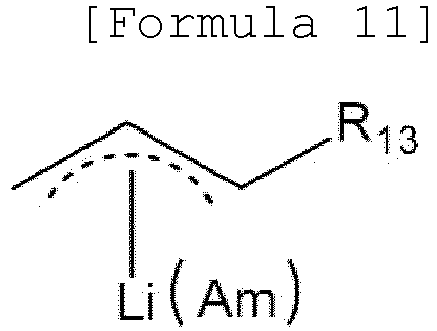
- In Formula 11 above,
- R13 is hydrogen or a C1 to C20 hydrocarbon, and
- Am is an amine-based compound represented by Formula 12 below.

- wherein in Formula 12 above,
- R14 to R18 are each independently hydrogen or a C1 to C20 hydrocarbon, and
- a and b are each independently an integer of 0 to 3, wherein the a and the b are not simultaneously 0.
- In one example of the present invention, R13 may be hydrogen, a C1 to C20 alkyl, a C3 to C20 cycloalky, or a substituted or unsubstituted C7 to C20 arylalkyl,
- R14 to R18 may each independently be hydrogen, a C1 to C20 alkyl, a C1 to C20 alkenyl, a C3 to C20 cycloalkyl, a substituted or unsubstituted C6 to C20 aryl, or a substituted or unsubstituted C7 to C20 arylalkyl, and
- a and b may each independently be an integer of 0 to 2.
- In addition, in one example of the present invention, R13 to R18 may each independently be hydrogen or a C1 to C20 alkyl, wherein a may be 1 or 2, and b may be 0 or 1.
- Specifically, a may be an integer of 1 to 3, and b may be an integer of 0 to 3, and more specifically, a may be 1 or 2, and b may be an integer of 0 to 2, and even more specifically, a may be 1 or 2, and b may be 0 or 1.
- In one example of the present invention, in Formula 11 above, Am may specifically be represented by Formulas 13 or 14 below.


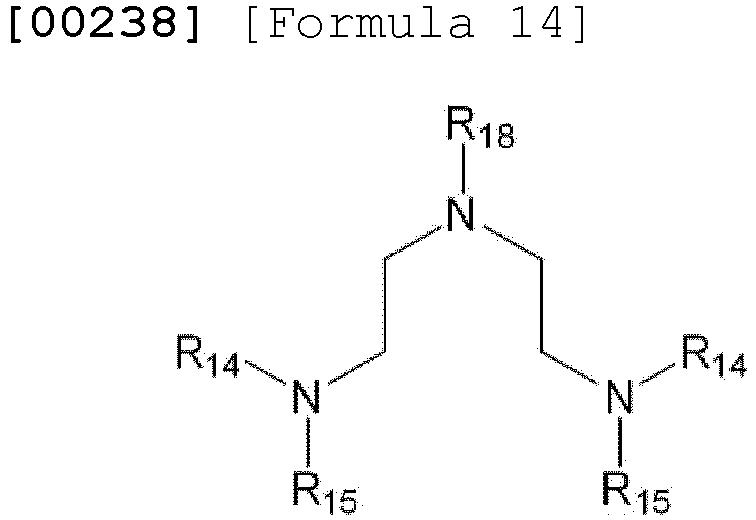
- In the above formulas,
R14, R15, and R18 are each independently hydrogen or a C1 to C20 alkyl. - In addition, in one example of the present invention, in Formula 11 above, Am may specifically be represented by Formulas 13a or Formula 14a below.


- In the method for preparing a multi-block copolymer of the present invention, the compound represented by Formula 11 above is used as an anionic polymerization initiator, so that a polystyrene-based chain may be grown from polyolefin of (polyolephinyl)2Zn in which a polyolefin-based chain has grown around the organozinc compound, zinc (Zn) in particular, prepared in Step S1. As described above, in the method for preparing a multi-block copolymer of the present invention, a polystyrene-polyolefin-polystyrene multi-block copolymer may be prepared by growing the polystyrene-based chain at both ends of a polyolefin chain, so that the prepared multi-block copolymer may have a structure close to symmetry, and may have a uniform polystyrene domain size.
- The anionic polymerization initiator may be prepared by the following preparation method.
- A method for preparing the anionic polymerization initiator includes a process of performing a reaction by introducing a compound represented by Formula 16 below and a compound represented by Formula 12 in the presence of a compound represented by
Formula 15 below.
[Formula 15] B-Li

- In the above formulas,
- R13 to R18 are each independently hydrogen or a C1 to C20 hydrocarbon,
- a and b are each independently an integer of 0 to 3, wherein the a and the b are not simultaneously 0, and
- B is a C1 to C20 alkyl.
- In one example of the present invention, R13 may be hydrogen or a C1 to C20 hydrocarbon, R14 to R18 may each independently be hydrogen, a C1 to C20 alkyl, a C1 to C20 alkenyl, a C3 to C20 cycloalkyl, a substituted or unsubstituted C6 to C20 aryl, or a substituted or unsubstituted C7 to C20 aryl alkyl, and a and b may each independently be an integer of 0 to 2, and B may be a C1 to C12 alkyl.
- In addition, in one example of the present invention, R14 to R18 may each independently be hydrogen or a C1 to C20 alkyl, a may be an integer of 1 or 2, b may be an integer of 0 or 1, and B may be a C1 to C8 alkyl.
- Specifically, a may be an integer of 1 to 3, and b may be an integer of 0 to 3, and more specifically, a may be 1 or 2, and b may be an integer of 0 to 2, and even more specifically, a may be 1 or 2, and b may be 0 or 1.
- An alkyl lithium compound represented by Formula 16 above may be, for example, n-BuLi, wherein n-BuLi is a material widely used as an initiator of anionic polymerization, and is easy to obtain and has excellent unit cost efficiency.
- In the method for preparing the anionic polymerization initiator, the process of reacting a compound represented by Formula 16 above with a compound represented by
Formula 15 above may be performed first, and thereafter, a compound of Formula 12 may be reacted therewith to prepare a compound of Formula 11 above. Specifically, a compound represented by Formula 16 above is reacted with a compound represented byFormula 15 above to produce allyl lithium is an intermediate, and the allyl lithium is reacted with a compound of Formula 12 to finally form an anionic polymerization initiator of Formula 11 above. - In addition, the process of performing a reaction by introducing a compound represented by Formula 16 above and a compound represented by Formula 12 above in the presence of a compound represented by
Formula 15 above may be performed under a condition of no additional solvent. The condition of no additional solvent means that, in the presence of the compound represented by Formula 16 above, there is no separate compound which may be used as a solvent in addition to the compound represented byFormula 15 above and the compound represented by Formula 12 above, or means that, an additional solvent is present in a trace amount, and thus does not significantly react with the compound ofFormula 15 above. - When the reaction is performed under condition of no additional solvent, the reaction of the compound represented by
Formula 15 and the compound represented by Formula 16 above is performed as a main reaction, so that the anionic polymerization initiator of Formula 11 above may be effectively prepared. When there is a separate solvent, the anionic polymerization initiator of Formula 11 above, a compound produced by reacting the compound represented byFormula 15 above with the compound represented by Formula 12 above, and a compound decomposed from the compound produced by reacting the compound represented byFormula 15 above with the compound represented by Formula 12 above are all mixed and present, and thus it is not effective. - Hereinafter, the present invention will be described in detail with reference to examples. However, the following examples are merely illustrative of the present invention and are not intended to limit the scope of the present invention.
- All experiments were performed under an inert atmosphere using a standard glove box and using a Schlenk technique. Toluene, hexane, and tetrahydrofuran (THF) were distilled with benzophenoneketyl and used. Methylcyclohexane (anhydrous grade) used in the polymerization reaction was purchased from Tokyo Chemical Industry (TCI) and purified with a Na/K alloy and used. Sublimation grade HfCl4 was purchased from Streme and used as is. An ethylene-propylene gas mixture was purified with trioctylaluminum (0.6 M in a mineral system) in a bombreactor (2.0 L) and used.
- 1H NMR(600 MHz) and 13C NMR(150 Mhz) spectra were recorded using an ECZ 600 instrument (JEOL).
- GPC data were analyzed in 1,2,4-trichlorobenzene at 160°C using a PL-
GPC 220 system equipped with a refractive index detector and two columns (PLarian Mixed-B 7.5 × 300 mm Varian [Polymer Lab]). -

-

- 2,6-dicyclohexylaniline (0.772 g, 3.00 mmol) and 6-bromo-2-pyridinecarbox aldehyde (0.558 g, 3.00 mmol) were dissolved in toluene (5 mL) and molecular sieve was added thereto. The mixture was heated to 70°C overnight while being stirred. After the filtration, the solvent was removed from a rotary evaporator. A yellow solid was obtained (1.07 g, 84%) .
- 1H NMR(C6D6): δ 8.41(s, 1H, NCH), 8.09(d, J = 7.8 Hz, 1H), 7.53(m, 3H), 6.85(d, J = 7.8 Hz, 1H), 6.63(t, J = 7.8 Hz, 1H), 2.74(m, 2H), 1.87(d, J = 12 Hz, 4H), 1.64(d, J = 12.6 Hz, 4H), 1.54(d, J = 10.8 Hz, 2H), 1.39(quartet, J = 10.2 Hz, 4H), 1.11(m, 6H) ppm.
- 13C NMR(C6D6): δ 26.55, 27.33, 34.25, 39.30, 119.42, 124.32, 125.21, 129.83, 136.68, 138.82, 142.54, 148.94, 155.95, 162.06 ppm.
- HRMS(EI): m/z calcd([M+] C24H29BrN2) 424.1514. Found: 424.1516.
- Under nitrogen, the compound (1.07 g, 2.51 mmol), 1-naphthyl boronic acid (0.453 g, 2.64 mmol), Na2CO3 (0.700 g, 6.60 mmol), and toluene (5 mL) filled a Schlenk flask. A solution of (Ph3P)4Pd(7.83 mg, 0.00678 mmol) was added to degassed H2O/EtOH(1 mL, v/v, 1:1) and toluene (1 mL). Light yellow oil was obtained by column chromatography on silica gel using ethyl acetate (v/v, 90:3:1) containing hexane and a small amount of triethylamine (0.712 g, 60%).
- 1H NMR(C6D6): δ 8.70 (s, 1H, NCH), 8.41(d, J = 7.8 Hz, 1H), 8.31(d, J = 7.8 Hz, 1H), 7.68(d, J = 7.2 Hz, 1H), 7.65(d, J = 7.8 Hz, 1H), 7.54(d, J = 7.2 Hz, 1H), 7.27(m, 4H), 7.20(m, 4H), 2.93(m, 2H), 1.90(d, J = 12 Hz, 4H), 1.61(d, J = 13.2 Hz, 4H), 1.50(d, J = 12.6 Hz, 2H), 1.38(m, 4H), 1.11(m, 6H), ppm.
- 13C NMR(C6D6): δ 26.63, 27.38, 34.35, 39.36, 119.21, 124.32, 124.98, 125.50, 126.15, 126.21, 126.64, 126.75, 128.15, 128.73, 129.38, 131.81, 134.52, 136.94, 137.14, 138.52, 149.48, 155.13, 159.79, 164.05 ppm.
- HRMS(EI): m/z calcd([M+] C34H36N2) 472.2878. Found: 472.2878.
- 2-isopropylphenyllithium (0.114 g, 0.904 mmol) dissolved in diethyl ether (8 mL) was added dropwise to a Schlenk flask containing the compound (0.247 g, 0.523 mmol) in diethyl ether (20 mL). Stirring was performed for 3 hours, and then an aqueous solution (10 mL) of ammonium chloride (0.30 g) was added, and the product was extracted with diethyl ether (3×10 mL). The resulting oil was dried at 60°C overnight at high vacuum. A yellow solid was obtained (0.257 g, 83%).
- 1H NMR (C6D6): δ 8.24 (m, 1H), 7.90(m, 1H), 7.64(m, 1H), 7.62(d, J = 7.8 Hz, 1H), 7.56 (d, J = 7.2 Hz, 1H), 7.26(m, 3H), 7.22(m, 4H), 7.11(m, 5H), 5.62(d, J = 5.4 Hz, 1H, NCH), 4.59(d, J = 5.4 Hz, 1H, NH), 3.31(septet, J = 7.2 Hz, 1H,CH), 2.74(m, 2H), 1.79(d, J = 7.8 Hz, 2H), 1.64 (m, 4H), 1.54(m, 4H), 1.32(m, 4H), 1.08(m, 2H), 1.03(d, J = 6.6 Hz, 3H, CH3), 1.00(m, 1H), 0.980(d, J = 6.6 Hz, 3H, CH3), 0.921(m, 3H) ppm.
- 13C NMR(C6D6): δ 23.78, 24.45, 26.63, 27.42, 27.54, 28.96, 34.77, 35.08, 39.01, 67.64, 119.99, 122.89, 124.13, 124.80, 125.36, 125.77, 126.08, 126.46, 126.56, 126.71, 127.58, 128.55, 129.35, 131.84, 134.64, 136.94, 138.77, 141.88, 142.24, 144.97, 146.32, 159.28, 163.74 ppm.
- HRMS(EI): m/z calcd([M+] C43H48N2) 592.3817. Found: 592.3819.
-

- To a Schlenk flask was filled with the ligand compound (0.150 g, 0.253 mmol) in toluene (1.5 g), and n-BuLi (0.17 mL, 1.6 M solution in hexane, 0.27 mmol) was added dropwise at room temperature. Stirring was performed for 1 hour, and then HfCl4(0.0814 g, 0.254 mmol) was added as a solid. The reaction mixture was heated at 100 °C, and stirred for 2 hours. After cooling was performed, MeMgBr (0.29 mL, 3.1 M solution in diethyl ether, 0.89 mmol) was added thereto, and stirred at room temperature overnight. After a volatile material was removed with a vacuum line, the product was extracted with toluene (1.5 g). The extract was obtained through cellite filtration. After the solvent was removed through a vacuum line, the residue was Triturated in hexane (2 mL) to obtain a yellow solid (0.128 g, 63%).
- 1H NMR(C6D6): δ 8.58 (d, J = 7.8 Hz, 1H), 8.29 (d, J = 8.4 Hz, 1H), 7.79(d, J = 7.8 Hz, 1H), 7.71(d, J = 7.2 Hz, 1H), 7.54(d, J = 7.8 Hz, 1H), 7.46(m, 1H), 7.30(m, 2H), 7.15(m, 3H), 7.09(m, 3H), 6.88(t, J = 7.8 Hz, 1H), 6.62(d, J = 8.4 Hz, 1H), 6.48(s, 1H, NCH), 3.39(m, 1H), 2.92(m, 2H), 2.15(d, J = 13.8 Hz, 1H), 2.10(d, J = 13.8 Hz, 2H), 1.80(m, 2H), 1.65(m, 3H), 1.29(m, 6H), 1.17(d, J = 7.2 Hz, 3H, CH3), 1.07(m, 3H), 0.99(s, 3H, HfCH3), 0.95(m, 2H), 0.73(d, J = 7.2 Hz, 3H, CH3), 0.70(s, 3H, HfCH3), 0.23(m, 1H) ppm.
- 13C NMR(C6D6): δ 23.31, 25.04, 26.63, 26.74, 27.70, 27.76, 27.81, 28.29, 28.89, 35.00, 35.66, 36.62, 37.02, 38.13, 40.88, 62.53, 67.00, 77.27, 119.30, 120.30, 124.29, 125.52, 125.60, 125.97, 126.95, 127.06, 127.73, 129.91, 130.00, 130.09, 130.85, 134.36, 135.80, 140.73, 140.89, 144.02, 145.12, 146.31, 146.38, 146.49, 164.46, 170.79, 206.40 ppm.
- Anal. calcd. (C45H52HfN2): C, 67.61; H, 6.56; N, 3.50%. Found: C, 67.98; H, 6.88; N, 3.19%.
- 15.0 g (98.3 mmol) of 4-vinylbenzyl chloride and 2.628 g (108.1 mmol) of a magnesium metal were added to 78 ml of diethyl ether and stirred at 0 °C for 1.0 hour, and then filtered on cellite to remove magnesium added in excess. 19.2 g (81.9 mmol) of p-tosyl-OCH2CH2Cl dissolved in 27 ml of diethyl ether was added dropwise to the prepared 4-vinylbenzyl-magnesium chloride (4-vinylbenzyl-MgCl) Grignard reagent. Stirring was performed overnight, and then filtration on cellite was performed to remove magnesium chloride tosylate (MgCl (OTs)), which is an insoluble salt. The filtered filter cake was washed three times with 70 ml of hexane, and the solvent was removed with a rotary evaporator to obtain 14.2 g of a crude product. 43 mg (3,000 ppm) of t-butylcatechol was added as a radical remover, and under full vacuum, vacuum distillation was performed at 85 °C to obtain a compound represented by Formula 8-4-1 below. As a result of measuring the weight of the obtained compound, the yield was obtained at 81 wt%, and 1H NMR and 13C NMR spectra were measured.

- 1H NMR (C6D6): δ 7.20 (d, J = 8.4 Hz, 2H), 6.88 (d, J = 8.4 Hz, 2H), 6.61 (dd, J = 16, 9.6 Hz, 1H, =CH), 5.63 (d, J = 16 Hz, 1H, =CH2), 5.09 (d, J = 9.6 Hz, 1H, =CH2), 3.04 (t, J = 6.6 Hz, 2H, CH2), 2.42 (t, J = 6.6 Hz, 2H, CH2), 1.64 (quintet, J = 6.6 Hz, 2H, CH2Cl) ppm.
- 13C NMR(C6D6): δ 32.61, 34.12, 44.07, 113.13, 126.74, 128.97, 135.99, 137.11, 140.63 ppm.
- Thereafter, 10.0 g (55.3 mmol) of the prepared compound (4-(3-chloropropyl)styrene) represented by Formula 8-4-1 above was dissolved in a mixed solvent of 20 ml of toluene and 7.98 g (111 mmol) of tetrahydrofuran (THF), and was added dropwise at room temperature to a suspension in which 2.02 g (83.0 mmol) of magnesium powder was stirred in 40 mL of toluene. After stirring was performed for 5.0 hours, a slight heat was gradually generated, and then the reaction mixture was filtered on celite to remove magnesium added in excess. 6.94 g (55.3 mmol, 1 equivalent to Grignard reagent) of ethyl zinc methoxide produced by reacting 6.83 g (55.3 mmol) of diethyl zinc (Et2Zn) and 1.78 g (55.3 mmol) of methanol in-situ in 30 ml of toluene at room temperature for 1.0 hour was added to the filtrate. Thereafter, 60 ml of toluene was added thereto, followed by stirring at room temperature for 1.0 hour, and then the solvent was removed using a high vacuum line. Thereafter, 96 g of hexane was added thereto, and magnesium chloridemethoxide (MgCl(OMe)), which is an insoluble salt, was removed on cellite. The filtrate was stored at -30°C to deposit a compound represented by Formula 5-4 as a white crystalline solid. As a result of measuring the weight, the yield was obtained at 56 wt% (7.28 g), and 1H NMR and 13C NMR were measured.

- 1H NMR(C6D6): δ 7.24 (d, J = 7.8 Hz, 2H), 6.90 (d, J = 7.8 Hz, 2H), 6.64 (dd, J = 17, 11 Hz, 1H, =CH), 5.66 (d, J = 17 Hz, 1H, =CH2), 5.11 (d, J = 11 Hz, 1H, =CH2), 2.43 (t, J = 7.2 Hz, 2H, CH2), 1.80 (quintet, J = 7.2 Hz, 2H, CH2), -0.19 (t, J = 7.2 Hz, 2H, CH2Zn) ppm.
- 13C NMR(C6D6):δ 12.66, 28.82, 40.09, 113.15, 127.31, 129.23, 136.05, 137.10, 142.91 ppm.
-

- n-BuLi (0.14 mg, 2.2 mmol) was added dropwise to pentamethyldiethylenetriamine (PMDTA, 0.37 g, 2.2 mmol) in 1-octene (13.0 g). Stirring was performed overnight at room temperature, a yellow solution (0.16 mmol-Li/g) of pentylallyl-Li·(PMDTA) was obtained. The aliquot was analyzed by 1H NMR spectroscopy. 1H NMR spectrum was recorded, and then a solution of C6D6 was quenched with H2O (or D2O) and filtered in a pipette with a short pad of anhydrous MgSO4 to record 1H NMR spectrum again.
- A Parr reactor (3.785 L) was vacuum dried at 120 °C for 2 hours. As a scavenger, a solution of MMAO (0.6 mg, 1,000 µmol-Al) in methylcyclohexane (1,200 g) was introduced into the reactor, and then the mixture was stirred at 120 °C for 1 hour using a heating jacket, and thereafter, the solution was removed using a cannula.
- The reactor was filled with methylcyclohexane (1,200 g) containing MMAO (1,000 µmol-Al) as a scavenger, and filled with 1-hexene (560 g) as an alpha-olefin monomer, and then the temperature was set to 90°C. A solution of the organozinc compound (3,100 µmol) of Formula 5-4 above in methylcyclohexane (5 g) was filled as a chain transfer agent, and then a methylcyclohexane solution containing the transition metal compound (12 µmol-Hf) activated with [(C18H37)2N(H)Me]+[B(C6F5)4]- (1.0 eq) in methylcyclohexane was injected. Polymerization was performed within the range of 90 to 120°C for 40 minutes while maintaining the pressure in the reactor at 25 bar by opening a valve of an ethylene tank. After the polymerization, ethylene gas was discharged and then the temperature of the reactor was adjusted to back to 90°C.
- When the temperature reached 90°C, pentylallyl-Li·(PMDTA) (2,600 µmol) in methylcyclohexane (10 g) was added. The temperature was maintained at 90°C for 30 minutes during stirring, and then styrene (104 g) was injected. The temperature was adjusted in the range of 90 to 100°C using a heating jacket. The viscosity increased gradually and reached nearly non-visible conditions within 5 hours. An aliquot was taken for analysis by 1H NMR spectroscopy. From the 1H NMR analysis of an aliquot, complete conversion of styrene was confirmed. After the complete conversion of styrene, 2-ethylhexanoic acid and ethanol were continuously injected. An obtained polymer mass was dried overnight in a vacuum oven at 80°C.
- A multi-block copolymer was prepared in the same manner as in Example 1 except that the reaction conditions were changed as shown in Table 1 below.
- G1651, which is an SEES of Kraton Inc., was set as Comparative Example 1.
- A multi-block copolymer was prepared in the same manner as in Example 1 except that diethyl zinc was used instead of the organozinc compound of Formula 5-4 above in Example 1, and that the reaction conditions were changed as shown in Table 1 below.
- Me3SiCH2Li (2,600 µmol, 291.4 mg) and PMDETA (2,600 µmol, 537.3 mg) were mixed with methylcyclohexane (20.7 g) and then stirred at room temperature for 30 minutes to prepare a polymerization initiator.
- A multi-block copolymer was prepared in the same manner as in Example 1 except that Me3SiCH2Li·(PMDETA) prepared above was used instead of pentylallyl-Li·(PMDTA) as the anionic initiator in Example 1, and that the reaction conditions were changed as shown in Table 1 below.
- A multi-block copolymer was prepared in the same manner as in Example 1 except that Oc3Al (1976.7 mg, 1,348 µmol-Al / 25wt% in hexane) was used instead of MMAO as the scavenger in Example 1, and that the reaction conditions were changed as shown in Table 1 below.
- A transition metal compound, a co-catalyst, and an organozinc compound were prepared according to the preparation of a transition metal compound, preparation of a co-catalyst, and preparation of an organozinc compound described in
Korean Patent Publication 2020-0132635 Korean Patent Publication 2020-0132635 [Table 1] Cataly st Scavenger Organ ic zinc compo und Alpha-olefin Styr ene Polymerizati on initiator Input amount (umol) Type (µmol ) (µmol ) Type Input amoun t (g) Type Input amount (umol) Example 1 12 MMAO 1,000 3, 100 1-hexen e 560 104 Allyl based 2, 600 Example 2 12 MMAO 1,000 3, 100 1-hexen e 560 104 Allyl based 2, 600 Example 3 12 MMAO 1,000 3,720 1-hexen e 560 109 Allyl based 3,125 Example 4 12 MMAO 2,020 3, 100 1-hexen e 560 104 Allyl based 3,410 Compara tive Example 1 Kraton G1651 Compara tive Example 2 10 MMAO 749 3,000 1-hexen e 430 100 Allyl based 2, 600 Compara tive Example 3 12 MMAO 1,000 3, 100 1-octen e 560 98 Silyl based 2, 600 Compara tive Example 4 20 TOA 1,348 2,496 1-octen e 229 61 Allyl based 2,746 Compara tive Example 5 10 TOA 238 640 1-hexen e 34 12 Silyl - based 988 - The physical properties of the polyolefin-polystyrene-based multi-block copolymer of each of Examples and Comparative Examples were measured as follows.
- The measurement was performed through nuclear magnetic resonance (NMR). Using Bruker 600MHz AVANCE III HD NMR device, 1H NMR was measured under the condition of ns=16, d1=3s, solvent=TCE-d2, and 373K, and then the TCE-d2 solvent peak was calibrated to 6.0 ppm. CH3 of 1-propylene was confirmed at 1 ppm and a CH3-related peak (triplet) of a butyl branch by 1-hexene was confirmed near 0.96 ppm to calculate the contents. In addition, the content of styrene was calculated using an aromatic peak near 6.5 to 7.5 ppm.
- The weight average molecular weight (Mw, g/mol) and the number average molecular weight (Mn, g/mol) were measured by gel permeation chromatography (GPC), respectively, and the weight average molecular weight was divided by the number average molecular weight to calculate the polydispersity index (PDI).
- Column: PL Olexis
- Solvent: TCB(trichlorobenzene)
- Flow rate: 1.0 ml/min
- Sample concentration: 1.0 mg/ml
- Injection amount: 200 µℓ
- Column temperature: 160°C
- Detector: Agilent High Temperature RI detector
- Standard: Polystyrene
- Calculate molecular weight by Universal calibration using the Mark-Houwink equation (K = 40.8 × 10⁻⁵, α = 0.7057)
- A storage modulus G' according to temperatures and a loss modulus G" according to temperatures were obtained by raising the temperature by 5°C per minute from 130°C to 250°C with a frequency of 1 Hz and a strain of 0.5% using a dynamic mechanical analysis (DMA) device, and then the storage modulus G' according to temperatures and the loss modulus G" according to temperatures were respectively plotted as a y-axis and an x-axis.
FIG. 1 shows a G'-G" plot for Example 2. In addition,FIG. 2 shows a graph showing the slope value of a storage modulus at each temperature in Examples and Comparative Examples.[Table 2] NMR (wt%) GPC Slope of G'-G" plot Ethy lene Alph a-olef in Styr ene Mw (g/m ol) PDI @130 °C @150 °C @190 °C @200 °C @250 °C Example 1 42.5 32.1 25.4 180, 236 1.79 2.93 3.36 3.83 3.80 3.47 Example 2 43.3 31.1 25.6 144, 188 1.67 2.84 3.27 4.45 4.47 4.28 Example 3 43.6 31.9 24.5 160, 889 1.77 2.94 3.37 4.04 4.01 3.52 Example 4 45.0 28.3 26.7 145, 506 1.86 2.58 2.87 3.15 3.16 3.16 Comparat ive Example 1 43.4 24.8 31.8 139, 261 1.13 2.88 4.52 6.39 7.43 10.14 Comparat ive Example 2 42.8 32.4 24.8 113, 012 1.49 1.85 1.71 1.61 1.55 1.24 Comparat ive Example 3 40.2 23.1 36.7 113, 379 1.56 2.28 2.30 2.29 2.30 2.16 Comparat ive Example 4 42.3 22.7 34.9 61,3 10 1.71 0.87 0.78 0.71 0.73 0.88 Comparat ive Example 5 49.1 25.3 25.5 98,0 42 1.87 2.55 2.63 2.93 2.90 2.49 - In accordance with the tensile test method of ASTM D412, a specimen was prepared using each the block copolymers of Examples and Comparative Examples, and the tensile strength, elongation, and 300% modulus of each specimen were measured.
- The results are shown in Table 3.
- In addition, strain according to stress applied to each specimen was measured, and a stress-strain graph with elongation as the x-axis and tensile strength as the y-axis is shown in
FIG. 3 .[Table 3] Elongation (%) Tensile strength (MPa) 300% Modulus (MPa) Example 1 1,959 24.1 1.9 Example 2 2,103 24.5 2.2 Example 3 1, 904 22.9 2.1 Example 4 1,772 21.9 2.3 Comparative Example 1 1, 849 27.6 1.8 Comparative Example 2 3,525 14.3 0.9 Comparative Example 3 1,905 7.9 1.9 Comparative Example 4 785 6.9 4.5 Comparative Example 5 1,476 22.1 3.8 - As shown in Table 3, the block copolymers of Examples have excellent tensile strength and elongation, and also exhibit a proper level of a 300% modulus value, so that it can be confirmed that all tensile properties are evenly excellent at above a certain level when compared to Comparative Examples which do not satisfy all of the above conditions.
- Meanwhile, referring to
FIG. 3 , there is a difference between the stress strain curve of the block copolymers of Examples and the stress strain curve of the block copolymers of Comparative Examples. Specifically, the block copolymer of each of Comparative Examples shows a significantly higher value of strain according to the applied stress than the block copolymer of each of Examples, but the block copolymer of each of Examples shows a low value of strain according to the applied stress, and in particular, it can be confirmed that the strain gradually decreases after a predetermined amount of stress increase. - From the above results, it can be confirmed and the multi-block copolymer of the present invention has excellent tensile strength and elongation and also exhibits a proper level of a 300% modulus value, so that all tensile properties are evenly excellent.
Claims (14)
- A multi-block copolymer comprising a polystyrene-based block including a repeating unit derived from an aromatic vinyl-based monomer and a polyolefin-based block including a repeating unit derived from an ethylene and a repeating unit derived from an alpha-olefin-based monomer, wherein:
the multi-block copolymer satisfies the following conditions when a storage modulus G' according to temperatures and a loss modulus G" according to temperatures as measured by a dynamic mechanical analysis method are plotted as a y-axis and an x-axis, respectively:a) a slope at 130°C is 2.00 to 4.00, andb) a slope at 190°C is 3.00 to 5.00. - The multi-block copolymer of claim 1, wherein the alpha-olefin is one or more selected from the group consisting of 1-pentene, 3-methyl-1-butene, 1-hexene, 4-methyl-1-pentene, 3-methyl-1-pentene, 1-heptene, 1-octene, 1-decene, 1-undecene, 1-dodecene, 1-tetradecene, 1-hexadecene, 1-eicosene, 4,4-dimethyl-1-pentene, 4,4-diethyl-1-hexene, and 3,4-dimethyl-1-hexene.
- The multi-block copolymer of claim 1, wherein the multi-block copolymer has a slope at 130°C which is less than a slope at 190°C.
- The multi-block copolymer of claim 1, wherein the multi-block copolymer further satisfies the condition in which c) the difference between the slope at 130°C and the slope at 190°C is 0.50 to 2.00.
- The multi-block copolymer of claim 1, wherein the multi-block copolymer further satisfies a slope in the range of 2.00 to 5.00 in the range of 130°C to 250°C.
- The multi-block copolymer of claim 1, wherein the multi-block copolymer further satisfies the condition in which the slope at 250°C is 3.00 to 4.80.
- The multi-block copolymer of claim 1, wherein the multi-block copolymer has a molecular weight distribution of 1.5 to 3.0 as measured from gel permeation chromatography (GPC).
- A method for preparing the multi-block copolymer of claim 1, the method comprising:(S1) preparing a polyolefin-based block by reacting ethylene and an alpha-olefin-based monomer using an organozinc compound as a chain transfer agent in the presence of a catalyst composition including a transition metal compound; and(S2) preparing a multi-block copolymer by reacting an aromatic vinyl-based monomer with the polyolefin-based block in the presence of an anionic polymerization initiator.
- The method of claim 8, wherein the transition metal compound is a compound represented by Formula 1 below:
 wherein in Formula 1 above,M is Ti, Zr, or Hf,R1 to R4 are each independently hydrogen, a substituted or unsubstituted C1 to C20 alkyl group, a substituted or unsubstituted C3 to C20 cycloalkyl group, or a substituted or unsubstituted C6 to C20 aryl group, wherein two or more adjacent ones thereof may be connected to each other and form a ring,R5 and R6 are each independently hydrogen, a substituted or unsubstituted C1 to C20 alkyl group, a substituted or unsubstituted C3 to C20 cycloalkyl group, or a substituted or unsubstituted C6 to C20 aryl group, wherein the substitution is performed by a C1 to C12 alkyl group,R7 is each independently a substituted or unsubstituted C4 to C20 alkyl group, a substituted or unsubstituted C4 to C20 cycloalkyl group, or a substituted or unsubstituted C6 to C20 aryl group,n is 1 to 5, andY1 and Y2 are each independently a halogen group, a C1 to C20 alkyl group, a C2 to C20 alkenyl group, a C2 to C20 alkynyl group, a C3 to C20 cycloalkyl group, a C6 to C20 aryl group, a C7 to C20 alkylaryl group, a C7 to C20 arylalkyl group, a C5 to C20 heteroaryl group, a C1 to C20 alkoxy group, a substituted or unsubstituted C5 to C20 aryloxy group, a C1 to C20 alkylamino group, a C5 to C20 arylamino group, a C1 to C20 alkylthio group, a C5 to C20 arylthio group, a C1 to C20 alkylsilyl group, a C5 to C20 arylsilyl group, a hydroxyl group, an amino group, a thiol group, a silyl group, a cyano group, or a nitro group.
 - The method of claim 8, wherein the organozinc compound is represented by Formula 5 below:

 wherein in Formula 5 above,R8 and R10 are each independently a single bond or a C1 to C10 alkylene group, R9 is a C1 to C10 alkylene group or - SiR11R12-, and R11 and R12 are each independently a C1 to C10 alkyl group.
 - The method of claim 10, wherein the organozinc compound is prepared from the reaction of a Grignard reagent containing a styrene moiety with an alkyl zinc alkoxide.
- The method of claim 11, wherein the Grignard reagent containing a styrene moiety is represented by Formula 7 below:
 wherein in Formula 7 above,R8 and R10 are each independently a single bond or a C1 to C10 alkylene group, R9 is a C1 to C10 alkylene group or - SiR11R12-, R11 and R12 are each independently a C1 to C10 alkyl group, and X is a halogen group.
 - The method of claim 8, wherein the anionic polymerization initiator comprises an alkyl lithium compound containing an allyl group, wherein the allyl group is combined with lithium.
- The method of claim 13, wherein the alkyl lithium compound is represented by Formula 11 below:
 wherein in Formula 11 above,R13 is hydrogen or a C1 to C20 hydrocarbon, andAm is an amine-based compound represented by Formula 12 below:
 wherein in Formula 12 above,R14 to R18 are each independently hydrogen or a C1 to C20 hydrocarbon, anda and b are each independently an integer of 0 to 3, wherein the a and the b are not simultaneously 0.
Applications Claiming Priority (3)
| Application Number | Priority Date | Filing Date | Title |
|---|---|---|---|
| KR20210130753 | 2021-10-01 | ||
| KR1020220124445A KR102935484B1 (en) | 2021-10-01 | 2022-09-29 | Multiblock copolymer and method for manufacturing the same |
| PCT/KR2022/014833 WO2023055205A1 (en) | 2021-10-01 | 2022-09-30 | Multiblock copolymer and preparation method therefor |
Publications (2)
| Publication Number | Publication Date |
|---|---|
| EP4372023A1 true EP4372023A1 (en) | 2024-05-22 |
| EP4372023A4 EP4372023A4 (en) | 2024-11-13 |
Family
ID=85783289
Family Applications (1)
| Application Number | Title | Priority Date | Filing Date |
|---|---|---|---|
| EP22876976.6A Pending EP4372023A4 (en) | 2021-10-01 | 2022-09-30 | Multiblock copolymer and preparation method therefor |
Country Status (3)
| Country | Link |
|---|---|
| US (1) | US20250136742A1 (en) |
| EP (1) | EP4372023A4 (en) |
| WO (1) | WO2023055205A1 (en) |
Family Cites Families (8)
| Publication number | Priority date | Publication date | Assignee | Title |
|---|---|---|---|---|
| WO2008112133A2 (en) * | 2007-03-13 | 2008-09-18 | Cornell University | Pyridlyamidohafnium catalyst precursors, active species from this and uses thereof to polymerize alkenes |
| KR101657925B1 (en) | 2015-02-10 | 2016-09-20 | 아주대학교산학협력단 | Organozinc compound including polyolefin-polystyrene block copolymers and method for manufacturing thereof |
| KR101848781B1 (en) * | 2017-03-31 | 2018-04-17 | 아주대학교산학협력단 | Polystyrene-polyolefin-polystyrene triblock copolymer and method for manufacturing the same |
| KR102379593B1 (en) * | 2018-03-30 | 2022-03-29 | 주식회사 엘지화학 | Block copolymer composition |
| US11096931B2 (en) | 2019-02-22 | 2021-08-24 | Janssen Sciences Ireland Unlimited Company | Amide derivatives useful in the treatment of HBV infection or HBV-induced diseases |
| KR20200132635A (en) | 2019-05-17 | 2020-11-25 | 주식회사 엘지화학 | Polyolefin-polystyrene multiblock copolymer and method for manufacturing the same |
| EP4169927A4 (en) * | 2020-07-31 | 2024-01-17 | Lg Chem, Ltd. | METHOD FOR PRODUCING ORGANOZINC COMPOUND, CHAIN TRANSFER AGENT, BLOCK COPOLYMER AND RESIN COMPOSITION |
| KR102465433B1 (en) | 2021-03-03 | 2022-11-09 | 울산과학대학교 산학협력단 | Active type bilge keel device |
-
2022
- 2022-09-30 WO PCT/KR2022/014833 patent/WO2023055205A1/en not_active Ceased
- 2022-09-30 EP EP22876976.6A patent/EP4372023A4/en active Pending
- 2022-09-30 US US18/683,590 patent/US20250136742A1/en active Pending
Also Published As
| Publication number | Publication date |
|---|---|
| WO2023055205A1 (en) | 2023-04-06 |
| US20250136742A1 (en) | 2025-05-01 |
| EP4372023A4 (en) | 2024-11-13 |
Similar Documents
| Publication | Publication Date | Title |
|---|---|---|
| JP7250402B2 (en) | Polyolefin-polystyrene multi-block copolymer and method for producing the same | |
| JP7262883B2 (en) | Polyolefin-polystyrene multi-block copolymer and method for producing same | |
| KR102731571B1 (en) | Polyolefin-polystyrene multiblock copolymer and method for manufacturing the same | |
| KR102672672B1 (en) | Polyolefin-polystyrene multiblock copolymer and method for manufacturing the same | |
| EP3747920A1 (en) | Block copolymer composition | |
| EP4559973A1 (en) | Resin composition and preparation method thereof | |
| EP4375306A1 (en) | Multi-block copolymer, resin composition comprising same, and method for preparing same | |
| EP4372022A1 (en) | Multi-block copolymer and preparation method therefor | |
| KR102935484B1 (en) | Multiblock copolymer and method for manufacturing the same | |
| EP4299667A1 (en) | Thermoplastic resin composition | |
| US20250136742A1 (en) | Multi-Block Copolymer and Method for Preparing the Same | |
| KR102942736B1 (en) | Multiblock copolymer and method for manufacturing the same | |
| KR102939134B1 (en) | Multiblock copolymer and method for manufacturing the same | |
| TWI919006B (en) | Multi-block copolymer and method for preparing the same | |
| CN117881709A (en) | Multi-block copolymer and preparation method thereof | |
| CN117881710A (en) | Multi-block copolymer and preparation method thereof | |
| KR20240112215A (en) | Block copolymer, method for preparing block compolymer and resin composition |
Legal Events
| Date | Code | Title | Description |
|---|---|---|---|
| STAA | Information on the status of an ep patent application or granted ep patent |
Free format text: STATUS: THE INTERNATIONAL PUBLICATION HAS BEEN MADE |
|
| PUAI | Public reference made under article 153(3) epc to a published international application that has entered the european phase |
Free format text: ORIGINAL CODE: 0009012 |
|
| STAA | Information on the status of an ep patent application or granted ep patent |
Free format text: STATUS: REQUEST FOR EXAMINATION WAS MADE |
|
| 17P | Request for examination filed |
Effective date: 20240212 |
|
| AK | Designated contracting states |
Kind code of ref document: A1 Designated state(s): AL AT BE BG CH CY CZ DE DK EE ES FI FR GB GR HR HU IE IS IT LI LT LU LV MC MK MT NL NO PL PT RO RS SE SI SK SM TR |
|
| A4 | Supplementary search report drawn up and despatched |
Effective date: 20241011 |
|
| RIC1 | Information provided on ipc code assigned before grant |
Ipc: C08F 4/46 20060101ALI20241007BHEP Ipc: C08F 4/64 20060101ALI20241007BHEP Ipc: C08F 210/14 20060101ALI20241007BHEP Ipc: C08F 212/08 20060101ALI20241007BHEP Ipc: C08F 297/02 20060101AFI20241007BHEP |
|
| DAV | Request for validation of the european patent (deleted) | ||
| DAX | Request for extension of the european patent (deleted) |