EP4371662A1 - Method for analyzing reactive low-molecular-weight compound contained in polyoxyethylene derivative - Google Patents
Method for analyzing reactive low-molecular-weight compound contained in polyoxyethylene derivative Download PDFInfo
- Publication number
- EP4371662A1 EP4371662A1 EP22841961.0A EP22841961A EP4371662A1 EP 4371662 A1 EP4371662 A1 EP 4371662A1 EP 22841961 A EP22841961 A EP 22841961A EP 4371662 A1 EP4371662 A1 EP 4371662A1
- Authority
- EP
- European Patent Office
- Prior art keywords
- formula
- compound
- group
- bond
- analysis
- Prior art date
- Legal status (The legal status is an assumption and is not a legal conclusion. Google has not performed a legal analysis and makes no representation as to the accuracy of the status listed.)
- Granted
Links
Classifications
-
- G—PHYSICS
- G01—MEASURING; TESTING
- G01N—INVESTIGATING OR ANALYSING MATERIALS BY DETERMINING THEIR CHEMICAL OR PHYSICAL PROPERTIES
- G01N30/00—Investigating or analysing materials by separation into components using adsorption, absorption or similar phenomena or using ion-exchange, e.g. chromatography or field flow fractionation
- G01N30/02—Column chromatography
- G01N30/62—Detectors specially adapted therefor
- G01N30/74—Optical detectors
-
- B—PERFORMING OPERATIONS; TRANSPORTING
- B01—PHYSICAL OR CHEMICAL PROCESSES OR APPARATUS IN GENERAL
- B01J—CHEMICAL OR PHYSICAL PROCESSES, e.g. CATALYSIS OR COLLOID CHEMISTRY; THEIR RELEVANT APPARATUS
- B01J20/00—Solid sorbent compositions or filter aid compositions; Sorbents for chromatography; Processes for preparing, regenerating or reactivating thereof
- B01J20/281—Sorbents specially adapted for preparative, analytical or investigative chromatography
- B01J20/286—Phases chemically bonded to a substrate, e.g. to silica or to polymers
- B01J20/287—Non-polar phases; Reversed phases
-
- G—PHYSICS
- G01—MEASURING; TESTING
- G01N—INVESTIGATING OR ANALYSING MATERIALS BY DETERMINING THEIR CHEMICAL OR PHYSICAL PROPERTIES
- G01N30/00—Investigating or analysing materials by separation into components using adsorption, absorption or similar phenomena or using ion-exchange, e.g. chromatography or field flow fractionation
- G01N30/02—Column chromatography
- G01N30/88—Integrated analysis systems specially adapted therefor, not covered by a single one of the groups G01N30/04 - G01N30/86
-
- G—PHYSICS
- G01—MEASURING; TESTING
- G01N—INVESTIGATING OR ANALYSING MATERIALS BY DETERMINING THEIR CHEMICAL OR PHYSICAL PROPERTIES
- G01N30/00—Investigating or analysing materials by separation into components using adsorption, absorption or similar phenomena or using ion-exchange, e.g. chromatography or field flow fractionation
- G01N30/89—Inverse chromatography
-
- G—PHYSICS
- G01—MEASURING; TESTING
- G01N—INVESTIGATING OR ANALYSING MATERIALS BY DETERMINING THEIR CHEMICAL OR PHYSICAL PROPERTIES
- G01N30/00—Investigating or analysing materials by separation into components using adsorption, absorption or similar phenomena or using ion-exchange, e.g. chromatography or field flow fractionation
- G01N30/02—Column chromatography
- G01N30/88—Integrated analysis systems specially adapted therefor, not covered by a single one of the groups G01N30/04 - G01N30/86
- G01N2030/8809—Integrated analysis systems specially adapted therefor, not covered by a single one of the groups G01N30/04 - G01N30/86 analysis specially adapted for the sample
- G01N2030/884—Integrated analysis systems specially adapted therefor, not covered by a single one of the groups G01N30/04 - G01N30/86 analysis specially adapted for the sample organic compounds
-
- G—PHYSICS
- G01—MEASURING; TESTING
- G01N—INVESTIGATING OR ANALYSING MATERIALS BY DETERMINING THEIR CHEMICAL OR PHYSICAL PROPERTIES
- G01N30/00—Investigating or analysing materials by separation into components using adsorption, absorption or similar phenomena or using ion-exchange, e.g. chromatography or field flow fractionation
- G01N30/02—Column chromatography
- G01N30/26—Conditioning of the fluid carrier; Flow patterns
- G01N30/28—Control of physical parameters of the fluid carrier
- G01N30/34—Control of physical parameters of the fluid carrier of fluid composition, e.g. gradient
Definitions
- the present invention relates to a highly sensitive analysis method for a low-molecular-weight compound contained in a polyoxyethylene derivative. More particularly, it relates to a highly sensitive method for analyzing a low-molecular-weight compound contained in a polyoxyethylene derivative having an active group at an end, which is used as a polyoxyethylene modifying agent for polypeptide, physiologically active protein, enzyme, and the like.
- polymer compounds aiming at use for pharmaceutical products have been actively developed, and polyoxyethylene derivatives activated at the end thereof are one of them.
- the main use thereof is to make it possible to extend the half-life in blood of a biologically related substance, such as hormones, cytokines, antibodies, and enzymes, through an increase in the molecular weight and formation of a hydration layer by chemically modifying the biologically related substance.
- a biologically related substance such as hormones, cytokines, antibodies, and enzymes
- effects such as reduction of the toxicity and antigenicity of biologically related substances, improved solubility of poorly water-soluble drugs, and the like can be obtained.
- the effect of reducing the toxicity and antigenicity of biologically related substances varies depending on the molecular weight of the polyoxyethylene derivative used for modification and the amount of modification.
- the antigenicity of the biologically related substance can be reduced by modifying with many polyoxyethylene derivatives.
- the structure of polyoxyethylene derivatives generally has an active group at the end of polyoxyethylene that can chemically bind to functional groups such as amino group, mercapto group, carboxyl group, and unsaturated bond that exist on the surface of biologically related substances such as proteins and the like to be modified.
- active groups for modifying amino groups of biologically related substances include formyl group, acetal group, paranitrophenyloxycarbonyl group, N-succinimidyloxycarbonyl group, and the like.
- N-succinimidyloxycarbonyl groups react under mild conditions, and comparatively many amino groups that can react with N-succinimidyloxycarbonyl groups are present on the surface of biologically related substances. Therefore, they are useful active groups for chemical modification of biologically related substances (Non Patent Literature 1).
- a polyoxyethylene derivative having an N-succinimidyloxycarbonyl group can be synthesized by reacting a polyoxyethylene derivative having a carboxylic acid at the end with N-hydroxysuccinimide in the presence of a condensing agent such as dicyclohexylcarbodiimide and the like.
- a condensing agent such as dicyclohexylcarbodiimide and the like.
- side reactions occur between reagents during condensation reaction, and a reactive low-molecular-weight compound represented by the formula (1)
- N-succinimidyloxycarbonyl- ⁇ -alanine N-succinimidyl ester, ⁇ -Ala-NHS, CAS registration number: 21994-89-8) is generated as an impurity (Non Patent Literatures 2, 3).
- Commercially available polyoxyethylene derivatives having an N-succinimidyloxycarbonyl group contain about 100 to 1000 ppm of a compound of the formula (1).
- the compound of the formula (1) has an N-succinimidyloxycarbonylamino group and an N-succinimidyloxycarbonyl group at both ends, and these functional groups have reactivity with an amino group, due to which application of the compound as a bifunctional linker has also been proposed (Patent Literature 1, Non Patent Literature 3).
- Patent Literature 1 Non Patent Literature 3
- the compound of the formula (1) reacts with the biologically related substances like polyoxyethylene derivatives and generates impurities in preparations. Therefore, highly sensitive analysis is required to control the content of the compound of formula (1), which is contained in small amounts in polyoxyethylene derivatives.
- a method using liquid chromatography is a general method for analyzing low-molecular-weight impurities such as the compound of the formula (1), and a method for highly sensitive detection includes ultraviolet visible spectrometer detector, fluorescence detector, mass spectrometry detector, and the like.
- ultraviolet visible spectrometer detector fluorescence detector
- mass spectrometry detector mass spectrometry detector
- the compound of the formula (1) which is produced as a by-product during the synthesis of polyoxyethylene derivatives having an N-succinimidyloxycarbonyl group at the end, reacts even in small amounts with biologically related substances and causes by-production of impurities. Therefore, from the viewpoint of quality control of pharmaceutical products, it is required to analyze the compound of the formula (1) contained in polyoxyethylene derivatives with high sensitivity.
- the problem to be solved by the present invention is provision of a method capable of highly sensitively analyzing a compound of the formula (1): contained in polyoxyethylene derivatives.
- the present invention is characterized in that it is a method including analyzing by reversed-phase liquid chromatography a polyoxyethylene derivative having an N-succinimidyloxycarbonyl group at the end that chemically binds to biologically related substances, and highly sensitively analyzing the compound of the formula (1) which is contained in an extremely small amount from the area value of the chromatogram obtained with an ultraviolet visible spectrometer detector.
- the present invention relates to the following (1) and (2).
- the present invention makes it possible to provide a polyoxyethylene derivative containing a small amount of the compound of the formula (1) by analyzing the compound of the formula (1) contained in the polyoxyethylene derivative with high sensitivity. Even in small amounts, the compound of the formula (1) contained in polyoxyethylene derivatives used for modification of biologically related substances can cause production of impurities during production of pharmaceutical products. Therefore, the present invention is extremely useful in the quality control of pharmaceutical products.
- ultraviolet visible spectrometer detector As a method for detecting low-molecular-weight compounds with high sensitivity, ultraviolet visible spectrometer detector, fluorescence detector, mass spectrometry detector, and the like can be generally mentioned.
- fluorescence detectors can only detect compounds that exhibit fluorescence. Therefore, the compound of the formula (1) cannot be detected.
- Mass spectrometry detectors are very expensive and have many limitations, for example, non-volatile eluents cannot be used and the detector is contaminated when high concentration samples are measured.
- ultraviolet visible spectrometer detectors are inexpensive, and can use many eluents regardless of whether they are volatile or non-volatile, and the detector is not contaminated with high concentration samples.
- ultraviolet visible spectrometer detector As the wavelength used for detection (detection wavelength), ultraviolet light having a wavelength shorter than 200 nm, preferably ultraviolet light having a wavelength of 190 to 200 nm, and particularly preferably ultraviolet light having a wavelength of 194 nm, is used.
- the separation mode used in the analysis method of the present invention is preferably reversed-phase chromatography.
- Reversed-phase chromatography using a column packed with silica-based particles modified with octadecyl group (C18), octyl group (C8), phenyl group (Ph), or triacontyl group (C30), or similarly modified polymer-based particles is more preferred, and reversed-phase chromatography using a column packed with silica-based particles modified with octadecyl group is particularly preferred.
- the column used for analysis may be made of stainless steel and have a column length of 5 to 25 cm and an inner diameter of 1 to 6 mm, preferably a column length of 15 to 25 cm and an inner diameter of 2 to 5 mm.
- the particle size of the filler is preferably 2 to 10 um, particularly preferably 2 to 5 um.
- the filler is preferably wholly porous particles or superficially porous particles, and the pore size is preferably 5 to 50 nm, particularly preferably 7 to 30 nm.
- the column temperature is preferably 5 to 60°C, particularly preferably 20 to 40°C.
- the eluent (mobile phase for analysis) used in the analysis a mixture of water and an organic solvent can be used.
- water-miscible polar solvents such as acetonitrile, methanol, and 2-propanol can be used, and acetonitrile is preferably used.
- the mixing ratio of the organic solvent can be in the range of 10 to 80% by volume, preferably in the range of 20 to 50%.
- water and the organic solvent can be mixed in advance or can be mixed continuously by gradient analysis, and it is particularly preferable to use an eluent mixed in advance. It is known that the compound of the formula (1) reacts with water under neutral to basic conditions and decomposes. Thus, the eluent needs to be under acidic conditions.
- Additives can be added to the eluent, and 0.01 to 1% of an acidic substance or a salt thereof is preferably added.
- an acidic substance or a salt thereof is preferably added.
- the baseline of the chromatogram and the peak of the compound of the formula (1) may overlap, which causes a decrease in peak detection sensitivity and analysis reproducibility.
- pKa is preferably not more than 4.
- An acidic substance to be added is preferably an acidic substance with a maximum molar absorption coefficient of not more than 20 M -1 cm -1 in ultraviolet ray with a wavelength of 190 to 200 nm and a pKa of not more than 4, more preferably a maximum molar absorption coefficient of not more than 5 M -1 cm -1 and a pKa of not more than 3. It is further preferable to use phosphoric acid and perchloric acid, and phosphoric acid is most preferred.
- the rate at which the eluent is fed is preferably 0.1 to 4 mL/min, particularly preferably 0.2 to 1.5 mL/min.
- the analysis sample of the present invention is a polyoxyethylene derivative containing the compound of the formula (1).
- the polyoxyethylene derivative is dissolved using an aprotic organic solvent and preferably dissolved in a solvent that is miscible with the eluent used for the analysis.
- a ghost peak that interferes with analysis may appear when an eluent and a liquid for dissolution of the analysis sample are different.
- an acidic substance can be added as an additive to a liquid for dissolution of an analysis sample.
- the acidic substance acetic acid, formic acid, or trifluoroacetic acid (hereinafter also to be referred to as TFA) is preferably used, and trifluoroacetic acid is particularly preferably used.
- the concentration of the polyoxyethylene derivative is preferably 50 to 300 mg/mL, particularly preferably 50 to 200 mg/mL.
- the sample injection amount (volume) during analysis is preferably not less than 0.2% and not more than 0.5%, particularly preferably not less than 0.2% and not more than 0.3%, of the column volume.
- the sample concentration used for analysis is C (mg/mL)
- the sample injection amount is I (mL)
- the column volume is V (mL)
- the sample amount per column volume is expressed as "CxI ⁇ V”.
- it is preferably not less than 0.1 and not more than 1.5, particularly preferably not less than 0.1 and not more than 1.6.
- the signal/noise ratio can be recited as a measure of the detection sensitivity of the analysis method of the present invention.
- S/N ratio When a polyoxyethylene derivative containing the compound of the formula (1) equivalent to 5 ppm is analyzed, the S/N ratio of the peak derived from the compound of the formula (1) is preferably not less than 10, more preferably not less than 30.
- a and b are the average number of added moles of oxyethylene groups, each 0 to 5000, preferably 0 to 1000, and a+b is not less than 20.
- Examples of the compound having 2 to 8 hydroxyl groups and 2 to 21 carbon atoms and optionally containing an oxygen atom and/or a nitrogen atom in the definition of Z in the formula (2) include ethylene glycol, triethanolamine, glycerin, diglycerin, tetrakis(2-hydroxyethyl)ethylenediamine, xylitol, pentaerythritol, dipentaerythritol, tripentaerythritol, hexaglycerine, and the like, preferably ethylene glycol, glycerine, and pentaerythritol, more preferably ethylene glycol.
- alkylene group in the definitions of L 1 and L 2 in the formula (2) examples include a linear or branched alkylene group having 1 to 6 carbon atoms, preferably methylene group, ethylene group, propylene group, butylene group, and pentylene group, more preferably methylene group, ethylene group, and pentylene group.
- Examples of the alkoxy group in the definition of X 1 in the formula (2) include a linear or branched alkylene group having 1 to 6 carbon atoms. A methoxy group, an ethoxy group, a propoxy group, or an isopropyloxy group is preferred, and a methoxy group is more preferred.
- X 2 is an N-succinimidyloxycarbonyl group.
- Z in the formula (2) is an ethylene glycol residue.
- Z in the formula (2) is a glycerin residue.
- Z in the formula (2) is a xylitol residue.
- Z in the formula (2) is a pentaerythritol residue.
- Z in the formula (2) is a hexaglycerin residue.
- L 1 and L 2 in the formula (2) are each independently a divalent spacer. These spacers are not particularly limited as long as they are groups that can form a covalent bond. Preferably, each is an ester bond, an amide bond, an ether bond, a thioether bond, a urethane bond, a urea bond, or an alkylene group optionally containing these bonds, and more preferably an ester bond, an amide bond, an ether bond, a urethane bond, or an alkylene group optionally containing these bonds. Particularly preferred embodiments are those shown in the following group (I). In addition, two to five spacers of group (I) may be combined.
- r in the formula is an integer of 0 to 10 (however, in (z1), r is not 0), preferably an integer of 0 to 6, further preferably an integer of 0 to 5.
- each r in the formula may be the same or different.
- L 1 in the formula (2) is preferably (z1), (z2), (z3), (z4), (z5), (z6), (z7), (z8), (z9), or (z10) of group (I), and (z1), (z2), (z6), and (z9) are more preferred.
- L 2 in the formula (2) is preferably (z2), (z3), (z4), (z5), (z6), (z7), (z8), (z9), or (z10) of group (I), and (z2), (z6), and (z9) are more preferred.
- p in the formula (2) is preferably 0.
- the present invention is not limited to the constitution described in the above-mentioned embodiments, but also includes, for example, the following constitution.
- the skeleton of the compound of the formula (4) may be made into the skeleton of the formula (11) below, or the skeleton of the compound of the formula (5) may be made into the skeleton of the formula (12) below.
- These compounds of the formula (11) and the formula (12) can also provide the same effects as those of the above-mentioned embodiments.
- the compound of the formula (1) ( ⁇ -Ala-NHS) (10.0 mg) was weighed into a 50 mL volumetric flask, and dissolved in acetonitrile, and then the volume was increased (0.2 mg/mL). This solution (0.5 mL) was accurately weighed into a 100 mL volumetric flask, and the volume was increased with 0.1% TFA-containing acetonitrile solution to prepare an addition solution (0.001 mg/mL).
- the peak height of ⁇ -Ala-NHS in the analysis sample at this time was 769, and the S/N ratio was 2.
- the peak height of ⁇ -Ala-NHS in the analysis sample at this time was 540, and the S/N ratio was 2.
- HPLC was measured by changing the amount of compound of the formula (8) to be measured when preparing the analysis sample solution from 100 mg to 30 mg, changing the concentration of the sample to be prepared from 100 mg/mL (5 ppm of ⁇ -Ala-NHS was added to the compound of the formula (8)) to 30 mg/mL (5 ppm of ⁇ -Ala-NHS was added to the compound of the formula (8)), through changing the amount of the addition solution from 0.5 mL to 0.15 mL, and under the same conditions as in Example 1.
- the peak height of ⁇ -Ala-NHS in the analysis sample at this time was 698, and the S/N ratio was 11.
- the compound (8) of Example 1 was changed to the compound of the formula (9) and HPLC was measured.
- the peak height of ⁇ -Ala-NHS in the sample at this time was 2520, and the S/N ratio was 57.
- Example 1 The compound (8) of Example 1 was changed to the compound of the formula (10) and HPLC was measured.
- the peak height of ⁇ -Ala-NHS in the sample at this time was 2210, and the S/N ratio was 54.
- a highly sensitive analysis method for a low-molecular-weight compound contained in a polyoxyethylene derivative is provided.
Landscapes
- Chemical & Material Sciences (AREA)
- Analytical Chemistry (AREA)
- Physics & Mathematics (AREA)
- General Health & Medical Sciences (AREA)
- Life Sciences & Earth Sciences (AREA)
- Biochemistry (AREA)
- Health & Medical Sciences (AREA)
- General Physics & Mathematics (AREA)
- Immunology (AREA)
- Pathology (AREA)
- Spectroscopy & Molecular Physics (AREA)
- Organic Chemistry (AREA)
- Chemical Kinetics & Catalysis (AREA)
- Organic Low-Molecular-Weight Compounds And Preparation Thereof (AREA)
Abstract
Description
- The present invention relates to a highly sensitive analysis method for a low-molecular-weight compound contained in a polyoxyethylene derivative. More particularly, it relates to a highly sensitive method for analyzing a low-molecular-weight compound contained in a polyoxyethylene derivative having an active group at an end, which is used as a polyoxyethylene modifying agent for polypeptide, physiologically active protein, enzyme, and the like.
- In recent years, polymer compounds aiming at use for pharmaceutical products have been actively developed, and polyoxyethylene derivatives activated at the end thereof are one of them. The main use thereof is to make it possible to extend the half-life in blood of a biologically related substance, such as hormones, cytokines, antibodies, and enzymes, through an increase in the molecular weight and formation of a hydration layer by chemically modifying the biologically related substance. In addition, by modifying with polyoxyethylene derivatives, effects such as reduction of the toxicity and antigenicity of biologically related substances, improved solubility of poorly water-soluble drugs, and the like can be obtained. The effect of reducing the toxicity and antigenicity of biologically related substances varies depending on the molecular weight of the polyoxyethylene derivative used for modification and the amount of modification. For example, in the case of a highly antigenic biologically related substance, the antigenicity of the biologically related substance can be reduced by modifying with many polyoxyethylene derivatives.
- The structure of polyoxyethylene derivatives generally has an active group at the end of polyoxyethylene that can chemically bind to functional groups such as amino group, mercapto group, carboxyl group, and unsaturated bond that exist on the surface of biologically related substances such as proteins and the like to be modified. For example, active groups for modifying amino groups of biologically related substances include formyl group, acetal group, paranitrophenyloxycarbonyl group, N-succinimidyloxycarbonyl group, and the like. In particular, N-succinimidyloxycarbonyl groups react under mild conditions, and comparatively many amino groups that can react with N-succinimidyloxycarbonyl groups are present on the surface of biologically related substances. Therefore, they are useful active groups for chemical modification of biologically related substances (Non Patent Literature 1).
- A polyoxyethylene derivative having an N-succinimidyloxycarbonyl group can be synthesized by reacting a polyoxyethylene derivative having a carboxylic acid at the end with N-hydroxysuccinimide in the presence of a condensing agent such as dicyclohexylcarbodiimide and the like. In addition, it is known that side reactions occur between reagents during condensation reaction, and a reactive low-molecular-weight compound represented by the formula (1)
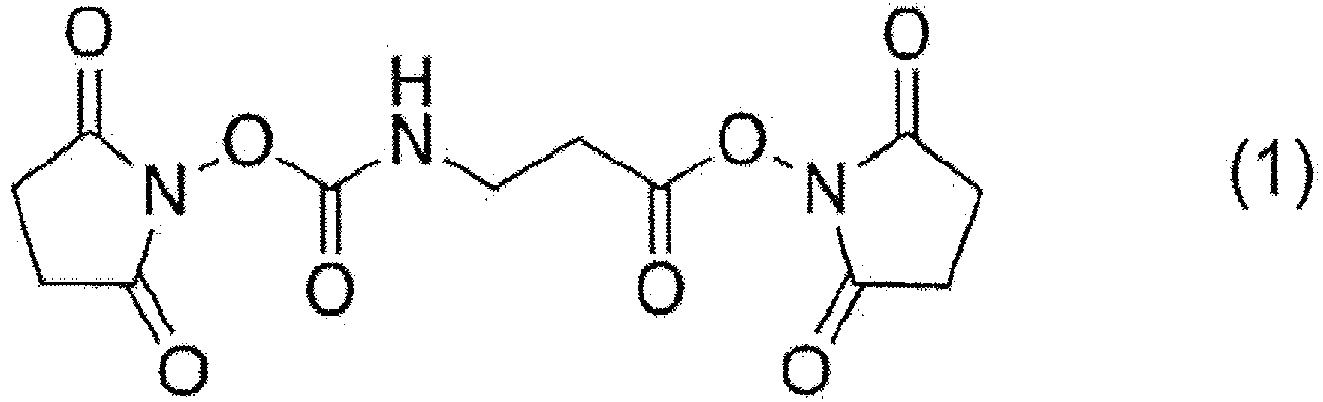
- (N-succinimidyloxycarbonyl-β-alanine N-succinimidyl ester, β-Ala-NHS, CAS registration number: 21994-89-8) is generated as an impurity (Non Patent Literatures 2, 3). Commercially available polyoxyethylene derivatives having an N-succinimidyloxycarbonyl group contain about 100 to 1000 ppm of a compound of the formula (1).
- The compound of the formula (1) has an N-succinimidyloxycarbonylamino group and an N-succinimidyloxycarbonyl group at both ends, and these functional groups have reactivity with an amino group, due to which application of the compound as a bifunctional linker has also been proposed (Patent Literature 1, Non Patent Literature 3). However, when the compound of the formula (1) is included in polyoxyethylene derivatives and biologically related substances such as protein and the like are chemically modified, the compound of the formula (1) reacts with the biologically related substances like polyoxyethylene derivatives and generates impurities in preparations. Therefore, highly sensitive analysis is required to control the content of the compound of formula (1), which is contained in small amounts in polyoxyethylene derivatives.
- A method using liquid chromatography is a general method for analyzing low-molecular-weight impurities such as the compound of the formula (1), and a method for highly sensitive detection includes ultraviolet visible spectrometer detector, fluorescence detector, mass spectrometry detector, and the like. However, no analysis method has been reported so far to detect the compound of the formula (1) with high sensitivity using these detectors.
- As described above, the compound of the formula (1), which is produced as a by-product during the synthesis of polyoxyethylene derivatives having an N-succinimidyloxycarbonyl group at the end, reacts even in small amounts with biologically related substances and causes by-production of impurities. Therefore, from the viewpoint of quality control of pharmaceutical products, it is required to analyze the compound of the formula (1) contained in polyoxyethylene derivatives with high sensitivity.
-
- [Patent Literature 1]
WO 2010/107520 - [Patent Literature 2]
WO 1997/003106 -
- [Non Patent Literature 1]
Bioconjugate Techniques 3rd edition, 2013 - [Non Patent Literature 2]
Tetrahedron 1968, 24, 6935-6939 - [Non Patent Literature 3]
Reactive & Functional Polymers 2007, 67, 529-539 - Accordingly, the problem to be solved by the present invention is provision of a method capable of highly sensitively analyzing a compound of the formula (1):

- The present invention is characterized in that it is a method including analyzing by reversed-phase liquid chromatography a polyoxyethylene derivative having an N-succinimidyloxycarbonyl group at the end that chemically binds to biologically related substances, and highly sensitively analyzing the compound of the formula (1) which is contained in an extremely small amount from the area value of the chromatogram obtained with an ultraviolet visible spectrometer detector.
- That is, the present invention relates to the following (1) and (2).
- (1) An analysis method comprising separating a compound of the formula (1):

- (2) The analysis method of the above-mentioned (1), wherein the polyoxyethylene derivative is represented by the formula (2):

- The present invention makes it possible to provide a polyoxyethylene derivative containing a small amount of the compound of the formula (1) by analyzing the compound of the formula (1) contained in the polyoxyethylene derivative with high sensitivity. Even in small amounts, the compound of the formula (1) contained in polyoxyethylene derivatives used for modification of biologically related substances can cause production of impurities during production of pharmaceutical products. Therefore, the present invention is extremely useful in the quality control of pharmaceutical products.
- The present invention is described in detail below.
- As a method for detecting low-molecular-weight compounds with high sensitivity, ultraviolet visible spectrometer detector, fluorescence detector, mass spectrometry detector, and the like can be generally mentioned. However, fluorescence detectors can only detect compounds that exhibit fluorescence. Therefore, the compound of the formula (1) cannot be detected. Mass spectrometry detectors are very expensive and have many limitations, for example, non-volatile eluents cannot be used and the detector is contaminated when high concentration samples are measured. On the other hand, ultraviolet visible spectrometer detectors are inexpensive, and can use many eluents regardless of whether they are volatile or non-volatile, and the detector is not contaminated with high concentration samples. Therefore, they are widely used as highly versatile detectors, and it is preferable to use an ultraviolet visible spectrometer detector as the detector also in the analysis method of the present invention. As the wavelength used for detection (detection wavelength), ultraviolet light having a wavelength shorter than 200 nm, preferably ultraviolet light having a wavelength of 190 to 200 nm, and particularly preferably ultraviolet light having a wavelength of 194 nm, is used.
- The separation mode used in the analysis method of the present invention is preferably reversed-phase chromatography. Reversed-phase chromatography using a column packed with silica-based particles modified with octadecyl group (C18), octyl group (C8), phenyl group (Ph), or triacontyl group (C30), or similarly modified polymer-based particles is more preferred, and reversed-phase chromatography using a column packed with silica-based particles modified with octadecyl group is particularly preferred. The column used for analysis may be made of stainless steel and have a column length of 5 to 25 cm and an inner diameter of 1 to 6 mm, preferably a column length of 15 to 25 cm and an inner diameter of 2 to 5 mm. The particle size of the filler is preferably 2 to 10 um, particularly preferably 2 to 5 um. The filler is preferably wholly porous particles or superficially porous particles, and the pore size is preferably 5 to 50 nm, particularly preferably 7 to 30 nm. The column temperature is preferably 5 to 60°C, particularly preferably 20 to 40°C. As the eluent (mobile phase for analysis) used in the analysis, a mixture of water and an organic solvent can be used. As for the kind of organic solvent, water-miscible polar solvents such as acetonitrile, methanol, and 2-propanol can be used, and acetonitrile is preferably used. The mixing ratio of the organic solvent can be in the range of 10 to 80% by volume, preferably in the range of 20 to 50%. Furthermore, water and the organic solvent can be mixed in advance or can be mixed continuously by gradient analysis, and it is particularly preferable to use an eluent mixed in advance. It is known that the compound of the formula (1) reacts with water under neutral to basic conditions and decomposes. Thus, the eluent needs to be under acidic conditions. Additives can be added to the eluent, and 0.01 to 1% of an acidic substance or a salt thereof is preferably added. When the molar absorption coefficient of an acidic substance to be added for ultraviolet light with a wavelength of 190 to 200 nm is large, the baseline of the chromatogram and the peak of the compound of the formula (1) may overlap, which causes a decrease in peak detection sensitivity and analysis reproducibility. Furthermore, from the aspect of suppression of the decomposition of the compound of the formula (1), pKa is preferably not more than 4. An acidic substance to be added is preferably an acidic substance with a maximum molar absorption coefficient of not more than 20 M-1cm-1 in ultraviolet ray with a wavelength of 190 to 200 nm and a pKa of not more than 4, more preferably a maximum molar absorption coefficient of not more than 5 M-1cm-1 and a pKa of not more than 3. It is further preferable to use phosphoric acid and perchloric acid, and phosphoric acid is most preferred. The rate at which the eluent is fed is preferably 0.1 to 4 mL/min, particularly preferably 0.2 to 1.5 mL/min.
- The analysis sample of the present invention is a polyoxyethylene derivative containing the compound of the formula (1). In a preparation method of this analysis specimen sample, since the compound of the formula (1) reacts with water and decomposes as described above, the polyoxyethylene derivative is dissolved using an aprotic organic solvent and preferably dissolved in a solvent that is miscible with the eluent used for the analysis. Generally in liquid chromatography, a ghost peak that interferes with analysis may appear when an eluent and a liquid for dissolution of the analysis sample are different. Thus, it is preferable to use the organic solvent used as the eluent. Furthermore, in order to suppress hydrolysis of the compound of the formula (1), an acidic substance can be added as an additive to a liquid for dissolution of an analysis sample. As the acidic substance, acetic acid, formic acid, or trifluoroacetic acid (hereinafter also to be referred to as TFA) is preferably used, and trifluoroacetic acid is particularly preferably used.
- By increasing the concentration of the polyoxyethylene derivative when dissolved in a liquid for dissolution, the concentration of the compound of the formula (1) contained also increases. As a result, the analysis sensitivity is improved but it is known that peak separation deteriorates if the concentration is too high. Therefore, the concentration of the polyoxyethylene derivative is preferably 50 to 300 mg/mL, particularly preferably 50 to 200 mg/mL. By increasing the amount of sample injection during analysis, the amounts of polyoxyethylene derivative introduced into the column and the compound of the formula (1) contained increase. As a result, the analysis sensitivity is improved but it is known that when the analysis sample of the present invention is dissolved using an aprotic organic solvent, peak separation deteriorates by increasing the amount of sample injection. Furthermore, when the amount of sample injection is small, the reproducibility of the injection amount becomes poor, and the reproducibility of the analysis results also becomes poor. Therefore, the sample injection amount (volume) during analysis is preferably not less than 0.2% and not more than 0.5%, particularly preferably not less than 0.2% and not more than 0.3%, of the column volume.
- When the sample concentration used for analysis is C (mg/mL), the sample injection amount is I (mL), and the column volume is V (mL), the sample amount per column volume is expressed as "CxI÷V". When it is small, the sensitivity becomes poor, and when it is large, the peak separation becomes poor. Therefore, it is preferably not less than 0.1 and not more than 1.5, particularly preferably not less than 0.1 and not more than 1.6.
- The signal/noise ratio (S/N ratio) can be recited as a measure of the detection sensitivity of the analysis method of the present invention. When a polyoxyethylene derivative containing the compound of the formula (1) equivalent to 5 ppm is analyzed, the S/N ratio of the peak derived from the compound of the formula (1) is preferably not less than 10, more preferably not less than 30.
- In the definition of the formula (2), a and b are the average number of added moles of oxyethylene groups, each 0 to 5000, preferably 0 to 1000, and a+b is not less than 20.
- Examples of the compound having 2 to 8 hydroxyl groups and 2 to 21 carbon atoms and optionally containing an oxygen atom and/or a nitrogen atom in the definition of Z in the formula (2) include ethylene glycol, triethanolamine, glycerin, diglycerin, tetrakis(2-hydroxyethyl)ethylenediamine, xylitol, pentaerythritol, dipentaerythritol, tripentaerythritol, hexaglycerine, and the like, preferably ethylene glycol, glycerine, and pentaerythritol, more preferably ethylene glycol.
- Examples of the alkylene group in the definitions of L1 and L2 in the formula (2) include a linear or branched alkylene group having 1 to 6 carbon atoms, preferably methylene group, ethylene group, propylene group, butylene group, and pentylene group, more preferably methylene group, ethylene group, and pentylene group.
- Examples of the alkoxy group in the definition of X1 in the formula (2) include a linear or branched alkylene group having 1 to 6 carbon atoms. A methoxy group, an ethoxy group, a propoxy group, or an isopropyloxy group is preferred, and a methoxy group is more preferred. X2 is an N-succinimidyloxycarbonyl group.
- In the following formula (3), which is one of the preferred embodiments of the polyoxyethylene derivative of the formula (2), Z in the formula (2) is an ethylene glycol residue.

- In the following formula (4), which is one of the preferred embodiments of the polyoxyethylene derivative of the formula (2), Z in the formula (2) is a glycerin residue.

- In the following formula (5), which is one of the preferred embodiments of the polyoxyethylene derivative of the formula (2), Z in the formula (2) is a xylitol residue.

- In the following formula (6), which is one of the preferred embodiments of the polyoxyethylene derivative of the formula (2), Z in the formula (2) is a pentaerythritol residue.

- In the following formula (7), which is one of the preferred embodiments of the polyoxyethylene derivative of the formula (2), Z in the formula (2) is a hexaglycerin residue.

- L1 and L2 in the formula (2) are each independently a divalent spacer. These spacers are not particularly limited as long as they are groups that can form a covalent bond. Preferably, each is an ester bond, an amide bond, an ether bond, a thioether bond, a urethane bond, a urea bond, or an alkylene group optionally containing these bonds, and more preferably an ester bond, an amide bond, an ether bond, a urethane bond, or an alkylene group optionally containing these bonds. Particularly preferred embodiments are those shown in the following group (I). In addition, two to five spacers of group (I) may be combined.

- In (z1) to (z10), r in the formula is an integer of 0 to 10 (however, in (z1), r is not 0), preferably an integer of 0 to 6, further preferably an integer of 0 to 5. In (z2) to (z10), each r in the formula may be the same or different.
- L1 in the formula (2) is preferably (z1), (z2), (z3), (z4), (z5), (z6), (z7), (z8), (z9), or (z10) of group (I), and (z1), (z2), (z6), and (z9) are more preferred.
- L2 in the formula (2) is preferably (z2), (z3), (z4), (z5), (z6), (z7), (z8), (z9), or (z10) of group (I), and (z2), (z6), and (z9) are more preferred.
- p in the formula (2) is preferably 0.
- The present invention is not limited to the constitution described in the above-mentioned embodiments, but also includes, for example, the following constitution.
- For example, the skeleton of the compound of the formula (4) may be made into the skeleton of the formula (11) below, or the skeleton of the compound of the formula (5) may be made into the skeleton of the formula (12) below. These compounds of the formula (11) and the formula (12) can also provide the same effects as those of the above-mentioned embodiments.


- The present invention is described in more detail by means of Examples and Comparative Examples. The present invention is not limited to the following examples.
- The compound of the formula (1) (β-Ala-NHS) (10.0 mg) was weighed into a 50 mL volumetric flask, and dissolved in acetonitrile, and then the volume was increased (0.2 mg/mL). This solution (0.5 mL) was accurately weighed into a 100 mL volumetric flask, and the volume was increased with 0.1% TFA-containing acetonitrile solution to prepare an addition solution (0.001 mg/mL). Then, 100 mg of the compound of the formula (8) (NOF CORPORATION, SUNBRIGHT ME-200HS)

- In Example 1, the sample concentration C (mg/mL) was 100 mg/mL, the sample injection amount I (mL) was 0.01 mL, and the column volume V (mL) was 4.15 mL, and therefore, C×I÷V=100×0.01÷4.15=0.24.
-
- HPLC apparatus: Alliance2695 (Nihon Waters K.K.)
- column: Inetsil ODS-3 (inner diameter 4.6 mm, length 250 mm, particle size 5 µm)
- flow rate: 1.0 mL/min
- analysis time: 20 min
- column temperature: 40°C
- eluent: water/acetonitrile=7/3, containing 0.02% phosphoric acid
- injection amount: 10 µL
- detector: ultraviolet visible spectrometer detector (194 nm) (Nihon Waters K.K.)
- HPLC was measured using the analysis sample solution of Example 1, changing the additive for HPLC eluent from 0.02% phosphoric acid (maximum molar absorption coefficient ε=1.2 M-1cm-1 (190 to 200 nm), pKa=2.1) to 0.1% acetic acid (maximum molar absorption coefficient ε=38 M-1cm-1 (190 to 200 nm), pKa=4.8), and under the same conditions as in Example 1 except the additive. The peak height of β-Ala-NHS in the analysis sample at this time was 769, and the S/N ratio was 2.
- HPLC was measured using the analysis sample solution of Example 1, changing the additive for HPLC eluent from 0.02% phosphoric acid (maximum molar absorption coefficient ε=1.2 M-1cm-1 (190 to 200 nm), pKa=2.1) to 0.1% TFA (maximum molar absorption coefficient ε=216 M-1cm-1 (190 to 200 nm), pKa=0.5), and under the same conditions as in Example 1 except the additive. The peak height of β-Ala-NHS in the analysis sample at this time was 540, and the S/N ratio was 2.
- HPLC was measured by changing the amount of compound of the formula (8) to be measured when preparing the analysis sample solution from 100 mg to 30 mg, changing the concentration of the sample to be prepared from 100 mg/mL (5 ppm of β-Ala-NHS was added to the compound of the formula (8)) to 30 mg/mL (5 ppm of β-Ala-NHS was added to the compound of the formula (8)), through changing the amount of the addition solution from 0.5 mL to 0.15 mL, and under the same conditions as in Example 1. The peak height of β-Ala-NHS in the analysis sample at this time was 698, and the S/N ratio was 11.
- In Example 2, the sample concentration C (mg/mL) was 30 mg/mL, the sample injection amount I (mL) was 0.01 mL, and the column volume V (mL) was 4.15 mL, and therefore, C×I÷V=30×0.01÷4.15=0.07.
[Table 1] peak height S/N ratio Example 1 2325 56 Example 2 698 11 Comparative Example 1 769 2 Comparative Example 2 540 2 - The compound (8) of Example 1 was changed to the compound of the formula (9)
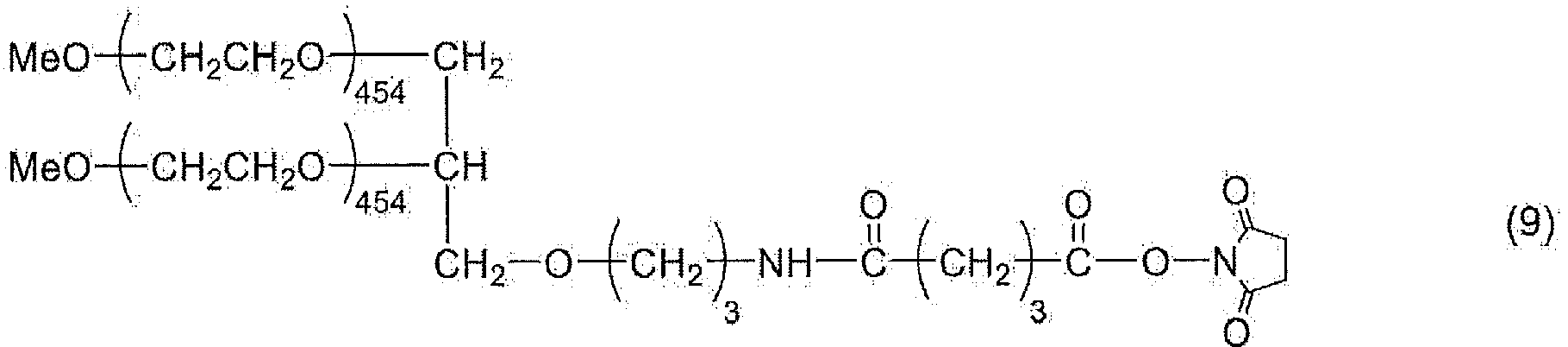
- The compound (8) of Example 1 was changed to the compound of the formula (10)

- According to the present invention, a highly sensitive analysis method for a low-molecular-weight compound contained in a polyoxyethylene derivative is provided.
- This application is based on a patent application No. 2021-115693 filed in Japan (filing date: July 13, 2021), the contents of which are incorporated in full herein.
Claims (2)
- An analysis method comprising separating a compound of the formula (1):

- The analysis method according to claim 1, wherein the polyoxyethylene derivative is represented by the formula (2)

Applications Claiming Priority (2)
| Application Number | Priority Date | Filing Date | Title |
|---|---|---|---|
| JP2021115693 | 2021-07-13 | ||
| PCT/JP2022/026213 WO2023286617A1 (en) | 2021-07-13 | 2022-06-30 | Method for analyzing reactive low-molecular-weight compound contained in polyoxyethylene derivative |
Publications (3)
| Publication Number | Publication Date |
|---|---|
| EP4371662A1 true EP4371662A1 (en) | 2024-05-22 |
| EP4371662A4 EP4371662A4 (en) | 2025-06-04 |
| EP4371662B1 EP4371662B1 (en) | 2025-12-31 |
Family
ID=84920076
Family Applications (1)
| Application Number | Title | Priority Date | Filing Date |
|---|---|---|---|
| EP22841961.0A Active EP4371662B1 (en) | 2021-07-13 | 2022-06-30 | METHOD FOR THE ANALYSIS OF A REACTIVE LOW MOLECULAR COMPOUND IN A POLYOXYETHYLENE DERIVATIVE |
Country Status (4)
| Country | Link |
|---|---|
| US (1) | US20240385153A1 (en) |
| EP (1) | EP4371662B1 (en) |
| JP (1) | JP7761050B2 (en) |
| WO (1) | WO2023286617A1 (en) |
Family Cites Families (4)
| Publication number | Priority date | Publication date | Assignee | Title |
|---|---|---|---|---|
| JP4543917B2 (en) * | 2003-12-26 | 2010-09-15 | 日油株式会社 | Method for analyzing terminal activation rate of polyoxyalkylene derivative |
| WO2010107520A1 (en) | 2009-03-20 | 2010-09-23 | Smartcells, Inc. | Soluble non-depot insulin conjugates and uses thereof |
| US10947343B2 (en) * | 2017-03-31 | 2021-03-16 | Nof Corporation | Production method of polyoxyethylene derivative having plurality of hydroxyl groups at terminal |
| JP7454132B2 (en) | 2020-01-23 | 2024-03-22 | オムロン株式会社 | Robot system control device, robot system control method, computer control program, and robot system |
-
2022
- 2022-06-30 US US18/578,893 patent/US20240385153A1/en active Pending
- 2022-06-30 EP EP22841961.0A patent/EP4371662B1/en active Active
- 2022-06-30 WO PCT/JP2022/026213 patent/WO2023286617A1/en not_active Ceased
- 2022-06-30 JP JP2023535234A patent/JP7761050B2/en active Active
Also Published As
| Publication number | Publication date |
|---|---|
| US20240385153A1 (en) | 2024-11-21 |
| JP7761050B2 (en) | 2025-10-28 |
| JPWO2023286617A1 (en) | 2023-01-19 |
| WO2023286617A1 (en) | 2023-01-19 |
| EP4371662B1 (en) | 2025-12-31 |
| EP4371662A4 (en) | 2025-06-04 |
Similar Documents
| Publication | Publication Date | Title |
|---|---|---|
| US20090324635A1 (en) | Caspofungin free of caspofungin impurity A | |
| CN110146631B (en) | Method for detecting residual quantity of polyethylene glycol monomethyl ether in medicinal material | |
| CN101493446A (en) | Method for measuring free polyethyleneglycol content in sample or products | |
| CN107064350B (en) | Method for detecting suspected genotoxic impurity of tofacitinib citrate | |
| EP4371662B1 (en) | METHOD FOR THE ANALYSIS OF A REACTIVE LOW MOLECULAR COMPOUND IN A POLYOXYETHYLENE DERIVATIVE | |
| US10591445B2 (en) | Methods for analysis and resolution of preparations of dianhydrogalactitol and derivatives or analogs thereof | |
| Husain et al. | High-performance liquid chromatographic separation and determination of small amounts of process impurities of ciprofloxacin in bulk drugs and formulations | |
| Reddy et al. | Rapid and sensitive HPLC method for the estimation of doxorubicin in dog blood-the silver nitrate artifact | |
| RU2416792C1 (en) | Method of ciprofloxacin evaluation in drug preparations | |
| CN114295768A (en) | Method for determining 10 impurities in atorvastatin mother nucleus M4 | |
| KR101257118B1 (en) | Detection and Quantification of Cyclodextrins | |
| Kurttio et al. | A high performance liquid chromatographic method for the determination of ethylenethiourea in urine and on filters | |
| CN113933399A (en) | Method for separating and detecting rifampicin and related impurities in rifampicin for injection | |
| Kudoh et al. | Determination of tertiary aliphatic amines by high-performance liquid chromatography | |
| CN114280191B (en) | Method for detecting related substances in double-cysteine and preparation thereof | |
| CN110606846A (en) | Tofacitinib citrate impurity and analysis method and application thereof | |
| Cohen et al. | Sensitive fluorescence detection of robenidine by derivatization with dansyl chloride and high-performance liquid chromatography | |
| CN116818956A (en) | Detection method of polyethylene glycol succinimidyl succinate | |
| King et al. | HPLC determination of a vincristine, doxorubicin, and ondansetron mixture in 0.9% sodium chloride injection | |
| Al-Rimawi | Development and validation of analytical method for fluconazole and fluconazole related compounds (A, B, and C) in capsule formulations by HPLC with UV detection | |
| JP4543917B2 (en) | Method for analyzing terminal activation rate of polyoxyalkylene derivative | |
| Joseph-Charles et al. | Isocratic high-performance liquid chromatography for the simultaneous separation of eleven tricyclic imipramine-derived compounds of therapeutic interest | |
| CN111579660A (en) | Detection method for measuring average molecular weight and distribution coefficient of polyethylene glycol 4000 and polyethylene glycol powder | |
| CN114280190B (en) | Kit for detecting related substances of double cysteines | |
| CN118961955B (en) | Analysis and detection method for PEG3 impurity and PEG5 impurity in Fmoc-NH-PEG 4-propionic acid |
Legal Events
| Date | Code | Title | Description |
|---|---|---|---|
| STAA | Information on the status of an ep patent application or granted ep patent |
Free format text: STATUS: THE INTERNATIONAL PUBLICATION HAS BEEN MADE |
|
| PUAI | Public reference made under article 153(3) epc to a published international application that has entered the european phase |
Free format text: ORIGINAL CODE: 0009012 |
|
| STAA | Information on the status of an ep patent application or granted ep patent |
Free format text: STATUS: REQUEST FOR EXAMINATION WAS MADE |
|
| 17P | Request for examination filed |
Effective date: 20240123 |
|
| AK | Designated contracting states |
Kind code of ref document: A1 Designated state(s): AL AT BE BG CH CY CZ DE DK EE ES FI FR GB GR HR HU IE IS IT LI LT LU LV MC MK MT NL NO PL PT RO RS SE SI SK SM TR |
|
| DAV | Request for validation of the european patent (deleted) | ||
| DAX | Request for extension of the european patent (deleted) | ||
| REG | Reference to a national code |
Ref country code: DE Ref legal event code: R079 Free format text: PREVIOUS MAIN CLASS: B01J0020287000 Ipc: G01N0030880000 Ref country code: DE Ref legal event code: R079 Ref document number: 602022028106 Country of ref document: DE Free format text: PREVIOUS MAIN CLASS: B01J0020287000 Ipc: G01N0030880000 |
|
| A4 | Supplementary search report drawn up and despatched |
Effective date: 20250507 |
|
| RIC1 | Information provided on ipc code assigned before grant |
Ipc: G01N 30/74 20060101ALN20250429BHEP Ipc: B01J 20/287 20060101ALI20250429BHEP Ipc: G01N 30/26 20060101ALI20250429BHEP Ipc: G01N 30/88 20060101AFI20250429BHEP |
|
| GRAP | Despatch of communication of intention to grant a patent |
Free format text: ORIGINAL CODE: EPIDOSNIGR1 |
|
| STAA | Information on the status of an ep patent application or granted ep patent |
Free format text: STATUS: GRANT OF PATENT IS INTENDED |
|
| RIC1 | Information provided on ipc code assigned before grant |
Ipc: G01N 30/88 20060101AFI20250731BHEP Ipc: G01N 30/26 20060101ALI20250731BHEP Ipc: B01J 20/287 20060101ALI20250731BHEP Ipc: G01N 30/74 20060101ALN20250731BHEP Ipc: G01N 30/34 20060101ALN20250731BHEP |
|
| INTG | Intention to grant announced |
Effective date: 20250825 |
|
| GRAS | Grant fee paid |
Free format text: ORIGINAL CODE: EPIDOSNIGR3 |
|
| GRAA | (expected) grant |
Free format text: ORIGINAL CODE: 0009210 |
|
| STAA | Information on the status of an ep patent application or granted ep patent |
Free format text: STATUS: THE PATENT HAS BEEN GRANTED |
|
| AK | Designated contracting states |
Kind code of ref document: B1 Designated state(s): AL AT BE BG CH CY CZ DE DK EE ES FI FR GB GR HR HU IE IS IT LI LT LU LV MC MK MT NL NO PL PT RO RS SE SI SK SM TR |
|
| REG | Reference to a national code |
Ref country code: CH Ref legal event code: F10 Free format text: ST27 STATUS EVENT CODE: U-0-0-F10-F00 (AS PROVIDED BY THE NATIONAL OFFICE) Effective date: 20251231 Ref country code: GB Ref legal event code: FG4D |
|
| REG | Reference to a national code |
Ref country code: DE Ref legal event code: R096 Ref document number: 602022028106 Country of ref document: DE |
|
| REG | Reference to a national code |
Ref country code: CH Ref legal event code: R17 Free format text: ST27 STATUS EVENT CODE: U-0-0-R10-R17 (AS PROVIDED BY THE NATIONAL OFFICE) Effective date: 20260127 |
|
| REG | Reference to a national code |
Ref country code: IE Ref legal event code: FG4D |
|
| REG | Reference to a national code |
Ref country code: LT Ref legal event code: MG9D |
|
| PG25 | Lapsed in a contracting state [announced via postgrant information from national office to epo] |
Ref country code: NO Free format text: LAPSE BECAUSE OF FAILURE TO SUBMIT A TRANSLATION OF THE DESCRIPTION OR TO PAY THE FEE WITHIN THE PRESCRIBED TIME-LIMIT Effective date: 20260331 |
|
| PG25 | Lapsed in a contracting state [announced via postgrant information from national office to epo] |
Ref country code: HR Free format text: LAPSE BECAUSE OF FAILURE TO SUBMIT A TRANSLATION OF THE DESCRIPTION OR TO PAY THE FEE WITHIN THE PRESCRIBED TIME-LIMIT Effective date: 20251231 Ref country code: FI Free format text: LAPSE BECAUSE OF FAILURE TO SUBMIT A TRANSLATION OF THE DESCRIPTION OR TO PAY THE FEE WITHIN THE PRESCRIBED TIME-LIMIT Effective date: 20251231 |
|
| PG25 | Lapsed in a contracting state [announced via postgrant information from national office to epo] |
Ref country code: RS Free format text: LAPSE BECAUSE OF FAILURE TO SUBMIT A TRANSLATION OF THE DESCRIPTION OR TO PAY THE FEE WITHIN THE PRESCRIBED TIME-LIMIT Effective date: 20260331 |
|
| PG25 | Lapsed in a contracting state [announced via postgrant information from national office to epo] |
Ref country code: LV Free format text: LAPSE BECAUSE OF FAILURE TO SUBMIT A TRANSLATION OF THE DESCRIPTION OR TO PAY THE FEE WITHIN THE PRESCRIBED TIME-LIMIT Effective date: 20251231 |