EP4371410A1 - Antibacterial composition - Google Patents
Antibacterial composition Download PDFInfo
- Publication number
- EP4371410A1 EP4371410A1 EP22842333.1A EP22842333A EP4371410A1 EP 4371410 A1 EP4371410 A1 EP 4371410A1 EP 22842333 A EP22842333 A EP 22842333A EP 4371410 A1 EP4371410 A1 EP 4371410A1
- Authority
- EP
- European Patent Office
- Prior art keywords
- antibacterial
- antibacterial composition
- strength
- composition
- measured
- Prior art date
- Legal status (The legal status is an assumption and is not a legal conclusion. Google has not performed a legal analysis and makes no representation as to the accuracy of the status listed.)
- Pending
Links
Images

Classifications
-
- A—HUMAN NECESSITIES
- A01—AGRICULTURE; FORESTRY; ANIMAL HUSBANDRY; HUNTING; TRAPPING; FISHING
- A01N—PRESERVATION OF BODIES OF HUMANS OR ANIMALS OR PLANTS OR PARTS THEREOF; BIOCIDES, e.g. AS DISINFECTANTS, AS PESTICIDES OR AS HERBICIDES; PEST REPELLANTS OR ATTRACTANTS; PLANT GROWTH REGULATORS
- A01N37/00—Biocides, pest repellants or attractants, or plant growth regulators containing organic compounds containing a carbon atom having three bonds to hetero atoms with at the most two bonds to halogen, e.g. carboxylic acids
- A01N37/44—Biocides, pest repellants or attractants, or plant growth regulators containing organic compounds containing a carbon atom having three bonds to hetero atoms with at the most two bonds to halogen, e.g. carboxylic acids containing at least one carboxylic group or a thio analogue, or a derivative thereof, and a nitrogen atom attached to the same carbon skeleton by a single or double bond, this nitrogen atom not being a member of a derivative or of a thio analogue of a carboxylic group, e.g. amino-carboxylic acids
-
- A—HUMAN NECESSITIES
- A01—AGRICULTURE; FORESTRY; ANIMAL HUSBANDRY; HUNTING; TRAPPING; FISHING
- A01N—PRESERVATION OF BODIES OF HUMANS OR ANIMALS OR PLANTS OR PARTS THEREOF; BIOCIDES, e.g. AS DISINFECTANTS, AS PESTICIDES OR AS HERBICIDES; PEST REPELLANTS OR ATTRACTANTS; PLANT GROWTH REGULATORS
- A01N33/00—Biocides, pest repellants or attractants, or plant growth regulators containing organic nitrogen compounds
- A01N33/02—Amines; Quaternary ammonium compounds
- A01N33/12—Quaternary ammonium compounds
-
- A—HUMAN NECESSITIES
- A01—AGRICULTURE; FORESTRY; ANIMAL HUSBANDRY; HUNTING; TRAPPING; FISHING
- A01P—BIOCIDAL, PEST REPELLANT, PEST ATTRACTANT OR PLANT GROWTH REGULATORY ACTIVITY OF CHEMICAL COMPOUNDS OR PREPARATIONS
- A01P1/00—Disinfectants; Antimicrobial compounds or mixtures thereof
-
- A—HUMAN NECESSITIES
- A01—AGRICULTURE; FORESTRY; ANIMAL HUSBANDRY; HUNTING; TRAPPING; FISHING
- A01N—PRESERVATION OF BODIES OF HUMANS OR ANIMALS OR PLANTS OR PARTS THEREOF; BIOCIDES, e.g. AS DISINFECTANTS, AS PESTICIDES OR AS HERBICIDES; PEST REPELLANTS OR ATTRACTANTS; PLANT GROWTH REGULATORS
- A01N25/00—Biocides, pest repellants or attractants, or plant growth regulators, characterised by their forms, or by their non-active ingredients or by their methods of application, e.g. seed treatment or sequential application; Substances for reducing the noxious effect of the active ingredients to organisms other than pests
- A01N25/02—Biocides, pest repellants or attractants, or plant growth regulators, characterised by their forms, or by their non-active ingredients or by their methods of application, e.g. seed treatment or sequential application; Substances for reducing the noxious effect of the active ingredients to organisms other than pests containing liquids as carriers, diluents or solvents
- A01N25/04—Dispersions, emulsions, suspoemulsions, suspension concentrates or gels
-
- A—HUMAN NECESSITIES
- A01—AGRICULTURE; FORESTRY; ANIMAL HUSBANDRY; HUNTING; TRAPPING; FISHING
- A01N—PRESERVATION OF BODIES OF HUMANS OR ANIMALS OR PLANTS OR PARTS THEREOF; BIOCIDES, e.g. AS DISINFECTANTS, AS PESTICIDES OR AS HERBICIDES; PEST REPELLANTS OR ATTRACTANTS; PLANT GROWTH REGULATORS
- A01N43/00—Biocides, pest repellants or attractants, or plant growth regulators containing heterocyclic compounds
- A01N43/64—Biocides, pest repellants or attractants, or plant growth regulators containing heterocyclic compounds having rings with three nitrogen atoms as the only ring hetero atoms
- A01N43/647—Triazoles; Hydrogenated triazoles
- A01N43/653—1,2,4-Triazoles; Hydrogenated 1,2,4-triazoles
-
- C—CHEMISTRY; METALLURGY
- C08—ORGANIC MACROMOLECULAR COMPOUNDS; THEIR PREPARATION OR CHEMICAL WORKING-UP; COMPOSITIONS BASED THEREON
- C08F—MACROMOLECULAR COMPOUNDS OBTAINED BY REACTIONS ONLY INVOLVING CARBON-TO-CARBON UNSATURATED BONDS
- C08F120/00—Homopolymers of compounds having one or more unsaturated aliphatic radicals, each having only one carbon-to-carbon double bond, and only one being terminated by only one carboxyl radical or a salt, anhydride, ester, amide, imide or nitrile thereof
- C08F120/02—Monocarboxylic acids having less than ten carbon atoms; Derivatives thereof
- C08F120/10—Esters
- C08F120/34—Esters containing nitrogen, e.g. N,N-dimethylaminoethyl (meth)acrylate
-
- C—CHEMISTRY; METALLURGY
- C09—DYES; PAINTS; POLISHES; NATURAL RESINS; ADHESIVES; COMPOSITIONS NOT OTHERWISE PROVIDED FOR; APPLICATIONS OF MATERIALS NOT OTHERWISE PROVIDED FOR
- C09D—COATING COMPOSITIONS, e.g. PAINTS, VARNISHES OR LACQUERS; FILLING PASTES; CHEMICAL PAINT OR INK REMOVERS; INKS; CORRECTING FLUIDS; WOODSTAINS; PASTES OR SOLIDS FOR COLOURING OR PRINTING; USE OF MATERIALS THEREFOR
- C09D5/00—Coating compositions, e.g. paints, varnishes or lacquers, characterised by their physical nature or the effects produced; Filling pastes
- C09D5/14—Paints containing biocides, e.g. fungicides, insecticides or pesticides
-
- C—CHEMISTRY; METALLURGY
- C12—BIOCHEMISTRY; BEER; SPIRITS; WINE; VINEGAR; MICROBIOLOGY; ENZYMOLOGY; MUTATION OR GENETIC ENGINEERING
- C12Q—MEASURING OR TESTING PROCESSES INVOLVING ENZYMES, NUCLEIC ACIDS OR MICROORGANISMS; COMPOSITIONS OR TEST PAPERS THEREFOR; PROCESSES OF PREPARING SUCH COMPOSITIONS; CONDITION-RESPONSIVE CONTROL IN MICROBIOLOGICAL OR ENZYMOLOGICAL PROCESSES
- C12Q1/00—Measuring or testing processes involving enzymes, nucleic acids or microorganisms; Compositions therefor; Processes of preparing such compositions
- C12Q1/02—Measuring or testing processes involving enzymes, nucleic acids or microorganisms; Compositions therefor; Processes of preparing such compositions involving viable microorganisms
- C12Q1/18—Testing for antimicrobial activity of a material
-
- Y—GENERAL TAGGING OF NEW TECHNOLOGICAL DEVELOPMENTS; GENERAL TAGGING OF CROSS-SECTIONAL TECHNOLOGIES SPANNING OVER SEVERAL SECTIONS OF THE IPC; TECHNICAL SUBJECTS COVERED BY FORMER USPC CROSS-REFERENCE ART COLLECTIONS [XRACs] AND DIGESTS
- Y02—TECHNOLOGIES OR APPLICATIONS FOR MITIGATION OR ADAPTATION AGAINST CLIMATE CHANGE
- Y02A—TECHNOLOGIES FOR ADAPTATION TO CLIMATE CHANGE
- Y02A50/00—TECHNOLOGIES FOR ADAPTATION TO CLIMATE CHANGE in human health protection, e.g. against extreme weather
- Y02A50/30—Against vector-borne diseases, e.g. mosquito-borne, fly-borne, tick-borne or waterborne diseases whose impact is exacerbated by climate change
Definitions
- the present invention relates to an antibacterial composition.
- the degree of antibacterial properties required and the material requirements for imparting antibacterial properties differ depending on the material of the product requiring antibacterial properties and the state of final use.
- the properties of the material for imparting antibacterial properties and the degree of antibacterial properties vary depending on the amount of antibacterial material applied to a product and the materials used together.
- the present invention has been made in an effort to provide an antibacterial composition comprising an antibacterial material which has hydrophilicity and hydrophobicity, and thus, is advantageous for imparting antibacterial properties, and is capable of not only imparting antibacterial properties but also solving safety problems due to the leakage of antibacterial materials, by forming a copolymer with an acryl-based resin and the like.
- An exemplary embodiment of the present invention provides an antibacterial composition comprising at least one compound comprising a quaternary ammonium structure having an acrylate group or methacrylate group, and having an antibacterial strength A of 90% or more which is measured by the following Method 1 for at least one strain of Gram-positive bacteria and Gram-negative bacteria and an acute oral toxicity dose LD50 of 300 mg/Kg or more:
- a broth-type medium Nutrient broth, BD DIFCO., 8 g/L
- a sufficiently mixed solution is incubated for 16 hours in a shaking water bath maintained at 35°C.
- Method 1 is measured against at least one strain of Proteus mirabilis, E.coli, S.aureus , E.Cloaceae and
- Method 1 is measured for each strain of Proteus mirabilis, E.coli, S.aureus , E.Cloaceae and E.faecalis.
- the antibacterial strength A of the antibacterial composition is expressed within 1 hour.
- the ratio (CB) of the antibacterial strength C measured by the following Method 3 to the antibacterial strength B measured by the following Method 2 of the antibacterial composition is 1 or more and less than 2:
- This method is the same as Method 1, except that 0.005 g of the antibacterial composition is added instead of 0.015 g of the antibacterial composition.
- This method is the same as Method 1, except that 0.02 g of the antibacterial composition is added instead of 0.015 g of the antibacterial composition.
- a product comprising the antibacterial composition or prepared therefrom.
- the antibacterial composition according to some exemplary embodiments of the present invention is an antibacterial composition comprising an antibacterial material which has hydrophilicity and hydrophobicity, and thus, is advantageous for imparting antibacterial properties, and is capable of not only imparting antibacterial properties but also solving safety problems due to the leakage of antibacterial materials, by forming a copolymer with an acryl-based resin, has antibacterial properties and acute oral toxicity dose controlled within a characteristic range, and is useful as a material capable of safely imparting excellent antibacterial properties.
- the antibacterial composition according to some exemplary embodiments of the present invention can exhibit antibacterial properties within a short period of time.
- antibacterial composition according to some exemplary embodiments of the present invention has little change in antibacterial strength depending on the amount of antibacterial material used, antibacterial properties can be exhibited within an expected range even when the unevenness of concentration occurs unintentionally during application to a product.
- An exemplary embodiment of the present invention provides an antibacterial composition comprising at least one compound comprising a quaternary ammonium structure having an acrylate group or a methacrylate group, and having an antibacterial strength A of 90% or more which is measured by the following Method 1 for at least one strain of Gram-positive bacteria and Gram-negative bacteria and an acute oral toxicity dose LD50 of 300 mg/Kg or more:
- a broth-type medium Nutrient broth, BD DIFCO., 8 g/L
- a sufficiently mixed solution is incubated for 16 hours in a shaking water bath maintained at 35°C.
- a compound comprising a quaternary ammonium structure having an acrylate group or methacrylate group comprised in the antibacterial composition may physicochemically destruct and kill a cell surface layer structure by hydrophobic interaction, when cations of the ammonium molecule of the quaternary ammonium-based compound are electrostatically adsorbed onto anionic sites of the cell surface of bacteria or microorganisms and a substituent bound to the quaternary ammonium structure is hydrophobic.
- an antibacterial function may be introduced through copolymerization with an acryl-based resin and the like by the acrylate group or methacrylate group, and in this case, safety may be improved by preventing the antibacterial material from being leaked.
- high antibacterial properties may be safely imparted by comprising compounds having the quaternary ammonium structure as described above and simultaneously limiting the antibacterial strength and acute oral toxicity dose of the antibacterial composition to within a specific range.
- the antibacterial strength mentioned in the present specification may be measured for at least one strain of Proteus mirabilis, E.coli, S.aureus , E.Cloaceae and E.faecalis. Preferably, the antibacterial strength mentioned in the present specification may be measured for each of Proteus mirabilis, E.coli, S.aureus , E.Cloaceae and E.faecalis.
- the antibacterial composition according to exemplary embodiments of the present invention may have a certain level or more of antibacterial strength against Gram-positive bacteria and Gram-negative bacteria.
- ATCC29906 and CCUG4637 may be used as Proteus mirabilis
- ATCC13047, ATCC13048, and CCUG71839 may be used as E.Cloaceae
- ATCC29212 and CCUG9997 may be used as E.faecalis.
- the antibacterial strength A of the antibacterial composition is expressed within 1 hour. This enables a desired antibacterial strength to be exhibited immediately after application of the antibacterial composition to an intended use or product.
- the ratio (CB) of the antibacterial strength C measured by the following Method 3 to the antibacterial strength B measured by the following Method 2 of the antibacterial composition is 1 or more and less than 2:
- This method is the same as Method 1, except that 0.005 g of the antibacterial composition is added instead of 0.015 g of the antibacterial composition.
- This method is the same as Method 1, except that 0.02 g of the antibacterial composition is added instead of 0.015 g of the antibacterial composition.
- antibacterial composition When the antibacterial composition is applied to the intended use or product, regions of unintentionally high concentration and low concentration of the antibacterial material may occur, and a region of low concentration may not exhibit the desired antibacterial properties.
- antibacterial properties can be exhibited within an expected range even when the unevenness of concentration occurs unintentionally during application to an intended use or product.
- the antibacterial strength A is 99% or more, preferably 99.3% or more, more preferably 99.5% or more, even more preferably 99.7% or more, and still even more preferably 99.9% or more.
- an antibacterial strength D measured by the following Method 4 is 65% or more:
- This method is the same as Method 1, except that 0.01 g of the antibacterial composition is added instead of 0.015 g of the antibacterial composition.
- excellent antibacterial properties may be provided even when the antibacterial composition is added in an amount of 0.01 g.
- the antibacterial strength D may be 65% or more, 68% or more, 68.2% or more, and 70% or more. Further, the antibacterial strength D may be 99% or more, preferably 99.3% or more, more preferably 99.5% or more, even more preferably 99.7% or more, and still even more preferably 99.9% or more.
- an antibacterial strength B measured by the following Method 2 is 55% or more:
- This method is the same as Method 1, except that 0.005 g of the antibacterial composition is added instead of 0.015 g of the antibacterial composition.
- excellent antibacterial properties may be provided even when the antibacterial composition is added in an amount of 0.005 g.
- the antibacterial strength B may be 55% or more, 59% or more, 59.3% or more, 60% or more, and 61.2% or more.
- the antibacterial strength B may be 99% or more, preferably 99.3% or more, more preferably 99.5% or more, even more preferably 99.7% or more, and still even more preferably 99.9% or more.
- the antibacterial composition according to the above-described exemplary embodiments has an acute oral toxicity dose LD50 of 300 mg/Kg or more, more than 300 mg/Kg, 500 mg/Kg or more, preferably 800 mg/Kg or more, and more preferably 1,000 mg/Kg or more.
- the antibacterial composition according to the above-described exemplary embodiments may have an acute oral toxicity dose LD50 of 800 mg/Kg or more, 843 mg/Kg or more, 869 mg/Kg or more, 900 mg/Kg or more, or 998 mg/Kg or more.
- the antibacterial composition according to the above-described exemplary embodiments may have an acute oral toxicity dose LD50 of 1,000 mg/Kg or more, 1,050 mg/Kg or more, 1,078 mg/Kg or more, 1,100 mg/Kg or more, 1,111 mg/Kg or more, 1,200 mg/Kg or more, 1,242 mg/Kg or more, 1,300 mg/Kg or more, 1,369 mg/Kg or more, 1,400 mg/Kg or more, 1,442 mg/Kg or more, 1,498 mg/Kg or more, 1,500 mg/Kg or more, 1,600 mg/Kg or more, 1,700 mg/Kg or more, and 1,708 mg/Kg or more.
- an acute oral toxicity dose LD50 of 1,000 mg/Kg or more, 1,050 mg/Kg or more, 1,078 mg/Kg or more, 1,100 mg/Kg or more, 1,111 mg/Kg or more, 1,200 mg/Kg or more, 1,242 mg/Kg or more
- the antibacterial composition according to the above-described exemplary embodiments may have an acute oral toxicity dose LD50 of 843 mg/Kg, 869 mg/Kg, 998 mg/Kg, 1,078 mg/Kg, 1,111 mg/Kg, 1,242 mg/Kg, 1,369 mg/Kg, 1,442 mg/Kg, 1,498 mg/Kg, or 1,708 mg/Kg.
- an acute oral toxicity dose LD50 of 843 mg/Kg, 869 mg/Kg, 998 mg/Kg, 1,078 mg/Kg, 1,111 mg/Kg, 1,242 mg/Kg, 1,369 mg/Kg, 1,442 mg/Kg, 1,498 mg/Kg, or 1,708 mg/Kg.
- the antibacterial composition according to the above-described exemplary embodiments may have an acute oral toxicity dose LD50 of 50,000 mg/Kg or less, for example, 10,000 mg/Kg or less, 5,000 mg/Kg or less, or 2,000 mg/Kg or less.
- the antibacterial composition according to the above-described exemplary embodiments may have an acute oral toxicity dose LD50 of 1,708 mg/Kg or less.
- the antibacterial composition according to the above-described exemplary embodiments has an acute percutaneous toxicity dose LD50 of 1,000 mg/Kg or more, more than 1,000 mg/Kg, preferably 1,500 mg/Kg or more, and more preferably 2,000 mg/Kg or more.
- the compound comprising a quaternary ammonium structure having an acrylate group or methacrylate group may be selected among those capable of exhibiting the above-described antibacterial strength and acute oral toxicity dose LD50 among the compounds represented by the following Chemical Formula 1:
- At least one of R1, R2 and R3 of Chemical Formula 1 is an alkyl group having 8 or more carbon atoms, preferably an alkyl group having 8 to 14 carbon atoms, and more preferably an alkyl group having 8 to 12 carbon atoms.
- the sum of the number of carbon atoms of the alkyl group comprised in R1, R2 and R3 of Chemical Formula 1 is 12 to 24.
- the sum of the number of carbon atoms of two of R1, R2 and R3 having the higher number of carbon atoms in Chemical Formula 1 is 2 to 24, preferably 8 to 20, and more preferably 8 to 16. According to an example, the sum of the number of carbon atoms of two of R1, R2 and R3 having the higher number of carbon atoms in Chemical Formula 1 may be 9 to 15.
- the number of carbon atoms of that having the largest number of carbon atoms in R1, R2 and R3 of Chemical Formula 1 is 12 or less, preferably 11 or less.
- any one is selected in the case where there are groups having the same carbon atoms.
- Acute oral toxicity and acute percutaneous toxicity may be controlled when having the number of carbon atoms according to the aforementioned exemplary embodiments.
- acute oral toxicity and/or acute percutaneous toxicity are too high, there are restrictions on intended uses, particularly use in infant products such as diapers.
- L1 in Chemical Formula 1 is ethylene or butylene.
- R4 in Chemical Formula 1 is hydrogen.
- R4 in Chemical Formula 1 is methyl.
- the antibacterial composition may be composed of only a compound comprising the quaternary ammonium structure having an acrylate group or methacrylate group, and an additive or solvent may be additionally added, if necessary.
- the compound comprising the quaternary ammonium structure having the acrylate group or methacrylate group has a water solubility of 50% or more, preferably 60% or more.
- the solubility may be measured at room temperature.
- the compound comprising the quaternary ammonium structure having an acrylate group or methacrylate group has an ethanol solubility of 50% or more, preferably 60% or more.
- the solubility may be measured at room temperature.
- the compound comprising the quaternary ammonium structure having an acrylate group or methacrylate group may be dissolved in at least one of methanol, acetone, dichloromethane, DMSO, THF, and chloroform, preferably in all of them.
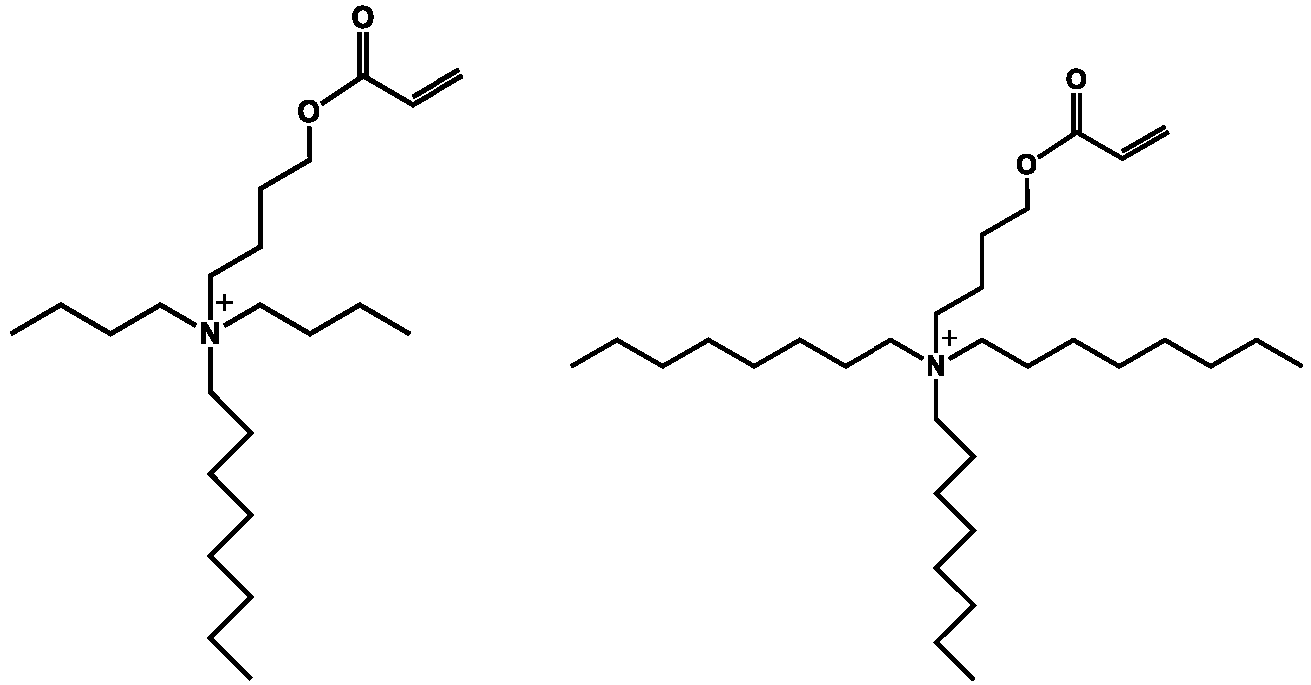
- the compound comprising the quaternary ammonium structure having an acrylate group or methacrylate group may be selected among the following Monomers 1 to 10:
- the antibacterial composition according to the above-described exemplary embodiments or the compound comprising the quaternary ammonium structure having an acrylate group or methacrylate group comprised in the same may be present in the form of a powder or oil.
- the compound comprising the quaternary ammonium structure having an acrylate group or methacrylate group exhibits cationic properties
- the compound may be present in a form where a salt is formed along with a group exhibiting anionic properties.
- the group exhibiting anionic properties is not particularly limited, and materials known in the art may be used as long as the materials do not impair the purpose of the antibacterial composition.
- the group exhibiting anionic properties may be a halogen anion, specifically, Br - .
- a product comprising the antibacterial composition according to the above-described exemplary embodiments or prepared therefrom.
- the product is not particularly limited as long as antibacterial properties are required.
- the product may be used in a state of a copolymer such as a copolymer with a (meth)acrylate-based resin, a copolymer with polyvinyl chloride, a copolymer with polylactic acid (PLA), and a copolymer with urethane, or may be a product comprising at least one of the copolymers, for example, a hygiene product, an antibacterial film, a diaper, and the like.
- the copolymer is preferably a copolymer with an acrylate or methacrylate-based compound.
- a known copolymerization method may be applied.
- the same description on the above-described compound comprising the quaternary ammonium structure having an acrylate group or methacrylate group may be applied to the following Monomers 1 to 10.
- a compound selected among Monomers 1 to 10 may be applied as a constituent component of the antibacterial composition. Furthermore, since the compound selected among Monomers 1 to 10 exhibits cationic properties, the compound may be present in a form where a salt is formed along with a group exhibiting anionic properties.
- the group exhibiting anionic properties is not particularly limited, and materials known in the art may be used as long as the materials do not impair the purpose of the antibacterial composition.
- the group exhibiting anionic properties may be a halogen anion, specifically, Br - .
- the 1 H-NMR spectrum ((CD 3 ) 2 SO) of the synthesized Monomer 1 is illustrated in the following FIG. 1
- the 1 H-NMR spectrum ((CD 3 ) 2 SO) of the synthesized Monomer 2 is illustrated in the following FIG. 2
- the 1 H-NMR spectrum ((CD 3 ) 2 SO) of the synthesized Monomer 3 is illustrated in the following FIG. 3 .
- Comparative Monomer 1 was confirmed by 1 H-NMR spectrum ((CD 3 ) 2 SO) in a manner similar to the above-described Monomers 1 to 3.
- the acute oral toxicity dose LD50 of Monomers 1 to 10 and Comparative Monomers 1 and 2 is shown in the following Table 3.
- Table 3 Sample Acute oral toxicity dose (mg/Kg) LD50 Monomer 1 1,708 Monomer 2 1,369 Monomer 3 843 Monomer 4 1,442 Monomer 5 1,078 Monomer 6 1,111 Monomer 7 998 Monomer 8 869 Monomer 9 1,498 Monomer 10 1,242 Comparative Monomer 1 2,355 Comparative Monomer 2 231
- the acute percutaneous toxicity dose LD50 of Monomers 1 to 10 is shown in the following Table 4.
- Table 4 Sample Acute percutaneous toxicity dose (mg/Kg) LD50 Monomer 1 2,000 or more Monomer 2 2,000 or more Monomer 3 2,000 or more Monomer 4 2,000 or more Monomer 5 2,000 or more Monomer 6 2,000 or more Monomer 7 2,000 or more Monomer 8 2,000 or more Monomer 9 2,000 or more Monomer 10 2,000 or more
- the acute oral toxicity dose LD50 and acute percutaneous toxicity dose LD50 were measured by 3T3 Neutral Red Uptake (NRU) assay (OECD Guidance Document No 129). Specifically, the acute oral toxicity dose LD50 and acute percutaneous toxicity dose LD50 may be calculated by the following method.
Landscapes
- Life Sciences & Earth Sciences (AREA)
- Chemical & Material Sciences (AREA)
- Health & Medical Sciences (AREA)
- Engineering & Computer Science (AREA)
- Wood Science & Technology (AREA)
- Zoology (AREA)
- Organic Chemistry (AREA)
- General Health & Medical Sciences (AREA)
- Plant Pathology (AREA)
- Environmental Sciences (AREA)
- Pest Control & Pesticides (AREA)
- Proteomics, Peptides & Aminoacids (AREA)
- Agronomy & Crop Science (AREA)
- Dentistry (AREA)
- Toxicology (AREA)
- Analytical Chemistry (AREA)
- Biochemistry (AREA)
- Biophysics (AREA)
- Genetics & Genomics (AREA)
- Biotechnology (AREA)
- Immunology (AREA)
- Microbiology (AREA)
- Molecular Biology (AREA)
- Chemical Kinetics & Catalysis (AREA)
- Physics & Mathematics (AREA)
- Bioinformatics & Cheminformatics (AREA)
- General Engineering & Computer Science (AREA)
- General Chemical & Material Sciences (AREA)
- Dispersion Chemistry (AREA)
- Materials Engineering (AREA)
- Medicinal Chemistry (AREA)
- Polymers & Plastics (AREA)
- Agricultural Chemicals And Associated Chemicals (AREA)
Abstract
Description
- This application claims priority to and the benefit of
Korean Patent Application No. 10-2021-0093569 filed in the Korean Intellectual Property Office on July 16, 2021 - The present invention relates to an antibacterial composition.
- Recently, various products such as daily supplies or hygiene products are required to have antibacterial properties.
- The degree of antibacterial properties required and the material requirements for imparting antibacterial properties differ depending on the material of the product requiring antibacterial properties and the state of final use. For example, the properties of the material for imparting antibacterial properties and the degree of antibacterial properties vary depending on the amount of antibacterial material applied to a product and the materials used together.
- Therefore, there is a need for developing an antibacterial material suitable for application to each of various products.
- The present invention has been made in an effort to provide an antibacterial composition comprising an antibacterial material which has hydrophilicity and hydrophobicity, and thus, is advantageous for imparting antibacterial properties, and is capable of not only imparting antibacterial properties but also solving safety problems due to the leakage of antibacterial materials, by forming a copolymer with an acryl-based resin and the like.
- An exemplary embodiment of the present invention provides an antibacterial composition comprising at least one compound comprising a quaternary ammonium structure having an acrylate group or methacrylate group, and having an antibacterial strength A of 90% or more which is measured by the following
Method 1 for at least one strain of Gram-positive bacteria and Gram-negative bacteria and an acute oral toxicity dose LD50 of 300 mg/Kg or more: - After 25 ml of a broth-type medium (Nutrient broth, BD DIFCO., 8 g/L) inoculated with 3,000 CFU/ml bacteria is put into a 50 mL conical tube, 0.015 g of the antibacterial composition is added thereto and suspended (vortexing), a sufficiently mixed solution is incubated for 16 hours in a shaking water bath maintained at 35°C.
- After the incubated solution was diluted to 1/5 using a 1X PBS buffer solution, absorbance (λ = 600 nm) was measured using a UV/Vis spectrophotometer, and the antibacterial strength, which is a bacteriostatic reduction rate, is calculated by the following equation by comparing the measured absorbance with a solution incubated without the addition of the antibacterial composition.

Asample = Absorbance of medium solution incubated by adding antibacterial composition Areference = Absorbance of medium solution incubated without addition of antibacterial composition - According to another exemplary embodiment of the present invention,
Method 1 is measured against at least one strain of Proteus mirabilis, E.coli, S.aureus, E.Cloaceae and - According to still another exemplary embodiment of the present invention,
Method 1 is measured for each strain of Proteus mirabilis, E.coli, S.aureus, E.Cloaceae and E.faecalis. - According to yet another exemplary embodiment of the present invention, the antibacterial strength A of the antibacterial composition is expressed within 1 hour.
- According to yet another exemplary embodiment of the present invention, the ratio (CB) of the antibacterial strength C measured by the following Method 3 to the antibacterial strength B measured by the following Method 2 of the antibacterial composition is 1 or more and less than 2:
- This method is the same as
Method 1, except that 0.005 g of the antibacterial composition is added instead of 0.015 g of the antibacterial composition. - This method is the same as
Method 1, except that 0.02 g of the antibacterial composition is added instead of 0.015 g of the antibacterial composition. - According to yet another exemplary embodiment of the present invention, provided is a product comprising the antibacterial composition or prepared therefrom.
- According to yet another exemplary embodiment of the present invention, provided is a compound selected among the following
Monomers 1 to 10.


- The antibacterial composition according to some exemplary embodiments of the present invention is an antibacterial composition comprising an antibacterial material which has hydrophilicity and hydrophobicity, and thus, is advantageous for imparting antibacterial properties, and is capable of not only imparting antibacterial properties but also solving safety problems due to the leakage of antibacterial materials, by forming a copolymer with an acryl-based resin, has antibacterial properties and acute oral toxicity dose controlled within a characteristic range, and is useful as a material capable of safely imparting excellent antibacterial properties.
- The antibacterial composition according to some exemplary embodiments of the present invention can exhibit antibacterial properties within a short period of time.
- Since the antibacterial composition according to some exemplary embodiments of the present invention has little change in antibacterial strength depending on the amount of antibacterial material used, antibacterial properties can be exhibited within an expected range even when the unevenness of concentration occurs unintentionally during application to a product.
-
-
FIG. 1 is a view illustrating the 1H-NMR spectrum ((CD3)2SO) of synthesizedMonomer 1 as an exemplary embodiment of the present invention. -
FIG. 2 is a view illustrating the 1H-NMR spectrum ((CD3)2SO) of synthesized Monomer 2 as an exemplary embodiment of the present invention. -
FIG. 3 is a view illustrating the 1H-NMR spectrum ((CD3)2SO) of synthesized Monomer 3 as an exemplary embodiment of the present invention. - An exemplary embodiment of the present invention provides an antibacterial composition comprising at least one compound comprising a quaternary ammonium structure having an acrylate group or a methacrylate group, and having an antibacterial strength A of 90% or more which is measured by the following
Method 1 for at least one strain of Gram-positive bacteria and Gram-negative bacteria and an acute oral toxicity dose LD50 of 300 mg/Kg or more: - After 25 ml of a broth-type medium (Nutrient broth, BD DIFCO., 8 g/L) inoculated with 3,000 CFU/ml bacteria is put into a 50 mL conical tube, 0.015 g of the antibacterial composition is added thereto and suspended (vortexing), a sufficiently mixed solution is incubated for 16 hours in a shaking water bath maintained at 35°C.
- After the incubated solution was diluted to 1/5 using a 1X PBS buffer solution, absorbance (λ = 600 nm) was measured using a UV/Vis spectrophotometer, and the antibacterial strength, which is a bacteriostatic reduction rate, is calculated by the following equation by comparing the measured absorbance with a solution incubated without the addition of the antibacterial composition.

Asample = Absorbance of medium solution incubated by adding antibacterial composition Areference = Absorbance of medium solution incubated without addition of antibacterial composition - A compound comprising a quaternary ammonium structure having an acrylate group or methacrylate group comprised in the antibacterial composition may physicochemically destruct and kill a cell surface layer structure by hydrophobic interaction, when cations of the ammonium molecule of the quaternary ammonium-based compound are electrostatically adsorbed onto anionic sites of the cell surface of bacteria or microorganisms and a substituent bound to the quaternary ammonium structure is hydrophobic. Further, an antibacterial function may be introduced through copolymerization with an acryl-based resin and the like by the acrylate group or methacrylate group, and in this case, safety may be improved by preventing the antibacterial material from being leaked. According to the exemplary embodiments of the present invention, high antibacterial properties may be safely imparted by comprising compounds having the quaternary ammonium structure as described above and simultaneously limiting the antibacterial strength and acute oral toxicity dose of the antibacterial composition to within a specific range.
- The antibacterial strength mentioned in the present specification may be measured for at least one strain of Proteus mirabilis, E.coli, S.aureus, E.Cloaceae and E.faecalis. Preferably, the antibacterial strength mentioned in the present specification may be measured for each of Proteus mirabilis, E.coli, S.aureus, E.Cloaceae and E.faecalis. The antibacterial composition according to exemplary embodiments of the present invention may have a certain level or more of antibacterial strength against Gram-positive bacteria and Gram-negative bacteria. ATCC29906 and CCUG4637 may be used as Proteus mirabilis, ATCC13047, ATCC13048, and CCUG71839 may be used as E.Cloaceae, and ATCC29212 and CCUG9997 may be used as E.faecalis.
- According to another exemplary embodiment of the present invention, the antibacterial strength A of the antibacterial composition is expressed within 1 hour. This enables a desired antibacterial strength to be exhibited immediately after application of the antibacterial composition to an intended use or product.
- According to still another exemplary embodiment of the present invention, the ratio (CB) of the antibacterial strength C measured by the following Method 3 to the antibacterial strength B measured by the following Method 2 of the antibacterial composition is 1 or more and less than 2:
- This method is the same as
Method 1, except that 0.005 g of the antibacterial composition is added instead of 0.015 g of the antibacterial composition. - This method is the same as
Method 1, except that 0.02 g of the antibacterial composition is added instead of 0.015 g of the antibacterial composition. - When the antibacterial composition is applied to the intended use or product, regions of unintentionally high concentration and low concentration of the antibacterial material may occur, and a region of low concentration may not exhibit the desired antibacterial properties. However, according to the exemplary embodiments, since there is little change in antibacterial strength depending on the amount of antibacterial material used, antibacterial properties can be exhibited within an expected range even when the unevenness of concentration occurs unintentionally during application to an intended use or product.
- According to yet another exemplary embodiment of the present invention, the antibacterial strength A is 99% or more, preferably 99.3% or more, more preferably 99.5% or more, even more preferably 99.7% or more, and still even more preferably 99.9% or more.
- According to yet another exemplary embodiment of the present invention, an antibacterial strength D measured by the following Method 4 is 65% or more:
- This method is the same as
Method 1, except that 0.01 g of the antibacterial composition is added instead of 0.015 g of the antibacterial composition. - According to the exemplary embodiments, excellent antibacterial properties may be provided even when the antibacterial composition is added in an amount of 0.01 g.
- According to another exemplary embodiment of the present invention, the antibacterial strength D may be 65% or more, 68% or more, 68.2% or more, and 70% or more. Further, the antibacterial strength D may be 99% or more, preferably 99.3% or more, more preferably 99.5% or more, even more preferably 99.7% or more, and still even more preferably 99.9% or more.
- According to still another exemplary embodiment of the present invention, an antibacterial strength B measured by the following Method 2 is 55% or more:
- This method is the same as
Method 1, except that 0.005 g of the antibacterial composition is added instead of 0.015 g of the antibacterial composition. - According to the exemplary embodiments, excellent antibacterial properties may be provided even when the antibacterial composition is added in an amount of 0.005 g.
- According to another exemplary embodiment of the present invention, the antibacterial strength B may be 55% or more, 59% or more, 59.3% or more, 60% or more, and 61.2% or more. In addition, the antibacterial strength B may be 99% or more, preferably 99.3% or more, more preferably 99.5% or more, even more preferably 99.7% or more, and still even more preferably 99.9% or more.
- According to still another exemplary embodiment of the present invention, the antibacterial composition according to the above-described exemplary embodiments has an acute oral toxicity dose LD50 of 300 mg/Kg or more, more than 300 mg/Kg, 500 mg/Kg or more, preferably 800 mg/Kg or more, and more preferably 1,000 mg/Kg or more. According to specific examples, the antibacterial composition according to the above-described exemplary embodiments may have an acute oral toxicity dose LD50 of 800 mg/Kg or more, 843 mg/Kg or more, 869 mg/Kg or more, 900 mg/Kg or more, or 998 mg/Kg or more. The antibacterial composition according to the above-described exemplary embodiments may have an acute oral toxicity dose LD50 of 1,000 mg/Kg or more, 1,050 mg/Kg or more, 1,078 mg/Kg or more, 1,100 mg/Kg or more, 1,111 mg/Kg or more, 1,200 mg/Kg or more, 1,242 mg/Kg or more, 1,300 mg/Kg or more, 1,369 mg/Kg or more, 1,400 mg/Kg or more, 1,442 mg/Kg or more, 1,498 mg/Kg or more, 1,500 mg/Kg or more, 1,600 mg/Kg or more, 1,700 mg/Kg or more, and 1,708 mg/Kg or more. According to specific examples, the antibacterial composition according to the above-described exemplary embodiments may have an acute oral toxicity dose LD50 of 843 mg/Kg, 869 mg/Kg, 998 mg/Kg, 1,078 mg/Kg, 1,111 mg/Kg, 1,242 mg/Kg, 1,369 mg/Kg, 1,442 mg/Kg, 1,498 mg/Kg, or 1,708 mg/Kg.
- The higher the acute oral toxicity dose LD50 of the antibacterial composition according to the above-described exemplary embodiments, the lower the toxicity, so that the acute oral toxicity dose is advantageous. However, the value of LD50 may be determined from the viewpoint that the above-described antibacterial strength needs also be satisfied. For example, the antibacterial composition according to the above-described exemplary embodiments may have an acute oral toxicity dose LD50 of 50,000 mg/Kg or less, for example, 10,000 mg/Kg or less, 5,000 mg/Kg or less, or 2,000 mg/Kg or less. According to an example, the antibacterial composition according to the above-described exemplary embodiments may have an acute oral toxicity dose LD50 of 1,708 mg/Kg or less.
- According to another exemplary embodiment of the present invention, the antibacterial composition according to the above-described exemplary embodiments has an acute percutaneous toxicity dose LD50 of 1,000 mg/Kg or more, more than 1,000 mg/Kg, preferably 1,500 mg/Kg or more, and more preferably 2,000 mg/Kg or more. The higher the acute percutaneous toxicity dose LD50 of the antibacterial composition according to the above-described exemplary embodiments, the lower the toxicity, so that the acute percutaneous toxicity dose is advantageous.
- According to an exemplary embodiment of the present invention, the compound comprising a quaternary ammonium structure having an acrylate group or methacrylate group may be selected among those capable of exhibiting the above-described antibacterial strength and acute oral toxicity dose LD50 among the compounds represented by the following Chemical Formula 1:

- In
Chemical Formula 1, - L1 is an alkylene group having 2 to 4 carbon atoms,
- R1, R2 and R3 are the same as or different from each other, and are each an alkyl group having 1 to 20 carbon atoms, and
- R4 is hydrogen or a methyl group.
- According to an exemplary embodiment, at least one of R1, R2 and R3 of
Chemical Formula 1 is an alkyl group having 8 or more carbon atoms, preferably an alkyl group having 8 to 14 carbon atoms, and more preferably an alkyl group having 8 to 12 carbon atoms. - According to an exemplary embodiment, the sum of the number of carbon atoms of the alkyl group comprised in R1, R2 and R3 of
Chemical Formula 1 is 12 to 24. - According to an exemplary embodiment, the sum of the number of carbon atoms of two of R1, R2 and R3 having the higher number of carbon atoms in
Chemical Formula 1 is 2 to 24, preferably 8 to 20, and more preferably 8 to 16. According to an example, the sum of the number of carbon atoms of two of R1, R2 and R3 having the higher number of carbon atoms inChemical Formula 1 may be 9 to 15. - According to an exemplary embodiment, the number of carbon atoms of that having the largest number of carbon atoms in R1, R2 and R3 of
Chemical Formula 1 is 12 or less, preferably 11 or less. - According to an exemplary embodiment, when any one of two having the largest number of carbon atoms among R1, R2 and R3 of
Chemical Formula 1 has 10 or more carbon atoms, the other has less than 8 carbon atoms. - Here, when a group having the largest number of carbon atoms is selected, any one is selected in the case where there are groups having the same carbon atoms.
- Acute oral toxicity and acute percutaneous toxicity may be controlled when having the number of carbon atoms according to the aforementioned exemplary embodiments. When acute oral toxicity and/or acute percutaneous toxicity are too high, there are restrictions on intended uses, particularly use in infant products such as diapers.
- According to an exemplary embodiment, L1 in
Chemical Formula 1 is ethylene or butylene. - According to an exemplary embodiment, R4 in
Chemical Formula 1 is hydrogen. - According to an exemplary embodiment, R4 in
Chemical Formula 1 is methyl. - The antibacterial composition may be composed of only a compound comprising the quaternary ammonium structure having an acrylate group or methacrylate group, and an additive or solvent may be additionally added, if necessary.
- According to another exemplary embodiment of the present invention, the compound comprising the quaternary ammonium structure having the acrylate group or methacrylate group has a water solubility of 50% or more, preferably 60% or more. The solubility may be measured at room temperature.
- According to still another exemplary embodiment of the present invention, the compound comprising the quaternary ammonium structure having an acrylate group or methacrylate group has an ethanol solubility of 50% or more, preferably 60% or more. The solubility may be measured at room temperature.
- According to yet another exemplary embodiment of the present invention, the compound comprising the quaternary ammonium structure having an acrylate group or methacrylate group may be dissolved in at least one of methanol, acetone, dichloromethane, DMSO, THF, and chloroform, preferably in all of them.
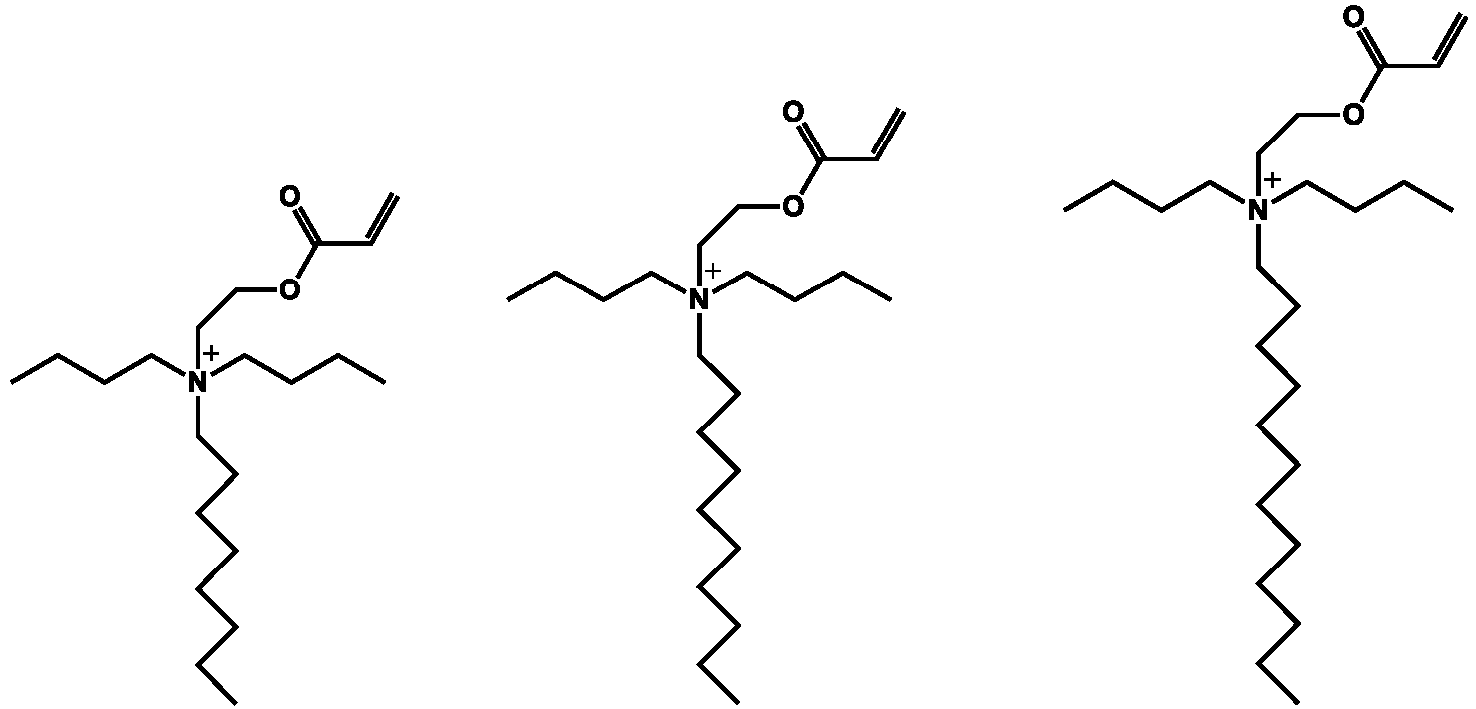
- According to yet another exemplary embodiment of the present invention, the compound comprising the quaternary ammonium structure having an acrylate group or methacrylate group may be selected among the following
Monomers 1 to 10:


- The antibacterial composition according to the above-described exemplary embodiments or the compound comprising the quaternary ammonium structure having an acrylate group or methacrylate group comprised in the same may be present in the form of a powder or oil.
- Since the compound comprising the quaternary ammonium structure having an acrylate group or methacrylate group exhibits cationic properties, the compound may be present in a form where a salt is formed along with a group exhibiting anionic properties. In this case, the group exhibiting anionic properties is not particularly limited, and materials known in the art may be used as long as the materials do not impair the purpose of the antibacterial composition. For example, the group exhibiting anionic properties may be a halogen anion, specifically, Br-.
- According to yet another exemplary embodiment of the present invention, provided is a product comprising the antibacterial composition according to the above-described exemplary embodiments or prepared therefrom. The product is not particularly limited as long as antibacterial properties are required. According to an example, the product may be used in a state of a copolymer such as a copolymer with a (meth)acrylate-based resin, a copolymer with polyvinyl chloride, a copolymer with polylactic acid (PLA), and a copolymer with urethane, or may be a product comprising at least one of the copolymers, for example, a hygiene product, an antibacterial film, a diaper, and the like. The copolymer is preferably a copolymer with an acrylate or methacrylate-based compound. As the copolymerization method, a known copolymerization method may be applied.
- According to yet another exemplary embodiment of the present invention, provided is a compound selected among the following
Monomers 1 to 10. The same description on the above-described compound comprising the quaternary ammonium structure having an acrylate group or methacrylate group may be applied to the followingMonomers 1 to 10.
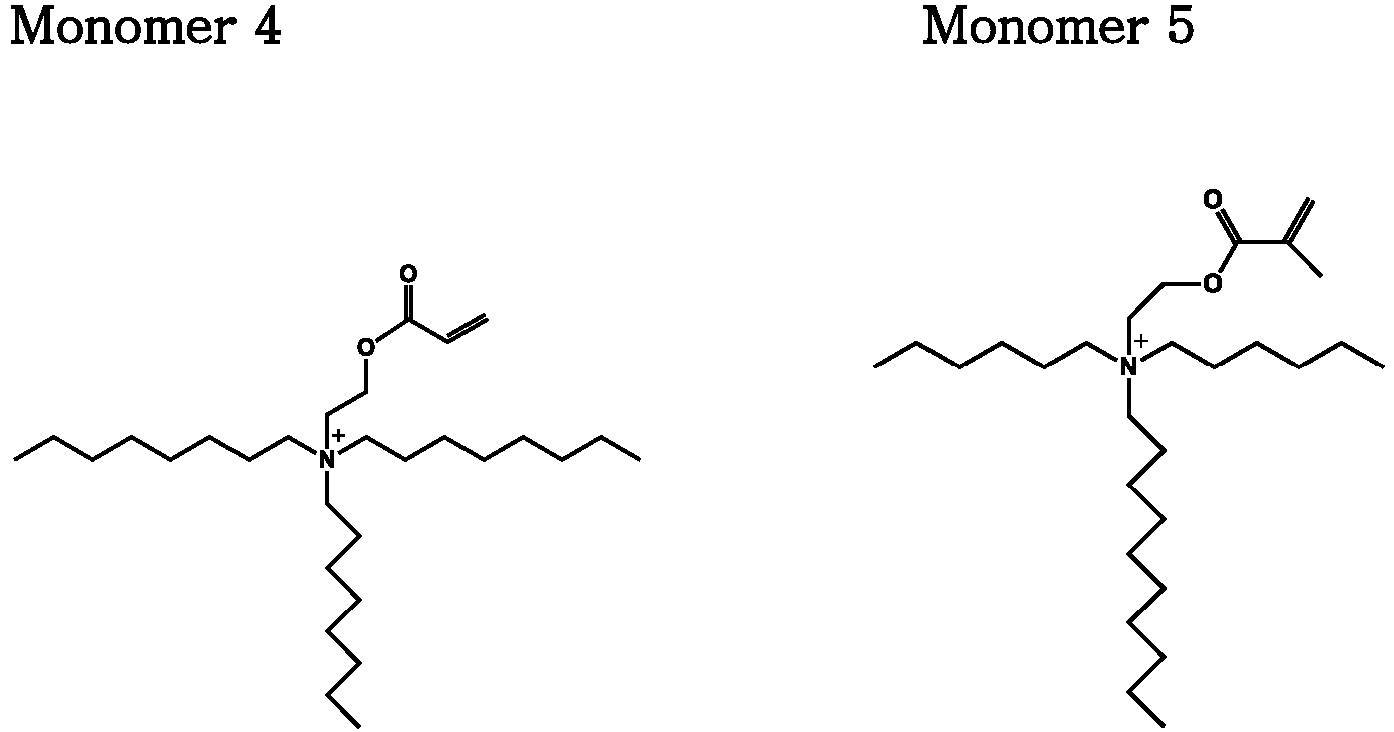


- A compound selected among
Monomers 1 to 10 may be applied as a constituent component of the antibacterial composition. Furthermore, since the compound selected amongMonomers 1 to 10 exhibits cationic properties, the compound may be present in a form where a salt is formed along with a group exhibiting anionic properties. In this case, the group exhibiting anionic properties is not particularly limited, and materials known in the art may be used as long as the materials do not impair the purpose of the antibacterial composition. For example, the group exhibiting anionic properties may be a halogen anion, specifically, Br-. - Hereinafter, the present invention will be described in more detail through examples. However, the following examples are provided for illustrating the present invention, and the scope of the present invention is not limited thereby.
-

-
- 1. 0.1 mol of 2-(dibutylamino)ethanol (DBAE), 0.1 mol of trimethylamine and 0.001 mol of hydroquinone were added to 100 mL of THF (solvent).
- 2. 0.1 mol of acryloyl chloride was added dropwise onto a reaction solution while stirring the materials (room temperature).
- 3. The resulting mixture was stirred for 2 hours.
- 4. After a triethylamine salt was removed by filtering the mixture, the solvent was removed by a rotary evaporator.
- 5. The residue was dried under vacuum at 83 to 87°C.
-
- 1. The product of
Step 1 and 1-bromooctane (preparation of Monomer 1), 1-bromodecane (preparation of Monomer 2), or 1-bromododecane (preparation of Monomer 3) were dissolved at 50 wt% in acrylonitrile (solvent) at a ratio of 1:1. - 2. Subsequently, p-methoxyphenol, which is a polymerization inhibitor, was added (ratio with reactants 1:0.001 eq).
- 3. The resulting mixture was reacted at 50°C for 20 hours.
- 4. After static precipitation (MTBE:reaction solution = 15:1) in methyl t-butyl ether (MTBE), the mixture was filtered. Here, although a static precipitation method of adding a reactant to a nonsolvent was used, a reverse precipitation method of adding a nonsolvent to a reactant may also be used. Furthermore, in addition to 15:1, other ratios of MTBE and reaction solution may be used, and for example, 12:1 and 26:1 may be used.
- 5. The resulting product was dried under vacuum at 45°C.
- The 1H-NMR spectrum ((CD3)2SO) of the synthesized
Monomer 1 is illustrated in the followingFIG. 1 , the 1H-NMR spectrum ((CD3)2SO) of the synthesized Monomer 2 is illustrated in the followingFIG. 2 , and the 1H-NMR spectrum ((CD3)2SO) of the synthesized Monomer 3 is illustrated in the followingFIG. 3 . -

-
- 1. 0.1 mol of 2-(dioctylamino)ethanol (DOAE), 0.1 mol of trimethylamine and 0.001 mol of hydroquinone were added to 100 mL of THF (solvent).
- 2. 0.1 mol of acryloyl chloride was added dropwise onto a reaction solution while stirring the materials (room temperature).
- 3. The resulting mixture was stirred for 2 hours.
- 4. After a triethylamine salt was removed by filtering the mixture, the solvent was removed by a rotary evaporator.
- 5. The residue was dried under vacuum at 83 to 87°C.
-
- 1. The product of
Step 1 and 1-bromooctane were dissolved at 50 wt% in acrylonitrile (solvent) at a ratio of 1:1. - 2. Subsequently, p-methoxyphenol, which is a polymerization inhibitor, was added (ratio with reactants 1:0.001 eq).
- 3. The resulting mixture was reacted at 50°C for 20 hours.
- 4. After static precipitation (MTBE:reaction solution = 15:1) in methyl t-butyl ether (MTBE), the mixture was filtered.
- 5. The resulting product was dried under vacuum at 45°C.
- Synthesis of Monomer 4 was confirmed by 1H-NMR spectrum (CD3)2SO) in a manner similar to the above-described
Monomers 1 to 3. -

-
- 1. 0.1 mol of 2-(dihexylamino)ethanol (DHAE), 0.1 mol of trimethylamine and 0.001 mol of hydroquinone were added to 100 mL of THF (solvent).
- 2. 0.1 mol of methacryloyl chloride was added dropwise onto a reaction solution while stirring the materials (room temperature).
- 3. The resulting mixture was stirred for 2 hours.
- 4. After a triethylamine salt was removed by filtering the mixture, the solvent was removed by a rotary evaporator.
- 5. The residue was dried under vacuum at 83 to 87°C.
-
- 1. The product of
Step 1 and 1-bromodecane were dissolved at 50 wt% in acrylonitrile (solvent) at a ratio of 1:1. - 2. Subsequently, p-methoxyphenol, which is a polymerization inhibitor, was added (ratio with reactants 1:0.001 eq).
- 3. The resulting mixture was reacted at 50°C for 20 hours.
- 4. After static precipitation (MTBE:reaction solution = 15:1) in methyl t-butyl ether (MTBE), the mixture was filtered.
- 5. The resulting product was dried under vacuum at 45°C.
- Synthesis of
monomer 5 was confirmed by 1H-NMR spectrum (CD3)2SO) in a manner similar to the above-describedMonomers 1 to 3. -

-
- 1. 0.1 mol of (butylhexylamino)ethanol (BHAE), 0.1 mol of trimethylamine and 0.001 mol of hydroquinone were added to 100 mL of THF (solvent).
- 2. 0.1 mol of methacryloyl chloride was added dropwise onto a reaction solution while stirring the materials (room temperature).
- 3. The resulting mixture was stirred for 2 hours.
- 4. After a triethylamine salt was removed by filtering the mixture, the solvent was removed by a rotary evaporator.
- 5. The residue was dried under vacuum at 83 to 87°C.
-
- 1. The product of
Step 1 and 1-bromodecane were dissolved at 50 wt% in acrylonitrile (solvent) at a ratio of 1:1. - 2. Subsequently, p-methoxyphenol, which is a polymerization inhibitor, was added (ratio with reactants 1:0.001 eq).
- 3. The resulting mixture was reacted at 50°C for 20 hours.
- 4. After static precipitation (MTBE:reaction solution = 15:1) in methyl t-butyl ether (MTBE), the mixture was filtered.
- 5. The resulting product was dried under vacuum at 45°C.
- Synthesis of Monomer 6 was confirmed by 1H-NMR spectrum ((CD3)2SO) in a manner similar to the above-described
Monomer 1 to 3. -

-
- 1. 0.1 mol of 2-(butyloctylamino)ethanol (BOAE), 0.1 mol of trimethylamine and 0.001 mol of hydroquinone were added to 100 mL of THF (solvent).
- 2. 0.1 mol of methacryloyl chloride was added dropwise onto a reaction solution while stirring the materials (room temperature).
- 3. The resulting mixture was stirred for 2 hours.
- 4. After a triethylamine salt was removed by filtering the mixture, the solvent was removed by a rotary evaporator.
- 5. The residue was dried under vacuum at 83 to 87°C.
-
- 1. The product of
Step 1 and 1-bromodecane were dissolved at 50 wt% in acrylonitrile (solvent) at a ratio of 1:1. - 2. Subsequently, p-methoxyphenol, which is a polymerization inhibitor, was added (ratio with reactants 1:0.001 eq).
- 3. The resulting mixture was reacted at 50°C for 20 hours.
- 4. After static precipitation (MTBE:reaction solution = 15:1) in methyl t-butyl ether (MTBE), the mixture was filtered.
- 5. The resulting product was dried under vacuum at 45°C.
- Synthesis of
Monomer 7 was confirmed by 1H-NMR spectrum ((CD3)2SO) in a manner similar to the above-describedMonomer 1 to 3. -

-
- 1. 0.1 mol of 2-(butyldecylamino)ethanol (BOAE), 0.1 mol of trimethylamine and 0.001 mol of hydroquinone were added to 100 mL of THF (solvent).
- 2. 0.1mol of methacryloyl chloride was added dropwise onto a reaction solution while stirring the materials (room temperature).
- 3. The resulting mixture was stirred for 2 hours.
- 4. After a triethylamine salt was removed by filtering the mixture, the solvent was removed by a rotary evaporator.
- 5. The residue was dried under vacuum at 83 to 87°C.
-
- 1. The product of
Step 1 and 1-bromodecane were dissolved at 50 wt% in acrylonitrile (solvent) at a ratio of 1:1. - 2. Subsequently, p-methoxyphenol, which is a polymerization inhibitor, was added (ratio with reactants 1:0.001 eq).
- 3. The resulting mixture was reacted at 50°C for 20 hours.
- 4. After static precipitation (MTBE:reaction solution = 15:1) in methyl t-butyl ether (MTBE), the mixture was filtered.
- 5. The resulting product was dried under vacuum at 45°C.
- Synthesis of
Monomer 8 was confirmed by 1H-NMR spectrum ((CD3)2SO) in a manner similar to the above-describedMonomer 1 to 3. -

-
- 1. 0.1 mol of 2-(dibutylamino)butanol (DBAB), 0.1 mol of trimethylamine and 0.001 mol of hydroquinone were added to 100 mL of THF (solvent).
- 2. 0.1 mol of acryloyl chloride was added dropwise onto a reaction solution while stirring the materials (room temperature).
- 3. The resulting mixture was stirred for 2 hours.
- 4. After a triethylamine salt was removed by filtering the mixture, the solvent was removed by a rotary evaporator.
- 5. The residue was dried under vacuum at 83 to 87°C.
-
- 1. The product of
Step 1 and 1-bromooctane were dissolved at 50 wt% in acrylonitrile (solvent) at a ratio of 1:1. - 2. Subsequently, p-methoxyphenol, which is a polymerization inhibitor, was added (ratio with reactants 1:0.001 eq).
- 3. The resulting mixture was reacted at 50°C for 20 hours.
- 4. After static precipitation (MTBE:reaction solution = 15:1) in methyl t-butyl ether (MTBE), the mixture was filtered.
- 5. The resulting product was dried under vacuum at 45°C.
- Synthesis of
Monomer 9 was confirmed by 1H-NMR spectrum (CD3)2SO) in a manner similar to the above-describedMonomers 1 to 3. -

-
- 1. 0.1 mol 2-(dioctylamino)butanol (DOAB), 0.1 mol of trimethylamine and 0.001 mol of hydroquinone were added to 100 mL of THF (solvent).
- 2. 0.1 mol of acryloyl chloride was added dropwise onto a reaction solution while stirring the materials (room temperature).
- 3. The resulting mixture was stirred for 2 hours.
- 4. After a triethylamine salt was removed by filtering the mixture, the solvent was removed by a rotary evaporator.
- 5. The residue was dried under vacuum at 83 to 87°C.
-
- 1. The product of
Step 1 and 1-bromooctane were dissolved at 50 wt% in acrylonitrile (solvent) at a ratio of 1:1. - 2. Subsequently, p-methoxyphenol, which is a polymerization inhibitor, was added (ratio with reactants 1:0.001 eq).
- 3. The resulting mixture was reacted at 50°C for 20 hours.
- 4. After static precipitation (MTBE:reaction solution = 15:1) in methyl t-butyl ether (MTBE), the mixture was filtered.
- 5. The resulting product was dried under vacuum at 45°C.
- Synthesis of
Monomer 10 was confirmed by 1H-NMR spectrum ((CD3)2SO) in a manner similar to the above-describedMonomer 1 to 3. - Synthesis was performed in the same manner as in the synthesis process of
Monomer 1, except that bromohexane was used instead of 1-bromooctane of Step 2 in the synthesis process ofMonomer 1. - Synthesis of
Comparative Monomer 1 was confirmed by 1H-NMR spectrum ((CD3)2SO) in a manner similar to the above-describedMonomers 1 to 3.
- Synthesis was performed in the same manner as in the synthesis process of
Monomer 10, except that 2-(ditetradecylamino)butanol was used instead of 2-(dioctylamino)butanol ofStep 1 and bromotetradecane was used instead of 1-bromooctane of Step 2 in the synthesis process ofMonomer 10. - Synthesis of Comparative Monomer 2 was confirmed by 1H-NMR spectrum ((CD3)2SO) in a manner similar to the above-described
Monomers 1 to 3.
- The antibacterial strength of
Monomers 1 to 10 andComparative Monomers 1 and 2 byMethods 1 to 4 was measured, and is shown in the following Table 1. In this case, the P.mirabilis (ATCC29906) bacteria were used.[Table 1] No. Sample Antibacterial strength (%) Method 2 (amount of antibacterial composition added 0.005g) Method 4 (amount of antibacterial composition added 0.01g) Method 1 (amount of antibacterial composition added 0.015g) Method 3 (amount of antibacterial composition added 0.02g) 1 reference - - - - 2 Monomer 159.3 68.2 99.9 99.9 3 Monomer 2 99.9 99.9 99.9 99.9 4 Monomer 3 99.9 99.9 99.9 99..9 5 Monomer 4 99.9 99.9 99.9 99.9 6 Monomer 599.9 99.9 99.9 99.9 7 Monomer 6 99.9 99.9 99.9 99.9 8 Monomer 799.9 99.9 99.9 99.9 9 Monomer 899.9 99.9 99.9 99.9 10 Monomer 961.2 70.0 99.9 99.9 11 Monomer 1099.9 99.9 99.9 99.9 12 Comparative Monomer 122.6 30.7 38.8 46.9 13 Comparative Monomer 2 99.9 99.9 99.9 99.9 - According to Table 1, all
Monomers 1 to 10 had an antibacterial strength A of 99.9% measured byMethod 1. - The time at which 99.9% of the antibacterial strength of
Monomers 1 to 10 andComparative Monomers 1 and 2 is confirmed is shown in the following Table 2.[Table 2] No. Sample Antibacterial strength (%) Method 2 (amount of antibacterial composition added 0.005g) Method 4 (amount of antibacterial composition added 0.01g) Method 1 (amount of antibacterial composition added 0.015g) Method 3 (amount of antibacterial composition added 0.02g) 1 reference - - - - 2 Monomer 1 - - Within 1 hour Within 1 hour 3 Monomer 2 Within 1 hour Within 1 hour Within 1 hour Within 1 hour 4 Monomer 3 Within 1 hour Within 1 hour Within 1 hour Within 1 hour 5 Monomer 4 Within 1 hour Within 1 hour Within 1 hour Within 1 hour 6 Monomer 5Within 1 hour Within 1 hour Within 1 hour Within 1 hour 7 Monomer 6 Within 1 hour Within 1 hour Within 1 hour Within 1 hour 8 Monomer 7Within 1 hour Within 1 hour Within 1 hour Within 1 hour 9 Monomer 8Within 1 hour Within 1 hour Within 1 hour Within 1 hour 10 Monomer 9 - - Within 1 hour Within 1 hour 11 Monomer 10Within 1 hour Within 1 hour Within 1 hour Within 1 hour 12 Comparative Monomer 1 - - - - 13 Comparative Monomer 2 Within 1 hour Within 1 hour Within 1 hour Within 1 hour - According to Table 2, all
Monomers 1 to 10 having an antibacterial strength A of 99.9% measured byMethod 1 was confirmed within 1 hour. - The acute oral toxicity dose LD50 of
Monomers 1 to 10 andComparative Monomers 1 and 2 is shown in the following Table 3.[Table 3] Sample Acute oral toxicity dose (mg/Kg) LD50 Monomer 1 1,708 Monomer 2 1,369 Monomer 3 843 Monomer 4 1,442 Monomer 51,078 Monomer 6 1,111 Monomer 7998 Monomer 8869 Monomer 91,498 Monomer 101,242 Comparative Monomer 12,355 Comparative Monomer 2 231 - According to Table 3, all
Monomers 1 to 10 had an acute oral toxicity dose LD50 of 300 mg/Kg or more, particularly 800 mg/Kg or more. Furthermore, Examples 1, 2, 4, 5, 6, 9 and 10 had an acute oral toxicity dose LD50 of 1,000 mg/Kg or more. - The acute percutaneous toxicity dose LD50 of
Monomers 1 to 10 is shown in the following Table 4.[Table 4] Sample Acute percutaneous toxicity dose (mg/Kg) LD50 Monomer 1 2,000 or more Monomer 2 2,000 or more Monomer 3 2,000 or more Monomer 4 2,000 or more Monomer 5 2,000 or more Monomer 6 2,000 or more Monomer 7 2,000 or more Monomer 8 2,000 or more Monomer 9 2,000 or more Monomer 10 2,000 or more - According to Table 4, all
Monomers 1 to 10 had an acute percutaneous toxicity dose LD50 of 1,000 mg/Kg or more, particularly 2,000 mg/Kg or more. - The acute oral toxicity dose LD50 and acute percutaneous toxicity dose LD50 were measured by 3T3 Neutral Red Uptake (NRU) assay (OECD Guidance Document No 129). Specifically, the acute oral toxicity dose LD50 and acute percutaneous toxicity dose LD50 may be calculated by the following method.

Claims (19)
- An antibacterial composition comprising at least one compound comprising a quaternary ammonium structure having an acrylate group or methacrylate group, and having an antibacterial strength A of 90% or more which is measured by the following Method 1 for at least one strain of Gram-positive bacteria and Gram-negative bacteria and an acute oral toxicity dose LD50 of 300 mg/Kg or more:[Method 1]After 25 ml of a broth-type medium (Nutrient broth, BD DIFCO., 8 g/L) inoculated with 3,000 CFU/ml bacteria is put into a 50 mL conical tube, 0.015 g of the antibacterial composition is added thereto and suspended (vortexing), a sufficiently mixed solution is incubated for 16 hours in a shaking water bath maintained at 35°C.After the incubated solution was diluted to 1/5 using a 1X PBS buffer solution, absorbance (λ = 600 nm) is measured using a UV/Vis spectrophotometer, and the antibacterial strength, which is a bacteriostatic reduction rate, is calculated by the following equation by comparing the measured absorbance with a solution incubated without the addition of the antibacterial composition.

Asample = Absorbance of medium solution incubated by adding antibacterial composition Areference = Absorbance of medium solution incubated without addition of antibacterial composition - The antibacterial composition of claim 1, wherein Method 1 is measured against at least one strain of Proteus mirabilis, E.coli, S.aureus, E.Cloaceae and E.faecalis.
- The antibacterial composition of claim 1, wherein Method 1 is measured for each strain of Proteus mirabilis, E. coli, S. aureus, E. Cloaceae and E.faecalis.
- The antibacterial composition of any one of claims 1 to 3, wherein an antibacterial strength A of the antibacterial composition is expressed within 1 hour.
- The antibacterial composition of any one of claims 1 to 3, wherein a ratio (CB) of an antibacterial strength C measured by the following Method 3 to an antibacterial strength B measured by the following Method 2 is 1 or more and less than 2:[Method 2]This method is the same as Method 1, except that 0.005 g of the antibacterial composition is added instead of 0.015 g of the antibacterial composition.[Method 3]This method is the same as Method 1, except that 0.02 g of the antibacterial composition is added instead of 0.015 g of the antibacterial composition.
- The antibacterial composition of any one of claims 1 to 3, wherein the antibacterial strength A is 99% or more.
- The antibacterial composition of any one of claims 1 to 3, wherein an antibacterial strength D measured by the following Method 4 is 65% or more:[Method 4]This method is the same as Method 1, except that 0.01 g of the antibacterial composition is added instead of 0.015 g of the antibacterial composition.
- The antibacterial composition of claim 7, wherein the antibacterial strength D is 99% or more.
- The antibacterial composition of any one of claims 1 to 3, wherein the antibacterial strength B measured by the following Method 2 is 55% or more:[Method 2]This method is the same as Method 1, except that 0.005 g of the antibacterial composition is added instead of 0.015 g of the antibacterial composition.
- The antibacterial composition of claim 9, wherein the antibacterial strength B is 99% or more.
- The antibacterial composition of any one of claims 1 to 3, wherein the acute oral toxicity dose LD50 is 800 mg/Kg or more.
- The antibacterial composition of any one of claims 1 to 3, wherein the acute oral toxicity dose LD50 is 1,000 mg/Kg or more.
- The antibacterial composition of any one of claims 1 to 3, wherein the compound comprising the quaternary ammonium structure having an acrylate group or methacrylate group is selected among compounds represented by the following Chemical Formula 1:

 L1 is an alkylene group having 2 to 4 carbon atoms,R1, R2 and R3 are the same as or different from each other, and are each an alkyl group having 1 to 20 carbon atoms, andR4 is hydrogen or a methyl group.
 - The antibacterial composition of claim 13, wherein at least one of R1, R2 and R3 of Chemical Formula 1 is an alkyl group having 8 or more carbon atoms, and the sum of the number of carbon atoms of the alkyl group comprised in R1, R2 and R3 is 12 to 24.
- The antibacterial composition of any one of claims 1 to 3, wherein the compound comprising the quaternary ammonium structure having an acrylate group or methacrylate group is selected among the following Monomers 1 to 10:


- The antibacterial composition of any one of claims 1 to 3, wherein the antibacterial composition has an acute percutaneous toxicity dose LD50 of 1,000 mg/Kg or more.
- The antibacterial composition of any one of claims 1 to 3, wherein the antibacterial composition has an acute percutaneous toxicity dose LD50 of 2,000 mg/Kg or more.
- A product comprising the antibacterial composition of any one of claims 1 to 3, or prepared therefrom.
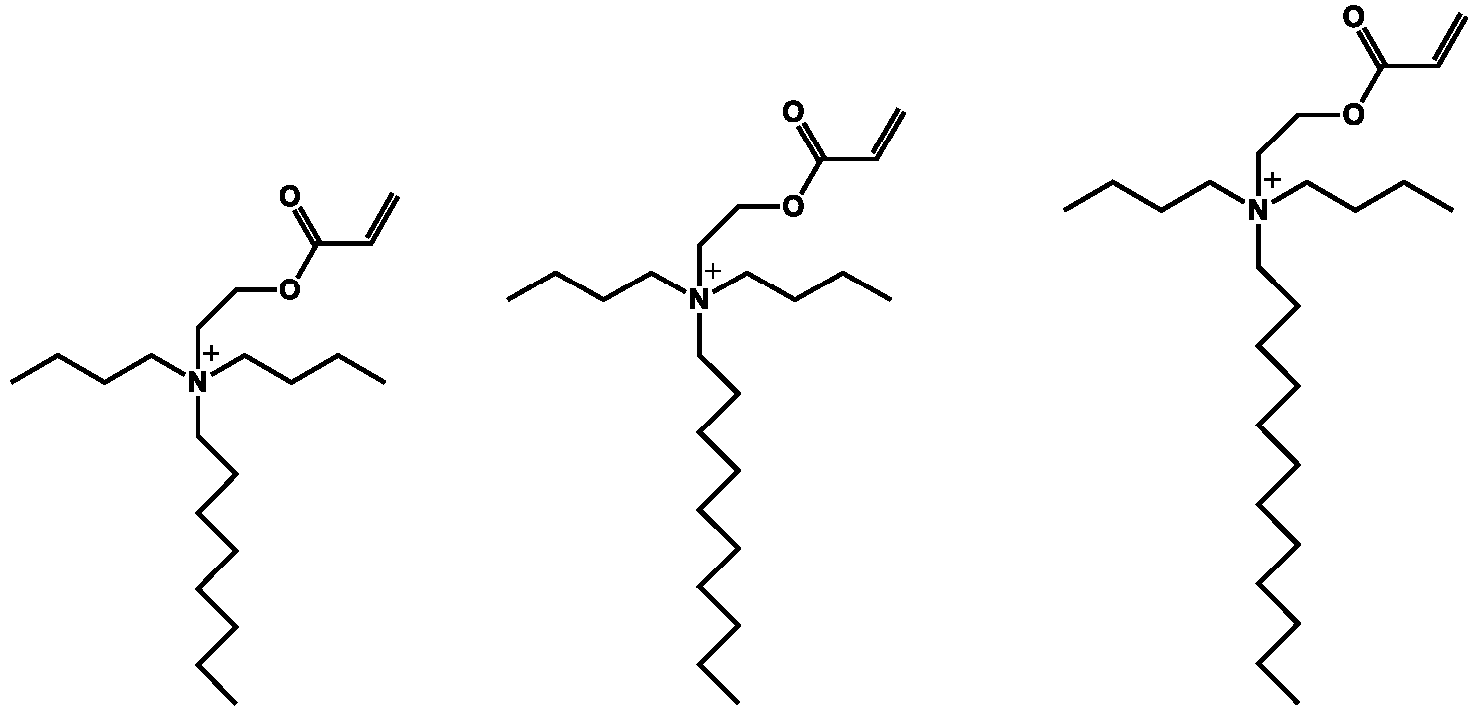
- A compound selected among the following Monomers 1 to 10:



Applications Claiming Priority (2)
| Application Number | Priority Date | Filing Date | Title |
|---|---|---|---|
| KR20210093569 | 2021-07-16 | ||
| PCT/KR2022/009358 WO2023287071A1 (en) | 2021-07-16 | 2022-06-29 | Antibacterial composition |
Publications (2)
| Publication Number | Publication Date |
|---|---|
| EP4371410A1 true EP4371410A1 (en) | 2024-05-22 |
| EP4371410A4 EP4371410A4 (en) | 2024-10-23 |
Family
ID=84919539
Family Applications (2)
| Application Number | Title | Priority Date | Filing Date |
|---|---|---|---|
| EP22842333.1A Pending EP4371410A4 (en) | 2021-07-16 | 2022-06-29 | ANTIBACTERIAL COMPOSITION |
| EP22842453.7A Pending EP4256960A4 (en) | 2021-07-16 | 2022-07-13 | ANTIBACTERIAL COMPOSITION |
Family Applications After (1)
| Application Number | Title | Priority Date | Filing Date |
|---|---|---|---|
| EP22842453.7A Pending EP4256960A4 (en) | 2021-07-16 | 2022-07-13 | ANTIBACTERIAL COMPOSITION |
Country Status (6)
| Country | Link |
|---|---|
| US (2) | US20240107999A1 (en) |
| EP (2) | EP4371410A4 (en) |
| JP (2) | JP2024502922A (en) |
| KR (2) | KR102903866B1 (en) |
| CN (2) | CN116249448B (en) |
| WO (2) | WO2023287071A1 (en) |
Families Citing this family (1)
| Publication number | Priority date | Publication date | Assignee | Title |
|---|---|---|---|---|
| JP2024502922A (en) * | 2021-07-16 | 2024-01-24 | エルジー・ケム・リミテッド | antibacterial composition |
Family Cites Families (29)
| Publication number | Priority date | Publication date | Assignee | Title |
|---|---|---|---|---|
| US5473057A (en) * | 1994-11-09 | 1995-12-05 | The Regents Of The University Of California | Eleutherobin and analogs thereof |
| GB9500856D0 (en) * | 1995-01-17 | 1995-03-08 | Zeneca Ltd | Composition and use |
| JP2000045179A (en) * | 1998-07-23 | 2000-02-15 | Toyobo Co Ltd | Antimicrobial fibers and fiber structures |
| JP2000154105A (en) * | 1998-11-18 | 2000-06-06 | Daicel Chem Ind Ltd | Antimicrobial composition |
| US7459167B1 (en) * | 2000-07-27 | 2008-12-02 | 3M Innovative Properties Company | Biocidal polyurethane compositions and methods of use |
| US20050164903A1 (en) * | 2001-08-03 | 2005-07-28 | Ki-Hwan Ko | Complexed surfactant system |
| KR100421508B1 (en) * | 2001-08-07 | 2004-03-09 | 김정한 | New derivatives of phenethylamine and their salts for antibiotics and antifungal agents |
| DE10203342A1 (en) * | 2002-01-29 | 2003-08-07 | Clariant Gmbh | Polymers with biocidal activity, process for their preparation and their use |
| FR2846970B1 (en) * | 2002-11-08 | 2006-08-11 | Desarrollo Del Grafting S L | METHOD FOR SURFACE TREATMENT BY PHOTOPOLYMERIZATION TO OBTAIN BIOCIDAL PROPERTIES |
| JP4320755B2 (en) * | 2003-05-20 | 2009-08-26 | パイオトレック株式会社 | Antibacterial / antifungal agent and antibacterial / antifungal resin composition containing the same |
| KR100752150B1 (en) | 2006-05-11 | 2007-08-29 | 한국과학기술연구원 | Photocurable monomer having imidazolium salt, antimicrobial photocurable composition containing the imidazolium salt and antimicrobial polymer material prepared from the composition |
| JP2010531156A (en) * | 2007-04-25 | 2010-09-24 | ビーエーエスエフ ソシエタス・ヨーロピア | Substrate with biocidal coating |
| KR101681522B1 (en) * | 2008-05-09 | 2016-12-01 | 고쿠리츠다이가쿠호진 히로시마다이가쿠 | Method of fixing antibacterial agent and article obtained by the method |
| US20110076387A1 (en) * | 2009-09-29 | 2011-03-31 | Lonza, Inc. | Method for imparting antibiotic activity to the surface of a solid substrate |
| KR101227761B1 (en) * | 2010-09-16 | 2013-01-29 | 영남대학교 산학협력단 | Anti-static and anti-microbial surface treating agent comprising quaternary ammonium salt compound and anti-static method of polymer fiber using the same |
| CN103384687A (en) * | 2010-11-30 | 2013-11-06 | 默克专利有限公司 | Particles for electrophoretic displays |
| JP5699738B2 (en) * | 2011-03-29 | 2015-04-15 | コニカミノルタ株式会社 | Hard coat film, heat ray blocking film using the same, and organic element device |
| KR102093832B1 (en) * | 2012-02-08 | 2020-03-26 | 메르크 파텐트 게엠베하 | Reactive mesogen formulation with conductive additive |
| WO2015133455A1 (en) * | 2014-03-05 | 2015-09-11 | 株式会社カネカ | Method for reducing critical micelle concentration, and surfactant composition |
| WO2016182444A1 (en) * | 2015-05-12 | 2016-11-17 | Rijksuniversiteit Groningen | 3d-printable antimicrobial composite resins, methods for manufacturing the same |
| CA3032514C (en) * | 2015-07-31 | 2021-05-04 | Takehiro SHINODA | Method of producing membrane protein and utilization thereof |
| WO2017057571A1 (en) * | 2015-09-30 | 2017-04-06 | 株式会社日本触媒 | Antibacterial agent |
| JP2017202982A (en) * | 2016-05-09 | 2017-11-16 | ライオン株式会社 | Antibacterial polymer |
| CN109135232B (en) * | 2017-06-27 | 2021-01-29 | 江南大学 | Antibacterial polymer composite material and preparation method thereof |
| KR102363525B1 (en) | 2020-01-20 | 2022-02-16 | 주식회사 이브이첨단소재 | Flexible printed circuit board for the transparent LED display |
| CN113498116A (en) * | 2020-03-18 | 2021-10-12 | 华为技术有限公司 | Uplink coordinated communication method and device |
| CA3196930A1 (en) * | 2020-09-28 | 2022-03-31 | Elpiscience (Suzhou) Biopharma, Ltd. | Novel anti-claudin18 antibodies |
| WO2022075763A1 (en) * | 2020-10-07 | 2022-04-14 | 주식회사 엘지화학 | Antibacterial polymer composition |
| JP2024502922A (en) * | 2021-07-16 | 2024-01-24 | エルジー・ケム・リミテッド | antibacterial composition |
-
2022
- 2022-06-29 JP JP2023518277A patent/JP2024502922A/en active Pending
- 2022-06-29 EP EP22842333.1A patent/EP4371410A4/en active Pending
- 2022-06-29 KR KR1020220079920A patent/KR102903866B1/en active Active
- 2022-06-29 WO PCT/KR2022/009358 patent/WO2023287071A1/en not_active Ceased
- 2022-06-29 US US18/027,430 patent/US20240107999A1/en active Pending
- 2022-06-29 CN CN202280006602.0A patent/CN116249448B/en active Active
- 2022-07-13 JP JP2023544140A patent/JP2024505838A/en active Pending
- 2022-07-13 WO PCT/KR2022/010196 patent/WO2023287191A1/en not_active Ceased
- 2022-07-13 KR KR1020220086215A patent/KR20230012989A/en active Pending
- 2022-07-13 EP EP22842453.7A patent/EP4256960A4/en active Pending
- 2022-07-13 CN CN202280010940.1A patent/CN116828983A/en active Pending
- 2022-07-13 US US18/274,356 patent/US20240108001A1/en active Pending
Also Published As
| Publication number | Publication date |
|---|---|
| CN116249448B (en) | 2026-02-27 |
| CN116249448A (en) | 2023-06-09 |
| WO2023287071A1 (en) | 2023-01-19 |
| KR20230012975A (en) | 2023-01-26 |
| KR102903866B1 (en) | 2025-12-24 |
| EP4256960A4 (en) | 2024-06-12 |
| US20240108001A1 (en) | 2024-04-04 |
| EP4256960A1 (en) | 2023-10-11 |
| JP2024505838A (en) | 2024-02-08 |
| WO2023287191A1 (en) | 2023-01-19 |
| CN116828983A (en) | 2023-09-29 |
| JP2024502922A (en) | 2024-01-24 |
| KR20230012989A (en) | 2023-01-26 |
| US20240107999A1 (en) | 2024-04-04 |
| EP4371410A4 (en) | 2024-10-23 |
Similar Documents
| Publication | Publication Date | Title |
|---|---|---|
| EP1038892B1 (en) | Method of improving viscosity stability of aqueous compounds | |
| Kocer et al. | A novel N-halamine acrylamide monomer and its copolymers for antimicrobial coatings | |
| JPH02612A (en) | Addition compound, its preparation, dispersant or dispersion stabilizer containing it as effective component, and solid coated therewith | |
| EP4371410A1 (en) | Antibacterial composition | |
| CA1038518A (en) | Highly cross-linked polyurethane dispersions stable to light and to storage | |
| EP4063407A1 (en) | Antibacterial polymer | |
| CN114245740A (en) | Polylysine polymers having antimicrobial and/or anticancer activity | |
| EP3785541A1 (en) | Antimicrobial resin and coating material | |
| EP4420516A1 (en) | Antibacterial composition | |
| EP4435022A1 (en) | Antibacterial resin, composition for preparing same, and molded body comprising same | |
| KR100439083B1 (en) | Thickener composition | |
| EP4442678A1 (en) | Compound and molded body comprising same | |
| EP4339186A1 (en) | Antibacterial compound | |
| EP4435018A1 (en) | Antibacterial resin and molded body comprising same | |
| JP2003012748A (en) | Aqueous UV-absorbing resin emulsion, method for producing the same, and emulsion resin composition | |
| JP2023541080A (en) | antibacterial polymer | |
| CN117355215A (en) | Antibacterial composition | |
| KR100748041B1 (en) | Antimicrobial Imidazolium Salt Derivatives and Antimicrobial Polymer Materials Using the Same | |
| EP4467583A1 (en) | Copolymer, antimicrobial deodorant composition comprising same, and method for producing same | |
| KR20240047211A (en) | Anti-bacterial polymer | |
| CN118742535A (en) | Antibacterial composition | |
| KR102943858B1 (en) | Antibacterial resin, composition for forming antibacterial resin, and molding product comprising antibacterial resin | |
| KR20240047213A (en) | Anti-bacterial compound | |
| KR20200077339A (en) | Novel compound, antibacterial agent, and antibacterial polymer coating composition comprising the same | |
| WO2005000933A1 (en) | Aqueous emulsion of ultraviolet-absorbing resin and emulsion resin composition |
Legal Events
| Date | Code | Title | Description |
|---|---|---|---|
| STAA | Information on the status of an ep patent application or granted ep patent |
Free format text: STATUS: THE INTERNATIONAL PUBLICATION HAS BEEN MADE |
|
| PUAI | Public reference made under article 153(3) epc to a published international application that has entered the european phase |
Free format text: ORIGINAL CODE: 0009012 |
|
| STAA | Information on the status of an ep patent application or granted ep patent |
Free format text: STATUS: REQUEST FOR EXAMINATION WAS MADE |
|
| 17P | Request for examination filed |
Effective date: 20230629 |
|
| AK | Designated contracting states |
Kind code of ref document: A1 Designated state(s): AL AT BE BG CH CY CZ DE DK EE ES FI FR GB GR HR HU IE IS IT LI LT LU LV MC MK MT NL NO PL PT RO RS SE SI SK SM TR |
|
| A4 | Supplementary search report drawn up and despatched |
Effective date: 20240924 |
|
| DAV | Request for validation of the european patent (deleted) | ||
| DAX | Request for extension of the european patent (deleted) | ||
| RIC1 | Information provided on ipc code assigned before grant |
Ipc: A01N 43/653 20060101ALI20240918BHEP Ipc: C12Q 1/18 20060101ALI20240918BHEP Ipc: A01P 1/00 20060101ALI20240918BHEP Ipc: A01N 25/10 20060101ALI20240918BHEP Ipc: A01N 33/12 20060101AFI20240918BHEP |