EP4369640A1 - Control method of wireless communication module for ppdu end time alignment - Google Patents
Control method of wireless communication module for ppdu end time alignment Download PDFInfo
- Publication number
- EP4369640A1 EP4369640A1 EP23205215.9A EP23205215A EP4369640A1 EP 4369640 A1 EP4369640 A1 EP 4369640A1 EP 23205215 A EP23205215 A EP 23205215A EP 4369640 A1 EP4369640 A1 EP 4369640A1
- Authority
- EP
- European Patent Office
- Prior art keywords
- ppdu
- padding
- alignment setting
- symbol count
- padding factor
- Prior art date
- Legal status (The legal status is an assumption and is not a legal conclusion. Google has not performed a legal analysis and makes no representation as to the accuracy of the status listed.)
- Pending
Links
- 238000004891 communication Methods 0.000 title claims abstract description 30
- 238000000034 method Methods 0.000 title claims abstract description 19
- 238000007670 refining Methods 0.000 claims abstract description 9
- 230000004931 aggregating effect Effects 0.000 claims abstract description 5
- 238000012937 correction Methods 0.000 claims description 3
- 230000002776 aggregation Effects 0.000 description 21
- 238000004220 aggregation Methods 0.000 description 21
- 230000007246 mechanism Effects 0.000 description 17
- 230000005540 biological transmission Effects 0.000 description 9
- 238000010586 diagram Methods 0.000 description 6
- 230000008569 process Effects 0.000 description 4
- 238000012545 processing Methods 0.000 description 4
- 230000009977 dual effect Effects 0.000 description 2
- 230000001360 synchronised effect Effects 0.000 description 2
- 230000004075 alteration Effects 0.000 description 1
- 230000008901 benefit Effects 0.000 description 1
- 230000008859 change Effects 0.000 description 1
- 230000001419 dependent effect Effects 0.000 description 1
- 238000012986 modification Methods 0.000 description 1
- 230000004048 modification Effects 0.000 description 1
- 238000012549 training Methods 0.000 description 1
- LNPDTQAFDNKSHK-UHFFFAOYSA-N valdecoxib Chemical compound CC=1ON=C(C=2C=CC=CC=2)C=1C1=CC=C(S(N)(=O)=O)C=C1 LNPDTQAFDNKSHK-UHFFFAOYSA-N 0.000 description 1
Images



Classifications
-
- H—ELECTRICITY
- H04—ELECTRIC COMMUNICATION TECHNIQUE
- H04W—WIRELESS COMMUNICATION NETWORKS
- H04W56/00—Synchronisation arrangements
- H04W56/0005—Synchronisation arrangements synchronizing of arrival of multiple uplinks
-
- H—ELECTRICITY
- H04—ELECTRIC COMMUNICATION TECHNIQUE
- H04L—TRANSMISSION OF DIGITAL INFORMATION, e.g. TELEGRAPHIC COMMUNICATION
- H04L1/00—Arrangements for detecting or preventing errors in the information received
- H04L1/0001—Systems modifying transmission characteristics according to link quality, e.g. power backoff
- H04L1/0006—Systems modifying transmission characteristics according to link quality, e.g. power backoff by adapting the transmission format
- H04L1/0007—Systems modifying transmission characteristics according to link quality, e.g. power backoff by adapting the transmission format by modifying the frame length
- H04L1/0008—Systems modifying transmission characteristics according to link quality, e.g. power backoff by adapting the transmission format by modifying the frame length by supplementing frame payload, e.g. with padding bits
-
- H—ELECTRICITY
- H04—ELECTRIC COMMUNICATION TECHNIQUE
- H04L—TRANSMISSION OF DIGITAL INFORMATION, e.g. TELEGRAPHIC COMMUNICATION
- H04L1/00—Arrangements for detecting or preventing errors in the information received
- H04L2001/0092—Error control systems characterised by the topology of the transmission link
- H04L2001/0096—Channel splitting in point-to-point links
Definitions
- IEEE 802.11be defines multiple link operations that allow an access point (AP) and a station to communicate with each other by using two or more links. Due to a hardware limitation such as the capability of radio frequency (RF) filters between RF bands within the station, the AP/station can be operated in a synchronous mode or an asynchronous mode.
- the synchronous mode is also named as a nonsimultaneous transmit and receive (NSTR) mode, that is the AP/station cannot transmit and receive data at the same time via multiple links.
- NSTR nonsimultaneous transmit and receive
- the asynchronous mode is also named as a simultaneous transmit and receive (STR) mode, that is the AP/station can transmit and receive data at the same time via multiple links, but the AP/station does not need to transmit data by using the multiple links simultaneously.
- STR simultaneous transmit and receive
- IEEE 802.11be also defines physical layer protocol data unit (PPDU) end time alignment requirements, that is when multiple PPDUs are simultaneously transmitted via multiple links, respectively, their end times should be aligned, and all differences between each pair of multiple links between the end times of the simultaneously transmitted PPDUs is required to be less than or equal to a specific time, to avoid the interference between pairs of multiple links.
- PPDU physical layer protocol data unit
- a method and a circuitry according to the invention are defined in the independent claims. The dependent claims define preferred embodiments thereof.
- a control method of a wireless communication module comprises the steps of: receiving target end time information of a PPDU, and estimating a symbol count of the PPDU according to the target end time information; determining a duration of a packet extension of the PPDU; refining an alignment setting comprising at least one of a padding factor, the duration of the packet extension, and the symbol count of the PPDU, wherein the padding factor indicates invalid data information of the PPDU; generating the alignment setting comprising a final symbol count of the PPDU, the duration of the packet extension, and the padding factor of the PPDU; and aggregating a plurality of media access control protocol data units (MPDUs) to generate the PPDU according to the alignment setting.
- MPDUs media access control protocol data units
- a circuitry of a wireless communication module is configured to perform the steps of: receiving target end time information of a PPDU, and estimating a symbol count of the PPDU according to the target end time information; determining a duration of a packet extension of the PPDU; refining an alignment setting comprising at least one of a padding factor, the duration of the packet extension, and the symbol count of the PPDU, wherein the padding factor indicates invalid data information of the PPDU; generating the alignment setting comprising a final symbol count of the PPDU, the duration of the packet extension, and the padding factor of the PPDU; and aggregating a plurality of MPDUs to generate the PPDU according to the alignment setting.
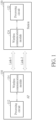
- FIG. 1 is a diagram illustrating a wireless communication system according to one embodiment of the present invention.
- the wireless communication system comprises an access point (AP) 110 and at least one station such as 120.
- the AP 110 is a Wi-Fi access point that allows other wireless devices such as the station 120 to connect to a wired network, and the AP 110 mainly comprises a processing circuit 112 and a wireless communication module 114.
- the station 120 is a Wi-Fi station comprising a processing circuit 122 and a wireless communication module 124, and the station 120 can be a cell phone, a tablet, a notebook, or any other electronic device capable of wirelessly communicating with the AP 110.
- the wireless communication module 114/124 comprises at least a media address control (MAC) layer circuitry and physical layer circuitry.
- MAC media address control
- the AP 110 and the station 120 are multi-link devices (MLD), that is the AP 110 and the station 120 are communicated with each other by using two or more links such as Link-1 and Link-2 shown in FIG. 1 .
- the Link-1 may use a channel corresponding to a 2.4GHz band (e.g., 2.412GHz - 2.484GHz), a 5GHz band (e.g., 4.915GHz - 5.825GHz) or a 6GHz band (e.g., 5.925GHz - 7.125GHz) ; and the Link-2 may also use a channel corresponding to the 2.4GHz band, the 5GHz band or the 6GHz band.
- a 2.4GHz band e.g., 2.412GHz - 2.484GHz
- 5GHz band e.g., 4.915GHz - 5.825GHz
- 6GHz band e.g., 5.925GHz - 7.125GHz
- the Link-2 may also use a channel corresponding to the 2.4GHz band, the 5GHz band or the 6
- the AP 110 and the station 120 operate in the NSTR mode, that is the AP 110 cannot transmit and receive data at the same time via multiple links.
- IEEE 802.11be defines PPDU end time alignment requirements, that is when multiple PPDUs are simultaneously transmitted via multiple links, respectively, their end times should be aligned with a specific tolerance requiremnt. Therefore, the following embodiments provide control methods that can generate the PPDU with suitable length.
- FIG. 2 is a control method of one of the wireless communication modules 114 and 124 according to one embodiment of the present invention.
- the wireless communication module 114 serves as an example to perform the following steps, but the present invention is not limited thereto.
- Step 200 the flow starts, and the AP 110 and the station 120 have established two or more links.
- Step 202 the wireless communication module 114 obtains a plurality of MAC service data units (MSDUs), and the wireless communication module 114 aggregates the MSDUs to generate MPDUs, wherein one MPDU may comprise one or more MSDUs.
- the wireless communication module 114 performs sequence number (SN) and packet number (PN) assignment for each MPDU.
- an encryption operation is performed on the MPDUs.
- Step 208 a MAC layer circuit within the wireless communication module 114 performs a PPDU end time alignment operation to determine a symbol count and related setting of the PPDU.
- the MAC layer circuit within the wireless communication module 114 aggregates a plurality of MPDUs to generate a PPDU, and the PPDU is transmitted to the station 120 via a physical layer circuit of the wireless communication module 114.
- Steps 202-206 and Step 210 are known by a person skilled in the art, and the present invention focuses on the PPDU end time alignment operation of Step 208, so the detailed operations of Steps 202-206 and Step 210 are omitted here.
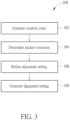
- FIG. 3 shows a flowchart of the PPDU end time alignment operation according to one embodiment of the present invention.
- the MAC layer circuit of the wireless communication module 114 receives target end time information of the PPDU, and estimates a symbol count of the PPDU according to the target end time information, wherein the symbol count of the PPDU may comprise data symbol count in the physical layer service data unit (PSDU) and/or SIG/LTF (Signal/Long Training Field) symbol in the preamble.
- PSDU physical layer service data unit
- SIG/LTF Synignal/Long Training Field
- the target end time information comprises a target length of a PPDU, and this information can be derived based on multi-link operation (MLO) or dual band dual concurrent (DBDC) links, or "TXVECTOR" parameter defined in IEEE 802.11specification. It is noted that the determination of target end time information or the target length of PPDU is known by a person skilled in the art, further descriptions are omitted here.
- the symbol count of the PPDU can be estimated by the target length of a PPDU, a length of each symbol (orthogonal frequency division multiplexing (OFDM) symbol), a length of a preamble of the PPDU and other parameter(s) such as packet extension disambiguity information.
- OFDM orthogonal frequency division multiplexing
- N SYM is the data symbol count of the PPDU
- L_LENGTH is the target length of a PPDU
- T SYM is the length of each data symbol
- T EHT-PREAMBLE is length of a preamble
- b PE-Disambiguity is the packet extension disambiguity information
- [] is a truncation operator.
- the MAC layer circuit determines a length of a packet extension (PE) according to the symbol count of the PPDU, the target length of the PPDU, a length of each symbol and a length of a preamble of the PPDU.
- PE packet extension
- the duration of the PE calculated in Step 304 is used for a nominal packet padding requested by the receiver (e.g., the station 120) defined in IEEE 802.11 specification, for the receiver to have additional processing time to decode the received symbols. It is noted that T PE calculated in Step 304 may not enough for the nominal packet padding requirement.
- the duration of the packet extension (T PE ) obtained in Step 304 is for the mode supporting a packet padding by PE mechanism, such as High Efficiency (HE) defined in IEEE 8002.11ax and Extreme High Throughput (EHT) modes defined in IEEE 802.11be. If the operation mode of the wireless communication module 114 does not support the packet padding by PE mechanism (e.g., Very High Throughput (VTH)), the duration of the packet extension can be directly set to zero.
- PE mechanism such as High Efficiency (HE) defined in IEEE 8002.11ax and Extreme High Throughput (EHT) modes defined in IEEE 802.11be.
- VTH Very High Throughput
- the MAC layer circuit refines an alignment setting based on an alignment mechanism, wherein the alignment mechanism may be a force-extra-symbol(-segment) mechanism, an avoid-extra-symbol mechanism or a best-effort mechanism; and the alignment setting comprises at least one of a padding factor, a duration of packet extension and a final symbol count of the PPDU.
- the alignment mechanism may be a force-extra-symbol(-segment) mechanism, an avoid-extra-symbol mechanism or a best-effort mechanism
- the alignment setting comprises at least one of a padding factor, a duration of packet extension and a final symbol count of the PPDU.
- the MAC layer directly subtracts one symbol or one symbol segment from "N SYM " calculated by formula (1) to obtain an alignment setting.
- the wireless communication module 114 does not have the mode of packet padding by PE mechanism, and if the data symbol count of the PPDU calculated by using formula (1) is "N SYM ", the MAC layer determines that the new data symbol count N SYM ' is equal to (N SYM -1) . That is, when the PPDU is generated, the content contained more invalid data across all OFDM symbols.
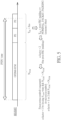
- the wireless communication module 114 has the mode of packet padding by PE mechanism, and the MAC layer circuit intentionally reduce a pre-FEC (forward error correction) padding factor (hereinafter, a-factor) to make the PPDU has more invalid data.
- a pre-FEC padding factor has four different value
- the last orthogonal frequency-division multiple access (OFDMA) symbol has four segments
- the pre-FEC padding factor having the value "1" indicates that only the first segment of the last OFDMA symbol has valid data
- the pre-FEC padding factor having the value "2" indicates that only the first two segments of the last OFDMA symbol have valid data
- the pre-FEC padding factor having the value "3” indicates that only the first three segments of the last OFDMA symbol have valid data
- the pre-FEC padding factor having the value "4" indicates that all the four segments of the last OFDMA symbol have valid data.
- the MAC layer circuit can initially determine that that the last OFDMA symbol has the a-factor equal to "2" so that only the first two segments of the last OFDMA symbol have valid data, and the last two segments only have invalid data, to make the length of the overall invalid data is equal to or greater than nominal packet padding (i.e. , a summation of 8us invalid symbol segment and 8us packet extension is equal to 16us nominal packet padding) . Then, the MAC layer circuit adjusts the initial a-factor to be "1" to increase invalid data of a segment, and the final a-factor serves as the alignment setting that will be provided to the following module.
- T PE shown in FIG. 5
- the encoder may temporarily need to use one more symbol or symbol segment during the encoding process to improve the encoding quality, wherein this one more symbol or symbol segment is also called "LDPC extra symbol or symbol segment" in the IEEE 802.11 specification.
- LDPC low density parity check
- the increased invalid data of one symbol or symbol segment can be used for this one more symbol or symbol segment, and the invalid data within the PPDU still satisfies nominal packet padding requirement (i.e., the a-factor becomes "2" from "1" in the encoding operations).
- LDPC extra symbol or "LDPC extra symbol segment” is always set to be true (e.g., the parameter "b extra " shown in FIG. 5 is always set “1"), even if the encoder will not use one more symbol or symbol segment during the subsequent encoding process. Furthermore, the preamble of the PPDU generated later will always indicate the presence of the LDPC extra symbol or symbol segment.
- the MAC layer circuit refers to the nominal packet padding requirement to determine the a-factor, and intentionally increase invalid data of one or more segment(s) to avoid introducing extra data symbol by the encoder.
- the MAC layer circuit initially determines that the last OFDMA symbol has the a-factor equal to "1" or "2", which depends on the results of encoding process, to make the length of the overall invalid data is equal to or greater than nominal packet padding, this a-factor can directly serve as an alignment setting that will be provided to the following module.
- the duration of packet extension may be increased to satisfy the nominal packet padding requirement.
- the MAC layer circuit does not intentionally adjust the a-factor according to the nominal packet padding requirement, that is the a-factor is determined by using a look-up table defined in the IEEE 802.11 specification.
- the alignment setting is provided to the following module for the encoding processing and MPDU aggregation.
- the alignment setting comprises the symbol count and the a-factor mentioned above, and by using the symbol count and the a-factor, the byte count of one PPDU can be obtained for the MPDU aggregation.
- FIG. 6 is a diagram of a circuitry 600 within the wireless communication module 114 according to one embodiment of the present invention, wherein the circuitry 600 is configured to perform the Step 200 - Step 210 and Step 302 - Step 308.
- the circuitry 600 comprises an aggregation module 610, a PPDU end time alignment module 620 and two transmission modules 630 and 640.
- the aggregation module 610 is configured to receive MPDUs corresponding to Link-1 and Link-2, and the aggregation module 610 transmits target end time information of two PPDUs respectively corresponding to Link-1 and Link-2 to the PPDU end time alignment module 620.
- the PPDU end time alignment module 620 uses the above embodiments to generate the alignment settings to the aggregation module 610, for the byte count determination and MPDU aggregation. Then, the aggregation module 610 generates a first PPDU and a second PPDU, wherein the first PPDU is wirelessly transmitted by the transmission module 630 via Link-1, and the second PPDU is wirelessly transmitted by the transmission module 640 via Link-2.
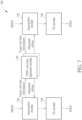
- FIG. 7 is a diagram of a circuitry 700 within the wireless communication module 114 according to one embodiment of the present invention, wherein the circuitry 700 is configured to perform the Step 200 - Step 210 and Step 302 - Step 308.
- the circuitry 700 comprises two aggregation modules 710 and 720, at least one PPDU end time alignment module 730 and two transmission modules 740 and 750, wherein the aggregation module 710 and the transmission module 740 correspond to Link-1, and the aggregation module 720 and the transmission module 750 correspond to Link-2.
- the aggregation module 710 is configured to receive MPDUs corresponding to Link-1, and the aggregation module 710 transmits target end time information of a PPDU to the PPDU end time alignment module 730. Then, the PPDU end time alignment module 730 uses the above embodiments to generate the alignment setting to the aggregation module 710, for the byte count determination and MPDU aggregation. Then, the aggregation module 710 generates a first PPDU, wherein the first PPDU is wirelessly transmitted by the transmission module 740 via Link-1.
- the aggregation module 720 is configured to receive MPDUs corresponding to Link-2, and the aggregation module 720 transmits target end time information of a PPDU to the PPDU end time alignment module 730. Then, the PPDU end time alignment module 730 uses the above embodiments to generate the alignment setting to the aggregation module 720, for the byte count determination and MPDU aggregation. Then, the aggregation module 720 generates a second PPDU, wherein the second PPDU is wirelessly transmitted by the transmission module 750 via Link-2.
Landscapes
- Engineering & Computer Science (AREA)
- Computer Networks & Wireless Communication (AREA)
- Signal Processing (AREA)
- Quality & Reliability (AREA)
- Mobile Radio Communication Systems (AREA)
Abstract
Description
- This application claims the benefit of
U.S. Provisional Application No. 63/383,110, filed on November 10th, 2022 - IEEE 802.11be defines multiple link operations that allow an access point (AP) and a station to communicate with each other by using two or more links. Due to a hardware limitation such as the capability of radio frequency (RF) filters between RF bands within the station, the AP/station can be operated in a synchronous mode or an asynchronous mode. The synchronous mode is also named as a nonsimultaneous transmit and receive (NSTR) mode, that is the AP/station cannot transmit and receive data at the same time via multiple links. The asynchronous mode is also named as a simultaneous transmit and receive (STR) mode, that is the AP/station can transmit and receive data at the same time via multiple links, but the AP/station does not need to transmit data by using the multiple links simultaneously.
- Regarding the NSTR mode, IEEE 802.11be also defines physical layer protocol data unit (PPDU) end time alignment requirements, that is when multiple PPDUs are simultaneously transmitted via multiple links, respectively, their end times should be aligned, and all differences between each pair of multiple links between the end times of the simultaneously transmitted PPDUs is required to be less than or equal to a specific time, to avoid the interference between pairs of multiple links. However, because the given length (in time as a unit) of a PPDU to be transmitted may not be the same as the actual transmission time of the PPDU, the multiple PPDUs may not be accurately aligned.
- It is therefore an objective of the present invention to provide a wireless communication method, which can determine a suitable symbol count and a duration of packet extension (PE) within a PPDU for the PPDU end time alignment mechanism, to solve the above-mentioned problems. A method and a circuitry according to the invention are defined in the independent claims. The dependent claims define preferred embodiments thereof.
- According to one embodiment of the present invention, a control method of a wireless communication module comprises the steps of: receiving target end time information of a PPDU, and estimating a symbol count of the PPDU according to the target end time information; determining a duration of a packet extension of the PPDU; refining an alignment setting comprising at least one of a padding factor, the duration of the packet extension, and the symbol count of the PPDU, wherein the padding factor indicates invalid data information of the PPDU; generating the alignment setting comprising a final symbol count of the PPDU, the duration of the packet extension, and the padding factor of the PPDU; and aggregating a plurality of media access control protocol data units (MPDUs) to generate the PPDU according to the alignment setting.
- According to one embodiment of the present invention, a circuitry of a wireless communication module is configured to perform the steps of: receiving target end time information of a PPDU, and estimating a symbol count of the PPDU according to the target end time information; determining a duration of a packet extension of the PPDU; refining an alignment setting comprising at least one of a padding factor, the duration of the packet extension, and the symbol count of the PPDU, wherein the padding factor indicates invalid data information of the PPDU; generating the alignment setting comprising a final symbol count of the PPDU, the duration of the packet extension, and the padding factor of the PPDU; and aggregating a plurality of MPDUs to generate the PPDU according to the alignment setting.
- These and other objectives of the present invention will no doubt become obvious to those of ordinary skill in the art after reading the following detailed description of the preferred embodiment that is illustrated in the various figures and drawings.
-
-
FIG. 1 is a diagram illustrating a wireless communication system according to one embodiment of the present invention. -
FIG. 2 is a control method of one wireless communication module according to one embodiment of the present invention. -
FIG. 3 shows a flowchart of the PPDU end time alignment operation according to one embodiment of the present invention. -
FIG. 4 shows a force-extra-symbol(-segment) mechanism according to one embodiment of the present invention. -
FIG. 5 shows a force-extra-symbol(-segment) mechanism according to one embodiment of the present invention. -
FIG. 6 is a diagram of a circuitry within the wireless communication module according to one embodiment of the present invention. -
FIG. 7 is a diagram of a circuitry within the wireless communication module according to one embodiment of the present invention. - Certain terms are used throughout the following description and claims to refer to particular system components. As one skilled in the art will appreciate, manufacturers may refer to a component by different names. This document does not intend to distinguish between components that differ in name but not function. In the following discussion and in the claims, the terms "including" and "comprising" are used in an open-ended fashion, and thus should be interpreted to mean "including, but not limited to ...". The terms "couple" and "couples" are intended to mean either an indirect or a direct electrical connection. Thus, if a first device couples to a second device, that connection may be through a direct electrical connection, or through an indirect electrical connection via other devices and connections.
-
FIG. 1 is a diagram illustrating a wireless communication system according to one embodiment of the present invention. As shown inFIG. 1 , the wireless communication system comprises an access point (AP) 110 and at least one station such as 120. The AP 110 is a Wi-Fi access point that allows other wireless devices such as thestation 120 to connect to a wired network, and the AP 110 mainly comprises aprocessing circuit 112 and awireless communication module 114. Thestation 120 is a Wi-Fi station comprising aprocessing circuit 122 and awireless communication module 124, and thestation 120 can be a cell phone, a tablet, a notebook, or any other electronic device capable of wirelessly communicating with theAP 110. In addition, thewireless communication module 114/124 comprises at least a media address control (MAC) layer circuitry and physical layer circuitry. - In this embodiment, the AP 110 and the
station 120 are multi-link devices (MLD), that is the AP 110 and thestation 120 are communicated with each other by using two or more links such as Link-1 and Link-2 shown inFIG. 1 . In this embodiment, the Link-1 may use a channel corresponding to a 2.4GHz band (e.g., 2.412GHz - 2.484GHz), a 5GHz band (e.g., 4.915GHz - 5.825GHz) or a 6GHz band (e.g., 5.925GHz - 7.125GHz) ; and the Link-2 may also use a channel corresponding to the 2.4GHz band, the 5GHz band or the 6GHz band. - In this embodiment, the AP 110 and the
station 120 operate in the NSTR mode, that is the AP 110 cannot transmit and receive data at the same time via multiple links. As described in the background of the present invention, IEEE 802.11be defines PPDU end time alignment requirements, that is when multiple PPDUs are simultaneously transmitted via multiple links, respectively, their end times should be aligned with a specific tolerance requiremnt. Therefore, the following embodiments provide control methods that can generate the PPDU with suitable length. -
FIG. 2 is a control method of one of thewireless communication modules wireless communication module 114 serves as an example to perform the following steps, but the present invention is not limited thereto. InStep 200, the flow starts, and the AP 110 and thestation 120 have established two or more links. InStep 202, thewireless communication module 114 obtains a plurality of MAC service data units (MSDUs), and thewireless communication module 114 aggregates the MSDUs to generate MPDUs, wherein one MPDU may comprise one or more MSDUs. InStep 204, thewireless communication module 114 performs sequence number (SN) and packet number (PN) assignment for each MPDU. InStep 206, an encryption operation is performed on the MPDUs. InStep 208, a MAC layer circuit within thewireless communication module 114 performs a PPDU end time alignment operation to determine a symbol count and related setting of the PPDU. InStep 208, the MAC layer circuit within thewireless communication module 114 aggregates a plurality of MPDUs to generate a PPDU, and the PPDU is transmitted to thestation 120 via a physical layer circuit of thewireless communication module 114. It is noted that Steps 202-206 andStep 210 are known by a person skilled in the art, and the present invention focuses on the PPDU end time alignment operation ofStep 208, so the detailed operations of Steps 202-206 andStep 210 are omitted here. -
FIG. 3 shows a flowchart of the PPDU end time alignment operation according to one embodiment of the present invention. InStep 302, the MAC layer circuit of thewireless communication module 114 receives target end time information of the PPDU, and estimates a symbol count of the PPDU according to the target end time information, wherein the symbol count of the PPDU may comprise data symbol count in the physical layer service data unit (PSDU) and/or SIG/LTF (Signal/Long Training Field) symbol in the preamble. In one embodiment, the target end time information comprises a target length of a PPDU, and this information can be derived based on multi-link operation (MLO) or dual band dual concurrent (DBDC) links, or "TXVECTOR" parameter defined in IEEE 802.11specification. It is noted that the determination of target end time information or the target length of PPDU is known by a person skilled in the art, further descriptions are omitted here. In this embodiment, the symbol count of the PPDU can be estimated by the target length of a PPDU, a length of each symbol (orthogonal frequency division multiplexing (OFDM) symbol), a length of a preamble of the PPDU and other parameter(s) such as packet extension disambiguity information. For example, without a limitation of the present invention, the data symbol count of the PPDU can be estimated by the following formula:
- In the formula (1), "NSYM" is the data symbol count of the PPDU, "L_LENGTH" is the target length of a PPDU, "TSYM" is the length of each data symbol, "TEHT-PREAMBLE" is length of a preamble, "bPE-Disambiguity" is the packet extension disambiguity information, and "[]" is a truncation operator. It is noted that the formula (1) is provided in the IEEE 802.11be specification, so a person skilled in the art should understand the operation corresponding to this formula.
- In
Step 304, the MAC layer circuit determines a length of a packet extension (PE) according to the symbol count of the PPDU, the target length of the PPDU, a length of each symbol and a length of a preamble of the PPDU. For example, without a limitation of the present invention, the duration of the PE (TPE) can be estimated by the following formula:
- It is noted that the formula (2) is provided in the IEEE 802.11be specification, so a person skilled in the art should understand the operation corresponding to this formula.
- The duration of the PE calculated in
Step 304 is used for a nominal packet padding requested by the receiver (e.g., the station 120) defined in IEEE 802.11 specification, for the receiver to have additional processing time to decode the received symbols. It is noted that TPE calculated inStep 304 may not enough for the nominal packet padding requirement. - The duration of the packet extension (TPE) obtained in
Step 304 is for the mode supporting a packet padding by PE mechanism, such as High Efficiency (HE) defined in IEEE 8002.11ax and Extreme High Throughput (EHT) modes defined in IEEE 802.11be. If the operation mode of thewireless communication module 114 does not support the packet padding by PE mechanism (e.g., Very High Throughput (VTH)), the duration of the packet extension can be directly set to zero. - In
Step 306, the MAC layer circuit refines an alignment setting based on an alignment mechanism, wherein the alignment mechanism may be a force-extra-symbol(-segment) mechanism, an avoid-extra-symbol mechanism or a best-effort mechanism; and the alignment setting comprises at least one of a padding factor, a duration of packet extension and a final symbol count of the PPDU. - Regarding the force-extra-symbol(-segment) mechanism, the MAC layer directly subtracts one symbol or one symbol segment from "NSYM" calculated by formula (1) to obtain an alignment setting. In one embodiment, referring to
FIG. 4 , thewireless communication module 114 does not have the mode of packet padding by PE mechanism, and if the data symbol count of the PPDU calculated by using formula (1) is "NSYM", the MAC layer determines that the new data symbol count NSYM' is equal to (NSYM-1) . That is, when the PPDU is generated, the content contained more invalid data across all OFDM symbols. - In another embodiment, the
wireless communication module 114 has the mode of packet padding by PE mechanism, and the MAC layer circuit intentionally reduce a pre-FEC (forward error correction) padding factor (hereinafter, a-factor) to make the PPDU has more invalid data. In the IEEE 802.11 specification, the pre-FEC padding factor has four different value, the last orthogonal frequency-division multiple access (OFDMA) symbol has four segments, and the pre-FEC padding factor having the value "1" indicates that only the first segment of the last OFDMA symbol has valid data, the pre-FEC padding factor having the value "2" indicates that only the first two segments of the last OFDMA symbol have valid data, the pre-FEC padding factor having the value "3" indicates that only the first three segments of the last OFDMA symbol have valid data, and the pre-FEC padding factor having the value "4" indicates that all the four segments of the last OFDMA symbol have valid data. In detail, referring toFIG. 5 , assuming that the duration of PE (i.e., TPE shown inFIG. 5 ) calculated by formula (2) is 8 microseconds (us), and the nominal packet padding required by the receiver is 16us, the last OFDMA symbol has four segments, a length of each segment is 4us, the MAC layer circuit can initially determine that that the last OFDMA symbol has the a-factor equal to "2" so that only the first two segments of the last OFDMA symbol have valid data, and the last two segments only have invalid data, to make the length of the overall invalid data is equal to or greater than nominal packet padding (i.e. , a summation of 8us invalid symbol segment and 8us packet extension is equal to 16us nominal packet padding) . Then, the MAC layer circuit adjusts the initial a-factor to be "1" to increase invalid data of a segment, and the final a-factor serves as the alignment setting that will be provided to the following module. - In the above force-extra-symbol(-segment) mechanism, by intentionally increase invalid data of one symbol or one symbol segment, the PPDU length (PPDU time) will not change much due to subsequent encoding operations. Specifically, if a low density parity check (LDPC) FEC is used in the subsequent encoding operations, the encoder may temporarily need to use one more symbol or symbol segment during the encoding process to improve the encoding quality, wherein this one more symbol or symbol segment is also called "LDPC extra symbol or symbol segment" in the IEEE 802.11 specification. At this time, the increased invalid data of one symbol or symbol segment can be used for this one more symbol or symbol segment, and the invalid data within the PPDU still satisfies nominal packet padding requirement (i.e., the a-factor becomes "2" from "1" in the encoding operations).
- In addition, in the force-extra-symbol(-segment) mechanism, "LDPC extra symbol" or "LDPC extra symbol segment" is always set to be true (e.g., the parameter "bextra" shown in
FIG. 5 is always set "1"), even if the encoder will not use one more symbol or symbol segment during the subsequent encoding process. Furthermore, the preamble of the PPDU generated later will always indicate the presence of the LDPC extra symbol or symbol segment. - Regarding the avoid-extra-symbol mechanism, the MAC layer circuit refers to the nominal packet padding requirement to determine the a-factor, and intentionally increase invalid data of one or more segment(s) to avoid introducing extra data symbol by the encoder. Taking
FIG. 5 as an example, after the MAC layer circuit initially determines that the last OFDMA symbol has the a-factor equal to "1" or "2", which depends on the results of encoding process, to make the length of the overall invalid data is equal to or greater than nominal packet padding, this a-factor can directly serve as an alignment setting that will be provided to the following module. In one embodiment, if the encoder temporarily needs to use one more symbol or symbol segment during the encoding process to improve the encoding quality, the duration of packet extension may be increased to satisfy the nominal packet padding requirement. - Regarding the best-effort mechanism, the MAC layer circuit does not intentionally adjust the a-factor according to the nominal packet padding requirement, that is the a-factor is determined by using a look-up table defined in the IEEE 802.11 specification.
- In
Step 308, the alignment setting is provided to the following module for the encoding processing and MPDU aggregation. In this embodiment, the alignment setting comprises the symbol count and the a-factor mentioned above, and by using the symbol count and the a-factor, the byte count of one PPDU can be obtained for the MPDU aggregation. -
FIG. 6 is a diagram of acircuitry 600 within thewireless communication module 114 according to one embodiment of the present invention, wherein thecircuitry 600 is configured to perform the Step 200 -Step 210 and Step 302 -Step 308. As shown inFIG. 6 , thecircuitry 600 comprises anaggregation module 610, a PPDU endtime alignment module 620 and twotransmission modules aggregation module 610 is configured to receive MPDUs corresponding to Link-1 and Link-2, and theaggregation module 610 transmits target end time information of two PPDUs respectively corresponding to Link-1 and Link-2 to the PPDU endtime alignment module 620. Then, the PPDU endtime alignment module 620 uses the above embodiments to generate the alignment settings to theaggregation module 610, for the byte count determination and MPDU aggregation. Then, theaggregation module 610 generates a first PPDU and a second PPDU, wherein the first PPDU is wirelessly transmitted by thetransmission module 630 via Link-1, and the second PPDU is wirelessly transmitted by thetransmission module 640 via Link-2. -
FIG. 7 is a diagram of acircuitry 700 within thewireless communication module 114 according to one embodiment of the present invention, wherein thecircuitry 700 is configured to perform the Step 200 -Step 210 and Step 302 -Step 308. As shown inFIG. 7 , thecircuitry 700 comprises twoaggregation modules time alignment module 730 and twotransmission modules aggregation module 710 and thetransmission module 740 correspond to Link-1, and theaggregation module 720 and thetransmission module 750 correspond to Link-2. Theaggregation module 710 is configured to receive MPDUs corresponding to Link-1, and theaggregation module 710 transmits target end time information of a PPDU to the PPDU endtime alignment module 730. Then, the PPDU endtime alignment module 730 uses the above embodiments to generate the alignment setting to theaggregation module 710, for the byte count determination and MPDU aggregation. Then, theaggregation module 710 generates a first PPDU, wherein the first PPDU is wirelessly transmitted by thetransmission module 740 via Link-1. Similarly, theaggregation module 720 is configured to receive MPDUs corresponding to Link-2, and theaggregation module 720 transmits target end time information of a PPDU to the PPDU endtime alignment module 730. Then, the PPDU endtime alignment module 730 uses the above embodiments to generate the alignment setting to theaggregation module 720, for the byte count determination and MPDU aggregation. Then, theaggregation module 720 generates a second PPDU, wherein the second PPDU is wirelessly transmitted by thetransmission module 750 via Link-2. - Those skilled in the art will readily observe that numerous modifications and alterations of the device and method may be made while retaining the teachings of the invention. Accordingly, the above disclosure should be construed as limited only by the metes and bounds of the appended claims.
Claims (10)
- A control method of a wireless communication module, comprising:receiving target end time information of a physical layer protocol data unit, in the following also referred to as PPDU, and estimating a symbol count of the PPDU according to the target end time information (302);determining a duration of a packet extension of the PPDU (304);refining an alignment setting (306) comprising at least one of a padding factor, the duration of the packet extension, and the symbol count of the PPDU, wherein the padding factor indicates invalid data information of the PPDU;generating the alignment setting (308) comprising a final symbol count of the PPDU and the padding factor of the PPDU; and aggregating a plurality of media access control protocol data units, in the following also referred to as MPDUs, to generate the PPDU according to the alignment setting.
- The control method of claim 1, further comprising:subtracting one symbol from the symbol count of the PPDU to generate a new symbol count of the PPDU; andthe step of generating the alignment setting comprises:
generating the alignment setting comprising the new symbol count of the PPDU. - The control method of claim 1 or 2, wherein the step of refining the alignment setting of the PPDU comprises:determining the padding factor, the duration of packet extension, and the final symbol count of the PPDU to satisfy a nominal packet padding requirement of a receiver and a target end time requirement;directly adjusting the padding factor to make the PPDU has more invalid data; andthe step of generating the alignment setting comprises:
generating the alignment setting comprising the final symbol count of the PPDU, a new duration of packet extension, and a new padding factor of the PPDU. - The control method of claim 3, wherein the padding factor is a pre forward error correction, in the following also referred to as pre-FEC, padding factor, the last symbol of a PPDU comprises a plurality of segments, and the step of directly adjusting the padding factor to make the PPDU has more invalid data comprises:
directly adjusting the padding factor to make a last symbol has at least one more segment(s) having invalid data. - The control method of any one of claims 1 to 4, wherein the step of refining the alignment setting of the PPDU comprises:determining the padding factor, the duration of packet extension, and the final symbol count of the PPDU to satisfy a nominal packet padding requirement of a receiver and a target end time requirement;wherein the padding factor, the duration of packet extension, and the final symbol count directly serves as part of the alignment setting.
- A circuitry of a wireless communication module (114), configured to perform the steps of:receiving target end time information of a physical layer protocol data unit, in the following also referred to as PPDU, and estimating a symbol count of the PPDU according to the target end time information;determining a duration of a packet extension of the PPDU;refining an alignment setting comprising at least one of a padding factor, the duration of the packet extension, and the symbol count of the PPDU, wherein the padding factor indicates invalid data information of the PPDU;generating the alignment setting comprising a final symbol count of the PPDU and the padding factor of the PPDU; andaggregating a plurality of media access control protocol data units, in the following also referred to as MPDUs, to generate the PPDU according to the alignment setting.
- The circuitry of claim 6, further comprising:subtracting one symbol from the symbol count of the PPDU to generate a new symbol count of the PPDU; andthe step of generating the alignment setting comprises:
generating the alignment setting comprising the new symbol count of the PPDU. - The circuitry of claim 6 or 7, wherein the step of refining the alignment setting of the PPDU comprises:determining the padding factor, the duration of packet extension, and the final symbol count of the PPDU to satisfy a nominal packet padding requirement of a receiver and a target end time requirement;directly adjusting the padding factor to make the PPDU has more invalid data; andthe step of generating the alignment setting comprises:
generating the alignment setting comprising the final symbol count of the PPDU, a new duration of packet extension, and a new padding factor of the PPDU. - The circuitry of claim 8, wherein the padding factor is a pre forward error correction, in the following also referred to as pre-FEC, padding factor, the last symbol of a PPDU comprises a plurality of segments, and the step of directly adjusting the padding factor to make the PPDU has more invalid data comprises:
directly adjusting the padding factor to make a last symbol has at least one more segment(s) having invalid data. - The circuitry of any one of claims 6 to 9, wherein the step of refining the alignment setting of the PPDU comprises:determining the padding factor, the duration of packet extension, and the final symbol count of the PPDU to satisfy a nominal packet padding requirement of a receiver and a target end time requirement;wherein the padding factor, the duration of packet extension, and the final symbol count directly serves as part of the alignment setting.
Applications Claiming Priority (2)
| Application Number | Priority Date | Filing Date | Title |
|---|---|---|---|
| US202263383110P | 2022-11-10 | 2022-11-10 | |
| US18/376,846 US20240163814A1 (en) | 2022-11-10 | 2023-10-05 | Control method of wireless communication module for ppdu end time alignment |
Publications (1)
| Publication Number | Publication Date |
|---|---|
| EP4369640A1 true EP4369640A1 (en) | 2024-05-15 |
Family
ID=88510866
Family Applications (1)
| Application Number | Title | Priority Date | Filing Date |
|---|---|---|---|
| EP23205215.9A Pending EP4369640A1 (en) | 2022-11-10 | 2023-10-23 | Control method of wireless communication module for ppdu end time alignment |
Country Status (3)
| Country | Link |
|---|---|
| US (1) | US20240163814A1 (en) |
| EP (1) | EP4369640A1 (en) |
| TW (1) | TW202420768A (en) |
Citations (2)
| Publication number | Priority date | Publication date | Assignee | Title |
|---|---|---|---|---|
| EP3817492A1 (en) * | 2019-10-30 | 2021-05-05 | MediaTek Singapore Pte. Ltd. | Apparatus and methods for tb ppdu alignment for multi-link triggered uplink access in a wireless network |
| US20210337564A1 (en) * | 2020-04-24 | 2021-10-28 | Nxp Usa, Inc. | Method and apparatus for wireless communications |
Family Cites Families (7)
| Publication number | Priority date | Publication date | Assignee | Title |
|---|---|---|---|---|
| CN101330346A (en) * | 2007-06-22 | 2008-12-24 | 华为技术有限公司 | Method and device for processing control signaling information |
| DE102016001166B4 (en) * | 2015-02-03 | 2020-10-01 | Avago Technologies International Sales Pte. Ltd. | PACKAGE EXPANSION FOR WIRELESS COMMUNICATION |
| WO2016201273A1 (en) * | 2015-06-11 | 2016-12-15 | Marvell World Trade Ltd. | Systems, apparatuses and methods for a signal extension padding scheme |
| US11290223B1 (en) * | 2019-06-25 | 2022-03-29 | Marvell Asia Pte Ltd | Physical layer (PHY) data unit encoding for hybrid automatic repeat request (HARQ) transmission |
| US11496926B2 (en) * | 2020-05-12 | 2022-11-08 | Nxp Usa, Inc. | EHT padding and packet extension method and apparatus |
| US12058230B2 (en) * | 2020-06-02 | 2024-08-06 | Samsung Electronics Co., Ltd. | Apparatus and method for signaling expansion in wireless local area network system |
| WO2022160311A1 (en) * | 2021-01-30 | 2022-08-04 | 华为技术有限公司 | Communication apparatus and communication method applied to wireless local area network (wlan) |
-
2023
- 2023-10-05 US US18/376,846 patent/US20240163814A1/en active Pending
- 2023-10-23 EP EP23205215.9A patent/EP4369640A1/en active Pending
- 2023-11-06 TW TW112142575A patent/TW202420768A/en unknown
Patent Citations (2)
| Publication number | Priority date | Publication date | Assignee | Title |
|---|---|---|---|---|
| EP3817492A1 (en) * | 2019-10-30 | 2021-05-05 | MediaTek Singapore Pte. Ltd. | Apparatus and methods for tb ppdu alignment for multi-link triggered uplink access in a wireless network |
| US20210337564A1 (en) * | 2020-04-24 | 2021-10-28 | Nxp Usa, Inc. | Method and apparatus for wireless communications |
Non-Patent Citations (1)
| Title |
|---|
| RONNY YONGHO KIM (KNUT): "End time alignment of Sync PPDUs medium access - CID 12415, 12426, 12431", vol. 802.11 EHT; 802.11be, 11 July 2022 (2022-07-11), pages 1 - 7, XP068192610, Retrieved from the Internet <URL:https://mentor.ieee.org/802.11/dcn/22/11-22-1052-00-00be-end-time-alignment-of-sync-ppdus-medium-access-cid-12415-12426-12431.pptx> [retrieved on 20220711] * |
Also Published As
| Publication number | Publication date |
|---|---|
| US20240163814A1 (en) | 2024-05-16 |
| TW202420768A (en) | 2024-05-16 |
Similar Documents
| Publication | Publication Date | Title |
|---|---|---|
| US11464059B2 (en) | Acknowledgment data unit for multiple uplink data units | |
| US8619814B2 (en) | Method and apparatus of transmitting PPDU in wireless communication system | |
| US12245226B2 (en) | Trigger frame arranged to solicit transmission of distributed resource units, and methods for generating the trigger frame | |
| EP3713122B1 (en) | Method for replying with acknowledgement frame, apparatus, and data transmission system | |
| TWI885208B (en) | Enhanced bandwidth puncturing | |
| EP3771122B1 (en) | Methods and nodes for determining a transmission data block size | |
| EP3547560B1 (en) | Method and apparatus for multiple frame transmission for supporting mu-mimo | |
| TW202211649A (en) | Enhanced sounding packet designs | |
| EP1610522B1 (en) | Method and system for generating a MAC-PDU comprising a type field indicating whether one or two fields are used for a connection identifier | |
| US10237891B1 (en) | Multiple basic service set support | |
| US9825782B2 (en) | Channel estimation | |
| WO2019217154A1 (en) | Punctured operating channels in wlan | |
| EP3471481B1 (en) | Method and terminal device for transmitting data | |
| US20190349280A1 (en) | Range measurement with closed-loop feedback on rtt quality | |
| US20170244531A1 (en) | Acknowledgement of transmissions in a wireless local area network | |
| EP3528563A1 (en) | Uplink signal transmission method and device | |
| KR20230173092A (en) | RU(RESOURCE UNIT) downsizing | |
| RU2718173C1 (en) | Method for uplink control information transmission, a terminal device and a network device | |
| EP3850806B1 (en) | Multi-protocol frame format | |
| US20240172216A1 (en) | Communication device and communication method | |
| US20240163814A1 (en) | Control method of wireless communication module for ppdu end time alignment | |
| WO2007024356A2 (en) | System and method for variably inserting training symbols into transmissions by estimating the channel coherence time in a wireless communication network | |
| CN118019096A (en) | Control method of wireless communication module for PPDU end time alignment | |
| US20180069677A1 (en) | Pre-association multi-user acknowledgement | |
| WO2008129379A2 (en) | Transport control signaling |
Legal Events
| Date | Code | Title | Description |
|---|---|---|---|
| PUAI | Public reference made under article 153(3) epc to a published international application that has entered the european phase |
Free format text: ORIGINAL CODE: 0009012 |
|
| STAA | Information on the status of an ep patent application or granted ep patent |
Free format text: STATUS: THE APPLICATION HAS BEEN PUBLISHED |
|
| AK | Designated contracting states |
Kind code of ref document: A1 Designated state(s): AL AT BE BG CH CY CZ DE DK EE ES FI FR GB GR HR HU IE IS IT LI LT LU LV MC ME MK MT NL NO PL PT RO RS SE SI SK SM TR |
|
| STAA | Information on the status of an ep patent application or granted ep patent |
Free format text: STATUS: REQUEST FOR EXAMINATION WAS MADE |
|
| 17P | Request for examination filed |
Effective date: 20241030 |
|
| RBV | Designated contracting states (corrected) |
Designated state(s): AL AT BE BG CH CY CZ DE DK EE ES FI FR GB GR HR HU IE IS IT LI LT LU LV MC ME MK MT NL NO PL PT RO RS SE SI SK SM TR |