EP4369487A1 - Battery and electric device - Google Patents
Battery and electric device Download PDFInfo
- Publication number
- EP4369487A1 EP4369487A1 EP22941330.7A EP22941330A EP4369487A1 EP 4369487 A1 EP4369487 A1 EP 4369487A1 EP 22941330 A EP22941330 A EP 22941330A EP 4369487 A1 EP4369487 A1 EP 4369487A1
- Authority
- EP
- European Patent Office
- Prior art keywords
- members
- bundling
- battery
- bundling members
- protective
- Prior art date
- Legal status (The legal status is an assumption and is not a legal conclusion. Google has not performed a legal analysis and makes no representation as to the accuracy of the status listed.)
- Pending
Links
Images



Classifications
-
- H—ELECTRICITY
- H01—ELECTRIC ELEMENTS
- H01M—PROCESSES OR MEANS, e.g. BATTERIES, FOR THE DIRECT CONVERSION OF CHEMICAL ENERGY INTO ELECTRICAL ENERGY
- H01M50/00—Constructional details or processes of manufacture of the non-active parts of electrochemical cells other than fuel cells, e.g. hybrid cells
- H01M50/20—Mountings; Secondary casings or frames; Racks, modules or packs; Suspension devices; Shock absorbers; Transport or carrying devices; Holders
- H01M50/249—Mountings; Secondary casings or frames; Racks, modules or packs; Suspension devices; Shock absorbers; Transport or carrying devices; Holders specially adapted for aircraft or vehicles, e.g. cars or trains
-
- H—ELECTRICITY
- H01—ELECTRIC ELEMENTS
- H01M—PROCESSES OR MEANS, e.g. BATTERIES, FOR THE DIRECT CONVERSION OF CHEMICAL ENERGY INTO ELECTRICAL ENERGY
- H01M50/00—Constructional details or processes of manufacture of the non-active parts of electrochemical cells other than fuel cells, e.g. hybrid cells
- H01M50/20—Mountings; Secondary casings or frames; Racks, modules or packs; Suspension devices; Shock absorbers; Transport or carrying devices; Holders
- H01M50/233—Mountings; Secondary casings or frames; Racks, modules or packs; Suspension devices; Shock absorbers; Transport or carrying devices; Holders characterised by physical properties of casings or racks, e.g. dimensions
- H01M50/242—Mountings; Secondary casings or frames; Racks, modules or packs; Suspension devices; Shock absorbers; Transport or carrying devices; Holders characterised by physical properties of casings or racks, e.g. dimensions adapted for protecting batteries against vibrations, collision impact or swelling
-
- H—ELECTRICITY
- H01—ELECTRIC ELEMENTS
- H01M—PROCESSES OR MEANS, e.g. BATTERIES, FOR THE DIRECT CONVERSION OF CHEMICAL ENERGY INTO ELECTRICAL ENERGY
- H01M50/00—Constructional details or processes of manufacture of the non-active parts of electrochemical cells other than fuel cells, e.g. hybrid cells
- H01M50/20—Mountings; Secondary casings or frames; Racks, modules or packs; Suspension devices; Shock absorbers; Transport or carrying devices; Holders
- H01M50/204—Racks, modules or packs for multiple batteries or multiple cells
- H01M50/207—Racks, modules or packs for multiple batteries or multiple cells characterised by their shape
- H01M50/209—Racks, modules or packs for multiple batteries or multiple cells characterised by their shape adapted for prismatic or rectangular cells
-
- H—ELECTRICITY
- H01—ELECTRIC ELEMENTS
- H01M—PROCESSES OR MEANS, e.g. BATTERIES, FOR THE DIRECT CONVERSION OF CHEMICAL ENERGY INTO ELECTRICAL ENERGY
- H01M50/00—Constructional details or processes of manufacture of the non-active parts of electrochemical cells other than fuel cells, e.g. hybrid cells
- H01M50/20—Mountings; Secondary casings or frames; Racks, modules or packs; Suspension devices; Shock absorbers; Transport or carrying devices; Holders
- H01M50/244—Secondary casings; Racks; Suspension devices; Carrying devices; Holders characterised by their mounting method
-
- H—ELECTRICITY
- H01—ELECTRIC ELEMENTS
- H01M—PROCESSES OR MEANS, e.g. BATTERIES, FOR THE DIRECT CONVERSION OF CHEMICAL ENERGY INTO ELECTRICAL ENERGY
- H01M50/00—Constructional details or processes of manufacture of the non-active parts of electrochemical cells other than fuel cells, e.g. hybrid cells
- H01M50/20—Mountings; Secondary casings or frames; Racks, modules or packs; Suspension devices; Shock absorbers; Transport or carrying devices; Holders
- H01M50/262—Mountings; Secondary casings or frames; Racks, modules or packs; Suspension devices; Shock absorbers; Transport or carrying devices; Holders with fastening means, e.g. locks
- H01M50/264—Mountings; Secondary casings or frames; Racks, modules or packs; Suspension devices; Shock absorbers; Transport or carrying devices; Holders with fastening means, e.g. locks for cells or batteries, e.g. straps, tie rods or peripheral frames
-
- H—ELECTRICITY
- H01—ELECTRIC ELEMENTS
- H01M—PROCESSES OR MEANS, e.g. BATTERIES, FOR THE DIRECT CONVERSION OF CHEMICAL ENERGY INTO ELECTRICAL ENERGY
- H01M50/00—Constructional details or processes of manufacture of the non-active parts of electrochemical cells other than fuel cells, e.g. hybrid cells
- H01M50/20—Mountings; Secondary casings or frames; Racks, modules or packs; Suspension devices; Shock absorbers; Transport or carrying devices; Holders
- H01M50/289—Mountings; Secondary casings or frames; Racks, modules or packs; Suspension devices; Shock absorbers; Transport or carrying devices; Holders characterised by spacing elements or positioning means within frames, racks or packs
-
- Y—GENERAL TAGGING OF NEW TECHNOLOGICAL DEVELOPMENTS; GENERAL TAGGING OF CROSS-SECTIONAL TECHNOLOGIES SPANNING OVER SEVERAL SECTIONS OF THE IPC; TECHNICAL SUBJECTS COVERED BY FORMER USPC CROSS-REFERENCE ART COLLECTIONS [XRACs] AND DIGESTS
- Y02—TECHNOLOGIES OR APPLICATIONS FOR MITIGATION OR ADAPTATION AGAINST CLIMATE CHANGE
- Y02E—REDUCTION OF GREENHOUSE GAS [GHG] EMISSIONS, RELATED TO ENERGY GENERATION, TRANSMISSION OR DISTRIBUTION
- Y02E60/00—Enabling technologies; Technologies with a potential or indirect contribution to GHG emissions mitigation
- Y02E60/10—Energy storage using batteries
Definitions
- This application relates to the field of battery technologies, in particular to a battery and an electric device.
- An objective of this application is to provide a battery and an electric device, which have a relatively high enery density.
- this application provides a battery, including: a plurality of battery units, the plurality of battery units being arranged in a first direction; and a bundling assembly, the bundling assembly including a plurality of bundling members and first protective members; the plurality of bundling members being provided in correspondence with the plurality of battery units, and each of the bundling members being configured to bundle a corresponding battery unit; and each first protective member connecting two adjacent bundling members to limit deformation of the bundling members.
- each first protective member connects two adjacent bundling members, so that the two bundling members are assembled into a whole by the first protective member.
- head and tail ends of one of the two bundling members are fixed, a deformation stress of the bundling member is transferred to the other bundling member, and the other bundling member can absorb the deformation stress to resist the deformation of the bundling member, thereby reducing an assembly space between two adj acent battery units, thus saving an overall assembly space of the plurality of battery units, improving a space utilization rate, and making the battery have a higher energy density.
- the first protective members are insulating members, configured to insulatingly isolate the battery units and the bundling members.
- the first protective members have the property of insulation, which can insulatingly isolate the battery units and the bundling members, and improve the safety of the battery.
- the first protective member is subjected to injection molding on the two adjacent bundling members.
- the first protective member is subjected to injection molding on the bundling members, which can improve connection strength between the first protective member and the two bundling members.
- each first protective member is arranged on the two adjacent bundling members in a sleeving manner.
- each first protective member is arranged on the two adjacent bundling members in the sleeving manner, which ensures stable connection between the first protective member and the two bundling members.
- the bundling members are rectangular rings, and each first protective member is arranged on portions, close to each other, of the two adjacent bundling members in a sleeving manner.
- each first protective member is arranged on the portions, close to each other, of the two adjacent bundling members in the sleeving manner, which improves binding force for the bundling members and reduces the risk of deformation of the bundling members.
- the plurality of bundling members are located on the same plane, or the two adjacent bundling members are located on different planes.
- the two adjacent bundling members can fit together, which can better restrain the bundling members to limit the deformation of the bundling members.
- the two adjacent bundling members can be disposed in a stacked manner to reduce a gap between two adjacent battery units and further improve the energy density of the battery.
- the two adjacent bundling members are in contact with each other.
- the two adjacent bundling members are in contact to improve the difficulty of deformation of the bundling members and better restrain the bundling members to limit the deformation of the bundling members.
- each of the battery units includes a plurality of battery cells arranged in a second direction, and the second direction is perpendicular to the first direction.
- the plurality of battery cells are arranged in the second direction to better restrain the deformation of the bundling members.
- two bundling assemblies are provided, the two bundling assemblies are spaced apart in a third direction, and the third direction is perpendicular to the second direction and the first direction.
- the two bundling assemblies are spaced apart in the third direction, restraint positions of the plurality of battery cells in the third direction are increased, and a restraint effect on the plurality of battery cells in the third direction is improved.
- the bundling assembly further includes two second protective members, the two second protective members are disposed on the bundling members, located at two ends, of the plurality of bundling members, respectively, the second protective members and the first protective members are arranged in the first direction, and the second protective members are insulating members, configured to insulatingly isolate the battery units and the bundling members.
- the second protective members are disposed on the bundling members at edges, and configured to perform insulation protection on the bundling members and the battery units located at the end portions to improve the insulation effect of the bundling members and the battery units.
- the second protective members are subjected to injection molding on the bundling members.
- the second protective members and the bundling members are integrally formed to ensure that the second protective members and the bundling members have better connection stability.
- this application provides an electric device, including the battery provided according to the first aspect.
- Reference numerals 100-Battery; 10-Case; 11-First portion; 12-Second portion; 20-Battery unit; 21-Battery cell; 30-Bundling assembly; 31-Bundling member; 311-First section; 312-Second section; 313-Third section; 314-Fourth section; 32-First protective member; 33-Second protective member; 200-Controller; 300-Motor; 1000-Vehicle.
- a plurality of refers to two or more (including two), similarly, “a plurality of groups” refers to two or more groups (including two groups), and “a plurality of pieces” refers to two or more pieces (including two pieces), unless otherwise expressly and specifically limited.
- the technical terms “mounted”, “connected”, “connect”, “fixed” and the like are to be understood in a broad sense, for example, it may be a fixed connection, or a detachable connection, or an integral connection; it may also be a mechanical connection or an electrical connection; and it may be a direct connection or indirect connection through an intermediate medium, and may be the interior communication between two elements or the interaction relationship between two elements.
- the specific meaning of the above-mentioned terms in the embodiments of this application may be understood according to specific circumstances.
- a battery referred to means a single physical module that includes a plurality of battery units to provide higher voltage and capacity.
- the main energy density level comes from the amount of active material capacity inside the battery.
- it is usually necessary to improve the utilization rate of the space inside the battery.
- each of the battery units has a plurality of battery cells, and the plurality of battery cells are usually restrained and fixed by bundling members (such as steel straps), i.e., after the bundling members surround the plurality of battery cells, two ends of the bundling members are fixed (e.g., welded) into a whole.
- bundling members such as steel straps
- the plurality of battery cells are bundled by the steel straps, after the steel straps surround the plurality of battery cells, the two ends of the steel straps are welded into a whole, and the welding makes the stress of the steel straps dispersed, resulting in local deformation and protruding of the steel straps.
- a receding space for protruding of the steep straps and an assembly space for the steel straps of two adjacent battery units need to be designed and reserved, which leads to low space utilization rate in an arrangement direction of the plurality of battery units and affects the energy density of the battery.
- the battery includes a plurality of battery units and a bundling assembly, the plurality of battery units are arranged in a first direction, the bundling assembly includes a plurality of bundling members and first protective members, the plurality of bundling members are provided in correspondence with the plurality of battery units, each of the bundling members is configured to bundle a corresponding battery unit, and each first protective member connects two adjacent bundling members to limit deformation of the bundling members.
- each first protective member connects two adj acent bundling members, so that the two bundling members are assembled into a whole by the first protective member.
- head and tail ends of one of the two bundling members are fixed, a deformation stress of the bundling member is transferred to the other bundling member, and the other bundling member can absorb the deformation stress to resist the deformation of the bundling member, thereby reducing an assembly space between two adjacent battery units, thus saving an overall assembly space of the plurality of battery units, improving a space utilization rate, and making the battery have a higher energy density.
- battery cells may include lithium-ion secondary batteries, lithium-ion primary batteries, lithium-sulfur batteries, sodium-lithium-ion batteries, sodium-ion batteries or magnesium-ion batteries, etc., which are not limited by the embodiments of this application.
- the battery disclosed in the embodiments of this application can be, but is not limited to, used in electric devices such as vehicles, ships or aircraft.
- the battery disclosed in this application may be used to form a power supply system of the electric device.
- Embodiments of this application provide an electric device that uses a battery as a power supply
- the electric device may be, but is not limited to, cell phones, tablet computers, laptop computers, electric toys, power tools, electric bicycles, electric motorcycles, electric cars, ships, spacecraft, etc.
- the electric toys may include fixed or mobile electric toys, for example, game consoles, electric car toys, electric ship toys and electric airplane toys, etc.
- the spacecraft may include airplanes, rockets, space shuttles and spaceships, etc.
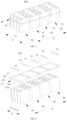
- FIG. 1 is a schematic structural diagram of a vehicle 1000 provided according to some embodiments of this application.
- the vehicle 1000 may be a fuel vehicle, a gas vehicle or a new energy vehicle, and the new energy vehicle may be a pure electric vehicle, a hybrid vehicle or an extended-range vehicle, etc.
- the vehicle 1000 is provided with a battery 100 inside, and the battery 100 may be disposed at a bottom or head or tail of the vehicle 1000.
- the battery 100 may be configured to power the vehicle 1000, for example, the battery 100 may be used as an operation power supply of the vehicle 1000 and for a circuit system of the vehicle 1000, such as for working power needs of the vehicle 1000 during start-up, navigation, and operation.
- the vehicle 1000 may also include a controller 200 and a motor 300, and the controller 200 is configured to control the battery 100 to power the motor 300, such as for the working power needs of the vehicle 1000 during start-up, navigation, and travelling.
- the battery 100 may serve not only as the operation power supply of the vehicle 1000, but also as a driving power supply of the vehicle 1000, replacing or partially replacing fuel or natural gas to provide driving power for the vehicle 1000.
- FIG. 2 is a schematic diagram of a breakdown structure of a battery 100 provided according to some embodiments of this application.
- the battery 100 may also include a case 10, and a plurality of battery cells 21 are disposed inside the case 10.
- the case 10 may be of various structures.
- the case 10 may include a first portion 11 and a second portion 12, the first portion 11 and the second portion 12 are capped with each other, and the first portion 11 and the second portion 12 together define a containing space configured to contain the battery cells 21.
- the second portion 12 may be of a hollow structure with an opening at one end, the first portion 11 may be of a plate-like structure, and the first portion 11 caps an opening side of the second portion 12, so that the first portion 11 and the second portion 12 together define the containing space. Both the first portion 11 and the second portion 12 may also be of a hollow structure with an opening on one side, and an opening side of the first portion 11 caps an opening side of the second portion 12.
- the plurality of battery cells 21 may be connected to one another in series or in parallel or in series-parallel connection, and the series-parallel connection means that the plurality of battery cells 21 are connected both in series and in parallel.
- the battery 100 may also include other structures, for example, the battery 100 may also include a bus component, configured to achieve an electrical connection between the plurality of battery cells 21.
- Each of the battery cells 21 may be a secondary battery or a primary battery, and may also be a lithium-sulfur battery, a sodium-ion battery or a magnesium-ion battery, which are not limited thereto.
- the battery 100 may include a battery unit 20, the battery unit 20 includes the plurality of battery cells 21, the plurality of battery cells 21 are arranged in a predetermined direction, and the plurality of battery cells 21 are bundled by bundling members to restrain the plurality of battery cells 21 and avoid positional movement of the battery cells 21.
- FIG. 3 is a schematic diagram of a partial structure of a battery 100 provided according to some embodiments of this application
- FIG. 4 is a breakdown diagram of a partial structure of a battery 100 provided according to some embodiments of this application
- FIG. 5 is a schematic diagram of a partial structure of a battery provided according to some other embodiments of this application.
- this application provides a battery 100, and the battery 100 includes a plurality of battery units 20 and a bundling assembly 30. The plurality of battery units 20 are arranged in a first direction.
- the bundling assembly 30 includes a plurality of bundling members 31 and first protective members 32, the plurality of bundling members 31 are provided in correspondence with the plurality of battery units 20, and each of the bundling members 31 is configured to bundle a corresponding battery unit 20; and each first protective member 32 connects two adjacent bundling members 31 to limit deformation of the bundling members 31.
- a direction shown by the letter X is the first direction, and the first direction X may be a length direction of the battery units 20, or, the first direction X may also be a width direction of the battery units 20.
- the battery units 20 include a plurality of battery cells 21, the plurality of battery cells 21 are arranged in a predetermined direction, as shown in FIGS. 3 and 4 , and the arrangement direction (predetermined direction) of the plurality of battery cells 21 may be perpendicular to the first direction X, or, as shown in FIG. 5 , the arrangement direction (predetermined direction) of the plurality of battery cells 21 may also be parallel to the first direction X.
- the plurality of battery units 20 are arranged in the first direction X to reasonably use an internal space of the battery 100, making the battery 100 have a large capacity.
- the plurality of bundling members 31 are provided in correspondence with the plurality of battery units 20.
- the plurality of bundling members 31 correspond to the plurality of battery units 20 one by one, and each of the bundling members 31 corresponds to one battery unit 20.
- the bundling members 31 are components configured to bundle the battery units 20, and are configured to restrain all the battery cells 21 in the battery units 20 into a whole to prevent the battery cells 21 from becoming loose.
- the bundling members 31 may be steel straps or other metal materials, which need to have a certain strength and toughness. When the bundling members 31 are the steel straps, the bundling members have better strength, toughness and corrosion resistance.
- Head and tail ends of the bundling members 31 are fixed into a whole by welding to ensure the overall strength of the bundling members 31, so that the bundling members 31 have a better bundling effect on the battery units 20.
- Every two adjacent bundling members 31 may be connected by at least one first protective member 32, for example, two adjacent bundling members 31 may be connected by the plurality of first protective members 32, and the plurality of first protective members 32 are arranged in a direction perpendicular to the first direction X; or, two adjacent bundling members 31 may be connected by one first protective member 32.
- two adjacent bundling members 31 are connected by a first protective member 32, and the first protective member 32 extends in the direction perpendicular to the first direction X.
- each first protective member 32 connects two adjacent bundling members 31, so that the two bundling members 31 are assembled into a whole by the first protective member 32.
- a deformation stress of the bundling member 31 is transferred to the other bundling member 31, and the other bundling member 31 can absorb the deformation stress to resist the deformation of the bundling member, thereby reducing an assembly space between two adjacent battery units 20, thus saving an overall assembly space of the plurality of battery units 20, improving a space utilization rate, and making the battery 100 have a higher energy density.
- the first protective members 32 are insulating members, and the first protective members 32 are configured to insulatingly isolate the battery units 20 and the bundling members 31.
- the first protective members 32 have the performance of insulation and corrosion resistance, for example, materials of the first protective members 32 may be PE (polyethylene, polyethylene), PVC (polyvinyl chloride, polyvinyl chloride), PP (polypropylene, polypropylene), etc.
- PE polyethylene, polyethylene
- PVC polyvinyl chloride, polyvinyl chloride
- PP polypropylene, polypropylene
- the first protective members 32 have the property of insulation, which can insulatingly isolate the battery units 20 and the bundling members 31, and improve the safety of the battery 100.
- each first protective member 32 is subjected to injection molding on the two adjacent bundling members 31.
- Each first protective member 32 is subjected to injection molding on the two adjacent bundling members 31.
- the first protective member 32 is subjected to injection molding, and the first protective member 32 is molded on the two adjacent bundling members 31, and the first protective member 32 connects the two adjacent bundling members 31 into a whole in a molding process.
- the two adjacent bundling members 31 are disposed in a mold, then molten plastic is injected into the mold, the molten plastic is attached to the two adjacent bundling members 31, and after cooling and molding, the first protective member 32 is attached to the two adjacent bundling members 31.
- each first protective member 32 is subjected to injection molding on the bundling members 31, which can improve the connection strength between the first protective member 32 and the two bundling members 31.
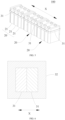
- FIG. 6 is a schematic diagram of assembly of a first protective member 32 and two adjacent bundling members 31 provided according to some embodiments of this application
- FIG. 7 is a schematic diagram of assembly of a first protective member 32 and two adjacent bundling members 31 provided according to some other embodiments of this application.
- each first protective member 32 is arranged on the two adjacent bundling members 31 in a sleeving manner.
- the molten plastic wraps around the two adjacent bundling members 31 and is cooled and molded, so that the first protective member 32 is arranged on the two adjacent bundling members 31 in the sleeving manner.
- the first protective member 32 may be of a ribbon-like structure, the first protective member 32 winds around the periphery of the two adjacent bundling members 31, and after assembly, the first protective member 32 is arranged on the two adjacent bundling members 31 in the sleeving manner.
- the first protective member 32 is arranged on the two adjacent bundling members 31 in the sleeving manner, which ensures stable connection between the first protective member 32 and the two bundling members 31.
- the bundling members 31 are rectangular rings, and each first protective member 32 is arranged on portions, close to each other, of the two adjacent bundling members 31 in a sleeving manner.
- the bundling members 31 are the rectangular rings to fit the shape of the battery units 20, which conveniently ensures that the bundling members 31 have a good bundling effect on the battery units 20.
- each bundling member 31 may include a first section 311 and a second section 312 disposed opposite to each other in the first direction X, and a third section 313 and a fourth section 314 disposed opposite to each other in a second direction Y
- the second direction Y is perpendicular to the first direction X.
- the first section 311, the third section 313, the second section 312 and the fourth section 314 are connected end to end in sequence to form a rectangular ring.
- the first section 311 and the third section 313 have a rounded transition at connection
- the first section 311 and the fourth section 314 have a rounded transition at connection
- the second section 312 and the third section 313 have a rounded transition at connection
- the second section 312 and the fourth section 314 have a rounded transition at connection, so as to facilitate bending the bundling member 31, and at the same time, to reduce the risk of scratching the battery cells 21 at the corners of the rectangular ring.
- the portions, close to each other, of the two bundling members 31 are the portions where the two adjacent bundling members 31 are nearest to each other in the arrangement direction of the plurality of battery units 20.
- Each first protective member 32 is arranged on the portions, close to each other, of the two adjacent bundling members 31 in the sleeving manner, so that the first protective member 32 can better connect the two adjacent bundling members 31, have a better restraining force on the bundling members 31, and reduce the risk of deformation of the bundling members 31.
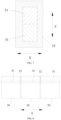
- FIG. 8 is a schematic diagram of arrangement of a plurality of bundling members 31 located on the same plane provided according to some embodiments of this application
- FIG. 9 is a schematic diagram of arrangement of a plurality of bundling members 31 located on different planes provided according to some embodiments of this application
- FIG. 10 is a schematic diagram of arrangement of a plurality of bundling members 31 located on different planes provided according to some other embodiments of this application.
- the plurality of bundling members 31 are located on the same plane, or the two adj acent bundling members 31 are located on different planes.
- the plurality of bundling members 31 are located on the same plane, which means that two opposite end faces of the plurality of bundling members 31 in a direction perpendicular to the plane are coplanar, for example, as shown in FIG. 8 , the plurality of bundling members 31 overlap in the arrangement direction of the plurality of battery units 20.
- the two adjacent bundling members 31 are located on different planes, which may have various forms.
- the two bundlng members 31 spaced apart may be located on the same plane, in other words, in the first direction X, the odd number of bundling members 31 are located on the same plane and the even number of bundling members 31 are located on another plane.
- FIG. 9 presented as an example with the number of bundling members 31 being three, a first bundling member 31 and a third bundling member 31 are located on the same plane and the first bundling member 31 and a second bundling member 31 are not on the same plane.
- the plurality of bundling members 31 are arranged sequentially in the direction perpendicular to the first direction X.
- the two adjacent bundling members 31 can fit together, which reduces an occupied space, and can better restrain the bundling members 31 to limit the deformation of the bundling members 31.
- the two adjacent bundling members 31 may be disposed in a stacked manner to reduce a gap between two adj acent battery units 20 and further improve the energy density of the battery 100.
- the two adjacent bundling members 31 are in contact with each other.
- the two adjacent bundling members 31 are in contact with each other, and a distance between the two adjacent bundling members 31 is small, enabling the first protective member 32 to better restrain the bundling members 31.
- the two adjacent bundling members 31 are in contact, when one of the two adjacent bundling members 31 is assembled, the stress of the bundling member 31 can be better transferred to the other bundling member 31, so that the other bundling member 31 consumes part of the deformation stress of the bundling member 31, so as to improve the difficulty of deformation of the bundling members 31, which can better restrain the bundling members 31 to limit the deformation of the bundling members 31.
- each of the battery units 20 includes the plurality of battery cells 21 arranged in a second direction Y, and the second direction Y is perpendicular to the first direction X.
- the plurality of battery cells 21 are arranged in the second direction Y Faces with the largest area of the plurality of battery cells 21 may be disposed adjacent to each other, that is, the second direction Y is perpendicular to the faces with the largest area of the battery cells 21, so as to facilitate the reduction of occupied space and make the plurality of battery cells 21 more compact in structure.
- end plates may be disposed at both ends of the second direction Y of the battery units 20, and the bundling members 31 bundle the plurality of battery cells 21 and the two end plates into a whole.
- head and tail ends of the bundling members 31 are typically located at end portions of the battery units 20 in the second direction Y
- the head and tail ends of the bundling members 31 may be located on sides of the end plates distal to the battery cells 21.
- the bundling members 31 are more easily deformed in the first direction X.
- the first protective member 32 is disposed between the two adjacent battery units 20 in the first direction X, so as to better restrain the deformation of the bundling members 31.
- the plurality of battery cells 21 are arranged in the second direction Y
- Two ends of the bundling members 31 in the first direction X have larger dimensions, and the first protective member 32 connects the two adjacent bundling members 31, so as to better restrain the deformation of the bundling members 31.
- FIG. 11 is a schematic diagram of a partial structure of a battery 100 provided according to another embodiments of this application.
- two bundling assemblies 30 are provided, the two bundling assemblies 30 are spaced apart in a third direction, and the third direction is perpendicular to the second direction Y and the first direction X.
- the first direction X may be a width direction of the battery units 20
- the second direction Y may be a length direction of the battery units 20
- the third direction may be a height direction of the battery units 20.
- the two bundling assemblies 30 are spaced apart in the third direction.
- the two bundling assemblies 30 are disposed in the third direction, and the two bundling assemblies 30 have a gap, for example, the two bundling assemblies 30 may get close to two ends of the battery units 20 in the height direction respectively, thereby having two restraint positions for the battery units 20 in the height direction of the battery units 20.
- the two bundling assemblies 30 are spaced apart in the third direction, restraint positions of the plurality of battery cells 21 in the third direction are increased, and a restraint effect of the plurality of battery cells 21 in the third direction is improved.
- the bundling assembly 30 further includes two second protective members 33, the two second protective members 33 are disposed on the bundling members 31, located at two ends, of the plurality of bundling members 31, respectively, the second protective members 33 and the first protective members 32 are arranged in the first direction X, the second protective members 33 are insulating members, and the second protective members 33 are configured to insulatingly isolate the battery units 20 and the bundling members 31.
- the two second protective members 33 are disposed on the bundling members 31, located at two ends, of the plurality of bundling members 31, respectively.
- one of the two second protective members 33 is disposed at an end of the bundling member 31 located at one end in the first direction X of the plurality of bundling members 31, and the other second protective member 33 is disposed at an end of the bundling member 31 located at the other end in the first direction X of the plurality of bundling members 31. That is, on the bundling member 31 located at the end in the first direction X of the plurality of bundling members 31, the first protective member 32 and the second protective member 33 are disposed on two opposite sides of the battery unit 20 bundled by the bundling member 31.
- the second protective members 33 are disposed on the bundling members 31 at the end portions of the plurality of bundling members 31, and configured to perform insulation protection on the bundling members 31 and the battery units 20 located at the end portions to improve the insulation effect of the bundling members 31 and the battery units 20.
- the second protective members 33 may have the same dimensions in the second direction Y as the first protective members 32 in the second direction Y
- the second protective members 33 are subjected to injection molding on the bundling members 31.
- the second protective members 33 are subjected to injection molding on the bundling members 31, which means that the bundling members 31 are disposed in a mold, then molten plastic is injected into the mold, and after cooling and molding, the second protective members 33 are attached to the bundling members 31.
- the second protective members 33 may be made of the same material as the first protective members 32.
- the second protective members 33 are integrally formed with the bundling members 31 to ensure that the second protective members 33 have a better connection stability with the bundling members 31.
- the second protective members 33 are arranged on the bundling members 31 in a sleeving manner.
- the second protective members 33 are of a ribbon-like structure, and the second protective members 33 wind around the bundling members 31; or, the second protective members 33 are subjected to injection molding on the bundling members 31, and the second protective members 33 wrap around the bundling members 31.
- the second protective members 33 are arranged on the bundling members 31 in a sleeving manner, and the second protective members 33 have a large connection area with the bundling members 31, which makes stable connection of the second protective members 33 and the bundling members 31.
- this application further provides an electric device, including the battery 100 according to any of the above solutions, and the battery 100 is configured to provide electric energy for the electric device.
- the electric device may be any of aforementioned equipment or systems that apply the battery 100.
- the battery 100 includes a plurality of battery units 20 and a bundling assembly 30.
- the plurality of battery units 20 are arranged in a first direction X
- each of the battery units 20 includes a plurality of battery cells 21 arranged in a second direction Y, wherein the second direction Y is perpendicular to faces with the largest area of the battery cells 21, and the first direction X is perpendicular to the second direction Y
- the bundling assembly 30 includes a plurality of bundling members 31, first protective members 32 and second protective members 33, the plurality of bundling members 31 are provided in correspondence with the plurality of battery units 20, each of the bundling members 31 bundles a corresponding battery unit 20, each first protective member 32 is disposed between two adjacent battery units 20, and each first protective member 32 connects two adjacent bundling members 31 to limit deformation of the bundling members 31.
- Two second protective members 33 are provided, the two second protective members 33 are disposed on the bundling members 31, located at two ends in the first direction X, of the plurality of bundling members 31, respectively, and the second protective members 33 and the first protective members 32 are arranged in the first direction X.
- the first protective members 32 and the second protective members 33 are insulating members, configured to insulatingly isolate the battery units 20 and the bundling members 31.
- an assembly process of the battery 100 is described as follows: in the assembly process of the battery 100, the bundling members 31 are prefabricated as rectangular rings; the plurality of bundling members 31 are arranged in the first direction X, and two adjacent bundling members 31 are in contact with each other; each first protective member 32 is subjected to injection molding on the two adjacent bundling members 31, and the first protective member 32 is arranged on the two adjacent bundling members 31 in a sleeving manner; and the second protective members 33 are subjected to injection molding on the bundling members 31, and the second protective members 33 are arranged on the bundling members 31 in a sleeving manner, so as to complete prefabrication of the bundling assembly 30.
- One battery unit 20 is disposed inside a rectangular ring formed by a corresponding bundling member 31, and head and tail ends of the bundling member 31 are welded and fixed into a whole to complete the bundling of the battery unit 20 by the bundling member 31.
- a connection part of the head and tail ends of the bundling member 31 may be treated with corrosion protection to prolong the service life of the bundling member 31.
- each first protective member 32 connects two adjacent bundling members 31, which can save the assembly space, improve the space utilization rate in the battery 100, and make the battery 100 have a higher energy density.
Landscapes
- Chemical & Material Sciences (AREA)
- Chemical Kinetics & Catalysis (AREA)
- Electrochemistry (AREA)
- General Chemical & Material Sciences (AREA)
- Engineering & Computer Science (AREA)
- Aviation & Aerospace Engineering (AREA)
- Battery Mounting, Suspending (AREA)
Abstract
Description
- This application claims priority to
Chinese Patent Application No. 202221098658.7, filed on May 10, 2022 - This application relates to the field of battery technologies, in particular to a battery and an electric device.
- Energy saving and emission reduction are the key to the sustainable development of the automotive industry, and electric vehicles have become an important part of the sustainable development of the automotive industry due to their energy saving and environmental protection advantages. For the electric vehicles, battery technologies are another important factor in development.
- In the development of the battery technologies, in addition to improving the performance of batteries, the energy density is also an issue that cannot be ignored. Therefore, how to improve the energy density of the batteries is an urgent technical problem in battery technologies.
- An objective of this application is to provide a battery and an electric device, which have a relatively high enery density.
- This application is realized by the following technical solutions.
- According to a first aspect, this application provides a battery, including: a plurality of battery units, the plurality of battery units being arranged in a first direction; and a bundling assembly, the bundling assembly including a plurality of bundling members and first protective members; the plurality of bundling members being provided in correspondence with the plurality of battery units, and each of the bundling members being configured to bundle a corresponding battery unit; and each first protective member connecting two adjacent bundling members to limit deformation of the bundling members.
- According to the battery of embodiments of this application, each first protective member connects two adjacent bundling members, so that the two bundling members are assembled into a whole by the first protective member. When head and tail ends of one of the two bundling members are fixed, a deformation stress of the bundling member is transferred to the other bundling member, and the other bundling member can absorb the deformation stress to resist the deformation of the bundling member, thereby reducing an assembly space between two adj acent battery units, thus saving an overall assembly space of the plurality of battery units, improving a space utilization rate, and making the battery have a higher energy density.
- According to some embodiments of this application, the first protective members are insulating members, configured to insulatingly isolate the battery units and the bundling members.
- In the above solution, the first protective members have the property of insulation, which can insulatingly isolate the battery units and the bundling members, and improve the safety of the battery.
- According to some embodiments of this application, the first protective member is subjected to injection molding on the two adjacent bundling members.
- In the above solution, the first protective member is subjected to injection molding on the bundling members, which can improve connection strength between the first protective member and the two bundling members.
- According to some embodiments of this application, each first protective member is arranged on the two adjacent bundling members in a sleeving manner.
- In the above solution, each first protective member is arranged on the two adjacent bundling members in the sleeving manner, which ensures stable connection between the first protective member and the two bundling members.
- According to some embodiments of this application, the bundling members are rectangular rings, and each first protective member is arranged on portions, close to each other, of the two adjacent bundling members in a sleeving manner.
- In the above solution, each first protective member is arranged on the portions, close to each other, of the two adjacent bundling members in the sleeving manner, which improves binding force for the bundling members and reduces the risk of deformation of the bundling members.
- According to some embodiments of this application, the plurality of bundling members are located on the same plane, or the two adjacent bundling members are located on different planes.
- In the above solution, when the plurality of bundling members are located on the same plane, the two adjacent bundling members can fit together, which can better restrain the bundling members to limit the deformation of the bundling members. When the two adjacent bundling members are located on different planes, the two adjacent bundling members can be disposed in a stacked manner to reduce a gap between two adjacent battery units and further improve the energy density of the battery.
- According to some embodiments of this application, the two adjacent bundling members are in contact with each other.
- In the above solution, the two adjacent bundling members are in contact to improve the difficulty of deformation of the bundling members and better restrain the bundling members to limit the deformation of the bundling members.
- According to some embodiments of this application, each of the battery units includes a plurality of battery cells arranged in a second direction, and the second direction is perpendicular to the first direction.
- In the above solution, the plurality of battery cells are arranged in the second direction to better restrain the deformation of the bundling members.
- According to some embodiments of this application, two bundling assemblies are provided, the two bundling assemblies are spaced apart in a third direction, and the third direction is perpendicular to the second direction and the first direction.
- In the above solution, the two bundling assemblies are spaced apart in the third direction, restraint positions of the plurality of battery cells in the third direction are increased, and a restraint effect on the plurality of battery cells in the third direction is improved.
- According to some embodiments of this application, the bundling assembly further includes two second protective members, the two second protective members are disposed on the bundling members, located at two ends, of the plurality of bundling members, respectively, the second protective members and the first protective members are arranged in the first direction, and the second protective members are insulating members, configured to insulatingly isolate the battery units and the bundling members.
- In the above solution, the second protective members are disposed on the bundling members at edges, and configured to perform insulation protection on the bundling members and the battery units located at the end portions to improve the insulation effect of the bundling members and the battery units.
- According to some embodiments of this application, the second protective members are subjected to injection molding on the bundling members.
- In the above solution, the second protective members and the bundling members are integrally formed to ensure that the second protective members and the bundling members have better connection stability.
- According to a second aspect, this application provides an electric device, including the battery provided according to the first aspect.
- Additional aspects and advantages of this application will be given in part in the following description, in part as will become apparent from the following description, or as will be learned through the practice of this application.
- To describe the technical solutions in embodiments of this application more clearly, the following outlines the drawings to be used in embodiments. It should be understood that the drawings below are merely some embodiments of this application and should therefore not be regarded as limiting the scope. A person of ordinary skill in the art may derive other related drawings from such drawings without making any creative efforts.
-
FIG. 1 is a schematic structural diagram of a vehicle provided according to some embodiments of this application. -
FIG. 2 is a schematic diagram of a breakdown structure of a battery provided according to some embodiments of this application. -
FIG. 3 is a schematic diagram of a partial structure of a battery provided according to some embodiments of this application. -
FIG. 4 is a breakdown diagram of a partial structure of a battery provided according to some embodiments of this application. -
FIG. 5 is a schematic diagram of a partial structure of a battery provided according to some other embodiments of this application. -
FIG. 6 is a schematic diagram of assembly of a first protective member and two adjacent bundling members provided according to some embodiments of this application. -
FIG. 7 is a schematic diagram of assembly of a first protective member and two adj acent bundling members provided according to some other embodiments of this application. -
FIG. 8 is a schematic diagram of arrangement of a plurality of bundling members located on the same plane provided according to some embodiments of this application. -
FIG. 9 is a schematic diagram of arrangement of a plurality of bundling members located on different planes provided according to some embodiments of this application. -
FIG. 10 is a schematic diagram of arrangement of a plurality of bundling members located on different planes provided according to some other embodiments of this application. -
FIG. 11 is a schematic diagram of a partial structure of a battery provided according to another embodiments of this application. - In the accompanying drawings, the accompanying drawings are not drawn to the actual scale.
- Reference numerals: 100-Battery; 10-Case; 11-First portion; 12-Second portion; 20-Battery unit; 21-Battery cell; 30-Bundling assembly; 31-Bundling member; 311-First section; 312-Second section; 313-Third section; 314-Fourth section; 32-First protective member; 33-Second protective member; 200-Controller; 300-Motor; 1000-Vehicle.
- Embodiments of the technical solutions of this application will be described in detail below in conjunction with the accompanying drawings. The following embodiments are provided only to more clearly illustrate the technical solutions of this application, and are therefore provided by way of example only, without limiting the scope of protection of this application.
- Unless otherwise defined, all technical and scientific terms used herein have the same meaning as commonly understood by a person of ordinary skill in the art to which this application belongs. The terms used herein are merely for the purpose of describing specific embodiments but are not intended to be limiting of this application. The terms "comprise", "have" and any variation thereof in the specification and claims of this application as well as the preceding brief description of the drawings are intended to cover a non-exclusive inclusion.
- In the description of the embodiments of this application, the technical terms "first", "second" and the like are only used for distinguishing between different objects and are not to be understood as indicating or implying relative importance or implicitly indicating the quantity, a particular order or a primary-secondary relationship of the technical features indicated.
- Reference herein to "embodiment" means that particular features, structures, or characteristics described in connection with the embodiments may be included in at least one embodiment of this application. The appearances of the phrase in various places in the specification are not necessarily all referring to the same embodiment, nor are separate or alternative embodiments mutually exclusive of other embodiments. It is to be explicitly and implicitly understood by a person of ordinary skill in the art that the embodiments described herein may be combined with other embodiments.
- In the description of the embodiments of this application, the term "and/or" is merely a description of an association relationship of associated objects, indicating that there may be three relationships, for example, A and/or B, which may mean: A, both A and B, and B. In addition, the character "/", as used herein, generally indicates an "or" relationship between the front and back associated objects.
- In the description of the embodiments of this application, the term "a plurality of" refers to two or more (including two), similarly, "a plurality of groups" refers to two or more groups (including two groups), and "a plurality of pieces" refers to two or more pieces (including two pieces), unless otherwise expressly and specifically limited.
- In the description of the embodiments of this application, the orientation or positional relationships indicated by the technical terms "center", "longitudinal", "transverse", "length", "width", "thickness", "upper", "lower", "front", "rear", "left", "right", "vertical", "horizontal", "top", "bottom", "inner", "outer", "clockwise", "anticlockwise", "axial", "radial", "circumferential", etc. are based on the orientation or positional relationships shown in the drawings, merely to facilitate the description of the embodiments of this application and simplify the description, and do not indicate or imply that the device or element referred to must have a particular orientation, be constructed and operated in a particular orientation, and thus should not be construed as limiting the embodiments of this application.
- In the description of the embodiments of this application, unless otherwise expressly specified and limited, the technical terms "mounted", "connected", "connect", "fixed" and the like are to be understood in a broad sense, for example, it may be a fixed connection, or a detachable connection, or an integral connection; it may also be a mechanical connection or an electrical connection; and it may be a direct connection or indirect connection through an intermediate medium, and may be the interior communication between two elements or the interaction relationship between two elements. For a person of ordinary skill in the art, the specific meaning of the above-mentioned terms in the embodiments of this application may be understood according to specific circumstances.
- In this application, a battery referred to means a single physical module that includes a plurality of battery units to provide higher voltage and capacity.
- The development of battery technologies should consider various design factors at the same time, such as cycle life, discharge capacity, charge/discharge multiplier and other performance parameters, in addition, the energy density of the battery also needs to be considered.
- For the battery, the main energy density level comes from the amount of active material capacity inside the battery. In order to increase the energy density of the battery, it is usually necessary to improve the utilization rate of the space inside the battery.
- In the prior art, in order to meet the demand for higher capacity, a plurality of battery units need to be disposed in a case of a battery, each of the battery units has a plurality of battery cells, and the plurality of battery cells are usually restrained and fixed by bundling members (such as steel straps), i.e., after the bundling members surround the plurality of battery cells, two ends of the bundling members are fixed (e.g., welded) into a whole. For example, when the plurality of battery cells are bundled by the steel straps, after the steel straps surround the plurality of battery cells, the two ends of the steel straps are welded into a whole, and the welding makes the stress of the steel straps dispersed, resulting in local deformation and protruding of the steel straps. When the plurality of battery cells are assembled, a receding space for protruding of the steep straps and an assembly space for the steel straps of two adjacent battery units need to be designed and reserved, which leads to low space utilization rate in an arrangement direction of the plurality of battery units and affects the energy density of the battery.
- In view of this, in order to solve the problem of low energy density of the battery due to low space utilization rate during the assembly of the plurality of battery units, the inventors, after thorough research, have designed a battery. The battery includes a plurality of battery units and a bundling assembly, the plurality of battery units are arranged in a first direction, the bundling assembly includes a plurality of bundling members and first protective members, the plurality of bundling members are provided in correspondence with the plurality of battery units, each of the bundling members is configured to bundle a corresponding battery unit, and each first protective member connects two adjacent bundling members to limit deformation of the bundling members.
- In this battery, each first protective member connects two adj acent bundling members, so that the two bundling members are assembled into a whole by the first protective member. When head and tail ends of one of the two bundling members are fixed, a deformation stress of the bundling member is transferred to the other bundling member, and the other bundling member can absorb the deformation stress to resist the deformation of the bundling member, thereby reducing an assembly space between two adjacent battery units, thus saving an overall assembly space of the plurality of battery units, improving a space utilization rate, and making the battery have a higher energy density.
- In this application, battery cells may include lithium-ion secondary batteries, lithium-ion primary batteries, lithium-sulfur batteries, sodium-lithium-ion batteries, sodium-ion batteries or magnesium-ion batteries, etc., which are not limited by the embodiments of this application.
- The battery disclosed in the embodiments of this application can be, but is not limited to, used in electric devices such as vehicles, ships or aircraft. The battery disclosed in this application may be used to form a power supply system of the electric device.
- Embodiments of this application provide an electric device that uses a battery as a power supply, and the electric device may be, but is not limited to, cell phones, tablet computers, laptop computers, electric toys, power tools, electric bicycles, electric motorcycles, electric cars, ships, spacecraft, etc. The electric toys may include fixed or mobile electric toys, for example, game consoles, electric car toys, electric ship toys and electric airplane toys, etc. The spacecraft may include airplanes, rockets, space shuttles and spaceships, etc.
- The following embodiments are illustrated as an example of the electric device as a vehicle of an embodiment of this application for the convenience of illustration.
- Referring to
FIG. 1, FIG. 1 is a schematic structural diagram of avehicle 1000 provided according to some embodiments of this application. Thevehicle 1000 may be a fuel vehicle, a gas vehicle or a new energy vehicle, and the new energy vehicle may be a pure electric vehicle, a hybrid vehicle or an extended-range vehicle, etc. Thevehicle 1000 is provided with abattery 100 inside, and thebattery 100 may be disposed at a bottom or head or tail of thevehicle 1000. Thebattery 100 may be configured to power thevehicle 1000, for example, thebattery 100 may be used as an operation power supply of thevehicle 1000 and for a circuit system of thevehicle 1000, such as for working power needs of thevehicle 1000 during start-up, navigation, and operation. - The
vehicle 1000 may also include acontroller 200 and amotor 300, and thecontroller 200 is configured to control thebattery 100 to power themotor 300, such as for the working power needs of thevehicle 1000 during start-up, navigation, and travelling. - In some embodiments of this application, the
battery 100 may serve not only as the operation power supply of thevehicle 1000, but also as a driving power supply of thevehicle 1000, replacing or partially replacing fuel or natural gas to provide driving power for thevehicle 1000. - Referring to
FIG. 2, FIG. 2 is a schematic diagram of a breakdown structure of abattery 100 provided according to some embodiments of this application. As shown inFIG. 2 , thebattery 100 may also include acase 10, and a plurality ofbattery cells 21 are disposed inside thecase 10. Thecase 10 may be of various structures. In some embodiments, thecase 10 may include afirst portion 11 and asecond portion 12, thefirst portion 11 and thesecond portion 12 are capped with each other, and thefirst portion 11 and thesecond portion 12 together define a containing space configured to contain thebattery cells 21. Thesecond portion 12 may be of a hollow structure with an opening at one end, thefirst portion 11 may be of a plate-like structure, and thefirst portion 11 caps an opening side of thesecond portion 12, so that thefirst portion 11 and thesecond portion 12 together define the containing space. Both thefirst portion 11 and thesecond portion 12 may also be of a hollow structure with an opening on one side, and an opening side of thefirst portion 11 caps an opening side of thesecond portion 12. - In the
battery 100, the plurality ofbattery cells 21 may be connected to one another in series or in parallel or in series-parallel connection, and the series-parallel connection means that the plurality ofbattery cells 21 are connected both in series and in parallel. Thebattery 100 may also include other structures, for example, thebattery 100 may also include a bus component, configured to achieve an electrical connection between the plurality ofbattery cells 21. - Each of the
battery cells 21 may be a secondary battery or a primary battery, and may also be a lithium-sulfur battery, a sodium-ion battery or a magnesium-ion battery, which are not limited thereto. - According to some embodiments of this application, in order to facilitate management of the
battery cells 21, thebattery 100 may include abattery unit 20, thebattery unit 20 includes the plurality ofbattery cells 21, the plurality ofbattery cells 21 are arranged in a predetermined direction, and the plurality ofbattery cells 21 are bundled by bundling members to restrain the plurality ofbattery cells 21 and avoid positional movement of thebattery cells 21. - Referring to
FIG. 3 and FIG. 4, FIG. 3 is a schematic diagram of a partial structure of abattery 100 provided according to some embodiments of this application,FIG. 4 is a breakdown diagram of a partial structure of abattery 100 provided according to some embodiments of this application, andFIG. 5 is a schematic diagram of a partial structure of a battery provided according to some other embodiments of this application. According to some embodiments of this application, this application provides abattery 100, and thebattery 100 includes a plurality ofbattery units 20 and a bundlingassembly 30. The plurality ofbattery units 20 are arranged in a first direction. The bundlingassembly 30 includes a plurality of bundlingmembers 31 and firstprotective members 32, the plurality of bundlingmembers 31 are provided in correspondence with the plurality ofbattery units 20, and each of thebundling members 31 is configured to bundle acorresponding battery unit 20; and each firstprotective member 32 connects twoadjacent bundling members 31 to limit deformation of the bundlingmembers 31. - In the figures, a direction shown by the letter X is the first direction, and the first direction X may be a length direction of the
battery units 20, or, the first direction X may also be a width direction of thebattery units 20. - The
battery units 20 include a plurality ofbattery cells 21, the plurality ofbattery cells 21 are arranged in a predetermined direction, as shown inFIGS. 3 and 4 , and the arrangement direction (predetermined direction) of the plurality ofbattery cells 21 may be perpendicular to the first direction X, or, as shown inFIG. 5 , the arrangement direction (predetermined direction) of the plurality ofbattery cells 21 may also be parallel to the first direction X. - The plurality of
battery units 20 are arranged in the first direction X to reasonably use an internal space of thebattery 100, making thebattery 100 have a large capacity. - The plurality of bundling
members 31 are provided in correspondence with the plurality ofbattery units 20. In other words, the plurality of bundlingmembers 31 correspond to the plurality ofbattery units 20 one by one, and each of thebundling members 31 corresponds to onebattery unit 20. - The bundling
members 31 are components configured to bundle thebattery units 20, and are configured to restrain all thebattery cells 21 in thebattery units 20 into a whole to prevent thebattery cells 21 from becoming loose. - The bundling
members 31 may be steel straps or other metal materials, which need to have a certain strength and toughness. When thebundling members 31 are the steel straps, the bundling members have better strength, toughness and corrosion resistance. - Head and tail ends of the
bundling members 31 are fixed into a whole by welding to ensure the overall strength of thebundling members 31, so that the bundlingmembers 31 have a better bundling effect on thebattery units 20. - Every two
adjacent bundling members 31 may be connected by at least one firstprotective member 32, for example, twoadjacent bundling members 31 may be connected by the plurality of firstprotective members 32, and the plurality of firstprotective members 32 are arranged in a direction perpendicular to the first direction X; or, twoadjacent bundling members 31 may be connected by one firstprotective member 32. Optionally, twoadjacent bundling members 31 are connected by a firstprotective member 32, and the firstprotective member 32 extends in the direction perpendicular to the first direction X. - According to the
battery 100 of embodiments of this application, each firstprotective member 32 connects twoadjacent bundling members 31, so that the two bundlingmembers 31 are assembled into a whole by the firstprotective member 32. When the head and tail ends of one of the two bundlingmembers 31 are fixed, a deformation stress of the bundlingmember 31 is transferred to the other bundlingmember 31, and the other bundlingmember 31 can absorb the deformation stress to resist the deformation of the bundling member, thereby reducing an assembly space between twoadjacent battery units 20, thus saving an overall assembly space of the plurality ofbattery units 20, improving a space utilization rate, and making thebattery 100 have a higher energy density. - According to some embodiments of this application, the first
protective members 32 are insulating members, and the firstprotective members 32 are configured to insulatingly isolate thebattery units 20 and the bundlingmembers 31. - The first
protective members 32 have the performance of insulation and corrosion resistance, for example, materials of the firstprotective members 32 may be PE (polyethylene, polyethylene), PVC (polyvinyl chloride, polyvinyl chloride), PP (polypropylene, polypropylene), etc. - In the above solution, the first
protective members 32 have the property of insulation, which can insulatingly isolate thebattery units 20 and thebundling members 31, and improve the safety of thebattery 100. - According to some embodiments of this application, each first
protective member 32 is subjected to injection molding on the twoadjacent bundling members 31. - Each first
protective member 32 is subjected to injection molding on the twoadjacent bundling members 31. In other words, the firstprotective member 32 is subjected to injection molding, and the firstprotective member 32 is molded on the twoadjacent bundling members 31, and the firstprotective member 32 connects the twoadjacent bundling members 31 into a whole in a molding process. During assembly, the twoadjacent bundling members 31 are disposed in a mold, then molten plastic is injected into the mold, the molten plastic is attached to the twoadjacent bundling members 31, and after cooling and molding, the firstprotective member 32 is attached to the twoadjacent bundling members 31. - In the above solution, each first
protective member 32 is subjected to injection molding on thebundling members 31, which can improve the connection strength between the firstprotective member 32 and the two bundlingmembers 31. - Referring to
FIG. 6 andFIG. 7 ,FIG. 6 is a schematic diagram of assembly of a firstprotective member 32 and twoadjacent bundling members 31 provided according to some embodiments of this application, andFIG. 7 is a schematic diagram of assembly of a firstprotective member 32 and twoadjacent bundling members 31 provided according to some other embodiments of this application. According to some embodiments of this application, each firstprotective member 32 is arranged on the twoadjacent bundling members 31 in a sleeving manner. - In the embodiments where the first
protective member 32 is subjected to injection molding on the twoadjacent bundling members 31, during assembly, the molten plastic wraps around the twoadjacent bundling members 31 and is cooled and molded, so that the firstprotective member 32 is arranged on the twoadjacent bundling members 31 in the sleeving manner. - In other embodiments, the first
protective member 32 may be of a ribbon-like structure, the firstprotective member 32 winds around the periphery of the twoadjacent bundling members 31, and after assembly, the firstprotective member 32 is arranged on the twoadjacent bundling members 31 in the sleeving manner. - In the above solution, the first
protective member 32 is arranged on the twoadjacent bundling members 31 in the sleeving manner, which ensures stable connection between the firstprotective member 32 and the two bundlingmembers 31. - According to some embodiments of this application, as shown in
FIG. 4 , the bundlingmembers 31 are rectangular rings, and each firstprotective member 32 is arranged on portions, close to each other, of the twoadjacent bundling members 31 in a sleeving manner. - The bundling
members 31 are the rectangular rings to fit the shape of thebattery units 20, which conveniently ensures that the bundlingmembers 31 have a good bundling effect on thebattery units 20. - It should be noted that each bundling
member 31 may include afirst section 311 and asecond section 312 disposed opposite to each other in the first direction X, and athird section 313 and afourth section 314 disposed opposite to each other in a second direction Y The second direction Y is perpendicular to the first direction X. Thefirst section 311, thethird section 313, thesecond section 312 and thefourth section 314 are connected end to end in sequence to form a rectangular ring. Optionally, thefirst section 311 and thethird section 313 have a rounded transition at connection, thefirst section 311 and thefourth section 314 have a rounded transition at connection, thesecond section 312 and thethird section 313 have a rounded transition at connection, and thesecond section 312 and thefourth section 314 have a rounded transition at connection, so as to facilitate bending the bundlingmember 31, and at the same time, to reduce the risk of scratching thebattery cells 21 at the corners of the rectangular ring. - The portions, close to each other, of the two bundling
members 31 are the portions where the twoadjacent bundling members 31 are nearest to each other in the arrangement direction of the plurality ofbattery units 20. - Each first
protective member 32 is arranged on the portions, close to each other, of the twoadjacent bundling members 31 in the sleeving manner, so that the firstprotective member 32 can better connect the twoadjacent bundling members 31, have a better restraining force on thebundling members 31, and reduce the risk of deformation of the bundlingmembers 31. - Referring to
FIG. 8 to FIG. 10 ,FIG. 8 is a schematic diagram of arrangement of a plurality of bundlingmembers 31 located on the same plane provided according to some embodiments of this application,FIG. 9 is a schematic diagram of arrangement of a plurality of bundlingmembers 31 located on different planes provided according to some embodiments of this application, andFIG. 10 is a schematic diagram of arrangement of a plurality of bundlingmembers 31 located on different planes provided according to some other embodiments of this application. According to some embodiments of this application, the plurality of bundlingmembers 31 are located on the same plane, or the two adjacent bundling members 31 are located on different planes. - The plurality of bundling
members 31 are located on the same plane, which means that two opposite end faces of the plurality of bundlingmembers 31 in a direction perpendicular to the plane are coplanar, for example, as shown inFIG. 8 , the plurality of bundlingmembers 31 overlap in the arrangement direction of the plurality ofbattery units 20. - The two
adjacent bundling members 31 are located on different planes, which may have various forms. In a first case, the twobundlng members 31 spaced apart may be located on the same plane, in other words, in the first direction X, the odd number of bundlingmembers 31 are located on the same plane and the even number of bundlingmembers 31 are located on another plane. For example, as shown inFIG. 9 , presented as an example with the number of bundlingmembers 31 being three, afirst bundling member 31 and athird bundling member 31 are located on the same plane and thefirst bundling member 31 and asecond bundling member 31 are not on the same plane. In a second case, as shown inFIG. 10 , the plurality of bundlingmembers 31 are arranged sequentially in the direction perpendicular to the first direction X. - In the above solution, when the plurality of bundling
members 31 are located on the same plane, the twoadjacent bundling members 31 can fit together, which reduces an occupied space, and can better restrain thebundling members 31 to limit the deformation of the bundlingmembers 31. When the twoadjacent bundling members 31 are located on different planes, the twoadjacent bundling members 31 may be disposed in a stacked manner to reduce a gap between two adj acentbattery units 20 and further improve the energy density of thebattery 100. - According to some embodiments of this application, as shown in
FIG. 6 andFIG. 7 , the twoadjacent bundling members 31 are in contact with each other. - The two
adjacent bundling members 31 are in contact with each other, and a distance between the twoadjacent bundling members 31 is small, enabling the firstprotective member 32 to better restrain thebundling members 31. - In the above solution, the two
adjacent bundling members 31 are in contact, when one of the twoadjacent bundling members 31 is assembled, the stress of the bundlingmember 31 can be better transferred to the other bundlingmember 31, so that the other bundlingmember 31 consumes part of the deformation stress of the bundlingmember 31, so as to improve the difficulty of deformation of thebundling members 31, which can better restrain thebundling members 31 to limit the deformation of the bundlingmembers 31. - According to some embodiments of this application, as shown in
FIG. 3 and FIG. 4 , each of thebattery units 20 includes the plurality ofbattery cells 21 arranged in a second direction Y, and the second direction Y is perpendicular to the first direction X. - In each of the
battery units 20, the plurality ofbattery cells 21 are arranged in the second direction Y Faces with the largest area of the plurality ofbattery cells 21 may be disposed adjacent to each other, that is, the second direction Y is perpendicular to the faces with the largest area of thebattery cells 21, so as to facilitate the reduction of occupied space and make the plurality ofbattery cells 21 more compact in structure. - In some embodiments, in order to protect the
battery cells 21, end plates may be disposed at both ends of the second direction Y of thebattery units 20, and thebundling members 31 bundle the plurality ofbattery cells 21 and the two end plates into a whole. - When the
bundling members 31 bundle thebattery units 20, head and tail ends of thebundling members 31 are typically located at end portions of thebattery units 20 in the second direction Y For example, the head and tail ends of thebundling members 31 may be located on sides of the end plates distal to thebattery cells 21. When the head and tail ends of thebundling members 31 are fixed into a whole, the bundlingmembers 31 are more easily deformed in the first direction X. The firstprotective member 32 is disposed between the twoadjacent battery units 20 in the first direction X, so as to better restrain the deformation of the bundlingmembers 31. - In the above scheme, the plurality of
battery cells 21 are arranged in the second direction Y Two ends of thebundling members 31 in the first direction X have larger dimensions, and the firstprotective member 32 connects the twoadjacent bundling members 31, so as to better restrain the deformation of the bundlingmembers 31. - Referring to
FIG. 11, FIG. 11 is a schematic diagram of a partial structure of abattery 100 provided according to another embodiments of this application. According to some embodiments of this application, twobundling assemblies 30 are provided, the twobundling assemblies 30 are spaced apart in a third direction, and the third direction is perpendicular to the second direction Y and the first direction X. - In order to facilitate description, the first direction X may be a width direction of the
battery units 20, the second direction Y may be a length direction of thebattery units 20, and the third direction may be a height direction of thebattery units 20. The twobundling assemblies 30 are spaced apart in the third direction. In other words, the twobundling assemblies 30 are disposed in the third direction, and the twobundling assemblies 30 have a gap, for example, the twobundling assemblies 30 may get close to two ends of thebattery units 20 in the height direction respectively, thereby having two restraint positions for thebattery units 20 in the height direction of thebattery units 20. - In the above solution, the two
bundling assemblies 30 are spaced apart in the third direction, restraint positions of the plurality ofbattery cells 21 in the third direction are increased, and a restraint effect of the plurality ofbattery cells 21 in the third direction is improved. - According to some embodiments of this application, as shown in
FIG. 3 and FIG. 4 , the bundlingassembly 30 further includes two secondprotective members 33, the two secondprotective members 33 are disposed on thebundling members 31, located at two ends, of the plurality of bundlingmembers 31, respectively, the secondprotective members 33 and the firstprotective members 32 are arranged in the first direction X, the secondprotective members 33 are insulating members, and the secondprotective members 33 are configured to insulatingly isolate thebattery units 20 and the bundlingmembers 31. - The two second
protective members 33 are disposed on thebundling members 31, located at two ends, of the plurality of bundlingmembers 31, respectively. In other words, one of the two secondprotective members 33 is disposed at an end of the bundlingmember 31 located at one end in the first direction X of the plurality of bundlingmembers 31, and the other secondprotective member 33 is disposed at an end of the bundlingmember 31 located at the other end in the first direction X of the plurality of bundlingmembers 31. That is, on the bundlingmember 31 located at the end in the first direction X of the plurality of bundlingmembers 31, the firstprotective member 32 and the secondprotective member 33 are disposed on two opposite sides of thebattery unit 20 bundled by the bundlingmember 31. - In the above solution, the second
protective members 33 are disposed on thebundling members 31 at the end portions of the plurality of bundlingmembers 31, and configured to perform insulation protection on thebundling members 31 and thebattery units 20 located at the end portions to improve the insulation effect of thebundling members 31 and thebattery units 20. - In the embodiments where the plurality of
battery cells 21 of thebattery units 20 are arranged in the second direction Y, the secondprotective members 33 may have the same dimensions in the second direction Y as the firstprotective members 32 in the second direction Y - According to some embodiments of this application, the second
protective members 33 are subjected to injection molding on the bundlingmembers 31. - The second
protective members 33 are subjected to injection molding on thebundling members 31, which means that the bundlingmembers 31 are disposed in a mold, then molten plastic is injected into the mold, and after cooling and molding, the secondprotective members 33 are attached to thebundling members 31. - The second
protective members 33 may be made of the same material as the firstprotective members 32. - In the above solution, the second
protective members 33 are integrally formed with the bundlingmembers 31 to ensure that the secondprotective members 33 have a better connection stability with the bundlingmembers 31. - According to some embodiments of this application, the second
protective members 33 are arranged on thebundling members 31 in a sleeving manner. For example, the secondprotective members 33 are of a ribbon-like structure, and the secondprotective members 33 wind around the bundlingmembers 31; or, the secondprotective members 33 are subjected to injection molding on thebundling members 31, and the secondprotective members 33 wrap around the bundlingmembers 31. - The second
protective members 33 are arranged on thebundling members 31 in a sleeving manner, and the secondprotective members 33 have a large connection area with the bundlingmembers 31, which makes stable connection of the secondprotective members 33 and the bundlingmembers 31. - According to some embodiments of this application, this application further provides an electric device, including the
battery 100 according to any of the above solutions, and thebattery 100 is configured to provide electric energy for the electric device. - The electric device may be any of aforementioned equipment or systems that apply the
battery 100. - According to some embodiments of this application, referring to
FIG. 3 and FIG. 4 , this application provides abattery 100. Thebattery 100 includes a plurality ofbattery units 20 and a bundlingassembly 30. The plurality ofbattery units 20 are arranged in a first direction X, each of thebattery units 20 includes a plurality ofbattery cells 21 arranged in a second direction Y, wherein the second direction Y is perpendicular to faces with the largest area of thebattery cells 21, and the first direction X is perpendicular to the second direction Y The bundlingassembly 30 includes a plurality of bundlingmembers 31, firstprotective members 32 and secondprotective members 33, the plurality of bundlingmembers 31 are provided in correspondence with the plurality ofbattery units 20, each of thebundling members 31 bundles acorresponding battery unit 20, each firstprotective member 32 is disposed between twoadjacent battery units 20, and each firstprotective member 32 connects twoadjacent bundling members 31 to limit deformation of the bundlingmembers 31. Two secondprotective members 33 are provided, the two secondprotective members 33 are disposed on thebundling members 31, located at two ends in the first direction X, of the plurality of bundlingmembers 31, respectively, and the secondprotective members 33 and the firstprotective members 32 are arranged in the first direction X. The firstprotective members 32 and the secondprotective members 33 are insulating members, configured to insulatingly isolate thebattery units 20 and the bundlingmembers 31. - Using an example of the
bundling members 31 as steel straps, an assembly process of thebattery 100 is described as follows: in the assembly process of thebattery 100, the bundlingmembers 31 are prefabricated as rectangular rings; the plurality of bundlingmembers 31 are arranged in the first direction X, and twoadjacent bundling members 31 are in contact with each other; each firstprotective member 32 is subjected to injection molding on the twoadjacent bundling members 31, and the firstprotective member 32 is arranged on the twoadjacent bundling members 31 in a sleeving manner; and the secondprotective members 33 are subjected to injection molding on thebundling members 31, and the secondprotective members 33 are arranged on thebundling members 31 in a sleeving manner, so as to complete prefabrication of the bundlingassembly 30. Onebattery unit 20 is disposed inside a rectangular ring formed by a corresponding bundlingmember 31, and head and tail ends of the bundlingmember 31 are welded and fixed into a whole to complete the bundling of thebattery unit 20 by the bundlingmember 31. - It should be noted that after the fixation of the head and tail ends of the bundling
member 31 is completed, a connection part of the head and tail ends of the bundlingmember 31 may be treated with corrosion protection to prolong the service life of the bundlingmember 31. - According to the
battery 100 of embodiments of this application, each firstprotective member 32 connects twoadjacent bundling members 31, which can save the assembly space, improve the space utilization rate in thebattery 100, and make thebattery 100 have a higher energy density. - Although this application has been described with reference to preferred embodiments, various improvements can be made thereto and components thereof can be replaced with equivalents without departing from the scope of the present application. In particular, respective technical features mentioned in the respective embodiments may be combined in any manner as long as there is no structural conflict. This application is not limited to the particular embodiments disclosed herein, but includes all technical solutions falling within the scope of the claims.
Claims (12)
- A battery, comprising:a plurality of battery units, the plurality of battery units being arranged in a first direction; anda bundling assembly, the bundling assembly comprising a plurality of bundling members and first protective members; the plurality of bundling members being provided in correspondence with the plurality of battery units, and each bundling member being configured to bundle a corresponding battery unit; and each first protective member connecting two adjacent bundling members to limit deformation of the bundling members.
- The battery according to claim 1, wherein the first protective members are insulating members, configured to insulatingly isolate the battery units and the bundling members.
- The battery according to claim 2, wherein each first protective member is subjected to injection molding on the two adjacent bundling members.
- The battery according to any one of claims 1-3, wherein each first protective member is arranged on the two adjacent bundling members in a sleeving manner.
- The battery according to claim 4, wherein the bundling members are rectangular rings, and each first protective member is arranged on portions, close to each other, of the two adjacent bundling members in a sleeving manner.
- The battery according to any one of claims 1-5, wherein the plurality of bundling members are located on the same plane, or the two adjacent bundling members are located on different planes.
- The battery according to any one of claims 1-6, wherein the two adjacent bundling members are in contact with each other.
- The battery according to any one of claims 1-7, wherein each of the battery units comprises a plurality of battery cells arranged in a second direction, and the second direction is perpendicular to the first direction.
- The battery according to claim 8, wherein two bundling assemblies are provided, the two bundling assemblies are spaced apart in a third direction, and the third direction is perpendicular to the second direction and the first direction.
- The battery according to claim 1 or 9, wherein the bundling assembly further comprises two second protective members, the two second protective members are disposed on the bundling members, located at two ends, of the plurality of bundling members, respectively, the second protective members and the first protective members are arranged in the first direction, and the second protective members are insulating members, configured to insulatingly isolate the battery units and the bundling members.
- The battery according to claim 10, wherein the second protective members are subjected to injection molding on the bundling members.
- An electric device, comprising the battery according to any one of claims 1-11.
Applications Claiming Priority (2)
| Application Number | Priority Date | Filing Date | Title |
|---|---|---|---|
| CN202221098658.7U CN217114648U (en) | 2022-05-10 | 2022-05-10 | Batteries and Electrical Equipment |
| PCT/CN2022/101679 WO2023216384A1 (en) | 2022-05-10 | 2022-06-27 | Battery and electric device |
Publications (2)
| Publication Number | Publication Date |
|---|---|
| EP4369487A1 true EP4369487A1 (en) | 2024-05-15 |
| EP4369487A4 EP4369487A4 (en) | 2025-03-12 |
Family
ID=82586677
Family Applications (1)
| Application Number | Title | Priority Date | Filing Date |
|---|---|---|---|
| EP22941330.7A Pending EP4369487A4 (en) | 2022-05-10 | 2022-06-27 | Battery and electric device |
Country Status (4)
| Country | Link |
|---|---|
| US (1) | US20240204327A1 (en) |
| EP (1) | EP4369487A4 (en) |
| CN (1) | CN217114648U (en) |
| WO (1) | WO2023216384A1 (en) |
Cited By (1)
| Publication number | Priority date | Publication date | Assignee | Title |
|---|---|---|---|---|
| EP4675803A1 (en) * | 2024-07-03 | 2026-01-07 | SK On Co., Ltd. | Band member, battery module, battery pack |
Families Citing this family (1)
| Publication number | Priority date | Publication date | Assignee | Title |
|---|---|---|---|---|
| CN219917464U (en) * | 2023-07-19 | 2023-10-27 | 宁德时代新能源科技股份有限公司 | Batteries and electrical devices |
Family Cites Families (7)
| Publication number | Priority date | Publication date | Assignee | Title |
|---|---|---|---|---|
| JP2021180063A (en) * | 2018-07-31 | 2021-11-18 | 三洋電機株式会社 | Battery system, and electric vehicle and power storage device having battery system |
| CN209496931U (en) * | 2019-04-18 | 2019-10-15 | 宁德时代新能源科技股份有限公司 | A battery module and battery pack |
| CN210535723U (en) * | 2019-09-20 | 2020-05-15 | 宁德时代新能源科技股份有限公司 | Battery module, battery pack and vehicle |
| CN210200839U (en) * | 2019-09-29 | 2020-03-27 | 蜂巢能源科技有限公司 | End plate, battery module and battery package |
| DE102020108703A1 (en) * | 2020-03-30 | 2021-09-30 | Bayerische Motoren Werke Aktiengesellschaft | Traction battery with strapping as well as an electrically powered motor vehicle |
| CN214043892U (en) * | 2020-12-17 | 2021-08-24 | 湖北亿纬动力有限公司 | A battery module, battery pack and battery |
| CN215578920U (en) * | 2021-07-29 | 2022-01-18 | 珠海银隆电器有限公司 | battery module |
-
2022
- 2022-05-10 CN CN202221098658.7U patent/CN217114648U/en active Active
- 2022-06-27 EP EP22941330.7A patent/EP4369487A4/en active Pending
- 2022-06-27 WO PCT/CN2022/101679 patent/WO2023216384A1/en not_active Ceased
-
2024
- 2024-03-01 US US18/592,568 patent/US20240204327A1/en active Pending
Cited By (1)
| Publication number | Priority date | Publication date | Assignee | Title |
|---|---|---|---|---|
| EP4675803A1 (en) * | 2024-07-03 | 2026-01-07 | SK On Co., Ltd. | Band member, battery module, battery pack |
Also Published As
| Publication number | Publication date |
|---|---|
| EP4369487A4 (en) | 2025-03-12 |
| WO2023216384A1 (en) | 2023-11-16 |
| CN217114648U (en) | 2022-08-02 |
| US20240204327A1 (en) | 2024-06-20 |
Similar Documents
| Publication | Publication Date | Title |
|---|---|---|
| US20240204327A1 (en) | Battery and electric device | |
| CN216720168U (en) | A battery module and an electrical device | |
| EP4246691A1 (en) | Battery module, battery, electrical device, method and device for manufacturing battery | |
| CN216903165U (en) | Flexible circuit board assembly, battery and electric device | |
| CN222637564U (en) | Battery cells, batteries, electrical equipment and battery cell manufacturing equipment | |
| EP4358174A1 (en) | Electrode sheet, electrode assembly, battery cell, battery and electric apparatus | |
| EP4654345A1 (en) | Battery cell, battery, and electric device | |
| US20230361356A1 (en) | Battery unit, and battery, power consuming device and preparation apparatus associated therewith | |
| JP7662614B2 (en) | Power supply device, vehicle equipped with same, and power storage device | |
| KR20240024236A (en) | Battery modules, battery packs, electrical devices and methods of manufacturing battery modules | |
| CN222126920U (en) | Batteries, battery modules, battery packs, energy storage devices and power consumption devices | |
| US20240097143A1 (en) | Battery unit, battery, and power consuming device | |
| CN220963648U (en) | Battery cells, batteries and electrical equipment | |
| EP4297144A1 (en) | Electrode assembly and battery cell related to same, and battery, apparatus and manufacturing method | |
| CN222775405U (en) | Battery device and electricity utilization device | |
| CN223583089U (en) | Battery devices and electrical appliances | |
| CN223771197U (en) | End battery cell, battery device and electric equipment | |
| CN223842906U (en) | Battery cells, battery packs, and energy storage devices | |
| CN222735389U (en) | Battery devices, cable assemblies and electrical equipment | |
| CN223401866U (en) | Battery cells, battery devices and electrical equipment | |
| CN223023550U (en) | Batteries and electrical equipment | |
| EP4664669A1 (en) | Battery cell, battery and electrical device | |
| CN223181235U (en) | Battery devices and power-consuming devices | |
| CN118783002B (en) | Battery devices and power-consuming devices | |
| CN223757523U (en) | Battery cells, battery packs and electrical devices |
Legal Events
| Date | Code | Title | Description |
|---|---|---|---|
| STAA | Information on the status of an ep patent application or granted ep patent |
Free format text: STATUS: THE INTERNATIONAL PUBLICATION HAS BEEN MADE |
|
| PUAI | Public reference made under article 153(3) epc to a published international application that has entered the european phase |
Free format text: ORIGINAL CODE: 0009012 |
|
| STAA | Information on the status of an ep patent application or granted ep patent |
Free format text: STATUS: REQUEST FOR EXAMINATION WAS MADE |
|
| 17P | Request for examination filed |
Effective date: 20240208 |
|
| AK | Designated contracting states |
Kind code of ref document: A1 Designated state(s): AL AT BE BG CH CY CZ DE DK EE ES FI FR GB GR HR HU IE IS IT LI LT LU LV MC MK MT NL NO PL PT RO RS SE SI SK SM TR |
|
| RAP1 | Party data changed (applicant data changed or rights of an application transferred) |
Owner name: CONTEMPORARY AMPEREX TECHNOLOGY(HONG KONG) LIMITED |
|
| A4 | Supplementary search report drawn up and despatched |
Effective date: 20250210 |
|
| RIC1 | Information provided on ipc code assigned before grant |
Ipc: H01M 50/264 20210101ALI20250204BHEP Ipc: H01M 50/249 20210101ALI20250204BHEP Ipc: H01M 50/209 20210101ALI20250204BHEP Ipc: H01M 50/244 20210101AFI20250204BHEP |
|
| DAV | Request for validation of the european patent (deleted) | ||
| DAX | Request for extension of the european patent (deleted) | ||
| GRAP | Despatch of communication of intention to grant a patent |
Free format text: ORIGINAL CODE: EPIDOSNIGR1 |
|
| STAA | Information on the status of an ep patent application or granted ep patent |
Free format text: STATUS: GRANT OF PATENT IS INTENDED |
|
| INTG | Intention to grant announced |
Effective date: 20260219 |
|
| GRAS | Grant fee paid |
Free format text: ORIGINAL CODE: EPIDOSNIGR3 |
|
| GRAA | (expected) grant |
Free format text: ORIGINAL CODE: 0009210 |
|
| STAA | Information on the status of an ep patent application or granted ep patent |
Free format text: STATUS: THE PATENT HAS BEEN GRANTED |