EP4369370A1 - Method for prelithiating soft carbon negative electrode and asymmetric lithium-ion supercapacitor - Google Patents
Method for prelithiating soft carbon negative electrode and asymmetric lithium-ion supercapacitor Download PDFInfo
- Publication number
- EP4369370A1 EP4369370A1 EP23151755.8A EP23151755A EP4369370A1 EP 4369370 A1 EP4369370 A1 EP 4369370A1 EP 23151755 A EP23151755 A EP 23151755A EP 4369370 A1 EP4369370 A1 EP 4369370A1
- Authority
- EP
- European Patent Office
- Prior art keywords
- negative electrode
- soft carbon
- carbon negative
- constant
- prelithiating
- Prior art date
- Legal status (The legal status is an assumption and is not a legal conclusion. Google has not performed a legal analysis and makes no representation as to the accuracy of the status listed.)
- Granted
Links
Images




Classifications
-
- H—ELECTRICITY
- H01—ELECTRIC ELEMENTS
- H01G—CAPACITORS; CAPACITORS, RECTIFIERS, DETECTORS, SWITCHING DEVICES, LIGHT-SENSITIVE OR TEMPERATURE-SENSITIVE DEVICES OF THE ELECTROLYTIC TYPE
- H01G11/00—Hybrid capacitors, i.e. capacitors having different positive and negative electrodes; Electric double-layer [EDL] capacitors; Processes for the manufacture thereof or of parts thereof
- H01G11/84—Processes for the manufacture of hybrid or EDL capacitors, or components thereof
- H01G11/86—Processes for the manufacture of hybrid or EDL capacitors, or components thereof specially adapted for electrodes
-
- H—ELECTRICITY
- H01—ELECTRIC ELEMENTS
- H01G—CAPACITORS; CAPACITORS, RECTIFIERS, DETECTORS, SWITCHING DEVICES, LIGHT-SENSITIVE OR TEMPERATURE-SENSITIVE DEVICES OF THE ELECTROLYTIC TYPE
- H01G11/00—Hybrid capacitors, i.e. capacitors having different positive and negative electrodes; Electric double-layer [EDL] capacitors; Processes for the manufacture thereof or of parts thereof
- H01G11/04—Hybrid capacitors
- H01G11/06—Hybrid capacitors with one of the electrodes allowing ions to be reversibly doped thereinto, e.g. lithium ion capacitors [LIC]
-
- H—ELECTRICITY
- H01—ELECTRIC ELEMENTS
- H01G—CAPACITORS; CAPACITORS, RECTIFIERS, DETECTORS, SWITCHING DEVICES, LIGHT-SENSITIVE OR TEMPERATURE-SENSITIVE DEVICES OF THE ELECTROLYTIC TYPE
- H01G11/00—Hybrid capacitors, i.e. capacitors having different positive and negative electrodes; Electric double-layer [EDL] capacitors; Processes for the manufacture thereof or of parts thereof
- H01G11/14—Arrangements or processes for adjusting or protecting hybrid or EDL capacitors
-
- H—ELECTRICITY
- H01—ELECTRIC ELEMENTS
- H01G—CAPACITORS; CAPACITORS, RECTIFIERS, DETECTORS, SWITCHING DEVICES, LIGHT-SENSITIVE OR TEMPERATURE-SENSITIVE DEVICES OF THE ELECTROLYTIC TYPE
- H01G11/00—Hybrid capacitors, i.e. capacitors having different positive and negative electrodes; Electric double-layer [EDL] capacitors; Processes for the manufacture thereof or of parts thereof
- H01G11/22—Electrodes
- H01G11/30—Electrodes characterised by their material
- H01G11/32—Carbon-based
-
- H—ELECTRICITY
- H01—ELECTRIC ELEMENTS
- H01G—CAPACITORS; CAPACITORS, RECTIFIERS, DETECTORS, SWITCHING DEVICES, LIGHT-SENSITIVE OR TEMPERATURE-SENSITIVE DEVICES OF THE ELECTROLYTIC TYPE
- H01G11/00—Hybrid capacitors, i.e. capacitors having different positive and negative electrodes; Electric double-layer [EDL] capacitors; Processes for the manufacture thereof or of parts thereof
- H01G11/22—Electrodes
- H01G11/30—Electrodes characterised by their material
- H01G11/32—Carbon-based
- H01G11/38—Carbon pastes or blends; Binders or additives therein
-
- H—ELECTRICITY
- H01—ELECTRIC ELEMENTS
- H01G—CAPACITORS; CAPACITORS, RECTIFIERS, DETECTORS, SWITCHING DEVICES, LIGHT-SENSITIVE OR TEMPERATURE-SENSITIVE DEVICES OF THE ELECTROLYTIC TYPE
- H01G11/00—Hybrid capacitors, i.e. capacitors having different positive and negative electrodes; Electric double-layer [EDL] capacitors; Processes for the manufacture thereof or of parts thereof
- H01G11/22—Electrodes
- H01G11/30—Electrodes characterised by their material
- H01G11/50—Electrodes characterised by their material specially adapted for lithium-ion capacitors, e.g. for lithium-doping or for intercalation
-
- H—ELECTRICITY
- H01—ELECTRIC ELEMENTS
- H01G—CAPACITORS; CAPACITORS, RECTIFIERS, DETECTORS, SWITCHING DEVICES, LIGHT-SENSITIVE OR TEMPERATURE-SENSITIVE DEVICES OF THE ELECTROLYTIC TYPE
- H01G11/00—Hybrid capacitors, i.e. capacitors having different positive and negative electrodes; Electric double-layer [EDL] capacitors; Processes for the manufacture thereof or of parts thereof
- H01G11/54—Electrolytes
- H01G11/58—Liquid electrolytes
-
- H—ELECTRICITY
- H01—ELECTRIC ELEMENTS
- H01M—PROCESSES OR MEANS, e.g. BATTERIES, FOR THE DIRECT CONVERSION OF CHEMICAL ENERGY INTO ELECTRICAL ENERGY
- H01M10/00—Secondary cells; Manufacture thereof
- H01M10/05—Accumulators with non-aqueous electrolyte
- H01M10/052—Li-accumulators
-
- H—ELECTRICITY
- H01—ELECTRIC ELEMENTS
- H01M—PROCESSES OR MEANS, e.g. BATTERIES, FOR THE DIRECT CONVERSION OF CHEMICAL ENERGY INTO ELECTRICAL ENERGY
- H01M4/00—Electrodes
- H01M4/02—Electrodes composed of, or comprising, active material
- H01M4/13—Electrodes for accumulators with non-aqueous electrolyte, e.g. for lithium-accumulators; Processes of manufacture thereof
-
- H—ELECTRICITY
- H01—ELECTRIC ELEMENTS
- H01M—PROCESSES OR MEANS, e.g. BATTERIES, FOR THE DIRECT CONVERSION OF CHEMICAL ENERGY INTO ELECTRICAL ENERGY
- H01M4/00—Electrodes
- H01M4/02—Electrodes composed of, or comprising, active material
- H01M4/13—Electrodes for accumulators with non-aqueous electrolyte, e.g. for lithium-accumulators; Processes of manufacture thereof
- H01M4/133—Electrodes based on carbonaceous material, e.g. graphite-intercalation compounds or CFx
-
- H—ELECTRICITY
- H01—ELECTRIC ELEMENTS
- H01M—PROCESSES OR MEANS, e.g. BATTERIES, FOR THE DIRECT CONVERSION OF CHEMICAL ENERGY INTO ELECTRICAL ENERGY
- H01M4/00—Electrodes
- H01M4/02—Electrodes composed of, or comprising, active material
- H01M4/13—Electrodes for accumulators with non-aqueous electrolyte, e.g. for lithium-accumulators; Processes of manufacture thereof
- H01M4/139—Processes of manufacture
-
- H—ELECTRICITY
- H01—ELECTRIC ELEMENTS
- H01M—PROCESSES OR MEANS, e.g. BATTERIES, FOR THE DIRECT CONVERSION OF CHEMICAL ENERGY INTO ELECTRICAL ENERGY
- H01M4/00—Electrodes
- H01M4/02—Electrodes composed of, or comprising, active material
- H01M4/13—Electrodes for accumulators with non-aqueous electrolyte, e.g. for lithium-accumulators; Processes of manufacture thereof
- H01M4/139—Processes of manufacture
- H01M4/1393—Processes of manufacture of electrodes based on carbonaceous material, e.g. graphite-intercalation compounds or CFx
-
- C—CHEMISTRY; METALLURGY
- C25—ELECTROLYTIC OR ELECTROPHORETIC PROCESSES; APPARATUS THEREFOR
- C25D—PROCESSES FOR THE ELECTROLYTIC OR ELECTROPHORETIC PRODUCTION OF COATINGS; ELECTROFORMING; APPARATUS THEREFOR
- C25D5/00—Electroplating characterised by the process; Pretreatment or after-treatment of workpieces
- C25D5/54—Electroplating of non-metallic surfaces
-
- H—ELECTRICITY
- H01—ELECTRIC ELEMENTS
- H01G—CAPACITORS; CAPACITORS, RECTIFIERS, DETECTORS, SWITCHING DEVICES, LIGHT-SENSITIVE OR TEMPERATURE-SENSITIVE DEVICES OF THE ELECTROLYTIC TYPE
- H01G11/00—Hybrid capacitors, i.e. capacitors having different positive and negative electrodes; Electric double-layer [EDL] capacitors; Processes for the manufacture thereof or of parts thereof
- H01G11/22—Electrodes
- H01G11/30—Electrodes characterised by their material
- H01G11/32—Carbon-based
- H01G11/34—Carbon-based characterised by carbonisation or activation of carbon
-
- Y—GENERAL TAGGING OF NEW TECHNOLOGICAL DEVELOPMENTS; GENERAL TAGGING OF CROSS-SECTIONAL TECHNOLOGIES SPANNING OVER SEVERAL SECTIONS OF THE IPC; TECHNICAL SUBJECTS COVERED BY FORMER USPC CROSS-REFERENCE ART COLLECTIONS [XRACs] AND DIGESTS
- Y02—TECHNOLOGIES OR APPLICATIONS FOR MITIGATION OR ADAPTATION AGAINST CLIMATE CHANGE
- Y02E—REDUCTION OF GREENHOUSE GAS [GHG] EMISSIONS, RELATED TO ENERGY GENERATION, TRANSMISSION OR DISTRIBUTION
- Y02E60/00—Enabling technologies; Technologies with a potential or indirect contribution to GHG emissions mitigation
- Y02E60/10—Energy storage using batteries
-
- Y—GENERAL TAGGING OF NEW TECHNOLOGICAL DEVELOPMENTS; GENERAL TAGGING OF CROSS-SECTIONAL TECHNOLOGIES SPANNING OVER SEVERAL SECTIONS OF THE IPC; TECHNICAL SUBJECTS COVERED BY FORMER USPC CROSS-REFERENCE ART COLLECTIONS [XRACs] AND DIGESTS
- Y02—TECHNOLOGIES OR APPLICATIONS FOR MITIGATION OR ADAPTATION AGAINST CLIMATE CHANGE
- Y02E—REDUCTION OF GREENHOUSE GAS [GHG] EMISSIONS, RELATED TO ENERGY GENERATION, TRANSMISSION OR DISTRIBUTION
- Y02E60/00—Enabling technologies; Technologies with a potential or indirect contribution to GHG emissions mitigation
- Y02E60/13—Energy storage using capacitors
Definitions
- the disclosure relates to a prelithiation method, and more particularly to a method for prelithiating a soft carbon negative electrode, and a lithium-ion supercapacitor including the same.
- the soft carbon negative electrode may be used in a lithium-ion battery.
- ELCs Electrical double-layer capacitors
- EDLCs also known as a type of symmetric supercapacitors
- the dissimilar configuration of the positive and negative electrodes in supercapacitors forms the asymmetric supercapacitors which have improved working voltages.
- E energy stored in a supercapacitor
- C cell capacitance of the supercapacitor
- V cell voltage across the supercapacitor
- use of various combinations of electrode materials to form asymmetric cells and use of various electrolytes might further enlarge the cell voltages, resulting in enhanced energy storage performances of the asymmetric supercapacitors.
- hybrid capacitors such as lithium-ion capacitors (LiCs)
- LiCs lithium-ion capacitors
- Lithium-ion capacitors mainly adopt activated carbon as a positive electrode material, and materials that allow insertions/extraction (intercalation/ deintercalation) of lithium ions as the negative electrode materials.
- Examples of such negative electrode materials include graphite, hard carbon, soft carbon, and lithium titanate.
- lithium-ion capacitors exhibit the charging-discharging curves with cell voltages significantly higher than 1 V, as a result of a non-faradaic current on activated carbon in positive electrodes thereof (i.e., adsorption/desorption of anions) and a faradaic reaction of lithium ions on negative electrodes thereof (i.e., intercalation/deintercalation of lithium ions which have a voltage close to 0 V vs. Li/Li+).
- Such asymmetric electrodes allow lithium-ion capacitors to have working voltages of approximately 4.0 V, which is much higher than those of EDLCs (approximately 2.7 V).
- an object of the disclosure is to provide a method for prelithiating a soft carbon negative electrode and an asymmetric lithium-ion supercapacitor including the same that can alleviate at least one of the drawbacks of the prior art.
- n asymmetric lithium-ion supercapacitor according to claim 10.
- FIGS. 1 and 2 show two different prelithiating processes of two identical soft carbon negative electrodes.
- the soft carbon negative electrode and a lithium metal piece are arranged to be spaced apart from each other such that a lithium-containing electrolyte is presented therebetween.
- the soft carbon negative electrode and the lithium metal piece serving as a Li/Li+ reference electrode
- the prelithiating process corresponding to FIG. 2 includes, during each prelithiating, prelithiating the soft carbon negative electrode with a constant current at a constant C-rate of 0.1 C, followed by a constant voltage (CV). That is, the prelithiating process shown in FIG. 2 may be represented by the expression: 2 V ⁇ 0.1 C 0.01 V ⁇ 5 h 0.01 V .
- a voltage (the y-axis) of the soft carbon negative electrode (measured with reference to the Li/Li+ reference electrode) against a specific capacity thereof is shown.
- the soft carbon negative electrode Before each prelithiating process, the soft carbon negative electrode may have an initial voltage greater than 1.5 V vs. Li/Li+ and not greater than 2 V vs. Li/Li+. 5 cycles of prelithiating/delithiating are shown in each of FIGS. 1 and 2 . Delithiation capacities (Cs) and coulombic efficiencies of the two prelithiated soft carbon negative electrodes are shown in Table 1.
- an irreversible capacity loss of the soft carbon negative electrode is found in the 1 st and even after the 2 nd cycle; a delithiation capacity of the soft carbon negative electrode gradually decreases as a number of cycle increases, and a coulombic efficiency of the soft carbon negative electrode does not level until reaching the 5 th cycle.
- the delithiating curves for all 5 cycles do not overlap, especially at end potions of the delithiation curves. This shows that, formation of a solid electrolyte interphase (SEI) on a surface of the soft carbon negative electrode does not complete until approximately the 4 th , or the 5 th cycle of prelithiating/delithiating of the soft carbon negative electrode.
- SEI solid electrolyte interphase
- FIG. 3 shows another prelithiating process similar to that shown in FIG. 2 , except that for the prelithiating process shown in FIG. 3 , the constant current is applied at a constant C-rate of 0.5 C.
- the prelithiating process shown in FIG. 3 may be represented by the expression: 2 V ⁇ 0.5 C 0.01 V ⁇ 5 h 0.01 V .
- prelithiating the soft carbon negative electrode with a constant voltage (CV) allows complete formation of the SEI.
- CV constant voltage
- prelithiating the soft carbon negative electrode at a higher constant current i.e., prelithiating the soft carbon negative electrode with a higher C-rate, followed by prelithiating with the constant voltage
- the coulombic efficiency of the soft carbon negative electrode prelithiated at 0.5 C remains fluctuating for a few cycles, and prelithiation of the soft carbon negative electrode does not complete.
- the lithium-ion intercalation capacity of the soft carbon negative electrode is relatively high and lithium ions migrate into the soft carbon negative electrode at a relatively slow rate. Therefore, when the soft carbon negative electrode is prelithiated at a relatively high constant C-rate in a relatively high potential range, followed by being prelithiated at a relatively low constant C-rate in the relatively low potential range, the prelithiation of the soft carbon negative electrode could be completed, and the time period for prelithiation of the soft carbon negative electrode could be shortened.
- FIG. 4 illustrates a system 1 for performing the method in accordance with some embodiments of the disclosure. Please note that the elements in the system 1 are merely for schematic illustration and not drawn to scale.
- step a) in the system 1, the soft carbon negative electrode 11 and a lithium metal piece 12 are spaced apart from each other such that a lithium-containing electrolyte (not shown) is presented therebetween.
- the lithium metal piece 12 may serve as a Li/Li+reference electrode simultaneously.
- the system 1 is connected to an external power supply (not shown) so as to prelithiate the soft carbon negative electrode 11 in the following steps.
- the system 1 includes the soft carbon negative electrode 11, the lithium metal piece 12, a separator 13 soaked with the lithium-containing electrolyte (not shown), a pad 14, a spring 15, an upper cap 16 and a lower cap 17.
- the soft carbon negative electrode 11 and the lithium metal piece 12 are spaced apart from each other by the separator 13.
- the separator 13 is soaked with the lithium-containing electrolyte and allows the lithium-containing electrolyte to pass therethrough, and avoids physical contact between the soft carbon negative electrode 11 and the lithium metal piece 12.
- the lithium-containing electrolyte includes lithium hexafluorophosphate (LiPF 6 ) dissolved in a solvent.
- the solvent may include ethylene carbonate (EC), ethyl methyl carbonate (EMC), dimethyl carbonate (DMC), diethyl carbonate (DEC), and combinations thereof.
- the lithium-containing electrolyte may also include vinylene carbonate (VC) as an additive.
- the lithium-containing electrolyte includes 1 M of LiPF 6 dissolved in the solvent including EC, EMC and DMC in a volume ratio of 1:1:1, and 1 wt% of VC based on 100 wt% of the lithium-containing electrolyte.
- the lithium-containing electrolyte includes 1 M of LiPF 6 dissolved in the solvent including EC and DMC in a volume ratio of 1:1. In some other embodiments, the lithium-containing electrolyte includes 1 M of LiPF 6 dissolved in the solvent including EC and DEC in a volume ratio of 1:1.
- the pad 14, the spring 15, the upper cap 16 and the lower cap 17 may be made of any suitable materials, so as to facilitate prelithiation of the soft carbon negative electrode 11.
- the soft carbon negative electrode 11 is prelithiated with a first constant current at a first constant C-rate until a voltage of the soft carbon negative electrode 11 is reduced to a first predetermined voltage that is not greater than 0.3 V vs. Li/Li+ (voltages disclosed in the following disclosure are measured with reference to the Li/Li+ reference electrode, and the soft carbon negative electrode 11 may have an initial voltage greater than 1.5 V vs. Li/Li+ and not greater than 2 V vs. Li/Li+).
- the first constant C-rate is not greater than 5 C. In other embodiments, the first constant C-rate ranges from 0.5 C to 5 C.
- the first constant C-rate is not less than 0.5 C so as to ensure a reasonable time period for performing step b).
- the first constant C-rate is not greater than 5 C so as to ensure an effective prelithiation of the soft carbon negative electrode 11.
- the first predetermined voltage ranges from 0.1 V to 0.3 V vs. Li/Li+.
- the soft carbon negative electrode 11 may be prelithiated at the first constant C-rate ranging from 0.5 C to 5 C until the first predetermined voltage ranging from 0.1 V to 0.3 V vs. Li/Li+ is reached.
- step c) after step b), the soft carbon negative electrode 11 is prelithiated with a second constant current (smaller than the first constant current) at a second constant C-rate until the voltage of the soft carbon negative electrode 11 is reduced to a second predetermined voltage that is lower than the first predetermined voltage.
- the second constant C-rate is not greater than 0.2 C and is less than the first constant C-rate.
- the second constant C-rate ranges from 0.05 C to 0.2 C.
- the second predetermined voltage is not less than 0.01 V vs. Li/Li+.
- step d) after step c), the soft carbon negative electrode 11 is prelithiated at a prelithiation constant voltage which is not greater than the second predetermined voltage, thereby completing prelithiation of the soft carbon negative electrode 11.
- the prelithiation constant voltage is the same as the second predetermined voltage.
- step d) is conducted for a time period ranging from 0.5 hours to 24 hours, thereby completing prelithiation of the soft carbon negative electrode 11.
- the soft carbon negative electrode 11 is prelithiated at the prelithiation constant voltage by a third (variable) current at a third (variable) C-rate.
- step d) is terminated when the third C-rate is less than 0.05 C, thereby completing prelithiation of the soft carbon negative electrode 11. In yet other embodiments, if the second constant C-rate is lower than 0.1 C, step d) is terminated when the third current is less than 50% of the second constant current, thereby completing prelithiation of the soft carbon negative electrode 11.
- the method further includes a delithiating process after the prelithiating process.
- the prelithating/ delithiating process may be repeated for a desired number of cycles, if necessary.
- step a) i.e., set up of the system 1 is omitted in the prelithating process of the repeated cycles (cycles performed after the first cycle).
- the soft carbon negative electrode 11 is first prelithiated by a higher constant current (higher C-rate), followed by a lower constant current (lower C-rate), and is then prelithiated by a prelithiation constant voltage in step d).
- the method of the present disclosure is capable of obtaining a prelithiated soft carbon negative electrode in a significantly short time period.
- the prelithiation of the soft carbon negative electrode 11 is completed by performing the three stages of prelithiating once. That is, by performing one-time prelithiating that includes the aforementioned three stages, the prelithiation of the soft carbon negative electrode 11 is completed.
- the aforementioned prelithiated soft carbon negative electrode 11 may be used as a soft carbon negative electrode of a lithium-ion battery (not shown), or a soft carbon negative electrode 21 of an asymmetric lithium-ion supercapacitor 2 shown in FIG. 5 .
- the asymmetric lithium-ion supercapacitor 2 of the present disclosure includes the soft carbon negative electrode 21, a positive electrode 22 spaced apart from the soft carbon negative electrode 21, an electrolyte 24 and a membrane 23.
- the electrolyte 24 is disposed between the soft carbon negative electrode 21 and the positive electrode 22.
- the membrane 23 is disposed between the soft carbon negative electrode 21 and the positive electrode 22, and allows the electrolyte 24 to pass therethrough.
- the positive electrode 22 may include one of an activated carbon and an alkaline-activated soft carbon.
- the asymmetric lithium-ion supercapacitor 2 including the prelithiated soft carbon negative electrode 21 and the activated carbon-containing positive electrode 22 may be operated at a relatively high working voltage, such as approximately 3.8 V. In some cases, the asymmetric lithium-ion supercapacitor 2 may have an energy density that is at least twice as that of a symmetrical capacitor.
- the prelithiation system was prepared as described with reference to FIG. 4 .
- the prelithaition system included a soft carbon negative electrode, a lithium metal piece, a separator soaked with an electrolyte, a pad, a spring, an upper cap and a lower cap.
- the soft carbon negative electrode was formed by coating a slurry that includes a soft carbon, a carboxymethyl cellulose and a carbon-based conductive material (Vulcan XC-72) over a copper foil so that the soft carbon on the coated copper foil had a weight of 2 mg per square centimeter.
- the lithium metal piece was formed by cutting a lithium metal sheet (purchased from Ubiq Technology Co., Ltd.) into a disc having a diameter ranging from 10 mm to 12 mm.
- the separator was formed by soaking a membrane with the electrolyte.
- the electrolyte was prepared by dissolving 1 M of lithium hexafluorophosphate in a solvent including ethylene carbonate, ethyl methyl carbonate and dimethyl carbonate in a volume ratio of 1:1:1, and 1 wt% of vinylene carbonate based on 100 wt% of the electrolyte.
- the prelithiation system was subjected to a plurality of cycles of prelithiation/delithiation within a voltage ranging from of 0.01 V to 2 V.
- the soft carbon negative electrode had a voltage of 2 V vs. Li/Li+ before prelithiating.
- the soft carbon was delithiated at a rate of 0.1 C.
- the soft carbon negative electrode was, in stage (i), prelithiated at a first constant C-rate of 0.5 C (i.e., prelithiated at a first constant current) until reaching a first predetermined voltage of 0.3 V vs.
- Li/Li+ (voltage values stated hereinafter are measured with reference to the Li/Li+ reference electrode), and then in stage (ii), prelithiated at a second constant C-rate of 0.1 C (i.e., prelithiated at a second constant current) until reaching a second predetermined voltage of 0.01 V vs. Li/Li+, followed by in stage (iii), being prelithiated at a prelithiation constant voltage of 0.01 V for 5 hours, thereby completing prelithation of the soft carbon negative electrode, and obtaining a prelithiated soft carbon negative electrode of E1.
- the stages (i), (ii), and (iii) are represented by the following expressions:
- Prelithiation of the soft carbon negative electrode of E2 was generally similar to that of E1, except that during each prelithiating, in stage (i), the first predetermined voltage was set at 0.1 V vs. Li/Li+.
- the stages (i), (ii), and (iii) are represented by the following expressions:
- the procedures of CE1 differs from those of E1 in that there were only two stages in CE1.
- the two stages of prelithiating with two different constant currents in E1 i.e., stages (i) and (ii) in E1
- were replaced by a single stage of prelithiating with only one constant current in CE1 i.e., stage (i) in CE1.
- Stage (ii) of CE1 remained the same as stage (iii) of E1.
- the stages (i), and (ii) of CE1 are represented by the following expressions:
- the 1 st cycle prelithiating of the soft carbon negative electrodes of E1 and E2 was completed earlier than that of CE1.
- the 1 st cycle prelithiating of the soft carbon negative electrode of E2 was completed earlier than that of E1.
- Prelithiating/delithiating curves of the soft carbon negative electrode of E2 are shown in FIG. 6 . Based on the three stages performed to prelithiate the soft carbon negative electrode of E2, further investigations are performed to achieve optimization of parameters of each of the three stages. Details thereof are discussed in the following paragraphs.
- prelithiation of the soft carbon negative electrodes (of all three samples and E2) completes when stage (iii) was conducted for a time period ranging from 0.5 hour to 5 hours. In addition, the time period ranging from 0.5 hour to 2 hours is sufficient for completion of stage (iii), and thus completing prelithiation of the soft carbon negative electrodes.
- Example 2-1 the aforesaid sample that was subjected to stage (iii) for 2 hours (the median among 0.5 hour, 1 hour, 2 hours and 5 hours) were taken as Example 2-1 (E2-1).
- Prelithiating/delithiating curves of the soft carbon negative electrode of E2-1 are shown in FIG. 7 .
- the stages (i), (ii), and (iii) performed in prelithiation of the soft carbon negative electrode of E2-1 are represented by the following expressions:
- the procedures in prelithiations of the soft carbon negative electrodes of E2-2, E2-3, and E2-4 were generally similar to those of E2-1, except that during each prelithiating, in stage (i), the soft carbon negative electrode was prelithiated at different C-rate, i.e., 1 C, 2 C, and 5 C, respectively.
- the delithiation capacities and coulombic efficiencies of the prelithated soft carbon negative electrodes of E2-1, E2-2, E2-3, E2-4 are shown in Table 4.
- Time periods for completion of different stages (in terms of prelithiating with different voltage level) of the 1 st cycle prelithiating of the soft carbon negative electrodes of E2-1, E2-2, E2-3, E2-4 and CE1 are shown in Table 5.
- the 1 st cycle prelithiating is completed within the shortest time period, and is approximately 50% of the time period of the two-stage method (i.e., the prelithiation performed in CE1 using only a single stage of prelithiating with only one constant current, followed by prelithiating with one constant voltage).
- Prelithiating/delithiating curves of the soft carbon negative electrode of E2-2 are shown in FIG. 8 .
- the stages (i), (ii), and (iii), performed in prelithiation of the soft carbon negative electrode of E2-2 are represented by the following expressions:
- stage (i) is performed by prelithiating the soft carbon negative electrode at 1 C
- stage (ii) is performed by prelithiating the soft carbon negative electrode at 0.2 C
- the 1 st cycle prelithiating is completed within the shortest time period.
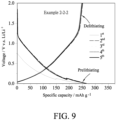
- Prelithiating/delithiating curves of the soft carbon negative electrode of E2-2-2 are shown in FIG. 9 .
- the stages (i), (ii), and (iii), performed in prelithiation of the soft carbon negative electrode of E2-2-2 are represented by the following expressions:
- an electrochemical method which is capable of controlling degree of prelithiation is performed, and the prelithiation of the soft carbon negative electrode is completed within a significantly short period of time.
- such prelithiated soft carbon negative electrode may be applied in an asymmetric lithium-ion supercapacitor that has a relatively high working voltage.
Landscapes
- Engineering & Computer Science (AREA)
- Power Engineering (AREA)
- Chemical & Material Sciences (AREA)
- Materials Engineering (AREA)
- Microelectronics & Electronic Packaging (AREA)
- Chemical Kinetics & Catalysis (AREA)
- Electrochemistry (AREA)
- Manufacturing & Machinery (AREA)
- General Chemical & Material Sciences (AREA)
- Battery Electrode And Active Subsutance (AREA)
- Electric Double-Layer Capacitors Or The Like (AREA)
- Secondary Cells (AREA)
Abstract
Description
- The disclosure relates to a prelithiation method, and more particularly to a method for prelithiating a soft carbon negative electrode, and a lithium-ion supercapacitor including the same. In addition to the lithium-ion supercapacitor, the soft carbon negative electrode may be used in a lithium-ion battery.
- Electrical double-layer capacitors (EDLCs, also known as a type of symmetric supercapacitors) have relatively low working voltages and energy densities thereof depending on potential windows of decomposition of electrolytes present therein. The dissimilar configuration of the positive and negative electrodes in supercapacitors forms the asymmetric supercapacitors which have improved working voltages. Considering that E=CV2/2, (where E is energy stored in a supercapacitor; C is cell capacitance of the supercapacitor; and V is cell voltage across the supercapacitor), use of various combinations of electrode materials to form asymmetric cells and use of various electrolytes might further enlarge the cell voltages, resulting in enhanced energy storage performances of the asymmetric supercapacitors.
- In recent years, hybrid capacitors, such as lithium-ion capacitors (LiCs), have been proposed to improve energy densities of supercapacitors by using the asymmetric design (i.e., dissimilar electrode materials are used for the negative and positive electrodes in each of the hybrid capacitors).
- Lithium-ion capacitors mainly adopt activated carbon as a positive electrode material, and materials that allow insertions/extraction (intercalation/ deintercalation) of lithium ions as the negative electrode materials. Examples of such negative electrode materials include graphite, hard carbon, soft carbon, and lithium titanate. In comparison with EDLCs, lithium-ion capacitors exhibit the charging-discharging curves with cell voltages significantly higher than 1 V, as a result of a non-faradaic current on activated carbon in positive electrodes thereof (i.e., adsorption/desorption of anions) and a faradaic reaction of lithium ions on negative electrodes thereof (i.e., intercalation/deintercalation of lithium ions which have a voltage close to 0 V vs. Li/Li+). Such asymmetric electrodes allow lithium-ion capacitors to have working voltages of approximately 4.0 V, which is much higher than those of EDLCs (approximately 2.7 V).
- However, power densities and cycle life of such asymmetric structures depend on properties of negative electrode materials. The intercalation/deintercalation of lithium ions in the aforementioned negative electrode materials has a voltage close to 0 V vs. Li/Li+, and forms a solid electrolyte interphase (SEI) membrane on the surface of the negative electrode materials. Therefore, the negative electrode materials are subjected to a prelithiation process before being used as negative electrodes of the lithium-ion capacitors.
- Therefore, an object of the disclosure is to provide a method for prelithiating a soft carbon negative electrode and an asymmetric lithium-ion supercapacitor including the same that can alleviate at least one of the drawbacks of the prior art.
- According to an aspect of the disclosure, there is provided a method for prelithiating a soft carbon negative electrode according to
claim 1. - According to an aspect of the disclosure, there is provided n asymmetric lithium-ion supercapacitor according to claim 10.
- Other features and advantages of the disclosure will become apparent in the following detailed description of the embodiment(s) with reference to the accompanying drawings. It is noted that various features may not be drawn to scale.
-
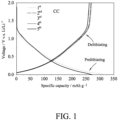
FIG. 1 is a plot of voltage against specific capacity of a soft carbon negative electrode that is prelithiated by applying a constant current thereto. -
FIG. 2 is a plot of voltage against specific capacity of another soft carbon negative electrode that is prelithiated by applying a constant current (at a C-rate of 0.1 C), followed by a constant voltage thereto. -
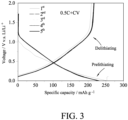
FIG. 3 is a plot of voltage against specific capacity of some other soft carbon negative electrode that is prelithiated by applying a constant current (at a C-rate of 0.5 C), followed by the constant voltage thereto. -
FIG. 4 is a schematic view illustrating a system for performing a prelithiation method according to the disclosure; -
FIG. 5 is a schematic view illustrating an embodiment of an asymmetric lithium-ion supercapacitor including a negative electrode that is prelithiated by a method according to the disclosure. -
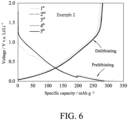
FIG. 6 is a plot of voltage against specific capacity of a certain soft carbon negative electrode that is prelithiated in Example 2. -
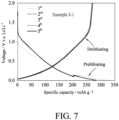
FIG. 7 is a plot of voltage against specific capacity of a still other soft carbon negative electrode that is prelithiated in Example 2-1. -
FIG. 8 is a plot of voltage against specific capacity of a yet other soft carbon negative electrode that is prelithiated in Example 2-2. -
FIG. 9 is a plot of voltage against specific capacity of a yet another soft carbon negative electrode that is prelithiated in Example 2-2-2. - Before the disclosure is described in greater detail, it should be noted that where considered appropriate, reference numerals or terminal portions of reference numerals have been repeated among the figures to indicate corresponding or analogous elements, which may optionally have similar characteristics.
- It should be noted herein that for clarity of description, spatially relative terms such as "top," "bottom," "upper," "lower," "on," "above," "over," "downwardly," "upwardly" and the like may be used throughout the disclosure while making reference to the features as illustrated in the drawings. The features may be oriented differently (e.g., rotated 90 degrees or at other orientations) and the spatially relative terms used herein may be interpreted accordingly.
- Different prelithiating processes are first discussed to evaluate elements that are to be included during prelithiating a soft carbon negative electrode.
FIGS. 1 and2 show two different prelithiating processes of two identical soft carbon negative electrodes. For each of the prelithiating processes shown inFIGS. 1 and2 , firstly, the soft carbon negative electrode and a lithium metal piece are arranged to be spaced apart from each other such that a lithium-containing electrolyte is presented therebetween. Then, the soft carbon negative electrode and the lithium metal piece (serving as a Li/Li+ reference electrode) are subjected to a plurality of cycles of prelithiating/delithiating processes, thereby obtaining a respective prelithated soft carbon negative electrode. The prelithiating process corresponding toFIG. 1 includes, during each prelithiating, prelithiating the soft carbon negative electrode with a constant current (denoted as "CC"). The prelithiating process corresponding toFIG. 2 includes, during each prelithiating, prelithiating the soft carbon negative electrode with a constant current at a constant C-rate of 0.1 C, followed by a constant voltage (CV). That is, the prelithiating process shown inFIG. 2 may be represented by the expression:
- In each of the aforementioned prelithiating processes, a voltage (the y-axis) of the soft carbon negative electrode (measured with reference to the Li/Li+ reference electrode) against a specific capacity thereof is shown. Before each prelithiating process, the soft carbon negative electrode may have an initial voltage greater than 1.5 V vs. Li/Li+ and not greater than 2 V vs. Li/Li+. 5 cycles of prelithiating/delithiating are shown in each of
FIGS. 1 and2 . Delithiation capacities (Cs) and coulombic efficiencies of the two prelithiated soft carbon negative electrodes are shown in Table 1. - Referring to Table 1 and
FIG. 1 , for the prelithiating process that includes only prelithiating the soft carbon negative electrode with the constant current (CC), an irreversible capacity loss of the soft carbon negative electrode is found in the 1st and even after the 2nd cycle; a delithiation capacity of the soft carbon negative electrode gradually decreases as a number of cycle increases, and a coulombic efficiency of the soft carbon negative electrode does not level until reaching the 5th cycle. In addition, the delithiating curves for all 5 cycles do not overlap, especially at end potions of the delithiation curves. This shows that, formation of a solid electrolyte interphase (SEI) on a surface of the soft carbon negative electrode does not complete until approximately the 4th, or the 5th cycle of prelithiating/delithiating of the soft carbon negative electrode. - Referring to Table 1 and
FIG. 2 , for the prelithiating process that includes prelithiating the soft carbon negative electrode at a constant C-rate of 0.1 C followed by a constant voltage (CV), an irreversible capacity loss of the soft carbon negative electrode is found merely in the 1st cycle, and is hardly observed in each of the 2nd, 3rd, 4th, 5th cycles. Delithiation capacities of the soft carbon negative electrode of all 5 cycles are similar, and a coulombic efficiency of the soft carbon negative electrode levels at the 3rd cycle. In addition, the delithiating curves for all 5 cycles overlap with one another and are stable. Therefore, formation of the SEI is completed at the 1st cycle of prelithiating of the prelithiating process (in which the soft carbon negative electrode is prelithiated by a constant current (CC) mode followed by a constant voltage (CV) method), which is conducive for shortening a time period of the prelithiating process. Thus, a step of prelithiating a soft carbon negative electrode with a constant voltage (CV) is included in a method for prelithiating the soft carbon negative electrode in the following discussion. -
FIG. 3 shows another prelithiating process similar to that shown inFIG. 2 , except that for the prelithiating process shown inFIG. 3 , the constant current is applied at a constant C-rate of 0.5 C. The prelithiating process shown inFIG. 3 may be represented by the expression:
- From the results shown in
FIG. 2 , it is known that prelithiating the soft carbon negative electrode with a constant voltage (CV) allows complete formation of the SEI. However, referring to Table 1 andFIG. 3 , prelithiating the soft carbon negative electrode at a higher constant current (i.e., prelithiating the soft carbon negative electrode with a higher C-rate, followed by prelithiating with the constant voltage) does not help in completing prelithiation of the soft carbon negative electrode in a shorter time period. The coulombic efficiency of the soft carbon negative electrode prelithiated at 0.5 C remains fluctuating for a few cycles, and prelithiation of the soft carbon negative electrode does not complete. This could be due to that during prelithiating the soft carbon negative electrode at a constant C-rate (i.e., during the voltage reducing from 2 V to 0.01 V), in a relatively low potential range (e.g., 0.3 V to 0.01 V), the lithium-ion intercalation capacity of the soft carbon negative electrode is relatively high and lithium ions migrate into the soft carbon negative electrode at a relatively slow rate. Therefore, when the soft carbon negative electrode is prelithiated at a relatively high constant C-rate in a relatively high potential range, followed by being prelithiated at a relatively low constant C-rate in the relatively low potential range, the prelithiation of the soft carbon negative electrode could be completed, and the time period for prelithiation of the soft carbon negative electrode could be shortened.Table 1 Prelithiating method 1st cycle 2nd cycle 3rd cycle 4th cycle 5th cycle CC Cs(mAhg-1) 268 268 271 269 262 Coulombic efficiency(%) 85.8 98.2 99.3 99.3 98.3 0.1 C + CV Cs(mAhg-1) 260 260 261 260 260 Coulombic efficiency(%) 85.2 98.5 99.2 99.2 99.2 0.5 C + CV Cs(mAhg-1) 260 260 261 260 260 Coulombic efficiency(%) 84.1 93.1 93.6 94.0 94.0 Note: Coulombic efficiency = (capacity loss during a delithiating process/capacity gained during a prelithiating process) x 100% - Based on the above, in accordance with some embodiments of the present disclosure, the following paragraphs provide a method for prelithiating a soft carbon negative electrode in a shorter time period. The method includes a prelithiating process. The prelithiating process may include steps a) to d).
FIG. 4 illustrates asystem 1 for performing the method in accordance with some embodiments of the disclosure. Please note that the elements in thesystem 1 are merely for schematic illustration and not drawn to scale. - In step a), in the
system 1, the soft carbonnegative electrode 11 and alithium metal piece 12 are spaced apart from each other such that a lithium-containing electrolyte (not shown) is presented therebetween. Thelithium metal piece 12 may serve as a Li/Li+reference electrode simultaneously. Thesystem 1 is connected to an external power supply (not shown) so as to prelithiate the soft carbonnegative electrode 11 in the following steps. - Referring to
FIG. 4 , in some embodiments, thesystem 1 includes the soft carbonnegative electrode 11, thelithium metal piece 12, aseparator 13 soaked with the lithium-containing electrolyte (not shown), apad 14, aspring 15, anupper cap 16 and alower cap 17. - The soft carbon
negative electrode 11 and thelithium metal piece 12 are spaced apart from each other by theseparator 13. Theseparator 13 is soaked with the lithium-containing electrolyte and allows the lithium-containing electrolyte to pass therethrough, and avoids physical contact between the soft carbonnegative electrode 11 and thelithium metal piece 12. - In some embodiments, the lithium-containing electrolyte includes lithium hexafluorophosphate (LiPF6) dissolved in a solvent. The solvent may include ethylene carbonate (EC), ethyl methyl carbonate (EMC), dimethyl carbonate (DMC), diethyl carbonate (DEC), and combinations thereof. In addition, the lithium-containing electrolyte may also include vinylene carbonate (VC) as an additive. In certain embodiments, the lithium-containing electrolyte includes 1 M of LiPF6 dissolved in the solvent including EC, EMC and DMC in a volume ratio of 1:1:1, and 1 wt% of VC based on 100 wt% of the lithium-containing electrolyte. In other embodiments, the lithium-containing electrolyte includes 1 M of LiPF6 dissolved in the solvent including EC and DMC in a volume ratio of 1:1. In some other embodiments, the lithium-containing electrolyte includes 1 M of LiPF6 dissolved in the solvent including EC and DEC in a volume ratio of 1:1.
- The
pad 14, thespring 15, theupper cap 16 and thelower cap 17 may be made of any suitable materials, so as to facilitate prelithiation of the soft carbonnegative electrode 11. - In step b), the soft carbon
negative electrode 11 is prelithiated with a first constant current at a first constant C-rate until a voltage of the soft carbonnegative electrode 11 is reduced to a first predetermined voltage that is not greater than 0.3 V vs. Li/Li+ (voltages disclosed in the following disclosure are measured with reference to the Li/Li+ reference electrode, and the soft carbonnegative electrode 11 may have an initial voltage greater than 1.5 V vs. Li/Li+ and not greater than 2 V vs. Li/Li+). In some embodiments, the first constant C-rate is not greater than 5 C. In other embodiments, the first constant C-rate ranges from 0.5 C to 5 C. The first constant C-rate is not less than 0.5 C so as to ensure a reasonable time period for performing step b). The first constant C-rate is not greater than 5 C so as to ensure an effective prelithiation of the soft carbonnegative electrode 11. In certain embodiments, the first predetermined voltage ranges from 0.1 V to 0.3 V vs. Li/Li+. In other words, in step b), the soft carbonnegative electrode 11 may be prelithiated at the first constant C-rate ranging from 0.5 C to 5 C until the first predetermined voltage ranging from 0.1 V to 0.3 V vs. Li/Li+ is reached. - In step c), after step b), the soft carbon
negative electrode 11 is prelithiated with a second constant current (smaller than the first constant current) at a second constant C-rate until the voltage of the soft carbonnegative electrode 11 is reduced to a second predetermined voltage that is lower than the first predetermined voltage. In some embodiments, the second constant C-rate is not greater than 0.2 C and is less than the first constant C-rate. In other embodiments, the second constant C-rate ranges from 0.05 C to 0.2 C. In certain embodiments, the second predetermined voltage is not less than 0.01 V vs. Li/Li+. - In step d), after step c), the soft carbon
negative electrode 11 is prelithiated at a prelithiation constant voltage which is not greater than the second predetermined voltage, thereby completing prelithiation of the soft carbonnegative electrode 11. In certain embodiments, the prelithiation constant voltage is the same as the second predetermined voltage. In some embodiments, step d) is conducted for a time period ranging from 0.5 hours to 24 hours, thereby completing prelithiation of the soft carbonnegative electrode 11. In other embodiments, the soft carbonnegative electrode 11 is prelithiated at the prelithiation constant voltage by a third (variable) current at a third (variable) C-rate. In some other embodiments, if the second constant C-rate is not less than 0.1 C, step d) is terminated when the third C-rate is less than 0.05 C, thereby completing prelithiation of the soft carbonnegative electrode 11. In yet other embodiments, if the second constant C-rate is lower than 0.1 C, step d) is terminated when the third current is less than 50% of the second constant current, thereby completing prelithiation of the soft carbonnegative electrode 11. - In some embodiments, if necessary, the method further includes a delithiating process after the prelithiating process. The prelithating/ delithiating process may be repeated for a desired number of cycles, if necessary. In such case, step a), i.e., set up of the
system 1 is omitted in the prelithating process of the repeated cycles (cycles performed after the first cycle). - In the method of the present disclosure, there are three different stages of prelithiating the soft carbon
negative electrode 11, so as to force lithium ions to migrate into the soft carbonnegative electrode 11, thereby completing prelithation of the soft carbonnegative electrode 11. The three stages are respectively steps b), c), and d) as discussed in the foregoing. In steps b) and c), the soft carbonnegative electrode 11 is first prelithiated by a higher constant current (higher C-rate), followed by a lower constant current (lower C-rate), and is then prelithiated by a prelithiation constant voltage in step d). By including numerous stages of prelithiating, the method of the present disclosure is capable of obtaining a prelithiated soft carbon negative electrode in a significantly short time period. In some embodiments, the prelithiation of the soft carbonnegative electrode 11 is completed by performing the three stages of prelithiating once. That is, by performing one-time prelithiating that includes the aforementioned three stages, the prelithiation of the soft carbonnegative electrode 11 is completed. - The aforementioned prelithiated soft carbon
negative electrode 11 may be used as a soft carbon negative electrode of a lithium-ion battery (not shown), or a soft carbonnegative electrode 21 of an asymmetric lithium-ion supercapacitor 2 shown inFIG. 5 . Referring toFIG. 5 , the asymmetric lithium-ion supercapacitor 2 of the present disclosure includes the soft carbonnegative electrode 21, apositive electrode 22 spaced apart from the soft carbonnegative electrode 21, anelectrolyte 24 and amembrane 23. Theelectrolyte 24 is disposed between the soft carbonnegative electrode 21 and thepositive electrode 22. Themembrane 23 is disposed between the soft carbonnegative electrode 21 and thepositive electrode 22, and allows theelectrolyte 24 to pass therethrough. In addition, thepositive electrode 22 may include one of an activated carbon and an alkaline-activated soft carbon. The asymmetric lithium-ion supercapacitor 2 including the prelithiated soft carbonnegative electrode 21 and the activated carbon-containingpositive electrode 22 may be operated at a relatively high working voltage, such as approximately 3.8 V. In some cases, the asymmetric lithium-ion supercapacitor 2 may have an energy density that is at least twice as that of a symmetrical capacitor. - Examples of the disclosure will be described hereinafter. It is to be understood that these examples are exemplary and explanatory and should not be construed as a limitation to the disclosure.
- A prelithiation system was prepared as described with reference to
FIG. 4 . The prelithaition system included a soft carbon negative electrode, a lithium metal piece, a separator soaked with an electrolyte, a pad, a spring, an upper cap and a lower cap. - The soft carbon negative electrode was formed by coating a slurry that includes a soft carbon, a carboxymethyl cellulose and a carbon-based conductive material (Vulcan XC-72) over a copper foil so that the soft carbon on the coated copper foil had a weight of 2 mg per square centimeter. The lithium metal piece was formed by cutting a lithium metal sheet (purchased from Ubiq Technology Co., Ltd.) into a disc having a diameter ranging from 10 mm to 12 mm. The separator was formed by soaking a membrane with the electrolyte. The electrolyte was prepared by dissolving 1 M of lithium hexafluorophosphate in a solvent including ethylene carbonate, ethyl methyl carbonate and dimethyl carbonate in a volume ratio of 1:1:1, and 1 wt% of vinylene carbonate based on 100 wt% of the electrolyte.
- The prelithiation system was subjected to a plurality of cycles of prelithiation/delithiation within a voltage ranging from of 0.01 V to 2 V. The soft carbon negative electrode had a voltage of 2 V vs. Li/Li+ before prelithiating. During each delithiating, the soft carbon was delithiated at a rate of 0.1 C. During each prelithiating, the soft carbon negative electrode was, in stage (i), prelithiated at a first constant C-rate of 0.5 C (i.e., prelithiated at a first constant current) until reaching a first predetermined voltage of 0.3 V vs. Li/Li+ (voltage values stated hereinafter are measured with reference to the Li/Li+ reference electrode), and then in stage (ii), prelithiated at a second constant C-rate of 0.1 C (i.e., prelithiated at a second constant current) until reaching a second predetermined voltage of 0.01 V vs. Li/Li+, followed by in stage (iii), being prelithiated at a prelithiation constant voltage of 0.01 V for 5 hours, thereby completing prelithation of the soft carbon negative electrode, and obtaining a prelithiated soft carbon negative electrode of E1. The stages (i), (ii), and (iii) are represented by the following expressions:
- Stage (i) (prelithiated at 1st constant current):

- Stage (ii) (prelithiated at 2nd constant current):

- Stage (iii) (prelithiated at constant voltage):

- Prelithiation of the soft carbon negative electrode of E2 was generally similar to that of E1, except that during each prelithiating, in stage (i), the first predetermined voltage was set at 0.1 V vs. Li/Li+. The stages (i), (ii), and (iii) are represented by the following expressions:
- Stage (i) (prelithiated at 1st constant current):

- Stage (ii) (prelithiated at 2nd constant current):

- Stage (iii) (prelithiated at constant voltage):

- The procedures of CE1 differs from those of E1 in that there were only two stages in CE1. The two stages of prelithiating with two different constant currents in E1 (i.e., stages (i) and (ii) in E1), were replaced by a single stage of prelithiating with only one constant current in CE1 (i.e., stage (i) in CE1). Stage (ii) of CE1 remained the same as stage (iii) of E1. The stages (i), and (ii) of CE1 are represented by the following expressions:
- Stage (i) (prelithiated at 1st constant current):

- Stage (ii) (prelithiated at constant voltage):
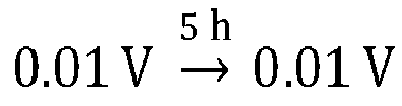
- It should be noted that if coulombic efficiencies of the 2nd, 3rd, 4th and 5th cycles for the soft carbon negative electrode are high with little fluctuation, completion of the 1st cycle prelithiating of the soft carbon negative electrode was regarded as completion of prelithiation of the soft carbon negative electrode. Time periods for completion of the 1st cycle prelithiating of the soft carbon negative electrodes of E1, E2 and CE1 are shown in Table 2.
Table 2 E1 E2 CE1 1st constant current stage C-rate (C) 0.5 0.5 0.1 1st predetermined voltage (V) 0.3 0.1 0.01 Time period (hr) 1.6 2.2 11.7 2nd constant current stage C-rate (C) 0.1 0.1 N/ A 2nd predetermined voltage (V) 0.01 0.01 N/A Time period (hr) 8.7 5.2 N/A Time period for constant voltage stage (hr) 5 5 5 Total time period for the 1st cycle prelithiating (hr) 15.3 12.4 16.7 Note: N/A = not applicable - It is found that, the 1st cycle prelithiating of the soft carbon negative electrodes of E1 and E2 was completed earlier than that of CE1. In addition, the 1st cycle prelithiating of the soft carbon negative electrode of E2 was completed earlier than that of E1. Prelithiating/delithiating curves of the soft carbon negative electrode of E2 are shown in
FIG. 6 . Based on the three stages performed to prelithiate the soft carbon negative electrode of E2, further investigations are performed to achieve optimization of parameters of each of the three stages. Details thereof are discussed in the following paragraphs. - Three samples of soft carbon negative electrodes, each of which was prelithiated in a similar manner as that of E2, except that stage (iii) was conducted for different time periods, i.e., 0.5 hour, 1 hour, and 2 hours, respectively. The delithiation capacities and coulombic efficiencies of the prelithiated soft carbon negative electrodes of the three samples and E2 are shown in Table 3.
Table 3 Time period for constant voltage stage (hr) 1st cycle 2nd cycle 3rd cycle 4th cycle 5th cycle 0.5 Cs(mAhg-1) 273 272 273 274 275 Coulombic efficiency(%) 84.3 97.8 98.4 98.7 98.6 1 Cs(mAhg-1) 271 272 272 273 276 Coulombic efficiency(%) 82.5 96.9 97.6 97.7 97.6 2 Cs(mAhg-1) 266 269 269 270 272 Coulombic efficiency(%) 84.1 95.9 96.4 96.7 96.3 5 Cs(mAhg-1) 273 282 280 280 282 Coulombic efficiency(%) 84.1 97.3 97.9 98.0 97.6 - Since coulombic efficiencies of the 2nd, 3rd, 4th and 5th cycles for each sample shown in Table 3 are high with little fluctuation, completion of the 1st cycle prelithiating of the soft carbon negative electrode in each sample shown in Table 3 was regarded as completion of prelithiation of the soft carbon negative electrode. As shown in Table 3, prelithiation of the soft carbon negative electrodes (of all three samples and E2) completes when stage (iii) was conducted for a time period ranging from 0.5 hour to 5 hours. In addition, the time period ranging from 0.5 hour to 2 hours is sufficient for completion of stage (iii), and thus completing prelithiation of the soft carbon negative electrodes. In the following discussion, the aforesaid sample that was subjected to stage (iii) for 2 hours (the median among 0.5 hour, 1 hour, 2 hours and 5 hours) were taken as Example 2-1 (E2-1). Prelithiating/delithiating curves of the soft carbon negative electrode of E2-1 are shown in
FIG. 7 . The stages (i), (ii), and (iii) performed in prelithiation of the soft carbon negative electrode of E2-1 are represented by the following expressions: - Stage (i) (prelithiated at 1st constant current):

- Stage (ii) (prelithiated at 2nd constant current):

- Stage (iii) (prelithiated at constant voltage):

- The procedures in prelithiations of the soft carbon negative electrodes of E2-2, E2-3, and E2-4 were generally similar to those of E2-1, except that during each prelithiating, in stage (i), the soft carbon negative electrode was prelithiated at different C-rate, i.e., 1 C, 2 C, and 5 C, respectively. The delithiation capacities and coulombic efficiencies of the prelithated soft carbon negative electrodes of E2-1, E2-2, E2-3, E2-4 are shown in Table 4. Time periods for completion of different stages (in terms of prelithiating with different voltage level) of the 1st cycle prelithiating of the soft carbon negative electrodes of E2-1, E2-2, E2-3, E2-4 and CE1 are shown in Table 5.
Table 4 Examples 1st cycle 2nd cycle 3rd cycle 4th cycle 5th cycle E2-1 Cs(mAhg-1) 266 269 269 270 272 Coulombic efficiency(%) 84.1 95.9 96.4 96.7 96.3 E2-2 Cs(mAhg-1) 279 283 281 282 277 Coulombic efficiency(%) 86.7 96.9 96.7 96.9 97.1 E2-3 Cs(mAhg-1) 265 270 273 275 275 Coulombic efficiency(%) 86.5 96.1 96.8 97.4 96.8 E2-4 Cs(mAhg-1) 278 283 286 288 288 Coulombic efficiency(%) 86.3 96.1 96.9 97.7 97.7 Table 5 CE1 E2-1 E2-2 E2-3 E2-4 1st constant current stage C-rate (C) 0.1 0.5 1 2 5 1st predetermined voltage (V) 0.01 0.1 0.1 0.1 0.1 Time period (hr) 11.7 2.2 1.0 0.4 0.1 2nd constant current stage C-rate (C) N/A 0.1 0.1 0.1 0.1 2nd predetermined voltage (V) N/A 0.01 0.01 0.01 0.01 Time period (hr) N/A 5.3 6.0 7.6 10.4 Time period for constant voltage stage (hr) 5 2 2 2 2 Total time period for 1st cycle prelithiating (hr) 16.7 9.5 9.0 10.0 12.5 Note: N/A = not applicable - As shown in Tables 4 and 5, in the prelithiation of the soft carbon negative electrode of E2-2, in which stage (i) is performed by prelithiating the soft carbon negative electrode at 1 C, and stage (ii) is performed by prelithiating the soft carbon negative electrode at 0.1 C, the 1st cycle prelithiating is completed within the shortest time period, and is approximately 50% of the time period of the two-stage method (i.e., the prelithiation performed in CE1 using only a single stage of prelithiating with only one constant current, followed by prelithiating with one constant voltage). Prelithiating/delithiating curves of the soft carbon negative electrode of E2-2 are shown in
FIG. 8 . The stages (i), (ii), and (iii), performed in prelithiation of the soft carbon negative electrode of E2-2, are represented by the following expressions: - Stage (i) (prelithiated at 1st constant current):

- Stage (ii) (prelithiated at 2nd constant current):

- Stage (iii) (prelithiated at constant voltage):

- The procedures in prelithiations of the soft carbon negative electrodes of E2-2-1, and E2-2-2 were generally similar to those of E2-2, except that during each prelithiating, in stage (ii), the soft carbon negative electrode was prelithiated at different C-rate, i.e., 0.05 C and 0.2 C, respectively. The delithiation capacities and coulombic efficiencies of the prelithated soft carbon negative electrodes of E2-2-1, and E2-2-2 are shown in Table 6. Time periods for completion of different stages (in terms of prelithiating with different voltage level) of the 1st cycle prelithiating of the soft carbon negative electrodes of E2-2-1, and E2-2-2 are shown in Table 7.
Table 6 Examples 1st cycle 2nd cycle 3rd cycle 4th cycle 5th cycle E-2-2-1 Cs(mAhg-1) 287 286 286 289 287 Coulombic efficiency(%) 77 91 92 93 94 E-2-2-2 Cs(mAhg-1) 246 252 250 250 249 Coulombic efficiency(%) 100 94 95 96 96 Table 7 E2-2-1 E2-2-2 1st constant current stage C-rate (C) 1 1 1st predetermined voltage (V) 0.1 0.1 Time period (hr) 0.98 0.74 2nd constant current stage C-rate (C) 0.05 0.2 2nd predetermined voltage (V) 0.01 0.01 Time period (hr) 14.29 2.23 Time period for constant voltage stage (hr) 2 2 Total time period for 1st cycle prelithiating (hr) 17.27 4.97 - As shown in Tables 6 and 7, in the prelithiation of the soft carbon negative electrode of E2-2-2, in which stage (i) is performed by prelithiating the soft carbon negative electrode at 1 C, and stage (ii) is performed by prelithiating the soft carbon negative electrode at 0.2 C, the 1st cycle prelithiating is completed within the shortest time period. Prelithiating/delithiating curves of the soft carbon negative electrode of E2-2-2 are shown in
FIG. 9 . The stages (i), (ii), and (iii), performed in prelithiation of the soft carbon negative electrode of E2-2-2, are represented by the following expressions: - Stage (i) (prelithiated at 1st constant current):

- Stage (ii) (prelithiated at 2nd constant current):

- Stage (iii) (prelithiated at constant voltage):

- To conclude, in the method for prelithiating the soft carbon negative electrode according to the present disclosure, an electrochemical method which is capable of controlling degree of prelithiation is performed, and the prelithiation of the soft carbon negative electrode is completed within a significantly short period of time. In addition, such prelithiated soft carbon negative electrode may be applied in an asymmetric lithium-ion supercapacitor that has a relatively high working voltage.
- In the description above, for the purposes of explanation, numerous specific details have been set forth in order to provide a thorough understanding of the embodiment(s). It will be apparent, however, to one skilled in the art, that one or more other embodiments may be practiced without some of these specific details. It should also be appreciated that reference throughout this specification to "one embodiment," "an embodiment," an embodiment with an indication of an ordinal number and so forth means that a particular feature, structure, or characteristic may be included in the practice of the disclosure. It should be further appreciated that in the description, various features are sometimes grouped together in a single embodiment, figure, or description thereof for the purpose of streamlining the disclosure and aiding in the understanding of various inventive aspects; such does not mean that every one of these features needs to be practiced with the presence of all the other features. In other words, in any described embodiment, when implementation of one or more features or specific details does not affect implementation of another one or more features or specific details, said one or more features may be singled out and practiced alone without said another one or more features or specific details. It should be further noted that one or more features or specific details from one embodiment may be practiced together with one or more features or specific details from another embodiment, where appropriate, in the practice of the disclosure.
Claims (11)
- A method for prelithiating a soft carbon negative electrode (11), characterized by the steps of:a) disposing the soft carbon negative electrode (11) and a lithium metal piece (12) spaced apart from each other such that a lithium-containing electrolyte is present therebetween;b) prelithiating the soft carbon negative electrode (11) at a first constant C-rate until a voltage of the soft carbon negative electrode (11) is reduced to a first predetermined voltage that is not greater than 0.3 V vs. Li/Li+, the first constant C-rate being not greater than 5 C;c) after step b), prelithiating the soft carbon negative electrode (11) at a second constant C-rate until the voltage of the soft carbon negative electrode (11) is reduced to a second predetermined voltage that is lower than the first predetermined voltage, the second constant C-rate being not greater than 0.2 C and being less than the first constant C-rate; andd) after step c), prelithiating the soft carbon negative electrode (11) at a prelithiation constant voltage which is not greater than the second predetermined voltage, thereby completing prelithiation of the soft carbon negative electrode (11).
- The method as claimed in claim 1, characterized in that the first constant C-rate ranges from 0.5 C to 5 C, and the first predetermined voltage ranges from 0.3 V to 0.1 V vs. Li/Li+.
- The method as claimed in any one of claims 1 to 2, characterized in that the second constant C-rate ranges from 0.05 C to 0.2 C, and the second predetermined voltage is not less than 0.01 V vs. Li/Li+.
- The method as claimed in any one of claims 1 to 3, characterized in that step d) is conducted for a time period ranging from 0.5 hour to 24 hours.
- The method as claimed in claim 4, characterized in that the second predetermined voltage is the same as the prelithiation constant voltage.
- The method as claimed in any one of claims 1 to 3, characterized in that the soft carbon negative electrode (11) is prelithiated in step b) by a first constant current, is prelithiated in step c) by a second constant current lower than the first constant current, and is prelithiated at the prelithiation constant voltage in step d) by a third current at a third C-rate.
- The method as claimed in claim 6, characterized in that the second constant C-rate is not less than 0.1 C, and step d) is terminated when the third C-rate is less than 0.05 C.
- The method as claimed in claim 6, characterized in that the second constant C-rate is lower than 0.1 C, step d) is terminated when the third current is less than 50% of the second constant current.
- The method as claimed in claim 6, characterized in that the second predetermined voltage is the same as the prelithiation constant voltage.
- An asymmetric lithium-ion supercapacitor (2), characterized by:a soft carbon negative electrode (21) prelithiated by the method as claimed in any one of claims 1 to 9;a positive electrode (22) spaced apart from said soft carbon negative electrode (21);an electrolyte (24) disposed between said soft carbon negative electrode (21) and said positive electrode (22); anda membrane (23) disposed between said soft carbon negative electrode (21) and said positive electrode (22) to allow said electrolyte (24) to pass therethrough.
- The asymmetric lithium-ion supercapacitor (2) as claimed in claim 10, characterized in that said positive electrode (22) includes one of an activated carbon and an alkaline-activated soft carbon.
Applications Claiming Priority (1)
| Application Number | Priority Date | Filing Date | Title |
|---|---|---|---|
| TW111143226A TWI848434B (en) | 2022-11-11 | 2022-11-11 | Pre-lithiation method of negative electrode of soft carbon material and supercapacitor thereof |
Publications (3)
| Publication Number | Publication Date |
|---|---|
| EP4369370A1 true EP4369370A1 (en) | 2024-05-15 |
| EP4369370C0 EP4369370C0 (en) | 2024-12-25 |
| EP4369370B1 EP4369370B1 (en) | 2024-12-25 |
Family
ID=84981297
Family Applications (1)
| Application Number | Title | Priority Date | Filing Date |
|---|---|---|---|
| EP23151755.8A Active EP4369370B1 (en) | 2022-11-11 | 2023-01-16 | Method for prelithiating soft carbon negative electrode and asymmetric lithium-ion supercapacitor |
Country Status (5)
| Country | Link |
|---|---|
| US (1) | US12437939B2 (en) |
| EP (1) | EP4369370B1 (en) |
| JP (1) | JP7446497B1 (en) |
| KR (1) | KR102856519B1 (en) |
| TW (1) | TWI848434B (en) |
Citations (5)
| Publication number | Priority date | Publication date | Assignee | Title |
|---|---|---|---|---|
| CN108565125A (en) * | 2018-03-28 | 2018-09-21 | 中能中科(天津)新能源科技有限公司 | Prelithiation lithium ion super capacitor cathode, preparation method and lithium ion super capacitor |
| EP3565035A2 (en) * | 2017-07-12 | 2019-11-06 | LG Chem, Ltd. | Lithium secondary battery and manufacturing method therefor |
| EP3761407A1 (en) * | 2019-01-31 | 2021-01-06 | Lg Chem, Ltd. | Method for pre-lithiation of negative electrode for secondary battery |
| KR20210024975A (en) * | 2019-08-26 | 2021-03-08 | 주식회사 엘지화학 | Lithium secondary battery and method for manufacturing the same |
| EP4012801A1 (en) * | 2019-09-06 | 2022-06-15 | Lg Energy Solution, Ltd. | Method for pre-lithiation/pre-sodiation of negative electrode, pre-lithiated/pre-sodiated negative electrode, and lithium secondary battery comprising same |
Family Cites Families (32)
| Publication number | Priority date | Publication date | Assignee | Title |
|---|---|---|---|---|
| JP2010080123A (en) | 2008-09-24 | 2010-04-08 | Sumitomo Bakelite Co Ltd | Negative electrode active material for energy storage device, and energy storage device |
| US8310208B2 (en) * | 2009-07-01 | 2012-11-13 | Surajit Sengupta | Charging algorithm for lithium batteries |
| JP2012099346A (en) | 2010-11-02 | 2012-05-24 | Fuji Heavy Ind Ltd | Method of manufacturing power storage device and power storage device obtained by this method |
| KR20120127938A (en) * | 2011-05-16 | 2012-11-26 | 삼성전기주식회사 | Hybrid capacitor |
| US9385397B2 (en) * | 2011-08-19 | 2016-07-05 | Nanotek Instruments, Inc. | Prelithiated current collector and secondary lithium cells containing same |
| JP2014183161A (en) * | 2013-03-19 | 2014-09-29 | Sumitomo Electric Ind Ltd | Lithium ion capacitor and charging/discharging method therefor |
| KR102479453B1 (en) * | 2014-04-08 | 2022-12-19 | 테슬라, 인크. | Energy storage device, anode thereof, and method of fabricating an energy storage device |
| US20160020618A1 (en) * | 2014-07-21 | 2016-01-21 | Ford Global Technologies, Llc | Fast Charge Algorithms for Lithium-Ion Batteries |
| US10354808B2 (en) * | 2015-01-29 | 2019-07-16 | Florida State University Research Foundation, Inc. | Electrochemical energy storage device |
| WO2016209460A2 (en) * | 2015-05-21 | 2016-12-29 | Ada Technologies, Inc. | High energy density hybrid pseudocapacitors and method of making and using the same |
| US20220328256A1 (en) * | 2015-07-31 | 2022-10-13 | Ada Technologies, Inc. | Shape conformable high energy and power electrochemical device and method of making and using same |
| US10044213B2 (en) * | 2015-09-09 | 2018-08-07 | Texas Instruments Incorporated | Fast charging for lithium ion battery |
| WO2017056451A1 (en) * | 2015-09-28 | 2017-04-06 | パナソニックIpマネジメント株式会社 | Method for manufacturing electrochemical device, and electrochemical device |
| US10714752B2 (en) * | 2016-01-13 | 2020-07-14 | Nec Corporation | Hierarchical oxygen containing carbon anode for lithium ion batteries with high capacity and fast charging capability |
| KR101903939B1 (en) | 2016-01-22 | 2018-10-02 | 아사히 가세이 가부시키가이샤 | Positive electrode precursor |
| US10755867B2 (en) * | 2016-04-18 | 2020-08-25 | Florida State University Research Foundation, Inc | Method of negative electrode pre-lithiation for lithium-ion capacitors |
| EA201990587A1 (en) * | 2016-08-31 | 2019-07-31 | Дзе Риджентс Оф Дзе Юнивёрсити Оф Калифорния | DEVICES CONTAINING CARBON-BASED MATERIALS AND THEIR PRODUCTION |
| JP2018056528A (en) | 2016-09-30 | 2018-04-05 | 日立化成株式会社 | Lithium ion capacitor and pre-charging method for the same |
| US10283280B2 (en) * | 2017-01-04 | 2019-05-07 | Nanotek Instruments, Inc. | Process for flexible and shape-conformal rope-shape supercapacitors |
| US10083799B2 (en) * | 2017-01-04 | 2018-09-25 | Nanotek Instruments, Inc. | Flexible and shape-conformal rope-shape supercapacitors |
| KR101901873B1 (en) * | 2017-02-08 | 2018-09-27 | 캡솔루션 주식회사 | lithium ion capacitor and making method therefor |
| US10454141B2 (en) * | 2017-06-30 | 2019-10-22 | Global Graphene Group, Inc. | Method of producing shape-conformable alkali metal-sulfur battery having a deformable and conductive quasi-solid electrode |
| US10727002B2 (en) * | 2017-10-09 | 2020-07-28 | Nanotek Instruments Group, Llc | Lithium ion-based internal hybrid electrochemical energy storage cell |
| KR20190101807A (en) * | 2018-02-23 | 2019-09-02 | 주식회사 엘지화학 | Negative electrode for lithium secondary battery, method of manufacturing the same and lithium secondary battery comprising the same |
| ES2939156T3 (en) * | 2018-09-12 | 2023-04-19 | Lg Energy Solution Ltd | Manufacturing method of a negative electrode for lithium secondary battery and lithium secondary battery |
| US11876211B2 (en) * | 2019-09-11 | 2024-01-16 | Government Of The United States Of America, As Represented By The Secretary Of Commerce | Prelithiated lithium ion battery and making a prelithiated lithium ion battery |
| US20210091368A1 (en) * | 2019-09-24 | 2021-03-25 | Nanotek Instruments, Inc. | Production process for graphene-enabled bi-polar electrode and battery containing same |
| WO2021067862A1 (en) * | 2019-10-04 | 2021-04-08 | Urbix Resources, LLC | Supercapacitor with biasing electrode |
| US11121359B2 (en) * | 2019-10-10 | 2021-09-14 | Global Graphene Group, Inc. | Production process for graphene-enabled bi-polar electrode and battery containing same |
| US20210351413A1 (en) * | 2020-05-11 | 2021-11-11 | Global Graphene Group, Inc. | Conducting composite current collector for a battery or supercapacitor and production process |
| KR102536131B1 (en) * | 2020-09-28 | 2023-05-26 | 한국과학기술연구원 | Prelithiation solution for graphite or graphite composite anode and prelithiation method using the same |
| CN117174496A (en) * | 2022-05-27 | 2023-12-05 | 通用汽车环球科技运作有限责任公司 | Electrolyte additives for capacitor auxiliary batteries |
-
2022
- 2022-11-11 TW TW111143226A patent/TWI848434B/en active
-
2023
- 2023-01-13 US US18/154,765 patent/US12437939B2/en active Active
- 2023-01-16 KR KR1020230005944A patent/KR102856519B1/en active Active
- 2023-01-16 EP EP23151755.8A patent/EP4369370B1/en active Active
- 2023-01-16 JP JP2023004524A patent/JP7446497B1/en active Active
Patent Citations (5)
| Publication number | Priority date | Publication date | Assignee | Title |
|---|---|---|---|---|
| EP3565035A2 (en) * | 2017-07-12 | 2019-11-06 | LG Chem, Ltd. | Lithium secondary battery and manufacturing method therefor |
| CN108565125A (en) * | 2018-03-28 | 2018-09-21 | 中能中科(天津)新能源科技有限公司 | Prelithiation lithium ion super capacitor cathode, preparation method and lithium ion super capacitor |
| EP3761407A1 (en) * | 2019-01-31 | 2021-01-06 | Lg Chem, Ltd. | Method for pre-lithiation of negative electrode for secondary battery |
| KR20210024975A (en) * | 2019-08-26 | 2021-03-08 | 주식회사 엘지화학 | Lithium secondary battery and method for manufacturing the same |
| EP4012801A1 (en) * | 2019-09-06 | 2022-06-15 | Lg Energy Solution, Ltd. | Method for pre-lithiation/pre-sodiation of negative electrode, pre-lithiated/pre-sodiated negative electrode, and lithium secondary battery comprising same |
Also Published As
| Publication number | Publication date |
|---|---|
| EP4369370C0 (en) | 2024-12-25 |
| US12437939B2 (en) | 2025-10-07 |
| KR102856519B1 (en) | 2025-09-05 |
| EP4369370B1 (en) | 2024-12-25 |
| US20240170230A1 (en) | 2024-05-23 |
| JP7446497B1 (en) | 2024-03-08 |
| TWI848434B (en) | 2024-07-11 |
| JP2024070768A (en) | 2024-05-23 |
| KR20240069564A (en) | 2024-05-20 |
| TW202419396A (en) | 2024-05-16 |
Similar Documents
| Publication | Publication Date | Title |
|---|---|---|
| US7006346B2 (en) | Positive electrode of an electric double layer capacitor | |
| CN102379017A (en) | Electricity accumulator device | |
| US8273475B2 (en) | Energy storage devices | |
| KR20140073492A (en) | Lithium ion capacitor, power storage device, power storage system | |
| US20120075771A1 (en) | Coin type lithium ion capacitor | |
| WO2023117170A2 (en) | Energy storage cells with fast charge and discharge capabilites | |
| CN1266799C (en) | Lithium accumulator | |
| KR101059934B1 (en) | Manufacturing method of hybrid supercapacitor | |
| KR101098240B1 (en) | Manufacturing method of supercapacitor cell | |
| KR20150016072A (en) | Positive electrode for lithium ion capacitor and lithium ion capacitor comprising the same | |
| EP4369370A1 (en) | Method for prelithiating soft carbon negative electrode and asymmetric lithium-ion supercapacitor | |
| KR101394743B1 (en) | Lithium-ion capacitor and manufacturing method of therof | |
| KR20150059726A (en) | Graphite anode with improved lithium pre-doping speed and lithium ion capacitor employing the same | |
| JP4053955B2 (en) | Manufacturing method of electric double layer capacitor | |
| KR101157500B1 (en) | Lithium ion capacitor cell and manufacturing method of the same | |
| CN114944286A (en) | A kind of electrochemical activation method of graphene-based cathode material and lithium ion capacitor | |
| Singh et al. | Recent progress on materials, architecture, and performances of hybrid battery-supercapacitors | |
| KR102862688B1 (en) | Manufacturing method of lithium-ion capacitors with improved stability | |
| KR101839020B1 (en) | Method of manufacturing coin type lithium ion capacitor | |
| EP4471888A2 (en) | Energy storage cells with rapid charging and discharge capacities having nb2o5 and activated carbon as negative active material and lithium manganese oxide as positive electrode | |
| KR20160143109A (en) | Electrode for secondary battery and Method for manufacturing the same | |
| JP7598675B2 (en) | Lithium-ion capacitor for energy harvesting | |
| EP4475225A2 (en) | Energy storage cells with fast charge and discharge capabilites | |
| EP4481779A1 (en) | Electrolyte compositions for energy storage cells with fast charge and dis-charge capabilites | |
| KR20140129774A (en) | Graphite anode with improved lithium pre-doping speed and lithium ion capacitor employing the same |
Legal Events
| Date | Code | Title | Description |
|---|---|---|---|
| PUAI | Public reference made under article 153(3) epc to a published international application that has entered the european phase |
Free format text: ORIGINAL CODE: 0009012 |
|
| STAA | Information on the status of an ep patent application or granted ep patent |
Free format text: STATUS: REQUEST FOR EXAMINATION WAS MADE |
|
| 17P | Request for examination filed |
Effective date: 20230206 |
|
| AK | Designated contracting states |
Kind code of ref document: A1 Designated state(s): AL AT BE BG CH CY CZ DE DK EE ES FI FR GB GR HR HU IE IS IT LI LT LU LV MC ME MK MT NL NO PL PT RO RS SE SI SK SM TR |
|
| GRAP | Despatch of communication of intention to grant a patent |
Free format text: ORIGINAL CODE: EPIDOSNIGR1 |
|
| STAA | Information on the status of an ep patent application or granted ep patent |
Free format text: STATUS: GRANT OF PATENT IS INTENDED |
|
| RIC1 | Information provided on ipc code assigned before grant |
Ipc: H01G 11/34 20130101ALN20240614BHEP Ipc: H01M 4/1393 20100101ALI20240614BHEP Ipc: H01M 4/133 20100101ALI20240614BHEP Ipc: H01M 10/052 20100101ALI20240614BHEP Ipc: H01M 4/139 20100101ALI20240614BHEP Ipc: H01M 4/13 20100101ALI20240614BHEP Ipc: H01G 11/86 20130101ALI20240614BHEP Ipc: H01G 11/50 20130101ALI20240614BHEP Ipc: H01G 11/38 20130101ALI20240614BHEP Ipc: H01G 11/14 20130101ALI20240614BHEP Ipc: H01G 11/06 20130101AFI20240614BHEP |
|
| INTG | Intention to grant announced |
Effective date: 20240723 |
|
| RAP3 | Party data changed (applicant data changed or rights of an application transferred) |
Owner name: CPC CORPORATION, TAIWAN |
|
| GRAS | Grant fee paid |
Free format text: ORIGINAL CODE: EPIDOSNIGR3 |
|
| GRAA | (expected) grant |
Free format text: ORIGINAL CODE: 0009210 |
|
| STAA | Information on the status of an ep patent application or granted ep patent |
Free format text: STATUS: THE PATENT HAS BEEN GRANTED |
|
| AK | Designated contracting states |
Kind code of ref document: B1 Designated state(s): AL AT BE BG CH CY CZ DE DK EE ES FI FR GB GR HR HU IE IS IT LI LT LU LV MC ME MK MT NL NO PL PT RO RS SE SI SK SM TR |
|
| REG | Reference to a national code |
Ref country code: GB Ref legal event code: FG4D |
|
| REG | Reference to a national code |
Ref country code: CH Ref legal event code: EP |
|
| REG | Reference to a national code |
Ref country code: DE Ref legal event code: R096 Ref document number: 602023001429 Country of ref document: DE |
|
| REG | Reference to a national code |
Ref country code: IE Ref legal event code: FG4D |
|
| U01 | Request for unitary effect filed |
Effective date: 20241230 |
|
| U07 | Unitary effect registered |
Designated state(s): AT BE BG DE DK EE FI FR IT LT LU LV MT NL PT RO SE SI Effective date: 20250114 |
|
| U20 | Renewal fee for the european patent with unitary effect paid |
Year of fee payment: 3 Effective date: 20250120 |
|
| PG25 | Lapsed in a contracting state [announced via postgrant information from national office to epo] |
Ref country code: HR Free format text: LAPSE BECAUSE OF FAILURE TO SUBMIT A TRANSLATION OF THE DESCRIPTION OR TO PAY THE FEE WITHIN THE PRESCRIBED TIME-LIMIT Effective date: 20241225 |
|
| PG25 | Lapsed in a contracting state [announced via postgrant information from national office to epo] |
Ref country code: NO Free format text: LAPSE BECAUSE OF FAILURE TO SUBMIT A TRANSLATION OF THE DESCRIPTION OR TO PAY THE FEE WITHIN THE PRESCRIBED TIME-LIMIT Effective date: 20250325 |
|
| PG25 | Lapsed in a contracting state [announced via postgrant information from national office to epo] |
Ref country code: GR Free format text: LAPSE BECAUSE OF FAILURE TO SUBMIT A TRANSLATION OF THE DESCRIPTION OR TO PAY THE FEE WITHIN THE PRESCRIBED TIME-LIMIT Effective date: 20250326 |
|
| PG25 | Lapsed in a contracting state [announced via postgrant information from national office to epo] |
Ref country code: RS Free format text: LAPSE BECAUSE OF FAILURE TO SUBMIT A TRANSLATION OF THE DESCRIPTION OR TO PAY THE FEE WITHIN THE PRESCRIBED TIME-LIMIT Effective date: 20250325 |
|
| PG25 | Lapsed in a contracting state [announced via postgrant information from national office to epo] |
Ref country code: SM Free format text: LAPSE BECAUSE OF FAILURE TO SUBMIT A TRANSLATION OF THE DESCRIPTION OR TO PAY THE FEE WITHIN THE PRESCRIBED TIME-LIMIT Effective date: 20241225 |
|
| PG25 | Lapsed in a contracting state [announced via postgrant information from national office to epo] |
Ref country code: PL Free format text: LAPSE BECAUSE OF FAILURE TO SUBMIT A TRANSLATION OF THE DESCRIPTION OR TO PAY THE FEE WITHIN THE PRESCRIBED TIME-LIMIT Effective date: 20241225 |
|
| PG25 | Lapsed in a contracting state [announced via postgrant information from national office to epo] |
Ref country code: ES Free format text: LAPSE BECAUSE OF FAILURE TO SUBMIT A TRANSLATION OF THE DESCRIPTION OR TO PAY THE FEE WITHIN THE PRESCRIBED TIME-LIMIT Effective date: 20241225 |
|
| PG25 | Lapsed in a contracting state [announced via postgrant information from national office to epo] |
Ref country code: IS Free format text: LAPSE BECAUSE OF FAILURE TO SUBMIT A TRANSLATION OF THE DESCRIPTION OR TO PAY THE FEE WITHIN THE PRESCRIBED TIME-LIMIT Effective date: 20250425 |
|
| PG25 | Lapsed in a contracting state [announced via postgrant information from national office to epo] |
Ref country code: SK Free format text: LAPSE BECAUSE OF FAILURE TO SUBMIT A TRANSLATION OF THE DESCRIPTION OR TO PAY THE FEE WITHIN THE PRESCRIBED TIME-LIMIT Effective date: 20241225 |
|
| PG25 | Lapsed in a contracting state [announced via postgrant information from national office to epo] |
Ref country code: CZ Free format text: LAPSE BECAUSE OF FAILURE TO SUBMIT A TRANSLATION OF THE DESCRIPTION OR TO PAY THE FEE WITHIN THE PRESCRIBED TIME-LIMIT Effective date: 20241225 |
|
| PG25 | Lapsed in a contracting state [announced via postgrant information from national office to epo] |
Ref country code: MC Free format text: LAPSE BECAUSE OF FAILURE TO SUBMIT A TRANSLATION OF THE DESCRIPTION OR TO PAY THE FEE WITHIN THE PRESCRIBED TIME-LIMIT Effective date: 20241225 |
|
| PLBE | No opposition filed within time limit |
Free format text: ORIGINAL CODE: 0009261 |
|
| STAA | Information on the status of an ep patent application or granted ep patent |
Free format text: STATUS: NO OPPOSITION FILED WITHIN TIME LIMIT |
|
| 26N | No opposition filed |
Effective date: 20250926 |
|
| PG25 | Lapsed in a contracting state [announced via postgrant information from national office to epo] |
Ref country code: IE Free format text: LAPSE BECAUSE OF NON-PAYMENT OF DUE FEES Effective date: 20250116 |
|
| U20 | Renewal fee for the european patent with unitary effect paid |
Year of fee payment: 4 Effective date: 20251222 |