EP4369012A1 - Information processing device, information processing method, and computer-readable storage medium - Google Patents
Information processing device, information processing method, and computer-readable storage medium Download PDFInfo
- Publication number
- EP4369012A1 EP4369012A1 EP23203532.9A EP23203532A EP4369012A1 EP 4369012 A1 EP4369012 A1 EP 4369012A1 EP 23203532 A EP23203532 A EP 23203532A EP 4369012 A1 EP4369012 A1 EP 4369012A1
- Authority
- EP
- European Patent Office
- Prior art keywords
- state information
- battery
- relating
- information processing
- threshold value
- Prior art date
- Legal status (The legal status is an assumption and is not a legal conclusion. Google has not performed a legal analysis and makes no representation as to the accuracy of the status listed.)
- Pending
Links
Images






Classifications
-
- B—PERFORMING OPERATIONS; TRANSPORTING
- B60—VEHICLES IN GENERAL
- B60L—PROPULSION OF ELECTRICALLY-PROPELLED VEHICLES; SUPPLYING ELECTRIC POWER FOR AUXILIARY EQUIPMENT OF ELECTRICALLY-PROPELLED VEHICLES; ELECTRODYNAMIC BRAKE SYSTEMS FOR VEHICLES IN GENERAL; MAGNETIC SUSPENSION OR LEVITATION FOR VEHICLES; MONITORING OPERATING VARIABLES OF ELECTRICALLY-PROPELLED VEHICLES; ELECTRIC SAFETY DEVICES FOR ELECTRICALLY-PROPELLED VEHICLES
- B60L58/00—Methods or circuit arrangements for monitoring or controlling batteries or fuel cells, specially adapted for electric vehicles
- B60L58/10—Methods or circuit arrangements for monitoring or controlling batteries or fuel cells, specially adapted for electric vehicles for monitoring or controlling batteries
- B60L58/16—Methods or circuit arrangements for monitoring or controlling batteries or fuel cells, specially adapted for electric vehicles for monitoring or controlling batteries responding to battery ageing, e.g. to the number of charging cycles or the state of health [SoH]
-
- G—PHYSICS
- G01—MEASURING; TESTING
- G01R—MEASURING ELECTRIC VARIABLES; MEASURING MAGNETIC VARIABLES
- G01R31/00—Arrangements for testing electric properties; Arrangements for locating electric faults; Arrangements for electrical testing characterised by what is being tested not provided for elsewhere
- G01R31/36—Arrangements for testing, measuring or monitoring the electrical condition of accumulators or electric batteries, e.g. capacity or state of charge [SoC]
- G01R31/392—Determining battery ageing or deterioration, e.g. state of health
-
- B—PERFORMING OPERATIONS; TRANSPORTING
- B60—VEHICLES IN GENERAL
- B60L—PROPULSION OF ELECTRICALLY-PROPELLED VEHICLES; SUPPLYING ELECTRIC POWER FOR AUXILIARY EQUIPMENT OF ELECTRICALLY-PROPELLED VEHICLES; ELECTRODYNAMIC BRAKE SYSTEMS FOR VEHICLES IN GENERAL; MAGNETIC SUSPENSION OR LEVITATION FOR VEHICLES; MONITORING OPERATING VARIABLES OF ELECTRICALLY-PROPELLED VEHICLES; ELECTRIC SAFETY DEVICES FOR ELECTRICALLY-PROPELLED VEHICLES
- B60L3/00—Electric devices on electrically-propelled vehicles for safety purposes; Monitoring operating variables, e.g. speed, deceleration or energy consumption
- B60L3/0023—Detecting, eliminating, remedying or compensating for drive train abnormalities, e.g. failures within the drive train
- B60L3/0046—Detecting, eliminating, remedying or compensating for drive train abnormalities, e.g. failures within the drive train relating to electric energy storage systems, e.g. batteries or capacitors
-
- B—PERFORMING OPERATIONS; TRANSPORTING
- B60—VEHICLES IN GENERAL
- B60L—PROPULSION OF ELECTRICALLY-PROPELLED VEHICLES; SUPPLYING ELECTRIC POWER FOR AUXILIARY EQUIPMENT OF ELECTRICALLY-PROPELLED VEHICLES; ELECTRODYNAMIC BRAKE SYSTEMS FOR VEHICLES IN GENERAL; MAGNETIC SUSPENSION OR LEVITATION FOR VEHICLES; MONITORING OPERATING VARIABLES OF ELECTRICALLY-PROPELLED VEHICLES; ELECTRIC SAFETY DEVICES FOR ELECTRICALLY-PROPELLED VEHICLES
- B60L58/00—Methods or circuit arrangements for monitoring or controlling batteries or fuel cells, specially adapted for electric vehicles
- B60L58/10—Methods or circuit arrangements for monitoring or controlling batteries or fuel cells, specially adapted for electric vehicles for monitoring or controlling batteries
-
- G—PHYSICS
- G01—MEASURING; TESTING
- G01R—MEASURING ELECTRIC VARIABLES; MEASURING MAGNETIC VARIABLES
- G01R31/00—Arrangements for testing electric properties; Arrangements for locating electric faults; Arrangements for electrical testing characterised by what is being tested not provided for elsewhere
- G01R31/36—Arrangements for testing, measuring or monitoring the electrical condition of accumulators or electric batteries, e.g. capacity or state of charge [SoC]
- G01R31/367—Software therefor, e.g. for battery testing using modelling or look-up tables
-
- G—PHYSICS
- G07—CHECKING-DEVICES
- G07C—TIME OR ATTENDANCE REGISTERS; REGISTERING OR INDICATING THE WORKING OF MACHINES; GENERATING RANDOM NUMBERS; VOTING OR LOTTERY APPARATUS; ARRANGEMENTS, SYSTEMS OR APPARATUS FOR CHECKING NOT PROVIDED FOR ELSEWHERE
- G07C5/00—Registering or indicating the working of vehicles
- G07C5/08—Registering or indicating performance data other than driving, working, idle, or waiting time, with or without registering driving, working, idle or waiting time
- G07C5/0808—Diagnosing performance data
-
- B—PERFORMING OPERATIONS; TRANSPORTING
- B60—VEHICLES IN GENERAL
- B60L—PROPULSION OF ELECTRICALLY-PROPELLED VEHICLES; SUPPLYING ELECTRIC POWER FOR AUXILIARY EQUIPMENT OF ELECTRICALLY-PROPELLED VEHICLES; ELECTRODYNAMIC BRAKE SYSTEMS FOR VEHICLES IN GENERAL; MAGNETIC SUSPENSION OR LEVITATION FOR VEHICLES; MONITORING OPERATING VARIABLES OF ELECTRICALLY-PROPELLED VEHICLES; ELECTRIC SAFETY DEVICES FOR ELECTRICALLY-PROPELLED VEHICLES
- B60L2240/00—Control parameters of input or output; Target parameters
- B60L2240/40—Drive Train control parameters
- B60L2240/54—Drive Train control parameters related to batteries
- B60L2240/547—Voltage
-
- B—PERFORMING OPERATIONS; TRANSPORTING
- B60—VEHICLES IN GENERAL
- B60L—PROPULSION OF ELECTRICALLY-PROPELLED VEHICLES; SUPPLYING ELECTRIC POWER FOR AUXILIARY EQUIPMENT OF ELECTRICALLY-PROPELLED VEHICLES; ELECTRODYNAMIC BRAKE SYSTEMS FOR VEHICLES IN GENERAL; MAGNETIC SUSPENSION OR LEVITATION FOR VEHICLES; MONITORING OPERATING VARIABLES OF ELECTRICALLY-PROPELLED VEHICLES; ELECTRIC SAFETY DEVICES FOR ELECTRICALLY-PROPELLED VEHICLES
- B60L2260/00—Operating Modes
- B60L2260/40—Control modes
- B60L2260/46—Control modes by self learning
-
- Y—GENERAL TAGGING OF NEW TECHNOLOGICAL DEVELOPMENTS; GENERAL TAGGING OF CROSS-SECTIONAL TECHNOLOGIES SPANNING OVER SEVERAL SECTIONS OF THE IPC; TECHNICAL SUBJECTS COVERED BY FORMER USPC CROSS-REFERENCE ART COLLECTIONS [XRACs] AND DIGESTS
- Y02—TECHNOLOGIES OR APPLICATIONS FOR MITIGATION OR ADAPTATION AGAINST CLIMATE CHANGE
- Y02E—REDUCTION OF GREENHOUSE GAS [GHG] EMISSIONS, RELATED TO ENERGY GENERATION, TRANSMISSION OR DISTRIBUTION
- Y02E60/00—Enabling technologies; Technologies with a potential or indirect contribution to GHG emissions mitigation
- Y02E60/10—Energy storage using batteries
Definitions
- the present disclosure relates to an information processing device, an information processing method, and a computer-readable storage medium that keep down the amount of data that is the subject in estimating the state of a battery.
- Patent Document 1 discloses a battery system that estimates the capacity retention of a battery by using an estimation model carrying out machine learning using, as teacher data, a usage pattern relating to the temperature, the current and the charge capacity of the battery, and a measured value of the capacity deterioration rate per unit time of the battery.
- Patent Document 2 JP-A No. 2020-148560 discloses a life predicting device that predicts the remaining life of a battery that is the object of prediction, by using a learned model that has learned the remaining lives of batteries on the basis of learning data including remaining lives and time series data of deterioration indices at past, predetermined points in time of batteries.
- Patent Document 3 discloses a battery state estimation device estimating the pack status for an entire battery pack by simplifying the battery pack, which includes plural battery cells, into a single battery cell.
- Patent Document 4 JP-A No. 2016-085062 discloses a battery deterioration judging device that measures the AC impedance characteristic of a lithium secondary battery having an electrolytic layer including a positive electrode, a negative electrode and a separator, and expresses the AC impedance characteristic by an artificial electronic equivalent circuit, and judges the formation of dendrites from the change in the resistance value derived from the negative electrode and from the change in the capacitor.
- An object of the present disclosure is to provide an information processing device, an information processing method, and a computer-readable storage medium that can keep computing costs down in cases of estimating the state of a battery.
- An information processing device relating to a first aspect has: an acquiring section acquiring state information relating to a state of a battery installed in a vehicle; a judging section judging whether or not the acquired state information satisfies a predetermined condition relating to the battery; and an outputting section that, in a case in which the state information satisfies the predetermined condition, outputs the state information as a subject for diagnosing the battery.
- the information processing device relating to the first aspect acquires state information expressing the state of the battery installed in a vehicle.
- the information processing device extracts the state information that satisfies the condition, as subject data. Namely, in accordance with this information processing device, of the acquired state information, the state information that satisfies a predetermined condition is extracted as subject data. Due thereto, computing costs can be suppressed when estimating the state of the battery.
- the acquiring section acquires the state information that includes a number of times of starting in which the vehicle was started and set in an on state, and an activated time period over which the vehicle was in the on state, and the judging section judges that the state information satisfies the predetermined condition when at least one of a case in which the number of times of starting relating to the state information is greater than or equal to a first threshold value, and a case in which the activated time period relating to the state information is greater than or equal to a second threshold value, is satisfied.
- state information at a battery which is in a condition in which it is difficult for load to be applied thereto, can be excluded from the subject data.
- the first threshold value is set such that, the greater the activated time period included in the state information, the greater the first threshold value
- the second threshold value is set such that, the greater the number of times of starting included in the state information, the greater the second threshold value.
- state information of the battery can be excluded from the subject data more appropriately, in accordance with the extent to which it is difficult for load to be applied to the battery.
- the acquiring section acquires, as the state information, lowest voltages outputted by the battery at times when the vehicle was started, and, in a case in which an index, which expresses a degree of dispersion in the lowest voltages, is greater than or equal to a third threshold value, the judging section judges that the state information satisfies the predetermined condition.
- state information can be extracted in consideration of the unstable state of the battery, such as the charge capacity, the allowable charge amount, and the like.
- the judging section judges whether or not the predetermined condition is satisfied by using, as the index, a cumulative value obtained by totaling, for a predetermined number of times relating to starting of an engine, difference values respectively derived by squaring a difference between the lowest voltage the battery actually outputted and the lowest voltage outputted by the battery a previous time, in starting of the vehicle of two successive times.
- the unstable state of the battery is clarified, and the state information can be extracted.
- the judging section includes a learned model that has been machine learned in order to judge whether or not the state information satisfies the predetermined condition.
- state information can be extracted on the basis of state information that was acquired in the past.
- An information processing device relating to a seventh aspect further includes, in the information processing device relating to the sixth aspect, a generating section that generates the learned model by executing machine learning by using, as learning data, the state information acquired in the past and suitabilities, as the subject, of the state information.
- the information processing device relating to the seventh aspect it can be judged whether or not the state information satisfies a condition, while reflecting data that was acquired in the past.
- An information processing method relating to an eighth aspect acquires state information relating to a state of a battery installed in a vehicle; judges whether or not the acquired state information satisfies a predetermined condition relating to the battery; and, in a case in which the state information satisfies the predetermined condition, outputs the state information as a subject for diagnosing the battery.
- the information processing method relating to the eighth aspect acquires state information expressing the state of the battery installed in a vehicle.
- the information processing method extracts the state information that satisfies the condition, as subject data. Namely, in accordance with this information processing method, of the acquired state information, the state information that satisfies a predetermined condition is extracted as subject data. Due thereto, computing costs can be suppressed when estimating the state of the battery.
- An information processing program relating to a ninth aspect causes a computer to execute processings of: acquiring state information relating to a state of a battery installed in a vehicle; judging whether or not the acquired state information satisfies a predetermined condition relating to the battery; and, in a case in which the state information satisfies the predetermined condition, outputting the state information as a subject for diagnosing the battery.
- a computer which executes the information processing program relating to the ninth aspect, acquires state information expressing the state of the battery installed in a vehicle.
- the computer extracts the state information that satisfies the condition, as subject data. Namely, in accordance with this computer, of the acquired state information, the state information that satisfies a predetermined condition is extracted as subject data. Due thereto, computing costs can be suppressed when estimating the state of the battery.
- computing costs can be kept down in cases of estimating the state of a battery.
- the information processing system is a system that, by using information (hereinafter called "state information") relating to the state of a battery installed in a vehicle, which information is acquired from an onboard device installed in the vehicle, extracts subject data for diagnosing the state of the battery.
- state information information relating to the state of a battery installed in a vehicle
- description is given of a form in which the vehicle relating to the present embodiments is an engine powered vehicle in which an engine is installed.
- the present disclosure is not limited to this, and the vehicle may be an electric vehicle (EV), a hybrid vehicle (HEV), or a fuel cell vehicle (FCV).
- EV electric vehicle
- HEV hybrid vehicle
- FCV fuel cell vehicle
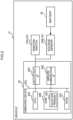
- an information processing system 10 of embodiments of the present disclosure is structured to include a vehicle 12 and a central server 30 serving as the information processing device.
- An onboard device 20 is installed in the vehicle 12.
- the onboard device 20 and the central server 30 are connected to one another through network N.
- FIG. 1 illustrates the one vehicle 12, which includes the onboard device 20, with respect to the one central server 30, the numbers of the vehicle 12, the onboard device 20 and the central server 30 are not limited to these.
- the onboard device 20 is a device that acquires state information relating to the vehicle 12 and transmits the state information to the central server 30.
- the state information relating to the present embodiment is data relating to the state of the battery that is detected from respective equipment installed in the vehicle 12.
- the state information relating to the present embodiment are data including the number of times that the ignition has been set in an on state in order to start the engine by using the battery (hereinafter called the “number of times of starting”), the durations from the ignition being set in the on state until the engine is set in the off state (hereinafter called the "activated time period"), and the lowest voltages that the battery outputted.
- the central server 30 is disposed, for example, at the manufacturer that manufactured the vehicle 12 or at a car dealer associated with that manufacturer.
- the central server 30 acquires the state information from the onboard device 20, and, from the acquired state information, extracts subject data for diagnosing the state of the battery.
- the extracted subject data may be transmitted to an external device that diagnoses the state of the battery, or may be stored as subject data.
- the vehicle 12 relating to the present embodiment is structured to include the onboard device 20, plural onboard equipment 22, and a battery 24.
- the onboard device 20 is structured to include a CPU (Central Processing Unit) 20A, a ROM (Read Only Memory) 20B, a RAM (Random Access Memory) 20C, an input/output I/F (Interface) 20D, and a wireless communication I/F 20E.
- the CPU 20A, the ROM 20B, the RAM 20C, the input/output I/F 20D, and the wireless communication I/F 20E are connected so as to be able to communicate with one another via an internal bus 20G.
- the CPU 20A is a central computing processing unit, and executes various programs and controls respective sections. Namely, the CPU 20A reads-out a program from the ROM 20B, and executes the program by using the RAM 20C as a workspace.
- the ROM 20B stores various programs and various data.
- a collection program 100 which carries out collecting of state information of the vehicle 12 from the onboard equipment 22, is stored in the ROM 20B of the present embodiment.
- the onboard device 20 executes processing that transmits the state information to the central server 30.
- the RAM 20C temporarily stores programs and data as a workspace.
- the input/output I/F 20D is an interface for communicating with the onboard equipment 22.
- the input/output I/F 20D is connected to an ignition switch 22A and a voltage sensor 22B that serve as the onboard equipment 22.
- the ignition switch 22A outputs a signal expressing that the engine has been set in an on state in order to start the engine.
- the voltage sensor 22B detects the voltage outputted by the battery 24, and outputs a signal expressing the voltage value to the onboard device 20 as results of detection.
- the wireless communication I/F 20E is a wireless communication module for communicating with the central server 30. Communication standards such as, for example, 5G, LTE, Wi-Fi TM , or the like are used at this wireless communication module.
- the wireless communication I/F 20E is connected to the network N.
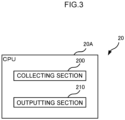
- the CPU 20A As illustrated in Fig. 3 , at the onboard device 20 of the present embodiment, due to the CPU 20A executing the collection program 100, the CPU 20A functions as a collecting section 200 and an outputting section 210.
- the collecting section 200 has the function of collecting the state information outputted from the respective onboard equipment 22 of the vehicle 12. Here, the collecting section 200 collects, as the state information, the number of times of starting, the activated time period, and the lowest voltages at times of starting the engine.
- the outputting section 210 has the function of outputting the state information, which was collected by the collecting section 200, to the central server 30 by using the wireless communication I/F 20E.
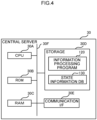
- the central server 30 is structured to include a CPU 30A, a ROM 30B, a RAM 30C, a storage 30D, and a communication I/F 30E.
- the CPU 30A, the ROM 30B, the RAM 30C, the storage 30D and the communication I/F 30E are connected so as to be able to communicate with one another via an internal bus 30F.
- the functions of the CPU 30A, the ROM 30B, the RAM 30C, and the communication I/F 30E are the same as those of the above-described CPU 20A, ROM 20B, RAM 20C, and wireless communication I/F 20E of the onboard device 20.
- the communication I/F 30E may carry out communication by wires.
- the storage 30D that serves as a recording medium is structured by an HDD (Hard Disk Drive) or an SSD (Solid State Drive), and stores various programs and various data.
- An information processing program 120 and a state information database (hereinafter called "state information DB") 130 are stored in the storage 30D of the present embodiment.
- the ROM 30B may store the information processing program 120 and the state information DB 130.
- the information processing program 120 that serves as the program is a program for controlling the central server 30.
- the central server 30 executes various processings including a processing of acquiring state information and a processing of extracting subject data from the state information.
- State information received from the onboard device, and subject data that is extracted, are stored in the state information DB 130.
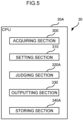
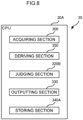
- the CPU 30A functions as an acquiring section 300, a setting section 310, a judging section 320A, an outputting section 330, and a storing section 340A.
- the acquiring section 300 has the function of acquiring the state information transmitted from the onboard device 20 of the vehicle 12.
- the acquiring section 300 relating to the present embodiment acquires state information including the number of times of starting, the activated time period, and the lowest voltages at times of starting the engine.
- the setting section 310 sets a threshold value for the number of times of starting (hereinafter called the “threshold value relating to the number of times”) and a threshold value for the activated time period (hereinafter called the “threshold value relating to the time period").
- the threshold value relating to the number of times is an example of the “first threshold value”
- the threshold value relating to the time period is an example of the "second threshold value”.
- Fig. 6 that is illustrated as an example is a graph showing the relationship between average number of times of starting per month and the average activated time period per month at a battery.
- the setting section 310 sets the threshold values for the number of times of starting and the activated time period, respectively, that are included in the state information.
- the setting section 310 sets a threshold value 400 relating to the number of times to be greater, the greater the activated time period that is included in the state information.
- the setting section 310 sets a threshold value 410 relating to the time period to be greater, the greater the number of times of starting that is included in the state information.
- the threshold value 400 relating to the number of times is set by the setting section 310 to be large in accordance with the magnitude of the activated time period
- the threshold value 410 relating to the time period is set by the setting section 310 to be large in accordance with the magnitude of the number of times of starting. Due thereto, state information of states in which the extent of deterioration of the battery 24 is low are excluded from the subject data. In other words, as illustrated in Fig. 6 , even in a case in which the number of times of starting that is included in the state information is small, if the activated time period is long, that state information is considered to be that of the battery 24 that has a low extent of deterioration, and is excluded from the subject data.
- the activated time period that is included in the state information is short, if the number of times of starting is large, similarly, that state information is considered to be that of the battery 24 that has a low extent of deterioration, and is excluded from the subject data.
- the judging section 320A compares the number of times of starting and the activated time period that are included in the state information with the threshold value 400 relating to the number of times and the threshold value 410 relating to the time period that were set by the setting section 310, and judges whether or not a predetermined condition is satisfied. For example, the judging section 320A judges whether or not the number of times of starting that is included in the state information is greater than or equal to the threshold value 400 relating to the number of times, and, if the number of times is greater than or equal to the threshold value 400 relating to the number of times, the judging section 320A judges that a predetermined condition is satisfied.
- the judging section 320A judges whether or not the activated time period included in the state information is greater than or equal to the threshold value 410 relating to the time period, and if the time period is greater than or equal to the threshold value 410 relating to the time period, the judging section 320A judges that a predetermined condition is satisfied.
- the outputting section 330 outputs the state information as subject data.
- the storing section 340A stores the state information that was outputted as subject data, and the acquired state information, respectively.
- the flow of the respective processings executed at the information processing system 10 of the present embodiment is described by using the flowchart of Fig. 7 .
- the respective processings at the central server 30 are executed due to the CPU 30A of the central server 30 functioning as the setting section 310, the judging section 320A, the outputting section 330, and the storing section 340A.
- the processing that extracts state information and is illustrated in Fig. 7 is executed, for example, in a case in which an instruction to extract state information is inputted.
- step S100 the CPU 30A acquires state information including the number of times of starting per one month and the activated time period per one month relating to the vehicle 12.
- step S102 the CPU 30A judges whether or not the number of times of starting that is included in the state information is greater than or equal to the threshold value 400 relating to the number of times. If the number of times of starting is greater than or equal to the threshold value 400 relating to the number of times (step S102: YES), the CPU 30A moves on to step S103. On the other hand, if the number of times of starting is not greater than or equal to the threshold value 400 relating to the number of times (i.e., if the number of times of starting is less than the threshold value 400 relating to the number of times) (step S102: NO), the CPU 30A moves on to step S106.
- step S103 the CPU 30A judges whether or not the activated time period that is included in the state information is greater than or equal to the threshold value 410 relating to the time period. If the activated time period is greater than or equal to the threshold value 410 relating to the time period (step S103: YES), the CPU 30A moves on to step S104. On the other hand, if the activated time period is not greater than or equal to the threshold value 410 relating to the time period (i.e., if the activated time period is less than the threshold value 410 relating to the time period) (step S103: NO), the CPU 30A moves on to step S106.
- step S104 the CPU 30A outputs state information as subject data.
- step S105 the CPU 30A stores the state information that was outputted as subject data.
- step S106 the CPU 30A stores the state information that was acquired.
- step S107 the CPU 30A judges whether or not to end the processing of extracting the state information. If the processing of extracting the state information is to be ended (step S107: YES), the CPU 30A ends the processing of extracting the state information. On the other hand, if the processing of extracting the state information is not to be ended (step S107: NO), the CPU 30A moves on to step S100, and acquires state information.
- the central server 30 that serves as the information processing device of the present embodiment acquires state information that includes the number of times of starting per one month and the activated time period per one month relating to the vehicle 12, and, by using the state information, sets the threshold value 400 relating to the number of times and the threshold value 410 relating to the time period. In a case in which the number of times of starting that is included in the state information is greater than or equal to the threshold value 400 relating to the number of times, and the activated time period that is included in the state information is greater than or equal to the threshold value 410 relating to the time period, the central server 30 outputs and stores that state information as subject data.
- computing costs can be suppressed when estimating the state of a battery.
- the above embodiment describes a form in which, in a case in which the condition that the number of times of starting is greater than or equal to the threshold value 400 relating to the number of times, and the activated time period is greater than or equal to the threshold value 410 relating to the time period, is satisfied, that state information is outputted as the subject data.
- the present disclosure is not limited to this.
- that state information may be outputted as the subject data.
- that state information may be outputted as the subject data.
- the present embodiment describes a form in which the threshold value 400 relating to the number of times and the threshold value 410 relating to the time period are linear.
- the threshold value 400 relating to the number of times and the threshold value 410 relating to the time period may be non-linear. Or, any threshold values may be used provided that the values thereof increase in accordance with the number of times of starting and the activated time period.
- the present embodiment describes a form in which the respective threshold values are set in accordance with the number of times of starting and the activated time period that are included in the state information.
- the present disclosure is not limited to this, and the threshold values may be set per vehicle type.
- the first embodiment describes a form in which state information is extracted by using the number of times of starting and the activated time period that are included in the state information.
- the second embodiment describes a form in which state information is extracted by using the lowest voltages that are included in the state information.
- the structure of the information processing system (see Fig. 1 ), the example of the hardware structures of the vehicle 12 (see Fig. 2 ), the example of the functional structures of the onboard device 20 (see Fig. 3 ), the example of the hardware structures of the central server 30 (see Fig. 4 ) and the graph illustrating the threshold values (see Fig. 6 ) relating to the present embodiment are similar to those of the first embodiment, and therefore, description thereof is omitted. Points that differ from the first embodiment are described hereinafter. Further, the same structures are denoted by the same reference numerals, and description thereof is omitted.
- the CPU 30A functions as the acquiring section 300, a deriving section 350, a judging section 320B, the outputting section 330 and the storing section 340A.
- the deriving section 350 derives an index expressing the degree of dispersion in the lowest voltages (hereinafter called "index") by using the lowest voltages of the battery 24 that are included in the acquired state information. For example, the deriving section 350 derives a difference squared value, which is obtained by squaring the difference value between the lowest voltage actually outputted by the battery and the lowest voltage outputted the previous time in the starting of the vehicle 12 (the starting of the engine or the starting of the motor or the like) of two successive times, and derives, as the index, the cumulative value obtained by totaling the difference squared values of the most recent five times from the present point in time.
- index an index expressing the degree of dispersion in the lowest voltages
- the charge capacity and the allowable charge amount and the like of the battery 24 decrease, and the voltage that is outputted becomes unstable. Therefore, when the lowest voltages outputted by the battery 24 in the starting of the vehicle 12 of two successive times are compared, the difference in the lowest voltages will be great at the battery 24 at which deterioration has advanced. Further, because there are cases in which the difference in the lowest voltages incidentally becomes large, in the present embodiment, by judging the degree of dispersion in the lowest voltages by using a cumulative value obtained by adding-up plural difference values, the state information is judged while taking the inclusion of incidental data into consideration.
- the present embodiment describes a form in which the difference values of the most recent five times are totaled.
- Difference values of the most recent three times or of the most recent seven times may be added-up, or the difference squared value of any number of times may be added-up.
- the present embodiment describes a form in which the difference squared value, which is obtained by squaring the values that are the differences, is derived.
- the present disclosure is not limited to this.
- the absolute value of the difference value may be derived.
- the mean squared error may be derived by squaring the difference value between the average value of past lowest voltages and an acquired lowest voltage.
- the variance of the lowest voltages may be derived. Any value may be derived provided that the derived value is a positive number.
- the judging section 320B compares the derived cumulative value and a predetermined threshold value, and judges whether or not a predetermined condition is satisfied. For example, the judging section 320B judges whether or not the cumulative value is greater than or equal to the predetermined threshold value (e.g., whether or not the cumulative value is greater than or equal to 5), and, if the cumulative value is greater than or equal to the predetermined threshold value, the judging section 320B judges that a predetermined condition is satisfied.
- the predetermined threshold value is an example of the "third threshold value".
- the flow of the respective processings executed at the information processing system 10 of the present embodiment are described by using the flowchart of Fig. 9 .
- the respective processings at the central server 30 are executed due to the CPU 30A of the central server 30 functioning as the acquiring section 300, the deriving section 350, the judging section 320B, the outputting section 330, and the storing section 340A.
- the processing that extracts state information and is illustrated in Fig. 9 is executed, for example, in a case in which an instruction to extract state information is inputted. Note that steps that are the same as those of the extracting processing illustrated in Fig. 7 are denoted by the same step numbers as in Fig. 7 , and description thereof is omitted.
- step S108 by using the lowest voltages included in the acquired state information, the CPU 30A derives the difference squared value of the lowest voltages relating to the starting of the vehicle 12 of two successive times, and derives a cumulative value that is obtained by totaling the difference squared values of the most recent five times.
- step S109 the CPU 30A judges whether or not the derived cumulative value is greater than or equal to a predetermined threshold value. If the cumulative value is greater than or equal to the predetermined threshold value (step S109: YES), the CPU 30A moves on to step S104. On the other hand, if the cumulative value is not greater than or equal to the predetermined threshold value (i.e., if the cumulative value is less than the predetermined threshold value) (step S109: NO), the CPU 30A moves on to step S106.
- the central server 30 that serves as the information processing device of the present embodiment acquires, as state information, the lowest voltages of the battery 24 per one month that relate to the vehicle 12, and, by using the state information, derives a cumulative value relating to the lowest voltages as an index. In a case in which the cumulative value is greater than or equal to a predetermined threshold value, the central server 30 outputs and stores that state information as subject data.
- state information can be extracted while taking into consideration unstable states of the battery.
- the present embodiment describes a form in which the state of the battery is estimated by using only the degree of dispersion of lowest voltages as an index.
- the present disclosure is not limited to this.
- the state of the battery may be estimated by using any of plural combinations of the activated time period and number of times of starting relating to the first embodiment and the index relating to the second embodiment.
- the second embodiment describes a form in which state information is extracted by using an index derived from acquired state information.
- the third embodiment describes a form in which state information is extracted by using a learned model on which machine learning for extracting state information has been carried out.
- the structure of the information processing system (see Fig. 1 ), the example of the hardware structures of the vehicle 12 (see Fig. 2 ), the example of the functional structures of the onboard device 20 (see Fig. 3 ), the example of the hardware structures of the central server 30 (see Fig. 4 ) and the graph illustrating the threshold values (see Fig. 6 ) relating to the present embodiment are similar to those of the first embodiment, and therefore, description thereof is omitted. Points that differ from the first embodiment are described hereinafter. Further, the same structures are denoted by the same reference numerals, and description thereof is omitted.
- the CPU 30A functions as the acquiring section 300, a judging section 320C, the outputting section 330, a storing section 340B and a generating section 360.
- the judging section 320C extracts state information that is to be used as the subject, by using a learned model on which machine learning for extracting state information has been carried out.
- the learned model is a classification model on which has been carried out machine learning for classifying the suitability of state information as subject data, i.e., whether or not the state information corresponds to subject data, by using state information that includes numbers of times of starting, activated time periods and lowest voltages that were acquired as learning data in the past, and the suitabilities of these state information as subject data.
- the judging section 320C inputs the acquired state information into the learned model, and, in accordance with the suitability as subject data that is judged by the learned model, judges whether or not the state information satisfies a predetermined condition. For example, in a case in which the learned model judges that inputted state information corresponds to subject data, the judging section 320C judges that a predetermined condition has been satisfied.
- the learned model may be a regression model, or may be a neural network model.
- the learned model that is a regression model may derive the threshold value 400 relating to the number of times and the threshold value 410 relating to the time period, and may judge whether or not the state information satisfies a predetermined condition.
- the learned model that is a neural network model may derive a cumulative value that relates to the lowest voltages as an index, and may judge whether or not the cumulative value satisfies a predetermined condition.
- the storing section 340B stores the state information that serves as the subject data and the state information that is acquired. Further, the storing section 340B stores the learned model that is generated by the generating section 360 that is described later. Here, the storing section 340B stores the judged suitability of the state information as subject data, in association with the state information.
- the generating section 360 executes machine learning by using state information acquired in the past, and generates the learned model.
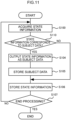
- the flow of the respective processings executed at the information processing system 10 of the present embodiment is described by using the flowchart of Fig. 11 .
- the respective processings at the central server 30 are executed due to the CPU 30A of the central server 30 functioning as the acquiring section 300, the judging section 320C, the outputting section 330, the storing section 340B and the generating section 360.
- the processing that extracts state information and is illustrated in Fig. 11 is executed, for example, in a case in which an instruction to extract state information is inputted. Note that, in Fig. 11 , steps that are the same as those of the extracting processing illustrated in Fig. 7 are denoted by the same step numbers as in Fig. 7 , and description thereof is omitted.
- step S110 the CPU 30A judges whether or not the state information that was inputted to the learned model corresponds to subject data. If the state information corresponds to subject data (step S 110: YES), the CPU 30A moves on to step S104. On the other hand, if the state information does not correspond to subject data (i.e., if the state information is different than subject data) (step S110: NO), the CPU 30A moves on to step S106.
- the processing of generating the learned model which is executed by the information processing system 10 of the present embodiment, is described next by using the flowchart of Fig. 12 .
- the generating processing illustrated in Fig. 12 is executed, for example, in a case in which an instruction to execute the processing of generating a learned model is inputted.
- step S200 the CPU 30A acquires, as learning data, state information including numbers of times of starting, activated time periods and lowest voltages that were acquired in the past, and suitabilities, as subject data, that correspond to the acquired state information.
- step S201 by using the acquired learning data, the CPU 30A executes machine learning and generates a learned model.
- step S202 the CPU 30A inputs state information to the learned model that was generated, and evaluates the learned model by using the suitability as subject data that is outputted from the learned model.
- step S203 the CPU 30A judges whether or not the processing of generating the learned model is to be ended. If the processing of generating the learned model is to be ended (step S203: YES), the CPU 30A moves on to step S204. On the other hand, if the processing of generating the learned model is not to be ended (step S203: NO), the CPU 30A moves on to step S200 and acquires learning data.
- step S204 the CPU 30A stores the learned model that was generated.
- the central server 30 that serves as the information processing device of the present embodiment extracts state information by using a learned model.
- state information can be extracted while reflecting state information that was acquired in the past.
- processors other than a CPU may execute the various processings that are executed due to the CPU 20A and the CPU 30A reading-in software (programs) in the above-described embodiments.
- processors in this case include PLDs (Programmable Logic Devices) whose circuit structure can be changed after production such as FPGAs (Field-Programmable Gate Arrays) and the like, and dedicated electrical circuits that are processors having circuit structures that are designed for the sole purpose of executing specific processings such as ASICs (Application Specific Integrated Circuits) and the like, and the like.
- PLDs Programmable Logic Devices
- FPGAs Field-Programmable Gate Arrays
- dedicated electrical circuits that are processors having circuit structures that are designed for the sole purpose of executing specific processings such as ASICs (Application Specific Integrated Circuits) and the like, and the like.
- the above-described respective processings may be executed by one of these various types of processors, or may be executed by a combination of two or more of the same type or different types of processors (e.g., plural FPGAs, or a combination of a CPU and an FPGA, or the like).
- the hardware structures of these various types of processors are, more specifically, electrical circuits that combine circuit elements such as semiconductor elements and the like.
- the respective programs are described as being stored in advance (installed) on computer-readable, non-transitory recording media.
- the collection program 100 at the onboard device 20 is stored in advance in the ROM 20B
- the information processing program 120 at the central server 30 is stored in advance in the storage 30D.
- the present disclosure is not limited to this, and the respective programs may be provided in forms of being recorded on a non-transitory recording medium such as a CD-ROM (Compact Disk Read Only Memory), a DVD-ROM (Digital Versatile Disk Read Only Memory), a USB (Universal Serial Bus) memory or the like.
- the programs may be in forms of being downloaded from an external device via a network.
Landscapes
- Engineering & Computer Science (AREA)
- Power Engineering (AREA)
- Life Sciences & Earth Sciences (AREA)
- Sustainable Development (AREA)
- Sustainable Energy (AREA)
- Transportation (AREA)
- Mechanical Engineering (AREA)
- Physics & Mathematics (AREA)
- General Physics & Mathematics (AREA)
- Electric Propulsion And Braking For Vehicles (AREA)
- Tests Of Electric Status Of Batteries (AREA)
Abstract
Description
- The present disclosure relates to an information processing device, an information processing method, and a computer-readable storage medium that keep down the amount of data that is the subject in estimating the state of a battery.
- Japanese Patent Application Laid-Open (
JP-A) No. 2022-044943 -
JP-A No. 2020-148560 -
JP-A No. 2017-004955 -
JP-A No. 2016-085062 - By the way, at a server that estimates the state of a battery installed in a vehicle, when state information relating to the state of the battery is collected from plural vehicles, the amount of data may become huge. Therefore, when carrying out processing on the collected state information in order to judge the state of a battery, there are the concerns that the computing costs will be huge, and that this will lead to delays in processing.
- An object of the present disclosure is to provide an information processing device, an information processing method, and a computer-readable storage medium that can keep computing costs down in cases of estimating the state of a battery.
- An information processing device relating to a first aspect has: an acquiring section acquiring state information relating to a state of a battery installed in a vehicle; a judging section judging whether or not the acquired state information satisfies a predetermined condition relating to the battery; and an outputting section that, in a case in which the state information satisfies the predetermined condition, outputs the state information as a subject for diagnosing the battery.
- The information processing device relating to the first aspect acquires state information expressing the state of the battery installed in a vehicle. In a case in which state information satisfies a predetermined condition, the information processing device extracts the state information that satisfies the condition, as subject data. Namely, in accordance with this information processing device, of the acquired state information, the state information that satisfies a predetermined condition is extracted as subject data. Due thereto, computing costs can be suppressed when estimating the state of the battery.
- In an information processing device relating to a second aspect, in the information processing device relating to the first aspect, the acquiring section acquires the state information that includes a number of times of starting in which the vehicle was started and set in an on state, and an activated time period over which the vehicle was in the on state, and the judging section judges that the state information satisfies the predetermined condition when at least one of a case in which the number of times of starting relating to the state information is greater than or equal to a first threshold value, and a case in which the activated time period relating to the state information is greater than or equal to a second threshold value, is satisfied.
- In accordance with the information processing device relating to the second aspect, state information at a battery, which is in a condition in which it is difficult for load to be applied thereto, can be excluded from the subject data.
- In an information processing device relating to a third aspect, in the information processing device relating to the second aspect, the first threshold value is set such that, the greater the activated time period included in the state information, the greater the first threshold value, and the second threshold value is set such that, the greater the number of times of starting included in the state information, the greater the second threshold value.
- In accordance with the information processing device relating to the third aspect, state information of the battery can be excluded from the subject data more appropriately, in accordance with the extent to which it is difficult for load to be applied to the battery.
- In an information processing device relating to a fourth aspect, in the information processing device relating to any one of the first through third aspects, the acquiring section acquires, as the state information, lowest voltages outputted by the battery at times when the vehicle was started, and, in a case in which an index, which expresses a degree of dispersion in the lowest voltages, is greater than or equal to a third threshold value, the judging section judges that the state information satisfies the predetermined condition.
- In accordance with the information processing device relating to the fourth aspect, state information can be extracted in consideration of the unstable state of the battery, such as the charge capacity, the allowable charge amount, and the like.
- In an information processing device relating to a fifth aspect, in the information processing device relating to the fourth aspect, the judging section judges whether or not the predetermined condition is satisfied by using, as the index, a cumulative value obtained by totaling, for a predetermined number of times relating to starting of an engine, difference values respectively derived by squaring a difference between the lowest voltage the battery actually outputted and the lowest voltage outputted by the battery a previous time, in starting of the vehicle of two successive times.
- In accordance with the information processing device relating to the fifth aspect, the unstable state of the battery is clarified, and the state information can be extracted.
- In an information processing device relating to a sixth aspect, in the information processing device relating to any one of the first through fifth aspects, the judging section includes a learned model that has been machine learned in order to judge whether or not the state information satisfies the predetermined condition.
- In accordance with the information processing device relating to the sixth aspect, by using the learned model that has learned past state information, state information can be extracted on the basis of state information that was acquired in the past.
- An information processing device relating to a seventh aspect further includes, in the information processing device relating to the sixth aspect, a generating section that generates the learned model by executing machine learning by using, as learning data, the state information acquired in the past and suitabilities, as the subject, of the state information.
- In accordance with the information processing device relating to the seventh aspect, it can be judged whether or not the state information satisfies a condition, while reflecting data that was acquired in the past.
- An information processing method relating to an eighth aspect: acquires state information relating to a state of a battery installed in a vehicle; judges whether or not the acquired state information satisfies a predetermined condition relating to the battery; and, in a case in which the state information satisfies the predetermined condition, outputs the state information as a subject for diagnosing the battery.
- The information processing method relating to the eighth aspect acquires state information expressing the state of the battery installed in a vehicle. In a case in which state information satisfies a predetermined condition, the information processing method extracts the state information that satisfies the condition, as subject data. Namely, in accordance with this information processing method, of the acquired state information, the state information that satisfies a predetermined condition is extracted as subject data. Due thereto, computing costs can be suppressed when estimating the state of the battery.
- An information processing program relating to a ninth aspect causes a computer to execute processings of: acquiring state information relating to a state of a battery installed in a vehicle; judging whether or not the acquired state information satisfies a predetermined condition relating to the battery; and, in a case in which the state information satisfies the predetermined condition, outputting the state information as a subject for diagnosing the battery.
- A computer, which executes the information processing program relating to the ninth aspect, acquires state information expressing the state of the battery installed in a vehicle. In a case in which state information satisfies a predetermined condition, the computer extracts the state information that satisfies the condition, as subject data. Namely, in accordance with this computer, of the acquired state information, the state information that satisfies a predetermined condition is extracted as subject data. Due thereto, computing costs can be suppressed when estimating the state of the battery.
- In accordance with the present disclosure, computing costs can be kept down in cases of estimating the state of a battery.
-
-
Fig. 1 is a drawing illustrating the schematic structure of an information processing system relating to embodiments; -
Fig. 2 is a block drawing illustrating hardware structures of a vehicle of the embodiments; -
Fig. 3 is a block drawing illustrating functional structures of an onboard device of the embodiments; -
Fig. 4 is a block drawing illustrating hardware structures of a central server of the embodiments; -
Fig. 5 is a block drawing illustrating functional structures of the central server of the first embodiment; -
Fig. 6 is a graph provided for explaining threshold values of the embodiments, and illustrating the relationship between number of times of starting and activated time period; -
Fig. 7 is a flowchart illustrating the flow of processing of extracting subject information, which processing is executed at the central server of the first embodiment; -
Fig. 8 is a block drawing illustrating functional structures of the central server of the second embodiment; -
Fig. 9 is a flowchart illustrating the flow of processing of extracting subject information, which processing is executed at the central server of the second embodiment; -
Fig. 10 is a block drawing illustrating functional structures of the central server of the third embodiment; -
Fig. 11 is a flowchart illustrating the flow of processing of extracting subject information, which processing is executed at the central server of the third embodiment; and -
Fig. 12 is a flowchart illustrating the flow of processing of generating a learned model, which processing is executed at the central server of the third embodiment. - An information processing system that includes an information processing device of the present disclosure is described. The information processing system is a system that, by using information (hereinafter called "state information") relating to the state of a battery installed in a vehicle, which information is acquired from an onboard device installed in the vehicle, extracts subject data for diagnosing the state of the battery. Note that description is given of a form in which the vehicle relating to the present embodiments is an engine powered vehicle in which an engine is installed. However, the present disclosure is not limited to this, and the vehicle may be an electric vehicle (EV), a hybrid vehicle (HEV), or a fuel cell vehicle (FCV).
- As illustrated in
Fig. 1 , aninformation processing system 10 of embodiments of the present disclosure is structured to include avehicle 12 and acentral server 30 serving as the information processing device. Anonboard device 20 is installed in thevehicle 12. Theonboard device 20 and thecentral server 30 are connected to one another through network N. - Note that, although
Fig. 1 illustrates the onevehicle 12, which includes theonboard device 20, with respect to the onecentral server 30, the numbers of thevehicle 12, theonboard device 20 and thecentral server 30 are not limited to these. - The
onboard device 20 is a device that acquires state information relating to thevehicle 12 and transmits the state information to thecentral server 30. Here, the state information relating to the present embodiment is data relating to the state of the battery that is detected from respective equipment installed in thevehicle 12. For example, the state information relating to the present embodiment are data including the number of times that the ignition has been set in an on state in order to start the engine by using the battery (hereinafter called the "number of times of starting"), the durations from the ignition being set in the on state until the engine is set in the off state (hereinafter called the "activated time period"), and the lowest voltages that the battery outputted. - The
central server 30 is disposed, for example, at the manufacturer that manufactured thevehicle 12 or at a car dealer associated with that manufacturer. Thecentral server 30 acquires the state information from theonboard device 20, and, from the acquired state information, extracts subject data for diagnosing the state of the battery. Note that the extracted subject data may be transmitted to an external device that diagnoses the state of the battery, or may be stored as subject data. - As illustrated in
Fig. 2 , thevehicle 12 relating to the present embodiment is structured to include theonboard device 20, pluralonboard equipment 22, and abattery 24. - The
onboard device 20 is structured to include a CPU (Central Processing Unit) 20A, a ROM (Read Only Memory) 20B, a RAM (Random Access Memory) 20C, an input/output I/F (Interface) 20D, and a wireless communication I/F 20E. TheCPU 20A, theROM 20B, theRAM 20C, the input/output I/F 20D, and the wireless communication I/F 20E are connected so as to be able to communicate with one another via aninternal bus 20G. - The
CPU 20A is a central computing processing unit, and executes various programs and controls respective sections. Namely, theCPU 20A reads-out a program from theROM 20B, and executes the program by using theRAM 20C as a workspace. - The
ROM 20B stores various programs and various data. Acollection program 100, which carries out collecting of state information of thevehicle 12 from theonboard equipment 22, is stored in theROM 20B of the present embodiment. Accompanying the execution of thecollection program 100, theonboard device 20 executes processing that transmits the state information to thecentral server 30. TheRAM 20C temporarily stores programs and data as a workspace. - The input/output I/
F 20D is an interface for communicating with theonboard equipment 22. The input/output I/F 20D is connected to an ignition switch 22A and avoltage sensor 22B that serve as theonboard equipment 22. The ignition switch 22A outputs a signal expressing that the engine has been set in an on state in order to start the engine. At the time when the engine starts, thevoltage sensor 22B detects the voltage outputted by thebattery 24, and outputs a signal expressing the voltage value to theonboard device 20 as results of detection. - The wireless communication I/
F 20E is a wireless communication module for communicating with thecentral server 30. Communication standards such as, for example, 5G, LTE, Wi-Fi™, or the like are used at this wireless communication module. The wireless communication I/F 20E is connected to the network N. - As illustrated in
Fig. 3 , at theonboard device 20 of the present embodiment, due to theCPU 20A executing thecollection program 100, theCPU 20A functions as acollecting section 200 and anoutputting section 210. - The collecting
section 200 has the function of collecting the state information outputted from the respectiveonboard equipment 22 of thevehicle 12. Here, the collectingsection 200 collects, as the state information, the number of times of starting, the activated time period, and the lowest voltages at times of starting the engine. - The
outputting section 210 has the function of outputting the state information, which was collected by the collectingsection 200, to thecentral server 30 by using the wireless communication I/F 20E. - As illustrated in
Fig. 4 , thecentral server 30 is structured to include aCPU 30A, aROM 30B, aRAM 30C, astorage 30D, and a communication I/F 30E. TheCPU 30A, theROM 30B, theRAM 30C, thestorage 30D and the communication I/F 30E are connected so as to be able to communicate with one another via aninternal bus 30F. The functions of theCPU 30A, theROM 30B, theRAM 30C, and the communication I/F 30E are the same as those of the above-describedCPU 20A,ROM 20B,RAM 20C, and wireless communication I/F 20E of theonboard device 20. Note that the communication I/F 30E may carry out communication by wires. - The
storage 30D that serves as a recording medium is structured by an HDD (Hard Disk Drive) or an SSD (Solid State Drive), and stores various programs and various data. Aninformation processing program 120 and a state information database (hereinafter called "state information DB") 130 are stored in thestorage 30D of the present embodiment. Note that theROM 30B may store theinformation processing program 120 and thestate information DB 130. - The
information processing program 120 that serves as the program is a program for controlling thecentral server 30. Accompanying the execution of theinformation processing program 120, thecentral server 30 executes various processings including a processing of acquiring state information and a processing of extracting subject data from the state information. - State information received from the onboard device, and subject data that is extracted, are stored in the
state information DB 130. - As illustrated in
Fig. 5 , at thecentral server 30 of the present embodiment, due to theCPU 30A executing theinformation processing program 120, theCPU 30A functions as an acquiringsection 300, asetting section 310, ajudging section 320A, anoutputting section 330, and astoring section 340A. - The acquiring
section 300 has the function of acquiring the state information transmitted from theonboard device 20 of thevehicle 12. Here, the acquiringsection 300 relating to the present embodiment acquires state information including the number of times of starting, the activated time period, and the lowest voltages at times of starting the engine. - By using the state information, the
setting section 310 sets a threshold value for the number of times of starting (hereinafter called the "threshold value relating to the number of times") and a threshold value for the activated time period (hereinafter called the "threshold value relating to the time period"). Here, the threshold value relating to the number of times is an example of the "first threshold value", and the threshold value relating to the time period is an example of the "second threshold value". - Here,
Fig. 6 that is illustrated as an example is a graph showing the relationship between average number of times of starting per month and the average activated time period per month at a battery. - As illustrated as an example in
Fig. 6 , on the basis of state information of batteries that have deteriorated among battery information that has been acquired in the past, thesetting section 310 sets the threshold values for the number of times of starting and the activated time period, respectively, that are included in the state information. Here, thesetting section 310 sets athreshold value 400 relating to the number of times to be greater, the greater the activated time period that is included in the state information. Further, thesetting section 310 sets athreshold value 410 relating to the time period to be greater, the greater the number of times of starting that is included in the state information. - The
threshold value 400 relating to the number of times is set by thesetting section 310 to be large in accordance with the magnitude of the activated time period, and thethreshold value 410 relating to the time period is set by thesetting section 310 to be large in accordance with the magnitude of the number of times of starting. Due thereto, state information of states in which the extent of deterioration of thebattery 24 is low are excluded from the subject data. In other words, as illustrated inFig. 6 , even in a case in which the number of times of starting that is included in the state information is small, if the activated time period is long, that state information is considered to be that of thebattery 24 that has a low extent of deterioration, and is excluded from the subject data. Further, even in a case in which the activated time period that is included in the state information is short, if the number of times of starting is large, similarly, that state information is considered to be that of thebattery 24 that has a low extent of deterioration, and is excluded from the subject data. - The judging
section 320A compares the number of times of starting and the activated time period that are included in the state information with thethreshold value 400 relating to the number of times and thethreshold value 410 relating to the time period that were set by thesetting section 310, and judges whether or not a predetermined condition is satisfied. For example, the judgingsection 320A judges whether or not the number of times of starting that is included in the state information is greater than or equal to thethreshold value 400 relating to the number of times, and, if the number of times is greater than or equal to thethreshold value 400 relating to the number of times, the judgingsection 320A judges that a predetermined condition is satisfied. Further, the judgingsection 320A judges whether or not the activated time period included in the state information is greater than or equal to thethreshold value 410 relating to the time period, and if the time period is greater than or equal to thethreshold value 410 relating to the time period, the judgingsection 320A judges that a predetermined condition is satisfied. - If it is judged by the judging
section 320A that a predetermined condition is satisfied, theoutputting section 330 outputs the state information as subject data. - The
storing section 340A stores the state information that was outputted as subject data, and the acquired state information, respectively. - The flow of the respective processings executed at the
information processing system 10 of the present embodiment is described by using the flowchart ofFig. 7 . The respective processings at thecentral server 30 are executed due to theCPU 30A of thecentral server 30 functioning as thesetting section 310, the judgingsection 320A, theoutputting section 330, and thestoring section 340A. The processing that extracts state information and is illustrated inFig. 7 is executed, for example, in a case in which an instruction to extract state information is inputted. - In step S100, the
CPU 30A acquires state information including the number of times of starting per one month and the activated time period per one month relating to thevehicle 12. - In step S101, by using the state information, the
CPU 30A sets thethreshold value 400 relating to the number of times and thethreshold value 410 relating to the time period. - In step S102, the
CPU 30A judges whether or not the number of times of starting that is included in the state information is greater than or equal to thethreshold value 400 relating to the number of times. If the number of times of starting is greater than or equal to thethreshold value 400 relating to the number of times (step S102: YES), theCPU 30A moves on to step S103. On the other hand, if the number of times of starting is not greater than or equal to thethreshold value 400 relating to the number of times (i.e., if the number of times of starting is less than thethreshold value 400 relating to the number of times) (step S102: NO), theCPU 30A moves on to step S106. - In step S103, the
CPU 30A judges whether or not the activated time period that is included in the state information is greater than or equal to thethreshold value 410 relating to the time period. If the activated time period is greater than or equal to thethreshold value 410 relating to the time period (step S103: YES), theCPU 30A moves on to step S104. On the other hand, if the activated time period is not greater than or equal to thethreshold value 410 relating to the time period (i.e., if the activated time period is less than thethreshold value 410 relating to the time period) (step S103: NO), theCPU 30A moves on to step S106. - In step S104, the
CPU 30A outputs state information as subject data. - In step S105, the
CPU 30A stores the state information that was outputted as subject data. - In step S106, the
CPU 30A stores the state information that was acquired. - In step S107, the
CPU 30A judges whether or not to end the processing of extracting the state information. If the processing of extracting the state information is to be ended (step S107: YES), theCPU 30A ends the processing of extracting the state information. On the other hand, if the processing of extracting the state information is not to be ended (step S107: NO), theCPU 30A moves on to step S100, and acquires state information. - The
central server 30 that serves as the information processing device of the present embodiment acquires state information that includes the number of times of starting per one month and the activated time period per one month relating to thevehicle 12, and, by using the state information, sets thethreshold value 400 relating to the number of times and thethreshold value 410 relating to the time period. In a case in which the number of times of starting that is included in the state information is greater than or equal to thethreshold value 400 relating to the number of times, and the activated time period that is included in the state information is greater than or equal to thethreshold value 410 relating to the time period, thecentral server 30 outputs and stores that state information as subject data. - As described above, in accordance with the present embodiment, computing costs can be suppressed when estimating the state of a battery.
- Note that the above embodiment describes a form in which, in a case in which the condition that the number of times of starting is greater than or equal to the
threshold value 400 relating to the number of times, and the activated time period is greater than or equal to thethreshold value 410 relating to the time period, is satisfied, that state information is outputted as the subject data. However, the present disclosure is not limited to this. For example, under the condition of only that the number of times of starting is greater than or equal to thethreshold value 400 relating to the number of times, that state information may be outputted as the subject data. Or, for example, under the condition of only that the activated time period is greater than or equal to thethreshold value 410 relating to the time period, that state information may be outputted as the subject data. - Further, the present embodiment describes a form in which the
threshold value 400 relating to the number of times and thethreshold value 410 relating to the time period are linear. However, the present disclosure is not limited to this. Thethreshold value 400 relating to the number of times and thethreshold value 410 relating to the time period may be non-linear. Or, any threshold values may be used provided that the values thereof increase in accordance with the number of times of starting and the activated time period. - Further, the present embodiment describes a form in which the respective threshold values are set in accordance with the number of times of starting and the activated time period that are included in the state information. However, the present disclosure is not limited to this, and the threshold values may be set per vehicle type.
- The first embodiment describes a form in which state information is extracted by using the number of times of starting and the activated time period that are included in the state information. The second embodiment describes a form in which state information is extracted by using the lowest voltages that are included in the state information.
- Note that the structure of the information processing system (see
Fig. 1 ), the example of the hardware structures of the vehicle 12 (seeFig. 2 ), the example of the functional structures of the onboard device 20 (seeFig. 3 ), the example of the hardware structures of the central server 30 (seeFig. 4 ) and the graph illustrating the threshold values (seeFig. 6 ) relating to the present embodiment are similar to those of the first embodiment, and therefore, description thereof is omitted. Points that differ from the first embodiment are described hereinafter. Further, the same structures are denoted by the same reference numerals, and description thereof is omitted. - As illustrated in
Fig. 8 , at thecentral server 30 of the present embodiment, due to theCPU 30A executing theinformation processing program 120, theCPU 30A functions as the acquiringsection 300, aderiving section 350, ajudging section 320B, theoutputting section 330 and thestoring section 340A. - The deriving
section 350 derives an index expressing the degree of dispersion in the lowest voltages (hereinafter called "index") by using the lowest voltages of thebattery 24 that are included in the acquired state information. For example, the derivingsection 350 derives a difference squared value, which is obtained by squaring the difference value between the lowest voltage actually outputted by the battery and the lowest voltage outputted the previous time in the starting of the vehicle 12 (the starting of the engine or the starting of the motor or the like) of two successive times, and derives, as the index, the cumulative value obtained by totaling the difference squared values of the most recent five times from the present point in time. - Here, when deterioration of the
battery 24 advances, the charge capacity and the allowable charge amount and the like of thebattery 24 decrease, and the voltage that is outputted becomes unstable. Therefore, when the lowest voltages outputted by thebattery 24 in the starting of thevehicle 12 of two successive times are compared, the difference in the lowest voltages will be great at thebattery 24 at which deterioration has advanced. Further, because there are cases in which the difference in the lowest voltages incidentally becomes large, in the present embodiment, by judging the degree of dispersion in the lowest voltages by using a cumulative value obtained by adding-up plural difference values, the state information is judged while taking the inclusion of incidental data into consideration. - Note that the present embodiment describes a form in which the difference values of the most recent five times are totaled. However, the present disclosure is not limited to this. Difference values of the most recent three times or of the most recent seven times may be added-up, or the difference squared value of any number of times may be added-up. Further, the present embodiment describes a form in which the difference squared value, which is obtained by squaring the values that are the differences, is derived. However, the present disclosure is not limited to this. For example, the absolute value of the difference value may be derived. Or, the mean squared error may be derived by squaring the difference value between the average value of past lowest voltages and an acquired lowest voltage. Or, the variance of the lowest voltages may be derived. Any value may be derived provided that the derived value is a positive number.
- The judging
section 320B compares the derived cumulative value and a predetermined threshold value, and judges whether or not a predetermined condition is satisfied. For example, the judgingsection 320B judges whether or not the cumulative value is greater than or equal to the predetermined threshold value (e.g., whether or not the cumulative value is greater than or equal to 5), and, if the cumulative value is greater than or equal to the predetermined threshold value, the judgingsection 320B judges that a predetermined condition is satisfied. Here, the predetermined threshold value is an example of the "third threshold value". - The flow of the respective processings executed at the
information processing system 10 of the present embodiment are described by using the flowchart ofFig. 9 . The respective processings at thecentral server 30 are executed due to theCPU 30A of thecentral server 30 functioning as the acquiringsection 300, the derivingsection 350, the judgingsection 320B, theoutputting section 330, and thestoring section 340A. The processing that extracts state information and is illustrated inFig. 9 is executed, for example, in a case in which an instruction to extract state information is inputted. Note that steps that are the same as those of the extracting processing illustrated inFig. 7 are denoted by the same step numbers as inFig. 7 , and description thereof is omitted. - In step S108, by using the lowest voltages included in the acquired state information, the
CPU 30A derives the difference squared value of the lowest voltages relating to the starting of thevehicle 12 of two successive times, and derives a cumulative value that is obtained by totaling the difference squared values of the most recent five times. - In step S109, the
CPU 30A judges whether or not the derived cumulative value is greater than or equal to a predetermined threshold value. If the cumulative value is greater than or equal to the predetermined threshold value (step S109: YES), theCPU 30A moves on to step S104. On the other hand, if the cumulative value is not greater than or equal to the predetermined threshold value (i.e., if the cumulative value is less than the predetermined threshold value) (step S109: NO), theCPU 30A moves on to step S106. - The
central server 30 that serves as the information processing device of the present embodiment acquires, as state information, the lowest voltages of thebattery 24 per one month that relate to thevehicle 12, and, by using the state information, derives a cumulative value relating to the lowest voltages as an index. In a case in which the cumulative value is greater than or equal to a predetermined threshold value, thecentral server 30 outputs and stores that state information as subject data. - As described above, in accordance with the present embodiment, state information can be extracted while taking into consideration unstable states of the battery.
- Note that the present embodiment describes a form in which the state of the battery is estimated by using only the degree of dispersion of lowest voltages as an index. However, the present disclosure is not limited to this. For example, the state of the battery may be estimated by using any of plural combinations of the activated time period and number of times of starting relating to the first embodiment and the index relating to the second embodiment.
- The second embodiment describes a form in which state information is extracted by using an index derived from acquired state information. The third embodiment describes a form in which state information is extracted by using a learned model on which machine learning for extracting state information has been carried out.
- Note that the structure of the information processing system (see
Fig. 1 ), the example of the hardware structures of the vehicle 12 (seeFig. 2 ), the example of the functional structures of the onboard device 20 (seeFig. 3 ), the example of the hardware structures of the central server 30 (seeFig. 4 ) and the graph illustrating the threshold values (seeFig. 6 ) relating to the present embodiment are similar to those of the first embodiment, and therefore, description thereof is omitted. Points that differ from the first embodiment are described hereinafter. Further, the same structures are denoted by the same reference numerals, and description thereof is omitted. - As illustrated in
Fig. 10 , at thecentral server 30 of the present embodiment, due to theCPU 30A executing theinformation processing program 120, theCPU 30A functions as the acquiringsection 300, ajudging section 320C, theoutputting section 330, astoring section 340B and agenerating section 360. - The judging
section 320C extracts state information that is to be used as the subject, by using a learned model on which machine learning for extracting state information has been carried out. For example, the learned model is a classification model on which has been carried out machine learning for classifying the suitability of state information as subject data, i.e., whether or not the state information corresponds to subject data, by using state information that includes numbers of times of starting, activated time periods and lowest voltages that were acquired as learning data in the past, and the suitabilities of these state information as subject data. - The judging
section 320C inputs the acquired state information into the learned model, and, in accordance with the suitability as subject data that is judged by the learned model, judges whether or not the state information satisfies a predetermined condition. For example, in a case in which the learned model judges that inputted state information corresponds to subject data, the judgingsection 320C judges that a predetermined condition has been satisfied. - Note that a form is described in which the learned model relating to the present embodiment is a classification model. However, the present disclosure is not limited to this. The learned model may be a regression model, or may be a neural network model. For example, the learned model that is a regression model may derive the
threshold value 400 relating to the number of times and thethreshold value 410 relating to the time period, and may judge whether or not the state information satisfies a predetermined condition. Further, the learned model that is a neural network model may derive a cumulative value that relates to the lowest voltages as an index, and may judge whether or not the cumulative value satisfies a predetermined condition. - The
storing section 340B stores the state information that serves as the subject data and the state information that is acquired. Further, thestoring section 340B stores the learned model that is generated by thegenerating section 360 that is described later. Here, thestoring section 340B stores the judged suitability of the state information as subject data, in association with the state information. - The
generating section 360 executes machine learning by using state information acquired in the past, and generates the learned model. - The flow of the respective processings executed at the
information processing system 10 of the present embodiment is described by using the flowchart ofFig. 11 . The respective processings at thecentral server 30 are executed due to theCPU 30A of thecentral server 30 functioning as the acquiringsection 300, the judgingsection 320C, theoutputting section 330, thestoring section 340B and thegenerating section 360. The processing that extracts state information and is illustrated inFig. 11 is executed, for example, in a case in which an instruction to extract state information is inputted. Note that, inFig. 11 , steps that are the same as those of the extracting processing illustrated inFig. 7 are denoted by the same step numbers as inFig. 7 , and description thereof is omitted. - In step S110, the
CPU 30A judges whether or not the state information that was inputted to the learned model corresponds to subject data. If the state information corresponds to subject data (step S 110: YES), theCPU 30A moves on to step S104. On the other hand, if the state information does not correspond to subject data (i.e., if the state information is different than subject data) (step S110: NO), theCPU 30A moves on to step S106. - The processing of generating the learned model, which is executed by the
information processing system 10 of the present embodiment, is described next by using the flowchart ofFig. 12 . The generating processing illustrated inFig. 12 is executed, for example, in a case in which an instruction to execute the processing of generating a learned model is inputted. - In step S200, the
CPU 30A acquires, as learning data, state information including numbers of times of starting, activated time periods and lowest voltages that were acquired in the past, and suitabilities, as subject data, that correspond to the acquired state information. - In step S201, by using the acquired learning data, the
CPU 30A executes machine learning and generates a learned model. - In step S202, the
CPU 30A inputs state information to the learned model that was generated, and evaluates the learned model by using the suitability as subject data that is outputted from the learned model. - In step S203, the
CPU 30A judges whether or not the processing of generating the learned model is to be ended. If the processing of generating the learned model is to be ended (step S203: YES), theCPU 30A moves on to step S204. On the other hand, if the processing of generating the learned model is not to be ended (step S203: NO), theCPU 30A moves on to step S200 and acquires learning data. - In step S204, the
CPU 30A stores the learned model that was generated. - The
central server 30 that serves as the information processing device of the present embodiment extracts state information by using a learned model. - As described above, in accordance with the present embodiment, state information can be extracted while reflecting state information that was acquired in the past.
- Note that any of various types of processors other than a CPU may execute the various processings that are executed due to the
CPU 20A and theCPU 30A reading-in software (programs) in the above-described embodiments. Examples of processors in this case include PLDs (Programmable Logic Devices) whose circuit structure can be changed after production such as FPGAs (Field-Programmable Gate Arrays) and the like, and dedicated electrical circuits that are processors having circuit structures that are designed for the sole purpose of executing specific processings such as ASICs (Application Specific Integrated Circuits) and the like, and the like. Further, the above-described respective processings may be executed by one of these various types of processors, or may be executed by a combination of two or more of the same type or different types of processors (e.g., plural FPGAs, or a combination of a CPU and an FPGA, or the like). Further, the hardware structures of these various types of processors are, more specifically, electrical circuits that combine circuit elements such as semiconductor elements and the like. - Further, in the above embodiments, the respective programs are described as being stored in advance (installed) on computer-readable, non-transitory recording media. For example, the
collection program 100 at theonboard device 20 is stored in advance in theROM 20B, and theinformation processing program 120 at thecentral server 30 is stored in advance in thestorage 30D. However, the present disclosure is not limited to this, and the respective programs may be provided in forms of being recorded on a non-transitory recording medium such as a CD-ROM (Compact Disk Read Only Memory), a DVD-ROM (Digital Versatile Disk Read Only Memory), a USB (Universal Serial Bus) memory or the like. Further, the programs may be in forms of being downloaded from an external device via a network. - The flows of the processings described in the above embodiments are examples, and unnecessary steps may be deleted therefrom, new steps may be added thereto, or the order of processings may be rearranged, with a scope that does not depart from the gist of the present disclosure.
Claims (9)
- An information processing device comprising:an acquiring section acquiring state information relating to a state of a battery installed in a vehicle;a judging section judging whether or not the acquired state information satisfies a predetermined condition relating to the battery; andan outputting section that, in a case in which the state information satisfies the predetermined condition, outputs the state information as a subject for diagnosing the battery.
- The information processing device of claim 1, whereinthe acquiring section acquires the state information that includes a number of times of starting in which the vehicle was started and set in an on state, and an activated time period over which the vehicle was in the on state, andthe judging section judges that the state information satisfies the predetermined condition when at least one of a case in which the number of times of starting relating to the state information is greater than or equal to a first threshold value, and a case in which the activated time period relating to the state information is greater than or equal to a second threshold value, is satisfied.
- The information processing device of claim 2, wherein the first threshold value is set such that, the greater the activated time period included in the state information, the greater the first threshold value, and the second threshold value is set such that, the greater the number of times of starting included in the state information, the greater the second threshold value.
- The information processing device of claim 1, whereinthe acquiring section acquires, as the state information, lowest voltages outputted by the battery at times when the vehicle was started, andin a case in which an index, which expresses a degree of dispersion in the lowest voltages, is greater than or equal to a third threshold value, the judging section judges that the state information satisfies the predetermined condition.
- The information processing device of claim 4, wherein the judging section judges whether or not the predetermined condition is satisfied by using, as the index, a cumulative value obtained by totaling, for a predetermined number of times relating to starting of the vehicle, difference values respectively derived by squaring a difference between the lowest voltage the battery actually outputted and the lowest voltage outputted by the battery a previous time, in starting of the vehicle of two successive times.
- The information processing device of claim 1, wherein the judging section includes a learned model that has been machine learned in order to judge suitability, as the subject, of the state information.
- The information processing device of claim 6, further comprising a generating section that generates the learned model by executing machine learning by using, as learning data, the state information acquired in the past and suitabilities, as the subject, of the state information.
- An information processing method in which a computer executes processings of:acquiring state information relating to a state of a battery installed in a vehicle;judging whether or not the acquired state information satisfies a predetermined condition relating to the battery; andin a case in which the state information satisfies the predetermined condition, outputting the state information as a subject for diagnosing the battery.
- A computer-readable storage medium storing an information processing program for causing a computer to execute processings of:acquiring state information relating to a state of a battery installed in a vehicle;judging whether or not the acquired state information satisfies a predetermined condition relating to the battery; andin a case in which the state information satisfies the predetermined condition, outputting the state information as a subject for diagnosing the battery.
Applications Claiming Priority (1)
| Application Number | Priority Date | Filing Date | Title |
|---|---|---|---|
| JP2022179865A JP7838451B2 (en) | 2022-11-09 | 2022-11-09 | Information processing device, information processing method, and information processing program |
Publications (1)
| Publication Number | Publication Date |
|---|---|
| EP4369012A1 true EP4369012A1 (en) | 2024-05-15 |
Family
ID=88413982
Family Applications (1)
| Application Number | Title | Priority Date | Filing Date |
|---|---|---|---|
| EP23203532.9A Pending EP4369012A1 (en) | 2022-11-09 | 2023-10-13 | Information processing device, information processing method, and computer-readable storage medium |
Country Status (4)
| Country | Link |
|---|---|
| US (1) | US20240149745A1 (en) |
| EP (1) | EP4369012A1 (en) |
| JP (1) | JP7838451B2 (en) |
| CN (1) | CN118003886A (en) |
Families Citing this family (1)
| Publication number | Priority date | Publication date | Assignee | Title |
|---|---|---|---|---|
| US20250388183A1 (en) * | 2024-06-25 | 2025-12-25 | Antigravity Batteries Llc | Battery management system |
Citations (8)
| Publication number | Priority date | Publication date | Assignee | Title |
|---|---|---|---|---|
| JP2016085062A (en) | 2014-10-23 | 2016-05-19 | エンネット株式会社 | Device and method for determining battery deterioration |
| US20160231390A1 (en) * | 2015-02-09 | 2016-08-11 | Toyota Jidosha Kabushiki Kaisha | Battery abnormality indication apparatus |
| JP2017004955A (en) | 2015-06-11 | 2017-01-05 | 三星電子株式会社Samsung Electronics Co.,Ltd. | Method and apparatus for estimating state of battery |
| EP3611524A1 (en) * | 2017-04-12 | 2020-02-19 | Hitachi Chemical Company, Ltd. | Cell service life diagnostic device and cell service life diagnostic method |
| JP2020148560A (en) | 2019-03-12 | 2020-09-17 | トヨタ自動車株式会社 | Battery life learning device, method, program, battery life prediction device, method and program |
| US20200384884A1 (en) * | 2019-05-23 | 2020-12-10 | Honda Motor Co., Ltd. | Battery state determining system, in-vehicle device, server, battery state determining method, and program |
| JP2022044943A (en) | 2020-09-08 | 2022-03-18 | トヨタ自動車株式会社 | Battery degradation diagnosing system |
| US20220317189A1 (en) * | 2021-03-31 | 2022-10-06 | Honda Motor Co., Ltd. | Deterioration state estimation system of secondary battery, deterioration state estimation method of secondary battery, and storage medium |
Family Cites Families (4)
| Publication number | Priority date | Publication date | Assignee | Title |
|---|---|---|---|---|
| EP4708233A3 (en) | 2018-02-08 | 2026-05-06 | GEOTAB Inc. | Telematically monitoring a condition of an operational vehicle component |
| JP7575255B2 (en) | 2019-12-03 | 2024-10-29 | 古河電気工業株式会社 | Rechargeable battery state detection device, rechargeable battery state detection method, and rechargeable battery state detection system |
| JP2022067454A (en) | 2020-10-20 | 2022-05-06 | トヨタ自動車株式会社 | Vehicle control support system |
| JP7472834B2 (en) | 2021-03-18 | 2024-04-23 | トヨタ自動車株式会社 | Battery Diagnostic System |
-
2022
- 2022-11-09 JP JP2022179865A patent/JP7838451B2/en active Active
-
2023
- 2023-10-13 EP EP23203532.9A patent/EP4369012A1/en active Pending
- 2023-10-18 US US18/489,126 patent/US20240149745A1/en active Pending
- 2023-10-26 CN CN202311398725.6A patent/CN118003886A/en active Pending
Patent Citations (8)
| Publication number | Priority date | Publication date | Assignee | Title |
|---|---|---|---|---|
| JP2016085062A (en) | 2014-10-23 | 2016-05-19 | エンネット株式会社 | Device and method for determining battery deterioration |
| US20160231390A1 (en) * | 2015-02-09 | 2016-08-11 | Toyota Jidosha Kabushiki Kaisha | Battery abnormality indication apparatus |
| JP2017004955A (en) | 2015-06-11 | 2017-01-05 | 三星電子株式会社Samsung Electronics Co.,Ltd. | Method and apparatus for estimating state of battery |
| EP3611524A1 (en) * | 2017-04-12 | 2020-02-19 | Hitachi Chemical Company, Ltd. | Cell service life diagnostic device and cell service life diagnostic method |
| JP2020148560A (en) | 2019-03-12 | 2020-09-17 | トヨタ自動車株式会社 | Battery life learning device, method, program, battery life prediction device, method and program |
| US20200384884A1 (en) * | 2019-05-23 | 2020-12-10 | Honda Motor Co., Ltd. | Battery state determining system, in-vehicle device, server, battery state determining method, and program |
| JP2022044943A (en) | 2020-09-08 | 2022-03-18 | トヨタ自動車株式会社 | Battery degradation diagnosing system |
| US20220317189A1 (en) * | 2021-03-31 | 2022-10-06 | Honda Motor Co., Ltd. | Deterioration state estimation system of secondary battery, deterioration state estimation method of secondary battery, and storage medium |
Also Published As
| Publication number | Publication date |
|---|---|
| CN118003886A (en) | 2024-05-10 |
| US20240149745A1 (en) | 2024-05-09 |
| JP2024069074A (en) | 2024-05-21 |
| JP7838451B2 (en) | 2026-04-01 |
Similar Documents
| Publication | Publication Date | Title |
|---|---|---|
| KR102824599B1 (en) | Apparatus and method for diagnosing battery cell | |
| EP3671244B1 (en) | Device and method for analyzing the state of health of a battery | |
| KR101465380B1 (en) | Device for controlling assembled battery | |
| JP3960241B2 (en) | Secondary battery remaining capacity estimation device, secondary battery remaining capacity estimation method, and computer-readable recording medium storing a program for causing a computer to execute processing by the secondary battery remaining capacity estimation method | |
| EP3988955A1 (en) | Battery diagnostic apparatus and method | |
| US20230335822A1 (en) | Method for charging power battery and battery management system | |
| CN113341330B (en) | SOC estimation method for lithium-sulfur power battery based on OCV correction and Kalman filter algorithm | |
| EP3842816A1 (en) | Soh estimation method of battery pack | |
| EP3985403A1 (en) | Apparatus and method for diagnosing malfunction of switch unit included in multi-battery pack | |
| US12401208B2 (en) | Method for charging power battery and battery management system | |
| US20250187492A1 (en) | Method and system for predicting engine-start performance of an electrical energy storage system | |
| KR102844381B1 (en) | Diagnosing Apparatus for Malfunction of Switch means included in Multi Battery Pack and Method thereof | |
| CN114035061A (en) | Online estimation method and system for battery health state of battery pack | |
| CN115047344A (en) | Power battery pack heat estimation method and device | |
| EP4369012A1 (en) | Information processing device, information processing method, and computer-readable storage medium | |
| US9702941B2 (en) | Method and devices for making available information for the purpose of performing maintenance and servicing of a battery | |
| CN116859244B (en) | Methods, devices, servers, and storage media for identifying abnormal battery cells. | |
| CN114503392A (en) | Determination device, power storage system, determination method, and determination program for a plurality of batteries | |
| KR102679707B1 (en) | Apparatus and method for diagnosing cooling requirement for battery module | |
| Faraji-Niri et al. | Two layer Markov model for prediction of future load and end of discharge time of batteries | |
| US20220385078A1 (en) | Charging control device, vehicle, charging control method, and storage medium storing control program | |
| CN118753045B (en) | Overvoltage protection method, battery management system and vehicle | |
| Carpio et al. | Real-time monitoring device for car battery with remote switching capability via mobile application | |
| KR20260051685A (en) | Electronic apparatus and method of diagnosing battery thereof | |
| JP2026037093A (en) | Estimation device, power storage device, estimation method, and computer program |
Legal Events
| Date | Code | Title | Description |
|---|---|---|---|
| PUAI | Public reference made under article 153(3) epc to a published international application that has entered the european phase |
Free format text: ORIGINAL CODE: 0009012 |
|
| STAA | Information on the status of an ep patent application or granted ep patent |
Free format text: STATUS: REQUEST FOR EXAMINATION WAS MADE |
|
| 17P | Request for examination filed |
Effective date: 20231013 |
|
| AK | Designated contracting states |
Kind code of ref document: A1 Designated state(s): AL AT BE BG CH CY CZ DE DK EE ES FI FR GB GR HR HU IE IS IT LI LT LU LV MC ME MK MT NL NO PL PT RO RS SE SI SK SM TR |
|
| GRAP | Despatch of communication of intention to grant a patent |
Free format text: ORIGINAL CODE: EPIDOSNIGR1 |
|
| STAA | Information on the status of an ep patent application or granted ep patent |
Free format text: STATUS: GRANT OF PATENT IS INTENDED |
|
| INTG | Intention to grant announced |
Effective date: 20260303 |
|
| GRAS | Grant fee paid |
Free format text: ORIGINAL CODE: EPIDOSNIGR3 |
|
| GRAA | (expected) grant |
Free format text: ORIGINAL CODE: 0009210 |
|
| STAA | Information on the status of an ep patent application or granted ep patent |
Free format text: STATUS: THE PATENT HAS BEEN GRANTED |