EP4368574A1 - High value-added method for resource recovery from lithium sludge and fluoride sludge - Google Patents
High value-added method for resource recovery from lithium sludge and fluoride sludge Download PDFInfo
- Publication number
- EP4368574A1 EP4368574A1 EP22837916.0A EP22837916A EP4368574A1 EP 4368574 A1 EP4368574 A1 EP 4368574A1 EP 22837916 A EP22837916 A EP 22837916A EP 4368574 A1 EP4368574 A1 EP 4368574A1
- Authority
- EP
- European Patent Office
- Prior art keywords
- lithium
- sludge
- fluoride
- compound
- recovery
- Prior art date
- Legal status (The legal status is an assumption and is not a legal conclusion. Google has not performed a legal analysis and makes no representation as to the accuracy of the status listed.)
- Pending
Links
- 239000010802 sludge Substances 0.000 title claims abstract description 244
- WHXSMMKQMYFTQS-UHFFFAOYSA-N Lithium Chemical compound [Li] WHXSMMKQMYFTQS-UHFFFAOYSA-N 0.000 title claims abstract description 242
- 229910052744 lithium Inorganic materials 0.000 title claims abstract description 242
- KRHYYFGTRYWZRS-UHFFFAOYSA-M Fluoride anion Chemical compound [F-] KRHYYFGTRYWZRS-UHFFFAOYSA-M 0.000 title claims abstract description 142
- 238000000034 method Methods 0.000 title claims abstract description 132
- 238000011084 recovery Methods 0.000 title claims abstract description 88
- PQXKHYXIUOZZFA-UHFFFAOYSA-M lithium fluoride Chemical compound [Li+].[F-] PQXKHYXIUOZZFA-UHFFFAOYSA-M 0.000 claims abstract description 170
- 229910001416 lithium ion Inorganic materials 0.000 claims abstract description 84
- HBBGRARXTFLTSG-UHFFFAOYSA-N Lithium ion Chemical compound [Li+] HBBGRARXTFLTSG-UHFFFAOYSA-N 0.000 claims abstract description 65
- 230000008569 process Effects 0.000 claims abstract description 65
- QAOWNCQODCNURD-UHFFFAOYSA-N sulfuric acid Substances OS(O)(=O)=O QAOWNCQODCNURD-UHFFFAOYSA-N 0.000 claims abstract description 60
- XLYOFNOQVPJJNP-UHFFFAOYSA-N water Substances O XLYOFNOQVPJJNP-UHFFFAOYSA-N 0.000 claims abstract description 59
- 229910007857 Li-Al Inorganic materials 0.000 claims abstract description 51
- 229910008447 Li—Al Inorganic materials 0.000 claims abstract description 51
- 239000000706 filtrate Substances 0.000 claims abstract description 50
- 238000006243 chemical reaction Methods 0.000 claims abstract description 47
- 150000002642 lithium compounds Chemical class 0.000 claims abstract description 40
- -1 aluminum compound Chemical class 0.000 claims abstract description 38
- 239000012141 concentrate Substances 0.000 claims abstract description 38
- WUKWITHWXAAZEY-UHFFFAOYSA-L calcium difluoride Chemical compound [F-].[F-].[Ca+2] WUKWITHWXAAZEY-UHFFFAOYSA-L 0.000 claims abstract description 31
- 229910001634 calcium fluoride Inorganic materials 0.000 claims abstract description 31
- 238000001556 precipitation Methods 0.000 claims abstract description 26
- XLYOFNOQVPJJNP-UHFFFAOYSA-M hydroxide Chemical compound [OH-] XLYOFNOQVPJJNP-UHFFFAOYSA-M 0.000 claims abstract description 25
- 238000005670 sulfation reaction Methods 0.000 claims abstract description 24
- 239000002244 precipitate Substances 0.000 claims abstract description 21
- 239000012084 conversion product Substances 0.000 claims abstract description 19
- 238000000926 separation method Methods 0.000 claims abstract description 19
- 229910052782 aluminium Inorganic materials 0.000 claims abstract description 17
- 238000002386 leaching Methods 0.000 claims abstract description 15
- 229940043430 calcium compound Drugs 0.000 claims abstract description 13
- 150000001674 calcium compounds Chemical class 0.000 claims abstract description 13
- 239000002994 raw material Substances 0.000 claims abstract description 12
- WMFOQBRAJBCJND-UHFFFAOYSA-M Lithium hydroxide Chemical compound [Li+].[OH-] WMFOQBRAJBCJND-UHFFFAOYSA-M 0.000 claims description 59
- KRHYYFGTRYWZRS-UHFFFAOYSA-N Fluorane Chemical compound F KRHYYFGTRYWZRS-UHFFFAOYSA-N 0.000 claims description 39
- 239000011737 fluorine Substances 0.000 claims description 38
- 229910052731 fluorine Inorganic materials 0.000 claims description 38
- 238000002360 preparation method Methods 0.000 claims description 37
- YCKRFDGAMUMZLT-UHFFFAOYSA-N Fluorine atom Chemical compound [F] YCKRFDGAMUMZLT-UHFFFAOYSA-N 0.000 claims description 33
- 239000002699 waste material Substances 0.000 claims description 25
- LDDQLRUQCUTJBB-UHFFFAOYSA-N ammonium fluoride Chemical compound [NH4+].[F-] LDDQLRUQCUTJBB-UHFFFAOYSA-N 0.000 claims description 24
- 238000004519 manufacturing process Methods 0.000 claims description 20
- KWGKDLIKAYFUFQ-UHFFFAOYSA-M lithium chloride Chemical compound [Li+].[Cl-] KWGKDLIKAYFUFQ-UHFFFAOYSA-M 0.000 claims description 18
- 239000007787 solid Substances 0.000 claims description 17
- DDFHBQSCUXNBSA-UHFFFAOYSA-N 5-(5-carboxythiophen-2-yl)thiophene-2-carboxylic acid Chemical compound S1C(C(=O)O)=CC=C1C1=CC=C(C(O)=O)S1 DDFHBQSCUXNBSA-UHFFFAOYSA-N 0.000 claims description 16
- 150000001450 anions Chemical class 0.000 claims description 15
- 239000004065 semiconductor Substances 0.000 claims description 15
- 238000004064 recycling Methods 0.000 claims description 14
- 150000002500 ions Chemical class 0.000 claims description 13
- INHCSSUBVCNVSK-UHFFFAOYSA-L lithium sulfate Inorganic materials [Li+].[Li+].[O-]S([O-])(=O)=O INHCSSUBVCNVSK-UHFFFAOYSA-L 0.000 claims description 13
- CSNNHWWHGAXBCP-UHFFFAOYSA-L Magnesium sulfate Chemical compound [Mg+2].[O-][S+2]([O-])([O-])[O-] CSNNHWWHGAXBCP-UHFFFAOYSA-L 0.000 claims description 12
- 150000001768 cations Chemical class 0.000 claims description 12
- 239000007788 liquid Substances 0.000 claims description 12
- 239000002002 slurry Substances 0.000 claims description 12
- FZGIHSNZYGFUGM-UHFFFAOYSA-L iron(ii) fluoride Chemical compound [F-].[F-].[Fe+2] FZGIHSNZYGFUGM-UHFFFAOYSA-L 0.000 claims description 10
- SHXXPRJOPFJRHA-UHFFFAOYSA-K iron(iii) fluoride Chemical compound F[Fe](F)F SHXXPRJOPFJRHA-UHFFFAOYSA-K 0.000 claims description 10
- XGZVUEUWXADBQD-UHFFFAOYSA-L lithium carbonate Chemical compound [Li+].[Li+].[O-]C([O-])=O XGZVUEUWXADBQD-UHFFFAOYSA-L 0.000 claims description 10
- 229910052808 lithium carbonate Inorganic materials 0.000 claims description 10
- XAGFODPZIPBFFR-UHFFFAOYSA-N aluminium Chemical compound [Al] XAGFODPZIPBFFR-UHFFFAOYSA-N 0.000 claims description 9
- OSGAYBCDTDRGGQ-UHFFFAOYSA-L calcium sulfate Chemical compound [Ca+2].[O-]S([O-])(=O)=O OSGAYBCDTDRGGQ-UHFFFAOYSA-L 0.000 claims description 9
- 229910000360 iron(III) sulfate Inorganic materials 0.000 claims description 9
- GEHJYWRUCIMESM-UHFFFAOYSA-L sodium sulfite Chemical compound [Na+].[Na+].[O-]S([O-])=O GEHJYWRUCIMESM-UHFFFAOYSA-L 0.000 claims description 9
- DHCDFWKWKRSZHF-UHFFFAOYSA-L thiosulfate(2-) Chemical compound [O-]S([S-])(=O)=O DHCDFWKWKRSZHF-UHFFFAOYSA-L 0.000 claims description 9
- DIZPMCHEQGEION-UHFFFAOYSA-H aluminium sulfate (anhydrous) Chemical compound [Al+3].[Al+3].[O-]S([O-])(=O)=O.[O-]S([O-])(=O)=O.[O-]S([O-])(=O)=O DIZPMCHEQGEION-UHFFFAOYSA-H 0.000 claims description 8
- 230000035484 reaction time Effects 0.000 claims description 8
- 229910001388 sodium aluminate Inorganic materials 0.000 claims description 8
- 239000002253 acid Substances 0.000 claims description 7
- 229910001386 lithium phosphate Inorganic materials 0.000 claims description 7
- RBTVSNLYYIMMKS-UHFFFAOYSA-N tert-butyl 3-aminoazetidine-1-carboxylate;hydrochloride Chemical compound Cl.CC(C)(C)OC(=O)N1CC(N)C1 RBTVSNLYYIMMKS-UHFFFAOYSA-N 0.000 claims description 7
- TWQULNDIKKJZPH-UHFFFAOYSA-K trilithium;phosphate Chemical compound [Li+].[Li+].[Li+].[O-]P([O-])([O-])=O TWQULNDIKKJZPH-UHFFFAOYSA-K 0.000 claims description 7
- PMZURENOXWZQFD-UHFFFAOYSA-L Sodium Sulfate Chemical compound [Na+].[Na+].[O-]S([O-])(=O)=O PMZURENOXWZQFD-UHFFFAOYSA-L 0.000 claims description 6
- LSNNMFCWUKXFEE-UHFFFAOYSA-N Sulfurous acid Chemical compound OS(O)=O LSNNMFCWUKXFEE-UHFFFAOYSA-N 0.000 claims description 6
- VSCWAEJMTAWNJL-UHFFFAOYSA-K aluminium trichloride Chemical compound Cl[Al](Cl)Cl VSCWAEJMTAWNJL-UHFFFAOYSA-K 0.000 claims description 6
- ANBBXQWFNXMHLD-UHFFFAOYSA-N aluminum;sodium;oxygen(2-) Chemical compound [O-2].[O-2].[Na+].[Al+3] ANBBXQWFNXMHLD-UHFFFAOYSA-N 0.000 claims description 6
- BFNBIHQBYMNNAN-UHFFFAOYSA-N ammonium sulfate Chemical compound N.N.OS(O)(=O)=O BFNBIHQBYMNNAN-UHFFFAOYSA-N 0.000 claims description 6
- 229910052921 ammonium sulfate Inorganic materials 0.000 claims description 6
- BAUYGSIQEAFULO-UHFFFAOYSA-L iron(2+) sulfate (anhydrous) Chemical compound [Fe+2].[O-]S([O-])(=O)=O BAUYGSIQEAFULO-UHFFFAOYSA-L 0.000 claims description 6
- RUTXIHLAWFEWGM-UHFFFAOYSA-H iron(3+) sulfate Chemical compound [Fe+3].[Fe+3].[O-]S([O-])(=O)=O.[O-]S([O-])(=O)=O.[O-]S([O-])(=O)=O RUTXIHLAWFEWGM-UHFFFAOYSA-H 0.000 claims description 6
- 229910000359 iron(II) sulfate Inorganic materials 0.000 claims description 6
- 229910052943 magnesium sulfate Inorganic materials 0.000 claims description 6
- CQDMJJVHDPDPHO-UHFFFAOYSA-L magnesium;dioxido-oxo-sulfanylidene-$l^{6}-sulfane;hexahydrate Chemical compound O.O.O.O.O.O.[Mg+2].[O-]S([O-])(=O)=S CQDMJJVHDPDPHO-UHFFFAOYSA-L 0.000 claims description 6
- 229910052751 metal Inorganic materials 0.000 claims description 6
- 239000002184 metal Substances 0.000 claims description 6
- OTYBMLCTZGSZBG-UHFFFAOYSA-L potassium sulfate Chemical compound [K+].[K+].[O-]S([O-])(=O)=O OTYBMLCTZGSZBG-UHFFFAOYSA-L 0.000 claims description 6
- 229910052939 potassium sulfate Inorganic materials 0.000 claims description 6
- 229910052938 sodium sulfate Inorganic materials 0.000 claims description 6
- KLZUFWVZNOTSEM-UHFFFAOYSA-K Aluminium flouride Chemical compound F[Al](F)F KLZUFWVZNOTSEM-UHFFFAOYSA-K 0.000 claims description 5
- NROKBHXJSPEDAR-UHFFFAOYSA-M potassium fluoride Chemical compound [F-].[K+] NROKBHXJSPEDAR-UHFFFAOYSA-M 0.000 claims description 5
- PUZPDOWCWNUUKD-UHFFFAOYSA-M sodium fluoride Chemical compound [F-].[Na+] PUZPDOWCWNUUKD-UHFFFAOYSA-M 0.000 claims description 5
- 230000003134 recirculating effect Effects 0.000 claims description 4
- CWYNVVGOOAEACU-UHFFFAOYSA-N Fe2+ Chemical compound [Fe+2] CWYNVVGOOAEACU-UHFFFAOYSA-N 0.000 claims description 3
- 239000007832 Na2SO4 Substances 0.000 claims description 3
- WAKTWVHWRCNIKU-UHFFFAOYSA-N S(=O)(=O)(O)O.[AlH3] Chemical compound S(=O)(=O)(O)O.[AlH3] WAKTWVHWRCNIKU-UHFFFAOYSA-N 0.000 claims description 3
- NINIDFKCEFEMDL-UHFFFAOYSA-N Sulfur Chemical compound [S] NINIDFKCEFEMDL-UHFFFAOYSA-N 0.000 claims description 3
- WNROFYMDJYEPJX-UHFFFAOYSA-K aluminium hydroxide Chemical compound [OH-].[OH-].[OH-].[Al+3] WNROFYMDJYEPJX-UHFFFAOYSA-K 0.000 claims description 3
- PNEYBMLMFCGWSK-UHFFFAOYSA-N aluminium oxide Inorganic materials [O-2].[O-2].[O-2].[Al+3].[Al+3] PNEYBMLMFCGWSK-UHFFFAOYSA-N 0.000 claims description 3
- 229910000329 aluminium sulfate Inorganic materials 0.000 claims description 3
- 235000011130 ammonium sulphate Nutrition 0.000 claims description 3
- 229910052925 anhydrite Inorganic materials 0.000 claims description 3
- GBAOBIBJACZTNA-UHFFFAOYSA-L calcium sulfite Chemical compound [Ca+2].[O-]S([O-])=O GBAOBIBJACZTNA-UHFFFAOYSA-L 0.000 claims description 3
- 235000010261 calcium sulphite Nutrition 0.000 claims description 3
- FAYYUXPSKDFLEC-UHFFFAOYSA-L calcium;dioxido-oxo-sulfanylidene-$l^{6}-sulfane Chemical compound [Ca+2].[O-]S([O-])(=O)=S FAYYUXPSKDFLEC-UHFFFAOYSA-L 0.000 claims description 3
- YDIQKOIXOOOXQQ-UHFFFAOYSA-H dialuminum;trisulfite Chemical compound [Al+3].[Al+3].[O-]S([O-])=O.[O-]S([O-])=O.[O-]S([O-])=O YDIQKOIXOOOXQQ-UHFFFAOYSA-H 0.000 claims description 3
- HRKQOINLCJTGBK-UHFFFAOYSA-N dihydroxidosulfur Chemical compound OSO HRKQOINLCJTGBK-UHFFFAOYSA-N 0.000 claims description 3
- FGRVOLIFQGXPCT-UHFFFAOYSA-L dipotassium;dioxido-oxo-sulfanylidene-$l^{6}-sulfane Chemical compound [K+].[K+].[O-]S([O-])(=O)=S FGRVOLIFQGXPCT-UHFFFAOYSA-L 0.000 claims description 3
- 239000011790 ferrous sulphate Substances 0.000 claims description 3
- 235000003891 ferrous sulphate Nutrition 0.000 claims description 3
- FPNCFEPWJLGURZ-UHFFFAOYSA-L iron(2+);sulfite Chemical compound [Fe+2].[O-]S([O-])=O FPNCFEPWJLGURZ-UHFFFAOYSA-L 0.000 claims description 3
- 235000019341 magnesium sulphate Nutrition 0.000 claims description 3
- JESHZQPNPCJVNG-UHFFFAOYSA-L magnesium;sulfite Chemical compound [Mg+2].[O-]S([O-])=O JESHZQPNPCJVNG-UHFFFAOYSA-L 0.000 claims description 3
- BHZRJJOHZFYXTO-UHFFFAOYSA-L potassium sulfite Chemical compound [K+].[K+].[O-]S([O-])=O BHZRJJOHZFYXTO-UHFFFAOYSA-L 0.000 claims description 3
- 235000011151 potassium sulphates Nutrition 0.000 claims description 3
- 235000019252 potassium sulphite Nutrition 0.000 claims description 3
- 239000011734 sodium Substances 0.000 claims description 3
- 235000011152 sodium sulphate Nutrition 0.000 claims description 3
- 235000010265 sodium sulphite Nutrition 0.000 claims description 3
- AKHNMLFCWUSKQB-UHFFFAOYSA-L sodium thiosulfate Chemical compound [Na+].[Na+].[O-]S([O-])(=O)=S AKHNMLFCWUSKQB-UHFFFAOYSA-L 0.000 claims description 3
- 235000019345 sodium thiosulphate Nutrition 0.000 claims description 3
- 239000011593 sulfur Substances 0.000 claims description 3
- 229910052717 sulfur Inorganic materials 0.000 claims description 3
- 150000001875 compounds Chemical class 0.000 claims description 2
- 150000002222 fluorine compounds Chemical group 0.000 claims 1
- 239000000243 solution Substances 0.000 description 45
- AXCZMVOFGPJBDE-UHFFFAOYSA-L calcium dihydroxide Chemical compound [OH-].[OH-].[Ca+2] AXCZMVOFGPJBDE-UHFFFAOYSA-L 0.000 description 24
- 239000000920 calcium hydroxide Substances 0.000 description 22
- 229910001861 calcium hydroxide Inorganic materials 0.000 description 22
- 239000002351 wastewater Substances 0.000 description 20
- 238000002354 inductively-coupled plasma atomic emission spectroscopy Methods 0.000 description 16
- 235000011116 calcium hydroxide Nutrition 0.000 description 14
- 238000005516 engineering process Methods 0.000 description 12
- 239000010406 cathode material Substances 0.000 description 11
- 239000011575 calcium Substances 0.000 description 10
- 229910000040 hydrogen fluoride Inorganic materials 0.000 description 10
- 239000013078 crystal Substances 0.000 description 9
- 238000003756 stirring Methods 0.000 description 9
- 230000007613 environmental effect Effects 0.000 description 7
- 230000003247 decreasing effect Effects 0.000 description 6
- 238000002156 mixing Methods 0.000 description 6
- PXHVJJICTQNCMI-UHFFFAOYSA-N Nickel Chemical compound [Ni] PXHVJJICTQNCMI-UHFFFAOYSA-N 0.000 description 4
- QAOWNCQODCNURD-UHFFFAOYSA-L Sulfate Chemical compound [O-]S([O-])(=O)=O QAOWNCQODCNURD-UHFFFAOYSA-L 0.000 description 4
- 230000000694 effects Effects 0.000 description 4
- AMXOYNBUYSYVKV-UHFFFAOYSA-M lithium bromide Chemical compound [Li+].[Br-] AMXOYNBUYSYVKV-UHFFFAOYSA-M 0.000 description 4
- 238000002441 X-ray diffraction Methods 0.000 description 3
- 239000003153 chemical reaction reagent Substances 0.000 description 3
- 238000010790 dilution Methods 0.000 description 3
- 239000012895 dilution Substances 0.000 description 3
- 239000003792 electrolyte Substances 0.000 description 3
- 108010087599 lactate dehydrogenase 1 Proteins 0.000 description 3
- IJGRMHOSHXDMSA-UHFFFAOYSA-N Atomic nitrogen Chemical compound N#N IJGRMHOSHXDMSA-UHFFFAOYSA-N 0.000 description 2
- ODINCKMPIJJUCX-UHFFFAOYSA-N Calcium oxide Chemical compound [Ca]=O ODINCKMPIJJUCX-UHFFFAOYSA-N 0.000 description 2
- 229910010199 LiAl Inorganic materials 0.000 description 2
- 229910017052 cobalt Inorganic materials 0.000 description 2
- 239000010941 cobalt Substances 0.000 description 2
- GUTLYIVDDKVIGB-UHFFFAOYSA-N cobalt atom Chemical compound [Co] GUTLYIVDDKVIGB-UHFFFAOYSA-N 0.000 description 2
- 239000011162 core material Substances 0.000 description 2
- 238000011161 development Methods 0.000 description 2
- 238000002474 experimental method Methods 0.000 description 2
- 238000000605 extraction Methods 0.000 description 2
- 239000012530 fluid Substances 0.000 description 2
- 238000004255 ion exchange chromatography Methods 0.000 description 2
- 239000000203 mixture Substances 0.000 description 2
- 230000004048 modification Effects 0.000 description 2
- 238000012986 modification Methods 0.000 description 2
- 229910052759 nickel Inorganic materials 0.000 description 2
- 239000000376 reactant Substances 0.000 description 2
- 238000005406 washing Methods 0.000 description 2
- OYPRJOBELJOOCE-UHFFFAOYSA-N Calcium Chemical compound [Ca] OYPRJOBELJOOCE-UHFFFAOYSA-N 0.000 description 1
- UXVMQQNJUSDDNG-UHFFFAOYSA-L Calcium chloride Chemical compound [Cl-].[Cl-].[Ca+2] UXVMQQNJUSDDNG-UHFFFAOYSA-L 0.000 description 1
- PWHULOQIROXLJO-UHFFFAOYSA-N Manganese Chemical compound [Mn] PWHULOQIROXLJO-UHFFFAOYSA-N 0.000 description 1
- 230000033228 biological regulation Effects 0.000 description 1
- 229910052791 calcium Inorganic materials 0.000 description 1
- 239000001110 calcium chloride Substances 0.000 description 1
- 229910001628 calcium chloride Inorganic materials 0.000 description 1
- 239000000292 calcium oxide Substances 0.000 description 1
- 238000004364 calculation method Methods 0.000 description 1
- 238000004891 communication Methods 0.000 description 1
- 238000002425 crystallisation Methods 0.000 description 1
- 230000008025 crystallization Effects 0.000 description 1
- 230000001419 dependent effect Effects 0.000 description 1
- 238000004146 energy storage Methods 0.000 description 1
- 238000005530 etching Methods 0.000 description 1
- 238000010438 heat treatment Methods 0.000 description 1
- 230000008676 import Effects 0.000 description 1
- 239000004973 liquid crystal related substance Substances 0.000 description 1
- 229910052748 manganese Inorganic materials 0.000 description 1
- 239000011572 manganese Substances 0.000 description 1
- WPBNNNQJVZRUHP-UHFFFAOYSA-L manganese(2+);methyl n-[[2-(methoxycarbonylcarbamothioylamino)phenyl]carbamothioyl]carbamate;n-[2-(sulfidocarbothioylamino)ethyl]carbamodithioate Chemical compound [Mn+2].[S-]C(=S)NCCNC([S-])=S.COC(=O)NC(=S)NC1=CC=CC=C1NC(=S)NC(=O)OC WPBNNNQJVZRUHP-UHFFFAOYSA-L 0.000 description 1
- 150000002739 metals Chemical class 0.000 description 1
- 230000007935 neutral effect Effects 0.000 description 1
- 238000006386 neutralization reaction Methods 0.000 description 1
- 229910052757 nitrogen Inorganic materials 0.000 description 1
- 238000007254 oxidation reaction Methods 0.000 description 1
- 239000000843 powder Substances 0.000 description 1
- 230000001376 precipitating effect Effects 0.000 description 1
- 239000002243 precursor Substances 0.000 description 1
- 238000012545 processing Methods 0.000 description 1
- 230000009257 reactivity Effects 0.000 description 1
- 239000002910 solid waste Substances 0.000 description 1
- 238000000638 solvent extraction Methods 0.000 description 1
- 235000012431 wafers Nutrition 0.000 description 1
- 230000003313 weakening effect Effects 0.000 description 1
Images


Classifications
-
- H—ELECTRICITY
- H01—ELECTRIC ELEMENTS
- H01M—PROCESSES OR MEANS, e.g. BATTERIES, FOR THE DIRECT CONVERSION OF CHEMICAL ENERGY INTO ELECTRICAL ENERGY
- H01M10/00—Secondary cells; Manufacture thereof
- H01M10/54—Reclaiming serviceable parts of waste accumulators
-
- C—CHEMISTRY; METALLURGY
- C22—METALLURGY; FERROUS OR NON-FERROUS ALLOYS; TREATMENT OF ALLOYS OR NON-FERROUS METALS
- C22B—PRODUCTION AND REFINING OF METALS; PRETREATMENT OF RAW MATERIALS
- C22B7/00—Working up raw materials other than ores, e.g. scrap, to produce non-ferrous metals and compounds thereof; Methods of a general interest or applied to the winning of more than two metals
- C22B7/006—Wet processes
- C22B7/007—Wet processes by acid leaching
-
- C—CHEMISTRY; METALLURGY
- C01—INORGANIC CHEMISTRY
- C01D—COMPOUNDS OF ALKALI METALS, i.e. LITHIUM, SODIUM, POTASSIUM, RUBIDIUM, CAESIUM, OR FRANCIUM
- C01D15/00—Lithium compounds
- C01D15/04—Halides
-
- C—CHEMISTRY; METALLURGY
- C01—INORGANIC CHEMISTRY
- C01F—COMPOUNDS OF THE METALS BERYLLIUM, MAGNESIUM, ALUMINIUM, CALCIUM, STRONTIUM, BARIUM, RADIUM, THORIUM, OR OF THE RARE-EARTH METALS
- C01F11/00—Compounds of calcium, strontium, or barium
- C01F11/20—Halides
- C01F11/22—Fluorides
-
- C—CHEMISTRY; METALLURGY
- C22—METALLURGY; FERROUS OR NON-FERROUS ALLOYS; TREATMENT OF ALLOYS OR NON-FERROUS METALS
- C22B—PRODUCTION AND REFINING OF METALS; PRETREATMENT OF RAW MATERIALS
- C22B1/00—Preliminary treatment of ores or scrap
- C22B1/005—Preliminary treatment of scrap
-
- C—CHEMISTRY; METALLURGY
- C22—METALLURGY; FERROUS OR NON-FERROUS ALLOYS; TREATMENT OF ALLOYS OR NON-FERROUS METALS
- C22B—PRODUCTION AND REFINING OF METALS; PRETREATMENT OF RAW MATERIALS
- C22B26/00—Obtaining alkali, alkaline earth metals or magnesium
- C22B26/10—Obtaining alkali metals
- C22B26/12—Obtaining lithium
-
- C—CHEMISTRY; METALLURGY
- C01—INORGANIC CHEMISTRY
- C01P—INDEXING SCHEME RELATING TO STRUCTURAL AND PHYSICAL ASPECTS OF SOLID INORGANIC COMPOUNDS
- C01P2002/00—Crystal-structural characteristics
- C01P2002/70—Crystal-structural characteristics defined by measured X-ray, neutron or electron diffraction data
- C01P2002/72—Crystal-structural characteristics defined by measured X-ray, neutron or electron diffraction data by d-values or two theta-values, e.g. as X-ray diagram
-
- C—CHEMISTRY; METALLURGY
- C01—INORGANIC CHEMISTRY
- C01P—INDEXING SCHEME RELATING TO STRUCTURAL AND PHYSICAL ASPECTS OF SOLID INORGANIC COMPOUNDS
- C01P2006/00—Physical properties of inorganic compounds
- C01P2006/80—Compositional purity
-
- Y—GENERAL TAGGING OF NEW TECHNOLOGICAL DEVELOPMENTS; GENERAL TAGGING OF CROSS-SECTIONAL TECHNOLOGIES SPANNING OVER SEVERAL SECTIONS OF THE IPC; TECHNICAL SUBJECTS COVERED BY FORMER USPC CROSS-REFERENCE ART COLLECTIONS [XRACs] AND DIGESTS
- Y02—TECHNOLOGIES OR APPLICATIONS FOR MITIGATION OR ADAPTATION AGAINST CLIMATE CHANGE
- Y02P—CLIMATE CHANGE MITIGATION TECHNOLOGIES IN THE PRODUCTION OR PROCESSING OF GOODS
- Y02P10/00—Technologies related to metal processing
- Y02P10/20—Recycling
-
- Y—GENERAL TAGGING OF NEW TECHNOLOGICAL DEVELOPMENTS; GENERAL TAGGING OF CROSS-SECTIONAL TECHNOLOGIES SPANNING OVER SEVERAL SECTIONS OF THE IPC; TECHNICAL SUBJECTS COVERED BY FORMER USPC CROSS-REFERENCE ART COLLECTIONS [XRACs] AND DIGESTS
- Y02—TECHNOLOGIES OR APPLICATIONS FOR MITIGATION OR ADAPTATION AGAINST CLIMATE CHANGE
- Y02W—CLIMATE CHANGE MITIGATION TECHNOLOGIES RELATED TO WASTEWATER TREATMENT OR WASTE MANAGEMENT
- Y02W30/00—Technologies for solid waste management
- Y02W30/50—Reuse, recycling or recovery technologies
- Y02W30/84—Recycling of batteries or fuel cells
Definitions
- the present disclosure relates to a high value-added method for resource recovery from lithium sludge and fluoride sludge, comprising preparing lithium fluoride from lithium sludge generated in the process of manufacturing lithium secondary batteries or recycling lithium secondary batteries after use, and from fluoride sludge generated in the process of manufacturing semiconductors, and performing a resource recovery process which significantly reduces the amount of waste from calcium fluoride precipitates and residual process water.
- NCA and NCM series cathode materials are manufactured by using lithium hydroxide.
- excessive amounts of lithium hydroxide are used.
- the concentration of lithium ions contained in the wastewater generated after water washing the cathode material is approximately 1,000 to 2,000 ppm (mg/L).
- the wastewater is a high-quality lithium raw material, the entire amount is currently being treated as wastewater due to the lack of economical extraction technology.
- Wastewater generated in the semiconductor industry is discharged as organic wastewater, nitrogen wastewater, hydrofluoric acid wastewater, and acid/alkaline wastewater, and hydrofluoric acid wastewater generally accounts for 60 to 70% of the generated wastewater.
- the filtrate is diluted and discharged after repeated slaked lime treatment processes, or CaF 2 is separated and buried after heating/concentration/crystallization.
- the applicant of the present disclosure has manufactured lithium fluoride, a raw material for lithium secondary battery electrolyte, by utilizing lithium sludge generated in the processes of manufacturing lithium secondary batteries and recycling waste lithium secondary batteries, and fluoride sludge generated in the semiconductor and display industries.
- the applicants of the present disclosure have developed a method for recovery of high value-added resources from lithium sludge and fluoride sludge, as integrated processing technology capable of significantly reducing the amount of slaked lime used in the process of treating fluoride sludge and the amount of waste solids (CaF 2 ) generated after treatment to suppress the environmental burden, and securing economic feasibility and significantly reducing the amount of wastewater by introducing high-efficiency recovery technology for unrecovered lithium ions that may be generated in the process of manufacturing lithium fluoride. Thereafter, they have completed the present disclosure.
- an objective of the present disclosure is to provide a method for recovery of high value-added resources from lithium sludge and fluoride sludge, comprising preparing lithium fluoride, which is a raw material for lithium secondary battery electrolyte, by using lithium sludge generated in the processes of manufacturing lithium secondary batteries and recycling waste lithium secondary batteries and fluoride sludge generated in the semiconductor and display industries.
- an objective of the present disclosure is to provide a method for recovery of high value-added resources from lithium sludge and fluoride sludge, which can significantly reduce the amount of slaked lime used in the process of treating fluoride sludge and the amount of waste solids (CaF 2 ) generated after the treatment to suppress the environmental burden.
- an objective of the present disclosure is to provide a method for recovery of high value-added resources from lithium sludge and fluoride sludge, which can secure economic feasibility and significantly reduce the amount of wastewater by introducing high-efficiency recovery technology for unrecovered lithium ions that may be generated in the process of manufacturing lithium fluoride.
- a method for recovery of high value-added resources from lithium sludge and fluoride sludge comprising the steps of:
- the lithium sludge may be lithium sludge generated in the processes of manufacturing lithium secondary batteries and recycling waste lithium secondary batteries
- the fluoride sludge may be fluoride sludge generated in the semiconductor and display industries.
- the lithium sludge may comprise at least one selected from the group consisting of lithium hydroxide, lithium carbonate, lithium sulfate, lithium phosphate and lithium chloride, and the form of the lithium sludge may comprise a solution or a slurry.
- the fluoride sludge may comprise at least one selected from the group consisting of sodium fluoride (NaF), ammonium fluoride (NH 4 F), potassium fluoride (KF), ferrous fluoride (FeF 2 ), ferric fluoride (FeF 3 ), aluminum fluoride (AlF 3 ) and hydrogen fluoride (HF), and the form of the fluoride sludge may comprise a solution or a slurry.
- NaF sodium fluoride
- NH 4 F ammonium fluoride
- KF potassium fluoride
- FeF 2 ferrous fluoride
- FeF 3 ferric fluoride
- AlF 3 aluminum fluoride
- hydrogen fluoride HF
- the lithium sludge may have a lithium ion concentration of 200 ppm to 5,000 ppm.
- the fluoride sludge may have a fluorine ion concentration of 500 ppm to 150,000 ppm.
- the content ratio of lithium (Li) in the lithium sludge and fluorine (F) in the fluoride sludge may be a molar ratio of Li:F of 1:0.1 to 1:10.
- the aluminum compound may be at least one selected from the group consisting of aluminum chloride, sodium aluminate, aluminum powder, aluminum hydroxide, aluminum sulfate and alumina.
- the concentration of fluorine ions contained in the remaining process water after the precipitation of calcium fluoride may be 100 ppm or less.
- the remaining process water may be recovered and used to adjust a pH for water treatment.
- the lithium concentrate may comprise lithium (Li) ions, sulfuric acid (SO 4 ) ions or metal (M) ions as ionic components.
- the sulfuric acid compound may be at least one selected from the group consisting of: sulfuric acid (H 2 SO 4 ), sulfurous acid (H 2 SO 3 ), hyposulphite (H 2 SO 2 ), magnesium sulfate (MgSO 4 ), magnesium sulfite (MgSO 3 ), magnesium hyposulfite (MgSO 2 ), calcium sulfate (CaSO 4 ), calcium sulfite (CaSO 3 ), calcium hyposulfite (CaSO 2 ), sodium sulfate (Na 2 SO 4 ), sodium sulfite (Na 2 SO 3 ), sodium hyposulfite (Na 2 SO 2 ), potassium sulfate (K 2 SO 4 ), potassium sulfite (K 2 SO 3 ), potassium hyposulfite (K 2 SO 2 ), ferrous sulfate (FeSO 4 ), ferrous sulfite (FeSO 3 ), ferrous hyposulfite (FeSO 4 ), ferrous
- the reaction temperature during the sulfation reaction between the Li-Al layered double hydroxide (LDH) and the sulfur acid compound may be 200°C to 1,000°C.
- the reaction time for the sulfation reaction between the Li-Al layered double hydroxide (LDH) and the sulfuric acid compound may be 0.5 to 36 hours.
- the solid/liquid ratio (solid/liquid, g/L) of the conversion product and water during the water leaching may be 30 g/L to 2,000 g/L.
- a method for recovery of high value-added resources from lithium sludge and fluoride sludge comprising the steps of:
- the lithium sludge may be lithium sludge generated in the processes of manufacturing lithium secondary batteries and recycling waste lithium secondary batteries
- the fluoride sludge may be fluoride sludge generated in the semiconductor and display industries.
- the lithium sludge may comprise at least one selected from the group consisting of lithium hydroxide, lithium carbonate, lithium sulfate, lithium phosphate and lithium chloride, and the form of the lithium sludge may comprise a solution or a slurry.
- the fluoride sludge may comprise at least one selected from the group consisting of sodium fluoride (NaF), ammonium fluoride (NH 4 F), potassium fluoride (KF), ferrous fluoride (FeF 2 ), ferric fluoride (FeF 3 ), aluminum fluoride (AlF 3 ) and hydrogen fluoride (HF), and the form of the fluoride sludge may comprise a solution or a slurry.
- NaF sodium fluoride
- NH 4 F ammonium fluoride
- KF potassium fluoride
- FeF 2 ferrous fluoride
- FeF 3 ferric fluoride
- AlF 3 aluminum fluoride
- hydrogen fluoride HF
- the lithium sludge may have a lithium ion concentration of 200 ppm to 5,000 ppm.
- the fluoride sludge may have a fluorine ion concentration of 500 ppm to 150,000 ppm.
- the content ratio of lithium (Li) in the lithium sludge and fluorine (F) in the fluoride sludge may be a molar ratio of Li:F of 1:0.1 to 1:10.
- the concentration of fluorine ions contained in the remaining process water after the precipitation of calcium fluoride may be 100 ppm or less.
- the remaining process water may be recovered and used to adjust a pH for water treatment.
- a method for recovery of high value-added resources from lithium sludge generated in the processes of manufacturing lithium secondary batteries and recycling waste lithium secondary batteries and from fluoride sludge generated in the display industry which reduces waste disposal costs and lithium fluoride recovery costs.
- the present disclosure provides a method for recovery of high value-added resources from lithium sludge and fluoride sludge, which significantly reduces the amount of slaked lime used in the process of treating fluoride sludge and the amount of waste solids (CaF 2 ) generated after the treatment, thereby significantly reducing the environmental burden and achieving high process efficiency.
- the present disclosure provides a method for recovery of high value-added resources from lithium sludge and fluoride sludge, which can secure economic feasibility and significantly reduce the amount of wastewater by introducing high-efficiency recovery technology for unrecovered lithium ions that may be generated in the process of preparing lithium fluoride.
- a method for recovery of high value-added resources from lithium sludge and fluoride sludge which can secure economic feasibility and significantly reduce the amount of wastewater by introducing high-efficiency recovery technology for unrecovered lithium ions that may be generated in the process of preparing lithium fluoride.
- a method is environmentally friendly and economical.
- the method for recovery of lithium fluoride from lithium sludge and fluoride sludge and high-efficiency lithium ion recovery method of the present disclosure comprises the steps of:
- the method for recovery of lithium fluoride from lithium sludge and fluoride sludge and high-efficiency lithium ion recovery method provides a method for recovery of high value-added resources from lithium sludge generated in the processes of manufacturing lithium secondary batteries and recycling waste lithium secondary batteries and from fluoride sludge generated in the display industry, thereby reducing waste disposal costs and lithium fluoride recovery costs.
- the method for recovery of lithium fluoride from lithium sludge and fluoride sludge and high-efficiency lithium ion recovery method provides a method for recovery of high value-added resources from lithium sludge and fluoride sludge, which significantly reduces the amount of slaked lime used in the process of treating fluoride sludge and the amount of waste solids (CaF 2 ) generated after the treatment, thereby significantly reducing the environmental burden and achieving high process efficiency.
- the method for recovery of lithium fluoride from lithium sludge and fluoride sludge and high-efficiency lithium ion recovery method provides a method for recovery of high value-added resources from lithium sludge and fluoride sludge, which can secure economic feasibility and significantly reduce the amount of wastewater by introducing high-efficiency recovery technology for unrecovered lithium ions that may be generated in the process of preparing lithium fluoride.
- a method is environmentally friendly and economical.
- the lithium sludge may be a solution or a slurry of at least one lithium compound selected from the group consisting of LiOH, LiCl, LiBr, Li 2 CO 3 , Li 2 SO 4 , Li 3 PO 4 and LiAl(Si 2 O 5 ) 2 , but the present disclosure is not limited thereto.
- the lithium sludge may comprise at least one selected from the group consisting of lithium hydroxide, lithium carbonate, lithium sulfate, lithium phosphate and lithium chloride, and the form of the lithium sludge may comprise a solution or a slurry.
- the lithium sludge may have a lithium ion concentration of 200 ppm to 5,000 ppm.
- the lithium ion concentration of the lithium sludge may preferably be 500 ppm to 4,000 ppm, and more preferably 800 ppm to 3,500 ppm.
- the fluoride sludge may comprise at least one selected from the group consisting of sodium fluoride (NaF), ammonium fluoride (NH 4 F), potassium fluoride (KF), ferrous fluoride (FeF 2 ), ferric fluoride (FeF 3 ), aluminum fluoride (AlF 3 ) and hydrogen fluoride (HF), and the form of the fluoride sludge may comprise a solution or a slurry.
- NaF sodium fluoride
- NH 4 F ammonium fluoride
- KF potassium fluoride
- FeF 2 ferrous fluoride
- FeF 3 ferric fluoride
- AlF 3 aluminum fluoride
- hydrogen fluoride HF
- the fluoride sludge may have a fluorine ion concentration of 500 ppm to 150,000 ppm.
- the fluoride ion concentration of the fluoride sludge may preferably be 800 ppm to 130,000 ppm, and more preferably 1,000 ppm to 120,000 ppm.
- lithium fluoride which is an insoluble lithium compound
- lithium fluoride may be prepared by using the lithium sludge and the fluoride sludge, followed by precipitation and separation, to obtain lithium fluoride.
- the content ratio of lithium (Li) in the lithium sludge and fluorine (F) in the fluoride sludge may be a molar ratio of Li:F of 1:0.1 to 1:10.
- the lithium ions in the reaction filtrate and the aluminum ions of the aluminum compound may react with hydroxide ions to prepare Li-Al layered double hydroxide (Li-Al LDH), which is an insoluble lithium compound.
- the aluminum compound may be at least one selected from the group consisting of aluminum chloride, sodium aluminate, aluminum powder, aluminum hydroxide, aluminum sulfate and alumina.
- the layered double hydroxide is a class of ionic solids characterized by a layered structure, generally with the layer sequence [AcB-Z-AcB]n.
- c represents a layer of metal cations
- a and B are layers of hydroxide (OH-).
- Z is a layer of other anions or neutral molecules such as water.
- the inserted anions (Z) are weakly bound and exchangeable.
- Li + and Al 3+ cations are combined with hydroxide ions to form the Li-Al layered double hydroxide (Li-Al LDH) represented by the following formula 1: [Formula I] [Li + Al 3+ 2 (HO - ) 6 ] + [Li + Al 3+ 2 (X 6- ) ⁇ y H 2 O] - wherein X 6- is one or more anions, comprises hydroxide ions, and represents a total charge of -6; and y is generally 0.5 to 4.
- the Li-Al layered double hydroxide (LDH) may be subjected to a sulfation reaction with the sulfuric acid compound and then water leached to prepare a lithium concentrate in which high concentrations of lithium (Li) ions, sulfuric acid (SO 4 ) ions, or metal (M) ions are dissolved.
- the lithium concentrate in which high concentrations of lithium (Li) ions, sulfuric acid (SO 4 ) ions, or metal (M) ions are dissolved may be recirculated as a lithium raw material.
- the sulfuric acid compound may be at least one selected from the group consisting of: sulfuric acid (H 2 SO 4 ), sulfurous acid (H 2 SO 3 ), hyposulphite (H 2 SO 2 ), magnesium sulfate (MgSO 4 ), magnesium sulfite (MgSO 3 ), magnesium hyposulfite (MgSO 2 ), calcium sulfate (CaSO 4 ), calcium sulfite (CaSO 3 ), calcium hyposulfite (CaSO 2 ), sodium sulfate (Na 2 SO 4 ), sodium sulfite (Na 2 SO 3 ), sodium hyposulfite (Na 2 SO 2 ), potassium sulfate (K 2 SO 4 ), potassium sulfite (K 2 SO 3 ), potassium hyposulfite (K 2 SO 2 ), ferrous sulfate (FeSO 4 ), ferrous sulfite (FeSO 3 ), ferrous hyposulfite (FeSO 2 ), ferrous
- reaction temperature during the sulfation reaction between the Li-Al layered double hydroxide and the sulfuric acid compound may be 200°C to 1,000°C.
- reaction temperature during the sulfation reaction is less than 200°C, there is a problem that the yield of the sulfation reaction is reduced, and, when the reaction temperature during the sulfation reaction is more than 1,000°C, there is a problem that manufacturing costs increase.
- reaction time for the sulfation reaction between the Li-Al layered double hydroxide and the sulfuric acid compound may be 0.5 to 36 hours.
- reaction time during the sulfation reaction is less than 0.5 hours, there is a problem that the yield of the sulfur oxidation reaction is reduced, and, when the reaction time during the sulfation reaction is more than 36 hours, there is a problem that manufacturing costs increase.
- the solid/liquid ratio (solid/liquid, g/L) of the conversion product and water during the water leaching may be 30 g/L to 2,000 g/L.
- the solid/liquid ratio (solid/liquid, g/L) of the conversion product and water is less than 30 g/L, there is a problem in that the lithium ion concentration of the prepared lithium concentrate is low, and, when the solid/liquid ratio (solid/liquid, g/L) of the conversion product and water exceeds 2,000 g/L, there is a problem in that the lithium solution recovery rate is lowered.
- step of (a-6) reacting the filtrate remaining after the preparation of the Li-Al layered double hydroxide (LDH), which is an insoluble lithium compound, with a calcium compound to separate the filtrate into a calcium fluoride precipitate and residual process water, the filtrate is reacted with a calcium compound to precipitate calcium fluoride, and the remaining process water is separated.
- LDH Li-Al layered double hydroxide
- the concentration of fluorine ions contained in the remaining process water after the precipitation of the calcium fluoride may be 100 ppm or less.
- the fluorine ion concentration contained in the remaining process water after the precipitation of calcium fluoride may be preferably 80 ppm or less, and more preferably 40 ppm.
- the remaining process water may be recovered and used to adjust a pH for water treatment.
- FIG. 1 is a process flow chart of a method for recovery of high value-added resources from lithium sludge and fluoride sludge according to an embodiment of the present disclosure.
- fluoride sludge 101 generated in the semiconductor and display industries may be reacted with lithium sludge 102 generated in the processes of manufacturing lithium secondary batteries and recycling waste lithium secondary batteries, followed by first-step precipitation and separation 103, to prepare lithium fluoride 104, which is an insoluble lithium compound.
- reaction filtrate remaining after first-step precipitation and separation 103 may be reacted with an aluminum compound, followed by extraction and conversion 105, to prepare Li-Al LDH, which is an insoluble lithium compound.
- the Li-Al LDH which is an insoluble lithium compound, may be subjected to a sulfation reaction and water leached to prepare a lithium concentrate, followed by recirculation 106 as a lithium raw material.
- reaction filtrate remaining after the preparation of the Li-Al LDH which is an insoluble lithium compound
- the method for preparation of lithium fluoride from lithium sludge and fluoride sludge and high-efficiency sludge treatment method of the present disclosure comprises the steps of:
- the method for preparation of lithium fluoride from lithium sludge and fluoride sludge and high-efficiency sludge treatment method provides a method for recovery of high value-added resources and sludge treatment method, comprising preparing lithium fluoride from lithium sludge generated in the processes of manufacturing lithium secondary batteries and recycling waste lithium secondary batteries and from fluoride sludge generated in the semiconductor and display industries, thereby reducing waste disposal costs and lithium fluoride recovery costs.
- the method for preparation of lithium fluoride from lithium sludge and fluoride sludge and high-efficiency sludge treatment method provides a method for recovery of high value-added resources from lithium sludge and fluoride sludge, which significantly reduces the amount of slaked lime used in the process of treating fluoride sludge and the amount of waste solids (CaF 2 ) generated after the treatment, thereby significantly reducing the environmental burden and achieving high process efficiency.
- the method for preparation of lithium fluoride from lithium sludge and fluoride sludge and high-efficiency sludge treatment method provides a method for recovery of high value-added resources from lithium sludge and fluoride sludge, which can secure economic feasibility and significantly reduce the amount of wastewater by introducing a high-efficiency recovery technology for unrecovered lithium ions that may be generated during the preparation of lithium fluoride.
- a high-efficiency recovery technology for unrecovered lithium ions that may be generated during the preparation of lithium fluoride is environmentally friendly and economical.
- the lithium sludge may be a solution or a slurry of at least one lithium compound selected from the group consisting of LiOH, LiCl, LiBr, Li 2 CO 3 , Li 2 SO 4 , Li 3 PO 4 and LiAl(Si 2 O 5 ) 2 , but the present disclosure is not limited thereto.
- the lithium sludge may comprise at least one selected from the group consisting of lithium hydroxide, lithium carbonate, lithium sulfate, lithium phosphate and lithium chloride, and the form of the lithium sludge may comprise a solution or a slurry.
- the lithium sludge may have a lithium ion concentration of 200 ppm to 5,000 ppm.
- the lithium ion concentration of the lithium sludge may preferably be 500 ppm to 4,000 ppm, and more preferably 800 ppm to 3,500 ppm.
- the fluoride sludge may comprise at least one selected from the group consisting of sodium fluoride (NaF), ammonium fluoride (NH 4 F), potassium fluoride (KF), ferrous fluoride (FeF 2 ), ferric fluoride (FeF 3 ), aluminum fluoride (AlF 3 ) and hydrogen fluoride (HF), and the form of the fluoride sludge may comprise a solution or a slurry.
- NaF sodium fluoride
- NH 4 F ammonium fluoride
- KF potassium fluoride
- FeF 2 ferrous fluoride
- FeF 3 ferric fluoride
- AlF 3 aluminum fluoride
- hydrogen fluoride HF
- the fluoride sludge may have a fluorine ion concentration of 500 ppm to 150,000 ppm.
- the fluoride ion concentration of the fluoride sludge may preferably be 800 ppm to 130,000 ppm, and more preferably 1,000 ppm to 120,000 ppm.
- lithium fluoride which is an insoluble lithium compound
- lithium fluoride may be prepared by using the lithium sludge and the fluoride sludge, followed by precipitation and separation, to obtain lithium fluoride.
- the content ratio of lithium (Li) in the lithium sludge and fluorine (F) in the fluoride sludge may be a molar ratio of Li:F of 1:0.1 to 1:10.
- step of (b-2) subjecting the reaction filtrate remaining after the preparation of the lithium fluoride (LiF), which is an insoluble lithium compound, to mechanical vapor recompression (MVR) to additionally precipitate and separate lithium fluoride (LiF), and separating a concentrate containing trace amounts of lithium, fluorine and other cations and anions, the precipitated lithium fluoride (LiF) is separated, and a concentrated solution containing trace amounts of lithium, fluorine, and other cations and anions is then separated and obtained.
- MVR mechanical vapor recompression
- step of (b-3) reacting the concentrate containing trace amounts of lithium, fluorine and other cations and anions with a calcium compound to separate the concentrate into a calcium fluoride precipitate and residual process water, the concentrate is reacted with a calcium compound to precipitate calcium fluoride, and the remaining process water is separated.
- the concentration of fluorine ions contained in the remaining process water after the precipitation of the calcium fluoride may be 100 ppm or less.
- the fluorine ion concentration contained in the remaining process water after the precipitation of the calcium fluoride may be preferably 80 ppm or less, and more preferably 40 ppm.
- the remaining process water may be recovered and used to adjust a pH for water treatment.
- FIG. 1 is a process flow chart of a method for recovery of high value-added resources from lithium sludge and fluoride sludge according to an embodiment of the present disclosure.
- fluoride sludge 101 generated in the semiconductor and display industries may be reacted with lithium sludge 102 generated in the processes of manufacturing lithium secondary batteries and recycling waste lithium secondary batteries, followed by first-step precipitation and separation 103, to prepare lithium fluoride 104, which is an insoluble lithium compound.
- reaction filtrate obtained after first-step precipitation and separation 103 may be subjected to mechanical vapor recompression (MVR) 107 to additionally precipitate and separate lithium fluoride (LiF), and a concentrate containing trace amounts of lithium, fluorine and other cations and anions may be separated, and the concentrate may be reacted with a calcium compound, followed by second-step precipitation and separation 109, to separate the concentrate into a calcium fluoride precipitate and residual process water.
- MVR mechanical vapor recompression
- Lithium carbonate, lithium hydroxide, lithium sulfate, and lithium chloride solutions with a lithium ion concentration of about 2,000 ppm were reacted with ammonium fluoride (NH 4 F), which is a precipitant, by stirring at a Li:F molar ratio of 1:1 for 24 hours to prepare lithium fluoride with a high lithium concentration.
- NH 4 F ammonium fluoride
- Lithium ion recovery rate % 1 ⁇ Q / Q o ⁇ 100
- Lithium hydroxide solutions with a lithium ion concentration of about 1,000 ppm and 2,000 ppm were reacted with ammonium fluoride (NH 4 F), which is a precipitant, by stirring at a Li:F molar ratio of 1:1 for 24 hours to prepare lithium fluoride with a high lithium concentration.
- NH 4 F ammonium fluoride
- the lithium ion recovery rate was confirmed by using Equation 1 mentioned above.
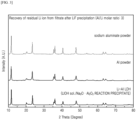
- FIG. 2 is a graph showing the results of analyzing the XRD crystal structure of lithium fluoride prepared by reacting lithium sludge with fluoride sludge at an equivalent ratio for each concentration according to Embodiment 2.
- the crystal structure of lithium fluoride prepared in Embodiment 2 was analyzed by using X-ray diffraction analysis (XRD; D/MAX 2200, Rigaku), and the same diffraction angle as that of the lithium fluoride reagent was measured.
- XRD X-ray diffraction analysis
- a lithium hydroxide solution with a lithium ion concentration of about 2,000 ppm was reacted with ammonium fluoride (NH 4 F), which is a precipitant, by stirring at a Li:F molar ratio of 1:2 for 24 hours to prepare lithium fluoride with a high lithium concentration.
- NH 4 F ammonium fluoride
- the lithium ion recovery rate was confirmed by using Equation 1 mentioned above.
- a lithium hydroxide solution with a lithium ion concentration of about 1,000 ppm was reacted with a hydrofluoric acid (HF) or ammonium fluoride (NH 4 F) solution, which is a precipitant, by stirring at a Li:F molar ratio of 1:1 for 24 hours to prepare lithium fluoride with a high lithium concentration.
- HF hydrofluoric acid
- NH 4 F ammonium fluoride
- a lithium hydroxide solution with a lithium ion concentration of about 2,000 ppm was reacted with a hydrofluoric acid (HF) or ammonium fluoride (NH 4 F) solution, which is a precipitant, by stirring at a Li:F molar ratio of 1:2 for 24 hours to prepare lithium fluoride with a high lithium concentration.
- HF hydrofluoric acid
- NH 4 F ammonium fluoride
- the lithium ion recovery rate was confirmed by using Equation 1 mentioned above.
- the hydrofluoric acid solution showed a large decrease in pH after mixing, and a decrease in reactivity caused therefrom was observed, which was similar to the trend shown in Embodiment 3 that the recovery rate decreased as the pH decreased.
- Lithium sludge discharged from a cathode material manufacturer (Company A) with a lithium ion concentration of about 2,000 ppm was reacted with fluoride sludge discharged from a display manufacturer (Company C) with a fluorine concentration of about 6 wt% by stirring at a Li:F molar ratio of 1:1 for 24 hours to prepare lithium fluoride-I with a high lithium concentration.
- the lithium ion recovery rate was confirmed by using Equation 1 mentioned above.
- wastewater discharged from the cathode material manufacturer (Company A) was used (lithium concentration: approximately 2,174 ppm) as lithium sludge, and wastewater discharged from the display manufacturer (Company C) was used (fluorine concentration: approximately 61,110 ppm) as fluoride sludge.
- lithium fluoride prepared after the reaction of lithium and fluorine was prepared at a lithium/fluorine molar ratio of 1.
- the concentration of fluorine contained in the used fluoride waste solution (24.2 mL applied) was about 61,110 ppm (mg/L), and the number of moles was 0.078 mol.
- the lithium concentration of the lithium sludge was diluted from 2,174.55 ppm to 1,981.93 ppm.
- the lithium ion recovery rate of about 78% was confirmed through calculation of residual lithium concentration before/after dilution by lithium-based reaction mixing and after reaction.
- Embodiment 5 the use of fluoride sludge and lithium sludge is expected to reduce the amount of Ca-based (e.g., CaO, Ca(OH) 2 and CaCl 2 ) precipitants used to remove existing fluoride ions by more than 77%.
- Ca-based e.g., CaO, Ca(OH) 2 and CaCl 2
- Conditions Cathode material manufacturer Li sludge (Company A)/ NH 4 F waste fluid (Company C)) Li/F molar ratio NH 4 F waste fluid (F - conc. 6%)(mL) Reaction time (hour) Li + conc. (ppm) Li + recovery rate (%) Li sludge/NH 4 F sludge (F - conc.: approximately 6%) 1 24.2 Initial 2174.552 24 436.992 77.9
- the lithium ion concentration of the sample filtrate remaining after the preparation of the high-concentration lithium fluoride-II was analyzed by inductively coupled plasma atomic emission spectroscopy (ICP-AES; Optima 7300D, Perkinelmer).
- the lithium ion concentration of the LiF reaction filtrate was confirmed to be 120.7 ppm, and the fluorine ion concentration was confirmed to be 435.5 ppm.
- the lithium ion recovery rate was confirmed by using Equation 1 mentioned above.
- reaction filtrate obtained after the preparation of lithium fluoride by reacting a lithium hydroxide solution with a lithium ion concentration of about 2,000 ppm with ammonium fluoride was reacted with sodium aluminate (NaAlO 2 ) or aluminum powder by stirring at a Al:Li molar ratio of 3:1 for 12 hours to prepare insoluble Li-Al LDH-I.
- the lithium ion concentration of the sample filtrate remaining after the preparation of the insoluble Li-Al LDH-I was analyzed by inductively coupled plasma atomic emission spectroscopy (ICP-AES; Optima 7300D, Perkinelmer), and the lithium ion recovery rate was confirmed to be over 99%.
- the lithium ion recovery rate was confirmed by using Equation 1 mentioned above.
- FIG. 3 is a graph showing the results of analyzing the XRD crystal structure of Li-Al LDH according to Embodiment 7.
- the crystal structure of lithium fluoride prepared in Embodiment 7 was analyzed by using X-ray diffraction analysis (XRD; D/MAX 2200, Rigaku), and the same diffraction angle as that of the Li-Al LDH prepared by reacting the sodium aluminate and lithium hydroxide solution was measured.
- XRD X-ray diffraction analysis
- reaction filtrate with the lithium ion concentration of 120.7 ppm obtained after the preparation of lithium fluoride in Embodiment 6 was reacted with sodium aluminate (NaAlO 2 ) by stirring at a Al:Li molar ratio of 2:1 for 12 hours to prepare insoluble Li-Al LDH-II.
- the lithium ion concentration of the sample filtrate remaining after the preparation of the insoluble Li-Al LDH-II was analyzed by inductively coupled plasma atomic emission spectroscopy (ICP-AES; Optima 7300D, Perkinelmer), and the lithium ion concentration of the Li-Al LDH-II reaction filtrate was confirmed to be 5.6 ppm.
- the lithium ion recovery rate was confirmed to be about 95% or more.
- the lithium ion recovery rate was confirmed by using Equation 1 mentioned above.
- Li-Al LDH-I prepared in Embodiment 7 10 g was mixed with 150 mL of 1 to 3 M sulfuric acid, and then subjected to a sulfation reaction and acid leaching for 6 hours to prepare a lithium concentrate, as shown in Table 7 below.
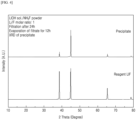
- FIG. 4 is a graph showing the results of analyzing the XRD crystal structure of lithium fluoride formed after the use of the MVR process to the reaction filtrate remaining after the preparation of the lithium fluoride according to Embodiment 11.
- the precipitate obtained by the separation of the filtrate and mechanical vapor recompression was analyzed, and the composition thereof showed similar to that of the LiF reagent.
- a solution of hydrofluoric acid and ammonium fluoride with a fluorine concentration of about 2 wt% or 6 wt% was prepared and then reacted for 24 hours by using calcium hydroxide (Ca(OH) 2 ), which is a conventional fluoride ion removal method, and the fluoride ion concentration of the remaining process water was analyzed by using ion chromatography (Metrohm, 881 Compact IC pro(Anion)).
- the reaction filtrate remaining after the preparation of the lithium fluoride (LiF) and Li-Al LDH-II in Embodiments 6 and 8 was reacted with calcium hydroxide (Ca(OH) 2 ) at a Ca/F 2 equivalent ratio of 1 to prepare calcium fluoride, and the fluoride ion concentration of the remaining process water was analyzed by using ion chromatography (Metrohm, 881 Compact IC pro(Anion)).
- the present disclosure can be used in a method for recovery of high value-added resources from lithium sludge generated in the process of manufacturing lithium secondary batteries or recycling the lithium secondary batteries after use, and from fluoride sludge generated in the process of manufacturing semiconductors.
Landscapes
- Chemical & Material Sciences (AREA)
- Engineering & Computer Science (AREA)
- Organic Chemistry (AREA)
- Materials Engineering (AREA)
- Manufacturing & Machinery (AREA)
- Life Sciences & Earth Sciences (AREA)
- Geology (AREA)
- Mechanical Engineering (AREA)
- General Life Sciences & Earth Sciences (AREA)
- Metallurgy (AREA)
- Environmental & Geological Engineering (AREA)
- Inorganic Chemistry (AREA)
- Geochemistry & Mineralogy (AREA)
- Chemical Kinetics & Catalysis (AREA)
- Electrochemistry (AREA)
- General Chemical & Material Sciences (AREA)
- Removal Of Specific Substances (AREA)
- Treatment Of Sludge (AREA)
Abstract
Description
- The present disclosure relates to a high value-added method for resource recovery from lithium sludge and fluoride sludge, comprising preparing lithium fluoride from lithium sludge generated in the process of manufacturing lithium secondary batteries or recycling lithium secondary batteries after use, and from fluoride sludge generated in the process of manufacturing semiconductors, and performing a resource recovery process which significantly reduces the amount of waste from calcium fluoride precipitates and residual process water.
- The demand for lithium secondary batteries (LIB) is rapidly increasing due to the rapid growth of the mid-to-large battery market for electric vehicles and energy storage systems (ESS).
- In addition to this rapid increase in demand for high-capacity batteries, the demand for cathode materials for NCM and NCA series is increasing significantly, as compared to the existing LCO, LMO, and LFP series.
- Unlike existing cathode materials that use lithium carbonate as a raw material, NCA and NCM series cathode materials are manufactured by using lithium hydroxide. When mixed with NCA and NCM precursors and fired to improve the high-capacity performance of lithium secondary batteries, excessive amounts of lithium hydroxide are used.
- Because of this, unreacted lithium compounds remain in the cathode material powder after manufacturing the cathode materials, which requires a subsequent process to remove the excessive amounts of lithium components through a water washing process of the cathode materials.
- Further, the concentration of lithium ions contained in the wastewater generated after water washing the cathode material is approximately 1,000 to 2,000 ppm (mg/L). Although the wastewater is a high-quality lithium raw material, the entire amount is currently being treated as wastewater due to the lack of economical extraction technology.
- Further, attempts to recover valuable metals (e.g., lithium, cobalt, nickel and manganese) from waste lithium secondary batteries generated after use are actively underway. Cobalt, nickel, manganese, etc. may be efficiently separated and recovered by applying solvent extraction. Although lithium is emitted at a concentration of over 3,000 ppm, there is a lack of economic separation technology therefor, and, thus, technology to overcome this is required to be developed.
- In addition to the rapid increase in demand for mid- to large-capacity lithium secondary batteries, rapid increase in the amount of lithium sludge generated in the process of manufacturing lithium secondary batteries or recycling lithium secondary batteries after use is also expected, and the development of economical recycling technology is urgently needed.
- Further, with the development of the information and communication industry, the demand for electronic devices using various semiconductor devices, liquid crystal displays (LCDs) and electroluminescent displays (LEDs) is increasing. Accordingly, the demand for hydrofluoric acid solution as an etching solution for wafers and circuit boards is also increasing.
- Wastewater generated in the semiconductor industry is discharged as organic wastewater, nitrogen wastewater, hydrofluoric acid wastewater, and acid/alkaline wastewater, and hydrofluoric acid wastewater generally accounts for 60 to 70% of the generated wastewater.
- As of 2018, domestic semiconductor processes generate 596 m3 of wastewater per day, and approximately 15,000 tons of hydrofluoric acid wastewater is discharged annually.
- Further, considering the growth potential and competitiveness of the semiconductor industry, it is expected that more than twice the current amount of hydrofluoric acid wastewater will be generated within the next five years, and preparation measures therefor are required.
- In the case of sludge (e.g., hydrofluoric acid, fluoride-based) generated in the semiconductor industry, additional economic and environmental cost problems are highlighted due to the problem of treatment costs and solid waste generated after treatment, but solutions are still insufficient.
- This is ultimately causing a weakening of corporate competitiveness in the IT industry, and interest in fluoride waste treatment technology is also increasing.
- To date, neutralization using slaked lime (calcium hydroxide, Ca(OH)2) has been applied as a method for treating waste hydrofluoric acid and fluoride solutions. Although the fluoride ion in the sludge is reduced to a certain concentration by forming/precipitating/separating CaF2 with low solubility through the reaction of slaked lime and fluoride, environmental regulations are still not met.
- As a result, the filtrate is diluted and discharged after repeated slaked lime treatment processes, or CaF2 is separated and buried after heating/concentration/crystallization.
- Recently, with the rapid increase in demand for lithium secondary batteries, measures to secure the four major components (i.e., anode, cathode, electrolyte and separator) are being highlighted. However, since core raw materials are still entirely dependent on imports, there is a need to develop technologies for self-sufficiency in core materials by using recycled resources.
- Through various studies, the applicant of the present disclosure has manufactured lithium fluoride, a raw material for lithium secondary battery electrolyte, by utilizing lithium sludge generated in the processes of manufacturing lithium secondary batteries and recycling waste lithium secondary batteries, and fluoride sludge generated in the semiconductor and display industries.
- Further, the applicants of the present disclosure have developed a method for recovery of high value-added resources from lithium sludge and fluoride sludge, as integrated processing technology capable of significantly reducing the amount of slaked lime used in the process of treating fluoride sludge and the amount of waste solids (CaF2) generated after treatment to suppress the environmental burden, and
securing economic feasibility and significantly reducing the amount of wastewater by introducing high-efficiency recovery technology for unrecovered lithium ions that may be generated in the process of manufacturing lithium fluoride. Thereafter, they have completed the present disclosure. - Accordingly, an objective of the present disclosure is to provide a method for recovery of high value-added resources from lithium sludge and fluoride sludge, comprising preparing lithium fluoride, which is a raw material for lithium secondary battery electrolyte, by using lithium sludge generated in the processes of manufacturing lithium secondary batteries and recycling waste lithium secondary batteries and fluoride sludge generated in the semiconductor and display industries.
- Further, an objective of the present disclosure is to provide a method for recovery of high value-added resources from lithium sludge and fluoride sludge, which can significantly reduce the amount of slaked lime used in the process of treating fluoride sludge and the amount of waste solids (CaF2) generated after the treatment to suppress the environmental burden.
- Further, an objective of the present disclosure is to provide a method for recovery of high value-added resources from lithium sludge and fluoride sludge, which can secure economic feasibility and significantly reduce the amount of wastewater by introducing high-efficiency recovery technology for unrecovered lithium ions that may be generated in the process of manufacturing lithium fluoride.
- The objectives of the present disclosure are not limited to the objects described above and other objectives will be clearly understood by those skilled in the art from the following description.
- In order to achieve the objectives, according to an aspect of the present disclosure, there is provided a method for recovery of high value-added resources from lithium sludge and fluoride sludge, comprising the steps of:
- (a-1) adding fluoride sludge, which is a precipitant, to lithium sludge, followed by precipitation and separation, to prepare lithium fluoride (LiF), which is an insoluble lithium compound;
- (a-2) reacting the reaction filtrate remaining after the preparation of the lithium fluoride, which is an insoluble lithium compound, with an aluminum compound to prepare Li-Al layered double hydroxide (LDH), which is an insoluble lithium compound;
- (a-3) subjecting the Li-Al layered double hydroxide (LDH), which is an insoluble lithium compound, to a sulfation reaction with a sulfuric acid compound to prepare a conversion product;
- (a-4) water leaching the lithium contained in the conversion product to prepare a lithium concentrate;
- (a-5) recirculating the lithium concentrate as a lithium raw material in the step of (a) preparing the lithium fluoride (LiF);
- (a-6) reacting the filtrate remaining after the preparation of the Li-Al layered double hydroxide (LDH), which is an insoluble lithium compound, with a calcium compound to separate the filtrate into a calcium fluoride precipitate and residual process water.
- According to one embodiment of the present disclosure, the lithium sludge may be lithium sludge generated in the processes of manufacturing lithium secondary batteries and recycling waste lithium secondary batteries, and
the fluoride sludge may be fluoride sludge generated in the semiconductor and display industries. - According to one embodiment of the present disclosure, the lithium sludge may comprise at least one selected from the group consisting of lithium hydroxide, lithium carbonate, lithium sulfate, lithium phosphate and lithium chloride, and
the form of the lithium sludge may comprise a solution or a slurry. - According to one embodiment of the present disclosure, the fluoride sludge may comprise at least one selected from the group consisting of sodium fluoride (NaF), ammonium fluoride (NH4F), potassium fluoride (KF), ferrous fluoride (FeF2), ferric fluoride (FeF3), aluminum fluoride (AlF3) and hydrogen fluoride (HF), and
the form of the fluoride sludge may comprise a solution or a slurry. - According to one embodiment of the present disclosure, the lithium sludge may have a lithium ion concentration of 200 ppm to 5,000 ppm.
- According to one embodiment of the present disclosure, the fluoride sludge may have a fluorine ion concentration of 500 ppm to 150,000 ppm.
- According to one embodiment of the present disclosure, the content ratio of lithium (Li) in the lithium sludge and fluorine (F) in the fluoride sludge may be a molar ratio of Li:F of 1:0.1 to 1:10.
- According to one embodiment of the present disclosure, the aluminum compound may be at least one selected from the group consisting of aluminum chloride, sodium aluminate, aluminum powder, aluminum hydroxide, aluminum sulfate and alumina.
- According to one embodiment of the present disclosure, the concentration of fluorine ions contained in the remaining process water after the precipitation of calcium fluoride may be 100 ppm or less.
- According to one embodiment of the present disclosure, the remaining process water may be recovered and used to adjust a pH for water treatment.
- According to one embodiment of the present disclosure, the lithium concentrate may comprise lithium (Li) ions, sulfuric acid (SO4) ions or metal (M) ions as ionic components.
- According to one embodiment of the present disclosure, the sulfuric acid compound may be at least one selected from the group consisting of:
sulfuric acid (H2SO4), sulfurous acid (H2SO3), hyposulphite (H2SO2), magnesium sulfate (MgSO4), magnesium sulfite (MgSO3), magnesium hyposulfite (MgSO2), calcium sulfate (CaSO4), calcium sulfite (CaSO3), calcium hyposulfite (CaSO2), sodium sulfate (Na2SO4), sodium sulfite (Na2SO3), sodium hyposulfite (Na2SO2), potassium sulfate (K2SO4), potassium sulfite (K2SO3), potassium hyposulfite (K2SO2), ferrous sulfate (FeSO4), ferrous sulfite (FeSO3), ferrous hyposulfite (FeSO2), ferric sulfate (Fe2(SO4)3), ferric sulfate (Fe2(SO3)3), ferric hyposulfite (Fe2(SO2)3), ammonium sulfate ((NH4)2SO4), sulfuric acid Aluminum (Al2(SO4)3), aluminum sulfite (Al2(SO3)3) and aluminum hyposulfite (Al2(SO2)3). - According to one embodiment of the present disclosure, the reaction temperature during the sulfation reaction between the Li-Al layered double hydroxide (LDH) and the sulfur acid compound may be 200°C to 1,000°C.
- According to one embodiment of the present disclosure, the reaction time for the sulfation reaction between the Li-Al layered double hydroxide (LDH) and the sulfuric acid compound may be 0.5 to 36 hours.
- According to one embodiment of the present disclosure, the solid/liquid ratio (solid/liquid, g/L) of the conversion product and water during the water leaching may be 30 g/L to 2,000 g/L.
- Further, according to another aspect of the present disclosure, there is provided a method for recovery of high value-added resources from lithium sludge and fluoride sludge, comprising the steps of:
- (b-1) adding fluoride sludge, which is a precipitant, to the lithium sludge, followed by precipitation and separation, to prepare lithium fluoride (LiF), which is an insoluble lithium compound;
- (b-2) subjecting the reaction filtrate remaining after the preparation of the lithium fluoride (LiF), which is an insoluble lithium compound, to mechanical vapor recompression (MVR) to additionally precipitate and separate lithium fluoride (LiF), and separating a concentrate containing trace amounts of lithium, fluorine and other cations and anions; and
- (b-3) reacting the concentrate containing trace amounts of lithium, fluorine and other cations and anions with a calcium compound to separate the concentrate into a calcium fluoride precipitate and residual process water.
- According to one embodiment of the present disclosure, the lithium sludge may be lithium sludge generated in the processes of manufacturing lithium secondary batteries and recycling waste lithium secondary batteries, and
the fluoride sludge may be fluoride sludge generated in the semiconductor and display industries. - According to one embodiment of the present disclosure, the lithium sludge may comprise at least one selected from the group consisting of lithium hydroxide, lithium carbonate, lithium sulfate, lithium phosphate and lithium chloride, and
the form of the lithium sludge may comprise a solution or a slurry. - According to one embodiment of the present disclosure, the fluoride sludge may comprise at least one selected from the group consisting of sodium fluoride (NaF), ammonium fluoride (NH4F), potassium fluoride (KF), ferrous fluoride (FeF2), ferric fluoride (FeF3), aluminum fluoride (AlF3) and hydrogen fluoride (HF), and
the form of the fluoride sludge may comprise a solution or a slurry. - According to one embodiment of the present disclosure, the lithium sludge may have a lithium ion concentration of 200 ppm to 5,000 ppm.
- According to one embodiment of the present disclosure, the fluoride sludge may have a fluorine ion concentration of 500 ppm to 150,000 ppm.
- According to one embodiment of the present disclosure, the content ratio of lithium (Li) in the lithium sludge and fluorine (F) in the fluoride sludge may be a molar ratio of Li:F of 1:0.1 to 1:10.
- According to one embodiment of the present disclosure, the concentration of fluorine ions contained in the remaining process water after the precipitation of calcium fluoride may be 100 ppm or less.
- According to one embodiment of the present disclosure, the remaining process water may be recovered and used to adjust a pH for water treatment.
- According to the present disclosure, there is provided a method for recovery of high value-added resources from lithium sludge generated in the processes of manufacturing lithium secondary batteries and recycling waste lithium secondary batteries and from fluoride sludge generated in the display industry, which reduces waste disposal costs and lithium fluoride recovery costs.
- Further, the present disclosure provides a method for recovery of high value-added resources from lithium sludge and fluoride sludge, which significantly reduces the amount of slaked lime used in the process of treating fluoride sludge and the amount of waste solids (CaF2) generated after the treatment, thereby significantly reducing the environmental burden and achieving high process efficiency.
- Further, the present disclosure provides a method for recovery of high value-added resources from lithium sludge and fluoride sludge, which can secure economic feasibility and significantly reduce the amount of wastewater by introducing high-efficiency recovery technology for unrecovered lithium ions that may be generated in the process of preparing lithium fluoride. Thus, such a method is environmentally friendly and economical.
- The effects of the present disclosure are not limited thereto and it should be understood that the effects include all effects that can be inferred from the configuration of the present disclosure described in the following specification or claims.
-
-
FIG. 1 is a process flow chart of a method for recovery of high value-added resources from lithium sludge and fluoride sludge according to an embodiment of the present disclosure. -
FIG. 2 is a graph showing the results of analyzing the XRD crystal structure of lithium fluoride prepared by reacting lithium sludge with fluoride sludge at an equivalent ratio for each concentration according to an embodiment of the present disclosure. -
FIG. 3 is a graph showing the results of analyzing the XRD crystal structure of Li-Al LDH prepared by reacting a filtrate remaining after the preparation of lithium fluoride with an aluminum compound according to an embodiment of the present disclosure. -
FIG. 4 is a graph showing the results of analyzing the XRD crystal structure of lithium fluoride formed after applying an MVR process to the reaction filtrate remaining after the preparation of lithium fluoride according to an embodiment of the present disclosure. - Hereinafter, preferred embodiments of the present disclosure will be described with reference to accompanying drawings.
- The advantages and features of the present disclosure, and methods of achieving them will be clear by referring to the exemplary embodiments that will be described hereafter in detail with reference to the accompanying drawings.
- However, the present disclosure is not limited to the exemplary embodiments described hereafter and may be implemented in various ways, and the exemplary embodiments are provided to complete the description of the present disclosure and let those skilled in the art completely know the scope of the present disclosure and the present disclosure is defined by claims.
- Further, when it is determined that well-known technologies, etc. may make the scope of the present disclosure unclear, they will not be described in detail in the following description.
- Hereinafter, the present disclosure is described in detail.
- The method for recovery of lithium fluoride from lithium sludge and fluoride sludge and high-efficiency lithium ion recovery method of the present disclosure comprises the steps of:
- (a-1) adding fluoride sludge, which is a precipitant, to lithium sludge, followed by precipitation and separation, to prepare lithium fluoride (LiF), which is an insoluble lithium compound;
- (a-2) reacting the reaction filtrate remaining after the preparation of the lithium fluoride, which is an insoluble lithium compound, with an aluminum compound to prepare Li-Al layered double hydroxide (LDH), which is an insoluble lithium compound;
- (a-3) subjecting the Li-Al layered double hydroxide (LDH), which is an insoluble lithium compound, to a sulfation reaction with a sulfuric acid compound to prepare a conversion product;
- (a-4) water leaching the lithium contained in the conversion product to prepare a lithium concentrate;
- (a-5) recirculating the lithium concentrate as a lithium raw material in the step of (a) preparing the lithium fluoride (LiF);
- (a-6) reacting the filtrate remaining after the preparation of the Li-Al layered double hydroxide (LDH), which is an insoluble lithium compound, with a calcium compound to separate the filtrate into a calcium fluoride precipitate and residual process water.
- Here, the method for recovery of lithium fluoride from lithium sludge and fluoride sludge and high-efficiency lithium ion recovery method provides a method for recovery of high value-added resources from lithium sludge generated in the processes of manufacturing lithium secondary batteries and recycling waste lithium secondary batteries and from fluoride sludge generated in the display industry, thereby reducing waste disposal costs and lithium fluoride recovery costs.
- Further, the method for recovery of lithium fluoride from lithium sludge and fluoride sludge and high-efficiency lithium ion recovery method provides a method for recovery of high value-added resources from lithium sludge and fluoride sludge, which significantly reduces the amount of slaked lime used in the process of treating fluoride sludge and the amount of waste solids (CaF2) generated after the treatment, thereby significantly reducing the environmental burden and achieving high process efficiency.
- Further, the method for recovery of lithium fluoride from lithium sludge and fluoride sludge and high-efficiency lithium ion recovery method provides a method for recovery of high value-added resources from lithium sludge and fluoride sludge, which can secure economic feasibility and significantly reduce the amount of wastewater by introducing high-efficiency recovery technology for unrecovered lithium ions that may be generated in the process of preparing lithium fluoride. Thus, such a method is environmentally friendly and economical.
- Further, the lithium sludge may be a solution or a slurry of at least one lithium compound selected from the group consisting of LiOH, LiCl, LiBr, Li2CO3, Li2SO4, Li3PO4 and LiAl(Si2O5)2, but the present disclosure is not limited thereto.
- Further, the lithium sludge may comprise at least one selected from the group consisting of lithium hydroxide, lithium carbonate, lithium sulfate, lithium phosphate and lithium chloride, and
the form of the lithium sludge may comprise a solution or a slurry. - Further, the lithium sludge may have a lithium ion concentration of 200 ppm to 5,000 ppm.
- At this time, the lithium ion concentration of the lithium sludge may preferably be 500 ppm to 4,000 ppm, and more preferably 800 ppm to 3,500 ppm.
- Further, the fluoride sludge may comprise at least one selected from the group consisting of sodium fluoride (NaF), ammonium fluoride (NH4F), potassium fluoride (KF), ferrous fluoride (FeF2), ferric fluoride (FeF3), aluminum fluoride (AlF3) and hydrogen fluoride (HF), and
the form of the fluoride sludge may comprise a solution or a slurry. - Here, the fluoride sludge may have a fluorine ion concentration of 500 ppm to 150,000 ppm.
- At this time, the fluoride ion concentration of the fluoride sludge may preferably be 800 ppm to 130,000 ppm, and more preferably 1,000 ppm to 120,000 ppm.
- Further, in the step of (a-1) adding fluoride sludge, which is a precipitant, to lithium sludge, followed by precipitation and separation, to prepare lithium fluoride (LiF), which is an insoluble lithium compound, lithium fluoride may be prepared by using the lithium sludge and the fluoride sludge, followed by precipitation and separation, to obtain lithium fluoride.
- Here, the content ratio of lithium (Li) in the lithium sludge and fluorine (F) in the fluoride sludge may be a molar ratio of Li:F of 1:0.1 to 1:10.
- At this time, when the content ratio of lithium (Li) in the lithium sludge and fluorine (F) in the fluoride sludge is less than a molar ratio of Li:F of 1:0.1, the content of the prepared lithium fluoride is insufficient, and, when the content ratio of lithium (Li) in the lithium sludge and fluorine (F) in the fluoride sludge exceeds a molar ratio of Li:F of 1:10, economic feasibility may be reduced.
- Further, the step of (a-2) reacting the reaction filtrate remaining after the preparation of the lithium fluoride, which is an insoluble lithium compound, with an aluminum compound to prepare Li-Al layered double hydroxide (LDH), which is an insoluble lithium compound,
the lithium ions in the reaction filtrate and the aluminum ions of the aluminum compound may react with hydroxide ions to prepare Li-Al layered double hydroxide (Li-Al LDH), which is an insoluble lithium compound. - Here, the aluminum compound may be at least one selected from the group consisting of aluminum chloride, sodium aluminate, aluminum powder, aluminum hydroxide, aluminum sulfate and alumina.
- Further, the layered double hydroxide (LDH) is a class of ionic solids characterized by a layered structure, generally with the layer sequence [AcB-Z-AcB]n. Here, c represents a layer of metal cations, and A and B are layers of hydroxide (OH-). Z is a layer of other anions or neutral molecules such as water. The inserted anions (Z) are weakly bound and exchangeable.
- Further, Li+ and Al3+ cations are combined with hydroxide ions to form the Li-Al layered double hydroxide (Li-Al LDH) represented by the following formula 1:
[Formula I] [Li+Al3+ 2(HO-)6]+[Li+Al3+ 2(X6-)·yH2O]-
wherein X6- is one or more anions, comprises hydroxide ions, and represents a total charge of -6; and y is generally 0.5 to 4. - Further, in the step of (a-3) subjecting the Li-Al layered double hydroxide (LDH), which is an insoluble lithium compound, to a sulfation reaction with a sulfuric acid compound to prepare a conversion product; and in the step of (a-4) water leaching the lithium contained in the conversion product to prepare a lithium concentrate,
the Li-Al layered double hydroxide (LDH) may be subjected to a sulfation reaction with the sulfuric acid compound and then water leached to prepare a lithium concentrate in which high concentrations of lithium (Li) ions, sulfuric acid (SO4) ions, or metal (M) ions are dissolved. - In the step of (a-5) recirculating the lithium concentrate as a lithium raw material in the step of (a) preparing the lithium fluoride (LiF), the lithium concentrate in which high concentrations of lithium (Li) ions, sulfuric acid (SO4) ions, or metal (M) ions are dissolved may be recirculated as a lithium raw material.
- At this time, the sulfuric acid compound may be at least one selected from the group consisting of:
sulfuric acid (H2SO4), sulfurous acid (H2SO3), hyposulphite (H2SO2), magnesium sulfate (MgSO4), magnesium sulfite (MgSO3), magnesium hyposulfite (MgSO2), calcium sulfate (CaSO4), calcium sulfite (CaSO3), calcium hyposulfite (CaSO2), sodium sulfate (Na2SO4), sodium sulfite (Na2SO3), sodium hyposulfite (Na2SO2), potassium sulfate (K2SO4), potassium sulfite (K2SO3), potassium hyposulfite (K2SO2), ferrous sulfate (FeSO4), ferrous sulfite (FeSO3), ferrous hyposulfite (FeSO2), ferric sulfate (Fe2(SO4)3), ferric sulfate (Fe2(SO3)3), ferric hyposulfite (Fe2(SO2)3), ammonium sulfate ((NH4)2SO4), sulfuric acid Aluminum (Al2(SO4)3), aluminum sulfite (Al2(SO3)3) and aluminum hyposulfite (Al2(SO2)3). - Further, the reaction temperature during the sulfation reaction between the Li-Al layered double hydroxide and the sulfuric acid compound may be 200°C to 1,000°C.
- Here, when the reaction temperature during the sulfation reaction is less than 200°C, there is a problem that the yield of the sulfation reaction is reduced, and, when the reaction temperature during the sulfation reaction is more than 1,000°C, there is a problem that manufacturing costs increase.
- At this time, the reaction time for the sulfation reaction between the Li-Al layered double hydroxide and the sulfuric acid compound may be 0.5 to 36 hours.
- Here, when the reaction time during the sulfation reaction is less than 0.5 hours, there is a problem that the yield of the sulfur oxidation reaction is reduced, and, when the reaction time during the sulfation reaction is more than 36 hours, there is a problem that manufacturing costs increase.
- Further, the solid/liquid ratio (solid/liquid, g/L) of the conversion product and water during the water leaching may be 30 g/L to 2,000 g/L.
- Here, when the solid/liquid ratio (solid/liquid, g/L) of the conversion product and water is less than 30 g/L, there is a problem in that the lithium ion concentration of the prepared lithium concentrate is low, and, when the solid/liquid ratio (solid/liquid, g/L) of the conversion product and water exceeds 2,000 g/L, there is a problem in that the lithium solution recovery rate is lowered.
- Further, in the step of (a-6) reacting the filtrate remaining after the preparation of the Li-Al layered double hydroxide (LDH), which is an insoluble lithium compound, with a calcium compound to separate the filtrate into a calcium fluoride precipitate and residual process water, the filtrate is reacted with a calcium compound to precipitate calcium fluoride, and the remaining process water is separated.
- Here, the concentration of fluorine ions contained in the remaining process water after the precipitation of the calcium fluoride may be 100 ppm or less.
- At this time, the fluorine ion concentration contained in the remaining process water after the precipitation of calcium fluoride may be preferably 80 ppm or less, and more preferably 40 ppm.
- Further, the remaining process water may be recovered and used to adjust a pH for water treatment.
-
FIG. 1 is a process flow chart of a method for recovery of high value-added resources from lithium sludge and fluoride sludge according to an embodiment of the present disclosure. - Referring to
FIG. 1 ,fluoride sludge 101 generated in the semiconductor and display industries may be reacted withlithium sludge 102 generated in the processes of manufacturing lithium secondary batteries and recycling waste lithium secondary batteries, followed by first-step precipitation andseparation 103, to preparelithium fluoride 104, which is an insoluble lithium compound. - Then, the reaction filtrate remaining after first-step precipitation and
separation 103 may be reacted with an aluminum compound, followed by extraction andconversion 105, to prepare Li-Al LDH, which is an insoluble lithium compound. - Then, the Li-Al LDH, which is an insoluble lithium compound, may be subjected to a sulfation reaction and water leached to prepare a lithium concentrate, followed by
recirculation 106 as a lithium raw material. - Further, the reaction filtrate remaining after the preparation of the Li-Al LDH, which is an insoluble lithium compound, may be reacted with a calcium compound, followed by second-step precipitation and
separation 109, to separate the filtrate into a calcium fluoride precipitate and residual process water. - The method for preparation of lithium fluoride from lithium sludge and fluoride sludge and high-efficiency sludge treatment method of the present disclosure comprises the steps of:
- (b-1) adding fluoride sludge, which is a precipitant, to the lithium sludge, followed by precipitation and separation, to prepare lithium fluoride (LiF), which is an insoluble lithium compound;
- (b-2) subjecting the reaction filtrate remaining after the preparation of the lithium fluoride (LiF), which is an insoluble lithium compound, to mechanical vapor recompression (MVR) to additionally precipitate and separate lithium fluoride (LiF), and separating a concentrate containing trace amounts of lithium, fluorine and other cations and anions; and
- (b-3) reacting the concentrate containing trace amounts of lithium, fluorine and other cations and anions with a calcium compound to separate the concentrate into a calcium fluoride precipitate and residual process water.
- Here, the method for preparation of lithium fluoride from lithium sludge and fluoride sludge and high-efficiency sludge treatment method provides a method for recovery of high value-added resources and sludge treatment method, comprising preparing lithium fluoride from lithium sludge generated in the processes of manufacturing lithium secondary batteries and recycling waste lithium secondary batteries and from fluoride sludge generated in the semiconductor and display industries, thereby reducing waste disposal costs and lithium fluoride recovery costs.
- Further, the method for preparation of lithium fluoride from lithium sludge and fluoride sludge and high-efficiency sludge treatment method provides a method for recovery of high value-added resources from lithium sludge and fluoride sludge, which significantly reduces the amount of slaked lime used in the process of treating fluoride sludge and the amount of waste solids (CaF2) generated after the treatment, thereby significantly reducing the environmental burden and achieving high process efficiency.
- Further, the method for preparation of lithium fluoride from lithium sludge and fluoride sludge and high-efficiency sludge treatment method provides a method for recovery of high value-added resources from lithium sludge and fluoride sludge, which can secure economic feasibility and significantly reduce the amount of wastewater by introducing a high-efficiency recovery technology for unrecovered lithium ions that may be generated during the preparation of lithium fluoride. Thus, such a method is environmentally friendly and economical.
- Further, the lithium sludge may be a solution or a slurry of at least one lithium compound selected from the group consisting of LiOH, LiCl, LiBr, Li2CO3, Li2SO4, Li3PO4 and LiAl(Si2O5)2, but the present disclosure is not limited thereto.
- Further, the lithium sludge may comprise at least one selected from the group consisting of lithium hydroxide, lithium carbonate, lithium sulfate, lithium phosphate and lithium chloride, and
the form of the lithium sludge may comprise a solution or a slurry. - Further, the lithium sludge may have a lithium ion concentration of 200 ppm to 5,000 ppm.
- At this time, the lithium ion concentration of the lithium sludge may preferably be 500 ppm to 4,000 ppm, and more preferably 800 ppm to 3,500 ppm.
- Further, the fluoride sludge may comprise at least one selected from the group consisting of sodium fluoride (NaF), ammonium fluoride (NH4F), potassium fluoride (KF), ferrous fluoride (FeF2), ferric fluoride (FeF3), aluminum fluoride (AlF3) and hydrogen fluoride (HF), and
the form of the fluoride sludge may comprise a solution or a slurry. - Here, the fluoride sludge may have a fluorine ion concentration of 500 ppm to 150,000 ppm.
- At this time, the fluoride ion concentration of the fluoride sludge may preferably be 800 ppm to 130,000 ppm, and more preferably 1,000 ppm to 120,000 ppm.
- Further, in the step of (b-1) adding fluoride sludge, which is a precipitant, to the lithium sludge, followed by precipitation and separation, to prepare lithium fluoride (LiF), which is an insoluble lithium compound, lithium fluoride may be prepared by using the lithium sludge and the fluoride sludge, followed by precipitation and separation, to obtain lithium fluoride.
- Here, the content ratio of lithium (Li) in the lithium sludge and fluorine (F) in the fluoride sludge may be a molar ratio of Li:F of 1:0.1 to 1:10.
- At this time, when the content ratio of lithium (Li) in the lithium sludge and fluorine (F) in the fluoride sludge is less than a molar ratio of Li:F of 1:0.1, the content of the prepared lithium fluoride is insufficient, and, when the content ratio of lithium (Li) in the lithium sludge and fluorine (F) in the fluoride sludge exceeds a molar ratio of Li:F of 1:10, economic feasibility may be reduced.
- Further, the step of (b-2) subjecting the reaction filtrate remaining after the preparation of the lithium fluoride (LiF), which is an insoluble lithium compound, to mechanical vapor recompression (MVR) to additionally precipitate and separate lithium fluoride (LiF), and separating a concentrate containing trace amounts of lithium, fluorine and other cations and anions, the precipitated lithium fluoride (LiF) is separated, and a concentrated solution containing trace amounts of lithium, fluorine, and other cations and anions is then separated and obtained.
- Thereafter, in the step of (b-3) reacting the concentrate containing trace amounts of lithium, fluorine and other cations and anions with a calcium compound to separate the concentrate into a calcium fluoride precipitate and residual process water, the concentrate is reacted with a calcium compound to precipitate calcium fluoride, and the remaining process water is separated.
- Here, the concentration of fluorine ions contained in the remaining process water after the precipitation of the calcium fluoride may be 100 ppm or less.
- At this time, the fluorine ion concentration contained in the remaining process water after the precipitation of the calcium fluoride may be preferably 80 ppm or less, and more preferably 40 ppm.
- Further, the remaining process water may be recovered and used to adjust a pH for water treatment.
-
FIG. 1 is a process flow chart of a method for recovery of high value-added resources from lithium sludge and fluoride sludge according to an embodiment of the present disclosure. - Referring to
FIG. 1 ,fluoride sludge 101 generated in the semiconductor and display industries may be reacted withlithium sludge 102 generated in the processes of manufacturing lithium secondary batteries and recycling waste lithium secondary batteries, followed by first-step precipitation andseparation 103, to preparelithium fluoride 104, which is an insoluble lithium compound. - Then, the reaction filtrate obtained after first-step precipitation and
separation 103 may be subjected to mechanical vapor recompression (MVR) 107 to additionally precipitate and separate lithium fluoride (LiF), and a concentrate containing trace amounts of lithium, fluorine and other cations and anions may be separated, and
the concentrate may be reacted with a calcium compound, followed by second-step precipitation andseparation 109, to separate the concentrate into a calcium fluoride precipitate and residual process water. - Hereafter, preferred embodiments are proposed to help understand the present disclosure, but the following embodiments just exemplify the present disclosure and the scope of the present disclosure is not limited to the following embodiments. The following embodiments may be appropriately modified and changed by those skilled in the art within the scope of the present disclosure.
- Lithium carbonate, lithium hydroxide, lithium sulfate, and lithium chloride solutions with a lithium ion concentration of about 2,000 ppm were reacted with ammonium fluoride (NH4F), which is a precipitant, by stirring at a Li:F molar ratio of 1:1 for 24 hours to prepare lithium fluoride with a high lithium concentration.
- Thereafter, the lithium ion concentration of the sample filtrate remaining after the preparation of the high-concentration lithium fluoride was analyzed by inductively coupled plasma atomic emission spectroscopy (ICP-AES; Optima 7300D, Perkinelmer), and the lithium ion recovery rate was confirmed as shown in Table 1 below.
- The lithium ion recovery rate was confirmed by using
Equation 1 below:
- Qo: Total amount of lithium ions contained in the lithium solution (mg)
- Q: Total amount of lithium ions contained in the lithium solution after the precipitation reaction (mg)
- Referring to Table 1 below, the lithium hydroxide solution with high initial pH showed the highest lithium recovery rate under equivalent ratio conditions.
[Table 1] Conditions (Li solution: Li+ 2,000 ppm, 100 mL, 400RPM) Reactant (NH4F) Equivalent ratio (Li/F) Initial pH Reaction time (hour) Li+ conc. (ppm) Li+ recovery rate (%) LiOH sol. 1 12.6 Initial 2036.72 - 24 358.003 82.423 LiCl sol. 5.6 Initial 2062.082 - 24 421.6 79.555 Li2SO4 sol. 8.9 Initial 2195.497 - 24 579.505 73.605 Li2CO3 sol. 10.1 Initial 2058.755 - 24 559.540 72.821 - Lithium hydroxide solutions with a lithium ion concentration of about 1,000 ppm and 2,000 ppm were reacted with ammonium fluoride (NH4F), which is a precipitant, by stirring at a Li:F molar ratio of 1:1 for 24 hours to prepare lithium fluoride with a high lithium concentration.
- Thereafter, the lithium ion concentration of the sample filtrate remaining after the preparation of the high-concentration lithium fluoride was analyzed by inductively coupled plasma atomic emission spectroscopy (ICP-AES; Optima 7300D, Perkinelmer), and the lithium ion recovery rate was confirmed as shown in Table 2 below.
- The lithium ion recovery rate was confirmed by using
Equation 1 mentioned above. -
FIG. 2 is a graph showing the results of analyzing the XRD crystal structure of lithium fluoride prepared by reacting lithium sludge with fluoride sludge at an equivalent ratio for each concentration according toEmbodiment 2. - Referring to
FIG. 2 , the crystal structure of lithium fluoride prepared inEmbodiment 2 was analyzed by using X-ray diffraction analysis (XRD; D/MAX 2200, Rigaku), and the same diffraction angle as that of the lithium fluoride reagent was measured. - Referring to Table 2 below, it was analyzed that the lithium recovery rate increased as the initial lithium ion concentration increased.
[Table 2] Conditions (Li/F molar ratio = 1), 100mL, 24h, 400RPM Lithium ion concentration (initial concentration, ppm) Li+ conc. (ppm) Li+ recovery rate (%) LiOH + NH4F 1,094.796 451.149 58.792 2036.72 358.003 82.423 - A lithium hydroxide solution with a lithium ion concentration of about 2,000 ppm was reacted with ammonium fluoride (NH4F), which is a precipitant, by stirring at a Li:F molar ratio of 1:2 for 24 hours to prepare lithium fluoride with a high lithium concentration.
- Thereafter, the lithium ion concentration of the sample filtrate remaining after the preparation of the high-concentration lithium fluoride was analyzed by inductively coupled plasma atomic emission spectroscopy (ICP-AES; Optima 7300D, Perkinelmer), and the lithium ion recovery rate was confirmed as shown in Table 3 below.
- The lithium ion recovery rate was confirmed by using
Equation 1 mentioned above. - Referring to Table 3 below, it was analyzed that the recovery rate decreased as the pH decreased.
[Table 3] Conditions (Li solution: Li+ 2,000 ppm, 100 mL, 24h) Reactant (NH4F) Equivalent ratio (Li/F) pH adjusted after mixing/reaction Li+ conc. (ppm) Li+ recovery rate (%) pH control: H2SO4 sol. 1 Initial pH 287.786 86.3 10.9 405.156 80.946 9.1 434.487 79.566 6.9 509.773 76.026 4.8 602.798 71.651 3.1 937.823 55.895 pH control: HCl sol. Initial pH 287.786 86.3 10.7 363.266 82.916 9.2 384.611 81.912 6.9 411.352 80.654 5.1 456.073 78.551 3 708.044 66.701 - A lithium hydroxide solution with a lithium ion concentration of about 1,000 ppm was reacted with a hydrofluoric acid (HF) or ammonium fluoride (NH4F) solution, which is a precipitant, by stirring at a Li:F molar ratio of 1:1 for 24 hours to prepare lithium fluoride with a high lithium concentration.
- A lithium hydroxide solution with a lithium ion concentration of about 2,000 ppm was reacted with a hydrofluoric acid (HF) or ammonium fluoride (NH4F) solution, which is a precipitant, by stirring at a Li:F molar ratio of 1:2 for 24 hours to prepare lithium fluoride with a high lithium concentration.
- Thereafter, the lithium ion concentration of the sample filtrate remaining after the preparation of the high-concentration lithium fluoride was analyzed by inductively coupled plasma atomic emission spectroscopy (ICP-AES; Optima 7300D, Perkinelmer), and the lithium ion recovery rate was confirmed as shown in Table 4 below.
- The lithium ion recovery rate was confirmed by using
Equation 1 mentioned above. - Referring to Table 4 below, the hydrofluoric acid solution showed a large decrease in pH after mixing, and a decrease in reactivity caused therefrom was observed, which was similar to the trend shown in
Embodiment 3 that the recovery rate decreased as the pH decreased. - Further, it was confirmed that the higher the lithium ion concentration, the higher the lithium fluoride recovery rate.
[Table 4] Conditions (HF vs NH4F), 100mL, 24h, 400RPM Fluoride Initial pH of LiOH Final pH of mixture Initial lithium ion concentration (ppm) Lithium ion concentration after reaction (ppm) Li+ recovery rate (%) LiOH sol. (Li+conc.: 2,000 ppm) Li/F molar ratio = 1 HF 12.6 4.2 2036.72 432.297 78.774 NH4F 12.6 11.3 2036.72 358.003 82.423 LiOH sol. (Li+conc.: 1,000 ppm) Li/F molar ratio = 1 HF 12.5 4.6 1094.796 493.305 54.941 NH4F 12.5 11.2 1094.796 451.149 58,792 - Lithium sludge discharged from a cathode material manufacturer (Company A) with a lithium ion concentration of about 2,000 ppm was reacted with fluoride sludge discharged from a display manufacturer (Company C) with a fluorine concentration of about 6 wt% by stirring at a Li:F molar ratio of 1:1 for 24 hours to prepare lithium fluoride-I with a high lithium concentration.
- Thereafter, the lithium ion concentration of the sample filtrate remaining after the preparation of the high-concentration lithium fluoride-I was analyzed by inductively coupled plasma atomic emission spectroscopy (ICP-AES; Optima 7300D, Perkinelmer), and the lithium ion recovery rate was confirmed as shown in Table 5 below.
- The lithium ion recovery rate was confirmed by using
Equation 1 mentioned above. - Referring to Table 5 below, wastewater discharged from the cathode material manufacturer (Company A) was used (lithium concentration: approximately 2,174 ppm) as lithium sludge, and wastewater discharged from the display manufacturer (Company C) was used (fluorine concentration: approximately 61,110 ppm) as fluoride sludge.
- After reaction of lithium sludge and fluoride sludge, a lithium recovery rate of about 78% was analyzed.
- In Embodiment 5, lithium fluoride prepared after the reaction of lithium and fluorine was prepared at a lithium/fluorine molar ratio of 1.
- The concentration of fluorine contained in the used fluoride waste solution (24.2 mL applied) was about 61,110 ppm (mg/L), and the number of moles was 0.078 mol.
- Approximately 249 mL of lithium sludge (Li+ conc.: 2,174 ppm) was used according to the reaction ratio (Li/F molar ratio: approximately 1).
- By simply mixing lithium sludge (249 mL) and fluoride sludge (24.2 mL) by the dilution factor of about 11.29 times, the initial fluorine concentration decreased from 61,110 ppm to about 5,413 ppm.
- After the simple mixing, the lithium concentration of the lithium sludge was diluted from 2,174.55 ppm to 1,981.93 ppm.
- The lithium ion recovery rate of about 78% was confirmed through calculation of residual lithium concentration before/after dilution by lithium-based reaction mixing and after reaction.
- Accordingly, about 0.06 mol of fluoride ion was consumed to form lithium fluoride, and 5,413 ppm of fluorine after dilution and about 1,196 ppm of fluorine after lithium fluoride reaction remained, and, thus, the fluoride ion consumption rate was confirmed to be about 77.9%.
- In Embodiment 5, the use of fluoride sludge and lithium sludge is expected to reduce the amount of Ca-based (e.g., CaO, Ca(OH)2 and CaCl2) precipitants used to remove existing fluoride ions by more than 77%.
[Table 5] Conditions (Cathode material manufacturer Li sludge (Company A)/ NH4F waste fluid (Company C)) Li/F molar ratio NH4F waste fluid (F- conc. 6%)(mL) Reaction time (hour) Li+ conc. (ppm) Li+ recovery rate (%) Li sludge/NH4F sludge (F- conc.: approximately 6%) 1 24.2 Initial 2174.552 24 436.992 77.9 - 600 mL of lithium sludge discharged from the cathode material manufacturer (Company A) with a lithium ion concentration of about 2,500 ppm was reacted with 145.2 mL of fluoride sludge discharged from the display manufacturer (Company C) with a fluorine concentration of about 6 wt% by stirring at a Li:F molar ratio of 1:1 for 24 hours to prepare lithium fluoride-II with a high lithium concentration.
- Thereafter, the lithium ion concentration of the sample filtrate remaining after the preparation of the high-concentration lithium fluoride-II was analyzed by inductively coupled plasma atomic emission spectroscopy (ICP-AES; Optima 7300D, Perkinelmer). The lithium ion concentration of the LiF reaction filtrate was confirmed to be 120.7 ppm, and the fluorine ion concentration was confirmed to be 435.5 ppm.
- After the reaction of lithium sludge and fluoride sludge, a lithium recovery rate of about 94% was analyzed.
- The lithium ion recovery rate was confirmed by using
Equation 1 mentioned above. - The reaction filtrate obtained after the preparation of lithium fluoride by reacting a lithium hydroxide solution with a lithium ion concentration of about 2,000 ppm with ammonium fluoride was reacted with sodium aluminate (NaAlO2) or aluminum powder by stirring at a Al:Li molar ratio of 3:1 for 12 hours to prepare insoluble Li-Al LDH-I.
- Thereafter, the lithium ion concentration of the sample filtrate remaining after the preparation of the insoluble Li-Al LDH-I was analyzed by inductively coupled plasma atomic emission spectroscopy (ICP-AES; Optima 7300D, Perkinelmer), and the lithium ion recovery rate was confirmed to be over 99%.
- The lithium ion recovery rate was confirmed by using
Equation 1 mentioned above. -
FIG. 3 is a graph showing the results of analyzing the XRD crystal structure of Li-Al LDH according to Embodiment 7. - Referring to
FIG. 3 , the crystal structure of lithium fluoride prepared in Embodiment 7 was analyzed by using X-ray diffraction analysis (XRD; D/MAX 2200, Rigaku), and the same diffraction angle as that of the Li-Al LDH prepared by reacting the sodium aluminate and lithium hydroxide solution was measured. - The reaction filtrate with the lithium ion concentration of 120.7 ppm obtained after the preparation of lithium fluoride in Embodiment 6 was reacted with sodium aluminate (NaAlO2) by stirring at a Al:Li molar ratio of 2:1 for 12 hours to prepare insoluble Li-Al LDH-II.
- Thereafter, the lithium ion concentration of the sample filtrate remaining after the preparation of the insoluble Li-Al LDH-II was analyzed by inductively coupled plasma atomic emission spectroscopy (ICP-AES; Optima 7300D, Perkinelmer), and the lithium ion concentration of the Li-Al LDH-II reaction filtrate was confirmed to be 5.6 ppm.
- The lithium ion recovery rate was confirmed to be about 95% or more.
- The lithium ion recovery rate was confirmed by using
Equation 1 mentioned above. - 15 g of the Li-Al LDH-I prepared in Embodiment 7 was subjected to a sulfation reaction of sulfate roasting by mixing the Li-Al LDH-I with 30 mL of 1.15 to 4 M sulfuric acid and raising the temperature to 280°C for 30 minutes, followed by maintaining for 2 hours, to prepare a conversion product, and the conversion product and water were water leached at a solid-liquid ratio of 1g/5mL to prepare a lithium concentrate, as shown in Table 6 below.
- As a result of the sulfation reaction/water leaching experiment of Li-Al LDH-I, it was confirmed that more than 95% of the contained lithium was recovered when the sulfuric acid concentration was 2 M to 3 M or more.
- Further, it was observed that, when the concentration of sulfuric acid was 3 M or more, the aluminum component was converted into aluminum sulfate and leached together with lithium.
- Further, it was analyzed that as the concentration of sulfuric acid increased, the amount of the aluminum component, in addition to lithium, increased. In the case of sulfate roasting where the sulfuric acid concentration was 5 M or more, it was confirmed that the reverse reaction that the lithium sulfate and aluminum sulfate formed in the roasting reaction were leached together to form Li-Al LDH-I occurred, or the concentration of Li ions in the solution decreased due to the relatively low content of lithium contained in the conversion product.
- Therefore, from the experimental results, it is considered that the roasting conditions of the 2 M sulfuric acid solution are appropriate.
[Table 6] Conditions Conditions for sulfate roasting Conditions for water leaching Concentration (mg/L, ppm) Weight (g) of Li-Al LDH-I Volume (mL) of H2SO4 Conversion product (g) by sulfate roasting Water (mL) Li Al 1.15 M H2SO4 15 30 1 5 4,241 N.D. 2 M H2SO4 5,161 N.D. 3 M H2SO4 5,047 435 4 M H2SO4 3,876 3,407 - 10 g of the Li-Al LDH-I prepared in Embodiment 7 was mixed with 150 mL of 1 to 3 M sulfuric acid, and then subjected to a sulfation reaction and acid leaching for 6 hours to prepare a lithium concentrate, as shown in Table 7 below.
- As a result of the sulfation reaction/acid leaching experiment of Li-Al LDH-I, when the concentration of sulfuric acid was 1 M or more, the concentration of Li ions was leached to be more than 1,000 ppm. It is considered that, as the concentration of sulfuric acid increases, the concentration of Al ions increases, and, thus, a sulfuric acid concentration of 1 M or less is appropriate.
- It was confirmed that a lithium concentrate might be converted into a lithium concentrate of more than 3,000 ppm by adjusting the leaching solid (Li-Al-LDH,g)/liquid (acid solution, mL) ratio.
[Table 7] Concentration (mg/L, ppm) Conditions Weight (g) of Li-Al LDH-I Volume (mL) of H2SO4 Li Al 1 M H2SO4 10 150 1,620 14,000 2 M H2SO4 1,650 14,280 3 M H2SO4 1,590 14,443 - The crystal structure of the precipitate precipitated by using mechanical vapor recompression (MVR) to the reaction filtrate remaining after the preparation of the lithium fluoride in Embodiment 4 was analyzed by using X-ray diffraction analysis (XRD; D/MAX 2200, Rigaku), and the same diffraction angle as that of reagent grade lithium fluoride (LiF) was measured.
-
FIG. 4 is a graph showing the results of analyzing the XRD crystal structure of lithium fluoride formed after the use of the MVR process to the reaction filtrate remaining after the preparation of the lithium fluoride according to Embodiment 11. - Referring to
FIG. 4 , the precipitate obtained by the separation of the filtrate and mechanical vapor recompression was analyzed, and the composition thereof showed similar to that of the LiF reagent. - A solution of hydrofluoric acid and ammonium fluoride with a fluorine concentration of about 2 wt% or 6 wt% was prepared and then reacted for 24 hours by using calcium hydroxide (Ca(OH)2), which is a conventional fluoride ion removal method, and the fluoride ion concentration of the remaining process water was analyzed by using ion chromatography (Metrohm, 881 Compact IC pro(Anion)).
- Referring to Table 8 below, fluoride sludge with a fluoride ion concentration of about 2 wt% was reacted with calcium hydroxide at a Ca/F2 molar ratio of 1 to 2, and, when the Ca/F2 molar ratio was 1.5 or more, the fluorine concentration of 500 ppm or less was observed. It is considered that, even if the Ca/F2 ratio is increased in the general CaF2 precipitation reaction, it is difficult to remove fluoride ions below a certain concentration from a high-concentration fluoride solution.
[Table 8] Conditions (HF, NH4F sol. 50mL. 24h, 400RPM) By equivalent ratio (Ca/F2) F- conc. (ppm) HF sol. (F-conc. 2%, 50mL)+ Ca(OH)2 1 561.682 1.5 488.477 2 492.470 NH4F sol. (F-conc. 2%, 50mL)+Ca(OH)2 1 529.738 1.5 499.125 2 479.160 - Referring to Table 9 below, after reacting the high-concentration fluoride sludge (F-conc. > 6%) with calcium hydroxide at a Ca/F2 equivalent ratio of 1, a fluorine concentration of 500 ppm or less was observed, and it was confirmed that the ammonium fluoride solution had a higher fluoride ion removal rate than hydrofluoric acid.
[Table 9] Conditions (HF, NH4F sol. 50mL. 24h, 400RPM) Equivalent ratio (Ca/F2) Reaction time (h) F conc. (ppm) HF sol. (F-conc. 2%, 50mL)+ Ca(OH)2 1 24 561.682 HF sol. (F-conc. 6%, 50mL)+ Ca(OH)2 496.463 NH4F sol. (F-conc. 2%, 50mL)+Ca(OH)2 529.738 NH4F sol. (F-conc. 6%, 50mL)+Ca(OH)2 447.216 - The reaction filtrate remaining after the preparation of the lithium fluoride (LiF) and Li-Al LDH-II in Embodiments 6 and 8 was reacted with calcium hydroxide (Ca(OH)2) at a Ca/F2 equivalent ratio of 1 to prepare calcium fluoride, and the fluoride ion concentration of the remaining process water was analyzed by using ion chromatography (Metrohm, 881 Compact IC pro(Anion)).
- After reacting the filtrate remaining after the preparation of the lithium fluoride (LiF) and Li-Al LDH-II with calcium hydroxide at a Ca/F2 equivalent ratio of 1, the fluorine concentration of the discharged solution was confirmed to decrease from about 435.5 ppm to 24.8 ppm.
- Embodiments about a method for recovery of high value-added resources from lithium sludge and fluoride sludge according to the present disclosure were described above, but it is apparent that various modifications may be achieved without departing from the scope of the present disclosure.
- Therefore, the scope of the present disclosure should not be limited to the embodiment(s) and should be determined by not only the following claims, but equivalents of the claims.
- That is, it should be understood that the embodiments described above are not limitative, but only examples in all respects, the scope of the present disclosure is expressed by claims described below, not the detailed description, and it should be construed that all of changes and modifications achieved from the meanings and scope of claims and equivalent concept are included in the scope of the present disclosure.
- The present disclosure can be used in a method for recovery of high value-added resources from lithium sludge generated in the process of manufacturing lithium secondary batteries or recycling the lithium secondary batteries after use, and from fluoride sludge generated in the process of manufacturing semiconductors.
Claims (16)
- A method for recovery of high value-added resources from lithium sludge and fluoride sludge, comprising:(a-1) adding fluoride sludge, which is a precipitant, to lithium sludge, followed by precipitation and separation, to prepare lithium fluoride (LiF), which is an insoluble lithium compound;(a-2) reacting the reaction filtrate remaining after the preparation of the lithium fluoride, which is an insoluble lithium compound, with an aluminum compound to prepare Li-Al layered double hydroxide (LDH), which is an insoluble lithium compound;(a-3) subjecting the Li-Al layered double hydroxide (LDH), which is an insoluble lithium compound, to a sulfation reaction with a sulfuric acid compound to prepare a conversion product;(a-4) water leaching the lithium contained in the conversion product to prepare a lithium concentrate;(a-5) recirculating the lithium concentrate as a lithium raw material in the step of (a) preparing the lithium fluoride (LiF);(a-6) reacting the filtrate remaining after the preparation of the Li-Al layered double hydroxide (LDH), which is an insoluble lithium compound, with a calcium compound to separate the filtrate into a calcium fluoride precipitate and residual process water.
- A method for recovery of high value-added resources from lithium sludge and fluoride sludge of claim 1, comprising:(b-1) adding fluoride sludge, which is a precipitant, to the lithium sludge, followed by precipitation and separation, to prepare lithium fluoride (LiF), which is an insoluble lithium compound;(b-2) subjecting the reaction filtrate remaining after the preparation of the lithium fluoride (LiF), which is an insoluble lithium compound, to mechanical vapor recompression (MVR) to additionally precipitate and separate lithium fluoride (LiF), and separating a concentrate containing trace amounts of lithium, fluorine and other cations and anions; and(b-3) reacting the concentrate containing trace amounts of lithium, fluorine and other cations and anions with a calcium compound to separate the concentrate into a calcium fluoride precipitate and residual process water.
- The method for recovery of high value-added resources from lithium sludge and fluoride sludge of claim 1 or 2, wherein the lithium sludge is lithium sludge generated in the processes of manufacturing lithium secondary batteries and recycling waste lithium secondary batteries, and
the fluoride sludge is fluoride sludge generated in the semiconductor and display industries. - The method for recovery of high value-added resources from lithium sludge and fluoride sludge of claim 1 or 2, wherein the lithium sludge comprises at least one selected from the group consisting of lithium hydroxide, lithium carbonate, lithium sulfate, lithium phosphate and lithium chloride, and
the form of the lithium sludge comprises a solution or a slurry. - The method for recovery of high value-added resources from lithium sludge and fluoride sludge of claim 1 or 2, wherein the fluoride sludge comprises at least one selected from the group consisting of sodium fluoride (NaF), ammonium fluoride (NH4F), potassium fluoride (KF), ferrous fluoride (FeF2), ferric fluoride (FeF3), aluminum fluoride (AlF3) and hydrogen fluoride (HF), and
the form of the fluoride sludge comprises a solution or a slurry. - The method for recovery of high value-added resources from lithium sludge and fluoride sludge of claim 1 or 2, wherein the lithium sludge has a lithium ion concentration of 200 ppm to 5,000 ppm.
- The method for recovery of high value-added resources from lithium sludge and fluoride sludge of claim 1 or 2, wherein the fluoride sludge has a fluorine ion concentration of 500 ppm to 150,000 ppm.
- The method for recovery of high value-added resources from lithium sludge and fluoride sludge of claim 1 or 2, wherein the content ratio of lithium (Li) in the lithium sludge and fluorine (F) in the fluoride sludge is a molar ratio of Li:F of 1:0.1 to 1:10.
- The method for recovery of high value-added resources from lithium sludge and fluoride sludge of claim 1, wherein the aluminum compound is at least one selected from the group consisting of aluminum chloride, sodium aluminate, aluminum powder, aluminum hydroxide, aluminum sulfate and alumina.
- The method for recovery of high value-added resources from lithium sludge and fluoride sludge of claim 1 or 2, wherein the concentration of fluorine ions contained in the remaining process water after the precipitation of calcium fluoride is 100 ppm or less.
- The method for recovery of high value-added resources from lithium sludge and fluoride sludge of claim 1 or 2, wherein the remaining process water is recovered and used to adjust a pH for water treatment.
- The method for recovery of high value-added resources from lithium sludge and fluoride sludge of claim 1, wherein the lithium concentrate comprises lithium (Li) ions, sulfuric acid (SO4) ions or metal (M) ions as ionic components.
- The method for recovery of high value-added resources from lithium sludge and fluoride sludge of claim 1, wherein the sulfuric acid compound is at least one selected from the group consisting of:
sulfuric acid (H2SO4), sulfurous acid (H2SO3), hyposulphite (H2SO2), magnesium sulfate (MgSO4), magnesium sulfite (MgSO3), magnesium hyposulfite (MgSO2), calcium sulfate (CaSO4), calcium sulfite (CaSO3), calcium hyposulfite (CaSO2), sodium sulfate (Na2SO4), sodium sulfite (Na2SO3), sodium hyposulfite (Na2SO2), potassium sulfate (K2SO4), potassium sulfite (K2SO3), potassium hyposulfite (K2SO2), ferrous sulfate (FeSO4), ferrous sulfite (FeSO3), ferrous hyposulfite (FeSO2), ferric sulfate (Fe2(SO4)3), ferric sulfate (Fe2(SO3)3), ferric hyposulfite (Fe2(SO2)3), ammonium sulfate ((NH4)2SO4), sulfuric acid Aluminum (Al2(SO4)3), aluminum sulfite (Al2(SO3)3) and aluminum hyposulfite (Al2(SO2)3). - The method for recovery of high value-added resources from lithium sludge and fluoride sludge of claim 1, wherein the reaction temperature during the sulfation reaction between the Li-Al layered double hydroxide (LDH) and the sulfur acid compound is 200°C to 1,000°C.
- The method for recovery of high value-added resources from lithium sludge and fluoride sludge of claim 1, wherein the reaction time for the sulfation reaction between the Li-Al layered double hydroxide (LDH) and the sulfuric acid compound is 0.5 to 36 hours.
- The method for recovery of high value-added resources from lithium sludge and fluoride sludge of claim 1, wherein the solid/liquid ratio (solid/liquid, g/L) of the conversion product and water during the water leaching is 30 g/L to 2,000 g/L.
Applications Claiming Priority (2)
| Application Number | Priority Date | Filing Date | Title |
|---|---|---|---|
| KR1020210088260A KR102378751B1 (en) | 2021-07-06 | 2021-07-06 | Method for recovering high value resources from lithium waste solution and fluoride waste solution |
| PCT/KR2022/009621 WO2023282564A1 (en) | 2021-07-06 | 2022-07-04 | High value-added method for resource recovery from lithium sludge and fluoride sludge |
Publications (2)
| Publication Number | Publication Date |
|---|---|
| EP4368574A1 true EP4368574A1 (en) | 2024-05-15 |
| EP4368574A4 EP4368574A4 (en) | 2025-01-15 |
Family
ID=80935256
Family Applications (1)
| Application Number | Title | Priority Date | Filing Date |
|---|---|---|---|
| EP22837916.0A Pending EP4368574A4 (en) | 2021-07-06 | 2022-07-04 | High value-added method for resource recovery from lithium sludge and fluoride sludge |
Country Status (5)
| Country | Link |
|---|---|
| US (1) | US20240247334A1 (en) |
| EP (1) | EP4368574A4 (en) |
| KR (1) | KR102378751B1 (en) |
| CA (1) | CA3220297A1 (en) |
| WO (1) | WO2023282564A1 (en) |
Families Citing this family (13)
| Publication number | Priority date | Publication date | Assignee | Title |
|---|---|---|---|---|
| KR102378751B1 (en) * | 2021-07-06 | 2022-03-25 | 한국지질자원연구원 | Method for recovering high value resources from lithium waste solution and fluoride waste solution |
| JP7797263B2 (en) * | 2022-03-18 | 2026-01-13 | 大陽日酸株式会社 | Lithium fluoride manufacturing method |
| KR102774974B1 (en) | 2022-05-27 | 2025-03-04 | 한국생산기술연구원 | Selective leaching method for separation and recovery of lithium in waste batteries and method for producing lithium compounds using the same |
| CN115010293A (en) * | 2022-05-31 | 2022-09-06 | 安徽超越环保科技股份有限公司 | A method for treating useful components in mixed waste acid containing heavy metal ions |
| CN115557520B (en) * | 2022-08-29 | 2023-11-10 | 昆明理工大学 | Method for recycling lithium from lithium silicate waste residues |
| KR102672766B1 (en) * | 2023-01-03 | 2024-06-07 | 한국지질자원연구원 | High-efficiency lithium recovery method from low-concentration lithium waste liquid through process improvement and lithium carbonate manufactured thereby |
| KR102672767B1 (en) * | 2023-01-06 | 2024-06-07 | 한국지질자원연구원 | Method for recovering lithium from leachate of waste lithium primary batteries and method for manufacturing lithium chloride from the lithium |
| KR20240173800A (en) * | 2023-06-07 | 2024-12-16 | 에스케이이노베이션 주식회사 | Method of recycling transition metal of lithium secondary battery |
| KR20250061160A (en) | 2023-10-27 | 2025-05-08 | 주식회사 에코프로이노베이션 | Manufacturing method for lithium fluoride with particle size control |
| KR20250061162A (en) | 2023-10-27 | 2025-05-08 | 주식회사 에코프로이노베이션 | Manufacturing method for lithium fluoride using seeds |
| WO2025179162A1 (en) * | 2024-02-21 | 2025-08-28 | Hulico LLC | Fluoride capture from wastewater |
| KR102791351B1 (en) * | 2024-08-06 | 2025-04-07 | (주)세화이에스 | Method of improving yield of lithium solution through concentration and crystallization |
| CN119495862B (en) * | 2025-01-20 | 2025-04-29 | 宁德时代新能源科技股份有限公司 | Method for recycling waste graphite lithium ion battery negative electrode plate |
Family Cites Families (10)
| Publication number | Priority date | Publication date | Assignee | Title |
|---|---|---|---|---|
| JP5847741B2 (en) * | 2013-02-18 | 2016-01-27 | Jx日鉱日石金属株式会社 | Waste cathode material and method for recovering metal from waste battery |
| KR101771596B1 (en) | 2017-03-07 | 2017-08-28 | 성일하이텍(주) | Manufacturing method of lithium salt from waste solution containing lithium |
| KR102016817B1 (en) * | 2017-12-28 | 2019-09-02 | 타운마이닝리소스주식회사 | A Method Of Preparing A Precursor Material By Recycling A Wasted Lithium Secondary Battery Cathode Material |
| KR102030446B1 (en) * | 2019-04-04 | 2019-10-10 | 한국지질자원연구원 | Method for concentrating and recovering of lithium by addition of aluminum compound and heat treatment from lithium solution and recycling method of aluminum by-product made thereby |
| KR102033607B1 (en) * | 2019-04-04 | 2019-10-17 | (주)세화브이엘 | Method for concentrating of lithium by addition of aluminum compound and sulfation reaction from lithium solution and recycling method of by-product made thereby |
| KR102206952B1 (en) * | 2019-04-22 | 2021-01-25 | 코스모에코켐(주) | Manufacturing Method of Mixed Metal Compounds for Preparing Precursors from Waste Cathode Active Material Powders |
| KR20210009133A (en) * | 2019-07-16 | 2021-01-26 | 한국교통대학교산학협력단 | A method for recovering lithium or lithium compound and valuable metals from a waste cathode material for a lithium secondary battery |
| KR102242686B1 (en) * | 2020-12-14 | 2021-04-21 | 한국지질자원연구원 | Method for manufacturing lithium concentrate and method for manufacturing lithium compound using lithium concentrate manufactured therefrom |
| KR102275866B1 (en) * | 2021-01-18 | 2021-07-12 | 한국지질자원연구원 | Method for manufacturing high efficiency lithium concentrate and method for manufacturing lithium compound using lithium concentrate manufactured therefrom |
| KR102378751B1 (en) * | 2021-07-06 | 2022-03-25 | 한국지질자원연구원 | Method for recovering high value resources from lithium waste solution and fluoride waste solution |
-
2021
- 2021-07-06 KR KR1020210088260A patent/KR102378751B1/en active Active
-
2022
- 2022-07-04 US US18/290,355 patent/US20240247334A1/en active Pending
- 2022-07-04 CA CA3220297A patent/CA3220297A1/en active Pending
- 2022-07-04 EP EP22837916.0A patent/EP4368574A4/en active Pending
- 2022-07-04 WO PCT/KR2022/009621 patent/WO2023282564A1/en not_active Ceased
Also Published As
| Publication number | Publication date |
|---|---|
| US20240247334A1 (en) | 2024-07-25 |
| CA3220297A1 (en) | 2023-01-12 |
| WO2023282564A1 (en) | 2023-01-12 |
| EP4368574A4 (en) | 2025-01-15 |
| KR102378751B9 (en) | 2023-05-11 |
| KR102378751B1 (en) | 2022-03-25 |
Similar Documents
| Publication | Publication Date | Title |
|---|---|---|
| EP4368574A1 (en) | High value-added method for resource recovery from lithium sludge and fluoride sludge | |
| EP4464665A1 (en) | Method for recovery of valuable metals and zeolite-containing material from waste cathode material reaction vessel | |
| KR102442036B1 (en) | Method for recovering manganese compound from waste cathode active material | |
| EP4261298A1 (en) | Method for processing lithium ion battery waste | |
| EP4324792A1 (en) | Method for producing lithium-concentrated solution with high recovery rate, and method for producing lithium compound using same | |
| CN114524572B (en) | Comprehensive treatment method for wastewater generated in iron phosphate production | |
| KR102275866B1 (en) | Method for manufacturing high efficiency lithium concentrate and method for manufacturing lithium compound using lithium concentrate manufactured therefrom | |
| US20250183398A1 (en) | Method using solvent extraction for selective recovery of valuable metal from lithium secondary battery waste material | |
| US10995413B2 (en) | Sulfide recycling in manganese production | |
| CN113921932B (en) | Precursor solution, preparation method thereof, positive electrode material and lithium ion battery | |
| KR20240049385A (en) | Method and equipment for recovering metal from black mass | |
| JP2024507474A (en) | Method for producing cathode active material precursor | |
| Klaehn et al. | Removal of impurity Metals as Phosphates from Lithium-ion Battery leachates | |
| US12091326B2 (en) | Method for producing manganese(II) sulfate monohydrate from by-product of zinc refining process | |
| KR101944522B1 (en) | Manufacturing method of high-concentration lithium solution from lithium phosphate | |
| CN107403931B (en) | Process for preparing high purity phosphates | |
| CN114572953A (en) | Method for removing metal impurities in ferrous phosphate acidic solution and application | |
| CN118239518A (en) | Method for preparing high-purity manganese carbonate, manganese sulfate or manganous oxide by using rhodochrosite | |
| AU2022387821A1 (en) | Selective acid leaching of mixed hydroxide precipitate | |
| RU2855112C1 (en) | Method for hydrometallurgical processing of components of spent high-nickel lithium-ion batteries | |
| RU2838963C1 (en) | Method of producing aqueous solution of nickel sulphate from nickel-containing raw material | |
| US20250349922A1 (en) | Impurity management process for lithium-ion battery recycling | |
| RU2793756C1 (en) | Method for lithium extraction, method for obtaining lithium carbonate and method for obtaining lithium hydroxide | |
| US20250263316A1 (en) | Fluoride capture from wastewater | |
| WO2026039005A1 (en) | A method for the recovery of anode sludges and their use as a raw material for phosphate coating chemical product |
Legal Events
| Date | Code | Title | Description |
|---|---|---|---|
| STAA | Information on the status of an ep patent application or granted ep patent |
Free format text: STATUS: THE INTERNATIONAL PUBLICATION HAS BEEN MADE |
|
| PUAI | Public reference made under article 153(3) epc to a published international application that has entered the european phase |
Free format text: ORIGINAL CODE: 0009012 |
|
| STAA | Information on the status of an ep patent application or granted ep patent |
Free format text: STATUS: REQUEST FOR EXAMINATION WAS MADE |
|
| 17P | Request for examination filed |
Effective date: 20231114 |
|
| AK | Designated contracting states |
Kind code of ref document: A1 Designated state(s): AL AT BE BG CH CY CZ DE DK EE ES FI FR GB GR HR HU IE IS IT LI LT LU LV MC MK MT NL NO PL PT RO RS SE SI SK SM TR |
|
| DAV | Request for validation of the european patent (deleted) | ||
| DAX | Request for extension of the european patent (deleted) | ||
| A4 | Supplementary search report drawn up and despatched |
Effective date: 20241217 |
|
| RIC1 | Information provided on ipc code assigned before grant |
Ipc: C01F 11/22 20060101ALI20241211BHEP Ipc: H01M 10/54 20060101ALI20241211BHEP Ipc: C01D 3/02 20060101ALI20241211BHEP Ipc: C01D 15/04 20060101AFI20241211BHEP |