EP4368570A1 - Cathode active material for lithium secondary battery and lithium secondary battery including the same - Google Patents
Cathode active material for lithium secondary battery and lithium secondary battery including the same Download PDFInfo
- Publication number
- EP4368570A1 EP4368570A1 EP23194046.1A EP23194046A EP4368570A1 EP 4368570 A1 EP4368570 A1 EP 4368570A1 EP 23194046 A EP23194046 A EP 23194046A EP 4368570 A1 EP4368570 A1 EP 4368570A1
- Authority
- EP
- European Patent Office
- Prior art keywords
- active material
- cathode active
- secondary battery
- equation
- plane
- Prior art date
- Legal status (The legal status is an assumption and is not a legal conclusion. Google has not performed a legal analysis and makes no representation as to the accuracy of the status listed.)
- Pending
Links
Images

Classifications
-
- C—CHEMISTRY; METALLURGY
- C01—INORGANIC CHEMISTRY
- C01B—NON-METALLIC ELEMENTS; COMPOUNDS THEREOF; METALLOIDS OR COMPOUNDS THEREOF NOT COVERED BY SUBCLASS C01C
- C01B25/00—Phosphorus; Compounds thereof
- C01B25/16—Oxyacids of phosphorus; Salts thereof
- C01B25/26—Phosphates
- C01B25/30—Alkali metal phosphates
-
- H—ELECTRICITY
- H01—ELECTRIC ELEMENTS
- H01M—PROCESSES OR MEANS, e.g. BATTERIES, FOR THE DIRECT CONVERSION OF CHEMICAL ENERGY INTO ELECTRICAL ENERGY
- H01M4/00—Electrodes
- H01M4/02—Electrodes composed of, or comprising, active material
- H01M4/36—Selection of substances as active materials, active masses, active liquids
- H01M4/58—Selection of substances as active materials, active masses, active liquids of inorganic compounds other than oxides or hydroxides, e.g. sulfides, selenides, tellurides, halogenides or LiCoFy; of polyanionic structures, e.g. phosphates, silicates or borates
- H01M4/5825—Oxygenated metallic salts or polyanionic structures, e.g. borates, phosphates, silicates, olivines
-
- B—PERFORMING OPERATIONS; TRANSPORTING
- B82—NANOTECHNOLOGY
- B82Y—SPECIFIC USES OR APPLICATIONS OF NANOSTRUCTURES; MEASUREMENT OR ANALYSIS OF NANOSTRUCTURES; MANUFACTURE OR TREATMENT OF NANOSTRUCTURES
- B82Y30/00—Nanotechnology for materials or surface science, e.g. nanocomposites
-
- C—CHEMISTRY; METALLURGY
- C01—INORGANIC CHEMISTRY
- C01B—NON-METALLIC ELEMENTS; COMPOUNDS THEREOF; METALLOIDS OR COMPOUNDS THEREOF NOT COVERED BY SUBCLASS C01C
- C01B25/00—Phosphorus; Compounds thereof
- C01B25/16—Oxyacids of phosphorus; Salts thereof
- C01B25/26—Phosphates
- C01B25/45—Phosphates containing plural metal, or metal and ammonium
-
- H—ELECTRICITY
- H01—ELECTRIC ELEMENTS
- H01M—PROCESSES OR MEANS, e.g. BATTERIES, FOR THE DIRECT CONVERSION OF CHEMICAL ENERGY INTO ELECTRICAL ENERGY
- H01M10/00—Secondary cells; Manufacture thereof
- H01M10/05—Accumulators with non-aqueous electrolyte
- H01M10/052—Li-accumulators
-
- H—ELECTRICITY
- H01—ELECTRIC ELEMENTS
- H01M—PROCESSES OR MEANS, e.g. BATTERIES, FOR THE DIRECT CONVERSION OF CHEMICAL ENERGY INTO ELECTRICAL ENERGY
- H01M10/00—Secondary cells; Manufacture thereof
- H01M10/05—Accumulators with non-aqueous electrolyte
- H01M10/058—Construction or manufacture
-
- H—ELECTRICITY
- H01—ELECTRIC ELEMENTS
- H01M—PROCESSES OR MEANS, e.g. BATTERIES, FOR THE DIRECT CONVERSION OF CHEMICAL ENERGY INTO ELECTRICAL ENERGY
- H01M4/00—Electrodes
- H01M4/02—Electrodes composed of, or comprising, active material
- H01M4/13—Electrodes for accumulators with non-aqueous electrolyte, e.g. for lithium-accumulators; Processes of manufacture thereof
- H01M4/131—Electrodes based on mixed oxides or hydroxides, or on mixtures of oxides or hydroxides, e.g. LiCoOx
-
- H—ELECTRICITY
- H01—ELECTRIC ELEMENTS
- H01M—PROCESSES OR MEANS, e.g. BATTERIES, FOR THE DIRECT CONVERSION OF CHEMICAL ENERGY INTO ELECTRICAL ENERGY
- H01M4/00—Electrodes
- H01M4/02—Electrodes composed of, or comprising, active material
- H01M4/36—Selection of substances as active materials, active masses, active liquids
- H01M4/362—Composites
- H01M4/366—Composites as layered products
-
- H—ELECTRICITY
- H01—ELECTRIC ELEMENTS
- H01M—PROCESSES OR MEANS, e.g. BATTERIES, FOR THE DIRECT CONVERSION OF CHEMICAL ENERGY INTO ELECTRICAL ENERGY
- H01M4/00—Electrodes
- H01M4/02—Electrodes composed of, or comprising, active material
- H01M4/62—Selection of inactive substances as ingredients for active masses, e.g. binders, fillers
- H01M4/624—Electric conductive fillers
- H01M4/625—Carbon or graphite
-
- C—CHEMISTRY; METALLURGY
- C01—INORGANIC CHEMISTRY
- C01P—INDEXING SCHEME RELATING TO STRUCTURAL AND PHYSICAL ASPECTS OF SOLID INORGANIC COMPOUNDS
- C01P2002/00—Crystal-structural characteristics
- C01P2002/50—Solid solutions
- C01P2002/52—Solid solutions containing elements as dopants
- C01P2002/54—Solid solutions containing elements as dopants one element only
-
- C—CHEMISTRY; METALLURGY
- C01—INORGANIC CHEMISTRY
- C01P—INDEXING SCHEME RELATING TO STRUCTURAL AND PHYSICAL ASPECTS OF SOLID INORGANIC COMPOUNDS
- C01P2002/00—Crystal-structural characteristics
- C01P2002/60—Compounds characterised by their crystallite size
-
- C—CHEMISTRY; METALLURGY
- C01—INORGANIC CHEMISTRY
- C01P—INDEXING SCHEME RELATING TO STRUCTURAL AND PHYSICAL ASPECTS OF SOLID INORGANIC COMPOUNDS
- C01P2002/00—Crystal-structural characteristics
- C01P2002/70—Crystal-structural characteristics defined by measured X-ray, neutron or electron diffraction data
- C01P2002/72—Crystal-structural characteristics defined by measured X-ray, neutron or electron diffraction data by d-values or two theta-values, e.g. as X-ray diagram
-
- C—CHEMISTRY; METALLURGY
- C01—INORGANIC CHEMISTRY
- C01P—INDEXING SCHEME RELATING TO STRUCTURAL AND PHYSICAL ASPECTS OF SOLID INORGANIC COMPOUNDS
- C01P2006/00—Physical properties of inorganic compounds
- C01P2006/40—Electric properties
-
- H—ELECTRICITY
- H01—ELECTRIC ELEMENTS
- H01M—PROCESSES OR MEANS, e.g. BATTERIES, FOR THE DIRECT CONVERSION OF CHEMICAL ENERGY INTO ELECTRICAL ENERGY
- H01M4/00—Electrodes
- H01M4/02—Electrodes composed of, or comprising, active material
- H01M2004/021—Physical characteristics, e.g. porosity, surface area
-
- H—ELECTRICITY
- H01—ELECTRIC ELEMENTS
- H01M—PROCESSES OR MEANS, e.g. BATTERIES, FOR THE DIRECT CONVERSION OF CHEMICAL ENERGY INTO ELECTRICAL ENERGY
- H01M4/00—Electrodes
- H01M4/02—Electrodes composed of, or comprising, active material
- H01M2004/026—Electrodes composed of, or comprising, active material characterised by the polarity
- H01M2004/028—Positive electrodes
-
- Y—GENERAL TAGGING OF NEW TECHNOLOGICAL DEVELOPMENTS; GENERAL TAGGING OF CROSS-SECTIONAL TECHNOLOGIES SPANNING OVER SEVERAL SECTIONS OF THE IPC; TECHNICAL SUBJECTS COVERED BY FORMER USPC CROSS-REFERENCE ART COLLECTIONS [XRACs] AND DIGESTS
- Y02—TECHNOLOGIES OR APPLICATIONS FOR MITIGATION OR ADAPTATION AGAINST CLIMATE CHANGE
- Y02E—REDUCTION OF GREENHOUSE GAS [GHG] EMISSIONS, RELATED TO ENERGY GENERATION, TRANSMISSION OR DISTRIBUTION
- Y02E60/00—Enabling technologies; Technologies with a potential or indirect contribution to GHG emissions mitigation
- Y02E60/10—Energy storage using batteries
Definitions
- the disclosure of this patent application relates to a cathode active material for a lithium secondary battery and a lithium secondary battery including the same.
- a secondary battery which can be charged and discharged repeatedly has been widely employed as a power source of a mobile electronic device such as a camcorder, a mobile phone, a laptop computer, etc., according to developments of information and display technologies. Recently, a battery pack including the secondary battery is being developed and applied as an eco-friendly power source of an electric automobile, a hybrid vehicle, etc.
- the secondary battery includes, e.g., a lithium secondary battery, a nickel-cadmium battery, a nickel-hydrogen battery, etc.
- the lithium secondary battery is being actively developed due to high operational voltage and energy density per unit weight, a high charging rate, a compact dimension, etc.
- a lithium metal phosphate may be used as a cathode active material of the lithium secondary battery.
- a low-temperature performance of the lithium secondary battery may be deteriorated due to a low ionic conductivity of the lithium metal phosphate.
- a cathode active material for a lithium secondary battery having improved low-temperature stability and operational reliability.
- a lithium secondary battery including a cathode active material for a lithium secondary battery with improved low-temperature stability and operational reliability.
- a cathode active material for a lithium secondary battery includes a lithium metal phosphate particle having a crystallite size in a range from 150 nm to 450 nm in a direction of a (020) plane as measured by an X-ray diffraction (XRD) analysis.
- XRD X-ray diffraction
- the crystallite size of the lithium metal phosphate particle in the direction of the (020) plane may be in a range from 250 nm to 400 nm.
- the crystallite size of the lithium metal phosphate particle in the direction of the (020) plane may be measured using Equation 1 below.
- Lp 020 0.9 ⁇ ⁇ cos ⁇
- Lp(020) is the crystallite size (nm) of the lithium metal phosphate particle in the direction of the (020) plane
- ⁇ is an X-ray wavelength (nm)
- ⁇ is a full width at half maximum (rad) of a peak corresponding to the (020) plane
- ⁇ is a diffraction angle (rad).
- a particle crystallite size ratio measured by an XRD analysis and defined by Equation 2 is greater than 0 and less than 1.
- particle crystallite size ratio Lp 020 / Lp 200
- Lp(020) is the crystallite size (nm) in the direction of the (020) plane of the lithium metal phosphate particle
- Lp(200) is a crystallite size (nm) in a direction of a (200) plane of the lithium metal phosphate particle.
- Lp(200) of Equation 2 may be measured using Equation 3.
- Lp 200 0.9 ⁇ ⁇ cos ⁇
- Lp(200) is the crystallite size (nm) of the lithium metal phosphate particle in the direction of the (200) plane
- ⁇ is an X-ray wavelength (nm)
- ⁇ is a full width at half maximum (rad) of a peak corresponding to the (200) plane
- ⁇ is a diffraction angle (rad).
- the particle crystallite size ratio may be in a range from 0.80 to 0.99.
- the lithium metal phosphate particle may include an olivine crystal structure represented by Chemical Formula 1.
- Chemical Formula 1 Li a M x P y O 4+z
- 0.9 ⁇ a ⁇ 1.2, 0.99 ⁇ x ⁇ 1.01, 0.9 ⁇ y ⁇ 1.2, -0.1 ⁇ z ⁇ 0.1, and M includes at least one selected from the group consisting of Fe, Co, Ni and Mn.
- the lithium metal phosphate particle may further include a doping element or a coating element, and the doping element or the coating element may include at least one selected from the group consisting of Na, Mg, Ca, Y, Ti, Hf, V, Nb, Ta, Cr, Mo, W, Fe, Cu, Ag, Zn, B, Al, Ga, C, Si, Sn, Sr, Ba, Ra, P and Zr.
- the lithium metal phosphate particle may further include a carbon coating formed on a surface thereof.
- the direction of the (020) plane of the lithium metal phosphate particle is a direction in which lithium ions are diffused or transferred.
- a lithium secondary battery includes a cathode including a cathode active material layer that includes a cathode active material for a lithium secondary battery, and an anode facing the cathode.
- Le(020) is a crystallite size (nm) in a direction of a (020) plane measured by an XRD analysis on the cathode active material layer
- Le(200) is a crystallite size (nm) in a direction of a (200) plane direction measured by the XRD analysis on the cathode active material layer.
- Le(020) of Equation may be measured using Equation 5
- Le(200) may be measured using Equation 6.
- Le 020 0.9 ⁇ ⁇ cos ⁇
- Le 200 0.9 ⁇ ⁇ cos ⁇
- Le(020) is the crystallite grain size (nm) in the direction of the (020) plane measured by the XRD analysis on the cathode active material layer
- ⁇ is an X-ray wavelength (nm)
- ⁇ is a full width at half maximum (rad) of a peak corresponding to the (020) plane measured by the XRD analysis on the cathode active material layer
- ⁇ is a diffraction angle (rad).
- Le(200) is the crystallite grain size (nm) in the direction of the (200) plane measured by the XRD analysis on the cathode active material layer
- ⁇ is an X-ray wavelength (nm)
- ⁇ is a full width at half maximum (rad) of a peak corresponding to the (200) plane measured by the XRD analysis on the cathode active material layer
- ⁇ is a diffraction angle (rad).
- Le(020) in Equation 4 may be in a range from 120 nm to 370 nm.
- a cathode active material for a lithium secondary battery according to embodiments of the present disclosure includes lithium metal phosphate particles.
- a crystallite size of the lithium metal phosphate particles in a (020) plane direction measured through am X-ray diffraction (XRD) analysis may be adjusted within a desired range. Accordingly, a diffusion distance of lithium ions may be reduced, and power properties and an energy density at low temperature may be improved. Additionally, process efficiency may be improved and an excessive increase of a specific surface area may be suppressed.
- XRD X-ray diffraction
- a ratio of the crystallite size of the lithium metal phosphate particles in the (020) plane direction relative to a crystallite size in a (200) plane direction measured by the XRD analysis may be controlled within a desired range. Accordingly, a discharge capacity and the energy density at low temperature may be improved while maintaining structural stability of the lithium metal phosphate particles.
- the cathode active material and the lithium secondary battery of the present disclosure may be widely applied in green technology fields such as an electric vehicle, a battery charging station, solar power generation wind power generation using other batteries, etc.
- the cathode active material for a lithium secondary battery and the lithium secondary battery according to the present disclosure may be used for eco-friendly electric vehicles and hybrid vehicles to prevent a climate change by suppressing air pollution and greenhouse gas emissions, etc.
- FIGS. 1 and 2 are a schematic plan view and a schematic cross-sectional view, respectively, illustrating a lithium secondary battery in accordance with exemplary embodiments.
- a cathode active material for a lithium secondary battery including a lithium metal phosphate particle is provided.
- a lithium secondary battery including the cathode active material is provided.
- a cathode active material for a lithium secondary battery (hereinafter, that may be abbreviated as a cathode active material) includes a lithium metal phosphate particle.
- the lithium metal phosphate particle may have a crystallite size from 150 nm to 450 nm in a (020) plane direction measured by an X-ray diffraction (XRD) analysis.
- the crystallite size may be in a range from 250 nm to 400 nm, or from 300 nm to 350 nm.
- the direction of the (020) plane of the lithium metal phosphate particle may be a direction in which lithium ions may be diffused or transferred.
- the crystallite size in the direction of the (020) plane decreases, a transfer distance of the lithium ions become shortened, and thus power properties and an energy density at low temperature may be improved.
- the crystallite size of the lithium metal phosphate particle in the direction of the (020) plane is less than 150 nm, a particle diameter of the lithium metal phosphate particle becomes excessively small, resulting in a reduction of process efficiency and an excessive increase of a BET specific surface area of the lithium metal phosphate particle. Accordingly, side reactions between the cathode active material and an electrolyte may be increased.
- the diffusion distance of the lithium ions may be excessively increased. Accordingly, a discharge capacity and the energy density at low temperature at which a transfer speed of the lithium ions decreases may be lowered.
- the crystallite size of the lithium metal phosphate particle in the direction of the (020) plane may be measured using a Scherrer equation represented by Equation 1 below in the XRD analysis.
- Lp 020 0.9 ⁇ ⁇ cos ⁇
- Lp(020) is the crystallite size (nm) in the direction of the (020) plane of the lithium metal phosphate particle
- ⁇ is an X-ray wavelength (nm)
- ⁇ is a full width at half maximum of a peak corresponding to the (020) plane of the lithium metal phosphate particle
- ⁇ is a diffraction angle (rad).
- ⁇ may be a full width at half maximum from which a device-derived value is corrected.
- a crystallite size ratio measured by the XRD analysis and defined by Equation 2 below may be greater than 0 and less than 1, and may be in a range from 0.80 to 0.99 in some embodiments.
- Crystallite size ratio Lp 020 / Lp 200
- Lp(020) is the crystallite size (nm) of the lithium metal phosphate particle in the (020) plane direction
- Lp(200) is a crystallite size (nm) of the lithium metal phosphate particle in a (200) plane direction.
- Lp(020) may be the crystallite size in a direction in which the lithium ions may be diffused or transferred
- Lp(200) may be the crystallite size in a direction perpendicular to the direction in which the lithium ions may be diffused or transferred.
- the particle size ratio range structural stability and process efficiency of the lithium metal phosphate particles may be maintained or improved while reducing the diffusion distance of the lithium ions.
- the discharge capacity and the energy density at low temperature may be enhanced.
- the crystallite size of the lithium metal phosphate particle in the (200) plane direction may be measured through the Scherrer equation represented by Equation 3 below in the XRD analysis.
- Lp 200 0.9 ⁇ ⁇ cos ⁇
- Equation 3 Lp(200) is the crystallite size (nm) in the (200) plane direction of the lithium metal phosphate particle, ⁇ is an X-ray wavelength (nm), and ⁇ is a full width at half maximum of a peak corresponding to the (200) plane of the lithium metal phosphate particle, and ⁇ is a diffraction angle (rad).
- ⁇ may be a full width at half maximum from which a device-derived value is corrected.
- the lithium metal phosphate particle may include a carbon coating formed thereon. Accordingly, electrical conductivity may be improved to also enhance the power properties of the cathode active material.
- Lp(020) and Lp(200) of Equations 1 to 3 may be measured by performing the XRD analysis on a powder of the lithium metal phosphate particles.
- the lithium metal phosphate particle may include an olivine crystal structure represented by Chemical Formula 1 below.
- Chemical Formula 1 Li a M x P y O 4+z
- 0.9 ⁇ a ⁇ 1.2, 0.99 ⁇ x ⁇ 1.01, 0.9 ⁇ y ⁇ 1.2, -0.1 ⁇ z ⁇ 0.1, and M may include at least one selected from the group consisting of Fe, Co, Ni, and Mn.
- the chemical structure represented by Chemical Formula 1 indicates a bonding relationship included in the olivine crystal structure of the cathode active material and is not intended to exclude other additional elements.
- M includes Fe, Co, Ni, and/or Mn, and Fe, Co, Ni, and/or Mn may serve as a main active element of the cathode active material.
- Chemical Formula 1 is provided to express the bonding relationship of the main active elements and is to be understood as a formula encompassing introduction and substitution of an additional element.
- an auxiliary element for enhancing chemical stability of the cathode active material or the olivine crystal structure may be further included in addition to the main active element.
- the auxiliary element may be incorporated into the olivine crystal structure to form a bond, and it is to be understood that this structure is also included within the chemical structure represented by Chemical Formula 1.
- the auxiliary element may include at least one selected from the group consisting of Na, Mg, Ca, Y, Ti, Hf, V, Nb, Ta, Cr, Mo, W, Fe, Cu, Ag, Zn, B, Al, Ga, C, Si, Sn, Sr, Ba, Ra, P and Zr.
- the auxiliary element may act as an auxiliary active element such as Al that may contribute to capacity/power activity of the cathode active material together with Fe, Co, Ni, or Mn.
- the cathode active material or the lithium metal phosphate particle may include an olivine crystal structure represented by Chemical Formula 1-1 below.
- Chemical Formula 1-1 Li a M1 x M2 y P z O 4+b
- M1 may include at least one selected from the group consisting of Fe, Co, Ni, and Mn.
- M2 may include at least one selected from the group consisting of Na, Mg, Ca, Y, Ti, Hf, V, Nb, Ta, Cr, Mo, W, Fe, Cu, Ag, Zn, B, Al, Ga, C, Si, Sn, Sr, Ba, Ra, P and Zr.
- the cathode active material or the lithium metal phosphate particle may further include a coating element or a doping element.
- a coating element or a doping element for example, an element substantially the same as or similar to the above-mentioned auxiliary element may be used as the coating element or the doping element.
- one of the above elements or a combination of two or more may be used as the coating element or the doping element.
- M2 in Chemical Formula 1-1 may serve as the coating element or the doping element.
- the coating element or the doping element may be present on a surface of the lithium metal phosphate particle or may be penetrated through the surface of the lithium metal phosphate particle to be included in the bonding structure represented by Chemical Formula 1 or Chemical Formula 1-1.
- the lithium metal phosphate particle may include LiFePO 4 .
- a lithium source e.g., lithium carbonate
- an iron phosphate and a carbon source e.g., glucose
- a lithium source e.g., lithium carbonate
- an iron phosphate and a carbon source e.g., glucose
- Distilled water may be evaporated by drying (e.g., a spray drying) the mixed solution containing the pulverized particles.
- Lithium metal phosphate may be formed by calcining the dried particles at a temperature from about 300 °C to 1000 °C for about 3 hours to 10 hours under a nitrogen atmosphere, and then performing classification and de-iron processes. A time and the temperature of the calcination may be adjusted to control the crystallite size of the lithium metal phosphate particle in the (020) plane direction and the (200) plane direction. Accordingly, the lithium metal phosphate particles satisfying the crystallite size in the direction of the (020) plane and the crystallite size ratio as described above may be formed.
- the above-described cathode active material described above may include a plurality of the lithium metal phosphate particles.
- a content of the lithium metal phosphate particles based on a total weight of the cathode active material may be 50 wt% or more, 60 wt% or more, 70 wt% or more, 80 wt% or more, or 90 wt% or more.
- the cathode active material may further include a different type of active material particles together with the lithium metal phosphate particles.
- the cathode active material may further include a lithium-nickel-cobalt-manganese (Li-NCM)-based active material particle, a lithium nickel-aluminum (LNA)-based active material particle, a lithium-nickel-manganese (LNM)-based active material particle, etc.
- the cathode active material may substantially consist of the lithium metal phosphate particles.
- FIGS. 1 and 2 are a schematic plan view and a schematic cross-sectional view, respectively, illustrating a lithium secondary battery in accordance with exemplary embodiments.
- FIG. 2 is a cross-sectional view taken along a line I-I' of FIG. 1 in a thickness direction.
- the lithium secondary battery may include a cathode 100 including the above-described lithium metal phosphate particle as the cathode active material and an anode 130 facing the cathode 100.
- the cathode 100 may include a cathode active material layer 110 formed by coating the above-described cathode active material on a cathode current collector 105.
- the cathode active material may be mixed and stirred in a solvent together with a binder, a conductive material and/or a dispersive agent to form a cathode slurry.
- the cathode slurry may be coated on at least one surface of the cathode current collector 105, and then dried and pressed to form the cathode 100.
- the cathode current collector 105 may include stainless steel, nickel, aluminum, titanium, or an alloy thereof.
- the cathode current collector 105 may include aluminum or stainless steel surface-treated with carbon, nickel, titanium or silver.
- a thickness of the cathode current collector 105 may be in a range from 10 ⁇ m to 50 ⁇ m.
- the binder may include an organic based binder such as a polyvinylidene fluoride-hexafluoropropylene copolymer (PVDF-co-HFP), polyvinylidenefluoride (PVDF), polyacrylonitrile, polymethylmethacrylate, etc., or an aqueous based binder such as styrene-butadiene rubber (SBR) that may be used with a thickener such as carboxymethyl cellulose (CMC).
- organic based binder such as a polyvinylidene fluoride-hexafluoropropylene copolymer (PVDF-co-HFP), polyvinylidenefluoride (PVDF), polyacrylonitrile, polymethylmethacrylate, etc.
- an aqueous based binder such as styrene-butadiene rubber (SBR) that may be used with a thickener such as carboxymethyl cellulose (CMC).
- SBR
- a PVDF-based binder may be used as a cathode binder.
- an amount of the binder for forming the cathode active material layer 110 may be reduced, and an amount of the cathode active material may be relatively increased.
- capacity and power of the secondary battery may be further improved.
- the conductive material may be added to facilitate electron mobility between active material particles.
- the conductive material may include a carbon-based material such as graphite, carbon black, graphene, carbon nanotube, etc., and/or a metal-based material such as tin, tin oxide, titanium oxide, a perovskite material such as LaSrCoO 3 or LaSrMnO 3 , etc.
- an electrode crystallite size ratio defined by Equation 4 below may be obtained by performing an XRD analysis on the cathode active material layer 110.
- Electrode crystallite size ratio Le 020 / Le 200
- Le(020) is a crystallite size (nm) in the (020) plane direction measured by the XRD analysis on the cathode active material layer
- Le(200) is a crystallite size (nm) in the (200) plane direction measured by the XRD analysis on the cathode active material layer.
- the structural stability and process efficiency of lithium metal phosphate particles may be maintained or improved while reducing the diffusion distance of the lithium ions. Accordingly, the discharge capacity and the energy density at low temperature may be improved.
- Le(020) of Equation 4 may be measured by Equation 5 below, and Le(200) may be measured by Equation 6 below.
- Le 020 0.9 ⁇ ⁇ cos ⁇
- Le 200 0.9 ⁇ ⁇ cos ⁇
- Le(020) is the crystallite size (nm) in the (020) plane direction measured by the XRD analysis on the cathode active material layer 110
- ⁇ is an X-ray wavelength (nm)
- ⁇ is a full width at half maximum of a peak corresponding to the (020) plane measured by the XRD analysis on the cathode active material layer 110
- ⁇ is a diffraction angle (rad).
- Le(200) is the crystallite size (nm) in the (200) plane direction measured by the XRD analysis on the cathode active material layer
- ⁇ is an X-ray wavelength (nm)
- ⁇ is a full width at half maximum of a peak corresponding to the (200) plane measured by the XRD analysis on the cathode active material layer 110
- ⁇ is a diffraction angle (rad).
- Le(020) of Equation 4 may be in a range from 120 nm to 370 nm, and may be in a range from 135 nm to 300 nm in some embodiments. Within this range, side reactions between the cathode and the electrolyte may be suppressed, and the capacity and energy density low-temperature may be improved.
- Le(020) and Le(200) of Equations 4 to 6 may be measured by performing the XRD analysis on the cathode active material layer 110 included in the cathode 100.
- the anode 130 may include an anode current collector 125 and an anode active material layer 120 formed by coating an anode active material on at least one surface of the anode current collector 125.
- the anode active material may include a material capable of adsorbing and ejecting lithium ions.
- a carbon-based material such as a crystalline carbon, an amorphous carbon, a carbon complex or a carbon fiber, a lithium alloy, silicon or tin may be used as the anode active material.
- the amorphous carbon may include, e.g., a hard carbon, coke, a mesocarbon microbead (MCMB) fired at a temperature of 1500 °C or less, a mesophase pitch-based carbon fiber (MPCF), etc.
- the crystalline carbon may include a graphite-based material such as natural graphite, graphitized coke, graphitized MCMB, graphitized MPCF, etc.
- the lithium alloy may further include aluminum, zinc, bismuth, cadmium, antimony, silicon, lead, tin, gallium, indium, etc.
- the anode current collector 125 may include a copper foil, a nickel foil, a stainless steel foil, a titanium foil, a nickel foam, a copper foam or a polymer substrate coated with a conductive metal. These may be used alone or in combination thereof.
- a thickness of the anode current collector 125 may be in a range from 10 ⁇ m to 50 ⁇ m.
- a slurry may be prepared by mixing and stirring the negative electrode active material with a binder, a conductive material, and/or a dispersive agent in a solvent.
- the slurry may be coated on the negative electrode current collector, and then dried and pressed to form the negative electrode 130.
- the binder and the conductive material substantially the same as or similar to those used for the cathode active material layer 110 may be used in the anode 130.
- the binder for forming the anode 130 may include an aqueous binder such as styrene-butadiene rubber (SBR) for a compatibility with, e.g., the carbon-based active material, and carboxymethyl cellulose (CMC) may also be used as a thickener.
- SBR styrene-butadiene rubber
- CMC carboxymethyl cellulose
- a separation layer 140 may be interposed between the cathode 100 and the anode 130.
- the separation layer 140 may include a porous polymer film prepared from, e.g., a polyolefin-based polymer such as an ethylene homopolymer, a propylene homopolymer, an ethylene/butene copolymer, an ethylene/hexene copolymer, an ethylene/methacrylate copolymer, etc.
- the separation layer 140 may also include a non-woven fabric formed from a glass fiber with a high melting point, a polyethylene terephthalate fiber, or the like.
- an electrode cell may be defined by the cathode 100, the anode 130 and the separation layer 140, and a plurality of the electrode cells may be stacked to form an electrode assembly 150 that may have e.g., a jelly roll shape.
- the electrode assembly 150 may be formed by stacking, z-folding, stack-folding of the separation layer 140.
- the electrode assembly 150 may be accommodated together with an electrolyte in an outer case 160 to define the lithium secondary battery.
- a non-aqueous electrolyte may be used as the electrolyte.
- the non-aqueous electrolyte may include a lithium salt and an organic solvent.
- the lithium salt may be represented by Li + X - , and an anion of the lithium salt X - may include, e.g., F - , Cl - , Br - , I - , NO 3 - , N(CN) 2 - , BF 4 - , ClO 4 - , PF 6 - , (CF 3 ) 2 PF 4 - , (CF 3 ) 3 PF 3 - , (CF 3 ) 4 PF 2 -, (CF 3 ) 5 PF - , (CF 3 ) 6 P - , CF 3 SO 3 - ; CF 3 CF 2 SO 3 - , (CF 3 SO 2 ) 2 N - , (FSO 2 ) 2 N - ; CF 3 CF 2 (CF 3 ) 2 CO - , (CF 3 SO 2 ) 2 CH - , (SF
- the organic solvent may include, e.g., propylene carbonate (PC), ethylene carbonate (EC), diethyl carbonate (DEC), dimethyl carbonate (DMC), ethylmethyl carbonate (EMC), methylpropyl carbonate, dipropyl carbonate, dimethyl sulfoxide, acetonitrile, dimethoxy ethane, diethoxy ethane, vinylene carbonate, sulfolane, gamma-butyrolactone, propylene sulfite, tetrahydrofuran, etc. These may be used alone or in a combination of two or more therefrom.
- PC propylene carbonate
- EC ethylene carbonate
- DEC diethyl carbonate
- DMC dimethyl carbonate
- EMC ethylmethyl carbonate
- methylpropyl carbonate dipropyl carbonate
- dimethyl sulfoxide acetonitrile
- dimethoxy ethane diethoxy
- a solid electrolyte may be used instead of the above-mentioned non-aqueous electrolyte.
- the lithium secondary battery may be manufactured in the form of an all-solid-state battery.
- a solid electrolyte layer may be disposed between the anode 100 and the cathode 130 instead of the above-mentioned separation layer 140.
- the solid electrolyte may include a sulfide-based electrolyte.
- Non-limiting examples of the sulfide-based electrolyte may include Li 2 S-P 2 S 5 , Li 2 S-P 2 S 5 -LiCl, Li 2 S-P 2 S 5 -LiBr, Li 2 S-P 2 S 5 -LiCl-LiBr, Li 2 S-P 2 S 5 -Li 2 O, Li 2 S-P 2 S 5 -Li 2 O-LiI, Li 2 S-SiS 2 , Li 2 S-SiS 2 -LiI, Li 2 S-SiS 2 -LiBr, Li 2 S-SiS 2 -LiCl, Li 2 S-SiS 2 -B 2 S 3 -LiI, Li 2 S-SiS 2 -P 2 S 5 -LiI, Li 2 S-B 2 S 3 , Li 2 S-P 2 S 5 -Z m
- the solid electrolyte may include, e.g., an oxide-based amorphous solid electrolyte such as Li 2 O-B 2 O 3 -P 2 O 5 , Li 2 O-SiO 2 , Li 2 O-B 2 O 3 , Li 2 O-B 2 O 3 -ZnO, etc.
- an oxide-based amorphous solid electrolyte such as Li 2 O-B 2 O 3 -P 2 O 5 , Li 2 O-SiO 2 , Li 2 O-B 2 O 3 , Li 2 O-B 2 O 3 -ZnO, etc.
- electrode tabs may protrude from the cathode current collector 105 and the anode current collector 125 included in each electrode cell to one side of the case 160.
- the electrode tabs may be welded together with the one side of the case 160 to be connected to an electrode lead (a cathode lead 107 and an anode lead 127) that may be extended or exposed to an outside of the case 160.
- the lithium secondary battery may be manufactured in, e.g., a cylindrical shape using a can, a square shape, a pouch shape or a coin shape.
- Lithium carbonate as a lithium source, iron phosphate, and glucose as a carbon coating source were put in distilled water, and the particles were mixed and pulverized using a ball mill to form a mixed solution containing LiFePO 4 .
- the formed LiFePO 4 -containing mixed solution was dried using a micro-nozzle type spray dryer.
- the dried powder was calcined at a temperature in a range from about 300 °C to 1000° C for about 3 hours to 10 hours under a nitrogen atmosphere, and then subjected to classification and de-iron processes to prepare lithium metal phosphate particles.
- Lithium metal phosphate particles having different crystallite sizes and crystallite size ratios in the (020) plane direction were prepared while controlling temperature and time of the calcination. Thereafter, particles having the crystallite size and the crystallite size ratio as shown in Table 2 from a result of an XRD analysis were selected among the prepared lithium metal phosphate particles, and used as cathode active materials according to Examples 1 to 6 and Comparative Examples 1 to 4.
- a lithium secondary battery was manufactured using the prepared cathode active material. Specifically, the prepared cathode active material, Denka Black as a conductive material and PVDF as a binder were mixed in a mass ratio of 93:5:2, respectively, to form a cathode slurry. The cathode slurry was coated on an aluminum current collector, dried and pressed to from a cathode including a cathode active material layer. A target electrode density of the cathode after the pressing was adjusted to 2.45 g/cc.
- Lithium metal was used as an anode active material.
- the cathode and the anode prepared as described above were notched and stacked in a circular shape having diameters of ⁇ 14 and ⁇ 16, respectively, and a separator (polyethylene, thickness 13 ⁇ m) notched by a dimension of ⁇ 19 was interposed between the cathode and the anode to form an electrode cell.
- the electrode cell was placed in a coin cell casing having a diameter of 20 mm and a height of 1.6 mm, an electrolyte was injected and assembled, and then aged for 12 hours or more so that the electrodes were impregnated with the electrolyte.
- a 1M LiPF 6 solution prepared using a mixed solvent of EC/EMC (30/70; volume ratio) was used as the electrolyte.
- the secondary battery prepared as described above was subjected to a formation charging and discharging (charging condition CC-CV 0.1C 3.8V 0.05C CUT-OFF, discharging condition CC 0.1C 2.5V CUT-OFF).
- the crystallite size ratio was calculated by substituting the calculated Lp(020) and Lp(200) into Equation 2 described above.
- the lithium secondary battery prepared according to each of Examples and Comparative Examples was placed in a -7 °C chamber and left for 12 hours, and then a low-temperature discharge capacity (mAh/g) was measured.
- the lithium secondary battery was left at room temperature (25 °C) for 12 hours, and then a room temperature discharge capacity (mAh/g) was measured.
- the measured low-temperature discharge capacity was divided by the roomtemperature discharge capacity, and calculated as a percentage.
- the lithium secondary battery prepared according to each of Examples and Comparative Examples was placed in a -7 °C chamber and left for 12 hours, and then a low-temperature energy density (Wh/kg) was measured.
- the lithium secondary battery was left at room temperature (25 °C) for 12 hours, and then a room temperature energy density (Wh/kg) was measured.
- the measured low-temperature energy density was divided by the room temperature energy density, and calculated as a percentage.
- An XRD analysis was performed on the cathode active material layer of the prepared cathode.
- the cathodes having the crystallite size and the electrode crystallite size ratio values as shown in Table 3 were selected based on the XRD analysis results and used as the cathodes according to Examples 7 to 14.
- a lithium secondary battery was manufactured by the same method as in Example 1 except that the selected cathode was used.
- Example 3 No. Le(020) (nm) Le(020)/ Le(200) low temperature power property (%) low temperature energy density (%)
- Example 7 124 0.87 68.0 67.4
- Example 8 138 0.79 68.2 67.1
- Example 9 280 0.68 68.4 66.5
- Example 10 368 0.57 68.1 68.1
- Example 11 116 0.90 63.3 60.0
- Example 12 373 0.52 66.5 64.3
- Example 13 120 0.92 58.2 57.9
- Example 14 369 0.49 65.4 63.7
Landscapes
- Chemical & Material Sciences (AREA)
- Electrochemistry (AREA)
- General Chemical & Material Sciences (AREA)
- Chemical Kinetics & Catalysis (AREA)
- Engineering & Computer Science (AREA)
- Inorganic Chemistry (AREA)
- Organic Chemistry (AREA)
- Crystallography & Structural Chemistry (AREA)
- Manufacturing & Machinery (AREA)
- Composite Materials (AREA)
- Materials Engineering (AREA)
- Nanotechnology (AREA)
- Physics & Mathematics (AREA)
- General Physics & Mathematics (AREA)
- Condensed Matter Physics & Semiconductors (AREA)
- Battery Electrode And Active Subsutance (AREA)
- Secondary Cells (AREA)
Abstract
A cathode active material for a lithium secondary battery includes a lithium metal phosphate particle having a crystallite size in a range from 150 nm to 450 nm in a direction of a (020) plane as measured by an X-ray diffraction (XRD) analysis. A lithium secondary battery includes a cathode including a cathode active material layer that includes a cathode active material for a lithium secondary battery, and an anode facing the cathode. An electrode crystallite size ratio defined by Equation 4 is in a range from 0.5 to 0.9.
Description
- The disclosure of this patent application relates to a cathode active material for a lithium secondary battery and a lithium secondary battery including the same.
- A secondary battery which can be charged and discharged repeatedly has been widely employed as a power source of a mobile electronic device such as a camcorder, a mobile phone, a laptop computer, etc., according to developments of information and display technologies. Recently, a battery pack including the secondary battery is being developed and applied as an eco-friendly power source of an electric automobile, a hybrid vehicle, etc.
- Examples of the secondary battery includes, e.g., a lithium secondary battery, a nickel-cadmium battery, a nickel-hydrogen battery, etc. The lithium secondary battery is being actively developed due to high operational voltage and energy density per unit weight, a high charging rate, a compact dimension, etc. For example, a lithium metal phosphate may be used as a cathode active material of the lithium secondary battery.
- As an application range of the lithium secondary batteries is being expanded, developments of the lithium secondary battery having higher capacity, longer life-span and higher energy density are required.
- However, a low-temperature performance of the lithium secondary battery may be deteriorated due to a low ionic conductivity of the lithium metal phosphate.
- According to an aspect of the present disclosure, there is provided a cathode active material for a lithium secondary battery having improved low-temperature stability and operational reliability.
- According to an aspect of the present disclosure, there is provided a lithium secondary battery including a cathode active material for a lithium secondary battery with improved low-temperature stability and operational reliability.
- A cathode active material for a lithium secondary battery includes a lithium metal phosphate particle having a crystallite size in a range from 150 nm to 450 nm in a direction of a (020) plane as measured by an X-ray diffraction (XRD) analysis.
- In some embodiments, the crystallite size of the lithium metal phosphate particle in the direction of the (020) plane may be in a range from 250 nm to 400 nm.
- In some embodiments, the crystallite size of the lithium metal phosphate particle in the direction of the (020) plane may be measured using Equation 1 below.

- In Equation 1, Lp(020) is the crystallite size (nm) of the lithium metal phosphate particle in the direction of the (020) plane, λ is an X-ray wavelength (nm), β is a full width at half maximum (rad) of a peak corresponding to the (020) plane, and θ is a diffraction angle (rad).
- In some embodiments, a particle crystallite size ratio measured by an XRD analysis and defined by Equation 2 is greater than 0 and less than 1.

- In Equation 2, Lp(020) is the crystallite size (nm) in the direction of the (020) plane of the lithium metal phosphate particle, and Lp(200) is a crystallite size (nm) in a direction of a (200) plane of the lithium metal phosphate particle.
- In some embodiments, Lp(200) of Equation 2 may be measured using Equation 3.

- In Equation 3, Lp(200) is the crystallite size (nm) of the lithium metal phosphate particle in the direction of the (200) plane, λ is an X-ray wavelength (nm), β is a full width at half maximum (rad) of a peak corresponding to the (200) plane, and θ is a diffraction angle (rad).
- In some embodiments, the particle crystallite size ratio may be in a range from 0.80 to 0.99.
- In some embodiments, the lithium metal phosphate particle may include an olivine crystal structure represented by Chemical Formula 1.
[Chemical Formula 1] LiaMxPyO4+z
- In Chemical Formula 1, 0.9≤a≤1.2, 0.99≤x≤1.01, 0.9≤y≤1.2, -0.1≤z≤0.1, and M includes at least one selected from the group consisting of Fe, Co, Ni and Mn.
- In some embodiments, the lithium metal phosphate particle may further include a doping element or a coating element, and the doping element or the coating element may include at least one selected from the group consisting of Na, Mg, Ca, Y, Ti, Hf, V, Nb, Ta, Cr, Mo, W, Fe, Cu, Ag, Zn, B, Al, Ga, C, Si, Sn, Sr, Ba, Ra, P and Zr.
- In some embodiments, the lithium metal phosphate particle may further include a carbon coating formed on a surface thereof.
- In some embodiments, the direction of the (020) plane of the lithium metal phosphate particle is a direction in which lithium ions are diffused or transferred.
- A lithium secondary battery includes a cathode including a cathode active material layer that includes a cathode active material for a lithium secondary battery, and an anode facing the cathode. An electrode crystallite size ratio defined by Equation 4 is in a range from 0.5 to 0.9.

- In Equation 4, Le(020) is a crystallite size (nm) in a direction of a (020) plane measured by an XRD analysis on the cathode active material layer, and Le(200) is a crystallite size (nm) in a direction of a (200) plane direction measured by the XRD analysis on the cathode active material layer.
- In some embodiments, Le(020) of Equation may be measured using Equation 5, and Le(200) may be measured using Equation 6.


- In Equation 5, Le(020) is the crystallite grain size (nm) in the direction of the (020) plane measured by the XRD analysis on the cathode active material layer, λ is an X-ray wavelength (nm), β is a full width at half maximum (rad) of a peak corresponding to the (020) plane measured by the XRD analysis on the cathode active material layer, and θ is a diffraction angle (rad). In Equation 6, Le(200) is the crystallite grain size (nm) in the direction of the (200) plane measured by the XRD analysis on the cathode active material layer, λ is an X-ray wavelength (nm), β is a full width at half maximum (rad) of a peak corresponding to the (200) plane measured by the XRD analysis on the cathode active material layer, and θ is a diffraction angle (rad).
- In some embodiments, Le(020) in Equation 4 may be in a range from 120 nm to 370 nm.
- A cathode active material for a lithium secondary battery according to embodiments of the present disclosure includes lithium metal phosphate particles.
- In example embodiments, a crystallite size of the lithium metal phosphate particles in a (020) plane direction measured through am X-ray diffraction (XRD) analysis may be adjusted within a desired range. Accordingly, a diffusion distance of lithium ions may be reduced, and power properties and an energy density at low temperature may be improved. Additionally, process efficiency may be improved and an excessive increase of a specific surface area may be suppressed.
- In some embodiments, a ratio of the crystallite size of the lithium metal phosphate particles in the (020) plane direction relative to a crystallite size in a (200) plane direction measured by the XRD analysis may be controlled within a desired range. Accordingly, a discharge capacity and the energy density at low temperature may be improved while maintaining structural stability of the lithium metal phosphate particles.
- The cathode active material and the lithium secondary battery of the present disclosure may be widely applied in green technology fields such as an electric vehicle, a battery charging station, solar power generation wind power generation using other batteries, etc. The cathode active material for a lithium secondary battery and the lithium secondary battery according to the present disclosure may be used for eco-friendly electric vehicles and hybrid vehicles to prevent a climate change by suppressing air pollution and greenhouse gas emissions, etc.
-
FIGS. 1 and 2 are a schematic plan view and a schematic cross-sectional view, respectively, illustrating a lithium secondary battery in accordance with exemplary embodiments. - According to embodiments of the present disclosure, a cathode active material for a lithium secondary battery including a lithium metal phosphate particle is provided. According to embodiments of the present disclosure, a lithium secondary battery including the cathode active material is provided.
- Hereinafter, example embodiments will be described in detail with reference to example embodiments and the accompanying drawings. However, those skilled in the art will appreciate that such embodiments and drawings are provided to further understand the spirit of the present invention and do not limit subject matters to be protected as disclosed in the detailed description and appended claims.
- A cathode active material for a lithium secondary battery (hereinafter, that may be abbreviated as a cathode active material) includes a lithium metal phosphate particle.
- The lithium metal phosphate particle may have a crystallite size from 150 nm to 450 nm in a (020) plane direction measured by an X-ray diffraction (XRD) analysis. In some embodiments, the crystallite size may be in a range from 250 nm to 400 nm, or from 300 nm to 350 nm.
- For example, the direction of the (020) plane of the lithium metal phosphate particle may be a direction in which lithium ions may be diffused or transferred. As the crystallite size in the direction of the (020) plane decreases, a transfer distance of the lithium ions become shortened, and thus power properties and an energy density at low temperature may be improved.
- For example, if the crystallite size of the lithium metal phosphate particle in the direction of the (020) plane is less than 150 nm, a particle diameter of the lithium metal phosphate particle becomes excessively small, resulting in a reduction of process efficiency and an excessive increase of a BET specific surface area of the lithium metal phosphate particle. Accordingly, side reactions between the cathode active material and an electrolyte may be increased.
- For example, if the crystallite size of the lithium metal phosphate particle in the (200) plane direction exceeds 450 nm, the diffusion distance of the lithium ions may be excessively increased. Accordingly, a discharge capacity and the energy density at low temperature at which a transfer speed of the lithium ions decreases may be lowered.
- In some embodiments, the crystallite size of the lithium metal phosphate particle in the direction of the (020) plane may be measured using a Scherrer equation represented by Equation 1 below in the XRD analysis.

- In Equation 1, Lp(020) is the crystallite size (nm) in the direction of the (020) plane of the lithium metal phosphate particle, λ is an X-ray wavelength (nm), and β is a full width at half maximum of a peak corresponding to the (020) plane of the lithium metal phosphate particle, and θ is a diffraction angle (rad).
- For example, in Equation 1, β may be a full width at half maximum from which a device-derived value is corrected.
- In some embodiments, a crystallite size ratio measured by the XRD analysis and defined by Equation 2 below may be greater than 0 and less than 1, and may be in a range from 0.80 to 0.99 in some embodiments.

- In Equation 2, Lp(020) is the crystallite size (nm) of the lithium metal phosphate particle in the (020) plane direction, and Lp(200) is a crystallite size (nm) of the lithium metal phosphate particle in a (200) plane direction.
- For example, Lp(020) may be the crystallite size in a direction in which the lithium ions may be diffused or transferred, and Lp(200) may be the crystallite size in a direction perpendicular to the direction in which the lithium ions may be diffused or transferred.
- Within the particle size ratio range, structural stability and process efficiency of the lithium metal phosphate particles may be maintained or improved while reducing the diffusion distance of the lithium ions. Thus, the discharge capacity and the energy density at low temperature may be enhanced.
- In some embodiments, the crystallite size of the lithium metal phosphate particle in the (200) plane direction may be measured through the Scherrer equation represented by Equation 3 below in the XRD analysis.

- In Equation 3, Lp(200) is the crystallite size (nm) in the (200) plane direction of the lithium metal phosphate particle, λ is an X-ray wavelength (nm), and β is a full width at half maximum of a peak corresponding to the (200) plane of the lithium metal phosphate particle, and θ is a diffraction angle (rad).
- For example, in Equation 3, β may be a full width at half maximum from which a device-derived value is corrected.
- In some embodiments, the lithium metal phosphate particle may include a carbon coating formed thereon. Accordingly, electrical conductivity may be improved to also enhance the power properties of the cathode active material.
- For example, Lp(020) and Lp(200) of Equations 1 to 3 may be measured by performing the XRD analysis on a powder of the lithium metal phosphate particles.
- In some embodiments, the lithium metal phosphate particle may include an olivine crystal structure represented by Chemical Formula 1 below.
[Chemical Formula 1] LiaMxPyO4+z
- In Chemical Formula 1, 0.9≤a≤1.2, 0.99≤x≤1.01, 0.9≤y≤1.2, -0.1≤z≤0.1, and M may include at least one selected from the group consisting of Fe, Co, Ni, and Mn.
- The chemical structure represented by Chemical Formula 1 indicates a bonding relationship included in the olivine crystal structure of the cathode active material and is not intended to exclude other additional elements. For example, M includes Fe, Co, Ni, and/or Mn, and Fe, Co, Ni, and/or Mn may serve as a main active element of the cathode active material. Chemical Formula 1 is provided to express the bonding relationship of the main active elements and is to be understood as a formula encompassing introduction and substitution of an additional element.
- In an embodiment, an auxiliary element for enhancing chemical stability of the cathode active material or the olivine crystal structure may be further included in addition to the main active element. The auxiliary element may be incorporated into the olivine crystal structure to form a bond, and it is to be understood that this structure is also included within the chemical structure represented by Chemical Formula 1.
- For example, the auxiliary element may include at least one selected from the group consisting of Na, Mg, Ca, Y, Ti, Hf, V, Nb, Ta, Cr, Mo, W, Fe, Cu, Ag, Zn, B, Al, Ga, C, Si, Sn, Sr, Ba, Ra, P and Zr. The auxiliary element may act as an auxiliary active element such as Al that may contribute to capacity/power activity of the cathode active material together with Fe, Co, Ni, or Mn.
- For example, the cathode active material or the lithium metal phosphate particle may include an olivine crystal structure represented by Chemical Formula 1-1 below.
[Chemical Formula 1-1] LiaM1xM2yPzO4+b
- In Chemical Formula 1-1, 0.98≤a≤1.56, 0.99≤x≤1.01, 0≤y≤0.05, 0.86≤z≤1.2, - 0.1≤b≤0.1. In Chemical Formula 1-1, M1 may include at least one selected from the group consisting of Fe, Co, Ni, and Mn. In Chemical Formula 1-1, M2 may include at least one selected from the group consisting of Na, Mg, Ca, Y, Ti, Hf, V, Nb, Ta, Cr, Mo, W, Fe, Cu, Ag, Zn, B, Al, Ga, C, Si, Sn, Sr, Ba, Ra, P and Zr.
- The cathode active material or the lithium metal phosphate particle may further include a coating element or a doping element. For example, an element substantially the same as or similar to the above-mentioned auxiliary element may be used as the coating element or the doping element. For example, one of the above elements or a combination of two or more may be used as the coating element or the doping element.
- For example, M2 in Chemical Formula 1-1 may serve as the coating element or the doping element.
- The coating element or the doping element may be present on a surface of the lithium metal phosphate particle or may be penetrated through the surface of the lithium metal phosphate particle to be included in the bonding structure represented by Chemical Formula 1 or Chemical Formula 1-1.
- In an embodiment, the lithium metal phosphate particle may include LiFePO4.
- For example, in a formation of the lithium metal phosphate particle, a lithium source (e.g., lithium carbonate), an iron phosphate and a carbon source (e.g., glucose) may be added to distilled water and mixed using a ball mill to pulverize the particles to a target size.
- Distilled water may be evaporated by drying (e.g., a spray drying) the mixed solution containing the pulverized particles.
- Lithium metal phosphate may be formed by calcining the dried particles at a temperature from about 300 °C to 1000 °C for about 3 hours to 10 hours under a nitrogen atmosphere, and then performing classification and de-iron processes. A time and the temperature of the calcination may be adjusted to control the crystallite size of the lithium metal phosphate particle in the (020) plane direction and the (200) plane direction. Accordingly, the lithium metal phosphate particles satisfying the crystallite size in the direction of the (020) plane and the crystallite size ratio as described above may be formed.
- The above-described cathode active material described above may include a plurality of the lithium metal phosphate particles. A content of the lithium metal phosphate particles based on a total weight of the cathode active material may be 50 wt% or more, 60 wt% or more, 70 wt% or more, 80 wt% or more, or 90 wt% or more.
- In some embodiments, the cathode active material may further include a different type of active material particles together with the lithium metal phosphate particles. For example, the cathode active material may further include a lithium-nickel-cobalt-manganese (Li-NCM)-based active material particle, a lithium nickel-aluminum (LNA)-based active material particle, a lithium-nickel-manganese (LNM)-based active material particle, etc.
- In some embodiments, the cathode active material may substantially consist of the lithium metal phosphate particles.
-
FIGS. 1 and 2 are a schematic plan view and a schematic cross-sectional view, respectively, illustrating a lithium secondary battery in accordance with exemplary embodiments. For example,FIG. 2 is a cross-sectional view taken along a line I-I' ofFIG. 1 in a thickness direction. - Referring to
FIGS. 1 and 2 , the lithium secondary battery may include acathode 100 including the above-described lithium metal phosphate particle as the cathode active material and ananode 130 facing thecathode 100. - The
cathode 100 may include a cathodeactive material layer 110 formed by coating the above-described cathode active material on a cathodecurrent collector 105. - For example, the cathode active material may be mixed and stirred in a solvent together with a binder, a conductive material and/or a dispersive agent to form a cathode slurry. The cathode slurry may be coated on at least one surface of the cathode
current collector 105, and then dried and pressed to form thecathode 100. - The cathode
current collector 105 may include stainless steel, nickel, aluminum, titanium, or an alloy thereof. The cathodecurrent collector 105 may include aluminum or stainless steel surface-treated with carbon, nickel, titanium or silver. For example, a thickness of the cathodecurrent collector 105 may be in a range from 10 µm to 50 µm. - The binder may include an organic based binder such as a polyvinylidene fluoride-hexafluoropropylene copolymer (PVDF-co-HFP), polyvinylidenefluoride (PVDF), polyacrylonitrile, polymethylmethacrylate, etc., or an aqueous based binder such as styrene-butadiene rubber (SBR) that may be used with a thickener such as carboxymethyl cellulose (CMC).
- For example, a PVDF-based binder may be used as a cathode binder. In this case, an amount of the binder for forming the cathode
active material layer 110 may be reduced, and an amount of the cathode active material may be relatively increased. Thus, capacity and power of the secondary battery may be further improved. - The conductive material may be added to facilitate electron mobility between active material particles. For example, the conductive material may include a carbon-based material such as graphite, carbon black, graphene, carbon nanotube, etc., and/or a metal-based material such as tin, tin oxide, titanium oxide, a perovskite material such as LaSrCoO3 or LaSrMnO3, etc.
- In example embodiments, an electrode crystallite size ratio defined by Equation 4 below may be obtained by performing an XRD analysis on the cathode
active material layer 110. - The electrode crystallite size ratio defined by Equation 4 below is in a range from 0.5 to 0.9, and may be from 0.65 to 0.8 in some embodiments.

- In Equation 4, Le(020) is a crystallite size (nm) in the (020) plane direction measured by the XRD analysis on the cathode active material layer, and Le(200) is a crystallite size (nm) in the (200) plane direction measured by the XRD analysis on the cathode active material layer.
- Within the range of the electrode crystallite size ratio, the structural stability and process efficiency of lithium metal phosphate particles may be maintained or improved while reducing the diffusion distance of the lithium ions. Accordingly, the discharge capacity and the energy density at low temperature may be improved.
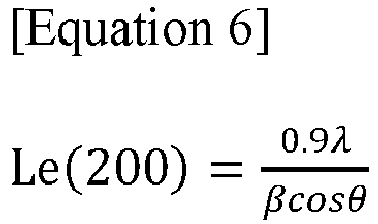
- In some embodiments, Le(020) of Equation 4 may be measured by Equation 5 below, and Le(200) may be measured by Equation 6 below.

- In Equation 5, Le(020) is the crystallite size (nm) in the (020) plane direction measured by the XRD analysis on the cathode
active material layer 110, λ is an X-ray wavelength (nm), and β is a full width at half maximum of a peak corresponding to the (020) plane measured by the XRD analysis on the cathodeactive material layer 110, and θ is a diffraction angle (rad). - In Equation 6, Le(200) is the crystallite size (nm) in the (200) plane direction measured by the XRD analysis on the cathode active material layer, λ is an X-ray wavelength (nm), and β is a full width at half maximum of a peak corresponding to the (200) plane measured by the XRD analysis on the cathode
active material layer 110, and θ is a diffraction angle (rad). - In some embodiments, Le(020) of Equation 4 may be in a range from 120 nm to 370 nm, and may be in a range from 135 nm to 300 nm in some embodiments. Within this range, side reactions between the cathode and the electrolyte may be suppressed, and the capacity and energy density low-temperature may be improved.
- For example, Le(020) and Le(200) of Equations 4 to 6 may be measured by performing the XRD analysis on the cathode
active material layer 110 included in thecathode 100. - The
anode 130 may include an anodecurrent collector 125 and an anodeactive material layer 120 formed by coating an anode active material on at least one surface of the anodecurrent collector 125. - The anode active material may include a material capable of adsorbing and ejecting lithium ions. For example, a carbon-based material such as a crystalline carbon, an amorphous carbon, a carbon complex or a carbon fiber, a lithium alloy, silicon or tin may be used as the anode active material.
- The amorphous carbon may include, e.g., a hard carbon, coke, a mesocarbon microbead (MCMB) fired at a temperature of 1500 °C or less, a mesophase pitch-based carbon fiber (MPCF), etc. The crystalline carbon may include a graphite-based material such as natural graphite, graphitized coke, graphitized MCMB, graphitized MPCF, etc. The lithium alloy may further include aluminum, zinc, bismuth, cadmium, antimony, silicon, lead, tin, gallium, indium, etc.
- For example, the anode
current collector 125 may include a copper foil, a nickel foil, a stainless steel foil, a titanium foil, a nickel foam, a copper foam or a polymer substrate coated with a conductive metal. These may be used alone or in combination thereof. For example, a thickness of the anodecurrent collector 125 may be in a range from 10 µm to 50 µm. - In some embodiments, a slurry may be prepared by mixing and stirring the negative electrode active material with a binder, a conductive material, and/or a dispersive agent in a solvent. The slurry may be coated on the negative electrode current collector, and then dried and pressed to form the
negative electrode 130. - The binder and the conductive material substantially the same as or similar to those used for the cathode
active material layer 110 may be used in theanode 130. In some embodiments, the binder for forming theanode 130 may include an aqueous binder such as styrene-butadiene rubber (SBR) for a compatibility with, e.g., the carbon-based active material, and carboxymethyl cellulose (CMC) may also be used as a thickener. - In some embodiments, a
separation layer 140 may be interposed between thecathode 100 and theanode 130. Theseparation layer 140 may include a porous polymer film prepared from, e.g., a polyolefin-based polymer such as an ethylene homopolymer, a propylene homopolymer, an ethylene/butene copolymer, an ethylene/hexene copolymer, an ethylene/methacrylate copolymer, etc. Theseparation layer 140 may also include a non-woven fabric formed from a glass fiber with a high melting point, a polyethylene terephthalate fiber, or the like. - In example embodiments, an electrode cell may be defined by the
cathode 100, theanode 130 and theseparation layer 140, and a plurality of the electrode cells may be stacked to form anelectrode assembly 150 that may have e.g., a jelly roll shape. For example, theelectrode assembly 150 may be formed by stacking, z-folding, stack-folding of theseparation layer 140. - The
electrode assembly 150 may be accommodated together with an electrolyte in anouter case 160 to define the lithium secondary battery. In example embodiments, a non-aqueous electrolyte may be used as the electrolyte. - The non-aqueous electrolyte may include a lithium salt and an organic solvent. The lithium salt may be represented by Li+X-, and an anion of the lithium salt X- may include, e.g., F-, Cl-, Br-, I-, NO3 -, N(CN)2 -, BF4 -, ClO4 -, PF6 -, (CF3)2PF4 -, (CF3)3PF3 -, (CF3)4PF2-, (CF3)5PF-, (CF3)6P-, CF3SO3 -; CF3CF2SO3 -, (CF3SO2)2N-, (FSO2)2N-; CF3CF2(CF3)2CO-, (CF3SO2)2CH-, (SF5)3C-, (CF3SO2)3C-, CF3(CF2)7SO3 -, CF3CO2 -, CH3CO2 -, SCN-, (CF3CF2SO2)2N-, etc.
- The organic solvent may include, e.g., propylene carbonate (PC), ethylene carbonate (EC), diethyl carbonate (DEC), dimethyl carbonate (DMC), ethylmethyl carbonate (EMC), methylpropyl carbonate, dipropyl carbonate, dimethyl sulfoxide, acetonitrile, dimethoxy ethane, diethoxy ethane, vinylene carbonate, sulfolane, gamma-butyrolactone, propylene sulfite, tetrahydrofuran, etc. These may be used alone or in a combination of two or more therefrom.
- In some embodiments, a solid electrolyte may be used instead of the above-mentioned non-aqueous electrolyte. In this case, the lithium secondary battery may be manufactured in the form of an all-solid-state battery. Further, a solid electrolyte layer may be disposed between the
anode 100 and thecathode 130 instead of the above-mentionedseparation layer 140. - The solid electrolyte may include a sulfide-based electrolyte. Non-limiting examples of the sulfide-based electrolyte may include Li2S-P2S5, Li2S-P2S5-LiCl, Li2S-P2S5-LiBr, Li2S-P2S5-LiCl-LiBr, Li2S-P2S5-Li2O, Li2S-P2S5-Li2O-LiI, Li2S-SiS2, Li2S-SiS2-LiI, Li2S-SiS2-LiBr, Li2S-SiS2-LiCl, Li2S-SiS2-B2S3-LiI, Li2S-SiS2-P2S5-LiI, Li2S-B2S3, Li2S-P2S5-ZmSn (m and n are positive numbers, and Z is Ge, Zn or Ga), Li2S-GeS2, Li2S-SiS2-Li3PO4, Li2S-SiS2-LipMOq, (p and q are positive numbers, M is P, Si, Ge, B, Al, Ga or In), Li7-xPS6-xClx (0≤x≤2), Li7-xPS6-xBrx (0≤x≤2), Li7-xPS6-xIx (0≤x≤2), etc. These may be used alone or in a combination thereof.
- In an embodiment, the solid electrolyte may include, e.g., an oxide-based amorphous solid electrolyte such as Li2O-B2O3-P2O5, Li2O-SiO2, Li2O-B2O3, Li2O-B2O3-ZnO, etc.
- As illustrated in
FIG. 1 , electrode tabs (a cathode tab and an anode tab) may protrude from the cathodecurrent collector 105 and the anodecurrent collector 125 included in each electrode cell to one side of thecase 160. The electrode tabs may be welded together with the one side of thecase 160 to be connected to an electrode lead (acathode lead 107 and an anode lead 127) that may be extended or exposed to an outside of thecase 160. - The lithium secondary battery may be manufactured in, e.g., a cylindrical shape using a can, a square shape, a pouch shape or a coin shape.
- Hereinafter, embodiments of the present disclosure are described in more detail with reference to experimental examples.
- Lithium carbonate as a lithium source, iron phosphate, and glucose as a carbon coating source were put in distilled water, and the particles were mixed and pulverized using a ball mill to form a mixed solution containing LiFePO4.
- The formed LiFePO4-containing mixed solution was dried using a micro-nozzle type spray dryer.
- The dried powder was calcined at a temperature in a range from about 300 °C to 1000° C for about 3 hours to 10 hours under a nitrogen atmosphere, and then subjected to classification and de-iron processes to prepare lithium metal phosphate particles.
- Lithium metal phosphate particles having different crystallite sizes and crystallite size ratios in the (020) plane direction were prepared while controlling temperature and time of the calcination. Thereafter, particles having the crystallite size and the crystallite size ratio as shown in Table 2 from a result of an XRD analysis were selected among the prepared lithium metal phosphate particles, and used as cathode active materials according to Examples 1 to 6 and Comparative Examples 1 to 4.
- A lithium secondary battery was manufactured using the prepared cathode active material. Specifically, the prepared cathode active material, Denka Black as a conductive material and PVDF as a binder were mixed in a mass ratio of 93:5:2, respectively, to form a cathode slurry. The cathode slurry was coated on an aluminum current collector, dried and pressed to from a cathode including a cathode active material layer. A target electrode density of the cathode after the pressing was adjusted to 2.45 g/cc.
- Lithium metal was used as an anode active material.
- The cathode and the anode prepared as described above were notched and stacked in a circular shape having diameters of Φ14 and Φ16, respectively, and a separator (polyethylene, thickness 13 µm) notched by a dimension of Φ19 was interposed between the cathode and the anode to form an electrode cell. The electrode cell was placed in a coin cell casing having a diameter of 20 mm and a height of 1.6 mm, an electrolyte was injected and assembled, and then aged for 12 hours or more so that the electrodes were impregnated with the electrolyte.
- A 1M LiPF6 solution prepared using a mixed solvent of EC/EMC (30/70; volume ratio) was used as the electrolyte.
- The secondary battery prepared as described above was subjected to a formation charging and discharging (charging condition CC-CV 0.1C 3.8V 0.05C CUT-OFF, discharging condition CC 0.1C 2.5V CUT-OFF).
- An XRD analysis was performed on the lithium metal phosphate particles (in a powder state) prepared according to the above-described Examples and Comparative Examples, and the crystallite size in the (020) plane direction (Lp(020)) and the crystallite size in the (200) plane direction (Lp(200)) of the lithium metal phosphate particles were calculated using Equations 1 and 3 described above.
- The crystallite size ratio was calculated by substituting the calculated Lp(020) and Lp(200) into Equation 2 described above.
- Specific XRD analysis equipment/conditions are as shown in Table 1 below.
[Table 1] XRD(X-Ray Diffractometer) EMPYREAN Maker PANalytical Anode material Cu K-Alpha1 wavelength 1.540598 Å Generator voltage 45 kV Tube current 40 mA Scan Range 10∼120° Scan Step Size 0.0065° Divergence slit 1/4° Antiscatter slit 1/2° - The lithium secondary battery prepared according to each of Examples and Comparative Examples was placed in a -7 °C chamber and left for 12 hours, and then a low-temperature discharge capacity (mAh/g) was measured.
- The lithium secondary battery was left at room temperature (25 °C) for 12 hours, and then a room temperature discharge capacity (mAh/g) was measured.
- The measured low-temperature discharge capacity was divided by the roomtemperature discharge capacity, and calculated as a percentage.
- The lithium secondary battery prepared according to each of Examples and Comparative Examples was placed in a -7 °C chamber and left for 12 hours, and then a low-temperature energy density (Wh/kg) was measured.
- The lithium secondary battery was left at room temperature (25 °C) for 12 hours, and then a room temperature energy density (Wh/kg) was measured.
- The measured low-temperature energy density was divided by the room temperature energy density, and calculated as a percentage.
- The calculation and evaluation results are shown in Table 2 below.
[Table 2] No. Lp(020) (nm) Lp(020) /Lp(200) low temperature power property (%) low temperature energy density (%) Example 1 293 0.99 67.8 67.2 Example 2 310 0.94 68.2 67.5 Example 3 325 0.92 68.0 66.4 Example 4 302 0.85 70.1 69.7 Example 5 335 1.04 58.1 57.4 Example 6 388 1.09 60.2 59.3 Comparative Example 1 470 0.97 40.2 39.4 Comparative Example 2 482 0.99 44.2 38.1 Comparative Example 3 455 0.99 48.5 48.4 Comparative Example 4 462 1.02 46.3 44.1 - Referring to Table 2, in Examples where the crystallite sizes of the lithium metal phosphate particles in the (020) plane direction as measured by the XRD analysis were within a range from 150 nm to 450 nm, the low-temperature power properties and the low-temperature energy density were improved compared to those from Comparative Examples.
- In Examples 5 and 6 where the crystallite size ratio exceeded 1, the low-temperature discharge capacity and the low-temperature energy density were relatively lowered compared to those from other Examples.
- An XRD analysis was performed on the cathode active material layer of the prepared cathode. The cathodes having the crystallite size and the electrode crystallite size ratio values as shown in Table 3 were selected based on the XRD analysis results and used as the cathodes according to Examples 7 to 14. A lithium secondary battery was manufactured by the same method as in Example 1 except that the selected cathode was used.
- An XRD analysis was performed on the cathode active material layer (in an electrode state) included in the cathode manufactured according to each of Examples and Comparative Examples, and the crystallite size in the (020) plane direction (Le(020)) and the crystallite size in the (200) plane direction (Le(200)) were calculated using Equations 5 and 6 as described above.
- The calculated Le(020) and Le(200) were substituted into Equation 4 to calculate the electrode crystallite size ratio.
- Specific XRD analysis equipment/conditions are as described in Table 1.
- Low-temperature power property and low-temperature energy density retention were evaluated by the same methods as those described in the above (2) and (3) of Evaluation Example 1.
- The evaluation results are shown in Table 3 below.
[Table 3] No. Le(020) (nm) Le(020)/ Le(200) low temperature power property (%) low temperature energy density (%) Example 7 124 0.87 68.0 67.4 Example 8 138 0.79 68.2 67.1 Example 9 280 0.68 68.4 66.5 Example 10 368 0.57 68.1 68.1 Example 11 116 0.90 63.3 60.0 Example 12 373 0.52 66.5 64.3 Example 13 120 0.92 58.2 57.9 Example 14 369 0.49 65.4 63.7 - Referring to Tables 2 and 3, in Examples 7 to 10, the low-temperature power property and the low-temperature energy density were improved compared to those from Comparative Examples.
- Referring to Table 3, in Examples 11 and 12 where the crystallite size in the (020) plane direction was less than 120 nm or greater than 370 nm, the low-temperature power property and the low-temperature energy density were relatively lowered compared to those from Examples 7 to 10.
- In Examples 13 and 14 where the electrode crystallite size ratio was less than 0.5 or greater than 0.9, the low-temperature power property and the low-temperature energy density were relatively lowered compared to those from Examples 7 to 10.
Claims (13)
- A cathode active material for a lithium secondary battery comprising a lithium metal phosphate particle having a crystallite size in a range from 150 nm to 450 nm in a direction of a (020) plane as measured by an X-ray diffraction (XRD) analysis.
- The cathode active material for a lithium secondary battery according to claim 1, wherein the crystallite size of the lithium metal phosphate particle in the direction of the (020) plane is in a range from 250 nm to 400 nm.
- The cathode active material for a lithium secondary battery according to claim 1 or claim 2, wherein the crystallite size of the lithium metal phosphate particle in the direction of the (020) plane is measured using Equation 1:

- The cathode active material for a lithium secondary battery according to any one of claims 1 to 3, wherein a particle crystallite size ratio measured by an XRD analysis and defined by Equation 2 is greater than 0 and less than 1:

- The cathode active material for a lithium secondary battery according to claim 4, wherein Lp(200) of Equation 2 is measured using Equation 3:

- The cathode active material for a lithium secondary battery according to claim 4 or claim 5, wherein the particle crystallite size ratio is in a range from 0.80 to 0.99.
- The cathode active material for a lithium secondary battery according to any one of claims 1 to 6, wherein the lithium metal phosphate particle includes an olivine crystal structure represented by Chemical Formula 1:
[Chemical Formula 1] LiaMxPyO4+z
wherein, in Chemical Formula 1, 0.9≤a≤1.2, 0.99≤x≤1.01, 0.9≤y≤1.2, - 0.1≤z≤0.1, and M includes at least one selected from the group consisting of Fe, Co, Ni and Mn. - The cathode active material for a lithium secondary battery according to any one of claims 1 to 7, wherein the lithium metal phosphate particle further includes a doping element or a coating element, and
the doping element or the coating element includes at least one selected from the group consisting of Na, Mg, Ca, Y, Ti, Hf, V, Nb, Ta, Cr, Mo, W, Fe, Cu, Ag, Zn, B, Al, Ga, C, Si, Sn, Sr, Ba, Ra, P and Zr. - The cathode active material for a lithium secondary battery according to any one of claims 1 to 8, wherein the lithium metal phosphate particle further includes a carbon coating formed on a surface thereof.
- The cathode active material for a lithium secondary battery according to any one of claims 1 to 9, wherein the direction of the (020) plane of the lithium metal phosphate particle is a direction in which lithium ions are diffused or transferred.
- A lithium secondary battery, comprising:a cathode comprising a cathode active material layer that comprises a cathode active material for a lithium secondary battery; andan anode facing the cathode,wherein an electrode crystallite size ratio defined by Equation 4 is in a range from 0.5 to 0.9:
 wherein, in Equation 4, Le(020) is a crystallite size (nm) in a direction of a (020) plane measured by an XRD analysis on the cathode active material layer, and Le(200) is a crystallite size (nm) in a direction of a (200) plane direction measured by the XRD analysis on the cathode active material layer.
 - The lithium secondary battery according to claim 11, wherein Le(020) of Equation is measured using Equation 5, and Le(200) is measured using Equation 6:

 wherein, in Equation 5, Le(020) is the crystallite grain size (nm) in the direction of the (020) plane measured by the XRD analysis on the cathode active material layer, λ is an X-ray wavelength (nm), β is a full width at half maximum (rad) of a peak corresponding to the (020) plane measured by the XRD analysis on the cathode active material layer, and θ is a diffraction angle (rad),wherein, in Equation 6, Le(200) is the crystallite grain size (nm) in the direction of the (200) plane measured by the XRD analysis on the cathode active material layer, λ is an X-ray wavelength (nm), β is a full width at half maximum (rad) of a peak corresponding to the (200) plane measured by the XRD analysis on the cathode active material layer, and θ is a diffraction angle (rad).
 - The lithium secondary battery according to claim 11 or claim 12, wherein Le(020) in Equation 4 is in a range from 120 nm to 370 nm.
Applications Claiming Priority (1)
| Application Number | Priority Date | Filing Date | Title |
|---|---|---|---|
| KR1020220148163A KR102660852B1 (en) | 2022-11-08 | 2022-11-08 | Cathode active material for lithium secondary battery and lithium secondary battery including the same |
Publications (1)
| Publication Number | Publication Date |
|---|---|
| EP4368570A1 true EP4368570A1 (en) | 2024-05-15 |
Family
ID=87863127
Family Applications (1)
| Application Number | Title | Priority Date | Filing Date |
|---|---|---|---|
| EP23194046.1A Pending EP4368570A1 (en) | 2022-11-08 | 2023-08-29 | Cathode active material for lithium secondary battery and lithium secondary battery including the same |
Country Status (4)
| Country | Link |
|---|---|
| US (1) | US12113217B2 (en) |
| EP (1) | EP4368570A1 (en) |
| KR (1) | KR102660852B1 (en) |
| CN (1) | CN118016874A (en) |
Citations (2)
| Publication number | Priority date | Publication date | Assignee | Title |
|---|---|---|---|---|
| JP2009218205A (en) * | 2008-02-12 | 2009-09-24 | Gs Yuasa Corporation | Cathode active material for lithium secondary battery, cathode for lithium secondary battery, lithium secondary battery, and their manufacturing method |
| EP3995455A1 (en) * | 2020-11-09 | 2022-05-11 | SK Innovation Co., Ltd. | Cathode active material for lithium secondary battery and lithium secondary battery including the same |
Family Cites Families (8)
| Publication number | Priority date | Publication date | Assignee | Title |
|---|---|---|---|---|
| KR20120021183A (en) * | 2010-08-31 | 2012-03-08 | 삼성에스디아이 주식회사 | Cathode active material, preparation method thereof, and cathode and lithium battery containing the material |
| US9577261B2 (en) * | 2011-03-18 | 2017-02-21 | Semiconductor Energy Laboratory Co., Ltd. | Lithium ion secondary battery and method for manufacturing the same |
| JP5892270B1 (en) * | 2015-01-30 | 2016-03-23 | 住友大阪セメント株式会社 | Method for producing positive electrode material for lithium ion secondary battery, positive electrode material for lithium ion secondary battery, positive electrode for lithium ion secondary battery, lithium ion secondary battery |
| WO2017135792A1 (en) | 2016-02-04 | 2017-08-10 | 주식회사 엘지화학 | Positive electrode and lithium secondary battery comprising same |
| US20180013151A1 (en) * | 2016-07-08 | 2018-01-11 | Semiconductor Energy Laboratory Co., Ltd. | Positive electrode active material, power storage device, electronic device, and method for manufacturing positive electrode active material |
| JP6501011B1 (en) | 2018-02-28 | 2019-04-17 | 住友大阪セメント株式会社 | ELECTRODE MATERIAL, METHOD FOR MANUFACTURING ELECTRODE MATERIAL, ELECTRODE, AND LITHIUM ION BATTERY |
| JP6885487B1 (en) * | 2020-03-30 | 2021-06-16 | 住友大阪セメント株式会社 | Positive electrode material for lithium ion secondary batteries, positive electrode for lithium ion secondary batteries and lithium ion secondary batteries |
| KR102879733B1 (en) * | 2020-09-24 | 2025-10-30 | 에스케이온 주식회사 | Cathode active material for lithium secondary battery and method of manufacturing the same |
-
2022
- 2022-11-08 KR KR1020220148163A patent/KR102660852B1/en active Active
-
2023
- 2023-08-29 EP EP23194046.1A patent/EP4368570A1/en active Pending
- 2023-09-27 CN CN202311260033.5A patent/CN118016874A/en active Pending
- 2023-11-03 US US18/501,932 patent/US12113217B2/en active Active
Patent Citations (2)
| Publication number | Priority date | Publication date | Assignee | Title |
|---|---|---|---|---|
| JP2009218205A (en) * | 2008-02-12 | 2009-09-24 | Gs Yuasa Corporation | Cathode active material for lithium secondary battery, cathode for lithium secondary battery, lithium secondary battery, and their manufacturing method |
| EP3995455A1 (en) * | 2020-11-09 | 2022-05-11 | SK Innovation Co., Ltd. | Cathode active material for lithium secondary battery and lithium secondary battery including the same |
Non-Patent Citations (4)
| Title |
|---|
| DATABASE WPI Week 200968, Derwent World Patents Index; AN 2009-N93039, XP002811009 * |
| FERRARI STEFANIA ET AL: "Influence of Particle Size and Crystal Orientation on the Electrochemical Behavior of Carbon-Coated LiFePO 4", THE JOURNAL OF PHYSICAL CHEMISTRY C, vol. 114, no. 29, 29 July 2010 (2010-07-29), US, pages 12598 - 12603, XP093130738, ISSN: 1932-7447, DOI: 10.1021/jp1025834 * |
| HUANG CHAOCHAO ET AL: "LiFePO 4 Crystal Growth during Co-precipitation", 1 December 2015 (2015-12-01), XP093130703, Retrieved from the Internet <URL:http://www.electrochemsci.org/papers/vol11/110100754.pdf> [retrieved on 20240213] * |
| KIYOSHI KANAMURA ET AL: "Hydrothermal synthesis of LiFePO4 as a cathode material for lithium batteries", JOURNAL OF MATERIALS SCIENCE, KLUWER ACADEMIC PUBLISHERS, BO, vol. 43, no. 7, 9 October 2007 (2007-10-09), pages 2138 - 2142, XP019575048, ISSN: 1573-4803 * |
Also Published As
| Publication number | Publication date |
|---|---|
| US20240154118A1 (en) | 2024-05-09 |
| KR102660852B1 (en) | 2024-04-24 |
| US12113217B2 (en) | 2024-10-08 |
| CN118016874A (en) | 2024-05-10 |
Similar Documents
| Publication | Publication Date | Title |
|---|---|---|
| US12482813B2 (en) | Cathode for lithium secondary battery and lithium secondary battery including the same | |
| EP3919444A2 (en) | Cathode active material for lithium secondary battery | |
| EP4102598A1 (en) | Cathode composition for lithium secondary battery and lithium secondary battery fabricated using the same | |
| EP4343890A1 (en) | Cathode active material for lithium secondary battery and lithium secondary battery including the same | |
| EP4064390B1 (en) | Cathode for lithium secondary battery and lithium secondary battery including the same | |
| EP4431455A1 (en) | Anode active material for lithium secondary battery and lithium secondary battery including the same | |
| EP4386900A1 (en) | Cathode active material for lithium secondary battery and lithium secondary battery including the same | |
| US12573624B2 (en) | Cathode active material for lithium secondary battery and lithium secondary battery including the same | |
| EP4411871A1 (en) | Anode active material for lithium secondary battery and lithium secondary battery including the same | |
| EP4517857A1 (en) | Cathode active material for lithium secondary battery and lithium secondary battery including the same | |
| EP4080603B1 (en) | Anode active material for lithium secondary battery and lithium secondary battery including the same | |
| KR20240061891A (en) | Lithium secondary battery | |
| KR20240061402A (en) | Lithium secondary battery | |
| EP4467518A1 (en) | Cathode active material for lithium secondary battery and lithium secondary battery including the same | |
| EP4372832A2 (en) | Lithium secondary battery | |
| EP4187630A1 (en) | Cathode for lithium secondary battery and lithium secondary battery including the same | |
| EP4368570A1 (en) | Cathode active material for lithium secondary battery and lithium secondary battery including the same | |
| US20240367985A1 (en) | Anode Active Material for Lithium Secondary Battery and Lithium Secondary Battery Including the Same | |
| EP4450460A1 (en) | Anode active material for lithium secondary battery and lithium secondary battery including the same | |
| EP4340064B1 (en) | Anode active material for lithium secondary battery and lithium secondary battery including the same | |
| EP4564453A2 (en) | Anode for lithium secondary battery and lithium secondary battery including the same | |
| EP4506310A1 (en) | Cathode active material for lithium secondary battery, method of preparing the same and lithium secondary battery including the same | |
| EP4699987A1 (en) | Cathode active material precursor for secondary battery, cathode active material for secondary battery and secondary battery | |
| EP4379854A1 (en) | Cathode active material for lithium secondary battery and lithium secondary battery including the same | |
| EP4656599A1 (en) | Cathode active material for secondary battery and lithium secondary battery including the same |
Legal Events
| Date | Code | Title | Description |
|---|---|---|---|
| PUAI | Public reference made under article 153(3) epc to a published international application that has entered the european phase |
Free format text: ORIGINAL CODE: 0009012 |
|
| STAA | Information on the status of an ep patent application or granted ep patent |
Free format text: STATUS: REQUEST FOR EXAMINATION WAS MADE |
|
| 17P | Request for examination filed |
Effective date: 20230829 |
|
| AK | Designated contracting states |
Kind code of ref document: A1 Designated state(s): AL AT BE BG CH CY CZ DE DK EE ES FI FR GB GR HR HU IE IS IT LI LT LU LV MC ME MK MT NL NO PL PT RO RS SE SI SK SM TR |
|
| STAA | Information on the status of an ep patent application or granted ep patent |
Free format text: STATUS: EXAMINATION IS IN PROGRESS |
|
| 17Q | First examination report despatched |
Effective date: 20250205 |