EP4368146A1 - Dental end mill and processing method - Google Patents
Dental end mill and processing method Download PDFInfo
- Publication number
- EP4368146A1 EP4368146A1 EP22837589.5A EP22837589A EP4368146A1 EP 4368146 A1 EP4368146 A1 EP 4368146A1 EP 22837589 A EP22837589 A EP 22837589A EP 4368146 A1 EP4368146 A1 EP 4368146A1
- Authority
- EP
- European Patent Office
- Prior art keywords
- dental
- end mill
- processing
- neck lower
- lower portion
- Prior art date
- Legal status (The legal status is an assumption and is not a legal conclusion. Google has not performed a legal analysis and makes no representation as to the accuracy of the status listed.)
- Pending
Links
Images
Classifications
-
- B—PERFORMING OPERATIONS; TRANSPORTING
- B23—MACHINE TOOLS; METAL-WORKING NOT OTHERWISE PROVIDED FOR
- B23C—MILLING
- B23C5/00—Milling-cutters
- B23C5/02—Milling-cutters characterised by the shape of the cutter
- B23C5/10—Shank-type cutters, i.e. with an integral shaft
- B23C5/1009—Ball nose end mills
-
- B—PERFORMING OPERATIONS; TRANSPORTING
- B23—MACHINE TOOLS; METAL-WORKING NOT OTHERWISE PROVIDED FOR
- B23C—MILLING
- B23C5/00—Milling-cutters
- B23C5/02—Milling-cutters characterised by the shape of the cutter
- B23C5/10—Shank-type cutters, i.e. with an integral shaft
-
- A—HUMAN NECESSITIES
- A61—MEDICAL OR VETERINARY SCIENCE; HYGIENE
- A61C—DENTISTRY; APPARATUS OR METHODS FOR ORAL OR DENTAL HYGIENE
- A61C13/00—Dental prostheses; Making same
- A61C13/0003—Making bridge-work, inlays, implants or the like
- A61C13/0004—Computer-assisted sizing or machining of dental prostheses
-
- A—HUMAN NECESSITIES
- A61—MEDICAL OR VETERINARY SCIENCE; HYGIENE
- A61C—DENTISTRY; APPARATUS OR METHODS FOR ORAL OR DENTAL HYGIENE
- A61C13/00—Dental prostheses; Making same
- A61C13/12—Tools for fastening artificial teeth; Holders, clamps, or stands for artificial teeth
-
- A—HUMAN NECESSITIES
- A61—MEDICAL OR VETERINARY SCIENCE; HYGIENE
- A61C—DENTISTRY; APPARATUS OR METHODS FOR ORAL OR DENTAL HYGIENE
- A61C3/00—Dental tools or instruments
- A61C3/06—Tooth grinding or polishing discs; Holders therefor
-
- A—HUMAN NECESSITIES
- A61—MEDICAL OR VETERINARY SCIENCE; HYGIENE
- A61C—DENTISTRY; APPARATUS OR METHODS FOR ORAL OR DENTAL HYGIENE
- A61C13/00—Dental prostheses; Making same
- A61C13/0003—Making bridge-work, inlays, implants or the like
- A61C13/0006—Production methods
-
- A—HUMAN NECESSITIES
- A61—MEDICAL OR VETERINARY SCIENCE; HYGIENE
- A61C—DENTISTRY; APPARATUS OR METHODS FOR ORAL OR DENTAL HYGIENE
- A61C13/00—Dental prostheses; Making same
- A61C13/08—Artificial teeth; Making same
-
- B—PERFORMING OPERATIONS; TRANSPORTING
- B23—MACHINE TOOLS; METAL-WORKING NOT OTHERWISE PROVIDED FOR
- B23C—MILLING
- B23C2226/00—Materials of tools or workpieces not comprising a metal
- B23C2226/18—Ceramic
-
- B—PERFORMING OPERATIONS; TRANSPORTING
- B23—MACHINE TOOLS; METAL-WORKING NOT OTHERWISE PROVIDED FOR
- B23C—MILLING
- B23C2226/00—Materials of tools or workpieces not comprising a metal
- B23C2226/31—Diamond
- B23C2226/315—Diamond polycrystalline [PCD]
Definitions
- the present disclosure relates to a dental end mill and a processing method performed by a dental processing machine including the dental end mill.
- dental prosthesis In the field of dentistry, as a treatment for tooth substance lost due to caries or the like, it is common to manufacture a dental prosthesis as a substitute for the lost tooth material and attach the dental prosthesis to an affected part to restore the function.
- Types of dental prostheses include a crown, inlay, onlay, or the like for one tooth, and a bridge, a coupling crown, or the like for a plurality of teeth.
- a manufacturing method using, as a manufacturing device, a dental CNC multiaxial processing machine (hereinafter, it is referred to as a "dental processing machine"), which is capable of automation and mass production regardless of day and night as a manufacturing device, has become widespread in recent years.
- a disk-shaped or block-shaped to-be-cut material (workpiece) is fixed to the dental processing machine; a tool is attached to a spindle which rotates at high speed; and the tool is operated based on a processing program created in advance by dental CAM software or the like to process the to-be-cut material.
- Various materials are used as the to-be-cut material, and in particular, a hybrid resin, semi-sintered zirconia, PMMA, PEEK, a titanium alloy, a cobalt chromium alloy, a nickel-chromium alloy, or the like is used.
- the tools used in the dental processing machine are classified into two types, which are a grinding tool in which fine abrasive grains such as diamond particles are bound with soft metal or the like, and a cutting tool having a spiral blade and a groove.
- the cutting tools are generally referred to as end mills.
- the processing method of the dental processing machine is roughly classified into a wet type in which the processing is performed while injecting water and a dry type in which the processing is performed while injecting compressed air.
- the grinding tool can be used substantially only in the wet type since frictional heat during the processing is large and clogging easily occurs.
- the end mill is used widely as a tool for a dental processing machine since it is applicable to a wide range of to-be-cut materials because of its lower frictional heat than the grinding tool and its dual use in the wet and dry types.
- the dental prostheses have complicated and diverse shapes in which the shape, size, and tooth crown length are different for each patient, for each region, and for each case. Also, it is necessary to appropriately maintain the positional relationship with the tooth adjacent to the region where the dental prosthesis is attached and the occlusal state with the mating tooth. In addition, it is necessary to reproduce the anatomical form before it is lost. Accordingly, stable high processing quality is required.
- Patent Literatures 1 to 3 As a technique for suppressing tool wear of the end mill, a technique for coating a surface layer of a neck lower portion of a base material with diamond fine particles or the like, and a technique of using diamond for a cutting edge are known (see, for example, Patent Literatures 1 to 3).
- Patent Literature 1 discloses a dental end mill in which a surface layer of a neck lower portion is coated with diamond fine particles.
- the hard coating layer is only the surface layer of the neck lower portion, and the coating film of the surface layer of the neck lower portion of the end mill may be worn and peeled early during processing. Therefore, it has been difficult to stably obtain the dental prosthesis with high processing quality.
- Patent Literatures 2 and 3 disclose an end mill in which a cutting edge and a tip are formed of polycrystalline diamond.
- these end mills are industrial end mills for processing metal materials, and there is no description of the processing for dental materials, and these end mills are not suitable for processing complicated and diverse dental prostheses.
- the present disclosure has been made in view of the above circumstances and enables the processing of a surface of a dental prosthesis to be smooth in processing by a dental end mill. In addition, it becomes possible to stably obtain a highly accurate dental prosthesis.
- the inventors have focused on the material of the neck lower portion (blade) of the dental end mill, and as a result, have found that the above problems can be solved by using polycrystalline diamond for the neck lower portion (blade) of the end mill, and have further progressed the research based on this finding, and completed the present disclosure.
- a dental end mill is a dental end mill for processing a workpiece, including a shank portion held by a dental processing machine; a neck lower portion including a cutting edge; and a neck portion that is configured to connect the shank portion and the neck lower portion.
- the neck lower portion is formed of polycrystalline diamond.
- a processing method is a processing method for a workpiece performed by a dental processing machine including a dental end mill, the method including processing the workpiece using the dental end mill.
- the present disclosure it is possible to process the surface of the dental prosthesis to be smooth in processing using the dental end mill. In addition, it is possible to stably obtain the highly accurate dental prosthesis.
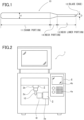
- Fig. 1 is a plan view illustrating a schematic configuration of a dental end mill 10 according to the present embodiment.
- the dental end mill 10 according to the present embodiment is configured to be attached to a dental processing machine (see, for example, dental processing machine 1 of Fig. 2 ) and to process a workpiece W to manufacture a dental prosthesis.
- the dental end mill 10 includes a shank portion 11, a neck lower portion 13 including a cutting edge 12, and a neck portion 14 connecting the shank portion 11 and the neck lower portion 13.
- the neck lower portion 13 is formed of polycrystalline diamond.
- the neck lower portion 13 of the dental end mill 10 is formed of a single material of polycrystalline diamond.
- the shank portion 11 is attached to, for example, the dental processing machine 1 (more specifically, to a spindle 2a of the dental processing machine 1) as illustrated in Fig. 2 .
- the polycrystalline diamond that forms the neck lower portion 13 is an aggregate of single-crystal diamond particles. The polycrystalline diamond does not have cleavability peculiar to single-crystal diamond.
- the polycrystalline diamond has excellent wear resistance and is more suitable for a processing tool than single-crystal diamond.
- the diamond used in the present disclosure may be a natural diamond or artificial diamond as long as it is a polycrystalline diamond.
- an artificial polycrystalline diamond produced, for example, by a gas phase synthesis method, a high-temperature and high-pressure sintering method, or the like is preferably used as the polycrystalline diamond.
- the polycrystalline diamond may be, for example, a sintered diamond in which diamond particles are bonded by a metal bonding material or the like, or a sintered diamond in which diamond particles are directly bonded to each other without a bonding material.
- An average particle diameter of polycrystalline diamond used for the neck lower portion 13 is between 5 nm or more and 10 ⁇ m or less, preferably 1 ⁇ m or less, and more preferably 0.5 ⁇ m or less. If the average particle diameter of the polycrystalline diamond is larger than the above upper limit value, the surface of the dental prosthesis becomes rough, and the plaque is likely to adhere, which is not preferable. On the other hand, when the average particle diameter of the polycrystalline diamond is smaller than the above lower limit, cutting efficiency is lowered, which is not preferable.
- the average particle diameter of the polycrystalline diamond can be measured by, for example, electron microscopy such as SEM and TEM, X-ray diffraction (XRD), or the like.
- the diameter (outside diameter D, see Fig. 1 ) of the cutting edge 12 of the neck lower portion 13 of the dental end mill 10 is preferably smaller than the diameter (shank diameter d, see Fig. 1 ) of the shank portion 11. That is, the outside diameter D of the cutting edge 12 is preferably between 0.1 mm or more and 6.0 mm or less, and more preferably between 0.3 mm or more and 2.0 mm or less. If the outside diameter of the cutting edge 12 is too large than the above upper limit value, fine processing cannot be performed, which is not preferable. In addition, if the outside diameter of the cutting edge 12 is too smaller than the above lower limit value, the processing efficiency is lowered, which is not preferable.
- the tip shape of the cutting edge 12 of the neck lower portion 13, that is, the blade bottom shape of the end mill 10 is selected from a flat end shape, a radius end shape, a ball end shape, or the like.
- a hemispherical ball end shape is preferable since the dental prosthesis is formed of a free-form surface. As a result, it is possible to obtain a dental prosthesis having a smooth surface property.
- the length L of the neck lower portion 13 is not particularly limited but is preferably between 1.0 mm or more and 30.0 mm or less, and more preferably between 1.0 mm or more and 5.0 mm or less. It is not preferable that the length of the neck lower portion 13 is longer than the upper limit because rigidity is lowered. It is not preferable that the length of the neck lower portion 13 is shorter than the lower limit because the processing range is limited.
- a cemented carbide base material is used as a material for the shank portion 11 and the neck portion 14.
- the cemented carbide base material suitably include cermet which is a composite material of ceramics and metal, and cemented carbide such as tungsten carbide (WC)-based cemented carbide, but are not limited to these.
- the neck lower portion 13 and the neck portion 14 of the end mill 10 are joined to each other by welding, brazing, or the like, for example. This configuration improves the durability of the end mill 10.
- the material of the workpiece W cut by the end mill 10 of the present embodiment is not particularly limited as long as it is a dental material, but dental ceramic and dental resin are suitably exemplified.
- Using the dental ceramic for the material of the workpiece W makes it possible to obtain a dental prosthesis with high biocompatibility and strength and with low aging deterioration, and thus have excellent aesthetics for a long period of time.
- using the dental resin for the material of the workpiece W makes it possible to obtain a lightweight dental prosthesis with good biocompatibility, strength, and aesthetics at a relatively low cost in a short time.
- the shape of the workpiece W is not particularly limited and may be any shape such as a block shape or a disk shape.
- the end mill 10 of the present embodiment does not limit the type of dental prosthesis to be processed.
- the dental prosthesis to be processed may be, for example, an artificial tooth corresponding to any of a central incisor, a lateral incisor, a canine, and a molar, and examples of the dental prosthesis to be processed include a crown (tooth crown), an inlay, an onlay, a bridge, a coupling crown, a tooth crown attached to an abutment of an implant, or the like, but are not limited to them.
- FIG. 2 is a schematic view of an example of the dental processing machine 1 including the dental end mill 10 according to the present embodiment.
- the dental processing machine 1 includes a cutting portion 2, a holding portion 3, a controller 4, or the like.
- the cutting portion 2 includes a spindle (main axis) 2a that holds the end mill 10, a motor 2b that rotates the spindle 2a, a moving portion that moves the spindle 2a in a predetermined direction(s), or the like.
- the holding portion 3 includes a holding member 3a that holds the workpiece W, a moving portion that moves the holding member in a predetermined direction(s), or the like.
- the controller 4 includes an NC device or the like including a processor, a memory, an operation button 4a, a monitor 4b, or the like.
- the end mill 10 of the present embodiment is attached to the spindle 2a of the dental processing machine 1, and the workpiece W is attached to the holding member 3a. After that, the processing method of the present embodiment is performed by changing the relative positional relationship between the end mill 10 and the workpiece W in three dimensions and rotating the end mill 10.
- the processing method according to the present embodiment is a method for processing the workpiece W performed by the dental processing machine 1 including the dental end mill 10 according to the present embodiment, and the method includes processing the workpiece W using the end mill 10 of the present embodiment.
- This processing step includes a rough processing and a finish processing by the dental end mill 10.
- the processing method according to the present embodiment may include a coloring step, a sintering step, or the like.
- the neck lower portion 13 of the dental end mill 10 is formed of polycrystalline diamond. Accordingly, it is possible to obtain a dental prosthesis having a smooth surface property in a state where the processing of the workpiece W by the dental end mill 10 is completed. In addition, since the processed dental prosthesis has a smooth surface property as described above, the adhesion of the plaque to the surface of the dental prosthesis can be appropriately suppressed after attachment in the oral cavity.
- the dental end mill 10 of the present embodiment in which the neck lower portion 13 is formed of polycrystalline diamond, even if the processing speed is increased, the accuracy is not reduced, the processing time can be shortened, and a dental prosthesis with higher accuracy and higher definition can be obtained in a short time.
- the dental end mill 10 of the present embodiment has excellent durability that can withstand repeated processing. Further, the dental end mill 10 of the present embodiment can suppress wear and peeling of the surface layer. Moreover, the dental end mill 10 of the present embodiment can save the labor of manual polishing work. As a result, the dental end mill 10 and the processing method of the present embodiment can stably obtain the highly accurate dental prosthesis while suppressing deterioration in the processing quality of the dental prosthesis.
- the outside diameter which is the diameter of the cutting edge 12
- the shank diameter which is the diameter of the shank portion 11.
- the outside diameter is between 0.1 mm or more and 6.0 mm or less.
- the neck lower length which is the length of the neck lower portion 13, is between 1.0 mm or more and 30.0 mm or less.
- the dental prosthesis is tailor-made according to the patient, it is necessary to process the dental prosthesis according to various shapes using the same type of end mill 10.
- an industrial end mill in which only a cutting edge is formed of the diamond as in Patent Literature 2, only the cutting edge is used for processing, and thus, portions of a workpiece to be processed and the shape of the workpiece are limited.
- the dental end mill 10 of the present embodiment the entire neck lower portion 13 is formed of polycrystalline diamond. Accordingly, the cutting edge and the side surface of the cutting edge 12 and the entire side surface of the neck lower portion 13 can be used for processing.
- the dental end mill 10 of the present embodiment can more accurately and smoothly process dental prostheses having complicated and diverse shapes having different shapes, sizes, and crown lengths for each patient, region, and case.
- the dental end mill 10 of the present embodiment by setting the average particle diameter of the polycrystalline diamond to between 5 nm or more and 10 ⁇ m or less, it is possible to obtain a dental prosthesis having a smooth surface to which a plaque hardly adheres and to perform processing with excellent cutting efficiency.
- the workpiece W is at least one of a dental resin or a dental ceramic, it is possible to obtain a dental prosthesis excellent in biocompatibility, strength, and aesthetics.
- Example 1 Processing of workpiece
- the implementer attached a processing tool (dental end mill 10) in which a polycrystalline diamond having an average particle diameter of 20 nm is used in the neck lower portion 13 to a processing machine (MEGA-SSS manufactured by ROKU-ROKU SANGYO, LTD) having a resolution of 10 nm or less.
- MEGA-SSS manufactured by ROKU-ROKU SANGYO, LTD
- the implementer cut, as the workpiece W, dental zirconia ("Noritake KATANA (registered trademark) Zirconia” STML, manufactured by Kuraray Noritake Dental Inc.) [diameter 98.5 mm, thickness 18 mm] under the conditions of the tooth crown high-definition processing shown in Table 1 below to obtain a coronal-shaped calcined body of about 15 mm ⁇ 15 mm ⁇ 15 mm.
- dental zirconia (“Noritake KATANA (registered trademark) Zirconia” STML, manufactured by Kuraray Noritake Dental Inc.) [diameter 98.5 mm, thickness 18 mm]
- the rotational speed indicates the main axis rotational speed of the spindle that holds the end mill
- the feed speed indicates the moving feed speed of the spindle
- the depth of the cut amount indicates the machining or processing depth in the Z direction
- the width of the cut amount indicates the machining or processing width in the XY direction.
- the Z direction is an axial direction of the main axis
- the XY direction is a direction forming a plane perpendicular to the Z direction.
- the implementer fired the processed coronal-shaped calcined body at 1550°C for 90 minutes to obtain a final prosthesis.
- Example 2 In Example 2, the implementer used, as the workpiece W, a dental hybrid resin block ("KATANA (registered trademark) AVENCIA (registered trademark) N", manufactured by Kuraray Noritake Dental Inc.). Except for this, the implementer used the same processing machine as in Example 1 to perform processing under the same conditions of the tooth crown high-definition processing as in Example 1, obtaining a final prosthesis.
- KATANA registered trademark
- AVENCIA registered trademark
- N manufactured by Kuraray Noritake Dental Inc.
- Comparative Example 1 In Comparative Example 1, the implementer replaced the dental end mill 10 with a conventional dental end mill in which a diamond fine particle coating is used in the neck lower portion (polycrystalline diamond is not used in the neck lower portion). Except for this, the implementer used the same processing machine as in Example 1 to perform processing and sintering under the same conditions of the tooth crown high-definition processing as in Example 1, obtaining a final prosthesis.
- Table 1 ROTATIONAL SPEED (SPINDLE SPEED) Min -1 FEED SPEED (FEED) mm/min CUT AMOUNT (DEPTH OF CUT) DEPTH ap mm WIDTH ae mm 40,000 1,000 0.005 0.005
- the average surface roughness of the final prosthesis is 0.3 ⁇ m or less.
- the average surface roughness of the final prosthesis is 30 ⁇ m or more.
- the dental end mill of the present disclosure can process the surface of a dental prosthesis to be smooth and stably obtain the highly accurate dental prosthesis in processing by the dental end mill and thus can be used for the processing of a dental prosthesis or the like.
Landscapes
- Health & Medical Sciences (AREA)
- Oral & Maxillofacial Surgery (AREA)
- Dentistry (AREA)
- Epidemiology (AREA)
- Life Sciences & Earth Sciences (AREA)
- Animal Behavior & Ethology (AREA)
- General Health & Medical Sciences (AREA)
- Public Health (AREA)
- Veterinary Medicine (AREA)
- Engineering & Computer Science (AREA)
- Mechanical Engineering (AREA)
- Dental Prosthetics (AREA)
- Dental Tools And Instruments Or Auxiliary Dental Instruments (AREA)
Abstract
Description
- The present disclosure relates to a dental end mill and a processing method performed by a dental processing machine including the dental end mill.
- In the field of dentistry, as a treatment for tooth substance lost due to caries or the like, it is common to manufacture a dental prosthesis as a substitute for the lost tooth material and attach the dental prosthesis to an affected part to restore the function. Types of dental prostheses include a crown, inlay, onlay, or the like for one tooth, and a bridge, a coupling crown, or the like for a plurality of teeth.
- Conventionally, the above dental prostheses have been manually manufactured by dental professionals. However, a manufacturing method using, as a manufacturing device, a dental CNC multiaxial processing machine (hereinafter, it is referred to as a "dental processing machine"), which is capable of automation and mass production regardless of day and night as a manufacturing device, has become widespread in recent years.
- In a method for manufacturing a dental prosthesis using a dental processing machine, a disk-shaped or block-shaped to-be-cut material (workpiece) is fixed to the dental processing machine; a tool is attached to a spindle which rotates at high speed; and the tool is operated based on a processing program created in advance by dental CAM software or the like to process the to-be-cut material. Various materials are used as the to-be-cut material, and in particular, a hybrid resin, semi-sintered zirconia, PMMA, PEEK, a titanium alloy, a cobalt chromium alloy, a nickel-chromium alloy, or the like is used.
- The tools used in the dental processing machine are classified into two types, which are a grinding tool in which fine abrasive grains such as diamond particles are bound with soft metal or the like, and a cutting tool having a spiral blade and a groove. In particular, the cutting tools are generally referred to as end mills.
- The processing method of the dental processing machine is roughly classified into a wet type in which the processing is performed while injecting water and a dry type in which the processing is performed while injecting compressed air. However, the grinding tool can be used substantially only in the wet type since frictional heat during the processing is large and clogging easily occurs. On the other hand, the end mill is used widely as a tool for a dental processing machine since it is applicable to a wide range of to-be-cut materials because of its lower frictional heat than the grinding tool and its dual use in the wet and dry types.
- On the other hand, the dental prostheses have complicated and diverse shapes in which the shape, size, and tooth crown length are different for each patient, for each region, and for each case. Also, it is necessary to appropriately maintain the positional relationship with the tooth adjacent to the region where the dental prosthesis is attached and the occlusal state with the mating tooth. In addition, it is necessary to reproduce the anatomical form before it is lost. Accordingly, stable high processing quality is required.
- As a technique for suppressing tool wear of the end mill, a technique for coating a surface layer of a neck lower portion of a base material with diamond fine particles or the like, and a technique of using diamond for a cutting edge are known (see, for example, Patent Literatures 1 to 3).
- Patent Literature 1 discloses a dental end mill in which a surface layer of a neck lower portion is coated with diamond fine particles. However, the hard coating layer is only the surface layer of the neck lower portion, and the coating film of the surface layer of the neck lower portion of the end mill may be worn and peeled early during processing. Therefore, it has been difficult to stably obtain the dental prosthesis with high processing quality.
- In addition, in the processing by the dental end mill coated with the diamond fine particles disclosed in Patent Literature 1, the surface of the processed dental prosthesis becomes rough, so that dirt such as plaque easily adheres to the surface of the dental prosthesis after attachment in the oral cavity. For this reason, after the processing by the dental processing machine is completed, manual polishing work is performed by a dentist or a dental technician. However, when the dental prosthesis has a complicated shape, a region where the polishing work is insufficient may be generated since the polishing work is done manually.
- On the other hand,
Patent Literatures -
- Patent Literature 1:
JP 2019-217118 A - Patent Literature 2:
JP 2004-255496 A - Patent Literature 3:
JP 2020-032485 A - The present disclosure has been made in view of the above circumstances and enables the processing of a surface of a dental prosthesis to be smooth in processing by a dental end mill. In addition, it becomes possible to stably obtain a highly accurate dental prosthesis.
- To solve the above problems, the inventors have focused on the material of the neck lower portion (blade) of the dental end mill, and as a result, have found that the above problems can be solved by using polycrystalline diamond for the neck lower portion (blade) of the end mill, and have further progressed the research based on this finding, and completed the present disclosure.
- A dental end mill according to the present disclosure is a dental end mill for processing a workpiece, including a shank portion held by a dental processing machine; a neck lower portion including a cutting edge; and a neck portion that is configured to connect the shank portion and the neck lower portion. The neck lower portion is formed of polycrystalline diamond.
- In addition, a processing method according to the present disclosure is a processing method for a workpiece performed by a dental processing machine including a dental end mill, the method including processing the workpiece using the dental end mill.
- According to the present disclosure, it is possible to process the surface of the dental prosthesis to be smooth in processing using the dental end mill. In addition, it is possible to stably obtain the highly accurate dental prosthesis.
-
-
Fig. 1 is a plan view illustrating a schematic configuration of a dental end mill according to an embodiment of the present disclosure. -
Fig. 2 is a schematic view of a processing machine including the dental end mill illustrated inFig. 1 to explain a processing method according to an embodiment of the present disclosure and is - (Structure of dental end mill) Hereinafter, a dental end mill according to an embodiment of the present disclosure will be described with reference to
Fig. 1. Fig. 1 is a plan view illustrating a schematic configuration of adental end mill 10 according to the present embodiment. Thedental end mill 10 according to the present embodiment is configured to be attached to a dental processing machine (see, for example, dental processing machine 1 ofFig. 2 ) and to process a workpiece W to manufacture a dental prosthesis. - As illustrated in
Fig. 1 , thedental end mill 10 according to the present embodiment includes ashank portion 11, a necklower portion 13 including acutting edge 12, and aneck portion 14 connecting theshank portion 11 and the necklower portion 13. The necklower portion 13 is formed of polycrystalline diamond. In the present embodiment, the necklower portion 13 of thedental end mill 10 is formed of a single material of polycrystalline diamond. Theshank portion 11 is attached to, for example, the dental processing machine 1 (more specifically, to aspindle 2a of the dental processing machine 1) as illustrated inFig. 2 . The polycrystalline diamond that forms the necklower portion 13 is an aggregate of single-crystal diamond particles. The polycrystalline diamond does not have cleavability peculiar to single-crystal diamond. Therefore, the polycrystalline diamond has excellent wear resistance and is more suitable for a processing tool than single-crystal diamond. The diamond used in the present disclosure may be a natural diamond or artificial diamond as long as it is a polycrystalline diamond. In the case of an artificial diamond, an artificial polycrystalline diamond produced, for example, by a gas phase synthesis method, a high-temperature and high-pressure sintering method, or the like is preferably used as the polycrystalline diamond. In addition, the polycrystalline diamond may be, for example, a sintered diamond in which diamond particles are bonded by a metal bonding material or the like, or a sintered diamond in which diamond particles are directly bonded to each other without a bonding material. - (Average particle diameter of polycrystalline diamond) An average particle diameter of polycrystalline diamond used for the neck
lower portion 13 is between 5 nm or more and 10 µm or less, preferably 1 µm or less, and more preferably 0.5 µm or less. If the average particle diameter of the polycrystalline diamond is larger than the above upper limit value, the surface of the dental prosthesis becomes rough, and the plaque is likely to adhere, which is not preferable. On the other hand, when the average particle diameter of the polycrystalline diamond is smaller than the above lower limit, cutting efficiency is lowered, which is not preferable. The average particle diameter of the polycrystalline diamond can be measured by, for example, electron microscopy such as SEM and TEM, X-ray diffraction (XRD), or the like. - (Outside diameter of dental end mill) The diameter (outside diameter D, see
Fig. 1 ) of thecutting edge 12 of the necklower portion 13 of thedental end mill 10 is preferably smaller than the diameter (shank diameter d, seeFig. 1 ) of theshank portion 11. That is, the outside diameter D of thecutting edge 12 is preferably between 0.1 mm or more and 6.0 mm or less, and more preferably between 0.3 mm or more and 2.0 mm or less. If the outside diameter of thecutting edge 12 is too large than the above upper limit value, fine processing cannot be performed, which is not preferable. In addition, if the outside diameter of thecutting edge 12 is too smaller than the above lower limit value, the processing efficiency is lowered, which is not preferable. - (Blade bottom shape of end mill) The tip shape of the
cutting edge 12 of the necklower portion 13, that is, the blade bottom shape of theend mill 10 is selected from a flat end shape, a radius end shape, a ball end shape, or the like. However, a hemispherical ball end shape is preferable since the dental prosthesis is formed of a free-form surface. As a result, it is possible to obtain a dental prosthesis having a smooth surface property. - (Length of neck lower portion) The length L of the neck
lower portion 13 is not particularly limited but is preferably between 1.0 mm or more and 30.0 mm or less, and more preferably between 1.0 mm or more and 5.0 mm or less. It is not preferable that the length of the necklower portion 13 is longer than the upper limit because rigidity is lowered. It is not preferable that the length of the necklower portion 13 is shorter than the lower limit because the processing range is limited. - (Shank portion and neck portion) For example, a cemented carbide base material is used as a material for the
shank portion 11 and theneck portion 14. Examples of the cemented carbide base material suitably include cermet which is a composite material of ceramics and metal, and cemented carbide such as tungsten carbide (WC)-based cemented carbide, but are not limited to these. In addition, the necklower portion 13 and theneck portion 14 of theend mill 10 are joined to each other by welding, brazing, or the like, for example. This configuration improves the durability of theend mill 10. - (Material of workpiece) The material of the workpiece W cut by the
end mill 10 of the present embodiment is not particularly limited as long as it is a dental material, but dental ceramic and dental resin are suitably exemplified. Using the dental ceramic for the material of the workpiece W makes it possible to obtain a dental prosthesis with high biocompatibility and strength and with low aging deterioration, and thus have excellent aesthetics for a long period of time. In addition, using the dental resin for the material of the workpiece W makes it possible to obtain a lightweight dental prosthesis with good biocompatibility, strength, and aesthetics at a relatively low cost in a short time. In addition, the shape of the workpiece W is not particularly limited and may be any shape such as a block shape or a disk shape. - (Type of dental prosthesis to be processed) The
end mill 10 of the present embodiment does not limit the type of dental prosthesis to be processed. The dental prosthesis to be processed may be, for example, an artificial tooth corresponding to any of a central incisor, a lateral incisor, a canine, and a molar, and examples of the dental prosthesis to be processed include a crown (tooth crown), an inlay, an onlay, a bridge, a coupling crown, a tooth crown attached to an abutment of an implant, or the like, but are not limited to them. - (Processing machine including end mill)
Fig. 2 is a schematic view of an example of the dental processing machine 1 including thedental end mill 10 according to the present embodiment. As illustrated inFig. 2 , the dental processing machine 1 includes a cuttingportion 2, a holdingportion 3, acontroller 4, or the like. The cuttingportion 2 includes a spindle (main axis) 2a that holds theend mill 10, amotor 2b that rotates thespindle 2a, a moving portion that moves thespindle 2a in a predetermined direction(s), or the like. The holdingportion 3 includes a holdingmember 3a that holds the workpiece W, a moving portion that moves the holding member in a predetermined direction(s), or the like. Thecontroller 4 includes an NC device or the like including a processor, a memory, anoperation button 4a, amonitor 4b, or the like. - The
end mill 10 of the present embodiment is attached to thespindle 2a of the dental processing machine 1, and the workpiece W is attached to the holdingmember 3a. After that, the processing method of the present embodiment is performed by changing the relative positional relationship between theend mill 10 and the workpiece W in three dimensions and rotating theend mill 10. - That is, the processing method according to the present embodiment is a method for processing the workpiece W performed by the dental processing machine 1 including the
dental end mill 10 according to the present embodiment, and the method includes processing the workpiece W using theend mill 10 of the present embodiment. This processing step includes a rough processing and a finish processing by thedental end mill 10. In addition, the processing method according to the present embodiment may include a coloring step, a sintering step, or the like. - As described above, according to the
dental end mill 10 and the processing method of the present embodiment, the necklower portion 13 of thedental end mill 10 is formed of polycrystalline diamond. Accordingly, it is possible to obtain a dental prosthesis having a smooth surface property in a state where the processing of the workpiece W by thedental end mill 10 is completed. In addition, since the processed dental prosthesis has a smooth surface property as described above, the adhesion of the plaque to the surface of the dental prosthesis can be appropriately suppressed after attachment in the oral cavity. - In addition, in the
dental end mill 10 of the present embodiment in which the necklower portion 13 is formed of polycrystalline diamond, even if the processing speed is increased, the accuracy is not reduced, the processing time can be shortened, and a dental prosthesis with higher accuracy and higher definition can be obtained in a short time. In addition, thedental end mill 10 of the present embodiment has excellent durability that can withstand repeated processing. Further, thedental end mill 10 of the present embodiment can suppress wear and peeling of the surface layer. Moreover, thedental end mill 10 of the present embodiment can save the labor of manual polishing work. As a result, thedental end mill 10 and the processing method of the present embodiment can stably obtain the highly accurate dental prosthesis while suppressing deterioration in the processing quality of the dental prosthesis. - In addition, a small tabletop-type processing machine is usually used in the dentistry, and thus the number of end mills that is mounted on the processing machine is limited. On the other hand, in the
end mill 10 of the present embodiment, the outside diameter, which is the diameter of thecutting edge 12, is smaller than the shank diameter, which is the diameter of theshank portion 11. The outside diameter is between 0.1 mm or more and 6.0 mm or less. The neck lower length, which is the length of the necklower portion 13, is between 1.0 mm or more and 30.0 mm or less. With this configuration,more end mills 10 can be mounted on the dental processing machine 1, and accordingly, the small dental processing machine 1 suitable for use in the dentistry can be provided. In addition, with thedental end mill 10 having such a configuration, the dental processing machine 1 can perform fine processing and can process dental prostheses having complicated and diverse shapes with higher accuracy and higher definition with excellent processing efficiency. - In addition, since the dental prosthesis is tailor-made according to the patient, it is necessary to process the dental prosthesis according to various shapes using the same type of
end mill 10. For example, in an industrial end mill in which only a cutting edge is formed of the diamond as inPatent Literature 2, only the cutting edge is used for processing, and thus, portions of a workpiece to be processed and the shape of the workpiece are limited. On the other hand, in thedental end mill 10 of the present embodiment, the entire necklower portion 13 is formed of polycrystalline diamond. Accordingly, the cutting edge and the side surface of thecutting edge 12 and the entire side surface of the necklower portion 13 can be used for processing. As a result, thedental end mill 10 of the present embodiment can more accurately and smoothly process dental prostheses having complicated and diverse shapes having different shapes, sizes, and crown lengths for each patient, region, and case. - Further, in the
dental end mill 10 of the present embodiment, by setting the average particle diameter of the polycrystalline diamond to between 5 nm or more and 10 µm or less, it is possible to obtain a dental prosthesis having a smooth surface to which a plaque hardly adheres and to perform processing with excellent cutting efficiency. - In addition, in the
dental end mill 10 and the processing method of the present embodiment, when the workpiece W is at least one of a dental resin or a dental ceramic, it is possible to obtain a dental prosthesis excellent in biocompatibility, strength, and aesthetics. - Hereinafter, the present disclosure will be described more specifically with reference to examples, but the present disclosure is not limited by these examples, and many modifications may be made by those skilled in the art within the technical idea of the present disclosure.
- (Example 1) (Processing of workpiece) The implementer attached a processing tool (dental end mill 10) in which a polycrystalline diamond having an average particle diameter of 20 nm is used in the neck
lower portion 13 to a processing machine (MEGA-SSS manufactured by ROKU-ROKU SANGYO, LTD) having a resolution of 10 nm or less. Using this processing machine, the implementer cut, as the workpiece W, dental zirconia ("Noritake KATANA (registered trademark) Zirconia" STML, manufactured by Kuraray Noritake Dental Inc.) [diameter 98.5 mm, thickness 18 mm] under the conditions of the tooth crown high-definition processing shown in Table 1 below to obtain a coronal-shaped calcined body of about 15 mm × 15 mm × 15 mm. In Table 1, the rotational speed indicates the main axis rotational speed of the spindle that holds the end mill, the feed speed indicates the moving feed speed of the spindle, the depth of the cut amount indicates the machining or processing depth in the Z direction, and the width of the cut amount indicates the machining or processing width in the XY direction. The Z direction is an axial direction of the main axis, and the XY direction is a direction forming a plane perpendicular to the Z direction. The implementer fired the processed coronal-shaped calcined body at 1550°C for 90 minutes to obtain a final prosthesis. - (Example 2) In Example 2, the implementer used, as the workpiece W, a dental hybrid resin block ("KATANA (registered trademark) AVENCIA (registered trademark) N", manufactured by Kuraray Noritake Dental Inc.). Except for this, the implementer used the same processing machine as in Example 1 to perform processing under the same conditions of the tooth crown high-definition processing as in Example 1, obtaining a final prosthesis.
- (Comparative Example 1) In Comparative Example 1, the implementer replaced the
dental end mill 10 with a conventional dental end mill in which a diamond fine particle coating is used in the neck lower portion (polycrystalline diamond is not used in the neck lower portion). Except for this, the implementer used the same processing machine as in Example 1 to perform processing and sintering under the same conditions of the tooth crown high-definition processing as in Example 1, obtaining a final prosthesis.Table 1 ROTATIONAL SPEED (SPINDLE SPEED) Min-1 FEED SPEED (FEED) mm/min CUT AMOUNT (DEPTH OF CUT) DEPTH ap mm WIDTH ae mm 40,000 1,000 0.005 0.005 - (Measurement of average surface roughness of final prosthesis) The implementer measured the average surface roughness Ra [µm] of the external surface and occlusal surface of the final prosthesis obtained in Examples 1, 2 and Comparative Example 1 with a non-contact laser microscope 3D (manufactured by KEYENCE CORPORATION). The measurement results are shown in Table 2 below.
Table 2 EXAMPLE1 EXAMPLE2 COMPARATIVE EXAMPLE 1 MATERIAL OF END MILL BLADE POLYCRYSTALLINE DIAMOND POLYCRYSTALLINE DIAMOND DIAMOND FINE PARTICLE COATING WORKPIECE ZIRCONIA HYBRID RESIN ZIRCONIA AVERAGE SURFACE ROUGHNESS Ra [µm] OF FINAL PROSTHESIS 0.3µm 0.3µm 32µm - As shown in Table 2, in Examples 1 and 2 in which the polycrystalline diamond is used in the neck
lower portion 13 of thedental end mill 10, the average surface roughness of the final prosthesis is 0.3 µm or less. On the other hand, in Comparative Example 1 using an end mill coated with diamond fine particles, the average surface roughness of the final prosthesis is 30 µm or more. As described above, in Examples 1 and 2, it is possible to reduce the average surface roughness of the final prosthesis as compared with the conventional diamond fine particle coating, indicating that the adhesion of plaque can be suppressed. - With respect to the numerical values and ranges set forth herein, any numerical values or ranges falling within the numerical values and ranges are to be construed as specifically set forth herein even if not so stated.
- The dental end mill of the present disclosure can process the surface of a dental prosthesis to be smooth and stably obtain the highly accurate dental prosthesis in processing by the dental end mill and thus can be used for the processing of a dental prosthesis or the like.
- The present application claims priority based on
Japanese Patent Application No. 2021-113297 filed with the Japan Patent Office on July 8, 2021
Claims (6)
- A dental end mill for processing a workpiece, comprising:a shank portion held by a dental processing machine;a neck lower portion comprising a cutting edge; anda neck portion that is configured to connect the shank portion and the neck lower portion,wherein the neck lower portion is formed of polycrystalline diamond.
- The dental end mill according to claim 1, wherein
an average particle diameter of the polycrystalline diamond is between 5 nm or more and 10 µm or less. - The dental end mill according to claim 1, whereina outside diameter is smaller than a shank diameter and between 0.1 mm or more and 6.0 mm or less, wherein the outside diameter is a diameter of the cutting edge and the shank diameter is a diameter of the shank portion; anda neck lower length is between 1.0 mm or more and 30.0 mm or less, wherein the neck lower length is a length of the neck lower portion.
- The dental end mill according to claim 2, whereina outside diameter is smaller than a shank diameter and between 0.1 mm or more and 6.0 mm or less, wherein the outside diameter is a diameter of the cutting edge and the shank diameter is a diameter of the shank portion; anda neck lower length is between 1.0 mm or more and 30.0 mm or less, wherein the neck lower length is a length of the neck lower portion.
- A processing method for a workpiece performed by a dental processing machine comprising the dental end mill according to any one of claims 1 to 4, the method comprising:
processing the workpiece using the dental end mill. - The processing method according to claim 5, wherein
the workpiece is at least one of a dental resin or a dental ceramic.
Applications Claiming Priority (2)
| Application Number | Priority Date | Filing Date | Title |
|---|---|---|---|
| JP2021113297 | 2021-07-08 | ||
| PCT/JP2022/026229 WO2023282173A1 (en) | 2021-07-08 | 2022-06-30 | Dental end mill and processing method |
Publications (2)
| Publication Number | Publication Date |
|---|---|
| EP4368146A1 true EP4368146A1 (en) | 2024-05-15 |
| EP4368146A4 EP4368146A4 (en) | 2025-06-18 |
Family
ID=84801620
Family Applications (1)
| Application Number | Title | Priority Date | Filing Date |
|---|---|---|---|
| EP22837589.5A Pending EP4368146A4 (en) | 2021-07-08 | 2022-06-30 | DENTAL DRILL AND TREATMENT METHOD |
Country Status (4)
| Country | Link |
|---|---|
| US (1) | US20250319532A1 (en) |
| EP (1) | EP4368146A4 (en) |
| JP (1) | JPWO2023282173A1 (en) |
| WO (1) | WO2023282173A1 (en) |
Family Cites Families (8)
| Publication number | Priority date | Publication date | Assignee | Title |
|---|---|---|---|---|
| JP2004255496A (en) | 2003-02-25 | 2004-09-16 | Ngk Spark Plug Co Ltd | End mill |
| CH711922A2 (en) * | 2015-12-17 | 2017-06-30 | Dentalpoint Ag | Denture system with a first supply part, in particular a ceramic implant, and a second supply part. |
| JP5969106B1 (en) * | 2015-12-28 | 2016-08-10 | 日進工具株式会社 | End mill and manufacturing method thereof |
| GB2573524B (en) * | 2018-05-08 | 2023-01-18 | Prima Dental Mfg Limited | Dental milling tool |
| JP7197249B2 (en) * | 2018-06-22 | 2022-12-27 | 株式会社松風 | dental end mill |
| JP6849636B2 (en) | 2018-08-29 | 2021-03-24 | ファナック株式会社 | Mirror surface processing method and mirror surface processing tool |
| CN112399898A (en) * | 2019-06-13 | 2021-02-23 | 住友电工硬质合金株式会社 | Cutting tool |
| JP7542315B2 (en) | 2020-01-21 | 2024-08-30 | 積水化学工業株式会社 | Adhesive tape and method for producing same |
-
2022
- 2022-06-30 JP JP2023533583A patent/JPWO2023282173A1/ja active Pending
- 2022-06-30 WO PCT/JP2022/026229 patent/WO2023282173A1/en not_active Ceased
- 2022-06-30 US US18/576,503 patent/US20250319532A1/en active Pending
- 2022-06-30 EP EP22837589.5A patent/EP4368146A4/en active Pending
Also Published As
| Publication number | Publication date |
|---|---|
| US20250319532A1 (en) | 2025-10-16 |
| EP4368146A4 (en) | 2025-06-18 |
| JPWO2023282173A1 (en) | 2023-01-12 |
| WO2023282173A1 (en) | 2023-01-12 |
Similar Documents
| Publication | Publication Date | Title |
|---|---|---|
| US9693840B2 (en) | Milling method for the manufacture of dental prostheses | |
| JP6895923B2 (en) | How to make an article | |
| US12090018B2 (en) | Dental milling tool | |
| US20120148985A1 (en) | Method for Machining a Dental Prosthesis | |
| US11864962B2 (en) | Method of making dental restorations from sintered preforms | |
| US20120177456A1 (en) | Method for machining a dental prosthesis | |
| US11850110B2 (en) | Method of making anterior dental restorations from sintered preforms | |
| US20250319532A1 (en) | Dental end mill and processing method | |
| CN113784685B (en) | Method for manufacturing tooth replacement parts | |
| JP7197249B2 (en) | dental end mill | |
| US20250152315A1 (en) | Methods of Making Dental Restorations from Sintered Preforms | |
| CN113164238B (en) | Method for producing ceramic dental prosthesis parts, CAD/CAM machining station and CAD/CAM machining system | |
| EP4117571B1 (en) | Manufacture of a dental prosthesis | |
| US20230404722A1 (en) | Pcd end-mills for dental crown | |
| CN113038905B (en) | Method for producing a ceramic dental prosthesis part, CAD/CAM machining station, computer program and blank made of a final strength dental ceramic | |
| JP2025041142A (en) | Dental end mills and dental processing equipment | |
| HK40008597A (en) | Dental milling tool | |
| HK40060924A (en) | Manufacture of a dental prosthesis |
Legal Events
| Date | Code | Title | Description |
|---|---|---|---|
| STAA | Information on the status of an ep patent application or granted ep patent |
Free format text: STATUS: THE INTERNATIONAL PUBLICATION HAS BEEN MADE |
|
| PUAI | Public reference made under article 153(3) epc to a published international application that has entered the european phase |
Free format text: ORIGINAL CODE: 0009012 |
|
| STAA | Information on the status of an ep patent application or granted ep patent |
Free format text: STATUS: REQUEST FOR EXAMINATION WAS MADE |
|
| 17P | Request for examination filed |
Effective date: 20240125 |
|
| AK | Designated contracting states |
Kind code of ref document: A1 Designated state(s): AL AT BE BG CH CY CZ DE DK EE ES FI FR GB GR HR HU IE IS IT LI LT LU LV MC MK MT NL NO PL PT RO RS SE SI SK SM TR |
|
| DAV | Request for validation of the european patent (deleted) | ||
| DAX | Request for extension of the european patent (deleted) | ||
| A4 | Supplementary search report drawn up and despatched |
Effective date: 20250515 |
|
| RIC1 | Information provided on ipc code assigned before grant |
Ipc: A61C 3/02 20060101ALI20250509BHEP Ipc: A61C 13/12 20060101ALI20250509BHEP Ipc: A61C 3/06 20060101ALI20250509BHEP Ipc: B23C 5/18 20060101ALI20250509BHEP Ipc: B23C 5/10 20060101ALI20250509BHEP Ipc: B23C 3/00 20060101ALI20250509BHEP Ipc: A61C 13/08 20060101AFI20250509BHEP |
|
| STAA | Information on the status of an ep patent application or granted ep patent |
Free format text: STATUS: EXAMINATION IS IN PROGRESS |
|
| 17Q | First examination report despatched |
Effective date: 20251218 |