EP4366908B1 - Laser machining apparatus and control device - Google Patents
Laser machining apparatus and control device Download PDFInfo
- Publication number
- EP4366908B1 EP4366908B1 EP22740991.9A EP22740991A EP4366908B1 EP 4366908 B1 EP4366908 B1 EP 4366908B1 EP 22740991 A EP22740991 A EP 22740991A EP 4366908 B1 EP4366908 B1 EP 4366908B1
- Authority
- EP
- European Patent Office
- Prior art keywords
- cover panel
- control unit
- laser emitter
- movement mechanism
- supporting base
- Prior art date
- Legal status (The legal status is an assumption and is not a legal conclusion. Google has not performed a legal analysis and makes no representation as to the accuracy of the status listed.)
- Active
Links
Images

Classifications
-
- B—PERFORMING OPERATIONS; TRANSPORTING
- B23—MACHINE TOOLS; METAL-WORKING NOT OTHERWISE PROVIDED FOR
- B23K—SOLDERING OR UNSOLDERING; WELDING; CLADDING OR PLATING BY SOLDERING OR WELDING; CUTTING BY APPLYING HEAT LOCALLY, e.g. FLAME CUTTING; WORKING BY LASER BEAM
- B23K26/00—Working by laser beam, e.g. welding, cutting or boring
- B23K26/08—Devices involving relative movement between laser beam and workpiece
- B23K26/083—Devices involving movement of the workpiece in at least one axial direction
- B23K26/0853—Devices involving movement of the workpiece in at least two axial directions, e.g. in a plane
- B23K26/0861—Devices involving movement of the workpiece in at least two axial directions, e.g. in a plane in at least three axial directions
-
- B—PERFORMING OPERATIONS; TRANSPORTING
- B23—MACHINE TOOLS; METAL-WORKING NOT OTHERWISE PROVIDED FOR
- B23K—SOLDERING OR UNSOLDERING; WELDING; CLADDING OR PLATING BY SOLDERING OR WELDING; CUTTING BY APPLYING HEAT LOCALLY, e.g. FLAME CUTTING; WORKING BY LASER BEAM
- B23K26/00—Working by laser beam, e.g. welding, cutting or boring
- B23K26/08—Devices involving relative movement between laser beam and workpiece
- B23K26/0869—Devices involving movement of the laser head in at least one axial direction
- B23K26/0876—Devices involving movement of the laser head in at least one axial direction in at least two axial directions
- B23K26/0884—Devices involving movement of the laser head in at least one axial direction in at least two axial directions in at least three axial directions, e.g. manipulators, robots
-
- B—PERFORMING OPERATIONS; TRANSPORTING
- B23—MACHINE TOOLS; METAL-WORKING NOT OTHERWISE PROVIDED FOR
- B23K—SOLDERING OR UNSOLDERING; WELDING; CLADDING OR PLATING BY SOLDERING OR WELDING; CUTTING BY APPLYING HEAT LOCALLY, e.g. FLAME CUTTING; WORKING BY LASER BEAM
- B23K26/00—Working by laser beam, e.g. welding, cutting or boring
- B23K26/20—Bonding
- B23K26/21—Bonding by welding
-
- B—PERFORMING OPERATIONS; TRANSPORTING
- B23—MACHINE TOOLS; METAL-WORKING NOT OTHERWISE PROVIDED FOR
- B23K—SOLDERING OR UNSOLDERING; WELDING; CLADDING OR PLATING BY SOLDERING OR WELDING; CUTTING BY APPLYING HEAT LOCALLY, e.g. FLAME CUTTING; WORKING BY LASER BEAM
- B23K26/00—Working by laser beam, e.g. welding, cutting or boring
- B23K26/36—Removing material
- B23K26/38—Removing material by boring or cutting
-
- B—PERFORMING OPERATIONS; TRANSPORTING
- B23—MACHINE TOOLS; METAL-WORKING NOT OTHERWISE PROVIDED FOR
- B23K—SOLDERING OR UNSOLDERING; WELDING; CLADDING OR PLATING BY SOLDERING OR WELDING; CUTTING BY APPLYING HEAT LOCALLY, e.g. FLAME CUTTING; WORKING BY LASER BEAM
- B23K26/00—Working by laser beam, e.g. welding, cutting or boring
- B23K26/70—Auxiliary operations or equipment
- B23K26/702—Auxiliary equipment
-
- B—PERFORMING OPERATIONS; TRANSPORTING
- B23—MACHINE TOOLS; METAL-WORKING NOT OTHERWISE PROVIDED FOR
- B23K—SOLDERING OR UNSOLDERING; WELDING; CLADDING OR PLATING BY SOLDERING OR WELDING; CUTTING BY APPLYING HEAT LOCALLY, e.g. FLAME CUTTING; WORKING BY LASER BEAM
- B23K37/00—Auxiliary devices or processes, not specially adapted for a procedure covered by only one of the other main groups of this subclass
- B23K37/02—Carriages for supporting the welding or cutting element
- B23K37/0252—Steering means
-
- B—PERFORMING OPERATIONS; TRANSPORTING
- B60—VEHICLES IN GENERAL
- B60L—PROPULSION OF ELECTRICALLY-PROPELLED VEHICLES; SUPPLYING ELECTRIC POWER FOR AUXILIARY EQUIPMENT OF ELECTRICALLY-PROPELLED VEHICLES; ELECTRODYNAMIC BRAKE SYSTEMS FOR VEHICLES IN GENERAL; MAGNETIC SUSPENSION OR LEVITATION FOR VEHICLES; MONITORING OPERATING VARIABLES OF ELECTRICALLY-PROPELLED VEHICLES; ELECTRIC SAFETY DEVICES FOR ELECTRICALLY-PROPELLED VEHICLES
- B60L3/00—Electric devices on electrically-propelled vehicles for safety purposes; Monitoring operating variables, e.g. speed, deceleration or energy consumption
- B60L3/02—Dead-man's devices
-
- B—PERFORMING OPERATIONS; TRANSPORTING
- B60—VEHICLES IN GENERAL
- B60L—PROPULSION OF ELECTRICALLY-PROPELLED VEHICLES; SUPPLYING ELECTRIC POWER FOR AUXILIARY EQUIPMENT OF ELECTRICALLY-PROPELLED VEHICLES; ELECTRODYNAMIC BRAKE SYSTEMS FOR VEHICLES IN GENERAL; MAGNETIC SUSPENSION OR LEVITATION FOR VEHICLES; MONITORING OPERATING VARIABLES OF ELECTRICALLY-PROPELLED VEHICLES; ELECTRIC SAFETY DEVICES FOR ELECTRICALLY-PROPELLED VEHICLES
- B60L3/00—Electric devices on electrically-propelled vehicles for safety purposes; Monitoring operating variables, e.g. speed, deceleration or energy consumption
- B60L3/04—Cutting off the power supply under fault conditions
-
- G—PHYSICS
- G05—CONTROLLING; REGULATING
- G05G—CONTROL DEVICES OR SYSTEMS INSOFAR AS CHARACTERISED BY MECHANICAL FEATURES ONLY
- G05G5/00—Means for preventing, limiting or returning the movements of parts of a control mechanism, e.g. locking controlling member
- G05G5/005—Means for preventing, limiting or returning the movements of parts of a control mechanism, e.g. locking controlling member for preventing unintentional use of a control mechanism
-
- G—PHYSICS
- G05—CONTROLLING; REGULATING
- G05G—CONTROL DEVICES OR SYSTEMS INSOFAR AS CHARACTERISED BY MECHANICAL FEATURES ONLY
- G05G9/00—Manually-actuated control mechanisms provided with one single controlling member co-operating with two or more controlled members, e.g. selectively, simultaneously
- G05G9/02—Manually-actuated control mechanisms provided with one single controlling member co-operating with two or more controlled members, e.g. selectively, simultaneously the controlling member being movable in different independent ways, movement in each individual way actuating one controlled member only
- G05G9/04—Manually-actuated control mechanisms provided with one single controlling member co-operating with two or more controlled members, e.g. selectively, simultaneously the controlling member being movable in different independent ways, movement in each individual way actuating one controlled member only in which movement in two or more ways can occur simultaneously
- G05G9/047—Manually-actuated control mechanisms provided with one single controlling member co-operating with two or more controlled members, e.g. selectively, simultaneously the controlling member being movable in different independent ways, movement in each individual way actuating one controlled member only in which movement in two or more ways can occur simultaneously the controlling member being movable by hand about orthogonal axes, e.g. joysticks
-
- H—ELECTRICITY
- H01—ELECTRIC ELEMENTS
- H01H—ELECTRIC SWITCHES; RELAYS; SELECTORS; EMERGENCY PROTECTIVE DEVICES
- H01H3/00—Mechanisms for operating contacts
- H01H3/02—Operating parts, i.e. for operating driving mechanism by a mechanical force external to the switch
- H01H3/20—Operating parts, i.e. for operating driving mechanism by a mechanical force external to the switch wherein an auxiliary movement thereof, or of an attachment thereto, is necessary before the main movement is possible or effective, e.g. for unlatching, for coupling
-
- H—ELECTRICITY
- H01—ELECTRIC ELEMENTS
- H01H—ELECTRIC SWITCHES; RELAYS; SELECTORS; EMERGENCY PROTECTIVE DEVICES
- H01H2300/00—Orthogonal indexing scheme relating to electric switches, relays, selectors or emergency protective devices covered by H01H
- H01H2300/026—Application dead man switch: power must be interrupted on release of operating member
Definitions
- the present invention relates to a laser machining apparatus.
- the invention relates to an apparatus used in the context of movable consoles for laser machine tools, in particular manual or semi-automatic machines, comprising a protective device useful to the operator who uses the same apparatus.
- the present invention further relates to a control device for the manipulation of a laser machining apparatus, preferably for the above apparatus.
- machinings Today, many precision machinings (engravings, welding ...) are preferably carried out with the aid of a laser beam.
- a laser beam can be collimated and aligned at the exact point where the machining must be performed.
- the action area of the laser is considerably reduced and allows to obtain machinings of great precision.
- the minimum diameter of a laser beam is of the order of one tenth of a millimetre.
- the aforesaid laser machinings are performed with specific apparatuses in which the object to be machined is positioned on a workbench arranged below a laser emitter configured to emit an orientable laser beam.
- the laser beam is directed substantially along a direction orthogonal to the aforesaid workbench.
- These apparatuses are provided with specific devices, the so-called “movable consoles” or “manipulators”, on which the controls that allow the use of the functions of the apparatus are located, such as the movement of the axes on which the laser emitter is mounted or the movement of the workbench.
- This type of machining can require that the operator is physically present within the work area with the whole body or only with some parts, for example with the arms or hands.
- the fact that the manipulator is movable allows the operator to bring the apparatus controls near the point where he is operating. In these cases, the work area cannot be protected with guards that make the operator safe and, therefore, the machining to be performed can present risks to the health of the operator.
- the aforesaid laser machining apparatuses can substantially have two distinct embodiments: the laser emitter can be movable with respect to the workbench, approaching and/or moving away and/or along any direction parallel to the same workbench or, alternatively, the laser emitter is constrained in a fixed position, while the workbench on which is arranged the object to be machined is movable.
- the reciprocal movement between the laser emitter and the workbench is controlled and managed by an operator who, being present in whole or in part within the work area, through the use of specific controls on the manipulator, must be able to guide the machining by moving the axes, orienting/positioning the tool, activating/deactivating the laser emission and, furthermore, must be able to continuously view the machining carried out and that to be carried out.
- a limit case could be the involuntary movement of the laser emitter along the vertical axis downwards, for example, due to an electrical fault or a software problem. Descending along the vertical axis, the laser emitter can hit the workbench and/or the object being machined and, therefore, cause the machine to tilt until a possible overturning.
- the technical task at the basis of the present invention is to propose a laser machining apparatus and a control device which overcome the problems of the prior art cited above.
- An object of the present invention is to provide a laser machining apparatus which ensures high safety standards. Therefore, specifically, the invention aims to provide a laser machining apparatus capable of deactivating the emission and/or movement of the laser beam if the operator is not present near the apparatus, or is not controlling it directly due to, for example, a distraction or an ailment.
- Another object of the present invention is to provide a laser machining apparatus which ensures ease of use for the operator, since possible safety devices do not directly interfere with his work.
- a further object of the present invention is to provide a control device which is easily usable by an operator and, furthermore, which is not an obstacle to the operations normally implemented so as not to encourage its tampering.
- the invention relates to: a control device as described in claim 1, a laser machining apparatus according to claim 4 and further objects / modifications of the invention are described in the dependent claims.
- the present invention relates to a laser machining apparatus which, with reference to the figures, has been generally indicated by the number 1.
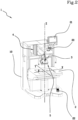
- Figures 1 and 2 show, respectively, a first and a second embodiment of the laser machining apparatus 1.
- the apparatus 1 comprises a workbench 2 having a work area A on which an object 50 to be machined by laser can be positioned, a laser emitter 3 configured to emit a laser beam F towards the work area A along a direction transversal Z to the same workbench 2, a movement mechanism 4 connected to the workbench 2 ( FIG.2 ) or to the laser emitter 3 ( FIG.1 ) configured to three-dimensionally move the same workbench 2 or the same laser emitter 3 reciprocally to each other.
- the apparatus 1 comprises a control unit connected to the movement mechanism 4 and/or the laser emitter 3 to generate and send an enabling signal to enable the movement mechanism 4 and/or the laser emitter 3 according to manipulations performed by the operator on at least one manipulation element 6 (better illustrated in figures 3A and 3B ) connected to the same control unit.
- the enabling signal is representative of a movement along a vertical direction Z and/or along one or more horizontal directions X, Y and/or a combination thereof.
- control unit comprises a box-like body 7 having a supporting base 8, a cover panel 9 and elastic return means interposed between the supporting base 8 and the cover panel 9.
- the manipulation element 6 is arranged on the cover panel 9.
- the manipulation element 6 can be arranged on the supporting base 8 so as to protrude beyond the cover panel 9 through a through hole previously arranged on the same cover panel 9.
- cover panel 9 and the supporting base 8 are movable reciprocally towards and away from each other according to external forces applied by the operator (arrow "P" in figure 3A ) on the same cover panel 9, for example the pressing force generated by the weight or otherwise of the operator's hand resting on the cover panel 9 during the manipulation operations.
- control unit is configurable between an active condition for allowing the sending of the enabling signal and an inactive condition for preventing the sending of the same enabling signal.
- active condition the cover panel 9 and the supporting base 8 are arranged at a minimum distance apart, while in the inactive condition the cover panel 9 and the supporting base 8 are arranged at a distance greater than the minimum distance.
- the laser machining apparatus 1 is advantageously capable of disabling the movement of the laser beam F and/or its emission if the operator is not directly controlling the control device 5, i.e., if the operator is not applying the correct resting pressure on the cover panel 9.
- control unit in the active condition, is configured to send a release signal which allows the reception by the laser emitter 3 and/or by the movement mechanism 4 of the enabling signal representative of the activation of the laser beam F and/or the three-dimensional movement of the latter. Otherwise, in the inactive condition, any enabling signal generated by the control unit is ignored/inhibited by the absence of reception of the release signal by the laser emitter 3 and the movement mechanism 4 and, therefore, the laser beam F cannot be activated or moved three-dimensionally with respect to the workbench 2.
- control unit in the inactive condition, can be configured to not generate any enabling signal.
- the elastic return means is configured to work in extension so that, in the absence of external forces, the control unit is configured in the inactive condition.
- control unit is normally in the inactive condition (maximum distance between the cover panel 9 and the supporting base 8) and, therefore, only the application of an external force on the cover panel 9 is capable of inducing movement in the active condition, i.e., the condition in which the cover panel 9 and the supporting base are at a close distance with respect to the previous one.
- an operator controlling the laser beam F tends to rest his hands on the cover panel 9 so as to push the latter towards the supporting base 8, enabling the reception of the enabling signals by the laser emitter 3 and/or the movement mechanism 4.
- the elastic return means comprises a spring and/or a hydraulic piston and/or a pneumatic piston.
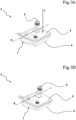
- Figures 3A and 3B illustrate the control unit, respectively, in the inactive condition (maximum distance between the cover panel 9 and the supporting base 8) and in the active condition (minimum distance between the cover panel 9 and the supporting base 8).
- the cover panel 9 and the supporting base 8 are rotatably connected to each other at a hinge side of the box-like body 7, which is opposite with respect to a portion of the cover panel 9 used as a rest for the hands of an operator.
- the cover panel 9 and the supporting base 8 are movable relative to each other with respect to a rotation axis R (visible in FIG. 3A ) to define the active (approaching) and inactive (distancing) positions.
- the cover panel 9 is preferably and advantageously capable of tilting with respect to the supporting base 8 so as to alternatively define the active condition and the inactive condition of the control unit.
- any peripheral side of the box-like body 7 can have the hinge between the supporting base 8 and the cover panel 9.
- one or more elastic return means can be interposed between the cover panel 9 and the supporting base 8 so that the cover panel 9 and the supporting base 8 are always substantially parallel to each other, even during the movement between the active condition and the inactive condition.
- Figure 1 illustrates the first embodiment of the apparatus 1, in which the workbench 2 is solidly connected to a support frame 10 arranged in a stable position.
- the movement mechanism 4 is connected to the laser emitter 3 to move the latter three-dimensionally with respect to the work area A.
- the workbench 2 is released from the rest of the apparatus 1 which, therefore, is advantageously movable between different workbenches 2.
- This solution is useful since, sometimes, it is preferable to avoid moving the objects to be machined and, therefore, it is easier to move the laser emitter 3.
- the support frame 10 comprises a movement carriage having four wheels 11 for movement and, in addition, four stop elements 12 to constrain everything in a stable position when the laser beam F must be generated.
- Figure 2 illustrates the second embodiment of the apparatus 1, alternative with respect to that of figure 1 , in which the laser emitter 3 is solidly connected to a support frame 10 arranged in a stable position.
- the movement mechanism 4 is connected to the workbench 2 to move the latter with respect to the laser emitter 3.
- the workbench 2 and the laser emitter 3 are preferably constrained to the same support frame 10 so that the apparatus 1 is defined by a single structure.
- Figures 1 and 2 further illustrate further elements which can be connected to the apparatus 1.
- the apparatus 1 can comprise a microscope 20 arranged at the laser emitter 3 so that the operator can check the progress of the machining through the eyepieces of the microscope 20.
- the apparatus 1 comprises a control panel 21 on which the machining data and/or any images recorded by the microscope 20 can be represented.
- the control panel 21 comprises a touchscreen display and/or is equipped with a push-button panel so as to be able to manipulate the data and/or the images shown.
- the apparatus 1 can also comprise an operating pedal board 22 connected to the laser emitter 3 and usable, alternatively, with any manipulation elements 6 connected to the control unit.
- the operating pedal board 22 is preferably configured to send a laser beam activation signal F and, advantageously, allows the operator to activate/deactivate the laser beam F through a pressure of the foot. Thereby, the operator is advantageously relieved from performing a further manual operation through any manipulation elements 6 with which he must substantially manage only the movement of the laser emitter 3 with respect to the workbench 2.
- control unit in the inactive condition is configured to send an inhibition signal of any enabling signal generated and sent by the operating pedal board 22 for the activation/deactivation of the laser beam F. More precisely, in the inactive condition the control unit is configured to not send a release signal of the laser emitter F for its activation, despite the reception of any enabling signal generated by the operating pedal board 22.
- control unit is electrically connected to the movement mechanism 4.
- control unit is wirelessly connected to the movement mechanism 4.
- control unit comprises a wireless communication module, for example a wireless or Bluetooth module, configured to interface with another similar module connected to the laser emitter 3.
- the movement mechanism 4 comprises a system of three-axis movement guides.
- the system of three-axis movement guides comprises, for each Cartesian direction, an axis which can be moved thanks to the use of a worm screw so as to define the classic three-dimensional movement in space with respect to the workbench 2.
- control unit comprises a safety unit (not illustrated) enabled to configure said control unit from the active condition to the inactive condition after a predefined interval of time in which no enabling signal is received by the control unit in the active condition.
- the safety unit is configured to force the passage from the active condition to the inactive condition after the predetermined time interval in which no commands have been generated to be sent to the laser emitter 3 and/or to the movement mechanism 4 (and, therefore, apparently the operator is not near the apparatus 1).
- the safety unit allows to prevent the control unit from sending any enabling signal to the laser emitter 3 and/or to the movement mechanism 4 which, therefore, are not capable of receiving any command to move and/or activate the laser beam F.
- the time interval has a duration of 10 minutes.
- the time interval has an adjustable duration which cannot exceed a maximum time equal to 30 minutes.
- control unit comprises a contact sensor (not illustrated) interposed between the supporting base 8 and the cover panel 9.
- contact sensor is configured to detect at least the minimum distance between the cover panel 9 and the supporting base 8 and to allow or not allow the sending of the enabling signal.
- the contact sensor when the control unit is in the active condition (minimum distance between the cover panel 9 and the supporting base 8), the contact sensor is configured to close the electrical circuit and, therefore, allow the sending of the movement and/or generation signals of the laser beam F towards, respectively, the movement mechanism 4 and/or the laser emitter 3.
- the contact sensor comprises a pair of electrodes arranged on the cover panel 9 and on the supporting base 8, opposite each other so that in the active condition they touch each other to short-circuit the circuit for sending the signals.
- the contact sensor of the apparatus 1 can comprise a capacitive sensor and/or a magnetic sensor and/or an RFID-type sensor, each of which is configured to define the closure of the circuit to which is connected the generation system of the enabling signals to be sent to the laser emitter 3 and/or to the movement mechanism 4.
- the present invention further relates to a control device 5 for the manipulation of a laser emitter 3 and/or a movement mechanism 4 of a laser machining apparatus 1, in which the movement mechanism 4 is connected to the laser emitter 3 and/or to a workbench 2 on which an object 50 to be machined by laser can be positioned so as to control a relative three-dimensional movement between them.
- figures 3A and 3B illustrate the control device 5 which comprises a box-like body 7 having a supporting base 8, a cover panel 9 and elastic return means interposed between the supporting base 8 and the cover panel 9.
- the cover panel 9 and the supporting base 8 are movable reciprocally towards and away from each other according to external forces induced by the operator (arrow "P" in figure 3A ) on the same cover panel 9.
- the control device 5 further comprises a control unit connected to the box-like body 7 and connected to the movement mechanism 4 and/or to the laser emitter 3.
- the control unit is configured to generate and send an enabling signal to enable the movement mechanism 4 and/or the laser emitter 3 according to manipulations performed by the operator on at least one manipulation element 6 connected to the same control unit.
- the enabling signal is representative of a movement of the movement mechanism 4 along a vertical direction and/or along one or more horizontal directions and/or a combination thereof and/or a generation of a laser beam by said laser emitter 3.
- control unit is configurable between an active condition for allowing the sending of the enabling signal and an inactive condition for preventing the sending of the enabling signal. More precisely, in the active condition, the cover panel 9 and the supporting base 8 are arranged near each other at a minimum distance apart, while in the inactive condition the cover panel 9 and the supporting base 8 are arranged away at a distance greater than the aforesaid minimum distance.
- the elastic return means is configured to work in extension so that the control unit is configured in the inactive condition in the absence of external forces applied on the cover panel.
- the cover panel 9 and the supporting base 8 are rotatably connected to each other at a hinge side of the box-like body 7 which is opposite with respect to a portion of the cover panel 9 used as a rest for the hands of an operator.
- the cover panel 9 and the supporting base 8 are movable relative to each other with respect to a rotation axis for defining the active and inactive conditions.
- control unit comprises a safety unit enabled to configure the control unit from the active condition to the inactive condition after a predefined interval of time in which the control unit has not sent an enabling signal when it is configured in the active condition.
- control unit comprises a contact sensor interposed between the supporting base 8 and the cover panel 9.
- the contact sensor is configured to detect at least the minimum distance between the cover panel 9 and the supporting base 8 and to allow or not allow the sending of the enabling signal.
- control device 5 just described encloses the features of the control unit described above referring to the laser machining apparatus 1. Consequently, the features (even secondary and/or optional) related to the control unit are also attributable to the control device 5.
- the present invention achieves the set objects.
- the machining apparatus 1 in accordance with the invention allows to detect the presence of the operator without forcing uncomfortable operations, but in an extremely simple and comfortable manner for the operator and at low costs. Thereby, it is possible to impart commands to the laser emitter 3 and to the movement mechanism 4 only if the operator is near the same apparatus 1 and with his hand on the control device 5 (so as to apply the pressure necessary to induce the active condition). Since the invention does not force the operator to assume uncomfortable positions during the machining, the operator himself will not be at all encouraged to circumvent the protection device (problem currently present with the laser machining apparatuses of the prior art).
- control device 5 is provided with a safety system (called a "man-present" sensor) that can only be activated by pressing down (in accordance with the preferred embodiment described) the operator's hand when it is placed on the same control device 5, and more precisely on the cover panel 9, to unlock the sending and receiving of movement and/or emission signals of the laser beam F.
- a safety system called a "man-present” sensor
- the apparatus 1 is capable of detecting when the operator is present and, therefore, only in this case unlocking the man-machine commands of the riskiest functions, whether these commands are present on the control device 5 (i.e., the sending of the enabling signal by the manipulation element 6), or in other parts of the apparatus 1 (i.e., the sending of the enabling signal by the pedalboard).
- control device 5 Resting the hand on the control device 5 is an intrinsic gesture during normal operator work operations. Therefore, the operator is not required to perform any other action to signal his presence at the apparatus 1.
- the main improvement is that the logic implemented in the safety system, based on the state of the "man-present" sensor arranged in the control device 5, inhibits dangerous operations when the operator moves away, or has left the controls. It therefore allows to avoid, for example, the possibility of undesired movements of the movement mechanism 4 and/or of the laser beam F, or the generation and emission of uncontrolled laser radiation when the operator is not present in front of the apparatus 1 or is setting up the work area, or is positioning the object 50 to be machined.
- Another improvement is that the dangerous operations can therefore be performed by the apparatus 1 only if the operator is present and, furthermore, if he has activated the commands to perform the required operations (including pressing the control device 5 to move it in the active condition).
Landscapes
- Engineering & Computer Science (AREA)
- Physics & Mathematics (AREA)
- Optics & Photonics (AREA)
- Mechanical Engineering (AREA)
- Plasma & Fusion (AREA)
- Robotics (AREA)
- Sustainable Energy (AREA)
- Sustainable Development (AREA)
- Life Sciences & Earth Sciences (AREA)
- Power Engineering (AREA)
- Transportation (AREA)
- General Physics & Mathematics (AREA)
- Automation & Control Theory (AREA)
- Laser Beam Processing (AREA)
- General Factory Administration (AREA)
- Laser Surgery Devices (AREA)
Description
- The present invention relates to a laser machining apparatus.
- In particular, the invention relates to an apparatus used in the context of movable consoles for laser machine tools, in particular manual or semi-automatic machines, comprising a protective device useful to the operator who uses the same apparatus.
- The present invention further relates to a control device for the manipulation of a laser machining apparatus, preferably for the above apparatus.
- Today, many precision machinings (engravings, welding ...) are preferably carried out with the aid of a laser beam. In fact, a laser beam can be collimated and aligned at the exact point where the machining must be performed. Furthermore, the action area of the laser is considerably reduced and allows to obtain machinings of great precision. Generally, in fact, the minimum diameter of a laser beam is of the order of one tenth of a millimetre.
- The aforesaid laser machinings are performed with specific apparatuses in which the object to be machined is positioned on a workbench arranged below a laser emitter configured to emit an orientable laser beam. Preferably, the laser beam is directed substantially along a direction orthogonal to the aforesaid workbench. These apparatuses are provided with specific devices, the so-called "movable consoles" or "manipulators", on which the controls that allow the use of the functions of the apparatus are located, such as the movement of the axes on which the laser emitter is mounted or the movement of the workbench.
- This type of machining can require that the operator is physically present within the work area with the whole body or only with some parts, for example with the arms or hands. The fact that the manipulator is movable allows the operator to bring the apparatus controls near the point where he is operating. In these cases, the work area cannot be protected with guards that make the operator safe and, therefore, the machining to be performed can present risks to the health of the operator.
- Furthermore, regardless of the presence or absence of any protective bulkheads, the possibility that some functions of the movable console are activated if the operator is far from the workstation must be avoided.
- The aforesaid laser machining apparatuses can substantially have two distinct embodiments: the laser emitter can be movable with respect to the workbench, approaching and/or moving away and/or along any direction parallel to the same workbench or, alternatively, the laser emitter is constrained in a fixed position, while the workbench on which is arranged the object to be machined is movable.
- Regardless, the reciprocal movement between the laser emitter and the workbench is controlled and managed by an operator who, being present in whole or in part within the work area, through the use of specific controls on the manipulator, must be able to guide the machining by moving the axes, orienting/positioning the tool, activating/deactivating the laser emission and, furthermore, must be able to continuously view the machining carried out and that to be carried out.
- The presence of the operator within the work area and the impossibility of having adequate confinement systems of the work area are intrinsic features of the aforesaid apparatuses and the type of work to be performed that can involve multiple risks, including: mechanical risks (impact, crushing, shearing, etc...), specific risks of machines with laser emission (ionising radiation, including laser radiation), etc...
- In addition, the possibility of having axis movements (i.e., the reciprocal movement between the workbench and the laser emitter) not controlled directly by the operator must be avoided, so as to avoid possible collisions with the objects being machined or other components present in the adjacent areas which could cause damage to both the machining apparatus and to the same objects being machined.
- A limit case could be the involuntary movement of the laser emitter along the vertical axis downwards, for example, due to an electrical fault or a software problem. Descending along the vertical axis, the laser emitter can hit the workbench and/or the object being machined and, therefore, cause the machine to tilt until a possible overturning.
- If the operator is present and the movement speed is sufficiently low, the operator can remedy this by pressing the emergency button. Alternatively, as illustrated in documents
DE20122595 ,US6380925 andUS2001/040553 , it would be possible to install on the apparatus or, possibly, on the movable consoles, safety devices capable of interrupting the operation of the same apparatus. However, such devices also have some drawbacks which the present invention aims to overcome. - Other solutions defining the prior art are disclosed in
documents DE 20 2011 104216 U1 andUS 6 420 680 B1 . - In this context, the technical task at the basis of the present invention is to propose a laser machining apparatus and a control device which overcome the problems of the prior art cited above.
- An object of the present invention is to provide a laser machining apparatus which ensures high safety standards. Therefore, specifically, the invention aims to provide a laser machining apparatus capable of deactivating the emission and/or movement of the laser beam if the operator is not present near the apparatus, or is not controlling it directly due to, for example, a distraction or an ailment.
- Another object of the present invention is to provide a laser machining apparatus which ensures ease of use for the operator, since possible safety devices do not directly interfere with his work.
- A further object of the present invention is to provide a control device which is easily usable by an operator and, furthermore, which is not an obstacle to the operations normally implemented so as not to encourage its tampering.
- The stated technical task and specified objects are substantially achieved by a laser machining apparatus and a control device, which comprise the technical features disclosed in the respective independent claims. The dependent claims correspond to further advantageous aspects of the invention.
- The invention relates to: a control device as described in
claim 1, a laser machining apparatus according toclaim 4 and further objects / modifications of the invention are described in the dependent claims. - Further features and advantages of the present invention will become clearer from the indicative, and therefore non-limiting, description of a preferred but not exclusive embodiment of a laser machining apparatus, as illustrated in the attached drawings, in which:
-
figure 1 illustrates, in perspective view, a first embodiment of the laser machining apparatus; -
figure 2 illustrates, in perspective view, a second embodiment of the laser machining apparatus; -
figures 3A and 3B illustrate, in perspective view, the control device of the apparatus illustrated in the previous figures, respectively, in the inactive condition and in the active condition. - With reference to the drawings, they serve solely to illustrate embodiments of the invention with the aim of better clarifying, in combination with the description, the inventive principles on which the invention is based.
- The present invention relates to a laser machining apparatus which, with reference to the figures, has been generally indicated by the
number 1. - Any modifications or variants which, in the light of the description, are evident to the person skilled in the art, must be considered to fall within the scope of protection established by the present invention, such as defined by the appended claims, according to considerations of technical equivalence.
-
Figures 1 and2 show, respectively, a first and a second embodiment of thelaser machining apparatus 1. - In particular, the
apparatus 1 comprises aworkbench 2 having a work area A on which anobject 50 to be machined by laser can be positioned, alaser emitter 3 configured to emit a laser beam F towards the work area A along a direction transversal Z to thesame workbench 2, amovement mechanism 4 connected to the workbench 2 (FIG.2 ) or to the laser emitter 3 (FIG.1 ) configured to three-dimensionally move thesame workbench 2 or thesame laser emitter 3 reciprocally to each other. - Furthermore, the
apparatus 1 comprises a control unit connected to themovement mechanism 4 and/or thelaser emitter 3 to generate and send an enabling signal to enable themovement mechanism 4 and/or thelaser emitter 3 according to manipulations performed by the operator on at least one manipulation element 6 (better illustrated infigures 3A and 3B ) connected to the same control unit. The enabling signal is representative of a movement along a vertical direction Z and/or along one or more horizontal directions X, Y and/or a combination thereof. - In particular, the control unit comprises a box-
like body 7 having a supportingbase 8, acover panel 9 and elastic return means interposed between the supportingbase 8 and thecover panel 9. - Preferably, the
manipulation element 6 is arranged on thecover panel 9. Alternatively, themanipulation element 6 can be arranged on the supportingbase 8 so as to protrude beyond thecover panel 9 through a through hole previously arranged on thesame cover panel 9. - More precisely, the
cover panel 9 and the supportingbase 8 are movable reciprocally towards and away from each other according to external forces applied by the operator (arrow "P" infigure 3A ) on thesame cover panel 9, for example the pressing force generated by the weight or otherwise of the operator's hand resting on thecover panel 9 during the manipulation operations. - In particular, the control unit is configurable between an active condition for allowing the sending of the enabling signal and an inactive condition for preventing the sending of the same enabling signal. In the active condition, the
cover panel 9 and the supportingbase 8 are arranged at a minimum distance apart, while in the inactive condition thecover panel 9 and the supportingbase 8 are arranged at a distance greater than the minimum distance. - Thereby, the
laser machining apparatus 1 is advantageously capable of disabling the movement of the laser beam F and/or its emission if the operator is not directly controlling thecontrol device 5, i.e., if the operator is not applying the correct resting pressure on thecover panel 9. - In other words, in the active condition, the control unit is configured to send a release signal which allows the reception by the
laser emitter 3 and/or by themovement mechanism 4 of the enabling signal representative of the activation of the laser beam F and/or the three-dimensional movement of the latter. Otherwise, in the inactive condition, any enabling signal generated by the control unit is ignored/inhibited by the absence of reception of the release signal by thelaser emitter 3 and themovement mechanism 4 and, therefore, the laser beam F cannot be activated or moved three-dimensionally with respect to theworkbench 2. - Alternatively, in the inactive condition, the control unit can be configured to not generate any enabling signal.
- In accordance with an aspect of the invention, the elastic return means is configured to work in extension so that, in the absence of external forces, the control unit is configured in the inactive condition.
- In other words, the control unit is normally in the inactive condition (maximum distance between the
cover panel 9 and the supporting base 8) and, therefore, only the application of an external force on thecover panel 9 is capable of inducing movement in the active condition, i.e., the condition in which thecover panel 9 and the supporting base are at a close distance with respect to the previous one. - For example, an operator controlling the laser beam F tends to rest his hands on the
cover panel 9 so as to push the latter towards the supportingbase 8, enabling the reception of the enabling signals by thelaser emitter 3 and/or themovement mechanism 4. - Preferably, the elastic return means comprises a spring and/or a hydraulic piston and/or a pneumatic piston.
-
Figures 3A and 3B illustrate the control unit, respectively, in the inactive condition (maximum distance between thecover panel 9 and the supporting base 8) and in the active condition (minimum distance between thecover panel 9 and the supporting base 8). - In accordance with another aspect of the invention, the
cover panel 9 and the supportingbase 8 are rotatably connected to each other at a hinge side of the box-like body 7, which is opposite with respect to a portion of thecover panel 9 used as a rest for the hands of an operator. In particular, thecover panel 9 and the supportingbase 8 are movable relative to each other with respect to a rotation axis R (visible inFIG. 3A ) to define the active (approaching) and inactive (distancing) positions. - In other words, the
cover panel 9 is preferably and advantageously capable of tilting with respect to the supportingbase 8 so as to alternatively define the active condition and the inactive condition of the control unit. - Alternatively, any peripheral side of the box-
like body 7 can have the hinge between the supportingbase 8 and thecover panel 9. - In accordance with a further alternative aspect of the invention, one or more elastic return means can be interposed between the
cover panel 9 and the supportingbase 8 so that thecover panel 9 and the supportingbase 8 are always substantially parallel to each other, even during the movement between the active condition and the inactive condition. -
Figure 1 illustrates the first embodiment of theapparatus 1, in which theworkbench 2 is solidly connected to asupport frame 10 arranged in a stable position. In particular, themovement mechanism 4 is connected to thelaser emitter 3 to move the latter three-dimensionally with respect to the work area A. - Thereby, the
workbench 2 is released from the rest of theapparatus 1 which, therefore, is advantageously movable betweendifferent workbenches 2. This solution is useful since, sometimes, it is preferable to avoid moving the objects to be machined and, therefore, it is easier to move thelaser emitter 3. - In
figure 1 , in fact, thesupport frame 10 comprises a movement carriage having fourwheels 11 for movement and, in addition, fourstop elements 12 to constrain everything in a stable position when the laser beam F must be generated. - Similarly, it is also possible to keep the
support frame 10 in a fixed and stable position over time and replace theworkbench 2 associated therewith according to the size of theobject 50 which must be machined with the laser beam F. -
Figure 2 illustrates the second embodiment of theapparatus 1, alternative with respect to that offigure 1 , in which thelaser emitter 3 is solidly connected to asupport frame 10 arranged in a stable position. In particular, themovement mechanism 4 is connected to theworkbench 2 to move the latter with respect to thelaser emitter 3. - Unlike the previous embodiment, the
workbench 2 and thelaser emitter 3 are preferably constrained to thesame support frame 10 so that theapparatus 1 is defined by a single structure. -
Figures 1 and2 further illustrate further elements which can be connected to theapparatus 1. - In fact, the
apparatus 1 can comprise amicroscope 20 arranged at thelaser emitter 3 so that the operator can check the progress of the machining through the eyepieces of themicroscope 20. - In addition, preferably, the
apparatus 1 comprises acontrol panel 21 on which the machining data and/or any images recorded by themicroscope 20 can be represented. Even more preferably, thecontrol panel 21 comprises a touchscreen display and/or is equipped with a push-button panel so as to be able to manipulate the data and/or the images shown. - The
apparatus 1 can also comprise an operatingpedal board 22 connected to thelaser emitter 3 and usable, alternatively, with anymanipulation elements 6 connected to the control unit. - In fact, the operating
pedal board 22 is preferably configured to send a laser beam activation signal F and, advantageously, allows the operator to activate/deactivate the laser beam F through a pressure of the foot. Thereby, the operator is advantageously relieved from performing a further manual operation through anymanipulation elements 6 with which he must substantially manage only the movement of thelaser emitter 3 with respect to theworkbench 2. - Preferably, the control unit in the inactive condition is configured to send an inhibition signal of any enabling signal generated and sent by the operating
pedal board 22 for the activation/deactivation of the laser beam F. More precisely, in the inactive condition the control unit is configured to not send a release signal of the laser emitter F for its activation, despite the reception of any enabling signal generated by the operatingpedal board 22. - According to an aspect of the invention illustrated in
figures 1 and2 , the control unit is electrically connected to themovement mechanism 4. - According to an alternative aspect of the invention (not shown), the control unit is wirelessly connected to the
movement mechanism 4. In this second case, the control unit comprises a wireless communication module, for example a wireless or Bluetooth module, configured to interface with another similar module connected to thelaser emitter 3. - In accordance with an aspect of the invention, the
movement mechanism 4 comprises a system of three-axis movement guides. - The system of three-axis movement guides comprises, for each Cartesian direction, an axis which can be moved thanks to the use of a worm screw so as to define the classic three-dimensional movement in space with respect to the
workbench 2. - In accordance with another aspect of the invention, the control unit comprises a safety unit (not illustrated) enabled to configure said control unit from the active condition to the inactive condition after a predefined interval of time in which no enabling signal is received by the control unit in the active condition.
- In other words, if the control unit remains locked in the active condition due to a malfunction or tampering, the safety unit is configured to force the passage from the active condition to the inactive condition after the predetermined time interval in which no commands have been generated to be sent to the
laser emitter 3 and/or to the movement mechanism 4 (and, therefore, apparently the operator is not near the apparatus 1). - Therefore, if the operator is not present near the
apparatus 1, the safety unit allows to prevent the control unit from sending any enabling signal to thelaser emitter 3 and/or to themovement mechanism 4 which, therefore, are not capable of receiving any command to move and/or activate the laser beam F. - Preferably, the time interval has a duration of 10 minutes.
- Even more preferably, the time interval has an adjustable duration which cannot exceed a maximum time equal to 30 minutes.
- In accordance with another aspect of the invention, the control unit comprises a contact sensor (not illustrated) interposed between the supporting
base 8 and thecover panel 9. In particular, the contact sensor is configured to detect at least the minimum distance between thecover panel 9 and the supportingbase 8 and to allow or not allow the sending of the enabling signal. - In other words, when the control unit is in the active condition (minimum distance between the
cover panel 9 and the supporting base 8), the contact sensor is configured to close the electrical circuit and, therefore, allow the sending of the movement and/or generation signals of the laser beam F towards, respectively, themovement mechanism 4 and/or thelaser emitter 3. - Preferably, the contact sensor comprises a pair of electrodes arranged on the
cover panel 9 and on the supportingbase 8, opposite each other so that in the active condition they touch each other to short-circuit the circuit for sending the signals. - Alternatively to the use of an electro-mechanical type sensor such as the one described above, the contact sensor of the
apparatus 1 can comprise a capacitive sensor and/or a magnetic sensor and/or an RFID-type sensor, each of which is configured to define the closure of the circuit to which is connected the generation system of the enabling signals to be sent to thelaser emitter 3 and/or to themovement mechanism 4. - The present invention further relates to a
control device 5 for the manipulation of alaser emitter 3 and/or amovement mechanism 4 of alaser machining apparatus 1, in which themovement mechanism 4 is connected to thelaser emitter 3 and/or to aworkbench 2 on which anobject 50 to be machined by laser can be positioned so as to control a relative three-dimensional movement between them. - In particular,
figures 3A and 3B illustrate thecontrol device 5 which comprises a box-like body 7 having a supportingbase 8, acover panel 9 and elastic return means interposed between the supportingbase 8 and thecover panel 9. Preferably, thecover panel 9 and the supportingbase 8 are movable reciprocally towards and away from each other according to external forces induced by the operator (arrow "P" infigure 3A ) on thesame cover panel 9. - The
control device 5 further comprises a control unit connected to the box-like body 7 and connected to themovement mechanism 4 and/or to thelaser emitter 3. In particular, the control unit is configured to generate and send an enabling signal to enable themovement mechanism 4 and/or thelaser emitter 3 according to manipulations performed by the operator on at least onemanipulation element 6 connected to the same control unit. Preferably, the enabling signal is representative of a movement of themovement mechanism 4 along a vertical direction and/or along one or more horizontal directions and/or a combination thereof and/or a generation of a laser beam by saidlaser emitter 3. - Advantageously, the control unit is configurable between an active condition for allowing the sending of the enabling signal and an inactive condition for preventing the sending of the enabling signal. More precisely, in the active condition, the
cover panel 9 and the supportingbase 8 are arranged near each other at a minimum distance apart, while in the inactive condition thecover panel 9 and the supportingbase 8 are arranged away at a distance greater than the aforesaid minimum distance. - In accordance with an aspect of the invention, the elastic return means is configured to work in extension so that the control unit is configured in the inactive condition in the absence of external forces applied on the cover panel.
- In accordance with another aspect of the invention, the
cover panel 9 and the supportingbase 8 are rotatably connected to each other at a hinge side of the box-like body 7 which is opposite with respect to a portion of thecover panel 9 used as a rest for the hands of an operator. In particular, thecover panel 9 and the supportingbase 8 are movable relative to each other with respect to a rotation axis for defining the active and inactive conditions. - In accordance with a further aspect of the invention, the control unit comprises a safety unit enabled to configure the control unit from the active condition to the inactive condition after a predefined interval of time in which the control unit has not sent an enabling signal when it is configured in the active condition.
- Preferably, the control unit comprises a contact sensor interposed between the supporting
base 8 and thecover panel 9. In particular, the contact sensor is configured to detect at least the minimum distance between thecover panel 9 and the supportingbase 8 and to allow or not allow the sending of the enabling signal. - In accordance with a preferred aspect of the invention, the
control device 5 just described encloses the features of the control unit described above referring to thelaser machining apparatus 1. Consequently, the features (even secondary and/or optional) related to the control unit are also attributable to thecontrol device 5. - The present invention achieves the set objects.
- In particular, the
machining apparatus 1 in accordance with the invention allows to detect the presence of the operator without forcing uncomfortable operations, but in an extremely simple and comfortable manner for the operator and at low costs. Thereby, it is possible to impart commands to thelaser emitter 3 and to themovement mechanism 4 only if the operator is near thesame apparatus 1 and with his hand on the control device 5 (so as to apply the pressure necessary to induce the active condition). Since the invention does not force the operator to assume uncomfortable positions during the machining, the operator himself will not be at all encouraged to circumvent the protection device (problem currently present with the laser machining apparatuses of the prior art). - In other words, the
control device 5 is provided with a safety system (called a "man-present" sensor) that can only be activated by pressing down (in accordance with the preferred embodiment described) the operator's hand when it is placed on thesame control device 5, and more precisely on thecover panel 9, to unlock the sending and receiving of movement and/or emission signals of the laser beam F. Thereby, theapparatus 1 is capable of detecting when the operator is present and, therefore, only in this case unlocking the man-machine commands of the riskiest functions, whether these commands are present on the control device 5 (i.e., the sending of the enabling signal by the manipulation element 6), or in other parts of the apparatus 1 (i.e., the sending of the enabling signal by the pedalboard). - Resting the hand on the
control device 5 is an intrinsic gesture during normal operator work operations. Therefore, the operator is not required to perform any other action to signal his presence at theapparatus 1. - In conclusion, the present invention allows to obtain the following improvements.
- The main improvement is that the logic implemented in the safety system, based on the state of the "man-present" sensor arranged in the
control device 5, inhibits dangerous operations when the operator moves away, or has left the controls. It therefore allows to avoid, for example, the possibility of undesired movements of themovement mechanism 4 and/or of the laser beam F, or the generation and emission of uncontrolled laser radiation when the operator is not present in front of theapparatus 1 or is setting up the work area, or is positioning theobject 50 to be machined. - Another improvement is that the dangerous operations can therefore be performed by the
apparatus 1 only if the operator is present and, furthermore, if he has activated the commands to perform the required operations (including pressing thecontrol device 5 to move it in the active condition). This means that in the event of anomalies (for example, an actuation of themovement mechanism 4 due to a control software error), it is sufficient to remove the hand from the control device 5 (or, more precisely, to reduce until cancelling the pressure induced on thecontrol device 5 by the operator's hand) to interrupt any operation of theapparatus 1. - What has just been described allows to obtain a technical solution which considerably increases the simplicity of use and ergonomics with respect to the technical solutions currently known.
Claims (9)
- A control device (5) for the manipulation of a laser emitter (3) and/or a movement mechanism (4) of a laser machining apparatus (1), wherein said movement mechanism (4) is connectable to said laser emitter (3) and/or to a workbench (2) in order to control a relative three-dimensional movement between them, comprising:- a box-like body (7) having a supporting base (8), a cover panel (9) and an elastic return means interposed between said supporting base (8) and said cover panel (9), said cover panel (9) and said supporting base (8) being movable reciprocally towards and away from each other according to external forces applied by the operator on said cover panel (9);- at least one manipulation element (6) arranged on the cover panel (9) or on the supporting base (8) protruding beyond the cover panel (9) through a through hole of the same cover panel (9);- a control unit connected to said box-like body (7) and suitable to be connected to said movement mechanism (4) and/or to said laser emitter (3), said control unit being configured to generate and send an enabling signal suitable to enable the movement mechanism (4) and/or the laser emitter (3) according to manipulations performed by the operator on said at least one manipulation element (6) connected to said control unit; said enabling signal being suitable to be representative of a movement of said movement mechanism (4) along a vertical direction and/or along one or more horizontal directions and/or a combination thereof and/or of a generation of a laser beam by said laser emitter (3),wherein said control unit is configurable between an active condition for allowing the sending of said enabling signal, wherein said cover panel (9) and said supporting base (8) are arranged near each other at a minimum distance apart, and an inactive condition for preventing the sending of said enabling signal, wherein said cover panel (9) and said supporting base (8) are positioned away from each other by a distance greater than said minimum distance,wherein said control unit comprises a contact sensor interposed between said supporting base (8) and said cover panel (9); said contact sensor being configured to detect at least said minimum distance between said cover panel (9) and said supporting base (8) and to allow or not allow the sending of said enabling signal,wherein said cover panel (9) and said supporting base (8) are rotatably connected to each other at a hinge side of the box-like body (7) which is opposite with respect to a portion of said cover panel (9) suitable to be used as a rest for the operator's hands; said cover panel (9) and said supporting base (8) being movable relative to each other with respect to a rotation axis so as to define the active and inactive conditions.
- The control device (5) according to claim 1, wherein said elastic return means is configured to work in extension so that, in the absence of external forces applied on said cover panel (9), said control unit is configured in the inactive condition.
- The control device (5) according to claim 1 or 2, wherein said control unit comprises a safety unit enabled to configure said control unit from the active condition to the inactive condition after a predefined interval of time in which said control unit has not sent any enabling signal when in the active condition.
- A laser machining apparatus (1), comprising:- a workbench (2) having a work area (A) on which an object (50) to be machined by laser can be positioned;- a laser emitter (3) configured to emit a laser beam toward said work area (A) along a direction transversal to said workbench (2);- a movement mechanism (4) connected to said workbench (2) or to said laser emitter (3) and configured to move said workbench (2) or said laser emitter (3) three-dimensionally and reciprocally to each other;- a control device (5) according to any one claim from 1 to 3, wherein the control unit is connected to said movement mechanism (4) and/or to said laser emitter (3) and in use configured to generate and send an enabling signal to enable the movement mechanism (4) and/or the laser emitter (3) according to manipulations performed by the operator on the at least one manipulation element (6) connected to said control unit; said enabling signal being representative of a movement of said movement mechanism (4) along a vertical direction and/or along one or more horizontal directions and/or a combination thereof and/or of a generation of a laser beam by said laser emitter (3).
- The apparatus (1) according to claim 4, wherein said workbench (2) is solidly connected to a support frame (10) arranged in a stable position, said movement mechanism (4) being connected to said laser emitter (3) in order to move the latter with respect to said work area (A).
- The apparatus (1) according to any one of the preceding claims 4 to 5, wherein said laser emitter (3) is solidly connected to a support frame (10) arranged in a stable position, said movement mechanism (4) being connected to said workbench (2) in order to move the latter with respect to said laser emitter (3).
- The apparatus (1) according to any one of preceding claims 4 to 6, wherein said control unit is electrically connected to said movement mechanism (4) and/or to said laser emitter (3).
- The apparatus (1) according to any one of preceding claims 4 to 6, wherein said control unit is wirelessly connected to said movement mechanism (4) and/or to said laser emitter (3).
- The apparatus (1) according to any one of preceding claims 4 to 8, wherein said movement mechanism (4) comprises a system of three-axis movement guides.
Applications Claiming Priority (2)
| Application Number | Priority Date | Filing Date | Title |
|---|---|---|---|
| IT102021000017924A IT202100017924A1 (en) | 2021-07-07 | 2021-07-07 | LASER PROCESSING EQUIPMENT AND CONTROL DEVICE |
| PCT/IB2022/055892 WO2023281342A1 (en) | 2021-07-07 | 2022-06-24 | Laser machining apparatus and control device |
Publications (2)
| Publication Number | Publication Date |
|---|---|
| EP4366908A1 EP4366908A1 (en) | 2024-05-15 |
| EP4366908B1 true EP4366908B1 (en) | 2024-12-04 |
Family
ID=77910998
Family Applications (1)
| Application Number | Title | Priority Date | Filing Date |
|---|---|---|---|
| EP22740991.9A Active EP4366908B1 (en) | 2021-07-07 | 2022-06-24 | Laser machining apparatus and control device |
Country Status (4)
| Country | Link |
|---|---|
| US (1) | US20240307999A1 (en) |
| EP (1) | EP4366908B1 (en) |
| IT (1) | IT202100017924A1 (en) |
| WO (1) | WO2023281342A1 (en) |
Citations (5)
| Publication number | Priority date | Publication date | Assignee | Title |
|---|---|---|---|---|
| GB2077501A (en) * | 1980-05-13 | 1981-12-16 | Cutler Hammer World Trade Inc | Safety electrical switch arrangement |
| US5691898A (en) * | 1995-09-27 | 1997-11-25 | Immersion Human Interface Corp. | Safe and low cost computer peripherals with force feedback for consumer applications |
| US6420680B1 (en) * | 2001-03-01 | 2002-07-16 | Lincoln Global, Inc. | Welder foot pedal |
| JP2006045802A (en) * | 2004-07-30 | 2006-02-16 | Konma Seisakusho:Kk | Snowplow |
| DE202011104216U1 (en) * | 2011-08-10 | 2012-01-16 | Rofin-Baasel Lasertech Gmbh & Co. Kg | Laser processing device |
Family Cites Families (3)
| Publication number | Priority date | Publication date | Assignee | Title |
|---|---|---|---|---|
| US5825308A (en) * | 1996-11-26 | 1998-10-20 | Immersion Human Interface Corporation | Force feedback interface having isotonic and isometric functionality |
| US6104382A (en) * | 1997-10-31 | 2000-08-15 | Immersion Corporation | Force feedback transmission mechanisms |
| DE20122595U1 (en) * | 2001-11-26 | 2006-07-20 | Alpha Laser Gmbh | Relative positioning and orientation of laser processing head and workpiece involves positioning depending on operator control inputs associated with at least one reference direction |
-
2021
- 2021-07-07 IT IT102021000017924A patent/IT202100017924A1/en unknown
-
2022
- 2022-06-24 US US18/577,098 patent/US20240307999A1/en active Pending
- 2022-06-24 EP EP22740991.9A patent/EP4366908B1/en active Active
- 2022-06-24 WO PCT/IB2022/055892 patent/WO2023281342A1/en not_active Ceased
Patent Citations (5)
| Publication number | Priority date | Publication date | Assignee | Title |
|---|---|---|---|---|
| GB2077501A (en) * | 1980-05-13 | 1981-12-16 | Cutler Hammer World Trade Inc | Safety electrical switch arrangement |
| US5691898A (en) * | 1995-09-27 | 1997-11-25 | Immersion Human Interface Corp. | Safe and low cost computer peripherals with force feedback for consumer applications |
| US6420680B1 (en) * | 2001-03-01 | 2002-07-16 | Lincoln Global, Inc. | Welder foot pedal |
| JP2006045802A (en) * | 2004-07-30 | 2006-02-16 | Konma Seisakusho:Kk | Snowplow |
| DE202011104216U1 (en) * | 2011-08-10 | 2012-01-16 | Rofin-Baasel Lasertech Gmbh & Co. Kg | Laser processing device |
Also Published As
| Publication number | Publication date |
|---|---|
| EP4366908A1 (en) | 2024-05-15 |
| WO2023281342A1 (en) | 2023-01-12 |
| US20240307999A1 (en) | 2024-09-19 |
| IT202100017924A1 (en) | 2023-01-07 |
Similar Documents
| Publication | Publication Date | Title |
|---|---|---|
| EP3017920B1 (en) | An industrial robot and a method for controlling an industrial robot | |
| EP2635456B1 (en) | Construction equipment machine with improved controller ergonomics | |
| US7347299B2 (en) | Rotating and/or swiveling seat | |
| US11052544B2 (en) | Safety device for machine tools | |
| DE112011101930B4 (en) | Method, control system and movement specification means for programming or specifying movements or sequences of an industrial robot | |
| CN103381605B (en) | Monitoring device for position monitoring of a robot device and production system comprising same | |
| EP3281671A1 (en) | Patient positioner system | |
| US10259128B2 (en) | Human-robot collaboration workstation with a mounting device | |
| EP3434245B1 (en) | Electric wheelchair operation apparatus and vehicle operation method therefor | |
| CA2453519A1 (en) | Toolholder for coupling a tool to a handling device | |
| US5396222A (en) | Ergonomic machine actuator | |
| US20240307999A1 (en) | Laser machining apparatus and control device | |
| JP7495943B2 (en) | Machine tools | |
| JP5816723B1 (en) | Mechanical device and control method thereof, remote control device and main control device | |
| US20050076688A1 (en) | Apparatus comprising a protection device | |
| EP3884115B1 (en) | Work machine with sensor enabled user control | |
| US20250091116A1 (en) | Bending machine and method for operating a bending machine | |
| JP3465252B2 (en) | Robot direct teaching device | |
| JPH0649598Y2 (en) | Safety equipment for aerial work vehicles | |
| JP2020078865A (en) | Console panel | |
| KR200498943Y1 (en) | Device of protecting the hand in the aerial work platforms | |
| JP4596767B2 (en) | Method of preventing workpiece collision with workpiece holding device | |
| JPH0743597Y2 (en) | Safety device for moving work equipment | |
| JPH05277564A (en) | Press brake | |
| JP2017021072A (en) | Simulated experience device |
Legal Events
| Date | Code | Title | Description |
|---|---|---|---|
| STAA | Information on the status of an ep patent application or granted ep patent |
Free format text: STATUS: UNKNOWN |
|
| STAA | Information on the status of an ep patent application or granted ep patent |
Free format text: STATUS: THE INTERNATIONAL PUBLICATION HAS BEEN MADE |
|
| PUAI | Public reference made under article 153(3) epc to a published international application that has entered the european phase |
Free format text: ORIGINAL CODE: 0009012 |
|
| STAA | Information on the status of an ep patent application or granted ep patent |
Free format text: STATUS: REQUEST FOR EXAMINATION WAS MADE |
|
| 17P | Request for examination filed |
Effective date: 20231227 |
|
| AK | Designated contracting states |
Kind code of ref document: A1 Designated state(s): AL AT BE BG CH CY CZ DE DK EE ES FI FR GB GR HR HU IE IS IT LI LT LU LV MC MK MT NL NO PL PT RO RS SE SI SK SM TR |
|
| REG | Reference to a national code |
Ref country code: DE Ref legal event code: R079 Free format text: PREVIOUS MAIN CLASS: B23K0026080000 Ipc: B60L0003020000 Ref country code: DE Ref legal event code: R079 Ref document number: 602022008454 Country of ref document: DE Free format text: PREVIOUS MAIN CLASS: B23K0026080000 Ipc: B60L0003020000 |
|
| GRAP | Despatch of communication of intention to grant a patent |
Free format text: ORIGINAL CODE: EPIDOSNIGR1 |
|
| STAA | Information on the status of an ep patent application or granted ep patent |
Free format text: STATUS: GRANT OF PATENT IS INTENDED |
|
| RIC1 | Information provided on ipc code assigned before grant |
Ipc: G05G 9/047 20060101ALI20240830BHEP Ipc: B23K 37/02 20060101ALI20240830BHEP Ipc: B23K 26/70 20140101ALI20240830BHEP Ipc: B23K 26/38 20140101ALI20240830BHEP Ipc: B23K 26/21 20140101ALI20240830BHEP Ipc: B23K 26/08 20140101ALI20240830BHEP Ipc: H01H 3/20 20060101ALI20240830BHEP Ipc: G05G 5/00 20060101ALI20240830BHEP Ipc: B60L 3/04 20060101ALI20240830BHEP Ipc: B60L 3/02 20060101AFI20240830BHEP |
|
| DAV | Request for validation of the european patent (deleted) | ||
| DAX | Request for extension of the european patent (deleted) | ||
| INTG | Intention to grant announced |
Effective date: 20240918 |
|
| GRAS | Grant fee paid |
Free format text: ORIGINAL CODE: EPIDOSNIGR3 |
|
| GRAA | (expected) grant |
Free format text: ORIGINAL CODE: 0009210 |
|
| STAA | Information on the status of an ep patent application or granted ep patent |
Free format text: STATUS: THE PATENT HAS BEEN GRANTED |
|
| AK | Designated contracting states |
Kind code of ref document: B1 Designated state(s): AL AT BE BG CH CY CZ DE DK EE ES FI FR GB GR HR HU IE IS IT LI LT LU LV MC MK MT NL NO PL PT RO RS SE SI SK SM TR |
|
| REG | Reference to a national code |
Ref country code: CH Ref legal event code: EP |
|
| REG | Reference to a national code |
Ref country code: DE Ref legal event code: R096 Ref document number: 602022008454 Country of ref document: DE |
|
| REG | Reference to a national code |
Ref country code: IE Ref legal event code: FG4D |
|
| REG | Reference to a national code |
Ref country code: LT Ref legal event code: MG9D |
|
| P01 | Opt-out of the competence of the unified patent court (upc) registered |
Free format text: CASE NUMBER: APP_8047/2025 Effective date: 20250218 |
|
| REG | Reference to a national code |
Ref country code: NL Ref legal event code: MP Effective date: 20241204 |
|
| PG25 | Lapsed in a contracting state [announced via postgrant information from national office to epo] |
Ref country code: HR Free format text: LAPSE BECAUSE OF FAILURE TO SUBMIT A TRANSLATION OF THE DESCRIPTION OR TO PAY THE FEE WITHIN THE PRESCRIBED TIME-LIMIT Effective date: 20241204 |
|
| PG25 | Lapsed in a contracting state [announced via postgrant information from national office to epo] |
Ref country code: FI Free format text: LAPSE BECAUSE OF FAILURE TO SUBMIT A TRANSLATION OF THE DESCRIPTION OR TO PAY THE FEE WITHIN THE PRESCRIBED TIME-LIMIT Effective date: 20241204 |
|
| PG25 | Lapsed in a contracting state [announced via postgrant information from national office to epo] |
Ref country code: BG Free format text: LAPSE BECAUSE OF FAILURE TO SUBMIT A TRANSLATION OF THE DESCRIPTION OR TO PAY THE FEE WITHIN THE PRESCRIBED TIME-LIMIT Effective date: 20241204 |
|
| PG25 | Lapsed in a contracting state [announced via postgrant information from national office to epo] |
Ref country code: ES Free format text: LAPSE BECAUSE OF FAILURE TO SUBMIT A TRANSLATION OF THE DESCRIPTION OR TO PAY THE FEE WITHIN THE PRESCRIBED TIME-LIMIT Effective date: 20241204 |
|
| PG25 | Lapsed in a contracting state [announced via postgrant information from national office to epo] |
Ref country code: NO Free format text: LAPSE BECAUSE OF FAILURE TO SUBMIT A TRANSLATION OF THE DESCRIPTION OR TO PAY THE FEE WITHIN THE PRESCRIBED TIME-LIMIT Effective date: 20250304 |
|
| PG25 | Lapsed in a contracting state [announced via postgrant information from national office to epo] |
Ref country code: GR Free format text: LAPSE BECAUSE OF FAILURE TO SUBMIT A TRANSLATION OF THE DESCRIPTION OR TO PAY THE FEE WITHIN THE PRESCRIBED TIME-LIMIT Effective date: 20250305 Ref country code: LV Free format text: LAPSE BECAUSE OF FAILURE TO SUBMIT A TRANSLATION OF THE DESCRIPTION OR TO PAY THE FEE WITHIN THE PRESCRIBED TIME-LIMIT Effective date: 20241204 |
|
| PG25 | Lapsed in a contracting state [announced via postgrant information from national office to epo] |
Ref country code: RS Free format text: LAPSE BECAUSE OF FAILURE TO SUBMIT A TRANSLATION OF THE DESCRIPTION OR TO PAY THE FEE WITHIN THE PRESCRIBED TIME-LIMIT Effective date: 20250304 |
|
| PG25 | Lapsed in a contracting state [announced via postgrant information from national office to epo] |
Ref country code: NL Free format text: LAPSE BECAUSE OF FAILURE TO SUBMIT A TRANSLATION OF THE DESCRIPTION OR TO PAY THE FEE WITHIN THE PRESCRIBED TIME-LIMIT Effective date: 20241204 |
|
| REG | Reference to a national code |
Ref country code: AT Ref legal event code: MK05 Ref document number: 1747835 Country of ref document: AT Kind code of ref document: T Effective date: 20241204 |
|
| PG25 | Lapsed in a contracting state [announced via postgrant information from national office to epo] |
Ref country code: SM Free format text: LAPSE BECAUSE OF FAILURE TO SUBMIT A TRANSLATION OF THE DESCRIPTION OR TO PAY THE FEE WITHIN THE PRESCRIBED TIME-LIMIT Effective date: 20241204 |
|
| PG25 | Lapsed in a contracting state [announced via postgrant information from national office to epo] |
Ref country code: PL Free format text: LAPSE BECAUSE OF FAILURE TO SUBMIT A TRANSLATION OF THE DESCRIPTION OR TO PAY THE FEE WITHIN THE PRESCRIBED TIME-LIMIT Effective date: 20241204 |
|
| PGFP | Annual fee paid to national office [announced via postgrant information from national office to epo] |
Ref country code: DE Payment date: 20250626 Year of fee payment: 4 |
|
| PG25 | Lapsed in a contracting state [announced via postgrant information from national office to epo] |
Ref country code: IS Free format text: LAPSE BECAUSE OF FAILURE TO SUBMIT A TRANSLATION OF THE DESCRIPTION OR TO PAY THE FEE WITHIN THE PRESCRIBED TIME-LIMIT Effective date: 20250404 |
|
| PG25 | Lapsed in a contracting state [announced via postgrant information from national office to epo] |
Ref country code: PT Free format text: LAPSE BECAUSE OF FAILURE TO SUBMIT A TRANSLATION OF THE DESCRIPTION OR TO PAY THE FEE WITHIN THE PRESCRIBED TIME-LIMIT Effective date: 20250404 |
|
| PG25 | Lapsed in a contracting state [announced via postgrant information from national office to epo] |
Ref country code: EE Free format text: LAPSE BECAUSE OF FAILURE TO SUBMIT A TRANSLATION OF THE DESCRIPTION OR TO PAY THE FEE WITHIN THE PRESCRIBED TIME-LIMIT Effective date: 20241204 |
|
| PGFP | Annual fee paid to national office [announced via postgrant information from national office to epo] |
Ref country code: FR Payment date: 20250624 Year of fee payment: 4 |
|
| PG25 | Lapsed in a contracting state [announced via postgrant information from national office to epo] |
Ref country code: AT Free format text: LAPSE BECAUSE OF FAILURE TO SUBMIT A TRANSLATION OF THE DESCRIPTION OR TO PAY THE FEE WITHIN THE PRESCRIBED TIME-LIMIT Effective date: 20241204 Ref country code: RO Free format text: LAPSE BECAUSE OF FAILURE TO SUBMIT A TRANSLATION OF THE DESCRIPTION OR TO PAY THE FEE WITHIN THE PRESCRIBED TIME-LIMIT Effective date: 20241204 |
|
| PG25 | Lapsed in a contracting state [announced via postgrant information from national office to epo] |
Ref country code: SK Free format text: LAPSE BECAUSE OF FAILURE TO SUBMIT A TRANSLATION OF THE DESCRIPTION OR TO PAY THE FEE WITHIN THE PRESCRIBED TIME-LIMIT Effective date: 20241204 |
|
| PG25 | Lapsed in a contracting state [announced via postgrant information from national office to epo] |
Ref country code: CZ Free format text: LAPSE BECAUSE OF FAILURE TO SUBMIT A TRANSLATION OF THE DESCRIPTION OR TO PAY THE FEE WITHIN THE PRESCRIBED TIME-LIMIT Effective date: 20241204 |
|
| REG | Reference to a national code |
Ref country code: DE Ref legal event code: R097 Ref document number: 602022008454 Country of ref document: DE |
|
| PG25 | Lapsed in a contracting state [announced via postgrant information from national office to epo] |
Ref country code: SE Free format text: LAPSE BECAUSE OF FAILURE TO SUBMIT A TRANSLATION OF THE DESCRIPTION OR TO PAY THE FEE WITHIN THE PRESCRIBED TIME-LIMIT Effective date: 20241204 |
|
| PG25 | Lapsed in a contracting state [announced via postgrant information from national office to epo] |
Ref country code: DK Free format text: LAPSE BECAUSE OF FAILURE TO SUBMIT A TRANSLATION OF THE DESCRIPTION OR TO PAY THE FEE WITHIN THE PRESCRIBED TIME-LIMIT Effective date: 20241204 |
|
| PLBE | No opposition filed within time limit |
Free format text: ORIGINAL CODE: 0009261 |
|
| STAA | Information on the status of an ep patent application or granted ep patent |
Free format text: STATUS: NO OPPOSITION FILED WITHIN TIME LIMIT |
|
| PGFP | Annual fee paid to national office [announced via postgrant information from national office to epo] |
Ref country code: IT Payment date: 20250630 Year of fee payment: 4 |
|
| REG | Reference to a national code |
Ref country code: CH Ref legal event code: L10 Free format text: ST27 STATUS EVENT CODE: U-0-0-L10-L00 (AS PROVIDED BY THE NATIONAL OFFICE) Effective date: 20251015 |
|
| 26N | No opposition filed |
Effective date: 20250905 |
|
| REG | Reference to a national code |
Ref country code: CH Ref legal event code: H13 Free format text: ST27 STATUS EVENT CODE: U-0-0-H10-H13 (AS PROVIDED BY THE NATIONAL OFFICE) Effective date: 20260127 |
|
| PG25 | Lapsed in a contracting state [announced via postgrant information from national office to epo] |
Ref country code: MC Free format text: LAPSE BECAUSE OF FAILURE TO SUBMIT A TRANSLATION OF THE DESCRIPTION OR TO PAY THE FEE WITHIN THE PRESCRIBED TIME-LIMIT Effective date: 20241204 |
|
| PG25 | Lapsed in a contracting state [announced via postgrant information from national office to epo] |
Ref country code: LU Free format text: LAPSE BECAUSE OF NON-PAYMENT OF DUE FEES Effective date: 20250624 |
|
| REG | Reference to a national code |
Ref country code: BE Ref legal event code: MM Effective date: 20250630 |
|
| PG25 | Lapsed in a contracting state [announced via postgrant information from national office to epo] |
Ref country code: IE Free format text: LAPSE BECAUSE OF NON-PAYMENT OF DUE FEES Effective date: 20250624 |
|
| PG25 | Lapsed in a contracting state [announced via postgrant information from national office to epo] |
Ref country code: BE Free format text: LAPSE BECAUSE OF NON-PAYMENT OF DUE FEES Effective date: 20250630 |
|
| PG25 | Lapsed in a contracting state [announced via postgrant information from national office to epo] |
Ref country code: CH Free format text: LAPSE BECAUSE OF NON-PAYMENT OF DUE FEES Effective date: 20250630 |