EP4366024A1 - Non-aqueous electrolyte and lithium secondary battery using same - Google Patents
Non-aqueous electrolyte and lithium secondary battery using same Download PDFInfo
- Publication number
- EP4366024A1 EP4366024A1 EP22916769.7A EP22916769A EP4366024A1 EP 4366024 A1 EP4366024 A1 EP 4366024A1 EP 22916769 A EP22916769 A EP 22916769A EP 4366024 A1 EP4366024 A1 EP 4366024A1
- Authority
- EP
- European Patent Office
- Prior art keywords
- aqueous electrolyte
- group
- carbonate
- lithium
- secondary battery
- Prior art date
- Legal status (The legal status is an assumption and is not a legal conclusion. Google has not performed a legal analysis and makes no representation as to the accuracy of the status listed.)
- Pending
Links
Images



Classifications
-
- H—ELECTRICITY
- H01—ELECTRIC ELEMENTS
- H01M—PROCESSES OR MEANS, e.g. BATTERIES, FOR THE DIRECT CONVERSION OF CHEMICAL ENERGY INTO ELECTRICAL ENERGY
- H01M10/00—Secondary cells; Manufacture thereof
- H01M10/05—Accumulators with non-aqueous electrolyte
- H01M10/056—Accumulators with non-aqueous electrolyte characterised by the materials used as electrolytes, e.g. mixed inorganic/organic electrolytes
- H01M10/0564—Accumulators with non-aqueous electrolyte characterised by the materials used as electrolytes, e.g. mixed inorganic/organic electrolytes the electrolyte being constituted of organic materials only
- H01M10/0566—Liquid materials
- H01M10/0567—Liquid materials characterised by the additives
-
- H—ELECTRICITY
- H01—ELECTRIC ELEMENTS
- H01M—PROCESSES OR MEANS, e.g. BATTERIES, FOR THE DIRECT CONVERSION OF CHEMICAL ENERGY INTO ELECTRICAL ENERGY
- H01M10/00—Secondary cells; Manufacture thereof
- H01M10/05—Accumulators with non-aqueous electrolyte
- H01M10/052—Li-accumulators
-
- H—ELECTRICITY
- H01—ELECTRIC ELEMENTS
- H01M—PROCESSES OR MEANS, e.g. BATTERIES, FOR THE DIRECT CONVERSION OF CHEMICAL ENERGY INTO ELECTRICAL ENERGY
- H01M10/00—Secondary cells; Manufacture thereof
- H01M10/05—Accumulators with non-aqueous electrolyte
- H01M10/052—Li-accumulators
- H01M10/0525—Rocking-chair batteries, i.e. batteries with lithium insertion or intercalation in both electrodes; Lithium-ion batteries
-
- H—ELECTRICITY
- H01—ELECTRIC ELEMENTS
- H01M—PROCESSES OR MEANS, e.g. BATTERIES, FOR THE DIRECT CONVERSION OF CHEMICAL ENERGY INTO ELECTRICAL ENERGY
- H01M10/00—Secondary cells; Manufacture thereof
- H01M10/05—Accumulators with non-aqueous electrolyte
- H01M10/056—Accumulators with non-aqueous electrolyte characterised by the materials used as electrolytes, e.g. mixed inorganic/organic electrolytes
- H01M10/0564—Accumulators with non-aqueous electrolyte characterised by the materials used as electrolytes, e.g. mixed inorganic/organic electrolytes the electrolyte being constituted of organic materials only
- H01M10/0566—Liquid materials
- H01M10/0568—Liquid materials characterised by the solutes
-
- H—ELECTRICITY
- H01—ELECTRIC ELEMENTS
- H01M—PROCESSES OR MEANS, e.g. BATTERIES, FOR THE DIRECT CONVERSION OF CHEMICAL ENERGY INTO ELECTRICAL ENERGY
- H01M10/00—Secondary cells; Manufacture thereof
- H01M10/05—Accumulators with non-aqueous electrolyte
- H01M10/056—Accumulators with non-aqueous electrolyte characterised by the materials used as electrolytes, e.g. mixed inorganic/organic electrolytes
- H01M10/0564—Accumulators with non-aqueous electrolyte characterised by the materials used as electrolytes, e.g. mixed inorganic/organic electrolytes the electrolyte being constituted of organic materials only
- H01M10/0566—Liquid materials
- H01M10/0569—Liquid materials characterised by the solvents
-
- H—ELECTRICITY
- H01—ELECTRIC ELEMENTS
- H01M—PROCESSES OR MEANS, e.g. BATTERIES, FOR THE DIRECT CONVERSION OF CHEMICAL ENERGY INTO ELECTRICAL ENERGY
- H01M10/00—Secondary cells; Manufacture thereof
- H01M10/42—Methods or arrangements for servicing or maintenance of secondary cells or secondary half-cells
- H01M10/4235—Safety or regulating additives or arrangements in electrodes, separators or electrolyte
-
- H—ELECTRICITY
- H01—ELECTRIC ELEMENTS
- H01M—PROCESSES OR MEANS, e.g. BATTERIES, FOR THE DIRECT CONVERSION OF CHEMICAL ENERGY INTO ELECTRICAL ENERGY
- H01M4/00—Electrodes
- H01M4/02—Electrodes composed of, or comprising, active material
- H01M4/36—Selection of substances as active materials, active masses, active liquids
- H01M4/48—Selection of substances as active materials, active masses, active liquids of inorganic oxides or hydroxides
- H01M4/50—Selection of substances as active materials, active masses, active liquids of inorganic oxides or hydroxides of manganese
- H01M4/505—Selection of substances as active materials, active masses, active liquids of inorganic oxides or hydroxides of manganese of mixed oxides or hydroxides containing manganese for inserting or intercalating light metals, e.g. LiMn2O4 or LiMn2OxFy
-
- H—ELECTRICITY
- H01—ELECTRIC ELEMENTS
- H01M—PROCESSES OR MEANS, e.g. BATTERIES, FOR THE DIRECT CONVERSION OF CHEMICAL ENERGY INTO ELECTRICAL ENERGY
- H01M2300/00—Electrolytes
- H01M2300/0017—Non-aqueous electrolytes
- H01M2300/0025—Organic electrolyte
-
- H—ELECTRICITY
- H01—ELECTRIC ELEMENTS
- H01M—PROCESSES OR MEANS, e.g. BATTERIES, FOR THE DIRECT CONVERSION OF CHEMICAL ENERGY INTO ELECTRICAL ENERGY
- H01M2300/00—Electrolytes
- H01M2300/0017—Non-aqueous electrolytes
- H01M2300/0025—Organic electrolyte
- H01M2300/0028—Organic electrolyte characterised by the solvent
- H01M2300/0037—Mixture of solvents
-
- H—ELECTRICITY
- H01—ELECTRIC ELEMENTS
- H01M—PROCESSES OR MEANS, e.g. BATTERIES, FOR THE DIRECT CONVERSION OF CHEMICAL ENERGY INTO ELECTRICAL ENERGY
- H01M4/00—Electrodes
- H01M4/02—Electrodes composed of, or comprising, active material
- H01M4/36—Selection of substances as active materials, active masses, active liquids
- H01M4/48—Selection of substances as active materials, active masses, active liquids of inorganic oxides or hydroxides
- H01M4/483—Selection of substances as active materials, active masses, active liquids of inorganic oxides or hydroxides for non-aqueous cells
-
- H—ELECTRICITY
- H01—ELECTRIC ELEMENTS
- H01M—PROCESSES OR MEANS, e.g. BATTERIES, FOR THE DIRECT CONVERSION OF CHEMICAL ENERGY INTO ELECTRICAL ENERGY
- H01M4/00—Electrodes
- H01M4/02—Electrodes composed of, or comprising, active material
- H01M4/36—Selection of substances as active materials, active masses, active liquids
- H01M4/48—Selection of substances as active materials, active masses, active liquids of inorganic oxides or hydroxides
- H01M4/52—Selection of substances as active materials, active masses, active liquids of inorganic oxides or hydroxides of nickel, cobalt or iron
- H01M4/525—Selection of substances as active materials, active masses, active liquids of inorganic oxides or hydroxides of nickel, cobalt or iron of mixed oxides or hydroxides containing iron, cobalt or nickel for inserting or intercalating light metals, e.g. LiNiO2, LiCoO2 or LiCoOxFy
-
- Y—GENERAL TAGGING OF NEW TECHNOLOGICAL DEVELOPMENTS; GENERAL TAGGING OF CROSS-SECTIONAL TECHNOLOGIES SPANNING OVER SEVERAL SECTIONS OF THE IPC; TECHNICAL SUBJECTS COVERED BY FORMER USPC CROSS-REFERENCE ART COLLECTIONS [XRACs] AND DIGESTS
- Y02—TECHNOLOGIES OR APPLICATIONS FOR MITIGATION OR ADAPTATION AGAINST CLIMATE CHANGE
- Y02E—REDUCTION OF GREENHOUSE GAS [GHG] EMISSIONS, RELATED TO ENERGY GENERATION, TRANSMISSION OR DISTRIBUTION
- Y02E60/00—Enabling technologies; Technologies with a potential or indirect contribution to GHG emissions mitigation
- Y02E60/10—Energy storage using batteries
Definitions
- the present disclosure relates to a non-aqueous electrolyte and a lithium secondary battery using the same.
- Lithium secondary batteries have been used widely not only for portable instruments, such as cellular phones and notebook PCs, but also for automobile and industrial storage batteries, and for novel use, such as drones. Although lithium secondary batteries originally have a relatively higher energy density as compared to the other types of secondary batteries, they have discussed to increase the charge voltage thereof in order to provide lithium secondary batteries having higher energy density.
- lithium cobaltate has been used as a positive electrode active material of a lithium secondary battery.
- NCM nickel-cobalt-manganese
- An electrolyte plays a role in ion conduction to operate a battery, and addition of an additive to the electrolyte has been studied to date in order to improve the function/performance of the electrolyte.
- it is required to develop an electrolyte optimized to a positive electrode active material and negative electrode active material used in a battery.
- the electrolyte is decomposed through reduction, and the decomposition product is deposited on the surface of a negative electrode.
- an electrolyte ingredient-derived coating film called 'solid electrolyte interface (SEI)' film is formed on the negative electrode surface.
- SEI electrolyte ingredient-derived coating film
- vinylene carbonate (VC) having a double bond in a cyclic structure As an electrolyte additive forming the SEI film, vinylene carbonate (VC) having a double bond in a cyclic structure has been used widely. However, when using an electrolyte containing vinylene carbonate, it is likely that the internal resistance of a battery is increased. Therefore, vinylene carbonate is problematic in use for a long-term preservation battery. Therefore, it is expected to develop an electrolyte having excellent characteristics to inhibit an increase in battery resistance even after repeating charge/discharge cycles.
- Patent Document 1 it is disclosed that use of a non-aqueous electrolyte including a polymer which is a reaction product of a maleimide compound with barbituric acid can inhibit a change in direct current resistance.
- Patent Document 1 merely discloses some embodiments wherein the additive is incorporated to a positive electrode.
- artificial graphite is used as a negative electrode material, and any effect upon the negative electrode using a silicon-containing material and surface coating film on the negative electrode is not described clearly.
- Patent Document 2 discloses that use of an additive for a lithium-ion battery, including an ion conductor having a specific structure and a compound having a maleimide structure can accelerate lithium-ion conduction and can improve the defect of an increase in resistance caused by the maleimide compound.
- graphite is used as a negative electrode material, and any effect upon the negative electrode using a silicon-containing material and surface coating film on the negative electrode is not described clearly.
- Non-Patent Document 1 discusses about the SEI film formability or battery characteristics depending on a difference in position (ortho-, meta- and para-) of phenylene dimaleimide. However, Non-Patent Document 1 merely discloses that phenylene dimaleimide in which para-functionalized substituents are selected has excellent SEI film formability, but there still remains a room for discussion about the structure of maleimide compound capable of providing optimized battery characteristics.
- Non-Patent Document 1 Fu-Ming Wang et.al, Journal of Power Sources (231), pp. 18-22, 2013
- the present disclosure is designed to solve the problems of the related art, and therefore the present disclosure is directed to providing a non-aqueous electrolyte capable of inhibiting an increase in battery resistance when repeating charge/discharge cycles.
- the inventors of the present disclosure have conducted intensive studies to solve the above-mentioned problem, and unexpectedly have found that it is possible to inhibit an increase in electrical resistance resulting from repetition of charge/discharge cycles by using a non-aqueous electrolyte including a bismaleimide compound having a specific chemical structure.
- the present disclosure is based on this finding.
- a non-aqueous electrolyte including a compound represented by the following Chemical Formula 1: wherein R 1 represents a C3-C20 linear or branched alkylene group, and each of R 2 to R 5 independently represents a hydrogen atom, a halogen atom or a C1-C5 alkyl group.
- R 1 preferably represents a C3-C10 linear or branched alkylene group.
- R 1 preferably represents a branched alkylene group.
- each of R 2 to R 5 preferably represents a hydrogen atom.
- the compound represented by Chemical Formula 1 is 1,5-bis(maleimide)-2-methylpentane.
- the compound represented by Chemical Formula 1 is present preferably in an amount of 0.1-5 wt% based on the total weight of the non-aqueous electrolyte.
- the non-aqueous electrolyte according to the present disclosure preferably further includes at least one carbonate selected from cyclic carbonates and linear carbonates.
- the non-aqueous electrolyte according to the present disclosure preferably further includes a lithium salt.
- the lithium salt preferably includes LiPF 6 .
- a lithium secondary battery including a positive electrode, a negative electrode, and the non-aqueous electrolyte according to the present disclosure, disposed between the positive electrode and the negative electrode.
- the positive electrode preferably includes a nickel-cobalt-manganese (NCM) or nickel-cobalt-aluminum (NCA) ternary material.
- NCM nickel-cobalt-manganese
- NCA nickel-cobalt-aluminum
- the negative electrode preferably includes a silicon-containing material.
- the silicon-containing material is SiO.
- a high-quality solid electrolyte interface (SEI) film can be formed on the surface of a negative electrode by using a non-aqueous electrolyte including a bismaleimide compound having a specific chemical structure. Therefore, it is possible to provide a non-aqueous electrolyte capable of inhibiting an increase in battery resistance when repeating charge/discharge cycles.
- SEI solid electrolyte interface
- a non-aqueous electrolyte including a compound represented by the following Chemical Formula 1 as an additive: wherein R 1 represents a C3-C20 linear or branched alkylene group, and each of R 2 to R 5 independently represents a hydrogen atom, a halogen atom or a C1-C5 alkyl group.
- ⁇ alkyl group' refers to a linear or branched monovalent saturated hydrocarbon group.
- ⁇ alkylene group' refers to a divalent saturated hydrocarbon group.
- ⁇ halogen atom' refers to a fluorine atom, a chlorine atom, a bromine atom, an iodine atom or an astatine atom.
- ⁇ halogen atom' refers to a fluorine atom, a chlorine atom, a bromine atom or an iodine atom.
- R 1 preferably represents a C3-C15 alkylene group, more preferably a C3-C10 alkylene group, far more preferably a C3-C7 alkylene group, even more preferably a C3-C6 alkylene group, even much more preferably a C4-C7 alkylene group, and most preferably a C4-C6 alkylene group.
- alkylene group may include methylethylene group, n-propylene group, 1-methylpropylene group, 2-methylpropylene group, isopropylene group, n-butylene group, s-butylene group, n-pentylene group, 1-methylbutylene group, 2-methylbutylene group, 3-methylbutylene group, 1,1-dimethylpropylene group, 1,2-dimethylpropylene group, 2,2-dimethylpropylene group, 1,3-dimethylpropylene group, n-hexylene group, 1,1-dimethylbutylene group, 1,2-dimethylbutylene group, 1,3-dimethylbutylene group, 2,2-dimethylbutylene group, 2,3-dimethylbutylene group, 3,3-dimethylbutylene group, 1,4-dimethylbutylene group, 1-methylpentylene group, 2-methylpentylene group, 3-methylpentylene group, 1-ethylbutylene group, 2-ethyl
- R 1 preferably represents a branched alkylene group.
- R 1 preferably represents a C3-C15 branched alkylene group, more preferably a C3-C10 branched alkylene group, far more preferably a C3-C7 branched alkylene group, even more preferably a C3-C6 branched alkylene group, even much more preferably a C4-C7 branched alkylene group, and most preferably a C4-C6 branched alkylene group.
- R 1 may include 1-methylbutylene group, 2-methylbutylene group, 3-methylbutyene group, 1-methylpentylene group, 2-methylpentylene group, 3-methylpentylene group, or the like.
- C1-C5 alkyl group represented by each of R 2 to R 5 may include methyl group, ethyl group, propyl group, butyl group and pentyl group.
- At least one of R 2 to R 5 preferably represents a hydrogen atom, more preferably at least two of them represent hydrogen atoms, even more preferably at least three of them represent hydrogen atoms, and most preferably all of them represent hydrogen atoms.
- Particular examples of the compound represented by Chemical Formula 1 may include 1,5-bis(maleimide)-2-methylpentane, 1,5-bis(maleimide)-1-methylpentane, or the like.
- the compound contained in the non-aqueous electrolyte according to the present disclosure is 1,5-bis(maleimide)-2-methylpentane.
- the compound represented by Chemical Formula 1 is present preferably in an amount of 0.1-5 wt%, more preferably 0.1-1 wt%, and most preferably 0.3-0.7 wt%, based on the total weight of the non-aqueous electrolyte.
- a soft coating film may be formed on the surface of a negative electrode, and thus an increase in battery resistance may be further inhibited.
- Only one type of the compound represented by Chemical Formula 1 may be used alone, or a plurality of compounds represented by Chemical Formula 1 may be used in combination.
- the combined weight of the compounds preferably falls within the above-defined range.
- the non-aqueous electrolyte according to the present disclosure preferably may further includes at least one carbonate selected from cyclic carbonates and linear carbonates.
- the non-aqueous electrolyte according to the present disclosure may include a cyclic carbonate and linear carbonate.
- cyclic carbonate may include ethylene carbonate (EC), propylene carbonate (PC), vinylene carbonate (VC), methylvinylene carbonate, ethylvinylene carbonate, 1,2-diethylvinylene carbonate, vinylethylene carbonate (VEC), 1-methyl-2-vinylethylene carbonate, 1-ethyl-2-vinylethylene carbonate, 1-methyl-2-vinylethylene carbonate, 1,1-divinylethylene carbonate, 1,2-divinylethylene carbonate, 1,1-dimethyl-2-methylene carbonate, 1,1-diethyl-2-methylene carbonate, ethynylethylene carbonate, 1,2-diethynylethylene carbonate, 1,2-butylene carbonate, 2,3-butylene carbonate, 1,2-pentylene carbonate, 2,3-pentylene carbonate, chloroethylene carbonate and a combination thereof.
- EC ethylene carbonate
- PC propylene carbonate
- VEC vinylene carbonate
- VEC vinylen
- linear carbonate may include dimethyl carbonate (DMC), ethylmethyl carbonate (EMC), methylpropyl carbonate (MPC), methylisopropyl carbonate, methylbutyl carbonate, diethyl carbonate (DEC), ethylpropyl carbonate, ethylbutyl carbonate, dipropyl carbonate, propylbutyl carbonate and a combination thereof.
- DMC dimethyl carbonate
- EMC ethylmethyl carbonate
- MPC methylpropyl carbonate
- DEC diethyl carbonate
- ethylpropyl carbonate ethylbutyl carbonate
- dipropyl carbonate ethylbutyl carbonate
- propylbutyl carbonate a combination thereof.
- the cyclic carbonate may include a cyclic carbonate containing a fluorine atom.
- Particular examples of the cyclic carbonate containing a fluorine atom may include fluorovinylene carbonate, trifluoromethylvinylene carbonate, fluoroethylene carbonate, 1,2-difluoroethylene carbonate, 1,1-difluoroethylene carbonate, 1,1,2-trifluoroethylene carbonate, tetrafluoroethylene carbonate, 1-fluoro-2-methylethylene carbonate, 1-fluoro-1-methylethylene carbonate, 1,2-difluoro-1-methylethylene carbonate, 1,1,2-trifluoro-2-methylethylene carbonate, trifluoromethylethylene carbonate, 4-fluoro-1,3-dioxolan-2-one, trans- or cis-4,5-difluoro-1,3-dioxolan-2-one, 4-ethylnyl-1,3-dioxolan-2-one and a combination thereof.
- ethylene carbonate and propylene carbonate which are cyclic carbonates
- are high-viscosity organic solvents have a high dielectric constant and are capable of easily dissociating the lithium salt in an electrolyte, and thus are used preferably.
- a cyclic carbonate mixed with a linear carbonate such as dimethyl carbonate, diethyl carbonate, ethylmethyl carbonate, or the like, at an adequate ratio, it is possible to prepare an electrolyte having high electrical conductivity preferably.
- the non-aqueous electrolyte according to the present disclosure may include a mixture of a cyclic carbonate with a linear carbonate, wherein the volume ratio of the cyclic carbonate to the linear carbonate is preferably 1:9-9:1, more preferably 2:8-8:2, and most preferably 2:8-4:6.
- the non-aqueous electrolyte according to the present disclosure may further include an ester compound.
- the ester compound may include carboxylate, or the like.
- Particular examples of the carboxylate may include methyl formate, ethyl formate, methyl acetate, ethyl acetate, propyl acetate, butyl acetate, methyl propionate, ethyl propionate, propyl propionate, methyl butyrate, ethyl butyrate, propyl butyrate, methyl valerate, ethyl valerate, propyl valerate, ⁇ -butyrolactone, ⁇ -valerolactone, ⁇ -caprolactone, ⁇ -valerolactone, ⁇ -caprolactone, those carboxylate compounds whose hydrogen atoms are partially substituted with fluorine atoms, and a combination thereof.
- the non-aqueous electrolyte according to the present disclosure may include the other solvents, such as ether compounds including a cyclic ether or linear ether, polyether, sulfur-containing solvents and phosphorus-containing solvents, with no particular limitation, as long as such solvents do not adversely affect the object of the present disclosure.
- solvents such as ether compounds including a cyclic ether or linear ether, polyether, sulfur-containing solvents and phosphorus-containing solvents, with no particular limitation, as long as such solvents do not adversely affect the object of the present disclosure.
- the cyclic ether may include tetrahydrofuran and 2-methyltetrahydrofuran.
- the non-aqueous electrolyte according to the present disclosure may further include a linear ether.
- the linear ether may include dimethyl ether, diethyl ether, dipropyl ether, methylethyl ether, methylpropyl ether and ethylpropyl ether.
- the non-aqueous electrolyte according to the present disclosure may include an electrolyte used conventionally for a secondary battery.
- the electrolyte functions as a medium through which ions participating in the electrochemical reactions in a secondary battery are transported.
- the non-aqueous electrolyte according to the present disclosure is useful as an electrolyte for a lithium secondary battery, and in this case, the non-aqueous electrolyte includes a lithium salt as an electrolyte salt.
- lithium salt contained in the non-aqueous electrolyte may include LiPF 6 , LiBF 4 , LiB 12 F 12 , LiAsF 6 , LiFSO 3 , Li 2 SiF 6 , LiCF 3 CO 2 , LiCH 3 CO 2 , LiCF 3 SO 3 , LiC 4 F 9 SO 3 , LiCF 3 CF 2 SO 3 , LiCF 3 (CF 2 ) 7 SO 3 , LiCF 3 CF 2 (CF 3 ) 2 CO, Li(CF 3 SO 2 ) 2 CH, LiNO 3 , LiN(CN) 2 , LiN(FSO 2 ) 2 , LiN(F 2 SO 2 ) 2 , LiN(CF 3 SO 2 ) 2 , LiN(C 2 F 5 SO 2 ) 2 , LiC(CF 3 SO 2 ) 3 , LiP(CF 3 ) 6 , LiPF(CF 3 ) 5 , LiPF 2 (CF 3 ) 4 , LiPF 3 (CF 3 ) 3 , LiPF 6 , LiPF
- the non-aqueous electrolyte preferably includes an inorganic salt, such as LiPF 6 , LiBF 4 , LiAsF 6 or LiClO 4 .
- the lithium salt contained in the non-aqueous electrolyte may include LiPF 6 , most preferably. Only one type of lithium salt may be used alone, or a plurality of lithium salts may be used in combination.
- the lithium salt contained in the non-aqueous electrolyte may include lithium bis(fluorosulfonyl)imide (LiFSI), lithium bis(trifluoromethanesulfonyl)imide (LiTFSI), or the like.
- the lithium salt contained in the non-aqueous electrolyte may include LiPF 6 in combination with LiFSI.
- the content of the electrolyte salt is not particularly limited, the electrolyte salt may be present in an amount 0.1-5 mol/L or less, preferably 0.5-3 mol/L or less, more preferably 0.5-2 mol/L or less, based on the total volume of the non-aqueous electrolyte.
- the content of the electrolyte salt falls within the above-defined range, it is possible to obtain sufficient battery characteristics.
- the non-aqueous electrolyte according to the present disclosure may further include at least one additive.
- the additive may include a flame retardant, a wetting agent, a stabilizer, an anti-corrosive agent, a gelling agent, an over-charge preventing agent, a negative electrode coating film-forming additive, or the like.
- a lithium secondary battery including: a positive electrode; a negative electrode; and the non-aqueous electrolyte according to the present disclosure, disposed between the positive electrode and the negative electrode.
- the lithium battery including the non-aqueous electrolyte according to the present disclosure may use any positive electrode and negative electrode that may be used in the known lithium secondary batteries with no particular limitation, and may be manufactured by introducing the electrodes to a casing together with the non-aqueous electrolyte according to the present disclosure.
- a separator may be interposed between the positive electrode and the negative electrode.
- the positive electrode used for the lithium secondary battery according to the present disclosure may be obtained by coating a positive electrode slurry including a positive electrode active material, a binder, a conductive material and a solvent on a positive electrode current collector, followed by drying and pressing.
- the positive electrode current collector is not particularly limited, as long as it causes no chemical change in the corresponding battery and has conductivity.
- Particular examples of the positive electrode current collector may include stainless steel, aluminum, nickel, titanium, baked carbon, aluminum or stainless steel surface-treated with carbon, nickel, titanium or silver, or the like.
- the positive electrode active material is a compound capable of reversible lithium intercalation/deintercalation, and particular examples thereof may include lithium composite metal oxides containing at least one metal, such as cobalt, manganese, nickel or aluminum, and lithium. More particularly, the lithium composite metal oxides may include lithium-manganese oxides (e.g.
- LiMnO 2 , LiMn 2 O 4 , etc. lithium-cobalt oxides (e.g., LiCoO 2 , etc.), lithium-nickel oxides (e.g., LiNiO 2 , etc.), lithium-nickel-manganese oxides (e.g., LiNi 1-y1 Mn y1 O 2 (wherein 0 ⁇ y1 ⁇ 1), LiMn 2-z1 Ni z1 O 4 (wherein 0 ⁇ z1 ⁇ 2)), lithium-nickel-cobalt oxides (e.g., LiNi 1-y2 Co y2 O 2 (wherein 0 ⁇ y2 ⁇ 1)), lithium-manganese-cobalt oxides (e.g., LiCo 1-y3 Mn y3 O 2 (wherein 0 ⁇ y3 ⁇ 1), LiMn 2-z2 Co z2 O 4 (wherein 0 ⁇ z2 ⁇ 2)), lithium-nickel-manganes
- the lithium composite metal oxide may be a lithium composite metal oxide containing a metal, such as nickel, and lithium.
- the positive electrode active material may include lithium-nickel oxide (e.g. LiNiO 2 , etc.), lithium-nickel-manganese-cobalt oxide (e.g. Li(Ni 0.6 Mn 0.2 Co 0.2 )O 2 , Li(Ni 0.5 Mn 0.3 Co 0.2 )O 2 , Li(Ni 0.8 Mn 0.1 Co 0.1 )O 2 , etc.), lithium-nickel-cobalt-aluminum oxide (e.g.
- lithium-nickel-manganese-cobalt oxide or lithium-nickel-cobalt-aluminum oxide which is a nickel-cobalt-manganese (CNM) or nickel-cobalt-aluminum (NCA) ternary material.
- the positive electrode active material may be used preferably in an amount of 80-99 wt%, more preferably in an amount of 90-99 wt%, based on the total weight of the solid content in the positive electrode mixture.
- content of the positive electrode active material falls within the above-defined range, it is possible to obtain high energy density and capacity.
- the binder is an ingredient which assists binding between the active material and the conductive material and binding to the current collector.
- the binder may be used preferably in an amount of 1-30 wt%, more preferably in an amount of 1-10 wt%, based on the total weight of the solid content in the positive electrode mixture.
- binder may include polyvinylidene fluoride, polyvinyl alcohol, carboxymethyl cellulose (CMC), starch, hydroxypropyl cellulose, regenerated cellulose, polyvinyl pyrrolidone, polytetrafluoroethylene, polyethylene, polypropylene, ethylene-propylene-diene monomer (EPDM), sulfonated EPDM, styrene-butadiene rubber, fluoro-rubber, or the like.
- CMC carboxymethyl cellulose
- EPDM ethylene-propylene-diene monomer
- EPDM ethylene-propylene-diene monomer
- EPDM ethylene-propylene-diene monomer
- sulfonated EPDM styrene-butadiene rubber
- fluoro-rubber fluoro-rubber
- the conductive material is an ingredient imparting conductivity, while not causing any chemical change in the lithium secondary battery according to the present disclosure, and may be used preferably in an amount of 0.5-50 wt%, more preferably in an amount of 1-20 wt%, based on the total weight of the solid content in the positive electrode mixture.
- the content of the conductive material falls within the above-defined range, it is possible to improve electrical conductivity and to obtain high energy density and capacity.
- the conductive material may include: carbon powder, such as carbon black, acetylene black, ketjen black, channel black, furnace black, lamp black or thermal black; graphite powder, such as natural graphite, artificial graphite or graphite having a well-developed crystal structure; conductive fibers, such as carbon fibers or metallic fibers; metal powder, such as aluminum or nickel powder; conductive whisker, such as zinc oxide or potassium titanate; conductive metal oxide, such as titanium oxide; and conductive materials, such as polyphenylene derivatives.
- carbon powder such as carbon black, acetylene black, ketjen black, channel black, furnace black, lamp black or thermal black
- graphite powder such as natural graphite, artificial graphite or graphite having a well-developed crystal structure
- conductive fibers such as carbon fibers or metallic fibers
- metal powder such as aluminum or nickel powder
- conductive whisker such as zinc oxide or potassium titanate
- conductive metal oxide such as titanium oxide
- conductive materials such as polyphenylene
- the solvent is not particularly limited, as long as it can form the positive electrode materials, including the positive electrode active material, a binder and a conductive material, into the form of a slurry.
- the solvent may include organic solvents, such as N-methyl-2-pyrrolidone (NMP), dimethyl formamide (DMF), acetone and dimethyl acetamide, and water.
- NMP N-methyl-2-pyrrolidone
- DMF dimethyl formamide
- acetone and dimethyl acetamide and water.
- the solvent may be used in such an amount that the positive electrode slurry may have a desired level of viscosity, and for example, in such an amount that the solid content in the slurry may be 10-60 wt%, preferably 20-50 wt%.
- the negative electrode used for the lithium secondary battery according to the present disclosure may be obtained by coating a negative electrode slurry including a negative electrode active material, a binder, a conductive material and a solvent on a negative electrode current collector, followed by drying and pressing.
- the negative electrode current collector generally has a thickness of 3-500 ⁇ m.
- the negative electrode current collector is not particularly limited, as long as it has high conductivity, while not causing any chemical change in the corresponding battery.
- Particular examples of the negative electrode current collector may include copper, stainless steel, aluminum, nickel, titanium, baked carbon, or copper or stainless steel surface-treated with carbon, nickel, titanium, silver, etc., aluminum-cadmium alloy, or the like.
- the negative electrode current collector similarly to the positive electrode current collector, may have fine surface irregularities formed on the surface thereof to increase the adhesion of a negative electrode active material, and may have various shapes, such as a film, a sheet, a foil, a net, a porous body, a foam or non-woven web body.
- the negative electrode active material may include at least one selected from the group consisting of lithium metal, a carbonaceous material capable of reversible lithium-ion intercalation/deintercalation, metal or alloy of metal with lithium, metal composite oxide, material capable of lithium doping/dedoping, and a transition metal oxide.
- the carbonaceous material capable of reversible lithium-ion intercalation/deintercalation may include any carbonaceous negative electrode active material used currently in a lithium-ion secondary battery with no particular limitation.
- Typical examples of the carbonaceous material include crystalline carbon, amorphous carbon or a combination thereof.
- Particular examples of the crystalline carbon may include graphite, such as amorphous, sheet-like, flake-like, spherical or fibrous natural graphite or artificial graphite.
- Particular examples of the amorphous carbon may include soft carbon (low-temperature baked carbon) or hard carbon, mesophase pitch carbide, baked cokes, or the like.
- metal or alloy of metal with lithium may include a metal selected from the group consisting of Cu, Ni, Na, K, Rb, Cs, Fr, Be, Mg, Ca, Sr, Si, Sb, Pb, In, Zn, Ba, Ra, Ge, Al and Sn, or alloys of those metals with lithium.
- the metal composite oxide that may be used is selected from the group consisting of PbO, PbO 2 , Pb 2 O 3 , Pb 3 O 4 , Sb 2 O 3 , Sb 2 O 4 , Sb 2 O 5 , GeO, GeO 2 , Bi 2 O 3 , Bi 2 O 4 , Bi 2 O 5 , Li x Fe 2 O 3 (0 ⁇ x ⁇ 1), Li x WO 2 (0 ⁇ x ⁇ 1), and Sn x Me 1-z Me' y O z (wherein Me is Mn, Fe, Pb, Ge; Me' is Al, B, P, Si, element of Group 1, 2 or 3 in the Periodic Table, halogen; and 0 ⁇ x ⁇ 1; 1 ⁇ y ⁇ 3; and 1 ⁇ z ⁇ 8).
- the material capable of lithium doping/dedoping may include Si, SiO x (0 ⁇ x ⁇ 2), Si-Y alloy (wherein Y is an element selected from the group consisting of alkali metals, alkaline earth metals, Group 13 elements, Group 14 elements, transition metals, rare earth metal elements and combinations thereof, except Si), Sn, SnO 2 , Sn-Y (wherein Y is an element selected from the group consisting of alkali metals, alkaline earth metals, Group 13 elements, Group 14 elements, transition metals, rare earth metal elements and combinations thereof, except Sn), or the like. At least one of such materials may be used in combination with SiO 2 .
- Element Y may be selected from the group consisting of Mg, Ca, Sr, Ba, Ra, Sc, Y, Ti, Zr, Hf, Rf, V, Nb, Ta, Db, Cr, Mo, W, Sg, Tc, Re, Bh, Fe, Pb, Ru, Os, Hs, Rh, Ir, Pd, Pt, Cu, Ag, Au, Zn, Cd, B, Al, Ga, Sn, In, Ti, Ge, P, As, Sb, Bi, S, Se, Te, Po, and a combination thereof.
- the transition metal oxide may include lithium-containing titanium composite oxide (LTO), vanadium oxide, lithium vanadium oxide, or the like.
- LTO lithium-containing titanium composite oxide
- the negative electrode active material for a lithium secondary battery according to the present disclosure preferably uses a silicon-containing material, such as Si, SiO x (0 ⁇ x ⁇ 2), Si-Y alloy (wherein Y is an element selected from the group consisting of alkali metals, alkaline earth metals, Group 13 elements, Group 14 elements, transition metals, rare earth metal and combinations thereof, and Y is not Si), and a mixture of at least one of them with SiO 2 . Particularly, it is more preferred to use SiO.
- the negative electrode active material is present preferably in an amount of 80-99 wt%, more preferably 90-99 wt%, based on the total weight of the solid content of the negative electrode slurry.
- the binder is an ingredient which assists binding among the conductive material, the active material and the current collector.
- the binder is added preferably in an amount of 1-30 wt%, more preferably 1-10 wt%, based on the total weight of the solid content in the negative electrode slurry.
- the binder may include polyvinylidene fluoride, polyvinyl alcohol, carboxymethyl cellulose (CMC), starch, hydroxypropyl cellulose, regenerated cellulose, polyvinyl pyrrolidone, polytetrafluoroethylene, polyethylene, polypropylene, ethylene-propylene-diene monomer (EPDM), sulfonated EPDM, styrene-butadiene rubber, fluoro-rubber, or the like. Only one of the binders may be used alone, or a plurality of compounds may be used in combination.
- the conductive material is an ingredient for further improving the conductivity of the negative electrode active material, and is added preferably in an amount of 1-20 wt% based on the total weight of the solid content of the negative electrode slurry.
- the conductive material is not particularly limited, as long as it has conductivity while not causing any chemical change in a lithium secondary battery.
- the conductive material may include: graphite, such as natural graphite or artificial graphite; carbon black, such as acetylene black, ketjen black, channel black, furnace black, lamp black or thermal black; conductive fibers, such as carbon fibers or metallic fibers; metal powder, such as aluminum or nickel powder; conductive whisker, such as zinc oxide or potassium titanate; conductive metal oxide, such as titanium oxide; and conductive materials, such as polyphenylene derivatives.
- graphite such as natural graphite or artificial graphite
- carbon black such as acetylene black, ketjen black, channel black, furnace black, lamp black or thermal black
- conductive fibers such as carbon fibers or metallic fibers
- metal powder such as aluminum or nickel powder
- conductive whisker such as zinc oxide or potassium titanate
- conductive metal oxide such as titanium oxide
- conductive materials such as polyphenylene derivatives.
- the solvent is not particularly limited, as long as it can form the negative electrode materials, including a negative electrode active material, a binder and a conductive material, into the form of a slurry.
- the solvent may include water, and organic solvents, such as NMP and alcohol.
- the solvent may be used in such an amount that the negative electrode slurry may have a desired level of viscosity, and for example, in such an amount that the solid content in the slurry may be 50-75 wt%, preferably 50-65 wt%.
- the separator for a lithium secondary battery functions to interrupt an internal short-circuit between both electrodes and to allow wetting with an electrolyte.
- the separator may be prepared by mixing a polymer resin, a filler and a solvent to form a separator composition and coating the separator composition directly on the top of an electrode, followed by drying, to form a separator film.
- the separator may be prepared by casting the separator composition on a support, followed by drying, and laminating the separator film separated from the support on the top of an electrode.
- the separator may include a conventional porous polymer film, such as a porous polymer film made of a polyolefin-based polymer, including ethylene homopolymer, propylene homopolymer, ethylene/butene copolymer, ethylene/hexene copolymer or ethylene/methacrylate copolymer, and such porous polymer films may be used alone or in the form of a laminate. Otherwise, a conventional porous non-woven web, such as a polymeric non-woven web made of high-melting point glass fibers, polyethylene terephthalate fibers, or the like, may be used with no particular limitation.
- a conventional porous non-woven web such as a polymeric non-woven web made of high-melting point glass fibers, polyethylene terephthalate fibers, or the like, may be used with no particular limitation.
- the porous separator may generally have a pore diameter of 0.01-50 ⁇ m and a porosity of 5-95%.
- the porous separator may generally have a thickness of 5-300 ⁇ m.
- the lithium secondary battery according to the present disclosure is not particularly limited in the external shape, it may have a cylindrical, prismatic, pouch-like or coin-like shape.
- NCM nickel-cobalt-manganese
- PVDF polyvinylidene fluoride
- NMP N-methyl-2-pyrrolidone
- ethylene carbonate (EC) mixed with 70 parts by volume of ethyl methyl carbonate (EMC) was used as a solvent, and LiPF 6 was dissolved therein to a concentration of 1 M to prepare a solution.
- ethylene carbonate (EC) mixed with 70 parts by volume of ethyl methyl carbonate (EMC) was used as a solvent, and LiPF 6 was dissolved therein to a concentration of 1 M to prepare a solution.
- 0.5 parts by weight of 1,5-bis(maleimide)-2-methylpentane available from Kawaguchi Chemical Industry Co., Ltd. was added to 100 parts by weight of the solution to obtain a non-aqueous electrolyte according to the present disclosure.
- the positive electrode, negative electrode and non-aqueous electrolyte obtained as described above were used together with a polyolefin-based film to obtain a pouch-type battery having an area of 12 cm 2 .
- a non-aqueous electrolyte and a lithium secondary battery including the same were obtained in the same manner as Example 1, except that no 1,5-bis(maleimide)-2-methylpentane was added to the non-aqueous electrolyte.
- a non-aqueous electrolyte and a lithium secondary battery including the same were obtained in the same manner as Example 1, except that N,N'-1,3-phenylene dimaleimide was added to the non-aqueous electrolyte instead of 1,5-bis(maleimide)-2-methylpentane.
- a non-aqueous electrolyte and a lithium secondary battery including the same were obtained in the same manner as Example 1, except that 1-maleimide-3-maleimidemethyl-3,5,5-trimethylcyclohexane was added to the non-aqueous electrolyte instead of 1,5-bis(maleimide)-2-methylpentane.
- a non-aqueous electrolyte and a lithium secondary battery including the same were obtained in the same manner as Example 1, except that N-phenyl maleimide was added to the non-aqueous electrolyte instead of 1,5-bis(maleimide)-2-methylpentane.
- a non-aqueous electrolyte and a lithium secondary battery including the same were obtained in the same manner as Example 1, except that N-cyclohexyl maleimide was added to the non-aqueous electrolyte instead of 1,5-bis(maleimide)-2-methylpentane.
- the graph obtained as a result is shown in FIG. 1 . It can be seen from the result that the lithium secondary battery according to Example 1 forms a solid electrolyte interface (SEI) film on the negative electrode in an earlier stage, as compared to the lithium secondary battery according to Comparative Example 1.
- SEI solid electrolyte interface
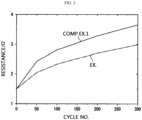
- the graph obtained as a result of the test is shown in FIG. 2 . It can be seen from the result that the lithium secondary battery according to Example 1 inhibits an increase in battery resistance when repeating charge/discharge cycles, as compared to the lithium secondary battery according to Comparative Example 1.
- Example 1 The lithium secondary battery according to each of Example 1 and Comparative Example 1, obtained as described in part (1), was used and subjected to a charge/discharge cycle test at 45°C in the same manner as described above.
- the graph obtained as a result of the test after 200 cycles is shown in FIG. 3 . It can be seen from the result that the lithium secondary battery according to Example 1 shows a lower coating film resistance component at the negative electrode, as compared to the lithium secondary battery according to Comparative Example 1.
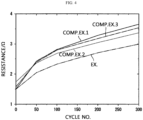
- Example 1 and Comparative Example 1-5 obtained as described in part (1), was used and subjected to a charge/discharge cycle test at 45°C under the conditions of a charge cut-off voltage of 4.2 V and a discharge cut-off voltage of 2.8 V.
- the non-aqueous electrolyte according to the present disclosure forms a high-quality SEI film on the surface of a negative electrode and can inhibit an increase in battery resistance when repeating charge/discharge cycles, and thus shows high industrial applicability.
Landscapes
- Chemical & Material Sciences (AREA)
- Chemical Kinetics & Catalysis (AREA)
- Electrochemistry (AREA)
- General Chemical & Material Sciences (AREA)
- Engineering & Computer Science (AREA)
- Manufacturing & Machinery (AREA)
- Inorganic Chemistry (AREA)
- Condensed Matter Physics & Semiconductors (AREA)
- General Physics & Mathematics (AREA)
- Physics & Mathematics (AREA)
- Materials Engineering (AREA)
- Secondary Cells (AREA)
- Battery Electrode And Active Subsutance (AREA)
Abstract
Description
- The present disclosure relates to a non-aqueous electrolyte and a lithium secondary battery using the same.
- The present application claims priority to
Japanese Patent Application No. 2021-214312 filed on December 28, 2021 - Lithium secondary batteries have been used widely not only for portable instruments, such as cellular phones and notebook PCs, but also for automobile and industrial storage batteries, and for novel use, such as drones. Although lithium secondary batteries originally have a relatively higher energy density as compared to the other types of secondary batteries, they have discussed to increase the charge voltage thereof in order to provide lithium secondary batteries having higher energy density.
- According to the related art, lithium cobaltate (LCO) has been used as a positive electrode active material of a lithium secondary battery. However, use of a ternary positive electrode active material, nickel-cobalt-manganese (NCM), has been extended. NCM is advantageous not only in terms of high energy density but also in terms of cost efficiency by virtue of a decrease in use of cobalt.
- In addition, development of a material including silicon, such as SiO, incorporated to a conventional graphite material has been conducted as a negative electrode active material in order to improve the capacity density of a lithium secondary battery. Since a silicon-containing material has high theoretical capacity, it is expected that such a material is applied to automobile purposes requiring high capacity.
- An electrolyte plays a role in ion conduction to operate a battery, and addition of an additive to the electrolyte has been studied to date in order to improve the function/performance of the electrolyte. In addition, recently, it is required to develop an electrolyte optimized to a positive electrode active material and negative electrode active material used in a battery.
- The electrolyte is decomposed through reduction, and the decomposition product is deposited on the surface of a negative electrode. In addition, an electrolyte ingredient-derived coating film called 'solid electrolyte interface (SEI)' film is formed on the negative electrode surface. As compared to the conventionally used graphite materials, the silicon-containing material undergoes a larger change in volume according to charge/discharge, and thus there is a need for forming a soft SEI film compliable to such a change in volume.
- As an electrolyte additive forming the SEI film, vinylene carbonate (VC) having a double bond in a cyclic structure has been used widely. However, when using an electrolyte containing vinylene carbonate, it is likely that the internal resistance of a battery is increased. Therefore, vinylene carbonate is problematic in use for a long-term preservation battery. Therefore, it is expected to develop an electrolyte having excellent characteristics to inhibit an increase in battery resistance even after repeating charge/discharge cycles.
- In
Patent Document 1, it is disclosed that use of a non-aqueous electrolyte including a polymer which is a reaction product of a maleimide compound with barbituric acid can inhibit a change in direct current resistance. However,Patent Document 1 merely discloses some embodiments wherein the additive is incorporated to a positive electrode. In addition, inPatent Document 1, artificial graphite is used as a negative electrode material, and any effect upon the negative electrode using a silicon-containing material and surface coating film on the negative electrode is not described clearly. -
Patent Document 2 discloses that use of an additive for a lithium-ion battery, including an ion conductor having a specific structure and a compound having a maleimide structure can accelerate lithium-ion conduction and can improve the defect of an increase in resistance caused by the maleimide compound. However, inPatent Document 2, graphite is used as a negative electrode material, and any effect upon the negative electrode using a silicon-containing material and surface coating film on the negative electrode is not described clearly. -
Non-Patent Document 1 discusses about the SEI film formability or battery characteristics depending on a difference in position (ortho-, meta- and para-) of phenylene dimaleimide. However, Non-PatentDocument 1 merely discloses that phenylene dimaleimide in which para-functionalized substituents are selected has excellent SEI film formability, but there still remains a room for discussion about the structure of maleimide compound capable of providing optimized battery characteristics. -
- Patent Document 1: International Patent Publication No.
2016/063964 - Patent Document 2:
Japanese Patent Application Laid-Open No. 2017-117792 - Non-Patent Document 1: Fu-Ming Wang et.al, Journal of Power Sources (231), pp. 18-22, 2013
- Therefore, there is a need for a non-aqueous electrolyte capable of inhibiting an increase in battery resistance after repeating charge/discharge.
- The present disclosure is designed to solve the problems of the related art, and therefore the present disclosure is directed to providing a non-aqueous electrolyte capable of inhibiting an increase in battery resistance when repeating charge/discharge cycles.
- The inventors of the present disclosure have conducted intensive studies to solve the above-mentioned problem, and unexpectedly have found that it is possible to inhibit an increase in electrical resistance resulting from repetition of charge/discharge cycles by using a non-aqueous electrolyte including a bismaleimide compound having a specific chemical structure. The present disclosure is based on this finding.
- In one aspect of the present disclosure, there is provided a non-aqueous electrolyte including a compound represented by the following Chemical Formula 1:

- In
Chemical Formula 1, R1 preferably represents a C3-C10 linear or branched alkylene group. - In
Chemical Formula 1, R1 preferably represents a branched alkylene group. - In
Chemical Formula 1, each of R2 to R5 preferably represents a hydrogen atom. - Preferably, the compound represented by Chemical Formula 1 is 1,5-bis(maleimide)-2-methylpentane.
- The compound represented by Chemical Formula 1 is present preferably in an amount of 0.1-5 wt% based on the total weight of the non-aqueous electrolyte.
- The non-aqueous electrolyte according to the present disclosure preferably further includes at least one carbonate selected from cyclic carbonates and linear carbonates.
- The non-aqueous electrolyte according to the present disclosure preferably further includes a lithium salt.
- The lithium salt preferably includes LiPF6.
- In another aspect of the present disclosure, there is provided a lithium secondary battery including a positive electrode, a negative electrode, and the non-aqueous electrolyte according to the present disclosure, disposed between the positive electrode and the negative electrode.
- The positive electrode preferably includes a nickel-cobalt-manganese (NCM) or nickel-cobalt-aluminum (NCA) ternary material.
- The negative electrode preferably includes a silicon-containing material.
- Preferably, the silicon-containing material is SiO.
- According to the present disclosure, a high-quality solid electrolyte interface (SEI) film can be formed on the surface of a negative electrode by using a non-aqueous electrolyte including a bismaleimide compound having a specific chemical structure. Therefore, it is possible to provide a non-aqueous electrolyte capable of inhibiting an increase in battery resistance when repeating charge/discharge cycles.
-
-
FIG. 1 shows the result of the dQ/dV-V curve of Example 1 and Comparative Example 1. -
FIG. 2 is a graph illustrating the relationship between cycle number and direct current resistance obtained by carrying out a charge/discharge cycle test of Example 1 and Comparative Example 1. -
FIG. 3 shows the result of alternating current impedance of Example 1 and Comparative Example 1, determined after 200 charge/discharge cycles. -
FIG. 4 is a graph illustrating the relationship between cycle number and direct current resistance obtained by carrying out a charge/discharge cycle test of Example 1 and Comparative Examples 1-3. -
FIG. 5 is a graph illustrating the relationship between cycle number and direct current resistance obtained by carrying out a charge/discharge cycle test of Example 1 and Comparative Examples 1, 4 and 5. - In one aspect of the present disclosure, there is provided a non-aqueous electrolyte including a compound represented by the following
Chemical Formula 1 as an additive:
- Unless otherwise stated, `alkyl group' refers to a linear or branched monovalent saturated hydrocarbon group.
- Unless otherwise stated, `alkylene group' refers to a divalent saturated hydrocarbon group.
- Unless otherwise stated, `halogen atom' refers to a fluorine atom, a chlorine atom, a bromine atom, an iodine atom or an astatine atom. Preferably, `halogen atom' refers to a fluorine atom, a chlorine atom, a bromine atom or an iodine atom.
- In
Chemical Formula 1, R1 preferably represents a C3-C15 alkylene group, more preferably a C3-C10 alkylene group, far more preferably a C3-C7 alkylene group, even more preferably a C3-C6 alkylene group, even much more preferably a C4-C7 alkylene group, and most preferably a C4-C6 alkylene group. Particular examples of the alkylene group may include methylethylene group, n-propylene group, 1-methylpropylene group, 2-methylpropylene group, isopropylene group, n-butylene group, s-butylene group, n-pentylene group, 1-methylbutylene group, 2-methylbutylene group, 3-methylbutylene group, 1,1-dimethylpropylene group, 1,2-dimethylpropylene group, 2,2-dimethylpropylene group, 1,3-dimethylpropylene group, n-hexylene group, 1,1-dimethylbutylene group, 1,2-dimethylbutylene group, 1,3-dimethylbutylene group, 2,2-dimethylbutylene group, 2,3-dimethylbutylene group, 3,3-dimethylbutylene group, 1,4-dimethylbutylene group, 1-methylpentylene group, 2-methylpentylene group, 3-methylpentylene group, 1-ethylbutylene group, 2-ethylbutylene group, 1-propylpropylene group, 2-propylpropylene group, butylethylene group, pentylmethylene group, 1-ethyl-2-methylpropylene group, 1-ethyl-3-methylpropylene group, 2-ethyl-3-methylpropylene group, 1-methyl-1-ethylpropylene group, 2-methyl-2-ethylpropylene group, 1,1-diethylethylene group, 1,2-diethylethylene group, 1-propyl-2-methylethylene group, 1-methyl-1-propylethylene group, 1-methylhexylene group, 2-methylhexylene group, 3-methylhexylene group, 1-ethylpentylene group, 2-ethylpentylene group, 3-ethylpentylene group, 1-propylbutylene group, 2-propylbutylene group, 1-butylpropylene group, 2-butylpropylene group, pentylethylene group, hexylmethylene group, 1,2-dimethylpentylene group, 1,3-dimethylpentylene group, 1,4-dimethylpentylene group, 1,5-dimethylpentylene group, 2,3-dimethylpentylene group, 2,4-dimethylpentylene group, 1,1-dimethylpentylene group, 2,2-dimethylpentylene group, 3,3-dimethylpentylene group, or the like. - According to an embodiment, in
Chemical Formula 1, R1 preferably represents a branched alkylene group. InChemical Formula 1, R1 preferably represents a C3-C15 branched alkylene group, more preferably a C3-C10 branched alkylene group, far more preferably a C3-C7 branched alkylene group, even more preferably a C3-C6 branched alkylene group, even much more preferably a C4-C7 branched alkylene group, and most preferably a C4-C6 branched alkylene group. - Particular examples of R1 may include 1-methylbutylene group, 2-methylbutylene group, 3-methylbutyene group, 1-methylpentylene group, 2-methylpentylene group, 3-methylpentylene group, or the like.
- In
Chemical Formula 1, particular examples of C1-C5 alkyl group represented by each of R2 to R5 may include methyl group, ethyl group, propyl group, butyl group and pentyl group. - In
Chemical Formula 1, at least one of R2 to R5 preferably represents a hydrogen atom, more preferably at least two of them represent hydrogen atoms, even more preferably at least three of them represent hydrogen atoms, and most preferably all of them represent hydrogen atoms. - Particular examples of the compound represented by
Chemical Formula 1 may include 1,5-bis(maleimide)-2-methylpentane, 1,5-bis(maleimide)-1-methylpentane, or the like. Preferably, the compound contained in the non-aqueous electrolyte according to the present disclosure is 1,5-bis(maleimide)-2-methylpentane. - The compound represented by
Chemical Formula 1 is present preferably in an amount of 0.1-5 wt%, more preferably 0.1-1 wt%, and most preferably 0.3-0.7 wt%, based on the total weight of the non-aqueous electrolyte. When the compound represented byChemical Formula 1 is present in the above-defined range, a soft coating film may be formed on the surface of a negative electrode, and thus an increase in battery resistance may be further inhibited. - Only one type of the compound represented by
Chemical Formula 1 may be used alone, or a plurality of compounds represented byChemical Formula 1 may be used in combination. When using a plurality of compounds represented byChemical Formula 1, the combined weight of the compounds preferably falls within the above-defined range. - The non-aqueous electrolyte according to the present disclosure preferably may further includes at least one carbonate selected from cyclic carbonates and linear carbonates. Preferably, the non-aqueous electrolyte according to the present disclosure may include a cyclic carbonate and linear carbonate.
- Particular examples of the cyclic carbonate may include ethylene carbonate (EC), propylene carbonate (PC), vinylene carbonate (VC), methylvinylene carbonate, ethylvinylene carbonate, 1,2-diethylvinylene carbonate, vinylethylene carbonate (VEC), 1-methyl-2-vinylethylene carbonate, 1-ethyl-2-vinylethylene carbonate, 1-methyl-2-vinylethylene carbonate, 1,1-divinylethylene carbonate, 1,2-divinylethylene carbonate, 1,1-dimethyl-2-methyleneethylene carbonate, 1,1-diethyl-2-methyleneethylene carbonate, ethynylethylene carbonate, 1,2-diethynylethylene carbonate, 1,2-butylene carbonate, 2,3-butylene carbonate, 1,2-pentylene carbonate, 2,3-pentylene carbonate, chloroethylene carbonate and a combination thereof.
- Particular examples of the linear carbonate may include dimethyl carbonate (DMC), ethylmethyl carbonate (EMC), methylpropyl carbonate (MPC), methylisopropyl carbonate, methylbutyl carbonate, diethyl carbonate (DEC), ethylpropyl carbonate, ethylbutyl carbonate, dipropyl carbonate, propylbutyl carbonate and a combination thereof.
- The cyclic carbonate may include a cyclic carbonate containing a fluorine atom. Particular examples of the cyclic carbonate containing a fluorine atom may include fluorovinylene carbonate, trifluoromethylvinylene carbonate, fluoroethylene carbonate, 1,2-difluoroethylene carbonate, 1,1-difluoroethylene carbonate, 1,1,2-trifluoroethylene carbonate, tetrafluoroethylene carbonate, 1-fluoro-2-methylethylene carbonate, 1-fluoro-1-methylethylene carbonate, 1,2-difluoro-1-methylethylene carbonate, 1,1,2-trifluoro-2-methylethylene carbonate, trifluoromethylethylene carbonate, 4-fluoro-1,3-dioxolan-2-one, trans- or cis-4,5-difluoro-1,3-dioxolan-2-one, 4-ethylnyl-1,3-dioxolan-2-one and a combination thereof.
- Particularly, among the carbonates, ethylene carbonate and propylene carbonate, which are cyclic carbonates, are high-viscosity organic solvents, have a high dielectric constant and are capable of easily dissociating the lithium salt in an electrolyte, and thus are used preferably. When using such a cyclic carbonate mixed with a linear carbonate, such as dimethyl carbonate, diethyl carbonate, ethylmethyl carbonate, or the like, at an adequate ratio, it is possible to prepare an electrolyte having high electrical conductivity preferably.
- The non-aqueous electrolyte according to the present disclosure may include a mixture of a cyclic carbonate with a linear carbonate, wherein the volume ratio of the cyclic carbonate to the linear carbonate is preferably 1:9-9:1, more preferably 2:8-8:2, and most preferably 2:8-4:6.
- The non-aqueous electrolyte according to the present disclosure may further include an ester compound. The ester compound may include carboxylate, or the like. Particular examples of the carboxylate may include methyl formate, ethyl formate, methyl acetate, ethyl acetate, propyl acetate, butyl acetate, methyl propionate, ethyl propionate, propyl propionate, methyl butyrate, ethyl butyrate, propyl butyrate, methyl valerate, ethyl valerate, propyl valerate, γ-butyrolactone, γ-valerolactone, γ-caprolactone, σ-valerolactone, ε-caprolactone, those carboxylate compounds whose hydrogen atoms are partially substituted with fluorine atoms, and a combination thereof.
- In addition to the above-listed examples, the non-aqueous electrolyte according to the present disclosure may include the other solvents, such as ether compounds including a cyclic ether or linear ether, polyether, sulfur-containing solvents and phosphorus-containing solvents, with no particular limitation, as long as such solvents do not adversely affect the object of the present disclosure.
- Particular examples of the cyclic ether may include tetrahydrofuran and 2-methyltetrahydrofuran. In addition, the non-aqueous electrolyte according to the present disclosure may further include a linear ether. Particular examples of the linear ether may include dimethyl ether, diethyl ether, dipropyl ether, methylethyl ether, methylpropyl ether and ethylpropyl ether.
- The non-aqueous electrolyte according to the present disclosure may include an electrolyte used conventionally for a secondary battery. The electrolyte functions as a medium through which ions participating in the electrochemical reactions in a secondary battery are transported. Particularly, the non-aqueous electrolyte according to the present disclosure is useful as an electrolyte for a lithium secondary battery, and in this case, the non-aqueous electrolyte includes a lithium salt as an electrolyte salt.
- Particular examples of the lithium salt contained in the non-aqueous electrolyte according to the present disclosure may include LiPF6, LiBF4, LiB12F12, LiAsF6, LiFSO3, Li2SiF6, LiCF3CO2, LiCH3CO2, LiCF3SO3, LiC4F9SO3, LiCF3CF2SO3, LiCF3(CF2)7SO3, LiCF3CF2(CF3)2CO, Li(CF3SO2)2CH, LiNO3, LiN(CN)2, LiN(FSO2)2, LiN(F2SO2)2, LiN(CF3SO2)2, LiN(C2F5SO2)2, LiC(CF3SO2)3, LiP(CF3)6, LiPF(CF3)5, LiPF2(CF3)4, LiPF3(CF3)3, LiPF4(CF3)2, LiPF4(C2F5)2, LiPF4(CF3SO2)2, LiPF4(C2F5SO2)2, LiBF2C2O4, LiBC4O8, LiBF2(CF3)2, LiBF2(C2F5)2, LiBF2(CF3SO2)2, LiBF2(C2F5SO2)2, LiSbF6, LiAlO4, LiAlF4, LiSCN, LiClO4, LiCl, LiF, LiBr, LiI, LiAlCl4, LiFSI, LiTFSI, or the like. Particularly, the non-aqueous electrolyte preferably includes an inorganic salt, such as LiPF6, LiBF4, LiAsF6 or LiClO4. According to an embodiment of the present disclosure, the lithium salt contained in the non-aqueous electrolyte may include LiPF6, most preferably. Only one type of lithium salt may be used alone, or a plurality of lithium salts may be used in combination.
- According to an embodiment of the present disclosure, the lithium salt contained in the non-aqueous electrolyte may include lithium bis(fluorosulfonyl)imide (LiFSI), lithium bis(trifluoromethanesulfonyl)imide (LiTFSI), or the like. According to the embodiment of the present disclosure, the lithium salt contained in the non-aqueous electrolyte may include LiPF6 in combination with LiFSI.
- Although the content of the electrolyte salt is not particularly limited, the electrolyte salt may be present in an amount 0.1-5 mol/L or less, preferably 0.5-3 mol/L or less, more preferably 0.5-2 mol/L or less, based on the total volume of the non-aqueous electrolyte. When the content of the electrolyte salt falls within the above-defined range, it is possible to obtain sufficient battery characteristics.
- The non-aqueous electrolyte according to the present disclosure may further include at least one additive. The additive may include a flame retardant, a wetting agent, a stabilizer, an anti-corrosive agent, a gelling agent, an over-charge preventing agent, a negative electrode coating film-forming additive, or the like.
- In another aspect of the present disclosure, there is provided a lithium secondary battery including: a positive electrode; a negative electrode; and the non-aqueous electrolyte according to the present disclosure, disposed between the positive electrode and the negative electrode.
- The lithium battery including the non-aqueous electrolyte according to the present disclosure may use any positive electrode and negative electrode that may be used in the known lithium secondary batteries with no particular limitation, and may be manufactured by introducing the electrodes to a casing together with the non-aqueous electrolyte according to the present disclosure. In addition, a separator may be interposed between the positive electrode and the negative electrode.
- For example, the positive electrode used for the lithium secondary battery according to the present disclosure may be obtained by coating a positive electrode slurry including a positive electrode active material, a binder, a conductive material and a solvent on a positive electrode current collector, followed by drying and pressing.
- The positive electrode current collector is not particularly limited, as long as it causes no chemical change in the corresponding battery and has conductivity. Particular examples of the positive electrode current collector may include stainless steel, aluminum, nickel, titanium, baked carbon, aluminum or stainless steel surface-treated with carbon, nickel, titanium or silver, or the like.
- The positive electrode active material is a compound capable of reversible lithium intercalation/deintercalation, and particular examples thereof may include lithium composite metal oxides containing at least one metal, such as cobalt, manganese, nickel or aluminum, and lithium. More particularly, the lithium composite metal oxides may include lithium-manganese oxides (e.g. LiMnO2, LiMn2O4, etc.), lithium-cobalt oxides (e.g., LiCoO2, etc.), lithium-nickel oxides (e.g., LiNiO2, etc.), lithium-nickel-manganese oxides (e.g., LiNi1-y1Mny1O2 (wherein 0 < y1 <1), LiMn2-z1Niz1O4 (wherein 0 < z1 < 2)), lithium-nickel-cobalt oxides (e.g., LiNi1-y2Coy2O2 (wherein 0 < y2 < 1)), lithium-manganese-cobalt oxides (e.g., LiCo1-y3Mny3O2 (wherein 0 < y3 < 1), LiMn2-z2Coz2O4 (wherein 0 < z2 < 2)), lithium-nickel-manganese-cobalt oxides (e.g., Li(Nip1Coq1Mnr1)O2 (0 < p1 < 1, 0 < q1 < 1, 0 < r1 < 1, p1 + q1 + r1 = 1) or Li(Nip2Coq2Mnr2)O4 (0 < p2 < 2, 0 < q2 < 2, 0 < r2 < 2, p2 + q2 + r2 = 2)), lithium-nickel-cobalt-transition metal (M) oxides (e.g., Li(Nip3Coq3Mnr3MS3)O2 (wherein M is selected from the group consisting of Al, Fe, V, Cr, Ti, Ta, Mg and Mo, and each of p3, q3, r3 and s3 represents the atomic proportion of each element satisfying 0 < p3 < 1, 0 < q3 < 1, 0 < r3 < 1, 0 < s3 < 1, and p3 + q3 + r3 + s3 = 1)), or the like, and any one compound of them may be used alone, or two or more compounds of them may be used.
- Preferably, with a view to improvement of the capacity characteristics and stability of a battery, the lithium composite metal oxide may be a lithium composite metal oxide containing a metal, such as nickel, and lithium. Particularly, the positive electrode active material may include lithium-nickel oxide (e.g. LiNiO2, etc.), lithium-nickel-manganese-cobalt oxide (e.g. Li(Ni0.6Mn0.2Co0.2)O2, Li(Ni0.5Mn0.3Co0.2)O2, Li(Ni0.8Mn0.1Co0.1)O2, etc.), lithium-nickel-cobalt-aluminum oxide (e.g. Li(Ni0.8Co0.15Al0.05)O2, etc.), or the like. Particularly, it is preferred in terms of cost to use lithium-nickel-manganese-cobalt oxide or lithium-nickel-cobalt-aluminum oxide, which is a nickel-cobalt-manganese (CNM) or nickel-cobalt-aluminum (NCA) ternary material.
- The positive electrode active material may be used preferably in an amount of 80-99 wt%, more preferably in an amount of 90-99 wt%, based on the total weight of the solid content in the positive electrode mixture. When the content of the positive electrode active material falls within the above-defined range, it is possible to obtain high energy density and capacity.
- The binder is an ingredient which assists binding between the active material and the conductive material and binding to the current collector. In general, the binder may be used preferably in an amount of 1-30 wt%, more preferably in an amount of 1-10 wt%, based on the total weight of the solid content in the positive electrode mixture. Particular examples of the binder may include polyvinylidene fluoride, polyvinyl alcohol, carboxymethyl cellulose (CMC), starch, hydroxypropyl cellulose, regenerated cellulose, polyvinyl pyrrolidone, polytetrafluoroethylene, polyethylene, polypropylene, ethylene-propylene-diene monomer (EPDM), sulfonated EPDM, styrene-butadiene rubber, fluoro-rubber, or the like.
- The conductive material is an ingredient imparting conductivity, while not causing any chemical change in the lithium secondary battery according to the present disclosure, and may be used preferably in an amount of 0.5-50 wt%, more preferably in an amount of 1-20 wt%, based on the total weight of the solid content in the positive electrode mixture. When the content of the conductive material falls within the above-defined range, it is possible to improve electrical conductivity and to obtain high energy density and capacity.
- Particular examples of the conductive material may include: carbon powder, such as carbon black, acetylene black, ketjen black, channel black, furnace black, lamp black or thermal black; graphite powder, such as natural graphite, artificial graphite or graphite having a well-developed crystal structure; conductive fibers, such as carbon fibers or metallic fibers; metal powder, such as aluminum or nickel powder; conductive whisker, such as zinc oxide or potassium titanate; conductive metal oxide, such as titanium oxide; and conductive materials, such as polyphenylene derivatives.
- The solvent is not particularly limited, as long as it can form the positive electrode materials, including the positive electrode active material, a binder and a conductive material, into the form of a slurry. Particular examples of the solvent may include organic solvents, such as N-methyl-2-pyrrolidone (NMP), dimethyl formamide (DMF), acetone and dimethyl acetamide, and water. In addition, the solvent may be used in such an amount that the positive electrode slurry may have a desired level of viscosity, and for example, in such an amount that the solid content in the slurry may be 10-60 wt%, preferably 20-50 wt%.
- For example, the negative electrode used for the lithium secondary battery according to the present disclosure may be obtained by coating a negative electrode slurry including a negative electrode active material, a binder, a conductive material and a solvent on a negative electrode current collector, followed by drying and pressing.
- The negative electrode current collector generally has a thickness of 3-500 µm. The negative electrode current collector is not particularly limited, as long as it has high conductivity, while not causing any chemical change in the corresponding battery. Particular examples of the negative electrode current collector may include copper, stainless steel, aluminum, nickel, titanium, baked carbon, or copper or stainless steel surface-treated with carbon, nickel, titanium, silver, etc., aluminum-cadmium alloy, or the like. In addition, similarly to the positive electrode current collector, the negative electrode current collector may have fine surface irregularities formed on the surface thereof to increase the adhesion of a negative electrode active material, and may have various shapes, such as a film, a sheet, a foil, a net, a porous body, a foam or non-woven web body.
- The negative electrode active material may include at least one selected from the group consisting of lithium metal, a carbonaceous material capable of reversible lithium-ion intercalation/deintercalation, metal or alloy of metal with lithium, metal composite oxide, material capable of lithium doping/dedoping, and a transition metal oxide.
- The carbonaceous material capable of reversible lithium-ion intercalation/deintercalation may include any carbonaceous negative electrode active material used currently in a lithium-ion secondary battery with no particular limitation. Typical examples of the carbonaceous material include crystalline carbon, amorphous carbon or a combination thereof. Particular examples of the crystalline carbon may include graphite, such as amorphous, sheet-like, flake-like, spherical or fibrous natural graphite or artificial graphite. Particular examples of the amorphous carbon may include soft carbon (low-temperature baked carbon) or hard carbon, mesophase pitch carbide, baked cokes, or the like.
- Particular examples of the metal or alloy of metal with lithium may include a metal selected from the group consisting of Cu, Ni, Na, K, Rb, Cs, Fr, Be, Mg, Ca, Sr, Si, Sb, Pb, In, Zn, Ba, Ra, Ge, Al and Sn, or alloys of those metals with lithium.
- The metal composite oxide that may be used is selected from the group consisting of PbO, PbO2, Pb2O3, Pb3O4, Sb2O3, Sb2O4, Sb2O5, GeO, GeO2, Bi2O3, Bi2O4, Bi2O5, LixFe2O3 (0 ≤ x ≤ 1), LixWO2 (0 ≤ x ≤ 1), and SnxMe1-zMe'yOz (wherein Me is Mn, Fe, Pb, Ge; Me' is Al, B, P, Si, element of
Group - The material capable of lithium doping/dedoping may include Si, SiOx(0 < x < 2), Si-Y alloy (wherein Y is an element selected from the group consisting of alkali metals, alkaline earth metals, Group 13 elements, Group 14 elements, transition metals, rare earth metal elements and combinations thereof, except Si), Sn, SnO2, Sn-Y (wherein Y is an element selected from the group consisting of alkali metals, alkaline earth metals, Group 13 elements, Group 14 elements, transition metals, rare earth metal elements and combinations thereof, except Sn), or the like. At least one of such materials may be used in combination with SiO2. Element Y may be selected from the group consisting of Mg, Ca, Sr, Ba, Ra, Sc, Y, Ti, Zr, Hf, Rf, V, Nb, Ta, Db, Cr, Mo, W, Sg, Tc, Re, Bh, Fe, Pb, Ru, Os, Hs, Rh, Ir, Pd, Pt, Cu, Ag, Au, Zn, Cd, B, Al, Ga, Sn, In, Ti, Ge, P, As, Sb, Bi, S, Se, Te, Po, and a combination thereof.
- The transition metal oxide may include lithium-containing titanium composite oxide (LTO), vanadium oxide, lithium vanadium oxide, or the like.
- The negative electrode active material for a lithium secondary battery according to the present disclosure preferably uses a silicon-containing material, such as Si, SiOx (0 < x < 2), Si-Y alloy (wherein Y is an element selected from the group consisting of alkali metals, alkaline earth metals, Group 13 elements, Group 14 elements, transition metals, rare earth metal and combinations thereof, and Y is not Si), and a mixture of at least one of them with SiO2. Particularly, it is more preferred to use SiO.
- The negative electrode active material is present preferably in an amount of 80-99 wt%, more preferably 90-99 wt%, based on the total weight of the solid content of the negative electrode slurry.
- The binder is an ingredient which assists binding among the conductive material, the active material and the current collector. The binder is added preferably in an amount of 1-30 wt%, more preferably 1-10 wt%, based on the total weight of the solid content in the negative electrode slurry. Particular examples of the binder may include polyvinylidene fluoride, polyvinyl alcohol, carboxymethyl cellulose (CMC), starch, hydroxypropyl cellulose, regenerated cellulose, polyvinyl pyrrolidone, polytetrafluoroethylene, polyethylene, polypropylene, ethylene-propylene-diene monomer (EPDM), sulfonated EPDM, styrene-butadiene rubber, fluoro-rubber, or the like. Only one of the binders may be used alone, or a plurality of compounds may be used in combination.
- The conductive material is an ingredient for further improving the conductivity of the negative electrode active material, and is added preferably in an amount of 1-20 wt% based on the total weight of the solid content of the negative electrode slurry. The conductive material is not particularly limited, as long as it has conductivity while not causing any chemical change in a lithium secondary battery. Particular examples of the conductive material may include: graphite, such as natural graphite or artificial graphite; carbon black, such as acetylene black, ketjen black, channel black, furnace black, lamp black or thermal black; conductive fibers, such as carbon fibers or metallic fibers; metal powder, such as aluminum or nickel powder; conductive whisker, such as zinc oxide or potassium titanate; conductive metal oxide, such as titanium oxide; and conductive materials, such as polyphenylene derivatives.
- The solvent is not particularly limited, as long as it can form the negative electrode materials, including a negative electrode active material, a binder and a conductive material, into the form of a slurry. Particular examples of the solvent may include water, and organic solvents, such as NMP and alcohol. In addition, the solvent may be used in such an amount that the negative electrode slurry may have a desired level of viscosity, and for example, in such an amount that the solid content in the slurry may be 50-75 wt%, preferably 50-65 wt%.
- The separator for a lithium secondary battery according to the present disclosure functions to interrupt an internal short-circuit between both electrodes and to allow wetting with an electrolyte. For example, the separator may be prepared by mixing a polymer resin, a filler and a solvent to form a separator composition and coating the separator composition directly on the top of an electrode, followed by drying, to form a separator film. In a variant, the separator may be prepared by casting the separator composition on a support, followed by drying, and laminating the separator film separated from the support on the top of an electrode.
- The separator may include a conventional porous polymer film, such as a porous polymer film made of a polyolefin-based polymer, including ethylene homopolymer, propylene homopolymer, ethylene/butene copolymer, ethylene/hexene copolymer or ethylene/methacrylate copolymer, and such porous polymer films may be used alone or in the form of a laminate. Otherwise, a conventional porous non-woven web, such as a polymeric non-woven web made of high-melting point glass fibers, polyethylene terephthalate fibers, or the like, may be used with no particular limitation.
- Herein, the porous separator may generally have a pore diameter of 0.01-50 µm and a porosity of 5-95%. In addition, the porous separator may generally have a thickness of 5-300 µm.
- Although the lithium secondary battery according to the present disclosure is not particularly limited in the external shape, it may have a cylindrical, prismatic, pouch-like or coin-like shape.
- Hereinafter, the present disclosure will be explained in more detail with reference to examples and comparative examples. However, the scope of the present disclosure is not limited thereto.
- First, 96.5 parts by weight of a nickel-cobalt-manganese (NCM) ternary material (Li(Ni0.8Mn0.1Co0.1)O2) as a positive electrode active material, 1.5 parts by weight of acetylene black as a conductive material and 2 parts by weight of polyvinylidene fluoride (PVDF) as a binder were dispersed in N-methyl-2-pyrrolidone (NMP) as a solvent to prepare a positive electrode slurry. Then, the prepared positive electrode slurry was applied uniformly onto aluminum foil and vacuum dried under heating, followed by roll pressing, to obtain a positive electrode.
- First, 96 parts by weight of a mixture containing graphite and SiO at a ratio of 9:1, as a negative electrode active material, 1.0 parts by weight of acetylene black as a conductive material and 3.0 parts by weight of each of styrene-butadiene rubber and carboxymethyl cellulose, as a binder, were dispersed in water to prepare a slurry. Then, the prepared negative electrode slurry was applied uniformly onto copper foil and vacuum dried under heating, followed by pressing, to obtain a negative electrode.
- First, 30 parts by volume of ethylene carbonate (EC) mixed with 70 parts by volume of ethyl methyl carbonate (EMC) was used as a solvent, and LiPF6 was dissolved therein to a concentration of 1 M to prepare a solution. Then, 0.5 parts by weight of 1,5-bis(maleimide)-2-methylpentane (available from Kawaguchi Chemical Industry Co., Ltd.) was added to 100 parts by weight of the solution to obtain a non-aqueous electrolyte according to the present disclosure.
- The positive electrode, negative electrode and non-aqueous electrolyte obtained as described above were used together with a polyolefin-based film to obtain a pouch-type battery having an area of 12 cm2.
- A non-aqueous electrolyte and a lithium secondary battery including the same were obtained in the same manner as Example 1, except that no 1,5-bis(maleimide)-2-methylpentane was added to the non-aqueous electrolyte.
- A non-aqueous electrolyte and a lithium secondary battery including the same were obtained in the same manner as Example 1, except that N,N'-1,3-phenylene dimaleimide was added to the non-aqueous electrolyte instead of 1,5-bis(maleimide)-2-methylpentane.
- A non-aqueous electrolyte and a lithium secondary battery including the same were obtained in the same manner as Example 1, except that 1-maleimide-3-maleimidemethyl-3,5,5-trimethylcyclohexane was added to the non-aqueous electrolyte instead of 1,5-bis(maleimide)-2-methylpentane.
- A non-aqueous electrolyte and a lithium secondary battery including the same were obtained in the same manner as Example 1, except that N-phenyl maleimide was added to the non-aqueous electrolyte instead of 1,5-bis(maleimide)-2-methylpentane.
- A non-aqueous electrolyte and a lithium secondary battery including the same were obtained in the same manner as Example 1, except that N-cyclohexyl maleimide was added to the non-aqueous electrolyte instead of 1,5-bis(maleimide)-2-methylpentane.
- The lithium secondary battery according to each of Example 1 and Comparative Example 1, obtained as described in part (1), was used and subjected to one charge cycle at 25°C to determine the dQ/dV-V curve.
- The graph obtained as a result is shown in
FIG. 1 . It can be seen from the result that the lithium secondary battery according to Example 1 forms a solid electrolyte interface (SEI) film on the negative electrode in an earlier stage, as compared to the lithium secondary battery according to Comparative Example 1. - The lithium secondary battery according to each of Example 1 and Comparative Example 1, obtained as described in part (1), was used and subjected to a charge/discharge cycle test at 45°C under the conditions of a charge cut-off voltage of 4.2 V and a discharge cut-off voltage of 2.8 V. At the initial stage, and after 50, 100, 200 and 300 cycles, the direct current resistance was determined (discharge at 2.5 C, 10 seconds) at
SOC 50% (= 3.7 V). - The graph obtained as a result of the test is shown in
FIG. 2 . It can be seen from the result that the lithium secondary battery according to Example 1 inhibits an increase in battery resistance when repeating charge/discharge cycles, as compared to the lithium secondary battery according to Comparative Example 1. - The lithium secondary battery according to each of Example 1 and Comparative Example 1, obtained as described in part (1), was used and subjected to a charge/discharge cycle test at 45°C in the same manner as described above. At the initial stage, and after 50, 100, 200 and 300 cycles, the alternating current impedance was determined at
SOC 100% (= 4.195 V) with an amplitude voltage of 5 mV. - The graph obtained as a result of the test after 200 cycles is shown in
FIG. 3 . It can be seen from the result that the lithium secondary battery according to Example 1 shows a lower coating film resistance component at the negative electrode, as compared to the lithium secondary battery according to Comparative Example 1. - The lithium secondary battery according to each of Example 1 and Comparative Example 1-5, obtained as described in part (1), was used and subjected to a charge/discharge cycle test at 45°C under the conditions of a charge cut-off voltage of 4.2 V and a discharge cut-off voltage of 2.8 V. At the initial stage, and after 50, 100, 200 and 300 cycles, the direct current resistance was determined (discharge at 2.5 C, 10 seconds) at
SOC 50% (= 3.7 V). - The graphs obtained as results of the test are shown in
FIG. 4 andFIG. 5 . It can be seen from the results that use of the lithium secondary battery according to Example 1 provides the highest effect of inhibiting an increase in battery resistance. - The non-aqueous electrolyte according to the present disclosure forms a high-quality SEI film on the surface of a negative electrode and can inhibit an increase in battery resistance when repeating charge/discharge cycles, and thus shows high industrial applicability.
Claims (13)
- A non-aqueous electrolyte comprising a compound represented by the following chemical formula 1:

- The non-aqueous electrolyte according to claim 1, wherein in chemical formula 1, R1 represents a C3-C10 linear or branched alkylene group.
- The non-aqueous electrolyte according to claim 1 or 2, wherein in chemical formula 1, R1 represents a branched alkylene group.
- The non-aqueous electrolyte according to any one of claims 1 to 3, wherein in chemical formula 1, each of R2 to R5 represents a hydrogen atom.
- The non-aqueous electrolyte according to any one of claims 1 to 4, wherein the compound represented by Chemical Formula 1 is 1,5-bis(maleimide)-2-methylpentane.
- The non-aqueous electrolyte according to any one of claims 1 to 5, wherein the compound represented by Chemical Formula 1 is present in an amount of 0.1-5 wt% based on the total weight of the non-aqueous electrolyte.
- The non-aqueous electrolyte according to any one of claims 1 to 6, which further comprises at least one carbonate selected from cyclic carbonates and linear carbonates.
- The non-aqueous electrolyte according to any one of claims 1 to 7, which further comprises a lithium salt.
- The non-aqueous electrolyte according to claim 8, wherein the lithium salt comprises LiPF6.
- A lithium secondary battery comprising:a positive electrode;a negative electrode; andthe non-aqueous electrolyte as defined in any one of claims 1 to 9, disposed between the positive electrode and the negative electrode.
- The lithium secondary battery according to claim 10, wherein the positive electrode comprises a nickel-cobalt-manganese (NCM) or nickel-cobalt-aluminum (NCA) ternary material.
- The lithium secondary battery according to claim 10 or 11, wherein the negative electrode comprises a silicon-containing material.
- The lithium secondary battery according to any one of claims 10 to 12, wherein the silicon-containing material is SiO.
Applications Claiming Priority (2)
| Application Number | Priority Date | Filing Date | Title |
|---|---|---|---|
| JP2021214312A JP7739170B2 (en) | 2021-12-28 | 2021-12-28 | Non-aqueous electrolyte and lithium secondary battery using the same |
| PCT/KR2022/021552 WO2023128628A1 (en) | 2021-12-28 | 2022-12-28 | Non-aqueous electrolyte and lithium secondary battery using same |
Publications (2)
| Publication Number | Publication Date |
|---|---|
| EP4366024A1 true EP4366024A1 (en) | 2024-05-08 |
| EP4366024A4 EP4366024A4 (en) | 2024-09-11 |
Family
ID=86999683
Family Applications (1)
| Application Number | Title | Priority Date | Filing Date |
|---|---|---|---|
| EP22916769.7A Pending EP4366024A4 (en) | 2021-12-28 | 2022-12-28 | NON-AQUEOUS ELECTROLYTE AND LITHIUM SECONDARY BATTERY |
Country Status (6)
| Country | Link |
|---|---|
| US (1) | US20250372707A1 (en) |
| EP (1) | EP4366024A4 (en) |
| JP (1) | JP7739170B2 (en) |
| KR (1) | KR102937300B1 (en) |
| CN (1) | CN117795730A (en) |
| WO (1) | WO2023128628A1 (en) |
Families Citing this family (1)
| Publication number | Priority date | Publication date | Assignee | Title |
|---|---|---|---|---|
| KR102820440B1 (en) | 2025-03-18 | 2025-06-16 | 삼정전기산업(주) | Smart multi-tap devices with enhanced safety |
Family Cites Families (9)
| Publication number | Priority date | Publication date | Assignee | Title |
|---|---|---|---|---|
| TWI377717B (en) * | 2006-12-29 | 2012-11-21 | Ind Tech Res Inst | Nonaqueous electrolyte having maleimide additives and rechargeable cells employing the same |
| CN101210073B (en) * | 2006-12-30 | 2010-12-08 | 财团法人工业技术研究院 | Composition containing bismaleimide oligomer and preparation method thereof |
| TWI372481B (en) * | 2008-06-17 | 2012-09-11 | Ind Tech Res Inst | Lithium battery |
| CN103715429B (en) * | 2012-09-28 | 2016-04-27 | 王复民 | Lithium battery |
| CN105244539B (en) * | 2014-07-09 | 2018-02-02 | 江苏华东锂电技术研究院有限公司 | additive, electrolyte solution and lithium ion battery |
| KR20170056699A (en) | 2014-10-22 | 2017-05-23 | 미쯔이가가꾸가부시끼가이샤 | Lithium secondary battery |
| JP2016143536A (en) * | 2015-01-30 | 2016-08-08 | 三菱化学株式会社 | Non-aqueous electrolyte and non-aqueous electrolyte secondary battery using the same |
| FR3044222B1 (en) * | 2015-11-30 | 2020-01-03 | L'oreal | COSMETIC PROCESSING PROCESS FOR KERATINIC MATERIALS |
| TWI579233B (en) | 2015-12-23 | 2017-04-21 | 財團法人工業技術研究院 | Additive formulation and compisition for lithium ion batteries and lithium ion batteries |
-
2021
- 2021-12-28 JP JP2021214312A patent/JP7739170B2/en active Active
-
2022
- 2022-12-28 EP EP22916769.7A patent/EP4366024A4/en active Pending
- 2022-12-28 KR KR1020237027028A patent/KR102937300B1/en active Active
- 2022-12-28 US US18/723,568 patent/US20250372707A1/en active Pending
- 2022-12-28 WO PCT/KR2022/021552 patent/WO2023128628A1/en not_active Ceased
- 2022-12-28 CN CN202280054055.3A patent/CN117795730A/en active Pending
Also Published As
| Publication number | Publication date |
|---|---|
| JP7739170B2 (en) | 2025-09-16 |
| KR102937300B1 (en) | 2026-03-09 |
| WO2023128628A1 (en) | 2023-07-06 |
| US20250372707A1 (en) | 2025-12-04 |
| EP4366024A4 (en) | 2024-09-11 |
| JP2023097930A (en) | 2023-07-10 |
| KR20230132807A (en) | 2023-09-18 |
| CN117795730A (en) | 2024-03-29 |
Similar Documents
| Publication | Publication Date | Title |
|---|---|---|
| EP4060781B1 (en) | Non-aqueous electrolyte solution for lithium secondary battery and lithium secondary battery comprising same | |
| CN114400375A (en) | Electrolyte solution, electrochemical device, and electronic device | |
| EP4329038A1 (en) | Non-aqueous electrolyte comprising additive for non-aqueous electrolyte, and lithium secondary battery comprising same | |
| KR102951725B1 (en) | Non-aqueous electrolyte and lithium secondary battery containing the same | |
| CN113646941A (en) | Electrolyte solution for lithium secondary battery and lithium secondary battery including the same | |
| CN117321821A (en) | Non-aqueous electrolyte containing additive for non-aqueous electrolyte and lithium secondary battery containing the same | |
| US20250372707A1 (en) | Non-Aqueous Electrolyte and Lithium Secondary Battery Using the Same | |
| US12407023B1 (en) | Non-aqueous electrolyte solution for lithium secondary battery and lithium secondary battery including the same | |
| EP4343914A1 (en) | Lithium secondary battery | |
| CN116802875A (en) | Lithium secondary battery | |
| KR102966369B1 (en) | Acid or moisture reducing agent in non-aqueous electrolyte, non-aqueous electrolyte containing the same, lithium secondary battery including non-aqueous electrolyte, and method for reducing acid or moisture in non-aqueous electrolyte | |
| KR102703534B1 (en) | Non-aqueous electrolyte and lithium secondary battery comprising the same | |
| EP4287338B1 (en) | Non-aqueous electrolyte solution for lithium secondary battery and lithium secondary battery including the same | |
| KR102821226B1 (en) | Non-aqueous electrolyte and lithium secondary battery including the same | |
| KR102823413B1 (en) | Non-aqueous electrolyte and lithium secondary battery including the same | |
| EP4641735A1 (en) | Acid or moisture reducing agent for non-aqueous electrolyte, non-aqueous electrolyte comprising same, lithium secondary battery containing non-aqueous electrolyte, and method for reducing acid or moisture in non-aqueous electrolyte | |
| KR102659656B1 (en) | Non-aqueous electrolyte solution for lithium secondary battery and lithium secondary battery comprising the same | |
| JP7515960B2 (en) | Nonaqueous electrolyte and lithium secondary battery containing same | |
| CN120712673B (en) | Electrolyte additive, electrolyte for lithium secondary battery comprising same, and lithium secondary battery | |
| KR20250044162A (en) | Non-aqueous electrolyte and lithium secondary battery including the same | |
| CN116964810A (en) | Non-aqueous electrolyte for lithium secondary batteries and lithium secondary batteries containing the same | |
| KR20250101954A (en) | Lithium-ion battery | |
| CN118020189A (en) | Non-aqueous electrolyte for lithium secondary battery and lithium secondary battery containing the same | |
| KR20250044163A (en) | Non-aqueous electrolyte and lithium secondary battery including the same | |
| CN120476497A (en) | Non-aqueous electrolyte and lithium secondary battery containing the same |
Legal Events
| Date | Code | Title | Description |
|---|---|---|---|
| STAA | Information on the status of an ep patent application or granted ep patent |
Free format text: STATUS: THE INTERNATIONAL PUBLICATION HAS BEEN MADE |
|
| PUAI | Public reference made under article 153(3) epc to a published international application that has entered the european phase |
Free format text: ORIGINAL CODE: 0009012 |
|
| STAA | Information on the status of an ep patent application or granted ep patent |
Free format text: STATUS: REQUEST FOR EXAMINATION WAS MADE |
|
| 17P | Request for examination filed |
Effective date: 20240202 |
|
| AK | Designated contracting states |
Kind code of ref document: A1 Designated state(s): AL AT BE BG CH CY CZ DE DK EE ES FI FR GB GR HR HU IE IS IT LI LT LU LV MC ME MK MT NL NO PL PT RO RS SE SI SK SM TR |
|
| A4 | Supplementary search report drawn up and despatched |
Effective date: 20240809 |
|
| RIC1 | Information provided on ipc code assigned before grant |
Ipc: H01M 4/525 20100101ALN20240805BHEP Ipc: H01M 4/48 20100101ALN20240805BHEP Ipc: H01M 10/0525 20100101ALI20240805BHEP Ipc: H01M 10/0567 20100101AFI20240805BHEP |
|
| DAV | Request for validation of the european patent (deleted) | ||
| DAX | Request for extension of the european patent (deleted) |