EP4365817A1 - Identification of transport modes of commuters via unsupervised learning implemented using multistage learner with domain generalization - Google Patents
Identification of transport modes of commuters via unsupervised learning implemented using multistage learner with domain generalization Download PDFInfo
- Publication number
- EP4365817A1 EP4365817A1 EP23198613.4A EP23198613A EP4365817A1 EP 4365817 A1 EP4365817 A1 EP 4365817A1 EP 23198613 A EP23198613 A EP 23198613A EP 4365817 A1 EP4365817 A1 EP 4365817A1
- Authority
- EP
- European Patent Office
- Prior art keywords
- data
- aecs
- journey
- commuters
- stationary
- Prior art date
- Legal status (The legal status is an assumption and is not a legal conclusion. Google has not performed a legal analysis and makes no representation as to the accuracy of the status listed.)
- Granted
Links
Images




Classifications
-
- G—PHYSICS
- G06—COMPUTING OR CALCULATING; COUNTING
- G06N—COMPUTING ARRANGEMENTS BASED ON SPECIFIC COMPUTATIONAL MODELS
- G06N3/00—Computing arrangements based on biological models
- G06N3/02—Neural networks
- G06N3/04—Architecture, e.g. interconnection topology
- G06N3/045—Combinations of networks
- G06N3/0455—Auto-encoder networks; Encoder-decoder networks
-
- G—PHYSICS
- G06—COMPUTING OR CALCULATING; COUNTING
- G06Q—INFORMATION AND COMMUNICATION TECHNOLOGY [ICT] SPECIALLY ADAPTED FOR ADMINISTRATIVE, COMMERCIAL, FINANCIAL, MANAGERIAL OR SUPERVISORY PURPOSES; SYSTEMS OR METHODS SPECIALLY ADAPTED FOR ADMINISTRATIVE, COMMERCIAL, FINANCIAL, MANAGERIAL OR SUPERVISORY PURPOSES, NOT OTHERWISE PROVIDED FOR
- G06Q50/00—Information and communication technology [ICT] specially adapted for implementation of business processes of specific business sectors, e.g. utilities or tourism
- G06Q50/40—Business processes related to the transportation industry
-
- G—PHYSICS
- G06—COMPUTING OR CALCULATING; COUNTING
- G06N—COMPUTING ARRANGEMENTS BASED ON SPECIFIC COMPUTATIONAL MODELS
- G06N3/00—Computing arrangements based on biological models
- G06N3/02—Neural networks
- G06N3/04—Architecture, e.g. interconnection topology
- G06N3/044—Recurrent networks, e.g. Hopfield networks
-
- G—PHYSICS
- G06—COMPUTING OR CALCULATING; COUNTING
- G06N—COMPUTING ARRANGEMENTS BASED ON SPECIFIC COMPUTATIONAL MODELS
- G06N3/00—Computing arrangements based on biological models
- G06N3/02—Neural networks
- G06N3/04—Architecture, e.g. interconnection topology
- G06N3/045—Combinations of networks
-
- G—PHYSICS
- G06—COMPUTING OR CALCULATING; COUNTING
- G06N—COMPUTING ARRANGEMENTS BASED ON SPECIFIC COMPUTATIONAL MODELS
- G06N3/00—Computing arrangements based on biological models
- G06N3/02—Neural networks
- G06N3/08—Learning methods
-
- G—PHYSICS
- G06—COMPUTING OR CALCULATING; COUNTING
- G06N—COMPUTING ARRANGEMENTS BASED ON SPECIFIC COMPUTATIONAL MODELS
- G06N3/00—Computing arrangements based on biological models
- G06N3/02—Neural networks
- G06N3/08—Learning methods
- G06N3/088—Non-supervised learning, e.g. competitive learning
-
- G—PHYSICS
- G08—SIGNALLING
- G08G—TRAFFIC CONTROL SYSTEMS
- G08G1/00—Traffic control systems for road vehicles
- G08G1/123—Traffic control systems for road vehicles indicating the position of vehicles, e.g. scheduled vehicles; Managing passenger vehicles circulating according to a fixed timetable, e.g. buses, trains, trams
- G08G1/127—Traffic control systems for road vehicles indicating the position of vehicles, e.g. scheduled vehicles; Managing passenger vehicles circulating according to a fixed timetable, e.g. buses, trains, trams to a central station ; Indicators in a central station
-
- G—PHYSICS
- G08—SIGNALLING
- G08G—TRAFFIC CONTROL SYSTEMS
- G08G1/00—Traffic control systems for road vehicles
- G08G1/005—Traffic control systems for road vehicles including pedestrian guidance indicator
-
- G—PHYSICS
- G08—SIGNALLING
- G08G—TRAFFIC CONTROL SYSTEMS
- G08G1/00—Traffic control systems for road vehicles
- G08G1/01—Detecting movement of traffic to be counted or controlled
- G08G1/0104—Measuring and analyzing of parameters relative to traffic conditions
- G08G1/0108—Measuring and analyzing of parameters relative to traffic conditions based on the source of data
- G08G1/012—Measuring and analyzing of parameters relative to traffic conditions based on the source of data from other sources than vehicle or roadside beacons, e.g. mobile networks
-
- G—PHYSICS
- G08—SIGNALLING
- G08G—TRAFFIC CONTROL SYSTEMS
- G08G1/00—Traffic control systems for road vehicles
- G08G1/01—Detecting movement of traffic to be counted or controlled
- G08G1/0104—Measuring and analyzing of parameters relative to traffic conditions
- G08G1/0125—Traffic data processing
- G08G1/0129—Traffic data processing for creating historical data or processing based on historical data
-
- G—PHYSICS
- G08—SIGNALLING
- G08G—TRAFFIC CONTROL SYSTEMS
- G08G1/00—Traffic control systems for road vehicles
- G08G1/01—Detecting movement of traffic to be counted or controlled
- G08G1/0104—Measuring and analyzing of parameters relative to traffic conditions
- G08G1/0137—Measuring and analyzing of parameters relative to traffic conditions for specific applications
- G08G1/0141—Measuring and analyzing of parameters relative to traffic conditions for specific applications for traffic information dissemination
Definitions
- the embodiments herein generally relate to the field of automated transport mode identification and, more particularly, to a method and system for identification of transport modes of commuters via unsupervised representation learning implemented using a multistage learner capturing the diversity in the user data with domain generalization.
- Smart phones equipped with multiple sensors have capability to capture and/or process critical data, enabling monitoring and tracking individuals health, mobility and obtaining derived insights for decision and planning.
- Automated transport mode detection of a commuter or user in one of the areas where data collected form mobile sensors enables unobtrusive sensing and transport mode analysis. Insights or inferences derived from such data has wide applications in urban planning such as transport management and many other applications.
- the approaches found in the literature for the detection of the mode of transportation differ mainly on a) the assumption on the position of the mobile sensor(s), i.e., fixed and known or variable and unknown a priori; b) the number and type of input signals collected; c) the kind and the number of features extracted from the collected data; d) the type of classifier used for the recognition of the mode of transportation on the basis of the extracted features.
- Embodiments of the present disclosure present technological improvements as solutions to one or more of the above-mentioned technical problems recognized by the inventors in conventional systems.
- a method for identification of transport mode of commuters includes receiving an unlabeled time series data for a diversified population of a plurality of commuters, wherein the unlabeled time series data comprising accelerometer data acquired from an accelerometer of a mobile device carried by each of the plurality of commuters during a journey, wherein the journey comprises commute via a plurality of transport modes.
- the method includes determining a plurality of stationary segments within the journey of each of the plurality of commuters by: (a)sampling the accelerometer data associated with the journey of each of the plurality of commuters into a plurality of samples; (b)detecting a plurality of end points and a plurality of start points within the plurality of samples that are associated with a plurality of non-stationary segments of the journey, wherein an end point indicating end of a current non-stationary segment is marked when difference between an amplitude of the accelerometer data of two consecutive samples is less or equal to a threshold ( ⁇ ), and a start point indicating start of a successive non-stationary segment is marked when the difference between the consecutive samples exceeds the threshold ( ⁇ ); and (c) computing a difference between consecutive end points and start points and identifying time duration between each consecutive non-stationary segments as a stop duration, wherein a journey segment corresponding to a time period of the identified stop duration is considered as a stationary segment.
- the method includes eliminating the accelerometer data associated with the plurality of stationary segments. Furthermore, the method includes learning a generalizable Auto-Encoded Compact Sequence (AECS) of the accelerometer data associated with the plurality of non-stationary segments of each of the plurality of commuters to generate a training data, wherein a fixed length latent representation AECS is used to capture a plurality of significant features of the time series data adapting diversity and commonality inside data as Invariant AECS (I-AECS).
- AECS Auto-Encoded Compact Sequence
- the method includes training a multistage learner for predicting the plurality of transport modes by applying Hierarchical Clustering (HC) using I-AECS on the training data to generate clusters corresponding to the plurality of transport modes using a best distance measure selected among a plurality of distance measures for clustering.
- HC Hierarchical Clustering
- a system for identification of transport modes comprises a memory storing instructions; one or more Input/Output (I/O) interfaces; and one or more hardware processors coupled to the memory via the one or more I/O interfaces, wherein the one or more hardware processors are configured by the instructions to receive an unlabeled time series data for a diversified population of a plurality of commuters, wherein the unlabeled time series data comprising accelerometer data acquired from an accelerometer of a mobile device carried by each of the plurality of commuters during a journey, wherein the journey comprises commute via a plurality of transport modes.
- I/O Input/Output
- the one or more hardware processors are configured to determine a plurality of stationary segments within the journey of each of the plurality of commuters by: (a)sampling the accelerometer data associated with the journey of each of the plurality of commuters into a plurality of samples; (b)detecting a plurality of end points and a plurality of start points within the plurality of samples that are associated with a plurality of non-stationary segments of the journey, wherein an end point indicating end of a current non-stationary segment is marked when difference between an amplitude of the accelerometer data of two consecutive samples is less or equal to a threshold ( ⁇ ), and a start point indicating start of a successive non-stationary segment is marked when the difference between the consecutive samples exceeds the threshold ( ⁇ ); and (c) computing a difference between consecutive end points and start points and identifying time duration between each consecutive non-stationary segments as a stop duration, wherein a journey segment corresponding to a time period of the identified stop duration is considered as a stationary segment.
- the one or more hardware processors are configured to eliminate the accelerometer data associated with the plurality of stationary segments. Furthermore, the one or more hardware processors are configured to learn a generalizable Auto-Encoded Compact Sequence (AECS) of the accelerometer data associated with the plurality of non-stationary segments of each of the plurality of commuters to generate a training data, wherein a fixed length latent representation AECS is used to capture a plurality of significant features of the time series data adapting diversity and commonality inside data as Invariant AECS (I-AECS).
- AECS Auto-Encoded Compact Sequence
- the one or more hardware processors are configured to train a multistage learner for predicting the plurality of transport modes by applying Hierarchical Clustering (HC) using I-AECS on the training data to generate clusters corresponding to the plurality of transport modes using a best distance measure selected among a plurality of distance measures for clustering.
- HC Hierarchical Clustering
- one or more non-transitory machine-readable information storage mediums comprising one or more instructions, which when executed by one or more hardware processors causes a method for identification of transport mode of commuters.
- the method includes receiving an unlabeled time series data for a diversified population of a plurality of commuters, wherein the unlabeled time series data comprising accelerometer data acquired from an accelerometer of a mobile device carried by each of the plurality of commuters during a journey, wherein the journey comprises commute via a plurality of transport modes.
- the method includes determining a plurality of stationary segments within the journey of each of the plurality of commuters by: (a)sampling the accelerometer data associated with the journey of each of the plurality of commuters into a plurality of samples; (b)detecting a plurality of end points and a plurality of start points within the plurality of samples that are associated with a plurality of non-stationary segments of the journey, wherein an end point indicating end of a current non-stationary segment is marked when difference between an amplitude of the accelerometer data of two consecutive samples is less or equal to a threshold ( ⁇ ), and a start point indicating start of a successive non-stationary segment is marked when the difference between the consecutive samples exceeds the threshold ( ⁇ ); and (c) computing a difference between consecutive end points and start points and identifying time duration between each consecutive non-stationary segments as a stop duration, wherein a journey segment corresponding to a time period of the identified stop duration is considered as a stationary segment.
- the method includes eliminating the accelerometer data associated with the plurality of stationary segments. Furthermore, the method includes learning a generalizable Auto-Encoded Compact Sequence (AECS) of the accelerometer data associated with the plurality of non-stationary segments of each of the plurality of commuters to generate a training data, wherein a fixed length latent representation AECS is used to capture a plurality of significant features of the time series data adapting diversity and commonality inside data as Invariant AECS (I-AECS).
- AECS Auto-Encoded Compact Sequence
- the method includes training a multistage learner for predicting the plurality of transport modes by applying Hierarchical Clustering (HC) using I-AECS) on the training data to generate clusters corresponding to the plurality of transport modes using a best distance measure selected among a plurality of distance measures for clustering.
- HC Hierarchical Clustering
- I-AECS I-AECS
- Embodiments of the present disclosure provide a method and system for identification of transport modes of commuters via unsupervised learning implemented using a multistage learner.
- Unlabeled time series data is obtained from accelerometer (sensor) of commuters' computing devices (e.g., mobile device) encompassing a diversified population.
- the accelerometer data is processed using a unique journey segment detection technique to eliminate redundant data corresponding to stationary segments of commuter or user.
- the method utilizes only accelerometer sensor, without any position or placement constraints on the mobile device while acquiring data instead of using GPS sensor. This enables hazard free collection of journey data, even inside subways or passing through tunnels, where many a times users encounter missing GPS signals..
- the unique journey segment detection approach accurately eliminates redundant data corresponding to no mobility phase of user.
- the elimination of stationary segments is intended to identify only the "in motion segments". These segments correspond to data needed to identify the journey part of different transport modes used by the commuter.
- I-AECS Invariant Auto-Encoded Compact Sequence
- I-LR Invariant Latent Representation
- the multistage unsupervised learning model also referred to as multistage learner, utilizes hierarchical clustering to generate clusters using I-AECS. The method does not perform clustering on raw data, rather clustering is performed on top of I-AECS or invariant AECS of the raw data.
- the method is based on learning representation incorporating diversity and then proceed further utilization on the learned representations.
- the hierarchical clusters so formed at multiple levels include (a) a first level based on transport corresponding to vehicle based transport and no-transport mode corresponding to movement of a commuter without a vehicle, (b) at a second level based on road transportation and rail transportation, and (c) at a third level, the cluster corresponding to the road transportation is further divided into car-bus, the cluster corresponding to the rail transportation is further divided into train and subway.
- additional clusters corresponding new modes and sub-modes of transport can also be created as per requirements of end application.
- FIGS. 1A through 6C where similar reference characters denote corresponding features consistently throughout the figures, there are shown preferred embodiments and these embodiments are described in the context of the following exemplary system and/or method.
- FIG. 1A is a functional block diagram of a system 100 for identification of transport modes of commuters via unsupervised learning implemented using a multistage learner, in accordance with some embodiments of the present disclosure.
- the system 100 includes a processor(s) 104, communication interface device(s), alternatively referred as input/output (I/O) interface(s) 106, and one or more data storage devices or a memory 102 operatively coupled to the processor(s) 104.
- the system 100 with one or more hardware processors is configured to execute functions of one or more functional blocks of the system 100.
- the processor(s) 104 can be one or more hardware processors 104.
- the one or more hardware processors 104 can be implemented as one or more microprocessors, microcomputers, microcontrollers, digital signal processors, central processing units, state machines, logic circuitries, and/or any devices that manipulate signals based on operational instructions.
- the one or more hardware processors 104 are configured to fetch and execute computer-readable instructions stored in the memory 102.
- the system 100 can be implemented in a variety of computing systems including laptop computers, notebooks, hand-held devices such as mobile phones (mobile devices), workstations, mainframe computers, servers, and the like.
- the I/O interface(s) 106 can include a variety of software and hardware interfaces, for example, a web interface, a graphical user interface to display the generated target images and the like and can facilitate multiple communications within a wide variety of networks N/W and protocol types, including wired networks, for example, LAN, cable, etc., and wireless networks, such as WLAN, cellular and the like.
- the I/O interface (s) 106 can include one or more ports for connecting to a number of external devices or to another server or devices.
- the memory 102 may include any computer-readable medium known in the art including, for example, volatile memory, such as static random access memory (SRAM) and dynamic random access memory (DRAM), and/or non-volatile memory, such as read only memory (ROM), erasable programmable ROM, flash memories, hard disks, optical disks, and magnetic tapes.
- volatile memory such as static random access memory (SRAM) and dynamic random access memory (DRAM)
- DRAM dynamic random access memory
- non-volatile memory such as read only memory (ROM), erasable programmable ROM, flash memories, hard disks, optical disks, and magnetic tapes.
- the memory 102 includes a plurality of modules 110 such as the multistage learner (not shown), a stationary segment detection module (not shown) and so on.
- the plurality of modules 110 include programs or coded instructions that supplement applications or functions performed by the system 100 for executing different steps involved in the process of identification of transport modes of commuters via unsupervised representation learning implemented using the multistage learner of the system 100.
- the plurality of modules 110 can include routines, programs, objects, components, and data structures, which performs particular tasks or implement particular abstract data types.
- the plurality of modules 110 may also be used as, signal processor(s), node machine(s), logic circuitries, and/or any other device or component that manipulates signals based on operational instructions.
- the plurality of modules 110 can be used by hardware, by computer-readable instructions executed by the one or more hardware processors 104, or by a combination thereof.
- the plurality of modules 110 can also include various sub-modules (not shown) within each module.
- the memory 102 may comprise information pertaining to input(s)/output(s) of each step performed by the processor(s) 104 of the system 100 and methods of the present disclosure.
- the memory 102 includes a database 108.
- the database (or repository) 108 may include a plurality of abstracted piece of code for refinement and data that is processed, received, or generated as a result of the execution of the plurality of modules 110.
- the database 108 is shown internal to the system 100, it will be noted that, in alternate embodiments, the database 108 can also be implemented external to the system 100, and communicatively coupled to the system 100. The data contained within such external database may be periodically updated. For example, new data may be added into the database (not shown in FIG.
- LDAP Lightweight Directory Access Protocol
- RDBMS Relational Database Management System
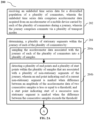
- FIGS. 2A through 2B (collectively referred as FIG. 2 ) is a flow diagram illustrating a method 200 for identification of transport modes of commuters via unsupervised learning implemented using the multistage learner, using the system of FIG. 1A , in accordance with some embodiments of the present disclosure.
- the system 100 comprises one or more data storage devices or the memory 102 operatively coupled to the processor(s) 104 and is configured to store instructions for execution of steps of the method 200 by the processor(s) or one or more hardware processors 104.
- the steps of the method 200 of the present disclosure will now be explained with reference to the components or blocks of the system 100 as depicted in FIGS. 1A and 1B and the steps of flow diagram as depicted in FIG. 2 .
- process steps, method steps, techniques or the like may be described in a sequential order, such processes, methods, and techniques may be configured to work in alternate orders. In other words, any sequence or order of steps that may be described does not necessarily indicate a requirement that the steps to be performed in that order.
- the steps of processes described herein may be performed in any order practical. Further, some steps may be performed simultaneously.
- the system 100 comprises two phases a training block to train the multistage learner such as a Hierarchical Model (HM) using a diversified training data set, and an inferencing block to predict or infer the transport mode using 3 axis accelerometer data received for a commuter using the trained multistage learner, for example the trained HM.
- HM Hierarchical Model
- the one or more hardware processors receive an unlabeled time series data from a diversified population of a plurality of commuters.
- the unlabeled time series data is data acquired from accelerometer sensor of a mobile device carried by each of the plurality of commuters during a journey where there are no restrictions on the placement/ positioning of the mobile device.
- the commuter or user can commute via a plurality of transport modes such as car, train, subway and even no transport mode such as walk, run, jog etc.
- the one or more hardware processors 104 determine a plurality of stationary segments (stationary segments) within the journey of each of the plurality of commuters by analyzing the accelerometer data (including its three axes as well understood by persons with ordinary skill in the art).
- An unsupervised pattern matching technique is used with extrema identification using accelerometer data, interchangeably referred to as accelerometer signal, to identify the journey segments.
- the steps of determining of the stationary segments in the journey by the stationary segment detection module executed by the one or more hardware processors 104 include:
- Pseudocode 1 Identification of journey start & stop - after execution of the first level of HM excluding the non-transport mode
- the one or more hardware processors 104 eliminate the time series accelerometer data (time series data) associated with the stationary segments.
- the one or more hardware processors 104 learn a generalizable AECS of the accelerometer data associated with the non-stationary segments of each of the plurality of commuters to generate a training data, also referred to as training domain data.
- a fixed length latent representation AECS is used to capture significant features of the time series data adapting diversity and commonality inside data as invariant AECS (I-AECS) which is the generalizable AECS.
- I-AECS invariant AECS
- the multistage learner learns the generalizable AECS of the time-series data associated with the non-stationary segments by one of the approaches.
- Approach 1 Preparing a generalizable data based on a Maximum Mean Discrepancy (MMD) and the best distance measure to construct domain generalizable latent representation comprising domain invariance to learn I-AECS using a reconstruction loss.
- MMD Maximum Mean Discrepancy
- the domain generalization concept is addressed by uniquely combining various techniques such as dual bonding of diversity and commonality of data distribution (D) and learned representation (LR) techniques.
- D data distribution
- LR learned representation
- the diverse related domains are considered, for example of the transport domain herein, journeys of diverse users are used.
- MMD Maximum Mean Discrepancy
- dLR minimum distance of LR space
- Definition 1 Domain generalization with LR or AECS (DGLR):
- DGLR Domain generalization with LR or AECS
- a combination is taken from U with ArgMin i ( MMD ) and ArgMin i ( dLR ).
- the objective of domain generalization is to learn a latent representation, embedding the diversity, as well as commonality (I-LR or Invariant-Auto-Encoded-Compact Sequence) to achieve a minimum LR difference between source domain and hidden target domain. This is shown in the experiments section in table 2B and 2C.
- DGLR is established by choosing best combinations of MMD and dLR and described in experimental analysis alter.
- S GD and T D be the generalized source domain data and target domain data respectively, and LR SCD and LR TD be their learned representations.
- MMD k S GD T D ⁇ ⁇ S GD ⁇ ⁇ T D ⁇
- k the radial basis function (RBF) kernel between two data samples is defined as: k x .
- y exp ⁇ ⁇ ⁇ S GD ⁇ ⁇ T D ⁇ dLR ⁇ Dist LR S GD LR T D
- the one or more hardware processors 104 train the multistage learner for predicting the plurality of transport modes by applying Hierarchical Clustering (HC) using I-AECS on the training data to generate clusters associated with the plurality of transport modes using a best distance measure selected from among a plurality of distance measures for clustering.
- the I-AECS enables learning from the diversified user considering the domain generalization (DGLR), wherein learning is on combining those users data which incorporates best diversity and commonality.
- DGLR domain generalization
- a method to identify best cluster and recommending the best distance measure is based on HC-AECS as explained in inventors Indian patent application no. 202021015292, filed on April 7, 2020 , and not reexplained herein for brevity.
- the best distance measure is selected based on a modified Hubert statistics ( ⁇ ) applied across clusters formed by a plurality of distance measures identified for the clustering..
- the accelerometer data associated with the non-stationary segments is clustered at (a) a first level into transport associated with vehicle based transport and no-transport mode associated with movement of a commuter without a vehicle usage, (b)at a second level based on road transportation and rail transportation, and (c) at a third level, the cluster associated with the road transportation is further divided into car-bus, the cluster associated with the rail transportation is further divided into train-subway.
- HM Hierarchical model
- Transport Mode Identification The identified journey segments are divided into windows of t samples. Hence, a data of size X ⁇ R N ⁇ t ⁇ d is obtained, where N & d are the number of instances and dimensions of the data.
- a hierarchical / multi-stage group based learning described in Pseudocode 2 is performed on the data X ⁇ R N ⁇ t ⁇ d to cluster the different transport types. Firstly, the instances are grouped based on type 1 (Road-type) and type 2 (Rail-type) transportation.
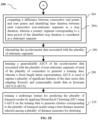
- FIG. 3B depicts the unsupervised multi-stage learner for transport mode identification.
- Hierarchical clustering using auto-encoded latent representation as in inventors Indian patent application no. 202021015292, filed on April 7, 2020 is used as the clustering mechanism for the multi-stage group based learning due to its robust performance across diverse datasets along with a recommendation of the best distance measure for clustering. It learns a compact representation of the raw time-series using a multilayer Seq-2-seq LSTM autoencoder well known in literature, and then agglomerative hierarchical clustering is performed on the representation.
- the cluster representative is computed of the groups formed in the multi-stage clustering during learning in the representation space i.e., on the I-LR.
- the CR of a cluster is computed as the average of the instances present in the cluster.
- CRS of the group in first stage clustering are denoted by C 1 as ⁇ Cen 1 , Cen 2... ... ⁇ , subsequently CRs in the group at second stage clustering C 1 as ⁇ Cen 1 1 , Cen 1 2 , ... ... . ⁇ , ⁇ Cen 2 1 , Cen 2 2 , ... ... . ⁇ Respectively.
- the trained multistage learner predicts the plurality of transport modes associated with input accelerometer data of an unknown commuter received for inferencing using the I-AECS representation of the input accelerometer data.
- the method disclosed has the capability to infer on journey segments of any user, be it of same or different city as the users, the model is trained with.
- the inferencing can be directly performed on the journey segments of the users, if provided, or else the starts and stops of the journey segments can be identified using Pseudocode 1. Even during inferencing, the journey segments are further divided into windows of t samples.
- a compact representation LR test of the windowed data using the autoencoder is performed.
- Each window is considered individually and the distance of its representation to the CR's of the first stage clusters of C 1 formed during the training phase using the recommended distance measure ( d best ) is computed.
- the window is assigned to the cluster to whose CR its distance is minimum.
- c ArgMin i d best LR w cen i , 1 ⁇ i ⁇ n 1
- c is the assigned cluster for window w, whose representation, is denoted as LR w .
- the journey segment is assigned to the cluster to which maximum of its windows are closest.
- the above steps are repeated for the sub-groups formed by dividing c 1 in the second stage, during the learning phase.
- the distance of the LR is computed of each windows to the CR's of the subgroups of C 1 as ⁇ Cen c 1 1 , Cen c 1 2 , ... ... . ⁇ .
- the journey segment is assigned to the cluster to which maximum of its windows are closest.
- the University of Wales-Huawei Locomotion-Transportation - SHL Dataset collected by University of Hampshire is one of the most extensive publicly available transportation mode detection data. It consists of eight different types of transportation and locomotion classes collected in United Kingdom (UK) considering 3 users over a period of seven months.
- the classes include transportation types such as Car, Bus, Train, Subway and Bike, and non-transportation activities like Walk, Run and Still.
- the dataset is recorded using four synchronized mobile phones (mobile devices) placed at hand, chest, hips, and backpack, and consists of sensor modalities such as accelerometer, gyroscope, magnetometer, GPS, network reception etc.
- Unconstrained Sensors Transportation Mode - US-TMD Dataset US-TMD collected by University of Bologna, is another widely used publicly available data for transport mode detection. This data is collected using 13 users, among which ten of them are male, and three are female.
- the classes of data collected include transportation types such as car, bus and train and non-transport activities like walk and still.
- data is collected using one mobile phone carried by each user, and sensors through which it is collected include accelerometer, magnetometer etc.
- Table 1 describes the salient features of SHL and TMD datasets. Table 1: Parameter SHL dataset TMD dataset City London, UK Bologna, Italy Users 3 13 Transports Car, Bus, Train, Subway Car, Bus, Train Other modes Walk, Run, Still Walk, Still Sensor Accelerometer Accelerometer
- the method disclosed utilizes only accelerometer sensor (3-axis) inbuilt in smartphone for experimentation.
- the accelerometer data is uniformly sampled at 100 Hz
- data is collected at non-uniform sampling rate with a maximum of 20 Hz.
- uniform sampling of the data to 100 Hz using linear extrapolation technique is performed.
- the continuous data is broken into different j ourney segments using the technique stated in Pseudocode 1 for the SHL dataset (for TMD data the journey segments are separated inherently in different files). Then, each journey segment is further broken into windows of 1 second (100 sampling points) and Min-max normalization is performed.
- journey segments are of very short duration (J s ), which may not be sufficient for identification of journey mode. Hence, these journey segments are not considered during inferencing, which are less than 1 minute duration (J s ⁇ 1 min). This 1 minute duration is considered as stabilization time for journey.
- Model Hyperparameters A Long short-term memory (LSTM) based multi-layer autoencoder, from which a latent representation of length 12 is extracted is used. Mean Squared Error (MSE) loss is used as the optimization function for the network, and the model is run for 1000 epochs. Adam optimizer is used with a learning rate of 0.001 with exponential decay parameters ⁇ 1 and ⁇ 2 as 0.9 and 0.999 respectively. The training is performed on a system with NVIDIA Tesla V100 GPU with 60 GB RAM and 32 GB GPU memory.
- MSE Mean Squared Error
- FIGS. 6A , 6B and 6C show the MMD distance and the recommended distance measure value dLR (obtained from Hierarchical clustering on LR) between learned representations of all users versus an individual user (say User 1) of S GD with the target set T D . It is observed that both MMD and dLR are minimum for the learned representation trained using all users as compared to User 1. Thus, the S GD is considered as the combination of all users as a domain generalized training data.
- Results on SHL Dataset (Same city diverse user view): Firstly, experiment is performed using the SHL dataset where the model (multistage learner) is trained on a user(s) and tested on a different user(s) from same city. Table 2A depicts the results on different combinations of training and test set on which the experiments have been performed and validates expressing the number of matched segments (MS) against total journey segments (TS). Following DGLR, it is observed that on adding a small part (here only one journey segment from each transport type) of target user during learning, the performance improves significantly. The model (multistage learner) trained on the twelve journey segments (one journey segment from each transport type of the 3 users) gives performance of 91%, 100% and 100% on remaining segments of User 1, 2 and 3 respectively.
- FIG. 5A , 5B and 5C depict multi-stage grouping for User 3 of SHL dataset during training showing groups formed at first stage (Road vs. Rail) and second stage (Car vs. Bus and Train vs. Subway) (t-SNE plot on the learned representation with the clusters formed) This shows the robustness and the generalization performance across different cities of the proposed method.
- FIG. 4 shows a scenario on how the model (multistage learner) trained using SHL dataset is used to infer on U6 of TMD.
- Table 3 depicts results on SHL Dataset (Same city scenario with different users).
- FIG. 6A , 6B and 6C shows the performance of the model trained on user 1 versus all users (1,2,3) across different users in the TMD dataset.
- Results on SHL dataset with model trained on TMD dataset (Different city with diverse user):
- the reverse scenario is performed, where the model (multistage learner) is trained using TMD and infer on the users of SHL dataset.
- TMD dataset does not have Subway transportation data
- the Subway journey segments of SHL dataset are not considered.
- the data from 4 users of TMD dataset (U3,U6, U10, U11) are considered as they cover all the three types of transport modes.
- Table 4 depicts the performance of the learned model on the three users of SHL dataset. Users 1and 2 a perfect accuracy is observed, while for User 3 only one segment is mismatched in Car vs. Bus.
- Table 3 Results on SHL Dataset (Same city scenario with different users).
- the method and system disclosed herein provides an unsupervised journey mode identification approach using representation learning, capturing the diversities across various users.
- the method detects journey segments and correspondingly its mode of transport, without using any label.
- the mobile phone based accelerometer sensor using all three axes is utilized, without any placement constraint of the phone, instead of using GPS sensor unlike conventional approaches. This enables hazard free collection of journey data, even inside subways or passing through tunnels, where many a times users encounter missing GPS signals.
- the method does not reveal location information, and hence it is sensitive towards preserving privacy of the users.
- the method disclosed is generalizable across cities and diverse users. This establishes a method of adapting diversities with commonality while learning representation as I-AECS.
- the method comprises an extrema-based pattern finding to identify the journey segments, followed by multi-stage group based learning using hierarchical clustering on learned representation, I-AECS. Inference is performed in a user-specific manner using best distance measure recommended during learning, where the user can be of same or different city.
- Such computer-readable storage means contain program-code means for implementation of one or more steps of the method, when the program runs on a server or mobile device or any suitable programmable device.
- the hardware device can be any kind of device which can be programmed including e.g., any kind of computer like a server or a personal computer, or the like, or any combination thereof.
- the device may also include means which could be e.g., hardware means like e.g., an application-specific integrated circuit (ASIC), a field-programmable gate array (FPGA), or a combination of hardware and software means, e.g., an ASIC and an FPGA, or at least one microprocessor and at least one memory with software processing components located therein.
- the means can include both hardware means, and software means.
- the method embodiments described herein could be implemented in hardware and software.
- the device may also include software means. Alternatively, the embodiments may be implemented on different hardware devices, e.g., using a plurality of CPUs.
- the embodiments herein can comprise hardware and software elements.
- the embodiments that are implemented in software include but are not limited to, firmware, resident software, microcode, etc.
- the functions performed by various components described herein may be implemented in other components or combinations of other components.
- a computer-usable or computer readable medium can be any apparatus that can comprise, store, communicate, propagate, or transport the program for use by or in connection with the instruction execution system, apparatus, or device.
- a computer-readable storage medium refers to any type of physical memory on which information or data readable by a processor may be stored.
- a computer-readable storage medium may store instructions for execution by one or more processors, including instructions for causing the processor(s) to perform steps or stages consistent with the embodiments described herein.
- the term "computer-readable medium” should be understood to include tangible items and exclude carrier waves and transient signals, i.e., be non-transitory. Examples include random access memory (RAM), read-only memory (ROM), volatile memory, nonvolatile memory, hard drives, CD ROMs, DVDs, flash drives, disks, and any other known physical storage media.
Landscapes
- Engineering & Computer Science (AREA)
- Physics & Mathematics (AREA)
- Theoretical Computer Science (AREA)
- General Physics & Mathematics (AREA)
- Health & Medical Sciences (AREA)
- General Health & Medical Sciences (AREA)
- Molecular Biology (AREA)
- Computing Systems (AREA)
- Software Systems (AREA)
- Mathematical Physics (AREA)
- General Engineering & Computer Science (AREA)
- Evolutionary Computation (AREA)
- Data Mining & Analysis (AREA)
- Computational Linguistics (AREA)
- Life Sciences & Earth Sciences (AREA)
- Artificial Intelligence (AREA)
- Biomedical Technology (AREA)
- Biophysics (AREA)
- Business, Economics & Management (AREA)
- Economics (AREA)
- Human Resources & Organizations (AREA)
- Marketing (AREA)
- Strategic Management (AREA)
- General Business, Economics & Management (AREA)
- Primary Health Care (AREA)
- Tourism & Hospitality (AREA)
- Radar, Positioning & Navigation (AREA)
- Remote Sensing (AREA)
- Management, Administration, Business Operations System, And Electronic Commerce (AREA)
Abstract
Description
- The present application claims priority to
Indian application no. 202221062643, filed on 2 November 2022 - The embodiments herein generally relate to the field of automated transport mode identification and, more particularly, to a method and system for identification of transport modes of commuters via unsupervised representation learning implemented using a multistage learner capturing the diversity in the user data with domain generalization.
- Smart phones equipped with multiple sensors have capability to capture and/or process critical data, enabling monitoring and tracking individuals health, mobility and obtaining derived insights for decision and planning. Automated transport mode detection of a commuter or user in one of the areas where data collected form mobile sensors enables unobtrusive sensing and transport mode analysis. Insights or inferences derived from such data has wide applications in urban planning such as transport management and many other applications.
- The approaches found in the literature for the detection of the mode of transportation differ mainly on a) the assumption on the position of the mobile sensor(s), i.e., fixed and known or variable and unknown a priori; b) the number and type of input signals collected; c) the kind and the number of features extracted from the collected data; d) the type of classifier used for the recognition of the mode of transportation on the basis of the extracted features.
- Conventional methods exploits GPS / location data to classify different modes of transportation. Obtaining GPS data is challenge in subways, underground metro etc. Also, GPS reveals the location information which is sensitive towards preserving privacy of the users. Furthermore, traditional supervised classification methods mostly rely on hand crafted features which may not distinguish between various transportation modes since they are vulnerable to traffic and environmental conditions. These may not generalize well to varying users and cities. Furthermore, the conventional approaches rely on completely labelled data, however, collecting the labeled data during a user's journey is tedious, time consuming and prone to error/noise.
- Embodiments of the present disclosure present technological improvements as solutions to one or more of the above-mentioned technical problems recognized by the inventors in conventional systems.
- For example, in one embodiment, a method for identification of transport mode of commuters is provided. The method includes receiving an unlabeled time series data for a diversified population of a plurality of commuters, wherein the unlabeled time series data comprising accelerometer data acquired from an accelerometer of a mobile device carried by each of the plurality of commuters during a journey, wherein the journey comprises commute via a plurality of transport modes.
- Further, the method includes determining a plurality of stationary segments within the journey of each of the plurality of commuters by: (a)sampling the accelerometer data associated with the journey of each of the plurality of commuters into a plurality of samples; (b)detecting a plurality of end points and a plurality of start points within the plurality of samples that are associated with a plurality of non-stationary segments of the journey, wherein an end point indicating end of a current non-stationary segment is marked when difference between an amplitude of the accelerometer data of two consecutive samples is less or equal to a threshold (δ), and a start point indicating start of a successive non-stationary segment is marked when the difference between the consecutive samples exceeds the threshold (δ); and (c) computing a difference between consecutive end points and start points and identifying time duration between each consecutive non-stationary segments as a stop duration, wherein a journey segment corresponding to a time period of the identified stop duration is considered as a stationary segment.
- Further, the method includes eliminating the accelerometer data associated with the plurality of stationary segments. Furthermore, the method includes learning a generalizable Auto-Encoded Compact Sequence (AECS) of the accelerometer data associated with the plurality of non-stationary segments of each of the plurality of commuters to generate a training data, wherein a fixed length latent representation AECS is used to capture a plurality of significant features of the time series data adapting diversity and commonality inside data as Invariant AECS (I-AECS). Further, the method includes training a multistage learner for predicting the plurality of transport modes by applying Hierarchical Clustering (HC) using I-AECS on the training data to generate clusters corresponding to the plurality of transport modes using a best distance measure selected among a plurality of distance measures for clustering.
- In another aspect, a system for identification of transport modes is provided. The system comprises a memory storing instructions; one or more Input/Output (I/O) interfaces; and one or more hardware processors coupled to the memory via the one or more I/O interfaces, wherein the one or more hardware processors are configured by the instructions to receive an unlabeled time series data for a diversified population of a plurality of commuters, wherein the unlabeled time series data comprising accelerometer data acquired from an accelerometer of a mobile device carried by each of the plurality of commuters during a journey, wherein the journey comprises commute via a plurality of transport modes.
- Further, the one or more hardware processors are configured to determine a plurality of stationary segments within the journey of each of the plurality of commuters by: (a)sampling the accelerometer data associated with the journey of each of the plurality of commuters into a plurality of samples; (b)detecting a plurality of end points and a plurality of start points within the plurality of samples that are associated with a plurality of non-stationary segments of the journey, wherein an end point indicating end of a current non-stationary segment is marked when difference between an amplitude of the accelerometer data of two consecutive samples is less or equal to a threshold (δ), and a start point indicating start of a successive non-stationary segment is marked when the difference between the consecutive samples exceeds the threshold (δ); and (c) computing a difference between consecutive end points and start points and identifying time duration between each consecutive non-stationary segments as a stop duration, wherein a journey segment corresponding to a time period of the identified stop duration is considered as a stationary segment.
- Further, the one or more hardware processors are configured to eliminate the accelerometer data associated with the plurality of stationary segments. Furthermore, the one or more hardware processors are configured to learn a generalizable Auto-Encoded Compact Sequence (AECS) of the accelerometer data associated with the plurality of non-stationary segments of each of the plurality of commuters to generate a training data, wherein a fixed length latent representation AECS is used to capture a plurality of significant features of the time series data adapting diversity and commonality inside data as Invariant AECS (I-AECS). Further, the one or more hardware processors are configured to train a multistage learner for predicting the plurality of transport modes by applying Hierarchical Clustering (HC) using I-AECS on the training data to generate clusters corresponding to the plurality of transport modes using a best distance measure selected among a plurality of distance measures for clustering.
- In yet another aspect, there are provided one or more non-transitory machine-readable information storage mediums comprising one or more instructions, which when executed by one or more hardware processors causes a method for identification of transport mode of commuters. The method includes receiving an unlabeled time series data for a diversified population of a plurality of commuters, wherein the unlabeled time series data comprising accelerometer data acquired from an accelerometer of a mobile device carried by each of the plurality of commuters during a journey, wherein the journey comprises commute via a plurality of transport modes.
- Further, the method includes determining a plurality of stationary segments within the journey of each of the plurality of commuters by: (a)sampling the accelerometer data associated with the journey of each of the plurality of commuters into a plurality of samples; (b)detecting a plurality of end points and a plurality of start points within the plurality of samples that are associated with a plurality of non-stationary segments of the journey, wherein an end point indicating end of a current non-stationary segment is marked when difference between an amplitude of the accelerometer data of two consecutive samples is less or equal to a threshold (δ), and a start point indicating start of a successive non-stationary segment is marked when the difference between the consecutive samples exceeds the threshold (δ); and (c) computing a difference between consecutive end points and start points and identifying time duration between each consecutive non-stationary segments as a stop duration, wherein a journey segment corresponding to a time period of the identified stop duration is considered as a stationary segment.
- Further, the method includes eliminating the accelerometer data associated with the plurality of stationary segments. Furthermore, the method includes learning a generalizable Auto-Encoded Compact Sequence (AECS) of the accelerometer data associated with the plurality of non-stationary segments of each of the plurality of commuters to generate a training data, wherein a fixed length latent representation AECS is used to capture a plurality of significant features of the time series data adapting diversity and commonality inside data as Invariant AECS (I-AECS). Further, the method includes training a multistage learner for predicting the plurality of transport modes by applying Hierarchical Clustering (HC) using I-AECS) on the training data to generate clusters corresponding to the plurality of transport modes using a best distance measure selected among a plurality of distance measures for clustering.
- It is to be understood that both the foregoing general description and the following detailed description are exemplary and explanatory only and are not restrictive of the invention, as claimed.
- The accompanying drawings, which are incorporated in and constitute a part of this disclosure, illustrate exemplary embodiments and, together with the description, serve to explain the disclosed principles:
-
FIG. 1A is a functional block diagram of a system for identification of transport modes of commuters via unsupervised learning implemented using a multistage learner, in accordance with some embodiments of the present disclosure. -
FIG. 1B illustrates a schematic overview of the system ofFIG. 1A , in accordance with some embodiments of the present disclosure. -
FIGS. 2A through 2B (collectively referred asFIG. 2 ) is a flow diagram illustrating a method for identification of transport modes of commuters via unsupervised learning implemented using the multistage learner, using the system ofFIG. 1A , in accordance with some embodiments of the present disclosure. -
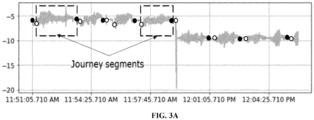
FIG. 3A depicts detected start points and end points used for identifying stationary journey segments, in accordance with some embodiments of the present disclosure. -
FIG. 3B depicts unsupervised learning architecture of the multistage learner, in accordance with some embodiments of the present disclosure. -
FIG. 4 depicts inferencing process flow of the trained multistage learner, in accordance with some embodiments of the present disclosure. -
FIG. 5A through 5C depicts exemplary multi-stage grouping of user's journey segments by the multistage learner with transport means at first level and vehicle type within the specific transport mean and second level, in accordance with some embodiments of the present disclosure. -
FIG. 6A through 6C depicts performance analysis of the multistage learner, in accordance with some embodiments of the present disclosure. - It should be appreciated by those skilled in the art that any block diagrams herein represent conceptual views of illustrative systems and devices embodying the principles of the present subject matter. Similarly, it will be appreciated that any flow charts, flow diagrams, and the like represent various processes which may be substantially represented in computer readable medium and so executed by a computer or processor, whether or not such computer or processor is explicitly shown.
- Exemplary embodiments are described with reference to the accompanying drawings. In the figures, the left-most digit(s) of a reference number identifies the figure in which the reference number first appears. Wherever convenient, the same reference numbers are used throughout the drawings to refer to the same or like parts. While examples and features of disclosed principles are described herein, modifications, adaptations, and other implementations are possible without departing from the scope of the disclosed embodiments.
- Conventional transport mode detection relies either on GPS data or uses supervised learning for transport mode detection, requiring labelled data with hand crafted features. Collecting the labeled data during a user's journey is tedious, time consuming and prone to error/noise. With scarcity and quality concerns in getting labeled data, affects the training of Machine Learning (ML) models during inferencing of the transport modes.
- Embodiments of the present disclosure provide a method and system for identification of transport modes of commuters via unsupervised learning implemented using a multistage learner. Unlabeled time series data is obtained from accelerometer (sensor) of commuters' computing devices (e.g., mobile device) encompassing a diversified population. The accelerometer data is processed using a unique journey segment detection technique to eliminate redundant data corresponding to stationary segments of commuter or user. The method utilizes only accelerometer sensor, without any position or placement constraints on the mobile device while acquiring data instead of using GPS sensor. This enables hazard free collection of journey data, even inside subways or passing through tunnels, where many a times users encounter missing GPS signals.. The unique journey segment detection approach accurately eliminates redundant data corresponding to no mobility phase of user. The elimination of stationary segments is intended to identify only the "in motion segments". These segments correspond to data needed to identify the journey part of different transport modes used by the commuter.
- Once the stationary segments are eliminated, non-stationary journey segments are represented using Invariant Auto-Encoded Compact Sequence (I-AECS), which is a learned compact representation of non-stationary journey segments encompassing the common encoded latent feature representation across diverse users and cities, where no annotation or ground truth information is used. I-AECS, interchangeably referred to as Invariant Latent Representation (I-LR) enables capturing diversities with commonality while learning the representation of journey segments across diversified users. The multistage unsupervised learning model, also referred to as multistage learner, utilizes hierarchical clustering to generate clusters using I-AECS. The method does not perform clustering on raw data, rather clustering is performed on top of I-AECS or invariant AECS of the raw data. The method is based on learning representation incorporating diversity and then proceed further utilization on the learned representations. The hierarchical clusters so formed at multiple levels, for example, include (a) a first level based on transport corresponding to vehicle based transport and no-transport mode corresponding to movement of a commuter without a vehicle, (b) at a second level based on road transportation and rail transportation, and (c) at a third level, the cluster corresponding to the road transportation is further divided into car-bus, the cluster corresponding to the rail transportation is further divided into train and subway. In similar manner additional clusters corresponding new modes and sub-modes of transport can also be created as per requirements of end application.
- Referring now to the drawings, and more particularly to
FIGS. 1A through 6C , where similar reference characters denote corresponding features consistently throughout the figures, there are shown preferred embodiments and these embodiments are described in the context of the following exemplary system and/or method. -
FIG. 1A is a functional block diagram of asystem 100 for identification of transport modes of commuters via unsupervised learning implemented using a multistage learner, in accordance with some embodiments of the present disclosure. In an embodiment, thesystem 100 includes a processor(s) 104, communication interface device(s), alternatively referred as input/output (I/O) interface(s) 106, and one or more data storage devices or amemory 102 operatively coupled to the processor(s) 104. Thesystem 100 with one or more hardware processors is configured to execute functions of one or more functional blocks of thesystem 100. - Referring to the components of
system 100, in an embodiment, the processor(s) 104, can be one ormore hardware processors 104. In an embodiment, the one ormore hardware processors 104 can be implemented as one or more microprocessors, microcomputers, microcontrollers, digital signal processors, central processing units, state machines, logic circuitries, and/or any devices that manipulate signals based on operational instructions. Among other capabilities, the one ormore hardware processors 104 are configured to fetch and execute computer-readable instructions stored in thememory 102. In an embodiment, thesystem 100 can be implemented in a variety of computing systems including laptop computers, notebooks, hand-held devices such as mobile phones (mobile devices), workstations, mainframe computers, servers, and the like. - The I/O interface(s) 106 can include a variety of software and hardware interfaces, for example, a web interface, a graphical user interface to display the generated target images and the like and can facilitate multiple communications within a wide variety of networks N/W and protocol types, including wired networks, for example, LAN, cable, etc., and wireless networks, such as WLAN, cellular and the like. In an embodiment, the I/O interface (s) 106 can include one or more ports for connecting to a number of external devices or to another server or devices.
- The
memory 102 may include any computer-readable medium known in the art including, for example, volatile memory, such as static random access memory (SRAM) and dynamic random access memory (DRAM), and/or non-volatile memory, such as read only memory (ROM), erasable programmable ROM, flash memories, hard disks, optical disks, and magnetic tapes. - In an embodiment, the
memory 102 includes a plurality ofmodules 110 such as the multistage learner (not shown), a stationary segment detection module ( not shown) and so on. The plurality ofmodules 110 include programs or coded instructions that supplement applications or functions performed by thesystem 100 for executing different steps involved in the process of identification of transport modes of commuters via unsupervised representation learning implemented using the multistage learner of thesystem 100. The plurality ofmodules 110, amongst other things, can include routines, programs, objects, components, and data structures, which performs particular tasks or implement particular abstract data types. The plurality ofmodules 110 may also be used as, signal processor(s), node machine(s), logic circuitries, and/or any other device or component that manipulates signals based on operational instructions. Further, the plurality ofmodules 110 can be used by hardware, by computer-readable instructions executed by the one ormore hardware processors 104, or by a combination thereof. The plurality ofmodules 110 can also include various sub-modules (not shown) within each module. - Further, the
memory 102 may comprise information pertaining to input(s)/output(s) of each step performed by the processor(s) 104 of thesystem 100 and methods of the present disclosure. Furthermore, thememory 102 includes adatabase 108. The database (or repository) 108 may include a plurality of abstracted piece of code for refinement and data that is processed, received, or generated as a result of the execution of the plurality ofmodules 110. Although thedatabase 108 is shown internal to thesystem 100, it will be noted that, in alternate embodiments, thedatabase 108 can also be implemented external to thesystem 100, and communicatively coupled to thesystem 100. The data contained within such external database may be periodically updated. For example, new data may be added into the database (not shown inFIG. 1 ) and/or existing data may be modified and/or non-useful data may be deleted from the database. In one example, the data may be stored in an external system, such as a Lightweight Directory Access Protocol (LDAP) directory and a Relational Database Management System (RDBMS). Functions of the components of thesystem 100 are now explained with reference to schematic overview of thesystem 100 depicted inFIG. 1B , steps of flow diagram ofFIG. 2 , andFIG. 3 . -
FIGS. 2A through 2B (collectively referred asFIG. 2 ) is a flow diagram illustrating amethod 200 for identification of transport modes of commuters via unsupervised learning implemented using the multistage learner, using the system ofFIG. 1A , in accordance with some embodiments of the present disclosure. - In an embodiment, the
system 100 comprises one or more data storage devices or thememory 102 operatively coupled to the processor(s) 104 and is configured to store instructions for execution of steps of themethod 200 by the processor(s) or one ormore hardware processors 104. The steps of themethod 200 of the present disclosure will now be explained with reference to the components or blocks of thesystem 100 as depicted inFIGS. 1A and1B and the steps of flow diagram as depicted inFIG. 2 . Although process steps, method steps, techniques or the like may be described in a sequential order, such processes, methods, and techniques may be configured to work in alternate orders. In other words, any sequence or order of steps that may be described does not necessarily indicate a requirement that the steps to be performed in that order. The steps of processes described herein may be performed in any order practical. Further, some steps may be performed simultaneously. - As depicted in system overview, the
system 100 comprises two phases a training block to train the multistage learner such as a Hierarchical Model (HM) using a diversified training data set, and an inferencing block to predict or infer the transport mode using 3 axis accelerometer data received for a commuter using the trained multistage learner, for example the trained HM. - Referring to the steps of the
method 200, atstep 202, during the training phase the one or more hardware processors receive an unlabeled time series data from a diversified population of a plurality of commuters. As depicted inFIG. 1B the unlabeled time series data is data acquired from accelerometer sensor of a mobile device carried by each of the plurality of commuters during a journey where there are no restrictions on the placement/ positioning of the mobile device. During the journey, also referred to as a trip, the commuter or user can commute via a plurality of transport modes such as car, train, subway and even no transport mode such as walk, run, jog etc. - Once raw data is acquired for multiple users, at
step 204, the one ormore hardware processors 104 determine a plurality of stationary segments (stationary segments) within the journey of each of the plurality of commuters by analyzing the accelerometer data (including its three axes as well understood by persons with ordinary skill in the art). An unsupervised pattern matching technique is used with extrema identification using accelerometer data, interchangeably referred to as accelerometer signal, to identify the journey segments. The steps of determining of the stationary segments in the journey by the stationary segment detection module executed by the one ormore hardware processors 104 include: - Step 204a- Sampling the accelerometer data associated with the journey of each of the plurality of commuters into a plurality of samples.
- Step 204b- Detecting a plurality of end points and a plurality of start points within the plurality of samples that are associated with a plurality of non-stationary segments (non-stationary segments) of the journey. An end point (stop position) indicating end of a current non-stationary segment is marked when difference between amplitude of the accelerometer data of two consecutive samples is less or equal to a threshold (δ), such that a t+1 - at ≤ δ. Further, a start point (start position) indicating start of a successive non-stationary segment is marked when the difference between the consecutive samples exceeds the threshold (δ) such that a t+1 - at > δ. Once the acceleration difference exceeds the threshold, the stop duration is reset, and it marks the start of a new journey segment. The δ value of 0.005 has been used for experiments, and exemplary value of the threshold would be close to zero.
- Step 204c- Computing difference between consecutive end point and start point and identifying time duration between each consecutive non-stationary segment as a stop duration. Thereafter, a journey segment associated with a time period of the identified stop duration is considered as stationary segment.
Pseudocode 1 describes the automated journey segment identification.FIG. 3A shows the identified start positions and stop positions for different journey segments of a continuous trip/journey using Pseudocode 1, forUser 1, SHL data referred in tables 2A, 2B and 2C depicting experimental results. (Start of journey segment is denoted by white circle and end by solid black circle). -


- At
step 206, the one ormore hardware processors 104 eliminate the time series accelerometer data (time series data) associated with the stationary segments. Atstep 208, the one ormore hardware processors 104 learn a generalizable AECS of the accelerometer data associated with the non-stationary segments of each of the plurality of commuters to generate a training data, also referred to as training domain data. A fixed length latent representation AECS is used to capture significant features of the time series data adapting diversity and commonality inside data as invariant AECS (I-AECS) which is the generalizable AECS. The multistage learner learns the generalizable AECS of the time-series data associated with the non-stationary segments by one of the approaches. - Approach 1: Preparing a generalizable data based on a Maximum Mean Discrepancy (MMD) and the best distance measure to construct domain generalizable latent representation comprising domain invariance to learn I-AECS using a reconstruction loss.
- Approach 2:
- i. Learning, domain generalizable representation comprising domain invariance, the I-AECS, by minimizing the MMD distance between the AECS of the training domain data and the AECS of a test data and minimizing the reconstruction error as a learning objective, set as a loss function.
- ii. Learning the AECS of the training domain data using reconstruction loss in an autoencoder model.
- iii. Learning the domain invariant representation of the test domain data using the learned AECS of the training domain data and the test domain data as input.
- The domain generalization concept is addressed by uniquely combining various techniques such as dual bonding of diversity and commonality of data distribution (D) and learned representation (LR) techniques. The diverse related domains are considered, for example of the transport domain herein, journeys of diverse users are used. The above is combined with minimum Maximum Mean Discrepancy (MMD) technique provided in literature, a measure gives the difference of data distribution as shown in
equation 1, and minimum distance of LR space (dLR) as shown in equation 3. - Definition 1: Domain generalization with LR or AECS (DGLR): In DGLR, U source domains SGD are considered, SGD = {SGDi ; i = 1...U}, where every domain SGD consists only data without any labels. A combination is taken from U with ArgMini (MMD) and ArgMini (dLR). The objective of domain generalization is to learn a latent representation, embedding the diversity, as well as commonality (I-LR or Invariant-Auto-Encoded-Compact Sequence) to achieve a minimum LR difference between source domain and hidden target domain. This is shown in the experiments section in table 2B and 2C. This enables to achieve robust inference having the closest match with learned trained group on latent representation and target representation. DGLR is established by choosing best combinations of MMD and dLR and described in experimental analysis alter. Suppose SGD and TD be the generalized source domain data and target domain data respectively, and LRSCD and LRTD be their learned representations.


- At
step 210, the one ormore hardware processors 104 train the multistage learner for predicting the plurality of transport modes by applying Hierarchical Clustering (HC) using I-AECS on the training data to generate clusters associated with the plurality of transport modes using a best distance measure selected from among a plurality of distance measures for clustering. The I-AECS enables learning from the diversified user considering the domain generalization (DGLR), wherein learning is on combining those users data which incorporates best diversity and commonality. A method to identify best cluster and recommending the best distance measure is based on HC-AECS as explained in inventorsIndian patent application no. 202021015292, filed on April 7, 2020 - The accelerometer data associated with the non-stationary segments is clustered at (a) a first level into transport associated with vehicle based transport and no-transport mode associated with movement of a commuter without a vehicle usage, (b)at a second level based on road transportation and rail transportation, and (c) at a third level, the cluster associated with the road transportation is further divided into car-bus, the cluster associated with the rail transportation is further divided into train-subway. It can be understood by the person skilled in the art that even though the current clusters focus on rail and road transport, similar approach can be applied to generate hierarchical clusters to group air transport and water transport with further divisions as airplane-helicopter, boat-ship and so on.
- Learning multistage learner, for example the Hierarchical model (HM), for Transport Mode Identification: The identified journey segments are divided into windows of t samples. Hence, a data of size X ∈ R N×t×d is obtained, where N & d are the number of instances and dimensions of the data. A hierarchical / multi-stage group based learning described in
Pseudocode 2 is performed on the data X ∈ R N×t×d to cluster the different transport types. Firstly, the instances are grouped based on type 1 (Road-type) and type 2 (Rail-type) transportation. Subsequently, the Road-type transportation group is divided further into Car and Bus type and the Rail-type transportation group is broken into Train and Subway / Metro type.FIG. 3B depicts the unsupervised multi-stage learner for transport mode identification. Hierarchical clustering using auto-encoded latent representation as in inventorsIndian patent application no. 202021015292, filed on April 7, 2020 Indian patent application no. 202021015292, filed on April 7, 2020 


- Inferencing: Once trained, during inferencing, as depicted in
FIG. 1B inferencing block, the trained multistage learner predicts the plurality of transport modes associated with input accelerometer data of an unknown commuter received for inferencing using the I-AECS representation of the input accelerometer data. The method disclosed has the capability to infer on journey segments of any user, be it of same or different city as the users, the model is trained with. The inferencing can be directly performed on the journey segments of the users, if provided, or else the starts and stops of the journey segments can be identified usingPseudocode 1. Even during inferencing, the journey segments are further divided into windows of t samples. Subsequently, a compact representation LRtest of the windowed data using the autoencoder is performed. Each window is considered individually and the distance of its representation to the CR's of the first stage clusters of C 1 formed during the training phase using the recommended distance measure (dbest ) is computed. The window is assigned to the cluster to whose CR its distance is minimum.
- Dataset Description: The University of Sussex-Huawei Locomotion-Transportation - SHL Dataset collected by University of Sussex, is one of the most extensive publicly available transportation mode detection data. It consists of eight different types of transportation and locomotion classes collected in United Kingdom (UK) considering 3 users over a period of seven months. The classes include transportation types such as Car, Bus, Train, Subway and Bike, and non-transportation activities like Walk, Run and Still. The dataset is recorded using four synchronized mobile phones (mobile devices) placed at hand, chest, hips, and backpack, and consists of sensor modalities such as accelerometer, gyroscope, magnetometer, GPS, network reception etc. The subset of this data which consists of three days of data for each user, made publicly available, is considered for experimental analysis. Unconstrained Sensors Transportation Mode - US-TMD Dataset US-TMD collected by University of Bologna, is another widely used publicly available data for transport mode detection. This data is collected using 13 users, among which ten of them are male, and three are female. The classes of data collected include transportation types such as car, bus and train and non-transport activities like walk and still. Here data is collected using one mobile phone carried by each user, and sensors through which it is collected include accelerometer, magnetometer etc. Table 1 describes the salient features of SHL and TMD datasets.
Table 1: Parameter SHL dataset TMD dataset City Sussex, UK Bologna, Italy Users 3 13 Transports Car, Bus, Train, Subway Car, Bus, Train Other modes Walk, Run, Still Walk, Still Sensor Accelerometer Accelerometer - Data Preprocessing: The method disclosed utilizes only accelerometer sensor (3-axis) inbuilt in smartphone for experimentation. For SHL dataset, the accelerometer data is uniformly sampled at 100 Hz, whereas, for TMD dataset, data is collected at non-uniform sampling rate with a maximum of 20 Hz. Hence for TMD dataset, uniform sampling of the data to 100 Hz using linear extrapolation technique is performed. Subsequently, the continuous data is broken into different j ourney segments using the technique stated in
Pseudocode 1 for the SHL dataset (for TMD data the journey segments are separated inherently in different files). Then, each journey segment is further broken into windows of 1 second (100 sampling points) and Min-max normalization is performed. For both the datasets, it is observed that some of the journey segments are of very short duration (Js), which may not be sufficient for identification of journey mode. Hence, these journey segments are not considered during inferencing, which are less than 1 minute duration (Js < 1 min). This 1 minute duration is considered as stabilization time for journey. - Model Hyperparameters: A Long short-term memory (LSTM) based multi-layer autoencoder, from which a latent representation of
length 12 is extracted is used. Mean Squared Error (MSE) loss is used as the optimization function for the network, and the model is run for 1000 epochs. Adam optimizer is used with a learning rate of 0.001 with exponential decay parameters β1 and β2 as 0.9 and 0.999 respectively. The training is performed on a system with NVIDIA Tesla V100 GPU with 60 GB RAM and 32 GB GPU memory. - Forming DGLR in accordance with definition provided on domain generalization on learned representation LR, domain generalizable training data SGD is formed using the journey of diverse users of SHL data.
FIGS. 6A ,6B and6C show the MMD distance and the recommended distance measure value dLR (obtained from Hierarchical clustering on LR) between learned representations of all users versus an individual user (say User 1) of SGD with the target set TD. It is observed that both MMD and dLR are minimum for the learned representation trained using all users as compared toUser 1. Thus, the SGD is considered as the combination of all users as a domain generalized training data. - Results on SHL Dataset (Same city diverse user view): Firstly, experiment is performed using the SHL dataset where the model (multistage learner) is trained on a user(s) and tested on a different user(s) from same city. Table 2A depicts the results on different combinations of training and test set on which the experiments have been performed and validates expressing the number of matched segments (MS) against total journey segments (TS). Following DGLR, it is observed that on adding a small part (here only one journey segment from each transport type) of target user during learning, the performance improves significantly. The model (multistage learner) trained on the twelve journey segments (one journey segment from each transport type of the 3 users) gives performance of 91%, 100% and 100% on remaining segments of
User Table 2A E.no Training set Test set Accuracy (MS/TS) 1 User 1 User 2 75% (9/12) 2 Complete User 1 data + Small part of User 2 data (25 %) User 2 data (excl. 4 train segments) 100% (12/12) 3 User 1 User 3 50% (6/12) 4 Complete User 1 data + Small part of User 2 data (25 %) User 2 data (excl. 4 train segments) 100% (12/12) 5 Complete User 1 data + Small part of User 2 data (25 %) + Small part of User 2 (25 %) User 2 data (excl. 4 train segments) 100% (12/12) User 3 data (excl. 4 train segments) 100% (12/12) 6 Small part of User 1 (25 %) + Small part of User 2 (25 %) + Small part of User 3data (25 %) User 1 data (excl. 4 train segments) 91% (11/12) User 2 data (excl. 4 train segments) 100% (12/12) User 3 data (excl. 4 train segments) 100% (12/12) Table 2B Best Distance measure U1 U2 U3 U1 0 2.52 3.1 All users (4 segs each) 1.27 0.977 1.531 Table 2C MMD U1 U2 U3 U1 0 0.582 1.471 All users (4 segs each) 1.179 0.215 0.491 - The bold text of row 6 of Table 2A indicates best performance. As seen from Table 2B, wherein argmin best distance measure equation 3 (0.977) is indicator of best commonality (at least w.r.t. one user - U2). The bold text of row 6 of Table 2A indicates best
performance satisfying equation 1 argmin MMD (0.215) given in table 2C.w.r.t User 2 (0.215).Those users' data (combining all users 4 segments each), which incorporates best diversity and commonality represents the generalizable data. This combinations of user data shows a good amount of diversity 1.179. Though U1 shows 1.471 with U3 but does not satisfyequation 1 and 3. - Results on TMD dataset with Model Trained on SHL Dataset (Different city with diverse user): Here following DGLR, experiment is performed on the generalizable domain aspect by training the model (multistage learner) using users of Sussex, UK (SHL dataset) and inferring on the users of Bologna, Italy (TMD dataset). Here SGD is formed using all the three users of SHL dataset (complete user data) considering minimum MMD and minimum difference in LR space i.e., satisfying
equation 1 and 3 , and test on each of the users of the TMD dataset individually to achieve user-specific inferencing. Table 4 shows the performance of the model across the users of TMD dataset in terms of accuracy for Road vs. Rail, Car vs. Bus, and Train vs. Subway identification. MS is validated against TS for each of the users, and 100% accuracy across all the stages of transport mode identification is obtained.FIG. 5A ,5B and5C depict multi-stage grouping for User 3 of SHL dataset during training showing groups formed at first stage (Road vs. Rail) and second stage (Car vs. Bus and Train vs. Subway) (t-SNE plot on the learned representation with the clusters formed) This shows the robustness and the generalization performance across different cities of the proposed method. As an example,FIG. 4 shows a scenario on how the model (multistage learner) trained using SHL dataset is used to infer on U6 of TMD. Table 3 depicts results on SHL Dataset (Same city scenario with different users). - Change in performance is observed if the model is trained with only one user from SHL dataset (say User 1).
FIG. 6A ,6B and6C shows the performance of the model trained onuser 1 versus all users (1,2,3) across different users in the TMD dataset. Thus, it can be concluded that the diversity introduced in the training model by learning from a variety from users is an important need for robust performance on the users of different city. - Results on SHL dataset with model trained on TMD dataset (Different city with diverse user): Here, the reverse scenario is performed, where the model (multistage learner) is trained using TMD and infer on the users of SHL dataset. As TMD dataset does not have Subway transportation data, the Subway journey segments of SHL dataset are not considered. For learning, the data from 4 users of TMD dataset (U3,U6, U10, U11) are considered as they cover all the three types of transport modes. Table 4 depicts the performance of the learned model on the three users of SHL dataset. Users 1and 2 a perfect accuracy is observed, while for User 3 only one segment is mismatched in Car vs. Bus.
Table 3 Results on SHL Dataset (Same city scenario with different users). User ID Transport types and total number of segments Performance (MS/TS) Road v/s rail Car v/s bus Train v/s subway U2 2 (Car - 2) 100 % (2/2) 100 % (2/2) - U3 5 (Bus - 2, Train - 3) 100 % (5/5) 100 % (2/2) 100 % (3/3) U6 7 (Car - 3, Bus - 1, Train - 3) 100 % (7/7) 100 % (4/4) 100 % (3/3) U8 2 (Car - 2) 100 % (2/2) 100 % (2/2) - U9 1 (Train - 1) 100 % (1/1) - 100 % (1/1) U10 9 (Car - 9) 100 % (9/9) 100 % (9/9) - U11 6 (Car - 6) 100 % (6/6) 100 % (6/6) - U13 4 (Car - 4) 100 % (4/4) 100 % (4/4) - U14 1 (Car - 1) 100 % (1/1) 100 % (1/1) - Table 4 Results on TMD Dataset with the proposed model trained on SHL dataset (Different city view) User ID Transport types and total number of segments Performance (MS/TS) Road v/s rail Car v/s bus Train v/s subway 1 14 (Car - 8, Bus - 1, Train - 5) 100 % (14/14) 100% (9/9) 100 % (5/5)- 2 9 (Car - 2, Bus - 2, Train - 5) 100 % (9/9) 100% (4/4) 100 % (5/5) 3 9 (Car - 2, Bus - 5, Train - 2) 100 % (9/9) 85.7% (6/7) 100 % (2/2) - The written description describes the subject matter herein to enable any person skilled in the art to make and use the embodiments. The scope of the subject matter embodiments is defined by the claims and may include other modifications that occur to those skilled in the art. Such other modifications are intended to be within the scope of the claims if they have similar elements that do not differ from the literal language of the claims or if they include equivalent elements with insubstantial differences from the literal language of the claims.
- The method and system disclosed herein provides an unsupervised journey mode identification approach using representation learning, capturing the diversities across various users. The method detects journey segments and correspondingly its mode of transport, without using any label. The mobile phone based accelerometer sensor using all three axes is utilized, without any placement constraint of the phone, instead of using GPS sensor unlike conventional approaches. This enables hazard free collection of journey data, even inside subways or passing through tunnels, where many a times users encounter missing GPS signals. At the same time, the method does not reveal location information, and hence it is sensitive towards preserving privacy of the users. The method disclosed is generalizable across cities and diverse users. This establishes a method of adapting diversities with commonality while learning representation as I-AECS. The method comprises an extrema-based pattern finding to identify the journey segments, followed by multi-stage group based learning using hierarchical clustering on learned representation, I-AECS. Inference is performed in a user-specific manner using best distance measure recommended during learning, where the user can be of same or different city.
- It is to be understood that the scope of the protection is extended to such a program and in addition to a computer-readable means having a message therein; such computer-readable storage means contain program-code means for implementation of one or more steps of the method, when the program runs on a server or mobile device or any suitable programmable device. The hardware device can be any kind of device which can be programmed including e.g., any kind of computer like a server or a personal computer, or the like, or any combination thereof. The device may also include means which could be e.g., hardware means like e.g., an application-specific integrated circuit (ASIC), a field-programmable gate array (FPGA), or a combination of hardware and software means, e.g., an ASIC and an FPGA, or at least one microprocessor and at least one memory with software processing components located therein. Thus, the means can include both hardware means, and software means. The method embodiments described herein could be implemented in hardware and software. The device may also include software means. Alternatively, the embodiments may be implemented on different hardware devices, e.g., using a plurality of CPUs.
- The embodiments herein can comprise hardware and software elements. The embodiments that are implemented in software include but are not limited to, firmware, resident software, microcode, etc. The functions performed by various components described herein may be implemented in other components or combinations of other components. For the purposes of this description, a computer-usable or computer readable medium can be any apparatus that can comprise, store, communicate, propagate, or transport the program for use by or in connection with the instruction execution system, apparatus, or device.
- The illustrated steps are set out to explain the exemplary embodiments shown, and it should be anticipated that ongoing technological development will change the manner in which particular functions are performed. These examples are presented herein for purposes of illustration, and not limitation. Further, the boundaries of the functional building blocks have been arbitrarily defined herein for the convenience of the description. Alternative boundaries can be defined so long as the specified functions and relationships thereof are appropriately performed. Alternatives (including equivalents, extensions, variations, deviations, etc., of those described herein) will be apparent to persons skilled in the relevant art(s) based on the teachings contained herein. Such alternatives fall within the scope of the disclosed embodiments. Also, the words "comprising," "having," "containing," and "including," and other similar forms are intended to be equivalent in meaning and be open ended in that an item or items following any one of these words is not meant to be an exhaustive listing of such item or items or meant to be limited to only the listed item or items. It must also be noted that as used herein and in the appended claims, the singular forms "a," "an," and "the" include plural references unless the context clearly dictates otherwise.
- Furthermore, one or more computer-readable storage media may be utilized in implementing embodiments consistent with the present disclosure. A computer-readable storage medium refers to any type of physical memory on which information or data readable by a processor may be stored. Thus, a computer-readable storage medium may store instructions for execution by one or more processors, including instructions for causing the processor(s) to perform steps or stages consistent with the embodiments described herein. The term "computer-readable medium" should be understood to include tangible items and exclude carrier waves and transient signals, i.e., be non-transitory. Examples include random access memory (RAM), read-only memory (ROM), volatile memory, nonvolatile memory, hard drives, CD ROMs, DVDs, flash drives, disks, and any other known physical storage media.
- It is intended that the disclosure and examples be considered as exemplary only, with a true scope of disclosed embodiments being indicated by the following claims.
Claims (12)
- A processor implemented method (200) for identification of transport mode of commuters, the method comprising:receiving (202), via one or more hardware processors, an unlabeled time series data for a diversified population of a plurality of commuters, wherein the unlabeled time series data comprises accelerometer data acquired from an accelerometer of a mobile device carried by each of the plurality of commuters during a journey, and wherein the journey comprises commute via a plurality of transport modes;determining (204), via the one or more hardware processors, a plurality of stationary segments within the journey of each of the plurality of commuters by:(a) sampling the accelerometer data associated with the journey of each of the plurality of commuters into a plurality of samples (204a);(b) detecting a plurality of end points and a plurality of start points within the plurality of samples that are associated with a plurality of non-stationary segments of the journey (204b), whereinan end point indicating end of a current non-stationary segment is marked when difference between an amplitude of the accelerometer data of two consecutive samples is less or equal to a threshold (δ), anda start point indicating start of a successive non-stationary segment is marked when the difference between the consecutive samples exceeds the threshold (δ); and(c) computing a difference between consecutive end points and start points and identifying time duration between each consecutive non-stationary segments as a stop duration, wherein a journey segment corresponding to a time period of the identified stop duration is considered as a stationary segment (204c);eliminating (206), via the one or more hardware processors, the accelerometer data associated with the plurality of stationary segments;learning (208), via the one or more hardware processors a generalizable Auto-Encoded Compact Sequence (AECS) of the accelerometer data associated with the plurality of non-stationary segments of each of the plurality of commuters to generate a training data, wherein a fixed length latent representation AECS is used to capture a plurality of significant features of the time series data adapting diversity and commonality inside data as Invariant AECS (I-AECS); andtraining (210), via the one or more hardware processors, a multistage learner for predicting the plurality of transport modes by applying Hierarchical Clustering (HC) using I-AECS on the training data to generate clusters corresponding to the plurality of transport modes using a best distance measure selected among a plurality of distance measures for clustering.
- The method as claimed in claim 1, wherein the trained multistage learner predicts the plurality of transport modes associated with an input accelerometer data of an unknown commuter received for inferencing using the I-AECS representation.
- The method as claimed in claim 1, wherein the multistage learner learns the generalizable AECS of the time-series data associated with the plurality of non-stationary segments by one of the approaches comprising:(a) preparing a generalizable data based on a Maximum Mean Discrepancy (MMD) and the best distance measure to construct domain generalizable latent representation comprising domain invariance to learn I-AECS using a reconstruction loss; and(b) learning, domain generalizable representation comprising domain invariance, the I-AECS, by minimizing the MMD distance between the AECS of the training data and the AECS of a test data and minimizing the reconstruction error as a learning objective, set as a loss function;learning the AECS of the training data using reconstruction loss in an autoencoder model; andlearning the domain invariant representation of the test domain data using the learned AECS of the training data and the test domain data as input.
- The method as claimed in claim 1, wherein the accelerometer data associated with the plurality of non-stationary segments is clustered at (a) a first level into transport corresponding to vehicle based transport and no-transport mode associated with movement of a commuter without a vehicle usage, (b) at a second level based on road transportation and rail transportation, and (c) at a third level, the cluster corresponding to the road transportation is further divided into car-bus, the cluster associated with the rail transportation is further divided into train-subway.
- A system (100) for identification of transport mode of commuters, the system (100) comprising:a memory (102) storing instructions;one or more Input/Output (I/O) interfaces (106); andone or more hardware processors (104) coupled to the memory (102) via the one or more I/O interfaces (106), wherein the one or more hardware processors (104) are configured by the instructions to:receive an unlabeled time series data for a diversified population of a plurality of commuters, wherein the unlabeled time series data comprises accelerometer data acquired from an accelerometer of a mobile device carried by each of the plurality of commuters during a journey, and wherein the journey comprises commute via a plurality of transport modes;determine a plurality of stationary segments within the journey of each of the plurality of commuters by:(a) sampling the accelerometer data associated with the journey of each of the plurality of commuters into a plurality of samples;(b) detecting a plurality of end points and a plurality of start points within the plurality of samples that are associated with a plurality of non-stationary segments of the journey, whereinan end point indicating end of a current non-stationary segment is marked when difference between an amplitude of the accelerometer data of two consecutive samples is less or equal to a threshold (δ), anda start point indicating start of a successive non-stationary segment is marked when the difference between the consecutive samples exceeds the threshold (δ); and(c) computing a difference between consecutive end points and start points and identifying time duration between each consecutive non-stationary segments as a stop duration, wherein a journey segment corresponding to a time period of the identified stop duration is considered as a stationary segment;eliminate the accelerometer data associated with the plurality of stationary segments;learn a generalizable Auto-Encoded Compact Sequence (AECS) of the accelerometer data associated with the plurality of non-stationary segments of each of the plurality of commuters to generate a training data, wherein a fixed length latent representation AECS is used to capture a plurality of significant features of the time series data adapting diversity and commonality inside data as Invariant AECS (I-AECS); andtrain a multistage learner for predicting the plurality of transport modes by applying Hierarchical Clustering (HC) using I-AECS on the training data to generate clusters corresponding to the plurality of transport modes using a best distance measure selected among a plurality of distance measures for clustering.
- The system as claimed in claim 5, wherein the trained multistage learner predicts the plurality of transport modes associated with an input accelerometer data of an unknown commuter received for inferencing using the I-AECS representation.
- The system as claimed in claim 5, wherein the multistage learner learns the generalizable AECS of the time-series data associated with the plurality of non-stationary segments by one of the approaches comprising:(a) preparing a generalizable data based on a Maximum Mean Discrepancy (MMD) and the best distance measure to construct domain generalizable latent representation comprising domain invariance to learn I-AECS using a reconstruction loss; and(b) learning, domain generalizable representation comprising domain invariance, the I-AECS, by minimizing the MMD distance between the AECS of the training data and the AECS of a test data and minimizing the reconstruction error as a learning objective, set as a loss function;learning the AECS of the training data using reconstruction loss in an autoencoder model; andlearning the domain invariant representation of the test domain data using the learned AECS of the training data and the test domain data as input.
- The system as claimed in claim 5, wherein the accelerometer data associated with the plurality of non-stationary segments is clustered at (a) a first level into transport corresponding to vehicle based transport and no-transport mode associated with movement of a commuter without a vehicle usage, (b) at a second level based on road transportation and rail transportation, and (c) at a third level, the cluster corresponding to the road transportation is further divided into car-bus, the cluster associated with the rail transportation is further divided into train-subway.
- One or more non-transitory machine-readable information storage mediums comprising one or more instructions which when executed by one or more hardware processors cause:receiving an unlabeled time series data for a diversified population of a plurality of commuters, wherein the unlabeled time series data comprises accelerometer data acquired from an accelerometer of a mobile device carried by each of the plurality of commuters during a journey, and wherein the journey comprises commute via a plurality of transport modes;determining a plurality of stationary segments within the journey of each of the plurality of commuters by:(a) sampling the accelerometer data associated with the journey of each of the plurality of commuters into a plurality of samples ;(b) detecting a plurality of end points and a plurality of start points within the plurality of samples that are associated with a plurality of non-stationary segments of the journey , whereinan end point indicating end of a current non-stationary segment is marked when difference between an amplitude of the accelerometer data of two consecutive samples is less or equal to a threshold (δ), anda start point indicating start of a successive non-stationary segment is marked when the difference between the consecutive samples exceeds the threshold (δ); and(c) computing a difference between consecutive end points and start points and identifying time duration between each consecutive non-stationary segments as a stop duration, wherein a journey segment corresponding to a time period of the identified stop duration is considered as a stationary segment;eliminating the accelerometer data associated with the plurality of stationary segments;learning a generalizable Auto-Encoded Compact Sequence (AECS) of the accelerometer data associated with the plurality of non-stationary segments of each of the plurality of commuters to generate a training data, wherein a fixed length latent representation AECS is used to capture a plurality of significant features of the time series data adapting diversity and commonality inside data as Invariant AECS (I-AECS); andtraining a multistage learner for predicting the plurality of transport modes by applying Hierarchical Clustering (HC) using I-AECS on the training data to generate clusters corresponding to the plurality of transport modes using a best distance measure selected among a plurality of distance measures for clustering.
- The one or more non-transitory machine-readable information storage mediums as claimed in claim 9, wherein the trained multistage learner predicts the plurality of transport modes associated with an input accelerometer data of an unknown commuter received for inferencing using the I-AECS representation.
- The one or more non-transitory machine-readable information storage mediums as claimed in claim 9, wherein the one or more instructions which when executed by the one or more hardware processors cause the multistage learner to learn the generalizable AECS of the time-series data associated with the plurality of non-stationary segments by one of the approaches comprising::(a) preparing a generalizable data based on a Maximum Mean Discrepancy (MMD) and the best distance measure to construct domain generalizable latent representation comprising domain invariance to learn I-AECS using a reconstruction loss; and(b) learning, domain generalizable representation comprising domain invariance, the I-AECS, by minimizing the MMD distance between the AECS of the training data and the AECS of a test data and minimizing the reconstruction error as a learning objective, set as a loss function;learning the AECS of the training data using reconstruction loss in an autoencoder model; andlearning the domain invariant representation of the test domain data using the learned AECS of the training data and the test domain data as input.
- The one or more non-transitory machine-readable information storage mediums as claimed in claim 9, wherein the accelerometer data associated with the plurality of non-stationary segments is clustered at (a) a first level into transport corresponding to vehicle based transport and no-transport mode associated with movement of a commuter without a vehicle usage, (b) at a second level based on road transportation and rail transportation, and (c) at a third level, the cluster corresponding to the road transportation is further divided into car-bus, the cluster associated with the rail transportation is further divided into train-subway.
Applications Claiming Priority (1)
| Application Number | Priority Date | Filing Date | Title |
|---|---|---|---|
| IN202221062643 | 2022-11-02 |
Publications (3)
| Publication Number | Publication Date |
|---|---|
| EP4365817A1 true EP4365817A1 (en) | 2024-05-08 |
| EP4365817C0 EP4365817C0 (en) | 2024-09-25 |
| EP4365817B1 EP4365817B1 (en) | 2024-09-25 |
Family
ID=88097709
Family Applications (1)
| Application Number | Title | Priority Date | Filing Date |
|---|---|---|---|
| EP23198613.4A Active EP4365817B1 (en) | 2022-11-02 | 2023-09-20 | Identification of transport modes of commuters via unsupervised learning implemented using multistage learner with domain generalization |
Country Status (2)
| Country | Link |
|---|---|
| US (1) | US20240143980A1 (en) |
| EP (1) | EP4365817B1 (en) |
Families Citing this family (1)
| Publication number | Priority date | Publication date | Assignee | Title |
|---|---|---|---|---|
| EP3996002A1 (en) * | 2020-11-05 | 2022-05-11 | Tata Consultancy Services Limited | System and method for label generation for timeseries classification |
-
2023
- 2023-09-20 EP EP23198613.4A patent/EP4365817B1/en active Active
- 2023-09-25 US US18/473,943 patent/US20240143980A1/en active Pending
Non-Patent Citations (5)
| Title |
|---|
| BANDYOPADHYAY SOMA ET AL: "Generalizable Journey Mode Detection Using Unsupervised Representation Learning", IEEE TRANSACTIONS ON INTELLIGENT TRANSPORTATION SYSTEMS, 1 January 2024 (2024-01-01) - 20 February 2024 (2024-02-20), Piscataway, NJ, USA, pages 1 - 10, XP093132614, ISSN: 1524-9050, Retrieved from the Internet <URL:https://ieeexplore.ieee.org/stampPDF/getPDF.jsp?tp=&arnumber=10400974&ref=aHR0cHM6Ly9pZWVleHBsb3JlLmllZWUub3JnL2RvY3VtZW50LzEwNDAwOTc0> DOI: 10.1109/TITS.2023.3348815 * |
| BANDYOPADHYAY SOMA ET AL: "Hierarchical Clustering using Auto-encoded Compact Representation for Time-series Analysis", ARXIV (CORNELL UNIVERSITY), 11 January 2021 (2021-01-11), XP093132605, Retrieved from the Internet <URL:https://arxiv.org/pdf/2101.03742.pdf> [retrieved on 20240219], DOI: 10.48550/arxiv.2101.03742 * |
| PRABONO ARIA GHORA ET AL: "Atypical Sample Regularizer Autoencoder for Cross-Domain Human Activity Recognition", INFORMATION SYSTEMS FRONTIERS, vol. 23, no. 1, 2 April 2020 (2020-04-02), pages 71 - 80, XP037359254, ISSN: 1387-3326, DOI: 10.1007/S10796-020-09992-5 * |
| SERVIZI VALENTINO ET AL: "Transport behavior-mining from smartphones: a review", EUROPEAN TRANSPORT RESEARCH REVIEW, 6 November 2021 (2021-11-06), Cham, pages 1 - 25, XP055956404, Retrieved from the Internet <URL:https://etrr.springeropen.com/track/pdf/10.1186/s12544-021-00516-z.pdf> [retrieved on 20220830], DOI: 10.1186/s12544-021-00516-z * |
| SOMA BANDYOPADHYAY ET AL: "Unsupervised Driving Behavior Analysis using Representation Learning and Exploiting Group-based Training", ARXIV.ORG, CORNELL UNIVERSITY LIBRARY, 201 OLIN LIBRARY CORNELL UNIVERSITY ITHACA, NY 14853, 12 May 2022 (2022-05-12), XP091226954 * |
Also Published As
| Publication number | Publication date |
|---|---|
| US20240143980A1 (en) | 2024-05-02 |
| EP4365817C0 (en) | 2024-09-25 |
| EP4365817B1 (en) | 2024-09-25 |
Similar Documents
| Publication | Publication Date | Title |
|---|---|---|
| Dabiri et al. | Inferring transportation modes from GPS trajectories using a convolutional neural network | |
| da Silva et al. | A survey and comparison of trajectory classification methods | |
| Cartwright et al. | SONYC-UST-V2: An urban sound tagging dataset with spatiotemporal context | |
| Etemad et al. | Predicting transportation modes of gps trajectories using feature engineering and noise removal | |
| Bolbol et al. | Inferring hybrid transportation modes from sparse GPS data using a moving window SVM classification | |
| Nitsche et al. | Supporting large-scale travel surveys with smartphones–A practical approach | |
| Iqbal et al. | Accurate real time localization tracking in a clinical environment using Bluetooth Low Energy and deep learning | |
| Hwang et al. | Segmenting human trajectory data by movement states while addressing signal loss and signal noise | |
| US9443326B2 (en) | Semantic place labels | |
| Yan et al. | Alighting stop determination using two-step algorithms in bus transit systems | |
| US10104494B2 (en) | Marker based activity transition models | |
| Alotaibi | Transportation mode detection by embedded sensors based on ensemble learning | |
| Wang et al. | Trip chain extraction using smartphone-collected trajectory data | |
| Servizi et al. | Transport behavior-mining from smartphones: a review | |
| Ghorpade et al. | An integrated stop-mode detection algorithm for real world smartphone-based travel survey | |
| Zhou et al. | The smartphone-based person travel survey system: Data collection, trip extraction, and travel mode detection | |
| US20240143980A1 (en) | Identification of transport modes of commuters via unsupervised learning implemented using multistage learner with domain generalization | |
| Abdullah et al. | Towards population scale activity recognition: A framework for handling data diversity | |
| Yu et al. | Using information entropy and a multi-layer neural network with trajectory data to identify transportation modes | |
| Rohith et al. | Remote sensing signature classification of agriculture detection using deep convolution network models | |
| Chandra et al. | A cognitive framework for road detection from high-resolution satellite images | |
| Dutta et al. | Inferencing transportation mode using unsupervised deep learning approach exploiting GPS point-level characteristics | |
| Zhou et al. | Travel mode detection method based on big smartphone global positioning system tracking data | |
| Andrade et al. | How are you riding? transportation mode identification from raw gps data | |
| EP4390776A2 (en) | Ensemble classifier for imputation of mobility data of unknown subject |
Legal Events
| Date | Code | Title | Description |
|---|---|---|---|
| PUAI | Public reference made under article 153(3) epc to a published international application that has entered the european phase |
Free format text: ORIGINAL CODE: 0009012 |
|
| STAA | Information on the status of an ep patent application or granted ep patent |
Free format text: STATUS: THE APPLICATION HAS BEEN PUBLISHED |
|
| AK | Designated contracting states |
Kind code of ref document: A1 Designated state(s): AL AT BE BG CH CY CZ DE DK EE ES FI FR GB GR HR HU IE IS IT LI LT LU LV MC ME MK MT NL NO PL PT RO RS SE SI SK SM TR |
|
| STAA | Information on the status of an ep patent application or granted ep patent |
Free format text: STATUS: REQUEST FOR EXAMINATION WAS MADE |
|
| 17P | Request for examination filed |
Effective date: 20240516 |
|
| RBV | Designated contracting states (corrected) |
Designated state(s): AL AT BE BG CH CY CZ DE DK EE ES FI FR GB GR HR HU IE IS IT LI LT LU LV MC ME MK MT NL NO PL PT RO RS SE SI SK SM TR |
|
| GRAP | Despatch of communication of intention to grant a patent |
Free format text: ORIGINAL CODE: EPIDOSNIGR1 |
|
| STAA | Information on the status of an ep patent application or granted ep patent |
Free format text: STATUS: GRANT OF PATENT IS INTENDED |
|
| RIC1 | Information provided on ipc code assigned before grant |
Ipc: G08G 1/01 20060101ALN20240624BHEP Ipc: G06N 3/088 20230101ALI20240624BHEP Ipc: G06Q 50/40 20240101AFI20240624BHEP |
|
| INTG | Intention to grant announced |
Effective date: 20240710 |
|
| GRAS | Grant fee paid |
Free format text: ORIGINAL CODE: EPIDOSNIGR3 |
|
| GRAA | (expected) grant |
Free format text: ORIGINAL CODE: 0009210 |
|
| STAA | Information on the status of an ep patent application or granted ep patent |
Free format text: STATUS: THE PATENT HAS BEEN GRANTED |
|
| AK | Designated contracting states |
Kind code of ref document: B1 Designated state(s): AL AT BE BG CH CY CZ DE DK EE ES FI FR GB GR HR HU IE IS IT LI LT LU LV MC ME MK MT NL NO PL PT RO RS SE SI SK SM TR |
|
| REG | Reference to a national code |
Ref country code: GB Ref legal event code: FG4D |
|
| REG | Reference to a national code |
Ref country code: CH Ref legal event code: EP |
|
| REG | Reference to a national code |
Ref country code: DE Ref legal event code: R096 Ref document number: 602023000618 Country of ref document: DE |
|
| REG | Reference to a national code |
Ref country code: IE Ref legal event code: FG4D |
|
| U01 | Request for unitary effect filed |
Effective date: 20240925 |
|
| U07 | Unitary effect registered |
Designated state(s): AT BE BG DE DK EE FI FR IT LT LU LV MT NL PT RO SE SI Effective date: 20241008 |
|
| PG25 | Lapsed in a contracting state [announced via postgrant information from national office to epo] |
Ref country code: NO Free format text: LAPSE BECAUSE OF FAILURE TO SUBMIT A TRANSLATION OF THE DESCRIPTION OR TO PAY THE FEE WITHIN THE PRESCRIBED TIME-LIMIT Effective date: 20241225 |
|
| PG25 | Lapsed in a contracting state [announced via postgrant information from national office to epo] |
Ref country code: GR Free format text: LAPSE BECAUSE OF FAILURE TO SUBMIT A TRANSLATION OF THE DESCRIPTION OR TO PAY THE FEE WITHIN THE PRESCRIBED TIME-LIMIT Effective date: 20241226 |
|
| PG25 | Lapsed in a contracting state [announced via postgrant information from national office to epo] |
Ref country code: RS Free format text: LAPSE BECAUSE OF FAILURE TO SUBMIT A TRANSLATION OF THE DESCRIPTION OR TO PAY THE FEE WITHIN THE PRESCRIBED TIME-LIMIT Effective date: 20241225 |
|
| PG25 | Lapsed in a contracting state [announced via postgrant information from national office to epo] |
Ref country code: RS Free format text: LAPSE BECAUSE OF FAILURE TO SUBMIT A TRANSLATION OF THE DESCRIPTION OR TO PAY THE FEE WITHIN THE PRESCRIBED TIME-LIMIT Effective date: 20241225 Ref country code: NO Free format text: LAPSE BECAUSE OF FAILURE TO SUBMIT A TRANSLATION OF THE DESCRIPTION OR TO PAY THE FEE WITHIN THE PRESCRIBED TIME-LIMIT Effective date: 20241225 Ref country code: GR Free format text: LAPSE BECAUSE OF FAILURE TO SUBMIT A TRANSLATION OF THE DESCRIPTION OR TO PAY THE FEE WITHIN THE PRESCRIBED TIME-LIMIT Effective date: 20241226 |
|
| PG25 | Lapsed in a contracting state [announced via postgrant information from national office to epo] |
Ref country code: IS Free format text: LAPSE BECAUSE OF FAILURE TO SUBMIT A TRANSLATION OF THE DESCRIPTION OR TO PAY THE FEE WITHIN THE PRESCRIBED TIME-LIMIT Effective date: 20250125 |
|
| PG25 | Lapsed in a contracting state [announced via postgrant information from national office to epo] |
Ref country code: SM Free format text: LAPSE BECAUSE OF FAILURE TO SUBMIT A TRANSLATION OF THE DESCRIPTION OR TO PAY THE FEE WITHIN THE PRESCRIBED TIME-LIMIT Effective date: 20240925 |
|
| PG25 | Lapsed in a contracting state [announced via postgrant information from national office to epo] |
Ref country code: ES Free format text: LAPSE BECAUSE OF FAILURE TO SUBMIT A TRANSLATION OF THE DESCRIPTION OR TO PAY THE FEE WITHIN THE PRESCRIBED TIME-LIMIT Effective date: 20240925 |
|
| PG25 | Lapsed in a contracting state [announced via postgrant information from national office to epo] |
Ref country code: CZ Free format text: LAPSE BECAUSE OF FAILURE TO SUBMIT A TRANSLATION OF THE DESCRIPTION OR TO PAY THE FEE WITHIN THE PRESCRIBED TIME-LIMIT Effective date: 20240925 Ref country code: PL Free format text: LAPSE BECAUSE OF FAILURE TO SUBMIT A TRANSLATION OF THE DESCRIPTION OR TO PAY THE FEE WITHIN THE PRESCRIBED TIME-LIMIT Effective date: 20240925 |
|
| PG25 | Lapsed in a contracting state [announced via postgrant information from national office to epo] |
Ref country code: SK Free format text: LAPSE BECAUSE OF FAILURE TO SUBMIT A TRANSLATION OF THE DESCRIPTION OR TO PAY THE FEE WITHIN THE PRESCRIBED TIME-LIMIT Effective date: 20240925 |
|
| PLBE | No opposition filed within time limit |
Free format text: ORIGINAL CODE: 0009261 |
|
| STAA | Information on the status of an ep patent application or granted ep patent |
Free format text: STATUS: NO OPPOSITION FILED WITHIN TIME LIMIT |
|
| 26N | No opposition filed |
Effective date: 20250626 |
|
| U20 | Renewal fee for the european patent with unitary effect paid |
Year of fee payment: 3 Effective date: 20250925 |
|
| PG25 | Lapsed in a contracting state [announced via postgrant information from national office to epo] |
Ref country code: HR Free format text: LAPSE BECAUSE OF FAILURE TO SUBMIT A TRANSLATION OF THE DESCRIPTION OR TO PAY THE FEE WITHIN THE PRESCRIBED TIME-LIMIT Effective date: 20240925 |