EP4365798A1 - Delivery support method, delivery support system, and delivery support program - Google Patents
Delivery support method, delivery support system, and delivery support program Download PDFInfo
- Publication number
- EP4365798A1 EP4365798A1 EP23198764.5A EP23198764A EP4365798A1 EP 4365798 A1 EP4365798 A1 EP 4365798A1 EP 23198764 A EP23198764 A EP 23198764A EP 4365798 A1 EP4365798 A1 EP 4365798A1
- Authority
- EP
- European Patent Office
- Prior art keywords
- delivery
- cooling
- arrangement pattern
- optimum data
- analysis model
- Prior art date
- Legal status (The legal status is an assumption and is not a legal conclusion. Google has not performed a legal analysis and makes no representation as to the accuracy of the status listed.)
- Granted
Links
Images



Classifications
-
- G—PHYSICS
- G06—COMPUTING OR CALCULATING; COUNTING
- G06Q—INFORMATION AND COMMUNICATION TECHNOLOGY [ICT] SPECIALLY ADAPTED FOR ADMINISTRATIVE, COMMERCIAL, FINANCIAL, MANAGERIAL OR SUPERVISORY PURPOSES; SYSTEMS OR METHODS SPECIALLY ADAPTED FOR ADMINISTRATIVE, COMMERCIAL, FINANCIAL, MANAGERIAL OR SUPERVISORY PURPOSES, NOT OTHERWISE PROVIDED FOR
- G06Q10/00—Administration; Management
- G06Q10/08—Logistics, e.g. warehousing, loading or distribution; Inventory or stock management
- G06Q10/083—Shipping
- G06Q10/0832—Special goods or special handling procedures, e.g. handling of hazardous or fragile goods
-
- G—PHYSICS
- G06—COMPUTING OR CALCULATING; COUNTING
- G06Q—INFORMATION AND COMMUNICATION TECHNOLOGY [ICT] SPECIALLY ADAPTED FOR ADMINISTRATIVE, COMMERCIAL, FINANCIAL, MANAGERIAL OR SUPERVISORY PURPOSES; SYSTEMS OR METHODS SPECIALLY ADAPTED FOR ADMINISTRATIVE, COMMERCIAL, FINANCIAL, MANAGERIAL OR SUPERVISORY PURPOSES, NOT OTHERWISE PROVIDED FOR
- G06Q10/00—Administration; Management
- G06Q10/06—Resources, workflows, human or project management; Enterprise or organisation planning; Enterprise or organisation modelling
- G06Q10/063—Operations research, analysis or management
- G06Q10/0631—Resource planning, allocation, distributing or scheduling for enterprises or organisations
- G06Q10/06311—Scheduling, planning or task assignment for a person or group
-
- F—MECHANICAL ENGINEERING; LIGHTING; HEATING; WEAPONS; BLASTING
- F25—REFRIGERATION OR COOLING; COMBINED HEATING AND REFRIGERATION SYSTEMS; HEAT PUMP SYSTEMS; MANUFACTURE OR STORAGE OF ICE; LIQUEFACTION SOLIDIFICATION OF GASES
- F25D—REFRIGERATORS; COLD ROOMS; ICE-BOXES; COOLING OR FREEZING APPARATUS NOT OTHERWISE PROVIDED FOR
- F25D3/00—Devices using other cold materials; Devices using cold-storage bodies
- F25D3/12—Devices using other cold materials; Devices using cold-storage bodies using solidified gases, e.g. carbon-dioxide snow
- F25D3/125—Movable containers
-
- G—PHYSICS
- G06—COMPUTING OR CALCULATING; COUNTING
- G06F—ELECTRIC DIGITAL DATA PROCESSING
- G06F30/00—Computer-aided design [CAD]
- G06F30/20—Design optimisation, verification or simulation
-
- G—PHYSICS
- G06—COMPUTING OR CALCULATING; COUNTING
- G06Q—INFORMATION AND COMMUNICATION TECHNOLOGY [ICT] SPECIALLY ADAPTED FOR ADMINISTRATIVE, COMMERCIAL, FINANCIAL, MANAGERIAL OR SUPERVISORY PURPOSES; SYSTEMS OR METHODS SPECIALLY ADAPTED FOR ADMINISTRATIVE, COMMERCIAL, FINANCIAL, MANAGERIAL OR SUPERVISORY PURPOSES, NOT OTHERWISE PROVIDED FOR
- G06Q10/00—Administration; Management
- G06Q10/06—Resources, workflows, human or project management; Enterprise or organisation planning; Enterprise or organisation modelling
- G06Q10/063—Operations research, analysis or management
- G06Q10/0631—Resource planning, allocation, distributing or scheduling for enterprises or organisations
- G06Q10/06313—Resource planning in a project environment
-
- G—PHYSICS
- G06—COMPUTING OR CALCULATING; COUNTING
- G06Q—INFORMATION AND COMMUNICATION TECHNOLOGY [ICT] SPECIALLY ADAPTED FOR ADMINISTRATIVE, COMMERCIAL, FINANCIAL, MANAGERIAL OR SUPERVISORY PURPOSES; SYSTEMS OR METHODS SPECIALLY ADAPTED FOR ADMINISTRATIVE, COMMERCIAL, FINANCIAL, MANAGERIAL OR SUPERVISORY PURPOSES, NOT OTHERWISE PROVIDED FOR
- G06Q10/00—Administration; Management
- G06Q10/08—Logistics, e.g. warehousing, loading or distribution; Inventory or stock management
-
- G—PHYSICS
- G06—COMPUTING OR CALCULATING; COUNTING
- G06Q—INFORMATION AND COMMUNICATION TECHNOLOGY [ICT] SPECIALLY ADAPTED FOR ADMINISTRATIVE, COMMERCIAL, FINANCIAL, MANAGERIAL OR SUPERVISORY PURPOSES; SYSTEMS OR METHODS SPECIALLY ADAPTED FOR ADMINISTRATIVE, COMMERCIAL, FINANCIAL, MANAGERIAL OR SUPERVISORY PURPOSES, NOT OTHERWISE PROVIDED FOR
- G06Q10/00—Administration; Management
- G06Q10/08—Logistics, e.g. warehousing, loading or distribution; Inventory or stock management
- G06Q10/083—Shipping
- G06Q10/08355—Routing methods
-
- G—PHYSICS
- G06—COMPUTING OR CALCULATING; COUNTING
- G06F—ELECTRIC DIGITAL DATA PROCESSING
- G06F30/00—Computer-aided design [CAD]
- G06F30/10—Geometric CAD
- G06F30/17—Mechanical parametric or variational design
Definitions
- the present disclosure relates to a delivery support technology to support a process for delivery of articles by a delivery vehicle.
- Patent Literature 1 discloses a technique of combining a cold storage box, a cold storage material, and dry ice in order to cool and transport articles such as refrigerated articles and frozen articles.
- Patent Literature 1 JP 2007-45519 A
- Patent Literature 1 merely exemplifies the arrangement of articles in the cooling box.
- the arrangement form in the cooling box has to be left to the experience value of the operator, and there is a concern that the cooling power necessary for the transport destination cannot be secured.
- the delivery vehicle is not necessarily an expensive cold storage vehicle, it is expected that the cold storage capacity can be finely adjusted in accordance with the delivery conditions.
- the cold insulation box, the cold storage material, and the dry ice are assumed to be disposable, improvement is also required from the viewpoint of the circular economy.
- An object of the present disclosure is to provide a delivery support method that secures a cooling power necessary for delivery. Another object of the present disclosure is to provide a delivery support system that secures a cooling power necessary for delivery. Still another object of the present disclosure is to provide a delivery support program that secures a cooling power necessary for delivery.
- a delivery support method executed by a processor in cooperation with a storage medium to support a delivery process by a delivery vehicle for articles that need to be kept cool in a delivery box includes: reading a cold insulation analysis model from the storage medium to analyze a cooling time according to an arrangement pattern of the articles in the delivery box; and outputting optimum data in which the cooling time and the arrangement pattern are optimized by the cold insulation analysis model to which a delivery condition of the article is input.
- a delivery support system includes a storage medium and a processor to support a delivery process by a delivery vehicle for articles that need to be kept cool in a delivery box.
- the processor is configured to execute to: read a cold insulation analysis model from the storage medium to analyze a cooling time according to an arrangement pattern of the articles in the delivery box; and output optimum data optimized in the cooling time and the arrangement pattern by the cold insulation analysis model to which a delivery condition of the article is input.
- a delivery support program stored in a storage medium includes instructions executed by a processor to support a delivery process by a delivery vehicle for articles that need to be kept cool in a delivery box.
- the instructions include: reading a cold insulation analysis model from the storage medium to analyze a cooling time according to an arrangement pattern of the articles in the delivery box; and outputting optimum data optimized in the cooling time and the arrangement pattern by the cold insulation analysis model to which a delivery condition of the article is input.
- the cold insulation analysis model is read from the storage medium to analyze the cooling time according to the arrangement pattern of the articles in the delivery box. Therefore, the optimum data obtained by optimizing the cooling time and the arrangement pattern is output by the cold insulation analysis model to which the delivery conditions of the articles are input. Accordingly, since the cooling time and the arrangement pattern that influence the cooling power can be determined based on the output optimum data, it is possible to secure the cooling power necessary for the delivery.
- a delivery support system 1 supports a delivery process by a delivery vehicle 4 for articles 3 that requires cooling in a delivery box 2. At least a part of the delivery support system 1 is installed in a management station a such as a picking station that manages packing of the articles 3 into the delivery box 2.
- the operator related to the delivery support system 1 may be the same as or different from the packing worker, for example, when the worker who packs the articles 3 into the delivery box 2 is working in the management station a.
- the article 3 to be subjected to the delivery process by the delivery vehicle 4 is at least one type of food that needs to be kept cold, among, for example, a refrigerated product, a frozen product, and a room temperature preservation product.
- the article 3 may include at least one type of packaging article for packaging such food, for example, a polystyrene foam container, a plastic container, a plastic film, or the like.
- the article 3 may include at least one of, for example, a medicine, a feed, a solvent, a solution, miscellaneous goods, a building material, an electronic device, and the like that need to be kept cold other than foods.
- the delivery box 2 capable of packaging one or more articles 3 is, for example, at least one of a cardboard box, a plastic case, a polystyrene foam box, and the like.
- the delivery vehicle 4 that delivers the articles 3 packed in one or more delivery boxes 2 may be, for example, a cold storage vehicle 4a equipped with a cargo bed 40 capable of cooling the articles 3 to a set temperature or lower by a cooling dedicated unit 41 such as a cold storage container.
- the delivery vehicle 4 may be a cargo van 4b that is not equipped with the cooling dedicated unit 41 and is equipped with a cargo bed 40 on which the article 3 is placed in a vehicle interior that can be air-conditioned by an air conditioning unit 42 such as an air conditioner.
- the delivery vehicle 4 may be a cargo truck 4c that is not equipped with the cooling dedicated unit 41 and is equipped with a cargo bed 40 on which the article 3 is placed in a cargo compartment isolated from air conditioning by the air conditioning unit 42 for the cabin.
- the delivery vehicle 4 may be other than the cold storage vehicle 4a, the cargo van 4b, and the cargo truck 4c.
- the delivery support system 1 includes an interface unit 6.
- the interface unit 6 is at least one of, for example, an information presentation unit 60 or/and an input unit 62 installed in the management station a.
- FIG. 2 illustrates an example of the delivery support system 1 including both the information presentation unit 60 and the input unit 62.
- the information presentation unit 60 presents information to the operator of the delivery support system 1.
- the information presentation unit 60 is, for example, at least one of a liquid crystal panel, an organic EL panel, and the like that displays an image of data necessary for supporting the delivery process.
- the information presentation unit 60 may include, for example, a speaker or the like that outputs data necessary for supporting the delivery process by voice.
- the input unit 62 is, for example, at least one of a mouse, a trackball, a keyboard, and the like that receives an input from the operator.
- the input unit 62 may be configured to provide a graphical user interface (GUI) to the operator in cooperation with the information presentation unit 60.
- GUI graphical user interface
- the delivery support system 1 further includes one or more control computers 7 as dedicated computer in order to control the interface unit 6 to support the delivery process by the delivery support system 1.
- the control computer 7 may be installed in the management station ⁇ .
- the control computer 7 may be installed outside the management station ⁇ as at least one of a cloud server, an edge server, and the like.
- the control computer 7 is connected to the interface unit 6 via at least one of, for example, a local area network (LAN) line, a wire harness, an internal bus, and a wireless communication line.
- LAN local area network
- the control computer 7 includes a memory 70 and a processor 72.
- the memory 70 is at least one type of non-transitory tangible storage medium among, for example, a semiconductor memory, a magnetic medium, an optical medium, and the like that non-temporarily stores a computer-readable program, data, a model, and the like.
- the processor 72 includes at least one of the CPU, GPU, and RISC-CPU as a core.
- control computer 7 the processor 72 executes plural instructions included in the delivery support program stored in the memory 70 in order to support the delivery process by the delivery support system 1. Accordingly, the control computer 7 constructs plural functional blocks for supporting the delivery process by the delivery support system 1 in cooperation with the memory 70. As shown in FIG. 3 , the functional blocks constructed in the control computer 7 include an input block 100 and an output block 120.
- the input block 100 and the output block 120 execute a delivery support method for supporting the delivery process by the delivery support system 1 according to the delivery support flow illustrated in FIG. 4 .
- the delivery support flow is executed in response to a command from an operator of the delivery support system 1 or automatically and repeatedly during activation of the delivery support system 1.
- Each "S" in the delivery support flow means each of steps executed by the instructions included in the delivery support program.
- the input block 100 reads the cold insulation analysis model Ma from the memory 70.
- the cold insulation analysis model Ma is constructed by, for example, a simulation model, a statistical model, a machine learning model, or the like in order to analyze the cooling time tc corresponding to the arrangement pattern Pp representing the three-dimensional arrangement position of the articles 3 in the delivery box 2.
- the articles 3 in the delivery box 2 illustrated in FIG. 5 and FIG. 1 are schematically illustrated by a rectangular parallelepiped for convenience of description.
- the cold insulation analysis model Ma is configured to output the optimum data Do in which the cooling time tc and the arrangement pattern Pp are optimized by using the delivery condition C illustrated in FIG. 6 as an input condition. Further, the cold insulation analysis model Ma of the present embodiment can output the optimum data Do obtained by optimizing the cooling pattern Pc in the delivery vehicle 4 together with the cooling time tc and the arrangement pattern Pp.
- the delivery condition C input to the cold storage analysis model Ma includes an article condition C1, a packing condition C2, a schedule condition C3, and an environmental condition C4.
- the article condition C1 is defined by at least one type of parameter including an article type Kg with respect to one or more articles 3 packed in the delivery box 2 as delivery target among, for example, the article type Kg, the initial packaging temperature, the outer shape, the outer size, the volume, the weight, the specific gravity, the specific heat, the thermal conductivity, the maximum allowable temperature (hereinafter, referred to as allowable temperature), and the material (in case of packaging article).
- FIG. 7 shows examples of the article type Kg, the specific gravity, the specific heat, and the thermal conductivity input to the cold storage analysis model Ma for each of the articles 3 as the article condition C1.
- the packing condition C2 illustrated in FIG. 6 is defined by at least one type of parameter including the performance Xc of the cooling material capable of internally cooling the delivery box 2 for packing one or more articles 3 to be delivered (hereinafter, referred to as a cold insulator performance Xc) among, for example, the type (hereinafter, referred to as box type), the initial packing temperature, the material, the external shape, the external size, the thickness, the internal volume, the weight, the specific gravity, the specific heat, the thermal conductivity, the thermal insulation performance, the temperature change rate over time for each internal position, and the cold insulator performance Xc.
- the type hereinafter, referred to as box type
- the schedule condition C3 is defined by at least one type of parameter including a target time tct that is a target of the cooling time tc, for one or more articles 3 to be delivered, among, for example, the target time tct, a scheduled delivery route Rd, and the like.
- the target time tct is set to include at least the scheduled delivery time corresponding to the scheduled delivery route Rd, among the scheduled delivery time, the average time from the completion of packing to the loading on the delivery vehicle 4 or the start of delivery, and the average time from the completion of delivery to the reception at the delivery destination ⁇ (see FIG. 1 ).
- the environmental condition C4 is defined by at least one type of parameter including the cooling performance Yc of cooling the upper side of the bed 40 in the delivery vehicle 4 (hereinafter, referred to as cooling performance Yc), with respect to the delivery vehicle 4 that transports one or more articles 3 to be delivered as target article, among, for example, the vehicle type, the cooling performance Yc, and the predicted transition in temperature on the scheduled delivery route Rd.
- the predicted transition in temperature on the scheduled delivery route Rd is, for example, a transition of a temporal change predicted for at least one of the outside air temperature outside the delivery vehicle 4, the road surface temperature on which the delivery vehicle 4 is scheduled to travel, the space temperature on the cargo bed 40 in the delivery vehicle 4, and the like.
- the input block 100 executes a process of inputting the delivery condition C to the cold insulation analysis model Ma.
- manual input from the operator by the input unit 62 (hereinafter, simply referred to as operator input) may be executed.
- the input block 100 may cause the information presentation unit 60 to display an input reception image for receiving an operator input as illustrated in FIG. 8 to the operator.
- automatic input of a condition that is self-generated by the delivery support system 1 or transferred from the outside such as a delivery-related servicer and stored in the memory 70 may be executed (hereinafter, simply referred to as automatic input).
- all the items of the article condition C1 may be input by the operator for one or more articles 3 to be delivered.
- the other information of the article condition C1 may be automatically input to the cold insulation analysis model Ma by reading from the memory 70 (for example, in case of FIG. 8 ).
- all the items of the article condition C1 may be automatically input for one or more articles 3 to be delivered.
- all the items of the packing condition C2 may be input by the operator with respect to the delivery box 2 in which at least one article 3 to be delivered is packed.
- the other information of the packing condition C2 may be automatically input to the cold insulation analysis model Ma by being read from the memory 70 (for example, in case of FIG. 8 ).
- all the items of the packing condition C2 may be automatically input with respect to the delivery box 2 in which at least one article 3 to be delivered is packed.
- all the items of the schedule condition C3 may be input by the operator for one or more articles 3 to be delivered.
- the scheduled delivery route Rd as the schedule condition C3 may be input by the operator with respect to one or more articles 3 to be delivered, and other information including the target time tct in the schedule condition C3 may be automatically input to the cold insulation analysis model Ma by being read from the memory 70 (for example, in the case of FIG. 8 ).
- all the items of the schedule condition C3 may be automatically input for one or more articles 3 to be delivered.
- all the items of the environmental condition C4 may be input by the operator with respect to the delivery vehicle 4 that transports at least one article 3 to be delivered.
- the vehicle type as the environmental condition C4 may be input by the operator with respect to the delivery vehicle 4 that transports at least one article 3 to be delivered, and other information including the cooling performance Yc in the environmental condition C4 may be automatically input to the cold insulation analysis model Ma by being read from the memory 70 (for example, in case of FIG. 8 ).
- all the items of the environmental condition C4 may be automatically input with respect to the delivery vehicle 4 that transports at least one article 3 to be delivered.
- the predicted transition in temperature as the environmental condition C4 may be automatically set by the input block 100 based on the parameters Xc, tct, Rd, Yc, and the like input by the operator or automatically input as the condition C2, C3, C4 and automatically input to the cold insulation analysis model Ma.
- the output block 120 outputs the optimum data Do in which the cooling time tc and the arrangement pattern Pp are optimized by the cold insulation analysis model Ma to which the delivery condition C is input. Specifically, in S30, an optimization subroutine shown in FIG. 9 is executed.
- the output block 120 determines whether the cooling performance Yc in the delivery vehicle 4 is satisfactory or insufficient for cooling. Specifically, any one of a satisfaction determination and an insufficiency determination is made in S300.
- the satisfaction determination represents that the cooling performance Yc on the cargo bed 40 in the delivery vehicle 4 is satisfied as the equipment performance for cooling the article 3 to the set temperature or less.
- the insufficiency determination represents that the cooling performance Yc is insufficient as the equipment performance.
- the satisfaction determination for the cooling performance Yc is made in the delivery vehicle 4 equipped with the cooling dedicated unit 41 (for example, the cold storage vehicle 4a), whereas the insufficiency determination for the cooling performance Yc is made in the delivery vehicle 4 without the cooling dedicated unit 41 (for example, the cargo van 4b, the cargo truck 4c, etc.).
- the cooling dedicated unit 41 for example, the cold storage vehicle 4a
- the insufficiency determination for the cooling performance Yc is made in the delivery vehicle 4 without the cooling dedicated unit 41 (for example, the cargo van 4b, the cargo truck 4c, etc.).
- the optimization subroutine proceeds to S301.
- the output block 120 determines the presence or absence of the arrangement pattern Pp that achieves the cooling time tc, which is longer than or equal to the target time tct, as the environmental condition C4 under the cooling performance Yc is insufficient, based on the optimum data Do output from the cold insulation analysis model Ma.
- FIG. 10 is a graph regarding the temperature change over time, and shows an example in which it is determined that the arrangement pattern Pp (see FIG. 5 ) is present (YES in S301). Specifically, the cooling time tc satisfying the minimum temperature Tmin is equal to or longer than the target time tct, among the allowable temperatures of the plural articles 3.
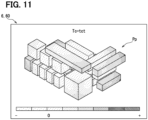
- FIG. 11 schematically illustrates an example of thermal map representing the cooling temperature of each of the articles 3 with gray scale shading in a state where the cooling time tc reaches the target time tct.
- the absence determination corresponds to a case where the presence of the arrangement pattern Pp that achieves the target time tct due to, for example, insufficiency of the cooling performance Yc is denied by the cold insulation analysis model Ma.
- the optimization subroutine proceeds to S302.
- the output block 120 determines whether the cold insulator is usable. At this time, since the information on the usability of the cold insulator is included in the cold insulator performance Xc as the packing condition C2, the determination is made based on the usability information.
- the optimization subroutine proceeds to S303.
- the output block 120 determines, based on the optimum data Do output from the cold insulation analysis model Ma, whether or not there is an arrangement pattern Pp that achieves the cooling time tc, which is equal to or longer than the target time tct, using the cold insulator while the cooling performance Yc is insufficient as the environmental condition C4.
- the arrangement pattern Pp in the optimum data Do where the determination of YES is made includes the number of used cold insulators and the arrangement position optimized by the cold insulation analysis model Ma.
- a determination of NO corresponds to a case where the presence of the arrangement pattern Pp that achieves the target time tct even under the use of the maximum number of cold insulators is denied by the cold insulation analysis model Ma.
- the optimization subroutine when a determination of YES is made in S301 or S303, the optimization subroutine proceeds to S304.
- the output block 120 outputs the optimum data Do of the arrangement pattern Pp in which the cooling time tc is the longest among the arrangement patterns Pp that achieve the target time tct while the cooling performance Yc is insufficient.
- the output block 120 may cause the information presentation unit 60 to display an optimized image presenting the arrangement pattern Pp in which the cooling time tc is the longest and equal to or longer than the target time tct as an output of the optimum data Do to the operator (in case where the operator is the same as the packing worker).
- the optimization subroutine when a determination of NO is made in S302 or S303, the optimization subroutine proceeds to S305.
- the output block 120 outputs the optimum data Do of the arrangement pattern Pp in which the cooling time tc is the longest while being less than the target time tct among the arrangement patterns Pp due to the shortage of the cooling performance Yc.
- the output block 120 may cause the information presentation unit 60 to display, as an output of the optimum data Do, an optimized image presenting the arrangement pattern Pp in which the cooling time tc is less than the target time tct but the longest among the arrangement patterns Pp, to the operator (in case where the operator is the same as the packing worker).
- the optimization subroutine proceeds to S306.
- the output block 120 determines the presence or absence of the arrangement pattern Pp that achieves the cooling time tc equal to or longer than the target time tct under the satisfaction of the cooling performance Yc, based on the optimum data Do output from the cold insulation analysis model Ma.
- the optimum data Do when the presence determination is made includes the cooling pattern Pc, in the delivery vehicle 4, optimized by the cold insulation analysis model Ma.
- the cooling pattern Pc is defined as, for example, a pattern obtained by optimizing the transition in the space temperature on the cargo bed 40, which is cooled and adjusted by the cooling dedicated unit 41, over the temporal change, by the cold insulation analysis model Ma based on the input of the predicted transition in temperature on the scheduled delivery route Rd.
- a determination of NO in S306 corresponds to a case where the presence of the arrangement pattern Pp that achieves the target time tct even under the satisfaction of the cooling performance Yc is denied by the cold insulation analysis model Ma.
- the optimization subroutine proceeds to S307.
- the output block 120 outputs the optimum data Do of the arrangement pattern Pp in which the cooling time tc is the longest among the arrangement patterns Pp in which the target time tct is achieved under the satisfaction of the cooling performance Yc.
- the output block 120 may cause the information presentation unit 60 to display an optimized image presenting the arrangement pattern Pp in which the cooling time tc is the longest and equal to or longer than the target time tct as an output of the optimum data Do to the operator (in case where the operator is the same as the packing worker).
- the output block 120 may present the cooling pattern Pc corresponding to the arrangement pattern Pp in which the cooling time tc is equal to or longer than the target time tct and is the longest by displaying the optimized image.
- the optimization subroutine proceeds to S308.
- the output block 120 outputs the optimum data Do of the arrangement pattern Pp in which the cooling time tc is the longest among the arrangement patterns Pp in which the cooling time tc is less than the target time tct even when the cooling performance Yc is satisfied.
- the output block 120 may cause the information presentation unit 60 to display, as an output of the optimum data Do, an optimized image presenting the arrangement pattern Pp in which the cooling time tc is less than the target time tct but the longest among the arrangement patterns Pp, to the operator (in case where the operator is the same as the packing worker).
- the output block 120 may present the cooling pattern Pc corresponding to the arrangement pattern Pp in which the cooling time tc is less than the target time tct but the longest by displaying the optimized image.
- the output block 120 may output the optimum data Do of the cooling pattern Pc that minimizes the cooling energy predicted to be consumed in the temperature adjustment according to the cooling performance Yc, with respect to the arrangement pattern Pp in which the cooling time Tc is equal to or longer than the target time tct.
- the output block 120 may output the optimum data Do of the cooling pattern Pc that minimizes the cooling energy predicted to be consumed in the temperature adjustment according to the cooling performance Yc, with respect to the arrangement pattern Pp in which the cooling time Tc is less than the target time tct.
- the output block 120 may present not only the transition of the temperature adjustment according to the cooling performance Yc but also, for example, the cooling start timing or the like as the cooling pattern Pc by displaying the optimized image.
- a three-dimensional image as illustrated in FIG. 5 or 11 may be displayed and output as an optimized image.
- a thermal map image of the cold storage temperature as illustrated in FIG. 11 may be displayed and output as an optimized image.
- the optimum data Do representing the arrangement pattern Pp as a character string may be displayed and output.
- the optimum data Do may be output to an external delivery-related servicer, and may be utilized for, for example, development or improvement of a delivery-related service.
- at least the arrangement pattern Pp of the optimum data Do may be output to the control unit of the packing robot that automatically packs the articles 3 to be used for the automatic packing.
- at least the cooling pattern Pc of the optimum data Do may be output to the control unit of the delivery vehicle 4 to be used for the automatic cooling control during delivery.
- the current execution of the optimization subroutine according to FIG. 9 described so far is ended by the completion of the execution of any one of S304, S305, S307, and S308, so that the current execution of the delivery support flow according to FIG. 4 is also ended.
- the cold insulation analysis model Ma for analyzing the cooling time tc according to the arrangement pattern Pp of the articles 3 in the delivery box 2 is read from the memory 70. Therefore, in the present embodiment, the optimum data Do obtained by optimizing the cooling time tc and the arrangement pattern Pp is output by the cold insulation analysis model Ma to which the delivery condition C of the article 3 is input. Accordingly, since the cooling time tc and the arrangement pattern Pp that influence the cooling power can be determined based on the output optimum data Do, it is possible to secure the cooling power necessary for the delivery.
- the optimum data Do of the arrangement pattern Pp that achieves the target time tct is output by the cold storage analysis model Ma, while the target time tct is a target of the cooling time tc input as the delivery condition C. Accordingly, the arrangement pattern Pp that provides the cooling power necessary for the target time tct can be determined based on the output optimum data Do. Therefore, it is possible to secure the necessary cooling power for achieving the target time tct.
- the optimum data Do of the arrangement pattern Pp in which the cooling time tc is the longest among the arrangement patterns Pp that achieve the target time tct is output. Accordingly, not only the target time tct is achieved, but also the arrangement pattern Pp that maximizes the cooling time tc can be determined based on the output optimum data Do. Therefore, the cooling power for achieving the target time tct can be secured on the safe side.
- the optimum data Do of the arrangement pattern Pp in which the cooling time tc is the longest while being less than the target time tct is output. Accordingly, for the delivery condition C in which only the arrangement pattern Pp that gives the cooling time tc less than the target time tct is present, the arrangement pattern Pp for securing the cooling power to the maximum can be determined based on the output optimum data Do. Therefore, the cooling power can be adjusted according to the delivery condition C.
- the optimum data Do obtained by optimizing the cooling pattern Pc in the delivery vehicle 4 together with the cooling time tc and the arrangement pattern Pp by the cold insulation analysis model Ma is output, while the cooling performance Yc in the delivery vehicle 4 is input as the delivery condition C. Accordingly, the arrangement pattern Pp capable of increasing the cooling time tc by optimizing the cooling pattern Pc depending on the cooling performance Yc can be determined based on the output optimum data Do. Therefore, it is possible to secure a high cooling power by utilizing the cooling performance Yc.
- the optimum data Do obtained by optimizing the cooling pattern Pc is output by the cold insulation analysis model Ma, while the predicted transition in temperature on the delivery scheduled route Rd of the delivery vehicle 4 is input as the delivery condition C together with the cooling performance Yc. Accordingly, the arrangement pattern Pp capable of increasing the cooling time tc by matching the cooling pattern Pc depending on the cooling performance Yc with the predicted transition in temperature to the scheduled delivery route Rd can be determined based on the output optimum data Do. Therefore, it is possible to secure an appropriate cooling power in consideration of the transition in temperature on the scheduled delivery route Rd.
- the optimum data Do of the cooling time tc and the arrangement pattern Pp in the cooling pattern Pc that minimizes the cooling energy is output. Accordingly, the cooling time tc and the arrangement pattern Pp capable of securing the necessary cooling power even when the cooling energy is the minimum can be determined based on the output optimum data Do. Therefore, it is possible to achieve both saving of energy and securing of cooling power.
- the optimum data Do obtained by optimizing the number of cold insulators used together with the cooling time tc and the arrangement pattern Pp is output by the cold insulation analysis model Ma, while the cooling performance Yc insufficient for cold insulation is input as the delivery condition C. Accordingly, even in a case where the cooling performance Yc is insufficient for the cold insulation, the cooling time tc and the arrangement pattern Pp capable of securing the necessary cold insulation power by using the necessary minimum cold insulation material can be determined based on the output optimum data Do. Therefore, it is possible to achieve a balance between the cold insulation property and the circular economy property.
- control computer 7 of the delivery support system 1 may include at least one of a digital circuit and an analog circuit as a processor.
- the digital circuit is at least one type of, for example, an ASIC (Application Specific Integrated Circuit), a FPGA (Field Programmable Gate Array), an SOC (System on a Chip), a PGA (Programmable Gate Array), a CPLD (Complex Programmable Logic Device), and the like.
- ASIC Application Specific Integrated Circuit
- FPGA Field Programmable Gate Array
- SOC System on a Chip
- PGA Programmable Gate Array
- CPLD Complex Programmable Logic Device
- At least one of the parameters constituting the delivery condition C of the modification may be incorporated in the construction stage or the learning stage of the cold insulation analysis model Ma.
- At least one of the packing condition C2 and the environmental condition C4 may be omitted as the delivery condition C of the modification. Further, in this modification, at least one of the packing condition C2 and the environmental condition C4 may be incorporated in the construction stage or the learning stage of the cold insulation analysis model Ma.
- the execution of at least S300, S302, or S303 may be skipped among S300 to S305.
- the cold insulator performance Xc may be omitted as the packing condition C2.
- the execution of S300 and S306 to S308 may be skipped.
- the cooling performance Yc may be omitted as the environmental condition C4.
- the arrangement pattern Pp in which the cooling time tc is other than the longest in S304, S305, S307, S308 may be output as the optimum data Do in addition to or instead of the arrangement pattern Pp in which the cooling time tc is the longest.
- S309 corresponding to S302 may be executed when the determination of NO is made in S306.
- S310 corresponding to S303 may be executed when the determination of NO is made in S309.
- S310 it is determined whether or not there is an arrangement pattern Pp that requires the use of a cold insulator in order to achieve the cooling time tc equal to or longer than the target time tct although the cooling performance Yc for cold insulation is satisfied. Therefore, when the determination of YES is made in S306 or S310, the optimization subroutine proceeds to S307. When the determination of NO is made in S309 or S310, the optimization subroutine proceeds to S308.
- a control device for example, a control ECU or the like
- a semiconductor device for example, a semiconductor chip or the like
- the processor 72 and the memory 70 may be used as a device including the processor 72 and the memory 70.
Landscapes
- Business, Economics & Management (AREA)
- Engineering & Computer Science (AREA)
- Human Resources & Organizations (AREA)
- Economics (AREA)
- Physics & Mathematics (AREA)
- Strategic Management (AREA)
- Theoretical Computer Science (AREA)
- Entrepreneurship & Innovation (AREA)
- General Physics & Mathematics (AREA)
- Operations Research (AREA)
- Tourism & Hospitality (AREA)
- Quality & Reliability (AREA)
- General Business, Economics & Management (AREA)
- Marketing (AREA)
- Development Economics (AREA)
- Game Theory and Decision Science (AREA)
- Chemical & Material Sciences (AREA)
- Educational Administration (AREA)
- General Engineering & Computer Science (AREA)
- Mechanical Engineering (AREA)
- Chemical Kinetics & Catalysis (AREA)
- Combustion & Propulsion (AREA)
- Biodiversity & Conservation Biology (AREA)
- Thermal Sciences (AREA)
- Life Sciences & Earth Sciences (AREA)
- Computer Hardware Design (AREA)
- Evolutionary Computation (AREA)
- Geometry (AREA)
- Management, Administration, Business Operations System, And Electronic Commerce (AREA)
Abstract
Description
- The present disclosure relates to a delivery support technology to support a process for delivery of articles by a delivery vehicle.
-
Patent Literature 1 discloses a technique of combining a cold storage box, a cold storage material, and dry ice in order to cool and transport articles such as refrigerated articles and frozen articles. - Patent Literature 1:
JP 2007-45519 A - However, the technique disclosed in
Patent Literature 1 merely exemplifies the arrangement of articles in the cooling box. The arrangement form in the cooling box has to be left to the experience value of the operator, and there is a concern that the cooling power necessary for the transport destination cannot be secured. In general, in the delivery process in which the transport destination is a general consumer, since the delivery vehicle is not necessarily an expensive cold storage vehicle, it is expected that the cold storage capacity can be finely adjusted in accordance with the delivery conditions. In the technology disclosed inPatent Literature 1, since the cold insulation box, the cold storage material, and the dry ice are assumed to be disposable, improvement is also required from the viewpoint of the circular economy. - An object of the present disclosure is to provide a delivery support method that secures a cooling power necessary for delivery. Another object of the present disclosure is to provide a delivery support system that secures a cooling power necessary for delivery. Still another object of the present disclosure is to provide a delivery support program that secures a cooling power necessary for delivery.
- Hereinafter, technical means of the present disclosure for solving the issues will be described. Note that the reference numerals indicate the corresponding relationship with the specific means described in the embodiments described in detail later, and do not limit the technical scope of the present disclosure.
- According to a first aspect of the present disclosure, a delivery support method executed by a processor in cooperation with a storage medium to support a delivery process by a delivery vehicle for articles that need to be kept cool in a delivery box includes: reading a cold insulation analysis model from the storage medium to analyze a cooling time according to an arrangement pattern of the articles in the delivery box; and outputting optimum data in which the cooling time and the arrangement pattern are optimized by the cold insulation analysis model to which a delivery condition of the article is input.
- According to a second aspect of the present disclosure, a delivery support system includes a storage medium and a processor to support a delivery process by a delivery vehicle for articles that need to be kept cool in a delivery box. The processor is configured to execute to: read a cold insulation analysis model from the storage medium to analyze a cooling time according to an arrangement pattern of the articles in the delivery box; and output optimum data optimized in the cooling time and the arrangement pattern by the cold insulation analysis model to which a delivery condition of the article is input.
- According to a third aspect of the present disclosure, a delivery support program stored in a storage medium includes instructions executed by a processor to support a delivery process by a delivery vehicle for articles that need to be kept cool in a delivery box. The instructions include: reading a cold insulation analysis model from the storage medium to analyze a cooling time according to an arrangement pattern of the articles in the delivery box; and outputting optimum data optimized in the cooling time and the arrangement pattern by the cold insulation analysis model to which a delivery condition of the article is input.
- As described above, according to the first to third aspects, the cold insulation analysis model is read from the storage medium to analyze the cooling time according to the arrangement pattern of the articles in the delivery box. Therefore, the optimum data obtained by optimizing the cooling time and the arrangement pattern is output by the cold insulation analysis model to which the delivery conditions of the articles are input. Accordingly, since the cooling time and the arrangement pattern that influence the cooling power can be determined based on the output optimum data, it is possible to secure the cooling power necessary for the delivery.
-
-
FIG. 1 is a schematic diagram illustrating an overall configuration of an embodiment. -
FIG. 2 is a block diagram illustrating a physical configuration of a delivery support system of the embodiment. -
FIG. 3 is a block diagram illustrating a functional configuration of a delivery support system of the embodiment. -
FIG. 4 is a flowchart illustrating a delivery support flow of the embodiment. -
FIG. 5 is a schematic diagram for explaining a delivery support flow of the embodiment. -
FIG. 6 is a block chart for explaining a cold insulation analysis model of the embodiment. -
FIG. 7 is a characteristic table for explaining a cold insulation analysis model of the embodiment. -
FIG. 8 is a schematic diagram illustrating a delivery support flow of the embodiment. -
FIG. 9 is a block diagram illustrating an optimization subroutine of the embodiment. -
FIG. 10 is a graph illustrating an optimization subroutine of the embodiment. -
FIG. 11 is a schematic diagram illustrating an optimization subroutine of the embodiment. -
FIG. 12 is a block chart illustrating an optimization subroutine according to a modification of the embodiment. - Hereinafter, an embodiment of the present disclosure will be described with reference to the drawings.
- A
delivery support system 1 according to an embodiment illustrated inFIG. 1 supports a delivery process by a delivery vehicle 4 forarticles 3 that requires cooling in adelivery box 2. At least a part of thedelivery support system 1 is installed in a management station a such as a picking station that manages packing of thearticles 3 into thedelivery box 2. The operator related to thedelivery support system 1 may be the same as or different from the packing worker, for example, when the worker who packs thearticles 3 into thedelivery box 2 is working in the management station a. - The
article 3 to be subjected to the delivery process by the delivery vehicle 4 is at least one type of food that needs to be kept cold, among, for example, a refrigerated product, a frozen product, and a room temperature preservation product. Thearticle 3 may include at least one type of packaging article for packaging such food, for example, a polystyrene foam container, a plastic container, a plastic film, or the like. Thearticle 3 may include at least one of, for example, a medicine, a feed, a solvent, a solution, miscellaneous goods, a building material, an electronic device, and the like that need to be kept cold other than foods. Thedelivery box 2 capable of packaging one ormore articles 3 is, for example, at least one of a cardboard box, a plastic case, a polystyrene foam box, and the like. - The delivery vehicle 4 that delivers the
articles 3 packed in one ormore delivery boxes 2 may be, for example, a cold storage vehicle 4a equipped with acargo bed 40 capable of cooling thearticles 3 to a set temperature or lower by a coolingdedicated unit 41 such as a cold storage container. The delivery vehicle 4 may be a cargo van 4b that is not equipped with the coolingdedicated unit 41 and is equipped with acargo bed 40 on which thearticle 3 is placed in a vehicle interior that can be air-conditioned by anair conditioning unit 42 such as an air conditioner. The delivery vehicle 4 may be a cargo truck 4c that is not equipped with the coolingdedicated unit 41 and is equipped with acargo bed 40 on which thearticle 3 is placed in a cargo compartment isolated from air conditioning by theair conditioning unit 42 for the cabin. The delivery vehicle 4 may be other than the cold storage vehicle 4a, the cargo van 4b, and the cargo truck 4c. - As shown in
FIG. 2 , thedelivery support system 1 includes aninterface unit 6. Theinterface unit 6 is at least one of, for example, aninformation presentation unit 60 or/and aninput unit 62 installed in the management station a.FIG. 2 illustrates an example of thedelivery support system 1 including both theinformation presentation unit 60 and theinput unit 62. - The
information presentation unit 60 presents information to the operator of thedelivery support system 1. Theinformation presentation unit 60 is, for example, at least one of a liquid crystal panel, an organic EL panel, and the like that displays an image of data necessary for supporting the delivery process. Theinformation presentation unit 60 may include, for example, a speaker or the like that outputs data necessary for supporting the delivery process by voice. - The
input unit 62 is, for example, at least one of a mouse, a trackball, a keyboard, and the like that receives an input from the operator. Theinput unit 62 may be configured to provide a graphical user interface (GUI) to the operator in cooperation with theinformation presentation unit 60. - The
delivery support system 1 further includes one ormore control computers 7 as dedicated computer in order to control theinterface unit 6 to support the delivery process by thedelivery support system 1. Thecontrol computer 7 may be installed in the management station α. Thecontrol computer 7 may be installed outside the management station α as at least one of a cloud server, an edge server, and the like. Thecontrol computer 7 is connected to theinterface unit 6 via at least one of, for example, a local area network (LAN) line, a wire harness, an internal bus, and a wireless communication line. When there areplural control computers 7 constituting thedelivery support system 1, the connection between thecontrol computers 7 is the same as described. - The
control computer 7 includes amemory 70 and aprocessor 72. Thememory 70 is at least one type of non-transitory tangible storage medium among, for example, a semiconductor memory, a magnetic medium, an optical medium, and the like that non-temporarily stores a computer-readable program, data, a model, and the like. Theprocessor 72 includes at least one of the CPU, GPU, and RISC-CPU as a core. - In the
control computer 7, theprocessor 72 executes plural instructions included in the delivery support program stored in thememory 70 in order to support the delivery process by thedelivery support system 1. Accordingly, thecontrol computer 7 constructs plural functional blocks for supporting the delivery process by thedelivery support system 1 in cooperation with thememory 70. As shown inFIG. 3 , the functional blocks constructed in thecontrol computer 7 include aninput block 100 and anoutput block 120. - The
input block 100 and theoutput block 120 execute a delivery support method for supporting the delivery process by thedelivery support system 1 according to the delivery support flow illustrated inFIG. 4 . The delivery support flow is executed in response to a command from an operator of thedelivery support system 1 or automatically and repeatedly during activation of thedelivery support system 1. Each "S" in the delivery support flow means each of steps executed by the instructions included in the delivery support program. - In S10 of the delivery support flow, the
input block 100 reads the cold insulation analysis model Ma from thememory 70. Specifically, as illustrated inFIG. 5 , the cold insulation analysis model Ma is constructed by, for example, a simulation model, a statistical model, a machine learning model, or the like in order to analyze the cooling time tc corresponding to the arrangement pattern Pp representing the three-dimensional arrangement position of thearticles 3 in thedelivery box 2. Thearticles 3 in thedelivery box 2 illustrated inFIG. 5 andFIG. 1 are schematically illustrated by a rectangular parallelepiped for convenience of description. - The cold insulation analysis model Ma is configured to output the optimum data Do in which the cooling time tc and the arrangement pattern Pp are optimized by using the delivery condition C illustrated in
FIG. 6 as an input condition. Further, the cold insulation analysis model Ma of the present embodiment can output the optimum data Do obtained by optimizing the cooling pattern Pc in the delivery vehicle 4 together with the cooling time tc and the arrangement pattern Pp. - The delivery condition C input to the cold storage analysis model Ma includes an article condition C1, a packing condition C2, a schedule condition C3, and an environmental condition C4. The article condition C1 is defined by at least one type of parameter including an article type Kg with respect to one or
more articles 3 packed in thedelivery box 2 as delivery target among, for example, the article type Kg, the initial packaging temperature, the outer shape, the outer size, the volume, the weight, the specific gravity, the specific heat, the thermal conductivity, the maximum allowable temperature (hereinafter, referred to as allowable temperature), and the material (in case of packaging article).FIG. 7 shows examples of the article type Kg, the specific gravity, the specific heat, and the thermal conductivity input to the cold storage analysis model Ma for each of thearticles 3 as the article condition C1. - The packing condition C2 illustrated in
FIG. 6 is defined by at least one type of parameter including the performance Xc of the cooling material capable of internally cooling thedelivery box 2 for packing one ormore articles 3 to be delivered (hereinafter, referred to as a cold insulator performance Xc) among, for example, the type (hereinafter, referred to as box type), the initial packing temperature, the material, the external shape, the external size, the thickness, the internal volume, the weight, the specific gravity, the specific heat, the thermal conductivity, the thermal insulation performance, the temperature change rate over time for each internal position, and the cold insulator performance Xc. - The schedule condition C3 is defined by at least one type of parameter including a target time tct that is a target of the cooling time tc, for one or
more articles 3 to be delivered, among, for example, the target time tct, a scheduled delivery route Rd, and the like. The target time tct is set to include at least the scheduled delivery time corresponding to the scheduled delivery route Rd, among the scheduled delivery time, the average time from the completion of packing to the loading on the delivery vehicle 4 or the start of delivery, and the average time from the completion of delivery to the reception at the delivery destination β (seeFIG. 1 ). - The environmental condition C4 is defined by at least one type of parameter including the cooling performance Yc of cooling the upper side of the
bed 40 in the delivery vehicle 4 (hereinafter, referred to as cooling performance Yc), with respect to the delivery vehicle 4 that transports one ormore articles 3 to be delivered as target article, among, for example, the vehicle type, the cooling performance Yc, and the predicted transition in temperature on the scheduled delivery route Rd. The predicted transition in temperature on the scheduled delivery route Rd is, for example, a transition of a temporal change predicted for at least one of the outside air temperature outside the delivery vehicle 4, the road surface temperature on which the delivery vehicle 4 is scheduled to travel, the space temperature on thecargo bed 40 in the delivery vehicle 4, and the like. - In S20 subsequent to S10 of the delivery support flow illustrated in
FIG. 4 , theinput block 100 executes a process of inputting the delivery condition C to the cold insulation analysis model Ma. As the input processing of the delivery condition C in S20, manual input from the operator by the input unit 62 (hereinafter, simply referred to as operator input) may be executed. At this time, theinput block 100 may cause theinformation presentation unit 60 to display an input reception image for receiving an operator input as illustrated inFIG. 8 to the operator. As the input process of the delivery condition C in S20, automatic input of a condition that is self-generated by thedelivery support system 1 or transferred from the outside such as a delivery-related servicer and stored in thememory 70 may be executed (hereinafter, simply referred to as automatic input). - In S20, all the items of the article condition C1 may be input by the operator for one or
more articles 3 to be delivered. In S20, when the article type Kg as the article condition C1 is input by the operator with respect to one ormore articles 3 to be delivered, the other information of the article condition C1 may be automatically input to the cold insulation analysis model Ma by reading from the memory 70 (for example, in case ofFIG. 8 ). In S20, all the items of the article condition C1 may be automatically input for one ormore articles 3 to be delivered. - In S20, all the items of the packing condition C2 may be input by the operator with respect to the
delivery box 2 in which at least onearticle 3 to be delivered is packed. In S20, when the box type and the cold insulator performance Xc as the packing condition C2 is input by the operator with respect to thedelivery box 2 for packing at least onearticle 3 to be delivered, the other information of the packing condition C2 may be automatically input to the cold insulation analysis model Ma by being read from the memory 70 (for example, in case ofFIG. 8 ). In S20, all the items of the packing condition C2 may be automatically input with respect to thedelivery box 2 in which at least onearticle 3 to be delivered is packed. - In S20, all the items of the schedule condition C3 may be input by the operator for one or
more articles 3 to be delivered. In S20, the scheduled delivery route Rd as the schedule condition C3 may be input by the operator with respect to one ormore articles 3 to be delivered, and other information including the target time tct in the schedule condition C3 may be automatically input to the cold insulation analysis model Ma by being read from the memory 70 (for example, in the case ofFIG. 8 ). In S20, all the items of the schedule condition C3 may be automatically input for one ormore articles 3 to be delivered. - In S20, all the items of the environmental condition C4 may be input by the operator with respect to the delivery vehicle 4 that transports at least one
article 3 to be delivered. In S20, the vehicle type as the environmental condition C4 may be input by the operator with respect to the delivery vehicle 4 that transports at least onearticle 3 to be delivered, and other information including the cooling performance Yc in the environmental condition C4 may be automatically input to the cold insulation analysis model Ma by being read from the memory 70 (for example, in case ofFIG. 8 ). In S20, all the items of the environmental condition C4 may be automatically input with respect to the delivery vehicle 4 that transports at least onearticle 3 to be delivered. However, in any case, the predicted transition in temperature as the environmental condition C4 may be automatically set by theinput block 100 based on the parameters Xc, tct, Rd, Yc, and the like input by the operator or automatically input as the condition C2, C3, C4 and automatically input to the cold insulation analysis model Ma. - In S30 subsequent to S20 of the delivery support flow illustrated in
FIG. 4 , theoutput block 120 outputs the optimum data Do in which the cooling time tc and the arrangement pattern Pp are optimized by the cold insulation analysis model Ma to which the delivery condition C is input. Specifically, in S30, an optimization subroutine shown inFIG. 9 is executed. - In S300 of the optimization subroutine, the
output block 120 determines whether the cooling performance Yc in the delivery vehicle 4 is satisfactory or insufficient for cooling. Specifically, any one of a satisfaction determination and an insufficiency determination is made in S300. The satisfaction determination represents that the cooling performance Yc on thecargo bed 40 in the delivery vehicle 4 is satisfied as the equipment performance for cooling thearticle 3 to the set temperature or less. The insufficiency determination represents that the cooling performance Yc is insufficient as the equipment performance. In the present embodiment, the satisfaction determination for the cooling performance Yc is made in the delivery vehicle 4 equipped with the cooling dedicated unit 41 (for example, the cold storage vehicle 4a), whereas the insufficiency determination for the cooling performance Yc is made in the delivery vehicle 4 without the cooling dedicated unit 41 (for example, the cargo van 4b, the cargo truck 4c, etc.). - When the insufficiency determination is made in S300, the optimization subroutine proceeds to S301. In S301, the
output block 120 determines the presence or absence of the arrangement pattern Pp that achieves the cooling time tc, which is longer than or equal to the target time tct, as the environmental condition C4 under the cooling performance Yc is insufficient, based on the optimum data Do output from the cold insulation analysis model Ma.FIG. 10 is a graph regarding the temperature change over time, and shows an example in which it is determined that the arrangement pattern Pp (seeFIG. 5 ) is present (YES in S301). Specifically, the cooling time tc satisfying the minimum temperature Tmin is equal to or longer than the target time tct, among the allowable temperatures of theplural articles 3. With respect to the arrangement pattern Pp (seeFIG. 5 ) when the presence determination is made (YES in S301),FIG. 11 schematically illustrates an example of thermal map representing the cooling temperature of each of thearticles 3 with gray scale shading in a state where the cooling time tc reaches the target time tct. The absence determination (NO in S301) corresponds to a case where the presence of the arrangement pattern Pp that achieves the target time tct due to, for example, insufficiency of the cooling performance Yc is denied by the cold insulation analysis model Ma. - When the absence determination (NO) is made in S301 of
FIG. 9 , the optimization subroutine proceeds to S302. In S302, theoutput block 120 determines whether the cold insulator is usable. At this time, since the information on the usability of the cold insulator is included in the cold insulator performance Xc as the packing condition C2, the determination is made based on the usability information. - In case where a determination of YES is made in S302, the optimization subroutine proceeds to S303. In S303, the
output block 120 determines, based on the optimum data Do output from the cold insulation analysis model Ma, whether or not there is an arrangement pattern Pp that achieves the cooling time tc, which is equal to or longer than the target time tct, using the cold insulator while the cooling performance Yc is insufficient as the environmental condition C4. The arrangement pattern Pp in the optimum data Do where the determination of YES is made includes the number of used cold insulators and the arrangement position optimized by the cold insulation analysis model Ma. A determination of NO corresponds to a case where the presence of the arrangement pattern Pp that achieves the target time tct even under the use of the maximum number of cold insulators is denied by the cold insulation analysis model Ma. - In the optimization subroutine, when a determination of YES is made in S301 or S303, the optimization subroutine proceeds to S304. In S304, the
output block 120 outputs the optimum data Do of the arrangement pattern Pp in which the cooling time tc is the longest among the arrangement patterns Pp that achieve the target time tct while the cooling performance Yc is insufficient. At this time, theoutput block 120 may cause theinformation presentation unit 60 to display an optimized image presenting the arrangement pattern Pp in which the cooling time tc is the longest and equal to or longer than the target time tct as an output of the optimum data Do to the operator (in case where the operator is the same as the packing worker). - In the optimization subroutine, when a determination of NO is made in S302 or S303, the optimization subroutine proceeds to S305. In S305, the
output block 120 outputs the optimum data Do of the arrangement pattern Pp in which the cooling time tc is the longest while being less than the target time tct among the arrangement patterns Pp due to the shortage of the cooling performance Yc. At this time, theoutput block 120 may cause theinformation presentation unit 60 to display, as an output of the optimum data Do, an optimized image presenting the arrangement pattern Pp in which the cooling time tc is less than the target time tct but the longest among the arrangement patterns Pp, to the operator (in case where the operator is the same as the packing worker). - When the satisfaction determination is made in S300, the optimization subroutine proceeds to S306. In S306, the
output block 120 determines the presence or absence of the arrangement pattern Pp that achieves the cooling time tc equal to or longer than the target time tct under the satisfaction of the cooling performance Yc, based on the optimum data Do output from the cold insulation analysis model Ma. At this time, the optimum data Do when the presence determination is made (YES in S306) includes the cooling pattern Pc, in the delivery vehicle 4, optimized by the cold insulation analysis model Ma. The cooling pattern Pc is defined as, for example, a pattern obtained by optimizing the transition in the space temperature on thecargo bed 40, which is cooled and adjusted by the coolingdedicated unit 41, over the temporal change, by the cold insulation analysis model Ma based on the input of the predicted transition in temperature on the scheduled delivery route Rd. A determination of NO in S306 corresponds to a case where the presence of the arrangement pattern Pp that achieves the target time tct even under the satisfaction of the cooling performance Yc is denied by the cold insulation analysis model Ma. - When a determination of YES is made in S306, the optimization subroutine proceeds to S307. In S307, the
output block 120 outputs the optimum data Do of the arrangement pattern Pp in which the cooling time tc is the longest among the arrangement patterns Pp in which the target time tct is achieved under the satisfaction of the cooling performance Yc. At this time, theoutput block 120 may cause theinformation presentation unit 60 to display an optimized image presenting the arrangement pattern Pp in which the cooling time tc is the longest and equal to or longer than the target time tct as an output of the optimum data Do to the operator (in case where the operator is the same as the packing worker). At this time, theoutput block 120 may present the cooling pattern Pc corresponding to the arrangement pattern Pp in which the cooling time tc is equal to or longer than the target time tct and is the longest by displaying the optimized image. - When a determination of NO is made in S306, the optimization subroutine proceeds to S308. In S308, the
output block 120 outputs the optimum data Do of the arrangement pattern Pp in which the cooling time tc is the longest among the arrangement patterns Pp in which the cooling time tc is less than the target time tct even when the cooling performance Yc is satisfied. At this time, theoutput block 120 may cause theinformation presentation unit 60 to display, as an output of the optimum data Do, an optimized image presenting the arrangement pattern Pp in which the cooling time tc is less than the target time tct but the longest among the arrangement patterns Pp, to the operator (in case where the operator is the same as the packing worker). In addition, at this time, theoutput block 120 may present the cooling pattern Pc corresponding to the arrangement pattern Pp in which the cooling time tc is less than the target time tct but the longest by displaying the optimized image. - In the optimization subroutine, in S307, the
output block 120 may output the optimum data Do of the cooling pattern Pc that minimizes the cooling energy predicted to be consumed in the temperature adjustment according to the cooling performance Yc, with respect to the arrangement pattern Pp in which the cooling time Tc is equal to or longer than the target time tct. In S308, theoutput block 120 may output the optimum data Do of the cooling pattern Pc that minimizes the cooling energy predicted to be consumed in the temperature adjustment according to the cooling performance Yc, with respect to the arrangement pattern Pp in which the cooling time Tc is less than the target time tct. At this time, theoutput block 120 may present not only the transition of the temperature adjustment according to the cooling performance Yc but also, for example, the cooling start timing or the like as the cooling pattern Pc by displaying the optimized image. - In S304, S305, S307, and S308 of the optimization subroutine, a three-dimensional image as illustrated in
FIG. 5 or11 may be displayed and output as an optimized image. In S304, S305, S307, and S308 of the optimization subroutine, a thermal map image of the cold storage temperature as illustrated inFIG. 11 may be displayed and output as an optimized image. In S304, S305, S307, and S308 of the optimization subroutine, in addition to or instead of the optimized image, the optimum data Do representing the arrangement pattern Pp as a character string may be displayed and output. - Further, in S304, S305, S307, and S308 of the optimization subroutine, the optimum data Do may be output to an external delivery-related servicer, and may be utilized for, for example, development or improvement of a delivery-related service. In S304, S305, S307, and S308 of the optimization subroutine, at least the arrangement pattern Pp of the optimum data Do may be output to the control unit of the packing robot that automatically packs the
articles 3 to be used for the automatic packing. In S307 and S308 of the optimization subroutine, at least the cooling pattern Pc of the optimum data Do may be output to the control unit of the delivery vehicle 4 to be used for the automatic cooling control during delivery. - The current execution of the optimization subroutine according to
FIG. 9 described so far is ended by the completion of the execution of any one of S304, S305, S307, and S308, so that the current execution of the delivery support flow according toFIG. 4 is also ended. - The effects and advantages in the present embodiment will be explained below.
- According to the present embodiment, the cold insulation analysis model Ma for analyzing the cooling time tc according to the arrangement pattern Pp of the
articles 3 in thedelivery box 2 is read from thememory 70. Therefore, in the present embodiment, the optimum data Do obtained by optimizing the cooling time tc and the arrangement pattern Pp is output by the cold insulation analysis model Ma to which the delivery condition C of thearticle 3 is input. Accordingly, since the cooling time tc and the arrangement pattern Pp that influence the cooling power can be determined based on the output optimum data Do, it is possible to secure the cooling power necessary for the delivery. - According to the present embodiment, the optimum data Do of the arrangement pattern Pp that achieves the target time tct is output by the cold storage analysis model Ma, while the target time tct is a target of the cooling time tc input as the delivery condition C. Accordingly, the arrangement pattern Pp that provides the cooling power necessary for the target time tct can be determined based on the output optimum data Do. Therefore, it is possible to secure the necessary cooling power for achieving the target time tct.
- According to the present embodiment, the optimum data Do of the arrangement pattern Pp in which the cooling time tc is the longest among the arrangement patterns Pp that achieve the target time tct is output. Accordingly, not only the target time tct is achieved, but also the arrangement pattern Pp that maximizes the cooling time tc can be determined based on the output optimum data Do. Therefore, the cooling power for achieving the target time tct can be secured on the safe side.
- According to the present embodiment, when the presence of the arrangement pattern Pp that achieves the target time tct is denied by the cold insulation analysis model Ma, the optimum data Do of the arrangement pattern Pp in which the cooling time tc is the longest while being less than the target time tct is output. Accordingly, for the delivery condition C in which only the arrangement pattern Pp that gives the cooling time tc less than the target time tct is present, the arrangement pattern Pp for securing the cooling power to the maximum can be determined based on the output optimum data Do. Therefore, the cooling power can be adjusted according to the delivery condition C.
- According to the present embodiment, the optimum data Do obtained by optimizing the cooling pattern Pc in the delivery vehicle 4 together with the cooling time tc and the arrangement pattern Pp by the cold insulation analysis model Ma is output, while the cooling performance Yc in the delivery vehicle 4 is input as the delivery condition C. Accordingly, the arrangement pattern Pp capable of increasing the cooling time tc by optimizing the cooling pattern Pc depending on the cooling performance Yc can be determined based on the output optimum data Do. Therefore, it is possible to secure a high cooling power by utilizing the cooling performance Yc.
- According to the present embodiment, the optimum data Do obtained by optimizing the cooling pattern Pc is output by the cold insulation analysis model Ma, while the predicted transition in temperature on the delivery scheduled route Rd of the delivery vehicle 4 is input as the delivery condition C together with the cooling performance Yc. Accordingly, the arrangement pattern Pp capable of increasing the cooling time tc by matching the cooling pattern Pc depending on the cooling performance Yc with the predicted transition in temperature to the scheduled delivery route Rd can be determined based on the output optimum data Do. Therefore, it is possible to secure an appropriate cooling power in consideration of the transition in temperature on the scheduled delivery route Rd.
- According to the present embodiment, the optimum data Do of the cooling time tc and the arrangement pattern Pp in the cooling pattern Pc that minimizes the cooling energy is output. Accordingly, the cooling time tc and the arrangement pattern Pp capable of securing the necessary cooling power even when the cooling energy is the minimum can be determined based on the output optimum data Do. Therefore, it is possible to achieve both saving of energy and securing of cooling power.
- According to the present embodiment, the optimum data Do obtained by optimizing the number of cold insulators used together with the cooling time tc and the arrangement pattern Pp is output by the cold insulation analysis model Ma, while the cooling performance Yc insufficient for cold insulation is input as the delivery condition C. Accordingly, even in a case where the cooling performance Yc is insufficient for the cold insulation, the cooling time tc and the arrangement pattern Pp capable of securing the necessary cold insulation power by using the necessary minimum cold insulation material can be determined based on the output optimum data Do. Therefore, it is possible to achieve a balance between the cold insulation property and the circular economy property.
- Although one embodiment of the present disclosure has been described above, the present disclosure is not construed as being limited to the described embodiment, and can be applied to various embodiments without departing from the gist of the present disclosure.
- In a modification, the
control computer 7 of thedelivery support system 1 may include at least one of a digital circuit and an analog circuit as a processor. In particular, the digital circuit is at least one type of, for example, an ASIC (Application Specific Integrated Circuit), a FPGA (Field Programmable Gate Array), an SOC (System on a Chip), a PGA (Programmable Gate Array), a CPLD (Complex Programmable Logic Device), and the like. Such a digital circuit may include a memory in which a program is stored. - At least one of the parameters constituting the delivery condition C of the modification, excluding the article type Kg as the article condition C1 and the target time tct as the schedule condition C3, may be incorporated in the construction stage or the learning stage of the cold insulation analysis model Ma. At least one of the packing condition C2 and the environmental condition C4 may be omitted as the delivery condition C of the modification. Further, in this modification, at least one of the packing condition C2 and the environmental condition C4 may be incorporated in the construction stage or the learning stage of the cold insulation analysis model Ma.
- In the optimization subroutine of the modification, the execution of at least S300, S302, or S303 may be skipped among S300 to S305. In this modification, the cold insulator performance Xc may be omitted as the packing condition C2. In the optimization subroutine of the modification, the execution of S300 and S306 to S308 may be skipped. In this modification, the cooling performance Yc may be omitted as the environmental condition C4. In the optimization subroutine of the modification, the arrangement pattern Pp in which the cooling time tc is other than the longest in S304, S305, S307, S308 may be output as the optimum data Do in addition to or instead of the arrangement pattern Pp in which the cooling time tc is the longest.
- As illustrated in
FIG. 12 , in the optimization subroutine according to the modification, S309 corresponding to S302 may be executed when the determination of NO is made in S306. S310 corresponding to S303 may be executed when the determination of NO is made in S309. However, in this modification, in S310, it is determined whether or not there is an arrangement pattern Pp that requires the use of a cold insulator in order to achieve the cooling time tc equal to or longer than the target time tct although the cooling performance Yc for cold insulation is satisfied. Therefore, when the determination of YES is made in S306 or S310, the optimization subroutine proceeds to S307. When the determination of NO is made in S309 or S310, the optimization subroutine proceeds to S308. - In the embodiment and the modifications, a control device (for example, a control ECU or the like) or a semiconductor device (for example, a semiconductor chip or the like) may be used as a device including the
processor 72 and thememory 70.
Claims (10)
- A delivery support method executed by a processor (72) and a storage medium (70) to support a delivery process by a delivery vehicle (4) for articles (3) that needs to be kept cool in a delivery box (2), the method comprising:reading a cold insulation analysis model (Ma) from the storage medium to analyze a cooling time (tc) according to an arrangement pattern (Pp) of the articles in the delivery box; andoutputting optimum data (Do) in which the cooling time and the arrangement pattern are optimized by the cold insulation analysis model to which a delivery condition (C) of the article is input.
- The delivery support method according to claim 1, whereinthe outputting of the optimum data includesoutputting the optimum data of the arrangement pattern that achieves a target time (tct) that is a target of the cooling time by the cold insulation analysis model in which the target time is input as the delivery condition.
- The delivery support method according to claim 2, whereinthe outputting of the optimum data includesoutputting the optimum data of the arrangement pattern in which the cooling time is longest, of the arrangement pattern that achieves the target time.
- The delivery support method according to claim 2 or 3, whereinthe outputting of the optimum data includesoutputting the optimum data of the arrangement pattern in which the cooling time is longest and less than the target time, when a presence of the arrangement pattern that achieves the target time is denied by the cold insulation analysis model.
- The delivery support method according to any one of claims 1 to 4, whereinthe outputting of the optimum data includesoutputting the optimum data optimized in a cooling pattern (Pc) inside the delivery vehicle together with the cooling time and the arrangement pattern by the cold insulation analysis model in which a cooling performance (Yc) inside the delivery vehicle is input as the delivery condition.
- The delivery support method according to claim 5, whereinthe outputting of the optimum data includesoutputting the optimum data optimized in the cooling pattern by the cold insulation analysis model in which a predicted transition in temperature on a delivery scheduled route (Rd) of the delivery vehicle is input as the delivery condition together with the cooling performance.
- The delivery support method according to claim 5 or 6, whereinthe outputting of the optimum data includesoutputting the optimum data of the cooling time and the arrangement pattern with the cooling pattern that minimizes a cooling energy.
- The delivery support method according to any one of claims 5 to 7, whereinthe outputting of the optimum data includesoutputting the optimum data optimized in a number of cold insulators together with the cooling time and the arrangement pattern by the cold insulation analysis model in which the cooling performance, which is insufficient for cooling, is input as the delivery condition.
- A delivery support system including a storage medium (70) and a processor (72) to support a delivery process by a delivery vehicle (4) for an article (3) that needs to be kept cool in a delivery box (2), wherein
the processor is configured to execute:reading a cold insulation analysis model (Ma) from the storage medium to analyze a cooling time (tc) according to an arrangement pattern (Pp) of the article in the delivery box; andoutputting optimum data (Do) optimized in the cooling time and the arrangement pattern by the cold insulation analysis model to which a delivery condition (C) of the article is input. - A delivery support program stored in a storage medium (70) and including instructions executed by a processor (72) to support a delivery process by a delivery vehicle (4) for an article (3) that needs to be kept cool in a delivery box (2), wherein
the instructions include:reading a cold insulation analysis model (Ma) from the storage medium to analyze a cooling time (tc) according to an arrangement pattern (Pp) of the article in the delivery box; andoutputting optimum data (Do) optimized in the cooling time and the arrangement pattern by the cold insulation analysis model to which a delivery condition (C) of the article is input.
Applications Claiming Priority (1)
| Application Number | Priority Date | Filing Date | Title |
|---|---|---|---|
| JP2022176814A JP2024067043A (en) | 2022-11-03 | 2022-11-03 | Delivery support method, delivery support system, delivery support program |
Publications (2)
| Publication Number | Publication Date |
|---|---|
| EP4365798A1 true EP4365798A1 (en) | 2024-05-08 |
| EP4365798B1 EP4365798B1 (en) | 2025-07-09 |
Family
ID=88146871
Family Applications (1)
| Application Number | Title | Priority Date | Filing Date |
|---|---|---|---|
| EP23198764.5A Active EP4365798B1 (en) | 2022-11-03 | 2023-09-21 | Delivery support method, delivery support system, and delivery support program |
Country Status (4)
| Country | Link |
|---|---|
| US (1) | US20240152856A1 (en) |
| EP (1) | EP4365798B1 (en) |
| JP (1) | JP2024067043A (en) |
| CN (1) | CN117993633A (en) |
Citations (5)
| Publication number | Priority date | Publication date | Assignee | Title |
|---|---|---|---|---|
| JP2007045519A (en) | 2005-08-09 | 2007-02-22 | Logione:Kk | Temperature control method for good cooled by combination of cold box, cold storage medium and the like |
| US20200057989A1 (en) * | 2016-05-18 | 2020-02-20 | Walmart Apollo, Llc | Temperature pack cooling systems and methods of controlling product temperatures during delivery |
| US20200342560A1 (en) * | 2019-04-24 | 2020-10-29 | Hitachi, Ltd. | Transportation planning apparatus, transportation planning system, and transportation planning method |
| US20210101745A1 (en) * | 2019-10-03 | 2021-04-08 | Walmart Apollo, Llc | Temperature-controlled receiving tunnel |
| US20220237560A1 (en) * | 2021-01-26 | 2022-07-28 | Hitachi, Ltd. | Delivery plan creating system, delivery plan creating apparatus, and delivery plan creating method |
Family Cites Families (2)
| Publication number | Priority date | Publication date | Assignee | Title |
|---|---|---|---|---|
| WO2022004833A1 (en) * | 2020-06-30 | 2022-01-06 | 旭化成株式会社 | Device, method, and program |
| EP4250196A4 (en) * | 2020-11-19 | 2024-01-17 | Fujitsu Limited | Placement specification program, placement specification method, and information processing device |
-
2022
- 2022-11-03 JP JP2022176814A patent/JP2024067043A/en active Pending
-
2023
- 2023-09-21 EP EP23198764.5A patent/EP4365798B1/en active Active
- 2023-10-30 US US18/496,960 patent/US20240152856A1/en active Pending
- 2023-10-31 CN CN202311426521.9A patent/CN117993633A/en active Pending
Patent Citations (5)
| Publication number | Priority date | Publication date | Assignee | Title |
|---|---|---|---|---|
| JP2007045519A (en) | 2005-08-09 | 2007-02-22 | Logione:Kk | Temperature control method for good cooled by combination of cold box, cold storage medium and the like |
| US20200057989A1 (en) * | 2016-05-18 | 2020-02-20 | Walmart Apollo, Llc | Temperature pack cooling systems and methods of controlling product temperatures during delivery |
| US20200342560A1 (en) * | 2019-04-24 | 2020-10-29 | Hitachi, Ltd. | Transportation planning apparatus, transportation planning system, and transportation planning method |
| US20210101745A1 (en) * | 2019-10-03 | 2021-04-08 | Walmart Apollo, Llc | Temperature-controlled receiving tunnel |
| US20220237560A1 (en) * | 2021-01-26 | 2022-07-28 | Hitachi, Ltd. | Delivery plan creating system, delivery plan creating apparatus, and delivery plan creating method |
Also Published As
| Publication number | Publication date |
|---|---|
| US20240152856A1 (en) | 2024-05-09 |
| JP2024067043A (en) | 2024-05-17 |
| EP4365798B1 (en) | 2025-07-09 |
| CN117993633A (en) | 2024-05-07 |
Similar Documents
| Publication | Publication Date | Title |
|---|---|---|
| KR102494692B1 (en) | Intelligent baggage handling | |
| US9185998B1 (en) | Inventory system with climate-controlled inventory | |
| US9533828B1 (en) | Inventory system with climate-controlled inventory | |
| JP2022547259A (en) | Multi-zone automated storage and retrieval system | |
| US10207804B1 (en) | Temperature-controlled payload container | |
| CN103999100B (en) | Management system for refrigerated containers | |
| US11447245B2 (en) | Drone-based goods transportation | |
| US20200116413A1 (en) | Actively cooled device for small scale delivery | |
| EP3521762A1 (en) | Cold chain transportation route modeling system | |
| JP7300469B2 (en) | Data processing device, data processing method, data processing program, evaluation system, evaluation method, and evaluation program | |
| JP2018083663A (en) | Storage unit, temperature management system and program | |
| TW201734943A (en) | Method and system using with automated guided vehicle | |
| CN108876238A (en) | Cold chain based on Internet of Things packs intelligent Matching system and method | |
| EP4365798A1 (en) | Delivery support method, delivery support system, and delivery support program | |
| CN115734926A (en) | Apparatus, method and program | |
| US10536527B2 (en) | Method and system for data logging in a transport refrigeration system that includes a human-machine interface | |
| CN110539948A (en) | Cold chain logistics process | |
| JP2018136090A (en) | Cold storage and power supply allocation method | |
| Moureh et al. | Analysis of use of insulating pallet covers for shipping heat-sensitive foodstuffs in ambient conditions | |
| CN115328235B (en) | Cold chain transportation temperature monitoring method and system | |
| CN207645014U (en) | Freshness preserving equipment, cold chain transportation device and cold chain system | |
| CA3143458A1 (en) | System and method for simulating the aeration of grain in a grain bin | |
| KR20230065084A (en) | Fresh products delivery system | |
| US20230419209A1 (en) | Task management device, vehicle, and task management method | |
| KR102692068B1 (en) | Fresh products delivery system |
Legal Events
| Date | Code | Title | Description |
|---|---|---|---|
| PUAI | Public reference made under article 153(3) epc to a published international application that has entered the european phase |
Free format text: ORIGINAL CODE: 0009012 |
|
| STAA | Information on the status of an ep patent application or granted ep patent |
Free format text: STATUS: THE APPLICATION HAS BEEN PUBLISHED |
|
| AK | Designated contracting states |
Kind code of ref document: A1 Designated state(s): AL AT BE BG CH CY CZ DE DK EE ES FI FR GB GR HR HU IE IS IT LI LT LU LV MC ME MK MT NL NO PL PT RO RS SE SI SK SM TR |
|
| STAA | Information on the status of an ep patent application or granted ep patent |
Free format text: STATUS: REQUEST FOR EXAMINATION WAS MADE |
|
| 17P | Request for examination filed |
Effective date: 20241017 |
|
| RBV | Designated contracting states (corrected) |
Designated state(s): AL AT BE BG CH CY CZ DE DK EE ES FI FR GB GR HR HU IE IS IT LI LT LU LV MC ME MK MT NL NO PL PT RO RS SE SI SK SM TR |
|
| GRAP | Despatch of communication of intention to grant a patent |
Free format text: ORIGINAL CODE: EPIDOSNIGR1 |
|
| STAA | Information on the status of an ep patent application or granted ep patent |
Free format text: STATUS: GRANT OF PATENT IS INTENDED |
|
| INTG | Intention to grant announced |
Effective date: 20250210 |
|
| GRAS | Grant fee paid |
Free format text: ORIGINAL CODE: EPIDOSNIGR3 |
|
| GRAA | (expected) grant |
Free format text: ORIGINAL CODE: 0009210 |
|
| STAA | Information on the status of an ep patent application or granted ep patent |
Free format text: STATUS: THE PATENT HAS BEEN GRANTED |
|
| AK | Designated contracting states |
Kind code of ref document: B1 Designated state(s): AL AT BE BG CH CY CZ DE DK EE ES FI FR GB GR HR HU IE IS IT LI LT LU LV MC ME MK MT NL NO PL PT RO RS SE SI SK SM TR |
|
| REG | Reference to a national code |
Ref country code: GB Ref legal event code: FG4D |
|
| REG | Reference to a national code |
Ref country code: CH Ref legal event code: EP |
|
| REG | Reference to a national code |
Ref country code: IE Ref legal event code: FG4D |
|
| REG | Reference to a national code |
Ref country code: DE Ref legal event code: R096 Ref document number: 602023004675 Country of ref document: DE |
|
| PGFP | Annual fee paid to national office [announced via postgrant information from national office to epo] |
Ref country code: DE Payment date: 20250919 Year of fee payment: 3 |
|
| PGFP | Annual fee paid to national office [announced via postgrant information from national office to epo] |
Ref country code: AT Payment date: 20251020 Year of fee payment: 3 |
|
| REG | Reference to a national code |
Ref country code: NL Ref legal event code: MP Effective date: 20250709 |
|
| PG25 | Lapsed in a contracting state [announced via postgrant information from national office to epo] |
Ref country code: PT Free format text: LAPSE BECAUSE OF FAILURE TO SUBMIT A TRANSLATION OF THE DESCRIPTION OR TO PAY THE FEE WITHIN THE PRESCRIBED TIME-LIMIT Effective date: 20251110 |
|
| PG25 | Lapsed in a contracting state [announced via postgrant information from national office to epo] |
Ref country code: NL Free format text: LAPSE BECAUSE OF FAILURE TO SUBMIT A TRANSLATION OF THE DESCRIPTION OR TO PAY THE FEE WITHIN THE PRESCRIBED TIME-LIMIT Effective date: 20250709 |
|
| REG | Reference to a national code |
Ref country code: AT Ref legal event code: MK05 Ref document number: 1812554 Country of ref document: AT Kind code of ref document: T Effective date: 20250709 |
|
| PG25 | Lapsed in a contracting state [announced via postgrant information from national office to epo] |
Ref country code: IS Free format text: LAPSE BECAUSE OF FAILURE TO SUBMIT A TRANSLATION OF THE DESCRIPTION OR TO PAY THE FEE WITHIN THE PRESCRIBED TIME-LIMIT Effective date: 20251109 |
|
| PG25 | Lapsed in a contracting state [announced via postgrant information from national office to epo] |
Ref country code: NO Free format text: LAPSE BECAUSE OF FAILURE TO SUBMIT A TRANSLATION OF THE DESCRIPTION OR TO PAY THE FEE WITHIN THE PRESCRIBED TIME-LIMIT Effective date: 20251009 |
|
| REG | Reference to a national code |
Ref country code: LT Ref legal event code: MG9D |
|
| PG25 | Lapsed in a contracting state [announced via postgrant information from national office to epo] |
Ref country code: AT Free format text: LAPSE BECAUSE OF FAILURE TO SUBMIT A TRANSLATION OF THE DESCRIPTION OR TO PAY THE FEE WITHIN THE PRESCRIBED TIME-LIMIT Effective date: 20250709 |
|
| PG25 | Lapsed in a contracting state [announced via postgrant information from national office to epo] |
Ref country code: FI Free format text: LAPSE BECAUSE OF FAILURE TO SUBMIT A TRANSLATION OF THE DESCRIPTION OR TO PAY THE FEE WITHIN THE PRESCRIBED TIME-LIMIT Effective date: 20250709 |
|
| PG25 | Lapsed in a contracting state [announced via postgrant information from national office to epo] |
Ref country code: HR Free format text: LAPSE BECAUSE OF FAILURE TO SUBMIT A TRANSLATION OF THE DESCRIPTION OR TO PAY THE FEE WITHIN THE PRESCRIBED TIME-LIMIT Effective date: 20250709 |
|
| PG25 | Lapsed in a contracting state [announced via postgrant information from national office to epo] |
Ref country code: GR Free format text: LAPSE BECAUSE OF FAILURE TO SUBMIT A TRANSLATION OF THE DESCRIPTION OR TO PAY THE FEE WITHIN THE PRESCRIBED TIME-LIMIT Effective date: 20251010 |
|
| PG25 | Lapsed in a contracting state [announced via postgrant information from national office to epo] |
Ref country code: SE Free format text: LAPSE BECAUSE OF FAILURE TO SUBMIT A TRANSLATION OF THE DESCRIPTION OR TO PAY THE FEE WITHIN THE PRESCRIBED TIME-LIMIT Effective date: 20250709 |
|
| PG25 | Lapsed in a contracting state [announced via postgrant information from national office to epo] |
Ref country code: LV Free format text: LAPSE BECAUSE OF FAILURE TO SUBMIT A TRANSLATION OF THE DESCRIPTION OR TO PAY THE FEE WITHIN THE PRESCRIBED TIME-LIMIT Effective date: 20250709 |
|
| PG25 | Lapsed in a contracting state [announced via postgrant information from national office to epo] |
Ref country code: BG Free format text: LAPSE BECAUSE OF FAILURE TO SUBMIT A TRANSLATION OF THE DESCRIPTION OR TO PAY THE FEE WITHIN THE PRESCRIBED TIME-LIMIT Effective date: 20250709 Ref country code: PL Free format text: LAPSE BECAUSE OF FAILURE TO SUBMIT A TRANSLATION OF THE DESCRIPTION OR TO PAY THE FEE WITHIN THE PRESCRIBED TIME-LIMIT Effective date: 20250709 |
|
| PG25 | Lapsed in a contracting state [announced via postgrant information from national office to epo] |
Ref country code: RS Free format text: LAPSE BECAUSE OF FAILURE TO SUBMIT A TRANSLATION OF THE DESCRIPTION OR TO PAY THE FEE WITHIN THE PRESCRIBED TIME-LIMIT Effective date: 20251009 |
|
| PG25 | Lapsed in a contracting state [announced via postgrant information from national office to epo] |
Ref country code: ES Free format text: LAPSE BECAUSE OF FAILURE TO SUBMIT A TRANSLATION OF THE DESCRIPTION OR TO PAY THE FEE WITHIN THE PRESCRIBED TIME-LIMIT Effective date: 20250709 |
|
| PG25 | Lapsed in a contracting state [announced via postgrant information from national office to epo] |
Ref country code: RO Free format text: LAPSE BECAUSE OF FAILURE TO SUBMIT A TRANSLATION OF THE DESCRIPTION OR TO PAY THE FEE WITHIN THE PRESCRIBED TIME-LIMIT Effective date: 20250709 |
|
| PG25 | Lapsed in a contracting state [announced via postgrant information from national office to epo] |
Ref country code: SM Free format text: LAPSE BECAUSE OF FAILURE TO SUBMIT A TRANSLATION OF THE DESCRIPTION OR TO PAY THE FEE WITHIN THE PRESCRIBED TIME-LIMIT Effective date: 20250709 |
|
| PG25 | Lapsed in a contracting state [announced via postgrant information from national office to epo] |
Ref country code: DK Free format text: LAPSE BECAUSE OF FAILURE TO SUBMIT A TRANSLATION OF THE DESCRIPTION OR TO PAY THE FEE WITHIN THE PRESCRIBED TIME-LIMIT Effective date: 20250709 |
|
| PG25 | Lapsed in a contracting state [announced via postgrant information from national office to epo] |
Ref country code: IT Free format text: LAPSE BECAUSE OF FAILURE TO SUBMIT A TRANSLATION OF THE DESCRIPTION OR TO PAY THE FEE WITHIN THE PRESCRIBED TIME-LIMIT Effective date: 20250709 |
|
| PG25 | Lapsed in a contracting state [announced via postgrant information from national office to epo] |
Ref country code: CZ Free format text: LAPSE BECAUSE OF FAILURE TO SUBMIT A TRANSLATION OF THE DESCRIPTION OR TO PAY THE FEE WITHIN THE PRESCRIBED TIME-LIMIT Effective date: 20250709 |
|
| PG25 | Lapsed in a contracting state [announced via postgrant information from national office to epo] |
Ref country code: EE Free format text: LAPSE BECAUSE OF FAILURE TO SUBMIT A TRANSLATION OF THE DESCRIPTION OR TO PAY THE FEE WITHIN THE PRESCRIBED TIME-LIMIT Effective date: 20250709 Ref country code: SK Free format text: LAPSE BECAUSE OF FAILURE TO SUBMIT A TRANSLATION OF THE DESCRIPTION OR TO PAY THE FEE WITHIN THE PRESCRIBED TIME-LIMIT Effective date: 20250709 |