EP4365744A1 - Software security defect prediction method and device, and computer readable medium - Google Patents
Software security defect prediction method and device, and computer readable medium Download PDFInfo
- Publication number
- EP4365744A1 EP4365744A1 EP21951308.2A EP21951308A EP4365744A1 EP 4365744 A1 EP4365744 A1 EP 4365744A1 EP 21951308 A EP21951308 A EP 21951308A EP 4365744 A1 EP4365744 A1 EP 4365744A1
- Authority
- EP
- European Patent Office
- Prior art keywords
- probability
- source code
- software source
- security flaw
- software
- Prior art date
- Legal status (The legal status is an assumption and is not a legal conclusion. Google has not performed a legal analysis and makes no representation as to the accuracy of the status listed.)
- Granted
Links
Images


Classifications
-
- G—PHYSICS
- G06—COMPUTING OR CALCULATING; COUNTING
- G06F—ELECTRIC DIGITAL DATA PROCESSING
- G06F11/00—Error detection; Error correction; Monitoring
- G06F11/36—Prevention of errors by analysis, debugging or testing of software
-
- G—PHYSICS
- G06—COMPUTING OR CALCULATING; COUNTING
- G06F—ELECTRIC DIGITAL DATA PROCESSING
- G06F11/00—Error detection; Error correction; Monitoring
- G06F11/36—Prevention of errors by analysis, debugging or testing of software
- G06F11/3604—Analysis of software for verifying properties of programs
-
- G—PHYSICS
- G06—COMPUTING OR CALCULATING; COUNTING
- G06F—ELECTRIC DIGITAL DATA PROCESSING
- G06F21/00—Security arrangements for protecting computers, components thereof, programs or data against unauthorised activity
- G06F21/50—Monitoring users, programs or devices to maintain the integrity of platforms, e.g. of processors, firmware or operating systems
- G06F21/57—Certifying or maintaining trusted computer platforms, e.g. secure boots or power-downs, version controls, system software checks, secure updates or assessing vulnerabilities
- G06F21/577—Assessing vulnerabilities and evaluating computer system security
-
- G—PHYSICS
- G06—COMPUTING OR CALCULATING; COUNTING
- G06N—COMPUTING ARRANGEMENTS BASED ON SPECIFIC COMPUTATIONAL MODELS
- G06N3/00—Computing arrangements based on biological models
- G06N3/02—Neural networks
- G06N3/04—Architecture, e.g. interconnection topology
- G06N3/045—Combinations of networks
-
- G—PHYSICS
- G06—COMPUTING OR CALCULATING; COUNTING
- G06N—COMPUTING ARRANGEMENTS BASED ON SPECIFIC COMPUTATIONAL MODELS
- G06N3/00—Computing arrangements based on biological models
- G06N3/02—Neural networks
- G06N3/08—Learning methods
-
- G—PHYSICS
- G06—COMPUTING OR CALCULATING; COUNTING
- G06F—ELECTRIC DIGITAL DATA PROCESSING
- G06F2221/00—Indexing scheme relating to security arrangements for protecting computers, components thereof, programs or data against unauthorised activity
- G06F2221/03—Indexing scheme relating to G06F21/50, monitoring users, programs or devices to maintain the integrity of platforms
- G06F2221/033—Test or assess software
Definitions
- Embodiments of the present invention relate to the field of software security, in particular to a software security flaw prediction method and apparatus, and a computer-readable medium.
- Embodiments of the present invention provide a software security flaw prediction method and apparatus, and a computer-readable medium.
- a software security flaw prediction method is provided.
- a number of occurrences of each error-prone mode present in a segment of software source code obtained by scanning with a code scanning tool is acquired, a probability of the software source code violating each secure programming rule is determined according to the number of occurrences of each error-prone mode, and a probability of each security flaw that might be present in the software source code is predicted according to the probability of the software source code violating each secure programming rule; furthermore, each item of alert information obtained by analysis of the software source code by a static code scanning tool is acquired, wherein an item of alert information is used to indicate that a security flaw might occur in the software source code; and then a probability of each item of alert information indicating a true security flaw is determined, according to the probability, obtained by prediction, of each security flaw that might be present in the software source code.
- an apparatus comprising modules for performing the steps in the method provided in the first aspect.
- an apparatus comprising: at least one memory, configured to store computer-readable code; at least one processor, configured to call the computer-readable code, to perform the steps in the method provided in the first aspect.
- a computer-readable medium has stored thereon computer-readable instructions which, when executed by a processor, cause the processor to perform the steps in the method provided in the first aspect.
- the number of occurrences of each error-prone mode may be inputted into a pre-trained first neural network model, to obtain the probability, outputted by the first neural network model, of the software source code violating each secure programming rule, wherein the first neural network model is used to indicate a relationship between the number of occurrences of each error-prone mode and the probability of each secure programming rule being violated.
- the probability of the software source code violating each secure programming rule may be inputted into a pre-trained second neural network model, to obtain the probability, outputted by the second neural model, of occurrence of each security flaw that might be present in the software source code, wherein the second neural network model is used to indicate a relationship between the probability of each secure programming rule being violated and the probability of each flaw.
- training data can be collected from projects of different types, these projects having completely different characteristics.
- the artificial neural network model can reflect project characteristics in different industries, different development processes and different situations. That is to say, the fully trained model can be very flexible and have a high degree of expandability, and can be used to analyse projects of different types, without the need to perform pre-configuration according to project characteristics, because all of the non-linear mappings indicated by the model come from learning of training data.
- Another advantage of using a neural network model is the ability to update the model's internal parameters through a continual learning and training process, so as to dynamically adjust and adapt to new data inputs.
- the model can be trained by continually accumulated data, so that the prediction result becomes more and more accurate.
- the probability, obtained by prediction, of occurrence of a security flaw that might be present in the software source code is high, and alert information indicating that said security flaw might occur in the software source code is obtained through analysis of the software source code using the static code scanning tool, then it is determined that the probability of the alert information indicating a true security flaw is high.
- the probability of each security flaw occurring therein is obtained by prediction, and then the static code scanning tool is used to obtain alert information regarding the occurrence of a security flaw in the portion of code; this assists in judging the probability of the alert information indicating a true security flaw. That is, when the predicted probability of a particular security flaw occurring is high and the static scanning tool produces alert information for this security flaw, the probability of the alert information indicating a true security flaw is high.
- the term “comprises” and variants thereof denote open terms, meaning “including but not limited to”.
- the term “based on” means “at least partly based on”.
- the terms “one embodiment” and “an embodiment” mean “at least one embodiment”.
- the term “another embodiment” means “at least one other embodiment”.
- the terms “first”, “second”, etc. may denote different or identical objects. Other definitions may be included below, whether explicit or implicit. Unless clearly specified in the context, the definition of a term is the same throughout the description.
- Fig. 1 is a structural schematic diagram of a software security flaw prediction apparatus provided in an embodiment of the present invention.
- the software security flaw prediction apparatus 10 may be realized as a network of computer processors, to perform the software security flaw prediction method 200 in embodiments of the present invention, or may be a single computer, a single-chip microcomputer or a processor chip as shown in Fig. 1 , and comprises at least one memory 101, which comprises a computer-readable medium, such as a random access memory (RAM).
- the apparatus 10 further comprises at least one processor 102 coupled to the at least one memory 101.
- Computer-executable instructions are stored in the at least one memory 101, and when executed by the at least one processor 102, can cause the at least one processor 102 to perform the steps described herein.
- the at least one memory 101 shown in Fig. 1 may contain a software security flaw prediction program 11, causing the at least one processor 102 to perform the software security flaw prediction method 200 described in embodiments of the present invention.
- the software security flaw prediction program 11 may comprise:
- the first processing module 112 is specifically configured to: input the number 41 of occurrences of each error-prone mode into a pre-trained first neural network model 51, to obtain the probability 42, outputted by the first neural network model 51, of the software source code 30 violating each secure programming rule, wherein the first neural network model 51 is used to indicate a relationship between the number of occurrences of each error-prone mode and the probability of each secure programming rule being violated.
- the second processing module 113 is specifically configured to: input the probability 42 of the software source code 30 violating each secure programming rule into a pre-trained second neural network model 52, to obtain the probability 43, outputted by the second neural model 52, of occurrence of each security flaw that might be present in the software source code 30, wherein the second neural network model 52 is used to indicate a relationship between the probability of each secure programming rule being violated and the probability of each flaw.
- the third processing module 115 is specifically configured to: if the probability 43, obtained by prediction, of occurrence of a security flaw that might be present in the software source code 30 is high, and alert information 44 indicating that said security flaw might occur in a portion of the software source code 30 is obtained through analysis of the software source code 30 using the static code scanning tool 60, then determine that a probability of the alert information 44 indicating a true security flaw is high.
- the abovementioned modules may also be regarded as functional modules realized by hardware, for realizing various functions involved when the software security flaw prediction apparatus 10 performs the software security flaw prediction method; for example, control logic of each process involved in the method is burnt into, for example, a field-programmable gate array (FPGA) chip or a complex programmable logic device (CPLD) in advance, and the function of each module mentioned above is performed by these chips or devices, wherein the specific manner of implementation may be decided according to engineering practice.
- FPGA field-programmable gate array
- CPLD complex programmable logic device
- the software security flaw prediction apparatus 10 may further comprise a communication interface 103, for communication between the software security flaw prediction apparatus 10 and other equipment.
- embodiments of the present invention may comprise an apparatus having a different architecture from that shown in Fig. 1 .
- the architecture described above is merely exemplary, being used to explain the software security flaw prediction method 200 provided in embodiments of the present invention.
- the at least one processor 102 may comprise a microprocessor, an application-specific integrated circuit (ASIC), a digital signal processor (DSP), a central processing unit (CPU), a graphical processing unit (GPU), a state machine, etc.
- ASIC application-specific integrated circuit
- DSP digital signal processor
- CPU central processing unit
- GPU graphical processing unit
- Embodiments of computer-readable media include but are not limited to floppy disks, CD-ROM, magnetic disks, memory chips, ROM, RAM, ASIC, configured processors, all-optical media, all magnetic tapes or other magnetic media, or any other media from which a computer processor can read instructions.
- various other forms of computer-readable media may send or carry instructions to a computer, including routers, private or public networks, or other wired and wireless transmission equipment or channels. Instructions may include code of any computer programming language, including C, C++, C language, Visual Basic, Java and JavaScript.
- Fig. 2 is a flow chart of a software security flaw prediction method provided in an embodiment of the present invention.
- the method 200 may be performed by the abovementioned software security flaw prediction apparatus 10, and may comprise the following steps:
- the security flaw prediction apparatus 10 may regard the software source code 30 as an input, first detecting an error-prone mode (generally also called a bad code smell, being a diagnostic symptom indicating that a quality issue and security flaw might be present in the software design) in the software source code 30, the error-prone mode being associated with a secure programming rule, and then assessing the situation regarding compliance with the secure programming rule during development of the software source code 30 according to the frequency of occurrence and specific distribution of the error-prone mode. AI technology may then be used to associate the secure programming rule with the risk of a security flaw occurring, and the probability of a security flaw occurring in the source code may be estimated on the basis of the situation regarding compliance of the source code with the security rule.
- an error-prone mode generally also called a bad code smell, being a diagnostic symptom indicating that a quality issue and security flaw might be present in the software design
- AI technology may then be used to associate the secure programming rule with the risk of a security flaw occurring, and the probability of a security flaw occurring in the
- step S201 the software source code 30 is scanned to obtain an error-prone mode.
- a tool such as SonarQube, Understand, Checkstyle, FindBugs, PMD or Fortify SCA may be used to scan the software source code 30, to obtain an error-prone mode of the software source code 30.
- step S202 the error-prone mode detected in step S201 is associated with a secure programming rule.
- a secure programming rule Taking as an example the code checking tool SonarQube and the secure programming rule set CERT (published by the Software Engineering Institute of Carnegie Mellon University, and including versions of different programming languages such as C/C++/Java), the following table sets out the associations between error-prone modes which the SonarQube tool is able to detect and CERT C/C++ secure programming rules (SEI CERT C/C++ Coding Standard).
- the error-prone modes and CERT C/C++ secure programming rules in the table above are all examples for illustration, and are not a complete list.
- the association between occurrence of an error-prone mode and violation of a CERT C/C++ secure programming rule might be any one of the following: the occurrence of a specific error-prone mode signifies that a CERT C/C++ secure programming rule might be violated; the occurrence of a specific error-prone mode signifies that multiple CERT C/C++ secure programming rules might be violated; the occurrences of multiple different error-prone modes all signify that a CERT C/C++ secure programming rule might be violated.
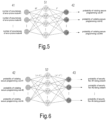
- an optional embodiment is to use an artificial intelligence (AI) algorithm, using the first neural network 51 shown in Fig. 5 to simulate the association between the occurrence of an error-prone mode and violation of a secure programming rule.
- AI artificial intelligence
- the first neural network 51 may be a back propagation (BP) neural network.
- the BP artificial neural network is an algorithmic model, formed of a large number of interconnected nodes (also called neurons), and divided into an input layer at the left side, an output layer at the right side, and a hidden layer in the middle.
- the connection between each pair of nodes represents a weighting value, called a weight, for a signal passing through this connection.
- Each node of the hidden layer and the output layer corresponds to a specific output function, called an activation function.
- the significance of the model is based on the following assumption: there is a hidden non-linear equation, which can express an association between an inputted number of occurrences of an error-prone mode and an outputted probability of a secure programming rule being violated, wherein the coefficients in the non-linear equation are unknown.
- the model can be trained by means of a training dataset, continually updating internal parameters of the model iteratively, until the parameters adjusted through training are able to make the equation fit the association between the input and output accurately. At this time, these parameters embody the essential nature of the model, i.e. the link between the number of occurrences of an error-prone mode and the probability of a secure programming rule being violated.
- the model learning and training process may consist of two steps, specifically forward propagation of a signal and backward propagation of an error, the specific process being as follows: During forward propagation, the numbers of occurrences of error-prone modes in the software source code 30 is used as an input signal at an input end of the model, expressed as an 1-dimensional vector: C 1 C 2 ⁇ C l where C 1 , C 2 , ..., C l denote the specific numbers of times that error-prone modes #1, #2, ..., #l occur in a segment of source code.
- the hidden layer of the model is responsible for receiving the input signal, extracting features, and transmitting to the output layer.
- Weight coefficients between the input layer and the hidden layer are represented by a matrix W, with elements w ij therein representing the weight between the ith node of the input layer and the jth node of the hidden layer.
- w ij denotes the weight between the ith node of the input layer and the jth node of the hidden layer.
- the output layer is responsible for receiving the signal transmitted out by the hidden layer, and outputting a final result.
- Weight coefficients between the hidden layer and the output layer are represented by a matrix V, with elements v jk therein representing the weight between node j of the hidden layer and node k of the output layer.
- the input which it receives is the sum of the products of multiplying the output of each of the nodes of the hidden layer connected thereto by its corresponding weight, i.e.
- J is the number of hidden layer nodes
- v jk denotes the weight between node j of the hidden layer and node k of the output layer.
- the output of the node is a prediction result of the model, i.e. the probability of a secure programming rule being violated.
- the principle of back propagation is the process of transmitting, to the input layer, an output error of the model in a specific mathematical form via the hidden layer; the error is shared among all of the nodes, thus enabling the nodes to use a self-learning algorithm such as gradient descent to correct their own parameters according to the numerical measure of the error, so that the predicted value of the model can move closer and closer to the real data.
- m is the number of neurons in the output layer, representing the total number of related CERT C/C++ secure programming rules
- d is the desired output, signifying whether a CERT C/C++ rule really has been violated in a code segment to be analysed at the present time
- o is the actual output of the model, i.e. the prediction made by the model at the present time, according to the input data, regarding the probability of a CERT C/C++ secure programming rule being violated in the code segment.
- the prediction error of the model is a function of the weight coefficients w ij and v jk , so the error can be changed by adjusting the weights.
- the negative sign indicates gradient descent; and the constant ⁇ ⁇ (0,1) denotes the proportionality coefficient, reflecting the learning rate of the model.
- the SonarQube error-prone modes used at the input end of the abovementioned BP neural network and the corresponding CERT C/C++ rules at the output end are all examples; the model may also use error-prone modes identifiable by other static checking tools (e.g. Findbug, PMD, etc.) and rule lists of other secure programming standards (e.g. OWASP secure coding practices, etc.), to match the specific usage environments of different software development projects.
- static checking tools e.g. Findbug, PMD, etc.
- rule lists of other secure programming standards e.g. OWASP secure coding practices, etc.
- the probability of a security flaw being present in the software source code 30 may be further predicted.
- this may be achieved by establishing an association between a secure programming rule and a security flaw.
- a secure programming rule Taking as an example the Common Weakness Enumeration, which is a classification and description of security flaws, the following table sets out the associations between some of the software security flaws in the CWE list and CERT C/C++ secure programming rules: CWE software flaws Related CERT C/C++ rules CWE-416.
- EXP Use after free Expressions
- FIO Input output
- FIO46-C Do not access a closed file Memory management (MEM)/MEM50-CPP: Do not access freed memory CWE-20.
- MEM closed file Memory management
- Improper input validation Error handling (ERR)/ERR07-C Prefer functions that support error checking over equivalent functions that don't Floating point (FLP)/FLP04-C: Check floating-point inputs for exceptional values
- Input output (FIO)/FIO30-C Exclude user input from format strings Integers (INT)/INT08-C: Verify that all integer values are in range
- Memory management (MEM)/MEM10-C Define and use a pointer validation function CWE-125.
- Out-of-bounds read Arrays (ARR)/ARR30-C: Do not form or use out-of-bounds pointers or array subscripts Arrays (ARR)/ARR38-C: Guarantee that library functions do not form invalid pointers Expressions (EXP)/EXP39-C: Do not access a variable through a pointer of an incompatible type for character data and the null terminator Memory management (MEM)/MEM10-C: Define and use a pointer validation function Characters and strings (STR)/STR32-C: Do not pass a non-null-terminated character sequence to a library function that expects a string Characters and strings (STR)/STR50-CPP: Guarantee that storage for strings has sufficient space Characters and strings (STR)/STR53-CPP: Range check element access CWE-787.
- Integer overflow or wraparound Integers (INT)/INT01-C Use rsize_t or size_t for all integer values representing the size of an object Integers (INT)/INT18-C: Evaluate using explicit type conversion before comparing or assigning expressions to larger size Integers/INT30-C: Ensure that unsigned integer operations do not wrap Memory management/MEM07-C: Ensure that the arguments to calloc() (the number and size of elements), when multiplied to calculate storage space, do not wrap CWE-400.
- Uncontrolled resource consumption Exceptions and error handling (ERR)/ERR57-CPP Do not leak resources when handling exceptions Input output (FIO)/FIO51-CPP: Close files when they are no longer needed Memory management (MEM)/MEM11-C: Do not assume infinite heap space Memory management (MEM)/MEM31-C: Free dynamically allocated memory when no longer needed Memory management (MEM)/MEM51-CPP: Properly deallocate dynamically allocated resources CWE-119.
- Expressions/EXP03-C Do not assume the size of a structure is the sum of the sizes of its members Expressions (EXP)/EXP36-C: Do not cast pointers into more strictly aligned pointer types Expressions (EXP)/EXP39-C: Do not access a variable through a pointer of an incompatible type Expressions (EXP)/EXP53-CPP: Do not read uninitialized memory Characters and strings (STR)/STR11-C: Do not specify the bound of a character array initialized with a string literal CWE-772.
- Input output (FIO)/FIO22-C Close files before spawning processes
- Input output (FIO)/FIO42-C Close files when they are no longer needed
- Memory management (MEM)/MEM03-C Clear sensitive information stored in reusable resources
- Memory management (MEM)/MEM31-C Free dynamically allocated memory when no longer needed
- the BNN model here may likewise comprise an input layer, a hidden layer and an output layer, wherein each node of the input layer respectively represents the possibility (probability) of a secure programming rule being violated in the code, and each node of the output layer represents the probability (risk) of a CWE security flaw being present in the code.
- a difference is that the associations between the nodes of the input layer and the hidden layer, and between the nodes of the hidden layer and the output layer, are no longer represented by weighting values, with Gaussian distributions ( ⁇ , ⁇ ) being used instead.
- the learning and training process for the BNN model is essentially the same as that for the BP neural network model, so is not described again here.
- the static code scanning tool 60 may be used to analyse the software source code to be assessed, to obtain a list of alerts for security flaws detected by the tool, i.e. each item of alert information 44.
- step S203 the software source code 30 was analysed, and a prediction was made regarding the possibility of a security flaw occurring in the code.
- step S205 the two results are combined, to obtain a security flaw alert list with accuracy assessment values.
- the logic here is very simple: if the probability of a security flaw occurring in the code is high according to the prediction, and at the same time the static scanning tool has issued an alert for it, then the possibility of the alert being accurate is high; conversely, if the possibility of a security risk occurring is low according to the prediction, but the tool has issued an alert, then the possibility of the alert being a false report is high. Equipped with the assessment of alert accuracy, the results of tool checking can be conveniently screened, disregarding a large number of false reports therein, and only dealing with high-credibility alerts. In this way, it is possible to considerably increase the efficiency of code review using tools, and save precious manpower resources and costs during projects.
- embodiments of the present invention further provide a computer-readable medium, having stored thereon computer-readable instructions which, when executed by a processor, cause the processor to perform the software security flaw prediction method described above.
- computer-readable media include floppy disks, hard disks, magneto-optical disks, optical disks (e.g. CD-ROM, CD-R, CD-RW, DVD-ROM, DVD-RAM, DVD-RW, DVD+RW), magnetic tapes, non-volatile memory cards and ROM.
- computer-readable instructions may be downloaded from a server computer or cloud via a communication network.
Landscapes
- Engineering & Computer Science (AREA)
- Theoretical Computer Science (AREA)
- General Engineering & Computer Science (AREA)
- Computer Hardware Design (AREA)
- Physics & Mathematics (AREA)
- Software Systems (AREA)
- General Physics & Mathematics (AREA)
- Computer Security & Cryptography (AREA)
- Computing Systems (AREA)
- Quality & Reliability (AREA)
- General Health & Medical Sciences (AREA)
- Molecular Biology (AREA)
- Evolutionary Computation (AREA)
- Data Mining & Analysis (AREA)
- Computational Linguistics (AREA)
- Mathematical Physics (AREA)
- Biophysics (AREA)
- Biomedical Technology (AREA)
- Artificial Intelligence (AREA)
- Life Sciences & Earth Sciences (AREA)
- Health & Medical Sciences (AREA)
- Stored Programmes (AREA)
Abstract
Description
- Embodiments of the present invention relate to the field of software security, in particular to a software security flaw prediction method and apparatus, and a computer-readable medium.
- As computer and internet technologies have developed, IT technology with software at its core has already been widely applied in various aspects of society and life, bringing huge convenience to people. At the same time, the amounts of information and data that are exchanged and transmitted with the aid of computer networks are rapidly growing. This information and data directly concerns people's property, privacy and other rights and interests, so leakage or theft thereof might have very serious consequences. Thus, the issue of how to ensure information security has become a challenge that the software industry must deal with.
- The results of assessment by research bodies show that about 820 of security loopholes are caused by coding. Thus, reviewing and checking the security of software code and identifying possible security flaws in code are important means of ensuring software security.
- In practice, most conventional software research and development organizations use the method of manual review, with quality managers, security specialists or experienced technical personnel within the team being responsible for assessing code security. This method has a relatively high cost in terms of human labor, and in particular will take up a lot of the time of key technical personnel, so is often very difficult to implement effectively in real projects. In recent years, with the rise of agile development, the use of static scanning tools to realize automated code checking in the process of continued integration, construction and publication of software has become the currently most popular way of reviewing software code. Such a method can theoretically solve the problems of high cost and low efficiency that are associated with manual review, but it also has its own shortcomings, the main two being a high false report rate and an excessive number of flaw alerts. For example, statistics for a well-known open source code dataset (Software Assurance Reference Dataset, SARD) are shown below:
Software combination analysis (SCA) tool Klocwork Coverity CppTest Total no. of flaw alerts 36383 30698 86962 No. of SARD flaws found 5092 7454 3027 True alert ratio 14.0% 24.3% 3.50 - Here, 3 mainstream static scanning tools were used to check for security flaws in software code in SARD. The total number of alerts issued by each tool was far greater than the number of true flaws detected by it, so accuracy was very low. Clearly, such a checking result cannot be used directly, and a large amount of manpower resources still needs to be committed for review, eliminating false reports, and seeking out true code flaws. As a result, the advantages of automation and high efficiency which should have been associated with the use of a tool to review code security are severely lessened.
- Embodiments of the present invention provide a software security flaw prediction method and apparatus, and a computer-readable medium.
- In a first aspect, a software security flaw prediction method is provided. In the method, a number of occurrences of each error-prone mode present in a segment of software source code obtained by scanning with a code scanning tool is acquired, a probability of the software source code violating each secure programming rule is determined according to the number of occurrences of each error-prone mode, and a probability of each security flaw that might be present in the software source code is predicted according to the probability of the software source code violating each secure programming rule; furthermore, each item of alert information obtained by analysis of the software source code by a static code scanning tool is acquired, wherein an item of alert information is used to indicate that a security flaw might occur in the software source code; and then a probability of each item of alert information indicating a true security flaw is determined, according to the probability, obtained by prediction, of each security flaw that might be present in the software source code.
- In a second aspect, an apparatus is provided, comprising modules for performing the steps in the method provided in the first aspect.
- In a third aspect, an apparatus is provided, comprising: at least one memory, configured to store computer-readable code; at least one processor, configured to call the computer-readable code, to perform the steps in the method provided in the first aspect.
- In a fourth aspect, a computer-readable medium has stored thereon computer-readable instructions which, when executed by a processor, cause the processor to perform the steps in the method provided in the first aspect.
- The use of this solution makes it possible to effectively solve certain problems associated with static code scanning tools, specifically an excessive number of security flaw alerts and a high false report rate. By assessing the degree to which the code complies with a secure programming norm or standard, it is possible to predict the possibility that a related security flaw will occur in the code, and compare this with a checking result of a static code scanning tool to determine consistency therewith, so as to assess the accuracy of the checking result.
- For any of the above aspects, optionally, the number of occurrences of each error-prone mode may be inputted into a pre-trained first neural network model, to obtain the probability, outputted by the first neural network model, of the software source code violating each secure programming rule, wherein the first neural network model is used to indicate a relationship between the number of occurrences of each error-prone mode and the probability of each secure programming rule being violated. The probability of the software source code violating each secure programming rule may be inputted into a pre-trained second neural network model, to obtain the probability, outputted by the second neural model, of occurrence of each security flaw that might be present in the software source code, wherein the second neural network model is used to indicate a relationship between the probability of each secure programming rule being violated and the probability of each flaw.
- Due to the use of a neural network model, training data can be collected from projects of different types, these projects having completely different characteristics. Thus, after training, the artificial neural network model can reflect project characteristics in different industries, different development processes and different situations. That is to say, the fully trained model can be very flexible and have a high degree of expandability, and can be used to analyse projects of different types, without the need to perform pre-configuration according to project characteristics, because all of the non-linear mappings indicated by the model come from learning of training data. Another advantage of using a neural network model is the ability to update the model's internal parameters through a continual learning and training process, so as to dynamically adjust and adapt to new data inputs. Thus, after being actually deployed, the model can be trained by continually accumulated data, so that the prediction result becomes more and more accurate.
- For any of the above aspects, optionally, if the probability, obtained by prediction, of occurrence of a security flaw that might be present in the software source code is high, and alert information indicating that said security flaw might occur in the software source code is obtained through analysis of the software source code using the static code scanning tool, then it is determined that the probability of the alert information indicating a true security flaw is high.
- By performing overall analysis of the software source code, the probability of each security flaw occurring therein is obtained by prediction, and then the static code scanning tool is used to obtain alert information regarding the occurrence of a security flaw in the portion of code; this assists in judging the probability of the alert information indicating a true security flaw. That is, when the predicted probability of a particular security flaw occurring is high and the static scanning tool produces alert information for this security flaw, the probability of the alert information indicating a true security flaw is high.
-
-
Fig. 1 is a structural schematic diagram of a software security flaw prediction apparatus provided in an embodiment of the present invention. -
Fig. 2 is a flow chart of a software security flaw prediction method provided in an embodiment of the present invention. -
Fig. 3 shows the process of performing software security flaw analysis using an embodiment of the present invention. -
Fig. 4 shows the process of using a neural network model to perform software security flaw analysis in some embodiments of the present invention. -
Fig. 5 shows the process of using a first neural network model to obtain the probability of software source code violating a secure programming rule in some embodiments of the present invention. -
Fig. 6 shows the process of using a second neural network model to obtain the probability of each security flaw being present in software source code in some embodiments of the present invention. -
- 10: software security flaw prediction apparatus
- 101: memory
- 102: processor
- 103: communication interface
- 11: software security flaw prediction program
- 111: code scanning module
- 112: first processing module
- 113: second processing module
- 114: information acquisition module
- 115: third processing module
- 200: software security flaw prediction method
- S101 - S205: method steps
- 30: software source code to be analysed
- 41: number of occurrences of each error-prone mode
- 42: probability of
software source code 30 violating each secure programming rule - 43: probability of each security flaw that might be present in
software source code 30 - 44: alert information
- 45: probability of
alert information 44 indicating true security flaw - 51: first neural network model
- 52: second neural network model
- 60: static code scanning tool
- The subject matter described herein will now be discussed with reference to exemplary embodiments. It should be understood that these embodiments are discussed merely in order to enable those skilled in the art to better understand and thereby implement the subject matter described herein, without limiting the protection scope, applicability or examples expounded in the claims. Changes may be made to the functions and arrangement of the discussed elements without departing from the protection scope of the content of embodiments of the present invention. Various processes or components may be omitted from, replaced in or added to the examples as required. For example, the method described may be performed in a different order from that described, and various steps may be added, omitted or combined. Furthermore, features described in relation to some examples may also be combined in other examples.
- As used herein, the term "comprises" and variants thereof denote open terms, meaning "including but not limited to". The term "based on" means "at least partly based on". The terms "one embodiment" and "an embodiment" mean "at least one embodiment". The term "another embodiment" means "at least one other embodiment". The terms "first", "second", etc. may denote different or identical objects. Other definitions may be included below, whether explicit or implicit. Unless clearly specified in the context, the definition of a term is the same throughout the description.
- Embodiments of the present invention are described in detail below with reference to
Figs. 1 - 6 . -
Fig. 1 is a structural schematic diagram of a software security flaw prediction apparatus provided in an embodiment of the present invention. The software securityflaw prediction apparatus 10 may be realized as a network of computer processors, to perform the software securityflaw prediction method 200 in embodiments of the present invention, or may be a single computer, a single-chip microcomputer or a processor chip as shown inFig. 1 , and comprises at least onememory 101, which comprises a computer-readable medium, such as a random access memory (RAM). Theapparatus 10 further comprises at least oneprocessor 102 coupled to the at least onememory 101. Computer-executable instructions are stored in the at least onememory 101, and when executed by the at least oneprocessor 102, can cause the at least oneprocessor 102 to perform the steps described herein. - The at least one
memory 101 shown inFig. 1 may contain a software securityflaw prediction program 11, causing the at least oneprocessor 102 to perform the software securityflaw prediction method 200 described in embodiments of the present invention. As shown inFig. 1 , the software securityflaw prediction program 11 may comprise: - a
code scanning module 111, configured to scan a segment ofsoftware source code 30, to obtain anumber 41 of occurrences of each error-prone mode present in thesoftware source code 30; - a
first processing module 112, configured to determine aprobability 42 of thesoftware source code 30 violating each secure programming rule, according to thenumber 41 of occurrences of each error-prone mode; - a
second processing module 113, configured to predict aprobability 43 of each security flaw that might be present in thesoftware source code 30, according to theprobability 42 of thesoftware source code 30 violating each secure programming rule; - an
information acquisition module 114, further configured to acquire each item ofalert information 44 obtained by analysis of thesoftware source code 30 by a staticcode scanning tool 60, wherein an item ofalert information 44 is used to indicate a security flaw that might occur in thesoftware source code 30; - a
third processing module 115, configured to determine aprobability 45 of each item ofalert information 44 indicating a true security flaw, according to theprobability 43, obtained by prediction, of each security flaw that might be present in thesoftware source code 30. - Optionally, the
first processing module 112 is specifically configured to: input thenumber 41 of occurrences of each error-prone mode into a pre-trained firstneural network model 51, to obtain theprobability 42, outputted by the firstneural network model 51, of thesoftware source code 30 violating each secure programming rule, wherein the firstneural network model 51 is used to indicate a relationship between the number of occurrences of each error-prone mode and the probability of each secure programming rule being violated. - Optionally, the
second processing module 113 is specifically configured to: input theprobability 42 of thesoftware source code 30 violating each secure programming rule into a pre-trained secondneural network model 52, to obtain theprobability 43, outputted by the secondneural model 52, of occurrence of each security flaw that might be present in thesoftware source code 30, wherein the secondneural network model 52 is used to indicate a relationship between the probability of each secure programming rule being violated and the probability of each flaw. - Optionally, the
third processing module 115 is specifically configured to: if theprobability 43, obtained by prediction, of occurrence of a security flaw that might be present in thesoftware source code 30 is high, andalert information 44 indicating that said security flaw might occur in a portion of thesoftware source code 30 is obtained through analysis of thesoftware source code 30 using the staticcode scanning tool 60, then determine that a probability of thealert information 44 indicating a true security flaw is high. - The abovementioned modules may also be regarded as functional modules realized by hardware, for realizing various functions involved when the software security
flaw prediction apparatus 10 performs the software security flaw prediction method; for example, control logic of each process involved in the method is burnt into, for example, a field-programmable gate array (FPGA) chip or a complex programmable logic device (CPLD) in advance, and the function of each module mentioned above is performed by these chips or devices, wherein the specific manner of implementation may be decided according to engineering practice. - In addition, the software security
flaw prediction apparatus 10 may further comprise acommunication interface 103, for communication between the software securityflaw prediction apparatus 10 and other equipment. - It should be mentioned that embodiments of the present invention may comprise an apparatus having a different architecture from that shown in
Fig. 1 . The architecture described above is merely exemplary, being used to explain the software securityflaw prediction method 200 provided in embodiments of the present invention. - The at least one
processor 102 may comprise a microprocessor, an application-specific integrated circuit (ASIC), a digital signal processor (DSP), a central processing unit (CPU), a graphical processing unit (GPU), a state machine, etc. Embodiments of computer-readable media include but are not limited to floppy disks, CD-ROM, magnetic disks, memory chips, ROM, RAM, ASIC, configured processors, all-optical media, all magnetic tapes or other magnetic media, or any other media from which a computer processor can read instructions. In addition, various other forms of computer-readable media may send or carry instructions to a computer, including routers, private or public networks, or other wired and wireless transmission equipment or channels. Instructions may include code of any computer programming language, including C, C++, C language, Visual Basic, Java and JavaScript. -
Fig. 2 is a flow chart of a software security flaw prediction method provided in an embodiment of the present invention. Themethod 200 may be performed by the abovementioned software securityflaw prediction apparatus 10, and may comprise the following steps: - S201: scanning a segment of
software source code 30, to obtain anumber 41 of occurrences of each error-prone mode present in thesoftware source code 30; - S202: determining a
probability 42 of thesoftware source code 30 violating each secure programming rule, according to thenumber 41 of occurrences of each error-prone mode; - S203: predicting a
probability 43 of each security flaw that might be present in thesoftware source code 30, according to theprobability 42 of thesoftware source code 30 violating each secure programming rule; - S204: acquiring each item of
alert information 44 obtained by analysis of thesoftware source code 30 by a staticcode scanning tool 60, wherein an item ofalert information 44 is used to indicate that a security flaw might occur in thesoftware source code 30; - S205: determining a
probability 45 of each item ofalert information 44 indicating a true security flaw, according to theprobability 43, obtained by prediction, of each security flaw that might be present in thesoftware source code 30. - The security
flaw prediction apparatus 10 may regard thesoftware source code 30 as an input, first detecting an error-prone mode (generally also called a bad code smell, being a diagnostic symptom indicating that a quality issue and security flaw might be present in the software design) in thesoftware source code 30, the error-prone mode being associated with a secure programming rule, and then assessing the situation regarding compliance with the secure programming rule during development of thesoftware source code 30 according to the frequency of occurrence and specific distribution of the error-prone mode. AI technology may then be used to associate the secure programming rule with the risk of a security flaw occurring, and the probability of a security flaw occurring in the source code may be estimated on the basis of the situation regarding compliance of the source code with the security rule. - Each of the steps above is described in detail below with reference to
Figs. 3 - 6 . - S201: scanning a segment of
software source code 30, to obtain anumber 41 of occurrences of each error-prone mode present in thesoftware source code 30. - In step S201, the
software source code 30 is scanned to obtain an error-prone mode. A tool such as SonarQube, Understand, Checkstyle, FindBugs, PMD or Fortify SCA may be used to scan thesoftware source code 30, to obtain an error-prone mode of thesoftware source code 30. - S202: determining a
probability 42 of thesoftware source code 30 violating each secure programming rule, according to thenumber 41 of occurrences of each error-prone mode. - In step S202, the error-prone mode detected in step S201 is associated with a secure programming rule. Taking as an example the code checking tool SonarQube and the secure programming rule set CERT (published by the Software Engineering Institute of Carnegie Mellon University, and including versions of different programming languages such as C/C++/Java), the following table sets out the associations between error-prone modes which the SonarQube tool is able to detect and CERT C/C++ secure programming rules (SEI CERT C/C++ Coding Standard).
Error-prone modes Related CERT C/C++ rules Resources should be closed Input/output (FIO)/FIO42-C; close files when they are no longer needed Dynamically allocated memory should be released Memory management (MEM)/MEM31-C: free dynamically allocated memory when no longer needed Appropriate memory de-allocation should be used Memory management (MEM)/MEM51-CPP: properly de-allocate dynamically allocated resources Freed memory should not be used Expressions (EXP)/EXP54-CPP: Do not access an object outside of its lifetime Memory management (MEM)/MEM50-CPP: Do not access freed memory POSIX functions should not be called with arguments that trigger buffer overflows Arrays (ARR)/ARR30-C: Do not form or use out-of-bounds pointers or array subscripts Characters and strings (STR)/STR50-CPP: Guarantee that storage for strings has sufficient space for character data and the null terminator Functions should not be defined with a variable number of arguments Declarations and Initialization (DCL)/DCL50-CPP: Do not define a C-style variadic function Memory access should be explicitly bounded to prevent buffer overflows Arrays (ARR)/ARR30-C: Do not form or use out-of-bounds pointers or array subscripts Characters and strings (STR)/STR50-CPP: Guarantee that storage for strings has sufficient space for character data and the null terminator Objects with integer type should not be converted to objects with pointer type Integers (INT)/INT36-C: Converting a pointer to integer or integer to pointer The address of an automatic object should not be assigned to another object that may persist after the first object has ceased to exist Declarations and Initialization (DCL)/DCL30-C: Declare objects with appropriate storage durations "atof", "atoi" and "atol" from <stdlib.h> should not be used Error Handling (ERR)/ERR34-C: Detect errors when converting a string to a number - It must be explained that the error-prone modes and CERT C/C++ secure programming rules in the table above are all examples for illustration, and are not a complete list. Here, the association between occurrence of an error-prone mode and violation of a CERT C/C++ secure programming rule might be any one of the following: the occurrence of a specific error-prone mode signifies that a CERT C/C++ secure programming rule might be violated; the occurrence of a specific error-prone mode signifies that multiple CERT C/C++ secure programming rules might be violated; the occurrences of multiple different error-prone modes all signify that a CERT C/C++ secure programming rule might be violated.
- To accurately reflect such a complex mapping relationship, an optional embodiment is to use an artificial intelligence (AI) algorithm, using the first
neural network 51 shown inFig. 5 to simulate the association between the occurrence of an error-prone mode and violation of a secure programming rule. Optionally, the firstneural network 51 may be a back propagation (BP) neural network. - Here, the BP artificial neural network is an algorithmic model, formed of a large number of interconnected nodes (also called neurons), and divided into an input layer at the left side, an output layer at the right side, and a hidden layer in the middle. The connection between each pair of nodes represents a weighting value, called a weight, for a signal passing through this connection. Each node of the hidden layer and the output layer corresponds to a specific output function, called an activation function. The significance of the model is based on the following assumption: there is a hidden non-linear equation, which can express an association between an inputted number of occurrences of an error-prone mode and an outputted probability of a secure programming rule being violated, wherein the coefficients in the non-linear equation are unknown. The model can be trained by means of a training dataset, continually updating internal parameters of the model iteratively, until the parameters adjusted through training are able to make the equation fit the association between the input and output accurately. At this time, these parameters embody the essential nature of the model, i.e. the link between the number of occurrences of an error-prone mode and the probability of a secure programming rule being violated.
- The model learning and training process may consist of two steps, specifically forward propagation of a signal and backward propagation of an error, the specific process being as follows:
During forward propagation, the numbers of occurrences of error-prone modes in thesoftware source code 30 is used as an input signal at an input end of the model, expressed as an 1-dimensional vector:
prone modes # 1, #2, ..., #l occur in a segment of source code. - The hidden layer of the model is responsible for receiving the input signal, extracting features, and transmitting to the output layer. Weight coefficients between the input layer and the hidden layer are represented by a matrix W, with elements wij therein representing the weight between the ith node of the input layer and the jth node of the hidden layer. Taking the jth node of the hidden layer as an example, the input which it receives is the sum of the products of multiplying each of the nodes of the input layer connected thereto by its corresponding weight, i.e.

- Correspondingly, the output signal of this hidden layer node is the result of processing the input signal by the activation function of this hidden layer node, i.e.

- The output layer is responsible for receiving the signal transmitted out by the hidden layer, and outputting a final result. Weight coefficients between the hidden layer and the output layer are represented by a matrix V, with elements vjk therein representing the weight between node j of the hidden layer and node k of the output layer. Taking the kth node of the output layer as an example, the input which it receives is the sum of the products of multiplying the output of each of the nodes of the hidden layer connected thereto by its corresponding weight, i.e.

- The output of the node is a prediction result of the model, i.e. the probability of a secure programming rule being violated. The mathematical representation thereof is:

- At this point, the forward propagation process of the network is complete. If the output result of the model does not agree with actual data, a back propagation process is initiated. The principle of back propagation is the process of transmitting, to the input layer, an output error of the model in a specific mathematical form via the hidden layer; the error is shared among all of the nodes, thus enabling the nodes to use a self-learning algorithm such as gradient descent to correct their own parameters according to the numerical measure of the error, so that the predicted value of the model can move closer and closer to the real data. Firstly, the error between the predicted value and actual data is defined at the output layer as:


- The formula above shows that the prediction error of the model is a function of the weight coefficients wij and vjk, so the error can be changed by adjusting the weights. The principle of adjustment is to continually reduce the error, i.e. the amount by which the weight is adjusted is caused to be directly proportional to the gradient descent of the error, expressed as follows:



- At this point, one full model training process is completed. This process of learning and training may be repeated multiple times, until the error in the model output is reduced to an acceptable level. At this time, the model and the parameters contained therein are able to fit, in a stable manner, a non-linear mapping relationship between the number of occurrences of an error-prone mode and violation of a CERT C/C++ security rule. Thereafter, if the number of occurrences of an error-prone mode in a code segment to be analysed is inputted into the model, the probability of a secure programming rule violation occurring therein can be predicted.
- It must be explained that the SonarQube error-prone modes used at the input end of the abovementioned BP neural network and the corresponding CERT C/C++ rules at the output end are all examples; the model may also use error-prone modes identifiable by other static checking tools (e.g. Findbug, PMD, etc.) and rule lists of other secure programming standards (e.g. OWASP secure coding practices, etc.), to match the specific usage environments of different software development projects.
- S203: predicting a
probability 43 of each security flaw that might be present in thesoftware source code 30, according to theprobability 42 of thesoftware source code 30 violating each secure programming rule. - After obtaining the prediction result for the probability of a secure programming rule violation occurring in the
software source code 30, the probability of a security flaw being present in thesoftware source code 30 may be further predicted. Optionally, this may be achieved by establishing an association between a secure programming rule and a security flaw. Taking as an example the Common Weakness Enumeration, which is a classification and description of security flaws, the following table sets out the associations between some of the software security flaws in the CWE list and CERT C/C++ secure programming rules:CWE software flaws Related CERT C/C++ rules CWE-416. Use after free Expressions (EXP)/EXP54-CPP: Do not access an object outside of its lifetime Input output (FIO)/FIO46-C: Do not access a closed file Memory management (MEM)/MEM50-CPP: Do not access freed memory CWE-20. Improper input validation Error handling (ERR)/ERR07-C: Prefer functions that support error checking over equivalent functions that don't Floating point (FLP)/FLP04-C: Check floating-point inputs for exceptional values Input output (FIO)/FIO30-C: Exclude user input from format strings Integers (INT)/INT08-C: Verify that all integer values are in range Memory management (MEM)/MEM10-C: Define and use a pointer validation function CWE-125. Out-of-bounds read Arrays (ARR)/ARR30-C: Do not form or use out-of-bounds pointers or array subscripts Arrays (ARR)/ARR38-C: Guarantee that library functions do not form invalid pointers Expressions (EXP)/EXP39-C: Do not access a variable through a pointer of an incompatible type for character data and the null terminator Memory management (MEM)/MEM10-C: Define and use a pointer validation function Characters and strings (STR)/STR32-C: Do not pass a non-null-terminated character sequence to a library function that expects a string Characters and strings (STR)/STR50-CPP: Guarantee that storage for strings has sufficient space Characters and strings (STR)/STR53-CPP: Range check element access CWE-787. Out-of-bounds write Arrays (ARR)/ARR30-C: Do not form or use out-of-bounds pointers or array subscripts Arrays (ARR)/ARR38-C: Guarantee that library functions do not form invalid pointers Expressions (EXP)/EXP39-C: Do not access a variable through a pointer of an incompatible type Memory management (MEM)/MEM10-C: Define and use a pointer validation function Characters and strings (STR)/STR32-C: Do not pass a non-null-terminated character sequence to a library function that expects a string Characters and strings (STR)/STR50-CPP: Guarantee that storage for strings has sufficient space for character data and the null terminator Characters and strings (STR)/STR53-CPP: Range check element access CWE-190. Integer overflow or wraparound Integers (INT)/INT01-C: Use rsize_t or size_t for all integer values representing the size of an object Integers (INT)/INT18-C: Evaluate using explicit type conversion before comparing or assigning expressions to larger size Integers/INT30-C: Ensure that unsigned integer operations do not wrap Memory management/MEM07-C: Ensure that the arguments to calloc() (the number and size of elements), when multiplied to calculate storage space, do not wrap CWE-400. Uncontrolled resource consumption Exceptions and error handling (ERR)/ERR57-CPP: Do not leak resources when handling exceptions Input output (FIO)/FIO51-CPP: Close files when they are no longer needed Memory management (MEM)/MEM11-C: Do not assume infinite heap space Memory management (MEM)/MEM31-C: Free dynamically allocated memory when no longer needed Memory management (MEM)/MEM51-CPP: Properly deallocate dynamically allocated resources CWE-119. Improper restriction of operations within the bounds of a memory buffer Expressions/EXP03-C: Do not assume the size of a structure is the sum of the sizes of its members Expressions (EXP)/EXP36-C: Do not cast pointers into more strictly aligned pointer types Expressions (EXP)/EXP39-C: Do not access a variable through a pointer of an incompatible type Expressions (EXP)/EXP53-CPP: Do not read uninitialized memory Characters and strings (STR)/STR11-C: Do not specify the bound of a character array initialized with a string literal CWE-772. Missing release of resource after effective lifetime Input output (FIO)/FIO22-C: Close files before spawning processes Input output (FIO)/FIO42-C: Close files when they are no longer needed Memory management (MEM)/MEM03-C: Clear sensitive information stored in reusable resources Memory management (MEM)/MEM31-C: Free dynamically allocated memory when no longer needed - It must be explained that the abovementioned CWE security flaws and CERT C/C++ secure programming rules are all examples for illustration, and are not a complete list. Violation of a secure programming rule in code will not necessarily result in the occurrence of the security flaw associated therewith, but increases the probability of its occurrence; therefore, a Bayesian neural network (BNN) model with a probability distribution characteristic is more suitable for approximating this complex, many-to-many mapping relationship containing a probability characteristic. Thus, optionally, embodiments of the present invention may use a BNN algorithm to fit the association between secure programming rule violations and security flaw occurrences, the structure of the model being shown in
Fig. 6 . - In comparison with the BP model shown in
Fig. 5 for predicting the probability of a secure programming rule violation occurring in thesoftware source code 30, the BNN model here may likewise comprise an input layer, a hidden layer and an output layer, wherein each node of the input layer respectively represents the possibility (probability) of a secure programming rule being violated in the code, and each node of the output layer represents the probability (risk) of a CWE security flaw being present in the code. A difference is that the associations between the nodes of the input layer and the hidden layer, and between the nodes of the hidden layer and the output layer, are no longer represented by weighting values, with Gaussian distributions (µ, σ) being used instead. The learning and training process for the BNN model is essentially the same as that for the BP neural network model, so is not described again here. - S204: acquiring each item of
alert information 44 obtained by analysis of thesoftware source code 30 by a staticcode scanning tool 60, wherein an item ofalert information 44 is used to indicate that a security flaw might occur in a portion of thesoftware source code 30. - S205: determining a
probability 45 of each item ofalert information 44 indicating a true security flaw, according to theprobability 43, obtained by prediction, of each security flaw that might be present in thesoftware source code 30. - The static
code scanning tool 60 may be used to analyse the software source code to be assessed, to obtain a list of alerts for security flaws detected by the tool, i.e. each item ofalert information 44. In step S203, thesoftware source code 30 was analysed, and a prediction was made regarding the possibility of a security flaw occurring in the code. In step S205, the two results are combined, to obtain a security flaw alert list with accuracy assessment values. The logic here is very simple: if the probability of a security flaw occurring in the code is high according to the prediction, and at the same time the static scanning tool has issued an alert for it, then the possibility of the alert being accurate is high; conversely, if the possibility of a security risk occurring is low according to the prediction, but the tool has issued an alert, then the possibility of the alert being a false report is high. Equipped with the assessment of alert accuracy, the results of tool checking can be conveniently screened, disregarding a large number of false reports therein, and only dealing with high-credibility alerts. In this way, it is possible to considerably increase the efficiency of code review using tools, and save precious manpower resources and costs during projects. - In addition, embodiments of the present invention further provide a computer-readable medium, having stored thereon computer-readable instructions which, when executed by a processor, cause the processor to perform the software security flaw prediction method described above. Embodiments of computer-readable media include floppy disks, hard disks, magneto-optical disks, optical disks (e.g. CD-ROM, CD-R, CD-RW, DVD-ROM, DVD-RAM, DVD-RW, DVD+RW), magnetic tapes, non-volatile memory cards and ROM. Optionally, computer-readable instructions may be downloaded from a server computer or cloud via a communication network.
- It must be explained that not all of the steps and modules in the procedures and system structural drawings above are necessary; certain steps or modules may be omitted according to actual needs. The order in which the steps are performed is not fixed, and may be adjusted as needed. The system structures described in the embodiments above may be physical structures or logic structures, i.e. some modules might be realized by the same physical entity, or some modules might be realized by multiple physical entities separately, or may be realized jointly by certain components in multiple independent devices.
Claims (10)
- A software security flaw prediction method (200), characterized by comprising:- scanning (S201) a segment of software source code (30), to obtain a number (41) of occurrences of each error-prone mode present in the software source code (30);- determining (S202) a probability (42) of the software source code (30) violating each secure programming rule, according to the number (41) of occurrences of each error-prone mode;- predicting (S203) a probability (43) of each security flaw that might be present in the software source code (30), according to the probability (42) of the software source code (30) violating each secure programming rule;- acquiring (S204) each item of alert information (44) obtained by analysis of the software source code (30) by a static code scanning tool (60), wherein an item of alert information (44) is used to indicate that a security flaw might occur in the software source code (30);- determining (S205) a probability (45) of each item of alert information (44) indicating a true security flaw, according to the probability (43), obtained by prediction, of each security flaw that might be present in the software source code (30).
- The method as claimed in claim 1, characterized in that the step of determining (S202) the probability (42) of the software source code (30) violating each secure programming rule, according to the number (41) of occurrences of each error-prone mode, comprises:- inputting the number (41) of occurrences of each error-prone mode into a pre-trained first neural network model (51), to obtain the probability (42), outputted by the first neural network model (51), of the software source code (30) violating each secure programming rule, wherein the first neural network model (51) is used to indicate a relationship between the number of occurrences of each error-prone mode and the probability of each secure programming rule being violated.
- The method as claimed in claim 1, characterized in that the step of predicting (S203) the probability (43) of each security flaw that might be present in the software source code (30), according to the probability (42) of the software source code (30) violating each secure programming rule, comprises:- inputting the probability (42) of the software source code (30) violating each secure programming rule into a pre-trained second neural network model (52), to obtain the probability (43), outputted by the second neural model (52), of occurrence of each security flaw that might be present in the software source code (30), wherein the second neural network model (52) is used to indicate a relationship between the probability of each secure programming rule being violated and the probability of each flaw.
- The method as claimed in claim 1, characterized in that the step of determining (S205) the probability (45) of each item of alert information (44) indicating a true security flaw, according to the probability (43), obtained by prediction, of each security flaw that might be present in the software source code (30), comprises:
if the probability (43), obtained by prediction, of occurrence of a security flaw that might be present in the software source code (30) is high, and alert information (44) indicating that said security flaw might occur in the software source code (30) is obtained through analysis of the software source code (30) using the static code scanning tool (60), then determining that the probability of the alert information (44) indicating a true security flaw is high. - A software security flaw prediction apparatus (10), characterized by comprising:- a code scanning module (111), configured to scan a number (41) of occurrences of each error-prone mode present in a segment of software source code (30);- a first processing module (112), configured to determine a probability (42) of the software source code (30) violating each secure programming rule, according to the number (41) of occurrences of each error-prone mode;- a second processing module (113), configured to predict a probability (43) of each security flaw that might be present in the software source code (30), according to the probability (42) of the software source code (30) violating each secure programming rule;- an information acquisition module (114), further configured to acquire each item of alert information (44) obtained by analysis of the software source code (30) by a static code scanning tool (60), wherein an item of alert information (44) is used to indicate a security flaw that might occur in the software source code (30);- a third processing module (115), configured to determine a probability (45) of each item of alert information (44) indicating a true security flaw, according to the probability (43), obtained by prediction, of each security flaw that might be present in the software source code (30).
- The apparatus as claimed in claim 5, characterized in that the first processing module (112) is specifically configured to:- input the number (41) of occurrences of each error-prone mode into a pre-trained first neural network model (51), to obtain the probability (42), outputted by the first neural network model (51), of the software source code (30) violating each secure programming rule, wherein the first neural network model (51) is used to indicate a relationship between the number of occurrences of each error-prone mode and the probability of each secure programming rule being violated.
- The apparatus as claimed in claim 5, characterized in that the second processing module (113) is specifically configured to:- input the probability (42) of the software source code (30) violating each secure programming rule into a pre-trained second neural network model (52), to obtain the probability (43), outputted by the second neural model (52), of occurrence of each security flaw that might be present in the software source code (30), wherein the second neural network model (52) is used to indicate a relationship between the probability of each secure programming rule being violated and the probability of each flaw.
- The apparatus as claimed in claim 5, characterized in that the third processing module (115) is specifically configured to:if the probability (43), obtained by prediction, of occurrence of a security flaw that might be present in the software source code (30) is high, and alert information (44) indicating that said security flaw might occur in the software source code (30) is obtained through analysis of the software source code (30) using the static code scanning tool (60), then determine that the probability of the alert information (44) indicating a true security flaw is high.
- A software security flaw prediction apparatus (10), characterized by comprising:at least one memory (101), configured to store computer-readable code;at least one processor (102), configured to call the computer-readable code, to perform the method as claimed in any one of claims 1 - 4.
- A computer-readable medium, characterized by having stored thereon computer-readable instructions which, when executed by a processor, cause the processor to perform the method as claimed in any one of claims 1 - 4.
Applications Claiming Priority (1)
| Application Number | Priority Date | Filing Date | Title |
|---|---|---|---|
| PCT/CN2021/109338 WO2023004701A1 (en) | 2021-07-29 | 2021-07-29 | Software security defect prediction method and device, and computer readable medium |
Publications (4)
| Publication Number | Publication Date |
|---|---|
| EP4365744A1 true EP4365744A1 (en) | 2024-05-08 |
| EP4365744A4 EP4365744A4 (en) | 2024-12-25 |
| EP4365744C0 EP4365744C0 (en) | 2026-03-04 |
| EP4365744B1 EP4365744B1 (en) | 2026-03-04 |
Family
ID=85085994
Family Applications (1)
| Application Number | Title | Priority Date | Filing Date |
|---|---|---|---|
| EP21951308.2A Active EP4365744B1 (en) | 2021-07-29 | 2021-07-29 | Software security defect prediction method and device, and computer readable medium |
Country Status (4)
| Country | Link |
|---|---|
| US (1) | US20240378297A1 (en) |
| EP (1) | EP4365744B1 (en) |
| CN (1) | CN117730313A (en) |
| WO (1) | WO2023004701A1 (en) |
Families Citing this family (5)
| Publication number | Priority date | Publication date | Assignee | Title |
|---|---|---|---|---|
| CN117873895B (en) * | 2024-01-17 | 2024-07-30 | 中国电子科技集团公司第十五研究所 | Software reliability prediction method, system, device and storage medium |
| CN118779236B (en) * | 2024-07-11 | 2025-02-11 | 南京审计大学 | A dual-channel smart contract defect detection method integrating multi-view features |
| CN118550755B (en) * | 2024-07-26 | 2024-10-22 | 浙江大华技术股份有限公司 | Heap memory boundary crossing positioning method, device, equipment and medium |
| CN119271530B (en) * | 2024-12-03 | 2025-02-28 | 中南大学 | Software defect positioning method and system based on multiple dynamic program execution tracks |
| CN119807018A (en) * | 2025-03-14 | 2025-04-11 | 苏州元脑智能科技有限公司 | A method, device, medium and program product for processing alarm information |
Family Cites Families (21)
| Publication number | Priority date | Publication date | Assignee | Title |
|---|---|---|---|---|
| US8402547B2 (en) * | 2010-03-14 | 2013-03-19 | Virtual Forge GmbH | Apparatus and method for detecting, prioritizing and fixing security defects and compliance violations in SAP® ABAP™ code |
| US8589882B2 (en) * | 2010-06-22 | 2013-11-19 | International Business Machines Corporation | Analyzing computer code development actions and process |
| US9747187B2 (en) * | 2010-10-27 | 2017-08-29 | International Business Machines Corporation | Simulating black box test results using information from white box testing |
| US8627465B2 (en) * | 2011-04-18 | 2014-01-07 | International Business Machines Corporation | Automatic inference of whitelist-based validation as part of static analysis for security |
| US8832662B2 (en) * | 2012-05-08 | 2014-09-09 | Siemens Aktiengesellschaft | Rules engine for architectural governance |
| WO2015005936A1 (en) * | 2013-07-12 | 2015-01-15 | Hewlett-Packard Development Company, L.P. | Analyzing target software for security vulnerabilities |
| US20160335168A1 (en) * | 2015-05-15 | 2016-11-17 | Microsoft Technology Licensing, Llc | Real-time analysis of application programming interfaces |
| US10423518B2 (en) * | 2016-04-27 | 2019-09-24 | The Mathworks, Inc. | Systems and methods for analyzing violations of coding rules |
| CN108446213B (en) * | 2017-02-15 | 2021-08-17 | 西门子公司 | A static code quality analysis method and device |
| EP3588272B1 (en) * | 2018-06-25 | 2021-03-10 | Tata Consultancy Services Limited | Method and system for repositioning of a plurality of static analysis alarms |
| US11475135B2 (en) * | 2018-11-30 | 2022-10-18 | Target Brands, Inc. | Orchestration of vulnerability scanning and issue tracking for version control technology |
| EP3929752A4 (en) * | 2019-03-26 | 2022-12-07 | Siemens Aktiengesellschaft | CODE DESIGN QUALITY ASSESSMENT METHOD, APPARATUS, AND SYSTEM |
| US11347865B2 (en) * | 2019-03-29 | 2022-05-31 | Blackberry Limited | Determining security risks in binary software code |
| CN111913872A (en) * | 2019-05-09 | 2020-11-10 | 南京大学 | Software static inspection warning sequencing optimization method based on defect prediction |
| US11620389B2 (en) * | 2019-06-24 | 2023-04-04 | University Of Maryland Baltimore County | Method and system for reducing false positives in static source code analysis reports using machine learning and classification techniques |
| CN110515836B (en) * | 2019-07-31 | 2023-08-11 | 杭州电子科技大学 | Weighted naive Bayes method for software defect prediction |
| US11593675B1 (en) * | 2019-11-29 | 2023-02-28 | Amazon Technologies, Inc. | Machine learning-based program analysis using synthetically generated labeled data |
| US11574252B2 (en) * | 2020-02-19 | 2023-02-07 | Raytheon Company | System and method for prioritizing and ranking static analysis results using machine learning |
| US11550923B2 (en) * | 2020-03-30 | 2023-01-10 | Software Ag | Systems and/or methods for static-dynamic security testing using a test configurator to identify vulnerabilities and automatically repair defects |
| US11526424B2 (en) * | 2020-05-15 | 2022-12-13 | Microsoft Technology Licensing Llc. | Automated program repair tool |
| EP4359979A4 (en) * | 2021-06-25 | 2025-01-22 | Red Bend Ltd. | HYBRID LEARNING OF EXPERT HEURISTICS, MACHINE AND DEEP LEARNING FOR CLASSIFICATION OF AUTOMOTIVE QUALITY APPLICATIONS |
-
2021
- 2021-07-29 EP EP21951308.2A patent/EP4365744B1/en active Active
- 2021-07-29 CN CN202180100663.9A patent/CN117730313A/en active Pending
- 2021-07-29 WO PCT/CN2021/109338 patent/WO2023004701A1/en not_active Ceased
- 2021-07-29 US US18/292,456 patent/US20240378297A1/en active Pending
Also Published As
| Publication number | Publication date |
|---|---|
| EP4365744C0 (en) | 2026-03-04 |
| US20240378297A1 (en) | 2024-11-14 |
| CN117730313A (en) | 2024-03-19 |
| WO2023004701A1 (en) | 2023-02-02 |
| EP4365744B1 (en) | 2026-03-04 |
| EP4365744A4 (en) | 2024-12-25 |
Similar Documents
| Publication | Publication Date | Title |
|---|---|---|
| EP4365744B1 (en) | Software security defect prediction method and device, and computer readable medium | |
| Steinley et al. | A method for making inferences in network analysis: Comment on Forbes, Wright, Markon, and Krueger (2017). | |
| CN112199293A (en) | Software quality evaluation method and device, terminal equipment and storage medium | |
| CN114444608B (en) | Data set quality evaluation method and device, electronic equipment and storage medium | |
| CN115860147B (en) | Customs declaration form prediction model training method and device based on unbalanced ensemble learning | |
| US11356174B1 (en) | Estimating performance margin of a multi-section path using optical signal-to-noise ratio (OSNR) | |
| Padhy et al. | Threshold estimation from software metrics by using evolutionary techniques and its proposed algorithms, models | |
| Mireh et al. | Copula-based reliability analysis of gamma degradation process and Weibull failure time | |
| CN117332425A (en) | Security risk prediction methods, devices, equipment and storage media | |
| CA3244286A1 (en) | System and method for evaluating and deploying data models having improved performance measures | |
| CN112836765B (en) | Data processing method and device for distributed learning and electronic equipment | |
| US12395415B2 (en) | Service health assessment | |
| CN111353622A (en) | Behavior prediction method and device | |
| CN121071807B (en) | Deep Learning-Driven Automated Review and Anomaly Warning System and Method for Inspection Results | |
| Kang et al. | Vulnerability diffusions in software product networks | |
| Garcia de Alford et al. | Reducing age bias in machine learning: An algorithmic approach | |
| Laarabi et al. | Understanding risk assessment in the context of fractional ownership using Ethereum smart contract | |
| US20210326475A1 (en) | Systems and method for evaluating identity disclosure risks in synthetic personal data | |
| Olsen et al. | Explaining the impact of parameter combinations in agent-based models | |
| CN117292756B (en) | Virus property prediction model training method and virus property prediction method | |
| CN112599215A (en) | Rule adjusting method, device and equipment of automatic auditing system and storage medium | |
| CN120105243A (en) | Method and device for determining knowledge boundary, storage medium, and electronic device | |
| CN118378213A (en) | Data quality evaluation method, device, equipment, storage medium and product | |
| CN118796695A (en) | Test case determination method, device, equipment and storage medium | |
| KR102159574B1 (en) | Method for estimating and managing the accuracy of work results of crowdsourcing based projects for artificial intelligence training data generation |
Legal Events
| Date | Code | Title | Description |
|---|---|---|---|
| STAA | Information on the status of an ep patent application or granted ep patent |
Free format text: STATUS: THE INTERNATIONAL PUBLICATION HAS BEEN MADE |
|
| PUAI | Public reference made under article 153(3) epc to a published international application that has entered the european phase |
Free format text: ORIGINAL CODE: 0009012 |
|
| STAA | Information on the status of an ep patent application or granted ep patent |
Free format text: STATUS: REQUEST FOR EXAMINATION WAS MADE |
|
| 17P | Request for examination filed |
Effective date: 20240129 |
|
| AK | Designated contracting states |
Kind code of ref document: A1 Designated state(s): AL AT BE BG CH CY CZ DE DK EE ES FI FR GB GR HR HU IE IS IT LI LT LU LV MC MK MT NL NO PL PT RO RS SE SI SK SM TR |
|
| DAV | Request for validation of the european patent (deleted) | ||
| DAX | Request for extension of the european patent (deleted) | ||
| A4 | Supplementary search report drawn up and despatched |
Effective date: 20241125 |
|
| RIC1 | Information provided on ipc code assigned before grant |
Ipc: G06F 21/57 20130101ALI20241119BHEP Ipc: G06F 11/36 20060101AFI20241119BHEP |
|
| REG | Reference to a national code |
Ref country code: DE Ref legal event code: R079 Free format text: PREVIOUS MAIN CLASS: G06F0011360000 Ipc: G06F0011360400 Ref document number: 602021049540 Country of ref document: DE |
|
| GRAP | Despatch of communication of intention to grant a patent |
Free format text: ORIGINAL CODE: EPIDOSNIGR1 |
|
| STAA | Information on the status of an ep patent application or granted ep patent |
Free format text: STATUS: GRANT OF PATENT IS INTENDED |
|
| RIC1 | Information provided on ipc code assigned before grant |
Ipc: G06F 11/3604 20250101AFI20251010BHEP Ipc: G06N 3/08 20230101ALI20251010BHEP Ipc: G06N 3/045 20230101ALI20251010BHEP Ipc: G06F 11/36 20060101ALI20251010BHEP Ipc: G06F 21/57 20130101ALI20251010BHEP |
|
| INTG | Intention to grant announced |
Effective date: 20251031 |
|
| GRAS | Grant fee paid |
Free format text: ORIGINAL CODE: EPIDOSNIGR3 |
|
| GRAA | (expected) grant |
Free format text: ORIGINAL CODE: 0009210 |
|
| STAA | Information on the status of an ep patent application or granted ep patent |
Free format text: STATUS: THE PATENT HAS BEEN GRANTED |
|
| AK | Designated contracting states |
Kind code of ref document: B1 Designated state(s): AL AT BE BG CH CY CZ DE DK EE ES FI FR GB GR HR HU IE IS IT LI LT LU LV MC MK MT NL NO PL PT RO RS SE SI SK SM TR |
|
| REG | Reference to a national code |
Ref country code: CH Ref legal event code: F10 Free format text: ST27 STATUS EVENT CODE: U-0-0-F10-F00 (AS PROVIDED BY THE NATIONAL OFFICE) Effective date: 20260304 Ref country code: GB Ref legal event code: FG4D |
|
| REG | Reference to a national code |
Ref country code: IE Ref legal event code: FG4D |
|
| U01 | Request for unitary effect filed |
Effective date: 20260310 |
|
| U07 | Unitary effect registered |
Designated state(s): AT BE BG DE DK EE FI FR IT LT LU LV MT NL PT RO SE SI Effective date: 20260316 |