EP4365728A1 - Screen projection method and apparatus, device and storage medium - Google Patents
Screen projection method and apparatus, device and storage medium Download PDFInfo
- Publication number
- EP4365728A1 EP4365728A1 EP22863682.5A EP22863682A EP4365728A1 EP 4365728 A1 EP4365728 A1 EP 4365728A1 EP 22863682 A EP22863682 A EP 22863682A EP 4365728 A1 EP4365728 A1 EP 4365728A1
- Authority
- EP
- European Patent Office
- Prior art keywords
- screen
- projected
- display screen
- screens
- projection
- Prior art date
- Legal status (The legal status is an assumption and is not a legal conclusion. Google has not performed a legal analysis and makes no representation as to the accuracy of the status listed.)
- Pending
Links
Images



Classifications
-
- G—PHYSICS
- G06—COMPUTING OR CALCULATING; COUNTING
- G06F—ELECTRIC DIGITAL DATA PROCESSING
- G06F3/00—Input arrangements for transferring data to be processed into a form capable of being handled by the computer; Output arrangements for transferring data from processing unit to output unit, e.g. interface arrangements
- G06F3/14—Digital output to display device ; Cooperation and interconnection of the display device with other functional units
-
- G—PHYSICS
- G06—COMPUTING OR CALCULATING; COUNTING
- G06F—ELECTRIC DIGITAL DATA PROCESSING
- G06F3/00—Input arrangements for transferring data to be processed into a form capable of being handled by the computer; Output arrangements for transferring data from processing unit to output unit, e.g. interface arrangements
- G06F3/14—Digital output to display device ; Cooperation and interconnection of the display device with other functional units
- G06F3/1423—Digital output to display device ; Cooperation and interconnection of the display device with other functional units controlling a plurality of local displays, e.g. CRT and flat panel display
- G06F3/1446—Digital output to display device ; Cooperation and interconnection of the display device with other functional units controlling a plurality of local displays, e.g. CRT and flat panel display display composed of modules, e.g. video walls
-
- G—PHYSICS
- G06—COMPUTING OR CALCULATING; COUNTING
- G06F—ELECTRIC DIGITAL DATA PROCESSING
- G06F3/00—Input arrangements for transferring data to be processed into a form capable of being handled by the computer; Output arrangements for transferring data from processing unit to output unit, e.g. interface arrangements
- G06F3/14—Digital output to display device ; Cooperation and interconnection of the display device with other functional units
- G06F3/1423—Digital output to display device ; Cooperation and interconnection of the display device with other functional units controlling a plurality of local displays, e.g. CRT and flat panel display
-
- G—PHYSICS
- G09—EDUCATION; CRYPTOGRAPHY; DISPLAY; ADVERTISING; SEALS
- G09G—ARRANGEMENTS OR CIRCUITS FOR CONTROL OF INDICATING DEVICES USING STATIC MEANS TO PRESENT VARIABLE INFORMATION
- G09G5/00—Control arrangements or circuits for visual indicators common to cathode-ray tube indicators and other visual indicators
- G09G5/14—Display of multiple viewports
-
- H—ELECTRICITY
- H04—ELECTRIC COMMUNICATION TECHNIQUE
- H04N—PICTORIAL COMMUNICATION, e.g. TELEVISION
- H04N21/00—Selective content distribution, e.g. interactive television or video on demand [VOD]
- H04N21/40—Client devices specifically adapted for the reception of or interaction with content, e.g. set-top-box [STB]; Operations thereof
- H04N21/43—Processing of content or additional data, e.g. demultiplexing additional data from a digital video stream; Elementary client operations, e.g. monitoring of home network or synchronising decoder's clock; Client middleware
- H04N21/436—Interfacing a local distribution network, e.g. communicating with another STB or one or more peripheral devices inside the home
- H04N21/4363—Adapting the video stream to a specific local network, e.g. a Bluetooth® network
- H04N21/43632—Adapting the video stream to a specific local network, e.g. a Bluetooth® network involving a wired protocol, e.g. IEEE 1394
- H04N21/43635—HDMI
-
- H—ELECTRICITY
- H04—ELECTRIC COMMUNICATION TECHNIQUE
- H04N—PICTORIAL COMMUNICATION, e.g. TELEVISION
- H04N9/00—Details of colour television systems
- H04N9/12—Picture reproducers
- H04N9/31—Projection devices for colour picture display, e.g. using electronic spatial light modulators [ESLM]
-
- G—PHYSICS
- G09—EDUCATION; CRYPTOGRAPHY; DISPLAY; ADVERTISING; SEALS
- G09G—ARRANGEMENTS OR CIRCUITS FOR CONTROL OF INDICATING DEVICES USING STATIC MEANS TO PRESENT VARIABLE INFORMATION
- G09G2340/00—Aspects of display data processing
- G09G2340/14—Solving problems related to the presentation of information to be displayed
-
- G—PHYSICS
- G09—EDUCATION; CRYPTOGRAPHY; DISPLAY; ADVERTISING; SEALS
- G09G—ARRANGEMENTS OR CIRCUITS FOR CONTROL OF INDICATING DEVICES USING STATIC MEANS TO PRESENT VARIABLE INFORMATION
- G09G2370/00—Aspects of data communication
- G09G2370/20—Details of the management of multiple sources of image data
Definitions
- the present disclosure relates to data processing technologies, and in particular, to a method and apparatus for projecting a device screen, device, and storage medium.
- the host are connected to two monitors through two High Definition Multimedia Interface (HDMI) cables, and the same content is displayed, that is, the function of duplicating the screen is realized, and the existing problems are as follows: if there are too many screen projection devices, the content displayed on one screen will be too dense.
- dual-screen synchronous display each screen displays a single content
- the screens seen by customers and the content seen by cashiers are different, and the existing problems are as follows: the content of each screen is relatively single and cannot be applied to the field of commercial screen projection.
- a method and apparatus for projecting a device screen, device and storage medium is provided.
- a screen projection method which includes:
- a screen projection apparatus which includes:
- an electronic device including: a communicating module, a memory, and one or more processors;
- a computer-readable storage medium on which a computer program is stored, and when the program is executed by a processor, the screen projection method of any one of the above-mentioned embodiments is implemented.
- Fig. 1 is a flowchart of a screen projection method according to an embodiment of the present disclosure. This embodiment is applicable to the situation of evenly projecting multiple devices to be projected onto different display screens. This embodiment may be executed by an electronic device.
- the electronic device may be a screen projection box. As shown in Fig. 1 , this embodiment includes the following steps: S 110, when a screen projection instruction is received, determining the number of device screens to be projected.
- the device screen to be projected and the display screen are in the same wireless network, and the display screen and the screen projection box are connected through HDMI cable.
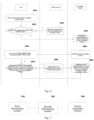
- Fig. 2 is a schematic diagram of device connection according to an embodiment of the present disclosure. As shown in Fig. 2 , communication connection is established between a device screen to be projected 210, a screen projection box 220, and a display screen 230. A communication connection is established between the device screen to be projected 210 and the display screen 220 through a wireless network, for example, the device screen to be projected 210 and the display screen 220 are in the same Wi-Fi network, and a communication connection is established between the screen projection box 220 and the display screen 230 through HDMI cable.
- the screen projection instruction refers to instruction information for projecting a display interface of the device screen to be projected to another display screen.
- a screen projection control is configured on the device screen to be projected, and a user may trigger a screen projection process through the screen projection control on the device screen to be projected, that is, when the device screen to be projected receives a trigger operation on the screen projection control from a user, the device screen to be projected generates a corresponding screen projection instruction, and sends the screen projection instruction to the screen projection box in the same network as the device screen to be projected, so that the screen projection box will project the display interface of the device screen to be projected to the display screen connected to the screen projection box.
- the number of device screens to be projected may be determined based on the number of devices that send screen projection instructions, that is, the number of devices that send screen projection instructions is equal to the number of device screens to be projected.
- the number of device screens to be projected may also be determined based on the total number of received screen projection instructions, that is, when one screen projection instruction is received, the number of device screens to be projected is increased by one.
- the number of device screens to be projected is reduced by one.
- the number of device screens to be projected may not be consistent with the number of display screens, that is, the number of device screens to be projected may be greater than the number of display screens, or the number of device screens to be projected may be smaller than the number of display screens, but a display region of each display screen is limited.
- the target display screen of the device screen to be projected may be determined by using the principle of equal distribution and/or the principle that the first display screen is projected first.
- the first display screen refers to the main screen, that is, a main screen is configured in all the display screens within the same region, and the other display screens are secondary screens. It may be understood that the difference between the main screen and the secondary screen may be their different locations of the display screens. For example, the main screen is located at the core location of the region (for example, at the center, or directly in front, which is related to the environment in which it is located, and this is not limited in the present disclosure).
- the target display of the device screen to be projected is determined according to the principle that the first screen is projected first.
- the target display screen of the device screen to be projected is determined based on the principle of equal distribution.
- the target display screen of each device screen to be projected is determined based on a principle of equal distribution and/or a principle that a first display screen is projected first, and the number of projected device screens on each display screen and the number of device screens to be projected.
- the display interface of the device screen to be projected may be displayed on both the main screen and the secondary screen, that is, the main screen and the secondary screen are equivalent to the function of the duplicate screen.
- the device screen to be projected is projected and displayed on the corresponding target display screen directly through the screen projection box.
- the number of device screens to be projected is determined; based on a principle of equal distribution and/or a principle that a first display screen is projected first, and the pre-acquired number of projected device screens on each display screen and the number of device screens to be projected, a target display screen of each device screen to be projected is determined; and each device screen to be projected is projected and displayed on a corresponding target display screen.
- the screen projection method further includes: when a screen projection closing instruction is received, determining the projection display screen corresponding to the device whose screen is to be turned off; receiving a deleting instruction for the device whose screen is to be turned off on the projection display screen, to delete the device whose screen is to be turned off; and based on the principle of equal distribution, evenly distributing the projected device screen to each display screen.
- the screen projection closing instruction refers to instruction information for closing the display interface of the screen projection device on the display screen.
- a screen projection control is configured on the device screen to be projected.
- the device screen to be projected may become a projected device on the screen, that is, the screen projection control on the display interface of the projected device becomes the screen projection closing control.
- the user may directly trigger the screen projection closing process by clicking the screen projection closing control.
- the screen projection closing instruction is received, the projection display screen corresponding to the device whose screen is to be turned off according to the screen projection closing instruction is determined, and then the device whose screen is to be turned off is deleted on the projection display screen, so as to delete the device whose screen is to be turned off on the display screen.
- the number of projected device screens on each screen may not be evenly distributed.
- the projected device on each display screen is acquired, and then based on the principle of equal distribution, one of the projected devices on the display screen with the largest number of projected device screens is transferred and projected on the display screen with the least number of projected device screens.
- the screen projection method further includes: when an unplugging instruction of HDMI cable is detected, removing all the projected device screens on the display screen connected to HDMI cable.
- the removing operation is directly performed on all projected devices on the display screen connected to HDMI cable, that is, the images of all projected devices on the display screen connected to HDMI cable are turned off.
- Fig. 3 is a flowchart of another device screen projection method according to an embodiment of the present disclosure. This embodiment is based on the above embodiments, and the device screen projection process is further described. As shown in Fig. 3 , the screen projection method in this embodiment includes the following steps:
- the time of receiving the screen projection instruction of each device screen to be projected is acquired.
- the time of receiving the screen projection instruction refers to the time when the screen projection box receives the screen projection instruction sent by the device screen to be projected.
- the screen projection box may be a MAXHUB WB05 box.
- the screen projection sequence of each device screen to be projected is sequentially determined based on the sequence of times of receiving the screen projection instructions, that is, the earlier the screen projection instruction is received by the device screen to be projected, the higher the corresponding screen projection sequence is.
- the target display screen corresponding to the device screen to be projected that receives the screen projection instruction earlier is determined as the first display screen; then the target display screen of the second to-be-projected device is determined as the secondary screen (for example, the second display screen) based on the principle of equal distribution, and the similar operation is performed until the target display screen of each device screen to be projected is determined.
- the projection position of the projected device may also be moved manually by dragging and dropping.
- the secondary screen when a screen projection closing instruction is received from the projected device on the secondary screen, the secondary screen may be automatically or manually deleted, and a projected device on the main screen is manually dragged to the secondary screen, so that a projected device is evenly distributed on each display.
- the maximum number of devices displayed on each display screen may also be configured, that is, when the number of projected device screens on each screen exceeds the maximum number of displayed devices, the display screen will not be able to display the device screen to be projected. For example, assuming that the maximum number of displayed devices on each display screen is 9, the maximum number of projected device screens on each display screen is 9.
- each device screen to be projected is projected and displayed on a corresponding target display screen.
- Fig. 4 is an interactive schematic diagram of device screen projection according to an embodiment of the present disclosure.
- the device screen projection process includes the following steps:
- both the main screen and the secondary screen display the screen projection device, that is, the main screen and the secondary screen are equivalent to duplicate screens.
- the secondary screen (using Presentation of Android system) is initialized, and the second to-be-projected device is added to the secondary screen.
- the number of device screens to be projected is greater than 2
- whether the number of projected device screens on the main screen is greater than the number of projected device screens on the secondary screen is determined.
- the number of projected device screens on the main screen and the number of projected device screens on the secondary screen may be recorded in a hypervisor. Based on the principle of equal distribution and the principle that the main screen is projected first, the devices to be projected are projected.
- the number of projected device screens on the main screen is equal to the number of projected device screens on the secondary screen, the first to-be-projected device is directly projected on the main screen, and then the second to-be-projected device is projected on the secondary screen.
- the device screen to be projected is added to the main screen at this time. If the number of projected device screens on the main screen is greater than that the number of projected device screens on the secondary screen, the device screen to be projected is added to the secondary screen. For example, if there are two projected devices on the main screen and one projected device on the secondary screen, the device screen to be projected is added to the secondary screen.
- the display images of different devices to be projected may be displayed on different display screens, and images of multiple devices to be projected are evenly distributed on different display screens.
- Fig. 5 is an interactive schematic diagram of another device screen projection according to an embodiment of the present disclosure.
- the device screen projection process in this embodiment includes the following steps:
- the display screen where the device whose screen is to be turned off is determined, that is, the deleting operation is performed on the display screen where the device whose screen is to be turned off. It may also be understood that the device whose screen is to be turned off is deleted from the display screen, and then based on the principle of equal distribution, the projected devices are evenly distributed. For example, there are two projected devices on the main screen and one projected device on the secondary screen.
- the closing operation is performed on the projected device on the secondary screen, that is, the device whose screen is to be turned off is the projected device on the secondary screen, then after the projected device is deleted from the secondary screen, a projected device on the main screen is moved to the secondary screen, that is, the two screens display the image of a projected device respectively.
- Fig. 6 is an interactive schematic diagram of still another device screen projection according to an embodiment of the present disclosure.
- the device screen projection process in this embodiment includes the following steps:
- the two display screens is dual-screen synchronous display
- all projected devices on the display screen corresponding to HDMI cable are removed. For example, assuming that there are three projected devices on the main screen and two projected devices on the secondary screen, when the user unplugs HDMI1, all the projected device screens on the main screen corresponding to HDMI1 will be turned off.
- Fig. 7 is a structural block diagram of a screen projection apparatus according to an embodiment of the present disclosure. This apparatus is suitable for evenly projecting multiple devices to be projected onto different display screens.
- the apparatus may be implemented by hardware/software.
- the apparatus includes: a first determining module 710, a second determining module 720 and a screen projecting module 730.
- the first determining module 710 is configured to, when a screen projection instruction is received, determine the number of device screens to be projected.
- the second determining module 720 is configured to, based on a principle of equal distribution and/or a principle that a first display screen is projected first, and the pre-acquired number of projected device screens on each display screen and the number of device screens to be projected, determine a target display screen of each device screen to be projected
- the screen projecting module 730 is configured to project and display each device screen to be projected on a corresponding target display screen.
- the number of device screens to be projected is determined; based on a principle of equal distribution and/or a principle that a first display screen is projected first, and the pre-acquired number of projected device screens on each display screen and the number of device screens to be projected, a target display screen of each device screen to be projected is determined; and each device screen to be projected is projected and displayed on a corresponding target display screen.
- the apparatus for projecting the device screen further includes:
- the apparatus for projecting the device screen further includes: a removing module, configured to, when an unplugging instruction of HDMI cable is detected, remove all the projected device screens on the display screen connected by HDMI cable.
- the second determining module includes:
- the apparatus for projecting the device screen further includes: an acquiring module, configured to acquire the time of receiving the screen projection instruction of each device screen to be projected before the target display screen of each device screen to be projected is determined based on the pre-acquired number of projected device screens on each display screen and the number of device screens to be projected.
- the second determining module includes:
- the device screen to be projected and the display screen are in the same wireless network, and the display screen and the screen projection box are connected through HDMI cable.
- the apparatus for projecting the device screen described above may execute the screen projection method according to any embodiment of the present disclosure, and has corresponding functional modules and beneficial effects for executing the screen projection method.
- Fig. 8 is a schematic diagram of a hardware structure of an electronic device according to an embodiment of the present disclosure.
- the device in the embodiment of the present disclosure is described by taking a screen projection box as an example.
- the screen projection box according to the embodiment of the present disclosure includes: a processor 810, a memory 820, an input device 830, an output device 840 and a communicating module 850.
- One processor 810 is taken as an example Fig. 8 .
- the processor 810, the memory 820, the input device 830, the output device 840 and the communicating module 850 in the screen projection box may be connected through a bus or in other ways, and the connection through a bus is taken as an example in Fig. 8 .
- the memory 820 in the screen projection box is a computer-readable storage medium, which may be used to store one or more programs, and the programs may be software programs, computer executable programs and modules, such as instructions/modules corresponding to the embodiment of the present disclosure or the provided device screen projection method (for example, the modules in the apparatus for projecting the device screen shown in Fig. 6 , including: a first determining module 610, a second determining module 620, and a screen projecting module 630).
- the processor 810 runs the software programs, instructions and modules stored in the memory 820 to execute various functional applications and data processing of the screen projection box, that is, to implement the screen projection method in the above method embodiments.
- the memory 820 may include a program storage area and a data storage area.
- the program storage area may store an operating system and an application program required by at least one function; the data storage area may store data created according to usage of the device, and the like.
- the memory 820 may include a highspeed random access memory, and may further include a non-volatile memory, such as at least one magnetic disk storage device, flash memory device, or other non-volatile solid-state storage devices.
- the memory 820 may further include memory arranged remotely relative to the processor 810, and these remote memories may be connected to the device through a network. Examples of the above-mentioned networks include, but are not limited to, the Internet, intranets, local area networks, mobile communication networks, and combinations thereof.
- the input device 830 may be used to receive numeric or character information input by the user, so as to generate key signal input related to user settings and function control of the terminal device.
- the output device 840 may include a display device such as a display screen.
- the communicating module 850 is configured to establish a communication connection between the device screen to be projected and the display screen.
- the program when one or more programs included in the above-mentioned cloud server are executed by one or more processors 810, the program performs the following operations: when a screen projection instruction is received, determining the number of device screens to be projected; based on a principle of equal distribution and/or a principle that a first display screen is projected first, and the pre-acquired number of projected device screens on each display screen and the number of device screens to be projected, determining a target display screen of each device screen to be projected; and projecting and displaying each device screen to be projected on a corresponding target display screen.
- a computer-readable storage medium is further provided, on which a computer program is stored.
- the screen projection method according to the embodiment of the present disclosure is implemented. The method includes: when a screen projection instruction is received, determining the number of device screens to be projected; based on a principle of equal distribution and/or a principle that a first display screen is projected first, and the pre-acquired number of projected device screens on each display screen and the number of device screens to be projected, determining a target display screen of each device screen to be projected; and projecting and displaying each device screen to be projected onto a corresponding target display screen.
- the computer storage medium in the embodiments of the present disclosure may use any combination of one or more computer-readable media.
- the computer readable medium may be a computer readable signal medium or a computer readable storage medium.
- a computer-readable storage medium may be, for example, but not limited to, an electrical, magnetic, optical, electromagnetic, infrared, or semiconductor system, apparatus, or device, or any combination thereof.
- a computer-readable storage medium may be any tangible medium that contains or stores a program, and this program may be used by or in conjunction with an instruction execution system, apparatus, or device.
- a computer readable signal medium may include a data signal in baseband or serve as a part of a carrier wave, which carries computer readable program codes. Such propagated data signals may take many forms, including but not limited to electromagnetic signals, optical signals, or any above-mentioned suitable combination.
- a computer-readable signal medium may also be any computer-readable medium other than a computer-readable storage medium, which may send, propagate, or transmit a program used by or in conjunction with an instruction execution system, apparatus, or device.
- Program code included in a computer readable medium may be transmitted by using any appropriate medium, including but not limited to wireless, wireline, optical fiber cable, RF, etc., or any suitable combination.
- Computer program code for performing the operations of the present disclosure may be written in one or more programming languages or combinations thereof, the programming languages include object-oriented programming languages such as Java, Smalltalk, C++, and conventional procedural programming languages, such as the "C" language or a similar programming language.
- the program code may be executed entirely on the computer of users, partly on the computer of users, as a stand-alone software package, partly on the computer of users and partly on a remote computer, or entirely on the remote computer or server.
- the remote computer may be connected to the computer of the user through any kind of network, including a local area network (LAN) or a wide area network (WAN), or may be connected to an external computer (such as through an Internet connection by using an Internet service provider).
- LAN local area network
- WAN wide area network
- Internet service provider such as AT&T, MCI, Sprint, EarthLink, MSN, GTE, etc.
Landscapes
- Engineering & Computer Science (AREA)
- Theoretical Computer Science (AREA)
- Physics & Mathematics (AREA)
- General Physics & Mathematics (AREA)
- Human Computer Interaction (AREA)
- General Engineering & Computer Science (AREA)
- Multimedia (AREA)
- Signal Processing (AREA)
- Computer Networks & Wireless Communication (AREA)
- Computer Hardware Design (AREA)
- Controls And Circuits For Display Device (AREA)
- Two-Way Televisions, Distribution Of Moving Picture Or The Like (AREA)
Abstract
Description
- The present disclosure claims the priority of a
Chinese patent application with the Application No. 202111020876.9, which is filed to CNIPA on September 1, 2021 - The present disclosure relates to data processing technologies, and in particular, to a method and apparatus for projecting a device screen, device, and storage medium.
- With the continuous development of technology, different projection manners may be used for projection display. In the related art, there are the following three screen projection manners: single-screen display, dual-screen simultaneous display, and dual-screen synchronous display. As for single-screen display, when the screen projection function is used on the electronic whiteboard, all screen projection apparatus may only be displayed on this display screen, and the existing problems are as follows: if there are too many participants in the meeting room, one monitor cannot allow everyone to watch the screen projection easily; if there are too many screen projection devices, the content displayed on one screen will be too dense. As for dual-screen simultaneous display, the host are connected to two monitors through two High Definition Multimedia Interface (HDMI) cables, and the same content is displayed, that is, the function of duplicating the screen is realized, and the existing problems are as follows: if there are too many screen projection devices, the content displayed on one screen will be too dense. As for dual-screen synchronous display (each screen displays a single content), for example, cash registers in convenience stores and movie theaters, the screens seen by customers and the content seen by cashiers are different, and the existing problems are as follows: the content of each screen is relatively single and cannot be applied to the field of commercial screen projection.
- In view of this, according to the present disclosure, a method and apparatus for projecting a device screen, device and storage medium is provided.
- According to a first aspect of the present disclosure, a screen projection method is provided, which includes:
- when a screen projection instruction is received, determining the number of device screens to be projected;
- based on a principle of equal distribution and/or a principle that a first display screen is projected first, and the pre-acquired number of projected device screens on each display screen and the number of device screens to be projected, determining a target display screen of each device screen to be projected; and
- projecting and displaying each device screen to be projected on a corresponding target display screen.
- According to a second aspect of the present disclosure, a screen projection apparatus is further provided, which includes:
- a first determining module, configured to, when a screen projection instruction is received, determine the number of device screens to be projected;
- a second determining module, configured to, based on a principle of equal distribution and/or a principle that a first display screen is projected first, and the pre-acquired number of projected device screens on each display screen and the number of device screens to be projected, determine a target display screen of each device screen to be projected; and
- a screen projecting module, configured to project and display each device screen to be projected on a corresponding target display screen.
- According to a third aspect of the present disclosure, an electronic device is further provided, including: a communicating module, a memory, and one or more processors;
- the communicating module is configured to establish a communication connection between a device screen to be projected and a display screen;
- the memory is configured to store one or more programs;
- when the one or more programs are executed by the one or more processors, the one or more processors are made to implement the screen projection method of any one of the above embodiments.
- According to a fourth aspect of the present disclosure, a computer-readable storage medium is provided, on which a computer program is stored, and when the program is executed by a processor, the screen projection method of any one of the above-mentioned embodiments is implemented.
-
-
Fig. 1 is a flowchart of a screen projection method according to an embodiment of the present disclosure. -
Fig. 2 is a schematic diagram of device connection according to an embodiment of the present disclosure. -
Fig. 3 is a flowchart of another screen projection method according to an embodiment of the present disclosure. -
Fig. 4 is an interactive schematic diagram of a device screen projection according to an embodiment of the present disclosure. -
Fig. 5 is an interactive schematic diagram of another device screen projection according to an embodiment of the present disclosure. -
Fig. 6 is an interactive schematic diagram of still another device screen projection according to an embodiment of the present disclosure. -
Fig. 7 is a structural block diagram of a screen projection apparatus according to an embodiment of the present disclosure. -
Fig. 8 is a schematic diagram of a hardware structure of an electronic device according to an embodiment of the present disclosure. - The present disclosure will be further described in detail below in conjunction with the accompanying drawings and embodiments. It should be understood that the specific embodiments described herein are only used to explain the present disclosure, but not to limit the present disclosure. In addition, it should be noted that, for the convenience of description, only some structures related to the present disclosure are shown in the drawings but not all structures.
- In an embodiment,
Fig. 1 is a flowchart of a screen projection method according to an embodiment of the present disclosure. This embodiment is applicable to the situation of evenly projecting multiple devices to be projected onto different display screens. This embodiment may be executed by an electronic device. The electronic device may be a screen projection box. As shown inFig. 1 , this embodiment includes the following steps:
S 110, when a screen projection instruction is received, determining the number of device screens to be projected. - In an embodiment, the device screen to be projected and the display screen are in the same wireless network, and the display screen and the screen projection box are connected through HDMI cable.
Fig. 2 is a schematic diagram of device connection according to an embodiment of the present disclosure. As shown inFig. 2 , communication connection is established between a device screen to be projected 210, ascreen projection box 220, and adisplay screen 230. A communication connection is established between the device screen to be projected 210 and thedisplay screen 220 through a wireless network, for example, the device screen to be projected 210 and thedisplay screen 220 are in the same Wi-Fi network, and a communication connection is established between thescreen projection box 220 and thedisplay screen 230 through HDMI cable. - The screen projection instruction refers to instruction information for projecting a display interface of the device screen to be projected to another display screen. In an embodiment, a screen projection control is configured on the device screen to be projected, and a user may trigger a screen projection process through the screen projection control on the device screen to be projected, that is, when the device screen to be projected receives a trigger operation on the screen projection control from a user, the device screen to be projected generates a corresponding screen projection instruction, and sends the screen projection instruction to the screen projection box in the same network as the device screen to be projected, so that the screen projection box will project the display interface of the device screen to be projected to the display screen connected to the screen projection box.
- During actual operation, the number of device screens to be projected may be determined based on the number of devices that send screen projection instructions, that is, the number of devices that send screen projection instructions is equal to the number of device screens to be projected. Of course, the number of device screens to be projected may also be determined based on the total number of received screen projection instructions, that is, when one screen projection instruction is received, the number of device screens to be projected is increased by one. Of course, after the screen projection of the device screen to be projected is completed, the number of device screens to be projected is reduced by one.
- S120, based on a principle of equal distribution and/or a principle that a first display screen is projected first, and the pre-acquired number of projected device screens on each display screen and the number of device screens to be projected, determining a target display screen of each device screen to be projected.
- In actual operation, the number of device screens to be projected may not be consistent with the number of display screens, that is, the number of device screens to be projected may be greater than the number of display screens, or the number of device screens to be projected may be smaller than the number of display screens, but a display region of each display screen is limited. When the number of device screens to be projected is large and the number of displays is small, in order to be able to project the display interface of the device screen to be projected on the display screen as much as possible, the target display screen of the device screen to be projected may be determined by using the principle of equal distribution and/or the principle that the first display screen is projected first.
- It should be noted that since the device screen to be projected, the projected box and the display screen are in the same network, it may also be understood that the device screen to be projected, the projected box and the display screen are in the same region, which may be an indoor region or an outdoor region, and this is not limited in the present disclosure. The first display screen refers to the main screen, that is, a main screen is configured in all the display screens within the same region, and the other display screens are secondary screens. It may be understood that the difference between the main screen and the secondary screen may be their different locations of the display screens. For example, the main screen is located at the core location of the region (for example, at the center, or directly in front, which is related to the environment in which it is located, and this is not limited in the present disclosure).
- In the embodiment, when there is one device screen to be projected and the number of projected device screens on each display screen is equal, the target display of the device screen to be projected is determined according to the principle that the first screen is projected first. When the number of device screens to be projected is one and the number of projected device screens on each display is not equal, the target display screen of the device screen to be projected is determined based on the principle of equal distribution. When the number of device screens to be projected is multiple, the target display screen of each device screen to be projected is determined based on a principle of equal distribution and/or a principle that a first display screen is projected first, and the number of projected device screens on each display screen and the number of device screens to be projected.
- Of course, when the display screen is initialized and started, the number of projected device screens on each display screen is 0, and when the number of projected device screens is determined to be one, the display interface of the device screen to be projected may be displayed on both the main screen and the secondary screen, that is, the main screen and the secondary screen are equivalent to the function of the duplicate screen.
- S130, projecting and displaying each device screen to be projected on a corresponding target display screen.
- In an embodiment, after the target display screen of each device screen to be projected is determined, the device screen to be projected is projected and displayed on the corresponding target display screen directly through the screen projection box.
- In this embodiment, when a screen projection instruction is received, the number of device screens to be projected is determined; based on a principle of equal distribution and/or a principle that a first display screen is projected first, and the pre-acquired number of projected device screens on each display screen and the number of device screens to be projected, a target display screen of each device screen to be projected is determined; and each device screen to be projected is projected and displayed on a corresponding target display screen. Thereby, such as a fact is realized that when multiple devices to be projected perform screen projection, each device screen to be projected may be evenly projected on different display screens.
- In an embodiment, the screen projection method further includes: when a screen projection closing instruction is received, determining the projection display screen corresponding to the device whose screen is to be turned off; receiving a deleting instruction for the device whose screen is to be turned off on the projection display screen, to delete the device whose screen is to be turned off; and based on the principle of equal distribution, evenly distributing the projected device screen to each display screen. The screen projection closing instruction refers to instruction information for closing the display interface of the screen projection device on the display screen. In the embodiment, a screen projection control is configured on the device screen to be projected. After the user clicks on the screen projection control and the display interface of the device screen to be projected is successfully projected on the display screen, the device screen to be projected may become a projected device on the screen, that is, the screen projection control on the display interface of the projected device becomes the screen projection closing control. At this time, the user may directly trigger the screen projection closing process by clicking the screen projection closing control. When the screen projection closing instruction is received, the projection display screen corresponding to the device whose screen is to be turned off according to the screen projection closing instruction is determined, and then the device whose screen is to be turned off is deleted on the projection display screen, so as to delete the device whose screen is to be turned off on the display screen. It should be noted that after the device whose screen is to be turned off on the display screen is deleted, the number of projected device screens on each screen may not be evenly distributed. At this time, the projected device on each display screen is acquired, and then based on the principle of equal distribution, one of the projected devices on the display screen with the largest number of projected device screens is transferred and projected on the display screen with the least number of projected device screens.
- In an embodiment, the screen projection method further includes: when an unplugging instruction of HDMI cable is detected, removing all the projected device screens on the display screen connected to HDMI cable. In the embodiment, when each display screen is in a synchronous display, that is, when an image displayed on each display screen is different, if the user unplugs one of HDMI cables, the removing operation is directly performed on all projected devices on the display screen connected to HDMI cable, that is, the images of all projected devices on the display screen connected to HDMI cable are turned off.
- In an embodiment,
Fig. 3 is a flowchart of another device screen projection method according to an embodiment of the present disclosure. This embodiment is based on the above embodiments, and the device screen projection process is further described. As shown inFig. 3 , the screen projection method in this embodiment includes the following steps: - S310, when the screen projection instruction is received, determining the number of device screens to be projected.
- S320, determining whether the number of device screens to be projected is 1, if yes, executing S330; if not, executing S360.
- S330, determining a comparison result between the number of projected device screens on the first display screen and the number of projected device screens on the second display screen.
- S340, when the number of projected device screens on the first display screen is equal to the number of projected device screens on the second display screen, determining that the target display screen of the device screen to be projected is the first display screen.
- S350, when the number of projected device screens on the first display screen is greater than the number of projected device screens on the second display screen, determining that the target display screen of the device screen to be projected is the second display screen.
- S360, acquiring the time of receiving the screen projection instruction of each device screen to be projected.
- In an embodiment, when the number of device screens to be projected is at least two, in order to project the display interface of the devices to be projected on the display screen as much as possible, the time of receiving the screen projection instruction of each device screen to be projected is acquired. The time of receiving the screen projection instruction refers to the time when the screen projection box receives the screen projection instruction sent by the device screen to be projected. For example, the screen projection box may be a MAXHUB WB05 box.
- S370, determining the screen projection sequence of each device screen to be projected based on the sequence of times of receiving the screen projection instructions.
- In the embodiment, the screen projection sequence of each device screen to be projected is sequentially determined based on the sequence of times of receiving the screen projection instructions, that is, the earlier the screen projection instruction is received by the device screen to be projected, the higher the corresponding screen projection sequence is.
- S380, based on the principle of equal distribution and the principle that the first display screen is projected first, and the number of projected device screens on each display screen, sequentially determining the target display screen of each device screen to be projected.
- In the embodiment, when the number of projected device screens on each display screen is equal, based on the principle that the first screen is projected first, the target display screen corresponding to the device screen to be projected that receives the screen projection instruction earlier is determined as the first display screen; then the target display screen of the second to-be-projected device is determined as the secondary screen (for example, the second display screen) based on the principle of equal distribution, and the similar operation is performed until the target display screen of each device screen to be projected is determined.
- S390, projecting and displaying each device screen to be projected on a corresponding target display screen.
- Of course, in the actual operation process, the projection position of the projected device may also be moved manually by dragging and dropping. For example, assuming that there are two projected devices on the main screen and one projected device on the secondary screen, when a screen projection closing instruction is received from the projected device on the secondary screen, the secondary screen may be automatically or manually deleted, and a projected device on the main screen is manually dragged to the secondary screen, so that a projected device is evenly distributed on each display.
- Of course, the maximum number of devices displayed on each display screen may also be configured, that is, when the number of projected device screens on each screen exceeds the maximum number of displayed devices, the display screen will not be able to display the device screen to be projected. For example, assuming that the maximum number of displayed devices on each display screen is 9, the maximum number of projected device screens on each display screen is 9.
- In this embodiment, based on the principle of equal distribution and/or the principle that the first display screen is projected first, and the pre-acquired number of projected device screens on each display screen and the number of device screens to be projected, the target display screen of each device screen to be projected is determined, and each device screen to be projected is projected and displayed on a corresponding target display screen. Thereby, such as a fact is realized that when multiple devices to be projected perform screen projection, each device screen to be projected may be evenly projected on different display screens.
- In an embodiment,
Fig. 4 is an interactive schematic diagram of device screen projection according to an embodiment of the present disclosure. In this embodiment, by taking the first display screen as the main screen and the second display screen as the secondary screen as an example, the device screen projection process will be described. As shown inFig. 4 , the device screen projection process in this embodiment includes the following steps: - S410, receiving a screen projection instruction.
- S420, determining whether the number of device screens to be projected is greater than 1, if yes, executing S430; if not, executing S450.
- S430, determining whether the number of device screens to be projected is equal to 2, if not, executing S440; if yes, executing S460.
- S440, determining whether the number of projected device screens on the main screen is greater than the number of projected device screens on the secondary screen, if not, executing S450; if yes, executing S470.
- S450, adding the device screen to be projected to the display interface of the main screen.
- S460, initializing the secondary screen.
- S470, adding the device screen to be projected to the display interface of the secondary screen.
- In an embodiment, when the user starts to perform screen projection, if there is only one device screen to be projected (that is, there are 0 projected devices and 1 device screen to be projected) that needs to be projected, both the main screen and the secondary screen display the screen projection device, that is, the main screen and the secondary screen are equivalent to duplicate screens.
- When the second to-be-projected device (i.e., 1 device is projected on the main screen and 0 devices are projected on the secondary screen) needs to be projected, the secondary screen (using Presentation of Android system) is initialized, and the second to-be-projected device is added to the secondary screen.
- When the number of device screens to be projected is greater than 2, whether the number of projected device screens on the main screen is greater than the number of projected device screens on the secondary screen is determined. The number of projected device screens on the main screen and the number of projected device screens on the secondary screen may be recorded in a hypervisor. Based on the principle of equal distribution and the principle that the main screen is projected first, the devices to be projected are projected. When the number of projected device screens on the main screen is equal to the number of projected device screens on the secondary screen, the first to-be-projected device is directly projected on the main screen, and then the second to-be-projected device is projected on the secondary screen. For example, if there is a projected device on the main screen and a projected device on the secondary screen, the device screen to be projected is added to the main screen at this time. If the number of projected device screens on the main screen is greater than that the number of projected device screens on the secondary screen, the device screen to be projected is added to the secondary screen. For example, if there are two projected devices on the main screen and one projected device on the secondary screen, the device screen to be projected is added to the secondary screen. According to this embodiment, when screen projection is performed multiple devices to be projected and two display screens are connected, the display images of different devices to be projected may be displayed on different display screens, and images of multiple devices to be projected are evenly distributed on different display screens.
- In an embodiment,
Fig. 5 is an interactive schematic diagram of another device screen projection according to an embodiment of the present disclosure. In this embodiment, taking the first display screen as the main screen and the second display screen as the secondary screen as an example, when a screen projection closing instruction is received, the device screen projection process will be described. As shown inFig. 5 , the device screen projection process in this embodiment includes the following steps: - S510, receiving a screen projection closing instruction.
- S520, determining whether the device whose screen is to be turned off is on the main screen, if yes, executing S530; if not, executing S540.
- S530, deleting the device whose screen is to be turned off on the display interface of the main screen.
- S540, deleting the device whose screen is to be turned off on the display interface of the secondary screen.
- S550, after the screen projection of the device whose screen is to be turned off is closed, determining whether the number of projected device screens on the main screen is greater than the number of projected device screens on the secondary screen, if yes, executing S560; if not, executing S580.
- S560, deleting the first projected device on the main screen.
- S570, adding the first projected device screen deleted from the main screen to the display interface of the secondary screen.
- S580, determining whether the number of projected device screens on the main screen is smaller than the number of projected device screens on the secondary screen, if yes, executing S590.
- S590, deleting the first projected device screen from the secondary screen.
- S5100, adding the first projected device screen deleted from the secondary screen to the display interface of the main screen.
- In the embodiment, when the user turns off the screen projection device, the display screen where the device whose screen is to be turned off is determined, that is, the deleting operation is performed on the display screen where the device whose screen is to be turned off. It may also be understood that the device whose screen is to be turned off is deleted from the display screen, and then based on the principle of equal distribution, the projected devices are evenly distributed. For example, there are two projected devices on the main screen and one projected device on the secondary screen. When the closing operation is performed on the projected device on the secondary screen, that is, the device whose screen is to be turned off is the projected device on the secondary screen, then after the projected device is deleted from the secondary screen, a projected device on the main screen is moved to the secondary screen, that is, the two screens display the image of a projected device respectively.
- In an embodiment,
Fig. 6 is an interactive schematic diagram of still another device screen projection according to an embodiment of the present disclosure. In this embodiment, taking the first display screen as the main screen and the second display screen as the secondary screen as an example, when an HDMI unplugging instruction is received, the device screen projection process will be described. As shown inFig. 6 , the device screen projection process in this embodiment includes the following steps: - S610, receiving an instruction to unplug HDMI cable.
- S620, determining whether the unplugged cable is the HDMI1 cable, if yes, executing S630; if not, executing S640.
- S630, deleting all projected device screens displayed on the main screen.
- S640, deleting all projected device screens displayed on the secondary screen.
- S650, in a case of single HDMI cable, inserting another HDMI cable.
- S660, initializing the secondary screen.
- S670, determining whether the number of projected device screens on the main screen is greater than the number of projected device screens on the secondary screen, if yes, executing S680.
- S680, deleting the first projected device screen on the main screen.
- S690, adding the first projected device screen deleted from the main screen to the display interface of the secondary screen, and returning to S670.
- In an embodiment, when the two display screens is dual-screen synchronous display, when the user unplugs one of HDMI cables, all projected devices on the display screen corresponding to HDMI cable are removed. For example, assuming that there are three projected devices on the main screen and two projected devices on the secondary screen, when the user unplugs HDMI1, all the projected device screens on the main screen corresponding to HDMI1 will be turned off.
- In an embodiment,
Fig. 7 is a structural block diagram of a screen projection apparatus according to an embodiment of the present disclosure. This apparatus is suitable for evenly projecting multiple devices to be projected onto different display screens. The apparatus may be implemented by hardware/software. As shown inFig. 7 , the apparatus includes: a first determiningmodule 710, a second determiningmodule 720 and ascreen projecting module 730. - The first determining
module 710 is configured to, when a screen projection instruction is received, determine the number of device screens to be projected. - The second determining
module 720 is configured to, based on a principle of equal distribution and/or a principle that a first display screen is projected first, and the pre-acquired number of projected device screens on each display screen and the number of device screens to be projected, determine a target display screen of each device screen to be projected - The
screen projecting module 730 is configured to project and display each device screen to be projected on a corresponding target display screen. - In this embodiment, when a screen projection instruction is received, the number of device screens to be projected is determined; based on a principle of equal distribution and/or a principle that a first display screen is projected first, and the pre-acquired number of projected device screens on each display screen and the number of device screens to be projected, a target display screen of each device screen to be projected is determined; and each device screen to be projected is projected and displayed on a corresponding target display screen. Thereby, such as a fact is realized that when multiple devices to be projected perform screen projection, each device screen to be projected may be evenly projected on different display screens.
- On the basis of the above embodiments, the apparatus for projecting the device screen further includes:
- a third determining module, configured to, when a screen projection closing instruction is received, determine the projection display screen corresponding to the device whose screen is to be turned off;
- a deleting module, configured to receive a deleting instruction for the device whose screen is to be turned off on the projection display screen, to delete the device whose screen is to be turned off; and
- a distributing module, configured to, based on the principle of equal distribution, evenly distribute the projected device screen to each display screen.
- On the basis of the above embodiments, the apparatus for projecting the device screen further includes:
a removing module, configured to, when an unplugging instruction of HDMI cable is detected, remove all the projected device screens on the display screen connected by HDMI cable. - On the basis of the above embodiments, when two display screens are used for screen projection display, and the number of device screens to be projected is one, the second determining module includes:
- a first determining unit, configured to determine a comparison result between the number of projected device screens on the first display screen and the number of projected device screens on the second display screen;
- a second determining unit, configured to, when the number of projected device screens on the first display screen is equal to the number of projected device screens on the second display screen, determine that the target display screen of the device screen to be projected is the first display screen; and
- a third determining unit, configured to, when the number of projected device screens on the first display screen is greater than the number of projected device screens on the second display screen, determine that the target display screen of the device screen to be projected is the second display screen.
- On the basis of the above embodiments, when two display screens are used for screen projection display, and the number of device screens to be projected is at least two, the apparatus for projecting the device screen further includes:
an acquiring module, configured to acquire the time of receiving the screen projection instruction of each device screen to be projected before the target display screen of each device screen to be projected is determined based on the pre-acquired number of projected device screens on each display screen and the number of device screens to be projected. - On the basis of the above embodiments, when the number of device screens to be projected is at least two, the second determining module includes:
- a fourth determining unit, configured to determine the screen projection sequence of each device screen to be projected based on the sequence of times of receiving the screen projection instructions; and
- a fifth determining unit, configured to, based on the principle of equal distribution and the principle that the first display screen is projected first, and the number of projected device screens on each display screen, sequentially determine the target display screen of each device screen to be projected.
- On the basis of the above embodiments, the device screen to be projected and the display screen are in the same wireless network, and the display screen and the screen projection box are connected through HDMI cable.
- The apparatus for projecting the device screen described above may execute the screen projection method according to any embodiment of the present disclosure, and has corresponding functional modules and beneficial effects for executing the screen projection method.
-
Fig. 8 is a schematic diagram of a hardware structure of an electronic device according to an embodiment of the present disclosure. The device in the embodiment of the present disclosure is described by taking a screen projection box as an example. As shown inFig. 8 , the screen projection box according to the embodiment of the present disclosure includes: aprocessor 810, amemory 820, aninput device 830, anoutput device 840 and a communicatingmodule 850. There may be one ormore processors 810 in the screen projection box. Oneprocessor 810 is taken as an exampleFig. 8 . Theprocessor 810, thememory 820, theinput device 830, theoutput device 840 and the communicatingmodule 850 in the screen projection box may be connected through a bus or in other ways, and the connection through a bus is taken as an example inFig. 8 . - The
memory 820 in the screen projection box is a computer-readable storage medium, which may be used to store one or more programs, and the programs may be software programs, computer executable programs and modules, such as instructions/modules corresponding to the embodiment of the present disclosure or the provided device screen projection method (for example, the modules in the apparatus for projecting the device screen shown inFig. 6 , including: a first determiningmodule 610, a second determining module 620, and a screen projecting module 630). Theprocessor 810 runs the software programs, instructions and modules stored in thememory 820 to execute various functional applications and data processing of the screen projection box, that is, to implement the screen projection method in the above method embodiments. - The
memory 820 may include a program storage area and a data storage area. The program storage area may store an operating system and an application program required by at least one function; the data storage area may store data created according to usage of the device, and the like. In addition, thememory 820 may include a highspeed random access memory, and may further include a non-volatile memory, such as at least one magnetic disk storage device, flash memory device, or other non-volatile solid-state storage devices. In some instances, thememory 820 may further include memory arranged remotely relative to theprocessor 810, and these remote memories may be connected to the device through a network. Examples of the above-mentioned networks include, but are not limited to, the Internet, intranets, local area networks, mobile communication networks, and combinations thereof. - The
input device 830 may be used to receive numeric or character information input by the user, so as to generate key signal input related to user settings and function control of the terminal device. Theoutput device 840 may include a display device such as a display screen. The communicatingmodule 850 is configured to establish a communication connection between the device screen to be projected and the display screen. - Moreover, when one or more programs included in the above-mentioned cloud server are executed by one or
more processors 810, the program performs the following operations: when a screen projection instruction is received, determining the number of device screens to be projected; based on a principle of equal distribution and/or a principle that a first display screen is projected first, and the pre-acquired number of projected device screens on each display screen and the number of device screens to be projected, determining a target display screen of each device screen to be projected; and projecting and displaying each device screen to be projected on a corresponding target display screen. - According to the embodiment of the present disclosure, a computer-readable storage medium is further provided, on which a computer program is stored. When the program is executed by a processor, the screen projection method according to the embodiment of the present disclosure is implemented. The method includes: when a screen projection instruction is received, determining the number of device screens to be projected; based on a principle of equal distribution and/or a principle that a first display screen is projected first, and the pre-acquired number of projected device screens on each display screen and the number of device screens to be projected, determining a target display screen of each device screen to be projected; and projecting and displaying each device screen to be projected onto a corresponding target display screen.
- The computer storage medium in the embodiments of the present disclosure may use any combination of one or more computer-readable media. The computer readable medium may be a computer readable signal medium or a computer readable storage medium. A computer-readable storage medium may be, for example, but not limited to, an electrical, magnetic, optical, electromagnetic, infrared, or semiconductor system, apparatus, or device, or any combination thereof. More specific examples (non-exhaustive list) of computer-readable storage media include: electrical connections with one or more wires, portable computer disks, hard disks, Random Access Memory (RAM), Read-Only Memory (ROM), Erasable Programmable ROM (EPROM or flash memory), optical fiber, portable Compact Disc Read-Only Memory (CD-ROM), optical storage devices, magnetic storage device, or any suitable combination of the above. In this description, a computer-readable storage medium may be any tangible medium that contains or stores a program, and this program may be used by or in conjunction with an instruction execution system, apparatus, or device.
- A computer readable signal medium may include a data signal in baseband or serve as a part of a carrier wave, which carries computer readable program codes. Such propagated data signals may take many forms, including but not limited to electromagnetic signals, optical signals, or any above-mentioned suitable combination. A computer-readable signal medium may also be any computer-readable medium other than a computer-readable storage medium, which may send, propagate, or transmit a program used by or in conjunction with an instruction execution system, apparatus, or device.
- Program code included in a computer readable medium may be transmitted by using any appropriate medium, including but not limited to wireless, wireline, optical fiber cable, RF, etc., or any suitable combination.
- Computer program code for performing the operations of the present disclosure may be written in one or more programming languages or combinations thereof, the programming languages include object-oriented programming languages such as Java, Smalltalk, C++, and conventional procedural programming languages, such as the "C" language or a similar programming language. The program code may be executed entirely on the computer of users, partly on the computer of users, as a stand-alone software package, partly on the computer of users and partly on a remote computer, or entirely on the remote computer or server. In a cases of involving a remote computer, the remote computer may be connected to the computer of the user through any kind of network, including a local area network (LAN) or a wide area network (WAN), or may be connected to an external computer (such as through an Internet connection by using an Internet service provider).
- It is noted that the above are only preferred embodiments of the present disclosure and applied technical principles. Those skilled in the art will understand that the present disclosure is not limited to the specific embodiments described herein, and that various obvious changes, readjustments and substitutions may be made by those skilled in the art without departing from the protection scope of the present disclosure. Therefore, although the present disclosure has been described in detail through the above embodiments, the present disclosure is not limited to the above embodiments, and may also include more other equivalent embodiments without departing from the concept of the present disclosure, and the scope of the present disclosure is determined by the scope of the appended claims.
Claims (10)
- A screen projection method, comprising:when a screen projection instruction is received, determining the number of device screens to be projected;based on a principle of equal distribution and/or a principle that a first display screen is projected first, and the pre-acquired number of projected device screens on each display screen and the number of device screens to be projected, determining a target display screen of each device screen to be projected; andprojecting and displaying each device screen to be projected on a corresponding target display screen.
- The screen projection method of claim 1, further comprising:when a screen projection closing instruction is received, determining the projection display screen corresponding to the device whose screen is to be turned off;receiving a deleting instruction for the device whose screen is to be turned off on the projection display screen, to delete the device whose screen is to be turned off; andbased on the principle of equal distribution, evenly distributing the projected device screen to each display screen.
- The screen projection method of claim 1, further comprising:
when an unplugging instruction of High Definition Multimedia Interface (HDMI) cable is detected, removing all the projected device screens on the display screen connected to HDMI cable. - The screen projection method of claim 1, wherein when two display screens are used for screen projection display, and the number of device screens to be projected is one, based on a principle of equal distribution and/or a principle that a first display screen is projected first, and the pre-acquired number of projected device screens on each display screen and the number of device screens to be projected, determining a target display screen of each device screen to be projected comprises:determining a comparison result between the number of projected device screens on the first display screen and the number of projected device screens on the second display screen.when the number of projected device screens on the first display screen is equal to the number of projected device screens on the second display screen, determining that the target display screen of the device screen to be projected is the first display screen.when the number of projected device screens on the first display screen is greater than the number of projected device screens on the second display screen, determining that the target display screen of the device screen to be projected is the second display screen.
- The screen projection method of claim 1, wherein when two display screens are used for screen projection display, and the number of device screens to be projected is at least two, based on the pre-acquired number of projected device screens on each display screen and the number of device screens to be projected, determining a target display screen of each device screen to be projected further comprises:
acquiring the time of receiving the screen projection instruction of each device screen to be projected. - The screen projection method of claim 5, wherein when the number of device screens to be projected is at least two, based on a principle of equal distribution and/or a principle that a first display screen is projected first, and the pre-acquired number of projected device screens on each display screen and the number of device screens to be projected, determining a target display screen of each device screen to be projected further comprises:determining the screen projection sequence of each device screen to be projected based on the sequence of times of receiving the screen projection instructions; andbased on the principle of equal distribution and the principle that the first display screen is projected first, and the number of projected device screens on each display screen, sequentially determining the target display screen of each device screen to be projected.
- The screen projection method of any one of claims 1-6, wherein the device screen to be projected and the display screen are in the same wireless network, and the display screen and the screen projection box are connected through HDMI cable.
- An screen projection apparatus, comprising:a first determining module, configured to, when a screen projection instruction is received, determine the number of device screens to be projected;a second determining module, configured to, based on a principle of equal distribution and/or a principle that a first display screen is projected first, and the pre-acquired number of projected device screens on each display screen and the number of device screens to be projected, determine a target display screen of each device screen to be projected; anda screen projecting module, configured to project and display each device screen to be projected onto a corresponding target display screen.
- An electronic device, comprising:a communicating module;a memory; andone or more processors,wherein the communicating module is configured to establish a communication connection between a device screen to be projected and a display screen;the memory is configured to store one or more programs;the one or more programs, when executed by the one or more processors, performs the method for projecting the device screen of any one of claims 1-7.
- A computer-readable storage medium, on which a computer program is stored, wherein the computer program, when executed by a processor, performs the method for projecting the device screen of any one of claims 1-7.
Applications Claiming Priority (2)
| Application Number | Priority Date | Filing Date | Title |
|---|---|---|---|
| CN202111020876.9A CN115729497B (en) | 2021-09-01 | 2021-09-01 | Equipment screen projection method, device, equipment and storage medium |
| PCT/CN2022/119008 WO2023030548A1 (en) | 2021-09-01 | 2022-09-15 | Screen projection method and apparatus, device and storage medium |
Publications (2)
| Publication Number | Publication Date |
|---|---|
| EP4365728A1 true EP4365728A1 (en) | 2024-05-08 |
| EP4365728A4 EP4365728A4 (en) | 2024-10-09 |
Family
ID=85292104
Family Applications (1)
| Application Number | Title | Priority Date | Filing Date |
|---|---|---|---|
| EP22863682.5A Pending EP4365728A4 (en) | 2021-09-01 | 2022-09-15 | SCREEN PROJECTION METHOD AND DEVICE, DEVICE AND STORAGE MEDIUM |
Country Status (6)
| Country | Link |
|---|---|
| US (1) | US12613669B2 (en) |
| EP (1) | EP4365728A4 (en) |
| JP (1) | JP2024528438A (en) |
| KR (1) | KR20240051264A (en) |
| CN (1) | CN115729497B (en) |
| WO (1) | WO2023030548A1 (en) |
Family Cites Families (17)
| Publication number | Priority date | Publication date | Assignee | Title |
|---|---|---|---|---|
| US8296662B2 (en) * | 2007-02-05 | 2012-10-23 | Brother Kogyo Kabushiki Kaisha | Image display device |
| US10884607B1 (en) * | 2009-05-29 | 2021-01-05 | Steelcase Inc. | Personal control apparatus and method for sharing information in a collaborative workspace |
| JP5375338B2 (en) | 2009-05-29 | 2013-12-25 | セイコーエプソン株式会社 | Image display system, image display apparatus, image display method, image supply apparatus, and program |
| JP2011141320A (en) | 2010-01-05 | 2011-07-21 | Sharp Corp | Display device |
| US20170154452A1 (en) * | 2015-11-30 | 2017-06-01 | Taeko Ishizu | Display apparatus, display control method, and recording medium |
| CN106856563A (en) | 2015-12-09 | 2017-06-16 | 中兴通讯股份有限公司 | A kind of projection terminal and its method for realizing the same screen projection in multiple terminals |
| US10620786B2 (en) * | 2016-03-07 | 2020-04-14 | Intel Corporation | Technologies for event notification interface management |
| CN108289241B (en) | 2016-09-29 | 2021-05-21 | 努比亚技术有限公司 | Wireless projection device, system and method |
| CN107690612B (en) * | 2016-12-31 | 2021-08-10 | 深圳配天智能技术研究院有限公司 | Display control method and electronic equipment |
| CN111601120A (en) * | 2020-04-21 | 2020-08-28 | 江苏大学 | Wireless screen transmission display system and display method |
| CN111813362B (en) * | 2020-07-15 | 2022-09-20 | 锐捷网络股份有限公司 | Display control method, device, medium and equipment |
| CN114079816A (en) | 2020-08-12 | 2022-02-22 | 艾锐势企业有限责任公司 | Apparatus and method for displaying video |
| US12050837B2 (en) * | 2020-08-27 | 2024-07-30 | Douyin Vision Co., Ltd. | Screen projection method and apparatus, electronic device, and computer-readable medium |
| CN112423073B (en) | 2020-09-30 | 2024-06-04 | 西安万像电子科技有限公司 | Remote control method and system for screen throwing equipment |
| CN112416277B (en) * | 2020-11-04 | 2024-09-03 | 上海郡码智能科技有限公司 | Multi-screen display method and device of vehicle-mounted system, vehicle-mounted system and storage medium |
| CN114296580A (en) * | 2021-04-30 | 2022-04-08 | 海信视像科技股份有限公司 | Display device and control method of user interface |
| CN112995575B (en) | 2021-05-13 | 2021-10-01 | 广州朗国电子科技股份有限公司 | A wireless screen projection relay device, relay control method and wireless screen projection system |
-
2021
- 2021-09-01 CN CN202111020876.9A patent/CN115729497B/en active Active
-
2022
- 2022-09-15 EP EP22863682.5A patent/EP4365728A4/en active Pending
- 2022-09-15 US US18/687,500 patent/US12613669B2/en active Active
- 2022-09-15 JP JP2023578693A patent/JP2024528438A/en active Pending
- 2022-09-15 WO PCT/CN2022/119008 patent/WO2023030548A1/en not_active Ceased
- 2022-09-15 KR KR1020247010934A patent/KR20240051264A/en active Pending
Also Published As
| Publication number | Publication date |
|---|---|
| JP2024528438A (en) | 2024-07-30 |
| US20240397023A1 (en) | 2024-11-28 |
| KR20240051264A (en) | 2024-04-19 |
| EP4365728A4 (en) | 2024-10-09 |
| CN115729497A (en) | 2023-03-03 |
| US12613669B2 (en) | 2026-04-28 |
| WO2023030548A1 (en) | 2023-03-09 |
| CN115729497B (en) | 2026-05-01 |
Similar Documents
| Publication | Publication Date | Title |
|---|---|---|
| US12261900B2 (en) | Platform-independent content generation for thin client applications | |
| CN102595239B (en) | Multi-screen interactive method, device and intelligent television for terminal system | |
| WO2021135160A1 (en) | Gaming live stream control method and device, computer storage medium, and electronic apparatus | |
| US20130135346A1 (en) | Image processing apparatus, image processing system, method, and computer program product | |
| EP4274237A1 (en) | Information display method and apparatus, and device and medium | |
| CN107479957A (en) | Multi-system application switching method, device, equipment and storage medium | |
| CN112416284A (en) | Method, apparatus, device and storage medium for sharing screen | |
| CN110362288B (en) | Same-screen control method, device, equipment and storage medium | |
| CN113784049B (en) | Camera calling method of android system virtual machine, electronic equipment and storage medium | |
| US20240143649A1 (en) | Multimedia information processing method, apparatus, electronic device, and medium | |
| CN113965799B (en) | Method and device for realizing wired screen transmission | |
| CN107122148A (en) | Remote cooperation method and system | |
| EP4589965A1 (en) | Livestreaming video processing method and apparatus, device, and medium | |
| WO2025036235A1 (en) | Live-streaming interaction method and apparatus, and device and medium | |
| CN111327910A (en) | Operation control method, device and equipment of application program and storage medium | |
| WO2024165010A1 (en) | Information generation method and apparatus, information display method and apparatus, device and storage medium | |
| CN112866784A (en) | Large-screen local playback control method, control system, equipment and storage medium | |
| CN114443192B (en) | Multi-window virtual application method and device based on cloud desktop | |
| CN114501041B (en) | Special effect display method, device, equipment and storage medium | |
| US12613669B2 (en) | Screen projection method, screen projection apparatus, electronic device and storage medium | |
| CN108696760A (en) | A kind of acquisition of information, providing method and device | |
| CN115134627A (en) | Live broadcast room information processing method and device, readable storage medium and electronic equipment | |
| US20150002514A1 (en) | Image processing apparatus, and image processing method, and storage medium | |
| CN115857846A (en) | A screen display control method, device, electronic equipment and storage medium | |
| CN112040149A (en) | Input source switching method and device of screen projector, screen projector and storage medium |
Legal Events
| Date | Code | Title | Description |
|---|---|---|---|
| STAA | Information on the status of an ep patent application or granted ep patent |
Free format text: STATUS: THE INTERNATIONAL PUBLICATION HAS BEEN MADE |
|
| PUAI | Public reference made under article 153(3) epc to a published international application that has entered the european phase |
Free format text: ORIGINAL CODE: 0009012 |
|
| STAA | Information on the status of an ep patent application or granted ep patent |
Free format text: STATUS: REQUEST FOR EXAMINATION WAS MADE |
|
| 17P | Request for examination filed |
Effective date: 20240130 |
|
| AK | Designated contracting states |
Kind code of ref document: A1 Designated state(s): AL AT BE BG CH CY CZ DE DK EE ES FI FR GB GR HR HU IE IS IT LI LT LU LV MC MK MT NL NO PL PT RO RS SE SI SK SM TR |
|
| A4 | Supplementary search report drawn up and despatched |
Effective date: 20240906 |
|
| RIC1 | Information provided on ipc code assigned before grant |
Ipc: H04N 9/31 20060101ALI20240902BHEP Ipc: G06F 3/14 20060101AFI20240902BHEP |
|
| STAA | Information on the status of an ep patent application or granted ep patent |
Free format text: STATUS: EXAMINATION IS IN PROGRESS |
|
| DAV | Request for validation of the european patent (deleted) | ||
| DAX | Request for extension of the european patent (deleted) | ||
| 17Q | First examination report despatched |
Effective date: 20251210 |