EP4365148A1 - Low-cost multi-cationic li-garnet as a solid-state ionic conductor for lithium batteries - Google Patents
Low-cost multi-cationic li-garnet as a solid-state ionic conductor for lithium batteries Download PDFInfo
- Publication number
- EP4365148A1 EP4365148A1 EP23206092.1A EP23206092A EP4365148A1 EP 4365148 A1 EP4365148 A1 EP 4365148A1 EP 23206092 A EP23206092 A EP 23206092A EP 4365148 A1 EP4365148 A1 EP 4365148A1
- Authority
- EP
- European Patent Office
- Prior art keywords
- combination
- garnet
- lithium
- solid
- site
- Prior art date
- Legal status (The legal status is an assumption and is not a legal conclusion. Google has not performed a legal analysis and makes no representation as to the accuracy of the status listed.)
- Pending
Links
Images




Classifications
-
- C—CHEMISTRY; METALLURGY
- C04—CEMENTS; CONCRETE; ARTIFICIAL STONE; CERAMICS; REFRACTORIES
- C04B—LIME, MAGNESIA; SLAG; CEMENTS; COMPOSITIONS THEREOF, e.g. MORTARS, CONCRETE OR LIKE BUILDING MATERIALS; ARTIFICIAL STONE; CERAMICS; REFRACTORIES; TREATMENT OF NATURAL STONE
- C04B35/00—Shaped ceramic products characterised by their composition; Ceramics compositions; Processing powders of inorganic compounds preparatory to the manufacturing of ceramic products
- C04B35/01—Shaped ceramic products characterised by their composition; Ceramics compositions; Processing powders of inorganic compounds preparatory to the manufacturing of ceramic products based on oxide ceramics
-
- C—CHEMISTRY; METALLURGY
- C04—CEMENTS; CONCRETE; ARTIFICIAL STONE; CERAMICS; REFRACTORIES
- C04B—LIME, MAGNESIA; SLAG; CEMENTS; COMPOSITIONS THEREOF, e.g. MORTARS, CONCRETE OR LIKE BUILDING MATERIALS; ARTIFICIAL STONE; CERAMICS; REFRACTORIES; TREATMENT OF NATURAL STONE
- C04B35/00—Shaped ceramic products characterised by their composition; Ceramics compositions; Processing powders of inorganic compounds preparatory to the manufacturing of ceramic products
- C04B35/50—Shaped ceramic products characterised by their composition; Ceramics compositions; Processing powders of inorganic compounds preparatory to the manufacturing of ceramic products based on rare-earth compounds
-
- C—CHEMISTRY; METALLURGY
- C01—INORGANIC CHEMISTRY
- C01G—COMPOUNDS CONTAINING METALS NOT COVERED BY SUBCLASSES C01D OR C01F
- C01G25/00—Compounds of zirconium
- C01G25/006—Compounds containing zirconium, with or without oxygen or hydrogen, and containing two or more other elements
-
- C—CHEMISTRY; METALLURGY
- C01—INORGANIC CHEMISTRY
- C01G—COMPOUNDS CONTAINING METALS NOT COVERED BY SUBCLASSES C01D OR C01F
- C01G35/00—Compounds of tantalum
- C01G35/006—Compounds containing tantalum, with or without oxygen or hydrogen, and containing two or more other elements
-
- H—ELECTRICITY
- H01—ELECTRIC ELEMENTS
- H01M—PROCESSES OR MEANS, e.g. BATTERIES, FOR THE DIRECT CONVERSION OF CHEMICAL ENERGY INTO ELECTRICAL ENERGY
- H01M10/00—Secondary cells; Manufacture thereof
- H01M10/05—Accumulators with non-aqueous electrolyte
- H01M10/052—Li-accumulators
-
- H—ELECTRICITY
- H01—ELECTRIC ELEMENTS
- H01M—PROCESSES OR MEANS, e.g. BATTERIES, FOR THE DIRECT CONVERSION OF CHEMICAL ENERGY INTO ELECTRICAL ENERGY
- H01M10/00—Secondary cells; Manufacture thereof
- H01M10/05—Accumulators with non-aqueous electrolyte
- H01M10/056—Accumulators with non-aqueous electrolyte characterised by the materials used as electrolytes, e.g. mixed inorganic/organic electrolytes
- H01M10/0561—Accumulators with non-aqueous electrolyte characterised by the materials used as electrolytes, e.g. mixed inorganic/organic electrolytes the electrolyte being constituted of inorganic materials only
- H01M10/0562—Solid materials
-
- C—CHEMISTRY; METALLURGY
- C04—CEMENTS; CONCRETE; ARTIFICIAL STONE; CERAMICS; REFRACTORIES
- C04B—LIME, MAGNESIA; SLAG; CEMENTS; COMPOSITIONS THEREOF, e.g. MORTARS, CONCRETE OR LIKE BUILDING MATERIALS; ARTIFICIAL STONE; CERAMICS; REFRACTORIES; TREATMENT OF NATURAL STONE
- C04B2235/00—Aspects relating to ceramic starting mixtures or sintered ceramic products
- C04B2235/02—Composition of constituents of the starting material or of secondary phases of the final product
- C04B2235/30—Constituents and secondary phases not being of a fibrous nature
- C04B2235/32—Metal oxides, mixed metal oxides, or oxide-forming salts thereof, e.g. carbonates, nitrates, (oxy)hydroxides, chlorides
- C04B2235/3201—Alkali metal oxides or oxide-forming salts thereof
-
- C—CHEMISTRY; METALLURGY
- C04—CEMENTS; CONCRETE; ARTIFICIAL STONE; CERAMICS; REFRACTORIES
- C04B—LIME, MAGNESIA; SLAG; CEMENTS; COMPOSITIONS THEREOF, e.g. MORTARS, CONCRETE OR LIKE BUILDING MATERIALS; ARTIFICIAL STONE; CERAMICS; REFRACTORIES; TREATMENT OF NATURAL STONE
- C04B2235/00—Aspects relating to ceramic starting mixtures or sintered ceramic products
- C04B2235/02—Composition of constituents of the starting material or of secondary phases of the final product
- C04B2235/30—Constituents and secondary phases not being of a fibrous nature
- C04B2235/32—Metal oxides, mixed metal oxides, or oxide-forming salts thereof, e.g. carbonates, nitrates, (oxy)hydroxides, chlorides
- C04B2235/3201—Alkali metal oxides or oxide-forming salts thereof
- C04B2235/3203—Lithium oxide or oxide-forming salts thereof
-
- C—CHEMISTRY; METALLURGY
- C04—CEMENTS; CONCRETE; ARTIFICIAL STONE; CERAMICS; REFRACTORIES
- C04B—LIME, MAGNESIA; SLAG; CEMENTS; COMPOSITIONS THEREOF, e.g. MORTARS, CONCRETE OR LIKE BUILDING MATERIALS; ARTIFICIAL STONE; CERAMICS; REFRACTORIES; TREATMENT OF NATURAL STONE
- C04B2235/00—Aspects relating to ceramic starting mixtures or sintered ceramic products
- C04B2235/02—Composition of constituents of the starting material or of secondary phases of the final product
- C04B2235/30—Constituents and secondary phases not being of a fibrous nature
- C04B2235/32—Metal oxides, mixed metal oxides, or oxide-forming salts thereof, e.g. carbonates, nitrates, (oxy)hydroxides, chlorides
- C04B2235/3205—Alkaline earth oxides or oxide forming salts thereof, e.g. beryllium oxide
- C04B2235/3206—Magnesium oxides or oxide-forming salts thereof
-
- C—CHEMISTRY; METALLURGY
- C04—CEMENTS; CONCRETE; ARTIFICIAL STONE; CERAMICS; REFRACTORIES
- C04B—LIME, MAGNESIA; SLAG; CEMENTS; COMPOSITIONS THEREOF, e.g. MORTARS, CONCRETE OR LIKE BUILDING MATERIALS; ARTIFICIAL STONE; CERAMICS; REFRACTORIES; TREATMENT OF NATURAL STONE
- C04B2235/00—Aspects relating to ceramic starting mixtures or sintered ceramic products
- C04B2235/02—Composition of constituents of the starting material or of secondary phases of the final product
- C04B2235/30—Constituents and secondary phases not being of a fibrous nature
- C04B2235/32—Metal oxides, mixed metal oxides, or oxide-forming salts thereof, e.g. carbonates, nitrates, (oxy)hydroxides, chlorides
- C04B2235/3205—Alkaline earth oxides or oxide forming salts thereof, e.g. beryllium oxide
- C04B2235/3208—Calcium oxide or oxide-forming salts thereof, e.g. lime
-
- C—CHEMISTRY; METALLURGY
- C04—CEMENTS; CONCRETE; ARTIFICIAL STONE; CERAMICS; REFRACTORIES
- C04B—LIME, MAGNESIA; SLAG; CEMENTS; COMPOSITIONS THEREOF, e.g. MORTARS, CONCRETE OR LIKE BUILDING MATERIALS; ARTIFICIAL STONE; CERAMICS; REFRACTORIES; TREATMENT OF NATURAL STONE
- C04B2235/00—Aspects relating to ceramic starting mixtures or sintered ceramic products
- C04B2235/02—Composition of constituents of the starting material or of secondary phases of the final product
- C04B2235/30—Constituents and secondary phases not being of a fibrous nature
- C04B2235/32—Metal oxides, mixed metal oxides, or oxide-forming salts thereof, e.g. carbonates, nitrates, (oxy)hydroxides, chlorides
- C04B2235/3205—Alkaline earth oxides or oxide forming salts thereof, e.g. beryllium oxide
- C04B2235/3213—Strontium oxides or oxide-forming salts thereof
-
- C—CHEMISTRY; METALLURGY
- C04—CEMENTS; CONCRETE; ARTIFICIAL STONE; CERAMICS; REFRACTORIES
- C04B—LIME, MAGNESIA; SLAG; CEMENTS; COMPOSITIONS THEREOF, e.g. MORTARS, CONCRETE OR LIKE BUILDING MATERIALS; ARTIFICIAL STONE; CERAMICS; REFRACTORIES; TREATMENT OF NATURAL STONE
- C04B2235/00—Aspects relating to ceramic starting mixtures or sintered ceramic products
- C04B2235/02—Composition of constituents of the starting material or of secondary phases of the final product
- C04B2235/30—Constituents and secondary phases not being of a fibrous nature
- C04B2235/32—Metal oxides, mixed metal oxides, or oxide-forming salts thereof, e.g. carbonates, nitrates, (oxy)hydroxides, chlorides
- C04B2235/3205—Alkaline earth oxides or oxide forming salts thereof, e.g. beryllium oxide
- C04B2235/3215—Barium oxides or oxide-forming salts thereof
-
- C—CHEMISTRY; METALLURGY
- C04—CEMENTS; CONCRETE; ARTIFICIAL STONE; CERAMICS; REFRACTORIES
- C04B—LIME, MAGNESIA; SLAG; CEMENTS; COMPOSITIONS THEREOF, e.g. MORTARS, CONCRETE OR LIKE BUILDING MATERIALS; ARTIFICIAL STONE; CERAMICS; REFRACTORIES; TREATMENT OF NATURAL STONE
- C04B2235/00—Aspects relating to ceramic starting mixtures or sintered ceramic products
- C04B2235/02—Composition of constituents of the starting material or of secondary phases of the final product
- C04B2235/30—Constituents and secondary phases not being of a fibrous nature
- C04B2235/32—Metal oxides, mixed metal oxides, or oxide-forming salts thereof, e.g. carbonates, nitrates, (oxy)hydroxides, chlorides
- C04B2235/3224—Rare earth oxide or oxide forming salts thereof, e.g. scandium oxide
-
- C—CHEMISTRY; METALLURGY
- C04—CEMENTS; CONCRETE; ARTIFICIAL STONE; CERAMICS; REFRACTORIES
- C04B—LIME, MAGNESIA; SLAG; CEMENTS; COMPOSITIONS THEREOF, e.g. MORTARS, CONCRETE OR LIKE BUILDING MATERIALS; ARTIFICIAL STONE; CERAMICS; REFRACTORIES; TREATMENT OF NATURAL STONE
- C04B2235/00—Aspects relating to ceramic starting mixtures or sintered ceramic products
- C04B2235/02—Composition of constituents of the starting material or of secondary phases of the final product
- C04B2235/30—Constituents and secondary phases not being of a fibrous nature
- C04B2235/32—Metal oxides, mixed metal oxides, or oxide-forming salts thereof, e.g. carbonates, nitrates, (oxy)hydroxides, chlorides
- C04B2235/3224—Rare earth oxide or oxide forming salts thereof, e.g. scandium oxide
- C04B2235/3225—Yttrium oxide or oxide-forming salts thereof
-
- C—CHEMISTRY; METALLURGY
- C04—CEMENTS; CONCRETE; ARTIFICIAL STONE; CERAMICS; REFRACTORIES
- C04B—LIME, MAGNESIA; SLAG; CEMENTS; COMPOSITIONS THEREOF, e.g. MORTARS, CONCRETE OR LIKE BUILDING MATERIALS; ARTIFICIAL STONE; CERAMICS; REFRACTORIES; TREATMENT OF NATURAL STONE
- C04B2235/00—Aspects relating to ceramic starting mixtures or sintered ceramic products
- C04B2235/02—Composition of constituents of the starting material or of secondary phases of the final product
- C04B2235/30—Constituents and secondary phases not being of a fibrous nature
- C04B2235/32—Metal oxides, mixed metal oxides, or oxide-forming salts thereof, e.g. carbonates, nitrates, (oxy)hydroxides, chlorides
- C04B2235/3224—Rare earth oxide or oxide forming salts thereof, e.g. scandium oxide
- C04B2235/3227—Lanthanum oxide or oxide-forming salts thereof
-
- C—CHEMISTRY; METALLURGY
- C04—CEMENTS; CONCRETE; ARTIFICIAL STONE; CERAMICS; REFRACTORIES
- C04B—LIME, MAGNESIA; SLAG; CEMENTS; COMPOSITIONS THEREOF, e.g. MORTARS, CONCRETE OR LIKE BUILDING MATERIALS; ARTIFICIAL STONE; CERAMICS; REFRACTORIES; TREATMENT OF NATURAL STONE
- C04B2235/00—Aspects relating to ceramic starting mixtures or sintered ceramic products
- C04B2235/02—Composition of constituents of the starting material or of secondary phases of the final product
- C04B2235/30—Constituents and secondary phases not being of a fibrous nature
- C04B2235/32—Metal oxides, mixed metal oxides, or oxide-forming salts thereof, e.g. carbonates, nitrates, (oxy)hydroxides, chlorides
- C04B2235/3224—Rare earth oxide or oxide forming salts thereof, e.g. scandium oxide
- C04B2235/3229—Cerium oxides or oxide-forming salts thereof
-
- C—CHEMISTRY; METALLURGY
- C04—CEMENTS; CONCRETE; ARTIFICIAL STONE; CERAMICS; REFRACTORIES
- C04B—LIME, MAGNESIA; SLAG; CEMENTS; COMPOSITIONS THEREOF, e.g. MORTARS, CONCRETE OR LIKE BUILDING MATERIALS; ARTIFICIAL STONE; CERAMICS; REFRACTORIES; TREATMENT OF NATURAL STONE
- C04B2235/00—Aspects relating to ceramic starting mixtures or sintered ceramic products
- C04B2235/02—Composition of constituents of the starting material or of secondary phases of the final product
- C04B2235/30—Constituents and secondary phases not being of a fibrous nature
- C04B2235/32—Metal oxides, mixed metal oxides, or oxide-forming salts thereof, e.g. carbonates, nitrates, (oxy)hydroxides, chlorides
- C04B2235/3231—Refractory metal oxides, their mixed metal oxides, or oxide-forming salts thereof
- C04B2235/3232—Titanium oxides or titanates, e.g. rutile or anatase
-
- C—CHEMISTRY; METALLURGY
- C04—CEMENTS; CONCRETE; ARTIFICIAL STONE; CERAMICS; REFRACTORIES
- C04B—LIME, MAGNESIA; SLAG; CEMENTS; COMPOSITIONS THEREOF, e.g. MORTARS, CONCRETE OR LIKE BUILDING MATERIALS; ARTIFICIAL STONE; CERAMICS; REFRACTORIES; TREATMENT OF NATURAL STONE
- C04B2235/00—Aspects relating to ceramic starting mixtures or sintered ceramic products
- C04B2235/02—Composition of constituents of the starting material or of secondary phases of the final product
- C04B2235/30—Constituents and secondary phases not being of a fibrous nature
- C04B2235/32—Metal oxides, mixed metal oxides, or oxide-forming salts thereof, e.g. carbonates, nitrates, (oxy)hydroxides, chlorides
- C04B2235/3231—Refractory metal oxides, their mixed metal oxides, or oxide-forming salts thereof
- C04B2235/3244—Zirconium oxides, zirconates, hafnium oxides, hafnates, or oxide-forming salts thereof
-
- C—CHEMISTRY; METALLURGY
- C04—CEMENTS; CONCRETE; ARTIFICIAL STONE; CERAMICS; REFRACTORIES
- C04B—LIME, MAGNESIA; SLAG; CEMENTS; COMPOSITIONS THEREOF, e.g. MORTARS, CONCRETE OR LIKE BUILDING MATERIALS; ARTIFICIAL STONE; CERAMICS; REFRACTORIES; TREATMENT OF NATURAL STONE
- C04B2235/00—Aspects relating to ceramic starting mixtures or sintered ceramic products
- C04B2235/02—Composition of constituents of the starting material or of secondary phases of the final product
- C04B2235/30—Constituents and secondary phases not being of a fibrous nature
- C04B2235/32—Metal oxides, mixed metal oxides, or oxide-forming salts thereof, e.g. carbonates, nitrates, (oxy)hydroxides, chlorides
- C04B2235/3231—Refractory metal oxides, their mixed metal oxides, or oxide-forming salts thereof
- C04B2235/3251—Niobium oxides, niobates, tantalum oxides, tantalates, or oxide-forming salts thereof
-
- C—CHEMISTRY; METALLURGY
- C04—CEMENTS; CONCRETE; ARTIFICIAL STONE; CERAMICS; REFRACTORIES
- C04B—LIME, MAGNESIA; SLAG; CEMENTS; COMPOSITIONS THEREOF, e.g. MORTARS, CONCRETE OR LIKE BUILDING MATERIALS; ARTIFICIAL STONE; CERAMICS; REFRACTORIES; TREATMENT OF NATURAL STONE
- C04B2235/00—Aspects relating to ceramic starting mixtures or sintered ceramic products
- C04B2235/02—Composition of constituents of the starting material or of secondary phases of the final product
- C04B2235/30—Constituents and secondary phases not being of a fibrous nature
- C04B2235/32—Metal oxides, mixed metal oxides, or oxide-forming salts thereof, e.g. carbonates, nitrates, (oxy)hydroxides, chlorides
- C04B2235/3293—Tin oxides, stannates or oxide forming salts thereof, e.g. indium tin oxide [ITO]
-
- C—CHEMISTRY; METALLURGY
- C04—CEMENTS; CONCRETE; ARTIFICIAL STONE; CERAMICS; REFRACTORIES
- C04B—LIME, MAGNESIA; SLAG; CEMENTS; COMPOSITIONS THEREOF, e.g. MORTARS, CONCRETE OR LIKE BUILDING MATERIALS; ARTIFICIAL STONE; CERAMICS; REFRACTORIES; TREATMENT OF NATURAL STONE
- C04B2235/00—Aspects relating to ceramic starting mixtures or sintered ceramic products
- C04B2235/02—Composition of constituents of the starting material or of secondary phases of the final product
- C04B2235/30—Constituents and secondary phases not being of a fibrous nature
- C04B2235/32—Metal oxides, mixed metal oxides, or oxide-forming salts thereof, e.g. carbonates, nitrates, (oxy)hydroxides, chlorides
- C04B2235/3294—Antimony oxides, antimonates, antimonites or oxide forming salts thereof, indium antimonate
-
- C—CHEMISTRY; METALLURGY
- C04—CEMENTS; CONCRETE; ARTIFICIAL STONE; CERAMICS; REFRACTORIES
- C04B—LIME, MAGNESIA; SLAG; CEMENTS; COMPOSITIONS THEREOF, e.g. MORTARS, CONCRETE OR LIKE BUILDING MATERIALS; ARTIFICIAL STONE; CERAMICS; REFRACTORIES; TREATMENT OF NATURAL STONE
- C04B2235/00—Aspects relating to ceramic starting mixtures or sintered ceramic products
- C04B2235/02—Composition of constituents of the starting material or of secondary phases of the final product
- C04B2235/30—Constituents and secondary phases not being of a fibrous nature
- C04B2235/32—Metal oxides, mixed metal oxides, or oxide-forming salts thereof, e.g. carbonates, nitrates, (oxy)hydroxides, chlorides
- C04B2235/3298—Bismuth oxides, bismuthates or oxide forming salts thereof, e.g. zinc bismuthate
-
- C—CHEMISTRY; METALLURGY
- C04—CEMENTS; CONCRETE; ARTIFICIAL STONE; CERAMICS; REFRACTORIES
- C04B—LIME, MAGNESIA; SLAG; CEMENTS; COMPOSITIONS THEREOF, e.g. MORTARS, CONCRETE OR LIKE BUILDING MATERIALS; ARTIFICIAL STONE; CERAMICS; REFRACTORIES; TREATMENT OF NATURAL STONE
- C04B2235/00—Aspects relating to ceramic starting mixtures or sintered ceramic products
- C04B2235/02—Composition of constituents of the starting material or of secondary phases of the final product
- C04B2235/30—Constituents and secondary phases not being of a fibrous nature
- C04B2235/34—Non-metal oxides, non-metal mixed oxides, or salts thereof that form the non-metal oxides upon heating, e.g. carbonates, nitrates, (oxy)hydroxides, chlorides
- C04B2235/3418—Silicon oxide, silicic acids or oxide forming salts thereof, e.g. silica sol, fused silica, silica fume, cristobalite, quartz or flint
-
- C—CHEMISTRY; METALLURGY
- C04—CEMENTS; CONCRETE; ARTIFICIAL STONE; CERAMICS; REFRACTORIES
- C04B—LIME, MAGNESIA; SLAG; CEMENTS; COMPOSITIONS THEREOF, e.g. MORTARS, CONCRETE OR LIKE BUILDING MATERIALS; ARTIFICIAL STONE; CERAMICS; REFRACTORIES; TREATMENT OF NATURAL STONE
- C04B2235/00—Aspects relating to ceramic starting mixtures or sintered ceramic products
- C04B2235/70—Aspects relating to sintered or melt-casted ceramic products
- C04B2235/74—Physical characteristics
- C04B2235/76—Crystal structural characteristics, e.g. symmetry
- C04B2235/762—Cubic symmetry, e.g. beta-SiC
- C04B2235/764—Garnet structure A3B2(CO4)3
-
- H—ELECTRICITY
- H01—ELECTRIC ELEMENTS
- H01M—PROCESSES OR MEANS, e.g. BATTERIES, FOR THE DIRECT CONVERSION OF CHEMICAL ENERGY INTO ELECTRICAL ENERGY
- H01M2300/00—Electrolytes
- H01M2300/0017—Non-aqueous electrolytes
- H01M2300/0065—Solid electrolytes
- H01M2300/0068—Solid electrolytes inorganic
- H01M2300/0071—Oxides
-
- Y—GENERAL TAGGING OF NEW TECHNOLOGICAL DEVELOPMENTS; GENERAL TAGGING OF CROSS-SECTIONAL TECHNOLOGIES SPANNING OVER SEVERAL SECTIONS OF THE IPC; TECHNICAL SUBJECTS COVERED BY FORMER USPC CROSS-REFERENCE ART COLLECTIONS [XRACs] AND DIGESTS
- Y02—TECHNOLOGIES OR APPLICATIONS FOR MITIGATION OR ADAPTATION AGAINST CLIMATE CHANGE
- Y02E—REDUCTION OF GREENHOUSE GAS [GHG] EMISSIONS, RELATED TO ENERGY GENERATION, TRANSMISSION OR DISTRIBUTION
- Y02E60/00—Enabling technologies; Technologies with a potential or indirect contribution to GHG emissions mitigation
- Y02E60/10—Energy storage using batteries
Definitions
- Materials according to embodiments relate to solid electrolyte materials for Li solid-state batteries.
- solid-state batteries are considered to be the next-generation batteries with improved safety and energy density.
- Solid-state lithium-ion conductors with high ionic conductivities play an important role in SSBs.
- SSLICs Solid-state lithium-ion conductors
- SSBs Solid-state lithium-ion conductors
- sulfide-based materials For solid-state electrolytes in SSBs, sulfide-based materials have high ionic conductivities (> 10 mS/cm), but are not really safe (H 2 S in air condition) and have limited electrochemical stability (for example, unstable against Li metal).
- Oxide SSLICs which have better electrochemical and chemical stability than sulfide SSLICs, have been largely limited in garnet-type materials. The ionic conductivities of reported oxide SSLICs are generally lower than those of sulfide SSLICs.
- La in garnet material (Li 7 La 3 Zr 2 O 12 ) is also rare in earth, heavy and expensive, compared to other elements (such as Sr, Strontium).
- La (lanthanum) which has a density of 6.145 kg/L, has an abundance in Earth's crust of 39 mg/kg (1.08 ⁇ 10 18 kg)
- Sr (strontium) which has a density of 2.64 kg/L, has an abundance in Earth's crust of 370 mg/kg (1.025 ⁇ 10 19 kg).
- Solid electrolyte materials with superionic conductivity and interfacial stability are desirable materials to form all-solid-state Li-metal batteries.
- a garnet-type lithium conductor is a promising solid electrolyte for the development of all-solid-state lithium ion batteries.
- the cubic Li-garnet Li 7 La 3 Zr 2 O 12 is a desirable composition as its Li-ion conductivity is 2 orders of magnitude higher than its tetragonal counterpart phase.
- the cubic modification of the pure LLZO is known to not be stable at room temperature, and several doping strategies have previously been proposed to stabilize at room temperature. For example, the introduction of supervalant cations which cause the reduction of the Li+ content (Li+ vacancies) was initially proposed as a mechanism to form the cubic LLZO phase.
- some approaches include the following: (1) Ta-LLZO / Nb-LLZO: Li-garnet with cubic phase stabilized through substitution of Zr for Ta or Nb, inducing Li vacancies.
- Compositions include Li 7-x La 3 Ta x Zr 2-x O 12 and Li 7-x La 3 Nb x Zr 2-x O 12 with x ⁇ 0.4.
- Al-LLZO / Ga-LLZO Li-garnet with cubic phase stabilized through substitution of Li for Al or Ga.
- Compositions include Li 7-3x Al x La 3 Zr 2 O 12 and Li 7 - 3x Ga x La 3 Zr 2 O 12 with x ⁇ 0.2.
- drawbacks of doping methods which induce Li vacancies include: decrease of attainable conductivity due to decreased Li content; Li-site dopants (e.g., Al 3+ , Fe 3+ , Ga 3+ ) can decrease Li-ion conductivity by occupying sites used for Li-ion hopping; and higher cost of many elements used for substitutional doping.
- Li-site dopants e.g., Al 3+ , Fe 3+ , Ga 3+
- the disclosure provides materials used as solid electrolytes for Li solid-state batteries, according to embodiments.
- new lithium garnet compositions with cubic phases are provided by co-doping the LLZO composition with A + (Na + , K + ), B 2+ (Mg 2+ , Ca 2+ , Sr 2+ , Ba 2+ ), C 3+ (Y 3+ , Sc 3+ , Ce 3+ ) on the La 3+ site, and C 3+ (Y 3+ , Sc 3+ , Ce 3+ ), D 4+ (Ce 4+ , Si 4+ , Sn 4+ , Ti 4+ ), E 5+ (Sb 5+ , Bi 5+ , Ta 5+ , Nb 5+ ) on the Zr 4+ site, wherein the strategic combination of one element of more of each oxidation state type strategically leads to a lower cost composition of the cubic LLZO composition, while maintaining the nominal concentration of Li (7 per formula unit). Furthermore, co-doping both La 3+ and Zr 4+ sites leads to an increased configurational entropy (S ideal ) which consequently increases the
- Embodiments demonstrate several approaches to optimize Li-garnet compositions through the co-doping of La 3+ and Zr 4+ sites of the LLZO material as to maximize the content of less expensive elements, such as Si 4+ and Ca 2+ .
- an embodiment includes a lithium garnet material having the following formula: Li 7-w La 3-x (A x1 B x2 C 1 x3 )Zr 2-y (C 2 y1 D y2 E y3 )O 12 where -0.2 ⁇ w ⁇ 0.2, A is one or a combination of (Na + , K + ), B is one or a combination of (Mg 2+ , Ca 2+ , Sr 2+ , Ba 2+ ), C 1 is one or a combination of (Y 3+ , Sc 3+ , Ce 3+ ) on the La 3+ site, and C 2 is one or a combination of (Y 3+ , Sc 3+ , Ce 3+ ), D is one or a combination of (Si 4+ , Sn 4+ , Ti 4+ , Ce 4+ ), E is one or a combination of (Sb 5+ , Bi 5+ , Ta 5+ , Nb 5+ ) on the Zr 4+ site, 1 ⁇ ⁇
- Another embodiment includes a lithium garnet material having the following formula: Li 7-w La 3-x (A x1 B x2 C 1 x3 )Zr 2-y (C 2 y1 D y2 E y3 )O 12 where -0.2 ⁇ w ⁇ 0.2, A is one or a combination of (Na + , K + ), B is one or a combination of (Mg 2+ , Ca 2+ , Sr 2+ , Ba 2+ ), C 1 is one or a combination of (Y 3+ , Sc 3+ , Ce 3+ ) on the La 3+ site, and C 2 is one or a combination of (Y 3+ , Sc 3+ , Ce 3+ ), D is one or a combination of (Si 4+ , Sn 4+ , Ti 4+ , Ce 4+ ), E is one or a combination of (Sb 5+ , Bi 5+ , Ta 5+ , Nb 5+ ) on the Zr 4+ site, 0.2 ⁇
- Another embodiment includes the aforementioned lithium garnet material, wherein 0.2 ⁇ x ⁇ 2 and 0 ⁇ y ⁇ 2.
- Another embodiment includes the aforementioned lithium garnet material, wherein y2 > 0.
- Another embodiment includes the aforementioned lithium garnet material, wherein the material comprises Si 4+ and at least one of Ca 2+ , Sr 2+ , and Bi 5+ .
- Another embodiment includes the aforementioned lithium garnet material, wherein the material comprises Si 4+ and Ca 2+ .
- Another embodiment includes the aforementioned lithium garnet material, wherein the material comprises Si 4+ and Sr 2+ .
- Another embodiment includes the aforementioned lithium garnet material, wherein the material comprises Si 4+ and Bi 5+ .
- Another embodiment includes the aforementioned lithium garnet material, wherein the material comprises Si 4+ , Bi 5+ , and at least one of Ca 2+ and Sr 2+ .
- Another embodiment is a solid state lithium battery comprising a cathode active material layer, an anode active material layer, and a solid electrolyte layer formed between the cathode active material layer and the anode active material layer, wherein the solid electrolyte layer comprises any of the aforementioned materials.
- the expression, "at least one of a, b and c,” should be understood as including only a, only b, only c, both a and b, both a and c, both b and c, or all of a, b and c..
- Embodiments include novel doping strategies of the parent structure LLZO of the form Li 7-w La 3-x ( A x1 B x2 C 1 x3 )Zr 2-y ( C 2 y1 D y2 E y3 )O 12 , where -0.2 ⁇ w ⁇ 0.2,
- A can be one or a combination of (Na + , K + )
- B can be one or a combination of (Mg 2+ , Ca 2+ , Sr 2+ , Ba 2+ )
- C 1 can be one or a combination of (Y 3+ , Sc 3+ , Ce 3+ ) on the La 3+ site
- C 2 can be one or a combination of (Y 3+ , Sc 3+ , Ce 3+ )
- D can be one or a combination of (Si 4+ , Sn 4+ , Ti 4+ , Ce 4+ )
- E can be one or a combination of (Sb 5+ , Bi 5+ ,
- Benefits of the multi-cation co-doping substitutions of La 3+ and Zr 4+ include: increasing the total configurational entropy of the phases and hence stabilizing higher concentrations of elements previously deemed as unstable; providing multiple design strategies to minimize the total cost of cubic Li garnet derivatives LLZO phases; maximizing the resistance to electrochemical decomposition through the insertion of a diverse set of species of different oxidation states and sizes which lead to a substantial increase of configurational entropy; and reducing the reduction potential against Li metal, therefore increasing Li stability in solid-state batteries.
- the materials in embodiments include those which maximize the total configurational entropy, minimize the total cost of the material, and maintain a cubic phase LLZO phase: Li 7-w La 3-x (A x1 B x2 C 1 x3 )Zr 2-y (C 2 y1 D y2 E y3 )O 12 where -0.2 ⁇ w ⁇ 0.2,
- A can be one or a combination of (Na + , K + )
- B can be one or a combination of (Mg 2+ , Ca 2+ , Sr 2+ , Ba 2+ )
- C 1 can be one or a combination of (Y 3+ , Sc 3+ , Ce 3+ ) on the La 3+ site
- C 2 can be one or a combination of (Y 3+ , Sc 3+ , Ce 3+ )
- D can be one or a combination of (Si 4+ , Sn 4+ , Ti 4+ , Ce 4+ )
- E can be one or
- the materials in embodiments adopt the cubic LLZO phase, and enable specific chemical, structural, and stoichiometric requirements to achieve low-cost multi-cationic Li-garnet as a solid-state ionic conductor for lithium batteries.
- the materials in embodiments include novel doping strategies of the parent structure LLZO of the form: Li 7-w La 3-x (A x1 B x2 C 1 x3 )Zr 2-y (C 2 y1 D y2 E y3 )O 12 where -0.2 ⁇ w ⁇ 0.2,
- A can be one or a combination of (Na + , K + )
- B can be one or a combination of (Mg 2+ , Ca 2+ , Sr 2+ , Ba 2+ )
- C 1 can be one or a combination of (Y 3+ , Sc 3+ , Ce 3+ ) on the La 3+ site
- C 2 can be one or a combination of (Y 3+ , Sc 3+ , Ce 3+ )
- D can be one or a combination of (Si 4+ , Sn 4+ , Ti 4+ , Ce 4+ )
- E can be one or a combination of (Sb 5+ , Bi 5+ ,
- Another embodiment includes values for x and y where 0.2 ⁇ x ⁇ 2 and 0 ⁇ y ⁇ 2, and yet another embodiment includes y2 > 0.
- Another embodiment includes a material which comprises Si 4+ and at least one of Ca 2+ , Sr 2+ , and Bi 5+ .
- an embodiment includes a material which comprises Si 4+ and Ca 2+ .
- an embodiment includes a material which comprises Si 4+ and Sr 2+ .
- an embodiment includes a material which comprises Si 4+ and Bi 5+ .
- an embodiment includes a material which comprises Si 4+ , Bi 5+ , and at least one of Ca 2+ and Sr 2+ .
- a preferred embodiment includes a material in which B comprises Ca 2+ .
- Another preferred another embodiment includes a material in which E comprises Ta 5+ .
- a more preferred embodiment includes a material in which D comprises Si 4+ , wherein the material further comprises at least one co-dopant.
- a more preferred embodiment includes a material in which B comprises Ca 2+ and D comprises Si 4+ .
- Another more preferred embodiment includes a material in which B comprises Ca 2+ and E comprises Ta 5+ .
- a particularly preferred embodiment includes a material in which B comprises Ca 2+ , D comprises Si 4+ , and E comprises Ta 5+ .
- an embodiment includes 0 ⁇ x1 ⁇ 3, 0 ⁇ x2 ⁇ 3, 0 ⁇ x3 ⁇ 3, 0 ⁇ y1 ⁇ 2, 0 ⁇ y2 ⁇ 2, and 0 ⁇ y3 ⁇ 2, as long as 0.2 ⁇ x1 + x2 + x3 ⁇ 3 and 0 ⁇ y1 + y2 + y3 ⁇ 2.
- an embodiment includes 0 ⁇ x1 ⁇ 3, 0 ⁇ x2 ⁇ 3, 0 ⁇ x3 ⁇ 3, 0 ⁇ y1 ⁇ 2, 0 ⁇ y2 ⁇ 2, and 0 ⁇ y3 ⁇ 2, as long as 1 ⁇ x1 + x2 + x3 ⁇ 3 and 0 ⁇ y1 + y2 + y3 ⁇ 2.
- a preferred embodiment includes 0 ⁇ x2 ⁇ 0.75, 0 ⁇ y2 ⁇ 0.5, and 0 ⁇ y3 ⁇ 0.75.
- Another preferred embodiment includes 0 ⁇ x2 ⁇ 0.5, 0 ⁇ y2 ⁇ 0.625, and 0 ⁇ y3 ⁇ 0.5.
- Embodiments of the lithium garnet material can be made using a standard solid-state method.
- precursor powders are combined in a certain ratio depending on the composition of the target material.
- precursors may consist of lithium carbonate, lanthanum hydroxide, zirconium oxide, and at least one precursor containing each of the included metals from A, B, C 1 , C 2 , D, and E.
- metal precursors include metal oxides, hydroxides, carbonates, and nitrates.
- the precursor mixture may be mixed by a method such as ball milling or planetary milling to produce a homogeneous mixture. Mixing may be done with a suitable solvent such as ethanol, isopropanol, ethylene glycol, or acetone to assist with the uniform dispersion of the precursors.
- a suitable solvent such as ethanol, isopropanol, ethylene glycol, or acetone to assist with the uniform dispersion of the precursors.
- the precursor mixture may then be heat treated to a temperature of 600C-1100C, for a period of 1 hour to 48 hours to produce an oxide powder with the desired composition and crystal structure.
- the calcined powder may be formed into a pellet through application of uniaxial pressure of 100-500MPa.
- the pellet may then be heat treated at 1200°C for 2 hours to form a dense sintered solid electrolyte separator suitable for use in a lithium battery cell.
- an ionic liquid electrolyte can be used as the cathode electrolyte (catholyte) and a garnet oxide electrolyte can be used as the Li-metal anode electrolyte, (anolyte).
- a garnet oxide electrolyte can be used as the Li-metal anode electrolyte, (anolyte).
- 20- ⁇ m-thick Li metal on 10- ⁇ m-thick Cu foil can be attached to the protonated surface of the LLZO pellet by cold-isostatic pressing at 250 MPa.
- a commercially available NCM111 electrode (loading capacity: 3.2 g cm -3 , active material: 93 wt%; Samsung SDI) can be coated onto Al foil as the cathode.
- the ionic liquid Pyrl3FSI (Kanto Chemical Co. Inc.) can be mixed with LiFSI salt (2M) to prepare the catholyte.
- the mixed solution can be dropped onto the cathode and then infiltrated into the cathode under a vacuum for 2 h.
- the infiltrated amount of ionic liquid can be 20 wt% relative to the cathode weight.
- the infiltrated cathode can be placed on the other side of the LLZO pellet in a 2032-coin cell.
- a relatively small cathode (0.4 cm in diameter) can be used for the hybrid electrolyte cell.
- the cell can be sealed under a vacuum using a pouch cell.
- a 110 micrometer pellet of LLZO (garnet) can be used.
- An even thinner pellet can desirably be made by a method like tape casting, down to 20 micrometer.
- the garnet electrolyte can have a thickness in the range of 20-150 micrometers. Another thickness range for the garnet electrolyte is 20-110 micrometers.
- An embodiment of the aforementioned materials can be assembled together with a cathode active material layer and an anode active material layer to be used in an embodiment which is a solid state lithium battery comprising a cathode active material layer, an anode active material layer, and a solid electrolyte layer formed between the cathode active material layer and the anode active material layer, wherein the solid electrolyte layer comprises any of the aforementioned materials.
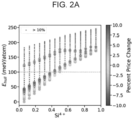
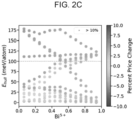
- FIGS. 2A-2D shows cases where the content of less expensive elements such as Si 4+ and Ca 2+ were optimized as to lower the total cost of Li 7 La 3-x ( A x1 B x2 C 1 x3 ) x Zr 2-y ( C 1 y1 D y2 E y3 )O 12 compared to the parent LLZO composition. It is observed that Si 4+ concentrations can reach an unprecedented concentration level up to ⁇ 0.5 while maintaining two keys properties: the cubic LLZO phase, and lowering the total cost compared to the LLZO parent structure.
- Table 1 below shows examples of some Si 4+ optimized compositions according to the embodiment.
- Table 1 Examples of Si 4+ optimized compositions Chemical System Chemical Formula Lattice[a b c]( ⁇ ) Volume ( ⁇ ) Density (g/cc) E hull (meV/atom) Si 4+ concentration % price change Di-La-Li-O-Si-Sr Sr15Li56La9Si(Bi5O32)3 [13.41 13.43 12.79] 2302.01 5.52 0.0 0.06 -3.35 La-Li-O-Si-Sn-Y Li56LaY23Si(Sn5O32)3 [12.8 12.8 12.32] 2018.42 4.87 42.71 0.06 8.13 La-Li-O-Si-Sn-Y Li56La2Y22Si(Sn5O32)3 [12.82 12.82 12.321 2024.38 4.89 41.53 0.06 7.74 La-Li-O-Si-Sn-Y Li56La3Y21Si(
- the exemplary structures consider Ca 2+ : 0.375 to 0.625, Sr 2+ : 0.375 to 0.625, La 3+ : 0.0416666666666664 to 0.9583333333333334, Y 3+ : 0.04166666666664 to 0.9583333333333334, Bi 5+ : 0.5625 to 0.9375, Si 4+ : 0.0625 to 0.4375, Sb 5+ : 0.5625 to 0.9375, and Sn 4+ : 0.5625 to 0.9375.
- an embodiment stabilizes derivatives of the cubic LLZO phase while maintaining nominal Li concentrations and lowering the total material cost by replacing La 3+ and Zr 4+ with elements of which the combination is less expensive than the parent LLZO composition.
- the strategic combination of one element or more of each oxidation state type strategically leads to a lower cost composition of the cubic LLZO composition, while maintaining the nominal concentration of Li (7 per formula unit).
- co-doping both La 3+ and Zr 4+ sites leads to an increased configurational entropy (S ideal ) which consequently increases the stability of phases historically known as unstable.
- examples of the Li-garnet material with dopants substituted for La 3+ and Zr 4+ were synthesized following the substitution rules in an embodiment, as described below.
- Table 2 A list of tested compositions and XRD results are included in Table 2 to demonstrate the results provided by the doping strategy in this material.
- the tested compositions included in Table 2 were prepared in the following manner.
- the compound Li 7 La 2.25 Ca 0.75 Zr 0.75 Ta 0.75 Si 0.5 O 12 in Example 1 was prepared using the precursor powders lithium carbonate, lanthanum hydroxide, calcium carbonate, zirconium oxide, tantalum oxide, and silicon oxide, mixed in a stoichiometric ratio with the addition of 30% excess lithium precursor to mitigate lithium evaporation during heat treatment.
- the precursor powders were then processed in a planetary mill at 350rpm for 24 hours using zirconia mixing balls.
- the precursor mixture was then heat treated at 1100°C for 4 hours to produce a powder of the desired composition and crystal structure.
- Example 2 and Comparative Examples 1 and 2 were prepared in a manner similar to that described above in Example 1, except that calcium carbonate and tantalum oxide were not used as precursor powders in the Comparative Examples,
- the synthesized materials were characterized via XRD to confirm the presence of the cubic garnet phase at room temperature, as well as SEM/EDS to confirm that the dopants have been incorporated into the parent structure.
- the results are shown in Table 2 below.
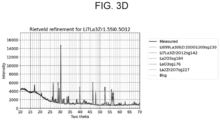
- XRD patterns with Rietveld refinement for Examples 1 and 2 and Comparative Examples 1 and 2 are shown in FIGS. 3A-3D , illustrating that co-doped samples have high purity of cubic LLZO, with Si content of up to 0.625 per formula unit, while samples where only the Zr 4+ site is doped at high Si 4+ concentration show very low purity.
- FIGS. 3A-3D XRD patterns with Rietveld refinement for Examples 1 and 2 and Comparative Examples 1 and 2 are shown in FIGS. 3A-3D , illustrating that co-doped samples have high purity of cubic LLZO, with Si content of up to 0.625 per formula unit, while samples where only the Zr 4+ site is doped at high Si 4+ concentration show very low
- FIG. 3A-3D show XRD results for the various samples, with Rietveld refinement fitting for cubic LLZO (blue), as follows.
- FIG. 3A shows a positive result: cubic LLZO with very high purity by co-doping (Example 1);
- FIG. 3B shows a positive result: cubic LLZO with high purity by co-doping (Example 2);
- FIG. 3C shows a negative result: low purity by only Si doping (Comparative Example 1); and
- FIG. 3D shows a negative result: very low purity by only Si doping (Comparative Example 2).
- Table 2 List of synthesized compositions, with XRD fitting results Sample ID Target composition XRD result Note Ex.
- Si substitution is desirable due to low cost, but substitution of Si for Zr is not usually possible due to high defect energy.
- configurational entropy effects due to multi-site doping improve stability, so that maximizing the Si content can be successfully carried out by the doping strategy, as shown in Table 2 above. That is, the experiments set forth above show that comparative examples with Si doping alone produced a very poor result, but Si doping was successful when done jointly with Ca + Ta doping, as shown in the examples. The experiments were done side-by-side with an identical procedure, other than the amounts of each precursor that was added. This strongly demonstrates that multi-site doping strategies applied simultaneously on the Zr and La sites via Ca + Ta dopants together with Si in this material provides superior results.
Landscapes
- Chemical & Material Sciences (AREA)
- Engineering & Computer Science (AREA)
- Manufacturing & Machinery (AREA)
- Organic Chemistry (AREA)
- Chemical Kinetics & Catalysis (AREA)
- Electrochemistry (AREA)
- General Chemical & Material Sciences (AREA)
- Ceramic Engineering (AREA)
- Inorganic Chemistry (AREA)
- General Physics & Mathematics (AREA)
- Condensed Matter Physics & Semiconductors (AREA)
- Physics & Mathematics (AREA)
- Materials Engineering (AREA)
- Structural Engineering (AREA)
- Battery Electrode And Active Subsutance (AREA)
- Secondary Cells (AREA)
Abstract
Description
- Materials according to embodiments relate to solid electrolyte materials for Li solid-state batteries.
- The fast development of portal electronics and electric vehicles has increased the demand for electrochemical energy storage systems. In the meantime, the related safety issues are gathering more attention.
- Due to their flammability and possible leakage, organic liquid electrolytes pose a safety risk in conventional Li-ion batteries. In this context, solid-state batteries (SSBs) are considered to be the next-generation batteries with improved safety and energy density.
- Solid-state lithium-ion conductors (SSLICs) with high ionic conductivities play an important role in SSBs. During the past two decades, there has been an increasing amount of discoveries on new SSLICs. Most of them are focused on sulfide SSLICs with high ionic conductivities. However, a very limited number of oxide materials were developed for SSBs, and so far, only lithium garnet is considered to be the oxide-type electrolyte for lithium SSBs.
- For solid-state electrolytes in SSBs, sulfide-based materials have high ionic conductivities (> 10 mS/cm), but are not really safe (H2S in air condition) and have limited electrochemical stability (for example, unstable against Li metal).
- Oxide SSLICs, which have better electrochemical and chemical stability than sulfide SSLICs, have been largely limited in garnet-type materials. The ionic conductivities of reported oxide SSLICs are generally lower than those of sulfide SSLICs.
- La in garnet material (Li7La3Zr2O12) is also rare in earth, heavy and expensive, compared to other elements (such as Sr, Strontium). In particular, La (lanthanum), which has a density of 6.145 kg/L, has an abundance in Earth's crust of 39 mg/kg (1.08 × 10¹⁸ kg), while Sr (strontium) , which has a density of 2.64 kg/L, has an abundance in Earth's crust of 370 mg/kg (1.025 × 10¹⁹ kg).
- Solid electrolyte materials with superionic conductivity and interfacial stability are desirable materials to form all-solid-state Li-metal batteries. A garnet-type lithium conductor is a promising solid electrolyte for the development of all-solid-state lithium ion batteries. For use as Li-ion conductors, the cubic Li-garnet Li7La3Zr2O12 is a desirable composition as its Li-ion conductivity is 2 orders of magnitude higher than its tetragonal counterpart phase. The cubic modification of the pure LLZO is known to not be stable at room temperature, and several doping strategies have previously been proposed to stabilize at room temperature. For example, the introduction of supervalant cations which cause the reduction of the Li+ content (Li+ vacancies) was initially proposed as a mechanism to form the cubic LLZO phase.
- In particular, some approaches include the following: (1) Ta-LLZO / Nb-LLZO: Li-garnet with cubic phase stabilized through substitution of Zr for Ta or Nb, inducing Li vacancies. Compositions include Li7-xLa3TaxZr2-xO12 and Li7-xLa3NbxZr2-xO12 with x~0.4. (2) Al-LLZO / Ga-LLZO: Li-garnet with cubic phase stabilized through substitution of Li for Al or Ga. Compositions include Li7-3xAlxLa3Zr2O12 and Li7-3xGaxLa3Zr2O12 with x~0.2. (3) Li7-3xM1xM2yM32-yM4O12, Ml: Al, M2: Nb, Ta, Sb, Bi, M3: Zr, M4: La.
- However, drawbacks of doping methods which induce Li vacancies include: decrease of attainable conductivity due to decreased Li content; Li-site dopants (e.g., Al3+, Fe3+, Ga3+) can decrease Li-ion conductivity by occupying sites used for Li-ion hopping; and higher cost of many elements used for substitutional doping.
- Thus, there is a need for improvement in the materials used as solid electrolytes for Li solid-state batteries.
- Information disclosed in this Background section has already been known to or derived by the inventors before or during the process of achieving the embodiments of the present application, or is technical information acquired in the process of achieving the embodiments. Therefore, it may contain information that does not form the prior art that is already known to the public.
- The disclosure provides materials used as solid electrolytes for Li solid-state batteries, according to embodiments.
- According to an embodiment, there is an approach which focuses on the development of new lithium garnet compositions where the introduction of multi-dopant species into the Zr4+ and La3+ sites of the Li7La3Zr2O12 (LLZO) material stabilizes derivatives of the cubic LLZO phase while maintaining nominal Li concentrations and lowering the total material cost by replacing La3+ and Zr4+ with elements of which the combination is less expensive than the parent LLZO composition.
- In an embodiment, new lithium garnet compositions with cubic phases are provided by co-doping the LLZO composition with A+ (Na+, K+), B2+ (Mg2+, Ca2+, Sr2+, Ba2+), C3+ (Y3+, Sc3+, Ce3+) on the La3+ site, and C3+ (Y3+, Sc3+, Ce3+), D4+ (Ce4+, Si4+, Sn4+, Ti4+), E5+ (Sb5+, Bi5+, Ta5+, Nb5+) on the Zr4+ site, wherein the strategic combination of one element of more of each oxidation state type strategically leads to a lower cost composition of the cubic LLZO composition, while maintaining the nominal concentration of Li (7 per formula unit). Furthermore, co-doping both La3+ and Zr4+ sites leads to an increased configurational entropy (Sideal) which consequently increases the stability of phases historically known as unstable.
- Embodiments demonstrate several approaches to optimize Li-garnet compositions through the co-doping of La3+ and Zr4+ sites of the LLZO material as to maximize the content of less expensive elements, such as Si4+ and Ca2+.
- Thus, an embodiment includes a lithium garnet material having the following formula:
Li7-wLa3-x(Ax1Bx2C1 x3)Zr2-y(C2 y1Dy2Ey3)O12
where -0.2 ≤ w ≤ 0.2, A is one or a combination of (Na+, K+), B is one or a combination of (Mg2+, Ca2+, Sr2+, Ba2+), C1 is one or a combination of (Y3+, Sc3+, Ce3+) on the La3+ site, and C2 is one or a combination of (Y3+, Sc3+, Ce3+), D is one or a combination of (Si4+, Sn4+, Ti4+, Ce4+), E is one or a combination of (Sb5+, Bi5+, Ta5+, Nb5+) on the Zr4+ site, 1 ≤ x < 3, 0 < y ≤ 2, and (x1 + x2 + x3 = x) and (y1 + y2 + y3 = y) either satisfy a charge balance mechanism with their respective doping site (La3+, Zr4+, respectively), or satisfy any combination that maintains the charge neutrality of the material. - Another embodiment includes a lithium garnet material having the following formula:
Li7-wLa3-x(Ax1Bx2C1 x3)Zr2-y(C2 y1Dy2Ey3)O12
where -0.2 ≤ w ≤ 0.2, A is one or a combination of (Na+, K+), B is one or a combination of (Mg2+, Ca2+, Sr2+, Ba2+), C1 is one or a combination of (Y3+, Sc3+, Ce3+) on the La3+ site, and C2 is one or a combination of (Y3+, Sc3+, Ce3+), D is one or a combination of (Si4+, Sn4+, Ti4+, Ce4+), E is one or a combination of (Sb5+, Bi5+, Ta5+, Nb5+) on the Zr4+ site, 0.2 < x < 3, 0 < y ≤ 2, and (x1 + x2 + x3 = x) and (y1 + y2 + y3 = y) either satisfy a charge balance mechanism with their respective doping site (La3+, Zr4+, respectively), or satisfy any combination that maintains the charge neutrality of the material. - Another embodiment includes the aforementioned lithium garnet material, wherein 0.2 < x ≤ 2 and 0 < y ≤ 2.
- Another embodiment includes the aforementioned lithium garnet material, wherein y2 > 0.
- Another embodiment includes the aforementioned lithium garnet material, wherein the material comprises Si4+ and at least one of Ca2+, Sr2+, and Bi5+.
- Another embodiment includes the aforementioned lithium garnet material, wherein the material comprises Si4+ and Ca2+.
- Another embodiment includes the aforementioned lithium garnet material, wherein the material comprises Si4+ and Sr2+.
- Another embodiment includes the aforementioned lithium garnet material, wherein the material comprises Si4+ and Bi5+.
- Another embodiment includes the aforementioned lithium garnet material, wherein the material comprises Si4+, Bi5+, and at least one of Ca2+and Sr2+.
- Another embodiment is a solid state lithium battery comprising a cathode active material layer, an anode active material layer, and a solid electrolyte layer formed between the cathode active material layer and the anode active material layer, wherein the solid electrolyte layer comprises any of the aforementioned materials.
- Example embodiments of the inventive concept will be more clearly understood from the following detailed description taken in conjunction with the accompanying drawings in which:
-
FIG. 1 shows the distribution of Sideal (meV/atom) in compounds where only Zr4+ is doped with at most 4 species (labeled as single site doping) and the distribution of S ideal (meV/atom) where La3+ and Zr4+ are co-doped (labeled as multi-site doping) with at least 2 species on each site Li7-wLa3-x(Ax1Bx2C1 x3)Zr2-y(C2 y1Dy2Ey3)O12. -
FIG. 2A shows the optimization of low-cost Li7-wLa3-x(Ax1Bx2C1 x3)Zr2-y(C2 y1Dy2Ey3)O12 where the composition's content is tailored as to introduce the lower cost element Si4+,FIG. 2B shows the optimization of low-cost Li7-wLa3-x(Ax1Bx2C1 x3)Zr2-y(C2 y1Dy2Ey3)O12 where the composition's content is tailored as to introduce the lower cost element Ca2+,FIG. 2C shows the optimization of low-cost Li7-wLa3-x(Ax1Bx2C1 x3)Zr2-y(C2 y1Dy2Ey3)O12 where the composition's content is tailored as to introduce the lower cost element Bi5+, andFIG. 2D shows the optimization of low-cost Li7-wLa3-x(Ax1Bx2C1 x3)Zr2-y(C2 y1Dy2Ey3)O12 where the composition's content is tailored as to introduce the lower cost element Sr2+. -
FIG. 3A is an XRD pattern with Rietveld refinement for Example 1;FIG. 3B is an XRD pattern with Rietveld refinement for Example 2;FIG. 3C is an XRD pattern with Rietveld refinement for Comparative Example 1; andFIG. 3D is an XRD pattern with Rietveld refinement for Comparative Example 2. - The embodiments of the disclosure described herein are example embodiments, and thus, the disclosure is not limited thereto, and may be realized in various other forms. Each of the embodiments provided in the following description is not excluded from being associated with one or more features of another example or another embodiment also provided herein or not provided herein but consistent with the disclosure. For example, even if matters described in a specific example or embodiment are not described in a different example or embodiment thereto, the matters may be understood as being related to or combined with the different example or embodiment, unless otherwise mentioned in descriptions thereof. In addition, it should be understood that all descriptions of principles, aspects, examples, and embodiments of the disclosure are intended to encompass structural and functional equivalents thereof. In addition, these equivalents should be understood as including not only currently well-known equivalents but also equivalents to be developed in the future.
- As used herein, expressions such as "at least one of," when preceding a list of elements, modify the entire list of elements and do not modify the individual elements of the list. For example, the expression, "at least one of a, b and c," should be understood as including only a, only b, only c, both a and b, both a and c, both b and c, or all of a, b and c..
- Embodiments include novel doping strategies of the parent structure LLZO of the form Li7-wLa3-x(A x1 B x2 C1 x3)Zr2-y(C2 y1 D y2 E y3)O12, where -0.2 ≤ w ≤ 0.2, A can be one or a combination of (Na+, K+), B can be one or a combination of (Mg2+, Ca2+, Sr2+, Ba2+), C1 can be one or a combination of (Y3+, Sc3+ , Ce3+) on the La3+ site, and C2 can be one or a combination of (Y3+, Sc3+ , Ce3+), D can be one or a combination of (Si4+, Sn4+, Ti4+, Ce4+), E can be one or a combination of (Sb5+, Bi5+, Ta5+, Nb5+) on the Zr4+ site. The multi-cation co-doping of both La3+ and Zr4+ increases the configurational entropy (i.e., ~100 meV/atom when, e.g., 1 ≤ x1 + x2 + x3 = x < 3; 0 < y1 + y2 + y3 = y ≤ 2) and therefore aids the stabilization of phases with higher concentrations of Si4+, hence lowering the total cost of the Li garnet compositions.
- Benefits of the multi-cation co-doping substitutions of La3+ and Zr4+ include: increasing the total configurational entropy of the phases and hence stabilizing higher concentrations of elements previously deemed as unstable; providing multiple design strategies to minimize the total cost of cubic Li garnet derivatives LLZO phases; maximizing the resistance to electrochemical decomposition through the insertion of a diverse set of species of different oxidation states and sizes which lead to a substantial increase of configurational entropy; and reducing the reduction potential against Li metal, therefore increasing Li stability in solid-state batteries.
- The materials in embodiments include those which maximize the total configurational entropy, minimize the total cost of the material, and maintain a cubic phase LLZO phase:
Li7-wLa3-x(Ax1Bx2C1 x3)Zr2-y(C2 y1Dy2Ey3)O12
where -0.2 ≤ w ≤ 0.2, A can be one or a combination of (Na+, K+), B can be one or a combination of (Mg2+, Ca2+, Sr2+, Ba2+), C1 can be one or a combination of (Y3+, Sc3+, Ce3+) on the La3+ site, and C2 can be one or a combination of (Y3+, Sc3+ , Ce3+), D can be one or a combination of (Si4+, Sn4+, Ti4+, Ce4+), E can be one or a combination of (Sb5+, Bi5+, Ta5+, Nb5+) on the Zr4+ site, 1 ≤ x < 3, 0 < y ≤ 2, and (x1 + x2 + x3 = x) and (y1 + y2 + y3 = y) can either satisfy a charge balance mechanism with their respective doping site (La3+, Zr4+, respectively), or satisfy any combination that maintains the charge neutrality of the overall composition. - The materials in embodiments adopt the cubic LLZO phase, and enable specific chemical, structural, and stoichiometric requirements to achieve low-cost multi-cationic Li-garnet as a solid-state ionic conductor for lithium batteries.
- Also, the materials in embodiments include novel doping strategies of the parent structure LLZO of the form:
Li7-wLa3-x(Ax1Bx2C1 x3)Zr2-y(C2 y1Dy2Ey3)O12
where -0.2 ≤ w ≤ 0.2, A can be one or a combination of (Na+, K+), B can be one or a combination of (Mg2+, Ca2+, Sr2+, Ba2+), C1 can be one or a combination of (Y3+, Sc3+, Ce3+) on the La3+ site, and C2 can be one or a combination of (Y3+, Sc3+ , Ce3+), D can be one or a combination of (Si4+, Sn4+, Ti4+, Ce4+), E can be one or a combination of (Sb5+, Bi5+, Ta5+, Nb5+) on the Zr4+ site, 0.2 < x < 3, 0 < y ≤ 2, and (x1 + x2 + x3 = x) and (y1 + y2 + y3 = y) can either satisfy a charge balance mechanism with their respective doping site (La3+, Zr4+, respectively), or satisfy any combination that maintains the charge neutrality of the overall composition. - In this regard, the multi-cation co-doping of both La3+ and Zr4+ increases the configurational entropy (e.g., -100 meV/atom when 0.2 < x1 + x2 + x3 = x < 3, 0 < y1 + y2 + y3 = y ≤ 2), which maximizes the stabilization of previously known unstable cations at unprecedented concentrations.
- Another embodiment includes values for x and y where 0.2 < x ≤ 2 and 0 < y ≤ 2, and yet another embodiment includes y2 > 0.
- Another embodiment includes a material which comprises Si4+ and at least one of Ca2+, Sr2+, and Bi5+. For example, an embodiment includes a material which comprises Si4+ and Ca2+. As another example, an embodiment includes a material which comprises Si4+ and Sr2+. As another example, an embodiment includes a material which comprises Si4+ and Bi5+. As another example, an embodiment includes a material which comprises Si4+, Bi5+, and at least one of Ca2+and Sr2+.
- A preferred embodiment includes a material in which B comprises Ca2+. Another preferred another embodiment includes a material in which E comprises Ta5+. A more preferred embodiment includes a material in which D comprises Si4+, wherein the material further comprises at least one co-dopant. For example, a more preferred embodiment includes a material in which B comprises Ca2+ and D comprises Si4+. Another more preferred embodiment includes a material in which B comprises Ca2+ and E comprises Ta5+. A particularly preferred embodiment includes a material in which B comprises Ca2+, D comprises Si4+, and E comprises Ta5+.
- Also, an embodiment includes 0 ≤ x1 < 3, 0 ≤ x2 < 3, 0 ≤ x3 < 3, 0 ≤ y1 ≤ 2, 0 ≤ y2 ≤ 2, and 0 ≤ y3 ≤ 2, as long as 0.2 < x1 + x2 + x3 < 3 and 0 < y1 + y2 + y3 ≤ 2. In addition, an embodiment includes 0 ≤ x1 < 3, 0 ≤ x2 < 3, 0 ≤ x3 < 3, 0 ≤ y1 ≤ 2, 0 ≤ y2 ≤ 2, and 0 ≤ y3 ≤ 2, as long as 1 ≤ x1 + x2 + x3 < 3 and 0 < y1 + y2 + y3 ≤ 2. A preferred embodiment includes 0 < x2 ≤ 0.75, 0 < y2 ≤ 0.5, and 0 < y3 ≤ 0.75. Another preferred embodiment includes 0 < x2 ≤ 0.5, 0 < y2 ≤ 0.625, and 0 < y3 ≤ 0.5.
- Embodiments of the lithium garnet material can be made using a standard solid-state method. In this method, precursor powders are combined in a certain ratio depending on the composition of the target material. In a typical preparation, precursors may consist of lithium carbonate, lanthanum hydroxide, zirconium oxide, and at least one precursor containing each of the included metals from A, B, C1, C2, D, and E. Examples of metal precursors include metal oxides, hydroxides, carbonates, and nitrates.
- The precursor mixture may be mixed by a method such as ball milling or planetary milling to produce a homogeneous mixture. Mixing may be done with a suitable solvent such as ethanol, isopropanol, ethylene glycol, or acetone to assist with the uniform dispersion of the precursors.
- The precursor mixture may then be heat treated to a temperature of 600C-1100C, for a period of 1 hour to 48 hours to produce an oxide powder with the desired composition and crystal structure.
- Subsequently the oxide powder may be compressed using a hydraulic uniaxial press to form a densely packed pellet. Heat treatment may then be applied at a temperature of about 900°C-1500°C for 1 hour to 48 hours to produce a dense pellet which may be used as a solid electrolyte separator in a solid state lithium battery cell.
- For instance, the calcined powder may be formed into a pellet through application of uniaxial pressure of 100-500MPa. The pellet may then be heat treated at 1200°C for 2 hours to form a dense sintered solid electrolyte separator suitable for use in a lithium battery cell.
- As an example of making a battery full cell using a garnet solid electrolyte and a Li-metal anode, an ionic liquid electrolyte can be used as the cathode electrolyte (catholyte) and a garnet oxide electrolyte can be used as the Li-metal anode electrolyte, (anolyte). First, 20-µm-thick Li metal on 10-µm-thick Cu foil (Honjo Metal Co., Ltd.) can be attached to the protonated surface of the LLZO pellet by cold-isostatic pressing at 250 MPa. A commercially available NCM111 electrode (loading capacity: 3.2 g cm-3, active material: 93 wt%; Samsung SDI) can be coated onto Al foil as the cathode. The ionic liquid Pyrl3FSI (Kanto Chemical Co. Inc.) can be mixed with LiFSI salt (2M) to prepare the catholyte. The mixed solution can be dropped onto the cathode and then infiltrated into the cathode under a vacuum for 2 h. The infiltrated amount of ionic liquid can be 20 wt% relative to the cathode weight. The infiltrated cathode can be placed on the other side of the LLZO pellet in a 2032-coin cell. To eliminate the possibility of direct contact between the ionic liquid and Li-metal, a relatively small cathode (0.4 cm in diameter) can be used for the hybrid electrolyte cell. Finally, the cell can be sealed under a vacuum using a pouch cell.
- A 110 micrometer pellet of LLZO (garnet) can be used. An even thinner pellet can desirably be made by a method like tape casting, down to 20 micrometer. The garnet electrolyte can have a thickness in the range of 20-150 micrometers. Another thickness range for the garnet electrolyte is 20-110 micrometers.
- An embodiment of the aforementioned materials can be assembled together with a cathode active material layer and an anode active material layer to be used in an embodiment which is a solid state lithium battery comprising a cathode active material layer, an anode active material layer, and a solid electrolyte layer formed between the cathode active material layer and the anode active material layer, wherein the solid electrolyte layer comprises any of the aforementioned materials.
- Embodiments will now be illustrated by way of the following examples, which do not limit the embodiments in any way.
- Using high-throughput density functional theory (DFT) calculations, a large amount of chemical strategies covering all relevant Li7-wLa3-x(Ax1Bx2C1 x3)Zr2-y(C2 y1Dy2Ey3)O12 compositions was investigated. The phase stability of predicted materials was estimated by calculating the energy above the linear combination of stable phases in the first principle phase diagram, also known as the energy above hull (E hull). For phase diagram construction, the energies of all compounds other than those of direct interest in this work were obtained from the Materials Project using the Materials Project Application Programming Interface (API). To assert a threshold value beyond which predicted materials in Li7-wLa3-x(Ax1Bx2C1 x3)Zr2-y(C2 y1Dy2Ey3)O12 are deemed unstable, the ideal configurational entropy (Sideal = -K bΣ ipi ln pi ) is computed, where K b is the Boltzmann constant, pi is the probability of each state (occupied or unoccupied) and the sum is over all states for each site.
FIG. 1 shows the distribution of S ideal in Li7-wLa3-x(Ax1Bx2C1 x3)Zr2-y(C2 y1Dy2Ey3)O12 where it is observed that the distribution is mainly centered around roughly 100 meV/atom. In comparison, the distribution of S ideal in compositions where only the Zr4+ site is doped with at most 4 species is observed to be centered around 50 meV/atom. This supports a key contention that co-doping both Zr4+ and La3+leads to an increased configurational entropy and hence facilitates the synthesis of phases with elements previously deemed as unstable. That is, an increased configurational entropy leads to stabilization of higher E hull phases. -
FIGS. 2A-2D shows cases where the content of less expensive elements such as Si4+ and Ca2+ were optimized as to lower the total cost of Li7La3-x(A x1 B x2 C1 x3)xZr2-y(C1 y1 D y2 E y3)O12 compared to the parent LLZO composition. It is observed that Si4+ concentrations can reach an unprecedented concentration level up to ~ 0.5 while maintaining two keys properties: the cubic LLZO phase, and lowering the total cost compared to the LLZO parent structure. - Table 1 below shows examples of some Si4+ optimized compositions according to the embodiment.
Table 1: Examples of Si4+ optimized compositions Chemical System Chemical Formula Lattice[a b c](Å) Volume (Å) Density (g/cc) E hull (meV/atom) Si4+ concentration % price change Di-La-Li-O-Si-Sr Sr15Li56La9Si(Bi5O32)3 [13.41 13.43 12.79] 2302.01 5.52 0.0 0.06 -3.35 La-Li-O-Si-Sn-Y Li56LaY23Si(Sn5O32)3 [12.8 12.8 12.32] 2018.42 4.87 42.71 0.06 8.13 La-Li-O-Si-Sn-Y Li56La2Y22Si(Sn5O32)3 [12.82 12.82 12.321 2024.38 4.89 41.53 0.06 7.74 La-Li-O-Si-Sn-Y Li56La3Y21Si(Sn5O32)3 [12.83 12.83 12.341 2031.92 4.92 40.11 0.06 7.34 La-Li-O-Si-Sn-Y Li56La4Y20Si(Sn5O32)3 [12.85 12.85 12.35] 2039.48 4.94 38.56 0.06 6.95 La-Li-O-Si-Sn-Y Li56La5Y19Si(Sn5O32)3 [12.87 12.87 12.36] 2047.39 4.96 37.5 0.06 6.55 La-Li-O-Si-Sn-Y Li56La7Y17Si(Sn5O32)3 [12.9 12.9 12.39] 2061.82 5.01 34.26 0.06 5.76 La-Li-O-Si-Sn-Y Li56La8Y16Si(Sn5O32)3 [12.92 12.92 12.39] 2068.32 5.03 33.0 0.06 5.36 La-Li-O-Si-Sn-Y Li56La9Y15Si(Sn5O32)3 [12.94 12.93 12.41] 2077.19 5.05 32.42 0.06 4.97 La-Li-O-Si-Sn-Y Li56La10Y14Si(Sn5O32)3 [12.96 12.94 12.43] 2084.55 5.07 31.02 0.06 4.57 La-Li-O-Si-Sn-Y Li56La11Y13Si(Sn5O32)3 [13. 12.95 12.43] 2092.45 5.09 30.65 0.06 4.18 La-Li-O-Si-Sn-Y Li56La12Y12Si(Sn5O32)3 [13. 12.97 12.44] 2098.81 5.12 29.8 0.06 3.78 La-Li-O-Si-Sn-Y Li56La13Y11Si(Sn5O32)3 [13.03 12.98 12.46] 2107.2 5.14 28.69 0.06 3.39 La-Li-O-Si-Sn-Y Li56La14Y10Si(Sn5O32)3 [13.04 13.01 12.47] 2115.6 5.15 27.75 0.06 2.99 La-Li-O-Si-Sn-Y Li56La 15Y9Si(Sn5O32)3 [13.05 13.04 12.48] 2123.19 5.18 27.1 0.06 2.59 La-Li-O-Si-Sn-Y Li56La6Y18Si(Sn5O32)3 [12.8912.8912.37] 2054.43 4.98 35.92 0.06 6.15 Bi-Ca-La-Li-O-Si Li56Ca15La9Si(Bi5O32)3 [13.19 13.26 12.64] 2211.36 5.21 12.23 0.06 -3.24 La-Li-O-Si-Sn-Y Li56La23YSi(Sn5O32)3 [13.18 13.17 12.57] 2182.9 5.34 17.23 0.06 -0.57 La-Li-O-Sb-Si-Sr Sr151Li56La9Si(Sb5O32)3 [13.21 13.25 12.521 2191.36 4.81 7.46 0.06 -4.05 La-Li-O-Si-Sn-Y Li56La22Y2Si(Sn5O32)3 [13.18 13.14 12.57] 2176.38 5.52 18.69 0.06 -0.17 Ca-La-Li-O-Sb-Si Li56Ca15La9Si(Sb5O32)3 [12.9913.0712.36] 2098.44 4.46 15.93 0.06 -3.94 La-Li-O-Si-Sn-Y Li56La20Y4Si(Sn5O32)3 113.14 13.11 12.54] 2160.66 5.28 21.15 0.06 0.62 La-Li-O-Si-Sn-Y Li56La19Y5Si(Sn5O32)3 [13.12 13.11 12.531 2153.71 5.26 22.55 0.06 1.01 La-Li-O-Si-Sn-Y Li56La21Y3Si(Sn5O32)3 [13.1713.1312.55] 2169.33 5.29 20.31 0.06 0.22 La-Li-O-Si-Sn-Y Li56La18Y6Si(Sn5O32)3 [13.11 13.08 12.51] 2145.08 5.24 23.9 0.06 1.41 La-Li-O-Si-Sn-Y Li56La17Y7Si(Sn5O32)3 [13.1 13.06 12.5] 213R.63 5.22 25.18 0.06 1.8 La-Li-O-Si-Sn-Y Li56La16Y8Si(Sn5O32)3 [13.0713.0412.49] 2130.19 5.2 25.79 0.06 2.2 La-Li-O-Si-Sn-Y Li56LaY23Si2(Sn7O48)2 [12.76 12.77 12.29] 2003.28 4.83 53.43 0.12 7.88 La-Li-O-Si-Sn-Y Li28La3Y9SiSn7O48 [12.8612.8612.34] 2040.36 4.95 47.06 0.12 5.9 La-Li-O-Si-Sn-Y Li56La5Y19Si2(Sn7O48)2 [12.94 12.84 12.32] 2032.34 4.92 48.8 0.12 6.29 La-Li-O-Si-Sn-Y Li56La7Y17Si2(Sn7O48)2 [12.86 12.87 12.35] 2044.44 4.98 45.4 0.12 5.5 La-Li-O-Si-Sn-Y Li28La4Y8SiSn7O48 [12.8912.8912.36] 2053.9 4.99 44.15 0.12 5.11 La-Li-O-Si-Sn-Y Li28La2Y10SiSn7O48 [12.82 12.82 12.32] 2024.32 4.9 49.56 0.12 6.69 La-Li-O-Si-Sn-Y Li56La9Y15Si2(Sn7O48)2 [12.91 12.9 12.38] 2061.96 5.01 43.45 0.12 4.71 La-Li-O-Si-Sn-Y Li28La5Y7SiSn7O48 [12.93 12.9 12.38] 2065.72 5.05 42.54 0.12 4.32 La-Li-O-Si-Sn-Y Li56La11Y13Si2(Sn7O48)2 [12.96 12.92 12.4] 2077.53 5.06 42.17 0.12 3.92 Bi-La-Li-O-Si-Sr Sr7Li28La5SiBi7O48 [13.37 13.4 12.74] 2282.56 5.47 10.98 0.12 -3.45 La-Li-O-Si-Sn-Y Li28La6Y6SiSn7O48 [12.97 12.95 12.41] 2084.1 5.08 40.95 0.12 3.53 La-Li-O-Si-Sn-Y Li28LaY11SiSn7O48 [12.78 12.79 12.29] 2009.22 4.86 52.16 0.12 7.48 La-Li-O-Si-Sn-Y Li56La13Y11Si2(Sn7O48)2 [13. 12.96 12.43] 2092.6 5.1 40.32 0.12 3.13 Bi-Ca-La-Li-O-Si Li28Ca7La5SiBi7O48 [13.16 13.24 12.61] 2197.59 5.18 25.96 0.12 -3.34 La-Li-O-Si-Sn-Y Li56La3Y21Si2(Sn7048)2 [12.8 12.81 12.3 1 2016.53 4.88 50.79 0.12 7.09 La-Li-O-Si-Sn-Y Li28La7Y5SiSn7048 [13.01 12.98 12.44] 2100.9 5.12 38.88 0.12 2.73 La-Li-O-Si-Sn-Y Li56La15Y9Si2(Sn7O48)2 [13.02 13.01 12.45] 2108.04 5.14 38.29 0.12 2.34 Ca-La-Li-O-Sb-Si Li28Ca7La5SiSb7O48 [12.98 13.05 12.35] 2091.76 4.47 29.19 0.12 -3.99 La-Li-O-Si-Sn-Y Li28La8Y4SiSn7O48 [13.05 13.02 12.46] 2116.18 5.16 37.14 0.12 1.94 La-Li-O-Si-Sn-Y Li56La23YSi2(Sn7O48)2 [13.16 13.14 12.54] 2169.73 5.3 29.24 0.12 -0.83 La-Li-O-Si-Sn-Y Li56La17Y7Si2(Sn7O48)2 [13.0713.0312.47] 2124.37 5.18 36.36 0.12 1.55 La-Li-O-Si-Sn-Y Li28La11YSiSn7O48 [13.15 13.12 12.53] 2161.88 5.28 30.58 0.12 -0.43 La-Li-O-Si-Sn-Y Li28La9Y3SiSn7O48 [13.08 13.05 12.48] 2130.98 5.2 35.47 0.12 1.15 La-Li-O-Sb-Si-Sr Sr7Li28La5SiSb7O48 [13.18 13.22 12.48] 2175.62 4.81 21.36 0.12 -4.1 La-Li-O-Si-Sn-Y Li56La21Y3Si2(Sn7O48)2 [13.14 13.1 12.52] 2155.38 5.26 31.83 0.12 -0.03 La-Li-O-Si-Sn-Y Li56La19Y5Si2(Sn7O48)2 [13.1 13.08 12.5 ] 2140.54 5.22 33.93 0.12 0.76 La-Li-O-Si-Sn-Y Li28La10Y2SiSn7O48 [13.11 13.09 12.5] 2146.31 5.24 33.92 0.12 0.36 La-Li-O-Si-Sn-Y Li56La13Y11Si3Sn13O96 [12.97 12.93 12.4] 2079.38 5.06 51.57 0.19 2.87 La-Li-O-Si-Sn-Y Li56La12Y12Si3Sn13O96 [12.95 12.92 12.38] 2070.41 5.04 52.87 0.19 3.27 La-Li-O-Si-Sn-Y Li56La11Y13Si3Sn13O96 [12.93 12.89 12.37] 2063.15 5.02 53.47 0.19 3.67 La-Li-O-Si-Sn-Y Li56La3Y21Si3Sn13O96 [12.77 12.78 12.27] 2001.99 4.84 61.96 0.19 6.83 La-Li-O-Si-Sn-Y Li56LaY23Si3Sn13O96 [12.75 12.75 12.25] 1989.77 4.79 64.29 0.19 7.62 La-Li-O-Si-Sn-Y Li56La4Y20Si3Sn13O96 [12.79 12.8 12.281 2009.59 4.86 60.76 0.19 6.43 La-Li-O-Si-Sn-Y Li56La14Y10Si3Sn13O96 [12.9812.9512.41] 2086.72 5.08 50.79 0.19 2.48 La-Li-O-Si-Sn-Y Li56La8Y16Si3Sn13O96 [12.86 12.86 12.32] 2038.03 4.96 56.06 0.19 4.85 La-Li-O-Si-Sn-Y Li56La7Y17Si3Sn13O96 [12.84 12.85 12.32] 2031.77 4.93 56.76 0.19 5.25 La-Li-O-Si-Sn-Y Li56La6Y18Si3Sn13O96 [12.82 12.83 12.3 1 2023.51 4.91 58.89 0.19 5.64 La-Li-O-Si-Sn-Y Li56La5Y19Si3Sn13O96 [12.8 12.81 12.29] 2016.09 4.89 59.33 0.19 6.04 La-Li-O-Si-Sn-Y Li56La10Y14Si3Sn13O96 [12.91 12.88 12.36] 2055.9 5.0 53.64 0.19 4.06 La-Li-O-Si-Sn-Y Li56La9Y15Si3Sn13O96 [12.88 12.87 12.34] 2046.03 4.98 54.76 0.19 4.46 Ca-La-Li-O-Sb-Si Li56Ca13La11Si3Sb13O96 [13.04 12.96 12.33] 2084.41 4.49 41.71 0.19 -4.05 La-Li-O-Si-Sn-Y Li56La16Y8Si3Sn13O96 [13.02 12.99 12.43] 2102.66 5.12 49.1 0.19 1.69 Bi-La-Li-O-Si-Sr Sr13Li56La11Si3Bi13O96 [13.33 13.38 12.68] 2261.4 5.43 26.79 0.19 -3.54 La-Li-O-Sb-Si-Sr Sr13Li56La11Si3Sb13O96 [13.18 13.18 12.43] 2161.07 4.81 34.38 0.19 -4.15 Bi-Ca-La-Li-O-Si Li56Ca13La11Si3Bi13O96 [13.2113.16 12.58] 2186.68 5.14 39.82 0.19 -3.45 La-Li-O-Si-Sn-Y Li56La23YSi3Sn13O96 [13.14 13.1112.51] 2155.33 5.27 41.49 0.19 -1.08 La-Li-O-Si-Sn-Y Li56La15Y9Si3Sn13O96 [12.99 12.97 12.42] 2092.81 5.11 50.1 0.19 2.08 La-Li-O-Si-Sn-Y Li56La22Y2Si3Sn13O96 [13.13 13.09 12.5 ] 2147.52 5.25 42.38 0.19 -0.69 La-Li-O-Si-Sn-Y LiS6La21 Y3 Si3Sn 13096 [13.12 13.07 12.49] 2141.04 5.22 43.66 0.19 -0.29 La-Li-O-Si-Sn-Y Li56La2Y22Si3Sn13O96 [12.7512.7612.26] 1995.41 4.81 63.0 0.19 7.23 La-Li-O-Si-Sn-Y Li56La20Y4Si3Sn13O96 [13.09 13.06 12.47] 2131.97 5.21 45.03 0.19 0.11 La-Li-O-Si-Sn-Y Li561La17Y7Si3Sn13O96 [13.0413. 12.44] 2108.96 5.15 48.35 0.19 1.29 La-Li-O-Si-Sn-Y Li56La19Y5Si3Sn13O96 [13.07 13.05 12.46] 2125.19 5.19 46.13 0.19 0.5 La-Li-O-Si-Sn-Y Li56La18Y6Si3Sn13O96 [13.06 13.02 12.46] 2117.86 5.16 47,13 0.19 0.9 La-Li-O-Si-Sn-Y Li56La13Y11Si4(SnO8)12 [12.9412.9 12.37] 2065.78 5.02 63.62 0.25 2.62 La-Li-O-Si-Sn-Y Li14La3Y3Si(SnO8)3 [12.92 12.89 12.36] 2057.62 5.0 64.12 0.25 3.01 La-Li-O-Si-Sn-Y Li28LaY11Si2(SnO8)6 [12.72 12.73 12.23] 1980.84 4.77 73.42 0.25 6.97 La-Li-O-Si-Sn-Y Li56La3Y21Si4(SnO8)12 [12.74 12.75 12.24] 1987.89 4.8 72.85 0.25 6.57 La-Li-O-Si-Sn-Y Li56LaY23Si4(SnO8)12 [12.7 12.71 12.21] 1971.83 4.75 74.71 0.25 7.37 La-Li-O-Si-Sn-Y Li14LaY5Si(SnO8)3 [12.76 12.77 12.25] 1995.61 4.82 72.4 0.25 6.18 La-Li-O-Si-Sn-Y Li56La5Y19Si4(SnO8)12 [12.78 12.79 12.26] 2003.07 4.85 70.77 0.25 5.78 La-Li-O-Si-Sn-Y Li56La11Y13Si4(SnO8)12 [12.9 12.87 12.34] 2049.16 4.98 65.39 0.25 3.41 La-Li-O-Si-Sn-Y Li56La9Y15Si4(SnO8)12 [12.85 12.85 12.31] 2033.51 4.94 66.39 0.25 4.2 La-Li-O-Si-Sn-Y Li14La2Y4Si(SnO8)3 [12.82 12.83 12.3 ] 2024.22 4.92 66.47 0.25 4.6 La-Li-O-Si-Sn-Y Li56La7Y17Si4(SnO8)12 [12.81 12.82 12.29] 2016.76 4.9 68.2 0.25 4.99 La-Li-O-Si-Sn-Y Li28La3Y9Si2(SnO8)6 [12.79 12.8 12.27] 2009.3 4.87 69.61 0.25 5.39 La-Li-O-Si-Sn-Y Li28La5Y7Si2(SnO8)6 [12.88 12.86 12.33] 2040.85 4.96 65.34 0.25 3.81 La-Li-O-Si-Sn-Y Li28La7Y5Si2(SnO8)6 [12.95 12.93 12.38] 2071.95 5.05 63.17 0.25 2.22 La-Li-O-Si-Sn-Y LI14La4Y2SI(SnO8)3 [12.99 12.96 12.4 1 2087.79 5.09 60.87 0.2.5 1.43 La-Li-O-Si-Sn-Y Li56La15Y9Si4(SnO8)12 [12.96 12.95 12.39] 2079.47 5.07 61.71 0.25 1.83 La-Li-O-Si-Sn-Y Li56La23YSi4(SnO8)12 [13.11 13.08 12.48] 2141.41 5.23 53.11 0.25 -1.34 Bi-Ca-La-Li-O-Si Li14Ca3La3Si(BiO8)3 [13.1513.1512.55] 2170.91 5.12 53.4 0.25 -3.55 Ca-La-Li-O-Sb-Si Li14Ca3La3Si(SbO8)3 [13.0112.97 12.31] 2077.33 4.51 54.05 0.25 -4.11 La-Li-O-Si-Sn-Y Li28La11YSi2(SnO8)6 [13.1 13.06 12.46] 2131.95 5.21 55.15 0.25 -0.94 Bi-La-Li-O-Si-Sr Sr3Li14La3Si(Bi08)3 [13.27 13.36 12.64] 2240.83 5.38 41.26 0.25 -3.64 La-Li-O-Si-Sn-Y Li56La21Y3Si4(SnO8)12 [13.09 13.04 12.46] 2126.34 5.19 55.9 0.25 -0.55 La-Li-O-Si-Sn-Y Li14La5YSi(SnO8)3 [13.07 13.03 12.45] 2118.91 5.17 56.96 0.25 -0.15 La-Li-O-Sb-Si-Sr Sr3Li14La3Si(SbO8)3 [13.14 13.17 12.41] 2146.04 4.81 47.61 0.25 -4.2 La-Li-O-Si-Sn-Y Li56La19Y5Si4(SnO8)12 [13.0413.0212.44] 2110.99 5.15 58.25 0.25 0.25 La-Li-O-Si-Sn-Y Li28La9Y3Si2(SnO8)6 [13.03 13. 12.43] 2105.1 5.12 59.11 0.25 0.64 La-Li-O-Si-Sn-Y Li56La17Y7Si4(SnO8)12 [13.02 12.96 12.41] 2094.79 5.11 60.1 0.25 1.04 La-Li-O-Sb-Si-Sr Sr11Li56La13Si5Sb11O96 [13.1 13.14 12.371 2130.28 4.81 62.09 0.31 -4.25 La-Li-O-Si-Sn-Y Li56La6Y18Si5Sn11O96 [12.76 12.77 12.24] 1994.62 4.83 79.91 0.31 5.13 La-Li-O-Si-Sn-Y Li56La3Y21Si5Sn 11096 [12.71 12.72 12.2 1 1973.34 4.76 83.36 0.31 6.32 La-Li-O-Si-Sn-Y Li56La8Y16Si5Sn11O96 [12.8 12.81 12.25] 2009.15 4.88 78.63 0.31 4.34 La-Li-O-Si-Sn-Y Li56La9Y15Si5Sn111O96 [12.82 12.82 12.27] 2016.66 4.9 77.7 0.31 3.95 La-Li-O-Si-Sn-Y Li56La2Y22Si5Sn11O96 [12.69 12.7 12.19] 1963.93 4.74 84.02 0.31 6.71 La-Li-O-Si-Sn-Y Li56La10Y14Si5Sn11O96 [12.85 12.83 12.29] 2027.53 4.92 76.0 0.31 3.55 La-Li-O-Si-Sn-Y Li56La11Y13Si5Sn11O96 [12.87 12.84 12.3 1 2033.11 4.95 76.66 0.31 3.15 La-Li-O-Si-Sn-Y Li56La12Y12Si5Sn11O96 [12.89 12.87 12.32] 2042.36 4.96 75.68 0.31 2.76 La-Li-O-Si-Sn-Y Li56La13Y11Si5Sn11O96 [12.91 12.88 12.33] 2050.43 4.98 75.53 0.31 2.36 La-Li-O-Si-Sn-Y Li56LaY23Si5Sn11O96 [12.68 12.68 12.18] 1957.54 4.71 85.09 0.31 7.11 La-Li-O-Si-Sn-Y Li56La4Y20Si5Sn11O96 [12.73 12.74 12.21] 1979.54 4.79 82.62 0.31 5.92 La-Li-O-Si-Sn-Y Li56La7Y17Si5Sn11096 [12.79 12.79 12.24] 2002.63 4.85 79.61 0.31 4.74 La-Li-O-Si-Sn-Y Li56La5Y19Si5Sn11O96 [12.7512.7512.22] 1988.06 4.81 81.05 0.31 5.53 La-Li-O-Si-Sn-Y Li56La15Y9Si5Sn11O96 [12.94 12.92 12.35] 2064.76 5.03 72.98 0.31 1.57 La-Li-O-Si-Sn-Y Li56La22Y2Si5Sn11O96 [13.08 13.04 12.43] 2120.08 5.17 65.96 0.31 -1.2 La-Li-O-Si-Sn-Y Li56La16Y8Si5Sn11O96 [12,97 12.93 12.37] 2073.89 5.05 72.08 0.31 1.18 La-Li-O-Si-Sn-Y Li56La14Y10Si5Sn11O96 [12.92 12.89 12.35] 2057.87 5.01 73.7 0.31 1.97 La-Li-O-Si-Sn-Y Li56La17Y7Si5Sn11O96 [12.99 12.94 12.38] 2080.54 5.07 71.82 0.31 0.78 La-Li-O-Si-Sn-Y Li56La18Y6Si5Sn11O96 [13. 12.96 12.39] 2088.34 5.09 70.83 0.31 0.39 La-Li-O-Si-Sn-Y Li56La19Y5Si5Sn11O96 [13.01 12.99 12.4] 2096.68 5.11 69.82 0.31 -0.01 La-Li-O-Si-Sn-Y Li56La20Y4Si5Sn11O96 [13.0413. 12.41] 2104.68 5.13 68.92 0.31 -0.41 Bi-La-Li-O-Si-Sr Sr11Li56La13Si5Bi11096 [13.2413.3212.61] 2222.58 5.33 57.58 0.31 -3.74 Bi-Ca-La-Li-O-Si Li56Ca11La13Si5Bi11096 [13.12 13.15 12.511 2159.05 5.08 68.76 0.31 -3.65 La-Li-O-Si-Sn-Y Li56La23YSi5Sn11096 [13.08 13.06 12.45] 2126.6 5.2 65.15 0.31 -1.59 La-Li-O-Si-Sn-Y Li56La21Y3Si5Sn11096 [13.06 13.01 12.42] 2110.45 5.16 68.04 0.31 -0.8 Ca-La-Li-O-Sb-Si Li56Ca11La13Si5Sb11O96 [12.99 12.97 12.28] 2069.58 4.53 66.95 0.31 -4.17 La-Li-O-Si-Sn-Y Li28La6Y6Si3Sn5O48 [12.86 12.84 12.281 2026.69 4.93 87.07 0.38 2.5 La-Li-O-Si-Sn-Y Li56La11Y13Si6(Sn5O48)2 [12.85 12.82 12.27] 2020.31 4.9 87.31 0.38 2.9 La-Li-O-Si-Sn-Y Li56La9Y 15 Si6(Sn5O48)2 [12.8 12.79 12.24] 2004.13 4.86 87.97 0.38 3.69 La-Li-O-Si-Sn-Y Li28La3Y9Si3Sn5O48 [12.74 12.75 12.19] 1979.37 4.79 91.26 0.38 4.88 La-Li-O-Si-Sn-Y Li56La7Y17Si6(Sn5O48)2 [12.76 12.76 12.21] 1987.61 4.82 90.2 0.38 4.48 La-Li-O-Si-Sn-Y Li56La5Y19Si6(Sn5O48)2 [12.72 12.72 12.18] 1971.36 4.77 92.07 0.38 5.27 La-Li-O-Si-Sn-Y Li28La2Y10Si3Sn5O48 [12.7 12.7 12.17] 1964.18 4.75 92.16 0.38 5.67 La-Li-O-Si-Sn-Y Li56La3Y21 Si6(Sn5O48)2 [12.69 12.69 12.16] 1957.79 4.72 93.27 0.38 6.06 La-Li-O-Si-Sn-Y Li28LaY11Si3Sn5O48 [12.67 12.68 12.15] 1951.73 4.69 94.49 0.38 6.46 La-Li-O-Si-Sn-Y Li56LaY23Si6(Sn5O48)2 [12.65 12.65 12.14] 1942.19 4.67 95.3 0.38 6.85 La-Li-O-Si-Sn-Y Li28La4Y8Si3Sn5O48 [12.78 12.78 12.21] 1994.24 4.84 88.98 0.38 4.09 La-Li-O-Si-Sn-Y Li56La13Y11Si6(Sn5O48)2 [12.89 12.85 12.29] 2035.78 4.95 86.14 0.38 2.11 La-Li-O-Si-Sn-Y Li28La5Y7Si3Sn5O48 [12.82 12.8 12.251 2011.67 4.88 87.26 0.38 3.29 La-Li-O-Si-Sn-Y Li56La21Y3Si6(Sn5O48)2 [13.04 12.98 12.39] 2096.42 5.12 79.14 0.38 -1.06 La-Li-O-Si-Sn-Y Li56La23YSi6(Sn5O48)2 [13.0613.0412.41] 2113.33 5.16 76.48 0.38 -1.85 La-Li-O-Si-Sn-Y Li28La11 YSi3Sn5O48 [13.04 13.01 12.39] 2101.34 5.15 77.82 0.38 -1.45 La-Li-O-Si-Sn-Y Li28La7Y5Si3Sn5O48 [12.89 12.87 12.31] 2043.01 4.97 84.97 0.38 1.71 La-Li-O-Sb-Si-Sr Sr5Li28La7Si3Sb5O48 [13.08 13.14 12.34] 2120.01 4.8 75.1 0.38 -4.7 La-Li-O-Si-Sn-Y Li28La10Y2Si3Sn5O48 [13.01 12.97 12.38] 2089.48 5.1 79.79 0.38 -0.66 Ca-La-Li-O-Sb-Si Li28Ca5La7Si3Sb5O48 [12.97 12.99 12.26] 2065.39 4.55 80.28 0.38 -4.22 La-Li-O-Si-Sn-Y Li56La19Y5Si6(Sn5O48)2 [12.9912.9612.36] 2081.42 5.08 80.93 0.38 -0.27 Bi-La-Li-O-Si-Sr Sr5Li28La7Si3Bi5O48 [13.21 13.2912.55] 2204.48 5.28 72.78 0.38 -3.83 La-Li-O-Si-Sn-Y Li28La9Y3Si3Sn5O48 [12.98 12.93 12.36] 2074.11 5.05 81.4 0.38 0.13 Bi-Ca-La-Li-O-Si Li28Ca5La7Si3Bi5O48 [13.1 13.15 12.47] 2148.42 5.05 82.64 0.38 -3.76 La-Li-O-Si-Sn-Y Li56La17Y7Si6(Sn5O48)2 [12.97 12.91 12.34] 2065.16 5.04 82.76 0.38 0.53 La-Li-O-Si-Sn-Y Li28La8Y4Si3Sn5O48 [12.94 12.9 12.33] 2058.5 5.01 83.1 0.38 0.92 La-Li-O-Si-Sn-Y Li56La15Y9Si6(Sn5O48)2 [12.91 12.89 12.32] 2050.36 4.99 84.21 0.38 1.32 La-Li-O-Si-Sn-Y Li56La11Y13Si7(Sn3O32)3 [12.81 12.78 12.23] 2002.6 4.87 97.89 0.44 2.64 La-Li-O-Si-Sn-Y Li56La16Y8Si7(Sn3O32)3 [12.91 12.87 12.29] 2043.59 4.98 94.69 0.44 0.67 La-Li-O-Si-Sn-Y Li56La10Y14Si7(Sn3O32)3 [12.79 12.78 12.21] 1996.55 4.84 98.64 0.44 3.04 La-Li-O-Si-Sn-Y Li56La13Y11Si7(Sn3O32)3 [12.85 12.82 12.26] 2019.75 4.91 96.71 0.44 1.85 La-Li-O-Si-Sn-Y Li56La14Y10Si7(Sn3O32)3 [12.86 12.83 12.27] 2025.24 4.94 95.49 0.44 1.46 La-Li-O-Si-Sn-Y Li56La15Y9Si7(Sn3O32)3 [12.88 12.86 12.29] 2035.23 4.96 95.2 0.44 1.06 La-Li-O-Si-Sn-Y Li56La12Y12Si7(Sn3O32)3 [12.83 12.81 12.24] 2011.82 4.89 97.47 0.44 2.25 Bi-Ca-La-Li-O-Si Li56Ca9La15Si7(Bi3O32)3 [13.05 13.16 12.44] 2136.3 5.01 97.32 0.44 -3.86 La-Li-O-Si-Sn-Y Li56La8Y16Si7(Sn3O32)3 [12.7512.7512.18] 1980.55 4.8 99.5 0.44 3.83 La-Li-O-Si-Sn-Y Li56La17Y7Si7(Sn3O32)3 [12.94 12.89 12.3] 2051.37 5.0 93.77 0.44 0.27 Ca-La-Li-O-Sb-Si Li56Ca9La15Si7(Sb3O32)3 [12.93 13. 12.25] 2058.34 4.57 93.53 0.44 -4.28 La-Li-O-Si-Sn-Y Li56La19Y5Si7(Sn3O32)3 [12.96 12.94 12.33] 2067.16 5.04 92.04 0.44 -0.52 La-Li-O-Si-Sn-Y Li56La20Y4Si7(Sn3O32)3 [12.98 12.95 12.34] 2074.12 5.06 91.4 0.44 -0.92 La-Li-O-Si-Sn-Y Li56La21Y3Si7(Sn3O32)3 [13.01 12.96 12.36] 2082.5 5.08 90.6 0.44 -1.31 La-Li-O-Si-Sn-Y Li56La22Y2Si7(Sn3O32)3 [13.02 12.98 12.36] 2089.48 5.1 89.21 0.44 -1.71 La-Li-O-Si-Sn-Y Li56La23YSi7(Sn3O32)3 [13.03 13.01 12.38] 2097.32 5.13 88.64 0.44 -2.1 La-Li-O-Sb-Si-Sr Sr9Li56La15Si7(Sb3O32)3 [13.04 13.12 12.31] 2105.41 4.8 88.57 0.44 -4.35 Bi-La-Li-O-Si-Sr Sr9Li56La15Si7(Bi3O32)3 [13.16 13.26 12.52] 2184.48 5.23 88.3 0.44 -3.93 La-Li-O-Si-Sn-Y Li56La18Y6Si7(Sn3O32)3 [12.94 12.91 12.32] 2057.76 5.02 93.83 0.44 -0.13 La-Li-O-Si-Sn-Y Li56La9Y15Si7(Sn3O32)3 [12.77 12.76 12.19] 1986.81 4.83 99.69 0.44 3.43 - The exemplary structures consider Ca2+: 0.375 to 0.625, Sr2+: 0.375 to 0.625, La3+: 0.041666666666666664 to 0.9583333333333334, Y3+: 0.041666666666666664 to 0.9583333333333334, Bi5+: 0.5625 to 0.9375, Si4+: 0.0625 to 0.4375, Sb5+: 0.5625 to 0.9375, and Sn4+: 0.5625 to 0.9375.
- Thus, as mentioned above, an embodiment stabilizes derivatives of the cubic LLZO phase while maintaining nominal Li concentrations and lowering the total material cost by replacing La3+ and Zr4+ with elements of which the combination is less expensive than the parent LLZO composition. The strategic combination of one element or more of each oxidation state type strategically leads to a lower cost composition of the cubic LLZO composition, while maintaining the nominal concentration of Li (7 per formula unit). Furthermore, co-doping both La3+ and Zr4+ sites leads to an increased configurational entropy (Sideal) which consequently increases the stability of phases historically known as unstable.
- Further, using the standard solid-state method, examples of the Li-garnet material with dopants substituted for La3+ and Zr4+ were synthesized following the substitution rules in an embodiment, as described below.
- A list of tested compositions and XRD results are included in Table 2 to demonstrate the results provided by the doping strategy in this material. The tested compositions included in Table 2 were prepared in the following manner.
- The compound Li7La2.25Ca0.75Zr0.75Ta0.75Si0.5O12 in Example 1 was prepared using the precursor powders lithium carbonate, lanthanum hydroxide, calcium carbonate, zirconium oxide, tantalum oxide, and silicon oxide, mixed in a stoichiometric ratio with the addition of 30% excess lithium precursor to mitigate lithium evaporation during heat treatment. The precursor powders were then processed in a planetary mill at 350rpm for 24 hours using zirconia mixing balls. The precursor mixture was then heat treated at 1100°C for 4 hours to produce a powder of the desired composition and crystal structure.
- The compounds in Example 2 and Comparative Examples 1 and 2 were prepared in a manner similar to that described above in Example 1, except that calcium carbonate and tantalum oxide were not used as precursor powders in the Comparative Examples,
- The synthesized materials were characterized via XRD to confirm the presence of the cubic garnet phase at room temperature, as well as SEM/EDS to confirm that the dopants have been incorporated into the parent structure. The results are shown in Table 2 below. XRD patterns with Rietveld refinement for Examples 1 and 2 and Comparative Examples 1 and 2 are shown in
FIGS. 3A-3D , illustrating that co-doped samples have high purity of cubic LLZO, with Si content of up to 0.625 per formula unit, while samples where only the Zr4+ site is doped at high Si4+ concentration show very low purity. In particular,FIGS. 3A-3D show XRD results for the various samples, with Rietveld refinement fitting for cubic LLZO (blue), as follows.FIG. 3A shows a positive result: cubic LLZO with very high purity by co-doping (Example 1);FIG. 3B shows a positive result: cubic LLZO with high purity by co-doping (Example 2);FIG. 3C shows a negative result: low purity by only Si doping (Comparative Example 1); andFIG. 3D shows a negative result: very low purity by only Si doping (Comparative Example 2).Table 2: List of synthesized compositions, with XRD fitting results Sample ID Target composition XRD result Note Ex. 1 Li7La2.25Ca0.75Zr0.75Ta0.75Si0.5O12 Very high purity Positive result Ex. 2 Li7La2.5Ca0.5Zr0.875Ta0.5Si0.625O12 High purity Positive result Comp. Ex. 1 Li7La3Zn1.375Si0.625O12 Low purity Negative result Comp. Ex. 2 Li7La3Zr1.5Si0.5O12 Very low purity Negative result - Si substitution is desirable due to low cost, but substitution of Si for Zr is not usually possible due to high defect energy. However, configurational entropy effects due to multi-site doping improve stability, so that maximizing the Si content can be successfully carried out by the doping strategy, as shown in Table 2 above. That is, the experiments set forth above show that comparative examples with Si doping alone produced a very poor result, but Si doping was successful when done jointly with Ca + Ta doping, as shown in the examples. The experiments were done side-by-side with an identical procedure, other than the amounts of each precursor that was added. This strongly demonstrates that multi-site doping strategies applied simultaneously on the Zr and La sites via Ca + Ta dopants together with Si in this material provides superior results.
- The foregoing is illustrative of exemplary embodiments and is not to be construed as limiting the disclosure. Although a few exemplary embodiments have been described, those skilled in the art will readily appreciate that many modifications are possible in the above embodiments within the scope of the appended claims.
Claims (12)
- A lithium garnet material having the following formula:
Li7-wLa3-x(Ax1Bx2C1 x3)Zr2-y(C2 y1Dy2Ey3)O12
where -0.2 ≤ w ≤ 0.2, A is one or a combination of Na+ and K+, B is one or a combination of two or more of Mg2+, Ca2+, Sr2+, and Ba2+, and C1 is one or a combination of two or more of Y3+, Sc3+, and Ce3+, and C2 is one or a combination of two or more of Y3+, Sc3+, and Ce3+, D is one or a combination of two or more of Si4+, Sn4+, Ti4+, and Ce4+ and E is one or a combination of two or more of Sb5+, Bi5+, Ta5+, and Nb5+, 0.2 < x < 3, 0 < y ≤ 2, 0 ≤ x1 < 3, 0 ≤ x2 < 3, 0 ≤ x3 < 3, 0 ≤ y1 ≤ 2, 0 ≤ y2 ≤ 2, and 0 ≤ y3 ≤ 2, and x1 + x2 + x3 = x and y1 + y2 + y3 = y either satisfy a charge balance mechanism with their respective doping site or satisfy any combination that maintains charge neutrality of the material. - The lithium garnet material according to claim 1, wherein 1 ≤ x.
- The lithium garnet material of claim 1, wherein 0.2 < x ≤ 2 and 0 < y < 2.
- The lithium garnet material of any one of claims 1 to 3, wherein y2 > 0.
- The lithium garnet material of any one of claims 1 to 4, wherein the material comprises Si4+ and at least one of Ca2+, Sr2+, and Bi5+.
- The lithium garnet material of any one of claims 1 to 5, wherein the material comprises Si4+ and Ca2+.
- The lithium garnet material of any one of claims 1 to 5, wherein the material comprises Si4+ and Sr2+.
- The lithium garnet material of any one of claims 1 to 5, wherein the material comprises Si4+ and Bi5+.
- The lithium garnet material of any one of claims 1 to 5, wherein the material comprises Si4+, Bi5+, and at least one of Ca2+and Sr2+.
- The lithium garnet material of any one of claims 1 to 9, wherein the material comprises Si4+ and at least one co-dopant.
- The lithium garnet material of any one of claims 1 to 10, wherein the material comprises Si4+, Ca2+, and Ta5+.
- A solid state lithium battery comprising a cathode active material layer, an anode active material layer, and a solid electrolyte layer formed between the cathode active material layer and the anode active material layer, wherein the solid electrolyte layer comprises the material of any one of claims 1 to 11.
Applications Claiming Priority (2)
| Application Number | Priority Date | Filing Date | Title |
|---|---|---|---|
| US202263421371P | 2022-11-01 | 2022-11-01 | |
| US18/113,431 US20240145766A1 (en) | 2022-11-01 | 2023-02-23 | Low-Cost Multi-Cationic Li-Garnet as a Solid-State Ionic Conductor for Lithium Batteries |
Publications (1)
| Publication Number | Publication Date |
|---|---|
| EP4365148A1 true EP4365148A1 (en) | 2024-05-08 |
Family
ID=88558338
Family Applications (1)
| Application Number | Title | Priority Date | Filing Date |
|---|---|---|---|
| EP23206092.1A Pending EP4365148A1 (en) | 2022-11-01 | 2023-10-26 | Low-cost multi-cationic li-garnet as a solid-state ionic conductor for lithium batteries |
Country Status (3)
| Country | Link |
|---|---|
| US (1) | US20240145766A1 (en) |
| EP (1) | EP4365148A1 (en) |
| KR (1) | KR20240062102A (en) |
Citations (2)
| Publication number | Priority date | Publication date | Assignee | Title |
|---|---|---|---|---|
| WO2022039953A1 (en) * | 2020-08-21 | 2022-02-24 | Corning Incorporated | Li-metal oxide/garnet composite thin membrane and method of making |
| JP2022115833A (en) * | 2021-01-28 | 2022-08-09 | 国立研究開発法人産業技術総合研究所 | Solid electrolyte film made of lithium-containing garnet crystal and its manufacturing method, as well as lithium ion secondary battery with the solid electrolyte film |
-
2023
- 2023-02-23 US US18/113,431 patent/US20240145766A1/en active Pending
- 2023-10-26 KR KR1020230145092A patent/KR20240062102A/en active Pending
- 2023-10-26 EP EP23206092.1A patent/EP4365148A1/en active Pending
Patent Citations (2)
| Publication number | Priority date | Publication date | Assignee | Title |
|---|---|---|---|---|
| WO2022039953A1 (en) * | 2020-08-21 | 2022-02-24 | Corning Incorporated | Li-metal oxide/garnet composite thin membrane and method of making |
| JP2022115833A (en) * | 2021-01-28 | 2022-08-09 | 国立研究開発法人産業技術総合研究所 | Solid electrolyte film made of lithium-containing garnet crystal and its manufacturing method, as well as lithium ion secondary battery with the solid electrolyte film |
Non-Patent Citations (3)
| Title |
|---|
| ABRHA LJALEM HADUSH ET AL: "Dual-Doped Cubic Garnet Solid Electrolytes with Superior Air Stability", APPLIED MATERIALS & INTERFACES, vol. 12, no. 23, 14 May 2020 (2020-05-14), US, pages 25709 - 25717, XP093135803, ISSN: 1944-8244, DOI: 10.1021/acsami.0c01289 * |
| NING TIANXIANG ET AL: "The effect of a Ta, Sr co-doping strategy on physical and electrochemical properties of Li7La3Zr2O12 electrolytes", SOLID STATE IONICS, NORTH HOLLAND PUB. COMPANY. AMSTERDAM; NL, NL, vol. 379, 5 April 2022 (2022-04-05), XP087021068, ISSN: 0167-2738, [retrieved on 20220405], DOI: 10.1016/J.SSI.2022.115917 * |
| STOCKHAM MARK P. ET AL: "Assessing the Importance of Cation Size in the Tetragonal-Cubic Phase Transition in Lithium-Garnet Electrolytes**", CHEMISTRY - A EUROPEAN JOURNAL, vol. 28, no. 6, 27 January 2022 (2022-01-27), DE, XP093135789, ISSN: 0947-6539, Retrieved from the Internet <URL:https://onlinelibrary.wiley.com/doi/full-xml/10.1002/chem.202103442> DOI: 10.1002/chem.202103442 * |
Also Published As
| Publication number | Publication date |
|---|---|
| US20240145766A1 (en) | 2024-05-02 |
| KR20240062102A (en) | 2024-05-08 |
Similar Documents
| Publication | Publication Date | Title |
|---|---|---|
| US7901658B2 (en) | Chemically stable solid lithium ion conductor | |
| US9761905B2 (en) | Lithium ion-conducting garnet-like compounds | |
| EP1723080B1 (en) | Chemically stable solid lithium ion conductors | |
| Cai et al. | High ion conductivity in garnet-type F-doped Li7La3Zr2O12 | |
| EP3789346B1 (en) | Lithium based ion conductive powder, ion conductive molded article, and electricity storage device | |
| EP4339160A1 (en) | Aliovalent multi-cation doping of li-garnet for stabilization of cubic llzo | |
| EP3778488A1 (en) | Ceramic powder, sintered body and battery | |
| CN111048772B (en) | Mixed conductor, electrode, electrochemical device and method for preparing mixed conductor | |
| US11955597B2 (en) | Solid electrolyte, preparation method thereof, metal air battery including the same, and electrochemical device including the same | |
| KR20240051250A (en) | Cathode with coated disordered rock salt material | |
| KR20210018040A (en) | Oxide, preparation method thereof, solid electrolyte including the oxide, and electrochemical device including the oxide | |
| KR20170003877A (en) | Oxide based solid electrolyte and method for forming the same | |
| KR20230175113A (en) | Solid-state electrolyte material and solid-state battery utilizing the same | |
| KR20200093620A (en) | Method for reducing the hot-pressing temperature of a garnet structured ion conductor | |
| Weinmann et al. | Stabilizing Interfaces of All‐Ceramic Composite Cathodes for Li‐Garnet Batteries | |
| KR20210068965A (en) | Solid electrolyte, preparation method thereof, metal air battery including the solid electrolyte, and electrochemical device including the solid electrolyte | |
| EP4365148A1 (en) | Low-cost multi-cationic li-garnet as a solid-state ionic conductor for lithium batteries | |
| US6838119B2 (en) | Manufacturing method to improve oxygen ion conductivity of an ionic conductor | |
| KR102206961B1 (en) | Solid electrolyte, method for manufacturing the same, and all solid state rechargeable lithium battery including the same | |
| CN117985750A (en) | Lithium garnet material and solid-state lithium battery comprising the same | |
| EP4250402A1 (en) | Lithium composite oxide sintered plate and all-solid-state secondary battery | |
| US20250270107A1 (en) | Zircon type ab04 materials as magnesium cathodes | |
| KR20150120498A (en) | High energy materials for a battery and methods for making and use | |
| US20230118975A1 (en) | Li-metal oxide/garnet composite thin membrane and method of making | |
| CN117728008A (en) | Materials and solid-state lithium batteries including the same |
Legal Events
| Date | Code | Title | Description |
|---|---|---|---|
| PUAI | Public reference made under article 153(3) epc to a published international application that has entered the european phase |
Free format text: ORIGINAL CODE: 0009012 |
|
| STAA | Information on the status of an ep patent application or granted ep patent |
Free format text: STATUS: THE APPLICATION HAS BEEN PUBLISHED |
|
| AK | Designated contracting states |
Kind code of ref document: A1 Designated state(s): AL AT BE BG CH CY CZ DE DK EE ES FI FR GB GR HR HU IE IS IT LI LT LU LV MC ME MK MT NL NO PL PT RO RS SE SI SK SM TR |
|
| STAA | Information on the status of an ep patent application or granted ep patent |
Free format text: STATUS: REQUEST FOR EXAMINATION WAS MADE |
|
| 17P | Request for examination filed |
Effective date: 20240619 |
|
| RBV | Designated contracting states (corrected) |
Designated state(s): AL AT BE BG CH CY CZ DE DK EE ES FI FR GB GR HR HU IE IS IT LI LT LU LV MC ME MK MT NL NO PL PT RO RS SE SI SK SM TR |