EP4365138A1 - Quaternary positive electrode material and preparation method therefor and application thereof - Google Patents
Quaternary positive electrode material and preparation method therefor and application thereof Download PDFInfo
- Publication number
- EP4365138A1 EP4365138A1 EP22859805.8A EP22859805A EP4365138A1 EP 4365138 A1 EP4365138 A1 EP 4365138A1 EP 22859805 A EP22859805 A EP 22859805A EP 4365138 A1 EP4365138 A1 EP 4365138A1
- Authority
- EP
- European Patent Office
- Prior art keywords
- positive electrode
- electrode material
- cobalt
- preparing
- quaternary
- Prior art date
- Legal status (The legal status is an assumption and is not a legal conclusion. Google has not performed a legal analysis and makes no representation as to the accuracy of the status listed.)
- Pending
Links
- 239000007774 positive electrode material Substances 0.000 title claims abstract description 72
- 238000002360 preparation method Methods 0.000 title abstract description 13
- 239000000463 material Substances 0.000 claims abstract description 84
- 229910052744 lithium Inorganic materials 0.000 claims abstract description 34
- WHXSMMKQMYFTQS-UHFFFAOYSA-N Lithium Chemical compound [Li] WHXSMMKQMYFTQS-UHFFFAOYSA-N 0.000 claims abstract description 33
- 238000000034 method Methods 0.000 claims abstract description 32
- 150000001868 cobalt Chemical class 0.000 claims abstract description 23
- 238000001354 calcination Methods 0.000 claims abstract description 21
- 239000008139 complexing agent Substances 0.000 claims abstract description 19
- 238000001035 drying Methods 0.000 claims abstract description 17
- 238000002156 mixing Methods 0.000 claims abstract description 16
- XLYOFNOQVPJJNP-UHFFFAOYSA-N water Substances O XLYOFNOQVPJJNP-UHFFFAOYSA-N 0.000 claims abstract description 12
- 239000000126 substance Substances 0.000 claims abstract description 6
- 229910013172 LiNixCoy Inorganic materials 0.000 claims abstract description 4
- 238000000926 separation method Methods 0.000 claims abstract description 4
- 239000007787 solid Substances 0.000 claims abstract description 4
- 239000007790 solid phase Substances 0.000 claims abstract description 4
- 239000000243 solution Substances 0.000 claims description 34
- PXHVJJICTQNCMI-UHFFFAOYSA-N Nickel Chemical compound [Ni] PXHVJJICTQNCMI-UHFFFAOYSA-N 0.000 claims description 26
- FYWUVDVZWURZJH-UHFFFAOYSA-E [OH-].[Al+3].[Mn+2].[Co+2].[Ni+2].[OH-].[OH-].[OH-].[OH-].[OH-].[OH-].[OH-].[OH-] Chemical compound [OH-].[Al+3].[Mn+2].[Co+2].[Ni+2].[OH-].[OH-].[OH-].[OH-].[OH-].[OH-].[OH-].[OH-] FYWUVDVZWURZJH-UHFFFAOYSA-E 0.000 claims description 21
- 239000000203 mixture Substances 0.000 claims description 19
- ATRRKUHOCOJYRX-UHFFFAOYSA-N Ammonium bicarbonate Chemical compound [NH4+].OC([O-])=O ATRRKUHOCOJYRX-UHFFFAOYSA-N 0.000 claims description 18
- 229910000013 Ammonium bicarbonate Inorganic materials 0.000 claims description 18
- 235000012538 ammonium bicarbonate Nutrition 0.000 claims description 18
- 239000001099 ammonium carbonate Substances 0.000 claims description 18
- 229910052759 nickel Inorganic materials 0.000 claims description 18
- 229940044175 cobalt sulfate Drugs 0.000 claims description 17
- 229910000361 cobalt sulfate Inorganic materials 0.000 claims description 17
- KTVIXTQDYHMGHF-UHFFFAOYSA-L cobalt(2+) sulfate Chemical compound [Co+2].[O-]S([O-])(=O)=O KTVIXTQDYHMGHF-UHFFFAOYSA-L 0.000 claims description 17
- 229910052751 metal Inorganic materials 0.000 claims description 14
- QVGXLLKOCUKJST-UHFFFAOYSA-N atomic oxygen Chemical compound [O] QVGXLLKOCUKJST-UHFFFAOYSA-N 0.000 claims description 12
- 229910052760 oxygen Inorganic materials 0.000 claims description 12
- 239000001301 oxygen Substances 0.000 claims description 12
- HBBGRARXTFLTSG-UHFFFAOYSA-N Lithium ion Chemical compound [Li+] HBBGRARXTFLTSG-UHFFFAOYSA-N 0.000 claims description 10
- XAGFODPZIPBFFR-UHFFFAOYSA-N aluminium Chemical compound [Al] XAGFODPZIPBFFR-UHFFFAOYSA-N 0.000 claims description 10
- 239000012266 salt solution Substances 0.000 claims description 9
- 238000003756 stirring Methods 0.000 claims description 9
- PWHULOQIROXLJO-UHFFFAOYSA-N Manganese Chemical compound [Mn] PWHULOQIROXLJO-UHFFFAOYSA-N 0.000 claims description 7
- 229910017052 cobalt Inorganic materials 0.000 claims description 7
- 239000010941 cobalt Substances 0.000 claims description 7
- GUTLYIVDDKVIGB-UHFFFAOYSA-N cobalt atom Chemical compound [Co] GUTLYIVDDKVIGB-UHFFFAOYSA-N 0.000 claims description 7
- UFMZWBIQTDUYBN-UHFFFAOYSA-N cobalt dinitrate Chemical compound [Co+2].[O-][N+]([O-])=O.[O-][N+]([O-])=O UFMZWBIQTDUYBN-UHFFFAOYSA-N 0.000 claims description 7
- 229910001981 cobalt nitrate Inorganic materials 0.000 claims description 7
- NLXLAEXVIDQMFP-UHFFFAOYSA-N Ammonia chloride Chemical compound [NH4+].[Cl-] NLXLAEXVIDQMFP-UHFFFAOYSA-N 0.000 claims description 6
- GVPFVAHMJGGAJG-UHFFFAOYSA-L cobalt dichloride Chemical compound [Cl-].[Cl-].[Co+2] GVPFVAHMJGGAJG-UHFFFAOYSA-L 0.000 claims description 6
- 235000019270 ammonium chloride Nutrition 0.000 claims description 3
- 238000004519 manufacturing process Methods 0.000 claims description 3
- 239000003792 electrolyte Substances 0.000 abstract description 7
- 150000001869 cobalt compounds Chemical class 0.000 abstract description 6
- 230000014759 maintenance of location Effects 0.000 abstract description 6
- 239000010410 layer Substances 0.000 abstract description 4
- 230000008569 process Effects 0.000 abstract description 4
- 238000007086 side reaction Methods 0.000 abstract description 4
- 238000000265 homogenisation Methods 0.000 abstract description 3
- 239000011241 protective layer Substances 0.000 abstract description 3
- 239000002585 base Substances 0.000 description 40
- WMFOQBRAJBCJND-UHFFFAOYSA-M Lithium hydroxide Chemical compound [Li+].[OH-] WMFOQBRAJBCJND-UHFFFAOYSA-M 0.000 description 14
- 239000011572 manganese Substances 0.000 description 10
- 229910052782 aluminium Inorganic materials 0.000 description 9
- 230000000052 comparative effect Effects 0.000 description 9
- 230000001351 cycling effect Effects 0.000 description 8
- 230000000977 initiatory effect Effects 0.000 description 8
- 229910001416 lithium ion Inorganic materials 0.000 description 7
- 238000001291 vacuum drying Methods 0.000 description 7
- 229910052748 manganese Inorganic materials 0.000 description 6
- SECXISVLQFMRJM-UHFFFAOYSA-N N-Methylpyrrolidone Chemical compound CN1CCCC1=O SECXISVLQFMRJM-UHFFFAOYSA-N 0.000 description 5
- 239000002033 PVDF binder Substances 0.000 description 5
- 239000012153 distilled water Substances 0.000 description 5
- 229920002981 polyvinylidene fluoride Polymers 0.000 description 5
- 238000000967 suction filtration Methods 0.000 description 5
- KMTRUDSVKNLOMY-UHFFFAOYSA-N Ethylene carbonate Chemical compound O=C1OCCO1 KMTRUDSVKNLOMY-UHFFFAOYSA-N 0.000 description 4
- 239000011230 binding agent Substances 0.000 description 4
- 239000006229 carbon black Substances 0.000 description 4
- 239000006258 conductive agent Substances 0.000 description 4
- 238000007580 dry-mixing Methods 0.000 description 4
- 239000011267 electrode slurry Substances 0.000 description 4
- VHUUQVKOLVNVRT-UHFFFAOYSA-N Ammonium hydroxide Chemical compound [NH4+].[OH-] VHUUQVKOLVNVRT-UHFFFAOYSA-N 0.000 description 3
- 229910001290 LiPF6 Inorganic materials 0.000 description 3
- 239000000908 ammonium hydroxide Substances 0.000 description 3
- 239000011248 coating agent Substances 0.000 description 3
- 238000000576 coating method Methods 0.000 description 3
- IEJIGPNLZYLLBP-UHFFFAOYSA-N dimethyl carbonate Chemical compound COC(=O)OC IEJIGPNLZYLLBP-UHFFFAOYSA-N 0.000 description 3
- 238000007599 discharging Methods 0.000 description 3
- 239000011888 foil Substances 0.000 description 3
- 239000002184 metal Substances 0.000 description 3
- 238000012360 testing method Methods 0.000 description 3
- 238000006243 chemical reaction Methods 0.000 description 2
- 239000013078 crystal Substances 0.000 description 2
- 230000004048 modification Effects 0.000 description 2
- 238000012986 modification Methods 0.000 description 2
- 238000005096 rolling process Methods 0.000 description 2
- 230000007704 transition Effects 0.000 description 2
- 238000005406 washing Methods 0.000 description 2
- 229910018632 Al0.05O2 Inorganic materials 0.000 description 1
- 239000003513 alkali Substances 0.000 description 1
- 238000013459 approach Methods 0.000 description 1
- 230000008859 change Effects 0.000 description 1
- 238000009831 deintercalation Methods 0.000 description 1
- 230000000694 effects Effects 0.000 description 1
- 230000005611 electricity Effects 0.000 description 1
- 238000009830 intercalation Methods 0.000 description 1
- 230000002687 intercalation Effects 0.000 description 1
- -1 lithium hexafluorophosphate Chemical compound 0.000 description 1
- 238000002715 modification method Methods 0.000 description 1
- 239000002994 raw material Substances 0.000 description 1
- 230000027756 respiratory electron transport chain Effects 0.000 description 1
Images
Classifications
-
- C—CHEMISTRY; METALLURGY
- C01—INORGANIC CHEMISTRY
- C01G—COMPOUNDS CONTAINING METALS NOT COVERED BY SUBCLASSES C01D OR C01F
- C01G53/00—Compounds of nickel
- C01G53/40—Complex oxides containing nickel and at least one other metal element
- C01G53/42—Complex oxides containing nickel and at least one other metal element containing alkali metals, e.g. LiNiO2
- C01G53/44—Complex oxides containing nickel and at least one other metal element containing alkali metals, e.g. LiNiO2 containing manganese
-
- C—CHEMISTRY; METALLURGY
- C01—INORGANIC CHEMISTRY
- C01G—COMPOUNDS CONTAINING METALS NOT COVERED BY SUBCLASSES C01D OR C01F
- C01G53/00—Compounds of nickel
- C01G53/40—Complex oxides containing nickel and at least one other metal element
- C01G53/42—Complex oxides containing nickel and at least one other metal element containing alkali metals, e.g. LiNiO2
-
- C—CHEMISTRY; METALLURGY
- C01—INORGANIC CHEMISTRY
- C01G—COMPOUNDS CONTAINING METALS NOT COVERED BY SUBCLASSES C01D OR C01F
- C01G51/00—Compounds of cobalt
-
- H—ELECTRICITY
- H01—ELECTRIC ELEMENTS
- H01M—PROCESSES OR MEANS, e.g. BATTERIES, FOR THE DIRECT CONVERSION OF CHEMICAL ENERGY INTO ELECTRICAL ENERGY
- H01M10/00—Secondary cells; Manufacture thereof
- H01M10/05—Accumulators with non-aqueous electrolyte
- H01M10/052—Li-accumulators
-
- H—ELECTRICITY
- H01—ELECTRIC ELEMENTS
- H01M—PROCESSES OR MEANS, e.g. BATTERIES, FOR THE DIRECT CONVERSION OF CHEMICAL ENERGY INTO ELECTRICAL ENERGY
- H01M4/00—Electrodes
- H01M4/02—Electrodes composed of, or comprising, active material
- H01M4/36—Selection of substances as active materials, active masses, active liquids
- H01M4/362—Composites
- H01M4/366—Composites as layered products
-
- H—ELECTRICITY
- H01—ELECTRIC ELEMENTS
- H01M—PROCESSES OR MEANS, e.g. BATTERIES, FOR THE DIRECT CONVERSION OF CHEMICAL ENERGY INTO ELECTRICAL ENERGY
- H01M4/00—Electrodes
- H01M4/02—Electrodes composed of, or comprising, active material
- H01M4/36—Selection of substances as active materials, active masses, active liquids
- H01M4/48—Selection of substances as active materials, active masses, active liquids of inorganic oxides or hydroxides
- H01M4/485—Selection of substances as active materials, active masses, active liquids of inorganic oxides or hydroxides of mixed oxides or hydroxides for inserting or intercalating light metals, e.g. LiTi2O4 or LiTi2OxFy
-
- H—ELECTRICITY
- H01—ELECTRIC ELEMENTS
- H01M—PROCESSES OR MEANS, e.g. BATTERIES, FOR THE DIRECT CONVERSION OF CHEMICAL ENERGY INTO ELECTRICAL ENERGY
- H01M4/00—Electrodes
- H01M4/02—Electrodes composed of, or comprising, active material
- H01M4/36—Selection of substances as active materials, active masses, active liquids
- H01M4/48—Selection of substances as active materials, active masses, active liquids of inorganic oxides or hydroxides
- H01M4/50—Selection of substances as active materials, active masses, active liquids of inorganic oxides or hydroxides of manganese
- H01M4/505—Selection of substances as active materials, active masses, active liquids of inorganic oxides or hydroxides of manganese of mixed oxides or hydroxides containing manganese for inserting or intercalating light metals, e.g. LiMn2O4 or LiMn2OxFy
-
- H—ELECTRICITY
- H01—ELECTRIC ELEMENTS
- H01M—PROCESSES OR MEANS, e.g. BATTERIES, FOR THE DIRECT CONVERSION OF CHEMICAL ENERGY INTO ELECTRICAL ENERGY
- H01M4/00—Electrodes
- H01M4/02—Electrodes composed of, or comprising, active material
- H01M4/36—Selection of substances as active materials, active masses, active liquids
- H01M4/48—Selection of substances as active materials, active masses, active liquids of inorganic oxides or hydroxides
- H01M4/52—Selection of substances as active materials, active masses, active liquids of inorganic oxides or hydroxides of nickel, cobalt or iron
- H01M4/525—Selection of substances as active materials, active masses, active liquids of inorganic oxides or hydroxides of nickel, cobalt or iron of mixed oxides or hydroxides containing iron, cobalt or nickel for inserting or intercalating light metals, e.g. LiNiO2, LiCoO2 or LiCoOxFy
-
- H—ELECTRICITY
- H01—ELECTRIC ELEMENTS
- H01M—PROCESSES OR MEANS, e.g. BATTERIES, FOR THE DIRECT CONVERSION OF CHEMICAL ENERGY INTO ELECTRICAL ENERGY
- H01M4/00—Electrodes
- H01M4/02—Electrodes composed of, or comprising, active material
- H01M4/62—Selection of inactive substances as ingredients for active masses, e.g. binders, fillers
- H01M4/624—Electric conductive fillers
-
- H—ELECTRICITY
- H01—ELECTRIC ELEMENTS
- H01M—PROCESSES OR MEANS, e.g. BATTERIES, FOR THE DIRECT CONVERSION OF CHEMICAL ENERGY INTO ELECTRICAL ENERGY
- H01M4/00—Electrodes
- H01M4/02—Electrodes composed of, or comprising, active material
- H01M4/62—Selection of inactive substances as ingredients for active masses, e.g. binders, fillers
- H01M4/628—Inhibitors, e.g. gassing inhibitors, corrosion inhibitors
-
- C—CHEMISTRY; METALLURGY
- C01—INORGANIC CHEMISTRY
- C01P—INDEXING SCHEME RELATING TO STRUCTURAL AND PHYSICAL ASPECTS OF SOLID INORGANIC COMPOUNDS
- C01P2002/00—Crystal-structural characteristics
- C01P2002/50—Solid solutions
- C01P2002/52—Solid solutions containing elements as dopants
-
- C—CHEMISTRY; METALLURGY
- C01—INORGANIC CHEMISTRY
- C01P—INDEXING SCHEME RELATING TO STRUCTURAL AND PHYSICAL ASPECTS OF SOLID INORGANIC COMPOUNDS
- C01P2004/00—Particle morphology
- C01P2004/80—Particles consisting of a mixture of two or more inorganic phases
-
- C—CHEMISTRY; METALLURGY
- C01—INORGANIC CHEMISTRY
- C01P—INDEXING SCHEME RELATING TO STRUCTURAL AND PHYSICAL ASPECTS OF SOLID INORGANIC COMPOUNDS
- C01P2006/00—Physical properties of inorganic compounds
- C01P2006/40—Electric properties
-
- H—ELECTRICITY
- H01—ELECTRIC ELEMENTS
- H01M—PROCESSES OR MEANS, e.g. BATTERIES, FOR THE DIRECT CONVERSION OF CHEMICAL ENERGY INTO ELECTRICAL ENERGY
- H01M4/00—Electrodes
- H01M4/02—Electrodes composed of, or comprising, active material
- H01M2004/021—Physical characteristics, e.g. porosity, surface area
-
- H—ELECTRICITY
- H01—ELECTRIC ELEMENTS
- H01M—PROCESSES OR MEANS, e.g. BATTERIES, FOR THE DIRECT CONVERSION OF CHEMICAL ENERGY INTO ELECTRICAL ENERGY
- H01M4/00—Electrodes
- H01M4/02—Electrodes composed of, or comprising, active material
- H01M2004/026—Electrodes composed of, or comprising, active material characterised by the polarity
- H01M2004/028—Positive electrodes
-
- Y—GENERAL TAGGING OF NEW TECHNOLOGICAL DEVELOPMENTS; GENERAL TAGGING OF CROSS-SECTIONAL TECHNOLOGIES SPANNING OVER SEVERAL SECTIONS OF THE IPC; TECHNICAL SUBJECTS COVERED BY FORMER USPC CROSS-REFERENCE ART COLLECTIONS [XRACs] AND DIGESTS
- Y02—TECHNOLOGIES OR APPLICATIONS FOR MITIGATION OR ADAPTATION AGAINST CLIMATE CHANGE
- Y02E—REDUCTION OF GREENHOUSE GAS [GHG] EMISSIONS, RELATED TO ENERGY GENERATION, TRANSMISSION OR DISTRIBUTION
- Y02E60/00—Enabling technologies; Technologies with a potential or indirect contribution to GHG emissions mitigation
- Y02E60/10—Energy storage using batteries
Definitions
- the present disclosure relates to the technical field of lithium batteries, in particular to a quaternary positive electrode material and a preparation method therefor and application thereof.
- Lithium-ion batteries have become the most widely used electrochemical power source at present, and the most representative of this kind of battery is a lithium secondary battery (LIB) that generates electricity due to the change of chemical potential of lithium ions in positive and negative electrodes during intercalation and deintercalation.
- LIB lithium secondary battery
- Positive electrode materials play a direct leading role in the performance of LIBs, so a lot of researchers are working to achieve positive electrode materials with a large capacity, a fast charging/discharging speed, and a long cycle life that can be reversibly embedded and deintercalated by lithium-ions.
- high-nickel materials are considered to be one of the most promising candidates because they can increase the specific capacity of the lithium-ion batteries by increasing nickel content.
- the resulting poor cycling stability of the lithium-ion batteries may hinder the success of this approach.
- a quaternary polycrystalline material in the high-nickel material has more advantages in safety and cycle stability than a ternary positive electrode material, and is one of the most promising materials at present.
- a washing process is the main way of the high-nickel quaternary positive electrode material to reduce residual alkali at present, after washing, lithium residue is removed, and because lithium ions in a crystal lattice have a greater concentration difference with lithium ions outside the crystal lattice, the material is more inclined to delithium reaction without electron transfer and then more inclined to the transition of Ni 3+ /Ni 2+ the transition, a surface of the washed material is rough, a specific surface area becomes larger, a contact area with electrolyte is larger, and side reactions are greater.
- the commonly used modification method is material surface coating, but for high-nickel quaternary positive electrode materials, dry mix coating will lead to uneven surface coating of the material, and a step process is added, which increases the production cost.
- the present disclosure provides a method for preparing a quaternary positive electrode material, including the following steps: mixing a positive electrode base material, a soluble cobalt salt, a precipitant, a complexing agent, and water, performing liquid-solid separation on a system after mixing, collecting a solid phase, and performing drying and calcining.
- a chemical general formula of the positive electrode base material is LiNi x Co y Mn z Al (1-x-y-z) O 2 , wherein 0.9 ⁇ x ⁇ 1 , 0 ⁇ y ⁇ 0.07, and 0 ⁇ z ⁇ 0.03.
- the complexing agent includes NH3 ⁇ H2O and/or ammonium chloride.
- the precipitant includes ammonium bicarbonate.
- the soluble cobalt salt includes at least one of cobalt sulfate, cobalt nitrate or cobalt chloride.
- a mass ratio of the positive electrode base material, the soluble cobalt salt, the precipitant, and the complexing agent is 1:(0.006-0.012):(0.004-0.006):(0.15-0.25).
- the mixing specifically includes the following steps: adding dropwise a soluble cobalt salt solution to a first mixture of the positive electrode base material and a complexing agent solution to obtain a second mixture; and adding dropwise a precipitant solution to the second mixture.
- the precipitant solution has a concentration of 4-6 mol/L.
- the soluble cobalt salt solution has a concentration of 1-3 mol/L.
- stirring is performed during the mixing, and the stirring is performed at a rotational speed of 100-300 r/min for 10-20 min.
- the drying is performed at a temperature of 80-150°C for 5-15h.
- the calcining performed at a temperature of 300-500°C for 7-9h.
- a process for preparing the positive electrode base material includes the following step:
- the calcining treatment is performed at a temperature of 650-800°C for 7-9h.
- the calcining treatment is performed in an atmosphere containing oxygen.
- a quaternary positive electrode material is obtained by the method for preparing the quaternary positive electrode material.
- a positive electrode for lithium batteries includes the quaternary positive electrode material.
- a lithium battery includes the positive electrode of the lithium battery.
- the present application provides a method for preparing a quaternary positive electrode material, including the following steps: a positive electrode base material, a soluble cobalt salt, a precipitant, a complexing agent, and water are mixed, liquid-solid separation is performed on a system after the mixing, a solid phase is collected, and drying and calcining are performed.
- a chemical general formula of the positive electrode base material is LiNi x Co y Mn z Al (1-x-y-z) O 2 , wherein 0.9 ⁇ x ⁇ 1 , 0 ⁇ y ⁇ 0.07, and 0 ⁇ z ⁇ 0.03.
- the soluble cobalt salt, the precipitant, the complexing agent, the water and the positive electrode base material are mixed, the positive electrode base material is washed and coated, and a layer of a cobalt compound is evenly coated on a surface of the positive electrode base material, which may not only improve an electrical conductivity of the material but also serve as a protective layer reducing a side reaction between a positive electrode material and an electrolyte.
- an ammonium bicarbonate solution is added to settle a residual lithium source, preventing the situation that a capacity exertion and circulation retention rate of the positive electrode material are affected due to a jelly-like status caused by an excessively high pH value in a subsequent homogenization process.
- a preparation process adopted by the present application is simple and short in cycle, and composition is easy.
- a value of x includes but is not limited to 0.9, 0.91, 0.92, 0.93, 0.94, 0.95, 0.96, 0.97, 0.98, or 0.99.
- a value of y includes but is not limited to 0.01, 0.02, 0.03, 0.04, 0.05, 0.06 or 0.065.
- a value of z includes but is not limited to 0.01, 0.02 or 0.025.
- a chemical formula of the positive electrode base material includes LiNi 0.91 Co 0.06 Mn 0.02 Al 0.01 O 2 , LiNi 0.93 Co 0.03 Mn 0.01 Al 0.03 O 2 , LiNi 0.95 Co 0.03 Mn 0.01 Al 0.01 O 2 , LiNi 0.98 Co 0.01 Mn 0.005 Al 0.05 O 2 , etc.
- the complexing agent includes NH 3 ⁇ H 2 O and/or ammonium chloride.
- the precipitant includes ammonium bicarbonate.
- the soluble cobalt salt includes at least one of cobalt sulfate, cobalt nitrate or cobalt chloride. In some implementations, the soluble cobalt salt includes cobalt sulfate, cobalt nitrate or cobalt chloride, or a combination of cobalt sulfate and cobalt nitrate, a combination of cobalt nitrate and cobalt chloride, and a combination of cobalt sulfate, cobalt nitrate and cobalt chloride.
- the present application adopts a suitable precipitant to match the complexing agent, the residual lithium source is easily settled, and a proper quantity of the cobalt compound is coated more evenly, thus significantly improving electrochemical properties (having both a relatively high initial effect and cycling performance) and safety performance of a battery obtained through preparation of the quaternary positive electrode material.
- a mass ratio of the positive electrode base material, the soluble cobalt salt, the precipitant, and the complexing agent is 1:(0.006-0.012):(0.004-0.006):(0.15-0.25).
- the mass ratio of the positive electrode base material, the soluble cobalt salt, the precipitant, and the complexing agent includes but is not limited to 1:0.006:0.004:0.15, 1:0.007:0.0045:0.17, 1:0.008:0.005:0.19, 1:0.009:0.005:0.2, 1:0.01:0.005:0.21, 1:0.12:0.006:0.25, 1:0.006:0.005:0.16, 1:0.007:0.006:0.2 or 1:0.008:0.006:0.22.
- the surface of the positive electrode base material may be evenly coated with the cobalt compound, and the residual lithium source may be effectively settled.
- the quaternary positive electrode material with excellent initial effect and cycling performance is further obtained.
- the mixing specifically includes the following steps: a soluble cobalt salt solution is added dropwise to a first mixture of the positive electrode base material and a complexing agent solution to obtain a second mixture; and a precipitant solution is added dropwise to the second mixture.
- the present application further limits a sequence of adding the positive electrode base material, the complexing agent solution, the soluble cobalt salt solution and the precipitant solution; and the quaternary positive electrode material with high initial effect, good cycling performance, and excellent safety performance may be further obtained through the above mixing sequence.
- the precipitant solution has a concentration of 4-6 mol/L.
- the precipitant solution has the concentration including but not limited to 4.1mol/L, 4.2mol/L, 4.3mol/L, 4.4mol/L, 4.5mol/L, 4.6mol/L, 4.7mol/L, 4.8mol/L, 4.9mol/L, 5mol/L, 5.1mol/L, 5.2mol/L, 5.3mol/L, 5.4mol/L, 5.5mol/L, 5.6mol/L, 5.7mol/L, 5.8mol/L or 5.9mol/L.
- the soluble cobalt salt solution has a concentration of 1-3 mol/L.
- the soluble cobalt salt solution has the concentration including but not limited to 1.1mol/L, 1.2mol/L, 1.3mol/L, 1.4mol/L, 1.5mol/L, 1.6mol/L, 1.7mol/L, 1.8mol/L, 1.9mol/L, 2mol/L, 2.1mol/L, 2.2mol/L, 2.3mol/L, 2.4mol/L, 2.5mol/L, 2.6mol/L, 2.7mol/L, 2.8mol/L or 2.9mol/L.
- stirring is performed during the mixing, and the stirring is at a rotational speed of 100-300 r/min for 10-20 min.
- the rotational speed of the stirring includes but is not limited to 110r/min, 120r/min, 130r/min, 140r/min, 140r/min, 150r/min, 160r/min, 170r/min, 180r/min, 190r/min, 200r/min, 210r/min, 220r/min, 230r/min, 240r/min, 250r/min, 260r/min, 270r/min, 280r/min, 290r/min, 295r/min or 300r/min.
- a duration of the stirring includes but is not limited to 11min, 11.5min, 12min, 12.5min, 13min, 13.5min, 14min, 15min, 16min, 17min, 18min, 19min or 20min.
- the drying is performed at a temperature of 80-150°C for 5-15h.
- the temperature for the drying includes but is not limited to 82°C, 85°C, 87°C, 90°C, 92°C, 95°C, 97°C, 100°C, 102°C, 105°C, 107°C, 109°C, 110°C, 112°C, 115°C, 117°C, 120°C, 122°C, 125°C, 127°C, 130°C, 135°C, 140°C, 142°C, 145°C, 147°C or 149°C.
- a drying duration includes but is not limited to 5.5h, 6h, 6.5h, 7h, 7.5h, 8h, 8.5h, 9h, 9.5h, 10h, 10.5h, 11h, 11.5h, 12h, 12.5h, 13h, 13.5h, 14h or 14.5h.
- a proper drying duration may not only ensure a drying effect, but also guarantee that a performance of the obtained positive electrode material is not affected.
- calcining is performed at a temperature of 300-500°C for 7-9h.
- the temperature for the calcining includes but is not limited to 310°C, 320°C, 330°C, 340°C, 350°C, 360°C, 370°C, 380°C, 390°C, 400°C, 410°C, 420°C, 430°C, 440°C, 450°C, 460°C, 470°C, 480°C or 490°C.
- a calcining duration includes but is not limited to 7.1h, 7.2h, 7.3h, 7.4h, 7.5h, 7.6h, 7.7h, 7.8h, 7.9h, 8h, 8.1h, 8.2h, 8.3h, 8.4h, 8.5h, 8.6h, 8.7h, 8.8h or 8.9h.
- a method for preparing the positive electrode base material includes the following step: a calcining treatment is performed on a mixture of a nickel-cobalt-manganese-aluminum hydroxide and a lithium source.
- a molar ratio of the lithium source to the nickel-cobalt-manganese-aluminum hydroxide is (1-1.05):1 in terms of lithium element to mixed metal elements, the mixed metal elements include nickel element, cobalt element, manganese element, and aluminum element, and in the nickel-cobalt-manganese-aluminum hydroxide, a molar ratio of nickel element, cobalt element, manganese element, and aluminum element is (89-91):(6.8-7.1):(1.8-2.1):1.
- the molar ratio of the lithium source to the nickel-cobalt-manganese-aluminum hydroxide is (1-1.05):1 in terms of lithium element to mixed metal elements, and may be 1:1, 1.01:1, 1.02:1, 1.03:1 or 1.04:1.
- the molar ratio of nickel element, cobalt element, manganese element, and aluminum element is 90:7:2: 1, 89:6.8: 1.8: 1, 89.5:6.9: 1.95: 1, 90.5:7:2: 1 or 91:7.1:2.1: 1.
- the calcining treatment is performed at a temperature of 650-800°C for 7-9h.
- the temperature of the calcining treatment is 650-800°C, and may be 660°C, 670°C, 680°C, 690°C, 700°C, 710°C, 720°C, 730°C, 740°C, 750°C, 760°C, 770°C, 780°C or 790°C.
- a duration of the calcining treatment is 7-9h, and may be 7.1h, 7.2h, 7.3h, 7.4h, 7.5h, 7.6h, 7.7h, 7.8h, 7.9h, 8h, 8.1h, 8.2h, 8.3h, 8.4h, 8.5h, 8.6h, 8.7h, 8.8h or 8.9h.
- the calcining treatment is performed in an atmosphere containing oxygen.
- the method for preparing the positive electrode base material includes the following steps: the nickel-cobalt-manganese-aluminum hydroxide and LiOH are subjected to dry mixing according to a certain molar ratio to obtain a dry mixture, then the dry mixture is calcined at 650-800°C in an atmosphere containing oxygen for 7-9h, and the dry mixture is cooled and screened to obtain the positive electrode base material.
- the present application relates to a quaternary positive electrode material obtained by the above method for preparing the quaternary positive electrode material.
- the positive electrode material of the present application has excellent capacity, good initial effect and stable cycling performance.
- the present application relates to a positive electrode of a lithium battery, including the above quaternary positive electrode material.
- a method for preparing a positive electrode plate of the lithium battery of the present application includes the following steps: the quaternary positive electrode material, a carbon black conductive agent, a binder polyvinylidene fluoride (PVDF) and N-methylpyrrolidone (NMP) are evenly mixed to prepare a battery positive electrode slurry.
- a mass ratio of the quaternary positive electrode material, the carbon black conductive agent, the binder PVDF and NMP is (94-96):(2-3):(2-3):(4-6).
- the above battery positive electrode slurry is coated on an aluminum foil with a thickness of 20-40 ⁇ m, and is subjected to vacuum drying and rolling to form the positive electrode plate.
- the mass ratio of the quaternary positive electrode material, the carbon black conductive agent, the binder PVDF and NMP includes but is not limited to 94:2:2, 94.5:2.5:2.5, 95:2:3, 95.5:2.5:2, 96:3:3.
- the thickness of the aluminum foil includes but is not limited to 22 ⁇ m, 25 ⁇ m, 27 ⁇ m, 30 ⁇ m, 32 ⁇ m, 35 ⁇ m, 37 ⁇ m or 39 ⁇ m.
- the present application relates to a lithium battery, including the above positive electrode of the lithium battery.
- the lithium battery of the present application includes the above positive electrode plate, a lithium metal negative electrode plate, and an electrolyte.
- a composition of the electrolyte is: lithium hexafluorophosphate (LiPF6), ethylene carbonate (EC) and dimethyl carbonate (DMC). LiPF6 is 1.15M, and a volume ratio of EC to DMC is 1:1.
- the lithium battery of the present application has excellent capacity, good initial effect and stable cycling performance.
- Typical non-limiting examples of the present disclosure are as follows:
- a method for preparing a quaternary positive electrode material including the following steps:
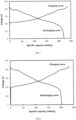
- a curve graph of initial charge and discharge of the positive electrode material in example 1 is as shown in FIG. 1 .
- a method for preparing a quaternary positive electrode material including the following steps:
- a method for preparing a quaternary positive electrode material including the following steps:
- the materials are stirred at 300r/min for 5 min to obtain a first mixed system; and the materials are stirred at 100r/min for 15 min to obtain a second mixed system; and
- the materials are stirred at 100r/min for 10 min to obtain a first mixed system; and the materials are stirred at 300r/min for 5 min to obtain a second mixed system; the cobalt sulfate solution has a concentration of 1 mol/L; and the ammonium bicarbonate solution has a concentration of 4 mol/L, other conditions are the same as example 1.
- a method for preparing a positive electrode material including the following steps:
- a curve graph of initial charge and discharge of the positive electrode material in this comparative example is as shown in FIG. 2 .
- a method for preparing a positive electrode material including the following steps:
- a preparation method includes the following steps: The positive electrode material, a carbon black conductive agent, a binder PVDF and NMP with a mass ratio of 95:2.5:2.5:5 are evenly mixed to prepare a battery positive electrode slurry, the positive electrode slurry is coated on an aluminum foil with a thickness of 12 ⁇ m, and is subjected to vacuum drying and rolling to form a positive electrode plate, a lithium metal plate is used as a negative electrode, a composition of an electrolyte is 1.15M LiPF6, and a volume ratio of EC to DMC is 1: 1; and the button battery is assembled.
- the present application mixes the soluble cobalt salt solution, the precipitant solution, the complexing agent, and the positive electrode base material according to a certain sequence, washes and coats the positive electrode base material, and evenly coats a layer of a cobalt compound on a surface of the positive electrode base material, which may not only improve an electrical conductivity of the material but also serve as a protective layer reducing a side reaction between a positive electrode material and an electrolyte.
- the precipitant may settle a residual lithium source, preventing the situation that a capacity exertion and circulation retention rate of the positive electrode material are affected due to a jelly-like status caused by an excessively high pH value in a subsequent homogenization process.
- the lithium batteries prepared by the positive electrode material obtained by the method of the embodiments of the present application may have excellent electrochemical properties, while the lithium batteries prepared by the positive electrode material obtained by the method in the comparative example 1 or comparative example 2 have lower charging specific capacity, discharging specific capacity, initial effect, and 50-cycle retention rate than the lithium batteries prepared by the positive electrode material obtained by the method of the embodiments of the present application.
- the present disclosure provides a positive electrode material and a preparation method therefor, and a lithium battery.
- the positive electrode material has excellent structural stability, volume expansion of the positive electrode material can be effectively inhibited, a battery cycling performance can be improved, and the preparation method may reduce the preparation cost.
Landscapes
- Chemical & Material Sciences (AREA)
- Chemical Kinetics & Catalysis (AREA)
- Electrochemistry (AREA)
- General Chemical & Material Sciences (AREA)
- Inorganic Chemistry (AREA)
- Organic Chemistry (AREA)
- Composite Materials (AREA)
- Engineering & Computer Science (AREA)
- Manufacturing & Machinery (AREA)
- Battery Electrode And Active Subsutance (AREA)
Abstract
Description
- The present disclosure claims priority to
Chinese Patent Application No. 2021109856987, entitled "Quaternary Positive Electrode Material and Preparation Method Therefor and Application Thereof, filed on August 26, 2021 - The present disclosure relates to the technical field of lithium batteries, in particular to a quaternary positive electrode material and a preparation method therefor and application thereof.
- Lithium-ion batteries have become the most widely used electrochemical power source at present, and the most representative of this kind of battery is a lithium secondary battery (LIB) that generates electricity due to the change of chemical potential of lithium ions in positive and negative electrodes during intercalation and deintercalation. Positive electrode materials play a direct leading role in the performance of LIBs, so a lot of researchers are working to achieve positive electrode materials with a large capacity, a fast charging/discharging speed, and a long cycle life that can be reversibly embedded and deintercalated by lithium-ions. Currently, high-nickel materials are considered to be one of the most promising candidates because they can increase the specific capacity of the lithium-ion batteries by increasing nickel content. However, the resulting poor cycling stability of the lithium-ion batteries may hinder the success of this approach.
- In addition, a quaternary polycrystalline material in the high-nickel material has more advantages in safety and cycle stability than a ternary positive electrode material, and is one of the most promising materials at present. However, a washing process is the main way of the high-nickel quaternary positive electrode material to reduce residual alkali at present, after washing, lithium residue is removed, and because lithium ions in a crystal lattice have a greater concentration difference with lithium ions outside the crystal lattice, the material is more inclined to delithium reaction without electron transfer and then more inclined to the transition of Ni3+/Ni2+ the transition, a surface of the washed material is rough, a specific surface area becomes larger, a contact area with electrolyte is larger, and side reactions are greater. In order to solve this problem, the commonly used modification method is material surface coating, but for high-nickel quaternary positive electrode materials, dry mix coating will lead to uneven surface coating of the material, and a step process is added, which increases the production cost.
- In view of this, the present application is hereby proposed.
- The present disclosure provides a method for preparing a quaternary positive electrode material, including the following steps:
mixing a positive electrode base material, a soluble cobalt salt, a precipitant, a complexing agent, and water, performing liquid-solid separation on a system after mixing, collecting a solid phase, and performing drying and calcining. - A chemical general formula of the positive electrode base material is LiNixCoyMnzAl(1-x-y-z)O2, wherein 0.9≤x<1 , 0<y<0.07, and 0<z<0.03.
- In some implementations, the complexing agent includes NH3·H2O and/or ammonium chloride.
- In some implementations, the precipitant includes ammonium bicarbonate.
- In some implementations, the soluble cobalt salt includes at least one of cobalt sulfate, cobalt nitrate or cobalt chloride.
- In some implementations, a mass ratio of the positive electrode base material, the soluble cobalt salt, the precipitant, and the complexing agent is 1:(0.006-0.012):(0.004-0.006):(0.15-0.25).
- In some implementations, the mixing specifically includes the following steps: adding dropwise a soluble cobalt salt solution to a first mixture of the positive electrode base material and a complexing agent solution to obtain a second mixture; and adding dropwise a precipitant solution to the second mixture.
- In some implementations, the precipitant solution has a concentration of 4-6 mol/L.
- In some implementations, the soluble cobalt salt solution has a concentration of 1-3 mol/L.
- In some implementations, stirring is performed during the mixing, and the stirring is performed at a rotational speed of 100-300 r/min for 10-20 min.
- In some implementations, the drying is performed at a temperature of 80-150°C for 5-15h.
- In some implementations, the calcining performed at a temperature of 300-500°C for 7-9h.
- In some implementations, a process for preparing the positive electrode base material includes the following step:
- performing a calcining treatment on a mixture of a nickel-cobalt-manganese-aluminum hydroxide and a lithium source; wherein
- a molar ratio of the lithium source to the nickel-cobalt-manganese-aluminum hydroxide calculated is (1-1.05):1 in terms of lithium elements to mixed metal elements, the mixed metal elements are nickel element, cobalt element, manganese element, and aluminum element, and in the nickel-cobalt-manganese-aluminum hydroxide, a molar ratio of nickel element, cobalt element, manganese element and aluminum element is (89-91):(6.8-7.1):(1.8-2.1):1.
- In some implementations, the calcining treatment is performed at a temperature of 650-800°C for 7-9h.
- In some implementations, the calcining treatment is performed in an atmosphere containing oxygen.
- A quaternary positive electrode material is obtained by the method for preparing the quaternary positive electrode material.
- A positive electrode for lithium batteries includes the quaternary positive electrode material.
- A lithium battery includes the positive electrode of the lithium battery.
- In order to more clearly illustrate the technical scheme of the implementations of the present disclosure, the accompanying drawings that need to be used in the implementations will be briefly introduced below. It should be understood that the following accompanying drawings merely illustrate the implementations of the present disclosure, and the size proportions in the accompanying drawings do not directly correspond to the true proportions of the implementations. Meanwhile, the following accompanying drawings merely show some implementations of the present disclosure and should not be regarded as limiting the scope.
-
FIG. 1 is a curve graph of initial charge and discharge of a positive electrode material in example 1. -
FIG. 2 is a curve graph of initial charge and discharge of a positive electrode material in comparative example 1. - The merits of embodiments in the summary of the invention will be set forth in the embodiments in the description below, and some of them may be obvious according to the description, or they may be obtained through a part of the embodiments of the present disclosure.
- The technical solution of the present disclosure will be further described below with reference to the accompanying drawings and through some embodiments.
- In order to make the objectives, technical solution and advantages of the present disclosure clearer, the present disclosure is further described in detail below with reference to the accompanying drawings and embodiments. It should be understood that the embodiments described here are only used to explain the present disclosure and are not intended to limit the present disclosure. In addition, the technical features involved in the embodiments of the present disclosure described below may be combined with each other as long as they do not conflict with each other. On the premise of not departing from the principles of the embodiments of the present disclosure, a number of improvements and modifications may also be made, and these improvements and modifications shall also be regarded as the scope of protection of the embodiments of the present disclosure.
- In one aspect, the present application provides a method for preparing a quaternary positive electrode material, including the following steps:
a positive electrode base material, a soluble cobalt salt, a precipitant, a complexing agent, and water are mixed, liquid-solid separation is performed on a system after the mixing, a solid phase is collected, and drying and calcining are performed. - A chemical general formula of the positive electrode base material is LiNixCoyMnzAl(1-x-y-z)O2, wherein 0.9≤x<1 , 0<y<0.07, and 0<z<0.03.
- According to the present application, the soluble cobalt salt, the precipitant, the complexing agent, the water and the positive electrode base material are mixed, the positive electrode base material is washed and coated, and a layer of a cobalt compound is evenly coated on a surface of the positive electrode base material, which may not only improve an electrical conductivity of the material but also serve as a protective layer reducing a side reaction between a positive electrode material and an electrolyte. In addition, an ammonium bicarbonate solution is added to settle a residual lithium source, preventing the situation that a capacity exertion and circulation retention rate of the positive electrode material are affected due to a jelly-like status caused by an excessively high pH value in a subsequent homogenization process. A preparation process adopted by the present application is simple and short in cycle, and composition is easy.
- In some implementations, a value of x includes but is not limited to 0.9, 0.91, 0.92, 0.93, 0.94, 0.95, 0.96, 0.97, 0.98, or 0.99. In some implementations, a value of y includes but is not limited to 0.01, 0.02, 0.03, 0.04, 0.05, 0.06 or 0.065. In some implementations, a value of z includes but is not limited to 0.01, 0.02 or 0.025.
- In some implementations, a chemical formula of the positive electrode base material includes LiNi0.91Co0.06Mn0.02Al0.01O2, LiNi0.93Co0.03Mn0.01Al0.03O2, LiNi0.95Co0.03Mn0.01Al0.01O2, LiNi0.98Co0.01Mn0.005Al0.05O2, etc.
- In some implementations, the complexing agent includes NH3·H2O and/or ammonium chloride.
- In some implementations, the precipitant includes ammonium bicarbonate.
- In some implementations, the soluble cobalt salt includes at least one of cobalt sulfate, cobalt nitrate or cobalt chloride. In some implementations, the soluble cobalt salt includes cobalt sulfate, cobalt nitrate or cobalt chloride, or a combination of cobalt sulfate and cobalt nitrate, a combination of cobalt nitrate and cobalt chloride, and a combination of cobalt sulfate, cobalt nitrate and cobalt chloride.
- The present application adopts a suitable precipitant to match the complexing agent, the residual lithium source is easily settled, and a proper quantity of the cobalt compound is coated more evenly, thus significantly improving electrochemical properties (having both a relatively high initial effect and cycling performance) and safety performance of a battery obtained through preparation of the quaternary positive electrode material.
- In some implementations, a mass ratio of the positive electrode base material, the soluble cobalt salt, the precipitant, and the complexing agent is 1:(0.006-0.012):(0.004-0.006):(0.15-0.25).
- In some implementations, the mass ratio of the positive electrode base material, the soluble cobalt salt, the precipitant, and the complexing agent includes but is not limited to 1:0.006:0.004:0.15, 1:0.007:0.0045:0.17, 1:0.008:0.005:0.19, 1:0.009:0.005:0.2, 1:0.01:0.005:0.21, 1:0.12:0.006:0.25, 1:0.006:0.005:0.16, 1:0.007:0.006:0.2 or 1:0.008:0.006:0.22.
- By limiting the proper ratio of the positive electrode base material, the soluble cobalt salt, the precipitant, and the complexing agent, the surface of the positive electrode base material may be evenly coated with the cobalt compound, and the residual lithium source may be effectively settled. The quaternary positive electrode material with excellent initial effect and cycling performance is further obtained.
- In some implementations, the mixing specifically includes the following steps: a soluble cobalt salt solution is added dropwise to a first mixture of the positive electrode base material and a complexing agent solution to obtain a second mixture; and a precipitant solution is added dropwise to the second mixture.
- The present application further limits a sequence of adding the positive electrode base material, the complexing agent solution, the soluble cobalt salt solution and the precipitant solution; and the quaternary positive electrode material with high initial effect, good cycling performance, and excellent safety performance may be further obtained through the above mixing sequence.
- In some implementations, the precipitant solution has a concentration of 4-6 mol/L.
- In some implementations, the precipitant solution has the concentration including but not limited to 4.1mol/L, 4.2mol/L, 4.3mol/L, 4.4mol/L, 4.5mol/L, 4.6mol/L, 4.7mol/L, 4.8mol/L, 4.9mol/L, 5mol/L, 5.1mol/L, 5.2mol/L, 5.3mol/L, 5.4mol/L, 5.5mol/L, 5.6mol/L, 5.7mol/L, 5.8mol/L or 5.9mol/L.
- In some implementations, the soluble cobalt salt solution has a concentration of 1-3 mol/L.
- In some implementations, the soluble cobalt salt solution has the concentration including but not limited to 1.1mol/L, 1.2mol/L, 1.3mol/L, 1.4mol/L, 1.5mol/L, 1.6mol/L, 1.7mol/L, 1.8mol/L, 1.9mol/L, 2mol/L, 2.1mol/L, 2.2mol/L, 2.3mol/L, 2.4mol/L, 2.5mol/L, 2.6mol/L, 2.7mol/L, 2.8mol/L or 2.9mol/L.
- In some implementations, stirring is performed during the mixing, and the stirring is at a rotational speed of 100-300 r/min for 10-20 min.
- In some implementations, the rotational speed of the stirring includes but is not limited to 110r/min, 120r/min, 130r/min, 140r/min, 140r/min, 150r/min, 160r/min, 170r/min, 180r/min, 190r/min, 200r/min, 210r/min, 220r/min, 230r/min, 240r/min, 250r/min, 260r/min, 270r/min, 280r/min, 290r/min, 295r/min or 300r/min.
- In some implementations, a duration of the stirring includes but is not limited to 11min, 11.5min, 12min, 12.5min, 13min, 13.5min, 14min, 15min, 16min, 17min, 18min, 19min or 20min.
- According to the present application, by adopting a proper range of rotational speed and duration of the stirring, raw materials are mixed more evenly, thus facilitating a reaction course. A more even layer of cobalt compound is further formed, which is conducive to improving the electrochemical properties of the quaternary positive electrode material.
- In some implementations, the drying is performed at a temperature of 80-150°C for 5-15h.
- In some implementations, the temperature for the drying includes but is not limited to 82°C, 85°C, 87°C, 90°C, 92°C, 95°C, 97°C, 100°C, 102°C, 105°C, 107°C, 109°C, 110°C, 112°C, 115°C, 117°C, 120°C, 122°C, 125°C, 127°C, 130°C, 135°C, 140°C, 142°C, 145°C, 147°C or 149°C.
- In some implementations, a drying duration includes but is not limited to 5.5h, 6h, 6.5h, 7h, 7.5h, 8h, 8.5h, 9h, 9.5h, 10h, 10.5h, 11h, 11.5h, 12h, 12.5h, 13h, 13.5h, 14h or 14.5h.
- A proper drying duration may not only ensure a drying effect, but also guarantee that a performance of the obtained positive electrode material is not affected.
- In some implementations, calcining is performed at a temperature of 300-500°C for 7-9h.
- In some implementations, the temperature for the calcining includes but is not limited to 310°C, 320°C, 330°C, 340°C, 350°C, 360°C, 370°C, 380°C, 390°C, 400°C, 410°C, 420°C, 430°C, 440°C, 450°C, 460°C, 470°C, 480°C or 490°C.
- In some implementations, a calcining duration includes but is not limited to 7.1h, 7.2h, 7.3h, 7.4h, 7.5h, 7.6h, 7.7h, 7.8h, 7.9h, 8h, 8.1h, 8.2h, 8.3h, 8.4h, 8.5h, 8.6h, 8.7h, 8.8h or 8.9h.
- By adopting a proper range of temperature and duration for the calcining, the cycling performance and initial effect of the obtained positive electrode material are improved.
- In some implementations, a method for preparing the positive electrode base material includes the following step:
a calcining treatment is performed on a mixture of a nickel-cobalt-manganese-aluminum hydroxide and a lithium source. - A molar ratio of the lithium source to the nickel-cobalt-manganese-aluminum hydroxide is (1-1.05):1 in terms of lithium element to mixed metal elements, the mixed metal elements include nickel element, cobalt element, manganese element, and aluminum element, and in the nickel-cobalt-manganese-aluminum hydroxide, a molar ratio of nickel element, cobalt element, manganese element, and aluminum element is (89-91):(6.8-7.1):(1.8-2.1):1.
- In one implementation, the molar ratio of the lithium source to the nickel-cobalt-manganese-aluminum hydroxide is (1-1.05):1 in terms of lithium element to mixed metal elements, and may be 1:1, 1.01:1, 1.02:1, 1.03:1 or 1.04:1.
- In one implementation, in the nickel-cobalt-manganese-aluminum hydroxide, the molar ratio of nickel element, cobalt element, manganese element, and aluminum element is 90:7:2: 1, 89:6.8: 1.8: 1, 89.5:6.9: 1.95: 1, 90.5:7:2: 1 or 91:7.1:2.1: 1.
- In some implementations, the calcining treatment is performed at a temperature of 650-800°C for 7-9h.
- In one implementation, the temperature of the calcining treatment is 650-800°C, and may be 660°C, 670°C, 680°C, 690°C, 700°C, 710°C, 720°C, 730°C, 740°C, 750°C, 760°C, 770°C, 780°C or 790°C.
- In one implementation, a duration of the calcining treatment is 7-9h, and may be 7.1h, 7.2h, 7.3h, 7.4h, 7.5h, 7.6h, 7.7h, 7.8h, 7.9h, 8h, 8.1h, 8.2h, 8.3h, 8.4h, 8.5h, 8.6h, 8.7h, 8.8h or 8.9h.
- In some implementations, the calcining treatment is performed in an atmosphere containing oxygen.
- In one implementation, the method for preparing the positive electrode base material includes the following steps: the nickel-cobalt-manganese-aluminum hydroxide and LiOH are subjected to dry mixing according to a certain molar ratio to obtain a dry mixture, then the dry mixture is calcined at 650-800°C in an atmosphere containing oxygen for 7-9h, and the dry mixture is cooled and screened to obtain the positive electrode base material.
- In another aspect, the present application relates to a quaternary positive electrode material obtained by the above method for preparing the quaternary positive electrode material.
- The positive electrode material of the present application has excellent capacity, good initial effect and stable cycling performance.
- In another aspect, the present application relates to a positive electrode of a lithium battery, including the above quaternary positive electrode material.
- A method for preparing a positive electrode plate of the lithium battery of the present application includes the following steps:
the quaternary positive electrode material, a carbon black conductive agent, a binder polyvinylidene fluoride (PVDF) and N-methylpyrrolidone (NMP) are evenly mixed to prepare a battery positive electrode slurry. A mass ratio of the quaternary positive electrode material, the carbon black conductive agent, the binder PVDF and NMP is (94-96):(2-3):(2-3):(4-6). The above battery positive electrode slurry is coated on an aluminum foil with a thickness of 20-40 µm, and is subjected to vacuum drying and rolling to form the positive electrode plate. - In one implementation, the mass ratio of the quaternary positive electrode material, the carbon black conductive agent, the binder PVDF and NMP includes but is not limited to 94:2:2, 94.5:2.5:2.5, 95:2:3, 95.5:2.5:2, 96:3:3.
- In one implementation, the thickness of the aluminum foil includes but is not limited to 22µm, 25µm, 27µm, 30µm, 32µm, 35µm, 37µm or 39µm.
- In another aspect, the present application relates to a lithium battery, including the above positive electrode of the lithium battery.
- The lithium battery of the present application includes the above positive electrode plate, a lithium metal negative electrode plate, and an electrolyte. A composition of the electrolyte is: lithium hexafluorophosphate (LiPF6), ethylene carbonate (EC) and dimethyl carbonate (DMC). LiPF6 is 1.15M, and a volume ratio of EC to DMC is 1:1.
- The lithium battery of the present application has excellent capacity, good initial effect and stable cycling performance.
- Typical non-limiting examples of the present disclosure are as follows:
- A method for preparing a quaternary positive electrode material, including the following steps:
- (a) A nickel-cobalt-manganese-aluminum hydroxide and LiOH are subjected to dry mixing in a mixer, the materials subjected to drying mixing are calcined in a common batch-type furnace at 700°C in an atmosphere containing oxygen for 8h, and the materials are cooled and screened to obtain a positive electrode base material. A molar ratio of the nickel-cobalt-manganese-aluminum hydroxide to LiOH is 1:1.025(Li/Metal(Ni, Co, Mn and Al)=1.025) in terms of metal elements; and in the nickel-cobalt-manganese-aluminum hydroxide, a molar ratio of Ni, Co, Mn and Al is 90:7:2: 1.
- (b) The above obtained positive electrode base material, ammonium hydroxide and distilled water are mixed according to a mass ratio of 1:0.2:100, and are stirred at 200r/min for 5 min to obtain a first mixed system; a cobalt sulfate solution is added dropwise to the first mixed system, a mass ratio of the positive electrode base material to cobalt sulfate is 1:0.01, and the materials are stirred at 200r/min for 10 min to obtain a second mixed system; and an ammonium bicarbonate solution is added dropwise to the second mixed system, a mass ratio of the positive electrode base material to ammonium bicarbonate is 1:0.005, and the materials are evenly stirred, subjected to suction filtration, placed in a 100°C vacuum drying oven for 10h, dried and fetched out. The cobalt sulfate solution has a concentration of 2 mol/L; and the ammonium bicarbonate solution has a concentration of 5 mol/L.
- (c) Finally, the materials obtained after drying are calcined at 400°C in an atmosphere containing oxygen for 8h, cooled and screened to obtain a coated positive electrode material.
- A curve graph of initial charge and discharge of the positive electrode material in example 1 is as shown in
FIG. 1 . - A method for preparing a quaternary positive electrode material, including the following steps:
- (a) A nickel-cobalt-manganese-aluminum hydroxide and LiOH are subjected to dry mixing in a mixer, the materials subjected to drying mixing are calcined in a common batch-type furnace at 700°C in an atmosphere containing oxygen for 8h, and the materials are cooled and screened to obtain a positive electrode base material. A molar ratio of the nickel-cobalt-manganese-aluminum hydroxide to LiOH is 1:1.025(Li/Metal(Ni, Co, Mn and Al)=1.025) in terms of metal elements; and in the nickel-cobalt-manganese-aluminum hydroxide, a molar ratio of Ni, Co, Mn and Al is 90:7:2: 1.
- (b) The above obtained positive electrode base material, ammonium hydroxide and distilled water are mixed according to a mass ratio of 1:0.15: 100, and are stirred at 200r/min for 5 min to obtain a first mixed system; a cobalt sulfate solution is added dropwise to the first mixed system, a mass ratio of the positive electrode base material to cobalt sulfate is 1:0.006, and the materials are stirred at 200r/min for 10 min to obtain a second mixed system; and an ammonium bicarbonate solution is added dropwise to the second mixed system, a mass ratio of the positive electrode base material to ammonium bicarbonate is 1:0.004, and the materials are evenly stirred, subjected to suction filtration, placed in a 80°C vacuum drying oven for 15h, dried and fetched out. The cobalt sulfate solution has a concentration of 2 mol/L; and the ammonium bicarbonate solution has a concentration of 5 mol/L.
- (c) Finally, the materials obtained after drying are calcined at 300°C in an atmosphere containing oxygen for 9h, cooled and screened to obtain a coated positive electrode material.
- A method for preparing a quaternary positive electrode material, including the following steps:
- (a) A nickel-cobalt-manganese-aluminum hydroxide and LiOH are subjected to dry mixing in a mixer, the materials subjected to drying mixing are calcined in a common batch-type furnace at 700°C in an atmosphere containing oxygen for 8h, and the materials are cooled and screened to obtain a positive electrode base material. A molar ratio of the nickel-cobalt-manganese-aluminum hydroxide to LiOH respectively calculated by metal elements is 1:1.025(Li/Metal(Ni, Co, Mn and Al)=1.025) in terms of metal elements; and in the nickel-cobalt-manganese-aluminum hydroxide, a molar ratio of Ni, Co, Mn and Al is 90:7:2:1.
- (b) The above obtained positive electrode base material, ammonium hydroxide and distilled water are mixed according to a mass ratio of 1:0.25:100, and are stirred at 200r/min for 5 min to obtain a first mixed system; a cobalt sulfate solution is added dropwise to the first mixed system, a mass ratio of the positive electrode base material to cobalt sulfate is 1:0.012, and the materials are stirred at 200r/min for 10 min to obtain a second mixed system; and an ammonium bicarbonate solution is added dropwise to the second mixed system, a mass ratio of the positive electrode base material to ammonium bicarbonate is 1:0.006, and the materials are evenly stirred, subjected to suction filtration, placed in a 150°C vacuum drying oven for 5h, dried and fetched out. The cobalt sulfate solution has a concentration of 2 mol/L; and the ammonium bicarbonate solution has a concentration of 5 mol/L.
- (c) Finally, the materials obtained after drying are calcined at 500°C in an atmosphere containing oxygen for 7h, cooled and screened to obtain a coated positive electrode material.
- According to a method for preparing a quaternary positive electrode material, except in step (b), the materials are stirred at 300r/min for 5 min to obtain a first mixed system; and the materials are stirred at 100r/min for 15 min to obtain a second mixed system; and
- the cobalt sulfate solution has a concentration of 3 mol/L; and the ammonium bicarbonate solution has a concentration of 6 mol/L,
- other conditions are the same as example 1.
- According to a method for preparing a quaternary positive electrode material, except in step (b), the materials are stirred at 100r/min for 10 min to obtain a first mixed system; and the materials are stirred at 300r/min for 5 min to obtain a second mixed system; the cobalt sulfate solution has a concentration of 1 mol/L; and the ammonium bicarbonate solution has a concentration of 4 mol/L, other conditions are the same as example 1.
- A method for preparing a positive electrode material, including the following steps:
- (a) Preparation of a positive electrode base material: the same as step (a) in example 1.
- (b) The obtained positive electrode base material is mixed with distilled water at a mass ratio of 1:1, and the materials are stirred at 200r/min for 10 min, subjected to suction filtration, placed in a 100°C vacuum drying oven for 10h, dried and fetched out.
- (c) The dried materials in (b) are calcined at 400°C in an atmosphere containing oxygen for 8h, cooled and screened to obtain a coated positive electrode material.
- A curve graph of initial charge and discharge of the positive electrode material in this comparative example is as shown in
FIG. 2 . - A method for preparing a positive electrode material, including the following steps:
- (a) Preparation of a positive electrode base material: the same as step (a) in example 1.
- (b) The obtained positive electrode base material is mixed with distilled water at a mass ratio of 1:1, an ammonium bicarbonate solution is added dropwise to the mixed system, a mass ratio of the positive electrode base material to ammonium bicarbonate is 1:0.006, and the materials are stirred at 200r/min for 10 min, subjected to suction filtration, placed in a 100°C vacuum drying oven for 10h, dried and fetched out. The ammonium bicarbonate solution has a concentration of 5 mol/L.
- (c) The dried materials in (b) are calcined at 400°C in an atmosphere containing oxygen for 8h, cooled and screened to obtain a coated positive electrode material.
- The positive electrode materials obtained in the examples and the comparative examples are respectively adopted to prepare a button battery. A preparation method includes the following steps:
The positive electrode material, a carbon black conductive agent, a binder PVDF and NMP with a mass ratio of 95:2.5:2.5:5 are evenly mixed to prepare a battery positive electrode slurry, the positive electrode slurry is coated on an aluminum foil with a thickness of 12 µm, and is subjected to vacuum drying and rolling to form a positive electrode plate, a lithium metal plate is used as a negative electrode, a composition of an electrolyte is 1.15M LiPF6, and a volume ratio of EC to DMC is 1: 1; and the button battery is assembled. - An electrical property of the material is tested at 45°C by a blue battery test system, a test voltage range being 3V-4.3V; and a 1-cycle capacity and 50-cycle capacity retention rate are tested.
Table 1 Electrochemical Properties of Batteries Implementation scheme Charging specific capacity (mAh/g) Discharging specific capacity (mAh/g) Initial effect (%) 50-cycle retention rate (%) Example 1 233.6 221.2 94.7 98.7 Example 2 231.4 218.6 94.4 97.6 Example 3 232.8 219.1 94.1 96.9 Comparative example 1 223.1 203.2 91.1 77.8 Comparative example 2 225.6 205.4 91.0 80.2 - The present application mixes the soluble cobalt salt solution, the precipitant solution, the complexing agent, and the positive electrode base material according to a certain sequence, washes and coats the positive electrode base material, and evenly coats a layer of a cobalt compound on a surface of the positive electrode base material, which may not only improve an electrical conductivity of the material but also serve as a protective layer reducing a side reaction between a positive electrode material and an electrolyte. In addition, the precipitant may settle a residual lithium source, preventing the situation that a capacity exertion and circulation retention rate of the positive electrode material are affected due to a jelly-like status caused by an excessively high pH value in a subsequent homogenization process. It can be seen from Table 1 that, the lithium batteries prepared by the positive electrode material obtained by the method of the embodiments of the present application may have excellent electrochemical properties, while the lithium batteries prepared by the positive electrode material obtained by the method in the comparative example 1 or comparative example 2 have lower charging specific capacity, discharging specific capacity, initial effect, and 50-cycle retention rate than the lithium batteries prepared by the positive electrode material obtained by the method of the embodiments of the present application.
- In conclusion, the present disclosure provides a positive electrode material and a preparation method therefor, and a lithium battery. The positive electrode material has excellent structural stability, volume expansion of the positive electrode material can be effectively inhibited, a battery cycling performance can be improved, and the preparation method may reduce the preparation cost.
Claims (13)
- A method for preparing a quaternary positive electrode material, comprising the following steps:mixing a positive electrode base material, a soluble cobalt salt, a precipitant, a complexing agent, and water, performing liquid-solid separation on a system after the mixing, collecting a solid phase, and performing drying and calcining; whereina chemical general formula of the positive electrode base material is LiNixCoyMnzAl(1-x-y-z)O2, wherein 0.9≤x<1 , 0<y<0.07, and 0<z<0.03.
- The method for preparing a quaternary positive electrode material of claim 1, comprising at least one of the following features (1) to (3):(1) the complexing agent comprises NH3·H2O and/or ammonium chloride;(2) the precipitant comprises ammonium bicarbonate; and(3) the soluble cobalt salt comprises at least one of cobalt sulfate, cobalt nitrate and cobalt chloride.
- The method for preparing a quaternary positive electrode material of claim 1 or 2, wherein a mass ratio of the positive electrode base material, the soluble cobalt salt, the precipitant, and the complexing agent is 1:(0.006-0.012):(0.004-0.006):(0.15-0.25).
- The method for preparing a quaternary positive electrode material of any one of claims 1 to 3, comprising at least one of the following features (1) to (3):(1) the mixing specifically comprises the following steps: adding dropwise a soluble cobalt salt solution to a first mixture of the positive electrode base material and a complexing agent solution to obtain a second mixture; and adding dropwise a precipitant solution to the second mixture;(2) the precipitant solution has a concentration of 4-6 mol/L; and(3) the soluble cobalt salt solution has a concentration of 1-3 mol/L.
- The method for preparing a quaternary positive electrode material of any one of claims 1 to 4, wherein a stirring is performed during the mixing, and the stirring is performed at a rotational speed of 100-300 r/min for 10-20 min.
- The method for preparing a quaternary positive electrode material of any one of claims 1 to 5, wherein the drying is performed at a temperature of 80-150°C for 5-15h.
- The method for preparing a quaternary positive electrode material of any one of claims 1 to 6, wherein the calcining is performed at a temperature of 300-500°C for 7-9h.
- The method for preparing a quaternary positive electrode material of any one of claims 1 to 7, wherein a process for preparing the positive electrode base material comprises the following step:performing a calcining treatment on a mixture of nickel-cobalt-manganese-aluminum hydroxide and a lithium source; whereina molar ratio of the lithium source to the nickel-cobalt-manganese-aluminum hydroxide is (1-1.05):1 in terms of lithium element to mixed metal elements, the mixed metal elements are nickel element, cobalt element, manganese element, and aluminum element, and in the nickel-cobalt-manganese-aluminum hydroxide, a molar ratio of nickel element, cobalt element, manganese element and aluminum element is (89-91):(6.8-7.1):(1.8-2.1): 1.
- The method for preparing a quaternary positive electrode material of claim 8, wherein the calcining treatment is performed at a temperature of 650-800°C for 7-9h.
- The method for preparing a quaternary positive electrode material of claim 8 or 9, wherein the calcining treatment is performed in an atmosphere containing oxygen.
- A quaternary positive electrode material, wherein the quaternary positive electrode material is obtained by the method for preparing a quaternary positive electrode material according to any one of claims 1 to 10.
- A positive electrode for lithium batteries, comprising the quaternary positive electrode material of claim 11.
- A lithium battery, comprising the positive electrode for lithium batteries of claim 12.
Applications Claiming Priority (2)
| Application Number | Priority Date | Filing Date | Title |
|---|---|---|---|
| CN202110985698.7A CN113428912B (en) | 2021-08-26 | 2021-08-26 | Quaternary positive electrode material and preparation method and application thereof |
| PCT/CN2022/075706 WO2023024446A1 (en) | 2021-08-26 | 2022-02-09 | Quaternary positive electrode material and preparation method therefor and application thereof |
Publications (2)
| Publication Number | Publication Date |
|---|---|
| EP4365138A1 true EP4365138A1 (en) | 2024-05-08 |
| EP4365138A4 EP4365138A4 (en) | 2024-10-30 |
Family
ID=77798009
Family Applications (1)
| Application Number | Title | Priority Date | Filing Date |
|---|---|---|---|
| EP22859805.8A Pending EP4365138A4 (en) | 2021-08-26 | 2022-02-09 | QUATERNARY POSITIVE ELECTRODE MATERIAL AND PRODUCTION METHOD THEREOF AND APPLICATION THEREOF |
Country Status (3)
| Country | Link |
|---|---|
| EP (1) | EP4365138A4 (en) |
| CN (1) | CN113428912B (en) |
| WO (1) | WO2023024446A1 (en) |
Families Citing this family (4)
| Publication number | Priority date | Publication date | Assignee | Title |
|---|---|---|---|---|
| CN113428912B (en) * | 2021-08-26 | 2022-02-18 | 蜂巢能源科技有限公司 | Quaternary positive electrode material and preparation method and application thereof |
| CN114583102B (en) * | 2022-02-21 | 2023-08-15 | 远景动力技术(江苏)有限公司 | Cathode active materials, electrochemical devices and electronic devices |
| CN114824242B (en) * | 2022-05-10 | 2023-09-15 | 哈尔滨工业大学(威海) | Preparation method of metal oxide coated lithium ion battery anode material |
| CN118173744A (en) * | 2024-03-26 | 2024-06-11 | 天津巴莫科技有限责任公司 | Positive electrode material and preparation method thereof, positive electrode sheet and secondary battery |
Family Cites Families (24)
| Publication number | Priority date | Publication date | Assignee | Title |
|---|---|---|---|---|
| CN101944610B (en) * | 2009-07-09 | 2013-08-28 | 河南新飞科隆电源有限公司 | Preparation of stratified lithium ion anode material |
| CN103066261B (en) * | 2012-12-28 | 2015-07-29 | 龙能科技(苏州)有限公司 | The synthetic method of the nickelic multi-element metal oxide positive electrode of high power capacity |
| CN104362308A (en) * | 2014-09-19 | 2015-02-18 | 青岛乾运高科新材料股份有限公司 | Lithium ion battery cathode multielement composite material and preparation method thereof |
| CN106532006A (en) * | 2016-12-16 | 2017-03-22 | 无锡晶石新型能源有限公司 | Preparation method of cobaltous oxide coated ternary anode material |
| US20180183046A1 (en) * | 2016-12-28 | 2018-06-28 | Lg Chem, Ltd. | Positive electrode active material for lithium secondary battery, method for preparing the same, and lithium secondary battery including the same |
| CN108063223A (en) * | 2017-11-17 | 2018-05-22 | 合肥国轩高科动力能源有限公司 | A kind of preparation method of modified high-nickel ternary cathode material |
| CN108390039A (en) * | 2018-02-23 | 2018-08-10 | 成都新柯力化工科技有限公司 | A kind of nickelic anode material of lithium battery that double oxide coats altogether and preparation method |
| CN108550802B (en) * | 2018-03-05 | 2020-09-08 | 格林美(无锡)能源材料有限公司 | Y/La-doped Co/B Co-coated nickel-cobalt-manganese ternary positive electrode material and preparation method thereof |
| CN108899480A (en) * | 2018-05-24 | 2018-11-27 | 中国科学院青岛生物能源与过程研究所 | A kind of long circulation life height ratio capacity nickel cobalt aluminium positive electrode and preparation method thereof |
| CN108878821A (en) * | 2018-06-19 | 2018-11-23 | 合肥国轩高科动力能源有限公司 | A kind of high-nickel ternary positive electrode material coated with lanthanum oxide on the surface and preparation method thereof |
| CN108807926B (en) * | 2018-06-22 | 2021-04-06 | 格林美(无锡)能源材料有限公司 | A kind of Co/B co-coated nickel-cobalt-manganese lithium ion positive electrode material and preparation method thereof |
| CN109449384A (en) * | 2018-09-21 | 2019-03-08 | 中国科学院青岛生物能源与过程研究所 | A kind of nickel-cobalt lithium manganate cathode material of Nano Carbon conducting polymer cladding |
| KR102816069B1 (en) * | 2018-12-10 | 2025-06-04 | 주식회사 엘지에너지솔루션 | High-nickel positive electrode active material, producing method thereof, positive electrode and lithium secondary battery comprising the same |
| CN109713262A (en) * | 2018-12-17 | 2019-05-03 | 浙江衡远新能源科技有限公司 | A kind of preparation method of cobalt/cobalt oxide cladding tertiary cathode material |
| CN109786687A (en) * | 2018-12-17 | 2019-05-21 | 厦门大学 | A kind of preparation method to sacrifice template induced synthesis metal oxide cladding nickel-cobalt-manganese ternary anode material for lithium-ion batteries |
| CN111490234A (en) * | 2019-01-29 | 2020-08-04 | 湖南杉杉能源科技股份有限公司 | Surface modification method of high-nickel multi-element cathode material |
| CN110010889B (en) * | 2019-04-17 | 2021-09-07 | 贵州容百锂电材料有限公司 | High-compaction high-stability high-nickel cathode material, preparation method thereof and lithium ion battery |
| CN112018341A (en) * | 2019-05-28 | 2020-12-01 | 天津国安盟固利新材料科技股份有限公司 | High-capacity high-nickel cathode material and preparation method thereof |
| CN111162271A (en) * | 2019-06-12 | 2020-05-15 | 北京当升材料科技股份有限公司 | Multi-element anode material, preparation method thereof and lithium ion battery |
| CN110649252A (en) * | 2019-11-01 | 2020-01-03 | 贵州中伟资源循环产业发展有限公司 | Ternary material LiNi of lithium battery0.8Co0.1Mn0.1O2Surface coated with Li2ZrO3Method (2) |
| CN111640928A (en) * | 2020-06-30 | 2020-09-08 | 蜂巢能源科技有限公司 | NCMA quaternary system material, preparation method thereof, lithium battery positive electrode material and lithium battery |
| CN111900364B (en) * | 2020-08-28 | 2022-08-30 | 蜂巢能源科技有限公司 | Coated ternary cathode material and preparation method and application thereof |
| CN113258072B (en) * | 2021-06-16 | 2021-10-15 | 浙江帕瓦新能源股份有限公司 | Nickel-cobalt-manganese positive electrode material and preparation method thereof |
| CN113428912B (en) * | 2021-08-26 | 2022-02-18 | 蜂巢能源科技有限公司 | Quaternary positive electrode material and preparation method and application thereof |
-
2021
- 2021-08-26 CN CN202110985698.7A patent/CN113428912B/en active Active
-
2022
- 2022-02-09 EP EP22859805.8A patent/EP4365138A4/en active Pending
- 2022-02-09 WO PCT/CN2022/075706 patent/WO2023024446A1/en not_active Ceased
Also Published As
| Publication number | Publication date |
|---|---|
| WO2023024446A1 (en) | 2023-03-02 |
| EP4365138A4 (en) | 2024-10-30 |
| CN113428912A (en) | 2021-09-24 |
| CN113428912B (en) | 2022-02-18 |
Similar Documents
| Publication | Publication Date | Title |
|---|---|---|
| CN113955809B (en) | Nickel-cobalt-manganese-lithium aluminate positive electrode material with shell-core structure and preparation method thereof | |
| CN100495775C (en) | Lithium ion secondary battery cathode material zirconium, phosphorus doped lithium cobalt oxide and preparation method thereof | |
| US8557440B2 (en) | Positive electrode active material including particle comprising crystal structure changing from a layered structure to a spinel structure, method of manufacturing the positive electrode active material, and non-aqueous electrolyte secondary battery using the positive electrode active material | |
| CN109742376B (en) | A kind of high nickel cathode material and preparation method thereof | |
| CN111762768B (en) | Spinel type lithium manganate-phosphate composite cathode material and preparation method thereof | |
| WO2022127324A1 (en) | High-nickel ternary positive electrode material, preparation method therefor and use thereof | |
| CN106784790B (en) | A kind of preparation method of nickle cobalt lithium manganate tertiary cathode material | |
| CN111422919B (en) | Quaternary positive electrode material and preparation method thereof, positive electrode, battery | |
| CN102694164B (en) | Lithium oxide-rich cathode material with nitrogen or carbon-doped surface and preparation method for cathode material | |
| CN111682174B (en) | A kind of antimony-coated lithium battery cathode material and its preparation method and application | |
| CN113428912B (en) | Quaternary positive electrode material and preparation method and application thereof | |
| US20250083974A1 (en) | Core-shell gradient ternary precursor and preparation method and application thereof | |
| CN111900364B (en) | Coated ternary cathode material and preparation method and application thereof | |
| CN108987683A (en) | A kind of preparation method of carbon coating tertiary cathode material | |
| CN110034274B (en) | Modified ternary cathode material, preparation method thereof and lithium ion battery | |
| WO2023184996A1 (en) | Modified high-nickel ternary positive electrode material and preparation method therefor | |
| CN115064682A (en) | Preparation method and application of surface and bulk phase jointly modified lithium-rich manganese-based layered oxide | |
| WO2023109194A1 (en) | Positive electrode material with high peak-intensity ratio, and preparation method therefor and use thereof | |
| CN115064670B (en) | A method for preparing doped and coated sodium nickel manganate cathode material | |
| CN114597372B (en) | Ultra-high nickel anode material and preparation method and application thereof | |
| CN113488633A (en) | Titanium magnesium phosphate coated high-nickel ternary or lithium-rich manganese-based positive electrode material and preparation method thereof | |
| KR20140058800A (en) | Cathode active material, method for preparing the same, and lithium secondary batteries comprising the same | |
| CN113582253B (en) | Quaternary positive electrode material, and preparation method and application thereof | |
| CN113471439A (en) | Coating modified cathode material and preparation method thereof | |
| CN109216692B (en) | Modified ternary cathode material, preparation method thereof and lithium ion battery |
Legal Events
| Date | Code | Title | Description |
|---|---|---|---|
| STAA | Information on the status of an ep patent application or granted ep patent |
Free format text: STATUS: THE INTERNATIONAL PUBLICATION HAS BEEN MADE |
|
| PUAI | Public reference made under article 153(3) epc to a published international application that has entered the european phase |
Free format text: ORIGINAL CODE: 0009012 |
|
| STAA | Information on the status of an ep patent application or granted ep patent |
Free format text: STATUS: REQUEST FOR EXAMINATION WAS MADE |
|
| 17P | Request for examination filed |
Effective date: 20240131 |
|
| AK | Designated contracting states |
Kind code of ref document: A1 Designated state(s): AL AT BE BG CH CY CZ DE DK EE ES FI FR GB GR HR HU IE IS IT LI LT LU LV MC MK MT NL NO PL PT RO RS SE SI SK SM TR |
|
| A4 | Supplementary search report drawn up and despatched |
Effective date: 20240926 |
|
| RIC1 | Information provided on ipc code assigned before grant |
Ipc: H01M 10/052 20100101ALI20240920BHEP Ipc: H01M 4/62 20060101ALI20240920BHEP Ipc: H01M 4/525 20100101ALI20240920BHEP Ipc: H01M 4/505 20100101ALI20240920BHEP Ipc: H01M 4/485 20100101ALI20240920BHEP Ipc: H01M 4/36 20060101ALI20240920BHEP Ipc: C01G 51/00 20060101ALI20240920BHEP Ipc: C01G 53/00 20060101AFI20240920BHEP |
|
| DAV | Request for validation of the european patent (deleted) | ||
| DAX | Request for extension of the european patent (deleted) |