EP4364820A1 - Fire extinguishing body - Google Patents
Fire extinguishing body Download PDFInfo
- Publication number
- EP4364820A1 EP4364820A1 EP22833186.4A EP22833186A EP4364820A1 EP 4364820 A1 EP4364820 A1 EP 4364820A1 EP 22833186 A EP22833186 A EP 22833186A EP 4364820 A1 EP4364820 A1 EP 4364820A1
- Authority
- EP
- European Patent Office
- Prior art keywords
- fire extinguishing
- layer
- resin
- extinguishing agent
- extinguishing body
- Prior art date
- Legal status (The legal status is an assumption and is not a legal conclusion. Google has not performed a legal analysis and makes no representation as to the accuracy of the status listed.)
- Pending
Links
Images



Classifications
-
- A—HUMAN NECESSITIES
- A62—LIFE-SAVING; FIRE-FIGHTING
- A62C—FIRE-FIGHTING
- A62C35/00—Permanently-installed equipment
- A62C35/02—Permanently-installed equipment with containers for delivering the extinguishing substance
- A62C35/10—Containers destroyed or opened by flames or heat
-
- A—HUMAN NECESSITIES
- A62—LIFE-SAVING; FIRE-FIGHTING
- A62C—FIRE-FIGHTING
- A62C8/00—Hand tools or accessories specially adapted for fire-fighting, e.g. tool boxes
-
- A—HUMAN NECESSITIES
- A62—LIFE-SAVING; FIRE-FIGHTING
- A62C—FIRE-FIGHTING
- A62C19/00—Hand fire-extinguishers in which the extinguishing substance is expelled by an explosion; Exploding containers thrown into the fire
-
- B—PERFORMING OPERATIONS; TRANSPORTING
- B32—LAYERED PRODUCTS
- B32B—LAYERED PRODUCTS, i.e. PRODUCTS BUILT-UP OF STRATA OF FLAT OR NON-FLAT, e.g. CELLULAR OR HONEYCOMB, FORM
- B32B15/00—Layered products comprising a layer of metal
- B32B15/04—Layered products comprising a layer of metal comprising metal as the main or only constituent of a layer, which is next to another layer of the same or of a different material
- B32B15/08—Layered products comprising a layer of metal comprising metal as the main or only constituent of a layer, which is next to another layer of the same or of a different material of synthetic resin
-
- B—PERFORMING OPERATIONS; TRANSPORTING
- B32—LAYERED PRODUCTS
- B32B—LAYERED PRODUCTS, i.e. PRODUCTS BUILT-UP OF STRATA OF FLAT OR NON-FLAT, e.g. CELLULAR OR HONEYCOMB, FORM
- B32B15/00—Layered products comprising a layer of metal
- B32B15/04—Layered products comprising a layer of metal comprising metal as the main or only constituent of a layer, which is next to another layer of the same or of a different material
- B32B15/08—Layered products comprising a layer of metal comprising metal as the main or only constituent of a layer, which is next to another layer of the same or of a different material of synthetic resin
- B32B15/085—Layered products comprising a layer of metal comprising metal as the main or only constituent of a layer, which is next to another layer of the same or of a different material of synthetic resin comprising polyolefins
-
- B—PERFORMING OPERATIONS; TRANSPORTING
- B32—LAYERED PRODUCTS
- B32B—LAYERED PRODUCTS, i.e. PRODUCTS BUILT-UP OF STRATA OF FLAT OR NON-FLAT, e.g. CELLULAR OR HONEYCOMB, FORM
- B32B15/00—Layered products comprising a layer of metal
- B32B15/04—Layered products comprising a layer of metal comprising metal as the main or only constituent of a layer, which is next to another layer of the same or of a different material
- B32B15/08—Layered products comprising a layer of metal comprising metal as the main or only constituent of a layer, which is next to another layer of the same or of a different material of synthetic resin
- B32B15/088—Layered products comprising a layer of metal comprising metal as the main or only constituent of a layer, which is next to another layer of the same or of a different material of synthetic resin comprising polyamides
-
- B—PERFORMING OPERATIONS; TRANSPORTING
- B32—LAYERED PRODUCTS
- B32B—LAYERED PRODUCTS, i.e. PRODUCTS BUILT-UP OF STRATA OF FLAT OR NON-FLAT, e.g. CELLULAR OR HONEYCOMB, FORM
- B32B15/00—Layered products comprising a layer of metal
- B32B15/04—Layered products comprising a layer of metal comprising metal as the main or only constituent of a layer, which is next to another layer of the same or of a different material
- B32B15/08—Layered products comprising a layer of metal comprising metal as the main or only constituent of a layer, which is next to another layer of the same or of a different material of synthetic resin
- B32B15/09—Layered products comprising a layer of metal comprising metal as the main or only constituent of a layer, which is next to another layer of the same or of a different material of synthetic resin comprising polyesters
-
- B—PERFORMING OPERATIONS; TRANSPORTING
- B32—LAYERED PRODUCTS
- B32B—LAYERED PRODUCTS, i.e. PRODUCTS BUILT-UP OF STRATA OF FLAT OR NON-FLAT, e.g. CELLULAR OR HONEYCOMB, FORM
- B32B15/00—Layered products comprising a layer of metal
- B32B15/20—Layered products comprising a layer of metal comprising aluminium or copper
-
- B—PERFORMING OPERATIONS; TRANSPORTING
- B32—LAYERED PRODUCTS
- B32B—LAYERED PRODUCTS, i.e. PRODUCTS BUILT-UP OF STRATA OF FLAT OR NON-FLAT, e.g. CELLULAR OR HONEYCOMB, FORM
- B32B27/00—Layered products comprising a layer of synthetic resin
- B32B27/06—Layered products comprising a layer of synthetic resin as the main or only constituent of a layer, which is next to another layer of the same or of a different material
- B32B27/08—Layered products comprising a layer of synthetic resin as the main or only constituent of a layer, which is next to another layer of the same or of a different material of synthetic resin
-
- B—PERFORMING OPERATIONS; TRANSPORTING
- B32—LAYERED PRODUCTS
- B32B—LAYERED PRODUCTS, i.e. PRODUCTS BUILT-UP OF STRATA OF FLAT OR NON-FLAT, e.g. CELLULAR OR HONEYCOMB, FORM
- B32B27/00—Layered products comprising a layer of synthetic resin
- B32B27/06—Layered products comprising a layer of synthetic resin as the main or only constituent of a layer, which is next to another layer of the same or of a different material
- B32B27/10—Layered products comprising a layer of synthetic resin as the main or only constituent of a layer, which is next to another layer of the same or of a different material of paper or cardboard
-
- B—PERFORMING OPERATIONS; TRANSPORTING
- B32—LAYERED PRODUCTS
- B32B—LAYERED PRODUCTS, i.e. PRODUCTS BUILT-UP OF STRATA OF FLAT OR NON-FLAT, e.g. CELLULAR OR HONEYCOMB, FORM
- B32B27/00—Layered products comprising a layer of synthetic resin
- B32B27/16—Layered products comprising a layer of synthetic resin specially treated, e.g. irradiated
-
- B—PERFORMING OPERATIONS; TRANSPORTING
- B32—LAYERED PRODUCTS
- B32B—LAYERED PRODUCTS, i.e. PRODUCTS BUILT-UP OF STRATA OF FLAT OR NON-FLAT, e.g. CELLULAR OR HONEYCOMB, FORM
- B32B27/00—Layered products comprising a layer of synthetic resin
- B32B27/28—Layered products comprising a layer of synthetic resin comprising synthetic resins not wholly covered by any one of the sub-groups B32B27/30 - B32B27/42
- B32B27/281—Layered products comprising a layer of synthetic resin comprising synthetic resins not wholly covered by any one of the sub-groups B32B27/30 - B32B27/42 comprising polyimides
-
- B—PERFORMING OPERATIONS; TRANSPORTING
- B32—LAYERED PRODUCTS
- B32B—LAYERED PRODUCTS, i.e. PRODUCTS BUILT-UP OF STRATA OF FLAT OR NON-FLAT, e.g. CELLULAR OR HONEYCOMB, FORM
- B32B27/00—Layered products comprising a layer of synthetic resin
- B32B27/30—Layered products comprising a layer of synthetic resin comprising vinyl (co)polymers; comprising acrylic (co)polymers
- B32B27/304—Layered products comprising a layer of synthetic resin comprising vinyl (co)polymers; comprising acrylic (co)polymers comprising vinyl halide (co)polymers, e.g. PVC, PVDC, PVF, PVDF
-
- B—PERFORMING OPERATIONS; TRANSPORTING
- B32—LAYERED PRODUCTS
- B32B—LAYERED PRODUCTS, i.e. PRODUCTS BUILT-UP OF STRATA OF FLAT OR NON-FLAT, e.g. CELLULAR OR HONEYCOMB, FORM
- B32B27/00—Layered products comprising a layer of synthetic resin
- B32B27/30—Layered products comprising a layer of synthetic resin comprising vinyl (co)polymers; comprising acrylic (co)polymers
- B32B27/306—Layered products comprising a layer of synthetic resin comprising vinyl (co)polymers; comprising acrylic (co)polymers comprising vinyl acetate or vinyl alcohol (co)polymers
-
- B—PERFORMING OPERATIONS; TRANSPORTING
- B32—LAYERED PRODUCTS
- B32B—LAYERED PRODUCTS, i.e. PRODUCTS BUILT-UP OF STRATA OF FLAT OR NON-FLAT, e.g. CELLULAR OR HONEYCOMB, FORM
- B32B27/00—Layered products comprising a layer of synthetic resin
- B32B27/32—Layered products comprising a layer of synthetic resin comprising polyolefins
-
- B—PERFORMING OPERATIONS; TRANSPORTING
- B32—LAYERED PRODUCTS
- B32B—LAYERED PRODUCTS, i.e. PRODUCTS BUILT-UP OF STRATA OF FLAT OR NON-FLAT, e.g. CELLULAR OR HONEYCOMB, FORM
- B32B27/00—Layered products comprising a layer of synthetic resin
- B32B27/34—Layered products comprising a layer of synthetic resin comprising polyamides
-
- B—PERFORMING OPERATIONS; TRANSPORTING
- B32—LAYERED PRODUCTS
- B32B—LAYERED PRODUCTS, i.e. PRODUCTS BUILT-UP OF STRATA OF FLAT OR NON-FLAT, e.g. CELLULAR OR HONEYCOMB, FORM
- B32B27/00—Layered products comprising a layer of synthetic resin
- B32B27/36—Layered products comprising a layer of synthetic resin comprising polyesters
-
- B—PERFORMING OPERATIONS; TRANSPORTING
- B32—LAYERED PRODUCTS
- B32B—LAYERED PRODUCTS, i.e. PRODUCTS BUILT-UP OF STRATA OF FLAT OR NON-FLAT, e.g. CELLULAR OR HONEYCOMB, FORM
- B32B27/00—Layered products comprising a layer of synthetic resin
- B32B27/38—Layered products comprising a layer of synthetic resin comprising epoxy resins
-
- B—PERFORMING OPERATIONS; TRANSPORTING
- B32—LAYERED PRODUCTS
- B32B—LAYERED PRODUCTS, i.e. PRODUCTS BUILT-UP OF STRATA OF FLAT OR NON-FLAT, e.g. CELLULAR OR HONEYCOMB, FORM
- B32B3/00—Layered products comprising a layer with external or internal discontinuities or unevennesses, or a layer of non-planar shape; Layered products comprising a layer having particular features of form
- B32B3/02—Layered products comprising a layer with external or internal discontinuities or unevennesses, or a layer of non-planar shape; Layered products comprising a layer having particular features of form characterised by features of form at particular places, e.g. in edge regions
- B32B3/04—Layered products comprising a layer with external or internal discontinuities or unevennesses, or a layer of non-planar shape; Layered products comprising a layer having particular features of form characterised by features of form at particular places, e.g. in edge regions characterised by at least one layer folded at the edge, e.g. over another layer ; characterised by at least one layer enveloping or enclosing a material
-
- B—PERFORMING OPERATIONS; TRANSPORTING
- B32—LAYERED PRODUCTS
- B32B—LAYERED PRODUCTS, i.e. PRODUCTS BUILT-UP OF STRATA OF FLAT OR NON-FLAT, e.g. CELLULAR OR HONEYCOMB, FORM
- B32B7/00—Layered products characterised by the relation between layers; Layered products characterised by the relative orientation of features between layers, or by the relative values of a measurable parameter between layers, i.e. products comprising layers having different physical, chemical or physicochemical properties; Layered products characterised by the interconnection of layers
- B32B7/04—Interconnection of layers
- B32B7/05—Interconnection of layers the layers not being connected over the whole surface, e.g. discontinuous connection or patterned connection
-
- B—PERFORMING OPERATIONS; TRANSPORTING
- B32—LAYERED PRODUCTS
- B32B—LAYERED PRODUCTS, i.e. PRODUCTS BUILT-UP OF STRATA OF FLAT OR NON-FLAT, e.g. CELLULAR OR HONEYCOMB, FORM
- B32B7/00—Layered products characterised by the relation between layers; Layered products characterised by the relative orientation of features between layers, or by the relative values of a measurable parameter between layers, i.e. products comprising layers having different physical, chemical or physicochemical properties; Layered products characterised by the interconnection of layers
- B32B7/04—Interconnection of layers
- B32B7/12—Interconnection of layers using interposed adhesives or interposed materials with bonding properties
-
- A—HUMAN NECESSITIES
- A62—LIFE-SAVING; FIRE-FIGHTING
- A62C—FIRE-FIGHTING
- A62C3/00—Fire prevention, containment or extinguishing specially adapted for particular objects or places
- A62C3/16—Fire prevention, containment or extinguishing specially adapted for particular objects or places in electrical installations, e.g. cableways
-
- A—HUMAN NECESSITIES
- A62—LIFE-SAVING; FIRE-FIGHTING
- A62D—CHEMICAL MEANS FOR EXTINGUISHING FIRES OR FOR COMBATING OR PROTECTING AGAINST HARMFUL CHEMICAL AGENTS; CHEMICAL MATERIALS FOR USE IN BREATHING APPARATUS
- A62D1/00—Fire-extinguishing compositions; Use of chemical substances in extinguishing fires
-
- B—PERFORMING OPERATIONS; TRANSPORTING
- B32—LAYERED PRODUCTS
- B32B—LAYERED PRODUCTS, i.e. PRODUCTS BUILT-UP OF STRATA OF FLAT OR NON-FLAT, e.g. CELLULAR OR HONEYCOMB, FORM
- B32B2250/00—Layers arrangement
- B32B2250/40—Symmetrical or sandwich layers, e.g. ABA, ABCBA, ABCCBA
-
- B—PERFORMING OPERATIONS; TRANSPORTING
- B32—LAYERED PRODUCTS
- B32B—LAYERED PRODUCTS, i.e. PRODUCTS BUILT-UP OF STRATA OF FLAT OR NON-FLAT, e.g. CELLULAR OR HONEYCOMB, FORM
- B32B2307/00—Properties of the layers or laminate
- B32B2307/30—Properties of the layers or laminate having particular thermal properties
- B32B2307/306—Resistant to heat
- B32B2307/3065—Flame resistant or retardant, fire resistant or retardant
-
- B—PERFORMING OPERATIONS; TRANSPORTING
- B32—LAYERED PRODUCTS
- B32B—LAYERED PRODUCTS, i.e. PRODUCTS BUILT-UP OF STRATA OF FLAT OR NON-FLAT, e.g. CELLULAR OR HONEYCOMB, FORM
- B32B2307/00—Properties of the layers or laminate
- B32B2307/30—Properties of the layers or laminate having particular thermal properties
- B32B2307/31—Heat sealable
-
- B—PERFORMING OPERATIONS; TRANSPORTING
- B32—LAYERED PRODUCTS
- B32B—LAYERED PRODUCTS, i.e. PRODUCTS BUILT-UP OF STRATA OF FLAT OR NON-FLAT, e.g. CELLULAR OR HONEYCOMB, FORM
- B32B2307/00—Properties of the layers or laminate
- B32B2307/40—Properties of the layers or laminate having particular optical properties
- B32B2307/402—Coloured
- B32B2307/4023—Coloured on the layer surface, e.g. ink
-
- B—PERFORMING OPERATIONS; TRANSPORTING
- B32—LAYERED PRODUCTS
- B32B—LAYERED PRODUCTS, i.e. PRODUCTS BUILT-UP OF STRATA OF FLAT OR NON-FLAT, e.g. CELLULAR OR HONEYCOMB, FORM
- B32B2307/00—Properties of the layers or laminate
- B32B2307/70—Other properties
- B32B2307/724—Permeability to gases, adsorption
- B32B2307/7242—Non-permeable
-
- B—PERFORMING OPERATIONS; TRANSPORTING
- B32—LAYERED PRODUCTS
- B32B—LAYERED PRODUCTS, i.e. PRODUCTS BUILT-UP OF STRATA OF FLAT OR NON-FLAT, e.g. CELLULAR OR HONEYCOMB, FORM
- B32B2307/00—Properties of the layers or laminate
- B32B2307/70—Other properties
- B32B2307/732—Dimensional properties
-
- B—PERFORMING OPERATIONS; TRANSPORTING
- B32—LAYERED PRODUCTS
- B32B—LAYERED PRODUCTS, i.e. PRODUCTS BUILT-UP OF STRATA OF FLAT OR NON-FLAT, e.g. CELLULAR OR HONEYCOMB, FORM
- B32B2307/00—Properties of the layers or laminate
- B32B2307/70—Other properties
- B32B2307/738—Thermoformability
-
- B—PERFORMING OPERATIONS; TRANSPORTING
- B32—LAYERED PRODUCTS
- B32B—LAYERED PRODUCTS, i.e. PRODUCTS BUILT-UP OF STRATA OF FLAT OR NON-FLAT, e.g. CELLULAR OR HONEYCOMB, FORM
- B32B2307/00—Properties of the layers or laminate
- B32B2307/70—Other properties
- B32B2307/748—Releasability
-
- B—PERFORMING OPERATIONS; TRANSPORTING
- B32—LAYERED PRODUCTS
- B32B—LAYERED PRODUCTS, i.e. PRODUCTS BUILT-UP OF STRATA OF FLAT OR NON-FLAT, e.g. CELLULAR OR HONEYCOMB, FORM
- B32B2307/00—Properties of the layers or laminate
- B32B2307/70—Other properties
- B32B2307/75—Printability
-
- B—PERFORMING OPERATIONS; TRANSPORTING
- B32—LAYERED PRODUCTS
- B32B—LAYERED PRODUCTS, i.e. PRODUCTS BUILT-UP OF STRATA OF FLAT OR NON-FLAT, e.g. CELLULAR OR HONEYCOMB, FORM
- B32B2439/00—Containers; Receptacles
- B32B2439/40—Closed containers
- B32B2439/46—Bags
-
- B—PERFORMING OPERATIONS; TRANSPORTING
- B32—LAYERED PRODUCTS
- B32B—LAYERED PRODUCTS, i.e. PRODUCTS BUILT-UP OF STRATA OF FLAT OR NON-FLAT, e.g. CELLULAR OR HONEYCOMB, FORM
- B32B2571/00—Protective equipment
Definitions
- the present invention relates to a fire extinguishing body.
- ignition and fire for example, when fossil fuels are mined, when gasoline is refined from fossil fuels, when gasoline is transported, or when gasoline is burned in engines.
- risk of ignition and fire for example, when electrical energy is transferred through power lines, when electrical energy is adjusted at substations and transformers, when electrical energy is used in electrical equipment in homes and factories, or when electrical energy is temporarily stored in rechargeable batteries.
- PTL 1 has proposed the use of a fire extinguishing liquid and an extinguisher.
- PTL 2 has proposed an automatic fire extinguishing device to be dropped from a helicopter.
- PTL 3 has proposed an aerosol fire extinguishing device.
- the present invention was made in view of the above circumstances, and an object thereof is to provide a fire extinguishing body that ensures excellent stability of the properties of a deliquescent fire extinguishing agent and is capable of preventing the outbreak and spread of fire.
- One aspect of the present invention is to provide a fire extinguishing body comprising a packaging bag formed from one or more substrates each comprising a resin layer, and a deliquescent fire extinguishing agent sealed in the packaging bag, the packaging bag having a sealing part at its peripheral edge, and the adhesion strength between the substrates in the sealing part being 5 N/15 mm or more.
- the packing bag with the peripheral edge sufficiently sealed prevents contact between the fire extinguishing agent and the outside air, thereby preventing the deterioration of the deliquescent fire extinguishing agent. That is, the above fire extinguishing body ensures excellent stability properties of the fire extinguishing agent. Further, by placing the fire extinguishing body near the object in advance, it is possible to extinguish the fire at an early stage and to prevent the fire from spreading to the surrounding area.
- the resin layer may comprise a polyolefin resin.
- the substrate may have a thickness of 4.5 to 1000 ⁇ m.
- the substrate may further comprise a gas barrier layer.
- the gas barrier layer may comprise a metal layer or a metal oxide layer.
- the resin layers may be thermally fused together in the sealing part.
- the sealing part may have a width of 5 mm or more.
- Fig. 1 is a schematic external view of a fire extinguishing body according to an embodiment.
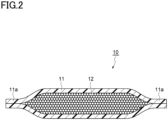
- Fig. 2 is a schematic cross-sectional view of the fire extinguishing body according to the embodiment, and is a cross-sectional view taken along line II-II of Fig. 1 .
- the fire extinguishing body 10 comprises a packaging bag 11 formed from substrates each comprising a resin layer, and a fire extinguishing agent 12 sealed in the packaging bag.
- the packaging bag 11 has a sealing part 11a at its peripheral edge, and the substrates are joined together in the sealing part 11a. In this embodiment, it can be said that the resin layers are thermally fused together in the sealing part.
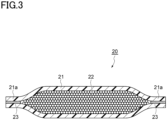
- Fig. 3 is a schematic cross-sectional view of a fire extinguishing body according to another embodiment.
- the fire extinguishing body 20 comprises a packaging bag 21 formed from substrates each comprising a resin layer, and a fire extinguishing agent 22 sealed in the packaging bag.
- the packaging bag 21 has a sealing part 21a at its peripheral edge, and the substrates are joined together with an adhesive 23 in the sealing part 21a.
- the resin layers are bonded together with an adhesive in the sealing part.
- Fig. 4 is a schematic external view of a fire extinguishing body according to another embodiment.
- the fire extinguishing body 30 comprises a packaging bag 31 formed from a substrate comprising a resin layer, and a fire extinguishing agent (not shown) sealed in the packaging bag.
- the packaging bag 31 has a sealing part 31a and a folded part 31b at its peripheral edge, and the substrates are joined together in the sealing part 31a.
- the folded part 31b is formed by folding a single substrate that is used in place of a pair of substrates.
- the sealing part 31a may have a form according to the sealing part 11a or a form according to the sealing part 21a.
- the adhesion strength between the substrates in the sealing part is 5 N/15 mm or more. As a result, even if the fire extinguishing agent is deliquescent, the fire extinguishing agent can be stably sealed. From this point of view, the adhesion strength may be 7 N/15 mm or more, or may be 10 N/15 mm or more. The upper limit of the adhesion strength is not particularly limited, but can be about 35 N/15 mm because material failure may occur during strength measurement.
- the adhesion strength can be changed, for example, by adjusting the resin layer, adhesive, and heat-sealing conditions (heat-sealing temperature, pressure, and time).
- the adhesion strength between the substrates can be measured as described below. Specifically, a sample is prepared by bonding together resin layers of substrates by thermal-fusion-bonding or using an adhesive. The thermally fused part or adhesive part of the sample is cut into 15-mm-wide pieces and peeled off in a T-shape at a peeling speed of 300 mm/min in a tensile tester placed in an environment at room temperature of 23°C according to JIS K 6854-3. The average strength from the start of peeling to the point where the thermally fused part or adhesive part is separated is defined as the adhesion strength between the substrates.
- the width of the sealing part is not particularly limited, but can be, for example, 5 mm or more, and may be 5 to 40 mm, in terms of the stability of properties of the fire extinguishing agent.
- the thickness of the central portion of the fire extinguishing body is not necessarily limited because it varies depending on the layer structure and the amount of fire extinguishing agent sealed therein; however, the thickness can be, for example, 2 to 20 mm, in terms of capable of reducing the thickness so that installation space is not an issue while maintaining fire extinguishing performance. Further, the area of the main surface of the fire extinguishing body (the surface when the fire extinguishing body is viewed perpendicularly from above) can be, for example, 9 to 620 cm 2 in terms of fire extinguishing performance and ease of handling.
- the fire extinguishing body is installed in advance on or near an object that may catch fire. If the object catches fire, initial fire extinguishing will be performed by the fire extinguishing body.
- the substrate comprises a resin layer.
- the material of the resin layer include polyolefins (PE, PP, COP, etc.), polyesters (PET etc.), fluororesins (PTFE, ETFE, EFEP, PFA, FEP, PCTFE, etc.), vinyl resins (PVC, PVA, etc.), acrylic resins, epoxy resins, polyamides, polyimides, and the like.
- the substrate may be composed of one resin layer made of such a material, or may be composed of a plurality of resin layers. A plurality of resin layers may be made of different materials. When the substrate is composed of a plurality of layers, the layers may be attached together using an adhesive (adhesive layer).
- adhesives examples include acrylic adhesives, epoxy adhesives, silicone adhesives, polyolefin adhesives, urethane adhesives, polyvinyl ether adhesives, or synthetic adhesives thereof (e.g., epoxy-urethane synthetic adhesives), and the like.
- the resin layer may have thermal-fusion-bonding properties (thermally-melting properties).
- the resin layer having thermal-fusion-bonding properties can be regarded as a thermally fused layer.
- the thermally fused layer can be provided on the innermost layer side (side facing toward the fire extinguishing agent) of the substrate.
- the sealing part of the packaging bag peripheral edge can be regarded as a thermally fused part (heat-seal part).
- a thermally-fusible polyolefin resin can be used as the resin That is, the resin layer may contain a polyolefin resin.
- polyolefin resins examples include polyolefin resins, such as low-density polyethylene resin (LDPE), linear low-density polyethylene resin (LLDPE), medium-density polyethylene resin (MDPE), and non-oriented polypropylene resin (CPP); polyethylene resins, such as ethylene-vinyl acetate copolymers and ethyl ene- ⁇ -olefin copolymers; polypropylene resins, such as propylene-ethylene random copolymers, propylene-ethylene block copolymers, and propylene- ⁇ -olefin copolymers; and the like.
- polyolefin resins such as low-density polyethylene resin (LDPE), linear low-density polyethylene resin (LLDPE), medium-density polyethylene resin (MDPE), and non-oriented polypropylene resin (CPP); polyethylene resins, such as ethylene-vinyl acetate copolymers and ethyl ene-
- the polyolefin resin may contain low-density polyethylene resin (LDPE), linear low-density polyethylene resin (LLDPE), or non-oriented polypropylene resin (CPP). These resins have transparency, and facilitate the visual inspection of fire extinguishing agents. Therefore, this makes it easier to check the time for replacement of the fire extinguishing body.
- LDPE low-density polyethylene resin
- LLDPE linear low-density polyethylene resin
- CPP non-oriented polypropylene resin
- the substrate may comprise a gas barrier layer.
- the gas barrier layer may be provided on the outermost layer side of the substrate, or may be provided as an intermediate layer of the substrate.
- the moisture permeability (according to JIS K 7129, under 40°C/90% RH conditions) of the gas barrier layer is not particularly limited because it can be designed depending on the type of fire extinguishing agent; however, the moisture permeability can be 10 g/m 2 /day or less, and may be 1 g/m 2 /day or less.
- examples of the gas barrier layer include metal layers, metal oxide layers, and the like, and specific examples include metal oxide deposition layers such as an alumina deposition layer and a silica deposition layer, and metal foil such as aluminum foil.
- the substrate may further comprise a resin layer for supporting the gas barrier layer.
- the metal oxide deposition layer may face the fire extinguishing agent side.
- the thickness of the substrate can be suitably selected depending on the use environment of the fire extinguishing body, the allowable space, and the like. For example, a thick substrate makes it easier to suppress water vapor permeation, provide strength and rigidity, provide a highly planar shape, and facilitate handling. Further, a thin substrate makes it possible to install the fire extinguishing body in a narrow space.
- the thickness of the substrate can be, for example, 4.5 to 1000 ⁇ m, and may be 12 to 100 ⁇ m or 12 to 50 ⁇ m.
- the thickness of the resin layer and the gas barrier layer may be suitably adjusted depending on the thickness of the substrate.
- the thickness of the resin layer (when the substrate comprises a plurality of resin layers, the total thickness of the layers) can be, for example, 4.5 to 150 ⁇ m, and may be 10 to 100 ⁇ m.
- the thickness of the gas barrier layer can be, for example, 5 to 100 nm in the case of a metal oxide deposition layer, and 0.8 to 30 ⁇ m in the case of a metal foil.
- the fire extinguishing agent is not particularly limited, and fire extinguishing agents that have the so-called four elements of fire extinguishing (starving action, cooling action, smothering action, and negative catalytic action) can be suitably used depending on the form of the object.
- the packaging bag of the present embodiment can be suitably used particularly for deliquescent fire extinguishing agents.
- deliquescent fire extinguishing agents include general extinguishing agents (e.g., powder fire extinguishing agents using a potassium salt as a main component, and general powder fire extinguishing agents such as sodium hydrogen carbonate and phosphate).
- Examples of versatile fire extinguishing agents include ABC fire extinguishing agents, and examples of fire extinguishing agents for oil and electrical fires include BC fire extinguishing agents.
- BC fire extinguishing agents and fire extinguishing agents for other lithium ion batteries are used.
- the fire extinguishing agent may contain at least one of an organic salt and an inorganic salt that generally have fire extinguishing performance and deliquescence.
- organic salts that function as a fire extinguishing agent include potassium salts, sodium salts, ammonium salts, and the like.
- a potassium salt can be preferably used as the organic salt.
- organic potassium salts include carboxylic acid potassium salts, such as potassium acetate, potassium citrate (tripotassium citrate, dipotassium citrate, and monopotassium citrate), potassium tartrate, potassium lactate, potassium oxalate, and potassium maleate.
- potassium citrate can be used in terms of usefulness for the negative catalytic effect of combustion.
- inorganic salts that function as a fire extinguishing agents include potassium salts, sodium salts, and the like.
- a potassium salt can be preferably used as the inorganic salt.
- inorganic potassium salts include potassium tetraborate, potassium carbonate, potassium hydrogen carbonate, potassium dihydrogen phosphate, dipotassium hydrogen phosphate, and the like.
- potassium hydrogen carbonate can be used in terms of usefulness for the negative catalytic effect of combustion.
- Organic salts and inorganic salts each may be used singly or in combination of two or more.
- the fire extinguishing agent may contain compounds other than the salts described above.
- other components include oxidizing agents for improving salt reactivity, and specific examples include potassium chlorate, sodium chlorate, strontium chlorate, ammonium chlorate, magnesium chlorate, and the like.
- Other examples of other components include colorants, antioxidants, flame retardants, inorganic fillers, fluidity-imparting agents, moisture retardants, dispersants, UV absorbers, metal catalysts, and the like.
- the amount of the fire extinguishing agent can be suitably selected depending on the form of the object, the power of the fire at the time of ignition, the extinguishing time, the allowable space, and the like.
- the amount of the fire extinguishing agent may be, for example, 0.4 to 3.9 g/cm 2 , 1.0 to 2.5 g/cm 2 , 0.01 to 1.0 g/cm 2 , or 0.02 to 0.2 g/cm 2 .
- the fire extinguishing agent may be mixed with a binder. That is, the fire extinguishing agent may be a composition containing a fire extinguishing agent (fire extinguishing agent component) and a binder.
- the content of the fire extinguishing agent in the composition (fire extinguishing agent composition) can be 70 to 97 mass% based on the total amount of the fire extinguishing agent composition.
- thermoplastic resin and a thermosetting resin can be used as binder resins.
- thermoplastic resins include polyolefin resins, such as polyvinyl alcohol resin, polyvinyl acetal resin, polypropylene resin, polyethylene resin, poly(1-)butene resin, and polypentene resin; polystyrene resin, acrylonitrile-butadiene-styrene resin, methyl methacrylate-butadiene-styrene resin, ethylene-vinyl acetate resin, ethylene-propylene resin, polycarbonate resin, polyphenylene ether resin, acrylic resin, polyamide resin, polyvinyl chloride resin, and the like.
- polyolefin resins such as polyvinyl alcohol resin, polyvinyl acetal resin, polypropylene resin, polyethylene resin, poly(1-)butene resin, and polypentene resin
- polystyrene resin acrylonitrile-butadiene-styrene resin,
- thermosetting resins include natural rubber (NR), isoprene rubber (IR), butadiene rubber (BR), 1,2-polybutadiene rubber (1,2-BR), styrene-butadiene rubber (SBR), chloroprene rubber (CR), nitrile rubber (NBR), butyl rubber (IIR), ethylene-propylene rubber (EPR, EPDM), chlorosulfonated polyethylene (CSM), acrylic rubber (ACM, ANM), epichlorohydrin rubber (CO, ECO), polyvulcanized rubber (T), silicone rubber (Q), fluororubber (FKM, FZ), urethane rubber (U), and other rubbers, polyurethane resin, polyisocyanate resin, polyisocyanurate resin, phenol resin, epoxy resin, and the like.
- the binder resin may contain a hardener component.
- the fire extinguishing agent may be formed as a fire extinguishing agent layer on a fire extinguishing agent support layer.
- the use of the fire extinguishing agent support layer facilitates the handling of the fire extinguishing agent.
- the fire extinguishing agent support layer include the layers mentioned above as examples of the resin layer of the substrate, and specific examples include polyester resin layers (e.g., PET layer).
- the fire extinguishing agent layer can be formed on an object by applying a coating liquid of a fire extinguishing agent composition containing a liquid medium onto the fire extinguishing agent support layer of the object, followed by drying.
- Coating can be performed by a wet coating method.
- the wet coating method include a gravure coating method, a comma coating method, a spray coating method, a dip coating method, a curtain coating method, a spin coating method, a sponge roll method, a die coating method, coating with a brush, and the like.
- the viscosity of the coating liquid is preferably, for example, 1 to 2000 mPa ⁇ s when using a gravure coating method, 500 to 100000 mPa ⁇ s when using a comma coating method, and 0.1 to 4000 mPa ⁇ s when using a spray coating method.
- the amount of the liquid medium may be suitably adjusted so that the coating liquid viscosity falls within the desired range.
- the viscosity can be measured with a coaxial double-cylinder rotational viscometer.
- the amount of the liquid medium may be suitably adjusted depending on the usage of the coating liquid, but can be 40 to 60 mass% based on the total amount of the fire extinguishing agent composition.
- adhesives examples include acrylic adhesives, epoxy adhesives, silicone adhesives, polyolefin adhesives, urethane adhesives, polyvinyl ether adhesives, or synthetic adhesives thereof, and the like.
- urethane adhesives and epoxy-urethane synthetic adhesives can be preferably used as adhesives, in terms of achieving both adhesion to the substrate under 85°C-85% RH high-temperature and high-humidity conditions, and low cost.
- the peripheral edges of the substrates can be joined even if the resin layer does not have thermal-fusion-bonding properties.
- the sealing part of the packaging bag peripheral edge can be regarded as an adhesive part.
- an adhesive is used only for the sealing part; however, if the adhesive does not affect the stability of properties of the fire extinguishing agent, it may also be used on the entire inner surface of the substrate.
- Fig. 5 is a schematic cross-sectional view of a fire extinguishing body according to another embodiment.
- the fire extinguishing body 60 comprises a packaging bag 61 formed from a substrate, a fire extinguishing agent 62 sealed in the packaging bag, and a sticky layer 64 (or an adhesive layer) and a release film 65 on one surface of the packaging bag.
- the substrate comprises a resin layer 611 as the inner layer, and a gas barrier layer 612 as the outer layer.
- the resin layer 611 and the gas barrier layer 612 are laminated via an adhesive layer 63.
- the fire extinguishing agent 62 is formed as a fire extinguishing agent layer on a fire extinguishing agent support layer 613.
- the sticky layer 64 is provided on one surface of the packaging bag, the fire extinguishing body can be more easily installed where there is a risk of ignition.
- the release film 65 is provided so as to cover the sticky layer 64. The release film 65 is to be peeled when the fire extinguishing body is attached to the desired location, and may be made of resin or paper.
- the fire extinguishing body may further comprise a design layer.
- the design layer can be formed by printing or typing. Specific examples of designs include wood grain, solid white and gray patterns and tile-like patterns with an awareness of living spaces, as well as pictures, patterns, designs, character patterns, and the like. Providing a design layer results in effects that designability can be enhanced, the fire extinguishing body can be made fit with its surroundings, and the strength of the fire extinguishing body can be increased.
- a design layer can be provided on the opposite side of the sticky layer side of the packaging bag (the side to which the fire extinguishing body is bonded).
- a design layer may be provided in the substrate.
- a design layer may be provided inside the gas barrier layer.
- the design layer may have a single-layer structure, or may have a multilayer structure.
- Objects to be extinguished are not particularly limited as long as they may catch fire.
- objects that may catch fire include electrical wires, switchboards, distribution boards, control panels, rechargeable batteries (lithium-ion batteries etc.), wallpaper for building materials, building materials such as ceiling materials, lithium-ion battery collection boxes (recycling boxes), trash cans, automotive-related parts, electrical outlets, electrical outlet covers, and other parts.
- the fire extinguishing body can be produced, for example, by the production method described below; however, the method is not limited thereto.
- Fig. 6 is a schematic view showing a method for producing a fire extinguishing body according to an embodiment.
- a fire extinguishing agent 42 is provided between a pair of substrates 44, the peripheral edges of the substrates 44 are joined and sealed by heat sealing or using an adhesive, whereby a fire extinguishing body can be obtained.
- Heat sealing can be performed using a heat seal bar, for example, at 80 to 140°C and 0.15 to 0.4 MPa for 0.1 to 50 seconds.
- Fig. 7 is a schematic view showing a method for producing a fire extinguishing body according to another embodiment.
- a single substrate 54 is folded, a fire extinguishing agent 52 is provided between the facing substrates 54, and the peripheral edges of the substrate 54 other than the folded part are joined and sealed by heat sealing or using an adhesive, whereby a fire extinguishing body can be obtained.
- peripheral edges of a pair of substrates are joined by heat sealing or using an adhesive while leaving an opening, and after a fire extinguishing agent is inserted through the opening, the opening is joined and sealed by heat sealing or using an adhesive, whereby a fire extinguishing body can be obtained.
- a single substrate may be folded, the peripheral edges of the facing substrates may be joined by heat sealing or using an adhesive while leaving an opening, and after a fire extinguishing agent is inserted through the opening, the opening may be joined and sealed by heat sealing or using an adhesive, whereby a fire extinguishing body can be obtained.
- a coating liquid containing the fire extinguishing agent composition may be applied to a resin layer or a fire extinguishing agent support layer to form a fire extinguishing agent layer, and this layer may be used to provide the fire extinguishing agent between the substrates.
- a resin kneaded with a fire extinguishing agent may be placed on a substrate to provide the fire extinguishing agent between substrates.
- the fire extinguishing agent (fire extinguishing agent-containing layer) may be a layer of a composition containing a fire extinguishing agent and a binder, or a resin layer containing a fire extinguishing agent.
- a fire extinguishing body comprising a packaging bag formed from one or more substrates each comprising a resin layer, and a deliquescent fire extinguishing agent sealed in the packaging bag, the packaging bag having a sealing part at its peripheral edge, and the adhesion strength between the substrates in the sealing part being 5 N/15 mm or more.
- Epoxy-urethane synthetic adhesives AD-393 and CAT-EP5 produced by Toyo Ink Co., Ltd. were prepared, and IPA was prepared as a diluting solvent. These were mixed at a formulation ratio of 15:1:25.7, and then stirred for 1 minute to produce an adhesive for dry lamination with a solid content of 20 mass%.
- a LDPE film (produced by Mitsui Chemicals Tohcello, Inc., thickness: 30 ⁇ m) and GL-ARH (produced by Toppan Inc., thickness: 12 ⁇ m), which is a PET film comprising an alumina deposition layer, were prepared.
- the adhesive for dry lamination was applied to the alumina deposition layer side of GL-ARH by a bar coating method using a wire bar #14, and dried in an oven at 80°C for 30 seconds to obtain an adhesive layer with a dry coating weight of 2 g/m 2 .
- the corona-treated side of the LDPE film was bonded to the adhesive layer at a laminating temperature of 60°C and a pressure of 0.5 MPa to obtain a laminated film.
- the opening edge was heat-sealed using the heat sealer described above under the same conditions as those described above to produce a fire extinguishing body.
- Fire extinguishing bodies were produced in the same manner as in Example 1, except that the heat sealing conditions were changed as shown in Table 1.
- the thermally fused part of the fire extinguishing body obtained in each example was cut into a 15-mm-wide sample.
- the sample was peeled off in a T-shape at a peeling speed of 300 mm/min in a tensile tester placed in an environment at room temperature of 23°C according to JIS K 6854-3, and the strength was measured from the start of peeling to the point where the thermally fused part was separated. This measurement was performed three times at different locations in the thermally fused part, and the average value was used as the adhesion strength between the substrates.
- the total light transmittance of the fire extinguishing body obtained in each example was measured. Specifically, a haze meter (produced by BYK Instruments) was used for the measurement. After calibration of the instrument, the sample was fixed so that the light entering the integrating sphere from the light source passed through the fire extinguishing agent placed in the laminated film bag of the fire extinguishing body. The total light transmittance was measured immediately after the fire extinguishing body was produced (initial stage), and after the elapse of a certain period of time (88 hours or 232 hours) after the fire extinguishing body was placed in an 85°C-85% RH constant temperature and humidity chamber. This process was performed three times at different measurement points, and the average value was recorded.
- a haze meter produced by BYK Instruments
- the fire extinguishing agent As the fire extinguishing agent deliquesces, the fire extinguishing agent becomes more transparent and the total light transmittance increases. Therefore, the degree of deliquescence of the fire extinguishing agent can be determined by measuring the total light transmittance.
- Example 1 Heat sealing conditions Adhesion strength (N/15 mm) Total light transmittance (%) Temperature (°C) Time (sec) Initial 88 hours later 232 hours later Comparative Example 1 100 0.2 0.3 8.46 N.D.* 55.3 Comparative Example 2 100 0.4 3 8.12 21.4 55.7 Example 1 100 0.5 7 8.26 16.9 35.5 Example 2 100 0.7 11 8.34 16.4 37.3 Example 3 100 1.0 14 8.18 17.5 36.7 Example 4 100 50 15 8.29 17.6 39.0 Example 5 120 0.3 >30 8.29 17.6 35.4 Example 6 140 2.0 >30 8.48 17.4 36.9
- the fire extinguishing body of the present invention can be suitably used particularly for components that are used for industrial materials, such as construction materials, automotive parts, aircraft parts, and electronics parts.
Landscapes
- Business, Economics & Management (AREA)
- Emergency Management (AREA)
- Health & Medical Sciences (AREA)
- Public Health (AREA)
- Chemical & Material Sciences (AREA)
- Chemical Kinetics & Catalysis (AREA)
- General Chemical & Material Sciences (AREA)
- Laminated Bodies (AREA)
Abstract
Description
- The present invention relates to a fire extinguishing body.
- In recent years, with the advancement of technology, our lives have become more and more comfortable, but at the same time, a large amount of energy is required to produce such comfort. High safety is required for the handling of energy in each situation of storing, transferring, and using a large amount of energy in a high density.
- Taking automobiles as an example, there is risk of ignition and fire, for example, when fossil fuels are mined, when gasoline is refined from fossil fuels, when gasoline is transported, or when gasoline is burned in engines. Further, taking electronics as an example, there is risk of ignition and fire, for example, when electrical energy is transferred through power lines, when electrical energy is adjusted at substations and transformers, when electrical energy is used in electrical equipment in homes and factories, or when electrical energy is temporarily stored in rechargeable batteries.
- In response to the problems of ignition and fire, PTL 1 has proposed the use of a fire extinguishing liquid and an extinguisher. PTL 2 has proposed an automatic fire extinguishing device to be dropped from a helicopter. PTL 3 has proposed an aerosol fire extinguishing device.
-
- PTL 1:
JP H9-276440 A - PTL 2:
JP 2015-6302 A - PTL 3:
JP 2017-080023 A - All of the prior arts propose ways to deal with fire after a certain amount of time has elapsed. On the other hand, from the viewpoint of minimizing damage caused by fire, it is desirable that some kind of fire extinguishing work (initial fire extinguishing) be performed soon after the fire breaks out.
- Therefore, for example, it is possible to locate in advance components of the fire extinguishing agents disclosed in the prior arts near an object that may catch fire. In this way, it is expected that the components of the fire extinguishing agents will extinguish the fire before humans detect the fire from the object. However, if a deliquescent fire extinguishing agent component is used, the fire extinguishing agent may deteriorate with time, even if the fire extinguishing agent is sealed in a packaging bag.
- The present invention was made in view of the above circumstances, and an object thereof is to provide a fire extinguishing body that ensures excellent stability of the properties of a deliquescent fire extinguishing agent and is capable of preventing the outbreak and spread of fire.
- One aspect of the present invention is to provide a fire extinguishing body comprising a packaging bag formed from one or more substrates each comprising a resin layer, and a deliquescent fire extinguishing agent sealed in the packaging bag, the packaging bag having a sealing part at its peripheral edge, and the adhesion strength between the substrates in the sealing part being 5 N/15 mm or more. With such a fire extinguishing body, the packing bag with the peripheral edge sufficiently sealed prevents contact between the fire extinguishing agent and the outside air, thereby preventing the deterioration of the deliquescent fire extinguishing agent. That is, the above fire extinguishing body ensures excellent stability properties of the fire extinguishing agent. Further, by placing the fire extinguishing body near the object in advance, it is possible to extinguish the fire at an early stage and to prevent the fire from spreading to the surrounding area.
- In an embodiment, the resin layer may comprise a polyolefin resin.
- In an embodiment, the substrate may have a thickness of 4.5 to 1000 µm.
- In an embodiment, the substrate may further comprise a gas barrier layer.
- In an embodiment, the gas barrier layer may comprise a metal layer or a metal oxide layer.
- In an embodiment, the resin layers may be thermally fused together in the sealing part.
- In an embodiment, the sealing part may have a width of 5 mm or more.
- According to the present invention, it is possible to provide a fire extinguishing body that ensures excellent stability of properties of a deliquescent fire extinguishing agent and is capable of preventing the outbreak and spread of fire. The advantages of the present invention are briefly summarized below.
- Damage caused by the spread of flames can be kept to a minimum. That is, initial fire extinguishing is possible.
- After a person confirms the existence of a fire, the person does not need to carry a fire extinguishing agent near the fire extinguishing target to extinguish the fire.
- Compared to automatic fire extinguishing devices and other equipment, the fire extinguishing body can be easily installed; thus, there are fewer restrictions on installation locations, and it can be applied to any necessary location.
- Even when the fire extinguishing agent is deliquescent, the fire extinguishing agent can be stably sealed; thus, the frequency of replacement of the fire extinguishing body can be reduced.
-
- [
Fig. 1] Fig. 1 is a schematic external view of a fire extinguishing body according to an embodiment. - [
Fig. 2] Fig. 2 is a schematic cross-sectional view of the fire extinguishing body according to the embodiment, and is a cross-sectional view taken along line II-II ofFig. 1 . - [
Fig. 3] Fig. 3 is a schematic cross-sectional view of a fire extinguishing body according to another embodiment. - [
Fig. 4] Fig. 4 is a schematic external view of a fire extinguishing body according to another embodiment. - [
Fig. 5] Fig. 5 is a schematic cross-sectional view of a fire extinguishing body according to another embodiment. - [
Fig. 6] Fig. 6 is a schematic view showing a method for producing a fire extinguishing body according to an embodiment. - [
Fig. 7] Fig. 7 is a schematic view showing a method for producing a fire extinguishing body according to another embodiment. - Embodiments of the present invention will be described in detail below. However, the present invention is not limited to the following embodiments.
-
Fig. 1 is a schematic external view of a fire extinguishing body according to an embodiment.Fig. 2 is a schematic cross-sectional view of the fire extinguishing body according to the embodiment, and is a cross-sectional view taken along line II-II ofFig. 1 . Thefire extinguishing body 10 comprises apackaging bag 11 formed from substrates each comprising a resin layer, and afire extinguishing agent 12 sealed in the packaging bag. Thepackaging bag 11 has a sealingpart 11a at its peripheral edge, and the substrates are joined together in thesealing part 11a. In this embodiment, it can be said that the resin layers are thermally fused together in the sealing part. -
Fig. 3 is a schematic cross-sectional view of a fire extinguishing body according to another embodiment. The fire extinguishing body 20 comprises apackaging bag 21 formed from substrates each comprising a resin layer, and afire extinguishing agent 22 sealed in the packaging bag. Thepackaging bag 21 has a sealingpart 21a at its peripheral edge, and the substrates are joined together with an adhesive 23 in thesealing part 21a. In this embodiment, it can be said that the resin layers are bonded together with an adhesive in the sealing part. -
Fig. 4 is a schematic external view of a fire extinguishing body according to another embodiment. Thefire extinguishing body 30 comprises apackaging bag 31 formed from a substrate comprising a resin layer, and a fire extinguishing agent (not shown) sealed in the packaging bag. Thepackaging bag 31 has a sealingpart 31a and a foldedpart 31b at its peripheral edge, and the substrates are joined together in thesealing part 31a. The foldedpart 31b is formed by folding a single substrate that is used in place of a pair of substrates. The sealingpart 31a may have a form according to the sealingpart 11a or a form according to the sealingpart 21a. - The adhesion strength between the substrates in the sealing part is 5 N/15 mm or more. As a result, even if the fire extinguishing agent is deliquescent, the fire extinguishing agent can be stably sealed. From this point of view, the adhesion strength may be 7 N/15 mm or more, or may be 10 N/15 mm or more. The upper limit of the adhesion strength is not particularly limited, but can be about 35 N/15 mm because material failure may occur during strength measurement. The adhesion strength can be changed, for example, by adjusting the resin layer, adhesive, and heat-sealing conditions (heat-sealing temperature, pressure, and time).
- The adhesion strength between the substrates can be measured as described below. Specifically, a sample is prepared by bonding together resin layers of substrates by thermal-fusion-bonding or using an adhesive. The thermally fused part or adhesive part of the sample is cut into 15-mm-wide pieces and peeled off in a T-shape at a peeling speed of 300 mm/min in a tensile tester placed in an environment at room temperature of 23°C according to JIS K 6854-3. The average strength from the start of peeling to the point where the thermally fused part or adhesive part is separated is defined as the adhesion strength between the substrates.
- When the fire extinguishing body is viewed vertically from above, the width of the sealing part (fusion width or adhesive width) is not particularly limited, but can be, for example, 5 mm or more, and may be 5 to 40 mm, in terms of the stability of properties of the fire extinguishing agent.
- The thickness of the central portion of the fire extinguishing body is not necessarily limited because it varies depending on the layer structure and the amount of fire extinguishing agent sealed therein; however, the thickness can be, for example, 2 to 20 mm, in terms of capable of reducing the thickness so that installation space is not an issue while maintaining fire extinguishing performance. Further, the area of the main surface of the fire extinguishing body (the surface when the fire extinguishing body is viewed perpendicularly from above) can be, for example, 9 to 620 cm2 in terms of fire extinguishing performance and ease of handling.
- The fire extinguishing body is installed in advance on or near an object that may catch fire. If the object catches fire, initial fire extinguishing will be performed by the fire extinguishing body.
- The substrate comprises a resin layer. Examples of the material of the resin layer include polyolefins (PE, PP, COP, etc.), polyesters (PET etc.), fluororesins (PTFE, ETFE, EFEP, PFA, FEP, PCTFE, etc.), vinyl resins (PVC, PVA, etc.), acrylic resins, epoxy resins, polyamides, polyimides, and the like. The substrate may be composed of one resin layer made of such a material, or may be composed of a plurality of resin layers. A plurality of resin layers may be made of different materials. When the substrate is composed of a plurality of layers, the layers may be attached together using an adhesive (adhesive layer). Examples of adhesives include acrylic adhesives, epoxy adhesives, silicone adhesives, polyolefin adhesives, urethane adhesives, polyvinyl ether adhesives, or synthetic adhesives thereof (e.g., epoxy-urethane synthetic adhesives), and the like.
- The resin layer may have thermal-fusion-bonding properties (thermally-melting properties). The resin layer having thermal-fusion-bonding properties can be regarded as a thermally fused layer. The thermally fused layer can be provided on the innermost layer side (side facing toward the fire extinguishing agent) of the substrate. When the substrate comprises a thermally fused layer, the sealing part of the packaging bag peripheral edge can be regarded as a thermally fused part (heat-seal part). A thermally-fusible polyolefin resin can be used as the resin That is, the resin layer may contain a polyolefin resin. Examples of polyolefin resins include polyolefin resins, such as low-density polyethylene resin (LDPE), linear low-density polyethylene resin (LLDPE), medium-density polyethylene resin (MDPE), and non-oriented polypropylene resin (CPP); polyethylene resins, such as ethylene-vinyl acetate copolymers and ethyl ene-α-olefin copolymers; polypropylene resins, such as propylene-ethylene random copolymers, propylene-ethylene block copolymers, and propylene-α-olefin copolymers; and the like. Among these, in terms of excellent heat sealability, and low moisture permeability, which makes it easy to suppress the deterioration of the fire extinguishing agent, the polyolefin resin may contain low-density polyethylene resin (LDPE), linear low-density polyethylene resin (LLDPE), or non-oriented polypropylene resin (CPP). These resins have transparency, and facilitate the visual inspection of fire extinguishing agents. Therefore, this makes it easier to check the time for replacement of the fire extinguishing body.
- The substrate may comprise a gas barrier layer. The gas barrier layer may be provided on the outermost layer side of the substrate, or may be provided as an intermediate layer of the substrate. When the substrate comprises a gas barrier layer, it becomes easier to maintain gas barrier performance to the extent that the properties of the fire extinguishing agent do not change significantly, regardless of the installation location or use environment of the fire extinguishing body. The moisture permeability (according to JIS K 7129, under 40°C/90% RH conditions) of the gas barrier layer is not particularly limited because it can be designed depending on the type of fire extinguishing agent; however, the moisture permeability can be 10 g/m2/day or less, and may be 1 g/m2/day or less. In terms of adjusting moisture permeability, examples of the gas barrier layer include metal layers, metal oxide layers, and the like, and specific examples include metal oxide deposition layers such as an alumina deposition layer and a silica deposition layer, and metal foil such as aluminum foil. In addition to the resin layer provided as the innermost layer, the substrate may further comprise a resin layer for supporting the gas barrier layer. When the gas barrier layer comprises a metal oxide deposition layer, the metal oxide deposition layer may face the fire extinguishing agent side.
- The thickness of the substrate can be suitably selected depending on the use environment of the fire extinguishing body, the allowable space, and the like. For example, a thick substrate makes it easier to suppress water vapor permeation, provide strength and rigidity, provide a highly planar shape, and facilitate handling. Further, a thin substrate makes it possible to install the fire extinguishing body in a narrow space. The thickness of the substrate can be, for example, 4.5 to 1000 µm, and may be 12 to 100 µm or 12 to 50 µm. The thickness of the resin layer and the gas barrier layer may be suitably adjusted depending on the thickness of the substrate. The thickness of the resin layer (when the substrate comprises a plurality of resin layers, the total thickness of the layers) can be, for example, 4.5 to 150 µm, and may be 10 to 100 µm. The thickness of the gas barrier layer can be, for example, 5 to 100 nm in the case of a metal oxide deposition layer, and 0.8 to 30 µm in the case of a metal foil.
- The fire extinguishing agent is not particularly limited, and fire extinguishing agents that have the so-called four elements of fire extinguishing (starving action, cooling action, smothering action, and negative catalytic action) can be suitably used depending on the form of the object. The packaging bag of the present embodiment can be suitably used particularly for deliquescent fire extinguishing agents. Examples of deliquescent fire extinguishing agents include general extinguishing agents (e.g., powder fire extinguishing agents using a potassium salt as a main component, and general powder fire extinguishing agents such as sodium hydrogen carbonate and phosphate). Examples of versatile fire extinguishing agents include ABC fire extinguishing agents, and examples of fire extinguishing agents for oil and electrical fires include BC fire extinguishing agents. When the object is a lithium ion battery, BC fire extinguishing agents and fire extinguishing agents for other lithium ion batteries are used.
- The fire extinguishing agent may contain at least one of an organic salt and an inorganic salt that generally have fire extinguishing performance and deliquescence.
- Examples of organic salts that function as a fire extinguishing agent include potassium salts, sodium salts, ammonium salts, and the like. A potassium salt can be preferably used as the organic salt. Examples of organic potassium salts include carboxylic acid potassium salts, such as potassium acetate, potassium citrate (tripotassium citrate, dipotassium citrate, and monopotassium citrate), potassium tartrate, potassium lactate, potassium oxalate, and potassium maleate. Among these, potassium citrate can be used in terms of usefulness for the negative catalytic effect of combustion.
- Examples of inorganic salts that function as a fire extinguishing agents include potassium salts, sodium salts, and the like. A potassium salt can be preferably used as the inorganic salt. Examples of inorganic potassium salts include potassium tetraborate, potassium carbonate, potassium hydrogen carbonate, potassium dihydrogen phosphate, dipotassium hydrogen phosphate, and the like. Among these, potassium hydrogen carbonate can be used in terms of usefulness for the negative catalytic effect of combustion.
- Organic salts and inorganic salts each may be used singly or in combination of two or more.
- The fire extinguishing agent may contain compounds other than the salts described above. Examples of other components include oxidizing agents for improving salt reactivity, and specific examples include potassium chlorate, sodium chlorate, strontium chlorate, ammonium chlorate, magnesium chlorate, and the like. Other examples of other components include colorants, antioxidants, flame retardants, inorganic fillers, fluidity-imparting agents, moisture retardants, dispersants, UV absorbers, metal catalysts, and the like.
- The amount of the fire extinguishing agent can be suitably selected depending on the form of the object, the power of the fire at the time of ignition, the extinguishing time, the allowable space, and the like. The larger the amount of the fire extinguishing agent, the better the fire extinguishing ability and the shorter the extinguishing time; however, it may also be bulkier, which limits the space where the fire extinguishing body can be placed. The amount of the fire extinguishing agent may be, for example, 0.4 to 3.9 g/cm2, 1.0 to 2.5 g/cm2, 0.01 to 1.0 g/cm2, or 0.02 to 0.2 g/cm2.
- The fire extinguishing agent may be mixed with a binder. That is, the fire extinguishing agent may be a composition containing a fire extinguishing agent (fire extinguishing agent component) and a binder. The content of the fire extinguishing agent in the composition (fire extinguishing agent composition) can be 70 to 97 mass% based on the total amount of the fire extinguishing agent composition.
- A thermoplastic resin and a thermosetting resin can be used as binder resins. Examples of thermoplastic resins include polyolefin resins, such as polyvinyl alcohol resin, polyvinyl acetal resin, polypropylene resin, polyethylene resin, poly(1-)butene resin, and polypentene resin; polystyrene resin, acrylonitrile-butadiene-styrene resin, methyl methacrylate-butadiene-styrene resin, ethylene-vinyl acetate resin, ethylene-propylene resin, polycarbonate resin, polyphenylene ether resin, acrylic resin, polyamide resin, polyvinyl chloride resin, and the like. Examples of thermosetting resins include natural rubber (NR), isoprene rubber (IR), butadiene rubber (BR), 1,2-polybutadiene rubber (1,2-BR), styrene-butadiene rubber (SBR), chloroprene rubber (CR), nitrile rubber (NBR), butyl rubber (IIR), ethylene-propylene rubber (EPR, EPDM), chlorosulfonated polyethylene (CSM), acrylic rubber (ACM, ANM), epichlorohydrin rubber (CO, ECO), polyvulcanized rubber (T), silicone rubber (Q), fluororubber (FKM, FZ), urethane rubber (U), and other rubbers, polyurethane resin, polyisocyanate resin, polyisocyanurate resin, phenol resin, epoxy resin, and the like. The binder resin may contain a hardener component.
- The fire extinguishing agent may be formed as a fire extinguishing agent layer on a fire extinguishing agent support layer. The use of the fire extinguishing agent support layer facilitates the handling of the fire extinguishing agent. Examples of the fire extinguishing agent support layer include the layers mentioned above as examples of the resin layer of the substrate, and specific examples include polyester resin layers (e.g., PET layer).
- The fire extinguishing agent layer can be formed on an object by applying a coating liquid of a fire extinguishing agent composition containing a liquid medium onto the fire extinguishing agent support layer of the object, followed by drying.
- Coating can be performed by a wet coating method. Examples of the wet coating method include a gravure coating method, a comma coating method, a spray coating method, a dip coating method, a curtain coating method, a spin coating method, a sponge roll method, a die coating method, coating with a brush, and the like.
- The viscosity of the coating liquid is preferably, for example, 1 to 2000 mPa·s when using a gravure coating method, 500 to 100000 mPa·s when using a comma coating method, and 0.1 to 4000 mPa·s when using a spray coating method. The amount of the liquid medium may be suitably adjusted so that the coating liquid viscosity falls within the desired range. The viscosity can be measured with a coaxial double-cylinder rotational viscometer.
- The amount of the liquid medium may be suitably adjusted depending on the usage of the coating liquid, but can be 40 to 60 mass% based on the total amount of the fire extinguishing agent composition.
- Examples of adhesives include acrylic adhesives, epoxy adhesives, silicone adhesives, polyolefin adhesives, urethane adhesives, polyvinyl ether adhesives, or synthetic adhesives thereof, and the like. Among these, urethane adhesives and epoxy-urethane synthetic adhesives can be preferably used as adhesives, in terms of achieving both adhesion to the substrate under 85°C-85% RH high-temperature and high-humidity conditions, and low cost.
- By using an adhesive, the peripheral edges of the substrates can be joined even if the resin layer does not have thermal-fusion-bonding properties. When an adhesive is used to join the peripheral edges of the substrates, the sealing part of the packaging bag peripheral edge can be regarded as an adhesive part.
- In
Fig. 3 , an adhesive is used only for the sealing part; however, if the adhesive does not affect the stability of properties of the fire extinguishing agent, it may also be used on the entire inner surface of the substrate. -
Fig. 5 is a schematic cross-sectional view of a fire extinguishing body according to another embodiment. Thefire extinguishing body 60 comprises apackaging bag 61 formed from a substrate, afire extinguishing agent 62 sealed in the packaging bag, and a sticky layer 64 (or an adhesive layer) and arelease film 65 on one surface of the packaging bag. The substrate comprises aresin layer 611 as the inner layer, and agas barrier layer 612 as the outer layer. Theresin layer 611 and thegas barrier layer 612 are laminated via anadhesive layer 63. Thefire extinguishing agent 62 is formed as a fire extinguishing agent layer on a fire extinguishingagent support layer 613. In the present embodiment, since thesticky layer 64 is provided on one surface of the packaging bag, the fire extinguishing body can be more easily installed where there is a risk of ignition. Moreover, therelease film 65 is provided so as to cover thesticky layer 64. Therelease film 65 is to be peeled when the fire extinguishing body is attached to the desired location, and may be made of resin or paper. - The fire extinguishing body may further comprise a design layer. The design layer can be formed by printing or typing. Specific examples of designs include wood grain, solid white and gray patterns and tile-like patterns with an awareness of living spaces, as well as pictures, patterns, designs, character patterns, and the like. Providing a design layer results in effects that designability can be enhanced, the fire extinguishing body can be made fit with its surroundings, and the strength of the fire extinguishing body can be increased. For example, in the embodiment of
Fig. 5 , a design layer can be provided on the opposite side of the sticky layer side of the packaging bag (the side to which the fire extinguishing body is bonded). When the layers contained in the substrate are transparent, a design layer may be provided in the substrate. For example, in the embodiment ofFig. 5 , a design layer may be provided inside the gas barrier layer. The design layer may have a single-layer structure, or may have a multilayer structure. - Objects to be extinguished are not particularly limited as long as they may catch fire. Examples of objects that may catch fire include electrical wires, switchboards, distribution boards, control panels, rechargeable batteries (lithium-ion batteries etc.), wallpaper for building materials, building materials such as ceiling materials, lithium-ion battery collection boxes (recycling boxes), trash cans, automotive-related parts, electrical outlets, electrical outlet covers, and other parts.
- The fire extinguishing body can be produced, for example, by the production method described below; however, the method is not limited thereto.
-
Fig. 6 is a schematic view showing a method for producing a fire extinguishing body according to an embodiment. As shown in this figure, afire extinguishing agent 42 is provided between a pair ofsubstrates 44, the peripheral edges of thesubstrates 44 are joined and sealed by heat sealing or using an adhesive, whereby a fire extinguishing body can be obtained. Heat sealing can be performed using a heat seal bar, for example, at 80 to 140°C and 0.15 to 0.4 MPa for 0.1 to 50 seconds. -
Fig. 7 is a schematic view showing a method for producing a fire extinguishing body according to another embodiment. As shown in this figure, asingle substrate 54 is folded, afire extinguishing agent 52 is provided between the facingsubstrates 54, and the peripheral edges of thesubstrate 54 other than the folded part are joined and sealed by heat sealing or using an adhesive, whereby a fire extinguishing body can be obtained. - Further, the peripheral edges of a pair of substrates are joined by heat sealing or using an adhesive while leaving an opening, and after a fire extinguishing agent is inserted through the opening, the opening is joined and sealed by heat sealing or using an adhesive, whereby a fire extinguishing body can be obtained.
- Moreover, a single substrate may be folded, the peripheral edges of the facing substrates may be joined by heat sealing or using an adhesive while leaving an opening, and after a fire extinguishing agent is inserted through the opening, the opening may be joined and sealed by heat sealing or using an adhesive, whereby a fire extinguishing body can be obtained.
- When a fire extinguishing agent composition containing a fire extinguishing agent and a binder is used as the fire extinguishing agent, for example, a coating liquid containing the fire extinguishing agent composition may be applied to a resin layer or a fire extinguishing agent support layer to form a fire extinguishing agent layer, and this layer may be used to provide the fire extinguishing agent between the substrates. Further, a resin kneaded with a fire extinguishing agent may be placed on a substrate to provide the fire extinguishing agent between substrates. The fire extinguishing agent (fire extinguishing agent-containing layer) may be a layer of a composition containing a fire extinguishing agent and a binder, or a resin layer containing a fire extinguishing agent.
- A fire extinguishing body comprising a packaging bag formed from one or more substrates each comprising a resin layer, and a deliquescent fire extinguishing agent sealed in the packaging bag,
the packaging bag having a sealing part at its peripheral edge, and the adhesion strength between the substrates in the sealing part being 5 N/15 mm or more. - The fire extinguishing body according to Invention 1, wherein the resin layer comprises a polyolefin resin.
- The fire extinguishing body according to Invention 1 or 2, wherein the substrate has a thickness of 4.5 to 1000 µm.
- The fire extinguishing body according to any one of Inventions 1 to 3, wherein the substrate further comprises a gas barrier layer.
- The fire extinguishing body according to Invention 4, wherein the gas barrier layer comprises a metal layer or a metal oxide layer.
- The fire extinguishing body according to any one of Inventions 1 to 5, wherein the resin layers are thermally fused together in the sealing part.
- The fire extinguishing body according to any one of Inventions 1 to 6, wherein the sealing part has a width of 5 mm or more.
- The present invention will be described in more detail by the following examples. However, the present invention is not limited to these examples.
- Epoxy-urethane synthetic adhesives AD-393 and CAT-EP5 produced by Toyo Ink Co., Ltd. were prepared, and IPA was prepared as a diluting solvent. These were mixed at a formulation ratio of 15:1:25.7, and then stirred for 1 minute to produce an adhesive for dry lamination with a solid content of 20 mass%.
- A LDPE film (produced by Mitsui Chemicals Tohcello, Inc., thickness: 30 µm) and GL-ARH (produced by Toppan Inc., thickness: 12 µm), which is a PET film comprising an alumina deposition layer, were prepared.
- The adhesive for dry lamination was applied to the alumina deposition layer side of GL-ARH by a bar coating method using a wire bar #14, and dried in an oven at 80°C for 30 seconds to obtain an adhesive layer with a dry coating weight of 2 g/m2.
- Using a tabletop laminator FA-570 produced by Taisei Laminator Co., Ltd., the corona-treated side of the LDPE film was bonded to the adhesive layer at a laminating temperature of 60°C and a pressure of 0.5 MPa to obtain a laminated film.
- Two 50-mm square samples were cut from the laminated film and placed on a heat sealer TP-701-B produced by Tester Sangyo Co., Ltd. with the LDPE films facing each other. Then, the three edges of the laminated film were thermally fused at 100°C and 0.3 MPa for 0.5 seconds using a sealing bar 1 cm in width and 30 cm in length so that the width of the thermally fused part was 1 cm, thereby obtaining a laminated film bag.
- As a fire extinguishing agent, 8.2 g of a deliquescent ABC fire extinguishing agent produced by Morita Miyata Corporation was weighed and placed in the laminated film bag.
- The opening edge was heat-sealed using the heat sealer described above under the same conditions as those described above to produce a fire extinguishing body.
- Fire extinguishing bodies were produced in the same manner as in Example 1, except that the heat sealing conditions were changed as shown in Table 1.
- The following evaluations were carried out on the fire extinguishing body of each example. Table 1 shows the results.
- The thermally fused part of the fire extinguishing body obtained in each example was cut into a 15-mm-wide sample. The sample was peeled off in a T-shape at a peeling speed of 300 mm/min in a tensile tester placed in an environment at room temperature of 23°C according to JIS K 6854-3, and the strength was measured from the start of peeling to the point where the thermally fused part was separated. This measurement was performed three times at different locations in the thermally fused part, and the average value was used as the adhesion strength between the substrates.
- The total light transmittance of the fire extinguishing body obtained in each example was measured. Specifically, a haze meter (produced by BYK Instruments) was used for the measurement. After calibration of the instrument, the sample was fixed so that the light entering the integrating sphere from the light source passed through the fire extinguishing agent placed in the laminated film bag of the fire extinguishing body. The total light transmittance was measured immediately after the fire extinguishing body was produced (initial stage), and after the elapse of a certain period of time (88 hours or 232 hours) after the fire extinguishing body was placed in an 85°C-85% RH constant temperature and humidity chamber. This process was performed three times at different measurement points, and the average value was recorded. As the fire extinguishing agent deliquesces, the fire extinguishing agent becomes more transparent and the total light transmittance increases. Therefore, the degree of deliquescence of the fire extinguishing agent can be determined by measuring the total light transmittance.
[Table 1] Heat sealing conditions Adhesion strength (N/15 mm) Total light transmittance (%) Temperature (°C) Time (sec) Initial 88 hours later 232 hours later Comparative Example 1 100 0.2 0.3 8.46 N.D.* 55.3 Comparative Example 2 100 0.4 3 8.12 21.4 55.7 Example 1 100 0.5 7 8.26 16.9 35.5 Example 2 100 0.7 11 8.34 16.4 37.3 Example 3 100 1.0 14 8.18 17.5 36.7 Example 4 100 50 15 8.29 17.6 39.0 Example 5 120 0.3 >30 8.29 17.6 35.4 Example 6 140 2.0 >30 8.48 17.4 36.9 - The fire extinguishing body of the present invention can be suitably used particularly for components that are used for industrial materials, such as construction materials, automotive parts, aircraft parts, and electronics parts.
-
- 10, 20, 30, 60 extinguishing body
- 11, 21, 31, 61 Packaging bag
- 12, 22, 42, 52, 62 Fire extinguishing agent
- 23 Adhesive
- 11a, 21a, 31a Sealing part
- 31b Folded part
- 44, 54 Substrate
- 63 Adhesion layer
- 64 Sticky layer (adhesion layer)
- 65 Release film
- 611 Resin layer
- 612 Gas barrier layer
- 613 Fire extinguishing agent support layer.
Claims (7)
- A fire extinguishing body comprising a packaging bag formed from one or more substrates each comprising a resin layer, and a deliquescent fire extinguishing agent sealed in the packaging bag,
the packaging bag having a sealing part at its peripheral edge, and the adhesion strength between the substrates in the sealing part being 5 N/15 mm or more. - The fire extinguishing body according to claim 1, wherein the resin layer comprises a polyolefin resin.
- The fire extinguishing body according to claim 1 or 2, wherein the substrate has a thickness of 4.5 to 1000 µm.
- The fire extinguishing body according to claim 1 or 2, wherein the substrate further comprises a gas barrier layer.
- The fire extinguishing body according to claim 4, wherein the gas barrier layer comprises a metal layer or a metal oxide layer.
- The fire extinguishing body according to claim 1 or 2, wherein the resin layers are thermally fused together in the sealing part.
- The fire extinguishing body according to claim 1 or 2, wherein the sealing part has a width of 5 mm or more.
Applications Claiming Priority (2)
| Application Number | Priority Date | Filing Date | Title |
|---|---|---|---|
| JP2021110930 | 2021-07-02 | ||
| PCT/JP2022/025844 WO2023277040A1 (en) | 2021-07-02 | 2022-06-28 | Fire extinguishing body |
Publications (2)
| Publication Number | Publication Date |
|---|---|
| EP4364820A1 true EP4364820A1 (en) | 2024-05-08 |
| EP4364820A4 EP4364820A4 (en) | 2024-09-25 |
Family
ID=84691444
Family Applications (1)
| Application Number | Title | Priority Date | Filing Date |
|---|---|---|---|
| EP22833186.4A Pending EP4364820A4 (en) | 2021-07-02 | 2022-06-28 | FIRE EXTINGUISHING BODY |
Country Status (6)
| Country | Link |
|---|---|
| US (1) | US12691312B2 (en) |
| EP (1) | EP4364820A4 (en) |
| JP (2) | JPWO2023277040A1 (en) |
| KR (1) | KR20240031225A (en) |
| CN (1) | CN117545531A (en) |
| WO (1) | WO2023277040A1 (en) |
Families Citing this family (7)
| Publication number | Priority date | Publication date | Assignee | Title |
|---|---|---|---|---|
| US20240194966A1 (en) * | 2022-12-12 | 2024-06-13 | Ford Global Technologies, Llc | Battery thermal suppression systems |
| JP7619416B2 (en) * | 2023-04-17 | 2025-01-22 | Toppanホールディングス株式会社 | Fire extinguishing sheet and device equipped with same and having automatic fire extinguishing function |
| WO2024219177A1 (en) * | 2023-04-17 | 2024-10-24 | Toppanホールディングス株式会社 | Fire extinguishing sheet, and device including same and having automatic fire extinguishing function |
| JP7694602B2 (en) * | 2023-04-20 | 2025-06-18 | Toppanホールディングス株式会社 | Fire extinguishing body |
| JP2025035391A (en) | 2023-09-01 | 2025-03-13 | Toppanホールディングス株式会社 | Fire extinguishing material, fire extinguishing material roll, and method for manufacturing fire extinguishing material |
| WO2025206829A1 (en) * | 2024-03-29 | 2025-10-02 | 주식회사 엘지화학 | Fire extinguishing device |
| WO2025229920A1 (en) * | 2024-04-30 | 2025-11-06 | Toppanホールディングス株式会社 | Fire extinguishing material package and electric equipment |
Family Cites Families (14)
| Publication number | Priority date | Publication date | Assignee | Title |
|---|---|---|---|---|
| JPS597243Y2 (en) * | 1979-07-03 | 1984-03-06 | 東洋紡績株式会社 | liquid encapsulation bag |
| JPH09276440A (en) | 1996-04-15 | 1997-10-28 | Kyoei Kogyosho:Kk | Fire extinguishing liquid and fire extinguisher using the same |
| JP3023463B2 (en) * | 1997-01-22 | 2000-03-21 | 政人 芳賀 | Fire extinguishing sheet |
| US5945025A (en) * | 1997-12-08 | 1999-08-31 | Cunningham; James A. | Fire extinguishing composition and method for fire extinguishing |
| JP2003117016A (en) * | 2001-10-12 | 2003-04-22 | Grand Forum:Kk | Fire extinguisher |
| JP2015037445A (en) * | 2011-07-29 | 2015-02-26 | 株式会社ボネックス | Resin laminate film for encapsulating fire-extinguishing agent |
| JP5938326B2 (en) * | 2012-06-27 | 2016-06-22 | 株式会社ボネックス | Fire fighting equipment |
| WO2014069022A1 (en) * | 2012-11-02 | 2014-05-08 | 株式会社ニチボウ | Automatic fire extinguisher |
| JP2015006302A (en) | 2013-05-31 | 2015-01-15 | 鈴木 義雄 | Automatic fire extinguishing device |
| JP6492499B2 (en) * | 2014-10-02 | 2019-04-03 | 大日本印刷株式会社 | Infusion solution packaging material, infusion bag comprising the same, and method for producing the same |
| JP6509709B2 (en) | 2015-10-27 | 2019-05-08 | 能美防災株式会社 | Aerosol fire extinguisher |
| DE112017003560T5 (en) * | 2016-07-12 | 2019-05-09 | Mitsui Chemicals Industrial Products, Ltd. | Automatic extinguishing device |
| KR102255537B1 (en) | 2018-01-12 | 2021-05-25 | 주식회사 엘지에너지솔루션 | The Pouch Film And The Method For Manufacturing Thereof |
| ES3065280T3 (en) * | 2019-09-06 | 2026-05-05 | Hiow San Choo | Composition and method for extinguishing fire |
-
2022
- 2022-06-28 EP EP22833186.4A patent/EP4364820A4/en active Pending
- 2022-06-28 JP JP2023531998A patent/JPWO2023277040A1/ja active Pending
- 2022-06-28 CN CN202280045049.1A patent/CN117545531A/en active Pending
- 2022-06-28 KR KR1020237041951A patent/KR20240031225A/en active Pending
- 2022-06-28 WO PCT/JP2022/025844 patent/WO2023277040A1/en not_active Ceased
-
2023
- 2023-12-28 US US18/398,976 patent/US12691312B2/en active Active
-
2026
- 2026-04-17 JP JP2026068704A patent/JP2026110659A/en active Pending
Also Published As
| Publication number | Publication date |
|---|---|
| JPWO2023277040A1 (en) | 2023-01-05 |
| KR20240031225A (en) | 2024-03-07 |
| US12691312B2 (en) | 2026-07-28 |
| EP4364820A4 (en) | 2024-09-25 |
| CN117545531A (en) | 2024-02-09 |
| US20240226622A9 (en) | 2024-07-11 |
| WO2023277040A1 (en) | 2023-01-05 |
| JP2026110659A (en) | 2026-07-02 |
| US20240131374A1 (en) | 2024-04-25 |
Similar Documents
| Publication | Publication Date | Title |
|---|---|---|
| US20240131374A1 (en) | Fire extinguishing body | |
| US20240173586A1 (en) | Fire extinguisher | |
| US12564745B2 (en) | Fire stopper | |
| JP7787508B2 (en) | Fire-fighting laminate | |
| EP4309745A1 (en) | Layered product for extinguishing fire, production method for layered product for extinguishing fire, and electronic member | |
| CN117222451A (en) | Fire-extinguishing laminated body, manufacturing method of fire-extinguishing laminated body, and electronic component | |
| US20250144459A1 (en) | Fire-extinguishing material and fire-extinguishing material package | |
| JP2024056393A (en) | Fire extinguishing body | |
| JP7480904B1 (en) | Fire extinguishing materials and fire extinguishing packages | |
| EP4556083A1 (en) | Fire-extinguishing material and fire-extinguishing material package | |
| US20260041944A1 (en) | Fire-extinguishing sheet and device having automatic fire-extinguishing function and including fire-extinguishing sheet | |
| JP2025073593A (en) | Fire extinguishing materials and devices with fire extinguishing functions | |
| WO2025023256A1 (en) | Fire extinguishing material, and device having fire extinguishing function | |
| WO2025229920A1 (en) | Fire extinguishing material package and electric equipment | |
| EP4696383A1 (en) | Fire extinguishing body and fire extinguishing device comprising fire extinguishing body | |
| WO2026079429A1 (en) | Fire extinguishing material, fire extinguishing material package, and electric facility | |
| WO2026105879A1 (en) | Fire-extinguishing material, fire-extinguishing material package, and electrical installation | |
| JP2024055912A (en) | Method for manufacturing fire extinguishing material and method for manufacturing fire extinguishing material package | |
| JP2025088203A (en) | Composition for fire extinguishing material, fire extinguishing material and method for producing same | |
| WO2025079421A1 (en) | Battery device and battery pack |
Legal Events
| Date | Code | Title | Description |
|---|---|---|---|
| STAA | Information on the status of an ep patent application or granted ep patent |
Free format text: STATUS: THE INTERNATIONAL PUBLICATION HAS BEEN MADE |
|
| PUAI | Public reference made under article 153(3) epc to a published international application that has entered the european phase |
Free format text: ORIGINAL CODE: 0009012 |
|
| STAA | Information on the status of an ep patent application or granted ep patent |
Free format text: STATUS: REQUEST FOR EXAMINATION WAS MADE |
|
| 17P | Request for examination filed |
Effective date: 20240116 |
|
| AK | Designated contracting states |
Kind code of ref document: A1 Designated state(s): AL AT BE BG CH CY CZ DE DK EE ES FI FR GB GR HR HU IE IS IT LI LT LU LV MC MK MT NL NO PL PT RO RS SE SI SK SM TR |
|
| A4 | Supplementary search report drawn up and despatched |
Effective date: 20240827 |
|
| RIC1 | Information provided on ipc code assigned before grant |
Ipc: B32B 27/38 20060101ALI20240821BHEP Ipc: B32B 27/36 20060101ALI20240821BHEP Ipc: B32B 27/34 20060101ALI20240821BHEP Ipc: B32B 27/30 20060101ALI20240821BHEP Ipc: B32B 27/28 20060101ALI20240821BHEP Ipc: B32B 27/16 20060101ALI20240821BHEP Ipc: B32B 27/10 20060101ALI20240821BHEP Ipc: B32B 15/20 20060101ALI20240821BHEP Ipc: B32B 15/09 20060101ALI20240821BHEP Ipc: B32B 15/088 20060101ALI20240821BHEP Ipc: B32B 15/085 20060101ALI20240821BHEP Ipc: B32B 15/08 20060101ALI20240821BHEP Ipc: B32B 7/12 20060101ALI20240821BHEP Ipc: B32B 3/04 20060101ALI20240821BHEP Ipc: B32B 7/05 20190101ALI20240821BHEP Ipc: A62D 1/00 20060101ALI20240821BHEP Ipc: A62C 13/76 20060101ALI20240821BHEP Ipc: A62C 19/00 20060101AFI20240821BHEP |
|
| DAV | Request for validation of the european patent (deleted) | ||
| DAX | Request for extension of the european patent (deleted) |