EP4362274A2 - Battery box, air conditioning system, and method for the air conditioning system - Google Patents
Battery box, air conditioning system, and method for the air conditioning system Download PDFInfo
- Publication number
- EP4362274A2 EP4362274A2 EP23206235.6A EP23206235A EP4362274A2 EP 4362274 A2 EP4362274 A2 EP 4362274A2 EP 23206235 A EP23206235 A EP 23206235A EP 4362274 A2 EP4362274 A2 EP 4362274A2
- Authority
- EP
- European Patent Office
- Prior art keywords
- voltage
- output
- battery box
- power failure
- energy storage
- Prior art date
- Legal status (The legal status is an assumption and is not a legal conclusion. Google has not performed a legal analysis and makes no representation as to the accuracy of the status listed.)
- Pending
Links
Images




Classifications
-
- H—ELECTRICITY
- H02—GENERATION; CONVERSION OR DISTRIBUTION OF ELECTRIC POWER
- H02J—ELECTRIC POWER NETWORKS; CIRCUIT ARRANGEMENTS OR SYSTEMS FOR SUPPLYING OR DISTRIBUTING ELECTRIC POWER; SYSTEMS FOR STORING ELECTRIC ENERGY
- H02J9/00—Circuit arrangements for emergency or stand-by power supply, e.g. for emergency lighting
- H02J9/04—Circuit arrangements for emergency or stand-by power supply, e.g. for emergency lighting in which the distribution system is disconnected from the normal source and connected to a standby source
- H02J9/06—Circuit arrangements for emergency or stand-by power supply, e.g. for emergency lighting in which the distribution system is disconnected from the normal source and connected to a standby source with automatic change-over, e.g. UPS systems
- H02J9/061—Circuit arrangements for emergency or stand-by power supply, e.g. for emergency lighting in which the distribution system is disconnected from the normal source and connected to a standby source with automatic change-over, e.g. UPS systems for DC powered loads
-
- F—MECHANICAL ENGINEERING; LIGHTING; HEATING; WEAPONS; BLASTING
- F24—HEATING; RANGES; VENTILATING
- F24F—AIR-CONDITIONING; AIR-HUMIDIFICATION; VENTILATION; USE OF AIR CURRENTS FOR SCREENING
- F24F11/00—Control or safety arrangements
- F24F11/30—Control or safety arrangements for purposes related to the operation of the system, e.g. for safety or monitoring
- F24F11/32—Responding to malfunctions or emergencies
-
- F—MECHANICAL ENGINEERING; LIGHTING; HEATING; WEAPONS; BLASTING
- F24—HEATING; RANGES; VENTILATING
- F24F—AIR-CONDITIONING; AIR-HUMIDIFICATION; VENTILATION; USE OF AIR CURRENTS FOR SCREENING
- F24F11/00—Control or safety arrangements
- F24F11/88—Electrical aspects, e.g. circuits
-
- G—PHYSICS
- G01—MEASURING; TESTING
- G01R—MEASURING ELECTRIC VARIABLES; MEASURING MAGNETIC VARIABLES
- G01R19/00—Arrangements for measuring currents or voltages or for indicating presence or sign thereof
- G01R19/145—Indicating the presence of current or voltage
- G01R19/155—Indicating the presence of voltage
-
- H—ELECTRICITY
- H02—GENERATION; CONVERSION OR DISTRIBUTION OF ELECTRIC POWER
- H02J—ELECTRIC POWER NETWORKS; CIRCUIT ARRANGEMENTS OR SYSTEMS FOR SUPPLYING OR DISTRIBUTING ELECTRIC POWER; SYSTEMS FOR STORING ELECTRIC ENERGY
- H02J7/00—Circuit arrangements for charging or discharging batteries or for supplying loads from batteries
- H02J7/02—Circuit arrangements for charging or discharging batteries or for supplying loads from batteries for charging batteries from AC mains by converters
-
- H—ELECTRICITY
- H02—GENERATION; CONVERSION OR DISTRIBUTION OF ELECTRIC POWER
- H02J—ELECTRIC POWER NETWORKS; CIRCUIT ARRANGEMENTS OR SYSTEMS FOR SUPPLYING OR DISTRIBUTING ELECTRIC POWER; SYSTEMS FOR STORING ELECTRIC ENERGY
- H02J7/00—Circuit arrangements for charging or discharging batteries or for supplying loads from batteries
- H02J7/34—Parallel operation in networks using both storage and other DC sources, e.g. providing buffering
- H02J7/345—Parallel operation in networks using both storage and other DC sources, e.g. providing buffering using capacitors as storage or buffering devices
-
- H—ELECTRICITY
- H02—GENERATION; CONVERSION OR DISTRIBUTION OF ELECTRIC POWER
- H02J—ELECTRIC POWER NETWORKS; CIRCUIT ARRANGEMENTS OR SYSTEMS FOR SUPPLYING OR DISTRIBUTING ELECTRIC POWER; SYSTEMS FOR STORING ELECTRIC ENERGY
- H02J7/00—Circuit arrangements for charging or discharging batteries or for supplying loads from batteries
- H02J7/60—Circuit arrangements for charging or discharging batteries or for supplying loads from batteries including safety or protection arrangements
- H02J7/685—Circuit arrangements for charging or discharging batteries or for supplying loads from batteries including safety or protection arrangements using connection detecting circuits
-
- H—ELECTRICITY
- H02—GENERATION; CONVERSION OR DISTRIBUTION OF ELECTRIC POWER
- H02J—ELECTRIC POWER NETWORKS; CIRCUIT ARRANGEMENTS OR SYSTEMS FOR SUPPLYING OR DISTRIBUTING ELECTRIC POWER; SYSTEMS FOR STORING ELECTRIC ENERGY
- H02J7/00—Circuit arrangements for charging or discharging batteries or for supplying loads from batteries
- H02J7/80—Circuit arrangements for charging or discharging batteries or for supplying loads from batteries including monitoring or indicating arrangements
-
- H—ELECTRICITY
- H02—GENERATION; CONVERSION OR DISTRIBUTION OF ELECTRIC POWER
- H02J—ELECTRIC POWER NETWORKS; CIRCUIT ARRANGEMENTS OR SYSTEMS FOR SUPPLYING OR DISTRIBUTING ELECTRIC POWER; SYSTEMS FOR STORING ELECTRIC ENERGY
- H02J7/00—Circuit arrangements for charging or discharging batteries or for supplying loads from batteries
- H02J7/855—Circuit arrangements for charging or discharging batteries or for supplying loads from batteries with circuits adapted for supplying loads from the battery
-
- H—ELECTRICITY
- H02—GENERATION; CONVERSION OR DISTRIBUTION OF ELECTRIC POWER
- H02J—ELECTRIC POWER NETWORKS; CIRCUIT ARRANGEMENTS OR SYSTEMS FOR SUPPLYING OR DISTRIBUTING ELECTRIC POWER; SYSTEMS FOR STORING ELECTRIC ENERGY
- H02J7/00—Circuit arrangements for charging or discharging batteries or for supplying loads from batteries
- H02J7/865—Battery or charger load switching, e.g. concurrent charging and load supply
-
- H—ELECTRICITY
- H02—GENERATION; CONVERSION OR DISTRIBUTION OF ELECTRIC POWER
- H02J—ELECTRIC POWER NETWORKS; CIRCUIT ARRANGEMENTS OR SYSTEMS FOR SUPPLYING OR DISTRIBUTING ELECTRIC POWER; SYSTEMS FOR STORING ELECTRIC ENERGY
- H02J7/00—Circuit arrangements for charging or discharging batteries or for supplying loads from batteries
- H02J7/90—Regulation of charging or discharging current or voltage
- H02J7/933—Regulation of charging or discharging current or voltage the cycle being controlled or terminated in response to electric parameters
-
- H—ELECTRICITY
- H02—GENERATION; CONVERSION OR DISTRIBUTION OF ELECTRIC POWER
- H02J—ELECTRIC POWER NETWORKS; CIRCUIT ARRANGEMENTS OR SYSTEMS FOR SUPPLYING OR DISTRIBUTING ELECTRIC POWER; SYSTEMS FOR STORING ELECTRIC ENERGY
- H02J9/00—Circuit arrangements for emergency or stand-by power supply, e.g. for emergency lighting
- H02J9/04—Circuit arrangements for emergency or stand-by power supply, e.g. for emergency lighting in which the distribution system is disconnected from the normal source and connected to a standby source
- H02J9/06—Circuit arrangements for emergency or stand-by power supply, e.g. for emergency lighting in which the distribution system is disconnected from the normal source and connected to a standby source with automatic change-over, e.g. UPS systems
- H02J9/068—Electronic means for switching from one power supply to another power supply, e.g. to avoid parallel connection
-
- H—ELECTRICITY
- H02—GENERATION; CONVERSION OR DISTRIBUTION OF ELECTRIC POWER
- H02J—ELECTRIC POWER NETWORKS; CIRCUIT ARRANGEMENTS OR SYSTEMS FOR SUPPLYING OR DISTRIBUTING ELECTRIC POWER; SYSTEMS FOR STORING ELECTRIC ENERGY
- H02J2207/00—Details of circuit arrangements for charging or discharging batteries or supplying loads from batteries
- H02J2207/20—Charging or discharging characterised by the power electronics converter
-
- H—ELECTRICITY
- H02—GENERATION; CONVERSION OR DISTRIBUTION OF ELECTRIC POWER
- H02J—ELECTRIC POWER NETWORKS; CIRCUIT ARRANGEMENTS OR SYSTEMS FOR SUPPLYING OR DISTRIBUTING ELECTRIC POWER; SYSTEMS FOR STORING ELECTRIC ENERGY
- H02J2207/00—Details of circuit arrangements for charging or discharging batteries or supplying loads from batteries
- H02J2207/50—Charging of capacitors, supercapacitors, ultra-capacitors or double layer capacitors
Definitions
- the present application relates to a battery box, an air conditioning system and a control method for an air conditioning system.
- an air conditioning system e.g. Variable Refrigerant Flow VRF system
- the refrigerant should be immediately recovered and locked in a specific pipeline in order to limit amount of the refrigerant leak, thus avoiding potential fire or explosion risks.
- valves e.g., ball valves, etc.
- the control circuits in existing air conditioning systems may not have sufficient energy to shut down these valves after the sudden power failure.
- a battery box comprising: a charging and energy storage unit for charging and storing electrical energy using an input voltage supplied to the battery box; a power failure detection unit for detecting a power failure of the input voltage; and a power output switching unit for switching an output based on a detection result of the power failure detection unit, wherein the power output switching unit is configured to output a voltage from the charging and energy storage unit (e.g., a charge stored in the charging and energy storage unit) when the power failure detection unit detects a power failure, and is configured not to output the voltage when the power failure detection unit does not detect the power failure.
- the charging and energy storage unit e.g., a charge stored in the charging and energy storage unit
- a battery box comprising: a charging and energy storage unit for charging and storing using an input voltage supplied to the battery box; a power failure detection unit for detecting a power failure of the input voltage; and a power output switching unit for switching an output based on a detection result of the power failure detection unit, wherein the power output switching unit is configured to output a voltage stored in the charging and energy storage unit when the power failure detection unit detects a power failure, and is configured not to output the voltage when the power failure detection unit does not detect the power failure.
- the power output switching unit may be configured not to output the voltage after a preset time period T of the power failure detected by the power failure detection unit.
- the charging and energy storage unit may comprise: an energy storage unit; and a charging unit for converting an AC input voltage supplied to the battery box to a DC voltage for charging the energy storage unit.
- the charging and energy storage unit may comprise: a voltage regulating unit for converting a first DC voltage from the energy storage unit to a second DC voltage.
- the battery box may comprise: an energy storage state detection unit for detecting whether a voltage from the energy storage unit satisfies a preset voltage threshold.
- the battery box may comprise: a power supply line detection unit for detecting whether an output of the battery box is normally connected.
- the battery box may be configured to output a "ready” signal when the energy storage state detection unit detects that the voltage from the energy storage unit satisfies the preset voltage threshold and the power supply line detection unit detects that the output of the battery box is normally connected; otherwise, the battery box may be configured to output a "not ready” signal.
- the battery box may comprise: a micro-control unit MCU for receiving a power failure detection signal from the power failure detection unit and controlling the power output switching unit accordingly.
- the micro-control unit MCU may be configured to receive a first detection signal from the energy storage state detection unit and a second detection signal from the power supply line detection unit; and the micro-control unit MCU may be configured to output a "ready" signal when the first detection signal indicates that the voltage from the energy storage unit satisfies the preset voltage threshold and the second detection signal indicates that the output of the battery box is normally connected; otherwise, the micro-control unit MCU may be configured to output a "not ready" signal.
- an air conditioning system comprising: a battery box as previously described; and a control board circuit for receiving an output voltage from the battery box for a safe operation.
- control board circuit may be configured to actuate one or more valves to perform a shutdown operation when the output voltage provided by the battery box is greater than a preset threshold.
- a control method for an air conditioning system comprising: charging an energy storage capacitor in the air conditioning system using an input voltage; detecting a power failure of the input voltage; outputting a voltage of the energy storage capacitor (e.g., a charge stored in the energy storage capacitor) when the power failure of the input voltage is detected, and not outputting the voltage when the power failure is not detected; and performing a safe operation on the air conditioning system based on the output voltage.
- a voltage of the energy storage capacitor e.g., a charge stored in the energy storage capacitor
- a control method for an air conditioning system comprising: charging an energy storage capacitor in the air conditioning system using an input voltage; detecting a power failure of the input voltage; outputting a voltage stored in the energy storage capacitor when the power failure of the input voltage is detected, and not outputting the voltage when the power failure is not detected; and performing a safe operation on the air conditioning system based on the output voltage.
- the method may comprise: not outputting the voltage after a preset time period T of the power failure detected.
- the method may comprise: outputting a "ready” signal when the voltage of the energy storage capacitor satisfies a preset voltage threshold and a voltage output terminal is normally connected; otherwise, outputting a "not ready” signal.
- the safe operation on the air conditioning system based on the output voltage may comprise: actuating one or more valves to perform a shutdown operation when the "ready" signal is received and the output voltage is greater than a preset threshold.
- first and second do not indicate the order of the units in terms of time, space, size, etc., but are merely used to distinguish the units.
- Coupled should be understood as including a case in which electrical energy or electrical signals are transmitted directly between two units, or a case in which electrical energy or electrical signals are transmitted indirectly through one or more third units.
- a battery box comprises a power output switching unit, the power output switching unit is configured to output a voltage from a charging and energy storage unit (e.g. a charge stored in a charging and energy storage unit) when a power failure detection unit detects a power failure of an input voltage of the battery box, and configured not to output the voltage when the power failure detection unit does not detect the power failure.
- a charging and energy storage unit e.g. a charge stored in a charging and energy storage unit
- the battery box is capable of, on the one hand, performing voltage output in a timely manner in the event of a sudden power failure, thereby providing sufficient energy for a related control circuit (e.g., a control board circuit) to perform a safe operation (e.g., shutting down a ball valve), and, on the other hand, performing no voltage output in the event of no power failure, thereby not affecting other control circuits.
- the power output switching unit is also configured not to output the voltage after a preset time period T of the power failure detected by the power failure detection unit. That is, the battery box is capable of not only automatically providing energy (voltage output) at the time of power failure, but also automatically cutting off the energy output after a time period.
- the battery box further comprises: an energy storage state detection unit for detecting whether the voltage from the energy storage unit satisfies a preset voltage threshold; and a power supply line detection unit for detecting whether an output of the battery box is normally connected (e.g., whether loosening occurs).
- the battery box is configured to output a "ready" signal when the energy storage state detection unit detects that the voltage from the energy storage unit satisfies the preset voltage threshold and the power supply line detection unit detects that the output of the battery box is normally connected; otherwise, to output a "not ready” signal.
- the battery box in addition to providing the output voltage, can provide the current state of energy storage and the state of the output connection (e.g., by means of the "ready" signal) to an external circuit.
- This solution enables timely warning of power and circuit failures and improves the safety of the system application.
- FIG. 1 is a schematic diagram of a structure of a battery box 1000 according to embodiments of the present application.
- the battery box 1000 comprises: a charging and energy storage unit 110, a power failure detection unit 120, and a power output switching unit 130.
- the charging and energy storage unit 110 is used to charge and store electrical energy using an input voltage supplied to the battery box 1000; the power failure detection unit 120 is used to detect a power failure of the input voltage; and the power output switching unit 130 is used to switch an output based on a detection result of the power failure detection unit 120, wherein the power output switching unit 130 is configured to output a voltage from the charging and energy storage unit 110 when the power failure detection unit 120 detects a power failure, and is configured not to output the voltage when the power failure detection unit 120 does not detect the power failure.
- the term "powerfailure” may also be referred to as a power loss, meaning that no power is supplied to the battery box, for example, due to a sudden power failure, a malfunction, or the like.
- the power output switching unit 130 is configured to output a voltage from the charging and energy storage unit 110 when the power failure detection unit 120 detects the power failure of the input voltage of the battery box, and is configured not to output the voltage when the power failure detection unit 120 does not detect the power failure.
- the battery box 1000 is capable of performing voltage output in a timely manner in the event of a sudden power failure/ power loss, thereby providing sufficient energy for a related control circuit (e.g., a control board circuit) to perform a safe operation (e.g., shutting down a ball valve).
- a related control circuit e.g., a control board circuit
- a safe operation e.g., shutting down a ball valve
- the power output switching unit 130 is further configured not to output the voltage after a preset time period T of the power failure detected by the power failure detection unit 120.
- the battery box 1000 is capable of not only automatically providing energy output at the time of power failure, but also automatically cutting off the energy output after a time period (i.e., the preset time period T), further improving safety.
- the charging and energy storage unit 110 may comprise: an energy storage unit; and a charging unit for converting an AC input voltage supplied to the battery box to a DC voltage for charging the energy storage unit.
- the energy storage unit may comprise one or more capacitor (or super-capacitor) modules, and the charging unit charges one or more capacitor modules in the energy storage unit after converting the AC input voltage to the DC voltage.
- the charging and energy storage unit 110 may further comprise a voltage regulating unit for converting the voltage from the energy storage unit, for example from a first DC voltage to a second DC voltage different from the first DC voltage.
- the battery box 1000 further comprises: an energy storage state detection unit for detecting whether a voltage from the energy storage unit satisfies a preset voltage threshold (e.g. whether it is greater than 5V).
- the battery box 1000 may further comprise: a power supply line detection unit for detecting whether an output of the battery box 1000 is normally connected (e.g., whether loosening occurs).
- the battery box 1000 is configured to output a "ready" signal when the energy storage state detection unit detects that the voltage from the energy storage unit satisfies the preset voltage threshold and the power supply line detection unit detects that the output of the battery box 1000 is normally connected; otherwise, the battery box 1000 is configured to output a "not ready" signal.
- FIG. 2 shows a schematic diagram of a structure of a battery box 2000 according to embodiments of the present application.
- the battery box 2000 comprises a micro-control unit MCU 260 for receiving a power failure detection signal from a power failure detection unit 250 and controlling a power output switching unit 270 accordingly.
- the battery box 2000 further comprises: a charging unit 210, an energy storage unit 220, a voltage regulating unit 230, an energy storage state detection unit 240, a power failure detection unit 250, a power output switching unit 270, and a power supply line detection unit 280.
- the charging unit 210 is used to convert an AC input voltage Vin supplied to the battery box 2000 to a DC voltage for charging the energy storage unit 220.
- the energy storage unit 220 may comprise one or more capacitor (or supercapacitor) modules, and the charging unit 210 charges one or more capacitor modules in the energy storage unit 220 after converting the AC input voltage to the DC voltage.
- the voltage regulating unit 230 is used to convert the voltage from the energy storage unit 220, for example, from a first DC voltage to a second DC voltage different from the first DC voltage, in order to provide the converted voltage to the power output switching unit 270.
- the energy storage state detection unit 240 is used to detect whether a voltage from the energy storage unit 220 satisfies a preset voltage threshold (e.g. whether it is greater than 5V).
- the power supply line detection unit 280 is used to detect whether an output Vout of the battery box 2000 is normally connected (e.g., whether loosening occurs, whether a malfunction occurs, etc.).
- the power failure detection unit 250 is used to detect a power failure of the AC input voltage Vin and to provide a power failure detection result to the micro-control unit MCU 260.
- the micro-control unit MCU 260 is further configured to receive a first detection signal from the energy storage state detection unit 240 and a second detection signal from the power supply line detection unit 280; and to output a "ready" signal (i.e., Sig indicates "ready") when the first detection signal indicates that the voltage from the energy storage unit 220 satisfies the preset voltage threshold and the second detection signal indicates that the output of the battery box 2000 is normally connected; otherwise, to output a "not ready” signal (i.e., Sig indicates "not ready”).
- the battery box 2000 further comprises: a communication unit 290 for communicating with an external circuit.
- the communication unit 290 includes an RS485 port for communicating with a control board circuit to provide information (e.g. information about the capacity, etc.) regarding the interior of the battery box.
- the Sig signal may also be transmitted to the external circuit via this communication unit 290.
- the power output switching unit 270 (under the control of the micro-control unit MCU 260) may be configured to output the voltage provided by the voltage regulating unit 230 when the power failure detection unit 250 detects a power failure, and configured not to output the voltage when the power failure is not detected.
- the power output switching unit 270 is configured not to output the voltage after a preset time period T of the power failure detected by the power failure detection unit 250 (e.g., after outputting the voltage provided by the voltage regulating unit 230 for a period of time).
- the battery box 2000 is capable of not only automatically providing energy output at the time of power failure, but also automatically cutting off the energy output after a time period, further improving safety.
- FIG. 3 shows a schematic diagram of a structure of a battery box 3000 according to embodiments of the present application.
- the battery box 3000 does not comprise a micro-control unit MCU.
- the battery box 3000 comprises: a charging unit 310, an energy storage unit 320, a voltage regulating unit 330, an energy storage state detection unit 340, a power failure detection unit 350, a power output switching unit 370, and a power supply line detection unit 380.
- the charging unit 310 is used to convert an AC input voltage Vin supplied to the battery box 3000 to a DC voltage for charging the energy storage unit 320.
- the energy storage unit 320 may comprise one or more capacitor (or supercapacitor) modules, and the charging unit 310 charges one or more capacitor modules in the energy storage unit 320 after converting the AC input voltage to the DC voltage.
- the voltage regulating unit 330 is used to convert the voltage from the energy storage unit 320, for example, from a first DC voltage to a second DC voltage different from the first DC voltage, in order to provide the converted voltage to the power output switching unit 370.
- the energy storage state detection unit 340 is used to detect whether a voltage from the energy storage unit 320 satisfies a preset voltage threshold (e.g. whether it is greater than 5V).
- the power supply line detection unit 380 is used to detect whether an output Vout of the battery box 3000 is normally connected (e.g., whether loosening occurs).
- the power failure detection unit 350 is used to detect a power failure of the AC input voltage Vin and to provide a power failure detection result to the power output switching unit 370. For example, when the power failure is detected, the power failure detection unit 350 provides a high voltage (e.g., "1") to the power output switching unit 370; and when the power failure is not detected, the power failure detection unit 350 provides a low voltage (e.g., "0") to the power output switching unit 370
- the battery box 3000 further comprises: a ready signal preparation unit 360 for receiving a first detection signal from the energy storage state detection unit 340 and receiving a second detection signal from the power supply line detection unit 380, and outputting a Sig signal.
- the ready signal preparation unit 360 may be a "logic AND” gate.
- the ready signal preparation unit 360 is configured to output “1” only when both the first detection signal and the second detection signal are “1” (assuming that the Sig signal is “1” indicating “ready”), and otherwise to output “0” (assuming that the Sig signal is “0” indicating “not ready”).
- the ready signal preparation unit 360 may be a "logic OR” gate.
- the ready signal preparation unit 360 is configured to output “0” only when both the first detection signal and the second detection signal are “0” (assuming that the Sig signal is “0” indicating “ready”), and otherwise to output “1” (assuming that the Sig signal is “1” indicating “not ready”).
- the power output switching unit 370 is configured to output the voltage provided by the voltage regulating unit 330 when the power failure detection unit 350 detects a power failure, and configured not to output the voltage when the power failure detection unit 350 does not detect the power failure. In one embodiment, the power output switching unit 370 is further configured not to output the voltage after a preset time period T of the power failure detected by the power failure detection unit 350 (e.g., after outputting the voltage provided by the voltage regulating unit 330 for a period of time). In this way, the battery box 3000 is capable of not only automatically providing energy output at the time of power failure, but also automatically cutting off the energy output after a time period, further improving safety.
- FIG. 4 is a circuit schematic diagram of energy storage state detection and power supply line detection according to embodiments of the present application.
- Vcap denotes a terminal voltage of the energy storage unit (capacitor modules in the energy storage unit)
- Vz denotes a voltage output from the battery box (via feedback).
- the terminal voltage Vcap of the energy storage unit (capacitor modules in the energy storage unit) is coupled with a first end of a first resistor R1, a second end of the first resistor R1 is coupled with a first end of a first capacitor C1, a first end of a fifth resistor R5, respectively, and a second end of the first capacitor C1 and a second end of the fifth resistor R5 are grounded. Also, the second end of the first resistor R1 is further coupled with a diode (a first end of the diode) with a reference voltage.
- a second end of the diode is grounded, and a third end of the diode is coupled with a second end of a sixth resistor R6 and a second end of a photocoupler IC1, respectively.
- the terminal voltage Vcap of the energy storage unit (capacitor modules in the energy storage unit) is also coupled with a first end of a second resistor R2, and a second end of the second resistor R2 is coupled with a first end of the photocoupler IC1 and a first end of the sixth resistor R6, respectively.
- the voltage Vz output from the battery box is coupled with a first end of a third resistor R3 and a first end of a fourth resistor R4, respectively, a second end of the third resistor R3 is coupled with a fourth end of the photocoupler IC1, and a third end of the photocoupler IC1 is coupled with a first end of a seventh resistor R7 and a first end of a ninth resistor R9, respectively, a second end of the ninth resistor R9 is grounded, a second end of a seventh resistor R7 is coupled with a base of a first triode Q1, an emitter of the first triode Q1 is grounded, and a collector is coupled with a second end of the fourth resistor R4.
- the second end of the fourth resistor R4 is also coupled with a first end of an eighth resistor, a first end of a first diode D1, and a second end of an electrical connector CN1, respectively.
- a second end of the eighth resistor, a second end of the first diode D1, and a first end of the electrical connector CN1 are grounded.
- the terminal voltage Vcap of the energy storage unit is greater than the reference voltage of the diode (e.g., 2.5 V) after being voltage-divided by the first resistor R1 and the fifth resistor R5, the diode conducts, and then the photocoupler IC1 conducts.
- the terminal voltage Vcap of the energy storage unit (capacitor modules in the energy storage unit) is not greaterthan the reference voltage of the diode (e.g., 2.5 V) after being voltage-divided by the first resistor R1 and the fifth resistor R5, the diode is disconnected, and the photocoupler IC1 does not conduct. As the photocoupler IC1 does not conduct, the first triode Q1 cuts off.
- the circuit schematic diagram of the energy storage state detection and the power supply line detection of FIG. 4 may correspond to the energy storage state detection unit 340, the power supply line detection unit 380 and the ready signal preparation unit 360 of FIG. 3 , wherein the ready signal preparation unit 360 is used to receive a first detection signal from the energy storage state detection unit 340 and a second detection signal from the power supply line detection unit 380, and to output a Sig signal.
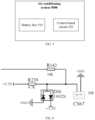
- FIG. 5 is a schematic diagram of an air conditioning system 5000 according to embodiments of the present application.
- the air conditioning system 5000 comprises: a battery box 510; and a control board circuit 520 for receiving an output voltage from the battery box 510 for a safe operation.
- the control board circuit 520 is configured to actuate one or more valves (e.g., ball valves) to perform a shutdown operation when the output voltage provided by the battery box 510 is greater than a preset threshold (e.g., when fully charged).
- a preset threshold e.g., when fully charged
- FIG. 6 is a schematic diagram of (part of) a control board circuit according to embodiments of the present application.
- the control board circuit is connected to the battery box via an electrical connector CN67.
- the electrical connector CN67 in FIG. 6 is connected to the electrical connector CN1 in FIG. 4 .
- Vz in FIG. 4 is not present (i.e., when the power supply line is disconnected)
- whether sig is high level or low level will depend on the voltage divider value of R8 in FIG. 4 and R239 in FIG. 6 .
- sig can be made to always be high when Vz is not present by reasonably selecting the relationship of R8 as well as R239.
- Vcap Vz Sig ⁇ Reference voltage Vref Power supply line is normal High level ⁇ Reference voltage Vref Power supply line is disconnected High level > Reference voltage Vref Power supply line is disconnected High level > Reference voltage Vref Power supply line is normal Low level
- Sig outputs a low level ('0') only when the terminal voltage Vcap of the energy storage unit (capacitor modules in the energy storage unit) is greater than the reference voltage of the diode (e.g., 2.5 V) after being voltage-divided by the first resistor R1 and the fifth resistor R5, and the voltage Vz output from the battery box is connected normally; otherwise, all outputs a high level.
- FIG. 7 is a circuit schematic diagram of power failure detection and power output switching according to embodiments of the present application.
- the circuit implements switching of outputs based on the result of power failure detection, wherein the voltage from the energy storage unit is output when the power failure is detected, and no voltage is output when the power failure is not detected.
- the circuit also implements automatic disconnection of the voltage output after a period of time in which the voltage is output (i.e., after a preset time period T of the power failure detected).
- IC5 when the power supply to L-terminal and N-terminal is normal, IC5 conducts and a triode Q11 conducts. This further causes a triode Q12 to conduct, a capacitor E5 is charged, a relay RY6 is attracted to a left moving contact, a triode Q10 is turned off, and Vcap is disconnected from Vz. That is, when the power supply to L-terminal and N-terminal is normal (i.e., no power failure has occurred), no voltage is output.
- the triode Q11 When the L-terminal and N-terminal is powered off, the triode Q11 is turned off, the relay Ry6 is attracted to the right, a base of the triode Q10 is powered by the capacitor E5, a relay RY5 is attracted, and Vcap is powered to Vz. That is, when the power failure occurs at the L-terminal and N-terminal, the voltage from the energy storage unit Vcap is output.
- the capacitor E5 is discharged below a certain threshold voltage (e.g., 0.7 V), and the triode Q10 will be turned off, i.e., automatic disconnection of voltage output is realized after outputting the voltage for a period of time.
- This discharge time i.e., the automatic disconnection time
- the circuit schematic diagram of the power failure detection and the power output switching of FIG. 7 may correspond to the power failure detection unit 350 and the power output switching unit 370 of FIG. 3 , wherein the power failure detection unit 350 is used to detect a power failure of the AC input voltage Vin, and the power output switching unit 370 is configured to output the stored electrical energy (i.e., voltage) when the power failure is detected, and configured not to output the voltage when the power failure is not detected.
- the stored electrical energy i.e., voltage
- FIG. 8 is a flow schematic diagram of a control method 8000 for an air conditioning system according to embodiments of the present application. As shown in FIG. 8 , the control method 8000 includes the following steps:
- the method 8000 further comprises: not outputting the voltage after a preset time period T of the power failure detected. In one embodiment, the method 8000 further comprises: outputting a "ready" signal when the voltage of the energy storage capacitor satisfies a preset voltage threshold and a voltage output terminal is normally connected; otherwise, outputting a "not ready” signal. In one embodiment, the step S840 (i.e., performing a safe operation on the air conditioning system based on the output voltage) comprises: actuating one or more valves (e.g., ball valves) to perform a shutdown operation when the "ready" signal is received and the output voltage is greater than a preset threshold.
- valves e.g., ball valves
- the battery box in an air conditioning system may be controlled as follows: when an external input voltage is normally provided, 220V AC power is present; the AC power is used to charge an energy storage unit; then, it is determined whether the energy storage unit is fully charged, and if it is not fully charged, the charging step is continued; and after it is fully charged, it is further determined whether the external input voltage has been disconnected (e.g., a sudden loss of power), and if so, provide 12V DC voltage to a control board circuit for a safe operation, and after a preset time period T, disconnect the supply of the 12V DC voltage.
- control board circuit in the air conditioning system may be controlled as follows: after the control board circuit is powered up, it is determined whether the energy storage unit is fully charged, and in the event that it is fully charged, actuating the ball valve EBV to open; further, when it is determined that the external input voltage has been disconnected (e.g., a sudden loss of power), actuating the ball valve EBV to shut down.
- the result of the shutdown of the ball valve EBV may also be provided by the control board circuit to the battery box so that the battery box may promptly cut off the supply of the backup power supply.
- a battery box comprises a power output switching unit, the power output switching unit is configured to output a voltage from a charging and energy storage unit when a power failure detection unit detects a power failure of an input voltage of the battery box, and configured not to output the voltage when the power failure detection unit does not detect the power failure.
- the battery box is capable of, on the one hand, performing voltage output in a timely manner in the event of a sudden power failure, thereby providing sufficient energy for a related control circuit (e.g., a control board circuit) to perform a safe operation (e.g., shutting down a ball valve), and, on the other hand, performing no voltage output in the event of no power failure, thereby not affecting other control circuits.
- the power output switching unit is also configured not to output the voltage after a preset time period T of the power failure detected by the power failure detection unit. That is, the battery box is capable of not only automatically providing energy (voltage output) at the time of power failure, but also automatically cutting off the energy output after a time period.
Landscapes
- Engineering & Computer Science (AREA)
- Power Engineering (AREA)
- Business, Economics & Management (AREA)
- Emergency Management (AREA)
- Chemical & Material Sciences (AREA)
- Combustion & Propulsion (AREA)
- Mechanical Engineering (AREA)
- General Engineering & Computer Science (AREA)
- Physics & Mathematics (AREA)
- General Physics & Mathematics (AREA)
- Charge And Discharge Circuits For Batteries Or The Like (AREA)
- Air Conditioning Control Device (AREA)
Abstract
Description
- The present application relates to a battery box, an air conditioning system and a control method for an air conditioning system.
- In an air conditioning system (e.g. Variable Refrigerant Flow VRF system), once a refrigerant leak is detected, the refrigerant should be immediately recovered and locked in a specific pipeline in order to limit amount of the refrigerant leak, thus avoiding potential fire or explosion risks.
- Therefore, valves (e.g., ball valves, etc.) in the air conditioning system should be shut down in a timely manner in the event of a sudden power failure. However, the control circuits in existing air conditioning systems may not have sufficient energy to shut down these valves after the sudden power failure.
- According to an aspect of the invention, there is provided a battery box, the battery box comprising: a charging and energy storage unit for charging and storing electrical energy using an input voltage supplied to the battery box; a power failure detection unit for detecting a power failure of the input voltage; and a power output switching unit for switching an output based on a detection result of the power failure detection unit, wherein the power output switching unit is configured to output a voltage from the charging and energy storage unit (e.g., a charge stored in the charging and energy storage unit) when the power failure detection unit detects a power failure, and is configured not to output the voltage when the power failure detection unit does not detect the power failure.
- According to an aspect of the invention, there is provided a battery box, the battery box comprising: a charging and energy storage unit for charging and storing using an input voltage supplied to the battery box; a power failure detection unit for detecting a power failure of the input voltage; and a power output switching unit for switching an output based on a detection result of the power failure detection unit, wherein the power output switching unit is configured to output a voltage stored in the charging and energy storage unit when the power failure detection unit detects a power failure, and is configured not to output the voltage when the power failure detection unit does not detect the power failure.
- Optionally, in the battery box, the power output switching unit may be configured not to output the voltage after a preset time period T of the power failure detected by the power failure detection unit.
- Optionally, in the battery box, the charging and energy storage unit may comprise: an energy storage unit; and a charging unit for converting an AC input voltage supplied to the battery box to a DC voltage for charging the energy storage unit.
- Optionally, in the battery box, the charging and energy storage unit may comprise: a voltage regulating unit for converting a first DC voltage from the energy storage unit to a second DC voltage.
- Optionally, the battery box may comprise: an energy storage state detection unit for detecting whether a voltage from the energy storage unit satisfies a preset voltage threshold.
- Optionally, the battery box may comprise: a power supply line detection unit for detecting whether an output of the battery box is normally connected.
- Optionally, the battery box may be configured to output a "ready" signal when the energy storage state detection unit detects that the voltage from the energy storage unit satisfies the preset voltage threshold and the power supply line detection unit detects that the output of the battery box is normally connected; otherwise, the battery box may be configured to output a "not ready" signal.
- Optionally, the battery box may comprise: a micro-control unit MCU for receiving a power failure detection signal from the power failure detection unit and controlling the power output switching unit accordingly.
- Optionally, in the battery box, the micro-control unit MCU may be configured to receive a first detection signal from the energy storage state detection unit and a second detection signal from the power supply line detection unit; and the micro-control unit MCU may be configured to output a "ready" signal when the first detection signal indicates that the voltage from the energy storage unit satisfies the preset voltage threshold and the second detection signal indicates that the output of the battery box is normally connected; otherwise, the micro-control unit MCU may be configured to output a "not ready" signal.
- According to another aspect of the invention, there is provided an air conditioning system, the system comprising: a battery box as previously described; and a control board circuit for receiving an output voltage from the battery box for a safe operation.
- Optionally, in the system, the control board circuit may be configured to actuate one or more valves to perform a shutdown operation when the output voltage provided by the battery box is greater than a preset threshold.
- According to another aspect of the invention, there is provided a control method for an air conditioning system, the method comprising: charging an energy storage capacitor in the air conditioning system using an input voltage; detecting a power failure of the input voltage; outputting a voltage of the energy storage capacitor (e.g., a charge stored in the energy storage capacitor) when the power failure of the input voltage is detected, and not outputting the voltage when the power failure is not detected; and performing a safe operation on the air conditioning system based on the output voltage.
- According to another aspect of the invention, there is provided a control method for an air conditioning system, the method comprising: charging an energy storage capacitor in the air conditioning system using an input voltage; detecting a power failure of the input voltage; outputting a voltage stored in the energy storage capacitor when the power failure of the input voltage is detected, and not outputting the voltage when the power failure is not detected; and performing a safe operation on the air conditioning system based on the output voltage.
- Optionally, the method may comprise: not outputting the voltage after a preset time period T of the power failure detected.
- Optionally, the method may comprise: outputting a "ready" signal when the voltage of the energy storage capacitor satisfies a preset voltage threshold and a voltage output terminal is normally connected; otherwise, outputting a "not ready" signal.
- Optionally, in the method, the safe operation on the air conditioning system based on the output voltage may comprise: actuating one or more valves to perform a shutdown operation when the "ready" signal is received and the output voltage is greater than a preset threshold.
- The above and/or other aspects and advantages of the present application will be clearer and more easily understood from the following description of various exemplary embodiments, which are provided for example only, in conjunction with the accompanying drawings, in which the same or similar elements are denoted by the same reference numerals. The accompanying drawings include:
-
FIGS. 1 to 3 are schematic diagrams of a structure of a battery box; -
FIG. 4 is a circuit schematic diagram of energy storage state detection and power supply line detection; -
FIG. 5 is a schematic diagram of an air conditioning system; -
FIG. 6 is a schematic diagram of (part of) a control board circuit; -
FIG. 7 is a circuit schematic diagram of power failure detection and power output switching; and -
FIG. 8 is a flow schematic diagram of a control method for an air conditioning system. - The present application is described more fully below with reference to the accompanying drawings, in which illustrative embodiments of the present application are illustrated. However, the present application may be implemented in different forms and should not be construed as limited to the embodiments presented herein. The presented embodiments are intended to make the disclosure herein comprehensive and complete, so as to more comprehensively convey the protection scope of the present invention to those skilled in the art, wherein the scope of the invention is as set out in the appended claims.
- In this specification, terms such as "comprising" and "including" mean that in addition to units and steps that are directly and clearly stated in the specification and claims, the technical solution of the application does not exclude the presence of other units and steps that are not directly or clearly stated in the specification and claims.
- Unless otherwise specified, terms such as "first" and "second" do not indicate the order of the units in terms of time, space, size, etc., but are merely used to distinguish the units.
- In this specification, "coupled" should be understood as including a case in which electrical energy or electrical signals are transmitted directly between two units, or a case in which electrical energy or electrical signals are transmitted indirectly through one or more third units.
- In accordance with some embodiments of the present application, a battery box comprises a power output switching unit, the power output switching unit is configured to output a voltage from a charging and energy storage unit (e.g. a charge stored in a charging and energy storage unit) when a power failure detection unit detects a power failure of an input voltage of the battery box, and configured not to output the voltage when the power failure detection unit does not detect the power failure. In this way, the battery box is capable of, on the one hand, performing voltage output in a timely manner in the event of a sudden power failure, thereby providing sufficient energy for a related control circuit (e.g., a control board circuit) to perform a safe operation (e.g., shutting down a ball valve), and, on the other hand, performing no voltage output in the event of no power failure, thereby not affecting other control circuits. In accordance with some embodiments of the present application, the power output switching unit is also configured not to output the voltage after a preset time period T of the power failure detected by the power failure detection unit. That is, the battery box is capable of not only automatically providing energy (voltage output) at the time of power failure, but also automatically cutting off the energy output after a time period.
- In accordance with some embodiments of the present application, the battery box further comprises: an energy storage state detection unit for detecting whether the voltage from the energy storage unit satisfies a preset voltage threshold; and a power supply line detection unit for detecting whether an output of the battery box is normally connected (e.g., whether loosening occurs). In these embodiments, the battery box is configured to output a "ready" signal when the energy storage state detection unit detects that the voltage from the energy storage unit satisfies the preset voltage threshold and the power supply line detection unit detects that the output of the battery box is normally connected; otherwise, to output a "not ready" signal. That is, in addition to providing the output voltage, the battery box can provide the current state of energy storage and the state of the output connection (e.g., by means of the "ready" signal) to an external circuit. This solution enables timely warning of power and circuit failures and improves the safety of the system application.
- Specific embodiments of the present application are further described below with the aid of the accompanying drawings. It should be noted that some non-essential features or circuit elements are not shown in the accompanying drawings for the purpose of more clearly describing what is relevant to the present application. However, for those skilled in the art, such omissions do not create difficulties in the implementations of the technical solutions described in the specification of the present application.
-
FIG. 1 is a schematic diagram of a structure of abattery box 1000 according to embodiments of the present application. As shown inFIG. 1 , thebattery box 1000 comprises: a charging andenergy storage unit 110, a powerfailure detection unit 120, and a power output switching unit 130. Wherein, the charging andenergy storage unit 110 is used to charge and store electrical energy using an input voltage supplied to thebattery box 1000; the powerfailure detection unit 120 is used to detect a power failure of the input voltage; and the power output switching unit 130 is used to switch an output based on a detection result of the powerfailure detection unit 120, wherein the power output switching unit 130 is configured to output a voltage from the charging andenergy storage unit 110 when the powerfailure detection unit 120 detects a power failure, and is configured not to output the voltage when the powerfailure detection unit 120 does not detect the power failure. - In the context of the present application, the term "powerfailure" may also be referred to as a power loss, meaning that no power is supplied to the battery box, for example, due to a sudden power failure, a malfunction, or the like. In the above embodiments of the present application, the power output switching unit 130 is configured to output a voltage from the charging and
energy storage unit 110 when the powerfailure detection unit 120 detects the power failure of the input voltage of the battery box, and is configured not to output the voltage when the powerfailure detection unit 120 does not detect the power failure. In this way, thebattery box 1000 is capable of performing voltage output in a timely manner in the event of a sudden power failure/ power loss, thereby providing sufficient energy for a related control circuit (e.g., a control board circuit) to perform a safe operation (e.g., shutting down a ball valve). - In one embodiment, the power output switching unit 130 is further configured not to output the voltage after a preset time period T of the power failure detected by the power
failure detection unit 120. In this way, thebattery box 1000 is capable of not only automatically providing energy output at the time of power failure, but also automatically cutting off the energy output after a time period (i.e., the preset time period T), further improving safety. - In one embodiment, the charging and
energy storage unit 110 may comprise: an energy storage unit; and a charging unit for converting an AC input voltage supplied to the battery box to a DC voltage for charging the energy storage unit. For example, the energy storage unit may comprise one or more capacitor (or super-capacitor) modules, and the charging unit charges one or more capacitor modules in the energy storage unit after converting the AC input voltage to the DC voltage. In one embodiment, the charging andenergy storage unit 110 may further comprise a voltage regulating unit for converting the voltage from the energy storage unit, for example from a first DC voltage to a second DC voltage different from the first DC voltage. - Although not shown in
FIG. 1 , in one embodiment thebattery box 1000 further comprises: an energy storage state detection unit for detecting whether a voltage from the energy storage unit satisfies a preset voltage threshold (e.g. whether it is greater than 5V). In one embodiment, thebattery box 1000 may further comprise: a power supply line detection unit for detecting whether an output of thebattery box 1000 is normally connected (e.g., whether loosening occurs). In one embodiment, thebattery box 1000 is configured to output a "ready" signal when the energy storage state detection unit detects that the voltage from the energy storage unit satisfies the preset voltage threshold and the power supply line detection unit detects that the output of thebattery box 1000 is normally connected; otherwise, thebattery box 1000 is configured to output a "not ready" signal. -
FIG. 2 shows a schematic diagram of a structure of abattery box 2000 according to embodiments of the present application. As shown inFIG. 2 , thebattery box 2000 comprises amicro-control unit MCU 260 for receiving a power failure detection signal from a powerfailure detection unit 250 and controlling a poweroutput switching unit 270 accordingly. - Continuing to refer to
FIG. 2 , in addition to themicro-control unit MCU 260, thebattery box 2000 further comprises: a chargingunit 210, anenergy storage unit 220, avoltage regulating unit 230, an energy storagestate detection unit 240, a powerfailure detection unit 250, a poweroutput switching unit 270, and a power supplyline detection unit 280. - In the embodiment of
FIG. 2 , the chargingunit 210 is used to convert an AC input voltage Vin supplied to thebattery box 2000 to a DC voltage for charging theenergy storage unit 220. For example, theenergy storage unit 220 may comprise one or more capacitor (or supercapacitor) modules, and thecharging unit 210 charges one or more capacitor modules in theenergy storage unit 220 after converting the AC input voltage to the DC voltage. Thevoltage regulating unit 230 is used to convert the voltage from theenergy storage unit 220, for example, from a first DC voltage to a second DC voltage different from the first DC voltage, in order to provide the converted voltage to the poweroutput switching unit 270. - The energy storage
state detection unit 240 is used to detect whether a voltage from theenergy storage unit 220 satisfies a preset voltage threshold (e.g. whether it is greater than 5V). The power supplyline detection unit 280 is used to detect whether an output Vout of thebattery box 2000 is normally connected (e.g., whether loosening occurs, whether a malfunction occurs, etc.). - The power
failure detection unit 250 is used to detect a power failure of the AC input voltage Vin and to provide a power failure detection result to themicro-control unit MCU 260. In one embodiment, themicro-control unit MCU 260 is further configured to receive a first detection signal from the energy storagestate detection unit 240 and a second detection signal from the power supplyline detection unit 280; and to output a "ready" signal (i.e., Sig indicates "ready") when the first detection signal indicates that the voltage from theenergy storage unit 220 satisfies the preset voltage threshold and the second detection signal indicates that the output of thebattery box 2000 is normally connected; otherwise, to output a "not ready" signal (i.e., Sig indicates "not ready"). - In one embodiment, as shown in
FIG. 2 , thebattery box 2000 further comprises: acommunication unit 290 for communicating with an external circuit. For example, thecommunication unit 290 includes an RS485 port for communicating with a control board circuit to provide information (e.g. information about the capacity, etc.) regarding the interior of the battery box. In one embodiment, the Sig signal may also be transmitted to the external circuit via thiscommunication unit 290. - In this way, the power output switching unit 270 (under the control of the micro-control unit MCU 260) may be configured to output the voltage provided by the
voltage regulating unit 230 when the powerfailure detection unit 250 detects a power failure, and configured not to output the voltage when the power failure is not detected. In one embodiment, the poweroutput switching unit 270 is configured not to output the voltage after a preset time period T of the power failure detected by the power failure detection unit 250 (e.g., after outputting the voltage provided by thevoltage regulating unit 230 for a period of time). In this way, thebattery box 2000 is capable of not only automatically providing energy output at the time of power failure, but also automatically cutting off the energy output after a time period, further improving safety. -
FIG. 3 shows a schematic diagram of a structure of abattery box 3000 according to embodiments of the present application. Compared to thebattery box 2000 ofFIG. 2 , thebattery box 3000 does not comprise a micro-control unit MCU. As shown inFIG. 3 , thebattery box 3000 comprises: a chargingunit 310, anenergy storage unit 320, avoltage regulating unit 330, an energy storagestate detection unit 340, a powerfailure detection unit 350, a poweroutput switching unit 370, and a power supplyline detection unit 380. - In the embodiment of
FIG. 3 , the chargingunit 310 is used to convert an AC input voltage Vin supplied to thebattery box 3000 to a DC voltage for charging theenergy storage unit 320. For example, theenergy storage unit 320 may comprise one or more capacitor (or supercapacitor) modules, and thecharging unit 310 charges one or more capacitor modules in theenergy storage unit 320 after converting the AC input voltage to the DC voltage. Thevoltage regulating unit 330 is used to convert the voltage from theenergy storage unit 320, for example, from a first DC voltage to a second DC voltage different from the first DC voltage, in order to provide the converted voltage to the poweroutput switching unit 370. - The energy storage
state detection unit 340 is used to detect whether a voltage from theenergy storage unit 320 satisfies a preset voltage threshold (e.g. whether it is greater than 5V). The power supplyline detection unit 380 is used to detect whether an output Vout of thebattery box 3000 is normally connected (e.g., whether loosening occurs). - The power
failure detection unit 350 is used to detect a power failure of the AC input voltage Vin and to provide a power failure detection result to the poweroutput switching unit 370. For example, when the power failure is detected, the powerfailure detection unit 350 provides a high voltage (e.g., "1") to the poweroutput switching unit 370; and when the power failure is not detected, the powerfailure detection unit 350 provides a low voltage (e.g., "0") to the poweroutput switching unit 370 - Referring further to
FIG. 3 , in addition to the foregoing units, thebattery box 3000 further comprises: a readysignal preparation unit 360 for receiving a first detection signal from the energy storagestate detection unit 340 and receiving a second detection signal from the power supplyline detection unit 380, and outputting a Sig signal. - In one embodiment, when the first detection signal is "1", it indicates that the voltage from the
energy storage unit 320 satisfies the preset voltage threshold (e.g., in a "fully charged" state), otherwise the first detection signal is "0"; when the second detection signal is "1", it indicates that the output of thebattery box 3000 is normally connected, otherwise the second detection signal is "0". In this embodiment, the readysignal preparation unit 360 may be a "logic AND" gate. Thus, the readysignal preparation unit 360 is configured to output "1" only when both the first detection signal and the second detection signal are "1" (assuming that the Sig signal is "1" indicating "ready"), and otherwise to output "0" (assuming that the Sig signal is "0" indicating "not ready"). - In another embodiment, when the first detection signal is "0", it indicates that the voltage from the
energy storage unit 320 satisfies the preset voltage threshold (e.g., in a "fully charged" state), otherwise the first detection signal is "1"; when the second detection signal is "0", it indicates that the output of thebattery box 3000 is normally connected, otherwise the second detection signal is "1". In this embodiment, the readysignal preparation unit 360 may be a "logic OR" gate. Thus, the readysignal preparation unit 360 is configured to output "0" only when both the first detection signal and the second detection signal are "0" (assuming that the Sig signal is "0" indicating "ready"), and otherwise to output "1" (assuming that the Sig signal is "1" indicating "not ready"). - The power
output switching unit 370 is configured to output the voltage provided by thevoltage regulating unit 330 when the powerfailure detection unit 350 detects a power failure, and configured not to output the voltage when the powerfailure detection unit 350 does not detect the power failure. In one embodiment, the poweroutput switching unit 370 is further configured not to output the voltage after a preset time period T of the power failure detected by the power failure detection unit 350 (e.g., after outputting the voltage provided by thevoltage regulating unit 330 for a period of time). In this way, thebattery box 3000 is capable of not only automatically providing energy output at the time of power failure, but also automatically cutting off the energy output after a time period, further improving safety. -
FIG. 4 is a circuit schematic diagram of energy storage state detection and power supply line detection according to embodiments of the present application. InFIG. 4 , Vcap denotes a terminal voltage of the energy storage unit (capacitor modules in the energy storage unit), and Vz denotes a voltage output from the battery box (via feedback). In the circuit ofFIG. 4 , sig=0 only if Vcap is greater than a specific voltage value (i.e., the voltage from the energy storage unit satisfies a preset voltage threshold) and Vz is present (i.e., the output of the battery box is normally connected). - As shown in
FIG. 4 , the terminal voltage Vcap of the energy storage unit (capacitor modules in the energy storage unit) is coupled with a first end of a first resistor R1, a second end of the first resistor R1 is coupled with a first end of a first capacitor C1, a first end of a fifth resistor R5, respectively, and a second end of the first capacitor C1 and a second end of the fifth resistor R5 are grounded. Also, the second end of the first resistor R1 is further coupled with a diode (a first end of the diode) with a reference voltage. A second end of the diode is grounded, and a third end of the diode is coupled with a second end of a sixth resistor R6 and a second end of a photocoupler IC1, respectively. The terminal voltage Vcap of the energy storage unit (capacitor modules in the energy storage unit) is also coupled with a first end of a second resistor R2, and a second end of the second resistor R2 is coupled with a first end of the photocoupler IC1 and a first end of the sixth resistor R6, respectively. - The voltage Vz output from the battery box is coupled with a first end of a third resistor R3 and a first end of a fourth resistor R4, respectively, a second end of the third resistor R3 is coupled with a fourth end of the photocoupler IC1, and a third end of the photocoupler IC1 is coupled with a first end of a seventh resistor R7 and a first end of a ninth resistor R9, respectively, a second end of the ninth resistor R9 is grounded, a second end of a seventh resistor R7 is coupled with a base of a first triode Q1, an emitter of the first triode Q1 is grounded, and a collector is coupled with a second end of the fourth resistor R4. The second end of the fourth resistor R4 is also coupled with a first end of an eighth resistor, a first end of a first diode D1, and a second end of an electrical connector CN1, respectively. In addition, a second end of the eighth resistor, a second end of the first diode D1, and a first end of the electrical connector CN1 are grounded.
- In one embodiment, when the terminal voltage Vcap of the energy storage unit (capacitor modules in the energy storage unit) is greater than the reference voltage of the diode (e.g., 2.5 V) after being voltage-divided by the first resistor R1 and the fifth resistor R5, the diode conducts, and then the photocoupler IC1 conducts. When the voltage Vz output from the battery box is present, the first triode Q1 conducts after being voltage-divided by the third resistor R3, the seventh resistor R7, and the ninth resistor R9, causing sig to be pulled down, i.e., sig=0. And when the terminal voltage Vcap of the energy storage unit (capacitor modules in the energy storage unit) is not greaterthan the reference voltage of the diode (e.g., 2.5 V) after being voltage-divided by the first resistor R1 and the fifth resistor R5, the diode is disconnected, and the photocoupler IC1 does not conduct. As the photocoupler IC1 does not conduct, the first triode Q1 cuts off. When the voltage Vz output from the battery box is present, sig is pulled up by Vz, i.e. sig=1.
- In one or more embodiments, the circuit schematic diagram of the energy storage state detection and the power supply line detection of
FIG. 4 may correspond to the energy storagestate detection unit 340, the power supplyline detection unit 380 and the readysignal preparation unit 360 ofFIG. 3 , wherein the readysignal preparation unit 360 is used to receive a first detection signal from the energy storagestate detection unit 340 and a second detection signal from the power supplyline detection unit 380, and to output a Sig signal. -
FIG. 5 is a schematic diagram of anair conditioning system 5000 according to embodiments of the present application. As shown inFIG. 5 , theair conditioning system 5000 comprises: abattery box 510; and acontrol board circuit 520 for receiving an output voltage from thebattery box 510 for a safe operation. In one or more embodiments, thecontrol board circuit 520 is configured to actuate one or more valves (e.g., ball valves) to perform a shutdown operation when the output voltage provided by thebattery box 510 is greater than a preset threshold (e.g., when fully charged). -
FIG. 6 is a schematic diagram of (part of) a control board circuit according to embodiments of the present application. As shown inFIG. 6 , the control board circuit is connected to the battery box via an electrical connector CN67. For example, in combination withFIG. 4 as well asFIG. 6 , the electrical connector CN67 inFIG. 6 is connected to the electrical connector CN1 inFIG. 4 . At this time, when Vz inFIG. 4 is not present (i.e., when the power supply line is disconnected), whether sig is high level or low level will depend on the voltage divider value of R8 inFIG. 4 and R239 inFIG. 6 . In one embodiment, sig can be made to always be high when Vz is not present by reasonably selecting the relationship of R8 as well as R239. - At this time, the circuit shown in
FIG. 4 for the energy storage state detection and the power supply line detection may be represented by the following logic diagram:Vcap Vz Sig < Reference voltage Vref Power supply line is normal High level < Reference voltage Vref Power supply line is disconnected High level > Reference voltage Vref Power supply line is disconnected High level > Reference voltage Vref Power supply line is normal Low level - In other words, Sig outputs a low level ('0') only when the terminal voltage Vcap of the energy storage unit (capacitor modules in the energy storage unit) is greater than the reference voltage of the diode (e.g., 2.5 V) after being voltage-divided by the first resistor R1 and the fifth resistor R5, and the voltage Vz output from the battery box is connected normally; otherwise, all outputs a high level.
-
FIG. 7 is a circuit schematic diagram of power failure detection and power output switching according to embodiments of the present application. As shown inFIG. 7 , the circuit implements switching of outputs based on the result of power failure detection, wherein the voltage from the energy storage unit is output when the power failure is detected, and no voltage is output when the power failure is not detected. In addition, the circuit also implements automatic disconnection of the voltage output after a period of time in which the voltage is output (i.e., after a preset time period T of the power failure detected). - Specifically, when the power supply to L-terminal and N-terminal is normal, IC5 conducts and a triode Q11 conducts. This further causes a triode Q12 to conduct, a capacitor E5 is charged, a relay RY6 is attracted to a left moving contact, a triode Q10 is turned off, and Vcap is disconnected from Vz. That is, when the power supply to L-terminal and N-terminal is normal (i.e., no power failure has occurred), no voltage is output.
- When the L-terminal and N-terminal is powered off, the triode Q11 is turned off, the relay Ry6 is attracted to the right, a base of the triode Q10 is powered by the capacitor E5, a relay RY5 is attracted, and Vcap is powered to Vz. That is, when the power failure occurs at the L-terminal and N-terminal, the voltage from the energy storage unit Vcap is output.
- In addition, at this time, as the triode Q11 is turned off and the triode Q12 is turned off, the capacitor E5 is discharged below a certain threshold voltage (e.g., 0.7 V), and the triode Q10 will be turned off, i.e., automatic disconnection of voltage output is realized after outputting the voltage for a period of time. This discharge time (i.e., the automatic disconnection time) may be adjusted according to the capacitance value of the capacitor E5 and a resistor R43.
- In one or more embodiments, the circuit schematic diagram of the power failure detection and the power output switching of
FIG. 7 may correspond to the powerfailure detection unit 350 and the poweroutput switching unit 370 ofFIG. 3 , wherein the powerfailure detection unit 350 is used to detect a power failure of the AC input voltage Vin, and the poweroutput switching unit 370 is configured to output the stored electrical energy (i.e., voltage) when the power failure is detected, and configured not to output the voltage when the power failure is not detected. -
FIG. 8 is a flow schematic diagram of acontrol method 8000 for an air conditioning system according to embodiments of the present application. As shown inFIG. 8 , thecontrol method 8000 includes the following steps: - In step S810, charging an energy storage capacitor in the air conditioning system using an input voltage;
- In step S820, detecting a power failure of the input voltage;
- In step S830, outputting a voltage from the energy storage capacitor when the power failure of the input voltage is detected, and not outputting the voltage when the power failure is not detected; and
- In step S840, performing a safe operation on the air conditioning system based on the output voltage.
- Although not shown in
FIG. 8 , in one embodiment, themethod 8000 further comprises: not outputting the voltage after a preset time period T of the power failure detected. In one embodiment, themethod 8000 further comprises: outputting a "ready" signal when the voltage of the energy storage capacitor satisfies a preset voltage threshold and a voltage output terminal is normally connected; otherwise, outputting a "not ready" signal. In one embodiment, the step S840 (i.e., performing a safe operation on the air conditioning system based on the output voltage) comprises: actuating one or more valves (e.g., ball valves) to perform a shutdown operation when the "ready" signal is received and the output voltage is greater than a preset threshold. - In one embodiment, the battery box in an air conditioning system may be controlled as follows: when an external input voltage is normally provided, 220V AC power is present; the AC power is used to charge an energy storage unit; then, it is determined whether the energy storage unit is fully charged, and if it is not fully charged, the charging step is continued; and after it is fully charged, it is further determined whether the external input voltage has been disconnected (e.g., a sudden loss of power), and if so, provide 12V DC voltage to a control board circuit for a safe operation, and after a preset time period T, disconnect the supply of the 12V DC voltage.
- In one embodiment, the control board circuit in the air conditioning system may be controlled as follows: after the control board circuit is powered up, it is determined whether the energy storage unit is fully charged, and in the event that it is fully charged, actuating the ball valve EBV to open; further, when it is determined that the external input voltage has been disconnected (e.g., a sudden loss of power), actuating the ball valve EBV to shut down. In a control method, the result of the shutdown of the ball valve EBV (whether it is completely shut down or not) may also be provided by the control board circuit to the battery box so that the battery box may promptly cut off the supply of the backup power supply.
- In summary, in accordance with some embodiments of the present application, a battery box comprises a power output switching unit, the power output switching unit is configured to output a voltage from a charging and energy storage unit when a power failure detection unit detects a power failure of an input voltage of the battery box, and configured not to output the voltage when the power failure detection unit does not detect the power failure. In this way, the battery box is capable of, on the one hand, performing voltage output in a timely manner in the event of a sudden power failure, thereby providing sufficient energy for a related control circuit (e.g., a control board circuit) to perform a safe operation (e.g., shutting down a ball valve), and, on the other hand, performing no voltage output in the event of no power failure, thereby not affecting other control circuits. In accordance with some embodiments of the present application, the power output switching unit is also configured not to output the voltage after a preset time period T of the power failure detected by the power failure detection unit. That is, the battery box is capable of not only automatically providing energy (voltage output) at the time of power failure, but also automatically cutting off the energy output after a time period.
- Those skilled in the art will appreciate that the various illustrative logical blocks, modules, circuits, and algorithm steps described herein may be implemented as electronic hardware, computer software, or combinations of both.
- To demonstrate this interchangeability between hardware and software, various illustrative components, blocks, modules, circuits, and steps have been described above generally in terms of their functionality. Whether such functionality is implemented in hardware or software depends on the particular application and design constraints imposed on the overall system. Those skilled in the art may implement the described functionality in changing ways for the particular application. However, such implementation decisions should not be interpreted as causing a departure from the scope of the invention, which is set out in the appended claims.
- Although only a few of the specific embodiments of the present application have been described, those skilled in the art will appreciate that the present application may be embodied in many other forms without departing from the scope of the invention, which is set out in the appended claims. Accordingly, the examples and implementations presented are to be regarded as illustrative and not restrictive, and various modifications and substitutions may be covered by the application without departing from the scope of the application as defined by the appended claims.
- The embodiments and examples presented herein are provided to best illustrate embodiments in accordance with the present technology and its particular application, and to thereby enable those skilled in the art to implement and use the present invention. However, those skilled in the art will appreciate that the above description and examples are provided for convenience of illustration and example only. The presented description is not intended to cover every aspect of the invention or to limit the invention to the precise form disclosed.
Claims (15)
- A battery box (1000), characterized by comprising:a charging and energy storage unit (110) for charging and storing electrical energy using an input voltage supplied to the battery box;a power failure detection unit (120) for detecting a power failure of the input voltage; anda power output switching unit (130) for switching an output based on a detection result of the power failure detection unit,wherein the power output switching unit is configured to output a voltage from the charging and energy storage unit when the power failure detection unit detects a power failure, and is configured not to output the voltage when the power failure detection unit does not detect the power failure.
- The battery box (1000) of claim 1, wherein the power output switching unit (130) is further configured not to output the voltage after a preset time period T of the power failure detected by the power failure detection unit (120).
- The battery box (1000) of claim 1 or 2, wherein the charging and energy storage unit (110) comprises:an energy storage unit (220); anda charging unit (210) for converting an AC input voltage supplied to the battery box to a DC voltage for charging the energy storage unit.
- The battery box (1000) of claim 3, wherein the charging and energy storage unit (110) further comprises:
a voltage regulating unit (230) for converting a first DC voltage from the energy storage unit to a second DC voltage. - The battery box (1000) of claim 3 or 4, further comprising:
an energy storage state detection unit (240) for detecting whether a voltage from the energy storage unit (220) satisfies a preset voltage threshold. - The battery box (1000) of claim 5, further comprising:
a power supply line detection unit (280) for detecting whether an output of the battery box is normally connected. - The battery box (1000) of claim 6, wherein the battery box is configured to output a "ready" signal when the energy storage state detection unit (240) detects that the voltage from the energy storage unit (220) satisfies the preset voltage threshold and the power supply line detection unit (280) detects that the output of the battery box is normally connected; otherwise, the battery box is configured to output a "not ready" signal.
- The battery box (1000) of claim 6 or 7, further comprising:
a micro-control unit MCU (260) for receiving a power failure detection signal from the power failure detection unit (120) and controlling the power output switching unit (130) accordingly. - The battery box (1000) of claim 8, wherein the micro-control unit MCU (260) is further configured to receive a first detection signal from the energy storage state detection unit (240) and a second detection signal from the power supply line detection unit (280); and
the micro-control unit MCU is configured to output a "ready" signal when the first detection signal indicates that the voltage from the energy storage unit (220) satisfies the preset voltage threshold and the second detection signal indicates that the output of the battery box is normally connected; otherwise, to output a "not ready" signal. - An air conditioning system (5000), characterized by comprising:the battery box (1000) as claimed in any one of claims 1 to 9; anda control board circuit (520) for receiving an output voltage from the battery box for a safe operation.
- The system (5000) of claim 10, wherein the control board circuit (520) is configured to actuate one or more valves to perform a shutdown operation when the output voltage provided by the battery box (1000) is greater than a preset threshold.
- A control method (8000) for an air conditioning system (5000), characterized by comprising:charging an energy storage capacitor in the air conditioning system using an input voltage (S810);detecting a power failure of the input voltage (S820);outputting a voltage of the energy storage capacitor when the power failure of the input voltage is detected, and not outputting the voltage when the power failure is not detected (S830); andperforming a safe operation on the air conditioning system based on the output voltage (S840).
- The method (8000) of claim 12, wherein the method further comprises: not outputting the voltage after a preset time period T of the power failure detected.
- The method (8000) of claim 12 or 13, wherein the method further comprises:outputting a "ready" signal when the voltage of the energy storage capacitor satisfies a preset voltage threshold and a voltage output terminal is normally connected;otherwise, outputting a "not ready" signal.
- The method (8000) of claim 14, wherein the safe operation on the air conditioning system based on the output voltage (S840) comprises:
actuating one or more valves to perform a shutdown operation when the "ready" signal is received and the output voltage is greater than a preset threshold.
Applications Claiming Priority (1)
| Application Number | Priority Date | Filing Date | Title |
|---|---|---|---|
| CN202211343615.5A CN117996875A (en) | 2022-10-31 | 2022-10-31 | Battery box, air conditioning system and method for the air conditioning system |
Publications (2)
| Publication Number | Publication Date |
|---|---|
| EP4362274A2 true EP4362274A2 (en) | 2024-05-01 |
| EP4362274A3 EP4362274A3 (en) | 2024-05-08 |
Family
ID=88778442
Family Applications (1)
| Application Number | Title | Priority Date | Filing Date |
|---|---|---|---|
| EP23206235.6A Pending EP4362274A3 (en) | 2022-10-31 | 2023-10-26 | Battery box, air conditioning system, and method for the air conditioning system |
Country Status (3)
| Country | Link |
|---|---|
| US (1) | US12407183B2 (en) |
| EP (1) | EP4362274A3 (en) |
| CN (1) | CN117996875A (en) |
Families Citing this family (2)
| Publication number | Priority date | Publication date | Assignee | Title |
|---|---|---|---|---|
| CN116094110A (en) * | 2023-01-16 | 2023-05-09 | 厦门普为光电科技有限公司 | Emergency lighting device with charging mode switching function |
| CN115884476B (en) * | 2023-03-08 | 2023-05-26 | 厦门普为光电科技有限公司 | Emergency lighting device with electric quantity indication function |
Family Cites Families (26)
| Publication number | Priority date | Publication date | Assignee | Title |
|---|---|---|---|---|
| JPS5931631U (en) | 1982-08-25 | 1984-02-27 | 三菱鉱業セメント株式会社 | Irrigation watering device |
| US5200644A (en) * | 1988-05-31 | 1993-04-06 | Kabushiki Kaisha Toshiba | Air conditioning system having battery for increasing efficiency |
| JPH07147743A (en) | 1993-11-24 | 1995-06-06 | Nec Field Service Ltd | Uninterruptible power system |
| KR100613959B1 (en) * | 2000-10-02 | 2006-08-22 | 오므론 가부시키가이샤 | Power supply |
| US6906933B2 (en) | 2002-11-01 | 2005-06-14 | Powerware Corporation | Power supply apparatus and methods with power-factor correcting bypass mode |
| US8203235B2 (en) | 2008-04-11 | 2012-06-19 | Liebert Corporation | AC and DC uninterruptible online power supplies |
| CN201787160U (en) | 2010-08-04 | 2011-04-06 | 鞍山拜尔自控有限公司 | Intelligent safety valve under the state of emergency |
| US9228750B2 (en) | 2011-01-24 | 2016-01-05 | Rocky Research | HVAC/R system with multiple power sources and time-based selection logic |
| CN204149816U (en) | 2014-06-05 | 2015-02-11 | 杨东华 | A kind of Novel vehicle refrigerating unit |
| WO2017199645A1 (en) * | 2016-05-18 | 2017-11-23 | 株式会社村田製作所 | Power supply device, power supply method, and power storage device |
| CN205753618U (en) * | 2016-05-23 | 2016-11-30 | 国神光电科技(上海)有限公司 | A kind of power-down protection circuit |
| CN106051292B (en) | 2016-07-27 | 2018-02-09 | 河北秦汉电子科技有限公司 | A kind of electromagnetic valve work condition detection method |
| CN106642602B (en) | 2016-10-26 | 2023-04-07 | 珠海格力电器股份有限公司 | Multi-connected air conditioning system and detection control method and device thereof |
| ES2982673T3 (en) * | 2018-12-31 | 2024-10-17 | Thermo King Llc | Methods and systems for reporting and mitigating a suboptimal event occurring in a transport HVAC control system |
| CN110425668B (en) | 2019-08-08 | 2021-03-16 | 长沙理工大学 | A computer room heat pipe air conditioning system with emergency refrigeration function and its control method |
| US11772508B2 (en) * | 2019-11-05 | 2023-10-03 | Carrier Corporation | Intelligent charging connector for transport refrigeration system |
| EP3819553B1 (en) | 2019-11-06 | 2026-01-28 | Carrier Corporation | Redundant power supply for hvac system including refrigerant leakage mitigation |
| CN212457335U (en) | 2019-12-20 | 2021-02-02 | 青岛森家电子科技有限公司 | Valve control circuit board, outage self-closing electronic expansion valve, electronic expansion valve coil cap and air conditioner |
| CN111306746A (en) | 2020-03-02 | 2020-06-19 | 广东美的暖通设备有限公司 | Indoor unit, air conditioning system, control method, and computer-readable storage medium |
| CN111306744A (en) | 2020-03-02 | 2020-06-19 | 广东美的暖通设备有限公司 | Valve body driving apparatus, control method, air conditioner, and computer-readable storage medium |
| EP4152550A4 (en) * | 2020-07-25 | 2023-07-19 | Huawei Digital Power Technologies Co., Ltd. | Non-current-sharing ups apparatus, shunting method, and ups parallel connection system |
| CN112762527A (en) | 2020-12-31 | 2021-05-07 | 青岛海尔空调电子有限公司 | Multi-split air conditioning system and power-off control method thereof |
| CN113299348B (en) | 2021-05-24 | 2023-01-06 | 潍柴动力股份有限公司 | Uninterrupted power supply system and method |
| CN113551386A (en) | 2021-08-31 | 2021-10-26 | 合肥美的暖通设备有限公司 | Control method and control circuit of air conditioning system and air conditioning system |
| CN113883703B (en) | 2021-10-22 | 2023-06-23 | 青岛海信日立空调系统有限公司 | An air conditioner indoor unit |
| CN216407900U (en) | 2021-11-30 | 2022-04-29 | 陈泳舟 | Leakage-free valve for refrigeration air-conditioning equipment |
-
2022
- 2022-10-31 CN CN202211343615.5A patent/CN117996875A/en active Pending
-
2023
- 2023-10-26 EP EP23206235.6A patent/EP4362274A3/en active Pending
- 2023-10-31 US US18/498,408 patent/US12407183B2/en active Active
Also Published As
| Publication number | Publication date |
|---|---|
| US12407183B2 (en) | 2025-09-02 |
| US20240146100A1 (en) | 2024-05-02 |
| CN117996875A (en) | 2024-05-07 |
| EP4362274A3 (en) | 2024-05-08 |
Similar Documents
| Publication | Publication Date | Title |
|---|---|---|
| EP4362274A2 (en) | Battery box, air conditioning system, and method for the air conditioning system | |
| US8987946B2 (en) | Air conditioner | |
| US8928175B2 (en) | Junction box, energy system and method for controlling the same | |
| CN111555433B (en) | Bus coupler device of direct current system and control method thereof | |
| CN102280924B (en) | Uninterrupted power supply system for relay protection device | |
| US12348042B2 (en) | Photovoltaic energy storage system and control method thereof | |
| CN103390879A (en) | Alternating current power supply input high voltage protection device | |
| CN108233513A (en) | Power-supply system and dc bus guard method with dc bus defencive function | |
| CN117914113A (en) | A safe power supply system for vehicle-mounted controller | |
| CN109450078B (en) | Dual-redundancy UPS power supply vehicle and control method thereof | |
| CN112104037B (en) | Power supply system, control method thereof, automatic driving vehicle and power supply management device | |
| CN216146151U (en) | Power supply redundancy switching circuit | |
| CN112713611A (en) | Grid-connected and off-grid automatic switching method, system and device, electronic equipment and electric cabinet | |
| CN119891457A (en) | Energy storage system control method, controller, battery compartment and energy storage system | |
| CN208028641U (en) | Power-supply system with DC bus defencive function | |
| US20250362046A1 (en) | Battery pack, air conditioning system, and method for the same | |
| CN104037935B (en) | A kind of Double Power Switch Controller of band short circuit tripping protection | |
| CN103434907B (en) | A kind of elevator control cabinet is powered phase-lacking protective device | |
| JP2006033997A (en) | Remote monitoring system | |
| CN106451798A (en) | Starting method and device | |
| CN119492117A (en) | Refrigerant leakage protection system, air conditioning unit and refrigerant leakage protection method | |
| CN120657937B (en) | A circuit for shutting off valves in multi-split air conditioning systems when power is off. | |
| CN223758038U (en) | Power-off protection system and semiconductor process equipment | |
| CN221768275U (en) | Speaker system with working fault detection function | |
| CN223553090U (en) | Charging pile power supply circuit based on super capacitor |
Legal Events
| Date | Code | Title | Description |
|---|---|---|---|
| PUAI | Public reference made under article 153(3) epc to a published international application that has entered the european phase |
Free format text: ORIGINAL CODE: 0009012 |
|
| STAA | Information on the status of an ep patent application or granted ep patent |
Free format text: STATUS: THE APPLICATION HAS BEEN PUBLISHED |
|
| PUAL | Search report despatched |
Free format text: ORIGINAL CODE: 0009013 |
|
| AK | Designated contracting states |
Kind code of ref document: A2 Designated state(s): AL AT BE BG CH CY CZ DE DK EE ES FI FR GB GR HR HU IE IS IT LI LT LU LV MC ME MK MT NL NO PL PT RO RS SE SI SK SM TR |
|
| AK | Designated contracting states |
Kind code of ref document: A3 Designated state(s): AL AT BE BG CH CY CZ DE DK EE ES FI FR GB GR HR HU IE IS IT LI LT LU LV MC ME MK MT NL NO PL PT RO RS SE SI SK SM TR |
|
| RIC1 | Information provided on ipc code assigned before grant |
Ipc: H02J 9/06 20060101ALI20240403BHEP Ipc: H02J 7/00 20060101AFI20240403BHEP |
|
| STAA | Information on the status of an ep patent application or granted ep patent |
Free format text: STATUS: REQUEST FOR EXAMINATION WAS MADE |
|
| 17P | Request for examination filed |
Effective date: 20240829 |
|
| RBV | Designated contracting states (corrected) |
Designated state(s): AL AT BE BG CH CY CZ DE DK EE ES FI FR GB GR HR HU IE IS IT LI LT LU LV MC ME MK MT NL NO PL PT RO RS SE SI SK SM TR |