EP4362130A1 - Negative electrode and secondary battery comprising same - Google Patents
Negative electrode and secondary battery comprising same Download PDFInfo
- Publication number
- EP4362130A1 EP4362130A1 EP22846296.6A EP22846296A EP4362130A1 EP 4362130 A1 EP4362130 A1 EP 4362130A1 EP 22846296 A EP22846296 A EP 22846296A EP 4362130 A1 EP4362130 A1 EP 4362130A1
- Authority
- EP
- European Patent Office
- Prior art keywords
- negative electrode
- active material
- electrode active
- current collector
- material layer
- Prior art date
- Legal status (The legal status is an assumption and is not a legal conclusion. Google has not performed a legal analysis and makes no representation as to the accuracy of the status listed.)
- Granted
Links
Images

Classifications
-
- H—ELECTRICITY
- H01—ELECTRIC ELEMENTS
- H01M—PROCESSES OR MEANS, e.g. BATTERIES, FOR THE DIRECT CONVERSION OF CHEMICAL ENERGY INTO ELECTRICAL ENERGY
- H01M4/00—Electrodes
- H01M4/02—Electrodes composed of, or comprising, active material
- H01M4/13—Electrodes for accumulators with non-aqueous electrolyte, e.g. for lithium-accumulators; Processes of manufacture thereof
-
- H—ELECTRICITY
- H01—ELECTRIC ELEMENTS
- H01M—PROCESSES OR MEANS, e.g. BATTERIES, FOR THE DIRECT CONVERSION OF CHEMICAL ENERGY INTO ELECTRICAL ENERGY
- H01M4/00—Electrodes
- H01M4/02—Electrodes composed of, or comprising, active material
- H01M4/13—Electrodes for accumulators with non-aqueous electrolyte, e.g. for lithium-accumulators; Processes of manufacture thereof
- H01M4/131—Electrodes based on mixed oxides or hydroxides, or on mixtures of oxides or hydroxides, e.g. LiCoOx
-
- H—ELECTRICITY
- H01—ELECTRIC ELEMENTS
- H01M—PROCESSES OR MEANS, e.g. BATTERIES, FOR THE DIRECT CONVERSION OF CHEMICAL ENERGY INTO ELECTRICAL ENERGY
- H01M10/00—Secondary cells; Manufacture thereof
- H01M10/05—Accumulators with non-aqueous electrolyte
- H01M10/052—Li-accumulators
-
- H—ELECTRICITY
- H01—ELECTRIC ELEMENTS
- H01M—PROCESSES OR MEANS, e.g. BATTERIES, FOR THE DIRECT CONVERSION OF CHEMICAL ENERGY INTO ELECTRICAL ENERGY
- H01M10/00—Secondary cells; Manufacture thereof
- H01M10/05—Accumulators with non-aqueous electrolyte
- H01M10/052—Li-accumulators
- H01M10/0525—Rocking-chair batteries, i.e. batteries with lithium insertion or intercalation in both electrodes; Lithium-ion batteries
-
- H—ELECTRICITY
- H01—ELECTRIC ELEMENTS
- H01M—PROCESSES OR MEANS, e.g. BATTERIES, FOR THE DIRECT CONVERSION OF CHEMICAL ENERGY INTO ELECTRICAL ENERGY
- H01M4/00—Electrodes
- H01M4/02—Electrodes composed of, or comprising, active material
- H01M4/13—Electrodes for accumulators with non-aqueous electrolyte, e.g. for lithium-accumulators; Processes of manufacture thereof
- H01M4/133—Electrodes based on carbonaceous material, e.g. graphite-intercalation compounds or CFx
-
- H—ELECTRICITY
- H01—ELECTRIC ELEMENTS
- H01M—PROCESSES OR MEANS, e.g. BATTERIES, FOR THE DIRECT CONVERSION OF CHEMICAL ENERGY INTO ELECTRICAL ENERGY
- H01M4/00—Electrodes
- H01M4/02—Electrodes composed of, or comprising, active material
- H01M4/13—Electrodes for accumulators with non-aqueous electrolyte, e.g. for lithium-accumulators; Processes of manufacture thereof
- H01M4/134—Electrodes based on metals, Si or alloys
-
- H—ELECTRICITY
- H01—ELECTRIC ELEMENTS
- H01M—PROCESSES OR MEANS, e.g. BATTERIES, FOR THE DIRECT CONVERSION OF CHEMICAL ENERGY INTO ELECTRICAL ENERGY
- H01M4/00—Electrodes
- H01M4/02—Electrodes composed of, or comprising, active material
- H01M4/36—Selection of substances as active materials, active masses, active liquids
- H01M4/362—Composites
- H01M4/364—Composites as mixtures
-
- H—ELECTRICITY
- H01—ELECTRIC ELEMENTS
- H01M—PROCESSES OR MEANS, e.g. BATTERIES, FOR THE DIRECT CONVERSION OF CHEMICAL ENERGY INTO ELECTRICAL ENERGY
- H01M4/00—Electrodes
- H01M4/02—Electrodes composed of, or comprising, active material
- H01M4/36—Selection of substances as active materials, active masses, active liquids
- H01M4/362—Composites
- H01M4/366—Composites as layered products
-
- H—ELECTRICITY
- H01—ELECTRIC ELEMENTS
- H01M—PROCESSES OR MEANS, e.g. BATTERIES, FOR THE DIRECT CONVERSION OF CHEMICAL ENERGY INTO ELECTRICAL ENERGY
- H01M4/00—Electrodes
- H01M4/02—Electrodes composed of, or comprising, active material
- H01M4/36—Selection of substances as active materials, active masses, active liquids
- H01M4/38—Selection of substances as active materials, active masses, active liquids of elements or alloys
- H01M4/386—Silicon or alloys based on silicon
-
- H—ELECTRICITY
- H01—ELECTRIC ELEMENTS
- H01M—PROCESSES OR MEANS, e.g. BATTERIES, FOR THE DIRECT CONVERSION OF CHEMICAL ENERGY INTO ELECTRICAL ENERGY
- H01M4/00—Electrodes
- H01M4/02—Electrodes composed of, or comprising, active material
- H01M4/36—Selection of substances as active materials, active masses, active liquids
- H01M4/48—Selection of substances as active materials, active masses, active liquids of inorganic oxides or hydroxides
- H01M4/485—Selection of substances as active materials, active masses, active liquids of inorganic oxides or hydroxides of mixed oxides or hydroxides for inserting or intercalating light metals, e.g. LiTi2O4 or LiTi2OxFy
-
- H—ELECTRICITY
- H01—ELECTRIC ELEMENTS
- H01M—PROCESSES OR MEANS, e.g. BATTERIES, FOR THE DIRECT CONVERSION OF CHEMICAL ENERGY INTO ELECTRICAL ENERGY
- H01M4/00—Electrodes
- H01M4/02—Electrodes composed of, or comprising, active material
- H01M4/36—Selection of substances as active materials, active masses, active liquids
- H01M4/58—Selection of substances as active materials, active masses, active liquids of inorganic compounds other than oxides or hydroxides, e.g. sulfides, selenides, tellurides, halogenides or LiCoFy; of polyanionic structures, e.g. phosphates, silicates or borates
- H01M4/583—Carbonaceous material, e.g. graphite-intercalation compounds or CFx
- H01M4/587—Carbonaceous material, e.g. graphite-intercalation compounds or CFx for inserting or intercalating light metals
-
- H—ELECTRICITY
- H01—ELECTRIC ELEMENTS
- H01M—PROCESSES OR MEANS, e.g. BATTERIES, FOR THE DIRECT CONVERSION OF CHEMICAL ENERGY INTO ELECTRICAL ENERGY
- H01M4/00—Electrodes
- H01M4/02—Electrodes composed of, or comprising, active material
- H01M2004/021—Physical characteristics, e.g. porosity, surface area
-
- H—ELECTRICITY
- H01—ELECTRIC ELEMENTS
- H01M—PROCESSES OR MEANS, e.g. BATTERIES, FOR THE DIRECT CONVERSION OF CHEMICAL ENERGY INTO ELECTRICAL ENERGY
- H01M4/00—Electrodes
- H01M4/02—Electrodes composed of, or comprising, active material
- H01M2004/026—Electrodes composed of, or comprising, active material characterised by the polarity
- H01M2004/027—Negative electrodes
-
- Y—GENERAL TAGGING OF NEW TECHNOLOGICAL DEVELOPMENTS; GENERAL TAGGING OF CROSS-SECTIONAL TECHNOLOGIES SPANNING OVER SEVERAL SECTIONS OF THE IPC; TECHNICAL SUBJECTS COVERED BY FORMER USPC CROSS-REFERENCE ART COLLECTIONS [XRACs] AND DIGESTS
- Y02—TECHNOLOGIES OR APPLICATIONS FOR MITIGATION OR ADAPTATION AGAINST CLIMATE CHANGE
- Y02E—REDUCTION OF GREENHOUSE GAS [GHG] EMISSIONS, RELATED TO ENERGY GENERATION, TRANSMISSION OR DISTRIBUTION
- Y02E60/00—Enabling technologies; Technologies with a potential or indirect contribution to GHG emissions mitigation
- Y02E60/10—Energy storage using batteries
Definitions
- the present invention relates to a negative electrode and a secondary battery including the same.
- the lithium secondary battery generally includes a positive electrode, a negative electrode, a separator disposed between the positive electrode and the negative electrode, an electrolyte, and an organic solvent. Also, with respect to the positive electrode and the negative electrode, an active material layer including a positive electrode active material or a negative electrode active material may be formed on a current collector.
- the negative electrode active material layer is generally prepared by coating a negative electrode current collector with a negative electrode slurry, which is prepared by adding the negative electrode active material or the like to a solvent for forming the negative electrode slurry, and drying and rolling the coated negative electrode current collector.
- a negative electrode active material layer there is a risk that an end portion forms an inclination due to fluid characteristics of the negative electrode slurry, and, as a result, since it is difficult to achieve desired capacity or a negative electrode loading amount and there is a problem in that lithium is precipitated because the inclined end portion does not sufficiently accept the lithium from the positive electrode facing the inclined end portion, it may cause insufficient capacity, a decrease in charge and discharge efficiency, and a decrease in life characteristics of the lithium secondary battery.
- Japanese Patent Application Laid-open Publication No. 2020-167066 discloses a positive electrode for a lithium ion secondary battery, a positive electrode sheet for a lithium ion secondary battery, and a preparation method thereof, but did not suggest an alternative to the above-described problem.
- An aspect of the present invention provides a negative electrode capable of improving capacity of the negative electrode and improving the capacity, charge and discharge efficiency, and life characteristics of the negative electrode by preventing precipitation of lithium on a negative electrode side portion.
- Another aspect of the present invention provides a secondary battery including the above-described negative electrode.
- a negative electrode including: a negative electrode current collector; a first negative electrode active material layer which is disposed on at least one surface of the negative electrode current collector and includes a first negative electrode active material; and second negative electrode active material layers including a second negative electrode active material, wherein the first negative electrode active material layer includes side portions partitioned on both sides and a central portion partitioned except for the side portions, the side portions have an inclination toward a surface of the negative electrode current collector, the second negative electrode active material layers are disposed on at least a portion of the side portions, and a maximum height of the second negative electrode active material layers based on the surface of the negative electrode current collector is less than or equal to a maximum height of the first negative electrode active material layer.
- a lithium secondary battery including: the above-described negative electrode; a positive electrode; a separator disposed between the negative electrode and the positive electrode; and an electrolyte.
- a negative electrode according to the present invention is characterized in that it includes a first negative electrode active material layer including side portions inclined toward a surface of a negative electrode current collector and second negative electrode active material layers disposed on at least a portion of the side portions, wherein a maximum height of the second negative electrode active material layers based on the surface of the negative electrode current collector is less than or equal to a maximum height of the first negative electrode active material layer.
- the second negative electrode active material layers are formed on the side portions which are formed to have an inclination, insufficient capacity and insufficient loading amount of the negative electrode due to the inclination of the side portions are compensated and a problem of precipitation of lithium that has not been intercalated is prevented, and thus, the capacity of the negative electrode may be improved, and charge and discharge efficiency and life characteristics of the negative electrode and a lithium secondary battery including the same may be improved.
- the expression average particle diameter (D 50 ) may be defined as a particle diameter at a cumulative volume of 50% in a particle size distribution curve.
- the average particle diameter (D 50 ), for example, may be measured by using a laser diffraction method.
- the laser diffraction method may generally measure a particle diameter ranging from submicrons to a few mm and may obtain highly repeatable and high-resolution results.
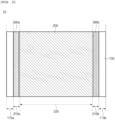
- FIG. 1 is a side view for explaining the negative electrode of the present invention
- FIG. 2 is a plan view for explaining the negative electrode of the present invention.
- the same reference numerals may be assigned to the same components as much as possible even though they are shown in different drawings.
- the detailed description thereof will be omitted.
- the present invention provides a negative electrode 10.
- the negative electrode 10 may be a negative electrode for a lithium secondary battery.
- the negative electrode 10 is characterized in that it includes a negative electrode current collector 100; a first negative electrode active material layer 200 which is disposed on at least one surface of the negative electrode current collector 100 and includes a first negative electrode active material; and second negative electrode active material layers 300a and 300b including a second negative electrode active material, wherein the first negative electrode active material layer 200 includes side portions 210a and 210b partitioned on both sides and a central portion 220 partitioned except for the side portions 210a and 210b, the side portions 210a and 210b have an inclination toward a surface of the negative electrode current collector 100, the second negative electrode active material layers 300a and 300b are disposed on at least a portion of the side portions 210a and 210b, and a maximum height of the second negative electrode active material layers 300a and 300b based on the surface of the negative electrode current collector 100 is less than or equal to a maximum height of the first negative electrode active material layer 200.
- a negative electrode active material layer included in a negative electrode is generally prepared by coating a negative electrode current collector with a negative electrode slurry, which is prepared by adding a negative electrode active material or the like to a solvent for forming the negative electrode slurry, and drying and rolling the coated negative electrode current collector.
- a side portion or end portion of the formed negative electrode active material layer is inclined toward a surface of the negative electrode current collector. Since the negative electrode active material layer is not sufficiently loaded on the side portion having such an inclination, insufficient capacity of the negative electrode is not only caused, but lithium ions transferred from a positive electrode are also not sufficiently intercalated, and thus, it causes a problem of external precipitation of lithium.
- the lithium precipitation presents a problem of not only reducing charge and discharge efficiency of a lithium secondary battery, but also significantly degrading life characteristics.
- the present invention is characterized in that a first negative electrode active material layer including side portions inclined toward the surface of the negative electrode current collector and second negative electrode active material layers disposed on at least a portion of the side portions are included, and a maximum height of the second negative electrode active material layers based on the surface of the negative electrode current collector is less than or equal to a maximum height of the first negative electrode active material layer.
- the second negative electrode active material layers are formed on the side portions which are formed to have an inclination, insufficient capacity and insufficient loading amount of the negative electrode due to the inclination of the side portions are compensated and a problem of precipitation of lithium that has not been intercalated is prevented, and thus, degradation of a cell is prevented, and charge and discharge efficiency and life characteristics of the negative electrode and a lithium secondary battery including the same may be improved.
- the negative electrode current collector 100 is not particularly limited as long as it has high conductivity without causing adverse chemical changes in the battery.
- the negative electrode current collector 100 may include at least one selected from the group consisting of copper, stainless steel, aluminum, nickel, titanium, fired carbon, and an aluminum-cadmium alloy, and may specifically include copper.
- the negative electrode current collector 100 may typically have a thickness of 3 um to 500 ⁇ m.
- the negative electrode current collector 100 may be used in various shapes such as that of a film, a sheet, a foil, a net, a porous body, a foam body, a non-woven fabric body, and the like.
- the first negative electrode active material layer 200 is disposed on at least one surface of the negative electrode current collector 100. Specifically, the first negative electrode active material layer 200 may be disposed on one surface or both surfaces of the negative electrode current collector 100.
- the first negative electrode active material layer may include the side portions 210a and 210b partitioned on both sides and the central portion 220 partitioned except for the side portions 210a and 210b.
- the side portions 210a and 210b and the central portion 220 may be abstractly partitioned to specify formation positions of the second negative electrode active material layers 300a and 300b to be described later as shown in FIGS. 1 and 2 .
- the side portions 210a and 210b and the central portion 220 may have the same composition or may be prepared with the same negative electrode slurry.
- the side portions 210a and 210b may have an inclination toward the surface of the negative electrode current collector 100.
- the inclination of the side portions 210a and 210b may be formed according to fluid characteristics of the negative electrode slurry when the negative electrode slurry is applied to prepare the first negative electrode active material layer.
- Inclination angle and width of the side portions 210a and 210b may be determined by viscosity, application conditions, and drying conditions of the negative electrode slurry for preparing the first negative electrode active material layer, and are not particularly limited.
- the central portion 200 may be a region partitioned except for the side portions 210a and 210b of the first negative electrode active material layer. Specifically, the central portion 200 may have substantially no inclination or may form a flat surface.
- the first negative electrode active material layer 200 may include a first negative electrode active material.
- the first negative electrode active material is a material capable of reversibly intercalating/deintercalating lithium, wherein it may include at least one selected from a carbon-based active material and a (semi)metal-based active material.
- the carbon-based active material may include at least one selected from the group consisting of artificial graphite, natural graphite, hard carbon, soft carbon, carbon black, graphene, and fibrous carbon.
- the (semi)metal-based active material may include at least one selected from the group consisting of: at least one (semi)metal selected from the group consisting of lithium (Li), copper (Cu), nickel (Ni), sodium (Na), potassium (K), rubidium (Rb), cesium (Cs), francium (Fr), beryllium (Be), magnesium (Mg), calcium (Ca), strontium (Sr), silicon (Si), antimony (Sb), lead (Pb), indium (In), zinc (Zn), barium (Ba), radium (Ra), germanium (Ge), aluminum (Al), vanadium (V), titanium (Ti), and tin (Sn); an alloy of lithium and at least one (semi)metal selected from the group consisting of Cu, Ni, Na, K, Rb, Cs, Fr, Be, Mg, Ca, Sr, Si, Sb, Pb, In, Zn, Ba, Ra, Ge, Al, V, Ti
- the first negative electrode active material layer may include the first negative electrode active material in an amount of 60 wt% or more, for example, 60 wt% to 99 wt%.
- the first negative electrode active material layer 200 may include at least one selected from a binder and a conductive agent together with the first negative electrode active material.
- the binder is used to improve performance of the battery by improving adhesion between the negative electrode active material layer and the negative electrode current collector, wherein, for example, the binder may include at least one selected from the group consisting of polyvinylidene fluoride-hexafluoropropylene copolymer (PVDF-co-HFP), polyvinylidene fluoride (PVDF), polyacrylonitrile, polymethylmethacrylate, polyvinyl alcohol, carboxymethyl cellulose (CMC), starch, hydroxypropyl cellulose, regenerated cellulose, polyvinylpyrrolidone, polytetrafluoroethylene, polyethylene, polypropylene, polyacrylic acid, an ethylene-propylene-diene monomer (EPDM), a sulfonated EPDM, a styrene-butadiene rubber (SBR), a fluorine rubber, and a material having hydrogen thereof substituted with lithium (Li), sodium (Na), or calcium (Ca), or
- the binder may be included in an amount of 0.5 wt% to 20 wt% in the first negative electrode active material layer.
- the conductive agent is not particularly limited as long as it has conductivity without causing adverse chemical changes in the battery, wherein, for example, a conductive material, such as: graphite such as natural graphite or artificial graphite; carbon black such as carbon black, acetylene black, Ketjen black, channel black, furnace black, lamp black, and thermal black; conductive fibers such as carbon fibers and metal fibers; conductive tubes such as carbon nanotubes; fluorocarbon; metal powder such as aluminum powder and nickel powder; conductive whiskers such as zinc oxide whiskers and potassium titanate whiskers; conductive metal oxide such as titanium oxide; or polyphenylene derivatives, may be used.
- a conductive material such as: graphite such as natural graphite or artificial graphite; carbon black such as carbon black, acetylene black, Ketjen black, channel black, furnace black, lamp black, and thermal black; conductive fibers such as carbon fibers and metal fibers; conductive tubes such as carbon nanotubes; fluorocarbon; metal powder
- the conductive agent may be included in an amount of 0.5 wt% to 20 wt% in the first negative electrode active material layer.
- a height or thickness of the first negative electrode active material layer based on the surface of the negative electrode current collector may be in a range of 10 um to 300 ⁇ m, for example, 50 um to 150 ⁇ m.
- the second negative electrode active material layers 300a and 300b may be disposed on at least a portion of the side portions 210a and 210b. Specifically, the second negative electrode active material layers 300a and 300b may be disposed on the side portions 210a and 210b along inclined surfaces of the side portions 210a and 210b.
- the second negative electrode active material layers since the insufficient capacity and insufficient loading amount of the negative electrode due to the inclination of the side portions 210a and 210b of the first negative electrode active material layer 200 are prevented and the problem of the precipitation of lithium on the side portions is prevented, the effect of improving the capacity, charge and discharge efficiency, and life characteristics of the negative electrode may be achieved.
- a maximum height H2 of the second negative electrode active material layers 300a and 300b based on the surface of the negative electrode current collector 100 may be less than or equal to a maximum height H1 of the first negative electrode active material layer.
- the maximum height H2 of the second negative electrode active material layers based on the surface of the negative electrode current collector may be equal to the maximum height H1 of the first negative electrode active material layer or may be less than the maximum height H1 of the first negative electrode active material layer.
- a maximum distance between the second negative electrode active material layers 300a and 300b formed or disposed on the side portions 210a and 210b and the surface of the negative electrode current collector 100 may not be greater than a maximum distance between the first negative electrode active material layer 200 and the surface of the negative electrode current collector 100, and, accordingly, overall flatness of the negative electrode is achieved, and a problem, in which structural stability of the negative electrode is reduced because the maximum height of the second negative electrode active material layers is greater than the maximum height of the first negative electrode active material layer, may be prevented.
- the expression “based on the surface of the negative electrode current collector” refers to the surface of the negative electrode current collector in which the negative electrode current collector and the first negative electrode active material layer are in contact with each other as shown in FIG. 1 .
- the second negative electrode active material layers 300a and 300b may include a second negative electrode active material.
- the second negative electrode active material is a material capable of reversibly intercalating/deintercalating lithium, wherein it may include at least one selected from a carbon-based active material and a (semi)metal-based active material.
- the carbon-based active material may include at least one selected from the group consisting of artificial graphite, natural graphite, hard carbon, soft carbon, carbon black, graphene, and fibrous carbon.
- the (semi)metal-based active material may include at least one selected from the group consisting of: at least one (semi)metal selected from the group consisting of Li, Cu, Ni, Na, K, Rb, Cs, Fr, Be, Mg, Ca, Sr, Si, Sb, Pb, In, Zn, Ba, Ra, Ge, Al, V, Ti, and Sn; an alloy of lithium and at least one (semi)metal selected from the group consisting of Cu, Ni, Na, K, Rb, Cs, Fr, Be, Mg, Ca, Sr, Si, Sb, Pb, In, Zn, Ba, Ra, Ge, Al, V, Ti, and Sn; a composite of carbon and the at least one (semi)metal selected from the group consisting of Cu, Ni, Na, K, Rb, Cs, Fr, Be, Mg, Ca, Sr, Si, Sb, Pb, In, Zn, Ba, Ra, Ge, Al, V, Ti
- the second negative electrode active material may include at least one silicon-based active material selected from SiO x (0 ⁇ x ⁇ 2 ) and a silicon-carbon composite. Since the silicon-based active material has excellent capacity, the above-described effect of improving the capacity of the negative electrode may be more preferably achieved.
- the second negative electrode active material may include a lithium titanium oxide (LTO), and, in this case, the capacity of the negative electrode may be improved, and it is desirable in terms of the fact that the lithium precipitation may be mitigated by increasing ionic conductivity of the second negative electrode active material layers.
- LTO lithium titanium oxide
- the second negative electrode active material may be the same as or different from the above-described first negative electrode active material.
- capacity per weight of the second negative electrode active material may be greater than capacity per weight of the first negative electrode active material, and, in this case, the insufficient loading amount or insufficient capacity of the negative electrode due to the inclination of the side portions of the first negative electrode active material layer may be compensated with a more desirable level.
- the maximum height H2 of the second negative electrode active material layers 300a and 300b based on the surface of the negative electrode current collector 100 may be less than the maximum height H1 of the first negative electrode active material layer 200.
- the capacity per weight of the second negative electrode active material is greater than the capacity per weight of the first negative electrode active material
- a degree of volume expansion of the second negative electrode active material may be greater than a degree of volume expansion of the first negative electrode active material due to lithium intercalation
- a decrease in the structural stability of the negative electrode due to volume expansion of the second negative electrode active material layers during charge and discharge of the negative electrode may be prevented by adjusting the maximum height H2 of the second negative electrode active material layers to be less than the maximum height H1 of the first negative electrode active material layer.
- the maximum height H2 of the second negative electrode active material layers 300a and 300b based on the surface of the negative electrode current collector 100 may be 99% or less, particularly 10% to 99%, and more particularly 40% to 95% of the maximum height H1 of the first negative electrode active material layer 200.
- the second negative electrode active material layers 300a and 300b may include the second negative electrode active material in an amount of 60 wt% or more, for example, 60 wt% to 99 wt%.
- the second negative electrode active material layers 300a and 300b may include at least one selected from a binder and a conductive agent together with the second negative electrode active material.
- the binder is used to improve the performance of the battery by improving the adhesion between the negative electrode active material layer and the negative electrode current collector, wherein, for example, the binder may include at least one selected from the group consisting of polyvinylidene fluoride-hexafluoropropylene copolymer (PVDF-co-HFP), polyvinylidene fluoride (PVDF), polyacrylonitrile, polymethylmethacrylate, polyvinyl alcohol, carboxymethyl cellulose (CMC), starch, hydroxypropyl cellulose, regenerated cellulose, polyvinylpyrrolidone, polytetrafluoroethylene, polyethylene, polypropylene, polyacrylic acid, an ethylene-propylene-diene monomer (EPDM), a sulfonated EPDM, a styrene-butadiene rubber (SBR), a fluorine rubber, and a material having hydrogen thereof substituted with Li, Na, or Ca, or may include various copolymers
- the binder may be included in an amount of 0.5 wt% to 20 wt% in the second negative electrode active material layer.
- the conductive agent is not particularly limited as long as it has conductivity without causing adverse chemical changes in the battery, wherein, for example, a conductive material, such as: graphite such as natural graphite or artificial graphite; carbon black such as carbon black, acetylene black, Ketjen black, channel black, furnace black, lamp black, and thermal black; conductive fibers such as carbon fibers and metal fibers; conductive tubes such as carbon nanotubes; fluorocarbon; metal powder such as aluminum powder and nickel powder; conductive whiskers such as zinc oxide whiskers and potassium titanate whiskers; conductive metal oxide such as titanium oxide; or polyphenylene derivatives, may be used.
- a conductive material such as: graphite such as natural graphite or artificial graphite; carbon black such as carbon black, acetylene black, Ketjen black, channel black, furnace black, lamp black, and thermal black; conductive fibers such as carbon fibers and metal fibers; conductive tubes such as carbon nanotubes; fluorocarbon; metal powder
- the conductive agent may be included in an amount of 0.5 wt% to 20 wt% in the second negative electrode active material layer.
- the negative electrode current collector may include uncoated portions 110a and 110b.
- the uncoated portions 110a and 110b are those in which the negative electrode active material layers (the first negative electrode active material layer and the second negative electrode active material layers) are not disposed on the negative electrode current collector.
- the negative electrode current collector includes the uncoated portions 110a and 110b located on both sides, in which the first negative electrode active material layer 200 and the second negative electrode active material layers 300a and 300b are not disposed, wherein the side portions 210a and 210b are adjacent to the uncoated portions 110a and 110b, and the central portion 220 may be spaced apart from the uncoated portions 110a and 110b.
- the present invention provides a method of preparing the above-described negative electrode.
- the method of preparing the negative electrode of the present invention may include the steps of: applying a first negative electrode slurry including a first negative electrode active material and a solvent for forming a negative electrode slurry on a negative electrode current collector; and forming second negative electrode active material layers on side portions of the applied first negative electrode slurry.
- the first negative electrode slurry may further include at least one selected from a binder and a conductive agent together with the first negative electrode active material.
- the solvent for forming a negative electrode slurry may include at least one selected from the group consisting of N-methyl-2-pyrrolidone (NMP), distilled water, ethanol, methanol, and isopropyl alcohol, preferably, distilled water.
- NMP N-methyl-2-pyrrolidone
- the forming of the second negative electrode active material layers may be performed simultaneously with the applying of the first negative electrode slurry, or may be performed after the applying of the first negative electrode slurry.
- the forming of the second negative electrode active material layers may be performed before drying after the applying of the first negative electrode slurry, or may be performed after the applying of the first negative electrode slurry and drying.
- the forming of the second negative electrode active material layers may be performed by applying the second negative electrode slurry to the side portions of the applied first negative electrode slurry.
- the application method is not particularly limited, and may be spray coating, slot die coating, gravure coating, or curtain coating.
- the second negative active material layers may also be formed by a method in which a film is prepared in advance by using the second negative electrode slurry and the film is transferred to the side portions of the applied first negative electrode slurry.
- the present invention provides a lithium secondary battery including the above-described negative electrode.
- the lithium secondary battery includes the above-described negative electrode; a positive electrode; a separator disposed between the negative electrode and the positive electrode; and an electrolyte.
- the positive electrode may include a positive electrode current collector; and a positive electrode active material layer formed on the positive electrode current collector.
- the positive electrode current collector is not particularly limited as long as it has high conductivity without causing adverse chemical changes in the battery, and, for example, stainless steel, aluminum, nickel, titanium, fired carbon, or aluminum or stainless steel that is surfacetreated with one of carbon, nickel, titanium, silver, or the like may be used.
- the positive electrode current collector may generally have a thickness of 3 um to 500 ⁇ m.
- the positive electrode active material layer is formed on the positive electrode current collector, and includes a positive electrode active material.
- the positive electrode active material is a compound capable of reversibly intercalating and deintercalating lithium, wherein the positive electrode active material may specifically include a lithium composite metal oxide including lithium and at least one metal such as cobalt, manganese, nickel, or aluminum. More specifically, the lithium composite metal oxide may include lithium-manganese-based oxide (e.g., LiMnO 2 , LiMn 2 O 4 , etc.), lithium-cobalt-based oxide (e.g., LiCoO 2 , etc.), lithium-nickel-based oxide (e.g., LiNiO 2 , etc.), lithium-nickel-manganese-based oxide (e.g., LiNi 1-y Mn y O 2 (where 0 ⁇ Y ⁇ 1), LiMn 2-z Ni z O 4 (where 0 ⁇ Z ⁇ 2), etc.), lithium-nickel-cobalt-based oxide (e.g., LiNi 1-Y1 Co Y1 O 2 (where 0 ⁇ Y1 ⁇ 1), lithium
- the lithium composite metal oxide may be LiCoO 2 , LiMnO 2 , LiNiO 2 , lithium nickel manganese cobalt oxide (e.g., Li(Ni 0.6 Mn 0.2 Co 0.2 )O 2 , Li(Ni 0.5 Mn 0.3 Co 0.2 )O 2 , or Li(Ni 0.8 Mn 0.1 Co 0.1 )O 2 , etc.), or lithium nickel cobalt aluminum oxide (e.g., Li(Ni 0.8 Co 0.15 Al 0.05 )O 2 , etc.).
- the positive electrode active material may be included in an amount of 80 wt% to 99 wt% based on a total weight of the positive electrode active material layer.
- the positive electrode active material layer may optionally further include at least one additive selected from the group consisting of a binder and a conductive agent in addition to the above-described positive electrode active material.
- the binder is a component that assists in binding between the conductive agent and the active material and in binding with the current collector, wherein the binder is commonly added in an amount of 1 wt% to 30 wt% based on the total weight of the positive electrode active material layer.
- binder may be polyvinylidene fluoride, polyvinyl alcohol, carboxymethylcellulose (CMC), starch, hydroxypropylcellulose, regenerated cellulose, polyvinylpyrrolidone, polytetrafluoroethylene, polyethylene, polypropylene, an ethylene-propylene-diene monomer (EPDM), a sulfonated EPDM, a styrene-butadiene rubber, a fluoro rubber, and various copolymers.
- CMC carboxymethylcellulose
- EPDM ethylene-propylene-diene monomer
- EPDM ethylene-propylene-diene monomer
- sulfonated EPDM a styrene-butadiene rubber
- fluoro rubber a fluoro rubber
- Any conductive agent may be used without particular limitation so long as it has conductivity without causing adverse chemical changes in the battery, and, for example, a conductive material, such as: graphite; a carbon-based material such as carbon black, acetylene black, Ketjen black, channel black, furnace black, lamp black, and thermal black; conductive fibers such as carbon fibers or metal fibers; fluorocarbon; metal powder such as aluminum powder, and nickel powder; conductive whiskers such as zinc oxide whiskers and potassium titanate whiskers; conductive metal oxide such as titanium oxide; or polyphenylene derivatives, may be used.
- a conductive material such as: graphite; a carbon-based material such as carbon black, acetylene black, Ketjen black, channel black, furnace black, lamp black, and thermal black
- conductive fibers such as carbon fibers or metal fibers
- fluorocarbon metal powder
- metal powder such as aluminum powder, and nickel powder
- conductive whiskers such as zinc oxide whiskers and potassium titanate whiskers
- a commercial conductive agent may be acetylene black-based products (Chevron Chemical Company, Denka black (Denka Singapore Private Limited), or Gulf Oil Company), Ketjen black, ethylene carbonate (EC)-based products (Armak Company), Vulcan XC-72 (Cabot Company), and Super P (Timcal Graphite & Carbon).
- the conductive agent may be included in an amount of 1 wt% to 30 wt% based on the total weight of the positive electrode active material layer.
- the positive electrode active material layer may be prepared by applying the positive electrode slurry on the positive electrode current collector and rolling and drying the coated positive electrode current collector.
- the solvent may include an organic solvent, such as N-methyl-2-pyrrolidone (NMP), and may be used in an amount such that desirable viscosity is obtained when the positive electrode active material as well as optionally the binder and the conductive agent are included.
- NMP N-methyl-2-pyrrolidone
- the solvent may be included in an amount such that a concentration of a solid content including the positive electrode active material as well as optionally the binder and the conductive agent is in a range of 50 wt% to 95 wt%, for example, 70 wt% to 90 wt%.
- the separator separates the negative electrode and the positive electrode and provides a movement path of lithium ions
- any separator may be used without particular limitation as long as it is typically used as a separator in a lithium secondary battery, and particularly, a separator having high moistureretention ability for an electrolyte solution as well as low resistance to the transfer of electrolyte ions may be used.
- a porous polymer film for example, a porous polymer film prepared from a polyolefin-based polymer, such as an ethylene homopolymer, a propylene homopolymer, an ethylene/butene copolymer, an ethylene/hexene copolymer, and an ethylene/methacrylate copolymer, or a laminated structure having two or more layers thereof may be used.
- a typical porous nonwoven fabric for example, a nonwoven fabric formed of high melting point glass fibers or polyethylene terephthalate fibers may be used.
- a coated separator including a ceramic component or a polymer material may be used to secure heat resistance or mechanical strength, and the separator having a single layer or multilayer structure may be optionally used.
- the electrolyte used in the present invention may include an organic liquid electrolyte, an inorganic liquid electrolyte, a solid polymer electrolyte, a gel-type polymer electrolyte, a solid inorganic electrolyte, or a molten-type inorganic electrolyte which may be used in the preparation of the lithium secondary battery, but the present invention is not limited thereto.
- the electrolyte may include an organic solvent and a lithium salt.
- any organic solvent may be used as the organic solvent without particular limitation so long as it may function as a medium through which ions involved in an electrochemical reaction of the battery may move.
- an esterbased solvent such as methyl acetate, ethyl acetate, ⁇ -butyrolactone, and ⁇ -caprolactone
- an ether-based solvent such as dibutyl ether or tetrahydrofuran
- a ketone-based solvent such as cyclohexanone
- an aromatic hydrocarbon-based solvent such as benzene and fluorobenzene
- a carbonate-based solvent such as dimethyl carbonate (DMC), diethyl carbonate (DEC), ethylmethyl carbonate (EMC), ethylene carbonate (EC), and propylene carbonate (PC)
- an alcohol-based solvent such as ethyl alcohol and isopropyl alcohol
- nitriles such as R-CN (where R is a linear, branched, or cyclic C
- the carbonate-based solvent may be used, and, for example, a mixture of a cyclic carbonate (e.g., ethylene carbonate or propylene carbonate) having high ionic conductivity and high dielectric constant, and a low-viscosity linear carbonate-based compound (e.g., ethylmethyl carbonate, dimethyl carbonate, or diethyl carbonate) may be used, said mixture may increase charge/discharge performance of the battery.
- a cyclic carbonate e.g., ethylene carbonate or propylene carbonate
- a low-viscosity linear carbonate-based compound e.g., ethylmethyl carbonate, dimethyl carbonate, or diethyl carbonate
- the performance of the electrolyte solution may be excellent when the cyclic carbonate and the chain carbonate are mixed in a volume ratio of about 1:1 to about 1:9.
- the lithium salt may be used without particular limitation as long as it is a compound capable of providing lithium ions used in the lithium secondary battery. Specifically, LiPF 6 , LiClO 4 , LiAsF 6 , LiBF 4 , LiSbF 6 , LiAlO 4 , LiAlCl 4 , LiCF 3 SO 3 , LiC 4 F 9 SO 3 , LiN(C 2 F 5 SO 3 ) 2 , LiN(C 2 F 5 SO 2 ) 2 , LiN(CF 3 SO 2 ) 2 , LiCl, LiI, or LiB(C 2 O 4 ) 2 may be used as the lithium salt.
- the lithium salt may be used in a concentration range of 0.1 M to 2.0 M. If the concentration of the lithium salt is included within the above range, since the electrolyte may have appropriate conductivity and viscosity, excellent performance of the electrolyte may be obtained and lithium ions may effectively move.
- the secondary battery according to the present invention is suitable for portable devices, such as mobile phones, notebook computers, and digital cameras, and electric cars such as hybrid electric vehicles (HEVs) and, particularly, may be preferably used as a constituent battery of a medium and large sized battery module.
- the present invention also provides a medium and large sized battery module including the above-described secondary battery as a unit cell.
- the medium and large sized battery module may be preferably used in power sources that require high output and large capacity, such as an electric vehicle, a hybrid electric vehicle, and a power storage system.
Landscapes
- Chemical & Material Sciences (AREA)
- Chemical Kinetics & Catalysis (AREA)
- Electrochemistry (AREA)
- General Chemical & Material Sciences (AREA)
- Engineering & Computer Science (AREA)
- Materials Engineering (AREA)
- Composite Materials (AREA)
- Manufacturing & Machinery (AREA)
- Inorganic Chemistry (AREA)
- Battery Electrode And Active Subsutance (AREA)
- Secondary Cells (AREA)
Abstract
Description
- This application claims priority from
Korean Patent Application No. 10-2021-0097021, filed on July 23, 2021 - The present invention relates to a negative electrode and a secondary battery including the same.
- There is a need to develop battery technology for efficiently storing and utilizing electrical energy as personal IT devices and computer networks are developed with the recent development of information society and the accompanying dependency of society as a whole on the electrical energy is increased.
- Particularly, studies of electricity storage devices, such as electric double-layer capacitors and lithium ion batteries, have been extensively conducted as an interest in solving environmental problems and realizing a sustainable circular society emerges. Among them, a lithium secondary battery is in the spotlight as a battery system with the highest theoretical energy density among battery technologies.
- The lithium secondary battery generally includes a positive electrode, a negative electrode, a separator disposed between the positive electrode and the negative electrode, an electrolyte, and an organic solvent. Also, with respect to the positive electrode and the negative electrode, an active material layer including a positive electrode active material or a negative electrode active material may be formed on a current collector.
- Among these, the negative electrode active material layer is generally prepared by coating a negative electrode current collector with a negative electrode slurry, which is prepared by adding the negative electrode active material or the like to a solvent for forming the negative electrode slurry, and drying and rolling the coated negative electrode current collector. In this case, with respect to the negative electrode active material layer, there is a risk that an end portion forms an inclination due to fluid characteristics of the negative electrode slurry, and, as a result, since it is difficult to achieve desired capacity or a negative electrode loading amount and there is a problem in that lithium is precipitated because the inclined end portion does not sufficiently accept the lithium from the positive electrode facing the inclined end portion, it may cause insufficient capacity, a decrease in charge and discharge efficiency, and a decrease in life characteristics of the lithium secondary battery.
-
Japanese Patent Application Laid-open Publication No. 2020-167066 -
Japanese Patent Application Laid-open Publication No. 2020-167066 - An aspect of the present invention provides a negative electrode capable of improving capacity of the negative electrode and improving the capacity, charge and discharge efficiency, and life characteristics of the negative electrode by preventing precipitation of lithium on a negative electrode side portion.
- Another aspect of the present invention provides a secondary battery including the above-described negative electrode.
- According to an aspect of the present invention, there is provided a negative electrode including: a negative electrode current collector; a first negative electrode active material layer which is disposed on at least one surface of the negative electrode current collector and includes a first negative electrode active material; and second negative electrode active material layers including a second negative electrode active material, wherein the first negative electrode active material layer includes side portions partitioned on both sides and a central portion partitioned except for the side portions, the side portions have an inclination toward a surface of the negative electrode current collector, the second negative electrode active material layers are disposed on at least a portion of the side portions, and a maximum height of the second negative electrode active material layers based on the surface of the negative electrode current collector is less than or equal to a maximum height of the first negative electrode active material layer.
- According to another aspect of the present invention, there is provided a lithium secondary battery including: the above-described negative electrode; a positive electrode; a separator disposed between the negative electrode and the positive electrode; and an electrolyte.
- A negative electrode according to the present invention is characterized in that it includes a first negative electrode active material layer including side portions inclined toward a surface of a negative electrode current collector and second negative electrode active material layers disposed on at least a portion of the side portions, wherein a maximum height of the second negative electrode active material layers based on the surface of the negative electrode current collector is less than or equal to a maximum height of the first negative electrode active material layer. With respect to the negative electrode according to the present invention, since the second negative electrode active material layers are formed on the side portions which are formed to have an inclination, insufficient capacity and insufficient loading amount of the negative electrode due to the inclination of the side portions are compensated and a problem of precipitation of lithium that has not been intercalated is prevented, and thus, the capacity of the negative electrode may be improved, and charge and discharge efficiency and life characteristics of the negative electrode and a lithium secondary battery including the same may be improved.
-
-
FIG. 1 is a side view schematically illustrating a negative electrode of the present invention. -
FIG. 2 is a plan view schematically illustrating the negative electrode of the present invention. - Hereinafter, the present invention will be described in more detail to allow for a clearer understanding of the present invention. In this case, it will be understood that words or terms used in the specification and claims shall not be interpreted as the meaning defined in commonly used dictionaries. It will be further understood that the words or terms should be interpreted as having a meaning that is consistent with their meaning in the context of the relevant art and the technical idea of the invention, based on the principle that an inventor may properly define the meaning of the words or terms to best explain the invention.
- Also, it will be further understood that the terms "include," "comprise," or "have" in this specification specify the presence of stated features, numbers, steps, elements, or combinations thereof, but do not preclude the presence or addition of one or more other features, numbers, steps, elements, or combinations thereof.
- In the present specification, the expression average particle diameter (D50) may be defined as a particle diameter at a cumulative volume of 50% in a particle size distribution curve. The average particle diameter (D50), for example, may be measured by using a laser diffraction method. The laser diffraction method may generally measure a particle diameter ranging from submicrons to a few mm and may obtain highly repeatable and high-resolution results.
- Hereinafter, a negative electrode of the present invention will be described in detail with reference to the accompanying drawings. Specifically,
FIG. 1 is a side view for explaining the negative electrode of the present invention, andFIG. 2 is a plan view for explaining the negative electrode of the present invention. In adding reference numerals to components of each drawing, it should be noted that the same reference numerals may be assigned to the same components as much as possible even though they are shown in different drawings. In addition, in describing the present invention, when it is determined that a detailed description of a related known configuration or function may obscure the gist of the present invention, the detailed description thereof will be omitted. - The present invention provides a
negative electrode 10. Specifically, thenegative electrode 10 may be a negative electrode for a lithium secondary battery. - The
negative electrode 10 according to the present invention is characterized in that it includes a negative electrodecurrent collector 100; a first negative electrodeactive material layer 200 which is disposed on at least one surface of the negative electrodecurrent collector 100 and includes a first negative electrode active material; and second negative electrodeactive material layers active material layer 200 includesside portions central portion 220 partitioned except for theside portions side portions current collector 100, the second negative electrodeactive material layers side portions active material layers current collector 100 is less than or equal to a maximum height of the first negative electrodeactive material layer 200. - In general, a negative electrode active material layer included in a negative electrode is generally prepared by coating a negative electrode current collector with a negative electrode slurry, which is prepared by adding a negative electrode active material or the like to a solvent for forming the negative electrode slurry, and drying and rolling the coated negative electrode current collector. In this case, as long as the negative electrode slurry has fluid characteristics, a side portion or end portion of the formed negative electrode active material layer is inclined toward a surface of the negative electrode current collector. Since the negative electrode active material layer is not sufficiently loaded on the side portion having such an inclination, insufficient capacity of the negative electrode is not only caused, but lithium ions transferred from a positive electrode are also not sufficiently intercalated, and thus, it causes a problem of external precipitation of lithium. The lithium precipitation presents a problem of not only reducing charge and discharge efficiency of a lithium secondary battery, but also significantly degrading life characteristics.
- In order to solve this problem, the present invention is characterized in that a first negative electrode active material layer including side portions inclined toward the surface of the negative electrode current collector and second negative electrode active material layers disposed on at least a portion of the side portions are included, and a maximum height of the second negative electrode active material layers based on the surface of the negative electrode current collector is less than or equal to a maximum height of the first negative electrode active material layer. With respect to the negative electrode according to the present invention, since the second negative electrode active material layers are formed on the side portions which are formed to have an inclination, insufficient capacity and insufficient loading amount of the negative electrode due to the inclination of the side portions are compensated and a problem of precipitation of lithium that has not been intercalated is prevented, and thus, degradation of a cell is prevented, and charge and discharge efficiency and life characteristics of the negative electrode and a lithium secondary battery including the same may be improved.
- The negative electrode
current collector 100 is not particularly limited as long as it has high conductivity without causing adverse chemical changes in the battery. Specifically, the negative electrodecurrent collector 100 may include at least one selected from the group consisting of copper, stainless steel, aluminum, nickel, titanium, fired carbon, and an aluminum-cadmium alloy, and may specifically include copper. - The negative electrode
current collector 100 may typically have a thickness of 3 um to 500 µm. - Microscopic irregularities may be formed on the surface of the negative electrode
current collector 100 to improve adhesion of the negative electrode active material. For example, the negative electrode current collector may be used in various shapes such as that of a film, a sheet, a foil, a net, a porous body, a foam body, a non-woven fabric body, and the like. - The first negative electrode
active material layer 200 is disposed on at least one surface of the negative electrodecurrent collector 100. Specifically, the first negative electrodeactive material layer 200 may be disposed on one surface or both surfaces of the negativeelectrode current collector 100. - The first negative electrode active material layer may include the
side portions central portion 220 partitioned except for theside portions side portions central portion 220 may be abstractly partitioned to specify formation positions of the second negative electrodeactive material layers FIGS. 1 and2 . For example, theside portions central portion 220 may have the same composition or may be prepared with the same negative electrode slurry. - As shown in
FIG. 1 , theside portions current collector 100. The inclination of theside portions active material layers - Inclination angle and width of the
side portions - The
central portion 200 may be a region partitioned except for theside portions central portion 200 may have substantially no inclination or may form a flat surface. - The first negative electrode
active material layer 200 may include a first negative electrode active material. - The first negative electrode active material is a material capable of reversibly intercalating/deintercalating lithium, wherein it may include at least one selected from a carbon-based active material and a (semi)metal-based active material.
- The carbon-based active material may include at least one selected from the group consisting of artificial graphite, natural graphite, hard carbon, soft carbon, carbon black, graphene, and fibrous carbon.
- The (semi)metal-based active material may include at least one selected from the group consisting of: at least one (semi)metal selected from the group consisting of lithium (Li), copper (Cu), nickel (Ni), sodium (Na), potassium (K), rubidium (Rb), cesium (Cs), francium (Fr), beryllium (Be), magnesium (Mg), calcium (Ca), strontium (Sr), silicon (Si), antimony (Sb), lead (Pb), indium (In), zinc (Zn), barium (Ba), radium (Ra), germanium (Ge), aluminum (Al), vanadium (V), titanium (Ti), and tin (Sn); an alloy of lithium and at least one (semi)metal selected from the group consisting of Cu, Ni, Na, K, Rb, Cs, Fr, Be, Mg, Ca, Sr, Si, Sb, Pb, In, Zn, Ba, Ra, Ge, Al, V, Ti, and Sn; a composite of carbon and the at least one (semi)metal selected from the group consisting of Cu, Ni, Na, K, Rb, Cs, Fr, Be, Mg, Ca, Sr, Si, Sb, Pb, In, Zn, Ba, Ra, Ge, Al, V, Ti, and Sn; and an oxide of the at least one (semi)metal selected from the group consisting of Li, Cu, Ni, Na, K, Rb, Cs, Fr, Be, Mg, Ca, Sr, Si, Sb, Pb, In, Zn, Ba, Ra, Ge, Al, V, Ti, and Sn.
- The first negative electrode active material layer may include the first negative electrode active material in an amount of 60 wt% or more, for example, 60 wt% to 99 wt%.
- The first negative electrode
active material layer 200 may include at least one selected from a binder and a conductive agent together with the first negative electrode active material. - The binder is used to improve performance of the battery by improving adhesion between the negative electrode active material layer and the negative electrode current collector, wherein, for example, the binder may include at least one selected from the group consisting of polyvinylidene fluoride-hexafluoropropylene copolymer (PVDF-co-HFP), polyvinylidene fluoride (PVDF), polyacrylonitrile, polymethylmethacrylate, polyvinyl alcohol, carboxymethyl cellulose (CMC), starch, hydroxypropyl cellulose, regenerated cellulose, polyvinylpyrrolidone, polytetrafluoroethylene, polyethylene, polypropylene, polyacrylic acid, an ethylene-propylene-diene monomer (EPDM), a sulfonated EPDM, a styrene-butadiene rubber (SBR), a fluorine rubber, and a material having hydrogen thereof substituted with lithium (Li), sodium (Na), or calcium (Ca), or may include various copolymers thereof.
- The binder may be included in an amount of 0.5 wt% to 20 wt% in the first negative electrode active material layer.
- The conductive agent is not particularly limited as long as it has conductivity without causing adverse chemical changes in the battery, wherein, for example, a conductive material, such as: graphite such as natural graphite or artificial graphite; carbon black such as carbon black, acetylene black, Ketjen black, channel black, furnace black, lamp black, and thermal black; conductive fibers such as carbon fibers and metal fibers; conductive tubes such as carbon nanotubes; fluorocarbon; metal powder such as aluminum powder and nickel powder; conductive whiskers such as zinc oxide whiskers and potassium titanate whiskers; conductive metal oxide such as titanium oxide; or polyphenylene derivatives, may be used.
- The conductive agent may be included in an amount of 0.5 wt% to 20 wt% in the first negative electrode active material layer.
- A height or thickness of the first negative electrode active material layer based on the surface of the negative electrode current collector may be in a range of 10 um to 300 µm, for example, 50 um to 150 µm.
- The second negative electrode
active material layers side portions active material layers side portions side portions - Through the disposition of the second negative electrode active material layers, since the insufficient capacity and insufficient loading amount of the negative electrode due to the inclination of the
side portions active material layer 200 are prevented and the problem of the precipitation of lithium on the side portions is prevented, the effect of improving the capacity, charge and discharge efficiency, and life characteristics of the negative electrode may be achieved. - In the present invention, a maximum height H2 of the second negative electrode
active material layers current collector 100 may be less than or equal to a maximum height H1 of the first negative electrode active material layer. Specifically, the maximum height H2 of the second negative electrode active material layers based on the surface of the negative electrode current collector may be equal to the maximum height H1 of the first negative electrode active material layer or may be less than the maximum height H1 of the first negative electrode active material layer. That is, a maximum distance between the second negative electrodeactive material layers side portions current collector 100 may not be greater than a maximum distance between the first negative electrodeactive material layer 200 and the surface of the negative electrodecurrent collector 100, and, accordingly, overall flatness of the negative electrode is achieved, and a problem, in which structural stability of the negative electrode is reduced because the maximum height of the second negative electrode active material layers is greater than the maximum height of the first negative electrode active material layer, may be prevented. - In the present specification, the expression "based on the surface of the negative electrode current collector" refers to the surface of the negative electrode current collector in which the negative electrode current collector and the first negative electrode active material layer are in contact with each other as shown in
FIG. 1 . - The second negative electrode
active material layers - The second negative electrode active material is a material capable of reversibly intercalating/deintercalating lithium, wherein it may include at least one selected from a carbon-based active material and a (semi)metal-based active material.
- The carbon-based active material may include at least one selected from the group consisting of artificial graphite, natural graphite, hard carbon, soft carbon, carbon black, graphene, and fibrous carbon.
- The (semi)metal-based active material may include at least one selected from the group consisting of: at least one (semi)metal selected from the group consisting of Li, Cu, Ni, Na, K, Rb, Cs, Fr, Be, Mg, Ca, Sr, Si, Sb, Pb, In, Zn, Ba, Ra, Ge, Al, V, Ti, and Sn; an alloy of lithium and at least one (semi)metal selected from the group consisting of Cu, Ni, Na, K, Rb, Cs, Fr, Be, Mg, Ca, Sr, Si, Sb, Pb, In, Zn, Ba, Ra, Ge, Al, V, Ti, and Sn; a composite of carbon and the at least one (semi)metal selected from the group consisting of Cu, Ni, Na, K, Rb, Cs, Fr, Be, Mg, Ca, Sr, Si, Sb, Pb, In, Zn, Ba, Ra, Ge, Al, V, Ti, and Sn; and an oxide of the at least one (semi)metal selected from the group consisting of Li, Cu, Ni, Na, K, Rb, Cs, Fr, Be, Mg, Ca, Sr, Si, Sb, Pb, In, Zn, Ba, Ra, Ge, Al, V, Ti, and Sn.
- More specifically, the second negative electrode active material may include at least one silicon-based active material selected from SiOx (0≤x<2) and a silicon-carbon composite. Since the silicon-based active material has excellent capacity, the above-described effect of improving the capacity of the negative electrode may be more preferably achieved.
- The second negative electrode active material may include a lithium titanium oxide (LTO), and, in this case, the capacity of the negative electrode may be improved, and it is desirable in terms of the fact that the lithium precipitation may be mitigated by increasing ionic conductivity of the second negative electrode active material layers.
- The second negative electrode active material may be the same as or different from the above-described first negative electrode active material.
- More specifically, capacity per weight of the second negative electrode active material may be greater than capacity per weight of the first negative electrode active material, and, in this case, the insufficient loading amount or insufficient capacity of the negative electrode due to the inclination of the side portions of the first negative electrode active material layer may be compensated with a more desirable level.
- In a case in which the capacity per weight of the second negative electrode active material is greater than the capacity per weight of the first negative electrode active material, the maximum height H2 of the second negative electrode
active material layers current collector 100 may be less than the maximum height H1 of the first negative electrodeactive material layer 200. Specifically, in the case that the capacity per weight of the second negative electrode active material is greater than the capacity per weight of the first negative electrode active material, since a degree of volume expansion of the second negative electrode active material may be greater than a degree of volume expansion of the first negative electrode active material due to lithium intercalation, a decrease in the structural stability of the negative electrode due to volume expansion of the second negative electrode active material layers during charge and discharge of the negative electrode may be prevented by adjusting the maximum height H2 of the second negative electrode active material layers to be less than the maximum height H1 of the first negative electrode active material layer. - For example, in a case in which the first negative electrode active material includes the carbon-based active material and the second negative electrode active material includes the silicon-based active material, the maximum height H2 of the second negative electrode
active material layers current collector 100 may be 99% or less, particularly 10% to 99%, and more particularly 40% to 95% of the maximum height H1 of the first negative electrodeactive material layer 200. - The second negative electrode
active material layers - The second negative electrode
active material layers - The binder is used to improve the performance of the battery by improving the adhesion between the negative electrode active material layer and the negative electrode current collector, wherein, for example, the binder may include at least one selected from the group consisting of polyvinylidene fluoride-hexafluoropropylene copolymer (PVDF-co-HFP), polyvinylidene fluoride (PVDF), polyacrylonitrile, polymethylmethacrylate, polyvinyl alcohol, carboxymethyl cellulose (CMC), starch, hydroxypropyl cellulose, regenerated cellulose, polyvinylpyrrolidone, polytetrafluoroethylene, polyethylene, polypropylene, polyacrylic acid, an ethylene-propylene-diene monomer (EPDM), a sulfonated EPDM, a styrene-butadiene rubber (SBR), a fluorine rubber, and a material having hydrogen thereof substituted with Li, Na, or Ca, or may include various copolymers thereof.
- The binder may be included in an amount of 0.5 wt% to 20 wt% in the second negative electrode active material layer.
- The conductive agent is not particularly limited as long as it has conductivity without causing adverse chemical changes in the battery, wherein, for example, a conductive material, such as: graphite such as natural graphite or artificial graphite; carbon black such as carbon black, acetylene black, Ketjen black, channel black, furnace black, lamp black, and thermal black; conductive fibers such as carbon fibers and metal fibers; conductive tubes such as carbon nanotubes; fluorocarbon; metal powder such as aluminum powder and nickel powder; conductive whiskers such as zinc oxide whiskers and potassium titanate whiskers; conductive metal oxide such as titanium oxide; or polyphenylene derivatives, may be used.
- The conductive agent may be included in an amount of 0.5 wt% to 20 wt% in the second negative electrode active material layer.
- In the present invention, the negative electrode current collector may include
uncoated portions uncoated portions - Specifically, as shown in
FIGS. 1 and2 , the negative electrode current collector includes theuncoated portions active material layer 200 and the second negative electrodeactive material layers side portions uncoated portions central portion 220 may be spaced apart from theuncoated portions - Also, the present invention provides a method of preparing the above-described negative electrode.
- Specifically, the method of preparing the negative electrode of the present invention may include the steps of: applying a first negative electrode slurry including a first negative electrode active material and a solvent for forming a negative electrode slurry on a negative electrode current collector; and forming second negative electrode active material layers on side portions of the applied first negative electrode slurry.
- The first negative electrode slurry may further include at least one selected from a binder and a conductive agent together with the first negative electrode active material.
- The solvent for forming a negative electrode slurry may include at least one selected from the group consisting of N-methyl-2-pyrrolidone (NMP), distilled water, ethanol, methanol, and isopropyl alcohol, preferably, distilled water.
- The forming of the second negative electrode active material layers may be performed simultaneously with the applying of the first negative electrode slurry, or may be performed after the applying of the first negative electrode slurry.
- In a case in which the forming of the second negative electrode active material layers is performed after the applying of the first negative electrode slurry, the forming of the second negative electrode active material layers may be performed before drying after the applying of the first negative electrode slurry, or may be performed after the applying of the first negative electrode slurry and drying.
- After preparing a second negative electrode slurry including a second negative electrode active material and a solvent for forming a negative electrode slurry, the forming of the second negative electrode active material layers may be performed by applying the second negative electrode slurry to the side portions of the applied first negative electrode slurry. The application method is not particularly limited, and may be spray coating, slot die coating, gravure coating, or curtain coating. The second negative active material layers may also be formed by a method in which a film is prepared in advance by using the second negative electrode slurry and the film is transferred to the side portions of the applied first negative electrode slurry.
- Also, the present invention provides a lithium secondary battery including the above-described negative electrode.
- Specifically, the lithium secondary battery includes the above-described negative electrode; a positive electrode; a separator disposed between the negative electrode and the positive electrode; and an electrolyte.
- The positive electrode may include a positive electrode current collector; and a positive electrode active material layer formed on the positive electrode current collector.
- The positive electrode current collector is not particularly limited as long as it has high conductivity without causing adverse chemical changes in the battery, and, for example, stainless steel, aluminum, nickel, titanium, fired carbon, or aluminum or stainless steel that is surfacetreated with one of carbon, nickel, titanium, silver, or the like may be used.
- The positive electrode current collector may generally have a thickness of 3 um to 500 µm.
- The positive electrode active material layer is formed on the positive electrode current collector, and includes a positive electrode active material.
- The positive electrode active material is a compound capable of reversibly intercalating and deintercalating lithium, wherein the positive electrode active material may specifically include a lithium composite metal oxide including lithium and at least one metal such as cobalt, manganese, nickel, or aluminum. More specifically, the lithium composite metal oxide may include lithium-manganese-based oxide (e.g., LiMnO2, LiMn2O4, etc.), lithium-cobalt-based oxide (e.g., LiCoO2, etc.), lithium-nickel-based oxide (e.g., LiNiO2, etc.), lithium-nickel-manganese-based oxide (e.g., LiNi1-yMnyO2 (where 0<Y<1), LiMn2-zNizO4 (where 0<Z<2), etc.), lithium-nickel-cobalt-based oxide (e.g., LiNi1-Y1CoY1O2 (where 0<Y1<1), lithium-manganese-cobalt-based oxide (e.g., LiCo1-Y2MnY2O2 (where 0<Y2<1), LiMn2-Z1Coz1O4 (where 0<Z1<2), etc.), lithium-nickel-manganese-cobalt-based oxide (e.g., Li(NipCoqMnr1)O2 (where 0<p<1, 0<q<1, 0<r1<1, and p+q+r1=1) or Li(Nip1Coq1Mnr2) O4 (where 0<p1<2, 0<q1<2, 0<r2<2, and p1+q1+r2=2), etc.), or lithium-nickel-cobalt-transition metal (M) oxide (e.g., Li(Nip2Coq2Mnr3MS2)O2 (where M is selected from the group consisting of aluminum (Al), iron (Fe), vanadium (V), chromium (Cr), titanium (Ti), tantalum (Ta), magnesium (Mg), and molybdenum (Mo), and p2, q2, r3, and s2 are atomic fractions of each independent elements, wherein 0<p2<1, 0<q2<1, 0<r3<1, 0<S2<1, and p2+q2+r3+S2=1), etc.), and any one thereof or a mixture of two or more thereof may be included. Among these materials, in terms of the improvement of capacity characteristics and stability of the battery, the lithium composite metal oxide may be LiCoO2, LiMnO2, LiNiO2, lithium nickel manganese cobalt oxide (e.g., Li(Ni0.6Mn0.2Co0.2)O2, Li(Ni0.5Mn0.3Co0.2)O2, or Li(Ni0.8Mn0.1Co0.1)O2, etc.), or lithium nickel cobalt aluminum oxide (e.g., Li(Ni0.8Co0.15Al0.05)O2, etc.).
- The positive electrode active material may be included in an amount of 80 wt% to 99 wt% based on a total weight of the positive electrode active material layer.
- The positive electrode active material layer may optionally further include at least one additive selected from the group consisting of a binder and a conductive agent in addition to the above-described positive electrode active material.
- The binder is a component that assists in binding between the conductive agent and the active material and in binding with the current collector, wherein the binder is commonly added in an amount of 1 wt% to 30 wt% based on the total weight of the positive electrode active material layer. Examples of the binder may be polyvinylidene fluoride, polyvinyl alcohol, carboxymethylcellulose (CMC), starch, hydroxypropylcellulose, regenerated cellulose, polyvinylpyrrolidone, polytetrafluoroethylene, polyethylene, polypropylene, an ethylene-propylene-diene monomer (EPDM), a sulfonated EPDM, a styrene-butadiene rubber, a fluoro rubber, and various copolymers.
- Any conductive agent may be used without particular limitation so long as it has conductivity without causing adverse chemical changes in the battery, and, for example, a conductive material, such as: graphite; a carbon-based material such as carbon black, acetylene black, Ketjen black, channel black, furnace black, lamp black, and thermal black; conductive fibers such as carbon fibers or metal fibers; fluorocarbon; metal powder such as aluminum powder, and nickel powder; conductive whiskers such as zinc oxide whiskers and potassium titanate whiskers; conductive metal oxide such as titanium oxide; or polyphenylene derivatives, may be used. Specific examples of a commercial conductive agent may be acetylene black-based products (Chevron Chemical Company, Denka black (Denka Singapore Private Limited), or Gulf Oil Company), Ketjen black, ethylene carbonate (EC)-based products (Armak Company), Vulcan XC-72 (Cabot Company), and Super P (Timcal Graphite & Carbon).
- The conductive agent may be included in an amount of 1 wt% to 30 wt% based on the total weight of the positive electrode active material layer.
- After a positive electrode slurry is prepared by adding the positive electrode active material as well as optionally the additive including the binder and/or the conductive agent to a solvent, the positive electrode active material layer may be prepared by applying the positive electrode slurry on the positive electrode current collector and rolling and drying the coated positive electrode current collector.
- The solvent may include an organic solvent, such as N-methyl-2-pyrrolidone (NMP), and may be used in an amount such that desirable viscosity is obtained when the positive electrode active material as well as optionally the binder and the conductive agent are included. For example, the solvent may be included in an amount such that a concentration of a solid content including the positive electrode active material as well as optionally the binder and the conductive agent is in a range of 50 wt% to 95 wt%, for example, 70 wt% to 90 wt%.
- In the lithium secondary battery, the separator separates the negative electrode and the positive electrode and provides a movement path of lithium ions, wherein any separator may be used without particular limitation as long as it is typically used as a separator in a lithium secondary battery, and particularly, a separator having high moistureretention ability for an electrolyte solution as well as low resistance to the transfer of electrolyte ions may be used. Specifically, a porous polymer film, for example, a porous polymer film prepared from a polyolefin-based polymer, such as an ethylene homopolymer, a propylene homopolymer, an ethylene/butene copolymer, an ethylene/hexene copolymer, and an ethylene/methacrylate copolymer, or a laminated structure having two or more layers thereof may be used. Also, a typical porous nonwoven fabric, for example, a nonwoven fabric formed of high melting point glass fibers or polyethylene terephthalate fibers may be used. Furthermore, a coated separator including a ceramic component or a polymer material may be used to secure heat resistance or mechanical strength, and the separator having a single layer or multilayer structure may be optionally used.
- Also, the electrolyte used in the present invention may include an organic liquid electrolyte, an inorganic liquid electrolyte, a solid polymer electrolyte, a gel-type polymer electrolyte, a solid inorganic electrolyte, or a molten-type inorganic electrolyte which may be used in the preparation of the lithium secondary battery, but the present invention is not limited thereto.
- Specifically, the electrolyte may include an organic solvent and a lithium salt.
- Any organic solvent may be used as the organic solvent without particular limitation so long as it may function as a medium through which ions involved in an electrochemical reaction of the battery may move. Specifically, an esterbased solvent such as methyl acetate, ethyl acetate, γ-butyrolactone, and ε-caprolactone; an ether-based solvent such as dibutyl ether or tetrahydrofuran; a ketone-based solvent such as cyclohexanone; an aromatic hydrocarbon-based solvent such as benzene and fluorobenzene; a carbonate-based solvent such as dimethyl carbonate (DMC), diethyl carbonate (DEC), ethylmethyl carbonate (EMC), ethylene carbonate (EC), and propylene carbonate (PC); an alcohol-based solvent such as ethyl alcohol and isopropyl alcohol; nitriles such as R-CN (where R is a linear, branched, or cyclic C2-C20 hydrocarbon group and may include a double-bond aromatic ring or ether bond); amides such as dimethylformamide; dioxolanes such as 1,3-dioxolane; or sulfolanes may be used as the organic solvent. Among these solvents, the carbonate-based solvent may be used, and, for example, a mixture of a cyclic carbonate (e.g., ethylene carbonate or propylene carbonate) having high ionic conductivity and high dielectric constant, and a low-viscosity linear carbonate-based compound (e.g., ethylmethyl carbonate, dimethyl carbonate, or diethyl carbonate) may be used, said mixture may increase charge/discharge performance of the battery. In this case, the performance of the electrolyte solution may be excellent when the cyclic carbonate and the chain carbonate are mixed in a volume ratio of about 1:1 to about 1:9.
- The lithium salt may be used without particular limitation as long as it is a compound capable of providing lithium ions used in the lithium secondary battery. Specifically, LiPF6, LiClO4, LiAsF6, LiBF4, LiSbF6, LiAlO4, LiAlCl4, LiCF3SO3, LiC4F9SO3, LiN(C2F5SO3)2, LiN(C2F5SO2)2, LiN(CF3SO2)2, LiCl, LiI, or LiB(C2O4)2 may be used as the lithium salt. The lithium salt may be used in a concentration range of 0.1 M to 2.0 M. If the concentration of the lithium salt is included within the above range, since the electrolyte may have appropriate conductivity and viscosity, excellent performance of the electrolyte may be obtained and lithium ions may effectively move.
- As described above, the secondary battery according to the present invention is suitable for portable devices, such as mobile phones, notebook computers, and digital cameras, and electric cars such as hybrid electric vehicles (HEVs) and, particularly, may be preferably used as a constituent battery of a medium and large sized battery module. Thus, the present invention also provides a medium and large sized battery module including the above-described secondary battery as a unit cell.
- The medium and large sized battery module may be preferably used in power sources that require high output and large capacity, such as an electric vehicle, a hybrid electric vehicle, and a power storage system.
- Although various embodiments of the present invention have been described above, it will be apparent to those skilled in the art that various modifications and changes can be made in the present invention by additions, alterations, deletions, etc. to components without departing from the spirit and scope of the invention as set forth in the appended claims, which also fall within the scope of the present invention.
- 10: Lithium Secondary Battery; 100: Negative Electrode Current Collector; 110a, 110b: Uncoated Portion; 200: First Negative Electrode Active Material Layer; 210a, 210b: Side Portion; 220: Central Portion; 300a, 300b: Second Negative Electrode Active Material Layer; H1: Maximum Height of the First Negative Electrode Active Material Layer Based On the Surface of the Negative Electrode Current Collector; H2: Maximum Height of the Second Negative Electrode Active Material Layer Based On the Surface of the Negative Electrode Current Collector
Claims (10)
- A negative electrode comprising:a negative electrode current collector;a first negative electrode active material layer which is disposed on at least one surface of the negative electrode current collector and includes a first negative electrode active material; andsecond negative electrode active material layers including a second negative electrode active material,wherein the first negative electrode active material layer comprises side portions partitioned on both sides and a central portion partitioned except for the side portions,the side portions have an inclination toward a surface of the negative electrode current collector,the second negative electrode active material layers are disposed on at least a portion of the side portions, anda maximum height of the second negative electrode active material layers based on the surface of the negative electrode current collector is less than or equal to a maximum height of the first negative electrode active material layer.
- The negative electrode of claim 1, wherein capacity per weight of the second negative electrode active material is greater than capacity per weight of the first negative electrode active material.
- The negative electrode of claim 1, wherein the maximum height of the second negative electrode active material layers based on the surface of the negative electrode current collector is less than the maximum height of the first negative electrode active material layer.
- The negative electrode of claim 1, wherein the first negative electrode active material and the second negative electrode active material each independently comprises at least one selected from a carbon-based active material and a (semi)metal-based active material.
- The negative electrode of claim 4, wherein the carbon-based active material comprises at least one selected from the group consisting of artificial graphite, natural graphite, hard carbon, soft carbon, carbon black, graphene, and fibrous carbon.
- The negative electrode of claim 4, wherein the (semi)metal-based active material comprises at least one selected from the group consisting of: at least one (semi)metal selected from the group consisting of lithium (Li), copper (Cu), nickel (Ni), sodium (Na), potassium (K), rubidium (Rb), cesium (Cs), francium (Fr), beryllium (Be), magnesium (Mg), calcium (Ca), strontium (Sr), silicon (Si), antimony (Sb), lead (Pb), indium (In), zinc (Zn), barium (Ba), radium (Ra), germanium (Ge), aluminum (Al), vanadium (V), titanium (Ti), and tin (Sn); an alloy of lithium and at least one (semi)metal selected from the group consisting of Cu, Ni, Na, K, Rb, Cs, Fr, Be, Mg, Ca, Sr, Si, Sb, Pb, In, Zn, Ba, Ra, Ge, Al, V, Ti, and Sn; a composite of carbon and the at least one (semi)metal selected from the group consisting of Cu, Ni, Na, K, Rb, Cs, Fr, Be, Mg, Ca, Sr, Si, Sb, Pb, In, Zn, Ba, Ra, Ge, Al, V, Ti, and Sn; and an oxide of the at least one (semi)metal selected from the group consisting of Li, Cu, Ni, Na, K, Rb, Cs, Fr, Be, Mg, Ca, Sr, Si, Sb, Pb, In, Zn, Ba, Ra, Ge, Al, V, Ti, and Sn.
- The negative electrode of claim 1, wherein the second negative electrode active material comprises at least one silicon-based active material selected from SiOx (0≤x<2) and a silicon-carbon composite.
- The negative electrode of claim 1, wherein the second negative electrode active material comprises a lithium titanium oxide.
- The negative electrode of claim 1, wherein the negative electrode current collector comprises uncoated portions located on both sides, in which the first negative electrode active material layer and the second negative electrode active material layers are not disposed,
wherein the side portions are adjacent to the uncoated portions, and the central portion is spaced apart from the uncoated portions. - A secondary battery comprising:the negative electrode of claim 1;a positive electrode;a separator disposed between the negative electrode and the positive electrode; andan electrolyte.
Applications Claiming Priority (2)
| Application Number | Priority Date | Filing Date | Title |
|---|---|---|---|
| KR1020210097021A KR20230015636A (en) | 2021-07-23 | 2021-07-23 | Negative electrode and lithium secondary battery comprising the same |
| PCT/KR2022/010786 WO2023003426A1 (en) | 2021-07-23 | 2022-07-22 | Negative electrode and secondary battery comprising same |
Publications (3)
| Publication Number | Publication Date |
|---|---|
| EP4362130A1 true EP4362130A1 (en) | 2024-05-01 |
| EP4362130A4 EP4362130A4 (en) | 2024-10-30 |
| EP4362130B1 EP4362130B1 (en) | 2026-04-01 |
Family
ID=84979444
Family Applications (1)
| Application Number | Title | Priority Date | Filing Date |
|---|---|---|---|
| EP22846296.6A Active EP4362130B1 (en) | 2021-07-23 | 2022-07-22 | Negative electrode and secondary battery comprising same |
Country Status (5)
| Country | Link |
|---|---|
| EP (1) | EP4362130B1 (en) |
| JP (1) | JP2024525949A (en) |
| KR (1) | KR20230015636A (en) |
| CN (1) | CN117716525A (en) |
| WO (1) | WO2023003426A1 (en) |
Families Citing this family (4)
| Publication number | Priority date | Publication date | Assignee | Title |
|---|---|---|---|---|
| KR102772683B1 (en) * | 2023-09-26 | 2025-02-26 | 주식회사 엘지에너지솔루션 | Negative electrode, composition for dam coating layer of negative electrode and lithium secondary battery |
| KR102949736B1 (en) * | 2023-09-26 | 2026-04-07 | 주식회사 엘지에너지솔루션 | Negative electrode, composition for dam coating layer of negative electrode and lithium secondary battery |
| KR102864400B1 (en) * | 2023-09-26 | 2025-09-24 | 주식회사 엘지에너지솔루션 | Negative electrode, composition for dam coating layer of negative electrode and lithium secondary battery |
| KR102836809B1 (en) * | 2023-10-23 | 2025-07-22 | 주식회사 엘지에너지솔루션 | Dam slurry for electrode, electrode using the same and manufacturing method of the electrode |
Family Cites Families (11)
| Publication number | Priority date | Publication date | Assignee | Title |
|---|---|---|---|---|
| JP4274256B2 (en) * | 2006-08-25 | 2009-06-03 | トヨタ自動車株式会社 | Electrode for power storage device and power storage device |
| KR101156377B1 (en) * | 2009-11-30 | 2012-06-13 | 삼성에스디아이 주식회사 | Secondary battery |
| KR101833438B1 (en) * | 2013-09-06 | 2018-02-28 | 주식회사 엘지화학 | Secondary Battery Having Two-types of Cathode Active Materials |
| JP6401589B2 (en) * | 2014-11-28 | 2018-10-10 | 日立オートモティブシステムズ株式会社 | Lithium secondary battery |
| KR102124105B1 (en) * | 2016-03-29 | 2020-06-17 | 주식회사 엘지화학 | Electrode assembly and secondary battery comprising the same |
| CN111033824B (en) * | 2017-08-18 | 2022-09-06 | 株式会社Lg新能源 | Negative electrode for lithium secondary battery and lithium secondary battery comprising same |
| CN108258193A (en) * | 2017-12-28 | 2018-07-06 | 湖南三迅新能源科技有限公司 | A kind of negative plate and preparation method thereof, lithium ion battery |
| JP2020087856A (en) * | 2018-11-30 | 2020-06-04 | 株式会社豊田自動織機 | Electrode for lithium ion secondary battery and manufacturing installation of electrode for lithium ion secondary battery |
| US11010067B2 (en) | 2018-12-28 | 2021-05-18 | Intel Corporation | Defense against speculative side-channel analysis of a computer system |
| JP7372045B2 (en) | 2019-03-29 | 2023-10-31 | 株式会社Aescジャパン | Positive electrode for lithium ion secondary batteries, positive electrode sheet for lithium ion secondary batteries, and manufacturing method thereof |
| CN112310344A (en) * | 2020-11-02 | 2021-02-02 | 珠海冠宇电池股份有限公司 | Positive plate and lithium ion battery containing same |
-
2021
- 2021-07-23 KR KR1020210097021A patent/KR20230015636A/en not_active Ceased
-
2022
- 2022-07-22 EP EP22846296.6A patent/EP4362130B1/en active Active
- 2022-07-22 JP JP2024503961A patent/JP2024525949A/en active Pending
- 2022-07-22 CN CN202280051098.6A patent/CN117716525A/en active Pending
- 2022-07-22 WO PCT/KR2022/010786 patent/WO2023003426A1/en not_active Ceased
Also Published As
| Publication number | Publication date |
|---|---|
| WO2023003426A1 (en) | 2023-01-26 |
| JP2024525949A (en) | 2024-07-12 |
| CN117716525A (en) | 2024-03-15 |
| EP4362130B1 (en) | 2026-04-01 |
| KR20230015636A (en) | 2023-01-31 |
| EP4362130A4 (en) | 2024-10-30 |
Similar Documents
| Publication | Publication Date | Title |
|---|---|---|
| US12176535B2 (en) | Positive electrode active material for secondary battery, method of preparing the same, and lithium secondary battery including the positive electrode active material | |
| EP3696894B1 (en) | Cathode material for lithium secondary battery, and cathode and lithium secondary battery which comprise same | |
| US11515522B2 (en) | Positive electrode active material for secondary battery, method of preparing the same, and lithium secondary battery including the positive electrode active material | |
| KR102900348B1 (en) | Negative electrode and secondary battery comprising the same | |
| EP3863084B1 (en) | Negative electrode and secondary battery including same | |
| KR102824105B1 (en) | Secondary battery | |
| CN111226330A (en) | Positive electrode material for secondary battery and lithium secondary battery containing the same | |
| EP4362130B1 (en) | Negative electrode and secondary battery comprising same | |
| EP3863105B1 (en) | Secondary battery | |
| US12555835B2 (en) | Method for charging and discharging secondary battery | |
| US20220255150A1 (en) | Method of manufacturing secondary battery | |
| US20230135194A1 (en) | Negative electrode and secondary battery comprising the same | |
| CN114651347B (en) | Negative electrode active material, and negative electrode and secondary battery comprising same | |
| EP4489104A1 (en) | Negative electrode and secondary battery comprising same | |
| EP3780189A1 (en) | Cathode for secondary battery, method for manufacturing same, and lithium secondary battery including same | |
| US20220255051A1 (en) | Method of preparing negative electrode active material | |
| KR20210034984A (en) | Battery system, method for using the same, and battery pack comprising the same | |
| US20240322167A1 (en) | Negative electrode and secondary battery including the same | |
| KR20220109699A (en) | Method for manufacturing secondary battery | |
| KR102535228B1 (en) | Negative electrode and lithium secondary battery |
Legal Events
| Date | Code | Title | Description |
|---|---|---|---|
| STAA | Information on the status of an ep patent application or granted ep patent |
Free format text: STATUS: THE INTERNATIONAL PUBLICATION HAS BEEN MADE |
|
| PUAI | Public reference made under article 153(3) epc to a published international application that has entered the european phase |
Free format text: ORIGINAL CODE: 0009012 |
|
| STAA | Information on the status of an ep patent application or granted ep patent |
Free format text: STATUS: REQUEST FOR EXAMINATION WAS MADE |
|
| 17P | Request for examination filed |
Effective date: 20240123 |
|
| AK | Designated contracting states |
Kind code of ref document: A1 Designated state(s): AL AT BE BG CH CY CZ DE DK EE ES FI FR GB GR HR HU IE IS IT LI LT LU LV MC MK MT NL NO PL PT RO RS SE SI SK SM TR |
|
| A4 | Supplementary search report drawn up and despatched |
Effective date: 20241001 |
|
| DAV | Request for validation of the european patent (deleted) | ||
| DAX | Request for extension of the european patent (deleted) | ||
| RIC1 | Information provided on ipc code assigned before grant |
Ipc: H01M 4/587 20100101ALI20240925BHEP Ipc: H01M 4/485 20100101ALI20240925BHEP Ipc: H01M 4/38 20060101ALI20240925BHEP Ipc: H01M 4/36 20060101ALI20240925BHEP Ipc: H01M 4/02 20060101ALI20240925BHEP Ipc: H01M 10/052 20100101ALI20240925BHEP Ipc: H01M 4/134 20100101ALI20240925BHEP Ipc: H01M 4/131 20100101ALI20240925BHEP Ipc: H01M 4/133 20100101ALI20240925BHEP Ipc: H01M 4/13 20100101AFI20240925BHEP |
|
| GRAP | Despatch of communication of intention to grant a patent |
Free format text: ORIGINAL CODE: EPIDOSNIGR1 |
|
| STAA | Information on the status of an ep patent application or granted ep patent |
Free format text: STATUS: GRANT OF PATENT IS INTENDED |
|
| INTG | Intention to grant announced |
Effective date: 20251223 |
|
| GRAS | Grant fee paid |
Free format text: ORIGINAL CODE: EPIDOSNIGR3 |
|
| GRAA | (expected) grant |
Free format text: ORIGINAL CODE: 0009210 |
|
| STAA | Information on the status of an ep patent application or granted ep patent |
Free format text: STATUS: THE PATENT HAS BEEN GRANTED |
|
| P01 | Opt-out of the competence of the unified patent court (upc) registered |
Free format text: CASE NUMBER: UPC_APP_0002471_4362130/2026 Effective date: 20260123 |
|
| AK | Designated contracting states |
Kind code of ref document: B1 Designated state(s): AL AT BE BG CH CY CZ DE DK EE ES FI FR GB GR HR HU IE IS IT LI LT LU LV MC MK MT NL NO PL PT RO RS SE SI SK SM TR |
|
| REG | Reference to a national code |
Ref country code: CH Ref legal event code: F10 Free format text: ST27 STATUS EVENT CODE: U-0-0-F10-F00 (AS PROVIDED BY THE NATIONAL OFFICE) Effective date: 20260401 Ref country code: GB Ref legal event code: FG4D |
|
| REG | Reference to a national code |
Ref country code: IE Ref legal event code: FG4D |
|
| REG | Reference to a national code |
Ref country code: DE Ref legal event code: R096 Ref document number: 602022033693 Country of ref document: DE |