EP4361960A1 - Annotation device and annotation method - Google Patents
Annotation device and annotation method Download PDFInfo
- Publication number
- EP4361960A1 EP4361960A1 EP23203952.9A EP23203952A EP4361960A1 EP 4361960 A1 EP4361960 A1 EP 4361960A1 EP 23203952 A EP23203952 A EP 23203952A EP 4361960 A1 EP4361960 A1 EP 4361960A1
- Authority
- EP
- European Patent Office
- Prior art keywords
- annotation
- segmentation
- superpixels
- superpixel
- user input
- Prior art date
- Legal status (The legal status is an assumption and is not a legal conclusion. Google has not performed a legal analysis and makes no representation as to the accuracy of the status listed.)
- Granted
Links
Images


Classifications
-
- G—PHYSICS
- G06—COMPUTING OR CALCULATING; COUNTING
- G06V—IMAGE OR VIDEO RECOGNITION OR UNDERSTANDING
- G06V20/00—Scenes; Scene-specific elements
- G06V20/70—Labelling scene content, e.g. deriving syntactic or semantic representations
-
- G—PHYSICS
- G06—COMPUTING OR CALCULATING; COUNTING
- G06V—IMAGE OR VIDEO RECOGNITION OR UNDERSTANDING
- G06V10/00—Arrangements for image or video recognition or understanding
- G06V10/40—Extraction of image or video features
- G06V10/50—Extraction of image or video features by performing operations within image blocks; by using histograms, e.g. histogram of oriented gradients [HoG]; by summing image-intensity values; Projection analysis
-
- G—PHYSICS
- G06—COMPUTING OR CALCULATING; COUNTING
- G06T—IMAGE DATA PROCESSING OR GENERATION, IN GENERAL
- G06T7/00—Image analysis
- G06T7/10—Segmentation; Edge detection
- G06T7/11—Region-based segmentation
-
- G—PHYSICS
- G06—COMPUTING OR CALCULATING; COUNTING
- G06V—IMAGE OR VIDEO RECOGNITION OR UNDERSTANDING
- G06V10/00—Arrangements for image or video recognition or understanding
- G06V10/70—Arrangements for image or video recognition or understanding using pattern recognition or machine learning
- G06V10/764—Arrangements for image or video recognition or understanding using pattern recognition or machine learning using classification, e.g. of video objects
-
- G—PHYSICS
- G06—COMPUTING OR CALCULATING; COUNTING
- G06T—IMAGE DATA PROCESSING OR GENERATION, IN GENERAL
- G06T7/00—Image analysis
- G06T7/10—Segmentation; Edge detection
- G06T7/187—Segmentation; Edge detection involving region growing; involving region merging; involving connected component labelling
-
- G—PHYSICS
- G06—COMPUTING OR CALCULATING; COUNTING
- G06T—IMAGE DATA PROCESSING OR GENERATION, IN GENERAL
- G06T7/00—Image analysis
- G06T7/70—Determining position or orientation of objects or cameras
- G06T7/73—Determining position or orientation of objects or cameras using feature-based methods
-
- G—PHYSICS
- G06—COMPUTING OR CALCULATING; COUNTING
- G06V—IMAGE OR VIDEO RECOGNITION OR UNDERSTANDING
- G06V10/00—Arrangements for image or video recognition or understanding
- G06V10/20—Image preprocessing
- G06V10/22—Image preprocessing by selection of a specific region containing or referencing a pattern; Locating or processing of specific regions to guide the detection or recognition
-
- G—PHYSICS
- G06—COMPUTING OR CALCULATING; COUNTING
- G06V—IMAGE OR VIDEO RECOGNITION OR UNDERSTANDING
- G06V10/00—Arrangements for image or video recognition or understanding
- G06V10/20—Image preprocessing
- G06V10/26—Segmentation of patterns in the image field; Cutting or merging of image elements to establish the pattern region, e.g. clustering-based techniques; Detection of occlusion
-
- G—PHYSICS
- G06—COMPUTING OR CALCULATING; COUNTING
- G06V—IMAGE OR VIDEO RECOGNITION OR UNDERSTANDING
- G06V10/00—Arrangements for image or video recognition or understanding
- G06V10/70—Arrangements for image or video recognition or understanding using pattern recognition or machine learning
- G06V10/77—Processing image or video features in feature spaces; using data integration or data reduction, e.g. principal component analysis [PCA] or independent component analysis [ICA] or self-organising maps [SOM]; Blind source separation
- G06V10/774—Generating sets of training patterns; Bootstrap methods, e.g. bagging or boosting
-
- G—PHYSICS
- G06—COMPUTING OR CALCULATING; COUNTING
- G06V—IMAGE OR VIDEO RECOGNITION OR UNDERSTANDING
- G06V20/00—Scenes; Scene-specific elements
- G06V20/40—Scenes; Scene-specific elements in video content
- G06V20/41—Higher-level, semantic clustering, classification or understanding of video scenes, e.g. detection, labelling or Markovian modelling of sport events or news items
-
- G—PHYSICS
- G06—COMPUTING OR CALCULATING; COUNTING
- G06V—IMAGE OR VIDEO RECOGNITION OR UNDERSTANDING
- G06V20/00—Scenes; Scene-specific elements
- G06V20/40—Scenes; Scene-specific elements in video content
- G06V20/49—Segmenting video sequences, i.e. computational techniques such as parsing or cutting the sequence, low-level clustering or determining units such as shots or scenes
Definitions
- Various embodiments relate to an annotation device and an annotation method.
- the annotation operation refers to an operation of tagging label information for each data in order to generate learning data.
- the annotation operation is typically conducted by humans, which leads to substantial cost in terms of both human effort and time in generating a large amount of learning data.
- the purpose of the present disclosure is to provide an annotation device capable of adaptively generating a superpixel by using a non-parametric inference-based superpixel segmentation technology and of recommending an annotation area even when there are few or many objects in an image, and such annotation method.
- an annotation device includes: at least one processor and memory configured to store a program.
- the at least one processor when executing instructions in the program, is configured to generate a plurality of superpixels in an annotation target image based on a predetermined non-parametric segmentation method, to recommend segmentation regions based on outlines of the plurality of superpixels, respectively, and to perform labeling for each of the recommended segmentation regions based on a user input for labeling.
- the processor may be configured to perform an annotation method according to any one of the herein described aspects and embodiments.
- the annotation device may be a computer.
- an annotation method includes: generating a plurality of superpixels in an annotation target image based on a predetermined non-parametric segmentation method; recommending segmentation regions based on outlines of the plurality of superpixels, respectively; and performing labeling for each of the recommended segmentation regions based on a user input for labeling.
- a recording medium that is readable by a computer or the processor and in which a program for performing the method according to any one of the herein described aspects and embodiments of the annotation method is recorded.
- annotation device and/or the annotation method according to these aspects may include one or more of the following features:
- the at least one processor may be configured to select, based on a user input for superpixel selection, at least one superpixel of the plurality of generated superpixels as an additional division target superpixel.
- the at least one processor may be configured to create a plurality of clusters by clustering pixels within the selected additional division target superpixel based on a predetermined hierarchical/non-parametric coordinate clustering algorithm.
- the at least one processor may be configured to generate, based on the plurality of clusters, new superpixels by dividing the selected additional division target superpixel into at least two superpixels, thereby updating the plurality of superpixels to include the new superpixels.
- the at least one processor may be configured to generate a new segmentation region by merging at least two segmentation regions of the recommended segmentation regions, thereby updating the segmentation regions.
- the at least one processor may be configured to modify at least any one segmentation region of the recommended segmentation regions based on a user input for region modification.
- the at least one segmentation region may be modified in units of a pixel based on the user input for region modification.
- the annotation target image may be a microstructure image generated by photographing a component, in particular by photographing a material of the component, e.g. in a plant.
- the annotation device further includes an input/output interface module.
- the input/output interface module may be configured to display the recommended segmentation regions by overlaying them on the annotation target image.
- the displayed recommendation segmentation regions may be updated by a user input for new segmentation.
- the generating superpixels in an annotation target image may include: selecting, based on a user input for superpixel selection, at least one superpixel of the plurality of generated superpixels as an additional division target superpixel, generating (i.e. creating) a plurality of clusters by clustering pixels within the selected additional division target superpixel based on a predetermined hierarchical and non-parametric coordinate clustering algorithm and generating, based on the plurality of clusters, new superpixels by dividing the selected additional division target superpixel into at least two superpixels, thereby updating the plurality of superpixels to include the new superpixels.
- the performing labeling for each of the segmentation regions may include: generating a new segmentation region by merging at least two segmentation regions of the recommended segmentation regions, based on a user input for new segmentation, thereby updating the segmentation regions.
- the annotation method may include modifying at least any one segmentation region of the segmentation regions based on a user input for region modification.
- the annotation target image may be a microstructure image generated by photographing a component, e.g. in a plant, in particular by photographing a material of the component. That is, the annotation target image may be an image of a microstructure of a component material.
- the annotation method may include displaying the recommended segmentation regions by overlaying them on the annotation target image.
- first, second, third, etc. are used to describe various parts, components, regions, layers, and/or sections, these terms are not limited thereto. These terms are only used to distinguish one part, component, region, layer or section from another part, component, region, layer or section.
- the use of such ordinal numbers should not be construed as limiting the meaning of the term.
- the components associated with such an ordinal number should not be limited in the order of use, placement order, or the like. If necessary, each ordinal number may be used interchangeably.
- a first part, component, region, layer or section to be described below can be referred to as a second part, component, region, layer or section without departing from the scope of the present disclosure.
- Spatially relative terms such as “under”, “over” and the like, may be used to more easily describe a relationship of one portion to another portion shown in the drawing. These terms are intended to include not only meanings intended in the drawing but other meanings or operations of a device in use. For example, if the device is turned upside down in the drawing, a portion described as being “under” other portions is described as being “over” other portions. Thus, the exemplary term “under” includes both an up direction and a down direction according to the context of the description. The device may rotate by 90 degrees or at other angles, and the spatially relative terms are construed accordingly.
- FIG. 1 is a diagram schematically illustrating a configuration of an annotation device according to an embodiment of the present disclosure.
- an annotation device 100 includes a processor 110, an input/output interface module 120, and a memory 130.
- the processor 110, the input/output interface module 120, and the memory 130 included in the annotation device 100 may be connected to each other by a bus and are capable of transmitting data to each other.
- the processor 110 may execute programs or instructions stored in the memory 130.
- an operation program e.g., OS
- OS for operating the annotation device 100 may be stored in the memory 130.
- the processor 110 may execute a program for managing information on the annotation device 100 or a program for managing the operation of the annotation device 100, or a program for managing the operation of the input/output interface module 120.
- the processor 110 may obtain or receive an annotation target image through the input/output interface module 120.
- the annotation target image may be an image of a material constituting a component of a machine.
- the annotation target image may be acquired by image capture accomplished using various photographic devices like cameras or scanning the material with optical sensors.
- the annotation device 100 may further include such photographing device or an optical sensor or may receive the annotation target image from such photographing device or the optical sensor via the input/output interface module 120 or may receive from a user via the input/output interface module 120.
- the material of the annotation target image may be a metal material.
- the material may be a material of any component in a gas turbine or a steam turbine, such as a turbine blade/vane or a compressor blade/vane, or a fuel nozzle or any part of the fuel nozzle.
- the material may be a material of any component in a reformer such tube (e.g., catalyst tube, connection tube).
- the material may be a material of any component of heat recovery boiler, such as a connection tube, or a tube sheet.
- the material may be any material of a plant.
- the processor 110 may designate every frame from an image obtained via the input/output interface module 120 as the annotation target image.
- the processor 110 may perform superpixel segmentation to generate a plurality of superpixels (hereinafter, referred to as "superpixels") in the annotation target image based on a predetermined non-parametric segmentation (hereinafter, referred to as "segmentation") method.
- the superpixels may be understood as a group of pixels that share common characteristics such as pixel intensity, color, or the brightness. Usually, superpixels have a perceptual meaning since pixels belonging to a given superpixel share similar visual properties.
- the processor 110 may perform image segmentation to generate the plurality of superpixels from the microstructure images.
- the processor 110 may perform superpixel segmentation based on a predetermined non-parametric segmentation method capable of adaptively generating superpixels according to the number of objects included in the annotation target image.
- the predetermined non-parametric segmentation may be Bayesian Adaptive Superpixel Segmentation, but is not limited thereto.
- the processor 110 may perform superpixel segmentation based on a predetermined non-parametric segmentation method that does not need to define the number K of superpixels in the annotation target image.
- the predetermined non-parametric segmentation may be Bayesian Adaptive Superpixel Segmentation, but is not limited thereto.
- the processor 110 may display the generated superpixels through the input/output interface module 120.
- the processor 110 may obtain a user input for at least one superpixel among the plurality of superpixels displayed via the input/output interface module 120.
- This user input may be a touch by a user's finger on any one superpixel among a plurality of displayed superpixels, a touch using a mouse click or a smart pen, etc., but is not limited thereto.
- the processor 110 may select the at least one superpixel of the plurality of superpixels and designate it as an additional division target superpixel.
- the processor 110 may generate a plurality of clusters by clustering pixels within the selected additional division target superpixel based on a predetermined hierarchical/non-parametric coordinate clustering algorithm.
- the predetermined hierarchical/non-parametric coordinate clustering algorithm may be HDBSCAN algorithm, but is not limited thereto.
- the processor 110 may display the plurality of generated clusters via the input/output interface module 120.
- the processor 110 may obtain a user input for at least two clusters among the plurality of clusters displayed via the input/output interface module 120.
- This user input may be a touch by a user's finger on any two clusters of the plurality of displayed clusters, a touch using a mouse click or a smart pen, etc., but is not limited thereto.
- the processor 110 may create a new merged cluster by merging at least two clusters of the plurality of clusters.
- the processor 110 may display the new merged cluster via the input/output interface module 120.
- the processor 110 may generate new superpixels by dividing the selected additional division target superpixel into at least two superpixels.
- the processor 110 may obtain an outline of each of the plurality of superpixels.
- the processor 110 may recommend a segmentation region corresponding to each of the plurality of superpixels based on the outlines by displaying each segmentation region via the input/output interface module 120.
- the processor 110 may display the recommended segmentation region corresponding to each of the plurality of superpixels by overlaying it onto the annotation target image via the input/output interface 120.
- the processor 110 may display the segmentation region on the annotation target image by adjusting the saturation or brightness of each segmentation region such that the recommended segmentation corresponding to each of the plurality of superpixels displayed on the input/output interface module 120 is distinguished and differentiated, and the display can be made distinctive.
- the processor 110 may obtain a user input for at least two segmentation regions among the multiple segmentation regions.
- the multiple segmentation regions correspond respectively to the plurality of superpixels that are displayed by being overlayed on the annotation target image via the input/output interface module 120.
- the user input may be a touch by a user's finger on at least two segmentation regions among the multiple segmentation regions corresponding respectively to the plurality of superpixels, a touch using a mouse click or a smart pen, etc., but is not limited thereto.
- the processor 110 may generate a new merged segmentation region by merging the at least two segmentation regions corresponding to the user input.
- the at least two segmentation regions may be segmentation regions that correspond to a same class, but are not limited thereto.
- the processor 110 may generate the new merged segmentation region by merging the segmentation regions of the same class, based on the user input.
- the processor 110 may determine a label for each recommended segmentation region. Specifically, the processor 110 may perform labeling for each recommended segmentation region based on a user input to the input/output interface module 120.
- the processor 110 may determine a label for the newly generated segmentation region.
- the processor 110 may perform labeling for the newly generated segmentation region based on the user input to the input/output interface module 120.
- the processor 110 may determine a label for the new segmentation region generated by merging the segmentation regions of the same class. More specifically, the processor 110 may perform labeling for the segmentation region generated by merging the segmentation regions of the same class based on the user input to the input/output interface module 120.
- the processor 110 may obtain a user input on at least one segmentation region for which labeling has been performed through the input/output interface module 120.
- the user input may be a touch by a user's finger on at least one segmentation region, a touch using a mouse click or a smart pen, etc., but is not limited thereto.
- the processor 110 may modify at least one segmentation region based on the user input selecting the at least one segmentation region. Specifically, the processor 110 may modify at least one segmentation region in units of a pixel (e.g., modifying a micro region) based on the user input.
- the input/output interface module 120 may be connected to an external device (e.g., a server) through a network.
- an external device e.g., a server
- the input/output interface module 120 may obtain data from an external device.
- the input/output interface module 120 may obtain the annotation target image.
- the input/output interface module 120 may display the annotation target image.
- the input/output interface module 120 may display the superpixels.
- the input/output interface module 120 may display the clusters.
- the input/output interface module 120 may display the segmentation region.
- the input/output interface module 120 may display a result of labeling performed on the segmentation region.
- the input/output interface module 120 may obtain the user input.
- the input/output interface module 120 may be integrally provided with the annotation device.
- the input/output interface module 120 may be provided separately from the annotation device.
- the input/output interface module 120 may be a separate device to be communicatively connected to the annotation device.
- the input/output interface module 120 may include a port (e.g., a USB port) for connection with an external device.
- the input/output interface module 120 may include a monitor, a touch screen, a mouse, an electronic pen, a microphone, a keyboard, a speaker, an earphone, a headphone, or a touch pad.
- the memory 130 may store the annotation target image obtained through the input/output interface module 120.
- the memory 130 may store the superpixels generated by the processor 110.
- the memory 130 may store the clusters generated by the processor 110.
- the memory 130 may store the segmentation region generated by the processor 110.
- the memory 130 may store annotation results.
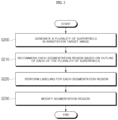
- FIG. 2 is a flowchart for describing an annotation method according to an embodiment of the present disclosure.
- the annotation method includes: generating a plurality of superpixels in the annotation target image (S200); recommending each segmentation region based on an outline of each of the plurality of superpixels (S210); performing labeling for each segmentation region (S220); and modifying the segmentation region (S230).
- the annotation device may perform superpixel segmentation based on a predetermined non-parametric segmentation method capable of adaptively generating superpixels according to the number of objects included in the annotation target image.
- the predetermined non-parametric segmentation may be Bayesian Adaptive Superpixel Segmentation, but is not limited thereto.
- the annotation device may perform superpixel segmentation based on a predetermined non-parametric segmentation method that does not need to define the number K of superpixels.
- the predetermined non-parametric segmentation may be Bayesian Adaptive Superpixel Segmentation, but is not limited thereto.
- the annotation device may adaptively generate the plurality of superpixels according to the number of objects included in the annotation target image.
- the annotation device may obtain an outline of each of the plurality of superpixels.
- the annotation device may also recommend a segmentation region corresponding to each of the plurality of superpixels based on the outline of each of the plurality of superpixels.
- the annotation device may display the recommended segmentation region corresponding to each of the plurality of superpixels by overlaying it on the annotation target image.
- the annotation device may determine a label for each recommended segmentation region. Specifically, the annotation device may perform labeling for each recommended segmentation region based on the user input.
- the annotation device may modify at least one segmentation region based on a user input selecting at least one segmentation region. Specifically, the annotation device may modify the at least one segmentation region in units of a pixel (modify a micro region) based on the user input.
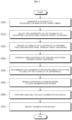
- FIG. 3 is a flowchart for describing an annotation method according to another embodiment of the present disclosure.
- the annotation method includes: generating a plurality of superpixels in the annotation target image (S300); selecting one superpixel of the plurality of superpixels as an additional division target superpixel (S310); creating a plurality of clusters by clustering pixels within the additional division target superpixel (S320); generating new superpixels by dividing the additional division target superpixel (S330); recommending each segmentation region based on an outline of each of the plurality of superpixels (S340); merging the superpixels corresponding to each segmentation region (S350); performing labeling for each segmentation region (S360); and modifying the segmentation region (S370).
- the annotation device may perform superpixel segmentation based on the predetermined non-parametric segmentation method capable of adaptively generating superpixels according to the number of objects included in the annotation target image.
- the predetermined non-parametric segmentation may be Bayesian Adaptive Superpixel Segmentation, and is not limited thereto.
- the annotation target image may be an image of a material constituting a component of a machine.
- the material of the annotation target image may be a metal material.
- the material may be a material of any component in a gas turbine or a steam turbine, such as a turbine blade/vane or a compressor blade/vane, or a fuel nozzle or any part of the fuel nozzle.
- the material may be a material of any component in a reformer such as a tube (e.g., catalyst tube, connection tube).
- the material may be a material of any component of heat recovery boiler, such as a connection tube, or a tube sheet.
- the material may be any material of a plant.
- the annotation device may perform superpixel segmentation based on a predetermined non-parametric segmentation method that does not need to define the number K of superpixels.
- the predetermined non-parametric segmentation may be Bayesian Adaptive Superpixel Segmentation, and is not limited thereto.
- the annotation device may adaptively and automatically generate the plurality of superpixels according to the number of objects included in the annotation target image.
- the superpixels may be understood as a group of pixels that share common characteristics such as pixel intensity, color, or the brightness. Usually, superpixels have a perceptual meaning since pixels belonging to a given superpixel share similar visual properties.
- the processor 110 may perform image segmentation to generate the plurality of superpixels from the microstructure images.
- the annotation device may display the generated superpixels.
- the annotation device may also select at least one superpixel of the plurality of superpixels as an additional division target superpixel.
- the annotation device may create a plurality of clusters by clustering pixels within the selected additional division target superpixel based on a predetermined hierarchical/non-parametric coordinate clustering algorithm.
- the predetermined hierarchical/non-parametric coordinate clustering algorithm may be HDBSCAN algorithm, but is not limited thereto.
- the annotation device may also display the plurality of generated clusters.
- the annotation device may create a new cluster by merging at least two clusters of the plurality of clusters selected by the user input. Based on the plurality of clusters including the newly created cluster, the annotation device may generate a new set of superpixels by dividing the selected additional division target superpixel into at least two superpixels.
- the annotation device may obtain an outline of each of the plurality of superpixels, which is the new set of superpixels generated by step S330. Then, the annotation device may recommend a segmentation region corresponding to each of the plurality of superpixels based on the outline of each of the plurality of superpixels. The annotation device may display the recommended segmentation region corresponding to each of the plurality of superpixels by overlying it on the annotation target image and display it. The segmentation regions may be displayed together with the outline of each of the plurality of superpixels.
- the annotation device may generate a new segmentation region by merging the at least two segmentation regions corresponding to a user input selecting the at least two segmentation regions.
- the at least two segmentation regions may be segmentation regions corresponding to a same class, but are not limited thereto.
- the annotation device may determine a new segmentation region by merging the at least two segmentation regions of the same class based on the user input.
- the annotation device may update the segmentation regions for the annotation target image to include the new segmentation region.
- the annotation device may determine a label for each recommended segmentation region. Specifically, the annotation device may perform labeling for each recommended segmentation region based on a user input.
- the annotation device may modify at least one segmentation region based on a user input selecting at least one segmentation region to be modified. Specifically, the annotation device may modify the at least one segmentation region, selected by the user input, in units of a pixel (e.g., modifying a micro region) based on the user input.
- FIG. 4 is a diagram exemplarily showing the annotation target image, annotation, an annotation result screen.
- a plurality of objects may be included in the annotation target image.
- the size and the shape of each of the plurality of objects included in the annotation target image may be different.
- the annotation device may generate superpixels 400, 410, 420, and 430 from the annotation target image. Then, the annotation device may overlay the generated superpixels 400, 410, 420, and 430 on the annotation target image and display them via the input/output interface module 120.
- the annotation device may display superpixels of the same class in the same color (e.g., black (400 and 410), red (420 and 430), etc.). According to an embodiment, the annotation device may label the superpixels of the same class with the same class.
- black 400 and 410
- red 420 and 430
- the annotation device may label the superpixels of the same class with the same class.
- the annotation device may divide the superpixel into at least two regions through an algorithm such as HDBSCAN algorithm.
- the at least two regions generated by dividing a superpixel may be considered as new superpixels.
- the annotation device may display an annotation result screen.
- the annotation device may display a filled annotation result screen 450 and/or an annotation result screen 460 indicated only by outlines, respectively.
- the superpixels may be shown as filled-in objects.
- the annotation result screen 460 the superpixels may be shown only by outlines.
- the annotation result 471 may be displayed by being overlayed on the annotation target image 470.
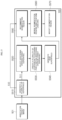
- FIG. 5 is a diagram describing the annotation method according to the embodiment of the present disclosure.
- the annotation device may obtain an annotation target image 501 and generate a plurality of superpixels (S510).
- the annotation device may select, based on a user input, at least one superpixel of the plurality of superpixels and designate it as the additional division target superpixel (S520).
- the annotation device may create a plurality of clusters by clustering pixels within the additional division target superpixel by using HDBSCAN algorithm as a hierarchical/non-parametric coordinate clustering algorithm (S530).
- the annotation device may generate new superpixels by dividing the selected additional division target superpixel into at least two superpixels (S540). Thereby, the annotation device may update the set of superpixels.
- the annotation device may recommend each segmentation region based on an outline of each of the plurality of superpixels (S550).
- the annotation device may skip steps S520, S530, and S540 and proceed from step 510 directly to step S550. That is, the annotation device may recommend each segmentation region based on the contour of each initially generated superpixel (S550).
- the annotation device may generate a new segmentation region by merging at least two of the recommended segmentation regions based on a user input, and may perform labeling for the generated segmentation region including the merged region (S560).
- the annotation device may modify at least one segmentation region based on the user input selecting at least one segmentation region (S570).
- a technical advantage is achieved through adaptively recommending of the segmentation regions according to the number of objects within an image. Also, when the generated superpixel requires additional division, it is possible to generate a new superpixel by dividing the existing superpixel by coordinate clustering. Furthermore, the generated superpixels can be merged according to a user input.
- the annotation target image may be a microstructure image of a material and objects in the annotation image may be microstructures in the microstructure image of the material.
- the microstructures in the material are adaptively and automatically identified by using superpixels and segmentation based such superpixels.
- the superlixels and segmentation of the microstructure image are optimized by user inputs. This reduces human effort and time for annotation operation (e.g., labeling) on objects in the annotation target image.
- annotation device may display the annotation target image with annotations via the input/output interface module 120.
- annotations to the annotation target image may include labels given to each of the segmentation regions in the annotation target image.
- the images of a material annotated according to the present disclosure may be used to evaluate or determine the strength status and/or remaining lifetime of the material.
- the annotation target image is a microstructure image of a material of a component in a plant, such as blades/vanes in a gas turbine or tubes/pipes in heat recovery system or reforms
- a system may determine a strength status and/or remaining lifetime value of the component and may provide an alert signal based on the determined strength status and/or the remaining lifetime value of the material. Since the annotation device according to the present disclosure allows efficient annotation of an image (e.g., a microstructure image), the determination of the strength status and/or remaining lifetime value may be performed with higher efficiency and accuracy.
Landscapes
- Engineering & Computer Science (AREA)
- Theoretical Computer Science (AREA)
- Physics & Mathematics (AREA)
- General Physics & Mathematics (AREA)
- Multimedia (AREA)
- Computer Vision & Pattern Recognition (AREA)
- Computing Systems (AREA)
- Software Systems (AREA)
- Computational Linguistics (AREA)
- Health & Medical Sciences (AREA)
- Artificial Intelligence (AREA)
- Databases & Information Systems (AREA)
- Evolutionary Computation (AREA)
- General Health & Medical Sciences (AREA)
- Medical Informatics (AREA)
- Image Processing (AREA)
- Processing Or Creating Images (AREA)
- Image Analysis (AREA)
- Electrotherapy Devices (AREA)
Abstract
Description
- Various embodiments relate to an annotation device and an annotation method.
- In a field of deep learning related to images or videos, various deep learning technologies are being developed in order to detect the type and position of a meaningful object present in the image or video. Generally, in order to perform machine learning for the purpose of building a deep learning model, an annotation operation must be necessarily performed in advance.
- The annotation operation refers to an operation of tagging label information for each data in order to generate learning data. The annotation operation is typically conducted by humans, which leads to substantial cost in terms of both human effort and time in generating a large amount of learning data.
- The purpose of the present disclosure is to provide an annotation device capable of adaptively generating a superpixel by using a non-parametric inference-based superpixel segmentation technology and of recommending an annotation area even when there are few or many objects in an image, and such annotation method.
- According to one aspect, an annotation device includes: at least one processor and memory configured to store a program. The at least one processor, when executing instructions in the program, is configured to generate a plurality of superpixels in an annotation target image based on a predetermined non-parametric segmentation method, to recommend segmentation regions based on outlines of the plurality of superpixels, respectively, and to perform labeling for each of the recommended segmentation regions based on a user input for labeling. By the program stored in the memory, the processor may be configured to perform an annotation method according to any one of the herein described aspects and embodiments. The annotation device may be a computer.
- According to a further aspect, an annotation method includes: generating a plurality of superpixels in an annotation target image based on a predetermined non-parametric segmentation method; recommending segmentation regions based on outlines of the plurality of superpixels, respectively; and performing labeling for each of the recommended segmentation regions based on a user input for labeling.
- According to a further aspect, a recording medium that is readable by a computer or the processor and in which a program for performing the method according to any one of the herein described aspects and embodiments of the annotation method is recorded.
- The annotation device and/or the annotation method according to these aspects may include one or more of the following features:
- The at least one processor may be configured to select, based on a user input for superpixel selection, at least one superpixel of the plurality of generated superpixels as an additional division target superpixel. The at least one processor may be configured to create a plurality of clusters by clustering pixels within the selected additional division target superpixel based on a predetermined hierarchical/non-parametric coordinate clustering algorithm. The at least one processor may be configured to generate, based on the plurality of clusters, new superpixels by dividing the selected additional division target superpixel into at least two superpixels, thereby updating the plurality of superpixels to include the new superpixels.
- Based on a user input for new segmentation, the at least one processor may be configured to generate a new segmentation region by merging at least two segmentation regions of the recommended segmentation regions, thereby updating the segmentation regions.
- The at least one processor may be configured to modify at least any one segmentation region of the recommended segmentation regions based on a user input for region modification.
- The at least one segmentation region may be modified in units of a pixel based on the user input for region modification.
- The annotation target image may be a microstructure image generated by photographing a component, in particular by photographing a material of the component, e.g. in a plant.
- The annotation device further includes an input/output interface module. The input/output interface module may be configured to display the recommended segmentation regions by overlaying them on the annotation target image.
- The displayed recommendation segmentation regions may be updated by a user input for new segmentation.
- The generating superpixels in an annotation target image may include: selecting, based on a user input for superpixel selection, at least one superpixel of the plurality of generated superpixels as an additional division target superpixel, generating (i.e. creating) a plurality of clusters by clustering pixels within the selected additional division target superpixel based on a predetermined hierarchical and non-parametric coordinate clustering algorithm and generating, based on the plurality of clusters, new superpixels by dividing the selected additional division target superpixel into at least two superpixels, thereby updating the plurality of superpixels to include the new superpixels.
- The performing labeling for each of the segmentation regions may include: generating a new segmentation region by merging at least two segmentation regions of the recommended segmentation regions, based on a user input for new segmentation, thereby updating the segmentation regions.
- The annotation method may include modifying at least any one segmentation region of the segmentation regions based on a user input for region modification.
- The annotation target image may be a microstructure image generated by photographing a component, e.g. in a plant, in particular by photographing a material of the component. That is, the annotation target image may be an image of a microstructure of a component material.
- The annotation method may include displaying the recommended segmentation regions by overlaying them on the annotation target image.
-
-
FIG. 1 is a diagram schematically illustrating a configuration of an annotation device according to an embodiment of the present disclosure. -
FIG. 2 is a flowchart for describing an annotation method according to an embodiment of the present disclosure. -
FIG. 3 is a flowchart for describing an annotation method according to another embodiment of the present disclosure. -
FIG. 4 is a diagram showing exemplarily an annotation target image, annotation, an annotation result screen. -
FIG. 5 is a diagram describing the annotation method according to an embodiment of the present disclosure. - Parts that may obscure the crux of the present disclosure may be omitted for a clear description of the present disclosure. The same or similar reference numerals will be assigned to the same or similar components throughout this patent document.
- Throughout the specification, when it is mentioned that a portion is "connected" to another portion, it includes not only "is directly connected" but also "indirectly connected" with another element placed therebetween. Meanwhile, in the case where a component is referred to as being "directly connected" to other components, it should be understood that there is no component therebetween unless context clearly indicate otherwise.
- When a part is referred to as being "on" another part, it may be directly on the other part, or still another part may be placed between them. In contrast, when a part is referred to as being "directly on" another part, there is no other part between them.
- While terms such as first, second, third, etc., are used to describe various parts, components, regions, layers, and/or sections, these terms are not limited thereto. These terms are only used to distinguish one part, component, region, layer or section from another part, component, region, layer or section. The use of such ordinal numbers should not be construed as limiting the meaning of the term. For example, the components associated with such an ordinal number should not be limited in the order of use, placement order, or the like. If necessary, each ordinal number may be used interchangeably. Thus, a first part, component, region, layer or section to be described below can be referred to as a second part, component, region, layer or section without departing from the scope of the present disclosure.
- The terminologies used herein are provided for description of only specific embodiments of the present disclosure and are not intended to limit the scope of the present disclosure. Singular forms used herein include plural form thereof unless phrases have the meanings opposite thereto clearly. The meaning of "including" used in this specification embodies specific characteristics, regions, integers, steps, operations, elements, and/or components, and does not exclude the existence or addition of other specific characteristics, regions, integers, steps, operations, elements, and/or components.
- Spatially relative terms, such as "under", "over" and the like, may be used to more easily describe a relationship of one portion to another portion shown in the drawing. These terms are intended to include not only meanings intended in the drawing but other meanings or operations of a device in use. For example, if the device is turned upside down in the drawing, a portion described as being "under" other portions is described as being "over" other portions. Thus, the exemplary term "under" includes both an up direction and a down direction according to the context of the description. The device may rotate by 90 degrees or at other angles, and the spatially relative terms are construed accordingly.
- Unless otherwise defined, all terms used herein including technical and scientific terms have the same meaning as commonly understood by one of ordinary skill in the art to which the present invention belongs. Commonly used terms defined in the dictionary are additionally construed as having meanings conforming to related technology documents and currently disclosed contents. As long as terms are not clearly defined, the terms should not be ideally or excessively construed as a strictly formal meaning.
- Hereafter, an embodiment of the present invention will be described in detail with reference to the accompanying drawings such that those skilled in the art can easily carry out the embodiment. However, the present invention may be embodied in various forms and is not limited to the embodiment described in the present specification.
-
FIG. 1 is a diagram schematically illustrating a configuration of an annotation device according to an embodiment of the present disclosure. - Referring to
FIG. 1 , anannotation device 100 according to an embodiment includes aprocessor 110, an input/output interface module 120, and amemory 130. - The
processor 110, the input/output interface module 120, and thememory 130 included in theannotation device 100 may be connected to each other by a bus and are capable of transmitting data to each other. - According to various embodiments, the
processor 110 may execute programs or instructions stored in thememory 130. Here, an operation program (e.g., OS) for operating theannotation device 100 may be stored in thememory 130. - According to various embodiments, the
processor 110 may execute a program for managing information on theannotation device 100 or a program for managing the operation of theannotation device 100, or a program for managing the operation of the input/output interface module 120. - According to various embodiments, the
processor 110 may obtain or receive an annotation target image through the input/output interface module 120. - The annotation target image may be an image of a material constituting a component of a machine. The annotation target image may be acquired by image capture accomplished using various photographic devices like cameras or scanning the material with optical sensors. The
annotation device 100 may further include such photographing device or an optical sensor or may receive the annotation target image from such photographing device or the optical sensor via the input/output interface module 120 or may receive from a user via the input/output interface module 120. - The material of the annotation target image may be a metal material. For example, the material may be a material of any component in a gas turbine or a steam turbine, such as a turbine blade/vane or a compressor blade/vane, or a fuel nozzle or any part of the fuel nozzle. Also, the material may be a material of any component in a reformer such tube (e.g., catalyst tube, connection tube). Also, the material may be a material of any component of heat recovery boiler, such as a connection tube, or a tube sheet. Furthermore, the material may be any material of a plant.
- According to an embodiment, the
processor 110 may designate every frame from an image obtained via the input/output interface module 120 as the annotation target image. - Then, the
processor 110 may perform superpixel segmentation to generate a plurality of superpixels (hereinafter, referred to as "superpixels") in the annotation target image based on a predetermined non-parametric segmentation (hereinafter, referred to as "segmentation") method. The superpixels may be understood as a group of pixels that share common characteristics such as pixel intensity, color, or the brightness. Usually, superpixels have a perceptual meaning since pixels belonging to a given superpixel share similar visual properties. Theprocessor 110 may perform image segmentation to generate the plurality of superpixels from the microstructure images. - According to an embodiment, the
processor 110 may perform superpixel segmentation based on a predetermined non-parametric segmentation method capable of adaptively generating superpixels according to the number of objects included in the annotation target image. Here, the predetermined non-parametric segmentation may be Bayesian Adaptive Superpixel Segmentation, but is not limited thereto. - According to an embodiment, the
processor 110 may perform superpixel segmentation based on a predetermined non-parametric segmentation method that does not need to define the number K of superpixels in the annotation target image. Here, the predetermined non-parametric segmentation may be Bayesian Adaptive Superpixel Segmentation, but is not limited thereto. - 02 Generating new superpixels by dividing an additional division target superpixel. According to an embodiment, the
processor 110 may display the generated superpixels through the input/output interface module 120. - Then, the
processor 110 may obtain a user input for at least one superpixel among the plurality of superpixels displayed via the input/output interface module 120. This user input may be a touch by a user's finger on any one superpixel among a plurality of displayed superpixels, a touch using a mouse click or a smart pen, etc., but is not limited thereto. Based on the user input, theprocessor 110 may select the at least one superpixel of the plurality of superpixels and designate it as an additional division target superpixel. - Then, the
processor 110 may generate a plurality of clusters by clustering pixels within the selected additional division target superpixel based on a predetermined hierarchical/non-parametric coordinate clustering algorithm. Here, the predetermined hierarchical/non-parametric coordinate clustering algorithm may be HDBSCAN algorithm, but is not limited thereto. Theprocessor 110 may display the plurality of generated clusters via the input/output interface module 120. - Then, the
processor 110 may obtain a user input for at least two clusters among the plurality of clusters displayed via the input/output interface module 120. This user input may be a touch by a user's finger on any two clusters of the plurality of displayed clusters, a touch using a mouse click or a smart pen, etc., but is not limited thereto. - Based on the user input, the
processor 110 may create a new merged cluster by merging at least two clusters of the plurality of clusters. Theprocessor 110 may display the new merged cluster via the input/output interface module 120. - Based on the plurality of clusters including the new merged cluster, the
processor 110 may generate new superpixels by dividing the selected additional division target superpixel into at least two superpixels. - According to an embodiment, the
processor 110 may obtain an outline of each of the plurality of superpixels. Theprocessor 110 may recommend a segmentation region corresponding to each of the plurality of superpixels based on the outlines by displaying each segmentation region via the input/output interface module 120. Theprocessor 110 may display the recommended segmentation region corresponding to each of the plurality of superpixels by overlaying it onto the annotation target image via the input/output interface 120. - According to various embodiments, the
processor 110 may display the segmentation region on the annotation target image by adjusting the saturation or brightness of each segmentation region such that the recommended segmentation corresponding to each of the plurality of superpixels displayed on the input/output interface module 120 is distinguished and differentiated, and the display can be made distinctive. - According to an embodiment, the
processor 110 may obtain a user input for at least two segmentation regions among the multiple segmentation regions. The multiple segmentation regions correspond respectively to the plurality of superpixels that are displayed by being overlayed on the annotation target image via the input/output interface module 120. Here, the user input may be a touch by a user's finger on at least two segmentation regions among the multiple segmentation regions corresponding respectively to the plurality of superpixels, a touch using a mouse click or a smart pen, etc., but is not limited thereto. - According to an embodiment, the
processor 110 may generate a new merged segmentation region by merging the at least two segmentation regions corresponding to the user input. The at least two segmentation regions may be segmentation regions that correspond to a same class, but are not limited thereto. Thus, theprocessor 110 may generate the new merged segmentation region by merging the segmentation regions of the same class, based on the user input. - According to various embodiments, the
processor 110 may determine a label for each recommended segmentation region. Specifically, theprocessor 110 may perform labeling for each recommended segmentation region based on a user input to the input/output interface module 120. - According to an embodiment, the
processor 110 may determine a label for the newly generated segmentation region. Theprocessor 110 may perform labeling for the newly generated segmentation region based on the user input to the input/output interface module 120. Theprocessor 110 may determine a label for the new segmentation region generated by merging the segmentation regions of the same class. More specifically, theprocessor 110 may perform labeling for the segmentation region generated by merging the segmentation regions of the same class based on the user input to the input/output interface module 120. - According to an embodiment, the
processor 110 may obtain a user input on at least one segmentation region for which labeling has been performed through the input/output interface module 120. The user input may be a touch by a user's finger on at least one segmentation region, a touch using a mouse click or a smart pen, etc., but is not limited thereto. - According to various embodiments, the
processor 110 may modify at least one segmentation region based on the user input selecting the at least one segmentation region. Specifically, theprocessor 110 may modify at least one segmentation region in units of a pixel (e.g., modifying a micro region) based on the user input. - The input/
output interface module 120 may be connected to an external device (e.g., a server) through a network. - The input/
output interface module 120 may obtain data from an external device. The input/output interface module 120 may obtain the annotation target image. - The input/
output interface module 120 may display the annotation target image. The input/output interface module 120 may display the superpixels. The input/output interface module 120 may display the clusters. The input/output interface module 120 may display the segmentation region. The input/output interface module 120 may display a result of labeling performed on the segmentation region. - The input/
output interface module 120 may obtain the user input. - The input/
output interface module 120 may be integrally provided with the annotation device. The input/output interface module 120 may be provided separately from the annotation device. The input/output interface module 120 may be a separate device to be communicatively connected to the annotation device. The input/output interface module 120 may include a port (e.g., a USB port) for connection with an external device. The input/output interface module 120 may include a monitor, a touch screen, a mouse, an electronic pen, a microphone, a keyboard, a speaker, an earphone, a headphone, or a touch pad. - The
memory 130 may store the annotation target image obtained through the input/output interface module 120. Thememory 130 may store the superpixels generated by theprocessor 110. Thememory 130 may store the clusters generated by theprocessor 110. Thememory 130 may store the segmentation region generated by theprocessor 110. Thememory 130 may store annotation results. -
FIG. 2 is a flowchart for describing an annotation method according to an embodiment of the present disclosure. - Referring to
FIG. 2 , the annotation method includes: generating a plurality of superpixels in the annotation target image (S200); recommending each segmentation region based on an outline of each of the plurality of superpixels (S210); performing labeling for each segmentation region (S220); and modifying the segmentation region (S230). - In step S200, the annotation device may perform superpixel segmentation based on a predetermined non-parametric segmentation method capable of adaptively generating superpixels according to the number of objects included in the annotation target image. Here, the predetermined non-parametric segmentation may be Bayesian Adaptive Superpixel Segmentation, but is not limited thereto.
- According to an embodiment, the annotation device may perform superpixel segmentation based on a predetermined non-parametric segmentation method that does not need to define the number K of superpixels. The predetermined non-parametric segmentation may be Bayesian Adaptive Superpixel Segmentation, but is not limited thereto. Thereby, the annotation device may adaptively generate the plurality of superpixels according to the number of objects included in the annotation target image.
- In step S210, the annotation device may obtain an outline of each of the plurality of superpixels. The annotation device may also recommend a segmentation region corresponding to each of the plurality of superpixels based on the outline of each of the plurality of superpixels. Furthermore, the annotation device may display the recommended segmentation region corresponding to each of the plurality of superpixels by overlaying it on the annotation target image.
- In step S220, the annotation device may determine a label for each recommended segmentation region. Specifically, the annotation device may perform labeling for each recommended segmentation region based on the user input.
- In step S230, the annotation device may modify at least one segmentation region based on a user input selecting at least one segmentation region. Specifically, the annotation device may modify the at least one segmentation region in units of a pixel (modify a micro region) based on the user input.
-
FIG. 3 is a flowchart for describing an annotation method according to another embodiment of the present disclosure. - Referring to
FIG. 3 , the annotation method includes: generating a plurality of superpixels in the annotation target image (S300); selecting one superpixel of the plurality of superpixels as an additional division target superpixel (S310); creating a plurality of clusters by clustering pixels within the additional division target superpixel (S320); generating new superpixels by dividing the additional division target superpixel (S330); recommending each segmentation region based on an outline of each of the plurality of superpixels (S340); merging the superpixels corresponding to each segmentation region (S350); performing labeling for each segmentation region (S360); and modifying the segmentation region (S370). - In step S300, the annotation device may perform superpixel segmentation based on the predetermined non-parametric segmentation method capable of adaptively generating superpixels according to the number of objects included in the annotation target image. Here, the predetermined non-parametric segmentation may be Bayesian Adaptive Superpixel Segmentation, and is not limited thereto.
- The annotation target image may be an image of a material constituting a component of a machine. The material of the annotation target image may be a metal material. For example, the material may be a material of any component in a gas turbine or a steam turbine, such as a turbine blade/vane or a compressor blade/vane, or a fuel nozzle or any part of the fuel nozzle. Also, the material may be a material of any component in a reformer such as a tube (e.g., catalyst tube, connection tube). Also, the material may be a material of any component of heat recovery boiler, such as a connection tube, or a tube sheet. Furthermore, the material may be any material of a plant.
- In step S300, the annotation device may perform superpixel segmentation based on a predetermined non-parametric segmentation method that does not need to define the number K of superpixels. Here, the predetermined non-parametric segmentation may be Bayesian Adaptive Superpixel Segmentation, and is not limited thereto. Thereby, the annotation device may adaptively and automatically generate the plurality of superpixels according to the number of objects included in the annotation target image.
- The superpixels may be understood as a group of pixels that share common characteristics such as pixel intensity, color, or the brightness. Usually, superpixels have a perceptual meaning since pixels belonging to a given superpixel share similar visual properties. The
processor 110 may perform image segmentation to generate the plurality of superpixels from the microstructure images. - In step S310, the annotation device may display the generated superpixels. In step S310, based on a user input, the annotation device may also select at least one superpixel of the plurality of superpixels as an additional division target superpixel.
- In step S320, the annotation device may create a plurality of clusters by clustering pixels within the selected additional division target superpixel based on a predetermined hierarchical/non-parametric coordinate clustering algorithm. Here, the predetermined hierarchical/non-parametric coordinate clustering algorithm may be HDBSCAN algorithm, but is not limited thereto. The annotation device may also display the plurality of generated clusters.
- In step S330, based on a user input, the annotation device may create a new cluster by merging at least two clusters of the plurality of clusters selected by the user input. Based on the plurality of clusters including the newly created cluster, the annotation device may generate a new set of superpixels by dividing the selected additional division target superpixel into at least two superpixels.
- In step S340, the annotation device may obtain an outline of each of the plurality of superpixels, which is the new set of superpixels generated by step S330. Then, the annotation device may recommend a segmentation region corresponding to each of the plurality of superpixels based on the outline of each of the plurality of superpixels. The annotation device may display the recommended segmentation region corresponding to each of the plurality of superpixels by overlying it on the annotation target image and display it. The segmentation regions may be displayed together with the outline of each of the plurality of superpixels.
- In step S350, the annotation device may generate a new segmentation region by merging the at least two segmentation regions corresponding to a user input selecting the at least two segmentation regions. Here, the at least two segmentation regions may be segmentation regions corresponding to a same class, but are not limited thereto. Thereby, the annotation device may determine a new segmentation region by merging the at least two segmentation regions of the same class based on the user input. Thereby, the annotation device may update the segmentation regions for the annotation target image to include the new segmentation region.
- In step S360, the annotation device may determine a label for each recommended segmentation region. Specifically, the annotation device may perform labeling for each recommended segmentation region based on a user input.
- In step S370, the annotation device may modify at least one segmentation region based on a user input selecting at least one segmentation region to be modified. Specifically, the annotation device may modify the at least one segmentation region, selected by the user input, in units of a pixel (e.g., modifying a micro region) based on the user input.
-
FIG. 4 is a diagram exemplarily showing the annotation target image, annotation, an annotation result screen. - Referring to (a) of
FIG. 4 , a plurality of objects may be included in the annotation target image. The size and the shape of each of the plurality of objects included in the annotation target image may be different. - Referring to (b) of
FIG. 4 , the annotation device may generatesuperpixels superpixels output interface module 120. - According to an embodiment, the annotation device may display superpixels of the same class in the same color (e.g., black (400 and 410), red (420 and 430), etc.). According to an embodiment, the annotation device may label the superpixels of the same class with the same class.
- Also, if there is a superpixel (not shown) that requires additional division among the generated superpixels or a user select a superpixel among the generated superpixles as a to-be-divided superpixel, the annotation device may divide the superpixel into at least two regions through an algorithm such as HDBSCAN algorithm. The at least two regions generated by dividing a superpixel may be considered as new superpixels.
- Referring to (c) of
FIG. 4 , the annotation device may display an annotation result screen. Specifically, the annotation device may display a filledannotation result screen 450 and/or anannotation result screen 460 indicated only by outlines, respectively. As shown in the filledannotation result screen 450, the superpixels may be shown as filled-in objects. On the other hand, as shown in theannotation result screen 460, the superpixels may be shown only by outlines. Furthermore, as shown in (c) ofFIG. 4 , theannotation result 471 may be displayed by being overlayed on theannotation target image 470. -
FIG. 5 is a diagram describing the annotation method according to the embodiment of the present disclosure. - Referring to
FIG. 5 , the annotation device may obtain anannotation target image 501 and generate a plurality of superpixels (S510). - According to an embodiment, when it is determined that there is a superpixel that requires additional division (511), the annotation device may select, based on a user input, at least one superpixel of the plurality of superpixels and designate it as the additional division target superpixel (S520).
- Then, the annotation device may create a plurality of clusters by clustering pixels within the additional division target superpixel by using HDBSCAN algorithm as a hierarchical/non-parametric coordinate clustering algorithm (S530).
- Based on the plurality of clusters, the annotation device may generate new superpixels by dividing the selected additional division target superpixel into at least two superpixels (S540). Thereby, the annotation device may update the set of superpixels.
- When the superpixels are determined, the annotation device may recommend each segmentation region based on an outline of each of the plurality of superpixels (S550).
- According to an embodiment, when it is determined that there is no superpixel that requires additional division (512), the annotation device may skip steps S520, S530, and S540 and proceed from
step 510 directly to step S550. That is, the annotation device may recommend each segmentation region based on the contour of each initially generated superpixel (S550). - According to an embodiment, the annotation device may generate a new segmentation region by merging at least two of the recommended segmentation regions based on a user input, and may perform labeling for the generated segmentation region including the merged region (S560).
- Then, the annotation device may modify at least one segmentation region based on the user input selecting at least one segmentation region (S570).
- Although the present invention has been described with reference to the embodiments shown in the drawings, these are just examples and it will be understood by those skilled in the art that various modifications and equivalent thereto may be made. Also, it is noted that any one feature of an embodiment of the present disclosure described in the specification may be applied to another embodiment of the present disclosure. Therefore, the technical scope of the present invention should be determined by the spirit of the appended claims.
- According to the embodiment of the present disclosure, a technical advantage is achieved through adaptively recommending of the segmentation regions according to the number of objects within an image. Also, when the generated superpixel requires additional division, it is possible to generate a new superpixel by dividing the existing superpixel by coordinate clustering. Furthermore, the generated superpixels can be merged according to a user input.
- According to an embodiment, the annotation target image may be a microstructure image of a material and objects in the annotation image may be microstructures in the microstructure image of the material. Thus, according to an embodiment, the microstructures in the material are adaptively and automatically identified by using superpixels and segmentation based such superpixels. Furthermore, the superlixels and segmentation of the microstructure image are optimized by user inputs. This reduces human effort and time for annotation operation (e.g., labeling) on objects in the annotation target image.
- Also, the annotation device may display the annotation target image with annotations via the input/
output interface module 120. The annotations to the annotation target image may include labels given to each of the segmentation regions in the annotation target image. - The images of a material annotated according to the present disclosure may be used to evaluate or determine the strength status and/or remaining lifetime of the material. Specifically, when the annotation target image is a microstructure image of a material of a component in a plant, such as blades/vanes in a gas turbine or tubes/pipes in heat recovery system or reforms, a system may determine a strength status and/or remaining lifetime value of the component and may provide an alert signal based on the determined strength status and/or the remaining lifetime value of the material. Since the annotation device according to the present disclosure allows efficient annotation of an image (e.g., a microstructure image), the determination of the strength status and/or remaining lifetime value may be performed with higher efficiency and accuracy.
Claims (15)
- An annotation device (100), comprising:at least one processor (110),and memory (130) on which a program is stored,wherein the at least one processor (110) is configured to, when executing instructions in the program:generate (S200, S300, S510) a plurality of superpixels (400, 410, 420, 430) in an annotation target image (470, 501) based on a predetermined non-parametric segmentation method,recommend (S210, S340, S550) segmentation regions based on outlines of the plurality of superpixels, respectively, andperform (S220, S360, S560) labeling for each of the recommended segmentation regions based on a user input for labeling.
- The annotation device of claim 1,
wherein the at least one processor (10) is further configured to:select (S310, S520), based on a user input for superpixel selection, at least one superpixel of the plurality of generated superpixels as an additional division target superpixel,generate (S310, S520)a plurality of clusters by clustering pixels within the selected additional division target superpixel based on a predetermined hierarchical and non-parametric coordinate clustering algorithm, andgenerate (S330, S540), based on the plurality of clusters, new superpixels by dividing the selected additional division target superpixel into at least two superpixels thereby updating the plurality of superpixels to include the new superpixels. - The annotation device of claim 1 or 2, wherein, based on a user input for new segmentation, the at least one processor (110) is further configured to generate a new segmentation region by merging (S350, S560) at least two segmentation regions of the recommended segmentation regions, thereby updating the segmentation regions.
- The annotation device according to any one of the preceding claims, wherein, based on a user input for region modification, the at least one processor (110) is further configured to modify (S230, S570) at least any one segmentation region of the recommended segmentation regions.
- The annotation device of claim 4, wherein the at least one segmentation region is modified in units of a pixel based on the user input for region modification.
- The annotation device according to any one of the preceding claims, wherein the annotation target image (470, 501) is a microstructure image generated by photographing of a material of a component in a plant.
- The annotation device according to any one of the preceding claims, further comprising an input/output interface module,
wherein the input/output interface module is configured to display the recommended segmentation regions by overlaying them on the annotation target image (470, 501). - An annotation method comprising:generating (S200, S300, S510) a plurality of superpixels in an annotation target image based on a predetermined non-parametric segmentation method;recommending (S210, S340, S550) segmentation regions based on outlines of the plurality of superpixels, respectively; andperforming (S220, S360, S560) labeling for each of the recommended segmentation regions based on a user input for labeling.
- The annotation method of claim 8, wherein the generating superpixels in an annotation target image comprises:selecting (S310, S520), based on a user input for superpixel selection, at least one superpixel of the plurality of generated superpixels as an additional division target superpixel;generating (S310, S520) a plurality of clusters by clustering pixels within the selected additional division target superpixel based on a predetermined hierarchical and non-parametric coordinate clustering algorithm; andgenerating (S330, S540), based on the plurality of clusters, new superpixels by dividing the selected additional division target superpixel into at least two superpixels, thereby updating the plurality of superpixels to include the new superpixels.
- The annotation method of claim 8 or 9, wherein the performing labeling for each of the segmentation regions comprises generating a new segmentation region by merging (S350, S560) at least two segmentation regions of the recommended segmentation regions, based on a user input for new segmentation, thereby updating the segmentation regions.
- The annotation method of claim 8, 9 or 10, further comprising modifying at least any one segmentation region of the segmentation regions based on a user input for region modification.
- The annotation method of claim 11, wherein the at least one segmentation region is modified in units of a pixel based on the user input for region modification.
- The annotation method according to any one of claims 8 to 12, wherein the annotation target image (470, 501) is a microstructure image generated by photographing of a material of a component in a plant.
- The annotation method according to any one of claims 8 to 13, further comprising:
displaying the recommended segmentation regions by overlaying them on the annotation target image. - A recording medium that is readable by a computer in which a program for performing the method according to any one of claims 8 to 14 is recorded.
Applications Claiming Priority (1)
| Application Number | Priority Date | Filing Date | Title |
|---|---|---|---|
| KR1020220138517A KR20240057830A (en) | 2022-10-25 | 2022-10-25 | Device and method for annotation |
Publications (2)
| Publication Number | Publication Date |
|---|---|
| EP4361960A1 true EP4361960A1 (en) | 2024-05-01 |
| EP4361960B1 EP4361960B1 (en) | 2026-03-04 |
Family
ID=88416908
Family Applications (1)
| Application Number | Title | Priority Date | Filing Date |
|---|---|---|---|
| EP23203952.9A Active EP4361960B1 (en) | 2022-10-25 | 2023-10-17 | Annotation device and annotation method |
Country Status (4)
| Country | Link |
|---|---|
| US (1) | US20240233420A9 (en) |
| EP (1) | EP4361960B1 (en) |
| KR (1) | KR20240057830A (en) |
| CN (1) | CN117934894A (en) |
Citations (2)
| Publication number | Priority date | Publication date | Assignee | Title |
|---|---|---|---|---|
| CN107886512A (en) * | 2016-09-29 | 2018-04-06 | 法乐第(北京)网络科技有限公司 | A kind of method for determining training sample |
| CN110189309A (en) * | 2019-05-21 | 2019-08-30 | 上海商汤智能科技有限公司 | A kind of image processing method and device, electronic equipment and storage medium |
-
2022
- 2022-10-25 KR KR1020220138517A patent/KR20240057830A/en active Pending
-
2023
- 2023-09-17 US US18/468,710 patent/US20240233420A9/en active Pending
- 2023-10-12 CN CN202311322856.6A patent/CN117934894A/en active Pending
- 2023-10-17 EP EP23203952.9A patent/EP4361960B1/en active Active
Patent Citations (2)
| Publication number | Priority date | Publication date | Assignee | Title |
|---|---|---|---|---|
| CN107886512A (en) * | 2016-09-29 | 2018-04-06 | 法乐第(北京)网络科技有限公司 | A kind of method for determining training sample |
| CN110189309A (en) * | 2019-05-21 | 2019-08-30 | 上海商汤智能科技有限公司 | A kind of image processing method and device, electronic equipment and storage medium |
Also Published As
| Publication number | Publication date |
|---|---|
| KR20240057830A (en) | 2024-05-03 |
| CN117934894A (en) | 2024-04-26 |
| US20240135738A1 (en) | 2024-04-25 |
| EP4361960B1 (en) | 2026-03-04 |
| US20240233420A9 (en) | 2024-07-11 |
Similar Documents
| Publication | Publication Date | Title |
|---|---|---|
| JP4845715B2 (en) | Image processing method, image processing apparatus, program, and storage medium | |
| CN116982073B (en) | Disturbance removal based on user input in media items | |
| US11610054B1 (en) | Semantically-guided template generation from image content | |
| JP4294348B2 (en) | Display system | |
| AU2019200269B2 (en) | An interactive user interface and its corresponding engine for improving image completion quality | |
| CN107608957A (en) | Text modification method, apparatus and its equipment based on voice messaging | |
| US11727672B1 (en) | System and method for generating training data sets for specimen defect detection | |
| US10817054B2 (en) | Eye watch point tracking via binocular and stereo images | |
| US20150149883A1 (en) | Image processing device, image processing device control method, program, and information storage medium | |
| CN111191580B (en) | Synthetic rendering method, apparatus, electronic device and medium | |
| US11941774B2 (en) | Machine learning artificial intelligence system for producing 360 virtual representation of an object | |
| EP4361960B1 (en) | Annotation device and annotation method | |
| JP7511191B2 (en) | DATA CREATION SYSTEM, LEARNING SYSTEM, ESTIMATION SYSTEM, PROCESSING DEVICE, DATA CREATION METHOD, AND PROGRAM | |
| CN116578374A (en) | Method, system and readable storage medium for visualizing samples | |
| CN111521127B (en) | Measuring method, measuring apparatus, and recording medium | |
| JP2014123260A (en) | Image creation device of system monitoring screen | |
| US20260120363A1 (en) | Display control apparatus and control method therefor | |
| JP2022124095A (en) | Image synthesizing method, computer program and image synthesizing device | |
| US8768060B2 (en) | Image processing apparatus, image processing method and computer-readable medium | |
| JP2011096109A (en) | Image processing apparatus and image processing program | |
| CN121326216A (en) | Content processing methods, devices and electronic equipment | |
| CN119940376A (en) | Text translation method, device, computer equipment and storage medium | |
| CN108958602B (en) | Method and device for reading 3D PDF file on mobile terminal, mobile terminal and storage medium | |
| KR20230095350A (en) | Image segmentation result's verification method and apparatus thereof | |
| JP2012043357A (en) | Usability evaluation device, method and program |
Legal Events
| Date | Code | Title | Description |
|---|---|---|---|
| PUAI | Public reference made under article 153(3) epc to a published international application that has entered the european phase |
Free format text: ORIGINAL CODE: 0009012 |
|
| STAA | Information on the status of an ep patent application or granted ep patent |
Free format text: STATUS: REQUEST FOR EXAMINATION WAS MADE |
|
| 17P | Request for examination filed |
Effective date: 20231017 |
|
| AK | Designated contracting states |
Kind code of ref document: A1 Designated state(s): AL AT BE BG CH CY CZ DE DK EE ES FI FR GB GR HR HU IE IS IT LI LT LU LV MC ME MK MT NL NO PL PT RO RS SE SI SK SM TR |
|
| RBV | Designated contracting states (corrected) |
Designated state(s): AL AT BE BG CH CY CZ DE DK EE ES FI FR GB GR HR HU IE IS IT LI LT LU LV MC ME MK MT NL NO PL PT RO RS SE SI SK SM TR |
|
| GRAP | Despatch of communication of intention to grant a patent |
Free format text: ORIGINAL CODE: EPIDOSNIGR1 |
|
| STAA | Information on the status of an ep patent application or granted ep patent |
Free format text: STATUS: GRANT OF PATENT IS INTENDED |
|
| INTG | Intention to grant announced |
Effective date: 20251013 |
|
| GRAS | Grant fee paid |
Free format text: ORIGINAL CODE: EPIDOSNIGR3 |
|
| GRAA | (expected) grant |
Free format text: ORIGINAL CODE: 0009210 |
|
| STAA | Information on the status of an ep patent application or granted ep patent |
Free format text: STATUS: THE PATENT HAS BEEN GRANTED |
|
| AK | Designated contracting states |
Kind code of ref document: B1 Designated state(s): AL AT BE BG CH CY CZ DE DK EE ES FI FR GB GR HR HU IE IS IT LI LT LU LV MC ME MK MT NL NO PL PT RO RS SE SI SK SM TR |
|
| REG | Reference to a national code |
Ref country code: CH Ref legal event code: F10 Free format text: ST27 STATUS EVENT CODE: U-0-0-F10-F00 (AS PROVIDED BY THE NATIONAL OFFICE) Effective date: 20260304 Ref country code: GB Ref legal event code: FG4D |
|
| REG | Reference to a national code |
Ref country code: IE Ref legal event code: FG4D |
|
| REG | Reference to a national code |
Ref country code: DE Ref legal event code: R096 Ref document number: 602023012922 Country of ref document: DE |