EP4358331A1 - High voltage ride through device and method, wind power converter, and wind turbine set - Google Patents
High voltage ride through device and method, wind power converter, and wind turbine set Download PDFInfo
- Publication number
- EP4358331A1 EP4358331A1 EP21947904.5A EP21947904A EP4358331A1 EP 4358331 A1 EP4358331 A1 EP 4358331A1 EP 21947904 A EP21947904 A EP 21947904A EP 4358331 A1 EP4358331 A1 EP 4358331A1
- Authority
- EP
- European Patent Office
- Prior art keywords
- switching element
- direct current
- current bus
- high voltage
- voltage
- Prior art date
- Legal status (The legal status is an assumption and is not a legal conclusion. Google has not performed a legal analysis and makes no representation as to the accuracy of the status listed.)
- Pending
Links
Images

Classifications
-
- H—ELECTRICITY
- H02—GENERATION; CONVERSION OR DISTRIBUTION OF ELECTRIC POWER
- H02J—ELECTRIC POWER NETWORKS; CIRCUIT ARRANGEMENTS OR SYSTEMS FOR SUPPLYING OR DISTRIBUTING ELECTRIC POWER; SYSTEMS FOR STORING ELECTRIC ENERGY
- H02J1/00—Circuit arrangements for DC mains or DC distribution networks
-
- H—ELECTRICITY
- H02—GENERATION; CONVERSION OR DISTRIBUTION OF ELECTRIC POWER
- H02H—EMERGENCY PROTECTIVE CIRCUIT ARRANGEMENTS
- H02H9/00—Emergency protective circuit arrangements for limiting excess current or voltage without disconnection
- H02H9/04—Emergency protective circuit arrangements for limiting excess current or voltage without disconnection responsive to excess voltage
- H02H9/041—Emergency protective circuit arrangements for limiting excess current or voltage without disconnection responsive to excess voltage using a short-circuiting device
-
- H—ELECTRICITY
- H02—GENERATION; CONVERSION OR DISTRIBUTION OF ELECTRIC POWER
- H02J—ELECTRIC POWER NETWORKS; CIRCUIT ARRANGEMENTS OR SYSTEMS FOR SUPPLYING OR DISTRIBUTING ELECTRIC POWER; SYSTEMS FOR STORING ELECTRIC ENERGY
- H02J3/00—Circuit arrangements for AC mains or AC distribution networks
- H02J3/001—Arrangements for handling faults or abnormalities, e.g. emergencies or contingencies
-
- H—ELECTRICITY
- H02—GENERATION; CONVERSION OR DISTRIBUTION OF ELECTRIC POWER
- H02J—ELECTRIC POWER NETWORKS; CIRCUIT ARRANGEMENTS OR SYSTEMS FOR SUPPLYING OR DISTRIBUTING ELECTRIC POWER; SYSTEMS FOR STORING ELECTRIC ENERGY
- H02J1/00—Circuit arrangements for DC mains or DC distribution networks
- H02J1/14—Balancing load and power generation in DC networks
-
- H—ELECTRICITY
- H02—GENERATION; CONVERSION OR DISTRIBUTION OF ELECTRIC POWER
- H02J—ELECTRIC POWER NETWORKS; CIRCUIT ARRANGEMENTS OR SYSTEMS FOR SUPPLYING OR DISTRIBUTING ELECTRIC POWER; SYSTEMS FOR STORING ELECTRIC ENERGY
- H02J3/00—Circuit arrangements for AC mains or AC distribution networks
- H02J3/38—Arrangements for feeding a single network from two or more generators or sources in parallel; Arrangements for feeding already energised networks from additional generators or sources in parallel
-
- H—ELECTRICITY
- H02—GENERATION; CONVERSION OR DISTRIBUTION OF ELECTRIC POWER
- H02M—APPARATUS FOR CONVERSION BETWEEN AC AND AC, BETWEEN AC AND DC, OR BETWEEN DC AND DC, AND FOR USE WITH MAINS OR SIMILAR POWER SUPPLY SYSTEMS; CONVERSION OF DC OR AC INPUT POWER INTO SURGE OUTPUT POWER; CONTROL OR REGULATION THEREOF
- H02M1/00—Details of apparatus for conversion
- H02M1/32—Means for protecting converters other than automatic disconnection
- H02M1/322—Means for rapidly discharging a capacitor of the converter for protecting electrical components or for preventing electrical shock
-
- H—ELECTRICITY
- H02—GENERATION; CONVERSION OR DISTRIBUTION OF ELECTRIC POWER
- H02J—ELECTRIC POWER NETWORKS; CIRCUIT ARRANGEMENTS OR SYSTEMS FOR SUPPLYING OR DISTRIBUTING ELECTRIC POWER; SYSTEMS FOR STORING ELECTRIC ENERGY
- H02J2101/00—Supply or distribution of decentralised, dispersed or local electric power generation
- H02J2101/20—Dispersed power generation using renewable energy sources
- H02J2101/28—Wind energy
-
- Y—GENERAL TAGGING OF NEW TECHNOLOGICAL DEVELOPMENTS; GENERAL TAGGING OF CROSS-SECTIONAL TECHNOLOGIES SPANNING OVER SEVERAL SECTIONS OF THE IPC; TECHNICAL SUBJECTS COVERED BY FORMER USPC CROSS-REFERENCE ART COLLECTIONS [XRACs] AND DIGESTS
- Y02—TECHNOLOGIES OR APPLICATIONS FOR MITIGATION OR ADAPTATION AGAINST CLIMATE CHANGE
- Y02E—REDUCTION OF GREENHOUSE GAS [GHG] EMISSIONS, RELATED TO ENERGY GENERATION, TRANSMISSION OR DISTRIBUTION
- Y02E10/00—Energy generation through renewable energy sources
- Y02E10/70—Wind energy
- Y02E10/76—Power conversion electric or electronic aspects
Definitions
- the present disclosure relates to the field of wind power, and in particular to a high voltage ride through apparatus, a high voltage ride through method, a wind power converter and a wind turbine.
- the grid With the gradual increase in the proportion of renewable energy provided to a grid, the grid has higher requirements for the high voltage ride through (HVRT) of wind turbines and photovoltaic units.
- HVRT high voltage ride through
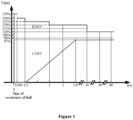
- Figure 1 is a graph of durations of high voltage ride through (HVRT) and low voltage ride through (LVRT).
- pu the pu herein refers to the rated voltage of the grid connected to the wind turbine
- the wind turbine can cope with the high voltage ride through by putting an unloading module composed of an IGBT, a freewheeling diode and a brake resistor into operation in a direct current loop.
- an unloading module composed of an IGBT, a freewheeling diode and a brake resistor into operation in a direct current loop.
- a direct current bus voltage increases because of increase of a grid voltage
- the increase of the direct current bus voltage is detected by a voltage detection loop.
- a controller sends a turn-on signal to the IGBT, so that the brake resistor is put into operation in the direct current bus and discharges direct current energy, to ensure that the direct current bus voltage is within a safe voltage range.
- the controller controls the IGBT to be turned off, to cut the brake resistor out.
- the controller collects a signal, processes it with software, and then sends a turn-on signal to turn on the IGBT.
- the whole processing takes about 2ms.
- the direct current bus voltage may rise too fast, such that it exceeds a safety threshold before the brake resistor is put into operation, resulting in device damage.
- One of the objectives of the present disclosure is to provide a high voltage ride through control apparatus capable of discharging electric energy in a high voltage ride through period.
- One of the objectives of the present disclosure is to provide a high voltage ride through control apparatus which can avoid overheating damage to a device caused by a brake module being put into operation for too long.
- a high voltage ride through control apparatus for a wind turbine.
- the high voltage ride through control apparatus includes: an unloading module including a brake module and a first switching element connected in series with each other, configured to discharge electric energy when high voltage ride through occurs; a controller, configured to detect a direct current bus voltage, and control the first switching element to be turned on to put the brake module into operation to discharge electric energy, when the high voltage ride through occurs and the direct current bus voltage is greater than a first threshold and less than or equal to a second threshold; and a passive drive circuit, configured to apply, by using the direct current bus voltage, a turn-on signal to a control terminal of the first switching element to put the brake module into operation to discharge electric energy, in response to that the direct current bus voltage is greater than the second threshold.
- a high voltage ride through control method for a wind turbine includes: detecting a direct current bus voltage; controlling, in response to that high voltage ride through occurs and the direct current bus voltage is greater than a first threshold and less than or equal to a second threshold, a first switching element of an unloading module to be turned on, to put a brake module of the unloading module into operation to discharge electric energy; and applying, by using the direct current bus voltage, a turn-on signal to a control terminal of the first switching element, to put the brake module into operation to discharge electric energy, in response to that the direct current bus voltage is greater than the second threshold.
- a wind power converter which includes the high voltage ride through control apparatus of the wind turbine described above.
- a wind turbine which includes the wind power converter described above.
- the terms “have”, “may have”, “include” or “may include” features indicate the presence of features and do not exclude the presence of other features.
- Figure 2 is a schematic circuit diagram of a high voltage ride through control apparatus according to an embodiment of the present disclosure.
- a high voltage ride through control apparatus for a wind turbine includes an unloading module 200, a controller 100, and a passive drive circuit 400.
- the unloading module 200 is configured to discharge electric energy, for example, a high voltage, when high voltage ride through occurs.
- the unloading module 200 may be electrically connected between a positive pole DC+ and a negative pole DC- of a direct current bus, so that the high voltage on the direct current bus can be discharged when required.
- the high voltage herein refers to a voltage higher than a rated voltage pu of a grid the wind turbine is connected to.
- the rated voltage pu is generally calculated according to a voltage at a point of common coupling.
- the rated voltage pu may be 690V, 900V, 1140V, 10kV, 35kV or any other voltage level.
- the voltage level of the rated voltage in each country may be different, while in all these countries, calculation and determination can be made according to the pu value.
- the unloading module 200 may include a brake module 220 and a first switching element 210, and the brake module 220 and the first switch element 210 may be connected in series with each other.
- the unloading module 200 may be controlled to be selectively put into operation to discharge electric energy.
- the brake module 220 may be electrically connected between the positive pole DC+ and the negative pole DC- of the direct current bus, and may include a brake resistor R1.
- the brake module 220 may further include a freewheeling diode D 1.
- the brake resistor R1 and the freewheeling diode D1 may be connected in parallel with each other. When a direct current bus voltage is too high, energy of the direct current bus can be discharged through the brake resistor R1 to ensure that the direct current bus voltage does not continue rising.
- pin 1 of the brake resistor R1 of the brake module 220 may be connected to the positive pole DC+ of the direct current bus, and pin 2 of the brake resistor R1 may be connected to an input terminal (for example, a collector) of the first switching element 210.
- An anode (electrode A) of the freewheeling diode D1 may be connected to pin 2 of the brake resistor R1, and a cathode (electrode K) of the freewheeling diode D1 may be connected to pin 1 of the brake resistor R1.
- the structure of the brake module 220 is not limited to the above, as long as the brake module 220 includes a brake resistor that can consume electric energy and a switching element that can be selectively turned on.
- the brake module 220 further includes other auxiliary elements in addition to the brake resistor, and a number, connection mode and resistance of the brake resistor of the module 220 are not specifically limited.
- the brake module 220 may include two resistors connected in series with each other.
- Figure 2 shows that the first switching element 210 includes one switching element, the number, connection mode and types of switching elements included in the first switching element 210 are not specifically limited.
- the first switching element 210 may be a MOSFET, and the type of the first switching element 210 is not specifically limited.
- the first switching element 210 may alternatively be an IGBT, a triode or any other switching element.
- the first switching element 210 may be turned on when its control terminal (for example, a gate) receives a high level.
- the freewheeling diode D1 forms a freewheeling loop with the brake resistor R1, to prevent a voltage spike caused by a parasitic inductance of the brake resistor R1 from breaking down the first switching element 210.
- the controller 100 may detect the direct current bus voltage, and control the first switching element 210 to be turned on, to put the brake module 220 into operation to discharge electric energy, when the high voltage ride through occurs and the direct current bus voltage is greater than the first threshold and less than or equal to the second threshold.
- the first threshold may be the rated voltage as described above
- the second threshold may be 1.3 times the rated voltage
- specific values of the first threshold and second threshold may be adjusted as required.
- the controller 100 may be a single control module, pin 1 of the controller 100 may be connected to the positive pole DC+ of the direct current bus, and pin 2 of controller 100 may be connected to the negative pole DC- of the direct current bus. That is, detection of the direct current bus voltage is implemented through pin 1 and pin 2 of the controller 100.
- pin 5 of the controller 100 is connected to the control terminal (for example, the gate) of the first switching element 210, thereby implementing on-off control of the first switching element 210.
- the control terminal (for example, the gate) of the first switching element 210 may be connected to pin 5 of the controller 100, and the input terminal (for example, the collector) of the first switching element 210 may be connected to pin 2 of the brake resistor R1 or electrode A of the freewheeling diode D 1.
- An output terminal (for example, an emitter) of the first switching element 210 may be connected to the negative pole DC- of the direct current bus.
- the first switching element 210 may be turned on to put the brake resistor R1 into operation in the direct current bus to discharge energy of the direct current bus, preventing the direct current bus voltage from being too high.
- the first switching element 210 may be turned off to cut the brake resistor R1 out from the direct current bus, so that a wind power converter can operate normally. It is merely an example that the high level signal puts the brake resistor R1 into operation in the direct current bus to discharge energy.
- the brake resistor R1 may alternatively be put into operation in the direct current bus through a low level signal to discharge energy of the direct current bus.
- the first switching element may include at least two switching elements, and the controller 100 and the passive drive circuit mentioned hereinafter may control different switching elements respectively, thereby implementing put-in and cut-out control of the brake resistor R1.
- pin 4 of the controller 100 may be connected to pin 2 of the brake resistor R1, and pin 1 and pin 4 of the controller 100 can implement the function of detecting a terminal voltage of the brake resistor R1.
- the passive drive circuit 400 may apply, by using the direct current bus voltage, a turn-on signal to the control terminal of the first switching element 210, to put the brake module 220 into operation to discharge electric energy, in response that the direct current bus voltage is greater than the second threshold.
- the passive drive circuit 400 may be electrically connected between the positive pole DC+ of the direct current bus and the control terminal (for example, the gate) of the first switching element 210.
- the passive drive circuit 400 can put the first switching element 210 into operation to discharge energy at a speed faster than a processing speed of the controller 100, when high voltage ride through occurs.
- a response speed of the passive drive circuit 400 can be faster .
- the passive drive circuit 400 can control the first switching element 210 to be turned on and put the brake module 220 into operation to discharge electric energy within a second period (in the order of microseconds, for example, a few microseconds) shorter than the first period.
- the passive drive circuit 400 may include a transient voltage suppression (TVS) diode 410 which can be broken down when the direct current bus voltage is greater than the second threshold (1.3pu), to apply the turn-on signal to the control terminal of the first switching element 210 by using the direct current bus voltage.
- TVS transient voltage suppression
- the transient voltage suppression diode 410 can undergo high voltage ride through multiple times and be repeatedly broken down, that is, and transient voltage suppression diode 410 can be reused and is of high reliability.
- the passive drive circuit 400 may further include other auxiliary components, for example, divider resistors, etc.
- the passive drive circuit 400 may further include a diode 420, and the diode 420 may be connected in series between the transient voltage suppression diode 410 and a second switching element 430 in a forward orientation.
- the diode 420 forms a clamp circuit with the transient voltage suppression diode 410, so as to keep a drive voltage supplied to the first switching element 210 stable, and prevent the first switching element 210 from being damaged by a high voltage shock.
- the diode 420 can prevent energy flowing from the control terminal (for example, the gate) to the input terminal (for example, the collector) when the first switching element 210 is turned on.
- control which the passive drive circuit 400 has over an energy discharge loop, may be further controlled by the controller 100.
- the passive drive circuit 400 may further include a second switching element 430 which may be connected in series between the transient voltage suppression diode 410 and the control terminal of the first switching element 210.
- Electrode K of the transient voltage suppression diode 410 may be connected to the positive pole DC+ of the direct current bus, electrode A of the transient voltage suppression diode 410 may be connected to electrode A of the diode 420, and electrode K of the diode 420 may be connected to an input terminal (for example, a drain) of the second switching element 430.
- the structure of the second switching element 430 may be identical to that of the first switching element 210.
- the second switching element 430 may include one switching element, and the second switching element 430 may be a MOSFET, or an IGBT.
- the controller 100 may control the first switching element 210 to be turned on at a predetermined instant after the transient voltage suppression diode 410 is broken down, and control the second switching element 430 to be turned off upon delaying for a predetermined period of time (for example, 1ms) from the predetermined instant. That is, the controller 100 may output a high level through pin 5 when the first switching element 210 is turned on by a voltage generated based on the direct current bus voltage, and output, upon delaying for 1ms from when a high level control signal is output to the first switching element 210, a turn-off signal to the second switching element 430.
- a predetermined period of time for example, 1ms
- the controller 100 may be connected to a control terminal (for example, a gate) of the second switching element 430, thereby implementing on-off control of the second switching element 430.
- a control terminal for example, a gate
- control terminal of the second switching element 430 may be connected to pin 3 of the controller, and an output terminal (for example, a source) of the second switching element 430 may be connected to the control terminal (for example, the gate) of the first switching element 210.
- the controller 100 may, on detecting that the direct current bus voltage returns to normal, control the first switching element 210 to be turned off to cut the brake module 220 out, and control the second switching element 430 to be turned on.
- the controller 100 may control the brake resistor to be cut out, and control a switching element of a breakdown loop to be turned on, when the wind power converter operates normally.
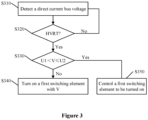
- Figure 3 is a flow chart of a high voltage ride through control method according to an embodiment of the present disclosure.
- a high voltage ride through control method for a wind turbine may include steps S310, S340, and S350.
- step S310 a direct current bus voltage v is detected.
- pin 5 of the controller 100 may output a low level, and pin 3 of the controller 100 may output a high level, so that the first switching element 210 is controlled to be turned off and the second switching element 430 is controlled to be turned on. This is a normal operation mode of the wind power converter.
- step S340 in response to that the direct current bus voltage v is greater than the second threshold U2, the first switching element 210 is turned on by the direct current bus voltage v. Specifically, in response to that the direct current bus voltage v is greater than or equal to the second threshold U2, a turn-on signal is applied to the control terminal of the first switching element 210 by using the direct current bus voltage, to put the brake module 220 into operation to discharge electric energy.
- step S350 in response to that the high voltage ride through occurs and the direct current bus voltage v is greater than the first threshold U1 and less than or equal to the second threshold U2 ( U1 ⁇ V ⁇ U2), the first switching element 210 is controlled to be turned on. Specifically, in response to that the high voltage ride through occurs and the direct current bus voltage v is greater than the first threshold U1 and less than or equal to the second threshold U2 (U1 ⁇ V ⁇ ,U2), the first switching element 210 of the unloading module 200 is controlled to be turned on to put the brake module 220 of the unloading module 200 into operation to discharge electric energy.
- the high voltage ride through control method may further include step S320 of determining whether a high voltage ride through situation occurs and step S330 of determining a range the detected voltage is in.
- a normal operation mode When it is determined that no high voltage ride through occurs, a normal operation mode may entered. When it is determined that the high voltage ride through occurs, a high voltage ride through mode may be entered.
- the transient voltage suppression diode 410 connected to the control terminal of the first switching element 210 may be broken down, so that a turn-on signal is applied to the control terminal of the first switching element 210 by using the direct current bus voltage.
- the direct current bus voltage is greater than 1.3 times the rated voltage, the direct current bus voltage increases rapidly, so that the transient voltage suppression diode 410 is broken down, generating a breakdown voltage.
- the breakdown voltage or a voltage generated based on the breakdown voltage is supplied to the control terminal of the first switching element 210 to put the brake module 220 into operation to discharge electric energy.
- the first switching element 210 may be turned on to put the brake module 220 into operation to discharge electric energy.
- the controller 100 may control pin 5 to output a high level, according to an increase of the direct current bus voltage collected by pin 1 and pin 2, so that the first switching element 210 is turned on, to put the brake resistor R1 into operation to discharge the electric energy on the direct current bus.
- the first switching element 210 may be controlled to be turned on at a predetermined instant after the transient voltage suppression diode 410 is broken down, and the second switching element 430 may be controlled to be turned off upon delaying for a predetermined period of time from the predetermined instant.
- pin 5 of the controller may be set to a high level
- pin 3 of the controller 100 may be set to a low level upon delaying for 1ms.
- the first switching element 210 is turned on
- the second switching element 430 is turned off after delaying for the predetermined period of time.
- the main purpose of turning off the second switching element 430 is to keep the whole system in a controllable state.
- the second switching element 430 may be turned on after it has been turned off for a short period of time, to enter a normal operation mode.
- the first switching element 210 may be controlled to turn off to cut out the brake module 220, and the second switching element 430 may be controlled to turn on, when the direct current bus voltage is detected to return to normal.
- the controller 100 detects that the direct current bus voltage is normal through pin 1 and pin 2, then pin 5 of the controller 100 is set to a low level to turn off the first switching element 210. In addition, pin 3 of controller 100 is set to a high level to turn on the second switching element 430. Thus, the wind power converter returns to the normal operation mode.
- the brake resistor can be put into operation within a time in the order of microseconds through the TVS transistor, and it can be ensured that the cut-out and subsequent put-in of the brake resistor is in a controllable range through the switching elements (for example, MOS transistors), avoiding overheating damage to a device caused by the brake module being put into operation for too long.
- the switching elements for example, MOS transistors
- unit or “module” may mean a hardware component such as a controller or circuit and/or a software component executed by a hardware component such as a controller.
- the apparatus (such as units or functions thereof) or the method may be implemented by a program or instructions stored in the computer readable storage medium.
- the processor or controller can perform a function corresponding to the instructions or execute a method corresponding to the instructions.
- At least part of a module or unit can be implemented (for example, executed) by a processor or controller.
- a unit may include a module, program, routine, instruction set or procedure to perform at least one function.
- instructions or software include machine codes (for example, machine codes generated by a compiler) directly executed by one or more processors or controllers, or by a computer.
- instructions or software include higher-level codes executed by one or more processors or computers using an interpreter.
- the instructions or the software may be written in any programming language based on the block diagrams and flow charts shown in the drawings and the corresponding descriptions in the specification.
- the units of the present disclosure may include at least one of the components hereinbefore with some components omitted or other components added.
- the operations or steps of a unit, a module, or other components can be performed sequentially, in parallel, in a loop, or tentatively.
- some operations or steps may be executed in a different order, may be omitted, or extended with other operations.
- the high voltage ride through control apparatus may be a part of the wind power converter.
- Electric energy can be discharged by the high voltage ride through control apparatus and the high voltage ride through control method according to the embodiments of the present disclosure.
- the overheating damage to a device caused by the brake module being put into operation for too long can be avoided by the high voltage ride through control apparatus and the high voltage ride through control method according to the embodiments of the present disclosure.
- the response speed is improved and reliability of the system is also ensured by the high voltage ride through control apparatus and the high voltage ride through control method according to the embodiments of the present disclosure.
Landscapes
- Engineering & Computer Science (AREA)
- Power Engineering (AREA)
- Control Of Eletrric Generators (AREA)
- Inverter Devices (AREA)
Abstract
Description
- The present disclosure relates to the field of wind power, and in particular to a high voltage ride through apparatus, a high voltage ride through method, a wind power converter and a wind turbine.
- With the gradual increase in the proportion of renewable energy provided to a grid, the grid has higher requirements for the high voltage ride through (HVRT) of wind turbines and photovoltaic units.
-
Figure 1 is a graph of durations of high voltage ride through (HVRT) and low voltage ride through (LVRT). - As shown in
Figure 1 , based on that 1.3 times pu (the pu herein refers to the rated voltage of the grid connected to the wind turbine) lasting 500ms, a higher requirement of 1.5 times pu lasting 5ms is put forward. - The wind turbine can cope with the high voltage ride through by putting an unloading module composed of an IGBT, a freewheeling diode and a brake resistor into operation in a direct current loop. When a direct current bus voltage increases because of increase of a grid voltage, the increase of the direct current bus voltage is detected by a voltage detection loop. Then a controller sends a turn-on signal to the IGBT, so that the brake resistor is put into operation in the direct current bus and discharges direct current energy, to ensure that the direct current bus voltage is within a safe voltage range. After the direct current bus voltage is detected to reach a brake resistor cutting out threshold, the controller controls the IGBT to be turned off, to cut the brake resistor out.
- In the existing manner of putting the brake resistor into operation, the controller collects a signal, processes it with software, and then sends a turn-on signal to turn on the IGBT. The whole processing takes about 2ms. In dealing with the high voltage ride through of more than 1.3 times pu, the direct current bus voltage may rise too fast, such that it exceeds a safety threshold before the brake resistor is put into operation, resulting in device damage.
- The above is only presented as background for understanding relevant technical content. Disclosure of the above content does not mean that the content is conventional art.
- One of the objectives of the present disclosure is to provide a high voltage ride through control apparatus capable of discharging electric energy in a high voltage ride through period.
- One of the objectives of the present disclosure is to provide a high voltage ride through control apparatus which can avoid overheating damage to a device caused by a brake module being put into operation for too long.
- According to a first aspect of the present disclosure, a high voltage ride through control apparatus for a wind turbine is provided. The high voltage ride through control apparatus includes: an unloading module including a brake module and a first switching element connected in series with each other, configured to discharge electric energy when high voltage ride through occurs; a controller, configured to detect a direct current bus voltage, and control the first switching element to be turned on to put the brake module into operation to discharge electric energy, when the high voltage ride through occurs and the direct current bus voltage is greater than a first threshold and less than or equal to a second threshold; and a passive drive circuit, configured to apply, by using the direct current bus voltage, a turn-on signal to a control terminal of the first switching element to put the brake module into operation to discharge electric energy, in response to that the direct current bus voltage is greater than the second threshold.
- According to a second aspect of the present disclosure, a high voltage ride through control method for a wind turbine is provided. The high voltage ride through control method includes: detecting a direct current bus voltage; controlling, in response to that high voltage ride through occurs and the direct current bus voltage is greater than a first threshold and less than or equal to a second threshold, a first switching element of an unloading module to be turned on, to put a brake module of the unloading module into operation to discharge electric energy; and applying, by using the direct current bus voltage, a turn-on signal to a control terminal of the first switching element, to put the brake module into operation to discharge electric energy, in response to that the direct current bus voltage is greater than the second threshold.
- According to a third aspect of the present disclosure, a wind power converter is provided, which includes the high voltage ride through control apparatus of the wind turbine described above.
- According to a fourth aspect of the present disclosure, a wind turbine is provided, which includes the wind power converter described above.
- With the high voltage ride through control apparatus and the high voltage ride through control method according to the embodiments of the present disclosure, for high voltage ride through of more than 1.3 times pu, a response speed is improved and a reliability of the system is also ensured.
- The above and other objectives and features of the present disclosure will become clearer through the following description of the embodiments in conjunction with the drawings, where:
-
Figure 1 is a graph of durations of high voltage ride through and low voltage ride through; -
Figure 2 is a schematic circuit diagram of a high voltage ride through control apparatus according to an embodiment of the present disclosure; -
Figure 3 is a flow chart of a high voltage ride through control method according to an embodiment of the present disclosure. - Same or similar reference labels may be used to indicate the same or similar elements. For clarity and brevity, descriptions of known components and/or constructions are omitted.
- As used herein, the terms "have", "may have", "include" or "may include" features (such as quantities, functions, operations or modules of components) indicate the presence of features and do not exclude the presence of other features.
- It will be understood that when an element such as a first element known as operably or communicably "combined with...", "combined to..." or "connected with...", "connected to... "such as an another module of a second component, it may be directly combined with another module, combined to another module, or connected with another module, connected to another module, through a third element. By contrast, it will be understood that when the first element is called "directly combined with... ", "directly combined to..." or "directly connected with...", "directly connected to..." the second element, there is no third element between the first element and the second element.
- In the following, embodiments of the present disclosure are described with reference to the drawings. It should be understood that this disclosure is not limited to the embodiments and that all variations and/or equivalents or substitutes thereof are also within the scope of the present disclosure.
-
Figure 2 is a schematic circuit diagram of a high voltage ride through control apparatus according to an embodiment of the present disclosure. - According to an embodiment of the present disclosure, a high voltage ride through control apparatus for a wind turbine includes an
unloading module 200, acontroller 100, and apassive drive circuit 400. - The
unloading module 200 is configured to discharge electric energy, for example, a high voltage, when high voltage ride through occurs. Theunloading module 200 may be electrically connected between a positive pole DC+ and a negative pole DC- of a direct current bus, so that the high voltage on the direct current bus can be discharged when required. - The high voltage herein refers to a voltage higher than a rated voltage pu of a grid the wind turbine is connected to. The rated voltage pu is generally calculated according to a voltage at a point of common coupling. For example, the rated voltage pu may be 690V, 900V, 1140V, 10kV, 35kV or any other voltage level. The voltage level of the rated voltage in each country may be different, while in all these countries, calculation and determination can be made according to the pu value.
- As shown in
Figure 2 , theunloading module 200 may include abrake module 220 and afirst switching element 210, and thebrake module 220 and thefirst switch element 210 may be connected in series with each other. - When high voltage ride through occurs, the
unloading module 200 may be controlled to be selectively put into operation to discharge electric energy. - The
brake module 220 may be electrically connected between the positive pole DC+ and the negative pole DC- of the direct current bus, and may include a brake resistor R1. - In addition, the
brake module 220 may further include afreewheeling diode D 1. The brake resistor R1 and the freewheeling diode D1 may be connected in parallel with each other. When a direct current bus voltage is too high, energy of the direct current bus can be discharged through the brake resistor R1 to ensure that the direct current bus voltage does not continue rising. - As shown in
Figure 2 ,pin 1 of the brake resistor R1 of thebrake module 220 may be connected to the positive pole DC+ of the direct current bus, andpin 2 of the brake resistor R1 may be connected to an input terminal (for example, a collector) of thefirst switching element 210. - An anode (electrode A) of the freewheeling diode D1 may be connected to
pin 2 of the brake resistor R1, and a cathode (electrode K) of the freewheeling diode D1 may be connected topin 1 of the brake resistor R1. - The structure of the
brake module 220 is not limited to the above, as long as thebrake module 220 includes a brake resistor that can consume electric energy and a switching element that can be selectively turned on. - The
brake module 220 further includes other auxiliary elements in addition to the brake resistor, and a number, connection mode and resistance of the brake resistor of themodule 220 are not specifically limited. For example, thebrake module 220 may include two resistors connected in series with each other. - Furthermore, although
Figure 2 shows that thefirst switching element 210 includes one switching element, the number, connection mode and types of switching elements included in thefirst switching element 210 are not specifically limited. - The
first switching element 210 may be a MOSFET, and the type of thefirst switching element 210 is not specifically limited. For example, thefirst switching element 210 may alternatively be an IGBT, a triode or any other switching element. - Furthermore, the
first switching element 210 may be turned on when its control terminal (for example, a gate) receives a high level. - At a moment when the
first switching element 210 is turned off, the freewheeling diode D1 forms a freewheeling loop with the brake resistor R1, to prevent a voltage spike caused by a parasitic inductance of the brake resistor R1 from breaking down thefirst switching element 210. - The
controller 100 may detect the direct current bus voltage, and control thefirst switching element 210 to be turned on, to put thebrake module 220 into operation to discharge electric energy, when the high voltage ride through occurs and the direct current bus voltage is greater than the first threshold and less than or equal to the second threshold. - The first threshold may be the rated voltage as described above, the second threshold may be 1.3 times the rated voltage, and specific values of the first threshold and second threshold may be adjusted as required.
- As shown in
Figure 2 , thecontroller 100 may be a single control module,pin 1 of thecontroller 100 may be connected to the positive pole DC+ of the direct current bus, andpin 2 ofcontroller 100 may be connected to the negative pole DC- of the direct current bus. That is, detection of the direct current bus voltage is implemented throughpin 1 andpin 2 of thecontroller 100. - In addition, pin 5 of the
controller 100 is connected to the control terminal (for example, the gate) of thefirst switching element 210, thereby implementing on-off control of thefirst switching element 210. - Specifically, in a case that the
first switching element 210 contains one switching element, the control terminal (for example, the gate) of thefirst switching element 210 may be connected to pin 5 of thecontroller 100, and the input terminal (for example, the collector) of thefirst switching element 210 may be connected to pin 2 of the brake resistor R1 or electrode A of thefreewheeling diode D 1. An output terminal (for example, an emitter) of thefirst switching element 210 may be connected to the negative pole DC- of the direct current bus. - As an example, when pin 5 of the
controller 100 emits a high level signal, thefirst switching element 210 may be turned on to put the brake resistor R1 into operation in the direct current bus to discharge energy of the direct current bus, preventing the direct current bus voltage from being too high. When pin 5 of thecontroller 100 emits a low level signal, thefirst switching element 210 may be turned off to cut the brake resistor R1 out from the direct current bus, so that a wind power converter can operate normally. It is merely an example that the high level signal puts the brake resistor R1 into operation in the direct current bus to discharge energy. When the structure of thefirst switching element 210 is changed (for example, when the first switching element includes a different number and different types of switching elements), the brake resistor R1 may alternatively be put into operation in the direct current bus through a low level signal to discharge energy of the direct current bus. - Although the drawing shows that the
controller 100 and the passive drive circuit mentioned hereinafter control the same switching element, it is only an example. The first switching element may include at least two switching elements, and thecontroller 100 and the passive drive circuit mentioned hereinafter may control different switching elements respectively, thereby implementing put-in and cut-out control of the brake resistor R1. - As an example, pin 4 of the
controller 100 may be connected to pin 2 of the brake resistor R1, andpin 1 and pin 4 of thecontroller 100 can implement the function of detecting a terminal voltage of the brake resistor R1. - As shown in
Figure 2 , thepassive drive circuit 400 may apply, by using the direct current bus voltage, a turn-on signal to the control terminal of thefirst switching element 210, to put thebrake module 220 into operation to discharge electric energy, in response that the direct current bus voltage is greater than the second threshold. - The
passive drive circuit 400 may be electrically connected between the positive pole DC+ of the direct current bus and the control terminal (for example, the gate) of thefirst switching element 210. - The
passive drive circuit 400 can put thefirst switching element 210 into operation to discharge energy at a speed faster than a processing speed of thecontroller 100, when high voltage ride through occurs. - In other words, compared with that the
controller 100 detects a high voltage and controls thefirst switching element 210 to be turned on to put thebrake module 220 into operation to discharge energy, a response speed of thepassive drive circuit 400 can be faster . - For example, when the
controller 100 controls thefirst switching component 210 to be turned on and puts thebrake module 220 into operation to discharge electric energy within a first period (in the order of milliseconds, for example, 2ms), thepassive drive circuit 400 can control thefirst switching element 210 to be turned on and put thebrake module 220 into operation to discharge electric energy within a second period (in the order of microseconds, for example, a few microseconds) shorter than the first period. - The
passive drive circuit 400 may include a transient voltage suppression (TVS)diode 410 which can be broken down when the direct current bus voltage is greater than the second threshold (1.3pu), to apply the turn-on signal to the control terminal of thefirst switching element 210 by using the direct current bus voltage. - The transient
voltage suppression diode 410 can undergo high voltage ride through multiple times and be repeatedly broken down, that is, and transientvoltage suppression diode 410 can be reused and is of high reliability. - The
passive drive circuit 400 may further include other auxiliary components, for example, divider resistors, etc. - As shown in
Figure 2 , thepassive drive circuit 400 may further include adiode 420, and thediode 420 may be connected in series between the transientvoltage suppression diode 410 and asecond switching element 430 in a forward orientation. - The
diode 420 forms a clamp circuit with the transientvoltage suppression diode 410, so as to keep a drive voltage supplied to thefirst switching element 210 stable, and prevent thefirst switching element 210 from being damaged by a high voltage shock. For example, thediode 420 can prevent energy flowing from the control terminal (for example, the gate) to the input terminal (for example, the collector) when thefirst switching element 210 is turned on. - As an example, the control, which the
passive drive circuit 400 has over an energy discharge loop, may be further controlled by thecontroller 100. - For example, the
passive drive circuit 400 may further include asecond switching element 430 which may be connected in series between the transientvoltage suppression diode 410 and the control terminal of thefirst switching element 210. - Electrode K of the transient
voltage suppression diode 410 may be connected to the positive pole DC+ of the direct current bus, electrode A of the transientvoltage suppression diode 410 may be connected to electrode A of thediode 420, and electrode K of thediode 420 may be connected to an input terminal (for example, a drain) of thesecond switching element 430. - The structure of the
second switching element 430 may be identical to that of thefirst switching element 210. For example, thesecond switching element 430 may include one switching element, and thesecond switching element 430 may be a MOSFET, or an IGBT. - The
controller 100 may control thefirst switching element 210 to be turned on at a predetermined instant after the transientvoltage suppression diode 410 is broken down, and control thesecond switching element 430 to be turned off upon delaying for a predetermined period of time (for example, 1ms) from the predetermined instant. That is, thecontroller 100 may output a high level through pin 5 when thefirst switching element 210 is turned on by a voltage generated based on the direct current bus voltage, and output, upon delaying for 1ms from when a high level control signal is output to thefirst switching element 210, a turn-off signal to thesecond switching element 430. - Specifically, the
controller 100 may be connected to a control terminal (for example, a gate) of thesecond switching element 430, thereby implementing on-off control of thesecond switching element 430. - As shown in
Figure 2 , the control terminal of thesecond switching element 430 may be connected to pin 3 of the controller, and an output terminal (for example, a source) of thesecond switching element 430 may be connected to the control terminal (for example, the gate) of thefirst switching element 210. - The
controller 100 may, on detecting that the direct current bus voltage returns to normal, control thefirst switching element 210 to be turned off to cut thebrake module 220 out, and control thesecond switching element 430 to be turned on. - In other words, the
controller 100 may control the brake resistor to be cut out, and control a switching element of a breakdown loop to be turned on, when the wind power converter operates normally. -
Figure 3 is a flow chart of a high voltage ride through control method according to an embodiment of the present disclosure. - According to an embodiment of the present disclosure, a high voltage ride through control method for a wind turbine may include steps S310, S340, and S350.
- As shown in
Figure 3 , in step S310, a direct current bus voltage v is detected. - In a case that the direct current bus voltage is detected to be normal, pin 5 of the
controller 100 may output a low level, andpin 3 of thecontroller 100 may output a high level, so that thefirst switching element 210 is controlled to be turned off and thesecond switching element 430 is controlled to be turned on. This is a normal operation mode of the wind power converter. - In step S340, in response to that the direct current bus voltage v is greater than the second threshold U2, the
first switching element 210 is turned on by the direct current bus voltage v. Specifically, in response to that the direct current bus voltage v is greater than or equal to the second threshold U2, a turn-on signal is applied to the control terminal of thefirst switching element 210 by using the direct current bus voltage, to put thebrake module 220 into operation to discharge electric energy. - In step S350, in response to that the high voltage ride through occurs and the direct current bus voltage v is greater than the first threshold U1 and less than or equal to the second threshold U2 ( U1 < V ≤ U2), the
first switching element 210 is controlled to be turned on. Specifically, in response to that the high voltage ride through occurs and the direct current bus voltage v is greater than the first threshold U1 and less than or equal to the second threshold U2 (U1 < V<,U2), thefirst switching element 210 of theunloading module 200 is controlled to be turned on to put thebrake module 220 of theunloading module 200 into operation to discharge electric energy. - As shown in
Figure 3 , the high voltage ride through control method may further include step S320 of determining whether a high voltage ride through situation occurs and step S330 of determining a range the detected voltage is in. - When it is determined that no high voltage ride through occurs, a normal operation mode may entered. When it is determined that the high voltage ride through occurs, a high voltage ride through mode may be entered.
- In a case that the direct current bus voltage is greater than the second threshold, the transient
voltage suppression diode 410 connected to the control terminal of thefirst switching element 210 may be broken down, so that a turn-on signal is applied to the control terminal of thefirst switching element 210 by using the direct current bus voltage. - Specifically, if the direct current bus voltage is greater than 1.3 times the rated voltage, the direct current bus voltage increases rapidly, so that the transient
voltage suppression diode 410 is broken down, generating a breakdown voltage. The breakdown voltage or a voltage generated based on the breakdown voltage is supplied to the control terminal of thefirst switching element 210 to put thebrake module 220 into operation to discharge electric energy. For example, thefirst switching element 210 may be turned on to put thebrake module 220 into operation to discharge electric energy. - If the direct current bus voltage is less than or equal to 1.3 times the rated voltage, the transient
voltage suppression diode 410 will not be broken down. Thecontroller 100 may control pin 5 to output a high level, according to an increase of the direct current bus voltage collected bypin 1 andpin 2, so that thefirst switching element 210 is turned on, to put the brake resistor R1 into operation to discharge the electric energy on the direct current bus. - The
first switching element 210 may be controlled to be turned on at a predetermined instant after the transientvoltage suppression diode 410 is broken down, and thesecond switching element 430 may be controlled to be turned off upon delaying for a predetermined period of time from the predetermined instant. - For example, pin 5 of the controller may be set to a high level, and
pin 3 of thecontroller 100 may be set to a low level upon delaying for 1ms. In this way, thefirst switching element 210 is turned on, and thesecond switching element 430 is turned off after delaying for the predetermined period of time. Herein, the main purpose of turning off thesecond switching element 430 is to keep the whole system in a controllable state. Thesecond switching element 430 may be turned on after it has been turned off for a short period of time, to enter a normal operation mode. - The
first switching element 210 may be controlled to turn off to cut out thebrake module 220, and thesecond switching element 430 may be controlled to turn on, when the direct current bus voltage is detected to return to normal. - As an example, after the high voltage ride through, the
controller 100 detects that the direct current bus voltage is normal throughpin 1 andpin 2, then pin 5 of thecontroller 100 is set to a low level to turn off thefirst switching element 210. In addition,pin 3 ofcontroller 100 is set to a high level to turn on thesecond switching element 430. Thus, the wind power converter returns to the normal operation mode. - According to the embodiments in the present disclosure, the brake resistor can be put into operation within a time in the order of microseconds through the TVS transistor, and it can be ensured that the cut-out and subsequent put-in of the brake resistor is in a controllable range through the switching elements (for example, MOS transistors), avoiding overheating damage to a device caused by the brake module being put into operation for too long.
- Furthermore, in this specification, the term "unit" or "module" may mean a hardware component such as a controller or circuit and/or a software component executed by a hardware component such as a controller.
- For illustration, the above description of the present disclosure is provided. It will be understood by those skilled in the art that, without departing from the substantive characters, spirit and scope of the present disclosure whose scope is defined by the claims hereinafter, multiple form and detail modifications can be made in the present disclosure. Therefore, the above embodiments and all aspects are only examples and not limitations. For example, each component defined as an integrated component can be implemented in a distributed manner. Similarly, components defined as separate components can be implemented in an integrated manner.
- According to the embodiments of the present disclosure, the apparatus (such as units or functions thereof) or the method may be implemented by a program or instructions stored in the computer readable storage medium. In a case that the instructions are executed by the processor or controller, the processor or controller can perform a function corresponding to the instructions or execute a method corresponding to the instructions. At least part of a module or unit can be implemented (for example, executed) by a processor or controller. A unit may include a module, program, routine, instruction set or procedure to perform at least one function. In an example, instructions or software include machine codes (for example, machine codes generated by a compiler) directly executed by one or more processors or controllers, or by a computer. In another example, instructions or software include higher-level codes executed by one or more processors or computers using an interpreter. The instructions or the software may be written in any programming language based on the block diagrams and flow charts shown in the drawings and the corresponding descriptions in the specification.
- The units of the present disclosure may include at least one of the components hereinbefore with some components omitted or other components added. The operations or steps of a unit, a module, or other components can be performed sequentially, in parallel, in a loop, or tentatively. In addition, some operations or steps may be executed in a different order, may be omitted, or extended with other operations.
- The high voltage ride through control apparatus according to the embodiments of the present disclosure may be a part of the wind power converter.
- Electric energy can be discharged by the high voltage ride through control apparatus and the high voltage ride through control method according to the embodiments of the present disclosure.
- The overheating damage to a device caused by the brake module being put into operation for too long can be avoided by the high voltage ride through control apparatus and the high voltage ride through control method according to the embodiments of the present disclosure.
- For high voltage ride through of more than 1.3 times pu, the response speed is improved and reliability of the system is also ensured by the high voltage ride through control apparatus and the high voltage ride through control method according to the embodiments of the present disclosure.
- Although some exemplary embodiments of the present disclosure are shown and described, those skilled in the art should understand that modifications can be made to the embodiments without departing from the principle and spirit of the present disclosure whose scope is defined by the claims and equivalents thereof. For example, technical features of different embodiments may be combined with each other. These variations and improvements are within the scope of the present disclosure.
Claims (12)
- A high voltage ride through control apparatus of a wind turbine, the apparatus comprising:an unloading module (200) comprising a brake module (220) and a first switching element (210) connected in series with each other, configured to discharge electric energy when high voltage ride through occurs;a controller (100), configured to detect a direct current bus voltage and control the first switching element (210) to be turned on to put the brake module (220) into operation to discharge electric energy, when the high voltage ride through occurs and the direct current bus voltage is greater than a first threshold and less than or equal to a second threshold; anda passive drive circuit (400), configured to apply, by using the direct current bus voltage, a turn-on signal to a control terminal of the first switching element (210) to put the brake module (220) into operation to discharge electric energy.
- The high voltage ride through control apparatus of a wind turbine according to claim 1, wherein, the passive drive circuit (400) comprises a transient voltage suppression diode (410), and the transient voltage suppression diode (410) is configured to be broken down when the direct current bus voltage is greater than the second threshold, to apply the turn-on signal to the control terminal of the first switching element (210) by using the direct current bus voltage.
- The high voltage ride through control apparatus of a wind turbine according to claim 2, wherein, the passive drive circuit (400) further comprises a second switching element (430), the second switching element (430) is connected in series between the transient voltage suppression diode (410) and the control terminal of the first switching element (210),
and the controller (100) controls the first switching element (210) to be turned on at a predetermined instant after the transient voltage suppression diode (410) is broken down, and controls the second switching element (430) to be turned off upon delaying for a predetermined period of time from the predetermined instant. - The high voltage ride through control apparatus of a wind turbine according to claim 3, wherein,
the controller (100) controls the first switching element (210) to be turned off to cut out the brake module (220), and controls the second switching element (430) to be turned on, on detecting that the direct current bus voltage returns to normal. - The high voltage ride through control apparatus of a wind turbine according to claim 3, wherein the passive drive circuit (400) further comprises a diode (420), and the diode (420) is connected in series between the transient voltage suppression diode (410) and the second switching element (430) in a forward orientation.
- The high voltage ride through control apparatus of a wind turbine according to claim 1, wherein the brake module (220) comprises a brake resistor (R1) and a freewheeling diode (D1) connected in parallel.
- The high voltage ride through control apparatus of a wind turbine according to any one of claims 1 to 6, wherein the first threshold is a rated voltage, the second threshold is 1.3 times the rated voltage, and the rated voltage is a rated voltage of a grid that the wind turbine is connected to.
- A high voltage ride through control method of a wind turbine, the method comprising:detecting a direct current bus voltage;controlling, in response to that high voltage ride through occurs and the direct current bus voltage is greater than a first threshold and less than or equal to a second threshold, a first switching element (210) of an unloading module (200) to be turned on, to put a brake module (220) of the unloading module (200) into operation to discharge electric energy;applying, by using the direct current bus voltage, a turn-on signal to a control terminal of the first switching element (210), to put the brake module (220) into operation to discharge electric energy, in response to that the direct current bus voltage is greater than the second threshold.
- The high voltage ride through control method of a wind turbine according to claim 8, wherein in a case that the direct current bus voltage is greater than the second threshold, a transient voltage suppression diode (410) connected to the control terminal of the first switching element (210) is broken down, to apply the turn-on signal to the control terminal of the first switching element (210) by using the direct current bus voltage.
- The high voltage ride through control method of a wind turbine according to claim 9, wherein,a second switching element (430) is connected in series between the transient voltage suppression diode (410) and the control terminal of the first switching element (210),the first switching element (210) is controlled to be turned on at a predetermined instant after the transient voltage suppression diode (410) is broken down, and the second switching element (430) is controlled to be turned off upon delaying for a predetermined period of time from the predetermined instant;the first switching element (210) is controlled to be turned off to cut out the brake module (220), and the second switching element (430) is controlled to be turned on, on detecting that the direct current bus voltage returns to normal.
- A wind power converter, comprising the high voltage ride through control apparatus of a wind turbine according to any one of claims 1 to 7.
- A wind turbine, comprising the wind power converter according to claim 11.
Applications Claiming Priority (2)
| Application Number | Priority Date | Filing Date | Title |
|---|---|---|---|
| CN202110726658.0A CN113422362B (en) | 2021-06-29 | 2021-06-29 | High-voltage ride-through device, high-voltage ride-through method and wind power converter |
| PCT/CN2021/120071 WO2023272976A1 (en) | 2021-06-29 | 2021-09-24 | High voltage ride through device and method, wind power converter, and wind turbine set |
Publications (2)
| Publication Number | Publication Date |
|---|---|
| EP4358331A1 true EP4358331A1 (en) | 2024-04-24 |
| EP4358331A4 EP4358331A4 (en) | 2024-11-20 |
Family
ID=77717196
Family Applications (1)
| Application Number | Title | Priority Date | Filing Date |
|---|---|---|---|
| EP21947904.5A Pending EP4358331A4 (en) | 2021-06-29 | 2021-09-24 | HIGH VOLTAGE POWER SUPPLY MAINTENANCE DEVICE AND METHOD, WIND ENERGY CONVERTER, AND WIND TURBINE ASSEMBLY |
Country Status (6)
| Country | Link |
|---|---|
| US (1) | US12494639B2 (en) |
| EP (1) | EP4358331A4 (en) |
| KR (1) | KR20240021307A (en) |
| CN (1) | CN113422362B (en) |
| AU (1) | AU2021454302B9 (en) |
| WO (1) | WO2023272976A1 (en) |
Families Citing this family (2)
| Publication number | Priority date | Publication date | Assignee | Title |
|---|---|---|---|---|
| CN113422362B (en) | 2021-06-29 | 2023-03-24 | 新疆金风科技股份有限公司 | High-voltage ride-through device, high-voltage ride-through method and wind power converter |
| CN116263857A (en) * | 2021-12-13 | 2023-06-16 | 新疆金风科技股份有限公司 | Simulation analysis method, device and medium of braking unit of converter |
Family Cites Families (29)
| Publication number | Priority date | Publication date | Assignee | Title |
|---|---|---|---|---|
| KR100625683B1 (en) * | 2004-07-06 | 2006-09-20 | 우리산업 주식회사 | Automotive Blower Motor Drive Circuit with Autonomous Protection Against Motor Restraint |
| CN100578707C (en) * | 2006-03-30 | 2010-01-06 | 台达电子工业股份有限公司 | Relay system with relatively better arc protection circuit and control method thereof |
| CN102223126A (en) * | 2011-06-28 | 2011-10-19 | 北京清能华福风电技术有限公司 | Variable resistor Crowbar structures for low-voltage ride-through of wind power generation and method for realizing variable resistor Crowbar structures |
| DE102011079569B4 (en) | 2011-07-21 | 2013-11-07 | Hs Elektronik Systeme Gmbh | A power or power distribution system of an aircraft having an active transistor clamp and associated active level holding method |
| US8432055B2 (en) * | 2011-12-12 | 2013-04-30 | General Electric Company | Wind turbine having a high-voltage ride through (HVRT) mode |
| EP2621070A1 (en) * | 2012-01-26 | 2013-07-31 | Siemens Aktiengesellschaft | Method and arrangement for operating a wind turbine converter |
| CN202634264U (en) | 2012-06-28 | 2012-12-26 | 深圳市汇川技术股份有限公司 | Frequency converter brake unit protection circuit |
| CN103538481B (en) * | 2012-07-12 | 2015-11-18 | 北汽福田汽车股份有限公司 | The control system of electronlmobil and brake protection device |
| CN102856909B (en) * | 2012-08-23 | 2015-04-22 | 无锡清源电气科技有限公司 | Unloading system and modularized multi-level wind power converter adopting same |
| CN103023296A (en) * | 2012-12-27 | 2013-04-03 | 北京科诺伟业科技有限公司 | Control method for unloading circuit on direct current side of converter |
| CN103743069B (en) * | 2014-01-20 | 2016-06-01 | 广东美的制冷设备有限公司 | A kind of new energy variable-frequency air conditioner and control method thereof |
| CN104242347A (en) * | 2014-09-23 | 2014-12-24 | 国家电网公司 | High voltage ride-through method of wind power converter |
| CN105048497B (en) | 2015-07-13 | 2017-04-19 | 国家电网公司 | Doubly-fed wind turbine generator low-voltage ride through method |
| CN105337479B (en) * | 2015-11-24 | 2018-11-20 | 北京赛德高科铁道电气科技有限责任公司 | A kind of gate protection circuit of IGBT driving |
| US10541622B2 (en) * | 2016-06-15 | 2020-01-21 | Mitsubishi Electric Corporation | Electric motor drive device |
| CN106787144B (en) * | 2016-12-29 | 2019-10-29 | 施耐德万高(天津)电气设备有限公司 | Excitation-type automatic transfer switching electric appliance controller |
| CN207234381U (en) * | 2017-09-26 | 2018-04-13 | 湖州积微电子科技有限公司 | Low-power consumption overvoltage is automatic to disconnect protective device and frequency converter |
| CN108538536A (en) * | 2018-03-22 | 2018-09-14 | 北京航天动力研究所 | A kind of accelerated release in vitro circuit and method based on two-way TVS |
| CN111668941A (en) * | 2019-03-05 | 2020-09-15 | 恩智浦美国有限公司 | Overvoltage protection circuitry for wireless power receivers |
| EP3713074B1 (en) | 2019-03-21 | 2021-09-08 | General Electric Technology GmbH | Converter cell for a voltage source converter |
| CN209592984U (en) * | 2019-05-24 | 2019-11-05 | 北京金风科创风电设备有限公司 | Overvoltage suppression device, wind power converter and wind power generating set |
| CN110212594B (en) * | 2019-06-19 | 2024-05-03 | 国网安徽省电力有限公司芜湖供电公司 | Circuit CT energy acquisition and energy storage power supply |
| CN211428910U (en) * | 2019-11-22 | 2020-09-04 | 苏州浪潮智能科技有限公司 | A kind of protection circuit of TVS diode |
| CN210864457U (en) | 2019-12-09 | 2020-06-26 | 新疆金风科技股份有限公司 | Voltage clamping module and common-mode voltage clamping circuit on machine side of wind power converter |
| CN111277130A (en) * | 2020-03-20 | 2020-06-12 | 苏州力生美半导体有限公司 | High-voltage starting circuit and method integrating zero-crossing detection and X capacitor discharge |
| CN112054485A (en) * | 2020-09-17 | 2020-12-08 | 深圳市槟城电子有限公司 | Electronic system |
| CN111934303A (en) * | 2020-09-22 | 2020-11-13 | 中国电子科技网络信息安全有限公司 | Strong electromagnetic pulse protection device of vehicle electric control system |
| CN112670065A (en) | 2020-12-28 | 2021-04-16 | 科华恒盛股份有限公司 | Anti-peak circuit and compensation transformer |
| CN113422362B (en) | 2021-06-29 | 2023-03-24 | 新疆金风科技股份有限公司 | High-voltage ride-through device, high-voltage ride-through method and wind power converter |
-
2021
- 2021-06-29 CN CN202110726658.0A patent/CN113422362B/en active Active
- 2021-09-24 EP EP21947904.5A patent/EP4358331A4/en active Pending
- 2021-09-24 AU AU2021454302A patent/AU2021454302B9/en active Active
- 2021-09-24 US US18/575,377 patent/US12494639B2/en active Active
- 2021-09-24 KR KR1020247001731A patent/KR20240021307A/en not_active Ceased
- 2021-09-24 WO PCT/CN2021/120071 patent/WO2023272976A1/en not_active Ceased
Also Published As
| Publication number | Publication date |
|---|---|
| AU2021454302B9 (en) | 2025-10-16 |
| AU2021454302A1 (en) | 2024-02-08 |
| EP4358331A4 (en) | 2024-11-20 |
| US20240322566A1 (en) | 2024-09-26 |
| WO2023272976A1 (en) | 2023-01-05 |
| US12494639B2 (en) | 2025-12-09 |
| KR20240021307A (en) | 2024-02-16 |
| CN113422362B (en) | 2023-03-24 |
| CN113422362A (en) | 2021-09-21 |
| AU2021454302B2 (en) | 2025-09-11 |
Similar Documents
| Publication | Publication Date | Title |
|---|---|---|
| CN110568335B (en) | A SiC MOSFET short circuit detection protection system and method without detection dead zone | |
| EP3396860B1 (en) | Electronic circuit | |
| CN204928561U (en) | System for operating an inverter and the electrical system of a vehicle | |
| CN101102075B (en) | Switch element driving circuit | |
| CN110830015B (en) | Drive protection circuit of power semiconductor element and control method thereof | |
| EP4358331A1 (en) | High voltage ride through device and method, wind power converter, and wind turbine set | |
| US8792215B2 (en) | Switch unit and power generation system thereof | |
| EP2330476A1 (en) | Sequential switching shunt regulator cell with non-redundant rectifier | |
| CN112363040A (en) | Power semiconductor device gate drive detection circuit and control method thereof | |
| WO2017215335A1 (en) | Igbt short-circuit protection circuit and method, igbt driver and igbt circuit | |
| CN113595536A (en) | IGBT active overcurrent protection device and protection method | |
| CN212413046U (en) | Soft-off active clamping protection circuit and power supply system | |
| CN109714033B (en) | Driving device and method for power device | |
| US11239838B2 (en) | Driving device and method of power device | |
| CN109390917B (en) | Control method and device of DCDC power supply and DCDC power supply protection circuit | |
| US12597799B2 (en) | Power supply switching method and apparatus, and multi-power supply system | |
| CN111799996A (en) | Fault protection circuit and method, frequency converter equipment and air conditioner | |
| WO2013174528A2 (en) | Gate driver for a power converter | |
| CN111736054B (en) | Test circuit for IGBT drive desaturation protection function and simulation test method thereof | |
| EP4654420A2 (en) | Serial-parallel converter protection system, controller, and converter | |
| US11469752B2 (en) | Power device driver and method | |
| JP3199910B2 (en) | Overcurrent protection circuit for voltage-driven self-extinguishing element | |
| CN107919824B (en) | A generator voltage regulator with time-limited self-absorption load dump overvoltage protection circuit | |
| US20260081443A1 (en) | Battery power management protection board, quick shutdown method and quick discharge circuit thereof | |
| US12463633B2 (en) | Control device, and switching device |
Legal Events
| Date | Code | Title | Description |
|---|---|---|---|
| STAA | Information on the status of an ep patent application or granted ep patent |
Free format text: STATUS: THE INTERNATIONAL PUBLICATION HAS BEEN MADE |
|
| PUAI | Public reference made under article 153(3) epc to a published international application that has entered the european phase |
Free format text: ORIGINAL CODE: 0009012 |
|
| STAA | Information on the status of an ep patent application or granted ep patent |
Free format text: STATUS: REQUEST FOR EXAMINATION WAS MADE |
|
| 17P | Request for examination filed |
Effective date: 20240119 |
|
| AK | Designated contracting states |
Kind code of ref document: A1 Designated state(s): AL AT BE BG CH CY CZ DE DK EE ES FI FR GB GR HR HU IE IS IT LI LT LU LV MC MK MT NL NO PL PT RO RS SE SI SK SM TR |
|
| DAV | Request for validation of the european patent (deleted) | ||
| DAX | Request for extension of the european patent (deleted) | ||
| REG | Reference to a national code |
Ref country code: DE Ref legal event code: R079 Free format text: PREVIOUS MAIN CLASS: H02J0001000000 Ipc: H02M0001320000 |
|
| A4 | Supplementary search report drawn up and despatched |
Effective date: 20241017 |
|
| RIC1 | Information provided on ipc code assigned before grant |
Ipc: H02H 9/04 20060101ALI20241011BHEP Ipc: H02M 1/32 20070101AFI20241011BHEP |