EP4358049A1 - Method and smoke detector for providing a predictive maintenance alert - Google Patents
Method and smoke detector for providing a predictive maintenance alert Download PDFInfo
- Publication number
- EP4358049A1 EP4358049A1 EP22202662.7A EP22202662A EP4358049A1 EP 4358049 A1 EP4358049 A1 EP 4358049A1 EP 22202662 A EP22202662 A EP 22202662A EP 4358049 A1 EP4358049 A1 EP 4358049A1
- Authority
- EP
- European Patent Office
- Prior art keywords
- data processor
- smoke detector
- electronic data
- ambient sound
- sound sample
- Prior art date
- Legal status (The legal status is an assumption and is not a legal conclusion. Google has not performed a legal analysis and makes no representation as to the accuracy of the status listed.)
- Granted
Links
Images

Classifications
-
- G—PHYSICS
- G08—SIGNALLING
- G08B—SIGNALLING SYSTEMS, e.g. PERSONAL CALLING SYSTEMS; ORDER TELEGRAPHS; ALARM SYSTEMS
- G08B17/00—Fire alarms; Alarms responsive to explosion
- G08B17/10—Actuation by presence of smoke or gases, e.g. automatic alarm devices for analysing flowing fluid materials by the use of optical means
-
- G—PHYSICS
- G06—COMPUTING OR CALCULATING; COUNTING
- G06N—COMPUTING ARRANGEMENTS BASED ON SPECIFIC COMPUTATIONAL MODELS
- G06N3/00—Computing arrangements based on biological models
- G06N3/02—Neural networks
- G06N3/04—Architecture, e.g. interconnection topology
- G06N3/044—Recurrent networks, e.g. Hopfield networks
- G06N3/0442—Recurrent networks, e.g. Hopfield networks characterised by memory or gating, e.g. long short-term memory [LSTM] or gated recurrent units [GRU]
-
- G—PHYSICS
- G06—COMPUTING OR CALCULATING; COUNTING
- G06N—COMPUTING ARRANGEMENTS BASED ON SPECIFIC COMPUTATIONAL MODELS
- G06N3/00—Computing arrangements based on biological models
- G06N3/02—Neural networks
- G06N3/04—Architecture, e.g. interconnection topology
- G06N3/0495—Quantised networks; Sparse networks; Compressed networks
-
- G—PHYSICS
- G06—COMPUTING OR CALCULATING; COUNTING
- G06N—COMPUTING ARRANGEMENTS BASED ON SPECIFIC COMPUTATIONAL MODELS
- G06N3/00—Computing arrangements based on biological models
- G06N3/02—Neural networks
- G06N3/08—Learning methods
- G06N3/082—Learning methods modifying the architecture, e.g. adding, deleting or silencing nodes or connections
-
- G—PHYSICS
- G06—COMPUTING OR CALCULATING; COUNTING
- G06N—COMPUTING ARRANGEMENTS BASED ON SPECIFIC COMPUTATIONAL MODELS
- G06N3/00—Computing arrangements based on biological models
- G06N3/02—Neural networks
- G06N3/08—Learning methods
- G06N3/096—Transfer learning
-
- H—ELECTRICITY
- H04—ELECTRIC COMMUNICATION TECHNIQUE
- H04L—TRANSMISSION OF DIGITAL INFORMATION, e.g. TELEGRAPHIC COMMUNICATION
- H04L67/00—Network arrangements or protocols for supporting network services or applications
- H04L67/01—Protocols
- H04L67/12—Protocols specially adapted for proprietary or special-purpose networking environments, e.g. medical networks, sensor networks, networks in vehicles or remote metering networks
Definitions
- the present disclosure belongs to the technical field of a smoke detector for detecting the need of a predictive maintenance.
- This method and device are arranged to be jointly use in smoke detectors, also interchangeably referred to as fire detectors.
- Smoke detectors are widely used as one key product for the building's safety against fire phenomenon. There is a large portfolio of different kinds of smoke detectors depending on what kind of sensor are hosted. Because they are directly installed in the building sealings and can carry additional services that can extend their usage and the building safety/maintenance.
- Machine learning is a field of computer systems that aims to develop self-improving algorithms and statistical models. This is done with massive amounts of data, which a model analyses and extracts patterns form in order to learn and improve on a given task.
- Tiny Machine Learning is a field of machine learning that focuses on the development and deployment of Machine learning models on low power microcontroller. This leverages Neural Networks and Big Data in format that can be handle by low power and low processing micro controllers.
- edge devices In the standard architecture, the edge device would only collect the data and send it to the cloud for processing. This would create some concerns namely: privacy, latency, storage, and energy efficiency.
- Tiny machine learning is the intersection of machine learning and embedded edge devices.
- the field is an emerging engineering discipline that has the potential to revolutionize many industries.
- fire detectors should be able to detect fire phenomena standalone without the need for extra computing processing from cloud or other fire system devices such as fire panels.
- TinyML algorithms work in much the same way as traditional machine learning models. Normally, the models are trained as usual on a user's computer or in the cloud. Post-training is where the real tinyML work begins, in a process often referred to as deep compression. In deep compression, the 'teacher' is a trained neural network model. The teacher is tasked with transferring its 'knowledge' to a smaller network model with fewer parameters, the 'student'. This process is used to enshrine the same accuracy in a smaller network, providing a way of compressing the knowledge representation, and hence the size, of a neural network such that they can be used on more memory-constrained devices.
- pruning attempts to remove neurons that provide little utility to the output prediction. This is often associated with small neural weights, whereas larger weights are kept due to their greater importance during inference.
- the network is then retrained on the pruned architecture to fine-tune the output.
- Encoding is an optional step that is sometimes taken to further reduce the model size by storing the data in a maximally efficient way.
- Document US7034702B2 discloses an optical smoke detector for detecting particulates in an air sample.
- the detector includes a detection chamber defining an enclosure for the air sample. At least one opening is in fluid communication with the detection chamber whereby the air sample can be introduced and discharged from the detection chamber.
- a cleaning port defines a passageway to the detection chamber from a position external to the smoke detector and a resilient valve seals the cleaning port with a substantially air-tight seal.
- the valve member is accessible from a position external to the smoke detector. The valve member is openable, permitting passage of air through the cleaning port into the discharge chamber, by engaging the valve member with a nozzle, such as an air nozzle mounted on a canister of pressurized air.
- Document KR20110007413A discloses an artificial intelligence type fire alarming sound apparatus is provided to automatically regulate the volume of the apparatus according to the volume of noises by detecting noises generated around fire alarms.
- Document KR102012103529 discloses a fire image and sound sensing device to easily investigate the cause of a fire even from a long distance.
- the present disclosure discloses a smoke detector comprising a microphone and an electronic data processor.
- the microphone is arranged to: capture a microphone signal for sampling an ambient sound sample over a period of time.
- the electronic data processor is arranged to process the captured ambient sound sample with a pretrained machine-learning model to determine whether the captured ambient sound sample matches predetermined sound patterns of machinery noise, especially sound patterns of repetitive machinery noise.
- the smoke detector further comprises a memory, wherein the pretrained machine-learning model is stored in the memory of the smoke detector.
- Tiny Machine Learning also known as Deep Learning
- Smoke Detector context in order to extend their core functionality and provide remote services through them.
- Tiny Machine Learning would make possible to the Smoke Detectors to handle some patterns that wouldn't be possible to support (in terms of processing or energy efficiency) using common programming.
- MFCC mel-frequency cepstral coefficients
- LSM Long short-term memory networks
- RNN recurrent neural network
- the compression will be an iterative process of pruning and afterwards quantization to keep the accuracy of the machine learning model but achieve a huge reduction on the size.
- the model After quantization, the model will be already able to be compiled for usage on a microcontroller used in edge devices such as smoke detectors.
- the suggested approach to handle the tiny machine learning model would be to import the model as a library because once flashed once in the edge device the model will not be able to continue learning and it would be just performing what it was trained to do.
- model update afterward via software over the air, for example.
- Tiny Machine Learning to create remote services
- detection of faucet leaking In huge buildings, maintenance plays a key role in order to keep the building infrastructure running to provide desire comfort to the visitants. Detecting faucets water liking could also the possible using Tiny Machine Learning models in the smoke detectors. The smoke detectors are already there, the proposal is to extend their functionality to provide this extra service for the building operators.
- the last example of the usage of the Tiny Machine Learning models is the usage of the data of the sensor onboard the smoke detector in order to infer predictive maintenance. Identifying malfunctions or loss of precision in the readings.
- a smoke detector comprising a microphone and an electronic data processor arranged to: capture a microphone signal for sampling an ambient sound sample over a period of time; process the captured ambient sound sample with a pretrained machine-learning model to determine whether the captured ambient sound sample matches predetermined sound patterns of repetitive machinery noise.
- the electronic data processor is further arranged to determine a predictive maintenance alert if the captured ambient sound sample is determined to be at least in part comprising predetermined sound patterns of repetitive machinery noise.
- the electronic data processor is further arranged to determine a predictive maintenance alert if the captured ambient sound sample is determined to be at least in part comprising predetermined sound patterns of non-repetitive or transient machinery noise.
- the electronic data processor is further arranged to emit an alarm if the captured ambient sound sample is determined comprises predetermined sound patterns of repetitive machinery noise.
- the electronic data processor is further arranged to capture microphone signal during periodic temporal windows and arranged to enter a power save mode outside these windows.
- the device is arranged to power down microphone circuitry when in power save mode.
- the electronic data processor comprises a performance core configured to carry out sound processing tasks and a low-power core configured to carry out smoke detection tasks.
- the electronic data processor comprises a data processor core configured to switch between two different operating modes comprising a run mode configured to carry out sound processing tasks and an ultra-low power mode configured to carry out smoke detection tasks.
- a computer-based method for providing a predictive maintenance alert using a smoke detector device comprising a microphone and an electronic data processor arranged to capture a microphone signal for sampling an ambient sound sample over a period of time; process the captured ambient sound sample with a pretrained machine-learning model to determine whether the captured ambient sound sample matches predetermined sound patterns of repetitive machinery noise.
- the electronic data processor is further arranged to determine a predictive maintenance alert if the captured ambient sound sample is determined to be at least in part comprising predetermined sound patterns of repetitive machinery noise.
- the electronic data processor is further arranged to determine a predictive maintenance alert if the captured ambient sound sample is determined to be at least in part comprising predetermined sound patterns of non-repetitive or transient machinery noise.
- the present disclosure relates to a smoke detector comprising a microphone and an electronic data processor arranged to detect the need of a predictive maintenance.
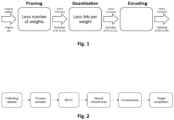
- Figure 1 shows a schematic representation of the approach for compressing the machine learning model. Since the machine learning model starts to be defined and trained using powerful computers, once the model reaches the desired performance it needs to be compressed. This is an important process to make possible to execute the machine learning algorithms from highly resource-constrained devices such as smoke detectors.
- the iterative process of collecting, analysing, train and compression the machine learning model is shown in the Figure 2 . This is an iterative process that maybe repeated until desired performance is achieved from the machine learning model.
- FIG. 3 shows a schematic representation of how different kinds of remote services can be offered either for the building owner and building operator.
- the smoke detector continues to operate as is, but it can be configured to add additional value thought machine learning models recognizing acoustic patents to enhance the building maintenance.
Landscapes
- Engineering & Computer Science (AREA)
- Physics & Mathematics (AREA)
- Theoretical Computer Science (AREA)
- General Health & Medical Sciences (AREA)
- Health & Medical Sciences (AREA)
- General Physics & Mathematics (AREA)
- Computing Systems (AREA)
- Biophysics (AREA)
- Software Systems (AREA)
- Evolutionary Computation (AREA)
- Computational Linguistics (AREA)
- Molecular Biology (AREA)
- Biomedical Technology (AREA)
- General Engineering & Computer Science (AREA)
- Artificial Intelligence (AREA)
- Mathematical Physics (AREA)
- Data Mining & Analysis (AREA)
- Life Sciences & Earth Sciences (AREA)
- Medical Informatics (AREA)
- Computer Networks & Wireless Communication (AREA)
- Signal Processing (AREA)
- Chemical & Material Sciences (AREA)
- Analytical Chemistry (AREA)
- Business, Economics & Management (AREA)
- Emergency Management (AREA)
- Fire-Detection Mechanisms (AREA)
- Fire Alarms (AREA)
Abstract
Description
- The present disclosure belongs to the technical field of a smoke detector for detecting the need of a predictive maintenance. This method and device are arranged to be jointly use in smoke detectors, also interchangeably referred to as fire detectors.
- Smoke detectors are widely used as one key product for the building's safety against fire phenomenon. There is a large portfolio of different kinds of smoke detectors depending on what kind of sensor are hosted. Because they are directly installed in the building sealings and can carry additional services that can extend their usage and the building safety/maintenance.
- There are some patterns that can be identified by the Smoke Detector in order to improve the building safety and maintenance, e.g.: sound patterns or predictive maintenance.
- Machine learning is a field of computer systems that aims to develop self-improving algorithms and statistical models. This is done with massive amounts of data, which a model analyses and extracts patterns form in order to learn and improve on a given task.
- Tiny Machine Learning (TinyML) is a field of machine learning that focuses on the development and deployment of Machine learning models on low power microcontroller. This leverages Neural Networks and Big Data in format that can be handle by low power and low processing micro controllers.
- The increasing demand for internet of things (loT) devices, created the need of having edge devices making operations alone without the need of computing from the cloud infrastructure. Therefore, avoiding the communication period to make a decision. In the standard architecture, the edge device would only collect the data and send it to the cloud for processing. This would create some concerns namely: privacy, latency, storage, and energy efficiency.
- These drawbacks led to the idea of performing processing activities onboard of edge devices. These devices are highly resource-constrained in terms of memory, computation, and power, leading to the development of more efficient algorithms, data structures, and computational methods.
- The key challenges in deploying machine learning on microcontrollers are the low memory footprint, limited power, and limited computation. Tiny machine learning (TinyML) is the intersection of machine learning and embedded edge devices. The field is an emerging engineering discipline that has the potential to revolutionize many industries.
- For normative reasons, fire detectors should be able to detect fire phenomena standalone without the need for extra computing processing from cloud or other fire system devices such as fire panels.
- TinyML algorithms work in much the same way as traditional machine learning models. Normally, the models are trained as usual on a user's computer or in the cloud. Post-training is where the real tinyML work begins, in a process often referred to as deep compression. In deep compression, the 'teacher' is a trained neural network model. The teacher is tasked with transferring its 'knowledge' to a smaller network model with fewer parameters, the 'student'. This process is used to enshrine the same accuracy in a smaller network, providing a way of compressing the knowledge representation, and hence the size, of a neural network such that they can be used on more memory-constrained devices.
- Similarly, pruning attempts to remove neurons that provide little utility to the output prediction. This is often associated with small neural weights, whereas larger weights are kept due to their greater importance during inference. The network is then retrained on the pruned architecture to fine-tune the output.
- Following the model is then quantized post-training into a format that is compatible with the architecture of the embedded device. Encoding is an optional step that is sometimes taken to further reduce the model size by storing the data in a maximally efficient way.
- Document
US7034702B2 discloses an optical smoke detector for detecting particulates in an air sample. The detector includes a detection chamber defining an enclosure for the air sample. At least one opening is in fluid communication with the detection chamber whereby the air sample can be introduced and discharged from the detection chamber. A cleaning port defines a passageway to the detection chamber from a position external to the smoke detector and a resilient valve seals the cleaning port with a substantially air-tight seal. The valve member is accessible from a position external to the smoke detector. The valve member is openable, permitting passage of air through the cleaning port into the discharge chamber, by engaging the valve member with a nozzle, such as an air nozzle mounted on a canister of pressurized air. - Document
KR20110007413A - Document
KR102012103529 - These facts are disclosed in order to illustrate the technical problem addressed by the present disclosure.
- The present disclosure discloses a smoke detector comprising a microphone and an electronic data processor. The microphone is arranged to: capture a microphone signal for sampling an ambient sound sample over a period of time. The electronic data processor is arranged to process the captured ambient sound sample with a pretrained machine-learning model to determine whether the captured ambient sound sample matches predetermined sound patterns of machinery noise, especially sound patterns of repetitive machinery noise. Preferably the smoke detector further comprises a memory, wherein the pretrained machine-learning model is stored in the memory of the smoke detector.
- Here, will be proposed the usage of Tiny Machine Learning (also known as Deep Learning) models in Smoke Detector context in order to extend their core functionality and provide remote services through them. Using Tiny Machine Learning would make possible to the Smoke Detectors to handle some patterns that wouldn't be possible to support (in terms of processing or energy efficiency) using common programming.
- There is a vast horizon of patterns that can be explored. But for sake of examples this proposal will just explore some use cases. The majority of the examples that will be present assume that the Smoke Detector is equipped with a MEMS microphone.
- To build a machine learning model capable of recognizing patterns from a MEMS microphone is needed to collect or gather a dataset with enough samples to train the machine learning model to perform with high accuracy. To achieve high accuracy performance the dataset should have the right balance of the samples from good cases, bad cases, and noise.
- When having the dataset available it will be needed to approach each sample using the mel-frequency cepstral coefficients (MFCC) technique to filter the audio samples from the dataset. This technique will help to isolate the audio input from each sample.
- Long short-term memory networks (LSTM) are a type of recurrent neural network (RNN) that can learn and memorize long-term dependencies. Its default behaviour is recalling past information for long periods.
- They are useful in time-series prediction because they remember previous inputs. This kind of network has a chain-like structure where four interacting layers communicate in a unique way. Besides timeseries predictions, they are the perfect candidate for detecting sound patterns.
- The compression will be an iterative process of pruning and afterwards quantization to keep the accuracy of the machine learning model but achieve a huge reduction on the size.
- After quantization, the model will be already able to be compiled for usage on a microcontroller used in edge devices such as smoke detectors. The suggested approach to handle the tiny machine learning model would be to import the model as a library because once flashed once in the edge device the model will not be able to continue learning and it would be just performing what it was trained to do.
- Therefore, using the model as an external library could simplify the model update afterward (via software over the air, for example).
- With this approach would be possible to generate models using just a few kilobytes of RAM and some milliseconds of processing time from the microcontroller leveraging over 85% accuracy.
- Surroundings sound inputs are also important in case of fire. They could give precise insights about the presence of humans or animals in dedicated rooms of the building, helping the fire brigade to a rapid rescue. Using Tiny Machine Learning models of the human voice (like "yelling" or saying "help") is possible to identify the human presence with accuracy. For security and power efficient reasons the MEMS microphone would only activate in case of fire from the fire alarm system. Furthermore it is also possible to detect domestic animal sound patterns.
- Other example of the usage of Tiny Machine Learning to create remote services is the detection of faucet leaking. In huge buildings, maintenance plays a key role in order to keep the building infrastructure running to provide desire comfort to the visitants. Detecting faucets water liking could also the possible using Tiny Machine Learning models in the smoke detectors. The smoke detectors are already there, the proposal is to extend their functionality to provide this extra service for the building operators.
- The last example of the usage of the Tiny Machine Learning models is the usage of the data of the sensor onboard the smoke detector in order to infer predictive maintenance. Identifying malfunctions or loss of precision in the readings.
- It is also disclosed using captured environment sound patterns to detect building machinery abnormal operation, for example malfunction in air-conditioning, electricity generator, IT servers, etc... and/or acoustic alarms or warnings coming from building machinery. Those are all acoustic periodic signals however it is possible to detect transient acoustic signals also.
- It is also disclosed a smoke detector comprising a microphone and an electronic data processor arranged to: capture a microphone signal for sampling an ambient sound sample over a period of time; process the captured ambient sound sample with a pretrained machine-learning model to determine whether the captured ambient sound sample matches predetermined sound patterns of repetitive machinery noise.
- In an embodiment, the electronic data processor is further arranged to determine a predictive maintenance alert if the captured ambient sound sample is determined to be at least in part comprising predetermined sound patterns of repetitive machinery noise.
- In an embodiment, the electronic data processor is further arranged to determine a predictive maintenance alert if the captured ambient sound sample is determined to be at least in part comprising predetermined sound patterns of non-repetitive or transient machinery noise.
- In an embodiment, the electronic data processor is further arranged to emit an alarm if the captured ambient sound sample is determined comprises predetermined sound patterns of repetitive machinery noise.
- In an embodiment, the electronic data processor is further arranged to capture microphone signal during periodic temporal windows and arranged to enter a power save mode outside these windows.
- In an embodiment, the device is arranged to power down microphone circuitry when in power save mode.
- In an embodiment, the electronic data processor comprises a performance core configured to carry out sound processing tasks and a low-power core configured to carry out smoke detection tasks.
- In an embodiment, the electronic data processor comprises a data processor core configured to switch between two different operating modes comprising a run mode configured to carry out sound processing tasks and an ultra-low power mode configured to carry out smoke detection tasks.
- It is also disclosed a computer-based method for providing a predictive maintenance alert, using a smoke detector device comprising a microphone and an electronic data processor arranged to capture a microphone signal for sampling an ambient sound sample over a period of time; process the captured ambient sound sample with a pretrained machine-learning model to determine whether the captured ambient sound sample matches predetermined sound patterns of repetitive machinery noise.
- In an embodiment, the electronic data processor is further arranged to determine a predictive maintenance alert if the captured ambient sound sample is determined to be at least in part comprising predetermined sound patterns of repetitive machinery noise.
- In an embodiment, the electronic data processor is further arranged to determine a predictive maintenance alert if the captured ambient sound sample is determined to be at least in part comprising predetermined sound patterns of non-repetitive or transient machinery noise.
- The following figures provide preferred embodiments for illustrating the disclosure and should not be seen as limiting the scope of invention.
-
Figure 1 : Schematic representation of an embodiment of a compressing machine learning model. -
Figure 2 : Schematic representation of an embodiment of a Tiny machine learning process. -
Figure 3 : Schematic representation of an embodiment of a present disclosure. - The present disclosure relates to a smoke detector comprising a microphone and an electronic data processor arranged to detect the need of a predictive maintenance.
-
Figure 1 shows a schematic representation of the approach for compressing the machine learning model. Since the machine learning model starts to be defined and trained using powerful computers, once the model reaches the desired performance it needs to be compressed. This is an important process to make possible to execute the machine learning algorithms from highly resource-constrained devices such as smoke detectors. - The iterative process of collecting, analysing, train and compression the machine learning model is shown in the
Figure 2 . This is an iterative process that maybe repeated until desired performance is achieved from the machine learning model. - When applying the machine learning models into edge devices like smoke detectors additional services can be offered to the business customer/operator. As an example of that, in the context of the smoke detector,
Figure 3 shows a schematic representation of how different kinds of remote services can be offered either for the building owner and building operator. The smoke detector continues to operate as is, but it can be configured to add additional value thought machine learning models recognizing acoustic patents to enhance the building maintenance. - The term "comprising" whenever used in this document is intended to indicate the presence of stated features, integers, steps, components, but not to preclude the presence or addition of one or more other features, integers, steps, components, or groups thereof.
- The disclosure should not be seen in any way restricted to the embodiments described and a person with ordinary skill in the art will foresee many possibilities to modifications thereof. The above-described embodiments are combinable. The following claims further set out particular embodiments of the disclosure.
Claims (11)
- A smoke detector comprising a microphone and an electronic data processor arranged to:capture a microphone signal for sampling an ambient sound sample over a period of time;process the captured ambient sound sample with a pretrained machine-learning model to determine whether the captured ambient sound sample matches predetermined sound patterns of machinery noise.
- The smoke detector device according to claim 1, wherein the electronic data processor is further arranged to determine a predictive maintenance alert if the captured ambient sound sample is determined to be at least in part comprising predetermined sound patterns of repetitive machinery noise.
- The smoke detector device according to claim 1 or 2, wherein the electronic data processor is further arranged to determine a predictive maintenance alert if the captured ambient sound sample is determined to be at least in part comprising predetermined sound patterns of non-repetitive or transient machinery noise.
- The smoke detector device according to any of the previous claims, wherein the electronic data processor is further arranged to emit an alarm if the captured ambient sound sample is determined comprises predetermined sound patterns of repetitive machinery noise.
- The smoke detector device according to any of the previous claims, wherein the electronic data processor is further arranged to capture microphone signal during periodic temporal windows and arranged to enter a power save mode outside these windows.
- The smoke detector device according to the previous claim, wherein the device is arranged to power down microphone circuitry when in power save mode.
- The smoke detector device according to claim 5 or 6 wherein the electronic data processor comprises a performance core configured to carry out sound processing tasks and a low-power core configured to carry out smoke detection tasks.
- The smoke detector device according to claim 5 or 6 wherein the electronic data processor comprises a data processor core configured to switch between two different operating modes comprising a run mode configured to carry out sound processing tasks and an ultra-low power mode configured to carry out smoke detection tasks.
- Computer-based method for providing a predictive maintenance alert, using a smoke detector device comprising a microphone and an electronic data processor arranged to capture a microphone signal for sampling an ambient sound sample over a period of time;
process the captured ambient sound sample with a pretrained machine-learning model to determine whether the captured ambient sound sample matches predetermined sound patterns of machinery noise. - Method according to the previous claim, wherein the electronic data processor is further arranged to determine a predictive maintenance alert if the captured ambient sound sample is determined to be at least in part comprising predetermined sound patterns of repetitive machinery noise.
- Method according to any of the claims 8-9, wherein the electronic data processor is further arranged to determine a predictive maintenance alert if the captured ambient sound sample is determined to be at least in part comprising predetermined sound patterns of non-repetitive or transient machinery noise.
Priority Applications (1)
| Application Number | Priority Date | Filing Date | Title |
|---|---|---|---|
| EP22202662.7A EP4358049B1 (en) | 2022-10-20 | 2022-10-20 | Method and smoke detector for providing a predictive maintenance alert |
Applications Claiming Priority (1)
| Application Number | Priority Date | Filing Date | Title |
|---|---|---|---|
| EP22202662.7A EP4358049B1 (en) | 2022-10-20 | 2022-10-20 | Method and smoke detector for providing a predictive maintenance alert |
Publications (2)
| Publication Number | Publication Date |
|---|---|
| EP4358049A1 true EP4358049A1 (en) | 2024-04-24 |
| EP4358049B1 EP4358049B1 (en) | 2026-02-18 |
Family
ID=83900236
Family Applications (1)
| Application Number | Title | Priority Date | Filing Date |
|---|---|---|---|
| EP22202662.7A Active EP4358049B1 (en) | 2022-10-20 | 2022-10-20 | Method and smoke detector for providing a predictive maintenance alert |
Country Status (1)
| Country | Link |
|---|---|
| EP (1) | EP4358049B1 (en) |
Citations (5)
| Publication number | Priority date | Publication date | Assignee | Title |
|---|---|---|---|---|
| US7034702B2 (en) | 2003-12-23 | 2006-04-25 | Robert Bosch Gmbh | Optical smoke detector and method of cleaning |
| KR20110007413A (en) | 2009-07-16 | 2011-01-24 | 경남대학교 산학협력단 | AI fire alarm sound system |
| KR20120103529A (en) | 2012-08-06 | 2012-09-19 | 나영선 | Image and phonetics perception device of fire |
| US20200233397A1 (en) * | 2019-01-23 | 2020-07-23 | New York University | System, method and computer-accessible medium for machine condition monitoring |
| US20210133607A1 (en) * | 2019-10-31 | 2021-05-06 | Shoreline Iot, Inc. | Systems and methods for self-learning artificial intelligence of things (aiot) devices and services |
-
2022
- 2022-10-20 EP EP22202662.7A patent/EP4358049B1/en active Active
Patent Citations (6)
| Publication number | Priority date | Publication date | Assignee | Title |
|---|---|---|---|---|
| US7034702B2 (en) | 2003-12-23 | 2006-04-25 | Robert Bosch Gmbh | Optical smoke detector and method of cleaning |
| KR20110007413A (en) | 2009-07-16 | 2011-01-24 | 경남대학교 산학협력단 | AI fire alarm sound system |
| KR101102752B1 (en) * | 2009-07-16 | 2012-01-05 | 경남대학교 산학협력단 | AI fire alarm sound system |
| KR20120103529A (en) | 2012-08-06 | 2012-09-19 | 나영선 | Image and phonetics perception device of fire |
| US20200233397A1 (en) * | 2019-01-23 | 2020-07-23 | New York University | System, method and computer-accessible medium for machine condition monitoring |
| US20210133607A1 (en) * | 2019-10-31 | 2021-05-06 | Shoreline Iot, Inc. | Systems and methods for self-learning artificial intelligence of things (aiot) devices and services |
Also Published As
| Publication number | Publication date |
|---|---|
| EP4358049B1 (en) | 2026-02-18 |
Similar Documents
| Publication | Publication Date | Title |
|---|---|---|
| US10169656B2 (en) | Video system using dual stage attention based recurrent neural network for future event prediction | |
| Natesha et al. | Fog-based intelligent machine malfunction monitoring system for industry 4.0 | |
| US20210147182A1 (en) | Non-intrusive data analytics system for adaptive intelligent condition monitoring of lifts | |
| Do et al. | Soham: A sound-based human activity monitoring framework for home service robots | |
| US20210208179A1 (en) | Context awareness of a smart device through sensing transient and continuous events | |
| CN117711309B (en) | LED display control method and system based on MCU controller | |
| CN119446154A (en) | Ambient sound event detection method based on multimodal data fusion | |
| CN119049509B (en) | Automatic dehumidification method in power equipment box | |
| US12293772B2 (en) | Method for identifying an audio signal | |
| Maniak et al. | Automated intelligent system for sound signalling device quality assurance | |
| KR20130097490A (en) | Apparatus and method for context recognition based on acoustic information | |
| CN119669994A (en) | An AI-based method and device for automatically identifying hidden dangers of hot work in pipe gallery | |
| CN120496555B (en) | A smart voice recognition and analysis system based on a general-purpose smartphone chip | |
| KR20240030037A (en) | Apparatus for sound recognition and method for controlling thereof | |
| CN120014809A (en) | Intelligent campus safety monitoring and early warning system and method | |
| EP4358049B1 (en) | Method and smoke detector for providing a predictive maintenance alert | |
| KR20200144366A (en) | Generating trigger recognition models for robot | |
| KR20220148430A (en) | Iot platform and underground environment monitering system and it's method using ai | |
| CN117524228A (en) | Voice data processing methods, devices, equipment and media | |
| KR101893945B1 (en) | System for safety management using biometric information and voice information | |
| Peddi et al. | Real-time audio recognition for hearing impaired | |
| JP2005172548A (en) | Supervisory device and database construction method | |
| KR102671008B1 (en) | Device for checking whether the water valve is open or closed | |
| CN120612214B (en) | Classroom abnormity early warning method, system, equipment and storage medium based on AI | |
| CN117636909B (en) | A data processing method, device, equipment and computer readable storage medium |
Legal Events
| Date | Code | Title | Description |
|---|---|---|---|
| PUAI | Public reference made under article 153(3) epc to a published international application that has entered the european phase |
Free format text: ORIGINAL CODE: 0009012 |
|
| STAA | Information on the status of an ep patent application or granted ep patent |
Free format text: STATUS: THE APPLICATION HAS BEEN PUBLISHED |
|
| AK | Designated contracting states |
Kind code of ref document: A1 Designated state(s): AL AT BE BG CH CY CZ DE DK EE ES FI FR GB GR HR HU IE IS IT LI LT LU LV MC ME MK MT NL NO PL PT RO RS SE SI SK SM TR |
|
| STAA | Information on the status of an ep patent application or granted ep patent |
Free format text: STATUS: REQUEST FOR EXAMINATION WAS MADE |
|
| 17P | Request for examination filed |
Effective date: 20241024 |
|
| RBV | Designated contracting states (corrected) |
Designated state(s): AL AT BE BG CH CY CZ DE DK EE ES FI FR GB GR HR HU IE IS IT LI LT LU LV MC ME MK MT NL NO PL PT RO RS SE SI SK SM TR |
|
| GRAP | Despatch of communication of intention to grant a patent |
Free format text: ORIGINAL CODE: EPIDOSNIGR1 |
|
| STAA | Information on the status of an ep patent application or granted ep patent |
Free format text: STATUS: GRANT OF PATENT IS INTENDED |
|
| INTG | Intention to grant announced |
Effective date: 20251118 |
|
| GRAS | Grant fee paid |
Free format text: ORIGINAL CODE: EPIDOSNIGR3 |
|
| GRAA | (expected) grant |
Free format text: ORIGINAL CODE: 0009210 |
|
| STAA | Information on the status of an ep patent application or granted ep patent |
Free format text: STATUS: THE PATENT HAS BEEN GRANTED |
|
| AK | Designated contracting states |
Kind code of ref document: B1 Designated state(s): AL AT BE BG CH CY CZ DE DK EE ES FI FR GB GR HR HU IE IS IT LI LT LU LV MC ME MK MT NL NO PL PT RO RS SE SI SK SM TR |
|
| REG | Reference to a national code |
Ref country code: CH Ref legal event code: F10 Free format text: ST27 STATUS EVENT CODE: U-0-0-F10-F00 (AS PROVIDED BY THE NATIONAL OFFICE) Effective date: 20260218 Ref country code: GB Ref legal event code: FG4D |
|
| REG | Reference to a national code |
Ref country code: DE Ref legal event code: R096 Ref document number: 602022030510 Country of ref document: DE |
|
| REG | Reference to a national code |
Ref country code: IE Ref legal event code: FG4D |