EP4357966A1 - Information processing program, information processing method, and information processing device - Google Patents
Information processing program, information processing method, and information processing device Download PDFInfo
- Publication number
- EP4357966A1 EP4357966A1 EP23185528.9A EP23185528A EP4357966A1 EP 4357966 A1 EP4357966 A1 EP 4357966A1 EP 23185528 A EP23185528 A EP 23185528A EP 4357966 A1 EP4357966 A1 EP 4357966A1
- Authority
- EP
- European Patent Office
- Prior art keywords
- sentence
- domain
- data
- belongs
- information processing
- Prior art date
- Legal status (The legal status is an assumption and is not a legal conclusion. Google has not performed a legal analysis and makes no representation as to the accuracy of the status listed.)
- Withdrawn
Links
Images





Classifications
-
- G—PHYSICS
- G06—COMPUTING OR CALCULATING; COUNTING
- G06F—ELECTRIC DIGITAL DATA PROCESSING
- G06F40/00—Handling natural language data
- G06F40/20—Natural language analysis
- G06F40/279—Recognition of textual entities
- G06F40/289—Phrasal analysis, e.g. finite state techniques or chunking
- G06F40/295—Named entity recognition
-
- G—PHYSICS
- G06—COMPUTING OR CALCULATING; COUNTING
- G06F—ELECTRIC DIGITAL DATA PROCESSING
- G06F40/00—Handling natural language data
- G06F40/30—Semantic analysis
-
- G—PHYSICS
- G06—COMPUTING OR CALCULATING; COUNTING
- G06F—ELECTRIC DIGITAL DATA PROCESSING
- G06F16/00—Information retrieval; Database structures therefor; File system structures therefor
- G06F16/30—Information retrieval; Database structures therefor; File system structures therefor of unstructured textual data
- G06F16/35—Clustering; Classification
-
- G—PHYSICS
- G06—COMPUTING OR CALCULATING; COUNTING
- G06F—ELECTRIC DIGITAL DATA PROCESSING
- G06F40/00—Handling natural language data
- G06F40/20—Natural language analysis
- G06F40/279—Recognition of textual entities
-
- G—PHYSICS
- G06—COMPUTING OR CALCULATING; COUNTING
- G06F—ELECTRIC DIGITAL DATA PROCESSING
- G06F40/00—Handling natural language data
- G06F40/20—Natural language analysis
- G06F40/279—Recognition of textual entities
- G06F40/289—Phrasal analysis, e.g. finite state techniques or chunking
-
- G—PHYSICS
- G06—COMPUTING OR CALCULATING; COUNTING
- G06F—ELECTRIC DIGITAL DATA PROCESSING
- G06F40/00—Handling natural language data
- G06F40/40—Processing or translation of natural language
-
- G—PHYSICS
- G06—COMPUTING OR CALCULATING; COUNTING
- G06N—COMPUTING ARRANGEMENTS BASED ON SPECIFIC COMPUTATIONAL MODELS
- G06N3/00—Computing arrangements based on biological models
- G06N3/02—Neural networks
- G06N3/04—Architecture, e.g. interconnection topology
- G06N3/045—Combinations of networks
-
- G—PHYSICS
- G06—COMPUTING OR CALCULATING; COUNTING
- G06N—COMPUTING ARRANGEMENTS BASED ON SPECIFIC COMPUTATIONAL MODELS
- G06N3/00—Computing arrangements based on biological models
- G06N3/02—Neural networks
- G06N3/08—Learning methods
- G06N3/096—Transfer learning
-
- G—PHYSICS
- G06—COMPUTING OR CALCULATING; COUNTING
- G06N—COMPUTING ARRANGEMENTS BASED ON SPECIFIC COMPUTATIONAL MODELS
- G06N3/00—Computing arrangements based on biological models
- G06N3/02—Neural networks
- G06N3/08—Learning methods
- G06N3/084—Backpropagation, e.g. using gradient descent
Definitions
- the embodiment discussed herein is related to an information processing program or the like.
- the domain adaptation is a technology for addressing an issue for reducing a domain shift between samples of a Source domain and a Target domain.
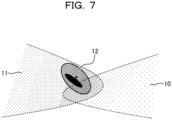
- FIG. 7 is a diagram illustrating an example of a data distribution on a domain.
- data 10 of Original language model (LM) domain data 11 of Target domain, and data 12 of Target domain downstream task are included in a space.
- LM Original language model
- the data 10 of the Original LM domain corresponds to data of a sentence existing on the Internet.
- the data 11 of the Target domain is corpus data of the Target domain.
- the data 12 of the Target domain downstream task is data of a sentence selected to execute a downstream task.
- FIG. 8 is a diagram for explaining the related art of the domain adaptation.
- processing is executed in order of step S10, step S11, and step S12.
- a typical device that performs the domain adaptation is referred to as a typical device.
- the typical device performs training of a first model 10a (Pretrained language model) using the data 10 of the Original LM domain in step S10.
- the first model 10a is a natural language processing model.
- the first model 10a is a neural network (NN) or the like. For example, when a sentence is input to the first model 10a, a vector of each word included in the sentence is output.
- NN neural network
- the typical device obtains a second model 11a (Re-pretrained language model) by performing retraining of the first model 10a, using the data 11 of the Target domain, in step S11.
- a second model 11a Re-pretrained language model
- the typical device couples the second model 11a to a name entity recognition (NER) model 12a and performs Fine-tuning on the second model 11a and the NER model 12a, using the data 12 of the Target domain downstream task, in step S12.
- NER name entity recognition
- the NER model 12a is a classification model.
- the NER model 12a is a NN or the like.
- steps S10 and S11 correct answer labels are not assigned to the data 10 of the Original LM domain and the data 11 of the Target domain, and unsupervised training is performed.
- step S12 a correct answer label is assigned to the data 12 of the Target domain downstream task, and supervised training is performed.
- a performance of the downstream task can be enhanced as more sentences among the plurality of sentences included in the data 11 of the Target domain are sentences related to the downstream task.
- a sentence related to the downstream task is selected from among the plurality of sentences included in the data 11 of the Target domain by a data selection method based on Bag-of-words.
- a typical device that performs data selection based on the Bag-of-words is also referred to as a typical device.
- FIG. 9 is a diagram for explaining the data selection method based on the Bag-of-words.
- the typical device converts a Downstream task sentence into a vector with VAMPIRE or the like and disposes the vector in a VAMPIRE embedding space.
- the Downstream task sentence is data of the sentence included in the data 12 of the Target domain downstream task.
- the typical device similarly executes the processing described above on another Downstream task sentence.
- Each Downstream task sentence on the VAMPIRE embedding space is represented by a "triangle".
- the typical device converts a Target domain sentence into a vector by the VAMPIRE and disposes the vector in the VAMPIRE embedding space.
- the Target domain sentence is data of the sentence included in the data 11 of the Target domain.
- the typical device similarly executes the processing described above on another Target domain sentence.
- Each Target domain sentence on the VAMPIRE embedding space is represented by a "circle".
- the typical device measures a similarity between the Downstream task sentence and the Target domain sentence on the VAMPIRE embedding space and selects Top-k Target domain sentences.
- the related art described above has a problem in that a Target domain sentence that is not related to a Downstream task sentence is selected.
- the sentence selected by the data selection method based on the Bag-of-words is often a noise that is not related to the Downstream task sentence.
- FIG. 10 is a diagram for explaining a problem of the related art.
- a Downstream task domain is set as an "Electronic medical records domain”
- a domain that is not the Downstream task is set as a "Disease explanation documents domain”.
- a sentence 15 is set as "Behcet's disease is globalized and infectious.”.
- the sentence 15 is similar to a sentence of the "Electronic medical records domain” and is also similar to a sentence of "Disease explanation documents domain", on the VAMPIRE embedding space.
- an object of the embodiment is to provide an information processing program, an information processing method, and an information processing device that can select data related to a Downstream task while removing a noise that is not related to the Downstream task.
- an information processing program including instructions which, when executed by a computer, cause the computer to execute processing including: selecting a sentence of a second vector similar to a first vector, based on the first vector of a sentence that belongs to a first domain and the second vector of a sentence that belongs to a second domain; determining whether or not the selected sentence is the sentence that belongs to the first domain, by inputting the selected sentence into a classifier trained by using the sentence that belongs to the first domain; and extracting the sentence that belongs to the first domain, from among a plurality of the selected sentences, based on a determination result.
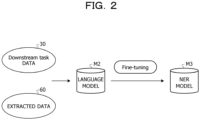
- FIGs. 1 and 2 are diagrams for explaining processing of an information processing device according to the present embodiment. First, FIG. 1 will be described.
- the information processing device executes data selection based on Bag-of-words based on Downstream task data 30 and Specific Domain data 40.
- the Downstream task data 30 is data corresponding to data 12 of a Target domain downstream task described with reference to FIG. 7 .
- the Specific Domain data 40 is data corresponding to data 11 of a Target domain described with reference to FIG. 7 .
- the information processing device converts each sentence included in the Downstream task data 30 into a vector by VAMPIRE or the like and disposes the vector in a VAMPIRE embedding space.
- the vector of the sentence included in the Downstream task data 30 is referred to as a "first vector".
- the information processing device converts each sentence included in the Specific Domain data 40 into a vector by VAMPIRE or the like and disposes the vector in the VAMPIRE embedding space.
- the vector of the sentence included in the Specific Domain data 40 is referred to as a "second vector".
- the information processing device calculates a similarity between each first vector and each second vector in the VAMPIRE embedding space and selects the sentence of the second vector similar to the first vector. For example, as in the processing described with reference to FIG. 9 , the information processing device selects the sentence of the second vector similar to the first vector. Note that the information processing device may select a sentence of the second vector of which a distance from an average vector of the first vector is less than a threshold.
- the information processing device registers each sentence of the Downstream task data 30 and the sentence selected through the data selection based on the Bag-of-words, in a data cluster 50.
- the information processing device inputs a sentence included in the data cluster 50 into a classifier M1, and determines whether or not the sentence input into the classifier M1 is a sentence that belongs to the Downstream task data 30, based on output data of the classifier M1.
- the output data of the classifier M1 includes a value of certainty indicating that the sentence input into the classifier M1 is the sentence of the Downstream task data 30.
- the value of the certainty indicating that the sentence input into the classifier M1 is the sentence of the Downstream task data 30 is referred to as a "likelihood”.
- the information processing device determines that the sentence input into the classifier M1 is the sentence belonging to the Downstream task data 30.
- the information processing device repeatedly executes the processing described above for each sentence included in the data cluster 50.
- the information processing device extracts the sentence that is determined as the sentence belonging to the Downstream task data 30, from among the sentences included in the data cluster 50 and sets the sentence as extracted data 60.
- the classifier M1 is a classifier that has been trained in advance, based on each sentence of the Downstream task data 30.
- the classifier M1 is a NN or the like.
- a training dataset used in a case where the classifier M1 is trained includes a plurality of pieces of training data.
- To the training data a pair of input data and a label is set.
- the input data is data of a sentence.
- "1" is set in a case where the sentence of the input data is the sentence belonging to the Downstream task data 30.
- "0" is set in a case where the sentence of the input data is a sentence that does not belong to the Downstream task data 30.
- the information processing device performs training of a language model M2 based on each sentence of the Downstream task data 30 and the extracted data 60.
- the language model M2 is a bidirectional encoder representations from transformers (BERT) or the like.
- the information processing device couples the language model M2 to a name entity recognition (NER) model M3.
- NER name entity recognition
- An output result of the language model M2 is input into the NER model M3, and a classification result is output from the NER model M3.
- the information processing device performs Fine-tuning on the language model M2 and the NER model M3. For example, when a sentence is input into the language model M2, a label of each word included in the sentence is output from the NER.
- the sentence selected based on the Bag-of-words is input into the trained classifier M1, and it is determined whether or not the selected sentence is the sentence belonging to the Downstream task data 30.
- the information processing device extracts the sentence belonging to the Downstream task data 30, from among the selected sentences. As a result, it is possible to remove a noise that is not related to the Downstream task and select data related to the Downstream task.
- FIG. 3 is a diagram for explaining an effect of the information processing device according to the present embodiment.
- a Downstream task domain is set as an "Electronic medical records domain”
- a domain that is not the Downstream task is set as a "Disease explanation documents domain”.
- a sentence 15 is set as "Behcet's disease is globalized and infectious.”.
- the sentence 15 is similar to a sentence of the "Electronic medical records domain” and is also similar to a sentence of "Disease explanation documents domain", on the VAMPIRE embedding space.
- the context information of the sentence 15 is different from the context information of the "Electronic medical records domain”
- the selected sentence 15 is assumed as a noise.
- the information processing device inputs the sentence 15 into the classifier M1 and determines whether or not the sentence 15 is a sentence belonging to the "Electronic medical records domain". For example, if the sentence 15 is the sentence belonging to the "Electronic medical records domain", by selecting the sentence 15, it is possible to give a positive influence on the Downstream task Domain. On the other hand, if the sentence 15 is a sentence that does not belong to the "Electronic medical records domain", by not selecting the sentence 15, it is possible to prevent a negative influence from being given to the Downstream task Domain.
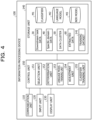
- FIG. 4 is a functional block diagram illustrating a configuration of the information processing device according to the present embodiment.
- an information processing device 100 includes a communication unit 110, an input unit 120, a display unit 130, a storage unit 140, and a control unit 150.
- the communication unit 110 performs data communication with an external device or the like via a network.
- the control unit 150 to be described later exchanges data with an external device via the communication unit 110.
- the input unit 120 is an input device that inputs various types of information into the control unit 150 of the information processing device 100.
- the input unit 120 corresponds to a keyboard, a mouse, a touch panel, or the like.
- the display unit 130 is a display device that displays information output from the control unit 150.
- the storage unit 140 includes the Downstream task data 30, the Specific Domain data 40, the data cluster 50, the extracted data 60, and a training dataset 141. Furthermore, the storage unit 140 includes the classifier M1, the language model M2, and the NER model M3. The storage unit 140 is a storage device such as a memory.
- the description regarding the Downstream task data 30, the Specific Domain data 40, the data cluster 50, and the extracted data 60 is similar to that of the Downstream task data 30, the Specific Domain data 40, the data cluster 50, and the extracted data 60 described with reference to FIG. 1 .
- the description regarding the classifier M1 is similar to the description regarding the classifier M1 described with reference to FIG. 1 .
- the description regarding the language model M2 and the NER model M3 is similar to the description regarding the language model M2 and the NER model M3 described with reference to FIG. 2 .
- the training dataset 141 is data used in a case where the classifier M1 is trained.
- the training dataset 141 includes a plurality of pieces of training data.
- To the training data a pair of input data and a label is set.
- the input data is data of a sentence.
- "1" is set in a case where the sentence of the input data is the sentence belonging to the Downstream task data 30.
- On the other hand, as the label, "0" is set in a case where the sentence of the input data is a sentence that does not belong to the Downstream task data 30.
- the control unit 150 includes a selection unit 151, a determination unit 152, a language model training unit 153, an adjustment unit 154, and a classifier training unit 155.
- the control unit 150 is a central processing unit (CPU), a graphics processing unit (GPU), or the like.
- the selection unit 151 performs the data selection based on the Bag-of-words, based on the Downstream task data 30 and the Specific Domain data 40.
- the selection unit 151 converts each sentence included in the Downstream task data 30 into the first vector by the VAMPIRE or the like.
- the selection unit 151 converts each sentence included in the Specific Domain data 40 into the second vector by the VAMPIRE or the like.
- the selection unit 151 calculates a similarity between each first vector and each second vector in the VAMPIRE embedding space and selects a sentence of the second vector similar to the first vector.
- the selection unit 151 registers each sentence of the Downstream task data 30 and the sentence selected through the data selection based on the Bag-of-words, in the data cluster 50.
- the determination unit 152 inputs the sentence included in the data cluster 50 into the trained classifier M1 and determines whether or not the sentence input into the classifier M1 is a sentence belonging to the Downstream task data 30, based on the output data of the classifier M1.
- the determination unit 152 determines that the sentence input into the classifier M1 is the sentence belonging to the Downstream task data 30.
- the determination unit 152 repeatedly executes the processing described above for each sentence included in the data cluster 50.
- the determination unit 152 extracts the sentence that is determined as the sentence belonging to the Downstream task data 30, from among the sentences included in the data cluster 50 and sets the sentence as extracted data 60.
- the language model training unit 153 performs learning (training) of the language model M2, based on each sentence of the Downstream task data 30 and each sentence of the extracted data 60.
- the adjustment unit 154 performs Fine-tuning on the language model M2 and the NER model M3, using the Downstream task data 30.
- the classifier training unit 155 trains the classifier M1, based on the training dataset 141.
- the classifier training unit 155 inputs the input data into the classifier M1 based on the error back propagation method, and trains the classifier M1 so that an error between the output of the classifier M1 and the label decreases.
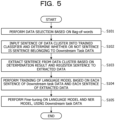
- FIG. 5 is a flowchart illustrating the processing procedure of the information processing device according to the present embodiment.
- the selection unit 151 of the information processing device 100 performs the data selection based on the Bag-of-words, based on the Downstream task data 30 and the Specific Domain data 40 (step S101).
- the determination unit 152 of the information processing device 100 inputs the sentence of the data cluster 50 into the trained classifier M1 and determines whether or not the sentence is the sentence belonging to the Downstream task data 30 (step S102).
- the determination unit 152 extracts the sentence from the data cluster 50 based on the determination result and registers the sentence to the extracted data 60 (step S103).
- the language model training unit 153 of the information processing device 100 performs learning (training) of the language model M2, based on each sentence of the Downstream task data 30 and each sentence of the extracted data 60 (step S104).
- the adjustment unit 154 of the information processing device 100 performs Fine-tuning on the language model M2 and the NER model M3, using the Downstream task data 30 (step S105).
- the information processing device 100 inputs the sentence selected based on the Bag-of-words into the trained classifier M1 and determines whether or not the selected sentence is the sentence belonging to the Downstream task data 30.
- the information processing device 100 extracts the sentence belonging to the Downstream task data 30 from among the selected sentences. As a result, it is possible to remove the noise that is not related to the specific domain such as the Downstream task and select data related to the specific domain.
- the information processing device 100 trains the classifier M1, based on the training dataset 141. As a result, it can be determined whether or not the sentence selected based on the Bag-of-words is the sentence belonging to the Downstream task data 30.
- the information processing device 100 inputs the sentence selected based on the Bag-of-words into the trained classifier M1, and in a case where the likelihood output from the classifier M1 is equal to or more than the threshold, the information processing device 100 determines whether or not the target sentence is the sentence belonging to the Downstream task data 30. As a result, it is possible to efficiently determine whether or not the sentence is the sentence belonging to the Downstream task data 30.
- the information processing device 100 extracts the sentence belonging to the Downstream task data 30, using the classifier M1, from among the sentences selected based on the Bag-of-words and trains the language model M2 using the extracted sentence.
- the language model M2 can be trained by an amount of the removed noise, and a performance of the Downstream task can be enhanced.
- FIG. 6 is a diagram illustrating an example of the hardware configuration of the computer that implements the functions similar to those of the information processing device according to the embodiment.
- a computer 200 includes a CPU 201 that executes various types of arithmetic processing, an input device 202 that receives data input from a user, and a display 203. Furthermore, the computer 200 includes a communication device 204 that exchanges data with an external device or the like via a wired or wireless network, and an interface device 205. Furthermore, the computer 200 includes a random access memory (RAM) 206 that temporarily stores various types of information, and a hard disk device 207. Additionally, each of the devices 201 to 207 is coupled to a bus 208.
- RAM random access memory
- the hard disk device 207 includes a selection program 207a, a determination program 207b, a language model training program 207c, an adjustment program 207d, and a classifier training program 207e. Furthermore, the CPU 201 reads each of the programs 207a to 207e, and loads the read program to the RAM 206.
- the selection program 207a functions as a selection process 206a.
- the determination program 207b functions as a determination process 206b.
- the language model training program 207c functions as a language model training process 206c.
- the adjustment program 207d functions as an adjustment process 206d.
- the classifier training program 207e functions as a classifier training process 206e.
- Processing of the selection process 206a corresponds to the processing of the selection unit 151.
- Processing of the determination process 206b corresponds to the processing of the determination unit 152.
- Processing of the language model training process 206c corresponds to the processing of the language model training unit 153.
- Processing of the adjustment process 206d corresponds to the processing of the adjustment unit 154.
- Processing of the classifier training process 206e corresponds to the processing of the classifier training unit 155.
- each of the programs 207a to 207e does not necessarily have to be stored in the hard disk device 207 from the beginning.
- each of the programs is stored in a "portable physical medium" to be inserted into the computer 200, such as a flexible disk (FD), a compact disc read only memory (CD-ROM), a digital versatile disc (DVD), a magneto-optical disk, or an integrated circuit (IC) card.
- FD flexible disk
- CD-ROM compact disc read only memory
- DVD digital versatile disc
- IC integrated circuit
Landscapes
- Engineering & Computer Science (AREA)
- Theoretical Computer Science (AREA)
- Physics & Mathematics (AREA)
- General Engineering & Computer Science (AREA)
- General Physics & Mathematics (AREA)
- Health & Medical Sciences (AREA)
- Artificial Intelligence (AREA)
- Computational Linguistics (AREA)
- General Health & Medical Sciences (AREA)
- Audiology, Speech & Language Pathology (AREA)
- Data Mining & Analysis (AREA)
- Life Sciences & Earth Sciences (AREA)
- Biomedical Technology (AREA)
- Biophysics (AREA)
- Evolutionary Computation (AREA)
- Molecular Biology (AREA)
- Computing Systems (AREA)
- Mathematical Physics (AREA)
- Software Systems (AREA)
- Databases & Information Systems (AREA)
- Machine Translation (AREA)
- Information Retrieval, Db Structures And Fs Structures Therefor (AREA)
Abstract
An information processing program including instructions which, when executed by a computer, cause the computer to execute processing including: selecting a sentence of a second vector similar to a first vector, based on the first vector of a sentence that belongs to a first domain and the second vector of a sentence that belongs to a second domain; determining whether or not the selected sentence is the sentence that belongs to the first domain, by inputting the selected sentence into a classifier trained by using the sentence that belongs to the first domain; and extracting the sentence that belongs to the first domain, from among a plurality of the selected sentences, based on a determination result.
Description
- The embodiment discussed herein is related to an information processing program or the like.
- In natural language processing, there is a technology called domain adaptation. For example, the domain adaptation is a technology for addressing an issue for reducing a domain shift between samples of a Source domain and a Target domain.
-
FIG. 7 is a diagram illustrating an example of a data distribution on a domain. In the example illustrated inFIG. 7 ,data 10 of Original language model (LM) domain,data 11 of Target domain, anddata 12 of Target domain downstream task are included in a space. - The
data 10 of the Original LM domain corresponds to data of a sentence existing on the Internet. Thedata 11 of the Target domain is corpus data of the Target domain. Thedata 12 of the Target domain downstream task is data of a sentence selected to execute a downstream task. - Hereinafter, an example of related art of the domain adaptation using the
data 10 of the Original LM domain, thedata 11 of the Target domain, and thedata 12 of the Target domain downstream task will be described. -
FIG. 8 is a diagram for explaining the related art of the domain adaptation. For example, in the domain adaptation in the related art, processing is executed in order of step S10, step S11, and step S12. A typical device that performs the domain adaptation is referred to as a typical device. - The typical device performs training of a
first model 10a (Pretrained language model) using thedata 10 of the Original LM domain in step S10. Thefirst model 10a is a natural language processing model. Thefirst model 10a is a neural network (NN) or the like. For example, when a sentence is input to thefirst model 10a, a vector of each word included in the sentence is output. - The typical device obtains a
second model 11a (Re-pretrained language model) by performing retraining of thefirst model 10a, using thedata 11 of the Target domain, in step S11. - The typical device couples the
second model 11a to a name entity recognition (NER)model 12a and performs Fine-tuning on thesecond model 11a and the NERmodel 12a, using thedata 12 of the Target domain downstream task, in step S12. The NERmodel 12a is a classification model. The NERmodel 12a is a NN or the like. - In steps S10 and S11, correct answer labels are not assigned to the
data 10 of the Original LM domain and thedata 11 of the Target domain, and unsupervised training is performed. In step S12, a correct answer label is assigned to thedata 12 of the Target domain downstream task, and supervised training is performed. - Here, a performance of the downstream task can be enhanced as more sentences among the plurality of sentences included in the
data 11 of the Target domain are sentences related to the downstream task. For example, in the related art, a sentence related to the downstream task is selected from among the plurality of sentences included in thedata 11 of the Target domain by a data selection method based on Bag-of-words. A typical device that performs data selection based on the Bag-of-words is also referred to as a typical device. -
FIG. 9 is a diagram for explaining the data selection method based on the Bag-of-words. The typical device converts a Downstream task sentence into a vector with VAMPIRE or the like and disposes the vector in a VAMPIRE embedding space. The Downstream task sentence is data of the sentence included in thedata 12 of the Target domain downstream task. The typical device similarly executes the processing described above on another Downstream task sentence. Each Downstream task sentence on the VAMPIRE embedding space is represented by a "triangle". - The typical device converts a Target domain sentence into a vector by the VAMPIRE and disposes the vector in the VAMPIRE embedding space. The Target domain sentence is data of the sentence included in the
data 11 of the Target domain. The typical device similarly executes the processing described above on another Target domain sentence. Each Target domain sentence on the VAMPIRE embedding space is represented by a "circle". - The typical device measures a similarity between the Downstream task sentence and the Target domain sentence on the VAMPIRE embedding space and selects Top-k Target domain sentences. In the example illustrated in
FIG. 9 , each Target domain sentence included in a circle of k = 50 is selected as the sentence related to the downstream task. - Suchin Gururangan et al., "Don't Stop Pretraining: Adapt Language Models to Domains and Tasks" continarXiv: 2004.10964v3 [cs.CL] 5 May 2020 is disclosed as related art.
- However, the related art described above has a problem in that a Target domain sentence that is not related to a Downstream task sentence is selected.
- In the data selection method based on the Bag-of-words, context information of a sentence is not considered, and a sentence is selected according to the similarity on the VAMPIRE embedding space. Therefore, the sentence selected by the data selection method based on the Bag-of-words is often a noise that is not related to the Downstream task sentence.
-
FIG. 10 is a diagram for explaining a problem of the related art. In the example inFIG. 10 , a Downstream task domain is set as an "Electronic medical records domain", and a domain that is not the Downstream task is set as a "Disease explanation documents domain". Asentence 15 is set as "Behcet's disease is globalized and infectious.". - For example, the
sentence 15 is similar to a sentence of the "Electronic medical records domain" and is also similar to a sentence of "Disease explanation documents domain", on the VAMPIRE embedding space. - In a case where context information of the
sentence 15 is different from context information of the "Electronic medical records domain", when thesentence 15 is selected by the data selection method based on the Bag-of-words, theselected sentence 15 is assumed as a noise. - In other words, it is requested to remove a noise that is not related to a specific domain such as the Downstream task and select data related to the specific domain.
- In one aspect, an object of the embodiment is to provide an information processing program, an information processing method, and an information processing device that can select data related to a Downstream task while removing a noise that is not related to the Downstream task.
- According to an aspect of the embodiments, there is provided an information processing program including instructions which, when executed by a computer, cause the computer to execute processing including: selecting a sentence of a second vector similar to a first vector, based on the first vector of a sentence that belongs to a first domain and the second vector of a sentence that belongs to a second domain; determining whether or not the selected sentence is the sentence that belongs to the first domain, by inputting the selected sentence into a classifier trained by using the sentence that belongs to the first domain; and extracting the sentence that belongs to the first domain, from among a plurality of the selected sentences, based on a determination result.
- It is possible to remove a noise that is not related to a specific domain and select data related to the specific domain.
-
-
FIG. 1 is a diagram (1) for explaining processing of an information processing device according to the present embodiment; -
FIG. 2 is a diagram (2) for explaining the processing of the information processing device according to the present embodiment; -
FIG. 3 is a diagram for explaining an effect of the information processing device according to the present embodiment; -
FIG. 4 is a functional block diagram illustrating a configuration of the information processing device according to the present embodiment; -
FIG. 5 is a flowchart illustrating a processing procedure of the information processing device according to the present embodiment; -
FIG. 6 is a diagram illustrating an example of a hardware configuration of a computer that implements functions similar to those of the information processing device according to the embodiment; -
FIG. 7 is a diagram illustrating an example of a data distribution on a domain; -
FIG. 8 is a diagram for explaining related art of domain adaptation; -
FIG. 9 is a diagram for explaining a data selection method based on Bag-of-words; and -
FIG. 10 is a diagram for explaining a problem of related art. - Hereinafter, embodiments of an information processing program, an information processing method, and an information processing device disclosed in the present application will be described in detail with reference to the drawings. Note that the present embodiment does not limit the present invention.
-
FIGs. 1 and2 are diagrams for explaining processing of an information processing device according to the present embodiment. First,FIG. 1 will be described. The information processing device executes data selection based on Bag-of-words based onDownstream task data 30 andSpecific Domain data 40. - For example, the
Downstream task data 30 is data corresponding todata 12 of a Target domain downstream task described with reference toFIG. 7 . TheSpecific Domain data 40 is data corresponding todata 11 of a Target domain described with reference toFIG. 7 . - In the present embodiment, description will be made as assuming that a granularity of data to be processed by the information processing device as a "sentence". However, the processing may be executed with a granularity of a "text".
- The data selection based on Bag-of-words, executed by the information processing device, will be described. The information processing device converts each sentence included in the
Downstream task data 30 into a vector by VAMPIRE or the like and disposes the vector in a VAMPIRE embedding space. The vector of the sentence included in theDownstream task data 30 is referred to as a "first vector". - The information processing device converts each sentence included in the
Specific Domain data 40 into a vector by VAMPIRE or the like and disposes the vector in the VAMPIRE embedding space. The vector of the sentence included in theSpecific Domain data 40 is referred to as a "second vector". - The information processing device calculates a similarity between each first vector and each second vector in the VAMPIRE embedding space and selects the sentence of the second vector similar to the first vector. For example, as in the processing described with reference to
FIG. 9 , the information processing device selects the sentence of the second vector similar to the first vector. Note that the information processing device may select a sentence of the second vector of which a distance from an average vector of the first vector is less than a threshold. - The information processing device registers each sentence of the
Downstream task data 30 and the sentence selected through the data selection based on the Bag-of-words, in adata cluster 50. - Subsequently, the information processing device inputs a sentence included in the
data cluster 50 into a classifier M1, and determines whether or not the sentence input into the classifier M1 is a sentence that belongs to theDownstream task data 30, based on output data of the classifier M1. - For example, the output data of the classifier M1 includes a value of certainty indicating that the sentence input into the classifier M1 is the sentence of the
Downstream task data 30. In the following description, the value of the certainty indicating that the sentence input into the classifier M1 is the sentence of the Downstream task data 30 (sentence belonging to domain of Downstream task data 30) is referred to as a "likelihood". - In a case where the likelihood of the output data of the classifier M1 is equal to or more than a threshold, the information processing device determines that the sentence input into the classifier M1 is the sentence belonging to the
Downstream task data 30. The information processing device repeatedly executes the processing described above for each sentence included in thedata cluster 50. The information processing device extracts the sentence that is determined as the sentence belonging to theDownstream task data 30, from among the sentences included in thedata cluster 50 and sets the sentence as extracteddata 60. - Here, the classifier M1 is a classifier that has been trained in advance, based on each sentence of the
Downstream task data 30. The classifier M1 is a NN or the like. For example, a training dataset used in a case where the classifier M1 is trained includes a plurality of pieces of training data. To the training data, a pair of input data and a label is set. The input data is data of a sentence. As the label, "1" is set in a case where the sentence of the input data is the sentence belonging to theDownstream task data 30. On the other hand, as the label, "0" is set in a case where the sentence of the input data is a sentence that does not belong to theDownstream task data 30. - Next, description proceeds to
FIG. 2 . The information processing device performs training of a language model M2 based on each sentence of theDownstream task data 30 and the extracteddata 60. The language model M2 is a bidirectional encoder representations from transformers (BERT) or the like. - The information processing device couples the language model M2 to a name entity recognition (NER) model M3. An output result of the language model M2 is input into the NER model M3, and a classification result is output from the NER model M3. The information processing device performs Fine-tuning on the language model M2 and the NER model M3. For example, when a sentence is input into the language model M2, a label of each word included in the sentence is output from the NER.
- As described above, according to the information processing device according to the present embodiment, the sentence selected based on the Bag-of-words is input into the trained classifier M1, and it is determined whether or not the selected sentence is the sentence belonging to the
Downstream task data 30. The information processing device extracts the sentence belonging to theDownstream task data 30, from among the selected sentences. As a result, it is possible to remove a noise that is not related to the Downstream task and select data related to the Downstream task. -
FIG. 3 is a diagram for explaining an effect of the information processing device according to the present embodiment. In the example inFIG. 3 , a Downstream task domain is set as an "Electronic medical records domain", and a domain that is not the Downstream task is set as a "Disease explanation documents domain". Asentence 15 is set as "Behcet's disease is globalized and infectious.". - For example, the
sentence 15 is similar to a sentence of the "Electronic medical records domain" and is also similar to a sentence of "Disease explanation documents domain", on the VAMPIRE embedding space. As described with reference toFIG. 10 , in a case where the context information of thesentence 15 is different from the context information of the "Electronic medical records domain", when thesentence 15 is selected as it is by the data selection method based on the Bag-of-words, the selectedsentence 15 is assumed as a noise. - On the other hand, the information processing device according to the present embodiment inputs the
sentence 15 into the classifier M1 and determines whether or not thesentence 15 is a sentence belonging to the "Electronic medical records domain". For example, if thesentence 15 is the sentence belonging to the "Electronic medical records domain", by selecting thesentence 15, it is possible to give a positive influence on the Downstream task Domain. On the other hand, if thesentence 15 is a sentence that does not belong to the "Electronic medical records domain", by not selecting thesentence 15, it is possible to prevent a negative influence from being given to the Downstream task Domain. - Next, a configuration example of the information processing device that executes the processing illustrated in
FIGs. 1 and2 will be described.FIG. 4 is a functional block diagram illustrating a configuration of the information processing device according to the present embodiment. As illustrated inFIG. 4 , aninformation processing device 100 includes acommunication unit 110, aninput unit 120, adisplay unit 130, astorage unit 140, and acontrol unit 150. - The
communication unit 110 performs data communication with an external device or the like via a network. Thecontrol unit 150 to be described later exchanges data with an external device via thecommunication unit 110. - The
input unit 120 is an input device that inputs various types of information into thecontrol unit 150 of theinformation processing device 100. Theinput unit 120 corresponds to a keyboard, a mouse, a touch panel, or the like. - The
display unit 130 is a display device that displays information output from thecontrol unit 150. - The
storage unit 140 includes theDownstream task data 30, theSpecific Domain data 40, thedata cluster 50, the extracteddata 60, and atraining dataset 141. Furthermore, thestorage unit 140 includes the classifier M1, the language model M2, and the NER model M3. Thestorage unit 140 is a storage device such as a memory. - The description regarding the
Downstream task data 30, theSpecific Domain data 40, thedata cluster 50, and the extracteddata 60 is similar to that of theDownstream task data 30, theSpecific Domain data 40, thedata cluster 50, and the extracteddata 60 described with reference toFIG. 1 . - The description regarding the classifier M1 is similar to the description regarding the classifier M1 described with reference to
FIG. 1 . The description regarding the language model M2 and the NER model M3 is similar to the description regarding the language model M2 and the NER model M3 described with reference toFIG. 2 . - The
training dataset 141 is data used in a case where the classifier M1 is trained. Thetraining dataset 141 includes a plurality of pieces of training data. To the training data, a pair of input data and a label is set. The input data is data of a sentence. As the label, "1" is set in a case where the sentence of the input data is the sentence belonging to theDownstream task data 30. On the other hand, as the label, "0" is set in a case where the sentence of the input data is a sentence that does not belong to theDownstream task data 30. - The
control unit 150 includes aselection unit 151, adetermination unit 152, a languagemodel training unit 153, anadjustment unit 154, and aclassifier training unit 155. Thecontrol unit 150 is a central processing unit (CPU), a graphics processing unit (GPU), or the like. - The
selection unit 151 performs the data selection based on the Bag-of-words, based on theDownstream task data 30 and theSpecific Domain data 40. - For example, the
selection unit 151 converts each sentence included in theDownstream task data 30 into the first vector by the VAMPIRE or the like. Theselection unit 151 converts each sentence included in theSpecific Domain data 40 into the second vector by the VAMPIRE or the like. - The
selection unit 151 calculates a similarity between each first vector and each second vector in the VAMPIRE embedding space and selects a sentence of the second vector similar to the first vector. Theselection unit 151 registers each sentence of theDownstream task data 30 and the sentence selected through the data selection based on the Bag-of-words, in thedata cluster 50. - The
determination unit 152 inputs the sentence included in thedata cluster 50 into the trained classifier M1 and determines whether or not the sentence input into the classifier M1 is a sentence belonging to theDownstream task data 30, based on the output data of the classifier M1. - In a case where the likelihood of the output data of the classifier M1 is equal to or more than the threshold, the
determination unit 152 determines that the sentence input into the classifier M1 is the sentence belonging to theDownstream task data 30. Thedetermination unit 152 repeatedly executes the processing described above for each sentence included in thedata cluster 50. Thedetermination unit 152 extracts the sentence that is determined as the sentence belonging to theDownstream task data 30, from among the sentences included in thedata cluster 50 and sets the sentence as extracteddata 60. - The language
model training unit 153 performs learning (training) of the language model M2, based on each sentence of theDownstream task data 30 and each sentence of the extracteddata 60. - The
adjustment unit 154 performs Fine-tuning on the language model M2 and the NER model M3, using theDownstream task data 30. - The
classifier training unit 155 trains the classifier M1, based on thetraining dataset 141. Theclassifier training unit 155 inputs the input data into the classifier M1 based on the error back propagation method, and trains the classifier M1 so that an error between the output of the classifier M1 and the label decreases. - Next, an example of a processing procedure of the
information processing device 100 according to the present embodiment will be described.FIG. 5 is a flowchart illustrating the processing procedure of the information processing device according to the present embodiment. As illustrated inFIG. 5 , theselection unit 151 of theinformation processing device 100 performs the data selection based on the Bag-of-words, based on theDownstream task data 30 and the Specific Domain data 40 (step S101). - The
determination unit 152 of theinformation processing device 100 inputs the sentence of thedata cluster 50 into the trained classifier M1 and determines whether or not the sentence is the sentence belonging to the Downstream task data 30 (step S102). Thedetermination unit 152 extracts the sentence from thedata cluster 50 based on the determination result and registers the sentence to the extracted data 60 (step S103). - The language
model training unit 153 of theinformation processing device 100 performs learning (training) of the language model M2, based on each sentence of theDownstream task data 30 and each sentence of the extracted data 60 (step S104). - The
adjustment unit 154 of theinformation processing device 100 performs Fine-tuning on the language model M2 and the NER model M3, using the Downstream task data 30 (step S105). - Next, an effect of the
information processing device 100 according to the present embodiment will be described. Theinformation processing device 100 inputs the sentence selected based on the Bag-of-words into the trained classifier M1 and determines whether or not the selected sentence is the sentence belonging to theDownstream task data 30. Theinformation processing device 100 extracts the sentence belonging to theDownstream task data 30 from among the selected sentences. As a result, it is possible to remove the noise that is not related to the specific domain such as the Downstream task and select data related to the specific domain. - The
information processing device 100 trains the classifier M1, based on thetraining dataset 141. As a result, it can be determined whether or not the sentence selected based on the Bag-of-words is the sentence belonging to theDownstream task data 30. - The
information processing device 100 inputs the sentence selected based on the Bag-of-words into the trained classifier M1, and in a case where the likelihood output from the classifier M1 is equal to or more than the threshold, theinformation processing device 100 determines whether or not the target sentence is the sentence belonging to theDownstream task data 30. As a result, it is possible to efficiently determine whether or not the sentence is the sentence belonging to theDownstream task data 30. - The
information processing device 100 extracts the sentence belonging to theDownstream task data 30, using the classifier M1, from among the sentences selected based on the Bag-of-words and trains the language model M2 using the extracted sentence. As a result, the language model M2 can be trained by an amount of the removed noise, and a performance of the Downstream task can be enhanced. - Next, an example of a hardware configuration of a computer that implements functions similar to those of the
information processing device 100 described above will be described.FIG. 6 is a diagram illustrating an example of the hardware configuration of the computer that implements the functions similar to those of the information processing device according to the embodiment. - As illustrated in
FIG. 6 , acomputer 200 includes aCPU 201 that executes various types of arithmetic processing, aninput device 202 that receives data input from a user, and adisplay 203. Furthermore, thecomputer 200 includes acommunication device 204 that exchanges data with an external device or the like via a wired or wireless network, and aninterface device 205. Furthermore, thecomputer 200 includes a random access memory (RAM) 206 that temporarily stores various types of information, and ahard disk device 207. Additionally, each of thedevices 201 to 207 is coupled to a bus 208. - The
hard disk device 207 includes aselection program 207a, adetermination program 207b, a languagemodel training program 207c, anadjustment program 207d, and aclassifier training program 207e. Furthermore, theCPU 201 reads each of theprograms 207a to 207e, and loads the read program to theRAM 206. - The
selection program 207a functions as aselection process 206a. Thedetermination program 207b functions as adetermination process 206b. The languagemodel training program 207c functions as a languagemodel training process 206c. Theadjustment program 207d functions as anadjustment process 206d. Theclassifier training program 207e functions as aclassifier training process 206e. - Processing of the
selection process 206a corresponds to the processing of theselection unit 151. Processing of thedetermination process 206b corresponds to the processing of thedetermination unit 152. Processing of the languagemodel training process 206c corresponds to the processing of the languagemodel training unit 153. Processing of theadjustment process 206d corresponds to the processing of theadjustment unit 154. Processing of theclassifier training process 206e corresponds to the processing of theclassifier training unit 155. - Note that each of the
programs 207a to 207e does not necessarily have to be stored in thehard disk device 207 from the beginning. For example, each of the programs is stored in a "portable physical medium" to be inserted into thecomputer 200, such as a flexible disk (FD), a compact disc read only memory (CD-ROM), a digital versatile disc (DVD), a magneto-optical disk, or an integrated circuit (IC) card. Then, thecomputer 200 may read and execute each of theprograms 207a to 207e.
Claims (6)
- An information processing program comprising instructions which, when executed by a computer, cause the computer to execute processing comprising:selecting a sentence of a second vector similar to a first vector, based on the first vector of a sentence that belongs to a first domain and the second vector of a sentence that belongs to a second domain;determining whether or not the selected sentence is the sentence that belongs to the first domain, by inputting the selected sentence into a classifier trained by using the sentence that belongs to the first domain; andextracting the sentence that belongs to the first domain, from among a plurality of the selected sentences, based on a determination result.
- The information processing program according to claim 1, the processing further comprising: training the classifier by using a pair of input data of one sentence and a label that indicates whether or not the one sentence is the sentence that belongs to the first domain as training data.
- The information processing program according to claim 1, wherein in a case where a sentence is input, the classifier outputs a likelihood that the input sentence is the sentence that belongs to the first domain, and in a case where the likelihood output when the selected sentence is input into the classifier is equal to or more than a threshold, the processing of determining determines that the selected sentence is the sentence that belongs to the first domain.
- The information processing program according to claim 1, the processing further comprising: training a language model, based on the sentence extracted through the processing of extracting and the sentence that belongs to the first domain.
- An information processing method implemented by a computer, the information processing method comprising:selecting a sentence of a second vector similar to a first vector, based on the first vector of a sentence that belongs to a first domain and the second vector of a sentence that belongs to a second domain;determining whether or not the selected sentence is the sentence that belongs to the first domain, by inputting the selected sentence into a classifier trained by using the sentence that belongs to the first domain; andextracting the sentence that belongs to the first domain, from among a plurality of the selected sentences, based on a determination result.
- An information processing apparatus comprising a control unit configured to perform processing including:selecting a sentence of a second vector similar to a first vector, based on the first vector of a sentence that belongs to a first domain and the second vector of a sentence that belongs to a second domain;determining whether or not the selected sentence is the sentence that belongs to the first domain, by inputting the selected sentence into a classifier trained by using the sentence that belongs to the first domain; andextracting the sentence that belongs to the first domain, from among a plurality of the selected sentences, based on a determination result.
Applications Claiming Priority (1)
| Application Number | Priority Date | Filing Date | Title |
|---|---|---|---|
| JP2022166303A JP2024058900A (en) | 2022-10-17 | 2022-10-17 | Information processing program, information processing method, and information processing device |
Publications (1)
| Publication Number | Publication Date |
|---|---|
| EP4357966A1 true EP4357966A1 (en) | 2024-04-24 |
Family
ID=87340800
Family Applications (1)
| Application Number | Title | Priority Date | Filing Date |
|---|---|---|---|
| EP23185528.9A Withdrawn EP4357966A1 (en) | 2022-10-17 | 2023-07-14 | Information processing program, information processing method, and information processing device |
Country Status (3)
| Country | Link |
|---|---|
| US (1) | US20240126992A1 (en) |
| EP (1) | EP4357966A1 (en) |
| JP (1) | JP2024058900A (en) |
Family Cites Families (7)
| Publication number | Priority date | Publication date | Assignee | Title |
|---|---|---|---|---|
| KR102410825B1 (en) * | 2017-08-14 | 2022-06-20 | 삼성전자주식회사 | Method and apparatus for determining domain of sentence |
| US11132509B1 (en) * | 2018-12-03 | 2021-09-28 | Amazon Technologies, Inc. | Utilization of natural language understanding (NLU) models |
| US11302310B1 (en) * | 2019-05-30 | 2022-04-12 | Amazon Technologies, Inc. | Language model adaptation |
| WO2021100183A1 (en) * | 2019-11-21 | 2021-05-27 | 富士通株式会社 | Machine learning method, machine learning device, and machine learning program |
| CN112906370B (en) * | 2019-12-04 | 2022-12-20 | 马上消费金融股份有限公司 | Intention recognition model training method, intention recognition method and related device |
| GB2603464A (en) * | 2021-01-27 | 2022-08-10 | Legal Utopia Ltd | System and method for classification of unstructured text data |
| US12254878B1 (en) * | 2021-12-01 | 2025-03-18 | Amazon Technologies, Inc. | Natural language processing and classification |
-
2022
- 2022-10-17 JP JP2022166303A patent/JP2024058900A/en active Pending
-
2023
- 2023-07-13 US US18/351,834 patent/US20240126992A1/en not_active Abandoned
- 2023-07-14 EP EP23185528.9A patent/EP4357966A1/en not_active Withdrawn
Non-Patent Citations (5)
| Title |
|---|
| ANDRÁS APONYI: "Domain Classification with Natural Language Processing", 19 August 2021 (2021-08-19), XP093126828, Retrieved from the Internet <URL:https://www.taus.net/resources/blog/domain-classification-with-natural-language-processing> [retrieved on 20240202] * |
| ANONYMOUS: "GitHub - TAUSBV/sentence-level-domain-classification: Sentence-level domain classification with convolutional neural networks", 1 January 2021 (2021-01-01), XP093126840, Retrieved from the Internet <URL:https://github.com/TAUSBV/sentence-level-domain-classification> [retrieved on 20240202] * |
| APONYI ANDRAS: "Domain Classification with Natural Language Processing", 2 July 2022 (2022-07-02), XP093126846, Retrieved from the Internet <URL:https://web.archive.org/web/20220702203213/https://www.taus.net/resources/blog/domain-classification-with-natural-language-processing> [retrieved on 20240202] * |
| GURURANGAN SUCHIN ET AL: "Don't Stop Pretraining: Adapt Language Models to Domains and Tasks", PROCEEDINGS OF THE 58TH ANNUAL MEETING OF THE ASSOCIATION FOR COMPUTATIONAL LINGUISTICS, 5 May 2020 (2020-05-05), Stroudsburg, PA, USA, pages 8342 - 8360, XP093126811, Retrieved from the Internet <URL:https://aclanthology.org/2020.acl-main.740.pdf> DOI: 10.18653/v1/2020.acl-main.740 * |
| SUCHIN GURURANGAN ET AL., DON'T STOP PRETRAINING: ADAPT LANGUAGE MODELS TO DOMAINS AND TASKS, 5 May 2020 (2020-05-05) |
Also Published As
| Publication number | Publication date |
|---|---|
| JP2024058900A (en) | 2024-04-30 |
| US20240126992A1 (en) | 2024-04-18 |
Similar Documents
| Publication | Publication Date | Title |
|---|---|---|
| CN111046679B (en) | Quality information acquisition method and device of translation model and computer equipment | |
| CN112052329A (en) | Text abstract generation method and device, computer equipment and readable storage medium | |
| CN109522552B (en) | Normalization method and device of medical information, medium and electronic equipment | |
| JP5245255B2 (en) | Specific expression extraction program, specific expression extraction method, and specific expression extraction apparatus | |
| CN111310470B (en) | Chinese named entity recognition method fusing word and word features | |
| CN113626576B (en) | Method, device, terminal and storage medium for extracting relational features in remote supervision | |
| CN112395873B (en) | Method and device for generating white character labeling model and electronic equipment | |
| CN108121699B (en) | Method and apparatus for outputting information | |
| CN109284497B (en) | Method and apparatus for identifying medical entities in medical text in natural language | |
| CN111368037A (en) | Method and device for text similarity calculation based on Bert model | |
| CN111930792A (en) | Data resource labeling method and device, storage medium and electronic equipment | |
| WO2021234610A1 (en) | Method of and system for training machine learning algorithm to generate text summary | |
| CN112836013A (en) | Data labeling method and device, readable storage medium and electronic equipment | |
| CN114722837A (en) | Multi-turn dialog intention recognition method and device and computer readable storage medium | |
| CN118779445A (en) | Method, device, equipment and medium for generating super-long text summaries | |
| US10896296B2 (en) | Non-transitory computer readable recording medium, specifying method, and information processing apparatus | |
| JP2018041300A (en) | Machine learning model generation device and program | |
| CN119358544B (en) | Model training methods, classification and feature extraction methods, devices, equipment and media | |
| CN114218393A (en) | Data classification method, apparatus, equipment and storage medium | |
| US20240126992A1 (en) | Computer-readable recording medium storing information processing program, information processing method, and information processing device | |
| CN109614494B (en) | Text classification method and related device | |
| JP7099254B2 (en) | Learning methods, learning programs and learning devices | |
| CN112668315B (en) | Text automatic generation method, system, terminal and storage medium | |
| CN116701635A (en) | Training video text binary classification method, device, equipment and storage medium | |
| CN116774973A (en) | Data rendering method, device, computer equipment and storage medium |
Legal Events
| Date | Code | Title | Description |
|---|---|---|---|
| PUAI | Public reference made under article 153(3) epc to a published international application that has entered the european phase |
Free format text: ORIGINAL CODE: 0009012 |
|
| STAA | Information on the status of an ep patent application or granted ep patent |
Free format text: STATUS: THE APPLICATION HAS BEEN PUBLISHED |
|
| AK | Designated contracting states |
Kind code of ref document: A1 Designated state(s): AL AT BE BG CH CY CZ DE DK EE ES FI FR GB GR HR HU IE IS IT LI LT LU LV MC ME MK MT NL NO PL PT RO RS SE SI SK SM TR |
|
| STAA | Information on the status of an ep patent application or granted ep patent |
Free format text: STATUS: THE APPLICATION IS DEEMED TO BE WITHDRAWN |
|
| 18D | Application deemed to be withdrawn |
Effective date: 20241025 |