EP4357959A1 - Optimization program, method for optimization, and information processing apparatus - Google Patents
Optimization program, method for optimization, and information processing apparatus Download PDFInfo
- Publication number
- EP4357959A1 EP4357959A1 EP23182265.1A EP23182265A EP4357959A1 EP 4357959 A1 EP4357959 A1 EP 4357959A1 EP 23182265 A EP23182265 A EP 23182265A EP 4357959 A1 EP4357959 A1 EP 4357959A1
- Authority
- EP
- European Patent Office
- Prior art keywords
- gaussian functions
- shape
- optimization
- functions
- gaussian
- Prior art date
- Legal status (The legal status is an assumption and is not a legal conclusion. Google has not performed a legal analysis and makes no representation as to the accuracy of the status listed.)
- Pending
Links
Images



Classifications
-
- G—PHYSICS
- G06—COMPUTING OR CALCULATING; COUNTING
- G06F—ELECTRIC DIGITAL DATA PROCESSING
- G06F30/00—Computer-aided design [CAD]
- G06F30/10—Geometric CAD
-
- G—PHYSICS
- G06—COMPUTING OR CALCULATING; COUNTING
- G06F—ELECTRIC DIGITAL DATA PROCESSING
- G06F30/00—Computer-aided design [CAD]
- G06F30/20—Design optimisation, verification or simulation
- G06F30/27—Design optimisation, verification or simulation using machine learning, e.g. artificial intelligence, neural networks, support vector machines [SVM] or training a model
-
- G—PHYSICS
- G06—COMPUTING OR CALCULATING; COUNTING
- G06F—ELECTRIC DIGITAL DATA PROCESSING
- G06F2111/00—Details relating to CAD techniques
- G06F2111/04—Constraint-based CAD
-
- G—PHYSICS
- G06—COMPUTING OR CALCULATING; COUNTING
- G06F—ELECTRIC DIGITAL DATA PROCESSING
- G06F2111/00—Details relating to CAD techniques
- G06F2111/06—Multi-objective optimisation, e.g. Pareto optimisation using simulated annealing [SA], ant colony algorithms or genetic algorithms [GA]
-
- G—PHYSICS
- G06—COMPUTING OR CALCULATING; COUNTING
- G06F—ELECTRIC DIGITAL DATA PROCESSING
- G06F2111/00—Details relating to CAD techniques
- G06F2111/08—Probabilistic or stochastic CAD
-
- G—PHYSICS
- G06—COMPUTING OR CALCULATING; COUNTING
- G06F—ELECTRIC DIGITAL DATA PROCESSING
- G06F2111/00—Details relating to CAD techniques
- G06F2111/10—Numerical modelling
-
- G—PHYSICS
- G06—COMPUTING OR CALCULATING; COUNTING
- G06F—ELECTRIC DIGITAL DATA PROCESSING
- G06F30/00—Computer-aided design [CAD]
- G06F30/20—Design optimisation, verification or simulation
- G06F30/23—Design optimisation, verification or simulation using finite element methods [FEM] or finite difference methods [FDM]
Definitions
- the embodiment discussed herein is related to an optimization program, a method for optimization, and an information processing apparatus.
- topology optimization using annealing such as a digital annealer (DA) has been known.
- DA digital annealer
- bits are assigned to CAE meshes in a design region that determines the shape of a product, and whether a material is disposed in the individual CAE meshes is represented by a value ("1" or "0") of the bit.
- the value of each bit that maximizes (or minimizes) the value of the objective function also referred to as an evaluation function
- the shape of the product is optimized.
- Japanese Laid-open Patent Publication No. 2022-68606 is disclosed as related art.
- an object is to provide an optimization program, a method for optimization, and an information processing apparatus that may efficiently optimize a shape.
- an optimization program that causes at least one computer to execute a process, the process includes setting, for a region of a design target, a plurality of Gaussian functions as basis functions of a shape function that corresponds to a shape of a design target item in the region; and identifying the shape of the design target item indicated by the shape function obtained by combining the plurality of Gaussian functions identified to be disposed by identifying whether to dispose the plurality of Gaussian functions.
- the shape may be efficiently optimized.
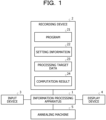
- FIG. 1 is a block diagram illustrating an example of a hardware configuration of the information processing apparatus according to the embodiment.
- an information processing apparatus 1 is coupled to a recording device 2, an input device 3, a display device 4, and an annealing machine 5 via a communication line such as a Universal Serial Bus (USB).
- a communication line such as a Universal Serial Bus (USB).
- USB Universal Serial Bus
- PC personal computer
- the recording device 2 is, for example, a hard disk drive (HDD), a solidstate drive (SSD), or the like.
- the recording device 2 stores a program 21, setting information 22, processing target data 23, a computation result 24, and so forth.
- the program 21 is program data that provides various functions in the information processing apparatus 1 when the program 21 is read and executed by a central processing unit (CPU) 11 (see FIG. 2 ) of the information processing apparatus 1.
- CPU central processing unit
- the setting information 22 is data in which various types of setting content when the CPU 11 of the information processing apparatus 1 executes the program 21 are described.
- the processing target data 23 is data to be optimized in the information processing apparatus 1.
- the processing target data 23 includes setting conditions related to an optimization problem such as an objective function and a variable definition for, for example, a design region that determines the shape of a product.
- the computation result 24 is data obtained by an optimization process of the information processing apparatus 1 based on the processing target data 23.
- the computation result 24 is data indicating the shape in the design region and the like.
- the input device 3 is a device that accepts data input from a user.
- a keyboard, a mouse, or the like may be applied to the input device 3 and receives input of an instruction, information, and the like from a user.
- the display device 4 is a display that displays processing results and the like of the information processing apparatus 1.
- a liquid crystal display (LCD) or the like may be applied to the display device 4.
- the annealing machine 5 is a computation device that processes a combinatorial optimization problem such as a quadratic unconstrained binary optimization (QUBO) at high speed under instructions from the information processing apparatus 1.
- Any computation device that is capable of solving the QUBO or the like such as a digital annealer (DA), simulated annealing (SA), quantum annealing (QA), or an Ising machine may be applied to the annealing machine 5.
- DA digital annealer
- SA simulated annealing
- QA quantum annealing
- Ising machine may be applied to the annealing machine 5.
- the annealing machine 5 upon receiving a parameter (initial value) to be set for an objective function from the information processing apparatus 1, the annealing machine 5 obtains an annealing solution based on the Ising model such that the value of the objective function approaches an optimum value.
- the annealing machine 5 outputs the annealing solution obtained as described above to the information processing apparatus 1.
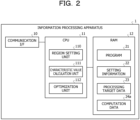
- FIG. 2 is a block diagram illustrating an example of a functional configuration of the information processing apparatus 1 according to the embodiment.
- the information processing apparatus 1 includes a communication interface (I/F) 10, the CPU 11, and a random-access memory (RAM) 12.
- I/F communication interface
- RAM random-access memory
- the communication I/F 10 is a communication interface that is coupled to an external apparatus or the like in a wired or wireless manner and that transmits and receives data to and from the external apparatus or the like under the control of the CPU 11.
- the communication I/F 10 transmits and receives the data to and from the recording device 2, the input device 3, the display device 4, and the annealing machine 5 that are coupled to the communication I/F 10 via the communication line such as the USB.
- the CPU 11 loads the program 21 read from the recording device 2 via the communication I/F 10 into the RAM 12 and sequentially executes the program 21, thereby centrally controlling operation of the information processing apparatus 1.
- the CPU 11 has functions as a region setting unit 110, a characteristic value calculation unit 111, and an optimization unit 112 by executing the program 21.
- the RAM 12 provides a work area for the CPU 11 to perform various types of processing.
- the RAM 12 stores, so as to be writable and readable to and from the CPU 11, computation data 24a related to computation in progress and the computation result 24 obtained by the processing of the CPU 11 in addition to the program 21, the setting information 22, and the processing target data 23 read from the recording device 2 via the communication I/F 10.
- the region setting unit 110 is a processing unit that sets a design region that determines the shape of a design target item.
- the region setting unit 110 sets a plurality of Gaussian functions (hereafter referred to as Gaussian basis functions) as basis functions of a shape function corresponding to the shape of the design target item for the design region designated by the coordinate information or the like in the variable definition included in the processing target data 23.
- Gaussian basis functions hereafter referred to as Gaussian basis functions
- the information processing apparatus 1 expresses the shape function.
- An arbitrary function may be expressed by normalizing and superposing a plurality of Gaussian basis functions as described in (Document 1) and (Document 2) below.
- a physical property such as the presence/absence of a material is determined by output of a normalized Gaussian network (NGnet, corresponding to a shape function) the value of which smoothly changes spatially.
- NGnet normalized Gaussian network
- the information processing apparatus 1 determines the physical property (presence or absence of the material or the like) of the design region based on the output of a shape function y (x, w) represented by Expression (1) below.
- w i represents a weight coefficient
- x represents a position vector
- N G represents the number of Gaussian basis functions
- G j (x) represents a jth Gaussian basis function.
- FIG. 3 is an explanatory diagram explaining an overview of region setting in the information processing apparatus 1 according to the embodiment.
- the information processing apparatus 1 optimizes the shape of a magnetic shield and obtains the shape of a magnetic body in a design region 203 so as to suppress leakage of a magnetic field (magnetic flux) generated from a coil 201 to a target region 202 with a smaller amount of magnetic body.
- the user generates in advance a CAE model as illustrated on the left side of FIG. 3 as a model to be optimized and registers the CAE model as the processing target data 23.
- the region setting unit 110 sets a plurality of Gaussian basis functions 301 for the design region 203. For each of the plurality of Gaussian basis functions 301, the region setting unit 110 sets a Gaussian basis function assuming a negative value as well as a Gaussian basis function assuming a positive value. Accordingly, the output of the shape function obtained by combining the plurality of Gaussian basis functions 301 has a large oscillation width compared to the case where only the Gaussian basis functions assuming a positive value is set (output in the case where the positive and negative Gaussian basis functions superpose on each other is 0).
- the information processing apparatus 1 increases the oscillation width of the output of the shape function as described above so as to enable improvement of accuracy of the physical property based on the shape function.
- the characteristic value calculation unit 111 is a processing unit that calculates a characteristic value corresponding to the shape (structure) based on the output of the shape function for the design region 203.
- a CAE solver or the like corresponds to the characteristic value calculation unit 111.
- the characteristic value calculation unit 111 calculates, as the characteristic value, a magnetic body area corresponding to the shape of the magnetic body in the design region 203, an average magnetic flux density of a leakage magnetic field in the target region 202, or the like.
- the optimization unit 112 is a processing unit that identifies (determines), by using the annealing machine 5, a shape that maximizes (or minimizes) the objective function as a disposition problem of the Gaussian basis functions 301 for the design region 203 in which the region setting unit 110 sets the plurality of Gaussian basis functions 301.
- the optimization unit 112 sets as the disposition problem of the positive and negative Gaussian basis functions 301 as represented by Expression (2) below and identifies the shape that maximizes (or minimizes) the objective function by annealing of the annealing machine 5.
- s i and z i ⁇ ⁇ 0, 1 ⁇ in the shape function y (x, s, z) correspond to bits of the annealing.
- s i is a bit indicating whether to dispose a Gaussian basis function of a positive value at the ith position
- z i is a bit indicating whether to dispose a Gaussian basis function of a negative value at the ith position.
- the optimization unit 112 randomly generates the bits of s i and z i to determine the disposition of the plurality of Gaussian basis functions 301 and obtains the shape function obtained by combining the disposed Gaussian basis functions 301.
- the optimization unit 112 based on the magnitude of the shape function (for example, the material is present when the function value > 0), the optimization unit 112 identifies the shape in the design region 203.
- FIG. 4 is an explanatory diagram explaining an overview of shape determination in the information processing apparatus 1 according to the embodiment.
- the positive and negative Gaussian basis functions 301 (s i , z i ) are set at each of the 96 positions.
- the weight coefficient (w i ) in the Gaussian basis functions 301 is a combination of s i and z i (w i ⁇ ⁇ -1, 0, 1 ⁇ ).
- the optimization unit 112 randomly determines the disposition of the Gaussian basis functions 301 to obtain a distribution of a value (y) of the shape function obtained by combining the disposed Gaussian basis functions 301.
- the optimization unit 112 identifies the material information (V e ) in the design region 203.
- the optimization unit 112 sets the material information (V e ) as a magnetic body in a case where y ⁇ 0 is satisfied and air (or other) in the case where y ⁇ 0 is not satisfied.
- the optimization unit 112 uses the characteristic value calculation unit 111 to calculate the characteristic value related to the objective function. By repeatedly performing the above-described processing, the optimization unit 112 identifies the shape that maximizes (or minimizes) the objective function.
- the optimization unit 112 may identify the shape that maximizes (or minimizes) the objective function not only by the above-described identification of the shape with the random search but also by a technique in which a scheme of a factorization. machine with quantum annealing (FMQA) is carried out by the DA (FM-DA).
- FMQA machine with quantum annealing
- FM-DA DA
- FM is an abbreviation of a Factorization Machine
- scheme of the FMQA is as in (Document 3) below.
- FM is as in (Document 4) below.
- the optimization unit 112 first generates initial training data including sets of the structures (shapes) and the characteristics. For example, the optimization unit 112 randomly determines the shape in the design region 203 similarly to the above-described random search, calculates the characteristic value of the structure by using the CAE solver (characteristic value calculation unit 111), and generates the training data including the sets of the structures and the characteristics. The user arbitrarily sets the number of pieces of initial training data to be generated.
- the optimization unit 112 generates the FM by machine learning based on the training data and converts the generated FM into the QUBO.
- the FM since the FM is in the format of the QUBO, generating the FM is equivalent to generating the QUBO.
- a machine learning model other than the FM may be used as long as the conversion into the QUBO is able to be performed.
- the optimization unit 112 uses the annealing machine 5 to optimize (perform annealing on) the QUBO converted from the FM and obtains an optimum structure (whether the individual Gaussian basis functions 301 are disposed) in which the characteristic is the best (the objective function is maximized or the minimized).
- the optimization unit 112 For the optimum structure obtained with the annealing machine 5, the optimization unit 112 combines the disposed Gaussian basis functions 301 to obtain the shape function and identifies the structure based on the magnitude of the shape function. Next, for the identified structure, the optimization unit 112 calculates the characteristic value by using the CAE solver (characteristic value calculation unit 111) and adds the characteristic value to the training data including the sets of the structures and the characteristics.
- the optimization unit 112 repeats the above-described processing related to the FM-DA until the end condition is satisfied to obtain the optimum structure (shape) in the design region 203.
- the end condition include a case where the maximum number of repetitions has been reached, a case where the amount of change of the objective function has not been present for a certain period of time, and so forth.
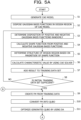
- FIGs. 5A and 5B are flowcharts illustrating an example of operation of the information processing apparatus according to the embodiment. As illustrated in FIG. 5A , when the processing is started, the information processing apparatus 1 generates the CAE model to be optimized based on an instruction from the user (S1).
- the region setting unit 110 disposes the plurality of Gaussian basis functions 301 in the design region 203 of the CAE model (S2).
- the optimization unit 112 randomly determines the disposition of the positive and negative Gaussian basis functions 301 (S3) and calculates the shape function by combining the disposed positive and negative Gaussian basis functions 301 (S4).
- the optimization unit 112 determines the structure (shape) of the design region 203 based on the magnitude of the shape function (S5) and calculates, for the determined structure, the characteristic value by using the CAE solver (characteristic value calculation unit 111) (S6).
- the optimization unit 112 adds the calculation result (characteristic value) together with the structure (array indicating whether the Gaussian basis functions 301 are disposed) to a training data set (S7).
- the optimization unit 112 determines whether an initial training data set is sufficient (the number of generations set by the user is satisfied) (S8). When the initial training data set is not sufficient (S8: No), the optimization unit 112 returns the processing to S3.
- the optimization unit 112 creates the FM by performing the machine learning based on the training data included in the training data set (S9).
- the optimization unit 112 converts the created FM into the QUBO (S10) and optimizes the converted QUBO by using, for example, DA of the annealing machine 5 (S11).
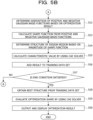
- the optimization unit 112 determines whether the positive and negative Gaussian basis functions 301 are disposed based on an optimization result (S12) and calculates the shape function by using the disposed positive and negative Gaussian basis functions 301 (S13).
- the optimization unit 112 determines the structure based on the magnitude of the shape function obtained by the calculation (S14) and calculates, for the determined structure, the characteristic value by using the CAE solver (characteristic value calculation unit 111) (S15).
- the optimization unit 112 adds the calculation result (characteristic value) together with the structure (array indicating whether the Gaussian basis functions 301 are disposed) to the training data set (S16).
- the optimization unit 112 determines whether the end condition such as the case where the maximum number of repetitions has been reached or the case where the amount of change of the objective function has not been present for a certain period of time is satisfied (S17). When the end condition is not satisfied (S17: No), the optimization unit 112 returns the processing to S9 (see FIG. 5A ).
- the optimization unit 112 obtains the best structure (that maximizes or minimizes the objective function) from the training data set (S18) and evaluates the optimization shape (for example, modeling of the shape or the like) by using the CAE solver (characteristic value calculation unit 111) (S19). Next, the optimization unit 112 outputs the optimization result such as an evaluation result to the display device 4 via the communication I/F 10 and causes the display device 4 to display the optimized result (S20).
- Optimization problems set as the targets in the (Embodiment example 1), the (Embodiment example 2), and the (Related art) are optimization of the shape of a magnetic shield.
- the objective function of Expression (3) below that minimizes the magnitude B T ave of an average magnetic flux density and a magnetic body area S mag in the target region 202 is obtained.
- E ⁇ E 1 B ave T + ⁇ E 2 S mag ⁇ min .
- E 1 is one tenth of the B T ave in a case where the entirety of the all design region 203 is air
- E 2 is S mag in a case where the entirety of the design region 203 is the magnetic body.
- Parameters are set in the target optimization problem as follows. It is assumed that the same parameter setting is used in the (Embodiment example 1), the (Embodiment example 2), and the (Related art).
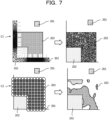
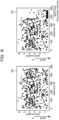
- FIGs. 6 to 8 are explanatory diagrams explaining results of the related art and the embodiment examples.
- case C1 indicates the result of (Related Art)
- case C2 indicates the result of the (Embodiment example 1)
- case C3 indicates the result of the (Embodiment example 2).
- a graph G1 of FIG. 6 indicates the relationships between energy (E) and the number of times of CAE analyses in the (Embodiment example 1), the (Embodiment example 2) and the (related art).
- a graph G2 indicates a distribution of the solutions in the (Embodiment example 1)
- a graph G3 indicates a distribution of the solutions in the (Embodiment example 2).
- the shape is smooth in the case C2 without the occurrence of a checkerboard problem.
- the results obtained in a portion of repetitive processing are concentrated in a small region of E.
- searching in a region where the E value is smaller is repeated, and the searching for the solution is performed more efficiently.
- the information processing apparatus 1 sets, for the design region 203, a plurality of Gaussian functions as the basis functions of the shape function corresponding to the shape of the design target item in the design region 203.
- the information processing apparatus 1 identifies whether to dispose the plurality of set Gaussian functions to identify the shape of the target item indicated by the shape function obtained by combining the plurality of Gaussian functions identified to be disposed.
- the information processing apparatus 1 may perform the annealing as the disposition problem of whether to dispose the plurality of Gaussian functions.
- the number of bits may be significantly reduced compared to the case where the annealing is performed as the problem of whether to dispose the material in each of the CAE meshes.
- convergence of the solution at the time of annealing may be improved, and the shape may be efficiently optimized.
- the shape of the target item is identified by the shape function obtained by combining the plurality of Gaussian functions, the occurrence of the checkerboard problem in which the material is formed into a discretely disposed shape may be suppressed.
- the information processing apparatus 1 For each of the shapes in which the plurality of Gaussian functions are arbitrarily disposed, the information processing apparatus 1 generates the FM based on the training data with which the characteristic value in the shape is associated. The information processing apparatus 1 converts the generated FM into the QUBO and identifies whether to dispose the plurality of Gaussian functions by using the annealing for the converted QUBO. Accordingly, the information processing apparatus 1 may change the optimization problem into the QUBO without QUBO formulation and to identify the shape by using the annealing for the QUBO.
- the information processing apparatus 1 sets a plurality of Gaussian functions of positive values and sets a plurality of Gaussian functions of negative values respectively corresponding to the Gaussian functions of positive values. As described above, the information processing apparatus 1 sets as the disposition problem of the Gaussian functions of positive values and negative values, and accordingly, the shape may be highly accurately identified compared to the case of, for example, setting as the disposition problem of only the Gaussian functions of positive values.
Landscapes
- Engineering & Computer Science (AREA)
- Physics & Mathematics (AREA)
- Theoretical Computer Science (AREA)
- Evolutionary Computation (AREA)
- Geometry (AREA)
- General Physics & Mathematics (AREA)
- General Engineering & Computer Science (AREA)
- Computer Hardware Design (AREA)
- Medical Informatics (AREA)
- Software Systems (AREA)
- Computer Vision & Pattern Recognition (AREA)
- Artificial Intelligence (AREA)
- Computational Mathematics (AREA)
- Mathematical Analysis (AREA)
- Mathematical Optimization (AREA)
- Pure & Applied Mathematics (AREA)
- Management, Administration, Business Operations System, And Electronic Commerce (AREA)
Abstract
Description
- The embodiment discussed herein is related to an optimization program, a method for optimization, and an information processing apparatus.
- Hitherto, in optimization of a product shape in computer aided engineering (CAE), topology optimization using annealing such as a digital annealer (DA) has been known. In this topology optimization, bits are assigned to CAE meshes in a design region that determines the shape of a product, and whether a material is disposed in the individual CAE meshes is represented by a value ("1" or "0") of the bit. When the value of each bit that maximizes (or minimizes) the value of the objective function (also referred to as an evaluation function) is obtained by using annealing, the shape of the product is optimized.
-
Japanese Laid-open Patent Publication No. 2022-68606 - However, according to the above-described related art, when the meshes of the CAE are made to be finer to increase a CAE scale in order to increase accuracy, the number of bits to be used becomes enormous. Thus, there is a problem in that efficient performance of the topology optimization is difficult. For example, when the number of bits is enormous, convergence of a solution at the time of annealing degrades, and it is difficult to obtain a good solution without increasing the number of trials. Also, a checkerboard problem in which a shape formed by discretely disposing the material in the design region is obtained as an optimum shape may occur in some cases.
- In one aspect, an object is to provide an optimization program, a method for optimization, and an information processing apparatus that may efficiently optimize a shape.
- According to an aspect of the embodiments, an optimization program that causes at least one computer to execute a process, the process includes setting, for a region of a design target, a plurality of Gaussian functions as basis functions of a shape function that corresponds to a shape of a design target item in the region; and identifying the shape of the design target item indicated by the shape function obtained by combining the plurality of Gaussian functions identified to be disposed by identifying whether to dispose the plurality of Gaussian functions.
- The shape may be efficiently optimized.
-
-
FIG. 1 is a block diagram illustrating an example of a hardware configuration of an information processing apparatus according to an embodiment; -
FIG. 2 is a block diagram illustrating an example of a functional configuration of the information processing apparatus according to the embodiment; -
FIG. 3 is an explanatory diagram explaining an overview of region setting in the information processing apparatus according to the embodiment; -
FIG. 4 is an explanatory diagram explaining an overview of shape determination in the information processing apparatus according to the embodiment; -
FIG. 5A is a flowchart illustrating an example of operation of the information processing apparatus according to the embodiment; -
FIG. 5B is a flowchart illustrating the example of the operation of the information processing apparatus according to the embodiment; -
FIG. 6 is an explanatory diagram explaining results of the related art and embodiment examples; -
FIG. 7 is an explanatory diagram explaining the results of the related art and embodiment examples; and -
FIG. 8 is an explanatory diagram explaining the results of the related art and embodiment examples. - An optimization program, a method for optimization, and an information processing apparatus according to an embodiment will be described below with reference to the drawings. In the embodiment, configurations having the same functions are denoted by the same reference numerals, thereby redundant description thereof is omitted. The optimization program, the method for optimization, and the information processing apparatus described in the embodiment below are merely exemplary. The optimization program, the method for optimization, or the information processing apparatus does not limit the embodiment. Portions of the embodiment below may be appropriately combined as long as the portions of the embodiment do not contradict each other.
-
FIG. 1 is a block diagram illustrating an example of a hardware configuration of the information processing apparatus according to the embodiment. As illustrated inFIG. 1 , aninformation processing apparatus 1 is coupled to arecording device 2, aninput device 3, adisplay device 4, and anannealing machine 5 via a communication line such as a Universal Serial Bus (USB). For example, a personal computer (PC) or the like may be applied to theinformation processing apparatus 1. - The
recording device 2 is, for example, a hard disk drive (HDD), a solidstate drive (SSD), or the like. Therecording device 2 stores aprogram 21, settinginformation 22, processingtarget data 23, acomputation result 24, and so forth. - The
program 21 is program data that provides various functions in theinformation processing apparatus 1 when theprogram 21 is read and executed by a central processing unit (CPU) 11 (seeFIG. 2 ) of theinformation processing apparatus 1. - The
setting information 22 is data in which various types of setting content when theCPU 11 of theinformation processing apparatus 1 executes theprogram 21 are described. Theprocessing target data 23 is data to be optimized in theinformation processing apparatus 1. For example, theprocessing target data 23 includes setting conditions related to an optimization problem such as an objective function and a variable definition for, for example, a design region that determines the shape of a product. Thecomputation result 24 is data obtained by an optimization process of theinformation processing apparatus 1 based on theprocessing target data 23. For example, thecomputation result 24 is data indicating the shape in the design region and the like. - The
input device 3 is a device that accepts data input from a user. For example, a keyboard, a mouse, or the like may be applied to theinput device 3 and receives input of an instruction, information, and the like from a user. Thedisplay device 4 is a display that displays processing results and the like of theinformation processing apparatus 1. For example, a liquid crystal display (LCD) or the like may be applied to thedisplay device 4. - The annealing
machine 5 is a computation device that processes a combinatorial optimization problem such as a quadratic unconstrained binary optimization (QUBO) at high speed under instructions from theinformation processing apparatus 1. Any computation device that is capable of solving the QUBO or the like such as a digital annealer (DA), simulated annealing (SA), quantum annealing (QA), or an Ising machine may be applied to the annealingmachine 5. For example, upon receiving a parameter (initial value) to be set for an objective function from theinformation processing apparatus 1, the annealingmachine 5 obtains an annealing solution based on the Ising model such that the value of the objective function approaches an optimum value. The annealingmachine 5 outputs the annealing solution obtained as described above to theinformation processing apparatus 1. -
FIG. 2 is a block diagram illustrating an example of a functional configuration of theinformation processing apparatus 1 according to the embodiment. As illustrated inFIG. 2 , theinformation processing apparatus 1 includes a communication interface (I/F) 10, theCPU 11, and a random-access memory (RAM) 12. - The communication I/
F 10 is a communication interface that is coupled to an external apparatus or the like in a wired or wireless manner and that transmits and receives data to and from the external apparatus or the like under the control of theCPU 11. For example, the communication I/F 10 transmits and receives the data to and from therecording device 2, theinput device 3, thedisplay device 4, and the annealingmachine 5 that are coupled to the communication I/F 10 via the communication line such as the USB. - The
CPU 11 loads theprogram 21 read from therecording device 2 via the communication I/F 10 into theRAM 12 and sequentially executes theprogram 21, thereby centrally controlling operation of theinformation processing apparatus 1. For example, theCPU 11 has functions as aregion setting unit 110, a characteristicvalue calculation unit 111, and anoptimization unit 112 by executing theprogram 21. - The
RAM 12 provides a work area for theCPU 11 to perform various types of processing. For example, theRAM 12 stores, so as to be writable and readable to and from theCPU 11,computation data 24a related to computation in progress and thecomputation result 24 obtained by the processing of theCPU 11 in addition to theprogram 21, thesetting information 22, and theprocessing target data 23 read from therecording device 2 via the communication I/F 10. - The
region setting unit 110 is a processing unit that sets a design region that determines the shape of a design target item. For example, theregion setting unit 110 sets a plurality of Gaussian functions (hereafter referred to as Gaussian basis functions) as basis functions of a shape function corresponding to the shape of the design target item for the design region designated by the coordinate information or the like in the variable definition included in theprocessing target data 23. - By normalizing and superposing (combining) the plurality of Gaussian basis functions set as described above, the
information processing apparatus 1 expresses the shape function. An arbitrary function may be expressed by normalizing and superposing a plurality of Gaussian basis functions as described in (Document 1) and (Document 2) below. - (Document 1): T. Sato, K. Watanabe and H. Igarashi, "Multimaterial Topology Optimization of Electric Machines Based on Normalized Gaussian Network", IEEE Trans. Magn., vol. 51, no. 3, pp. 1-4, March 2015.
- (Document 2): Y. Otomo and H. Igarashi, "A 3-D Topology Optimization of Magnetic Cores for Wireless Power Transfer Device", IEEE Trans. Magn., vol. 55, no. 6, pp. 1-5, June 2019.
- As described above, in the
information processing apparatus 1, instead of giving an on/off state (whether the material is disposed) independently to CAE meshes, a physical property such as the presence/absence of a material is determined by output of a normalized Gaussian network (NGnet, corresponding to a shape function) the value of which smoothly changes spatially. - For example, the
information processing apparatus 1 determines the physical property (presence or absence of the material or the like) of the design region based on the output of a shape function y (x, w) represented by Expression (1) below.
- In Expression (1), wi represents a weight coefficient, x represents a position vector, NG represents the number of Gaussian basis functions, and Gj(x) represents a jth Gaussian basis function. For example, based on the output of the shape function (y) represented by Expression (1), the
information processing apparatus 1 determines that the material is present in a case where y (xe, w) ≥ 0 (< 0) is satisfied for material information of an element (e). -
FIG. 3 is an explanatory diagram explaining an overview of region setting in theinformation processing apparatus 1 according to the embodiment. As illustrated inFIG. 3 , it is assumed that, as an example, theinformation processing apparatus 1 optimizes the shape of a magnetic shield and obtains the shape of a magnetic body in adesign region 203 so as to suppress leakage of a magnetic field (magnetic flux) generated from acoil 201 to atarget region 202 with a smaller amount of magnetic body. For example, the user generates in advance a CAE model as illustrated on the left side ofFIG. 3 as a model to be optimized and registers the CAE model as theprocessing target data 23. - As in (Document 1) and (Document 2), the
region setting unit 110 sets a plurality of Gaussian basis functions 301 for thedesign region 203. For each of the plurality of Gaussian basis functions 301, theregion setting unit 110 sets a Gaussian basis function assuming a negative value as well as a Gaussian basis function assuming a positive value. Accordingly, the output of the shape function obtained by combining the plurality of Gaussian basis functions 301 has a large oscillation width compared to the case where only the Gaussian basis functions assuming a positive value is set (output in the case where the positive and negative Gaussian basis functions superpose on each other is 0). Theinformation processing apparatus 1 increases the oscillation width of the output of the shape function as described above so as to enable improvement of accuracy of the physical property based on the shape function. - The characteristic
value calculation unit 111 is a processing unit that calculates a characteristic value corresponding to the shape (structure) based on the output of the shape function for thedesign region 203. For example, a CAE solver or the like corresponds to the characteristicvalue calculation unit 111. As an example, in the case of optimizing the shape of the magnetic shield, the characteristicvalue calculation unit 111 calculates, as the characteristic value, a magnetic body area corresponding to the shape of the magnetic body in thedesign region 203, an average magnetic flux density of a leakage magnetic field in thetarget region 202, or the like. - The
optimization unit 112 is a processing unit that identifies (determines), by using theannealing machine 5, a shape that maximizes (or minimizes) the objective function as a disposition problem of the Gaussian basis functions 301 for thedesign region 203 in which theregion setting unit 110 sets the plurality of Gaussian basis functions 301. - For example, the
optimization unit 112 sets as the disposition problem of the positive and negative Gaussian basis functions 301 as represented by Expression (2) below and identifies the shape that maximizes (or minimizes) the objective function by annealing of theannealing machine 5.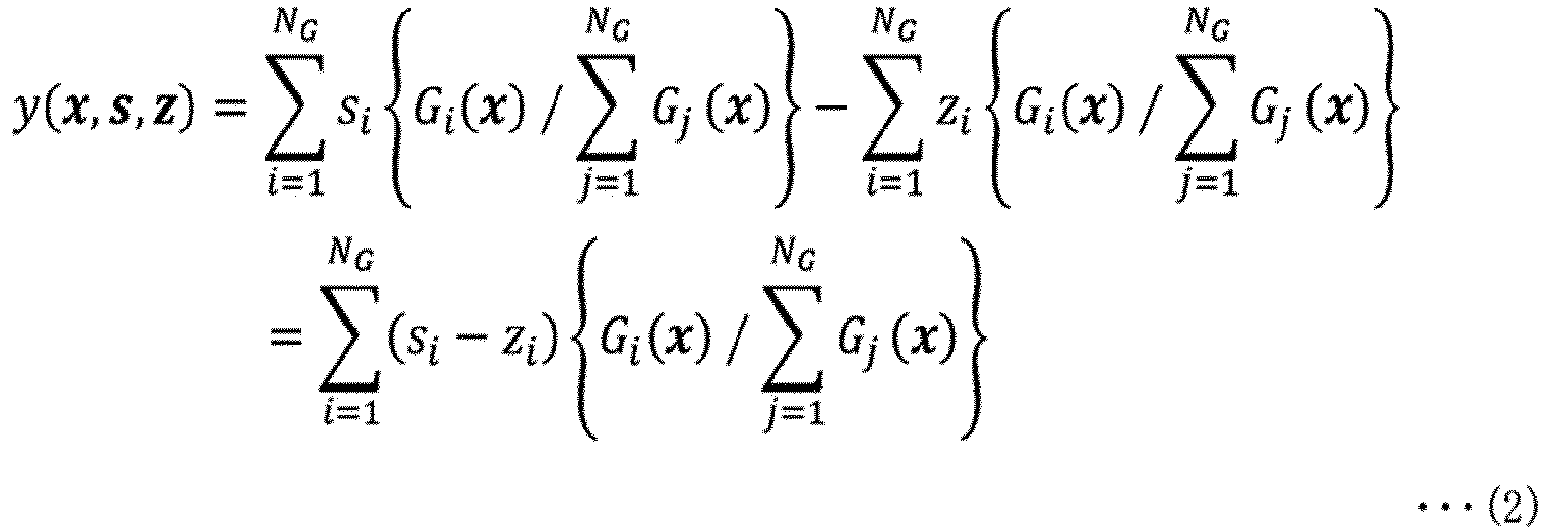
- Here, si and zi ∈ {0, 1} in the shape function y (x, s, z) correspond to bits of the annealing. For example, si is a bit indicating whether to dispose a Gaussian basis function of a positive value at the ith position, and zi is a bit indicating whether to dispose a Gaussian basis function of a negative value at the ith position.
- For example, the
optimization unit 112 randomly generates the bits of si and zi to determine the disposition of the plurality of Gaussian basis functions 301 and obtains the shape function obtained by combining the disposed Gaussian basis functions 301. Next, based on the magnitude of the shape function (for example, the material is present when the function value > 0), theoptimization unit 112 identifies the shape in thedesign region 203. -
FIG. 4 is an explanatory diagram explaining an overview of shape determination in theinformation processing apparatus 1 according to the embodiment. As illustrated inFIG. 4 , it is assumed that the Gaussian basis functions 301 are set at 96 positions (i = 1, 2, ..., 96) in thedesign region 203. The positive and negative Gaussian basis functions 301 (si, zi) are set at each of the 96 positions. The weight coefficient (wi) in the Gaussian basis functions 301 is a combination of si and zi (wi ∈ {-1, 0, 1}). - For the
design region 203, theoptimization unit 112 randomly determines the disposition of the Gaussian basis functions 301 to obtain a distribution of a value (y) of the shape function obtained by combining the disposed Gaussian basis functions 301. Next, based on the magnitude of the shape function, theoptimization unit 112 identifies the material information (Ve) in thedesign region 203. For example, theoptimization unit 112 sets the material information (Ve) as a magnetic body in a case where y ≥ 0 is satisfied and air (or other) in the case where y ≥ 0 is not satisfied. - Next, the
optimization unit 112 uses the characteristicvalue calculation unit 111 to calculate the characteristic value related to the objective function. By repeatedly performing the above-described processing, theoptimization unit 112 identifies the shape that maximizes (or minimizes) the objective function. - The
optimization unit 112 may identify the shape that maximizes (or minimizes) the objective function not only by the above-described identification of the shape with the random search but also by a technique in which a scheme of a factorization. machine with quantum annealing (FMQA) is carried out by the DA (FM-DA). - Here, FM is an abbreviation of a Factorization Machine, and the scheme of the FMQA is as in (Document 3) below. Also, the FM is as in (Document 4) below.
- (Document 3): K. Kitai et al.,
- (Document 4): S. Rendle, "Factorization Machines", 2010 IEEE International Conference on Data Mining, 2010, pp. 995-1000, doi: 10.1109/ICDM.2010.127
- In the FM-DA, the
optimization unit 112 first generates initial training data including sets of the structures (shapes) and the characteristics. For example, theoptimization unit 112 randomly determines the shape in thedesign region 203 similarly to the above-described random search, calculates the characteristic value of the structure by using the CAE solver (characteristic value calculation unit 111), and generates the training data including the sets of the structures and the characteristics. The user arbitrarily sets the number of pieces of initial training data to be generated. - Next, the
optimization unit 112 generates the FM by machine learning based on the training data and converts the generated FM into the QUBO. As described in (Document 4), since the FM is in the format of the QUBO, generating the FM is equivalent to generating the QUBO. Although the case where the FM is converted into the QUBO is described as the example according to the present embodiment, a machine learning model other than the FM may be used as long as the conversion into the QUBO is able to be performed. - Next, the
optimization unit 112 uses theannealing machine 5 to optimize (perform annealing on) the QUBO converted from the FM and obtains an optimum structure (whether the individual Gaussian basis functions 301 are disposed) in which the characteristic is the best (the objective function is maximized or the minimized). - For the optimum structure obtained with the
annealing machine 5, theoptimization unit 112 combines the disposed Gaussian basis functions 301 to obtain the shape function and identifies the structure based on the magnitude of the shape function. Next, for the identified structure, theoptimization unit 112 calculates the characteristic value by using the CAE solver (characteristic value calculation unit 111) and adds the characteristic value to the training data including the sets of the structures and the characteristics. - The
optimization unit 112 repeats the above-described processing related to the FM-DA until the end condition is satisfied to obtain the optimum structure (shape) in thedesign region 203. Examples of the end condition include a case where the maximum number of repetitions has been reached, a case where the amount of change of the objective function has not been present for a certain period of time, and so forth. -
FIGs. 5A and5B are flowcharts illustrating an example of operation of the information processing apparatus according to the embodiment. As illustrated inFIG. 5A , when the processing is started, theinformation processing apparatus 1 generates the CAE model to be optimized based on an instruction from the user (S1). - Next, the
region setting unit 110 disposes the plurality of Gaussian basis functions 301 in thedesign region 203 of the CAE model (S2). Next, theoptimization unit 112 randomly determines the disposition of the positive and negative Gaussian basis functions 301 (S3) and calculates the shape function by combining the disposed positive and negative Gaussian basis functions 301 (S4). - Next, the
optimization unit 112 determines the structure (shape) of thedesign region 203 based on the magnitude of the shape function (S5) and calculates, for the determined structure, the characteristic value by using the CAE solver (characteristic value calculation unit 111) (S6). Next, theoptimization unit 112 adds the calculation result (characteristic value) together with the structure (array indicating whether the Gaussian basis functions 301 are disposed) to a training data set (S7). - Next, the
optimization unit 112 determines whether an initial training data set is sufficient (the number of generations set by the user is satisfied) (S8). When the initial training data set is not sufficient (S8: No), theoptimization unit 112 returns the processing to S3. - In a case where the initial training data set is sufficient (S8: Yes), the
optimization unit 112 creates the FM by performing the machine learning based on the training data included in the training data set (S9). - Next, the
optimization unit 112 converts the created FM into the QUBO (S10) and optimizes the converted QUBO by using, for example, DA of the annealing machine 5 (S11). - Next, as illustrated in
FIG. 5B , theoptimization unit 112 determines whether the positive and negative Gaussian basis functions 301 are disposed based on an optimization result (S12) and calculates the shape function by using the disposed positive and negative Gaussian basis functions 301 (S13). Next, theoptimization unit 112 determines the structure based on the magnitude of the shape function obtained by the calculation (S14) and calculates, for the determined structure, the characteristic value by using the CAE solver (characteristic value calculation unit 111) (S15). Next, theoptimization unit 112 adds the calculation result (characteristic value) together with the structure (array indicating whether the Gaussian basis functions 301 are disposed) to the training data set (S16). - Next, the
optimization unit 112 determines whether the end condition such as the case where the maximum number of repetitions has been reached or the case where the amount of change of the objective function has not been present for a certain period of time is satisfied (S17). When the end condition is not satisfied (S17: No), theoptimization unit 112 returns the processing to S9 (seeFIG. 5A ). - When the end condition is satisfied (S17: Yes), the
optimization unit 112 obtains the best structure (that maximizes or minimizes the objective function) from the training data set (S18) and evaluates the optimization shape (for example, modeling of the shape or the like) by using the CAE solver (characteristic value calculation unit 111) (S19). Next, theoptimization unit 112 outputs the optimization result such as an evaluation result to thedisplay device 4 via the communication I/F 10 and causes thedisplay device 4 to display the optimized result (S20). - Next, comparison between (Embodiment example 1) and (Embodiment example 2) and the (Related art) according to the above-described embodiment is described. The (Embodiment example 1), the (Embodiment example 2), and the (Related art) are as follows.
- (Embodiment example 1): For the
design region 203, optimization of the shape by random searching with the disposition problem of 96 Gaussian basis functions 301 (192 positive and negative Gaussian basis functions 301) - (Embodiment example 2): For the
design region 203, optimization of the shape by the FM-DA with the disposition problem of 96 Gaussian basis functions 301 (192 positive and negative Gaussian basis functions 301) - Optimization problems set as the targets in the (Embodiment example 1), the (Embodiment example 2), and the (Related art) are optimization of the shape of a magnetic shield. For example, in the target optimization problem, the objective function of Expression (3) below that minimizes the magnitude BT ave of an average magnetic flux density and a magnetic body area Smag in the
target region 202 is obtained.
- In Expression (3), E1 is one tenth of the BT ave in a case where the entirety of the all
design region 203 is air, and E2 is Smag in a case where the entirety of thedesign region 203 is the magnetic body. - Parameters are set in the target optimization problem as follows. It is assumed that the same parameter setting is used in the (Embodiment example 1), the (Embodiment example 2), and the (Related art).
- [Parameter settings] Initial point: 384 (96 × 4), Number of repetitions: 96, Total number of times of CAE calculation: 480(384 + 96) α = 0.5, β = 0.5
-
FIGs. 6 to 8 are explanatory diagrams explaining results of the related art and the embodiment examples. InFIGs. 6 and7 , case C1 indicates the result of (Related Art), case C2 indicates the result of the (Embodiment example 1), and case C3 indicates the result of the (Embodiment example 2). A graph G1 ofFIG. 6 indicates the relationships between energy (E) and the number of times of CAE analyses in the (Embodiment example 1), the (Embodiment example 2) and the (related art). InFIG. 8 , a graph G2 indicates a distribution of the solutions in the (Embodiment example 1), and a graph G3 indicates a distribution of the solutions in the (Embodiment example 2). - As illustrated in
FIG. 6 , for the same number of CAE analyses, in the (Embodiment example 1) and the (Embodiment example 2), good solutions having smaller E values than that in the (Related art) are obtained. For the annealing, 4402 bits (the number of CAE meshes in the design region 203) are used in the (Related art) whereas only 192 bits (the number of dispositions of the positive and negative Gaussian basis functions 301) are used in the (Embodiment example 1) and the (Embodiment example 2). For example, the number of bits used for the annealing may be significantly reduced in the (Embodiment example 1) and the (Embodiment example 2). - As illustrated in
FIG. 7 , as clearly seen from a comparison between the shape (right side) of thedesign region 203 in the case C1 of the (related art) and the shape (right side) of thedesign region 203 in the case C2 of the (Embodiment example 1), the shape is smooth in the case C2 without the occurrence of a checkerboard problem. - As illustrated in
FIG. 8 , compared to the graph G2 of the (Embodiment example 1), in the graph G3 of the (Embodiment example 2) using the FM-DA, the results obtained in a portion of repetitive processing are concentrated in a small region of E. For example, in the (Embodiment example 2), as in the graph G1a ofFIG. 6 , searching in a region where the E value is smaller is repeated, and the searching for the solution is performed more efficiently. - As has been described, the
information processing apparatus 1 sets, for thedesign region 203, a plurality of Gaussian functions as the basis functions of the shape function corresponding to the shape of the design target item in thedesign region 203. Theinformation processing apparatus 1 identifies whether to dispose the plurality of set Gaussian functions to identify the shape of the target item indicated by the shape function obtained by combining the plurality of Gaussian functions identified to be disposed. - Accordingly, the
information processing apparatus 1 may perform the annealing as the disposition problem of whether to dispose the plurality of Gaussian functions. Thus, the number of bits may be significantly reduced compared to the case where the annealing is performed as the problem of whether to dispose the material in each of the CAE meshes. For this reason, with theinformation processing apparatus 1, convergence of the solution at the time of annealing may be improved, and the shape may be efficiently optimized. Also with theinformation processing apparatus 1, since the shape of the target item is identified by the shape function obtained by combining the plurality of Gaussian functions, the occurrence of the checkerboard problem in which the material is formed into a discretely disposed shape may be suppressed. - For each of the shapes in which the plurality of Gaussian functions are arbitrarily disposed, the
information processing apparatus 1 generates the FM based on the training data with which the characteristic value in the shape is associated. Theinformation processing apparatus 1 converts the generated FM into the QUBO and identifies whether to dispose the plurality of Gaussian functions by using the annealing for the converted QUBO. Accordingly, theinformation processing apparatus 1 may change the optimization problem into the QUBO without QUBO formulation and to identify the shape by using the annealing for the QUBO. - The
information processing apparatus 1 sets a plurality of Gaussian functions of positive values and sets a plurality of Gaussian functions of negative values respectively corresponding to the Gaussian functions of positive values. As described above, theinformation processing apparatus 1 sets as the disposition problem of the Gaussian functions of positive values and negative values, and accordingly, the shape may be highly accurately identified compared to the case of, for example, setting as the disposition problem of only the Gaussian functions of positive values.
Claims (9)
- An optimization program that causes at least one computer to execute a process, the process comprising:setting, for a region of a design target, a plurality of Gaussian functions as basis functions of a shape function that corresponds to a shape of a design target item in the region; andidentifying the shape of the design target item indicated by the shape function obtained by combining the plurality of Gaussian functions identified to be disposed by identifying whether to dispose the plurality of Gaussian functions.
- The optimization program according to claim 1, whereinthe plurality of Gaussian functions are arbitrary disposed in a plurality of the shapes, whereinthe identifying includes:generating, for each of the shapes in which the plurality of Gaussian functions are arbitrarily disposed, a factorization machine based on training data with which a characteristic value in the shape is associated;converting the generated factorization machine into quadratic unconstrained binary optimization; andidentifying whether to dispose the plurality of Gaussian functions by annealing for the converted quadratic unconstrained binary optimization.
- The optimization program according to claim 1, wherein
the setting includes setting a plurality of Gaussian functions of positive values and a plurality of Gaussian functions of negative values that respectively correspond to the Gaussian functions of positive values. - An optimization method for a computer to execute a process comprising:setting, for a region of a design target, a plurality of Gaussian functions as basis functions of a shape function that corresponds to a shape of a design target item in the region; andidentifying the shape of the design target item indicated by the shape function obtained by combining the plurality of Gaussian functions identified to be disposed by identifying whether to dispose the plurality of Gaussian functions.
- The optimization method according to claim 4, whereinthe plurality of Gaussian functions are arbitrary disposed in a plurality of the shapes, whereinthe identifying includes:generating, for each of the shapes in which the plurality of Gaussian functions are arbitrarily disposed, a factorization machine based on training data with which a characteristic value in the shape is associated;converting the generated factorization machine into quadratic unconstrained binary optimization; andidentifying whether to dispose the plurality of Gaussian functions by annealing for the converted quadratic unconstrained binary optimization.
- The optimization method according to claim 4, wherein
the setting includes setting a plurality of Gaussian functions of positive values and a plurality of Gaussian functions of negative values that respectively correspond to the Gaussian functions of positive values. - An information processing apparatus comprising:
a control unit configured to:set, for a region of a design target, a plurality of Gaussian functions as basis functions of a shape function that corresponds to a shape of a design target item in the region, andidentify the shape of the design target item indicated by the shape function obtained by combining the plurality of Gaussian functions identified to be disposed by identifying whether to dispose the plurality of Gaussian functions. - The information processing apparatus according to claim 7, whereinthe plurality of Gaussian functions are arbitrary disposed in a plurality of the shapes, whereinthe control unit is further configured to:generate, for each of the shapes in which the plurality of Gaussian functions are arbitrarily disposed, a factorization machine based on training data with which a characteristic value in the shape is associated,convert the generated factorization machine into quadratic unconstrained binary optimization, andidentify whether to dispose the plurality of Gaussian functions by annealing for the converted quadratic unconstrained binary optimization.
- The information processing apparatus according to claim 7, wherein the control unit is further configured to:
set a plurality of Gaussian functions of positive values and a plurality of Gaussian functions of negative values that respectively correspond to the Gaussian functions of positive values.
Applications Claiming Priority (1)
| Application Number | Priority Date | Filing Date | Title |
|---|---|---|---|
| JP2022166472A JP2024059008A (en) | 2022-10-17 | 2022-10-17 | OPTIMIZATION PROGRAM, OPTIMIZATION METHOD, AND INFORMATION PROCESSING APPARATUS |
Publications (1)
| Publication Number | Publication Date |
|---|---|
| EP4357959A1 true EP4357959A1 (en) | 2024-04-24 |
Family
ID=87060305
Family Applications (1)
| Application Number | Title | Priority Date | Filing Date |
|---|---|---|---|
| EP23182265.1A Pending EP4357959A1 (en) | 2022-10-17 | 2023-06-29 | Optimization program, method for optimization, and information processing apparatus |
Country Status (4)
| Country | Link |
|---|---|
| US (1) | US20240135070A1 (en) |
| EP (1) | EP4357959A1 (en) |
| JP (1) | JP2024059008A (en) |
| CN (1) | CN117910063A (en) |
Citations (1)
| Publication number | Priority date | Publication date | Assignee | Title |
|---|---|---|---|---|
| US20220129605A1 (en) * | 2020-10-22 | 2022-04-28 | Fujitsu Limited | Optimization device, optimization method, and computer-readable recording medium storing optimization program |
-
2022
- 2022-10-17 JP JP2022166472A patent/JP2024059008A/en active Pending
-
2023
- 2023-06-26 US US18/340,925 patent/US20240135070A1/en active Pending
- 2023-06-29 EP EP23182265.1A patent/EP4357959A1/en active Pending
- 2023-07-13 CN CN202310861879.8A patent/CN117910063A/en active Pending
Patent Citations (2)
| Publication number | Priority date | Publication date | Assignee | Title |
|---|---|---|---|---|
| US20220129605A1 (en) * | 2020-10-22 | 2022-04-28 | Fujitsu Limited | Optimization device, optimization method, and computer-readable recording medium storing optimization program |
| JP2022068606A (en) | 2020-10-22 | 2022-05-10 | 富士通株式会社 | Optimization device, optimization method, and optimization program |
Non-Patent Citations (6)
| Title |
|---|
| K. KITAI ET AL., PHYS. REV. RESEARCH, vol. 2, 2020, Retrieved from the Internet <URL:https://doi.org/10.1103/PhysRevResearch.2.013319> |
| OTOMO YOSHITSUGU ET AL: "A 3-D Topology Optimization of Magnetic Cores for Wireless Power Transfer Device", IEEE TRANSACTIONS ON MAGNETICS, IEEE, USA, vol. 55, no. 6, 1 June 2019 (2019-06-01), pages 1 - 5, XP011724328, ISSN: 0018-9464, [retrieved on 20190515], DOI: 10.1109/TMAG.2019.2900744 * |
| S. RENDLE: "Factorization Machines", 2010 IEEE INTERNATIONAL CONFERENCE ON DATA MINING, 2010, pages 995 - 1000, XP055562823, DOI: 10.1109/ICDM.2010.127 |
| STEFFEN RENDLE: "Factorization Machines", DATA MINING (ICDM), 2010 IEEE 10TH INTERNATIONAL CONFERENCE ON, 1 December 2010 (2010-12-01), Piscataway, NJ, USA, pages 995 - 1000, XP055562823, ISBN: 978-1-4244-9131-5, DOI: 10.1109/ICDM.2010.127 * |
| T. SATOK. WATANABEH. IGARASHI: "Multimaterial Topology Optimization of Electric Machines Based on Normalized Gaussian Network", IEEE TRANS. MAGN., vol. 51, no. 3, March 2015 (2015-03-01), pages 1 - 4, XP011579573, DOI: 10.1109/TMAG.2014.2359972 |
| Y. OTOMOH. IGARASHI: "A 3-D Topology Optimization of Magnetic Cores for Wireless Power Transfer Device", IEEE TRANS. MAGN., vol. 55, no. 6, June 2019 (2019-06-01), pages 1 - 5, XP011724328, DOI: 10.1109/TMAG.2019.2900744 |
Also Published As
| Publication number | Publication date |
|---|---|
| JP2024059008A (en) | 2024-04-30 |
| CN117910063A (en) | 2024-04-19 |
| US20240135070A1 (en) | 2024-04-25 |
Similar Documents
| Publication | Publication Date | Title |
|---|---|---|
| CN114219076B (en) | Quantum neural network training method and device, electronic equipment and medium | |
| Poloni et al. | Hybridization of a multi-objective genetic algorithm, a neural network and a classical optimizer for a complex design problem in fluid dynamics | |
| Hussein et al. | A generative kriging surrogate model for constrained and unconstrained multi-objective optimization | |
| US20190235033A1 (en) | Simulation Device, Recording Medium, and Simulation Method | |
| US20230087100A1 (en) | Pulse-based quantum gate implementation | |
| EP3955175B1 (en) | Information processing system using an ising model | |
| EP3996000A1 (en) | Method and apparatus for quantizing parameters of neural network | |
| CN112115407A (en) | Yixin machine data input equipment and method for inputting data into Yi xin machine | |
| CN121816577A (en) | Electric drive unit simulation | |
| EP4357959A1 (en) | Optimization program, method for optimization, and information processing apparatus | |
| CN116821745B (en) | Control method and system of intelligent wire-cut slow-moving wire equipment | |
| Hussain et al. | Optimization through genetic algorithm with a new and efficient crossover operator | |
| Annicchiarico et al. | Structural shape optimization using genetic algorithms | |
| US11386332B2 (en) | Optimization calculation method and information processing apparatus | |
| He et al. | Training quantum self-attention model in near-term quantum computer | |
| Boulas et al. | A hybrid evolutionary algorithm approach for estimating the throughput of short reliable approximately balanced production lines | |
| CN115630701A (en) | System characteristic information determination method, device, electronic equipment and medium | |
| EP4506862A1 (en) | Method for solving an optimization problem in adiabatic quantum computing | |
| Cheng | A single-machine two-agent scheduling problem by GA approach | |
| US20240289664A1 (en) | Method and apparatus for processing a data simulation task, electronic device, and storage medium | |
| Kheireddine et al. | Application of PSO and TLBO algorithms with neural network for optimal design of electrical machines | |
| US20240005192A1 (en) | Method and apparatus for fabricating quantum circuit, device, medium, and product | |
| WO2020245937A1 (en) | Inference processing device and inference processing method | |
| Li et al. | Safe reinforcement learning via episodic control | |
| EP4607411A1 (en) | Digital-analog counterdiabatic quantum algorithm (dacqa) |
Legal Events
| Date | Code | Title | Description |
|---|---|---|---|
| PUAI | Public reference made under article 153(3) epc to a published international application that has entered the european phase |
Free format text: ORIGINAL CODE: 0009012 |
|
| STAA | Information on the status of an ep patent application or granted ep patent |
Free format text: STATUS: THE APPLICATION HAS BEEN PUBLISHED |
|
| STAA | Information on the status of an ep patent application or granted ep patent |
Free format text: STATUS: REQUEST FOR EXAMINATION WAS MADE |
|
| AK | Designated contracting states |
Kind code of ref document: A1 Designated state(s): AL AT BE BG CH CY CZ DE DK EE ES FI FR GB GR HR HU IE IS IT LI LT LU LV MC ME MK MT NL NO PL PT RO RS SE SI SK SM TR |
|
| 17P | Request for examination filed |
Effective date: 20240403 |
|
| RBV | Designated contracting states (corrected) |
Designated state(s): AL AT BE BG CH CY CZ DE DK EE ES FI FR GB GR HR HU IE IS IT LI LT LU LV MC ME MK MT NL NO PL PT RO RS SE SI SK SM TR |