EP4357153A1 - Internal connection of a bicycle rear hub - Google Patents
Internal connection of a bicycle rear hub Download PDFInfo
- Publication number
- EP4357153A1 EP4357153A1 EP22383008.4A EP22383008A EP4357153A1 EP 4357153 A1 EP4357153 A1 EP 4357153A1 EP 22383008 A EP22383008 A EP 22383008A EP 4357153 A1 EP4357153 A1 EP 4357153A1
- Authority
- EP
- European Patent Office
- Prior art keywords
- freehub
- wheel hub
- hub
- bicycle wheel
- rear bicycle
- Prior art date
- Legal status (The legal status is an assumption and is not a legal conclusion. Google has not performed a legal analysis and makes no representation as to the accuracy of the status listed.)
- Granted
Links
Images


Classifications
-
- B—PERFORMING OPERATIONS; TRANSPORTING
- B60—VEHICLES IN GENERAL
- B60B—VEHICLE WHEELS; CASTORS; AXLES FOR WHEELS OR CASTORS; INCREASING WHEEL ADHESION
- B60B27/00—Hubs
- B60B27/0094—Hubs one or more of the bearing races are formed by the hub
-
- B—PERFORMING OPERATIONS; TRANSPORTING
- B60—VEHICLES IN GENERAL
- B60B—VEHICLE WHEELS; CASTORS; AXLES FOR WHEELS OR CASTORS; INCREASING WHEEL ADHESION
- B60B27/00—Hubs
- B60B27/02—Hubs adapted to be rotatably arranged on axle
- B60B27/023—Hubs adapted to be rotatably arranged on axle specially adapted for bicycles
-
- B—PERFORMING OPERATIONS; TRANSPORTING
- B60—VEHICLES IN GENERAL
- B60B—VEHICLE WHEELS; CASTORS; AXLES FOR WHEELS OR CASTORS; INCREASING WHEEL ADHESION
- B60B27/00—Hubs
- B60B27/02—Hubs adapted to be rotatably arranged on axle
- B60B27/04—Hubs adapted to be rotatably arranged on axle housing driving means, e.g. sprockets
- B60B27/047—Hubs adapted to be rotatably arranged on axle housing driving means, e.g. sprockets comprising a freewheel mechanisms
-
- B—PERFORMING OPERATIONS; TRANSPORTING
- B60—VEHICLES IN GENERAL
- B60B—VEHICLE WHEELS; CASTORS; AXLES FOR WHEELS OR CASTORS; INCREASING WHEEL ADHESION
- B60B2310/00—Manufacturing methods
- B60B2310/30—Manufacturing methods joining
- B60B2310/307—Manufacturing methods joining by removably mountable securing elements, e.g. circlips
-
- B—PERFORMING OPERATIONS; TRANSPORTING
- B60—VEHICLES IN GENERAL
- B60B—VEHICLE WHEELS; CASTORS; AXLES FOR WHEELS OR CASTORS; INCREASING WHEEL ADHESION
- B60B27/00—Hubs
- B60B27/0015—Hubs for driven wheels
- B60B27/0021—Hubs for driven wheels characterised by torque transmission means from drive axle
- B60B27/0026—Hubs for driven wheels characterised by torque transmission means from drive axle of the radial type, e.g. splined key
-
- B—PERFORMING OPERATIONS; TRANSPORTING
- B60—VEHICLES IN GENERAL
- B60B—VEHICLE WHEELS; CASTORS; AXLES FOR WHEELS OR CASTORS; INCREASING WHEEL ADHESION
- B60B2900/00—Purpose of invention
- B60B2900/50—Improvement of
- B60B2900/541—Servicing
-
- B—PERFORMING OPERATIONS; TRANSPORTING
- B60—VEHICLES IN GENERAL
- B60Y—INDEXING SCHEME RELATING TO ASPECTS CROSS-CUTTING VEHICLE TECHNOLOGY
- B60Y2200/00—Type of vehicle
- B60Y2200/10—Road Vehicles
- B60Y2200/13—Bicycles; Tricycles
-
- F—MECHANICAL ENGINEERING; LIGHTING; HEATING; WEAPONS; BLASTING
- F16—ENGINEERING ELEMENTS AND UNITS; GENERAL MEASURES FOR PRODUCING AND MAINTAINING EFFECTIVE FUNCTIONING OF MACHINES OR INSTALLATIONS; THERMAL INSULATION IN GENERAL
- F16D—COUPLINGS FOR TRANSMITTING ROTATION; CLUTCHES; BRAKES
- F16D41/00—Freewheels or freewheel clutches
- F16D41/24—Freewheels or freewheel clutches specially adapted for cycles
Definitions
- the present invention relates to the rear hub of a bicycle wheel and, more particularly, to the connection between the hub body and the freehub.
- the rear hub of a bicycle wheel is a fundamental part of the wheel.
- the hub surrounds the axle of the wheel and joins the ends of the spokes.
- the hub houses the brake disc on one side and serves as a support for the sprocket cassette on the other side, which transmits the movement of the pedals to the wheel so that it turns.
- the most widely known hubs comprise a hollow cylindrical body with an axle running through it, where the brake disc is attached to a distal end by means of a locking system, and what is known as the cassette core or freehub body is attached to the proximal end, to which the sprockets, forming the cassette, are fixed.
- the freehub body is the most important part of the freewheel effect, i.e. that the wheel can continue to rotate, even if pedalling stops.
- pawl freehubs comprise a body that comprises a threaded connecting part with angled teeth on an inner surface and screw threading externally, i.e. the thread joins the threaded connecting part to the body of the hub and the wedge-shaped teeth are the complementary geometry to the at least three pawls arranged on the outer radial surface of the freehub. Therefore, when the freehub body rotates in the direction of travel or forward when pedalling, the pawls engage and are locked in the flat part of the teeth, making the whole part turn, and then when pedalling stops, they slide easily along the inclined part of the tooth when turning in the opposite direction to the direction of travel or backwards.
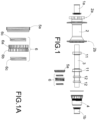
- the hub commonly called a ratchet hub comprises a system of toothed rings like that shown in Figures 1 and 1A , i.e. it comprises a body with an externally threaded connecting part that is fixed to the body, while the internal geometry of the connecting part can be complementary to the outer surface of a ring, which can generally be externally and laterally toothed as seen in Figure 1A .
- the rings comprise equal and complementary teeth facing each other, so that when the parts rotates in the direction of pedalling, the teeth mesh, turning the entire part, while when pedalling stops or is reversed, some springs outside the rings allow them to be released and rotate free of each other, allowing the wheel to continue turning.
- the rear hub there are several wheel bearings arranged in different positions and different ends of the body to facilitate turning, a connecting mechanism between the body and the freehub, and the ratchet ring or pawl systems mentioned above.
- the connecting mechanism between the body and the freehub body is generally a part that is radially threaded on its outer surface and engages by screwing into the inner surface of the hub body so that it is fixed and does not come out during pedalling as seen in FIG.1 and 1A .
- the inner surface may comprise a shape that fits one of the rings in the ring system or the pawls; or it may have a lateral toothed surface that engages the lateral surface of the ring directly in the freewheel system.
- the connecting part is an externally threaded part, so that each time the user pedals, this connecting part tightens more and more around the body of the hub.
- this connecting part tightens more and more around the body of the hub.
- the objective of the invention is a bicycle rear hub with improved internal connection between the body and the freehub, which facilitates the replacement or disassembly of this connecting part without the need for special tools, facilitating and reducing the cost of maintenance and prolonging the life of the hub and therefore of the wheel.
- the object of the invention is a bicycle wheel rear hub with an improved connecting system.
- the hub comprises a hollow cylindrical body to hold an axle, with at least one wheel bearing at each end.
- a brake disc is attached to an outer distal end of the body, which is fixed by means of a threaded nut to the body, or by the use of screws.
- the freehub body also comprises a cylindrical body, where inside there is a freewheel system characterized in that the connecting mechanism for joining the hub body to the freehub body comprises a connecting crown which is preferably crenellated and splined on the outside and toothed on the inside, and an elastic ring to fix the connecting crown to the body of the hub.
- the connecting crown comprises a lateral surface with a circular recess towards the proximal end of the body where the elastic ring is attached on the outer surface so that it can expand towards the inner surface of the hub body and fix the connecting crown inside the hub body.
- the connecting system of the invention As a result, thanks to the connecting system of the invention, the cleaning and replacement of the parts is easier, since it is a system that allows the easy manual removal of the elastic ring and the connecting crown.
- the invention refers to a rear hub system (1) of a bicycle. Specifically, it relates to the connecting mechanism (5) of the body (2) and the freehub body (4) of a rear hub (1) of a bicycle as seen in Figures 2 , 3 and 4 .
- FIGS 1 and 1A show an exploded view and a locally enlarged view of a rear hub system (1) known as a ratchet system, which comprises, from left to right, a distal stop (1a), a body (2), an axle (3) with wheel bearings (11, 12), a freehub body (4) and a proximal stop (1b).
- the rear hub (1) between the body (2) and the freehub body (4) comprises a connecting part (5a) and a freewheel system (6).
- the freewheel system (6) works through the interaction between the connecting part (5a), which is normally externally threaded and has internal splines, and the two rings (6a, 6b) facing each other, with external splines and laterally toothed with equal and complementary lateral teeth, pushed by two springs (6c) external to them, which make up the freewheel system (6) as shown in Figure 1A .
- the connecting part (5a) which is normally threaded externally for fastening to the body (2) and internally splined for holding the freewheel system (6), is the most important part in the connection and fastening of the freehub body (4) to the body (2).
- the invention refers to a bicycle wheel rear hub (1) that also comprises a cylindrical body (2) that surrounds an axle (3) and where at a distal end (2a) it comprises a distal stop (1a) and at a proximal end (2b) a freehub body (4) is attached by means of a connecting mechanism (5), where the freehub body (4) comprises a cylindrical body, a freewheel system (6) within it and a proximal stop (1b) at a proximal end (4b) of the freehub body (4).
- the body (2) of the rear hub (1) of the invention is characterized in that the connecting mechanism (5) between the body (2) and the freewheel system (6) comprises a connecting crown (7) and an elastic ring (8), which are the key innovative parts of the invention.
- the connecting crown (7) comprises an external crenellated and/or splined surface (7a), an inner radially toothed surface (7b) and a lateral surface (7c).
- the external crenellated and/or splined surface (7a) and the internal toothed surface (7b) act as a support and link between the body (2) of the hub (1) and the rings (6a, 6b) of the freehub body (4) responsible for the effect of the freewheel system (6), ensuring the solidity and firmness necessary for holding the freehub body (4), by means of a sliding adjustment.
- the outer surface (7a) and inner surface (7b) require shapes which may be regular or irregular, but which must be complementary to the surfaces with which they are going to be matched.
- the lateral surface (7c) comprises a circular recess (9) where the elastic ring (8) is attached or seated.
- the crenellated and/or splined outer surface (7a) of the connecting crown (7) is complementary to the inner surface (2c) of the body (2), while the inner radial surface (7b) of the connecting crown (7) is toothed and complementary to the outer surface of the ring (6a) of the freewheel system (6) as seen in Figure 3 .
- the elastic ring (8) of the rear hub (1) of the invention comprises a circular flat body with two free ends (8a, 8b) so as to be able to expand towards the inner surface (2c) of the body (2) and fit into a groove or channel (2d) in the inner radial surface (2c) of the proximal end (2b) of the body (2) of the hub (1) and block the sliding movement of the connecting crown (7), guaranteeing the absolute immobility of the connecting crown (7) inside the body (2).
- the free end (8b) comprises a tab (10) that facilitates the extraction of the elastic ring (8) from the body (2) when it is seated and expanded in the groove (2d) of the inner surface (2c) of the body (2).
- the freewheel system (6) comprises at least two moving rings (6a, 6b) that are laterally toothed and have external splines, facing each other, and at least two springs (6c) on the other side from the toothed surface of the rings (6a, 6b), which together with the rotation of the pedals determine the operation of the freewheel system (6).
- the first ring (6a) fits externally with the complementary splines of the inner radial surface (7b) of the connecting crown (7) and the second ring (6b) fits laterally with the complementary teeth of the first ring (6a) and externally with the inner surface of the freehub body (4).
- the teeth of the rings (6a, 6b) form a wedge shape, one side being inclined and the other straight.
- the freehub body (4) comprises at least one pawl system on an external surface of the distal end (4a) and the connecting crown (7) comprises an inner radially toothed surface (7b) complementary to the pawls of the freehub body (4).
- the connecting crown (7) comprises a lateral radially toothed surface (7c) complementary to the outer surface of a ring (6b) of the free wheel system (6), where in this case, the use of one of the toothed rings (6a) is eliminated, being the connecting crown (7) the connecting mechanism (5) and ring (6a) at the same time.
- the rear hub (1) of the invention comprises wheel bearings (11, 12) on the axle (3), where the wheel bearings (11) are those located inside the body (2) and the wheel bearings (12) are those located inside the freehub body (4), allowing and helping them to rotate when necessary.
Landscapes
- Engineering & Computer Science (AREA)
- Mechanical Engineering (AREA)
- Axle Suspensions And Sidecars For Cycles (AREA)
Abstract
Description
- The present invention relates to the rear hub of a bicycle wheel and, more particularly, to the connection between the hub body and the freehub.
- The rear hub of a bicycle wheel is a fundamental part of the wheel. The hub surrounds the axle of the wheel and joins the ends of the spokes. In addition, the hub houses the brake disc on one side and serves as a support for the sprocket cassette on the other side, which transmits the movement of the pedals to the wheel so that it turns.
- Normally, the most widely known hubs comprise a hollow cylindrical body with an axle running through it, where the brake disc is attached to a distal end by means of a locking system, and what is known as the cassette core or freehub body is attached to the proximal end, to which the sprockets, forming the cassette, are fixed. In this way, the freehub body is the most important part of the freewheel effect, i.e. that the wheel can continue to rotate, even if pedalling stops. There are at least two types of bicycle rear hubs, depending on the internal design of the freehub; with a freehub body that contains pawls or with a freehub body that contains rings with angled teeth, commonly called the ratchet type.
- On the one hand, pawl freehubs comprise a body that comprises a threaded connecting part with angled teeth on an inner surface and screw threading externally, i.e. the thread joins the threaded connecting part to the body of the hub and the wedge-shaped teeth are the complementary geometry to the at least three pawls arranged on the outer radial surface of the freehub. Therefore, when the freehub body rotates in the direction of travel or forward when pedalling, the pawls engage and are locked in the flat part of the teeth, making the whole part turn, and then when pedalling stops, they slide easily along the inclined part of the tooth when turning in the opposite direction to the direction of travel or backwards.
- On the other hand, the hub commonly called a ratchet hub comprises a system of toothed rings like that shown in
Figures 1 and 1A , i.e. it comprises a body with an externally threaded connecting part that is fixed to the body, while the internal geometry of the connecting part can be complementary to the outer surface of a ring, which can generally be externally and laterally toothed as seen inFigure 1A . In this way, as with the operation of a pawl system, the rings comprise equal and complementary teeth facing each other, so that when the parts rotates in the direction of pedalling, the teeth mesh, turning the entire part, while when pedalling stops or is reversed, some springs outside the rings allow them to be released and rotate free of each other, allowing the wheel to continue turning. - Furthermore, inside the rear hub there are several wheel bearings arranged in different positions and different ends of the body to facilitate turning, a connecting mechanism between the body and the freehub, and the ratchet ring or pawl systems mentioned above.
- At present, the connecting mechanism between the body and the freehub body is generally a part that is radially threaded on its outer surface and engages by screwing into the inner surface of the hub body so that it is fixed and does not come out during pedalling as seen in
FIG.1 and 1A . The inner surface may comprise a shape that fits one of the rings in the ring system or the pawls; or it may have a lateral toothed surface that engages the lateral surface of the ring directly in the freewheel system. - In any of the previously explained and known cases, the connecting part is an externally threaded part, so that each time the user pedals, this connecting part tightens more and more around the body of the hub. As a result, when it needs to be replaced due to wear or tear, it is often difficult to loosen given the degree of tightening, corrosion or other factors. Moreover, in cases where it is possible to replace it without having to change the entire hub, a special, difficult-to-find tool will be needed, as well as requiring a minimum amount of knowledge about how to use it.
- For all of the aforementioned reasons, the objective of the invention is a bicycle rear hub with improved internal connection between the body and the freehub, which facilitates the replacement or disassembly of this connecting part without the need for special tools, facilitating and reducing the cost of maintenance and prolonging the life of the hub and therefore of the wheel.
- The object of the invention is a bicycle wheel rear hub with an improved connecting system. The hub comprises a hollow cylindrical body to hold an axle, with at least one wheel bearing at each end. A brake disc is attached to an outer distal end of the body, which is fixed by means of a threaded nut to the body, or by the use of screws. At the other proximal end, next to the wheel bearing, there is a connecting mechanism to join the hub body to the freehub, where the sprocket cassette is fixed by means of a threaded cap on the proximal end of the hub.
- The freehub body also comprises a cylindrical body, where inside there is a freewheel system characterized in that the connecting mechanism for joining the hub body to the freehub body comprises a connecting crown which is preferably crenellated and splined on the outside and toothed on the inside, and an elastic ring to fix the connecting crown to the body of the hub. The connecting crown comprises a lateral surface with a circular recess towards the proximal end of the body where the elastic ring is attached on the outer surface so that it can expand towards the inner surface of the hub body and fix the connecting crown inside the hub body.
- As a result, thanks to the connecting system of the invention, the cleaning and replacement of the parts is easier, since it is a system that allows the easy manual removal of the elastic ring and the connecting crown.
- In this way, considerable savings can be made in cycle maintenance costs, since it allows parts to be replaced without the need to change the wheel or hub completely.
- The details of the invention can be seen in the accompanying figures, which are not intended to limit the scope of the invention:
-
Figure 1 shows a perspective view of a bicycle rear hub that is part of the state of the art. -
Figure 1A shows a perspective view of the connecting mechanism between the hub body and the freehub body in an embodiment that is part of the state of the art. -
Figure 2 shows an exploded perspective view of the rear hub of the invention. -
Figure 3 shows a locally enlarged exploded view of the connecting mechanism between the hub and the freehub. -
Figure 4 shows a locally enlarged view of the connection mechanism of the invention between the hub body and the freehub. - The invention refers to a rear hub system (1) of a bicycle. Specifically, it relates to the connecting mechanism (5) of the body (2) and the freehub body (4) of a rear hub (1) of a bicycle as seen in
Figures 2 ,3 and4 . -
Figures 1 and 1A show an exploded view and a locally enlarged view of a rear hub system (1) known as a ratchet system, which comprises, from left to right, a distal stop (1a), a body (2), an axle (3) with wheel bearings (11, 12), a freehub body (4) and a proximal stop (1b). The rear hub (1) between the body (2) and the freehub body (4) comprises a connecting part (5a) and a freewheel system (6). In this 'ratchet' type of rear hub, the freewheel system (6) works through the interaction between the connecting part (5a), which is normally externally threaded and has internal splines, and the two rings (6a, 6b) facing each other, with external splines and laterally toothed with equal and complementary lateral teeth, pushed by two springs (6c) external to them, which make up the freewheel system (6) as shown inFigure 1A . The connecting part (5a) which is normally threaded externally for fastening to the body (2) and internally splined for holding the freewheel system (6), is the most important part in the connection and fastening of the freehub body (4) to the body (2). As a result, and based on the workload it undergoes after continued use, it generates problems when it has to be replaced, as mentioned above. - Therefore, the invention refers to a bicycle wheel rear hub (1) that also comprises a cylindrical body (2) that surrounds an axle (3) and where at a distal end (2a) it comprises a distal stop (1a) and at a proximal end (2b) a freehub body (4) is attached by means of a connecting mechanism (5), where the freehub body (4) comprises a cylindrical body, a freewheel system (6) within it and a proximal stop (1b) at a proximal end (4b) of the freehub body (4). However, as shown in
Figure 2 , the body (2) of the rear hub (1) of the invention is characterized in that the connecting mechanism (5) between the body (2) and the freewheel system (6) comprises a connecting crown (7) and an elastic ring (8), which are the key innovative parts of the invention. - On the one hand and preferably, the connecting crown (7) comprises an external crenellated and/or splined surface (7a), an inner radially toothed surface (7b) and a lateral surface (7c). The external crenellated and/or splined surface (7a) and the internal toothed surface (7b) act as a support and link between the body (2) of the hub (1) and the rings (6a, 6b) of the freehub body (4) responsible for the effect of the freewheel system (6), ensuring the solidity and firmness necessary for holding the freehub body (4), by means of a sliding adjustment. In other words, the outer surface (7a) and inner surface (7b) require shapes which may be regular or irregular, but which must be complementary to the surfaces with which they are going to be matched. The lateral surface (7c) comprises a circular recess (9) where the elastic ring (8) is attached or seated.
- Also, preferably, the crenellated and/or splined outer surface (7a) of the connecting crown (7) is complementary to the inner surface (2c) of the body (2), while the inner radial surface (7b) of the connecting crown (7) is toothed and complementary to the outer surface of the ring (6a) of the freewheel system (6) as seen in
Figure 3 . - On the other hand, as shown in
Figures 3 and4 , the elastic ring (8) of the rear hub (1) of the invention comprises a circular flat body with two free ends (8a, 8b) so as to be able to expand towards the inner surface (2c) of the body (2) and fit into a groove or channel (2d) in the inner radial surface (2c) of the proximal end (2b) of the body (2) of the hub (1) and block the sliding movement of the connecting crown (7), guaranteeing the absolute immobility of the connecting crown (7) inside the body (2). In addition, the free end (8b) comprises a tab (10) that facilitates the extraction of the elastic ring (8) from the body (2) when it is seated and expanded in the groove (2d) of the inner surface (2c) of the body (2). - Optionally, the freewheel system (6) comprises at least two moving rings (6a, 6b) that are laterally toothed and have external splines, facing each other, and at least two springs (6c) on the other side from the toothed surface of the rings (6a, 6b), which together with the rotation of the pedals determine the operation of the freewheel system (6). In other words, the first ring (6a) fits externally with the complementary splines of the inner radial surface (7b) of the connecting crown (7) and the second ring (6b) fits laterally with the complementary teeth of the first ring (6a) and externally with the inner surface of the freehub body (4). The teeth of the rings (6a, 6b) form a wedge shape, one side being inclined and the other straight. In this way, when pedalling on the bicycle, the sprockets make the freehub body (4) turn and thus turn the rings (6a, 6b) of the freewheel system (6), which are facing each other and in contact due to the fact that the springs (6c) are partially extended, exerting pressure on one ring (6a) against the other (6b). Therefore, when the pedals turn in the direction of travel, the teeth mesh, turning the body (2) and with it the bicycle wheel. However, when pedalling is stopped or reversed, the springs (6c) are slightly compressed and the freewheel system (6) disengages releasing and allowing both rings (6a, 6b) to slide, since the teeth rotate in the opposite direction allowing the wheel to turn when the pedals are immobile or rotate in the opposite direction to the direction of travel.
- Another possible embodiment of the invention is when the freehub body (4) comprises at least one pawl system on an external surface of the distal end (4a) and the connecting crown (7) comprises an inner radially toothed surface (7b) complementary to the pawls of the freehub body (4). Alternatively, in another embodiment, the connecting crown (7) comprises a lateral radially toothed surface (7c) complementary to the outer surface of a ring (6b) of the free wheel system (6), where in this case, the use of one of the toothed rings (6a) is eliminated, being the connecting crown (7) the connecting mechanism (5) and ring (6a) at the same time.
- Additionally, as shown in the Figures, the rear hub (1) of the invention comprises wheel bearings (11, 12) on the axle (3), where the wheel bearings (11) are those located inside the body (2) and the wheel bearings (12) are those located inside the freehub body (4), allowing and helping them to rotate when necessary.
- For all of the above and thanks to the connecting mechanism (5) of the invention, the problem of over-tightening of the threaded connecting part (5a) is solved, facilitating the disassembly and replacement of the necessary parts without the need for tools or special knowledge, thus simplifying and reducing the cost of maintenance work. In addition, it is possible to prolong the life of the hub (1) and therefore of the bicycle wheel.
Claims (10)
- Rear bicycle wheel hub (1) comprising a cylindrical body (2) that surrounds an axle (3), wherein at a distal end (2a) comprises a distal stop (1a) and at a proximal end (2b) a freehub body (4) is attached by means of a connecting mechanism (5), where the freehub body (4) comprises a cylindrical body that surrounds a freewheel system (6) and a proximal stop (1b) at a proximal end (4b) of the freehub body (4) that closes and fixes the hub (1), where the body (2) of the rear hub (1) is characterized in that :- The connecting mechanism (5) between the body (2) and the freewheel system (6) of the freehub body (4) comprises a connecting crown (7) and an elastic ring (8), where the connecting crown (7) comprises a lateral surface (7c) with a circular groove (9) where the elastic ring (8) is fitted so that it can expand towards the internal surface (2c) of the body (2) and fix the connecting crown (7) inside the body (2).
- Rear bicycle wheel hub (1), according to claim 1, where the connecting crown (7) comprises a regular or irregular external surface (7a) with crenellations and/or splines, complementary to the inner surface (2c) of the body (2) and an inner radial surface (7b) complementary to the outer surface of at least one toothed ring (6a) of the freewheel system (6).
- Rear bicycle wheel hub (1), according to claim 1, wherein the elastic ring (8) comprises a circular flat body with two free ends (8a, 8b) where the free end (8b) has a tab (10).
- Rear bicycle wheel hub (1), according to claim 1, wherein the body (2) comprises a groove or channel (2d) at the proximal end (2b) of the inner surface (2c).
- Rear bicycle wheel hub (1), according to claim 1, wherein the free wheel system (6) comprises at least two toothed rings (6a, 6b) laterally facing each other with external teeth or splines complementary to the inner surfaces of the connecting crown (7) and the freehub body (4).
- Rear bicycle wheel hub (1), according to claim 1, wherein the freewheel system (6) comprises at least one pawl system on the outer surface of the distal end (4a) of the freehub body (4).
- Rear bicycle wheel hub (1), according to claim 6, wherein the connecting crown (7) comprises a regular or irregular outer surface (7a) with crenellations and/or splines, complementary to the inner surface (2c) of the body (2) and an inner radial surface (7b) complementary to the outer surface of at least one pawl system in the freehub body (4).
- Rear bicycle wheel hub (1) according to claim 1, wherein the crenellated and/or splined connecting crown (7) comprises a toothed lateral surface (7c) complementary to the outer surface of a ring (6b) of the freewheel system (6).
- Rear bicycle wheel hub (1), according to claim 1, wherein the body (2) comprises at least one wheel bearing (11) inside.
- Rear bicycle wheel hub (1), according to claim 1, wherein the freehub body (4) comprises at least one wheel bearing (12) inside.
Priority Applications (3)
| Application Number | Priority Date | Filing Date | Title |
|---|---|---|---|
| ES22383008T ES3037132T3 (en) | 2022-10-20 | 2022-10-20 | Internal connection of a bicycle rear hub |
| EP22383008.4A EP4357153B1 (en) | 2022-10-20 | 2022-10-20 | Internal connection of a bicycle rear hub |
| US18/484,046 US20240227440A9 (en) | 2022-10-20 | 2023-10-10 | Internal connection of a bicycle rear hub |
Applications Claiming Priority (1)
| Application Number | Priority Date | Filing Date | Title |
|---|---|---|---|
| EP22383008.4A EP4357153B1 (en) | 2022-10-20 | 2022-10-20 | Internal connection of a bicycle rear hub |
Publications (2)
| Publication Number | Publication Date |
|---|---|
| EP4357153A1 true EP4357153A1 (en) | 2024-04-24 |
| EP4357153B1 EP4357153B1 (en) | 2025-06-18 |
Family
ID=84365604
Family Applications (1)
| Application Number | Title | Priority Date | Filing Date |
|---|---|---|---|
| EP22383008.4A Active EP4357153B1 (en) | 2022-10-20 | 2022-10-20 | Internal connection of a bicycle rear hub |
Country Status (3)
| Country | Link |
|---|---|
| US (1) | US20240227440A9 (en) |
| EP (1) | EP4357153B1 (en) |
| ES (1) | ES3037132T3 (en) |
Citations (3)
| Publication number | Priority date | Publication date | Assignee | Title |
|---|---|---|---|---|
| US6478128B2 (en) * | 1998-09-30 | 2002-11-12 | Anthony G. Taylor | Redundant freewheeling bicycle apparatus and method |
| EP1121255B1 (en) * | 1998-10-15 | 2003-04-09 | DT-Swiss AG. | Hub, especially for bicycles and the like |
| US20220161597A1 (en) * | 2020-11-23 | 2022-05-26 | Tien Hsin Industries Co., Ltd. | Bicycle hub |
Family Cites Families (2)
| Publication number | Priority date | Publication date | Assignee | Title |
|---|---|---|---|---|
| US6123179A (en) * | 1998-02-26 | 2000-09-26 | Kun Teng Industry Co., Ltd | Bicycle freewheel hub |
| US10406856B2 (en) * | 2017-06-05 | 2019-09-10 | Chosen Co., Ltd | Bicycle hub apparatus |
-
2022
- 2022-10-20 ES ES22383008T patent/ES3037132T3/en active Active
- 2022-10-20 EP EP22383008.4A patent/EP4357153B1/en active Active
-
2023
- 2023-10-10 US US18/484,046 patent/US20240227440A9/en active Pending
Patent Citations (3)
| Publication number | Priority date | Publication date | Assignee | Title |
|---|---|---|---|---|
| US6478128B2 (en) * | 1998-09-30 | 2002-11-12 | Anthony G. Taylor | Redundant freewheeling bicycle apparatus and method |
| EP1121255B1 (en) * | 1998-10-15 | 2003-04-09 | DT-Swiss AG. | Hub, especially for bicycles and the like |
| US20220161597A1 (en) * | 2020-11-23 | 2022-05-26 | Tien Hsin Industries Co., Ltd. | Bicycle hub |
Also Published As
| Publication number | Publication date |
|---|---|
| US20240131863A1 (en) | 2024-04-25 |
| EP4357153B1 (en) | 2025-06-18 |
| US20240227440A9 (en) | 2024-07-11 |
| ES3037132T3 (en) | 2025-09-29 |
Similar Documents
| Publication | Publication Date | Title |
|---|---|---|
| JPH0113605Y2 (en) | ||
| US7044876B2 (en) | Bicycle sprocket having lateral protrusions for use in a multiple sprocket assembly | |
| US6866604B2 (en) | Multiple level sprocket support for a bicycle | |
| US7846047B2 (en) | Bicycle sprocket having a thickened spline | |
| US11148753B2 (en) | Sprocket assembly | |
| US6497314B2 (en) | Bicycle hub with sliding engagement member and detachable freewheel | |
| US8075065B2 (en) | Quick-tightening system for cycle with tightening torque control | |
| EP0834450B1 (en) | Multiple sprocket assembly adapted to secure a sprocket to an outer race | |
| US5676227A (en) | Free-wheel hub for bicycles | |
| US11220133B2 (en) | Bicycle component for an at least partially muscle-powered bicycle | |
| US20020067069A1 (en) | Bicycle hub with threaded spacer and detachable freewheel | |
| US20120032498A1 (en) | Hub with star ratchet | |
| GB1582793A (en) | Multi-speed freewheel for a bicycle | |
| US20110193406A1 (en) | Tubular portion of bicycle hub | |
| TWI803562B (en) | Hub, in particular for bicycles | |
| TWI720244B (en) | Hub, in particular for bicycles | |
| US5332294A (en) | Bicycle hub freewheel assembly | |
| CN110203319B (en) | Rear wheel sprocket assembly comprising two integral parts arranged to be connected to each other for common rotation | |
| EP4357153B1 (en) | Internal connection of a bicycle rear hub | |
| US8733524B2 (en) | Driving system for bicycle hub | |
| JP2006076502A (en) | Winding gearing | |
| US20070074948A1 (en) | One-way clutch and a clamping structure for a handled tool using the same | |
| US4840084A (en) | Freewheel mechanism for bicycles | |
| GB1565827A (en) | Hub unit for a bicycle | |
| US7637510B2 (en) | Chuck with gripping mechanism stop |
Legal Events
| Date | Code | Title | Description |
|---|---|---|---|
| PUAI | Public reference made under article 153(3) epc to a published international application that has entered the european phase |
Free format text: ORIGINAL CODE: 0009012 |
|
| STAA | Information on the status of an ep patent application or granted ep patent |
Free format text: STATUS: THE APPLICATION HAS BEEN PUBLISHED |
|
| AK | Designated contracting states |
Kind code of ref document: A1 Designated state(s): AL AT BE BG CH CY CZ DE DK EE ES FI FR GB GR HR HU IE IS IT LI LT LU LV MC ME MK MT NL NO PL PT RO RS SE SI SK SM TR |
|
| STAA | Information on the status of an ep patent application or granted ep patent |
Free format text: STATUS: REQUEST FOR EXAMINATION WAS MADE |
|
| 17P | Request for examination filed |
Effective date: 20241017 |
|
| RBV | Designated contracting states (corrected) |
Designated state(s): AL AT BE BG CH CY CZ DE DK EE ES FI FR GB GR HR HU IE IS IT LI LT LU LV MC ME MK MT NL NO PL PT RO RS SE SI SK SM TR |
|
| P01 | Opt-out of the competence of the unified patent court (upc) registered |
Free format text: CASE NUMBER: APP_62587/2024 Effective date: 20241125 |
|
| GRAP | Despatch of communication of intention to grant a patent |
Free format text: ORIGINAL CODE: EPIDOSNIGR1 |
|
| STAA | Information on the status of an ep patent application or granted ep patent |
Free format text: STATUS: GRANT OF PATENT IS INTENDED |
|
| INTG | Intention to grant announced |
Effective date: 20250217 |
|
| GRAS | Grant fee paid |
Free format text: ORIGINAL CODE: EPIDOSNIGR3 |
|
| GRAA | (expected) grant |
Free format text: ORIGINAL CODE: 0009210 |
|
| STAA | Information on the status of an ep patent application or granted ep patent |
Free format text: STATUS: THE PATENT HAS BEEN GRANTED |
|
| AK | Designated contracting states |
Kind code of ref document: B1 Designated state(s): AL AT BE BG CH CY CZ DE DK EE ES FI FR GB GR HR HU IE IS IT LI LT LU LV MC ME MK MT NL NO PL PT RO RS SE SI SK SM TR |
|
| REG | Reference to a national code |
Ref country code: GB Ref legal event code: FG4D |
|
| REG | Reference to a national code |
Ref country code: CH Ref legal event code: EP |
|
| REG | Reference to a national code |
Ref country code: DE Ref legal event code: R096 Ref document number: 602022016070 Country of ref document: DE |
|
| REG | Reference to a national code |
Ref country code: CH Ref legal event code: EP |
|
| REG | Reference to a national code |
Ref country code: IE Ref legal event code: FG4D |
|
| REG | Reference to a national code |
Ref country code: ES Ref legal event code: FG2A Ref document number: 3037132 Country of ref document: ES Kind code of ref document: T3 Effective date: 20250929 |
|
| PG25 | Lapsed in a contracting state [announced via postgrant information from national office to epo] |
Ref country code: FI Free format text: LAPSE BECAUSE OF FAILURE TO SUBMIT A TRANSLATION OF THE DESCRIPTION OR TO PAY THE FEE WITHIN THE PRESCRIBED TIME-LIMIT Effective date: 20250618 |
|
| REG | Reference to a national code |
Ref country code: LT Ref legal event code: MG9D |
|
| PG25 | Lapsed in a contracting state [announced via postgrant information from national office to epo] |
Ref country code: NO Free format text: LAPSE BECAUSE OF FAILURE TO SUBMIT A TRANSLATION OF THE DESCRIPTION OR TO PAY THE FEE WITHIN THE PRESCRIBED TIME-LIMIT Effective date: 20250918 Ref country code: GR Free format text: LAPSE BECAUSE OF FAILURE TO SUBMIT A TRANSLATION OF THE DESCRIPTION OR TO PAY THE FEE WITHIN THE PRESCRIBED TIME-LIMIT Effective date: 20250919 |
|
| PG25 | Lapsed in a contracting state [announced via postgrant information from national office to epo] |
Ref country code: BG Free format text: LAPSE BECAUSE OF FAILURE TO SUBMIT A TRANSLATION OF THE DESCRIPTION OR TO PAY THE FEE WITHIN THE PRESCRIBED TIME-LIMIT Effective date: 20250618 |
|
| PG25 | Lapsed in a contracting state [announced via postgrant information from national office to epo] |
Ref country code: HR Free format text: LAPSE BECAUSE OF FAILURE TO SUBMIT A TRANSLATION OF THE DESCRIPTION OR TO PAY THE FEE WITHIN THE PRESCRIBED TIME-LIMIT Effective date: 20250618 |
|
| PG25 | Lapsed in a contracting state [announced via postgrant information from national office to epo] |
Ref country code: RS Free format text: LAPSE BECAUSE OF FAILURE TO SUBMIT A TRANSLATION OF THE DESCRIPTION OR TO PAY THE FEE WITHIN THE PRESCRIBED TIME-LIMIT Effective date: 20250918 |
|
| REG | Reference to a national code |
Ref country code: NL Ref legal event code: MP Effective date: 20250618 |
|
| PG25 | Lapsed in a contracting state [announced via postgrant information from national office to epo] |
Ref country code: LV Free format text: LAPSE BECAUSE OF FAILURE TO SUBMIT A TRANSLATION OF THE DESCRIPTION OR TO PAY THE FEE WITHIN THE PRESCRIBED TIME-LIMIT Effective date: 20250618 |
|
| PG25 | Lapsed in a contracting state [announced via postgrant information from national office to epo] |
Ref country code: NL Free format text: LAPSE BECAUSE OF FAILURE TO SUBMIT A TRANSLATION OF THE DESCRIPTION OR TO PAY THE FEE WITHIN THE PRESCRIBED TIME-LIMIT Effective date: 20250618 |
|
| PG25 | Lapsed in a contracting state [announced via postgrant information from national office to epo] |
Ref country code: PT Free format text: LAPSE BECAUSE OF FAILURE TO SUBMIT A TRANSLATION OF THE DESCRIPTION OR TO PAY THE FEE WITHIN THE PRESCRIBED TIME-LIMIT Effective date: 20251020 |
|
| REG | Reference to a national code |
Ref country code: AT Ref legal event code: MK05 Ref document number: 1803888 Country of ref document: AT Kind code of ref document: T Effective date: 20250618 |
|
| PG25 | Lapsed in a contracting state [announced via postgrant information from national office to epo] |
Ref country code: IS Free format text: LAPSE BECAUSE OF FAILURE TO SUBMIT A TRANSLATION OF THE DESCRIPTION OR TO PAY THE FEE WITHIN THE PRESCRIBED TIME-LIMIT Effective date: 20251018 |
|
| PGFP | Annual fee paid to national office [announced via postgrant information from national office to epo] |
Ref country code: DE Payment date: 20251029 Year of fee payment: 4 |
|
| PG25 | Lapsed in a contracting state [announced via postgrant information from national office to epo] |
Ref country code: AT Free format text: LAPSE BECAUSE OF FAILURE TO SUBMIT A TRANSLATION OF THE DESCRIPTION OR TO PAY THE FEE WITHIN THE PRESCRIBED TIME-LIMIT Effective date: 20250618 Ref country code: SM Free format text: LAPSE BECAUSE OF FAILURE TO SUBMIT A TRANSLATION OF THE DESCRIPTION OR TO PAY THE FEE WITHIN THE PRESCRIBED TIME-LIMIT Effective date: 20250618 |
|
| PGFP | Annual fee paid to national office [announced via postgrant information from national office to epo] |
Ref country code: IT Payment date: 20251031 Year of fee payment: 4 |
|
| PGFP | Annual fee paid to national office [announced via postgrant information from national office to epo] |
Ref country code: FR Payment date: 20251027 Year of fee payment: 4 |
|
| PGFP | Annual fee paid to national office [announced via postgrant information from national office to epo] |
Ref country code: BE Payment date: 20251027 Year of fee payment: 4 |
|
| PG25 | Lapsed in a contracting state [announced via postgrant information from national office to epo] |
Ref country code: CZ Free format text: LAPSE BECAUSE OF FAILURE TO SUBMIT A TRANSLATION OF THE DESCRIPTION OR TO PAY THE FEE WITHIN THE PRESCRIBED TIME-LIMIT Effective date: 20250618 |
|
| PG25 | Lapsed in a contracting state [announced via postgrant information from national office to epo] |
Ref country code: PL Free format text: LAPSE BECAUSE OF FAILURE TO SUBMIT A TRANSLATION OF THE DESCRIPTION OR TO PAY THE FEE WITHIN THE PRESCRIBED TIME-LIMIT Effective date: 20250618 |
|
| PG25 | Lapsed in a contracting state [announced via postgrant information from national office to epo] |
Ref country code: EE Free format text: LAPSE BECAUSE OF FAILURE TO SUBMIT A TRANSLATION OF THE DESCRIPTION OR TO PAY THE FEE WITHIN THE PRESCRIBED TIME-LIMIT Effective date: 20250618 |
|
| PG25 | Lapsed in a contracting state [announced via postgrant information from national office to epo] |
Ref country code: SK Free format text: LAPSE BECAUSE OF FAILURE TO SUBMIT A TRANSLATION OF THE DESCRIPTION OR TO PAY THE FEE WITHIN THE PRESCRIBED TIME-LIMIT Effective date: 20250618 |
|
| PGFP | Annual fee paid to national office [announced via postgrant information from national office to epo] |
Ref country code: ES Payment date: 20251103 Year of fee payment: 4 |
|
| PG25 | Lapsed in a contracting state [announced via postgrant information from national office to epo] |
Ref country code: RO Free format text: LAPSE BECAUSE OF FAILURE TO SUBMIT A TRANSLATION OF THE DESCRIPTION OR TO PAY THE FEE WITHIN THE PRESCRIBED TIME-LIMIT Effective date: 20250618 |
|
| PG25 | Lapsed in a contracting state [announced via postgrant information from national office to epo] |
Ref country code: DK Free format text: LAPSE BECAUSE OF FAILURE TO SUBMIT A TRANSLATION OF THE DESCRIPTION OR TO PAY THE FEE WITHIN THE PRESCRIBED TIME-LIMIT Effective date: 20250618 |
|
| PLBE | No opposition filed within time limit |
Free format text: ORIGINAL CODE: 0009261 |
|
| STAA | Information on the status of an ep patent application or granted ep patent |
Free format text: STATUS: NO OPPOSITION FILED WITHIN TIME LIMIT |
|
| REG | Reference to a national code |
Ref country code: CH Ref legal event code: L10 Free format text: ST27 STATUS EVENT CODE: U-0-0-L10-L00 (AS PROVIDED BY THE NATIONAL OFFICE) Effective date: 20260430 |