EP4357020A2 - Asymmetric phase transfer catalysis - Google Patents
Asymmetric phase transfer catalysis Download PDFInfo
- Publication number
- EP4357020A2 EP4357020A2 EP23217661.0A EP23217661A EP4357020A2 EP 4357020 A2 EP4357020 A2 EP 4357020A2 EP 23217661 A EP23217661 A EP 23217661A EP 4357020 A2 EP4357020 A2 EP 4357020A2
- Authority
- EP
- European Patent Office
- Prior art keywords
- alkyl
- amino
- halogen
- heteroaryl
- aryl
- Prior art date
- Legal status (The legal status is an assumption and is not a legal conclusion. Google has not performed a legal analysis and makes no representation as to the accuracy of the status listed.)
- Pending
Links
Classifications
-
- B—PERFORMING OPERATIONS; TRANSPORTING
- B01—PHYSICAL OR CHEMICAL PROCESSES OR APPARATUS IN GENERAL
- B01J—CHEMICAL OR PHYSICAL PROCESSES, e.g. CATALYSIS OR COLLOID CHEMISTRY; THEIR RELEVANT APPARATUS
- B01J31/00—Catalysts comprising hydrides, coordination complexes or organic compounds
- B01J31/02—Catalysts comprising hydrides, coordination complexes or organic compounds containing organic compounds or metal hydrides
- B01J31/0277—Catalysts comprising hydrides, coordination complexes or organic compounds containing organic compounds or metal hydrides comprising ionic liquids, as components in catalyst systems or catalysts per se, the ionic liquid compounds being used in the molten state at the respective reaction temperature
- B01J31/0278—Catalysts comprising hydrides, coordination complexes or organic compounds containing organic compounds or metal hydrides comprising ionic liquids, as components in catalyst systems or catalysts per se, the ionic liquid compounds being used in the molten state at the respective reaction temperature containing nitrogen as cationic centre
- B01J31/0285—Catalysts comprising hydrides, coordination complexes or organic compounds containing organic compounds or metal hydrides comprising ionic liquids, as components in catalyst systems or catalysts per se, the ionic liquid compounds being used in the molten state at the respective reaction temperature containing nitrogen as cationic centre also containing elements or functional groups covered by B01J31/0201 - B01J31/0274
-
- B—PERFORMING OPERATIONS; TRANSPORTING
- B01—PHYSICAL OR CHEMICAL PROCESSES OR APPARATUS IN GENERAL
- B01J—CHEMICAL OR PHYSICAL PROCESSES, e.g. CATALYSIS OR COLLOID CHEMISTRY; THEIR RELEVANT APPARATUS
- B01J31/00—Catalysts comprising hydrides, coordination complexes or organic compounds
- B01J31/02—Catalysts comprising hydrides, coordination complexes or organic compounds containing organic compounds or metal hydrides
- B01J31/0201—Oxygen-containing compounds
- B01J31/0204—Ethers
-
- B—PERFORMING OPERATIONS; TRANSPORTING
- B01—PHYSICAL OR CHEMICAL PROCESSES OR APPARATUS IN GENERAL
- B01J—CHEMICAL OR PHYSICAL PROCESSES, e.g. CATALYSIS OR COLLOID CHEMISTRY; THEIR RELEVANT APPARATUS
- B01J31/00—Catalysts comprising hydrides, coordination complexes or organic compounds
- B01J31/02—Catalysts comprising hydrides, coordination complexes or organic compounds containing organic compounds or metal hydrides
- B01J31/0234—Nitrogen-, phosphorus-, arsenic- or antimony-containing compounds
- B01J31/0235—Nitrogen containing compounds
- B01J31/0239—Quaternary ammonium compounds
-
- B—PERFORMING OPERATIONS; TRANSPORTING
- B01—PHYSICAL OR CHEMICAL PROCESSES OR APPARATUS IN GENERAL
- B01J—CHEMICAL OR PHYSICAL PROCESSES, e.g. CATALYSIS OR COLLOID CHEMISTRY; THEIR RELEVANT APPARATUS
- B01J31/00—Catalysts comprising hydrides, coordination complexes or organic compounds
- B01J31/02—Catalysts comprising hydrides, coordination complexes or organic compounds containing organic compounds or metal hydrides
- B01J31/0234—Nitrogen-, phosphorus-, arsenic- or antimony-containing compounds
- B01J31/0235—Nitrogen containing compounds
- B01J31/0244—Nitrogen containing compounds with nitrogen contained as ring member in aromatic compounds or moieties, e.g. pyridine
-
- B—PERFORMING OPERATIONS; TRANSPORTING
- B01—PHYSICAL OR CHEMICAL PROCESSES OR APPARATUS IN GENERAL
- B01J—CHEMICAL OR PHYSICAL PROCESSES, e.g. CATALYSIS OR COLLOID CHEMISTRY; THEIR RELEVANT APPARATUS
- B01J31/00—Catalysts comprising hydrides, coordination complexes or organic compounds
- B01J31/02—Catalysts comprising hydrides, coordination complexes or organic compounds containing organic compounds or metal hydrides
- B01J31/0234—Nitrogen-, phosphorus-, arsenic- or antimony-containing compounds
- B01J31/0271—Nitrogen-, phosphorus-, arsenic- or antimony-containing compounds also containing elements or functional groups covered by B01J31/0201 - B01J31/0231
-
- C—CHEMISTRY; METALLURGY
- C07—ORGANIC CHEMISTRY
- C07D—HETEROCYCLIC COMPOUNDS
- C07D453/00—Heterocyclic compounds containing quinuclidine or iso-quinuclidine ring systems, e.g. quinine alkaloids
- C07D453/02—Heterocyclic compounds containing quinuclidine or iso-quinuclidine ring systems, e.g. quinine alkaloids containing not further condensed quinuclidine ring systems
- C07D453/04—Heterocyclic compounds containing quinuclidine or iso-quinuclidine ring systems, e.g. quinine alkaloids containing not further condensed quinuclidine ring systems having a quinolyl-4, a substituted quinolyl-4 or a alkylenedioxy-quinolyl-4 radical linked through only one carbon atom, attached in position 2, e.g. quinine
-
- B—PERFORMING OPERATIONS; TRANSPORTING
- B01—PHYSICAL OR CHEMICAL PROCESSES OR APPARATUS IN GENERAL
- B01J—CHEMICAL OR PHYSICAL PROCESSES, e.g. CATALYSIS OR COLLOID CHEMISTRY; THEIR RELEVANT APPARATUS
- B01J2231/00—Catalytic reactions performed with catalysts classified in B01J31/00
- B01J2231/40—Substitution reactions at carbon centres, e.g. C-C or C-X, i.e. carbon-hetero atom, cross-coupling, C-H activation or ring-opening reactions
- B01J2231/42—Catalytic cross-coupling, i.e. connection of previously not connected C-atoms or C- and X-atoms without rearrangement
- B01J2231/4205—C-C cross-coupling, e.g. metal catalyzed or Friedel-Crafts type
-
- B—PERFORMING OPERATIONS; TRANSPORTING
- B01—PHYSICAL OR CHEMICAL PROCESSES OR APPARATUS IN GENERAL
- B01J—CHEMICAL OR PHYSICAL PROCESSES, e.g. CATALYSIS OR COLLOID CHEMISTRY; THEIR RELEVANT APPARATUS
- B01J2231/00—Catalytic reactions performed with catalysts classified in B01J31/00
- B01J2231/40—Substitution reactions at carbon centres, e.g. C-C or C-X, i.e. carbon-hetero atom, cross-coupling, C-H activation or ring-opening reactions
- B01J2231/42—Catalytic cross-coupling, i.e. connection of previously not connected C-atoms or C- and X-atoms without rearrangement
- B01J2231/4205—C-C cross-coupling, e.g. metal catalyzed or Friedel-Crafts type
- B01J2231/4272—C-C cross-coupling, e.g. metal catalyzed or Friedel-Crafts type via enolates or aza-analogues, added as such or made in-situ, e.g. ArY + R2C=C(OM)Z -> ArR2C-C(O)Z, in which R is H or alkyl, M is Na, K or SiMe3, Y is the leaving group, Z is Ar or OR' and R' is alkyl
-
- B—PERFORMING OPERATIONS; TRANSPORTING
- B01—PHYSICAL OR CHEMICAL PROCESSES OR APPARATUS IN GENERAL
- B01J—CHEMICAL OR PHYSICAL PROCESSES, e.g. CATALYSIS OR COLLOID CHEMISTRY; THEIR RELEVANT APPARATUS
- B01J2531/00—Additional information regarding catalytic systems classified in B01J31/00
- B01J2531/90—Catalytic systems characterized by the solvent or solvent system used
- B01J2531/98—Phase-transfer catalysis in a mixed solvent system containing at least 2 immiscible solvents or solvent phases
- B01J2531/985—Phase-transfer catalysis in a mixed solvent system containing at least 2 immiscible solvents or solvent phases in a water / organic solvent system
Definitions
- Cinchona alkaloid salts are known phase transfer catalysts useful in the asymmetric formation of carbon-carbon, carbon-heteroatom or carbon-halide bonds. See Takashi Ooi and Keiji Maruoka, Recent Advances in Asymmetric Phase-Transfer Catalysis, Angew. Chem. Int. Ed. 2007, 46, 4222-4266 ("Maruoka"). Maruoka reviews the various reactions in which phase-transfer catalysis is useful, including enantioselective alkylation, Michael addition, aldol and related reactions and Darzens reaction.
- the present invention is directed to novel bis-quarternary cinchona alkaloid salts and the use of bis-quarternary cinchona alkaloid salts in asymmetric phase transfer catalysis.
- the use of bis-quarternary cinchona alkaloid salts in asymmetric phase transfer catalysis surprisingly provides for a more active and efficient process as compared to mono-quarternary catalysts, providing high efficiency rates and asymmetric products in high enantiomeric excess.
- the invention is directed to novel bis-quarternary cinchona alkaloid salts and the use of bis-quarternary cinchona alkaloid salts in asymmetric phase transfer catalysis.
- the invention encompasses bis-quarternary cinchona alkaloid salts having the chemical structure of Formula I: wherein:
- the cinchona alkaloid salts of Formula I encompass all stereoisomers, including cinchonine, cinchonidine, quinine, quinidine, dihydroquinidine, and dihydroquinine.
- the invention encompasses the bis-quarternary cinchona alkaloid salts of Formula I for use as phase transfer catalysts in one of the following asymmetric reactions: (1) alkylation with an electrophilic alkylating agent, (2) Michael addition with an electron deficient olefin, (3) aldol reaction with an aldehyde, (4) Mannich reaction with a ⁇ -imino ester, (5) Darzens reaction with an aldehyde, (6) Neber rearrangement of an oxime into an ⁇ -aminoketone, (7) epoxidation of an electron deficient olefin, (8) aziridination of an electron deficient olefin, (9) dihydroxylation of an electron deficient olefins, (10) fluorination of a carbonyl substrate, and (11) sulfenylation of a ⁇ -keto sulfoxide.
- the aforementioned reactions are well know in the art and described by Maruoka.
- Another embodiment of the invention encompasses a process for stereoselectively producing a compound of Formula A wherein:
- each R A and each R B are independently selected from the group consisting of:
- R C is selected from the group consisting of:
- the invention encompasses the aforementioned process wherein in Formula A PG is selected from the group consisting of: C 1-6 alkyl, vinyl, C(O)-O-L, C(O)-L, aryl, hetroaryl, benzyl, benzhydryl, trityl and C 1-6 alkoxymethyl, wherein aryl, heteroaryl, benzyl, benzyhydryl and trityl optionally are substituted with 1 to 3 substituents independently selected from methoxy and nitro, C 1-6 alkoxymethyl is optionally substituted with trimethylsilyl and L is C 1-6 alkyl, aryl or benzyl.
- the invention encompasses the aforementioned process wherein in Formula A W is selected from the group consisting of: halogen and sulfonate.
- the invention encompasses the aforementioned process wherein the water-immiscible organic phase is selected from the group consisting of benzene, toluene, xylenes, chlorobenzene, ethyl ether, isopropyl ether, tetrahydrofuran, 2-methyl tetrahydrofuran, dioxane, methyl tert -butyl ether, cyclopentyl methyl ether, isopropyl acetate, ethyl acetate, hexanes, heptanes, cyclohexane, dichloromethane and dichloroethane.
- the water-immiscible organic phase is selected from the group consisting of benzene, toluene, xylenes, chlorobenzene, ethyl ether, isopropyl ether, tetrahydrofuran, 2-methyl tetrahydrofuran, dioxane
- the base is selected from the group consisting of: sodium hydroxide, lithium hydroxide, potassium hydroxide, sodium carbonate, lithium carbonate, potassium carbonate, cesium hydroxide, cesium carbonate, sodium hydrogen carbonate, potassium hydrogen carbonate, lithium hydrogen carbonate, cesium hydrogen carbonate, lithium fluoride, sodium fluoride, potassium fluoride, cesium fluoride, lithium tert-butoxide, sodium tert-butoxide, potassium tert-butoxide, sodium phosphate, lithium phosphate and potassium phosphate.
- the invention encompasses the aforementioned process wherein the water-immiscible organic phase is toluene and the base is sodium hydroxide.
- the invention also encompasses the bis-quarternary cinchona alkaloid salts of Formula I for use as a phase transfer catalyst in one of the following reactions:
- the invention also encompasses bis-quarternary cinchona alkaloid salts having the chemical structure of Formula II: wherein:
- the cinchona alkaloid salts of Formula II encompass all stereoisomers, including cinchonine, cinchonidine, quinine, quinidine, dihydroquinidine, and dihydroquinine.
- An embodiment of the invention encompasses bis-quarternary cinchona alkaloid salts of Formula II wherein Ar 1 is phenyl which is optionally substituted with one to five substituents independently selected from R 3 , and Ar 2 is phenyl which is optionally substituted with one to five substituents independently selected from R 3 .
- An embodiment of the invention encompasses bis-quarternary cinchona alkaloid salts of Formula IIa and otherwise as defined above.
- An embodiment of the invention encompasses bis-quarternary cinchona alkaloid salts of Formula IIa wherein R 1 is vinyl and R 2 is methoxy.
- Another embodiment of the invention encompasses bis-quarternary cinchona alkaloid salts of Formula IIa wherein R 3 is selected from halogen and methoxy.
- Another embodiment of the invention encompasses a bis-quarternary cinchona alkaloid salt selected from: R 2 R 3 R 4 X- Y - OMe Br Br H Br Br H I I H Br I H Br Br H Me Br I H Br Br H allyl Br Br wherein R is selected from the group consisting of vinyl and ethyl;
- alkyl refers to a monovalent straight or branched chain, saturated aliphatic hydrocarbon radical having a number of carbon atoms in the specified range.
- C 1-6 alkyl (or “C 1 -C 6 alkyl”) refers to any of the hexyl alkyl and pentyl alkyl isomers as well as n-, iso-, sec- and t-butyl, n- and iso- propyl, ethyl and methyl.
- C 1-4 alkyl refers to n-, iso-, sec- and t-butyl, n- and isopropyl, ethyl and methyl.
- C 1-3 alkyl refers to n-propyl, isopropyl, ethyl and methyl.
- haloalkyl means an alkyl radical as defined above, unless otherwise specified, that is substituted with one to five, preferably one to three halogen. Representative examples include, but are not limited to trifluoromethyl, dichloroethyl, and the like.
- acyl means -C(O)-alkyl where alkyl is as defined above.
- alkoxy means -O-alkyl where alkyl is as defined above.
- alkenyl refers to a monovalent straight or branched chain, saturated aliphatic hydrocarbon radical having a number of carbon atoms in the specified range and at least one carbon-carbon double bond, and otherwise carbon-carbon single bonds.
- Alkenyl includes for example ethenyl, 1-methylethynyl, 2-propenenyl, 2-butenyl, 1,4-pentadienyl and the like.
- alkynyl refers to a monovalent straight or branched chain, saturated aliphatic hydrocarbon radical having a number of carbon atoms in the specified range and at least one carbon-carbon triple bond, and otherwise carbon-carbon double or single bonds.
- Alkynyl includes for example 2-propynyl, 1-butynyl, 3-hexen-5-ynyl and the like.
- cycloalkyl refers to any monocyclic ring of an alkane having a number of carbon atoms in the specified range.
- C 3-6 cycloalkyl (or “C 3 -C 6 cycloalkyl”) refers to cyclopropyl, cyclobutyl, cyclopentyl, and cyclohexyl
- C 3-5 cycloalkyl refers to cyclopropyl, cyclobutyl, and cyclopentyl.
- halogen refers to fluorine, chlorine, bromine and iodine (alternatively referred to as fluoro, chloro, bromo, and iodo).
- aryl refers to phenyl, naphthyl, and anthranyl.
- heteroaryl refers to (i) a 5- or 6-membered heteroaromatic ring containing from 1 to 3 heteroatoms independently selected from N, O and S, or (ii) is a heterobicyclic ring selected from quinolinyl, isoquinolinyl, and quinoxalinyl.
- Suitable 5- and 6-membered heteroaromatic rings include, for example, pyridyl (also referred to as pyridinyl), pyrrolyl, pyrazinyl, pyrimidinyl, pyridazinyl, triazinyl, thienyl, furanyl, imidazolyl, pyrazolyl, triazolyl, oxazolyl, isooxazolyl, oxadiazolyl, oxatriazolyl, thiazolyl, isothiazolyl, and thiadiazolyl.
- Heteroaryls of particular interest are pyrrolyl, imidazolyl, pyridyl, pyrazinyl, quinolinyl (or quinolyl), isoquinolinyl (or isoquinolyl), and quinoxalinyl.
- Examples of 4- to 7-membered, saturated heterocyclic rings within the scope of this invention include, for example, azetidinyl, piperidinyl, morpholinyl, thiomorpholinyl, thiazolidinyl, isothiazolidinyl, oxazolidinyl, isoxazolidinyl, pyrrolidinyl, imidazolidinyl, piperazinyl, tetrahydrofuranyl, tetrahydrothienyl, pyrazolidinyl, hexahydropyrimidinyl, thiazinanyl, thiazepanyl, azepanyl, diazepanyl, tetrahydropyranyl, tetrahydrothiopyranyl, and dioxanyl.
- Examples of 4- to 7-membered, unsaturated heterocyclic rings within the scope of this invention include mono-unsaturated heterocyclic rings corresponding to the saturated heterocyclic rings listed in the preceding sentence in which a single bond is replaced with a double bond (e.g., a carbon-carbon single bond is replaced with a carbon-carbon double bond).
- any of the various cyclic rings and ring systems described herein may be attached to the rest of the compound at any ring atom (i.e., any carbon atom or any heteroatom) provided that a stable compound results.
- a heteroaromatic ring described as containing from “1 to 4 heteroatoms” means the ring can contain 1, 2, 3 or 4 heteroatoms. It is also understood that any range cited herein includes within its scope all of the sub-ranges within that range. Thus, for example, a heterocyclic ring described as containing from “1 to 4 heteroatoms” is intended to include as aspects thereof, heterocyclic rings containing 2 to 4 heteroatoms, 3 or 4 heteroatoms, 1 to 3 heteroatoms, 2 or 3 heteroatoms, 1 or 2 heteroatoms, 1 heteroatom, 2 heteroatoms, 3 heteroatoms, and 4 heteroatoms.
- an aryl or heteroaryl described as optionally substituted with "from 1 to 4 substituents” is intended to include as aspects thereof, an aryl or heteroaryl substituted with 1 to 4 substituents, 2 to 4 substituents, 3 to 4 substituents, 4 substituents, 1 to 3 substituents, 2 to 3 substituents, 3 substituents, 1 to 2 substituents, 2 substituents, and 1 substituent.
- any variable occurs more than one time in any constituent or in Formula I, II, IIa, A, B or C, or in any other formula depicting and describing compounds of the present invention, its definition on each occurrence is independent of its definition at every other occurrence. Also, combinations of substituents and/or variables are permissible only if such combinations result in stable compounds.
- substitution by a named substituent is permitted on any atom in a ring (e.g., cycloalkyl, aryl, or heteroaryl) provided such ring substitution is chemically allowed and results in a stable compound.
- the compounds of the invention contain chiral centers and, as a result of the selection of substituents and substituent patterns, can contain additional chiral centers, and thus can occur as mixtures of stereoisomers, or as individual diastereomers, or enantiomers. All isomeric forms of these compounds, whether individually or in mixtures, are within the scope of the present invention.
- the cinchona alkaloid salts of the invention encompass all stereoisomers, including cinchonine, cinchonidine, quinine, quinidine, dihydroquinidine, and dihydroquinine.
- tautomers e.g., keto-enol tautomers
- substituents and substituent patterns provide for the existence of tautomers (e.g., keto-enol tautomers) in the compounds of the invention
- all tautomeric forms of these compounds are within the scope of the present invention.
- Compounds of the present invention having a hydroxy substituent on a carbon atom of a heteroaromatic ring are understood to include compounds in which only the hydroxy is present, compounds in which only the tautomeric keto form (i.e., an oxo substitutent) is present, and compounds in which the keto and enol forms are both present.
- organic substituent group means any substituent group containing a carbon atom, which may be optionally substituted.
- Organic substituent groups include, but are not limited to, C 1-10 alkyl, C 2-10 alkenyl, C 2-10 alkynyl, aryl, heteroaryl, non- or partially aromatic heterocycles, C 3-10 cycloalkyl, C 1-10 alkoxy, C 1-10 alkylthio, and C 1-10 acyl, each optionally substituted with, for example, one or more of the following: halide, hydroxy, nitrogen containing substituents such as amino, sulfur containing substituent such as sulfates, C 1-4 alkoxy and C 1-4 alkylthio.
- nitrogen protecting group means a substituent that protects a nitrogen atom in a reaction from a reagent or chemical environment.
- Nitrogen protecting groups are well known in the art and include for example, t -butyl, vinyl, phenyl, benzyl, p -methoxybenzyl, 3,4-dimethoxy benzyl, p -nitrobenzyl, benzhydryl, trityl, trialkylsilyl, methoxymethyl ether, (2,2,2-trichloroethoxy)methyl and 2-(trimethylsilyl)ethoxy)methyl, Boc, Cbz.
- the term "functional group that has leaving ability” means an atom or atom group that leaves from a substrate in a substitution or elimination reaction, that is a leaving group, and includes for example halogen and sulfonate.
- electrophilic alkylating agent means an agent that delivers the equivalent of an alkyl cation, such as for example an alkyl halide.
- sulfonate means an anion or leaving group having the formula R # -SO 3 - which is the conjugate base of sulfonic acid.
- R # includes for example C 1-4 alkyl optionally substituted with 1 to 3 halogen, and aryl optionally substituted with 1 to 3 halogen or methyl or nitro. Examples include mesylate, triflate, tosylate and besylate.
- electron withdrawing group is well known in the art are includes for example, cyano, nitro, -C(O)OR xvii ,-C(O)SR xviii and -C(O)NR xvix R xx , wherein R xvii and R xviii are independently H or an organic substituent group and R xvix and R xx are independently H or an organic substituent group or R xvix and R xx may be joined together with the nitrogen to which they are attached to form a 5- or 6-membered heterocyclic ring;
- the resulting solution was stirred for another 1 h at this temperature.
- the reaction mixture was quenched by addition of MTBE (50 mL), 15% aqueous citric acid (25 mL) and water (15 mL).
- the organic layer was separated and washed with 5% aqueous NaCl (50 mL) twice.
- the organic solution was concentrated under vacuum at 50 °C to give 2 as an oil (6.2 g, 68 wt%, 16.6 mmol, 74% yield).
- the crude product was used directly for the next step without further purification.
- the pure sample was isolated by flash chromatography on silica gel with 5% ethyl acetate in hexane as eluants.
- the suspension was cooled to room temperature and filtered.
- the cake was washed with a mixture of isopropanol (3 mL) and water (3 mL).
- the precipitates were collected and dried in a vacuum oven over night at 50 °C to give 4 (6.2 g, 87%) as a solid.
- the resulting slurry was aged at 22 °C for 1 to 2 h, filtered, rinsed with AcOEt (2 x 24 ml), then hexane (2 x 24 ml). The solid was dried under vacuum to give powder as a mixture of bis-salts (bis-quinidine salt 10 and bis-dihydroquinidine salt). (Total 19.7 g, 94% yield).
- the authentic sample of 10 was purified by SFC (IC column, 20 x 250 mm, 60% MeOH/CO 2 , 50 mL/min, 100 bar, 35°C, 220 nm, sample concentration: 133 mg/mL in MeOH; desired peak: 3 to 4.5 min).
- the resulting solution was stirred for another one hour at this temperature.
- the reaction mixture was quenched by addition of MTBE (40 mL), 15% aqueous citric acid (20 mL) and water (12 mL).
- the organic layer was separated and washed twice with 5% aqueous NaCl (40 mL).
- the solution was concentrated under vacuum at 50 °C to give 4.65 g of 14 as oil (97 %wt, 98% yield).
- the crude product was used directly for the next step without further purification.
- a slurry cinchonidine (5.0 g, 16.98 mmol) and 2-cyano-benzyl bromide (4.0 g, 20.38 mmol) in 50 ml of IPA was degassed by vacuum and flushed with N 2 , then it was heated to 67 °C until completely conversion (4 to 5 h). It was cooled down and ⁇ 40 mL of solvent was removed by reducing pressure. This concentrated solution was added into AcOEt (160 ml) over 5 to 10 min while stirring.
- the resulting slurry was aged for 1 to 2 h at 22 °C, filtered, rinsed with IPA/hexane (1:1; 50 ml) and dried under vacuum to give 19 as a solid (7.43 g, 89% IY).
- the bis-quaternary catalyst is much more active and efficient as compared to the mono-quaternary catalyst for the spirocyclization reaction shown.
- the bis-catalysts contained ⁇ 12 to 15% of the double saturated compounds hydroquinidine or hydrocinchonine.
- Tables 2 and 3 show a SAR study of bis-quaternary PTC catalysts for spirocyclization. Both bis-quaternary quinidine and cinchonine catalysts are very efficient (Entries 2 to 5). The Bis-Quinidine catalyst is relatively better than bis-cinchonine catalyst (Entry 2 and 3). 2-Bromo-5-Methoxy-benzyl group is the optimized group for this reaction.
- Table 4 shows a study of different functional groups. Table 4 Entry X 1 Y 1 %ee 1 Cl Cl 92 2 Br Cl 92 3 CO 2 Me Cl 92 4 Br Tos 51 5 Br Br 70
- Table 5 shows a study of different ring systems; Doubly quaternized PTC is a more active catalyst than mono quaternized PTC. Table 5 PTC 19 : 3%ee Absolute configulation ( R or S ) has not been determined. PTC 18: 85%ee
Landscapes
- Chemical & Material Sciences (AREA)
- Organic Chemistry (AREA)
- Engineering & Computer Science (AREA)
- Materials Engineering (AREA)
- Chemical Kinetics & Catalysis (AREA)
- Nitrogen Condensed Heterocyclic Rings (AREA)
- Pharmaceuticals Containing Other Organic And Inorganic Compounds (AREA)
- Catalysts (AREA)
- Organic Low-Molecular-Weight Compounds And Preparation Thereof (AREA)
- Low-Molecular Organic Synthesis Reactions Using Catalysts (AREA)
- Plural Heterocyclic Compounds (AREA)
Abstract

Description
- Cinchona alkaloid salts are known phase transfer catalysts useful in the asymmetric formation of carbon-carbon, carbon-heteroatom or carbon-halide bonds. See Takashi Ooi and Keiji Maruoka, Recent Advances in Asymmetric Phase-Transfer Catalysis, Angew. Chem. Int. Ed. 2007, 46, 4222-4266 ("Maruoka"). Maruoka reviews the various reactions in which phase-transfer catalysis is useful, including enantioselective alkylation, Michael addition, aldol and related reactions and Darzens reaction. Maruoka at page 4223 discusses the advantages of such phase transfer catalysis processes as involving "simple experimental procedures, mild reaction conditions, inexpensive and environmentally benign reagents and solvents and the possibility of conducting large-scale preparations." Thus, asymmetric phase transfer catalysis remains an important area for organic chemistry research.
- The present invention is directed to novel bis-quarternary cinchona alkaloid salts and the use of bis-quarternary cinchona alkaloid salts in asymmetric phase transfer catalysis. On certain substrates and under specific reaction conditions, the inventors have discovered that the use of bis-quarternary cinchona alkaloid salts in asymmetric phase transfer catalysis surprisingly provides for a more active and efficient process as compared to mono-quarternary catalysts, providing high efficiency rates and asymmetric products in high enantiomeric excess.
- The invention is directed to novel bis-quarternary cinchona alkaloid salts and the use of bis-quarternary cinchona alkaloid salts in asymmetric phase transfer catalysis.
- The invention encompasses bis-quarternary cinchona alkaloid salts having the chemical structure of Formula I:

- R1 is selected from ethyl and vinyl,
- R2 is selected from hydrogen and methoxy,
- R3 and R4 are independently selected from the group consisting of C1-6alkyl, C2-6alkenyl, C2-6alkynyl, C3-6cycloalkyl, aryl, heteroaryl, -C1-4alkyl-aryl and -C1-4alkyl-heteroaryl, wherein C1-6alkyl, C2-6alkenyl, C2-6alkynyl, C3-6cycloalkyl, aryl, heteroaryl and the aryl and heteroaryl portions of C1-4alkyl-aryl and -C1-4alkyl-heteroaryl are optionally substituted with one to five substituents independently selected from R6,
- R5 is selected from the group consisting of hydrogen, C(O)R, C(O)OR, CONRR', and C1-6alkyl, R6 is selected from the group consisting of C1-4alkyl, C1-4haloalkyl, aryl, C1-4alkoxy, hydroxy, CN, CO2R, CONRR', SR, SO2R, SO3R, PR2, PO(OR)2, PO(OR) (NRR'), PO(NRR')2, P(OR)2, P(OR)(NRR'), P(NRR')2, SiRR'R", B(OR)2, C(O)R, NRR', NO2, and halogen, each R, R' and R" is independently selected from the group consisting of, H, C1-6alkyl, hydroxyl, C1-6alkoxy, aryl, heteroaryl, -CH2-aryl, -CH2-heteroaryl, and
- each X and Y are independently anions selected from halide, OH, HSO4, SO4, BF4, SbF6, carboxylate, carbonate, hydrogencarbonate, NO3, sulfonate, hexafluorophosphate, phosphate, hydrogen phosphate and perchlorate,
- for use as phase transfer catalysts in the stereoselective formation of a carbon-carbon, carbon-heteroatom or carbon-halide bond on a substrate in a biphasic medium comprising an aqueous phase and organic phase or a micelle medium.
- Unless depicted or specified otherwise, the cinchona alkaloid salts of Formula I encompass all stereoisomers, including cinchonine, cinchonidine, quinine, quinidine, dihydroquinidine, and dihydroquinine.
- In an embodiment, the invention encompasses the bis-quarternary cinchona alkaloid salts of Formula I for use as phase transfer catalysts in one of the following asymmetric reactions: (1) alkylation with an electrophilic alkylating agent, (2) Michael addition with an electron deficient olefin, (3) aldol reaction with an aldehyde, (4) Mannich reaction with a α-imino ester, (5) Darzens reaction with an aldehyde, (6) Neber rearrangement of an oxime into an α-aminoketone, (7) epoxidation of an electron deficient olefin, (8) aziridination of an electron deficient olefin, (9) dihydroxylation of an electron deficient olefins, (10) fluorination of a carbonyl substrate, and (11) sulfenylation of a β-keto sulfoxide. The aforementioned reactions are well know in the art and described by Maruoka.
- Another embodiment of the invention encompasses a process for stereoselectively producing a compound of Formula A

- Q forms a fused 5- or 6-membered aromatic carbocyclic or heterocyclic ring, each optionally substituted with 1 to 4 RC groups,
- each RA and each RB are independently hydrogen, halogen, hydroxy, amino or an organic substituent group, and one RA and one RB may be joined together to form a mono-, bi- or tricyclic carbocyclic or heterocyclic ring system, optionally substituted with 1 to 4 RC groups,
- RC is hydrogen, halogen, hydroxy, amino or an organic substituent group,
- PG is a nitrogen protecting group and
- * represents an asymmetric center,
- comprising initiating a reaction of a compound of Formula B

- with a compound of Formula C

- wherein W is a functional group that has leaving ability, in a water-immiscible organic phase in the presence of a bis-quarternary cinchona alkaloid salt and a base in an aqueous phase to form a biphasic medium comprising the aqueous phase and water-immiscible organic phase,
- wherein the bis-quarternary cinchona alkaloid salt has the chemical structure of Formula I:

- R1 is selected from ethyl and vinyl,
- R2 is selected from hydrogen and methoxy,
- R3 and R4 are independently selected from the group consisting of C1-6alkyl, C2-6alkenyl, C2-6alkynyl, C3-6cycloalkyl, aryl, heteroaryl, -C1-4alkyl-aryl and -C1-4alkyl-heteroaryl, wherein C1-6alkyl, C2-6alkenyl, C2-6alkynyl, C3-6cycloalkyl, aryl, heteroaryl and the aryl and heteroaryl portions of C1-4alkyl-aryl and -C1-4alkyl-heteroaryl are optionally substituted with one to five substituents independently selected from R6,
- R5 is selected from the group consisting of hydrogen, C(O)R, C(O)OR, CONRR', and C1-6alkyl,
- R6 is selected from the group consisting of C1-4alkyl, C1-4haloalkyl, aryl, C1-4alkoxy, hydroxy, CN, CO2R, CONRR', SR, SO2R, SO3R, PR2, PO(OR)2, PO(OR) (NRR'), PO(NRR')2, P(OR)2, P(OR)(NRR'), P(NRR')2, SiRR'R", B(OR)2, C(O)R, NRR', NO2, and halogen,
- each R, R' and R" is independently selected from the group consisting of, H, C1-4alkyl, hydroxy and C1-4alkoxy, and
- each X and Y are independently anions selected from halide, OH, HSO4, SO4, BF4, SbF6, carboxylate, carbonate, hydrogencarbonate, NO3, sulfonate, hexafluorophosphate, phosphate, hydrogen phosphate and perchlorate,
- Within this embodiment, the invention encompasses the aforementioned process wherein in Formula A each RA and each RB are independently selected from the group consisting of:
- (i) hydrogen,
- (ii) halogen,
- (iii) OR7,
- (iv) N(R7)2,
- (v) CN,
- (vi) C1-8alkyl or C2-8alkenyl, either of which optionally bears up to 3 substituents independently selected from halogen, OH, CN, CF3, OR7, SR8, SO2R8, SO2N(R7)2, COR7, CO2R7, CON(R7)2, N(R7)2, NR7COR8 and NR7SO2R8; and
- (vii) C3-10cycloalkyl, C3-10cycloalkylC1-4alkyl, Het, HetC1-4alkyl, ARY or ARY-C1-4alkyl, any of which optionally bears up to 3 substituents independently selected from halogen, OH, oxo, CN, CF3, R8, OR7, SR8, SO2R8, SO2N(R7)2, COR7, CO2R7, CON(R7)2, N(R7)2, NR7COR8 and NR7SO2R8; where "ARY" refers to phenyl or 5- or 6-membered heteroaryl, either of which phenyl or heteroaryl is optionally fused to a 5- or 6-membered carbocycle or heterocycle, and "Het" refers to a nonaromatic mono- or bicyclic heterocyclic system of up to 10 ring atoms;
- and one of RA and RB together may complete a mono- or bicyclic carbocyclic or heterocyclic system of up to 10 ring atoms which optionally bears up to 3 substituents independently selected from halogen, OH, oxo, CN, CF3, R8, OR7, SR8, SO2R8, SO2N(R7)2, COR7, CO2R7, CON(R7)2, N(R7)2, NR7COR8 and NR7SO2R8;
- R7 is H or C1-6alkyl which is optionally substituted with up to 3 halogen atoms or with OH, CN, CF3, C1-4alkoxy, amino, C1-4alkylamino or di(C1-4alkyl)amino, or R7 is phenyl, benzyl or 5- or 6-membered heteroaryl, any of which optionally bears up to 3 substituents independently selected from halogen, OH, CN, CF3, C1-4alkyl, C1-4alkoxy, amino, C1-4alkylamino and di(C1-4alkyl)amino;
- or two R7 groups attached to the same nitrogen atom may complete a heterocycle of up to 6 ring atoms which optionally bears up to 3 substituents independently selected from halogen, OH, oxo, CN, CF3, C1-4alkyl, C1-4alkoxy, amino, C1-4alkylamino and di(C1-4alkyl)amino; and
- R8 is C1-6alkyl which is optionally substituted with up to 3 halogen atoms or with OH, CN, CF3, C1-4alkoxy, amino, C1-4alkylamino or di(C1-4alkyl)amino, or R8 is phenyl, benzyl or 5- or 6-membered heteroaryl, any of which optionally bears up to 3 substituents independently selected from halogen, OH, CN, CF3, C1-4alkyl, C1-4alkoxy, amino, C1-4alkylamino and di(C1-4alkyl)amino;
- or two R8 groups attached to the same nitrogen atom may complete a heterocycle of up to 6 ring atoms which optionally bears up to 3 substituents independently selected from halogen, OH, oxo, CN, CF3, C1-4alkyl, C1-4alkoxy, amino, C1-4alkylamino and di(C1-4alkyl)amino.
- Also within this embodiment, the invention encompasses the aforementioned process wherein in Formula A RC is selected from the group consisting of:
- (i) hydrogen,
- (ii) halogen,
- (iii) OR7,
- (iv) N(R7)2,
- (v) CN,
- (vi) C1-8alkyl or C2-8alkenyl, either of which optionally bears up to 3 substituents independently selected from halogen, OH, CN, CF3, OR7, SR8, SO2R8, SO2N(R7)2, COR7, CO2R7, CON(R7)2, N(R7)2, NR7COR8 and NR7SO2R8; and
- (vii) C3-10cycloalkyl, C3-10cycloalkylC1-4alkyl, Het, HetC1-4alkyl, ARY or ARY-C1-4alkyl, any of which optionally bears up to 3 substituents independently selected from halogen, OH, oxo, CN, CF3, R8, OR7, SR8, SO2R8, SO2N(R7)2, COR7, CO2R7, CON(R7)2, N(R7)2, NR7COR8 and NR7SO2R8; where "ARY" refers to phenyl or 5- or 6-membered heteroaryl, either of which phenyl or heteroaryl is optionally fused to a 5- or 6-membered carbocycle or heterocycle, and "Het" refers to a nonaromatic mono- or bicyclic heterocyclic system of up to 10 ring atoms;
- R7 is H or C1-6alkyl which is optionally substituted with up to 3 halogen atoms or with OH, CN, CF3, C1-4alkoxy, amino, C1-4alkylamino or di(C1-4alkyl)amino, or R7 is phenyl, benzyl or 5- or 6-membered heteroaryl, any of which optionally bears up to 3 substituents independently selected from halogen, OH, CN, CF3, C1-4alkyl, C1-4alkoxy, amino, C1-4alkylamino and di(C1-4alkyl)amino;
- or two R7 groups attached to the same nitrogen atom may complete a heterocycle of up to 6 ring atoms which optionally bears up to 3 substituents independently selected from halogen, OH, oxo, CN, CF3, C1-4alkyl, C1-4alkoxy, amino, C1-4alkylamino and di(C1-4alkyl)amino; and
- R8 is C1-6alkyl which is optionally substituted with up to 3 halogen atoms or with OH, CN, CF3, C1-4alkoxy, amino, C1-4alkylamino or di(C1-4alkyl)amino, or R8 is phenyl, benzyl or 5- or 6-membered heteroaryl, any of which optionally bears up to 3 substituents independently selected from halogen, OH, CN, CF3, C1-4alkyl, C1-4alkoxy, amino, C1-4alkylamino and di(C1-4alkyl)amino;
- or two R8 groups attached to the same nitrogen atom may complete a heterocycle of up to 6 ring atoms which optionally bears up to 3 substituents independently selected from halogen, OH, oxo, CN, CF3, C1-4alkyl, C1-4alkoxy, amino, C1-4alkylamino and di(C1-4alkyl)amino.
- Also within this embodiment, the invention encompasses the aforementioned process wherein in Formula A PG is selected from the group consisting of: C1-6 alkyl, vinyl, C(O)-O-L, C(O)-L, aryl, hetroaryl, benzyl, benzhydryl, trityl and C1-6alkoxymethyl, wherein aryl, heteroaryl, benzyl, benzyhydryl and trityl optionally are substituted with 1 to 3 substituents independently selected from methoxy and nitro, C1-6alkoxymethyl is optionally substituted with trimethylsilyl and L is C1-6alkyl, aryl or benzyl.
- Also within this embodiment, the invention encompasses the aforementioned process wherein in Formula A W is selected from the group consisting of: halogen and sulfonate.
- Also within this embodiment, the invention encompasses the aforementioned process wherein the water-immiscible organic phase is selected from the group consisting of benzene, toluene, xylenes, chlorobenzene, ethyl ether, isopropyl ether, tetrahydrofuran, 2-methyl tetrahydrofuran, dioxane, methyl tert-butyl ether, cyclopentyl methyl ether, isopropyl acetate, ethyl acetate, hexanes, heptanes, cyclohexane, dichloromethane and dichloroethane.
- Also within this embodiment, the invention encompasses the aforementioned process the base is selected from the group consisting of: sodium hydroxide, lithium hydroxide, potassium hydroxide, sodium carbonate, lithium carbonate, potassium carbonate, cesium hydroxide, cesium carbonate, sodium hydrogen carbonate, potassium hydrogen carbonate, lithium hydrogen carbonate, cesium hydrogen carbonate, lithium fluoride, sodium fluoride, potassium fluoride, cesium fluoride, lithium tert-butoxide, sodium tert-butoxide, potassium tert-butoxide, sodium phosphate, lithium phosphate and potassium phosphate.
- Also within this embodiment, the invention encompasses the aforementioned process wherein the water-immiscible organic phase is toluene and the base is sodium hydroxide.
- The invention also encompasses the bis-quarternary cinchona alkaloid salts of Formula I for use as a phase transfer catalyst in one of the following reactions:
- (1) the asymmetric formation of a carbon-carbon bond at position b of a substrate having the following formula

- G is N or CH,
- Ri, Rii and Riii are independently H, halogen or an organic substituent group
- Riv is selected from -ORv,SRvi and NRviiRviii, wherein Rv and Rvi are independently H or an organic substituent group, Rvii and Rviii are independently H or an organic substituent group or
- Rvii and Rviii may be joined together with the nitrogen to which they are attached to form a 5- or 6-membered heterocyclic ring, and
- when G is N, Rii and Riii may be joined together with the atoms to which they are attached to form a 5- or 6-membered mono- or 9- or 10-membered bi-cyclic ring containing one or more heteroatoms in addition to the nitrogen, said ring optionally substituted with 1 to 5 substituents independently selected from: halogen, hydroxy, amino or an organic substituent group;
- (2) the asymmetric formation of a carbon-carbon bond at position b of a substrate having the following formula

- (3) the asymmetric formation of a carbon-carbon bond at position b of a substrate having the following formula

- (4) the asymmetric formation of a carbon-carbon bond position b of a substrate having the following formula

- The invention also encompasses bis-quarternary cinchona alkaloid salts having the chemical structure of Formula II:

- R1 is selected from ethyl and vinyl,
- R2 is selected from hydrogen and methoxy,
- Ar1 is aryl or heteroaryl, wherein said aryl and heteroaryl groups are optionally substituted with one to five substituents independently selected from R3,
- Ar2 is aryl or heteroaryl, wherein said aryl and heteroaryl groups are optionally substituted with one to five substituents independently selected from R3,
- each R3 is independently selected from the group consisting of C1-4alkyl, C1-4haloalkyl, aryl, C1-4alkoxy, hydroxy, CN, C1-4acyl, N(R4)2, NO2, halogen, O-Phenyl and(C=O)OC1-4alkyl, each R4 is independently H or C1-4alkyl, and
- each X and Y are independently anions selected from halide, OH, HSO4, SO4, BF4, SbF6, carboxylate, carbonate, hydrogencarbonate, NO3, sulfonate, hexafluorophosphate, phosphate, hydrogen phosphate and perchlorate.
- Unless depicted or specified otherwise, the cinchona alkaloid salts of Formula II encompass all stereoisomers, including cinchonine, cinchonidine, quinine, quinidine, dihydroquinidine, and dihydroquinine.
- An embodiment of the invention encompasses bis-quarternary cinchona alkaloid salts of Formula II wherein Ar1 is phenyl which is optionally substituted with one to five substituents independently selected from R3, and Ar2 is phenyl which is optionally substituted with one to five substituents independently selected from R3.
- An embodiment of the invention encompasses bis-quarternary cinchona alkaloid salts of Formula IIa

- An embodiment of the invention encompasses bis-quarternary cinchona alkaloid salts of Formula IIa wherein R1 is vinyl and R2 is methoxy.
- Another embodiment of the invention encompasses bis-quarternary cinchona alkaloid salts of Formula IIa wherein R3 is selected from halogen and methoxy.
- Another embodiment of the invention encompasses a bis-quarternary cinchona alkaloid salt selected from:

R2 R3 R4 X- Y- OMe 

Br Br H 

Br Br H 

I I H 

Br I H 

Br Br H Me 
Br I H 

Br Br H 
allyl Br Br 
- R3 is selected from the following groups:
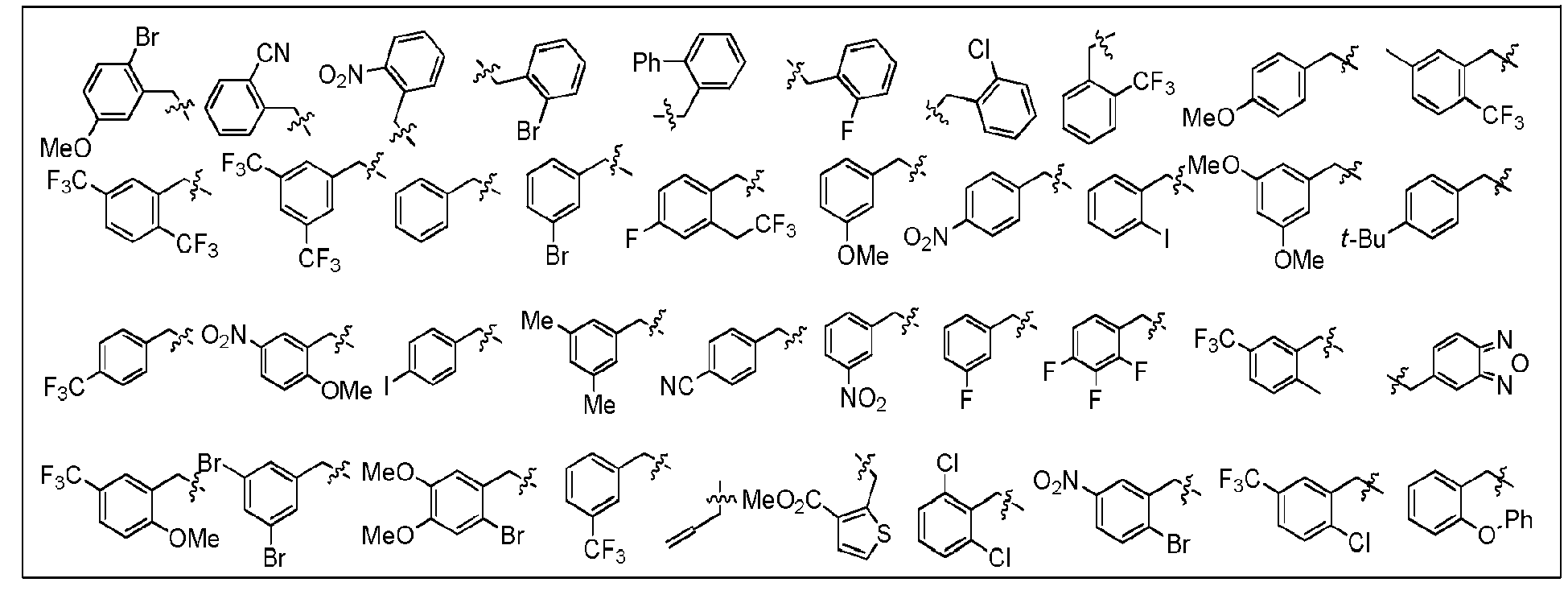

- wherein R is selected from the group consisting of vinyl and ethyl;
- R3 is selected from the following groups:


- wherein R is selected from the group consisting of vinyl and ethyl;
- R3 and R4 areindependently selected from the following groups:

- As used herein, the term "alkyl" refers to a monovalent straight or branched chain, saturated aliphatic hydrocarbon radical having a number of carbon atoms in the specified range. Thus, for example, "C1-6 alkyl" (or "C1-C6 alkyl") refers to any of the hexyl alkyl and pentyl alkyl isomers as well as n-, iso-, sec- and t-butyl, n- and iso- propyl, ethyl and methyl. As another example, "C1-4 alkyl" refers to n-, iso-, sec- and t-butyl, n- and isopropyl, ethyl and methyl. As another example, "C1-3 alkyl" refers to n-propyl, isopropyl, ethyl and methyl.
- The term "haloalkyl" means an alkyl radical as defined above, unless otherwise specified, that is substituted with one to five, preferably one to three halogen. Representative examples include, but are not limited to trifluoromethyl, dichloroethyl, and the like.
- The term acyl, means -C(O)-alkyl where alkyl is as defined above.
- The term "alkoxy" means -O-alkyl where alkyl is as defined above.
- The term "alkenyl" refers to a monovalent straight or branched chain, saturated aliphatic hydrocarbon radical having a number of carbon atoms in the specified range and at least one carbon-carbon double bond, and otherwise carbon-carbon single bonds. Alkenyl includes for example ethenyl, 1-methylethynyl, 2-propenenyl, 2-butenyl, 1,4-pentadienyl and the like.
- The term "alkynyl" refers to a monovalent straight or branched chain, saturated aliphatic hydrocarbon radical having a number of carbon atoms in the specified range and at least one carbon-carbon triple bond, and otherwise carbon-carbon double or single bonds. Alkynyl includes for example 2-propynyl, 1-butynyl, 3-hexen-5-ynyl and the like.
- The term "cycloalkyl" refers to any monocyclic ring of an alkane having a number of carbon atoms in the specified range. Thus, for example, "C3-6 cycloalkyl" (or "C3-C6 cycloalkyl") refers to cyclopropyl, cyclobutyl, cyclopentyl, and cyclohexyl, and "C3-5 cycloalkyl" refers to cyclopropyl, cyclobutyl, and cyclopentyl.
- The term "halogen" (or "halo") refers to fluorine, chlorine, bromine and iodine (alternatively referred to as fluoro, chloro, bromo, and iodo).
- The term "aryl" refers to phenyl, naphthyl, and anthranyl.
- The term "heteroaryl" refers to (i) a 5- or 6-membered heteroaromatic ring containing from 1 to 3 heteroatoms independently selected from N, O and S, or (ii) is a heterobicyclic ring selected from quinolinyl, isoquinolinyl, and quinoxalinyl. Suitable 5- and 6-membered heteroaromatic rings include, for example, pyridyl (also referred to as pyridinyl), pyrrolyl, pyrazinyl, pyrimidinyl, pyridazinyl, triazinyl, thienyl, furanyl, imidazolyl, pyrazolyl, triazolyl, oxazolyl, isooxazolyl, oxadiazolyl, oxatriazolyl, thiazolyl, isothiazolyl, and thiadiazolyl. Heteroaryls of particular interest are pyrrolyl, imidazolyl, pyridyl, pyrazinyl, quinolinyl (or quinolyl), isoquinolinyl (or isoquinolyl), and quinoxalinyl.
- Examples of 4- to 7-membered, saturated heterocyclic rings within the scope of this invention include, for example, azetidinyl, piperidinyl, morpholinyl, thiomorpholinyl, thiazolidinyl, isothiazolidinyl, oxazolidinyl, isoxazolidinyl, pyrrolidinyl, imidazolidinyl, piperazinyl, tetrahydrofuranyl, tetrahydrothienyl, pyrazolidinyl, hexahydropyrimidinyl, thiazinanyl, thiazepanyl, azepanyl, diazepanyl, tetrahydropyranyl, tetrahydrothiopyranyl, and dioxanyl. Examples of 4- to 7-membered, unsaturated heterocyclic rings within the scope of this invention (see HetB) include mono-unsaturated heterocyclic rings corresponding to the saturated heterocyclic rings listed in the preceding sentence in which a single bond is replaced with a double bond (e.g., a carbon-carbon single bond is replaced with a carbon-carbon double bond).
- It is understood that the specific rings listed above are not a limitation on the rings which can be used in the present invention. These rings are merely representative.
- Unless expressly stated to the contrary in a particular context, any of the various cyclic rings and ring systems described herein may be attached to the rest of the compound at any ring atom (i.e., any carbon atom or any heteroatom) provided that a stable compound results.
- Unless expressly stated to the contrary, all ranges cited herein are inclusive. For example, a heteroaromatic ring described as containing from "1 to 4 heteroatoms" means the ring can contain 1, 2, 3 or 4 heteroatoms. It is also understood that any range cited herein includes within its scope all of the sub-ranges within that range. Thus, for example, a heterocyclic ring described as containing from "1 to 4 heteroatoms" is intended to include as aspects thereof, heterocyclic rings containing 2 to 4 heteroatoms, 3 or 4 heteroatoms, 1 to 3 heteroatoms, 2 or 3 heteroatoms, 1 or 2 heteroatoms, 1 heteroatom, 2 heteroatoms, 3 heteroatoms, and 4 heteroatoms. As another example, an aryl or heteroaryl described as optionally substituted with "from 1 to 4 substituents" is intended to include as aspects thereof, an aryl or heteroaryl substituted with 1 to 4 substituents, 2 to 4 substituents, 3 to 4 substituents, 4 substituents, 1 to 3 substituents, 2 to 3 substituents, 3 substituents, 1 to 2 substituents, 2 substituents, and 1 substituent.
- When any variable occurs more than one time in any constituent or in Formula I, II, IIa, A, B or C, or in any other formula depicting and describing compounds of the present invention, its definition on each occurrence is independent of its definition at every other occurrence. Also, combinations of substituents and/or variables are permissible only if such combinations result in stable compounds.
- Unless expressly stated to the contrary, substitution by a named substituent is permitted on any atom in a ring (e.g., cycloalkyl, aryl, or heteroaryl) provided such ring substitution is chemically allowed and results in a stable compound.
- The compounds of the invention contain chiral centers and, as a result of the selection of substituents and substituent patterns, can contain additional chiral centers, and thus can occur as mixtures of stereoisomers, or as individual diastereomers, or enantiomers. All isomeric forms of these compounds, whether individually or in mixtures, are within the scope of the present invention. Unless depicted or specified otherwise, the cinchona alkaloid salts of the invention encompass all stereoisomers, including cinchonine, cinchonidine, quinine, quinidine, dihydroquinidine, and dihydroquinine.
- To the extent substituents and substituent patterns provide for the existence of tautomers (e.g., keto-enol tautomers) in the compounds of the invention, all tautomeric forms of these compounds, whether present individually or in mixtures, are within the scope of the present invention. Compounds of the present invention having a hydroxy substituent on a carbon atom of a heteroaromatic ring are understood to include compounds in which only the hydroxy is present, compounds in which only the tautomeric keto form (i.e., an oxo substitutent) is present, and compounds in which the keto and enol forms are both present.
- The term "organic substituent group" means any substituent group containing a carbon atom, which may be optionally substituted. Organic substituent groups include, but are not limited to, C1-10alkyl, C2-10alkenyl, C2-10alkynyl, aryl, heteroaryl, non- or partially aromatic heterocycles, C3-10cycloalkyl, C1-10alkoxy, C1-10alkylthio, and C1-10acyl, each optionally substituted with, for example, one or more of the following: halide, hydroxy, nitrogen containing substituents such as amino, sulfur containing substituent such as sulfates, C1-4alkoxy and C1-4alkylthio.
- The term "nitrogen protecting group" means a substituent that protects a nitrogen atom in a reaction from a reagent or chemical environment. Nitrogen protecting groups are well known in the art and include for example, t-butyl, vinyl, phenyl, benzyl, p-methoxybenzyl, 3,4-dimethoxy benzyl, p-nitrobenzyl, benzhydryl, trityl, trialkylsilyl, methoxymethyl ether, (2,2,2-trichloroethoxy)methyl and 2-(trimethylsilyl)ethoxy)methyl, Boc, Cbz.
- The term "functional group that has leaving ability" means an atom or atom group that leaves from a substrate in a substitution or elimination reaction, that is a leaving group, and includes for example halogen and sulfonate.
- The term electrophilic alkylating agent" means an agent that delivers the equivalent of an alkyl cation, such as for example an alkyl halide.
- The term "electon deficient olefin" means an electrophilic alkene substituted with for example, a ketone, such as an α, β-unsaturated carbonyl, a nitrile or a nitro group.
- The term "sulfonate" means an anion or leaving group having the formula R#-SO3- which is the conjugate base of sulfonic acid. R# includes for example C1-4alkyl optionally substituted with 1 to 3 halogen, and aryl optionally substituted with 1 to 3 halogen or methyl or nitro. Examples include mesylate, triflate, tosylate and besylate.
- The term "electron withdrawing group" is well known in the art are includes for example, cyano, nitro, -C(O)ORxvii,-C(O)SRxviii and -C(O)NRxvixRxx, wherein Rxvii and Rxviii are independently H or an organic substituent group and Rxvix and Rxx are independently H or an organic substituent group or Rxvix and Rxx may be joined together with the nitrogen to which they are attached to form a 5- or 6-membered heterocyclic ring;
- The following abbreviations are used throughout the specification.
- DCM
- = dichloromethane
- DCPP
- = 1,3-bis(dicyclohexylphosphino)propane
- DHP
- = 3,4-dihydro-2H-pyran
- DMF
- = dimethylformamide
- DMSO
- = dimethyl sulfoxide
- HCl
- = hydrochloric acid
- IPA
- = isopropyl alcohol
- LCAP
- = liquid chromatography area percent
- MTBE
- = methyl tert-butyl ether
- NMP
- = N-methyl-2-pyrrolidone
- PTC
- = phase transfer catalyst
- RT
- = room temperature
- SFC
- = supercritical fluid chromatography
- THF
- = tetrahydrofuran
-

-

- To a solution of 2,3-dibromo-5-chloropyridine (60 g, 221 mmol) in THF (500 mL) was added a solution of isopropylmagnesium chloride lithium chloride solution in THF (1.3M, 185 mL) at -40 °C over about 30 min. The solution was stirred for 30 min at -40 °C and DMF (50 mL) was added. The resulting solution was warmed up to room temperature and stirred for 30 min. The reaction was quenched with 1 N HCl (400 mL) and MTBE (200 mL) was added. Organic layer was separated and washed twice with 5% aqueous NaHCOs (200 mL). The solvent was removed under vacuum at 50 °C. The resulting solids (aldehyde intermediate) were dissolved in methanol (400 mL). The solution was cooled to 5 °C under an ice bath. NaBH4 (3.6 g) was added slowly over 30 min while maintaining the reaction temperature below room temperature. The reaction mixture was stirred for another 30 min followed by addition of water (125 mL). The resulting mixture was concentrated under vacuum to approximately 150 ml. Solids precipitated during the concentration. The suspension was stirred vigorously at room temperature for 1 h and solids were collected by filtration. The wet cake was dried in a vacuum oven over night at 60 °C to give 1 (45.6 g, 93%) as a solid. 1H NMR (CDCl3, 400 MHz): δ 8.26 (d, J = 2.5 Hz, 1H), 7.88 (d, J =2.5 Hz, 1H), 4.73 (d, J = 5.8 Hz, 2H), 2.33 (t, J = 11.4 Hz, 1H); 13C NMR (CDCl3, 100 MHz): δ 147.12, 138.48, 138.39, 136.14, 132.06, 62.76.
-

- To a solution of 1 (5.0 g, 22.5 mmol) in 2-MeTHF (15 mL) was added 3,4-dihydro-2H-pyran (2.7 mL, 29.6 mmol) and concentrated sulfuric acid (125 mg) at room temperature. The solution was stirred for 10 min and was then cooled to - 3 °C. Isopropylmagnesium chloride lithium chloride solution (1.3 M, 30 ml, 39 mmol) was slowly added at -3 to 3 °C. The resulting solution was stirred at -3 °C for 3 h until a HPLC showed the conversion was greater than 97%. DMF (5 ml) was added over 15 min below 5 °C. The resulting solution was stirred for another 1 h at this temperature. The reaction mixture was quenched by addition of MTBE (50 mL), 15% aqueous citric acid (25 mL) and water (15 mL). The organic layer was separated and washed with 5% aqueous NaCl (50 mL) twice. The organic solution was concentrated under vacuum at 50 °C to give 2 as an oil (6.2 g, 68 wt%, 16.6 mmol, 74% yield). The crude product was used directly for the next step without further purification. The pure sample was isolated by flash chromatography on silica gel with 5% ethyl acetate in hexane as eluants. 1H NMR (CDCl3, 400 MHz): δ 10.13 (s, 1H), 8.65 (s, 1H), 8.20 (s, 1H), 5.25 (d, J= 16.6 Hz, 1H), 5.01 (d, J = 16.6 Hz, 1H), 4.80 (m, 1H), 3.88 (m, 1H), 3.58 (m, 1H), 1.7 (m, 6H); 13C NMR (CDCl3, 100 MHz): δ 194.20, 147.06, 146.32, 138.98, 136.41, 134.87, 99.04, 64.42, 62.72, 30.53, 25.30, 19.66.
-

- To a solution of crude 2 (6.2 g, 68 wt%, 16.6 mmol) and 3 (3.46 g, 18.3 mmol) in isopropanol (40 mL) was added DBU (0.12 g, 0.83 mmol) at - 2 °C. After stirring at -2 °C for 2 h, the solution was warmed up to 10 °C and stirred at this temperature for 3 h. The yellow solids precipitated from the solution. The suspension was stirred over night while the batch was allowed to warm up to room temperature slowly. The suspension was finally warm up to 50 °C and stirred for 4 h at this temperature. After cooling to 30 °C, water (35 ml) was added dropwise over 30 min from an additional funnel. The suspension was cooled to room temperature and filtered. The cake was washed with a mixture of isopropanol (3 mL) and water (3 mL). The precipitates were collected and dried in a vacuum oven over night at 50 °C to give 4 (6.2 g, 87%) as a solid. 1H NMR (CDCl3, 400 MHz): δ 8.72 (dd, J = 7.5, 1.8 Hz), 8.66 (d, J = 2.4 Hz, 1H), 8.18 (dd, J =5.1, 1.8 Hz, 1H), 7.94 (d, J = 2.4Hz, 1H), 7.78 (s, 1H, 1H), 6.89 (dd, J = 7.5, 5.1 Hz, 1H), 4.99 (d, J = 13.8 Hz, 1H), 4.80 (m, 1H), 4.70 (d, J = 13.8 Hz, 1H), 3.90 (m, 1H), 3.60 (m, 1H), 1.83 (s, 9H), 2.0-1.5 (m, 6H). The conformation of the double bond as trans isomer was confirmed by NOE experiment. 13C NMR (CDCl3, 100 MHz): δ 168.75, 159.64, 148.99, 147.85, 146.65, 137.01, 135.29, 133.56, 132.41, 129.50, 129.37, 117.27, 116.32, 98.77 64.80, 62.49, 58.62, 30.39, 29.01, 25.26, 19.34.
-

- To a suspension of 4 (3.0 g, 7.0 mmol) in ethanol (25 mL) was added NaBH4 (0.37 g) in one portion. The resulting suspension was stirred at room temperature for 1 h. The reaction was quenched by adding water (10 mL) followed by 6 N HCl solution in isopropanol (5 mL) slowly. The solution was warmed up to 40 °C and stirred for 3 h. The reaction mixture was mixed with MTBE (50 mL) and saturated aqueous NaCl (50 mL). The organic was separated and washed with water (50 mL). The solution was concentrated under vacuum at 50 °C and residue was triturated with hexane (30 mL). The resulting suspension was stirred at room temperature for 30 min. The precipitates were collected by filtration to give 5 (2.2 g, 86 %) as a solid. 1H NMR (CDCl3, 400 MHz): δ 8.34 (s, 1H), 8.15 (d, J = 4.9 Hz, 1H), 7.74 (s, 1H), 7.30 (d, J = 7.1 Hz, 1H), 6.83 (t, J = 5.7 Hz, 1H), 4.73 (dd, J = 13.4, 4.9 Hz, 1H), 4.63 (dd, J = 13.4, 5.7 Hz, 1H), 4.01 (t, J = 6.1 Hz, 1H), 3.44 (dd, J = 15.4, 5.2 Hz, 1H), 3.17 (dd, J = 15.4, 7.2 Hz, 1H), 2.94 (t, J = 5.5 Hz, 1H), 1.79 (s, 9H); 13C NMR (CDCl3, 100 MHz): δ 178.72, 159.12, 153.82, 146.45, 145.83 135.72, 135.32, 130.63, 130.27, 124.04, 117.33, 61.40, 58.70, 44.12, 34.01, 28.81.
-

- To a solution of 5 (5.8 g, 16.8 mmol) in dichloromethane (30 mL) was added DMF (60 µL) and thionyl chloride (2.2 g) at 5 °C. The mixture was stirred for 30 min at this temperature followed by addition of 5% aqueous NaCl (30 mL). The organic layer was separated and washed with 5% aqueous NaCl (30 mL). The solvent was removed and the residue was dissolved in heptane (20 mL). The solution was stirred for 30 min and the product was precipitated. The suspension was cooled to 0 °C and filtered to give 6 (5.8 g, 93%) as a solid: 1H NMR (CDCl3, 400 MHz): δ 8.36 (d, J = 2.3 Hz, 1H), 8.13 (dd, J = 5.1, 1.4 Hz, 1H), 7.65 (d, J = 2.3 Hz, 1H), 7.19 (om, 1H), 6.78 (dd, J = 7.3, 5.2 Hz, 1H), 4.58 (m, 2H), 4.06 (m, 1H), 3.66 (dd, J = 16.3, 4.6 Hz, 1H), 3.32 (dd, J = 16.3, 7.5 Hz, 1H), 1.75 (s, 9H); 13C NMR (CDCl3, 100 MHz): δ 178.06, 159.45, 154.58, 147.39, 145.73, 136.87, 132.47, 130.42, 130.11, 123.77, 117.03, 58.51, 43.37, 42.25, 33.69, 28.82.
-

- A solution of 6 (2.39 g, 6.56 mmol) in toluene (50 mL) was cooled to -2.5 °C under nitrogen atmosphere. Compound 10 (17 mg, 0.020 mmol) was charged, and the resulting solution was aged for about 15 min while cooled to -3.3 °C. A pre-cooled (-1 °C ) aqueous NaOH (26.2 mL, 0.3 N) was charged in over 4 min below -0.6 °C. The reaction was aged at -1.3 °C for 3 h. The reaction was quenched with water (10 ml). The organic layer was washed with water (10 mL), concentrated, flushed with IPA to give crude product 7 (2.59 g, 94.4%ee, 83% wt by NMR against 1,3,5-trimethoxybenzene as an internal standard).
- The crude product was recrystallized from IPA and water, filtered and dried in an oven at 50 °C to give 58 (1.95 g, 95.7%wt, 99%ee, 87% yield) as a solid. 1H NMR (CDCl3, 400 MHz): δ 8.42 (s, 1H), 8.19 (d, J = 5.2 Hz, 1H), 7.56 (s, 1H), 7.10 (d, J = 7.3 Hz, 1H), 6.83 (dd, J = 7.3, 5.2 Hz, 1H), 3.60 (dd, J = 24.9, 16.8 Hz, 2 H), 3.09 (dd, J = 28.6, 16.8 Hz, 2H); 13C NMR (CDCl3, 100 Hz): δ 179.43, 160.54, 157.82, 147.44, 146.54, 135.80, 132.17, 130.62, 129.33, 128.36, 117.69, 58.83, 51.94, 44.35, 41.57, 28.83.
-

- A slurry of quinidine (11, 8.1 g, 23.7 mmol, containing -14% dihydroquinidine) and 2-bromo-5-methoxybenzylbromide (12, 16.59 g, 59.3 mmol) in IPA (4.0 ml) and DMF (28.4 mL) was degassed by vacuum and flushed with N2, then heated to 70 °C for 7 h. The reaction mixture was cooled to 22 °C, this reaction solution was charged to AcOEt (320 ml) at 22 °C over 10 min while stirring. The resulting slurry was aged at 22 °C for 1 to 2 h, filtered, rinsed with AcOEt (2 x 24 ml), then hexane (2 x 24 ml). The solid was dried under vacuum to give powder as a mixture of bis-salts (bis-quinidine salt 10 and bis-dihydroquinidine salt). (Total 19.7 g, 94% yield). The authentic sample of 10 was purified by SFC (IC column, 20 x 250 mm, 60% MeOH/CO2, 50 mL/min, 100 bar, 35°C, 220 nm, sample concentration: 133 mg/mL in MeOH; desired peak: 3 to 4.5 min). 1H NMR (CDCl3, 500 MHz): δ 9.34 (d, J = 6.1 Hz, 1H), 8.46 (d, J = 6.1 Hz, 1H), 8.38 (d, J = 9.7 Hz, 1H), 8.0 (dd, J = 9.7, 2.1 Hz, 1H), 7.86 (s, 1H), 7.79 (d, J = 8.9 Hz, 1H), 7.74 (d, J = 8.9 Hz, 1H), 7.60 (d, J = 2.5 Hz, 1H), 7.42 (d, J = 2.3 Hz, 1H), 7.17 (dd, J = 8.8, 2.8 Hz, 1H), 7.03 (dd, J = 8.8, 2.7 Hz, 1H), 6.93 (s, 1H), 6.50 (d, J = 2.4 Hz, 1 H), 6.06 (m, 1H), 5.24 (m, 3H), 4.95 (d, J = 12.9 Hz, 1H), 4.37 (m, 1H), 4.23 (m, 4H),4.12 (m, 1H), 3.88 (s, 3H), 3.69 (s, 3H), 3.54 (m, 1H), 3.32 (s, 2H), 3.23 (m, 1H), 2.71 (m, 1H), 2.51 (s, 2H), 2.33 (m, 1H), 1.94 (br, 1H), 1.83 (br, 2H), 1.17 (br, 1H); 13C NMR (DMSO-d6, 100 Hz): δ 159.45, 159.07, 158.67, 156.12, 146.01, 137.08, 134.68, 134.30, 133.21, 132.98, 128.18, 128.03, 127.45, 122.13, 121.89, 121.22, 118.08, 117.5, 117.07, 116.73, 116.20, 115.81, 112.67, 105.09, 66.81, 65.51, 62.43, 56.75, 56.06, 55.91, 55.52, 54.80, 36.84, 25.91, 23.10, 20.75.
-
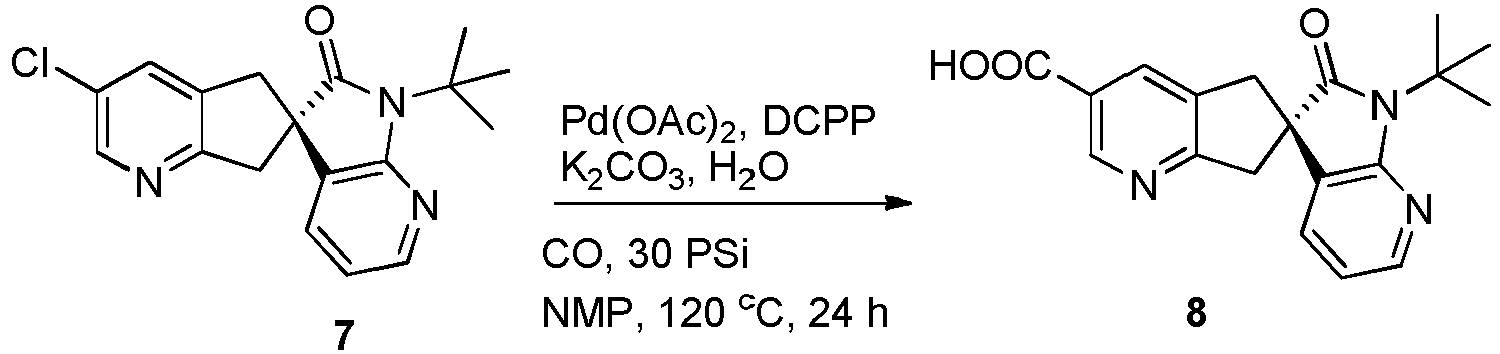
- A mixture of 7 (5.0 g, 14.5 mmol), K2CO3 (5.01 g, 36.2 mmol), Pd(OAc)2 (33 mg, 0.145 mmol), 1,3-bis(dicyclohexylphosphino)propane (DCPP, 127 mg, 0.290 mmol) and water (0.522 mL, 29.0 mmol) in NMP (32 mL) was heated at 120 °C under 30 psi of CO for 24 h. After cooling to room temperature, the resulted slurry was diluted with water (100 mL). The pH was slowly adjusted to 3~4 with 2 N HCl. The slurry was aged at room temperature for 1 h, filtered, rinsed with water (40 to 50 mL), dried under oven at 60 °C to give 8 (4.64 g, 95%) as a solid. 1H NMR (DMSO-d6, 500 MHz): δ 8.90 (s, 1H), 8.19 (d, J = 5.2 Hz, 1H), 7.54 (d, J = 7.3 Hz, 1H,), 6.99 (dd, J = 7.3, 5.2 Hz, 1H), 3.33 (m, 4H), 1.72 (s, 9H); 13C NMR (DMSO-d6, 125 MHz): δ 180.16, 167.44, 166.97, 158.07, 149.76, 146.61, 135.39, 133.09, 130.36, 128.81, 125.48, 118.44, 58.19, 51.12, 44.56, 41.24, 28.91.
-

- To 8 (4 g, 97%wt) was charged 37% HCl (40 to 44 mL). The slurry was heated at 94 °C for up to 48 h, cooled down to room temperature. The solvent was partially removed by reducing pressure to about total 2 vol (~ 4 mL water remained). The residue was diluted with water (20 mL) followed by adjusting pH to 2.6 with NaOH (3.5 N, 4.5 mL). The thick slurry was aged for 1 to 2 h, filtered, rinsed with water (2 × 8 mL), followed by water/acetone (1:1, 8 mL). The wet cake was dried to give compound 9 (3.1 g, 98%wt, 94%) as crystals. 1H NMR (DMSO-d6, 500 MHz): δ 13.31(br, 1H), 11.14 (s, 1H), 8.91 (s, 1H), 8.11 (m, 2H), 7.49 (dd, J = 7.3, 1.3 Hz, 1H), 6.93 (dd, J = 7.3, 5,3 Hz, 1H), 3.36 (m, 4H); 13C NMR (DMSO-d6, 125 MHz): δ 181.06, 167.36, 166.95, 156.80, 149.79, 147.32, 135.37, 133.19, 130.73, 128.88, 125.50, 118.46, 51.78, 44.12, 40.70.
-

- A mixture of compound 3a (10.0 g, 40.3 mmol), NaCl (2.9g, 1.25 eq.) and water (2 mL) in DMSO (50 mL) was heated at 120 °C for 30 min. The mixture was cooled to 30 °C followed by addition of MTBE (200 mL) and water (50 mL). The organic layer was separated and the aqueous layer extracted with another MTBE (50 mL). Combined organic layer was washed three times with water (50 mL). Solvent removed under vacuum and the resulting solid was dried in a vacuum oven at 30 °C to give 3 (7.0 g, 92%) as solid. 1H NMR (CDCl3, 400 MHz): δ 8.15 (dd, J = 5.2, 1.4 Hz, 1H), 7.40 (dd, J = 7.2, 1.4 Hz, 1H), 6.88 (dd, J = 7.2, 5.2 Hz, 1H), 3.45 (s, 2H), 1.78 (s, 9H). 13C NMR (CDCl3, 100 MHz): δ 174.99, 160.06, 145.82, 130.80, 119.51, 117.15, 58.53, 35.98, 28.80;
-

-
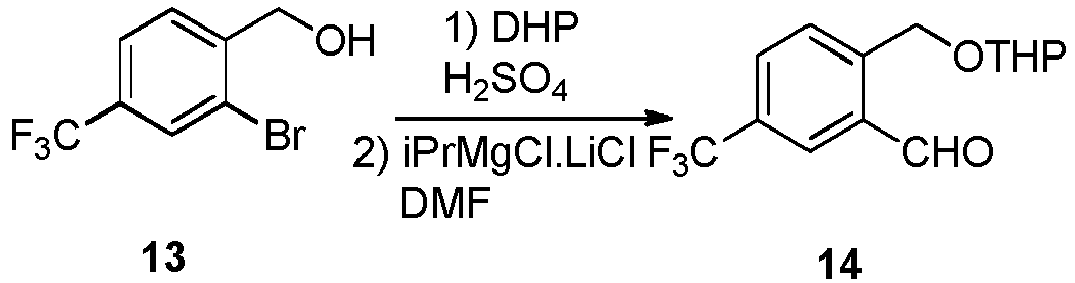
- To a solution of compound 13 (5.0 g, 15.7 mmol) in 2-MeTHF (12 mL) was added 3,4-dihydro-2H-pyran (2 mL, 20.4 mmol) and concentrated sulfuric acid (0.06 mL) at room temperature. The solution was stirred for 10 min and was then cooled to - 3 °C. Isopropylmagnesium chloride lithium chloride solution (21 mL, 1.3 M, 26.7 mmol) was slowly added at -3 to 3 °C. The resulting solution was stirred at -3 °C for 3 h until a HPLC showed the conversion was greater than 97%. DMF (4 ml) was added over 15 min below 5 °C. The resulting solution was stirred for another one hour at this temperature. The reaction mixture was quenched by addition of MTBE (40 mL), 15% aqueous citric acid (20 mL) and water (12 mL). The organic layer was separated and washed twice with 5% aqueous NaCl (40 mL). The solution was concentrated under vacuum at 50 °C to give 4.65 g of 14 as oil (97 %wt, 98% yield). The crude product was used directly for the next step without further purification.
-

- To a round bottom flask was charged 14 (4.50 g , 15.6 mmol), 3 (2.50 g. 17.2 mmol, 1.1 eq.) and IPA (25 ml). This slurry was aged until dissolved. It was cooled under an ice bath followed by charging DBU (0.12 mL, 0.8 mmol) then was aged for half hour below 5 °C and 2 h at room temperature. The reaction mixture was degassed by vacuum and flushed with N2 followed by charge NaBH4 (0.80g, 21.8 mmol). The reaction was aged for 2 h. After completion of the reduction, 6 N HCl (10 mL) and water (16 mL) was added in and the mixture was heated to 70 °C for 1 to 2 h until the deprotection of THP was complete. The resulting reaction mixture was concentrated followed by charge dichloromethane (60 mL) and water (27 mL). The pH of the reaction mixture was adjusted to ~10 with aqueous NaOH, and the organic layer was separated. The aqueous layer was then extracted with dichloromethane (50 mL) twice. The combined organic layer was concentrated under vacuum, and purified with silica gel column (0 to 30% of AcOEt/hexane) to give the desired product 15 as a solid (4.07 g , 78%).
1H NMR (CDCl3, 500 MHz): δ 8.21 (dd, J =5.2, 0.8 Hz, 1H), 7.59 (d, J = 8.1 Hz, 1H), 7.52 (dd, J = 8.0, 1.1 Hz, 1H), 7.19 (om, 2H), 6.90 (dd, J = 7.3, 5.3 Hz, 1H), 4.78 (ABq, J = 12.9 Hz, 2H), 3.71 (m, 1H), 3.45 (dd, J =14.2, 4.4Hz, 1H), 3.22 (dd, J = 14.2, 4.4 Hz, 1H), 2.77 (br, 1H), 1.67 (s, 9H); 13C NMR (CDCl3, 125 MHz): δ 176.6, 159.1, 146.3, 140.1, 137.4, 131.13, 131.10, 130.7 (q, J = 33.8 Hz), 127.3, 124.3, 123.5 (q, J = 272 Hz), 122.5, 117.1, 58.7, 45.7, 43.0, 33.0, 28.7. -

- To a solution of 15 (3.5g, 10.4 mmol) in dichloromethane (20 mL) was charged DMF (0.04 mL, 0.5 mmol). This solution was cooled under an ice bath. Thionyl chloride (0.85 mL, 11.5 mmol) was then added under 5 °C, and the resulting reaction was aged for 3 h at this temperature. Once the reaction was complete, 5% aqueous NaCl (16.5 mL) was added. The organic layer was separated and washed with 5% aqueous NaCl (16.5 mL). The solvent was removed via rotovap, and the crude was purified by silica gel column chromatography (0 to 10% AcOEt/hexane) to give the desired compound 16 as an oil (3.05 g, 74%). 1H NMR (CDCl3, 500 MHz): δ 8.20 (dd, J = 5.1, 1.7 Hz, 1H), 7.58 (d, J = 8.1 Hz, 1H), 7.51 (dd, J = 8.1, 1.1 Hz, 1H), 7.18 (s, 1H), 7.12 (dd, J = 6.3, 2.7 Hz, 1H), 6.88 (dd, J = 7.3, 5.1 Hz, 1H), 4.77 (ABq, J = 12.9 Hz, 2H), 3,72 (m, 1H), 3.46 (dd, J = 14.2, 4.4, 1H), 3.18 (dd, J = 14.2, 8.7 Hz, 1H), 1.67 (s, 9H); 13C NMR (CDCl3, 125 MHz): δ 177.6, 159.1, 146.5, 143.3, 136.6, 131.0, 129.7 (m, 2C), 124.0, 123.0, 123.9 (q, J = 271 Hz), 117.4, 126.6, 62.4, 58.8, 46.1, 32.9, 28.6.
-

- A solution of 16 (50 mg, 0.126 mmol) in toluene (2 ml) was cooled to -1 °C, degassed with vacuum and flushed N2. To this solution was charged a precooled (-2 to 0 °C) aqueous NaOH (1N, 1 mL) followed by charged a catalyst 18. The resulted reaction was aged at -1 to 1 °C for several hours until complete conversion. The organic layer was purified with silica gel column chromatography (0 to 10% AcOEt/hexane) to give the desired compound 17 as oil (42 mg, 92%IY, 85%ee, A or S undetermined).
1H NMR (CDCl3, 400 MHz): δ 8.17 (dd, J = 5.2, 1.8 Hz, 1H), 7.52 (m, 2 H), 7.37 (d, J = 8.2 Hz, 1H), 7.02 (dd, J = 7.3, 1.8 Hz, 1H), 6.80 (dd, J = 7.3, 5.2 Hz, 1H), 3.64 (d, J = 15.9 Hz, 2H), 3.09 (d, J = 16.1 Hz, 2H), 1.83 (s, 9H); 13C NMR (CDCl3, 125 MHz): δ 179.6, 157.6, 146.3, 145.3, 141.9, 129.8, 129.6 (q, J = 32 Hz), 127.6, 124.8, 124.5 (q, J= 271 Hz), 121.4, 117.6, 58.7, 53.8, 43.8, 43.7, 28.9. -

- A slurry cinchonidine (5.0 g, 16.98 mmol) and 2-cyano-benzyl bromide (4.0 g, 20.38 mmol) in 50 ml of IPA was degassed by vacuum and flushed with N2, then it was heated to 67 °C until completely conversion (4 to 5 h). It was cooled down and ~40 mL of solvent was removed by reducing pressure. This concentrated solution was added into AcOEt (160 ml) over 5 to 10 min while stirring. The resulting slurry was aged for 1 to 2 h at 22 °C, filtered, rinsed with IPA/hexane (1:1; 50 ml) and dried under vacuum to give 19 as a solid (7.43 g, 89% IY). 1H NMR(DMSO-d6, 500 MHz): δ 9.00 (d, J = 4.5 Hz, 1H), 8.39 (d, J = 8.4 Hz, 1H), 8.17 (d, J = 7.6 Hz, 1H), 8.12 (d, J = 7.6 Hz, 2H),7.97 (t, J = 7.8 Hz, 1H), 7.85 (m, 3H), 7.76 (t, J = 8.2 Hz, 1H), 6.87 (d, J = 3.0 Hz, 1H), 6.58 (s, 1H), 5.72 (m, 1H), 5.33 (q, J = 13.1 Hz, 2H), 5.21 (d, J = 17.3 Hz, 1H), 4.96 (d, J = 10.6 Hz, 1H), 4.47 (br, 1H), 4.07 (t, J = 9.8 Hz, 1H), 3.94 (dt, J = 12.0, 3.6 Hz, 1H), 3.44 (t, J = 12.0 Hz, 1H), 3.30 (dt, J = 11.5, 4.1 Hz, 1H), 2.68 (br , 1H), 2.13 (m, 2H), 2.02 (s, 1H), 1.81 (m, 1H), 1.22 (m, 1H); 13C NMR(DMSO-d6, 125 MHz): δ 150.1, 147.6, 145.0, 138.0, 135.7, 134.3, 133.6, 131.1, 130.8, 129.8, 129.4, 127.1, 124.2, 123.6, 120.0, 117.8, 116.4, 115.7, 67.7, 64.7, 60.4, 59.3, 51.2, 37.0, 25.5, 24.3, 21.1.
- A slurry of 19 (0.15 g, 0.306 mmol) and 2-nitrobenzyl bromide (0.104 g, 0.61 mmol) in IPA (0.075 mL) and DMF (0.53 mL) was degassed by vacuum and flushed with N2, then it was heated to 70 °C until completely conversion (4 to 5 h). It was cooled down and was added into AcOEt (6 ml) over 5 to 10 min. The resulting slurry was aged for 1 to 2 h at 22 °C, filtered, rinsed AcOEt (2 x 5 ml) and dried under vacuum to give 18 as a solid (0.19 g, 94%IY). 1H NMR(DMSO-d6, 500 MHz): δ 9.82 (d, J = 6.3 Hz, 1H), 8.81 (d, J = 8.5 Hz, 1H), 8.55 (m, 1H), 8.30 (t, J = 7.4 Hz, 1H), 8.13 (m, 3H), 8.0 (t, J = 7.4 Hz, 1H), 7.82 (m, 3H), 7.63 (d, J = 8.1 Hz, 2H), 7.45 (d, J = 3.5 Hz, 1H), 6.86 (s, 1H), 6.50 (m, 2H), 6.5 (m, 2H), 5.70 (m, 1H), 5.33 (s, 2H), 5.21 (d, J = 17.4 Hz, 1H), 4.99 (d, J = 10.5 Hz, 1H), 4.49 (m, 1H), 4.15 (m, 1H) 3.90 (m, 1H), 3.53 (m, 1H), 3.38 (m, 1H), 2.70 (br, 1H), 2.10 (m, 3H), 1.88 (m, 1H), 1.48 (m, 1H); 13C NMR(DMSO-d6, 125 MHz): δ 158.4, 149.8, 138.3, 138.0, 137.2, 135.8, 135.6, 134.3, 133.7, 131.2, 130.6, 130.5, 129.2 (q, J = 32.0 Hz), 128.3 (2C), 126.7, 126.2, 125.99, 125.96, 123.9 (q, J = 272.5 Hz), 122.8,121.6, 119.8, 117.8, 116.7, 115.7, 67.3, 65.4, 60.4, 59.7, 59.4, 51.3,37.0, 30.9, 25.5, 24.9, 22.0.
- As shown in Table 1, the bis-quaternary catalyst is much more active and efficient as compared to the mono-quaternary catalyst for the spirocyclization reaction shown. For this experiment, the bis-catalysts contained ~12 to 15% of the double saturated compounds hydroquinidine or hydrocinchonine.
Table 1 
PTC catalysts: Loading EE conversion Yield 
3% 58% 80% ND 
0.3% 92% 100% 98% AY 
0.3% 94.4% 100% 100% - Tables 2 and 3 show a SAR study of bis-quaternary PTC catalysts for spirocyclization. Both bis-quaternary quinidine and cinchonine catalysts are very efficient (Entries 2 to 5). The Bis-Quinidine catalyst is relatively better than bis-cinchonine catalyst (Entry 2 and 3). 2-Bromo-5-Methoxy-benzyl group is the optimized group for this reaction.
Table 2 
Entry R1 R2 R3 X Y %ee 1 No-substitution H H Br Br 58%ee 2 
OMe H Br Br 94.4%ee 3 
H H Br Br 90%ee 4 
H H I I 89.7%ee 5 
H H Br I 89.4%ee 6 
H H Br Br 84.8%ee 7 Me H H Br I 80%ee 8 No-substitution H 
Br Br 67%ee 9 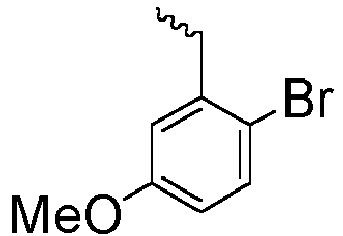
H 
Br Br 27%ee Table 3 
R4 EE Conversion Benzyl 66.3%ee 93% Allyl 69.7%ee 100% 2-Br-5-MeO-benzyl 92%ee 100% - Table 4 shows a study of different functional groups.
Table 4 
Entry X1 Y1 %ee 1 Cl Cl 92 2 Br Cl 92 3 CO2Me Cl 92 4 Br Tos 51 5 Br Br 70 - Table 5 shows a study of different ring systems; Doubly quaternized PTC is a more active catalyst than mono quaternized PTC.
Table 5 
PTC 19: 3%ee Absolute configulation (R or S) has not been determined. PTC 18: 85%ee - The invention is thus disclosed as comprising the following numbered embodiments:
- 1. A process for stereoselectively producing a compound of Formula A
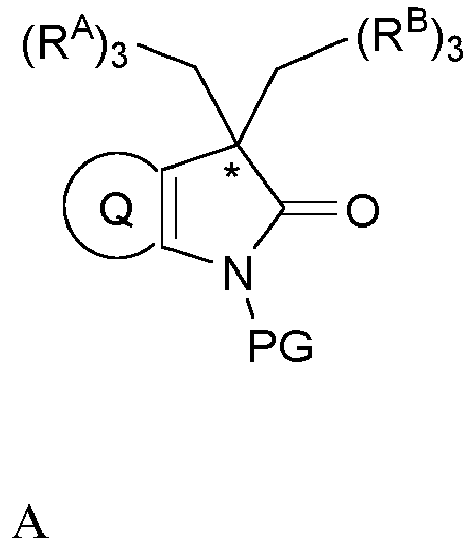
- Q forms a fused 5- or 6-membered aromatic carbocyclic or heterocyclic ring, each optionally substituted with 1 to 4 RC groups,
- each RA and each RB are independently hydrogen, halogen, hydroxy, amino or an organic substituent group, and one RA and one RB may be joined together to form a mono-, bi- or tricyclic carbocyclic or heterocyclic ring system, optionally substituted with 1 to 4 RC groups,
- RC is hydrogen, halogen, hydroxy, amino or an organic substituent group,
- PG is a nitrogen protecting group and
- * represents an asymmetric center,
- comprising initiating a reaction of a compound of Formula B

- with a compound of Formula C

- wherein W is a functional group that has leaving ability, in a water-immiscible organic phase in the presence of a bis-quarternary cinchona alkaloid salt and a base in an aqueous phase to form a biphasic medium comprising the aqueous phase and water-immiscible organic phase,
- wherein the bis-quarternary cinchona alkaloid salt has the chemical structure of Formula I:

- R1 is selected from ethyl and vinyl,
- R2 is selected from hydrogen and methoxy,
- R3 and R4 are independently selected from the group consisting of C1-6alkyl, C2-6alkenyl, C2-6alkynyl, C3-6cycloalkyl, aryl, heteroaryl, -C1-4alkyl-aryl and -C1-4alkyl-heteroaryl, wherein C1-6alkyl, C2-6alkenyl, C2-6alkynyl, C3-6cycloalkyl, aryl, heteroaryl and the aryl and heteroaryl portions of C1-4alkyl-aryl and -C1-4alkyl-heteroaryl are optionally substituted with one to five substituents independently selected from R6,
- R5 is selected from the group consisting of hydrogen, C(O)R, C(O)OR, CONRR', and C1-6alkyl,
- R6 is selected from the group consisting of C1-4alkyl, C1-4haloalkyl, aryl, C1-4alkoxy, hydroxy, CN, CO2R, CONRR', SR, SO2R, SO3R, PR2, PO(OR)2, PO(OR) (NRR'), PO(NRR')2, P(OR)2, P(OR)(NRR'), P(NRR')2, SiRR'R", B(OR)2, C(O)R, NRR', NO2, and halogen, ,
- each R, R' and R" is independently selected from the group consisting of, H, C1-4alkyl, hydroxy and C1-4alkoxy, and
- each X and Y are independently anions selected from halide, OH, HSO4, SO4, BF4, SbF6, carboxylate, carbonate, hydrogencarbonate, NO3, sulfonate, hexafluorophosphate, phosphate, hydrogen phosphate, and perchlorate,
- 2. The process according to Embodiment 1 wherein each RA and each RB are independently selected from the group consisting of:
- (i) hydrogen,
- (ii) halogen,
- (iii) OR7,
- (iv) N(R7)2,
- (v) CN,
- (vi) C1-8alkyl or C2-8alkenyl, either of which optionally bears up to 3 substituents independently selected from halogen, OH, CN, CF3, OR7, SR8, SO2R8, SO2N(R7)2, COR7, CO2R7, CON(R7)2, N(R7)2, NR7COR8 and NR7SO2R8; and
- (vii) C3-10cycloalkyl, C3-10cycloalkylC1-4alkyl, Het, HetC1-4alkyl, ARY or ARY-C1-4alkyl, any of which optionally bears up to 3 substituents independently selected from halogen, OH, oxo, CN, CF3, R8, OR7, SR8, SO2R8, SO2N(R7)2, COR7, CO2R7, CON(R7)2, N(R7)2, NR7COR8 and NR7SO2R8; where "ARY" refers to phenyl or 5- or 6-membered heteroaryl, either of which phenyl or heteroaryl is optionally fused to a 5- or 6-membered carbocycle or heterocycle, and "Het" refers to a nonaromatic mono- or bicyclic heterocyclic system of up to 10 ring atoms;
- and one of RA and RB together may complete a mono- or bicyclic carbocyclic or heterocyclic system of up to 10 ring atoms which optionally bears up to 3 substituents independently selected from halogen, OH, oxo, CN, CF3, R8, OR7, SR8, SO2R8, SO2N(R7)2, COR7, CO2R7, CON(R7)2, N(R7)2, NR7COR8 and NR7SO2R8;
- R7 is H or C1-6alkyl which is optionally substituted with up to 3 halogen atoms or with OH, CN, CF3, C1-4alkoxy, amino, C1-4alkylamino or di(C1-4alkyl)amino, or R7 is phenyl, benzyl or 5- or 6-membered heteroaryl, any of which optionally bears up to 3 substituents independently selected from halogen, OH, CN, CF3, C1-4alkyl, C1-4alkoxy, amino, C1-4alkylamino and di(C1-4alkyl)amino;
- or two R7 groups attached to the same nitrogen atom may complete a heterocycle of up to 6 ring atoms which optionally bears up to 3 substituents independently selected from halogen, OH, oxo, CN, CF3, C1-4alkyl, C1-4alkoxy, amino, C1-4alkylamino and di(C1-4alkyl)amino; and
- R8 is C1-6alkyl which is optionally substituted with up to 3 halogen atoms or with OH, CN, CF3, C1-4alkoxy, amino, C1-4alkylamino or di(C1-4alkyl)amino, or R8 is phenyl, benzyl or 5- or 6-membered heteroaryl, any of which optionally bears up to 3 substituents independently selected from halogen, OH, CN, CF3, C1-4alkyl, C1-4alkoxy, amino, C1-4alkylamino and di(C1-4alkyl)amino;
- or two R8 groups attached to the same nitrogen atom may complete a heterocycle of up to 6 ring atoms which optionally bears up to 3 substituents independently selected from halogen, OH, oxo, CN, CF3, C1-4alkyl, C1-4alkoxy, amino, C1-4alkylamino and di(C1-4alkyl)amino.
- 3. The process according to Embodiment 1 wherein RC is selected from the group consisting of:
- (i) hydrogen,
- (ii) halogen,
- (iii) OR7,
- (iv) N(R7)2,
- (v) CN,
- (vi) C1-8alkyl or C2-8alkenyl, either of which optionally bears up to 3 substituents independently selected from halogen, OH, CN, CF3, OR7, SR8, SO2R8, SO2N(R7)2, COR7, CO2R7, CON(R7)2, N(R7)2, NR7COR8 and NR7SO2R8; and
- (vii) C3-10cycloalkyl, C3-10cycloalkylC1-4alkyl, Het, HetC1-4alkyl, ARY or ARY-C1-4alkyl, any of which optionally bears up to 3 substituents independently selected from halogen, OH, oxo, CN, CF3, R8, OR7, SR8, SO2R8, SO2N(R7)2, COR7, CO2R7, CON(R7)2, N(R7)2, NR7COR8 and NR7SO2R8; where "ARY" refers to phenyl or 5- or 6-membered heteroaryl, either of which phenyl or heteroaryl is optionally fused to a 5- or 6-membered carbocycle or heterocycle, and "Het" refers to a nonaromatic mono- or bicyclic heterocyclic system of up to 10 ring atoms;
- R7 is H or C1-6alkyl which is optionally substituted with up to 3 halogen atoms or with OH, CN, CF3, C1-4alkoxy, amino, C1-4alkylamino or di(C1-4alkyl)amino, or R7 is phenyl, benzyl or 5- or 6-membered heteroaryl, any of which optionally bears up to 3 substituents independently selected from halogen, OH, CN, CF3, C1-4alkyl, C1-4alkoxy, amino, C1-4alkylamino and di(C1-4alkyl)amino;
- or two R7 groups attached to the same nitrogen atom may complete a heterocycle of up to 6 ring atoms which optionally bears up to 3 substituents independently selected from halogen, OH, oxo, CN, CF3, C1-4alkyl, C1-4alkoxy, amino, C1-4alkylamino and di(C1-4alkyl)amino; and
- R8 is C1-6alkyl which is optionally substituted with up to 3 halogen atoms or with OH, CN, CF3, C1-4alkoxy, amino, C1-4alkylamino or di(C1-4alkyl)amino, or R8 is phenyl, benzyl or 5- or 6-membered heteroaryl, any of which optionally bears up to 3 substituents independently selected from halogen, OH, CN, CF3, C1-4alkyl, C1-4alkoxy, amino, C1-4alkylamino and di(C1-4alkyl)amino;
- or two R8 groups attached to the same nitrogen atom may complete a heterocycle of up to 6 ring atoms which optionally bears up to 3 substituents independently selected from halogen, OH, oxo, CN, CF3, C1-4alkyl, C1-4alkoxy, amino, C1-4alkylamino and di(C1-4alkyl)amino.
- 4. The process according to Embodiment 1 wherein PG is selected from the group consisting of: C1-6 alkyl, vinyl, C(O)-O-L, C(O)-L, aryl, heteroaryl, benzyl, benzhydryl, trityl and C1-6alkoxymethyl, wherein aryl, heteroaryl, benzyl, benzyhydryl and trityl optionally are substituted with 1 to 3 substituents independently selected from methoxy and nitro, C1-6alkoxymethyl is optionally substituted with trimethylsilyl and L is C1-6alkyl, aryl or benzyl.
- 5. The process according to Embodiment 1 wherein W is selected from the group consisting of: halogen and sulfonate.
- 6. The process according to Embodiment 1 wherein the water-immiscible organic phase is selected from the group consisting of benzene, toluene, xylenes, chlorobenzene, ethyl ether, isopropyl ether, tetrahydrofuran, 2-methyl tetrahydrofuran, dioxane, methyl tert-butyl ether, cyclopentyl methyl ether, isopropyl acetate, ethyl acetate, hexanes, heptanes, cyclohexane, dichloromethane and dichloroethane.
- 7. The process according to Embodiment 1 wherein the base is selected from the group consisting of: sodium hydroxide, lithium hydroxide, potassium hydroxide, sodium carbonate, lithium carbonate, potassium carbonate, cesium hydroxide, cesium carbonate, sodium hydrogen carbonate, cesium hydrogen carbonate, potassium hydrogen carbonate, lithium hydrogen carbonate, lithium fluoride, sodium fluoride, potassium fluoride, cesium fluoride, lithium tert-butoxide, sodium tert-butoxide, potassium tert-butoxide, cesium tert-butoxide, sodium phosphate, lithium phosphate and potassium phosphate.
- 8. The process according to Embodiment 1 wherein the water-immiscible organic phase is toluene and the base is sodium hydroxide.
Claims (15)
- A bis-quaternary alkaloid salt having the chemical structure of Formula I:
 R1 is selected from ethyl and vinyl,R2 is selected from hydrogen and methoxy,R3 and R4 are independently selected from the group consisting of C1-6alkyl, C2-6alkenyl, C2-6alkynyl, C3-6cycloalkyl, aryl, heteroaryl, -C1-4alkyl-aryl and -C1-4alkyl-heteroaryl, wherein C1-6alkyl, C2-6alkenyl, C2-6alkynyl, C3-6cycloalkyl, aryl, heteroaryl and the aryl and heteroaryl portions of -C1-4alkyl-aryl and -C1-4alkyl-heteroaryl are optionally substituted with one to five substituents independently selected from R6,R5 is selected from the group consisting of hydrogen, C(O)R, C(O)OR, CONRR', and C1-6alkyl,R6 is selected from the group consisting of C1-4alkyl, C1-4haloalkyl, aryl, C1-4alkoxy, hydroxy, CN, CO2R, CONRR', SR, SO2R, SO3R, PR2, PO(OR)2, PO(OR) (NRR'), PO(NRR')2, P(OR)2, P(OR)(NRR'), P(NRR')2, SiRR'R", B(OR)2, C(O)R, NRR', NO2, and halogen,each R, R' and R" is independently selected from the group consisting of, H, C1-6alkyl, hydroxyl, C1-6alkoxy, aryl, heteroaryl, -CH2-aryl, -CH2-heteroaryl, andeach X and Y are independently anions selected from halide, OH, HSO4, SO4, BF4, SbF6, carboxylate, carbonate, hydrogencarbonate, NO3, sulfonate, hexafluorophosphate, phosphate, hydrogen phosphate and perchlorate,for use as phase transfer catalysts in the stereoselective formation of a carbon-carbon, carbon-heteroatom or carbon-halide bond on a substrate in a biphasic medium comprising an aqueous phase and organic phase or a micelle medium.
 - The bis-quarternary cinchona alkaloid salt according to claim 1 for use as phase transfer catalysts in one of the following asymmetric reactions:(1) alkylation with an electrophilic alkylating agent,(2) Michael addition with an electron deficient olefin,(3) aldol reaction with an aldehyde,(4) Mannich reaction with a α-imino ester,(5) Darzens reaction with an aldehyde,(6) Neber rearrangement of an oxime into an α-aminoketone,(7) epoxidation of an electron deficient olefin,(8) aziridination of an electron deficient olefin,(9) dihydroxylation of an electron deficient olefins,(10) fluorination of a carbonyl substrate, and(11) sulfenylation of a β-keto sulfoxide.
- A process for stereoselectively producing a compound of Formula A
 Q forms a fused 5- or 6-membered aromatic carbocyclic or heterocyclic ring, each optionally substituted with 1 to 4 RC groups,each RA and each RB are independently hydrogen, halogen, hydroxy, amino or an organic substituent group, and one RA and one RB may be joined together to form a mono-, bi- or tricyclic carbocyclic or heterocyclic ring system, optionally substituted with 1 to 4 RC groups,RC is hydrogen, halogen, hydroxy, amino or an organic substituent group,PG is a nitrogen protecting group and* represents an asymmetric center,comprising initiating a reaction of a compound of Formula B
 with a compound of Formula C
 wherein W is a functional group that has leaving ability, in a water-immiscible organic phase in the presence of a bis-quarternary cinchona alkaloid salt and a base in an aqueous phase to form a biphasic medium comprising the aqueous phase and water-immiscible organic phase,wherein the bis-quarternary cinchona alkaloid salt has the chemical structure of Formula I:
 R1 is selected from ethyl and vinyl,R2 is selected from hydrogen and methoxy,R3 and R4 are independently selected from the group consisting of C1-6alkyl, C2-6alkenyl, C2-6alkynyl, C3-6cycloalkyl, aryl, heteroaryl, -C1-4alkyl-aryl and -C1-4alkyl-heteroaryl, wherein C1-6alkyl, C2-6alkenyl, C2-6alkynyl, C3-6cycloalkyl, aryl, heteroaryl and the aryl and heteroaryl portions of -C1-4alkyl-aryl and -C1-4alkyl-heteroaryl are optionally substituted with one to five substituents independently selected from R6,R5 is selected from the group consisting of hydrogen, C(O)R, C(O)OR, CONRR', and C1-6alkyl,R6 is selected from the group consisting of C1-4alkyl, C1-4haloalkyl, aryl, C1-4alkoxy, hydroxy, CN, CO2R, CONRR', SR, SO2R, SO3R, PR2, PO(OR)2, PO(OR) (NRR'), PO(NRR')2, P(OR)2, P(OR)(NRR'), P(NRR')2, SiRR'R", B(OR)2, C(O)R, NRR', NO2, and halogen,each R, R' and R" is independently selected from the group consisting of, H, C1-6alkyl, hydroxyl, C1-6alkoxy, aryl, heteroaryl, -CH2-aryl, -CH2-heteroaryl, andeach X and Y are independently anions selected from halide, OH, HSO4, SO4, BF4, SbF6, carboxylate, carbonate, hydrogencarbonate, NO3, sulfonate, hexafluorophosphate, phosphate, hydrogen phosphate and perchlorate.
 - The process according to Claim 3 wherein each RA and each RB are independently selected from the group consisting of:(i) hydrogen,(ii) halogen,(iii) OR7,(iv) N(R7)2,(v) CN,(vi) C1-8alkyl or C2-8alkenyl, either of which optionally bears up to 3 substituents independently selected from halogen, OH, CN, CF3, OR7, SR8, SO2R8, SO2N(R7)2, COR7, CO2R7, CON(R7)2, N(R7)2, NR7COR8 and NR7SO2R8; and(vii) C3-10cycloalkyl, C3-10cycloalkylC1-4alkyl, Het, HetC1-4alkyl, ARY or ARY-C1-4alkyl, any of which optionally bears up to 3 substituents independently selected from halogen, OH, oxo, CN, CF3, R8, OR7, SR8, SO2R8, SO2N(R7)2, COR7, CO2R7, CON(R7)2, N(R7)2, NR7COR8 and NR7SO2R8; where "ARY" refers to phenyl or 5- or 6-membered heteroaryl, either of which phenyl or heteroaryl is optionally fused to a 5- or 6-membered carbocycle or heterocycle, and "Het" refers to a nonaromatic mono- or bicyclic heterocyclic system of up to 10 ring atoms;and one of RA and RB together may complete a mono- or bicyclic carbocyclic or heterocyclic system of up to 10 ring atoms which optionally bears up to 3 substituents independently selected from halogen, OH, oxo, CN, CF3, R8, OR7, SR8, SO2R8, SO2N(R7)2, COR7, CO2R7, CON(R7)2, N(R7)2, NR7COR8 and NR7SO2R8;R7 is H or C1-6alkyl which is optionally substituted with up to 3 halogen atoms or with OH, CN, CF3, C1-4alkoxy, amino, C1-4alkylamino or di(C1-4alkyl)amino, or R7 is phenyl, benzyl or 5- or 6-membered heteroaryl, any of which optionally bears up to 3 substituents independently selected from halogen, OH, CN, CF3, C1-4alkyl, C1-4alkoxy, amino, C1-4alkylamino and di(C1-4alkyl)amino;or two R7 groups attached to the same nitrogen atom may complete a heterocycle of up to 6 ring atoms which optionally bears up to 3 substituents independently selected from halogen, OH, oxo, CN, CF3, C1-4alkyl, C1-4alkoxy, amino, C1-4alkylamino and di(C1-4alkyl)amino; andR8 is C1-6alkyl which is optionally substituted with up to 3 halogen atoms or with OH, CN, CF3, C1-4alkyl, C1-4alkoxy, amino, C1-4alkylamino and di(C1-4alkyl)amino, or R8 is phenyl, benzyl or 5- or 6-membered heteroaryl, any of which optionally bears up to 3 substituents independently selected from halogen, OH, CN, CF3, C1-4alkyl, C1-4alkoxy, amino, C1-4alkylamino and di(C1-4alkyl)amino;or two R8 groups attached to the same nitrogen atom may complete a heterocycle of up to 6 ring atoms which optionally bears up to 3 substituents independently selected from halogen, OH, oxo, CN, CF3, C1-4alkyl, C1-4alkoxy, amino, C1-4alkylamino and di(C1-4alkyl)amino.
- The process according to Claim 3 wherein RC is selected from the group consisting of:(i) hydrogen,(ii) halogen,(iii) OR7,(iv) N(R7)2,(v) CN,(vi) C1-8alkyl or C2-8alkenyl, either of which optionally bears up to 3 substituents independently selected from halogen, OH, CN, CF3, OR7, SR8, SO2R8, SO2N(R7)2, COR7, CO2R7, CON(R7)2, N(R7)2, NR7COR8 and NR7SO2R8; and(vii) C3-10cycloalkyl, C3-10cycloalkylC1-4alkyl, Het, HetC1-4alkyl, ARY or ARY-C1-4alkyl, any of which optionally bears up to 3 substituents independently selected from halogen, OH, oxo, CN, CF3, R8, OR7, SR8, SO2R8, SO2N(R7)2, COR7, CO2R7, CON(R7)2, N(R7)2, NR7COR8 and NR7SO2R8; where "ARY" refers to phenyl or 5- or 6-membered heteroaryl, either of which phenyl or heteroaryl is optionally fused to a 5- or 6-membered carbocycle or heterocycle, and "Het" refers to a nonaromatic mono- or bicyclic heterocyclic system of up to 10 ring atoms;R7 is H or C1-6alkyl which is optionally substituted with up to 3 halogen atoms or with OH, CN, CF3, C1-4alkoxy, amino, C1-4alkylamino or di(C1-4alkyl)amino, or R7 is phenyl, benzyl or 5- or 6-membered heteroaryl, any of which optionally bears up to 3 substituents independently selected from halogen, OH, CN, CF3, C1-4alkyl, C1-4alkoxy, amino, C1-4alkylamino and di(C1-4alkyl)amino;or two R7 groups attached to the same nitrogen atom may complete a heterocycle of up to 6 ring atoms which optionally bears up to 3 substituents independently selected from halogen, OH, oxo, CN, CF3, C1-4alkyl, C1-4alkoxy, amino, C1-4alkylamino and di(C1-4alkyl)amino; andR8 is C1-6alkyl which is optionally substituted with up to 3 halogen atoms or with OH, CN, CF3, C1-4alkyl, C1-4alkoxy, amino, C1-4alkylamino and di(C1-4alkyl)amino, or R8 is phenyl, benzyl or 5- or 6-membered heteroaryl, any of which optionally bears up to 3 substituents independently selected from halogen, OH, CN, CF3, C1-4alkyl, C1-4alkoxy, amino, C1-4alkylamino and di(C1-4alkyl)amino;or two R8 groups attached to the same nitrogen atom may complete a heterocycle of up to 6 ring atoms which optionally bears up to 3 substituents independently selected from halogen, OH, oxo, CN, CF3, C1-4alkyl, C1-4alkoxy, amino, C1-4alkylamino and di(C1-4alkyl)amino.
- The process according to Claim 3 wherein PG is selected from the group consisting of: C1-6 alkyl, vinyl, C(O)-O-L, C(O)-L, aryl, hetroaryl, benzyl, benzhydryl, trityl and C1-6alkoxymethyl, wherein aryl, heteroaryl, benzyl, benzyhydryl and trityl optionally are substituted with 1 to 3 substituents independently selected from methoxy and nitro, C1-6alkoxymethyl is optionally substituted with trimethylsilyl and L is C1-6alkyl, aryl or benzyl.
- The process according to Claim 3 wherein W is selected from the group consisting of: halogen and sulfonate.
- The process according to Claim 3 wherein the water-immiscible organic phase is selected from the group consisting of benzene, toluene, xylenes, chlorobenzene, ethyl ether, isopropyl ether, tetrahydrofuran, 2-methyl tetrahydrofuran, dioxane, methyl tert-butyl ether, cyclopentyl methyl ether, isopropyl acetate, ethyl acetate, hexanes, heptanes, cyclohexane, dichloromethane and dichloroethane.
- The process according to Claim 3 wherein the base is selected from the group consisting of: sodium hydroxide, lithium hydroxide, potassium hydroxide, sodium carbonate, lithium carbonate, potassium carbonate, cesium hydroxide, cesium carbonate, sodium hydrogen carbonate, potassium hydrogen carbonate, lithium hydrogen carbonate, cesium hydrogen carbonate, lithium fluoride, sodium fluoride, potassium fluoride, cesium fluoride, lithium tert-butoxide, sodium tert-butoxide, potassium tert-butoxide, sodium phosphate, lithium phosphate and potassium phosphate.
- The process according to Claim 3 wherein the water-immiscible organic phase is toluene and the base is sodium hydroxide
- The bis-quarternary cinchona alkaloid salt according to claim 1 for use as a phase transfer catalyst in one of the following reactions:(1) the asymmetric formation of a carbon-carbon bond at position b of a substrate having the following formula
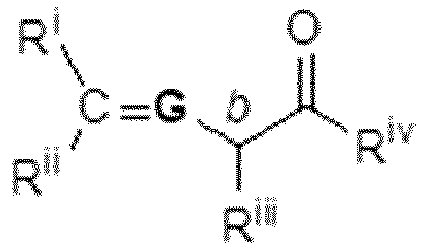 G is N or CH,Ri, Rii and Riii are independently H, halogen or an organic substituent groupRiv is selected from -ORv,SRvi and NRviiRviii, wherein Rv and Rvi are independently H or an organic substituent group, Rvii and Rviii are independently H or an organic substituent group or Rvii and Rviii may be joined together with the nitrogen to which they are attached to form a 5- or 6-membered heterocyclic ring, andwhen G is N, Rii and Riii may be joined together with the atoms to which they are attached to form a 5- or 6-membered mono- or 9- or 10-membered bi-cyclic ring containing one or more heteroatoms in addition to the nitrogen, said ring optionally substituted with 1 to 5 substituents independently selected from: halogen, hydroxy, amino or an organic substituent group;(2) the asymmetric formation of a carbon-carbon bond at position b of a substrate having the following formula
 (3) the asymmetric formation of a carbon-carbon bond at position b of a substrate having the following formula
 (4) the asymmetric formation of a carbon-carbon bond position b of a substrate having the following formula
comprising reacting the substrate with electrophilic alkylating agent, an electron deficient olefin or an aldehyde in the presence of bis-quarternary cinchona alkaloid salt and a base in a biphasic medium comprising an aqueous phase and organic phase to form the carbon-carbon bond. - A bis-quarternary cinchona alkaloid salt having the chemical structure of Formula II:
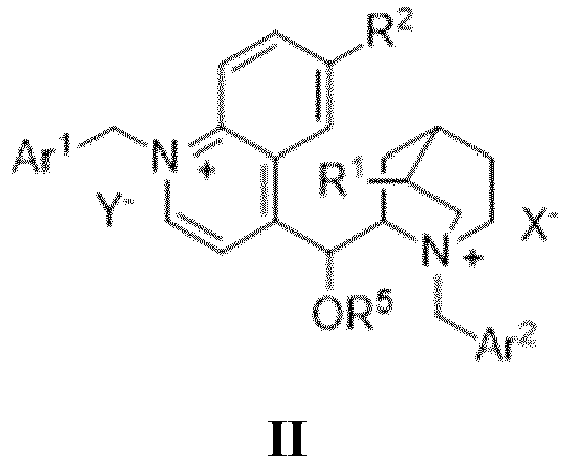 R1 is selected from ethyl and vinyl,R2 is selected from hydrogen and methoxy,Ar1 is aryl or heteroaryl, wherein said aryl and heteroaryl groups are optionally substituted with one to five substituents independently selected from R3,Ar2 is aryl or heteroaryl, wherein said aryl and heteroaryl groups are optionally substituted with one to five substituents independently selected from R3,each R3 is independently selected from the group consisting of C1-4alkyl, C1-4haloalkyl, aryl, C1-4alkoxy, hydroxy, CN, C1-4acyl, N(R4)2, NO2, halogen, O-Phenyl and(C=O)OC1-4alkyl,each R4 is independently H or C1-4alkyl, andeach X and Y are independently anions selected from halide, OH, HSO4, SO4, BF4, SbF6, carboxylate, carbonate, hydrogencarbonate, NO3, sulfonate, hexafluorophosphate, phosphate, hydrogen phosphate and perchlorate.
 - The bis-quarternary cinchona alkaloid salt of claim 12 wherein Ar1 is phenyl optionally substituted with one to five substituents independently selected from R3, and Ar2 is phenyl optionally substituted with one to five substituents independently selected from R3.
- The bis-quarternary cinchona alkaloid salt of claim 13 having the chemical structure of Formula IIa

- The bis-quaternary cinchona alkaloid salt of claim 14 wherein R1 is vinyl and R2 is methoxy.
Applications Claiming Priority (4)
| Application Number | Priority Date | Filing Date | Title |
|---|---|---|---|
| US201261610746P | 2012-03-14 | 2012-03-14 | |
| EP20154142.2A EP3680240A1 (en) | 2012-03-14 | 2013-03-13 | Asymmetric phase transfer catalysis |
| EP13761100.0A EP2825536B1 (en) | 2012-03-14 | 2013-03-13 | Bis-quarternary cinchona alkaloid salts as asymmetric phase transfer catalysts |
| PCT/US2013/030688 WO2013138413A1 (en) | 2012-03-14 | 2013-03-13 | Bis-quarternary cinchona alkaloid salts as asymmetric phase transfer catalysts |
Related Parent Applications (2)
| Application Number | Title | Priority Date | Filing Date |
|---|---|---|---|
| EP20154142.2A Division EP3680240A1 (en) | 2012-03-14 | 2013-03-13 | Asymmetric phase transfer catalysis |
| EP13761100.0A Division EP2825536B1 (en) | 2012-03-14 | 2013-03-13 | Bis-quarternary cinchona alkaloid salts as asymmetric phase transfer catalysts |
Publications (2)
| Publication Number | Publication Date |
|---|---|
| EP4357020A2 true EP4357020A2 (en) | 2024-04-24 |
| EP4357020A3 EP4357020A3 (en) | 2024-06-26 |
Family
ID=49161748
Family Applications (4)
| Application Number | Title | Priority Date | Filing Date |
|---|---|---|---|
| EP21202495.4A Withdrawn EP4019516A1 (en) | 2012-03-14 | 2013-03-13 | Asymmetric phase transfer catalysis |
| EP13761100.0A Active EP2825536B1 (en) | 2012-03-14 | 2013-03-13 | Bis-quarternary cinchona alkaloid salts as asymmetric phase transfer catalysts |
| EP20154142.2A Withdrawn EP3680240A1 (en) | 2012-03-14 | 2013-03-13 | Asymmetric phase transfer catalysis |
| EP23217661.0A Pending EP4357020A3 (en) | 2012-03-14 | 2013-03-13 | Asymmetric phase transfer catalysis |
Family Applications Before (3)
| Application Number | Title | Priority Date | Filing Date |
|---|---|---|---|
| EP21202495.4A Withdrawn EP4019516A1 (en) | 2012-03-14 | 2013-03-13 | Asymmetric phase transfer catalysis |
| EP13761100.0A Active EP2825536B1 (en) | 2012-03-14 | 2013-03-13 | Bis-quarternary cinchona alkaloid salts as asymmetric phase transfer catalysts |
| EP20154142.2A Withdrawn EP3680240A1 (en) | 2012-03-14 | 2013-03-13 | Asymmetric phase transfer catalysis |
Country Status (12)
| Country | Link |
|---|---|
| US (1) | US9376431B2 (en) |
| EP (4) | EP4019516A1 (en) |
| JP (1) | JP6140266B2 (en) |
| KR (2) | KR102061180B1 (en) |
| CN (1) | CN104144929B (en) |
| AU (6) | AU2013232191B2 (en) |
| BR (1) | BR112014021828B8 (en) |
| CA (1) | CA2865941A1 (en) |
| ES (1) | ES2806150T3 (en) |
| MX (1) | MX351657B (en) |
| RU (1) | RU2667909C2 (en) |
| WO (1) | WO2013138413A1 (en) |
Families Citing this family (16)
| Publication number | Priority date | Publication date | Assignee | Title |
|---|---|---|---|---|
| TWI501968B (en) * | 2010-11-12 | 2015-10-01 | Merck Sharp & Dohme | Hexahydropyridone methotrexate azaindene CGRP receptor antagonist |
| WO2013138418A2 (en) | 2012-03-14 | 2013-09-19 | Merck Sharp & Dohme Corp. | Process for making cgrp receptor antagonists |
| US9174989B2 (en) | 2012-05-09 | 2015-11-03 | Merck Sharp & Dohme Corp. | Process for making CGRP receptor antagonists |
| US12168004B2 (en) | 2014-02-05 | 2024-12-17 | Merck Sharp & Dohme Llc | Treatment of migraine |
| US10117836B2 (en) | 2014-02-05 | 2018-11-06 | Merck Sharp & Dohme Corp. | Tablet formulation for CGRP active compounds |
| RU2731944C2 (en) | 2016-06-07 | 2020-09-09 | Пирелли Тайр С.П.А. | Tire for wheels of vehicles |
| CA3065683A1 (en) | 2017-05-30 | 2018-12-06 | Millennium Pharmaceuticals, Inc. | Method for producing optically active compound |
| US12383545B1 (en) | 2018-06-08 | 2025-08-12 | Allergan Pharmaceuticals International Limited | Treatment of migraine |
| CN109180606B (en) * | 2018-09-30 | 2021-04-06 | 浙江工业大学 | Synthesis method of beta-aminoketone with optical activity |
| MX2022013872A (en) * | 2020-05-06 | 2022-11-30 | Amgen Inc | SYNTHESIS OF VINYL ALCOHOL INTERMEDIATE PRODUCTS. |
| MX2023001071A (en) | 2020-07-29 | 2023-05-12 | Allergan Pharmaceuticals Int Ltd | Treatment of migraine. |
| CN116490507A (en) | 2020-09-10 | 2023-07-25 | 薛定谔公司 | Heterocyclic inclusion condensed CDC7 kinase inhibitors for the treatment of cancer |
| CA3206184A1 (en) | 2020-12-22 | 2022-06-30 | Allergan Pharmaceuticals International Limited | Treatment of migraine |
| JP2024533756A (en) | 2021-09-27 | 2024-09-12 | アラガン ファーマスーティカルズ インターナショナル リミテッド | Combination Migraine Therapies Containing Atogepant |
| CN115974867B (en) * | 2023-01-31 | 2025-11-28 | 成都大学 | Chiral phase transfer catalyst and preparation method and application thereof |
| CN117603205A (en) * | 2023-12-20 | 2024-02-27 | 杭州澳赛诺生物科技有限公司 | Synthesis method and application of a quinidine derivative chiral phase transfer catalyst |
Family Cites Families (9)
| Publication number | Priority date | Publication date | Assignee | Title |
|---|---|---|---|---|
| DK0438796T3 (en) | 1990-01-22 | 1999-05-25 | Hoechst Marion Roussel Inc | Process for Enantioselective Synthesis of Alkylated Oxindoles Used as Intermediates in the Preparation of Phy |
| DE69727679T2 (en) | 1996-06-05 | 2004-07-22 | Lindner, Wolfgang, Prof. Dr. | CINCHONAN-BASED CHIRAL SELECTORS FOR SEPARATING STEREOISOMERS |
| US6596870B2 (en) | 2000-07-13 | 2003-07-22 | Brandeis University | Asymmetric synthetic methods based on phase transfer catalysis |
| ATE520661T1 (en) * | 2003-06-27 | 2011-09-15 | Univ Maryland | HETEROCYCLIC COMPOUNDS WITH QUATERNARY NITROGEN FOR THE DETECTION OF AQUEOUS MONOSACHARIDES IN PHYSIOLOGICAL LIQUIDS |
| GB0601286D0 (en) * | 2006-01-23 | 2006-03-01 | Sandoz Ag | Asymmetric synthesis |
| PL213306B1 (en) * | 2008-02-04 | 2013-02-28 | Politechnika Lodzka | The manner of obtaining of enantiomerically enriched products of condensation from racemic acids or acids of low enanciomerical purity |
| WO2011005731A2 (en) * | 2009-07-08 | 2011-01-13 | Merck Sharp & Dohme Corp. | Process for making cgrp receptor antagonist |
| WO2013138418A2 (en) | 2012-03-14 | 2013-09-19 | Merck Sharp & Dohme Corp. | Process for making cgrp receptor antagonists |
| US9174989B2 (en) | 2012-05-09 | 2015-11-03 | Merck Sharp & Dohme Corp. | Process for making CGRP receptor antagonists |
-
2013
- 2013-03-13 WO PCT/US2013/030688 patent/WO2013138413A1/en not_active Ceased
- 2013-03-13 RU RU2014141166A patent/RU2667909C2/en active
- 2013-03-13 KR KR1020147025142A patent/KR102061180B1/en active Active
- 2013-03-13 EP EP21202495.4A patent/EP4019516A1/en not_active Withdrawn
- 2013-03-13 EP EP13761100.0A patent/EP2825536B1/en active Active
- 2013-03-13 US US14/384,355 patent/US9376431B2/en active Active
- 2013-03-13 EP EP20154142.2A patent/EP3680240A1/en not_active Withdrawn
- 2013-03-13 EP EP23217661.0A patent/EP4357020A3/en active Pending
- 2013-03-13 AU AU2013232191A patent/AU2013232191B2/en active Active
- 2013-03-13 CN CN201380013400.XA patent/CN104144929B/en active Active
- 2013-03-13 MX MX2014010999A patent/MX351657B/en active IP Right Grant
- 2013-03-13 BR BR112014021828A patent/BR112014021828B8/en active IP Right Grant
- 2013-03-13 ES ES13761100T patent/ES2806150T3/en active Active
- 2013-03-13 JP JP2015500539A patent/JP6140266B2/en active Active
- 2013-03-13 KR KR1020197038179A patent/KR102153850B1/en active Active
- 2013-03-13 CA CA2865941A patent/CA2865941A1/en active Pending
-
2017
- 2017-06-29 AU AU2017204464A patent/AU2017204464B2/en active Active
-
2019
- 2019-07-17 AU AU2019206049A patent/AU2019206049B2/en active Active
-
2021
- 2021-07-01 AU AU2021204629A patent/AU2021204629A1/en not_active Abandoned
-
2023
- 2023-10-24 AU AU2023254886A patent/AU2023254886A1/en not_active Abandoned
-
2025
- 2025-08-25 AU AU2025220879A patent/AU2025220879A1/en active Pending
Non-Patent Citations (1)
| Title |
|---|
| TAKASHI OOIKEIJI MARUOKA: "Recent Advances in Asymmetric Phase-Transfer Catalysis", ANGEW. CHEM. INT. ED., vol. 46, 2007, pages 4222 - 4266, XP055060024, DOI: 10.1002/anie.200601737 |
Also Published As
Similar Documents
| Publication | Publication Date | Title |
|---|---|---|
| EP2825536B1 (en) | Bis-quarternary cinchona alkaloid salts as asymmetric phase transfer catalysts | |
| JP6743256B2 (en) | Method for producing CGRP receptor antagonist | |
| US8653282B2 (en) | Preparation of dihydrothieno [3,2-D] pyrimidines and intermediates used therein | |
| AU2009212338A1 (en) | Furo-and Thieno[3,2-c] Pyridines | |
| CA3121631A1 (en) | Substituted heterocycle fused gamma-carbolines synthesis | |
| AU2022215237B2 (en) | Methods of preparing indolinobenzodiazepine derivatives | |
| SK14472003A3 (en) | Dihydroimidazo[4,5-E]indole and 7H-pyrrolo[3,2-F]quinoxaline derivatives as nicotinic acetylcholine receptor ligands and/or serotonergic ligands | |
| CA3141855A1 (en) | Heterocyclic compounds as prmt5 inhibitors | |
| BG108757A (en) | IMPROVED PROCESS FOR THE PREPARATION OF 3-{2-[4-(6-FLUORO-1,2-BENZISOXAZOL-3-YL)-1-PIPERIDINYL]ETHYL}-6,7,8,9-TETRAHYDRO-2-METHYL-4H-PYRIDO[1,2-a]PYRIMIDIN-4-ONE | |
| KR101657599B1 (en) | PROCESS FOR THE PREPARATION OF PYRROLO[2,3-c]PYRIDINE DERIVATIVES OR PHARMACEUTICALLY ACCEPTABLE SALTS THEREOF | |
| TW202525805A (en) | Bicyclic compound and manufacturing method and application thereof | |
| CA3216995A1 (en) | Processes for the preparation of (s)-2-(2,6-dioxopiperidin-3-yl)-4-((2-fluoro-4-((3-morpholinoazetidin-1-yl) methyl)benzyl) amino)isoindoline-1,3-dione | |
| CA3237961A1 (en) | Methods of preparing substituted pyrazolopyrimidines | |
| SK288415B6 (en) | Method for producing (1-cyclopropyl-6-fluoro-1,4-dihydro-8- methoxy-7-[(4as,7as)-octahydro-6h-pyrrolo[3,4-b]pyridin-6-yl]-4- oxo-3-quinoline-carboxylic acid |
Legal Events
| Date | Code | Title | Description |
|---|---|---|---|
| PUAI | Public reference made under article 153(3) epc to a published international application that has entered the european phase |
Free format text: ORIGINAL CODE: 0009012 |
|
| STAA | Information on the status of an ep patent application or granted ep patent |
Free format text: STATUS: THE APPLICATION HAS BEEN PUBLISHED |
|
| AC | Divisional application: reference to earlier application |
Ref document number: 2825536 Country of ref document: EP Kind code of ref document: P Ref document number: 3680240 Country of ref document: EP Kind code of ref document: P |
|
| AK | Designated contracting states |
Kind code of ref document: A2 Designated state(s): AL AT BE BG CH CY CZ DE DK EE ES FI FR GB GR HR HU IE IS IT LI LT LU LV MC MK MT NL NO PL PT RO RS SE SI SK SM TR |
|
| REG | Reference to a national code |
Ref country code: DE Ref legal event code: R079 Free format text: PREVIOUS MAIN CLASS: B01J0031020000 Ipc: C07D0453040000 |
|
| PUAL | Search report despatched |
Free format text: ORIGINAL CODE: 0009013 |
|
| P01 | Opt-out of the competence of the unified patent court (upc) registered |
Effective date: 20240425 |
|
| AK | Designated contracting states |
Kind code of ref document: A3 Designated state(s): AL AT BE BG CH CY CZ DE DK EE ES FI FR GB GR HR HU IE IS IT LI LT LU LV MC MK MT NL NO PL PT RO RS SE SI SK SM TR |
|
| RIC1 | Information provided on ipc code assigned before grant |
Ipc: B01J 31/02 20060101ALI20240522BHEP Ipc: C07D 453/04 20060101AFI20240522BHEP |
|
| STAA | Information on the status of an ep patent application or granted ep patent |
Free format text: STATUS: REQUEST FOR EXAMINATION WAS MADE |
|
| 17P | Request for examination filed |
Effective date: 20241119 |
|
| RBV | Designated contracting states (corrected) |
Designated state(s): AL AT BE BG CH CY CZ DE DK EE ES FI FR GB GR HR HU IE IS IT LI LT LU LV MC MK MT NL NO PL PT RO RS SE SI SK SM TR |
|
| STAA | Information on the status of an ep patent application or granted ep patent |
Free format text: STATUS: EXAMINATION IS IN PROGRESS |
|
| 17Q | First examination report despatched |
Effective date: 20260313 |