EP4356646B1 - Method of performing a handover of a mobile network device - Google Patents
Method of performing a handover of a mobile network device Download PDFInfo
- Publication number
- EP4356646B1 EP4356646B1 EP22734207.8A EP22734207A EP4356646B1 EP 4356646 B1 EP4356646 B1 EP 4356646B1 EP 22734207 A EP22734207 A EP 22734207A EP 4356646 B1 EP4356646 B1 EP 4356646B1
- Authority
- EP
- European Patent Office
- Prior art keywords
- mobile network
- network device
- gateway
- gateway device
- movement information
- Prior art date
- Legal status (The legal status is an assumption and is not a legal conclusion. Google has not performed a legal analysis and makes no representation as to the accuracy of the status listed.)
- Active
Links
Images


Classifications
-
- H—ELECTRICITY
- H04—ELECTRIC COMMUNICATION TECHNIQUE
- H04W—WIRELESS COMMUNICATION NETWORKS
- H04W36/00—Hand-off or reselection arrangements
- H04W36/14—Reselecting a network or an air interface
- H04W36/142—Reselecting a network or an air interface over the same radio air interface technology
-
- H—ELECTRICITY
- H04—ELECTRIC COMMUNICATION TECHNIQUE
- H04W—WIRELESS COMMUNICATION NETWORKS
- H04W28/00—Network traffic management; Network resource management
- H04W28/16—Central resource management; Negotiation of resources or communication parameters, e.g. negotiating bandwidth or QoS [Quality of Service]
- H04W28/26—Resource reservation
-
- H—ELECTRICITY
- H04—ELECTRIC COMMUNICATION TECHNIQUE
- H04W—WIRELESS COMMUNICATION NETWORKS
- H04W36/00—Hand-off or reselection arrangements
- H04W36/24—Reselection being triggered by specific parameters
- H04W36/32—Reselection being triggered by specific parameters by location or mobility data, e.g. speed data
-
- H—ELECTRICITY
- H04—ELECTRIC COMMUNICATION TECHNIQUE
- H04W—WIRELESS COMMUNICATION NETWORKS
- H04W36/00—Hand-off or reselection arrangements
- H04W36/24—Reselection being triggered by specific parameters
- H04W36/32—Reselection being triggered by specific parameters by location or mobility data, e.g. speed data
- H04W36/322—Reselection being triggered by specific parameters by location or mobility data, e.g. speed data by location data
-
- H—ELECTRICITY
- H04—ELECTRIC COMMUNICATION TECHNIQUE
- H04W—WIRELESS COMMUNICATION NETWORKS
- H04W4/00—Services specially adapted for wireless communication networks; Facilities therefor
- H04W4/30—Services specially adapted for particular environments, situations or purposes
- H04W4/40—Services specially adapted for particular environments, situations or purposes for vehicles, e.g. vehicle-to-pedestrians [V2P]
- H04W4/44—Services specially adapted for particular environments, situations or purposes for vehicles, e.g. vehicle-to-pedestrians [V2P] for communication between vehicles and infrastructures, e.g. vehicle-to-cloud [V2C] or vehicle-to-home [V2H]
-
- H—ELECTRICITY
- H04—ELECTRIC COMMUNICATION TECHNIQUE
- H04W—WIRELESS COMMUNICATION NETWORKS
- H04W76/00—Connection management
- H04W76/30—Connection release
-
- G—PHYSICS
- G05—CONTROLLING; REGULATING
- G05B—CONTROL OR REGULATING SYSTEMS IN GENERAL; FUNCTIONAL ELEMENTS OF SUCH SYSTEMS; MONITORING OR TESTING ARRANGEMENTS FOR SUCH SYSTEMS OR ELEMENTS
- G05B19/00—Program-control systems
- G05B19/02—Program-control systems electric
- G05B19/418—Total factory control, i.e. centrally controlling a plurality of machines, e.g. direct or distributed numerical control [DNC], flexible manufacturing systems [FMS], integrated manufacturing systems [IMS] or computer integrated manufacturing [CIM]
- G05B19/4185—Total factory control, i.e. centrally controlling a plurality of machines, e.g. direct or distributed numerical control [DNC], flexible manufacturing systems [FMS], integrated manufacturing systems [IMS] or computer integrated manufacturing [CIM] characterised by the network communication
-
- H—ELECTRICITY
- H04—ELECTRIC COMMUNICATION TECHNIQUE
- H04W—WIRELESS COMMUNICATION NETWORKS
- H04W36/00—Hand-off or reselection arrangements
- H04W36/08—Reselecting an access point
Definitions
- the current disclosure relates to industrial wireless networks and more particularly, relates to handover of user equipment between gateway devices in an industrial environment.
- a plurality of mobile network devices may be used for transportation of material amongst various process stations and production cells.
- sufficient network resources should be made available to the mobile network devices for providing low latency communication.
- US 2009/245199 A1 discloses a wireless handover in mobile communication systems, wherein a handover controller uses a route profile identifying gateway devices ("access points") distributed over a given route that are capable of supporting the network connection, and to handover the network connection between the gateways as the mobile device travels along the given route.
- access points a route profile identifying gateway devices
- US 2019/196456 A1 discloses a data communication method for reducing a working time of an automated material handling system.
- the current disclosure relates to industrial wireless networks and more particularly, to handover of mobile network devices such as mobile robots, autonomous vehicles, etc., between two or more gateway devices.
- mobile network devices such as mobile robots, autonomous vehicles, etc.
- gateway devices Conventionally, in order to ensure sufficient coverage in the industrial environment, a plurality of distributed network devices are deployed in the industrial environment. Accordingly, when the mobile network devices move from one location to another location, the network aspects associated with the mobile network devices have to handed over from the origin distributed unit to the destination distributed unit.
- inter distributed unit handover can cause interruption in communication, and can cause disruption in the QoS associated with the mobile network devices. Accordingly, interDU handover can be quite challenging in an industrial environment. Accordingly, there is a need for a method and device which addresses the above-mentioned issues around interDU handover.
- the current disclosure describes a method according to claim 1, a gateway device according to claim 5 and a non-transitory storage medium according to claim 6, which addresses the issues mentioned above.
- the current disclosure describes a method of performing a handover of a mobile network device from a first gateway device to a second gateway device.
- the method comprises determining the second gateway device from a plurality of gateway devices based on a movement information associated the mobile network device, wherein the movement information is indicative of a potential movement of the autonomous vehicle; and reserving one or more radio resources at the second gateway device in relation to the mobile network device and releasing one or more radio resources at the first gateway device in relation to the mobile network device.
- the movement information associated with the mobile network device is estimated based on at least one of process data associated with the mobile network device and the network information associated with the mobile network device.
- the current disclosure describes a handover method where the destination gateway device and the resource reservation are performed based on movement information associated with the mobile network device. Accordingly, the reliability of a successful handover in 5G can be achieved by combining the movement information which includes position and route information of the mobile devices that have to go across a factory floor and require high quality of service. Accordingly, schedulers at the DUs can be coordinated to ensure appropriate quality of service for the mobile network device during handover.
- the process data is obtained from one of a process controller associated with a first process, a manufacturing execution system associated with a first process and a controller associated with the mobile network vehicle. Accordingly, the movement information is determined based on real time process data available in the industrial environment.
- the process data is indicative of a first production cell, wherein the mobile network device is configured to visit the first production cell for transfer of manufacturing material and wherein the first production cell is within a radio coverage of the second gateway device.
- the movement information includes one of position information indicative of a position associated with the mobile network device, route information indicative of a route associated with the mobile network device, and velocity information indicative of a velocity associated with the mobile network device.
- the method comprises transmitting a route control message to the mobile network device based on an unavailability of the one or more resources at the second gateway device, wherein the mobile network device is configured to adjust one of the route associated with the mobile network device and the velocity associated with the mobile network device. Accordingly, in the example, when there aren't sufficient resources available at the second gateway device, the route of the mobile network device or the velocity of the mobile network device may be adjusted to the mobile network device arrives at a later time when the resources may be available or is directed to a third gateway device where sufficient resources are available.
- the one or more radio resources at the second gateway device are reserved for a predefined time window, wherein a start time instance of the predefined time window is associated with an arrival of the mobile network device within a radio range of the second gateway device.
- the start time instance is determined based on the movement information of the mobile network device.
- the current disclosure describes a gateway device configured to perform a handover of a mobile network device to a second gateway device.
- the gateway device comprises one or more processors connected to a memory module.
- the one or more processors are configured to determine the second gateway device from a plurality of gateway devices based on a movement information associated the mobile network device, wherein the movement information is indicative of a potential movement of the mobile network device; and reserve one or more radio resources at the second gateway device in relation to the mobile network device and releasing one or more radio resources at the first gateway device in relation to the mobile network device.
- the movement information associated with the mobile network device is estimated based on at least one of process data associated with the mobile network device and the network information associated with the mobile network device.
- the current disclosure describes a non-transitory storage medium for performing a handover of a mobile network device to a second gateway device.
- the non-transitory storage medium comprises a plurality of instructions, which when executed one or more processors, cause the one or more processors to determine the second gateway device from a plurality of gateway devices based on a movement information associated the mobile network device, wherein the movement information is indicative of a potential movement of the mobile network device; and reserve one or more radio resources at the second gateway device in relation to the mobile network device and releasing one or more radio resources at the first gateway device in relation to the mobile network device.
- the movement information associated with the mobile network device is estimated based on at least one of process data associated with the mobile network device and the network information associated with the mobile network device.
- Figure 1 illustrates a section 100 of an industrial facility.
- Industrial facility herein refers to any environment where one or more industrial processes such as manufacturing, refining, smelting, or assembly of equipment may take place. This includes process plants, oil refineries, automobile factories, power plants, storehouses, etc.
- the plurality of industrial process and operations may be carried out in production cells using a plurality of devices such as control devices, field devices, mobile devices, etc., present with the corresponding production cell.
- the control devices include process controllers, programmable logic controllers, supervisory controllers, automated guided vehicles, robots, operator devices, etc.
- One or more control devices are connected to a plurality of field devices (not shown in figure) such as actuators and sensor devices for monitoring and controlling various industrial processes in the industrial facility.
- the industrial facility includes a plurality of mobile devices (also referred to as mobile network devices) including one or more robots for performing a plurality of operations such as welding, assembly of parts; one or more autonomous guided vehicles for transportation and handling of material; one or more assets with RFID tags on conveyor belts, etc. in the industrial facility.
- the industrial facility may include an operator station for displaying the status of the industrial facility to an operator and for allowing the operator to define KPIs for the control of the industrial processes in the facility. All the industrial devices may be connected to each other via a plant network (realized via wired and wireless technologies).
- the industrial facility includes a wireless network for enabling communication amongst the various devices of the industrial facility.
- the wireless network is based on cellular technology and comprises a plurality of gateway devices.
- Gateway devices herein refers to one or more network devices capable of connecting the user devices to the wireless network. Examples of gateway devices include base stations, routers, switches, relays, access points, etc.
- the plurality of gateway devices may include stationary gateway devices which may be affixed to a plurality of locations in the industrial facility.
- a plurality of the user devices in the facility are connected to one or more industrial gateway devices to connect to the wireless network and for communicating information with the other devices and systems in the industrial facility.
- User device herein refers to an industrial device which is capable of connecting to a wireless network via the gateway devices.
- the user devices include one or more industrial applications which are capable of processing data from other industrial devices.
- the wireless network includes a central network core 140 which includes a plurality of network functions 145 such as user plane function, authentication server function (AUSF), access and mobility function (AMF), session management function (SMF), network exposure function (NEF) etc.
- AUSF authentication server function
- AMF access and mobility function
- SMF session management function
- NEF network exposure function
- the section 100 of the industrial facility includes a distributed base station comprising a central unit 160 connected to two distributed units 150 and 170.
- the distributed units 150 and 170 may be regarded as gateway devices.
- the functions/responsibilities of the central unit 160, and the distributed units (150 and 170) depends on the Split Option utilized in the implementation of the distributed base station.
- split option 7.2 is utilized and accordingly, the central unit is responsible for transfer of user data, mobility control, header compression, positioning, etc., except those functions allocated exclusively to the distributed units.
- the central unit controls the operation of distributed units over a front-haul interface.
- the distributed units include radio link control (RLC), High-media access control (MAC), Low-media access control (MAC) and upper physical (PHY) layers and their corresponding functions.
- RLC layer carries out segmentation.
- High-MAC layer the centralized scheduling which takes high-level centralized scheduling decision.
- the inter-cell interference coordination in the High-MAC sublayer will be in charge of interference coordination methods such as JP/CS CoMP.
- Low-MAC layer the time-critical functions in the Low-MAC sublayer include the functions with stringent delay requirements (e.g., HARQ).
- Upper-PHY layer does Forward Error Correction (FEC), Modulation, MIMO Layer mapping and Rate matching.
- FEC Forward Error Correction
- Each distributed unit is connected to a plurality of radio units.
- the distributed unit 150 is connected to radio units 153 and 156, and the distributed unit 170 is connected to radio units 173 and 176.
- the radio units 153 and 156 provide radio coverage in the production cell 110 and accordingly, the distributed unit 150 is responsible for communication within the production cell 110.
- the radio coverage associated with the radio units 153 and 156 (and accordingly distributed unit 150) is shown in the figure as circle 155.
- radio units 173 and 176 provide radio coverage in the production cell 120 and accordingly, the distributed unit 170 is responsible for communication within the production cell 120.
- the radio coverage associated with the radio units 173 and 176 (and accordingly distributed unit 170) is shown in the figure as circle 175.
- the distributed base stations are connected to a user plane function 140 via the central unit 160 of the wireless network, for transmitting data packets from the one or more user devices connected to the corresponding radio units.
- the production cells 110 and 120 comprise a plurality of mobile devices which are capable of moving within and in between the production cells (110 and 120) for transporting material and work in progress items between the production cells.
- the mobiles are configured to connect to the wireless network via the corresponding distributed unit associated with the production cell.
- the mobile device 117 is connected to the wireless network via the distributed unit 170.
- the mobile devices 125 and 127 are connected to the wireless network via the distributed unit 150. Since the mobile devices are capable of moving in between the production cells, the distributed unit of the source or origin production cell, is configured to handover the mobile device to the distributed unit associated with the destination production cell based on the movement information associated with the mobile device, obtained from a location manager function 147.
- the mobile device 115 is moving from the production cell 110 to the production cell 120, and accordingly, the distributed unit 170 handovers the mobile device 115 to the distributed unit 150, based on the movement information of the mobile device 115. This is further explained in reference to figure 2 .
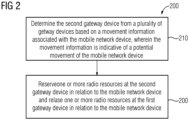
- Figure 2 illustrates a method 200 of performing a handover of a mobile network device 115 from a first gateway device 170 to a second gateway device 150.
- the method 200 is implemented by the first gateway device 170.
- the first gateway device 170 determines the second gateway device from a plurality of gateway devices based on a movement information associated the mobile network device 115.
- the movement information is indicative of a potential movement of the mobile network device 115.
- the movement information associated with the mobile network device 115 is estimated based on at least one of process data associated with the mobile network device 115 and the network information associated with the mobile network device 115.
- the first gateway device 170 coordinates with the location manager function 147 and the trajectory planner module 180 of the wireless network to obtain the movement information associated with the mobile network device 115.
- the trajectory planner module 180 (also referred to as trajectory planner 180) is configured to interface with one or more control devices in the production cells 110 and 120 to receive process data and determine or estimate a potential movement associated with the mobile network device 115.
- the trajectory planner 180 is configured to interface with an autonomous vehicle controller (not shown in the figure) to receive a route plan of the mobile network device 115. Accordingly, based on the route plan, the trajectory planner 180 generates the movement information associated with the mobile network device 115.
- the trajectory planner 180 interfaces with a manufacturing execution system to receive a schedule associated with mobile network device 115. Accordingly, based on the schedule, the trajectory planner 180 determines the potential movement associated with the mobile network device 115.
- the trajectory planner is configured to coordinate with one or more process controllers to evaluate or determine where the mobile network device is in the schedule and then determine the potential movement associated with the mobile network device.
- the location management function 147 is configured to receive the movement information from the trajectory planner 180 and augments the movement information with location information from localization services available in the wireless network. For example, when the wireless network is based on 5G technology, the network includes a positioning service which is configured to determine the location and other aspects related with the mobile network device based on the network information associated with the mobile network device such as signal strength, noise to strength ratio, etc. Then, the movement information is transmitted to the first gateway device 170 which then utilizes this information to determine the second gateway device 150.
- the first gateway device 170 determines that the second gateway device is the distributed unit 150 responsible for communication within the production cell 120. In another example, the first gateway device 170 determines the second gateway device based on the route, direction and velocity associated with the mobile network device 115.
- the first gateway device 170 reserves one or more radio resources at the second gateway device 150 in relation to the mobile network device 115 and releases one or more radio resources at the first gateway device 170 in relation to the mobile network device 115.
- the reservation and release of radio resources is done in accordance with handover procedures as known in the current state of the art (for example X2-based handover and S1-based handover.
- the first gateway device i.e., the serving eNB
- the second gateway device i.e., target eNB
- the request includes a list of bearers that will be transferred and whether downlink data forwarding is necessary.
- the second gateway device i.e., target eNB
- the mobile network device is notified and detaches from the first gateway device Downlink packets that are received by the first gateway device are forwarded to the second gateway device. Resources in the first gateway device are released following successful completion of the handover.
- the first gateway device 170 determines an arrival time instance i.e., the time instance at which the mobile network device 115 arrives within the radio range of the radio units of the second gateway device 150. Then first gateway device accordingly, coordinates with the second gateway device 150 to reserve resources for the mobile network device 115 for a predefined time window with the start of the time window at the arrival time instance.
- the resources to be reserved are based on the Qos associated with the mobile network device 115 which is already known to the first gateway device 170.
- the first gateway devices 170 schedules the resources of the first gateway device 170 associated with the mobile network device 115, to be released after the estimated arrival time instance. However, if the second gateway device 150 is unable to confirm the reservation of the resources, the first gateway device 170 is able to coordinate with the mobile network device to change the movement associated with mobile network device 115. This is further explained in reference to figure 3 .
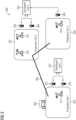
- Figure 3 illustrates an example section 300 of the industrial facility comprising three production cells 310, 320 and 330.
- the production cells 310 is within the coverage of the radio units 373 and 376 of the distributed unit 370.
- the production cells 320 and 330 are within the coverage of the radio units 353, 356 and 359 of the distributed unit 350.
- Each production cell includes one or more processes and one or more mobile devices (shown in the figure as mobile robot 317, 325, 327 and 337).
- the section 300 includes an autonomous vehicle 360 which is configured to transport materials from the production cell 310 to production cells 320 and 330. Accordingly, the autonomous vehicle 360 is configured to follow a route 365 to reach production cells 320 and 330 from the production cell 310.
- the route 365 is programmed by an autonomous vehicle controller (not shown in the figure).
- the distributed unit 370 is configured to obtain the movement information associated with the autonomous vehicle 360 from the location manager function 147.
- the distributed unit 370 is configured to periodically check the location manager function 147 to determine if movement information is available for any of the mobile devices within its radio coverage.
- the trajectory planner 180 is configured to push the movement information to the corresponding distributed unit via the location manager function. Then, accordingly, using the distributed unit 370 determines the distributed unit 350 as the second gateway device. Then, the distributed unit 370 requests reservation of resources at the distributed unit 350 in relation to the autonomous vehicle 360.
- the distributed unit 350 is unable to reserve the resources required for the autonomous vehicle 360.
- the distributed unit 370 is configured to adjust resources currently allocated to make resources available for the autonomous vehicle 360 at the arrival time instance.
- the distributed unit 350 sends a message that reservation of the resources is not possible since the resources are not available till a predefined time instance.
- the first gateway device 370 coordinates with the autonomous vehicle 360 to change the movement associated with the autonomous vehicle 360.
- the first gateway device 370 transmits a route control message to instruct the autonomous vehicle 360 to change its velocity to reach the radio range of the distributed unit 350 at a time instance later than the predefined time instance after which resources at the distributed unit 370 is available.
- the distributed unit 370 transmits a route control message instructing the autonomous vehicle 360 to change its route so that another distributed unit (besides the distributed unit 370) serves the autonomous vehicle 360.
- the distributed unit 370 coordinates with the autonomous vehicle controller to plan a new route for the autonomous vehicle 360. Accordingly, based on movement information, the handover of the autonomous vehicle 360 is handled by the distributed unit 370 such that the QoS of the autonomous vehicle 360 is satisfied during the handover.
- the current method allows QoS Schedulers at DUs to optimize the amount of resources reserved and spent during handovers.
- the above method 200 is explained in relation to the first gateway device, the above method may be realized in another device or a plurality of devices.
- the method 200 may be implemented in a central network management device.
- the present disclosure can take a form of a computer program product comprising program modules accessible from computer-usable or computer-readable medium storing program code for use by or in connection with one or more computers, processing units, or instruction execution system.
- the current disclosure describes a gateway device 400 as shown in figure 4 .
- the gateway device 400 is configured to perform a handover of a mobile network device to a second gateway device.
- the gateway device includes a network interface 410 which is configured to send and receive data to the other network devices.
- the gateway device 400 comprises one or more processors 420 connected to a memory module 430 (also referred to as non-transitory storage module or medium).
- the memory module 430 includes a plurality of instructions 440 executable on the one or more processors 420.
- the one or more processors 420 are configured to determine the second gateway device from a plurality of gateway devices based on a movement information associated the mobile network device, wherein the movement information is indicative of a potential movement of the mobile network device; and reserve one or more radio resources at the second gateway device in relation to the mobile network device and releasing one or more radio resources at the first gateway device in relation to the mobile network device.
- the movement information associated with the mobile network device is estimated based on at least one of process data associated with the mobile network device and the network information associated with the mobile network device.
- a computer-usable or computer-readable non-transitory storage medium can be any apparatus that can contain, store, communicate, propagate, or transport the program for use by or in connection with the instruction execution system, apparatus, or device.
- the medium can be electronic, magnetic, optical, electromagnetic, infrared, or semiconductor system (or apparatus or device) or a propagation mediums in and of themselves as signal carriers are not included in the definition of physical computer-readable medium include a semiconductor or solid state memory, magnetic tape, a removable computer diskette, random access memory (RAM), a read only memory (ROM), a rigid magnetic disk and optical disk such as compact disk read-only memory (CD-ROM), compact disk read/write, and DVD.
- RAM random access memory
- ROM read only memory
- CD-ROM compact disk read-only memory
- DVD compact disk read/write
Landscapes
- Engineering & Computer Science (AREA)
- Computer Networks & Wireless Communication (AREA)
- Signal Processing (AREA)
- Quality & Reliability (AREA)
- Mobile Radio Communication Systems (AREA)
Description
- The current disclosure relates to industrial wireless networks and more particularly, relates to handover of user equipment between gateway devices in an industrial environment. In industrial environments, a plurality of mobile network devices may be used for transportation of material amongst various process stations and production cells. To carry out such transportation related tasks, sufficient network resources should be made available to the mobile network devices for providing low latency communication.
-
US 2009/245199 A1 discloses a wireless handover in mobile communication systems, wherein a handover controller uses a route profile identifying gateway devices ("access points") distributed over a given route that are capable of supporting the network connection, and to handover the network connection between the gateways as the mobile device travels along the given route. -
US 2019/196456 A1 discloses a data communication method for reducing a working time of an automated material handling system. - The current disclosure relates to industrial wireless networks and more particularly, to handover of mobile network devices such as mobile robots, autonomous vehicles, etc., between two or more gateway devices. Conventionally, in order to ensure sufficient coverage in the industrial environment, a plurality of distributed network devices are deployed in the industrial environment. Accordingly, when the mobile network devices move from one location to another location, the network aspects associated with the mobile network devices have to handed over from the origin distributed unit to the destination distributed unit. However, inter distributed unit handover can cause interruption in communication, and can cause disruption in the QoS associated with the mobile network devices. Accordingly, interDU handover can be quite challenging in an industrial environment. Accordingly, there is a need for a method and device which addresses the above-mentioned issues around interDU handover.
- Accordingly, the current disclosure describes a method according to
claim 1, a gateway device according to claim 5 and a non-transitory storage medium according to claim 6, which addresses the issues mentioned above. - In a first aspect, the current disclosure describes a method of performing a handover of a mobile network device from a first gateway device to a second gateway device. The method comprises determining the second gateway device from a plurality of gateway devices based on a movement information associated the mobile network device, wherein the movement information is indicative of a potential movement of the autonomous vehicle; and reserving one or more radio resources at the second gateway device in relation to the mobile network device and releasing one or more radio resources at the first gateway device in relation to the mobile network device. The movement information associated with the mobile network device is estimated based on at least one of process data associated with the mobile network device and the network information associated with the mobile network device.
- Accordingly, the current disclosure describes a handover method where the destination gateway device and the resource reservation are performed based on movement information associated with the mobile network device. Accordingly, the reliability of a successful handover in 5G can be achieved by combining the movement information which includes position and route information of the mobile devices that have to go across a factory floor and require high quality of service. Accordingly, schedulers at the DUs can be coordinated to ensure appropriate quality of service for the mobile network device during handover.
- In an example, the process data is obtained from one of a process controller associated with a first process, a manufacturing execution system associated with a first process and a controller associated with the mobile network vehicle. Accordingly, the movement information is determined based on real time process data available in the industrial environment. In an example, the process data is indicative of a first production cell, wherein the mobile network device is configured to visit the first production cell for transfer of manufacturing material and wherein the first production cell is within a radio coverage of the second gateway device. In an example, wherein the movement information includes one of position information indicative of a position associated with the mobile network device, route information indicative of a route associated with the mobile network device, and velocity information indicative of a velocity associated with the mobile network device.
- In an example, the method comprises transmitting a route control message to the mobile network device based on an unavailability of the one or more resources at the second gateway device, wherein the mobile network device is configured to adjust one of the route associated with the mobile network device and the velocity associated with the mobile network device. Accordingly, in the example, when there aren't sufficient resources available at the second gateway device, the route of the mobile network device or the velocity of the mobile network device may be adjusted to the mobile network device arrives at a later time when the resources may be available or is directed to a third gateway device where sufficient resources are available. In an example, the one or more radio resources at the second gateway device are reserved for a predefined time window, wherein a start time instance of the predefined time window is associated with an arrival of the mobile network device within a radio range of the second gateway device. In an example, the start time instance is determined based on the movement information of the mobile network device.
- In another aspect, the current disclosure describes a gateway device configured to perform a handover of a mobile network device to a second gateway device. The gateway device comprises one or more processors connected to a memory module. The one or more processors are configured to determine the second gateway device from a plurality of gateway devices based on a movement information associated the mobile network device, wherein the movement information is indicative of a potential movement of the mobile network device; and reserve one or more radio resources at the second gateway device in relation to the mobile network device and releasing one or more radio resources at the first gateway device in relation to the mobile network device. The movement information associated with the mobile network device is estimated based on at least one of process data associated with the mobile network device and the network information associated with the mobile network device.
- In yet another aspect, the current disclosure describes a non-transitory storage medium for performing a handover of a mobile network device to a second gateway device. The non-transitory storage medium comprises a plurality of instructions, which when executed one or more processors, cause the one or more processors to determine the second gateway device from a plurality of gateway devices based on a movement information associated the mobile network device, wherein the movement information is indicative of a potential movement of the mobile network device; and reserve one or more radio resources at the second gateway device in relation to the mobile network device and releasing one or more radio resources at the first gateway device in relation to the mobile network device. The movement information associated with the mobile network device is estimated based on at least one of process data associated with the mobile network device and the network information associated with the mobile network device. The advantages of the method apply to the gateway device and the non-transitory storage medium. These aspects are further explained in relation to
figures 1-4 . -
Figure 1 illustrates a section of an industrial facility comprising two production cells with an industrial wireless network deployed in the production cells; -
Figure 2 illustrates a method of performing a handover of a mobile network device from a first gateway device to a second gateway device; -
Figure 3 illustrates an example route of an example autonomous vehicle for transporting manufacturing material between three production cells; and -
Figure 4 illustrates an example gateway device for performing a handover of a mobile network device to a second gateway device. -
Figure 1 illustrates asection 100 of an industrial facility. Industrial facility herein refers to any environment where one or more industrial processes such as manufacturing, refining, smelting, or assembly of equipment may take place. This includes process plants, oil refineries, automobile factories, power plants, storehouses, etc. The plurality of industrial process and operations may be carried out in production cells using a plurality of devices such as control devices, field devices, mobile devices, etc., present with the corresponding production cell. The control devices include process controllers, programmable logic controllers, supervisory controllers, automated guided vehicles, robots, operator devices, etc. One or more control devices are connected to a plurality of field devices (not shown in figure) such as actuators and sensor devices for monitoring and controlling various industrial processes in the industrial facility. These field devices can include flowmeters, value actuators, temperature sensors, pressure sensors, etc. Additionally, the industrial facility includes a plurality of mobile devices (also referred to as mobile network devices) including one or more robots for performing a plurality of operations such as welding, assembly of parts; one or more autonomous guided vehicles for transportation and handling of material; one or more assets with RFID tags on conveyor belts, etc. in the industrial facility. Additionally, the industrial facility may include an operator station for displaying the status of the industrial facility to an operator and for allowing the operator to define KPIs for the control of the industrial processes in the facility. All the industrial devices may be connected to each other via a plant network (realized via wired and wireless technologies). - Communication in the above-mentioned plant network happens through wired and wireless means or technologies. Accordingly, the industrial facility includes a wireless network for enabling communication amongst the various devices of the industrial facility. The wireless network is based on cellular technology and comprises a plurality of gateway devices. Gateway devices herein refers to one or more network devices capable of connecting the user devices to the wireless network. Examples of gateway devices include base stations, routers, switches, relays, access points, etc. The plurality of gateway devices may include stationary gateway devices which may be affixed to a plurality of locations in the industrial facility. A plurality of the user devices in the facility are connected to one or more industrial gateway devices to connect to the wireless network and for communicating information with the other devices and systems in the industrial facility. User device herein refers to an industrial device which is capable of connecting to a wireless network via the gateway devices. The user devices include one or more industrial applications which are capable of processing data from other industrial devices. Additionally, the wireless network includes a
central network core 140 which includes a plurality ofnetwork functions 145 such as user plane function, authentication server function (AUSF), access and mobility function (AMF), session management function (SMF), network exposure function (NEF) etc. - For example, as shown in the
figure 1 , thesection 100 of the industrial facility includes a distributed base station comprising acentral unit 160 connected to twodistributed units distributed units central unit 160, and the distributed units (150 and 170) depends on the Split Option utilized in the implementation of the distributed base station. Conventionally, split option 7.2 is utilized and accordingly, the central unit is responsible for transfer of user data, mobility control, header compression, positioning, etc., except those functions allocated exclusively to the distributed units. The central unit controls the operation of distributed units over a front-haul interface. The distributed units include radio link control (RLC), High-media access control (MAC), Low-media access control (MAC) and upper physical (PHY) layers and their corresponding functions. RLC layer carries out segmentation. In High-MAC layer the centralized scheduling which takes high-level centralized scheduling decision. The inter-cell interference coordination in the High-MAC sublayer will be in charge of interference coordination methods such as JP/CS CoMP. In Low-MAC layer the time-critical functions in the Low-MAC sublayer include the functions with stringent delay requirements (e.g., HARQ). Upper-PHY layer does Forward Error Correction (FEC), Modulation, MIMO Layer mapping and Rate matching. - Each distributed unit is connected to a plurality of radio units. For example, the distributed
unit 150 is connected toradio units unit 170 is connected toradio units radio units production cell 110 and accordingly, the distributedunit 150 is responsible for communication within theproduction cell 110. The radio coverage associated with theradio units 153 and 156 (and accordingly distributed unit 150) is shown in the figure ascircle 155. Similarly,radio units production cell 120 and accordingly, the distributedunit 170 is responsible for communication within theproduction cell 120. The radio coverage associated with theradio units 173 and 176 (and accordingly distributed unit 170) is shown in the figure ascircle 175. The distributed base stations are connected to auser plane function 140 via thecentral unit 160 of the wireless network, for transmitting data packets from the one or more user devices connected to the corresponding radio units. - Additionally, as mentioned previously, the
production cells unit 170. Similarly, themobile devices unit 150. Since the mobile devices are capable of moving in between the production cells, the distributed unit of the source or origin production cell, is configured to handover the mobile device to the distributed unit associated with the destination production cell based on the movement information associated with the mobile device, obtained from alocation manager function 147. For example, themobile device 115 is moving from theproduction cell 110 to theproduction cell 120, and accordingly, the distributedunit 170 handovers themobile device 115 to the distributedunit 150, based on the movement information of themobile device 115. This is further explained in reference tofigure 2 . -
Figure 2 illustrates amethod 200 of performing a handover of amobile network device 115 from afirst gateway device 170 to asecond gateway device 150. In an example, themethod 200 is implemented by thefirst gateway device 170. - At
step 210, thefirst gateway device 170 determines the second gateway device from a plurality of gateway devices based on a movement information associated themobile network device 115. The movement information is indicative of a potential movement of themobile network device 115. The movement information associated with themobile network device 115 is estimated based on at least one of process data associated with themobile network device 115 and the network information associated with themobile network device 115. - Accordingly, the
first gateway device 170 coordinates with thelocation manager function 147 and thetrajectory planner module 180 of the wireless network to obtain the movement information associated with themobile network device 115. - The trajectory planner module 180 (also referred to as trajectory planner 180) is configured to interface with one or more control devices in the
production cells mobile network device 115. For example, thetrajectory planner 180 is configured to interface with an autonomous vehicle controller (not shown in the figure) to receive a route plan of themobile network device 115. Accordingly, based on the route plan, thetrajectory planner 180 generates the movement information associated with themobile network device 115. In another example, thetrajectory planner 180 interfaces with a manufacturing execution system to receive a schedule associated withmobile network device 115. Accordingly, based on the schedule, thetrajectory planner 180 determines the potential movement associated with themobile network device 115. Similarly, in another example, the trajectory planner is configured to coordinate with one or more process controllers to evaluate or determine where the mobile network device is in the schedule and then determine the potential movement associated with the mobile network device. Thelocation management function 147 is configured to receive the movement information from thetrajectory planner 180 and augments the movement information with location information from localization services available in the wireless network. For example, when the wireless network is based on 5G technology, the network includes a positioning service which is configured to determine the location and other aspects related with the mobile network device based on the network information associated with the mobile network device such as signal strength, noise to strength ratio, etc. Then, the movement information is transmitted to thefirst gateway device 170 which then utilizes this information to determine thesecond gateway device 150. In an example, based on the location of the next destination of themobile network device 115 and accordingly determines the distributed unit which provides the radio coverage in the destination. For example, when the destination is theproduction cell 120, thefirst gateway device 170 determines that the second gateway device is the distributedunit 150 responsible for communication within theproduction cell 120. In another example, thefirst gateway device 170 determines the second gateway device based on the route, direction and velocity associated with themobile network device 115. - Then, at step 220, subsequent to the determination of the
second gateway device 150, thefirst gateway device 170 reserves one or more radio resources at thesecond gateway device 150 in relation to themobile network device 115 and releases one or more radio resources at thefirst gateway device 170 in relation to themobile network device 115. - The reservation and release of radio resources is done in accordance with handover procedures as known in the current state of the art (for example X2-based handover and S1-based handover. For example, the first gateway device (i.e., the serving eNB) notifies the second gateway device (i.e., target eNB) that a handover is requested. The request includes a list of bearers that will be transferred and whether downlink data forwarding is necessary. The second gateway device (i.e., target eNB) acknowledges the handover request and responds with a list of bearers that are admitted along with downlink and uplink GTP tunnel endpoints to enable data forwarding. Once the resources have been set up on the second gateway device (i.e., target side), the mobile network device is notified and detaches from the first gateway device Downlink packets that are received by the first gateway device are forwarded to the second gateway device. Resources in the first gateway device are released following successful completion of the handover.
- In an example, based on the above-mentioned movement information, the
first gateway device 170 determines an arrival time instance i.e., the time instance at which themobile network device 115 arrives within the radio range of the radio units of thesecond gateway device 150. Then first gateway device accordingly, coordinates with thesecond gateway device 150 to reserve resources for themobile network device 115 for a predefined time window with the start of the time window at the arrival time instance. The resources to be reserved are based on the Qos associated with themobile network device 115 which is already known to thefirst gateway device 170. Then, subsequent to the confirmation of the reservation of the resources at thesecond gateway device 150, thefirst gateway devices 170 schedules the resources of thefirst gateway device 170 associated with themobile network device 115, to be released after the estimated arrival time instance. However, if thesecond gateway device 150 is unable to confirm the reservation of the resources, thefirst gateway device 170 is able to coordinate with the mobile network device to change the movement associated withmobile network device 115. This is further explained in reference tofigure 3 . -
Figure 3 illustrates anexample section 300 of the industrial facility comprising threeproduction cells radio units unit 370. Similarly, theproduction cells radio units unit 350. Each production cell includes one or more processes and one or more mobile devices (shown in the figure asmobile robot section 300 includes anautonomous vehicle 360 which is configured to transport materials from the production cell 310 toproduction cells autonomous vehicle 360 is configured to follow aroute 365 to reachproduction cells route 365 is programmed by an autonomous vehicle controller (not shown in the figure). - Accordingly, the distributed
unit 370 is configured to obtain the movement information associated with theautonomous vehicle 360 from thelocation manager function 147. In an example, the distributedunit 370 is configured to periodically check thelocation manager function 147 to determine if movement information is available for any of the mobile devices within its radio coverage. In another example, thetrajectory planner 180 is configured to push the movement information to the corresponding distributed unit via the location manager function. Then, accordingly, using the distributedunit 370 determines the distributedunit 350 as the second gateway device. Then, the distributedunit 370 requests reservation of resources at the distributedunit 350 in relation to theautonomous vehicle 360. However, in an example, the distributedunit 350 is unable to reserve the resources required for theautonomous vehicle 360. In an example, the distributedunit 370 is configured to adjust resources currently allocated to make resources available for theautonomous vehicle 360 at the arrival time instance. - In another example, the distributed
unit 350 sends a message that reservation of the resources is not possible since the resources are not available till a predefined time instance. Upon receiving a message indicative of the same, thefirst gateway device 370 coordinates with theautonomous vehicle 360 to change the movement associated with theautonomous vehicle 360. In a first example, thefirst gateway device 370 transmits a route control message to instruct theautonomous vehicle 360 to change its velocity to reach the radio range of the distributedunit 350 at a time instance later than the predefined time instance after which resources at the distributedunit 370 is available. In another example, the distributedunit 370 transmits a route control message instructing theautonomous vehicle 360 to change its route so that another distributed unit (besides the distributed unit 370) serves theautonomous vehicle 360. In an example, the distributedunit 370 coordinates with the autonomous vehicle controller to plan a new route for theautonomous vehicle 360. Accordingly, based on movement information, the handover of theautonomous vehicle 360 is handled by the distributedunit 370 such that the QoS of theautonomous vehicle 360 is satisfied during the handover. The current method allows QoS Schedulers at DUs to optimize the amount of resources reserved and spent during handovers. - It is to be noted that while the
above method 200 is explained in relation to the first gateway device, the above method may be realized in another device or a plurality of devices. For example, themethod 200 may be implemented in a central network management device. Accordingly, the present disclosure can take a form of a computer program product comprising program modules accessible from computer-usable or computer-readable medium storing program code for use by or in connection with one or more computers, processing units, or instruction execution system. - Accordingly, the current disclosure describes a
gateway device 400 as shown infigure 4 . Thegateway device 400 is configured to perform a handover of a mobile network device to a second gateway device. The gateway device includes anetwork interface 410 which is configured to send and receive data to the other network devices. Additionally, thegateway device 400 comprises one ormore processors 420 connected to a memory module 430 (also referred to as non-transitory storage module or medium). Thememory module 430 includes a plurality ofinstructions 440 executable on the one ormore processors 420. Upon the execution of theinstructions 440, the one ormore processors 420 are configured to determine the second gateway device from a plurality of gateway devices based on a movement information associated the mobile network device, wherein the movement information is indicative of a potential movement of the mobile network device; and reserve one or more radio resources at the second gateway device in relation to the mobile network device and releasing one or more radio resources at the first gateway device in relation to the mobile network device. The movement information associated with the mobile network device is estimated based on at least one of process data associated with the mobile network device and the network information associated with the mobile network device. - For the purpose of this description, a computer-usable or computer-readable non-transitory storage medium can be any apparatus that can contain, store, communicate, propagate, or transport the program for use by or in connection with the instruction execution system, apparatus, or device. The medium can be electronic, magnetic, optical, electromagnetic, infrared, or semiconductor system (or apparatus or device) or a propagation mediums in and of themselves as signal carriers are not included in the definition of physical computer-readable medium include a semiconductor or solid state memory, magnetic tape, a removable computer diskette, random access memory (RAM), a read only memory (ROM), a rigid magnetic disk and optical disk such as compact disk read-only memory (CD-ROM), compact disk read/write, and DVD. Both processing units and program code for implementing each aspect of the technology can be centralized or distributed (or a combination thereof) as known to those skilled in the art.
- The scope of the present disclosure is, therefore, indicated by the following claims rather than by the foregoing description. advantageous embodiments claimed in method claims may also be applied to device/non transitory storage medium claims.
Claims (6)
- A method (200) of performing a handover of a mobile network device (115) from a first gateway device (170) to a second gateway device (150), in an industrial facility comprising two or more production cells, wherein the mobile network device (115) moves in between and within the two or more production cells for transporting material and work in process items between the two or more production cells, the method (200) comprising:a. determining (210) the second gateway device (150) from a plurality of gateway devices based on a movement information associated the mobile network device (115), wherein the movement information is indicative of a potential movement of the mobile network device (115); andb. reserving (220) one or more radio resources at the second gateway device (150) in relation to the mobile network device (115) and releasing one or more radio resources at the first gateway device (170) in relation to the mobile network device (115) ;wherein the movement information associated with the mobile network device (115) is estimated based on process data associated with the mobile network device (115), wherein the process data is obtained from one of a process controller associated with a first process, a manufacturing execution system associated with a first process and a mobile network device controller associated with the mobile network device (115), the process data indicative of a first production cell (120), wherein the mobile network device (115) visits the first production cell (120) for transfer of manufacturing material and wherein the first production cell (120) is within a radio coverage (155) of the second gateway device (150), and transmitting a route control message to the mobile network device (115) based on an unavailability of the one or more resources at the second gateway device (150), wherein the mobile network device (115) is configured to adjust one of the route (365) associated with the mobile network device (115) and the velocity associated with the mobile network device (115).
- The method (200) as claimed in claim 1, wherein the movement information includes one of position information indicative of a position associated with the mobile network device (115), route information indicative of a route (365) associated with the mobile network device (115), and velocity information indicative of a velocity associated with the mobile network device (115).
- The method (200) as claimed in claim 1, wherein the one or more radio resources at the second gateway device (150) are reserved for a predefined time window, wherein a start time instance of the predefined time window is associated with an arrival of the mobile network device (115) within a radio range (155) of the second gateway device (150).
- The method (200) as claimed in claim 3, wherein the start time instance is determined based on the movement information of the mobile network device (115).
- A gateway device (400) configured to perform a handover of a mobile network device (115) to a second gateway device (150), the gateway device (400) comprising:a. One or more processors (420) connected to a memory module (430), the one or more processors (420) configured to:i. obtain process data from one of a process controller associated with a first process, a manufacturing execution system associated with a first process and a mobile network device controller associated with the mobile network device (115),the process data indicative of a first production cell (120), wherein the mobile network device (115) visits the first production cell (120) for transfer of manufacturing material and wherein the first production cell (120) is within a radio coverage (155) of the second gateway device (150) ;ii. generate movement information associated with the mobile network device based on the process data associated with the mobile network device (115), wherein the movement information is indicative of a potential movement of the mobile network device (115);iii. determine the second gateway device (150) from a plurality of gateway devices based on a movement information associated the mobile network device (115); andiv. reserve one or more radio resources at the second gateway device (150) in relation to the mobile network device (115) and releasing one or more radio resources in relation to the mobile network device (115),v. transmit a route control message to the mobile network device (115) based on an unavailability of the one or more resources at the second gateway device (150), wherein the mobile network device (115) is configured to adjust one of the route (365) associated with the mobile network device (115) and the velocity associated with the mobile network device (115).
- A non-transitory storage medium (430) for performing a handover of a mobile network device (115) to a second gateway device (150), the non-transitory storage medium (430) comprising a plurality of instructions (440), which when executed one or more processors (420), cause the one or more processors (420) to:i. obtain process data from one of a process controller associated with a first process, a manufacturing execution system associated with a first process and a mobile network device controller associated with the mobile network device (115), the process data indicative of a first production cell (120), wherein the mobile network device (115) visits the first production cell (120) for transfer of manufacturing material and wherein the first production cell (120) is within a radio coverage (155) of the second gateway device (150);ii. generate movement information associated with the mobile network device based on the process data associated with the mobile network device (115), wherein the movement information is indicative of a potential movement of the mobile network device (115) ;iii. determine the second gateway device (150) from a plurality of gateway devices based on a movement information associated the mobile network device (115);andiv. reserve one or more radio resources at the second gateway device (150) in relation to the mobile network device (115) and releasing one or more radio resources in relation to the mobile network device (115)v. transmit a route control message to the mobile network device (115) based on an unavailability of the one or more resources at the second gateway device (150), wherein the mobile network device (115) is configured to adjust one of the route (365) associated with the mobile network device (115) and the velocity associated with the mobile network device (115).
Applications Claiming Priority (2)
| Application Number | Priority Date | Filing Date | Title |
|---|---|---|---|
| EP21192086.3A EP4138450A1 (en) | 2021-08-19 | 2021-08-19 | Method of performing a handover of a mobile network device |
| PCT/EP2022/064942 WO2023020727A1 (en) | 2021-08-19 | 2022-06-01 | Method of performing a handover of a mobile network device |
Publications (3)
| Publication Number | Publication Date |
|---|---|
| EP4356646A1 EP4356646A1 (en) | 2024-04-24 |
| EP4356646B1 true EP4356646B1 (en) | 2024-08-07 |
| EP4356646C0 EP4356646C0 (en) | 2024-08-07 |
Family
ID=77411601
Family Applications (2)
| Application Number | Title | Priority Date | Filing Date |
|---|---|---|---|
| EP21192086.3A Withdrawn EP4138450A1 (en) | 2021-08-19 | 2021-08-19 | Method of performing a handover of a mobile network device |
| EP22734207.8A Active EP4356646B1 (en) | 2021-08-19 | 2022-06-01 | Method of performing a handover of a mobile network device |
Family Applications Before (1)
| Application Number | Title | Priority Date | Filing Date |
|---|---|---|---|
| EP21192086.3A Withdrawn EP4138450A1 (en) | 2021-08-19 | 2021-08-19 | Method of performing a handover of a mobile network device |
Country Status (4)
| Country | Link |
|---|---|
| US (1) | US12335804B2 (en) |
| EP (2) | EP4138450A1 (en) |
| CN (1) | CN117813863A (en) |
| WO (1) | WO2023020727A1 (en) |
Families Citing this family (1)
| Publication number | Priority date | Publication date | Assignee | Title |
|---|---|---|---|---|
| US12484012B2 (en) * | 2021-09-13 | 2025-11-25 | Juniper Networks, Inc. | Determining locations of deployed access points |
Family Cites Families (11)
| Publication number | Priority date | Publication date | Assignee | Title |
|---|---|---|---|---|
| US6957074B2 (en) * | 2002-12-26 | 2005-10-18 | Nokia Corporation | Apparatus, and an associated method, for reserving resources in a mobile communication system through the use of historical indicia |
| US8213388B2 (en) * | 2008-03-31 | 2012-07-03 | Cisco Technology, Inc. | Wireless hand-over in mobile deployments |
| US8824301B2 (en) | 2011-06-15 | 2014-09-02 | Innovative Sonic Corporation | Method and apparatus to provide assistance information for reconfiguration in a wireless communication system |
| US9414409B2 (en) | 2012-02-06 | 2016-08-09 | Samsung Electronics Co., Ltd. | Method and apparatus for transmitting/receiving data on multiple carriers in mobile communication system |
| CN108353443B9 (en) | 2015-09-07 | 2022-10-25 | 诺基亚通信公司 | Method and apparatus for radio resource control for implementing multiple connections |
| EP3482602B1 (en) | 2016-07-05 | 2023-10-18 | Apple Inc. | Systems, methods and devices for control-user plane separation for 5g radio access networks |
| KR102064485B1 (en) * | 2017-12-27 | 2020-01-09 | 오학서 | Data Communicating Method for Work Time Reducing of Automated Material Handling System |
| US10660111B2 (en) * | 2018-03-19 | 2020-05-19 | Verizon Patent And Licensing Inc. | Network resource allocation for unmanned aerial vehicles |
| US10966135B2 (en) * | 2018-09-28 | 2021-03-30 | Intel Corporation | Software-defined networking data re-direction |
| US12230150B2 (en) * | 2019-04-12 | 2025-02-18 | Northeastern University | Software defined drone network control system |
| WO2021044864A1 (en) * | 2019-09-06 | 2021-03-11 | 日本電気株式会社 | Control device, first core network node, wireless station, second core network node, mobile terminal, system, method, program, and computer-readable non-transitory recording medium |
-
2021
- 2021-08-19 EP EP21192086.3A patent/EP4138450A1/en not_active Withdrawn
-
2022
- 2022-06-01 CN CN202280055640.5A patent/CN117813863A/en active Pending
- 2022-06-01 US US18/682,806 patent/US12335804B2/en active Active
- 2022-06-01 EP EP22734207.8A patent/EP4356646B1/en active Active
- 2022-06-01 WO PCT/EP2022/064942 patent/WO2023020727A1/en not_active Ceased
Also Published As
| Publication number | Publication date |
|---|---|
| US12335804B2 (en) | 2025-06-17 |
| EP4356646A1 (en) | 2024-04-24 |
| US20240267816A1 (en) | 2024-08-08 |
| WO2023020727A1 (en) | 2023-02-23 |
| EP4356646C0 (en) | 2024-08-07 |
| EP4138450A1 (en) | 2023-02-22 |
| CN117813863A (en) | 2024-04-02 |
Similar Documents
| Publication | Publication Date | Title |
|---|---|---|
| EP4008097B1 (en) | Software defined manufacturing in a cellular network | |
| US12608002B2 (en) | Computational task offloading | |
| US20240408762A1 (en) | Industrial Robot with A Peer-To-Peer Communication Interface to Support Collaboration Among Robots | |
| CN113377129B (en) | Method for cooperatively controlling one unmanned aerial vehicle by two ground stations | |
| US10684613B2 (en) | Data communication method for reducing working time of automated material handling system | |
| US20200068412A1 (en) | Method for controlling a wireless communication system | |
| CN110347161B (en) | Scheduling method and device for automatic guided transport vehicles | |
| Külzer et al. | AI4Mobile: Use cases and challenges of AI-based QoS prediction for high-mobility scenarios | |
| US12335804B2 (en) | Method of performing a handover of a mobile network device | |
| WO2018043245A1 (en) | Driverless vehicle, traveling system for driverless vehicle, and control method for driverless vehicle | |
| EP3731048B1 (en) | A method for cooperatively carrying a work piece | |
| EP3570133A1 (en) | Method and system for controlling a vehicle moving within an environment | |
| CN120883669A (en) | Method and apparatus for controlling the path taken by a first wireless device | |
| US20220100203A1 (en) | Method for the control, by a supervising server, of the movement of a fleet of autonomously guided vehicles | |
| US20250341821A1 (en) | Connectivity-Guided Control of an Industrial System | |
| WO2021106302A1 (en) | Communication system, communication method, and wireless base station | |
| EP4381721B1 (en) | Network device and method for connecting a plurality of industrial devices | |
| US11815909B2 (en) | System for and method of controlling driving of automated guided vehicle | |
| JP2018092264A (en) | Control device, traveling system, and control method | |
| EP4358569A1 (en) | Controlling wireless network performance in an industrial environment | |
| US20260032547A1 (en) | System for path-aware mobility management and mobility-management-aware path planning for robots | |
| JP7648076B2 (en) | COMMUNICATION SYSTEM AND COMMUNICATION METHOD | |
| EP4358568A1 (en) | Environmentally controlling an industrial environment for optimizing wireless network performance | |
| Raab et al. | Wireless Enabled Situationally Aware Robot Collaboration in Industrial Environments | |
| CN121002833A (en) | Control network for mobile robots |
Legal Events
| Date | Code | Title | Description |
|---|---|---|---|
| STAA | Information on the status of an ep patent application or granted ep patent |
Free format text: STATUS: UNKNOWN |
|
| STAA | Information on the status of an ep patent application or granted ep patent |
Free format text: STATUS: THE INTERNATIONAL PUBLICATION HAS BEEN MADE |
|
| PUAI | Public reference made under article 153(3) epc to a published international application that has entered the european phase |
Free format text: ORIGINAL CODE: 0009012 |
|
| STAA | Information on the status of an ep patent application or granted ep patent |
Free format text: STATUS: REQUEST FOR EXAMINATION WAS MADE |
|
| GRAP | Despatch of communication of intention to grant a patent |
Free format text: ORIGINAL CODE: EPIDOSNIGR1 |
|
| STAA | Information on the status of an ep patent application or granted ep patent |
Free format text: STATUS: GRANT OF PATENT IS INTENDED |
|
| 17P | Request for examination filed |
Effective date: 20240112 |
|
| AK | Designated contracting states |
Kind code of ref document: A1 Designated state(s): AL AT BE BG CH CY CZ DE DK EE ES FI FR GB GR HR HU IE IS IT LI LT LU LV MC MK MT NL NO PL PT RO RS SE SI SK SM TR |
|
| INTG | Intention to grant announced |
Effective date: 20240415 |
|
| GRAS | Grant fee paid |
Free format text: ORIGINAL CODE: EPIDOSNIGR3 |
|
| GRAA | (expected) grant |
Free format text: ORIGINAL CODE: 0009210 |
|
| STAA | Information on the status of an ep patent application or granted ep patent |
Free format text: STATUS: THE PATENT HAS BEEN GRANTED |
|
| AK | Designated contracting states |
Kind code of ref document: B1 Designated state(s): AL AT BE BG CH CY CZ DE DK EE ES FI FR GB GR HR HU IE IS IT LI LT LU LV MC MK MT NL NO PL PT RO RS SE SI SK SM TR |
|
| DAV | Request for validation of the european patent (deleted) | ||
| DAX | Request for extension of the european patent (deleted) | ||
| REG | Reference to a national code |
Ref country code: GB Ref legal event code: FG4D |
|
| REG | Reference to a national code |
Ref country code: CH Ref legal event code: EP |
|
| REG | Reference to a national code |
Ref country code: DE Ref legal event code: R096 Ref document number: 602022005200 Country of ref document: DE |
|
| REG | Reference to a national code |
Ref country code: IE Ref legal event code: FG4D |
|
| U01 | Request for unitary effect filed |
Effective date: 20240807 |
|
| U07 | Unitary effect registered |
Designated state(s): AT BE BG DE DK EE FI FR IT LT LU LV MT NL PT RO SE SI Effective date: 20240902 |
|
| PG25 | Lapsed in a contracting state [announced via postgrant information from national office to epo] |
Ref country code: NO Free format text: LAPSE BECAUSE OF FAILURE TO SUBMIT A TRANSLATION OF THE DESCRIPTION OR TO PAY THE FEE WITHIN THE PRESCRIBED TIME-LIMIT Effective date: 20241107 |
|
| PG25 | Lapsed in a contracting state [announced via postgrant information from national office to epo] |
Ref country code: PL Free format text: LAPSE BECAUSE OF FAILURE TO SUBMIT A TRANSLATION OF THE DESCRIPTION OR TO PAY THE FEE WITHIN THE PRESCRIBED TIME-LIMIT Effective date: 20240807 Ref country code: GR Free format text: LAPSE BECAUSE OF FAILURE TO SUBMIT A TRANSLATION OF THE DESCRIPTION OR TO PAY THE FEE WITHIN THE PRESCRIBED TIME-LIMIT Effective date: 20241108 |
|
| PG25 | Lapsed in a contracting state [announced via postgrant information from national office to epo] |
Ref country code: IS Free format text: LAPSE BECAUSE OF FAILURE TO SUBMIT A TRANSLATION OF THE DESCRIPTION OR TO PAY THE FEE WITHIN THE PRESCRIBED TIME-LIMIT Effective date: 20241207 |
|
| PG25 | Lapsed in a contracting state [announced via postgrant information from national office to epo] |
Ref country code: HR Free format text: LAPSE BECAUSE OF FAILURE TO SUBMIT A TRANSLATION OF THE DESCRIPTION OR TO PAY THE FEE WITHIN THE PRESCRIBED TIME-LIMIT Effective date: 20240807 |
|
| PG25 | Lapsed in a contracting state [announced via postgrant information from national office to epo] |
Ref country code: RS Free format text: LAPSE BECAUSE OF FAILURE TO SUBMIT A TRANSLATION OF THE DESCRIPTION OR TO PAY THE FEE WITHIN THE PRESCRIBED TIME-LIMIT Effective date: 20241107 Ref country code: ES Free format text: LAPSE BECAUSE OF FAILURE TO SUBMIT A TRANSLATION OF THE DESCRIPTION OR TO PAY THE FEE WITHIN THE PRESCRIBED TIME-LIMIT Effective date: 20240807 |
|
| PG25 | Lapsed in a contracting state [announced via postgrant information from national office to epo] |
Ref country code: RS Free format text: LAPSE BECAUSE OF FAILURE TO SUBMIT A TRANSLATION OF THE DESCRIPTION OR TO PAY THE FEE WITHIN THE PRESCRIBED TIME-LIMIT Effective date: 20241107 Ref country code: PL Free format text: LAPSE BECAUSE OF FAILURE TO SUBMIT A TRANSLATION OF THE DESCRIPTION OR TO PAY THE FEE WITHIN THE PRESCRIBED TIME-LIMIT Effective date: 20240807 Ref country code: NO Free format text: LAPSE BECAUSE OF FAILURE TO SUBMIT A TRANSLATION OF THE DESCRIPTION OR TO PAY THE FEE WITHIN THE PRESCRIBED TIME-LIMIT Effective date: 20241107 Ref country code: IS Free format text: LAPSE BECAUSE OF FAILURE TO SUBMIT A TRANSLATION OF THE DESCRIPTION OR TO PAY THE FEE WITHIN THE PRESCRIBED TIME-LIMIT Effective date: 20241207 Ref country code: HR Free format text: LAPSE BECAUSE OF FAILURE TO SUBMIT A TRANSLATION OF THE DESCRIPTION OR TO PAY THE FEE WITHIN THE PRESCRIBED TIME-LIMIT Effective date: 20240807 Ref country code: GR Free format text: LAPSE BECAUSE OF FAILURE TO SUBMIT A TRANSLATION OF THE DESCRIPTION OR TO PAY THE FEE WITHIN THE PRESCRIBED TIME-LIMIT Effective date: 20241108 Ref country code: ES Free format text: LAPSE BECAUSE OF FAILURE TO SUBMIT A TRANSLATION OF THE DESCRIPTION OR TO PAY THE FEE WITHIN THE PRESCRIBED TIME-LIMIT Effective date: 20240807 |
|
| PG25 | Lapsed in a contracting state [announced via postgrant information from national office to epo] |
Ref country code: SM Free format text: LAPSE BECAUSE OF FAILURE TO SUBMIT A TRANSLATION OF THE DESCRIPTION OR TO PAY THE FEE WITHIN THE PRESCRIBED TIME-LIMIT Effective date: 20240807 |
|
| PG25 | Lapsed in a contracting state [announced via postgrant information from national office to epo] |
Ref country code: CZ Free format text: LAPSE BECAUSE OF FAILURE TO SUBMIT A TRANSLATION OF THE DESCRIPTION OR TO PAY THE FEE WITHIN THE PRESCRIBED TIME-LIMIT Effective date: 20240807 |
|
| PG25 | Lapsed in a contracting state [announced via postgrant information from national office to epo] |
Ref country code: SK Free format text: LAPSE BECAUSE OF FAILURE TO SUBMIT A TRANSLATION OF THE DESCRIPTION OR TO PAY THE FEE WITHIN THE PRESCRIBED TIME-LIMIT Effective date: 20240807 |
|
| PLBE | No opposition filed within time limit |
Free format text: ORIGINAL CODE: 0009261 |
|
| STAA | Information on the status of an ep patent application or granted ep patent |
Free format text: STATUS: NO OPPOSITION FILED WITHIN TIME LIMIT |
|
| 26N | No opposition filed |
Effective date: 20250508 |
|
| U20 | Renewal fee for the european patent with unitary effect paid |
Year of fee payment: 4 Effective date: 20250620 |
|
| REG | Reference to a national code |
Ref country code: CH Ref legal event code: H13 Free format text: ST27 STATUS EVENT CODE: U-0-0-H10-H13 (AS PROVIDED BY THE NATIONAL OFFICE) Effective date: 20260127 |
|
| PG25 | Lapsed in a contracting state [announced via postgrant information from national office to epo] |
Ref country code: MC Free format text: LAPSE BECAUSE OF FAILURE TO SUBMIT A TRANSLATION OF THE DESCRIPTION OR TO PAY THE FEE WITHIN THE PRESCRIBED TIME-LIMIT Effective date: 20240807 |
|
| PG25 | Lapsed in a contracting state [announced via postgrant information from national office to epo] |
Ref country code: IE Free format text: LAPSE BECAUSE OF NON-PAYMENT OF DUE FEES Effective date: 20250601 |
|
| PG25 | Lapsed in a contracting state [announced via postgrant information from national office to epo] |
Ref country code: CH Free format text: LAPSE BECAUSE OF NON-PAYMENT OF DUE FEES Effective date: 20250630 |