EP4355846B1 - Saps-free twin-tail amine derivatives additives for lubricant for friction modification and wear prevention - Google Patents
Saps-free twin-tail amine derivatives additives for lubricant for friction modification and wear prevention Download PDFInfo
- Publication number
- EP4355846B1 EP4355846B1 EP22733620.3A EP22733620A EP4355846B1 EP 4355846 B1 EP4355846 B1 EP 4355846B1 EP 22733620 A EP22733620 A EP 22733620A EP 4355846 B1 EP4355846 B1 EP 4355846B1
- Authority
- EP
- European Patent Office
- Prior art keywords
- formula
- compound
- lubricant
- compounds
- carbon atoms
- Prior art date
- Legal status (The legal status is an assumption and is not a legal conclusion. Google has not performed a legal analysis and makes no representation as to the accuracy of the status listed.)
- Active
Links
Classifications
-
- C—CHEMISTRY; METALLURGY
- C10—PETROLEUM, GAS OR COKE INDUSTRIES; TECHNICAL GASES CONTAINING CARBON MONOXIDE; FUELS; LUBRICANTS; PEAT
- C10M—LUBRICATING COMPOSITIONS; USE OF CHEMICAL SUBSTANCES EITHER ALONE OR AS LUBRICATING INGREDIENTS IN A LUBRICATING COMPOSITION
- C10M133/00—Lubricating compositions characterised by the additive being an organic non-macromolecular compound containing nitrogen
- C10M133/02—Lubricating compositions characterised by the additive being an organic non-macromolecular compound containing nitrogen having a carbon chain of less than 30 atoms
- C10M133/04—Amines, e.g. polyalkylene polyamines; Quaternary amines
- C10M133/06—Amines, e.g. polyalkylene polyamines; Quaternary amines having amino groups bound to acyclic or cycloaliphatic carbon atoms
- C10M133/08—Amines, e.g. polyalkylene polyamines; Quaternary amines having amino groups bound to acyclic or cycloaliphatic carbon atoms containing hydroxy groups
-
- C—CHEMISTRY; METALLURGY
- C10—PETROLEUM, GAS OR COKE INDUSTRIES; TECHNICAL GASES CONTAINING CARBON MONOXIDE; FUELS; LUBRICANTS; PEAT
- C10M—LUBRICATING COMPOSITIONS; USE OF CHEMICAL SUBSTANCES EITHER ALONE OR AS LUBRICATING INGREDIENTS IN A LUBRICATING COMPOSITION
- C10M133/00—Lubricating compositions characterised by the additive being an organic non-macromolecular compound containing nitrogen
- C10M133/02—Lubricating compositions characterised by the additive being an organic non-macromolecular compound containing nitrogen having a carbon chain of less than 30 atoms
- C10M133/16—Amides; Imides
-
- C—CHEMISTRY; METALLURGY
- C10—PETROLEUM, GAS OR COKE INDUSTRIES; TECHNICAL GASES CONTAINING CARBON MONOXIDE; FUELS; LUBRICANTS; PEAT
- C10M—LUBRICATING COMPOSITIONS; USE OF CHEMICAL SUBSTANCES EITHER ALONE OR AS LUBRICATING INGREDIENTS IN A LUBRICATING COMPOSITION
- C10M133/00—Lubricating compositions characterised by the additive being an organic non-macromolecular compound containing nitrogen
- C10M133/52—Lubricating compositions characterised by the additive being an organic non-macromolecular compound containing nitrogen having a carbon chain of 30 or more atoms
- C10M133/54—Amines
-
- C—CHEMISTRY; METALLURGY
- C10—PETROLEUM, GAS OR COKE INDUSTRIES; TECHNICAL GASES CONTAINING CARBON MONOXIDE; FUELS; LUBRICANTS; PEAT
- C10M—LUBRICATING COMPOSITIONS; USE OF CHEMICAL SUBSTANCES EITHER ALONE OR AS LUBRICATING INGREDIENTS IN A LUBRICATING COMPOSITION
- C10M133/00—Lubricating compositions characterised by the additive being an organic non-macromolecular compound containing nitrogen
- C10M133/52—Lubricating compositions characterised by the additive being an organic non-macromolecular compound containing nitrogen having a carbon chain of 30 or more atoms
- C10M133/56—Amides; Imides
-
- C—CHEMISTRY; METALLURGY
- C10—PETROLEUM, GAS OR COKE INDUSTRIES; TECHNICAL GASES CONTAINING CARBON MONOXIDE; FUELS; LUBRICANTS; PEAT
- C10M—LUBRICATING COMPOSITIONS; USE OF CHEMICAL SUBSTANCES EITHER ALONE OR AS LUBRICATING INGREDIENTS IN A LUBRICATING COMPOSITION
- C10M2203/00—Organic non-macromolecular hydrocarbon compounds and hydrocarbon fractions as ingredients in lubricant compositions
- C10M2203/10—Petroleum or coal fractions, e.g. tars, solvents, bitumen
- C10M2203/102—Aliphatic fractions
- C10M2203/1025—Aliphatic fractions used as base material
-
- C—CHEMISTRY; METALLURGY
- C10—PETROLEUM, GAS OR COKE INDUSTRIES; TECHNICAL GASES CONTAINING CARBON MONOXIDE; FUELS; LUBRICANTS; PEAT
- C10M—LUBRICATING COMPOSITIONS; USE OF CHEMICAL SUBSTANCES EITHER ALONE OR AS LUBRICATING INGREDIENTS IN A LUBRICATING COMPOSITION
- C10M2215/00—Organic non-macromolecular compounds containing nitrogen as ingredients in lubricant Compositions
- C10M2215/02—Amines, e.g. polyalkylene polyamines; Quaternary amines
- C10M2215/04—Amines, e.g. polyalkylene polyamines; Quaternary amines having amino groups bound to acyclic or cycloaliphatic carbon atoms
- C10M2215/042—Amines, e.g. polyalkylene polyamines; Quaternary amines having amino groups bound to acyclic or cycloaliphatic carbon atoms containing hydroxy groups; Alkoxylated derivatives thereof
-
- C—CHEMISTRY; METALLURGY
- C10—PETROLEUM, GAS OR COKE INDUSTRIES; TECHNICAL GASES CONTAINING CARBON MONOXIDE; FUELS; LUBRICANTS; PEAT
- C10M—LUBRICATING COMPOSITIONS; USE OF CHEMICAL SUBSTANCES EITHER ALONE OR AS LUBRICATING INGREDIENTS IN A LUBRICATING COMPOSITION
- C10M2215/00—Organic non-macromolecular compounds containing nitrogen as ingredients in lubricant Compositions
- C10M2215/08—Amides [having hydrocarbon substituents containing less than thirty carbon atoms]
- C10M2215/082—Amides [having hydrocarbon substituents containing less than thirty carbon atoms] containing hydroxyl groups; Alkoxylated derivatives
-
- C—CHEMISTRY; METALLURGY
- C10—PETROLEUM, GAS OR COKE INDUSTRIES; TECHNICAL GASES CONTAINING CARBON MONOXIDE; FUELS; LUBRICANTS; PEAT
- C10N—INDEXING SCHEME ASSOCIATED WITH SUBCLASS C10M RELATING TO LUBRICATING COMPOSITIONS
- C10N2030/00—Specified physical or chemical properties which is improved by the additive characterising the lubricating composition, e.g. multifunctional additives
- C10N2030/06—Oiliness; Film-strength; Anti-wear; Resistance to extreme pressure
-
- C—CHEMISTRY; METALLURGY
- C10—PETROLEUM, GAS OR COKE INDUSTRIES; TECHNICAL GASES CONTAINING CARBON MONOXIDE; FUELS; LUBRICANTS; PEAT
- C10N—INDEXING SCHEME ASSOCIATED WITH SUBCLASS C10M RELATING TO LUBRICATING COMPOSITIONS
- C10N2030/00—Specified physical or chemical properties which is improved by the additive characterising the lubricating composition, e.g. multifunctional additives
- C10N2030/40—Low content or no content compositions
- C10N2030/42—Phosphor free or low phosphor content compositions
-
- C—CHEMISTRY; METALLURGY
- C10—PETROLEUM, GAS OR COKE INDUSTRIES; TECHNICAL GASES CONTAINING CARBON MONOXIDE; FUELS; LUBRICANTS; PEAT
- C10N—INDEXING SCHEME ASSOCIATED WITH SUBCLASS C10M RELATING TO LUBRICATING COMPOSITIONS
- C10N2030/00—Specified physical or chemical properties which is improved by the additive characterising the lubricating composition, e.g. multifunctional additives
- C10N2030/40—Low content or no content compositions
- C10N2030/43—Sulfur free or low sulfur content compositions
-
- C—CHEMISTRY; METALLURGY
- C10—PETROLEUM, GAS OR COKE INDUSTRIES; TECHNICAL GASES CONTAINING CARBON MONOXIDE; FUELS; LUBRICANTS; PEAT
- C10N—INDEXING SCHEME ASSOCIATED WITH SUBCLASS C10M RELATING TO LUBRICATING COMPOSITIONS
- C10N2030/00—Specified physical or chemical properties which is improved by the additive characterising the lubricating composition, e.g. multifunctional additives
- C10N2030/40—Low content or no content compositions
- C10N2030/45—Ash-less or low ash content
-
- C—CHEMISTRY; METALLURGY
- C10—PETROLEUM, GAS OR COKE INDUSTRIES; TECHNICAL GASES CONTAINING CARBON MONOXIDE; FUELS; LUBRICANTS; PEAT
- C10N—INDEXING SCHEME ASSOCIATED WITH SUBCLASS C10M RELATING TO LUBRICATING COMPOSITIONS
- C10N2040/00—Specified use or application for which the lubricating composition is intended
- C10N2040/04—Oil-bath; Gear-boxes; Automatic transmissions; Traction drives
-
- C—CHEMISTRY; METALLURGY
- C10—PETROLEUM, GAS OR COKE INDUSTRIES; TECHNICAL GASES CONTAINING CARBON MONOXIDE; FUELS; LUBRICANTS; PEAT
- C10N—INDEXING SCHEME ASSOCIATED WITH SUBCLASS C10M RELATING TO LUBRICATING COMPOSITIONS
- C10N2040/00—Specified use or application for which the lubricating composition is intended
- C10N2040/25—Internal-combustion engines
Definitions
- the present invention relates to the field of lubricants, notably but not exclusively used in automotive applications, especially within internal combustion engines and power transmission systems such as gearboxes found in cars and trucks, for example.
- the invention more precisely relates to additives (also referred as components) useful in lubricant compositions, that allow to modify and reduce the wear of contacting parts (typically moving metallic parts such as gears, piston-cylinder assemblies.%) and to modulate the friction between these contacting parts.
- Modifying the friction between moving parts is one of the fundamental roles of the lubricants.
- a high reduction of the friction is typically sought, for example, within internal combustion engines, especially since the friction directly impacts the fuel consumption.
- a reduction of the friction is also sought in transmissions systems without clutches of electrical vehicles.
- low coefficients of friction are sought, when for other applications, for example in gearboxes or other power transmission systems with clutches, higher friction coefficient are needed, that allow a better grip between the moving parts.
- a lubricant Another effect that may be ensured by a lubricant is an antiwear protection, that impacts the lifespan of the contacting parts. Whatever the coefficient of friction sought, it is highly preferable for a lubricant to provide an antiwear protection (for example for improving the durability of an internal combustion engines or of a gearbox).
- Lubricant additives able to impart friction modification and antiwear properties to the lubricant are known, that includes compounds based of metal (based on zinc or molybdenum, typically) and/or on phosphorous and/or sulfur, such as dialkylthiophosphates for example, or molybdenum dithiocarbamate (MoDTC). These compounds have the drawback to lead to sulfur- or phosphorus- based residues and particles (referred as "SAPS" for : Sulphated Ash, Phosphorous and Sulfur) in the exhaust gas when the lubricant is used in a combustion (industrial or automotive) engine. And more generally, they constitute an issue for recycling the lubricant.
- SAPS sulfur- or phosphorus- based residues and particles
- SAPS-free additives have been proposed that allow a friction modification, including for example fatty esters and amides, such as glycerol monooleate (GMO) or oleyl amides, for example, but these SAPS -free additive tend to have weaker antiwear properties than the aforementioned compounds based on metal, phosphorous and/or sulfur.
- GMO glycerol monooleate
- oleyl amides for example
- WO 2020/095189 A1 discloses primary or secondary amino alkanediols as additives for fuels or lubricating oils to improve engine fuel economy by reducing friction and/or reducing wear.
- One aim of the invention is to provide additives for lubricants, that are free from metal, sulfur and phosphorous, and that however impart a good antiwear protection at least as good as those obtained for compounds containing metal, sulfur and phosphorous such as MoDTC.
- the invention further aims at providing SAPS-free additives that allow to modulate the coefficient of friction.
- the instant invention provides a new family of twin tailed amine derivatives, that reveal to provide especially good antiwear properties.
- Each of the member of the family provide a variable impact as regards the coefficient of friction, with some members of the family leading to low coefficients of friction and other to higher coefficients, which allows to modulate the coefficient of friction depending on the application by selecting a suitable member of the family, while keeping a good antiwear protection.
- one subject-matter of the instant invention is the use as an antiwear additive in a lubricant of at least one compound having the following formula (I) : wherein :
- the instant invention also relates to the lubricant compositions comprising at least an oil and at least one compound having the following formula (I), typically as an antiwear additive (antiwear component) and/or as a friction modifier.
- the oil contained in a lubricant composition according to the invention may typically include C20-C30 alkane chains.
- the oil may for example be selected from the base oils used in lubricants, typically:
- a lubricant composition according to the invention may further comprise, in addition to the base oil and the compound of formula (I), at least one additives selected from detergents, dispersants, anti-wears, extreme pressure agents, friction modifiers, antioxidants, anti-corrosion inhibitors, foam inhibitors, viscosity index improvers and pour point depressants.
- at least one additives selected from detergents, dispersants, anti-wears, extreme pressure agents, friction modifiers, antioxidants, anti-corrosion inhibitors, foam inhibitors, viscosity index improvers and pour point depressants.
- the compounds of formula (I) are free from metal, sulfur and phosphorous and therefore give access to a SAPS-free technology, which is one first advantage, especially since the compounds of formula (I) do not lead to production of harmful gases when used for engine application (especially they do not induce the production of sulfated ashes produced by the burn of metals) and they are not detrimental to catalysts (as they are free from phosphorus and sulfur).
- the compounds of formula (I) may be prepared by a direct reductive amination of the fatty internal ketone of formula (II) as defined above with an amine having the following formula (III) : NH 2 -[CH 2 -CH 2 -NH-] a -A-[-CHOH-] b -CH 2 -OH (III) wherein a and b are as defined above.
- the primary amine (IV) is preferably obtained by a reductive amination of the aforementioned fatty internal ketone of formula (II) with an amine of formula H 2 N-(CH 2 -CH 2 -NH) a -H.
- an epoxy-containing compound such as glycidol
- aldehyde such as glucose
- a first subclass of compounds of formula (I) useful according to the present invention are compounds wherein a ⁇ 0, namely a is equal to 1 or more (and typically a is equal to 1).
- b is typically equal to 0 and A is preferably a methylene group (-CH 2 -).
- specific compounds of this fist subclass are especially the 2-[(2-alkylaminoethyl)amino]ethanol derivatives having the following formula (I-1) : wherein each of R and R', which are identical of different is as defined above, and contains between 5 and 23 carbon atoms.
- These compounds of formula (I-1) may typically be obtained by a direct reductive amination of a fatty internal ketone of formula (II) with aminoethylethanolamine (AEEA) of formula HO-CH 2 -CH 2 -NH-CH 2 -CH 2 -NH 2 .
- AEEA aminoethylethanolamine
- the compounds of formula (I-4) may be obtained by a preparation process including a step (E) of derivatizing a primary amine R-CH(NH 2 )-R' with gluconolactone, wherein R and R' are as defined above.
- the preparation process typically include, before step (E) a preparation step (E0) of the primary amine R-CH(NH 2 )-R', by reductive amination of a fatty internal ketone of formula (II) with ammonia.
- a specific subject-matter of the instant invention are the compound of formula (I-4) as defined above.
- Another subject matter of the invention is the preparation process of these compounds.
- the compounds of formula (I), and especially the compounds of formula (I-1), (I-2), (I-3) and (I-4) exhibit good antiwear properties when introduced in a lubricant composition, when each of R and R' contains between 5 and 23 carbon atoms. Namely, the addition of the compound in the lubricant enhances the antiwear effect of the lubricant, i.e. it decreases the mechanical wear of parts in friction when the lubricant is present between the surfaces in friction.
- the "antiwear" properties correspond to the wear protection that can be assessed for example according to the 4 ball wear test according to ASTM D4172 standard.
- the compounds of formula (I-1), (I-2), (I-3) are especially useful in lubricant composition for transmission systems such as gearboxes.
- the compounds of formula (I-1), (I-2), (I-3) furthermore allow to obtain relatively high friction coefficients needed in transmission systems.
- the friction coefficient can be measured by using a High Frequency Reciprocating Rig (HFRR) as illustrated in the appended examples.
- HFRR High Frequency Reciprocating Rig
- the use of at least one compound (I-1), (I-2), (I-3) as an antiwear agent and friction modifier in a lubricant used in a transmission system including clutches such as a gearbox constitutes another subject-matter of the instant invention.
- the total content of compounds of formula (I-1) or (I-2) or (I-3) in the lubricant is preferably between 0.2 and 5 % notably between 0.5 and 2 % by weight based on the total weight of the lubricant composition.
- the compounds of formula (I-4) are especially interesting when used as additives in engine oil.
- the compounds of formula (I-4) induce very low friction coefficients, which is of particular interest in a combustion engine (industrial or automotive) or in transmissions without clutches for electrical vehicle since it allows a reduction of energy consumption.
- the use of at least one compound (I-4) as an antiwear and friction reducer in a lubricant for combustion engine constitute yet another subject-matter of the instant invention.
- the total content of compounds of formula (I-4) in the lubricant is between 0.2 and 5 % notably between 0.5 and 2 % by weight based on the total weight of the lubricant composition.
- the compounds of formula (I) constitute a generic family of compounds with a so-called “twin-tailed” structure, wherein the groups R and R' correspond to the two "tails" of the structure.
- the two tails R and R' may be identical. Alternatively, R and R' may be distinct.
- Each of the groups R and R' is a C 5 -C 23 aliphatic group.
- Each of R and R' is linear or branched, typically linear.
- each of R and R' may comprise cycloaliphatic groups.
- the number of carbon atom in each of R and R' is preferably from 7 to 19, notably from 9 to 17, for example from 11 to 17.
- the number of carbon atoms of R and R' can be even or odd numbers.
- R and R' may be a, linear or branched, not cyclized or partially cyclized, aliphatic C 7 -C 19 aliphatic group, notably a linear and not cyclized aliphatic C 9 -C 15 group.
- Groups R and R' having a number of carbon atoms or 5 or more, for example of 7 or more, notably of 9 or more and for example of 11 or more are especially interesting in terms of solubility -or at least of dispersibility- of the compounds of formula (I) in the lubricant wherein they are used as additives.
- the compounds of formula (I) carrying R and R' groups with a lower number of carbon atoms exhibit a well lower solubility.
- R and R' contain at least 5, more preferably at least 7 and even more preferably more than 9 carbon atoms, for example 11 carbon atoms or more.
- Each of the groups R and R' is a C 5 -C 23 aliphatic group and the compound (I) is specifically used without any surfactant and, preferably, without any additive for improving the dispersibility or the solubility of said compounds (I) in the lubricant.
- R and R' have a number of carbon atoms preferably of 23 or less, for example of 19 or less, notably of 17 or less. In the scope of the instant invention, the inventors have found that it notably leads to a proper adhesion to the surfaces to be protected by the lubricant.
- each of the R and R' groups is selected from alkyl groups, alkenyl groups, alkanedienyl groups, alkanetrienyl groups and alkylnyl groups.
- R and R' are independently chosen from alkyl and alkenyl groups, preferably linear and not cyclized.
- R and R' may for example be independently selected from linear and not cyclized C 5 -C 23 alkyl and linear and not cyclized C 5 -C 23 alkenyl groups, for example from linear and not cyclized C 11 -C 17 alkyl groups.
- the R and R' groups present in the compounds of formula (I) are typically the R and R' group of a fatty internal ketone of formula (II) as defined above, which is itself advantageously obtained from a decarboxylative ketonization reaction of corresponding fatty acids RCOOH and R'COOH.
- These fatty acids RCOOH and R'COOH may typically be selected from caprylic acid, capric acid, lauric acid, myristic acid, palmitic acid, palmitoleic acid, stearic acid, isostearic acids, oleic acid, linoleic acid, linolenic acid, arachidic acid, behenic acid, lignoceric acid, cerotic acid or mixtures thereof.
- the internal ketone of formula (II) is asymmetric (R ⁇ R') if obtained from two distinct fatty acids.
- the starting fatty acids RCOOH and R'COOH are used in the form of a mixture is, typically in the form of the so-called cuts which are obtained from vegetable or animal oils through saponification or alcoholysis.
- the fatty acids cut is derived from coconut oil or palm kernel oil and contains a mixture of fatty acids which can comprise fatty acids having 8 carbon atoms up to 18 carbon atoms.
- the compounds of formula (I) may be obtained from an internal ketone (II) derived from so called naphthenic acids.
- naphthenic acid generally denotes a mixture of cyclopentyl and cyclohexyl carboxylic acids with a carbon backbone of usually 9 to 20 carbon atoms. Naphthenic acids are obtained by oxidation of the naphtha fraction of crude oil and their composition varies with the crude oil composition and the conditions during refining and oxidation.
- the compounds of formula (I) are typically obtained from a fatty internal ketone of formula (II) as defined above.
- the suspension was then filtered to remove solid TiO 2 and the organic phase was separated from the filtrate.
- the reaction was conducted in carefully dried vessels and under an inert argon atmosphere.
- the milky heterogeneous mixture was stirred at 65°C at which temperature and turned homogeneous transparent orange. It was allowed to stir at this temperature overnight.
- the obtained mixture was then cooled down to 40°C and anhydrous methanol (63 ml) is added into the reactor followed by careful addition of 16.3 g of NaBH 4 (413 mmol, 2eq) portion wise while monitoring foaming during the addition.
- the mixture was then stirred at 40°C for 3 hours.
- reaction mixture was allowed to cool down to room temperature and water (200 ml) was added slowly to quench NaBH 4 excess followed by 200 ml of diethyl ether.
- the product was then purified thanks to flash chromatography on silica gel using CHCl 3 : i PrOH eluent with a gradient going from 100% chloroform to 60/40 CHCl 3 :iPrOH (30 ml/min) followed by elution with isopropanol (150 ml/min).
- the reaction was conducted under an inert argon atmosphere.
- the mixture is then stirred at 65°C overnight and it was observed that during the course of the reaction the mixture becomes homogeneous.
- the reaction medium was then stirred at 40°C for 3h00.
- the crude was then purified through flash chromatography over silica gel using CHCl 3 :isopropanol mixture as the eluent with a gradient going from 100:0 to 50:50.
- the reaction was conducted under an inert argon atmosphere.
- the solution was refluxed at 80°C for 24 h and kept at 50°C overnight under stirring.
- the reaction mixture was then diluted with MeOH (94 mL), followed by addition of NaBH4 portion wise (15.55 g, 0.395 mole, 2 eq.) and stirred at 50°C for 5 h.
- reaction mixture was further stirred at room temperature over the weekend.
- the reaction mixture was then quenched with 200 mL of water and the resulting mixture was concentrated under reduced pressure to remove 2-Me THF and methanol.
- To the residue was added toluene (200 mL) and the mixture was concentrated under vacuum to remove toluene-water azeotrope.
- the resulting white TiO2 solid was filtered over celite and washed with large amounts of chloroform. The filtrate was washed with DI water and brine solution.
- Step 2 Condensation with ⁇ -gluconolactone
- the reaction is conducted under an inert argon atmosphere.
- Step 2 Condensation with ⁇ -gluconolactone
- the reaction was conducted under an inert argon atmosphere.
- the mixture was stirred at 80°C for 2 days and then was allowed to cool down to room temperature.
- the synthetized compounds C1-C6 have been tested according to the following protocols ("4 ball wear test” and “Friction test” defined hereinafter).
- compound C7 A further compound, herein referred as “compound C7”, has been tested according to the same protocol for the friction test as comparison.
- This compound C7 is 3-(isopropylamino)propane-1,2-diol ( CAS # 6452-5-9 ) of formula:
- Each candidate is added at 1wt% in a Group II mixture base oil of 45wt% of a base oil at 6.5cSt at 100C and 55% of a base oil at 12cSt at 100°C to meet an overall kinematic viscosity at 9 cSt at 100°C.
- Friction has been evaluated using a HFRR (High Frequency Reciprocating Rig) under the following conditions: slide ball on disc: metal/metal under a 200g load at a 1000 microns stroke, at 40°C for 15 min and then ramped to 150°C @ 2°C/min for 55 min.
- HFRR High Frequency Reciprocating Rig
- Each candidate was added at 1wt% in a Group III base oil with a kinematic viscosity at 8cSt at 100°C to mimic a typical engine oil (SAE 20).
Landscapes
- Chemical & Material Sciences (AREA)
- Chemical Kinetics & Catalysis (AREA)
- General Chemical & Material Sciences (AREA)
- Oil, Petroleum & Natural Gas (AREA)
- Organic Chemistry (AREA)
- Organic Low-Molecular-Weight Compounds And Preparation Thereof (AREA)
Description
- The present invention relates to the field of lubricants, notably but not exclusively used in automotive applications, especially within internal combustion engines and power transmission systems such as gearboxes found in cars and trucks, for example. The invention more precisely relates to additives (also referred as components) useful in lubricant compositions, that allow to modify and reduce the wear of contacting parts (typically moving metallic parts such as gears, piston-cylinder assemblies....) and to modulate the friction between these contacting parts.
- Modifying the friction between moving parts is one of the fundamental roles of the lubricants. A high reduction of the friction is typically sought, for example, within internal combustion engines, especially since the friction directly impacts the fuel consumption. A reduction of the friction is also sought in transmissions systems without clutches of electrical vehicles. Thus, in a combustion engine or electrical vehicles, low coefficients of friction are sought, when for other applications, for example in gearboxes or other power transmission systems with clutches, higher friction coefficient are needed, that allow a better grip between the moving parts.
- Another effect that may be ensured by a lubricant is an antiwear protection, that impacts the lifespan of the contacting parts. Whatever the coefficient of friction sought, it is highly preferable for a lubricant to provide an antiwear protection (for example for improving the durability of an internal combustion engines or of a gearbox).
- Lubricant additives able to impart friction modification and antiwear properties to the lubricant are known, that includes compounds based of metal (based on zinc or molybdenum, typically) and/or on phosphorous and/or sulfur, such as dialkylthiophosphates for example, or molybdenum dithiocarbamate (MoDTC). These compounds have the drawback to lead to sulfur- or phosphorus- based residues and particles (referred as "SAPS" for : Sulphated Ash, Phosphorous and Sulfur) in the exhaust gas when the lubricant is used in a combustion (industrial or automotive) engine. And more generally, they constitute an issue for recycling the lubricant.
- SAPS-free additives have been proposed that allow a friction modification, including for example fatty esters and amides, such as glycerol monooleate (GMO) or oleyl amides, for example, but these SAPS -free additive tend to have weaker antiwear properties than the aforementioned compounds based on metal, phosphorous and/or sulfur.
-
WO 2020/095189 A1 discloses primary or secondary amino alkanediols as additives for fuels or lubricating oils to improve engine fuel economy by reducing friction and/or reducing wear. - One aim of the invention is to provide additives for lubricants, that are free from metal, sulfur and phosphorous, and that however impart a good antiwear protection at least as good as those obtained for compounds containing metal, sulfur and phosphorous such as MoDTC. The invention further aims at providing SAPS-free additives that allow to modulate the coefficient of friction.
- To this end, the instant invention provides a new family of twin tailed amine derivatives, that reveal to provide especially good antiwear properties. Each of the member of the family provide a variable impact as regards the coefficient of friction, with some members of the family leading to low coefficients of friction and other to higher coefficients, which allows to modulate the coefficient of friction depending on the application by selecting a suitable member of the family, while keeping a good antiwear protection.
- The invention is set out in the appended claims.
- More precisely, according to a first aspect, one subject-matter of the instant invention is the use as an antiwear additive in a lubricant of at least one compound having the following formula (I) :

- each of R and R', which are identical of different, is an aliphatic group containing between 5 and 23 carbon atoms ; and
- a is an integer selected from 0, 1, 2, 3 and 4 and preferably a=0 or a=1; and
- b is an integer selected from 0, 1, 2, 3 and 4 ; and
- A is a methylene group -CH2- ; or a carbonyl group -C(=O)-
- The instant invention also relates to the lubricant compositions comprising at least an oil and at least one compound having the following formula (I), typically as an antiwear additive (antiwear component) and/or as a friction modifier.
- The oil contained in a lubricant composition according to the invention may typically include C20-C30 alkane chains. The oil may for example be selected from the base oils used in lubricants, typically:
- the base oils commonly referred as oils of Group (III), which are crude oils obtained from petroleum refining, and preferably those comprising C20-C30 saturated and unsaturated hydrocarbons, including saturated alkanes (referred as paraffines) and naphtenes; and
- The base oils referred as oils of Group (IV), which are synthetic saturated polyalphaolefines. These oils preferably comprise C20-C30 saturated alkanes.
- A lubricant composition according to the invention may further comprise, in addition to the base oil and the compound of formula (I), at least one additives selected from detergents, dispersants, anti-wears, extreme pressure agents, friction modifiers, antioxidants, anti-corrosion inhibitors, foam inhibitors, viscosity index improvers and pour point depressants.
- The compounds of formula (I) are free from metal, sulfur and phosphorous and therefore give access to a SAPS-free technology, which is one first advantage, especially since the compounds of formula (I) do not lead to production of harmful gases when used for engine application (especially they do not induce the production of sulfated ashes produced by the burn of metals) and they are not detrimental to catalysts (as they are free from phosphorus and sulfur).
- Another advantage of the compounds (I) is that they can be at least partly and preferably totally bio-based. The compounds of formula (I) may for example be prepared from a fatty internal ketone of formula (II) :
R-C(=O)-R' (II)
- wherein each of R and R', which are identical or different (and typically identical), is as defined above,
- said fatty internal ketone being typically obtained through a decarboxylative ketonization reaction (Piria) of corresponding fatty acids RCOOH and R'COOH (wherein R and R' are as defined above), that may be for example bio-based, for example obtained from natural fatty esters such as those present in vegetal oils.
- As an example, the compounds of formula (I) may be prepared by a direct reductive amination of the fatty internal ketone of formula (II) as defined above with an amine having the following formula (III) :
NH2-[CH2-CH2-NH-]a-A-[-CHOH-]b-CH2-OH (III)
wherein a and b are as defined above. - According to another possible route, the compounds of formula (I) may be prepared by derivatization of a primary amine (IV) :
R-CH[NH-(CH2-CH2-NH-)aH]-R' (IV)
wherein R, R' and a are as defined above. According to a specific embodiment, a=0; but a may be greater. - The primary amine (IV) is preferably obtained by a reductive amination of the aforementioned fatty internal ketone of formula (II) with an amine of formula H2N-(CH2-CH2-NH)a-H.
- For example the compounds of formula (I) may be obtained by condensation of the primary amine (IV) with an epoxy-containing compound, such as glycidol (in this case A is -CH2- and b = 1), or by reductive amination of the primary amine (IV) with an aldehyde such as glucose (in this case A is -CH2- and b = 4) ; or by condensation of the primary amine (IV) with a gluconolactone (and then A is a carbonyl and b = 4).
- A first subclass of compounds of formula (I) useful according to the present invention are compounds wherein a≠0, namely a is equal to 1 or more (and typically a is equal to 1). In the compounds of formula wherein a≠0, b is typically equal to 0 and A is preferably a methylene group (-CH2-). Thus, specific compounds of this fist subclass are especially the 2-[(2-alkylaminoethyl)amino]ethanol derivatives having the following formula (I-1) :

- These compounds of formula (I-1) may typically be obtained by a direct reductive amination of a fatty internal ketone of formula (II) with aminoethylethanolamine (AEEA) of formula HO-CH2-CH2-NH-CH2-CH2-NH2 .
- Another subclass of compounds of formula (I) useful according to the invention are compounds wherein b≠0 (namely b is equal to 1, 2, 3 or 4, and typically b=1 or b=4). In these compounds, a is typically equal to 0. Specific compounds of formula (I) wherein a = 0 include the followings:
- ▪ compounds of formula (I) wherein a=0; b=1 and A is a a methylene group (-CH2-), namely 3-alkylaminopropane-1,2-diol derivatives having the following formula (I-2):

The compounds of formula (I-2) may typically be obtained by a direct reductive amination of a fatty internal ketone of formula (II) with aminoglycerol NH2-CH2-CHOH-CH2OH. Alternatively, the compounds of formula (I-2) may be synthetized by derivatizing with glycidol a primary amine R-CH(NH2)-R', said primary amine being typically obtained by a reductive amination of the aforementioned fatty internal ketone of formula (II) with ammonia.. - ▪ compounds of formula (I) wherein a=0; b=4 and A is a a methylene group, namely N-alkylglucamine derivatives having the following formula (I-3):

The compounds of formula (I-3) may typically be obtained by a direct reductive amination of a fatty internal ketone of formula (II) with glucamine (H2N-CH2-(CHOH)4-CH2OH). Alternatively, the compounds of formula (I-3) may be synthetized by derivatizing with glucose a primary amine R-CH(NH2)-R' , typically obtained by a reductive amination of the aforementioned fatty internal ketone of formula (II) with ammonia.. - ▪ compounds of formula (I) wherein a=0; b=4 and A is a carbonyl group -C(=O)- namely N-alkylgluconamide derivatives having the following formula (I-4):

- The compounds of formula (I-4) may be obtained by a preparation process including a step (E) of derivatizing a primary amine R-CH(NH2)-R' with gluconolactone, wherein R and R' are as defined above. The preparation process typically include, before step (E) a preparation step (E0) of the primary amine R-CH(NH2)-R', by reductive amination of a fatty internal ketone of formula (II) with ammonia.
- According to another aspect, a specific subject-matter of the instant invention are the compound of formula (I-4) as defined above. Another subject matter of the invention is the preparation process of these compounds.
- The compounds of formula (I), and especially the compounds of formula (I-1), (I-2), (I-3) and (I-4) exhibit good antiwear properties when introduced in a lubricant composition, when each of R and R' contains between 5 and 23 carbon atoms. Namely, the addition of the compound in the lubricant enhances the antiwear effect of the lubricant, i.e. it decreases the mechanical wear of parts in friction when the lubricant is present between the surfaces in friction. The "antiwear" properties, as referred herein, correspond to the wear protection that can be assessed for example according to the 4 ball wear test according to ASTM D4172 standard.
- Among the family of the compounds of formula (I), the compounds of formula (I-1), (I-2), (I-3) are especially useful in lubricant composition for transmission systems such as gearboxes. In addition to the good antiwear protection discussed in the previous paragraph, the compounds of formula (I-1), (I-2), (I-3) furthermore allow to obtain relatively high friction coefficients needed in transmission systems. The friction coefficient can be measured by using a High Frequency Reciprocating Rig (HFRR) as illustrated in the appended examples. The use of at least one compound (I-1), (I-2), (I-3) as an antiwear agent and friction modifier in a lubricant used in a transmission system including clutches such as a gearbox constitutes another subject-matter of the instant invention.
- When at least one compound of formula (I-1) or (I-2) or (I-3) is used in a lubricant in a transmission system including clutches, such as a gearbox, both as an antiwear agent and as a friction modifier, the total content of compounds of formula (I-1) or (I-2) or (I-3) in the lubricant is preferably between 0.2 and 5 % notably between 0.5 and 2 % by weight based on the total weight of the lubricant composition.
- Besides, the compounds of formula (I-4) are especially interesting when used as additives in engine oil. In addition to the general antiwear properties of the compounds of formula (I), that increase the service life of the engine, the compounds of formula (I-4) induce very low friction coefficients, which is of particular interest in a combustion engine (industrial or automotive) or in transmissions without clutches for electrical vehicle since it allows a reduction of energy consumption. The use of at least one compound (I-4) as an antiwear and friction reducer in a lubricant for combustion engine constitute yet another subject-matter of the instant invention.
- When at least one compound of formula (I-4) is used in a lubricant in a combustion engine, both as an antiwear agent and as a friction reducer, the total content of compounds of formula (I-4) in the lubricant is between 0.2 and 5 % notably between 0.5 and 2 % by weight based on the total weight of the lubricant composition.
- Various specific advantages and possible embodiments of the invention will now be described in more details.
- The compounds of formula (I) constitute a generic family of compounds with a so-called "twin-tailed" structure, wherein the groups R and R' correspond to the two "tails" of the structure. The two tails R and R' may be identical. Alternatively, R and R' may be distinct.
- Each of the groups R and R' is a C5-C23 aliphatic group. Each of R and R' is linear or branched, typically linear. Besides, each of R and R' may comprise cycloaliphatic groups. The number of carbon atom in each of R and R' is preferably from 7 to 19, notably from 9 to 17, for example from 11 to 17. The number of carbon atoms of R and R' can be even or odd numbers. For example R and R' may be a, linear or branched, not cyclized or partially cyclized, aliphatic C7-C19 aliphatic group, notably a linear and not cyclized aliphatic C9-C15 group.
- Groups R and R' having a number of carbon atoms or 5 or more, for example of 7 or more, notably of 9 or more and for example of 11 or more are especially interesting in terms of solubility -or at least of dispersibility- of the compounds of formula (I) in the lubricant wherein they are used as additives. On the contrary, the compounds of formula (I) carrying R and R' groups with a lower number of carbon atoms (for example when R and R' are methyl, ethyl or propyl groups or, more generally, when the total number of carbon atoms in R plus in R' is below 10) exhibit a well lower solubility.
- Especially, the higher the number of carbon atoms in R and R' and the better the solubility in group 3 oils used in oils for combustion engines, with a good solubility when R and R' contain at least 5, more preferably at least 7 and even more preferably more than 9 carbon atoms, for example 11 carbon atoms or more.
- This is a great advantage of the invention when Groups R and R' have a high number of carbon, preferably in the above recited ranges, since the invention allows then to make use of compounds (I) in a lubricant without the need of any co-additives such as surfactants. In addition to a direct impact on the costs and complexity of the obtained compositions, this possibility of precluding co-additives avoids any potential negative interactions with the composition and related toxicity issues.
- Each of the groups R and R' is a C5-C23 aliphatic group and the compound (I) is specifically used without any surfactant and, preferably, without any additive for improving the dispersibility or the solubility of said compounds (I) in the lubricant.
- Besides the groups R and R' have a number of carbon atoms preferably of 23 or less, for example of 19 or less, notably of 17 or less. In the scope of the instant invention, the inventors have found that it notably leads to a proper adhesion to the surfaces to be protected by the lubricant.
- The R and R' groups are preferably free from -C=C- double bond and -C≡C- triple bond -, but according to specific embodiments, R and R' may comprise at least one -C=C-double bond.
- Advantageously, each of the R and R' groups is selected from alkyl groups, alkenyl groups, alkanedienyl groups, alkanetrienyl groups and alkylnyl groups. Preferably, R and R' are independently chosen from alkyl and alkenyl groups, preferably linear and not cyclized. R and R' may for example be independently selected from linear and not cyclized C5-C23 alkyl and linear and not cyclized C5-C23 alkenyl groups, for example from linear and not cyclized C11-C17 alkyl groups.
- The R and R' groups present in the compounds of formula (I) are typically the R and R' group of a fatty internal ketone of formula (II) as defined above, which is itself advantageously obtained from a decarboxylative ketonization reaction of corresponding fatty acids RCOOH and R'COOH. These fatty acids RCOOH and R'COOH may typically be selected from caprylic acid, capric acid, lauric acid, myristic acid, palmitic acid, palmitoleic acid, stearic acid, isostearic acids, oleic acid, linoleic acid, linolenic acid, arachidic acid, behenic acid, lignoceric acid, cerotic acid or mixtures thereof. The internal ketone of formula (II) may be a symmetric internal ketone obtained from only one fatty acid (in that case, R and R' are identical and RCOOH=R'COOH). Alternatively, the internal ketone of formula (II) is asymmetric (R≠R') if obtained from two distinct fatty acids. Preferably the starting fatty acids RCOOH and R'COOH are used in the form of a mixture is, typically in the form of the so-called cuts which are obtained from vegetable or animal oils through saponification or alcoholysis. For example, the fatty acids cut is derived from coconut oil or palm kernel oil and contains a mixture of fatty acids which can comprise fatty acids having 8 carbon atoms up to 18 carbon atoms. In the case the internal ketone (II) is obtained from a cut of fatty acids R-CO2H, all the possible ketones R-(C=O)-R obtained by combination of the R groups of the starting fatty acids are formed.
- Alternatively, the compounds of formula (I) may be obtained from an internal ketone (II) derived from so called naphthenic acids. The term "naphthenic acid" generally denotes a mixture of cyclopentyl and cyclohexyl carboxylic acids with a carbon backbone of usually 9 to 20 carbon atoms. Naphthenic acids are obtained by oxidation of the naphtha fraction of crude oil and their composition varies with the crude oil composition and the conditions during refining and oxidation.
- The compounds of formula (I) are typically obtained from a fatty internal ketone of formula (II) as defined above.
- ▪ According to a first variant, suitable notably for preparing the compounds (I-1), (I-2) and (I-3), the preparation process of the compounds of formula (I) includes a direct reductive amination of the fatty internal ketone of formula (II) as defined above with an amine of formula (III) as defined above.
- This amination may be performed by reacting the ketone (II) and the amine (III) in the presence of a metal transition (e.g. Ni, Co, Cu, Fe, Rh, Ru, Ir, Pd, Pt) based catalyst (typically Pt/C or Pd/C or Raney Ni), in a autoclave under hydrogen pressure (typically from 1 atm to 200 bar).
- The amination reaction may alternatively be performed by reacting the ketone (II) and the amine (III) in the presence of titanium tetraalkoxide such as titanium tetraethoxide Ti(OEt)4 or titanium tetraisopropoxide Ti(OiPr)4 and then contacting the resulting reaction mixture with NaBH4 or another hydride source.
- The amination reaction may optionally be carried out in a solvent. However, the presence of such a solvent is not compulsory and according to a specific embodiment, no solvent is used for this step. The exact nature of the solvent, if any, may be determined by the skilled person. Typical suitable solvents include, without limitation, methanol (MeOH), ethanol, isopropanol, tert-butanol, n-butanol, tetrahydrofuran (referred as "THF"), 2-methyltetrahydrofuran (referred as "2-methyl THF"), 1,4-dioxane, dimethoxyethane, trichlooromethane, diglyme and mixtures thereof.
- Besides, the amination is usually carried out at a temperature ranging from 15°C to 400°C and may be conducted batchwise, semi-continuously or continuously and generally performed either in a batch mode or in a continuous mode using a fixed-bed catalyst (gas-solid or gas-liquid-solid process).
- ▪ According to a second variant, suitable notably for preparing the compounds (I-2), (I-3) and (I-4), may be prepared by derivatization of a primary amine (IV) as defined above, by condensation of the primary amine (IV) with an epoxy-containing compound, such as glycidol, or by reductive amination of the primary amine (IV) with an aldehyde such as glucose ; or by condensation of the primary amine (IV) with a gluconolactone.
In that case, the primary amine (IV) is preferably obtained by a reductive amination of a fatty internal ketone of formula (II) with ammonia NH3. - The following examples illustrate the invention.
- A compound C1 having the following formula was synthetized according to the protocol described below, from 12-tricosanone which is an internal ketone of formula (II) wherein R=R'=-(CH2)10-CH3

- In a 2L double-jacketed reactor equipped with a mechanical stirrer (propeller with four inclined plows), a condenser and a temperature probe were added:
- 100 g of 12-tricosanone (0.295 mole, 1 eq.)
- 1L of THF
- 61.5 g of aminoethylethanolamine AEEA (0.590 mole, 2 eq)
- The mixture was allowed to stir at room temperature (25°C) and 100.75 g of titanium tetraisopropoxide (0.354 mole, 1.2 eq.) was added.
- The mixture was then allowed to stir at room temperature overnight and then 500 mL of methanol was added followed by the progressive and careful addition of 11.15 g of NaBH4 (0.295 mole, 1 eq.).
- The mixture is then stirred at room temperature for 3 hours. 1L of water is then added (precipitation of TiO2 observed) followed by the addition of 1L of diethyl ether.
- The suspension was then filtered to remove solid TiO2 and the organic phase was separated from the filtrate.
- The organic phase was washed 3 times with 200 mL of an aqueous NaOH solution (0.5 M), 1 time with 200 mL of water, dried over MgSO4, filtered and evaporated to afford a pale yellow oil.
- 150 mL of methanol was then added to the crude oil in order to precipitate the insoluble alcohol by-product which is filtered out.
- After methanol evaporation 105.7 g of product is obtained as a pale yellow oil.
- Yield: 84%
- 1H NMR (MeOD, 400 MHz) δ (ppm): 3.65 (t, J = 5.6 Hz, 2H), 2.77-2.60 (m, 6H), 2.49 (quint, J = 5.6 Hz, 1H), 1.52-1.19 (m, 40H), 0.91 (t, J = 6.8 Hz, 6H).
- 13C NMR (CDCl3, 101 MHz) δ (ppm): 61.04, 57.77, 51.46, 49.66, 46.67, 34.29, 32.07, 30.13, 29.82, 29.80, 29.50, 25.95, 22.83, 14.23 (terminal CH3).
- A compound C2 having the following formula was synthetized according to the protocol described below, from 12-tricosanone which is an internal ketone of formula (II) wherein R=R'=-(CH2)10-CH3

- The reaction was conducted in carefully dried vessels and under an inert argon atmosphere.
- Fresh commercial anhydrous THF and MeOH were used as such.
- In a 1L double-jacketed reactor equipped with a mechanical stirrer (propeller with four inclined plows), a condenser and a temperature probe were added:
- 70 g of tricosan-12-one (207 mmol, 1 eq)
- 315 ml of anhydrous THF
- 38.8 g of 3-Amino-1,2-propanediol (222 mmol, 2 eq)
- 89.12 ml of titanium tetraethoxide (413 mmol, 2 eq).
- The milky heterogeneous mixture was stirred at 65°C at which temperature and turned homogeneous transparent orange. It was allowed to stir at this temperature overnight. The obtained mixture was then cooled down to 40°C and anhydrous methanol (63 ml) is added into the reactor followed by careful addition of 16.3 g of NaBH4 (413 mmol, 2eq) portion wise while monitoring foaming during the addition. The mixture was then stirred at 40°C for 3 hours.
- After 3h, 1H NMR analysis in MeOD (sampling 2-3 drops from the mixture, addition of water and diethyl ether, filtration of formed TiO2 on celite, solvent evaporation and MeOD addition) showed the formation of the expected product.
- The reaction mixture was allowed to cool down to room temperature and water (200 ml) was added slowly to quench NaBH4 excess followed by 200 ml of diethyl ether.
- The mixture was filtered on celite to remove the large amount of TiO2 and the solid was washed several times with diethyl ether. The filtrate was decanted and the organic phase was washed 3 times with water and 1 time with brine. The organic phase was dried over MgSO4, filtered and evaporated to afford crude product as a yellow oil which crystallizes at room temperature.
- The product was then purified thanks to flash chromatography on silica gel using CHCl3:iPrOH eluent with a gradient going from 100% chloroform to 60/40 CHCl3:iPrOH (30 ml/min) followed by elution with isopropanol (150 ml/min).
- After solvent evaporation 40.05 g of product analytically pure was obtained in the form of a clear oil which crystallizes as a white solid at room temperature.
- Yield: 47%.
- 1H NMR (MeOD, 400 MHz) δ (ppm): 3.75-3.67 (m, 1H), 3.57-3.46 (m, 2H), 2.67 (dd, J = 12.0 Hz, J = 3.7 Hz, 1H), 2.55-2.45 (m, 2H), 1.53-1.39 (m, 4H), 1.39-1.24 (m, 36 H), 0.9 (t, J = 6.8 Hz, 6H).
- 13C NMR (MeOD, 101 MHz) δ (ppm): 71.81, 66.47, 59.03, 51.1, 34.75, 33.25, 31.12, 31.09, 30.94, 30.87, 30.84, 30.65, 26.91, 23.91, 14.62 (terminal CH3).
- A compound C3 having the following formula was synthetized according to the protocol described below, from 16-hentriacontanone which is an internal ketone of formula (II) wherein R=R'=-(CH2)14-CH3

- The reaction was conducted under an inert argon atmosphere.
- In a 1L double-jacketed reactor equipped with a mechanical stirrer (propeller with four inclined plows), a condenser and a temperature probe were added:
- 50 g of 16-hentriacontanone (111 mmoles, 1 eq.)
- 281 mL of CHCl3
- 17.73 mL of 3-amino-1,2-propanediol (20.8 g, 222 mmoles, 2 eq.)
- The mixture was then stirred at room temperature and 54.71 mL of Ti(OEt)4 (59.52 g, 222 mmoles, 2 eq.) was added into the reactor.
- The mixture is then stirred at 65°C overnight and it was observed that during the course of the reaction the mixture becomes homogeneous.
- At the end of the reaction, the temperature was cooled down at 40°C and 56 mL of anhydrous methanol was added into the reactor followed by the careful and slow addition of 8.74 g of NaBH4 (222 moles, 2 eq.). Care should be taken as foaming can occur during NaBH4 addition.
- The reaction medium was then stirred at 40°C for 3h00.
- Then the mixture was cooled down at room temperature and 100 mL of water was added followed by 100 mL of diethyl ether. During water addition precipitation of TiO2 occured. The suspension was filtered, the solid was washed several times with diethyl ether and the biphasic filtrate was separated. The organic phase was again filtered over celite and was washed with water and brine. The organic phase was then dried over MgSO4, filtered and evaporated to afford the crude material as a yellow paste (48.9 g).
- The crude was then purified through flash chromatography over silica gel using CHCl3:isopropanol mixture as the eluent with a gradient going from 100:0 to 50:50.
- After solvent evaporation 28.75 g of pure product is obtained (54.70 mmoles)
- Yield: 49%
- 1H NMR (MeOD, 400 MHz) δ (ppm): 3.78-3.64 (m, 1H), 3.62-3.42 (m, 2H), 2.78 (dd, J = 11.6 Hz, J = 3.6 Hz, 1H), 2.62-2.40 (m, 2H), 1.70-1.11 (m, 56H), 0.90 (t, J = 6.4 Hz, 6H). 13C NMR (MeOD, 101 MHz) δ (ppm): 71.78, 66.46, 59.03, 51.08, 34.67, 33.26, 31.08, 31.04, 30.97, 30.95, 30.92, 30.83, 30.80, 30.66, 26.87, 26.85, 23.91, 14.62 (terminal CH3).
- A compound C4 having the following formula was synthetized according to the protocol described below, from 18-pentatriacontanone which is an internal ketone of formula (II) wherein R=R'=-(CH2) 16 -CH3

- The reaction was conducted under an inert argon atmosphere.
- A solution of pentatriacontan-18-one (100 g, 0.197 mole, 1 eq.) in 2-Methyl THF (471 mL) was prepared in a 1L double-jacketed reactor equipped with a mechanical stirrer (propeller with four inclined plows) a condenser and a temperature probe.
- To this solution were added under stirring:
- 37.06 g of (±)-3-Amino-1,2-propanediol (0.395 mole, 2 eq.)
- 105.87 g of titanium (IV) ethoxide (0.395 mole, 2 eq.).
- The solution was refluxed at 80°C for 24 h and kept at 50°C overnight under stirring. The reaction mixture was then diluted with MeOH (94 mL), followed by addition of NaBH4 portion wise (15.55 g, 0.395 mole, 2 eq.) and stirred at 50°C for 5 h.
- The reaction mixture was further stirred at room temperature over the weekend. The reaction mixture was then quenched with 200 mL of water and the resulting mixture was concentrated under reduced pressure to remove 2-Me THF and methanol. To the residue was added toluene (200 mL) and the mixture was concentrated under vacuum to remove toluene-water azeotrope.
- The resulting white TiO2 solid was filtered over celite and washed with large amounts of chloroform. The filtrate was washed with DI water and brine solution.
- The combined organic phase was concentrated under reduced pressure and dried. The crude was then purified by flash chromatography over silica gel to yield 30 g of pure product (0.056 mole).
- Yield: 26%
- 1H NMR (CDCl3, 400 MHz) δ (ppm): 3.74-3.64 (m, 2H), 3.60 (dd, J = 10.4 Hz, J = 3.6 Hz, 1H), 2.83 (dd, J = 12.4 Hz, J = 3.6 Hz, 1H), 2.61 (dd, J = 12.4 Hz, J = 6.4 Hz, 1H), 2.43 (quint, J = 1 Hz, 1H), 1.45-1.15 (m, 64H), 0.86 (t, J = 6.8 Hz, 6H).
- 13C NMR (CDCl3, 101 MHz) δ (ppm): 69.57, 66.06, 57.68, 49.61, 34.06, 34.01, 31.96, 29.94, 29.74, 29.70, 29.40, 25.72, 22.72, 14.15 (terminal CH3).
- A compound C5 having the following formula was synthetized according to the protocol described below,from 12-tricosanone which is an internal ketone of formula (II) wherein R=R'=-(CH2)10-CH3
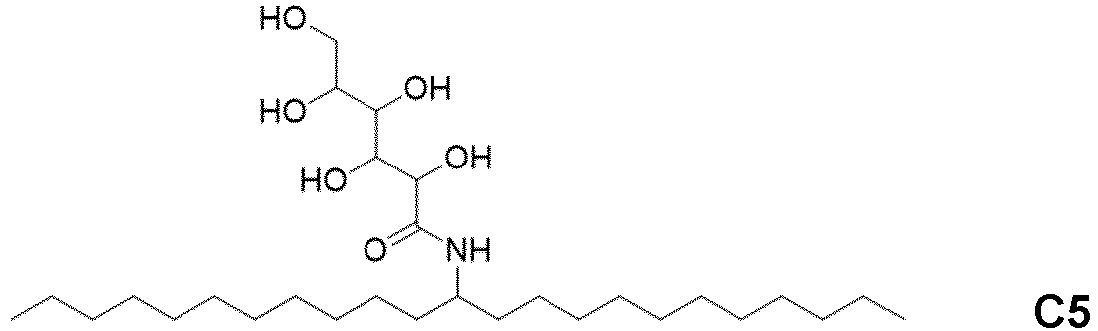
- All the reactions were conducted under an inert argon atmosphere.
- In a 5L three necked round bottom flask equipped with a magnetic stirrer, a condenser, a temperature probe and a heater was prepared a solution of tricosan-12-one (100 g, 0.295 mol, 1 eq.) in 700 mL of methanol.
- Then NH4OAc (227.386 g, 2.95mol, 10 eq.) followed by NaCNBH3 (74.15 g, 1.18 mol, 4 eq.) are added into the mixture in small portions. The reaction media was stirred at room temperature for 1 hour. Finally, the mixture was heated under reflux for 16 hours.Then the reaction media was cooled down to room temperature and concentrated under vacuum. Finally, 500 mL of a saturated NaHCO3 aqueous solution and 500 mL of methyl-tertbutyl ether MTBE were added to the residue and the mixture was stirred at room temperature for 1 hour. Concentrated aqueous NaOH solution was added in order to adjust the pH around 9.
- The obtained product (tricosan-12-amine) was extracted with MTBE and the organic phase was washed several times with water and brine. The organic phase is dried with K2CO3, filtered and concentrated in vacuum to afford 100.4 g of crude yellow oil.
- The crude was then purified through flash chromatography column over silica gel using dichloromethane : methanol mixture as the eluent with a gradient going from DCM :
MeOH =100:1 to DCM : MeOH= 10 : 1 + 1% Et3N. After solvent evaporation 93.5 g (0.275 mol) of pure light yellow oil was obtained. - Yield: 93%
- The reaction is conducted under an inert argon atmosphere.
- In a 250 mL round bottom flask equipped with a condenser, a magnetic stirrer, a heater and a temperature probe were added:
- 30 g of tricosan-12-amine as obtained in step 1 (88.3 mmoles, 1 eq.)
- 31.47 g of δ-gluconolactone (176.7 mmoles, 2 eq.)
- 75 mL of Me-THF
- The mixture was stirred at 80°C for 6 hours and then is allowed to cool down to room temperature.
- 500 mL of water was then added into the reaction mixture and the product is extracted with 3x500 mL of chloroform.
- The organic phases were gathered, washed again with 500 mL of water, dried over MgSO4, filtered and the solvent is evaporated to afford 47g of a pale yellow paste.
- At this stage the crude product still contained residual amounts of the starting amine, therefor the solid was washed with 3x100 mL of ethyl acetate.
- The solid is then dried to remove traces of solvent and 41g of analytically pure product (79.2 mmoles) is obtained as a white solid.
- Yield: 90%
- 1H NMR (d6-DMSO, 400 MHz) δ (ppm): 7.14 (d, J = 9.2 Hz, 1H), 5.32 (d, J = 5.2 Hz, 1H), 4.52 (d, J = 5.2 Hz, 1H), 4.45 (d, J = 5.2 Hz, 1H), 4.32 (d, J = 7.6 Hz, 1H), 4.32 (t, J = 5.6 Hz, 1H), 3.97 (dd, J = 4.8 Hz, J = 4.0 Hz, 1H), 3.92-3.84 (m, 1H), 3.75-3.62 (m, 1H), 3.58 (ddd, J = 10.8 Hz, J = 5.6 Hz, J = 2.8 Hz, 1H), 3.52-3.42 (m, 2H), 3.35 (dt, J = 10.8 Hz, J = 5.6 Hz, 1H), 1.44-1.12 (m, 40H), 0.85 (t, J = 7.2 Hz, 6H).
- A compound C6 having the following formula was synthetized according to the protocol described below,from 16-hentriacontanone which is an internal ketone of formula (II) wherein R=R'=-(CH2) 14 -CH3

- All the reactions were conducted under an inert argon atmosphere.
- Same protocol as described in step 1 of example 1 has been followed, but starting from hentriacontan-16-amine instead of tricosan-12-amine.
- The reaction was conducted under an inert argon atmosphere.
- In a 250 mL round bottom flask equipped with a condenser, a magnetic stirrer, a heater and a temperature probe wereadded:
- 30.0 g of hentriacontan-16-amine (66.4 mmoles, 1 eq.)
- 11.8 g of δ-gluconolactone (66.4 mmoles, 1 eq.)
- 75 mL of Me-THF
- The mixture was stirred at 80°C for 2 days and then was allowed to cool down to room temperature.
- 500 mL of water was then added into the reaction mixture followed by 500 mL of chloroform. The obtained precipitate is filtered out and the solid was washed with 2*100 mL of ethyl acetate.
- The solid was then dried to remove traces of solvent and 32g of analytically pure product (51 mmoles) is obtained as a white solid.
- Yield: 77%
- 1H NMR (d6-DMSO:CDCl3, 400 MHz) δ (ppm): 6.87 (d, J = 9.2 Hz, 1H), 5.25 (d, J = 4.8 Hz, 1H), 4.46 (d, J = 4.8 Hz, 1H), 4.40 (d, J = 4.8 Hz, 1H), 4.24 (d, J = 7.6 Hz, 1H), 4.15 (t, J = 5.6 Hz, 1H), 4.05 (dd, J = 4.0 Hz, J = 3.2 Hz, 1H), 4.01-3.96 (m, 1H), 3.77-3.66 (m, 1H), 3.64-3.50 (m, 3H), 3.52-3.42 (m, 1H), 1.55-1.10 (m, 56H), 0.82 (t, J = 6.8Hz, 6H).
- 13C NMR (d6-DMSO:CDCl3, 101 MHz) δ (ppm): 171.9, 74.54, 73.60, 71.80, 70.26, 63.82, 48.57, 35.05, 31.82, 29.59, 29.55, 29.52, 29.24, 25.90, 25.86, 22.61, 14.31 (terminal CH3).
- The synthetized compounds C1-C6 have been tested according to the following protocols ("4 ball wear test" and "Friction test" defined hereinafter).
- A further compound, herein referred as "compound C7", has been tested according to the same protocol for the friction test as comparison.
- This compound C7, purchased from Asta Tech Inc, is 3-(isopropylamino)propane-1,2-diol (CAS # 6452-5-9) of formula:

- For the sake of comparison, the following additives have been tested in the same conditions:
- GMO : Glycerol Monooleate
- Oleyl amide
- MoDTC (Molybdeneum Dithiocarbamate): 55-65% by weight of a MoDTC mixture of Molybdenum, bis[N,N-bis(2-ethylhexyl)carbamodithioato-kS,kS']dioxodi-m-thioxodi- and Molybdenum, bis(N,N-ditridecylcarbamodithioato-κS,κS')dioxodi-µ-thioxodi-, branched in a mineral oil
- All the tests run for 60 min at 75°C under a 40kg load, at a 1200 rpm speed.
- Each candidate is added at 1wt% in a Group II mixture base oil of 45wt% of a base oil at 6.5cSt at 100C and 55% of a base oil at 12cSt at 100°C to meet an overall kinematic viscosity at 9 cSt at 100°C.
- Friction has been evaluated using a HFRR (High Frequency Reciprocating Rig) under the following conditions:
slide ball on disc: metal/metal under a 200g load at a 1000 microns stroke, at 40°C for 15 min and then ramped to 150°C @ 2°C/min for 55 min. - Each candidate was added at 1wt% in a Group III base oil with a kinematic viscosity at 8cSt at 100°C to mimic a typical engine oil (SAE 20).
- The obtained results are reported in the following Table 1 :
Table 1 : Results Tested compound Antiwear: scar diameter (mm) Friction test: coefficient of friction @ 150°C C1 0.53 0.176 C2 0.57 0.127 C3 0.58 0.135 C4 0.54 0.122 C5 0.34 0.085 C6 0.41 0.076 C7 - not tested - 0.171 GMO (COMPARATIVE) 0.75 0.094 Oleyl amide (COMPARATIVE) 0.55 0.105 MoDTC (COMPARATIVE) 0.42 0.076
Claims (15)
- Use as an antiwear additive in a lubricant of at least one compound having the following formula (I) :
 each of R and R', which are identical or different, is a aliphatic group containing between 5 and 23 carbon atoms ; anda is an integer selected from 0, 1, 2, 3 and 4 and preferably a=0 or a=1; andb is an integer selected from 0, 1, 2, 3 and 4; and
; andA is a methylene group -CH2- ; or a carbonyl group -C(=O)- - The use of claim 1, wherein the compound of formula (I) is a 2-[(2-alkylaminoethyl)amino]ethanol derivative having the following formula (I-1) :
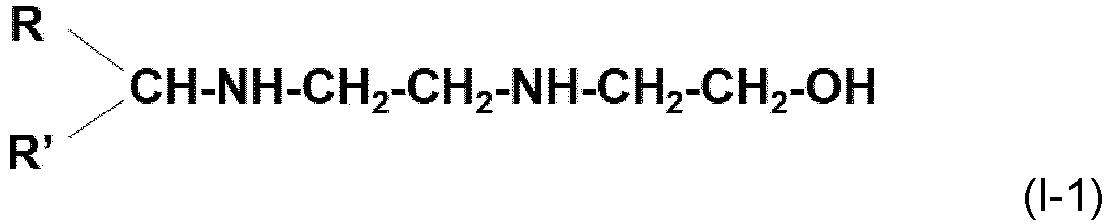
- The use of claim 1, wherein the compound of formula (I) is a 3-alkylaminopropane-1,2-diol derivative having the following formula (I-2):

- The use of claim 1, wherein the compound of formula (I) is a N-alkylglucamine derivatives having the following formula (I-3):

- The use of claim 1, wherein the compound of formula (I) is a N-alkylgluconamide derivatives having the following formula (I-4):

- The use of claim 2, 3 or 4 wherein the compound of formula (I) is at least one compound of formula (I-1) or (I-2) or (I-3), which is used in a lubricant in a transmission system including clutches, such as a gearbox, both as an antiwear agent and as a friction modifier
- The use of claim 6, wherein the total content of compounds of formula (I-1), (I-2) and (I-3) in the lubricant is between 0.2 and 5 % by weight, based on the total weight of the lubricant composition.
- The use of claim 5, wherein the compound of formula (I) is at least one compound of formula (I-4), which is used in a lubricant in a combustion engine or in transmissions without clutches for electrical vehicle, both as an antiwear agent and as a friction reducer.
- The use of claim 8, wherein the total content of compounds of formula (I-4) in the lubricant is between 0.2 and 5 % by weight, based on the total weight of the lubricant composition.
- A lubricant composition comprising at least an oil and at least a compound of formula (I) as defined in anyone of claim 1 to 5.
- A compound having the following formula (I-4):

- A process for preparing a compound according to claim 11, comprising a step (E) of derivatizing a primary amine R-CH(NH2)-R' with gluconolactone, wherein R and R' are as defined in claim 10.
- The process of claim 12, which includes, before step (E), a preparation step (E0) of the primary amine R-CH(NH2)-R', by a reductive amination of a fatty internal ketone of formula (II) :
R-C(=O)-R' (II)
wherein R and R' are as defined in claim 10. - The process of claim 13, wherein the fatty internal ketone (II) is obtained through a decarboxylative ketonization of two fatty acids RCOOH and R'COOH, wherein R and R' are as defined in claim 10.
- The process of claim 14, wherein the fatty acids RCOOH and R'COOH are bio-based, and preferably obtained from natural fatty esters.
Applications Claiming Priority (2)
| Application Number | Priority Date | Filing Date | Title |
|---|---|---|---|
| EP21305819.1A EP4105303A1 (en) | 2021-06-16 | 2021-06-16 | Saps-free twin-tail amine derivatives additives for lubricant for friction modification and wear prevention for friction modification and wear prevention |
| PCT/EP2022/066209 WO2022263462A1 (en) | 2021-06-16 | 2022-06-14 | Saps-free twin-tail amine derivatives additives for lubricant for friction modification and wear prevention |
Publications (2)
| Publication Number | Publication Date |
|---|---|
| EP4355846A1 EP4355846A1 (en) | 2024-04-24 |
| EP4355846B1 true EP4355846B1 (en) | 2025-05-28 |
Family
ID=76708177
Family Applications (2)
| Application Number | Title | Priority Date | Filing Date |
|---|---|---|---|
| EP21305819.1A Withdrawn EP4105303A1 (en) | 2021-06-16 | 2021-06-16 | Saps-free twin-tail amine derivatives additives for lubricant for friction modification and wear prevention for friction modification and wear prevention |
| EP22733620.3A Active EP4355846B1 (en) | 2021-06-16 | 2022-06-14 | Saps-free twin-tail amine derivatives additives for lubricant for friction modification and wear prevention |
Family Applications Before (1)
| Application Number | Title | Priority Date | Filing Date |
|---|---|---|---|
| EP21305819.1A Withdrawn EP4105303A1 (en) | 2021-06-16 | 2021-06-16 | Saps-free twin-tail amine derivatives additives for lubricant for friction modification and wear prevention for friction modification and wear prevention |
Country Status (4)
| Country | Link |
|---|---|
| US (1) | US12606763B2 (en) |
| EP (2) | EP4105303A1 (en) |
| CN (1) | CN117396583A (en) |
| WO (1) | WO2022263462A1 (en) |
Families Citing this family (1)
| Publication number | Priority date | Publication date | Assignee | Title |
|---|---|---|---|---|
| JP2026514539A (en) * | 2023-05-03 | 2026-05-11 | シェブロン・オロナイト・カンパニー・エルエルシー | Nitrogen and sulfur-containing additives in fluids for electric vehicles |
Family Cites Families (11)
| Publication number | Priority date | Publication date | Assignee | Title |
|---|---|---|---|---|
| US3280029A (en) * | 1964-06-18 | 1966-10-18 | Mobil Oil Corp | Lubricant compositions |
| DE2338087A1 (en) * | 1973-04-30 | 1975-01-16 | Albert Ag Chem Werke | NEW ALDONIC AMIDES AS MEDICINAL PRODUCTS |
| US9321979B2 (en) | 2012-03-13 | 2016-04-26 | Chemtura Corporation | Friction modifier composition for lubricants |
| US9963656B2 (en) | 2012-04-12 | 2018-05-08 | Infineum International Limited | Lubricating oil compositions |
| US9193932B2 (en) * | 2013-07-18 | 2015-11-24 | Afton Chemical Corporation | Amide alcohol friction modifiers for lubricating oils |
| SG10201504242RA (en) | 2014-06-02 | 2016-01-28 | Infineum Int Ltd | Lubricating oil compositions |
| US9314785B1 (en) * | 2014-11-13 | 2016-04-19 | Chevron U.S.A. Inc. | Ketonization process using oxidative catalyst regeneration |
| FR3039165B1 (en) | 2015-07-23 | 2018-11-30 | Total Marketing Services | LUBRICATING COMPOSITION WITH LONG LIFE ECO FUEL |
| CN109072061B (en) | 2016-04-08 | 2021-10-08 | 罗地亚经营管理公司 | Zwitterionic Surfactants for Enhanced Oil Recovery |
| WO2017174417A1 (en) | 2016-04-08 | 2017-10-12 | Rhodia Operations | Diamines surfactants suitable as emulsifier |
| CA3119081C (en) * | 2018-11-07 | 2024-02-27 | Chevron U.S.A. Inc. | Amino alkanediols and carboxylate salts as additives for improving fuel efficiency |
-
2021
- 2021-06-16 EP EP21305819.1A patent/EP4105303A1/en not_active Withdrawn
-
2022
- 2022-06-14 EP EP22733620.3A patent/EP4355846B1/en active Active
- 2022-06-14 WO PCT/EP2022/066209 patent/WO2022263462A1/en not_active Ceased
- 2022-06-14 US US18/570,506 patent/US12606763B2/en active Active
- 2022-06-14 CN CN202280038623.0A patent/CN117396583A/en active Pending
Also Published As
| Publication number | Publication date |
|---|---|
| EP4105303A1 (en) | 2022-12-21 |
| US20240271054A1 (en) | 2024-08-15 |
| US12606763B2 (en) | 2026-04-21 |
| WO2022263462A1 (en) | 2022-12-22 |
| EP4355846A1 (en) | 2024-04-24 |
| CN117396583A (en) | 2024-01-12 |
Similar Documents
| Publication | Publication Date | Title |
|---|---|---|
| EP1265906B1 (en) | Fluorinated lubricant additives | |
| CN103314084B (en) | Nonaqueous lubricant and fuel compositions containing fatty acid esters of hydroxycarboxylic acids and uses thereof | |
| US9359572B2 (en) | Modified vegetable oil lubricants | |
| EP2836480B1 (en) | Method for preparing mono or dialkanol amides | |
| GB2220954A (en) | Lubricant additive | |
| US8455413B2 (en) | Additive for oils and lubricant comprising the same | |
| EP2316838B1 (en) | Fuel additive containing alkyl hydroxy carboxylic acid boron esters | |
| JPS5888387A (en) | Lubricant oil composition | |
| US12606763B2 (en) | SAPS-free twin-tail amine derivatives additives for lubricant for friction modification and wear prevention | |
| US11781084B2 (en) | Oil agent additive and oil agent composition | |
| US20220154094A1 (en) | Lubricant additive, lubricant additive composition, and lubricating oil composition containing the same | |
| US20120202727A1 (en) | Antiwear Composition and Method of Lubricating an Internal Combustion Engine | |
| JPS63501155A (en) | Compositions, concentrates, lubricant compositions, fuel compositions, and methods for reducing fuel consumption in internal combustion engines | |
| KR910007941B1 (en) | Polyfluorinated compounds their preparation and their use as lubricant additives | |
| CN115368957B (en) | Lubricant composition containing ashless TBN molecules | |
| JP2012106944A (en) | Amide compound, boronized amide compound, additive for lubricant, and lubricant composition | |
| CN102453561B (en) | Diesel oil additive and application thereof to low-sulfur diesel oil | |
| RU2249589C1 (en) | Method for production of o-(n-butyl)-o-(2-ethyl-n-hexyl)-dithiophosphoric acid 1-(n,n-dimethylaminomethyl)-benzotriazole salt | |
| KR20240045662A (en) | Ester based compound having a low traction coefficient, lubricating base oil comprising thereof, and lubricant composition comprising thereof | |
| RU2249596C1 (en) | Method for production of o-(2-ethyl-n-hexyl)-o-(3,4,5-trithiatricyclo[5.2.1.02,6]-dez-8-yl-methyl)-dithiophosphoric 1-(n,n-dimethylaminomethyl)-1,2,4-triazole salt as lubricant oil additive | |
| KR20250160682A (en) | Ester mixtures, and Lubricant composition comprising the same | |
| JPH05125377A (en) | Ash-free, antiabrading and oxidation-resistant lubricant additive | |
| HK40076924A (en) | Lubricant composition containing ashless tbn molecules | |
| CN115605562B (en) | Estolide composition and method for preparing estolide | |
| Kaddour et al. | Synthesis of metallorganics as polyfunctional additives for engine oils |
Legal Events
| Date | Code | Title | Description |
|---|---|---|---|
| STAA | Information on the status of an ep patent application or granted ep patent |
Free format text: STATUS: UNKNOWN |
|
| STAA | Information on the status of an ep patent application or granted ep patent |
Free format text: STATUS: THE INTERNATIONAL PUBLICATION HAS BEEN MADE |
|
| PUAI | Public reference made under article 153(3) epc to a published international application that has entered the european phase |
Free format text: ORIGINAL CODE: 0009012 |
|
| STAA | Information on the status of an ep patent application or granted ep patent |
Free format text: STATUS: REQUEST FOR EXAMINATION WAS MADE |
|
| 17P | Request for examination filed |
Effective date: 20240116 |
|
| AK | Designated contracting states |
Kind code of ref document: A1 Designated state(s): AL AT BE BG CH CY CZ DE DK EE ES FI FR GB GR HR HU IE IS IT LI LT LU LV MC MK MT NL NO PL PT RO RS SE SI SK SM TR |
|
| DAV | Request for validation of the european patent (deleted) | ||
| DAX | Request for extension of the european patent (deleted) | ||
| GRAP | Despatch of communication of intention to grant a patent |
Free format text: ORIGINAL CODE: EPIDOSNIGR1 |
|
| STAA | Information on the status of an ep patent application or granted ep patent |
Free format text: STATUS: GRANT OF PATENT IS INTENDED |
|
| INTG | Intention to grant announced |
Effective date: 20250228 |
|
| GRAS | Grant fee paid |
Free format text: ORIGINAL CODE: EPIDOSNIGR3 |
|
| P01 | Opt-out of the competence of the unified patent court (upc) registered |
Free format text: CASE NUMBER: APP_13164/2025 Effective date: 20250317 |
|
| GRAA | (expected) grant |
Free format text: ORIGINAL CODE: 0009210 |
|
| STAA | Information on the status of an ep patent application or granted ep patent |
Free format text: STATUS: THE PATENT HAS BEEN GRANTED |
|
| AK | Designated contracting states |
Kind code of ref document: B1 Designated state(s): AL AT BE BG CH CY CZ DE DK EE ES FI FR GB GR HR HU IE IS IT LI LT LU LV MC MK MT NL NO PL PT RO RS SE SI SK SM TR |
|
| REG | Reference to a national code |
Ref country code: GB Ref legal event code: FG4D |
|
| REG | Reference to a national code |
Ref country code: CH Ref legal event code: EP |
|
| REG | Reference to a national code |
Ref country code: DE Ref legal event code: R096 Ref document number: 602022015235 Country of ref document: DE |
|
| REG | Reference to a national code |
Ref country code: IE Ref legal event code: FG4D |
|
| PGFP | Annual fee paid to national office [announced via postgrant information from national office to epo] |
Ref country code: DE Payment date: 20250528 Year of fee payment: 4 |
|
| PGFP | Annual fee paid to national office [announced via postgrant information from national office to epo] |
Ref country code: FR Payment date: 20250523 Year of fee payment: 4 |
|
| PGFP | Annual fee paid to national office [announced via postgrant information from national office to epo] |
Ref country code: AT Payment date: 20250721 Year of fee payment: 4 |
|
| REG | Reference to a national code |
Ref country code: NL Ref legal event code: MP Effective date: 20250528 |
|
| PG25 | Lapsed in a contracting state [announced via postgrant information from national office to epo] |
Ref country code: FI Free format text: LAPSE BECAUSE OF FAILURE TO SUBMIT A TRANSLATION OF THE DESCRIPTION OR TO PAY THE FEE WITHIN THE PRESCRIBED TIME-LIMIT Effective date: 20250528 Ref country code: ES Free format text: LAPSE BECAUSE OF FAILURE TO SUBMIT A TRANSLATION OF THE DESCRIPTION OR TO PAY THE FEE WITHIN THE PRESCRIBED TIME-LIMIT Effective date: 20250528 |
|
| REG | Reference to a national code |
Ref country code: LT Ref legal event code: MG9D |
|
| PG25 | Lapsed in a contracting state [announced via postgrant information from national office to epo] |
Ref country code: NO Free format text: LAPSE BECAUSE OF FAILURE TO SUBMIT A TRANSLATION OF THE DESCRIPTION OR TO PAY THE FEE WITHIN THE PRESCRIBED TIME-LIMIT Effective date: 20250828 Ref country code: GR Free format text: LAPSE BECAUSE OF FAILURE TO SUBMIT A TRANSLATION OF THE DESCRIPTION OR TO PAY THE FEE WITHIN THE PRESCRIBED TIME-LIMIT Effective date: 20250829 |
|
| PG25 | Lapsed in a contracting state [announced via postgrant information from national office to epo] |
Ref country code: NL Free format text: LAPSE BECAUSE OF FAILURE TO SUBMIT A TRANSLATION OF THE DESCRIPTION OR TO PAY THE FEE WITHIN THE PRESCRIBED TIME-LIMIT Effective date: 20250528 Ref country code: PL Free format text: LAPSE BECAUSE OF FAILURE TO SUBMIT A TRANSLATION OF THE DESCRIPTION OR TO PAY THE FEE WITHIN THE PRESCRIBED TIME-LIMIT Effective date: 20250528 |
|
| PG25 | Lapsed in a contracting state [announced via postgrant information from national office to epo] |
Ref country code: BG Free format text: LAPSE BECAUSE OF FAILURE TO SUBMIT A TRANSLATION OF THE DESCRIPTION OR TO PAY THE FEE WITHIN THE PRESCRIBED TIME-LIMIT Effective date: 20250528 |
|
| PG25 | Lapsed in a contracting state [announced via postgrant information from national office to epo] |
Ref country code: HR Free format text: LAPSE BECAUSE OF FAILURE TO SUBMIT A TRANSLATION OF THE DESCRIPTION OR TO PAY THE FEE WITHIN THE PRESCRIBED TIME-LIMIT Effective date: 20250528 |
|
| PG25 | Lapsed in a contracting state [announced via postgrant information from national office to epo] |
Ref country code: RS Free format text: LAPSE BECAUSE OF FAILURE TO SUBMIT A TRANSLATION OF THE DESCRIPTION OR TO PAY THE FEE WITHIN THE PRESCRIBED TIME-LIMIT Effective date: 20250828 |
|
| PG25 | Lapsed in a contracting state [announced via postgrant information from national office to epo] |
Ref country code: IS Free format text: LAPSE BECAUSE OF FAILURE TO SUBMIT A TRANSLATION OF THE DESCRIPTION OR TO PAY THE FEE WITHIN THE PRESCRIBED TIME-LIMIT Effective date: 20250928 |
|
| PG25 | Lapsed in a contracting state [announced via postgrant information from national office to epo] |
Ref country code: LV Free format text: LAPSE BECAUSE OF FAILURE TO SUBMIT A TRANSLATION OF THE DESCRIPTION OR TO PAY THE FEE WITHIN THE PRESCRIBED TIME-LIMIT Effective date: 20250528 |
|
| REG | Reference to a national code |
Ref country code: AT Ref legal event code: MK05 Ref document number: 1798634 Country of ref document: AT Kind code of ref document: T Effective date: 20250528 |
|
| PG25 | Lapsed in a contracting state [announced via postgrant information from national office to epo] |
Ref country code: SM Free format text: LAPSE BECAUSE OF FAILURE TO SUBMIT A TRANSLATION OF THE DESCRIPTION OR TO PAY THE FEE WITHIN THE PRESCRIBED TIME-LIMIT Effective date: 20250528 Ref country code: DK Free format text: LAPSE BECAUSE OF FAILURE TO SUBMIT A TRANSLATION OF THE DESCRIPTION OR TO PAY THE FEE WITHIN THE PRESCRIBED TIME-LIMIT Effective date: 20250528 Ref country code: AT Free format text: LAPSE BECAUSE OF FAILURE TO SUBMIT A TRANSLATION OF THE DESCRIPTION OR TO PAY THE FEE WITHIN THE PRESCRIBED TIME-LIMIT Effective date: 20250528 |
|
| PG25 | Lapsed in a contracting state [announced via postgrant information from national office to epo] |
Ref country code: CZ Free format text: LAPSE BECAUSE OF FAILURE TO SUBMIT A TRANSLATION OF THE DESCRIPTION OR TO PAY THE FEE WITHIN THE PRESCRIBED TIME-LIMIT Effective date: 20250528 |
|
| PG25 | Lapsed in a contracting state [announced via postgrant information from national office to epo] |
Ref country code: EE Free format text: LAPSE BECAUSE OF FAILURE TO SUBMIT A TRANSLATION OF THE DESCRIPTION OR TO PAY THE FEE WITHIN THE PRESCRIBED TIME-LIMIT Effective date: 20250528 |
|
| PG25 | Lapsed in a contracting state [announced via postgrant information from national office to epo] |
Ref country code: SK Free format text: LAPSE BECAUSE OF FAILURE TO SUBMIT A TRANSLATION OF THE DESCRIPTION OR TO PAY THE FEE WITHIN THE PRESCRIBED TIME-LIMIT Effective date: 20250528 |
|
| REG | Reference to a national code |
Ref country code: CH Ref legal event code: H13 Free format text: ST27 STATUS EVENT CODE: U-0-0-H10-H13 (AS PROVIDED BY THE NATIONAL OFFICE) Effective date: 20260127 |
|
| PG25 | Lapsed in a contracting state [announced via postgrant information from national office to epo] |
Ref country code: IT Free format text: LAPSE BECAUSE OF FAILURE TO SUBMIT A TRANSLATION OF THE DESCRIPTION OR TO PAY THE FEE WITHIN THE PRESCRIBED TIME-LIMIT Effective date: 20250528 |
|
| PG25 | Lapsed in a contracting state [announced via postgrant information from national office to epo] |
Ref country code: LU Free format text: LAPSE BECAUSE OF NON-PAYMENT OF DUE FEES Effective date: 20250614 |
|
| PG25 | Lapsed in a contracting state [announced via postgrant information from national office to epo] |
Ref country code: MC Free format text: LAPSE BECAUSE OF FAILURE TO SUBMIT A TRANSLATION OF THE DESCRIPTION OR TO PAY THE FEE WITHIN THE PRESCRIBED TIME-LIMIT Effective date: 20250528 |
|
| REG | Reference to a national code |
Ref country code: BE Ref legal event code: MM Effective date: 20250630 |
|
| REG | Reference to a national code |
Ref country code: DE Ref legal event code: R097 Ref document number: 602022015235 Country of ref document: DE |
|
| PG25 | Lapsed in a contracting state [announced via postgrant information from national office to epo] |
Ref country code: RO Free format text: LAPSE BECAUSE OF FAILURE TO SUBMIT A TRANSLATION OF THE DESCRIPTION OR TO PAY THE FEE WITHIN THE PRESCRIBED TIME-LIMIT Effective date: 20250528 |
|
| PLBE | No opposition filed within time limit |
Free format text: ORIGINAL CODE: 0009261 |
|
| STAA | Information on the status of an ep patent application or granted ep patent |
Free format text: STATUS: NO OPPOSITION FILED WITHIN TIME LIMIT |
|
| REG | Reference to a national code |
Ref country code: CH Ref legal event code: L10 Free format text: ST27 STATUS EVENT CODE: U-0-0-L10-L00 (AS PROVIDED BY THE NATIONAL OFFICE) Effective date: 20260409 |
|
| PG25 | Lapsed in a contracting state [announced via postgrant information from national office to epo] |
Ref country code: IE Free format text: LAPSE BECAUSE OF NON-PAYMENT OF DUE FEES Effective date: 20250614 |
|
| PG25 | Lapsed in a contracting state [announced via postgrant information from national office to epo] |
Ref country code: BE Free format text: LAPSE BECAUSE OF NON-PAYMENT OF DUE FEES Effective date: 20250630 |
|
| PG25 | Lapsed in a contracting state [announced via postgrant information from national office to epo] |
Ref country code: CH Free format text: LAPSE BECAUSE OF NON-PAYMENT OF DUE FEES Effective date: 20250630 |
|
| 26N | No opposition filed |
Effective date: 20260303 |