EP4354626A1 - Gas venting apparatus, and battery module and battery pack comprising same - Google Patents
Gas venting apparatus, and battery module and battery pack comprising same Download PDFInfo
- Publication number
- EP4354626A1 EP4354626A1 EP23824052.7A EP23824052A EP4354626A1 EP 4354626 A1 EP4354626 A1 EP 4354626A1 EP 23824052 A EP23824052 A EP 23824052A EP 4354626 A1 EP4354626 A1 EP 4354626A1
- Authority
- EP
- European Patent Office
- Prior art keywords
- flow path
- gas
- cross
- disk
- gas discharge
- Prior art date
- Legal status (The legal status is an assumption and is not a legal conclusion. Google has not performed a legal analysis and makes no representation as to the accuracy of the status listed.)
- Pending
Links
Images



Classifications
-
- H—ELECTRICITY
- H01—ELECTRIC ELEMENTS
- H01M—PROCESSES OR MEANS, e.g. BATTERIES, FOR THE DIRECT CONVERSION OF CHEMICAL ENERGY INTO ELECTRICAL ENERGY
- H01M50/00—Constructional details or processes of manufacture of the non-active parts of electrochemical cells other than fuel cells, e.g. hybrid cells
- H01M50/30—Arrangements for facilitating escape of gases
- H01M50/342—Non-re-sealable arrangements
- H01M50/3425—Non-re-sealable arrangements in the form of rupturable membranes or weakened parts, e.g. pierced with the aid of a sharp member
-
- H—ELECTRICITY
- H01—ELECTRIC ELEMENTS
- H01M—PROCESSES OR MEANS, e.g. BATTERIES, FOR THE DIRECT CONVERSION OF CHEMICAL ENERGY INTO ELECTRICAL ENERGY
- H01M50/00—Constructional details or processes of manufacture of the non-active parts of electrochemical cells other than fuel cells, e.g. hybrid cells
- H01M50/20—Mountings; Secondary casings or frames; Racks, modules or packs; Suspension devices; Shock absorbers; Transport or carrying devices; Holders
- H01M50/204—Racks, modules or packs for multiple batteries or multiple cells
-
- H—ELECTRICITY
- H01—ELECTRIC ELEMENTS
- H01M—PROCESSES OR MEANS, e.g. BATTERIES, FOR THE DIRECT CONVERSION OF CHEMICAL ENERGY INTO ELECTRICAL ENERGY
- H01M50/00—Constructional details or processes of manufacture of the non-active parts of electrochemical cells other than fuel cells, e.g. hybrid cells
- H01M50/30—Arrangements for facilitating escape of gases
- H01M50/308—Detachable arrangements, e.g. detachable vent plugs or plug systems
-
- H—ELECTRICITY
- H01—ELECTRIC ELEMENTS
- H01M—PROCESSES OR MEANS, e.g. BATTERIES, FOR THE DIRECT CONVERSION OF CHEMICAL ENERGY INTO ELECTRICAL ENERGY
- H01M50/00—Constructional details or processes of manufacture of the non-active parts of electrochemical cells other than fuel cells, e.g. hybrid cells
- H01M50/30—Arrangements for facilitating escape of gases
- H01M50/35—Gas exhaust passages comprising elongated, tortuous or labyrinth-shaped exhaust passages
- H01M50/358—External gas exhaust passages located on the battery cover or case
-
- H—ELECTRICITY
- H01—ELECTRIC ELEMENTS
- H01M—PROCESSES OR MEANS, e.g. BATTERIES, FOR THE DIRECT CONVERSION OF CHEMICAL ENERGY INTO ELECTRICAL ENERGY
- H01M2200/00—Safety devices for primary or secondary batteries
- H01M2200/20—Pressure-sensitive devices
-
- Y—GENERAL TAGGING OF NEW TECHNOLOGICAL DEVELOPMENTS; GENERAL TAGGING OF CROSS-SECTIONAL TECHNOLOGIES SPANNING OVER SEVERAL SECTIONS OF THE IPC; TECHNICAL SUBJECTS COVERED BY FORMER USPC CROSS-REFERENCE ART COLLECTIONS [XRACs] AND DIGESTS
- Y02—TECHNOLOGIES OR APPLICATIONS FOR MITIGATION OR ADAPTATION AGAINST CLIMATE CHANGE
- Y02E—REDUCTION OF GREENHOUSE GAS [GHG] EMISSIONS, RELATED TO ENERGY GENERATION, TRANSMISSION OR DISTRIBUTION
- Y02E60/00—Enabling technologies; Technologies with a potential or indirect contribution to GHG emissions mitigation
- Y02E60/10—Energy storage using batteries
Definitions
- the present invention relates to a gas venting device for discharging gases inside a battery module or a battery pack.
- the present invention relates to a battery module and a battery pack including the gas venting device.
- Battery packs applied to electric vehicles and the like have a structure in which a plurality of battery modules including a plurality of secondary batteries are connected in series or in parallel to obtain high output.
- the secondary batteries can be repeatedly charged and discharged by an electrochemical reaction between components including positive electrode and negative electrode current collectors, separators, active materials, electrolyte, and the like.
- a secondary battery may generate gas from the inside thereof at any time while repeatedly charged and discharged, which is called venting gas.
- venting gas For example, when an overcurrent flows, a temperature of the secondary battery inside of the battery pack is rapidly increased. Such a rapid increase in temperature may cause a decomposition reaction of an electrolyte to generate gas.
- the gas When the gas is generated from the secondary battery inside the battery pack, the gas may be collected inside the pack and the battery pack may explode, or the gas may be introduced into the interior of a vehicle or the like through a cooling duct of the battery pack or the like. Accordingly, a venting device capable of reducing the pressure in a battery pack by discharging gas inside the battery pack to the outside is provided in the battery pack.
- a venting device has a structure in which a venting disk the can rupture according to internal pressure is inserted between an inlet through which gas inside a battery module or a battery pack is introduced and an outlet through which the gas is discharge.
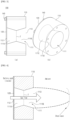
- FIG. 1 is a perspective view illustrating an example of a conventional gas venting device
- FIG. 2 is a schematic view illustrating a gas flow situation at an outlet part of a conventional gas venting device.
- the conventional gas venting device 1 has the advantage of being easy to design device, since the gas discharge flow path 11 of the bracket 10 connected to the venting disk 20 is simply designed as a cylinder.
- the conventional gas venting device 1 has a cylindrical-shaped structure simply connected to an inlet 12 and an outlet 13 of gas, the pressure between the inlet and outlet is not large, thereby limits the flow amount of gas that can be discharged.
- the present invention is directed to solve the above problems, and aims to provide a gas venting device, which can discharge more flow per hour with a venting disk with the same area, and a battery module and battery pack including the same.
- the present invention aims to provide a gas venting device in which a venting disk is installed on the outlet side of the flow path to prevent contamination of the flow path due to incorporation of disk fragments when the venting disk ruptures, and to develop the flow of gas in the flow path to the maximum extent possible to stably discharge the discharging gas.
- a gas venting device of the present invention for solving the above problems includes: a hollow bracket member with a gas discharge flow path; and a venting disk coupled to the bracket member to shield the gas discharge flow path, and configured to rupture when a predetermined pressure is applied to the venting disk; wherein the gas discharge flow path comprises: a first flow path that continuously or sequentially decreases in flow path cross-section along the gas discharge direction, and a second flow path formed consecutively with the first flow path and having a flow path cross-section that increases continuously or sequentially along the gas discharge direction, wherein the venting disk is installed on the inlet side of the gas discharge flow path.
- the first and second flow paths may have the same or different lengths.
- the cross-sectional profiles of the both side portions of the first flow path may be formed in a tapered shape approaching each other along the gas discharge direction
- the cross-sectional profiles of the both side portions of the second flow path may be formed in a tapered shape moving away from each other along the gas discharge direction
- a slope of the tapered shape of the first flow path and a slope of the tapered shape of the second flow path may be the same or different.
- cross-sectional profiles of the both side portions of the first and second flow paths may be formed in a linear or curved tapered shape.
- the first flow path may have a first truncated conical shape in which the cross-sectional profiles of the both side portions are formed in a linear or curved tapered shape
- the second flow path may have a second truncated conical shape in which the cross-sectional profiles of the both side portions are formed in a linear or curved tapered shape
- the first flow path may have a first truncated pyramid shape in which the cross-sectional profiles of the both side portions are formed in a tapered shape
- the second flow path may have a second truncated pyramid shape in which the cross-sectional profiles of the both side portions are formed in a tapered shape
- first truncated pyramid and the second truncated pyramid may have a truncated square pyramid shape having a trapezoidal cross-sectional profile.
- a flow path having a linear cross-sectional profile on both side portions may be connected to the inlet side of the first flow path.
- the bracket member has a through hole, and includes a discharge guide inserted within the through hole and having a gas discharge flow path formed therethrough, wherein the venting disk is coupled to the bracket member and the discharge guide at the inlet side of the gas discharge flow path of the discharge guide to shield the gas discharge flow path.
- a fastening portion may be formed on the outer peripheral surface of the discharge guide for fastening the discharge guide to the bracket member.
- bracket member and the discharge guide may be coupled together by a screw fastening method.
- the venting disk includes a disk outer peripheral portion coupled to the bracket member; and a disk inner peripheral portion formed in one piece with the disk outer peripheral portion, shielding the gas discharge flow path, and ruptures when a predetermined pressure is applied to the disk inner peripheral portion; wherein a notch is formed in the disk inner peripheral portion to rupture when the predetermined pressure is applied to the disk inner peripheral portion.
- the present invention also provides a battery module including the gas venting device.
- the battery module includes a plurality of secondary batteries; and a module frame on which the plurality of secondary batteries are mounted, wherein the above-described gas venting device may be coupled to one side of the module frame.
- the present invention also provides a battery pack including the gas venting device.
- the battery pack includes at least one battery module having a plurality of secondary batteries; and a battery pack case in which the battery module is mounted; wherein the above-described gas venting device may be coupled to one side of the battery pack case.
- the gas venting device according to the present invention and the battery module or battery pack including it can improve the safety of the battery module and battery pack by discharging more flow per hour even when using a venting disk with the same area.
- the discharged gas is discharged at high velocities, and such high-velocity inertia of the flow can prevent shock waves far from the exit from being generated, or shock waves from occurring at all.
- the present invention installs a venting disk on the the inlet side of the flow path to protect internal components of battery modules and packs with gas venting devices installed, and to increase the design freedom of the venting disk.
- the gas venting device of the present invention and the battery module and battery pack including it, have the advantage of significantly improving safety in the case of an event such as heat propagation.
- a gas venting device of the present invention includes: a hollow bracket member with a gas discharge flow path; and a venting disk coupled to the bracket member to shield the gas discharge flow path, and configured to rupture when a predetermined pressure is applied; wherein the gas discharge flow path includes: a first flow path that continuously or sequentially decreases in flow path cross-section along the gas discharge direction, and a second flow path formed consecutively with the first flow path and having a flow path cross-section that increases continuously or sequentially along the gas discharge direction, wherein the venting disk is installed on the inlet side of the gas discharge flow path.
- the present invention also provides a battery module including the gas venting device.
- the battery module includes a plurality of secondary batteries; and a module frame on which the secondary battery is mounted, wherein the above-mentioned gas venting device may be coupled to one side of the module frame.
- the present invention also provides a battery pack including the gas venting device.
- the battery pack includes at least one battery module having a plurality of secondary batteries; and a battery pack case in which the battery module is mounted; wherein the above-mentioned gas venting device may be coupled to one side of the battery pack case.
- a layer, film, region, or plate when referred to as being “formed below” an element, it includes a case in which the layer, film, region, or plate is formed directly below the element and a case in which the layer, film, region, or plate is formed below the element with another element interposed therebetween.
- a member when referred to as being located “on” another member, it includes a case in which a member is disposed above another member and a case in which a member is disposed below another member.
- FIG. 3 is a diagram illustrating an exemplary embodiment of a gas venting device of the present invention
- FIG. 4 is a schematic illustration of a gas flow situation at the outlet of a gas venting device of the present invention.
- FIG. 3(a) is a schematic cross-sectional view of the gas venting device
- FIG. 3(b) is a schematic perspective view of the gas venting device.
- a gas venting device 100 includes: a hollow bracket member 110 with a gas discharge flow path 111; and a venting disk 120 coupled to the bracket member 110 to shield the gas discharge flow path 111, and configured to rupture when a predetermined pressure is applied; wherein the gas discharge flow path 111 includes: a first flow path 111A that continuously or sequentially decreases in flow path cross-section along the gas discharge direction, and a second flow path 111B formed consecutively with the first flow path and having a flow path cross-section that increases continuously or sequentially along the gas discharge direction, wherein the venting disk 120 is installed on the inlet 112 side of the gas discharge flow path 111.
- a gas venting device 100 includes a hollow bracket member 110 having a gas discharge flow path; and a venting disk 120 coupled to the bracket member 110.
- the bracket member 110 may be hollow, such that the hollow (through hole) space may directly form a gas discharge flow path 111, or, as will be described later, another member with a gas discharge flow path (e.g., a discharge guide) may be positioned within the hollow space.
- the bracket member 110 has a through hole at its approximate center, wherein the through hole forms a gas discharge flow path 111.
- the bracket member 110 is provided with a venting disk 120 that shields the gas discharge flow path 111.
- the venting disk 120 is formed of a rupturable material such that it ruptures when a predetermined pressure is applied.
- it may be formed of a rupturable metal or plastic material.
- it may be made of a polymeric material that can be thinned, such as vinyl, film, or the like.
- the venting disk may be provided with a notch in the area corresponding to the flow path to facilitate rupturing.
- the predetermined pressure may be determined by considering the design of the battery cells within the battery module or battery pack and the degree of safety required.
- the venting disk 120 may be designed to rupture in the event of a flame within the module or pack or in the event that it exceeds a set high temperature and pressure.
- the venting disk 120 may be designed to rupture at a relatively low set pressure, which is the pressure before an internal explosion occurs.
- the venting disk 120 is coupled to the bracket member 110 by being positioned above the gas discharge flow path 111 so as to shield the gas discharge flow path 111.
- the gas discharge flow path 111 includes a first flow path 111A having a flow path cross-sectional area continuously or sequentially decreasing along the gas discharge direction, and a second flow path 111B formed successively to the first flow path and having a flow path cross-sectional area continuously or sequentially increasing along the gas discharge direction.
- a battery pack is equipped with a plurality of battery modules, each of which contains a plurality of secondary batteries. These secondary batteries generate gas due to the decomposition reaction of the electrolyte as they are repeatedly charged and discharged.
- the heat generated during the charging and discharging process of the battery cells promotes the generation of gas, which expands and increases the pressure inside the battery module or battery pack. If this process continues, the battery module or battery pack may explode, or the gas inside may enter the interior of a vehicle or the like through a duct, so a venting device is attached to discharge the gas by rupturing the venting disk when the pressure of the gas reaches a certain limit.
- conventional gas venting devices simply have a cylindrical-shaped gas discharge flow path with a gas inlet and outlet connected to it, so the pressure difference between the inlet and outlet is not large, which limits the flow rate of gas that can be discharged.
- the gas discharge flow path 111 of the present invention has a first flow path 111A whose flow path cross-sectional area decreases continuously or sequentially along the gas discharge direction, and a second flow path 111B formed in succession to the first flow path and whose flow path cross-sectional area increases continuously or sequentially along the gas discharge direction.
- the first flow path 111A when the cross-sectional area of the gas discharge flow path 111 decreases, the internal pressure increases as the velocity of the gas decreases at the inlet 112 of the first flow path with a large cross-sectional area, and the internal pressure decreases as the velocity of the gas increases at the outlet of the first flow path with a small cross-sectional area.
- the pressure difference between the inlet and outlet of the first flow path 111A is locally increased, and a larger flow rate of gas can be discharged even if a venting disk of the same area is used.
- the first flow path 111A having a reduced cross-sectional area of the present invention can increase the gas discharge flow rate by increasing the pressure difference at the inlet and outlet, compared to the conventional cylindrical flow path.
- a so-called choking phenomenon can also occur in the case of a flow path in which cross-sectional area is reduced as shown in the first flow path above.
- a larger pressure difference between the inlet and outlet of the flow path is advantageous.
- M speed of sound
- the present invention provides a second flow path 111B with an increased flow path cross-sectional area connected to the first flow path 111A.
- the gas exhibits the behavior of a so-called compressible gas and, unlike the first flow path, flows at supersonic speeds with the flow rate increasing with the cross-sectional area of the flow path.
- the gas flow rate that was stagnant at the outlet of the first flow path 111A is further increased by the increase in cross-sectional area in the second flow path 111B and flows at speeds exceeding the speed of sound.
- the present invention by forming a first flow path 111A with a decreasing cross-sectional area and a second flow path 111B with an increasing cross-sectional area in succession, the present invention can solve the choking and finally increase the gas flow rate at the outlet of the gas discharge flow path, i.e., the outlet 113 of the second flow path 111B, so that a large amount of gas can be discharged.
- the present invention has the advantage of mitigating or eliminating the generation of shock waves as in the prior art.
- the gas flow rate at the outlet is not high, resulting in a shock wave near the outlet.
- the shock wave is an irreversible loss of flow energy and is accompanied by a sharp increase in pressure at the outlet rear. This increase in pressure at the outlet consequently reduces the inlet-outlet pressure difference, which hinders gas discharge.
- the outlet flow rate is very large, reaching supersonic speeds, and the inertia of the flow at such high speeds causes shock waves to occur far from the outlet.
- the present invention provides for a first and second flow path 111A, 111B with different cross-sections, so that shock waves can be formed away from the outlet 113.
- the intensity of the resulting shock wave is much smaller, as shown by the dotted line in FIG. 3 , or in some cases, it may dissipate into the atmosphere without generating a shock wave.
- the present invention does not cause a localized pressure increase at the outlet as in the prior art.
- the rupture pressure of the venting disk 120 can also be set to be relatively high because the pressure difference can be large.
- the shape, length, cross-sectional area size, cross-sectional area change rate, etc. of the first flow path and the second flow path constituting the gas discharge flow path of the present invention can be appropriately changed and selected according to the design specifications such as the type, number, and arrangement structure of the secondary battery installed in the battery module and the battery pack.
- the design specifications such as the type, number, and arrangement structure of the secondary battery installed in the battery module and the battery pack.
- the heat transfer situation, flame generation situation, temperature, and pressure occurring in the battery module or pack will vary.
- the number of battery modules installed in the battery pack and the arrangement structure need to be considered.
- various specifications of the gas discharge flow path 111 of the present invention can be determined by considering the various parameters described above.
- the venting disk 120 is installed in the gas discharge flow path 111 of the bracket member 110 so as to shield the gas discharge flow path 111.
- the venting disk 120 can be installed in any part of the path of the first flow path 111A and the second flow path 111B.
- the venting disk 120 can be installed at the most appropriate location by considering the pressure or flow rate, cross-sectional area, flow path shape, and ease of installation depending on the location of the gas discharge flow path.
- venting disk 120 can be installed in a throat portion T, which is the boundary between the first flow path 111A and the second flow path 111B.
- the throat portion T forms the cross-sectional area where the subsonic behavior changes to supersonic behavior, so it is necessary to determine the cross-sectional area of this throat portion first when designing the flow path. If the venting disk 120 is installed in the throat portion T, the area of the venting disk 120 and the rupture pressure range can be designed relatively accurately by considering the cross-sectional area at the throat portion T. In particular, the flow in the throat portion T is stable compared to the inlet and outlet of the gas discharge flow path 111, and the design is based on such a stable portion, so it is advantageous that the design accuracy of the venting disk 120 can be further improved.
- the venting disk 120 can be installed at the inlet 112 side of the gas discharge flow path 111.
- installing it on the "inlet side” includes both installing it at the inlet 112 of the first flow path 111A forming the gas discharge flow path 111 and installing it on a portion adjacent to the inlet.
- it includes the case of installing the venting disk 120 in an additional flow path when the additional flow path is formed inside the gas venting device 100 that precedes the first flow path 111A (Refer to FIG. 7 below).
- venting disk 120 can effectively protect the venting disk 120 from external pressure. It is also useful for protecting critical components such as secondary battery components and module components inside the venting disk 120.
- the total flow rate is not highly dependent on the size of the inlet, so it is easy to select the specification of the venting disk 120 installed at the inlet of the gas discharge flow path 111.
- the shape of the throat portion T and the flow path is determined within the range that can achieve the effect of increasing the flow rate due to pressure changes at the inlet and outlet, the area of the inlet and the size of the venting disk 120 installed therein can be designed appropriately. Therefore, installing a venting disk 120 at the inlet 132 has the advantage of providing greater design freedom.
- the venting disk 120 can be installed at the outlet of the gas discharge flow path 111, that is, at the outlet 113 side of the second flow path.
- venting disk 120 If the venting disk 120 is installed at the inlet 112 of the flow path or in the throat portion T, if it ruptures, the ruptured fragments can block the flow path or flow into the module and cause interference. This can impair the flow stability of the flow path. Installing the venting disk 120 at the outlet 133 of the flow path reduces this risk and contributes to flow stability.
- venting disk 120 Since the venting disk 120 is located on the outlet side of the flow path 113, there are no obstructions in the flow path from the inlet to the outlet side. As a result, since the flow path gets connected to the outside after the gas flow in the gas discharge flow path 111 becomes fully developed, this further improves the flow stability of the flow path, and enables a stable venting of the discharging gas.
- the venting disk 120 can be installed at the inlet of the first flow path 111A (inlet 112 of the gas discharge flow path), at the outlet of the second flow path 111B (outlet 113 of the gas discharge flow path), or at the throat portion T, which is a boundary between the outlet of the first flow path and the inlet of the second flow path.
- the venting disk 120 can be installed in other locations.
- venting disk 120 at the inlet, outlet, or throat portion of the first flow path has its own advantages.
- bracket member 110 when the bracket member 110 is coupled to the venting disk 120 in the throat portion T, it is necessary to process the shape of the bracket member 110 or the gas discharge flow path 111 separately to provide a place for the venting disk 120 to be coupled.
- the venting disk 120 is installed on the inlet side of the gas outlet flow path 111, that is, the inlet side 112 of the first flow path 111A, in order to enlarge the coupling area of the venting disk 120 and the bracket member 110 while simplifying the processing of the bracket member 110. Furthermore, by installing the venting disk 120 on the inlet side of the gas exhaust flow path 111, the venting disk 120 is disposed at the innermost side of the flow path and is not exposed to the outside. Therefore, the venting disk 120 can be effectively protected from external pressure, thereby protecting the internal important parts.
- the area of the flow inlet portion and the size of the venting disk 120 installed therein can be designed appropriately within the range of achieving the effect of increasing the flow rate according to the change in pressure at the inlet and the outlet. Therefore, when the venting disk 120 is installed at the inlet, the design freedom is increased.
- venting disk is installed on the inlet side of the gas discharge flow path, i.e., on the inlet side of the first flow path 111A.
- the length of the overall gas discharge flow path, or the length of the first flow path 111A and the second flow path 111B, can be determined by considering the gas discharge pressure, the flow path cross-sectional area, the size of the module or the pack, etc.
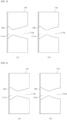
- FIGS. 5 through 7 are diagrams illustrating flow path shapes of gas venting devices according to various exemplary embodiments of the present invention.
- the length of the overall gas venting flow path, or the length of the first flow path 111A and the second flow path 111B, can be determined by considering the gas discharge pressure, the flow path cross-sectional area, the size of the module or the pack, etc.
- the first flow path 111A and the second flow path 111B may be configured to have the same length. This case is applicable when the change in gas flow rate is relatively simple, and it makes it easy to process the bracket member 110.
- first flow path 111A and the second flow path 111B vary the length of the first flow path 111A and the second flow path 111B, as in FIGS. 5 and 6 .
- the choking of the throat portion T can be quickly solved, and gas can be discharged from the outlet while the supersonic flow of the second flow path is sufficiently developed.
- the shock wave generating region can be formed further away from the outlet.
- the first flow path 111A has a flow path cross-sectional area that decreases continuously or sequentially along the gas discharge direction.
- the cross-sectional profiles of the both side portions of the first flow path 111A form a tapered shape that approaches each other in the gas discharge direction.
- the both side portions of the flow path refer to the sides on either side forming the inner wall of the flow path, not the inlet and outlet sides forming the upper and lower portions of the flow path.
- the cross-sectional profiles of the both side portions of the second flow path 111B form a tapered shape that moves away from each other toward the gas discharge direction.
- the slope of the tapered profile of the cross-sectional profiles of the both side portions can also be determined differently depending on the design goal. That is, if the flow change is relatively simple or if the venting path is short, the slope of the tapered shape of the first and second flow paths can be set to be the same, as shown in FIGS. 3 and 4 . On the other hand, if the flow change is complex, the slope of the tapered shape of the first flow path can be made larger than the slope of the tapered shape of the second flow path from the perspective of preventing choking and shock waves, as shown in FIGS. 5 and 6 .
- the cross-sectional profiles of the two side portions are not limited to a linear tapered shape, but may include a curved tapered shape.
- the cross-sectional profiles of the first and second flow paths may be all linear tapered shape, or as shown in FIG. 5(b) , they may be all curved tapered shape.
- the cross-sectional profile of the both side portions of the first flow path 111A and the second flow path 111B may be a mixture of linear and curved lines. That is, the cross-sectional profile of the first flow path 111A may be curved and the cross-sectional profile of the second flow path 111B may be linear, as shown in FIG. 6(a) .
- the cross-sectional profiles of the first and second flow paths may be linear-curved, as shown in FIG. 6(b) .
- the cross-sectional profile may be composed of a partial mixture of linear and curved lines within each of the first flow path 111A and the second flow path 111B.
- the cross-sectional area condition of the overall flow path must satisfy a continuous or sequential decrease (first flow path) and increase (second flow path).
- the curvature of the curve can be set differently for each flow path, or even within a single flow path, along the gas discharge direction.
- the curved tapered flow path of FIGS. 5 and 6 has a concave curved shape from the center of the flow path toward the flow path inner wall, but it is also possible to configure a curved flow path with a convex protruding shape from the flow path inner wall toward the center of the flow path.
- configuring the cross-sectional profile of the both side portions of the flow path with a mixture of linear and curved lines, or with different curvatures of the lines has the following effects: For example, if the cross-sectional profile of the flow path is only linear, it is easy to manufacture because of its simplicity, but when connected to other parts such as pipes, an angled part may occur on the wall of the flow path, causing some flow instability.
- the cross-sectional area reduction rate is constant, if a gas with unstable flow is introduced, for example, at the inlet of the flow path, the unstable flow of the gas is not likely to be solved and maintained until the outlet of the flow path.
- a flow path with a constant cross-sectional area decrease or increase rate has a disadvantage of having less freedom to control the flow instability within the flow path.
- the flow instability described above can be controlled or managed within the flow path if the cross-sectional area reduction rate varies along the flow path (e.g., the cross-sectional profile of the two side portions is a mixture of linear and curved lines, or the curvature of the curves is different).
- the shape of the first and second flow paths or the profiles of the two side portions are different as shown in FIG. 6 , even if the flow in the first flow 111A is unstable, the flow can be stabilized by appropriately designing the shape of the second flow path 111B.
- the gas flow within the flow path can be adjusted, thereby increasing the design freedom for controlling flow stability.
- the length of the first and second flow paths, as well as the slope of the tapered shape can be adjusted to further increase the design freedom for controlling flow stability.
- the gas discharge flow path 111 may be designed to have the shape of the cross-section perpendicular to the gas discharge direction to be circular, as shown in FIG. 3 .
- the three-dimensional shape of the gas discharge flow path 141 may be a truncated conical shape. Accordingly, the shapes of the inlet 112 of the first flow path 111A, the cross-section of the throat portion T, and the outlet 113 of the second flow path 111B of the gas discharge flow path 141 may also be circular.
- the first flow path 111A of the gas discharge flow path 111 has a first truncated conical shape 111C, wherein the cross-sectional profiles of the both side portions are formed in a linear or curved tapered shape.
- the second flow path 111B has a second truncated conical shape 111D, wherein the cross-sectional profiles of the both side portions are formed in a linear or curved tapered shape.
- the outer peripheral surface of the first and second truncated conical shapes forming the first and second flow paths, respectively, has a linear or curved cross-sectional profile.
- the outer peripheral surface of the first truncated conical shape forming the first flow path has a curved ( FIG. 6(a) ) or linear ( FIG. 6(b) ) cross-sectional profile
- the outer peripheral surface of the second truncated conical shape forming the second flow path has a linear ( FIG. 6(a) ) or curved ( FIG. 6(b) ) cross-sectional profile.
- the cross-sectional shape perpendicular to the gas discharge direction is circular, with the first and second flow paths each forming a truncated conical shape.
- the cross-sectional shape is not limited to a circular shape and may have a rectangular cross-sectional shape as shown in FIG. 7 .
- the first flow path 111A has a first truncated pyramid 111E shape with a tapered cross-sectional profile on both side portions
- the second flow path 111B has a second truncated pyramid 111F shape with a tapered cross-sectional profile on both side portions.
- the first truncated pyramid 111E and the second truncated pyramid 111F have a trapezoidal cross-sectional profile on both side portions of the flow path.
- a gas discharge flow path having such a rectangular cross-sectional shape can also be appropriately employed for design purposes or for adjustment of flow stability.
- a flow path having a rectangular (square) rather than a circular cross-sectional shape perpendicular to the gas discharge direction i.e., a flow path in which the three-dimensional shape of the flow path forms a truncated pyramid, is applicable not only to FIG. 7 but also to flow paths having a cross-sectional profile of the both side portions of the same shape as in FIGS. 5 and 6 .
- a linear flow path 115 can be further formed on the inner side of the gas discharge flow path 111, that is, on the inner side of the first flow path 111A, if necessary.
- the linear flow path 115 is added in this way, the flux flow inside the gas venting device 100 can be stably directed to the first flow path 111A.
- a bracket member 110 including a linear flow path 115 it may be advantageous in terms of processibility, as it is easy to introduce a tool for processing the flow path into the interior of the bracket member 110.
- the linear flow path 115 is rectangular in cross-sectional shape perpendicular to the gas discharge direction, but a circular flow path, that is, a flow path having a cylindrical shape in three dimensions, is also possible.
- Such a linear flow path 115 can be applied to the inlet side of the truncated conical flow paths of FIGS. 3 through 7 , in addition to the truncated pyramid flow paths shown in FIG. 8 .
- the venting disk 120 can be installed on the inlet side of the linear flow path 115.
- Such a linear flow path 115 can be applied to the inlet side of the truncated conical-shaped flow paths of FIGS. 4 to 6 in addition to the truncated conical-shaped flow path shown in FIG. 7 .
- FIG. 8 is a diagram of a gas venting device according to another exemplary embodiment of the present invention.
- FIG. 8(a) is a schematic cross-sectional view
- FIG. 8(b) is a perspective view of a discharge guide 130, which is a component of the gas venting device.
- the through hole itself of the bracket member 110 is formed as a gas discharge flow path 111 including a first flow path 111A and a second flow path 111B.
- a gas discharge flow path 111 including a first flow path 111A and a second flow path 111B.
- the bracket member 110 itself has to be replaced with a bracket member with a different flow path shape.
- the purpose of the present invention is achieved by inserting a discharge guide 130 having a gas discharge flow path 131 formed through the through hole of the bracket member 110. That is, in this embodiment, gas discharge flow paths including the first and second flow paths are formed through the discharge guide 130, and the discharge guide 130 is coupled to a through hole of the bracket member 110, and a venting disk 120 is coupled to the bracket member 110 and the discharge guide 130 at the inlet 132 side of the gas discharge flow path 131 of the discharge guide 130. As shown in FIG.
- the gas discharge flow path 131 of the discharge guide 130 is formed in the form in which a first flow path 131A in the shape of a first truncated conical 131C shape and a second flow path 131B in the shape of a second truncated conical 131D shape, with the directions of the tapered cross-sectional profile of the both side portions are opposite to each other, are formed in succession.
- the discharge guide 130 is a removable or replaceable structure.
- the bracket member 110 is provided with a separate discharge guide 130 having a gas discharge flow path 131 to facilitate the discharge of gases, allow for easy replacement of parts, and make it easy to change the shape of the flow path.
- the description of the length, slope and shape of the gas discharge flow path 111 described above with reference to FIGS. 4 to 7 is equally applicable to the gas discharge flow path 131 of the discharge guide 130.
- FIGS. 9 and 10 are diagrams illustrating the fastening structure of a gas venting device of the present invention.
- the discharge guide 130 has a fastening portion 135 formed on its outer peripheral surface for fastening the discharge guide 130 to the bracket member 110.
- the bracket member and the discharge guide 130 may be fastened by a fastening member 140, such as bolts.
- a fastening member 135 may be protruding on the outer peripheral surface of the discharge guide 130 for fastening the discharge guide to the bracket member 110.
- the discharge guide has to be inserted into the through hole in the bracket member, so that its cross-section corresponds to the shape of the through hole.
- the fastening portion 135 may form plate-type protrusions protruding along its outer peripheral portions in a shape similar to the outer periphery of the venting disk 120.
- a fastening hole (not shown) for bolting together with the bracket member is formed.
- the fastening hole formed in the fastening portion 135 is formed in the same position as the fastening hole formed in the bracket member, and is fixed by inserting a bolt.
- the fastening portion 135 may be formed to be positioned between the bracket member and the venting disk 120.
- the fastening portion 135 may be formed to contact the other side of the side on which the bracket member contacts the venting disk 120.
- the bracket member 110 and the discharge guide 130 may be fastened in a screw fastening.
- threads 116,136 for screwing may be correspondingly formed on the inner wall of the through hole of the bracket member 110 and on the outer peripheral surface of the discharge guide, respectively.
- the bracket member 110 and the discharge guide 130 may be fastened in the same manner as nuts and bolts are fastened.
- the discharge guide 130 is fastened to the bracket member 110 in a screw fastening method, the structure and fastening method of the parts are simplified, and the discharge guide 130 can be strongly fixed to the bracket member 110.
- a separate fastening member 140 is required to fasten the bracket member 110 and the venting disk 120.
- the shape of the gas discharge flow path 111, 131 formed in the bracket member 110 or the discharge guide 130 can be designed in various forms depending on the safety standards of the battery pack, etc.
- the cross-sectional area of the throat portion T of the gas discharge flow paths 111,131 may be appropriately selected according to the structure of the battery module and battery pack or the safety conditions to be achieved, but may be between 20% and 80% of the cross-sectional area of the inlet of the gas discharge flow path (inlet 112, 132 of the first flow path). More specifically, the cross-sectional area of the throat portion may be 20% to 40%, or 40% to 60%, or 60% to 80%, or even more specifically, 55% to 65% of the cross-sectional area of the inlet.
- the cross-sectional area of the outlet 113, 133 of the gas discharge flow path 111, 131 may be the same as or different from the cross-sectional area of the inlet.
- patterns may be formed on the inner walls of the gas discharge flow paths 111,131 to aid in gas discharge.
- the pattern may be threaded, embossed, or protruded with a pattern of linear lines parallel to the gas discharge direction.
- the pattern may be in the form of threaded protrusions along the inner wall of the flow path that wrap around the inside of the flow path. Such a pattern may accelerate the discharge of the gas.
- FIG. 11 is a schematic diagram illustrating the shape of a venting disk 120 according to the present invention.
- the venting disk 120 includes a disk outer peripheral portion 121 that is fastened to the bracket member 110; and a disk inner peripheral portion 122 that is formed integrally with the disk outer peripheral portion 121, shields the through hole, but ruptures when a predetermined pressure is applied.
- the disk outer peripheral portion 121 is a portion for fixing the bracket member 110 and the venting disk 120.
- the disk outer peripheral portion 121 may be provided with a bolt through hole 123 along the circumferential direction, and the bracket member 110 and the disk outer peripheral portion 121 may be integrally coupled through a bolting method or the like.
- the disk inner peripheral portion 122 may be made of a metal or plastic material that is capable of rupturing when a predetermined pressure is applied.
- the disk inner peripheral portion 122 may be formed of a metal or plastic material such as copper, aluminum, or stainless steel with a small thickness. In case of rupturing, the disk inner peripheral portion 122 may be suitably selected to match the pressure conditions.
- the disk inner peripheral portion 122 prevents moisture or foreign matter from penetrating into the interior of the battery module or battery pack by blocking the through holes formed in the bracket member or the first bracket 110A and the second bracket 110B.
- the internal pressure rises, and this pressure acts as a force to rupture the disk inner peripheral portion 122.
- the pressure inside the battery module or battery pack is higher than the air pressure outside, so the gas inside can be discharged to the outside of the battery module or battery pack by negative pressure.
- a notch 124 are formed in the disk inner peripheral portion 122 to rupture when a predetermined pressure is applied.
- This notch 124 is formed by partially cutting the surface of the venting disk 130 in the thickness direction.
- the shape of the notch 124 can be designed as a cross shape, a circular shape, a quadrilateral shape, a U-shape, an oval shape, an arc shape, or the like, and the cross-section of the notch 124 can be a trapezoid, a V-shape, a quadrilateral shape, an arc, or the like.
- the shape of the notch 124 formed in the disk inner peripheral portion 122 is not necessarily limited thereto and may have various shapes.
- the shape of the notch 124 may be an X-shape, as shown in FIG. 11 .
- the ruptured fragment of the inner circumference of the disk 122 may not completely break off and may be coupled to the disk outer peripheral portion 121. If the ruptured fragment of the disk inner peripheral portion completely separates from the venting disk and falls off, it can be difficult to remove and can damage other components.
- the bracket member 110 and the venting disk 120 may be interposed with a disk pad (not shown).
- These disk pads have a shape corresponding to the disk outer peripheral portion 121, and may be annular or ring-shaped.
- the disk pad is intended to increase the airtightness between the bracket member 110 and the venting disk 120, and to prevent damage of the disk outer peripheral portion 121.
- the disk pad may be formed of an elastic rubber material or the like.
- the present invention provides a battery module that includes the gas venting device described above.
- FIG. 12 is a schematic diagram illustrating the coupling structure of a gas venting device in a battery module according to an exemplary embodiment of the present invention.
- a battery module 200 includes a plurality of secondary batteries (not shown); and a module frame 210 on which the secondary batteries are mounted, wherein the above-mentioned gas venting device 100 is fastened to one side of the module frame 210.
- the secondary battery has a form in which an electrode assembly with alternately stacked positive electrodes, negative electrodes, and separators mounted within a cell case with an electrolyte.
- the configuration of such a secondary battery is self-explanatory to a person of ordinary skill in the art to which the present invention belongs, and a more detailed description is therefore omitted.
- the gas venting device 100 may be fastened with the bracket member 110 abutting the outer surface of the module frame 210, as shown in FIG. 12(a), or may be fastened with the bracket member 110 abutting the inner surface of the module frame 210, as shown in FIG. 12(b).
- the inner surface of the module frame 210 refers to the surface of the module frame 210 facing the interior space in which the secondary battery is mounted
- the outer surface refers to the surface of the module frame 210 exposed to the outside.
- the bracket member 110 In the module frame 210, the bracket member 110, a fastening hole formed in a fastening portion (not shown) of the discharge guide 130, and a hole corresponding to the fastening hole (bolt through holes) of the venting disk 120 are formed, so that the bracket member 110, the venting disk 120, the discharge guide 130 can be fixed to the module frame 210 through a single bolt fastening. Furthermore, the module frame 210 may have a hole with a size corresponding to the through hole formed in the bracket member 110, or an inlet of the gas discharge flow path 131 formed in the discharge guide 130, so that the gas generated in the module may be discharged.
- the battery module 200 may further include a sealing member (not shown) that provides a seal between the module frame 210 and the periphery of the gas venting device 100.
- the sealing member may be a rubber ring or silicone resin, and may be installed in the gap between the gas venting device and the module frame to seal the battery module.
- the venting disk 120 when the venting disk 120 is installed on the inlet side 112,132 of the gas discharge flow path 111,131 of the gas venting device 100 or the discharge guide, the passage from the innermost side of the flow path to the battery module is shielded by the venting disk 120. Thus, by blocking contamination from the outside by the venting disk 120, damage to the components inside the module frame 210 of the battery module 200 can be prevented.
- the present invention provides a battery pack including a gas venting device as previously described.
- a battery pack according to the invention includes: at least one battery module having a plurality of secondary batteries; and a battery pack case in which the battery module is mounted, wherein one side of the battery pack case may be fastened with a gas venting device as previously described.
- the gas venting device may be fastened to the battery pack case in the same manner as the coupling of the module frame to the gas venting device described above.
- the gas venting device may be such that the bracket member 110 is coupled to an inner surface or an outer surface of the battery pack case.
- the battery pack may include a sealing member that seals between the battery pack case and the outer periphery of the gas venting device.
- the gas venting device and the battery module and the battery pack equipped with it has a sealed inside, so that when the pressure inside exceeds a reference value, the venting disk ruptures and the gas inside the battery pack is discharged to the outside.
- the present invention adopts two consecutive flow paths in which the cross-sectional area of the gas discharge flow path is continuously or sequentially reduced in the gas discharge direction and then increased again. Accordingly, this overcomes the conventional limitation in which a choking phenomenon occurs due to the outlet flow rate being only subsonic, and the outlet flow rate of the gas discharge flow path can be made to be supersonic or higher, so that a larger flow rate of gas can be discharged.
- the flow stability of the gas at the outlet is greatly improved, and the occurrence of shock waves can be reduced or prevented.
- the venting disk and internal parts can be effectively protected from external pressure.
- the area of the inlet of the flow path and the size of the venting disk can be appropriately designed to the extent that the effect of increasing the flow rate according to pressure changes at the inlet and outlet sides can be achieved.
Landscapes
- Chemical & Material Sciences (AREA)
- Chemical Kinetics & Catalysis (AREA)
- Electrochemistry (AREA)
- General Chemical & Material Sciences (AREA)
- Gas Exhaust Devices For Batteries (AREA)
- Battery Mounting, Suspending (AREA)
Abstract
Description
- The present invention relates to a gas venting device for discharging gases inside a battery module or a battery pack.
- In addition, the present invention relates to a battery module and a battery pack including the gas venting device.
- This application claims the benefit of priority based on
Korean Patent Application No. 10-2022-0072872 filed on June 15, 2022 - Battery packs applied to electric vehicles and the like have a structure in which a plurality of battery modules including a plurality of secondary batteries are connected in series or in parallel to obtain high output. In addition, the secondary batteries can be repeatedly charged and discharged by an electrochemical reaction between components including positive electrode and negative electrode current collectors, separators, active materials, electrolyte, and the like.
- A secondary battery may generate gas from the inside thereof at any time while repeatedly charged and discharged, which is called venting gas. For example, when an overcurrent flows, a temperature of the secondary battery inside of the battery pack is rapidly increased. Such a rapid increase in temperature may cause a decomposition reaction of an electrolyte to generate gas. When the gas is generated from the secondary battery inside the battery pack, the gas may be collected inside the pack and the battery pack may explode, or the gas may be introduced into the interior of a vehicle or the like through a cooling duct of the battery pack or the like. Accordingly, a venting device capable of reducing the pressure in a battery pack by discharging gas inside the battery pack to the outside is provided in the battery pack.
- Generally, a venting device has a structure in which a venting disk the can rupture according to internal pressure is inserted between an inlet through which gas inside a battery module or a battery pack is introduced and an outlet through which the gas is discharge.
-
FIG. 1 is a perspective view illustrating an example of a conventional gas venting device, andFIG. 2 is a schematic view illustrating a gas flow situation at an outlet part of a conventional gas venting device. - As shown, the conventional
gas venting device 1 has the advantage of being easy to design device, since the gasdischarge flow path 11 of thebracket 10 connected to theventing disk 20 is simply designed as a cylinder. - However, as the conventional
gas venting device 1 has a cylindrical-shaped structure simply connected to aninlet 12 and anoutlet 13 of gas, the pressure between the inlet and outlet is not large, thereby limits the flow amount of gas that can be discharged. - In addition, when a large amount of gas is generated, a so-called choking phenomenon which causes the flow to stagnate can occur at the outlet of the gas
discharge flow path 11, thereby increasing the flow instability. To avoid such choking phenomenon, it is necessary to select a venting disk that can rupture at a low pressure. However, considering the rupture pressure tolerances, it can be difficult to ensure component reliability of the venting disk in this case. - In addition, as shown in
FIG. 2 , in a gas venting device of acylindrical flow path 11, there is a problem that a strong shock wave is generated near the outlet due to an unstable flow at the outlet part and a sudden pressure change at the outlet, which impairs safety. - Furthermore, at the downstream of the shock wave, there is a local pressure increase, which causes the outlet pressure to rise again. This in turn reduces the inlet-outlet pressure difference, potentially reducing the rate of discharge.
- The present invention is directed to solve the above problems, and aims to provide a gas venting device, which can discharge more flow per hour with a venting disk with the same area, and a battery module and battery pack including the same.
- In addition, it aims to provide a gas venting device that can increase the rupture pressure of the venting disk by solving the choking phenomenon at the outlet.
- In addition, it aims to provide a gas venting device that prevents the generation of shock waves at the outlet of the flow path to increase safety and further improve flow stability.
- Additionally, the present invention aims to provide a gas venting device in which a venting disk is installed on the outlet side of the flow path to prevent contamination of the flow path due to incorporation of disk fragments when the venting disk ruptures, and to develop the flow of gas in the flow path to the maximum extent possible to stably discharge the discharging gas.
- A gas venting device of the present invention for solving the above problems includes: a hollow bracket member with a gas discharge flow path; and a venting disk coupled to the bracket member to shield the gas discharge flow path, and configured to rupture when a predetermined pressure is applied to the venting disk; wherein the gas discharge flow path comprises: a first flow path that continuously or sequentially decreases in flow path cross-section along the gas discharge direction, and a second flow path formed consecutively with the first flow path and having a flow path cross-section that increases continuously or sequentially along the gas discharge direction, wherein the venting disk is installed on the inlet side of the gas discharge flow path.
- The first and second flow paths may have the same or different lengths.
- In a specific example, the cross-sectional profiles of the both side portions of the first flow path may be formed in a tapered shape approaching each other along the gas discharge direction, and the cross-sectional profiles of the both side portions of the second flow path may be formed in a tapered shape moving away from each other along the gas discharge direction.
- A slope of the tapered shape of the first flow path and a slope of the tapered shape of the second flow path may be the same or different.
- In addition, the cross-sectional profiles of the both side portions of the first and second flow paths may be formed in a linear or curved tapered shape.
- In this case, the first flow path may have a first truncated conical shape in which the cross-sectional profiles of the both side portions are formed in a linear or curved tapered shape, and the second flow path may have a second truncated conical shape in which the cross-sectional profiles of the both side portions are formed in a linear or curved tapered shape.
- As another example, the first flow path may have a first truncated pyramid shape in which the cross-sectional profiles of the both side portions are formed in a tapered shape, and the second flow path may have a second truncated pyramid shape in which the cross-sectional profiles of the both side portions are formed in a tapered shape.
- Here, the first truncated pyramid and the second truncated pyramid may have a truncated square pyramid shape having a trapezoidal cross-sectional profile.
- In addition, a flow path having a linear cross-sectional profile on both side portions may be connected to the inlet side of the first flow path.
- As an example, the bracket member has a through hole, and includes a discharge guide inserted within the through hole and having a gas discharge flow path formed therethrough, wherein the venting disk is coupled to the bracket member and the discharge guide at the inlet side of the gas discharge flow path of the discharge guide to shield the gas discharge flow path.
- A fastening portion may be formed on the outer peripheral surface of the discharge guide for fastening the discharge guide to the bracket member.
- Additionally, the bracket member and the discharge guide may be coupled together by a screw fastening method.
- Meanwhile, the venting disk includes a disk outer peripheral portion coupled to the bracket member; and
a disk inner peripheral portion formed in one piece with the disk outer peripheral portion, shielding the gas discharge flow path, and ruptures when a predetermined pressure is applied to the disk inner peripheral portion; wherein a notch is formed in the disk inner peripheral portion to rupture when the predetermined pressure is applied to the disk inner peripheral portion. - The present invention also provides a battery module including the gas venting device.
- The battery module includes a plurality of secondary batteries; and a module frame on which the plurality of secondary batteries are mounted, wherein the above-described gas venting device may be coupled to one side of the module frame.
- The present invention also provides a battery pack including the gas venting device.
- The battery pack includes at least one battery module having a plurality of secondary batteries; and
a battery pack case in which the battery module is mounted; wherein the above-described gas venting device may be coupled to one side of the battery pack case. - The gas venting device according to the present invention and the battery module or battery pack including it can improve the safety of the battery module and battery pack by discharging more flow per hour even when using a venting disk with the same area.
- In addition, by having a unique gas discharge flow path shape, relatively stable gas flow at the outlet can be achieved while solving choking phenomenon even when a large amount of venting gas is generated. In addition, it has the advantage that the rupture pressure of the venting disk can be set to be relatively high, as the inlet and outlet pressure difference can be made large while avoiding choking phenomenon.
- Moreover, the discharged gas is discharged at high velocities, and such high-velocity inertia of the flow can prevent shock waves far from the exit from being generated, or shock waves from occurring at all.
- Furthermore, the present invention installs a venting disk on the the inlet side of the flow path to protect internal components of battery modules and packs with gas venting devices installed, and to increase the design freedom of the venting disk.
- Accordingly, the gas venting device of the present invention, and the battery module and battery pack including it, have the advantage of significantly improving safety in the case of an event such as heat propagation.
-
-
FIG. 1 is a perspective view of an example of a conventional gas venting device. -
FIG. 2 is a schematic illustration of a gas flow situation at the outlet of a conventional gas venting device. -
FIG. 3 is a diagram illustrating an exemplary embodiment of a gas venting device of the present invention. -
FIG. 4 is a schematic illustration of a gas flow situation at the outlet of a gas venting device of the present invention. -
FIG. 5 is a diagram illustrating the shape of a flow path of a gas venting device according to an exemplary embodiment of the present invention. -
FIG. 6 is a diagram illustrating the shape of a flow path of a gas venting device according to another exemplary embodiment of the present invention. -
FIG. 7 is a diagram illustrating the shape of a flow path of a gas venting device according to yet another exemplary embodiment of the present invention. -
FIG. 8 is a diagram illustrating a gas venting device according to another exemplary embodiment of the present invention. -
FIG. 9 is a diagram illustrating a fastening structure of a gas venting device of the present invention. -
FIG. 10 is a perspective view of the gas venting device ofFIG. 9 . -
FIG. 11 is a schematic illustration of the shape of a venting disk according to the present invention. -
FIG. 12 is a schematic illustration of a coupling structure of a gas venting device in a battery module according to an exemplary embodiment of the present invention. -
- 100: GAS VENTING DEVICE
- 110: BRACKET MEMBER
- 111: GAS DISCHARGE FLOW PATH
- 111A: FIRST FLOW PATH
- 111B: SECOND FLOW PATH
- 111C: FIRST TRUNCATED CONE
- 111D: SECOND TRUNCATED CONE
- 111E: FIRST TRUNCATED PYRAMID
- 111F: SECOND TRUNCATED PYRAMID
- 112: INLET
- 113: OUTLET
- T: THROAT PORTION
- 115: LINEAR FLOW PATH
- 116: THREAD
- 120: VENTING DISK
- 121: DISK OUTER PERIPHERAL PORTION
- 122: DISK INNER PERIPHERAL PORTION
- 123: BOLT THROUGH HOLE
- 124: NOTCH
- 130: DISCHARGE GUIDE
- 131: GAS DISCHARGE FLOW PATH
- 131A: FIRST FLOW PATH
- 131B: SECOND FLOW PATH
- 131C: FIRST TRUNCATED CONE
- 131D: SECOND TRUNCATED CONE
- 132: INLET
- 133: OUTLET
- 135: FASTENING PORTION
- 136: THREAD
- 140: FASTENING MEMBER
- 200: BATTERY MODULE
- 210: MODULE FRAME
- A gas venting device of the present invention, includes: a hollow bracket member with a gas discharge flow path; and a venting disk coupled to the bracket member to shield the gas discharge flow path, and configured to rupture when a predetermined pressure is applied; wherein the gas discharge flow path includes: a first flow path that continuously or sequentially decreases in flow path cross-section along the gas discharge direction, and a second flow path formed consecutively with the first flow path and having a flow path cross-section that increases continuously or sequentially along the gas discharge direction, wherein the venting disk is installed on the inlet side of the gas discharge flow path.
- The present invention also provides a battery module including the gas venting device.
- The battery module includes a plurality of secondary batteries; and a module frame on which the secondary battery is mounted, wherein the above-mentioned gas venting device may be coupled to one side of the module frame.
- The present invention also provides a battery pack including the gas venting device.
- The battery pack includes at least one battery module having a plurality of secondary batteries; and a battery pack case in which the battery module is mounted; wherein the above-mentioned gas venting device may be coupled to one side of the battery pack case.
- Hereinafter, the present invention will be described in detail with reference to the accompanying drawings. Terms and words used in this specification and claims should not be construed as being limited to commonly used meanings or meanings in dictionaries and should be construed with meanings and concepts which are consistent with the technological scope of the present invention based on the principle that the inventors have appropriately defined concepts of terms in order to describe the present invention in the best way.
- It should be understood that the terms "comprise," "comprising," "include," and/or "including," when used herein, specify the presence of stated features, integers, steps, operations, elements, parts, and/or combinations thereof, but do not preclude the presence or addition of one or more other features, integers, steps, operations, elements, parts, and/or combinations thereof. In addition, when a layer, film, region, or plate is referred to as being "formed on" another element, it includes a case in which the layer, film, region, or plate is formed directly on an element and a case in which the layer, film, region, or plate is formed on the element with another element interposed therebetween. In contrast, when a layer, film, region, or plate is referred to as being "formed below" an element, it includes a case in which the layer, film, region, or plate is formed directly below the element and a case in which the layer, film, region, or plate is formed below the element with another element interposed therebetween. In addition, in the present invention, when a member is referred to as being located "on" another member, it includes a case in which a member is disposed above another member and a case in which a member is disposed below another member.
- The present invention is described in more detail below.
-
FIG. 3 is a diagram illustrating an exemplary embodiment of a gas venting device of the present invention, andFIG. 4 is a schematic illustration of a gas flow situation at the outlet of a gas venting device of the present invention.FIG. 3(a) is a schematic cross-sectional view of the gas venting device, andFIG. 3(b) is a schematic perspective view of the gas venting device. - A
gas venting device 100 according to the invention includes: ahollow bracket member 110 with a gasdischarge flow path 111; and aventing disk 120 coupled to thebracket member 110 to shield the gasdischarge flow path 111, and configured to rupture when a predetermined pressure is applied; wherein the gasdischarge flow path 111 includes: afirst flow path 111A that continuously or sequentially decreases in flow path cross-section along the gas discharge direction, and asecond flow path 111B formed consecutively with the first flow path and having a flow path cross-section that increases continuously or sequentially along the gas discharge direction, wherein theventing disk 120 is installed on theinlet 112 side of the gasdischarge flow path 111. - Referring to
FIG. 3 , agas venting device 100 according to the present invention includes ahollow bracket member 110 having a gas discharge flow path; and aventing disk 120 coupled to thebracket member 110. - The
bracket member 110 may be hollow, such that the hollow (through hole) space may directly form a gasdischarge flow path 111, or, as will be described later, another member with a gas discharge flow path (e.g., a discharge guide) may be positioned within the hollow space. In the embodiment ofFIG. 3 , thebracket member 110 has a through hole at its approximate center, wherein the through hole forms a gasdischarge flow path 111. - The
bracket member 110 is provided with aventing disk 120 that shields the gasdischarge flow path 111. Theventing disk 120 is formed of a rupturable material such that it ruptures when a predetermined pressure is applied. For example, it may be formed of a rupturable metal or plastic material. Alternatively, it may be made of a polymeric material that can be thinned, such as vinyl, film, or the like. Meanwhile, the venting disk may be provided with a notch in the area corresponding to the flow path to facilitate rupturing. - The predetermined pressure may be determined by considering the design of the battery cells within the battery module or battery pack and the degree of safety required. For example, the
venting disk 120 may be designed to rupture in the event of a flame within the module or pack or in the event that it exceeds a set high temperature and pressure. Alternatively, for increased safety, theventing disk 120 may be designed to rupture at a relatively low set pressure, which is the pressure before an internal explosion occurs. - The
venting disk 120 is coupled to thebracket member 110 by being positioned above the gasdischarge flow path 111 so as to shield the gasdischarge flow path 111. - The gas
discharge flow path 111 includes afirst flow path 111A having a flow path cross-sectional area continuously or sequentially decreasing along the gas discharge direction, and asecond flow path 111B formed successively to the first flow path and having a flow path cross-sectional area continuously or sequentially increasing along the gas discharge direction. Thus, by forming two flow paths with different flow path cross-sections in succession, the present invention can discharge a large amount of gas by increasing the outlet flow rate while excluding the choking phenomenon as described below, and can improve flow stability by preventing the generation of shock waves. - In general, a battery pack is equipped with a plurality of battery modules, each of which contains a plurality of secondary batteries. These secondary batteries generate gas due to the decomposition reaction of the electrolyte as they are repeatedly charged and discharged. The heat generated during the charging and discharging process of the battery cells promotes the generation of gas, which expands and increases the pressure inside the battery module or battery pack. If this process continues, the battery module or battery pack may explode, or the gas inside may enter the interior of a vehicle or the like through a duct, so a venting device is attached to discharge the gas by rupturing the venting disk when the pressure of the gas reaches a certain limit.
- As mentioned earlier, conventional gas venting devices simply have a cylindrical-shaped gas discharge flow path with a gas inlet and outlet connected to it, so the pressure difference between the inlet and outlet is not large, which limits the flow rate of gas that can be discharged.
- In this regard, the gas
discharge flow path 111 of the present invention has afirst flow path 111A whose flow path cross-sectional area decreases continuously or sequentially along the gas discharge direction, and asecond flow path 111B formed in succession to the first flow path and whose flow path cross-sectional area increases continuously or sequentially along the gas discharge direction. - As in the
first flow lath 111A, when the cross-sectional area of the gasdischarge flow path 111 decreases, the internal pressure increases as the velocity of the gas decreases at theinlet 112 of the first flow path with a large cross-sectional area, and the internal pressure decreases as the velocity of the gas increases at the outlet of the first flow path with a small cross-sectional area. As a result, the pressure difference between the inlet and outlet of thefirst flow path 111A is locally increased, and a larger flow rate of gas can be discharged even if a venting disk of the same area is used. Accordingly, when the internal pressure caused by the gas generated inside the battery module or battery pack exceeds the standard value, the safety of the battery module and the battery pack can be improved by quickly discharging the gas. In other words, thefirst flow path 111A having a reduced cross-sectional area of the present invention can increase the gas discharge flow rate by increasing the pressure difference at the inlet and outlet, compared to the conventional cylindrical flow path. - Meanwhile, in addition to the conventional cylindrical flow path, a so-called choking phenomenon can also occur in the case of a flow path in which cross-sectional area is reduced as shown in the first flow path above. As mentioned above, in order to discharge a large volume of gas, a larger pressure difference between the inlet and outlet of the flow path is advantageous. However, no matter how large the pressure difference between the inlet and outlet is designed, the maximum gas flow rate that can be reached at the outlet of a reduced cross-sectional area flow path such as the first flow path is limited to the speed of sound (M=1). That is, in the subsonic region, where the gas flow rate is below the speed of sound, the gas is considered incompressible and the gas flow rate increases as the cross-sectional area of the gas discharge flow path decreases. However, in the case of subsonic flow, no matter how large the pressure difference is, the gas flow rate at the outlet of the flow path cannot exceed the speed of sound due to the laws of physics.
- Because of this, even if the pressure difference between the inlet and outlet is kept increasing, once the outlet flow rate reaches the speed of sound, a so-called choking phenomenon in which the flow rate and flow of the gas at the outlet stagnates can occur.
- In order to solve this choking phenomenon and further increase the outlet flow rate, the present invention provides a
second flow path 111B with an increased flow path cross-sectional area connected to thefirst flow path 111A. - If the flow rate at the outlet of the
first flow path 111A reaches the speed of sound and the cross-sectional area of the flow path is increased again, such as in thesecond passage 111B, the gas exhibits the behavior of a so-called compressible gas and, unlike the first flow path, flows at supersonic speeds with the flow rate increasing with the cross-sectional area of the flow path. In other words, the gas flow rate that was stagnant at the outlet of thefirst flow path 111A is further increased by the increase in cross-sectional area in thesecond flow path 111B and flows at speeds exceeding the speed of sound. Therefore, according to the present invention, by forming afirst flow path 111A with a decreasing cross-sectional area and asecond flow path 111B with an increasing cross-sectional area in succession, the present invention can solve the choking and finally increase the gas flow rate at the outlet of the gas discharge flow path, i.e., theoutlet 113 of thesecond flow path 111B, so that a large amount of gas can be discharged. - In addition, the present invention has the advantage of mitigating or eliminating the generation of shock waves as in the prior art.
- Referring to
FIG. 2 , in a conventional gas discharge flow path, the gas flow rate at the outlet is not high, resulting in a shock wave near the outlet. The shock wave is an irreversible loss of flow energy and is accompanied by a sharp increase in pressure at the outlet rear. This increase in pressure at the outlet consequently reduces the inlet-outlet pressure difference, which hinders gas discharge. - On the other hand, as shown in
FIG. 4 , in the case of the present invention with a flow path of decreasing and increasing cross-sectional area, the outlet flow rate is very large, reaching supersonic speeds, and the inertia of the flow at such high speeds causes shock waves to occur far from the outlet. In light of the recent dangers of battery ignition and explosion, it is important to design the flow path so that these shock waves are avoided within the region of interest of the flow. The present invention provides for a first andsecond flow path outlet 113. Furthermore, since the flow energy of the gas is lost in this process, the intensity of the resulting shock wave is much smaller, as shown by the dotted line inFIG. 3 , or in some cases, it may dissipate into the atmosphere without generating a shock wave. - Accordingly, the present invention does not cause a localized pressure increase at the outlet as in the prior art.
- In conclusion, according to the present invention, it is possible to overcome the choking phenomenon and discharge a large amount of gas by increasing the pressure difference between the
inlet 112 and theoutlet 113 of the gasdischarge flow path 111, while obtaining a relatively stable gas flow without generating a shock wave at the outlet, and improving safety. - Moreover, the rupture pressure of the
venting disk 120 can also be set to be relatively high because the pressure difference can be large. - The shape, length, cross-sectional area size, cross-sectional area change rate, etc. of the first flow path and the second flow path constituting the gas discharge flow path of the present invention can be appropriately changed and selected according to the design specifications such as the type, number, and arrangement structure of the secondary battery installed in the battery module and the battery pack. In other words, depending on the design specifications of the secondary battery, the heat transfer situation, flame generation situation, temperature, and pressure occurring in the battery module or pack will vary. In addition, the number of battery modules installed in the battery pack and the arrangement structure need to be considered.
- Thus, various specifications of the gas
discharge flow path 111 of the present invention, such as shape, length, cross-sectional area, and the like, can be determined by considering the various parameters described above. - The shape, length, cross-sectional area size, and cross-sectional area change rate, etc. of these gas
discharge flow paths 111 will be discussed later. - Meanwhile, the
venting disk 120 is installed in the gasdischarge flow path 111 of thebracket member 110 so as to shield the gasdischarge flow path 111. In theory, theventing disk 120 can be installed in any part of the path of thefirst flow path 111A and thesecond flow path 111B. In practice, theventing disk 120 can be installed at the most appropriate location by considering the pressure or flow rate, cross-sectional area, flow path shape, and ease of installation depending on the location of the gas discharge flow path. - Examples of desirable locations for a typical venting disk include the following:
First, theventing disk 120 can be installed in a throat portion T, which is the boundary between thefirst flow path 111A and thesecond flow path 111B. - The throat portion T forms the cross-sectional area where the subsonic behavior changes to supersonic behavior, so it is necessary to determine the cross-sectional area of this throat portion first when designing the flow path. If the
venting disk 120 is installed in the throat portion T, the area of theventing disk 120 and the rupture pressure range can be designed relatively accurately by considering the cross-sectional area at the throat portion T. In particular, the flow in the throat portion T is stable compared to the inlet and outlet of the gasdischarge flow path 111, and the design is based on such a stable portion, so it is advantageous that the design accuracy of theventing disk 120 can be further improved. - In addition, there is less pressure variation before and after the throat portion T, so there is less chance of inadvertently breaking the
venting disk 120 before it reaches the set pressure. - Second, as shown in
FIG. 3 and FIG. 4 , theventing disk 120 can be installed at theinlet 112 side of the gasdischarge flow path 111. As shown inFIG. 3 and FIG. 4 , installing it on the "inlet side" includes both installing it at theinlet 112 of thefirst flow path 111A forming the gasdischarge flow path 111 and installing it on a portion adjacent to the inlet. Furthermore, it includes the case of installing theventing disk 120 in an additional flow path when the additional flow path is formed inside thegas venting device 100 that precedes thefirst flow path 111A (Refer toFIG. 7 below). - In this case, it can effectively protect the
venting disk 120 from external pressure. It is also useful for protecting critical components such as secondary battery components and module components inside theventing disk 120. - In addition, if only the shape of the throat portion T described above is determined for the flow path shape, the total flow rate is not highly dependent on the size of the inlet, so it is easy to select the specification of the
venting disk 120 installed at the inlet of the gasdischarge flow path 111. In other words, if the shape of the throat portion T and the flow path is determined within the range that can achieve the effect of increasing the flow rate due to pressure changes at the inlet and outlet, the area of the inlet and the size of theventing disk 120 installed therein can be designed appropriately. Therefore, installing aventing disk 120 at theinlet 132 has the advantage of providing greater design freedom. - Third, the
venting disk 120 can be installed at the outlet of the gasdischarge flow path 111, that is, at theoutlet 113 side of the second flow path. - If the
venting disk 120 is installed at theinlet 112 of the flow path or in the throat portion T, if it ruptures, the ruptured fragments can block the flow path or flow into the module and cause interference. This can impair the flow stability of the flow path. Installing theventing disk 120 at theoutlet 133 of the flow path reduces this risk and contributes to flow stability. - Since the
venting disk 120 is located on the outlet side of theflow path 113, there are no obstructions in the flow path from the inlet to the outlet side. As a result, since the flow path gets connected to the outside after the gas flow in the gasdischarge flow path 111 becomes fully developed, this further improves the flow stability of the flow path, and enables a stable venting of the discharging gas. - As described above, the
venting disk 120 can be installed at the inlet of thefirst flow path 111A (inlet 112 of the gas discharge flow path), at the outlet of thesecond flow path 111B (outlet 113 of the gas discharge flow path), or at the throat portion T, which is a boundary between the outlet of the first flow path and the inlet of the second flow path. Of course, depending on the flow path design, theventing disk 120 can be installed in other locations. - However, as described above, installing the
venting disk 120 at the inlet, outlet, or throat portion of the first flow path has its own advantages. In addition, in terms of ease of coupling of theventing disk 120 to thebracket member 110, it is preferable to install the venting disk at the inlet or outlet side of the gas discharge flow path. That is, by placing theventing disk 120 at the inlet or outlet side of the gasdischarge flow path 111, thegas venting device 100 can be easily assembled, for example, by contacting the venting disk with the corresponding mating surface of thebracket member 110 and fastening it with a fastening member. - On the other hand, when the
bracket member 110 is coupled to theventing disk 120 in the throat portion T, it is necessary to process the shape of thebracket member 110 or the gasdischarge flow path 111 separately to provide a place for theventing disk 120 to be coupled. - Therefore, in the present invention, the
venting disk 120 is installed on the inlet side of the gasoutlet flow path 111, that is, theinlet side 112 of thefirst flow path 111A, in order to enlarge the coupling area of theventing disk 120 and thebracket member 110 while simplifying the processing of thebracket member 110. Furthermore, by installing theventing disk 120 on the inlet side of the gasexhaust flow path 111, theventing disk 120 is disposed at the innermost side of the flow path and is not exposed to the outside. Therefore, theventing disk 120 can be effectively protected from external pressure, thereby protecting the internal important parts. Moreover, as described above, the area of the flow inlet portion and the size of theventing disk 120 installed therein can be designed appropriately within the range of achieving the effect of increasing the flow rate according to the change in pressure at the inlet and the outlet. Therefore, when theventing disk 120 is installed at the inlet, the design freedom is increased. - Hereinafter, an embodiment will be described in which the venting disk is installed on the inlet side of the gas discharge flow path, i.e., on the inlet side of the
first flow path 111A. - The length of the overall gas discharge flow path, or the length of the
first flow path 111A and thesecond flow path 111B, can be determined by considering the gas discharge pressure, the flow path cross-sectional area, the size of the module or the pack, etc. -
FIGS. 5 through 7 are diagrams illustrating flow path shapes of gas venting devices according to various exemplary embodiments of the present invention. - The length of the overall gas venting flow path, or the length of the
first flow path 111A and thesecond flow path 111B, can be determined by considering the gas discharge pressure, the flow path cross-sectional area, the size of the module or the pack, etc. - For example, as shown in
FIGS. 3 and 4 , thefirst flow path 111A and thesecond flow path 111B may be configured to have the same length. This case is applicable when the change in gas flow rate is relatively simple, and it makes it easy to process thebracket member 110. - However, it is also possible to vary the length of the
first flow path 111A and thesecond flow path 111B, as inFIGS. 5 and 6 . In particular, it is possible to shorten the length of thefirst flow path 111A in the subsonic region and lengthen the length of thesecond flow path 111B in the supersonic region. By shortening the first flow path and lengthening the second flow path, the choking of the throat portion T can be quickly solved, and gas can be discharged from the outlet while the supersonic flow of the second flow path is sufficiently developed. By increasing the flow inertia of the discharging gas, the shock wave generating region can be formed further away from the outlet. - The
first flow path 111A has a flow path cross-sectional area that decreases continuously or sequentially along the gas discharge direction. In consideration of the case where the cross-sectional area of the flow path decreases continuously, the cross-sectional profiles of the both side portions of thefirst flow path 111A form a tapered shape that approaches each other in the gas discharge direction. Here, the both side portions of the flow path refer to the sides on either side forming the inner wall of the flow path, not the inlet and outlet sides forming the upper and lower portions of the flow path. - In addition, when the cross-sectional area of the
second flow path 111B increases continuously along the gas discharge direction, the cross-sectional profiles of the both side portions of thesecond flow path 111B form a tapered shape that moves away from each other toward the gas discharge direction. - In addition to the length of the first and second flow paths, the slope of the tapered profile of the cross-sectional profiles of the both side portions can also be determined differently depending on the design goal. That is, if the flow change is relatively simple or if the venting path is short, the slope of the tapered shape of the first and second flow paths can be set to be the same, as shown in
FIGS. 3 and 4 . On the other hand, if the flow change is complex, the slope of the tapered shape of the first flow path can be made larger than the slope of the tapered shape of the second flow path from the perspective of preventing choking and shock waves, as shown inFIGS. 5 and 6 . - Meanwhile, the cross-sectional profiles of the two side portions are not limited to a linear tapered shape, but may include a curved tapered shape. For example, as shown in
FIG. 5(a) , the cross-sectional profiles of the first and second flow paths may be all linear tapered shape, or as shown inFIG. 5(b) , they may be all curved tapered shape. Alternatively, the cross-sectional profile of the both side portions of thefirst flow path 111A and thesecond flow path 111B may be a mixture of linear and curved lines. That is, the cross-sectional profile of thefirst flow path 111A may be curved and the cross-sectional profile of thesecond flow path 111B may be linear, as shown inFIG. 6(a) . Alternatively, the cross-sectional profiles of the first and second flow paths may be linear-curved, as shown inFIG. 6(b) . - Furthermore, the cross-sectional profile may be composed of a partial mixture of linear and curved lines within each of the
first flow path 111A and thesecond flow path 111B. Importantly, the cross-sectional area condition of the overall flow path must satisfy a continuous or sequential decrease (first flow path) and increase (second flow path). - In addition, the curvature of the curve can be set differently for each flow path, or even within a single flow path, along the gas discharge direction. For example, the curved tapered flow path of
FIGS. 5 and 6 has a concave curved shape from the center of the flow path toward the flow path inner wall, but it is also possible to configure a curved flow path with a convex protruding shape from the flow path inner wall toward the center of the flow path. - In this way, configuring the cross-sectional profile of the both side portions of the flow path with a mixture of linear and curved lines, or with different curvatures of the lines, has the following effects:
For example, if the cross-sectional profile of the flow path is only linear, it is easy to manufacture because of its simplicity, but when connected to other parts such as pipes, an angled part may occur on the wall of the flow path, causing some flow instability. In addition, since the cross-sectional area reduction rate is constant, if a gas with unstable flow is introduced, for example, at the inlet of the flow path, the unstable flow of the gas is not likely to be solved and maintained until the outlet of the flow path. In other words, a flow path with a constant cross-sectional area decrease or increase rate has a disadvantage of having less freedom to control the flow instability within the flow path. - In this regard, it is advantageous that the flow instability described above can be controlled or managed within the flow path if the cross-sectional area reduction rate varies along the flow path (e.g., the cross-sectional profile of the two side portions is a mixture of linear and curved lines, or the curvature of the curves is different). For example, the shape of the first and second flow paths or the profiles of the two side portions are different as shown in
FIG. 6 , even if the flow in thefirst flow 111A is unstable, the flow can be stabilized by appropriately designing the shape of thesecond flow path 111B. In this way, by designing different shapes of the first and second flow paths, or by designing different shapes or different cross-sectional profiles within a single flow path, the gas flow within the flow path can be adjusted, thereby increasing the design freedom for controlling flow stability. - Furthermore, as described above, the length of the first and second flow paths, as well as the slope of the tapered shape, can be adjusted to further increase the design freedom for controlling flow stability.
- Meanwhile, the gas
discharge flow path 111 may be designed to have the shape of the cross-section perpendicular to the gas discharge direction to be circular, as shown inFIG. 3 . In this case, the three-dimensional shape of the gas discharge flow path 141 may be a truncated conical shape. Accordingly, the shapes of theinlet 112 of thefirst flow path 111A, the cross-section of the throat portion T, and theoutlet 113 of thesecond flow path 111B of the gas discharge flow path 141 may also be circular. - Here, the
first flow path 111A of the gasdischarge flow path 111 has a first truncatedconical shape 111C, wherein the cross-sectional profiles of the both side portions are formed in a linear or curved tapered shape. In addition, thesecond flow path 111B has a second truncatedconical shape 111D, wherein the cross-sectional profiles of the both side portions are formed in a linear or curved tapered shape. - Specifically, in the gas
discharge flow path 111 ofFIG. 5 , the outer peripheral surface of the first and second truncated conical shapes forming the first and second flow paths, respectively, has a linear or curved cross-sectional profile. - In addition, in the gas discharge flow path of
FIG. 6 , the outer peripheral surface of the first truncated conical shape forming the first flow path has a curved (FIG. 6(a) ) or linear (FIG. 6(b) ) cross-sectional profile, and the outer peripheral surface of the second truncated conical shape forming the second flow path has a linear (FIG. 6(a) ) or curved (FIG. 6(b) ) cross-sectional profile. - By changing or mixing the cross-sectional profiles of the first and second truncated conical shapes, the flow stability as described above can be more effectively controlled.
- In
FIGS. 4 through 6 , the cross-sectional shape perpendicular to the gas discharge direction is circular, with the first and second flow paths each forming a truncated conical shape. However, the cross-sectional shape is not limited to a circular shape and may have a rectangular cross-sectional shape as shown inFIG. 7 . - In other words, to the extent that the conditions of decreasing and increasing the cross-sectional area of the first flow path and the second flow path, respectively, are satisfied, it is also possible to adopt a flow path having a rectangular cross-sectional shape in the direction perpendicular to the gas discharge flow path, as shown in
FIG. 7 . Referring toFIG. 7 , thefirst flow path 111A has a firsttruncated pyramid 111E shape with a tapered cross-sectional profile on both side portions, and thesecond flow path 111B has a secondtruncated pyramid 111F shape with a tapered cross-sectional profile on both side portions. In the gas discharge flow path ofFIG. 7 , the firsttruncated pyramid 111E and the secondtruncated pyramid 111F have a trapezoidal cross-sectional profile on both side portions of the flow path. A gas discharge flow path having such a rectangular cross-sectional shape can also be appropriately employed for design purposes or for adjustment of flow stability. - As such, a flow path having a rectangular (square) rather than a circular cross-sectional shape perpendicular to the gas discharge direction, i.e., a flow path in which the three-dimensional shape of the flow path forms a truncated pyramid, is applicable not only to
FIG. 7 but also to flow paths having a cross-sectional profile of the both side portions of the same shape as inFIGS. 5 and 6 . - As shown in the cross-sectional view of
FIG. 7(a) and the perspective view ofFIG. 7(b) , alinear flow path 115 can be further formed on the inner side of the gasdischarge flow path 111, that is, on the inner side of thefirst flow path 111A, if necessary. When thelinear flow path 115 is added in this way, the flux flow inside thegas venting device 100 can be stably directed to thefirst flow path 111A. Furthermore, in the case of abracket member 110 including alinear flow path 115, it may be advantageous in terms of processibility, as it is easy to introduce a tool for processing the flow path into the interior of thebracket member 110. - The
linear flow path 115 is rectangular in cross-sectional shape perpendicular to the gas discharge direction, but a circular flow path, that is, a flow path having a cylindrical shape in three dimensions, is also possible. - Such a
linear flow path 115 can be applied to the inlet side of the truncated conical flow paths ofFIGS. 3 through 7 , in addition to the truncated pyramid flow paths shown inFIG. 8 . - In this case, the
venting disk 120 can be installed on the inlet side of thelinear flow path 115. Such alinear flow path 115 can be applied to the inlet side of the truncated conical-shaped flow paths ofFIGS. 4 to 6 in addition to the truncated conical-shaped flow path shown inFIG. 7 . -
FIG. 8 is a diagram of a gas venting device according to another exemplary embodiment of the present invention. -
FIG. 8(a) is a schematic cross-sectional view, andFIG. 8(b) is a perspective view of adischarge guide 130, which is a component of the gas venting device. - In
FIGS. 3 to 7 , the through hole itself of thebracket member 110 is formed as a gasdischarge flow path 111 including afirst flow path 111A and asecond flow path 111B.
However, in this case, it is difficult to easily change the flow path shape according to changes in product specifications, and in order to change the flow path, it is inconvenient in that thebracket member 110 itself has to be replaced with a bracket member with a different flow path shape. - In the embodiment of
FIG. 8 , the purpose of the present invention is achieved by inserting adischarge guide 130 having a gasdischarge flow path 131 formed through the through hole of thebracket member 110. That is, in this embodiment, gas discharge flow paths including the first and second flow paths are formed through thedischarge guide 130, and thedischarge guide 130 is coupled to a through hole of thebracket member 110, and aventing disk 120 is coupled to thebracket member 110 and thedischarge guide 130 at theinlet 132 side of the gasdischarge flow path 131 of thedischarge guide 130. As shown inFIG. 8 , the gasdischarge flow path 131 of thedischarge guide 130 is formed in the form in which afirst flow path 131A in the shape of a first truncated conical 131C shape and asecond flow path 131B in the shape of a second truncated conical 131D shape, with the directions of the tapered cross-sectional profile of the both side portions are opposite to each other, are formed in succession. - The
discharge guide 130 is a removable or replaceable structure. As such, in the present embodiment, thebracket member 110 is provided with aseparate discharge guide 130 having a gasdischarge flow path 131 to facilitate the discharge of gases, allow for easy replacement of parts, and make it easy to change the shape of the flow path. In this case, the description of the length, slope and shape of the gasdischarge flow path 111 described above with reference toFIGS. 4 to 7 is equally applicable to the gasdischarge flow path 131 of thedischarge guide 130. -
FIGS. 9 and 10 are diagrams illustrating the fastening structure of a gas venting device of the present invention. - Referring to
FIG. 9 , thedischarge guide 130 has afastening portion 135 formed on its outer peripheral surface for fastening thedischarge guide 130 to thebracket member 110. For example, the bracket member and thedischarge guide 130 may be fastened by afastening member 140, such as bolts. In this case, as shown inFIG. 9(a) , afastening member 135 may be protruding on the outer peripheral surface of thedischarge guide 130 for fastening the discharge guide to thebracket member 110. The discharge guide has to be inserted into the through hole in the bracket member, so that its cross-section corresponds to the shape of the through hole. In addition, thefastening portion 135 may form plate-type protrusions protruding along its outer peripheral portions in a shape similar to the outer periphery of theventing disk 120. In thefastening portion 135, a fastening hole (not shown) for bolting together with the bracket member is formed. The fastening hole formed in thefastening portion 135 is formed in the same position as the fastening hole formed in the bracket member, and is fixed by inserting a bolt. - Meanwhile, the positions at which the
fastening portions 135 are formed may be suitably designed. For example, as shown inFIG. 9(a) , thefastening portion 135 may be formed to be positioned between the bracket member and theventing disk 120. Alternatively, thefastening portion 135 may be formed to contact the other side of the side on which the bracket member contacts theventing disk 120. - In another example, the
bracket member 110 and thedischarge guide 130 may be fastened in a screw fastening. In this case, threads 116,136 for screwing may be correspondingly formed on the inner wall of the through hole of thebracket member 110 and on the outer peripheral surface of the discharge guide, respectively. Accordingly, thebracket member 110 and thedischarge guide 130 may be fastened in the same manner as nuts and bolts are fastened. In this way, when thedischarge guide 130 is fastened to thebracket member 110 in a screw fastening method, the structure and fastening method of the parts are simplified, and thedischarge guide 130 can be strongly fixed to thebracket member 110. However, even in this case, aseparate fastening member 140 is required to fasten thebracket member 110 and theventing disk 120. - The shape of the gas
discharge flow path bracket member 110 or thedischarge guide 130 can be designed in various forms depending on the safety standards of the battery pack, etc. - In addition, the cross-sectional area of the throat portion T of the gas discharge flow paths 111,131 may be appropriately selected according to the structure of the battery module and battery pack or the safety conditions to be achieved, but may be between 20% and 80% of the cross-sectional area of the inlet of the gas discharge flow path (
inlet - The cross-sectional area of the
outlet discharge flow path 111, 131 (outlet of the second flow path) may be the same as or different from the cross-sectional area of the inlet. - Meanwhile, patterns (not shown) may be formed on the inner walls of the gas discharge flow paths 111,131 to aid in gas discharge. For example, the pattern may be threaded, embossed, or protruded with a pattern of linear lines parallel to the gas discharge direction. Specifically, the pattern may be in the form of threaded protrusions along the inner wall of the flow path that wrap around the inside of the flow path. Such a pattern may accelerate the discharge of the gas.
-
FIG. 11 is a schematic diagram illustrating the shape of aventing disk 120 according to the present invention. - The
venting disk 120 includes a disk outerperipheral portion 121 that is fastened to thebracket member 110; and a disk innerperipheral portion 122 that is formed integrally with the disk outerperipheral portion 121, shields the through hole, but ruptures when a predetermined pressure is applied. - The disk outer
peripheral portion 121 is a portion for fixing thebracket member 110 and theventing disk 120. The disk outerperipheral portion 121 may be provided with a bolt throughhole 123 along the circumferential direction, and thebracket member 110 and the disk outerperipheral portion 121 may be integrally coupled through a bolting method or the like. - The disk inner
peripheral portion 122 may be made of a metal or plastic material that is capable of rupturing when a predetermined pressure is applied. For example, the disk innerperipheral portion 122 may be formed of a metal or plastic material such as copper, aluminum, or stainless steel with a small thickness. In case of rupturing, the disk innerperipheral portion 122 may be suitably selected to match the pressure conditions. - Under normal conditions, the disk inner
peripheral portion 122 prevents moisture or foreign matter from penetrating into the interior of the battery module or battery pack by blocking the through holes formed in the bracket member or the first bracket 110A and the second bracket 110B. However, when a large amount of gas is generated in the battery module or battery pack, the internal pressure rises, and this pressure acts as a force to rupture the disk innerperipheral portion 122. At this time, the pressure inside the battery module or battery pack is higher than the air pressure outside, so the gas inside can be discharged to the outside of the battery module or battery pack by negative pressure. - A
notch 124 are formed in the disk innerperipheral portion 122 to rupture when a predetermined pressure is applied. Thisnotch 124 is formed by partially cutting the surface of theventing disk 130 in the thickness direction. The shape of thenotch 124 can be designed as a cross shape, a circular shape, a quadrilateral shape, a U-shape, an oval shape, an arc shape, or the like, and the cross-section of thenotch 124 can be a trapezoid, a V-shape, a quadrilateral shape, an arc, or the like. The shape of thenotch 124 formed in the disk innerperipheral portion 122 is not necessarily limited thereto and may have various shapes. For example, the shape of thenotch 124 may be an X-shape, as shown inFIG. 11 . In this case, when the disk innerperipheral portion 122 ruptures, the ruptured fragment of the inner circumference of thedisk 122 may not completely break off and may be coupled to the disk outerperipheral portion 121. If the ruptured fragment of the disk inner peripheral portion completely separates from the venting disk and falls off, it can be difficult to remove and can damage other components. - In addition, the
bracket member 110 and theventing disk 120 may be interposed with a disk pad (not shown). These disk pads have a shape corresponding to the disk outerperipheral portion 121, and may be annular or ring-shaped. The disk pad is intended to increase the airtightness between thebracket member 110 and theventing disk 120, and to prevent damage of the disk outerperipheral portion 121. For example, the disk pad may be formed of an elastic rubber material or the like. - In addition, the present invention provides a battery module that includes the gas venting device described above.
-
FIG. 12 is a schematic diagram illustrating the coupling structure of a gas venting device in a battery module according to an exemplary embodiment of the present invention. - Referring to
FIG. 12 , abattery module 200 according to the present invention includes a plurality of secondary batteries (not shown); and amodule frame 210 on which the secondary batteries are mounted, wherein the above-mentionedgas venting device 100 is fastened to one side of themodule frame 210. - Specifically, the secondary battery has a form in which an electrode assembly with alternately stacked positive electrodes, negative electrodes, and separators mounted within a cell case with an electrolyte. The configuration of such a secondary battery is self-explanatory to a person of ordinary skill in the art to which the present invention belongs, and a more detailed description is therefore omitted.
- In one example, the
gas venting device 100 may be fastened with thebracket member 110 abutting the outer surface of themodule frame 210, as shown in FIG. 12(a), or may be fastened with thebracket member 110 abutting the inner surface of themodule frame 210, as shown in FIG. 12(b). In the specification of the present invention, the inner surface of themodule frame 210 refers to the surface of themodule frame 210 facing the interior space in which the secondary battery is mounted, and the outer surface refers to the surface of themodule frame 210 exposed to the outside. In themodule frame 210, thebracket member 110, a fastening hole formed in a fastening portion (not shown) of thedischarge guide 130, and a hole corresponding to the fastening hole (bolt through holes) of theventing disk 120 are formed, so that thebracket member 110, theventing disk 120, thedischarge guide 130 can be fixed to themodule frame 210 through a single bolt fastening. Furthermore, themodule frame 210 may have a hole with a size corresponding to the through hole formed in thebracket member 110, or an inlet of the gasdischarge flow path 131 formed in thedischarge guide 130, so that the gas generated in the module may be discharged. - Meanwhile, the
battery module 200 may further include a sealing member (not shown) that provides a seal between themodule frame 210 and the periphery of thegas venting device 100. The sealing member may be a rubber ring or silicone resin, and may be installed in the gap between the gas venting device and the module frame to seal the battery module. - As shown in
FIG. 12 , when theventing disk 120 is installed on the inlet side 112,132 of the gas discharge flow path 111,131 of thegas venting device 100 or the discharge guide, the passage from the innermost side of the flow path to the battery module is shielded by theventing disk 120. Thus, by blocking contamination from the outside by theventing disk 120, damage to the components inside themodule frame 210 of thebattery module 200 can be prevented. - In addition, the present invention provides a battery pack including a gas venting device as previously described.
- A battery pack according to the invention includes: at least one battery module having a plurality of secondary batteries; and a battery pack case in which the battery module is mounted, wherein one side of the battery pack case may be fastened with a gas venting device as previously described.
- In this case, the gas venting device may be fastened to the battery pack case in the same manner as the coupling of the module frame to the gas venting device described above.
- That is, the gas venting device may be such that the
bracket member 110 is coupled to an inner surface or an outer surface of the battery pack case. - Similarly, the battery pack may include a sealing member that seals between the battery pack case and the outer periphery of the gas venting device.
- According to the above, the gas venting device according to the present invention, and the battery module and the battery pack equipped with it has a sealed inside, so that when the pressure inside exceeds a reference value, the venting disk ruptures and the gas inside the battery pack is discharged to the outside.
- The present invention adopts two consecutive flow paths in which the cross-sectional area of the gas discharge flow path is continuously or sequentially reduced in the gas discharge direction and then increased again. Accordingly, this overcomes the conventional limitation in which a choking phenomenon occurs due to the outlet flow rate being only subsonic, and the outlet flow rate of the gas discharge flow path can be made to be supersonic or higher, so that a larger flow rate of gas can be discharged.
- In addition, as described above, the flow stability of the gas at the outlet is greatly improved, and the occurrence of shock waves can be reduced or prevented.
- In particular, in the present invention, by installing the venting disk on the inlet side of the gas discharge flow path, the venting disk and internal parts can be effectively protected from external pressure. In addition, the area of the inlet of the flow path and the size of the venting disk can be appropriately designed to the extent that the effect of increasing the flow rate according to pressure changes at the inlet and outlet sides can be achieved.
- While the present invention has been particularly described with reference to exemplary embodiments, it will be understood by those of skilled in the art that various changes in form and details may be made without departing from the spirit and scope of the present invention. Therefore, the embodiments disclosed above and in the accompanying drawings should be considered in a descriptive sense only and not for purposes of limitation. The scope of the present invention is defined not by the detailed description of the present invention but by the appended claims, and encompasses all equivalents that fall within the scope of the appended claims.
- Meanwhile, in this specification, terms indicating directions such as up, down, left, right, front, and back are used, and it should be clear that these terms are for convenience of description only, and may vary depending on the position of the object or the position of the observer.
Claims (16)
- A gas venting device comprising:a hollow bracket member with a gas discharge flow path; anda venting disk coupled to the bracket member to shield the gas discharge flow path, and configured to rupture when a predetermined pressure is applied to the venting disk; whereinthe gas discharge flow path comprises:a first flow path that continuously or sequentially decreases in flow path cross-section along the gas discharge direction, anda second flow path formed consecutively with the first flow path and having a flow path cross-section that increases continuously or sequentially along the gas discharge direction, whereinthe venting disk is installed on a inlet side of the gas discharge flow path.
- The gas venting device of claim 1, wherein
the first and second flow paths are of the same or different lengths. - The gas venting device of claim 1, whereinthe cross-sectional profiles of the both side portions of the first flow path are formed in a tapered shape approaching each other along the gas discharge direction, andthe cross-sectional profiles of the both side portions of the second flow path are formed in a tapered shape moving away from each other along the gas discharge direction.
- The gas venting device of claim 3, wherein
a slope of the tapered shape of the first flow path and a slope of the tapered shape of the second flow path are the same or different. - The gas venting device of claim 3, wherein
the cross-sectional profiles of the both side portions of the first and second flow paths are formed in a linear or curved tapered shape. - The gas venting device of claim 5, whereinthe first flow path has a first truncated conical shape in which the cross-sectional profiles of the both side portions are formed in a linear or curved tapered shape, andthe second flow path has a second truncated conical shape in which the cross-sectional profiles of the both side portions are formed in a linear or curved tapered shape.
- The gas venting device of claim 3, whereinthe first flow path has a first truncated pyramid shape in which the cross-sectional profiles of the both side portions are formed in a tapered shape, andthe second flow path has a second truncated pyramid shape in which the cross-sectional profiles of the both side portions are formed in a tapered shape.
- The gas venting device of claim 7, wherein
the first truncated pyramid and the second truncated pyramid have a truncated square pyramid shape having a trapezoidal cross-sectional profile. - The gas venting device of claim 1, wherein
a flow path having a linear cross-sectional profile on both side portions is connected to the inlet side of the first flow path. - The gas venting device of claim 1, whereinthe bracket member has a through hole, and comprisesa discharge guide inserted within the through hole and having a gas discharge flow path formed therethrough, whereinthe venting disk is coupled to the bracket member and the discharge guide at the inlet side of the gas discharge flow path of the discharge guide to shield the gas discharge flow path.
- The gas venting device of claim 10, wherein
a fastening portion is formed on the outer peripheral surface of the discharge guide for fastening the discharge guide to the bracket member. - The gas venting device of claim 10, wherein
the bracket member and the discharge guide are coupled together by a screw fastening method. - The gas venting device of claim 1, wherein
the venting disk comprises:a disk outer peripheral portion coupled to the bracket member; anda disk inner peripheral portion formed in one piece with the disk outer peripheral portion, shielding the gas discharge flow path, and rupturing when a predetermined pressure is applied to the disk inner peripheral portion; whereina notch is formed in the disk inner peripheral portion to rupture when the predetermined pressure is applied to the disk inner peripheral portion. - A battery module comprising:a plurality of secondary batteries; anda module frame on which the plurality of secondary batteries are mounted,wherein a gas venting device according to any one of claims 1 to 13 is coupled to one side of the module frame.
- The battery module of claim 14, further comprising
a sealing member providing an airtight seal between the module frame and the outer periphery of the gas venting device. - A battery pack comprising:at least one battery module having a plurality of secondary batteries; and a battery pack case in which the battery module is mounted;wherein a gas venting device according to any one of claims 1 to 13 is coupled to one side of the battery pack case.
Applications Claiming Priority (2)
| Application Number | Priority Date | Filing Date | Title |
|---|---|---|---|
| KR1020220072872A KR20230172248A (en) | 2022-06-15 | 2022-06-15 | Gas venting device, battery module and battery pack comprising the same |
| PCT/KR2023/003984 WO2023243822A1 (en) | 2022-06-15 | 2023-03-24 | Gas venting apparatus, and battery module and battery pack comprising same |
Publications (2)
| Publication Number | Publication Date |
|---|---|
| EP4354626A1 true EP4354626A1 (en) | 2024-04-17 |
| EP4354626A4 EP4354626A4 (en) | 2025-03-05 |
Family
ID=89191346
Family Applications (1)
| Application Number | Title | Priority Date | Filing Date |
|---|---|---|---|
| EP23824052.7A Pending EP4354626A4 (en) | 2022-06-15 | 2023-03-24 | Gas venting apparatus, and battery module and battery pack comprising same |
Country Status (6)
| Country | Link |
|---|---|
| US (1) | US20240313335A1 (en) |
| EP (1) | EP4354626A4 (en) |
| JP (1) | JP2024526790A (en) |
| KR (1) | KR20230172248A (en) |
| CN (1) | CN117642916A (en) |
| WO (1) | WO2023243822A1 (en) |
Cited By (1)
| Publication number | Priority date | Publication date | Assignee | Title |
|---|---|---|---|---|
| EP4636925A1 (en) * | 2024-04-19 | 2025-10-22 | Volvo Truck Corporation | Battery housing with venting channel comprising gas guiding arrangement |
Family Cites Families (10)
| Publication number | Priority date | Publication date | Assignee | Title |
|---|---|---|---|---|
| JP5507173B2 (en) * | 2009-09-25 | 2014-05-28 | パナソニック株式会社 | Battery module and battery pack using the same |
| JP2013114991A (en) * | 2011-11-30 | 2013-06-10 | Hitachi Vehicle Energy Ltd | Secondary battery |
| JP2013187530A (en) * | 2012-03-08 | 2013-09-19 | Mutsuki Denki Kk | Explosion-proof valve for hermetic type electrochemical device |
| KR101465442B1 (en) * | 2012-07-30 | 2014-11-27 | 한국생산기술연구원 | Supply Apparatus of Gas Fuel Having Converging-Diverging Nozzle |
| DE102013210335A1 (en) * | 2013-06-04 | 2014-12-04 | Robert Bosch Gmbh | Galvanic cell and battery system with at least one galvanic cell |
| KR101831817B1 (en) * | 2015-03-20 | 2018-02-23 | 주식회사 엘지화학 | Battery pack for a vehicle having gas discharge means and pressure compensating means |
| KR102142087B1 (en) | 2016-10-11 | 2020-08-06 | 주식회사 엘지화학 | Battery pack |
| EP3477756B1 (en) * | 2017-10-30 | 2019-10-09 | Samsung SDI Co., Ltd. | Ventilation device for a battery |
| WO2021092268A1 (en) | 2019-11-05 | 2021-05-14 | Kwak Janet | Reversible multi-configuration modular dinnerware / cookware / serveware apparatus and method |
| KR102772673B1 (en) * | 2020-01-14 | 2025-02-25 | 주식회사 엘지에너지솔루션 | Gas venting device and battery pack comprising the same |
-
2022
- 2022-06-15 KR KR1020220072872A patent/KR20230172248A/en active Pending
-
2023
- 2023-03-24 WO PCT/KR2023/003984 patent/WO2023243822A1/en not_active Ceased
- 2023-03-24 JP JP2024502173A patent/JP2024526790A/en active Pending
- 2023-03-24 EP EP23824052.7A patent/EP4354626A4/en active Pending
- 2023-03-24 CN CN202380012827.1A patent/CN117642916A/en active Pending
- 2023-03-24 US US18/577,925 patent/US20240313335A1/en active Pending
Cited By (1)
| Publication number | Priority date | Publication date | Assignee | Title |
|---|---|---|---|---|
| EP4636925A1 (en) * | 2024-04-19 | 2025-10-22 | Volvo Truck Corporation | Battery housing with venting channel comprising gas guiding arrangement |
Also Published As
| Publication number | Publication date |
|---|---|
| CN117642916A (en) | 2024-03-01 |
| JP2024526790A (en) | 2024-07-19 |
| KR20230172248A (en) | 2023-12-22 |
| WO2023243822A1 (en) | 2023-12-21 |
| EP4354626A4 (en) | 2025-03-05 |
| US20240313335A1 (en) | 2024-09-19 |
Similar Documents
| Publication | Publication Date | Title |
|---|---|---|
| KR102772673B1 (en) | Gas venting device and battery pack comprising the same | |
| KR102821850B1 (en) | Battery pack | |
| EP4550556A1 (en) | Battery pack having variable coupling portion for preventing structural collapse | |
| EP4354626A1 (en) | Gas venting apparatus, and battery module and battery pack comprising same | |
| EP4350869B1 (en) | Gas venting device, and battery module and battery pack comprising same | |
| JP2025090774A (en) | Gas venting device and battery pack including same | |
| EP4358263B1 (en) | DEGATING DEVICE AND BATTERY MODULE AND BATTERY PACK SO THAT | |
| CN214625293U (en) | Explosion-proof valve and battery pack | |
| CN115552707B (en) | Ventilation device and battery module and battery pack including the ventilation device | |
| KR20220120488A (en) | Gas venting device and battery pack comprising the same | |
| KR20220120489A (en) | Gas venting device and battery pack comprising the same | |
| CN215834665U (en) | Pressure-operated venting device for a battery and battery | |
| KR20240006264A (en) | Battery pack, energy storage system, and vehicle comprising the same | |
| CN119174040A (en) | Two-way discharge device and secondary battery including the same |
Legal Events
| Date | Code | Title | Description |
|---|---|---|---|
| STAA | Information on the status of an ep patent application or granted ep patent |
Free format text: STATUS: THE INTERNATIONAL PUBLICATION HAS BEEN MADE |
|
| PUAI | Public reference made under article 153(3) epc to a published international application that has entered the european phase |
Free format text: ORIGINAL CODE: 0009012 |
|
| STAA | Information on the status of an ep patent application or granted ep patent |
Free format text: STATUS: REQUEST FOR EXAMINATION WAS MADE |
|
| 17P | Request for examination filed |
Effective date: 20240109 |
|
| AK | Designated contracting states |
Kind code of ref document: A1 Designated state(s): AL AT BE BG CH CY CZ DE DK EE ES FI FR GB GR HR HU IE IS IT LI LT LU LV MC ME MK MT NL NO PL PT RO RS SE SI SK SM TR |
|
| A4 | Supplementary search report drawn up and despatched |
Effective date: 20250204 |
|
| RIC1 | Information provided on ipc code assigned before grant |
Ipc: H01M 50/204 20210101ALI20250129BHEP Ipc: H01M 50/358 20210101ALI20250129BHEP Ipc: H01M 50/342 20210101AFI20250129BHEP |
|
| STAA | Information on the status of an ep patent application or granted ep patent |
Free format text: STATUS: EXAMINATION IS IN PROGRESS |
|
| 17Q | First examination report despatched |
Effective date: 20250711 |
|
| DAV | Request for validation of the european patent (deleted) | ||
| DAX | Request for extension of the european patent (deleted) | ||
| GRAP | Despatch of communication of intention to grant a patent |
Free format text: ORIGINAL CODE: EPIDOSNIGR1 |
|
| STAA | Information on the status of an ep patent application or granted ep patent |
Free format text: STATUS: GRANT OF PATENT IS INTENDED |
|
| INTG | Intention to grant announced |
Effective date: 20251114 |
|
| P01 | Opt-out of the competence of the unified patent court (upc) registered |
Free format text: CASE NUMBER: UPC_APP_0015373_4354626/2025 Effective date: 20251201 |
|
| GRAJ | Information related to disapproval of communication of intention to grant by the applicant or resumption of examination proceedings by the epo deleted |
Free format text: ORIGINAL CODE: EPIDOSDIGR1 |
|
| STAA | Information on the status of an ep patent application or granted ep patent |
Free format text: STATUS: EXAMINATION IS IN PROGRESS |
|
| INTC | Intention to grant announced (deleted) |