EP4354398A1 - Method and system of pose estimation - Google Patents
Method and system of pose estimation Download PDFInfo
- Publication number
- EP4354398A1 EP4354398A1 EP23200707.0A EP23200707A EP4354398A1 EP 4354398 A1 EP4354398 A1 EP 4354398A1 EP 23200707 A EP23200707 A EP 23200707A EP 4354398 A1 EP4354398 A1 EP 4354398A1
- Authority
- EP
- European Patent Office
- Prior art keywords
- human
- subject
- constraint
- pose
- computer
- Prior art date
- Legal status (The legal status is an assumption and is not a legal conclusion. Google has not performed a legal analysis and makes no representation as to the accuracy of the status listed.)
- Granted
Links
Images


Classifications
-
- G—PHYSICS
- G06—COMPUTING OR CALCULATING; COUNTING
- G06T—IMAGE DATA PROCESSING OR GENERATION, IN GENERAL
- G06T7/00—Image analysis
- G06T7/70—Determining position or orientation of objects or cameras
- G06T7/73—Determining position or orientation of objects or cameras using feature-based methods
- G06T7/74—Determining position or orientation of objects or cameras using feature-based methods involving reference images or patches
-
- G—PHYSICS
- G06—COMPUTING OR CALCULATING; COUNTING
- G06T—IMAGE DATA PROCESSING OR GENERATION, IN GENERAL
- G06T7/00—Image analysis
- G06T7/70—Determining position or orientation of objects or cameras
- G06T7/73—Determining position or orientation of objects or cameras using feature-based methods
-
- G—PHYSICS
- G06—COMPUTING OR CALCULATING; COUNTING
- G06T—IMAGE DATA PROCESSING OR GENERATION, IN GENERAL
- G06T7/00—Image analysis
- G06T7/70—Determining position or orientation of objects or cameras
- G06T7/73—Determining position or orientation of objects or cameras using feature-based methods
- G06T7/75—Determining position or orientation of objects or cameras using feature-based methods involving models
-
- G—PHYSICS
- G06—COMPUTING OR CALCULATING; COUNTING
- G06T—IMAGE DATA PROCESSING OR GENERATION, IN GENERAL
- G06T7/00—Image analysis
- G06T7/20—Analysis of motion
- G06T7/246—Analysis of motion using feature-based methods, e.g. the tracking of corners or segments
- G06T7/251—Analysis of motion using feature-based methods, e.g. the tracking of corners or segments involving models
-
- G—PHYSICS
- G06—COMPUTING OR CALCULATING; COUNTING
- G06T—IMAGE DATA PROCESSING OR GENERATION, IN GENERAL
- G06T7/00—Image analysis
- G06T7/70—Determining position or orientation of objects or cameras
- G06T7/77—Determining position or orientation of objects or cameras using statistical methods
-
- G—PHYSICS
- G06—COMPUTING OR CALCULATING; COUNTING
- G06T—IMAGE DATA PROCESSING OR GENERATION, IN GENERAL
- G06T2207/00—Indexing scheme for image analysis or image enhancement
- G06T2207/20—Special algorithmic details
- G06T2207/20076—Probabilistic image processing
-
- G—PHYSICS
- G06—COMPUTING OR CALCULATING; COUNTING
- G06T—IMAGE DATA PROCESSING OR GENERATION, IN GENERAL
- G06T2207/00—Indexing scheme for image analysis or image enhancement
- G06T2207/20—Special algorithmic details
- G06T2207/20084—Artificial neural networks [ANN]
-
- G—PHYSICS
- G06—COMPUTING OR CALCULATING; COUNTING
- G06T—IMAGE DATA PROCESSING OR GENERATION, IN GENERAL
- G06T2207/00—Indexing scheme for image analysis or image enhancement
- G06T2207/30—Subject of image; Context of image processing
- G06T2207/30196—Human being; Person
-
- G—PHYSICS
- G06—COMPUTING OR CALCULATING; COUNTING
- G06T—IMAGE DATA PROCESSING OR GENERATION, IN GENERAL
- G06T2207/00—Indexing scheme for image analysis or image enhancement
- G06T2207/30—Subject of image; Context of image processing
- G06T2207/30244—Camera pose
-
- G—PHYSICS
- G06—COMPUTING OR CALCULATING; COUNTING
- G06T—IMAGE DATA PROCESSING OR GENERATION, IN GENERAL
- G06T2207/00—Indexing scheme for image analysis or image enhancement
- G06T2207/30—Subject of image; Context of image processing
- G06T2207/30248—Vehicle exterior or interior
- G06T2207/30268—Vehicle interior
Definitions
- the invention relates generally to pose estimation, and more specifically to a system and method for pose estimation by generating combinations of candidate keypoint positions and further incorporating spatial, physical and temporal constraints.
- Pose estimation in vehicles is difficult and are generally more likely to exhibit lower accuracy relative to the free space due to the presence of occluding objects in the vehicle, such as steering wheels and chairs.
- Existing prior art for human pose estimation utilize deep learning-based pose-estimation algorithms. Such algorithms are generally trained in free space, which may not be accurate for pose estimation in vehicles. Although some algorithms are trained inside a default vehicle, there may be errors when generalizing to other vehicles as different vehicles have different configurations, sizes, and shapes.
- the present invention provides a computer-implemented method for pose estimation, the method comprising:
- the computer-implemented method of the present invention is advantageous over known methods as the identification of one or more candidate positions, generation of one or more combinations of human keypoints, and determining the pose of each of the at least one subject based on the combinations of human keypoints increases the accuracy of pose estimation as the location of each human keypoint is determined in context as a combination of human keypoints instead of individual keypoints in isolation.
- a preferred method of the present invention is a computer-implemented method as described above, wherein determining one or more candidate positions of a plurality of human keypoints comprises:
- the above-described aspect of the present invention has the advantage that one or more candidate positions of each human keypoint is identified and then accounted for in subsequent steps to ensure a higher accuracy of the determined pose.
- a preferred method of the present invention is a computer-implemented method as described above or as described above as preferred, wherein determining a pose of each of the at least one subject is further based on at least one constraint affecting the pose of each of the at least one subject, wherein the at least one constraint preferably comprises at least one of: limb length, limb angle, and limb movement.
- the above-described aspect of the present invention has the advantage that the incorporation of at least one constraint affecting the each of the at least one subject increases the accuracy of pose estimation by ensuring that such physical real-life constraints are accounted for when determining a pose of a subject.
- the incorporation of at least one constraint affecting the each of the at least one subject may also be particularly advantageous in situation or environments with occluding vehicles, such as a vehicle that comprises several occluding objects such as steering wheels, seatbelts, and seats.
- occluding vehicles such as a vehicle that comprises several occluding objects such as steering wheels, seatbelts, and seats.
- the above-described aspect is also advantageous as each of the at least one constraint listed accounts for one or more of a physical, spatial and/or temporal constraint that affects the pose that each subject is able to take.
- a preferred method of the present invention is a computer-implemented method as described above or as described above as preferred, wherein the at least one constraint comprises limb movement, wherein limb movement is based on a maximum movement of each limb between image frames.
- limb movement is a constraint that affects the pose a subject that take within a restricted space, such as within a vehicle cabin.
- a preferred method of the present invention is a computer-implemented method as described above or as described above as preferred, wherein the at least one constraint comprises at least one generic constraint, wherein the generic constraint is preferably determined based on a dataset comprising a general or specific population.
- the above-described aspect of the present invention has the advantage that the pose of each subject may be estimated without prior knowledge of the specific constraints that affect each of the at least one subject.
- a preferred method of the present invention is a computer-implemented method as described above or as described above as preferred, wherein the at least one constraint comprises at least one personal constraint, wherein the at least one personal constraint is unique to each of the at least one subject, and wherein the at least one personal constraint is preferably determined based on a plurality of poses for the subject determined over a period of time.
- the above-described aspect of the present invention has the advantage of increasing the accuracy of the estimated pose by taking into account constraints that are personal and unique to each subject.
- the above-described aspect of the present invention also has the advantage of determining the at least one personal constraint automatically based on past pose estimations without the provision of the at least one personal constraint.
- a preferred method of the present invention is a computer-implemented method as described above or as described above as preferred, wherein determining the pose of each of the at least one subject comprises:
- the above-described aspect of the present invention has the advantage that the positions of human keypoints selected are those that meet the predefined constraints and have the highest likelihood.
- a preferred method of the present invention is a computer-implemented method as described above or as described above as preferred, wherein determining the pose of each of the at least one subject comprises calculating, for each of the generated one or more combinations of human keypoints, a value based on a function that maximises a likelihood that the human keypoint occurs and a fit to the at least one constraint, wherein the detected pose of the subject is the combination with the highest calculated value.
- the above-described aspect of the present invention has the advantage that the likelihood that the human keypoint occurs and the at least one constraint are both accounted for such that the determined pose may be more accurate.
- a preferred method of the present invention is a computer-implemented method as described above or as described above as preferred, wherein determining the pose of each of the at least one subject is further based on one or more vector fields encoding a location and orientation of limbs.
- the above-described aspect of the present invention has the advantage that the method of pose estimation is more accurate when there are two or more subjects within the image frame.
- a preferred method of the present invention is a computer-implemented method as described above or as described above as preferred, wherein determining the pose of each of the at least one subject comprises:
- the above-described aspect of the present invention has the advantage that the method of pose estimation is more accurate when there are two or more subjects within the image frame.
- a preferred method of the present invention is a computer-implemented method as described above or as described above as preferred, further comprising generating an alert based on the determined pose of each of the at least one subject.
- the above-described aspect of the present invention has the advantage that by generating an alert, any unsafe behaviour may be corrected in order to increase the overall driving safety.
- the invention also relates to an in-cabin method of monitoring at least one subject inside a vehicle cabin, the method comprising performing of a computer-implemented method according to any of the preceding claims, wherein the imaging device is arranged to image at least one subject inside a vehicle cabin.
- the invention also relates to a system comprising an imaging device, one or more processors and a memory that stores executable instructions for execution by the one or more processors, the executable instructions comprising instructions for performing a method of the invention.
- the invention also relates to a vehicle comprising a system of the invention, wherein the imaging device is positioned to image at least one subject inside the vehicle.
- the invention also relates to a computer program, a machine-readable storage medium, or a data carrier signal that comprises instructions, that upon execution on a data processing device and/or control unit, cause the data processing device and/or control unit to perform the steps of a computer-implemented method according to the invention.
- the machine-readable medium may include any medium and/or mechanism for storing or transmitting information in a form readable by a machine (e.g., a computing device).
- the machine-readable medium may be any medium, such as for example, read-only memory (ROM); random access memory (RAM); a universal serial bus (USB) stick; a compact disc (CD); a digital video disc (DVD); a data storage device; a hard disk; electrical, acoustical, optical, or other forms of propagated signals (e.g., digital signals, data carrier signal, carrier waves), or any other medium on which a program element as described above can be transmitted and/or stored.
- ROM read-only memory
- RAM random access memory
- USB universal serial bus
- CD compact disc
- DVD digital video disc
- data storage device e.g., compact disc, CD
- hard disk electrical, acoustical, optical, or other forms of propagated signals (e.g., digital signals, data carrier signal, carrier waves), or any other medium on which a program element as described above can be transmitted and/or stored.
- vehicle refers to any mobile agent capable of movement, including cars, trucks, buses, agricultural machines, forklift, robots, wherein such mobile agent is capable of carrying or transporting humans, whether or not such mobile agent is autonomous or human-operated.
- keypoint or “human keypoint” refer to interest points or key locations in an image that are generally indicative of unique and/or important locations of the human body, such as facial landmarks (eyes, etc.), joints (elbow, knees, hips, etc.), hands and feet, etc.
- Coupled may be understood as electrically coupled, as communicatively coupled, for example to receive and transmit data wirelessly or through wire, or as mechanically coupled, for example attached or fixed, or just in contact without any fixation, and it will be understood that both direct coupling or indirect coupling (in other words: coupling without direct contact) may be provided.
- the present disclosure is directed to methods, systems, vehicles, computer programs, machine-readable storage media, and data carrier signals, for human pose estimation, wherein such human pose estimation accounts for at least one constraint affecting the poses that a subject can take.
- Embodiments of the present invention improve pose estimation inside a vehicle by incorporating physical, spatial, and/or temporal constraints with a pose estimation algorithm, such as limb length, limb movement and limb angles.
- Fig. 1A is a simplified functional block diagram of a system 100 for pose estimation, in accordance with embodiments of a present disclosure.
- System 100 for pose estimation may be used in a vehicle, e.g., for in-cabin monitoring of subjects/persons within the vehicle cabin.
- system 100 may be configured to receive at least one image frame 108 of at least one subject or person and to output a pose 112 for each subject or person captured in the received at least one image frame 108.
- the at least one image frame 108 may be captured by an imaging device 148 (see Fig. 1B ) arranged to image at least one subject.
- system 100 for pose estimation may comprise a keypoint determination module 116, the keypoint determination module 116 configured to receive at least one image frame 108 of at least one subject or person.
- the keypoint determination module 116 may be configured to determine one or more candidate positions for each of a plurality of human keypoints, wherein each candidate position is associated with a likelihood that a human keypoint is located at such position.
- Human keypoints are generally indicative of unique and/or important locations of the human body, such as eyes, joints (elbow, knees, hips, etc.), hands and feet, etc.
- the keypoint determination module 116 may be further configured to determine one or more vector fields encoding a location and orientation of limbs identified within image frame 108. It is contemplated that keypoint determination module 116 may use any known algorithm or model to identify human keypoints and/or one or more vector fields encoding a location and orientation of limbs.
- system 100 may comprise a keypoint combination module 124, the keypoint combination module 124 configured to receive input from the keypoint determination module 116.
- keypoint combination module 124 may be configured to generate one or more combinations of human keypoints based on the one or more candidate positions of human keypoints determined by keypoint determination module 116.
- each combination of human keypoints may comprise one of each of the plurality of human keypoints, wherein each human keypoint is located at one of the one or more candidate positions determined by keypoint determination module 116 for such human keypoint. It is contemplated that keypoint combination module 124 may generate the one or more combinations of human keypoints using any known algorithm or model.
- system 100 may comprise a pose determination module 132, the pose determination module 132 configured to receive input from the keypoint combination module 124 and/or keypoint determination module 116.
- the pose determination module 132 may be configured to determine a pose of each of the at least one subject based at least on the one or more generated combinations of human keypoints.
- the pose determination module 132 may be further configured to determine the pose of each of the at least one subject based on at least one constraint affecting the pose of each of the at least one subject.
- pose determination module 132 may be further configured to determine the pose of each of the at least one subject further based on one or more vector fields encoding a location and orientation of limbs.
- Fig. 1B is a simplified hardware block diagram of the system 100, according to embodiments of the present disclosure.
- System 100 may comprise at least one processor 140.
- system 100 may comprise an imaging device 148.
- the imaging device 148 may be a camera or a video camera.
- the imaging device 148 may be arranged to image at least one subject and capture at least one image frame 108 of at least one subject or person.
- the imaging device 148 may be installed on a vehicle and arranged to image at least one subject inside the vehicle cabin.
- the at least one processor 140 may be configured to carry out the functions of at least one of the keypoint determination module 116, the keypoint combination module 124, and the pose determination module 132.
- system 100 may comprise at least one memory 156.
- the at least one memory 156 may include a non-transitory computer-readable medium.
- the at least one processor 140, the imaging device 148 and the at least one memory 156 may be coupled to one another, for example, mechanically or electrically, via the coupling line 164.
- system 100 may be further coupled to an alert unit 172 that is configured to generate an alert based on the pose 112 determined by system 100.
- System 100 may be coupled to alert unit 172 by manner of one or both of wired or wireless coupling.
- the alert may be generated for a driver or occupant of the vehicle and/or a third-party service provider For example, where the pose 112 determined by system 100 indicates that a driver's hands are not on a steering wheel, or that a driver's head is not facing forward, the alert unit 172 may generate an alert to call for the driver's attention.
- the alert unit 172 may generate an alert to the driver and/or third-party service provider to indicate a possibility of an unusual situation or an emergency, so that further actions may be taken.
- the alert unit 172 may generate alerts in the form of a visual, auditory or tactile alert. Examples include an audible alarm or voice notification, a visible notification on a dashboard display, or a vibration.
- Fig. 2 shows a flow chart of a method 200 for pose estimation, in accordance with embodiments of the present disclosure.
- Method 200 of for pose estimation may be implemented by any architecture and/or computing system.
- various architectures employing, for example, multiple integrated circuit (IC) chips and/or packages, and/or various computing devices and/or consumer electronic (CE) devices such as multifunction devices, tablets, smart phones, etc., may implement the techniques and/or arrangements described herein.
- method 200 may be carried out by system 100.
- method 200 may be employed for in-cabin monitoring of at least one subject inside a vehicle cabin.
- method 200 for pose estimation may comprise step 208 wherein at least one image frame 108 capturing at least one subject is received.
- the at least one image frame 108 may be captured by an imaging device 148.
- the at least one image frame 108 may be received by manner of one or both of wired or wireless coupling or communication to the imaging device 148.
- the at least one image frame 108 may be received from the imaging device 148 through a communication network.
- the at least one image frame 108 may be captured by imaging device 148 and stored on one or more remote storage devices and the at least one image frame 108 may be retrieved from such remote storage device, or a cloud storage site, through one or both of wired or wireless connection.
- method 200 may comprise step 216 wherein one or more candidate positions are determined for each of a plurality of human keypoints.
- step 216 may be carried out by keypoint determination module 116.
- each candidate position of a human keypoint may be associated with a likelihood or probability that a human keypoint is located at such position.
- step 216 may optionally comprise determining one or more vector fields encoding a location and orientation of limbs. Step 216 may be carried out using any known algorithm or model used to identify human keypoints and/or one or more vector fields encoding a location and orientation of limbs in an image.
- Fig. 3 is a schematic illustration of examples of human keypoints that may be determined, in accordance with embodiments of the present disclosure.
- a plurality of human keypoints 308 may be identified for a person 300.
- human keypoint 308a may represent a left elbow of person 300
- human keypoint 308b may represent a left shoulder of person 300
- human keypoint 308c may represent a left hand of person 300. It is emphasised that the human keypoints 308 identified in Fig. 3 are examples, and any number of human keypoints or types of human keypoints may be determined.
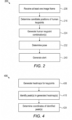
- Fig. 4 is a schematic illustration of a method of determining one or more candidate positions of human keypoints, in accordance with embodiments of the present disclosure.
- method 400 of determining one or more candidate positions of human keypoints may be carried out at step 216 of method 200.
- method 400 of determining one or more candidate positions of human keypoints may be carried out by keypoint determination module 116.
- method 400 of determining one or more candidate positions of human keypoints may comprise step 408 wherein heatmaps are generated for the plurality of human keypoints, wherein each heatmap represents a likelihood that a human keypoint occurs at each pixel location.
- the heatmaps may be generated using any known pose estimation algorithms or models.
- a neural network may be used to determine one or more candidate positions of human keypoints.
- a convolutional neural network (CNN) may be used to determine one or more candidate positions of human keypoints.
- An example of a model that may be used in step 408 is the pretrained Qualcomm pose estimation model available at https://github.com/quic/aimet-model-zoo/blob/develop/zoo_tensorflow/Docs/PoseEstimation.md, wherein the model was pretrained on the images of persons with labelled keypoints from the Coco dataset available at https://cocodataset.org/.
- the Qualcomm pose estimation model outputs heatmaps which represent a likelihood that a particular human keypoint occurs at each pixel location, as well as part affinity fields which are vector fields encoding a location and orientation of limbs and represent connections between keypoints.
- method 400 may comprise step 416 wherein one or more peaks are identified in each heatmap generated in step 408.
- the one or more peaks identified may be local peaks as each heatmap generated may have multiple local peaks.
- Any peak identification algorithm may be employed to identify the one or more peaks.
- the Fast 2D peak finder described at https://www.mathworks.com/matlabcentral/fileexchange/37388-fast-2d-peak-finder may be used to identify the one or more peaks. It is contemplated that any other suitable peak identification algorithm may be employed.
- method 400 may comprise step 424 wherein the coordinates of the one or more peaks identified in step 416 are determined.
- each coordinate determined in step 424 represents a candidate position of the corresponding human keypoint.
- the coordinates may be expressed as ( x , y ) , wherein x represents an x-coordinate and y represents a y-coordinate.
- method 200 may comprise step 224, wherein one or more combinations of human keypoints are generated based on the one or more candidate positions determined in step 216.
- step 224 may be carried out by a keypoint combination module 124.
- each combination of human keypoints may comprise one of each of the plurality of human keypoints 308, wherein each of the plurality of human keypoints 308 is located at one of the one or more candidate positions determined in step 216 for each of the plurality of human keypoints 308. It is contemplated that any known algorithm or model may be used to generate the one or more combinations of human keypoints.
- method 200 may comprise step 232 wherein a pose is determined for each of the at least one subject based at least on the one or more combinations of human keypoints generated in step 224.
- step 232 may be carried out by a pose determination module.
- pose may be determined for each of the at least one subject may be further based on at least one constraint affecting the pose of each of the at least one subject.
- the at least one constraint may comprise a physical constraint, a spatial constraint, a temporal constraint, or some combination thereof.
- the at least one constraint comprises at least one of: limb length, limb angle, and limb movement.
- the at least one constraint may be a generic constraint or a personal constraint.
- the generic constraint may be determined based on a dataset comprising a general or specific population. An example of a specific population is a driver population.
- a personal constraint may be determined based on the specific constraints unique to each subject.
- the personal constraints may be provided to system 100 for calculation in method 200.
- the personal constraints may be determined based on a plurality of poses for the subject determined over a period of time, or on the fly.
- step 232 may be implemented as a maximisation operation over the final layers.
- method 200 seeks for ⁇ k argmax i k , j k L k i k + Constraints which entangle i, j and k.
- the at least one constraint may comprise a limb length.
- Limb length is the distance between a position of a first keypoint and a second keypoint, wherein the two keypoints are connected to each other.
- limb length may be a Euclidian distance between any two human keypoints.
- limb length l may be determined by calculating the distance between keypoint 308a and 308b.
- the limb length constraint may be expressed as a range, for example as l i min ⁇ l i ⁇ l i max , wherein l i represents the limb length of limb i , l i min represents the lower length limit of limb i , and l i max represents the upper length limit of limb i .
- l i min and l i max may be determined based on generic measurements from a general or specific population.
- the population may be a general population.
- the population may be a subset of a general population or a specific population.
- An example of a dataset of a population that may be used to determine the generic limb length is the Coco dataset available at https://cocodataset.org/#home which comprises the data of 250,000 people with keypoints.
- l i min and l i max may be determined based on the limb length of the specific subject.
- the at least one constraint may comprise a limb angle.
- Limb angle represents the orientation of a first limb in relation to a second limb, wherein the first limb and the second limb are joined together by a human keypoint.
- the limb angle within three human keypoints may be calculated via triangle function.
- limb angle ⁇ may be determined based on a distance between keypoint 308b and 308a, a distance between keypoint 308a and keypoint 308c, and a distance between keypoint 308b and 308c.
- the limb angle constraint may be expressed as a range, for example as ⁇ j min ⁇ ⁇ j ⁇ ⁇ j max , where ⁇ j is the limb angle at human keypoint j, ⁇ j min represents the lower angle limit of keypoint j , and ⁇ j max represents the upper angle limit of keypoint j.
- ⁇ j min and ⁇ j max may be determined based on generic measurements from a general or specific population.
- ⁇ j min and ⁇ j max may be determined based on the limb angle distribution over a general or specific population.
- ⁇ j min and ⁇ j max may be obtained as a quantile distribution of ⁇ j over a population.
- the quantile for ⁇ j min may be between 0.3 and 0.6, while the quantile for ⁇ j max may be between 0.93 to 0.97.
- ⁇ j min and ⁇ j max may be obtained as the 0.5 quantile and 0.95 quantile respectively of ⁇ j distribution.
- the population may be a general population. In some embodiments, the population may be a subset of a general population or a specific population.
- ⁇ i min and ⁇ i max may be determined based on the limb angles of the specific subject.
- ⁇ i min and ⁇ i max may be provided or may be obtained based on the limb angle of the subject calculated for all image frames containing the specific subject.
- the at least one constraint may comprise a limb movement.
- Limb movement represents is based on a maximum movement of each limb between image frames.
- the maximum movement of each limb may be expressed as
- the limb movement may be expressed with the equation ( ⁇ max , ⁇ l max ), wherein ⁇ max represents a maximum difference of angles between two frames, and ⁇ l max represents a maximum difference of limb lengths between two image frames.
- the maximum movement of each limb ( ⁇ max , ⁇ l max ) may be determined based on generic measurements from a general or specific population. In some embodiments, the maximum movement of each limb ( ⁇ max , ⁇ l max ) , may be obtained as a quantile of distribution of ⁇ and ⁇ l respectively over a population. For example, the quantile for both ⁇ max and ⁇ l max may be between 0.93 to 0.97. In some embodiments, both ⁇ max and ⁇ l max may be obtained as the 0.95 quantile of ⁇ and ⁇ l distribution respectively. In some embodiments, the quantile for ⁇ max and ⁇ l max may be different. In some embodiments, the quantile for ⁇ max and ⁇ l max may be the same.
- the population may be a subset of a general population or a specific population.
- An example of a dataset of a general population that may be used to determine the distribution of ⁇ and ⁇ l is the BBC Pose or Extended BBC Pose datasets of the VGG pose estimation dataset available at https://www.robots.ox.ac.uk/ ⁇ vgg/data/pose/.
- An example of a dataset of a specific population that may be used to determine the distribution of ⁇ and ⁇ l is the DriPE dataset available at https://gitlab.liris.cnrs.fr/aura_autobehave/dripe which comprises images of human drivers with keypoint annotations.
- DriPE A Dataset for Human Pose Estimation in Real-World Driving Settings
- ⁇ max and ⁇ l max may be adjusted, for example by multiplying it to imaging device frame rate dataset frame rate , wherein imaging device frame rate corresponds to the frame rate of imaging device 148 and dataset frame rate corresponds to the frame rate of the dataset used.
- step 232 may comprise a sequential set of steps.
- step 232 may commence with selecting, from the one or more combinations of human keypoints generated in step 224, one or more combinations that fit the at least one constraint.
- the combination of human keypoints is the determined pose.
- step 232 may further comprise selecting, for each human keypoint, the candidate position with the highest likelihood that the human keypoint is located, wherein the candidate position is selected from the selected one or more combinations that fit the at least one constraint.
- the combination of selected positions of keypoints comprises the determined pose.
- the constraints and the probability are accounted for sequentially.
- step 232 may comprise a single step, which comprises calculating a value based on a function that maximises a likelihood that the human keypoint occurs and a fit to the at least one constraint.
- the function simultaneously maximises a likelihood that the human keypoint occurs and a fit to the at least one constraint.
- the at least one constraint is incorporated as a regularisation in an objective function.
- N l and N ⁇ are respectively the numbers of limbs and keypoints
- c i are confidence values or probability associated with each keypoint
- ⁇ l and ⁇ ⁇ are ratios of second term expectations to first term expectations
- step 232 wherein a pose is determined for each of the at least one subject may be further based on one or more vector fields encoding a location and orientation of limbs.
- the one or more vector fields encoding a location and orientation of limbs may be determined by a Qualcomm pose estimation model as referenced above in relation to step 216, wherein the one or more vector fields are termed as "part affinity fields" in relation to the Qualcomm pose estimation model.
- step 232 of determining the pose of each of the at least one subject comprises calculating, for each of the generated one or more combinations of human keypoints, a value based on a function that maximises a likelihood that the keypoint occurs and a fit to the at least one constraint; and correcting the calculated values based on one or more vector fields encoding a location and orientation of limbs, wherein the detected pose of the subject is the combination with the highest corrected calculated value.
- the function employed may be expressed as Equation (1) as described above.
- correcting the calculated values may comprise generating a sum of normalised angles between the vectors for every possible limb connection between keypoints.
- the calculated values may be corrected to account for orientation of the limbs.
- method 200 may comprise step 240 wherein an alert is generated based on the pose determined in step 232.
- the alert may be generated by alert unit 172.
- the alert may be generated for a driver or occupant of the vehicle and/or a third-party service provider.
Landscapes
- Engineering & Computer Science (AREA)
- Physics & Mathematics (AREA)
- Computer Vision & Pattern Recognition (AREA)
- General Physics & Mathematics (AREA)
- Theoretical Computer Science (AREA)
- Bioinformatics & Cheminformatics (AREA)
- Life Sciences & Earth Sciences (AREA)
- Bioinformatics & Computational Biology (AREA)
- Evolutionary Biology (AREA)
- Probability & Statistics with Applications (AREA)
- Multimedia (AREA)
- Image Analysis (AREA)
- Closed-Circuit Television Systems (AREA)
- Alarm Systems (AREA)
Abstract
Description
- The invention relates generally to pose estimation, and more specifically to a system and method for pose estimation by generating combinations of candidate keypoint positions and further incorporating spatial, physical and temporal constraints.
- Pose estimation in vehicles is difficult and are generally more likely to exhibit lower accuracy relative to the free space due to the presence of occluding objects in the vehicle, such as steering wheels and chairs. Existing prior art for human pose estimation utilize deep learning-based pose-estimation algorithms. Such algorithms are generally trained in free space, which may not be accurate for pose estimation in vehicles. Although some algorithms are trained inside a default vehicle, there may be errors when generalizing to other vehicles as different vehicles have different configurations, sizes, and shapes.
- It is the object of the invention to provide improved methods and systems for human pose estimation.
- The object is achieved by the subject-matter of the independent claims. Preferred embodiments are subject-matter of the dependent claims.
- It shall be noted that all embodiments of the present invention concerning a method might be carried out with the order of the steps as described, nevertheless this has not to be the only and essential order of the steps of the method. The herein presented methods can be carried out with another order of the disclosed steps without departing from the respective method embodiment, unless explicitly mentioned to the contrary hereinafter.
- To solve the above technical problems, the present invention provides a computer-implemented method for pose estimation, the method comprising:
- receiving at least one image frame captured by an imaging device, wherein the imaging device is arranged to image at least one subject;
- determining one or more candidate positions for each of a plurality of human keypoints, wherein each candidate position is associated with a likelihood that a human keypoint is located at such position;
- generating one or more combinations of human keypoints based on the determined one or more candidate positions; and
- determining a pose of each of the at least one subject based at least on the one or more generated combinations of human keypoints.
- The computer-implemented method of the present invention is advantageous over known methods as the identification of one or more candidate positions, generation of one or more combinations of human keypoints, and determining the pose of each of the at least one subject based on the combinations of human keypoints increases the accuracy of pose estimation as the location of each human keypoint is determined in context as a combination of human keypoints instead of individual keypoints in isolation.
- A preferred method of the present invention is a computer-implemented method as described above, wherein determining one or more candidate positions of a plurality of human keypoints comprises:
- generating heatmaps for each of the plurality of human keypoints, wherein each heatmap represents a likelihood that a human keypoint occurs at each pixel location;
- identifying one or more peaks in each generated heatmap; and
- determining coordinates of each identified peak, wherein each coordinate represents a candidate position of the corresponding human keypoint.
- The above-described aspect of the present invention has the advantage that one or more candidate positions of each human keypoint is identified and then accounted for in subsequent steps to ensure a higher accuracy of the determined pose.
- A preferred method of the present invention is a computer-implemented method as described above or as described above as preferred, wherein determining a pose of each of the at least one subject is further based on at least one constraint affecting the pose of each of the at least one subject, wherein the at least one constraint preferably comprises at least one of: limb length, limb angle, and limb movement.
- The above-described aspect of the present invention has the advantage that the incorporation of at least one constraint affecting the each of the at least one subject increases the accuracy of pose estimation by ensuring that such physical real-life constraints are accounted for when determining a pose of a subject. The incorporation of at least one constraint affecting the each of the at least one subject may also be particularly advantageous in situation or environments with occluding vehicles, such as a vehicle that comprises several occluding objects such as steering wheels, seatbelts, and seats. The above-described aspect is also advantageous as each of the at least one constraint listed accounts for one or more of a physical, spatial and/or temporal constraint that affects the pose that each subject is able to take.
- A preferred method of the present invention is a computer-implemented method as described above or as described above as preferred, wherein the at least one constraint comprises limb movement, wherein limb movement is based on a maximum movement of each limb between image frames.
- The above-described aspect of the present invention has the advantage that limb movement is a constraint that affects the pose a subject that take within a restricted space, such as within a vehicle cabin.
- A preferred method of the present invention is a computer-implemented method as described above or as described above as preferred, wherein the at least one constraint comprises at least one generic constraint, wherein the generic constraint is preferably determined based on a dataset comprising a general or specific population.
- The above-described aspect of the present invention has the advantage that the pose of each subject may be estimated without prior knowledge of the specific constraints that affect each of the at least one subject.
- A preferred method of the present invention is a computer-implemented method as described above or as described above as preferred, wherein the at least one constraint comprises at least one personal constraint, wherein the at least one personal constraint is unique to each of the at least one subject, and wherein the at least one personal constraint is preferably determined based on a plurality of poses for the subject determined over a period of time.
- The above-described aspect of the present invention has the advantage of increasing the accuracy of the estimated pose by taking into account constraints that are personal and unique to each subject. The above-described aspect of the present invention also has the advantage of determining the at least one personal constraint automatically based on past pose estimations without the provision of the at least one personal constraint.
- A preferred method of the present invention is a computer-implemented method as described above or as described above as preferred, wherein determining the pose of each of the at least one subject comprises:
- selecting, from the generated one or more combinations of human keypoints, one or more combinations of human keypoints that fit the at least one constraint; and
- optionally, for each human keypoint, selecting the candidate position with the highest likelihood that the human keypoint is located, wherein the candidate position is selected from the selected one or more combinations of human keypoints that fit the at least one constraint.
- The above-described aspect of the present invention has the advantage that the positions of human keypoints selected are those that meet the predefined constraints and have the highest likelihood.
- A preferred method of the present invention is a computer-implemented method as described above or as described above as preferred, wherein determining the pose of each of the at least one subject comprises calculating, for each of the generated one or more combinations of human keypoints, a value based on a function that maximises a likelihood that the human keypoint occurs and a fit to the at least one constraint, wherein the detected pose of the subject is the combination with the highest calculated value.
- The above-described aspect of the present invention has the advantage that the likelihood that the human keypoint occurs and the at least one constraint are both accounted for such that the determined pose may be more accurate.
- A preferred method of the present invention is a computer-implemented method as described above or as described above as preferred, wherein determining the pose of each of the at least one subject is further based on one or more vector fields encoding a location and orientation of limbs.
- The above-described aspect of the present invention has the advantage that the method of pose estimation is more accurate when there are two or more subjects within the image frame.
- A preferred method of the present invention is a computer-implemented method as described above or as described above as preferred, wherein determining the pose of each of the at least one subject comprises:
- calculating, for each of the generated one or more combinations of human keypoints, a value based on a function that maximises a likelihood that the keypoint occurs and a fit to the at least one constraint; and
- correcting the calculated values based on one or more vector fields encoding a location and orientation of limbs,
- wherein the detected pose of the subject is the combination with the highest corrected calculated value.
- The above-described aspect of the present invention has the advantage that the method of pose estimation is more accurate when there are two or more subjects within the image frame.
- A preferred method of the present invention is a computer-implemented method as described above or as described above as preferred, further comprising generating an alert based on the determined pose of each of the at least one subject.
- The above-described aspect of the present invention has the advantage that by generating an alert, any unsafe behaviour may be corrected in order to increase the overall driving safety.
- The above-described advantageous aspects of a computer-implemented method of the invention also hold for all aspects of a below-described in-cabin method of the invention. All below-described advantageous aspects of an in-cabin method of the invention also hold for all aspects of an above-described computer-implemented method of the invention.
- The invention also relates to an in-cabin method of monitoring at least one subject inside a vehicle cabin, the method comprising performing of a computer-implemented method according to any of the preceding claims, wherein the imaging device is arranged to image at least one subject inside a vehicle cabin.
- The above-described advantageous aspects of a computer-implemented method or in-cabin method of the invention also hold for all aspects of a below-described system of the invention. All below-described advantageous aspects of a system of the invention also hold for all aspects of an above-described computer-implemented method or in-cabin method of the invention.
- The invention also relates to a system comprising an imaging device, one or more processors and a memory that stores executable instructions for execution by the one or more processors, the executable instructions comprising instructions for performing a method of the invention.
- The above-described advantageous aspects of a computer-implemented method, in-cabin method, or system of the invention also hold for all aspects of a below-described vehicle of the invention. All below-described advantageous aspects of a vehicle of the invention also hold for all aspects of an above-described computer-implemented method, in-cabin method, or system of the invention.
- The invention also relates to a vehicle comprising a system of the invention, wherein the imaging device is positioned to image at least one subject inside the vehicle.
- The above-described advantageous aspects of a computer-implemented method, in-cabin method, system, or vehicle of the invention also hold for all aspects of below-described computer program, a machine-readable storage medium, or a data carrier signal of the invention. All below-described advantageous aspects of a computer program, a machine-readable storage medium, or a data carrier signal of the invention also hold for all aspects of an above-described computer-implemented method, training dataset, graph representation, uses of the graph representation, or system of the invention.
- The invention also relates to a computer program, a machine-readable storage medium, or a data carrier signal that comprises instructions, that upon execution on a data processing device and/or control unit, cause the data processing device and/or control unit to perform the steps of a computer-implemented method according to the invention. The machine-readable medium may include any medium and/or mechanism for storing or transmitting information in a form readable by a machine (e.g., a computing device). The machine-readable medium may be any medium, such as for example, read-only memory (ROM); random access memory (RAM); a universal serial bus (USB) stick; a compact disc (CD); a digital video disc (DVD); a data storage device; a hard disk; electrical, acoustical, optical, or other forms of propagated signals (e.g., digital signals, data carrier signal, carrier waves), or any other medium on which a program element as described above can be transmitted and/or stored.
- As used in this summary, in the description below, in the claims below, and in the accompanying drawings, the term "vehicle" refers to any mobile agent capable of movement, including cars, trucks, buses, agricultural machines, forklift, robots, wherein such mobile agent is capable of carrying or transporting humans, whether or not such mobile agent is autonomous or human-operated.
- As used in this summary, in the description below, in the claims below, and in the accompanying drawings, the term "keypoint" or "human keypoint" refer to interest points or key locations in an image that are generally indicative of unique and/or important locations of the human body, such as facial landmarks (eyes, etc.), joints (elbow, knees, hips, etc.), hands and feet, etc.
- These and other features, aspects, and advantages will become better understood with regard to the following description, appended claims, and accompanying drawings where:
-
Fig. 1A is a simplified functional block diagram of a system for pose estimation, in accordance with embodiments of a present disclosure; -
Fig. 1B is a simplified hardware block diagram of the system, according to embodiments of the present disclosure; -
Fig. 2 shows a flow chart of a method for pose estimation, in accordance with embodiments of the present disclosure; -
Fig. 3 is a schematic illustration of examples of human keypoints that may be determined, in accordance with embodiments of the present disclosure; and -
Fig. 4 is a schematic illustration of a method of determining one or more candidate positions of human keypoints, in accordance with embodiments of the present disclosure. - In the drawings, like parts are denoted by like reference numerals.
- It should be appreciated by those skilled in the art that any block diagrams herein represent conceptual views of illustrative systems embodying the principles of the present subject matter. Similarly, it will be appreciated that any flow charts, flow diagrams, state transition diagrams, pseudo code, and the like represent various processes which may be substantially represented in computer readable medium and executed by a computer or processor, whether or not such computer or processor is explicitly shown.
- In the summary above, in this description, in the claims below, and in the accompanying drawings, reference is made to particular features (including method steps) of the invention. It is to be understood that the disclosure of the invention in this specification includes all possible combinations of such particular features. For example, where a particular feature is disclosed in the context of a particular aspect or embodiment of the invention, or a particular claim, that feature can also be used, to the extent possible, in combination with and/or in the context of other particular aspects and embodiments of the invention, and in the inventions generally.
- In the present document, the word "exemplary" is used herein to mean "serving as an example, instance, or illustration." Any embodiment or implementation of the present subject matter described herein as "exemplary" is not necessarily be construed as preferred or advantageous over other embodiments.
- The term "coupled" (or "connected") herein may be understood as electrically coupled, as communicatively coupled, for example to receive and transmit data wirelessly or through wire, or as mechanically coupled, for example attached or fixed, or just in contact without any fixation, and it will be understood that both direct coupling or indirect coupling (in other words: coupling without direct contact) may be provided.
- While the disclosure is susceptible to various modifications and alternative forms, specific embodiment thereof has been shown by way of example in the drawings and will be described in detail below. It should be understood, however that it is not intended to limit the disclosure to the forms disclosed, but on the contrary, the disclosure is to cover all modifications, equivalents, and alternative falling within the scope of the disclosure.
- The present disclosure is directed to methods, systems, vehicles, computer programs, machine-readable storage media, and data carrier signals, for human pose estimation, wherein such human pose estimation accounts for at least one constraint affecting the poses that a subject can take. Embodiments of the present invention improve pose estimation inside a vehicle by incorporating physical, spatial, and/or temporal constraints with a pose estimation algorithm, such as limb length, limb movement and limb angles.
- The following description sets forth exemplary methods, parameters, and the like. It should be recognized, however, that such description is not intended as a limitation on the scope of the present disclosure but is instead provided as a description of exemplary embodiments.
- The illustrated steps are set out to explain the exemplary embodiments shown, and it should be anticipated that on-going technological development will change the manner in which particular functions are performed. These examples are presented herein for purposes of illustration, and not limitation. Further, the boundaries of the functional building blocks have been arbitrarily defined herein for the convenience of the description. Alternative boundaries can be defined so long as the specified functions and relationships thereof are appropriately performed. Alternatives (including equivalents, extensions, variations, deviations, etc., of those described herein) will be apparent to persons skilled in the relevant art(s) based on the teachings contained herein. Such alternatives fall within the scope and spirit of the disclosed embodiments. The terms "comprises", "comprising", "includes" or any other variations thereof, are intended to cover a non-exclusive inclusion, such that a setup, device or method that includes a list of components or steps does not include only those components or steps but may include other components or steps not expressly listed or inherent to such setup or device or method. In other words, one or more elements in a system or apparatus proceeded by "comprises... a" does not, without more constraints, preclude the existence of other elements or additional elements in the system or method. It must also be noted that as used herein and in the appended claims, the singular forms "a," "an," and "the" include plural references unless the context clearly dictates otherwise.
-
Fig. 1A is a simplified functional block diagram of asystem 100 for pose estimation, in accordance with embodiments of a present disclosure.System 100 for pose estimation may be used in a vehicle, e.g., for in-cabin monitoring of subjects/persons within the vehicle cabin. In some embodiments,system 100 may be configured to receive at least oneimage frame 108 of at least one subject or person and to output apose 112 for each subject or person captured in the received at least oneimage frame 108. In some embodiments, the at least oneimage frame 108 may be captured by an imaging device 148 (seeFig. 1B ) arranged to image at least one subject. In some embodiments,system 100 for pose estimation may comprise akeypoint determination module 116, thekeypoint determination module 116 configured to receive at least oneimage frame 108 of at least one subject or person. In some embodiments, thekeypoint determination module 116 may be configured to determine one or more candidate positions for each of a plurality of human keypoints, wherein each candidate position is associated with a likelihood that a human keypoint is located at such position. Human keypoints are generally indicative of unique and/or important locations of the human body, such as eyes, joints (elbow, knees, hips, etc.), hands and feet, etc. In some embodiments, thekeypoint determination module 116 may be further configured to determine one or more vector fields encoding a location and orientation of limbs identified withinimage frame 108. It is contemplated thatkeypoint determination module 116 may use any known algorithm or model to identify human keypoints and/or one or more vector fields encoding a location and orientation of limbs. - According to some embodiments,
system 100 may comprise akeypoint combination module 124, thekeypoint combination module 124 configured to receive input from thekeypoint determination module 116. In some embodiments,keypoint combination module 124 may be configured to generate one or more combinations of human keypoints based on the one or more candidate positions of human keypoints determined bykeypoint determination module 116. In some embodiments, each combination of human keypoints may comprise one of each of the plurality of human keypoints, wherein each human keypoint is located at one of the one or more candidate positions determined bykeypoint determination module 116 for such human keypoint. It is contemplated thatkeypoint combination module 124 may generate the one or more combinations of human keypoints using any known algorithm or model. - According to some embodiments,
system 100 may comprise apose determination module 132, thepose determination module 132 configured to receive input from thekeypoint combination module 124 and/orkeypoint determination module 116. In some embodiments, thepose determination module 132 may be configured to determine a pose of each of the at least one subject based at least on the one or more generated combinations of human keypoints. In some embodiments, thepose determination module 132 may be further configured to determine the pose of each of the at least one subject based on at least one constraint affecting the pose of each of the at least one subject. In some embodiments, posedetermination module 132 may be further configured to determine the pose of each of the at least one subject further based on one or more vector fields encoding a location and orientation of limbs. -
Fig. 1B is a simplified hardware block diagram of thesystem 100, according to embodiments of the present disclosure.System 100 may comprise at least oneprocessor 140. In some embodiments,system 100 may comprise animaging device 148. In some embodiments, theimaging device 148 may be a camera or a video camera. In some embodiments, theimaging device 148 may be arranged to image at least one subject and capture at least oneimage frame 108 of at least one subject or person. In some embodiments, theimaging device 148 may be installed on a vehicle and arranged to image at least one subject inside the vehicle cabin. In some embodiments, the at least oneprocessor 140 may be configured to carry out the functions of at least one of thekeypoint determination module 116, thekeypoint combination module 124, and thepose determination module 132. In some embodiments,system 100 may comprise at least onememory 156. The at least onememory 156 may include a non-transitory computer-readable medium. In some embodiments, the at least oneprocessor 140, theimaging device 148 and the at least onememory 156 may be coupled to one another, for example, mechanically or electrically, via thecoupling line 164. - According to some embodiments,
system 100 may be further coupled to analert unit 172 that is configured to generate an alert based on thepose 112 determined bysystem 100.System 100 may be coupled toalert unit 172 by manner of one or both of wired or wireless coupling. In some embodiments, the alert may be generated for a driver or occupant of the vehicle and/or a third-party service provider For example, where thepose 112 determined bysystem 100 indicates that a driver's hands are not on a steering wheel, or that a driver's head is not facing forward, thealert unit 172 may generate an alert to call for the driver's attention. For example, where thepose 112 determined bysystem 100 indicates that a subject's pose has remained unchanged for a period of time, or indicates an unusual behaviour, thealert unit 172 may generate an alert to the driver and/or third-party service provider to indicate a possibility of an unusual situation or an emergency, so that further actions may be taken. In some embodiments, thealert unit 172 may generate alerts in the form of a visual, auditory or tactile alert. Examples include an audible alarm or voice notification, a visible notification on a dashboard display, or a vibration. -
Fig. 2 shows a flow chart of amethod 200 for pose estimation, in accordance with embodiments of the present disclosure.Method 200 of for pose estimation may be implemented by any architecture and/or computing system. For example, various architectures employing, for example, multiple integrated circuit (IC) chips and/or packages, and/or various computing devices and/or consumer electronic (CE) devices such as multifunction devices, tablets, smart phones, etc., may implement the techniques and/or arrangements described herein. In some embodiments,method 200 may be carried out bysystem 100. In some embodiments,method 200 may be employed for in-cabin monitoring of at least one subject inside a vehicle cabin. - According to some embodiments,
method 200 for pose estimation may comprisestep 208 wherein at least oneimage frame 108 capturing at least one subject is received. The at least oneimage frame 108 may be captured by animaging device 148. The at least oneimage frame 108 may be received by manner of one or both of wired or wireless coupling or communication to theimaging device 148. In some embodiments, the at least oneimage frame 108 may be received from theimaging device 148 through a communication network. In other embodiments, the at least oneimage frame 108 may be captured byimaging device 148 and stored on one or more remote storage devices and the at least oneimage frame 108 may be retrieved from such remote storage device, or a cloud storage site, through one or both of wired or wireless connection. - According to some embodiments,
method 200 may comprisestep 216 wherein one or more candidate positions are determined for each of a plurality of human keypoints. In some embodiments,step 216 may be carried out bykeypoint determination module 116. In some embodiments, each candidate position of a human keypoint may be associated with a likelihood or probability that a human keypoint is located at such position. In some embodiments,step 216 may optionally comprise determining one or more vector fields encoding a location and orientation of limbs. Step 216 may be carried out using any known algorithm or model used to identify human keypoints and/or one or more vector fields encoding a location and orientation of limbs in an image. -
Fig. 3 is a schematic illustration of examples of human keypoints that may be determined, in accordance with embodiments of the present disclosure. A plurality ofhuman keypoints 308 may be identified for aperson 300. For example,human keypoint 308a may represent a left elbow ofperson 300,human keypoint 308b may represent a left shoulder ofperson 300, andhuman keypoint 308c may represent a left hand ofperson 300. It is emphasised that thehuman keypoints 308 identified inFig. 3 are examples, and any number of human keypoints or types of human keypoints may be determined. -
Fig. 4 is a schematic illustration of a method of determining one or more candidate positions of human keypoints, in accordance with embodiments of the present disclosure. In some embodiments,method 400 of determining one or more candidate positions of human keypoints may be carried out atstep 216 ofmethod 200. In some embodiments,method 400 of determining one or more candidate positions of human keypoints may be carried out bykeypoint determination module 116. - According to some embodiments,
method 400 of determining one or more candidate positions of human keypoints may comprisestep 408 wherein heatmaps are generated for the plurality of human keypoints, wherein each heatmap represents a likelihood that a human keypoint occurs at each pixel location. The heatmaps may be generated using any known pose estimation algorithms or models. In some embodiments, a neural network may be used to determine one or more candidate positions of human keypoints. In some embodiments, a convolutional neural network (CNN) may be used to determine one or more candidate positions of human keypoints. An example of a model that may be used instep 408 is the pretrained Qualcomm pose estimation model available at https://github.com/quic/aimet-model-zoo/blob/develop/zoo_tensorflow/Docs/PoseEstimation.md, wherein the model was pretrained on the images of persons with labelled keypoints from the Coco dataset available at https://cocodataset.org/. The Qualcomm pose estimation model outputs heatmaps which represent a likelihood that a particular human keypoint occurs at each pixel location, as well as part affinity fields which are vector fields encoding a location and orientation of limbs and represent connections between keypoints. An example of the architecture and training of the Qualcomm pose estimation model may be found in "Realtime Multi-Person 2D Pose Estimation using Part Affinity Fields" by Cao et. al. An example of training parameters could be using AdamOptimiser with a learning rate of 0.001, mini batch size of 16 at 10 epochs. It is contemplated that any other suitable pose estimation algorithm or model may be employed. - According to some embodiments,
method 400 may comprisestep 416 wherein one or more peaks are identified in each heatmap generated instep 408. In some embodiments, the one or more peaks identified may be local peaks as each heatmap generated may have multiple local peaks. Any peak identification algorithm may be employed to identify the one or more peaks. For example, the Fast 2D peak finder described at https://www.mathworks.com/matlabcentral/fileexchange/37388-fast-2d-peak-finder may be used to identify the one or more peaks. It is contemplated that any other suitable peak identification algorithm may be employed. - According to some embodiments,
method 400 may comprisestep 424 wherein the coordinates of the one or more peaks identified instep 416 are determined. In some embodiments, each coordinate determined instep 424 represents a candidate position of the corresponding human keypoint. In some embodiments, the coordinates may be expressed as (x, y), wherein x represents an x-coordinate and y represents a y-coordinate. - Returning to
Fig. 2 , according to some embodiments,method 200 may comprisestep 224, wherein one or more combinations of human keypoints are generated based on the one or more candidate positions determined instep 216. In some embodiments,step 224 may be carried out by akeypoint combination module 124. In some embodiments, each combination of human keypoints may comprise one of each of the plurality ofhuman keypoints 308, wherein each of the plurality ofhuman keypoints 308 is located at one of the one or more candidate positions determined instep 216 for each of the plurality ofhuman keypoints 308. It is contemplated that any known algorithm or model may be used to generate the one or more combinations of human keypoints. - According to some embodiments,
method 200 may comprisestep 232 wherein a pose is determined for each of the at least one subject based at least on the one or more combinations of human keypoints generated instep 224. In some embodiments,step 232 may be carried out by a pose determination module. In some embodiments, pose may be determined for each of the at least one subject may be further based on at least one constraint affecting the pose of each of the at least one subject. In some embodiments, the at least one constraint may comprise a physical constraint, a spatial constraint, a temporal constraint, or some combination thereof. In some embodiments, the at least one constraint comprises at least one of: limb length, limb angle, and limb movement. In some embodiments, the at least one constraint may be a generic constraint or a personal constraint. In some embodiments, the generic constraint may be determined based on a dataset comprising a general or specific population. An example of a specific population is a driver population. In some embodiments, a personal constraint may be determined based on the specific constraints unique to each subject. In some embodiments, the personal constraints may be provided tosystem 100 for calculation inmethod 200. In some embodiments, the personal constraints may be determined based on a plurality of poses for the subject determined over a period of time, or on the fly. In some embodiments, where a convolutional neural network is used to implementmethod 200,step 232 may be implemented as a maximisation operation over the final layers. In contrast with existing methods that seek
method 200 seeks for
- According to some embodiments, the at least one constraint may comprise a limb length. Limb length is the distance between a position of a first keypoint and a second keypoint, wherein the two keypoints are connected to each other. In some embodiments, limb length may be a Euclidian distance between any two human keypoints. In some embodiments, limb length may be expressed with the equation of l = ∥pn - po ∥, wherein l is the limb length between a first keypoint m and second keypoint n, and p refers to the position or coordinates (x,y) of each keypoint m and n. For example, as illustrated in
Fig. 3 , limb length l may be determined by calculating the distance betweenkeypoint 


- According to some embodiments, the at least one constraint may comprise a limb angle. Limb angle represents the orientation of a first limb in relation to a second limb, wherein the first limb and the second limb are joined together by a human keypoint. In some embodiments, the limb angle within three human keypoints may be calculated via triangle function. In some embodiments, limb angle may be expressed with the equation

Fig. 3 , limb angle θ may be determined based on a distance betweenkeypoint keypoint 308a andkeypoint 308c, and a distance betweenkeypoint 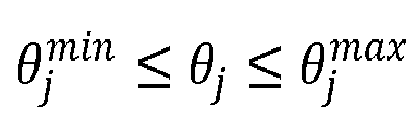


- According to some embodiments, the at least one constraint may comprise a limb movement. Limb movement represents is based on a maximum movement of each limb between image frames. In some embodiments, the maximum movement of each limb may be expressed as For example, the limb movement may be expressed with the equation (δθmax , δlmax ), wherein δθmax represents a maximum difference of angles between two frames, and δlmax represents a maximum difference of limb lengths between two image frames. In some embodiments,


system 100 is different from the dataset used to determine the distribution of δθ and δl, δθmax and δlmax may be adjusted, for example by multiplying it to
imaging device 148 and dataset frame rate corresponds to the frame rate of the dataset used. - According to some embodiments,
step 232 may comprise a sequential set of steps. In such an embodiment, step 232 may commence with selecting, from the one or more combinations of human keypoints generated instep 224, one or more combinations that fit the at least one constraint. In situations where only one combination of human keypoints generated fit the at least one constraint, the combination of human keypoints is the determined pose. In situations where a plurality of combinations of human keypoints generated instep 224 fit the at least one constraint, step 232 may further comprise selecting, for each human keypoint, the candidate position with the highest likelihood that the human keypoint is located, wherein the candidate position is selected from the selected one or more combinations that fit the at least one constraint. In such situations, the combination of selected positions of keypoints comprises the determined pose. In such an embodiment, the constraints and the probability are accounted for sequentially. - According to some embodiments,
step 232 may comprise a single step, which comprises calculating a value based on a function that maximises a likelihood that the human keypoint occurs and a fit to the at least one constraint. Preferably, the function simultaneously maximises a likelihood that the human keypoint occurs and a fit to the at least one constraint. In such embodiments, the at least one constraint is incorporated as a regularisation in an objective function. In some embodiments, the objective function that maximises a likelihood that the human keypoint occurs and a fit to the at least one constraint may be expressed as Equation (1) as follows:


- According to some embodiments, step 232 wherein a pose is determined for each of the at least one subject may be further based on one or more vector fields encoding a location and orientation of limbs. In some embodiments, the one or more vector fields encoding a location and orientation of limbs may be determined by a Qualcomm pose estimation model as referenced above in relation to step 216, wherein the one or more vector fields are termed as "part affinity fields" in relation to the Qualcomm pose estimation model. In such embodiments, step 232 of determining the pose of each of the at least one subject comprises calculating, for each of the generated one or more combinations of human keypoints, a value based on a function that maximises a likelihood that the keypoint occurs and a fit to the at least one constraint; and correcting the calculated values based on one or more vector fields encoding a location and orientation of limbs, wherein the detected pose of the subject is the combination with the highest corrected calculated value. In some embodiments, the function employed may be expressed as Equation (1) as described above. In some embodiments, correcting the calculated values may comprise generating a sum of normalised angles between the vectors for every possible limb connection between keypoints. In some embodiments, the calculated values may be corrected to account for orientation of the limbs.
- According to some embodiments,
method 200 may comprisestep 240 wherein an alert is generated based on the pose determined instep 232. The alert may be generated byalert unit 172. In some embodiments, the alert may be generated for a driver or occupant of the vehicle and/or a third-party service provider. - Finally, the language used in the specification has been principally selected for readability and instructional purposes, and it may not have been selected to delineate or circumscribe the inventive subject matter. It is therefore intended that the scope of the invention be limited not by this detailed description, but rather by any claims that issue on an application based here on. Accordingly, the embodiments of the present invention are intended to be illustrative, but not limiting, of the scope of the invention, which is set forth in the following claims.
Claims (15)
- A computer-implemented method for pose estimation, the method comprising:receiving at least one image frame captured by an imaging device, wherein the imaging device is arranged to image at least one subject;determining one or more candidate positions for each of a plurality of human keypoints, wherein each candidate position is associated with a likelihood that a human keypoint is located at such position;generating one or more combinations of human keypoints based on the determined one or more candidate positions; anddetermining a pose of each of the at least one subject based at least on the one or more generated combinations of human keypoints.
- The computer-implemented method of claim 1, wherein determining one or more candidate positions for each of a plurality of human keypoints comprises:generating heatmaps for each of the plurality of human keypoints, wherein each heatmap represents a likelihood that a human keypoint occurs at each pixel location;identifying one or more peaks in each generated heatmap; anddetermining coordinates of each identified peak, wherein each coordinate represents a candidate position of the corresponding human keypoint.
- The computer-implemented method of any of the preceding claims, wherein determining a pose of each of the at least one subject is further based on at least one constraint affecting the pose of each of the at least one subject, wherein the at least one constraint preferably comprises at least one of: limb length, limb angle, and limb movement.
- The computer-implemented method of claim 3, wherein the at least one constraint comprises limb movement, wherein limb movement is based on a maximum movement of each limb between image frames.
- The computer-implemented method of claim 3 or 4, wherein the at least one constraint comprises at least one generic constraint, wherein the generic constraint is preferably determined based on a dataset comprising a general or specific population.
- The computer-implemented method of any of claims 3 to 5, wherein the at least one constraint comprises at least one personal constraint, wherein the at least one personal constraint is unique to each of the at least one subject, and wherein the at least one personal constraint is preferably determined based on a plurality of poses for the subject determined over a period of time.
- The computer-implemented method of any of claims 3 to 6, wherein determining the pose of each of the at least one subject comprises:selecting, from the generated one or more combinations of human keypoints, one or more combinations of human keypoints that fit the at least one constraint; andoptionally, for each human keypoint, selecting the candidate position with the highest likelihood that the human keypoint is located, wherein the candidate position is selected from the selected one or more combinations of human keypoints that fit the at least one constraint.
- The computer-implemented method of any of claims 3 to 7, wherein determining the pose of each of the at least one subject comprises calculating, for each of the generated one or more combinations of human keypoints, a value based on a function that maximises a likelihood that the human keypoint occurs and a fit to the at least one constraint, wherein the detected pose of the subject is the combination with the highest calculated value.
- The computer-implemented method of any of claims 3 to 8, wherein determining the pose of each of the at least one subject is further based on one or more vector fields encoding a location and orientation of limbs.
- The computer-implemented method of any of claims 3 to 9, wherein determining the pose of each of the at least one subject comprises:calculating, for each of the generated one or more combinations of human keypoints, a value based on a function that maximises a likelihood that the keypoint occurs and a fit to the at least one constraint; andcorrecting the calculated values based on one or more vector fields encoding a location and orientation of limbs,wherein the detected pose of the subject is the combination with the highest corrected calculated value.
- The computer-implemented method of any of the preceding claims, further comprising generating an alert based on the determined pose of each of the at least one subj ect.
- An in-cabin method of monitoring at least one subject inside a vehicle cabin, the method comprising performing of a computer-implemented method according to any of the preceding claims, wherein the imaging device is arranged to image at least one subject inside a vehicle cabin.
- A system comprising an imaging device, one or more processors and a memory that stores executable instructions for execution by the one or more processors, the executable instructions comprising instructions for performing a method according to any of the preceding claims.
- A vehicle comprising the system of claim 13, wherein the imaging device is positioned to image at least one subject inside the vehicle.
- A computer program, a machine-readable storage medium, or a data carrier signal that comprises instructions, that upon execution on a data processing device and/or control unit, cause the data processing device and/or control unit to perform the steps of a method according to any one of claims 1 to 12.
Applications Claiming Priority (1)
| Application Number | Priority Date | Filing Date | Title |
|---|---|---|---|
| GB2214554.4A GB2623085A (en) | 2022-10-04 | 2022-10-04 | Method and system of pose estimation |
Publications (2)
| Publication Number | Publication Date |
|---|---|
| EP4354398A1 true EP4354398A1 (en) | 2024-04-17 |
| EP4354398B1 EP4354398B1 (en) | 2026-03-11 |
Family
ID=84000213
Family Applications (1)
| Application Number | Title | Priority Date | Filing Date |
|---|---|---|---|
| EP23200707.0A Active EP4354398B1 (en) | 2022-10-04 | 2023-09-29 | Method and system of pose estimation |
Country Status (3)
| Country | Link |
|---|---|
| US (1) | US20240127477A1 (en) |
| EP (1) | EP4354398B1 (en) |
| GB (1) | GB2623085A (en) |
Citations (2)
| Publication number | Priority date | Publication date | Assignee | Title |
|---|---|---|---|---|
| KR20140114741A (en) * | 2013-03-19 | 2014-09-29 | 삼성전자주식회사 | Apparatus and method for human pose estimation |
| US20200327465A1 (en) * | 2019-04-12 | 2020-10-15 | University Of Iowa Research Foundation | System and method to predict, prevent, and mitigate workplace injuries |
Family Cites Families (3)
| Publication number | Priority date | Publication date | Assignee | Title |
|---|---|---|---|---|
| EP3579196A1 (en) * | 2018-06-05 | 2019-12-11 | Cristian Sminchisescu | Human clothing transfer method, system and device |
| WO2022174075A1 (en) * | 2021-02-12 | 2022-08-18 | Retinus Llc | Systems and methods for computer vision based detection and alerting |
| US11615648B2 (en) * | 2021-05-28 | 2023-03-28 | Sportsbox.ai Inc. | Practice drill-related features using quantitative, biomechanical-based analysis |
-
2022
- 2022-10-04 GB GB2214554.4A patent/GB2623085A/en not_active Withdrawn
-
2023
- 2023-09-29 EP EP23200707.0A patent/EP4354398B1/en active Active
- 2023-10-03 US US18/479,909 patent/US20240127477A1/en active Pending
Patent Citations (2)
| Publication number | Priority date | Publication date | Assignee | Title |
|---|---|---|---|---|
| KR20140114741A (en) * | 2013-03-19 | 2014-09-29 | 삼성전자주식회사 | Apparatus and method for human pose estimation |
| US20200327465A1 (en) * | 2019-04-12 | 2020-10-15 | University Of Iowa Research Foundation | System and method to predict, prevent, and mitigate workplace injuries |
Non-Patent Citations (1)
| Title |
|---|
| CAO ZHE ET AL: "OpenPose: Realtime Multi-Person 2D Pose Estimation using Part Affinity Fields", IEEE TRANSACTIONS ON PATTERN ANALYSIS AND MACHINE INTELLIGENCE, 30 May 2019 (2019-05-30), pages 1 - 14, XP055849326, Retrieved from the Internet <URL:https://arxiv.org/pdf/1812.08008.pdf> [retrieved on 20211008] * |
Also Published As
| Publication number | Publication date |
|---|---|
| US20240127477A1 (en) | 2024-04-18 |
| EP4354398B1 (en) | 2026-03-11 |
| GB2623085A (en) | 2024-04-10 |
| GB202214554D0 (en) | 2022-11-16 |
Similar Documents
| Publication | Publication Date | Title |
|---|---|---|
| EP3588372B1 (en) | Controlling an autonomous vehicle based on passenger behavior | |
| US10330787B2 (en) | Advanced driver-assistance system | |
| US10867195B2 (en) | Systems and methods for monitoring driver state | |
| US11040712B2 (en) | Information processing apparatus and information processing method | |
| CN114764912A (en) | Driving behavior recognition method, device and storage medium | |
| US10899356B2 (en) | Drowsiness prevention device, drowsiness prevention method, and recording medium | |
| EP4095490B1 (en) | Information provision device, information provision method, information provision program, and recording medium | |
| EP2955700A2 (en) | Automated emergency response systems for a vehicle | |
| CN113763670A (en) | Alarm method and device, electronic equipment and storage medium | |
| US11164015B2 (en) | Simultaneous diagnosis and shape estimation from a perceptual system derived from range sensors | |
| JP2010191793A (en) | Alarm display and alarm display method | |
| JP2022033805A (en) | Method, device, apparatus, and storage medium for identifying passenger's status in unmanned vehicle | |
| WO2018052714A2 (en) | Video to radar | |
| EP4394729A1 (en) | Seatbelt verification | |
| CN115713738A (en) | Gaze and awareness prediction using neural network models | |
| JP6449504B1 (en) | Information processing apparatus, information processing method, and information processing program | |
| CN107122702A (en) | Safety device and safety method | |
| EP3706095A1 (en) | Evaluation device, evaluation system, vehicle, and program | |
| JP6459856B2 (en) | Vehicle driving support device, vehicle driving support method, and program | |
| EP4354398B1 (en) | Method and system of pose estimation | |
| CN113221734A (en) | Image recognition method and device | |
| JP6772775B2 (en) | Driving support device and driving support method | |
| US11854274B2 (en) | In-vehicle monitoring information generation control device and in-vehicle monitoring information generation control method | |
| JP2021034739A (en) | Learning data generation method / program for event occurrence estimation, learning model and event occurrence estimation device | |
| US20210290129A1 (en) | State estimation device, method and computer program therefor |
Legal Events
| Date | Code | Title | Description |
|---|---|---|---|
| PUAI | Public reference made under article 153(3) epc to a published international application that has entered the european phase |
Free format text: ORIGINAL CODE: 0009012 |
|
| STAA | Information on the status of an ep patent application or granted ep patent |
Free format text: STATUS: THE APPLICATION HAS BEEN PUBLISHED |
|
| AK | Designated contracting states |
Kind code of ref document: A1 Designated state(s): AL AT BE BG CH CY CZ DE DK EE ES FI FR GB GR HR HU IE IS IT LI LT LU LV MC ME MK MT NL NO PL PT RO RS SE SI SK SM TR |
|
| RAP3 | Party data changed (applicant data changed or rights of an application transferred) |
Owner name: CONTINENTAL AUTOMOTIVE TECHNOLOGIES GMBH |
|
| STAA | Information on the status of an ep patent application or granted ep patent |
Free format text: STATUS: REQUEST FOR EXAMINATION WAS MADE |
|
| 17P | Request for examination filed |
Effective date: 20241017 |
|
| RBV | Designated contracting states (corrected) |
Designated state(s): AL AT BE BG CH CY CZ DE DK EE ES FI FR GB GR HR HU IE IS IT LI LT LU LV MC ME MK MT NL NO PL PT RO RS SE SI SK SM TR |
|
| GRAP | Despatch of communication of intention to grant a patent |
Free format text: ORIGINAL CODE: EPIDOSNIGR1 |
|
| STAA | Information on the status of an ep patent application or granted ep patent |
Free format text: STATUS: GRANT OF PATENT IS INTENDED |
|
| RAP3 | Party data changed (applicant data changed or rights of an application transferred) |
Owner name: AUMOVIO GERMANY GMBH |
|
| INTG | Intention to grant announced |
Effective date: 20251031 |
|
| GRAS | Grant fee paid |
Free format text: ORIGINAL CODE: EPIDOSNIGR3 |
|
| GRAA | (expected) grant |
Free format text: ORIGINAL CODE: 0009210 |
|
| STAA | Information on the status of an ep patent application or granted ep patent |
Free format text: STATUS: THE PATENT HAS BEEN GRANTED |
|
| AK | Designated contracting states |
Kind code of ref document: B1 Designated state(s): AL AT BE BG CH CY CZ DE DK EE ES FI FR GB GR HR HU IE IS IT LI LT LU LV MC ME MK MT NL NO PL PT RO RS SE SI SK SM TR |
|
| REG | Reference to a national code |
Ref country code: CH Ref legal event code: F10 Free format text: ST27 STATUS EVENT CODE: U-0-0-F10-F00 (AS PROVIDED BY THE NATIONAL OFFICE) Effective date: 20260311 Ref country code: GB Ref legal event code: FG4D |
|
| REG | Reference to a national code |
Ref country code: DE Ref legal event code: R096 Ref document number: 602023013285 Country of ref document: DE |
|
| REG | Reference to a national code |
Ref country code: IE Ref legal event code: FG4D |
|
| PG25 | Lapsed in a contracting state [announced via postgrant information from national office to epo] |
Ref country code: RS Free format text: LAPSE BECAUSE OF FAILURE TO SUBMIT A TRANSLATION OF THE DESCRIPTION OR TO PAY THE FEE WITHIN THE PRESCRIBED TIME-LIMIT Effective date: 20260611 |
|
| PG25 | Lapsed in a contracting state [announced via postgrant information from national office to epo] |
Ref country code: ES Free format text: LAPSE BECAUSE OF FAILURE TO SUBMIT A TRANSLATION OF THE DESCRIPTION OR TO PAY THE FEE WITHIN THE PRESCRIBED TIME-LIMIT Effective date: 20260311 |
|
| PG25 | Lapsed in a contracting state [announced via postgrant information from national office to epo] |
Ref country code: GR Free format text: LAPSE BECAUSE OF FAILURE TO SUBMIT A TRANSLATION OF THE DESCRIPTION OR TO PAY THE FEE WITHIN THE PRESCRIBED TIME-LIMIT Effective date: 20260612 |
|
| REG | Reference to a national code |
Ref country code: LT Ref legal event code: MG9D |
|
| PG25 | Lapsed in a contracting state [announced via postgrant information from national office to epo] |
Ref country code: LT Free format text: LAPSE BECAUSE OF FAILURE TO SUBMIT A TRANSLATION OF THE DESCRIPTION OR TO PAY THE FEE WITHIN THE PRESCRIBED TIME-LIMIT Effective date: 20260311 |
|
| PG25 | Lapsed in a contracting state [announced via postgrant information from national office to epo] |
Ref country code: NO Free format text: LAPSE BECAUSE OF FAILURE TO SUBMIT A TRANSLATION OF THE DESCRIPTION OR TO PAY THE FEE WITHIN THE PRESCRIBED TIME-LIMIT Effective date: 20260611 |
|
| PG25 | Lapsed in a contracting state [announced via postgrant information from national office to epo] |
Ref country code: FI Free format text: LAPSE BECAUSE OF FAILURE TO SUBMIT A TRANSLATION OF THE DESCRIPTION OR TO PAY THE FEE WITHIN THE PRESCRIBED TIME-LIMIT Effective date: 20260311 Ref country code: SE Free format text: LAPSE BECAUSE OF FAILURE TO SUBMIT A TRANSLATION OF THE DESCRIPTION OR TO PAY THE FEE WITHIN THE PRESCRIBED TIME-LIMIT Effective date: 20260311 |
|
| REG | Reference to a national code |
Ref country code: NL Ref legal event code: MP Effective date: 20260311 |
|
| PG25 | Lapsed in a contracting state [announced via postgrant information from national office to epo] |
Ref country code: HR Free format text: LAPSE BECAUSE OF FAILURE TO SUBMIT A TRANSLATION OF THE DESCRIPTION OR TO PAY THE FEE WITHIN THE PRESCRIBED TIME-LIMIT Effective date: 20260311 |
|
| PG25 | Lapsed in a contracting state [announced via postgrant information from national office to epo] |
Ref country code: LV Free format text: LAPSE BECAUSE OF FAILURE TO SUBMIT A TRANSLATION OF THE DESCRIPTION OR TO PAY THE FEE WITHIN THE PRESCRIBED TIME-LIMIT Effective date: 20260311 |
|
| PG25 | Lapsed in a contracting state [announced via postgrant information from national office to epo] |
Ref country code: BG Free format text: LAPSE BECAUSE OF FAILURE TO SUBMIT A TRANSLATION OF THE DESCRIPTION OR TO PAY THE FEE WITHIN THE PRESCRIBED TIME-LIMIT Effective date: 20260311 |