EP4353856A2 - High-strength high-thermal-conductivity wrought nickel alloy - Google Patents
High-strength high-thermal-conductivity wrought nickel alloy Download PDFInfo
- Publication number
- EP4353856A2 EP4353856A2 EP24152983.3A EP24152983A EP4353856A2 EP 4353856 A2 EP4353856 A2 EP 4353856A2 EP 24152983 A EP24152983 A EP 24152983A EP 4353856 A2 EP4353856 A2 EP 4353856A2
- Authority
- EP
- European Patent Office
- Prior art keywords
- nickel
- powder
- metal
- alloying process
- nickel alloy
- Prior art date
- Legal status (The legal status is an assumption and is not a legal conclusion. Google has not performed a legal analysis and makes no representation as to the accuracy of the status listed.)
- Pending
Links
Images


Classifications
-
- C—CHEMISTRY; METALLURGY
- C22—METALLURGY; FERROUS OR NON-FERROUS ALLOYS; TREATMENT OF ALLOYS OR NON-FERROUS METALS
- C22C—ALLOYS
- C22C19/00—Alloys based on nickel or cobalt
- C22C19/03—Alloys based on nickel or cobalt based on nickel
-
- B—PERFORMING OPERATIONS; TRANSPORTING
- B22—CASTING; POWDER METALLURGY
- B22F—WORKING METALLIC POWDER; MANUFACTURE OF ARTICLES FROM METALLIC POWDER; MAKING METALLIC POWDER; APPARATUS OR DEVICES SPECIALLY ADAPTED FOR METALLIC POWDER
- B22F1/00—Metallic powder; Treatment of metallic powder, e.g. to facilitate working or to improve properties
- B22F1/12—Metallic powder containing non-metallic particles
-
- B—PERFORMING OPERATIONS; TRANSPORTING
- B22—CASTING; POWDER METALLURGY
- B22F—WORKING METALLIC POWDER; MANUFACTURE OF ARTICLES FROM METALLIC POWDER; MAKING METALLIC POWDER; APPARATUS OR DEVICES SPECIALLY ADAPTED FOR METALLIC POWDER
- B22F3/00—Manufacture of workpieces or articles from metallic powder characterised by the manner of compacting or sintering; Apparatus specially adapted therefor ; Presses and furnaces
- B22F3/20—Manufacture of workpieces or articles from metallic powder characterised by the manner of compacting or sintering; Apparatus specially adapted therefor ; Presses and furnaces by extruding
-
- B—PERFORMING OPERATIONS; TRANSPORTING
- B22—CASTING; POWDER METALLURGY
- B22F—WORKING METALLIC POWDER; MANUFACTURE OF ARTICLES FROM METALLIC POWDER; MAKING METALLIC POWDER; APPARATUS OR DEVICES SPECIALLY ADAPTED FOR METALLIC POWDER
- B22F9/00—Making metallic powder or suspensions thereof
- B22F9/02—Making metallic powder or suspensions thereof using physical processes
- B22F9/04—Making metallic powder or suspensions thereof using physical processes starting from solid material, e.g. by crushing, grinding or milling
-
- C—CHEMISTRY; METALLURGY
- C22—METALLURGY; FERROUS OR NON-FERROUS ALLOYS; TREATMENT OF ALLOYS OR NON-FERROUS METALS
- C22C—ALLOYS
- C22C1/00—Making non-ferrous alloys
- C22C1/04—Making non-ferrous alloys by powder metallurgy
- C22C1/05—Mixtures of metal powder with non-metallic powder
- C22C1/051—Making hard metals based on borides, carbides, nitrides, oxides or silicides; Preparation of the powder mixture used as the starting material therefor
- C22C1/053—Making hard metals based on borides, carbides, nitrides, oxides or silicides; Preparation of the powder mixture used as the starting material therefor with in situ formation of hard compounds
-
- C—CHEMISTRY; METALLURGY
- C22—METALLURGY; FERROUS OR NON-FERROUS ALLOYS; TREATMENT OF ALLOYS OR NON-FERROUS METALS
- C22C—ALLOYS
- C22C1/00—Making non-ferrous alloys
- C22C1/04—Making non-ferrous alloys by powder metallurgy
- C22C1/05—Mixtures of metal powder with non-metallic powder
- C22C1/059—Making alloys comprising less than 5% by weight of dispersed reinforcing phases
-
- C—CHEMISTRY; METALLURGY
- C22—METALLURGY; FERROUS OR NON-FERROUS ALLOYS; TREATMENT OF ALLOYS OR NON-FERROUS METALS
- C22C—ALLOYS
- C22C1/00—Making non-ferrous alloys
- C22C1/10—Alloys containing non-metals
- C22C1/1084—Alloys containing non-metals by mechanical alloying (blending, milling)
-
- C—CHEMISTRY; METALLURGY
- C22—METALLURGY; FERROUS OR NON-FERROUS ALLOYS; TREATMENT OF ALLOYS OR NON-FERROUS METALS
- C22C—ALLOYS
- C22C19/00—Alloys based on nickel or cobalt
- C22C19/007—Alloys based on nickel or cobalt with a light metal (alkali metal Li, Na, K, Rb, Cs; earth alkali metal Be, Mg, Ca, Sr, Ba, Al Ga, Ge, Ti) or B, Si, Zr, Hf, Sc, Y, lanthanides, actinides, as the next major constituent
-
- B—PERFORMING OPERATIONS; TRANSPORTING
- B22—CASTING; POWDER METALLURGY
- B22F—WORKING METALLIC POWDER; MANUFACTURE OF ARTICLES FROM METALLIC POWDER; MAKING METALLIC POWDER; APPARATUS OR DEVICES SPECIALLY ADAPTED FOR METALLIC POWDER
- B22F3/00—Manufacture of workpieces or articles from metallic powder characterised by the manner of compacting or sintering; Apparatus specially adapted therefor ; Presses and furnaces
- B22F3/20—Manufacture of workpieces or articles from metallic powder characterised by the manner of compacting or sintering; Apparatus specially adapted therefor ; Presses and furnaces by extruding
- B22F2003/208—Warm or hot extruding
-
- B—PERFORMING OPERATIONS; TRANSPORTING
- B22—CASTING; POWDER METALLURGY
- B22F—WORKING METALLIC POWDER; MANUFACTURE OF ARTICLES FROM METALLIC POWDER; MAKING METALLIC POWDER; APPARATUS OR DEVICES SPECIALLY ADAPTED FOR METALLIC POWDER
- B22F9/00—Making metallic powder or suspensions thereof
- B22F9/02—Making metallic powder or suspensions thereof using physical processes
- B22F9/04—Making metallic powder or suspensions thereof using physical processes starting from solid material, e.g. by crushing, grinding or milling
- B22F2009/041—Making metallic powder or suspensions thereof using physical processes starting from solid material, e.g. by crushing, grinding or milling by mechanical alloying, e.g. blending, milling
-
- B—PERFORMING OPERATIONS; TRANSPORTING
- B22—CASTING; POWDER METALLURGY
- B22F—WORKING METALLIC POWDER; MANUFACTURE OF ARTICLES FROM METALLIC POWDER; MAKING METALLIC POWDER; APPARATUS OR DEVICES SPECIALLY ADAPTED FOR METALLIC POWDER
- B22F9/00—Making metallic powder or suspensions thereof
- B22F9/02—Making metallic powder or suspensions thereof using physical processes
- B22F9/04—Making metallic powder or suspensions thereof using physical processes starting from solid material, e.g. by crushing, grinding or milling
- B22F2009/043—Making metallic powder or suspensions thereof using physical processes starting from solid material, e.g. by crushing, grinding or milling by ball milling
-
- B—PERFORMING OPERATIONS; TRANSPORTING
- B22—CASTING; POWDER METALLURGY
- B22F—WORKING METALLIC POWDER; MANUFACTURE OF ARTICLES FROM METALLIC POWDER; MAKING METALLIC POWDER; APPARATUS OR DEVICES SPECIALLY ADAPTED FOR METALLIC POWDER
- B22F2301/00—Metallic composition of the powder or its coating
- B22F2301/15—Nickel or cobalt
-
- B—PERFORMING OPERATIONS; TRANSPORTING
- B22—CASTING; POWDER METALLURGY
- B22F—WORKING METALLIC POWDER; MANUFACTURE OF ARTICLES FROM METALLIC POWDER; MAKING METALLIC POWDER; APPARATUS OR DEVICES SPECIALLY ADAPTED FOR METALLIC POWDER
- B22F2302/00—Metal Compound, non-Metallic compound or non-metal composition of the powder or its coating
- B22F2302/10—Carbide
-
- B—PERFORMING OPERATIONS; TRANSPORTING
- B22—CASTING; POWDER METALLURGY
- B22F—WORKING METALLIC POWDER; MANUFACTURE OF ARTICLES FROM METALLIC POWDER; MAKING METALLIC POWDER; APPARATUS OR DEVICES SPECIALLY ADAPTED FOR METALLIC POWDER
- B22F2302/00—Metal Compound, non-Metallic compound or non-metal composition of the powder or its coating
- B22F2302/20—Nitride
-
- B—PERFORMING OPERATIONS; TRANSPORTING
- B22—CASTING; POWDER METALLURGY
- B22F—WORKING METALLIC POWDER; MANUFACTURE OF ARTICLES FROM METALLIC POWDER; MAKING METALLIC POWDER; APPARATUS OR DEVICES SPECIALLY ADAPTED FOR METALLIC POWDER
- B22F2302/00—Metal Compound, non-Metallic compound or non-metal composition of the powder or its coating
- B22F2302/25—Oxide
-
- B—PERFORMING OPERATIONS; TRANSPORTING
- B22—CASTING; POWDER METALLURGY
- B22F—WORKING METALLIC POWDER; MANUFACTURE OF ARTICLES FROM METALLIC POWDER; MAKING METALLIC POWDER; APPARATUS OR DEVICES SPECIALLY ADAPTED FOR METALLIC POWDER
- B22F2302/00—Metal Compound, non-Metallic compound or non-metal composition of the powder or its coating
- B22F2302/25—Oxide
- B22F2302/253—Aluminum oxide (Al2O3)
-
- B—PERFORMING OPERATIONS; TRANSPORTING
- B22—CASTING; POWDER METALLURGY
- B22F—WORKING METALLIC POWDER; MANUFACTURE OF ARTICLES FROM METALLIC POWDER; MAKING METALLIC POWDER; APPARATUS OR DEVICES SPECIALLY ADAPTED FOR METALLIC POWDER
- B22F2302/00—Metal Compound, non-Metallic compound or non-metal composition of the powder or its coating
- B22F2302/25—Oxide
- B22F2302/256—Silicium oxide (SiO2)
-
- B—PERFORMING OPERATIONS; TRANSPORTING
- B22—CASTING; POWDER METALLURGY
- B22F—WORKING METALLIC POWDER; MANUFACTURE OF ARTICLES FROM METALLIC POWDER; MAKING METALLIC POWDER; APPARATUS OR DEVICES SPECIALLY ADAPTED FOR METALLIC POWDER
- B22F2302/00—Metal Compound, non-Metallic compound or non-metal composition of the powder or its coating
- B22F2302/35—Complex boride, carbide, carbonitride, nitride, oxide or oxynitride
-
- B—PERFORMING OPERATIONS; TRANSPORTING
- B22—CASTING; POWDER METALLURGY
- B22F—WORKING METALLIC POWDER; MANUFACTURE OF ARTICLES FROM METALLIC POWDER; MAKING METALLIC POWDER; APPARATUS OR DEVICES SPECIALLY ADAPTED FOR METALLIC POWDER
- B22F2998/00—Supplementary information concerning processes or compositions relating to powder metallurgy
-
- B—PERFORMING OPERATIONS; TRANSPORTING
- B22—CASTING; POWDER METALLURGY
- B22F—WORKING METALLIC POWDER; MANUFACTURE OF ARTICLES FROM METALLIC POWDER; MAKING METALLIC POWDER; APPARATUS OR DEVICES SPECIALLY ADAPTED FOR METALLIC POWDER
- B22F2998/00—Supplementary information concerning processes or compositions relating to powder metallurgy
- B22F2998/10—Processes characterised by the sequence of their steps
-
- B—PERFORMING OPERATIONS; TRANSPORTING
- B22—CASTING; POWDER METALLURGY
- B22F—WORKING METALLIC POWDER; MANUFACTURE OF ARTICLES FROM METALLIC POWDER; MAKING METALLIC POWDER; APPARATUS OR DEVICES SPECIALLY ADAPTED FOR METALLIC POWDER
- B22F2999/00—Aspects linked to processes or compositions used in powder metallurgy
Definitions
- the present disclosure relates generally to alloying metals, and, more particularly, to method for producing a nickel alloy with increased thermal conductivity combined with high temperature strength capability.
- TMS Thermal Management System
- a key component in the TMS is a heat exchanger for hot section air-to-air exchanges.
- the heat exchanger requires strength, temperature capability and high thermal conductivity along with manufacturability and cost.
- Conventional hot section heat exchanger materials are typically made of a nickel alloy for their high temperature capability and ease of fabrication.
- nickel alloys have significantly lower thermal conductivity as compared to pure nickel metal.
- Typical strengthening mechanisms used in those alloys, such as solid solution strengthening and precipitation hardening cause significant electron scattering and markedly lower thermal conductivity.
- the conventional nickel alloys have thermal conductivities 1/IOth to I/25th of that of pure nickel. But the relatively low strength of pure nickel makes it undesirable as an engineering or structural material.
- a nickel alloying process which includes providing a metal powder containing substantially unalloyed nickel, forming a nickel alloy from the metal powder, removing air and absorbed water from the nickel alloy, and hot extruding the nickel alloy.
- the metal powder is produced by blending a substantially unalloyed nickel powder with an incoherent particle powder.
- the metal powder is produced by blending a nickel oxide powder proportionally with a nickel-aluminum alloy powder.
- the nickel alloy is formed by a ball milling process.
- the metal powder is a nickel-vanadium-carbon powder, and the nickel alloy is formed by a melting and rapid solidifying process.
- One aspect of the disclosure relates to processes of manufacturing high strength and high thermal conductivity wrought nickel alloy. Embodiments of the present disclosure will be described hereinafter with reference to the attached drawings.
- a process for forming a nickel alloy is based on dispersion strengthening of a nickel metal, in which a uniform ultra- fine dispersion of thermo-dynamically stable incoherent particles or precipitates is distributed in the nickel metal and produces increased strength by significantly inhibiting dislocation motion in the nickel.
- Orowan Strengthening conditions are sought.
- the strength increase is generally proportional to the volume fraction (Vf) of the particles present in the nickel metal up to an appropriate limit.
- Key to dispersion strengthening is the size, distribution and Vf of the incoherent precipitates.
- a particle radius of about 10-20 nm, an interparticle spacing of about 100 nm or at least two times the particle size in a Vf of about 0.05 are conducive to Orowan Strengthening.
- Incoherent particles or precipitates covered in this disclosure include metal oxides, metal nitrides and metal carbides.
- thermodynamic stability up to the melting point of the nickel metal and resistance to coarsening over the thermo-mechanical processing range of the nickel metal during component fabrication and operation. Thermo-dynamic stability is reflected in high negative Gibbs free energy of formation, -AG.
- a key to high thermal conductivity of the dispersion strengthened nickel is to limit any conventional alloying (solid solution strengthening and precipitation hardening) to less than 8 weight percent of combined alloying elements. In so doing, the nickel matrix will maintain its high thermal conductivity to nearly 90 W/m. K.
- Fig. 1 is a plot diagram illustrating a weight fraction of phases, vanadium carbide (VC) and nickel metal as a function of temperature according one embodiment of the present disclosure.
- Line 110 represents pure Nickel
- line 120 represents VC
- line 130 represents a liquid phase of the VC.
- the VC forms during the solidification from liquid to solid, and is stable from solidification to room temperature.
- Strength of the VC dispersion strengthened nickel metal can be adjusted according to the weight fraction of the VC dispersion in the nickel metal.
- Ni-2.15V-0.5C is an exemplary lower level VC weight fraction composition.
- -3V-0.7C is an exemplary higher level VC weight fraction.
- alloy design involves compositions whereby there is a one-to-one ratio of vanadium to carbon as is accomplished by atomic percent and not by weight percent.
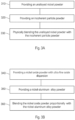
- Fig. 2 is a flow chart illustrating a process for producing a nickel alloy according to one embodiment of the present disclosure.
- the process begins with providing a metal powder containing substantially unalloyed nickel powder in step 210.
- the substantially unalloyed nickel powder is to ensure a base metal with high thermal conductivity.
- a nickel alloy is formed in step 220 from the metal powder.
- the nickel alloy is formed by a ball milling process under a specific atmosphere.
- the specific atmosphere can be gaseous and/or cryo-liquid, to promote repetitive cold-welding, deformation and fracturing of powder particles.
- the ball milling process can be replaced by an attrition process for a similar result, as an attritor is a high energy ball mill.
- the nickel alloy formed in step 220 is a composite powder in which average dispersoid interparticle spacing is approximately the same as welding interspace, i.e., a uniform microstructural spacing of ultra-fine dispersant.
- the nickel alloy is then placed in a suitable metal container and evacuated to remove air and absorbed water in step 230. Stainless steel can be used to make such metal container. Finally the resulting nickel alloy is hot extruded to full density in step 240. In order to control recrystallized grain size and shape of the nickel alloy, a subsequent thermomechanical processing may be employed.
- the nickel alloy produced according to the embodiment of the present disclosure possesses a desired microstructural condition for strength and high thermal conductivity.
- Figs. 3A-3C are flow charts illustrating details of the processes shown in Fig. 2 according to embodiments of the present disclosure.
- the process of providing the metal powder of Fig. 2 begins with providing an unalloyed nickel powder in step 310.
- a selected incoherent particle powder is provided in step 320.
- the incoherent particle can be selected from metal oxides, metal nitrides and metal carbides.
- the metal oxides include but not limited to calcia, magnesia, alumina, ceria, silica, chromia, yttria and thoria and certain mixed oxides in forms of garnates, etc.
- the metal nitrides include but not limited to TiN, CrN, A1N, etc.
- the metal carbides include but not limited to vanadium carbide (VC), TiC, TaC, WC, HfC, etc.
- the unalloyed nickel powder and the selected incoherent particle powder are physically blended in step 330.
- the blended powder will then be ready for subsequent processing steps as shown in Fig. 2 .
- the unalloyed nickel powder used in step 310 can be replaced with a limited conventionally alloyed nickel.
- a conventionally mechanically alloy nickel alloy INCONEL MA 6000 is the product of the process shown in Fig. 2 .
- the process of providing the metal powder of Fig. 2 begins with providing a nickel oxide powder with ultra-fine oxide dispersion in step 340.
- a nickel and aluminum alloy powder is provided in step 350.
- the nickel and aluminum alloy powder can be made by conventional powder metallurgy methods, rotary atomization, or gas atomization.
- the nickel oxide powder is proportionally blended with a nickel and aluminum alloy powder in step 360. The proportion is determined by a need for the nickel oxide powder to react with the nickel-aluminum alloy powder to form nickel metal and aluminum oxide. Such reaction can be expressed as ((Ni + Al alloy powder) + (NiO oxide) reaction) -> Ni metal + A1203 oxide dispersion.
- the metal powder in step 210 of Fig. 2 is a nickel-vanadium-carbon powder provided in step 370.
- the nickel-vanadium-carbon powder can be formulated with a certain level of VC dispersion in the nickel powder for a desired nickel alloy strength.
- Other nickel-refractory metal-carbon or metal-nitrogen powder can also be used.
- Such metal-carbon or metal-nitrogen powder can be formulated to subsequently form a dispersion of MC carbides (e.g. tungsten carbide or titanium carbide), metal nitrides, etc.
- MC carbides e.g. tungsten carbide or titanium carbide
- metal nitrides etc.
- carbides that can be formed in metal alloys including Ni and Steels. Type depends on the alloying additions and their ratios.
- MC carbides the letter M represents metal and can be one or a mixture of metal alloying additions. Examples include but not limited to: WC, VC, TiC, HfC; Cr7C3. (Cr, Mo, Fe)7C3 and others; (Cr, Mo)23C6; Mo2C and others; and Fe3C. Their thermo-dynamic stabilities are in the order of (highest to lowest): MC, M7C3, M23C6, M2C, M3C. In embodiments of the present disclosure, MC carbides are preferred for their high thermo-dynamic stability to maintain dispersion strengthening to very high temperatures, while resisting coarsening.
- the nickel-vanadium-carbon powder is melted in step 380, and then rapidly solidified in step 390.
- the rapidly solidification may be implemented by rotary atomization using high specific heat inert quench gases like Helium, Hydrogen, or mixtures of these gases with more economical Argon or Nitrogen. Quench rate of 10 5 degree Celsius/second or higher should be used to control the nucleation and precipitation of the uniform ultra- fine dispersion necessary for the strength of the resulting nickel alloy. For producing fine rapidly cooled powder high rotational speeds is preferred.
- the rapidly solidified powder should also be made to -240 mesh powder size fraction or finer to ensure that a desired rapid solidification rate can be obtained for a desired dispersion.
- the methodology of the present disclosure for retaining good thermal conductivity of Ni, while increasing the high temperature strength can be applied to situations where other physical properties of the metal base are retained and utilized at high temperatures.
- the electrical resistivity of pure Ni is about 1/10th of such Ni-based alloys.
- high temperature strength DS Ni in electrical/power applications has better electrical conductivity than Ni-base alloys, and may be used to improve related performance.
- Other physical properties like Coefficient of Thermal Expansion and Specific Heat stay approximately the same between Ni and most of its alloys (excluding certain Fe-Ni-base low CTE compositions), i.e., these properties do not adversely influence the present disclosure.
Landscapes
- Chemical & Material Sciences (AREA)
- Engineering & Computer Science (AREA)
- Mechanical Engineering (AREA)
- Materials Engineering (AREA)
- Metallurgy (AREA)
- Organic Chemistry (AREA)
- Manufacturing & Machinery (AREA)
- Dispersion Chemistry (AREA)
- Powder Metallurgy (AREA)
- Manufacture Of Metal Powder And Suspensions Thereof (AREA)
Abstract
Description
- This application claims priority to
U.S. Provisional Application No. 61/921,380 filed on December 27, 2013 - The present disclosure relates generally to alloying metals, and, more particularly, to method for producing a nickel alloy with increased thermal conductivity combined with high temperature strength capability.
- With each next generation of gas turbine engines comes increased performance, durability and reliability along with affordability. Those performance metrics are met with increased operating stresses, temperature and speed. These factors place ever increasing demands on Thermal Management System (TMS). A key component in the TMS is a heat exchanger for hot section air-to-air exchanges. The heat exchanger requires strength, temperature capability and high thermal conductivity along with manufacturability and cost. Conventional hot section heat exchanger materials are typically made of a nickel alloy for their high temperature capability and ease of fabrication. However, nickel alloys have significantly lower thermal conductivity as compared to pure nickel metal. Typical strengthening mechanisms used in those alloys, such as solid solution strengthening and precipitation hardening, cause significant electron scattering and markedly lower thermal conductivity. In some cases, the conventional nickel alloys have thermal conductivities 1/IOth to I/25th of that of pure nickel. But the relatively low strength of pure nickel makes it undesirable as an engineering or structural material.
- As such, what is desired is one or more materials with high thermal conductivity and significant strength characteristics.
- Disclosed and claimed herein is a nickel alloying process which includes providing a metal powder containing substantially unalloyed nickel, forming a nickel alloy from the metal powder, removing air and absorbed water from the nickel alloy, and hot extruding the nickel alloy. In one embodiment, the metal powder is produced by blending a substantially unalloyed nickel powder with an incoherent particle powder. In one embodiment, the metal powder is produced by blending a nickel oxide powder proportionally with a nickel-aluminum alloy powder. In the above embodiments, the nickel alloy is formed by a ball milling process. In one embodiment, the metal powder is a nickel-vanadium-carbon powder, and the nickel alloy is formed by a melting and rapid solidifying process.
- Other aspects, features, and techniques will be apparent to one skilled in the relevant art in view of the following detailed description of the embodiments.
- The drawings accompanying and forming part of this specification are included to depict certain aspects of the present disclosure. A clearer conception of the present disclosure, and of the components and operation of systems provided with the present disclosure, will become more readily apparent by referring to the exemplary, and therefore non-limiting, embodiments illustrated in the drawings, wherein like reference numbers (if they occur in more than one view) designate the same elements. The present disclosure may be better understood by reference to one or more of these drawings in combination with the description presented herein. It should be noted that the features illustrated in the drawings are not necessarily drawn to scale.
-
Fig. 1 is a plot diagram illustrating a weight fraction of phases, vanadium carbide (VC) and nickel metal as a function of temperature according one embodiment of the present disclosure. -
Fig. 2 is a flow chart illustrating a process for producing a nickel alloy according to one embodiment of the present disclosure. -
Figs. 3A-3C are flow charts illustrating details of the processes shown inFig. 2 according to embodiments of the present disclosure. - One aspect of the disclosure relates to processes of manufacturing high strength and high thermal conductivity wrought nickel alloy. Embodiments of the present disclosure will be described hereinafter with reference to the attached drawings.
- One embodiment of the present disclosure provides a process to obtain higher strength in nickel alloys without significantly reducing the thermal conductivity of the alloys. In one embodiment, a process for forming a nickel alloy is based on dispersion strengthening of a nickel metal, in which a uniform ultra- fine dispersion of thermo-dynamically stable incoherent particles or precipitates is distributed in the nickel metal and produces increased strength by significantly inhibiting dislocation motion in the nickel. Specifically, Orowan Strengthening conditions are sought. The strength increase is generally proportional to the volume fraction (Vf) of the particles present in the nickel metal up to an appropriate limit. Key to dispersion strengthening is the size, distribution and Vf of the incoherent precipitates. Typically, a particle radius of about 10-20 nm, an interparticle spacing of about 100 nm or at least two times the particle size in a Vf of about 0.05 are conducive to Orowan Strengthening.
- Particles of the aforementioned size range require a high magnification electron microscope to be observed. If they can be seen in an optical microscope at lower magnification, then they are described as non-metallic inclusions which are not suitable for engineering materials. Incoherent particles or precipitates covered in this disclosure include metal oxides, metal nitrides and metal carbides.
- A necessary characteristic of the incoherent precipitates listed above is their thermodynamic stability up to the melting point of the nickel metal and resistance to coarsening over the thermo-mechanical processing range of the nickel metal during component fabrication and operation. Thermo-dynamic stability is reflected in high negative Gibbs free energy of formation, -AG.
- A key to high thermal conductivity of the dispersion strengthened nickel is to limit any conventional alloying (solid solution strengthening and precipitation hardening) to less than 8 weight percent of combined alloying elements. In so doing, the nickel matrix will maintain its high thermal conductivity to nearly 90 W/m. K.
-
Fig. 1 is a plot diagram illustrating a weight fraction of phases, vanadium carbide (VC) and nickel metal as a function of temperature according one embodiment of the present disclosure.Line 110 represents pure Nickel,line 120 represents VC, andline 130 represents a liquid phase of the VC. The VC forms during the solidification from liquid to solid, and is stable from solidification to room temperature. Strength of the VC dispersion strengthened nickel metal can be adjusted according to the weight fraction of the VC dispersion in the nickel metal. Ni-2.15V-0.5C is an exemplary lower level VC weight fraction composition. -3V-0.7C is an exemplary higher level VC weight fraction. For these two alloys, alloy design involves compositions whereby there is a one-to-one ratio of vanadium to carbon as is accomplished by atomic percent and not by weight percent. -
Fig. 2 is a flow chart illustrating a process for producing a nickel alloy according to one embodiment of the present disclosure. The process begins with providing a metal powder containing substantially unalloyed nickel powder instep 210. The substantially unalloyed nickel powder is to ensure a base metal with high thermal conductivity. A nickel alloy is formed instep 220 from the metal powder. In one embodiment, the nickel alloy is formed by a ball milling process under a specific atmosphere. The specific atmosphere can be gaseous and/or cryo-liquid, to promote repetitive cold-welding, deformation and fracturing of powder particles. In other embodiments, the ball milling process can be replaced by an attrition process for a similar result, as an attritor is a high energy ball mill. - The nickel alloy formed in
step 220 is a composite powder in which average dispersoid interparticle spacing is approximately the same as welding interspace, i.e., a uniform microstructural spacing of ultra-fine dispersant. The nickel alloy is then placed in a suitable metal container and evacuated to remove air and absorbed water instep 230. Stainless steel can be used to make such metal container. Finally the resulting nickel alloy is hot extruded to full density instep 240. In order to control recrystallized grain size and shape of the nickel alloy, a subsequent thermomechanical processing may be employed. The nickel alloy produced according to the embodiment of the present disclosure possesses a desired microstructural condition for strength and high thermal conductivity. -
Figs. 3A-3C are flow charts illustrating details of the processes shown inFig. 2 according to embodiments of the present disclosure. Referring toFig. 3 A , in one embodiment, the process of providing the metal powder ofFig. 2 begins with providing an unalloyed nickel powder instep 310. A selected incoherent particle powder is provided instep 320. The incoherent particle can be selected from metal oxides, metal nitrides and metal carbides. The metal oxides include but not limited to calcia, magnesia, alumina, ceria, silica, chromia, yttria and thoria and certain mixed oxides in forms of garnates, etc. The metal nitrides include but not limited to TiN, CrN, A1N, etc. The metal carbides include but not limited to vanadium carbide (VC), TiC, TaC, WC, HfC, etc. - Referring again to
Fig. 3A , the unalloyed nickel powder and the selected incoherent particle powder are physically blended instep 330. The blended powder will then be ready for subsequent processing steps as shown inFig. 2 . It should be realized the unalloyed nickel powder used instep 310 can be replaced with a limited conventionally alloyed nickel. As an example, a conventionally mechanically alloy nickel alloy INCONEL MA 6000 is the product of the process shown inFig. 2 . However, its conventional alloy content as shown below is of significant proportion as to markedly debit the thermal conductivity of that alloy; 16 W/m.K for MA 6000 versus 90 W/m.K for Ni INCONEL MA 6000: Ni-0.06C-15.0Cr-4.5Al-2.3Ti-3.9W-1.5Fe-0.2N-0.57 total Oxygen with 1.1Y203 oxide dispersion. - Referring to
Fig. 3B , in one embodiment, the process of providing the metal powder ofFig. 2 begins with providing a nickel oxide powder with ultra-fine oxide dispersion instep 340. A nickel and aluminum alloy powder is provided instep 350. The nickel and aluminum alloy powder can be made by conventional powder metallurgy methods, rotary atomization, or gas atomization. The nickel oxide powder is proportionally blended with a nickel and aluminum alloy powder instep 360. The proportion is determined by a need for the nickel oxide powder to react with the nickel-aluminum alloy powder to form nickel metal and aluminum oxide. Such reaction can be expressed as ((Ni + Al alloy powder) + (NiO oxide) reaction) -> Ni metal + A1203 oxide dispersion. - Referring to
Fig. 3C , in one embodiment, the metal powder instep 210 ofFig. 2 is a nickel-vanadium-carbon powder provided instep 370. The nickel-vanadium-carbon powder can be formulated with a certain level of VC dispersion in the nickel powder for a desired nickel alloy strength. Other nickel-refractory metal-carbon or metal-nitrogen powder can also be used. Such metal-carbon or metal-nitrogen powder can be formulated to subsequently form a dispersion of MC carbides (e.g. tungsten carbide or titanium carbide), metal nitrides, etc. There are a number of carbides that can be formed in metal alloys including Ni and Steels. Type depends on the alloying additions and their ratios. In MC carbides, the letter M represents metal and can be one or a mixture of metal alloying additions. Examples include but not limited to: WC, VC, TiC, HfC; Cr7C3. (Cr, Mo, Fe)7C3 and others; (Cr, Mo)23C6; Mo2C and others; and Fe3C. Their thermo-dynamic stabilities are in the order of (highest to lowest): MC, M7C3, M23C6, M2C, M3C. In embodiments of the present disclosure, MC carbides are preferred for their high thermo-dynamic stability to maintain dispersion strengthening to very high temperatures, while resisting coarsening. - Referring again to
Fig. 3C , as a way to form the nickel alloy instep 220 ofFig. 2 , the nickel-vanadium-carbon powder is melted instep 380, and then rapidly solidified instep 390. The rapidly solidification may be implemented by rotary atomization using high specific heat inert quench gases like Helium, Hydrogen, or mixtures of these gases with more economical Argon or Nitrogen. Quench rate of 105 degree Celsius/second or higher should be used to control the nucleation and precipitation of the uniform ultra- fine dispersion necessary for the strength of the resulting nickel alloy. For producing fine rapidly cooled powder high rotational speeds is preferred. The rapidly solidified powder should also be made to -240 mesh powder size fraction or finer to ensure that a desired rapid solidification rate can be obtained for a desired dispersion. - It should also be recognized that the methodology of the present disclosure for retaining good thermal conductivity of Ni, while increasing the high temperature strength, can be applied to situations where other physical properties of the metal base are retained and utilized at high temperatures. For example, conversely, the electrical resistivity of pure Ni is about 1/10th of such Ni-based alloys. Aside from heat, high temperature strength DS Ni in electrical/power applications has better electrical conductivity than Ni-base alloys, and may be used to improve related performance. Other physical properties like Coefficient of Thermal Expansion and Specific Heat stay approximately the same between Ni and most of its alloys (excluding certain Fe-Ni-base low CTE compositions), i.e., these properties do not adversely influence the present disclosure.
- While this disclosure has been particularly shown and described with references to exemplary embodiments thereof, it shall be understood by those skilled in the art that various changes in form and details may be made therein without departing from the spirit of the claimed embodiments.
Claims (7)
- A nickel alloying process comprising:providing a metal powder containing substantially unalloyed nickel;forming a nickel alloy from the metal powder;removing air and absorbed water from the nickel alloy; andhot extruding the nickel alloy.
- The nickel alloying process of claim 1, wherein the providing the metal powder comprises providing the group consisting of a nickel-vanadium-carbon powder, a nickel-refractory metal-carbon powder and a nickel-refractory metal-nitrogen powder.
- The nickel alloying process of claim 2, wherein the nickel-refractory metal-carbon powder is formulated to subsequently form a dispersion of metal carbides.
- The nickel alloying process of claim 2, wherein the nickel-refractory metal-nitrogen powder is formulated to subsequently form a dispersion of metal nitrides.
- The nickel alloying process of claim 1, wherein the forming the nickel alloy comprises melting the metal powder; and rapidly solidifying the melted metal powder.
- The nickel alloying process of claim 5, wherein the melting is a vacuum induction melting.
- The nickel alloying process of claim 5, wherein the rapidly solidifying is performed by rotary atomization using a high specific heat inert quench gas and high rotational speeds to produce fine rapidly cooled powder, preferably wherein the heat inert quench gas is selected from the group consisting of Helium, Hydrogen, Argon, Nitrogen and a combination thereof.
Applications Claiming Priority (3)
| Application Number | Priority Date | Filing Date | Title |
|---|---|---|---|
| US201361921380P | 2013-12-27 | 2013-12-27 | |
| EP14873424.7A EP3087210B1 (en) | 2013-12-27 | 2014-12-16 | High-strength high-thermal-conductivity wrought nickel alloy |
| PCT/US2014/070646 WO2015100074A1 (en) | 2013-12-27 | 2014-12-16 | High-strength high-thermal-conductivity wrought nickel alloy |
Related Parent Applications (1)
| Application Number | Title | Priority Date | Filing Date |
|---|---|---|---|
| EP14873424.7A Division EP3087210B1 (en) | 2013-12-27 | 2014-12-16 | High-strength high-thermal-conductivity wrought nickel alloy |
Publications (2)
| Publication Number | Publication Date |
|---|---|
| EP4353856A2 true EP4353856A2 (en) | 2024-04-17 |
| EP4353856A3 EP4353856A3 (en) | 2024-07-10 |
Family
ID=53479557
Family Applications (3)
| Application Number | Title | Priority Date | Filing Date |
|---|---|---|---|
| EP24152983.3A Pending EP4353856A3 (en) | 2013-12-27 | 2014-12-16 | High-strength high-thermal-conductivity wrought nickel alloy |
| EP24152972.6A Pending EP4332259A3 (en) | 2013-12-27 | 2014-12-16 | High-strength high-thermal-conductivity wrought nickel alloy |
| EP14873424.7A Active EP3087210B1 (en) | 2013-12-27 | 2014-12-16 | High-strength high-thermal-conductivity wrought nickel alloy |
Family Applications After (2)
| Application Number | Title | Priority Date | Filing Date |
|---|---|---|---|
| EP24152972.6A Pending EP4332259A3 (en) | 2013-12-27 | 2014-12-16 | High-strength high-thermal-conductivity wrought nickel alloy |
| EP14873424.7A Active EP3087210B1 (en) | 2013-12-27 | 2014-12-16 | High-strength high-thermal-conductivity wrought nickel alloy |
Country Status (3)
| Country | Link |
|---|---|
| US (1) | US20160325357A1 (en) |
| EP (3) | EP4353856A3 (en) |
| WO (1) | WO2015100074A1 (en) |
Families Citing this family (9)
| Publication number | Priority date | Publication date | Assignee | Title |
|---|---|---|---|---|
| US10507638B2 (en) | 2015-03-17 | 2019-12-17 | Elementum 3D, Inc. | Reactive additive manufacturing |
| US11802321B2 (en) | 2015-03-17 | 2023-10-31 | Elementum 3D, Inc. | Additive manufacturing of metal alloys and metal alloy matrix composites |
| US20180283695A1 (en) * | 2017-04-03 | 2018-10-04 | United Technologies Corporation | Combustion panel grommet |
| WO2019156658A1 (en) * | 2018-02-06 | 2019-08-15 | Sinter Print, Inc. | Additive manufacturing of metal alloys and metal alloy matrix composites |
| CN111719060B (en) * | 2020-05-19 | 2021-08-27 | 山东源航超轻材料研究院有限公司 | Surface modification of reinforcement for Mg-Li-based composite material and preparation method of prefabricated body of reinforcement |
| CN114749660A (en) * | 2022-04-20 | 2022-07-15 | 西安工业大学 | Method for improving high-temperature strength of Inconel718 laser deposition layer |
| CN118895451B (en) * | 2024-07-05 | 2026-04-10 | 散裂中子源科学中心 | Neutron diffraction peak-free high-thermal-conductivity VNI alloy plate and manufacturing method thereof |
| CN121023306B (en) * | 2025-10-29 | 2026-01-09 | 合肥格物新材料科技有限公司 | High-precision nickel alloy foil and preparation process thereof |
| CN121178875B (en) * | 2025-11-24 | 2026-02-03 | 中国机械总院集团沈阳铸造研究所有限公司 | Additive manufacturing of high phase transformation temperature and high elongation nickel-titanium alloys, their preparation methods and applications |
Family Cites Families (31)
| Publication number | Priority date | Publication date | Assignee | Title |
|---|---|---|---|---|
| CA873267A (en) * | 1971-06-15 | Frederick C. Holtz, Jr. | Alloys and process | |
| US3361560A (en) * | 1966-04-19 | 1968-01-02 | Du Pont | Nickel silicon and refractory metal alloy |
| US3738817A (en) | 1968-03-01 | 1973-06-12 | Int Nickel Co | Wrought dispersion strengthened metals by powder metallurgy |
| CA934191A (en) * | 1970-07-06 | 1973-09-25 | The International Nickel Company Of Canada | Hot working dispersion-strengthened heat resistant alloys and the product thereof |
| US3723213A (en) * | 1970-08-18 | 1973-03-27 | Rohm & Haas | Method of making non-woven pile fabric |
| US3723109A (en) * | 1971-07-16 | 1973-03-27 | Int Nickel Co | Extrusion of canned metal powders using graphite follower block |
| US3926691A (en) * | 1972-11-01 | 1975-12-16 | Sherritt Gordon Mines Ltd | Dispersion strengthened metals and alloys |
| US3964878A (en) * | 1973-06-06 | 1976-06-22 | Gte Sylvania Incorporated | Cemented carbide employing a refractory metal binder and process for producing same |
| JPS5274509A (en) * | 1975-12-18 | 1977-06-22 | Mitsubishi Metal Corp | Ni-base sintered alloy |
| US4579587A (en) * | 1983-08-15 | 1986-04-01 | Massachusetts Institute Of Technology | Method for producing high strength metal-ceramic composition |
| US4647304A (en) * | 1983-08-17 | 1987-03-03 | Exxon Research And Engineering Company | Method for producing dispersion strengthened metal powders |
| US4599214A (en) * | 1983-08-17 | 1986-07-08 | Exxon Research And Engineering Co. | Dispersion strengthened extruded metal products substantially free of texture |
| EP0169054A3 (en) * | 1984-07-18 | 1987-12-16 | The University Of Newcastle Upon Tyne | Composite materials and products |
| US5006163A (en) * | 1985-03-13 | 1991-04-09 | Inco Alloys International, Inc. | Turbine blade superalloy II |
| KR960014946B1 (en) * | 1988-12-22 | 1996-10-21 | 더 유니버어스티 오브 웨스트런 오스트레일리아 | Method for manufacturing metals, alloys and ceramic materials |
| JP3421758B2 (en) * | 1993-09-27 | 2003-06-30 | 株式会社日立製作所 | Oxide dispersion strengthened alloy and high temperature equipment composed of the alloy |
| US5429793A (en) * | 1994-05-17 | 1995-07-04 | Institute Of Gas Technology | Scaleable process for producing Ni-Al ODS anode |
| US5831187A (en) * | 1996-04-26 | 1998-11-03 | Lockheed Idaho Technologies Company | Advanced nickel base alloys for high strength, corrosion applications |
| CA2265098A1 (en) * | 1998-03-12 | 1999-09-12 | Abdelouahab Ziani | Method for producing aluminum alloy powder compacts |
| CN1108391C (en) * | 1999-01-29 | 2003-05-14 | 株式会社三德 | AB-type rare earth transition intermetallic compounds for the negative electrodes of rechargeable batteries |
| CN1109765C (en) * | 2000-02-29 | 2003-05-28 | 中南工业大学 | Nickel-silver alloy and its preparing method |
| EP1195446A1 (en) * | 2000-10-04 | 2002-04-10 | General Electric Company | Ni based superalloy and its use as gas turbine disks, shafts, and impellers |
| JP4412964B2 (en) * | 2003-10-20 | 2010-02-10 | 株式会社荏原製作所 | Coating alloys with corrosion and wear resistance |
| WO2006104004A1 (en) * | 2005-03-28 | 2006-10-05 | Kyocera Corporation | Super hard alloy and cutting tool |
| US7699905B1 (en) * | 2006-05-08 | 2010-04-20 | Iowa State University Research Foundation, Inc. | Dispersoid reinforced alloy powder and method of making |
| UA100460C2 (en) * | 2008-11-19 | 2012-12-25 | Сандвік Інтеллекчуал Проперті Аб | Nickel based alloy capable for forming ALUMINA |
| US20100237364A1 (en) * | 2009-03-19 | 2010-09-23 | Christy Alexander C | Thermal Energy Dissipating and Light Emitting Diode Mounting Arrangement |
| CN101871056A (en) * | 2009-04-21 | 2010-10-27 | 莱芜市金石特种合金材料有限公司 | Production method of high-boron-nickel alloy |
| US8652400B2 (en) * | 2011-06-01 | 2014-02-18 | Ati Properties, Inc. | Thermo-mechanical processing of nickel-base alloys |
| JP6011946B2 (en) * | 2011-10-19 | 2016-10-25 | 公立大学法人大阪府立大学 | Nickel-based intermetallic compound composite sintered material and method for producing the same |
| JP2013181213A (en) * | 2012-03-01 | 2013-09-12 | Hokkaido Univ | Oxide dispersion strengthened nickel-base superalloy |
-
2014
- 2014-12-16 US US15/108,476 patent/US20160325357A1/en not_active Abandoned
- 2014-12-16 EP EP24152983.3A patent/EP4353856A3/en active Pending
- 2014-12-16 EP EP24152972.6A patent/EP4332259A3/en active Pending
- 2014-12-16 EP EP14873424.7A patent/EP3087210B1/en active Active
- 2014-12-16 WO PCT/US2014/070646 patent/WO2015100074A1/en not_active Ceased
Also Published As
| Publication number | Publication date |
|---|---|
| EP3087210A1 (en) | 2016-11-02 |
| EP3087210B1 (en) | 2024-01-24 |
| EP4353856A3 (en) | 2024-07-10 |
| EP4332259A2 (en) | 2024-03-06 |
| EP3087210A4 (en) | 2017-11-01 |
| US20160325357A1 (en) | 2016-11-10 |
| WO2015100074A1 (en) | 2015-07-02 |
| EP4332259A3 (en) | 2024-05-22 |
Similar Documents
| Publication | Publication Date | Title |
|---|---|---|
| EP4353856A2 (en) | High-strength high-thermal-conductivity wrought nickel alloy | |
| EP4134459B1 (en) | Nickel-based superalloy and manufacturing method therefor, and component and application | |
| Horn et al. | Additive manufacturing of copper and copper alloys | |
| Bewlay et al. | Ultrahigh-temperature Nb-silicide-based composites | |
| KR102070059B1 (en) | High entropy alloys with intermetallic compound precipitates for strengthening and method for manufacturing the same | |
| EP0804627B1 (en) | Oxidation resistant molybdenum alloy | |
| Knop et al. | A new polycrystalline Co-Ni superalloy | |
| Pan et al. | High-temperature oxidation behaviour of TiAl alloys with Co addition | |
| KR20200040970A (en) | Precipitation strengthenend high entropy steel and method for manufacturing the same | |
| KR20120139821A (en) | Iron-chromium-molybdenum-based thermal spray powder and method of making of the same | |
| KR20130049768A (en) | Nickel based thermal spray powder and coating, and methdo for making the same | |
| Fleetwood | Mechanical alloying–the development of strong alloys | |
| CN109778042A (en) | A kind of high-strength tungsten-based alloy and preparation method thereof | |
| Wang et al. | Grain size effects of tungsten powder on the micro-structure and mechanical properties of tungsten-based alloys | |
| Karpov | Niobium-base refractory alloys with silicide and carbide hardening current status and prospects | |
| US3000734A (en) | Solid state fabrication of hard, high melting point, heat resistant materials | |
| CN116219246B (en) | Synergistically strengthened high temperature and high strength molybdenum alloy strengthened by solid solution, dispersion and fine grain strengthening, preparation method and application thereof | |
| EP1340826B2 (en) | High-temperature member for use in gas turbine | |
| US20220275483A1 (en) | Castable high temperature nickel-rare earth element alloys | |
| JPWO2015020007A1 (en) | Oxide particle dispersion strengthened Ni-base superalloy | |
| US7186369B1 (en) | Method of forming a part made of a molybdenum-copper composite material | |
| CN114032433B (en) | Cobalt-based high-temperature alloy, preparation method thereof and hot end component | |
| Migas et al. | Thermogravimetric investigations of new γ-γ′ cobalt-based superalloys. | |
| WO2024084242A1 (en) | An alloy | |
| Ovalı et al. | Effects of oxide particles on the microstructural and mechanical properties of W-Ni-WB composites |
Legal Events
| Date | Code | Title | Description |
|---|---|---|---|
| PUAI | Public reference made under article 153(3) epc to a published international application that has entered the european phase |
Free format text: ORIGINAL CODE: 0009012 |
|
| STAA | Information on the status of an ep patent application or granted ep patent |
Free format text: STATUS: THE APPLICATION HAS BEEN PUBLISHED |
|
| AC | Divisional application: reference to earlier application |
Ref document number: 3087210 Country of ref document: EP Kind code of ref document: P |
|
| AK | Designated contracting states |
Kind code of ref document: A2 Designated state(s): AL AT BE BG CH CY CZ DE DK EE ES FI FR GB GR HR HU IE IS IT LI LT LU LV MC MK MT NL NO PL PT RO RS SE SI SK SM TR |
|
| PUAL | Search report despatched |
Free format text: ORIGINAL CODE: 0009013 |
|
| AK | Designated contracting states |
Kind code of ref document: A3 Designated state(s): AL AT BE BG CH CY CZ DE DK EE ES FI FR GB GR HR HU IE IS IT LI LT LU LV MC MK MT NL NO PL PT RO RS SE SI SK SM TR |
|
| RIC1 | Information provided on ipc code assigned before grant |
Ipc: C22C 1/059 20230101ALI20240531BHEP Ipc: C22C 1/053 20230101ALI20240531BHEP Ipc: B22F 1/12 20220101ALI20240531BHEP Ipc: C22C 19/00 20060101ALI20240531BHEP Ipc: C22C 1/10 20230101ALI20240531BHEP Ipc: B22F 9/04 20060101ALI20240531BHEP Ipc: B22F 3/20 20060101ALI20240531BHEP Ipc: B22F 1/00 20220101ALI20240531BHEP Ipc: C22C 1/04 20230101ALI20240531BHEP Ipc: C22F 1/18 20060101ALI20240531BHEP Ipc: C22F 1/02 20060101ALI20240531BHEP Ipc: C22C 19/03 20060101AFI20240531BHEP |
|
| STAA | Information on the status of an ep patent application or granted ep patent |
Free format text: STATUS: REQUEST FOR EXAMINATION WAS MADE |
|
| 17P | Request for examination filed |
Effective date: 20250110 |