EP4353711A1 - Quinolin-2-yl nitrones for the treatment and prevention of stroke - Google Patents
Quinolin-2-yl nitrones for the treatment and prevention of stroke Download PDFInfo
- Publication number
- EP4353711A1 EP4353711A1 EP22382968.0A EP22382968A EP4353711A1 EP 4353711 A1 EP4353711 A1 EP 4353711A1 EP 22382968 A EP22382968 A EP 22382968A EP 4353711 A1 EP4353711 A1 EP 4353711A1
- Authority
- EP
- European Patent Office
- Prior art keywords
- compound
- formula
- alkyl
- benzyl
- oxide
- Prior art date
- Legal status (The legal status is an assumption and is not a legal conclusion. Google has not performed a legal analysis and makes no representation as to the accuracy of the status listed.)
- Withdrawn
Links
- 238000011282 treatment Methods 0.000 title claims abstract description 18
- 230000002265 prevention Effects 0.000 title claims abstract description 10
- BOHDZKSQXXJHBO-UHFFFAOYSA-N N-(quinolin-2-ylmethylidene)hydroxylamine Chemical class C1=CC=CC2=NC(C=NO)=CC=C21 BOHDZKSQXXJHBO-UHFFFAOYSA-N 0.000 title abstract description 20
- 208000006011 Stroke Diseases 0.000 claims abstract description 23
- 208000019553 vascular disease Diseases 0.000 claims abstract description 11
- 206010008120 Cerebral ischaemia Diseases 0.000 claims abstract description 10
- 150000001875 compounds Chemical class 0.000 claims description 63
- -1 (Z)-N-tert-Butyl-1-(8-(3-(piperidin-1-yl)propoxy)quinolin-2-yl)methanimine oxide Chemical compound 0.000 claims description 48
- 125000004178 (C1-C4) alkyl group Chemical group 0.000 claims description 43
- 125000001797 benzyl group Chemical group [H]C1=C([H])C([H])=C(C([H])=C1[H])C([H])([H])* 0.000 claims description 24
- 239000008194 pharmaceutical composition Substances 0.000 claims description 17
- 125000002496 methyl group Chemical group [H]C([H])([H])* 0.000 claims description 15
- 238000000034 method Methods 0.000 claims description 13
- 125000000999 tert-butyl group Chemical group [H]C([H])([H])C(*)(C([H])([H])[H])C([H])([H])[H] 0.000 claims description 12
- 125000005842 heteroatom Chemical group 0.000 claims description 10
- 125000004433 nitrogen atom Chemical group N* 0.000 claims description 10
- 229920006395 saturated elastomer Polymers 0.000 claims description 10
- 229910052799 carbon Inorganic materials 0.000 claims description 9
- 125000001997 phenyl group Chemical group [H]C1=C([H])C([H])=C(*)C([H])=C1[H] 0.000 claims description 9
- 125000004432 carbon atom Chemical group C* 0.000 claims description 8
- 239000003814 drug Substances 0.000 claims description 6
- 238000009093 first-line therapy Methods 0.000 claims description 5
- 229910052736 halogen Inorganic materials 0.000 claims description 5
- 150000002367 halogens Chemical class 0.000 claims description 5
- 239000000546 pharmaceutical excipient Substances 0.000 claims description 4
- 238000013151 thrombectomy Methods 0.000 claims description 4
- 102000003978 Tissue Plasminogen Activator Human genes 0.000 claims description 3
- 108090000373 Tissue Plasminogen Activator Proteins 0.000 claims description 3
- 238000009098 adjuvant therapy Methods 0.000 claims description 3
- 125000000217 alkyl group Chemical group 0.000 claims description 3
- 239000003527 fibrinolytic agent Substances 0.000 claims description 3
- 229960000103 thrombolytic agent Drugs 0.000 claims description 3
- 229960000187 tissue plasminogen activator Drugs 0.000 claims description 3
- 125000003118 aryl group Chemical group 0.000 claims description 2
- 229910052760 oxygen Inorganic materials 0.000 claims description 2
- 229910052711 selenium Inorganic materials 0.000 claims description 2
- 201000006474 Brain Ischemia Diseases 0.000 abstract description 6
- 206010008118 cerebral infarction Diseases 0.000 abstract description 6
- HEDRZPFGACZZDS-MICDWDOJSA-N Trichloro(2H)methane Chemical compound [2H]C(Cl)(Cl)Cl HEDRZPFGACZZDS-MICDWDOJSA-N 0.000 description 36
- OKKJLVBELUTLKV-UHFFFAOYSA-N Methanol Chemical compound OC OKKJLVBELUTLKV-UHFFFAOYSA-N 0.000 description 21
- 239000000203 mixture Substances 0.000 description 20
- LFQSCWFLJHTTHZ-UHFFFAOYSA-N Ethanol Chemical compound CCO LFQSCWFLJHTTHZ-UHFFFAOYSA-N 0.000 description 16
- 230000015572 biosynthetic process Effects 0.000 description 16
- 238000003786 synthesis reaction Methods 0.000 description 15
- GPWNWKWQOLEVEQ-UHFFFAOYSA-N 2,4-diaminopyrimidine-5-carbaldehyde Chemical compound NC1=NC=C(C=O)C(N)=N1 GPWNWKWQOLEVEQ-UHFFFAOYSA-N 0.000 description 12
- SLBPIHCMXPQAIQ-UHFFFAOYSA-N 8-hydroxyquinoline-2-carbaldehyde Chemical compound C1=C(C=O)N=C2C(O)=CC=CC2=C1 SLBPIHCMXPQAIQ-UHFFFAOYSA-N 0.000 description 11
- 238000004440 column chromatography Methods 0.000 description 11
- 238000005160 1H NMR spectroscopy Methods 0.000 description 10
- YMWUJEATGCHHMB-UHFFFAOYSA-N Dichloromethane Chemical compound ClCCl YMWUJEATGCHHMB-UHFFFAOYSA-N 0.000 description 10
- 241001465754 Metazoa Species 0.000 description 10
- PMZURENOXWZQFD-UHFFFAOYSA-L Sodium Sulfate Chemical compound [Na+].[Na+].[O-]S([O-])(=O)=O PMZURENOXWZQFD-UHFFFAOYSA-L 0.000 description 10
- 230000000324 neuroprotective effect Effects 0.000 description 10
- 239000000243 solution Substances 0.000 description 10
- 239000002904 solvent Substances 0.000 description 10
- 206010061216 Infarction Diseases 0.000 description 9
- 239000007832 Na2SO4 Substances 0.000 description 9
- 230000007574 infarction Effects 0.000 description 9
- 229910052938 sodium sulfate Inorganic materials 0.000 description 9
- 238000001644 13C nuclear magnetic resonance spectroscopy Methods 0.000 description 8
- 238000007429 general method Methods 0.000 description 8
- VLKZOEOYAKHREP-UHFFFAOYSA-N n-Hexane Chemical compound CCCCCC VLKZOEOYAKHREP-UHFFFAOYSA-N 0.000 description 8
- SQDFHQJTAWCFIB-UHFFFAOYSA-N n-methylidenehydroxylamine Chemical compound ON=C SQDFHQJTAWCFIB-UHFFFAOYSA-N 0.000 description 8
- VMHLLURERBWHNL-UHFFFAOYSA-M Sodium acetate Chemical compound [Na+].CC([O-])=O VMHLLURERBWHNL-UHFFFAOYSA-M 0.000 description 7
- 239000007787 solid Substances 0.000 description 7
- MWUXSHHQAYIFBG-UHFFFAOYSA-N Nitric oxide Chemical compound O=[N] MWUXSHHQAYIFBG-UHFFFAOYSA-N 0.000 description 6
- PQUXJODDQQAICY-UHFFFAOYSA-N C#CCN1CCN(CCCCl)CC1 Chemical compound C#CCN1CCN(CCCCl)CC1 PQUXJODDQQAICY-UHFFFAOYSA-N 0.000 description 5
- IAZDPXIOMUYVGZ-UHFFFAOYSA-N Dimethylsulphoxide Chemical compound CS(C)=O IAZDPXIOMUYVGZ-UHFFFAOYSA-N 0.000 description 5
- 241000699670 Mus sp. Species 0.000 description 5
- 210000004556 brain Anatomy 0.000 description 5
- 238000006243 chemical reaction Methods 0.000 description 5
- HEDRZPFGACZZDS-UHFFFAOYSA-N Chloroform Chemical compound ClC(Cl)Cl HEDRZPFGACZZDS-UHFFFAOYSA-N 0.000 description 4
- 239000003963 antioxidant agent Substances 0.000 description 4
- 230000003078 antioxidant effect Effects 0.000 description 4
- 230000000694 effects Effects 0.000 description 4
- 208000028867 ischemia Diseases 0.000 description 4
- 239000012528 membrane Substances 0.000 description 4
- IYSYLWYGCWTJSG-XFXZXTDPSA-N n-tert-butyl-1-phenylmethanimine oxide Chemical compound CC(C)(C)[N+](\[O-])=C\C1=CC=CC=C1 IYSYLWYGCWTJSG-XFXZXTDPSA-N 0.000 description 4
- 230000001537 neural effect Effects 0.000 description 4
- BWHMMNNQKKPAPP-UHFFFAOYSA-L potassium carbonate Chemical compound [K+].[K+].[O-]C([O-])=O BWHMMNNQKKPAPP-UHFFFAOYSA-L 0.000 description 4
- 238000001356 surgical procedure Methods 0.000 description 4
- XEKOWRVHYACXOJ-UHFFFAOYSA-N Ethyl acetate Chemical compound CCOC(C)=O XEKOWRVHYACXOJ-UHFFFAOYSA-N 0.000 description 3
- UIIMBOGNXHQVGW-UHFFFAOYSA-M Sodium bicarbonate Chemical class [Na+].OC([O-])=O UIIMBOGNXHQVGW-UHFFFAOYSA-M 0.000 description 3
- 238000003556 assay Methods 0.000 description 3
- 230000017531 blood circulation Effects 0.000 description 3
- 210000001218 blood-brain barrier Anatomy 0.000 description 3
- XLZOVRYBVCMCGL-BPNVQINPSA-L disodium;4-[(z)-[tert-butyl(oxido)azaniumylidene]methyl]benzene-1,3-disulfonate Chemical group [Na+].[Na+].CC(C)(C)[N+](\[O-])=C\C1=CC=C(S([O-])(=O)=O)C=C1S([O-])(=O)=O XLZOVRYBVCMCGL-BPNVQINPSA-L 0.000 description 3
- 238000002474 experimental method Methods 0.000 description 3
- 230000006698 induction Effects 0.000 description 3
- 150000002632 lipids Chemical class 0.000 description 3
- YSNXOQGDHGUKCZ-UHFFFAOYSA-N n-benzylhydroxylamine;hydron;chloride Chemical compound Cl.ONCC1=CC=CC=C1 YSNXOQGDHGUKCZ-UHFFFAOYSA-N 0.000 description 3
- DCSATTBHEMKGIP-UHFFFAOYSA-N n-tert-butylhydroxylamine;hydron;chloride Chemical compound Cl.CC(C)(C)NO DCSATTBHEMKGIP-UHFFFAOYSA-N 0.000 description 3
- 239000004090 neuroprotective agent Substances 0.000 description 3
- 230000003287 optical effect Effects 0.000 description 3
- ZAUYNCUCMJDAHW-UHFFFAOYSA-N 1-ethenylpyrrolidin-2-one;hydrogen peroxide;molecular iodine Chemical compound OO.II.C=CN1CCCC1=O ZAUYNCUCMJDAHW-UHFFFAOYSA-N 0.000 description 2
- 206010002091 Anaesthesia Diseases 0.000 description 2
- OKTJSMMVPCPJKN-UHFFFAOYSA-N Carbon Chemical compound [C] OKTJSMMVPCPJKN-UHFFFAOYSA-N 0.000 description 2
- 235000004694 Eucalyptus leucoxylon Nutrition 0.000 description 2
- 244000166102 Eucalyptus leucoxylon Species 0.000 description 2
- PIWKPBJCKXDKJR-UHFFFAOYSA-N Isoflurane Chemical compound FC(F)OC(Cl)C(F)(F)F PIWKPBJCKXDKJR-UHFFFAOYSA-N 0.000 description 2
- 206010030113 Oedema Diseases 0.000 description 2
- 241000700159 Rattus Species 0.000 description 2
- VYPSYNLAJGMNEJ-UHFFFAOYSA-N Silicium dioxide Chemical compound O=[Si]=O VYPSYNLAJGMNEJ-UHFFFAOYSA-N 0.000 description 2
- XLIJUKVKOIMPKW-BTVCFUMJSA-N [O].OC[C@@H](O)[C@@H](O)[C@H](O)[C@@H](O)C=O Chemical compound [O].OC[C@@H](O)[C@@H](O)[C@H](O)[C@@H](O)C=O XLIJUKVKOIMPKW-BTVCFUMJSA-N 0.000 description 2
- 238000001949 anaesthesia Methods 0.000 description 2
- 230000037005 anaesthesia Effects 0.000 description 2
- 230000003833 cell viability Effects 0.000 description 2
- 210000003710 cerebral cortex Anatomy 0.000 description 2
- 238000007796 conventional method Methods 0.000 description 2
- 230000006378 damage Effects 0.000 description 2
- 201000010099 disease Diseases 0.000 description 2
- 208000037265 diseases, disorders, signs and symptoms Diseases 0.000 description 2
- 238000001727 in vivo Methods 0.000 description 2
- 229960002725 isoflurane Drugs 0.000 description 2
- 238000002368 isothermal capactiance transient spectroscopy Methods 0.000 description 2
- 230000003902 lesion Effects 0.000 description 2
- 238000004519 manufacturing process Methods 0.000 description 2
- 239000000463 material Substances 0.000 description 2
- 230000035699 permeability Effects 0.000 description 2
- 229910000027 potassium carbonate Inorganic materials 0.000 description 2
- 230000003389 potentiating effect Effects 0.000 description 2
- 125000006412 propinylene group Chemical group [H]C#CC([H])([H])* 0.000 description 2
- 238000011084 recovery Methods 0.000 description 2
- 238000011160 research Methods 0.000 description 2
- 239000000741 silica gel Substances 0.000 description 2
- 229910002027 silica gel Inorganic materials 0.000 description 2
- 241000894007 species Species 0.000 description 2
- 238000001228 spectrum Methods 0.000 description 2
- 238000012360 testing method Methods 0.000 description 2
- 230000001225 therapeutic effect Effects 0.000 description 2
- 238000002560 therapeutic procedure Methods 0.000 description 2
- 230000001052 transient effect Effects 0.000 description 2
- 238000007492 two-way ANOVA Methods 0.000 description 2
- 230000002792 vascular Effects 0.000 description 2
- XLYOFNOQVPJJNP-UHFFFAOYSA-N water Substances O XLYOFNOQVPJJNP-UHFFFAOYSA-N 0.000 description 2
- 125000006650 (C2-C4) alkynyl group Chemical group 0.000 description 1
- GQNNWVWTRHOSBC-UHFFFAOYSA-N 1-(3-chloropropyl)piperazine;dihydrochloride Chemical compound [Cl-].[Cl-].ClCCC[NH+]1CC[NH2+]CC1 GQNNWVWTRHOSBC-UHFFFAOYSA-N 0.000 description 1
- HDDNBUNZJIQDBQ-UHFFFAOYSA-N 1-(3-chloropropyl)piperidine Chemical compound ClCCCN1CCCCC1 HDDNBUNZJIQDBQ-UHFFFAOYSA-N 0.000 description 1
- 125000004972 1-butynyl group Chemical group [H]C([H])([H])C([H])([H])C#C* 0.000 description 1
- PLRACCBDVIHHLZ-UHFFFAOYSA-N 1-methyl-4-phenyl-1,2,3,6-tetrahydropyridine Chemical compound C1N(C)CCC(C=2C=CC=CC=2)=C1 PLRACCBDVIHHLZ-UHFFFAOYSA-N 0.000 description 1
- 125000000530 1-propynyl group Chemical group [H]C([H])([H])C#C* 0.000 description 1
- 238000004791 1D NOESY Methods 0.000 description 1
- 125000000069 2-butynyl group Chemical group [H]C([H])([H])C#CC([H])([H])* 0.000 description 1
- NPUKDXXFDDZOKR-UHFFFAOYSA-N 3-(1-phenylethyl)-4-imidazolecarboxylic acid ethyl ester Chemical compound CCOC(=O)C1=CN=CN1C(C)C1=CC=CC=C1 NPUKDXXFDDZOKR-UHFFFAOYSA-N 0.000 description 1
- 125000000474 3-butynyl group Chemical group [H]C#CC([H])([H])C([H])([H])* 0.000 description 1
- ZCYVEMRRCGMTRW-UHFFFAOYSA-N 7553-56-2 Chemical compound [I] ZCYVEMRRCGMTRW-UHFFFAOYSA-N 0.000 description 1
- WKBOTKDWSSQWDR-UHFFFAOYSA-N Bromine atom Chemical compound [Br] WKBOTKDWSSQWDR-UHFFFAOYSA-N 0.000 description 1
- 208000024172 Cardiovascular disease Diseases 0.000 description 1
- ZAMOUSCENKQFHK-UHFFFAOYSA-N Chlorine atom Chemical compound [Cl] ZAMOUSCENKQFHK-UHFFFAOYSA-N 0.000 description 1
- 102000004127 Cytokines Human genes 0.000 description 1
- 108090000695 Cytokines Proteins 0.000 description 1
- PXGOKWXKJXAPGV-UHFFFAOYSA-N Fluorine Chemical compound FF PXGOKWXKJXAPGV-UHFFFAOYSA-N 0.000 description 1
- 229940123457 Free radical scavenger Drugs 0.000 description 1
- 241000699694 Gerbillinae Species 0.000 description 1
- 101000599951 Homo sapiens Insulin-like growth factor I Proteins 0.000 description 1
- VEXZGXHMUGYJMC-UHFFFAOYSA-N Hydrochloric acid Chemical compound Cl VEXZGXHMUGYJMC-UHFFFAOYSA-N 0.000 description 1
- 102100037852 Insulin-like growth factor I Human genes 0.000 description 1
- 102000007330 LDL Lipoproteins Human genes 0.000 description 1
- 108010007622 LDL Lipoproteins Proteins 0.000 description 1
- 102000004895 Lipoproteins Human genes 0.000 description 1
- 108090001030 Lipoproteins Proteins 0.000 description 1
- 102000043136 MAP kinase family Human genes 0.000 description 1
- 108091054455 MAP kinase family Proteins 0.000 description 1
- 241000699666 Mus <mouse, genus> Species 0.000 description 1
- 101001135571 Mus musculus Tyrosine-protein phosphatase non-receptor type 2 Proteins 0.000 description 1
- 102000005877 Peptide Initiation Factors Human genes 0.000 description 1
- 108010044843 Peptide Initiation Factors Proteins 0.000 description 1
- 102000005569 Protein Phosphatase 1 Human genes 0.000 description 1
- 108010059000 Protein Phosphatase 1 Proteins 0.000 description 1
- FAPWRFPIFSIZLT-UHFFFAOYSA-M Sodium chloride Chemical compound [Na+].[Cl-] FAPWRFPIFSIZLT-UHFFFAOYSA-M 0.000 description 1
- 238000009825 accumulation Methods 0.000 description 1
- QTBSBXVTEAMEQO-UHFFFAOYSA-N acetic acid Substances CC(O)=O QTBSBXVTEAMEQO-UHFFFAOYSA-N 0.000 description 1
- 239000000654 additive Substances 0.000 description 1
- 125000000304 alkynyl group Chemical group 0.000 description 1
- 125000000746 allylic group Chemical group 0.000 description 1
- HSFWRNGVRCDJHI-UHFFFAOYSA-N alpha-acetylene Natural products C#C HSFWRNGVRCDJHI-UHFFFAOYSA-N 0.000 description 1
- 239000004411 aluminium Substances 0.000 description 1
- 229910052782 aluminium Inorganic materials 0.000 description 1
- XAGFODPZIPBFFR-UHFFFAOYSA-N aluminium Chemical compound [Al] XAGFODPZIPBFFR-UHFFFAOYSA-N 0.000 description 1
- 238000004458 analytical method Methods 0.000 description 1
- 238000010171 animal model Methods 0.000 description 1
- 230000003110 anti-inflammatory effect Effects 0.000 description 1
- 239000003146 anticoagulant agent Substances 0.000 description 1
- 230000006907 apoptotic process Effects 0.000 description 1
- 238000013459 approach Methods 0.000 description 1
- 210000001367 artery Anatomy 0.000 description 1
- 230000036760 body temperature Effects 0.000 description 1
- 230000037396 body weight Effects 0.000 description 1
- 208000006752 brain edema Diseases 0.000 description 1
- 201000008247 brain infarction Diseases 0.000 description 1
- 210000005013 brain tissue Anatomy 0.000 description 1
- GDTBXPJZTBHREO-UHFFFAOYSA-N bromine Substances BrBr GDTBXPJZTBHREO-UHFFFAOYSA-N 0.000 description 1
- 229910052794 bromium Inorganic materials 0.000 description 1
- 239000000872 buffer Substances 0.000 description 1
- 125000000484 butyl group Chemical group [H]C([*])([H])C([H])([H])C([H])([H])C([H])([H])[H] 0.000 description 1
- 238000004364 calculation method Methods 0.000 description 1
- 238000001460 carbon-13 nuclear magnetic resonance spectrum Methods 0.000 description 1
- 238000010523 cascade reaction Methods 0.000 description 1
- 230000030833 cell death Effects 0.000 description 1
- 210000000170 cell membrane Anatomy 0.000 description 1
- 230000001413 cellular effect Effects 0.000 description 1
- 210000003169 central nervous system Anatomy 0.000 description 1
- 230000002490 cerebral effect Effects 0.000 description 1
- 239000003795 chemical substances by application Substances 0.000 description 1
- 239000000460 chlorine Substances 0.000 description 1
- 229910052801 chlorine Inorganic materials 0.000 description 1
- 238000004587 chromatography analysis Methods 0.000 description 1
- 239000012230 colorless oil Substances 0.000 description 1
- 229940125773 compound 10 Drugs 0.000 description 1
- 229940125782 compound 2 Drugs 0.000 description 1
- 229940126214 compound 3 Drugs 0.000 description 1
- 238000001816 cooling Methods 0.000 description 1
- 238000005100 correlation spectroscopy Methods 0.000 description 1
- 230000001054 cortical effect Effects 0.000 description 1
- 238000007428 craniotomy Methods 0.000 description 1
- 230000003247 decreasing effect Effects 0.000 description 1
- 230000002939 deleterious effect Effects 0.000 description 1
- 230000001419 dependent effect Effects 0.000 description 1
- 238000001514 detection method Methods 0.000 description 1
- 238000011161 development Methods 0.000 description 1
- IJKVHSBPTUYDLN-UHFFFAOYSA-N dihydroxy(oxo)silane Chemical compound O[Si](O)=O IJKVHSBPTUYDLN-UHFFFAOYSA-N 0.000 description 1
- 229940079593 drug Drugs 0.000 description 1
- 238000001647 drug administration Methods 0.000 description 1
- 238000007877 drug screening Methods 0.000 description 1
- 238000000921 elemental analysis Methods 0.000 description 1
- 210000003743 erythrocyte Anatomy 0.000 description 1
- 125000001495 ethyl group Chemical group [H]C([H])([H])C([H])([H])* 0.000 description 1
- 125000002534 ethynyl group Chemical group [H]C#C* 0.000 description 1
- 238000011156 evaluation Methods 0.000 description 1
- 238000003818 flash chromatography Methods 0.000 description 1
- 239000003269 fluorescent indicator Substances 0.000 description 1
- 229910052731 fluorine Inorganic materials 0.000 description 1
- 239000011737 fluorine Substances 0.000 description 1
- 238000001640 fractional crystallisation Methods 0.000 description 1
- 230000007773 growth pattern Effects 0.000 description 1
- 238000010438 heat treatment Methods 0.000 description 1
- 238000003919 heteronuclear multiple bond coherence Methods 0.000 description 1
- 238000005570 heteronuclear single quantum coherence Methods 0.000 description 1
- RGZRSLKIOCHTSI-UHFFFAOYSA-N hydron;n-methylhydroxylamine;chloride Chemical compound Cl.CNO RGZRSLKIOCHTSI-UHFFFAOYSA-N 0.000 description 1
- 238000000338 in vitro Methods 0.000 description 1
- 230000001939 inductive effect Effects 0.000 description 1
- 238000002329 infrared spectrum Methods 0.000 description 1
- 239000004615 ingredient Substances 0.000 description 1
- 239000011630 iodine Substances 0.000 description 1
- 229910052740 iodine Inorganic materials 0.000 description 1
- 159000000014 iron salts Chemical class 0.000 description 1
- 208000037906 ischaemic injury Diseases 0.000 description 1
- 230000000302 ischemic effect Effects 0.000 description 1
- 125000000959 isobutyl group Chemical group [H]C([H])([H])C([H])(C([H])([H])[H])C([H])([H])* 0.000 description 1
- 125000001449 isopropyl group Chemical group [H]C([H])([H])C([H])(*)C([H])([H])[H] 0.000 description 1
- ZLVXBBHTMQJRSX-VMGNSXQWSA-N jdtic Chemical compound C1([C@]2(C)CCN(C[C@@H]2C)C[C@H](C(C)C)NC(=O)[C@@H]2NCC3=CC(O)=CC=C3C2)=CC=CC(O)=C1 ZLVXBBHTMQJRSX-VMGNSXQWSA-N 0.000 description 1
- 230000003859 lipid peroxidation Effects 0.000 description 1
- 230000007774 longterm Effects 0.000 description 1
- 238000012423 maintenance Methods 0.000 description 1
- 238000013227 male C57BL/6J mice Methods 0.000 description 1
- 239000011159 matrix material Substances 0.000 description 1
- 230000010534 mechanism of action Effects 0.000 description 1
- 238000002844 melting Methods 0.000 description 1
- 230000008018 melting Effects 0.000 description 1
- 229910052751 metal Inorganic materials 0.000 description 1
- 239000002184 metal Substances 0.000 description 1
- WZHJKEUHNJHDLS-QTGUNEKASA-N metergoline Chemical compound C([C@H]1CN([C@H]2[C@@H](C=3C=CC=C4N(C)C=C(C=34)C2)C1)C)NC(=O)OCC1=CC=CC=C1 WZHJKEUHNJHDLS-QTGUNEKASA-N 0.000 description 1
- 210000003657 middle cerebral artery Anatomy 0.000 description 1
- 238000002156 mixing Methods 0.000 description 1
- 238000012986 modification Methods 0.000 description 1
- 230000004048 modification Effects 0.000 description 1
- 238000012544 monitoring process Methods 0.000 description 1
- RGSZCLJUMLNGKH-MTJSOVHGSA-N n-benzyl-1-(2-chloro-6-methylquinolin-3-yl)methanimine oxide Chemical compound C=1C2=CC(C)=CC=C2N=C(Cl)C=1\C=[N+](/[O-])CC1=CC=CC=C1 RGSZCLJUMLNGKH-MTJSOVHGSA-N 0.000 description 1
- IYSYLWYGCWTJSG-UHFFFAOYSA-N n-tert-butyl-1-phenylmethanimine oxide Chemical compound CC(C)(C)[N+]([O-])=CC1=CC=CC=C1 IYSYLWYGCWTJSG-UHFFFAOYSA-N 0.000 description 1
- 210000002569 neuron Anatomy 0.000 description 1
- 230000016273 neuron death Effects 0.000 description 1
- 230000009223 neuronal apoptosis Effects 0.000 description 1
- 230000004112 neuroprotection Effects 0.000 description 1
- 239000002547 new drug Substances 0.000 description 1
- 239000012044 organic layer Substances 0.000 description 1
- 230000003647 oxidation Effects 0.000 description 1
- 238000007254 oxidation reaction Methods 0.000 description 1
- 230000004792 oxidative damage Effects 0.000 description 1
- 230000001590 oxidative effect Effects 0.000 description 1
- 230000036542 oxidative stress Effects 0.000 description 1
- 230000037361 pathway Effects 0.000 description 1
- 230000035515 penetration Effects 0.000 description 1
- 238000005502 peroxidation Methods 0.000 description 1
- 238000011458 pharmacological treatment Methods 0.000 description 1
- HKOOXMFOFWEVGF-UHFFFAOYSA-N phenylhydrazine Chemical compound NNC1=CC=CC=C1 HKOOXMFOFWEVGF-UHFFFAOYSA-N 0.000 description 1
- 229940067157 phenylhydrazine Drugs 0.000 description 1
- DHRLEVQXOMLTIM-UHFFFAOYSA-N phosphoric acid;trioxomolybdenum Chemical compound O=[Mo](=O)=O.O=[Mo](=O)=O.O=[Mo](=O)=O.O=[Mo](=O)=O.O=[Mo](=O)=O.O=[Mo](=O)=O.O=[Mo](=O)=O.O=[Mo](=O)=O.O=[Mo](=O)=O.O=[Mo](=O)=O.O=[Mo](=O)=O.O=[Mo](=O)=O.OP(O)(O)=O DHRLEVQXOMLTIM-UHFFFAOYSA-N 0.000 description 1
- 235000020777 polyunsaturated fatty acids Nutrition 0.000 description 1
- 239000012286 potassium permanganate Substances 0.000 description 1
- YORCIIVHUBAYBQ-UHFFFAOYSA-N propargyl bromide Chemical compound BrCC#C YORCIIVHUBAYBQ-UHFFFAOYSA-N 0.000 description 1
- 125000001436 propyl group Chemical group [H]C([*])([H])C([H])([H])C([H])([H])[H] 0.000 description 1
- 102000004169 proteins and genes Human genes 0.000 description 1
- 108090000623 proteins and genes Proteins 0.000 description 1
- 238000000425 proton nuclear magnetic resonance spectrum Methods 0.000 description 1
- 238000003908 quality control method Methods 0.000 description 1
- 239000002516 radical scavenger Substances 0.000 description 1
- 150000003254 radicals Chemical class 0.000 description 1
- 230000009467 reduction Effects 0.000 description 1
- 230000001105 regulatory effect Effects 0.000 description 1
- 230000010410 reperfusion Effects 0.000 description 1
- 125000002914 sec-butyl group Chemical group [H]C([H])([H])C([H])([H])C([H])(*)C([H])([H])[H] 0.000 description 1
- 229910000030 sodium bicarbonate Inorganic materials 0.000 description 1
- 239000011780 sodium chloride Substances 0.000 description 1
- HPALAKNZSZLMCH-UHFFFAOYSA-M sodium;chloride;hydrate Chemical class O.[Na+].[Cl-] HPALAKNZSZLMCH-UHFFFAOYSA-M 0.000 description 1
- 239000007921 spray Substances 0.000 description 1
- 230000001629 suppression Effects 0.000 description 1
- CZDYPVPMEAXLPK-UHFFFAOYSA-N tetramethylsilane Chemical compound C[Si](C)(C)C CZDYPVPMEAXLPK-UHFFFAOYSA-N 0.000 description 1
- 230000002537 thrombolytic effect Effects 0.000 description 1
- 238000011200 topical administration Methods 0.000 description 1
- 230000001988 toxicity Effects 0.000 description 1
- 231100000419 toxicity Toxicity 0.000 description 1
- 238000005303 weighing Methods 0.000 description 1
- 238000010626 work up procedure Methods 0.000 description 1
Images
Classifications
-
- C—CHEMISTRY; METALLURGY
- C07—ORGANIC CHEMISTRY
- C07D—HETEROCYCLIC COMPOUNDS
- C07D215/00—Heterocyclic compounds containing quinoline or hydrogenated quinoline ring systems
- C07D215/02—Heterocyclic compounds containing quinoline or hydrogenated quinoline ring systems having no bond between the ring nitrogen atom and a non-ring member or having only hydrogen atoms or carbon atoms directly attached to the ring nitrogen atom
- C07D215/16—Heterocyclic compounds containing quinoline or hydrogenated quinoline ring systems having no bond between the ring nitrogen atom and a non-ring member or having only hydrogen atoms or carbon atoms directly attached to the ring nitrogen atom with hetero atoms or with carbon atoms having three bonds to hetero atoms with at the most one bond to halogen, e.g. ester or nitrile radicals, directly attached to ring carbon atoms
- C07D215/20—Oxygen atoms
- C07D215/24—Oxygen atoms attached in position 8
- C07D215/26—Alcohols; Ethers thereof
-
- A—HUMAN NECESSITIES
- A61—MEDICAL OR VETERINARY SCIENCE; HYGIENE
- A61P—SPECIFIC THERAPEUTIC ACTIVITY OF CHEMICAL COMPOUNDS OR MEDICINAL PREPARATIONS
- A61P25/00—Drugs for disorders of the nervous system
Definitions
- the invention relates to quinolin-2-yl nitrone derivatives of formula I.
- the invention also relates to their use for the treatment and/or prevention of a vascular disease, particularly for the treatment and/or prevention of cerebral ischemia or stroke.
- Oxidative stress is possibly one of the most important molecular events occurring during and after cerebral ischemic injury, and in particular their induction of damage to the membrane lipids ( Alper, G. et al. Eur. Nueropsychopharmacol. 1999, 9, 247-252 ).
- Current research efforts directed to find an efficient therapies for stroke, overcoming the limitations of current clinically administered thrombolytic recombinant tissue plasminogen activator (rtPA) or thrombectomy-based therapeutic approaches, are mainly focused on the identification of new, more efficient neuroprotective agents able to block and scavenge reactive oxygenated species (ROS).
- ROS reactive oxygenated species
- free radical scavengers such as nitrones ( Floyd, R. A.; Kopke, R. D. Choi, C. H.; Foster, S. B.; Doblas, S.; Towner, R. A. Nitrones as therapeutics. Free Radic. Biol. Med. 2008, 45, 1361-1374 ), have proved to be efficient neuroprotective agents in experimental ischemia studies. However, to date, no nitrone has been marketed for stroke treatment, due to failed clinical studies. This is the case of (Z)- ⁇ -phenyl- N - tert -butylnitrone (PBN) ( Kalyanaraman, B.; Joseph, J.; Parthasarathy, S.
- PBN Z- ⁇ -phenyl- N - tert -butylnitrone
- nitrone sodium ( Z )-4-(( tert- butyloxidoazanylidene)methyl)benzene-1,3-disulfonate (NXY-059) ( Kuroda, S.; Tsuchidate, R.; Smith, M. L.; Maples, K. R.; Siesjo, B. K.
- new nitrones have been synthesized and biologically evaluated as potential drugs for cerebral ischemia treatment.
- a first aspect of the present invention related to a compound of formula I : wherein:
- the invention relates to the compound of formula I as defined above, wherein R 1 represents H, -C 1-4 alkyl or benzyl, and preferably R 1 represents methyl (-Me), tert -butyl (- t -Bu) or benzyl (-Bn).
- the invention relates to the compound of formula I as defined above, wherein each R 2 to R 6 independently represents H.
- each R 2 to R 6 represents H.
- the invention relates to the compound of formula I as defined above, wherein R 7 represents H or -OR 8 .
- the invention relates to the compound of formula I as defined above, wherein R 8 represents C 1-4 alkyl optionally substituted by one or more R 9 .
- the invention relates to the compound of formula I as defined above, wherein R 9 represents Cy 1 .
- the invention relates to the compound of formula I as defined above, wherein Cy 1 represents a saturated 5- member ring, which contains 1 or 2 N heteroatoms; wherein Cy 1 may be attached to rest of the molecule through any available C or N atom, and wherein Cy 1 is optionally substituted by one or more R 10 .
- the invention relates to the compound of formula I as defined above, wherein R 10 represents -C 1-4 alkyl optionally substituted by one or more R 11 , and preferably R 10 represent methyl substituted by one R 11 .
- the invention relates to the compound of formula I as defined above, selected from:
- Some compounds of formula I can have chiral centers that can give rise to various stereoisomers.
- the present invention relates to each of these stereoisomers and also mixtures thereof.
- Another aspect of the invention relates to a pharmaceutical composition which comprises a compound of formula I as defined above and one or more pharmaceutically acceptable excipients.
- the pharmaceutical composition comprises the compound of formula I as defined above and one or more pharmaceutically acceptable excipients.
- the excipients must be "acceptable” in the sense of being compatible with the other ingredients of the composition and not deleterious to the recipients thereof.
- Another aspect of the invention relates to a compound of formula I as defined above or to a pharmaceutical composition thereof, for use as a medicament.
- Another aspect of the invention relates to a compound of formula I as defined above or to a pharmaceutical composition thereof, for use for the treatment and/or prevention of a vascular diseases, and preferably wherein the vascular disease is cerebral ischaemia or stroke.
- Another aspect of the invention relates to the use of the compound of formula I as defined above or to the use of the pharmaceutical composition as defined above, for the manufacture of a medicament.
- Another aspect of the invention relates to a method of treating and/or preventing a disease in a subject in need thereof, especially an animal or a human being, which comprises administering to said subject the compound of formula I as defined above or the pharmaceutical composition thereof as defined above.
- composition of the present invention can be administered in the form of any pharmaceutical formulation, the nature of which, as it is well known, will depend upon the nature of the active compound and its route of administration. Any route of administration may be used, for example oral, parenteral, nasal, ocular, rectal and topical administration.
- the dosage and frequency of doses will depend upon the nature and severity of the disease to be treated, the age, the general condition and body weight of the patient, as well as the composition administered and the route of administration, among other factors.
- the compounds of formula I as defined above or a pharmaceutical composition thereof can be administered separately or in combination, particularly as adjuvant therapy administered simultaneously, alternatively or successively with respect to a first-line therapy suitable for the treatment and/or prevention of a vascular diseases, and preferably wherein the vascular disease is cerebral ischemia or stroke.
- a first-line therapy suitable for the treatment and/or prevention of a vascular diseases
- the vascular disease is cerebral ischemia or stroke.
- the compounds of formula I or a pharmaceutical composition thereof administered simultaneously, alternatively or successively with respect to a thrombolytic agent/s and/or thrombectomy procedures result in particularly suitable therapy for the treatment of a vascular diseases, particularly cerebral ischaemia or stroke.
- another embodiment relates to the compound of formula I or the pharmaceutical composition for the use as defined above, which is used in adjuvant therapy and administered simultaneously, alternatively or successively with respect to a first-line therapy aspect, preferably wherein the cardiovascular diseases is cerebral ischemia or stroke, and wherein said first line therapy comprises the use of a thrombolytic agent, preferably the use of recombinant tissue plasminogen activator (rt-PA), and/or thrombectomy procedures.
- rt-PA tissue plasminogen activator
- C 1-4 alkyl as a group or part of a group, means a straight or branched alkyl chain which contains from 1 to 4 carbon atoms and includes, the groups methyl, ethyl, propyl, isopropyl, butyl, isobutyl, sec-butyl and tert -butyl.
- C 2-4 alkynyl as a group or part of a group, means an alkynyl chain which contains from 2 to 4 carbon and includes ethynyl, 1-propynyl, 2-propinyl, 1-butynyl, 2-butynyl and 3-butynyl.
- halogen refers to fluorine, chlorine, bromine, or iodine.
- Some of the compounds of the present invention may exist as several diastereoisomers and/or several optical isomers.
- Diastereoisomers can be separated by conventional techniques such as chromatography or fractional crystallization.
- Optical isomers can be resolved by conventional techniques of optical resolution to give optically pure isomers. This resolution can be carried out on any chiral synthetic intermediate or on products of formula I.
- Optically pure isomers can also be individually obtained using enantiospecific synthesis.
- the present invention covers all individual isomers as well as mixtures thereof (for example racemic mixtures or mixtures of diastereomers), whether obtained by synthesis or by physically mixing them.
- the present invention relates to a method for identifying and evaluating, in a rapid and optionally robotic manner, compounds having high neuroprotective power and involving a possible effective treatment of stroke.
- another aspect of the invention relates to the use of a compound of formula I or a pharmaceutical composition thereof as defined above, for identifying and evaluating in a robotic manner other compounds having high neuroprotective power which may be useful as a medicament, preferably for the treatment and/or prevention of stroke.
- Quinolin-2-yl nitrones of formula I and geometric isomers thereof are used to carry out said drug screening.
- IR spectra were obtained on a Perkin-Elmer Spectrum One spectrophotometer. 1 H NMR spectra were recorded with a Varian VXR-200S spectrometer, using tetramethylsilane as internal standard and 13 C NMR spectra were recorded with a Bruker WP-200-SY. All the assignments for protons and carbons were in agreement with 2D COSY, HSQC, HMBC, and 1D NOESY spectra. Values with (*) can be interchanged. The purity of compounds was checked by elemental analyses, conducted on a Carlo Erba EA 1108 apparatus, and confirmed to be ⁇ 95%.
- Scheme 1 depicted the synthesis of QNs 3 and 4 .
- Scheme 2 depicted the synthesis of QNs 7 and 8 .
- Scheme 3 depicted the synthesis of of compounds 9 , 10 and QN11 .
- the common branch of the middle cerebral artery was, after craniotomy, exposed and occluded permanently by suture ligation.
- cortical blood flow was monitored by non-invasive laser Doppler flowmetry, as a quality control, with the aid of a Perimed equipment (PeriFlux System 5000 Stroke Model Monitor, Perimed, Järsocila, Sweden).
- Perimed equipment PeriFlux System 5000 Stroke Model Monitor, Perimed, Järsocila, Sweden.
- the study was exclusively performed in animals that showed post-ligature a drop of blood flow of at least 65%. Animals subjected to surgery for longer than 15 min were excluded of the study. Physiological parameters were maintained.
- MRI is the most commonly used diagnostic tool for stroke.
- Diffusion-weighted images (WI) were acquired in T 2 (T 2 WI) as a tool to obtain precise images of the vascular edema, with a resolution limit of 0.8-1 mm 3 . This information is needed to delineate lesion boundaries for assessment of intracranial edema location and growth pattern evaluation.
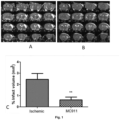
- determination of infarct size in vehicle and QN11 treated mice was performed in sequential MRI coronal 0.8-1 mm-thick brain slices ( Figures 1A, 1B ).
- MRI studies were performed at BiolmaC (ICTS Biolmagen Complutense), node of the ICTS ReDIB (https://www.redib.net/) using one tesla (1 T) benchtop MRI scanner ICON-1T; Bruker BioSpin (GmbH, Ettlingen, Germany).
- the system consists of a 1 T permanent magnet (without extra cooling required for the magnet) with a gradient coil that provides a gradient strength of 450 mT/m.
- the animal monitoring systems and the solenoid mouse head RF are integrated into the bed and they allow the animals to be handled on with accurate positioning of the coil and full control of anaesthesia and body temperature.
- MRI experiment consisted of three dimensional T 2 WI used to evaluate the vascular edema.
- the acquired matrix size was 120x 120 x 28 (resolution 0.150 x 0.150 x 0.500 mm) and total acquisition time was ⁇ 12 min. All MRI data was analysed using ImageJ software.
Landscapes
- Chemical & Material Sciences (AREA)
- Organic Chemistry (AREA)
- Health & Medical Sciences (AREA)
- Engineering & Computer Science (AREA)
- Bioinformatics & Cheminformatics (AREA)
- Biomedical Technology (AREA)
- Neurology (AREA)
- Neurosurgery (AREA)
- Chemical Kinetics & Catalysis (AREA)
- General Chemical & Material Sciences (AREA)
- Medicinal Chemistry (AREA)
- Nuclear Medicine, Radiotherapy & Molecular Imaging (AREA)
- Pharmacology & Pharmacy (AREA)
- Life Sciences & Earth Sciences (AREA)
- Animal Behavior & Ethology (AREA)
- General Health & Medical Sciences (AREA)
- Public Health (AREA)
- Veterinary Medicine (AREA)
- Pharmaceuticals Containing Other Organic And Inorganic Compounds (AREA)
Abstract
The invention relates to quinolin-2-yl nitrone derivatives of formula I, wherein R<sub>1</sub> to R<sub>7</sub> groups have the meanings defined in the description, and to their use for the treatment and/or prevention of a vascular disease, particularly for the treatment and/or prevention of cerebral ischemia or stroke.
Description
- The invention relates to quinolin-2-yl nitrone derivatives of formula I. The invention also relates to their use for the treatment and/or prevention of a vascular disease, particularly for the treatment and/or prevention of cerebral ischemia or stroke.
- Oxidative stress is possibly one of the most important molecular events occurring during and after cerebral ischemic injury, and in particular their induction of damage to the membrane lipids (Alper, G. et al. Eur. Nueropsychopharmacol. 1999, 9, 247-252). Current research efforts directed to find an efficient therapies for stroke, overcoming the limitations of current clinically administered thrombolytic recombinant tissue plasminogen activator (rtPA) or thrombectomy-based therapeutic approaches, are mainly focused on the identification of new, more efficient neuroprotective agents able to block and scavenge reactive oxygenated species (ROS). This is due to the high susceptibility of neuronal membranes to be attacked by ROS through the allylic carbon of polyunsaturated fatty acids, main component of these brain structures. The resulting lipid hydroperoxide species are very unstable in vivo and, in the presence of bio-metals, such as iron salts, can be decomposed to new ROS, which will trigger further free radical cascade reactions. Potential consequences of membrane lipids damage include changes in fluidity, permeability, and orientation of proteins embedded in the bilayer of the plasma membrane, along with other cellular endo-membranes, leading finally to cell death in the brain tissue.
- In this context, free radical scavengers, such as nitrones (Floyd, R. A.; Kopke, R. D. Choi, C. H.; Foster, S. B.; Doblas, S.; Towner, R. A. Nitrones as therapeutics. Free Radic. Biol. Med. 2008, 45, 1361-1374), have proved to be efficient neuroprotective agents in experimental ischemia studies. However, to date, no nitrone has been marketed for stroke treatment, due to failed clinical studies. This is the case of (Z)-α-phenyl-N-tert-butylnitrone (PBN) (Kalyanaraman, B.; Joseph, J.; Parthasarathy, S. The spin trap, α-phenyl N-tert-butylnitrone, inhibits the oxidative modification of low density lipoprotein (FEBS Lett. 1991, 280, 17-20), a simple but largely investigated nitrone that inhibits lipoprotein oxidation, reduces the oxidative damage to erythrocytes and the phenylhydrazine-induced peroxidation of lipids, and protects gerbils and mice from brain stroke and MPTP toxicity, respectively. In spite of this, nitrone PBN mechanism of action is still not clear. It does not seem due to its ability to act as a ROS trap, but to the suppression of inducible nitric oxide (NO) synthase expression, cytokine accumulation and apoptosis. On the other hand, the formation of NO from PBN spin adducts could also play a role in the observed effects in the central nervous system. Another well-known nitrone is sodium (Z)-4-((tert-butyloxidoazanylidene)methyl)benzene-1,3-disulfonate (NXY-059) (Kuroda, S.; Tsuchidate, R.; Smith, M. L.; Maples, K. R.; Siesjo, B. K. Neuroprotective effects of a novel nitrone, NXY-059, after transient focal cerebral ischemia in the rat. J. Cereb. Blood Flow Metab. 1999, 19, 778-787), which based on its good neuroprotection in suitable animal models of transient and permanent focal ischemia, it was assayed in several clinical studies, unfortunately without success. In spite of these unfulfilled expectations, the current efforts devoted to discover new nitrones for the treatment of stroke show and proves that the antioxidant and neuroprotective strategy is still a choice for the development of new drugs for stroke.
- In this context, in the present invention new nitrones have been synthesized and biologically evaluated as potential drugs for cerebral ischemia treatment.
- In previous studies (Z)-N-benzyl-1-(2-chloro-6-methylquinolin-3-yl)methanimine oxide RP19 (Chioua M, Sucunza D, Soriano E, Hadjipavlou-Litina D, Alcázar A, Ayuso I, Oset-Gasque MJ, Gonzalez MP, Monjas L, Rodríguez-Franco MI, Marco-Contelles J, Samadi A. α-aryl-N-alkyl nitrones, as potential agents for stroke treatment: synthesis, theoretical calculations, antioxidant, anti-inflammatory, neuroprotective, and brain-blood barrier permeability properties. J Med Chem. 2012, 55, 153-168) as potent antioxidant and neuroprotective agents. Remarkably, in the case of RP19, the biological analysis showed that this nitrone induced long-term cell viability after 5 d of recovery after oxygen-glucose deprivation in primary neuronal cultures, and significantly reduced ROS and lipid peroxidation production. Furthermore, pharmacological treatment with nitrone RP19 of reperfused animals after both global and focal ischemia, at the dose that was demonstrated to be neuroprotective in neuronal cultures, significantly decreased neuronal death and apoptosis induction, reduced the size of infarct, and improved the neurodeficit scores after 48 h or 5 days of reperfusion after ischemia.
- Considering the above, it would be desirable to improve the promising biological results gathered from nitrone RP19 to obtain more potent, efficient antioxidant and neuroprotective compounds for the treatment and/or prevention of a vascular diseases such as cerebral ischaemia and stroke.
- A first aspect of the present invention related to a compound of formula I:

- R1 independently represents C1-4 alkyl, phenyl or benzyl (Bn);
- each R2 to R7 independently represents H, C1-4 alkyl, phenyl, halogen, -OR8 or -NHR8; each R8 independently represents H or C1-4 alkyl, wherein C1-4 alkyl is optionally substituted by one or more R9.
- each R9 independently represents halogen, -OH, -OC1-4 alkyl, NH2, -NH(C1-4 alkyl) or Cy1; and
- Cy1 represents a 5-to-8-member ring, saturated, partially unsaturated or aromatic, which optionally contains from 1 to 3 heteroatoms selected from N, O, Se and/or S; wherein Cy1 may be attached to rest of the molecule through any available C or N atom, and wherein Cy1 is optionally substituted by one or more R10;
- each R10 independently represent -C1-4 alkyl optionally substituted by one or more R11; and
- each R11 independently represents -C2-4 alkynyl.
- In another embodiment the invention relates to the compound of formula I as defined above, wherein R1 represents H, -C1-4 alkyl or benzyl, and preferably R1 represents methyl (-Me), tert-butyl (-t-Bu) or benzyl (-Bn).
- In another embodiment the invention relates to the compound of formula I as defined above, wherein each R2 to R6 independently represents H.
- In another embodiment the invention relates to the compound of formula I as defined above, wherein each R2 to R6 represents H.
- In another embodiment the invention relates to the compound of formula I as defined above, wherein:
- R1 represents H, -C1-4 alkyl or benzyl, and preferably R1 represents methyl (-Me), tert-butyl (-t-Bu) or benzyl (-Bn); and
- each R2 to R6 independently represents H, and preferably each R2 to R6 represents H.
- In another embodiment the invention relates to the compound of formula I as defined above, wherein R7 represents H or -OR8.
- In another embodiment the invention relates to the compound of formula I as defined above, wherein R8 represents C1-4 alkyl optionally substituted by one or more R9.
- In another embodiment the invention relates to the compound of formula I as defined above, wherein:
- R7 represents -OR8; and
- R8 represents C1-4 alkyl optionally substituted by one or more R9.
- In another embodiment the invention relates to the compound of formula I as defined above, wherein R9 represents Cy1.
- In another embodiment the invention relates to the compound of formula I as defined above, wherein Cy1 represents a saturated 5- member ring, which contains 1 or 2 N heteroatoms; wherein Cy1 may be attached to rest of the molecule through any available C or N atom, and wherein Cy1 is optionally substituted by one or more R10.
- In another embodiment the invention relates to the compound of formula I as defined above, wherein:
- R9 represents Cy1; and
- Cy1 represents a saturated 5- member ring, which contains 1 or 2 N heteroatoms; wherein Cy1 may be attached to rest of the molecule through any available C or N atom, and wherein Cy1 is optionally substituted by one or more R10.
- In another embodiment the invention relates to the compound of formula I as defined above, wherein R10 represents -C1-4 alkyl optionally substituted by one or more R11, and preferably R10 represent methyl substituted by one R11.
- In another embodiment the invention relates to the compound of formula I as defined above, wherein:
- R9 represents Cy1;
- Cy1 represents a saturated 5- member ring, which contains 1 or 2 N heteroatoms; wherein Cy1 may be attached to rest of the molecule through any available C or N atom, and wherein Cy1 is optionally substituted by one or more R10; and
- R10 represents -C1-4 alkyl optionally substituted by one or more R11, and preferably R10 represent methyl substituted by one R11.
- In another embodiment the invention relates to the compound of formula I as defined above, wherein:
- R1 represents H, -C1-4 alkyl or benzyl, and preferably R1 represents methyl (-Me), tert-butyl (-t-Bu) or benzyl (-Bn);
- R2 to R6 represents H; and
- R7 represents -OR8.
- In another embodiment the invention relates to the compound of formula I as defined above, wherein:
- R1 represents H, -C1-4 alkyl or benzyl, and preferably R1 represents methyl (-Me), tert-butyl (-t-Bu) or benzyl (-Bn);
- R2 to R6 represents H,
- R7 represents -OR8; and
- R8 represents C1-4 alkyl, wherein C1-4 alkyl is optionally substituted by one or more R9.
- In another embodiment the invention relates to the compound of formula I as defined above, wherein:
- R1 represents H, -C1-4 alkyl or benzyl, and preferably R1 represents methyl (-Me), tert-butyl (-t-Bu) or benzyl (-Bn);
- R2 to R6 represents H,
- R7 represents -OR8;
- R8 represents C1-4 alkyl, wherein C1-4 alkyl is optionally substituted by one or more R9 and
- R9 represents Cy1.
- In another embodiment the invention relates to the compound of formula I as defined above, wherein:
- R1 represents H, -C1-4 alkyl or benzyl, and preferably R1 represents methyl (-Me), tert-butyl (-t-Bu) or benzyl (-Bn);
- R2 to R6 represents H,
- R7 represents -OR8;
- R8 represents C1-4 alkyl, wherein C1-4 alkyl is optionally substituted by one or more R9; R9 represents Cy1; and
- Cy1 represents a saturated 5- member ring, which contains 1 or 2 N heteroatoms; wherein Cy1 may be attached to rest of the molecule through any available C or N atom, and wherein Cy1 is optionally substituted by one or more R10.
- In another embodiment the invention relates to the compound of formula I as defined above, wherein:
- R1 represents H, -C1-4 alkyl or benzyl, and preferably R1 represents methyl (-Me), tert-butyl (-t-Bu) or benzyl (-Bn);
- R2 to R6 represents H,
- R7 represents -OR8;
- R8 represents C1-4 alkyl, wherein C1-4 alkyl is optionally substituted by one or more R9; R9 represents Cy1; and
- Cy1 represents a saturated 5- member ring, which contains 1 or 2 N heteroatoms; wherein Cy1 is attached to rest of the molecule through any N atom, and wherein Cy1 is optionally substituted by one or more R10.
- In another embodiment the invention relates to the compound of formula I as defined above, wherein:
- R1 represents H, -C1-4 alkyl or benzyl, and preferably R1 represents methyl (-Me), tert-butyl (-t-Bu) or benzyl (-Bn);
- R2 to R6 represents H,
- R7 represents -OR8;
- R8 represents C1-4 alkyl, wherein C1-4 alkyl is optionally substituted by one or more R9; R9 represents Cy1; and
- Cy1 represents a saturated 5- member ring, which contains 1 or 2 N heteroatoms; wherein Cy1 is attached to rest of the molecule through any N atom, and wherein Cy1 is substituted by one R10.
- In another embodiment the invention relates to the compound of formula I as defined above, wherein:
- R1 represents H, -C1-4 alkyl or benzyl, and preferably R1 represents methyl (-Me), tert-butyl (-t-Bu) or benzyl (-Bn);
- R2 to R6 represents H,
- R7 represents -OR8;
- R8 represents C1-4 alkyl, wherein C1-4 alkyl is optionally substituted by one or more R9; R9 represents Cy1;
- Cy1 represents a saturated 5- member ring, which contains 1 or 2 N heteroatoms; wherein Cy1 is attached to rest of the molecule through any N atom, and wherein Cy1 is substituted by one R10; and
- R10 represents -C1-4 alkyl optionally substituted by one or more R11, and preferably R10 represent methyl substituted by one R11.
- In another embodiment the invention relates to the compound of formula I as defined above, wherein:
- R1 represents H, -C1-4 alkyl or benzyl, and preferably R1 represents methyl (-Me), tert-butyl (-t-Bu) or benzyl (-Bn);
- R2 to R6 represents H; and
- R7 represents H.
- In another embodiment the invention relates to the compound of formula I as defined above, selected from:
- (Z)-N-tert-Butyl-1-(8-(3-(piperidin-1-yl)propoxy)quinolin-2-yl)methanimine oxide (3);
- (Z)-N-Benzyl-1-(8-(3-(piperidin-1-yl)propoxy)quinolin-2-yl)methanimine oxide (4);
- (Z)-N-tert-Butyl-1-(8-(3-(4-(prop-2-yn-1-yl)piperazin-1-yl)propoxy)quinolin-2-yl)methanimine oxide (7);
- (Z)-N-Benzyl-1-(8-(3-(4-(prop-2-yn-1-yl)piperazin-1-yl)propoxy)quinolin-2-yl)methanimine oxide (8);
- (Z)-1-(8-Hydroxyquinolin-2-yl)-N-methylmethanimine oxide (9);
- (Z)-N-tert-butyl-1-(8-hydroxyquinolin-2-yl)methanimine oxide (10); and
- (Z)-N-Benzyl-1-(8-hydroxyquinolin-2-yl)methanimine oxide (QN11).
- Some compounds of formula I can have chiral centers that can give rise to various stereoisomers. The present invention relates to each of these stereoisomers and also mixtures thereof.
- Another aspect of the invention relates to a pharmaceutical composition which comprises a compound of formula I as defined above and one or more pharmaceutically acceptable excipients.
- As indicated above, the pharmaceutical composition comprises the compound of formula I as defined above and one or more pharmaceutically acceptable excipients. The excipients must be "acceptable" in the sense of being compatible with the other ingredients of the composition and not deleterious to the recipients thereof.
- Another aspect of the invention relates to a compound of formula I as defined above or to a pharmaceutical composition thereof, for use as a medicament.
- Another aspect of the invention relates to a compound of formula I as defined above or to a pharmaceutical composition thereof, for use for the treatment and/or prevention of a vascular diseases, and preferably wherein the vascular disease is cerebral ischaemia or stroke.
- Another aspect of the invention relates to the use of the compound of formula I as defined above or to the use of the pharmaceutical composition as defined above, for the manufacture of a medicament.
- Another aspect of the invention relates to a method of treating and/or preventing a disease in a subject in need thereof, especially an animal or a human being, which comprises administering to said subject the compound of formula I as defined above or the pharmaceutical composition thereof as defined above.
- The composition of the present invention can be administered in the form of any pharmaceutical formulation, the nature of which, as it is well known, will depend upon the nature of the active compound and its route of administration. Any route of administration may be used, for example oral, parenteral, nasal, ocular, rectal and topical administration.
- The dosage and frequency of doses will depend upon the nature and severity of the disease to be treated, the age, the general condition and body weight of the patient, as well as the composition administered and the route of administration, among other factors.
- The compounds of formula I as defined above or a pharmaceutical composition thereof, can be administered separately or in combination, particularly as adjuvant therapy administered simultaneously, alternatively or successively with respect to a first-line therapy suitable for the treatment and/or prevention of a vascular diseases, and preferably wherein the vascular disease is cerebral ischemia or stroke. In this sense, the compounds of formula I or a pharmaceutical composition thereof administered simultaneously, alternatively or successively with respect to a thrombolytic agent/s and/or thrombectomy procedures, result in particularly suitable therapy for the treatment of a vascular diseases, particularly cerebral ischaemia or stroke.
- Thus, another embodiment relates to the compound of formula I or the pharmaceutical composition for the use as defined above, which is used in adjuvant therapy and administered simultaneously, alternatively or successively with respect to a first-line therapy aspect, preferably wherein the cardiovascular diseases is cerebral ischemia or stroke, and wherein said first line therapy comprises the use of a thrombolytic agent, preferably the use of recombinant tissue plasminogen activator (rt-PA), and/or thrombectomy procedures.
- In the above definitions, the term C1-4 alkyl, as a group or part of a group, means a straight or branched alkyl chain which contains from 1 to 4 carbon atoms and includes, the groups methyl, ethyl, propyl, isopropyl, butyl, isobutyl, sec-butyl and tert-butyl.
- The term C2-4 alkynyl, as a group or part of a group, means an alkynyl chain which contains from 2 to 4 carbon and includes ethynyl, 1-propynyl, 2-propinyl, 1-butynyl, 2-butynyl and 3-butynyl.
- The term "halogen" refers to fluorine, chlorine, bromine, or iodine.
- Some of the compounds of the present invention may exist as several diastereoisomers and/or several optical isomers. Diastereoisomers can be separated by conventional techniques such as chromatography or fractional crystallization. Optical isomers can be resolved by conventional techniques of optical resolution to give optically pure isomers. This resolution can be carried out on any chiral synthetic intermediate or on products of formula I. Optically pure isomers can also be individually obtained using enantiospecific synthesis. The present invention covers all individual isomers as well as mixtures thereof (for example racemic mixtures or mixtures of diastereomers), whether obtained by synthesis or by physically mixing them.
- Additionally, the present invention relates to a method for identifying and evaluating, in a rapid and optionally robotic manner, compounds having high neuroprotective power and involving a possible effective treatment of stroke.
- Accordingly, another aspect of the invention relates to the use of a compound of formula I or a pharmaceutical composition thereof as defined above, for identifying and evaluating in a robotic manner other compounds having high neuroprotective power which may be useful as a medicament, preferably for the treatment and/or prevention of stroke.
- Quinolin-2-yl nitrones of formula I and geometric isomers thereof are used to carry out said drug screening. To verify the neuroprotective activity of said quinolin-2-yl nitrones of formula I and to enable selecting those compounds with the highest activity, their neuroprotective power is determined using any in vitro or in vivo model or assay suited to that end. Said models or assays are known for the person skilled in the art; nevertheless, and merely by way of example, a possible assay for determining the neuroprotective activity of quinolin-2-yl nitrones of formula I and their possible usefulness in the treatment of vascular diseases, would be in primary neuronal cultures, cultured from 6 to 8 d, taken from the cerebral cortex of rats, where cell viability is determined (Quevedo, C, Salinas, M, Alcázar, A. Initiation factor 2B activity is regulated by protein phosphatase 1, which is activated by the mitogen-activated protein kinase-dependent pathway in insulin-like growth factor 1-stimulated neuronal cells. J. Biol. Chem. 2003, 278, 16579-16586), and subjected to oxygen-glucose deprivation.
- Unless otherwise defined, all technical and scientific terms used herein have the same meaning as commonly understood by one of ordinary skilled in the art to which this invention belongs. Methods and materials similar or equivalent to those described herein can be used in the practice of the present invention. Throughout the description and claims the word "comprise" and its variations are not intended to exclude other technical features, additives, components, or steps. Additional objects, advantages and features of the invention will become apparent to those skilled in the art upon examination of the description or may be learned by practice of the invention. The following examples and drawings are provided by way of illustration and are not intended to be limiting of the present invention.
-
Fig. 1 . Shows the MRI study after 48 h of surgery. Note the lesion with T2 WI hyperintensity restricted to the left side of the cerebral cortex. Treatment with QN11 reduces the infarct volume after pMCAO in mice. Studies were performed 48 h after pMCAO. T2WItaken from vehicle treated b group (A) and QN11 c treated group (B) randomly chosen ischemic mices are shown. Infarct volumes were quantified from T2WI using ImageJ free software (C). Graphic represents the percentage of the infarct volume with respect to the total volume of the brain. Data are mean ± SEM, n= 7-8. Statistical significance was evaluated by two-way ANOVA followed by post hoc Bonferroni's test to compare paired experimental points (**p < 0.01). - General Methods. Reactions were monitored by TLC using precoated silica gel aluminium plates containing a fluorescent indicator (Merck, 5539). Detection was done by UV (254 nm) followed by charring with sulfuric-acetic acid spray, 1% aqueous potassium permanganate solution or 0.5% phosphomolybdic acid in 95% EtOH. Anhydrous Na2SO4 was used to dry organic solutions during workups and the removal of solvents was carried out under vacuum with a rotary evaporator. Flash column chromatography was performed using silica gel 60 (230-400 mesh, Merck). Melting points were determined on a Kofler block and are uncorrected. IR spectra were obtained on a Perkin-Elmer Spectrum One spectrophotometer. 1H NMR spectra were recorded with a Varian VXR-200S spectrometer, using tetramethylsilane as internal standard and 13C NMR spectra were recorded with a Bruker WP-200-SY. All the assignments for protons and carbons were in agreement with 2D COSY, HSQC, HMBC, and 1D NOESY spectra. Values with (*) can be interchanged. The purity of compounds was checked by elemental analyses, conducted on a Carlo Erba EA 1108 apparatus, and confirmed to be ≥95%.
- General procedure for the synthesis of nitrones. A solution of the corresponding carbaldehyde (1 mmol), Na2SO4 (3 mmol), AcONa (2 mmol) and the appropriate N-alkylhydroxylamine hydrochloride (1.5 mmol) in EtOH (5 mL) was heated at 90 °C for 2-3 h under MWI. After that time, the solvent was evaporated, and the crude mixture was purified on column chromatography using the indicated mixtures of solvents.
- Scheme 1 depicted the synthesis of QNs 3 and 4.

- 8-(3-(Piperidin-1-yl)propoxy)quinoline-2-carbaldehyde (2). A solution of commercial 8-hydroxyquinoline-2-carbaldehyde (1) (103.9 mg, 0.6 mmol) in CHCl3 (3.6 mL)/ water (0,6 mL), K2CO3 (249 mg, 1.8 mmol) and commercial 1-(3-chloropropyl)piperidine (178.32 mg, 0.9 mmol) were added. The mixture was vigorously stirred and heated at 80 °C for 1 d. After that time, the solvent was evaporated under reduced pressure and the crude mixture was purified on column chromatography (DCM/MeOH 7%) to yield compound 2 as a yellow solid (158.7 mg, 89%): mp 44-6°C; IR (KBr) δ 2932, 1709, 1462, 1323, 1102 cm-1; 1H NMR (400 MHz, CDCl3) δ 10.20 (s, 1H), 8.18 (dd, J = 8.5, 0.9 Hz, 1H), 7.97 (d, J = 8.4 Hz, 1H), 7.52 (t, J = 8.0 Hz, 1H), 7.37 (dd, J = 8.3, 1.1 Hz, 1H), 7.12 (dd, J = 7.9, 1.2 Hz, 1H), 4.29 (t, J = 6.8 Hz, 2H), 2.62 - 2.51 (m, 2H), 2.50 - 2.30 (m, 4H), 2.25 - 2.12 (m, 2H), 1.55 (p, J = 5.6 Hz, 4H), 1.39 (q, J= 5.7, 4.3 Hz, 2H); 13C NMR (101 MHz, CDCl3) δ 193.9, 155.5, 151.4, 140.1, 137.2, 131.4, 129.8, 119.5, 117.7, 109.9, 67.9, 55.78, 54.6 (2C), 26.33, 25.8 (2C), 24.3. HRMS (ESI_ACN) Calcd. for C18H22N2O2: 298.1682. Found: 298.1690.
- (Z)-N-tert-Butyl-1-(8-(3-(piperidin-1-yl)propoxy)quinolin-2-yl)methanimine oxide (3). Following the general method for the synthesis of nitrones, a solution of carbaldehyde 2 (79.35 mg, 0.27 mmol), Na2SO4 (76.68 mg, 0.54 mmol), AcONa (26.57 mg, 0.324 mmol) and N-tert-butylhydroxylamine hydrochloride (40.69 mg, 0.324 mmol) in EtOH (5 mL) was heated at 95 °C for 3 h under MWI. Then, the solvent was evaporated and the crude mixture was purified on column chromatography (DCM/MeOH 7%) to yield compound 3 as a yellow solid (52.3 mg, 52%): mp 135-7 °C; IR (KBr) δ 3493, 2942, 1615, 1261, 1096 cm-1; 1H NMR (400 MHz, CDCl3) δ 9.27 (d, J = 8.8 Hz, 1H), 8.36 - 8.13 (m, 1H), 7.53 - 7.41 (m, 2H), 7.16 -7.04 (m, 1H), 4.37 (t, J = 5.7 Hz, 2H), 3.61 (d, J = 11.9 Hz, 2H), 3.43 - 3.28 (m, 2H), 2.68 (dd, J = 15.8, 6.7 Hz, 4H), 2.32 (d, J = 13.8 Hz, 2H), 2.00 - 1.79 (m, 4H), 1.67 (s, 9H); 13C NMR (101 MHz, CDCl3) δ 137.5, 132.1, 129.6, 127.6, 127.5, 121.9, 120.4, 119.1, 110.2, 110.0, 72.5. 66.7, 55.4, 53.5 (2C), 28.4 (3C), 23.9, 22.7 (2C), 22.2. HRMS (ESI_ACN) Calcd. for C22H31N3O2: 369.24163. Found: 369.24136.
- (Z)-N-Benzyl-1-(8-(3-(piperidin-1-yl)propoxy)quinolin-2-yl)methanimine oxide (4). Following the general method for the synthesis of nitrones, a solution of carbaldehyde 2 (79.35 mg, 0.27 mmol), Na2SO4 (76.68 mg, 0.54 mmol), AcONa (26.57 mg, 0.324 mmol) and N-benzylhydroxylamine hydrochloride (51.71 mg, 0.324 mmol) in EtOH (5 mL) was heated at 90 °C for 2 h under MWI. After that time, the solvent was evaporated and the crude mixture was purified on column chromatography (DCM/MeOH 7%) to yield compound 4 as a mixture of Z and E isomers in a 3.5:1 ratio, that were unable to separate, as a yellow solid (59.7 mg, 55%): mp 108-10 °C; IR (KBr) δ 3420, 2935, 1600, 1455, 1105 cm-1; 1H NMR (400 MHz, CDCl3) [(minor isomer E ) 8.17 (d, J = 8.8 Hz, 1H, H4), 7.79 (s, 1H, CH=N), 7.74 (dd, J = 8.4, 1.1 Hz, 1H, H3), 7.55 (dd, J= 7.0, 2.5 Hz, 1H, H5), 7.09 (br d, J= 1.5 Hz, 1H, H7), 5.43 (s, 1H, CH 2C6H5), (major isomer Z ) 9.15 (d, J = 8.8 Hz, 1H, H4), 8.17 (d, J = 8.8 Hz, 1H, H3), 8.08 (s, 1H, CH=N), 7.07 (br d, J= 7.5 Hz, 1H, H7), 5.15 (s, 1H, CH 2C6H5)], 8.28 - 8.26 (m, 1H, C6H5), 7.54 (br d, J= Hz, 1H, H5), 7.44 - 7.38 (m, 6H, H6, C6H5), 7.45 (t, J= Hz, 1H, H6), 7.52 - 7.37 (m, 4H, C6H5), 4.31 (t, J= Hz., 2H, OCH2), 3.15 - 2.65 (m, 6H), 2.43-2.41 (m, 2H), 1.98-1.70 (m, 4 H), 1.65-1.51 (m, 2H). HRMS (ESI_ACN) Calcd. for C25H29N3O2: 403.22598. Found: 403.22528.
-
Scheme 2 depicted the synthesis of QNs 7 and 8.
- 1-(3-Chloropropyl)-4-(prop-2-yn-1-yl)piperazine (5). To solution of commercial 1-(3-chloropropyl)piperazine dihydrochloride (702 mg, 3 mmol, 1 equiv), TEA (0,84 mL, 6 mmol, 2 equiv) in dry CH2Cl2 (5 mL), cooled at 0 °C, propargyl bromide (0,81 mL, 9 mmol, 3 equiv) was added over 30 min under Ar. The mixture was stirred at rt for 24 h and then treated with a saturated sodium bicarbonate solution (10 mL). The organic layer was separated and washed with saturated brine, and dried over anhydrous sodium sulfate. The solvent was removed under reduced pressure and the residue purified by column chromatography through silica gel (CH2Cl2/MeOH 1%-2%), to yield 5 (312 mg, 52%) as a colorless oil: 1H NMR (400 MHz, CDCl3) δ 3.53 (t, J = 6.6 Hz, 2H), 3.23 (d, J = 2.5 Hz, 2H), 2.54 - 2.39 (m, 10H), 2.18 (t, J = 2.5 Hz, 1H), 1.88 (p, J = 6.7 Hz, 2H); 13C NMR (101 MHz, CDCl3) δ 78.8, 73.2, 55.4, 53.1 (2C), 51.9 (2C), 46.8, 43.2, 29.9.
- 8-(3-(4-(Prop-2-yn-1-yl)piperazin-1-yl)propoxy)quinoline-2-carbaldehyde (6). A solution of commercial 8-hydroxyquinoline-2-carbaldehyde (1) (91.69 mg, 0.53 mmol) in CHCl3 (5 mL) was added K2CO3 (219.42 mg, 1.59 mmol) and 1-(3-chloropropyl)-4-(prop-2-yn-1-yl)piperazine (5) (138 mg, 0.69 mmol); then, water (1 mL) was added. The mixture was vigorously stirred and heated at 80 °C for 2 d. After that time, the solvent was evaporated under reduced pressure and the crude mixture was purified on column chromatography (DCM/MeOH 4%) to yield compound 6 as a yellow solid (95.5 mg, 53%): mp 99-101 °C; IR (KBr) δ 3128, 2829, 1715, 1462, 1320, 1094 cm-1; 1H NMR (400 MHz, CDCl3) δ 10.20 (s, 1H), 8.20 (d, J = 8.4 Hz, 1H), 7.98 (d, J = 8.5 Hz, 1H), 7.53 (t, J = 8.5 Hz, 1H), 7.39 (d, J = 8.5 Hz, 1H), 7.13 (d, J = 8.4 Hz, 1H), 4.31 (t, J= 6.5 Hz, 2H), 3.24 (s, 2H), 2.76 - 2.36 (m, 10H), 2.26 - 2.13 (m, 3H); 13C NMR (101 MHz, CDCl3) δ 193.8, 155.5, 151.4, 140.1, 137.2, 131.4, 129.8, 119.6, 117.8, 110.0, 78.8, 73.2, 67.7, 55.0, 53.0 (2C), 51.8 (2C), 46.8, 26.3. HRMS (ESI_ACN) Calcd. for C20H23N3O2: 337.1790. Found: 337.1790.
- (Z)-N-tert-Butyl-1-(8-(3-(4-(prop-2-yn-1-yl)piperazin-1-yl)propoxy)quinolin-2-yl)methanimine oxide (7). Following the general method for the synthesis of nitrones, the reaction of carbaldehyde 6 (69 mg, 0.20 mmol) with Na2SO4 (57 mg, 0.4 mmol), AcONa (26 mg, 0.32 mmol) and N-tert-butylhydroxylamine hydrochloride (38 mg, 0.3 mmol) in EtOH (5 mL) after 5 min, and column chromatography (DCM/MeOH 3%) yielded compound 7 as a yellow gum (55.7 mg, 66%): IR (KBr) δ 3428, 2819, 1451, 13206, 1155, 1104 cm-1; 1H NMR (400 Hz, CDCl3) δ 9.26 (d, J = 8.8 Hz, 1H), 8.19 (d, J = 8.8 Hz, 1H), 8.13 (s, 1H), 7.44-7.38 (m, 2H,), 7.08-7.06 (m, 1H), 4.29 (t, J = 6.9 Hz, 2H), 3.30-3.28 (m, 2H), 2.63 (s, 10H), 2.32 - 2.17 (m, 3H), 1.65 (s, 9H); 13C NMR (126 MHz, CDCl3) δ 154.6, 149.8, 140.2, 136.6, 132.6, 129.5, 127.3, 121.7, 119.5, 109.0, 78.7, 73.4, 72.0, 67.7, 55.0, 53.0 (2C), 51.8 (2C), 46.8, 28.3 (3C), 26.3. HRMS (ESI_ACN) Calcd for C24H32N4O2: 408,2525. Found: 408,2525.
- (Z)-N-Benzyl-1-(8-(3-(4-(prop-2-yn-1-yl)piperazin-1-yl)propoxy)quinolin-2-yl)methanimine oxide (8). Following the general method for the synthesis of nitrones, a solution of carbaldehyde 6 (95.5 mg, 0.28 mmol), treated with Na2SO4 (79.52 mg, 0.56 mmol), NaHCO3 (35.28 mg, 0.42 mmol) and N-benzylhydroxylamine hydrochloride (67.03 mg, 0.42 mmol), in THF (5 mL), reacted instantly. After that time, the solvent was evaporated and the crude mixture was purified on column chromatography (DCM/MeOH 3%) to yield compound 8 as a mixture of E and Z isomers in a 1.5:1 ratio, that were unable to separate, as a yellow gum (92.5 mg, 75%): IR(KBr) δ 3429, 2817, 1457, 1320, 1151, 1104 cm-1; 1H NMR (500 MHz, CDCl3) δ [(major isomer E ) 8.17 (d, J = 8.5 Hz, 1H, H4), 7.81 (d, J = 8.5 Hz, 1H, H3), 7.75 (s, 1H, CH=N), 7.55 (dd, J= 7.8, 1.7 Hz, 1H, H5), 7.12 (dd, J= 7.7, 1.2 Hz, 1H, H7), 5.44 (s, 1H, CH 2C6H5), 3.30 (d, J = 2.4 Hz, 2H, CH2C≡CH), (minor isomer Z ) 9.18 (d, J = 8.7 Hz, 1H, H4), 8.19 (d, J = 8.7 Hz, 1H, H3), 8.06 (s, 1H, CH=N), 7.10 (dd, J= 7.7, 1.3 Hz, 1H, H7), 5.14 (s, 1H, CH 2C6H5), 3.31 (d, J = 2.4 Hz, 2H, CH 2C≡CH)], 8.26 - 8.24 (m, 1H, C6H5), 7.45 (t, J= Hz, 1H, H6), 7.52 - 7.37 [m, 4H, H5 (minor)], C6H5), 4.31 (t, J= Hz, 2H, OCH2), 2.75 - 2.50 (m, 10H), 2.25-2.24 (m, 1H, CH2C≡CH), 2.24-2.16 (h, J= Hz, 2H, NCH2CH 2CH2O). HRMS (ESI_ACN) Calcd for C27H30ClN4O2: 442.2369. Found: 442.2369.
- Scheme 3 depicted the synthesis of of compounds 9, 10 and QN11.

- (Z)-1-(8-Hydroxyquinolin-2-yl)-N-methylmethanimine oxide (9). Following the general method for the synthesis of nitrones, the reaction of 8-hydroxyquinoline-2-carbaldehyde (1) (173 mg, 1 mmol, 1 equiv) with Na2SO4 (426 mg, 3 mmol, 3 equiv), AcONa (160 mg, 2 mmol, 1.6 equiv) and N-methylhydroxylamine hydrochloride (239 mg, 1.5 mmol, 1.5 equiv) in EtOH (7 mL) at 90 °C for 10 min, after column chromatography (hexane/AcOEt 9/1) yielded compound 9 as a pale yellow solid (171 mg, 85%): 149-151 ºC; 1H NMR (300 MHz, CDCl3) δ 9.16 (d, J = 8.8 Hz, 1H), 8.25 (d, J = 8.8 Hz, 1H), 8.03 (br s, 1H), 7.86 (s, 1H), 7.51-7.46 (m, 1H), 7.36 (dd, J = 7.6, 1.3 Hz, 1H), 7.18 (dd, J = 7.6, 1.3 Hz, 1H), 4.01 (s, 3H); 13C NMR (100 MHz, CDCl3) δ 152.1, 147.7, 138.1, 136.8, 136.4, 128.7, 128.6, 121.4, 117.8, 110.1, 55.1. HRMS (ESI_ACN) Calcd. for C11H10N2O2: 202,0742. Found 202,0742.
- (Z)-N-tert-butyl-1-(8-hydroxyquinolin-2-yl)methanimine oxide (10). Following the general method for the synthesis of nitrones, the reaction of 8-hydroxyquinoline-2-carbaldehyde (1) (173 mg, 1 mmol, 1 equiv) with Na2SO4 (426 mg, 3 mmol, 3 equiv), AcONa (160 mg, 2 mmol, 1.6 equiv) and N- tert-butylhydroxylamine hydrochloride (188 mg, 1.5 mmol, 1.5 equiv) in EtOH (7 mL) at 90 °C for 5 min, after column chromatography (hexane/AcOEt 9/1), yielded compound 10 as a pale yellow solid (159 mg, 92%): 103-4 ºC; 1H NMR (400 MHz, CDCl3) δ 9.16 (d, J= 8.8 Hz, 1H), 8.16 (d, J = 8.8 Hz, 1H), 8.04 (br s , 1H), 7.97 (s, 1H), 7.41-7.39 (m, 1H), 7.27 (dd, J = 7.6, 1.2 Hz, 1H), 7.09 (dd, J = 7.6, 1.2 Hz, 1H), 1.62 (s, 9H); 13C NMR (100 MHz, CDCl3) δ 152.0, 148.5, 138.1, 136.7, 131.5, 128.5, 128.4, 121.7, 117.8, 110.0, 72.1, 28.4 (3C). HRMS (ESI_ACN) Calcd. for C14H16N2O2: 244,1212. Found 244,1212.
- (Z)-N-Benzyl-1-(8-hydroxyquinolin-2-yl)methanimine oxide (QN11). Following the general method for the synthesis of nitrones, the reaction of 8-hydroxyquinoline-2-carbaldehyde (1) (173 mg, 1 mmol, 1 equiv), Na2SO4 (426 mg, 3 mmol, 3 equiv.), AcONa (160 mg, 2 mmol, 1.6 equiv.) and N-benzylhydroxylamine hydrochloride (239 mg, 1.5 mmol, 1.5 equiv.) in EtOH (7 mL) was heated at 90°C during 10 min under mw irradiation. After that time, the solvent was evaporated and the crude mixture was purified on column chromatography (Hexanes/AcOEt 9/1) to yield compound QN11 as a pale yellow solid (272 mg, 98%): 110-1 ºC; 1H NMR (400 MHz, CDCl3) δ 9.15 (d, J = 8.8 Hz, 1H), 8.22 (d, J = 8.8 Hz, 1H), 8.00 (br s, 1H), 7.88 (s, 1H), 7.55-7.51(m, 2H), 7.44-7.37 (m, 4H), 7.26 (dd, J = 7.6, 1.2 Hz, 1H), 7.08 (dd, J = 7.6, 1.2 Hz, 1H), 5.09 (s, 2H); 13C NMR (100 MHz, CDCl3) δ 152.1, 147.7, 138.1, 136.8, 135.3, 132.7, 129.5 (2C), 129.3, 129.2 (2C), 128.7, 128.6, 121.6, 117.8, 110.1, 72.1. HRMS (ESI_ACN) Calcd. for C17H14N2O2: 278,1055. Found 278,1055.
- To study of the effects of QN11 on stroke recovery, administration of the vehicle and QN11 molecule was performed intraperitoneally, to 8-week-old male C57BL/6J mice (Harlan) weighing 25-30 g. All procedures with animals were carried out under a protocol approved by the Ethical Committee of the Spanish National Research Council (CSIC), and recommendations of the European Council. A special effort was made to keep to a minimum necessary the number of animals to achieve adequate significance. For surgery, anaesthesia induction was carried out with 3% isoflurane (in 70% N2O, 30% O2), followed by 2% isoflurane for maintenance during stroke procedure. Rectal temperature was maintained at 36.5 ºC with the use of a heating pad. The common branch of the middle cerebral artery was, after craniotomy, exposed and occluded permanently by suture ligation. To ensure a complete artery occlusion during surgery, cortical blood flow was monitored by non-invasive laser Doppler flowmetry, as a quality control, with the aid of a Perimed equipment (PeriFlux System 5000 Stroke Model Monitor, Perimed, Järfälla, Sweden). The study was exclusively performed in animals that showed post-ligature a drop of blood flow of at least 65%. Animals subjected to surgery for longer than 15 min were excluded of the study. Physiological parameters were maintained. Experiments were performed in each of the following groups: (a) sham operated (n= 6 animals); (b) pMCAO vehicle control group (saline buffer containing 29% dimethyl sulfoxide, DMSO) (n= 7), and (c) pMCAO QN11 treated group (85 mg/kg QN11 dissolved in vehicle) (n= 8). Drug administration was 15 min after arterial ligature.
- MRI is the most commonly used diagnostic tool for stroke. Diffusion-weighted images (WI) were acquired in T2 (T2WI) as a tool to obtain precise images of the vascular edema, with a resolution limit of 0.8-1 mm3. This information is needed to delineate lesion boundaries for assessment of intracranial edema location and growth pattern evaluation. In this study, determination of infarct size in vehicle and QN11 treated mice was performed in sequential MRI coronal 0.8-1 mm-thick brain slices (
Figures 1A, 1B ). MRI studies were performed at BiolmaC (ICTS Biolmagen Complutense), node of the ICTS ReDIB (https://www.redib.net/) using one tesla (1 T) benchtop MRI scanner ICON-1T; Bruker BioSpin (GmbH, Ettlingen, Germany). The system consists of a 1 T permanent magnet (without extra cooling required for the magnet) with a gradient coil that provides a gradient strength of 450 mT/m. The animal monitoring systems and the solenoid mouse head RF are integrated into the bed and they allow the animals to be handled on with accurate positioning of the coil and full control of anaesthesia and body temperature. MRI experiment consisted of three dimensional T2WI used to evaluate the vascular edema. Three-dimensional T2WI were acquired using a rapid acquisition with relaxation enhancement (RARE) technique, with a repetition time (TR) = 2500 s, echo train length = 12, interecho interval = 18 ms (resulting in an effective echo time (TE) = 90 ms), number of average = 1, field of view (FOV) = 18 x 18 x 14 mm. The acquired matrix size was 120x 120 x 28 (resolution 0.150 x 0.150 x 0.500 mm) and total acquisition time was ~ 12 min. All MRI data was analysed using ImageJ software. - The experiments compared infarct volume outcome between group's b and c (
Figures 1A, 1B , respectively). Sham operated control group (a) showed with certainty that stroke was not due to the surgical pre-occlusive procedure. Infarct volumes, shown in mm3 were obtained integrating infarcted areas by counting pixels contained within the regions of interest. Each side of the coronal sections was sampled. Compared with vehicle-treated animals (b), a significant reduction in the percentage of brain infarct volume (74,47%) was appreciated in QN11 treated group (c) (Figure 1C ). With regard to the whole brain volume, the infarct volume in group b represented 2.453 %, whereas in group a it dropped to 0.6262%. Statistical significance was evaluated by two-way ANOVA followed by post hoc Bonferroni's test Student to determine the statistical significance of differences of infarct values between vehicle (b) and the QN11 treated (c) mice. P value < 0.05 was considered significant. - These results show evidence which suggest that quinolylnitrone QN11 is a therapeutic target for stroke, showing easy and efficient penetration of the compound through the BBB (Brain Blood Barrier).
Claims (15)
- A compound of formula I:
 R1 independently represents C1-4 alkyl, phenyl or benzyl (Bn);each R2 to R7 independently represents H, C1-4 alkyl, phenyl, halogen, -OR8 or -NHR8;each R8 independently represents H or C1-4 alkyl, wherein C1-4 alkyl is optionally substituted by one or more R9.each R9 independently represents halogen, -OH, -OC1-4 alkyl, NH2, -NH(C1-4 alkyl) or Cy1; andCy1 represents a 5-to-8-member ring, saturated, partially unsaturated oraromatic, which optionally contains from 1 to 3 heteroatoms selected from N, O, Se and/or S; wherein Cy1 may be attached to rest of the molecule through any available C or N atom, and wherein Cy1 is optionally substituted by one or more R10;each R10 independently represent -C1-4 alkyl optionally substituted by one or more R11; andeach R11 independently represents -C2-4 alkynyl.
 - The compound of formula I according to claim 1, wherein R1 represents H, -C1-4 alkyl or benzyl, and preferably R1 represents methyl (-Me), tert-butyl (-t-Bu) or benzyl (-Bn).
- The compound of formula I according to any of claims 1 or 2, wherein each R2 to R6 independently represents H.
- The compound of formula I according to any of claims 1 to 3, wherein R7 represents H or -OR8.
- The compound of formula I according to any of claims 1 to 4, wherein R8 represents C1-4 alkyl optionally substituted by one or more R9.
- The compound of formula I according to any of claims 1 to 5, wherein R9 represents Cy1.
- The compound of formula I according to any of claims 1 to 6, wherein Cy1 represents a saturated 5- member ring, which contains 1 or 2 N heteroatoms; wherein Cy1 may be attached to rest of the molecule through any available C or N atom, and wherein Cy1 is optionally substituted by one or more R10.
- The compound of formula I according to any of claims 1 to 7, wherein R10 represents -C1-4 alkyl optionally substituted by one or more R11.
- The compound of formula I according to claim 1, selected from:(Z)-N-tert-Butyl-1-(8-(3-(piperidin-1-yl)propoxy)quinolin-2-yl)methanimine oxide (3);(Z)-N-Benzyl-1-(8-(3-(piperidin-1-yl)propoxy)quinolin-2-yl)methanimine oxide (4);(Z)-N-tert-Butyl-1-(8-(3-(4-(prop-2-yn-1-yl)piperazin-1-yl)propoxy)quinolin-2-yl)methanimine oxide (7);(Z)-N-Benzyl-1-(8-(3-(4-(prop-2-yn-1-yl)piperazin-1-yl)propoxy)quinolin-2-yl)methanimine oxide (8);(Z)-1-(8-Hydroxyquinolin-2-yl)-N-methylmethanimine oxide (9);(Z)-N-tert-butyl-1-(8-hydroxyquinolin-2-yl)methanimine oxide (10); and(Z)-N-Benzyl-1-(8-hydroxyquinolin-2-yl)methanimine oxide (QN11).
- A pharmaceutical composition which comprises a compound of formula I according to any of claims 1 to 9 and one or more pharmaceutically acceptable excipients.
- A compound of formula I according to any of claims 1 to 9 or a pharmaceutical composition according to claim 10, for use as a medicament.
- A compound of formula I according to any of claims 1 to 9 or a pharmaceutical composition according to claim 10, for use for the treatment and/or prevention of a vascular diseases.
- The compound of formula I or the pharmaceutical composition for the use according to claim 12, wherein the vascular disease is cerebral ischaemia or stroke.
- The compound of formula I or the pharmaceutical composition for the use according to any of claims 12 or 13, which is used in adjuvant therapy and administered simultaneously, alternatively or successively with respect to a first-line therapy.
- The compound of formula I or the pharmaceutical composition for the use according to claim 14, wherein said first line therapy comprises the use of a thrombolytic agent, preferably the use of recombinant tissue plasminogen activator (rt-PA), and/or thrombectomy procedures.
Priority Applications (1)
| Application Number | Priority Date | Filing Date | Title |
|---|---|---|---|
| EP22382968.0A EP4353711A1 (en) | 2022-10-11 | 2022-10-11 | Quinolin-2-yl nitrones for the treatment and prevention of stroke |
Applications Claiming Priority (1)
| Application Number | Priority Date | Filing Date | Title |
|---|---|---|---|
| EP22382968.0A EP4353711A1 (en) | 2022-10-11 | 2022-10-11 | Quinolin-2-yl nitrones for the treatment and prevention of stroke |
Publications (1)
| Publication Number | Publication Date |
|---|---|
| EP4353711A1 true EP4353711A1 (en) | 2024-04-17 |
Family
ID=83691048
Family Applications (1)
| Application Number | Title | Priority Date | Filing Date |
|---|---|---|---|
| EP22382968.0A Withdrawn EP4353711A1 (en) | 2022-10-11 | 2022-10-11 | Quinolin-2-yl nitrones for the treatment and prevention of stroke |
Country Status (1)
| Country | Link |
|---|---|
| EP (1) | EP4353711A1 (en) |
Citations (1)
| Publication number | Priority date | Publication date | Assignee | Title |
|---|---|---|---|---|
| ES2924575A1 (en) * | 2021-03-25 | 2022-10-07 | Consejo Superior Investigacion | QUINOLYLNITRONES DERIVATIVES FOR USE IN THE PREVENTION AND TREATMENT OF CEREBRAL ISCHEMIA, ISCHEMIC STROKE AND NEURODEGENERATIVE DISEASES |
-
2022
- 2022-10-11 EP EP22382968.0A patent/EP4353711A1/en not_active Withdrawn
Patent Citations (1)
| Publication number | Priority date | Publication date | Assignee | Title |
|---|---|---|---|---|
| ES2924575A1 (en) * | 2021-03-25 | 2022-10-07 | Consejo Superior Investigacion | QUINOLYLNITRONES DERIVATIVES FOR USE IN THE PREVENTION AND TREATMENT OF CEREBRAL ISCHEMIA, ISCHEMIC STROKE AND NEURODEGENERATIVE DISEASES |
Non-Patent Citations (9)
| Title |
|---|
| "Ambinter Screening Library", 8 July 2022, article AMBINTER: "Ambinter Screening Library", XP093023729 * |
| ALPER, G. ET AL., EUR. NUEROPSYCHOPHARMACOL, vol. 9, 1999, pages 247 - 252 |
| CHIOUA MOURAD ET AL: "Novel Quinolylnitrones Combining Neuroprotective and Antioxidant Properties", ACS CHEMICAL NEUROSCIENCE, vol. 10, no. 6, 3 April 2019 (2019-04-03), US, pages 2703 - 2706, XP055977976, ISSN: 1948-7193, Retrieved from the Internet <URL:https://pubs.acs.org/doi/pdf/10.1021/acschemneuro.9b00152> DOI: 10.1021/acschemneuro.9b00152 * |
| CHIOUA MSUCUNZA DSORIANO EHADJIPAVLOU-LITINA DALCAZAR AAYUSO IOSET-GASQUE MJGONZALEZ MPMONJAS LFRANCO MI: "a-aryl-N-alkyl nitrones, as potential agents for stroke treatment: synthesis, theoretical calculations, antioxidant, anti-inflammatory, neuroprotective, and brain-blood barrier permeability properties", J MED CHEM., vol. 55, 2012, pages 153 - 168, XP055328379, DOI: 10.1021/jm201105a |
| FLOYD, R. AKOPKE, R. DCHOI, C. HFOSTER, S. BDOBLAS, STOWNER, R. A: "Nitrones as therapeutics", FREE RADIC. BIOL. MED, vol. 45, 2008, pages 1361 - 1374, XP025586538, DOI: 10.1016/j.freeradbiomed.2008.08.017 |
| KALYANARAMAN, B.JOSEPH, JPARTHASARATHY, S: "The spin trap, a-phenyl N-tert-butylnitrone, inhibits the oxidative modification of low density lipoprotein", FEBS LETT, vol. 280, 1991, pages 17 - 20 |
| KURODA, STSUCHIDATE, RSMITH, M. LMAPLES, K. RSIESJO, B. K: "Neuroprotective effects of a novel nitrone, NXY-059, after transient focal cerebral ischemia in the rat", J. CEREB. BLOOD FLOW METAB, vol. 19, 1999, pages 778 - 787, XP000993220, DOI: 10.1097/00004647-199907000-00008 |
| PETKOVA ELENA G. ET AL: "New Coordination Compounds Derived from Nitrone Ligands: Copper(II) Complexes with 8-Hydroxyquinoline-2-carbaldehyde- and Pyridine-2-carbaldehyde-N-methylnitrones", ZEITSCHRIFT FUR NATURFORSCHUNG - SECTION B JOURNAL OF CHEMICAL SCIENCES, vol. 56, no. 12, 1 December 2001 (2001-12-01), DE, pages 1264 - 1270, XP055977981, ISSN: 0932-0776, Retrieved from the Internet <URL:http://dx.doi.org/10.1515/znb-2001-1203> DOI: 10.1515/znb-2001-1203 * |
| QUEVEDO, CSALINAS, MALCAZAR, A: "Initiation factor 2B activity is regulated by protein phosphatase 1, which is activated by the mitogen-activated protein kinase-dependent pathway in insulin-like growth factor 1-stimulated neuronal cells", J. BIOL. CHEM., vol. 278, 2003, pages 16579 - 16586 |
Similar Documents
| Publication | Publication Date | Title |
|---|---|---|
| DE60219595T2 (en) | METHOD FOR TREATING DISEASES WITH MALONYL COA DECARBOXYLASE INHIBITORS | |
| AU2013203252B2 (en) | Combination therapies using late sodium ion channel blockers and potassium ion channel blockers | |
| US4826860A (en) | Substituted 2-aminobenzothiazoles and derivatives useful as cerebrovascular agents | |
| CN104619710B (en) | Oxabicyclo heptane and oxabicyclo heptene for treating reperfusion injury | |
| JP2015091809A (en) | Novel nitroso compound as nitroxyl donor and application method thereof | |
| JPWO1999020620A1 (en) | Isoquinoline derivatives and medicines | |
| DE10216145A1 (en) | Use of stimulators of soluble guanylate cyclase to produce a medicament for treating glaucoma | |
| US12102631B2 (en) | Quinolylnitrones for the treatment and prevention of a cerebral stroke or ischaemia | |
| KR20200081445A (en) | Aromatic sulfonamide derivatives for the treatment of ischemic stroke | |
| RS67683B1 (en) | Pharmaceutical combination comprising ponesimod and its use in the treatment of multiple sclerosis | |
| DE60102161T2 (en) | CUMARINE DERIVATIVES WITH COMT INHIBITING EFFECT | |
| JPS61263917A (en) | Cerebral function normalizing agent | |
| SI9111975A (en) | Novel derivatives of 3,4-dihydroisoquinoline, processes for their preparation and pharmaceutical compositions containing novel compounds | |
| JPH0535128B2 (en) | ||
| US20180155363A1 (en) | Compounds for the treatment of ischemia-reperfusion-related diseases | |
| JP7032323B2 (en) | Phenylurea derivative as N-formylmethionide receptor modulator | |
| US4918090A (en) | Substituted 2-aminbenzothiazoles and derivatives useful as cerebrovascular agents | |
| US20170029452A1 (en) | Phenanthroline phosphonic acid derivative and preparation method therefor and application thereof | |
| US20110150767A1 (en) | Alpha-substituted and alpha-unsubstituted aromatic amino acid derivatives and compositions thereof for use to treat, diagnose, or monitor a medical condition | |
| WO2022135502A1 (en) | Multi-substituted uracil derivative and use thereof | |
| US4971983A (en) | Substituted 2-aminobenzothiazoles and derivatives useful as cerebrovascular agents | |
| JP2009530323A (en) | Substituted 1-amino-4-phenyl-dihydroisoquinolines, processes for their preparation, their use as drugs, and drugs containing them | |
| JP2016527228A (en) | New antimalarial drugs | |
| JP2009530324A (en) | Substituted 2-amino-4-phenyl-dihydroquinolines, processes for their preparation, their use as drugs, and drugs containing them | |
| CN113939342A (en) | Triphenylphosphonium-linked salicylamine derivatives |
Legal Events
| Date | Code | Title | Description |
|---|---|---|---|
| PUAI | Public reference made under article 153(3) epc to a published international application that has entered the european phase |
Free format text: ORIGINAL CODE: 0009012 |
|
| STAA | Information on the status of an ep patent application or granted ep patent |
Free format text: STATUS: THE APPLICATION HAS BEEN PUBLISHED |
|
| AK | Designated contracting states |
Kind code of ref document: A1 Designated state(s): AL AT BE BG CH CY CZ DE DK EE ES FI FR GB GR HR HU IE IS IT LI LT LU LV MC ME MK MT NL NO PL PT RO RS SE SI SK SM TR |
|
| STAA | Information on the status of an ep patent application or granted ep patent |
Free format text: STATUS: THE APPLICATION IS DEEMED TO BE WITHDRAWN |
|
| 18D | Application deemed to be withdrawn |
Effective date: 20241018 |