EP4353707A1 - Method for light-promoted oxidation of compound containing saturated carbon-hydrogen bond - Google Patents
Method for light-promoted oxidation of compound containing saturated carbon-hydrogen bond Download PDFInfo
- Publication number
- EP4353707A1 EP4353707A1 EP22819201.9A EP22819201A EP4353707A1 EP 4353707 A1 EP4353707 A1 EP 4353707A1 EP 22819201 A EP22819201 A EP 22819201A EP 4353707 A1 EP4353707 A1 EP 4353707A1
- Authority
- EP
- European Patent Office
- Prior art keywords
- compound containing
- hydrogen bond
- saturated carbon
- oxidation
- light
- Prior art date
- Legal status (The legal status is an assumption and is not a legal conclusion. Google has not performed a legal analysis and makes no representation as to the accuracy of the status listed.)
- Pending
Links
Images

Classifications
-
- C—CHEMISTRY; METALLURGY
- C07—ORGANIC CHEMISTRY
- C07C—ACYCLIC OR CARBOCYCLIC COMPOUNDS
- C07C51/00—Preparation of carboxylic acids or their salts, halides or anhydrides
- C07C51/16—Preparation of carboxylic acids or their salts, halides or anhydrides by oxidation
- C07C51/21—Preparation of carboxylic acids or their salts, halides or anhydrides by oxidation with molecular oxygen
- C07C51/255—Preparation of carboxylic acids or their salts, halides or anhydrides by oxidation with molecular oxygen of compounds containing six-membered aromatic rings without ring-splitting
- C07C51/265—Preparation of carboxylic acids or their salts, halides or anhydrides by oxidation with molecular oxygen of compounds containing six-membered aromatic rings without ring-splitting having alkyl side chains which are oxidised to carboxyl groups
-
- C—CHEMISTRY; METALLURGY
- C07—ORGANIC CHEMISTRY
- C07B—GENERAL METHODS OF ORGANIC CHEMISTRY; APPARATUS THEREFOR
- C07B33/00—Oxidation in general
-
- C—CHEMISTRY; METALLURGY
- C07—ORGANIC CHEMISTRY
- C07C—ACYCLIC OR CARBOCYCLIC COMPOUNDS
- C07C27/00—Processes involving the simultaneous production of more than one class of oxygen-containing compounds
- C07C27/10—Processes involving the simultaneous production of more than one class of oxygen-containing compounds by oxidation of hydrocarbons
- C07C27/12—Processes involving the simultaneous production of more than one class of oxygen-containing compounds by oxidation of hydrocarbons with oxygen
-
- C—CHEMISTRY; METALLURGY
- C07—ORGANIC CHEMISTRY
- C07C—ACYCLIC OR CARBOCYCLIC COMPOUNDS
- C07C29/00—Preparation of compounds having hydroxy or O-metal groups bound to a carbon atom not belonging to a six-membered aromatic ring
- C07C29/48—Preparation of compounds having hydroxy or O-metal groups bound to a carbon atom not belonging to a six-membered aromatic ring by oxidation reactions with formation of hydroxy groups
- C07C29/50—Preparation of compounds having hydroxy or O-metal groups bound to a carbon atom not belonging to a six-membered aromatic ring by oxidation reactions with formation of hydroxy groups with molecular oxygen only
-
- C—CHEMISTRY; METALLURGY
- C07—ORGANIC CHEMISTRY
- C07C—ACYCLIC OR CARBOCYCLIC COMPOUNDS
- C07C407/00—Preparation of peroxy compounds
-
- C—CHEMISTRY; METALLURGY
- C07—ORGANIC CHEMISTRY
- C07C—ACYCLIC OR CARBOCYCLIC COMPOUNDS
- C07C45/00—Preparation of compounds having >C = O groups bound only to carbon or hydrogen atoms; Preparation of chelates of such compounds
- C07C45/27—Preparation of compounds having >C = O groups bound only to carbon or hydrogen atoms; Preparation of chelates of such compounds by oxidation
- C07C45/32—Preparation of compounds having >C = O groups bound only to carbon or hydrogen atoms; Preparation of chelates of such compounds by oxidation with molecular oxygen
-
- C—CHEMISTRY; METALLURGY
- C07—ORGANIC CHEMISTRY
- C07C—ACYCLIC OR CARBOCYCLIC COMPOUNDS
- C07C45/00—Preparation of compounds having >C = O groups bound only to carbon or hydrogen atoms; Preparation of chelates of such compounds
- C07C45/27—Preparation of compounds having >C = O groups bound only to carbon or hydrogen atoms; Preparation of chelates of such compounds by oxidation
- C07C45/32—Preparation of compounds having >C = O groups bound only to carbon or hydrogen atoms; Preparation of chelates of such compounds by oxidation with molecular oxygen
- C07C45/33—Preparation of compounds having >C = O groups bound only to carbon or hydrogen atoms; Preparation of chelates of such compounds by oxidation with molecular oxygen of CHx-moieties
-
- C—CHEMISTRY; METALLURGY
- C07—ORGANIC CHEMISTRY
- C07C—ACYCLIC OR CARBOCYCLIC COMPOUNDS
- C07C45/00—Preparation of compounds having >C = O groups bound only to carbon or hydrogen atoms; Preparation of chelates of such compounds
- C07C45/27—Preparation of compounds having >C = O groups bound only to carbon or hydrogen atoms; Preparation of chelates of such compounds by oxidation
- C07C45/32—Preparation of compounds having >C = O groups bound only to carbon or hydrogen atoms; Preparation of chelates of such compounds by oxidation with molecular oxygen
- C07C45/33—Preparation of compounds having >C = O groups bound only to carbon or hydrogen atoms; Preparation of chelates of such compounds by oxidation with molecular oxygen of CHx-moieties
- C07C45/34—Preparation of compounds having >C = O groups bound only to carbon or hydrogen atoms; Preparation of chelates of such compounds by oxidation with molecular oxygen of CHx-moieties in unsaturated compounds
- C07C45/36—Preparation of compounds having >C = O groups bound only to carbon or hydrogen atoms; Preparation of chelates of such compounds by oxidation with molecular oxygen of CHx-moieties in unsaturated compounds in compounds containing six-membered aromatic rings
-
- C—CHEMISTRY; METALLURGY
- C07—ORGANIC CHEMISTRY
- C07C—ACYCLIC OR CARBOCYCLIC COMPOUNDS
- C07C51/00—Preparation of carboxylic acids or their salts, halides or anhydrides
- C07C51/16—Preparation of carboxylic acids or their salts, halides or anhydrides by oxidation
- C07C51/21—Preparation of carboxylic acids or their salts, halides or anhydrides by oxidation with molecular oxygen
- C07C51/215—Preparation of carboxylic acids or their salts, halides or anhydrides by oxidation with molecular oxygen of saturated hydrocarbyl groups
-
- C—CHEMISTRY; METALLURGY
- C07—ORGANIC CHEMISTRY
- C07C—ACYCLIC OR CARBOCYCLIC COMPOUNDS
- C07C53/00—Saturated compounds having only one carboxyl group bound to an acyclic carbon atom or hydrogen
- C07C53/08—Acetic acid
-
- C—CHEMISTRY; METALLURGY
- C07—ORGANIC CHEMISTRY
- C07D—HETEROCYCLIC COMPOUNDS
- C07D231/00—Heterocyclic compounds containing 1,2-diazole or hydrogenated 1,2-diazole rings
- C07D231/02—Heterocyclic compounds containing 1,2-diazole or hydrogenated 1,2-diazole rings not condensed with other rings
- C07D231/10—Heterocyclic compounds containing 1,2-diazole or hydrogenated 1,2-diazole rings not condensed with other rings having two or three double bonds between ring members or between ring members and non-ring members
- C07D231/12—Heterocyclic compounds containing 1,2-diazole or hydrogenated 1,2-diazole rings not condensed with other rings having two or three double bonds between ring members or between ring members and non-ring members with only hydrogen atoms, hydrocarbon or substituted hydrocarbon radicals, directly attached to ring carbon atoms
-
- C—CHEMISTRY; METALLURGY
- C07—ORGANIC CHEMISTRY
- C07C—ACYCLIC OR CARBOCYCLIC COMPOUNDS
- C07C2601/00—Systems containing only non-condensed rings
- C07C2601/12—Systems containing only non-condensed rings with a six-membered ring
- C07C2601/14—The ring being saturated
-
- C—CHEMISTRY; METALLURGY
- C07—ORGANIC CHEMISTRY
- C07C—ACYCLIC OR CARBOCYCLIC COMPOUNDS
- C07C2602/00—Systems containing two condensed rings
- C07C2602/02—Systems containing two condensed rings the rings having only two atoms in common
- C07C2602/04—One of the condensed rings being a six-membered aromatic ring
- C07C2602/08—One of the condensed rings being a six-membered aromatic ring the other ring being five-membered, e.g. indane
Definitions
- the present application belongs to the technical field of the synthesis of an organic intermediate, and specifically relates to a method for the light-promoted oxidation of a compound containing a saturated carbon-hydrogen bond.
- Oxygen-containing organic compounds such as alcohols, peroxy alcohols, aldehydes, ketones, carboxylic acids and peroxy acids have important applications in daily life and in the basic chemical industry, among which terephthalic acid is the raw material of polyester, with an annual output of hundreds of millions of tons; salicylic acid is widely used in personal health care and food preservation; and peroxyacetic acid is an eco-bactericidal agent and a bleaching agent for paper and wood.
- Oxidation reaction is a very important class of reactions in the chemical industry, and the majority of oxygen-containing compounds are prepared by oxidation reactions. As shown in FIG.
- oxidant for homogeneous oxidation includes metallic oxidant (potassium permanganate (KMnO 4 )), transition metal, diiodine pentaoxide (iodine V), peroxides (t-Butyl Hydroperoxide (t-BuOOH), meta-chloroperoxybenzoic acid (m-CPBA), hydrogen peroxide (H 2 O 2 )), and N-hydroxyphthalimide (NHPI).
- metallic oxidant potassium permanganate (KMnO 4 )
- transition metal diiodine pentaoxide
- iodine V peroxides
- t-Butyl Hydroperoxide (t-BuOOH) meta-chloroperoxybenzoic acid
- m-CPBA meta-chloroperoxybenzoic acid
- H 2 O 2 hydrogen peroxide
- NHPI N-hydroxyphthalimide
- the present application was carried out to solve the above problems, and aims to provide an environmentally friendly method for light-promoted oxidation of a compound containing a saturated carbon-hydrogen bond without metal participation.
- the specific technical solution is as follows.
- the present application provides a method for light-promoted oxidation of a compound containing a saturated carbon-hydrogen bond, comprising: mixing the compound containing the saturated carbon-hydrogen bond with a catalyst, and subjecting the compound containing the saturated carbon-hydrogen bond to an oxidation reaction in an oxygen or air atmosphere at a temperature of 20°C to 100°C under light irradiation to generate an oxidation product.
- the method for oxidation of a compound containing a saturated carbon-hydrogen bond refers to a method for oxidizing a carbon-hydrogen bond on a carbon atom that does not have an unsaturated bond.
- the method for light-promoted oxidation of the compound containing the saturated carbon-hydrogen bond may also be characterized in that: the catalyst is any one of tert-butyl hypochlorite, hydrochloric acid, or hydrobromic acid; or the catalyst is a mixture capable of in-situ generating hydrochloric acid or hydrobromic acid, wherein the mixture is a mixture of chloride and acetic acid or of bromide and acetic acid.
- the method for light-promoted oxidation of the compound containing the saturated carbon-hydrogen bond provided by the present application may also be characterized in that: the compound containing the saturated carbon-hydrogen bond is C1-C8 alkane.
- the method for light-promoted oxidation of the compound containing the saturated carbon-hydrogen bond may also be characterized in that: the compound containing the saturated carbon-hydrogen bond is C1-C8 alkane substituted with phenyl, biphenyl or substituted phenyl, wherein a substituent of the substituted phenyl is any one selected from the group consisting of halogen, nitro, cyano, hydroxyl, amino, carboxyl, C2-C8 carboxylic ester, and group.
- the method for light-promoted oxidation of the compound containing the saturated carbon-hydrogen bond may also be characterized in that: the catalyst is an oxyacid, wherein the oxyacid is any one of p-toluenesulfonic acid, sulfuric acid or nitric acid.
- the method for light-promoted oxidation of the compound containing the saturated carbon-hydrogen bond provided by the present application may also be characterized in that: the light has a wavelength of 300 nm to 800 nm.
- the method for light-promoted oxidation of the compound containing the saturated carbon-hydrogen bond may also be characterized in that: the oxidation product is at least one of alcohol, peroxyalcohol, aldehyde, ketone, carboxylic acid or peroxyacid.
- the method for light-promoted oxidation of the compound containing the saturated carbon-hydrogen bond provided by the present application may also be characterized in that: the oxygen or air atmosphere in a reaction system has a pressure of 1 atm to 100 atm.
- the method for light-promoted oxidation of the compound containing the saturated carbon-hydrogen bond provided by the present application may also be characterized in that: a molar ratio of the compound containing the saturated carbon-hydrogen bond to the catalyst is 1:0.0001 to 1: 1.
- the method for light-promoted oxidation of the compound containing the saturated carbon-hydrogen bond may also be characterized in that: a solvent for the oxidation reaction is any one of acetonitrile, tetrahydrofuran, dichloromethane, dichloroethane, trichloromethane, dimethyl sulfoxide, dibromoethane or N,N-dimethylformamide.
- a solvent for the oxidation reaction is any one of acetonitrile, tetrahydrofuran, dichloromethane, dichloroethane, trichloromethane, dimethyl sulfoxide, dibromoethane or N,N-dimethylformamide.
- the present application provides a method for light-promoted oxidation of a compound containing a saturated carbon-hydrogen bond, wherein the compound containing the saturated carbon-hydrogen bond undergoes an oxidation reaction with oxygen in the presence of catalyst under a condition of light irradiation to synthesize a corresponding oxidation product, such as at least one of alcohol, peroxyalcohol, aldehyde, ketone, carboxylic acid, or peroxyacid.
- the method is a light-promoted direct oxidation method of a compound containing a saturated carbon-hydrogen bond, which only needs to be carried out at a low temperature (20°C to100°C), has the advantages of good compatibility of functional groups, short reaction time, high reaction efficiency, low reaction cost, high added value, simple operation, and good safety, and is a mild, green, and environmentally friendly oxidation method.
- the present application provides a method for light-promoted oxidation of a compound containing a saturated carbon-hydrogen bond, comprising: mixing the compound containing the saturated carbon-hydrogen bond with a catalyst, and subjecting the compound containing the saturated carbon-hydrogen bond to an oxidation reaction in an oxygen or air atmosphere at a temperature of 20°C to 100°C under light irradiation to generate an oxidation product.
- the method for oxidation of a compound containing a saturated carbon-hydrogen bond refers to a method for oxidizing a carbon-hydrogen bond on a carbon atom that does not have an unsaturated bond.
- the catalyst is any one of tert-butyl hypochlorite, hydrochloric acid, or hydrobromic acid; or the catalyst is a mixture capable of in-situ generating hydrochloric acid or hydrobromic acid, wherein the mixture is a mixture of chloride and acetic acid or of bromide and acetic acid.
- a molar ratio of chloride to acetic acid or of bromide to acetic acid is 1:1 to 1:10.
- a mixture liquid of ammonium chloride and acetic acid at a molar ratio of 1:1 may be used as the catalyst.
- the compound containing the saturated carbon-hydrogen bond is C1-C8 alkane.
- the C1-C8 alkane may be a liner alkane, a branched alkane, or a cycloalkane, including but not limited to methane, ethane, propane, butane, isobutane, pentane, isopentane, hexane, isohexane, heptane, isoheptane, octane, isooctane, cyclopropane, cyclobutane, cyclopentane, cyclohexane, cycloheptane, or cyclooctane.
- the compound containing the saturated carbon-hydrogen bond is C1-C8 alkane substituted with phenyl, biphenyl or substituted phenyl, wherein a substituent of the substituted phenyl is any one selected from the group consisting of halogen, nitro, cyano, hydroxyl, amino, carboxyl, C2-C8 carboxylic ester, and group, the halogen substituent is selected from the group consisting of fluorine, chlorine, bromine and iodine, and the substitution position of the above substituted phenyl may be ortho-position, meta-position or para-position.
- the catalyst is an oxyacid, wherein the oxyacid is any one of p-toluenesulfonic acid, sulfuric acid or nitric acid.
- the light has a wavelength of 300 nm to 800 nm.
- the oxidation product is at least one of alcohol, peroxyalcohol, aldehyde, ketone, carboxylic acid peroxyacid.
- the oxygen or air atmosphere in a reaction system has a pressure of 1 atm to 100 atm.
- a molar ratio of the compound containing the saturated carbon-hydrogen bond to the catalyst is 1:0.0001 to 1:1.
- a solvent for the oxidation reaction is any one of acetonitrile, tetrahydrofuran, dichloromethane, dichloroethane, trichloromethane, dimethyl sulfoxide, dibromoethane or N,N-dimethylformamide.
- the reaction vessel used needs to enable the oxidation reaction promoted by light in a certain atmosphere, wherein the reaction vessel used includes, but is not limited to, a photoreactor or a quartz tube.
- the power of the light source ranges from 1 W to 100 W.
- a 40 W light-emitting diode (LED) lamp is used as the light source.
- the method of separating the target product after the light-promoted reaction is a separation method commonly used in art, such as filtration, vacuum distillation, extraction, and the like.
- the present application does not impose any limitation on the separation method, as long as the purpose of the present application can be achieved.
- a nuclear magnetic resonance spectrometer was used to determine the 1HNMR spectrum of the target product, to quantitatively determine the yield of the target product, and to identify the molecular structure of the target product.
- the reaction product was demonstrated to be the target product benzoic acid.
- Example 2 differed from Example 1 in that the reaction temperature was adjusted to 60°C as follows.
- Example 3 differed from Example 1 in that the light source was adjusted to one with a wavelength of 390 nm as follows.
- Example 4 differed from Example 1 in that hydrobromic acid was used as catalyst as follows.
- Example 5 differed from Example 1 in that p-toluenesulfonic acid was used as catalyst as follows.
- Toluene (92 mg, 1 mmol), p-toluenesulfonic acid (TsOH, 200 ⁇ L, 1 M), and acetonitrile (2 mL) were added in turn into a 25 mL quartz tube for mixing to obtain a mixture solution.
- the resulting mixture solution was irradiated with a blue LED lamp (40 W) with a wavelength of 380 nm to 550 nm in oxygen atmosphere (1 atm) for reacting for 12 h at room temperature.
- the solvent was removed under reduced pressure to obtain 70 mg of the corresponding benzoic acid at a yield of 57%.
- Example 6 differed from Example 1 in that a mixture liquid of lithium chloride and acetic acid was used as catalyst as follows.
- Toluene (92 mg, 1 mmol), a mixture liquid of lithium chloride and acetic acid (at a molar ratio of LiCl: AcOH of 1:1, 200 ⁇ L, 1 M), and acetonitrile (2 mL) were added in turn into a 25 mL quartz tube for mixing.
- the mixture was irradiated with a blue LED lamp (40 W) with a wavelength of 380 nm to 550 nm in oxygen atmosphere (1 atm) for reacting for 12 h at room temperature.
- the solvent was removed under reduced pressure to obtain 92 mg of the corresponding benzoic acid at a yield of 75%.
- Example 7 differed from Example 1 in that a mixture liquid of ammonium chloride and acetic acid was used as catalyst as follows.
- Example 8 differed from Example 1 in that sulfuric acid was used as catalyst as follows.
- Example 9 differed from Example 1 in that nitric acid was used as catalyst as follows.
- Example 10 differed from Example 1 in that tert-butyl hypochlorite was used as catalyst as follows.
- the reaction product was demonstrated to be the target product 4-phenylbenzoic acid.
- Indane (168 mg, 1 mmol), hydrochloric acid (200 ⁇ L, 1 M), and acetonitrile (2 mL) were added in turn into a 25 mL quartz tube for mixing to obtain a mixture solution.
- the resulting mixture solution was irradiated with a blue LED lamp (40 W) with a wavelength of 380 nm to 550 nm in oxygen atmosphere (1 atm) for reacting for 12 h at room temperature. After the reaction was completed, the solvent was removed under reduced pressure to obtain 103 mg of the corresponding 1-indanone at a yield of 78%.
- the reaction product was demonstrated to be the target product 1-indanone.
- Diphenylmethane (168 mg, 1 mmol), hydrochloric acid (200 ⁇ L, 1 M), and acetonitrile (2 mL) were added in turn into a 25 mL quartz tube for mixing to obtain a mixture solution.
- the resulting mixture solution was irradiated with a blue LED lamp (40 W) with a wavelength of 380 nm to 550 nm in oxygen atmosphere (1 atm) for reacting for 24 h at room temperature. After the reaction was completed, the solvent was removed under reduced pressure to obtain 162 mg of the corresponding benzophenone at a yield of 89%.
- the reaction product was demonstrated to be the target product benzophenone.
- Celecoxib (381 mg, 1 mmol), hydrochloric acid (200 ⁇ L, 1 M), and acetonitrile (2 mL) were added in turn into a 25 mL quartz tube for mixing to obtain a mixture solution.
- the resulting mixture solution was irradiated with a blue LED lamp (40 W) with a wavelength of 380 nm to 550 nm in oxygen atmosphere (1 atm) for reacting for 24 h at room temperature. After the reaction was completed, the reaction solution was rapidly separated to obtain 262 mg of the corresponding oxidation product at a yield of 64%.
- the reaction product was demonstrated to be the target product.
- a stirrer was put into a 25 mL sealed tube, and hydrochloric acid (5.0 ⁇ L, 0.1 M) and deuterated acetonitrile (750.0 ⁇ L) were added in turn.
- the sealed tube was then placed in front of a LED lamp (40 W) with a wavelength of 390 nm and the reaction was carried out for 24 h at room temperature. After the reaction was completed, the corresponding oxidation product and the yield thereof were obtained via NMR, as shown in Table 2.
- a stirrer was put into a 25 mL sealed tube, and hydrochloric acid (5.0 ⁇ L, 0.1 M) and deuterated acetonitrile (750.0 ⁇ L) were added in turn.
- the sealed tube was then placed in front of a LED lamp (40 W) with a wavelength of 390 nm and the reaction was carried out for 24 h at room temperature. After the reaction was completed, the corresponding oxidation product and the yield thereof were obtained via NMR, as shown in Table 3.
- a stirrer was put into a 25 mL sealed tube, and hydrochloric acid (5.0 ⁇ L, 0.1 M) and deuterated acetonitrile (750.0 ⁇ L) were added in turn.
- the compound containing a saturated carbon-hydrogen bond undergoes an oxidation reaction with oxygen in the presence of catalyst under a condition of light irradiation to synthesize a corresponding oxidation product, such as at least one of alcohol, peroxyalcohol, aldehyde, ketone, carboxylic acid, or peroxyacid.
- a corresponding oxidation product such as at least one of alcohol, peroxyalcohol, aldehyde, ketone, carboxylic acid, or peroxyacid.
- the method is a light-promoted direct oxidation method of a compound containing a saturated carbon-hydrogen bond, which only needs to be carried out at a low temperature (20°C to100°C) and has the advantages of good compatibility of functional groups, short reaction time, high reaction efficiency, low reaction cost, high added value, simple operation, and good safety. Moreover, It uses only common acids instead of transition metals as catalyst, and requires only light to promote the reaction to occur. Thus this method is milder, greener, and more environmentally friendly oxidation method.
Landscapes
- Chemical & Material Sciences (AREA)
- Organic Chemistry (AREA)
- Engineering & Computer Science (AREA)
- Oil, Petroleum & Natural Gas (AREA)
- Chemical Kinetics & Catalysis (AREA)
- Health & Medical Sciences (AREA)
- Emergency Medicine (AREA)
- Organic Low-Molecular-Weight Compounds And Preparation Thereof (AREA)
- Catalysts (AREA)
- Low-Molecular Organic Synthesis Reactions Using Catalysts (AREA)
Abstract
Description
- The present application claims the priorities of
Chinese Patent Application No. 202110642049.7, filed before the CNIPA on June 09, 2021 Chinese Patent Application No. 202210137499.5, filed before the CNIPA on February 15, 2022 - The present application belongs to the technical field of the synthesis of an organic intermediate, and specifically relates to a method for the light-promoted oxidation of a compound containing a saturated carbon-hydrogen bond.
- Oxygen-containing organic compounds such as alcohols, peroxy alcohols, aldehydes, ketones, carboxylic acids and peroxy acids have important applications in daily life and in the basic chemical industry, among which terephthalic acid is the raw material of polyester, with an annual output of hundreds of millions of tons; salicylic acid is widely used in personal health care and food preservation; and peroxyacetic acid is an eco-bactericidal agent and a bleaching agent for paper and wood. Oxidation reaction is a very important class of reactions in the chemical industry, and the majority of oxygen-containing compounds are prepared by oxidation reactions. As shown in
FIG. 1 , traditional oxidation generally adopts homogeneous oxidation or heterogeneous catalytic oxidation, and, for example, oxidant for homogeneous oxidation includes metallic oxidant (potassium permanganate (KMnO4)), transition metal, diiodine pentaoxide (iodine V), peroxides (t-Butyl Hydroperoxide (t-BuOOH), meta-chloroperoxybenzoic acid (m-CPBA), hydrogen peroxide (H2O2)), and N-hydroxyphthalimide (NHPI). The above catalysts are high-consuming or expensive, restricting the development and application of oxidation reaction. - Under the guidance of sustainable development, it is imperative to develop new energy-saving and environmentally friendly synthesis methods. How to oxidize alkane compounds efficiently under mild and green conditions using inexpensive catalysts is a goal that has been pursued in the art of chemical synthesis. Organic oxidation reactions using oxygen as an oxidant have become a popular research direction due to their higher atom economy, low cost, and relatively small environmental damage, which meets the growing environmental requirements. In recent years, chemical reactions promoted by organometallic catalysts or organic dyes with photosensitive characteristics have been rapidly developed. Most of the currently developed light-promoted oxidation reactions require the use of expensive metallic catalysts such as ruthenium, platinum, iridium, and the like, or organic photosensitizers with complex structures such as methyl acridine, anthraquinone derivatives, and the like. The use of these two types of catalysts has certain shortcomings in terms of economy and environmental protection, which may increase the cost of the reaction and the pollution to the environment.
- The present application was carried out to solve the above problems, and aims to provide an environmentally friendly method for light-promoted oxidation of a compound containing a saturated carbon-hydrogen bond without metal participation. The specific technical solution is as follows.
- The present application provides a method for light-promoted oxidation of a compound containing a saturated carbon-hydrogen bond, comprising: mixing the compound containing the saturated carbon-hydrogen bond with a catalyst, and subjecting the compound containing the saturated carbon-hydrogen bond to an oxidation reaction in an oxygen or air atmosphere at a temperature of 20°C to 100°C under light irradiation to generate an oxidation product.
- In the present application, the method for oxidation of a compound containing a saturated carbon-hydrogen bond refers to a method for oxidizing a carbon-hydrogen bond on a carbon atom that does not have an unsaturated bond.
- The method for light-promoted oxidation of the compound containing the saturated carbon-hydrogen bond provided in the present application may also be characterized in that: the catalyst is any one of tert-butyl hypochlorite, hydrochloric acid, or hydrobromic acid; or the catalyst is a mixture capable of in-situ generating hydrochloric acid or hydrobromic acid, wherein the mixture is a mixture of chloride and acetic acid or of bromide and acetic acid.
- The method for light-promoted oxidation of the compound containing the saturated carbon-hydrogen bond provided by the present application may also be characterized in that: the compound containing the saturated carbon-hydrogen bond is C1-C8 alkane.
- The method for light-promoted oxidation of the compound containing the saturated carbon-hydrogen bond provided by the present application may also be characterized in that: the compound containing the saturated carbon-hydrogen bond is C1-C8 alkane substituted with phenyl, biphenyl or substituted phenyl, wherein a substituent of the substituted phenyl is any one selected from the group consisting of halogen, nitro, cyano, hydroxyl, amino, carboxyl, C2-C8 carboxylic ester, and

- The method for light-promoted oxidation of the compound containing the saturated carbon-hydrogen bond provided by the present application may also be characterized in that: the catalyst is an oxyacid, wherein the oxyacid is any one of p-toluenesulfonic acid, sulfuric acid or nitric acid.
- The method for light-promoted oxidation of the compound containing the saturated carbon-hydrogen bond provided by the present application may also be characterized in that: the light has a wavelength of 300 nm to 800 nm.
- The method for light-promoted oxidation of the compound containing the saturated carbon-hydrogen bond provided by the present application may also be characterized in that: the oxidation product is at least one of alcohol, peroxyalcohol, aldehyde, ketone, carboxylic acid or peroxyacid.
- The method for light-promoted oxidation of the compound containing the saturated carbon-hydrogen bond provided by the present application may also be characterized in that: the oxygen or air atmosphere in a reaction system has a pressure of 1 atm to 100 atm.
- The method for light-promoted oxidation of the compound containing the saturated carbon-hydrogen bond provided by the present application may also be characterized in that: a molar ratio of the compound containing the saturated carbon-hydrogen bond to the catalyst is 1:0.0001 to 1: 1.
- The method for light-promoted oxidation of the compound containing the saturated carbon-hydrogen bond provided by the present application may also be characterized in that: a solvent for the oxidation reaction is any one of acetonitrile, tetrahydrofuran, dichloromethane, dichloroethane, trichloromethane, dimethyl sulfoxide, dibromoethane or N,N-dimethylformamide.
- The present application provides a method for light-promoted oxidation of a compound containing a saturated carbon-hydrogen bond, wherein the compound containing the saturated carbon-hydrogen bond undergoes an oxidation reaction with oxygen in the presence of catalyst under a condition of light irradiation to synthesize a corresponding oxidation product, such as at least one of alcohol, peroxyalcohol, aldehyde, ketone, carboxylic acid, or peroxyacid. The method is a light-promoted direct oxidation method of a compound containing a saturated carbon-hydrogen bond, which only needs to be carried out at a low temperature (20°C to100°C), has the advantages of good compatibility of functional groups, short reaction time, high reaction efficiency, low reaction cost, high added value, simple operation, and good safety, and is a mild, green, and environmentally friendly oxidation method.
- Of course, all of the advantages described above do not have to be achieved at the same time when any of the products or methods of the present application is implemented.
-
-
FIG. 1 is a schematic diagram of a traditional oxidation method; -
FIG. 2 is a 1HNMR spectrum of the product in Example 15 of the present application. - In order to make the technical means, inventive features, purposes and effects achieved by the present application easy to understand, the present application is specifically described in detail below in combination with embodiments and drawings, but the scope of protection of the present application is not limited to the specific embodiments. Other embodiments obtained by those skilled in the art according to the embodiments of the present application are also within the scope of protection of the present application.
- The present application provides a method for light-promoted oxidation of a compound containing a saturated carbon-hydrogen bond, comprising: mixing the compound containing the saturated carbon-hydrogen bond with a catalyst, and subjecting the compound containing the saturated carbon-hydrogen bond to an oxidation reaction in an oxygen or air atmosphere at a temperature of 20°C to 100°C under light irradiation to generate an oxidation product.
- In the present application, the method for oxidation of a compound containing a saturated carbon-hydrogen bond refers to a method for oxidizing a carbon-hydrogen bond on a carbon atom that does not have an unsaturated bond.
- In some embodiments of the present application, the catalyst is any one of tert-butyl hypochlorite, hydrochloric acid, or hydrobromic acid; or the catalyst is a mixture capable of in-situ generating hydrochloric acid or hydrobromic acid, wherein the mixture is a mixture of chloride and acetic acid or of bromide and acetic acid. Among them, a molar ratio of chloride to acetic acid or of bromide to acetic acid is 1:1 to 1:10. Exemplarily, a mixture liquid of ammonium chloride and acetic acid at a molar ratio of 1:1 may be used as the catalyst.
- In some embodiments of the present application, the compound containing the saturated carbon-hydrogen bond is C1-C8 alkane. In the present application, the C1-C8 alkane may be a liner alkane, a branched alkane, or a cycloalkane, including but not limited to methane, ethane, propane, butane, isobutane, pentane, isopentane, hexane, isohexane, heptane, isoheptane, octane, isooctane, cyclopropane, cyclobutane, cyclopentane, cyclohexane, cycloheptane, or cyclooctane.
- In some embodiments of the present application, the compound containing the saturated carbon-hydrogen bond is C1-C8 alkane substituted with phenyl, biphenyl or substituted phenyl, wherein a substituent of the substituted phenyl is any one selected from the group consisting of halogen, nitro, cyano, hydroxyl, amino, carboxyl, C2-C8 carboxylic ester, and

- In some embodiments of the present application, the catalyst is an oxyacid, wherein the oxyacid is any one of p-toluenesulfonic acid, sulfuric acid or nitric acid.
- In some embodiments of the present application, the light has a wavelength of 300 nm to 800 nm.
- In some embodiments of the present application, the oxidation product is at least one of alcohol, peroxyalcohol, aldehyde, ketone, carboxylic acid peroxyacid.
- In some embodiments of the present application, the oxygen or air atmosphere in a reaction system has a pressure of 1 atm to 100 atm.
- In some embodiments of the present application, a molar ratio of the compound containing the saturated carbon-hydrogen bond to the catalyst is 1:0.0001 to 1:1.
- In some embodiments of the present application, a solvent for the oxidation reaction is any one of acetonitrile, tetrahydrofuran, dichloromethane, dichloroethane, trichloromethane, dimethyl sulfoxide, dibromoethane or N,N-dimethylformamide. In the present application, the reaction vessel used needs to enable the oxidation reaction promoted by light in a certain atmosphere, wherein the reaction vessel used includes, but is not limited to, a photoreactor or a quartz tube.
- In the present application, there is no special restriction on the type of light source used, as long as the purpose of the present application can be achieved. In the present application, the power of the light source ranges from 1 W to 100 W. Exemplarily, a 40 W light-emitting diode (LED) lamp is used as the light source.
- In the present application, the method of separating the target product after the light-promoted reaction is a separation method commonly used in art, such as filtration, vacuum distillation, extraction, and the like. The present application does not impose any limitation on the separation method, as long as the purpose of the present application can be achieved.
- In the present application, the term "yield" refers to the molar percentage of the actual yield and the theoretical yield of a product; in the present application, the equation for calculating the yield is: yield of target product = actual number of moles of target product/theoretical number of moles of target product×100%.
- Hereinafter, Examples and Comparative Examples are given to illustrate the embodiments of the present application more specifically. Various tests and evaluations were carried out according to the method described below. In addition, "portions" and "%" are used in the basis on weight unless otherwise specified.
- A nuclear magnetic resonance spectrometer was used to determine the 1HNMR spectrum of the target product, to quantitatively determine the yield of the target product, and to identify the molecular structure of the target product.
-
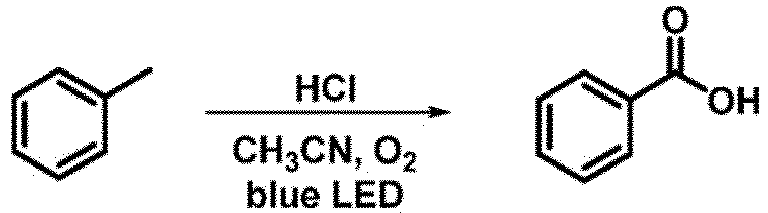
- Toluene (92 mg, 1 mmol), hydrochloric acid (200 µL, 1 M), and acetonitrile (CH3CN, 2 mL) were added in turn into a 25 mL quartz tube for mixing to obtain a mixture solution. The resulting mixture solution was irradiated with a blue LED lamp (40 W) with a wavelength of 380 nm to 550 nm in oxygen atmosphere (1 atm) for reacting for 12 h at room temperature. After the reaction was completed, the solvent was removed under reduced pressure to obtain 103 mg of the corresponding benzoic acid at a yield of 84%.
- The 1HNMR spectrum of the product was:
1H NMR (400 MHz, DMSO) δ 12.98 (s, 1H), 7.95 (d, J = 8.0 Hz, 2H), 7.63 (t, J = 7.2 Hz, 1H), 7.50 (t, J = 7.6 Hz, 2H). 13C NMR (100 MHz, DMSO) δ 167.4, 132.9, 130.8, 129.3, 128.6. - The reaction product was demonstrated to be the target product benzoic acid.
-

- Example 2 differed from Example 1 in that the reaction temperature was adjusted to 60°C as follows.
- Toluene (92 mg, 1 mmol), hydrochloric acid (200 µL, 1 M), and acetonitrile (2 mL) were added in turn into a 25 mL quartz tube for mixing to obtain a mixture solution. The resulting mixture solution was irradiated with a blue LED lamp (40 W) with a wavelength of 380 nm to 550 nm in oxygen atmosphere (1 atm) for reacting for 12 h at 60°C. After the reaction was completed, the solvent was removed under reduced pressure to obtain 109 mg of the corresponding benzoic acid at a yield of 89%.
-

- Example 3 differed from Example 1 in that the light source was adjusted to one with a wavelength of 390 nm as follows.
- Toluene (92 mg, 1 mmol), hydrochloric acid (200 µL, 1 M), and acetonitrile (2 mL) were added in turn into a 25 mL quartz tube for mixing to obtain a mixture solution. The resulting mixture solution was irradiated with a LED lamp (40 W) with a wavelength of 390 nm in oxygen atmosphere (1 atm) for reacting for 12 h at room temperature. After the reaction was completed, the solvent was removed under reduced pressure to obtain 112 mg of the corresponding benzoic acid at a yield of 92%.
-

- Example 4 differed from Example 1 in that hydrobromic acid was used as catalyst as follows.
- Toluene (92 mg, 1 mmol), hydrobromic acid (200 µL, 1 M), and acetonitrile (2 mL) were added in turn into a 25 mL quartz tube for mixing to obtain a mixture solution. The resulting mixture solution was irradiated with a blue LED lamp (40 W) with a wavelength of 380 nm to 550 nm in oxygen atmosphere (1 atm) for reacting for 12 h at room temperature. The solvent was removed under reduced pressure to obtain 76 mg of the corresponding benzoic acid at a yield of 62%.
-

- Example 5 differed from Example 1 in that p-toluenesulfonic acid was used as catalyst as follows.
- Toluene (92 mg, 1 mmol), p-toluenesulfonic acid (TsOH, 200 µL, 1 M), and acetonitrile (2 mL) were added in turn into a 25 mL quartz tube for mixing to obtain a mixture solution. The resulting mixture solution was irradiated with a blue LED lamp (40 W) with a wavelength of 380 nm to 550 nm in oxygen atmosphere (1 atm) for reacting for 12 h at room temperature. The solvent was removed under reduced pressure to obtain 70 mg of the corresponding benzoic acid at a yield of 57%.
-

- Example 6 differed from Example 1 in that a mixture liquid of lithium chloride and acetic acid was used as catalyst as follows.
- Toluene (92 mg, 1 mmol), a mixture liquid of lithium chloride and acetic acid (at a molar ratio of LiCl: AcOH of 1:1, 200 µL, 1 M), and acetonitrile (2 mL) were added in turn into a 25 mL quartz tube for mixing. The mixture was irradiated with a blue LED lamp (40 W) with a wavelength of 380 nm to 550 nm in oxygen atmosphere (1 atm) for reacting for 12 h at room temperature. The solvent was removed under reduced pressure to obtain 92 mg of the corresponding benzoic acid at a yield of 75%.
-

- Example 7 differed from Example 1 in that a mixture liquid of ammonium chloride and acetic acid was used as catalyst as follows.
- Toluene (92 mg, 1 mmol), a mixture liquid of ammonium chloride and acetic acid (at a molar ratio of NH4Cl: AcOH of 1:1, 200 µL, 1 M), and acetonitrile (2 mL) were added in turn into a 25 mL quartz tube for mixing. The mixture was irradiated with a blue LED lamp (40 W) with a wavelength of 380 nm to 550 nm in oxygen atmosphere (1 atm) for reacting for 12 h at room temperature. The solvent was removed under reduced pressure to obtain 98 mg of the corresponding benzoic acid at a yield of 80%.
-

- Example 8 differed from Example 1 in that sulfuric acid was used as catalyst as follows.
- Toluene (92 mg, 1 mmol), sulfuric acid (200 µL, 1 M), and acetonitrile (2 mL) were added sequentially into a 25 mL quartz tube for mixing to obtain a mixture solution. The resulting mixture solution was irradiated with a blue LED lamp (40 W) with a wavelength of 380 nm to 550 nm in oxygen atmosphere (1 atm) for reacting for 12 h at room temperature. The solvent was removed under reduced pressure to obtain 105 mg of the corresponding benzoic acid at a yield of 86%.
-

- Example 9 differed from Example 1 in that nitric acid was used as catalyst as follows.
- Toluene (92 mg, 1 mmol), nitric acid (200 µL, 1 M), and acetonitrile (2 mL) were added in turn into a 25 mL quartz tube for mixing to obtain a mixture solution. The resulting mixture solution was irradiated with a blue LED lamp (40 W) with a wavelength of 380 nm to 550 nm in oxygen atmosphere (1 atm) for reacting for 12 h at room temperature. The solvent was removed under reduced pressure to obtain 102 mg of the corresponding benzoic acid at a yield of 84%.
-

- Example 10 differed from Example 1 in that tert-butyl hypochlorite was used as catalyst as follows.
- Toluene (92 mg, 1 mmol), tert-butyl hypochlorite (t-BuOCl, 200 µL, 1 M), and acetonitrile (2 mL) were added in turn into a 25 mL quartz tube for mixing to obtain a mixture solution. The resulting mixture solution was irradiated with a blue LED lamp (40 W) with a wavelength of 380 nm to 550 nm in oxygen atmosphere (1 atm) for reacting for 12 h at room temperature. The solvent was removed under reduced pressure to obtain 0.112 g of the corresponding benzoic acid at a yield of 92%.
-

- 4-phenyltoluene (168mg, 1 mmol), hydrochloric acid (200 µL, 1 M), and acetonitrile (2 mL) were added in turn into a 25 mL quartz tube for mixing to obtain a mixture solution. The resulting mixture solution was irradiated with a blue LED lamp (40 W) with a wavelength of 380 nm to 550 nm in oxygen atmosphere (1 atm) for reacting for 12 h at room temperature. After the reaction was completed, the solvent was removed under reduced pressure to obtain 170 mg of the corresponding 4-phenylbenzoic acid at a yield of 86%.
- The 1HNMR spectrum of the product was:
1H NMR (400 MHz, DMSO) δ 13.04 (s, 1H), 8.05 (d, J = 8.4 Hz, 2H), 7.81 (d, J = 8.4 Hz, 2H), 7.74 (d, J = 7.2 Hz, 2H), 7.51 (t, J = 7.6 Hz, 2H), 7.44 (t, J= 7.2 Hz, 1H). 13C NMR (100 MHz, DMSO) δ 167.3, 144.4, 139.2, 130.1, 129.7, 129.2, 128.4, 127.1, 126.9. - The reaction product was demonstrated to be the target product 4-phenylbenzoic acid.
-

- Indane (168 mg, 1 mmol), hydrochloric acid (200 µL, 1 M), and acetonitrile (2 mL) were added in turn into a 25 mL quartz tube for mixing to obtain a mixture solution. The resulting mixture solution was irradiated with a blue LED lamp (40 W) with a wavelength of 380 nm to 550 nm in oxygen atmosphere (1 atm) for reacting for 12 h at room temperature. After the reaction was completed, the solvent was removed under reduced pressure to obtain 103 mg of the corresponding 1-indanone at a yield of 78%.
- The 1HNMR spectrum of the product was:
1H NMR (400 MHz, CDCl3) δ 7.77 (d, J = 7.6 Hz, 1H), 7.59 (t, J = 7.6 Hz, 1H), 7.49 (d, J = 7.6 Hz, 1H), 7.38 (t, J = 7.2 Hz, 1H), 3.17 - 3.14 (m, 2H), 2.72 - 2.69 (m, 2H). 13C NMR (100 MHz, CDCl3) δ 207.1, 155.1, 137.1, 134.6, 127.3, 126.7, 123.7, 36.2, 25.8. - The reaction product was demonstrated to be the target product 1-indanone.
-

- Diphenylmethane (168 mg, 1 mmol), hydrochloric acid (200 µL, 1 M), and acetonitrile (2 mL) were added in turn into a 25 mL quartz tube for mixing to obtain a mixture solution. The resulting mixture solution was irradiated with a blue LED lamp (40 W) with a wavelength of 380 nm to 550 nm in oxygen atmosphere (1 atm) for reacting for 24 h at room temperature. After the reaction was completed, the solvent was removed under reduced pressure to obtain 162 mg of the corresponding benzophenone at a yield of 89%.
- The 1HNMR spectrum of the product was:
1H NMR (400 MHz, CDCl3) δ 7.81 (dd, J = 8.4, 1.3 Hz, 4H), 7.62-7.57 (m, 2H), 7.49 (t, J = 7.6 Hz, 4H). 13C NMR (100 MHz, CDCl3) δ 132.4, 130.1, 128.3. - The reaction product was demonstrated to be the target product benzophenone.
-

- Celecoxib (381 mg, 1 mmol), hydrochloric acid (200 µL, 1 M), and acetonitrile (2 mL) were added in turn into a 25 mL quartz tube for mixing to obtain a mixture solution. The resulting mixture solution was irradiated with a blue LED lamp (40 W) with a wavelength of 380 nm to 550 nm in oxygen atmosphere (1 atm) for reacting for 24 h at room temperature. After the reaction was completed, the reaction solution was rapidly separated to obtain 262 mg of the corresponding oxidation product at a yield of 64%.
- The 1HNMR spectrum of the product was:
1H NMR (400 MHz, DMSO-d6) δ 12, 11 (brs, 1H), 7.94 (d, J= 8.4 Hz, 2H), 7.88 (d, J = 8.8 Hz, 2H), 7.55 (d, J = 8.8 Hz, 2H), 7.52 (s, 2H), 7.44 (d, J = 8.4 Hz, 2H), 7.35 (s, 1H). 13C NMR (100 MHz, DMSO-d6) δ 167.0, 144.6, 144.5, 142.5 (q, J = 10.0 Hz), 141.2, 132.6, 131.7, 130.0, 129.5, 127.3, 126.4, 120.3 (q, J = 247.0 Hz), 107.4. 19F NMR (377 MHz, DMSO-d6) δ -60.87. - The reaction product was demonstrated to be the target product.
-

- Hydrochloric acid (200 µL, 1 M) and deuterated acetonitrile (CD3CN, 2 mL) were added in turn into a photoreactor, which was then tightened and filled with 20 atm of oxygen and 40 atm of methane. The resulting mixture solution was irradiated with a blue LED lamp (40 W) with a wavelength of 380 nm to 550 nm for reacting for 24 h at room temperature. After the reaction was completed, the yields for methanol and formic acid were determined to be 3.3% and16.5%, respectively, by NMR. The 1HNMR spectrum of the reaction product was as shown in
FIG. 2 . - The 1HNMR spectrum of formic acid was: 1H NMR (400 MHz, CD3CN) δ 8.08 (s, 1H).
- The 1HNMR spectrum of methanol was: 1H NMR (400 MHz, CD3CN) δ 3.31 (s, 0.6 H).
-

- A stirrer was put into a 25 mL sealed tube, and hydrochloric acid (5.0 µL, 12.0 M) and deuterated acetonitrile (750.0 µL) were added in turn. The sealed tube was subjected to vacuum degassing under freezing conditions (-20°C) and filled with a gas mixture of methane and oxygen (a total pressure of the gas mixture of 1 atm, a gas pressure ratio of CH4: O2 = 1:1). The sealed tube was then placed in front of a LED lamp (40 W) with a wavelength of 390 nm and the reaction was carried out for 24 h at room temperature. After the reaction was completed, the corresponding oxidation product and the yield thereof were obtained via NMR, as shown in Table 1.
Table 1 Oxidation product Formic acid Peroxymethanol Methanol Total Yield Yield 22.7% 0.01% 0.01% 22.72% -

- A stirrer was put into a 25 mL sealed tube, and hydrochloric acid (5.0 µL, 0.1 M) and deuterated acetonitrile (750.0 µL) were added in turn. The sealed tube was subjected to vacuum degassing under freezing conditions (-20°C) and filled with a gas mixture of ethane and oxygen (a total pressure of the gas mixture of 1 atm, a gas pressure ratio of ethane: O2=1:1). The sealed tube was then placed in front of a LED lamp (40 W) with a wavelength of 390 nm and the reaction was carried out for 24 h at room temperature. After the reaction was completed, the corresponding oxidation product and the yield thereof were obtained via NMR, as shown in Table 2.
Table 2 Oxidati on product Formic acid Acetic acid Acetal dehyde Peroxyeth anol Ethano 1 Formalde hyde Peroxymeth anol Metha nol Total Yield Yield 7.92% 8.14% 1.53% 1.50% 2.23% 0.03% 0.43% 1.33% 23.11 % -

- A stirrer was put into a 25 mL sealed tube, and hydrochloric acid (5.0 µL, 0.1 M) and deuterated acetonitrile (750.0 µL) were added in turn. The sealed tube was subjected to vacuum degassing under freezing conditions (-20°C) and filled with a gas mixture of propane and oxygen (a total pressure of the gas mixture of 1 atm, a gas pressure ratio of propane: O2=1:1). The sealed tube was then placed in front of a LED lamp (40 W) with a wavelength of 390 nm and the reaction was carried out for 24 h at room temperature. After the reaction was completed, the corresponding oxidation product and the yield thereof were obtained via NMR, as shown in Table 3.
Table 3 Oxidati on produc t Aceto ne Propio nic acid Acet ic acid Form ic acid Propionalde hyde n-Prop yl alcoh ol Isopro pyl alcoho 1 Acetaldeh yde Ethan ol Metha nol Total Yield Yield 13.57 % 5.77% 4.75 % 8.78 % 0.26% 5.57 % 3.93% 0.39% 3.41 % 2.43% 48.86 % -

- A stirrer was put into a 25 mL sealed tube, and hydrochloric acid (5.0 µL, 0.1 M) and deuterated acetonitrile (750.0 µL) were added in turn. The sealed tube was subjected to vacuum degassing under freezing conditions (-20°C) and filled with a gas mixture of butane and oxygen (a total pressure of the gas mixture of 1 atm, a gas pressure ratio of butane: O2=1:1). The sealed tube was then placed in front of a LED lamp (40 W) with a wavelength of 390 nm and the reaction was carried out for 24 h at room temperature. After the reaction was completed, the corresponding oxidation product and the yield thereof were obtained via NMR, as shown in Table 4.
Table 4 Oxidation product 2-Butanone Butyric acid Acetic acid Acetaldehyde Formic acid Ethanol Methanol Total Yield Yield 9.48% 3.52% 9.50% 16.2% 12.2% 3.60% 4.91% 59.41% -

- A stirrer was put into a 25 mL sealed tube, and hydrochloric acid (5.0 µL, 0.1 M) and deuterated acetonitrile (750.0 µL) were added in turn. The sealed tube was subjected to vacuum degassing under freezing conditions (-20°C) and filled with a gas mixture of mixed alkanes gas and oxygen (a total pressure of the gas mixture of 1 atm, a gas pressure ratio of methane:ethane:propane:butane: O2=7:1:1:1:10), and the ratio of the mixed alkanes gas simulated the ratio of each alkane in natural gas. The sealed tube was then placed in front of a LED lamp (40 W) with a wavelength of 390 nm and the reaction was carried out for 24 h at room temperature. After the reaction was completed, the corresponding oxidation product and the yield thereof were obtained via NMR, as shown in Table 5.
Table 5 Oxidation product Formic acid Acetic acid Acetone 2-Butanone Propionic acid Peroxymethanol Methanol Total Yield Yield 8.55% 6.15% 2.20% 1.44% 1.52% 0.21% 0.43% 20.5% -

- A stirrer was put into a 25 mL sealed tube, and hydrochloric acid (5.0 µL, 0.1 M), petroleum ether (22.6 mg), and deuterated acetonitrile (750.0 µL) were added in turn. The sealed tube was subjected to vacuum degassing under freezing conditions (-20°C) and filled with oxygen (1 atm). The sealed tube was then placed in front of a LED lamp (40 W) with a wavelength of 390 nm and the reaction was carried out for 24 h at room temperature. After the reaction was completed, the corresponding oxidation product and the yield thereof were obtained via NMR, as shown in Table 6.
Table 6 Oxidation product Acetone Formic acid Acetic acid Acetaldehyde Ethanol Methanol Total Yield Yield 12.30% 9.73% 8.50% 3.38% 4.80% 3.95% 42.66% -

- A stirrer was put into a 25 mL sealed tube, and hydrochloric acid (5.0 µL, 0.1 M), n-hexane (17.2 mg), and deuterated acetonitrile (750.0 µL) were added in turn. The sealed tube was subjected to vacuum degassing under freezing conditions (-20°C) and filled with oxygen (1 atm). The sealed tube was then placed in front of a LED lamp (40 W) with a wavelength of 390 nm and the reaction was carried out for 24 h at room temperature. After the reaction was completed, the corresponding oxidation product and the yield thereof were obtained via NMR, as shown in Table 7.
Table 7 Oxidation product Acetone Formic acid Acetic acid Acetaldehyde Methanol Hexan-2-one Total Yield Yield 3.50% 5.46% 7.00% 3.78% 0.98% 8.82% 29.54% -

- A stirrer was put into a 25 mL sealed tube, and hydrochloric acid (5.0 µL, 0.1 M), cyclohexane (16.8 mg), and deuterated acetonitrile (750.0 µL) were added in turn. The sealed tube was subjected to vacuum degassing under freezing conditions (-20°C) and filled with oxygen (1 atm). The sealed tube was then placed in front of a LED lamp (40 W) with a wavelength of 390 nm and the reaction was carried out for 24 h at room temperature. After the reaction was completed, the corresponding oxidation product and the yield thereof were obtained via NMR, as shown in Table 8.
Table 8 Oxidation product Formic acid Acetaldehyde Cyclohexanone Cyclohexanol Total Yield Yield 3.73% 1.70% 12.65% 11.2% 29.28% -

- A stirrer was put into a 25 mL sealed tube, and hydrochloric acid (5.0 µL, 0.1 M), isooctane (22.8 mg), and deuterated acetonitrile (750.0 µL) were added in turn. The sealed tube was subjected to vacuum degassing under freezing conditions (-20°C) and filled with oxygen (1 atm). The sealed tube was then placed in front of a LED lamp (40 W) with a wavelength of 390 nm and the reaction was carried out for 24 h at room temperature. After the reaction was completed, the corresponding oxidation product and the yield thereof were obtained via NMR, as shown in Table 9.
Table 9 Oxidation product Acetone Formic acid Methanol Pivalaldehyde Total Yield Yield 0.79% 4.75% 1.59% 2.38% 9.51% -

- A stirrer was put into a 25 mL sealed tube, and hydrochloric acid (5.0 µL, 0.1 M), n-heptane (20.0 mg), and deuterated acetonitrile (750.0 µL) were added in turn. The sealed tube was subjected to vacuum degassing under freezing conditions (-20°C) and filled with oxygen (1 atm). The sealed tube was then placed in front of a LED lamp (40 W) with a wavelength of 390 nm and the reaction was carried out for 24 h at room temperature. After the reaction was completed, the corresponding oxidation product and the yield thereof were obtained via NMR, as shown in Table 10.
Table 10 Oxidation product Acetone Formic acid Methanol Acetic acid Acetaldehyde Ethanol 2-Heptanone Total Yield Yield 2.4% 6.7% 1.3% 8.0% 3.8% 3.3% 6.4% 31.9% -

- A stirrer was put into a 25 mL sealed tube, and hydrochloric acid (5.0 µL, 0.1 M), n-octane (22.8 mg), and deuterated acetonitrile (750.0 µL) were added in turn. The sealed tube was subjected to vacuum degassing under freezing conditions (-20°C) and filled with oxygen (1 atm). The sealed tube was then placed in front of a LED lamp (40 W) with a wavelength of 390 nm and the reaction was carried out for 24 h at room temperature. After the reaction was completed, the corresponding oxidation product and the yield thereof were obtained via NMR, as shown in Table 11.
Table 11 Oxidation product Acetone Formic acid Methanol Acetic acid Acetaldehyde 2-Octanone Total Yield Yield 1.3% 2.3% 0.5% 3.5% 5.0% 4.1% 16.7% -

- A stirrer was put into a 25 mL sealed tube, and hydrochloric acid (5.0 µL, 0.1 M), cyclohexane (16.8 mg), and deuterated acetonitrile (750.0 µL) were added in turn. The sealed tube was subjected to vacuum degassing under freezing conditions (-20°C) and filled with air (1 atm). The sealed tube was then placed in front of a LED lamp (40 W) with a wavelength of 390 nm and the reaction was carried out for 24 h at room temperature. After the reaction was completed, the corresponding oxidation product and the yield thereof were obtained via NMR, as shown in Table 12.
Table 12 Oxidation product Formic acid Acetaldehyde Cyclohexanone Cyclohexanol Total Yield Yield 2.67% 1.22% 10.56% 9.04% 23.49% - According to the method for light-promoted oxidation of a compound containing a saturated carbon-hydrogen bond provided by the Examples of the present application, the compound containing a saturated carbon-hydrogen bond undergoes an oxidation reaction with oxygen in the presence of catalyst under a condition of light irradiation to synthesize a corresponding oxidation product, such as at least one of alcohol, peroxyalcohol, aldehyde, ketone, carboxylic acid, or peroxyacid. The method is a light-promoted direct oxidation method of a compound containing a saturated carbon-hydrogen bond, which only needs to be carried out at a low temperature (20°C to100°C) and has the advantages of good compatibility of functional groups, short reaction time, high reaction efficiency, low reaction cost, high added value, simple operation, and good safety. Moreover, It uses only common acids instead of transition metals as catalyst, and requires only light to promote the reaction to occur. Thus this method is milder, greener, and more environmentally friendly oxidation method.
- The above embodiments are preferred Examples of the present application and are not intended to limit the scope of protection of the present application. Any modifications, equivalent substitutions, improvements and the like made within the spirit and principles of the present application should be included in the scope of protection of the present application.
Claims (10)
- A method for light-promoted oxidation of a compound containing a saturated carbon-hydrogen bond, comprising: mixing the compound containing the saturated carbon-hydrogen bond with a catalyst, and subjecting the compound containing the saturated carbon-hydrogen bond to an oxidation reaction in an oxygen or air atmosphere at a temperature of 20°C to 100°C under light irradiation to generate an oxidation product.
- The method for light-promoted oxidation of the compound containing the saturated carbon-hydrogen bond according to claim 1, wherein the catalyst is any one of tert-butyl hypochlorite, hydrochloric acid or hydrobromic acid; or
the catalyst is a mixture capable of in-situ generating hydrochloric acid or hydrobromic acid, wherein the mixture is a mixture of chloride and acetic acid or of bromide and acetic acid. - The method for light-promoted oxidation of the compound containing the saturated carbon-hydrogen bond according to claim 1, wherein the compound containing the saturated carbon-hydrogen bond is C1-C8 alkane.
- The method for light-promoted oxidation of the compound containing the saturated carbon-hydrogen bond according to claim 1, wherein the compound containing the saturated carbon-hydrogen bond is C1-C8 alkane substituted with phenyl, biphenyl or substituted phenyl, wherein a substituent of the substituted phenyl is any one selected from the group consisting of halogen, nitro, cyano, hydroxyl, amino, carboxyl, C2-C8 carboxylic ester group and

- The method for light-promoted oxidation of the compound containing the saturated carbon-hydrogen bond according to claim 1, wherein the catalyst is an oxyacid, wherein the oxyacid is any one of p-toluenesulfonic acid, sulfuric acid or nitric acid.
- The method for light-promoted oxidation of the compound containing the saturated carbon-hydrogen bond according to claim 1, wherein the light has a wavelength of 300 nm to 800 nm.
- The method for light-promoted oxidation of the compound containing the saturated carbon-hydrogen bond according to claim 1, wherein the oxidation product is at least one of alcohol, peroxyalcohol, aldehyde, ketone, carboxylic acid or peroxyacid.
- The method for light-promoted oxidation of the compound containing the saturated carbon-hydrogen bond according to claim 1, wherein the oxygen or air atmosphere in a reaction system has a pressure of 1 atm to 100 atm.
- The method for light-promoted oxidation of the compound containing the saturated carbon-hydrogen bond according to claim 1, wherein a molar ratio of the compound containing the saturated carbon-hydrogen bond to the catalyst is 1:0.0001 to 1:1.
- The method for light-promoted oxidation of the compound containing the saturated carbon-hydrogen bond according to claim 1, wherein a solvent for the oxidation reaction is any one of acetonitrile, tetrahydrofuran, dichloromethane, dichloroethane, trichloromethane, dimethyl sulfoxide, dibromoethane or N,N-dimethylformamide.
Applications Claiming Priority (3)
| Application Number | Priority Date | Filing Date | Title |
|---|---|---|---|
| CN202110642049 | 2021-06-09 | ||
| CN202210137499.5A CN115448830A (en) | 2021-06-09 | 2022-02-15 | Method for promoting oxidation of compound containing saturated carbon-hydrogen bond by light |
| PCT/CN2022/086889 WO2022257598A1 (en) | 2021-06-09 | 2022-04-14 | Method for light-promoted oxidation of compound containing saturated carbon-hydrogen bond |
Publications (2)
| Publication Number | Publication Date |
|---|---|
| EP4353707A1 true EP4353707A1 (en) | 2024-04-17 |
| EP4353707A4 EP4353707A4 (en) | 2025-09-03 |
Family
ID=84297114
Family Applications (1)
| Application Number | Title | Priority Date | Filing Date |
|---|---|---|---|
| EP22819201.9A Pending EP4353707A4 (en) | 2021-06-09 | 2022-04-14 | Method for the light-promoted oxidation of a compound with a saturated carbon-hydrogen bond |
Country Status (5)
| Country | Link |
|---|---|
| US (1) | US20240286981A1 (en) |
| EP (1) | EP4353707A4 (en) |
| JP (1) | JP7681352B2 (en) |
| CN (2) | CN118834126A (en) |
| WO (1) | WO2022257598A1 (en) |
Families Citing this family (3)
| Publication number | Priority date | Publication date | Assignee | Title |
|---|---|---|---|---|
| CN118026102B (en) * | 2024-01-11 | 2026-03-27 | 四川大学 | A photochemical synthesis method for preparing solid hydrogen peroxide compounds |
| CN119528703B (en) * | 2024-11-15 | 2025-10-14 | 兰州大学 | A method for visible light-driven air oxidation of benzyl carbon-hydrogen bonds |
| CN119490393A (en) * | 2024-12-18 | 2025-02-21 | 浙江工业大学 | A method for synthesizing unsaturated ketone or aromatic ketone compounds |
Family Cites Families (20)
| Publication number | Priority date | Publication date | Assignee | Title |
|---|---|---|---|---|
| JPS5883650A (en) * | 1981-11-13 | 1983-05-19 | Mitsui Toatsu Chem Inc | Acyloxyneophyl chloride and its preparation |
| GB0024745D0 (en) * | 2000-10-10 | 2000-11-22 | Univ Belfast | Oxidation of alkyl-aromatic compounds |
| JP3990133B2 (en) * | 2001-10-04 | 2007-10-10 | ダイセル化学工業株式会社 | Method for oxidizing compounds containing methylene carbon atoms or methine carbon atoms or non-aromatic rings |
| JP4197224B2 (en) * | 2001-10-04 | 2008-12-17 | ダイセル化学工業株式会社 | Method for oxidizing compound having carbon-hydrogen bond adjacent to unsaturated bond |
| CN1332913C (en) * | 2004-06-02 | 2007-08-22 | 中国科学院化学研究所 | Photochemical process for olefin synthesis of oxygen-containing compound |
| JP4670078B2 (en) * | 2004-11-26 | 2011-04-13 | 財団法人名古屋産業科学研究所 | Method for producing carbonyl compound and method for producing aromatic carboxylic acid |
| CN1319925C (en) * | 2005-01-27 | 2007-06-06 | 中国科学院化学研究所 | Alkylbenzene photooxidizing process with oxygen to prepare aromatic aldehyde and aromatic acid |
| JP5083725B2 (en) * | 2007-02-21 | 2012-11-28 | 公益財団法人名古屋産業科学研究所 | Method for producing carbonyl compound |
| JP5197106B2 (en) * | 2008-03-31 | 2013-05-15 | イハラニッケイ化学工業株式会社 | Method for producing halogenated phthalic acid compound |
| JP2012056851A (en) * | 2010-09-04 | 2012-03-22 | Nagoya Industrial Science Research Inst | Method for producing aromatic carboxylic acid compound |
| CN105218341B (en) * | 2014-06-05 | 2017-09-19 | 湖南师范大学 | Hydrochloric acid-promoted effective system for PWV heteropolyacid photocatalytic cyclohexane oxidation to KA oil |
| JP6786068B2 (en) * | 2016-11-09 | 2020-11-18 | 株式会社 エースネット | Method for producing diol |
| CN106831387B (en) * | 2017-01-19 | 2020-12-29 | 上海科技大学 | A visible light-catalyzed direct oxidation of saturated carbon-hydrogen bonds |
| CN109836307B (en) * | 2017-11-29 | 2021-11-23 | 中国科学院大连化学物理研究所 | Method for oxidizing alkane by ferric oxide photocatalysis |
| JP7210007B2 (en) * | 2017-12-16 | 2023-01-23 | 国立大学法人大阪大学 | Method for producing oxidation reaction product of hydrocarbon or derivative thereof |
| WO2020155595A1 (en) * | 2019-02-01 | 2020-08-06 | 清华大学 | Aerobic oxidation system containing sulfinic acid, sulfonic acid or derivatives thereof and photocatalytic oxidation method therefor |
| JP7645249B2 (en) * | 2019-09-26 | 2025-03-13 | アリエル サイエンティフィック イノベーションズ リミテッド | Photoinduced catalytic C—H oxygenation of alkanes |
| CN112778107B (en) * | 2019-11-06 | 2022-06-10 | 复旦大学 | Method for synthesizing acetophenone or benzoic acid compound by oxidizing toluene compound |
| CN113956148B (en) * | 2021-10-29 | 2022-12-16 | 南京工业大学 | An Acid/Photocatalyzed Oxidation of Benzyl Carbon-Hydrogen Bonds in Aromatic Compounds |
| WO2023094418A1 (en) * | 2021-11-23 | 2023-06-01 | Universiteit Antwerpen | Method and system for producing benzoic acid from polystyrene |
-
2022
- 2022-02-15 CN CN202410895702.4A patent/CN118834126A/en active Pending
- 2022-02-15 CN CN202210137499.5A patent/CN115448830A/en active Pending
- 2022-04-14 WO PCT/CN2022/086889 patent/WO2022257598A1/en not_active Ceased
- 2022-04-14 US US18/568,571 patent/US20240286981A1/en active Pending
- 2022-04-14 EP EP22819201.9A patent/EP4353707A4/en active Pending
- 2022-04-14 JP JP2023575667A patent/JP7681352B2/en active Active
Also Published As
| Publication number | Publication date |
|---|---|
| CN115448830A (en) | 2022-12-09 |
| US20240286981A1 (en) | 2024-08-29 |
| WO2022257598A1 (en) | 2022-12-15 |
| JP2024523216A (en) | 2024-06-28 |
| CN118834126A (en) | 2024-10-25 |
| JP7681352B2 (en) | 2025-05-22 |
| EP4353707A4 (en) | 2025-09-03 |
Similar Documents
| Publication | Publication Date | Title |
|---|---|---|
| EP4353707A1 (en) | Method for light-promoted oxidation of compound containing saturated carbon-hydrogen bond | |
| Recupero et al. | Free radical functionalization of organic compounds catalyzed by N-hydroxyphthalimide | |
| Kirillova et al. | Remarkably fast oxidation of alkanes by hydrogen peroxide catalyzed by a tetracopper (II) triethanolaminate complex: Promoting effects of acid co-catalysts and water, kinetic and mechanistic features | |
| Stary et al. | Ozonization of organic substrates. Hydrotrioxide formation and decomposition to give singlet oxygen | |
| Hu et al. | NHPI/tert-butyl nitrite: A highly efficient metal-free catalytic system for aerobic oxidation of alcohols to carbonyl compounds using molecular oxygen as the terminal oxidant | |
| Nechab et al. | New aerobic oxidation of benzylic compounds: efficient catalysis by N-hydroxy-3, 4, 5, 6-tetraphenylphthalimide (NHTPPI)/CuCl under mild conditions and low catalyst loading | |
| Yang et al. | Experimental and theoretical study on N-hydroxyphthalimide and its derivatives catalyzed aerobic oxidation of cyclohexylbenzene | |
| Miao et al. | Tert-butyl nitrite: a metal-free radical initiator for aerobic cleavage of benzylic C [double bond, length as m-dash] C bonds in compressed carbon dioxide | |
| JP2006176527A (en) | Process for transition metal free catalytic aerobic oxidation of alcohols under mild conditions using stable free nitroxyl radicals | |
| Oroshnik et al. | The Nef Reaction with α, β-Unsaturated Ketones | |
| Sivamurugan et al. | Selective and clean oxidation of alcohols with benzimidazolium fluorochromate (BIFC) under solvent free conditions | |
| EP4458797A1 (en) | Visible-light-mediated one-step method for preparing phenol and cyclohexanone from cyclohexylbenzene | |
| Yang et al. | A promotion effect of alkaline-earth chloride on N-hydroxyphthalimide-catalyzed aerobic oxidation of hydrocarbons | |
| Yang et al. | Efficient aerobic oxidation of hydrocarbons with O2 catalyzed by DDQ/NHPI | |
| CN102391091A (en) | Synthetic method for 1, 4 naphthaquinone | |
| US12502661B2 (en) | Catalysts for synthesizing cyclic carbonates, preparation methods and uses thereof | |
| Jiang et al. | Highly efficient oxidation of toluene to benzoic acid catalyzed by manganese dioxide and N-hydroxyphthalimide | |
| Pyszny et al. | Solvent-free aerobic oxidative cleavage of alkenes catalyzed by N-hydroxyphthalimide | |
| Liu et al. | I2O5: mild and efficient reagents for the oxidation of alcohols in water | |
| CN111978162A (en) | A new method for the synthesis of aromatic ketones | |
| US2967197A (en) | Difunctional aliphatic compounds prepared from peroxides and halogens | |
| EP0461972B1 (en) | Process for the conversion of N-tertiary amine oxides into aldehydes | |
| Li et al. | Oxidation of alkynes by cobalt acetate bromide: a new mode of action for an important industrial catalyst | |
| Koshcheeva et al. | Novel organocatalytic system of R-bian, R-mian and NHPI for selective oxidation of cumene | |
| JPH06507154A (en) | Cyanoacetic acid production method |
Legal Events
| Date | Code | Title | Description |
|---|---|---|---|
| STAA | Information on the status of an ep patent application or granted ep patent |
Free format text: STATUS: THE INTERNATIONAL PUBLICATION HAS BEEN MADE |
|
| PUAI | Public reference made under article 153(3) epc to a published international application that has entered the european phase |
Free format text: ORIGINAL CODE: 0009012 |
|
| STAA | Information on the status of an ep patent application or granted ep patent |
Free format text: STATUS: REQUEST FOR EXAMINATION WAS MADE |
|
| 17P | Request for examination filed |
Effective date: 20231228 |
|
| AK | Designated contracting states |
Kind code of ref document: A1 Designated state(s): AL AT BE BG CH CY CZ DE DK EE ES FI FR GB GR HR HU IE IS IT LI LT LU LV MC MK MT NL NO PL PT RO RS SE SI SK SM TR |
|
| DAV | Request for validation of the european patent (deleted) | ||
| DAX | Request for extension of the european patent (deleted) | ||
| A4 | Supplementary search report drawn up and despatched |
Effective date: 20250804 |
|
| RIC1 | Information provided on ipc code assigned before grant |
Ipc: C07C 51/265 20060101AFI20250729BHEP Ipc: C07C 63/06 20060101ALI20250729BHEP Ipc: C07C 63/331 20060101ALI20250729BHEP Ipc: C07C 45/36 20060101ALI20250729BHEP Ipc: C07C 49/67 20060101ALI20250729BHEP Ipc: C07C 49/786 20060101ALI20250729BHEP Ipc: C07C 29/50 20060101ALI20250729BHEP Ipc: C07C 31/04 20060101ALI20250729BHEP Ipc: C07C 51/215 20060101ALI20250729BHEP Ipc: C07C 53/02 20060101ALI20250729BHEP Ipc: C07D 231/12 20060101ALI20250729BHEP Ipc: C07C 27/12 20060101ALI20250729BHEP Ipc: C07B 33/00 20060101ALI20250729BHEP |