EP4353694A1 - Transparent article with anti-fog film for security camera, and security camera - Google Patents
Transparent article with anti-fog film for security camera, and security camera Download PDFInfo
- Publication number
- EP4353694A1 EP4353694A1 EP22820323.8A EP22820323A EP4353694A1 EP 4353694 A1 EP4353694 A1 EP 4353694A1 EP 22820323 A EP22820323 A EP 22820323A EP 4353694 A1 EP4353694 A1 EP 4353694A1
- Authority
- EP
- European Patent Office
- Prior art keywords
- film
- antifog
- water
- transparent article
- group
- Prior art date
- Legal status (The legal status is an assumption and is not a legal conclusion. Google has not performed a legal analysis and makes no representation as to the accuracy of the status listed.)
- Pending
Links
Images




Classifications
-
- C—CHEMISTRY; METALLURGY
- C09—DYES; PAINTS; POLISHES; NATURAL RESINS; ADHESIVES; COMPOSITIONS NOT OTHERWISE PROVIDED FOR; APPLICATIONS OF MATERIALS NOT OTHERWISE PROVIDED FOR
- C09D—COATING COMPOSITIONS, e.g. PAINTS, VARNISHES OR LACQUERS; FILLING PASTES; CHEMICAL PAINT OR INK REMOVERS; INKS; CORRECTING FLUIDS; WOODSTAINS; PASTES OR SOLIDS FOR COLOURING OR PRINTING; USE OF MATERIALS THEREFOR
- C09D5/00—Coating compositions, e.g. paints, varnishes or lacquers, characterised by their physical nature or the effects produced; Filling pastes
- C09D5/16—Antifouling paints; Underwater paints
- C09D5/1656—Antifouling paints; Underwater paints characterised by the film-forming substance
- C09D5/1662—Synthetic film-forming substance
- C09D5/1675—Polyorganosiloxane-containing compositions
-
- C—CHEMISTRY; METALLURGY
- C03—GLASS; MINERAL OR SLAG WOOL
- C03C—CHEMICAL COMPOSITION OF GLASSES, GLAZES OR VITREOUS ENAMELS; SURFACE TREATMENT OF GLASS; SURFACE TREATMENT OF FIBRES OR FILAMENTS MADE FROM GLASS, MINERALS OR SLAGS; JOINING GLASS TO GLASS OR OTHER MATERIALS
- C03C17/00—Surface treatment of glass, not in the form of fibres or filaments, by coating
- C03C17/28—Surface treatment of glass, not in the form of fibres or filaments, by coating with organic material
- C03C17/30—Surface treatment of glass, not in the form of fibres or filaments, by coating with organic material with silicon-containing compounds
-
- C—CHEMISTRY; METALLURGY
- C03—GLASS; MINERAL OR SLAG WOOL
- C03C—CHEMICAL COMPOSITION OF GLASSES, GLAZES OR VITREOUS ENAMELS; SURFACE TREATMENT OF GLASS; SURFACE TREATMENT OF FIBRES OR FILAMENTS MADE FROM GLASS, MINERALS OR SLAGS; JOINING GLASS TO GLASS OR OTHER MATERIALS
- C03C17/00—Surface treatment of glass, not in the form of fibres or filaments, by coating
- C03C17/28—Surface treatment of glass, not in the form of fibres or filaments, by coating with organic material
- C03C17/32—Surface treatment of glass, not in the form of fibres or filaments, by coating with organic material with synthetic or natural resins
-
- C—CHEMISTRY; METALLURGY
- C08—ORGANIC MACROMOLECULAR COMPOUNDS; THEIR PREPARATION OR CHEMICAL WORKING-UP; COMPOSITIONS BASED THEREON
- C08J—WORKING-UP; GENERAL PROCESSES OF COMPOUNDING; AFTER-TREATMENT NOT COVERED BY SUBCLASSES C08B, C08C, C08F, C08G or C08H
- C08J7/00—Chemical treatment or coating of shaped articles made of macromolecular substances
- C08J7/04—Coating
- C08J7/0427—Coating with only one layer of a composition containing a polymer binder
-
- C—CHEMISTRY; METALLURGY
- C08—ORGANIC MACROMOLECULAR COMPOUNDS; THEIR PREPARATION OR CHEMICAL WORKING-UP; COMPOSITIONS BASED THEREON
- C08J—WORKING-UP; GENERAL PROCESSES OF COMPOUNDING; AFTER-TREATMENT NOT COVERED BY SUBCLASSES C08B, C08C, C08F, C08G or C08H
- C08J7/00—Chemical treatment or coating of shaped articles made of macromolecular substances
- C08J7/04—Coating
- C08J7/054—Forming anti-misting or drip-proofing coatings
-
- C—CHEMISTRY; METALLURGY
- C09—DYES; PAINTS; POLISHES; NATURAL RESINS; ADHESIVES; COMPOSITIONS NOT OTHERWISE PROVIDED FOR; APPLICATIONS OF MATERIALS NOT OTHERWISE PROVIDED FOR
- C09D—COATING COMPOSITIONS, e.g. PAINTS, VARNISHES OR LACQUERS; FILLING PASTES; CHEMICAL PAINT OR INK REMOVERS; INKS; CORRECTING FLUIDS; WOODSTAINS; PASTES OR SOLIDS FOR COLOURING OR PRINTING; USE OF MATERIALS THEREFOR
- C09D129/00—Coating compositions based on homopolymers or copolymers of compounds having one or more unsaturated aliphatic radicals, each having only one carbon-to-carbon double bond, and at least one being terminated by an alcohol, ether, aldehydo, ketonic, acetal, or ketal radical; Coating compositions based on hydrolysed polymers of esters of unsaturated alcohols with saturated carboxylic acids; Coating compositions based on derivatives of such polymers
- C09D129/14—Homopolymers or copolymers of acetals or ketals obtained by polymerisation of unsaturated acetals or ketals or by after-treatment of polymers of unsaturated alcohols
-
- C—CHEMISTRY; METALLURGY
- C09—DYES; PAINTS; POLISHES; NATURAL RESINS; ADHESIVES; COMPOSITIONS NOT OTHERWISE PROVIDED FOR; APPLICATIONS OF MATERIALS NOT OTHERWISE PROVIDED FOR
- C09D—COATING COMPOSITIONS, e.g. PAINTS, VARNISHES OR LACQUERS; FILLING PASTES; CHEMICAL PAINT OR INK REMOVERS; INKS; CORRECTING FLUIDS; WOODSTAINS; PASTES OR SOLIDS FOR COLOURING OR PRINTING; USE OF MATERIALS THEREFOR
- C09D5/00—Coating compositions, e.g. paints, varnishes or lacquers, characterised by their physical nature or the effects produced; Filling pastes
-
- C—CHEMISTRY; METALLURGY
- C09—DYES; PAINTS; POLISHES; NATURAL RESINS; ADHESIVES; COMPOSITIONS NOT OTHERWISE PROVIDED FOR; APPLICATIONS OF MATERIALS NOT OTHERWISE PROVIDED FOR
- C09D—COATING COMPOSITIONS, e.g. PAINTS, VARNISHES OR LACQUERS; FILLING PASTES; CHEMICAL PAINT OR INK REMOVERS; INKS; CORRECTING FLUIDS; WOODSTAINS; PASTES OR SOLIDS FOR COLOURING OR PRINTING; USE OF MATERIALS THEREFOR
- C09D7/00—Features of coating compositions, not provided for in group C09D5/00; Processes for incorporating ingredients in coating compositions
- C09D7/20—Diluents or solvents
-
- C—CHEMISTRY; METALLURGY
- C09—DYES; PAINTS; POLISHES; NATURAL RESINS; ADHESIVES; COMPOSITIONS NOT OTHERWISE PROVIDED FOR; APPLICATIONS OF MATERIALS NOT OTHERWISE PROVIDED FOR
- C09D—COATING COMPOSITIONS, e.g. PAINTS, VARNISHES OR LACQUERS; FILLING PASTES; CHEMICAL PAINT OR INK REMOVERS; INKS; CORRECTING FLUIDS; WOODSTAINS; PASTES OR SOLIDS FOR COLOURING OR PRINTING; USE OF MATERIALS THEREFOR
- C09D7/00—Features of coating compositions, not provided for in group C09D5/00; Processes for incorporating ingredients in coating compositions
- C09D7/40—Additives
- C09D7/65—Additives macromolecular
-
- G—PHYSICS
- G02—OPTICS
- G02B—OPTICAL ELEMENTS, SYSTEMS OR APPARATUS
- G02B1/00—Optical elements characterised by the material of which they are made; Optical coatings for optical elements
- G02B1/10—Optical coatings produced by application to, or surface treatment of, optical elements
- G02B1/18—Coatings for keeping optical surfaces clean, e.g. hydrophobic or photo-catalytic films
-
- C—CHEMISTRY; METALLURGY
- C03—GLASS; MINERAL OR SLAG WOOL
- C03C—CHEMICAL COMPOSITION OF GLASSES, GLAZES OR VITREOUS ENAMELS; SURFACE TREATMENT OF GLASS; SURFACE TREATMENT OF FIBRES OR FILAMENTS MADE FROM GLASS, MINERALS OR SLAGS; JOINING GLASS TO GLASS OR OTHER MATERIALS
- C03C2217/00—Coatings on glass
- C03C2217/70—Properties of coatings
- C03C2217/75—Hydrophilic and oleophilic coatings
-
- C—CHEMISTRY; METALLURGY
- C08—ORGANIC MACROMOLECULAR COMPOUNDS; THEIR PREPARATION OR CHEMICAL WORKING-UP; COMPOSITIONS BASED THEREON
- C08G—MACROMOLECULAR COMPOUNDS OBTAINED OTHERWISE THAN BY REACTIONS ONLY INVOLVING UNSATURATED CARBON-TO-CARBON BONDS
- C08G77/00—Macromolecular compounds obtained by reactions forming a linkage containing silicon with or without sulfur, nitrogen, oxygen or carbon in the main chain of the macromolecule
- C08G77/42—Block-or graft-polymers containing polysiloxane sequences
- C08G77/46—Block-or graft-polymers containing polysiloxane sequences containing polyether sequences
-
- C—CHEMISTRY; METALLURGY
- C08—ORGANIC MACROMOLECULAR COMPOUNDS; THEIR PREPARATION OR CHEMICAL WORKING-UP; COMPOSITIONS BASED THEREON
- C08J—WORKING-UP; GENERAL PROCESSES OF COMPOUNDING; AFTER-TREATMENT NOT COVERED BY SUBCLASSES C08B, C08C, C08F, C08G or C08H
- C08J2429/00—Characterised by the use of homopolymers or copolymers of compounds having one or more unsaturated aliphatic radicals, each having only one carbon-to-carbon double bond, and at least one being terminated by an alcohol, ether, aldehydo, ketonic, acetal, or ketal radical; Hydrolysed polymers of esters of unsaturated alcohols with saturated carboxylic acids; Derivatives of such polymer
- C08J2429/14—Homopolymers or copolymers of acetals or ketals obtained by polymerisation of unsaturated acetals or ketals or by after-treatment of polymers of unsaturated alcohols
-
- C—CHEMISTRY; METALLURGY
- C08—ORGANIC MACROMOLECULAR COMPOUNDS; THEIR PREPARATION OR CHEMICAL WORKING-UP; COMPOSITIONS BASED THEREON
- C08K—Use of inorganic or non-macromolecular organic substances as compounding ingredients
- C08K5/00—Use of organic ingredients
- C08K5/04—Oxygen-containing compounds
- C08K5/05—Alcohols; Metal alcoholates
- C08K5/053—Polyhydroxylic alcohols
-
- C—CHEMISTRY; METALLURGY
- C08—ORGANIC MACROMOLECULAR COMPOUNDS; THEIR PREPARATION OR CHEMICAL WORKING-UP; COMPOSITIONS BASED THEREON
- C08K—Use of inorganic or non-macromolecular organic substances as compounding ingredients
- C08K5/00—Use of organic ingredients
- C08K5/54—Silicon-containing compounds
- C08K5/5403—Silicon-containing compounds containing no other elements than carbon or hydrogen
-
- C—CHEMISTRY; METALLURGY
- C08—ORGANIC MACROMOLECULAR COMPOUNDS; THEIR PREPARATION OR CHEMICAL WORKING-UP; COMPOSITIONS BASED THEREON
- C08K—Use of inorganic or non-macromolecular organic substances as compounding ingredients
- C08K5/00—Use of organic ingredients
- C08K5/54—Silicon-containing compounds
- C08K5/544—Silicon-containing compounds containing nitrogen
Definitions
- the present invention relates to an antifog-film-attached transparent article for security cameras and a security camera.
- Transparent bases typified by glass sheets may have antifog films formed thereon in order to impart antifog properties.
- Patent Literature 1 discloses an antifog film containing a polyvinyl acetal resin, which is a water-absorbing polymer, and a silica component such as colloidal silica.
- Patent Literature 1 JP 2012-117025 A
- the present invention aims to provide an antifog-film-attached transparent article suitable for use in security cameras.
- QR code being a registered trademark is hereinafter omitted.
- the present invention provides an antifog-film-attached transparent article for security cameras, the antifog-film-attached transparent article including:
- the present invention provides an antifog-film-attached transparent article for security cameras, the antifog-film-attached transparent article including:
- the present invention provides an antifog-film-attached transparent article for security cameras, the antifog-film-attached transparent article including:
- the present invention provides a security camera including:
- the present invention provides an antifog-film-attached transparent article suitable for maintaining the imaging function of security cameras.
- a “main component” refers to a component contained in the highest content among the components contained.
- "principal surfaces” of a plate-shaped article refer to two surfaces facing away from each other at a predetermined distance, called the thickness.
- antifog films often have blended thereto a water-absorbing polymer.
- a higher water-absorbing polymer content can be expected to enhance the antifog properties of the films.
- a higher water-absorbing polymer content usually decreases the abrasion resistance of the films.
- antifog films often have added thereto an inorganic component that compensates for a decrease in abrasion resistance, typically a silica component such as colloidal silica.
- Antifog-film-attached transparent articles that achieve a high abrasion resistance as well as antifog properties are suitable for use as window panes for automobiles.
- transparent articles for use together with security cameras are not required to have a high-level abrasion resistance. It is appropriate to proceed with development of antifog-film-attached transparent articles for security cameras from a perspective different from that of antifog-film-attached transparent articles for automobiles.
- An emphasis for antifog-film-attached transparent articles for security cameras that should be placed on is that even a long-time exposure of antifog films to a harsh environment does not impair the imaging function of security cameras.
- An antifog-film-attached transparent article according to the present embodiment has been achieved through further studies made from such a perspective, and can exhibit a function of transmitting light without scattering at a high level even when the antifog film is exposed to a harsh environment.
- FIG. 1 is a cross-sectional view showing the antifog-film-attached transparent article according to the present embodiment.
- An antifog-film-attached transparent article 1 includes a plate-shaped transparent base 10, that is, a transparent substrate, and an antifog film 11 formed on the surface of the transparent base 10.
- the antifog film 11 is formed on at least a portion of a surface of the transparent base 10, for example, a principal surface of the transparent base 10.
- the antifog film 11 may be formed on both principal surfaces 10a and 10b of the plate-shaped transparent base 10, or may be formed only on the one principal surface 10a as shown in FIG. 1 .
- the transparent base 10 only needs to be transparent, and its shape and material are not particularly limited.
- the transparent base 10 may be made of glass or a resin.
- the transparent base 10 is, for example, a glass sheet or a resin sheet. The following describes a glass sheet and a resin sheet as typical transparent bases 10.
- the glass composition of the glass sheet is not particularly limited, and may be soda-lime glass, aluminosilicate glass, borosilicate glass, alkali-free glass, or even multicomponent glass called C-glass, E-glass, etc.
- the multicomponent glass contains SiO 2 as the main component, and further contains a component other than SiO 2 , for example, at least one oxide selected from the group consisting of B 2 O 3 , Al 2 O 3 , MgO, CaO, Li 2 O, Na 2 O, and K 2 O.
- the glass sheet may be made of silica glass.
- the glass sheet may be float glass.
- Float glass is shaped by a so-called float process. Since float glass is shaped in a float bath with one principal surface in contact with molten tin, the tin becomes diffused over the one principal surface. Accordingly, one principal surface, called a bottom surface, of float glass has a surface layer formed of tin diffused thereon, whereas the other principal surface, called a top surface, does not have such a surface layer. From another perspective, the tin concentration in float glass is higher on one principal surface than on the other principal surface.
- the glass sheet may be shaped by a manufacturing process other than the float process, for example, the overflow downdraw process.
- the antifog film is desirably formed on the bottom surface of the float glass.
- the principal surface 10a is preferably the bottom surface though it may be the top surface.
- the bottom surface has more hydroxy groups than the top surface, and accordingly is suitable as the surface on which an antifog film having an excellent water resistance is to be formed.
- the thickness of the glass sheet is, for example, 0.5 to 7.0 mm, and may be 0.5 to 5.0 mm.
- the glass sheet that is non-strengthened glass has a thickness of preferably 3.5 mm or more.
- the glass sheet that is strengthened glass having a thickness of 1.8 mm or more can have a sufficient impact resistance.
- the strengthened glass may be either thermally strengthened glass or chemically strengthened glass.
- the resin material of the resin sheet is not particularly limited, and its examples include acrylic resins such as methacryl resin (PMMA), polycarbonate (PC), acrylonitrile/styrene resin (AS), acrylonitrile/butadiene/styrene resin (ABS), cycloolefin polymer (COP), vinyl chloride (PVC), triacetyl cellulose (TAC), polyethylene terephthalate (PET), and urethane.
- the thickness of the resin sheet is, for example, 0.5 to 7.0 mm and may be 0.5 to 5.0 mm. In the case where the resin is an acrylic resin, the thickness of the resin sheet is preferably 2.0 to 3.0 mm. In the case where the resin is polycarbonate, the thickness of the resin sheet is preferably 1.0 to 2.0 mm.
- the transparent base 10 may have a flat plate shape whose principal surfaces are flat surfaces.
- the principal surfaces of the transparent base may be curved surfaces.
- the transparent base may be obtained by bending a flat-plate-shaped transparent substrate.
- the transparent base may be a shaped body having curved surfaces obtained not by shaping from a flat-plate-shaped transparent substrate but by directly shaping from a molten material.
- FIG. 2 shows an example of such a shaped body.
- a transparent base 20 shown in FIG. 2 has principal surfaces that are both curved surfaces, and one principal surface 20a is a concave surface, and the other principal surface 20b is a convex surface.
- the principal surface 20a faces the lens of a security camera that is not shown in the figure.
- the transparent base 20 has a dome shape, and the inside of the dome shape can be used as a space in which the lens of the security camera is to be placed (see FIG. 4 ). In other words, the transparent base 20 has a concave surface facing the space in which the lens of the security camera is to be placed.
- an underlying film may be formed on the principal surface of the transparent base.
- the underlying film is interposed between the surface of the transparent base and the antifog film.
- the underlying film is not particularly limited, and may be, for example, a barrier film preventing elution of an alkali metal from the glass.
- the barrier film is, for example, a silica film.
- a film other than the antifog film may be formed on the other principal surface.
- a film include an antireflection film, a water-repellent film, a hydrophilic film, and a colored film.
- the film thickness of each of the antifog films 11 and 21 is not limited to a specific value, and is 0.1 to 10 ⁇ m, preferably 0.5 to 5.0 ⁇ m, and particularly preferably 0.8 to 2.0 ⁇ m.
- the antifog films 11 and 21 each include, for example: a silane coupling agent and/or a cross-linked structure derived from the silane coupling agent; a water-absorbing polymer; a polyether-modified siloxane; and a C 2 -C 8 diol.
- a silane coupling agent and/or a cross-linked structure derived from the silane coupling agent a water-absorbing polymer
- a polyether-modified siloxane a C 2 -C 8 diol.
- Examples of the water-absorbing polymer include at least one selected from the group consisting of a urethane resin, an epoxy resin, an acrylic resin, a polyvinyl acetal resin, and a polyvinyl alcohol resin.
- Examples of the urethane resin include a polyurethane resin composed of a polyisocyanate and a polyol.
- Examples of the polyol include acrylic polyol and polyoxyalkylene-based polyol.
- Examples of the epoxy resin include glycidyl ether-based epoxy resin, glycidyl ester-based epoxy resin, glycidyl amine-based epoxy resin, and cyclic aliphatic epoxy resin.
- a preferred epoxy resin is cyclic aliphatic epoxy resin.
- a polyvinyl acetal resin (hereinafter, simply referred to as "polyvinyl acetal") that is a preferred water-absorbing polymer will be described below.
- Polyvinyl acetal can be obtained by acetalization of polyvinyl alcohol through a condensation reaction with an aldehyde.
- the acetalization of polyvinyl alcohol should be performed by any known method, such as a precipitation method using an aqueous medium in the presence of an acid catalyst or a dissolution method using a solvent such as an alcohol.
- the acetalization can also be performed in parallel with saponification of polyvinyl acetate.
- the degree of acetalization is preferably 2 to 40 mol%, more preferably 3 to 30 mol%, particularly preferably 5 to 20 mol%, and in some cases preferably 5 to 15 mol%.
- the degree of acetalization can be measured, for example, by 13 C nuclear magnetic resonance spectroscopy.
- Polyvinyl acetal having a degree of acetalization in the above range is suitable for forming an antifog film having a good water absorbency and a good water resistance.
- the average degree of polymerization of polyvinyl alcohol is preferably 200 to 4500 and more preferably 500 to 4500.
- a higher average degree of polymerization is more advantageous in terms of forming an antifog film having a good water absorbency and a good water resistance.
- an excessively high average degree of polymerization excessively increases the solution viscosity, which may adversely affect the film formation.
- the degree of saponification of polyvinyl alcohol is preferably 75 to 99.8 mol%.
- aldehyde to be subjected to a condensation reaction with polyvinyl alcohol examples include aliphatic aldehydes such as formaldehyde, acetaldehyde, butyraldehyde, hexylcarbaldehyde, octylcarbaldehyde, and decylcarbaldehyde.
- the examples further include aromatic aldehydes including: benzaldehyde; 2-methylbenzaldehyde, 3-methylbenzaldehyde, 4-methylbenzaldehyde, and other alkyl-substituted benzaldehydes; chlorobenzaldehyde and other halogen-substituted benzaldehydes; substituted benzaldehydes in which a hydrogen atom is substituted by a functional group other than an alkyl group, such as a hydroxy group, an alkoxy group, an amino group, or a cyano group; and condensed aromatic ring aldehydes such as naphthaldehyde and anthraldehyde.
- aromatic aldehydes including: benzaldehyde; 2-methylbenzaldehyde, 3-methylbenzaldehyde, 4-methylbenzaldehyde, and other alkyl-substituted benzaldehydes; chlorobenzaldehyde
- Aromatic aldehydes which are highly hydrophobic, are advantageous in terms of forming a water-absorbing film having a low degree of acetalization and an excellent water resistance. Using aromatic aldehydes is advantageous also in terms of forming a highly water-absorbing film with a large amount of a hydroxy group remained.
- Polyvinyl acetal preferably contains an acetal structure derived from an aromatic aldehyde, particularly from benzaldehyde.
- the content of the water-absorbing polymer in the antifog film is, for example, 45 to 95 mass%, preferably 55 to 85 mass%, and more preferably 65 to 80 mass%.
- the water-absorbing polymer may be the main component of the antifog film.
- the polyether-modified siloxane is a compound having a polyether chain as at least one selected from the group consisting of a molecular chain bonded to a terminal of a main chain of siloxane and a molecular chain bonded as a side chain of the main chain of siloxane.
- Siloxane is a compound having a siloxane bond (Si-O-Si) as a skeleton.
- the structural unit of the polyether chain is not particularly limited, and is, for example, ethylene oxide or propylene oxide.
- the polyether chain may include, as the structural unit, only one structural unit or two or more structural units.
- the polyether-modified siloxane may be a polyether-modified silicone.
- Silicone is a polymer having a siloxane bond (Si-O-Si) as a skeleton.
- Examples of the polyether-modified silicone include BYK-345, BYK-347, and BYK-349 manufactured by BYK-Chemie GmbH and TSF-4440 manufactured by Momentive Performance Materials Inc.
- the content of the polyether-modified siloxane in the antifog film is, for example, 2 to 30 mass%, preferably 5 to 25 mass%, and more preferably 8 to 20 mass%.
- a C 2 -C 8 diol in other words, a diol having 2 to 8 carbon atoms may include, for example, at least one selected from the group consisting of ethylene glycol, diethylene glycol, propylene glycol, dipropylene glycol, butanediol, pentanediol, and hexanediol.
- the diol may be a C 2 -C 6 diol.
- Examples of a preferred diol include at least one selected from the group consisting of butanediol, propylene glycol, and dipropylene glycol.
- the antifog film may include, as a particularly preferred diol, propylene glycol and/or dipropylene glycol.
- the content of the C 2 -C 8 diol in the antifog film is, for example, 0.01 to 30 mass%, preferably 0.05 to 20 mass%, and more preferably 0.1 to 10 mass%.
- silane coupling agent examples include silicon compounds each having a hydrolyzable group represented by Formula (I).
- the silicon compounds each having a hydrolyzable group represented by Formula (I) may be used alone or in combination.
- n an integer of 1 to 3.
- X is a hydrolyzable group or a halogen atom.
- the hydrolyzable group include at least one selected from the group consisting of an alkoxyl group, an acetoxy group, an alkenyloxy group, and an amino group.
- Examples of a preferred alkoxyl group include a C 1 -C 4 alkoxyl group (a methoxy group, an ethoxy group, a propoxy group, and a butoxy group).
- Examples of a preferred halogen atom include chlorine.
- Y is a C 1 -C 3 alkyl group.
- Preferred alkyl groups are a methyl group and an ethyl group.
- L is a hydrocarbon group.
- the hydrocarbon group is preferably an alkylene group.
- the carbon number of the hydrocarbon group is, for example, 1 to 10, preferably 1 to 6, and more preferably 1 to 3.
- Preferred examples of the hydrocarbon group include a methylene group, an ethylene group, an n-propylene group, an isopropylene group, a vinylene group, and a propenylene group.
- R is a substituent or an optionally substituted hydrocarbon group.
- the carbon number of this hydrocarbon group is not particularly limited, and is, for example, 4 to 12, and may be 3 or less.
- the substituent may be a reactive functional group.
- the reactive functional group is, for example, at least one selected from the group consisting of an epoxy group, an amino group, a mercapto group, an isocyanate group, an acrylic group, and a methacrylic group, and is preferably at least one selected from the group consisting of an epoxy group and an amino group.
- the epoxy group may be included as a portion of a glycidyl ether group.
- An epoxy-containing silane coupling agent is also referred to as "epoxysilane".
- the amino group may be any of a primary amino group, a secondary amino group, and a tertiary amino group, and is preferably a primary amino group and a secondary amino group.
- An amino-containing silane coupling agent is also referred to as "aminosilane".
- a compound in which X in Formula (I) is an alkoxyl group is called a silicon alkoxide.
- n is preferably 2 or 3. That is, the silane coupling agent is preferably a bifunctional silicon alkoxide having a reactive functional group represented by R-L-SiY 1 X 2 in Formula (I) or a trifunctional silicon alkoxide having a reactive functional group represented by R-L-SiX 3 in Formula (I).
- Preferred specific examples of the bifunctional silicon alkoxide having a reactive functional group include a glycidoxyalkylalkyldialkoxysilane and an aminoalkylalkyldialkoxysilane.
- Examples of the glycidoxyalkylalkyldialkoxysilane include 3-glycidoxypropylmethyldimethoxysilane and 3-glycidoxypropylmethyldiethoxysilane.
- the aminoalkylalkyldialkoxysilane include N-2-(aminoethyl)-3-aminopropylmethyldimethoxysilane and N-2-(aminoethyl)-3-aminopropylethyldiethoxysilane.
- Preferred specific examples of the trifunctional silicon alkoxide having a reactive functional group include a glycidoxyalkyltrialkoxysilane and an aminoalkyltrialkoxysilane.
- Examples of the glycidoxyalkyltrialkoxysilane include 2-(3,4-epoxycyclohexyl)ethyltrimethoxysilane, 3-glycidoxypropyltrimethoxysilane (GPTMS), and 3-glycidoxypropyltriethoxysilane.
- aminoalkyltrialkoxysilane examples include 3-aminopropyltrimethoxysilane (APTMS), 3-am inopropyltriethoxysilane (APTES), 3-triethoxysilyl-N-(1,3-dimethyl-butylidene)propylamine, 3-(N-phenyl)aminopropyltrimethoxysilane, a hydrochloride of N-(vinylbenzyl)-2-aminoethyl-3-aminopropyltrimethoxysilane, N-2-(aminoethyl)-3-aminopropyltrimethoxysilane, and N-2-(aminoethyl)-3-am inopropyltriethoxysilane.
- APIMS 3-aminopropyltrimethoxysilane
- APTES 3-am inopropyltriethoxysilane
- APTES 3-triethoxysilyl-N-
- the silane coupling agent may be only at least one or two or more selected from the group consisting of the bifunctional silicon alkoxide having a reactive functional group and the trifunctional silicon alkoxide having a reactive functional group.
- the silane coupling agent can be preferably the trifunctional silicon alkoxide having a reactive functional group.
- the trifunctional silicon alkoxide having a reactive functional group may be only at least one or two or more selected from the group consisting of the glycidoxyalkyltrialkoxysilane and the aminoalkyltrialkoxysilane.
- the trifunctional silicon alkoxide having a reactive functional group can be preferably 3-glycidoxypropyltrimethoxysilane (GPTMS) and 3-aminopropyltriethoxysilane (APTES).
- the silane coupling agent reacts with a different component to form a cross-linked structure.
- the different component include an organic component such as the water-absorbing polymer and the hydroxy group on the surface of the base.
- a particularly preferred silane coupling agent combination is a combination of an epoxy-containing silane coupling agent (epoxysilane) and an amino-containing silane coupling agent (aminosilane).
- the epoxysilane and the aminosilane are added in a mass ratio of, for example, preferably 1:3 to 3:1, and particularly preferably 1:2 to 2:1.
- the content of the silane coupling agent in the antifog film is, for example, 2 to 35 mass%, preferably 5 to 30 mass%, and more preferably 8 to 25 mass%.
- the antifog film may contain an ultraviolet absorber, an infrared absorber, a leveling agent (surface conditioner), a light stabilizer, and the like as appropriate in addition to the above components. These components, however, are added in desirably 20 mass% or less, more desirably 10 mass% or less, and particularly desirably 5 mass% or less, relative to the antifog film.
- the antifog film is not required to have a high abrasion resistance, and accordingly may or may not contain colloidal silica or other silica fine particles.
- the content of the silica fine particles in the antifog film may be, for example, 10 to 60 mass%, and may be limited to less than 5 mass%, even less than 3 mass%, or particularly less than 1 mass%.
- the content of oxide fine particles including silica fine particles may also be about the same as described above for the silica fine particles.
- the antifog film may or may not contain oxide fine particles typified by silica fine particles. Note that even in the case where the antifog film contains no silica fine particles, the antifog film can contain a siloxane component contained in the polyether-modified siloxane, the silane coupling agent, etc.
- the antifog film according to the present embodiment can exhibit a function of transmitting transmission light without scattering at a high level, even after a long-time exposure to a harsh environment for antifog films, for example, contact with water.
- the antifog film desirably has, in addition to transparency and water absorbency, water resistance and even hydrophilicity.
- An antifog film having an insufficient water resistance may cause elution of its components when exposed to moisture for a long time.
- an antifog film has hydrophilicity to such an extent that at saturation of the water absorption by the antifog film, excess water is retained as a continuous film on the surface of the antifog film, transmission light can be transmitted without excessive scattering.
- the antifog-film-attached transparent article according to the present embodiment can transmit transmission light without excessive scattering.
- the antifog-film-attached transparent article can have a haze ratio of, for example, 5% or less, even 3% or less, particularly 1% or less, and in some cases, 0.4% or less.
- the haze ratio is specified in JIS K 7136: 2018.
- the antifog-film-attached transparent article according to the present embodiment can have both water resistance and hydrophilicity. These properties can be evaluated by a method called a high-temperature water vapor evaluation which will be described in detail in the Examples section. This method supplies high-temperature and excessive water vapor to the antifog film with the antifog film turned vertically downward. When the antifog film is brought into contact with this water vapor, a transparent continuous film of water is formed on a portion directly exposed to the water vapor on the surface of the antifog film that is excellent in hydrophilicity and water resistance. Being a "transparent continuous film" can be determined by visually confirming that the continuity as a film, not water drops, is ensured and that the film has not become fogged.
- Fogging of a film can be caused by whitening of the film due to an insufficient water resistance or by dew condensation on the film surface due to insufficient antifog properties.
- On the surface of a film having an insufficient hydrophilicity water is not retained as a continuous film but is dispersed and adhered as water drops.
- On a film having an insufficient water resistance whitening of the film due to contact with high-temperature water vapor is observed, and elution of the components of the film, a defect of the film, or the like may occur.
- the hydrophilicity of the surface is evaluated typically by the contact angle of water. However, this evaluation method only drops an extremely small amount of water drops onto the film, and accordingly does not adequately reproduce a harsh environment. Additionally, the transparent continuous film may coat 80% or more or even 90% or more of the surface of the antifog film exposed to water vapor.
- the antifog-film-attached transparent article according to the present embodiment even after immersion in water at room temperature for 24 hours can exhibit a good hydrophilicity to such an extent that it is possible to read preferably a QR code "A" of a 30 mm square size, more preferably a QR code "S” of a 20 mm square size, still more preferably a QR code "SS” of a 15 mm square size, and particularly preferably a QR code "SSS" of a 10 mm square size.
- the antifog film can be formed by applying, onto the surface of the transparent base, a coating liquid for forming the antifog film, and heating the transparent base on which the coating film has been formed from the coating liquid.
- the solvent used for preparing the coating liquid and the application method for the coating liquid should be any conventionally known material and method. Examples of the application method include spin coating, roll coating, spray coating, dip coating, flow coating, screen printing, and brush coating.
- the coating film may be appropriately dried before the heating.
- the heating temperature for the transparent base on which the coating film has been formed is not particularly limited, and is, for example, 100 to 180°C.
- the heating time is, for example, 5.0 minutes to 1 hour.
- FIG. 3 shows an example of a security camera including the antifog-film-attached transparent article 1 according to the present embodiment.
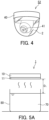
- FIG. 4 shows an example of a security camera including the antifog-film-attached transparent article 2 according to the present embodiment.
- a security camera 51 shown in FIG. 3 includes a camera 31, a housing 30 for fixing the camera, and the antifog-film-attached transparent article 1.
- a security camera 52 shown in FIG. 4 includes a camera 41, a housing 40 for fixing the camera, and the antifog-film-attached transparent article 2.
- the antifog-film-attached transparent article was immersed in a plastic container containing pure water at room temperature (about 25°C) and held in this state for 24 hours. Subsequently, the antifog-film-attached transparent article was removed and leaned against a holder for drying. The sample dried was subjected to the following appearance evaluation and high-temperature water vapor evaluation.
- the state of the film surface was evaluated with the naked eye to determine which of the following is met.
- the antifog-film-attached transparent article 1 was held in a horizontal position so that the antifog film 11 formation side of the antifog-film-attached transparent article 1 faced the heat-retaining cup 80. While water vapor was supplied, the temperature of the water 70 was maintained at 90 to 100°C. A distance D 1 between the antifog film and the surface of the water was set to 60 mm. Additionally, the internal space of the heat-retaining cup 80 had a shape of a circular column with a 64-mm diameter opening, and the volume of the water 70 was set to about 130 cc.
- the antifog-film-attached transparent article 1 was held above the heat-retaining cup 80 for 30 seconds to supply high-temperature water vapor to the antifog film 11. Subsequently, as shown in FIG. 5B , the heat-retaining cup 80 was removed and a sheet 95 with a predetermined QR code 90 printed thereon was disposed instead. A distance D 2 between the antifog film 11 and the sheet 95 was set to 110 mm. In this state, the QR code 90 was photographed with a camera 100 from above through the antifog-film-attached transparent article 1 to check whether the information of the QR code 90 was readable. A distance D 3 between the transparent base 10 and a lens 101 of the camera 100 was set to 80 mm. The process from the removal of the heat-retaining cup 80, that is, the stop of the supply of the high-temperature water vapor, to the photographing of the QR code was performed within 30 seconds.
- the QR codes used were of the five types shown in FIG. 6A to FIG. 6E .
- the QR code of the smallest size from which the information was readable was specified and determined as the evaluation results.
- the size and information of the QR codes used are as follows. For example, in the case where the QR code SSS is readable, character information "Rank:SSS" is displayed.
- the QR code "SSS” shown in FIG. 6A was obtained by encoding, as the information, the above character string under a symbol size of 25 ⁇ 25 modules and a specification of error correction level H, in accordance with JIS X 0510: 2018.
- the respective QR codes “SS”, “S”, “A”, and “B” shown in FIG. 6B to FIG. 6E are each obtained by encoding, as the information, the above character string under a symbol size of 21 ⁇ 21 modules and a specification of error correction level H, in accordance with JIS X 0510: 2018.
- the character strings are each composed of not double-byte characters but single-byte characters (1-byte codes).
- the camera used was smartphone "Xperia XZ2" manufactured by Sony Corporation (model name: SO-03K, OS: Android (registered trademark) (ver. 10)).
- QR code reading the QR code reading function of LINE (registered trademark) application (ver. 11.7.2) was used.
- a coating liquid was prepared by putting the following materials into a glass container for stirring: 48.2 mass% of a polyvinyl acetal resin-containing solution ("S-LEC KX-5" manufactured by Sekisui Chemical Co., Ltd., a solid content of 8 mass%, a degree of acetalization of 9 mol%, and containing an acetal structure derived from benzaldehyde); 0.5 mass% of a polyether-modified siloxane ("BYK-345" manufactured by BYK-Chemie GmbH); 1.0 mass% of 3-aminopropyltriethoxysilane (APTES, "KBE-903" manufactured by Shin-Etsu Chemical Co., Ltd.); 0.7 mass% of 3-glycidoxypropyltrimethoxysilane (GPTMS, "KBM-403” manufactured by Shin-Etsu Chemical Co., Ltd.); 20.0 mass% of propylene glycol; 18.5 mass% of purified water; 11.0 mass% of an alcohol
- the coating liquid was applied by spin coating (at 1500 rpm for 10 seconds) to form a coating film.
- the float glass on which the coating film had been formed was heated under conditions of 100°C and 30 minutes. Thus, an antifog-film-attached transparent article was obtained.
- Antifog-film-attached transparent articles were obtained in the same manner as in Example 1 except that the raw materials and amounts shown in Table 1 were used in the preparation of the coating liquid. Additionally, in Example 2, the amount of the alcohol solvent was increased by the amount of the epoxysilane decreased. In Example 3, the amount of the alcohol solvent was decreased by the amount of the polyether-modified siloxane increased.
- BYK-347, BYK-349, and BYK-3455 are polyether-modified silicones manufactured by BYK-Chemie GmbH, and TSF-4440 is a polyether-modified silicone manufactured by Momentive Performance Materials Inc.
- Antifog-film-attached transparent articles were obtained in the same manner as in Example 1 except that the raw materials and amounts shown in Table 2 were used in the preparation of the coating liquid. Additionally, “A-80" (RAPIDSOL A-80) used in Comparative Example 10 is a product name of a product manufactured by NOF CORPORATION. Furthermore, in Comparative Examples 1 to 6, the amount of the alcohol solvent was increased by the amount of the component that was not added.
- the antifog-film-attached transparent articles according to the examples were each evaluated as any of "SSS" to "S” in the high-temperature water vapor evaluation performed after the water immersion test.
- a continuous film of water having a uniform thickness was formed on the surface of the antifog film, and the transparency of the antifog-film-attached transparent article was ensured while neither whitening of the film itself nor fogging due to dew condensation was observed.
- the transparent continuous films of the examples each of which was evaluated as any of "SSS” to "S", each coated 90% or more of the surface of the antifog film exposed to water vapor, more specifically, coated substantially the entirety of the above surface.
- the antifog film was eluted after the water immersion test.
- Comparative Examples 1 to 6 and 10 at the stop time point of the supply of high-temperature water vapor, fogging due to dew condensation was observed or large water drops spread to adhere onto the surface of the antifog film was observed. Consequently, in these comparative examples, even the QR code of the largest size was not readable.
- the antifog-film-attached transparent article in the initial state where the antifog film had been formed was subjected to an appearance evaluation in the same manner as described above, and furthermore subjected to a haze ratio measurement.
- the antifog-film-attached transparent article in the initial state where the antifog film had been formed was subjected to supply of high-temperature water vapor to the antifog film in the same manner as in the high-temperature water vapor evaluation. Subsequently, the antifog-film-attached transparent article was removed and leaned against a holder for drying. The sample dried was again repeatedly subjected to supply of high-temperature water vapor to the antifog film and drying, where high-temperature water vapor was supplied to the antifog film 10 times. Subsequently, an appearance evaluation and a high-temperature water vapor evaluation were performed in the same manner as described above. Additionally, in the high-temperature water vapor evaluation, the QR code photographing was performed without performing the 11th water vapor supply (immediately after the completion of the 10th water vapor supply).
Landscapes
- Chemical & Material Sciences (AREA)
- Organic Chemistry (AREA)
- Life Sciences & Earth Sciences (AREA)
- Engineering & Computer Science (AREA)
- Materials Engineering (AREA)
- Wood Science & Technology (AREA)
- Chemical Kinetics & Catalysis (AREA)
- Physics & Mathematics (AREA)
- Geochemistry & Mineralogy (AREA)
- General Chemical & Material Sciences (AREA)
- General Physics & Mathematics (AREA)
- Optics & Photonics (AREA)
- Health & Medical Sciences (AREA)
- Polymers & Plastics (AREA)
- Medicinal Chemistry (AREA)
- Laminated Bodies (AREA)
- Surface Treatment Of Glass (AREA)
- Paints Or Removers (AREA)
- Materials Applied To Surfaces To Minimize Adherence Of Mist Or Water (AREA)
- Surface Treatment Of Optical Elements (AREA)
Abstract
Description
- The present invention relates to an antifog-film-attached transparent article for security cameras and a security camera.
- Transparent bases typified by glass sheets may have antifog films formed thereon in order to impart antifog properties. For example, Patent Literature 1 discloses an antifog film containing a polyvinyl acetal resin, which is a water-absorbing polymer, and a silica component such as colloidal silica.
- Patent Literature 1:
JP 2012-117025 A - According to studies by the present inventors, however, conventional antifog films are not suitable for maintaining the imaging function of security cameras for which the demand has been increasing. In view of this, the present invention aims to provide an antifog-film-attached transparent article suitable for use in security cameras.
- In the present description, the mention of QR code being a registered trademark is hereinafter omitted.
- The present invention provides an antifog-film-attached transparent article for security cameras, the antifog-film-attached transparent article including:
- a transparent base; and
- an antifog film on a surface of the transparent base, wherein
- in a test in which:
- the antifog-film-attached transparent article is immersed in water at 25°C for 24 hours and removed from the water;
- subsequently the antifog film is exposed for 30 seconds to water vapor generated from water at 90°C to 100°C disposed at a distance of 60 mm from the antifog film downward in a vertical direction; and
- subsequently a judgment is made as to whether information of a QR code disposed at a distance of 110 mm from the antifog film downward in the direction is readable with a camera from an opposite side to a formation side of the antifog film,
- information of a QR code of a 40 mm square size is readable
- where the QR code is a two-dimensional code obtained by encoding, as the information, a character string "Rank:B" under a symbol size of 21 × 21 modules and a specification of error correction level H, in accordance with Japanese Industrial Standards (JIS) X 0510: 2018.
- In another aspect, the present invention provides an antifog-film-attached transparent article for security cameras, the antifog-film-attached transparent article including:
- a transparent base; and
- an antifog film on a surface of the transparent base, wherein
- the antifog film includes a water-absorbing polymer, and
- when a test is performed in which: the antifog-film-attached transparent article is immersed in water at 25°C for 24 hours and removed from the water; and subsequently the antifog film is exposed for 30 seconds to water vapor generated from water at 90°C to 100°C disposed at a distance of 60 mm from the antifog film downward in a vertical direction,
- a transparent continuous film is formed on a surface of the antifog film exposed to the water vapor.
- In still another aspect, the present invention provides an antifog-film-attached transparent article for security cameras, the antifog-film-attached transparent article including:
- a transparent base; and
- an antifog film on a surface of the transparent base, wherein
- the antifog film includes:
- at least one selected from the group consisting of a silane coupling agent and a cross-linked structure derived from the silane coupling agent;
- a water-absorbing polymer;
- a polyether-modified siloxane; and
- a C2-C8 diol.
- In yet another aspect, the present invention provides a security camera including:
- a camera; and
- the antifog-film-attached transparent article for security cameras according to the present invention disposed in front of a lens of the camera.
- The present invention provides an antifog-film-attached transparent article suitable for maintaining the imaging function of security cameras.
-
-
FIG. 1 is a cross-sectional view showing an example of an antifog-film-attached transparent article according to an embodiment of the present invention. -
FIG. 2 is a cross-sectional view showing another example of the antifog-film-attached transparent article according to the embodiment. -
FIG. 3 is a schematic view showing an example of a security camera according to the embodiment. -
FIG. 4 is a schematic view showing another example of the security camera according to the embodiment. -
FIG. 5A is a schematic view for illustrating the outline of a high-temperature water vapor evaluation. -
FIG. 5B is another schematic view for illustrating the outline of the high-temperature water vapor evaluation. -
FIG. 6A shows a QR code example (10 mm × 10 mm size, recorded information "Rank:SSS") used for the high-temperature water vapor evaluation. -
FIG. 6B shows a QR code example (15 mm × 15 mm size, recorded information "Rank:SS") used for the high-temperature water vapor evaluation. -
FIG. 6C shows a QR code example (20 mm × 20 mm size, recorded information "Rank:S") used for the high-temperature water vapor evaluation. -
FIG. 6D shows a QR code example (30 mm × 30 mm size, recorded information "Rank:A") used for the high-temperature water vapor evaluation. -
FIG. 6E shows a QR code example (40 mm × 40 mm size, recorded information "Rank: B") used for the high-temperature water vapor evaluation. - An embodiment of the present invention will be described below with reference to the drawings as appropriate. The present invention is not limited to the following embodiment. In the present description, a "main component" refers to a component contained in the highest content among the components contained. Furthermore, "principal surfaces" of a plate-shaped article refer to two surfaces facing away from each other at a predetermined distance, called the thickness.
- As disclosed in Patent Literature 1, antifog films often have blended thereto a water-absorbing polymer. A higher water-absorbing polymer content can be expected to enhance the antifog properties of the films. On the other hand, a higher water-absorbing polymer content usually decreases the abrasion resistance of the films. Accordingly, as disclosed in Patent Literature 1, antifog films often have added thereto an inorganic component that compensates for a decrease in abrasion resistance, typically a silica component such as colloidal silica. Antifog-film-attached transparent articles that achieve a high abrasion resistance as well as antifog properties are suitable for use as window panes for automobiles. In contrast, transparent articles for use together with security cameras are not required to have a high-level abrasion resistance. It is appropriate to proceed with development of antifog-film-attached transparent articles for security cameras from a perspective different from that of antifog-film-attached transparent articles for automobiles.
- An emphasis for antifog-film-attached transparent articles for security cameras that should be placed on is that even a long-time exposure of antifog films to a harsh environment does not impair the imaging function of security cameras. An antifog-film-attached transparent article according to the present embodiment has been achieved through further studies made from such a perspective, and can exhibit a function of transmitting light without scattering at a high level even when the antifog film is exposed to a harsh environment.
-
FIG. 1 is a cross-sectional view showing the antifog-film-attached transparent article according to the present embodiment. An antifog-film-attached transparent article 1 includes a plate-shapedtransparent base 10, that is, a transparent substrate, and anantifog film 11 formed on the surface of thetransparent base 10. Theantifog film 11 is formed on at least a portion of a surface of thetransparent base 10, for example, a principal surface of thetransparent base 10. Theantifog film 11 may be formed on bothprincipal surfaces transparent base 10, or may be formed only on the oneprincipal surface 10a as shown inFIG. 1 . - The
transparent base 10 only needs to be transparent, and its shape and material are not particularly limited. Thetransparent base 10 may be made of glass or a resin. Thetransparent base 10 is, for example, a glass sheet or a resin sheet. The following describes a glass sheet and a resin sheet as typicaltransparent bases 10. - The glass composition of the glass sheet is not particularly limited, and may be soda-lime glass, aluminosilicate glass, borosilicate glass, alkali-free glass, or even multicomponent glass called C-glass, E-glass, etc. The multicomponent glass contains SiO2 as the main component, and further contains a component other than SiO2, for example, at least one oxide selected from the group consisting of B2O3, Al2O3, MgO, CaO, Li2O, Na2O, and K2O. The glass sheet, however, may be made of silica glass.
- The glass sheet may be float glass. Float glass is shaped by a so-called float process. Since float glass is shaped in a float bath with one principal surface in contact with molten tin, the tin becomes diffused over the one principal surface. Accordingly, one principal surface, called a bottom surface, of float glass has a surface layer formed of tin diffused thereon, whereas the other principal surface, called a top surface, does not have such a surface layer. From another perspective, the tin concentration in float glass is higher on one principal surface than on the other principal surface. The glass sheet, however, may be shaped by a manufacturing process other than the float process, for example, the overflow downdraw process.
- In the case where float glass is used as the transparent base, the antifog film is desirably formed on the bottom surface of the float glass. Accordingly, in the case where the
transparent base 10 inFIG. 1 is float glass, theprincipal surface 10a is preferably the bottom surface though it may be the top surface. The bottom surface has more hydroxy groups than the top surface, and accordingly is suitable as the surface on which an antifog film having an excellent water resistance is to be formed. - The thickness of the glass sheet is, for example, 0.5 to 7.0 mm, and may be 0.5 to 5.0 mm. In the case where impact resistance should be emphasized, the glass sheet that is non-strengthened glass has a thickness of preferably 3.5 mm or more. Note that the glass sheet that is strengthened glass having a thickness of 1.8 mm or more can have a sufficient impact resistance. The strengthened glass may be either thermally strengthened glass or chemically strengthened glass.
- The resin material of the resin sheet is not particularly limited, and its examples include acrylic resins such as methacryl resin (PMMA), polycarbonate (PC), acrylonitrile/styrene resin (AS), acrylonitrile/butadiene/styrene resin (ABS), cycloolefin polymer (COP), vinyl chloride (PVC), triacetyl cellulose (TAC), polyethylene terephthalate (PET), and urethane. The thickness of the resin sheet is, for example, 0.5 to 7.0 mm and may be 0.5 to 5.0 mm. In the case where the resin is an acrylic resin, the thickness of the resin sheet is preferably 2.0 to 3.0 mm. In the case where the resin is polycarbonate, the thickness of the resin sheet is preferably 1.0 to 2.0 mm.
- As shown in
FIG. 1 , thetransparent base 10 may have a flat plate shape whose principal surfaces are flat surfaces. The principal surfaces of the transparent base, however, may be curved surfaces. For example, the transparent base may be obtained by bending a flat-plate-shaped transparent substrate. The transparent base may be a shaped body having curved surfaces obtained not by shaping from a flat-plate-shaped transparent substrate but by directly shaping from a molten material.FIG. 2 shows an example of such a shaped body. - A
transparent base 20 shown inFIG. 2 has principal surfaces that are both curved surfaces, and oneprincipal surface 20a is a concave surface, and the otherprincipal surface 20b is a convex surface. On the front surface of theprincipal surface 20a, which is a concave surface, anantifog film 21 is formed. Theprincipal surface 20a faces the lens of a security camera that is not shown in the figure. Thetransparent base 20 has a dome shape, and the inside of the dome shape can be used as a space in which the lens of the security camera is to be placed (seeFIG. 4 ). In other words, thetransparent base 20 has a concave surface facing the space in which the lens of the security camera is to be placed. - On the principal surface of the transparent base, an underlying film may be formed. In this case, the underlying film is interposed between the surface of the transparent base and the antifog film. The underlying film is not particularly limited, and may be, for example, a barrier film preventing elution of an alkali metal from the glass. The barrier film is, for example, a silica film.
- In the case where the antifog film is formed only on one principal surface of the transparent base, a film other than the antifog film may be formed on the other principal surface. Examples of such a film include an antireflection film, a water-repellent film, a hydrophilic film, and a colored film.
- The film thickness of each of the
antifog films - The
antifog films - Examples of the water-absorbing polymer include at least one selected from the group consisting of a urethane resin, an epoxy resin, an acrylic resin, a polyvinyl acetal resin, and a polyvinyl alcohol resin. Examples of the urethane resin include a polyurethane resin composed of a polyisocyanate and a polyol. Examples of the polyol include acrylic polyol and polyoxyalkylene-based polyol. Examples of the epoxy resin include glycidyl ether-based epoxy resin, glycidyl ester-based epoxy resin, glycidyl amine-based epoxy resin, and cyclic aliphatic epoxy resin. A preferred epoxy resin is cyclic aliphatic epoxy resin. A polyvinyl acetal resin (hereinafter, simply referred to as "polyvinyl acetal") that is a preferred water-absorbing polymer will be described below.
- Polyvinyl acetal can be obtained by acetalization of polyvinyl alcohol through a condensation reaction with an aldehyde. The acetalization of polyvinyl alcohol should be performed by any known method, such as a precipitation method using an aqueous medium in the presence of an acid catalyst or a dissolution method using a solvent such as an alcohol. The acetalization can also be performed in parallel with saponification of polyvinyl acetate. The degree of acetalization is preferably 2 to 40 mol%, more preferably 3 to 30 mol%, particularly preferably 5 to 20 mol%, and in some cases preferably 5 to 15 mol%. The degree of acetalization can be measured, for example, by 13C nuclear magnetic resonance spectroscopy. Polyvinyl acetal having a degree of acetalization in the above range is suitable for forming an antifog film having a good water absorbency and a good water resistance.
- The average degree of polymerization of polyvinyl alcohol is preferably 200 to 4500 and more preferably 500 to 4500. A higher average degree of polymerization is more advantageous in terms of forming an antifog film having a good water absorbency and a good water resistance. However, an excessively high average degree of polymerization excessively increases the solution viscosity, which may adversely affect the film formation. The degree of saponification of polyvinyl alcohol is preferably 75 to 99.8 mol%.
- Examples of the aldehyde to be subjected to a condensation reaction with polyvinyl alcohol include aliphatic aldehydes such as formaldehyde, acetaldehyde, butyraldehyde, hexylcarbaldehyde, octylcarbaldehyde, and decylcarbaldehyde. The examples further include aromatic aldehydes including: benzaldehyde; 2-methylbenzaldehyde, 3-methylbenzaldehyde, 4-methylbenzaldehyde, and other alkyl-substituted benzaldehydes; chlorobenzaldehyde and other halogen-substituted benzaldehydes; substituted benzaldehydes in which a hydrogen atom is substituted by a functional group other than an alkyl group, such as a hydroxy group, an alkoxy group, an amino group, or a cyano group; and condensed aromatic ring aldehydes such as naphthaldehyde and anthraldehyde. Aromatic aldehydes, which are highly hydrophobic, are advantageous in terms of forming a water-absorbing film having a low degree of acetalization and an excellent water resistance. Using aromatic aldehydes is advantageous also in terms of forming a highly water-absorbing film with a large amount of a hydroxy group remained. Polyvinyl acetal preferably contains an acetal structure derived from an aromatic aldehyde, particularly from benzaldehyde.
- The content of the water-absorbing polymer in the antifog film is, for example, 45 to 95 mass%, preferably 55 to 85 mass%, and more preferably 65 to 80 mass%. The water-absorbing polymer may be the main component of the antifog film.
- The polyether-modified siloxane is a compound having a polyether chain as at least one selected from the group consisting of a molecular chain bonded to a terminal of a main chain of siloxane and a molecular chain bonded as a side chain of the main chain of siloxane. Siloxane is a compound having a siloxane bond (Si-O-Si) as a skeleton. The structural unit of the polyether chain is not particularly limited, and is, for example, ethylene oxide or propylene oxide. The polyether chain may include, as the structural unit, only one structural unit or two or more structural units.
- The polyether-modified siloxane may be a polyether-modified silicone. Silicone is a polymer having a siloxane bond (Si-O-Si) as a skeleton. Examples of the polyether-modified silicone include BYK-345, BYK-347, and BYK-349 manufactured by BYK-Chemie GmbH and TSF-4440 manufactured by Momentive Performance Materials Inc.
- The content of the polyether-modified siloxane in the antifog film is, for example, 2 to 30 mass%, preferably 5 to 25 mass%, and more preferably 8 to 20 mass%.
- A C2-C8 diol, in other words, a diol having 2 to 8 carbon atoms may include, for example, at least one selected from the group consisting of ethylene glycol, diethylene glycol, propylene glycol, dipropylene glycol, butanediol, pentanediol, and hexanediol. The diol may be a C2-C6 diol. Examples of a preferred diol include at least one selected from the group consisting of butanediol, propylene glycol, and dipropylene glycol. The antifog film may include, as a particularly preferred diol, propylene glycol and/or dipropylene glycol.
- The content of the C2-C8 diol in the antifog film is, for example, 0.01 to 30 mass%, preferably 0.05 to 20 mass%, and more preferably 0.1 to 10 mass%.
- Examples of the silane coupling agent include silicon compounds each having a hydrolyzable group represented by Formula (I). The silicon compounds each having a hydrolyzable group represented by Formula (I) may be used alone or in combination.
R-L-SiY3-nXn (I)
- In Formula (I), n represents an integer of 1 to 3.
- X is a hydrolyzable group or a halogen atom. Examples of the hydrolyzable group include at least one selected from the group consisting of an alkoxyl group, an acetoxy group, an alkenyloxy group, and an amino group. Examples of a preferred alkoxyl group include a C1-C4 alkoxyl group (a methoxy group, an ethoxy group, a propoxy group, and a butoxy group). Examples of a preferred halogen atom include chlorine.
- Y is a C1-C3 alkyl group. Preferred alkyl groups are a methyl group and an ethyl group.
- L is a hydrocarbon group. The hydrocarbon group is preferably an alkylene group. The carbon number of the hydrocarbon group is, for example, 1 to 10, preferably 1 to 6, and more preferably 1 to 3. Preferred examples of the hydrocarbon group include a methylene group, an ethylene group, an n-propylene group, an isopropylene group, a vinylene group, and a propenylene group.
- R is a substituent or an optionally substituted hydrocarbon group. The carbon number of this hydrocarbon group is not particularly limited, and is, for example, 4 to 12, and may be 3 or less. The substituent may be a reactive functional group. The reactive functional group is, for example, at least one selected from the group consisting of an epoxy group, an amino group, a mercapto group, an isocyanate group, an acrylic group, and a methacrylic group, and is preferably at least one selected from the group consisting of an epoxy group and an amino group. The epoxy group may be included as a portion of a glycidyl ether group. An epoxy-containing silane coupling agent is also referred to as "epoxysilane". The amino group may be any of a primary amino group, a secondary amino group, and a tertiary amino group, and is preferably a primary amino group and a secondary amino group. An amino-containing silane coupling agent is also referred to as "aminosilane".
- A compound in which X in Formula (I) is an alkoxyl group is called a silicon alkoxide. In Formula (I), n is preferably 2 or 3. That is, the silane coupling agent is preferably a bifunctional silicon alkoxide having a reactive functional group represented by R-L-SiY1X2 in Formula (I) or a trifunctional silicon alkoxide having a reactive functional group represented by R-L-SiX3 in Formula (I).
- Preferred specific examples of the bifunctional silicon alkoxide having a reactive functional group include a glycidoxyalkylalkyldialkoxysilane and an aminoalkylalkyldialkoxysilane. Examples of the glycidoxyalkylalkyldialkoxysilane include 3-glycidoxypropylmethyldimethoxysilane and 3-glycidoxypropylmethyldiethoxysilane. Examples of the aminoalkylalkyldialkoxysilane include N-2-(aminoethyl)-3-aminopropylmethyldimethoxysilane and N-2-(aminoethyl)-3-aminopropylethyldiethoxysilane.
- Preferred specific examples of the trifunctional silicon alkoxide having a reactive functional group include a glycidoxyalkyltrialkoxysilane and an aminoalkyltrialkoxysilane. Examples of the glycidoxyalkyltrialkoxysilane include 2-(3,4-epoxycyclohexyl)ethyltrimethoxysilane, 3-glycidoxypropyltrimethoxysilane (GPTMS), and 3-glycidoxypropyltriethoxysilane. Examples of the aminoalkyltrialkoxysilane include 3-aminopropyltrimethoxysilane (APTMS), 3-am inopropyltriethoxysilane (APTES), 3-triethoxysilyl-N-(1,3-dimethyl-butylidene)propylamine, 3-(N-phenyl)aminopropyltrimethoxysilane, a hydrochloride of N-(vinylbenzyl)-2-aminoethyl-3-aminopropyltrimethoxysilane, N-2-(aminoethyl)-3-aminopropyltrimethoxysilane, and N-2-(aminoethyl)-3-am inopropyltriethoxysilane.
- In the present embodiment, the silane coupling agent may be only at least one or two or more selected from the group consisting of the bifunctional silicon alkoxide having a reactive functional group and the trifunctional silicon alkoxide having a reactive functional group. The silane coupling agent can be preferably the trifunctional silicon alkoxide having a reactive functional group. The trifunctional silicon alkoxide having a reactive functional group may be only at least one or two or more selected from the group consisting of the glycidoxyalkyltrialkoxysilane and the aminoalkyltrialkoxysilane. The trifunctional silicon alkoxide having a reactive functional group can be preferably 3-glycidoxypropyltrimethoxysilane (GPTMS) and 3-aminopropyltriethoxysilane (APTES).
- In the antifog film, at least a portion of the silane coupling agent reacts with a different component to form a cross-linked structure. Examples of the different component include an organic component such as the water-absorbing polymer and the hydroxy group on the surface of the base.
- A particularly preferred silane coupling agent combination is a combination of an epoxy-containing silane coupling agent (epoxysilane) and an amino-containing silane coupling agent (aminosilane). The epoxysilane and the aminosilane are added in a mass ratio of, for example, preferably 1:3 to 3:1, and particularly preferably 1:2 to 2:1.
- The content of the silane coupling agent in the antifog film is, for example, 2 to 35 mass%, preferably 5 to 30 mass%, and more preferably 8 to 25 mass%.
- The antifog film may contain an ultraviolet absorber, an infrared absorber, a leveling agent (surface conditioner), a light stabilizer, and the like as appropriate in addition to the above components. These components, however, are added in desirably 20 mass% or less, more desirably 10 mass% or less, and particularly desirably 5 mass% or less, relative to the antifog film. The antifog film is not required to have a high abrasion resistance, and accordingly may or may not contain colloidal silica or other silica fine particles. The content of the silica fine particles in the antifog film may be, for example, 10 to 60 mass%, and may be limited to less than 5 mass%, even less than 3 mass%, or particularly less than 1 mass%. The content of oxide fine particles including silica fine particles may also be about the same as described above for the silica fine particles. The antifog film may or may not contain oxide fine particles typified by silica fine particles. Note that even in the case where the antifog film contains no silica fine particles, the antifog film can contain a siloxane component contained in the polyether-modified siloxane, the silane coupling agent, etc.
- The antifog film according to the present embodiment can exhibit a function of transmitting transmission light without scattering at a high level, even after a long-time exposure to a harsh environment for antifog films, for example, contact with water. To exhibit this function, the antifog film desirably has, in addition to transparency and water absorbency, water resistance and even hydrophilicity. An antifog film having an insufficient water resistance may cause elution of its components when exposed to moisture for a long time. Furthermore, in the case where an antifog film has hydrophilicity to such an extent that at saturation of the water absorption by the antifog film, excess water is retained as a continuous film on the surface of the antifog film, transmission light can be transmitted without excessive scattering.
- The antifog-film-attached transparent article according to the present embodiment can transmit transmission light without excessive scattering. Specifically, the antifog-film-attached transparent article can have a haze ratio of, for example, 5% or less, even 3% or less, particularly 1% or less, and in some cases, 0.4% or less. The haze ratio is specified in JIS K 7136: 2018.
- The antifog-film-attached transparent article according to the present embodiment can have both water resistance and hydrophilicity. These properties can be evaluated by a method called a high-temperature water vapor evaluation which will be described in detail in the Examples section. This method supplies high-temperature and excessive water vapor to the antifog film with the antifog film turned vertically downward. When the antifog film is brought into contact with this water vapor, a transparent continuous film of water is formed on a portion directly exposed to the water vapor on the surface of the antifog film that is excellent in hydrophilicity and water resistance. Being a "transparent continuous film" can be determined by visually confirming that the continuity as a film, not water drops, is ensured and that the film has not become fogged. Fogging of a film can be caused by whitening of the film due to an insufficient water resistance or by dew condensation on the film surface due to insufficient antifog properties. On the surface of a film having an insufficient hydrophilicity, water is not retained as a continuous film but is dispersed and adhered as water drops. On a film having an insufficient water resistance, whitening of the film due to contact with high-temperature water vapor is observed, and elution of the components of the film, a defect of the film, or the like may occur. The hydrophilicity of the surface is evaluated typically by the contact angle of water. However, this evaluation method only drops an extremely small amount of water drops onto the film, and accordingly does not adequately reproduce a harsh environment. Additionally, the transparent continuous film may
coat 80% or more or even 90% or more of the surface of the antifog film exposed to water vapor. - For a more detailed or more phased film evaluation, an information reading evaluation using a QR code can be performed. The details of this evaluation method will be described later in the Examples section as well. In this evaluation method, the antifog-film-attached transparent article according to the present embodiment even after immersion in water at room temperature for 24 hours can exhibit a good hydrophilicity to such an extent that it is possible to read preferably a QR code "A" of a 30 mm square size, more preferably a QR code "S" of a 20 mm square size, still more preferably a QR code "SS" of a 15 mm square size, and particularly preferably a QR code "SSS" of a 10 mm square size.
- The antifog film can be formed by applying, onto the surface of the transparent base, a coating liquid for forming the antifog film, and heating the transparent base on which the coating film has been formed from the coating liquid. The solvent used for preparing the coating liquid and the application method for the coating liquid should be any conventionally known material and method. Examples of the application method include spin coating, roll coating, spray coating, dip coating, flow coating, screen printing, and brush coating. The coating film may be appropriately dried before the heating.
- The heating temperature for the transparent base on which the coating film has been formed is not particularly limited, and is, for example, 100 to 180°C. The heating time is, for example, 5.0 minutes to 1 hour.
-
FIG. 3 shows an example of a security camera including the antifog-film-attached transparent article 1 according to the present embodiment.FIG. 4 shows an example of a security camera including the antifog-film-attachedtransparent article 2 according to the present embodiment. Asecurity camera 51 shown inFIG. 3 includes acamera 31, ahousing 30 for fixing the camera, and the antifog-film-attached transparent article 1. Asecurity camera 52 shown inFIG. 4 includes acamera 41, ahousing 40 for fixing the camera, and the antifog-film-attachedtransparent article 2. - Light incident on the lenses of the
cameras transparent articles 1 and 2. On the sides facing thecameras - The present invention will be described below in more detail with reference to examples. First, a method for evaluating antifog-film-attached transparent articles obtained in the examples and comparative examples will be described.
- The antifog-film-attached transparent article was immersed in a plastic container containing pure water at room temperature (about 25°C) and held in this state for 24 hours. Subsequently, the antifog-film-attached transparent article was removed and leaned against a holder for drying. The sample dried was subjected to the following appearance evaluation and high-temperature water vapor evaluation.
- The state of the film surface was evaluated with the naked eye to determine which of the following is met.
- G: No change from before the test is observed.
- F: Some whitening is observed.
- NG: Whitening is observed.
- Y: Film elution is observed.
- As shown in
FIG. 5A , above a stainless-steel heat-retainingcup 80 containing boiledwater 70, the antifog-film-attached transparent article 1 was held in a horizontal position so that theantifog film 11 formation side of the antifog-film-attached transparent article 1 faced the heat-retainingcup 80. While water vapor was supplied, the temperature of thewater 70 was maintained at 90 to 100°C. A distance D1 between the antifog film and the surface of the water was set to 60 mm. Additionally, the internal space of the heat-retainingcup 80 had a shape of a circular column with a 64-mm diameter opening, and the volume of thewater 70 was set to about 130 cc. The antifog-film-attached transparent article 1 was held above the heat-retainingcup 80 for 30 seconds to supply high-temperature water vapor to theantifog film 11. Subsequently, as shown inFIG. 5B , the heat-retainingcup 80 was removed and asheet 95 with apredetermined QR code 90 printed thereon was disposed instead. A distance D2 between theantifog film 11 and thesheet 95 was set to 110 mm. In this state, theQR code 90 was photographed with acamera 100 from above through the antifog-film-attached transparent article 1 to check whether the information of theQR code 90 was readable. A distance D3 between thetransparent base 10 and alens 101 of thecamera 100 was set to 80 mm. The process from the removal of the heat-retainingcup 80, that is, the stop of the supply of the high-temperature water vapor, to the photographing of the QR code was performed within 30 seconds. - The QR codes used were of the five types shown in
FIG. 6A to FIG. 6E . The QR code of the smallest size from which the information was readable was specified and determined as the evaluation results. The size and information of the QR codes used are as follows. For example, in the case where the QR code SSS is readable, character information "Rank:SSS" is displayed. - QR code "SSS": 10 mm × 10 mm, information "Rank:SSS" (
FIG. 6A ) - QR Code "SS": 15 mm × 15 mm, information "Rank:SS" (
FIG. 6B ) - QR Code "S": 20 mm × 20 mm, information "Rank:S" (
FIG. 6C ) - QR Code "A": 30 mm × 30 mm, information "Rank:A" (
FIG. 6D ) - QR Code "B": 40 mm × 40 mm, information "Rank:B" (
FIG. 6E ) - The case where none of the QR codes had been readable was evaluated as "X", and the case where the film had been eluted or peeled off due to contact with high-temperature water vapor was evaluated as "Y".
- The QR code "SSS" shown in
FIG. 6A was obtained by encoding, as the information, the above character string under a symbol size of 25 × 25 modules and a specification of error correction level H, in accordance with JIS X 0510: 2018. The respective QR codes "SS", "S", "A", and "B" shown inFIG. 6B to FIG. 6E are each obtained by encoding, as the information, the above character string under a symbol size of 21 × 21 modules and a specification of error correction level H, in accordance with JIS X 0510: 2018. Note that the character strings are each composed of not double-byte characters but single-byte characters (1-byte codes). - The camera used was smartphone "Xperia XZ2" manufactured by Sony Corporation (model name: SO-03K, OS: Android (registered trademark) (ver. 10)). For QR code reading, the QR code reading function of LINE (registered trademark) application (ver. 11.7.2) was used.
- A coating liquid was prepared by putting the following materials into a glass container for stirring: 48.2 mass% of a polyvinyl acetal resin-containing solution ("S-LEC KX-5" manufactured by Sekisui Chemical Co., Ltd., a solid content of 8 mass%, a degree of acetalization of 9 mol%, and containing an acetal structure derived from benzaldehyde); 0.5 mass% of a polyether-modified siloxane ("BYK-345" manufactured by BYK-Chemie GmbH); 1.0 mass% of 3-aminopropyltriethoxysilane (APTES, "KBE-903" manufactured by Shin-Etsu Chemical Co., Ltd.); 0.7 mass% of 3-glycidoxypropyltrimethoxysilane (GPTMS, "KBM-403" manufactured by Shin-Etsu Chemical Co., Ltd.); 20.0 mass% of propylene glycol; 18.5 mass% of purified water; 11.0 mass% of an alcohol solvent ("Neoethanol P-7" manufactured by Daishin-Chemical Co., Ltd.); 0.1 mass% of hydrochloric acid; and 0.01 mass% of a leveling agent ("KP-341" manufactured by Shin-Etsu Chemical Co., Ltd.).
- Onto the bottom surface of float glass (size: 50 mm × 50 mm, thickness: 1.1 mm) subjected in advance to alkaline cleaning, the coating liquid was applied by spin coating (at 1500 rpm for 10 seconds) to form a coating film. Next, the float glass on which the coating film had been formed was heated under conditions of 100°C and 30 minutes. Thus, an antifog-film-attached transparent article was obtained.
- Antifog-film-attached transparent articles were obtained in the same manner as in Example 1 except that the raw materials and amounts shown in Table 1 were used in the preparation of the coating liquid. Additionally, in Example 2, the amount of the alcohol solvent was increased by the amount of the epoxysilane decreased. In Example 3, the amount of the alcohol solvent was decreased by the amount of the polyether-modified siloxane increased. BYK-347, BYK-349, and BYK-3455 are polyether-modified silicones manufactured by BYK-Chemie GmbH, and TSF-4440 is a polyether-modified silicone manufactured by Momentive Performance Materials Inc.
- Antifog-film-attached transparent articles were obtained in the same manner as in Example 1 except that the raw materials and amounts shown in Table 2 were used in the preparation of the coating liquid. Additionally, "A-80" (RAPIDSOL A-80) used in Comparative Example 10 is a product name of a product manufactured by NOF CORPORATION. Furthermore, in Comparative Examples 1 to 6, the amount of the alcohol solvent was increased by the amount of the component that was not added.
- The results of the water immersion test are shown in Tables 1 and 2.
[Table 1] Example Water-absorbing polymer Polyether-modified siloxane Diol Silane coupling agent Water immersion test Epoxysilane Aminosilnane Appearance Hightemper ature water vapor 1 48.2 BYK-345 0.5 PG 20.0 0.7 1.0 G SSS 2 48.2 BYK-345 0.5 PG 20.0 - 1.0 G S 3 48.2 BYK-345 1.1 PG 20.0 0.7 1.0 G SSS 4 48.2 BYK-347 0.5 PG 20.0 0.7 1.0 G SS 5 48.2 BYK-349 0.5 PG 20.0 0.7 1.0 G SSS 6 48.2 TSF-4440 0.5 PG 20.0 0.7 1.0 G S 7 48.2 BYK-3455 0.5 DPG 20.0 0.7 1.0 G SSS 8 48.2 BYK-3455 0.5 BG 20.0 0.7 1.0 G SSS • PG: propylene glycol, DPG: dipropylene glycol, BG: 1,3-butanediol (1,3-butylene glycol)
• Numerical values in mass%[Table 2] Compa r. Exampl e Water-absorbi ng polymer Polyether-modifi ed siloxane Diol Silane coupling agent Water immersion test Epoxysila ne Aminosila ne Appearan ce High-temperatu re water vapor 1 48.2 - - - - 0.7 - G X 2 48.2 - - PG 20. 0 0.7 - G X 3 48.2 - - - - 0.7 1.0 G X 4 48.2 BYK-345 0.5 - - 0.7 - G X 5 48.2 - - PG 20. 0 0.7 1.0 G X 6 48.2 BYK-345 0.5 - - 0.7 1.0 G X 7 48.2 BYK-345 0.5 (PGME) 20. 0 0.7 1.0 Y Y 8 48.2 BYK-345 0.5 (MeOBtOH) 20. 0 0.7 1.0 Y Y 9 48.2 BYK-345 0.5 (MeOMeBtO H) 20. 0 0.7 1.0 Y Y 10 48.2 (A-80) 0.5 PG 20. 0 0.7 1.0 G X • PG: propylene glycol, PGME: polyethylene glycol monomethylether,
MeOBtOH: methoxybutanol,
MeOMeBtOH: 3-methoxy-3-methyl-1-butanol,
A-80 (RAPIDSOL A-80): di(2-ethylhexyl)sodium sulfosuccinate
• Numerical values in mass% - The antifog-film-attached transparent articles according to the examples were each evaluated as any of "SSS" to "S" in the high-temperature water vapor evaluation performed after the water immersion test. In each of the antifog films of the transparent articles according to the examples, at the stop time point of the supply of high-temperature water vapor, a continuous film of water having a uniform thickness was formed on the surface of the antifog film, and the transparency of the antifog-film-attached transparent article was ensured while neither whitening of the film itself nor fogging due to dew condensation was observed. Additionally, the transparent continuous films of the examples, each of which was evaluated as any of "SSS" to "S", each coated 90% or more of the surface of the antifog film exposed to water vapor, more specifically, coated substantially the entirety of the above surface. In contrast, in each of Comparative Examples 7 to 9, the antifog film was eluted after the water immersion test. In each of Comparative Examples 1 to 6 and 10, at the stop time point of the supply of high-temperature water vapor, fogging due to dew condensation was observed or large water drops spread to adhere onto the surface of the antifog film was observed. Consequently, in these comparative examples, even the QR code of the largest size was not readable.
- Moreover, the following evaluations were performed on Examples 1, 7, and 8 in order to check influence of a diol on the antifog films. The results are shown in Table 3.
[Table 3] Example Diol Initial state Repeated antifog test Alcohol abrasion test Appearance Haze ratio (%) Appearance High-temperature water vapor Appearance High-temperature water vapor 1 PG G 0.03 G SSS G SSS 7 DPG G 0.11 G SSS G SSS 8 BG G 0.07 G SSS G SSS • PG: propylene glycol, DPG: dipropylene glycol, BG: 1,3-butanediol (1,3-butylene glycol) - The antifog-film-attached transparent article in the initial state where the antifog film had been formed was subjected to an appearance evaluation in the same manner as described above, and furthermore subjected to a haze ratio measurement.
- The antifog-film-attached transparent article in the initial state where the antifog film had been formed was subjected to supply of high-temperature water vapor to the antifog film in the same manner as in the high-temperature water vapor evaluation. Subsequently, the antifog-film-attached transparent article was removed and leaned against a holder for drying. The sample dried was again repeatedly subjected to supply of high-temperature water vapor to the antifog film and drying, where high-temperature water vapor was supplied to the
antifog film 10 times. Subsequently, an appearance evaluation and a high-temperature water vapor evaluation were performed in the same manner as described above. Additionally, in the high-temperature water vapor evaluation, the QR code photographing was performed without performing the 11th water vapor supply (immediately after the completion of the 10th water vapor supply). - An amount of 0.5 cc of an alcohol solvent containing ethanol as the main component ("FineeterA-10" manufactured by FUTABA PURE CHEMICAL CO, LTD.) was dropped for impregnation onto a nonwoven fabric wiper ("BEMCOT M-3II" manufactured by Asahi Kasei Corporation) cut into a width of 25 mm, and then the wiper and the antifog-film-attached transparent article were set in a reciprocating abrasion tester. With a load of 400 g applied to the wiper, reciprocation for a length of 30 mm was performed 20 times. Subsequently, an appearance evaluation and a high-temperature water vapor evaluation were performed in the same manner as described above.
Claims (10)
- An antifog-film-attached transparent article for security cameras, the antifog-film-attached transparent article comprising:a transparent base; andan antifog film on a surface of the transparent base, whereinin a test in which:the antifog-film-attached transparent article is immersed in water at 25°C for 24 hours and removed from the water;subsequently the antifog film is exposed for 30 seconds to water vapor generated from water at 90°C to 100°C disposed at a distance of 60 mm from the antifog film downward in a vertical direction; andsubsequently a judgment is made as to whether information of a QR code disposed at a distance of 110 mm from the antifog film downward in the direction is readable with a camera from an opposite side to a formation side of the antifog film,information of a QR code of a 40 mm square size is readablewhere the QR code is a two-dimensional code obtained by encoding, as the information, a character string "Rank:B" under a symbol size of 21 × 21 modules and a specification of error correction level H, in accordance with Japanese Industrial Standards (JIS) X 0510: 2018.
- An antifog-film-attached transparent article for security cameras, the antifog-film-attached transparent article comprising:a transparent base; andan antifog film on a surface of the transparent base, whereinthe antifog film includes a water-absorbing polymer, andwhen a test is performed in which: the antifog-film-attached transparent article is immersed in water at 25°C for 24 hours and removed from the water; and subsequently the antifog film is exposed for 30 seconds to water vapor generated from water at 90°C to 100°C disposed at a distance of 60 mm from the antifog film downward in a vertical direction,a transparent continuous film is formed on a surface of the antifog film exposed to the water vapor.
- The antifog-film-attached transparent article for security cameras according to claim 1 or 2, wherein
the antifog film includes:at least one selected from the group consisting of a silane coupling agent and a cross-linked structure derived from the silane coupling agent;a water-absorbing polymer;a polyether-modified siloxane; anda C2-C8 diol. - An antifog-film-attached transparent article for security cameras, the antifog-film-attached transparent article comprising:a transparent base; andan antifog film on a surface of the transparent base, whereinthe antifog film includes:at least one selected from the group consisting of a silane coupling agent and a cross-linked structure derived from the silane coupling agent;a water-absorbing polymer;a polyether-modified siloxane; anda C2-C8 diol.
- The antifog-film-attached transparent article for security cameras according to claim 3 or 4, wherein
the diol includes at least one selected from the group consisting of ethylene glycol, diethylene glycol, propylene glycol, dipropylene glycol, butanediol, pentanediol, and hexanediol. - The antifog-film-attached transparent article for security cameras according to claim 5, wherein
the diol includes at least one selected from the group consisting of butanediol, propylene glycol, and dipropylene glycol. - The antifog-film-attached transparent article for security cameras according to any one of claims 3 to 6, wherein
the water-absorbing polymer includes a polyvinyl acetal resin. - The antifog-film-attached transparent article for security cameras according to any one of claims 1 to 7, whereinthe transparent base is float glass, andthe antifog film is formed on a bottom surface of the float glass.
- The antifog-film-attached transparent article for security cameras according to any one of claims 1 to 8, wherein
the transparent base has a concave surface adjacent to a space in which a lens of a security camera is to be placed. - A security camera comprising:a camera; andthe antifog-film-attached transparent article for security cameras according to any one of claims 1 to 9 disposed in front of a lens of the camera.
Applications Claiming Priority (2)
| Application Number | Priority Date | Filing Date | Title |
|---|---|---|---|
| JP2021098341 | 2021-06-11 | ||
| PCT/JP2022/023354 WO2022260144A1 (en) | 2021-06-11 | 2022-06-09 | Transparent article with anti-fog film for security camera, and security camera |
Publications (2)
| Publication Number | Publication Date |
|---|---|
| EP4353694A1 true EP4353694A1 (en) | 2024-04-17 |
| EP4353694A4 EP4353694A4 (en) | 2025-05-21 |
Family
ID=84425244
Family Applications (1)
| Application Number | Title | Priority Date | Filing Date |
|---|---|---|---|
| EP22820323.8A Pending EP4353694A4 (en) | 2021-06-11 | 2022-06-09 | CLEAR ITEM WITH ANTI-FOG FILM FOR SECURITY CAMERA AND SECURITY CAMERA |
Country Status (5)
| Country | Link |
|---|---|
| US (1) | US20240279486A1 (en) |
| EP (1) | EP4353694A4 (en) |
| JP (2) | JP7281607B2 (en) |
| CN (1) | CN117858851A (en) |
| WO (1) | WO2022260144A1 (en) |
Families Citing this family (2)
| Publication number | Priority date | Publication date | Assignee | Title |
|---|---|---|---|---|
| JP7281607B2 (en) * | 2021-06-11 | 2023-05-25 | 日本板硝子株式会社 | Transparent article with anti-fogging film for security camera and security camera |
| US20240280733A1 (en) * | 2021-06-11 | 2024-08-22 | Nippon Sheet Glass Company, Limited | Antifog-film-attached glass article for security cameras, security camera, and method for manufacturing antifog-film-attached glass article for security cameras |
Family Cites Families (17)
| Publication number | Priority date | Publication date | Assignee | Title |
|---|---|---|---|---|
| JP4381742B2 (en) * | 2002-08-01 | 2009-12-09 | セントラル硝子株式会社 | Antifogging film, method for forming the same and coating agent for forming antifogging film |
| JP6118012B2 (en) | 2010-12-03 | 2017-04-19 | 日本板硝子株式会社 | Antifogging film coated article |
| RU2615646C2 (en) * | 2012-10-15 | 2017-04-06 | Асахи Гласс Компани, Лимитед | Vehicle windscreen |
| CN103664003A (en) * | 2013-10-28 | 2014-03-26 | 滁州旭中化工有限公司 | Preparation method of heat-insulating anti-fogging film |
| BR122018010566B1 (en) * | 2014-06-05 | 2021-02-02 | Nippon Sheet Glass Company, Limited | transparent anti-fog coated article |
| JP6539051B2 (en) * | 2014-11-28 | 2019-07-03 | 日本板硝子株式会社 | Anti-fog coated articles |
| JP6450177B2 (en) * | 2014-12-10 | 2019-01-09 | 積水化学工業株式会社 | Anti-fogging coating |
| US20190283549A1 (en) * | 2016-07-20 | 2019-09-19 | Nippon Sheet Glass Company, Limited | Windshield and windshield manufacturing method |
| JP6794322B2 (en) * | 2016-07-25 | 2020-12-02 | 日本板硝子株式会社 | Windshield and its manufacturing method |
| WO2019234701A1 (en) * | 2018-06-08 | 2019-12-12 | Guardian Glass, LLC | Coated glass having antifog properties |
| WO2020044821A1 (en) * | 2018-08-31 | 2020-03-05 | 富士フイルム株式会社 | Laminate |
| JPWO2020111128A1 (en) * | 2018-11-30 | 2021-10-07 | ダイキン工業株式会社 | Anti-fog paint composition |
| CN211791722U (en) * | 2020-04-30 | 2020-10-27 | 商丘广信电子科技有限公司 | Antifog camera |
| JP7281608B2 (en) * | 2021-06-11 | 2023-05-25 | 日本板硝子株式会社 | Glass article with anti-fogging film and coating solution for forming anti-fogging film |
| CN122463534A (en) * | 2021-06-11 | 2026-07-28 | 日本板硝子株式会社 | Resin substrate with anti-fog film, transparent article with anti-fog film and coating liquid |
| US20240280733A1 (en) * | 2021-06-11 | 2024-08-22 | Nippon Sheet Glass Company, Limited | Antifog-film-attached glass article for security cameras, security camera, and method for manufacturing antifog-film-attached glass article for security cameras |
| JP7281607B2 (en) * | 2021-06-11 | 2023-05-25 | 日本板硝子株式会社 | Transparent article with anti-fogging film for security camera and security camera |
-
2022
- 2022-06-09 JP JP2022568663A patent/JP7281607B2/en active Active
- 2022-06-09 US US18/568,507 patent/US20240279486A1/en active Pending
- 2022-06-09 WO PCT/JP2022/023354 patent/WO2022260144A1/en not_active Ceased
- 2022-06-09 CN CN202280041470.5A patent/CN117858851A/en active Pending
- 2022-06-09 EP EP22820323.8A patent/EP4353694A4/en active Pending
-
2023
- 2023-03-09 JP JP2023036734A patent/JP2023088929A/en active Pending
Also Published As
| Publication number | Publication date |
|---|---|
| JPWO2022260144A1 (en) | 2022-12-15 |
| JP2023088929A (en) | 2023-06-27 |
| EP4353694A4 (en) | 2025-05-21 |
| JP7281607B2 (en) | 2023-05-25 |
| WO2022260144A1 (en) | 2022-12-15 |
| US20240279486A1 (en) | 2024-08-22 |
| TW202313863A (en) | 2023-04-01 |
| CN117858851A (en) | 2024-04-09 |
Similar Documents
| Publication | Publication Date | Title |
|---|---|---|
| EP4353695A1 (en) | Antifogging film-including glass article, and antifogging film-forming application liquid | |
| US10400130B2 (en) | Anti-fogging coated transparent article | |
| EP3492438B1 (en) | Windshield and windshield manufacturing method | |
| EP3564030A1 (en) | Glass plate production method and automotive glass plate | |
| JP6869671B2 (en) | Anti-fog coating composition and coating film containing it | |
| US20260125314A1 (en) | Transparent laminate | |
| EP4353476A1 (en) | Resin substrate with anti-fogging film, transparent article with anti-fogging film, and coating liquid | |
| US20240279486A1 (en) | Antifog-film-attached transparent article for security cameras and security camera | |
| EP3835099B1 (en) | Windshield | |
| WO2011004873A1 (en) | Anti-fog article, method for producing same, and coating kit for forming anti-fog film | |
| JP6007664B2 (en) | Window glass and manufacturing method thereof | |
| EP3955702A1 (en) | Windshield | |
| JP6488575B2 (en) | Near-infrared absorbing structure | |
| EP4353693A1 (en) | Antifog film-equipped glass article for security cameras, security camera, and method for producing antifog film-equipped glass article for security cameras | |
| JP2021192090A (en) | Transparent laminate | |
| JP7738383B2 (en) | flying object |
Legal Events
| Date | Code | Title | Description |
|---|---|---|---|
| STAA | Information on the status of an ep patent application or granted ep patent |
Free format text: STATUS: THE INTERNATIONAL PUBLICATION HAS BEEN MADE |
|
| PUAI | Public reference made under article 153(3) epc to a published international application that has entered the european phase |
Free format text: ORIGINAL CODE: 0009012 |
|
| STAA | Information on the status of an ep patent application or granted ep patent |
Free format text: STATUS: REQUEST FOR EXAMINATION WAS MADE |
|
| 17P | Request for examination filed |
Effective date: 20240104 |
|
| AK | Designated contracting states |
Kind code of ref document: A1 Designated state(s): AL AT BE BG CH CY CZ DE DK EE ES FI FR GB GR HR HU IE IS IT LI LT LU LV MC MK MT NL NO PL PT RO RS SE SI SK SM TR |
|
| DAV | Request for validation of the european patent (deleted) | ||
| DAX | Request for extension of the european patent (deleted) | ||
| REG | Reference to a national code |
Ref country code: DE Ref legal event code: R079 Free format text: PREVIOUS MAIN CLASS: C03C0017320000 Ipc: G02B0001100000 |
|
| A4 | Supplementary search report drawn up and despatched |
Effective date: 20250423 |
|
| RIC1 | Information provided on ipc code assigned before grant |
Ipc: C08J 7/054 20200101ALI20250415BHEP Ipc: C08K 5/544 20060101ALI20250415BHEP Ipc: C08K 5/54 20060101ALI20250415BHEP Ipc: C08K 5/053 20060101ALI20250415BHEP Ipc: C08G 77/46 20060101ALI20250415BHEP Ipc: C09D 183/04 20060101ALI20250415BHEP Ipc: C09D 129/14 20060101ALI20250415BHEP Ipc: C09D 7/20 20180101ALI20250415BHEP Ipc: C09D 5/00 20060101ALI20250415BHEP Ipc: C03C 17/32 20060101ALI20250415BHEP Ipc: G02B 1/10 20150101AFI20250415BHEP |