EP4353554A1 - All-terrain control method and apparatus, storage medium, and vehicle - Google Patents
All-terrain control method and apparatus, storage medium, and vehicle Download PDFInfo
- Publication number
- EP4353554A1 EP4353554A1 EP22824210.3A EP22824210A EP4353554A1 EP 4353554 A1 EP4353554 A1 EP 4353554A1 EP 22824210 A EP22824210 A EP 22824210A EP 4353554 A1 EP4353554 A1 EP 4353554A1
- Authority
- EP
- European Patent Office
- Prior art keywords
- mode
- terrain
- vehicle
- driving
- controlling
- Prior art date
- Legal status (The legal status is an assumption and is not a legal conclusion. Google has not performed a legal analysis and makes no representation as to the accuracy of the status listed.)
- Pending
Links
- 238000000034 method Methods 0.000 title claims abstract description 61
- 238000012544 monitoring process Methods 0.000 claims abstract description 28
- 230000008859 change Effects 0.000 claims description 29
- 238000004590 computer program Methods 0.000 claims description 17
- 230000001960 triggered effect Effects 0.000 claims description 16
- 238000012545 processing Methods 0.000 claims description 14
- 230000015654 memory Effects 0.000 claims description 12
- 239000004576 sand Substances 0.000 description 18
- 239000011435 rock Substances 0.000 description 11
- 238000010586 diagram Methods 0.000 description 8
- 238000011217 control strategy Methods 0.000 description 7
- 230000006870 function Effects 0.000 description 7
- 230000008569 process Effects 0.000 description 6
- 230000005540 biological transmission Effects 0.000 description 4
- 230000009194 climbing Effects 0.000 description 3
- 206010063385 Intellectualisation Diseases 0.000 description 2
- 238000005516 engineering process Methods 0.000 description 2
- 239000000446 fuel Substances 0.000 description 2
- 238000012986 modification Methods 0.000 description 2
- 230000004048 modification Effects 0.000 description 2
- 230000002411 adverse Effects 0.000 description 1
- 239000000969 carrier Substances 0.000 description 1
- 230000003111 delayed effect Effects 0.000 description 1
- 238000011161 development Methods 0.000 description 1
- 230000003993 interaction Effects 0.000 description 1
- 230000003287 optical effect Effects 0.000 description 1
- 230000000087 stabilizing effect Effects 0.000 description 1
- 239000002699 waste material Substances 0.000 description 1
Images



Classifications
-
- B—PERFORMING OPERATIONS; TRANSPORTING
- B60—VEHICLES IN GENERAL
- B60W—CONJOINT CONTROL OF VEHICLE SUB-UNITS OF DIFFERENT TYPE OR DIFFERENT FUNCTION; CONTROL SYSTEMS SPECIALLY ADAPTED FOR HYBRID VEHICLES; ROAD VEHICLE DRIVE CONTROL SYSTEMS FOR PURPOSES NOT RELATED TO THE CONTROL OF A PARTICULAR SUB-UNIT
- B60W30/00—Purposes of road vehicle drive control systems not related to the control of a particular sub-unit, e.g. of systems using conjoint control of vehicle sub-units
- B60W30/18—Propelling the vehicle
- B60W30/182—Selecting between different operative modes, e.g. comfort and performance modes
-
- B—PERFORMING OPERATIONS; TRANSPORTING
- B60—VEHICLES IN GENERAL
- B60K—ARRANGEMENT OR MOUNTING OF PROPULSION UNITS OR OF TRANSMISSIONS IN VEHICLES; ARRANGEMENT OR MOUNTING OF PLURAL DIVERSE PRIME-MOVERS IN VEHICLES; AUXILIARY DRIVES FOR VEHICLES; INSTRUMENTATION OR DASHBOARDS FOR VEHICLES; ARRANGEMENTS IN CONNECTION WITH COOLING, AIR INTAKE, GAS EXHAUST OR FUEL SUPPLY OF PROPULSION UNITS IN VEHICLES
- B60K35/00—Instruments specially adapted for vehicles; Arrangement of instruments in or on vehicles
- B60K35/20—Output arrangements, i.e. from vehicle to user, associated with vehicle functions or specially adapted therefor
- B60K35/28—Output arrangements, i.e. from vehicle to user, associated with vehicle functions or specially adapted therefor characterised by the type of the output information, e.g. video entertainment or vehicle dynamics information; characterised by the purpose of the output information, e.g. for attracting the attention of the driver
-
- B—PERFORMING OPERATIONS; TRANSPORTING
- B60—VEHICLES IN GENERAL
- B60W—CONJOINT CONTROL OF VEHICLE SUB-UNITS OF DIFFERENT TYPE OR DIFFERENT FUNCTION; CONTROL SYSTEMS SPECIALLY ADAPTED FOR HYBRID VEHICLES; ROAD VEHICLE DRIVE CONTROL SYSTEMS FOR PURPOSES NOT RELATED TO THE CONTROL OF A PARTICULAR SUB-UNIT
- B60W20/00—Control systems specially adapted for hybrid vehicles
-
- B—PERFORMING OPERATIONS; TRANSPORTING
- B60—VEHICLES IN GENERAL
- B60W—CONJOINT CONTROL OF VEHICLE SUB-UNITS OF DIFFERENT TYPE OR DIFFERENT FUNCTION; CONTROL SYSTEMS SPECIALLY ADAPTED FOR HYBRID VEHICLES; ROAD VEHICLE DRIVE CONTROL SYSTEMS FOR PURPOSES NOT RELATED TO THE CONTROL OF A PARTICULAR SUB-UNIT
- B60W50/00—Details of control systems for road vehicle drive control not related to the control of a particular sub-unit, e.g. process diagnostic or vehicle driver interfaces
- B60W50/08—Interaction between the driver and the control system
- B60W50/082—Selecting or switching between different modes of propelling
-
- B—PERFORMING OPERATIONS; TRANSPORTING
- B60—VEHICLES IN GENERAL
- B60W—CONJOINT CONTROL OF VEHICLE SUB-UNITS OF DIFFERENT TYPE OR DIFFERENT FUNCTION; CONTROL SYSTEMS SPECIALLY ADAPTED FOR HYBRID VEHICLES; ROAD VEHICLE DRIVE CONTROL SYSTEMS FOR PURPOSES NOT RELATED TO THE CONTROL OF A PARTICULAR SUB-UNIT
- B60W50/00—Details of control systems for road vehicle drive control not related to the control of a particular sub-unit, e.g. process diagnostic or vehicle driver interfaces
- B60W50/08—Interaction between the driver and the control system
- B60W50/14—Means for informing the driver, warning the driver or prompting a driver intervention
-
- B—PERFORMING OPERATIONS; TRANSPORTING
- B60—VEHICLES IN GENERAL
- B60K—ARRANGEMENT OR MOUNTING OF PROPULSION UNITS OR OF TRANSMISSIONS IN VEHICLES; ARRANGEMENT OR MOUNTING OF PLURAL DIVERSE PRIME-MOVERS IN VEHICLES; AUXILIARY DRIVES FOR VEHICLES; INSTRUMENTATION OR DASHBOARDS FOR VEHICLES; ARRANGEMENTS IN CONNECTION WITH COOLING, AIR INTAKE, GAS EXHAUST OR FUEL SUPPLY OF PROPULSION UNITS IN VEHICLES
- B60K2360/00—Indexing scheme associated with groups B60K35/00 or B60K37/00 relating to details of instruments or dashboards
- B60K2360/16—Type of output information
- B60K2360/172—Driving mode indication
-
- B—PERFORMING OPERATIONS; TRANSPORTING
- B60—VEHICLES IN GENERAL
- B60W—CONJOINT CONTROL OF VEHICLE SUB-UNITS OF DIFFERENT TYPE OR DIFFERENT FUNCTION; CONTROL SYSTEMS SPECIALLY ADAPTED FOR HYBRID VEHICLES; ROAD VEHICLE DRIVE CONTROL SYSTEMS FOR PURPOSES NOT RELATED TO THE CONTROL OF A PARTICULAR SUB-UNIT
- B60W50/00—Details of control systems for road vehicle drive control not related to the control of a particular sub-unit, e.g. process diagnostic or vehicle driver interfaces
- B60W50/08—Interaction between the driver and the control system
- B60W50/14—Means for informing the driver, warning the driver or prompting a driver intervention
- B60W2050/146—Display means
-
- B—PERFORMING OPERATIONS; TRANSPORTING
- B60—VEHICLES IN GENERAL
- B60W—CONJOINT CONTROL OF VEHICLE SUB-UNITS OF DIFFERENT TYPE OR DIFFERENT FUNCTION; CONTROL SYSTEMS SPECIALLY ADAPTED FOR HYBRID VEHICLES; ROAD VEHICLE DRIVE CONTROL SYSTEMS FOR PURPOSES NOT RELATED TO THE CONTROL OF A PARTICULAR SUB-UNIT
- B60W2540/00—Input parameters relating to occupants
- B60W2540/215—Selection or confirmation of options
Definitions
- the present application relates to the technical field of vehicles, and particularly relates to an all-terrain controlling method and apparatus, a storage medium and a vehicle.
- the ATS system is an electronic control system of cars.
- the driver can select the corresponding terrain mode according to the practical terrain situation where the car is driving, for example, snowfield, sandy ground and muddy ground, so that the subsystems of the car enter the operation modes corresponding to the terrain mode, whereby the subsystems can improve the stability and the safety of the car in the terrain situation to the largest extent.
- the ATS system is mainly applied to fuel powered vehicles and electric-only vehicle models.
- some hybrid-electric vehicle models are provided with the ATS system, for example, the snowfield mode, the muddy-ground mode and the sandy-ground mode, because in the early stage the software architectures mainly focus in the interaction between the ATS system and the electronic steering assisting system, they cannot be compatible with hybrid-electric vehicle models of various architectures.
- the software requires to be re-designed, which results in unnecessary waste in the resource and the cost, and is adverse to the quick iteration of the software.
- the present application provides an all-terrain controlling method and apparatus, a storage medium and a vehicle, to solve the problem that the conventional ATS system cannot be compatible with hybrid-electric vehicle models of various architectures.
- an all-terrain controlling method which is applied to a hybrid-electric vehicle installed with an ATS module, and the method includes:
- the step of, when it is monitored that the all-terrain mode that the vehicle is in changes, based on the correspondence relation between the all-terrain modes and the driving modes, controlling the driving mode of the vehicle by using the changed all-terrain mode includes:
- the step of, when it is monitored that the driving mode of the vehicle changes, based on the correspondence relation between the driving modes and the all-terrain modes, controlling the all-terrain mode that the vehicle is in by using the changed driving mode includes:
- the method further includes: when the all-terrain mode that the vehicle is in does not change, controlling the driving mode of the vehicle based on a switching request of a user, wherein the switching request of the user is triggered by using the switch of the HUT module.
- the step of, when the all-terrain mode that the vehicle is in does not change, controlling the driving mode of the vehicle based on the switching request of the user includes:
- the method further includes: when the driving mode of the vehicle does not change, switching the all-terrain mode that the vehicle is in based on a switching request of a user, wherein the switching request of the user is triggered by using the switch of the ATS module.
- the step of, when the driving mode of the vehicle does not change, switching the all-terrain mode that the vehicle is in based on the switching request of the user includes:
- the hybrid-electric vehicle is installed with an Electronic Stability Program (ESP) module, an Engine Management System (EMS) module, a Transmission Control Unit (TCU) module, a Four Wheel Driving System (4WD) module, an Electric Power Steering (EPS) module, an Electronic Differential Lock (EDL) module and an Instrument Panel (IP) instrument
- ESP Electronic Stability Program
- EMS Engine Management System
- TCU Transmission Control Unit
- 4WD Four Wheel Driving System
- EPS Electric Power Steering
- EDL Electronic Differential Lock
- IP Instrument Panel
- the present application discloses an all-terrain controlling apparatus, wherein the apparatus is applied to a hybrid-electric vehicle installed with an ATS module, and the apparatus includes:
- the present application discloses a computer-readable storage medium, wherein the computer-readable storage medium stores an all-terrain controlling program, and when the all-terrain controlling program is executed by a processor, the steps of the all-terrain controlling method according to any one of the embodiments in the first aspect are implemented.
- the present application discloses a vehicle, wherein an operation state of the vehicle is controlled by using the all-terrain controlling method according to any one of the embodiments in the first aspect.
- the present application has the following advantages:
- the all-terrain mode that the vehicle is in and the driving mode are monitored in real time, and by using the correspondence relation between the driving modes and the all-terrain modes of the vehicle, closed-loop control is performed to the driving mode of the vehicle and the all-terrain mode that the vehicle is in.
- the driving mode of the vehicle automatically responds to the changing of the all-terrain mode.
- the all-terrain mode automatically responds to the changing of the driving mode.
- the above technical solution can realize automatic selection and switching of the all-terrain modes and the driving modes, which expands the driving-mode switching function of the all-terrain controlling system, fills the gap in terms of the controlling over the driving modes when the conventional all-terrain controlling system is applied to hybrid-electric vehicles, and enables the all-terrain controlling system to be compatible with hybrid-electric vehicle models of various architectures.
- the all-terrain controlling method is performed based on an all-terrain controlling system in a hybrid-electric vehicle.
- the all-terrain controlling system includes an ATS (All Terrain System, or all-terrain controlling system) module, an HUT (Head Unit System, or host system) module and an HCU (Hybrid Control Unit, or hybrid-electric controlling unit) module.
- the ATS module is connected to the HUT module and the HCU module by a CAN bus.
- the user artificially switches the all-terrain modes by operating a switch of the ATS module, and artificially switches the driving modes of the vehicle by operating a switch of the HUT module, and may also, by using the correspondence relation between the ATS module and the HCU module, automatically switch the all-terrain modes or the driving modes.
- FIG. 1 shows a flow chart of an all-terrain controlling method according to an embodiment of the present application.
- the method is applied to a hybrid-electric vehicle installed with the ATS module, and the method includes: Step S101: monitoring an all-terrain mode that the vehicle is in, and monitoring a driving mode of the vehicle.
- the implementation subject of the embodiments of the present application may be various controllers or processors adapted for being provided in the vehicle.
- it may be a built-in controller or processor of the vehicle, and corresponding improvements in the hardware and the software may be performed to the controller or processor, to implement the vehicle terrain-mode controlling method according to the embodiments of the present application.
- it may also be a processor or controller additionally provided in the vehicle, to implement the vehicle terrain-mode controlling method according to the present application.
- all of the above embodiments fall within the protection scope of the present application.
- the all-terrain controlling apparatus monitors in real time the all-terrain mode (the all-terrain-mode signal) that the vehicle is in.
- the all-terrain modes that the vehicle is in include a standard mode, an economical mode, a sport mode, a snowfield mode, a muddy-ground mode, a sandy-ground mode, a 4L mode, a rock mode, a mountain-land mode, an uneven-road mode and a silt mode, and the modes can realize different functions.
- the standard mode takes into consideration both of the power performance and the economic efficiency of the entire vehicle, wherein the driving style of the entire vehicle is regular.
- the economical mode improves the fuel economy of the vehicle, and is suitable for even and hard road surfaces such as urban roads and paved roads.
- sport mode Sport
- the accelerator pedal is sensitive, the gear shifting of the transmission is delayed, the power performance of the vehicle is increased, and the driving style of the entire vehicle tends to be intense.
- snowfield mode (Snow) is mainly used for driving in a situation of a low adhesion coefficient or off-road driving, and is mainly used in road surfaces such as a snowfield, an ice surface, a grassland and a gravel road.
- the muddy-ground mode is mainly applied for driving in deep mud and shallow mud or off-road driving.
- the sandy-ground mode (Sand) is mainly applied for driving in desert and gobi or off-road driving.
- the 4L mode is mainly used in low-speed difficulty-releasing situations (for example, a climbing situation and a car-trapping situation), and situations that require large-torque climbing.
- the rock mode (Rock) is mainly used for climbing on wet or dry hard road surfaces.
- the mountain-land mode (Mountain) is mainly applied for driving on mountain roads.
- the uneven-road mode (Pothole) is mainly applied for uneven roads.
- the silt mode (Mud_Sand) is mainly applied for road surfaces that are muddy and have deep grooves with sand.
- the four-wheel-driving system of the vehicle is in a low gear (i.e., the four-wheel-driving system is in the 4L mode), at this time a large torque can be outputted.
- the all-terrain controlling apparatus monitors in real time the driving mode (the driving-mode signal) of the vehicle.
- the driving modes of the vehicle include an electric-only mode (EV), an energy-saving mode (Save) and a hybrid mode (HEV).
- EV electric-only mode
- Save energy-saving mode
- HEV hybrid mode
- the electric motor supplies the power, and the engine does not operate.
- SAVE mode when the electric quantity of the battery is greater than a certain value, the electric motor supplies the power; when the electric quantity of the battery is less than a certain value, an electric generator charges the battery; and when a large torque is required, the engine and the electric motor supply the power together.
- HEV mode the electric motor and the engine supply the power together.
- Step S102 when it is monitored that the all-terrain mode that the vehicle is in changes, based on a correspondence relation between all-terrain modes and driving modes, controlling the driving mode of the vehicle by using the changed all-terrain mode, wherein the changing of the all-terrain mode that the vehicle is in is triggered by using a switch of the ATS module.
- Table 1 shows the control strategy of an all-terrain controlling system according to an embodiment of the present application. It can be known from Table 1 that, in the Standard mode and the ECO mode, the driving mode of the vehicle is any one of the EV mode, the SAVE mode and the HEV mode, and in the Sport mode, the Snow mode, the Mud mode, the Sand mode, the 4L mode, the Rock mode, the Mountain mode, the Pothole mode and the Mud_Sand mode, the driving mode of the vehicle is the HEV mode.
- Table 1 The control strategy of an all-terrain controlling system Terrain mode HCU module ESP module EMS module TCU module EDL module EPS module IP instrument driving mode power mode Standard EV/SAVE/ HEV Standard Standard Standard Standard Standard Standard Standard Standard Standard Standard Standard Standard Standard Standard Standard Standard Standard Standard Standard Standard Standard Standard Standard Standard Standard Standard Standard Standard Standard Standard Standard Standard Standard Standard Standard Standard Standard Standard Standard Standard Standard Standard Standard Standard Standard Standard Standard Standard Standard Standard Standard Standard Standard Standard Standard Standard Standard Standard Standard Standard Standard Standard Standard Standard Standard Standard Standard Standard Standard Standard Standard Standard Standard Standard Standard Standard Standard Standard Standard Standard Standard Standard Standard Standard Standard Standard Standard Standard Standard Standard Standard Standard Standard Standard Standard Standard Standard Standard Standard Standard Standard Standard Standard Standard Standard Standard Standard Standard Standard Standard Standard Standard Standard Standard Standard Standard Standard Standard Standard Standard Standard Standard Standard Standard Standard Standard Standard Standard Standard Standard Standard Standard Standard Standard Standard Standard Standard Standard Standard Standard Standard Standard Standard Standard Standard Standard Standard Standard Standard Standard Standard Standard Standard Standard Standard Standard Standard Standard Standard Standard Standard Standard Standard Standard Standard Standard Standard Standard Standard Standard Standard Standard Standard Standard Standard Standard Standard Standard Standard Standard Standard Standard Standard Standard Standard Standard Standard Standard Standard Standard Standard Standard Standard Standard Standard Standard Standard Standard Standard Standard Standard Standard Standard Standard Standard
- the HCU module automatically switches the driving mode into the HEV mode.
- Step S103 when it is monitored that the driving mode of the vehicle changes, based on a correspondence relation between the driving modes and the all-terrain modes, controlling the all-terrain mode that the vehicle is in by using the changed driving mode, wherein the changing of the driving mode of the vehicle is triggered by using a switch of an HUT module.
- the ATS module automatically switches the all-terrain mode into the standard mode.
- the all-terrain mode that the vehicle is in and the driving mode are monitored in real time, and by using the correspondence relation between the driving modes and the all-terrain modes of the vehicle, closed-loop control is performed to the driving mode of the vehicle and the all-terrain mode that the vehicle is in.
- the driving mode of the vehicle automatically responds to the changing of the all-terrain mode.
- the all-terrain mode automatically responds to the changing of the driving mode.
- the above technical solution can realize automatic selection and switching of the all-terrain modes and the driving modes, which expands the driving-mode switching function of the all-terrain controlling system, fills the gap in terms of the controlling over the driving modes when the conventional all-terrain controlling system is applied to hybrid-electric vehicles, and enables the all-terrain controlling system to be compatible with hybrid-electric vehicle models of various architectures.
- the step of, when it is monitored that the all-terrain mode that the vehicle is in changes, based on the correspondence relation between the all-terrain modes and the driving modes, controlling the driving mode of the vehicle by using the changed all-terrain mode includes:
- the driving mode responds to the changing of the all-terrain mode.
- the all-terrain controlling apparatus monitors the all-terrain mode.
- the vehicle can operate in any one of the driving modes, and, therefore, the HCU module does not switch the driving mode of the vehicle; in other words, the driving mode of the vehicle maintains unchanged.
- the HCU module is required to switch the driving mode of the vehicle into the HEV mode.
- the driving mode of the vehicle maintains unchanged.
- the step of, when it is monitored that the driving mode of the vehicle changes, based on the correspondence relation between the driving modes and the all-terrain modes, controlling the all-terrain mode that the vehicle is in by using the changed driving mode includes:
- the all-terrain mode when the driving mode of the vehicle changes, responds to the changing of the driving mode.
- the ATS module When it is monitored by the all-terrain controlling apparatus that the driving mode of the vehicle changes, if the changed driving mode is the HEV mode, because the HEV mode is suitable for all of the all-terrain modes, the ATS module does not automatically switch the all-terrain mode that the vehicle is in.
- the changed driving mode is the EV mode or the SAVE mode
- the terrain mode corresponding to the EV mode or the SAVE mode is the Standard mode or the ECO mode
- the ATS module automatically switches the all-terrain mode into the Standard mode or the ECO mode.
- the ATS module when the ATS module is utilized to automatically switch the all-terrain modes, the output of the ATS module must be a definite result, in an embodiment of the present application, when the changed driving mode is the Standard mode or the ECO mode, the ATS module automatically switches the all-terrain mode into the Standard mode. In the Standard mode, it is not required to output a large torque, and therefore the all-terrain controlling apparatus prompts the user to exit the 4L mode of the four-wheel-driving system.
- the all-terrain controlling method further includes: Step S104: when the all-terrain mode that the vehicle is in does not change, controlling the driving mode of the vehicle based on a switching request of a user, wherein the switching request of the user is triggered by using the switch of the HUT module.
- the user may also perform manual selection of the driving modes by using the switch in the HUT module, to switch the driving mode of the vehicle to the optimum operate mode.
- the all-terrain controlling apparatus when it is monitored by the all-terrain controlling apparatus that the all-terrain mode that the vehicle is in does not change, but it is detected that the switch of the HUT module changes, the all-terrain controlling apparatus outputs the corresponding driving mode based on the changing of the switch of the HUT module.
- the user may operate the switch of the HUT module to generate a driving-mode switching-request signal DrvModReq_HUT, the signal is transmitted to the all-terrain controlling apparatus via the CAN bus, the all-terrain controlling apparatus transmits the driving-mode switching signal DrvModReq_HUT to the HCU module via the CAN bus, and the HCU module controls the driving mode of the vehicle according to the driving-mode switching signal DrvModReq_HUT.
- the driving-mode switching-request signal DrvModReq_HUT carries the target driving mode.
- the embodiment of the present application provides a controlling-system architecture that can take into consideration both of the manual selection of the driving modes and the automatic switching of the driving modes, which does not only improve the degree of the intellectualization of the all-terrain controlling system, but also satisfies the various demands of the clients to the largest extent.
- step S104 the step of, when the all-terrain mode that the vehicle is in does not change, controlling the driving mode of the vehicle based on the switching request of the user includes:
- the all-terrain controlling apparatus determines the switching operation based on the correspondence relation between the all-terrain modes and the driving modes, and, merely when the switching request is correct, switches the driving mode according to the switching request of the user, i.e., switching the driving mode of the vehicle by using the driving mode corresponding to the switch of the HUT module.
- the all-terrain controlling apparatus switches the driving mode of the vehicle into the HEV mode.
- the all-terrain controlling apparatus switches the driving mode of the vehicle according to the switching request of the user.
- the all-terrain controlling apparatus switches the driving mode of the vehicle into the EV mode.
- the all-terrain controlling apparatus switches the driving mode of the vehicle into the HEV mode.
- the all-terrain controlling method further includes: Step S105: when the driving mode of the vehicle does not change, switching the all-terrain mode that the vehicle is in based on a switching request of a user, wherein the switching request of the user is triggered by using the switch of the ATS module.
- the user may also switch the all-terrain modes by using the switch in the ATS module, to switch the all-terrain mode of the vehicle to the optimum operate mode.
- the all-terrain controlling apparatus when it is monitored by the all-terrain controlling apparatus that the driving mode of the vehicle does not change, but it is detected that the switch of the ATS module changes, the all-terrain controlling apparatus, based on the changing of the switch of the ATS module, outputs the corresponding all-terrain mode.
- the user may operate the switch of the ATS module to generate an all-terrain-mode switching-request signal DrivingModReq, the signal is transmitted to the all-terrain controlling apparatus via the CAN bus, the all-terrain controlling apparatus transmits the all-terrain-mode switching-request signal DrivingModReq to the ATS module via the CAN bus, and the ATS module controls the all-terrain mode that the vehicle is in according to the all-terrain-mode switching-request signal DrivingModReq.
- the all-terrain-mode switching-request signal DrivingModReq carries the target all-terrain mode.
- the embodiment of the present application provides a controlling-system architecture that can take into consideration both of the manual selection of the all-terrain modes and the automatic switching of the all-terrain modes, which does not only improve the degree of the intellectualization of the all-terrain controlling system, but also satisfies the various demands of the clients to the largest extent.
- the step of, when the driving mode of the vehicle does not change, switching the all-terrain mode that the vehicle is in based on the switching request of the user includes:
- the switching is performed based on the subjective intention of the user, and therefore an all-terrain mode that does not match with the driving mode might be selected, which affects the drivability of the vehicle.
- the all-terrain controlling apparatus determines the switching operation based on the correspondence relation between the driving modes and the all-terrain modes, and, merely when the switching request is correct, switches the driving mode according to the switching request of the user, i.e., switching the all-terrain mode that the vehicle is in by using the all-terrain mode corresponding to the switch of the ATS module.
- the apparatus switches the all-terrain mode that the vehicle is in according to the request of the user, and prompts to exit the 4L mode of the four-wheel-driving system.
- the apparatus switches the all-terrain mode that the vehicle is in according to the request of the user.
- the switching request of the user is the Snow mode
- the all-terrain controlling apparatus switches the all-terrain mode that the vehicle is in into the Snow mode, and prompts the user to exit the 4L mode of the four-wheel-driving system.
- the hybrid-electric vehicle is installed with an ESP module, an EMS module, a TCU module, a 4WD module, an EPS module, an EDL module and an IP instrument
- the all-terrain controlling method further includes: Step S106: based on the correspondence relations of the all-terrain mode with the ESP module, the EMS module, the TCU module, the 4WD module, the EPS module, the EDL module and the IP instrument, controlling the ESP module, the EMS module, the TCU module, the 4WD module, the EPS module, the EDL module and the IP instrument to operate, respectively.
- the ATS module is connected to the ESP (Electronic Stability Program, or vehicle-body electronically stabilizing system) module, the EMS (Engine Management System, or engine managing system) module, the TCU (Transmission Control Unit, or transmission controlling unit) module, the 4WD (Four Wheel Driving System, or four-wheel-driving system) module, the EPS (Electric Power Steering, or electronic power-assisted steering system) module, the EDL (Electronic Differential Lock, or electronic differential lock) module and the IP (Instrument Panel, instrument) by the CAN bus.
- ESP Electronic Stability Program, or vehicle-body electronically stabilizing system
- EMS Engine Management System, or engine managing system
- TCU Transmission Control Unit, or transmission controlling unit
- 4WD Full Wheel Driving System, or four-wheel-driving system
- the EPS Electro Power Steering, or electronic power-assisted steering system
- EDL Electronic Differential Lock
- IP Intrament Panel, instrument
- the ESP module, the EMS module, the TCU module, the 4WD module, the EPS module, the EDL module and the IP instrument employ the corresponding control strategies (executed according to Table 1).
- the ESP module, the EMS module, the TCU module, the 4WD module, the EPS module and the EDL module execute the corresponding operations in the Snow mode.
- FIG. 2 shows a flow chart of the control strategy of a driving mode according to an embodiment of the present application.
- the method for controlling the driving mode according to the present embodiment includes:
- the all-terrain controlling apparatus continuously monitors the all-terrain mode that the vehicle is in and the switch of the HUT module. Firstly, when the all-terrain mode that the vehicle is in changes but the switch of the HUT module does not change, the controlling of the driving mode is executed according to S202. Secondly, when the all-terrain mode that the vehicle is in does not change but the switch of the HUT module changes, the controlling of the driving mode is executed according to S204 and S205. Thirdly, when both of the all-terrain mode that the vehicle is in and the switch of the HUT module change, because the priority of the all-terrain mode is higher than the priority of the switch of the HUT module, the controlling of the driving mode is executed according to S202.
- the all-terrain controlling apparatus switches the driving mode of the vehicle into the HEV mode.
- the driving mode corresponding to the Sport mode before change is the HEV mode, here it may be understood as that the driving mode maintains unchanged.
- the driving mode the EV mode or the SAVE mode or the HEV mode
- the all-terrain controlling apparatus switches the driving mode of the vehicle into the EV mode.
- FIG. 3 shows a flow chart of the control strategy of an all-terrain mode according to an embodiment of the present application.
- the method for controlling the all-terrain mode according to the present embodiment includes:
- the all-terrain controlling apparatus continuously monitors the driving mode of the vehicle and the switch of the ATS module. Firstly, when the switch of the ATS module changes, but the driving mode of the vehicle does not change, the all-terrain mode that the vehicle is in is controlled in the manner of S302. Secondly, when the switch of the ATS module does not change, but the driving mode of the vehicle changes, the all-terrain mode that the vehicle is in is controlled in the manner of S304. Thirdly, when both of the switch of the ATS module and the driving mode of the vehicle change, the all-terrain mode that the vehicle is in is controlled in the manner of S302.
- the present application discloses an all-terrain controlling apparatus, which is applied to a hybrid-electric vehicle installed with an ATS module.
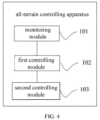
- FIG. 4 shows an all-terrain controlling apparatus according to an embodiment of the present application. Referring to FIG. 4 , the apparatus includes:
- the first monitoring module 101 includes:
- the first controlling module 102 includes:
- the second controlling module 103 includes:
- the all-terrain controlling apparatus further includes:
- the present application discloses a computer-readable storage medium, wherein the computer-readable storage medium stores an all-terrain controlling program, and when the all-terrain controlling program is executed by a processor, the steps of the all-terrain controlling method according to any one of the embodiments in the first aspect are implemented.
- the present application discloses a vehicle, wherein an operation state of the vehicle is controlled by using the all-terrain controlling method according to any one of the embodiments in the first aspect.
- the embodiments of the present application may be provided as a method, a device, or a computer program product. Therefore, the embodiments of the present application may take the form of a complete hardware embodiment, a complete software embodiment, or an embodiment combining software and hardware. Furthermore, the embodiments of the present application may take the form of a computer program product implemented on one or more computer-usable storage media (including but not limited to a disk storage, a CD-ROM, an optical memory and so on) containing a computer-usable program code therein.
- a computer-usable storage media including but not limited to a disk storage, a CD-ROM, an optical memory and so on
- the computer program instructions may be provided to a processor of a general-purpose computer, a special-purpose computer, an embedded processor, or another programmable data processing terminal device to generate a machine, so that a device for implementing the functions specified in one or more flows of the flow charts and/or one or more blocks of the block diagrams can be generated by instructions executed by the processor of the computers or the other programmable data processing terminal device.
- the computer program instructions may also be stored in a computer-readable memory that can instruct the computers or the other programmable data processing terminal device to operate in a specific mode, so that the instructions stored in the computer-readable memory generate an article including an instruction device, and the instruction device implements the functions specified in one or more flows of the flow charts and/or one or more blocks of the block diagrams.
- the computer program instructions may also be loaded to the computers or the other programmable data processing terminal device, so that the computers or the other programmable data processing terminal device implement a series of operation steps to generate the computer-implemented processes, whereby the instructions executed in the computers or the other programmable data processing terminal device provide the steps for implementing the functions specified in one or more flows of the flow charts and/or one or more blocks of the block diagrams.
- the above-described device embodiments are merely illustrative, wherein the units that are described as separate components may or may not be physically separate, and the components that are displayed as units may or may not be physical units; in other words, they may be located at the same one location, and may also be distributed to a plurality of network units. Some or all of the modules may be selected according to actual demands to realize the purposes of the solutions of the embodiments. A person skilled in the art can understand and implement the technical solutions without paying creative work.
- Each component embodiment of the present application may be implemented by hardware, or by software modules that are operated in one or more processors, or by a combination thereof.
- a person skilled in the art should understand that some or all of the functions of some or all of the components of the computing and processing device according to the embodiments of the present application may be implemented by using a microprocessor or a digital signal processor (DSP) in practice.
- DSP digital signal processor
- the present application may also be implemented as apparatus or device programs (for example, computer programs and computer program products) for implementing part of or the whole of the method described herein. Such programs for implementing the present application may be stored in a computer-readable medium, or may be in the form of one or more signals. Such signals may be downloaded from an Internet website, or provided on a carrier signal, or provided in any other forms.
- FIG. 5 shows a computing and processing device that can implement the method according to the present application.
- the computing and processing device traditionally includes a processor 1010 and a computer program product or computer-readable medium in the form of a memory 1020.
- the memory 1020 may be electronic memories such as flash memory, EEPROM (Electrically Erasable Programmable Read Only Memory), EPROM, hard disk or ROM.
- the memory 1020 has the storage space 1030 of the program code 1031 for implementing any steps of the above method.
- the storage space 1030 for program code may contain program codes 1031 for individually implementing each of the steps of the above method. Those program codes may be read from one or more computer program products or be written into the one or more computer program products.
- Those computer program products include program code carriers such as a hard disk, a compact disk (CD), a memory card or a floppy disk. Such computer program products are usually portable or fixed storage units as shown in FIG. 6 .
- the storage unit may have storage segments or storage spaces with similar arrangement to the memory 1020 of the computing and processing device in FIG. 5 .
- the program codes may, for example, be compressed in a suitable form.
- the storage unit contains a computer-readable code 1031', which can be read by a processor like 1010. When those codes are executed by the computing and processing device, the codes cause the computing and processing device to implement each of the steps of the method described above.
Landscapes
- Engineering & Computer Science (AREA)
- Automation & Control Theory (AREA)
- Transportation (AREA)
- Mechanical Engineering (AREA)
- Human Computer Interaction (AREA)
- Chemical & Material Sciences (AREA)
- Combustion & Propulsion (AREA)
- Hybrid Electric Vehicles (AREA)
- Electric Propulsion And Braking For Vehicles (AREA)
Abstract
Description
- The present application claims the priority of the
Chinese patent application filed on June 17th, 2021 before the China National Intellectual Property Administration with the application number of 202110674891.9 - The present application relates to the technical field of vehicles, and particularly relates to an all-terrain controlling method and apparatus, a storage medium and a vehicle.
- With the development in economy, science and technology, cars are no longer merely a transportation tool for people, but are popular products that integrate leading-edge technologies. In order to bring the users better joy in driving and technological experience, the all-terrain controlling system (All Terrain System, ATS) developed based on various scenes emerges accordingly.
- The ATS system is an electronic control system of cars. When driving a car equipped with the all-terrain controlling system, the driver can select the corresponding terrain mode according to the practical terrain situation where the car is driving, for example, snowfield, sandy ground and muddy ground, so that the subsystems of the car enter the operation modes corresponding to the terrain mode, whereby the subsystems can improve the stability and the safety of the car in the terrain situation to the largest extent.
- Currently, the ATS system is mainly applied to fuel powered vehicles and electric-only vehicle models. Although in the market some hybrid-electric vehicle models are provided with the ATS system, for example, the snowfield mode, the muddy-ground mode and the sandy-ground mode, because in the early stage the software architectures mainly focus in the interaction between the ATS system and the electronic steering assisting system, they cannot be compatible with hybrid-electric vehicle models of various architectures. As a result, when the hybrid-electric vehicle models are to carry the conventional ATS, the software requires to be re-designed, which results in unnecessary waste in the resource and the cost, and is adverse to the quick iteration of the software.
- The present application provides an all-terrain controlling method and apparatus, a storage medium and a vehicle, to solve the problem that the conventional ATS system cannot be compatible with hybrid-electric vehicle models of various architectures.
- In order to solve the above problems, the present application discloses an all-terrain controlling method, which is applied to a hybrid-electric vehicle installed with an ATS module, and the method includes:
- monitoring an all-terrain mode that the vehicle is in, and monitoring a driving mode of the vehicle;
- when it is monitored that the all-terrain mode that the vehicle is in changes, based on a correspondence relation between all-terrain modes and driving modes, controlling the driving mode of the vehicle by using the changed all-terrain mode, wherein the changing of the all-terrain mode that the vehicle is in is triggered by using a switch of the ATS module; and
- when it is monitored that the driving mode of the vehicle changes, based on a correspondence relation between driving modes and all-terrain modes, controlling the all-terrain mode that the vehicle is in by using the changed driving mode, wherein the changing of the driving mode of the vehicle is triggered by using a switch of a Head Unit System (HUT) module.
- In an alternative embodiment, the step of, when it is monitored that the all-terrain mode that the vehicle is in changes, based on the correspondence relation between the all-terrain modes and the driving modes, controlling the driving mode of the vehicle by using the changed all-terrain mode includes:
- when the changed all-terrain mode is a standard mode or an economical mode, maintaining the driving mode of the vehicle; and
- when the changed all-terrain mode is another mode, switching the driving mode of the vehicle into a hybrid mode, wherein the another mode is a mode among the all-terrain modes other than the standard mode and the economical mode.
- In an alternative embodiment, the step of, when it is monitored that the driving mode of the vehicle changes, based on the correspondence relation between the driving modes and the all-terrain modes, controlling the all-terrain mode that the vehicle is in by using the changed driving mode includes:
- when the changed driving mode is a hybrid mode, maintaining the all-terrain mode that the vehicle is in; and
- when the changed driving mode is an electric-only mode or an energy-saving mode, switching the all-terrain mode that the vehicle is in into a standard mode, and prompting to exit a 4L mode of a four-wheel-driving system.
- In an alternative embodiment, the method further includes:
when the all-terrain mode that the vehicle is in does not change, controlling the driving mode of the vehicle based on a switching request of a user, wherein the switching request of the user is triggered by using the switch of the HUT module. - In an alternative embodiment, the step of, when the all-terrain mode that the vehicle is in does not change, controlling the driving mode of the vehicle based on the switching request of the user includes:
- when the switching request of the user is an electric-only mode or an energy-saving mode and the all-terrain mode that the vehicle is in is another mode, switching the driving mode of the vehicle into a hybrid mode, and prompting to exit a 4L mode of a four-wheel-driving system, wherein the another mode is a mode among the all-terrain modes other than a standard mode and an economical mode;
- when the switching request of the user is the electric-only mode or the energy-saving mode and the all-terrain mode that the vehicle is in is the standard mode or the economical mode, switching the driving mode of the vehicle according to the switching request of the user; and
- when the switching request of the user is the hybrid mode, switching the driving mode of the vehicle into the hybrid mode.
- In an alternative embodiment, the method further includes:
when the driving mode of the vehicle does not change, switching the all-terrain mode that the vehicle is in based on a switching request of a user, wherein the switching request of the user is triggered by using the switch of the ATS module. - In an alternative embodiment, the step of, when the driving mode of the vehicle does not change, switching the all-terrain mode that the vehicle is in based on the switching request of the user includes:
- when the switching request of the user is another mode, switching the all-terrain mode that the vehicle is in according to the request of the user, and prompting to exit a 4L mode of a four-wheel-driving system, wherein the another mode is a mode among the all-terrain modes other than a standard mode and an economical mode; and
- when the switching request of the user is the standard mode or the economical mode, switching the all-terrain mode that the vehicle is in according to the switching request of the user.
- In an alternative embodiment, the hybrid-electric vehicle is installed with an Electronic Stability Program (ESP) module, an Engine Management System (EMS) module, a Transmission Control Unit (TCU) module, a Four Wheel Driving System (4WD) module, an Electric Power Steering (EPS) module, an Electronic Differential Lock (EDL) module and an Instrument Panel (IP) instrument, and the method further includes:
based on the correspondence relations of the all-terrain mode with the ESP module, the EMS module, the TCU module, the 4WD module, the EPS module, the EDL module and the IP instrument, controlling the ESP module, the EMS module, the TCU module, the 4WD module, the EPS module, the EDL module and the IP instrument to operate. - In the second aspect, the present application discloses an all-terrain controlling apparatus, wherein the apparatus is applied to a hybrid-electric vehicle installed with an ATS module, and the apparatus includes:
- a first monitoring module configured for monitoring an all-terrain mode that the vehicle is in;
- a second monitoring module configured for monitoring a driving mode of the vehicle;
- a first controlling module configured for, when it is monitored that the all-terrain mode that the vehicle is in changes, based on a correspondence relation between all-terrain modes and driving modes, controlling the driving mode of the vehicle by using the changed all-terrain mode; and
- a second controlling module configured for, when it is monitored that the driving mode of the vehicle changes, based on a correspondence relation between the driving modes and the all-terrain modes, controlling the all-terrain mode that the vehicle is in by using the changed driving mode.
- In the third aspect, the present application discloses a computer-readable storage medium, wherein the computer-readable storage medium stores an all-terrain controlling program, and when the all-terrain controlling program is executed by a processor, the steps of the all-terrain controlling method according to any one of the embodiments in the first aspect are implemented.
- In the fourth aspect, the present application discloses a vehicle, wherein an operation state of the vehicle is controlled by using the all-terrain controlling method according to any one of the embodiments in the first aspect.
- As compared with the prior art, the present application has the following advantages:
In the present application, the all-terrain mode that the vehicle is in and the driving mode are monitored in real time, and by using the correspondence relation between the driving modes and the all-terrain modes of the vehicle, closed-loop control is performed to the driving mode of the vehicle and the all-terrain mode that the vehicle is in. When the all-terrain mode of the vehicle changes, the driving mode of the vehicle automatically responds to the changing of the all-terrain mode. When the driving mode of the vehicle changes, the all-terrain mode automatically responds to the changing of the driving mode. The above technical solution can realize automatic selection and switching of the all-terrain modes and the driving modes, which expands the driving-mode switching function of the all-terrain controlling system, fills the gap in terms of the controlling over the driving modes when the conventional all-terrain controlling system is applied to hybrid-electric vehicles, and enables the all-terrain controlling system to be compatible with hybrid-electric vehicle models of various architectures. -
-
FIG. 1 is a flow chart of an all-terrain controlling method according to an embodiment of the present application; -
FIG. 2 is a flow chart of the control strategy of a driving mode according to an embodiment of the present application; -
FIG. 3 is a flow chart of the control strategy of an all-terrain mode according to an embodiment of the present application; -
FIG. 4 is an all-terrain controlling apparatus according to an embodiment of the present application; -
FIG. 5 is a structural block diagram of an electronic device according to an embodiment of the present application; and -
FIG. 6 is a schematic diagram of the hardware structure of an electronic device according to an embodiment of the present application. - In order to make the above purposes, features and advantages of the present application more apparent and understandable, the present application will be described in further detail below with reference to the drawings and the particular embodiments.
- The all-terrain controlling method according to the present application is performed based on an all-terrain controlling system in a hybrid-electric vehicle. The all-terrain controlling system includes an ATS (All Terrain System, or all-terrain controlling system) module, an HUT (Head Unit System, or host system) module and an HCU (Hybrid Control Unit, or hybrid-electric controlling unit) module. The ATS module is connected to the HUT module and the HCU module by a CAN bus. The user artificially switches the all-terrain modes by operating a switch of the ATS module, and artificially switches the driving modes of the vehicle by operating a switch of the HUT module, and may also, by using the correspondence relation between the ATS module and the HCU module, automatically switch the all-terrain modes or the driving modes.
-
FIG. 1 shows a flow chart of an all-terrain controlling method according to an embodiment of the present application. Referring toFIG. 1 , the method is applied to a hybrid-electric vehicle installed with the ATS module, and the method includes:
Step S101: monitoring an all-terrain mode that the vehicle is in, and monitoring a driving mode of the vehicle. - The implementation subject of the embodiments of the present application may be various controllers or processors adapted for being provided in the vehicle. For example, in an aspect, it may be a built-in controller or processor of the vehicle, and corresponding improvements in the hardware and the software may be performed to the controller or processor, to implement the vehicle terrain-mode controlling method according to the embodiments of the present application. In another aspect, it may also be a processor or controller additionally provided in the vehicle, to implement the vehicle terrain-mode controlling method according to the present application. Furthermore, all of the above embodiments fall within the protection scope of the present application.
- Particularly, in an embodiment of the present application, the all-terrain controlling apparatus monitors in real time the all-terrain mode (the all-terrain-mode signal) that the vehicle is in. The all-terrain modes that the vehicle is in include a standard mode, an economical mode, a sport mode, a snowfield mode, a muddy-ground mode, a sandy-ground mode, a 4L mode, a rock mode, a mountain-land mode, an uneven-road mode and a silt mode, and the modes can realize different functions.
- Particularly, the standard mode (Standard) takes into consideration both of the power performance and the economic efficiency of the entire vehicle, wherein the driving style of the entire vehicle is regular. The economical mode (ECO) improves the fuel economy of the vehicle, and is suitable for even and hard road surfaces such as urban roads and paved roads. In the sport mode (Sport), the accelerator pedal is sensitive, the gear shifting of the transmission is delayed, the power performance of the vehicle is increased, and the driving style of the entire vehicle tends to be intense. The snowfield mode (Snow) is mainly used for driving in a situation of a low adhesion coefficient or off-road driving, and is mainly used in road surfaces such as a snowfield, an ice surface, a grassland and a gravel road. The muddy-ground mode (Mud) is mainly applied for driving in deep mud and shallow mud or off-road driving. The sandy-ground mode (Sand) is mainly applied for driving in desert and gobi or off-road driving. The 4L mode is mainly used in low-speed difficulty-releasing situations (for example, a climbing situation and a car-trapping situation), and situations that require large-torque climbing. The rock mode (Rock) is mainly used for climbing on wet or dry hard road surfaces. The mountain-land mode (Mountain) is mainly applied for driving on mountain roads. The uneven-road mode (Pothole) is mainly applied for uneven roads. The silt mode (Mud_Sand) is mainly applied for road surfaces that are muddy and have deep grooves with sand.
- It should be noted that, in the Sport mode, the Snow mode, the Mud mode, the Sand mode, the 4L mode, the Rock mode, the Mountain mode, the Pothole mode and the Mud_Sand mode, the four-wheel-driving system of the vehicle is in a low gear (i.e., the four-wheel-driving system is in the 4L mode), at this time a large torque can be outputted.
- Particularly, in an embodiment of the present application, the all-terrain controlling apparatus monitors in real time the driving mode (the driving-mode signal) of the vehicle. The driving modes of the vehicle include an electric-only mode (EV), an energy-saving mode (Save) and a hybrid mode (HEV). In the EV mode, the electric motor supplies the power, and the engine does not operate. In the SAVE mode, when the electric quantity of the battery is greater than a certain value, the electric motor supplies the power; when the electric quantity of the battery is less than a certain value, an electric generator charges the battery; and when a large torque is required, the engine and the electric motor supply the power together. In the HEV mode, the electric motor and the engine supply the power together.
- Step S102: when it is monitored that the all-terrain mode that the vehicle is in changes, based on a correspondence relation between all-terrain modes and driving modes, controlling the driving mode of the vehicle by using the changed all-terrain mode, wherein the changing of the all-terrain mode that the vehicle is in is triggered by using a switch of the ATS module.
- Table 1 shows the control strategy of an all-terrain controlling system according to an embodiment of the present application. It can be known from Table 1 that, in the Standard mode and the ECO mode, the driving mode of the vehicle is any one of the EV mode, the SAVE mode and the HEV mode, and in the Sport mode, the Snow mode, the Mud mode, the Sand mode, the 4L mode, the Rock mode, the Mountain mode, the Pothole mode and the Mud_Sand mode, the driving mode of the vehicle is the HEV mode.
Table 1 The control strategy of an all-terrain controlling system Terrain mode HCU module ESP module EMS module TCU module EDL module EPS module IP instrument driving mode power mode Standard EV/SAVE/ HEV Standard Standard Standard Standard Standard Standard Standard ECO EV/SAVE/ HEV ECO ECO ECO ECO ECO ECO ECO Sport HEV Sport Sport Sport Sport Sport Sport Sport Snow HEV Snow Snow Snow Snow Snow Snow Snow Mud HEV Mud Mud Mud Mud Mud Mud Mud Sand HEV Sand Sand Sand Sand Sand Sand Sand 4L HEV 4L 4L 4L 4L 4L 4L 4L Rock HEV Rock Rock Rock Rock Rock Rock Rock Mountain HEV Mountain Mountain Mountain Mountain Mountain Mountain Mountain Pothole HEV Pothole Pothole Pothole Pothole Pothole Pothole Pothole Mud_ Sand HEV Mud_ Sand Mud_ Sand Mud_ Sand Mud_ Sand Mud_ Sand Mud_ Sand Mud_ Sand - Particularly, when it is monitored by the all-terrain controlling apparatus that the all-terrain mode that the vehicle is in changes, for example, when the all-terrain mode is switched from the Standard mode into the Mud mode by using the switch of the ATS module, based on a correspondence relation between the all-terrain modes and the driving modes, the HCU module automatically switches the driving mode into the HEV mode.
- Step S103: when it is monitored that the driving mode of the vehicle changes, based on a correspondence relation between the driving modes and the all-terrain modes, controlling the all-terrain mode that the vehicle is in by using the changed driving mode, wherein the changing of the driving mode of the vehicle is triggered by using a switch of an HUT module.
- Particularly, when it is monitored by the all-terrain controlling apparatus that the driving mode of the vehicle changes, for example, when the HEV mode is switched into the EV mode by using the switch of the HUT module, based on a correspondence relation between the all-terrain modes and the driving modes, the ATS module automatically switches the all-terrain mode into the standard mode.
- As compared with the related art, in the present application, the all-terrain mode that the vehicle is in and the driving mode are monitored in real time, and by using the correspondence relation between the driving modes and the all-terrain modes of the vehicle, closed-loop control is performed to the driving mode of the vehicle and the all-terrain mode that the vehicle is in. When the all-terrain mode of the vehicle changes, the driving mode of the vehicle automatically responds to the changing of the all-terrain mode. When the driving mode of the vehicle changes, the all-terrain mode automatically responds to the changing of the driving mode. The above technical solution can realize automatic selection and switching of the all-terrain modes and the driving modes, which expands the driving-mode switching function of the all-terrain controlling system, fills the gap in terms of the controlling over the driving modes when the conventional all-terrain controlling system is applied to hybrid-electric vehicles, and enables the all-terrain controlling system to be compatible with hybrid-electric vehicle models of various architectures.
- In an alternative embodiment, in the step S102, the step of, when it is monitored that the all-terrain mode that the vehicle is in changes, based on the correspondence relation between the all-terrain modes and the driving modes, controlling the driving mode of the vehicle by using the changed all-terrain mode includes:
- Step S1021: when the changed all-terrain mode is a standard mode or an economical mode, maintaining the driving mode of the vehicle; and
- Step S1022: when the changed all-terrain mode is another mode, switching the driving mode of the vehicle into a hybrid mode, wherein the another mode is a mode among the all-terrain modes other than the standard mode and the economical mode.
- Particularly, in an embodiment of the present application, when the all-terrain mode of the vehicle changes, the driving mode responds to the changing of the all-terrain mode. When it is monitored by the all-terrain controlling apparatus that the all-terrain mode changes, if the changed all-terrain mode is the Standard mode or the ECO mode, in the Standard mode or the ECO mode, the vehicle can operate in any one of the driving modes, and, therefore, the HCU module does not switch the driving mode of the vehicle; in other words, the driving mode of the vehicle maintains unchanged. If the changed all-terrain mode is the Sport mode or the Snow mode or the Mud mode or the Sand mode or the 4L mode or the Rock mode or the Mountain mode or the Pothole mode or the Mud_Sand mode, because those modes can operate normally merely in the HEV mode, the HCU module is required to switch the driving mode of the vehicle into the HEV mode. As an example, when the all-terrain mode is switched from the 4L mode into the ECO mode, the driving mode of the vehicle maintains unchanged.
- In an alternative embodiment, in the step S103, the step of, when it is monitored that the driving mode of the vehicle changes, based on the correspondence relation between the driving modes and the all-terrain modes, controlling the all-terrain mode that the vehicle is in by using the changed driving mode includes:
- Step S1031: when the changed driving mode is a hybrid mode, maintaining the all-terrain mode that the vehicle is in; and
- Step S1032: when the changed driving mode is an electric-only mode or an energy-saving mode, switching the all-terrain mode that the vehicle is in into a standard mode, and prompting to exit a 4L mode of a four-wheel-driving system.
- Particularly, in an embodiment of the present application, when the driving mode of the vehicle changes, the all-terrain mode responds to the changing of the driving mode. When it is monitored by the all-terrain controlling apparatus that the driving mode of the vehicle changes, if the changed driving mode is the HEV mode, because the HEV mode is suitable for all of the all-terrain modes, the ATS module does not automatically switch the all-terrain mode that the vehicle is in. When the changed driving mode is the EV mode or the SAVE mode, because the terrain mode corresponding to the EV mode or the SAVE mode is the Standard mode or the ECO mode, the ATS module automatically switches the all-terrain mode into the Standard mode or the ECO mode. Because, when the ATS module is utilized to automatically switch the all-terrain modes, the output of the ATS module must be a definite result, in an embodiment of the present application, when the changed driving mode is the Standard mode or the ECO mode, the ATS module automatically switches the all-terrain mode into the Standard mode. In the Standard mode, it is not required to output a large torque, and therefore the all-terrain controlling apparatus prompts the user to exit the 4L mode of the four-wheel-driving system.
- In an alternative embodiment, the all-terrain controlling method further includes:
Step S104: when the all-terrain mode that the vehicle is in does not change, controlling the driving mode of the vehicle based on a switching request of a user, wherein the switching request of the user is triggered by using the switch of the HUT module. - In an embodiment of the present application, besides switching the driving modes of the vehicle based on the changing of the all-terrain mode, the user may also perform manual selection of the driving modes by using the switch in the HUT module, to switch the driving mode of the vehicle to the optimum operate mode. In other words, when it is monitored by the all-terrain controlling apparatus that the all-terrain mode that the vehicle is in does not change, but it is detected that the switch of the HUT module changes, the all-terrain controlling apparatus outputs the corresponding driving mode based on the changing of the switch of the HUT module. Particularly, the user may operate the switch of the HUT module to generate a driving-mode switching-request signal DrvModReq_HUT, the signal is transmitted to the all-terrain controlling apparatus via the CAN bus, the all-terrain controlling apparatus transmits the driving-mode switching signal DrvModReq_HUT to the HCU module via the CAN bus, and the HCU module controls the driving mode of the vehicle according to the driving-mode switching signal DrvModReq_HUT. In the present embodiment, the driving-mode switching-request signal DrvModReq_HUT carries the target driving mode. The embodiment of the present application provides a controlling-system architecture that can take into consideration both of the manual selection of the driving modes and the automatic switching of the driving modes, which does not only improve the degree of the intellectualization of the all-terrain controlling system, but also satisfies the various demands of the clients to the largest extent.
- In an alternative embodiment, in the step S104, the step of, when the all-terrain mode that the vehicle is in does not change, controlling the driving mode of the vehicle based on the switching request of the user includes:
- Step S1041: when the switching request of the user is an electric-only mode or an energy-saving mode and the all-terrain mode that the vehicle is in is another mode, switching the driving mode of the vehicle into a hybrid mode, and prompting to exit a 4L mode of a four-wheel-driving system, wherein the another mode is a mode among the all-terrain modes other than a standard mode and an economical mode;
- Step S1042: when the switching request of the user is the electric-only mode or the energy-saving mode and the all-terrain mode that the vehicle is in is the standard mode or the economical mode, switching the driving mode of the vehicle according to the switching request of the user; and
- Step S1043: when the switching request of the user is the hybrid mode, switching the driving mode of the vehicle into the hybrid mode.
- Particularly, in an embodiment of the present application, when the user performs the manual selection of the driving modes by using the switch in the HUT module, the switching is performed based on the subjective intention of the user, and therefore a driving mode that does not match with the all-terrain mode might be selected, which affects the drivability of the vehicle. In order to prevent that, when the user is switching the driving modes of the vehicle by using the switch in the HUT module, the all-terrain controlling apparatus determines the switching operation based on the correspondence relation between the all-terrain modes and the driving modes, and, merely when the switching request is correct, switches the driving mode according to the switching request of the user, i.e., switching the driving mode of the vehicle by using the driving mode corresponding to the switch of the HUT module.
- Particularly, when the user requests to switch the driving mode into the electric-only mode or the energy-saving mode by using the switch in the HUT module, and the all-terrain mode of the vehicle is the Sport mode or the Snow mode or the Mud mode or the Sand mode or the 4L mode or the Rock mode or the Mountain mode or the Pothole mode or the Mud_Sand mode, the all-terrain controlling apparatus switches the driving mode of the vehicle into the HEV mode. When the user requests to switch the driving mode into the electric-only mode or the energy-saving mode by using the switch in the HUT module, and the all-terrain mode of the vehicle is the Standard mode or the ECO mode, the all-terrain controlling apparatus switches the driving mode of the vehicle according to the switching request of the user. For example, if the switching request of the user is the EV mode, the all-terrain controlling apparatus switches the driving mode of the vehicle into the EV mode. When the user requests to switch the driving mode into the hybrid mode by using the switch in the HUT module, because the hybrid mode is suitable for all of the terrain modes, the all-terrain controlling apparatus switches the driving mode of the vehicle into the HEV mode.
- In an alternative embodiment, the all-terrain controlling method further includes:
Step S105: when the driving mode of the vehicle does not change, switching the all-terrain mode that the vehicle is in based on a switching request of a user, wherein the switching request of the user is triggered by using the switch of the ATS module. - Particularly, in an embodiment of the present application, besides switching the all-terrain modes based on the changing of the driving mode, the user may also switch the all-terrain modes by using the switch in the ATS module, to switch the all-terrain mode of the vehicle to the optimum operate mode. In other words, when it is monitored by the all-terrain controlling apparatus that the driving mode of the vehicle does not change, but it is detected that the switch of the ATS module changes, the all-terrain controlling apparatus, based on the changing of the switch of the ATS module, outputs the corresponding all-terrain mode. Particularly, the user may operate the switch of the ATS module to generate an all-terrain-mode switching-request signal DrivingModReq, the signal is transmitted to the all-terrain controlling apparatus via the CAN bus, the all-terrain controlling apparatus transmits the all-terrain-mode switching-request signal DrivingModReq to the ATS module via the CAN bus, and the ATS module controls the all-terrain mode that the vehicle is in according to the all-terrain-mode switching-request signal DrivingModReq. In the present embodiment, the all-terrain-mode switching-request signal DrivingModReq carries the target all-terrain mode.
- The embodiment of the present application provides a controlling-system architecture that can take into consideration both of the manual selection of the all-terrain modes and the automatic switching of the all-terrain modes, which does not only improve the degree of the intellectualization of the all-terrain controlling system, but also satisfies the various demands of the clients to the largest extent.
- In an alternative embodiment, in the step S105, the step of, when the driving mode of the vehicle does not change, switching the all-terrain mode that the vehicle is in based on the switching request of the user includes:
- Step S1051: when the switching request of the user is another mode, switching the all-terrain mode that the vehicle is in according to the request of the user, and prompting to exit a 4L mode of a four-wheel-driving system, wherein the another mode is a mode among the all-terrain modes other than a standard mode and an economical mode; and
- Step S1052: when the switching request of the user is the standard mode or the economical mode, switching the all-terrain mode that the vehicle is in according to the switching request of the user.
- Particularly, in an embodiment of the present application, when the user performs the manual switching of the all-terrain modes by using the switch in the ATS module, the switching is performed based on the subjective intention of the user, and therefore an all-terrain mode that does not match with the driving mode might be selected, which affects the drivability of the vehicle. In order to prevent that, when the user is switching the all-terrain modes of the vehicle by using the switch in the ATS module, the all-terrain controlling apparatus determines the switching operation based on the correspondence relation between the driving modes and the all-terrain modes, and, merely when the switching request is correct, switches the driving mode according to the switching request of the user, i.e., switching the all-terrain mode that the vehicle is in by using the all-terrain mode corresponding to the switch of the ATS module.
- Particularly, when the user requests to switch the all-terrain mode into the Sport mode or the Snow mode or the Mud mode or the Sand mode or the 4L mode or the Rock mode or the Mountain mode or the Pothole mode or the Mud_Sand mode by using the switch in the ATS module, the apparatus switches the all-terrain mode that the vehicle is in according to the request of the user, and prompts to exit the 4L mode of the four-wheel-driving system. When the user requests to switch the all-terrain mode into the Standard mode or the ECO mode by using the switch in the ATS module, the apparatus switches the all-terrain mode that the vehicle is in according to the request of the user. As an example, if the switching request of the user is the Snow mode, the all-terrain controlling apparatus switches the all-terrain mode that the vehicle is in into the Snow mode, and prompts the user to exit the 4L mode of the four-wheel-driving system.
- In an alternative embodiment, the hybrid-electric vehicle is installed with an ESP module, an EMS module, a TCU module, a 4WD module, an EPS module, an EDL module and an IP instrument, and the all-terrain controlling method further includes:
Step S106: based on the correspondence relations of the all-terrain mode with the ESP module, the EMS module, the TCU module, the 4WD module, the EPS module, the EDL module and the IP instrument, controlling the ESP module, the EMS module, the TCU module, the 4WD module, the EPS module, the EDL module and the IP instrument to operate, respectively. - Particularly, in an embodiment of the present application, the ATS module is connected to the ESP (Electronic Stability Program, or vehicle-body electronically stabilizing system) module, the EMS (Engine Management System, or engine managing system) module, the TCU (Transmission Control Unit, or transmission controlling unit) module, the 4WD (Four Wheel Driving System, or four-wheel-driving system) module, the EPS (Electric Power Steering, or electronic power-assisted steering system) module, the EDL (Electronic Differential Lock, or electronic differential lock) module and the IP (Instrument Panel, instrument) by the CAN bus. When the all-terrain mode changes, the ESP module, the EMS module, the TCU module, the 4WD module, the EPS module, the EDL module and the IP instrument employ the corresponding control strategies (executed according to Table 1). As an example, when the all-terrain mode is switched from the Standard mode into the Snow mode, the ESP module, the EMS module, the TCU module, the 4WD module, the EPS module and the EDL module execute the corresponding operations in the Snow mode.
-
FIG. 2 shows a flow chart of the control strategy of a driving mode according to an embodiment of the present application. Referring toFIG. 2 , the method for controlling the driving mode according to the present embodiment includes: - S201: monitoring whether the all-terrain mode that the vehicle is in changes; when the all-terrain mode that the vehicle is in changes, executing S202; and when the all-terrain mode that the vehicle is in does not change, executing S203;
- S202: detecting whether the changed all-terrain mode is the Standard mode or the ECO mode; if yes, maintaining the driving mode of the vehicle; and if no, switching the driving mode of the vehicle into the HEV mode;
- S203: monitoring whether the switch of the HUT module changes; if the switch of the HUT module changes, executing S204; and if the switch of the HUT module does not change, maintaining the driving mode of the vehicle;
- S204: detecting whether the driving mode corresponding to the switch of the HUT module is the EV mode or the SAVE mode; if yes, executing S205; and if no, switching the driving mode of the vehicle into the HEV mode; and
- S205: detecting whether the all-terrain mode that the vehicle is in is the Sport mode or the Snow mode or the Mud mode or the Sand mode or the 4L mode or the Rock mode or the Mountain mode or the Pothole mode or the Mud_Sand mode; if yes, switching the driving mode of the vehicle into the HEV mode, and prompting the user to exit the 4L mode; and if no, switching the driving mode of the vehicle according to the driving mode corresponding to the switch of the HUT module.
- Particularly, in an embodiment of the present application, the all-terrain controlling apparatus continuously monitors the all-terrain mode that the vehicle is in and the switch of the HUT module. Firstly, when the all-terrain mode that the vehicle is in changes but the switch of the HUT module does not change, the controlling of the driving mode is executed according to S202. Secondly, when the all-terrain mode that the vehicle is in does not change but the switch of the HUT module changes, the controlling of the driving mode is executed according to S204 and S205. Thirdly, when both of the all-terrain mode that the vehicle is in and the switch of the HUT module change, because the priority of the all-terrain mode is higher than the priority of the switch of the HUT module, the controlling of the driving mode is executed according to S202.
- As an example, when the all-terrain mode that the vehicle is in changes from the Sport mode into the Rock mode, but the switch of the HUT module does not change, in this case the all-terrain controlling apparatus switches the driving mode of the vehicle into the HEV mode. In the present embodiment, because the driving mode corresponding to the Sport mode before change is the HEV mode, here it may be understood as that the driving mode maintains unchanged. However, when the all-terrain mode changes from the Standard mode into the Sport mode, in this case it is required to switch the driving mode (the EV mode or the SAVE mode or the HEV mode) corresponding to the Standard mode into the HEV mode.
- As an example, when the all-terrain mode that the vehicle is in does not change (the current all-terrain mode is the Standard mode), but the switch of the HUT module changes, the driving mode corresponding to the switch of the HUT module changes from the HEV mode into the EV mode, in which case the all-terrain controlling apparatus switches the driving mode of the vehicle into the EV mode.
-
FIG. 3 shows a flow chart of the control strategy of an all-terrain mode according to an embodiment of the present application. Referring toFIG. 3 , the method for controlling the all-terrain mode according to the present embodiment includes: - S301: monitoring whether the switch of the ATS module changes; when the switch of the ATS module changes, executing S302; and when the switch of the ATS module does not change, executing S303;
- S302: detecting whether the all-terrain mode corresponding to the switch of the ATS module is the Sport mode or the Snow mode or the Mud mode or the Sand mode or the 4L mode or the Rock mode or the Mountain mode or the Pothole mode or the Mud_Sand mode; if yes, switching the all-terrain mode that the vehicle is in into the all-terrain mode corresponding to the switch of the ATS module and sending an instruction of exiting the 4L mode of the four-wheel-driving system; and if no, switching the all-terrain mode that the vehicle is in into the all-terrain mode corresponding to the switch of the ATS module;
- S303: monitoring whether the driving mode of the vehicle changes; if the driving mode of the vehicle changes, executing S304; and if the driving mode of the vehicle does not change, maintaining the all-terrain mode that the vehicle is in; and
- S304: detecting the changed driving mode of the vehicle; if the changed driving mode is the HEV mode, maintaining the all-terrain mode that the vehicle is in; and if the changed driving mode is the EV mode or the SAVE mode, switching the all-terrain mode that the vehicle is in into the Standard mode, and prompting to exit the 4L mode of the four-wheel-driving system.
- Particularly, in an embodiment of the present application, the all-terrain controlling apparatus continuously monitors the driving mode of the vehicle and the switch of the ATS module. Firstly, when the switch of the ATS module changes, but the driving mode of the vehicle does not change, the all-terrain mode that the vehicle is in is controlled in the manner of S302. Secondly, when the switch of the ATS module does not change, but the driving mode of the vehicle changes, the all-terrain mode that the vehicle is in is controlled in the manner of S304. Thirdly, when both of the switch of the ATS module and the driving mode of the vehicle change, the all-terrain mode that the vehicle is in is controlled in the manner of S302.
- In the second aspect, the present application discloses an all-terrain controlling apparatus, which is applied to a hybrid-electric vehicle installed with an ATS module.
FIG. 4 shows an all-terrain controlling apparatus according to an embodiment of the present application. Referring toFIG. 4 , the apparatus includes: - a
first monitoring module 101 configured for monitoring an all-terrain mode that the vehicle is in and monitoring a driving mode of the vehicle; - a
first controlling module 103 configured for, when it is monitored that the all-terrain mode that the vehicle is in changes, based on a correspondence relation between all-terrain modes and driving modes, controlling the driving mode of the vehicle by using the changed all-terrain mode, wherein the changing of the all-terrain mode that the vehicle is in is triggered by using a switch of the ATS module; and - a
second controlling module 103 configured for, when it is monitored that the driving mode of the vehicle changes, based on a correspondence relation between driving modes and all-terrain modes, controlling the all-terrain mode that the vehicle is in by using the changed driving mode, wherein the changing of the driving mode of the vehicle is triggered by using a switch of an HUT module. - In an alternative embodiment, the
first monitoring module 101 includes: - a first monitoring submodule 1011 configured for monitoring an all-terrain mode that the vehicle is in; and
- a second monitoring submodule 1012 configured for monitoring a driving mode of the vehicle.
- In an alternative embodiment, the
first controlling module 102 includes: - a first controlling submodule configured for, when the changed all-terrain mode is a standard mode or an economical mode, maintaining the driving mode of the vehicle; and
- a second controlling submodule configured for, when the changed all-terrain mode is another mode, switching the driving mode of the vehicle into a hybrid mode, wherein the another mode is a mode among the all-terrain modes other than the standard mode and the economical mode.
- In an alternative embodiment, the
second controlling module 103 includes: - a third controlling submodule configured for, when the changed driving mode is a hybrid mode, maintaining the all-terrain mode that the vehicle is in; and
- a fourth controlling submodule configured for, when the changed driving mode is an electric-only mode or an energy-saving mode, switching the all-terrain mode that the vehicle is in into a standard mode, and prompting to exit a 4L mode of a four-wheel-driving system.
- In an alternative embodiment, the all-terrain controlling apparatus further includes:
- a third controlling module configured for, when the all-terrain mode that the vehicle is in does not change, controlling the driving mode of the vehicle based on a switching request of a user, wherein the switching request of the user is triggered by using the switch of the HUT module; and
- a fourth controlling module configured for, when the driving mode of the vehicle does not change, switching the all-terrain mode that the vehicle is in based on a switching request of a user, wherein the switching request of the user is triggered by using the switch of the ATS module.
- In the third aspect, the present application discloses a computer-readable storage medium, wherein the computer-readable storage medium stores an all-terrain controlling program, and when the all-terrain controlling program is executed by a processor, the steps of the all-terrain controlling method according to any one of the embodiments in the first aspect are implemented.
- In the fourth aspect, the present application discloses a vehicle, wherein an operation state of the vehicle is controlled by using the all-terrain controlling method according to any one of the embodiments in the first aspect.
- Regarding the device embodiments, because they are substantially similar to the process embodiments, they are described simply, and the related parts may refer to the description on the process embodiments.
- The embodiments of the description are described in the mode of progression, each of the embodiments emphatically describes the differences from the other embodiments, and the same or similar parts of the embodiments may refer to each other.
- A person skilled in the art should understand that the embodiments of the present application may be provided as a method, a device, or a computer program product. Therefore, the embodiments of the present application may take the form of a complete hardware embodiment, a complete software embodiment, or an embodiment combining software and hardware. Furthermore, the embodiments of the present application may take the form of a computer program product implemented on one or more computer-usable storage media (including but not limited to a disk storage, a CD-ROM, an optical memory and so on) containing a computer-usable program code therein.
- The embodiments of the present application are described with reference to the flow charts and/or block diagrams of the method, the terminal device (system), and the computer program product according to the embodiments of the present application. It should be understood that each flow and/or block in the flow charts and/or block diagrams, and combinations of the flows and/or blocks in the flow charts and/or block diagrams, may be implemented by a computer program instruction. The computer program instructions may be provided to a processor of a general-purpose computer, a special-purpose computer, an embedded processor, or another programmable data processing terminal device to generate a machine, so that a device for implementing the functions specified in one or more flows of the flow charts and/or one or more blocks of the block diagrams can be generated by instructions executed by the processor of the computers or the other programmable data processing terminal device.
- The computer program instructions may also be stored in a computer-readable memory that can instruct the computers or the other programmable data processing terminal device to operate in a specific mode, so that the instructions stored in the computer-readable memory generate an article including an instruction device, and the instruction device implements the functions specified in one or more flows of the flow charts and/or one or more blocks of the block diagrams.
- The computer program instructions may also be loaded to the computers or the other programmable data processing terminal device, so that the computers or the other programmable data processing terminal device implement a series of operation steps to generate the computer-implemented processes, whereby the instructions executed in the computers or the other programmable data processing terminal device provide the steps for implementing the functions specified in one or more flows of the flow charts and/or one or more blocks of the block diagrams.
- The above-described device embodiments are merely illustrative, wherein the units that are described as separate components may or may not be physically separate, and the components that are displayed as units may or may not be physical units; in other words, they may be located at the same one location, and may also be distributed to a plurality of network units. Some or all of the modules may be selected according to actual demands to realize the purposes of the solutions of the embodiments. A person skilled in the art can understand and implement the technical solutions without paying creative work.
- Each component embodiment of the present application may be implemented by hardware, or by software modules that are operated in one or more processors, or by a combination thereof. A person skilled in the art should understand that some or all of the functions of some or all of the components of the computing and processing device according to the embodiments of the present application may be implemented by using a microprocessor or a digital signal processor (DSP) in practice. The present application may also be implemented as apparatus or device programs (for example, computer programs and computer program products) for implementing part of or the whole of the method described herein. Such programs for implementing the present application may be stored in a computer-readable medium, or may be in the form of one or more signals. Such signals may be downloaded from an Internet website, or provided on a carrier signal, or provided in any other forms.
- For example,
FIG. 5 shows a computing and processing device that can implement the method according to the present application. The computing and processing device traditionally includes aprocessor 1010 and a computer program product or computer-readable medium in the form of amemory 1020. Thememory 1020 may be electronic memories such as flash memory, EEPROM (Electrically Erasable Programmable Read Only Memory), EPROM, hard disk or ROM. Thememory 1020 has thestorage space 1030 of theprogram code 1031 for implementing any steps of the above method. For example, thestorage space 1030 for program code may containprogram codes 1031 for individually implementing each of the steps of the above method. Those program codes may be read from one or more computer program products or be written into the one or more computer program products. Those computer program products include program code carriers such as a hard disk, a compact disk (CD), a memory card or a floppy disk. Such computer program products are usually portable or fixed storage units as shown inFIG. 6 . The storage unit may have storage segments or storage spaces with similar arrangement to thememory 1020 of the computing and processing device inFIG. 5 . The program codes may, for example, be compressed in a suitable form. Generally, the storage unit contains a computer-readable code 1031', which can be read by a processor like 1010. When those codes are executed by the computing and processing device, the codes cause the computing and processing device to implement each of the steps of the method described above. - Although preferable embodiments of the embodiments of the present application have been described, once a person skilled in the art has known the essential inventive concept, he may make further variations and modifications on those embodiments. Therefore, the appended claims are intended to be interpreted as including the preferable embodiments and all of the variations and modifications that fall within the scope of the embodiments of the present application.
- Finally, it should also be noted that, in the present text, relation terms such as first and second are merely intended to distinguish one entity or operation from another entity or operation, and that does not necessarily require or imply that those entities or operations have therebetween any such actual relation or order. Furthermore, the terms "include", "comprise" or any variants thereof are intended to cover non-exclusive inclusions, so that processes, methods, articles or terminal devices that include a series of elements do not only include those elements, but also include other elements that are not explicitly listed, or include the elements that are inherent to such processes, methods, articles or terminal devices. Unless further limitation is set forth, an element defined by the wording "comprising a ..." does not exclude additional same element in the process, method, article or terminal device comprising the element.
- The all-terrain controlling method and apparatus, the storage medium and the vehicle according to the present application have been described in detail above. The principle and the embodiments of the present application are described herein with reference to the particular examples, and the description of the above embodiments is merely intended to facilitate to comprehend the method according to the present application and its core concept. Moreover, for a person skilled in the art, according to the concept of the present application, the particular embodiments and the range of application may be varied. In conclusion, the contents of the description should not be understood as limiting the present application.
Claims (12)
- An all-terrain controlling method, characterized in that the method is applied to a hybrid-electric vehicle installed with an all-terrain system (ATS) module, and the method comprises:monitoring an all-terrain mode that the vehicle is in, and monitoring a driving mode of the vehicle;when it is monitored that the all-terrain mode that the vehicle is in changes, based on a correspondence relation between all-terrain modes and driving modes, controlling the driving mode of the vehicle by using the changed all-terrain mode, wherein the changing of the all-terrain mode that the vehicle is in is triggered by using a switch of the ATS module; andwhen it is monitored that the driving mode of the vehicle changes, based on a correspondence relation between the driving modes and the all-terrain modes, controlling the all-terrain mode that the vehicle is in by using the changed driving mode, wherein the changing of the driving mode of the vehicle is triggered by using a switch of a Head Unit System (HUT) module.
- The all-terrain controlling method according to claim 1, wherein the step of, when it is monitored that the all-terrain mode that the vehicle is in changes, based on the correspondence relation between the all-terrain modes and the driving modes, controlling the driving mode of the vehicle by using the changed all-terrain mode comprises:when the changed all-terrain mode is a standard mode or an economical mode, maintaining the driving mode of the vehicle; andwhen the changed all-terrain mode is another mode, switching the driving mode of the vehicle into a hybrid mode, wherein the another mode is a mode among the all-terrain modes other than the standard mode and the economical mode.
- The all-terrain controlling method according to claim 1, wherein the step of, when it is monitored that the driving mode of the vehicle changes, based on the correspondence relation between the driving modes and the all-terrain modes, controlling the all-terrain mode that the vehicle is in by using the changed driving mode comprises:when the changed driving mode is a hybrid mode, maintaining the all-terrain mode that the vehicle is in; andwhen the changed driving mode is an electric-only mode or an energy-saving mode, switching the all-terrain mode that the vehicle is in into a standard mode, and prompting to exit a 4L mode of a four-wheel-driving system.
- The all-terrain controlling method according to claim 1, wherein the method further comprises:
when the all-terrain mode that the vehicle is in does not change, controlling the driving mode of the vehicle based on a switching request of a user, wherein the switching request of the user is triggered by using the switch of the HUT module. - The all-terrain controlling method according to claim 4, wherein the step of, when the all-terrain mode that the vehicle is in does not change, controlling the driving mode of the vehicle based on the switching request of the user comprises:when the switching request of the user is an electric-only mode or an energy-saving mode and the all-terrain mode that the vehicle is in is another mode, switching the driving mode of the vehicle into a hybrid mode, and prompting to exit a 4L mode of a four-wheel-driving system, wherein the another mode is a mode among the all-terrain modes other than a standard mode and an economical mode;when the switching request of the user is the electric-only mode or the energy-saving mode and the all-terrain mode that the vehicle is in is the standard mode or the economical mode, switching the driving mode of the vehicle according to the switching request of the user; andwhen the switching request of the user is the hybrid mode, switching the driving mode of the vehicle into the hybrid mode.
- The all-terrain controlling method according to claim 1, wherein the method further comprises:
when the driving mode of the vehicle does not change, switching the all-terrain mode that the vehicle is in based on a switching request of a user, wherein the switching request of the user is triggered by using the switch of the ATS module. - The all-terrain controlling method according to claim 6, wherein the step of, when the driving mode of the vehicle does not change, switching the all-terrain mode that the vehicle is in based on the switching request of the user comprises:when the switching request of the user is another mode, switching the all-terrain mode that the vehicle is in according to the request of the user, and prompting to exit a 4L mode of a four-wheel-driving system, wherein the another mode is a mode among the all-terrain modes other than a standard mode and an economical mode; andwhen the switching request of the user is the standard mode or the economical mode, switching the all-terrain mode that the vehicle is in according to the switching request of the user.
- An all-terrain controlling apparatus, characterized in that the apparatus is applied to a hybrid-electric vehicle installed with an ATS module, and the apparatus comprises:a first monitoring module configured for monitoring an all-terrain mode that the vehicle is in;a second monitoring module configured for monitoring a driving mode of the vehicle;a first controlling module configured for, when it is monitored that the all-terrain mode that the vehicle is in changes, based on a correspondence relation between all-terrain modes and driving modes, controlling the driving mode of the vehicle by using the changed all-terrain mode; anda second controlling module configured for, when it is monitored that the driving mode of the vehicle changes, based on a correspondence relation between the driving modes and the all-terrain modes, controlling the all-terrain mode that the vehicle is in by using the changed driving mode.
- A vehicle, characterized in that an operation state of the vehicle is controlled by using the all-terrain controlling method according to any one of claims 1-7.
- An electronic device, characterized in that the electronic device comprises a processor, a memory and a program or instruction stored in the memory and executable in the processor, and when the program or instruction is executed by the processor, the steps of the all-terrain controlling method according to any one of claims 1-7 are implemented.
- A computer program, characterized in that the computer program comprises a computer-readable code, and when the computer-readable code is executed in a computing and processing device, the computer-readable code causes the computing and processing device to implement the steps of the all-terrain controlling method according to any one of claims 1-7.
- A readable storage medium, characterized in that the readable storage medium stores a program or instruction, and when the program or instruction is executed by a processor, the computer program according to claim 11 is implemented.
Applications Claiming Priority (2)
| Application Number | Priority Date | Filing Date | Title |
|---|---|---|---|
| CN202110674891.9A CN114763130B (en) | 2021-06-17 | 2021-06-17 | All-terrain control method, device, storage medium and vehicle |
| PCT/CN2022/098730 WO2022262731A1 (en) | 2021-06-17 | 2022-06-14 | All-terrain control method and apparatus, storage medium, and vehicle |
Publications (2)
| Publication Number | Publication Date |
|---|---|
| EP4353554A1 true EP4353554A1 (en) | 2024-04-17 |
| EP4353554A4 EP4353554A4 (en) | 2024-10-09 |
Family
ID=82364752
Family Applications (1)
| Application Number | Title | Priority Date | Filing Date |
|---|---|---|---|
| EP22824210.3A Pending EP4353554A4 (en) | 2021-06-17 | 2022-06-14 | TERRAIN CONTROL METHOD AND DEVICE, STORAGE MEDIUM AND VEHICLE |
Country Status (4)
| Country | Link |
|---|---|
| EP (1) | EP4353554A4 (en) |
| CN (1) | CN114763130B (en) |
| BR (1) | BR112023026570A2 (en) |
| WO (1) | WO2022262731A1 (en) |
Families Citing this family (3)
| Publication number | Priority date | Publication date | Assignee | Title |
|---|---|---|---|---|
| CN114763130B (en) * | 2021-06-17 | 2025-03-25 | 长城汽车股份有限公司 | All-terrain control method, device, storage medium and vehicle |
| CN119283868A (en) * | 2024-11-08 | 2025-01-10 | 江铃汽车股份有限公司 | Vehicle control method, system, readable storage medium and vehicle |
| CN120156533B (en) * | 2025-04-02 | 2026-01-02 | 奇瑞汽车股份有限公司 | Control method of intelligent driving mode, storage medium and electronic equipment |
Family Cites Families (17)
| Publication number | Priority date | Publication date | Assignee | Title |
|---|---|---|---|---|
| TW201000339A (en) * | 2008-06-24 | 2010-01-01 | Kwang Yang Motor Co | Driven switching device for all terrain vehicle |
| US9764632B2 (en) * | 2010-01-07 | 2017-09-19 | Ford Global Technologies, Llc | Plug-in hybrid electric vehicle battery state of charge hold function and energy management |
| GB201107102D0 (en) * | 2011-04-28 | 2011-06-08 | Land Rover Uk Ltd | Hybrid electric vehicle and method of control thereof |
| GB2517469A (en) * | 2013-08-21 | 2015-02-25 | Jaguar Land Rover Ltd | Hybrid electric vehicle controller and method |
| US9512916B2 (en) * | 2014-01-10 | 2016-12-06 | Shawn Baumgartner | Customizable drive function mode system and method |
| KR101776723B1 (en) * | 2015-09-03 | 2017-09-08 | 현대자동차 주식회사 | Method and device for controlling driving mode conversion of hybrid vehicle |
| CN107544318B (en) * | 2016-06-28 | 2019-12-31 | 长城汽车股份有限公司 | Protection device, method and all-terrain control system of an all-terrain control system |
| CN107813813B (en) * | 2016-09-13 | 2020-07-10 | 比亚迪股份有限公司 | Torque control method and system for vehicle and its sand mode |
| CN107128309B (en) * | 2017-04-27 | 2019-05-28 | 广州汽车集团股份有限公司 | Vehicle power output control method, device and system |
| CN108382387A (en) * | 2018-01-12 | 2018-08-10 | 上海汽车集团股份有限公司 | Vehicle drive control method |
| US10597022B2 (en) * | 2018-02-01 | 2020-03-24 | GM Global Technology Operations LLC | Coordinated torque and speed control systems and logic for hybrid electric vehicles |
| CN111376744A (en) * | 2018-12-28 | 2020-07-07 | 北京致行慕远科技有限公司 | All-terrain vehicle and all-terrain vehicle control method |
| CN110789527A (en) * | 2019-01-29 | 2020-02-14 | 长城汽车股份有限公司 | Vehicle all-terrain automatic control method and device |
| CN110027562A (en) * | 2019-04-29 | 2019-07-19 | 重庆工商大学 | A kind of control method of automobile, apparatus and system |
| US10960882B2 (en) * | 2019-06-18 | 2021-03-30 | Ford Global Technologies, Llc | Method and system for creep torque control |
| GB2594288B (en) * | 2020-04-21 | 2022-07-06 | Jaguar Land Rover Ltd | Controlling energy management of a traction battery |
| CN114763130B (en) * | 2021-06-17 | 2025-03-25 | 长城汽车股份有限公司 | All-terrain control method, device, storage medium and vehicle |
-
2021
- 2021-06-17 CN CN202110674891.9A patent/CN114763130B/en active Active
-
2022
- 2022-06-14 WO PCT/CN2022/098730 patent/WO2022262731A1/en not_active Ceased
- 2022-06-14 BR BR112023026570A patent/BR112023026570A2/en unknown
- 2022-06-14 EP EP22824210.3A patent/EP4353554A4/en active Pending
Also Published As
| Publication number | Publication date |
|---|---|
| WO2022262731A1 (en) | 2022-12-22 |
| BR112023026570A2 (en) | 2024-03-05 |
| CN114763130B (en) | 2025-03-25 |
| CN114763130A (en) | 2022-07-19 |
| EP4353554A4 (en) | 2024-10-09 |
Similar Documents
| Publication | Publication Date | Title |
|---|---|---|
| CN109017747B (en) | Front and rear axle torque distribution method and system of new energy four-wheel drive vehicle and related components | |
| CN115123245B (en) | Driving mode switching method and device and vehicle | |
| US11225245B2 (en) | Vehicle and method for controlling the same | |
| WO2022262731A1 (en) | All-terrain control method and apparatus, storage medium, and vehicle | |
| CN107253475B (en) | Torque distribution method and torque distribution controller for hybrid electric vehicle | |
| US9505430B2 (en) | Techniques for deactivating steering wheel actuators to prevent unintended actuation | |
| DE102017129198A1 (en) | IMPROVED ENGINE AND BATTERY OPERATION | |
| US12509138B2 (en) | Steering feedback control for vehicle steer-by-wire systems | |
| CN116382904A (en) | Method, device, equipment and medium for managing power of domain controller chip | |
| CN111016900B (en) | Vehicle four-wheel drive control method and electronic equipment | |
| CN113954660B (en) | A cab-less vehicle control method, device, cab-less vehicle and medium | |
| CN115972923B (en) | Motor torque control method and device for electric four-wheel drive automobile | |
| CN112918443A (en) | Brake control method, device, equipment and storage medium | |
| CN114291047B (en) | Auxiliary limited slip method, device and equipment for automobile | |
| CN107161126A (en) | For the method for the counterturn that vehicle is controlled during abs braking | |
| KR100906868B1 (en) | Rear wheel motor assist control method of hybrid vehicle according to steering angle | |
| CN113619555B (en) | Vehicle driving control method, device, system, storage medium and terminal equipment | |
| CN111873988B (en) | Parking control method and device, vehicle and storage medium | |
| CN111196166A (en) | Electric vehicle and its working condition identification method and device | |
| CN104602988A (en) | Steering force control device | |
| WO2022262672A1 (en) | Method and system for controlling differential lock in wading mode, and vehicle | |
| US20080201023A1 (en) | Method for reducing quiescent power draw and machine using same | |
| KR20130020014A (en) | Turning control systen and method for vehicle | |
| CN117325658A (en) | Method and device for determining energy recovery intensity, electronic equipment and storage medium | |
| CN119636716A (en) | Auxiliary driving mode switching method and device, storage medium and vehicle |
Legal Events
| Date | Code | Title | Description |
|---|---|---|---|
| STAA | Information on the status of an ep patent application or granted ep patent |
Free format text: STATUS: THE INTERNATIONAL PUBLICATION HAS BEEN MADE |
|
| PUAI | Public reference made under article 153(3) epc to a published international application that has entered the european phase |
Free format text: ORIGINAL CODE: 0009012 |
|
| STAA | Information on the status of an ep patent application or granted ep patent |
Free format text: STATUS: REQUEST FOR EXAMINATION WAS MADE |
|
| 17P | Request for examination filed |
Effective date: 20231218 |
|
| AK | Designated contracting states |
Kind code of ref document: A1 Designated state(s): AL AT BE BG CH CY CZ DE DK EE ES FI FR GB GR HR HU IE IS IT LI LT LU LV MC MK MT NL NO PL PT RO RS SE SI SK SM TR |
|
| DAV | Request for validation of the european patent (deleted) | ||
| DAX | Request for extension of the european patent (deleted) | ||
| A4 | Supplementary search report drawn up and despatched |
Effective date: 20240906 |
|
| RIC1 | Information provided on ipc code assigned before grant |
Ipc: B60W 50/14 20200101ALN20240902BHEP Ipc: B60K 35/28 20240101ALI20240902BHEP Ipc: B60W 20/00 20160101AFI20240902BHEP |