EP4353146A1 - Signal processing method and apparatus, and electronic device - Google Patents
Signal processing method and apparatus, and electronic device Download PDFInfo
- Publication number
- EP4353146A1 EP4353146A1 EP22819507.9A EP22819507A EP4353146A1 EP 4353146 A1 EP4353146 A1 EP 4353146A1 EP 22819507 A EP22819507 A EP 22819507A EP 4353146 A1 EP4353146 A1 EP 4353146A1
- Authority
- EP
- European Patent Office
- Prior art keywords
- filter coefficient
- dimensional direction
- corresponds
- pulse wave
- wave signal
- Prior art date
- Legal status (The legal status is an assumption and is not a legal conclusion. Google has not performed a legal analysis and makes no representation as to the accuracy of the status listed.)
- Granted
Links
Images


Classifications
-
- A—HUMAN NECESSITIES
- A61—MEDICAL OR VETERINARY SCIENCE; HYGIENE
- A61B—DIAGNOSIS; SURGERY; IDENTIFICATION
- A61B5/00—Measuring for diagnostic purposes; Identification of persons
- A61B5/02—Detecting, measuring or recording for evaluating the cardiovascular system, e.g. pulse, heart rate, blood pressure or blood flow
- A61B5/024—Measuring pulse rate or heart rate
- A61B5/02416—Measuring pulse rate or heart rate using photoplethysmograph signals, e.g. generated by infrared radiation
-
- A—HUMAN NECESSITIES
- A61—MEDICAL OR VETERINARY SCIENCE; HYGIENE
- A61B—DIAGNOSIS; SURGERY; IDENTIFICATION
- A61B5/00—Measuring for diagnostic purposes; Identification of persons
- A61B5/02—Detecting, measuring or recording for evaluating the cardiovascular system, e.g. pulse, heart rate, blood pressure or blood flow
- A61B5/024—Measuring pulse rate or heart rate
-
- A—HUMAN NECESSITIES
- A61—MEDICAL OR VETERINARY SCIENCE; HYGIENE
- A61B—DIAGNOSIS; SURGERY; IDENTIFICATION
- A61B5/00—Measuring for diagnostic purposes; Identification of persons
- A61B5/72—Signal processing specially adapted for physiological signals or for diagnostic purposes
- A61B5/7203—Signal processing specially adapted for physiological signals or for diagnostic purposes for noise prevention, reduction or removal
- A61B5/7207—Signal processing specially adapted for physiological signals or for diagnostic purposes for noise prevention, reduction or removal of noise induced by motion artifacts
- A61B5/721—Signal processing specially adapted for physiological signals or for diagnostic purposes for noise prevention, reduction or removal of noise induced by motion artifacts using a separate sensor to detect motion or using motion information derived from signals other than the physiological signal to be measured
-
- A—HUMAN NECESSITIES
- A61—MEDICAL OR VETERINARY SCIENCE; HYGIENE
- A61B—DIAGNOSIS; SURGERY; IDENTIFICATION
- A61B5/00—Measuring for diagnostic purposes; Identification of persons
- A61B5/72—Signal processing specially adapted for physiological signals or for diagnostic purposes
- A61B5/7235—Details of waveform analysis
- A61B5/725—Details of waveform analysis using specific filters therefor, e.g. Kalman or adaptive filters
Definitions
- This application belongs to the field of signal processing technologies, and in particular, to a signal processing method and apparatus, and an electronic device.
- a pulse wave signal acquired by a device When a user is in motion, a pulse wave signal acquired by a device includes motion noise. If a heart rate of the user is estimated based on the pulse wave signal, a problem of relatively low estimation accuracy is caused.
- An objective of embodiments of this application is to provide a signal processing method and apparatus, and an electronic device, which can resolve a problem of relatively low estimation accuracy.
- an embodiment of this application provides a signal processing method, where the method includes: obtaining a first pulse wave signal and motion signals in multi-dimensional directions, where the first pulse wave signal includes motion noise; performing independent filtering processing on the motion signal in each dimensional direction, and determining a noise estimated value corresponding to each dimensional direction; and using the noise estimated values in the multi-dimensional directions as parallel input parameters, using the first pulse wave signal as an input parameter, and performing filtering processing on the first pulse wave signal, to obtain a second pulse wave signal.
- an embodiment of this application provides a signal processing apparatus, where the apparatus includes: an obtaining module, configured to obtain a first pulse wave signal and motion signals in multi-dimensional directions, where the first pulse wave signal includes motion noise; a first processing module, configured to perform independent filtering processing on the motion signal in each dimensional direction, and determine a noise estimated value corresponding to each dimensional direction; and a second processing module, configured to use the noise estimated values in the multi-dimensional directions as parallel input parameters, use the first pulse wave signal as an input parameter, and perform filtering processing on the first pulse wave signal, to obtain a second pulse wave signal.
- an embodiment of this application provides an electronic device, including a processor, a memory, and a program or an instruction stored in the memory and runnable on the processor, where the program or the instruction is executed by the processor to implement the steps of the method according to the first aspect.
- an embodiment of this application provides a readable storage medium, storing a program or an instruction, where the program or the instruction is executed by a processor to implement the steps of the method according to a first aspect.
- an embodiment of this application provides a chip, including a processor and a communication interface, where the communication interface is coupled to the processor, and the processor is configured to run a program or instruction to implement the method according to the first aspect.
- the first pulse wave signal and the motion signals in the multi-dimensional directions are obtained, where the first pulse wave signal includes motion noise; independent filtering processing is performed on the motion signal in each dimensional direction, and the noise estimated value corresponding to each dimensional direction is determined; and the noise estimated values in the multi-dimensional directions are used as the parallel input parameters, the first pulse wave signal is used as an input parameter, and filtering processing is performed on the first pulse wave signal, to obtain the second pulse wave signal.
- the embodiments of this application provide the signal processing method, which can resolve a problem of relatively low estimation accuracy.
- first and second are used to distinguish similar objects, but are not used to describe a specific sequence or order. It should be understood that the data termed in such a way are interchangeable in appropriate circumstances, so that the embodiments of this application can be implemented in orders other than the order illustrated or described herein.
- the objects distinguished by “first” and “second” are usually of a same type, without limiting a quantity of objects, for example, there may be one or more first objects.
- “and/or” in the description and the claims means at least one of the connected objects, and the character “/" in this specification generally indicates an "or” relationship between the associated objects.
- a signal processing method provided in this embodiment may include the following step S 110 to step S130.
- Step S 110 Obtain a first pulse wave signal and motion signals in multi-dimensional directions, where the first pulse wave signal includes motion noise.
- the first pulse wave signal may be a pulse wave signal acquired by an electronic device
- the motion signals may be motion signals that are of the electronic device and that correspond to the multi-dimensional directions.
- the electronic device may be a smart wearable device such as a smartwatch or a smart band. A user may wear the electronic device during motion.
- a signal acquisition apparatus configured to acquire a pulse wave signal is arranged in the electronic device, and the acquired pulse wave signal includes motion noise or is referred to as noise including a motion artifact.
- the signal acquisition apparatus may be a photo plethysmo graphy (Photo Plethysmo Graphy, PPG) sensor and may acquire a PPG signal including motion noise.
- the PPG signal is, for example, d(n) shown in FIG. 2 .
- n may represent an n th processing cycle.
- d(n) is a pulse wave signal that corresponds to the n th processing cycle and that includes motion noise.
- the following is the same.
- a sensor configured to acquire motion signals that are of the electronic device and that correspond to the multi-dimensional directions may be arranged in the electronic device.
- the sensor may be a triaxial accelerometer and acquires motion signals of the electronic device that respectively correspond to an X axis direction, a Y axis direction, and a Z axis direction.
- the motion signals are, for example, x(n), y(n), and z(n) that correspond to the n th processing cycle shown in FIG. 2 .
- the multi-dimensional directions in this embodiment may be the X axis direction, the Y axis direction, and the Z axis direction.
- step S 110 After the first pulse wave signal including the motion noise and the motion signals in the multi-dimensional directions are obtained in step S 110, the following step S 120 may be performed.
- Step S 120 Perform independent filtering processing on the motion signal in each dimensional direction, and determine a noise estimated value corresponding to each dimensional direction.
- independent filtering processing is performed on the motion signal in each dimensional direction, to implement independent and parallel processing on multi-channel motion signals. Based on this, the noise estimated value corresponding each dimensional direction may be determined.
- a plurality of filters may be designed.
- the plurality of filters are in a one-to-one correspondence with the multi-dimensional directions, and each filter independently performs filtering processing on a motion signal in a corresponding dimensional direction.
- the filter may be an NLMS adaptive filter adopting a normalized least mean square (Normalized Least Mean Square, NLMS) algorithm shown in FIG. 2 .
- each filter in the plurality of filters may perform filtering processing on a motion signal in a corresponding dimensional direction with reference to a filter coefficient thereof.
- the filter coefficient of each filter in the plurality of filters may be recorded as a filter coefficient corresponding to a corresponding dimensional direction.
- the performing independent filtering processing on the motion signal in each dimensional direction, and determining a noise estimated value corresponding to each dimensional direction in step S120 may include the following step S1201 and step S1202.
- Step S1201 Determine, according to a motion signal in a first dimensional direction, a motion parameter corresponding to the first dimensional direction, where the first dimensional direction is any dimensional direction of the multi-dimensional directions.
- the motion signal in the first dimensional direction includes: motion parameter values corresponding to the first dimensional direction at a series of sampling time points. At least some motion parameter values may be selected from the motion signal and are arranged according to a sequence of corresponding sampling time points, to obtain a motion parameter corresponding to the first dimensional direction.
- the motion parameter may be a vector.
- the some selected motion parameter values may be motion parameter values respectively corresponding to a plurality of sampling time points relatively closest to a current time.
- the motion parameter is constructed by using motion parameter values acquired within first 1s to 2s.
- the motion signals that are of the electronic device and that correspond to the X axis direction, the Y axis direction, and the Z axis direction are respectively x(n), y(n), and z(n), motion parameters X(n), Y(n), and Z(n) respectively corresponding to the X axis direction, the Y axis direction, and the Z axis direction may be obtained.
- Step S1202 Determine a noise estimated value corresponding to the first dimensional direction according to the motion parameter and a first filter coefficient corresponding to the first dimensional direction.
- a noise estimated value in a corresponding dimensional direction is estimated with reference to the motion parameter and a filter coefficient of the filter.
- the noise estimated value may also be referred to as an adaptive estimated value of the first pulse wave signal d(n).
- each NLMS adaptive filter independently estimates a noise estimated value corresponding to a corresponding dimensional direction.
- step S 120 After the noise estimated value corresponding to each dimensional direction is determined in step S 120, the following step S 130 may be performed.
- Step S130 Use the noise estimated values in the multi-dimensional directions as parallel input parameters, use the first pulse wave signal as an input parameter, and perform filtering processing on the first pulse wave signal, to obtain a second pulse wave signal.
- another filter may be designed.
- the another filter has a fusion function and performs filtering processing on the first pulse wave signal with reference to the noise estimated value corresponding to each dimensional direction.
- the NLMS adaptive filter corresponding to each dimensional direction independently estimates a noise estimated value
- the noise estimated value may be further inputted into an NLMS adaptive filter that has a fusion function
- the NLMS adaptive filter that has the fusion function may perform, with reference to each noise estimated value, filtering processing on the acquired first pulse wave signal that includes the motion noise, to obtain a second pulse wave signal, where the second pulse wave signal is a heart rate estimation signal e(n) shown in FIG. 2 .
- the filter that has the fusion function may perform filtering processing on the first pulse wave signal with reference to a filter coefficient of the filter and the noise estimated value corresponding to each dimensional direction.
- the filter coefficient of each filter may be recorded as a filter coefficient corresponding to a corresponding dimensional direction.
- a filter coefficient of the fusion filter may be recorded as a filter coefficient corresponding to the multi-dimensional directions.
- the using the noise estimated values in the multi-dimensional directions as parallel input parameters, using the first pulse wave signal as an input parameter, and performing filtering processing on the first pulse wave signal, to obtain a second pulse wave signal in step S130 may include the following step S1301 and step S1302.
- Step S1301 Use the noise estimated values in the multi-dimensional direction as the parallel input parameters, use the first pulse wave signal as the input parameter, and obtain a second filter coefficient corresponding to the multi-dimensional directions, where the second filter coefficient includes a first filter coefficient value corresponding to each dimensional direction.
- a x (n), a y (n), and a z (n) are all scalars
- A(n) is a vector constructed by using the three scalars.
- Step S1302 Perform filtering processing on the first pulse wave signal according to the noise estimated value in each dimensional direction and the first filter coefficient value corresponding to each dimensional direction, to obtain the second pulse wave signal.
- a physiological signal may be separated from a noise signal generated during movement of a user, to obtain a second pulse wave signal in which noise has been removed.
- the signal may accurately reflect a change of a heart rate of the user, so that the heart rate of the user obtained through estimation is closer to an actual heart rate of the user, thereby improving heart rate estimation accuracy.
- the second pulse wave signal is e(n).
- the signal may be further used for heart rate estimation.
- independent and parallel processing is performed on the motion signal corresponding to each dimensional direction, to estimate a noise estimated value in a corresponding dimensional direction, and then fusion filtering processing is performed based on the noise estimated value in each dimensional direction, to reduce noise, so as to obtain the second pulse wave signal.
- a heart rate of the user is estimated by using the second pulse wave signal, and an adverse effect of motion noise on the heart rate estimation can be eliminated, thereby improving heart rate estimation accuracy.
- independent adaptive filtering can be performed on the first pulse wave signal that includes the motion noise by using a motion signal of each channel of a multi-channel accelerometer, to independently estimate the first pulse wave signal to obtain a corresponding noise estimated value, and then an adaptive approximate result of each channel can be combined in the fusion filter with a lowest loss function of the first pulse wave signal, to improve the denoising effect. Therefore, when the fusion filter has motion artifact noise, a convergence response speed of denoising can be accelerated based on the parallel denoising manner, and a signal-to-noise ratio of a pulse wave heart rate signal is improved.
- filtering noise reduction processing may be further performed according to a cascading sequence.
- filtering for example, an X axis motion signal, a Y axis motion signal, and a Z axis motion signal of the triaxial accelerometer are used as input signals for noise reduction, and adaptive filters are combined according to a cascading sequence of X axis ⁇ Y axis ⁇ Z axis and sequentially perform adaptive filtering, to perform filtering processing on a pulse wave signal that includes motion noise, to achieve a noise reduction effect.
- adaptive filters correspond to channels are set in a cascading manner. Therefore, in the cascaded adaptive filters, filtering input signals have a sequence. Specifically, due to the sequence of the combined cascaded filters, a second-stage adaptive filter performs adaptive tracking according to a result outputted by a first-stage adaptive filter, and then a third-stage adaptive filter performs adaptive tracking according to a result outputted by the second-stage adaptive filter. Therefore, there is a sequence problem in an adaptive tracking sequence for calculation of a loss function, and an error signal of a latter-stage filter lags behind that of a previous-stage filter.
- the parallel filtering solution provided in this embodiment of the present disclosure can resolve the problem.
- the filters corresponding to the channels are set in a parallel manner. Therefore, in the parallel filters, filtering input signals have no sequence.
- the filter corresponding to each axis of the accelerometer may simultaneously perform independent filtering processing on an input signal, to obtain a corresponding noise estimated value.
- An additional filter is arranged, and the filter fuses signals by using the noise estimated values as parallel input parameters, to perform filtering processing on the first pulse wave signal.
- the fusion filter can further make a reasonable response according to a filtering status of each signal, to improve an input channel weight coefficient that can effectively reduce a loss function, thereby achieving an objective of multipath parallel noise reduction.
- a reference signal of the second-stage adaptive filter uses an error signal e(n) of the first-stage adaptive filter as an input. Therefore, in terms of an amplitude of a signal, the reference signal of the second-stage adaptive filter is smaller than that of the first-stage adaptive filter. Similarly, a reference signal of the third-stage adaptive filter is smaller than that of the second-stage adaptive filter. That is, there is a stage-by-stage attenuation problem in the combined cascaded filters.
- the parallel filtering solution provided in this embodiment of the present disclosure does not have the problem. This is because independent parallel computing is performed on the input signals in this embodiment of the present disclosure, there is no problem in which a reference signal of a filter is an error signal outputted by a previous-stage filter of the filter in the combined cascaded filters. Therefore, the convergence speed can be improved.
- the filters perform parallel output, so that an amplitude of an estimation signal outputted by each channel is uniform, but information about an error signal of a lower-stage filter is always lower than that of a higher-stage filter in the cascaded filters.
- a parallel filtering solution is provided, and the solution is correspondingly described by using the foregoing content.
- filtering processing on the first pulse wave signal may be a periodical processing process. Therefore, to improve a noise reduction effect, a filter coefficient of each filter may be periodically updated. Therefore, when filtering processing is performed in each filtering processing cycle, a corresponding noise estimated value is estimated according to a current latest filter coefficient of each filter. Therefore, the first filter coefficient may be a real-time updated filter coefficient.
- the first filter coefficient is a filter coefficient that corresponds to a first processing cycle and that corresponds to the first dimensional direction.
- the first processing cycle is an n th processing cycle (n is greater than or equal to 2).
- An X axis is used as an example, and the first filter coefficient corresponding to an X axis direction is w x (n).
- a filter coefficient that corresponds to the n th processing cycle and that corresponds to each dimensional direction may be obtained according to data corresponding to an (n-1) th processing cycle, to update the filter coefficient.
- the method further includes the following step A.
- Step A Obtain the first filter coefficient according to a target pulse wave signal that corresponds to a second processing cycle and that includes motion noise, a target motion parameter that corresponds to the second processing cycle and that corresponds to the first dimensional direction, and a third filter coefficient that corresponds to the second processing cycle and that corresponds to the first dimensional direction.
- the second processing cycle is a previous processing cycle adjacent to the first processing cycle.
- the first processing cycle is a current processing cycle
- the second processing cycle is a previous processing cycle of the current processing cycle.
- the first processing cycle is the n th processing cycle
- the second processing cycle is the (n-1) th processing cycle.
- the first processing cycle is the n th processing cycle.
- the target pulse wave signal may be d(n-1)
- the target motion parameter may be one of X(n-1), Y(n-1), and Z(n-1), X(n-1), Y(n-1), and Z(n-1) respectively correspond to the X axis direction, the Y axis direction, and the Z axis direction of the triaxial accelerometer
- the third filter coefficient may be one of w x (n-1), w y (n-1), and w z (n-1), and w x (n-1), w y (n-1), and w z (n-1) respectively correspond to the X axis direction, the Y axis direction, and the Z axis direction of the triaxial accelerometer.
- a filter coefficient that corresponds to a current processing cycle and that corresponds to the dimensional direction may be obtained according to a pulse wave signal that includes motion noise and that corresponds to a previous processing cycle, a motion parameter that corresponds to the previous processing cycle and that corresponds to the dimensional direction, and a filter coefficient that corresponds to the previous processing cycle and that corresponds to the dimensional direction.
- the process is repeated, and a filter coefficient corresponding to any dimensional direction can be updated in real time.
- the filter coefficient corresponding to each dimensional direction is updated in real time with reference to a real-time changed pulse wave signal that includes motion noise and a real-time changed motion signal in each dimensional direction and based on an existing filter coefficient corresponding to each dimensional direction. Therefore, when a noise estimated value is calculated based on the real-time updated filter coefficient corresponding to each dimensional direction, accurate estimation can be performed on the noise estimated value, and accurate filtering processing is supported, thereby achieving a good noise filtering effect.
- the obtaining the first filter coefficient according to a target pulse wave signal that corresponds to a second processing cycle and that includes motion noise, a target motion parameter that corresponds to the second processing cycle and that corresponds to the first dimensional direction, and a third filter coefficient that corresponds to the second processing cycle and that corresponds to the first dimensional direction in step A may include the following step A1 to step A3.
- Step A1 Obtain an error signal corresponding to the first dimensional direction according to the target pulse wave signal, the target motion parameter, and the third filter coefficient.
- the X axis direction, the Y axis direction, or the Z axis direction of the triaxial accelerometer is the first dimensional direction.
- a noise estimated value that corresponds to the (n-1) th processing cycle and that corresponds to the X axis direction is d x (n-1)
- a noise estimated value that corresponds to the (n-1) th processing cycle and that corresponds to the Y axis direction is d y (n-1)
- a noise estimated value that corresponds to the (n-1) th processing cycle and that corresponds to the Z axis direction is d z (n-1).
- the X axis is used as an example, and an error signal e x (n-1) corresponding to the X axis direction may be obtained according to the target pulse wave signal d(n-1), the target motion parameter X(n-1), and the noise estimated value d x (n-1) that corresponds to the (n-1) th processing cycle and that corresponds to the X axis direction.
- an error signal e y (n-1) corresponding to the Y axis direction may be obtained, and an error signal e z (n-1) corresponding to the Z axis direction may be obtained.
- step S120 it can be learned that to obtain the second pulse wave signal corresponding to the (n-1) th processing cycle, the noise estimated value that corresponds to the (n-1) th processing cycle and that corresponds to each dimensional direction needs to be estimated in advance. Therefore, when the error signal corresponding to the (n-1) th processing cycle is calculated, the error signal may be directly calculated according to the estimated noise estimated value rather than according to the filter coefficient and the motion parameter.
- Step A2 Obtain a filter adjustment coefficient according to the error signal and the target motion parameter.
- the filter adjustment coefficient is obtained according to the error signal and the motion parameter, and a current filter coefficient is adjusted based on the adjustment coefficient, to obtain a new filter coefficient.
- Step A3 Obtain the first filter coefficient according to the filter adjustment coefficient and the third filter coefficient.
- the current processing cycle is the n th processing cycle
- the first filter coefficient is one of w x (n), w y (n), and w z (n).
- the third filter coefficient is one of w x (n-1), w y (n-1), and w z (n-1).
- the filter coefficient corresponding to each dimensional direction may be periodically updated, so that when filtering processing is periodically performed, the used filter coefficient corresponding to each dimensional direction is a real-time updated filter coefficient. Therefore, a noise reduction effect can be improved when filtering processing is performed based on the filter coefficient.
- the filter coefficient of the fusion filter may also be periodically updated. Therefore, when filtering processing is performed on the first pulse wave signal that includes the motion noise, the real-time updated filter coefficient corresponding to the multi-dimensional directions may be used, so that the noise reduction effect is also improved when filtering processing is performed based on the filter coefficient.
- the second filter coefficient is a filter coefficient that corresponds to a first processing cycle and that corresponds to the multi-dimensional directions.
- the first processing cycle is the n th processing cycle (n is greater than or equal to 2).
- An X axis is used as an example, and the filter coefficient that corresponds to the n th processing cycle and that corresponds to the multi-dimensional directions is P(n).
- a filter coefficient of the fusion filter that corresponds to the n th processing cycle may be obtained according to data corresponding to the (n-1) th processing cycle, to update the filter coefficient corresponding to the multi-dimensional directions.
- the obtaining a second filter coefficient corresponding to the multi-dimensional directions in step S1301 includes: obtaining the second filter coefficient according to a pulse wave signal that corresponds to a second processing cycle and that is obtained through filtering processing, a fourth filter coefficient that corresponds to the second processing cycle and that corresponds to the multi-dimensional directions, and a noise estimated value that corresponds to the second processing cycle and that corresponds to each dimensional direction.
- the fourth filter coefficient includes a second filter coefficient value corresponding to each dimensional direction.
- the second processing cycle is a previous processing cycle adjacent to the first processing cycle.
- the first processing cycle is a current processing cycle
- the second processing cycle is a previous processing cycle of the current processing cycle.
- the first processing cycle is the n th processing cycle
- the second processing cycle is the (n-1) th processing cycle.
- the filter coefficient corresponding to the multi-dimensional directions is updated according to a pulse wave signal e(n-1) that is obtained through filtering processing and that corresponds to the (n-1) th processing cycle, a filter coefficient A(n-1) that corresponds to the (n-1) th processing cycle and that corresponds to the multi-dimensional directions, and a noise estimated value d x (n-1), d y (n-1), and d z (n-1) that corresponds to the (n-1) th processing cycle and that corresponds to each dimensional direction, to obtain the filter coefficient that corresponds to the n th processing cycle and that corresponds to the multi-dimensional directions.
- the filter coefficient that corresponds to the current processing cycle and that corresponds to the multi-dimensional directions may be obtained according to the pulse wave signal that is obtained through filtering processing and that corresponds to the previous processing cycle, the filter coefficient that corresponds to the previous processing cycle and that corresponds to the multi-dimensional directions, and the noise estimated value that corresponds to the previous processing cycle and that corresponds to each dimensional direction.
- the process is repeated, and the filter coefficient corresponding to multi-dimensional directions can be updated in real time.
- the filter coefficient is updated in real time with reference to the real-time changed pulse wave signal that is obtained through filtering processing and the real-time changed noise estimated values that corresponds to the dimensional directions and based on the existing filter coefficient that corresponds to the multi-dimensional directions. Therefore, when the second pulse wave signal is calculated based on the real-time updated filter coefficient that corresponds to the multi-dimensional directions, the second pulse wave signal can be accurately obtained, to achieve a better noise filtering effect.
- the filter coefficient of the fusion filter may be periodically updated, so that when filtering processing is periodically performed, the used filter coefficient is a real-time updated filter coefficient that corresponds to the multi-dimensional directions. Therefore, a noise reduction effect can be improved when filtering processing is performed based on the filter coefficient.
- the signal processing method provided in the embodiments of this application may be performed by a signal processing apparatus or a control module configured to perform the signal processing method in the signal processing apparatus.
- the signal processing apparatus provided in this embodiment of this application is described by using an example in which the signal processing apparatus executes the signal processing method.
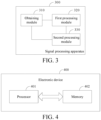
- a signal processing apparatus 300 may include: an obtaining module 310, a first processing module 320, and a second processing module 330.
- the obtaining module 310 is configured to obtain a first pulse wave signal and motion signals in multi-dimensional directions, where the first pulse wave signal includes motion noise.
- the first processing module 320 is configured to perform independent filtering processing on the motion signal in each dimensional direction, and determine a noise estimated value corresponding to each dimensional direction.
- the second processing module 330 is configured to use the noise estimated values in the multi-dimensional directions as parallel input parameters, use the first pulse wave signal as an input parameter, and perform filtering processing on the first pulse wave signal, to obtain a second pulse wave signal.
- independent parallel processing is performed on the motion signal corresponding to each dimensional direction, to estimate a noise estimated value in a corresponding dimensional direction, and then fusion filtering processing is performed based on the noise estimated value in each dimensional direction, to reduce noise, so as to obtain the second pulse wave signal.
- a heart rate of the user is estimated by using the second pulse wave signal, and an adverse effect of motion noise on the heart rate estimation can be eliminated, thereby improving heart rate estimation accuracy.
- the first processing module 320 is configured to determine, according to a motion signal in a first dimensional direction, a motion parameter corresponding to the first dimensional direction, where the first dimensional direction is any dimensional direction of the multi-dimensional directions; and determine a noise estimated value corresponding to the first dimensional direction according to the motion parameter and a first filter coefficient corresponding to the first dimensional direction.
- the first filter coefficient is a filter coefficient that corresponds to a first processing cycle and that corresponds to the first dimensional direction.
- the first processing module 320 is configured to: before the determining a noise estimated value corresponding to the first dimensional direction according to the motion parameter and a first filter coefficient corresponding to the first dimensional direction, obtain the first filter coefficient according to a target pulse wave signal that corresponds to a second processing cycle and that includes motion noise, a target motion parameter that corresponds to the second processing cycle and that corresponds to the first dimensional direction, and a third filter coefficient that corresponds to the second processing cycle and that corresponds to the first dimensional direction.
- the second processing cycle is a previous processing cycle adjacent to the first processing cycle.
- the first processing module 320 is configured to obtain an error signal corresponding to the first dimensional direction according to the target pulse wave signal, the target motion parameter, and the third filter coefficient; obtain a filter adjustment coefficient according to the error signal and the target motion parameter; and obtain the first filter coefficient according to the filter adjustment coefficient and the third filter coefficient.
- the second processing module 330 is configured to use the noise estimated values in the multi-dimensional direction as the parallel input parameters, use the first pulse wave signal as the input parameter, and obtain a second filter coefficient corresponding to the multi-dimensional directions, where the second filter coefficient includes a first filter coefficient value corresponding to each dimensional direction; and perform filtering processing on the first pulse wave signal according to the noise estimated value in each dimensional direction and the first filter coefficient value corresponding to each dimensional direction, to obtain the second pulse wave signal.
- the second filter coefficient is a filter coefficient that corresponds to a first processing cycle and that corresponds to the multi-dimensional directions.
- the second processing module 330 is configured to obtain the second filter coefficient according to a pulse wave signal that corresponds to a second processing cycle and that is obtained through filtering processing, a fourth filter coefficient that corresponds to the second processing cycle and that corresponds to the multi-dimensional directions, and a noise estimated value that corresponds to the second processing cycle and that corresponds to each dimensional direction.
- the fourth filter coefficient includes a second filter coefficient value corresponding to each dimensional direction.
- the second processing cycle is a previous processing cycle adjacent to the first processing cycle.
- the first processing module 320 may include a plurality of first filters.
- the plurality of first filters are in a one-to-one correspondence with the multi-dimensional directions, and each first filter is configured to perform independent filtering processing on a motion signal in a corresponding dimensional direction and determine a noise estimated value corresponding to the corresponding dimensional direction.
- the second processing module 330 may include a second filter.
- the second filter is configured to use the noise estimated values in the multi-dimensional directions as parallel input parameters, use the first pulse wave signal as an input parameter, and perform filtering processing on the first pulse wave signal, to obtain a second pulse wave signal.
- the signal processing apparatus in this embodiment of this application may be an apparatus, or may be a component, an integrated circuit, or a chip in a terminal.
- the apparatus may be a mobile electronic device or may be a non-mobile electronic device.
- the mobile electronic device may be a mobile phone, a tablet computer, a notebook computer, a palmtop computer, an in-vehicle electronic device, a wearable equipment, an ultra-mobile personal computer (ultra-mobile personal computer, UMPC), a netbook, a personal digital assistant (personal digital assistant, PDA), or the like.
- the non-mobile electronic device may be a server, a network attached storage (Network Attached Storage, NAS), a personal computer (personal computer, PC), a television (television, TV), a teller machine, a self-service machine, or the like. This is not specifically limited in this embodiment of this application.
- Network Attached Storage NAS
- PC personal computer
- TV television
- teller machine a self-service machine
- the signal processing apparatus in this embodiment of this application may be an apparatus with an operating system.
- the operating system may be an Android (Android) operating system, an ios operating system, or another possible operating system. This is not specifically limited in this embodiment of this application.
- the signal processing apparatus provided in this embodiment of this application can implement the processes implemented in the method embodiment of FIG. 1 . To avoid repetition, details are not described herein again.
- an embodiment of this application further provides an electronic device 400, including a processor 401, a memory 402, and a program or an instruction stored on the memory 402 and runnable on the processor 401.
- the program or the instruction is executed by the processor 401 to implement each process of the foregoing embodiments of the signal processing method, and the same technical effects can be achieved. To avoid repetition, details are not described herein again.
- the memory 402 may be configured to store a software program and various data.
- the memory 402 may mainly include a first storage area that includes the program or the instruction and a second storage area that includes data.
- the first storage area may store an operating system, an application program or instruction required by at least one function (for example, a sound playback function and an image display function), and the like.
- the memory 402 may include a volatile memory or a non-volatile memory, or the memory 402 may include both a volatile memory and a non-volatile memory.
- the non-volatile memory may be a read-only memory (Read-Only Memory, ROM), a programmable read-only memory (Programmable ROM, PROM), an erasable programmable read-only memory (Erasable PROM, EPROM), an electrically erasable programmable read- only memory (Electrically EPROM, EEPROM), or a flash memory.
- ROM Read-Only Memory
- PROM programmable read-only memory
- Erasable PROM Erasable PROM
- EPROM electrically erasable programmable read- only memory
- EEPROM electrically erasable programmable read- only memory
- the volatile memory may be a random access memory (Random Access Memory, RAM), a static random access memory (Static RAM, SRAM), a dynamic random access memory (Dynamic RAM, DRAM), a synchronous dynamic random access memory (Synchronous DRAM, SDRAM), a double data rate synchronous dynamic random access memory (Double Data Rate SDRAM, DDRSDRAM), an enhanced synchronous dynamic random access memory (Enhanced SDRAM, ESDRAM), a synch link dynamic random access memory (Synch link DRAM, SLDRAM), and a direct rambus random access memory (Direct Rambus RAM, DRRAM).
- RAM Random Access Memory
- SRAM static random access memory
- DRAM dynamic random access memory
- DRAM synchronous dynamic random access memory
- SDRAM double data rate synchronous dynamic random access memory
- Enhanced SDRAM, ESDRAM enhanced synchronous dynamic random access memory
- Synch link DRAM, SLDRAM synch link dynamic random access memory
- Direct Rambus RAM Direct Rambus RAM
- the processor 401 may include one or more processing units.
- the processor 401 may integrate an application processor and a modem.
- the application processor mainly processes an operation involved in an operating system, a user interface, an application program, and the like.
- the modem mainly processes a wireless communication signal, for example, a baseband processor. It may be understood that the foregoing modem may either not be integrated into the processor 401.
- the electronic device in this embodiment of this application includes the mobile electronic device and the non-mobile electronic device.
- FIG. 5 is a schematic diagram of a hardware structure of an electronic device 1000 according to an embodiment of this application.
- the electronic device 1000 includes, but is not limited to, components such as a radio frequency unit 1001, a network module 1002, an audio output unit 1003, an input unit 1004, a sensor 1005, a display unit 1006, a user input unit 1007, an interface unit 1008, a memory 1009, and a processor 1010.
- components such as a radio frequency unit 1001, a network module 1002, an audio output unit 1003, an input unit 1004, a sensor 1005, a display unit 1006, a user input unit 1007, an interface unit 1008, a memory 1009, and a processor 1010.
- the electronic device 1000 may further include the power supply (such as a battery) for supplying power to the components.
- the power supply may logically connect to the processor 1010 by using a power supply management system, thereby implementing functions, such as charging, discharging, and power consumption management, by using the power supply management system.
- the electronic device structure shown in FIG. 5 constitutes no limitation on an external device, and the electronic device may include more or fewer components than those shown in the figure, or some components may be combined, or a different component deployment may be used. Details are described herein again.
- the processor 1010 is configured to obtain a first pulse wave signal and motion signals in multi-dimensional directions, where the first pulse wave signal includes motion noise; perform independent filtering processing on the motion signal in each dimensional direction, and determine a noise estimated value corresponding to each dimensional direction; and use the noise estimated values in the multi-dimensional directions as parallel input parameters, use the first pulse wave signal as an input parameter, and perform filtering processing on the first pulse wave signal, to obtain a second pulse wave signal.
- independent parallel processing is performed on the motion signal corresponding to each dimensional direction, to estimate a noise estimated value in a corresponding dimensional direction, and then fusion filtering processing is performed based on the noise estimated value in each dimensional direction, to reduce noise, so as to obtain the second pulse wave signal.
- a heart rate of the user is estimated by using the second pulse wave signal, and an adverse effect of motion noise on the heart rate estimation can be eliminated, thereby improving heart rate estimation accuracy.
- the processor 1010 is configured to determine, according to a motion signal in a first dimensional direction, a motion parameter corresponding to the first dimensional direction, where the first dimensional direction is any dimensional direction of the multi-dimensional directions; and determine a noise estimated value corresponding to the first dimensional direction according to the motion parameter and a first filter coefficient corresponding to the first dimensional direction.
- the first filter coefficient is a filter coefficient that corresponds to a first processing cycle and that corresponds to the first dimensional direction.
- the processor 1010 is configured to: before the determining a noise estimated value corresponding to the first dimensional direction according to the motion parameter and a first filter coefficient corresponding to the first dimensional direction, obtain the first filter coefficient according to a target pulse wave signal that corresponds to a second processing cycle and that includes motion noise, a target motion parameter that corresponds to the second processing cycle and that corresponds to the first dimensional direction, and a third filter coefficient that corresponds to the second processing cycle and that corresponds to the first dimensional direction.
- the second processing cycle is a previous processing cycle adjacent to the first processing cycle.
- the processor 1010 is configured to obtain an error signal corresponding to the first dimensional direction according to the target pulse wave signal, the target motion parameter, and the third filter coefficient; obtain a filter adjustment coefficient according to the error signal and the target motion parameter; and obtain the first filter coefficient according to the filter adjustment coefficient and the third filter coefficient.
- the processor 1010 is configured to use the noise estimated values in the multi-dimensional direction as the parallel input parameters, use the first pulse wave signal as the input parameter, and obtain a second filter coefficient corresponding to the multi-dimensional directions, where the second filter coefficient includes a first filter coefficient value corresponding to each dimensional direction; and perform filtering processing on the first pulse wave signal according to the noise estimated value in each dimensional direction and the first filter coefficient value corresponding to each dimensional direction, to obtain the second pulse wave signal.
- the second filter coefficient is a filter coefficient that corresponds to a first processing cycle and that corresponds to the multi-dimensional directions.
- the processor 1010 is configured to obtain the second filter coefficient according to a pulse wave signal that corresponds to a second processing cycle and that is obtained through filtering processing, a fourth filter coefficient that corresponds to the second processing cycle and that corresponds to the multi-dimensional directions, and a noise estimated value that corresponds to the second processing cycle and that corresponds to each dimensional direction.
- the fourth filter coefficient includes a second filter coefficient value corresponding to each dimensional direction.
- the second processing cycle is a previous processing cycle adjacent to the first processing cycle.
- the input unit 1004 may include a graphics processing unit (Graphics Processing Unit, GPU) 10041 and a microphone 10042.
- the graphics processing unit 10041 performs processing on image data of a static picture or a video that is obtained by an image acquisition device (for example, a camera) in a video acquisition mode or an image acquisition mode.
- the display unit 1006 may include a display panel 10061, for example, the display panel 10061 configured in a form such as a liquid crystal display or an organic light-emitting diode.
- the user input unit 1007 includes a touch panel 10071 and another input device 10072.
- the touch panel 10071 is also referred to as a touchscreen.
- the touch panel 10071 may include two parts: a touch detection apparatus and a touch controller.
- the another input device 10072 may include, but not limited to, a physical keyboard, a functional key (such as a volume control key or a switch key), a track ball, a mouse, and a joystick, which are not described herein in detail.
- the memory 1009 may be configured to store a software program and various data, which includes, but not limited to, an application and an operating system.
- the processor 1010 may integrate an application processor and a modem processor.
- the application processor mainly processes an operating system, a user interface, an application program, and the like.
- the modem processor mainly processes wireless communication. It may be understood that the foregoing modem may either not be integrated into the processor 1010.
- An embodiment of this application further provides a readable storage medium, storing a program or an instruction, where the program or the instruction is executed by a processor to implement each process of the foregoing embodiments of the signal processing method, and the same technical effect can be achieved. To avoid repetition, details are not repeated herein.
- the processor is the processor in the electronic device in the foregoing embodiment.
- the readable storage medium includes a computer-readable storage medium such as a computer read-only memory (Read-Only Memory, ROM), a random access memory (Random Access Memory, RAM), a magnetic disk, or an optical disc.
- An embodiment of this application further provides a chip, including a processor and a communication interface, where the communication interface is coupled to the processor, and the processor is configured to run a program or an instruction, to implement each process of the foregoing embodiments of the signal processing method, and the same technical effect can be achieved. To avoid repetition, details are not repeated herein.
- the chip mentioned in this embodiment of this application may also be referred to as a system-level chip, a system chip, a chip system, a system on chip, or the like.
- the methods in the foregoing embodiments may be implemented by means of software and a necessary general hardware platform, and certainly, may also be implemented by hardware, but in many cases, the former manner is a better implementation.
- the technical solutions of this application essentially or the part contributing to the related art may be implemented in the form of a computer software product.
- the computer software product is stored in a storage medium (such as a ROM/RAM, a magnetic disk, or an optical disc), and includes several instructions for instructing a terminal (which may be a mobile phone, a computer, a server, a network device, or the like) to perform the method described in the embodiments of this application.
Landscapes
- Health & Medical Sciences (AREA)
- Life Sciences & Earth Sciences (AREA)
- Engineering & Computer Science (AREA)
- Surgery (AREA)
- General Health & Medical Sciences (AREA)
- Biophysics (AREA)
- Pathology (AREA)
- Physiology (AREA)
- Biomedical Technology (AREA)
- Heart & Thoracic Surgery (AREA)
- Medical Informatics (AREA)
- Molecular Biology (AREA)
- Veterinary Medicine (AREA)
- Animal Behavior & Ethology (AREA)
- Physics & Mathematics (AREA)
- Public Health (AREA)
- Signal Processing (AREA)
- Cardiology (AREA)
- Artificial Intelligence (AREA)
- Computer Vision & Pattern Recognition (AREA)
- Psychiatry (AREA)
- Measuring Pulse, Heart Rate, Blood Pressure Or Blood Flow (AREA)
- Measurement Of The Respiration, Hearing Ability, Form, And Blood Characteristics Of Living Organisms (AREA)
- Indication And Recording Devices For Special Purposes And Tariff Metering Devices (AREA)
- Radar Systems Or Details Thereof (AREA)
Abstract
Description
- This application claims priority to
Chinese Patent Application No. 202110651546.3, entitled "SIGNAL PROCESSING METHOD AND APPARATUS, AND ELECTRONIC DEVICE" and filed on June 10, 2021 - This application belongs to the field of signal processing technologies, and in particular, to a signal processing method and apparatus, and an electronic device.
- When a user is in motion, a pulse wave signal acquired by a device includes motion noise. If a heart rate of the user is estimated based on the pulse wave signal, a problem of relatively low estimation accuracy is caused.
- Therefore, it is necessary to process the signal acquired by the device.
- An objective of embodiments of this application is to provide a signal processing method and apparatus, and an electronic device, which can resolve a problem of relatively low estimation accuracy.
- According to a first aspect, an embodiment of this application provides a signal processing method, where the method includes: obtaining a first pulse wave signal and motion signals in multi-dimensional directions, where the first pulse wave signal includes motion noise; performing independent filtering processing on the motion signal in each dimensional direction, and determining a noise estimated value corresponding to each dimensional direction; and using the noise estimated values in the multi-dimensional directions as parallel input parameters, using the first pulse wave signal as an input parameter, and performing filtering processing on the first pulse wave signal, to obtain a second pulse wave signal.
- According to a second aspect, an embodiment of this application provides a signal processing apparatus, where the apparatus includes: an obtaining module, configured to obtain a first pulse wave signal and motion signals in multi-dimensional directions, where the first pulse wave signal includes motion noise; a first processing module, configured to perform independent filtering processing on the motion signal in each dimensional direction, and determine a noise estimated value corresponding to each dimensional direction; and a second processing module, configured to use the noise estimated values in the multi-dimensional directions as parallel input parameters, use the first pulse wave signal as an input parameter, and perform filtering processing on the first pulse wave signal, to obtain a second pulse wave signal.
- According to a third aspect, an embodiment of this application provides an electronic device, including a processor, a memory, and a program or an instruction stored in the memory and runnable on the processor, where the program or the instruction is executed by the processor to implement the steps of the method according to the first aspect.
- According to a fourth aspect, an embodiment of this application provides a readable storage medium, storing a program or an instruction, where the program or the instruction is executed by a processor to implement the steps of the method according to a first aspect.
- According to a fifth aspect, an embodiment of this application provides a chip, including a processor and a communication interface, where the communication interface is coupled to the processor, and the processor is configured to run a program or instruction to implement the method according to the first aspect.
- In the embodiments of this application, the first pulse wave signal and the motion signals in the multi-dimensional directions are obtained, where the first pulse wave signal includes motion noise; independent filtering processing is performed on the motion signal in each dimensional direction, and the noise estimated value corresponding to each dimensional direction is determined; and the noise estimated values in the multi-dimensional directions are used as the parallel input parameters, the first pulse wave signal is used as an input parameter, and filtering processing is performed on the first pulse wave signal, to obtain the second pulse wave signal. The embodiments of this application provide the signal processing method, which can resolve a problem of relatively low estimation accuracy.
-
-
FIG. 1 is a flowchart of a signal processing method according to an embodiment; -
FIG. 2 is a block diagram of a signal flow according to an embodiment; -
FIG. 3 is a block principle diagram of a signal processing apparatus according to an embodiment; -
FIG. 4 is a schematic diagram of a hardware structure of an electronic device according to an embodiment; and -
FIG. 5 is a schematic diagram of a hardware structure of another electronic device according to an embodiment. - The technical solutions in the embodiments of this application are clearly described in the following with reference to the accompanying drawings in the embodiments of this application. Apparently, the described embodiments are some rather than all of the embodiments of this application. All other embodiments obtained by a person of ordinary skill in the art based on the embodiments of this application fall within the protection scope of this application.
- The specification and claims of this application, and terms "first" and "second" are used to distinguish similar objects, but are not used to describe a specific sequence or order. It should be understood that the data termed in such a way are interchangeable in appropriate circumstances, so that the embodiments of this application can be implemented in orders other than the order illustrated or described herein. In addition, the objects distinguished by "first" and "second" are usually of a same type, without limiting a quantity of objects, for example, there may be one or more first objects. In addition, "and/or" in the description and the claims means at least one of the connected objects, and the character "/" in this specification generally indicates an "or" relationship between the associated objects.
- A signal processing method provided in the embodiments of this application are described in detail below with reference to the accompanying drawings by using specific embodiments and application scenarios thereof.
- Referring to
FIG. 1 , a signal processing method provided in this embodiment may include the following step S 110 to step S130. - Step S 110: Obtain a first pulse wave signal and motion signals in multi-dimensional directions, where the first pulse wave signal includes motion noise.
- In an embodiment of the present disclosure, the first pulse wave signal may be a pulse wave signal acquired by an electronic device, and the motion signals may be motion signals that are of the electronic device and that correspond to the multi-dimensional directions. The electronic device may be a smart wearable device such as a smartwatch or a smart band. A user may wear the electronic device during motion.
- Specifically, a signal acquisition apparatus configured to acquire a pulse wave signal is arranged in the electronic device, and the acquired pulse wave signal includes motion noise or is referred to as noise including a motion artifact. In an embodiment of the present disclosure, the signal acquisition apparatus may be a photo plethysmo graphy (Photo Plethysmo Graphy, PPG) sensor and may acquire a PPG signal including motion noise. The PPG signal is, for example, d(n) shown in
FIG. 2 . - n may represent an nth processing cycle. The following is the same. Therefore, d(n) is a pulse wave signal that corresponds to the nth processing cycle and that includes motion noise. The following is the same.
- Specifically, a sensor configured to acquire motion signals that are of the electronic device and that correspond to the multi-dimensional directions may be arranged in the electronic device. In an embodiment of the present disclosure, the sensor may be a triaxial accelerometer and acquires motion signals of the electronic device that respectively correspond to an X axis direction, a Y axis direction, and a Z axis direction. The motion signals are, for example, x(n), y(n), and z(n) that correspond to the nth processing cycle shown in
FIG. 2 . - Therefore, the multi-dimensional directions in this embodiment may be the X axis direction, the Y axis direction, and the Z axis direction.
- After the first pulse wave signal including the motion noise and the motion signals in the multi-dimensional directions are obtained in step S 110, the following
step S 120 may be performed. - Step S 120: Perform independent filtering processing on the motion signal in each dimensional direction, and determine a noise estimated value corresponding to each dimensional direction.
- In this step, independent filtering processing is performed on the motion signal in each dimensional direction, to implement independent and parallel processing on multi-channel motion signals. Based on this, the noise estimated value corresponding each dimensional direction may be determined.
- In a feasible implementation, a plurality of filters may be designed. The plurality of filters are in a one-to-one correspondence with the multi-dimensional directions, and each filter independently performs filtering processing on a motion signal in a corresponding dimensional direction. Optionally, the filter may be an NLMS adaptive filter adopting a normalized least mean square (Normalized Least Mean Square, NLMS) algorithm shown in
FIG. 2 . - Specifically, each filter in the plurality of filters may perform filtering processing on a motion signal in a corresponding dimensional direction with reference to a filter coefficient thereof.
- In this embodiment, the filter coefficient of each filter in the plurality of filters may be recorded as a filter coefficient corresponding to a corresponding dimensional direction.
- Based on this, in an embodiment of the present disclosure, the performing independent filtering processing on the motion signal in each dimensional direction, and determining a noise estimated value corresponding to each dimensional direction in step S120 may include the following step S1201 and step S1202.
- Step S1201: Determine, according to a motion signal in a first dimensional direction, a motion parameter corresponding to the first dimensional direction, where the first dimensional direction is any dimensional direction of the multi-dimensional directions.
- In an embodiment of the present disclosure, the motion signal in the first dimensional direction includes: motion parameter values corresponding to the first dimensional direction at a series of sampling time points. At least some motion parameter values may be selected from the motion signal and are arranged according to a sequence of corresponding sampling time points, to obtain a motion parameter corresponding to the first dimensional direction. The motion parameter may be a vector.
- In a feasible implementation, the some selected motion parameter values may be motion parameter values respectively corresponding to a plurality of sampling time points relatively closest to a current time. For example, when a motion parameter is constructed, the motion parameter is constructed by using motion parameter values acquired within first 1s to 2s.
- In this embodiment, it is assumed that the motion signals that are of the electronic device and that correspond to the X axis direction, the Y axis direction, and the Z axis direction are respectively x(n), y(n), and z(n), motion parameters X(n), Y(n), and Z(n) respectively corresponding to the X axis direction, the Y axis direction, and the Z axis direction may be obtained.
- Step S1202: Determine a noise estimated value corresponding to the first dimensional direction according to the motion parameter and a first filter coefficient corresponding to the first dimensional direction.
- In the step, a noise estimated value in a corresponding dimensional direction is estimated with reference to the motion parameter and a filter coefficient of the filter. The noise estimated value may also be referred to as an adaptive estimated value of the first pulse wave signal d(n).
- Referring to
FIG. 2 , when there are three-dimensional directions, three independent and parallel NLMS adaptive filters may be designed correspondingly, and each NLMS adaptive filter independently estimates a noise estimated value corresponding to a corresponding dimensional direction. - In a feasible implementation, the noise estimated value corresponding to each dimensional direction may be obtained through the following formula:


n represents the nth processing cycle, dx, dy, and dz respectively represent noise estimated values corresponding to the X axis direction, the Y axis direction, and the Z axis direction of the triaxial accelerometer, wx, wy, and wz respectively represent filter coefficients corresponding to the X axis direction, the Y axis direction, and the Z axis direction of the triaxial accelerometer, X(n), Y(n), and Z(n) respectively represent motion parameters corresponding to the X axis direction, the Y axis direction, and the Z axis direction of the triaxial accelerometer, and a * operation represents multiplication. - After the noise estimated value corresponding to each dimensional direction is determined in
step S 120, the followingstep S 130 may be performed. - Step S130: Use the noise estimated values in the multi-dimensional directions as parallel input parameters, use the first pulse wave signal as an input parameter, and perform filtering processing on the first pulse wave signal, to obtain a second pulse wave signal.
- In a feasible implementation, another filter may be designed. The another filter has a fusion function and performs filtering processing on the first pulse wave signal with reference to the noise estimated value corresponding to each dimensional direction.
- Referring to
FIG. 2 , the NLMS adaptive filter corresponding to each dimensional direction independently estimates a noise estimated value, the noise estimated value may be further inputted into an NLMS adaptive filter that has a fusion function, and the NLMS adaptive filter that has the fusion function may perform, with reference to each noise estimated value, filtering processing on the acquired first pulse wave signal that includes the motion noise, to obtain a second pulse wave signal, where the second pulse wave signal is a heart rate estimation signal e(n) shown inFIG. 2 . - Specifically, the filter that has the fusion function may perform filtering processing on the first pulse wave signal with reference to a filter coefficient of the filter and the noise estimated value corresponding to each dimensional direction.
- In this embodiment, in the plurality of filters that are in a one-to-one correspondence with the multi-dimensional directions, the filter coefficient of each filter may be recorded as a filter coefficient corresponding to a corresponding dimensional direction. For the fusion filter, a filter coefficient of the fusion filter may be recorded as a filter coefficient corresponding to the multi-dimensional directions.
- Based on this, in an embodiment of the present disclosure, the using the noise estimated values in the multi-dimensional directions as parallel input parameters, using the first pulse wave signal as an input parameter, and performing filtering processing on the first pulse wave signal, to obtain a second pulse wave signal in step S130 may include the following step S1301 and step S1302.
- Step S1301: Use the noise estimated values in the multi-dimensional direction as the parallel input parameters, use the first pulse wave signal as the input parameter, and obtain a second filter coefficient corresponding to the multi-dimensional directions, where the second filter coefficient includes a first filter coefficient value corresponding to each dimensional direction.
- In a feasible implementation, the filter coefficient corresponding to the multi-dimensional directions may be obtained by using the following formula:

n represents the nth processing cycle, A represents the filter coefficient corresponding to the multi-dimensional directions, and ax, ay, and az respectively represent filter coefficient values corresponding to the X axis direction, the Y axis direction, and the Z axis direction of the triaxial accelerometer. ax(n), ay(n), and az(n) are all scalars, and A(n) is a vector constructed by using the three scalars. - Step S1302: Perform filtering processing on the first pulse wave signal according to the noise estimated value in each dimensional direction and the first filter coefficient value corresponding to each dimensional direction, to obtain the second pulse wave signal.
- Based on the foregoing content, in a feasible implementation, the second pulse wave signal may be obtained by using the following formula:


n represents the nth processing cycle, e represents the second pulse wave signal, d represents the first pulse wave signal that includes the motion noise, A represents the filter coefficient corresponding to the multi-dimensional directions, P(n) represents a vector constructed by using three scalars dx(n), dy(n), and dz(n), dx, dy, and dz respectively represent noise estimated values corresponding to the X axis direction, the Y axis direction, and the Z axis direction of the triaxial accelerometer, ax, ay, and az respectively represent filter coefficient values corresponding to the X axis direction, the Y axis direction, and the Z axis direction of the triaxial accelerometer, and a * operation represents multiplication. - In this embodiment, when filtering processing is performed on the first pulse wave signal that includes the motion noise based on the noise estimated value corresponding to each dimensional direction, a physiological signal may be separated from a noise signal generated during movement of a user, to obtain a second pulse wave signal in which noise has been removed. The signal may accurately reflect a change of a heart rate of the user, so that the heart rate of the user obtained through estimation is closer to an actual heart rate of the user, thereby improving heart rate estimation accuracy.
- As shown in
FIG. 2 , the second pulse wave signal is e(n). The signal may be further used for heart rate estimation. - It can be learned from the foregoing content that in this embodiment, independent and parallel processing is performed on the motion signal corresponding to each dimensional direction, to estimate a noise estimated value in a corresponding dimensional direction, and then fusion filtering processing is performed based on the noise estimated value in each dimensional direction, to reduce noise, so as to obtain the second pulse wave signal. A heart rate of the user is estimated by using the second pulse wave signal, and an adverse effect of motion noise on the heart rate estimation can be eliminated, thereby improving heart rate estimation accuracy.
- In addition, in this embodiment of the present disclosure, in the parallel manner, independent adaptive filtering can be performed on the first pulse wave signal that includes the motion noise by using a motion signal of each channel of a multi-channel accelerometer, to independently estimate the first pulse wave signal to obtain a corresponding noise estimated value, and then an adaptive approximate result of each channel can be combined in the fusion filter with a lowest loss function of the first pulse wave signal, to improve the denoising effect. Therefore, when the fusion filter has motion artifact noise, a convergence response speed of denoising can be accelerated based on the parallel denoising manner, and a signal-to-noise ratio of a pulse wave heart rate signal is improved.
- In addition to the parallel filter manner provided in this embodiment of the present disclosure, filtering noise reduction processing may be further performed according to a cascading sequence. For an implementation in which filtering is performed according to the cascading sequence, for example, an X axis motion signal, a Y axis motion signal, and a Z axis motion signal of the triaxial accelerometer are used as input signals for noise reduction, and adaptive filters are combined according to a cascading sequence of X axis→Y axis→Z axis and sequentially perform adaptive filtering, to perform filtering processing on a pulse wave signal that includes motion noise, to achieve a noise reduction effect.
- However, in the implementation in which filtering is performed according to the cascading sequence, adaptive filters correspond to channels are set in a cascading manner. Therefore, in the cascaded adaptive filters, filtering input signals have a sequence. Specifically, due to the sequence of the combined cascaded filters, a second-stage adaptive filter performs adaptive tracking according to a result outputted by a first-stage adaptive filter, and then a third-stage adaptive filter performs adaptive tracking according to a result outputted by the second-stage adaptive filter. Therefore, there is a sequence problem in an adaptive tracking sequence for calculation of a loss function, and an error signal of a latter-stage filter lags behind that of a previous-stage filter. Therefore, in a scenario in which a user wears a smartwatch and does a vigorous exercise such as running, the best effect cannot be necessarily achieved according to a specific cascading sequence (for example, X-Y-Z), and estimation and noise reduction on a heart rate signal by using an output signal are still inaccurate.
- The parallel filtering solution provided in this embodiment of the present disclosure can resolve the problem. Specifically, the filters corresponding to the channels are set in a parallel manner. Therefore, in the parallel filters, filtering input signals have no sequence. Based on this, the filter corresponding to each axis of the accelerometer may simultaneously perform independent filtering processing on an input signal, to obtain a corresponding noise estimated value. An additional filter is arranged, and the filter fuses signals by using the noise estimated values as parallel input parameters, to perform filtering processing on the first pulse wave signal. During fusion, the fusion filter can further make a reasonable response according to a filtering status of each signal, to improve an input channel weight coefficient that can effectively reduce a loss function, thereby achieving an objective of multipath parallel noise reduction.
- In addition, in the implementation in which filtering is performed according to the cascading sequence, a reference signal of the second-stage adaptive filter uses an error signal e(n) of the first-stage adaptive filter as an input. Therefore, in terms of an amplitude of a signal, the reference signal of the second-stage adaptive filter is smaller than that of the first-stage adaptive filter. Similarly, a reference signal of the third-stage adaptive filter is smaller than that of the second-stage adaptive filter. That is, there is a stage-by-stage attenuation problem in the combined cascaded filters.
- However, the parallel filtering solution provided in this embodiment of the present disclosure does not have the problem. This is because independent parallel computing is performed on the input signals in this embodiment of the present disclosure, there is no problem in which a reference signal of a filter is an error signal outputted by a previous-stage filter of the filter in the combined cascaded filters. Therefore, the convergence speed can be improved. In addition, the filters perform parallel output, so that an amplitude of an estimation signal outputted by each channel is uniform, but information about an error signal of a lower-stage filter is always lower than that of a higher-stage filter in the cascaded filters.
- In this embodiment of the present disclosure, a parallel filtering solution is provided, and the solution is correspondingly described by using the foregoing content. Based on the foregoing content, it should be noted that, filtering processing on the first pulse wave signal may be a periodical processing process. Therefore, to improve a noise reduction effect, a filter coefficient of each filter may be periodically updated. Therefore, when filtering processing is performed in each filtering processing cycle, a corresponding noise estimated value is estimated according to a current latest filter coefficient of each filter. Therefore, the first filter coefficient may be a real-time updated filter coefficient.
- Based on this, to describe a possible implementation in which a filter coefficient corresponding to each dimensional direction is updated, in an embodiment of the present disclosure, the first filter coefficient is a filter coefficient that corresponds to a first processing cycle and that corresponds to the first dimensional direction.
- For example, the first processing cycle is an nth processing cycle (n is greater than or equal to 2). An X axis is used as an example, and the first filter coefficient corresponding to an X axis direction is wx(n).
- Correspondingly, a filter coefficient that corresponds to the nth processing cycle and that corresponds to each dimensional direction may be obtained according to data corresponding to an (n-1)th processing cycle, to update the filter coefficient.
- Based on this, before the determining a noise estimated value corresponding to the first dimensional direction according to the motion parameter and a first filter coefficient corresponding to the first dimensional direction in step S 1202, the method further includes the following step A.
- Step A: Obtain the first filter coefficient according to a target pulse wave signal that corresponds to a second processing cycle and that includes motion noise, a target motion parameter that corresponds to the second processing cycle and that corresponds to the first dimensional direction, and a third filter coefficient that corresponds to the second processing cycle and that corresponds to the first dimensional direction. The second processing cycle is a previous processing cycle adjacent to the first processing cycle.
- Specifically, the first processing cycle is a current processing cycle, and the second processing cycle is a previous processing cycle of the current processing cycle. For example, when the first processing cycle is the nth processing cycle, the second processing cycle is the (n-1)th processing cycle.
- For example, the first processing cycle is the nth processing cycle. The target pulse wave signal may be d(n-1), the target motion parameter may be one of X(n-1), Y(n-1), and Z(n-1), X(n-1), Y(n-1), and Z(n-1) respectively correspond to the X axis direction, the Y axis direction, and the Z axis direction of the triaxial accelerometer, the third filter coefficient may be one of wx(n-1), wy(n-1), and wz(n-1), and wx(n-1), wy(n-1), and wz(n-1) respectively correspond to the X axis direction, the Y axis direction, and the Z axis direction of the triaxial accelerometer.
- In this embodiment, for any dimensional direction, a filter coefficient that corresponds to a current processing cycle and that corresponds to the dimensional direction may be obtained according to a pulse wave signal that includes motion noise and that corresponds to a previous processing cycle, a motion parameter that corresponds to the previous processing cycle and that corresponds to the dimensional direction, and a filter coefficient that corresponds to the previous processing cycle and that corresponds to the dimensional direction. The process is repeated, and a filter coefficient corresponding to any dimensional direction can be updated in real time.
- The filter coefficient corresponding to each dimensional direction is updated in real time with reference to a real-time changed pulse wave signal that includes motion noise and a real-time changed motion signal in each dimensional direction and based on an existing filter coefficient corresponding to each dimensional direction. Therefore, when a noise estimated value is calculated based on the real-time updated filter coefficient corresponding to each dimensional direction, accurate estimation can be performed on the noise estimated value, and accurate filtering processing is supported, thereby achieving a good noise filtering effect.
- Based on the foregoing content, in an embodiment of the present disclosure, the obtaining the first filter coefficient according to a target pulse wave signal that corresponds to a second processing cycle and that includes motion noise, a target motion parameter that corresponds to the second processing cycle and that corresponds to the first dimensional direction, and a third filter coefficient that corresponds to the second processing cycle and that corresponds to the first dimensional direction in step A may include the following step A1 to step A3.
- Step A1: Obtain an error signal corresponding to the first dimensional direction according to the target pulse wave signal, the target motion parameter, and the third filter coefficient.
- Based on the foregoing content, for example, the X axis direction, the Y axis direction, or the Z axis direction of the triaxial accelerometer is the first dimensional direction. A noise estimated value that corresponds to the (n-1)th processing cycle and that corresponds to the X axis direction is dx(n-1), a noise estimated value that corresponds to the (n-1)th processing cycle and that corresponds to the Y axis direction is dy(n-1), and a noise estimated value that corresponds to the (n-1)th processing cycle and that corresponds to the Z axis direction is dz(n-1).
- In the step, the X axis is used as an example, and an error signal ex(n-1) corresponding to the X axis direction may be obtained according to the target pulse wave signal d(n-1), the target motion parameter X(n-1), and the noise estimated value dx(n-1) that corresponds to the (n-1)th processing cycle and that corresponds to the X axis direction.
- Similarly, an error signal ey(n-1) corresponding to the Y axis direction may be obtained, and an error signal ez(n-1) corresponding to the Z axis direction may be obtained.
- In a feasible implementation, the error signal corresponding to each dimensional direction may be obtained through the following formula:



n-1 represents the (n-1)th processing cycle, ex, ey, and ez respectively represent error signals corresponding to the X axis direction, the Y axis direction, and the Z axis direction of the triaxial accelerometer, d represents the first pulse wave signal that includes the motion noise, wx, wy, and wz respectively represent filter coefficients corresponding to the X axis direction, the Y axis direction, and the Z axis direction of the triaxial accelerometer, and X, Y, and Z respectively represent motion parameters corresponding to the X axis direction, the Y axis direction, and the Z axis direction of the triaxial accelerometer. - In another feasible implementation, the X axis is used as an example, because dx(n)=wx(n)*X(n), the error signal corresponding to each dimensional direction may be obtained through the following formula.



n-1 represents the (n-1)th processing cycle, ex, ey, and ez respectively represent error signals corresponding to the X axis direction, the Y axis direction, and the Z axis direction of the triaxial accelerometer, d represents the first pulse wave signal that includes the motion noise, and dx, dy, and dz respectively represent noise estimated values corresponding to the X axis direction, the Y axis direction, and the Z axis direction of the triaxial accelerometer. - It should be noted that, referring to step S120, it can be learned that to obtain the second pulse wave signal corresponding to the (n-1)th processing cycle, the noise estimated value that corresponds to the (n-1)th processing cycle and that corresponds to each dimensional direction needs to be estimated in advance. Therefore, when the error signal corresponding to the (n-1)th processing cycle is calculated, the error signal may be directly calculated according to the estimated noise estimated value rather than according to the filter coefficient and the motion parameter.
- Step A2: Obtain a filter adjustment coefficient according to the error signal and the target motion parameter.
- In the step, the filter adjustment coefficient is obtained according to the error signal and the motion parameter, and a current filter coefficient is adjusted based on the adjustment coefficient, to obtain a new filter coefficient.
- In a feasible implementation, the filter adjustment coefficient corresponding to each dimensional direction may be obtained by using the following formula:


n-1 represents the (n-1)th processing cycle, Δwx, Δwy, and Δwz respectively represent filter adjustment coefficients corresponding to the X axis direction, the Y axis direction, and the Z axis direction of the triaxial accelerometer, ex, ey, and ez respectively represent error signals corresponding to the X axis direction, the Y axis direction, and the Z axis direction of the triaxial accelerometer, X, Y, and Z respectively represent motion parameters corresponding to the X axis direction, the Y axis direction, and the Z axis direction of the triaxial accelerometer, and ε is a constant. - Step A3: Obtain the first filter coefficient according to the filter adjustment coefficient and the third filter coefficient.
- For example, the current processing cycle is the nth processing cycle, and the first filter coefficient is one of wx(n), wy(n), and wz(n). Correspondingly, the third filter coefficient is one of wx(n-1), wy(n-1), and wz(n-1).
- Based on the foregoing content, in a feasible implementation, the filter coefficient corresponding to each dimensional direction may be obtained by using the following formula:


n represents the nth processing cycle, n-1 represents the (n-1)th processing cycle, wx, wy, and wz respectively represent filter coefficients corresponding to the X axis direction, the Y axis direction, and the Z axis direction of the triaxial accelerometer, and Δwx, Δwy, and Δwz respectively represent filter adjustment coefficients corresponding to the X axis direction, the Y axis direction, and the Z axis direction of the triaxial accelerometer. - Therefore, in another embodiment of the present disclosure, after step A1, the filter coefficient corresponding to each dimensional direction may alternatively be directly calculated according to the following formula:


- It can be learned from the foregoing content that in this embodiment of the present disclosure, the filter coefficient corresponding to each dimensional direction may be periodically updated, so that when filtering processing is periodically performed, the used filter coefficient corresponding to each dimensional direction is a real-time updated filter coefficient. Therefore, a noise reduction effect can be improved when filtering processing is performed based on the filter coefficient.
- Based on a similar implementation principle, the filter coefficient of the fusion filter may also be periodically updated. Therefore, when filtering processing is performed on the first pulse wave signal that includes the motion noise, the real-time updated filter coefficient corresponding to the multi-dimensional directions may be used, so that the noise reduction effect is also improved when filtering processing is performed based on the filter coefficient.
- Based on this, in an embodiment of the present disclosure, the second filter coefficient is a filter coefficient that corresponds to a first processing cycle and that corresponds to the multi-dimensional directions.
- For example, the first processing cycle is the nth processing cycle (n is greater than or equal to 2). An X axis is used as an example, and the filter coefficient that corresponds to the nth processing cycle and that corresponds to the multi-dimensional directions is P(n).
- Correspondingly, a filter coefficient of the fusion filter that corresponds to the nth processing cycle may be obtained according to data corresponding to the (n-1)th processing cycle, to update the filter coefficient corresponding to the multi-dimensional directions.
- Based on this, the obtaining a second filter coefficient corresponding to the multi-dimensional directions in step S1301 includes: obtaining the second filter coefficient according to a pulse wave signal that corresponds to a second processing cycle and that is obtained through filtering processing, a fourth filter coefficient that corresponds to the second processing cycle and that corresponds to the multi-dimensional directions, and a noise estimated value that corresponds to the second processing cycle and that corresponds to each dimensional direction. The fourth filter coefficient includes a second filter coefficient value corresponding to each dimensional direction. The second processing cycle is a previous processing cycle adjacent to the first processing cycle.
- Specifically, the first processing cycle is a current processing cycle, and the second processing cycle is a previous processing cycle of the current processing cycle. For example, when the first processing cycle is the nth processing cycle, the second processing cycle is the (n-1)th processing cycle.
- In this embodiment, the filter coefficient corresponding to the multi-dimensional directions is updated according to a pulse wave signal e(n-1) that is obtained through filtering processing and that corresponds to the (n-1)th processing cycle, a filter coefficient A(n-1) that corresponds to the (n-1)th processing cycle and that corresponds to the multi-dimensional directions, and a noise estimated value dx(n-1), dy(n-1), and dz(n-1) that corresponds to the (n-1)th processing cycle and that corresponds to each dimensional direction, to obtain the filter coefficient that corresponds to the nth processing cycle and that corresponds to the multi-dimensional directions.
- In this embodiment, the filter coefficient that corresponds to the current processing cycle and that corresponds to the multi-dimensional directions may be obtained according to the pulse wave signal that is obtained through filtering processing and that corresponds to the previous processing cycle, the filter coefficient that corresponds to the previous processing cycle and that corresponds to the multi-dimensional directions, and the noise estimated value that corresponds to the previous processing cycle and that corresponds to each dimensional direction. The process is repeated, and the filter coefficient corresponding to multi-dimensional directions can be updated in real time.
- The filter coefficient is updated in real time with reference to the real-time changed pulse wave signal that is obtained through filtering processing and the real-time changed noise estimated values that corresponds to the dimensional directions and based on the existing filter coefficient that corresponds to the multi-dimensional directions. Therefore, when the second pulse wave signal is calculated based on the real-time updated filter coefficient that corresponds to the multi-dimensional directions, the second pulse wave signal can be accurately obtained, to achieve a better noise filtering effect.
- In a feasible implementation, the filter coefficient corresponding to the multi-dimensional directions may be obtained by using the following formula:


n represents the nth processing cycle, n-1 represents the (n-1)th processing cycle, A represents the filter coefficient that corresponds to the multi-dimensional directions, µ is a step, e represents the second pulse wave signal, P(n-1) represents a vector constructed by using three scalars dx(n-1), dy(n-1), and dz(n-1), dx, dy, and dz respectively represent noise estimated values corresponding to the X axis direction, the Y axis direction, and the Z axis direction of the triaxial accelerometer, ax, ay, and az respectively represent filter coefficient values corresponding to the X axis direction, the Y axis direction, and the Z axis direction of the triaxial accelerometer, a * operation represents multiplication, and ε is a constant. - It can be learned from the foregoing content that in this embodiment of the present disclosure, the filter coefficient of the fusion filter may be periodically updated, so that when filtering processing is periodically performed, the used filter coefficient is a real-time updated filter coefficient that corresponds to the multi-dimensional directions. Therefore, a noise reduction effect can be improved when filtering processing is performed based on the filter coefficient.
- It should be noted that, the signal processing method provided in the embodiments of this application may be performed by a signal processing apparatus or a control module configured to perform the signal processing method in the signal processing apparatus. In this embodiment of this application, the signal processing apparatus provided in this embodiment of this application is described by using an example in which the signal processing apparatus executes the signal processing method.
- As shown in
FIG. 3 , asignal processing apparatus 300 provided in this embodiment may include: an obtainingmodule 310, afirst processing module 320, and asecond processing module 330. - The obtaining
module 310 is configured to obtain a first pulse wave signal and motion signals in multi-dimensional directions, where the first pulse wave signal includes motion noise. Thefirst processing module 320 is configured to perform independent filtering processing on the motion signal in each dimensional direction, and determine a noise estimated value corresponding to each dimensional direction. Thesecond processing module 330 is configured to use the noise estimated values in the multi-dimensional directions as parallel input parameters, use the first pulse wave signal as an input parameter, and perform filtering processing on the first pulse wave signal, to obtain a second pulse wave signal. - In this embodiment, independent parallel processing is performed on the motion signal corresponding to each dimensional direction, to estimate a noise estimated value in a corresponding dimensional direction, and then fusion filtering processing is performed based on the noise estimated value in each dimensional direction, to reduce noise, so as to obtain the second pulse wave signal. A heart rate of the user is estimated by using the second pulse wave signal, and an adverse effect of motion noise on the heart rate estimation can be eliminated, thereby improving heart rate estimation accuracy.
- In an embodiment of the present disclosure, the
first processing module 320 is configured to determine, according to a motion signal in a first dimensional direction, a motion parameter corresponding to the first dimensional direction, where the first dimensional direction is any dimensional direction of the multi-dimensional directions; and determine a noise estimated value corresponding to the first dimensional direction according to the motion parameter and a first filter coefficient corresponding to the first dimensional direction. - In an embodiment of the present disclosure, the first filter coefficient is a filter coefficient that corresponds to a first processing cycle and that corresponds to the first dimensional direction. The
first processing module 320 is configured to: before the determining a noise estimated value corresponding to the first dimensional direction according to the motion parameter and a first filter coefficient corresponding to the first dimensional direction, obtain the first filter coefficient according to a target pulse wave signal that corresponds to a second processing cycle and that includes motion noise, a target motion parameter that corresponds to the second processing cycle and that corresponds to the first dimensional direction, and a third filter coefficient that corresponds to the second processing cycle and that corresponds to the first dimensional direction. The second processing cycle is a previous processing cycle adjacent to the first processing cycle. - In an embodiment of the present disclosure, the
first processing module 320 is configured to obtain an error signal corresponding to the first dimensional direction according to the target pulse wave signal, the target motion parameter, and the third filter coefficient; obtain a filter adjustment coefficient according to the error signal and the target motion parameter; and obtain the first filter coefficient according to the filter adjustment coefficient and the third filter coefficient. - In an embodiment of the present disclosure, the
second processing module 330 is configured to use the noise estimated values in the multi-dimensional direction as the parallel input parameters, use the first pulse wave signal as the input parameter, and obtain a second filter coefficient corresponding to the multi-dimensional directions, where the second filter coefficient includes a first filter coefficient value corresponding to each dimensional direction; and perform filtering processing on the first pulse wave signal according to the noise estimated value in each dimensional direction and the first filter coefficient value corresponding to each dimensional direction, to obtain the second pulse wave signal. - In an embodiment of the present disclosure, the second filter coefficient is a filter coefficient that corresponds to a first processing cycle and that corresponds to the multi-dimensional directions. The
second processing module 330 is configured to obtain the second filter coefficient according to a pulse wave signal that corresponds to a second processing cycle and that is obtained through filtering processing, a fourth filter coefficient that corresponds to the second processing cycle and that corresponds to the multi-dimensional directions, and a noise estimated value that corresponds to the second processing cycle and that corresponds to each dimensional direction. The fourth filter coefficient includes a second filter coefficient value corresponding to each dimensional direction. The second processing cycle is a previous processing cycle adjacent to the first processing cycle. - In an embodiment of the present disclosure, the
first processing module 320 may include a plurality of first filters. The plurality of first filters are in a one-to-one correspondence with the multi-dimensional directions, and each first filter is configured to perform independent filtering processing on a motion signal in a corresponding dimensional direction and determine a noise estimated value corresponding to the corresponding dimensional direction. - In an embodiment of the present disclosure, the
second processing module 330 may include a second filter. The second filter is configured to use the noise estimated values in the multi-dimensional directions as parallel input parameters, use the first pulse wave signal as an input parameter, and perform filtering processing on the first pulse wave signal, to obtain a second pulse wave signal. - The signal processing apparatus in this embodiment of this application may be an apparatus, or may be a component, an integrated circuit, or a chip in a terminal. The apparatus may be a mobile electronic device or may be a non-mobile electronic device. For example, the mobile electronic device may be a mobile phone, a tablet computer, a notebook computer, a palmtop computer, an in-vehicle electronic device, a wearable equipment, an ultra-mobile personal computer (ultra-mobile personal computer, UMPC), a netbook, a personal digital assistant (personal digital assistant, PDA), or the like. The non-mobile electronic device may be a server, a network attached storage (Network Attached Storage, NAS), a personal computer (personal computer, PC), a television (television, TV), a teller machine, a self-service machine, or the like. This is not specifically limited in this embodiment of this application.
- The signal processing apparatus in this embodiment of this application may be an apparatus with an operating system. The operating system may be an Android (Android) operating system, an ios operating system, or another possible operating system. This is not specifically limited in this embodiment of this application.
- The signal processing apparatus provided in this embodiment of this application can implement the processes implemented in the method embodiment of
FIG. 1 . To avoid repetition, details are not described herein again. - Optionally, as shown in
FIG. 4 , an embodiment of this application further provides anelectronic device 400, including aprocessor 401, amemory 402, and a program or an instruction stored on thememory 402 and runnable on theprocessor 401. For example, the program or the instruction is executed by theprocessor 401 to implement each process of the foregoing embodiments of the signal processing method, and the same technical effects can be achieved. To avoid repetition, details are not described herein again. - The
memory 402 may be configured to store a software program and various data. Thememory 402 may mainly include a first storage area that includes the program or the instruction and a second storage area that includes data. The first storage area may store an operating system, an application program or instruction required by at least one function (for example, a sound playback function and an image display function), and the like. In addition, thememory 402 may include a volatile memory or a non-volatile memory, or thememory 402 may include both a volatile memory and a non-volatile memory. The non-volatile memory may be a read-only memory (Read-Only Memory, ROM), a programmable read-only memory (Programmable ROM, PROM), an erasable programmable read-only memory (Erasable PROM, EPROM), an electrically erasable programmable read- only memory (Electrically EPROM, EEPROM), or a flash memory. The volatile memory may be a random access memory (Random Access Memory, RAM), a static random access memory (Static RAM, SRAM), a dynamic random access memory (Dynamic RAM, DRAM), a synchronous dynamic random access memory (Synchronous DRAM, SDRAM), a double data rate synchronous dynamic random access memory (Double Data Rate SDRAM, DDRSDRAM), an enhanced synchronous dynamic random access memory (Enhanced SDRAM, ESDRAM), a synch link dynamic random access memory (Synch link DRAM, SLDRAM), and a direct rambus random access memory (Direct Rambus RAM, DRRAM). Thememory 402 in this embodiment of this application includes but not limited to these memories and any other suitable types of memories. - The
processor 401 may include one or more processing units. Optionally, theprocessor 401 may integrate an application processor and a modem. The application processor mainly processes an operation involved in an operating system, a user interface, an application program, and the like. The modem mainly processes a wireless communication signal, for example, a baseband processor. It may be understood that the foregoing modem may either not be integrated into theprocessor 401. - It should be noted that, the electronic device in this embodiment of this application includes the mobile electronic device and the non-mobile electronic device.
-
FIG. 5 is a schematic diagram of a hardware structure of anelectronic device 1000 according to an embodiment of this application. - The
electronic device 1000 includes, but is not limited to, components such as aradio frequency unit 1001, anetwork module 1002, anaudio output unit 1003, aninput unit 1004, asensor 1005, adisplay unit 1006, auser input unit 1007, aninterface unit 1008, amemory 1009, and aprocessor 1010. - A person skilled in the art may understand that the
electronic device 1000 may further include the power supply (such as a battery) for supplying power to the components. The power supply may logically connect to theprocessor 1010 by using a power supply management system, thereby implementing functions, such as charging, discharging, and power consumption management, by using the power supply management system. The electronic device structure shown inFIG. 5 constitutes no limitation on an external device, and the electronic device may include more or fewer components than those shown in the figure, or some components may be combined, or a different component deployment may be used. Details are described herein again. - The
processor 1010 is configured to obtain a first pulse wave signal and motion signals in multi-dimensional directions, where the first pulse wave signal includes motion noise; perform independent filtering processing on the motion signal in each dimensional direction, and determine a noise estimated value corresponding to each dimensional direction; and use the noise estimated values in the multi-dimensional directions as parallel input parameters, use the first pulse wave signal as an input parameter, and perform filtering processing on the first pulse wave signal, to obtain a second pulse wave signal. - In this embodiment, independent parallel processing is performed on the motion signal corresponding to each dimensional direction, to estimate a noise estimated value in a corresponding dimensional direction, and then fusion filtering processing is performed based on the noise estimated value in each dimensional direction, to reduce noise, so as to obtain the second pulse wave signal. A heart rate of the user is estimated by using the second pulse wave signal, and an adverse effect of motion noise on the heart rate estimation can be eliminated, thereby improving heart rate estimation accuracy.
- Optionally, the
processor 1010 is configured to determine, according to a motion signal in a first dimensional direction, a motion parameter corresponding to the first dimensional direction, where the first dimensional direction is any dimensional direction of the multi-dimensional directions; and determine a noise estimated value corresponding to the first dimensional direction according to the motion parameter and a first filter coefficient corresponding to the first dimensional direction. - Optionally, the first filter coefficient is a filter coefficient that corresponds to a first processing cycle and that corresponds to the first dimensional direction. The
processor 1010 is configured to: before the determining a noise estimated value corresponding to the first dimensional direction according to the motion parameter and a first filter coefficient corresponding to the first dimensional direction, obtain the first filter coefficient according to a target pulse wave signal that corresponds to a second processing cycle and that includes motion noise, a target motion parameter that corresponds to the second processing cycle and that corresponds to the first dimensional direction, and a third filter coefficient that corresponds to the second processing cycle and that corresponds to the first dimensional direction. The second processing cycle is a previous processing cycle adjacent to the first processing cycle. - Optionally, the
processor 1010 is configured to obtain an error signal corresponding to the first dimensional direction according to the target pulse wave signal, the target motion parameter, and the third filter coefficient; obtain a filter adjustment coefficient according to the error signal and the target motion parameter; and obtain the first filter coefficient according to the filter adjustment coefficient and the third filter coefficient. - Optionally, the
processor 1010 is configured to use the noise estimated values in the multi-dimensional direction as the parallel input parameters, use the first pulse wave signal as the input parameter, and obtain a second filter coefficient corresponding to the multi-dimensional directions, where the second filter coefficient includes a first filter coefficient value corresponding to each dimensional direction; and perform filtering processing on the first pulse wave signal according to the noise estimated value in each dimensional direction and the first filter coefficient value corresponding to each dimensional direction, to obtain the second pulse wave signal. - Optionally, the second filter coefficient is a filter coefficient that corresponds to a first processing cycle and that corresponds to the multi-dimensional directions. The
processor 1010 is configured to obtain the second filter coefficient according to a pulse wave signal that corresponds to a second processing cycle and that is obtained through filtering processing, a fourth filter coefficient that corresponds to the second processing cycle and that corresponds to the multi-dimensional directions, and a noise estimated value that corresponds to the second processing cycle and that corresponds to each dimensional direction. The fourth filter coefficient includes a second filter coefficient value corresponding to each dimensional direction. The second processing cycle is a previous processing cycle adjacent to the first processing cycle. - It should be understood that in this embodiment of this application, the
input unit 1004 may include a graphics processing unit (Graphics Processing Unit, GPU) 10041 and amicrophone 10042. Thegraphics processing unit 10041 performs processing on image data of a static picture or a video that is obtained by an image acquisition device (for example, a camera) in a video acquisition mode or an image acquisition mode. Thedisplay unit 1006 may include adisplay panel 10061, for example, thedisplay panel 10061 configured in a form such as a liquid crystal display or an organic light-emitting diode. Theuser input unit 1007 includes atouch panel 10071 and anotherinput device 10072. Thetouch panel 10071 is also referred to as a touchscreen. Thetouch panel 10071 may include two parts: a touch detection apparatus and a touch controller. The anotherinput device 10072 may include, but not limited to, a physical keyboard, a functional key (such as a volume control key or a switch key), a track ball, a mouse, and a joystick, which are not described herein in detail. Thememory 1009 may be configured to store a software program and various data, which includes, but not limited to, an application and an operating system. Theprocessor 1010 may integrate an application processor and a modem processor. The application processor mainly processes an operating system, a user interface, an application program, and the like. The modem processor mainly processes wireless communication. It may be understood that the foregoing modem may either not be integrated into theprocessor 1010. - An embodiment of this application further provides a readable storage medium, storing a program or an instruction, where the program or the instruction is executed by a processor to implement each process of the foregoing embodiments of the signal processing method, and the same technical effect can be achieved. To avoid repetition, details are not repeated herein.
- The processor is the processor in the electronic device in the foregoing embodiment. The readable storage medium includes a computer-readable storage medium such as a computer read-only memory (Read-Only Memory, ROM), a random access memory (Random Access Memory, RAM), a magnetic disk, or an optical disc.
- An embodiment of this application further provides a chip, including a processor and a communication interface, where the communication interface is coupled to the processor, and the processor is configured to run a program or an instruction, to implement each process of the foregoing embodiments of the signal processing method, and the same technical effect can be achieved. To avoid repetition, details are not repeated herein.
- It should be understood that, the chip mentioned in this embodiment of this application may also be referred to as a system-level chip, a system chip, a chip system, a system on chip, or the like.
- It should be noted that, the terms "include", "including", or any other variation thereof in this specification is intended to cover a non-exclusive inclusion, which specifies the presence of stated processes, methods, objects, or apparatuses, but do not preclude the presence or addition of one or more other processes, methods, objects, or apparatuses. Without more limitations, elements defined by the sentence "including one" does not exclude that there are still other same elements in the processes, methods, objects, or apparatuses. In addition, it should be noted that, the scope of the methods and apparatuses in the implementations of this application is not limited to performing the functions in the order shown or discussed, but may further include performing the functions in a substantially simultaneous manner or in a reverse order depending on the functions involved. For example, the described methods may be performed in an order different from that described, and various steps may be added, omitted, or combined. In addition, features described with reference to some examples may be combined in other examples.
- Through the descriptions of the foregoing implementations, a person skilled in the art may clearly understand that the methods in the foregoing embodiments may be implemented by means of software and a necessary general hardware platform, and certainly, may also be implemented by hardware, but in many cases, the former manner is a better implementation. Based on such an understanding, the technical solutions of this application essentially or the part contributing to the related art may be implemented in the form of a computer software product. The computer software product is stored in a storage medium (such as a ROM/RAM, a magnetic disk, or an optical disc), and includes several instructions for instructing a terminal (which may be a mobile phone, a computer, a server, a network device, or the like) to perform the method described in the embodiments of this application.
- The embodiments of this application are described above with reference to the accompanying drawings. However, this application is not limited to the foregoing specific implementations. The foregoing specific implementations are illustrative instead of limitative. Enlightened by this application, a person of ordinary skill in the art can make many forms without departing from the idea of this application and the scope of protection of the claims. All of the forms fall within the protection of this application.
Claims (17)
- A signal processing method, comprising:obtaining a first pulse wave signal and motion signals in multi-dimensional directions, wherein the first pulse wave signal comprises motion noise;performing independent filtering processing on the motion signal in each dimensional direction, and determining a noise estimated value corresponding to each dimensional direction; andusing the noise estimated values in the multi-dimensional directions as parallel input parameters, using the first pulse wave signal as an input parameter, and performing filtering processing on the first pulse wave signal, to obtain a second pulse wave signal.
- The method according to claim 1, wherein the performing independent filtering processing on the motion signal in each dimensional direction, and determining a noise estimated value corresponding to each dimensional direction comprises:determining, according to a motion signal in a first dimensional direction, a motion parameter corresponding to the first dimensional direction, wherein the first dimensional direction is any dimensional direction of the multi-dimensional directions; anddetermining a noise estimated value corresponding to the first dimensional direction according to the motion parameter and a first filter coefficient corresponding to the first dimensional direction.
- The method according to claim 2, wherein the first filter coefficient is a filter coefficient that corresponds to a first processing cycle and that corresponds to the first dimensional direction; and
before the determining a noise estimated value corresponding to the first dimensional direction according to the motion parameter and a first filter coefficient corresponding to the first dimensional direction, the method further comprises:obtaining the first filter coefficient according to a target pulse wave signal that corresponds to a second processing cycle and that comprises motion noise, a target motion parameter that corresponds to the second processing cycle and that corresponds to the first dimensional direction, and a third filter coefficient that corresponds to the second processing cycle and that corresponds to the first dimensional direction, whereinthe second processing cycle is a previous processing cycle adjacent to the first processing cycle. - The method according to claim 3, wherein the obtaining the first filter coefficient according to a target pulse wave signal that corresponds to a second processing cycle and that comprises motion noise, a target motion parameter that corresponds to the second processing cycle and that corresponds to the first dimensional direction, and a third filter coefficient that corresponds to the second processing cycle and that corresponds to the first dimensional direction comprises:obtaining an error signal corresponding to the first dimensional direction according to the target pulse wave signal, the target motion parameter, and the third filter coefficient;obtaining a filter adjustment coefficient according to the error signal and the target motion parameter; andobtaining the first filter coefficient according to the filter adjustment coefficient and the third filter coefficient.
- The method according to claim 1, wherein the using the noise estimated values in the multi-dimensional directions as parallel input parameters, using the first pulse wave signal as an input parameter, and performing filtering processing on the first pulse wave signal, to obtain a second pulse wave signal comprises:using the noise estimated values in the multi-dimensional direction as the parallel input parameters, using the first pulse wave signal as the input parameter, and obtaining a second filter coefficient corresponding to the multi-dimensional directions, wherein the second filter coefficient comprises a first filter coefficient value corresponding to each dimensional direction; andperforming filtering processing on the first pulse wave signal according to the noise estimated value in each dimensional direction and the first filter coefficient value corresponding to each dimensional direction, to obtain the second pulse wave signal.
- The method according to claim 5, wherein the second filter coefficient is a filter coefficient that corresponds to a first processing cycle and that corresponds to the multi-dimensional directions; and
the obtaining a second filter coefficient corresponding to the multi-dimensional directions comprises:obtaining the second filter coefficient according to a pulse wave signal that corresponds to a second processing cycle and that is obtained through filtering processing, a fourth filter coefficient that corresponds to the second processing cycle and that corresponds to the multi-dimensional directions, and a noise estimated value that corresponds to the second processing cycle and that corresponds to each dimensional direction, whereinthe fourth filter coefficient comprises a second filter coefficient value corresponding to each dimensional direction; andthe second processing cycle is a previous processing cycle adjacent to the first processing cycle. - A signal processing apparatus, comprising:an obtaining module, configured to obtain a first pulse wave signal and motion signals in multi-dimensional directions, wherein the first pulse wave signal comprises motion noise;a first processing module, configured to perform independent filtering processing on the motion signal in each dimensional direction, and determine a noise estimated value corresponding to each dimensional direction; anda second processing module, configured to use the noise estimated values in the multi-dimensional directions as parallel input parameters, use the first pulse wave signal as an input parameter, and perform filtering processing on the first pulse wave signal, to obtain a second pulse wave signal.
- The apparatus according to claim 7, wherein the first processing module is configured to determine, according to a motion signal in a first dimensional direction, a motion parameter corresponding to the first dimensional direction, wherein the first dimensional direction is any dimensional direction of the multi-dimensional directions; and determine a noise estimated value corresponding to the first dimensional direction according to the motion parameter and a first filter coefficient corresponding to the first dimensional direction.
- The apparatus according to claim 8, wherein the first filter coefficient is a filter coefficient that corresponds to a first processing cycle and that corresponds to the first dimensional direction; and
the first processing module is configured to: before the determining a noise estimated value corresponding to the first dimensional direction according to the motion parameter and a first filter coefficient corresponding to the first dimensional direction, obtain the first filter coefficient according to a target pulse wave signal that corresponds to a second processing cycle and that comprises motion noise, a target motion parameter that corresponds to the second processing cycle and that corresponds to the first dimensional direction, and a third filter coefficient that corresponds to the second processing cycle and that corresponds to the first dimensional direction, wherein the second processing cycle is a previous processing cycle adjacent to the first processing cycle. - The apparatus according to claim 9, wherein the first processing module is configured to obtain an error signal corresponding to the first dimensional direction according to the target pulse wave signal, the target motion parameter, and the third filter coefficient; obtain a filter adjustment coefficient according to the error signal and the target motion parameter; and obtain the first filter coefficient according to the filter adjustment coefficient and the third filter coefficient.
- The apparatus according to claim 7, wherein the second processing module is configured to use the noise estimated values in the multi-dimensional direction as the parallel input parameters, use the first pulse wave signal as the input parameter, and obtain a second filter coefficient corresponding to the multi-dimensional directions, wherein the second filter coefficient comprises a first filter coefficient value corresponding to each dimensional direction; and perform filtering processing on the first pulse wave signal according to the noise estimated value in each dimensional direction and the first filter coefficient value corresponding to each dimensional direction, to obtain the second pulse wave signal.
- The apparatus according to claim 11, wherein the second filter coefficient is a filter coefficient that corresponds to a first processing cycle and that corresponds to the multi-dimensional directions; and
the second processing module is configured to obtain the second filter coefficient according to a pulse wave signal that corresponds to a second processing cycle and that is obtained through filtering processing, a fourth filter coefficient that corresponds to the second processing cycle and that corresponds to the multi-dimensional directions, and a noise estimated value that corresponds to the second processing cycle and that corresponds to each dimensional direction, wherein the fourth filter coefficient comprises a second filter coefficient value corresponding to each dimensional direction; and the second processing cycle is a previous processing cycle adjacent to the first processing cycle. - An electronic device, comprising a processor, a memory, and a program or an instruction stored in the memory and runnable on the processor, wherein the program or the instruction is executed by the processor to implement the steps of the signal processing method according to any one of claims 1 to 6.
- A readable storage medium, storing a program or instruction, wherein the program or the instruction is executed by a processor to implement the steps of the signal processing method according to any one of claims 1 to 6.
- A chip, comprising a processor and a communication interface, wherein the communication interface is coupled to the processor, and the processor is configured to run a to implement the signal processing method according to any one of claims 1 to 6.
- A computer program product, wherein the computer program product is executed by at least one processor to implement the signal processing method according to any one of claims 1 to 6.
- An electronic device, configured to perform the signal processing method according to any one of claims 1 to 6.
Applications Claiming Priority (2)
| Application Number | Priority Date | Filing Date | Title |
|---|---|---|---|
| CN202110651546.3A CN113397497B (en) | 2021-06-10 | 2021-06-10 | Signal processing method, device and electronic device |
| PCT/CN2022/097309 WO2022257909A1 (en) | 2021-06-10 | 2022-06-07 | Signal processing method and apparatus, and electronic device |
Publications (3)
| Publication Number | Publication Date |
|---|---|
| EP4353146A1 true EP4353146A1 (en) | 2024-04-17 |
| EP4353146A4 EP4353146A4 (en) | 2024-10-30 |
| EP4353146B1 EP4353146B1 (en) | 2025-08-27 |
Family
ID=77683511
Family Applications (1)
| Application Number | Title | Priority Date | Filing Date |
|---|---|---|---|
| EP22819507.9A Active EP4353146B1 (en) | 2021-06-10 | 2022-06-07 | Signal processing method and apparatus, and electronic device |
Country Status (5)
| Country | Link |
|---|---|
| US (1) | US20240099664A1 (en) |
| EP (1) | EP4353146B1 (en) |
| CN (1) | CN113397497B (en) |
| ES (1) | ES3041939T3 (en) |
| WO (1) | WO2022257909A1 (en) |
Families Citing this family (1)
| Publication number | Priority date | Publication date | Assignee | Title |
|---|---|---|---|---|
| CN113397497B (en) * | 2021-06-10 | 2024-08-13 | 维沃移动通信有限公司 | Signal processing method, device and electronic device |
Family Cites Families (30)
| Publication number | Priority date | Publication date | Assignee | Title |
|---|---|---|---|---|
| JP3726832B2 (en) * | 2003-03-19 | 2005-12-14 | セイコーエプソン株式会社 | Pulse meter, wristwatch type information device, control program, and recording medium |
| US20100145171A1 (en) * | 2008-12-05 | 2010-06-10 | Electronics And Telecommunications Research Institute | Apparatus for measuring motion noise robust pulse wave and method thereof |
| KR20100065084A (en) * | 2008-12-05 | 2010-06-15 | 한국전자통신연구원 | Apparatus for measuring motion noise robust pulse wave and method thereof |
| US9675282B2 (en) * | 2010-02-11 | 2017-06-13 | Koninklijke Philips N.V. | Method and apparatus for determining a respiration signal |
| CN104203089B (en) * | 2012-03-30 | 2016-05-04 | 精工爱普生株式会社 | Pulsation detector and electronic equipment |
| JP5979604B2 (en) * | 2013-02-06 | 2016-08-24 | カシオ計算機株式会社 | Biological information detection apparatus, biological information detection method, and biological information detection program |
| CN104161505A (en) * | 2014-08-13 | 2014-11-26 | 北京邮电大学 | Motion noise interference eliminating method suitable for wearable heart rate monitoring device |
| WO2017140663A1 (en) * | 2016-02-15 | 2017-08-24 | Koninklijke Philips N.V. | Device and method for extracting heart rate information |
| US20170241799A1 (en) * | 2016-02-22 | 2017-08-24 | Invensense, Inc. | Systems and methods to compensate for gyroscope offset |
| JP2017205145A (en) * | 2016-05-16 | 2017-11-24 | 富士通株式会社 | Pulse estimation device, pulse estimation system, pulse estimation method, and pulse estimation program |
| US11311242B2 (en) * | 2016-05-20 | 2022-04-26 | Sony Corporation | Biological information processing apparatus, biological information processing method, and information processing apparatus |
| CN105943015A (en) * | 2016-06-04 | 2016-09-21 | 浙江大学 | Wearable heart rate variability (HRV) monitoring device with active noise reduction function |
| US10729381B2 (en) * | 2016-06-24 | 2020-08-04 | Texas Instruments Incorporated | Photoplethysmogram with motion artifact compensation |
| CN106691425B (en) * | 2016-12-30 | 2019-06-21 | 北京工业大学 | A wrist heart rate monitoring method for a sports bracelet |
| EP3485813A1 (en) * | 2017-11-16 | 2019-05-22 | Koninklijke Philips N.V. | System and method for sensing physiological parameters |
| CN108478206B (en) * | 2018-02-02 | 2021-08-13 | 北京邮电大学 | Heart rate monitoring method based on pulse wave in exercise state |
| CN108652609B (en) * | 2018-05-17 | 2020-10-02 | 歌尔科技有限公司 | Heart rate acquisition method and system and wearable device |
| CN108937878B (en) * | 2018-06-06 | 2020-10-02 | 北京邮电大学 | Method for eliminating pulse wave signal motion noise |
| CN109222948B (en) * | 2018-09-17 | 2021-07-13 | 歌尔科技有限公司 | Method, device, electronic equipment and storage medium for eliminating motion interference noise |
| CN109512418A (en) * | 2018-10-22 | 2019-03-26 | 哈尔滨理工大学 | A kind of volumetric blood flow pulse imaging reduction motion artifacts method |
| CN109512416A (en) * | 2018-11-21 | 2019-03-26 | 哈尔滨理工大学 | A kind of volume pulsation wave extracting method and system |
| KR102758582B1 (en) * | 2018-12-21 | 2025-01-21 | 삼성전자주식회사 | Apparatus and method for estimating cardiovascular information |
| US20220096016A1 (en) * | 2019-02-01 | 2022-03-31 | Nec Corporation | State estimation apparatus, state estimation method, and computer-readable recording medium |
| CN111643053A (en) * | 2019-04-03 | 2020-09-11 | 上海铼锶信息技术有限公司 | Method and system for reducing motion artifacts in pulse wave signals |
| CN109864713B (en) * | 2019-04-04 | 2020-10-30 | 北京邮电大学 | Heart rate monitoring method based on multi-channel parallel filtering and spectral peak weighting selection algorithm |
| CN109965861A (en) * | 2019-04-16 | 2019-07-05 | 重庆大学 | Continuous monitoring device when a kind of wearable non-invasive blood pressure of no cuff is long |
| CN110151158A (en) * | 2019-06-21 | 2019-08-23 | 深圳市奋达智能技术有限公司 | A kind of measurement method and device of low-power consumption dynamic and static continuous heart rate |
| CN111084618A (en) * | 2019-12-13 | 2020-05-01 | 安徽通灵仿生科技有限公司 | Wearable multifunctional respiration cycle detection system and method |
| CN113349752B (en) * | 2021-05-08 | 2022-10-14 | 电子科技大学 | Wearable device real-time heart rate monitoring method based on sensing fusion |
| CN113397497B (en) * | 2021-06-10 | 2024-08-13 | 维沃移动通信有限公司 | Signal processing method, device and electronic device |
-
2021
- 2021-06-10 CN CN202110651546.3A patent/CN113397497B/en active Active
-
2022
- 2022-06-07 WO PCT/CN2022/097309 patent/WO2022257909A1/en not_active Ceased
- 2022-06-07 ES ES22819507T patent/ES3041939T3/en active Active
- 2022-06-07 EP EP22819507.9A patent/EP4353146B1/en active Active
-
2023
- 2023-12-08 US US18/534,550 patent/US20240099664A1/en active Pending
Also Published As
| Publication number | Publication date |
|---|---|
| EP4353146B1 (en) | 2025-08-27 |
| WO2022257909A1 (en) | 2022-12-15 |
| EP4353146A4 (en) | 2024-10-30 |
| US20240099664A1 (en) | 2024-03-28 |
| CN113397497A (en) | 2021-09-17 |
| CN113397497B (en) | 2024-08-13 |
| ES3041939T3 (en) | 2025-11-17 |
Similar Documents
| Publication | Publication Date | Title |
|---|---|---|
| US12106768B2 (en) | Speech signal processing method and speech separation method | |
| CN112150962B (en) | Chip clock frequency adjusting method and device, chip and electronic equipment | |
| EP3968223A1 (en) | Method and apparatus for acquiring positions of target, and computer device and storage medium | |
| EP4383753A1 (en) | Channel switching method and apparatus, and electronic device | |
| US11527257B2 (en) | Method for detecting audio signal beat points of bass drum, and terminal | |
| CN105302596A (en) | Mobile terminal application opening device and method | |
| US11249645B2 (en) | Application management method, storage medium, and electronic apparatus | |
| EP3644312B1 (en) | Method and apparatus for recovering audio signals | |
| CN110572710B (en) | Video generation method, device, equipment and storage medium | |
| CN110490389B (en) | Click rate prediction method, device, equipment and medium | |
| WO2021114847A1 (en) | Internet calling method and apparatus, computer device, and storage medium | |
| EP4579658B1 (en) | Noise reduction | |
| EP4353146B1 (en) | Signal processing method and apparatus, and electronic device | |
| WO2016137653A1 (en) | Fast adaptive estimation of motion blur for coherent rendering | |
| WO2023197933A1 (en) | Signal processing method and apparatus, and electronic device and medium | |
| US20220327405A1 (en) | Inference Processing Apparatus and Inference Processing Method | |
| CN112508959A (en) | Video object segmentation method and device, electronic equipment and storage medium | |
| CN119535215A (en) | A method and device for estimating state of charge of a lithium-ion battery based on transfer learning | |
| CN118214336A (en) | Motor driving method, medium, chip and electronic equipment | |
| CN110414673B (en) | Multimedia recognition method, device, equipment and storage medium | |
| CN115002710A (en) | Motion monitoring method and electronic equipment | |
| CN113436603A (en) | Method and apparatus for training vocoder, method for synthesizing audio signal and vocoder | |
| CN115841181B (en) | Residual oil distribution prediction method, device, equipment and storage medium | |
| US12299596B2 (en) | Method, system, and circuit for extracting features for use in embedded artificial intelligence mechanisms | |
| JP2025155477A (en) | Wireless network-based human body posture detection method, device, equipment, and storage medium |
Legal Events
| Date | Code | Title | Description |
|---|---|---|---|
| STAA | Information on the status of an ep patent application or granted ep patent |
Free format text: STATUS: THE INTERNATIONAL PUBLICATION HAS BEEN MADE |
|
| PUAI | Public reference made under article 153(3) epc to a published international application that has entered the european phase |
Free format text: ORIGINAL CODE: 0009012 |
|
| STAA | Information on the status of an ep patent application or granted ep patent |
Free format text: STATUS: REQUEST FOR EXAMINATION WAS MADE |
|
| 17P | Request for examination filed |
Effective date: 20240109 |
|
| AK | Designated contracting states |
Kind code of ref document: A1 Designated state(s): AL AT BE BG CH CY CZ DE DK EE ES FI FR GB GR HR HU IE IS IT LI LT LU LV MC MK MT NL NO PL PT RO RS SE SI SK SM TR |
|
| DAV | Request for validation of the european patent (deleted) | ||
| DAX | Request for extension of the european patent (deleted) | ||
| A4 | Supplementary search report drawn up and despatched |
Effective date: 20240927 |
|
| RIC1 | Information provided on ipc code assigned before grant |
Ipc: A61B 5/00 20060101ALI20240923BHEP Ipc: A61B 5/024 20060101ALI20240923BHEP Ipc: A61B 5/02 20060101AFI20240923BHEP |
|
| GRAP | Despatch of communication of intention to grant a patent |
Free format text: ORIGINAL CODE: EPIDOSNIGR1 |
|
| STAA | Information on the status of an ep patent application or granted ep patent |
Free format text: STATUS: GRANT OF PATENT IS INTENDED |
|
| INTG | Intention to grant announced |
Effective date: 20250408 |
|
| GRAS | Grant fee paid |
Free format text: ORIGINAL CODE: EPIDOSNIGR3 |
|
| GRAA | (expected) grant |
Free format text: ORIGINAL CODE: 0009210 |
|
| STAA | Information on the status of an ep patent application or granted ep patent |
Free format text: STATUS: THE PATENT HAS BEEN GRANTED |
|
| AK | Designated contracting states |
Kind code of ref document: B1 Designated state(s): AL AT BE BG CH CY CZ DE DK EE ES FI FR GB GR HR HU IE IS IT LI LT LU LV MC MK MT NL NO PL PT RO RS SE SI SK SM TR |
|
| REG | Reference to a national code |
Ref country code: CH Ref legal event code: EP |
|
| REG | Reference to a national code |
Ref country code: DE Ref legal event code: R096 Ref document number: 602022020394 Country of ref document: DE |
|
| REG | Reference to a national code |
Ref country code: IE Ref legal event code: FG4D |
|
| REG | Reference to a national code |
Ref country code: NL Ref legal event code: FP |
|
| REG | Reference to a national code |
Ref country code: ES Ref legal event code: FG2A Ref document number: 3041939 Country of ref document: ES Kind code of ref document: T3 Effective date: 20251117 |
|
| PG25 | Lapsed in a contracting state [announced via postgrant information from national office to epo] |
Ref country code: IS Free format text: LAPSE BECAUSE OF FAILURE TO SUBMIT A TRANSLATION OF THE DESCRIPTION OR TO PAY THE FEE WITHIN THE PRESCRIBED TIME-LIMIT Effective date: 20251227 |
|
| PG25 | Lapsed in a contracting state [announced via postgrant information from national office to epo] |
Ref country code: NO Free format text: LAPSE BECAUSE OF FAILURE TO SUBMIT A TRANSLATION OF THE DESCRIPTION OR TO PAY THE FEE WITHIN THE PRESCRIBED TIME-LIMIT Effective date: 20251127 |
|
| REG | Reference to a national code |
Ref country code: LT Ref legal event code: MG9D |
|
| PG25 | Lapsed in a contracting state [announced via postgrant information from national office to epo] |
Ref country code: PT Free format text: LAPSE BECAUSE OF FAILURE TO SUBMIT A TRANSLATION OF THE DESCRIPTION OR TO PAY THE FEE WITHIN THE PRESCRIBED TIME-LIMIT Effective date: 20251229 |
|
| PG25 | Lapsed in a contracting state [announced via postgrant information from national office to epo] |
Ref country code: FI Free format text: LAPSE BECAUSE OF FAILURE TO SUBMIT A TRANSLATION OF THE DESCRIPTION OR TO PAY THE FEE WITHIN THE PRESCRIBED TIME-LIMIT Effective date: 20250827 |
|
| PG25 | Lapsed in a contracting state [announced via postgrant information from national office to epo] |
Ref country code: HR Free format text: LAPSE BECAUSE OF FAILURE TO SUBMIT A TRANSLATION OF THE DESCRIPTION OR TO PAY THE FEE WITHIN THE PRESCRIBED TIME-LIMIT Effective date: 20250827 |
|
| PG25 | Lapsed in a contracting state [announced via postgrant information from national office to epo] |
Ref country code: GR Free format text: LAPSE BECAUSE OF FAILURE TO SUBMIT A TRANSLATION OF THE DESCRIPTION OR TO PAY THE FEE WITHIN THE PRESCRIBED TIME-LIMIT Effective date: 20251128 |
|
| PG25 | Lapsed in a contracting state [announced via postgrant information from national office to epo] |
Ref country code: SE Free format text: LAPSE BECAUSE OF FAILURE TO SUBMIT A TRANSLATION OF THE DESCRIPTION OR TO PAY THE FEE WITHIN THE PRESCRIBED TIME-LIMIT Effective date: 20250827 |
|
| PG25 | Lapsed in a contracting state [announced via postgrant information from national office to epo] |
Ref country code: LV Free format text: LAPSE BECAUSE OF FAILURE TO SUBMIT A TRANSLATION OF THE DESCRIPTION OR TO PAY THE FEE WITHIN THE PRESCRIBED TIME-LIMIT Effective date: 20250827 |
|
| PG25 | Lapsed in a contracting state [announced via postgrant information from national office to epo] |
Ref country code: PL Free format text: LAPSE BECAUSE OF FAILURE TO SUBMIT A TRANSLATION OF THE DESCRIPTION OR TO PAY THE FEE WITHIN THE PRESCRIBED TIME-LIMIT Effective date: 20250827 Ref country code: BG Free format text: LAPSE BECAUSE OF FAILURE TO SUBMIT A TRANSLATION OF THE DESCRIPTION OR TO PAY THE FEE WITHIN THE PRESCRIBED TIME-LIMIT Effective date: 20250827 |
|
| PG25 | Lapsed in a contracting state [announced via postgrant information from national office to epo] |
Ref country code: RS Free format text: LAPSE BECAUSE OF FAILURE TO SUBMIT A TRANSLATION OF THE DESCRIPTION OR TO PAY THE FEE WITHIN THE PRESCRIBED TIME-LIMIT Effective date: 20251127 |
|
| REG | Reference to a national code |
Ref country code: AT Ref legal event code: MK05 Ref document number: 1829003 Country of ref document: AT Kind code of ref document: T Effective date: 20250827 |
|
| PG25 | Lapsed in a contracting state [announced via postgrant information from national office to epo] |
Ref country code: SM Free format text: LAPSE BECAUSE OF FAILURE TO SUBMIT A TRANSLATION OF THE DESCRIPTION OR TO PAY THE FEE WITHIN THE PRESCRIBED TIME-LIMIT Effective date: 20250827 |
|
| PG25 | Lapsed in a contracting state [announced via postgrant information from national office to epo] |
Ref country code: DK Free format text: LAPSE BECAUSE OF FAILURE TO SUBMIT A TRANSLATION OF THE DESCRIPTION OR TO PAY THE FEE WITHIN THE PRESCRIBED TIME-LIMIT Effective date: 20250827 |
|
| PG25 | Lapsed in a contracting state [announced via postgrant information from national office to epo] |
Ref country code: AT Free format text: LAPSE BECAUSE OF FAILURE TO SUBMIT A TRANSLATION OF THE DESCRIPTION OR TO PAY THE FEE WITHIN THE PRESCRIBED TIME-LIMIT Effective date: 20250827 |
|
| PG25 | Lapsed in a contracting state [announced via postgrant information from national office to epo] |
Ref country code: CZ Free format text: LAPSE BECAUSE OF FAILURE TO SUBMIT A TRANSLATION OF THE DESCRIPTION OR TO PAY THE FEE WITHIN THE PRESCRIBED TIME-LIMIT Effective date: 20250827 |
|
| PG25 | Lapsed in a contracting state [announced via postgrant information from national office to epo] |
Ref country code: SK Free format text: LAPSE BECAUSE OF FAILURE TO SUBMIT A TRANSLATION OF THE DESCRIPTION OR TO PAY THE FEE WITHIN THE PRESCRIBED TIME-LIMIT Effective date: 20250827 Ref country code: EE Free format text: LAPSE BECAUSE OF FAILURE TO SUBMIT A TRANSLATION OF THE DESCRIPTION OR TO PAY THE FEE WITHIN THE PRESCRIBED TIME-LIMIT Effective date: 20250827 |
|
| REG | Reference to a national code |
Ref country code: DE Ref legal event code: R097 Ref document number: 602022020394 Country of ref document: DE |
|
| PGFP | Annual fee paid to national office [announced via postgrant information from national office to epo] |
Ref country code: NL Payment date: 20260514 Year of fee payment: 5 |
|
| PG25 | Lapsed in a contracting state [announced via postgrant information from national office to epo] |
Ref country code: LT Free format text: LAPSE BECAUSE OF FAILURE TO SUBMIT A TRANSLATION OF THE DESCRIPTION OR TO PAY THE FEE WITHIN THE PRESCRIBED TIME-LIMIT Effective date: 20250827 |
|
| PLBE | No opposition filed within time limit |
Free format text: ORIGINAL CODE: 0009261 |
|
| STAA | Information on the status of an ep patent application or granted ep patent |
Free format text: STATUS: NO OPPOSITION FILED WITHIN TIME LIMIT |
|
| REG | Reference to a national code |
Ref country code: CH Ref legal event code: L10 Free format text: ST27 STATUS EVENT CODE: U-0-0-L10-L00 (AS PROVIDED BY THE NATIONAL OFFICE) Effective date: 20260708 |
|
| PGFP | Annual fee paid to national office [announced via postgrant information from national office to epo] |
Ref country code: GB Payment date: 20260507 Year of fee payment: 5 |
|
| PGFP | Annual fee paid to national office [announced via postgrant information from national office to epo] |
Ref country code: IT Payment date: 20260522 Year of fee payment: 5 |
|
| PGFP | Annual fee paid to national office [announced via postgrant information from national office to epo] |
Ref country code: DE Payment date: 20260428 Year of fee payment: 5 |
|
| PGFP | Annual fee paid to national office [announced via postgrant information from national office to epo] |
Ref country code: FR Payment date: 20260511 Year of fee payment: 5 |
|
| 26N | No opposition filed |
Effective date: 20260528 |