EP4352469B1 - Vehicle wheel with a measuring device and a monitoring device for vehicles - Google Patents
Vehicle wheel with a measuring device and a monitoring device for vehicles Download PDFInfo
- Publication number
- EP4352469B1 EP4352469B1 EP22735994.0A EP22735994A EP4352469B1 EP 4352469 B1 EP4352469 B1 EP 4352469B1 EP 22735994 A EP22735994 A EP 22735994A EP 4352469 B1 EP4352469 B1 EP 4352469B1
- Authority
- EP
- European Patent Office
- Prior art keywords
- measuring
- vehicle wheel
- metal strip
- section
- vehicle
- Prior art date
- Legal status (The legal status is an assumption and is not a legal conclusion. Google has not performed a legal analysis and makes no representation as to the accuracy of the status listed.)
- Active
Links
Images


Classifications
-
- G—PHYSICS
- G01—MEASURING; TESTING
- G01G—WEIGHING
- G01G19/00—Weighing apparatus or methods adapted for special purposes not provided for in the preceding groups
- G01G19/08—Weighing apparatus or methods adapted for special purposes not provided for in the preceding groups for incorporation in vehicles
- G01G19/086—Weighing apparatus or methods adapted for special purposes not provided for in the preceding groups for incorporation in vehicles wherein the vehicle mass is dynamically estimated
-
- G—PHYSICS
- G01—MEASURING; TESTING
- G01G—WEIGHING
- G01G19/00—Weighing apparatus or methods adapted for special purposes not provided for in the preceding groups
- G01G19/08—Weighing apparatus or methods adapted for special purposes not provided for in the preceding groups for incorporation in vehicles
- G01G19/12—Weighing apparatus or methods adapted for special purposes not provided for in the preceding groups for incorporation in vehicles having electrical weight-sensitive devices
-
- G—PHYSICS
- G01—MEASURING; TESTING
- G01L—MEASURING FORCE, STRESS, TORQUE, WORK, MECHANICAL POWER, MECHANICAL EFFICIENCY, OR FLUID PRESSURE
- G01L1/00—Measuring force or stress, in general
- G01L1/20—Measuring force or stress, in general by measuring variations in ohmic resistance of solid materials or of electrically-conductive fluids; by making use of electrokinetic cells, i.e. liquid-containing cells wherein an electrical potential is produced or varied upon the application of stress
- G01L1/22—Measuring force or stress, in general by measuring variations in ohmic resistance of solid materials or of electrically-conductive fluids; by making use of electrokinetic cells, i.e. liquid-containing cells wherein an electrical potential is produced or varied upon the application of stress using resistance strain gauges
- G01L1/2206—Special supports with preselected places to mount the resistance strain gauges; Mounting of supports
-
- G—PHYSICS
- G01—MEASURING; TESTING
- G01L—MEASURING FORCE, STRESS, TORQUE, WORK, MECHANICAL POWER, MECHANICAL EFFICIENCY, OR FLUID PRESSURE
- G01L1/00—Measuring force or stress, in general
- G01L1/26—Auxiliary measures taken, or devices used, in connection with the measurement of force, e.g. for preventing influence of transverse components of force, for preventing overload
-
- G—PHYSICS
- G01—MEASURING; TESTING
- G01L—MEASURING FORCE, STRESS, TORQUE, WORK, MECHANICAL POWER, MECHANICAL EFFICIENCY, OR FLUID PRESSURE
- G01L5/00—Apparatus for, or methods of, measuring force, work, mechanical power, or torque, specially adapted for specific purposes
- G01L5/20—Apparatus for, or methods of, measuring force, work, mechanical power, or torque, specially adapted for specific purposes for measuring wheel side-thrust
-
- G—PHYSICS
- G01—MEASURING; TESTING
- G01M—TESTING STATIC OR DYNAMIC BALANCE OF MACHINES OR STRUCTURES; TESTING OF STRUCTURES OR APPARATUS, NOT OTHERWISE PROVIDED FOR
- G01M17/00—Testing of vehicles
- G01M17/007—Wheeled or endless-tracked vehicles
- G01M17/013—Wheels
-
- B—PERFORMING OPERATIONS; TRANSPORTING
- B60—VEHICLES IN GENERAL
- B60C—VEHICLE TYRES; TYRE INFLATION; TYRE CHANGING; CONNECTING VALVES TO INFLATABLE ELASTIC BODIES IN GENERAL; DEVICES OR ARRANGEMENTS RELATED TO TYRES
- B60C19/00—Tyre parts or constructions not otherwise provided for
- B60C2019/004—Tyre sensors other than for detecting tyre pressure
-
- B—PERFORMING OPERATIONS; TRANSPORTING
- B60—VEHICLES IN GENERAL
- B60C—VEHICLE TYRES; TYRE INFLATION; TYRE CHANGING; CONNECTING VALVES TO INFLATABLE ELASTIC BODIES IN GENERAL; DEVICES OR ARRANGEMENTS RELATED TO TYRES
- B60C19/00—Tyre parts or constructions not otherwise provided for
- B60C2019/008—Venting means, e.g. for expelling entrapped air
Definitions
- the invention relates to a vehicle wheel with a rim section having rim flanges, rim shoulders and a rim well base for supporting a tyre and with a disc section having a hub connection flange with bolt holes and a transition section with ventilation holes and connected to the rim section for non-rotatably fastening the vehicle wheel to a vehicle, with a measuring device fastened co-rotatably to the vehicle wheel, having at least one measuring sensor for detecting forces acting on the vehicle wheel, and having a transceiver coupled to the measuring sensor for transmitting the load data detected with the measuring sensor to components, as in particular a vehicle-side monitoring device with an evaluation device, outside the vehicle wheel.
- the invention further relates to a monitoring device for vehicles with several vehicle wheels, wherein at least one vehicle wheel has a measuring device with a measuring sensor and a transceiver coupled to the measuring sensor, and with a vehicle-side evaluation device for the measuring signals of the measuring sensors.
- weight sensors can be permanently installed between the chassis of the vehicle and the loading area of the vehicle. These respective load sensors are intended for the exclusive detection of the weight on the load area of the goods vehicle. These sensors do not provide any other data for other vehicle states and are neither designed or provided to detect other conditions such as mass distribution, temperature, tyre pressure, wheel camber, etc. Such load states and other detected operating states can influence how a vehicle system reacts during the drive mode.
- WO 2017/048762 A1 it is known to fasten a monitoring device with a load detection device on the outer circumference of a rim section of a vehicle wheel in such a manner that the sensor is arranged protected from environmental influences in the pressure-loaded interior of the tyre.
- the load detection device has strain gauges, which are intended to determine the impact loads acting on the vehicle wheel both under static and dynamic conditions, for which the forces generated during the rotation of the vehicle wheel are determined as sinusoidal signals and the wheel load is determined by means of the recorded maxima.
- the static loads can also be detected, for which the rotational position of the monitoring device relative to the wheel contact area is also detected, if necessary, in order to determine the loads by correlating the measuring signals of the strain gauges with measuring data previously recorded under different loads.
- the housing of the monitoring device is fastened to the rim well base, preferably by adhesion, and has a lower part which is curved in accordance with the curvature of the well base.
- Additional sensors can be arranged in the housing in order to detect various vehicle states such as wheel-clamping force, wheel load, axle load, mass distribution, ambient temperature, wheel temperature and tyre air pressure.
- the information obtained through the sensors can be used by various systems such as in particular, but not exclusively, traction control system (TCS), anti-lock brake system (ABS), electronic brake force distribution (EBD), anti-roll stabilizer (AAR), Anti-Collision Braking System (CMBS), collision-avoidance brake system (CMB), all-wheel drive (AWD), tyre pressure control system (TPMS, TPMS), tyre wear and damage control logging.
- TCS traction control system
- ABS anti-lock brake system
- ELD electronic brake force distribution
- AAR anti-roll stabilizer
- CMBS Anti-Collision Braking System
- CMB collision-avoidance brake system
- ATD tyre pressure control system
- TPMS tyre wear and damage control logging.
- piezoelectric elements and an energy generation circuit are provided in the housing in order to convert the energy generated due to vibrations of the piezo elements into electrical energy, which is stored if necessary.
- a modified variant of a monitoring device for vehicle wheels in which the housing has two fastening zones spaced apart from one another in the circumferential direction and a bending strut is arranged between the fastening zones as an essential element of the monitoring device, wherein the measuring sensors, in particular strain gauges, are arranged directly on the bending strut in order to determine the load forces acting on the respective vehicle wheel via the deformations of the bending struts.
- the housing either an adaptor plate with screw holes can be adhered to the outer circumference of the vehicle wheel, or anchoring pins or anchoring threads are fastened to the outer circumference of the vehicle wheel, with which the fastening zones interact.
- the sensor is not arranged on the actual rim here, but on the disc part of the vehicle wheel, and namely either on spokes on the disc part or on an annular section of the disc part, for example containing the ventilation holes.
- the actual sensor shall preferably consist of a capacitive sensor with two sensor surfaces separated from one another by a dielectric material, and the sensor is arranged on a sensor seat on the surface of the disc part. If the vehicle wheel deforms due to different loads, the two sensor surfaces also deform, whereby an electrical signal is generated which is to be used to determine the wheel load.
- the magnitude of the signal depends on the angular position of the sensor relative to the wheel contact area and is greatest when the sensor is in the position above the wheel contact area.
- the document refers to empirical data, according to which there is a linear relationship between the tyre pressure and the actual measuring signal.
- the invention suggests a metal strip which is fastened to the circumference of the vehicle wheel as an additional element and which in turn has fastening elements in order to fasten the measuring device comprising the measuring sensor, preferably detachably, to the fastening elements of the metal strip.
- the fastening zones consist of two anchor pins or anchor nuts which are fastened circumferentially offset to one another on the cover side of the metal strip. These can preferably be welded or soldered to the metal strip.
- the metal strip can preferably be partially provided with recesses between the fastening zones, wherein it is particularly advantageous if the recesses are attached symmetrically with respect to the fastening zones, whereby measuring deviations due to the recesses can be avoided.
- the metal strip can only partially extend over the circumference of the rim section.
- the metal strip extends completely over the circumference of the rim section.
- the metal strip has at least 2 partial sections with different strip widths transversely to the circumferential direction.
- the measuring device is provided with a housing and with an electrical circuit arranged in the housing together with the transceiver, the bending strut and the measuring sensor, wherein the measuring device is preferably fastened to the fastening zones as a unit in a detachable and replaceable manner.
- the metal strip of one measuring device may comprise several sections, with a preferably thin metal band strip building an circumferential outer section and a thicker metal plate strip building a circumferential inner section, wherein the bending strut being composed of a center metal band strip fixed between inner ends of the metal plate strips facing each other, and preferably, the measuring sensor being fixed to an underside of the center metal band strip.
- the outer metal band strips are fastened by the adhesive connection to the outer side of the rim section.
- each metal strip is fastened along their full circumferential extension and the inner sections are fastened along a part circumferential extension to the outer side of the rim section, with preferably, the metal plate strips building the circumferential inner sections comprise a plate thickness reducing step on the underside distancing the underside from the outer side of the rim section.
- the glue of the adhesive connection transfers the displacement of the glued fixing points at the thin metal band strips to the thicker metal plate strips, which again transfers the displacement to the center metal band strip forming the bending strut and being equipped with the measuring sensor, generating the deformation signals for the bending strut.
- the strain gauges forming the measuring sensor are preferably installed only to the bottom surface of the bending strut, where both strain forces (bending and axial), are added up. It is particularly advantageous, if the measuring sensor is designed as a measuring surface with 4 strain gauges, of which two strain gauges are oriented in the circumferential direction and two further strain gauges are oriented transversely to the circumferential direction preferably parallel to the wheel axis.
- two measuring devices each having a measuring sensor on its bending strut are positioned circumferentially offset from one another, wherein the distance of the two measuring sensors to each other in the circumferential direction is preferably 40°.
- the measuring sensor is connected by means of a cable connection to an electronic circuit, the transceiver and a power supply source, which preferably form components or additional parts of an air pressure measuring device (TPMS) assigned to the vehicle valve.
- TPMS air pressure measuring device
- the measuring sensor is designed as a measuring surface with 4 strain gauges, of which two strain gauges are oriented in the circumferential direction and two further strain gauges are oriented transversely to the circumferential direction. It is also expedient if the measuring sensor is connected by means of a cable connection to an electronic circuit, the transceiver and a power supply source, which form components or additional parts of an air pressure measuring device (TPMS) assigned to the vehicle valve.
- TPMS air pressure measuring device
- At least 2 measuring sensors working independently form each other are positioned circumferentially offset from one another, wherein the distance of the two measuring sensors to each other in the circumferential direction is preferably at least 20°, and in particular 22.5° within several variants or 40° within a different embodiment.
- a corresponding arrangement enables the static load to be measured on all vehicle wheels mounted on the vehicle when the vehicle is stationary, irrespective of the angle of rotation position of the vehicle wheel. The latter is based on the finding that at certain angles of rotation, if only one measuring sensor is present per vehicle wheel, it is not possible to mathematically determine the static load from the measured values.
- the load measured by a sensor depends on the angular position (angle of rotation) ⁇ of the position of the sensor relative to the wheel contact area.
- the basic mathematical approach is that the sensor value e determined with the sensor, assuming a constant weight load L , a constant internal tyre pressure p and a constant ambient temperature T during a rotation of 360°, results in a periodic function that depends on the angle of rotation ⁇ during a complete wheel rotation.
- the formula e f ⁇ L T P
- this function can be set up. If it is assumed that there is a linear relationship between the tyre pressure and the temperature and the sensor values set at a sensor, then this function can mathematically be split into several components, namely
- the user could be informed by the evaluation device that the vehicle has to be moved into a different position, but, as it cannot be excluded with several vehicle wheels that at least one of the vehicle wheels is in a corresponding position at certain wheel positions, it is provided according to the particularly preferred design that two sensors are assigned to each vehicle wheel.
- the at least 2 measuring sensors are assigned to the same metal strip; preferably the metal strip then extends in the circumferential direction beyond the position of the measuring sensors, and in particular preferably by a strip section of more than 20 mm beyond the outermost area of the measuring sensors.
- the metal strip should also extend transversely to the circumferential direction beyond the area covered by the measuring sensors, in particular so that the influence of the edge of the metal strip is largely eliminated.
- the metal strip can consist of stainless steel, light metal, a metal alloy or high-grade steel.
- the metal strip should have a thickness of between 0.03 mm and 0.25 mm, in particular a constant thickness of between 0.05 mm and 0.2 mm, in particular in the partial section in which the measuring sensors are also arranged.
- the metal strip should furthermore have a width of more than 15 mm in the partial section.
- connection between the metal strip and the surface of the rim section preferably takes place via an adhesive connection by means of an adhesive which has a modulus of elasticity of at least 50 MPa, preferably more than 200 MPa, particularly preferably more than 450 Mpa, the thickness of the adhesive in the area of the adhesive connection is preferably less than 0.25 mm, and most preferably less than 0.125 mm.
- the adhesive is preferably selected from an adhesive based on acrylic, cyanoacrylate or silicone.
- the adhesive can in particular be applied to both sides on the underside of the metal strip and on the outer side of the rim section.
- the thickness of the adhesive can be approximately equal to or greater than the thickness of the metal strip in the partial section.
- the invention also relates to a monitoring device for vehicles with multiple vehicle wheels, wherein at least one vehicle wheel is designed according to one of the inventive solution approaches and is correspondingly provided with a metal strip, to which a measuring device with a measuring sensor and a transceiver coupled to the measuring sensor is assigned, wherein a vehicle-side evaluation device for the measuring signals of the measuring sensors is available.
- the monitoring device is designed and formed to be able to determine from the measuring signals of the measuring sensors the dynamic load in drive operation and the static load in the stationary state of a vehicle on the associated vehicle wheel, wherein, for determining the dynamic load by means of the evaluation device, the measuring signal amplitude between the measured maximum signal value and the measured minimum signal value at one wheel rotation is determined and compared with the amplitude values from a vehicle wheel calibration reference curve for determining a deviation factor, and/wherein, for determining the static load, the angle of rotation between the sensor position and the wheel contact position is determined and, by means of the evaluation device, the measured signal value is compared with a reference value from a vehicle wheel calibration reference curve for the same angle of rotation, wherein several vehicle wheel calibration reference curves for different temperatures and internal tyre pressures are stored in the evaluation device.
- the measured values determined continuously during the dynamic measurement for the respective vehicle and the weight load can be used to determine the load-independent factor e 0 , via which, in turn, the displacement of the curve at different temperatures and tyre pressures is determined based on the previous calibration, which is required for the static load calculation.
- the static load can be determined from the signal values independent of pressure and temperature via the load-independent factor e 0 .
- a vehicle wheel is denoted overall by reference numeral 1, which has a disc section 2 and a rim section 3 in a manner known per se.
- the vehicle wheel can consist in one piece, for example, of a cast part made of light metal, or the disc section 2 and the rim section 3 are manufactured separately and then connected to one another to form an assembled vehicle wheel, preferably by a welded joint.
- the disc section 2 serves functionally for the non-rotatable fastening of the vehicle wheel 1 to the hub of a vehicle (not shown); the rim section 3 is functionally used to support a tyre (not shown) made of plastic and inflated to an internal pressure recommended by the vehicle manufacturer, wherein only the tyre is in contact with the ground.
- the rim section 3 For supporting and mounting the tyre, the rim section 3 has, in a manner known per se, two rim flanges 4, two rim shoulders 5 and a multi-stage rim well base 6.
- the rim shoulders serve for the radial support of the tyre, the rim flanges for the axial support of the tyre.
- the disc section 3, which is only partially shown here, is provided with bolt holes for mounting the vehicle wheel 1 to the hub on a hub connection surface and further provided with ventilation holes (not shown) for cooling brakes in a transition section.
- Vehicle wheels can have different geometries and designs, which is why the vehicle wheel shown is only symbolic in nature, without restricting the invention to this.
- a tyre pressure valve 8 of a tyre pressure monitoring system (RDKS), not shown further, is also indicated schematically.
- the tyre pressure valve 8 is provided with at least one internal pressure sensor, an energy source for supplying energy and a transceiver for transmitting the measuring signals from the internal pressure sensor to a tyre pressure control device on the vehicle, in order to display the current internal tyre pressure for each tyre to the vehicle driver, as is now prescribed for new vehicles.
- a vehicle wheel with an arbitrary structure and equipped with a tyre pressure valve for a tyre pressure control system is known to a person skilled in the art, which is why no further description is given here.
- a measuring device 10 additionally arranged on the radial outer side of the rim section 3 of the vehicle wheel is essential to the invention.
- the measuring device 10 is arranged on a transitional section of the rim well base 6 between the well base bottom 7 and one of the rim shoulders 5.
- the measuring device 10 consists of a metal strip 11 which is adhered to the outer circumference of the rim section 3 by means of an adhesive connection.
- the metal strip 11 in turn, as can be seen clearly in fig. 2 and fig. 3 , is provided here with a measuring sensor 12 in the centre of its longitudinal and transverse extent, which, as the schematic illustration in fig. 2 shows approximately, is equipped here with a total of four strain gauges 13, 14.
- the two strain gauges 13 are oriented in the circumferential direction, that is, in the direction of rotation of a vehicle wheel rotating about a wheel axle, the two strain gauges 14 are oriented transversely to the circumferential direction.
- the individual strain gauges 13, 14 are connected in the manner of a Wheatstone measuring bridge in order to provide deformations of the metal strip as a sensor measuring signal.
- the measuring sensor 12 measures the deformations of the metal strip 11, wherein the deformations of the metal strip 11 correspond to the deformations of the vehicle wheel 1 in the area of the rim section 3.
- the degree and direction of the deformations depend on the weight of the vehicle with the respective load and, in the case of a moving vehicle, also on the dynamic loads.
- there is the influence of the mounted tyre as well as the influence of the internal pressure of the tyre and the temperature.
- the metal strip 11 has a significantly greater length and also a somewhat greater width than the dimensions of the measuring sensor 11.
- the entire metal strip including the measuring sensor 12 is covered by a plastic cover 15 on the circumference of the measuring device 12.
- the entire underside 17 of the metal strip 11 and the underside 19 of the plastic cover projecting beyond it are fixed to the surface of the rim part 3 by means of an adhesive layer 16 indicated schematically in fig. 3 .
- the thickness D K of the adhesive layer 16 is slightly less than the thickness D S of the metal strip 11. This is only for illustration; in the description instruction and the claims, different thickness ratios are addressed, as well as different materials and material properties for the metal strip and the adhesive for the adhesive connection.
- the measuring sensor 12 fastened to the top side 18 of the metal strip 11 is completely protected between the plastic cover 15 and the metal strip 11. Due to the position of the measuring device 10 within the tyre on the outer side of the rim section 3, this measuring device 10 is also largely protected against external influences.
- the energy source and the transceiver of the tyre pressure valve can be used to supply energy to the measuring sensor 12 of the measuring device 10 and also to wirelessly transmit the measuring signals of the measuring sensor 12 to a vehicle-side evaluation device of a vehicle-side monitoring device (not shown).
- a vehicle-side evaluation device of a vehicle-side monitoring device not shown.
- the metal strip 11 has a constant thickness D S between the top side 18 and the underside 17 along its entire length in the circumferential direction.
- D S the constant thickness
- Fig. 4 shows a minor modification of the measuring device according to fig. 2 .
- the measuring device 110 according to fig. 4 is provided with two measuring sensors 112A, 112B, which are arranged offset from one another in the circumferential direction on the metal strip 111 of the measuring device 110.
- the entire metal strip 11 together with the two measuring sensors 112A, 112B is covered all around by a plastic cover 115, and the fastening to the vehicle wheel is carried out by means of an adhesive connection respectively on the underside of the plastic cover 115 and the underside of the metal strip 111, as in the previous exemplary embodiment.
- the distance between the two measuring sensors 112A, 112B can be selected in such a way that, in the mounted state, the angular distance between the two measuring sensors 112A, 112B is at least 20° in the circumferential direction, preferably even at least 22.5.
- the total length of the metal strip 111 within the measuring device 110 must have a correspondingly sufficient length.
- Fig. 5 to 7 show yet another alternative embodiment. Similar to the previous exemplary embodiment, the measurement is carried out indirectly via a metal strip 211 which is fastened to the outer side of a rim section 203 of a vehicle wheel by means of an adhesive connection, not shown, and in this respect fully experiences and passes on the deformations of the rim section.
- a measuring device 210 provided with a housing 218 is fastened to the metal strip 211, and namely, as can be clearly seen in fig. 6 , to two anchor nuts 219 spaced apart from one another in the circumferential direction.
- the measuring device 210 has a bending strut 220 here, the two ends of which are each fixed circumferentially offset from one another on the anchor nuts 219 by means of detachable fastening screws 221.
- the strain gauges (not shown) are in turn fastened to the bending strut 220.
- a power supply and a transceiver can also be arranged within the housing 218 so that the measuring device can be replaced by another measuring device if necessary.
- the anchor nuts can be made of the same material as the metal strip 211 and can be welded or soldered to it, but they can also be made in other ways, e.g. can be fastened to the metal strip 211 by means of an adhesive connection.
- the metal strip 211 can be provided with one or, as here, several recesses 222, wherein the recesses 222 are preferably positioned symmetrically to and between the two anchor nuts 219.
- the metal strip 211 extends beyond the anchor nuts 219 in the circumferential direction.
- the anchor nuts 219 are arranged in an area of the metal strip 211 which has a first larger width B 1 transversely to the circumferential direction.
- the partial section 211A of the metal strip 211, in which the anchor nuts 219 and the recesses 222 are arranged, is followed by a narrow-banded partial section 211B, the width B 2 of which is preferably equal to 50% or less than 50% of the width B 1 in the partial section 211A.
- the partial section 211B can extend over the remaining circumference of the rim part 203 ( fig. 5 ), so that the metal strip 211 is therefore arranged all the way round.
- Fig. 8 serves as a diagram for the clarification of the angle of rotation ⁇ between the position of the wheel contact area A, at which the entire wheel load L is supported on the ground, and the actual current position P of the sensor device of a measuring sensor of a measuring device rotating with a vehicle wheel.
- a deformation of the rim section can be measured with the strain gauges and returned as a measuring signal to an evaluation device.
- the measuring signal takes a periodic course depending on the angle ⁇ (or over time t in the case of a moving vehicle), as indicated in fig. 9.
- Fig. 9 serves as a diagram for the clarification of the angle of rotation ⁇ between the position of the wheel contact area A, at which the entire wheel load L is supported on the ground, and the actual current position P of the sensor device of a measuring sensor of a measuring device rotating with a vehicle wheel.
- Figs 10 to 13 show a further different 3 rd embodiment.
- the vehicle wheel is denoted overall by reference numeral 301 and the wheel has a disc section 302 and a rim section 303 in a manner known per se.
- the rim section 303 again has, in a manner known per se, two rim flanges 304, two rim shoulders 305 and a multi-stage rim well base 306.
- the disc section 303 which is only partially shown here, is provided with bolt holes 340 and ventilation holes 341, which ventilation holes may have different positions and configurations, as known per se to the person skilled in the art.
- a measuring device arrangement 350 comprising two measuring devices 310 of same construction is additionally arranged on the radial outer side of the rim section 303 of the vehicle wheel.
- the measuring device arrangement 350 with the two independent measuring devices 310 is arranged on a transitional section of the rim well base 306 between the well base bottom 307 and one of the rim shoulders 305.
- the measuring device arrangement 350 consists of two measuring devices 310 both having same configuration and construction and being schematically shown in detail in Figs. 11 and 12 .
- Each of the measuring devices 310 is arranged symmetrically to the valve hole 308, which is equipped with a valve as well as a tire pressure monitoring system (RDKS), being referenced with 360.
- RDKS tire pressure monitoring system
- the tire pressure monitoring system 360 comprises several elements including housing as well as a battery and an electronic circuit (not shown) within the housing, which will be used here also for sensing, monitoring and transmitting the sensor signals of each of the measuring devices 310 to a monitoring device of the vehicle, on which the wheel is installed.
- each of the measuring devices 310 comprises on both circumferential opposed ends an outer first section being built by a metal band strip 371 as well as a second section built by a metal plate strip 372; the metal band strip 371 and the metal plate strip 372 are fixed to each other preferably by welding or soldering.
- the underside of the metal band strip 371 is fixed to the outer side of the rim by a glue layer referenced with 381 in FIG. 13 .
- the same glue layer is also used to fix the circumferentially outer part of the metal plate strip 372 to the outer side of the rim.
- the metal plate strip 372 is thicker than the metal band strip 371 and is also having a longer extension in circumferential direction, while the width of metal plate strip 372 and metal band strip 371 is identical.
- the dotted line 385 presents the line where metal plate strip 372 starts and the metal band strip 371 ends.
- the metal plate strip 372 comprises on its bottom side a thickness reducing step 375, and the glue layer 381 extends over almost the entire extension length of the of metal band strip 371, but only until near to the reducing step 375 on the bottom side of the metal plate strip 372. Due to the thickness reducing step 375, a gap exists between the circumferential inner of the metal plate strip 372 and the outer side of the rim.
- a measuring sensor 312 preferably having a very similar configuration as the measuring sensor shown in figure 2 and described in connection with that embodiment, and thus having a total of four strain gauges, from which two strain gauges 313 are oriented in the circumferential direction, that is, in the direction of rotation of the vehicle wheel rotating about a wheel axle, and the two strain gauges 314 being oriented transversely to the circumferential direction.
- the individual strain gauges 313, 314 are connected in the manner of a Wheatstone measuring bridge in order to provide deformations of the metal band strip 377 forming and being used as the bending strut 320.
- the measuring sensor 312 measures the deformations of the center metal band strip 377 or bending strut 320, respectively, between those sections of the metal band strip 371 and metal tape strip 372 being fixed to the rim by adhesive connection, and thus both circumferential deformation and transversal deformation will be detected. It is sufficient to arrange the measuring sensor 312 on the bottom side of the center metal band strip 377 in order to detect both deformations in axial direction and in circumferential direction.
- two measuring devices 310 are installed symmetrically to the valve hole and the tire pressure monitoring system arranged on the valve inserted in the valve hole; the entire electronics of the tire pressure monitoring system including the battery can be used by connecting the measuring sensors 312 to the electronics, preferably by wiring. No additional connection between the individual measuring devices and the tire pressure monitoring system and its electronics is needed.
- the lengths and positions of each of the measuring devices is preferably adapted such that the two centers of each of the center metal band strip are arranged with an offset of 40°; the centers of each of the center metal band strips 377 corresponds to the center position of each of the measuring sensors 312.
- the measuring devices needs not to be fixed to the wheel rim at the position of the valve hole but could also be used in different position depending on the most deforming zones; the higher the deformation, the better is the load estimation crazy of the measuring arrangement with the measuring devices.
- an indirect vehicle speed measurement could also be achieved.
Landscapes
- Physics & Mathematics (AREA)
- General Physics & Mathematics (AREA)
- Force Measurement Appropriate To Specific Purposes (AREA)
- Measuring Fluid Pressure (AREA)
Description
- The invention relates to a vehicle wheel with a rim section having rim flanges, rim shoulders and a rim well base for supporting a tyre and with a disc section having a hub connection flange with bolt holes and a transition section with ventilation holes and connected to the rim section for non-rotatably fastening the vehicle wheel to a vehicle, with a measuring device fastened co-rotatably to the vehicle wheel, having at least one measuring sensor for detecting forces acting on the vehicle wheel, and having a transceiver coupled to the measuring sensor for transmitting the load data detected with the measuring sensor to components, as in particular a vehicle-side monitoring device with an evaluation device, outside the vehicle wheel. The invention further relates to a monitoring device for vehicles with several vehicle wheels, wherein at least one vehicle wheel has a measuring device with a measuring sensor and a transceiver coupled to the measuring sensor, and with a vehicle-side evaluation device for the measuring signals of the measuring sensors.
- In particular, heavy goods vehicles and normal goods vehicles are subject to weight restrictions on certain roads. In order to determine the load capacities in the vehicle, weight sensors can be permanently installed between the chassis of the vehicle and the loading area of the vehicle. These respective load sensors are intended for the exclusive detection of the weight on the load area of the goods vehicle. These sensors do not provide any other data for other vehicle states and are neither designed or provided to detect other conditions such as mass distribution, temperature, tyre pressure, wheel camber, etc. Such load states and other detected operating states can influence how a vehicle system reacts during the drive mode.
- From
WO 2017/048762 A1 , it is known to fasten a monitoring device with a load detection device on the outer circumference of a rim section of a vehicle wheel in such a manner that the sensor is arranged protected from environmental influences in the pressure-loaded interior of the tyre. The load detection device has strain gauges, which are intended to determine the impact loads acting on the vehicle wheel both under static and dynamic conditions, for which the forces generated during the rotation of the vehicle wheel are determined as sinusoidal signals and the wheel load is determined by means of the recorded maxima. The static loads can also be detected, for which the rotational position of the monitoring device relative to the wheel contact area is also detected, if necessary, in order to determine the loads by correlating the measuring signals of the strain gauges with measuring data previously recorded under different loads. In the known solution, the housing of the monitoring device is fastened to the rim well base, preferably by adhesion, and has a lower part which is curved in accordance with the curvature of the well base. Additional sensors can be arranged in the housing in order to detect various vehicle states such as wheel-clamping force, wheel load, axle load, mass distribution, ambient temperature, wheel temperature and tyre air pressure. The information obtained through the sensors can be used by various systems such as in particular, but not exclusively, traction control system (TCS), anti-lock brake system (ABS), electronic brake force distribution (EBD), anti-roll stabilizer (AAR), Anti-Collision Braking System (CMBS), collision-avoidance brake system (CMB), all-wheel drive (AWD), tyre pressure control system (TPMS, TPMS), tyre wear and damage control logging. In order to supply the monitoring device permanently with energy, piezoelectric elements and an energy generation circuit are provided in the housing in order to convert the energy generated due to vibrations of the piezo elements into electrical energy, which is stored if necessary. - From
WO 2021/048761 A1 , a modified variant of a monitoring device for vehicle wheels is known, in which the housing has two fastening zones spaced apart from one another in the circumferential direction and a bending strut is arranged between the fastening zones as an essential element of the monitoring device, wherein the measuring sensors, in particular strain gauges, are arranged directly on the bending strut in order to determine the load forces acting on the respective vehicle wheel via the deformations of the bending struts. For anchoring the housing, either an adaptor plate with screw holes can be adhered to the outer circumference of the vehicle wheel, or anchoring pins or anchoring threads are fastened to the outer circumference of the vehicle wheel, with which the fastening zones interact. By means of this design, the actual measuring sensor can be replaced comparatively easily, and a corresponding housing can be attached to vehicle wheels with different wheel geometries. - From
US 2021/0023893 is also known a measuring device and a vehicle wheel, with which the dynamic loads on a vehicle wheel are to be determined. However, the sensor is not arranged on the actual rim here, but on the disc part of the vehicle wheel, and namely either on spokes on the disc part or on an annular section of the disc part, for example containing the ventilation holes. The actual sensor shall preferably consist of a capacitive sensor with two sensor surfaces separated from one another by a dielectric material, and the sensor is arranged on a sensor seat on the surface of the disc part. If the vehicle wheel deforms due to different loads, the two sensor surfaces also deform, whereby an electrical signal is generated which is to be used to determine the wheel load. The magnitude of the signal depends on the angular position of the sensor relative to the wheel contact area and is greatest when the sensor is in the position above the wheel contact area. The document refers to empirical data, according to which there is a linear relationship between the tyre pressure and the actual measuring signal. - It is the object of the invention to create a vehicle wheel which can be provided with a measuring device in an even more simplified manner in order to be able to determine the dynamic load on the vehicle wheel during drive operation and static load forces by means of a suitable measuring device.
- To solve this problem, it is suggested according to the invention according to
claim 1 that - a metal strip is attached to a radial outer side of the rim section and the at least one measuring sensor is assigned to the metal strip,
- the metal strip has an underside and a top side and has at least one partial section with constant thickness between the underside and the top side in the circumferential direction,
- the underside of the metal strip is connected to the outer side of the rim section along the partial section by means of an adhesive connection,
- the measuring device has a bending strut provided with the at least one measuring sensor, which strut is connected to the metal strip at two fastening zones spaced apart from one another in the circumferential direction of the rim section for the local detection of a deformation of the metal strip between the fastening zones, and
- the metal strip has a length in the circumferential direction of the vehicle wheel that is greater than the distance between the fastening zones from one another.
- The invention suggests a metal strip which is fastened to the circumference of the vehicle wheel as an additional element and which in turn has fastening elements in order to fasten the measuring device comprising the measuring sensor, preferably detachably, to the fastening elements of the metal strip. By inserting a metal strip, there is a high degree of flexibility with regard to the adaptation to different wheel geometries. The sensors do not measure directly on the surface of the rim section, but only indirectly via the deformation of the metal strip. A secure connection between the metal strip and the surface of the actual vehicle wheel can for example preferably be achieved via a suitable adhesive connection.
- In the above-mentioned solution concept, it is particularly advantageous if the fastening zones consist of two anchor pins or anchor nuts which are fastened circumferentially offset to one another on the cover side of the metal strip. These can preferably be welded or soldered to the metal strip.
- The metal strip can preferably be partially provided with recesses between the fastening zones, wherein it is particularly advantageous if the recesses are attached symmetrically with respect to the fastening zones, whereby measuring deviations due to the recesses can be avoided.
- According to one solution variant, the metal strip can only partially extend over the circumference of the rim section. However, it can prove to be advantageous if, according to an alternative solution variant, the metal strip extends completely over the circumference of the rim section. Particularly with the second solution variant, it is particularly advantageous if the metal strip has at least 2 partial sections with different strip widths transversely to the circumferential direction.
- With all above variants of the solution concept, it is particularly advantageous if the measuring device is provided with a housing and with an electrical circuit arranged in the housing together with the transceiver, the bending strut and the measuring sensor, wherein the measuring device is preferably fastened to the fastening zones as a unit in a detachable and replaceable manner.
- According to a further variant of the inventive solution, the metal strip of one measuring device may comprise several sections, with a preferably thin metal band strip building an circumferential outer section and a thicker metal plate strip building a circumferential inner section, wherein the bending strut being composed of a center metal band strip fixed between inner ends of the metal plate strips facing each other, and preferably, the measuring sensor being fixed to an underside of the center metal band strip. Preferably on this variant, the outer metal band strips are fastened by the adhesive connection to the outer side of the rim section. Furthermore, preferably, the outer sections of each metal strip are fastened along their full circumferential extension and the inner sections are fastened along a part circumferential extension to the outer side of the rim section, with preferably, the metal plate strips building the circumferential inner sections comprise a plate thickness reducing step on the underside distancing the underside from the outer side of the rim section.
- With this arrangement the glue of the adhesive connection transfers the displacement of the glued fixing points at the thin metal band strips to the thicker metal plate strips, which again transfers the displacement to the center metal band strip forming the bending strut and being equipped with the measuring sensor, generating the deformation signals for the bending strut. The strain gauges forming the measuring sensor are preferably installed only to the bottom surface of the bending strut, where both strain forces (bending and axial), are added up. It is particularly advantageous, if the measuring sensor is designed as a measuring surface with 4 strain gauges, of which two strain gauges are oriented in the circumferential direction and two further strain gauges are oriented transversely to the circumferential direction preferably parallel to the wheel axis.
- According to a most preferred variant using the afore mentioned measuring device, two measuring devices each having a measuring sensor on its bending strut are positioned circumferentially offset from one another, wherein the distance of the two measuring sensors to each other in the circumferential direction is preferably 40°. With this embodiment, it is expedient if the measuring sensor is connected by means of a cable connection to an electronic circuit, the transceiver and a power supply source, which preferably form components or additional parts of an air pressure measuring device (TPMS) assigned to the vehicle valve.
- It is particularly expedient if the measuring sensor is designed as a measuring surface with 4 strain gauges, of which two strain gauges are oriented in the circumferential direction and two further strain gauges are oriented transversely to the circumferential direction. It is also expedient if the measuring sensor is connected by means of a cable connection to an electronic circuit, the transceiver and a power supply source, which form components or additional parts of an air pressure measuring device (TPMS) assigned to the vehicle valve.
- In all variants, it is particularly advantageous if, distributed over the circumference of the rim section, at least 2 measuring sensors working independently form each other are positioned circumferentially offset from one another, wherein the distance of the two measuring sensors to each other in the circumferential direction is preferably at least 20°, and in particular 22.5° within several variants or 40° within a different embodiment. A corresponding arrangement enables the static load to be measured on all vehicle wheels mounted on the vehicle when the vehicle is stationary, irrespective of the angle of rotation position of the vehicle wheel. The latter is based on the finding that at certain angles of rotation, if only one measuring sensor is present per vehicle wheel, it is not possible to mathematically determine the static load from the measured values. The load measured by a sensor depends on the angular position (angle of rotation) α of the position of the sensor relative to the wheel contact area. The basic mathematical approach is that the sensor value e determined with the sensor, assuming a constant weight load L, a constant internal tyre pressure p and a constant ambient temperature T during a rotation of 360°, results in a periodic function that depends on the angle of rotation α during a complete wheel rotation. Basically, as a mathematical approach, the formula

- can be set up. If it is assumed that there is a linear relationship between the tyre pressure and the temperature and the sensor values set at a sensor, then this function can mathematically be split into several components, namely

- With this mathematical assumption,
- e 0 forms the part of the function that is not dependent on the weight load,
- c(α) forms the part that is proportionally dependent on the weight load as a periodic function. c(α) corresponds to a periodic function that ideally repeats itself with every rotation of the wheel, which is why the following applies:

- g(P) is the scaling factor that reflects the pressure-dependent influence due to the stiffness of the wheel-tyre system.
- These formulas and conditions are helpful when the static load due to the weight force shall be determined. The prerequisite for this is, among others things, a determination of the proportion factor e 0. This takes place with a suitable calibration method in order to determine the displacement coefficient of the respective curve depending on the temperature and tyre pressure. In a further calibration method, c(α) is then determined by a plurality of measurements, for which corresponding measurements are carried out at different angular positions of the sensor.
- After the individual factors are determined in the calibration method in a suitable manner, the dynamic weight load can be mathematically determined with the formula


- For determining the dynamic load, it is therefore not necessary to know the angle of rotation and the temperature if a vehicle wheel calibration reference curve is available via the calibration for the respective internal tyre pressure.
- The static weight load on each vehicle wheel can be determined with the following formula:

- In all of designs, the metal strip can consist of stainless steel, light metal, a metal alloy or high-grade steel. The metal strip should have a thickness of between 0.03 mm and 0.25 mm, in particular a constant thickness of between 0.05 mm and 0.2 mm, in particular in the partial section in which the measuring sensors are also arranged. The metal strip should furthermore have a width of more than 15 mm in the partial section.
- The connection between the metal strip and the surface of the rim section preferably takes place via an adhesive connection by means of an adhesive which has a modulus of elasticity of at least 50 MPa, preferably more than 200 MPa, particularly preferably more than 450 Mpa, the thickness of the adhesive in the area of the adhesive connection is preferably less than 0.25 mm, and most preferably less than 0.125 mm.
- The adhesive is preferably selected from an adhesive based on acrylic, cyanoacrylate or silicone. The adhesive can in particular be applied to both sides on the underside of the metal strip and on the outer side of the rim section. The thickness of the adhesive can be approximately equal to or greater than the thickness of the metal strip in the partial section.
- The invention also relates to a monitoring device for vehicles with multiple vehicle wheels, wherein at least one vehicle wheel is designed according to one of the inventive solution approaches and is correspondingly provided with a metal strip, to which a measuring device with a measuring sensor and a transceiver coupled to the measuring sensor is assigned, wherein a vehicle-side evaluation device for the measuring signals of the measuring sensors is available. According to the invention, the monitoring device is designed and formed to be able to determine from the measuring signals of the measuring sensors the dynamic load in drive operation and the static load in the stationary state of a vehicle on the associated vehicle wheel, wherein, for determining the dynamic load by means of the evaluation device, the measuring signal amplitude between the measured maximum signal value and the measured minimum signal value at one wheel rotation is determined and compared with the amplitude values from a vehicle wheel calibration reference curve for determining a deviation factor, and/wherein, for determining the static load, the angle of rotation between the sensor position and the wheel contact position is determined and, by means of the evaluation device, the measured signal value is compared with a reference value from a vehicle wheel calibration reference curve for the same angle of rotation, wherein several vehicle wheel calibration reference curves for different temperatures and internal tyre pressures are stored in the evaluation device. It is particularly advantageous that the measured values determined continuously during the dynamic measurement for the respective vehicle and the weight load can be used to determine the load-independent factor e0, via which, in turn, the displacement of the curve at different temperatures and tyre pressures is determined based on the previous calibration, which is required for the static load calculation. With a suitable prior calibration, the static load can be determined from the signal values independent of pressure and temperature via the load-independent factor e0.
- Further advantages and designs of the invention result from the following description of exemplary embodiments shown schematically in the drawing. In the drawings:
-
Fig. 1 schematically shows a highly simplified and not true-to-scale vehicle wheel in top view with a mounted measuring device according to a first exemplary embodiment and a schematically indicated tyre pressure valve for a tyre pressure control system (TPMS); -
Fig. 2 shows the measuring device according to the first exemplary embodiment in a schematic top view; -
Fig. 3 shows the measuring device according tofig. 1 in a schematic detailed sectional view through the rim section and the measuring device; -
Fig. 4 shows a measuring device similar tofig. 1 and fig. 2 according to a second exemplary embodiment; -
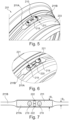
Fig. 5 shows a measuring device according to a second exemplary embodiment in the mounted state on a rim section in perspective view; -
Fig. 6 shows the measuring device offig. 5 with the housing removed; -
Fig. 7 shows the measuring device offig. 6 schematically simplified in top view; -
Fig. 8 shows schematically highly simplified the relationship between the angle of rotation and the wheel contact area by means of a diagram; -
Fig. 9 shows a highly simplified example of a diagram showing the periodic measuring signal values for several measured wheel rotations, split into different parts; -
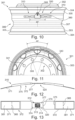
Fig. 10 schematically shows, similar toFig. 1 , a measuring device arrangement according to a further alternative third embodiment and a schematically indicated tyre pressure valve for a tyre pressure control system (TPMS); -
Fig. 11 shows the measuring device arrangement according toFig.10 in side sectional view of the vehicle wheel; -
Fig.12 schematically shows one of the measuring devices according to the third embodiment in enlarged scale side view; and -
Fig.13 schematically shows the measuring device in view onto the bottom side. - In
Fig. 1 , a vehicle wheel is denoted overall byreference numeral 1, which has adisc section 2 and arim section 3 in a manner known per se. The vehicle wheel can consist in one piece, for example, of a cast part made of light metal, or thedisc section 2 and therim section 3 are manufactured separately and then connected to one another to form an assembled vehicle wheel, preferably by a welded joint. Thedisc section 2 serves functionally for the non-rotatable fastening of thevehicle wheel 1 to the hub of a vehicle (not shown); therim section 3 is functionally used to support a tyre (not shown) made of plastic and inflated to an internal pressure recommended by the vehicle manufacturer, wherein only the tyre is in contact with the ground. For supporting and mounting the tyre, therim section 3 has, in a manner known per se, tworim flanges 4, two rim shoulders 5 and a multi-stage rim well base 6. The rim shoulders serve for the radial support of the tyre, the rim flanges for the axial support of the tyre. Thedisc section 3, which is only partially shown here, is provided with bolt holes for mounting thevehicle wheel 1 to the hub on a hub connection surface and further provided with ventilation holes (not shown) for cooling brakes in a transition section. Vehicle wheels can have different geometries and designs, which is why the vehicle wheel shown is only symbolic in nature, without restricting the invention to this. - In the exemplary embodiment according to
fig. 1 , atyre pressure valve 8 of a tyre pressure monitoring system (RDKS), not shown further, is also indicated schematically. Thetyre pressure valve 8 is provided with at least one internal pressure sensor, an energy source for supplying energy and a transceiver for transmitting the measuring signals from the internal pressure sensor to a tyre pressure control device on the vehicle, in order to display the current internal tyre pressure for each tyre to the vehicle driver, as is now prescribed for new vehicles. A vehicle wheel with an arbitrary structure and equipped with a tyre pressure valve for a tyre pressure control system is known to a person skilled in the art, which is why no further description is given here. - A measuring
device 10 additionally arranged on the radial outer side of therim section 3 of the vehicle wheel is essential to the invention. Infig. 1 , the measuringdevice 10 is arranged on a transitional section of the rim well base 6 between thewell base bottom 7 and one of the rim shoulders 5. The measuringdevice 10 consists of ametal strip 11 which is adhered to the outer circumference of therim section 3 by means of an adhesive connection. Themetal strip 11 in turn, as can be seen clearly infig. 2 and fig. 3 , is provided here with a measuringsensor 12 in the centre of its longitudinal and transverse extent, which, as the schematic illustration infig. 2 shows approximately, is equipped here with a total of fourstrain gauges strain gauges 13 are oriented in the circumferential direction, that is, in the direction of rotation of a vehicle wheel rotating about a wheel axle, the twostrain gauges 14 are oriented transversely to the circumferential direction. Theindividual strain gauges sensor 12 measures the deformations of themetal strip 11, wherein the deformations of themetal strip 11 correspond to the deformations of thevehicle wheel 1 in the area of therim section 3. The degree and direction of the deformations depend on the weight of the vehicle with the respective load and, in the case of a moving vehicle, also on the dynamic loads. In addition, there is the influence of the mounted tyre as well as the influence of the internal pressure of the tyre and the temperature. - As can be clearly seen in
fig. 1 to 3 , themetal strip 11 has a significantly greater length and also a somewhat greater width than the dimensions of the measuringsensor 11. The entire metal strip including the measuringsensor 12 is covered by aplastic cover 15 on the circumference of the measuringdevice 12. Theentire underside 17 of themetal strip 11 and the underside 19 of the plastic cover projecting beyond it are fixed to the surface of therim part 3 by means of anadhesive layer 16 indicated schematically infig. 3 . In the exemplary embodiment shown, the thickness DK of theadhesive layer 16 is slightly less than the thickness DS of themetal strip 11. This is only for illustration; in the description instruction and the claims, different thickness ratios are addressed, as well as different materials and material properties for the metal strip and the adhesive for the adhesive connection. In the mounted state, the measuringsensor 12 fastened to thetop side 18 of themetal strip 11 is completely protected between theplastic cover 15 and themetal strip 11. Due to the position of the measuringdevice 10 within the tyre on the outer side of therim section 3, this measuringdevice 10 is also largely protected against external influences. By means of the arrangement of the measuring device near thetyre pressure valve 8 of the tyre pressure control device, the energy source and the transceiver of the tyre pressure valve can be used to supply energy to the measuringsensor 12 of the measuringdevice 10 and also to wirelessly transmit the measuring signals of the measuringsensor 12 to a vehicle-side evaluation device of a vehicle-side monitoring device (not shown). Infig. 2 and 3 , themetal strip 11 has a constant thickness DS between thetop side 18 and theunderside 17 along its entire length in the circumferential direction. However, it can be sufficient if the constant thickness only exists in the area in which the measuring sensor or measuring sensors are arranged. -
Fig. 4 shows a minor modification of the measuring device according tofig. 2 . The main difference is that the measuringdevice 110 according tofig. 4 is provided with two measuringsensors metal strip 111 of the measuringdevice 110. Here, too, theentire metal strip 11 together with the two measuringsensors plastic cover 115, and the fastening to the vehicle wheel is carried out by means of an adhesive connection respectively on the underside of theplastic cover 115 and the underside of themetal strip 111, as in the previous exemplary embodiment. As themeasuring device 110 is provided with two measuringsensors sensors sensors metal strip 111 within the measuringdevice 110 must have a correspondingly sufficient length. -
Fig. 5 to 7 show yet another alternative embodiment. Similar to the previous exemplary embodiment, the measurement is carried out indirectly via ametal strip 211 which is fastened to the outer side of arim section 203 of a vehicle wheel by means of an adhesive connection, not shown, and in this respect fully experiences and passes on the deformations of the rim section. A measuringdevice 210 provided with ahousing 218 is fastened to themetal strip 211, and namely, as can be clearly seen infig. 6 , to twoanchor nuts 219 spaced apart from one another in the circumferential direction. The measuringdevice 210 has a bendingstrut 220 here, the two ends of which are each fixed circumferentially offset from one another on theanchor nuts 219 by means of detachable fastening screws 221. The strain gauges (not shown) are in turn fastened to the bendingstrut 220. A power supply and a transceiver can also be arranged within thehousing 218 so that the measuring device can be replaced by another measuring device if necessary. The anchor nuts can be made of the same material as themetal strip 211 and can be welded or soldered to it, but they can also be made in other ways, e.g. can be fastened to themetal strip 211 by means of an adhesive connection. Between the twoanchor nuts 219, themetal strip 211 can be provided with one or, as here,several recesses 222, wherein therecesses 222 are preferably positioned symmetrically to and between the two anchor nuts 219. - Here, too, the
metal strip 211 extends beyond theanchor nuts 219 in the circumferential direction. Theanchor nuts 219 are arranged in an area of themetal strip 211 which has a first larger width B1 transversely to the circumferential direction. Thepartial section 211A of themetal strip 211, in which theanchor nuts 219 and therecesses 222 are arranged, is followed by a narrow-bandedpartial section 211B, the width B2 of which is preferably equal to 50% or less than 50% of the width B1 in thepartial section 211A. Thepartial section 211B can extend over the remaining circumference of the rim part 203 (fig. 5 ), so that themetal strip 211 is therefore arranged all the way round. -
Fig. 8 serves as a diagram for the clarification of the angle of rotation α between the position of the wheel contact area A, at which the entire wheel load L is supported on the ground, and the actual current position P of the sensor device of a measuring sensor of a measuring device rotating with a vehicle wheel. At each position or at each angle of rotation α of the position P of a measuring sensor relative to the contact area A, a deformation of the rim section can be measured with the strain gauges and returned as a measuring signal to an evaluation device. Hereby, the measuring signal takes a periodic course depending on the angle α (or over time t in the case of a moving vehicle), as indicated infig. 9. Fig. 9 clarifies again the dependencies between the load-dependent part g(P)* L * c(α) and the non-load-dependent factor e 0 explained above, via which the displacement of the curve at different temperatures and tyre pressures can be determined after prior calibration. Reference is also made to the formulas set out in the introduction of the description. -
Figs 10 to 13 show a further different 3rd embodiment. The vehicle wheel is denoted overall byreference numeral 301 and the wheel has adisc section 302 and arim section 303 in a manner known per se. Therim section 303 again has, in a manner known per se, tworim flanges 304, two rimshoulders 305 and a multi-stage rim well base 306. Thedisc section 303, which is only partially shown here, is provided withbolt holes 340 andventilation holes 341, which ventilation holes may have different positions and configurations, as known per se to the person skilled in the art. Again, a measuringdevice arrangement 350 comprising two measuringdevices 310 of same construction is additionally arranged on the radial outer side of therim section 303 of the vehicle wheel. The measuringdevice arrangement 350 with the twoindependent measuring devices 310 is arranged on a transitional section of the rim well base 306 between thewell base bottom 307 and one of the rim shoulders 305. The measuringdevice arrangement 350 consists of two measuringdevices 310 both having same configuration and construction and being schematically shown in detail inFigs. 11 and 12 . Each of the measuringdevices 310 is arranged symmetrically to thevalve hole 308, which is equipped with a valve as well as a tire pressure monitoring system (RDKS), being referenced with 360. The tirepressure monitoring system 360 comprises several elements including housing as well as a battery and an electronic circuit (not shown) within the housing, which will be used here also for sensing, monitoring and transmitting the sensor signals of each of the measuringdevices 310 to a monitoring device of the vehicle, on which the wheel is installed. - The construction principle of each of the measuring
devices 310 can best be seen fromFigs. 12 and 13 . Each of the measuringdevices 310 comprises on both circumferential opposed ends an outer first section being built by ametal band strip 371 as well as a second section built by ametal plate strip 372; themetal band strip 371 and themetal plate strip 372 are fixed to each other preferably by welding or soldering. The underside of themetal band strip 371 is fixed to the outer side of the rim by a glue layer referenced with 381 inFIG. 13 . The same glue layer is also used to fix the circumferentially outer part of themetal plate strip 372 to the outer side of the rim. Themetal plate strip 372 is thicker than themetal band strip 371 and is also having a longer extension in circumferential direction, while the width ofmetal plate strip 372 andmetal band strip 371 is identical. InFig. 13 , the dottedline 385 presents the line wheremetal plate strip 372 starts and themetal band strip 371 ends. Themetal plate strip 372 comprises on its bottom side athickness reducing step 375, and theglue layer 381 extends over almost the entire extension length of the ofmetal band strip 371, but only until near to the reducingstep 375 on the bottom side of themetal plate strip 372. Due to thethickness reducing step 375, a gap exists between the circumferential inner of themetal plate strip 372 and the outer side of the rim. Finally, a bendingstrut 320 is fixed between the inner ends of the metal plate strips 372 facing each other. The bendingstrut 320 is formed by a centermetal band strip 377, again having thinner thickness and also smaller width compared to the metal plate strips 372. - A measuring
sensor 312, preferably having a very similar configuration as the measuring sensor shown infigure 2 and described in connection with that embodiment, and thus having a total of four strain gauges, from which twostrain gauges 313 are oriented in the circumferential direction, that is, in the direction of rotation of the vehicle wheel rotating about a wheel axle, and the twostrain gauges 314 being oriented transversely to the circumferential direction. Theindividual strain gauges metal band strip 377 forming and being used as the bendingstrut 320. The measuringsensor 312 measures the deformations of the centermetal band strip 377 or bendingstrut 320, respectively, between those sections of themetal band strip 371 andmetal tape strip 372 being fixed to the rim by adhesive connection, and thus both circumferential deformation and transversal deformation will be detected. It is sufficient to arrange the measuringsensor 312 on the bottom side of the centermetal band strip 377 in order to detect both deformations in axial direction and in circumferential direction. - In the preferred embodiment, as shown in
Figs. 10 and 11 , two measuringdevices 310 are installed symmetrically to the valve hole and the tire pressure monitoring system arranged on the valve inserted in the valve hole; the entire electronics of the tire pressure monitoring system including the battery can be used by connecting the measuringsensors 312 to the electronics, preferably by wiring. No additional connection between the individual measuring devices and the tire pressure monitoring system and its electronics is needed. The lengths and positions of each of the measuring devices is preferably adapted such that the two centers of each of the center metal band strip are arranged with an offset of 40°; the centers of each of the center metal band strips 377 corresponds to the center position of each of the measuringsensors 312. The fixing of the metal band strips of each of the measuring devices by gluing to the outer side of the rim can be done easily and the identical sensor can be used on any kind of wheels and wheel size. With the two measuring sensors in themeasuring device arrangement 350, the risk of zero-crossing can easily be avoided. also, it is possible to measure the wheel load also in static condition, where the vehicle does not know. - The measuring devices needs not to be fixed to the wheel rim at the position of the valve hole but could also be used in different position depending on the most deforming zones; the higher the deformation, the better is the load estimation crazy of the measuring arrangement with the measuring devices. By adding an additional gyroscope sensor, an indirect vehicle speed measurement could also be achieved.
Claims (15)
- A vehicle wheel with a rim section (203) having rim flanges, rim shoulders and a rim well base for supporting a tyre and with a disc section having a hub connection flange with bolt holes and a transition section with ventilation holes and connected to the rim section for non-rotatably fastening the vehicle wheel to a vehicle, with a measuring device (110) fastened co-rotatably to the vehicle wheel, having at least one measuring sensor for detecting forces acting on the vehicle wheel, and having a transceiver coupled to the measuring sensor for transmitting the load data detected with the measuring sensor to components outside the vehicle wheel, characterized in that- a metal strip (111) is attached to a radial outer side of the rim section (203) and the at least one measuring sensor (112) is assigned to the metal strip,- the metal strip has an underside and a top side and has at least one partial section with constant thickness between the underside and the top side in the circumferential direction,- the underside of the metal strip is connected to the outer side of the rim section along the partial section by means of an adhesive connection,- the measuring device (110) has a bending strut (220) provided with the at least one measuring sensor, which strut is connected to the metal strip at two fastening zones spaced apart from one another in the circumferential direction of the rim section for the local detection of a deformation of the metal strip between the fastening zones, and- the metal strip (211) has a length in the circumferential direction of the vehicle wheel that is greater than the distance between the fastening zones from one another.
- The vehicle wheel according to claim 1, characterized in that the fastening zones consist of two anchor pins or anchor nuts (219) which are circumferentially offset relative to one another, fastened, preferably welded or soldered, to the top side of the metal strip.
- The vehicle wheel according to claim 1 or 2, characterized in that the metal strip (211) is partially provided with recesses (222) between the fastening zones, wherein the recesses are attached symmetrically with respect to the fastening zones.
- The vehicle wheel according to one of claims 1 to 3, characterized in that the metal strip extends only partially over the circumference of the rim section, or that the metal strip extends completely over the circumference of the rim section, wherein the metal strip preferably has at least 2 partial sections (211A, 211B) with different strip widths (B1, B2) transversely to the circumferential direction.
- The vehicle wheel according to one of claims 1 to 4, characterized in that the measuring device (210) is provided with a housing (218) and with an electrical circuit arranged in the housing together with the transceiver, the bending strut (219) and the measuring sensor, wherein the measuring device is preferably fastened to the fastening zones as a unit in a detachable and replaceable manner.
- The vehicle wheel according to one of claims 1 to 4, characterized in that the metal strip (311) of one measuring device (310) comprises several sections, with a preferably thin metal band strip building an circumferential outer section and a thicker metal plate strip building an circumferential inner section, wherein the bending strut being composed of a center metal band strip fixed between inner ends of the metal plate strips facing each other, and preferably, the measuring sensor being fixed to an underside of the center metal band strip.
- The vehicle wheel according to claim 6, characterized in that the outer metal band strips are fastened by the adhesive connection to the outer side of the rim section, and wherein preferably, the outer sections of each metal strip are fastened along their full circumferential extension and the inner sections are fastened along a part circumferential extension to the outer side of the rim section, with preferably, the metal plate strips building the circumferential inner sections comprises a plate thickness reducing step on the underside distancing the underside from the outer side of the rim section.
- The vehicle wheel according to claim 6 or 7, characterized in that two measuring devices each having a measuring sensor on its bending strut are positioned circumferentially offset from one another, wherein the distance of the two measuring sensors to each other in the circumferential direction is preferably 40°.
- The vehicle wheel according to any of claims 1 to 8, characterized in that the measuring sensor (12; 112; 312) is designed as a measuring surface with 4 strain gauges (13, 14; 313, 314), of which two strain gauges (13) are oriented in the circumferential direction and two further strain gauges (14) are oriented transversely to the circumferential direction, and/or in that the measuring sensor is connected by means of a cable connection to an electronic circuit, the transceiver and a power supply source, which form components or additional parts of an air pressure measuring device (TPMS) assigned to the vehicle valve.
- The vehicle wheel according to one of claims 1 to 9 , characterized in that, distributed over the circumference of the rim section, at least 2 measuring sensors (112A, 112B) are positioned circumferentially offset from one another, wherein the distance of the two measuring sensors to each other in the circumferential direction is preferably at least 20°, and in particular 22.5°, wherein preferably, the at least 2 measuring sensors are assigned to the same metal strip, wherein the metal strip extends in the circumferential direction beyond the position of the measuring sensors, and preferably extends by more than 20 mm, and/or wherein the metal strip extends transversely to the circumferential direction beyond the area covered by the measuring sensors.
- The vehicle wheel according to one of claims 1 to 10, characterized in that the metal strip consists of stainless steel, light metal, a metal alloy or high-grade steel, and/or that the metal strip has a thickness of between 0.03 mm and 0.25 mm in the partial section, in particular a constant thickness between 0.05 mm and 0.2 mm and/or that the metal strip has a width of more than 15 mm in the partial section.
- The vehicle wheel according to one of claims 1 to 11, characterized in that the adhesive connection takes place by means of an adhesive which has a modulus of elasticity of at least 50 MPa, preferably more than 200 MPa, particularly preferably more than 450 MPa, and/or that the thickness of the adhesive in the area of the adhesive connection is less than 0.25 mm, and preferably less than 0.125 mm.
- The vehicle wheel according to one of claims 1 to 12, characterized in that the adhesive is selected from an adhesive based on acrylic, cyanoacrylate or silicone.
- The vehicle wheel according to claims 12 and 13, characterized in that the adhesive is applied to both sides on the underside of the metal strip and on the outer side of the rim section, and/or that the thickness of the adhesive is approximately the same as or greater than the thickness of the metal strip in the partial section.
- A monitoring device for vehicles with several vehicle wheels, wherein the monitoring device comprises at least one vehicle wheel according to one of claims 1 to 14 and is provided with a metal strip (11; 111), with which a measuring device (10) with a measuring sensor (12) and a transceiver coupled to the measuring sensor is associated, and with a vehicle-side evaluation device for the measuring signals of the measuring sensors, characterized in that the monitoring device is designed and formed to be able to determine from the measuring signals of the measuring sensors the dynamic load in drive operation and the static load in the stationary state of a vehicle on the associated vehicle wheel, wherein, for determining the dynamic load by means of the evaluation device, the measuring signal amplitude between the measured maximum signal value and the measured minimum signal value at one wheel rotation is determined and compared with the amplitude values from a vehicle wheel calibration reference curve for determining a deviation factor, and/wherein, for determining the static load, the angle of rotation between the sensor position and the wheel contact position is determined and, by means of the evaluation device, the measured signal value is compared with a reference value from a vehicle wheel calibration reference curve for the same angle of rotation, wherein several vehicle wheel calibration reference curves for different temperatures and internal tyre pressures are stored in the evaluation device.
Applications Claiming Priority (2)
| Application Number | Priority Date | Filing Date | Title |
|---|---|---|---|
| DE202021103142.5U DE202021103142U1 (en) | 2021-06-10 | 2021-06-10 | Vehicle wheel with measuring device and monitoring device for vehicles |
| PCT/IB2022/055400 WO2022259212A1 (en) | 2021-06-10 | 2022-06-10 | Vehicle wheel with a measuring device and a monitoring device for vehicles |
Publications (3)
| Publication Number | Publication Date |
|---|---|
| EP4352469A1 EP4352469A1 (en) | 2024-04-17 |
| EP4352469C0 EP4352469C0 (en) | 2025-04-09 |
| EP4352469B1 true EP4352469B1 (en) | 2025-04-09 |
Family
ID=82358534
Family Applications (1)
| Application Number | Title | Priority Date | Filing Date |
|---|---|---|---|
| EP22735994.0A Active EP4352469B1 (en) | 2021-06-10 | 2022-06-10 | Vehicle wheel with a measuring device and a monitoring device for vehicles |
Country Status (8)
| Country | Link |
|---|---|
| US (1) | US20240264014A1 (en) |
| EP (1) | EP4352469B1 (en) |
| JP (1) | JP7794858B2 (en) |
| KR (1) | KR102923214B1 (en) |
| CN (1) | CN117460932A (en) |
| BR (1) | BR112023024831A2 (en) |
| DE (1) | DE202021103142U1 (en) |
| WO (1) | WO2022259212A1 (en) |
Families Citing this family (3)
| Publication number | Priority date | Publication date | Assignee | Title |
|---|---|---|---|---|
| CN116571850B (en) * | 2023-05-12 | 2025-12-05 | 洛阳船舶材料研究所(中国船舶集团有限公司第七二五研究所) | An integrated dual tungsten inert gas torch for TIG welding |
| KR102886398B1 (en) * | 2023-08-18 | 2025-11-14 | 주식회사 일진글로벌홀딩스 | Harmonic reducer with torque measuring unit |
| WO2025202972A1 (en) * | 2024-03-28 | 2025-10-02 | Hutchinson S.A. | Wheel performance monitoring and feedback system for vehicle control |
Family Cites Families (7)
| Publication number | Priority date | Publication date | Assignee | Title |
|---|---|---|---|---|
| DE4311903A1 (en) * | 1993-04-10 | 1994-10-13 | Audi Ag | Measuring wheel |
| DE10001272C2 (en) * | 2000-01-14 | 2003-08-21 | Markus Fach | Device and method for determining forces in the tire of a vehicle wheel |
| JP2004331038A (en) * | 2002-06-21 | 2004-11-25 | Bridgestone Corp | Measurement method for force applied to tire and measurement apparatus for force applied to tire |
| CN111929080B (en) | 2015-09-14 | 2022-08-16 | 马可迅车轮美国有限责任公司 | Monitoring device for monitoring various vehicle conditions |
| IT201800003697A1 (en) | 2018-03-16 | 2019-09-16 | Milano Politecnico | RIM WITH SENSOR AND WHEEL INCLUDING THIS RIM |
| JP7034811B2 (en) * | 2018-04-09 | 2022-03-14 | 日本電産コパル電子株式会社 | Strain sensor fixing device and torque sensor using it |
| DE202019104976U1 (en) * | 2019-09-09 | 2020-12-10 | Maxion Wheels Holding Gmbh | Vehicle wheel with monitoring device and monitoring device for vehicle wheels |
-
2021
- 2021-06-10 DE DE202021103142.5U patent/DE202021103142U1/en active Active
-
2022
- 2022-06-10 WO PCT/IB2022/055400 patent/WO2022259212A1/en not_active Ceased
- 2022-06-10 CN CN202280041435.3A patent/CN117460932A/en active Pending
- 2022-06-10 US US18/567,854 patent/US20240264014A1/en active Pending
- 2022-06-10 BR BR112023024831A patent/BR112023024831A2/en unknown
- 2022-06-10 KR KR1020237043248A patent/KR102923214B1/en active Active
- 2022-06-10 EP EP22735994.0A patent/EP4352469B1/en active Active
- 2022-06-10 JP JP2023575764A patent/JP7794858B2/en active Active
Also Published As
| Publication number | Publication date |
|---|---|
| KR102923214B1 (en) | 2026-02-04 |
| JP2024520172A (en) | 2024-05-21 |
| US20240264014A1 (en) | 2024-08-08 |
| DE202021103142U1 (en) | 2022-11-09 |
| BR112023024831A2 (en) | 2024-02-20 |
| EP4352469C0 (en) | 2025-04-09 |
| CN117460932A (en) | 2024-01-26 |
| KR20240019150A (en) | 2024-02-14 |
| WO2022259212A1 (en) | 2022-12-15 |
| EP4352469A1 (en) | 2024-04-17 |
| JP7794858B2 (en) | 2026-01-06 |
Similar Documents
| Publication | Publication Date | Title |
|---|---|---|
| EP4352469B1 (en) | Vehicle wheel with a measuring device and a monitoring device for vehicles | |
| US5864056A (en) | Method and apparatus for monitoring the coefficient of friction between a tire and rolling surface, particularly to provide the vehicle operator with coefficient of friction, tire tread wear out and skid warning indications | |
| US6339956B1 (en) | Pneumatic automobile tire with integrated sensors and traction control system | |
| US12235149B2 (en) | Vehicle wheel with monitoring device and monitoring device for vehicle wheels | |
| US7249528B2 (en) | Hub unit with sensor | |
| CN100534817C (en) | Method and system for determining a tyre load during the running of a vehicle | |
| JP3350896B2 (en) | Tire monitoring system and method | |
| US7000462B2 (en) | System for monitoring a vehicle with pneumatic tires, signal analysis method, and vehicle tire | |
| US8874386B2 (en) | Method and system for determining a tyre load during the running of a motor vehicle | |
| KR100303077B1 (en) | Device for measuring the rotary frequency of a rotating vehicle wheel | |
| US20090180722A1 (en) | Load sensing wheel end | |
| JPH11125585A (en) | Device for monitoring stress received by tire | |
| KR20050092753A (en) | Hub unit with sensor | |
| US8566042B2 (en) | Direct contact force measurement system | |
| JP2024520172A5 (en) | ||
| US5849120A (en) | Device for monitoring the inflation pressure of the tires of a vehicle | |
| JP2004517337A (en) | A device for detecting physical measurands, in particular arranged on the wheel bearings of a motor vehicle | |
| KR20000011058A (en) | Measuring system of vehicle load figure | |
| EP3055145B1 (en) | System for indirectly monitoring the inflation pressure of pneumatic-tyred vehicle wheels and vehicle wheel therefore | |
| WO1994021480A1 (en) | Vehicle force transducer system | |
| KR20250171343A (en) | Wheel bearing unit for vehicle wheel mounting | |
| GB2625291A (en) | Wheel load determining apparatus and method | |
| Yang et al. | Measurement of heavy vehicle dynamic wheel forces using a bolt-on transducer | |
| KR100601182B1 (en) | How to determine the driving state of the vehicle | |
| Swift et al. | Development of a Transducer for Independent Measurements of Dual Truck Wheel Loads |
Legal Events
| Date | Code | Title | Description |
|---|---|---|---|
| STAA | Information on the status of an ep patent application or granted ep patent |
Free format text: STATUS: UNKNOWN |
|
| STAA | Information on the status of an ep patent application or granted ep patent |
Free format text: STATUS: THE INTERNATIONAL PUBLICATION HAS BEEN MADE |
|
| PUAI | Public reference made under article 153(3) epc to a published international application that has entered the european phase |
Free format text: ORIGINAL CODE: 0009012 |
|
| STAA | Information on the status of an ep patent application or granted ep patent |
Free format text: STATUS: REQUEST FOR EXAMINATION WAS MADE |
|
| 17P | Request for examination filed |
Effective date: 20231219 |
|
| AK | Designated contracting states |
Kind code of ref document: A1 Designated state(s): AL AT BE BG CH CY CZ DE DK EE ES FI FR GB GR HR HU IE IS IT LI LT LU LV MC MK MT NL NO PL PT RO RS SE SI SK SM TR |
|
| DAV | Request for validation of the european patent (deleted) | ||
| DAX | Request for extension of the european patent (deleted) | ||
| GRAP | Despatch of communication of intention to grant a patent |
Free format text: ORIGINAL CODE: EPIDOSNIGR1 |
|
| STAA | Information on the status of an ep patent application or granted ep patent |
Free format text: STATUS: GRANT OF PATENT IS INTENDED |
|
| GRAS | Grant fee paid |
Free format text: ORIGINAL CODE: EPIDOSNIGR3 |
|
| INTG | Intention to grant announced |
Effective date: 20250130 |
|
| GRAA | (expected) grant |
Free format text: ORIGINAL CODE: 0009210 |
|
| STAA | Information on the status of an ep patent application or granted ep patent |
Free format text: STATUS: THE PATENT HAS BEEN GRANTED |
|
| AK | Designated contracting states |
Kind code of ref document: B1 Designated state(s): AL AT BE BG CH CY CZ DE DK EE ES FI FR GB GR HR HU IE IS IT LI LT LU LV MC MK MT NL NO PL PT RO RS SE SI SK SM TR |
|
| REG | Reference to a national code |
Ref country code: GB Ref legal event code: FG4D |
|
| REG | Reference to a national code |
Ref country code: CH Ref legal event code: EP |
|
| REG | Reference to a national code |
Ref country code: DE Ref legal event code: R096 Ref document number: 602022012995 Country of ref document: DE |
|
| REG | Reference to a national code |
Ref country code: IE Ref legal event code: FG4D |
|
| U01 | Request for unitary effect filed |
Effective date: 20250429 |
|
| U07 | Unitary effect registered |
Designated state(s): AT BE BG DE DK EE FI FR IT LT LU LV MT NL PT RO SE SI Effective date: 20250507 |
|
| PGFP | Annual fee paid to national office [announced via postgrant information from national office to epo] |
Ref country code: TR Payment date: 20250619 Year of fee payment: 4 |
|
| U20 | Renewal fee for the european patent with unitary effect paid |
Year of fee payment: 4 Effective date: 20250628 |
|
| PG25 | Lapsed in a contracting state [announced via postgrant information from national office to epo] |
Ref country code: ES Free format text: LAPSE BECAUSE OF FAILURE TO SUBMIT A TRANSLATION OF THE DESCRIPTION OR TO PAY THE FEE WITHIN THE PRESCRIBED TIME-LIMIT Effective date: 20250409 |
|
| PG25 | Lapsed in a contracting state [announced via postgrant information from national office to epo] |
Ref country code: GR Free format text: LAPSE BECAUSE OF FAILURE TO SUBMIT A TRANSLATION OF THE DESCRIPTION OR TO PAY THE FEE WITHIN THE PRESCRIBED TIME-LIMIT Effective date: 20250710 Ref country code: NO Free format text: LAPSE BECAUSE OF FAILURE TO SUBMIT A TRANSLATION OF THE DESCRIPTION OR TO PAY THE FEE WITHIN THE PRESCRIBED TIME-LIMIT Effective date: 20250709 |
|
| PG25 | Lapsed in a contracting state [announced via postgrant information from national office to epo] |
Ref country code: PL Free format text: LAPSE BECAUSE OF FAILURE TO SUBMIT A TRANSLATION OF THE DESCRIPTION OR TO PAY THE FEE WITHIN THE PRESCRIBED TIME-LIMIT Effective date: 20250409 |
|
| PG25 | Lapsed in a contracting state [announced via postgrant information from national office to epo] |
Ref country code: HR Free format text: LAPSE BECAUSE OF FAILURE TO SUBMIT A TRANSLATION OF THE DESCRIPTION OR TO PAY THE FEE WITHIN THE PRESCRIBED TIME-LIMIT Effective date: 20250409 |
|
| PG25 | Lapsed in a contracting state [announced via postgrant information from national office to epo] |
Ref country code: RS Free format text: LAPSE BECAUSE OF FAILURE TO SUBMIT A TRANSLATION OF THE DESCRIPTION OR TO PAY THE FEE WITHIN THE PRESCRIBED TIME-LIMIT Effective date: 20250709 |
|
| PG25 | Lapsed in a contracting state [announced via postgrant information from national office to epo] |
Ref country code: IS Free format text: LAPSE BECAUSE OF FAILURE TO SUBMIT A TRANSLATION OF THE DESCRIPTION OR TO PAY THE FEE WITHIN THE PRESCRIBED TIME-LIMIT Effective date: 20250809 |
|
| PG25 | Lapsed in a contracting state [announced via postgrant information from national office to epo] |
Ref country code: SM Free format text: LAPSE BECAUSE OF FAILURE TO SUBMIT A TRANSLATION OF THE DESCRIPTION OR TO PAY THE FEE WITHIN THE PRESCRIBED TIME-LIMIT Effective date: 20250409 |
|
| PG25 | Lapsed in a contracting state [announced via postgrant information from national office to epo] |
Ref country code: CZ Free format text: LAPSE BECAUSE OF FAILURE TO SUBMIT A TRANSLATION OF THE DESCRIPTION OR TO PAY THE FEE WITHIN THE PRESCRIBED TIME-LIMIT Effective date: 20250409 |
|
| PG25 | Lapsed in a contracting state [announced via postgrant information from national office to epo] |
Ref country code: SK Free format text: LAPSE BECAUSE OF FAILURE TO SUBMIT A TRANSLATION OF THE DESCRIPTION OR TO PAY THE FEE WITHIN THE PRESCRIBED TIME-LIMIT Effective date: 20250409 |
|
| REG | Reference to a national code |
Ref country code: CH Ref legal event code: H13 Free format text: ST27 STATUS EVENT CODE: U-0-0-H10-H13 (AS PROVIDED BY THE NATIONAL OFFICE) Effective date: 20260127 |
|
| PG25 | Lapsed in a contracting state [announced via postgrant information from national office to epo] |
Ref country code: MC Free format text: LAPSE BECAUSE OF FAILURE TO SUBMIT A TRANSLATION OF THE DESCRIPTION OR TO PAY THE FEE WITHIN THE PRESCRIBED TIME-LIMIT Effective date: 20250409 |
|
| PLBE | No opposition filed within time limit |
Free format text: ORIGINAL CODE: 0009261 |
|
| STAA | Information on the status of an ep patent application or granted ep patent |
Free format text: STATUS: NO OPPOSITION FILED WITHIN TIME LIMIT |
|
| REG | Reference to a national code |
Ref country code: CH Ref legal event code: L10 Free format text: ST27 STATUS EVENT CODE: U-0-0-L10-L00 (AS PROVIDED BY THE NATIONAL OFFICE) Effective date: 20260218 |
|
| 26N | No opposition filed |
Effective date: 20260112 |
|
| PG25 | Lapsed in a contracting state [announced via postgrant information from national office to epo] |
Ref country code: IE Free format text: LAPSE BECAUSE OF NON-PAYMENT OF DUE FEES Effective date: 20250610 |
|
| PG25 | Lapsed in a contracting state [announced via postgrant information from national office to epo] |
Ref country code: CH Free format text: LAPSE BECAUSE OF NON-PAYMENT OF DUE FEES Effective date: 20250630 |