EP4350670A1 - Secure computing device, secure computing system, secure computing method, and program - Google Patents
Secure computing device, secure computing system, secure computing method, and program Download PDFInfo
- Publication number
- EP4350670A1 EP4350670A1 EP21944187.0A EP21944187A EP4350670A1 EP 4350670 A1 EP4350670 A1 EP 4350670A1 EP 21944187 A EP21944187 A EP 21944187A EP 4350670 A1 EP4350670 A1 EP 4350670A1
- Authority
- EP
- European Patent Office
- Prior art keywords
- sequence
- elements
- seq
- secure computation
- sorted
- Prior art date
- Legal status (The legal status is an assumption and is not a legal conclusion. Google has not performed a legal analysis and makes no representation as to the accuracy of the status listed.)
- Granted
Links
Images


Classifications
-
- H—ELECTRICITY
- H04—ELECTRIC COMMUNICATION TECHNIQUE
- H04L—TRANSMISSION OF DIGITAL INFORMATION, e.g. TELEGRAPHIC COMMUNICATION
- H04L9/00—Cryptographic mechanisms or cryptographic arrangements for secret or secure communications; Network security protocols
- H04L9/08—Key distribution or management, e.g. generation, sharing or updating, of cryptographic keys or passwords
- H04L9/0816—Key establishment, i.e. cryptographic processes or cryptographic protocols whereby a shared secret becomes available to two or more parties, for subsequent use
- H04L9/085—Secret sharing or secret splitting, e.g. threshold schemes
-
- G—PHYSICS
- G06—COMPUTING OR CALCULATING; COUNTING
- G06F—ELECTRIC DIGITAL DATA PROCESSING
- G06F21/00—Security arrangements for protecting computers, components thereof, programs or data against unauthorised activity
- G06F21/50—Monitoring users, programs or devices to maintain the integrity of platforms, e.g. of processors, firmware or operating systems
- G06F21/52—Monitoring users, programs or devices to maintain the integrity of platforms, e.g. of processors, firmware or operating systems during program execution, e.g. stack integrity ; Preventing unwanted data erasure; Buffer overflow
-
- G—PHYSICS
- G06—COMPUTING OR CALCULATING; COUNTING
- G06F—ELECTRIC DIGITAL DATA PROCESSING
- G06F21/00—Security arrangements for protecting computers, components thereof, programs or data against unauthorised activity
- G06F21/70—Protecting specific internal or peripheral components, in which the protection of a component leads to protection of the entire computer
- G06F21/71—Protecting specific internal or peripheral components, in which the protection of a component leads to protection of the entire computer to assure secure computing or processing of information
-
- H—ELECTRICITY
- H04—ELECTRIC COMMUNICATION TECHNIQUE
- H04L—TRANSMISSION OF DIGITAL INFORMATION, e.g. TELEGRAPHIC COMMUNICATION
- H04L9/00—Cryptographic mechanisms or cryptographic arrangements for secret or secure communications; Network security protocols
- H04L9/008—Cryptographic mechanisms or cryptographic arrangements for secret or secure communications; Network security protocols involving homomorphic encryption
-
- G—PHYSICS
- G06—COMPUTING OR CALCULATING; COUNTING
- G06F—ELECTRIC DIGITAL DATA PROCESSING
- G06F2221/00—Indexing scheme relating to security arrangements for protecting computers, components thereof, programs or data against unauthorised activity
- G06F2221/03—Indexing scheme relating to G06F21/50, monitoring users, programs or devices to maintain the integrity of platforms
- G06F2221/034—Test or assess a computer or a system
-
- H—ELECTRICITY
- H04—ELECTRIC COMMUNICATION TECHNIQUE
- H04L—TRANSMISSION OF DIGITAL INFORMATION, e.g. TELEGRAPHIC COMMUNICATION
- H04L2209/00—Additional information or applications relating to cryptographic mechanisms or cryptographic arrangements for secret or secure communication H04L9/00
- H04L2209/04—Masking or blinding
- H04L2209/046—Masking or blinding of operations, operands or results of the operations
-
- H—ELECTRICITY
- H04—ELECTRIC COMMUNICATION TECHNIQUE
- H04L—TRANSMISSION OF DIGITAL INFORMATION, e.g. TELEGRAPHIC COMMUNICATION
- H04L2209/00—Additional information or applications relating to cryptographic mechanisms or cryptographic arrangements for secret or secure communication H04L9/00
- H04L2209/46—Secure multiparty computation, e.g. millionaire problem
Definitions
- the present invention relates to a cryptographic technique, and in particular, to a secure computation technique.
- Intersect X , Y X ′ ⁇ Y ′
- X' represents a set obtained by removing an element overlap from the multiset X. That is, a set obtained by replacing the same plurality of elements belonging to the multiset X with a single element is X'.
- Y' represents a set obtained by removing an element overlap from the multiset Y.
- X' ⁇ Y' represents a product set of the sets X' and Y'.
- Non Patent Literature 1 Koki Hamada, Dai Ikarashi, and Koji Chida, "(Improved Algorithms for Computing Relational Algebra Operators for Secure Function Evaluation)", IEICE Technical Report LOIS2012-82, Vol. 112, No. 446, pp. 76-82, 2013 .
- This problem can be solved by first using the concealed information of the two multisets X and Y as an input, obtaining the concealed information of the sets X' and Y' obtained by eliminating duplication of elements of the multisets X and Y by secure computation, and then obtaining the concealed information of the product set of the sets X' and Y' by applying a conventional secure computation method to the concealed information of the sets X' and Y' .
- the present invention has been made in view of such a point, and an object of the present invention is to provide a technique of obtaining a concealed operation result representing concealed information of Intersect (X, Y) at a small computation cost by secure computation using concealed information of two multisets X and Y as an input.
- n and m are positive integers
- q 0,..., n+m-1
- [ ⁇ ] is the concealed information of ⁇ .
- n is a positive integer representing the number of elements X 0 , ... , X n-1 belonging to the multiset X.
- n may be 1 or 2 or more.
- i 0,..., n-1 is an index of the elements X 0 , ... , X n-1 , and an element corresponding to the index i of the multiset X is expressed as x i .
- the content (for example, numerical values, characters (letters, numbers, and the like), dates and time, and the like.) represented by any two or more of the elements x 0 , ..., X n-1 may be the same as each other, or the content represented by each of the elements X 0 , ... , X n-1 may be different.
- An order relation (order) corresponding to the content represented by each of the elements x 0 , ..., X n-1 is defined in the content represented by each of the elements x 0 , ..., X n-1 , separately from the index i.
- an order relation for example, descending or ascending order
- an order relation for example, alphabetical order or a reverse order thereof
- an order relation for example, the order of antegrade or retrograde time
- an order relation for example, the order of antegrade or retrograde time
- an order relation is defined for the characters indicated by each of the elements X 0 , ... , x n-1 .
- an order relation for example, the order of the character codes or the reverse order of the character codes, and the like
- m is a positive integer representing the number of elements y 0 , ..., y m-1 belonging to the multiset Y.
- m may be 1 or 2 or more.
- j 0,..., m-1 is an index of the element y 0 , ... , y m-1 , and an element corresponding to the index j of the multiset Y is expressed as y j .
- y m-1 may be the same as each other, or the content represented by each of the elements y 0 ,..., y m-1 may be different.
- An order relation according to the content of the elements y 0 , ... , y m-1 is also defined in the elements y 0 , ... , y m-1 , separately from the index j. Note that the definition of the order relation according to the content of the elements y 0 , ...
- y m-1 (for example, descending order, descending order, alphabetical order, and the like) is the same as the definition of the order relation according to the content represented by each of the elements x 0 , ..., X n-1 , and the order relation according to the content of the elements X 0 , ... , x n-1 , y 0 , ... , y m-1 is also defined for the elements X 0 , ... , x n-1 , y 0 , ..., y m-1 .
- (K 0 , ..., K P-1 ) represents a sequence of P elements K 0 , ... , K P-1 .
- the sequence (K 0 ,..., K P-1 ) is a vector having elements K 0 , ... , K P-1 , but the embodiment of the sequence (K 0 , ..., K P-1 ) is not limited.
- P is a positive integer representing the number of elements K 0 , ... , K P-1 belonging to the sequence (K 0 , ... , K P-1 ) .
- p 0, ... , P-1 are indexes of the elements K 0 , ... , K P-1 , and an element corresponding to the index p of the sequence (K 0 ,..., K P-1 ) is expressed as K p .
- [ ⁇ ] represents concealed information of ⁇ . That is, [ ⁇ ] represents information obtained by concealing ⁇ .
- ⁇ is a sequence (K 0 , ... , K P-1 ) of the plurality of elements K 0 , ..., K P-1
- the concealed information [ ⁇ ] is information for which secure computation can be performed.
- the secure computation may be based on secret sharing (see, for example, Non Patent Literature 1) or based on homomorphic encryption.
- [ ⁇ ] is a share obtained by subjecting ⁇ to secret sharing (also referred to as a secret share or a secret sharing value).
- [ ⁇ ] is a ciphertext obtained by encrypting ⁇ according to the homomorphic encryption scheme.
- the secret sharing is an encryption method in which data is divided into a plurality of values (shares) and distributed to a plurality of parties.
- An example of secret sharing is (K, N) threshold secret sharing.
- (K, N) threshold secret sharing is a system in which original data is divided into N random shares and distributed to a plurality of parties, and is a secret sharing method having a property that when K or more shares are collected, the original data can be restored, but information of the original data cannot be obtained from less than K shares.
- K and N are positive integers satisfying K ⁇ N.
- Specific examples of (K, N) threshold secret sharing are Shamir secret sharing (see, for example, Reference Literature 1) and reproduction secret sharing (see, for example, Reference Literature 2 and Reference Literature 3) .
- ⁇ 1 (XOR) ⁇ 2 represents an exclusive OR of ⁇ 1 and ⁇ 2 .
- the execution of this operation will be described as follows. ⁇ ⁇ A ND ⁇ 1 ⁇ 2
- the stable sorting results ⁇ ' 0 ,..., ⁇ ' P-1 are obtained by stably sorting the elements ⁇ 0 ,..., ⁇ P-1 in descending order or ascending order according to the order relationship of the content represented by each of the elements ⁇ 0 ,..., ⁇ P-1 , but whether the order is descending order or ascending order may be determined in advance or may be determined on the basis of input.
- the concealed stable sorting includes the following two algorithms (GenPerm, S ORT ) .
- Reference Literature 4 Dai Ikarashi, Koki Hamada, Ryo Kikuchi, Koji Chida, (A Design and an Implementation of Superhigh-speed Multi-party Sorting: The Day When Multi-party Computation Reaches Scripting Languages: The Day When Multi-party Computation Reaches Scripting Languages)," In CSS2017, pp. 1-8, 2017 .
- a secure computation system 1 of the present embodiment includes W secure computation devices 11-0,..., 11-(W-1) configured to be able to communicate via a network.
- W is an integer of 1 or more.
- W is an integer of 2 or more, and in a case where the secure computation based on homomorphic encryption is performed, W is an integer of 1 or more.
- the secure computation device 11-w executes each processing based on the control of the control unit 118-w, and the data input to the secure computation device 11-w and the data obtained in each processing are stored in the storage unit 119-w, read as necessary, and used for other processing.
- X' represents a set obtained by removing element overlap from the multiset X
- Y' represents a set obtained by removing element overlap from the multiset Y.
- [X] and [Y] may be sent from any of the W secure computation devices 11-0,..., 11-(W-1), or may be sent from another device (not illustrated) (step 5111-w) .
- the five elements [a], [b], [c], and [d] and the three elements [b], [b], and [c] are input to the input flag adding unit 112.
- the input flag adding unit 112 sets [s 0 ] and [s i ] shown in Expressions (1) and (2).
- B 0 and B 1 are different from each other.
- the input flag adding unit 112 obtains and outputs a sequence with an input flagged sequence ([s], [M]) including the sequence [s] and the sequence [M].
- the sequence [s] is obtained by arranging the sequence ([B 0 ],...,[B 0 ]) of the n values [B 0 ],..., [B 0 ] of Expression (1) followed by the sequence ([B 1 ],...,[B 1 ]) of the m values [B 1 ],..., [B 1 ] of Expression (2), and includes the n values (first values) [B 0 ] and the m values (second values) [B 1 ].
- the sequence [M] is obtained by arranging n elements [x 0 ], ..., [x n-1 ] followed by m elements [yo], ..., [y m-1 ] , and includes n elements [x 0 ] , ... , [x n-1 ] and m elements [y 0 ] , ... , [y m-1 ]. These are expressed as Expressions (3) and (4) below.
- the input flag adding unit 112 vertically combines ([s0 T ], [X T ] ) and ([s1 T ], [Y T ]), and outputs the combined result as an input flagged sequence ([s], [M]).
- ⁇ T represents transposition of ⁇ . That is, the input flag adding unit 112 outputs, for example, the following input flagged sequence ([s], [M]).
- the column [M] is sent to the permutation information generation unit 113-w, and the input flagged sequence ([s], [M]) is sent to the stable sorting unit 114-w (step S112-w).
- the sequence [M] is input to the permutation information generation unit 113-w.
- the concealed information [ ⁇ ] is sent to the stable sorting unit 114-w (step S113-w).
- the input flagged sequence ([s], [M]) and the concealed information [ ⁇ ] are input to the stable sorting unit 114-w.
- the sequence of M' 0 ,..., M' n+m-1 is a stable sorting result of the sequence of the elements M 0 ,..., M n+m-1 according to the order relation of the contents represented by the elements M 0 ,..., M n+m-1 , and each sorted value [s' q ] is the element [s r ] associated with the element [M r ] stably sorted to each sorted element [M' q] by secure computation.
- q 0,..., n+m-1
- r 0,..., n+m-1.
- the sorted sequence ([s'], [M']) is sent to the equality check unit 115-w, and the sequence [M'] is sent to the output flag adding unit 117-w (step S114-w).
- the sorted sequence ([s'], [M']) is input to the equality check unit 115-w.
- T and F are different from each other
- the equality check results [eq q ] and [seq q ] are input to the output flag generation unit 116-w.
- the output flag generation unit 116-w obtains and outputs the output flag [f q ] by secure computation using the equality check results [eq q ] and [seq q ].
- D 1 and D 0 are different from each other.
- the sequence [f] is sent to the output flag adding unit 117-w (step S116-w).
- the sequence [f] and the sequence [M'] are input to the output flag adding unit 117-w.
- the output flag adding unit 117-w associates the output flag [f q ] of the sequence [f] and the sorted element [M' q] of the sequence [M'] with each other, and outputs the concealed operation result [Z] including the output flag [f q ] and the sorted element [M' q ] associated with each other.
- the elements [s' q(1) ], ..., [s' q(Q) ] ⁇ ⁇ [s' 0 ], ..., [s' n+m-1 ]) ⁇ of the sequence [s'] associated with the elements [M' q(1) ], ..., [M' q(Q) ] ⁇ ⁇ [M '0 ] , ..., [M' n+m-1 ] ⁇ of the sequence [M'] corresponding to the same content are one in which one or more [B 0 ] (for example, [0]) corresponding to the multiset X are consecutively arranged, one or more [B 1 ] (for example, [1]) corresponding to the multiset Y are consecutively arranged after one or more [B 0 ] (for example, [0]) corresponding to the multiset X are consecutively arranged, or one or more [B 1 ] (for example, [1]) corresponding to the multiset Y are consecutively arranged (see, for example,
- flags representing whether M q belongs to the multiset X or the multiset Y are concealed and added to each element [M q ], and using these concealed flags ([s]), regardless of whether or not the multiset X or the multiset Y includes overlapping elements, the logical product X' ⁇ Y' is calculated by secure computation, and the concealed operation result [Z] representing the concealed information [Intersect (X, Y)] of the operation result of Intersect (X, Y) is obtained.
- the number of bits of the flag ([s]) is small, and the computation cost for determining flags in the equality check unit 115-w, that is, equality check of [s' q ] and [s' q+1 ] is small.
- the concealed operation result [Z] may be used to restore Z, or may be used as an operator for subsequent secure computation.
- an invalid row may be deleted from the concealed operation result [Z] by the method disclosed in Reference Literature 5 or the like, and the obtained result may be used for another database operation.
- Reference Literature 5 Hiroki Sudo, Dai Ikarashi, "Implementation and evaluation of a secure computation database management system that discloses only the number of rows" In SCIS2021, pp. 1-6, 2021 .
- concealed information of the valid flag indicating whether the row is the valid row or the invalid row while leaving the invalid row in order to conceal and handle the valid row in the concealed operation result [Z] and perform subsequent processing.
- concealed information [ ⁇ q ] of the valid flag indicating whether M q is valid is added to each ([s q ] , [M q ]) of the input flagged sequence ([s], [M]), and the subsequent processing from steps S113-w to S117-w can be executed while maintaining the correspondence relationship of ([s q ] , [M q ] , [ ⁇ q ]), and the subsequent processing can be performed.
- the secure computation device 11-w is a device formed with a general-purpose or dedicated computer executing a predetermined program, the computer including a processor (a hardware processor) such as a central processing unit (CPU) and a memory such as a random access memory (RAM) and a read only memory (ROM), for example. That is, the secure computation device 11-w in each embodiment includes processing circuitry designed to implement the components included in the respective secure computation devices, for example.
- the computer may include one processor and one memory, or may include a plurality of processors and a plurality of memories.
- the program may be installed in the computer, or may be recorded in a ROM or the like in advance.
- processing units may be formed with an electronic circuit that independently implements the processing functions, rather than an electronic circuit (circuitry) that forms the functional components by reading the program like a CPU.
- an electronic circuit forming one device may include a plurality of CPUs.
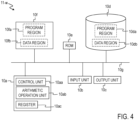
- Fig. 4 is a block diagram illustrating an example hardware configuration of the secure computation device 11-w according to each embodiment.
- the secure computation device 11-w in this example includes a central processing unit (CPU) 10a, an input unit 10b, an output unit 10c, a random access memory (RAM) 10d, a read only memory (ROM) 10e, an auxiliary storage device 10f, and a bus 10g.
- the CPU 10a in this example includes a control unit 10aa, an arithmetic operation unit 10ab, and a register 10ac, and performs various arithmetic operations in accordance with various programs read into the register 10ac.
- the input unit 10b is an input terminal to which data is input, a keyboard, a mouse, a touch panel, or the like.
- the output unit 10c is an output terminal from which data is output, a display, a LAN card or the like controlled by the CPU 10a that has read a predetermined program.
- the RAM 10d is a static random access memory (SRAM), a dynamic random access memory (DRAM), or the like, and incudes a program region 10da in which a predetermined program is stored and a data region 10db in which various kinds of data are stored.
- the auxiliary storage device 10f is a hard disk, a magneto-optical disc (MO), a semiconductor memory, or the like, for example, and includes a program region 10fa in which a predetermined program is stored and a data region 10fb in which various kinds of data are stored.
- the bus 10g connects the CPU 10a, the input unit 10b, the output unit 10c, the RAM 10d, the ROM 10e, and the auxiliary storage device 10f so that information can be exchanged among these components.
- the CPU 10a writes, into the program region 10da of the RAM 10d, the program stored in the program region 10fa of the auxiliary storage device 10f, in accordance with a read operating system (OS) program.
- OS read operating system
- the CPU 10a writes, into the data region 10db of the RAM 10d, the various kinds of data stored in the data region 10fb of the auxiliary storage device 10f.
- the addresses in the RAM 10d at which the program and the data are written are stored into the register 10ac of the CPU 10a.
- the control unit 10aa of the CPU 10a sequentially reads these addresses stored in the register 10ac, reads the program and the data from the regions in the RAM 10d indicated by the read addresses, causes the arithmetic operation unit 10ab to sequentially execute arithmetic operations indicated by the program, and stores results of the arithmetic operations into the register 10ac.
- the program mentioned above can be recorded in a computer-readable recording medium.
- the computer-readable recording medium in an example is a non-transitory recording medium. Examples of such a recording medium include a magnetic recording device, an optical disc, a magneto-optical recording medium, and a semiconductor memory.
- the program is distributed by selling, giving, or renting portable recording media such as DVDs or CD-ROMs recording the program thereon, for example.
- portable recording media such as DVDs or CD-ROMs
- a configuration in which the program is stored in a storage device in a server computer and the program is distributed by transferring the program from the server computer to other computers via a network may also be employed.
- the computer executing such a program first stores the program recorded in the portable recording medium or the program transferred from the server computer temporarily into a storage device of the computer, for example.
- the computer then reads the program stored in the storage device itself, and performs a process in accordance with the read program at the time of execution of the process.
- the computer may read the program directly from the portable recording medium and performs a process in accordance with the program, or alternatively, the computer may sequentially execute a process in accordance with the received program every time the program is transferred from the server computer to the computer.
- the above processing may be executed by a so-called application service provider (ASP) service that implements a processing function only by issuing an instruction to execute the program and acquiring the result, without transferring the program from the server computer to the computer.
- ASP application service provider
- the program according to the present embodiment includes information used for processing by an electronic computer and equivalent to the program (data, or the like, that is not a direct command to the computer but has property that defines processing of the computer).
- this device is formed with a computer executing a predetermined program in each embodiment, at least some of the processing contents may be realized by hardware.
- the present invention can be applied to an application of performing an Intersect operation on two multisets by secure computation.
- the present invention can be used for an application of performing the Intersect operation in a relational database management system (RDBMS) by means of secure computation.
- RDBMS relational database management system
Landscapes
- Engineering & Computer Science (AREA)
- Computer Security & Cryptography (AREA)
- Theoretical Computer Science (AREA)
- Software Systems (AREA)
- Physics & Mathematics (AREA)
- Computer Hardware Design (AREA)
- General Engineering & Computer Science (AREA)
- General Physics & Mathematics (AREA)
- Computer Networks & Wireless Communication (AREA)
- Signal Processing (AREA)
- Mathematical Physics (AREA)
- Complex Calculations (AREA)
- Machine Translation (AREA)
Abstract
Description
- The present invention relates to a cryptographic technique, and in particular, to a secure computation technique.
- In a normal set, overlapping of elements is not allowed. On the other hand, a set in which overlapping of elements is allowed is referred to as a "multiset". The following Intersect operation is defined for the two multisets X and Y.

- Here, X' represents a set obtained by removing an element overlap from the multiset X. That is, a set obtained by replacing the same plurality of elements belonging to the multiset X with a single element is X'. Similarly, Y' represents a set obtained by removing an element overlap from the multiset Y. X' ∩ Y' represents a product set of the sets X' and Y'.
- In addition, a secure computation method in which concealed information of a product set computation result of two sets is obtained while concealing information by using the concealed information of the two sets is known (see, for example, Non Patent Literature 1).
- Non Patent Literature 1: Koki Hamada, Dai Ikarashi, and Koji Chida, "(Improved Algorithms for Computing Relational Algebra Operators for Secure Function Evaluation)", IEICE Technical Report LOIS2012-82, Vol. 112, No. 446, pp. 76-82, 2013.
- However, in the conventional secure computation method, overlapping of elements is not allowed in a set to be subjected to product-set computation. Therefore, it is not possible to obtain concealed information of Intersect (X, Y) by a conventional secure computation method using the concealed information of the two multisets X and Y as an input.
- This problem can be solved by first using the concealed information of the two multisets X and Y as an input, obtaining the concealed information of the sets X' and Y' obtained by eliminating duplication of elements of the multisets X and Y by secure computation, and then obtaining the concealed information of the product set of the sets X' and Y' by applying a conventional secure computation method to the concealed information of the sets X' and Y' .
- However, the computation cost of the secure computation for obtaining the concealed information of the set obtained by removing the duplication of the elements of the multiset from the concealed information of the multiset is large.
- The present invention has been made in view of such a point, and an object of the present invention is to provide a technique of obtaining a concealed operation result representing concealed information of Intersect (X, Y) at a small computation cost by secure computation using concealed information of two multisets X and Y as an input.
- As will be described below, the secure computation device of the present invention obtains a concealed operation result indicating concealed information of an Intersect operation result of a first multiset X = {{x0,..., xn_1}} and a second multiset Y = { {y0, ..., ym-1}} while concealing the first multiset X and the second multiset Y. Here, n and m are positive integers, i = 0,..., n-1, j = 0,..., m-1, q = 0,..., n+m-1, and [α] is the concealed information of α.
-
- (A) An input flag adding unit receives n first elements [x0], ..., [xn-1] and m second elements [yo], ..., [ym-1] as inputs, and obtains an input flagged sequence ([s], [M]) including a sequence [s] = ([s0],..., [Sn-1] [sn] ,..., [Sn + m-1]) = ( [B0] ,..., [B0], [B1] , ... , [B1] ) including n first values [B0] and m second values [B1] and a sequence [M] = ( [M0] , ... , [Mn-1] , [Mn] , ... , [Mn + m-1] ) = ( [X0] , ... , [xn-1] , [ y0] ,...,[ym-1]) including first elements [x0], ..., [xn-1] and second elements [yo], ..., [ym-1] . Here, B0 and B1 are different from each other, each first value [si] = [B0] is associated with each first element [Mi] = [xi], and each second value [Sj+n] = [B1] is associated with each second element [Mj+n] = [yj].
- (B) A stable sorting unit performs, by secure computation, stable sorting according to an order relation of contents represented by each of the elements M0,..., Mn+m-1 corresponding to the sequence [M] for the input flagged sequence ([s], [M]) while maintaining a correspondence between [sq] and [Mq], to obtain a sorted sequence ([s'], [M']) including a sequence [s'] = ([s'0],..., [s'n+m-1]) of sorted values [s'0], ..., [s'n+m-1] and a sequence [M'] = ([M'0] , ..., [M'n+m-1] ) of sorted elements [M'0] , ..., [M' n+m-1] .
- (C) An equality check unit obtains a first equality check result [eqq] and a second equality check result [seqq] by secure computation using the sorted sequence ([s'], [M']). Here, eqq = T when M'q = M' q+1 holds, eqq = F when M'q = M' q+1 does not hold, eqn+m-1 = F, seqq = T when s'q = S'q+1 holds, seqq = F when S'q = S'q+1 does not hold, seqn+m-1 = F, and T and F are different from each other.
- (D) An output flag generation unit obtains an output flag [fq] by secure computation using the first equality check result [eqq] and the second equality check result [seqq]. Here, fq = D1 when "eqq = T and seqq = F" holds, fq = D0 when "eqq = T and seqq = F" does not hold, and D1 and D0 are different from each other.
- (E) An output flag adding unit outputs the concealed operation result including the output flag [fq] and the sorted element [M'q] of the sequence [M'] associated with each other.
- As a result, with the concealed information of the two multisets X and Y as an input, it is possible to obtain the concealed operation result representing the concealed information of Intersect (X, Y) at a small computation cost by secure computation.
-
-
Fig. 1 is a block diagram illustrating a functional configuration of a secure computation system according to an embodiment. -
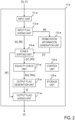
Fig. 2 is a block diagram illustrating a functional configuration of a secure computation device according to the embodiment. -
Fig. 3 is a flowchart illustrating a secure computation method according to the embodiment. -
Fig. 4 is a block diagram illustrating a hardware configuration of the secure computation device according to the embodiment. - Hereinafter, an embodiment of the present invention will be described with reference to the drawings.
- First, symbols used in the embodiments will be defined.
- X = {{x0,..., xn-1}} represents a multiset (first multiset) having X0, ... , Xn-1 as elements. n is a positive integer representing the number of elements X0, ... , Xn-1 belonging to the multiset X. n may be 1 or 2 or more. i = 0,..., n-1 is an index of the elements X0, ... , Xn-1, and an element corresponding to the index i of the multiset X is expressed as xi. The content (for example, numerical values, characters (letters, numbers, and the like), dates and time, and the like.) represented by any two or more of the elements x0, ..., Xn-1 may be the same as each other, or the content represented by each of the elements X0, ... , Xn-1 may be different. An order relation (order) corresponding to the content represented by each of the elements x0, ..., Xn-1 is defined in the content represented by each of the elements x0, ..., Xn-1, separately from the index i. For example, in a case where the elements x0, ..., Xn-1 represent numerical values, an order relation (for example, descending or ascending order) according to the magnitude of the numerical values is defined for the numerical values indicated by the respective elements x0, ..., xn-1. For example, when the elements x0, ..., Xn-1 represent an alphabet, an order relation (for example, alphabetical order or a reverse order thereof) according to the alphabet is defined in the alphabet indicated by the elements x0, ..., xn-1. For example, in a case where the elements x0, ..., Xn-1 represent dates and times, an order relation (for example, the order of antegrade or retrograde time) according to the date and time is defined for the dates and times indicated by each of the elements X0, ... , xn-1. For example, when the elements x0, ..., Xn-1 represent a plurality of types of characters such as numbers, letters, and symbols, an order relation (for example, the order of the character codes or the reverse order of the character codes, and the like) defined for the characters is defined for the characters indicated by each of the elements X0, ... , xn-1.
- Y = { {y0, • • •, ym-1}} represents a multiset (second multiset) having y0,..., ym-1 as elements. m is a positive integer representing the number of elements y0, ..., ym-1 belonging to the multiset Y. m may be 1 or 2 or more. j = 0,..., m-1 is an index of the element y0, ... , ym-1, and an element corresponding to the index j of the multiset Y is expressed as yj. The content represented by any two or more of the elements y0, ... , ym-1 may be the same as each other, or the content represented by each of the elements y0,..., ym-1 may be different. An order relation according to the content of the elements y0, ... , ym-1 is also defined in the elements y0, ... , ym-1, separately from the index j. Note that the definition of the order relation according to the content of the elements y0, ... , ym-1 (for example, descending order, descending order, alphabetical order, and the like) is the same as the definition of the order relation according to the content represented by each of the elements x0, ..., Xn-1, and the order relation according to the content of the elements X0, ... , xn-1, y0, ... , ym-1 is also defined for the elements X0, ... , xn-1, y0, ..., ym-1.
- (K0, ..., KP-1) represents a sequence of P elements K0, ... , KP-1. For example, the sequence (K0,..., KP-1) is a vector having elements K0, ... , KP-1, but the embodiment of the sequence (K0, ..., KP-1) is not limited. P is a positive integer representing the number of elements K0, ... , KP-1 belonging to the sequence (K0, ... , KP-1) . p = 0, ... , P-1 are indexes of the elements K0, ... , KP-1, and an element corresponding to the index p of the sequence (K0,..., KP-1) is expressed as Kp.
- [α] represents concealed information of α. That is, [α] represents information obtained by concealing α. In a case where α is a sequence (K0, ... , KP-1) of the plurality of elements K0, ..., KP-1, the sequence [K0], ..., [KP-1] of the concealed information of each of the plurality of elements K0,..., KP-1 included in α = (K0,..., KP-1) is also expressed as [α]. However, the concealed information [α] is information for which secure computation can be performed. That is, it is possible to obtain the concealed information [β] of the calculation result β with respect to α by the secure computation using the concealed information [α] while α remains concealed. The secure computation may be based on secret sharing (see, for example, Non Patent Literature 1) or based on homomorphic encryption. In the former case, [α] is a share obtained by subjecting α to secret sharing (also referred to as a secret share or a secret sharing value). In the latter case, [α] is a ciphertext obtained by encrypting α according to the homomorphic encryption scheme.
- The secret sharing is an encryption method in which data is divided into a plurality of values (shares) and distributed to a plurality of parties. An example of secret sharing is (K, N) threshold secret sharing. (K, N) threshold secret sharing is a system in which original data is divided into N random shares and distributed to a plurality of parties, and is a secret sharing method having a property that when K or more shares are collected, the original data can be restored, but information of the original data cannot be obtained from less than K shares. Where K and N are positive integers satisfying K ≤ N. Specific examples of (K, N) threshold secret sharing are Shamir secret sharing (see, for example, Reference Literature 1) and reproduction secret sharing (see, for example, Reference Literature 2 and Reference Literature 3) .
- Reference Literature 1: Adi Shamir, "How to share a secret," Communications of the ACM, Vol. 22, No. 11, pp. 612-613, 1979.
- Reference Literature 2: Mitsuru Ito, Akira Saito, and Takao Nishizeki, "Secret sharing scheme realizing general access structure," Electronics and Communications in Japan (Part III: Fundamental Electronic Science), Vol. 72, No. 9, pp. 56-64, 1989.
- Reference Literature 3: Ronald Cramer, Ivan Damgard, and Yuval Ishai, "Share conversion, pseudorandom secret-sharing and applications to secure computation," In Theory of Cryptography Conference, pp. 342-362. Springer, 2005.
- Hereinafter, operation by secure computation will be exemplified (see, for example, Non Patent Literature 1).
- The equality check of the concealed information [α1] and [α2] by secure computation means an operation that uses the concealed information [α1] and [α2] (for example, share) of α1 and α2 as inputs and outputs concealed information [β] (for example, share) of a true/false value β ∈ {T, F} in which β = T (true) when α1 = α2 and β = F (false) when not α1 = α2. Here, T and F represent different values (T ≠ F), for example, T = 1 and F = 0. The execution of this operation will be described as follows.

- The NOT operation of the concealed information [α] by secure computation means an operation that uses the concealed information [α] of α ∈ {T, F} as an input and outputs the concealed information [β] of a true/false value β ∈ {T, F} in which β = F (false) when α = T (true) and β = T (true) when α = F (false). For example, in a case where T = 1 and F = 0, β = α (XOR) 1 is satisfied. Here, α1 (XOR) α2 represents an exclusive OR of α1 and α2. The execution of this operation will be described as follows.

- The AND operation of the concealed information [α1] and [α2] by secure computation means an operation of using the concealed information [α1] and [α2] of α1, α2 ∈ {T, F} as inputs and outputting the concealed information [β] of the logical product β = α1 (AND) α2 ∈ {T, F} of α1 and α2 . When α1, = T (true) and α2 = T (true), β = T (true), and otherwise, β = F (false). The execution of this operation will be described as follows.

- The concealed stable sorting of the sequence [α] = ([α0],..., [αP-1]) by secure computation means processing of using the concealed information [α0] , ... , [αP-1] of the elements α0, ... , αP-1, belonging to the sequence (α0, ... , αP-1) as inputs, and outputting the concealed information [α'] = ([α'0],..., [α'P-1]) of the stable sorting results α'0, ..., αP-1 of the elements α0, ... , αP-1, according to the order relation of the contents represented by the elements α0,..., αP-1, respectively. Here, the stable sorting results α'0,..., α'P-1 are obtained by stably sorting the elements α0,..., αP-1 in descending order or ascending order according to the order relationship of the content represented by each of the elements α0,..., αP-1, but whether the order is descending order or ascending order may be determined in advance or may be determined on the basis of input. The concealed stable sorting includes the following two algorithms (GenPerm, SORT) .
- [Π] ← GenPerm ([α]): The algorithm GenPerm uses [α] = ([α0],..., [αP-1]) as an input, and outputs concealed information [Π] of permutation information Π for concealed stable sorting [α0] , ... , [αP-1] into [α'0] , ... , [α'P-1] by secure computation.
- [α'] ← SORT ([Π] , [α]): The algorithm SORT uses [Π] and [α] as inputs, and obtains and outputs [α'] by secure computation.
- A high-speed mounting method for realizing this is disclosed in Reference Literature 4 and the like.
- Reference Literature 4: Dai Ikarashi, Koki Hamada, Ryo Kikuchi, Koji Chida, (A Design and an Implementation of Superhigh-speed Multi-party Sorting: The Day When Multi-party Computation Reaches Scripting Languages: The Day When Multi-party Computation Reaches Scripting Languages)," In CSS2017, pp. 1-8, 2017.
- Next, an embodiment of the present invention will be described.
- As illustrated in
Fig. 1 , asecure computation system 1 of the present embodiment includes W secure computation devices 11-0,..., 11-(W-1) configured to be able to communicate via a network. Where, W is an integer of 1 or more. For example, in a case where the secure computation devices 11-0,..., 11-(W-1) perform secure computation based on secret sharing, W is an integer of 2 or more, and in a case where the secure computation based on homomorphic encryption is performed, W is an integer of 1 or more. - As illustrated in
Fig. 2 , the secure computation device 11-w (where w = 0,..., W-1) includes an input unit 111-w, an input flag adding unit 112-w, a permutation information generation unit 113-w, a stable sorting unit 114-w, an equality check unit 115-w, an output flag generation unit 116-w, an output flag adding unit 117-w, a control unit 118-w, and a storage unit 119-w. The secure computation device 11-w executes each processing based on the control of the control unit 118-w, and the data input to the secure computation device 11-w and the data obtained in each processing are stored in the storage unit 119-w, read as necessary, and used for other processing. - The secure computation device 11-w (where w = 0,..., W-1) obtains and outputs the concealed operation result [Z] of the data structure representing the concealed information [Intersect (X, Y)] of the Intersect operation result Intersect (X, Y) = X' ∩ Y' between the multiset X and the multiset Y while concealing the multiset (first multiset) X = {{x0,..., xn-1}} of the number of elements n and the multiset (second multiset) Y = {{ y0, .. , ym-1}} of the number of elements m by the secure computation. Here, X' represents a set obtained by removing element overlap from the multiset X, and Y' represents a set obtained by removing element overlap from the multiset Y. As a specific example, for example, in a case where elements of the multisets X and Y represent an alphabet, n = 5 and m = 3, and X = { {x0, x1, x2, x3, x4}} = {{a, a, b, c, d} } and Y = { {y0, y1, y2} } = { {b, b, c} }, X' = {a, b, c, d} and Y' = {b, c}, and Intersect (X, Y) = X' ∩ Y' = {b, c}. The secure computation processing of the secure computation device 11-w will be described with reference to
Fig. 3 . - The concealed information [X] = ([x0] , ..., [xn-1]) of the multiset X = {{x0,..., xn-1}} and the concealed information [Y] = ([y0] , ... , [ym-1]) of the multiset Y = { {y0, ..., ym-1} } are input to the input unit 111-w of the secure computation device 11-w. In the above specific example, [X] = ([a], [a], [b], [c], [d]) and [Y] = ([b], [b], [c]) are input. [X] and [Y] may be sent from any of the W secure computation devices 11-0,..., 11-(W-1), or may be sent from another device (not illustrated) (step 5111-w) .
- n elements (first elements) [x0],..., [xn-1] included in [X] = ([x0], ..., [xn-1]) and m elements (second elements) [y0] , ..., [ym-1] included in [Y] = ([ y0],...,[ym-1]) are input to the input
flag adding unit 112. For example, in the case of the above specific example, the five elements [a], [b], [c], and [d] and the three elements [b], [b], and [c] are input to the inputflag adding unit 112. - First, the input
flag adding unit 112 sets [s0] and [si] shown in Expressions (1) and (2).

- Here, B0 and B1 are different from each other. B0 and B1 are not limited, and for example, B0 = 0 and B1 = 1 may be satisfied, or B0 = 1 and B1 = 0 may be satisfied.
- Next, the input
flag adding unit 112 obtains and outputs a sequence with an input flagged sequence ([s], [M]) including the sequence [s] and the sequence [M]. Where, the sequence [s] is obtained by arranging the sequence ([B0],...,[B0]) of the n values [B0],..., [B0] of Expression (1) followed by the sequence ([B1],...,[B1]) of the m values [B1],..., [B1] of Expression (2), and includes the n values (first values) [B0] and the m values (second values) [B1]. The sequence [M] is obtained by arranging n elements [x0], ..., [xn-1] followed by m elements [yo], ..., [ym-1] , and includes n elements [x0] , ... , [xn-1] and m elements [y0] , ... , [ym-1]. These are expressed as Expressions (3) and (4) below.

- Here, in the input flagged sequence ([s], [M]), [si] = [B0] is associated with [Mi] = [xi] , and [Sj+n] = [B1] is associated with [Mj+n] = [yj]. That is, [B0] is a concealed flag given to [xi] corresponding to the multiset X, and [B1] is a concealed flag given to [yj] corresponding to the multiset Y. For example, the input
flag adding unit 112 vertically combines ([s0T], [XT] ) and ([s1T], [YT]), and outputs the combined result as an input flagged sequence ([s], [M]). Where αT represents transposition of α. That is, the inputflag adding unit 112 outputs, for example, the following input flagged sequence ([s], [M]).
- For example, if X = {{a, a, b, c, d}} and Y = {{b, b, c}}, and B0 = 0 and B1 = 1, then the input flagged sequences ([s], [M]) would be as follows:

- The column [M] is sent to the permutation information generation unit 113-w, and the input flagged sequence ([s], [M]) is sent to the stable sorting unit 114-w (step S112-w).
- The sequence [M] is input to the permutation information generation unit 113-w. The permutation information generation unit 113-w applies the above-described algorithm GenPerm to the sequence [M] by secure computation ([Π] = ← GenPerm ([M])), to obtain and output the concealed information [Π] of the substitution information Π for concealed stable sorting ([M0],..., [Mn-1], [Mn] , ... , [Mn+m-1]) to ([M'0], . . . , [M'n-1], [M'n] , . . . , [M'n+m-1]). The concealed information [Π] is sent to the stable sorting unit 114-w (step S113-w).
- The input flagged sequence ([s], [M]) and the concealed information [Π] are input to the stable sorting unit 114-w. The stable sorting unit 114-w applies the algorithm SORT described above to the input flagged sequence ([s], [M]) and the concealed information [Π] (([s'] , [M']) ← SORT ([Π], ([s], [M]))), and for the input flagged sequence ([s], [M]), while maintaining the correspondence between [sq] and [Mq] for q = 0,..., n+m-1, performs stable sorting (concealed stable sorting) according to the order relationship of the contents represented by the elements M0,..., Mn+m-1 corresponding to the sequence [M] by secure computation, to obtain and output a sorted sequence ([s'], [M']). [s'] is the sequence [s'] = ([s'0],..., [s'n+m-1]) of the sorted values [s'0] , ..., [s'n+m-1], [M'] is the sequence [M'] = ([M'0] , ... , [M'n+m-1]) of the sorted elements [M'0] , ..., [M'n+m-1], and the sorted sequence ([s'], [M']) is expressed as follows:
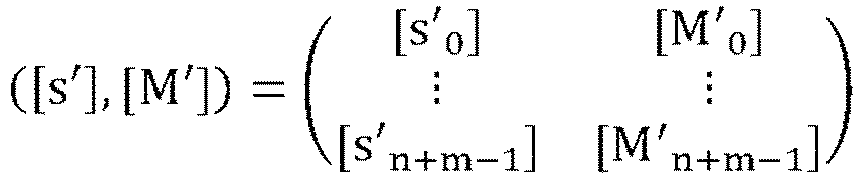
- Here, the sequence of M'0,..., M'n+m-1 is a stable sorting result of the sequence of the elements M0,..., Mn+m-1 according to the order relation of the contents represented by the elements M0 ,..., Mn+m-1, and each sorted value [s'q] is the element [sr] associated with the element [Mr] stably sorted to each sorted element [M'q] by secure computation. Where, q = 0,..., n+m-1, and r = 0,..., n+m-1. For example, in the case of the input flagged sequence ([s], [M]) exemplified in Expression (5), the following sorted sequence ([s'], [M']) is obtained.

- The sorted sequence ([s'], [M']) is sent to the equality check unit 115-w, and the sequence [M'] is sent to the output flag adding unit 117-w (step S114-w).
- The sorted sequence ([s'], [M']) is input to the equality check unit 115-w. The equality check unit 115-w obtains and outputs an equality check result (first equality check result) [eqq] and an equality check result (second equality check result) [seqq] for q = 0,..., n+m-1 by secure computation using the sorted sequence ([s'], [M']). Here, eqq = T when M'q = M' q+1 holds, eqq = F when M'q = M' q+1 does not hold, eqn+m-1 = F, seqq = T when s'q = S'q+1 holds, seqq = F when s'q = S'q+1 does not hold, seqn+m-1 = F, and T and F are different from each other Although T and F are not limited, for example, T = 1 and F = 0 may be satisfied, or T = 0 and F = 1 may be satisfied. These processing procedures can be realized by equality check of the concealed information [M'q] and [M'q+1] by the above-described secure computation and equality check of the concealed information [s'q] and [s'q+1] by the secure computation. For example, the equality check unit 115-w executes Expressions (7) and (8) below for q = 0,..., n+m-1 (that is, q ∈ [0, n + m)) by secure computation to obtain and output the equality check results [eqq] and [seqq]. Since these processing procedures do not depend on the order, it is also possible to execute the processing procedures of Expressions (7) and (8) in parallel for q = 0,..., n+m-1.


- For example, in the case of the sorted sequence ([s'], [M']) exemplified in Expression (6), in a case where T = 1 and F = 0, equality check results [eqq] and [seqq] of Expressions (9) and (10) below are obtained.


- The equality check results [eqq] and [seqq] are sent to the output flag generation unit 116-w (step S115-w).
- The equality check results [eqq] and [seqq] are input to the output flag generation unit 116-w. The output flag generation unit 116-w obtains and outputs the output flag [fq] by secure computation using the equality check results [eqq] and [seqq]. Here, fq = D1 when "eqq = T and seqq = F" holds, fq = D0 when "eqq = T and seqq = F" does not hold, and D1 and D0 are different from each other. Although D1 and D0 are not limited, for example, D1 = 1 and D0 = 0 may be satisfied, or D1 = 0 and D0 = 1 may be satisfied.
- This processing can be realized as in Expression (11) below by setting D1 = T and D0 = F and using the NOT operation and the AND operation of the concealed information by the secure computation described above.

- The sequence [f] of the output flag [fq] is expressed as follows:

- For example, in the case of the equality check results [eqq] and [seqq] of Expressions (9) and (10), when D1 = 1 and D0 = 0, the sequence [f] is as follows:

- The sequence [f] is sent to the output flag adding unit 117-w (step S116-w).
- The sequence [f] and the sequence [M'] are input to the output flag adding unit 117-w. For q = 0,..., n+m-1, the output flag adding unit 117-w associates the output flag [fq] of the sequence [f] and the sorted element [M'q] of the sequence [M'] with each other, and outputs the concealed operation result [Z] including the output flag [fq] and the sorted element [M'q] associated with each other. For example, the concealed operation result [Z] is expressed as follows:

- For example, in the case of the sequence [M'] of Expression (6) and the sequence [f] of Expression (12), the concealed operation result [Z] is as follows:

- The concealed operation result [Z] represents concealed information [Intersect (X, Y)] of the Intersect operation result Intersect (X, Y) = X' ∩ Y' between the multiset X and the multiset Y. That is, M'h corresponding to the sorted element [M'h] associated with the output flag [fh] in which fh = D1 (where h ∈ {0,..., n+m-1}) in the sequence [f] is an element of Intersect (X, Y). For example, in the case of Expression (13) in which D1 = 1 and D0 = 0, b and c corresponding to the sorted element [b] [c] associated with the output flag [fh] in which fh = 1 in the sequence [f] are the elements of Intersect (X, Y) (step S117-w).
- As described above, the stable sorting unit 114-w performs stable sorting according to the order relation of the contents respectively represented by the elements M0,..., Mn+m-1 corresponding to the sequence [M] by secure computation while maintaining the correspondence between [sq] and [Mq], to obtain and output the sorted sequences ([s'], [M']) ([s'] = ([s'0],..., [s'n+m-1]) , [M'] = ([M'0], ... , [M'n+m-1])). Since the sorting is stable, the order relation of the plurality of elements of the sequence [M] corresponding to the same content (for example, the same alphabet "b") is maintained in the sorted sequence ([s'], [M']). Here, the correspondence between [sq] and [Mq] before sorting is also maintained in the sorted sequence ([s'], [M']). Therefore, the elements [s'q(1)], ..., [s'q(Q)] ∈ { [s'0], ..., [s'n+m-1])} of the sequence [s'] associated with the elements [M'q(1)], ..., [M'q(Q)] ∈ {[M'0] , ..., [M'n+m-1]} of the sequence [M'] corresponding to the same content are one in which one or more [B0] (for example, [0]) corresponding to the multiset X are consecutively arranged, one or more [B1] (for example, [1]) corresponding to the multiset Y are consecutively arranged after one or more [B0] (for example, [0]) corresponding to the multiset X are consecutively arranged, or one or more [B1] (for example, [1]) corresponding to the multiset Y are consecutively arranged (see, for example, Expression (6)). Therefore, the output flag [fq] obtained by the output flag generation unit 116-w is such that (I) M'q = M'q+1, and fq = D1 (for example, 1) for [M'q] in which M'q and M'q+1 correspond to mutually different multisets X and Y, and (II) fq = D0 (for example, 0) for other [M'q] (see, for example, Expression (13)). Therefore, M'q corresponding to the element [M'q] of (I) is an element of Intersect (X, Y) = X' ∩ Y', and the concealed operation result [Z] including the output flag [fq] and the sorted element [M'q] represents concealed information [Intersect (X, Y)] of Intersect (X, Y) = X' ∩ Y' . For example, in a case of X = {{x0, x1, x2, x3, x4}} = {{a, a, b, c, d}} and Y = {{y0, Y1, y2}} = {{b, b, c}}, Intersect (X, Y) = {b, c}, and in the concealed operation result [Z] of the corresponding expression (13), the output flag [1] is associated with one sorted element [b] [c], and the output flag [0] is associated with the other sorted elements.
- As described above, in the present embodiment, flags representing whether Mq belongs to the multiset X or the multiset Y are concealed and added to each element [Mq], and using these concealed flags ([s]), regardless of whether or not the multiset X or the multiset Y includes overlapping elements, the logical product X' ∩ Y' is calculated by secure computation, and the concealed operation result [Z] representing the concealed information [Intersect (X, Y)] of the operation result of Intersect (X, Y) is obtained. The number of bits of the flag ([s]) is small, and the computation cost for determining flags in the equality check unit 115-w, that is, equality check of [s'q] and [s'q+1] is small. Furthermore, since there is no order dependency in the equality check between [s'q] and [s'q+1], it is also possible to execute processing for q = 0,..., n+m-1 in parallel. Therefore, the computation of the present embodiment can be executed at high speed. As described above, in the present embodiment, with the concealed information [X] and [Y] of the two multisets X and Y as an input, it is possible to obtain the concealed operation result [Z] representing the concealed information of Intersect (X, Y) at a small computation cost by secure computation.
- Note that the concealed operation result [Z] may be used to restore Z, or may be used as an operator for subsequent secure computation. For example, an invalid row may be deleted from the concealed operation result [Z] by the method disclosed in Reference Literature 5 or the like, and the obtained result may be used for another database operation.
- Reference Literature 5: Hiroki Sudo, Dai Ikarashi, "Implementation and evaluation of a secure computation database management system that discloses only the number of rows" In SCIS2021, pp. 1-6, 2021.
- In addition, it is also possible to assign the concealed information of the valid flag indicating whether the row is the valid row or the invalid row while leaving the invalid row in order to conceal and handle the valid row in the concealed operation result [Z] and perform subsequent processing. Alternatively, in the input flag adding unit 112-w described above, concealed information [Ψq] of the valid flag indicating whether Mq is valid is added to each ([sq] , [Mq]) of the input flagged sequence ([s], [M]), and the subsequent processing from steps S113-w to S117-w can be executed while maintaining the correspondence relationship of ([sq] , [Mq] , [Ψq]), and the subsequent processing can be performed.
- The secure computation device 11-w according to each embodiment is a device formed with a general-purpose or dedicated computer executing a predetermined program, the computer including a processor (a hardware processor) such as a central processing unit (CPU) and a memory such as a random access memory (RAM) and a read only memory (ROM), for example. That is, the secure computation device 11-w in each embodiment includes processing circuitry designed to implement the components included in the respective secure computation devices, for example. The computer may include one processor and one memory, or may include a plurality of processors and a plurality of memories. The program may be installed in the computer, or may be recorded in a ROM or the like in advance. Also, some or all of the processing units may be formed with an electronic circuit that independently implements the processing functions, rather than an electronic circuit (circuitry) that forms the functional components by reading the program like a CPU. Also, an electronic circuit forming one device may include a plurality of CPUs.
-
Fig. 4 is a block diagram illustrating an example hardware configuration of the secure computation device 11-w according to each embodiment. As illustrated as the example inFig. 4 , the secure computation device 11-w in this example includes a central processing unit (CPU) 10a, aninput unit 10b, anoutput unit 10c, a random access memory (RAM) 10d, a read only memory (ROM) 10e, anauxiliary storage device 10f, and abus 10g. TheCPU 10a in this example includes a control unit 10aa, an arithmetic operation unit 10ab, and a register 10ac, and performs various arithmetic operations in accordance with various programs read into the register 10ac. Meanwhile, theinput unit 10b is an input terminal to which data is input, a keyboard, a mouse, a touch panel, or the like. Also, theoutput unit 10c is an output terminal from which data is output, a display, a LAN card or the like controlled by theCPU 10a that has read a predetermined program. Further, theRAM 10d is a static random access memory (SRAM), a dynamic random access memory (DRAM), or the like, and incudes a program region 10da in which a predetermined program is stored and a data region 10db in which various kinds of data are stored. Further, theauxiliary storage device 10f is a hard disk, a magneto-optical disc (MO), a semiconductor memory, or the like, for example, and includes a program region 10fa in which a predetermined program is stored and a data region 10fb in which various kinds of data are stored. Meanwhile, thebus 10g connects theCPU 10a, theinput unit 10b, theoutput unit 10c, theRAM 10d, theROM 10e, and theauxiliary storage device 10f so that information can be exchanged among these components. TheCPU 10a writes, into the program region 10da of theRAM 10d, the program stored in the program region 10fa of theauxiliary storage device 10f, in accordance with a read operating system (OS) program. Likewise, theCPU 10a writes, into the data region 10db of theRAM 10d, the various kinds of data stored in the data region 10fb of theauxiliary storage device 10f. The addresses in theRAM 10d at which the program and the data are written are stored into the register 10ac of theCPU 10a. The control unit 10aa of theCPU 10a sequentially reads these addresses stored in the register 10ac, reads the program and the data from the regions in theRAM 10d indicated by the read addresses, causes the arithmetic operation unit 10ab to sequentially execute arithmetic operations indicated by the program, and stores results of the arithmetic operations into the register 10ac. With such a configuration, the functional components of the secure computation device 11-w are obtained. - The program mentioned above can be recorded in a computer-readable recording medium. The computer-readable recording medium in an example is a non-transitory recording medium. Examples of such a recording medium include a magnetic recording device, an optical disc, a magneto-optical recording medium, and a semiconductor memory.
- The program is distributed by selling, giving, or renting portable recording media such as DVDs or CD-ROMs recording the program thereon, for example. Furthermore, a configuration in which the program is stored in a storage device in a server computer and the program is distributed by transferring the program from the server computer to other computers via a network may also be employed. As described above, the computer executing such a program first stores the program recorded in the portable recording medium or the program transferred from the server computer temporarily into a storage device of the computer, for example. The computer then reads the program stored in the storage device itself, and performs a process in accordance with the read program at the time of execution of the process. Also, in other execution modes of the program, the computer may read the program directly from the portable recording medium and performs a process in accordance with the program, or alternatively, the computer may sequentially execute a process in accordance with the received program every time the program is transferred from the server computer to the computer. Alternatively, the above processing may be executed by a so-called application service provider (ASP) service that implements a processing function only by issuing an instruction to execute the program and acquiring the result, without transferring the program from the server computer to the computer. Note that the program according to the present embodiment includes information used for processing by an electronic computer and equivalent to the program (data, or the like, that is not a direct command to the computer but has property that defines processing of the computer).
- Although this device is formed with a computer executing a predetermined program in each embodiment, at least some of the processing contents may be realized by hardware.
- Note that the present invention is not limited to the embodiments described above. For example, it may be executed not only in time series in accordance with the description but also in parallel or individually in accordance with processing abilities of the devices that execute the processes or as necessary. Further, appropriate modifications can of course be made without departing from the scope of the present invention.
- The present invention can be applied to an application of performing an Intersect operation on two multisets by secure computation. For example, the present invention can be used for an application of performing the Intersect operation in a relational database management system (RDBMS) by means of secure computation.
-
- 1
- Secure computation system
- 11-w
- Secure computation device
- 112-w
- Input flag adding unit
- 114-w
- Stable sorting unit
- 115-w
- Equality check unit
- 116-w
- Output flag generation unit
- 117-w
- Output flag adding unit
Claims (5)
- A secure computation device that obtains a concealed operation result representing concealed information of an Intersect operation result between a first multiset X = {{x0,..., xn-1}} and a second multiset Y = {{y0, ..., ym-1}} while concealing the first multiset X and the second multiset Y, the device comprising:(A) an input flag adding unit that receives n first elements [x0], ..., [xn-1] and m second elements [y0] , ..., [ym-1] as inputs, and obtains an input flagged sequence ([s], [M]) including a sequence [s] = ([s0],..., [Sn-1] , [sn], ... , [sn+m-1]) = ([B0],..., [B0] , [B1],..., [B1]) including n first values [B0] and m second values [B1] and a sequence [M] = ([M0],..., [Mn-1] , [Mn] , ... , [Mn+m-1]) = ([x0],..., [xn-1] , [y0] , ..., [ym-1]) including first elements [x0], ..., [xn-1] and second elements [y0] ... , [ym-1] in which B0 and B1 are different from each other, each first value [si] = [B0] is associated with each first element [Mi] = [xi], and each second value [Sj+n] = [B1] is associated with each second element [Mj+n] = [yj], where n and m are positive integers, i = 0,..., n-1, j = 0,..., m-1, q = 0,..., n+m-1, and [α] is concealed information of α;(B) a stable sorting unit that performs, by secure computation, stable sorting according to an order relation of content represented by each of elements M0,..., Mn+m-1 corresponding to the sequence [M] for the input flagged sequence ([s], [M]) while maintaining a correspondence between [sq] and [Mq], to obtain a sorted sequence ([s'], [M']) including a sequence [s'] = ([s'0], ... , [s'n+m-1]) of sorted values [s'0], ..., [s'n+m-1] and a sequence [M'] = ([M'0] , ..., [M'n+m-i]) of sorted elements [M'0], ..., [M' n+m-1] ;(C) an equality check unit that obtains a first equality check result [eqq] and a second equality check result [seqq] by secure computation using the sorted sequence ([s'], [M']), where eqq = T when M'q = M'q+1 holds, eqq = F when M'q = M' q+1 does not hold, eqn+m-1 = F, seqq = T when s'q = s'q+1 holds, seqq = F when s'q = S'q+1 does not hold, seqn+m-1 = F, and T and F are different from each other;(D) an output flag generation unit that obtains an output flag [fq] by secure computation using the first equality check result [eqq] and the second equality check result [seqq], where, fq = D1 when "eqq = T and seqq = F" holds, fq = D0 when "eqq = T and seqq = F" does not hold, and D1 and D0 are different from each other; and(E) an output flag adding unit that outputs the concealed operation result including the output flag [fq] and the sorted element [M'q] of the sequence [M'] associated with each other.
- The secure computation device according to claim 1, wherein(A) the input flag adding unit obtains the input flagged sequence ([s], [M]) represented by:
 (B) the stable sorting unit obtains the sorted sequence ([s'], [M']) represented by:
 a sequence of M'0,..., M'n+m-1 is a stable sorting result of a sequence of the elements M0, ... , Mn+m-1 according to an order relation of content represented by each of the elements M0,..., Mn+m-1, andeach sorted value [s'q] is an element [sr] associated with an element [Mr] stably sorted into each sorted element [M'q] by secure computation in the stable sorting unit, and r = 0,..., n+m-1.
 - A secure computation system having the secure computation device according to claim 1 or 2.
- A secure computation method of a secure computation device that obtains a concealed operation result representing concealed information of an Intersect operation result between a first multiset X = {{x0,..., xn-1}} and a second multiset Y = {{y0,..., ym-1}} while concealing the first multiset X and the second multiset Y, the method comprising:(A) an input flag adding step of, by an input flag adding unit, receiving n first elements [x0],..., [xn-1] and m second elements [y0],..., [ym-1] as inputs, and obtaining an input flagged sequence ([s] , [M]) including a sequence [s] = ([s0] , ... , [Sn-1], [sn] , ..., [Sn+m-1]) = ([B0],..., [B0], [B1],..., [B1]) including n first values [B0] and m second values [B1] and a sequence [M] = ([M0],..., [Mn-1], [Mn] , ... , [Mn+m-1]) = ([x0],..., [xn-1] , [y0],..., [ym-1]) including first elements [x0], ..., [xn-1] and second elements [y0], ... , [ym-1] in which B0 and B1 are different from each other, each first value [si] = [B0] is associated with each first element [Mi] = [xi], and each second value [Sj+n] = [B1] is associated with each second element [Mj+n] = [yj], where n and m are positive integers, i = 0,..., n-1, j = 0,..., m-1, q = 0,..., n+m-1, and [α] is concealed information of α;(B) a stable sorting step of, by a stable sorting unit, performing stable sorting according to an order relation of content represented by each of elements M0,..., Mn+m-1 corresponding to the sequence [M] for the input flagged sequence ([s], [M]) while maintaining a correspondence between [sq] and [Mq] by secure computation, to obtain a sorted sequence ([s'], [M']) including a sequence [s'] = ([s'0],..., [s'n+m-1]) of sorted values [s'0],..., [s'n+m-1] and a sequence [M'] = ([M'0], ..., [M'n+m-1]) of sorted elements [M'0], ..., [M'n+m-1];(C) an equality check step of, by an equality check unit, obtaining a first equality check result [eqq] and a second equality check result [seqq] by secure computation using the sorted sequence ([s'], [M']), where eqq = T when M'q = M'q+1 holds, eqq = F when M'q = M'q+1 does not hold, eqn+m-1 = F, seqq = T when s'q = S'q+1 holds, seqq = F when s'q = S'q+1 does not hold, seqn+m-1 = F, and T and F are different from each other;(D) an output flag generation step of, by an output flag generation unit, obtaining an output flag [fq] by secure computation using the first equality check result [eqq] and the second equality check result [seqq], where fq = D1 when "eqq = T and seqq = F" holds, fq = D0 when "eqq = T and seqq = F" does not hold, and D1 and D0 are different from each other; and(E) an output flag adding step of, by an output flag adding unit, outputting the concealed operation result including the output flag [fq] and the sorted element [M'q] of the sequence [M'] associated with each other.
- A program for causing a computer to function as the secure computation device according to claim 1 or 2.
Applications Claiming Priority (1)
| Application Number | Priority Date | Filing Date | Title |
|---|---|---|---|
| PCT/JP2021/021366 WO2022254691A1 (en) | 2021-06-04 | 2021-06-04 | Secure computing device, secure computing system, secure computing method, and program |
Publications (3)
| Publication Number | Publication Date |
|---|---|
| EP4350670A1 true EP4350670A1 (en) | 2024-04-10 |
| EP4350670A4 EP4350670A4 (en) | 2025-04-09 |
| EP4350670B1 EP4350670B1 (en) | 2026-02-11 |
Family
ID=84322950
Family Applications (1)
| Application Number | Title | Priority Date | Filing Date |
|---|---|---|---|
| EP21944187.0A Active EP4350670B1 (en) | 2021-06-04 | 2021-06-04 | Secure computing device, secure computing system, secure computing method, and program |
Country Status (5)
| Country | Link |
|---|---|
| US (1) | US12386948B2 (en) |
| EP (1) | EP4350670B1 (en) |
| JP (1) | JP7533784B2 (en) |
| CN (1) | CN117425926A (en) |
| WO (1) | WO2022254691A1 (en) |
Families Citing this family (1)
| Publication number | Priority date | Publication date | Assignee | Title |
|---|---|---|---|---|
| JP2024160620A (en) * | 2023-05-01 | 2024-11-14 | エヌ・ティ・ティ・コミュニケーションズ株式会社 | Analytical device, analytical method, and analytical program |
Family Cites Families (18)
| Publication number | Priority date | Publication date | Assignee | Title |
|---|---|---|---|---|
| US9442980B1 (en) * | 2010-04-21 | 2016-09-13 | Stan Trepetin | Mathematical method for performing homomorphic operations |
| JP5995749B2 (en) * | 2013-02-26 | 2016-09-21 | 日本電信電話株式会社 | Secret set operation apparatus and method |
| CN105009505A (en) * | 2013-08-09 | 2015-10-28 | 汤姆逊许可公司 | Method and system for privacy-preserving recommendation based on matrix factorization and ridge regression |
| WO2016208202A1 (en) * | 2015-06-24 | 2016-12-29 | 日本電信電話株式会社 | High-frequency line |
| JP6034927B1 (en) * | 2015-07-27 | 2016-11-30 | 日本電信電話株式会社 | Secret calculation system, secret calculation device, and program |
| WO2017122352A1 (en) * | 2016-01-15 | 2017-07-20 | 三菱電機株式会社 | Encryption device, encryption method, and encryption program |
| EP3340152A1 (en) * | 2016-12-22 | 2018-06-27 | Telefonica Digital España, S.L.U. | Method of selecting and delivering content for privacy-protected targeting content systems |
| US11675847B2 (en) * | 2017-12-19 | 2023-06-13 | Nippon Telegraph And Telephone Corporation | Retrieval device, retrieval method, program, and recording medium |
| CN111758127B (en) * | 2018-02-20 | 2023-08-08 | 日本电信电话株式会社 | Secret computing device and method, secret computing authentication system, and recording medium |
| US11126709B2 (en) * | 2019-01-28 | 2021-09-21 | Nec Corporation Of America | Secure multiparty computation of shuffle, sort, and set operations |
| WO2020167254A1 (en) * | 2019-02-13 | 2020-08-20 | Agency For Science, Technology And Research | Method and system for determining an order of encrypted inputs |
| US12250297B1 (en) * | 2020-05-20 | 2025-03-11 | Stealth Software Technologies, Inc. | Apparatus and method for secure merging of lists using only local computations at each of two machines and communications solely between the two machines |
| EP4148606B1 (en) * | 2020-06-08 | 2025-03-26 | Huawei Technologies Co., Ltd. | Data encryption or decryption method, apparatus and system |
| US12002145B2 (en) * | 2020-08-17 | 2024-06-04 | Intel Corporation | Apparatus and method for efficient graphics processing including ray tracing |
| US11411742B2 (en) * | 2020-09-08 | 2022-08-09 | Qed-It Systems Ltd. | Private set calculation using private intersection and calculation, and applications thereof |
| US11949778B1 (en) * | 2020-09-16 | 2024-04-02 | Snap Inc. | Privacy-preserving multi-touch attribution |
| CN116324778A (en) * | 2020-10-08 | 2023-06-23 | 维萨国际服务协会 | updatable private collection intersection |
| US11687666B2 (en) * | 2021-01-12 | 2023-06-27 | Visa International Service Association | System, method, and computer program product for conducting private set intersection (PSI) techniques with multiple parties using a data repository |
-
2021
- 2021-06-04 EP EP21944187.0A patent/EP4350670B1/en active Active
- 2021-06-04 US US18/565,091 patent/US12386948B2/en active Active
- 2021-06-04 CN CN202180098863.5A patent/CN117425926A/en active Pending
- 2021-06-04 WO PCT/JP2021/021366 patent/WO2022254691A1/en not_active Ceased
- 2021-06-04 JP JP2023525310A patent/JP7533784B2/en active Active
Also Published As
| Publication number | Publication date |
|---|---|
| CN117425926A (en) | 2024-01-19 |
| US12386948B2 (en) | 2025-08-12 |
| US20240273180A1 (en) | 2024-08-15 |
| JP7533784B2 (en) | 2024-08-14 |
| JPWO2022254691A1 (en) | 2022-12-08 |
| WO2022254691A1 (en) | 2022-12-08 |
| EP4350670A4 (en) | 2025-04-09 |
| EP4350670B1 (en) | 2026-02-11 |
Similar Documents
| Publication | Publication Date | Title |
|---|---|---|
| Xue et al. | Medical image protection algorithm based on deoxyribonucleic acid chain of dynamic length | |
| CN114881247A (en) | Longitudinal federal feature derivation method, device and medium based on privacy computation | |
| EP4092655A1 (en) | Secret maximum value calculation device, method, and program | |
| EP4350670B1 (en) | Secure computing device, secure computing system, secure computing method, and program | |
| EP4016506A1 (en) | Softmax function secret calculation system, softmax function secret calculation device, softmax function secret calculation method, neural network secret calculation system, neural network secret learning system, and program | |
| JP7060115B2 (en) | Secret array access device, secret array access method, and program | |
| EP4231276A1 (en) | Hidden decision tree test device, hidden decision tree test system, hidden decision tree test method, and program | |
| EP4365877B1 (en) | Secret equijoin device, secret equijoin method, and program | |
| Dehghan et al. | On the reflexive and anti-reflexive solutions of the generalised coupled Sylvester matrix equations | |
| EP3813042A1 (en) | Secret combination system, method, secret calculation device, and program | |
| CN113966511A (en) | Secret division system, secret calculation device, secret division method, and program | |
| Yang | Wireless sensor network security encryption based on AES module optimization design | |
| US12475237B2 (en) | Secure computation apparatus, secure computation system, secure computation method, and program | |
| EP4465280A1 (en) | Secure cluster computation system, secure cluster computation device, secure cluster computation method, and program | |
| US20250322032A1 (en) | Secure attribute selection system, secure attribute selection apparatus, secure attribute selection method, and program | |
| US20250150265A1 (en) | Secure computation apparatus, secure computation method, and program | |
| US20250148095A1 (en) | Secure computation apparatus, secure computation method, and program | |
| CN113924610B (en) | Secret conjugate gradient method calculation system and method, secret calculation device, conjugate gradient method calculation device and method, and recording medium | |
| WO2022254599A1 (en) | Secret conjugate gradient method calculation method, secret conjugate gradient method calculation system, secret calculation device, and program | |
| EP4465279A1 (en) | Secret random number calculation system, secret random number calculation device, secret random number calculation method, secret cluster calculation system, secret cluster calculation device, secret cluster calculation method, and program | |
| Dolev et al. | Secret-shared RAM indefinite private and secure RAM execution of perfectly unrevealed programs | |
| JP7694684B2 (en) | Secret division device, secret division method, and program | |
| EP3839923B1 (en) | Secret strong mapping calculation system, method therefor, secret calculation device, and program | |
| WO2026078809A1 (en) | Secure aggregation computational device and method | |
| EP4231275A1 (en) | Secret grouping device, secret grouping system, secret grouping method, and program |
Legal Events
| Date | Code | Title | Description |
|---|---|---|---|
| STAA | Information on the status of an ep patent application or granted ep patent |
Free format text: STATUS: THE INTERNATIONAL PUBLICATION HAS BEEN MADE |
|
| PUAI | Public reference made under article 153(3) epc to a published international application that has entered the european phase |
Free format text: ORIGINAL CODE: 0009012 |
|
| STAA | Information on the status of an ep patent application or granted ep patent |
Free format text: STATUS: REQUEST FOR EXAMINATION WAS MADE |
|
| 17P | Request for examination filed |
Effective date: 20240104 |
|
| AK | Designated contracting states |
Kind code of ref document: A1 Designated state(s): AL AT BE BG CH CY CZ DE DK EE ES FI FR GB GR HR HU IE IS IT LI LT LU LV MC MK MT NL NO PL PT RO RS SE SI SK SM TR |
|
| DAV | Request for validation of the european patent (deleted) | ||
| DAX | Request for extension of the european patent (deleted) | ||
| A4 | Supplementary search report drawn up and despatched |
Effective date: 20250306 |
|
| RIC1 | Information provided on ipc code assigned before grant |
Ipc: G09C 1/00 20060101AFI20250228BHEP |
|
| RAP3 | Party data changed (applicant data changed or rights of an application transferred) |
Owner name: NTT, INC. |
|
| GRAP | Despatch of communication of intention to grant a patent |
Free format text: ORIGINAL CODE: EPIDOSNIGR1 |
|
| STAA | Information on the status of an ep patent application or granted ep patent |
Free format text: STATUS: GRANT OF PATENT IS INTENDED |
|
| INTG | Intention to grant announced |
Effective date: 20251020 |
|
| GRAS | Grant fee paid |
Free format text: ORIGINAL CODE: EPIDOSNIGR3 |
|
| GRAA | (expected) grant |
Free format text: ORIGINAL CODE: 0009210 |
|
| STAA | Information on the status of an ep patent application or granted ep patent |
Free format text: STATUS: THE PATENT HAS BEEN GRANTED |
|
| AK | Designated contracting states |
Kind code of ref document: B1 Designated state(s): AL AT BE BG CH CY CZ DE DK EE ES FI FR GB GR HR HU IE IS IT LI LT LU LV MC MK MT NL NO PL PT RO RS SE SI SK SM TR |
|
| REG | Reference to a national code |
Ref country code: CH Ref legal event code: F10 Free format text: ST27 STATUS EVENT CODE: U-0-0-F10-F00 (AS PROVIDED BY THE NATIONAL OFFICE) Effective date: 20260211 Ref country code: GB Ref legal event code: FG4D |
|
| REG | Reference to a national code |
Ref country code: DE Ref legal event code: R096 Ref document number: 602021047991 Country of ref document: DE |
|
| REG | Reference to a national code |
Ref country code: IE Ref legal event code: FG4D |
|
| REG | Reference to a national code |
Ref country code: NL Ref legal event code: MP Effective date: 20260211 |
|
| PG25 | Lapsed in a contracting state [announced via postgrant information from national office to epo] |
Ref country code: RS Free format text: LAPSE BECAUSE OF FAILURE TO SUBMIT A TRANSLATION OF THE DESCRIPTION OR TO PAY THE FEE WITHIN THE PRESCRIBED TIME-LIMIT Effective date: 20260511 |
|
| PG25 | Lapsed in a contracting state [announced via postgrant information from national office to epo] |
Ref country code: ES Free format text: LAPSE BECAUSE OF FAILURE TO SUBMIT A TRANSLATION OF THE DESCRIPTION OR TO PAY THE FEE WITHIN THE PRESCRIBED TIME-LIMIT Effective date: 20260211 |
|
| PG25 | Lapsed in a contracting state [announced via postgrant information from national office to epo] |
Ref country code: PL Free format text: LAPSE BECAUSE OF FAILURE TO SUBMIT A TRANSLATION OF THE DESCRIPTION OR TO PAY THE FEE WITHIN THE PRESCRIBED TIME-LIMIT Effective date: 20260211 |
|
| PGFP | Annual fee paid to national office [announced via postgrant information from national office to epo] |
Ref country code: GB Payment date: 20260402 Year of fee payment: 6 |
|
| PG25 | Lapsed in a contracting state [announced via postgrant information from national office to epo] |
Ref country code: GR Free format text: LAPSE BECAUSE OF FAILURE TO SUBMIT A TRANSLATION OF THE DESCRIPTION OR TO PAY THE FEE WITHIN THE PRESCRIBED TIME-LIMIT Effective date: 20260512 |
|
| REG | Reference to a national code |
Ref country code: LT Ref legal event code: MG9D |
|
| PG25 | Lapsed in a contracting state [announced via postgrant information from national office to epo] |
Ref country code: LT Free format text: LAPSE BECAUSE OF FAILURE TO SUBMIT A TRANSLATION OF THE DESCRIPTION OR TO PAY THE FEE WITHIN THE PRESCRIBED TIME-LIMIT Effective date: 20260211 |
|
| PGFP | Annual fee paid to national office [announced via postgrant information from national office to epo] |
Ref country code: DE Payment date: 20260630 Year of fee payment: 6 |
|
| PG25 | Lapsed in a contracting state [announced via postgrant information from national office to epo] |
Ref country code: NO Free format text: LAPSE BECAUSE OF FAILURE TO SUBMIT A TRANSLATION OF THE DESCRIPTION OR TO PAY THE FEE WITHIN THE PRESCRIBED TIME-LIMIT Effective date: 20260511 |
|
| PG25 | Lapsed in a contracting state [announced via postgrant information from national office to epo] |
Ref country code: FI Free format text: LAPSE BECAUSE OF FAILURE TO SUBMIT A TRANSLATION OF THE DESCRIPTION OR TO PAY THE FEE WITHIN THE PRESCRIBED TIME-LIMIT Effective date: 20260211 Ref country code: SE Free format text: LAPSE BECAUSE OF FAILURE TO SUBMIT A TRANSLATION OF THE DESCRIPTION OR TO PAY THE FEE WITHIN THE PRESCRIBED TIME-LIMIT Effective date: 20260211 Ref country code: AT Free format text: LAPSE BECAUSE OF FAILURE TO SUBMIT A TRANSLATION OF THE DESCRIPTION OR TO PAY THE FEE WITHIN THE PRESCRIBED TIME-LIMIT Effective date: 20260211 |
|
| REG | Reference to a national code |
Ref country code: AT Ref legal event code: MK05 Ref document number: 1886451 Country of ref document: AT Kind code of ref document: T Effective date: 20260211 |
|
| PG25 | Lapsed in a contracting state [announced via postgrant information from national office to epo] |
Ref country code: HR Free format text: LAPSE BECAUSE OF FAILURE TO SUBMIT A TRANSLATION OF THE DESCRIPTION OR TO PAY THE FEE WITHIN THE PRESCRIBED TIME-LIMIT Effective date: 20260211 |
|
| PG25 | Lapsed in a contracting state [announced via postgrant information from national office to epo] |
Ref country code: IS Free format text: LAPSE BECAUSE OF FAILURE TO SUBMIT A TRANSLATION OF THE DESCRIPTION OR TO PAY THE FEE WITHIN THE PRESCRIBED TIME-LIMIT Effective date: 20260611 Ref country code: PT Free format text: LAPSE BECAUSE OF FAILURE TO SUBMIT A TRANSLATION OF THE DESCRIPTION OR TO PAY THE FEE WITHIN THE PRESCRIBED TIME-LIMIT Effective date: 20260611 |
|
| PG25 | Lapsed in a contracting state [announced via postgrant information from national office to epo] |
Ref country code: NL Free format text: LAPSE BECAUSE OF FAILURE TO SUBMIT A TRANSLATION OF THE DESCRIPTION OR TO PAY THE FEE WITHIN THE PRESCRIBED TIME-LIMIT Effective date: 20260211 |
|
| PGFP | Annual fee paid to national office [announced via postgrant information from national office to epo] |
Ref country code: FR Payment date: 20260622 Year of fee payment: 6 |
|
| PG25 | Lapsed in a contracting state [announced via postgrant information from national office to epo] |
Ref country code: LV Free format text: LAPSE BECAUSE OF FAILURE TO SUBMIT A TRANSLATION OF THE DESCRIPTION OR TO PAY THE FEE WITHIN THE PRESCRIBED TIME-LIMIT Effective date: 20260211 |
|
| PG25 | Lapsed in a contracting state [announced via postgrant information from national office to epo] |
Ref country code: BG Free format text: LAPSE BECAUSE OF FAILURE TO SUBMIT A TRANSLATION OF THE DESCRIPTION OR TO PAY THE FEE WITHIN THE PRESCRIBED TIME-LIMIT Effective date: 20260211 |