EP4350619A1 - Battery cell squeeze damage detection method, apparatus and system - Google Patents
Battery cell squeeze damage detection method, apparatus and system Download PDFInfo
- Publication number
- EP4350619A1 EP4350619A1 EP23789485.2A EP23789485A EP4350619A1 EP 4350619 A1 EP4350619 A1 EP 4350619A1 EP 23789485 A EP23789485 A EP 23789485A EP 4350619 A1 EP4350619 A1 EP 4350619A1
- Authority
- EP
- European Patent Office
- Prior art keywords
- crush
- cell assembly
- images
- cell
- similarity matching
- Prior art date
- Legal status (The legal status is an assumption and is not a legal conclusion. Google has not performed a legal analysis and makes no representation as to the accuracy of the status listed.)
- Granted
Links
Images




Classifications
-
- G—PHYSICS
- G06—COMPUTING OR CALCULATING; COUNTING
- G06V—IMAGE OR VIDEO RECOGNITION OR UNDERSTANDING
- G06V20/00—Scenes; Scene-specific elements
- G06V20/60—Type of objects
- G06V20/69—Microscopic objects, e.g. biological cells or cellular parts
- G06V20/698—Matching; Classification
-
- G—PHYSICS
- G06—COMPUTING OR CALCULATING; COUNTING
- G06V—IMAGE OR VIDEO RECOGNITION OR UNDERSTANDING
- G06V20/00—Scenes; Scene-specific elements
- G06V20/50—Context or environment of the image
- G06V20/52—Surveillance or monitoring of activities, e.g. for recognising suspicious objects
-
- G—PHYSICS
- G06—COMPUTING OR CALCULATING; COUNTING
- G06T—IMAGE DATA PROCESSING OR GENERATION, IN GENERAL
- G06T7/00—Image analysis
- G06T7/0002—Inspection of images, e.g. flaw detection
- G06T7/0004—Industrial image inspection
- G06T7/001—Industrial image inspection using an image reference approach
-
- G—PHYSICS
- G06—COMPUTING OR CALCULATING; COUNTING
- G06V—IMAGE OR VIDEO RECOGNITION OR UNDERSTANDING
- G06V10/00—Arrangements for image or video recognition or understanding
- G06V10/40—Extraction of image or video features
- G06V10/44—Local feature extraction by analysis of parts of the pattern, e.g. by detecting edges, contours, loops, corners, strokes or intersections; Connectivity analysis, e.g. of connected components
-
- G—PHYSICS
- G06—COMPUTING OR CALCULATING; COUNTING
- G06V—IMAGE OR VIDEO RECOGNITION OR UNDERSTANDING
- G06V20/00—Scenes; Scene-specific elements
- G06V20/60—Type of objects
- G06V20/69—Microscopic objects, e.g. biological cells or cellular parts
- G06V20/695—Preprocessing, e.g. image segmentation
-
- G—PHYSICS
- G06—COMPUTING OR CALCULATING; COUNTING
- G06T—IMAGE DATA PROCESSING OR GENERATION, IN GENERAL
- G06T2207/00—Indexing scheme for image analysis or image enhancement
- G06T2207/20—Special algorithmic details
- G06T2207/20081—Training; Learning
-
- G—PHYSICS
- G06—COMPUTING OR CALCULATING; COUNTING
- G06T—IMAGE DATA PROCESSING OR GENERATION, IN GENERAL
- G06T2207/00—Indexing scheme for image analysis or image enhancement
- G06T2207/20—Special algorithmic details
- G06T2207/20084—Artificial neural networks [ANN]
-
- G—PHYSICS
- G06—COMPUTING OR CALCULATING; COUNTING
- G06T—IMAGE DATA PROCESSING OR GENERATION, IN GENERAL
- G06T2207/00—Indexing scheme for image analysis or image enhancement
- G06T2207/30—Subject of image; Context of image processing
- G06T2207/30108—Industrial image inspection
- G06T2207/30136—Metal
-
- G—PHYSICS
- G06—COMPUTING OR CALCULATING; COUNTING
- G06T—IMAGE DATA PROCESSING OR GENERATION, IN GENERAL
- G06T2207/00—Indexing scheme for image analysis or image enhancement
- G06T2207/30—Subject of image; Context of image processing
- G06T2207/30108—Industrial image inspection
- G06T2207/30164—Workpiece; Machine component
-
- Y—GENERAL TAGGING OF NEW TECHNOLOGICAL DEVELOPMENTS; GENERAL TAGGING OF CROSS-SECTIONAL TECHNOLOGIES SPANNING OVER SEVERAL SECTIONS OF THE IPC; TECHNICAL SUBJECTS COVERED BY FORMER USPC CROSS-REFERENCE ART COLLECTIONS [XRACs] AND DIGESTS
- Y02—TECHNOLOGIES OR APPLICATIONS FOR MITIGATION OR ADAPTATION AGAINST CLIMATE CHANGE
- Y02E—REDUCTION OF GREENHOUSE GAS [GHG] EMISSIONS, RELATED TO ENERGY GENERATION, TRANSMISSION OR DISTRIBUTION
- Y02E60/00—Enabling technologies; Technologies with a potential or indirect contribution to GHG emissions mitigation
- Y02E60/10—Energy storage using batteries
Definitions
- the present application relates to the technical field of battery defect inspection, and in particular to a method, apparatus and system for inspecting a cell crush, a computer device, a storage medium, and a computer program product.
- Cell pack Mylar is an extremely important process in the production of battery cells.
- Mylar is a polyester film with a good insulating property, which wraps around the surface of a cell and isolates the cell from an external aluminum shell, thus protecting the cell.
- a method, apparatus and system for inspecting a cell crush, a computer device, a storage medium, and a computer program product are provided.
- the present application provides a method for inspecting a cell crush, where the method is applied in a crush inspection device, and the crush inspection device can be specifically implemented by a logic controller.
- the method includes the following steps:
- the high-speed image acquisition device is used to acquire the images of the cell assembly, enabling the images to be acquired at a faster rate. Furthermore, the images of the flowing cell assembly are acquired without the need to stop the cell assembly and keep same stationary, having no impact on normal line production.
- the cell crush inspection result is quickly obtained through image feature extraction for the acquired images of the cell and based on similarity matching with the preset crush model. The whole solution can meet the requirements of faster production, enabling rapid cell crush inspection.
- the acquiring images of a flowing cell assembly by a high-speed image acquisition device includes: acquiring, by a high-speed line scan camera, the images of the cell assembly which flows from a cell assembly working station to a pack Mylar station.
- the use of the high-speed line scan camera for image acquisition allows for high-speed and effective acquisition of the images of the cell assembly, and in the process of acquiring the images of the cell assembly, the cell assembly flows from the cell assembly station to the pack Mylar station along the production line, which does not affect normal line production and can meet the requirements of faster production.
- the performing similarity matching between the image features and a preset crush model to obtain a similarity matching result includes:
- the corresponding database of crush feature parameters is obtained based on the preset crush model, and the similarity matching is performed, in the database of crush feature parameters, on the inspection feature parameters of the cell assembly obtained based on graphical features, to find crush feature parameters with matched similarity, such that the similarity matching result can be obtained quickly and accurately.
- the performing, in the database of crush feature parameters, similarity matching on the inspection feature parameters to obtain a similarity matching result includes:
- similarity matching calculation is performed on the similar crush feature parameters in the inspection feature parameters that are within the different range values of crush feature parameters, and different similar crush feature parameters are pre-assigned different weights, which fully takes into account the magnitude of impact of different crush features in terms of the representation of crush defects, such that a more accurate similarity matching result can be obtained.
- the method before the extracting image features from the images of the cell assembly, the method further includes: pre-processing the images of the cell assembly, the pre-processing including at least one of denoising, image enhancement, gray-scale processing, binary image processing, edge detection and segmentation, and histogram matching.
- the images of the cell assembly are further pre-processed, so that the image features can be more quickly extracted from the images of the cell assembly subsequently.
- the method before the extracting image features from the images of the cell assembly, the method further includes:
- the extracting image features from the images of the cell assembly includes: extracting the image features from the images of the cell assembly using the trained AI feature extraction algorithm.
- the AI feature algorithm is extracted with the sample images to obtain an AI algorithm that can allow for accurate extraction of crush image features.
- the image features are extracted from the images of the cell assembly directly using the trained AI feature extraction algorithm. Therefore, the image features can be extracted from the images of the cell assembly more quickly and accurately.
- the present application further provides an apparatus for inspecting a cell crush.
- the apparatus includes:
- the present application further provides a system for inspecting a cell crush, the system including a high-speed line scan image acquisition device and an inspection module, where the high-speed line scan image acquisition device is configured to: acquire images of a flowing cell assembly, and send the images of the cell assembly to the inspection module; and the inspection module is configured to perform crush inspection by using the above-mentioned method.
- the present application provides a computer device, including a memory and one or more processors, where the memory stores computer-readable instructions that, when executed by the one or more processors, cause the one or more processors to perform the steps of the above-mentioned method for inspecting a cell crush.
- the present application provides one or more computer storage media storing computer-readable instructions that, when executed by one or more processors, cause the one or more processors to perform the steps of the above-mentioned method for inspecting a cell crush.
- the present application provides a computer program product, where a computer program, when executed by one or more processors, causes the one or more processors to perform the steps of the above-mentioned method for inspecting a cell crush.
- Cell assembly is a battery process in which two bare cells are folded from an unwound state to an overlapping state.
- Mylar is a polyester film with a good insulating property, which wraps around the surface of a cell and isolates the cell from an external aluminum shell, thus protecting the cell. After cell assembly and before pack Mylar film wrapping, cells need to be subjected to crush inspection of the surface appearance of the cells, to prevent a crushed cell from affecting the performance of a finished battery with the crushed cell assembled.
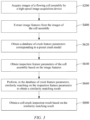
- a new method for inspecting a cell crush including: acquiring images of a flowing cell assembly by a high-speed image acquisition device; extracting image features from the images of the cell assembly; performing similarity matching between the image features and a preset crush model to obtain a similarity matching result; and obtaining a cell crush inspection result based on the similarity matching result.
- the high-speed image acquisition device is used to acquire the images of the cell assembly, enabling the images to be acquired at a faster rate.
- the images of the flowing cell assembly are acquired without the need to stop the cell assembly and keep same stationary, having no impact on normal line production.
- the cell crush inspection result is quickly obtained through image feature extraction for the acquired images of the cell and based on similarity matching with the preset crush model. The whole solution can meet the requirements of faster production, enabling rapid cell crush inspection.
- the method for inspecting a cell crush provided in the embodiments of the present application can be applied in a crush inspection device on a cell production line.
- the crush inspection device is arranged between a cell assembly station and a pack Mylar station.
- the cell assembly flows from the cell assembly station to the pack Mylar station.
- the crush inspection device is configured to: acquire images of a flowing cell assembly by a high-speed image acquisition device; extract image features from the images of the cell assembly; perform similarity matching between the image features and a preset crush model to obtain a similarity matching result; and obtain a cell crush inspection result based on the similarity matching result.
- the crush inspection device may feed the obtained crush inspection result back to operators to prompt them to remove a cell assembly with a crush; alternatively, other automation equipment can directly remove the cell assembly with a crush from the production line.
- the present application provides a method for inspecting a cell crush, where the method is applied in a crush inspection device, and the crush inspection device can be specifically implemented by a logic controller.
- the method includes the following steps.
- the high-speed image acquisition device is a device that performs high-speed image acquisition, which can acquire images of an object at an extremely high rate.
- the high-speed image acquisition device may be a high-speed line scan camera.
- two high-speed line scan cameras can be used to acquire the images of the flowing cell assembly, for example, one high-speed line scan camera can be used to acquire an image of a front side of the cell assembly and the other high-speed line scan camera can be used to acquire an image of a back side of the cell assembly.
- the flowing cell assembly is a cell assembly that moves along the cell production line. As mentioned above, the cell assembly generally flows from the cell assembly station to the pack Mylar station. Therefore, during practical applications, the high-speed line scan camera can be used to acquire the images of the cell assembly which flows from the cell assembly station to the pack Mylar station.
- the image features are parameters for representing image feature points.
- the image features can use variables, such as gray-scale value, shape, angle, length and width, and scaling, as parameters.
- the image features can be extracted from the images of the cell assembly using a trained feature extraction algorithm.
- the preset crush model is specifically a model constructed based on the image features corresponding to different crush conditions in the cell assembly.
- the preset crush model represents variable parameters corresponding to different crush conditions in the cell assembly. Matching is performed between the image features acquired in real time and the variable parameters corresponding to different crush conditions to obtain a similarity matching result.
- the similarity matching result obtained after processing in S600 indicates the possibility of presence of a crush on the cell assembly.
- the similarity matching result is a similarity score
- the similarity score obtained in real time can be compared with a preset similarity score threshold. If the similarity score is not less than the preset similarity score threshold, this indicates that a crush defect is present in the cell assembly; and if the similarity score is less than the preset similarity score threshold, no crush defect is present in the cell assembly.
- a prompt message for giving an exception prompt can be sent out, so that the operator or automation equipment can remove the cell assembly with a crush defect from the production line.
- the high-speed image acquisition device is used to acquire the images of the cell assembly, enabling the images to be acquired at a faster rate. Furthermore, the images of the flowing cell assembly are acquired without the need to stop the cell assembly and keep same stationary, having no impact on normal line production.
- the cell crush inspection result is quickly obtained through image feature extraction for the acquired images of the cell and based on similarity matching with the preset crush model. The whole solution can meet the requirements of faster production, enabling rapid cell crush inspection.
- the acquiring images of a flowing cell assembly by a high-speed image acquisition device includes: acquiring, by a high-speed line scan camera, the images of the cell assembly which flows from a cell assembly working station to a pack Mylar station.
- the high-speed line scan camera can quickly acquire the images of the cell assembly which flows from the cell assembly working station to the pack Mylar station.
- two high-speed line scan cameras can be used to acquire the images of the flowing cell assembly, one of which acquires an image of a front side of the cell assembly, and the other acquires an image of a back side of the cell assembly.
- the image acquisition for both the front and back sides eliminates the requirement that two image acquisition devices (2D cameras) should be used for acquisition of every single side when the width of a single image acquisition device cannot reach the entire length of the cell assembly, simplifying the structure for image acquisition.
- the use of the high-speed line scan camera for image acquisition allows for high-speed and effective acquisition of the images of the cell assembly, and in the process of acquiring the images of the cell assembly, the cell assembly flows from the cell assembly station to the pack Mylar station along the production line, which does not affect normal line production and can meet the requirements of faster production.
- S600 includes:
- the preset crush model represents variable parameters corresponding to different crush conditions in the cell assembly, and generates a database of crush feature parameters based on the variable parameters.
- the database of crush feature parameters can include corresponding variable parameters, such as gray-scale value, shape, angle, length and width, and scaling, in the presence of crush defects.
- the inspection feature parameters are obtained.
- the similarity matching is performed on the inspection feature parameters to determine whether there are similar inspection feature parameters, that is, whether there are suspected crush defects in the cell assembly, such that the similarity matching result is obtained.
- the corresponding database of crush feature parameters is obtained based on the preset crush model, and the similarity matching is performed, in the database of crush feature parameters, on the inspection feature parameters of the cell assembly obtained based on graphical features, to find crush feature parameters with matched similarity, such that the similarity matching result can be obtained quickly and accurately.
- the performing, in the database of crush feature parameters, similarity matching on the inspection feature parameters to obtain a similarity matching result includes: extracting different range values of crush feature parameters from the database of crush feature parameters; identifying, from the inspection feature parameters, similar crush feature parameters that are within the different range values of crush feature parameters; extracting, from the database of crush feature parameters, similar weights corresponding to the similar crush feature parameters; and obtaining a similarity matching result based on the similar crush feature parameters and the similar weights.
- a feature degree feature parameter range value is used as an object for similarity comparison.
- different crush feature parameters correspond to different range values of feature parameters, for example a range value of (a, b) millimeters in length. If there are feature parameters, in the inspection feature parameters acquired in real time, that are within different range values of crush feature parameters, this indicates that the feature parameters represent the risk of crush defects occurring in the cell assembly.
- the feature parameters that are within the different range values of crush feature parameters are similar crush feature parameters.
- similar weights corresponding to these similar crush feature parameters can be extracted from the database of crush feature parameters, and these similar feature parameters can be processed by means of weighting to obtain a similarity matching result.
- a corresponding range value of (a, b) in length, range value of (c, d) in gray-scale, and range value of (e, f) in angle in the presence of a crush defect are extracted from the database of crush feature parameters. If inspection features include length x, gray-scale value y, and angle z, when x is within the range (a, b), y is within the range (c, d), and z is not within the range (e, f), it is determined that length and gray-scale are similar crush feature parameters. Then, similar weights m and n corresponding to length and gray-scale are extracted from the database of crush feature parameters. The similarity score is calculated by means of weighting to obtain the similarity matching result.
- similarity matching calculation is performed on the similar crush feature parameters in the inspection feature parameters that are within the different range values of crush feature parameters, and different similar crush feature parameters are pre-assigned different weights, which fully takes into account the magnitude of impact of different crush features in terms of the representation of crush defects, such that a more accurate similarity matching result can be obtained.
- the method before the extracting image features from the images of the cell assembly, the method further includes: pre-processing the images of the cell assembly, the pre-processing including at least one of denoising, image enhancement, gray-scale processing, binary image processing, edge detection and segmentation, and histogram matching.
- the images of the cell assembly are further pre-processed.
- the pre-processing can be specifically any one of or any combination of denoising, image enhancement, gray-scale processing, binary image processing, edge detection and segmentation, and histogram matching.
- the pre-processing can sequentially include denoising, image enhancement, gray-scale processing, binary image processing, edge detection and segmentation, and histogram matching.
- the images of the cell assembly are further pre-processed, so that the image features can be more quickly extracted from the images of the cell assembly subsequently.
- the method before the extracting image features from the images of the cell assembly, the method further includes: obtaining sample images labeled with different types of crush features; and training an AI feature extraction algorithm with the sample images to obtain a trained AI feature extraction algorithm.
- the extracting image features from the images of the cell assembly includes: extracting the image features from the images of the cell assembly using the trained AI feature extraction algorithm.
- AI algorithm is an algorithm with a machine learning capability, which can be trained by learning with sample graphics labeled with different types of crush features, to obtain the trained AI feature extraction algorithm.
- image feature extraction is required, the image features are extracted from the images of the cell assembly directly using the trained AI feature extraction algorithm.
- the AI feature algorithm is extracted with the sample images to obtain an AI algorithm that can allow for accurate extraction of crush image features.
- the image features are extracted from the images of the cell assembly directly using the trained AI feature extraction algorithm. Therefore, the image features can be extracted from the images of the cell assembly more quickly and accurately.
- steps in the flowchart that are involved in the embodiments described above are displayed in sequence as indicated by arrows, these steps are not necessarily sequentially executed in the order indicated by the arrows. Unless explicitly described herein, the execution of these steps is not limited to a strict order, instead, the steps may be executed in another order. Furthermore, some of the steps in the flowcharts involved in the embodiments as described above may include a plurality of steps or stages which are not necessarily performed at the same time, but may be performed at different times, and the order in which these steps or stages can be performed is not necessarily sequential, but may be performed in turn or alternately with other steps or some of steps or stages in other steps.
- an embodiment of the present application further provides an apparatus for inspecting a cell crush to implement the method for inspecting a cell crush described above.
- the apparatus provides an implementation solution for solving the problems that is similar to the implementation solution described in the above method. Therefore, for specific limitations in one or more embodiments of the apparatus for inspecting a cell crush provided below, reference may be made to the above limitations on the method for inspecting a cell crush, which will not be repeated herein.
- the present application further provides an apparatus for inspecting a cell crush.
- the apparatus includes:
- the high-speed image acquisition device is used to acquire the images of the cell assembly, enabling the images to be acquired at a faster rate. Furthermore, the images of the flowing cell assembly are acquired without the need to stop the cell assembly and keep same stationary, having no impact on normal line production.
- the cell crush inspection result is quickly obtained through image feature extraction for the acquired images of the cell and based on similarity matching with the preset crush model. The whole solution can meet the requirements of faster production, enabling rapid cell crush inspection.
- the image acquisition module 200 is further configured to acquire, by a high-speed line scan camera, the images of the cell assembly which flows from a cell assembly working station to a pack Mylar station.
- the similarity matching module 600 is further configured to: obtain a database of crush feature parameters corresponding to the preset crush model; obtain inspection feature parameters of the cell assembly based on the image features; and perform, in the database of crush feature parameters, similarity matching on the inspection feature parameters to obtain a similarity matching result.
- the similarity matching module 600 is further configured to: extract different range values of crush feature parameters from the database of crush feature parameters; identify, from the inspection feature parameters, similar crush feature parameters that are within the different range values of crush feature parameters; extract, from the database of crush feature parameters, similar weights corresponding to the similar crush feature parameters; and obtain a similarity matching result based on the similar crush feature parameters and the similar weights.
- the above apparatus for inspecting a cell crush further includes a pre-processing module configured to pre-process the images of the cell assembly, the pre-processing including at least one of denoising, image enhancement, gray-scale processing, binary image processing, edge detection and segmentation, and histogram matching.
- the feature extraction module 400 is further configured to: obtain sample images labeled with different types of crush features; train an AI feature extraction algorithm with the sample images to obtain a trained AI feature extraction algorithm; and extract the image features from the images of the cell assembly using the trained AI feature extraction algorithm.
- the modules in the above apparatus for inspecting a cell crush can be fully or partially implemented in software, hardware, and a combination thereof.
- the modules above may be embedded, in the form of hardware, in or independent of a processor in a computer device, or may be stored, in the form of software, in a memory of the computer device, so as to be invoked by the processor to perform the operations corresponding to the modules above.
- the present application further provides a system for inspecting a cell crush, the system including a high-speed line scan image acquisition device and an inspection module, where the high-speed line scan image acquisition device is configured to: acquire images of a flowing cell assembly, and send the images of the cell assembly to the inspection module; and the inspection module is configured to perform crush inspection by using the above-mentioned method.
- a computer device may be a terminal, and a diagram of an internal structural thereof may be as shown in FIG. 6 .
- the computer device includes a processor, a memory, a communications interface, a display screen, and an input apparatus that are connected via a system bus.
- the processor of the computer device is used to provide computing and control capabilities.
- the memory of the computer device includes a non-volatile storage medium and an internal memory.
- the non-volatile storage medium stores an operating system and a computer program.
- the internal memory provides an environment for operation of the operating system and the computer program in the non-volatile storage medium.
- the communications interface of the computer device is used for wired or wireless communication with an external terminal, and the wireless method can be implemented by WIFI, a mobile cellular network, NFC (near-field communication), or other technologies.
- the computer program when executed by the processor, implements a method for inspecting a cell crush.
- the display screen of the computer device may be a liquid crystal display or an electronic ink display.
- the input apparatus of the computer device may be a touch layer covering the display screen, or a key, trackball or trackpad set on a casing of the computer device, or an external keyboard, trackpad or mouse, etc.
- FIG. 6 is merely a block diagram of part of the structure related to the solutions of the present application, and that does not constitute a limitation on the computer device to which the solutions of the present application are applied.
- the computer device may include more or fewer components than those shown in the drawings, or combine some components, or have different component arrangements.
- a computer device which includes a memory and one or more processors, where the memory stores computer-readable instructions that, when executed by the one or more processors, cause the one or more processors to perform the steps of the above-mentioned method for inspecting a cell crush to obtain a cell crush inspection result.
- the present application provides one or more computer storage media storing computer-readable instructions that, when executed by one or more processors, cause the one or more processors to perform the steps of the above-mentioned method for inspecting a cell crush to obtain a cell crush inspection result.
- the present application provides a computer program product, where a computer program, when executed by one or more processors, causes the one or more processors to perform the steps of the above-mentioned method for inspecting a cell crush.
- the computer program may be stored in a non-volatile computer-readable storage medium.
- the computer program when executed, may include the procedures of the foregoing method embodiments. Any reference to a memory, a database, or other media used in the embodiments provided in the present application may include one of a non-volatile memory and/or a volatile memory.
- the non-volatile memory may include a read-only memory (ROM), a magnetic tape, a floppy disk, a flash memory, an optical memory, a high-density embedded non-volatile memory, a resistive random access memory (ReRAM), a magnetoresistive random access memory (MRAM), a ferroelectric random access memory (FRAM), a phase change memory (PCM), a graphene memory, etc.
- the volatile memory may include a random access memory (RAM), an external cache memory, etc.
- the RAM may be in various forms, such as a static random access memory (SRAM) or a dynamic random access memory (DRAM).
- the database involved in the embodiments provided in the present application may include one of a relational database and a non-relational database.
- the non-relational database may include a blockchain-based distributed database, etc., and is not limited thereto.
- the processor involved in the embodiments provided in the present application may be a general-purpose processor, a central processor, a graphics processor, a digital signal processor, a programmable logic device, a quantum computing-based data processing logic device, etc., and is not limited thereto.
Landscapes
- Engineering & Computer Science (AREA)
- Theoretical Computer Science (AREA)
- Physics & Mathematics (AREA)
- General Physics & Mathematics (AREA)
- Multimedia (AREA)
- Health & Medical Sciences (AREA)
- Life Sciences & Earth Sciences (AREA)
- Biomedical Technology (AREA)
- General Health & Medical Sciences (AREA)
- Molecular Biology (AREA)
- Computer Vision & Pattern Recognition (AREA)
- Quality & Reliability (AREA)
- Image Analysis (AREA)
- Secondary Cells (AREA)
Abstract
Description
- The present application refers to
Chinese patent application no. 2022109460857, filed on August 08, 2022 - The present application relates to the technical field of battery defect inspection, and in particular to a method, apparatus and system for inspecting a cell crush, a computer device, a storage medium, and a computer program product.
- Cell pack Mylar is an extremely important process in the production of battery cells. Mylar is a polyester film with a good insulating property, which wraps around the surface of a cell and isolates the cell from an external aluminum shell, thus protecting the cell.
- After cell assembly and before pack Mylar film wrapping, cells need to be subjected to crush inspection of the surface appearance of the cells, to prevent a crushed cell from affecting the performance of a finished battery with the crushed cell assembled.
- Conventional cell crush inspection schemes can achieve crush inspection, but it cannot meet the requirements of faster production with the innovation of cell production processes and production lines as well as the acceleration of the overall production.
- According to various embodiments of the present application, a method, apparatus and system for inspecting a cell crush, a computer device, a storage medium, and a computer program product are provided.
- In a first aspect, the present application provides a method for inspecting a cell crush, where the method is applied in a crush inspection device, and the crush inspection device can be specifically implemented by a logic controller. The method includes the following steps:
- acquiring images of a flowing cell assembly by a high-speed image acquisition device;
- extracting image features from the images of the cell assembly;
- performing similarity matching between the image features and a preset crush model to obtain a similarity matching result; and
- obtaining a cell crush inspection result based on the similarity matching result.
- In the technical solution of the embodiments of the present application, the high-speed image acquisition device is used to acquire the images of the cell assembly, enabling the images to be acquired at a faster rate. Furthermore, the images of the flowing cell assembly are acquired without the need to stop the cell assembly and keep same stationary, having no impact on normal line production. In addition, the cell crush inspection result is quickly obtained through image feature extraction for the acquired images of the cell and based on similarity matching with the preset crush model. The whole solution can meet the requirements of faster production, enabling rapid cell crush inspection.
- In some embodiments, the acquiring images of a flowing cell assembly by a high-speed image acquisition device includes:
acquiring, by a high-speed line scan camera, the images of the cell assembly which flows from a cell assembly working station to a pack Mylar station. - In the technical solution of the embodiments of the present application, the use of the high-speed line scan camera for image acquisition allows for high-speed and effective acquisition of the images of the cell assembly, and in the process of acquiring the images of the cell assembly, the cell assembly flows from the cell assembly station to the pack Mylar station along the production line, which does not affect normal line production and can meet the requirements of faster production.
- In some embodiments, the performing similarity matching between the image features and a preset crush model to obtain a similarity matching result includes:
- obtaining a database of crush feature parameters corresponding to the preset crush model;
- obtaining inspection feature parameters of the cell assembly based on the image features; and
- performing, in the database of crush feature parameters, similarity matching on the inspection feature parameters to obtain a similarity matching result.
- In the technical solution of the embodiments of the present application, the corresponding database of crush feature parameters is obtained based on the preset crush model, and the similarity matching is performed, in the database of crush feature parameters, on the inspection feature parameters of the cell assembly obtained based on graphical features, to find crush feature parameters with matched similarity, such that the similarity matching result can be obtained quickly and accurately.
- In some embodiments, the performing, in the database of crush feature parameters, similarity matching on the inspection feature parameters to obtain a similarity matching result includes:
- extracting different range values of crush feature parameters from the database of crush feature parameters;
- identifying, from the inspection feature parameters, similar crush feature parameters that are within the different range values of crush feature parameters;
- extracting, from the database of crush feature parameters, similar weights corresponding to the similar crush feature parameters; and
- obtaining a similarity matching result based on the similar crush feature parameters and the similar weights.
- In the technical solution of the embodiments of the present application, similarity matching calculation is performed on the similar crush feature parameters in the inspection feature parameters that are within the different range values of crush feature parameters, and different similar crush feature parameters are pre-assigned different weights, which fully takes into account the magnitude of impact of different crush features in terms of the representation of crush defects, such that a more accurate similarity matching result can be obtained.
- In some embodiments, before the extracting image features from the images of the cell assembly, the method further includes:
pre-processing the images of the cell assembly, the pre-processing including at least one of denoising, image enhancement, gray-scale processing, binary image processing, edge detection and segmentation, and histogram matching. - In the technical solution of the embodiments of the present application, before image feature extraction for the images of the cell assembly, the images of the cell assembly are further pre-processed, so that the image features can be more quickly extracted from the images of the cell assembly subsequently.
- In some embodiments, before the extracting image features from the images of the cell assembly, the method further includes:
- obtaining sample images labeled with different types of crush features; and
- training an AI feature extraction algorithm with the sample images to obtain a trained AI feature extraction algorithm.
- The extracting image features from the images of the cell assembly includes:
extracting the image features from the images of the cell assembly using the trained AI feature extraction algorithm. - In the technical solution of the embodiments of the present application, the AI feature algorithm is extracted with the sample images to obtain an AI algorithm that can allow for accurate extraction of crush image features. For extraction of the image features from the images of the cell assembly, the image features are extracted from the images of the cell assembly directly using the trained AI feature extraction algorithm. Therefore, the image features can be extracted from the images of the cell assembly more quickly and accurately.
- In a second aspect, the present application further provides an apparatus for inspecting a cell crush. The apparatus includes:
- an image acquisition module configured to acquire images of a flowing cell assembly by a high-speed image acquisition device;
- a feature extraction module configured to extract image features from the images of the cell assembly;
- a similarity matching module configured to perform similarity matching between the image features and a preset crush model to obtain a similarity matching result; and
- an inspection module configured to obtain a cell crush inspection result based on the similarity matching result.
- In a third aspect, the present application further provides a system for inspecting a cell crush, the system including a high-speed line scan image acquisition device and an inspection module,
where the high-speed line scan image acquisition device is configured to: acquire images of a flowing cell assembly, and send the images of the cell assembly to the inspection module; and the inspection module is configured to perform crush inspection by using the above-mentioned method. - In a fourth aspect, the present application provides a computer device, including a memory and one or more processors, where the memory stores computer-readable instructions that, when executed by the one or more processors, cause the one or more processors to perform the steps of the above-mentioned method for inspecting a cell crush.
- In a fifth aspect, the present application provides one or more computer storage media storing computer-readable instructions that, when executed by one or more processors, cause the one or more processors to perform the steps of the above-mentioned method for inspecting a cell crush.
- In a sixth aspect, the present application provides a computer program product, where a computer program, when executed by one or more processors, causes the one or more processors to perform the steps of the above-mentioned method for inspecting a cell crush.
- The above description is merely an overview of the technical solutions of the present application. In order to more clearly understand the technical means of the present application to implement same according to the content of the description, and in order to make the above and other objectives, features and advantages of the present application more obvious and understandable, specific implementations of the present application are illustratively described below.
- In order to illustrate the technical solutions of the embodiments of the present application more clearly, the accompanying drawings required in the description of the embodiments of the present application will be described briefly below. Obviously, the accompanying drawings described below are merely some embodiments of the present application, and for those of ordinary skill in the art, other accompanying drawings can also be obtained from these accompanying drawings without any creative efforts.
-
FIG. 1 is a schematic diagram of an application scenario of a method for inspecting a cell crush according to some embodiments of the present application; -
FIG. 2 is a schematic flowchart of a method for inspecting a cell crush according to some embodiments; -
FIG. 3 is a schematic flowchart of a method for inspecting a cell crush according to some embodiments; -
FIG. 4 is a schematic flowchart of a method for inspecting a cell crush according to some embodiments; -
FIG. 5 is a structural block diagram of an apparatus for inspecting a cell crush according to some embodiments; and -
FIG. 6 is a diagram of an internal structure of a computer device according to some embodiments. - Embodiments of the technical solutions of the present application will be described in detail below with reference to the accompanying drawings. The following embodiments are merely intended to more clearly illustrate the technical solutions of the present application, so they merely serve as examples, but are not intended to limit the scope of protection of the present application.
- Unless otherwise defined, all technical and scientific terms used herein have the same meanings as those commonly understood by those skilled in the art to which the present application belongs. The terms used herein are merely for the purpose of describing specific embodiments, but are not intended to limit the present application. The terms "comprising" and "having" and any variations thereof in the description and the claims of the present application as well as the brief description of the accompanying drawings described above are intended to cover non-exclusive inclusion.
- In the description of the embodiments of the present application, the technical terms "first", "second", etc. are merely used for distinguishing different objects, and are not to be construed as indicating or implying relative importance or implicitly indicating the number, particular order or primary-secondary relationship of the indicated technical features. In the description of the embodiments of the present application, the phrase "a plurality of" means two or more, unless otherwise explicitly and specifically defined.
- The phrase "embodiment" mentioned herein means that the specific features, structures and characteristics described in conjunction with the embodiment may be included in some embodiments of the present application. The phrase at various locations in the specification does not necessarily refer to the same embodiment, or an independent or alternative embodiment exclusive of another embodiment. Those skilled in the art understand explicitly or implicitly that the embodiment described herein may be combined with another embodiment.
- Cell assembly is a battery process in which two bare cells are folded from an unwound state to an overlapping state. Mylar is a polyester film with a good insulating property, which wraps around the surface of a cell and isolates the cell from an external aluminum shell, thus protecting the cell. After cell assembly and before pack Mylar film wrapping, cells need to be subjected to crush inspection of the surface appearance of the cells, to prevent a crushed cell from affecting the performance of a finished battery with the crushed cell assembled.
- In conventional technologies, four visual 2D cameras are used for crush inspection of front and back sides of a large face of the cell. It is noted in the present application that in conventional technologies, in the process of using visual 2D cameras for crush inspection of the front and back sides of large faces of the cell, two 2D cameras are used for each of the two large faces of the cell assembly, and that there is a need to stop the moving cell assembly on the production line and then keep the stopped cell assembly stationary during an image capturing process, such that the images of the cell assembly are captured in the stationary state. With the upgrade of the cell production equipment/ production line, the production rate has increased from the conventional 12PPM (Pages per minute) to the current 24PPM. The conventional solution of using 2D cameras to locate and capture pictures for crush inspection can no longer meet the requirements of the production rate of the cell production line.
- In order to solve the above problem that the conventional technologies for crush inspection of a cell assembly cannot meet the requirements of faster production, a new method for inspecting a cell crush is proposed, the method including: acquiring images of a flowing cell assembly by a high-speed image acquisition device; extracting image features from the images of the cell assembly; performing similarity matching between the image features and a preset crush model to obtain a similarity matching result; and obtaining a cell crush inspection result based on the similarity matching result. In the entire solution, the high-speed image acquisition device is used to acquire the images of the cell assembly, enabling the images to be acquired at a faster rate. Furthermore, the images of the flowing cell assembly are acquired without the need to stop the cell assembly and keep same stationary, having no impact on normal line production. In addition, the cell crush inspection result is quickly obtained through image feature extraction for the acquired images of the cell and based on similarity matching with the preset crush model. The whole solution can meet the requirements of faster production, enabling rapid cell crush inspection.
- The method for inspecting a cell crush provided in the embodiments of the present application can be applied in a crush inspection device on a cell production line. As shown in
FIG. 1 , the crush inspection device is arranged between a cell assembly station and a pack Mylar station. The cell assembly flows from the cell assembly station to the pack Mylar station. The crush inspection device is configured to: acquire images of a flowing cell assembly by a high-speed image acquisition device; extract image features from the images of the cell assembly; perform similarity matching between the image features and a preset crush model to obtain a similarity matching result; and obtain a cell crush inspection result based on the similarity matching result. In some embodiments, the crush inspection device may feed the obtained crush inspection result back to operators to prompt them to remove a cell assembly with a crush; alternatively, other automation equipment can directly remove the cell assembly with a crush from the production line. - As shown in
FIG. 2 , the present application provides a method for inspecting a cell crush, where the method is applied in a crush inspection device, and the crush inspection device can be specifically implemented by a logic controller. The method includes the following steps. - In S200: images of a flowing cell assembly are acquired by a high-speed image acquisition device.
- The high-speed image acquisition device is a device that performs high-speed image acquisition, which can acquire images of an object at an extremely high rate. In some embodiments, the high-speed image acquisition device may be a high-speed line scan camera. During practical applications, two high-speed line scan cameras can be used to acquire the images of the flowing cell assembly, for example, one high-speed line scan camera can be used to acquire an image of a front side of the cell assembly and the other high-speed line scan camera can be used to acquire an image of a back side of the cell assembly. The flowing cell assembly is a cell assembly that moves along the cell production line. As mentioned above, the cell assembly generally flows from the cell assembly station to the pack Mylar station. Therefore, during practical applications, the high-speed line scan camera can be used to acquire the images of the cell assembly which flows from the cell assembly station to the pack Mylar station.
- In S400: image features are extracted from the images of the cell assembly.
- The image features are parameters for representing image feature points. In some embodiments, the image features can use variables, such as gray-scale value, shape, angle, length and width, and scaling, as parameters. The image features can be extracted from the images of the cell assembly using a trained feature extraction algorithm.
- In S600: similarity matching is performed between the image features and a preset crush model to obtain a similarity matching result.
- The preset crush model, as a pre-defined crush model, is specifically a model constructed based on the image features corresponding to different crush conditions in the cell assembly. In other words, the preset crush model represents variable parameters corresponding to different crush conditions in the cell assembly. Matching is performed between the image features acquired in real time and the variable parameters corresponding to different crush conditions to obtain a similarity matching result.
- In S800: a cell crush inspection result is obtained based on the similarity matching result.
- The similarity matching result obtained after processing in S600 indicates the possibility of presence of a crush on the cell assembly. In some embodiments, the similarity matching result is a similarity score, and the similarity score obtained in real time can be compared with a preset similarity score threshold. If the similarity score is not less than the preset similarity score threshold, this indicates that a crush defect is present in the cell assembly; and if the similarity score is less than the preset similarity score threshold, no crush defect is present in the cell assembly. In some embodiments, for a cell assembly with a crush defect, a prompt message for giving an exception prompt can be sent out, so that the operator or automation equipment can remove the cell assembly with a crush defect from the production line.
- In the technical solution of the embodiments of the present application, the high-speed image acquisition device is used to acquire the images of the cell assembly, enabling the images to be acquired at a faster rate. Furthermore, the images of the flowing cell assembly are acquired without the need to stop the cell assembly and keep same stationary, having no impact on normal line production. In addition, the cell crush inspection result is quickly obtained through image feature extraction for the acquired images of the cell and based on similarity matching with the preset crush model. The whole solution can meet the requirements of faster production, enabling rapid cell crush inspection.
- In some embodiments, the acquiring images of a flowing cell assembly by a high-speed image acquisition device includes:
acquiring, by a high-speed line scan camera, the images of the cell assembly which flows from a cell assembly working station to a pack Mylar station. - The high-speed line scan camera can quickly acquire the images of the cell assembly which flows from the cell assembly working station to the pack Mylar station. In some embodiments, two high-speed line scan cameras can be used to acquire the images of the flowing cell assembly, one of which acquires an image of a front side of the cell assembly, and the other acquires an image of a back side of the cell assembly. Unlike conventional methods in which four 2D cameras are required for image acquisition, here, due to the cell assembly is flowing, the image acquisition for both the front and back sides eliminates the requirement that two image acquisition devices (2D cameras) should be used for acquisition of every single side when the width of a single image acquisition device cannot reach the entire length of the cell assembly, simplifying the structure for image acquisition.
- In the technical solution of the embodiments of the present application, the use of the high-speed line scan camera for image acquisition allows for high-speed and effective acquisition of the images of the cell assembly, and in the process of acquiring the images of the cell assembly, the cell assembly flows from the cell assembly station to the pack Mylar station along the production line, which does not affect normal line production and can meet the requirements of faster production.
- As shown in
FIG. 3 , in some embodiments, S600 includes: - S620: obtaining a database of crush feature parameters corresponding to the preset crush model;
- S640: obtaining inspection feature parameters of the cell assembly based on the image features; and
- S660: performing, in the database of crush feature parameters, similarity matching on the inspection feature parameters to obtain a similarity matching result.
- As mentioned above, the preset crush model, as a pre-defined crush model, represents variable parameters corresponding to different crush conditions in the cell assembly, and generates a database of crush feature parameters based on the variable parameters. In some embodiments, the database of crush feature parameters can include corresponding variable parameters, such as gray-scale value, shape, angle, length and width, and scaling, in the presence of crush defects. Based on the image features of the cell assembly acquired in real time, the inspection feature parameters are obtained. In the database of crush feature parameters, the similarity matching is performed on the inspection feature parameters to determine whether there are similar inspection feature parameters, that is, whether there are suspected crush defects in the cell assembly, such that the similarity matching result is obtained.
- In the technical solution of the embodiments of the present application, the corresponding database of crush feature parameters is obtained based on the preset crush model, and the similarity matching is performed, in the database of crush feature parameters, on the inspection feature parameters of the cell assembly obtained based on graphical features, to find crush feature parameters with matched similarity, such that the similarity matching result can be obtained quickly and accurately.
- In some embodiments, the performing, in the database of crush feature parameters, similarity matching on the inspection feature parameters to obtain a similarity matching result includes:
extracting different range values of crush feature parameters from the database of crush feature parameters; identifying, from the inspection feature parameters, similar crush feature parameters that are within the different range values of crush feature parameters; extracting, from the database of crush feature parameters, similar weights corresponding to the similar crush feature parameters; and obtaining a similarity matching result based on the similar crush feature parameters and the similar weights. - During the actual process of similarity matching, in order to be able to effectively identify crush defects, a feature degree feature parameter range value is used as an object for similarity comparison. In some embodiments, different crush feature parameters correspond to different range values of feature parameters, for example a range value of (a, b) millimeters in length. If there are feature parameters, in the inspection feature parameters acquired in real time, that are within different range values of crush feature parameters, this indicates that the feature parameters represent the risk of crush defects occurring in the cell assembly. The feature parameters that are within the different range values of crush feature parameters are similar crush feature parameters. In some embodiments, similar weights corresponding to these similar crush feature parameters can be extracted from the database of crush feature parameters, and these similar feature parameters can be processed by means of weighting to obtain a similarity matching result.
- Detained explanation will be made below in combination with a specific instance. A corresponding range value of (a, b) in length, range value of (c, d) in gray-scale, and range value of (e, f) in angle in the presence of a crush defect are extracted from the database of crush feature parameters. If inspection features include length x, gray-scale value y, and angle z, when x is within the range (a, b), y is within the range (c, d), and z is not within the range (e, f), it is determined that length and gray-scale are similar crush feature parameters. Then, similar weights m and n corresponding to length and gray-scale are extracted from the database of crush feature parameters. The similarity score is calculated by means of weighting to obtain the similarity matching result.
- In the technical solution of the embodiments of the present application, similarity matching calculation is performed on the similar crush feature parameters in the inspection feature parameters that are within the different range values of crush feature parameters, and different similar crush feature parameters are pre-assigned different weights, which fully takes into account the magnitude of impact of different crush features in terms of the representation of crush defects, such that a more accurate similarity matching result can be obtained.
- In some embodiments, before the extracting image features from the images of the cell assembly, the method further includes:
pre-processing the images of the cell assembly, the pre-processing including at least one of denoising, image enhancement, gray-scale processing, binary image processing, edge detection and segmentation, and histogram matching. - In this embodiment, before image features are extracted from the images of the cell assembly, the images of the cell assembly are further pre-processed. The pre-processing can be specifically any one of or any combination of denoising, image enhancement, gray-scale processing, binary image processing, edge detection and segmentation, and histogram matching. The pre-processing can sequentially include denoising, image enhancement, gray-scale processing, binary image processing, edge detection and segmentation, and histogram matching.
- In the technical solution of the embodiments of the present application, before image feature extraction for the images of the cell assembly, the images of the cell assembly are further pre-processed, so that the image features can be more quickly extracted from the images of the cell assembly subsequently.
- In some embodiments, before the extracting image features from the images of the cell assembly, the method further includes:
obtaining sample images labeled with different types of crush features; and training an AI feature extraction algorithm with the sample images to obtain a trained AI feature extraction algorithm. The extracting image features from the images of the cell assembly includes: extracting the image features from the images of the cell assembly using the trained AI feature extraction algorithm. - AI algorithm is an algorithm with a machine learning capability, which can be trained by learning with sample graphics labeled with different types of crush features, to obtain the trained AI feature extraction algorithm. When image feature extraction is required, the image features are extracted from the images of the cell assembly directly using the trained AI feature extraction algorithm.
- In the technical solution of the embodiments of the present application, the AI feature algorithm is extracted with the sample images to obtain an AI algorithm that can allow for accurate extraction of crush image features. For extraction of the image features from the images of the cell assembly, the image features are extracted from the images of the cell assembly directly using the trained AI feature extraction algorithm. Therefore, the image features can be extracted from the images of the cell assembly more quickly and accurately.
- The technical solutions of the method for inspecting a cell crush in the present application will be illustrated in detail below in combination with a specific application instance.
- 1. A cell assembly flows from a cell assembly station to a pack Mylar station.
- 2. A high-speed line scan camera acquires images of the cell assembly, and sends the images of the cell assembly to a crush inspection device.
- 3. The crush inspection device pre-processes the images of the cell assembly.
- 4. Feature extraction is performed on the images of the cell assembly using a trained AI algorithm, to obtain image features.
- 5. Similarity matching is performed between the image features and a preset crush model to obtain a similarity matching result.
- 6. The cell assembly enters the pack Mylar station.
- 7. If the similarity matching result indicates that there is a crush in the cell assembly, the cell assembly is removed. If the similarity matching result indicates that there is no crush in the cell assembly, pack Mylar processing is performed.
- It should be understood that although the steps in the flowchart that are involved in the embodiments described above are displayed in sequence as indicated by arrows, these steps are not necessarily sequentially executed in the order indicated by the arrows. Unless explicitly described herein, the execution of these steps is not limited to a strict order, instead, the steps may be executed in another order. Furthermore, some of the steps in the flowcharts involved in the embodiments as described above may include a plurality of steps or stages which are not necessarily performed at the same time, but may be performed at different times, and the order in which these steps or stages can be performed is not necessarily sequential, but may be performed in turn or alternately with other steps or some of steps or stages in other steps.
- Based on the same inventive concept, an embodiment of the present application further provides an apparatus for inspecting a cell crush to implement the method for inspecting a cell crush described above. The apparatus provides an implementation solution for solving the problems that is similar to the implementation solution described in the above method. Therefore, for specific limitations in one or more embodiments of the apparatus for inspecting a cell crush provided below, reference may be made to the above limitations on the method for inspecting a cell crush, which will not be repeated herein.
- As shown in
FIG. 5 , the present application further provides an apparatus for inspecting a cell crush. The apparatus includes: - an
image acquisition module 200 configured to acquire images of a flowing cell assembly by a high-speed image acquisition device; - a
feature extraction module 400 configured to extract image features from the images of the cell assembly; - a
similarity matching module 600 configured to perform similarity matching between the image features and a preset crush model to obtain a similarity matching result; and - an
inspection module 800 configured to obtain a cell crush inspection result based on the similarity matching result. - According to the apparatus for inspecting a cell crush described above, the high-speed image acquisition device is used to acquire the images of the cell assembly, enabling the images to be acquired at a faster rate. Furthermore, the images of the flowing cell assembly are acquired without the need to stop the cell assembly and keep same stationary, having no impact on normal line production. In addition, the cell crush inspection result is quickly obtained through image feature extraction for the acquired images of the cell and based on similarity matching with the preset crush model. The whole solution can meet the requirements of faster production, enabling rapid cell crush inspection.
- In some embodiments, the
image acquisition module 200 is further configured to acquire, by a high-speed line scan camera, the images of the cell assembly which flows from a cell assembly working station to a pack Mylar station. - In some embodiments, the
similarity matching module 600 is further configured to: obtain a database of crush feature parameters corresponding to the preset crush model; obtain inspection feature parameters of the cell assembly based on the image features; and perform, in the database of crush feature parameters, similarity matching on the inspection feature parameters to obtain a similarity matching result. - In some embodiments, the
similarity matching module 600 is further configured to: extract different range values of crush feature parameters from the database of crush feature parameters; identify, from the inspection feature parameters, similar crush feature parameters that are within the different range values of crush feature parameters; extract, from the database of crush feature parameters, similar weights corresponding to the similar crush feature parameters; and obtain a similarity matching result based on the similar crush feature parameters and the similar weights. - In some embodiments, the above apparatus for inspecting a cell crush further includes a pre-processing module configured to pre-process the images of the cell assembly, the pre-processing including at least one of denoising, image enhancement, gray-scale processing, binary image processing, edge detection and segmentation, and histogram matching.
- In some embodiments, the
feature extraction module 400 is further configured to: obtain sample images labeled with different types of crush features; train an AI feature extraction algorithm with the sample images to obtain a trained AI feature extraction algorithm; and extract the image features from the images of the cell assembly using the trained AI feature extraction algorithm. - The modules in the above apparatus for inspecting a cell crush can be fully or partially implemented in software, hardware, and a combination thereof. The modules above may be embedded, in the form of hardware, in or independent of a processor in a computer device, or may be stored, in the form of software, in a memory of the computer device, so as to be invoked by the processor to perform the operations corresponding to the modules above.
- In addition, the present application further provides a system for inspecting a cell crush, the system including a high-speed line scan image acquisition device and an inspection module, where the high-speed line scan image acquisition device is configured to: acquire images of a flowing cell assembly, and send the images of the cell assembly to the inspection module; and the inspection module is configured to perform crush inspection by using the above-mentioned method.
- In some embodiments, a computer device is provided. The computer device may be a terminal, and a diagram of an internal structural thereof may be as shown in
FIG. 6 . The computer device includes a processor, a memory, a communications interface, a display screen, and an input apparatus that are connected via a system bus. The processor of the computer device is used to provide computing and control capabilities. The memory of the computer device includes a non-volatile storage medium and an internal memory. The non-volatile storage medium stores an operating system and a computer program. The internal memory provides an environment for operation of the operating system and the computer program in the non-volatile storage medium. The communications interface of the computer device is used for wired or wireless communication with an external terminal, and the wireless method can be implemented by WIFI, a mobile cellular network, NFC (near-field communication), or other technologies. The computer program, when executed by the processor, implements a method for inspecting a cell crush. The display screen of the computer device may be a liquid crystal display or an electronic ink display. The input apparatus of the computer device may be a touch layer covering the display screen, or a key, trackball or trackpad set on a casing of the computer device, or an external keyboard, trackpad or mouse, etc. - Those skilled in the art can understand that a structure shown in
FIG. 6 is merely a block diagram of part of the structure related to the solutions of the present application, and that does not constitute a limitation on the computer device to which the solutions of the present application are applied. Specifically, the computer device may include more or fewer components than those shown in the drawings, or combine some components, or have different component arrangements. - In some embodiments, a computer device is provided, which includes a memory and one or more processors, where the memory stores computer-readable instructions that, when executed by the one or more processors, cause the one or more processors to perform the steps of the above-mentioned method for inspecting a cell crush to obtain a cell crush inspection result.
- In some embodiments, the present application provides one or more computer storage media storing computer-readable instructions that, when executed by one or more processors, cause the one or more processors to perform the steps of the above-mentioned method for inspecting a cell crush to obtain a cell crush inspection result.
- In some embodiments, the present application provides a computer program product, where a computer program, when executed by one or more processors, causes the one or more processors to perform the steps of the above-mentioned method for inspecting a cell crush.
- Those skilled in the art can understand that all or some of the procedures in the methods in the above embodiments can be implemented by a computer program instructing related hardware. The computer program may be stored in a non-volatile computer-readable storage medium. The computer program, when executed, may include the procedures of the foregoing method embodiments. Any reference to a memory, a database, or other media used in the embodiments provided in the present application may include one of a non-volatile memory and/or a volatile memory. The non-volatile memory may include a read-only memory (ROM), a magnetic tape, a floppy disk, a flash memory, an optical memory, a high-density embedded non-volatile memory, a resistive random access memory (ReRAM), a magnetoresistive random access memory (MRAM), a ferroelectric random access memory (FRAM), a phase change memory (PCM), a graphene memory, etc. The volatile memory may include a random access memory (RAM), an external cache memory, etc. By way of illustration but not limitation, the RAM may be in various forms, such as a static random access memory (SRAM) or a dynamic random access memory (DRAM). The database involved in the embodiments provided in the present application may include one of a relational database and a non-relational database. The non-relational database may include a blockchain-based distributed database, etc., and is not limited thereto. The processor involved in the embodiments provided in the present application may be a general-purpose processor, a central processor, a graphics processor, a digital signal processor, a programmable logic device, a quantum computing-based data processing logic device, etc., and is not limited thereto.
- The technical features of the above embodiments can be combined in any manner, and in order to simplify the description, not all possible combinations of the technical features of the above embodiments are described. However, as long as there is no conflict between the combinations of these technical features, they should be considered to be within the scope of the description in this application.
- The above embodiments merely describe several implementations of the present application more specifically and in more detail, but cannot be thus understood as limitations to the patent scope of the present application. It should be pointed out that those of ordinary skill in the art may also make several variations and improvements without departing from the concept of the present application. All these variations and improvements fall within the scope of protection of the present application. Therefore, the scope of protection of the present application shall be subject to the appended claims.
Claims (10)
- A method for inspecting a cell crush, comprising:acquiring images of a flowing cell assembly by a high-speed image acquisition device;extracting image features from the images of the cell assembly;performing similarity matching between the image features and a preset crush model to obtain a similarity matching result; andobtaining a cell crush inspection result based on the similarity matching result.
- The method according to claim 1, wherein the acquiring images of a flowing cell assembly by a high-speed image acquisition device comprises:
acquiring, by a high-speed line scan camera, the images of the cell assembly which flows from a cell assembly working station to a pack Mylar station. - The method according to claim 1 or 2, wherein the performing similarity matching between the image features and a preset crush model to obtain a similarity matching result comprises:obtaining a database of crush feature parameters corresponding to the preset crush model;obtaining inspection feature parameters of the cell assembly based on the image features; andperforming, in the database of crush feature parameters, similarity matching on the inspection feature parameters to obtain a similarity matching result.
- The method according to claim 3, wherein the performing, in the database of crush feature parameters, similarity matching on the inspection feature parameters to obtain a similarity matching result comprises:extracting different range values of crush feature parameters from the database of crush feature parameters;identifying, from the inspection feature parameters, similar crush feature parameters that are within the different range values of crush feature parameters;extracting, from the database of crush feature parameters, similar weights corresponding to the similar crush feature parameters; andobtaining a similarity matching result based on the similar crush feature parameters and the similar weights.
- The method according to claim 1 or 2, wherein before the extracting image features from the images of the cell assembly, the method further comprises:
pre-processing the images of the cell assembly, the pre-processing comprising at least one of denoising, image enhancement, gray-scale processing, binary image processing, edge detection and segmentation, and histogram matching. - The method according to claim 1 or 2, wherein before the extracting image features from the images of the cell assembly, the method further comprises:obtaining sample images labeled with different types of crush features; andtraining an AI feature extraction algorithm with the sample images to obtain a trained AI feature extraction algorithm; andwherein the extracting image features from the images of the cell assembly comprises:
extracting the image features from the images of the cell assembly using the trained AI feature extraction algorithm. - An apparatus for inspecting a cell crush, comprising:an image acquisition module configured to acquire images of a flowing cell assembly by a high-speed image acquisition device;a feature extraction module configured to extract image features from the images of the cell assembly;a similarity matching module configured to perform similarity matching between the image features and a preset crush model to obtain a similarity matching result; andan inspection module configured to obtain a cell crush inspection result based on the similarity matching result.
- A system for inspecting a cell crush, comprising a high-speed line scan image acquisition device and an inspection module,
wherein the high-speed line scan image acquisition device is configured to: acquire images of a flowing cell assembly, and send the images of the cell assembly to the inspection module; and the inspection module is configured to perform crush inspection by using a method according to any one of claims 1 to 6. - A computer device, comprising a memory and one or more processors, wherein the memory stores computer-readable instructions that, when executed by the one or more processors, cause the one or more processors to perform the steps of a method according to any one of claims 1 to 6.
- One or more computer storage media storing computer-readable instructions that, when executed by one or more processors, cause the one or more processors to perform the steps of a method according to any one of claims 1 to 6.
Applications Claiming Priority (2)
| Application Number | Priority Date | Filing Date | Title |
|---|---|---|---|
| CN202210946085.7A CN115809982B (en) | 2022-08-08 | 2022-08-08 | Method, device and system for detecting cell crush injury |
| PCT/CN2023/084745 WO2024032007A1 (en) | 2022-08-08 | 2023-03-29 | Battery cell squeeze damage detection method, apparatus and system |
Publications (3)
| Publication Number | Publication Date |
|---|---|
| EP4350619A1 true EP4350619A1 (en) | 2024-04-10 |
| EP4350619A4 EP4350619A4 (en) | 2024-10-16 |
| EP4350619B1 EP4350619B1 (en) | 2025-11-26 |
Family
ID=85482411
Family Applications (1)
| Application Number | Title | Priority Date | Filing Date |
|---|---|---|---|
| EP23789485.2A Active EP4350619B1 (en) | 2022-08-08 | 2023-03-29 | Method, apparatus and system for inspecting battery cell crush |
Country Status (5)
| Country | Link |
|---|---|
| US (1) | US12614399B2 (en) |
| EP (1) | EP4350619B1 (en) |
| CN (1) | CN115809982B (en) |
| ES (1) | ES3062365T3 (en) |
| WO (1) | WO2024032007A1 (en) |
Families Citing this family (3)
| Publication number | Priority date | Publication date | Assignee | Title |
|---|---|---|---|---|
| CN115809982B (en) | 2022-08-08 | 2023-12-01 | 宁德时代新能源科技股份有限公司 | Method, device and system for detecting cell crush injury |
| CN116779937A (en) * | 2023-08-17 | 2023-09-19 | 宁德时代新能源科技股份有限公司 | Cold pressing station determining method, device, equipment and storage medium |
| CN117870564B (en) * | 2024-03-11 | 2024-07-12 | 宁德时代新能源科技股份有限公司 | Detection method and system of Mylar film of battery cell |
Family Cites Families (18)
| Publication number | Priority date | Publication date | Assignee | Title |
|---|---|---|---|---|
| US7254269B2 (en) * | 2000-08-31 | 2007-08-07 | Hewlett-Packard Development Company, L.P. | Character recognition system |
| US7949186B2 (en) * | 2006-03-15 | 2011-05-24 | Massachusetts Institute Of Technology | Pyramid match kernel and related techniques |
| US10691743B2 (en) * | 2014-08-05 | 2020-06-23 | Sri International | Multi-dimensional realization of visual content of an image collection |
| US9619702B2 (en) * | 2014-08-29 | 2017-04-11 | Ancestry.Com Operations Inc. | System and method for transcribing handwritten records using word grouping with assigned centroids |
| CN104320610B (en) * | 2014-10-09 | 2018-08-10 | 韩立亮 | Small-sized mammalian(Muroid)Intelligent identifying system |
| CN104568965B (en) * | 2014-12-20 | 2019-02-26 | 佛山市多谱光电科技有限公司 | A kind of LED light source chip defect detection method and its device |
| CN109239075B (en) * | 2018-08-27 | 2021-11-30 | 北京百度网讯科技有限公司 | Battery detection method and device |
| CN109472284A (en) * | 2018-09-18 | 2019-03-15 | 浙江大学 | A Cell Defect Classification Method Based on Unbiased Embedding Zero-Sample Learning |
| CN111767204B (en) * | 2019-04-02 | 2024-05-28 | 杭州海康威视数字技术股份有限公司 | Overflow risk detection method, device and equipment |
| US20210073890A1 (en) * | 2019-09-05 | 2021-03-11 | Kohl's, Inc. | Catalog-based image recommendations |
| CN111598877B (en) * | 2020-05-18 | 2022-08-09 | 河北工业大学 | Lithium battery surface defect detection method based on generation of countermeasure network |
| CN111999273B (en) * | 2020-08-17 | 2023-12-08 | 无锡先导智能装备股份有限公司 | Object defect detection method, system, device, equipment and storage medium |
| CN112084998A (en) * | 2020-09-22 | 2020-12-15 | 杭州云栖智慧视通科技有限公司 | Pedestrian re-identification method based on attribute information assistance |
| CN112241699B (en) * | 2020-10-13 | 2024-07-05 | 无锡先导智能装备股份有限公司 | Object defect type identification method, object defect type identification device, computer equipment and storage medium |
| CN113821094A (en) * | 2021-09-22 | 2021-12-21 | 黎川县盛嘉科技有限公司 | Enhanced heat dissipation device and operation method |
| US12203880B2 (en) * | 2022-02-07 | 2025-01-21 | GM Global Technology Operations LLC | Image processing and detection of discontinuities in battery cells |
| US12182990B2 (en) * | 2022-05-13 | 2024-12-31 | GM Global Technology Operations LLC | Battery component inspection based on optical and thermal imaging |
| CN115809982B (en) * | 2022-08-08 | 2023-12-01 | 宁德时代新能源科技股份有限公司 | Method, device and system for detecting cell crush injury |
-
2022
- 2022-08-08 CN CN202210946085.7A patent/CN115809982B/en active Active
-
2023
- 2023-03-29 EP EP23789485.2A patent/EP4350619B1/en active Active
- 2023-03-29 ES ES23789485T patent/ES3062365T3/en active Active
- 2023-03-29 WO PCT/CN2023/084745 patent/WO2024032007A1/en not_active Ceased
- 2023-11-07 US US18/387,475 patent/US12614399B2/en active Active
Also Published As
| Publication number | Publication date |
|---|---|
| EP4350619A4 (en) | 2024-10-16 |
| US20240071111A1 (en) | 2024-02-29 |
| CN115809982A (en) | 2023-03-17 |
| CN115809982B (en) | 2023-12-01 |
| ES3062365T3 (en) | 2026-04-10 |
| US12614399B2 (en) | 2026-04-28 |
| EP4350619B1 (en) | 2025-11-26 |
| WO2024032007A1 (en) | 2024-02-15 |
Similar Documents
| Publication | Publication Date | Title |
|---|---|---|
| US12614399B2 (en) | Method, apparatus and system for inspecting cell crush | |
| EP3937128B1 (en) | Image defect detection method and apparatus, electronic device, storage medium and product | |
| CN112241699B (en) | Object defect type identification method, object defect type identification device, computer equipment and storage medium | |
| US11783474B1 (en) | Defective picture generation method and apparatus applied to industrial quality inspection | |
| JP2022539912A (en) | Electronic device backplane appearance defect inspection method and apparatus | |
| CN113052798A (en) | Screen aging detection model training method and screen aging detection method | |
| CN110751642A (en) | Insulator crack detection method and system | |
| CN111192678A (en) | Pathological microscopic image diagnosis and model training method, device, equipment and medium | |
| EP4220552A1 (en) | Image processing method and system | |
| CN111815576A (en) | Corrosion condition detection method, device, equipment and storage medium of metal parts | |
| EP4064186B1 (en) | Methods and systems for generating synthetic microstructure images of material with desired features | |
| CN115311542B (en) | Target detection method, device, equipment and medium | |
| CN113255516A (en) | Living body detection method and device and electronic equipment | |
| CN113496223A (en) | Method and device for establishing text region detection model | |
| CN119963442A (en) | Scattering center adaptive de-redundancy method, device and equipment based on feature significance | |
| CN119273615A (en) | Substation pressure plate identification method, device, computer equipment and readable storage medium | |
| CN117788414A (en) | Method and device for detecting edge defects of pole piece, electronic equipment and computer storage medium | |
| CN115063806B (en) | Text detection method, device, readable medium and electronic device | |
| CN113034420A (en) | Industrial product surface defect segmentation method and system based on frequency space domain characteristics | |
| CN116958116A (en) | Cigarette case defect detection method, storage medium and device | |
| CN115578362A (en) | Defect detection method, device, electronic equipment and medium of electrode coating | |
| CN115393337A (en) | Industrial defect detection method, device, equipment and computer-readable storage medium | |
| CN115718703A (en) | Page comparison test method and device, computer equipment and storage medium | |
| CN111950493A (en) | Image recognition method, device, terminal device and readable storage medium | |
| CN116740385B (en) | Equipment quality inspection method, device and system |
Legal Events
| Date | Code | Title | Description |
|---|---|---|---|
| STAA | Information on the status of an ep patent application or granted ep patent |
Free format text: STATUS: UNKNOWN |
|
| STAA | Information on the status of an ep patent application or granted ep patent |
Free format text: STATUS: THE INTERNATIONAL PUBLICATION HAS BEEN MADE |
|
| PUAI | Public reference made under article 153(3) epc to a published international application that has entered the european phase |
Free format text: ORIGINAL CODE: 0009012 |
|
| STAA | Information on the status of an ep patent application or granted ep patent |
Free format text: STATUS: REQUEST FOR EXAMINATION WAS MADE |
|
| 17P | Request for examination filed |
Effective date: 20231027 |
|
| AK | Designated contracting states |
Kind code of ref document: A1 Designated state(s): AL AT BE BG CH CY CZ DE DK EE ES FI FR GB GR HR HU IE IS IT LI LT LU LV MC ME MK MT NL NO PL PT RO RS SE SI SK SM TR |
|
| RAP1 | Party data changed (applicant data changed or rights of an application transferred) |
Owner name: CONTEMPORARY AMPEREX TECHNOLOGY(HONG KONG) LIMITED |
|
| A4 | Supplementary search report drawn up and despatched |
Effective date: 20240917 |
|
| RIC1 | Information provided on ipc code assigned before grant |
Ipc: G06V 10/74 20220101ALI20240912BHEP Ipc: G06V 10/40 20220101ALI20240912BHEP Ipc: G06V 10/10 20220101ALI20240912BHEP Ipc: G06T 7/00 20170101AFI20240912BHEP |
|
| STAA | Information on the status of an ep patent application or granted ep patent |
Free format text: STATUS: EXAMINATION IS IN PROGRESS |
|
| 17Q | First examination report despatched |
Effective date: 20250214 |
|
| GRAP | Despatch of communication of intention to grant a patent |
Free format text: ORIGINAL CODE: EPIDOSNIGR1 |
|
| STAA | Information on the status of an ep patent application or granted ep patent |
Free format text: STATUS: GRANT OF PATENT IS INTENDED |
|
| DAV | Request for validation of the european patent (deleted) | ||
| DAX | Request for extension of the european patent (deleted) | ||
| INTG | Intention to grant announced |
Effective date: 20250711 |
|
| GRAS | Grant fee paid |
Free format text: ORIGINAL CODE: EPIDOSNIGR3 |
|
| GRAA | (expected) grant |
Free format text: ORIGINAL CODE: 0009210 |
|
| STAA | Information on the status of an ep patent application or granted ep patent |
Free format text: STATUS: THE PATENT HAS BEEN GRANTED |
|
| AK | Designated contracting states |
Kind code of ref document: B1 Designated state(s): AL AT BE BG CH CY CZ DE DK EE ES FI FR GB GR HR HU IE IS IT LI LT LU LV MC ME MK MT NL NO PL PT RO RS SE SI SK SM TR |
|
| REG | Reference to a national code |
Ref country code: CH Ref legal event code: F10 Free format text: ST27 STATUS EVENT CODE: U-0-0-F10-F00 (AS PROVIDED BY THE NATIONAL OFFICE) Effective date: 20251126 Ref country code: GB Ref legal event code: FG4D |
|
| REG | Reference to a national code |
Ref country code: IE Ref legal event code: FG4D |
|
| REG | Reference to a national code |
Ref country code: DE Ref legal event code: R096 Ref document number: 602023009086 Country of ref document: DE |
|
| REG | Reference to a national code |
Ref country code: NL Ref legal event code: FP |
|
| P01 | Opt-out of the competence of the unified patent court (upc) registered |
Free format text: CASE NUMBER: UPC_APP_0003290_4350619/2026 Effective date: 20260129 |
|
| REG | Reference to a national code |
Ref country code: LT Ref legal event code: MG9D Ref country code: ES Ref legal event code: FG2A Ref document number: 3062365 Country of ref document: ES Kind code of ref document: T3 Effective date: 20260410 |
|
| PG25 | Lapsed in a contracting state [announced via postgrant information from national office to epo] |
Ref country code: NO Free format text: LAPSE BECAUSE OF FAILURE TO SUBMIT A TRANSLATION OF THE DESCRIPTION OR TO PAY THE FEE WITHIN THE PRESCRIBED TIME-LIMIT Effective date: 20260226 |
|
| PGFP | Annual fee paid to national office [announced via postgrant information from national office to epo] |
Ref country code: DE Payment date: 20260324 Year of fee payment: 4 |
|
| PG25 | Lapsed in a contracting state [announced via postgrant information from national office to epo] |
Ref country code: FI Free format text: LAPSE BECAUSE OF FAILURE TO SUBMIT A TRANSLATION OF THE DESCRIPTION OR TO PAY THE FEE WITHIN THE PRESCRIBED TIME-LIMIT Effective date: 20251126 Ref country code: AT Free format text: LAPSE BECAUSE OF FAILURE TO SUBMIT A TRANSLATION OF THE DESCRIPTION OR TO PAY THE FEE WITHIN THE PRESCRIBED TIME-LIMIT Effective date: 20251126 Ref country code: HR Free format text: LAPSE BECAUSE OF FAILURE TO SUBMIT A TRANSLATION OF THE DESCRIPTION OR TO PAY THE FEE WITHIN THE PRESCRIBED TIME-LIMIT Effective date: 20251126 |
|
| PGFP | Annual fee paid to national office [announced via postgrant information from national office to epo] |
Ref country code: AT Payment date: 20260301 Year of fee payment: 4 |
|
| REG | Reference to a national code |
Ref country code: AT Ref legal event code: MK05 Ref document number: 1861848 Country of ref document: AT Kind code of ref document: T Effective date: 20251126 |
|
| PGFP | Annual fee paid to national office [announced via postgrant information from national office to epo] |
Ref country code: NL Payment date: 20260330 Year of fee payment: 4 |
|
| PG25 | Lapsed in a contracting state [announced via postgrant information from national office to epo] |
Ref country code: RS Free format text: LAPSE BECAUSE OF FAILURE TO SUBMIT A TRANSLATION OF THE DESCRIPTION OR TO PAY THE FEE WITHIN THE PRESCRIBED TIME-LIMIT Effective date: 20260226 |
|
| PG25 | Lapsed in a contracting state [announced via postgrant information from national office to epo] |
Ref country code: IS Free format text: LAPSE BECAUSE OF FAILURE TO SUBMIT A TRANSLATION OF THE DESCRIPTION OR TO PAY THE FEE WITHIN THE PRESCRIBED TIME-LIMIT Effective date: 20260326 |
|
| PGFP | Annual fee paid to national office [announced via postgrant information from national office to epo] |
Ref country code: FR Payment date: 20260330 Year of fee payment: 4 |
|
| PG25 | Lapsed in a contracting state [announced via postgrant information from national office to epo] |
Ref country code: PT Free format text: LAPSE BECAUSE OF FAILURE TO SUBMIT A TRANSLATION OF THE DESCRIPTION OR TO PAY THE FEE WITHIN THE PRESCRIBED TIME-LIMIT Effective date: 20260326 |
|
| PG25 | Lapsed in a contracting state [announced via postgrant information from national office to epo] |
Ref country code: PL Free format text: LAPSE BECAUSE OF FAILURE TO SUBMIT A TRANSLATION OF THE DESCRIPTION OR TO PAY THE FEE WITHIN THE PRESCRIBED TIME-LIMIT Effective date: 20251126 |
|
| PG25 | Lapsed in a contracting state [announced via postgrant information from national office to epo] |
Ref country code: LV Free format text: LAPSE BECAUSE OF FAILURE TO SUBMIT A TRANSLATION OF THE DESCRIPTION OR TO PAY THE FEE WITHIN THE PRESCRIBED TIME-LIMIT Effective date: 20251126 |
|
| PG25 | Lapsed in a contracting state [announced via postgrant information from national office to epo] |
Ref country code: BG Free format text: LAPSE BECAUSE OF FAILURE TO SUBMIT A TRANSLATION OF THE DESCRIPTION OR TO PAY THE FEE WITHIN THE PRESCRIBED TIME-LIMIT Effective date: 20251126 |