EP4350584A1 - Iterative quantum annealing - Google Patents
Iterative quantum annealing Download PDFInfo
- Publication number
- EP4350584A1 EP4350584A1 EP23193828.3A EP23193828A EP4350584A1 EP 4350584 A1 EP4350584 A1 EP 4350584A1 EP 23193828 A EP23193828 A EP 23193828A EP 4350584 A1 EP4350584 A1 EP 4350584A1
- Authority
- EP
- European Patent Office
- Prior art keywords
- solution
- model
- qubo
- computed
- quantum
- Prior art date
- Legal status (The legal status is an assumption and is not a legal conclusion. Google has not performed a legal analysis and makes no representation as to the accuracy of the status listed.)
- Withdrawn
Links
Images

Classifications
-
- G—PHYSICS
- G06—COMPUTING OR CALCULATING; COUNTING
- G06F—ELECTRIC DIGITAL DATA PROCESSING
- G06F17/00—Digital computing or data processing equipment or methods, specially adapted for specific functions
- G06F17/10—Complex mathematical operations
- G06F17/11—Complex mathematical operations for solving equations, e.g. nonlinear equations, general mathematical optimization problems
-
- G—PHYSICS
- G06—COMPUTING OR CALCULATING; COUNTING
- G06N—COMPUTING ARRANGEMENTS BASED ON SPECIFIC COMPUTATIONAL MODELS
- G06N10/00—Quantum computing, i.e. information processing based on quantum-mechanical phenomena
- G06N10/60—Quantum algorithms, e.g. based on quantum optimisation, quantum Fourier or Hadamard transforms
-
- G—PHYSICS
- G06—COMPUTING OR CALCULATING; COUNTING
- G06N—COMPUTING ARRANGEMENTS BASED ON SPECIFIC COMPUTATIONAL MODELS
- G06N10/00—Quantum computing, i.e. information processing based on quantum-mechanical phenomena
- G06N10/20—Models of quantum computing, e.g. quantum circuits or universal quantum computers
-
- G—PHYSICS
- G06—COMPUTING OR CALCULATING; COUNTING
- G06N—COMPUTING ARRANGEMENTS BASED ON SPECIFIC COMPUTATIONAL MODELS
- G06N5/00—Computing arrangements using knowledge-based models
- G06N5/01—Dynamic search techniques; Heuristics; Dynamic trees; Branch-and-bound
-
- G—PHYSICS
- G06—COMPUTING OR CALCULATING; COUNTING
- G06Q—INFORMATION AND COMMUNICATION TECHNOLOGY [ICT] SPECIALLY ADAPTED FOR ADMINISTRATIVE, COMMERCIAL, FINANCIAL, MANAGERIAL OR SUPERVISORY PURPOSES; SYSTEMS OR METHODS SPECIALLY ADAPTED FOR ADMINISTRATIVE, COMMERCIAL, FINANCIAL, MANAGERIAL OR SUPERVISORY PURPOSES, NOT OTHERWISE PROVIDED FOR
- G06Q10/00—Administration; Management
- G06Q10/04—Forecasting or optimisation specially adapted for administrative or management purposes, e.g. linear programming or "cutting stock problem"
- G06Q10/047—Optimisation of routes or paths, e.g. travelling salesman problem
-
- G—PHYSICS
- G06—COMPUTING OR CALCULATING; COUNTING
- G06Q—INFORMATION AND COMMUNICATION TECHNOLOGY [ICT] SPECIALLY ADAPTED FOR ADMINISTRATIVE, COMMERCIAL, FINANCIAL, MANAGERIAL OR SUPERVISORY PURPOSES; SYSTEMS OR METHODS SPECIALLY ADAPTED FOR ADMINISTRATIVE, COMMERCIAL, FINANCIAL, MANAGERIAL OR SUPERVISORY PURPOSES, NOT OTHERWISE PROVIDED FOR
- G06Q10/00—Administration; Management
- G06Q10/08—Logistics, e.g. warehousing, loading or distribution; Inventory or stock management
-
- G—PHYSICS
- G06—COMPUTING OR CALCULATING; COUNTING
- G06Q—INFORMATION AND COMMUNICATION TECHNOLOGY [ICT] SPECIALLY ADAPTED FOR ADMINISTRATIVE, COMMERCIAL, FINANCIAL, MANAGERIAL OR SUPERVISORY PURPOSES; SYSTEMS OR METHODS SPECIALLY ADAPTED FOR ADMINISTRATIVE, COMMERCIAL, FINANCIAL, MANAGERIAL OR SUPERVISORY PURPOSES, NOT OTHERWISE PROVIDED FOR
- G06Q10/00—Administration; Management
- G06Q10/08—Logistics, e.g. warehousing, loading or distribution; Inventory or stock management
- G06Q10/083—Shipping
- G06Q10/08355—Routing methods
-
- G—PHYSICS
- G06—COMPUTING OR CALCULATING; COUNTING
- G06F—ELECTRIC DIGITAL DATA PROCESSING
- G06F17/00—Digital computing or data processing equipment or methods, specially adapted for specific functions
- G06F17/10—Complex mathematical operations
- G06F17/16—Matrix or vector computation, e.g. matrix-matrix or matrix-vector multiplication, matrix factorization
Definitions
- Quantum computing approaches leverage quantum mechanical behavior in order to perform certain operations. For example, quantum computing may be useful in performing an optimization.
- Embodiments implement iterative quantum annealing to provide a solution of an optimization.
- An annealing engine is located upstream of a quantum annealer (or a digital annealer, simulated annealer, or classical solver).
- the annealing engine is configured to process an initial solution to an original Quadratic Unconstrained Binary Optimization (QUBO) model, and thereby construct a second QUBO model.
- the second model is then fed to the quantum annealer, which returns a computed solution.
- the annealing engine constructs an intermediate solution from the computed solution and the second QUBO model. If the annealing engine determines a stopping criterion is satisfied by the intermediate solution, a final solution is constructed therefrom.
- QUBO Quadratic Unconstrained Binary Optimization
- the second QUBO model is overwritten with the intermediate solution to form the basis for another iteration of QUBO model creation, quantum annealing, and evaluation of satisfaction of the stopping criterion.
- Quantum annealing is an optimization process that exploits the nature of quantum mechanics to find the global minima of a Quadratic Unconstrained Binary Optimization (QUBO): min x T Qx : x ⁇ 0,1 n , for a matrix Q ⁇ R n , n .
- QUBO Quadratic Unconstrained Binary Optimization
- QUBO is used as the de facto standard interface for quantum annealing.
- Quantum annealing may offer exponential speed up to classical methods.
- quantum annealing may be considered to be a heuristic. That is, quantum annealing offers a solution that is valuable, but may not be guaranteed as optimal.
- Quantum annealing does not support warm starting. That is, quantum annealing does not accept an initial solution and improve it further. Rather, quantum annealing starts from scratch. Such lack of support for a warm start can pose issues in attempting to combine classical methods or procedures and quantum annealing.
- embodiments derive an iterative approach to solve QUBOs with quantum annealing and an initial solution.
- embodiments construct a QUBO that computes a delta to that current solution with quantum annealing. This procedure can then be used iteratively and in combination with classical methods or procedures.
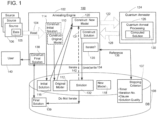
- Figure 1 shows a simplified view of an example system that is configured to implement iterative quantum annealing according to an embodiment.
- system 100 comprises an annealing engine 102 that is configured to read 104 selected data 105 available from one or more sources 106.
- the annealing engine is in communication with a non-transitory computer readable storage medium 108, which may comprise a database. That storage medium may receive and retain data that is read from source(s) by the annealing engine.
- that stored data may be referenced by the annealing engine in order to construct 110 an original optimization model 112.
- a matrix may be constructed by the engine.
- Figure 1 shows the engine constructing the original optimization model, this is not required. According to certain embodiments an already-existing original optimization model may be available for reading from a source and for retention in the storage medium.
- Stored data that has been selected and read from source(s), may also be used in constructing 114 an initial solution 116 to the optimization. Again, however, in alternative embodiments the initial solution may already be available from source(s) for import and reference by the annealing engine (rather than being constructed).
- a new QUBO model 118 is constructed 120. Such construction of a QUBO model is described in detail below.
- the constructed new model is then sent 122 to a quantum annealer 124 for processing 126.
- the quantum annealer can take various forms.
- a quantum annealer can be dedicated hardware. Digital annealers and classical solvers (e.g., the Gurobi Optimizer) are also possible. Alternatively, a procedure could implement simulated quantum annealing.
- the quantum annealer executes the QUBO based upon quantum mechanical behavior (actual and/or simulated). The quantum annealer then sends 128 its computed solution 130 back the annealing engine.
- the annealing engine constructs 131 a first solution 132 from the initial solution and the computed solution returned by the quantum annealer.
- the first solution is then written 134 to the storage medium.
- the annealing engine determines 135 whether another iteration of new model generation is appropriate. That is, the first solution may be acceptable, or may be further improved.
- the decision by the annealing engine as to whether or not to perform another iteration of new model generation, can reference 135 one or more stopping criterion 137.
- stopping criterion can include, but are not limited to, one or more of:
- the annealing engine constructs 138 a final solution 139 for storage.
- the first computed solution returned by the quantum annealer, and the solution constructed therefrom may be in mathematical form (e.g., a vector).
- the final solution generated from the solution may represent a user-intelligible parameters regarding the optimization.
- the annealing engine may determine that the first solution should be improved. Under these circumstances, the annealing engine performs another iteration 142 of model generation referencing the first constructed solution (which may have superseded the initial solution, e.g. by overwriting the initial solution in the storage medium).
- the annealing engine constructs the newest model for quantum annealing from latest constructed solution and from the original model. That newest model is again forwarded to the quantum annealer for processing.
- the resulting second computed solution is returned to the annealing engine for handling (construction of another new solution, further iteration determination). Such iterating can continue until a determination is ultimately made (e.g., by the quantum annealer referencing a stopping criterion) to construct a final solution for communication to the user.
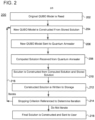
- Figure 2 is a flow diagram of a method 200 according to an embodiment.
- an original first Quadratic Unconstrained Binary Optimization (QUBO) model comprising a first matrix is read.
- QUBO Quadratic Unconstrained Binary Optimization
- a second QUBO model comprising a second matrix is constructed from the first QUBO model and an initial solution.
- the second QUBO model is sent to a quantum annealer;
- a first computed solution is received from the quantum annealer in response to sending the second QUBO model.
- a first intermediate solution is constructed from the initial solution and the first computed solution.
- the first intermediate solution is stored in a non-transitory computer readable storage medium.
- a stopping criterion is referenced to determine whether an iteration should be performed.
- the method returns 216 to 204 to construct a another new model from the original model and the latest solution. If no iteration is determined to be performed, at 218 a final solution is constructed from the latest solution.
- This optimization problem can be transformed into a QUBO. That is, there exists a Q ⁇ ⁇ R n , n , such that z is a solution for: min z T Q ⁇ z : z ⁇ 0,1 n .
- That function constructs the new matrix based on a given matrix and a solution vector.
- the first iteration is standard quantum annealing. From this, it follows that iterative annealing according to embodiments may offer benefits in terms of solution quality.
- the method corresponds to warm start quantum annealing.
- the goal of the capacitated vehicle routing problem is to pick up all of the packages, without overloading the trucks and at the same time minimizing travel time or distance.
- Figure 3 shows an overview of a system 300 according to an example.
- the number of trucks and their respective capacities are known. Such values may be available to SAP Computer Application 302 from a first source 304 (e.g., SAP system 1).
- a first source 304 e.g., SAP system 1).
- an initial solution 308 could be a truck route from a previous day, and is also saved in one or several SAP systems. That is, routes from a previous day should be informative, as the delivery situation is not expected to change dramatically from day-to-day.
- initial solution could be used. For example, a shorter previous route could be available for reference as the initial solution to a longer route.
- the QUBO model 310 represents the optimization problem that is to be solved by quantum annealing. Given an initial solution, embodiments can translate that solution into actual routes that the trucks can then execute.
- a user 312 starts 314 the procedure 1.-8. described below, based upon an interest in determining the truck routes for the present day.
- a decision now may be made whether the solution x is the final solution, or whether the solution x should be further improved. This can be based upon one or more stopping criteria, e.g., •a fixed number of iterations, •a time limit, and/or •a no-progress clause.
- x 0 is set to be the x that was just computed in the previous iteration.
- an in-memory database engine e.g., the in-memory database engine of the HANA in-memory database available from SAP SE
- functions can include, but are not limited to one or more of:
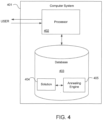
- Figure 4 illustrates hardware of a special purpose computing machine configured to perform iterative quantum anneal according to an embodiment.
- computer system 401 comprises a processor 402 that is in electronic communication with a non-transitory computer-readable storage medium comprising a database 403.
- This computer-readable storage medium has stored thereon code 405 corresponding to an annealing engine.
- Code 404 corresponds to a solution.
- Code may be configured to reference data stored in a database of a non-transitory computer-readable storage medium, for example as may be present locally or in a remote database server.
- Software servers together may form a cluster or logical network of computer systems programmed with software programs that communicate with each other and work together in order to process requests.
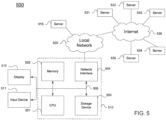
- Computer system 510 includes a bus 505 or other communication mechanism for communicating information, and a processor 501 coupled with bus 505 for processing information.
- Computer system 510 also includes a memory 502 coupled to bus 505 for storing information and instructions to be executed by processor 501, including information and instructions for performing the techniques described above, for example.
- This memory may also be used for storing variables or other intermediate information during execution of instructions to be executed by processor 501. Possible implementations of this memory may be, but are not limited to, random access memory (RAM), read only memory (ROM), or both.
- a storage device 503 is also provided for storing information and instructions.
- Storage devices include, for example, a hard drive, a magnetic disk, an optical disk, a CD-ROM, a DVD, a flash memory, a USB memory card, or any other medium from which a computer can read.
- Storage device 503 may include source code, binary code, or software files for performing the techniques above, for example.
- Storage device and memory are both examples of computer readable mediums.
- Computer system 510 may be coupled via bus 505 to a display 512, such as a Light Emitting Diode (LED) or liquid crystal display (LCD), for displaying information to a computer user.
- a display 512 such as a Light Emitting Diode (LED) or liquid crystal display (LCD)
- An input device 511 such as a keyboard and/or mouse is coupled to bus 505 for communicating information and command selections from the user to processor 501.
- bus 505 may be divided into multiple specialized buses.
- Computer system 510 also includes a network interface 504 coupled with bus 505.
- Network interface 504 may provide two-way data communication between computer system 510 and the local network 520.
- the network interface 504 may be a digital subscriber line (DSL) or a modem to provide data communication connection over a telephone line, for example.
- DSL digital subscriber line
- Another example of the network interface is a local area network (LAN) card to provide a data communication connection to a compatible LAN.
- LAN local area network
- Wireless links are another example.
- network interface 504 sends and receives electrical, electromagnetic, or optical signals that carry digital data streams representing various types of information.
- Computer system 510 can send and receive information, including messages or other interface actions, through the network interface 504 across a local network 520, an Intranet, or the Internet 530.
- computer system 510 may communicate with a plurality of other computer machines, such as server 515.
- server 515 may form a cloud computing network, which may be programmed with processes described herein.
- software components or services may reside on multiple different computer systems 510 or servers 531-535 across the network.
- the processes described above may be implemented on one or more servers, for example.
- a server 531 may transmit actions or messages from one component, through Internet 530, local network 520, and network interface 504 to a component on computer system 510.
- the software components and processes described above may be implemented on any computer system and send and/or receive information across a network, for example.
Landscapes
- Engineering & Computer Science (AREA)
- Physics & Mathematics (AREA)
- General Physics & Mathematics (AREA)
- Theoretical Computer Science (AREA)
- Business, Economics & Management (AREA)
- Mathematical Physics (AREA)
- Data Mining & Analysis (AREA)
- Mathematical Analysis (AREA)
- Mathematical Optimization (AREA)
- Pure & Applied Mathematics (AREA)
- Computational Mathematics (AREA)
- General Engineering & Computer Science (AREA)
- Software Systems (AREA)
- Economics (AREA)
- Computing Systems (AREA)
- Human Resources & Organizations (AREA)
- Evolutionary Computation (AREA)
- Artificial Intelligence (AREA)
- Operations Research (AREA)
- Strategic Management (AREA)
- Condensed Matter Physics & Semiconductors (AREA)
- Entrepreneurship & Innovation (AREA)
- Marketing (AREA)
- General Business, Economics & Management (AREA)
- Tourism & Hospitality (AREA)
- Development Economics (AREA)
- Quality & Reliability (AREA)
- Algebra (AREA)
- Databases & Information Systems (AREA)
- Computational Linguistics (AREA)
- Game Theory and Decision Science (AREA)
- Management, Administration, Business Operations System, And Electronic Commerce (AREA)
- Life Sciences & Earth Sciences (AREA)
- Bioinformatics & Cheminformatics (AREA)
- Bioinformatics & Computational Biology (AREA)
- Probability & Statistics with Applications (AREA)
- Evolutionary Biology (AREA)
- Recrystallisation Techniques (AREA)
Abstract
Description
- Unless otherwise indicated herein, the approaches described in this section are not prior art to the claims in this application and are not admitted to be prior art by inclusion in this section.
- Quantum computing approaches leverage quantum mechanical behavior in order to perform certain operations. For example, quantum computing may be useful in performing an optimization.
- Embodiments implement iterative quantum annealing to provide a solution of an optimization. An annealing engine is located upstream of a quantum annealer (or a digital annealer, simulated annealer, or classical solver). The annealing engine is configured to process an initial solution to an original Quadratic Unconstrained Binary Optimization (QUBO) model, and thereby construct a second QUBO model. The second model is then fed to the quantum annealer, which returns a computed solution. The annealing engine constructs an intermediate solution from the computed solution and the second QUBO model. If the annealing engine determines a stopping criterion is satisfied by the intermediate solution, a final solution is constructed therefrom. If the annealing engine determines the stopping criterion is not satisfied, the second QUBO model is overwritten with the intermediate solution to form the basis for another iteration of QUBO model creation, quantum annealing, and evaluation of satisfaction of the stopping criterion.
- The following detailed description and accompanying drawings provide a better understanding of the nature and advantages of various embodiments.
-
-
Figure 1 shows a simplified diagram of a system according to an embodiment. -
Figure 2 shows a simplified flow diagram of a method according to an embodiment. -
Figure 3 shows an overview of a system according to an example. -
Figure 4 illustrates hardware of a special purpose computing machine configured to implement iterative quantum anneal according to an embodiment. -
Figure 5 illustrates an example computer system. - Described herein are methods and apparatuses that implement iterative quantum annealing. In the following description, for purposes of explanation, numerous examples and specific details are set forth in order to provide a thorough understanding of embodiments according to the present invention. It will be evident, however, to one skilled in the art that embodiments as defined by the claims may include some or all of the features in these examples alone or in combination with other features described below, and may further include modifications and equivalents of the features and concepts described herein.
- One type of quantum computing, is quantum annealing. Quantum annealing is an optimization process that exploits the nature of quantum mechanics to find the global minima of a Quadratic Unconstrained Binary Optimization (QUBO):

- Due to its expressiveness and close relation to the Ising model, a QUBO is used as the de facto standard interface for quantum annealing.
- Quantum annealing may offer exponential speed up to classical methods.
- As implemented in practice, quantum annealing may be considered to be a heuristic. That is, quantum annealing offers a solution that is valuable, but may not be guaranteed as optimal.
- Quantum annealing does not support warm starting. That is, quantum annealing does not accept an initial solution and improve it further. Rather, quantum annealing starts from scratch. Such lack of support for a warm start can pose issues in attempting to combine classical methods or procedures and quantum annealing.
- In addition, one cannot apply quantum annealing iteratively in order to solve combinatorial optimization problems. This can undesirably restrict the usage and application of quantum annealing.
- In order to avoid these issues and render quantum annealing more useful, embodiments derive an iterative approach to solve QUBOs with quantum annealing and an initial solution. In particular, given an initial solution, embodiments construct a QUBO that computes a delta to that current solution with quantum annealing. This procedure can then be used iteratively and in combination with classical methods or procedures.
-
Figure 1 shows a simplified view of an example system that is configured to implement iterative quantum annealing according to an embodiment. Specifically,system 100 comprises anannealing engine 102 that is configured to read 104 selecteddata 105 available from one ormore sources 106. - The annealing engine is in communication with a non-transitory computer
readable storage medium 108, which may comprise a database. That storage medium may receive and retain data that is read from source(s) by the annealing engine. - In certain embodiments, that stored data may be referenced by the annealing engine in order to construct 110 an
original optimization model 112. For the case of a QUBO model, a matrix may be constructed by the engine. - While
Figure 1 shows the engine constructing the original optimization model, this is not required. According to certain embodiments an already-existing original optimization model may be available for reading from a source and for retention in the storage medium. - Stored data that has been selected and read from source(s), may also be used in constructing 114 an
initial solution 116 to the optimization. Again, however, in alternative embodiments the initial solution may already be available from source(s) for import and reference by the annealing engine (rather than being constructed). - Based upon the original optimization model and the initial solution, a new QUBO
model 118 is constructed 120. Such construction of a QUBO model is described in detail below. - The constructed new model is then sent 122 to a
quantum annealer 124 for processing 126. The quantum annealer can take various forms. - A quantum annealer can be dedicated hardware. Digital annealers and classical solvers (e.g., the Gurobi Optimizer) are also possible. Alternatively, a procedure could implement simulated quantum annealing.
- The quantum annealer executes the QUBO based upon quantum mechanical behavior (actual and/or simulated). The quantum annealer then sends 128 its computed
solution 130 back the annealing engine. - The annealing engine constructs 131 a
first solution 132 from the initial solution and the computed solution returned by the quantum annealer. The first solution is then written 134 to the storage medium. - The annealing engine then determines 135 whether another iteration of new model generation is appropriate. That is, the first solution may be acceptable, or may be further improved.
- The decision by the annealing engine as to whether or not to perform another iteration of new model generation, can reference 135 one or more stopping
criterion 137. Examples of stopping criterion can include, but are not limited to, one or more of: - a (fixed) number of iterations;
- a time limit;
- a no-progress clause (e.g., including a solution quality).
- If it is determined that the solution should not be further improved, then no further iterations with the quantum annealer take place. The annealing engine constructs 138 a
final solution 139 for storage. - More specifically, the first computed solution returned by the quantum annealer, and the solution constructed therefrom, may be in mathematical form (e.g., a vector). By contrast, the final solution generated from the solution may represent a user-intelligible parameters regarding the optimization.
- Illustration of this is further discussed in the example below, which involves optimization of vehicle delivery routes. While the computed solution returned by the quantum annealer could be in the form of a mathematical vector, the final solution that is ultimately returned to a user 140 (application or human), could be in the form of optimized geographic vehicle routes (physical locations and roads connecting them).
- The annealing engine may determine that the first solution should be improved. Under these circumstances, the annealing engine performs another
iteration 142 of model generation referencing the first constructed solution (which may have superseded the initial solution, e.g. by overwriting the initial solution in the storage medium). - During that next iteration, the annealing engine constructs the newest model for quantum annealing from latest constructed solution and from the original model. That newest model is again forwarded to the quantum annealer for processing.
- The resulting second computed solution is returned to the annealing engine for handling (construction of another new solution, further iteration determination). Such iterating can continue until a determination is ultimately made (e.g., by the quantum annealer referencing a stopping criterion) to construct a final solution for communication to the user.
-
Figure 2 is a flow diagram of amethod 200 according to an embodiment. At 202, an original first Quadratic Unconstrained Binary Optimization (QUBO) model comprising a first matrix is read. - At 204, a second QUBO model comprising a second matrix is constructed from the first QUBO model and an initial solution. At 206 the second QUBO model is sent to a quantum annealer;
- At 208, a first computed solution is received from the quantum annealer in response to sending the second QUBO model. At 210, a first intermediate solution is constructed from the initial solution and the first computed solution.
- At 212, the first intermediate solution is stored in a non-transitory computer readable storage medium. At 214, a stopping criterion is referenced to determine whether an iteration should be performed.
- If another iteration is to be performed, the method returns 216 to 204 to construct a another new model from the original model and the latest solution. If no iteration is determined to be performed, at 218 a final solution is constructed from the latest solution.
- Further details regarding iterative quantum annealing according to various embodiments, are now provided in connection with the following derivation.
- First, for the sake of simplicity, let us introduce modular 2 addition:

- Now, for a QUBO, defined by the matrix:

- Then for any y ∈ {0,1} n , there exists an z ∈ {0,1} n such that x = y ⊕ z and z is a solution of the following optimization problem:

- This optimization problem can be transformed into a QUBO. That is, there exists a Q̃ ∈


- We will now construct the matrix Q. First, we partition the indices I = {1, ... , n}:

- With 1 ⊕ z = 1 - z, we get:

- Because of zi ∈ {0,1}, we have


- Hence, (y ⊕ z)TQ(y ⊕ z)=

- Now, let


- Then,

- Setting


- In summary, for a given y and z ∈ argmin{zTQ̃z : z ∈ {0,1} n }, we have

- For the sake of simplicity, we introduce the function:

- That function constructs the new matrix based on a given matrix and a solution vector.
- Given the notation already introduced, the function T maps Q and y to Q̃. That is:

- Furthermore, for


- An embodiment of a method for iterative annealing now can be stated as follows.
- Given: A matrix

- Output: A good solution x ∈ {0,1} n for min{xTQx : x ∈ {0,1}n}
- Method:
- 1. Construct Q̃ ← T(Q, x)
- 2. Apply quantum annealing Δx ← α(Q i+1)
- 3. If ΔxTQ̃Δx < 0 update x by x ← x ⊕ Δx
- 4. Go to 1 or return x
- When using the zero vector x = 0 n as an initial solution, the first iteration is standard quantum annealing. From this, it follows that iterative annealing according to embodiments may offer benefits in terms of solution quality.
- In 4. above, it is not specified when to go to 1. or return x. Examples of a possible stopping criterion could include but are not limited to:
- a fixed number of iterations,
- a time limit, or
- a no-progress clause.
- When choosing x ≠ 0 n , for example if x is computed by a classical heuristic, and using the stopping clause "True" (i.e., the solution of the first application of quantum annealing is returned), the method corresponds to warm start quantum annealing.
- An example of an embodiment of performing iterative quantum annealing is now described in connection with the capacitated vehicle routing problem. This assumes that a software program available from SAP SE of Walldorf, Germany, is charged with finding the best routes for moving packages.
- In particular, there are several customers, each with a certain number of packages they want to have picked up. In addition, there is an existing fleet of trucks, each with a certain capacity.
- The goal of the capacitated vehicle routing problem, is to pick up all of the packages, without overloading the trucks and at the same time minimizing travel time or distance.
-
Figure 3 shows an overview of asystem 300 according to an example. Here, the number of trucks and their respective capacities are known. Such values may be available toSAP Computer Application 302 from a first source 304 (e.g., SAP system 1). - Also accessible to the SAP application, are:
- the customers;
- customer locations;
- customer demands
- distances and/or travel times from one costumer to another.
- These values are available from a different source 306 (e.g., SAP system 2). Together, the
data 307 that is available from the various sources can be used to construct the QUBO model. - In this example, an
initial solution 308 could be a truck route from a previous day, and is also saved in one or several SAP systems. That is, routes from a previous day should be informative, as the delivery situation is not expected to change dramatically from day-to-day. - It is noted that a different type of initial solution could be used. For example, a shorter previous route could be available for reference as the initial solution to a longer route.
- The
QUBO model 310 represents the optimization problem that is to be solved by quantum annealing. Given an initial solution, embodiments can translate that solution into actual routes that the trucks can then execute. - As shown in
Figure 3 , a user 312 (SAP user or system) starts 314 the procedure 1.-8. described below, based upon an interest in determining the truck routes for the present day. - 1. From the SAP systems and additional source(s) 315, the data 316 for constructing the QUBO model is selected. This data is read 317 by the
computing device 318 running the SAP application. - 2. With the data selected in 1, the matrix Q representing the QUBO model is constructed.
- 3. From the SAP systems and/or additional source(s), the
data 320 to construct the initial solution is selected. This data is read by the computing device running the application. - 4. With the data that is selected and read in 3, the initial solution x 0 representing the QUBO model is constructed.
- 5. A
new QUBO model 322 is then constructed from the original model at 2. and the initial solution at 4. Thus, the matrix Q̋ is constructed from Q and x 0 as previously described.- Note: in the mathematical derivation given above, x 0 simply represents the initial value of x. This is because we iteratively overwrite the initial solution.
- Thus according to embodiments, the initial solution gets overwritten with an intermediate solution in each iteration. The intermediate solution is itself overwritten (or not) in producing the final solution at the conclusion of the procedure.
- 6. The QUBO model constructed in 5. is then sent 324 to the
quantum annealer 326. That is, the QUBO model is sent from the computing device (on which the SAP application runs) to a computing device responsible for managing the quantum annealer.
The quantum annealer runs the QUBO represented by the matrix Q̃. The quantum annealer sends 328 its computed solution Δx back the computing device (on which the SAP application runs). - 7. At 330, set x = x 0 ⊕ Δx that represents a new and optimized route. The solution Δx received from the quantum annealer tells if the initial routing should be changed in the following way:
- if, for example, the i-th entry is 1 (Δxi = 1), then
- the entry i-th entry in x 0 in needs to change.
- According to the current example, suppose that in one route, customer a is succeeded by customer b, and customer c is succeeded by customer d. Now, the Δx tells that the route should not go from a to b and from c to d, but rather from a to d and from c to b.
- This would correspond to four (4) bit-flips:
- two (2) for deselecting going from a to b and from c to d, and
- two (2) for selecting going from a to d and from c to b.
- A decision now may be made whether the solution x is the final solution, or whether the solution x should be further improved. This can be based upon one or more stopping criteria, e.g., •a fixed number of iterations, •a time limit, and/or •a no-progress clause.
- If the solution should be further improved, then at 332 the system goes back to step 5. Under these circumstances x 0 is set to be the x that was just computed in the previous iteration.
- If, however, it is concluded that x is the final solution, then the procedure moves 334 to 8. below.
- 8. Lastly, at 336, the (mathematical) final solution x is converted to an actual routing for the vehicles. That routing is communicated 338 to the user.
- Returning now to
Figure 1 , there the particular embodiment is depicted with the engine as being located outside of the database. However, this is not required. - Rather, alternative embodiments could leverage the processing power of an in-memory database engine (e.g., the in-memory database engine of the HANA in-memory database available from SAP SE), in order to perform various functions. Examples of such functions can include, but are not limited to one or more of:
- storing data read from source;
- constructing initial solution;
- constructing original model;
- constructing new model from initial solution and computed solution;
- constructing final solution;
- storing (e.g., time, iteration, solution quality, and/or clause) information referenced by stopping criterion.
- Thus
Figure 4 illustrates hardware of a special purpose computing machine configured to perform iterative quantum anneal according to an embodiment. In particular,computer system 401 comprises aprocessor 402 that is in electronic communication with a non-transitory computer-readable storage medium comprising adatabase 403. This computer-readable storage medium has stored thereoncode 405 corresponding to an annealing engine.Code 404 corresponds to a solution. Code may be configured to reference data stored in a database of a non-transitory computer-readable storage medium, for example as may be present locally or in a remote database server. Software servers together may form a cluster or logical network of computer systems programmed with software programs that communicate with each other and work together in order to process requests. - In view of the above-described implementations of subject matter this application discloses the following list of examples, wherein one feature of an example in isolation or more than one feature of said example taken in combination and, optionally, in combination with one or more features of one or more further examples are further examples also falling within the disclosure of this application:
- Example 1. Computer implemented system and methods comprising:
- reading a first Quadratic Unconstrained Binary Optimization (QUBO) model comprising a first matrix;
- constructing from the first QUBO model and an initial solution, a second QUBO model comprising a second matrix;
- sending the second QUBO model to a quantum annealer;
- receiving from the quantum annealer, a first computed solution in response to sending the second QUBO model;
- constructing a first intermediate solution from the initial solution and the first computed solution; and
- writing the first intermediate solution to a non-transitory computer readable storage medium.
- Example 2. The computer implemented system and method of Example 1 further comprising:
- transforming the first intermediate solution into a final solution; and
- communicating the final solution to a user.
- Example 3. The computer implemented system and method of Example 1 or 2 further comprising:
- determining the first intermediate solution does not satisfy a stopping criterion;
- constructing from the second QLTBO model and the first solution, a third QUBO model;
- sending the third QUBO model to the quantum annealer;
- receiving a second computed solution from the quantum annealer in response to sending the third QUBO model;
- constructing a second intermediate solution from the initial solution and the second computed solution; and
- overwriting the first intermediate solution with the second intermediate solution.
- Example 4. The computer implemented system and method of Example 3 wherein the stopping criterion comprises at least one of a number of iterations and a time limit.
- Example 5. The computer implemented system and method of Example 3 or 4 further comprising:
- determining a solution quality of the first solution,
- wherein the stopping criterion comprises a no-progress clause referencing the solution quality.
- Example 6. The computer implemented system and method of Example 1, 2, 3, 4, or 5 further comprising constructing the initial solution from data read from a source.
- Example 7. The computer implemented system and method of Examples 1, 2, 3, 4, 5, or 6 further comprising constructing the first QUBO model from data read from a source.
- Example 8. The computer implemented system and method of Examples 1, 2, 3, 4, 5, 6, or 7 wherein the quantum annealer comprises at least one of a digital annealer, a simulated annealer, and a classical solver.
- Example 9. The computer implemented system and method of Examples 1, 2, 3, 4, 5, 6, 7, or 8 wherein:
- an in-memory database engine of an in-memory database constructs the second QUBO model from the first QUBO model and the initial solution; and
- the non-transitory computer readable storage medium comprises the in-memory database.
- An
example computer system 500 is illustrated inFigure 5 .Computer system 510 includes abus 505 or other communication mechanism for communicating information, and aprocessor 501 coupled withbus 505 for processing information.Computer system 510 also includes amemory 502 coupled tobus 505 for storing information and instructions to be executed byprocessor 501, including information and instructions for performing the techniques described above, for example. This memory may also be used for storing variables or other intermediate information during execution of instructions to be executed byprocessor 501. Possible implementations of this memory may be, but are not limited to, random access memory (RAM), read only memory (ROM), or both. Astorage device 503 is also provided for storing information and instructions. Common forms of storage devices include, for example, a hard drive, a magnetic disk, an optical disk, a CD-ROM, a DVD, a flash memory, a USB memory card, or any other medium from which a computer can read.Storage device 503 may include source code, binary code, or software files for performing the techniques above, for example. Storage device and memory are both examples of computer readable mediums. -
Computer system 510 may be coupled viabus 505 to adisplay 512, such as a Light Emitting Diode (LED) or liquid crystal display (LCD), for displaying information to a computer user. Aninput device 511 such as a keyboard and/or mouse is coupled tobus 505 for communicating information and command selections from the user toprocessor 501. The combination of these components allows the user to communicate with the system. In some systems,bus 505 may be divided into multiple specialized buses. -
Computer system 510 also includes anetwork interface 504 coupled withbus 505.Network interface 504 may provide two-way data communication betweencomputer system 510 and thelocal network 520. Thenetwork interface 504 may be a digital subscriber line (DSL) or a modem to provide data communication connection over a telephone line, for example. Another example of the network interface is a local area network (LAN) card to provide a data communication connection to a compatible LAN. Wireless links are another example. In any such implementation,network interface 504 sends and receives electrical, electromagnetic, or optical signals that carry digital data streams representing various types of information. -
Computer system 510 can send and receive information, including messages or other interface actions, through thenetwork interface 504 across alocal network 520, an Intranet, or theInternet 530. For a local network,computer system 510 may communicate with a plurality of other computer machines, such asserver 515. Accordingly,computer system 510 and server computer systems represented byserver 515 may form a cloud computing network, which may be programmed with processes described herein. In the Internet example, software components or services may reside on multipledifferent computer systems 510 or servers 531-535 across the network. The processes described above may be implemented on one or more servers, for example. Aserver 531 may transmit actions or messages from one component, throughInternet 530,local network 520, andnetwork interface 504 to a component oncomputer system 510. The software components and processes described above may be implemented on any computer system and send and/or receive information across a network, for example. - The above description illustrates various embodiments of the present invention along with examples of how aspects of the present invention may be implemented. The above examples and embodiments should not be deemed to be the only embodiments, and are presented to illustrate the flexibility and advantages of the present invention as defined by the following claims. Based on the above disclosure and the following claims, other arrangements, embodiments, implementations and equivalents will be evident to those skilled in the art and may be employed without departing from the spirit and scope of the invention as defined by the claims.
Claims (15)
- A method comprising:reading a first Quadratic Unconstrained Binary Optimization (QUBO) model comprising a first matrix;constructing from the first QUBO model and an initial solution, a second QUBO model comprising a second matrix;sending the second QUBO model to a quantum annealer;receiving from the quantum annealer, a first computed solution in response to sending the second QUBO model;constructing a first intermediate solution from the initial solution and the first computed solution; andwriting the first intermediate solution to a non-transitory computer readable storage medium.
- A method as in claim 1 further comprising:transforming the first intermediate solution into a final solution; andcommunicating the final solution to a user.
- A method as in claim 1 or 2 further comprising:determining the first intermediate solution does not satisfy a stopping criterion;constructing from the second QUBO model and the first solution, a third QUBO model;sending the third QUBO model to the quantum annealer;receiving a second computed solution from the quantum annealer in response to sending the third QUBO model;constructing a second intermediate solution from the initial solution and the second computed solution; andoverwriting the first intermediate solution with the second intermediate solution.
- A method as in claim 3 wherein the stopping criterion comprises at least one of a number of iterations and a time limit; and/or
further comprising:determining a solution quality of the first solution,wherein the stopping criterion comprises a no-progress clause referencing the solution quality. - A method as in any one of claims 1 to 4 further comprising constructing the initial solution from data read from a source; and/or
further comprising constructing the first QUBO model from data read from a source. - A method as in any one of claims 1 to 5 wherein the quantum annealer comprises at least one of a digital annealer, a simulated annealer, and a classical solver; and/or wherein:an in-memory database engine of an in-memory database constructs the second QUBO model from the first QUBO model and the initial solution; andthe non-transitory computer readable storage medium comprises the in-memory database.
- A non-transitory computer readable storage medium embodying a computer program for performing a method, said method comprising:reading a first Quadratic Unconstrained Binary Optimization (QUBO) model comprising a first matrix;constructing from the first QUBO model and an initial solution, a second QUBO model comprising a second matrix;sending the second QUBO model to a quantum annealer;receiving from the quantum annealer, a first computed solution in response to sending the second QUBO model;constructing a first intermediate solution from the initial solution and the first computed solution; andwriting the first intermediate solution to a non-transitory computer readable storage medium.determining the first intermediate solution does not satisfy a stopping criterion;constructing from the second QUBO model and the first solution, a third QUBO model;sending the third QUBO model to the quantum annealer;receiving a second computed solution from the quantum annealer in response to sending the third QUBO model;constructing a second intermediate solution from the initial solution and the second computed solution; andoverwriting the first intermediate solution with the second intermediate solution.
- A non-transitory computer readable storage medium as in claim 7 wherein the stopping criterion comprises at least one of a number of iterations and a time limit; and/or wherein the method further comprises:determining a solution quality of the first solution,wherein the stopping criterion comprises a no-progress clause referencing the solution quality.
- A non-transitory computer readable storage medium as in claim 7 or 8 wherein the method further comprises constructing the initial solution from data read from a source; and/or
wherein the method further comprises constructing the first QUBO model from data read from a source. - A computer system comprising:one or more processors;a software program, executable on said computer system, the software program configured to cause an in-memory database engine of an in-memory database to:read from the in-memory database, a first Quadratic Unconstrained Binary Optimization (QUBO) model comprising a first matrix;construct from the first QUBO model and an initial solution, a second QUBO model comprising a second matrix;send the second QUBO model to a quantum annealer;receive from the quantum annealer, a first computed solution in response to sending the second QUBO model;construct a first intermediate solution from the initial solution and the first computed solution; andwrite the first intermediate solution to the in-memory database.
- A computer system as in claim 10 wherein the in-memory database engine is further configured to:determine the first intermediate solution does not satisfy a stopping criterion;construct from the second QUBO model and the first solution, a third QUBO model;send the third QUBO model to the quantum annealer;receive a second computed solution from the quantum annealer in response to sending the third QUBO model;construct a second intermediate solution from the initial solution and the second computed solution; andoverwrite the first intermediate solution with the second intermediate solution.
- A computer system as in claim 11 wherein the stopping criterion comprises at least one of a number of iterations, a time limit, and a stopping criterion.
- A computer system as in any one of claims 10 to 12 wherein the in-memory database engine is further configured to construct a final solution from an intermediate solution.
- A computer system as in any one of claims 10 to 13 wherein the in-memory database engine is further configured to construct the initial solution from data read from a source.
- A computer system as in any one of claims 10 to 14 wherein the in-memory database engine is further configured to construct the first QUBO model from data read from a source.
Applications Claiming Priority (1)
| Application Number | Priority Date | Filing Date | Title |
|---|---|---|---|
| US17/959,105 US20240126834A1 (en) | 2022-10-03 | 2022-10-03 | Iterative Quantum Annealing |
Publications (1)
| Publication Number | Publication Date |
|---|---|
| EP4350584A1 true EP4350584A1 (en) | 2024-04-10 |
Family
ID=87863570
Family Applications (1)
| Application Number | Title | Priority Date | Filing Date |
|---|---|---|---|
| EP23193828.3A Withdrawn EP4350584A1 (en) | 2022-10-03 | 2023-08-29 | Iterative quantum annealing |
Country Status (3)
| Country | Link |
|---|---|
| US (1) | US20240126834A1 (en) |
| EP (1) | EP4350584A1 (en) |
| CN (1) | CN117829304A (en) |
Families Citing this family (2)
| Publication number | Priority date | Publication date | Assignee | Title |
|---|---|---|---|---|
| US20250202500A1 (en) * | 2023-12-15 | 2025-06-19 | Dell Products L.P. | A compression method for qubos and ising models |
| US20250238702A1 (en) * | 2024-01-23 | 2025-07-24 | Dell Products L.P. | Explainable quantum annealing |
Citations (3)
| Publication number | Priority date | Publication date | Assignee | Title |
|---|---|---|---|---|
| US20210303704A1 (en) * | 2020-03-31 | 2021-09-30 | Fujitsu Limited | Data privacy protection on cloud-based optimization systems |
| EP3893168A1 (en) * | 2020-04-09 | 2021-10-13 | Accenture Global Solutions Limited | Quantum computation for intensity-modulated radiation therapy |
| WO2022087535A1 (en) * | 2020-10-23 | 2022-04-28 | Entanglement, Inc. | Method and apparatus for logistics management using quantum computing |
Family Cites Families (4)
| Publication number | Priority date | Publication date | Assignee | Title |
|---|---|---|---|---|
| US20170242824A1 (en) * | 2016-02-23 | 2017-08-24 | 1Qb Information Technologies Inc. | Method and system for solving the lagrangian dual of a binary polynomially constrained polynomial programming problem using a quantum annealer |
| US20220389414A1 (en) * | 2019-10-28 | 2022-12-08 | The Governing Council Of The University Of Toronto | Molecular computing methods and systems for solving computational problems |
| US20240127122A1 (en) * | 2021-06-30 | 2024-04-18 | Sony Group Corporation | Information processing device, information processing method, and information processing program |
| US20230325461A1 (en) * | 2022-04-11 | 2023-10-12 | Noblis, Inc. | Hardware accelerated minor embedding for quantum annealing |
-
2022
- 2022-10-03 US US17/959,105 patent/US20240126834A1/en active Pending
-
2023
- 2023-08-28 CN CN202311093108.5A patent/CN117829304A/en active Pending
- 2023-08-29 EP EP23193828.3A patent/EP4350584A1/en not_active Withdrawn
Patent Citations (3)
| Publication number | Priority date | Publication date | Assignee | Title |
|---|---|---|---|---|
| US20210303704A1 (en) * | 2020-03-31 | 2021-09-30 | Fujitsu Limited | Data privacy protection on cloud-based optimization systems |
| EP3893168A1 (en) * | 2020-04-09 | 2021-10-13 | Accenture Global Solutions Limited | Quantum computation for intensity-modulated radiation therapy |
| WO2022087535A1 (en) * | 2020-10-23 | 2022-04-28 | Entanglement, Inc. | Method and apparatus for logistics management using quantum computing |
Also Published As
| Publication number | Publication date |
|---|---|
| CN117829304A (en) | 2024-04-05 |
| US20240126834A1 (en) | 2024-04-18 |
Similar Documents
| Publication | Publication Date | Title |
|---|---|---|
| Singh et al. | Obsolescence driven design refresh planning for sustainment-dominated systems | |
| WO2021164390A1 (en) | Route determination method and appparatus for cold chain distribution, server and storage medium | |
| US12131133B2 (en) | Information processing device supporting solving problems using quantum-related computers and information processing system | |
| US12288074B2 (en) | Generating and providing proposed digital actions in high-dimensional action spaces using reinforcement learning models | |
| US20240126834A1 (en) | Iterative Quantum Annealing | |
| CN110880082B (en) | Service evaluation method, device, system, electronic device and readable storage medium | |
| US9400836B2 (en) | External evaluation processes | |
| US20250013939A1 (en) | Method and system for optimizing an objective heaving discrete constraints | |
| US20230376764A1 (en) | System and method for increasing efficiency of gradient descent while training machine-learning models | |
| KR102288785B1 (en) | Sampling Schemes for Strategic Search in Strategic Interactions Between Parties | |
| Yu et al. | Robust team orienteering problem with decreasing profits | |
| CN111428925B (en) | Method and device for determining distribution route | |
| EP3862936A1 (en) | Information processing apparatus, recording medium, information processing method, and information processing system | |
| WO2021140884A1 (en) | Method for reusing model and computer system | |
| US10789810B1 (en) | Determining action selection policies of an execution device | |
| Farrington et al. | Going faster to see further: graphics processing unit-accelerated value iteration and simulation for perishable inventory control using JAX: J. Farrington et al. | |
| CN111667105B (en) | Intelligent optimization distribution cloud system with time window | |
| Jeet et al. | Learning quantitative finance with R | |
| US12430321B2 (en) | Communication transmission using a communication allocation based on iterative processing | |
| Tarantilis et al. | An efficient meta-heuristic algorithm for routing product collecting vehicles of dehydration plants. II. Algorithm performance and case studies | |
| Ince | A generalized entropy optimization modelling in the theory of stochastic differential equations | |
| CN119379183B (en) | Finished product selection methods, equipment and systems | |
| Even et al. | Strong polynomiality of the Gass-Saaty shadow-vertex pivoting rule for controlled random walks | |
| King et al. | A Recycling Heuristic Capable of Generating Initial Solutions for Use in Vehicle Routing Metaheuristics | |
| EP4740164A1 (en) | Intelligent systems and methods for click price generation |
Legal Events
| Date | Code | Title | Description |
|---|---|---|---|
| PUAI | Public reference made under article 153(3) epc to a published international application that has entered the european phase |
Free format text: ORIGINAL CODE: 0009012 |
|
| STAA | Information on the status of an ep patent application or granted ep patent |
Free format text: STATUS: THE APPLICATION HAS BEEN PUBLISHED |
|
| AK | Designated contracting states |
Kind code of ref document: A1 Designated state(s): AL AT BE BG CH CY CZ DE DK EE ES FI FR GB GR HR HU IE IS IT LI LT LU LV MC ME MK MT NL NO PL PT RO RS SE SI SK SM TR |
|
| STAA | Information on the status of an ep patent application or granted ep patent |
Free format text: STATUS: REQUEST FOR EXAMINATION WAS MADE |
|
| 17P | Request for examination filed |
Effective date: 20240815 |
|
| RBV | Designated contracting states (corrected) |
Designated state(s): AL AT BE BG CH CY CZ DE DK EE ES FI FR GB GR HR HU IE IS IT LI LT LU LV MC ME MK MT NL NO PL PT RO RS SE SI SK SM TR |
|
| STAA | Information on the status of an ep patent application or granted ep patent |
Free format text: STATUS: EXAMINATION IS IN PROGRESS |
|
| 17Q | First examination report despatched |
Effective date: 20250109 |
|
| STAA | Information on the status of an ep patent application or granted ep patent |
Free format text: STATUS: THE APPLICATION HAS BEEN WITHDRAWN |
|
| 18W | Application withdrawn |
Effective date: 20250424 |