EP4349876A1 - Antibacterial san resin, preparation method therefor, and antibacterial abs resin composition containing same - Google Patents
Antibacterial san resin, preparation method therefor, and antibacterial abs resin composition containing same Download PDFInfo
- Publication number
- EP4349876A1 EP4349876A1 EP22849733.5A EP22849733A EP4349876A1 EP 4349876 A1 EP4349876 A1 EP 4349876A1 EP 22849733 A EP22849733 A EP 22849733A EP 4349876 A1 EP4349876 A1 EP 4349876A1
- Authority
- EP
- European Patent Office
- Prior art keywords
- antibacterial
- san resin
- san
- resin
- repeating unit
- Prior art date
- Legal status (The legal status is an assumption and is not a legal conclusion. Google has not performed a legal analysis and makes no representation as to the accuracy of the status listed.)
- Pending
Links
- 230000000844 anti-bacterial effect Effects 0.000 title claims abstract description 123
- 229920005989 resin Polymers 0.000 title claims abstract description 119
- 239000011347 resin Substances 0.000 title claims abstract description 119
- 229920000122 acrylonitrile butadiene styrene Polymers 0.000 title claims abstract description 25
- 239000011342 resin composition Substances 0.000 title claims abstract description 13
- 238000002360 preparation method Methods 0.000 title description 15
- 239000000126 substance Substances 0.000 claims abstract description 42
- 238000000034 method Methods 0.000 claims abstract description 27
- 239000000178 monomer Substances 0.000 claims description 104
- PPBRXRYQALVLMV-UHFFFAOYSA-N Styrene Chemical compound C=CC1=CC=CC=C1 PPBRXRYQALVLMV-UHFFFAOYSA-N 0.000 claims description 80
- 241000894006 Bacteria Species 0.000 claims description 46
- NLHHRLWOUZZQLW-UHFFFAOYSA-N Acrylonitrile Chemical compound C=CC#N NLHHRLWOUZZQLW-UHFFFAOYSA-N 0.000 claims description 43
- 238000006116 polymerization reaction Methods 0.000 claims description 29
- 125000004432 carbon atom Chemical group C* 0.000 claims description 26
- 238000006243 chemical reaction Methods 0.000 claims description 20
- 239000003505 polymerization initiator Substances 0.000 claims description 16
- 125000000217 alkyl group Chemical group 0.000 claims description 15
- 125000003178 carboxy group Chemical group [H]OC(*)=O 0.000 claims description 15
- 125000001424 substituent group Chemical group 0.000 claims description 11
- 241000588724 Escherichia coli Species 0.000 claims description 7
- 125000003545 alkoxy group Chemical group 0.000 claims description 7
- 125000003118 aryl group Chemical group 0.000 claims description 6
- 230000000379 polymerizing effect Effects 0.000 claims description 6
- 150000001875 compounds Chemical class 0.000 claims description 5
- 229910052739 hydrogen Inorganic materials 0.000 claims description 5
- 239000001257 hydrogen Substances 0.000 claims description 5
- YZCKVEUIGOORGS-OUBTZVSYSA-N Deuterium Chemical compound [2H] YZCKVEUIGOORGS-OUBTZVSYSA-N 0.000 claims description 4
- 229910052805 deuterium Inorganic materials 0.000 claims description 4
- 229910052736 halogen Inorganic materials 0.000 claims description 4
- 150000002367 halogens Chemical class 0.000 claims description 4
- 150000002431 hydrogen Chemical group 0.000 claims description 4
- 125000004356 hydroxy functional group Chemical group O* 0.000 claims description 4
- 125000002887 hydroxy group Chemical group [H]O* 0.000 claims description 4
- QEDJMOONZLUIMC-UHFFFAOYSA-N 1-tert-butyl-4-ethenylbenzene Chemical compound CC(C)(C)C1=CC=C(C=C)C=C1 QEDJMOONZLUIMC-UHFFFAOYSA-N 0.000 claims description 3
- 241000194032 Enterococcus faecalis Species 0.000 claims description 3
- 241000588770 Proteus mirabilis Species 0.000 claims description 3
- 241000191967 Staphylococcus aureus Species 0.000 claims description 3
- QROGIFZRVHSFLM-QHHAFSJGSA-N [(e)-prop-1-enyl]benzene Chemical compound C\C=C\C1=CC=CC=C1 QROGIFZRVHSFLM-QHHAFSJGSA-N 0.000 claims description 3
- XYLMUPLGERFSHI-UHFFFAOYSA-N alpha-Methylstyrene Chemical compound CC(=C)C1=CC=CC=C1 XYLMUPLGERFSHI-UHFFFAOYSA-N 0.000 claims description 3
- 229940032049 enterococcus faecalis Drugs 0.000 claims description 3
- SSZOCHFYWWVSAI-UHFFFAOYSA-N 1-bromo-2-ethenylbenzene Chemical compound BrC1=CC=CC=C1C=C SSZOCHFYWWVSAI-UHFFFAOYSA-N 0.000 claims description 2
- KQJQPCJDKBKSLV-UHFFFAOYSA-N 1-bromo-3-ethenylbenzene Chemical compound BrC1=CC=CC(C=C)=C1 KQJQPCJDKBKSLV-UHFFFAOYSA-N 0.000 claims description 2
- WGGLDBIZIQMEGH-UHFFFAOYSA-N 1-bromo-4-ethenylbenzene Chemical compound BrC1=CC=C(C=C)C=C1 WGGLDBIZIQMEGH-UHFFFAOYSA-N 0.000 claims description 2
- BOVQCIDBZXNFEJ-UHFFFAOYSA-N 1-chloro-3-ethenylbenzene Chemical compound ClC1=CC=CC(C=C)=C1 BOVQCIDBZXNFEJ-UHFFFAOYSA-N 0.000 claims description 2
- KTZVZZJJVJQZHV-UHFFFAOYSA-N 1-chloro-4-ethenylbenzene Chemical compound ClC1=CC=C(C=C)C=C1 KTZVZZJJVJQZHV-UHFFFAOYSA-N 0.000 claims description 2
- ISRGONDNXBCDBM-UHFFFAOYSA-N 2-chlorostyrene Chemical compound ClC1=CC=CC=C1C=C ISRGONDNXBCDBM-UHFFFAOYSA-N 0.000 claims description 2
- TVONJMOVBKMLOM-UHFFFAOYSA-N 2-methylidenebutanenitrile Chemical compound CCC(=C)C#N TVONJMOVBKMLOM-UHFFFAOYSA-N 0.000 claims description 2
- JLBJTVDPSNHSKJ-UHFFFAOYSA-N 4-Methylstyrene Chemical compound CC1=CC=C(C=C)C=C1 JLBJTVDPSNHSKJ-UHFFFAOYSA-N 0.000 claims description 2
- GYCMBHHDWRMZGG-UHFFFAOYSA-N Methylacrylonitrile Chemical compound CC(=C)C#N GYCMBHHDWRMZGG-UHFFFAOYSA-N 0.000 claims description 2
- 125000001997 phenyl group Chemical group [H]C1=C([H])C([H])=C(*)C([H])=C1[H] 0.000 claims description 2
- 230000001747 exhibiting effect Effects 0.000 abstract description 4
- 230000002085 persistent effect Effects 0.000 abstract description 4
- 239000011145 styrene acrylonitrile resin Substances 0.000 description 77
- 229920000638 styrene acrylonitrile Polymers 0.000 description 76
- ZMXDDKWLCZADIW-UHFFFAOYSA-N N,N-Dimethylformamide Chemical compound CN(C)C=O ZMXDDKWLCZADIW-UHFFFAOYSA-N 0.000 description 33
- OZAIFHULBGXAKX-UHFFFAOYSA-N 2-(2-cyanopropan-2-yldiazenyl)-2-methylpropanenitrile Chemical compound N#CC(C)(C)N=NC(C)(C)C#N OZAIFHULBGXAKX-UHFFFAOYSA-N 0.000 description 28
- 239000000243 solution Substances 0.000 description 18
- -1 subjects Substances 0.000 description 18
- 241000192125 Firmicutes Species 0.000 description 15
- 239000002904 solvent Substances 0.000 description 15
- XLYOFNOQVPJJNP-UHFFFAOYSA-N water Substances O XLYOFNOQVPJJNP-UHFFFAOYSA-N 0.000 description 15
- WYURNTSHIVDZCO-UHFFFAOYSA-N Tetrahydrofuran Chemical compound C1CCOC1 WYURNTSHIVDZCO-UHFFFAOYSA-N 0.000 description 14
- 239000003242 anti bacterial agent Substances 0.000 description 13
- 230000000052 comparative effect Effects 0.000 description 13
- 229920001577 copolymer Polymers 0.000 description 11
- 239000000843 powder Substances 0.000 description 9
- 239000007787 solid Substances 0.000 description 9
- 238000012360 testing method Methods 0.000 description 9
- 230000001580 bacterial effect Effects 0.000 description 8
- LFQSCWFLJHTTHZ-UHFFFAOYSA-N Ethanol Chemical compound CCO LFQSCWFLJHTTHZ-UHFFFAOYSA-N 0.000 description 7
- YLQBMQCUIZJEEH-UHFFFAOYSA-N tetrahydrofuran Natural products C=1C=COC=1 YLQBMQCUIZJEEH-UHFFFAOYSA-N 0.000 description 7
- YMWUJEATGCHHMB-UHFFFAOYSA-N Dichloromethane Chemical compound ClCCl YMWUJEATGCHHMB-UHFFFAOYSA-N 0.000 description 6
- 238000005227 gel permeation chromatography Methods 0.000 description 6
- 239000000523 sample Substances 0.000 description 6
- 239000007788 liquid Substances 0.000 description 5
- 229920003023 plastic Polymers 0.000 description 5
- 239000004033 plastic Substances 0.000 description 5
- 229920000642 polymer Polymers 0.000 description 5
- RYHBNJHYFVUHQT-UHFFFAOYSA-N 1,4-Dioxane Chemical compound C1COCCO1 RYHBNJHYFVUHQT-UHFFFAOYSA-N 0.000 description 4
- IAZDPXIOMUYVGZ-WFGJKAKNSA-N Dimethyl sulfoxide Chemical compound [2H]C([2H])([2H])S(=O)C([2H])([2H])[2H] IAZDPXIOMUYVGZ-WFGJKAKNSA-N 0.000 description 4
- VEXZGXHMUGYJMC-UHFFFAOYSA-N Hydrochloric acid Chemical compound Cl VEXZGXHMUGYJMC-UHFFFAOYSA-N 0.000 description 4
- HFBMWMNUJJDEQZ-UHFFFAOYSA-N acryloyl chloride Chemical compound ClC(=O)C=C HFBMWMNUJJDEQZ-UHFFFAOYSA-N 0.000 description 4
- 210000002421 cell wall Anatomy 0.000 description 4
- 230000009477 glass transition Effects 0.000 description 4
- 229920000578 graft copolymer Polymers 0.000 description 4
- 239000012263 liquid product Substances 0.000 description 4
- 238000005259 measurement Methods 0.000 description 4
- 239000000047 product Substances 0.000 description 4
- 229920002554 vinyl polymer Polymers 0.000 description 4
- ZWEHNKRNPOVVGH-UHFFFAOYSA-N 2-Butanone Chemical compound CCC(C)=O ZWEHNKRNPOVVGH-UHFFFAOYSA-N 0.000 description 3
- IRQWEODKXLDORP-UHFFFAOYSA-N 4-ethenylbenzoic acid Chemical compound OC(=O)C1=CC=C(C=C)C=C1 IRQWEODKXLDORP-UHFFFAOYSA-N 0.000 description 3
- 229920001817 Agar Polymers 0.000 description 3
- RTZKZFJDLAIYFH-UHFFFAOYSA-N Diethyl ether Chemical compound CCOCC RTZKZFJDLAIYFH-UHFFFAOYSA-N 0.000 description 3
- LYCAIKOWRPUZTN-UHFFFAOYSA-N Ethylene glycol Chemical compound OCCO LYCAIKOWRPUZTN-UHFFFAOYSA-N 0.000 description 3
- DNIAPMSPPWPWGF-UHFFFAOYSA-N Propylene glycol Chemical compound CC(O)CO DNIAPMSPPWPWGF-UHFFFAOYSA-N 0.000 description 3
- HEMHJVSKTPXQMS-UHFFFAOYSA-M Sodium hydroxide Chemical compound [OH-].[Na+] HEMHJVSKTPXQMS-UHFFFAOYSA-M 0.000 description 3
- YXFVVABEGXRONW-UHFFFAOYSA-N Toluene Chemical compound CC1=CC=CC=C1 YXFVVABEGXRONW-UHFFFAOYSA-N 0.000 description 3
- XECAHXYUAAWDEL-UHFFFAOYSA-N acrylonitrile butadiene styrene Chemical compound C=CC=C.C=CC#N.C=CC1=CC=CC=C1 XECAHXYUAAWDEL-UHFFFAOYSA-N 0.000 description 3
- 239000004676 acrylonitrile butadiene styrene Substances 0.000 description 3
- 239000008272 agar Substances 0.000 description 3
- 239000003963 antioxidant agent Substances 0.000 description 3
- 150000001993 dienes Chemical class 0.000 description 3
- MTHSVFCYNBDYFN-UHFFFAOYSA-N diethylene glycol Chemical compound OCCOCCO MTHSVFCYNBDYFN-UHFFFAOYSA-N 0.000 description 3
- 230000000694 effects Effects 0.000 description 3
- 229920001971 elastomer Polymers 0.000 description 3
- 238000005516 engineering process Methods 0.000 description 3
- 230000002401 inhibitory effect Effects 0.000 description 3
- 230000000704 physical effect Effects 0.000 description 3
- 230000008569 process Effects 0.000 description 3
- 230000002829 reductive effect Effects 0.000 description 3
- 238000003756 stirring Methods 0.000 description 3
- MYRTYDVEIRVNKP-UHFFFAOYSA-N 1,2-Divinylbenzene Chemical compound C=CC1=CC=CC=C1C=C MYRTYDVEIRVNKP-UHFFFAOYSA-N 0.000 description 2
- 238000005160 1H NMR spectroscopy Methods 0.000 description 2
- SDJHPPZKZZWAKF-UHFFFAOYSA-N 2,3-dimethylbuta-1,3-diene Chemical compound CC(=C)C(C)=C SDJHPPZKZZWAKF-UHFFFAOYSA-N 0.000 description 2
- XLLIQLLCWZCATF-UHFFFAOYSA-N 2-methoxyethyl acetate Chemical compound COCCOC(C)=O XLLIQLLCWZCATF-UHFFFAOYSA-N 0.000 description 2
- IJFXRHURBJZNAO-UHFFFAOYSA-N 3-hydroxybenzoic acid Chemical compound OC(=O)C1=CC=CC(O)=C1 IJFXRHURBJZNAO-UHFFFAOYSA-N 0.000 description 2
- YEJRWHAVMIAJKC-UHFFFAOYSA-N 4-Butyrolactone Chemical compound O=C1CCCO1 YEJRWHAVMIAJKC-UHFFFAOYSA-N 0.000 description 2
- CSCPPACGZOOCGX-UHFFFAOYSA-N Acetone Chemical compound CC(C)=O CSCPPACGZOOCGX-UHFFFAOYSA-N 0.000 description 2
- NIXOWILDQLNWCW-UHFFFAOYSA-M Acrylate Chemical compound [O-]C(=O)C=C NIXOWILDQLNWCW-UHFFFAOYSA-M 0.000 description 2
- KAKZBPTYRLMSJV-UHFFFAOYSA-N Butadiene Chemical compound C=CC=C KAKZBPTYRLMSJV-UHFFFAOYSA-N 0.000 description 2
- 230000005526 G1 to G0 transition Effects 0.000 description 2
- 238000003794 Gram staining Methods 0.000 description 2
- RRHGJUQNOFWUDK-UHFFFAOYSA-N Isoprene Chemical compound CC(=C)C=C RRHGJUQNOFWUDK-UHFFFAOYSA-N 0.000 description 2
- MSFSPUZXLOGKHJ-UHFFFAOYSA-N Muraminsaeure Natural products OC(=O)C(C)OC1C(N)C(O)OC(CO)C1O MSFSPUZXLOGKHJ-UHFFFAOYSA-N 0.000 description 2
- 108010013639 Peptidoglycan Proteins 0.000 description 2
- 239000004793 Polystyrene Substances 0.000 description 2
- 230000002378 acidificating effect Effects 0.000 description 2
- 239000000981 basic dye Substances 0.000 description 2
- WERYXYBDKMZEQL-UHFFFAOYSA-N butane-1,4-diol Chemical compound OCCCCO WERYXYBDKMZEQL-UHFFFAOYSA-N 0.000 description 2
- 210000000170 cell membrane Anatomy 0.000 description 2
- 239000013078 crystal Substances 0.000 description 2
- JHIVVAPYMSGYDF-UHFFFAOYSA-N cyclohexanone Chemical compound O=C1CCCCC1 JHIVVAPYMSGYDF-UHFFFAOYSA-N 0.000 description 2
- BGTOWKSIORTVQH-UHFFFAOYSA-N cyclopentanone Chemical compound O=C1CCCC1 BGTOWKSIORTVQH-UHFFFAOYSA-N 0.000 description 2
- 239000012153 distilled water Substances 0.000 description 2
- 238000007720 emulsion polymerization reaction Methods 0.000 description 2
- 238000000605 extraction Methods 0.000 description 2
- 239000000499 gel Substances 0.000 description 2
- 239000003999 initiator Substances 0.000 description 2
- 239000000463 material Substances 0.000 description 2
- 229910021645 metal ion Inorganic materials 0.000 description 2
- 125000002496 methyl group Chemical group [H]C([H])([H])* 0.000 description 2
- 244000005700 microbiome Species 0.000 description 2
- 239000012071 phase Substances 0.000 description 2
- 238000000425 proton nuclear magnetic resonance spectrum Methods 0.000 description 2
- 238000001953 recrystallisation Methods 0.000 description 2
- YGSDEFSMJLZEOE-UHFFFAOYSA-N salicylic acid Chemical compound OC(=O)C1=CC=CC=C1O YGSDEFSMJLZEOE-UHFFFAOYSA-N 0.000 description 2
- 239000007790 solid phase Substances 0.000 description 2
- 238000010186 staining Methods 0.000 description 2
- 230000001954 sterilising effect Effects 0.000 description 2
- 238000004659 sterilization and disinfection Methods 0.000 description 2
- 238000004114 suspension culture Methods 0.000 description 2
- 125000001973 tert-pentyl group Chemical group [H]C([H])([H])C([H])([H])C(*)(C([H])([H])[H])C([H])([H])[H] 0.000 description 2
- 238000001291 vacuum drying Methods 0.000 description 2
- PMJHHCWVYXUKFD-SNAWJCMRSA-N (E)-1,3-pentadiene Chemical compound C\C=C\C=C PMJHHCWVYXUKFD-SNAWJCMRSA-N 0.000 description 1
- 125000006218 1-ethylbutyl group Chemical group [H]C([H])([H])C([H])([H])C([H])([H])C([H])(*)C([H])([H])C([H])([H])[H] 0.000 description 1
- ARXJGSRGQADJSQ-UHFFFAOYSA-N 1-methoxypropan-2-ol Chemical compound COCC(C)O ARXJGSRGQADJSQ-UHFFFAOYSA-N 0.000 description 1
- IGGDKDTUCAWDAN-UHFFFAOYSA-N 1-vinylnaphthalene Chemical compound C1=CC=C2C(C=C)=CC=CC2=C1 IGGDKDTUCAWDAN-UHFFFAOYSA-N 0.000 description 1
- SBASXUCJHJRPEV-UHFFFAOYSA-N 2-(2-methoxyethoxy)ethanol Chemical compound COCCOCCO SBASXUCJHJRPEV-UHFFFAOYSA-N 0.000 description 1
- AZCYBBHXCQYWTO-UHFFFAOYSA-N 2-[(2-chloro-6-fluorophenyl)methoxy]benzaldehyde Chemical compound FC1=CC=CC(Cl)=C1COC1=CC=CC=C1C=O AZCYBBHXCQYWTO-UHFFFAOYSA-N 0.000 description 1
- POAOYUHQDCAZBD-UHFFFAOYSA-N 2-butoxyethanol Chemical compound CCCCOCCO POAOYUHQDCAZBD-UHFFFAOYSA-N 0.000 description 1
- SBYMUDUGTIKLCR-UHFFFAOYSA-N 2-chloroethenylbenzene Chemical compound ClC=CC1=CC=CC=C1 SBYMUDUGTIKLCR-UHFFFAOYSA-N 0.000 description 1
- XUDBVJCTLZTSDC-UHFFFAOYSA-N 2-ethenylbenzoic acid Chemical compound OC(=O)C1=CC=CC=C1C=C XUDBVJCTLZTSDC-UHFFFAOYSA-N 0.000 description 1
- 125000006176 2-ethylbutyl group Chemical group [H]C([H])([H])C([H])([H])C([H])(C([H])([H])*)C([H])([H])C([H])([H])[H] 0.000 description 1
- 125000003229 2-methylhexyl group Chemical group [H]C([H])([H])C([H])([H])C([H])([H])C([H])([H])C([H])(C([H])([H])[H])C([H])([H])* 0.000 description 1
- 125000005916 2-methylpentyl group Chemical group 0.000 description 1
- NDAJNMAAXXIADY-UHFFFAOYSA-N 2-methylpropanimidamide Chemical compound CC(C)C(N)=N NDAJNMAAXXIADY-UHFFFAOYSA-N 0.000 description 1
- ZKFOEDSYSPDTEB-UHFFFAOYSA-N 2-prop-2-enoyloxybenzoic acid Chemical compound OC(=O)C1=CC=CC=C1OC(=O)C=C ZKFOEDSYSPDTEB-UHFFFAOYSA-N 0.000 description 1
- IWTYTFSSTWXZFU-UHFFFAOYSA-N 3-chloroprop-1-enylbenzene Chemical compound ClCC=CC1=CC=CC=C1 IWTYTFSSTWXZFU-UHFFFAOYSA-N 0.000 description 1
- 125000003469 3-methylhexyl group Chemical group [H]C([H])([H])C([H])([H])C([H])([H])C([H])(C([H])([H])[H])C([H])([H])C([H])([H])* 0.000 description 1
- IGLWCQMNTGCUBB-UHFFFAOYSA-N 3-methylidenepent-1-ene Chemical compound CCC(=C)C=C IGLWCQMNTGCUBB-UHFFFAOYSA-N 0.000 description 1
- KDBHBKXQPOACAK-UHFFFAOYSA-N 3-prop-2-enoyloxybenzoic acid Chemical compound OC(=O)C1=CC=CC(OC(=O)C=C)=C1 KDBHBKXQPOACAK-UHFFFAOYSA-N 0.000 description 1
- 125000004920 4-methyl-2-pentyl group Chemical group CC(CC(C)*)C 0.000 description 1
- 208000003322 Coinfection Diseases 0.000 description 1
- RYGMFSIKBFXOCR-UHFFFAOYSA-N Copper Chemical compound [Cu] RYGMFSIKBFXOCR-UHFFFAOYSA-N 0.000 description 1
- 208000028399 Critical Illness Diseases 0.000 description 1
- 241000194031 Enterococcus faecium Species 0.000 description 1
- UFHFLCQGNIYNRP-UHFFFAOYSA-N Hydrogen Chemical compound [H][H] UFHFLCQGNIYNRP-UHFFFAOYSA-N 0.000 description 1
- 241001147746 Lactobacillus delbrueckii subsp. lactis Species 0.000 description 1
- 102000004895 Lipoproteins Human genes 0.000 description 1
- 108090001030 Lipoproteins Proteins 0.000 description 1
- CERQOIWHTDAKMF-UHFFFAOYSA-M Methacrylate Chemical compound CC(=C)C([O-])=O CERQOIWHTDAKMF-UHFFFAOYSA-M 0.000 description 1
- FXHOOIRPVKKKFG-UHFFFAOYSA-N N,N-Dimethylacetamide Chemical compound CN(C)C(C)=O FXHOOIRPVKKKFG-UHFFFAOYSA-N 0.000 description 1
- CTQNGGLPUBDAKN-UHFFFAOYSA-N O-Xylene Chemical compound CC1=CC=CC=C1C CTQNGGLPUBDAKN-UHFFFAOYSA-N 0.000 description 1
- 239000002033 PVDF binder Substances 0.000 description 1
- ISWSIDIOOBJBQZ-UHFFFAOYSA-N Phenol Chemical compound OC1=CC=CC=C1 ISWSIDIOOBJBQZ-UHFFFAOYSA-N 0.000 description 1
- OAICVXFJPJFONN-UHFFFAOYSA-N Phosphorus Chemical compound [P] OAICVXFJPJFONN-UHFFFAOYSA-N 0.000 description 1
- 241000589517 Pseudomonas aeruginosa Species 0.000 description 1
- 241000293871 Salmonella enterica subsp. enterica serovar Typhi Species 0.000 description 1
- BQCADISMDOOEFD-UHFFFAOYSA-N Silver Chemical compound [Ag] BQCADISMDOOEFD-UHFFFAOYSA-N 0.000 description 1
- 239000003568 Sodium, potassium and calcium salts of fatty acids Substances 0.000 description 1
- 241000193998 Streptococcus pneumoniae Species 0.000 description 1
- 241000607626 Vibrio cholerae Species 0.000 description 1
- HCHKCACWOHOZIP-UHFFFAOYSA-N Zinc Chemical compound [Zn] HCHKCACWOHOZIP-UHFFFAOYSA-N 0.000 description 1
- LXEKPEMOWBOYRF-UHFFFAOYSA-N [2-[(1-azaniumyl-1-imino-2-methylpropan-2-yl)diazenyl]-2-methylpropanimidoyl]azanium;dichloride Chemical compound Cl.Cl.NC(=N)C(C)(C)N=NC(C)(C)C(N)=N LXEKPEMOWBOYRF-UHFFFAOYSA-N 0.000 description 1
- 239000000654 additive Substances 0.000 description 1
- 230000000996 additive effect Effects 0.000 description 1
- 230000002411 adverse Effects 0.000 description 1
- 241001148470 aerobic bacillus Species 0.000 description 1
- 125000003158 alcohol group Chemical group 0.000 description 1
- 229920005603 alternating copolymer Polymers 0.000 description 1
- 238000004458 analytical method Methods 0.000 description 1
- 230000000845 anti-microbial effect Effects 0.000 description 1
- 239000004599 antimicrobial Substances 0.000 description 1
- QVGXLLKOCUKJST-UHFFFAOYSA-N atomic oxygen Chemical compound [O] QVGXLLKOCUKJST-UHFFFAOYSA-N 0.000 description 1
- 239000011324 bead Substances 0.000 description 1
- 230000009286 beneficial effect Effects 0.000 description 1
- 230000003115 biocidal effect Effects 0.000 description 1
- 239000003139 biocide Substances 0.000 description 1
- LBSPZZSGTIBOFG-UHFFFAOYSA-N bis[2-(4,5-dihydro-1h-imidazol-2-yl)propan-2-yl]diazene;dihydrochloride Chemical compound Cl.Cl.N=1CCNC=1C(C)(C)N=NC(C)(C)C1=NCCN1 LBSPZZSGTIBOFG-UHFFFAOYSA-N 0.000 description 1
- 238000012662 bulk polymerization Methods 0.000 description 1
- 125000000484 butyl group Chemical group [H]C([*])([H])C([H])([H])C([H])([H])C([H])([H])[H] 0.000 description 1
- 229930188620 butyrolactone Natural products 0.000 description 1
- 150000001768 cations Chemical class 0.000 description 1
- 210000004027 cell Anatomy 0.000 description 1
- OOCCDEMITAIZTP-UHFFFAOYSA-N cinnamyl alcohol Chemical compound OCC=CC1=CC=CC=C1 OOCCDEMITAIZTP-UHFFFAOYSA-N 0.000 description 1
- 238000005352 clarification Methods 0.000 description 1
- 230000001332 colony forming effect Effects 0.000 description 1
- 239000000306 component Substances 0.000 description 1
- 238000007334 copolymerization reaction Methods 0.000 description 1
- 229910052802 copper Inorganic materials 0.000 description 1
- 239000010949 copper Substances 0.000 description 1
- 125000004210 cyclohexylmethyl group Chemical group [H]C([H])(*)C1([H])C([H])([H])C([H])([H])C([H])([H])C([H])([H])C1([H])[H] 0.000 description 1
- 125000004851 cyclopentylmethyl group Chemical group C1(CCCC1)C* 0.000 description 1
- 230000003247 decreasing effect Effects 0.000 description 1
- 230000007547 defect Effects 0.000 description 1
- 239000002781 deodorant agent Substances 0.000 description 1
- 230000001877 deodorizing effect Effects 0.000 description 1
- 230000002542 deteriorative effect Effects 0.000 description 1
- 238000011161 development Methods 0.000 description 1
- XXJWXESWEXIICW-UHFFFAOYSA-N diethylene glycol monoethyl ether Chemical compound CCOCCOCCO XXJWXESWEXIICW-UHFFFAOYSA-N 0.000 description 1
- 239000012470 diluted sample Substances 0.000 description 1
- 238000002845 discoloration Methods 0.000 description 1
- 201000010099 disease Diseases 0.000 description 1
- 208000037265 diseases, disorders, signs and symptoms Diseases 0.000 description 1
- 238000010494 dissociation reaction Methods 0.000 description 1
- 230000005593 dissociations Effects 0.000 description 1
- 239000003995 emulsifying agent Substances 0.000 description 1
- 239000002158 endotoxin Substances 0.000 description 1
- 125000001495 ethyl group Chemical group [H]C([H])([H])C([H])([H])* 0.000 description 1
- 238000002474 experimental method Methods 0.000 description 1
- 238000011049 filling Methods 0.000 description 1
- 239000012467 final product Substances 0.000 description 1
- 235000013305 food Nutrition 0.000 description 1
- 239000011521 glass Substances 0.000 description 1
- 230000036541 health Effects 0.000 description 1
- 238000010438 heat treatment Methods 0.000 description 1
- CATSNJVOTSVZJV-UHFFFAOYSA-N heptan-2-one Chemical compound CCCCCC(C)=O CATSNJVOTSVZJV-UHFFFAOYSA-N 0.000 description 1
- 125000003187 heptyl group Chemical group [H]C([*])([H])C([H])([H])C([H])([H])C([H])([H])C([H])([H])C([H])([H])C([H])([H])[H] 0.000 description 1
- 125000004051 hexyl group Chemical group [H]C([H])([H])C([H])([H])C([H])([H])C([H])([H])C([H])([H])C([H])([H])* 0.000 description 1
- 230000036039 immunity Effects 0.000 description 1
- 208000015181 infectious disease Diseases 0.000 description 1
- 238000002347 injection Methods 0.000 description 1
- 239000007924 injection Substances 0.000 description 1
- 238000001746 injection moulding Methods 0.000 description 1
- 125000000959 isobutyl group Chemical group [H]C([H])([H])C([H])(C([H])([H])[H])C([H])([H])* 0.000 description 1
- 125000004491 isohexyl group Chemical group C(CCC(C)C)* 0.000 description 1
- 125000001972 isopentyl group Chemical group [H]C([H])([H])C([H])(C([H])([H])[H])C([H])([H])C([H])([H])* 0.000 description 1
- 125000001449 isopropyl group Chemical group [H]C([H])([H])C([H])(*)C([H])([H])[H] 0.000 description 1
- 229920006008 lipopolysaccharide Polymers 0.000 description 1
- 238000004519 manufacturing process Methods 0.000 description 1
- 230000007246 mechanism Effects 0.000 description 1
- 239000012528 membrane Substances 0.000 description 1
- 150000002736 metal compounds Chemical class 0.000 description 1
- MPHUYCIKFIKENX-UHFFFAOYSA-N methyl 2-ethenylbenzoate Chemical compound COC(=O)C1=CC=CC=C1C=C MPHUYCIKFIKENX-UHFFFAOYSA-N 0.000 description 1
- 239000000203 mixture Substances 0.000 description 1
- 238000012986 modification Methods 0.000 description 1
- 230000004048 modification Effects 0.000 description 1
- 239000003607 modifier Substances 0.000 description 1
- 238000000465 moulding Methods 0.000 description 1
- 125000004108 n-butyl group Chemical group [H]C([H])([H])C([H])([H])C([H])([H])C([H])([H])* 0.000 description 1
- 125000003136 n-heptyl group Chemical group [H]C([H])([H])C([H])([H])C([H])([H])C([H])([H])C([H])([H])C([H])([H])C([H])([H])* 0.000 description 1
- 125000001280 n-hexyl group Chemical group C(CCCCC)* 0.000 description 1
- 125000000740 n-pentyl group Chemical group [H]C([H])([H])C([H])([H])C([H])([H])C([H])([H])C([H])([H])* 0.000 description 1
- 125000004123 n-propyl group Chemical group [H]C([H])([H])C([H])([H])C([H])([H])* 0.000 description 1
- 125000001971 neopentyl group Chemical group [H]C([*])([H])C(C([H])([H])[H])(C([H])([H])[H])C([H])([H])[H] 0.000 description 1
- 125000002347 octyl group Chemical group [H]C([*])([H])C([H])([H])C([H])([H])C([H])([H])C([H])([H])C([H])([H])C([H])([H])C([H])([H])[H] 0.000 description 1
- 230000003287 optical effect Effects 0.000 description 1
- 150000002894 organic compounds Chemical class 0.000 description 1
- 229910052760 oxygen Inorganic materials 0.000 description 1
- 239000001301 oxygen Substances 0.000 description 1
- FJKROLUGYXJWQN-UHFFFAOYSA-N papa-hydroxy-benzoic acid Natural products OC(=O)C1=CC=C(O)C=C1 FJKROLUGYXJWQN-UHFFFAOYSA-N 0.000 description 1
- 125000003538 pentan-3-yl group Chemical group [H]C([H])([H])C([H])([H])C([H])(*)C([H])([H])C([H])([H])[H] 0.000 description 1
- 125000001147 pentyl group Chemical group C(CCCC)* 0.000 description 1
- 229910052698 phosphorus Inorganic materials 0.000 description 1
- 239000011574 phosphorus Substances 0.000 description 1
- PMJHHCWVYXUKFD-UHFFFAOYSA-N piperylene Natural products CC=CC=C PMJHHCWVYXUKFD-UHFFFAOYSA-N 0.000 description 1
- 239000002861 polymer material Substances 0.000 description 1
- 229920002223 polystyrene Polymers 0.000 description 1
- 229920002981 polyvinylidene fluoride Polymers 0.000 description 1
- 239000011148 porous material Substances 0.000 description 1
- 235000013966 potassium salts of fatty acid Nutrition 0.000 description 1
- 125000001436 propyl group Chemical group [H]C([*])([H])C([H])([H])C([H])([H])[H] 0.000 description 1
- LLHKCFNBLRBOGN-UHFFFAOYSA-N propylene glycol methyl ether acetate Chemical compound COCC(C)OC(C)=O LLHKCFNBLRBOGN-UHFFFAOYSA-N 0.000 description 1
- 108090000623 proteins and genes Proteins 0.000 description 1
- 102000004169 proteins and genes Human genes 0.000 description 1
- 229920005604 random copolymer Polymers 0.000 description 1
- 239000001044 red dye Substances 0.000 description 1
- OARRHUQTFTUEOS-UHFFFAOYSA-N safranin Chemical compound [Cl-].C=12C=C(N)C(C)=CC2=NC2=CC(C)=C(N)C=C2[N+]=1C1=CC=CC=C1 OARRHUQTFTUEOS-UHFFFAOYSA-N 0.000 description 1
- 229960004889 salicylic acid Drugs 0.000 description 1
- 238000005464 sample preparation method Methods 0.000 description 1
- 239000012488 sample solution Substances 0.000 description 1
- 125000002914 sec-butyl group Chemical group [H]C([H])([H])C([H])([H])C([H])(*)C([H])([H])[H] 0.000 description 1
- 125000003548 sec-pentyl group Chemical group [H]C([H])([H])C([H])([H])C([H])([H])C([H])(*)C([H])([H])[H] 0.000 description 1
- 229910052709 silver Inorganic materials 0.000 description 1
- 239000004332 silver Substances 0.000 description 1
- 241000894007 species Species 0.000 description 1
- 238000003860 storage Methods 0.000 description 1
- 229940031000 streptococcus pneumoniae Drugs 0.000 description 1
- 239000000758 substrate Substances 0.000 description 1
- 238000010557 suspension polymerization reaction Methods 0.000 description 1
- 125000000999 tert-butyl group Chemical group [H]C([H])([H])C(*)(C([H])([H])[H])C([H])([H])[H] 0.000 description 1
- ZIBGPFATKBEMQZ-UHFFFAOYSA-N triethylene glycol Chemical compound OCCOCCOCCO ZIBGPFATKBEMQZ-UHFFFAOYSA-N 0.000 description 1
- 241001148471 unidentified anaerobic bacterium Species 0.000 description 1
- 229940118696 vibrio cholerae Drugs 0.000 description 1
- 239000008096 xylene Substances 0.000 description 1
- 229910052725 zinc Inorganic materials 0.000 description 1
- 239000011701 zinc Substances 0.000 description 1
Images
Classifications
-
- C—CHEMISTRY; METALLURGY
- C08—ORGANIC MACROMOLECULAR COMPOUNDS; THEIR PREPARATION OR CHEMICAL WORKING-UP; COMPOSITIONS BASED THEREON
- C08F—MACROMOLECULAR COMPOUNDS OBTAINED BY REACTIONS ONLY INVOLVING CARBON-TO-CARBON UNSATURATED BONDS
- C08F212/00—Copolymers of compounds having one or more unsaturated aliphatic radicals, each having only one carbon-to-carbon double bond, and at least one being terminated by an aromatic carbocyclic ring
- C08F212/02—Monomers containing only one unsaturated aliphatic radical
- C08F212/04—Monomers containing only one unsaturated aliphatic radical containing one ring
- C08F212/06—Hydrocarbons
- C08F212/08—Styrene
-
- C—CHEMISTRY; METALLURGY
- C08—ORGANIC MACROMOLECULAR COMPOUNDS; THEIR PREPARATION OR CHEMICAL WORKING-UP; COMPOSITIONS BASED THEREON
- C08F—MACROMOLECULAR COMPOUNDS OBTAINED BY REACTIONS ONLY INVOLVING CARBON-TO-CARBON UNSATURATED BONDS
- C08F212/00—Copolymers of compounds having one or more unsaturated aliphatic radicals, each having only one carbon-to-carbon double bond, and at least one being terminated by an aromatic carbocyclic ring
- C08F212/02—Monomers containing only one unsaturated aliphatic radical
- C08F212/04—Monomers containing only one unsaturated aliphatic radical containing one ring
- C08F212/06—Hydrocarbons
- C08F212/08—Styrene
- C08F212/10—Styrene with nitriles
-
- C—CHEMISTRY; METALLURGY
- C08—ORGANIC MACROMOLECULAR COMPOUNDS; THEIR PREPARATION OR CHEMICAL WORKING-UP; COMPOSITIONS BASED THEREON
- C08F—MACROMOLECULAR COMPOUNDS OBTAINED BY REACTIONS ONLY INVOLVING CARBON-TO-CARBON UNSATURATED BONDS
- C08F220/00—Copolymers of compounds having one or more unsaturated aliphatic radicals, each having only one carbon-to-carbon double bond, and only one being terminated by only one carboxyl radical or a salt, anhydride ester, amide, imide or nitrile thereof
- C08F220/02—Monocarboxylic acids having less than ten carbon atoms; Derivatives thereof
- C08F220/10—Esters
- C08F220/26—Esters containing oxygen in addition to the carboxy oxygen
- C08F220/30—Esters containing oxygen in addition to the carboxy oxygen containing aromatic rings in the alcohol moiety
- C08F220/301—Esters containing oxygen in addition to the carboxy oxygen containing aromatic rings in the alcohol moiety and one oxygen in the alcohol moiety
-
- C—CHEMISTRY; METALLURGY
- C08—ORGANIC MACROMOLECULAR COMPOUNDS; THEIR PREPARATION OR CHEMICAL WORKING-UP; COMPOSITIONS BASED THEREON
- C08L—COMPOSITIONS OF MACROMOLECULAR COMPOUNDS
- C08L25/00—Compositions of, homopolymers or copolymers of compounds having one or more unsaturated aliphatic radicals, each having only one carbon-to-carbon double bond, and at least one being terminated by an aromatic carbocyclic ring; Compositions of derivatives of such polymers
- C08L25/02—Homopolymers or copolymers of hydrocarbons
- C08L25/04—Homopolymers or copolymers of styrene
- C08L25/08—Copolymers of styrene
- C08L25/12—Copolymers of styrene with unsaturated nitriles
-
- C—CHEMISTRY; METALLURGY
- C08—ORGANIC MACROMOLECULAR COMPOUNDS; THEIR PREPARATION OR CHEMICAL WORKING-UP; COMPOSITIONS BASED THEREON
- C08L—COMPOSITIONS OF MACROMOLECULAR COMPOUNDS
- C08L25/00—Compositions of, homopolymers or copolymers of compounds having one or more unsaturated aliphatic radicals, each having only one carbon-to-carbon double bond, and at least one being terminated by an aromatic carbocyclic ring; Compositions of derivatives of such polymers
- C08L25/02—Homopolymers or copolymers of hydrocarbons
- C08L25/04—Homopolymers or copolymers of styrene
- C08L25/08—Copolymers of styrene
- C08L25/14—Copolymers of styrene with unsaturated esters
-
- C—CHEMISTRY; METALLURGY
- C08—ORGANIC MACROMOLECULAR COMPOUNDS; THEIR PREPARATION OR CHEMICAL WORKING-UP; COMPOSITIONS BASED THEREON
- C08L—COMPOSITIONS OF MACROMOLECULAR COMPOUNDS
- C08L33/00—Compositions of homopolymers or copolymers of compounds having one or more unsaturated aliphatic radicals, each having only one carbon-to-carbon double bond, and only one being terminated by only one carboxyl radical, or of salts, anhydrides, esters, amides, imides or nitriles thereof; Compositions of derivatives of such polymers
- C08L33/04—Homopolymers or copolymers of esters
- C08L33/14—Homopolymers or copolymers of esters of esters containing halogen, nitrogen, sulfur, or oxygen atoms in addition to the carboxy oxygen
-
- C—CHEMISTRY; METALLURGY
- C08—ORGANIC MACROMOLECULAR COMPOUNDS; THEIR PREPARATION OR CHEMICAL WORKING-UP; COMPOSITIONS BASED THEREON
- C08L—COMPOSITIONS OF MACROMOLECULAR COMPOUNDS
- C08L2207/00—Properties characterising the ingredient of the composition
Definitions
- the present invention relates to an antibacterial SAN resin exhibiting a persistent antibacterial property, a method of preparing the same, and an antibacterial ABS resin composition including the same.
- SAN resin Styrene-Acrylonitrile Resin
- SAN resin collectively refers to a copolymer including a repeating unit derived from a styrene-based monomer and a repeating unit derived from an acrylonitrile-based monomer. Since such a SAN resin has excellent fluidity and excellent heat resistance, chemical resistance and mechanical strength, it is widely used for electrical and electronic products, home appliances, office supplies, automobile parts, medical machines, etc.
- the SAN resin is mixed with an ABS resin (acrylonitrile butadiene styrene resin), which may be manufactured into items mainly used in daily life, such as automobile interior/exterior materials, home appliances such as refrigerators and vacuum cleaners, toys, etc., and therefore, there is a great demand for its antibacterial property.
- ABS resin acrylonitrile butadiene styrene resin
- organic and inorganic antibacterial agents as antibacterial agents.
- Organic antibacterial agents are economical because they are relatively inexpensive, and exhibit excellent immediate antibacterial action, but have disadvantages of low antibacterial durability, human stability, and thermal stability.
- inorganic antibacterial agents have problems in that they have a high unit price and a low immediate antibacterial action, and are oxidized to cause discoloration of articles when exposed to air, light, moisture, etc., and rapidly reduce physical properties of compositions during injection.
- an antibacterial SAN resin capable of exhibiting a persistent antibacterial property without being harmful due to no leakage of antibacterial substances, a method of preparing the same, and an antibacterial ABS resin composition including the same.
- an antibacterial SAN resin including a repeating unit derived from a monomer represented by the following Chemical Formula 1; a repeating unit derived from a styrene-based monomer; and a repeating unit derived from an acrylonitrile-based monomer: in Chemical Formula 1,
- a method of preparing an antibacterial SAN resin including the step of polymerizing a monomer represented by the following Chemical Formula 1; a styrene-based monomer; and an acrylonitrile-based monomer in the presence of a polymerization initiator at a temperature of 60°C to 90°C for 3 hours to 8 hours.
- an antibacterial ABS resin composition including the above-described antibacterial SAN resin and an ABS resin.
- An antibacterial SAN resin of the present invention may exhibit a persistent antibacterial property of inhibiting bacterial growth without leakage of antibacterial agents.
- the antibacterial SAN resin is prepared by copolymerizing a polymerizable antibacterial monomer having a specific structure with a styrene-based monomer and an acrylonitrile-based monomer, rather than being mixed separately, it may continuously exhibit an excellent antibacterial property against at least one of Gram-positive bacteria and Gram-negative bacteria without being harmful due to no leakage of antibacterial substances over time.
- the antibacterial SAN resin is mixed with an ABS resin to be preferably applied to a variety of industrial products and daily products requiring durability and thermal stability.
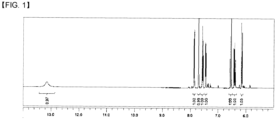
- FIG. 1 shows 1 H NMR spectrum of a polymerizable antibacterial monomer 1-1 which is prepared in Preparation Example 1.
- a layer or an element when a layer or an element is mentioned to be formed “on” or “above” layers or elements, it means that each layer or element is directly formed on the layers or elements, or other layers or elements may be formed between the layers, subjects, or substrates.
- the present invention may be variously modified and have various forms, and specific exemplary embodiments are exemplified and explained in detail in the following description. However, it is not intended to limit the present invention to the specific exemplary embodiments and it must be understood that the present invention includes every modifications, equivalents, or replacements included in the spirit and technical scope of the present invention.
- (meth)acrylate includes both acrylate and methacrylate.
- the alkyl group may be straight or branched, and its number of carbon atoms is not particularly limited, but preferably 1 to 10. According to one embodiment, the number of carbon atoms of the alkyl group is 1 to 6.
- Specific examples of the alkyl group may include methyl, ethyl, propyl, n-propyl, isopropyl, butyl, n-butyl, isobutyl, tert-butyl, sec-butyl, 1-methyl-butyl, 1-ethylbutyl, pentyl, n-pentyl, isopentyl, neopentyl, tert-pentyl, 1-ethyl-propyl, 1,1-dimethylpropyl, hexyl, n-hexyl, 1-methylpentyl, 2-methylpentyl, 4-methyl-2-pentyl, 3,3-dimethylbutyl, 2-ethylbuty
- the alkoxy group may be straight or branched, and its number of carbon atoms is not particularly limited, but preferably 1 to 10. According to one embodiment, the number of carbon atoms of the alkoxy group is 1 to 6. Specific examples of the alkoxy group may include methoxy, ethoxy, n-propoxy, isopropoxy, n-butoxy, etc., but are not limited thereto.
- antibacterial agent components containing antibacterial metal ions may exhibit antibacterial property by destroying cell walls of microorganisms such as bacteria, etc., but are classified as biocide substances that are also able to kill microorganisms beneficial to the human body.
- antibacterial agent components are mixed after manufacturing the plastic resins, there has been a problem in that the antibacterial agent is leached from the final product over time, and thus the antibacterial property do not persist.
- the leached antibacterial agent adversely affects the human body, there is also a disadvantage in that health safety of the plastic resins exhibiting antibacterial property, manufactured as described above, is reduced.
- bacteria have diverse cell morphologies such as spheres, rods, spirals, etc., and their demand for oxygen is also different from each other, and thus they are divided into aerobic bacteria, facultative bacteria, and anaerobic bacteria. Therefore, it is usually not easy for one type of antibacterial agent to have physical/chemical mechanisms whereby cell membranes/cell walls of various bacteria are damaged or proteins thereof are denatured.
- an SAN resin when an SAN resin is prepared by polymerizing a monomer containing a carboxyl group and having a specific structure with a styrene-based monomer and an acrylonitrile-based monomer, it may exhibit excellent antibacterial property against at least one of Gram-positive bacteria and Gram-negative bacteria while having excellent safety to the human body due to no leakage of antibacterial substances, and maintaining the antibacterial effect, thereby completing the present invention.
- the SAN resin including the copolymer formed by the polymerizable antibacterial monomer represented by Chemical Formula 1 may exhibit antibacterial property against at least one of Gram-positive bacteria and Gram-negative bacteria.
- An SAN resin according to one embodiment is characterized by including a repeating unit derived from a monomer represented by the following Chemical Formula 1; a repeating unit derived from a styrene-based monomer; and a repeating unit derived from an acrylonitrile-based monomer: in Chemical Formula 1,
- the SAN resin is a copolymer prepared by copolymerization of the monomer represented by Chemical Formula 1, the styrene-based monomer, and the acrylonitrile-based monomer, and has a one-dimensional linear polymer form having a structure, in which the repeating units are arranged in long chains.
- the SAN resin may be an alternating copolymer in which the repeating unit derived from the monomer represented by Chemical Formula 1, the repeating unit derived from the styrene-based monomer, and the repeating unit derived from the acrylonitrile-based monomer are regularly arranged in an alternating fashion, or a random copolymer in which the repeating units are randomly arranged.
- the antibacterial property of the SAN resin is exhibited by the carboxyl group contained in the repeating unit derived from the monomer represented by Chemical Formula 1 as described above. Since the monomer represented by Chemical Formula 1 does not exist as a separate compound in the SAN resin but exists as a repeating unit constituting the main chain, it is not leached over time, and thus the antibacterial property of the SAN resin may be continuously maintained.
- the repeating unit derived from the monomer represented by Chemical Formula 1 may be included in the antibacterial SAN resin in an amount of 0.01 mole to 0.7 moles based on 1 mole of the antibacterial SAN resin.
- the repeating unit derived from the monomer represented by Chemical Formula 1 is included in an excessively low amount, it is difficult to exhibit a sufficient antibacterial effect, and when the repeating unit derived from the monomer represented by Chemical Formula 1 is included in an excessively high amount, a glass transition temperature of the SAN resin may increase, and thus processability may be lowered.
- the repeating unit derived from the monomer represented by Chemical Formula 1 may be included in an amount of 0.02 moles or more, 0.03 moles or more, 0.04 moles or more, or 0.05 moles or more, and 0.65 moles or less, 0.6 moles or less, 0.55 moles or less, 0.5 moles or less, or 0.45 moles or less, based on 1 mole of the antibacterial SAN resin.
- A may be an aromatic ring having 6 to 60 carbon atoms which is unsubstituted or substituted with one or more substituents selected from alkyl having 1 to 4 carbon atoms, hydroxy and carboxyl groups.
- R 1 to R 3 may be each independently hydrogen or methyl.
- A may be an aromatic ring having 6 to 10 carbon atoms which is unsubstituted or substituted with one or more substituents, for example, 1 to 5 substituents selected from alkyl having 1 to 4 carbon atoms, hydroxy and carboxyl groups.
- A may be a benzene ring which is unsubstituted or substituted with one or more substituents, for example, 1 to 5 substituents selected from alkyl having 1 to 4 carbon atoms, hydroxy and carboxyl groups.
- the polymerizable antibacterial monomer may be any one selected from the following compounds:
- the styrene-based monomer may be one or more selected from styrene, ⁇ -methylstyrene, ⁇ -methylstyrene, p-methylstyrene, p-tert-butylstyrene, o-bromostyrene, o-chlorostyrene, m-bromostyrene, m-chlorostyrene, p-bromostyrene and p-chlorostyrene.
- the repeating unit derived from such a styrene-based monomer may serve to increase a polymerization conversion rate during polymerization while increasing the heat resistance of the SAN resin.
- the acrylonitrile-based monomer may be one or more selected from acrylonitrile, methacrylonitrile and ethacrylonitrile.
- the repeating unit derived from such an acrylonitrile-based monomer may serve to increase strength, heat resistance, and crack resistance of the SAN resin.
- the repeating unit derived from the styrene-based monomer and the repeating unit derived from the acrylonitrile-based monomer may be included in the antibacterial SAN resin at a molar ratio of 5:5 to 9:1.
- the molar ratio of the repeating unit derived from the styrene-based monomer and the repeating unit derived from the acrylonitrile-based monomer in the SAN resin is less than 5:5, the repeating unit derived from the acrylonitrile-based monomer is included in an excessively large amount, relative to the repeating unit derived from the styrene-based monomer, and thus a gel polymer not soluble in a solvent may be formed.
- This gel polymer is very weak to heat, and thus there may be a problem in that it appears as a red or black foreign substance when heated, damaging appearance of a product.
- the molar ratio of the repeating unit derived from the styrene-based monomer and the repeating unit derived from the acrylonitrile-based monomer in the SAN resin is more than 9:1
- the content of the repeating unit derived from the acrylonitrile-based monomer is excessively small, and thus there may be a problem in that a polymerization conversion rate and a molecular weight are lowered, and the heat resistance may deteriorate due to the excessively high content of the repeating unit derived from the styrene-based monomer.
- the repeating unit derived from the styrene-based monomer and the repeating unit derived from the acrylonitrile-based monomer may be included in the antibacterial SAN resin at a molar ratio of 5.2:4.8 or more, 5.3:4.7 or more, 5.4:4.6 or more, 5.5:4.5 or more, 5.6:4.4 or more, 5.7:4.3 or more, 5.8:4.2 or more, or 5.9:4.1 or more, and 8:2 or less, 7:3 or less, 6.5:3.5 or less, or 6:4 or less.
- the antibacterial SAN resin may be represented by the following Chemical Formula 2, when styrene is used as the styrene-based monomer, and acrylonitrile is used as the acrylonitrile-based monomer:
- x, y and z refer to the number of mole of the repeating unit derived from styrene, the number of mole of the repeating unit derived from acrylonitrile, and the number of mole of the repeating unit derived from the monomer represented by Chemical Formula 1, respectively.
- the SAN resin may exhibit antibacterial property against at least one of Gram-negative bacteria and Gram-positive bacteria, as described above. More specifically, the SAN resin may exhibit antibacterial property against one or more kinds of bacteria, categorized as Gram-positive bacteria. Alternatively, the SAN resin may exhibit antibacterial property against one or more kinds of bacteria, categorized as the Gram-negative bacteria. Alternatively, the SAN resin may exhibit antibacterial property against one or more kinds of bacteria, categorized as the Gram-negative bacteria and one or more kinds of bacteria, categorized as the Gram-positive bacteria.
- the Gram-positive bacteria collectively refer to bacteria that are stained purple when stained by the Gram staining method.
- the cell wall of Gram-positive bacteria consists of several layers of peptidoglycan. After staining with a basic dye such as crystal violet, even when the Gram-positive bacteria are treated with ethanol, they are not decolorized and remain colored purple.
- Bacteria categorized as the Gram-positive bacteria include Enterococcus faecalis, Staphylococcus aureus, Streptococcus pneumoniae, Enterococcus faecium, Lactobacillus lactis, etc.
- the Gram-negative bacteria collectively refer to bacteria that are stained red when stained by the Gram staining method, and have outer membrane consisting of lipopolysaccharides, lipoproteins, and other complex polymer materials instead of the cell wall having a relatively small amount of peptidoglycan, as compared to the Gram-positive bacteria.
- a basic dye such as crystal violet
- Bacteria categorized as the Gram-negative bacteria include Proteus mirabilis, Escherichia coli, Salmonella typhi, Pseudomonas aeruginosa, Vibrio cholerae, etc.
- the Gram-positive bacteria and Gram-negative bacteria may cause various diseases upon contacting, and may also cause secondary infection in critically ill patients with weak immunity, it is preferable that a single antibacterial agent is used to exhibit antibacterial property against both Gram-positive bacteria and Gram-negative bacteria.
- the SAN resin may exhibit antibacterial property against both of the Gram-negative bacteria and Gram-positive bacteria.
- the Gram-negative bacteria against which the SAN resin may exhibit the antibacterial property may be Proteus mirabilis, or Escherichia coli, and the Gram-positive bacteria against which the SAN resin may exhibit the antibacterial property may be Enterococcus faecalis or Staphylococcus aureus, but are not limited thereto.
- the antibacterial property of the SAN resin may be evaluated in accordance with JIS Z 2801 (Measuring antibacterial activity on plastic and nonporous surfaces) or ASTM E2149 (Determining the Antimicrobial Activity of Immobilized Antimicrobial Agents Under Dynamic Contact Conditions).
- the antibacterial rate of the SAN resin may be 38% or more, 50% or more, 60% or more, 70% or more, 80% or more, 90% or more, 95% or more, 96% or more, 97% or more, 98% or more, 98.1 % or more, 99% or more, 99.3% or more, or 99.9% or more, and 100% or less:
- Antibacterial rate % 1 ⁇ Number of bacteria in test group / Number of bacteria in control group ⁇ 100
- the SAN resin may have a weight average molecular weight of 20,000 g/mol to 100,000 g/mol.
- the weight average molecular weight of the SAN resin is less than 20,000 g/mol, it may exist not in the form of polymers but in the form of monomers, and thus it may easily leach. Furthermore, due to the low molecular weight, there is a problem in that it may be absorbed into the human body, and breakage of the resin occurs, and thus there is a difficulty in processability.
- the weight average molecular weight of the SAN resin is more than 100,000 g/mol, strength and chemical resistance are reduced, and molding defects may occur during injection molding.
- the weight average molecular weight (Mw, g/mol) of the SAN resin may be 20,000 or more, 25,000 or more, 25,187 or more, 30,000 or more, 31,468 or more, 40,000 or more, 50,000 or more, or 60,000 or more, and 95,000 or less, 93,000 or less, 91,000 or less, 90,403 or less, 85,000 or less, 80,000 or less, 78,568 or less, or 75,000 or less.
- the weight average molecular weight (Mw) of the SAN resin may be measured by gel permeation chromatography (GPC) using polystyrene (PS) as a standard for calibration. More specifically, the SAN resin is diluted with a tetrahydrofuran (THF) solvent at a concentration of 2 mg/mL, and then the weight average molecular weight may be measured at a flow rate of 1.0 mL/min through an RI detector using Agilent Technologies' Agilent 1200 series GPC instrument. The more detailed measurement is performed by referring to Experimental Example below.
- GPC gel permeation chromatography
- PS polystyrene
- THF tetrahydrofuran
- the SAN resin may have a glass transition temperature (Tg) of 90°C to 160°C.
- Tg glass transition temperature
- the SAN resin having a glass transition temperature in the above range may have a good balance between heat resistance and strength.
- the glass transition temperature of the SAN resin may be determined using TA Instruments' Differential Scanning Calorimeters (DSC).
- the SAN resin may have a bulk density of 0.6 g/cc to 0.7 g/cc.
- the SAN resin having a bulk density in the above range is advantageous in that its storage and transport are easy.
- the bulk density of the SAN resin may be determined as a value obtained by filling a 100 cc cup with the powdery SAN resin and then dividing the weight (g) thereof by 100.
- the SAN resin may be prepared by the step of polymerizing the monomer represented by Chemical Formula 1; the styrene-based monomer; and the acrylonitrile-based monomer in the presence of a polymerization initiator at a temperature of 60°C to 90°C for 3 hours to 8 hours. More specifically, the SAN resin may be prepared by polymerizing the three kinds of monomers in the temperature range of 60°C or higher, or 70°C or higher, and 90°C or lower, or 80°C or lower for 3 hours or longer or 3 hours and 30 minutes or longer, and 8 hours or shorter, 7 hours or shorter, 6 hours or shorter, 5 hours or shorter, or 4 hours or shorter.
- the copolymerizing may be performed by a method such as emulsion polymerization, suspension polymerization, bulk polymerization, etc., and an appropriate polymerization method may be selected according to the end use.
- an azo-based initiator may be used as the polymerization initiator that promotes polymerization stability and polymerization reaction.
- the azo-based initiator may include azobisisobutyronitrile (AIBN), 2, 2-azobis(2-amidinopropane) dihydrochloride, 2,2-azobis-(N,N-dimethylene)isobutyramidine dihydrochloride, 2-(carbamoylazo)isobutylonitrile, 2,2-azobis[2-(2-imidazolin-2-yl)propane] dihydrochloride, 4,4-azobis-(4-cyanovaleric acid), etc.
- AIBN azobisisobutyronitrile
- 2-azobis(2-amidinopropane) dihydrochloride 2,2-azobis-(N,N-dimethylene)isobutyramidine dihydrochloride
- 2-(carbamoylazo)isobutylonitrile 2,2-azobis[2-(2-imidazolin-2-y
- the polymerization initiator may be used in an amount of 0.01 part by weight to 5 parts by weight with respect to the total 100 parts by weight of the monomers.
- the content of the polymerization initiator is less than 0.01 part by weight, the effect of adding the polymerization initiator may be insignificant.
- the content of the polymerization initiator is more than 5 parts by weight, the molecular weight of the SAN resin may be small and the physical properties may be deteriorated.
- the polymerization initiator may be used in an amount of 0.05 parts by weight or more, or 0.1 parts by weight or more, 0.5 parts by weight or more, or 1.2 parts by weight or more, and 4 parts by weight or less, 2 parts by weight or less, or 1.85 or less with respect to the total 100 parts by weight of the monomers.
- the monomers and the polymerization initiators may be prepared in the form of a solution, in which they are dissolved in a solvent.
- any solvent may be used without limitations in the constitution as long as it is able to dissolve the above components.
- a molecular weight modifier such as a mercaptan compound may be additionally used during polymerization, and an emulsifier such as potassium salts of fatty acids may be used when the polymerization reaction is performed by emulsion polymerization.
- the polymerization may be performed, for example, until the polymerization conversion rate reaches 50% or more, more specifically, 50% to 90%.
- the polymerization may be performed until the polymerization conversion rate reaches 60% or more, 70% or more, or 80% or more, and 90% or less, or 85% or less.
- the process may be easy and excellent productivity may be exhibited.
- the step of extracting and vacuumdrying the polymer is performed to finally obtain the desired SAN resin.
- the step of extracting and vacuumdrying the polymer is performed to finally obtain the desired SAN resin.
- an antibacterial ABS resin composition including the above-described antibacterial SAN resin; and an ABS resin.
- the ABS resin may be, for example, a copolymer of an acrylonitrile-based monomer, a conjugated diene monomer, and a vinyl aromatic monomer.
- the acrylonitrile-based monomer is the same as described above.
- the conjugated diene monomer may be one or more selected from 1,3-butadiene, 2,3-dimethyl-1,3-butadiene, 2-ethyl-1,3-butadiene, 1,3-pentadiene, and isoprene.
- the vinyl aromatic monomer may be one or more selected from styrene, ⁇ -methylstyrene, ⁇ -methylstyrene, p-t-butylstyrene, chlorostyrene, vinylbenzoic acid, methyl vinylbenzoate, vinylnaphthalene, chloromethylstyrene, hydroxymethylstyrene, and divinylbenzene.
- the ABS resin may be a graft copolymer in which a vinyl aromatic monomer and an acrylonitrile-based monomer are grafted onto a rubbery polymer in which a conjugated diene monomer is polymerized.
- the content of the rubbery polymer is preferably 30% by weight to 75% by weight, based on the total weight of the graft copolymer.
- the content of the vinyl aromatic monomer is preferably 20% by weight to 65% by weight, based on the total weight of the graft copolymer resin, and the content of the acrylonitrile-based monomer is preferably 5% by weight to 30% by weight, based on the total weight of the graft copolymer resin.
- the ABS resin composition may include 60% by weight to 90% by weight of the antibacterial SAN resin; and 10% by weight to 40% by weight of the ABS resin.
- ABS resin composition may further include antioxidants such as hindered phenol-based antioxidants, phosphorus-based antioxidants, etc.
- a molded article manufactured by using the above-described ABS resin composition may be, for example, one or more selected from automobile interior/exterior materials, home appliance housings, toys, food containers, and medical articles.
- Preparation Example 1 Preparation of polymerizable antibacterial monomer 1-1 (3-(acryloyloxy)benzoic acid; A-BA)
- a weight average molecular weight of the SAN-co-(A-BA) resin thus prepared was 90,403 g/mol, and a molar ratio (x:y:z) of the repeating unit derived from styrene, the repeating unit derived from acrylonitrile, and the repeating unit derived from the polymerizable antibacterial monomer was 0.3:0.2:0.5.
- the weight average molecular weight of the SAN-co-(A-BA) resin was determined by dissolving the prepared copolymer in tetrahydrofuran (THF) by using GPC (device name: Agilent 1200 series GPC, manufactured by Agilent Technologies). Specifically, the sample preparation method for measuring the weight average molecular weight and measurement conditions are as follows.
- THF stabilized with BHT
- a solvent clarification system to prepare a mobile phase A.
- the sample to be measured was diluted in THF (stabilized with BHT) to a concentration of 2 mg/mL, and dissolved at a temperature of 50°C for 6 hours, and then the solution was filtered through a PVDF filter (pore size: 0.45 ⁇ m), and prepared as a sample solution.
- styrene, 20.84 g of acrylonitrile, 10 g of the polymerizable antibacterial monomer 1-1 prepared in Preparation Example 1, and 1.70 g of azobisisobutyronitrile (AIBN) as a polymerization initiator were dissolved in 153.66 mL of a solvent N,N-dimethylformamide (DMF), and then polymerization was carried out for 4 hours using a magnetic bar at 80 °C under air conditions. The reaction was terminated when a polymerization conversion rate was 80%. Thereafter, the reaction-completed solution was cooled to room temperature, precipitated in a sufficient amount of water, and then vacuum-dried to obtain a copolymer SAN-co-(A-BA) resin in the form of a solid powder.
- AIBN azobisisobutyronitrile
- a weight average molecular weight of the SAN-co-(A-BA) resin was 31,468 g/mol, as measured according to the method described in Example 1, and a molar ratio (x:y:z) of the repeating unit derived from styrene, the repeating unit derived from acrylonitrile, and the repeating unit derived from the polymerizable antibacterial monomer was 0.57:0.38:0.05.
- a weight average molecular weight of the SAN-co-(2-A-BA) resin thus prepared was 78,568 g/mol, as measured according to the method described in Example 1, and a molar ratio (x:y:z) of the repeating unit derived from styrene, the repeating unit derived from acrylonitrile, and the repeating unit derived from the polymerizable antibacterial monomer was 0.32:0.23:0.45.
- a weight average molecular weight of the SAN-co-(2-A-BA) resin thus prepared was 25,187 g/mol, as measured according to the method described in Example 1, and a molar ratio (x:y:z) of the repeating unit derived from styrene, the repeating unit derived from acrylonitrile, and the repeating unit derived from the polymerizable antibacterial monomer was 0.58:0.39:0.03.
- a weight average molecular weight of the SAN resin thus prepared was 37,266 g/mol, as measured according to the method described in Example 1, and a molar ratio (x:y) of the repeating unit derived from styrene and the repeating unit derived from acrylonitrile was 0.6:0.4.
- ABS HF380 manufactured by LG Chem
- Comparative Example 2 Comparative Example 2.
- a weight average molecular weight of the SAN-co-(4-VBA) resin thus prepared was 147,822 g/mol, as measured according to the method described in Example 1, and a molar ratio (x:y:z) of the repeating unit derived from styrene, the repeating unit derived from acrylonitrile, and the repeating unit derived from the polymerizable antibacterial monomer was 0.3:0.2:0.5.
- the antibacterial properties of the SAN resins prepared in Examples and Comparative Examples against E.coli were measured by the following method in accordance with ASTM E2149(Shake Flask Method), respectively.
- the bacteria were brought into contact with a sample to be tested for a predetermined period of time, recovered and cultured in a medium. Then, the antibacterial rate was calculated by comparing the colony forming unit (CFU) with that of a control (SAN resin of Comparative Example 1). Preparation methods of the medium and test group required for the antibacterial test and a detailed method of the antibacterial test are as follows.
- a liquid medium 8 g of NB broth and 1 L of distilled water were placed in a 2 L container and sufficiently dissolved, and then sterilized in an autoclave at (120 ⁇ 2)°C with a vapor pressure of 103 kPA for 20 minutes.
- NB broth solidifies at 40 °C, and thus when the temperature decreased to 60 °C after sterilization, each 25 mL of the solution was poured into a 90 mm diameter Petri dish and solidified.
- the SAN-co-(A-BA) and SAN-co-(2-A-BA) resins of Examples were found to exhibit superior antibacterial properties against E.coli which is one of Gram-negative bacteria, as compared to the resin of Comparative Example without the repeating unit derived from the polymerizable antibacterial monomer represented by Chemical Formula 1.
- the SAN-co-(4-VBA) resin of Comparative Example 3 which was prepared by using 4-vinyl benzoic acid, instead of the polymerizable antibacterial monomer prepared in Preparation Examples 1 and 2, was found to exhibit a remarkably low antibacterial property, as compared to the resins of Examples.
- the SAN resin further includes the repeating unit derived from the polymerizable antibacterial monomer represented by Chemical Formula 1, in addition to the repeating unit derived from the styrene-based monomer and the repeating unit derived from the acrylonitrile-based monomer, it was found to exhibit superior antibacterial property, as compared to a resin including a repeating unit derived from a monomer having a carboxyl group, such as 4-vinyl benzoic acid.
Landscapes
- Chemical & Material Sciences (AREA)
- Health & Medical Sciences (AREA)
- Chemical Kinetics & Catalysis (AREA)
- Medicinal Chemistry (AREA)
- Polymers & Plastics (AREA)
- Organic Chemistry (AREA)
- Addition Polymer Or Copolymer, Post-Treatments, Or Chemical Modifications (AREA)
- Agricultural Chemicals And Associated Chemicals (AREA)
- Compositions Of Macromolecular Compounds (AREA)
Abstract
Description
- The present application is based on, and claims priority from,
Korean Patent Application Nos. 10-2021-0098134 10-2022-0079972, filed on July 26, 2021 - The present invention relates to an antibacterial SAN resin exhibiting a persistent antibacterial property, a method of preparing the same, and an antibacterial ABS resin composition including the same.
- Styrene-Acrylonitrile Resin (SAN resin) collectively refers to a copolymer including a repeating unit derived from a styrene-based monomer and a repeating unit derived from an acrylonitrile-based monomer. Since such a SAN resin has excellent fluidity and excellent heat resistance, chemical resistance and mechanical strength, it is widely used for electrical and electronic products, home appliances, office supplies, automobile parts, medical machines, etc.
- In particular, the SAN resin is mixed with an ABS resin (acrylonitrile butadiene styrene resin), which may be manufactured into items mainly used in daily life, such as automobile interior/exterior materials, home appliances such as refrigerators and vacuum cleaners, toys, etc., and therefore, there is a great demand for its antibacterial property.
- For this reason, attempts have been made to introduce various bacterial growth-inhibitory components, deodorants, or antibacterial agents into SAN resins, etc. Specifically, there are organic and inorganic antibacterial agents as antibacterial agents. Organic antibacterial agents are economical because they are relatively inexpensive, and exhibit excellent immediate antibacterial action, but have disadvantages of low antibacterial durability, human stability, and thermal stability. Further, inorganic antibacterial agents have problems in that they have a high unit price and a low immediate antibacterial action, and are oxidized to cause discoloration of articles when exposed to air, light, moisture, etc., and rapidly reduce physical properties of compositions during injection.
- Accordingly, there is a continuous demand for the development of a SAN resin-related technology capable of remarkably inhibiting bacterial growth without deteriorating basic physical properties of SAN resins, when antibacterial agents inhibiting bacterial growth are introduced into the SAN resins.
- Accordingly, there are provided an antibacterial SAN resin capable of exhibiting a persistent antibacterial property without being harmful due to no leakage of antibacterial substances, a method of preparing the same, and an antibacterial ABS resin composition including the same.
- According to one embodiment of the present invention,
there is provided an antibacterial SAN resin including a repeating unit derived from a monomer represented by the following Chemical Formula 1; a repeating unit derived from a styrene-based monomer; and a repeating unit derived from an acrylonitrile-based monomer:

- R1 to R3 are each independently hydrogen, or alkyl having 1 to 4 carbon atoms, and
- A is an aromatic ring having 6 to 60 carbon atoms which is unsubstituted or substituted with one or more substituents selected from alkyl having 1 to 10 carbon atoms, alkoxy having 1 to 10 carbon atoms, deuterium, halogen, a hydroxy group, and a carboxyl group.
- According to another embodiment of the present invention,
there is provided a method of preparing an antibacterial SAN resin, the method including the step of polymerizing a monomer represented by the following Chemical Formula 1; a styrene-based monomer; and an acrylonitrile-based monomer in the presence of a polymerization initiator at a temperature of 60°C to 90°C for 3 hours to 8 hours. - Furthermore, according to still another embodiment of the present invention, there is provided an antibacterial ABS resin composition including the above-described antibacterial SAN resin and an ABS resin.
- An antibacterial SAN resin of the present invention may exhibit a persistent antibacterial property of inhibiting bacterial growth without leakage of antibacterial agents.
- Specifically, as the antibacterial SAN resin is prepared by copolymerizing a polymerizable antibacterial monomer having a specific structure with a styrene-based monomer and an acrylonitrile-based monomer, rather than being mixed separately, it may continuously exhibit an excellent antibacterial property against at least one of Gram-positive bacteria and Gram-negative bacteria without being harmful due to no leakage of antibacterial substances over time.
- Accordingly, the antibacterial SAN resin is mixed with an ABS resin to be preferably applied to a variety of industrial products and daily products requiring durability and thermal stability.
-
FIG. 1 shows 1H NMR spectrum of a polymerizable antibacterial monomer 1-1 which is prepared in Preparation Example 1. - The terms used in this description are just for explaining exemplary embodiments and it is not intended to restrict the present invention. The singular expression may include the plural expression unless it is differently expressed contextually. It must be understood that the term "include", "equip", or "have" in the present description is only used for designating the existence of characteristics taken effect, steps, components, or combinations thereof, and do not exclude the existence or the possibility of addition of one or more different characteristics, steps, components or combinations thereof beforehand.
- Further, in the present invention, when a layer or an element is mentioned to be formed "on" or "above" layers or elements, it means that each layer or element is directly formed on the layers or elements, or other layers or elements may be formed between the layers, subjects, or substrates.
- The present invention may be variously modified and have various forms, and specific exemplary embodiments are exemplified and explained in detail in the following description. However, it is not intended to limit the present invention to the specific exemplary embodiments and it must be understood that the present invention includes every modifications, equivalents, or replacements included in the spirit and technical scope of the present invention.
- Further, the terms used in this description are just for explaining exemplary embodiments and it is not intended to restrict the present invention. The singular expression used herein may include the plural expression unless it is differently expressed contextually.
- Meanwhile, as used herein, the term "(meth)acrylate" includes both acrylate and methacrylate.
- In addition, in the present specification, the alkyl group may be straight or branched, and its number of carbon atoms is not particularly limited, but preferably 1 to 10. According to one embodiment, the number of carbon atoms of the alkyl group is 1 to 6. Specific examples of the alkyl group may include methyl, ethyl, propyl, n-propyl, isopropyl, butyl, n-butyl, isobutyl, tert-butyl, sec-butyl, 1-methyl-butyl, 1-ethylbutyl, pentyl, n-pentyl, isopentyl, neopentyl, tert-pentyl, 1-ethyl-propyl, 1,1-dimethylpropyl, hexyl, n-hexyl, 1-methylpentyl, 2-methylpentyl, 4-methyl-2-pentyl, 3,3-dimethylbutyl, 2-ethylbutyl, heptyl, n-heptyl, isohexyl, 1-methylhexyl, 2-methylhexyl, 3-methylhexyl, 4-methylhexyl, 5-methylhexyl, cyclopentylmethyl, cyclohexylmethyl, octyl, n-octyl, tert-octyl, 1-methylheptyl, 2-ethylhexyl, 2,4,4-trimethyl-1-pentyl, 2,4,4-trimethyl-2-pentyl, 2-propylpentyl, n-nonyl, 2,2-dimethylheptyl, etc., but are not limited thereto.
- Further, in the present specification, the alkoxy group may be straight or branched, and its number of carbon atoms is not particularly limited, but preferably 1 to 10. According to one embodiment, the number of carbon atoms of the alkoxy group is 1 to 6. Specific examples of the alkoxy group may include methoxy, ethoxy, n-propoxy, isopropoxy, n-butoxy, etc., but are not limited thereto.
- In order to secure antibacterial and deodorizing properties in existing plastics such as SAN resins, a metal compound having an antibacterial function or an organic compound containing a cation or alcohol functional group was introduced in the form of an additive. However, in this case, there have been problems such as a decrease in safety of the SAN resin, persistency of antibacterial property, leakage of antibacterial substance, etc.
- For example, an attempt has been made to mix the plastic resins with antibacterial agent components containing antibacterial metal ions such as silver, copper, zinc, etc. These components containing antibacterial metal ions may exhibit antibacterial property by destroying cell walls of microorganisms such as bacteria, etc., but are classified as biocide substances that are also able to kill microorganisms beneficial to the human body. In addition, when the antibacterial agent components are mixed after manufacturing the plastic resins, there has been a problem in that the antibacterial agent is leached from the final product over time, and thus the antibacterial property do not persist. Moreover, since the leached antibacterial agent adversely affects the human body, there is also a disadvantage in that health safety of the plastic resins exhibiting antibacterial property, manufactured as described above, is reduced.
- Further, there are more than 5,000 species of bacteria that have been identified. Specifically, bacteria have diverse cell morphologies such as spheres, rods, spirals, etc., and their demand for oxygen is also different from each other, and thus they are divided into aerobic bacteria, facultative bacteria, and anaerobic bacteria. Therefore, it is usually not easy for one type of antibacterial agent to have physical/chemical mechanisms whereby cell membranes/cell walls of various bacteria are damaged or proteins thereof are denatured.
- However, it was found that when an SAN resin is prepared by polymerizing a monomer containing a carboxyl group and having a specific structure with a styrene-based monomer and an acrylonitrile-based monomer, it may exhibit excellent antibacterial property against at least one of Gram-positive bacteria and Gram-negative bacteria while having excellent safety to the human body due to no leakage of antibacterial substances, and maintaining the antibacterial effect, thereby completing the present invention.
- More specifically, when the polymerizable antibacterial monomer represented by Chemical Formula 1 comes in contact with bacteria, an acidic condition is formed by dissociation of the carboxyl group (COOH) substituted on the A ring. Under these acidic conditions, the structure and function of the cell membrane of bacteria may be affected, and thus the bacterial growth may be inhibited. Therefore, the SAN resin including the copolymer formed by the polymerizable antibacterial monomer represented by Chemical Formula 1 may exhibit antibacterial property against at least one of Gram-positive bacteria and Gram-negative bacteria.
- Hereinafter, an SAN resin, a method of preparing the same, and an ABS resin composition including the same according to specific embodiments of the present invention will be described in more detail.
- An SAN resin according to one embodiment is characterized by including a repeating unit derived from a monomer represented by the following Chemical Formula 1; a repeating unit derived from a styrene-based monomer; and a repeating unit derived from an acrylonitrile-based monomer:

- R1 to R3 are each independently hydrogen, or alkyl having 1 to 4 carbon atoms, and
- A is an aromatic ring having 6 to 60 carbon atoms which is unsubstituted or substituted with one or more substituents, for example, 1 to 5 substituents selected from alkyl having 1 to 10 carbon atoms, alkoxy having 1 to 10 carbon atoms, deuterium, halogen, a hydroxy group, and a carboxyl group.
- More specifically, the SAN resin is a copolymer prepared by copolymerization of the monomer represented by Chemical Formula 1, the styrene-based monomer, and the acrylonitrile-based monomer, and has a one-dimensional linear polymer form having a structure, in which the repeating units are arranged in long chains. In addition, the SAN resin may be an alternating copolymer in which the repeating unit derived from the monomer represented by Chemical Formula 1, the repeating unit derived from the styrene-based monomer, and the repeating unit derived from the acrylonitrile-based monomer are regularly arranged in an alternating fashion, or a random copolymer in which the repeating units are randomly arranged.
- In this regard, the antibacterial property of the SAN resin is exhibited by the carboxyl group contained in the repeating unit derived from the monomer represented by Chemical Formula 1 as described above. Since the monomer represented by Chemical Formula 1 does not exist as a separate compound in the SAN resin but exists as a repeating unit constituting the main chain, it is not leached over time, and thus the antibacterial property of the SAN resin may be continuously maintained.
- Furthermore, the repeating unit derived from the monomer represented by Chemical Formula 1 may be included in the antibacterial SAN resin in an amount of 0.01 mole to 0.7 moles based on 1 mole of the antibacterial SAN resin. When the repeating unit derived from the monomer represented by Chemical Formula 1 is included in an excessively low amount, it is difficult to exhibit a sufficient antibacterial effect, and when the repeating unit derived from the monomer represented by Chemical Formula 1 is included in an excessively high amount, a glass transition temperature of the SAN resin may increase, and thus processability may be lowered.
- Specifically, the repeating unit derived from the monomer represented by Chemical Formula 1 may be included in an amount of 0.02 moles or more, 0.03 moles or more, 0.04 moles or more, or 0.05 moles or more, and 0.65 moles or less, 0.6 moles or less, 0.55 moles or less, 0.5 moles or less, or 0.45 moles or less, based on 1 mole of the antibacterial SAN resin.
- In addition, in Chemical Formula 1, A may be an aromatic ring having 6 to 60 carbon atoms which is unsubstituted or substituted with one or more substituents selected from alkyl having 1 to 4 carbon atoms, hydroxy and carboxyl groups.
- In one embodiment, R1 to R3 may be each independently hydrogen or methyl.
- In addition, in one embodiment, A may be an aromatic ring having 6 to 10 carbon atoms which is unsubstituted or substituted with one or more substituents, for example, 1 to 5 substituents selected from alkyl having 1 to 4 carbon atoms, hydroxy and carboxyl groups.
- Specifically, A may be a benzene ring which is unsubstituted or substituted with one or more substituents, for example, 1 to 5 substituents selected from alkyl having 1 to 4 carbon atoms, hydroxy and carboxyl groups.
- For example, the polymerizable antibacterial monomer may be any one selected from the following compounds:

- Meanwhile, the styrene-based monomer may be one or more selected from styrene, α-methylstyrene, β-methylstyrene, p-methylstyrene, p-tert-butylstyrene, o-bromostyrene, o-chlorostyrene, m-bromostyrene, m-chlorostyrene, p-bromostyrene and p-chlorostyrene. The repeating unit derived from such a styrene-based monomer may serve to increase a polymerization conversion rate during polymerization while increasing the heat resistance of the SAN resin.
- In addition, the acrylonitrile-based monomer may be one or more selected from acrylonitrile, methacrylonitrile and ethacrylonitrile. The repeating unit derived from such an acrylonitrile-based monomer may serve to increase strength, heat resistance, and crack resistance of the SAN resin.
- In this regard, the repeating unit derived from the styrene-based monomer and the repeating unit derived from the acrylonitrile-based monomer may be included in the antibacterial SAN resin at a molar ratio of 5:5 to 9:1. When the molar ratio of the repeating unit derived from the styrene-based monomer and the repeating unit derived from the acrylonitrile-based monomer in the SAN resin is less than 5:5, the repeating unit derived from the acrylonitrile-based monomer is included in an excessively large amount, relative to the repeating unit derived from the styrene-based monomer, and thus a gel polymer not soluble in a solvent may be formed. This gel polymer is very weak to heat, and thus there may be a problem in that it appears as a red or black foreign substance when heated, damaging appearance of a product. Further, when the molar ratio of the repeating unit derived from the styrene-based monomer and the repeating unit derived from the acrylonitrile-based monomer in the SAN resin is more than 9:1, the content of the repeating unit derived from the acrylonitrile-based monomer is excessively small, and thus there may be a problem in that a polymerization conversion rate and a molecular weight are lowered, and the heat resistance may deteriorate due to the excessively high content of the repeating unit derived from the styrene-based monomer.
- Specifically, the repeating unit derived from the styrene-based monomer and the repeating unit derived from the acrylonitrile-based monomer may be included in the antibacterial SAN resin at a molar ratio of 5.2:4.8 or more, 5.3:4.7 or more, 5.4:4.6 or more, 5.5:4.5 or more, 5.6:4.4 or more, 5.7:4.3 or more, 5.8:4.2 or more, or 5.9:4.1 or more, and 8:2 or less, 7:3 or less, 6.5:3.5 or less, or 6:4 or less.
- Meanwhile, the antibacterial SAN resin may be represented by the following Chemical Formula 2, when styrene is used as the styrene-based monomer, and acrylonitrile is used as the acrylonitrile-based monomer:

- in Chemical Formula 2,
- A is the same as defined in Chemical Formula 1,
- x+y is a real number of 0.3 to 0.99,
- z is a real number of 0.01 to 0.7, and
- x+y+z is 1.
- In other words, in Chemical Formula 2, x, y and z refer to the number of mole of the repeating unit derived from styrene, the number of mole of the repeating unit derived from acrylonitrile, and the number of mole of the repeating unit derived from the monomer represented by Chemical Formula 1, respectively.
- Further, the SAN resin may exhibit antibacterial property against at least one of Gram-negative bacteria and Gram-positive bacteria, as described above. More specifically, the SAN resin may exhibit antibacterial property against one or more kinds of bacteria, categorized as Gram-positive bacteria. Alternatively, the SAN resin may exhibit antibacterial property against one or more kinds of bacteria, categorized as the Gram-negative bacteria. Alternatively, the SAN resin may exhibit antibacterial property against one or more kinds of bacteria, categorized as the Gram-negative bacteria and one or more kinds of bacteria, categorized as the Gram-positive bacteria.
- The Gram-positive bacteria collectively refer to bacteria that are stained purple when stained by the Gram staining method. The cell wall of Gram-positive bacteria consists of several layers of peptidoglycan. After staining with a basic dye such as crystal violet, even when the Gram-positive bacteria are treated with ethanol, they are not decolorized and remain colored purple. Bacteria categorized as the Gram-positive bacteria include Enterococcus faecalis, Staphylococcus aureus, Streptococcus pneumoniae, Enterococcus faecium, Lactobacillus lactis, etc.
- Further, the Gram-negative bacteria collectively refer to bacteria that are stained red when stained by the Gram staining method, and have outer membrane consisting of lipopolysaccharides, lipoproteins, and other complex polymer materials instead of the cell wall having a relatively small amount of peptidoglycan, as compared to the Gram-positive bacteria. Thus, after staining with a basic dye such as crystal violet, even when the Gram-negative bacteria are treated with ethanol, they are decolorized, and when they are counter-stained with a red dye such as safranin, they appear red. Bacteria categorized as the Gram-negative bacteria include Proteus mirabilis, Escherichia coli, Salmonella typhi, Pseudomonas aeruginosa, Vibrio cholerae, etc.
- Therefore, since the Gram-positive bacteria and Gram-negative bacteria may cause various diseases upon contacting, and may also cause secondary infection in critically ill patients with weak immunity, it is preferable that a single antibacterial agent is used to exhibit antibacterial property against both Gram-positive bacteria and Gram-negative bacteria.
- Preferably, the SAN resin may exhibit antibacterial property against both of the Gram-negative bacteria and Gram-positive bacteria. In this regard, the Gram-negative bacteria against which the SAN resin may exhibit the antibacterial property may be Proteus mirabilis, or Escherichia coli, and the Gram-positive bacteria against which the SAN resin may exhibit the antibacterial property may be Enterococcus faecalis or Staphylococcus aureus, but are not limited thereto.
- Here, the antibacterial property of the SAN resin may be evaluated in accordance with JIS Z 2801 (Measuring antibacterial activity on plastic and nonporous surfaces) or ASTM E2149 (Determining the Antimicrobial Activity of Immobilized Antimicrobial Agents Under Dynamic Contact Conditions).
- More specifically, the antibacterial rate of the SAN resin, as measured by the following Equation 1 in accordance with ASTM E2149, may be 38% or more, 50% or more, 60% or more, 70% or more, 80% or more, 90% or more, 95% or more, 96% or more, 97% or more, 98% or more, 98.1 % or more, 99% or more, 99.3% or more, or 99.9% or more, and 100% or less:

- The method of measuring the antibacterial rate will be described in more detail in Experimental Example below.
- Further, the SAN resin may have a weight average molecular weight of 20,000 g/mol to 100,000 g/mol. When the weight average molecular weight of the SAN resin is less than 20,000 g/mol, it may exist not in the form of polymers but in the form of monomers, and thus it may easily leach. Furthermore, due to the low molecular weight, there is a problem in that it may be absorbed into the human body, and breakage of the resin occurs, and thus there is a difficulty in processability. When the weight average molecular weight of the SAN resin is more than 100,000 g/mol, strength and chemical resistance are reduced, and molding defects may occur during injection molding.
- More specifically, the weight average molecular weight (Mw, g/mol) of the SAN resin may be 20,000 or more, 25,000 or more, 25,187 or more, 30,000 or more, 31,468 or more, 40,000 or more, 50,000 or more, or 60,000 or more, and 95,000 or less, 93,000 or less, 91,000 or less, 90,403 or less, 85,000 or less, 80,000 or less, 78,568 or less, or 75,000 or less.
- In this regard, the weight average molecular weight (Mw) of the SAN resin may be measured by gel permeation chromatography (GPC) using polystyrene (PS) as a standard for calibration. More specifically, the SAN resin is diluted with a tetrahydrofuran (THF) solvent at a concentration of 2 mg/mL, and then the weight average molecular weight may be measured at a flow rate of 1.0 mL/min through an RI detector using Agilent Technologies' Agilent 1200 series GPC instrument. The more detailed measurement is performed by referring to Experimental Example below.
- Further, the SAN resin may have a glass transition temperature (Tg) of 90°C to 160°C. The SAN resin having a glass transition temperature in the above range may have a good balance between heat resistance and strength. At this time, the glass transition temperature of the SAN resin may be determined using TA Instruments' Differential Scanning Calorimeters (DSC).
- Further, the SAN resin may have a bulk density of 0.6 g/cc to 0.7 g/cc. The SAN resin having a bulk density in the above range is advantageous in that its storage and transport are easy. At this time, the bulk density of the SAN resin may be determined as a value obtained by filling a 100 cc cup with the powdery SAN resin and then dividing the weight (g) thereof by 100.
- Meanwhile, the SAN resin may be prepared by the step of polymerizing the monomer represented by Chemical Formula 1; the styrene-based monomer; and the acrylonitrile-based monomer in the presence of a polymerization initiator at a temperature of 60°C to 90°C for 3 hours to 8 hours. More specifically, the SAN resin may be prepared by polymerizing the three kinds of monomers in the temperature range of 60°C or higher, or 70°C or higher, and 90°C or lower, or 80°C or lower for 3 hours or longer or 3 hours and 30 minutes or longer, and 8 hours or shorter, 7 hours or shorter, 6 hours or shorter, 5 hours or shorter, or 4 hours or shorter.
- More specifically, the copolymerizing may be performed by a method such as emulsion polymerization, suspension polymerization, bulk polymerization, etc., and an appropriate polymerization method may be selected according to the end use.
- In addition, an azo-based initiator may be used as the polymerization initiator that promotes polymerization stability and polymerization reaction. For example, the azo-based initiator may include azobisisobutyronitrile (AIBN), 2, 2-azobis(2-amidinopropane) dihydrochloride, 2,2-azobis-(N,N-dimethylene)isobutyramidine dihydrochloride, 2-(carbamoylazo)isobutylonitrile, 2,2-azobis[2-(2-imidazolin-2-yl)propane] dihydrochloride, 4,4-azobis-(4-cyanovaleric acid), etc.
- The polymerization initiator may be used in an amount of 0.01 part by weight to 5 parts by weight with respect to the total 100 parts by weight of the monomers. When the content of the polymerization initiator is less than 0.01 part by weight, the effect of adding the polymerization initiator may be insignificant. When the content of the polymerization initiator is more than 5 parts by weight, the molecular weight of the SAN resin may be small and the physical properties may be deteriorated. More specifically, the polymerization initiator may be used in an amount of 0.05 parts by weight or more, or 0.1 parts by weight or more, 0.5 parts by weight or more, or 1.2 parts by weight or more, and 4 parts by weight or less, 2 parts by weight or less, or 1.85 or less with respect to the total 100 parts by weight of the monomers.
- Further, the monomers and the polymerization initiators may be prepared in the form of a solution, in which they are dissolved in a solvent.
- In this regard, as the solvent to be applicable, any solvent may be used without limitations in the constitution as long as it is able to dissolve the above components. For example, one or more selected from water, ethanol, ethylene glycol, diethylene glycol, triethylene glycol, 1,4-butanediol, propylene glycol, ethylene glycol monobutyl ether, propylene glycol monomethyl ether, propylene glycol monomethyl ether acetate, methyl ethyl ketone, acetone, methyl amyl ketone, cyclohexanone, cyclopentanone, diethylene glycol monomethyl ether, diethylene glycol ethylether, toluene, xylene, butyrolactone, carbitol, methyl cellosolve acetate, N,N-dimethylformamide, and N,N-dimethylacetamide may be used in combination.
- In addition, a molecular weight modifier such as a mercaptan compound may be additionally used during polymerization, and an emulsifier such as potassium salts of fatty acids may be used when the polymerization reaction is performed by emulsion polymerization.
- Further, the polymerization may be performed, for example, until the polymerization conversion rate reaches 50% or more, more specifically, 50% to 90%. For example, the polymerization may be performed until the polymerization conversion rate reaches 60% or more, 70% or more, or 80% or more, and 90% or less, or 85% or less. When the polymerization is performed within the above-described range of the polymerization conversion rate, the process may be easy and excellent productivity may be exhibited.
- In addition, after the polymerization step, the step of extracting and vacuumdrying the polymer is performed to finally obtain the desired SAN resin. In particular, it is possible to improve transparency and heat resistance of the final SAN resin by volatilizing the unreacted monomer and solvent remaining after the polymerization through the vacuum drying process.
- Meanwhile, according to still another embodiment, provided is an antibacterial ABS resin composition including the above-described antibacterial SAN resin; and an ABS resin.
- The ABS resin may be, for example, a copolymer of an acrylonitrile-based monomer, a conjugated diene monomer, and a vinyl aromatic monomer.
- Here, the acrylonitrile-based monomer is the same as described above.
- In addition, the conjugated diene monomer may be one or more selected from 1,3-butadiene, 2,3-dimethyl-1,3-butadiene, 2-ethyl-1,3-butadiene, 1,3-pentadiene, and isoprene.
- In addition, the vinyl aromatic monomer may be one or more selected from styrene, α-methylstyrene, β-methylstyrene, p-t-butylstyrene, chlorostyrene, vinylbenzoic acid, methyl vinylbenzoate, vinylnaphthalene, chloromethylstyrene, hydroxymethylstyrene, and divinylbenzene.
- More specifically, the ABS resin may be a graft copolymer in which a vinyl aromatic monomer and an acrylonitrile-based monomer are grafted onto a rubbery polymer in which a conjugated diene monomer is polymerized. Here, the content of the rubbery polymer is preferably 30% by weight to 75% by weight, based on the total weight of the graft copolymer. Within the above range, not only the rate of grafting is high, but also a molded article finally manufactured may have excellent impact strength and chemical resistance. In addition, in terms of increasing the rate of grafting with the rubbery polymer, the content of the vinyl aromatic monomer is preferably 20% by weight to 65% by weight, based on the total weight of the graft copolymer resin, and the content of the acrylonitrile-based monomer is preferably 5% by weight to 30% by weight, based on the total weight of the graft copolymer resin.
- In addition, the ABS resin composition may include 60% by weight to 90% by weight of the antibacterial SAN resin; and 10% by weight to 40% by weight of the ABS resin.
- In addition, the ABS resin composition may further include antioxidants such as hindered phenol-based antioxidants, phosphorus-based antioxidants, etc.
- Meanwhile, according to still another embodiment, provided is a molded article manufactured by using the above-described ABS resin composition. The molded article may be, for example, one or more selected from automobile interior/exterior materials, home appliance housings, toys, food containers, and medical articles.
- Hereinafter, preferred exemplary embodiments are provided for better understanding of the invention. However, the following exemplary embodiments are only for illustrating the invention, and the invention is not limited thereto.
-

- A solution, in which 26.67 g of 3-hydroxybenzoic acid and 15.63 g of NaOH were dissolved in 100 mL of water, was put in a 250 mL round bottom flask, and a solution, in which 19.39 g of acryloyl chloride was dissolved in 50 mL of 1,4-dioxane, was added thereto. At this time, the addition was carried out by slowly adding dropwise using a dropping funnel at 0°C. When the addition of the 1,4-dioxane solution, in which acryloyl chloride was dissolved, was completed, the reaction was carried out under stirring at room temperature for 4 hours, and hydrochloric acid was added until pH of the reaction-completed solution reached 2 to 3, and as a result, a liquid product was obtained. The obtained liquid product was dissolved in a methylene chloride (MC) solvent, and then water was added to perform extraction. Thereafter, recrystallization was carried out with water to obtain the title compound, polymerizable antibacterial monomer 1-1 in a solid phase. Meanwhile, 1H NMR spectrum of the obtained polymerizable antibacterial monomer 1-1 is shown in
FIG. 1 . - MS[M+H]+ = 193
1H NMR (500 MHz, DMSO-d6, δ [ppm]): 6.1 (dd, 1H, CH2=CH), 6.3 (dd, 1H, CH2=CH), 6.5 (dd, 1H, CH2=CH), 7.4 (d, 1H, Ar-H), 7.5 (d, 1H, Ar-H), 7.6 (d, 1H, Ar-H), 7.8 (d, 1H, Ar-H), 13.1 (s, 1H, COOH). -

- A solution, in which 26.67 g (0.2 mol) of salicylic acid and 22.4 g (0.4 mol) of KOH were dissolved in 100 mL of water, was put in a 250 mL round bottom flask, and a solution, in which 19.39 g of acryloyl chloride was dissolved in 50 mL of 1,4-dioxane, was added thereto. At this time, the addition was carried out by slowly adding dropwise using a dropping funnel at 0°C. When the addition of the 1,4-dioxane solution, in which acryloyl chloride was dissolved, was completed, the reaction was carried out under stirring at 40°C for 8 hours, and hydrochloric acid was added until pH of the reaction-completed solution reached 2 to 3, and as a result, a liquid product was obtained. The obtained liquid product was dissolved in a diethyl ether solvent, and then water was added to perform extraction. Thereafter, recrystallization was carried out with water to obtain the title compound, polymerizable antibacterial monomer 1-2 with high purity in a solid phase.
- MS[M+H]+ = 193
1H NMR (500 MHz, DMSO-d6, δ [ppm]): 5.7 (dd, 1H, CH2=CH), 6.1 (dd, 1H, CH2=CH), 6.2 (dd, 1H, CH2=CH), 7.8 (d, 1H, Ar-H), 7.9 (d, 1H, Ar-H), 7.96 (d, 1H, Ar-H), 8.2 (d, 1H, Ar-H), 12.0 (s, 1H, COOH). -

- 4.878 g of styrene, 1.657 g of acrylonitrile, 15 g of the polymerizable antibacterial monomer 1-1 prepared in Preparation Example 1, and 0.26 g of azobisisobutyronitrile (AIBN) as a polymerization initiator were dissolved in 35.89 mL of a solvent N,N-dimethylformamide (DMF), and then polymerization was carried out for 4 hours using a magnetic bar at 80 °C under air conditions. The reaction was terminated when a polymerization conversion rate was 80%. Thereafter, the reaction-completed solution was cooled to room temperature, precipitated in a sufficient amount of water, and then vacuum-dried to obtain a copolymer SAN-co-(A-BA) resin in the form of a solid powder.
- A weight average molecular weight of the SAN-co-(A-BA) resin thus prepared was 90,403 g/mol, and a molar ratio (x:y:z) of the repeating unit derived from styrene, the repeating unit derived from acrylonitrile, and the repeating unit derived from the polymerizable antibacterial monomer was 0.3:0.2:0.5.
- At this time, the weight average molecular weight of the SAN-co-(A-BA) resin was determined by dissolving the prepared copolymer in tetrahydrofuran (THF) by using GPC (device name: Agilent 1200 series GPC, manufactured by Agilent Technologies). Specifically, the sample preparation method for measuring the weight average molecular weight and measurement conditions are as follows.
- 1000 mL of THF (stabilized with BHT) was filtered through a solvent clarification system to prepare a mobile phase A. Then, the sample to be measured was diluted in THF (stabilized with BHT) to a concentration of 2 mg/mL, and dissolved at a temperature of 50°C for 6 hours, and then the solution was filtered through a PVDF filter (pore size: 0.45 µm), and prepared as a sample solution.
-
- Stationary phase: 3x Agilent PLgel MIXED-C, 7.5 x 300 mm, 5 µm
- Mobile phase A: THF (stabilized with BHT) = 100 (w/v, %)
- Flow rate: 1.0 mL/min
- Stationary phase temperature: 40°C
- Feeding amount: 100 µl (0.45 µm filter)
- Analysis time: 35 minutes
- Standard: polystyrene
-

- 61.36 g of styrene, 20.84 g of acrylonitrile, 10 g of the polymerizable antibacterial monomer 1-1 prepared in Preparation Example 1, and 1.70 g of azobisisobutyronitrile (AIBN) as a polymerization initiator were dissolved in 153.66 mL of a solvent N,N-dimethylformamide (DMF), and then polymerization was carried out for 4 hours using a magnetic bar at 80 °C under air conditions. The reaction was terminated when a polymerization conversion rate was 80%. Thereafter, the reaction-completed solution was cooled to room temperature, precipitated in a sufficient amount of water, and then vacuum-dried to obtain a copolymer SAN-co-(A-BA) resin in the form of a solid powder.
- At this time, a weight average molecular weight of the SAN-co-(A-BA) resin was 31,468 g/mol, as measured according to the method described in Example 1, and a molar ratio (x:y:z) of the repeating unit derived from styrene, the repeating unit derived from acrylonitrile, and the repeating unit derived from the polymerizable antibacterial monomer was 0.57:0.38:0.05.
-

- 4.878 g of styrene, 1.657 g of acrylonitrile, 15 g of the polymerizable antibacterial monomer 1-2 prepared in Preparation Example 2, and 0.26 g of azobisisobutyronitrile (AIBN) as a polymerization initiator were dissolved in 35.89 mL of a solvent N,N-dimethylformamide (DMF), and then polymerization was carried out for 4 hours using a magnetic bar at 80 °C under air conditions. The reaction was terminated when a polymerization conversion rate was 80%. Thereafter, the reaction-completed solution was cooled to room temperature, precipitated in a sufficient amount of water, and then vacuum-dried to obtain a copolymer SAN-co-(2-A-BA) resin in the form of a solid powder.
- A weight average molecular weight of the SAN-co-(2-A-BA) resin thus prepared was 78,568 g/mol, as measured according to the method described in Example 1, and a molar ratio (x:y:z) of the repeating unit derived from styrene, the repeating unit derived from acrylonitrile, and the repeating unit derived from the polymerizable antibacterial monomer was 0.32:0.23:0.45.
-

- 61.36 g of styrene, 20.84 g of acrylonitrile, 10 g of the polymerizable antibacterial monomer 1-2 prepared in Preparation Example 2, and 1.70 g of azobisisobutyronitrile (AIBN) as a polymerization initiator were dissolved in 153.66 mL of a solvent N,N-dimethylformamide (DMF), and then polymerization was carried out for 4 hours using a magnetic bar at 80 °C under air conditions. The reaction was terminated when a polymerization conversion rate was 80%. Thereafter, the reaction-completed solution was cooled to room temperature, precipitated in a sufficient amount of water, and then vacuum-dried to obtain a copolymer SAN-co-(2-A-BA) resin in the form of a solid powder.
- A weight average molecular weight of the SAN-co-(2-A-BA) resin thus prepared was 25,187 g/mol, as measured according to the method described in Example 1, and a molar ratio (x:y:z) of the repeating unit derived from styrene, the repeating unit derived from acrylonitrile, and the repeating unit derived from the polymerizable antibacterial monomer was 0.58:0.39:0.03.
-

- A weight average molecular weight of the SAN resin thus prepared was 37,266 g/mol, as measured according to the method described in Example 1, and a molar ratio (x:y) of the repeating unit derived from styrene and the repeating unit derived from acrylonitrile was 0.6:0.4.
- For comparison of antibacterial properties with those of the SAN resins prepared in Examples, ABS HF380 (manufactured by LG Chem) which is a commercial ABS resin was used as Comparative Example 2.
-

- 2.109 g of styrene, 0.716 g of acrylonitrile, 5 g of 4-vinylbenzoic acid, and 0.11 g of azobisisobutyronitrile (AIBN) as a polymerization initiator were dissolved in 40 mL of a solvent N,N-dimethylformamide (DMF), and then polymerization was carried out for 4 hours using a magnetic bar at 80 °C under air conditions. The reaction was terminated when a polymerization conversion rate was 80%. Thereafter, the reaction-completed solution was cooled to room temperature, precipitated in a sufficient amount of water, and then vacuum-dried to obtain a copolymer SAN-co-(4-VBA) resin in the form of a solid powder.
- A weight average molecular weight of the SAN-co-(4-VBA) resin thus prepared was 147,822 g/mol, as measured according to the method described in Example 1, and a molar ratio (x:y:z) of the repeating unit derived from styrene, the repeating unit derived from acrylonitrile, and the repeating unit derived from the polymerizable antibacterial monomer was 0.3:0.2:0.5.
- The antibacterial properties of the SAN resins prepared in Examples and Comparative Examples against E.coli (ATCC 25922) were measured by the following method in accordance with ASTM E2149(Shake Flask Method), respectively.
- In detail, the bacteria were brought into contact with a sample to be tested for a predetermined period of time, recovered and cultured in a medium. Then, the antibacterial rate was calculated by comparing the colony forming unit (CFU) with that of a control (SAN resin of Comparative Example 1). Preparation methods of the medium and test group required for the antibacterial test and a detailed method of the antibacterial test are as follows.
- With regard to a liquid medium, 8 g of NB broth and 1 L of distilled water were placed in a 2 L container and sufficiently dissolved, and then sterilized in an autoclave at (120±2)°C with a vapor pressure of 103 kPA for 20 minutes.
- With regard to a solid medium, 8 g of NB broth, 25 g of agar powder, and 1 L of distilled water were placed in a 2 L container and dissolved by stirring with a spoon or by heating. Since the agar powder on the wall is not dissolved even at high temperatures during the sterilization process, it was dissolved by shaking. Further, it was sterilized under the same conditions as the liquid medium. NB broth solidifies at 40 °C, and thus when the temperature decreased to 60 °C after sterilization, each 25 mL of the solution was poured into a 90 mm diameter Petri dish and solidified.
-
- ① A portion of the own bacterial strain was inoculated into 10 mL of the liquid medium using a loop, followed by suspension culture at (37±1)°C for 18 hours to 24 hours using a shaking incubator.
- ② The bacterial strain cultured in the liquid medium were centrifuged at 2000 rpm for 3 minutes to separate only the bacteria from the medium, which were then diluted with 1X PBS such that an OD value (optical density) was 1 at a wavelength of 600 nm. E.coli showed CFU value of 2*108 CFU/mL at OD 600 nm= 0.45.
-
- ① 0.5 g of the powder or liquid antibacterial sample and 25 mL of 105 CFU concentration of bacteria (25 mL of 1X PBS, 250 uL of bacteria with OD 600 nm =0.45) were added to a 50 mL conical tube. As a control specimen, the remainder (bacteria, PBS), except for the antibacterial sample, was prepared in a 50 mL conical tube.
- ② The prepared samples were subjected to suspension-culture at (37±1)°C for 18 hours to 24 hours using a shaking incubator.
- ③ After the bacterial culture was completed, the samples were diluted 1x, 10x, and 100x, and each 100 ul thereof was inoculated on the agar solid medium, and then spread thereon using a spreader or glass beads until absorbed into the medium.
- ④ The solid medium was subjected to stationary culture at (37±1)°C for 24 hours to 48 hours.
- ⑤ The colonies on the Petri dish having 30 to 300 colonies among the 1-fold, 10-fold, and 100-fold diluted samples were counted and recorded. Then, the antibacterial rate (%) was obtained by calculating how many percent was reduced in the number of CFUs of the sample, as compared to that of the control group, according to Equation 1 below, and the average value was obtained after the experiment was performed in triplicate, and shown in Table 1 below.

- the number of bacteria in the test group represents the number of bacteria in the antibacterial test of each resin of Examples and Comparative Examples, and
- the number of bacteria in the control group represents the number of bacteria in the antibacterial test of the resin of Comparative Example 1.
- Referring to Table 1, the SAN-co-(A-BA) and SAN-co-(2-A-BA) resins of Examples were found to exhibit superior antibacterial properties against E.coli which is one of Gram-negative bacteria, as compared to the resin of Comparative Example without the repeating unit derived from the polymerizable antibacterial monomer represented by Chemical Formula 1.
- In particular, the SAN-co-(4-VBA) resin of Comparative Example 3, which was prepared by using 4-vinyl benzoic acid, instead of the polymerizable antibacterial monomer prepared in Preparation Examples 1 and 2, was found to exhibit a remarkably low antibacterial property, as compared to the resins of Examples.
- Accordingly, when the SAN resin further includes the repeating unit derived from the polymerizable antibacterial monomer represented by Chemical Formula 1, in addition to the repeating unit derived from the styrene-based monomer and the repeating unit derived from the acrylonitrile-based monomer, it was found to exhibit superior antibacterial property, as compared to a resin including a repeating unit derived from a monomer having a carboxyl group, such as 4-vinyl benzoic acid.
| Kind of resin | Antibacterial property against E.coli | |||
| CFU/mL SUE | Log CFU/mL SUE | Antibacterial rate (%) | ||
| Example 1 | SAN-co-(A-BA) | 2.13E+05 | 5.33 | 99.94 |
| Example 2 | SAN-co-(A-BA) | 2.57E+06 | 6.41 | 99.30 |
| Example 3 | SAN-co-(2-A-BA) | 3.39E+06 | 6.53 | 99.07 |
| Example 4 | SAN-co-(2-A-BA) | 6.61E+06 | 6.82 | 98.18 |
| Comparative Example 1 | SAN | 3.7E+08 | 8.56 | 0 |
| Comparative Example 2 | ABS | 3.1E+08 | 8.49 | 0 |
| Comparative Example 3 | SAN-co-(4-VBA) | 2.3E+08 | 8.36 | 37.03 |
Claims (13)
- An antibacterial SAN resin comprising a repeating unit derived from a monomer represented by the following Chemical Formula 1; a repeating unit derived from a styrene-based monomer; and a repeating unit derived from an acrylonitrile-based monomer:
 R1 to R3 are each independently hydrogen, or alkyl having 1 to 4 carbon atoms, andA is an aromatic ring having 6 to 60 carbon atoms which is unsubstituted or substituted with one or more substituents selected from alkyl having 1 to 10 carbon atoms, alkoxy having 1 to 10 carbon atoms, deuterium, halogen, a hydroxy group, and a carboxyl group.
 - The antibacterial SAN resin of claim 1,
wherein the repeating unit derived from the monomer represented by Chemical Formula 1 is included in an amount of 0.01 mole to 0.7 moles, based on 1 mole of the antibacterial SAN resin. - The antibacterial SAN resin of claim 1,wherein in the Chemical Formula 1,A is a benzene ring which is unsubstituted or substituted with one or more substituents selected from alkyl having 1 to 4 carbon atoms, hydroxy and carboxyl groups.
- The antibacterial SAN resin of claim 1,
wherein the monomer represented by Chemical Formula 1 is any one selected from the following compounds:
- The antibacterial SAN resin of claim 1,
wherein the styrene-based monomer is one or more selected from styrene, α-methylstyrene, β-methylstyrene, p-methylstyrene, p-tert-butylstyrene, o-bromostyrene, o-chlorostyrene, m-bromostyrene, m-chlorostyrene, p-bromostyrene and p-chlorostyrene. - The antibacterial SAN resin of claim 1,
wherein the acrylonitrile-based monomer is one or more selected from acrylonitrile, methacrylonitrile, and ethacrylonitrile. - The antibacterial SAN resin of claim 1,
wherein the repeating unit derived from the styrene-based monomer and the repeating unit derived from the acrylonitrile-based monomer are included at a molar ratio of 5:5 to 9:1. - The antibacterial SAN resin of claim 1,
wherein the antibacterial SAN resin exhibits an antibacterial property against one or more of Gram-negative bacterium and Gram-positive bacterium. - The antibacterial SAN resin of claim 8,wherein the Gram-negative bacterium is Proteus mirabilis or Escherichia coli, andthe Gram-positive bacterium is Enterococcus faecalis or Staphylococcus aureus.
- The antibacterial SAN resin of claim 1,
wherein the antibacterial SAN resin has a weight average molecular weight of 20,000 g/mol to 100,000 g/mol. - A method of preparing an antibacterial SAN resin, the method comprising the step of polymerizing a monomer represented by the following Chemical Formula 1; a styrene-based monomer; and an acrylonitrile-based monomer in the presence of a polymerization initiator at a temperature of 60°C to 90°C for 3 hours to 8 hours:

 R1 to R3 are each independently hydrogen, or alkyl having 1 to 4 carbon atoms, andA is an aromatic ring having 6 to 60 carbon atoms which is unsubstituted or substituted with one or more substituents selected from alkyl having 1 to 10 carbon atoms, alkoxy having 1 to 10 carbon atoms, deuterium, halogen, a hydroxy group, and a carboxyl group.
 - The method of claim 11,
wherein the polymerizing is carried out until a polymerization conversion rate reaches 50% to 90%. - An antibacterial ABS resin composition comprising the antibacterial SAN resin of any one of claims 1 to 10; and an ABS resin.
Applications Claiming Priority (3)
| Application Number | Priority Date | Filing Date | Title |
|---|---|---|---|
| KR20210098134 | 2021-07-26 | ||
| KR1020220079972A KR20230016578A (en) | 2021-07-26 | 2022-06-29 | Antibacterial san resin, method for preparing the same, and antibacterial abs resin composition the same |
| PCT/KR2022/009387 WO2023008754A1 (en) | 2021-07-26 | 2022-06-30 | Antibacterial san resin, preparation method therefor, and antibacterial abs resin composition containing same |
Publications (2)
| Publication Number | Publication Date |
|---|---|
| EP4349876A1 true EP4349876A1 (en) | 2024-04-10 |
| EP4349876A4 EP4349876A4 (en) | 2024-07-17 |
Family
ID=85087070
Family Applications (1)
| Application Number | Title | Priority Date | Filing Date |
|---|---|---|---|
| EP22849733.5A Pending EP4349876A4 (en) | 2021-07-26 | 2022-06-30 | ANTIBACTERIAL SAN RESIN, PREPARATION METHOD THEREFOR AND ANTIBACTERIAL ABS RESIN COMPOSITION CONTAINING SAME |
Country Status (4)
| Country | Link |
|---|---|
| US (1) | US20240254265A1 (en) |
| EP (1) | EP4349876A4 (en) |
| JP (1) | JP7697755B2 (en) |
| WO (1) | WO2023008754A1 (en) |
Family Cites Families (6)
| Publication number | Priority date | Publication date | Assignee | Title |
|---|---|---|---|---|
| KR100536551B1 (en) * | 2002-01-31 | 2005-12-14 | (주)마이크로 사이언스 테크 | Monomer with anti-microbial character, polymer using the same, and manufacturing method thereof |
| JP2004067753A (en) * | 2002-08-02 | 2004-03-04 | Toray Ind Inc | Thermoplastic resin composition and molded article comprising the same |
| TW201029966A (en) | 2008-11-17 | 2010-08-16 | Bayer Materialscience Llc | Biofilm-inhibitory coatings that release salicylic acid by hydrolisis |
| KR101957666B1 (en) | 2015-12-04 | 2019-03-13 | 주식회사 엘지화학 | Method for preparing heat-resistant san resin |
| KR101900164B1 (en) * | 2016-12-30 | 2018-09-20 | 롯데첨단소재(주) | Aromatic vinyl-based copolymer and thermoplastic resin composition comprising the same |
| KR101933797B1 (en) | 2017-08-08 | 2018-12-28 | 롯데첨단소재(주) | Thermoplastic resin composition and article produced therefrom |
-
2022
- 2022-06-30 WO PCT/KR2022/009387 patent/WO2023008754A1/en not_active Ceased
- 2022-06-30 EP EP22849733.5A patent/EP4349876A4/en active Pending
- 2022-06-30 US US18/578,117 patent/US20240254265A1/en active Pending
- 2022-06-30 JP JP2024503473A patent/JP7697755B2/en active Active
Also Published As
| Publication number | Publication date |
|---|---|
| JP2024527817A (en) | 2024-07-26 |
| WO2023008754A1 (en) | 2023-02-02 |
| US20240254265A1 (en) | 2024-08-01 |
| JP7697755B2 (en) | 2025-06-24 |
| EP4349876A4 (en) | 2024-07-17 |
Similar Documents
| Publication | Publication Date | Title |
|---|---|---|
| US12421383B2 (en) | Thermoplastic resin composition and molded product manufactured therefrom | |
| US20230120607A1 (en) | Antibacterial Polymer Composition | |
| EP4339215A1 (en) | Antibacterial copolymer | |
| CN117616057A (en) | Antibacterial SAN resin, preparation method thereof and antibacterial ABS resin composition containing the same | |
| US20240254265A1 (en) | Antibacterial San Resin, Preparation Method Therefor, and Antibacterial ABS Resin Composition Containing Same | |
| KR102797462B1 (en) | Antibacterial polymer | |
| KR20230016578A (en) | Antibacterial san resin, method for preparing the same, and antibacterial abs resin composition the same | |
| CN101168586A (en) | A kind of antibacterial polymer and preparation method thereof | |
| JP7562203B2 (en) | Antibacterial Polymers | |
| EP4435018A1 (en) | Antibacterial resin and molded body comprising same | |
| EP4628514A1 (en) | Antibacterial resin and molded body comprising same | |
| KR20180078902A (en) | Aromatic vinyl-based copolymer and thermoplastic resin composition comprising the same | |
| KR102837118B1 (en) | Antibacterial resin, and molding product comprising antibacterial resin | |
| CN118475623A (en) | Antibacterial resin and molded body containing same | |
| Zaiton et al. | Synthesis of some bioactive compounds and its application as antimicrobial agents for plastic industry | |
| CN115991854B (en) | Polyurethane material with fluorescence and antibacterial properties and preparation method thereof | |
| KR20230057259A (en) | Resin Composition | |
| KR20240051870A (en) | Antibacterial resin, and molding product comprising antibacterial resin | |
| KR20250000343A (en) | Antibacterial resin, and molding product comprising antibacterial resin | |
| KR20240019536A (en) | Antibacterial polymer, antibacterial polymer composition comprising same, molding product and preparing method thereof | |
| KR20240019535A (en) | Antibacterial polymer, antibacterial polymer composition comprising same, molding product and preparing method thereof | |
| KR20240047213A (en) | Anti-bacterial compound | |
| KR20240053267A (en) | Anti-bacterial compound | |
| KR20240092426A (en) | Anti-bacterial polymer | |
| JP2025500389A (en) | Antibacterial resin, composition for forming antibacterial resin, and molded body containing antibacterial resin |
Legal Events
| Date | Code | Title | Description |
|---|---|---|---|
| STAA | Information on the status of an ep patent application or granted ep patent |
Free format text: STATUS: THE INTERNATIONAL PUBLICATION HAS BEEN MADE |
|
| PUAI | Public reference made under article 153(3) epc to a published international application that has entered the european phase |
Free format text: ORIGINAL CODE: 0009012 |
|
| STAA | Information on the status of an ep patent application or granted ep patent |
Free format text: STATUS: REQUEST FOR EXAMINATION WAS MADE |
|
| 17P | Request for examination filed |
Effective date: 20240102 |
|
| AK | Designated contracting states |
Kind code of ref document: A1 Designated state(s): AL AT BE BG CH CY CZ DE DK EE ES FI FR GB GR HR HU IE IS IT LI LT LU LV MC MK MT NL NO PL PT RO RS SE SI SK SM TR |
|
| A4 | Supplementary search report drawn up and despatched |
Effective date: 20240613 |
|
| RIC1 | Information provided on ipc code assigned before grant |
Ipc: C08L 33/14 20060101ALI20240607BHEP Ipc: C08L 25/14 20060101ALI20240607BHEP Ipc: C08L 55/02 20060101ALI20240607BHEP Ipc: C08L 25/12 20060101ALI20240607BHEP Ipc: C08F 220/44 20060101ALI20240607BHEP Ipc: C08F 220/30 20060101ALI20240607BHEP Ipc: C08F 212/08 20060101AFI20240607BHEP |
|
| DAV | Request for validation of the european patent (deleted) | ||
| DAX | Request for extension of the european patent (deleted) |