EP4349820A2 - Compounds and compositions for treating conditions associated with nlrp activity - Google Patents
Compounds and compositions for treating conditions associated with nlrp activity Download PDFInfo
- Publication number
- EP4349820A2 EP4349820A2 EP24151235.9A EP24151235A EP4349820A2 EP 4349820 A2 EP4349820 A2 EP 4349820A2 EP 24151235 A EP24151235 A EP 24151235A EP 4349820 A2 EP4349820 A2 EP 4349820A2
- Authority
- EP
- European Patent Office
- Prior art keywords
- alkyl
- hydroxy
- aryl
- substituted
- optionally substituted
- Prior art date
- Legal status (The legal status is an assumption and is not a legal conclusion. Google has not performed a legal analysis and makes no representation as to the accuracy of the status listed.)
- Pending
Links
Images

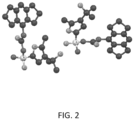

Classifications
-
- C—CHEMISTRY; METALLURGY
- C07—ORGANIC CHEMISTRY
- C07D—HETEROCYCLIC COMPOUNDS
- C07D277/00—Heterocyclic compounds containing 1,3-thiazole or hydrogenated 1,3-thiazole rings
- C07D277/02—Heterocyclic compounds containing 1,3-thiazole or hydrogenated 1,3-thiazole rings not condensed with other rings
- C07D277/20—Heterocyclic compounds containing 1,3-thiazole or hydrogenated 1,3-thiazole rings not condensed with other rings having two or three double bonds between ring members or between ring members and non-ring members
- C07D277/32—Heterocyclic compounds containing 1,3-thiazole or hydrogenated 1,3-thiazole rings not condensed with other rings having two or three double bonds between ring members or between ring members and non-ring members with hetero atoms or with carbon atoms having three bonds to hetero atoms with at the most one bond to halogen, e.g. ester or nitrile radicals, directly attached to ring carbon atoms
- C07D277/36—Sulfur atoms
-
- A—HUMAN NECESSITIES
- A61—MEDICAL OR VETERINARY SCIENCE; HYGIENE
- A61K—PREPARATIONS FOR MEDICAL, DENTAL OR TOILETRY PURPOSES
- A61K31/00—Medicinal preparations containing organic active ingredients
- A61K31/13—Amines
- A61K31/145—Amines having sulfur, e.g. thiurams (>N—C(S)—S—C(S)—N< and >N—C(S)—S—S—C(S)—N<), Sulfinylamines (—N=SO), Sulfonylamines (—N=SO2)
-
- A—HUMAN NECESSITIES
- A61—MEDICAL OR VETERINARY SCIENCE; HYGIENE
- A61K—PREPARATIONS FOR MEDICAL, DENTAL OR TOILETRY PURPOSES
- A61K31/00—Medicinal preparations containing organic active ingredients
- A61K31/33—Heterocyclic compounds
- A61K31/335—Heterocyclic compounds having oxygen as the only ring hetero atom, e.g. fungichromin
- A61K31/34—Heterocyclic compounds having oxygen as the only ring hetero atom, e.g. fungichromin having five-membered rings with one oxygen as the only ring hetero atom, e.g. isosorbide
- A61K31/341—Heterocyclic compounds having oxygen as the only ring hetero atom, e.g. fungichromin having five-membered rings with one oxygen as the only ring hetero atom, e.g. isosorbide not condensed with another ring, e.g. ranitidine, furosemide, bufetolol, muscarine
-
- A—HUMAN NECESSITIES
- A61—MEDICAL OR VETERINARY SCIENCE; HYGIENE
- A61K—PREPARATIONS FOR MEDICAL, DENTAL OR TOILETRY PURPOSES
- A61K31/00—Medicinal preparations containing organic active ingredients
- A61K31/33—Heterocyclic compounds
- A61K31/38—Heterocyclic compounds having sulfur as a ring hetero atom
- A61K31/381—Heterocyclic compounds having sulfur as a ring hetero atom having five-membered rings
-
- A—HUMAN NECESSITIES
- A61—MEDICAL OR VETERINARY SCIENCE; HYGIENE
- A61K—PREPARATIONS FOR MEDICAL, DENTAL OR TOILETRY PURPOSES
- A61K31/00—Medicinal preparations containing organic active ingredients
- A61K31/33—Heterocyclic compounds
- A61K31/395—Heterocyclic compounds having nitrogen as a ring hetero atom, e.g. guanethidine or rifamycins
- A61K31/41—Heterocyclic compounds having nitrogen as a ring hetero atom, e.g. guanethidine or rifamycins having five-membered rings with two or more ring hetero atoms, at least one of which being nitrogen, e.g. tetrazole
- A61K31/425—Thiazoles
- A61K31/426—1,3-Thiazoles
-
- A—HUMAN NECESSITIES
- A61—MEDICAL OR VETERINARY SCIENCE; HYGIENE
- A61K—PREPARATIONS FOR MEDICAL, DENTAL OR TOILETRY PURPOSES
- A61K31/00—Medicinal preparations containing organic active ingredients
- A61K31/33—Heterocyclic compounds
- A61K31/395—Heterocyclic compounds having nitrogen as a ring hetero atom, e.g. guanethidine or rifamycins
- A61K31/435—Heterocyclic compounds having nitrogen as a ring hetero atom, e.g. guanethidine or rifamycins having six-membered rings with one nitrogen as the only ring hetero atom
- A61K31/44—Non condensed pyridines; Hydrogenated derivatives thereof
- A61K31/4427—Non condensed pyridines; Hydrogenated derivatives thereof containing further heterocyclic ring systems
- A61K31/443—Non condensed pyridines; Hydrogenated derivatives thereof containing further heterocyclic ring systems containing a five-membered ring with oxygen as a ring hetero atom
-
- A—HUMAN NECESSITIES
- A61—MEDICAL OR VETERINARY SCIENCE; HYGIENE
- A61P—SPECIFIC THERAPEUTIC ACTIVITY OF CHEMICAL COMPOUNDS OR MEDICINAL PREPARATIONS
- A61P1/00—Drugs for disorders of the alimentary tract or the digestive system
-
- A—HUMAN NECESSITIES
- A61—MEDICAL OR VETERINARY SCIENCE; HYGIENE
- A61P—SPECIFIC THERAPEUTIC ACTIVITY OF CHEMICAL COMPOUNDS OR MEDICINAL PREPARATIONS
- A61P1/00—Drugs for disorders of the alimentary tract or the digestive system
- A61P1/16—Drugs for disorders of the alimentary tract or the digestive system for liver or gallbladder disorders, e.g. hepatoprotective agents, cholagogues, litholytics
-
- A—HUMAN NECESSITIES
- A61—MEDICAL OR VETERINARY SCIENCE; HYGIENE
- A61P—SPECIFIC THERAPEUTIC ACTIVITY OF CHEMICAL COMPOUNDS OR MEDICINAL PREPARATIONS
- A61P1/00—Drugs for disorders of the alimentary tract or the digestive system
- A61P1/18—Drugs for disorders of the alimentary tract or the digestive system for pancreatic disorders, e.g. pancreatic enzymes
-
- A—HUMAN NECESSITIES
- A61—MEDICAL OR VETERINARY SCIENCE; HYGIENE
- A61P—SPECIFIC THERAPEUTIC ACTIVITY OF CHEMICAL COMPOUNDS OR MEDICINAL PREPARATIONS
- A61P11/00—Drugs for disorders of the respiratory system
-
- A—HUMAN NECESSITIES
- A61—MEDICAL OR VETERINARY SCIENCE; HYGIENE
- A61P—SPECIFIC THERAPEUTIC ACTIVITY OF CHEMICAL COMPOUNDS OR MEDICINAL PREPARATIONS
- A61P11/00—Drugs for disorders of the respiratory system
- A61P11/06—Antiasthmatics
-
- A—HUMAN NECESSITIES
- A61—MEDICAL OR VETERINARY SCIENCE; HYGIENE
- A61P—SPECIFIC THERAPEUTIC ACTIVITY OF CHEMICAL COMPOUNDS OR MEDICINAL PREPARATIONS
- A61P13/00—Drugs for disorders of the urinary system
- A61P13/12—Drugs for disorders of the urinary system of the kidneys
-
- A—HUMAN NECESSITIES
- A61—MEDICAL OR VETERINARY SCIENCE; HYGIENE
- A61P—SPECIFIC THERAPEUTIC ACTIVITY OF CHEMICAL COMPOUNDS OR MEDICINAL PREPARATIONS
- A61P17/00—Drugs for dermatological disorders
-
- A—HUMAN NECESSITIES
- A61—MEDICAL OR VETERINARY SCIENCE; HYGIENE
- A61P—SPECIFIC THERAPEUTIC ACTIVITY OF CHEMICAL COMPOUNDS OR MEDICINAL PREPARATIONS
- A61P17/00—Drugs for dermatological disorders
- A61P17/06—Antipsoriatics
-
- A—HUMAN NECESSITIES
- A61—MEDICAL OR VETERINARY SCIENCE; HYGIENE
- A61P—SPECIFIC THERAPEUTIC ACTIVITY OF CHEMICAL COMPOUNDS OR MEDICINAL PREPARATIONS
- A61P19/00—Drugs for skeletal disorders
-
- A—HUMAN NECESSITIES
- A61—MEDICAL OR VETERINARY SCIENCE; HYGIENE
- A61P—SPECIFIC THERAPEUTIC ACTIVITY OF CHEMICAL COMPOUNDS OR MEDICINAL PREPARATIONS
- A61P19/00—Drugs for skeletal disorders
- A61P19/06—Antigout agents, e.g. antihyperuricemic or uricosuric agents
-
- A—HUMAN NECESSITIES
- A61—MEDICAL OR VETERINARY SCIENCE; HYGIENE
- A61P—SPECIFIC THERAPEUTIC ACTIVITY OF CHEMICAL COMPOUNDS OR MEDICINAL PREPARATIONS
- A61P19/00—Drugs for skeletal disorders
- A61P19/08—Drugs for skeletal disorders for bone diseases, e.g. rachitism, Paget's disease
-
- A—HUMAN NECESSITIES
- A61—MEDICAL OR VETERINARY SCIENCE; HYGIENE
- A61P—SPECIFIC THERAPEUTIC ACTIVITY OF CHEMICAL COMPOUNDS OR MEDICINAL PREPARATIONS
- A61P19/00—Drugs for skeletal disorders
- A61P19/08—Drugs for skeletal disorders for bone diseases, e.g. rachitism, Paget's disease
- A61P19/10—Drugs for skeletal disorders for bone diseases, e.g. rachitism, Paget's disease for osteoporosis
-
- A—HUMAN NECESSITIES
- A61—MEDICAL OR VETERINARY SCIENCE; HYGIENE
- A61P—SPECIFIC THERAPEUTIC ACTIVITY OF CHEMICAL COMPOUNDS OR MEDICINAL PREPARATIONS
- A61P21/00—Drugs for disorders of the muscular or neuromuscular system
-
- A—HUMAN NECESSITIES
- A61—MEDICAL OR VETERINARY SCIENCE; HYGIENE
- A61P—SPECIFIC THERAPEUTIC ACTIVITY OF CHEMICAL COMPOUNDS OR MEDICINAL PREPARATIONS
- A61P25/00—Drugs for disorders of the nervous system
-
- A—HUMAN NECESSITIES
- A61—MEDICAL OR VETERINARY SCIENCE; HYGIENE
- A61P—SPECIFIC THERAPEUTIC ACTIVITY OF CHEMICAL COMPOUNDS OR MEDICINAL PREPARATIONS
- A61P25/00—Drugs for disorders of the nervous system
- A61P25/14—Drugs for disorders of the nervous system for treating abnormal movements, e.g. chorea, dyskinesia
- A61P25/16—Anti-Parkinson drugs
-
- A—HUMAN NECESSITIES
- A61—MEDICAL OR VETERINARY SCIENCE; HYGIENE
- A61P—SPECIFIC THERAPEUTIC ACTIVITY OF CHEMICAL COMPOUNDS OR MEDICINAL PREPARATIONS
- A61P25/00—Drugs for disorders of the nervous system
- A61P25/28—Drugs for disorders of the nervous system for treating neurodegenerative disorders of the central nervous system, e.g. nootropic agents, cognition enhancers, drugs for treating Alzheimer's disease or other forms of dementia
-
- A—HUMAN NECESSITIES
- A61—MEDICAL OR VETERINARY SCIENCE; HYGIENE
- A61P—SPECIFIC THERAPEUTIC ACTIVITY OF CHEMICAL COMPOUNDS OR MEDICINAL PREPARATIONS
- A61P27/00—Drugs for disorders of the senses
-
- A—HUMAN NECESSITIES
- A61—MEDICAL OR VETERINARY SCIENCE; HYGIENE
- A61P—SPECIFIC THERAPEUTIC ACTIVITY OF CHEMICAL COMPOUNDS OR MEDICINAL PREPARATIONS
- A61P27/00—Drugs for disorders of the senses
- A61P27/02—Ophthalmic agents
-
- A—HUMAN NECESSITIES
- A61—MEDICAL OR VETERINARY SCIENCE; HYGIENE
- A61P—SPECIFIC THERAPEUTIC ACTIVITY OF CHEMICAL COMPOUNDS OR MEDICINAL PREPARATIONS
- A61P27/00—Drugs for disorders of the senses
- A61P27/02—Ophthalmic agents
- A61P27/06—Antiglaucoma agents or miotics
-
- A—HUMAN NECESSITIES
- A61—MEDICAL OR VETERINARY SCIENCE; HYGIENE
- A61P—SPECIFIC THERAPEUTIC ACTIVITY OF CHEMICAL COMPOUNDS OR MEDICINAL PREPARATIONS
- A61P29/00—Non-central analgesic, antipyretic or antiinflammatory agents, e.g. antirheumatic agents; Non-steroidal antiinflammatory drugs [NSAID]
-
- A—HUMAN NECESSITIES
- A61—MEDICAL OR VETERINARY SCIENCE; HYGIENE
- A61P—SPECIFIC THERAPEUTIC ACTIVITY OF CHEMICAL COMPOUNDS OR MEDICINAL PREPARATIONS
- A61P3/00—Drugs for disorders of the metabolism
-
- A—HUMAN NECESSITIES
- A61—MEDICAL OR VETERINARY SCIENCE; HYGIENE
- A61P—SPECIFIC THERAPEUTIC ACTIVITY OF CHEMICAL COMPOUNDS OR MEDICINAL PREPARATIONS
- A61P3/00—Drugs for disorders of the metabolism
- A61P3/04—Anorexiants; Antiobesity agents
-
- A—HUMAN NECESSITIES
- A61—MEDICAL OR VETERINARY SCIENCE; HYGIENE
- A61P—SPECIFIC THERAPEUTIC ACTIVITY OF CHEMICAL COMPOUNDS OR MEDICINAL PREPARATIONS
- A61P3/00—Drugs for disorders of the metabolism
- A61P3/08—Drugs for disorders of the metabolism for glucose homeostasis
- A61P3/10—Drugs for disorders of the metabolism for glucose homeostasis for hyperglycaemia, e.g. antidiabetics
-
- A—HUMAN NECESSITIES
- A61—MEDICAL OR VETERINARY SCIENCE; HYGIENE
- A61P—SPECIFIC THERAPEUTIC ACTIVITY OF CHEMICAL COMPOUNDS OR MEDICINAL PREPARATIONS
- A61P31/00—Antiinfectives, i.e. antibiotics, antiseptics, chemotherapeutics
- A61P31/12—Antivirals
-
- A—HUMAN NECESSITIES
- A61—MEDICAL OR VETERINARY SCIENCE; HYGIENE
- A61P—SPECIFIC THERAPEUTIC ACTIVITY OF CHEMICAL COMPOUNDS OR MEDICINAL PREPARATIONS
- A61P31/00—Antiinfectives, i.e. antibiotics, antiseptics, chemotherapeutics
- A61P31/12—Antivirals
- A61P31/14—Antivirals for RNA viruses
- A61P31/18—Antivirals for RNA viruses for HIV
-
- A—HUMAN NECESSITIES
- A61—MEDICAL OR VETERINARY SCIENCE; HYGIENE
- A61P—SPECIFIC THERAPEUTIC ACTIVITY OF CHEMICAL COMPOUNDS OR MEDICINAL PREPARATIONS
- A61P35/00—Antineoplastic agents
-
- A—HUMAN NECESSITIES
- A61—MEDICAL OR VETERINARY SCIENCE; HYGIENE
- A61P—SPECIFIC THERAPEUTIC ACTIVITY OF CHEMICAL COMPOUNDS OR MEDICINAL PREPARATIONS
- A61P35/00—Antineoplastic agents
- A61P35/02—Antineoplastic agents specific for leukemia
-
- A—HUMAN NECESSITIES
- A61—MEDICAL OR VETERINARY SCIENCE; HYGIENE
- A61P—SPECIFIC THERAPEUTIC ACTIVITY OF CHEMICAL COMPOUNDS OR MEDICINAL PREPARATIONS
- A61P35/00—Antineoplastic agents
- A61P35/04—Antineoplastic agents specific for metastasis
-
- A—HUMAN NECESSITIES
- A61—MEDICAL OR VETERINARY SCIENCE; HYGIENE
- A61P—SPECIFIC THERAPEUTIC ACTIVITY OF CHEMICAL COMPOUNDS OR MEDICINAL PREPARATIONS
- A61P37/00—Drugs for immunological or allergic disorders
-
- A—HUMAN NECESSITIES
- A61—MEDICAL OR VETERINARY SCIENCE; HYGIENE
- A61P—SPECIFIC THERAPEUTIC ACTIVITY OF CHEMICAL COMPOUNDS OR MEDICINAL PREPARATIONS
- A61P37/00—Drugs for immunological or allergic disorders
- A61P37/02—Immunomodulators
- A61P37/06—Immunosuppressants, e.g. drugs for graft rejection
-
- A—HUMAN NECESSITIES
- A61—MEDICAL OR VETERINARY SCIENCE; HYGIENE
- A61P—SPECIFIC THERAPEUTIC ACTIVITY OF CHEMICAL COMPOUNDS OR MEDICINAL PREPARATIONS
- A61P9/00—Drugs for disorders of the cardiovascular system
-
- A—HUMAN NECESSITIES
- A61—MEDICAL OR VETERINARY SCIENCE; HYGIENE
- A61P—SPECIFIC THERAPEUTIC ACTIVITY OF CHEMICAL COMPOUNDS OR MEDICINAL PREPARATIONS
- A61P9/00—Drugs for disorders of the cardiovascular system
- A61P9/10—Drugs for disorders of the cardiovascular system for treating ischaemic or atherosclerotic diseases, e.g. antianginal drugs, coronary vasodilators, drugs for myocardial infarction, retinopathy, cerebrovascula insufficiency, renal arteriosclerosis
-
- C—CHEMISTRY; METALLURGY
- C07—ORGANIC CHEMISTRY
- C07C—ACYCLIC OR CARBOCYCLIC COMPOUNDS
- C07C307/00—Amides of sulfuric acids, i.e. compounds having singly-bound oxygen atoms of sulfate groups replaced by nitrogen atoms, not being part of nitro or nitroso groups
- C07C307/04—Diamides of sulfuric acids
- C07C307/06—Diamides of sulfuric acids having nitrogen atoms of the sulfamide groups bound to acyclic carbon atoms
-
- C—CHEMISTRY; METALLURGY
- C07—ORGANIC CHEMISTRY
- C07C—ACYCLIC OR CARBOCYCLIC COMPOUNDS
- C07C381/00—Compounds containing carbon and sulfur and having functional groups not covered by groups C07C301/00 - C07C337/00
- C07C381/10—Compounds containing sulfur atoms doubly-bound to nitrogen atoms
-
- C—CHEMISTRY; METALLURGY
- C07—ORGANIC CHEMISTRY
- C07D—HETEROCYCLIC COMPOUNDS
- C07D205/00—Heterocyclic compounds containing four-membered rings with one nitrogen atom as the only ring hetero atom
- C07D205/02—Heterocyclic compounds containing four-membered rings with one nitrogen atom as the only ring hetero atom not condensed with other rings
- C07D205/04—Heterocyclic compounds containing four-membered rings with one nitrogen atom as the only ring hetero atom not condensed with other rings having no double bonds between ring members or between ring members and non-ring members
-
- C—CHEMISTRY; METALLURGY
- C07—ORGANIC CHEMISTRY
- C07D—HETEROCYCLIC COMPOUNDS
- C07D207/00—Heterocyclic compounds containing five-membered rings not condensed with other rings, with one nitrogen atom as the only ring hetero atom
- C07D207/02—Heterocyclic compounds containing five-membered rings not condensed with other rings, with one nitrogen atom as the only ring hetero atom with only hydrogen or carbon atoms directly attached to the ring nitrogen atom
- C07D207/04—Heterocyclic compounds containing five-membered rings not condensed with other rings, with one nitrogen atom as the only ring hetero atom with only hydrogen or carbon atoms directly attached to the ring nitrogen atom having no double bonds between ring members or between ring members and non-ring members
-
- C—CHEMISTRY; METALLURGY
- C07—ORGANIC CHEMISTRY
- C07D—HETEROCYCLIC COMPOUNDS
- C07D207/00—Heterocyclic compounds containing five-membered rings not condensed with other rings, with one nitrogen atom as the only ring hetero atom
- C07D207/02—Heterocyclic compounds containing five-membered rings not condensed with other rings, with one nitrogen atom as the only ring hetero atom with only hydrogen or carbon atoms directly attached to the ring nitrogen atom
- C07D207/04—Heterocyclic compounds containing five-membered rings not condensed with other rings, with one nitrogen atom as the only ring hetero atom with only hydrogen or carbon atoms directly attached to the ring nitrogen atom having no double bonds between ring members or between ring members and non-ring members
- C07D207/10—Heterocyclic compounds containing five-membered rings not condensed with other rings, with one nitrogen atom as the only ring hetero atom with only hydrogen or carbon atoms directly attached to the ring nitrogen atom having no double bonds between ring members or between ring members and non-ring members with hetero atoms or with carbon atoms having three bonds to hetero atoms with at the most one bond to halogen, e.g. ester or nitrile radicals, directly attached to ring carbon atoms
-
- C—CHEMISTRY; METALLURGY
- C07—ORGANIC CHEMISTRY
- C07D—HETEROCYCLIC COMPOUNDS
- C07D213/00—Heterocyclic compounds containing six-membered rings, not condensed with other rings, with one nitrogen atom as the only ring hetero atom and three or more double bonds between ring members or between ring members and non-ring members
- C07D213/02—Heterocyclic compounds containing six-membered rings, not condensed with other rings, with one nitrogen atom as the only ring hetero atom and three or more double bonds between ring members or between ring members and non-ring members having three double bonds between ring members or between ring members and non-ring members
- C07D213/04—Heterocyclic compounds containing six-membered rings, not condensed with other rings, with one nitrogen atom as the only ring hetero atom and three or more double bonds between ring members or between ring members and non-ring members having three double bonds between ring members or between ring members and non-ring members having no bond between the ring nitrogen atom and a non-ring member or having only hydrogen or carbon atoms directly attached to the ring nitrogen atom
- C07D213/60—Heterocyclic compounds containing six-membered rings, not condensed with other rings, with one nitrogen atom as the only ring hetero atom and three or more double bonds between ring members or between ring members and non-ring members having three double bonds between ring members or between ring members and non-ring members having no bond between the ring nitrogen atom and a non-ring member or having only hydrogen or carbon atoms directly attached to the ring nitrogen atom with hetero atoms or with carbon atoms having three bonds to hetero atoms with at the most one bond to halogen, e.g. ester or nitrile radicals, directly attached to ring carbon atoms
- C07D213/62—Oxygen or sulfur atoms
- C07D213/70—Sulfur atoms
- C07D213/71—Sulfur atoms to which a second hetero atom is attached
-
- C—CHEMISTRY; METALLURGY
- C07—ORGANIC CHEMISTRY
- C07D—HETEROCYCLIC COMPOUNDS
- C07D215/00—Heterocyclic compounds containing quinoline or hydrogenated quinoline ring systems
- C07D215/02—Heterocyclic compounds containing quinoline or hydrogenated quinoline ring systems having no bond between the ring nitrogen atom and a non-ring member or having only hydrogen atoms or carbon atoms directly attached to the ring nitrogen atom
- C07D215/16—Heterocyclic compounds containing quinoline or hydrogenated quinoline ring systems having no bond between the ring nitrogen atom and a non-ring member or having only hydrogen atoms or carbon atoms directly attached to the ring nitrogen atom with hetero atoms or with carbon atoms having three bonds to hetero atoms with at the most one bond to halogen, e.g. ester or nitrile radicals, directly attached to ring carbon atoms
- C07D215/36—Sulfur atoms
-
- C—CHEMISTRY; METALLURGY
- C07—ORGANIC CHEMISTRY
- C07D—HETEROCYCLIC COMPOUNDS
- C07D217/00—Heterocyclic compounds containing isoquinoline or hydrogenated isoquinoline ring systems
- C07D217/22—Heterocyclic compounds containing isoquinoline or hydrogenated isoquinoline ring systems with hetero atoms or with carbon atoms having three bonds to hetero atoms with at the most one bond to halogen, e.g. ester or nitrile radicals, directly attached to carbon atoms of the nitrogen-containing ring
-
- C—CHEMISTRY; METALLURGY
- C07—ORGANIC CHEMISTRY
- C07D—HETEROCYCLIC COMPOUNDS
- C07D231/00—Heterocyclic compounds containing 1,2-diazole or hydrogenated 1,2-diazole rings
- C07D231/02—Heterocyclic compounds containing 1,2-diazole or hydrogenated 1,2-diazole rings not condensed with other rings
- C07D231/10—Heterocyclic compounds containing 1,2-diazole or hydrogenated 1,2-diazole rings not condensed with other rings having two or three double bonds between ring members or between ring members and non-ring members
- C07D231/14—Heterocyclic compounds containing 1,2-diazole or hydrogenated 1,2-diazole rings not condensed with other rings having two or three double bonds between ring members or between ring members and non-ring members with hetero atoms or with carbon atoms having three bonds to hetero atoms with at the most one bond to halogen, e.g. ester or nitrile radicals, directly attached to ring carbon atoms
- C07D231/18—One oxygen or sulfur atom
-
- C—CHEMISTRY; METALLURGY
- C07—ORGANIC CHEMISTRY
- C07D—HETEROCYCLIC COMPOUNDS
- C07D231/00—Heterocyclic compounds containing 1,2-diazole or hydrogenated 1,2-diazole rings
- C07D231/54—Heterocyclic compounds containing 1,2-diazole or hydrogenated 1,2-diazole rings condensed with carbocyclic rings or ring systems
- C07D231/56—Benzopyrazoles; Hydrogenated benzopyrazoles
-
- C—CHEMISTRY; METALLURGY
- C07—ORGANIC CHEMISTRY
- C07D—HETEROCYCLIC COMPOUNDS
- C07D239/00—Heterocyclic compounds containing 1,3-diazine or hydrogenated 1,3-diazine rings
- C07D239/02—Heterocyclic compounds containing 1,3-diazine or hydrogenated 1,3-diazine rings not condensed with other rings
- C07D239/24—Heterocyclic compounds containing 1,3-diazine or hydrogenated 1,3-diazine rings not condensed with other rings having three or more double bonds between ring members or between ring members and non-ring members
- C07D239/26—Heterocyclic compounds containing 1,3-diazine or hydrogenated 1,3-diazine rings not condensed with other rings having three or more double bonds between ring members or between ring members and non-ring members with only hydrogen atoms, hydrocarbon or substituted hydrocarbon radicals, directly attached to ring carbon atoms
-
- C—CHEMISTRY; METALLURGY
- C07—ORGANIC CHEMISTRY
- C07D—HETEROCYCLIC COMPOUNDS
- C07D263/00—Heterocyclic compounds containing 1,3-oxazole or hydrogenated 1,3-oxazole rings
- C07D263/02—Heterocyclic compounds containing 1,3-oxazole or hydrogenated 1,3-oxazole rings not condensed with other rings
- C07D263/30—Heterocyclic compounds containing 1,3-oxazole or hydrogenated 1,3-oxazole rings not condensed with other rings having two or three double bonds between ring members or between ring members and non-ring members
- C07D263/34—Heterocyclic compounds containing 1,3-oxazole or hydrogenated 1,3-oxazole rings not condensed with other rings having two or three double bonds between ring members or between ring members and non-ring members with hetero atoms or with carbon atoms having three bonds to hetero atoms with at the most one bond to halogen, e.g. ester or nitrile radicals, directly attached to ring carbon atoms
- C07D263/46—Sulfur atoms
-
- C—CHEMISTRY; METALLURGY
- C07—ORGANIC CHEMISTRY
- C07D—HETEROCYCLIC COMPOUNDS
- C07D265/00—Heterocyclic compounds containing six-membered rings having one nitrogen atom and one oxygen atom as the only ring hetero atoms
- C07D265/28—1,4-Oxazines; Hydrogenated 1,4-oxazines
- C07D265/30—1,4-Oxazines; Hydrogenated 1,4-oxazines not condensed with other rings
-
- C—CHEMISTRY; METALLURGY
- C07—ORGANIC CHEMISTRY
- C07D—HETEROCYCLIC COMPOUNDS
- C07D307/00—Heterocyclic compounds containing five-membered rings having one oxygen atom as the only ring hetero atom
- C07D307/02—Heterocyclic compounds containing five-membered rings having one oxygen atom as the only ring hetero atom not condensed with other rings
- C07D307/34—Heterocyclic compounds containing five-membered rings having one oxygen atom as the only ring hetero atom not condensed with other rings having two or three double bonds between ring members or between ring members and non-ring members
- C07D307/56—Heterocyclic compounds containing five-membered rings having one oxygen atom as the only ring hetero atom not condensed with other rings having two or three double bonds between ring members or between ring members and non-ring members with hetero atoms or with carbon atoms having three bonds to hetero atoms with at the most one bond to halogen, e.g. ester or nitrile radicals, directly attached to ring carbon atoms
- C07D307/64—Sulfur atoms
-
- C—CHEMISTRY; METALLURGY
- C07—ORGANIC CHEMISTRY
- C07D—HETEROCYCLIC COMPOUNDS
- C07D307/00—Heterocyclic compounds containing five-membered rings having one oxygen atom as the only ring hetero atom
- C07D307/77—Heterocyclic compounds containing five-membered rings having one oxygen atom as the only ring hetero atom ortho- or peri-condensed with carbocyclic rings or ring systems
- C07D307/78—Benzo [b] furans; Hydrogenated benzo [b] furans
- C07D307/79—Benzo [b] furans; Hydrogenated benzo [b] furans with only hydrogen atoms, hydrocarbon or substituted hydrocarbon radicals, directly attached to carbon atoms of the hetero ring
-
- C—CHEMISTRY; METALLURGY
- C07—ORGANIC CHEMISTRY
- C07D—HETEROCYCLIC COMPOUNDS
- C07D317/00—Heterocyclic compounds containing five-membered rings having two oxygen atoms as the only ring hetero atoms
- C07D317/08—Heterocyclic compounds containing five-membered rings having two oxygen atoms as the only ring hetero atoms having the hetero atoms in positions 1 and 3
- C07D317/44—Heterocyclic compounds containing five-membered rings having two oxygen atoms as the only ring hetero atoms having the hetero atoms in positions 1 and 3 ortho- or peri-condensed with carbocyclic rings or ring systems
- C07D317/46—Heterocyclic compounds containing five-membered rings having two oxygen atoms as the only ring hetero atoms having the hetero atoms in positions 1 and 3 ortho- or peri-condensed with carbocyclic rings or ring systems condensed with one six-membered ring
- C07D317/48—Methylenedioxybenzenes or hydrogenated methylenedioxybenzenes, unsubstituted on the hetero ring
- C07D317/62—Methylenedioxybenzenes or hydrogenated methylenedioxybenzenes, unsubstituted on the hetero ring with hetero atoms or with carbon atoms having three bonds to hetero atoms with at the most one bond to halogen, e.g. ester or nitrile radicals, directly attached to atoms of the carbocyclic ring
-
- C—CHEMISTRY; METALLURGY
- C07—ORGANIC CHEMISTRY
- C07D—HETEROCYCLIC COMPOUNDS
- C07D333/00—Heterocyclic compounds containing five-membered rings having one sulfur atom as the only ring hetero atom
- C07D333/02—Heterocyclic compounds containing five-membered rings having one sulfur atom as the only ring hetero atom not condensed with other rings
- C07D333/04—Heterocyclic compounds containing five-membered rings having one sulfur atom as the only ring hetero atom not condensed with other rings not substituted on the ring sulphur atom
- C07D333/26—Heterocyclic compounds containing five-membered rings having one sulfur atom as the only ring hetero atom not condensed with other rings not substituted on the ring sulphur atom with hetero atoms or with carbon atoms having three bonds to hetero atoms with at the most one bond to halogen, e.g. ester or nitrile radicals, directly attached to ring carbon atoms
- C07D333/30—Hetero atoms other than halogen
- C07D333/34—Sulfur atoms
-
- C—CHEMISTRY; METALLURGY
- C07—ORGANIC CHEMISTRY
- C07D—HETEROCYCLIC COMPOUNDS
- C07D417/00—Heterocyclic compounds containing two or more hetero rings, at least one ring having nitrogen and sulfur atoms as the only ring hetero atoms, not provided for by group C07D415/00
- C07D417/02—Heterocyclic compounds containing two or more hetero rings, at least one ring having nitrogen and sulfur atoms as the only ring hetero atoms, not provided for by group C07D415/00 containing two hetero rings
- C07D417/12—Heterocyclic compounds containing two or more hetero rings, at least one ring having nitrogen and sulfur atoms as the only ring hetero atoms, not provided for by group C07D415/00 containing two hetero rings linked by a chain containing hetero atoms as chain links
-
- C—CHEMISTRY; METALLURGY
- C07—ORGANIC CHEMISTRY
- C07D—HETEROCYCLIC COMPOUNDS
- C07D487/00—Heterocyclic compounds containing nitrogen atoms as the only ring hetero atoms in the condensed system, not provided for by groups C07D451/00 - C07D477/00
- C07D487/02—Heterocyclic compounds containing nitrogen atoms as the only ring hetero atoms in the condensed system, not provided for by groups C07D451/00 - C07D477/00 in which the condensed system contains two hetero rings
- C07D487/04—Ortho-condensed systems
-
- C—CHEMISTRY; METALLURGY
- C07—ORGANIC CHEMISTRY
- C07C—ACYCLIC OR CARBOCYCLIC COMPOUNDS
- C07C2601/00—Systems containing only non-condensed rings
- C07C2601/02—Systems containing only non-condensed rings with a three-membered ring
-
- C—CHEMISTRY; METALLURGY
- C07—ORGANIC CHEMISTRY
- C07C—ACYCLIC OR CARBOCYCLIC COMPOUNDS
- C07C2603/00—Systems containing at least three condensed rings
- C07C2603/02—Ortho- or ortho- and peri-condensed systems
- C07C2603/04—Ortho- or ortho- and peri-condensed systems containing three rings
- C07C2603/06—Ortho- or ortho- and peri-condensed systems containing three rings containing at least one ring with less than six ring members
- C07C2603/10—Ortho- or ortho- and peri-condensed systems containing three rings containing at least one ring with less than six ring members containing five-membered rings
-
- C—CHEMISTRY; METALLURGY
- C07—ORGANIC CHEMISTRY
- C07C—ACYCLIC OR CARBOCYCLIC COMPOUNDS
- C07C2603/00—Systems containing at least three condensed rings
- C07C2603/02—Ortho- or ortho- and peri-condensed systems
- C07C2603/04—Ortho- or ortho- and peri-condensed systems containing three rings
- C07C2603/06—Ortho- or ortho- and peri-condensed systems containing three rings containing at least one ring with less than six ring members
- C07C2603/10—Ortho- or ortho- and peri-condensed systems containing three rings containing at least one ring with less than six ring members containing five-membered rings
- C07C2603/12—Ortho- or ortho- and peri-condensed systems containing three rings containing at least one ring with less than six ring members containing five-membered rings only one five-membered ring
-
- C—CHEMISTRY; METALLURGY
- C07—ORGANIC CHEMISTRY
- C07C—ACYCLIC OR CARBOCYCLIC COMPOUNDS
- C07C335/00—Thioureas, i.e. compounds containing any of the groups, the nitrogen atoms not being part of nitro or nitroso groups
- C07C335/40—Thioureas, i.e. compounds containing any of the groups, the nitrogen atoms not being part of nitro or nitroso groups having nitrogen atoms of thiourea or isothiourea groups further bound to other hetero atoms
- C07C335/42—Sulfonylthioureas; Sulfonylisothioureas
-
- C—CHEMISTRY; METALLURGY
- C07—ORGANIC CHEMISTRY
- C07D—HETEROCYCLIC COMPOUNDS
- C07D231/00—Heterocyclic compounds containing 1,2-diazole or hydrogenated 1,2-diazole rings
- C07D231/02—Heterocyclic compounds containing 1,2-diazole or hydrogenated 1,2-diazole rings not condensed with other rings
- C07D231/10—Heterocyclic compounds containing 1,2-diazole or hydrogenated 1,2-diazole rings not condensed with other rings having two or three double bonds between ring members or between ring members and non-ring members
- C07D231/12—Heterocyclic compounds containing 1,2-diazole or hydrogenated 1,2-diazole rings not condensed with other rings having two or three double bonds between ring members or between ring members and non-ring members with only hydrogen atoms, hydrocarbon or substituted hydrocarbon radicals, directly attached to ring carbon atoms
-
- C—CHEMISTRY; METALLURGY
- C07—ORGANIC CHEMISTRY
- C07D—HETEROCYCLIC COMPOUNDS
- C07D405/00—Heterocyclic compounds containing both one or more hetero rings having oxygen atoms as the only ring hetero atoms, and one or more rings having nitrogen as the only ring hetero atom
- C07D405/02—Heterocyclic compounds containing both one or more hetero rings having oxygen atoms as the only ring hetero atoms, and one or more rings having nitrogen as the only ring hetero atom containing two hetero rings
- C07D405/12—Heterocyclic compounds containing both one or more hetero rings having oxygen atoms as the only ring hetero atoms, and one or more rings having nitrogen as the only ring hetero atom containing two hetero rings linked by a chain containing hetero atoms as chain links
-
- C—CHEMISTRY; METALLURGY
- C07—ORGANIC CHEMISTRY
- C07D—HETEROCYCLIC COMPOUNDS
- C07D409/00—Heterocyclic compounds containing two or more hetero rings, at least one ring having sulfur atoms as the only ring hetero atoms
- C07D409/02—Heterocyclic compounds containing two or more hetero rings, at least one ring having sulfur atoms as the only ring hetero atoms containing two hetero rings
- C07D409/12—Heterocyclic compounds containing two or more hetero rings, at least one ring having sulfur atoms as the only ring hetero atoms containing two hetero rings linked by a chain containing hetero atoms as chain links
-
- C—CHEMISTRY; METALLURGY
- C07—ORGANIC CHEMISTRY
- C07D—HETEROCYCLIC COMPOUNDS
- C07D471/00—Heterocyclic compounds containing nitrogen atoms as the only ring hetero atoms in the condensed system, at least one ring being a six-membered ring with one nitrogen atom, not provided for by groups C07D451/00 - C07D463/00
- C07D471/02—Heterocyclic compounds containing nitrogen atoms as the only ring hetero atoms in the condensed system, at least one ring being a six-membered ring with one nitrogen atom, not provided for by groups C07D451/00 - C07D463/00 in which the condensed system contains two hetero rings
- C07D471/04—Ortho-condensed systems
Definitions
- This disclosure features chemical entities (e.g., a compound that modulates (e.g., antagonizes) NLRP3, or a pharmaceutically acceptable salt, and/or hydrate, and/or cocrystal, and/or drug combination of the compound) that are useful, e.g., for treating a condition, disease or disorder in which a decrease or increase in NLRP3 activity (e.g., an increase, e.g., a condition, disease or disorder associated with NLRP3 signaling) contributes to the pathology and/or symptoms and/or progression of the condition, disease or disorder in a subject (e.g., a human).
- This disclosure also features compositions as well as other methods of using and making the same.
- the NLRP3 inflammasome is a component of the inflammatory process and its aberrant activation is pathogenic in inherited disorders such as the cryopyrin associated periodic syndromes (CAPS).
- CAPS Muckle-Wells syndrome MFS
- FCAS familial cold autoinflammatory syndrome
- NOMID neonatal onset multi-system inflammatory disease
- NLRP3 can form a complex and has been implicated in the pathogenesis of a number of complex diseases, including but not limited to metabolic disorders such as type 2 diabetes, atherosclerosis, obesity and gout, as well as diseases of the central nervous system, such as Alzheimer's disease and multiple sclerosis and Amyotrophic Lateral Sclerosis and Parkinson disease, lung disease, such as asthma and COPD and pulmonary idiopathic fibrosis, liver disease, such as NASH syndrome, viral hepatitis and cirrhosis, pancreatic disease, such as acute and chronic pancreatitis, kidney disease, such as acute and chronic kidney injury, intestinal disease such as Crohn's disease and Ulcerative Colitis, skin disease such as psoriasis, musculoskeletal disease such as scleroderma, vessel disorders, such as giant cell arteritis, disorders of the bones, such as Osteoarthritis , osteoporosis and osteopetrosis disorders eye disease, such as glaucoma and macular degeneration, disease
- This disclosure features chemical entities (e.g., a compound that modulates (e.g., antagonizes) NLRP3, or a pharmaceutically acceptable salt, and/or hydrate, and/or cocrystal, and/or drug combination of the compound) that are useful, e.g., for treating a condition, disease or disorder in which a decrease or increase in NLRP3 activity (e.g., an increase, e.g., a condition, disease or disorder associated with NLRP3 signaling).
- a compound that modulates e.g., antagonizes
- a pharmaceutically acceptable salt, and/or hydrate, and/or cocrystal, and/or drug combination of the compound e.g., for treating a condition, disease or disorder in which a decrease or increase in NLRP3 activity (e.g., an increase, e.g., a condition, disease or disorder associated with NLRP3 signaling).
- a compound of Formula AA or a pharmaceutically acceptable salt thereof wherein the variables in Formula AA can be as defined anywhere herein.
- compositions as well as other methods of using and making the same.
- An "antagonist" of NLRP3 includes compounds that inhibit the ability of NLRP3 to induce the production of IL-1 ⁇ and/or IL-18 by directly binding to NLRP3, or by inactivating, destabilizing, altering distribution, of NLRP3 or otherwise.
- compositions are featured that include a chemical entity described herein (e.g., a compound described generically or specifically herein or a pharmaceutically acceptable salt thereof or compositions containing the same) and one or more pharmaceutically acceptable excipients.
- a chemical entity described herein e.g., a compound described generically or specifically herein or a pharmaceutically acceptable salt thereof or compositions containing the same
- one or more pharmaceutically acceptable excipients e.g., a compound described generically or specifically herein or a pharmaceutically acceptable salt thereof or compositions containing the same.
- methods for modulating e.g., agonizing, partially agonizing, antagonizing
- NLRP3 activity include contacting NLRP3 with a chemical entity described herein (e.g., a compound described generically or specifically herein or a pharmaceutically acceptable salt thereof or compositions containing the same).
- Methods include in vitro methods, e.g., contacting a sample that includes one or more cells comprising NLRP3, as well as in vivo methods.
- methods of treatment of a disease in which NLRP3 signaling contributes to the pathology and/or symptoms and/or progression of the disease include administering to a subject in need of such treatment an effective amount of a chemical entity described herein (e.g., a compound described generically or specifically herein or a pharmaceutically acceptable salt thereof or compositions containing the same).
- a chemical entity described herein e.g., a compound described generically or specifically herein or a pharmaceutically acceptable salt thereof or compositions containing the same.
- methods of treatment include administering to a subject a chemical entity described herein (e.g., a compound described generically or specifically herein or a pharmaceutically acceptable salt thereof or compositions containing the same), wherein the chemical entity is administered in an amount effective to treat a disease in which NLRP3 signaling contributes to the pathology and/or symptoms and/or progression of the disease, thereby treating the disease.
- a chemical entity described herein e.g., a compound described generically or specifically herein or a pharmaceutically acceptable salt thereof or compositions containing the same
- Embodiments can include one or more of the following features.
- the chemical entity can be administered in combination with one or more additional therapies with one or more agents suitable for the treatment of the condition, disease or disorder.
- Examples of the indications that may be treated by the compounds disclosed herein include but are not limited to metabolic disorders such as type 2 diabetes, atherosclerosis, obesity and gout, as well as diseases of the central nervous system, such as Alzheimer's disease and multiple sclerosis and Amyotrophic Lateral Sclerosis and Parkinson disease, lung disease, such as asthma and COPD and pulmonary idiopathic fibrosis, liver disease, such as NASH syndrome, viral hepatitis and cirrhosis, pancreatic disease, such as acute and chronic pancreatitis, kidney disease, such as acute and chronic kidney injury, intestinal disease such as Crohn's disease and Ulcerative Colitis, skin disease such as psoriasis, musculoskeletal disease such as scleroderma, vessel disorders, such as giant cell arteritis, disorders of the bones, such as osteoarthritis , osteoporosis and osteopetrosis disorders, eye disease, such as glaucoma and macular degeneration, diseases caused by viral infection such as HIV and AIDS,
- the methods can further include identifying the subject.
- NLRP3 is meant to include, without limitation, nucleic acids, polynucleotides, oligonucleotides, sense and antisense polynucleotide strands, complementary sequences, peptides, polypeptides, proteins, homologous and/or orthologous NLRP3 molecules, isoforms, precursors, mutants, variants, derivatives, splice variants, alleles, different species, and active fragments thereof.
- API refers to an active pharmaceutical ingredient.
- an "effective amount” or “therapeutically effective amount,” as used herein, refer to a sufficient amount of a chemical entity (e.g., a compound exhibiting activity as a modulator of NLRP3, or a pharmaceutically acceptable salt and/or hydrate and/or cocrystal thereof;) being administered which will relieve to some extent one or more of the symptoms of the disease or condition being treated.
- the result includes reduction and/or alleviation of the signs, symptoms, or causes of a disease, or any other desired alteration of a biological system.
- an "effective amount” for therapeutic uses is the amount of the composition comprising a compound as disclosed herein required to provide a clinically significant decrease in disease symptoms.
- An appropriate "effective" amount in any individual case is determined using any suitable technique, such as a dose escalation study.
- excipient or “pharmaceutically acceptable excipient” means a pharmaceutically-acceptable material, composition, or vehicle, such as a liquid or solid filler, diluent, carrier, solvent, or encapsulating material.
- each component is " pharmaceutically acceptable” in the sense of being compatible with the other ingredients of a pharmaceutical formulation, and suitable for use in contact with the tissue or organ of humans and animals without excessive toxicity, irritation, allergic response, immunogenicity, or other problems or complications, commensurate with a reasonable benefit/risk ratio.
- pharmaceutically acceptable salt may refer to pharmaceutically acceptable addition salts prepared from pharmaceutically acceptable non-toxic acids including inorganic and organic acids.
- pharmaceutically acceptable salts are obtained by reacting a compound described herein, with acids such as hydrochloric acid, hydrobromic acid, sulfuric acid, nitric acid, phosphoric acid, methanesulfonic acid, ethanesulfonic acid, p-toluenesulfonic acid, salicylic acid and the like.
- pharmaceutically acceptable salt may also refer to pharmaceutically acceptable addition salts prepared by reacting a compound having an acidic group with a base to form a salt such as an ammonium salt, an alkali metal salt, such as a sodium or a potassium salt, an alkaline earth metal salt, such as a calcium or a magnesium salt, a salt of organic bases such as dicyclohexylamine, N-methyl-D-glucamine, tris(hydroxymethyl)methylamine, and salts with amino acids such as arginine, lysine, and the like, or by other methods previously determined.
- a salt such as an ammonium salt, an alkali metal salt, such as a sodium or a potassium salt, an alkaline earth metal salt, such as a calcium or a magnesium salt, a salt of organic bases such as dicyclohexylamine, N-methyl-D-glucamine, tris(hydroxymethyl)methylamine, and salts with amino acids such as arginine, lysine, and the like, or
- Examples of a salt that the compounds described hereinform with a base include the following: salts thereof with inorganic bases such as sodium, potassium, magnesium, calcium, and aluminum; salts thereof with organic bases such as methylamine, ethylamine and ethanolamine; salts thereof with basic amino acids such as lysine and ornithine; and ammonium salt.
- the salts may be acid addition salts, which are specifically exemplified by acid addition salts with the following: mineral acids such as hydrochloric acid, hydrobromic acid, hydroiodic acid, sulfuric acid, nitric acid, and phosphoric acid:organic acids such as formic acid, acetic acid, propionic acid, oxalic acid, malonic acid, succinic acid, fumaric acid, maleic acid, lactic acid, malic acid, tartaric acid, citric acid, methanesulfonic acid, and ethanesulfonic acid; acidic amino acids such as aspartic acid and glutamic acid.
- mineral acids such as hydrochloric acid, hydrobromic acid, hydroiodic acid, sulfuric acid, nitric acid, and phosphoric acid
- organic acids such as formic acid, acetic acid, propionic acid, oxalic acid, malonic acid, succinic acid, fumaric acid, maleic acid, lactic acid, malic acid, tart
- composition refers to a mixture of a compound described herein with other chemical components (referred to collectively herein as “excipients”), such as carriers, stabilizers, diluents, dispersing agents, suspending agents, and/or thickening agents.
- excipients such as carriers, stabilizers, diluents, dispersing agents, suspending agents, and/or thickening agents.
- the pharmaceutical composition facilitates administration of the compound to an organism. Multiple techniques of administering a compound exist in the art including, but not limited to: rectal, oral, intravenous, aerosol, parenteral, ophthalmic, pulmonary, and topical administration.
- subject refers to an animal, including, but not limited to, a primate (e.g., human), monkey, cow, pig, sheep, goat, horse, dog, cat, rabbit, rat, or mouse.
- primate e.g., human
- monkey cow, pig, sheep, goat
- horse dog, cat, rabbit, rat
- patient are used interchangeably herein in reference, for example, to a mammalian subject, such as a human.
- treat in the context of treating a disease or disorder, are meant to include alleviating or abrogating a disorder, disease, or condition, or one or more of the symptoms associated with the disorder, disease, or condition; or to slowing the progression, spread or worsening of a disease, disorder or condition or of one or more symptoms thereof.
- halo refers to fluoro (F), chloro (Cl), bromo (Br), or iodo (I).
- alkyl refers to a hydrocarbon chain that may be a straight chain or branched chain, saturated or unsaturated, containing the indicated number of carbon atoms.
- C 1-10 indicates that the group may have from 1 to 10 (inclusive) carbon atoms in it.
- Non-limiting examples include methyl, ethyl, iso-propyl, tert-butyl, n-hexyl.
- haloalkyl refers to an alkyl, in which one or more hydrogen atoms is/are replaced with an independently selected halo.
- alkoxy refers to an -O-alkyl radical (e.g., -OCH 3 ).
- carbocyclic ring as used herein includes an aromatic or nonaromatic cyclic hydrocarbon group having 3 to 10 carbons, such as 3 to 8 carbons, such as 3 to 7 carbons, which may be optionally substituted.
- Examples of carbocyclic rings include five-membered, six-membered, and seven-membered carbocyclic rings.
- heterocyclic ring refers to an aromatic or nonaromatic 5-8 membered monocyclic, 8-12 membered bicyclic, or 11-14 membered tricyclic ring system having 1-3 heteroatoms if monocyclic, 1-6 heteroatoms if bicyclic, or 1-9 heteroatoms if tricyclic, said heteroatoms selected from O, N, or S (e.g., carbon atoms and 1-3, 1-6, or 1-9 heteroatoms of N, O, or S if monocyclic, bicyclic, or tricyclic, respectively), wherein 0, 1, 2, or 3 atoms of each ring may be substituted by a substituent.
- heterocyclic rings include five-membered, six-membered, and seven-membered heterocyclic rings.
- cycloalkyl as used herein includes an nonaromatic cyclic, bicylic, fused, or spiro hydrocarbon radical having 3 to 10 carbons, such as 3 to 8 carbons, such as 3 to 7 carbons, wherein the cycloalkyl group which may be optionally substituted.
- Examples of cycloalkyls include five-membered, six-membered, and seven-membered rings. Examples include cyclopropyl, cyclobutyl, cyclopentyl, cyclopentenyl, cyclohexyl, cyclohexenyl, cycloheptyl, and cyclooctyl.
- heterocycloalkyl refers to an nonaromatic 5-8 membered monocyclic, 8-12 membered bicyclic, or 11-14 membered tricyclic ring, fused, or spiro system radical having 1-3 heteroatoms if monocyclic, 1-6 heteroatoms if bicyclic, or 1-9 heteroatoms if tricyclic, said heteroatoms selected from O, N, or S (e.g., carbon atoms and 1-3, 1-6, or 1-9 heteroatoms of N, O, or S if monocyclic, bicyclic, or tricyclic, respectively), wherein 0, 1, 2, or 3 atoms of each ring may be substituted by a substituent.
- heterocycloalkyls include five-membered, six-membered, and seven-membered heterocyclic rings.
- Examples include piperazinyl, pyrrolidinyl, dioxanyl, morpholinyl, tetrahydrofuranyl, and the like.
- aryl is intended to mean an aromatic ring radical containing 6 to 10 ring carbons. Examples include phenyl and naphthyl.
- heteroaryl is intended to mean an aromatic ring system containing 5 to 14 aromatic ring atoms that may be a single ring, two fused rings or three fused rings wherein at least one aromatic ring atom is a heteroatom selected from, but not limited to, the group consisting of O, S and N.
- Examples include furanyl, thienyl, pyrrolyl, imidazolyl, oxazolyl, thiazolyl, isoxazolyl, pyrazolyl, isothiazolyl, oxadiazolyl, triazolyl, thiadiazolyl, pyridinyl, pyrazinyl, pyrimidinyl, pyridazinyl, triazinyl and the like.
- Examples also include carbazolyl, quinolizinyl, quinolinyl, isoquinolinyl, cinnolinyl, phthalazinyl, quinazolinyl, quinoxalinyl, triazinyl, indolyl, isoindolyl, indazolyl, indolizinyl, purinyl, naphthyridinyl, pteridinyl, carbazolyl, acridinyl.
- hydroxy refers to an OH group.
- amino refers to an NH 2 group.
- oxo refers to O.
- the terms "the ring B" or “B” are used interchangeably to denote in formula AA wherein the bond that is shown as being broken by the wavy line connects B to the NH(CO) group of Formula AA.
- the term "the substituted ring B" is used to denote in formula AA, wherein the bond that is shown as being broken by the wavy line connects B to the NH(CO) group of Formula AA.
- atoms making up the compounds of the present embodiments are intended to include all isotopic forms of such atoms.
- Isotopes include those atoms having the same atomic number but different mass numbers.
- isotopes of hydrogen include tritium and deuterium
- isotopes of carbon include 13 C and 14 C.
- a compound that is represented as containing the moiety is also intended to include the tautomeric form containing the moiety
- a compound that is represented as containing the moiety is also intended to include the tautomeric form containing the moiety
- Non-limiting exemplified compounds of the formulae described herein include a stereogenic sulfur atom and optionally one or more stereogenic carbon atoms.
- This disclosure provides examples of stereoisomer mixtures (e.g., racemic mixture of enantiomers; mixture of diastereomers).
- This disclosure also describes and exemplifies methods for separating individual components of said stereoisomer mixtures (e.g., resolving the enantiomers of a racemic mixture).
- resolved enantiomers are graphically depicted using one of the two following formats: formulas A/B (hashed and solid wedge three-dimensional representation); and formula C ("flat structures with *-labelled stereogenic sulfur).
- provided herein is a compound of Formula AA wherein
- provided herein is a compound of Formula AA wherein
- provided herein is a compound of Formula AA wherein
- provided herein is a compound of Formula AA wherein
- provided herein is a compound of Formula AA wherein
- provided herein is a compound of Formula AA wherein
- n 0, 1, or 2.
- n 0 or 1.
- n 1 or 2.
- n 0 or 2.
- m 0.
- m 1.
- m 2.
- n 0, 1, or 2.
- n 0 or 1.
- n 1 or 2.
- n 0 or 2.
- n 0.
- n 1
- n 2.
- n 0
- n 0.
- n 1
- A is a 5- to 10-membered (e.g., 5- to 6-membered) monocyclic or bicyclic heteroaryl or a C 6 -C 10 (e.g., C 6 ) monocyclic or bicyclic aryl, such as phenyl.
- A is a 5- to 10-membered (e.g., 5- to 6-membered) monocyclic or bicyclic heteroaryl.
- A is a 5-membered heteroaryl containing a sulfur and optionally one or more nitrogens.
- A is a C 6 -C 10 monocyclic or bicyclic aryl.
- A is phenyl optionally substituted with 1 or 2 R 1 and optionally substituted with 1 or 2 R 2 .
- A is naphthyl optionally substituted with 1 or 2 R 1 and optionally substituted with 1 or 2 R 2 .
- A is furanyl optionally substituted with 1 or 2 R 1 and optionally substituted with 1 R 2 .
- A is furanyl optionally substituted with 1 R 1 and optionally substituted with 1 or 2 R 2 .
- A is thiophenyl optionally substituted with 1 or 2 R 1 and optionally substituted with 1 or 2 R 2 .
- A is oxazolyl optionally substituted with 1 or 2 R 1 and optionally substituted with 1 or 2 R 2 .
- A is thiazolyl optionally substituted with 1 or 2 R 1 and optionally substituted with 1 or 2 R 2 .
- A is oxazolyl optionally substituted with 2 R 1 or optionally substituted with 2 R 2 .
- A is thiazolyl optionally substituted with 2 R 1 or optionally substituted with 2 R 2 .
- A is pyrazolyl optionally substituted with 1 or 2 R 1 and optionally substituted with 1 or 2 R 2 .
- A is pyrazolyl optionally substituted with 1 R 1 and optionally substituted with 1 or 2 R 2 .
- A is pyrazolyl optionally substituted with 1 or 2 R 1 and optionally substituted with 1 R 2 .
- A is pyridyl optionally substituted with 1 or 2 R 1 and optionally substituted with 1 or 2 R 2 .
- A is indazolyl optionally substituted with 1 or 2 R 1 and optionally substituted with 1 or 2 R 2 .
- A is phenyl substituted with 1 R 1 and optionally substituted with 1 R 2 .
- A is naphthyl substituted with 1 R 1 and optionally substituted with 1 R 2 .
- A is furanyl substituted with 1 R 1 and optionally substituted with 1 R 2 .
- A is thiophenyl substituted with 1 R 1 and optionally substituted with 1 R 2 .
- A is oxazolyl substituted with 1 R 1 and optionally substituted with 1 R 2 .
- A is thiazolyl substituted with 1 R 1 and optionally substituted with 1 R 2 .
- A is pyrazolyl substituted with 1 R 1 and optionally substituted with 1 R 2 .
- A is pyridyl substituted with 1 R 1 and optionally substituted with 1 R 2 .
- A is indazolyl optionally substituted with 1 R 1 and optionally substituted with 1 R 2 .
- A is phenyl substituted with 1 R 1 and substituted with 1 R 2 .
- A is furanyl substituted with 1 R 1 and substituted with 1 R 2 .
- A is thiophenyl substituted with 1 R 1 and substituted with 1 R 2 .
- A is oxazolyl substituted with 1 R 1 and substituted with 1 R 2 .
- A is thiazolyl substituted with 1 R 1 and substituted with 1 R 2 .
- A is pyrazolyl substituted with 1 R 1 and substituted with 1 R 2 .
- A is pyridyl substituted with 1 R 1 and substituted with 1 R 2 .
- A is phenyl, m is 0 or 1, and n is 0, 1, or 2.
- A is furanyl, m is 0 or 1, and n is 0, 1, or 2.
- A is thiophenyl
- m is 0 or 1
- n is 0, 1, or 2.
- A is oxazolyl
- m is 0 or 1
- n is 0, 1, or 2.
- A is thiazolyl
- m is 0 or 1
- n is 0, 1, or 2.
- A is pyrazolyl
- m is 0 or 1
- n is 0, 1, or 2.
- A is pyridyl
- m is 0 or 1
- n is 0, 1, or 2.
- A is indazolyl, m is 0 or 1, and n is 0, 1, or 2.
- A is phenyl, m is 0, and n is 0 or 1.
- A is furanyl, m is 0, and n is 0 or 1.
- A is thiophenyl, m is 0, and n is 0 or 1.
- A is oxazolyl, m is 0, and n is 0 or 1.
- A is thiazolyl, m is 0, and n is 0 or 1.
- A is pyrazolyl, m is 0, and n is 0 or 1.
- A is pyridyl, m is 0, and n is 0 or 1.
- the optionally substituted ring A is
- the optionally substituted ring A is
- the optionally substituted ring A is
- the optionally substituted ring A is
- the optionally substituted ring A is
- the optionally substituted ring A is
- the optionally substituted ring A is
- the optionally substituted ring A is
- the optionally substituted ring A is
- the optionally substituted ring A is
- the optionally substituted ring A is
- the optionally substituted ring A is
- the optionally substituted ring A is
- the optionally substituted ring A is
- the optionally substituted ring A is
- the optionally substituted ring A is
- the optionally substituted ring A is
- the optionally substituted ring A is
- the optionally substituted ring A is
- the optionally substituted ring A is
- the optionally substituted ring A is
- the optionally substituted ring A is
- the optionally substituted ring A is
- the optionally substituted ring A is
- the optionally substituted ring A is
- the optionally substituted ring A is
- the optionally substituted ring A is
- the optionally substituted ring A is
- the optionally substituted ring A is
- the optionally substituted ring A is
- the optionally substituted ring A is
- the optionally substituted ring A is
- the optionally substituted ring A is
- the optionally substituted ring A is
- the optionally substituted ring A is
- the optionally substituted ring A is
- the optionally substituted ring A is
- the optionally substituted ring A is
- the optionally substituted ring A is
- the optionally substituted ring A is
- the optionally substituted ring A is
- the optionally substituted ring A is
- the optionally substituted ring A is
- the optionally substituted ring A is
- the optionally substituted ring A is
- the optionally substituted ring A is
- the optionally substituted ring A is
- the optionally substituted ring A is
- the optionally substituted ring A is
- the optionally substituted ring A is
- the optionally substituted ring A is
- the optionally substituted ring A is
- the optionally substituted ring A is
- the optionally substituted ring A is
- the optionally substituted ring A is
- the optionally substituted ring A is
- the optionally substituted ring A is
- the optionally substituted ring A is
- the optionally substituted ring A is
- the optionally substituted ring A is
- the optionally substituted ring A is
- the optionally substituted ring A is
- the optionally substituted ring A is
- the optionally substituted ring A is
- the optionally substituted ring A is
- the optionally substituted ring A is
- the optionally substituted ring A is
- the optionally substituted ring A is
- the optionally substituted ring A is
- the optionally substituted ring A is
- the optionally substituted ring A is
- the optionally substituted ring A is
- the optionally substituted ring A is
- the optionally substituted ring A is
- the optionally substituted ring A is
- the optionally substituted ring A is
- the optionally substituted ring A is
- the optionally substituted ring A is
- the optionally substituted ring A is
- the optionally substituted ring A is
- the optionally substituted ring A is
- n 0;
- n 0; and,
- n 1;
- n 1;
- R 1 is C 1 -C 6 alkyl optionally substituted with one or more hydroxy.
- R 1 is 1-hydroxy-2-methylpropan-2-yl.
- R 1 is 2-hydroxyethyl.
- R 1 is C 1 -C 6 alkyl.
- R 1 is methyl
- R 1 is isopropyl
- R 1 is isopropyl
- R 1 is C 1 -C 6 alkyl substituted with hydroxy at the carbon directly connected to ring A.
- R 1 is 2-hydroxy-2-propyl.
- R 1 is hydroxymethyl
- R 1 is 1-hydroxyethyl.
- R 1 is 1-hydroxy-2-propyl.
- R 1 is C 1 -C 6 alkyl substituted with two or more hydroxy groups.
- R 1 is C 1 -C 6 alkyl substituted with two or more hydroxy groups, wherein one of the two or more hydroxy groups is bonded to the carbon directly connected to ring A.
- R 1 is 1,2-dihydroxy-prop-2-yl.
- R 1 is C 3 -C 7 cycloalkyl optionally substituted with one or more hydroxy. In some embodiments, R 1 is C 3 -C 7 cycloalkyl.
- R 1 is C 3 -C 7 cycloalkyl substituted with hydroxy at the carbon directly connected to ring A.
- R 1 is 1-hydroxy-1-cyclopropyl.
- R 1 is 1-hydroxy-1-cyclobutyl.
- R 1 is 1-hydroxy-1-cyclopentyl.
- R 1 is 1-hydroxy-1-cyclohexyl.
- R 1 is 3- to 7-membered heterocycloalkyl optionally substituted with one or more hydroxy.
- R 1 is 3- to 7-membered heterocycloalkyl.
- R 1 is morpholinyl (e.g., 1-morpholinyl).
- R 1 is 1,3-dioxolan-2-yl.
- R 1 is 3- to 7-membered heterocycloalkyl optionally substituted with one or more C 1 -C 6 alkyl.
- R 1 is 1-methylpyrrolidin-2-yl.
- R 1 is 3- to 7-membered heterocycloalkyl substituted with hydroxy at the carbon directly connected to ring A.
- R 1 is C 1 -C 6 alkyl optionally substituted with one or more oxo.
- R 1 is COCH 3 .
- R 1 is COCH 2 CH 3 .
- R 1 is C 3 -C 7 cycloalkyl optionally substituted with one or more oxo.
- R 1 is 3- to 7-membered heterocycloalkyl optionally substituted with one or more oxo.
- R 1 is C 1 -C 6 alkyl optionally substituted with one or more C 1 -C 6 alkoxy. In some embodiments, R 1 is 2-methoxy-2-propyl.
- R 1 is methoxymethyl
- R 1 is C 3 -C 7 cycloalkyl optionally substituted with one or more C 1 -C 6 alkoxy.
- R 1 is 3- to 7-membered heterocycloalkyl optionally substituted with one or more C 1 -C 6 alkoxy.
- R 1 is C 1 -C 6 alkyl optionally substituted with one or more NR 8 R 9 .
- R 1 is C 1 -C 6 alkyl substituted with NR 8 R 9 at the carbon directly connected to ring A.
- R 1 is (methylamino)methyl.
- R 1 is (dimethylamino)methyl.
- R 1 is aminomethyl
- R 1 is N-methylacetamidomethyl.
- R 1 is 1-(dimethylamino)eth-1-yl.
- R 1 is 2-(dimethylamino)prop-2-yl.
- R 1 is (2-methoxy-eth-1-yl)(methyl)aminomethyl.
- R 1 is (methyl)(acetyl)aminomethyl.
- R 1 is (methyl)(cyclopropylmethyl)aminomethyl.
- R 1 is (methyl)(2,2-difluoroeth-1-yl)aminomethyl.
- R 1 is C 3 -C 7 cycloalkyl optionally substituted with one or more NR 8 R 9 .
- R 1 is 3- to 7-membered heterocycloalkyl optionally substituted with one or more NR 8 R 9 .
- R 1 is C 1 -C 6 haloalkyl optionally substituted with one or more hydroxy.
- R 1 is C 1 -C 6 alkoxy.
- R 1 is C 1 -C 6 haloalkoxy.
- R 1 is C 1 -C 6 alkyl optionally substituted with 3- to 7-membered heterocycloalkyl, wherein the 3- to 7-membered heterocycloalkyl is further optionally substituted as defined elsewhere herein.
- R 1 is pyrrolidinylmethyl (e.g., pyrrolidin-1-ylmethyl).
- R 1 is optionally substituted pyrrolidinylmethyl (e.g., 3,3-difluoropyrrolidin-1 -ylmethyl).
- R 1 is azetidinylmethyl (e.g., azetidin-1-ylmethyl).
- R 1 is optionally substituted azetidinylmethyl (e.g., 3-methoxyazetidin-1-ylmethyl).
- R 1 is morpholinylmethyl (e.g., morpholin-4-ylmethyl).
- R 1 is halo
- R 1 is fluoro
- R 1 is chloro
- R 1 is CN
- R 1 is NO 2 .
- R 1 is COC 1 -C 6 alkyl.
- R 1 is CO-C 6 -C 10 aryl.
- R 1 is CO(5- to 10-membered heteroaryl).
- R 1 is CO 2 C 1 -C 6 alkyl.
- R 1 is CO 2 C 3 -C 8 cycloalkyl.
- R 1 is OCOC 1 -C 6 alkyl.
- R 1 is OCOC 6 -C 10 aryl.
- R 1 is OCO(5- to 10-membered heteroaryl).
- R 1 is OCO(3- to 7-membered heterocycloalkyl).
- R 1 is C 6 -C 10 aryl.
- R 1 is phenyl
- R 1 is 5- to 10-membered heteroaryl.
- R 1 is pyridyl (e.g., 4-pyridyl).
- R 1 is pyrazolyl (e.g., 1-pyrazolyl).
- R 1 is NH 2 .
- R 1 is NHC 1 -C 6 alkyl.
- R 1 is N(C 1 -C 6 alkyl) 2 .
- R 1 is CONR 8 R 9 .
- R 1 is SF 5 .
- R 1 is SC 1 -C 6 alkyl
- R 1 is S(O 2 )C 1 -C 6 alkyl.
- R 1 is S(O 2 )CH 3 .
- R 1 is S(O 2 )NR 11 R 12 .
- R 1 is S(O 2 )N(CH 3 ) 2 .
- R 1 is S(O)C 1 -C 6 alkyl.
- R 1 is S(O)CH 3 .
- R 1 is attached to a carbon of an aryl ring A.
- R 1 is attached to a carbon of a heteroaryl ring A.
- R 1 is attached to a nitrogen of a heteroaryl ring A.
- R 1 is C 1 -C 6 alkyl optionally substituted with one or more hydroxy
- R 2 is C 1 -C 6 alkyl optionally substituted with one or more hydroxy
- R 1 is 1-hydroxy-2-methylpropan-2-yl
- R 2 is methyl
- R 1 is 2-hydroxy-2-propyl and R 2 is methyl.
- R 1 is 2-hydroxy-2-propyl and R 2 is isopropyl.
- R 1 is 2-hydroxy-2-propyl and R 2 is 2-hydroxy-2-propyl.
- R 1 is 2-hydroxy-2-propyl and R 2 is 1-hydroxyethyl.
- R 1 is hydroxymethyl and R 2 is methyl.
- R 1 is 1-hydroxyethyl and R 2 is methyl.
- R 1 is 2-hydroxyethyl and R 2 is methyl.
- R 1 is 1-hydroxy-2-propyl and R 2 is methyl.
- R 1 is C 1 -C 6 alkyl optionally substituted with one or more hydroxy
- R 2 is C 6 -C 10 aryl.
- R 1 is 2-hydroxy-2-propyl and R 2 is phenyl.
- R 1 is C 1 -C 6 alkyl optionally substituted with one or more hydroxy
- R 2 is 5- to 10-membered heteroaryl.
- R 1 is 2-hydroxy-2-propyl and R 2 is pyridyl.
- R 1 is 2-hydroxy-2-propyl and R 2 is pyrazolyl.
- R 1 is C 1 -C 6 alkyl optionally substituted with one or more hydroxy
- R 2 is SF 5 .
- R 1 is C 1 -C 6 alkyl optionally substituted with one or more hydroxy
- R 2 is SC 1 -C 6 alkyl
- R 1 is C 1 -C 6 alkyl optionally substituted with one or more hydroxy
- R 2 is S(O 2 )C 1 -C 6 alkyl.
- R 1 is C 1 -C 6 alkyl optionally substituted with one or more hydroxy
- R 2 is S(O 2 )CH 3 .
- R 1 is C 1 -C 6 alkyl optionally substituted with one or more hydroxy
- R 2 is halo
- R 1 is 2-hydroxy-2-propyl and R 2 is chloro.
- R 1 is 2-hydroxy-2-propyl and R 2 is fluoro.
- R 1 is C 3 -C 7 cycloalkyl optionally substituted with one or more hydroxy
- R 2 is C 1 -C 6 alkyl.
- R 1 is 1-hydroxy-1-cyclopropyl
- R 2 is methyl
- R 1 is 1-hydroxy-1-cyclobutyl
- R 2 is methyl
- R 1 is 1-hydroxy-1-cyclopentyl
- R 2 is methyl
- R 1 is 1-hydroxy-1-cyclohexyl
- R 2 is methyl
- R 1 is 3- to 7-membered heterocycloalkyl optionally substituted with one or more hydroxy
- R 2 is C 1 -C 6 alkyl.
- R 1 is morpholinyl
- R 2 is methyl
- R 1 is 1,3-dioxolan-2-yl
- R 2 is methyl
- R 1 is 3- to 7-membered heterocycloalkyl optionally substituted with one or more hydroxy, and R 2 is halo.
- R 1 is 1,3-dioxolan-2-yl
- R 2 is fluoro
- R 1 is 1,3-dioxolan-2-yl, and R 2 is chloro.
- R 1 is C 1 -C 6 alkyl optionally substituted with one or more oxo, and R 2 is methyl.
- R 1 is COCH 3
- R 2 is methyl
- R 1 is C 1 -C 6 alkyl optionally substituted with one or more C 1 -C 6 alkoxy, and R 2 is C 1 -C 6 alkyl.
- R 1 is 2-methoxy-2-propyl
- R 2 is methyl
- R 1 is C 1 -C 6 alkyl optionally substituted with one or more NR 8 R 9
- R 2 is C 1 -C 6 alkyl.
- R 1 is (dimethylamino)methyl
- R 2 is methyl
- R 1 is C 1 -C 6 alkyl optionally substituted with one or more NR 8 R 9 , and R 2 is halo.
- R 1 is (dimethylamino)methyl
- R 2 is fluoro
- R 1 is (dimethylamino)methyl
- R 2 is fluoro
- R 1 is (methylamino)methyl
- R 2 is fluoro
- R 1 is aminomethyl
- R 2 is fluoro
- R 1 is C 1 -C 6 alkyl
- R 2 is C 1 -C 6 alkyl
- R 1 is methyl
- R 2 is methyl
- R 2 is 1-hydroxy-2-methylpropan-2-yl, and R 1 is methyl.
- R 2 is 2-hydroxy-2-propyl and R 1 is methyl.
- R 2 is 2-hydroxy-2-propyl and R 1 is isopropyl.
- R 2 is 2-hydroxy-2-propyl and R 1 is 1-hydroxyethyl.
- R 2 is hydroxymethyl and R 1 is methyl.
- R 2 is 1-hydroxyethyl and R 1 is methyl.
- R 2 is 2-hydroxyethyl and R 1 is methyl.
- R 2 is 1-hydroxy-2-propyl and R 1 is methyl.
- R 2 is C 1 -C 6 alkyl optionally substituted with one or more hydroxy
- R 1 is C 6 -C 10 aryl.
- R 2 is 2-hydroxy-2-propyl and R 1 is phenyl.
- R 2 is C 1 -C 6 alkyl optionally substituted with one or more hydroxy, and R 1 is 5- to 10-membered heteroaryl.
- R 2 is 2-hydroxy-2-propyl and R 1 is pyridyl.
- R 2 is 2-hydroxy-2-propyl and R 1 is pyrazolyl.
- R 2 is C 1 -C 6 alkyl optionally substituted with one or more hydroxy, and R 1 is SF 5 .
- R 2 is C 1 -C 6 alkyl optionally substituted with one or more hydroxy
- R 1 is SC 1 -C 6 alkyl.
- R 2 is C 1 -C 6 alkyl optionally substituted with one or more hydroxy
- R 1 is S(O 2 )C 1 -C 6 alkyl.
- R 2 is C 1 -C 6 alkyl optionally substituted with one or more hydroxy
- R 1 is S(O 2 )CH 3 .
- R 2 is C 1 -C 6 alkyl optionally substituted with one or more hydroxy, and R 1 is halo.
- R 2 is 2-hydroxy-2-propyl and R 1 is chloro.
- R 2 is 2-hydroxy-2-propyl and R 1 is fluoro.
- R 2 is C 3 -C 7 cycloalkyl optionally substituted with one or more hydroxy
- R 1 is C 1 -C 6 alkyl.
- R 2 is 1-hydroxy-1-cyclopropyl, and R 1 is methyl.
- R 2 is 1-hydroxy-1-cyclobutyl, and R 1 is methyl.
- R 2 is 1-hydroxy-1-cyclopentyl, and R 1 is methyl.
- R 2 is 1-hydroxy-1-cyclohexyl, and R 1 is methyl.
- R 2 is 3- to 7-membered heterocycloalkyl optionally substituted with one or more hydroxy
- R 1 is C 1 -C 6 alkyl.
- R 2 is morpholinyl, and R 1 is methyl.
- R 2 is 1,3-dioxolan-2-yl, and R 1 is methyl.
- R 2 is 3- to 7-membered heterocycloalkyl optionally substituted with one or more hydroxy, and R 1 is halo.
- R 2 is 1,3-dioxolan-2-yl, and R 1 is fluoro.
- R 2 is 1,3-dioxolan-2-yl, and R 1 is chloro.
- R 2 is C 1 -C 6 alkyl optionally substituted with one or more oxo, and R 1 is methyl.
- R 2 is COCH 3
- R 1 is methyl
- R 2 is C 1 -C 6 alkyl optionally substituted with one or more C 1 -C 6 alkoxy, and R 1 is C 1 -C 6 alkyl.
- R 2 is 2-methoxy-2-propyl
- R 1 is methyl
- R 2 is C 1 -C 6 alkyl optionally substituted with one or more NR 8 R 9
- R 1 is C 1 -C 6 alkyl.
- R 2 is (dimethylamino)methyl, and R 1 is methyl.
- R 2 is C 1 -C 6 alkyl optionally substituted with one or more NR 8 R 9 , and R 1 is halo.
- R 2 is (dimethylamino)methyl, and R 1 is fluoro.
- R 2 is (methylamino)methyl, and R 1 is fluoro.
- R 2 is aminomethyl, and R 1 is fluoro.
- R 2 is C 1 -C 6 alkoxy
- R 1 is C 1 -C 6 alkyl optionally substituted with one or more NR 8 R 9 .
- R 2 is methoxy, and R 1 is (dimethylamino)methyl.
- R 1 and R 2 are each attached to a carbon of an aryl ring A.
- R 1 and R 2 are each attached to a carbon of a heteroaryl ring A.
- R 1 is attached to a carbon and R 2 is attached to a nitrogen of a heteroaryl ring A.
- R 2 is attached to a carbon and R 1 is attached to a nitrogen of a heteroaryl ring A.
- R 1 and R 2 are on adjacent atoms, and taken together with the atoms connecting them, form a C 5 aliphatic carbocyclic ring.
- R 1 and R 2 are on adjacent atoms, and taken together with the atoms connecting them, form a C 6 aliphatic carbocyclic ring.
- R 1 and R 2 are on adjacent atoms, and taken together with the atoms connecting them, form a C 6 aromatic carbocyclic ring.
- R 1 and R 2 are on adjacent atoms, and taken together with the atoms connecting them, form a 5-membered aliphatic heterocyclic ring containing 1 or 2 heteroatoms independently selected from O, N, and S.
- R 1 and R 2 are on adjacent atoms, and taken together with the atoms connecting them, form a 5-membered heteroaromatic ring containing 1 or 2 heteroatoms independently selected from O, N, and S.
- R 1 and R 2 are on adjacent atoms, and taken together with the atoms connecting them, form a 6-membered aliphatic heterocyclic ring containing 1 or 2 heteroatoms independently selected from O, N, and S.
- R 1 and R 2 are on adjacent atoms, and taken together with the atoms connecting them, form a 6-membered heteroaromatic ring containing 1 or 2 heteroatoms independently selected from O, N, and S.
- R 1 and R 2 are different.
- R 1 and R 2 are different, and R 2 comprises a carbonyl group.
- R 1 and R 2 are different, and R 2 comprises 1 or 2 (e.g., 1) nitrogen atoms. In some embodiments, R 1 and R 2 are different, and R 2 comprises 1 or 2 (e.g., 1) oxygen atoms. In some embodiments, R 1 and R 2 are different, and R 2 comprises a sulfur atom.
- R 2 and R 1 are different, and R 2 comprises a carbonyl group.
- R 2 and R 1 are different, and R 2 comprises 1 or 2 (e.g., 1) nitrogen atoms. In some embodiments, R 2 and R 1 are different, and R 2 comprises 1 or 2 (e.g., 1) oxygen atoms. In some embodiments, R 2 and R 1 are different, and R 2 comprises a sulfur atom.
- R 1 and R 2 are the same.
- R 1 is para or meta to R 2 .
- R 1 is para or ortho to R 2 .
- R 1 is ortho or meta to R 2 . In some embodiments, R 1 is para to R 2 .
- R 1 is meta to R 2 .
- R 1 is ortho to R 2 .
- o 1 or 2.
- o 1.
- o 2.
- p 0, 1, 2, or 3.
- p 0.
- p 1
- B is a 5- to 10-membered monocyclic or bicyclic heteroaryl or a C 6 -C 10 monocyclic or bicyclic aryl, such as phenyl.
- B is a 5- to 6-membered monocyclic heteroaryl or a C 6 monocyclic aryl.
- B is a 5- to 10-membered monocyclic or bicyclic heteroaryl.
- B is a C 6 -C 10 monocyclic or bicyclic aryl.
- B is a 5-membered heteroaryl.
- B is a 7-10 membered monocyclic or bicyclic heteroaryl.
- B is phenyl substituted with 1 or 2 R 6 and optionally substituted with 1, 2, or 3 R 7 .
- B is pyridyl substituted with 1 or 2 R 6 and optionally substituted with 1, 2, or 3 R 7 .
- B is indazolyl substituted with 1 or 2 R 6 and optionally substituted with 1, 2, or 3 R 7 .
- B is pyrazolyl substituted with 1 or 2 R 6 and optionally substituted with 1 or 2 R 7 .
- B is phenyl, o is 1 or 2, and p is 0, 1, 2, or 3.
- B is phenyl, o is 1, and p is 0, 1, 2, or 3.
- B is phenyl, o is 2, and p is 0, 1, 2, or 3.
- B is one of the rings disclosed hereinbelow, substituted as disclosed hereinbelow, wherein in each case the bond that is shown as being broken by the wavy line connects B to the NH(CO)group of Formula AA.
- the substituted ring B is
- the substituted ring B is
- the substituted ring B is
- the substituted ring B is
- the substituted ring B is
- the substituted ring B is
- the substituted ring B is
- the substituted ring B is
- the substituted ring B is
- the substituted ring B is
- the substituted ring B is
- the substituted ring B is
- the substituted ring B is
- the substituted ring B is
- the substituted ring B is
- the substituted ring B is
- the substituted ring B is
- the substituted ring B is
- the substituted ring B is
- the substituted ring B is
- the substituted ring B is
- the substituted ring B is
- the substituted ring B is
- the substituted ring B is
- the substituted ring B is
- the substituted ring B is
- the substituted ring B is
- the substituted ring B is
- the substituted ring B is
- the substituted ring B is
- the substituted ring B is
- the substituted ring B is
- the substituted ring B is
- the substituted ring B is
- the substituted ring B is
- the substituted ring B is
- the substituted ring B is
- the substituted ring B is
- the substituted ring B is
- the substituted ring B is
- the substituted ring B is
- the substituted ring B is
- the substituted ring B is
- the substituted ring B is
- the substituted ring B is
- the substituted ring B is
- the substituted ring B is
- the substituted ring B is
- the substituted ring B is
- the substituted ring B is
- o 1 or 2
- p 1, 2, or 3
- o 1 or 2
- p 1, 2, or 3
- o 1 or 2
- p 1, 2, or 3
- R 6 is C 1 -C 6 alkyl.
- R 6 is isopropyl.
- R 6 is ethyl
- R 6 is methyl
- R 6 is C 1 -C 6 alkyl substituted with one or more halo.
- R 6 is trifluoromethyl.
- R 6 is trifluoromethoxy
- R 6 is C 3 -C 7 cycloalkyl.
- R 6 is cyclopropyl
- R 6 is halo
- R 6 is chloro
- R 6 is fluoro
- R 6 is cyano
- R 6 is attached to a carbon of an aryl ring B.
- R 6 is attached to a carbon of a heteroaryl ring B.
- R 6 is attached to a nitrogen of a heteroaryl ring B.
- At least one R 6 is C 1 -C 6 alkyl
- at least one R 7 is C 1 -C 6 alkyl optionally substituted with one or more halo.
- At least one R 6 is C 1 -C 6 alkyl and at least one R 7 is C 1 -C 6 alkyl.
- At least one R 6 is isopropyl and at least one R' is methyl.
- At least one R 6 is isopropyl and at least one R 7 is isopropyl.
- At least one R 6 is C 1 -C 6 alkyl
- at least one R 7 is C 1 -C 6 alkyl substituted with one or more halo.
- At least one R 6 is isopropyl and at least one R' is trifluoromethyl.
- At least one R 6 is C 1 -C 6 alkyl, and at least one R 7 is C 3 -C 7 cycloalkyl.
- At least one R 6 is isopropyl and at least one R 7 is cyclopropyl.
- At least one R 6 is C 1 -C 6 alkyl, and at least one R 7 is halo.
- At least one R 6 is isopropyl and at least one R 7 is halo.
- At least one R 6 is isopropyl and at least one R 7 is chloro.
- At least one R 6 is isopropyl and at least one R 7 is fluoro.
- At least one R 6 is C 1 -C 6 alkyl, and at least one R 7 is cyano.
- At least one R 6 is isopropyl and at least one R 7 is cyano.
- At least one R 6 is C 3 -C 7 cycloalkyl, and at least one R 7 is C 3 -C 7 cycloalkyl.
- At least one R 6 is cyclopropyl, and at least one R 7 is cyclopropyl.
- At least one R 6 is C 3 -C 7 cycloalkyl, and at least one R 7 is halo.
- At least one R 6 is cyclopropyl and at least one R 7 is halo.
- At least one R 6 is cyclopropyl and at least one R 7 is chloro.
- At least one R 6 is cyclopropyl and at least one R 7 is fluoro.
- At least one R 6 is C 1 -C 6 alkyl, and at least one R 7 is C 1 -C 6 alkoxy optionally substituted with one or more halo.
- At least one R 6 is isopropyl, and at least one R 7 is C 1 -C 6 alkoxy.
- At least one R 6 is isopropyl, and at least one R 7 is methoxy.
- At least one R 6 is C 1 -C 6 alkyl, and at least one R 7 is C 1 -C 6 alkoxy substituted with one or more halo.
- At least one R 6 is isopropyl, and at least one R 7 is trifluoromethoxy.
- At least one R 6 is isopropyl, and at least one R 7 is difluoromethoxy.
- At least one R 6 is halo
- at least one R 7 is C 1 -C 6 haloalkyl optionally substituted with hydroxy.
- At least one R 6 is halo, and at least one R 7 is C 1 -C 6 haloalkoxy.
- At least one R 6 is chloro, and at least one R 7 is trifluoromethoxy.
- At least one R 6 is C 1 -C 6 alkoxy; and at least one R 7 is halo.
- At least one R 7 is C 1 -C 6 alkyl, and at least one R 6 is C 1 -C 6 alkyl optionally substituted with one or more halo.
- At least one R 7 is isopropyl and at least one R 6 is methyl.
- At least one R 7 is C 1 -C 6 alkyl, and at least one R 6 is C 1 -C 6 alkyl substituted with one or more halo.
- At least one R 7 is isopropyl and at least one R 6 is trifluoromethyl.
- At least one R 7 is C 1 -C 6 alkyl, and at least one R 6 is C 3 -C 7 cycloalkyl.
- At least one R 7 is isopropyl and at least one R 6 is cyclopropyl.
- At least one R 7 is C 1 -C 6 alkyl, and at least one R 6 is halo.
- At least one R 7 is isopropyl and at least one R 6 is halo.
- At least one R 7 is isopropyl and at least one R 6 is chloro.
- At least one R 7 is isopropyl and at least one R 6 is fluoro.
- At least one R 7 is C 1 -C 6 alkyl, and at least one R 6 is cyano.
- At least one R 7 is isopropyl and at least one R 6 is cyano.
- At least one R 7 is C 3 -C 7 cycloalkyl, and at least one R 6 is C 3 -C 7 cycloalkyl.
- At least one R 7 is cyclopropyl, and at least one R 6 is cyclopropyl.
- At least one R 7 is C 3 -C 7 cycloalkyl, and at least one R 6 is halo.
- At least one R 7 is cyclopropyl and at least one R 6 is halo.
- At least one R 7 is cyclopropyl and at least one R 6 is chloro.
- At least one R 7 is cyclopropyl and at least one R 6 is fluoro.
- At least one R 7 is C 1 -C 6 alkyl, and at least one R 6 is C 1 -C 6 alkoxy optionally substituted with one or more halo.
- At least one R 7 is isopropyl, and at least one R 6 is C 1 -C 6 alkoxy.
- At least one R 7 is isopropyl, and at least one R 6 is methoxy.
- At least one R 7 is C 1 -C 6 alkyl, and at least one R 6 is C 1 -C 6 alkoxy substituted with one or more halo.
- At least one R 7 is isopropyl, and at least one R 6 is trifluoromethoxy.
- At least one R 7 is halo
- at least one R 6 is C 1 -C 6 haloalkyl optionally substituted with one or more hydroxy.
- At least one R 7 is halo, and at least one R 6 is C 1 -C 6 haloalkoxy.
- At least one R 7 is chloro, and at least one R 6 is trifluoromethoxy.
- At least one R 7 is C 1 -C 6 alkoxy; and at least one R 6 is halo.
- R 6 and R 7 are each attached to a carbon of an aryl ring B.
- R 6 and R 7 are each attached to a carbon of a heteroaryl ring B.
- R 6 is attached to a carbon and R 7 is attached to a nitrogen of a heteroaryl ring B.
- R 7 is attached to a carbon and R 6 is attached to a nitrogen of a heteroaryl ring B.
- R 6 and R 7 are on adjacent atoms, and taken together with the atoms connecting them, form a C 5 aliphatic carbocyclic ring.
- R 6 and R 7 are on adjacent atoms, and taken together with the atoms connecting them, form a C 6 aliphatic carbocyclic ring.
- R 6 and R 7 are on adjacent atoms, and taken together with the atoms connecting them, form a C 6 aromatic carbocyclic ring.
- R 6 and R 7 are on adjacent atoms, and taken together with the atoms connecting them, form a 5-membered aliphatic heterocyclic ring containing 1 or 2 heteroatoms independently selected from O, N, and S.
- R 6 and R 7 are on adjacent atoms, and taken together with the atoms connecting them, form a 5-membered heteroaromatic ring containing 1 or 2 heteroatoms independently selected from O, N, and S.
- R 6 and R 7 are on adjacent atoms, and taken together with the atoms connecting them, form a 6-membered aliphatic heterocyclic ring containing 1 or 2 heteroatoms independently selected from O, N, and S.
- R 6 and R 7 are on adjacent atoms, and taken together with the atoms connecting them, form a 6-membered heteroaromatic ring containing 1 or 2 heteroatoms independently selected from O, N, and S.
- one R 6 and one R 7 are on adjacent atoms, and taken together with the atoms connecting them, form a C 4 -C 8 carbocyclic ring or a 5- to 8-membered heterocyclic ring containing 1 or 2 heteroatoms independently selected from O, N, and S, wherein the ring is fused to the B ring at the 2- and 3- positions relative to the bond connecting the B ring to the NH(CO)group.
- one R 7 is pyrazolyl and is para to the bond connecting the B ring to the NH(CO) group of Formula AA.
- one R 7 is 3-pyrazolyl and is para to the bond connecting the B ring to the NH(CO) group of Formula AA.
- one R 7 is 4-pyrazolyl and is para to the bond connecting the B ring to the NH(CO) group of Formula AA.
- one R 7 is 5-pyrazolyl and is para to the bond connecting the B ring to the NH(CO) group of Formula AA.
- one R 7 is thiazolyl and is para to the bond connecting the B ring to the NH(CO) group of Formula AA.
- one R 7 is 4-thiazolyl and is para to the bond connecting the B ring to the NH(CO) group of Formula AA.
- one R 7 is 5-thiazolyl and is para to the bond connecting the B ring to the NH(CO) group of Formula AA.
- one R 7 is furyl and is para to the bond connecting the B ring to the NH(CO) group of Formula AA.
- one R 7 is 2-furyl and is para to the bond connecting the B ring to the NH(CO) group of Formula AA.
- one R 7 is thiophenyl and is para to the bond connecting the B ring to the NH(CO) group of Formula AA.
- one R 7 is 2-thiophenyl and is para to the bond connecting the B ring to the NH(CO) group of Formula AA.
- one R 7 is phenyl and is para to the bond connecting the B ring to the NH(CO) group of Formula AA.
- one R 7 is cycloalkenyl (e.g., cyclopentenyl, e.g., 1-cyclopentenyl) and is para to the bond connecting the B ring to the NR 3 (CO) group of Formula AA.
- cycloalkenyl e.g., cyclopentenyl, e.g., 1-cyclopentenyl
- one R 7 is phenyl optionally substituted with one or more C 1 -C 6 alkyl (e.g., methyl or propyl, e.g., 2-propyl) optionally substituted with one or more hydroxyl, NR 8 R 9 (e.g., dimethylamino), or C 6 -C 10 aryl (e.g., phenyl, naphthyl, or methylenedioxyphenyl and is para to the bond connecting the B ring to the NH(CO) group of Formula AA.
- C 1 -C 6 alkyl e.g., methyl or propyl, e.g., 2-propyl
- NR 8 R 9 e.g., dimethylamino
- C 6 -C 10 aryl e.g., phenyl, naphthyl, or methylenedioxyphenyl and is para to the bond connecting the B ring to the NH(CO) group of Formula AA.
- one R 7 is phenyl optionally substituted with one or more C 1 -C 6 alkoxy (e.g., methoxy) optionally substituted with one or more hydroxyl, NR 8 R 9 (e.g., dimethylamino), or C 6 -C 10 aryl (e.g., phenyl, naphthyl, or methylenedioxyphenyl and is para to the bond connecting the B ring to the NH(CO) group of Formula AA.
- C 1 -C 6 alkoxy e.g., methoxy
- NR 8 R 9 e.g., dimethylamino
- C 6 -C 10 aryl e.g., phenyl, naphthyl, or methylenedioxyphenyl and is para to the bond connecting the B ring to the NH(CO) group of Formula AA.
- one R 7 is phenyl optionally substituted with one or more C 6 -C 10 aryloxy (e.g., phenoxy) and is para to the bond connecting the B ring to the NH(CO) group of Formula AA.
- one R 7 is phenyl optionally substituted with one or more CN and is para to the bond connecting the B ring to the NH(CO) group of Formula AA.
- one R 7 is phenyl optionally substituted with one or more halo (e.g., F, Cl) and is para to the bond connecting the B ring to the NH(CO) group of Formula AA and is para to the bond connecting the B ring to the NH(CO) group of Formula AA.
- halo e.g., F, Cl
- one R 7 is phenyl optionally substituted with one or more COOC 1 -C 6 alkyl (e.g., CO 2 t -Bu) and is para to the bond connecting the B ring to the NH(CO) group of Formula AA.
- COOC 1 -C 6 alkyl e.g., CO 2 t -Bu
- one R 7 is phenyl optionally substituted with one or more S(O 2 )C 1 -C 6 alkyl (e.g., S(O 2 )methyl) and is para to the bond connecting the B ring to the NH(CO) group of Formula AA.
- S(O 2 )C 1 -C 6 alkyl e.g., S(O 2 )methyl
- one R 7 is phenyl optionally substituted with one or more 3- to 7-membered heterocycloalkyl (e.g., morpholinyl) and is para to the bond connecting the B ring to the NH(CO) group of Formula AA.
- 3- to 7-membered heterocycloalkyl e.g., morpholinyl
- one R 7 is phenyl optionally substituted with one or more CONR 8 R 9 (e.g., unsubstituted amido) and is para to the bond connecting the B ring to the NH(CO) groupof Formula AA.
- CONR 8 R 9 e.g., unsubstituted amido
- one R 7 is phenyl optionally substituted with one or more C 1 -C 6 alkyl (e.g., methyl or propyl, e.g., 2-propyl) and with one or more halo (e.g., F, Cl) and is para to the bond connecting the B ring to the NH(CO) groupof Formula AA and is para to the bond connecting the B ring to the NH(CO) groupof Formula AA.
- C 1 -C 6 alkyl e.g., methyl or propyl, e.g., 2-propyl
- halo e.g., F, Cl
- R 6 and R 7 are each attached to a carbon of an aryl ring B.
- R 6 and R 7 are each attached to a carbon of a heteroaryl ring B.
- R 6 is attached to a carbon and R 7 is attached to a nitrogen of a heteroaryl ring B.
- R 7 is attached to a carbon and R 6 is attached to a nitrogen of a heteroaryl ring B.
- each of R 1 and R 2 is independently selected from the group consisting of C 1 -C 6 alkyl optionally substituted with one or more hydroxy, halo, oxo, or C 1 -C 6 alkoxy; C 3 -C 7 cycloalkyl optionally substituted with one or more hydroxy, halo, oxo, C 1 -C 6 alkoxy, or C 1 -C 6 alkyl; wherein the C 1 -C 6 alkoxy or C 1 -C 6 alkyl is further optionally substituted with one to three hydroxy, halo, NR 8 R 9 , or oxo; 3- to 7-membered heterocycloalkyl optionally substituted with one or more hydroxy, halo, oxo, or C 1 -C 6 alkyl wherein the C 1 -C 6 alkoxy or C 1 -C 6 alkyl is further optionally substituted with one to three hydroxy, halo
- R 1 is selected from the group consisting of 1-hydroxy-2-methylpropan-2-yl; methyl; isopropyl; 2-hydroxy-2-propyl; hydroxymethyl; 1-hydroxyethyl; 2-hydroxyethyl; 1-hydroxy-2-propyl; 1-hydroxy-1-cyclopropyl; 1-hydroxy-1-cyclobutyl; 1-hydroxy-1-cyclopentyl; 1-hydroxy-1-cyclohexyl; morpholinyl; 1,3-dioxolan-2-yl; COCH 3 ; COCH 2 CH 3 ; 2-methoxy-2-propyl; fluoro; chloro; phenyl; pyridyl; pyrazolyl; S(O 2 )CH 3; and S(O 2 )NR 11 R 12 .
- R 2 is selected from the group consisting of fluoro, chloro, cyano, methyl; methoxy; ethoxy; isopropyl; 1-hydroxy-2-methylpropan-2-yl; 2-hydroxy-2-propyl; hydroxymethyl; 1-hydroxyethyl; 2-hydroxyethyl; 1-hydroxy-2-propyl; 1-hydroxy-1-cyclopropyl; COCH 3 ; COPh; 2-methoxy-2-propyl; S(O 2 )CH 3; and S(O 2 )NR 11 R 12 .
- the substituted ring B is and each R 6 is independently selected from the group consisting of: C 1 -C 6 alkyl, C 3 -C 7 cycloalkyl, C 1 -C 6 haloalkyl, C 1 -C 6 alkoxy, C 1 -C 6 haloalkoxy, wherein the C 1 -C 6 alkyl, C 1 -C 6 haloalkyl, and C 3 -C 7 cycloalkyl is optionally substituted with one or more substituents each independently selected from hydroxy, halo, CN, or oxo.
- the substituted ring B is wherein each R 6 is independently selected from C 1 -C 6 alkyl, C 3 -C 7 cycloalkyl, C 1 -C 6 haloalkyl, C 1 -C 6 alkoxy, C 1 -C 6 haloalkoxy, halo, CN, C 6 -C 10 aryl, 5- to 10-membered heteroaryl, CO-C 1 -C 6 alkyl; CONR 8 R 9 , and 4- to 6-membered heterocycloalkyl,
- the substituted ring B is wherein each R 6 is independently selected from C 1 -C 6 alkyl, C 3 -C 7 cycloalkyl, C 1 -C 6 haloalkyl, C 1 -C 6 alkoxy, C 1 -C 6 haloalkoxy, halo, CN, C 6 -C 10 aryl, 5- to 10-membered heteroaryl, CO-C 1 -C 6 alkyl; CONR 8 R 9 , and 4- to 6-membered heterocycloalkyl,
- the substituted ring B is wherein each R 6 is independently selected from C 1 -C 6 alkyl, C 3 -C 7 cycloalkyl, C 1 -C 6 haloalkyl, C 1 -C 6 alkoxy, C 1 -C 6 haloalkoxy, halo, CN, C 6 -C 10 aryl, 5- to 10-membered heteroaryl, CO-C 1 -C 6 alkyl; CONR 8 R 9 , and 4- to 6-membered heterocycloalkyl,
- the substituted ring B is wherein each R 6 is independently selected from C 1 -C 6 alkyl, C 3 -C 7 cycloalkyl, C 1 -C 6 haloalkyl, C 1 -C 6 alkoxy, C 1 -C 6 haloalkoxy, halo, CN, C 6 -C 10 aryl, 5- to 10-membered heteroaryl, CO-C 1 -C 6 alkyl; CONR 8 R 9 , and 4- to 6-membered heterocycloalkyl,
- the substituted ring B is wherein each R 6 is independently selected from C 1 -C 6 alkyl, C 3 -C 7 cycloalkyl, C 1 -C 6 haloalkyl, C 1 -C 6 alkoxy, C 1 -C 6 haloalkoxy, halo, CN, C 6 -C 10 aryl, 5- to 10-membered heteroaryl, CO-C 1 -C 6 alkyl; CONR 8 R 9 , and 4- to 6-membered heterocycloalkyl,
- R 3 is selected from hydrogen, C 1 -C 6 alkyl, and wherein the C 1 -C 2 alkylene group is optionally substituted with oxo.
- R 3 is hydrogen
- R 3 is cyano
- R 3 is hydroxy
- R 3 is C 1 -C 6 alkoxy. In some embodiments, R 3 is C 1 -C 6 alkyl.
- R 3 is methyl
- R 3 is wherein the C 1 -C 2 alkylene group is optionally substituted with oxo.
- R 3 is -CH 2 R 14 .
- R 3 is -C(O)R 14 .
- R 3 is -CH 2 CH 2 R 14 .
- R 3 is -CHR 14 CH 3 .
- R 3 is -CH 2 C(O)R 14 .
- R 3 is -C(O)CH 2 R 14 .
- R 3 is CO 2 C 1 -C 6 alkyl.
- R 14 is hydrogen, C 1 -C 6 alkyl, 5- to 10-membered monocyclic or bicyclic heteroaryl or C 6 -C 10 monocyclic or bicyclic aryl, wherein each C 1 -C 6 alkyl, aryl or heteroaryl is optionally independently substituted with 1 or 2 R 6 .
- R 14 is hydrogen or C 1 -C 6 alkyl.
- R 14 is hydrogen, 5- to 10-membered monocyclic or bicyclic heteroaryl or C 6 -C 10 monocyclic or bicyclic aryl, wherein each C 1 -C 6 alkyl, aryl or heteroaryl is optionally independently substituted with 1 or 2 R 6 .
- R 14 is hydrogen
- R 14 is C 1 -C 6 alkyl.
- R 14 is methyl
- R 14 is 5- to 10-membered monocyclic or bicyclic heteroaryl optionally independently substituted with 1 or 2 R 6 .
- R 14 is C 6 -C 10 monocyclic or bicyclic aryl optionally independently substituted with 1 or 2 R 6 .
- R 10 is C 1 -C 6 alkyl.
- R 10 is methyl
- R 10 is ethyl
- each of R 8 and R 9 at each occurrence is hydrogen
- each R 8 at each occurrence is hydrogen and each R 9 at each occurrence is C 1 -C 6 alkyl.
- each R 8 at each occurrence is hydrogen and each R 9 at each occurrence is methyl.
- each R 8 at each occurrence is hydrogen and each R 9 at each occurrence is ethyl.
- each of R 8 and R 9 at each occurrence is methyl.
- each of R 8 and R 9 at each occurrence is ethyl.
- R 8 and R 9 taken together with the nitrogen they are attached to form a 3-membered ring.
- R 8 and R 9 taken together with the nitrogen they are attached to form a 4-membered ring.
- R 8 and R 9 taken together with the nitrogen they are attached to form a 5-membered ring.
- R 8 and R 9 taken together with the nitrogen they are attached to form a 6-membered ring optionally containing one or more oxygen atoms in addition to the nitrogen they are attached to.
- R 8 and R 9 taken together with the nitrogen they are attached to form a 6-membered ring optionally containing one or more nitrogen atoms in addition to the nitrogen they are attached to.
- R 8 and R 9 taken together with the nitrogen they are attached to form a 7-membered ring.
- R 13 is C 1 -C 6 alkyl.
- R 13 is methyl
- R 13 is ethyl
- R 13 is C 6 -C 10 aryl.
- R 13 is phenyl
- R 13 is 5- to 10-membered heteroaryl.
- each of R 11 and R 12 at each occurrence is independently selected from hydrogen and C 1 -C 6 alkyl.
- each of R 11 and R 12 at each occurrence is hydrogen
- each R 11 at each occurrence is hydrogen and each R 12 at each occurrence is C 1 -C 6 alkyl.
- each R 11 at each occurrence is hydrogen and each R 12 at each occurrence is methyl.
- each R 11 at each occurrence is hydrogen and each R 12 at each occurrence is ethyl.
- each of R 11 and R 12 at each occurrence is methyl.
- each of R 11 and R 12 at each occurrence is ethyl.
- the substituted ring A is and R 1 is selected from: C 1 -C 6 alkyl optionally substituted with one or more hydroxy; C 3 -C 7 cycloalkyl optionally substituted with one or more hydroxy; 3- to 7-membered heterocycloalkyl optionally substituted with one or more hydroxy; C 1 -C 6 alkyl substituted with one or more oxo; C 3 -C 7 cycloalkyl substituted with one or more oxo; C 1 -C 6 alkyl substituted with one or more C 1 -C 6 alkoxy; C 3 -C 7 cycloalkyl substituted with one or more C 1 -C 6 alkoxy; C 1 -C 6 haloalkyl; C 1 -C 6 alkoxy; C 1 -C 6 haloalkoxy; halo; CN; NO 2 ; COC 1 -C 6 alkyl; CO-C 6 -C 10
- the substituted ring A is and R 1 is selected from: 1-hydroxy-2-methylpropan-2-yl; methyl; isopropyl; 2-hydroxy-2-propyl; hydroxymethyl; 1-hydroxyethyl; 2-hydroxyethyl; 1-hydroxy-2-propyl; 1-hydroxy-1-cyclopropyl; 1-hydroxy-1-cyclobutyl; 1-hydroxy-1-cyclopentyl; 1-hydroxy-1-cyclohexyl; morpholinyl; 1,3-dioxolan-2-yl; COCH 3 ; COCH 2 CH 3 ; 2-methoxy-2-propyl; (dimethylamino)methyl; 1-(dimethylamino)ethyl; fluoro; chloro; phenyl; pyridyl; pyrazolyl; and S(O 2 )CH 3 .
- the substituted ring A is and R 1 is selected from: C 1 -C 6 alkyl optionally substituted with one or more hydroxy; C 3 -C 7 cycloalkyl optionally substituted with one or more hydroxy; 3- to 7-membered heterocycloalkyl optionally substituted with one or more hydroxy; C 1 -C 6 alkyl substituted with one or more oxo; C 3 -C 7 cycloalkyl substituted with one or more oxo; C 1 -C 6 alkyl substituted with one or more C 1 -C 6 alkoxy; C 3 -C 7 cycloalkyl substituted with one or more C 1 -C 6 alkoxy; C 1 -C 6 alkyl substituted with one or more NR 8 R 9 ; 3- to 7-membered heterocycloalkyl substituted with one or more NR 8 R 9 ; C 1 -C 6 haloalkyl; C 1 -C 6 haloalkyl; C 1
- the substituted ring A is and R 1 is selected from: 1-hydroxy-2-methylpropan-2-yl; methyl; isopropyl; 2-hydroxy-2-propyl; hydroxymethyl; 1-hydroxyethyl; 2-hydroxyethyl; 1-hydroxy-2-propyl; 1-hydroxy-1-cyclopropyl; 1-hydroxy-1-cyclobutyl; 1-hydroxy-1-cyclopentyl; 1-hydroxy-1-cyclohexyl; morpholinyl; 1,3-dioxolan-2-yl; COCH 3 ; COCH 2 CH 3 ; 2-methoxy-2-propyl; (dimethylamino)methyl; 1-(dimethylamino)ethyl; fluoro; chloro; phenyl; pyridyl; pyrazolyl; and S(O 2 )CH 3 .
- the substituted ring A is and R 1 is selected from: C 1 -C 6 alkyl optionally substituted with one or more hydroxy; C 3 -C 7 cycloalkyl optionally substituted with one or more hydroxy; 3- to 7-membered heterocycloalkyl optionally substituted with one or more hydroxy; C 1 -C 6 alkyl substituted with one or more oxo; C 3 -C 7 cycloalkyl substituted with one or more oxo; C 1 -C 6 alkyl substituted with one or more C 1 -C 6 alkoxy; C 3 -C 7 cycloalkyl substituted with one or more C 1 -C 6 alkoxy; C 1 -C 6 alkyl substituted with one or more NR 8 R 9 ; 3- to 7-membered heterocycloalkyl substituted with one or more NR 8 R 9 ; C 1 -C 6 haloalkyl; C 1 -C 6 haloalkyl; C 1
- the substituted ring A is and R 1 is selected from: 1-hydroxy-2-methylpropan-2-yl; methyl; isopropyl; 2-hydroxy-2-propyl; hydroxymethyl; 1-hydroxyethyl; 2-hydroxyethyl; 1-hydroxy-2-propyl; 1-hydroxy-1-cyclopropyl; 1-hydroxy-1-cyclobutyl; 1-hydroxy-1-cyclopentyl; 1-hydroxy-1-cyclohexyl; morpholinyl; 1,3-dioxolan-2-yl; COCH 3 ; COCH 2 CH 3 ; 2-methoxy-2-propyl; (dimethylamino)methyl; 1-(dimethylamino)ethyl; fluoro; chloro; phenyl; pyridyl; pyrazolyl; and S(O 2 )CH 3 .
- the substituted ring A is and R 1 is selected from: C 1 -C 6 alkyl optionally substituted with one or more hydroxy; C 3 -C 7 cycloalkyl optionally substituted with one or more hydroxy; 3- to 7-membered heterocycloalkyl optionally substituted with one or more hydroxy; C 1 -C 6 alkyl substituted with one or more oxo; C 3 -C 7 cycloalkyl substituted with one or more oxo; C 1 -C 6 alkyl substituted with one or more C 1 -C 6 alkoxy; C 3 -C 7 cycloalkyl substituted with one or more C 1 -C 6 alkoxy; C 1 -C 6 alkyl substituted with one or more NR 8 R 9 ; 3- to 7-membered heterocycloalkyl substituted with one or more NR 8 R 9 ; C 1 -C 6 haloalkyl; C 1 -C 6 haloalkyl; C 1
- the substituted ring A is and R 1 is selected from: 1-hydroxy-2-methylpropan-2-yl; methyl; isopropyl; 2-hydroxy-2-propyl; hydroxymethyl; 1-hydroxyethyl; 2-hydroxyethyl; 1-hydroxy-2-propyl; 1-hydroxy-1-cyclopropyl; 1-hydroxy-1-cyclobutyl; 1-hydroxy-1-cyclopentyl; 1-hydroxy-1-cyclohexyl; morpholinyl; 1,3-dioxolan-2-yl; COCH 3 ; COCH 2 CH 3 ; 2-methoxy-2-propyl; (dimethylamino)methyl; 1-(dimethylamino)ethyl; fluoro; chloro; phenyl; pyridyl; pyrazolyl; and S(O 2 )CH 3 .
- the substituted ring A is and R 1 is selected from: C 1 -C 6 alkyl optionally substituted with one or more hydroxy; C 3 -C 7 cycloalkyl optionally substituted with one or more hydroxy; 3- to 7-membered heterocycloalkyl optionally substituted with one or more hydroxy; C 1 -C 6 alkyl substituted with one or more oxo; C 3 -C 7 cycloalkyl substituted with one or more oxo; C 1 -C 6 alkyl substituted with one or more C 1 -C 6 alkoxy; C 3 -C 7 cycloalkyl substituted with one or more C 1 -C 6 alkoxy; C 1 -C 6 alkyl substituted with one or more NR 8 R 9 ; 3- to 7-membered heterocycloalkyl substituted with one or more NR 8 R 9 ; C 1 -C 6 haloalkyl; C 1 -C 6 haloalkyl; C 1
- the substituted ring A is and R 1 is selected from: 1-hydroxy-2-methylpropan-2-yl; methyl; isopropyl; 2-hydroxy-2-propyl; hydroxymethyl; 1-hydroxyethyl; 2-hydroxyethyl; 1-hydroxy-2-propyl; 1-hydroxy-1-cyclopropyl; 1-hydroxy-1-cyclobutyl; 1-hydroxy-1-cyclopentyl; 1-hydroxy-1-cyclohexyl; morpholinyl; 1,3-dioxolan-2-yl; COCH 3 ; COCH 2 CH 3 ; 2-methoxy-2-propyl; (dimethylamino)methyl; 1-(dimethylamino)ethyl; fluoro; chloro; phenyl; pyridyl; pyrazolyl; and S(O 2 )CH 3 .
- the substituted ring A is and R 1 is selected from: C 1 -C 6 alkyl optionally substituted with one or more hydroxy; C 3 -C 7 cycloalkyl optionally substituted with one or more hydroxy; 3- to 7-membered heterocycloalkyl optionally substituted with one or more hydroxy; C 1 -C 6 alkyl substituted with one or more oxo; C 3 -C 7 cycloalkyl substituted with one or more oxo; C 1 -C 6 alkyl substituted with one or more C 1 -C 6 alkoxy; C 3 -C 7 cycloalkyl substituted with one or more C 1 -C 6 alkoxy; C 1 -C 6 alkyl substituted with one or more NR 8 R 9 ; 3- to 7-membered heterocycloalkyl substituted with one or more NR 8 R 9 ; C 1 -C 6 haloalkyl; C 1 -C 6 haloalkyl; C 1
- the substituted ring A is and R 1 is selected from: 1-hydroxy-2-methylpropan-2-yl; methyl; isopropyl; 2-hydroxy-2-propyl; hydroxymethyl; 1-hydroxyethyl; 2-hydroxyethyl; 1-hydroxy-2-propyl; 1-hydroxy-1-cyclopropyl; 1-hydroxy-1-cyclobutyl; 1-hydroxy-1-cyclopentyl; 1-hydroxy-1-cyclohexyl; morpholinyl; 1,3-dioxolan-2-yl; COCH 3 ; COCH 2 CH 3 ; 2-methoxy-2-propyl; (dimethylamino)methyl; 1-(dimethylamino)ethyl; fluoro; chloro; phenyl; pyridyl; pyrazolyl; and S(O 2 )CH 3 .
- the substituted ring A is and R 1 is selected from: C 1 -C 6 alkyl optionally substituted with one or more hydroxy; C 3 -C 7 cycloalkyl optionally substituted with one or more hydroxy; 3- to 7-membered heterocycloalkyl optionally substituted with one or more hydroxy; C 1 -C 6 alkyl substituted with one or more oxo; C 3 -C 7 cycloalkyl substituted with one or more oxo; C 1 -C 6 alkyl substituted with one or more C 1 -C 6 alkoxy; C 3 -C 7 cycloalkyl substituted with one or more C 1 -C 6 alkoxy; C 1 -C 6 alkyl substituted with one or more NR 8 R 9 ; 3- to 7-membered heterocycloalkyl substituted with one or more NR 8 R 9 ; C 1 -C 6 haloalkyl; C 1 -C 6 haloalkyl; C 1
- the substituted ring A is and R 1 is selected from: 1-hydroxy-2-methylpropan-2-yl; methyl; isopropyl; 2-hydroxy-2-propyl; hydroxymethyl; 1-hydroxyethyl; 2-hydroxyethyl; 1-hydroxy-2-propyl; 1-hydroxy-1-cyclopropyl; 1-hydroxy-1-cyclobutyl; 1-hydroxy-1-cyclopentyl; 1-hydroxy-1-cyclohexyl; morpholinyl; 1,3-dioxolan-2-yl; COCH 3 ; COCH 2 CH 3 ; 2-methoxy-2-propyl; (dimethylamino)methyl; 1-(dimethylamino)ethyl; fluoro; chloro; phenyl; pyridyl; pyrazolyl; and S(O 2 )CH 3 .
- the substituted ring A is and R 1 is selected from: C 1 -C 6 alkyl optionally substituted with one or more hydroxy; C 3 -C 7 cycloalkyl optionally substituted with one or more hydroxy; 3- to 7-membered heterocycloalkyl optionally substituted with one or more hydroxy; C 1 -C 6 alkyl substituted with one or more oxo; C 3 -C 7 cycloalkyl substituted with one or more oxo; C 1 -C 6 alkyl substituted with one or more C 1 -C 6 alkoxy; C 3 -C 7 cycloalkyl substituted with one or more C 1 -C 6 alkoxy; C 1 -C 6 alkyl substituted with one or more NR 8 R 9 ; 3- to 7-membered heterocycloalkyl substituted with one or more NR 8 R 9 ; C 1 -C 6 haloalkyl; C 1 -C 6 haloalkyl; C 1
- the substituted ring A is and R 1 is selected from: 1-hydroxy-2-methylpropan-2-yl; methyl; isopropyl; 2-hydroxy-2-propyl; hydroxymethyl; 1-hydroxyethyl; 2-hydroxyethyl; 1-hydroxy-2-propyl; 1-hydroxy-1-cyclopropyl; 1-hydroxy-1-cyclobutyl; 1-hydroxy-1-cyclopentyl; 1-hydroxy-1-cyclohexyl; morpholinyl; 1,3-dioxolan-2-yl; COCH 3 ; COCH 2 CH 3 ; 2-methoxy-2-propyl; (dimethylamino)methyl; 1-(dimethylamino)ethyl; fluoro; chloro; phenyl; pyridyl; pyrazolyl; and S(O 2 )CH 3 .
- the substituted ring A is and R 1 is selected from: C 1 -C 6 alkyl optionally substituted with one or more hydroxy; C 3 -C 7 cycloalkyl optionally substituted with one or more hydroxy; 3- to 7-membered heterocycloalkyl optionally substituted with one or more hydroxy; C 1 -C 6 alkyl substituted with one or more oxo; C 3 -C 7 cycloalkyl substituted with one or more oxo; C 1 -C 6 alkyl substituted with one or more C 1 -C 6 alkoxy; C 3 -C 7 cycloalkyl substituted with one or more C 1 -C 6 alkoxy; C 1 -C 6 alkyl substituted with one or more NR 8 R 9 ; 3- to 7-membered heterocycloalkyl substituted with one or more NR 8 R 9 ; C 1 -C 6 haloalkyl; C 1 -C 6 haloalkyl; C 1
- the substituted ring A is and R 1 is selected from: 1-hydroxy-2-methylpropan-2-yl; methyl; isopropyl; 2-hydroxy-2-propyl; hydroxymethyl; 1-hydroxyethyl; 2-hydroxyethyl; 1-hydroxy-2-propyl; 1-hydroxy-1-cyclopropyl; 1-hydroxy-1-cyclobutyl; 1-hydroxy-1-cyclopentyl; 1-hydroxy-1-cyclohexyl; morpholinyl; 1,3-dioxolan-2-yl; COCH 3 ; COCH 2 CH 3 ; 2-methoxy-2-propyl; (dimethylamino)methyl; 1-(dimethylamino)ethyl; fluoro; chloro; phenyl; pyridyl; pyrazolyl; and S(O 2 )CH 3 .
- the substituted ring A is and R 1 is selected from: C 1 -C 6 alkyl optionally substituted with one or more hydroxy; C 3 -C 7 cycloalkyl optionally substituted with one or more hydroxy; 3- to 7-membered heterocycloalkyl optionally substituted with one or more hydroxy; C 1 -C 6 alkyl substituted with one or more oxo; C 3 -C 7 cycloalkyl substituted with one or more oxo; C 1 -C 6 alkyl substituted with one or more C 1 -C 6 alkoxy; C 3 -C 7 cycloalkyl substituted with one or more C 1 -C 6 alkoxy; C 1 -C 6 alkyl substituted with one or more NR 8 R 9 ; 3- to 7-membered heterocycloalkyl substituted with one or more NR 8 R 9 ; C 1 -C 6 haloalkyl; C 1 -C 6 haloalkyl; C 1
- the substituted ring A is and R 1 is selected from: 1-hydroxy-2-methylpropan-2-yl; methyl; isopropyl; 2-hydroxy-2-propyl; hydroxymethyl; 1-hydroxyethyl; 2-hydroxyethyl; 1-hydroxy-2-propyl; 1-hydroxy-1-cyclopropyl; 1-hydroxy-1-cyclobutyl; 1-hydroxy-1-cyclopentyl; 1-hydroxy-1-cyclohexyl; morpholinyl; 1,3-dioxolan-2-yl; COCH 3 ; COCH 2 CH 3 ; 2-methoxy-2-propyl; (dimethylamino)methyl; 1-(dimethylamino)ethyl; fluoro; chloro; phenyl; pyridyl; pyrazolyl; and S(O 2 )CH 3 .
- the substituted ring A is and R 1 is selected from: C 1 -C 6 alkyl optionally substituted with one or more hydroxy; C 3 -C 7 cycloalkyl optionally substituted with one or more hydroxy; 3- to 7-membered heterocycloalkyl optionally substituted with one or more hydroxy; C 1 -C 6 alkyl substituted with one or more oxo; C 3 -C 7 cycloalkyl substituted with one or more oxo; C 1 -C 6 alkyl substituted with one or more C 1 -C 6 alkoxy; C 3 -C 7 cycloalkyl substituted with one or more C 1 -C 6 alkoxy; C 1 -C 6 alkyl substituted with one or more NR 8 R 9 ; 3- to 7-membered heterocycloalkyl substituted with one or more NR 8 R 9 ; C 1 -C 6 haloalkyl; C 1 -C 6 haloalkyl; C 1
- the substituted ring A is and R 1 is selected from: 1-hydroxy-2-methylpropan-2-yl; methyl; isopropyl; 2-hydroxy-2-propyl; hydroxymethyl; 1-hydroxyethyl; 2-hydroxyethyl; 1-hydroxy-2-propyl; 1-hydroxy-1-cyclopropyl; 1-hydroxy-1-cyclobutyl; 1-hydroxy-1-cyclopentyl; 1-hydroxy-1-cyclohexyl; morpholinyl; 1,3-dioxolan-2-yl; COCH 3 ; COCH 2 CH 3 ; 2-methoxy-2-propyl; (dimethylamino)methyl; 1-(dimethylamino)ethyl; fluoro; chloro; phenyl; pyridyl; pyrazolyl; and S(O 2 )CH 3 .
- the substituted ring A is and R 1 is selected from: C 1 -C 6 alkyl optionally substituted with one or more hydroxy; C 3 -C 7 cycloalkyl optionally substituted with one or more hydroxy; 3- to 7-membered heterocycloalkyl optionally substituted with one or more hydroxy; C 1 -C 6 alkyl substituted with one or more oxo; C 3 -C 7 cycloalkyl substituted with one or more oxo; C 1 -C 6 alkyl substituted with one or more C 1 -C 6 alkoxy; C 3 -C 7 cycloalkyl substituted with one or more C 1 -C 6 alkoxy; C 1 -C 6 alkyl substituted with one or more NR 8 R 9 ; 3- to 7-membered heterocycloalkyl substituted with one or more NR 8 R 9 ; C 1 -C 6 haloalkyl; C 1 -C 6 haloalkyl; C 1
- the substituted ring A is and R 1 is selected from: 1-hydroxy-2-methylpropan-2-yl; methyl; isopropyl; 2-hydroxy-2-propyl; hydroxymethyl; 1-hydroxyethyl; 2-hydroxyethyl; 1-hydroxy-2-propyl; 1-hydroxy-1-cyclopropyl; 1-hydroxy-1-cyclobutyl; 1-hydroxy-1-cyclopentyl; 1-hydroxy-1-cyclohexyl; morpholinyl; 1,3-dioxolan-2-yl; COCH 3 ; COCH 2 CH 3 ; 2-methoxy-2-propyl; (dimethylamino)methyl; 1-(dimethylamino)ethyl; fluoro; chloro; phenyl; pyridyl; pyrazolyl; and S(O 2 )CH 3 .
- the substituted ring A is and R 1 is selected from: C 1 -C 6 alkyl optionally substituted with one or more hydroxy; C 3 -C 7 cycloalkyl optionally substituted with one or more hydroxy; 3- to 7-membered heterocycloalkyl optionally substituted with one or more hydroxy; C 1 -C 6 alkyl substituted with one or more oxo; C 3 -C 7 cycloalkyl substituted with one or more oxo; C 1 -C 6 alkyl substituted with one or more C 1 -C 6 alkoxy; C 3 -C 7 cycloalkyl substituted with one or more C 1 -C 6 alkoxy; C 1 -C 6 alkyl substituted with one or more NR 8 R 9 ; 3- to 7-membered heterocycloalkyl substituted with one or more NR 8 R 9 ; C 1 -C 6 haloalkyl; C 1 -C 6 haloalkyl; C 1
- the substituted ring A is and R 1 is selected from: 1-hydroxy-2-methylpropan-2-yl; methyl; isopropyl; 2-hydroxy-2-propyl; hydroxymethyl; 1-hydroxyethyl; 2-hydroxyethyl; 1-hydroxy-2-propyl; 1-hydroxy-1-cyclopropyl; 1-hydroxy-1-cyclobutyl; 1-hydroxy-1-cyclopentyl; 1-hydroxy-1-cyclohexyl; morpholinyl; 1,3-dioxolan-2-yl; COCH 3 ; COCH 2 CH 3 ; 2-methoxy-2-propyl; (dimethylamino)methyl; 1-(dimethylamino)ethyl; fluoro; chloro; phenyl; pyridyl; pyrazolyl; and S(O 2 )CH 3 .
- the substituted ring A is and R 1 is selected from: C 1 -C 6 alkyl optionally substituted with one or more hydroxy; C 3 -C 7 cycloalkyl optionally substituted with one or more hydroxy; 3- to 7-membered heterocycloalkyl optionally substituted with one or more hydroxy; C 1 -C 6 alkyl substituted with one or more oxo; C 3 -C 7 cycloalkyl substituted with one or more oxo; C 1 -C 6 alkyl substituted with one or more C 1 -C 6 alkoxy; C 3 -C 7 cycloalkyl substituted with one or more C 1 -C 6 alkoxy; C 1 -C 6 alkyl substituted with one or more NR 8 R 9 ; 3- to 7-membered heterocycloalkyl substituted with one or more NR 8 R 9 ; C 1 -C 6 haloalkyl; C 1 -C 6 haloalkyl; C 1
- the substituted ring A is and R 1 is selected from: 1-hydroxy-2-methylpropan-2-yl; methyl; isopropyl; 2-hydroxy-2-propyl; hydroxymethyl; 1-hydroxyethyl; 2-hydroxyethyl; 1-hydroxy-2-propyl; 1-hydroxy-1-cyclopropyl; 1-hydroxy-1-cyclobutyl; 1-hydroxy-1-cyclopentyl; 1-hydroxy-1-cyclohexyl; morpholinyl; 1,3-dioxolan-2-yl; COCH 3 ; COCH 2 CH 3 ; 2-methoxy-2-propyl; (dimethylamino)methyl; 1-(dimethylamino)ethyl; fluoro; chloro; phenyl; pyridyl; pyrazolyl; and S(O 2 )CH 3 .
- the substituted ring A is and R 1 is selected from: C 1 -C 6 alkyl optionally substituted with one or more hydroxy; C 3 -C 7 cycloalkyl optionally substituted with one or more hydroxy; 3- to 7-membered heterocycloalkyl optionally substituted with one or more hydroxy; C 1 -C 6 alkyl substituted with one or more oxo; C 3 -C 7 cycloalkyl substituted with one or more oxo; C 1 -C 6 alkyl substituted with one or more C 1 -C 6 alkoxy; C 3 -C 7 cycloalkyl substituted with one or more C 1 -C 6 alkoxy; C 1 -C 6 alkyl substituted with one or more NR 8 R 9 ; 3- to 7-membered heterocycloalkyl substituted with one or more NR 8 R 9 ; C 1 -C 6 haloalkyl; C 1 -C 6 haloalkyl; C 1
- the substituted ring A is and R 1 is selected from: 1-hydroxy-2-methylpropan-2-yl; methyl; isopropyl; 2-hydroxy-2-propyl; hydroxymethyl; 1-hydroxyethyl; 2-hydroxyethyl; 1-hydroxy-2-propyl; 1-hydroxy-1-cyclopropyl; 1-hydroxy-1-cyclobutyl; 1-hydroxy-1-cyclopentyl; 1-hydroxy-1-cyclohexyl; morpholinyl; 1,3-dioxolan-2-yl; COCH 3 ; COCH 2 CH 3 ; 2-methoxy-2-propyl; (dimethylamino)methyl; 1-(dimethylamino)ethyl; fluoro; chloro; phenyl; pyridyl; pyrazolyl; and S(O 2 )CH 3 .
- the substituted ring A is and R 1 is selected from: C 1 -C 6 alkyl optionally substituted with one or more hydroxy; C 3 -C 7 cycloalkyl optionally substituted with one or more hydroxy; 3- to 7-membered heterocycloalkyl optionally substituted with one or more hydroxy; C 1 -C 6 alkyl substituted with one or more oxo; C 3 -C 7 cycloalkyl substituted with one or more oxo; C 1 -C 6 alkyl substituted with one or more C 1 -C 6 alkoxy; C 3 -C 7 cycloalkyl substituted with one or more C 1 -C 6 alkoxy; C 1 -C 6 alkyl substituted with one or more NR 8 R 9 ; 3- to 7-membered heterocycloalkyl substituted with one or more NR 8 R 9 ; C 1 -C 6 haloalkyl; C 1 -C 6 haloalkyl; C 1
- the substituted ring A is and R 1 is selected from: 1-hydroxy-2-methylpropan-2-yl; methyl; isopropyl; 2-hydroxy-2-propyl; hydroxymethyl; 1-hydroxyethyl; 2-hydroxyethyl; 1-hydroxy-2-propyl; 1-hydroxy-1-cyclopropyl; 1-hydroxy-1-cyclobutyl; 1-hydroxy-1-cyclopentyl; 1-hydroxy-1-cyclohexyl; morpholinyl; 1,3-dioxolan-2-yl; COCH 3 ; COCH 2 CH 3 ; 2-methoxy-2-propyl; (dimethylamino)methyl; 1-(dimethylamino)ethyl; fluoro; chloro; phenyl; pyridyl; pyrazolyl; and S(O 2 )CH 3 .
- the substituted ring A is and R 1 is selected from: C 1 -C 6 alkyl optionally substituted with one or more hydroxy; C 3 -C 7 cycloalkyl optionally substituted with one or more hydroxy; 3- to 7-membered heterocycloalkyl optionally substituted with one or more hydroxy; C 1 -C 6 alkyl substituted with one or more oxo; C 3 -C 7 cycloalkyl substituted with one or more oxo; C 1 -C 6 alkyl substituted with one or more C 1 -C 6 alkoxy; C 3 -C 7 cycloalkyl substituted with one or more C 1 -C 6 alkoxy; C 1 -C 6 alkyl substituted with one or more NR 8 R 9 ; 3- to 7-membered heterocycloalkyl substituted with one or more NR 8 R 9 ; C 1 -C 6 haloalkyl; C 1 -C 6 haloalkyl; C 1
- the substituted ring A is and R 1 is selected from: 1-hydroxy-2-methylpropan-2-yl; methyl; isopropyl; 2-hydroxy-2-propyl; hydroxymethyl; 1-hydroxyethyl; 2-hydroxyethyl; 1-hydroxy-2-propyl; 1-hydroxy-1-cyclopropyl; 1-hydroxy-1-cyclobutyl; 1-hydroxy-1-cyclopentyl; 1-hydroxy-1-cyclohexyl; morpholinyl; 1,3-dioxolan-2-yl; COCH 3 ; COCH 2 CH 3 ; 2-methoxy-2-propyl; (dimethylamino)methyl; 1-(dimethylamino)ethyl; fluoro; chloro; phenyl; pyridyl; pyrazolyl; and S(O 2 )CH 3 .
- the substituted ring A is and R 1 and R 2 are one of the following combinations:
- the substituted ring A is and R 1 and R 2 are one of the following combinations:
- the substituted ring A is and R 1 and R 2 are one of the following combinations:
- the substituted ring A is and R 1 and R 2 are one of the following combinations:
- the substituted ring A is and R 1 and R 2 are one of the following combinations:
- the substituted ring A is and R 1 and R 2 are one of the following combinations:
- the substituted ring A is and R 1 and R 2 are one of the following combinations:
- the substituted ring A is and R 1 and R 2 are one of the following combinations:
- the substituted ring A is and R 1 and R 2 are one of the following combinations:
- the substituted ring A is and R 1 and R 2 are one of the following combinations:
- the substituted ring A is and R 1 and R 2 are one of the following combinations:
- the substituted ring A is and R 1 and R 2 are one of the following combinations:
- the substituted ring A is and R 1 and R 2 are one of the following combinations:
- the substituted ring A is and R 1 and R 2 are one of the following combinations:
- the substituted ring A is and R 1 and R 2 are one of the following combinations:
- the substituted ring A is and R 1 and R 2 are one of the following combinations:
- the substituted ring A is and R 1 and R 2 are one of the following combinations:
- the substituted ring A is and R 1 and R 2 are one of the following combinations:
- the substituted ring A is and R 1 and R 2 are one of the following combinations:
- the substituted ring A is and R 1 and R 2 are one of the following combinations:
- the substituted ring A is and R 1 and R 2 are one of the following combinations:
- the substituted ring A is and R 1 and R 2 are one of the following combinations:
- the substituted ring A is and R 1 and R 2 are one of the following combinations:
- the substituted ring A is and R 1 and R 2 are one of the following combinations:
- the substituted ring A is and R 1 and R 2 are one of the following combinations:
- the substituted ring A is and R 1 and R 2 are one of the following combinations:
- the substituted ring A is and R 1 and R 2 are one of the following combinations:
- the substituted ring A is and R 1 and R 2 are one of the following combinations:
- the substituted ring A is and R 1 and R 2 are one of the following combinations:
- the substituted ring B is and R 6 is selected from: C 1 -C 6 alkyl, C 1 -C 6 alkyl substituted with one or more halo, C 1 -C 6 alkoxy, C 1 -C 6 alkoxy substituted with one or more halo, C 3 -C 7 cycloalkyl, halo, and cyano.
- the substituted ring B is and R 6 is selected from: isopropyl, ethyl, methyl, trifluoromethyl, trifluoromethoxy, cyclopropyl, halo, chloro, and fluoro.
- the substituted ring B is and R 6 is selected from: C 1 -C 6 alkyl, C 1 -C 6 alkyl substituted with one or more halo, C 1 -C 6 alkoxy, C 1 -C 6 alkoxy substituted with one or more halo, C 3 -C 7 cycloalkyl, halo, and cyano.
- the substituted ring B is and R 6 is selected from: isopropyl, ethyl, methyl, trifluoromethyl, trifluoromethoxy, cyclopropyl, halo, chloro, and fluoro.
- the substituted ring B is and R 6 is selected from: C 1 -C 6 alkyl, C 1 -C 6 alkyl substituted with one or more halo, C 1 -C 6 alkoxy, C 1 -C 6 alkoxy substituted with one or more halo, C 3 -C 7 cycloalkyl, halo, and cyano.
- the substituted ring B is and R 6 is selected from: isopropyl, ethyl, methyl, trifluoromethyl, trifluoromethoxy, cyclopropyl, halo, chloro, and fluoro.
- the substituted ring B is and R 6 is selected from: C 1 -C 6 alkyl, C 1 -C 6 alkyl substituted with one or more halo, C 1 -C 6 alkoxy, C 1 -C 6 alkoxy substituted with one or more halo, C 3 -C 7 cycloalkyl, halo, and cyano.
- the substituted ring B is and R 6 is selected from: isopropyl, ethyl, methyl, trifluoromethyl, trifluoromethoxy, cyclopropyl, halo, chloro, and fluoro.
- the substituted ring B is and R 6 is selected from: C 1 -C 6 alkyl, C 1 -C 6 alkyl substituted with one or more halo, C 1 -C 6 alkoxy, C 1 -C 6 alkoxy substituted with one or more halo, C 3 -C 7 cycloalkyl, halo, and cyano.
- the substituted ring B is and R 6 is selected from: isopropyl, ethyl, methyl, trifluoromethyl, trifluoromethoxy, cyclopropyl, halo, chloro, and fluoro.
- the substituted ring B is and the two R 6 are one of the following combinations:
- the substituted ring B is and the two R 6 are one of the following combinations:
- the substituted ring B is and R 6 and R 7 are one of the following combinations:
- the substituted ring B is and R 6 and R 7 are one of the following combinations:
- the substituted ring B is and R 6 and R 7 are one of the following combinations:
- the substituted ring B is and R 6 and R 7 are one of the following combinations:
- the substituted ring B is and R 6 and R 7 are one of the following combinations:
- the substituted ring B is and R 6 and R 7 are one of the following combinations:
- the substituted ring B is and R 6 and R 7 are one of the following combinations:
- the substituted ring B is and R 6 and R 7 are one of the following combinations:
- the substituted ring B is and R 6 and R 7 are one of the following combinations:
- the substituted ring B is and R 6 and R 7 are one of the following combinations:
- the substituted ring B is and R 6 and R 7 are one of the following combinations:
- the substituted ring B is and R 6 and R 7 are one of the following combinations:
- the substituted ring B is and R 6 and R 7 are one of the following combinations:
- the substituted ring B is and R 6 and R 7 are one of the following combinations:
- the substituted ring B is and R 6 and R 7 are one of the following combinations:
- the substituted ring B is and R 6 and R 7 are one of the following combinations:
- the substituted ring B is and R 6 and R 7 are one of the following combinations:
- the substituted ring B is and R 6 and R 7 are one of the following combinations:
- the substituted ring B is and R 6 and R 7 are one of the following combinations:
- the substituted ring B is and R 6 and R 7 are one of the following combinations:
- the substituted ring B is and R 6 and R 7 are one of the following combinations:
- the substituted ring B is and R 6 and R 7 are one of the following combinations:
- the substituted ring B is and R 6 and R 7 are one of the following combinations:
- the substituted ring B is and R 6 and R 7 are one of the following combinations:
- the substituted ring B is and R 6 and R 7 are one of the following combinations:
- the substituted ring B is and R 6 and R 7 are one of the following combinations:
- the substituted ring B is and R 6 and R 7 are one of the following combinations:
- the substituted ring B is and R 6 and R 7 are one of the following combinations:
- the substituted ring B is and R 6 and R 7 are one of the following combinations:
- the substituted ring B is and R 6 and R 7 are one of the following combinations:
- the substituted ring B is and R 6 and R 7 are one of the following combinations:
- the substituted ring B is and R 6 and R 7 are one of the following combinations:
- the substituted ring B is and R 6 and R 7 are one of the following combinations:
- the substituted ring B is and R 6 and R 7 are one of the following combinations:
- the substituted ring B is and R 6 and R 7 are one of the following combinations:
- the substituted ring B is and R 6 and R 7 are one of the following combinations:
- R 6 is not CN.
- the compound of Formula AA is not a compound selected from the group consisting of: , and
- the compound of Formula AA is not a compound selected from the group consisting of:
- the compound of any of the formulae herein is not a compound disclosed in EP 0173498 , which is incorporated herein by reference in its entirety.
- the compound of any of the formulae herein is not a compound disclosed in US 4666506 , which is incorporated herein by reference in its entirety.
- a compound that is selected from the group consisting of the compounds in Table 1: Table 1.
- Table 1 Compound Structure 101' 101 102 103' 103 104 105 105a 105b 106 106a 106b 107 107a 107b 108 108a 108b 109a 109b 110 110a 110b 111 112 112a 112b 113 113a 113b 114 115 116 116a 116b 117 118 119 120 120a 120b 121 121a 121b 122 122a 122b 123 124 125 125a 125b 126 127 128 129 129a 129b 130 130a 130b 131 131a 131b 132 133 134 134a 134b 135 135a 135b 136 136a 136b 137 137a 137b 138 138a 138b 139 139a 139b 140 141 142 143 143a 143b 144 144a
- a compound that is selected from the group consisting of the compounds in the following table: 303 303a 303b 306 307 308 308a 308b 309 310 311 312 313 314 315 315b 315a 316 316a 316b 317 317ab 317aa 317bb 317ba 318 318a 318b 319 319ab 319ba 319aa 319bb 320 320a 320b 321 321b 321a 322 323 323ab 323aa 323bb 323ba 324 325 325a 325b 326 326b 326a 327 328b 328a 329 329a 329b 330 330a 330b 331 332 332a 332b 333 333a 333b 334 334ba 334ab 334a 334ab 334b 334a 335 335b 336 336a 336
- a compound that is selected from the group consisting of the compounds in the following table: 401 402 403 404 404a 404b 405 406 407 408 409 409a 409b 410
- a chemical entity e.g., a compound that modulates (e.g., antagonizes) NLRP3, or a pharmaceutically acceptable salt, and/or hydrate, and/or cocrystal, and/or drug combination thereof
- a pharmaceutical composition that includes the chemical entity and one or more pharmaceutically acceptable excipients, and optionally one or more additional therapeutic agents as described herein.
- the chemical entities can be administered in combination with one or more conventional pharmaceutical excipients.
- Pharmaceutically acceptable excipients include, but are not limited to, ion exchangers, alumina, aluminum stearate, lecithin, self-emulsifying drug delivery systems (SEDDS) such as d- ⁇ -tocopherol polyethylene glycol 1000 succinate, surfactants used in pharmaceutical dosage forms such as Tweens, poloxamers or other similar polymeric delivery matrices, serum proteins, such as human serum albumin, buffer substances such as phosphates, tris, glycine, sorbic acid, potassium sorbate, partial glyceride mixtures of saturated vegetable fatty acids, water, salts or electrolytes, such as protamine sulfate, disodium hydrogen phosphate, potassium hydrogen phosphate, sodium-chloride, zinc salts, colloidal silica, magnesium trisilicate, polyvinyl pyrrolidone, cellulose-based substances, polyethylene glycol, sodium, sodium
- Cyclodextrins such as ⁇ -, ⁇ , and ⁇ -cyclodextrin, or chemically modified derivatives such as hydroxyalkylcyclodextrins, including 2- and 3-hydroxypropyl- ⁇ -cyclodextrins, or other solubilized derivatives can also be used to enhance delivery of compounds described herein.
- Dosage forms or compositions containing a chemical entity as described herein in the range of 0.005% to 100% with the balance made up from non-toxic excipient may be prepared.
- the contemplated compositions may contain 0.001%-100% of a chemical entity provided herein, in one embodiment 0.1-95%, in another embodiment 75-85%, in a further embodiment 20-80%.
- Actual methods of preparing such dosage forms are known, or will be apparent, to those skilled in this art; for example, see Remington: The Science and Practice of Pharmacy, 22nd Edition (Pharmaceutical Press, London, UK. 2012 ).
- the chemical entities described herein or a pharmaceutical composition thereof can be administered to subject in need thereof by any accepted route of administration.
- Acceptable routes of administration include, but are not limited to, buccal, cutaneous, endocervical, endosinusial, endotracheal, enteral, epidural, interstitial, intra-abdominal, intra-arterial, intrabronchial, intrabursal, intracerebral, intracisternal, intracoronary, intradermal, intraductal, intraduodenal, intradural, intraepidermal, intraesophageal, intragastric, intragingival, intraileal, intralymphatic, intramedullary, intrameningeal, intramuscular, intraovarian, intraperitoneal, intraprostatic, intrapulmonary, intrasinal, intraspinal, intrasynovial, intratesticular, intrathecal, intratubular, intratumoral, intrauterine, intravascular, intravenous, nasal, nasogastric
- compositions can be formulated for parenteral administration, e.g., formulated for injection via the intravenous, intramuscular, sub-cutaneous, or even intraperitoneal routes.
- parenteral administration e.g., formulated for injection via the intravenous, intramuscular, sub-cutaneous, or even intraperitoneal routes.
- such compositions can be prepared as injectables, either as liquid solutions or suspensions; solid forms suitable for use to prepare solutions or suspensions upon the addition of a liquid prior to injection can also be prepared; and the preparations can also be emulsified.
- injectables either as liquid solutions or suspensions
- solid forms suitable for use to prepare solutions or suspensions upon the addition of a liquid prior to injection can also be prepared; and the preparations can also be emulsified.
- the preparation of such formulations will be known to those of skill in the art in light of the present disclosure.
- the pharmaceutical forms suitable for injectable use include sterile aqueous solutions or dispersions; formulations including sesame oil, peanut oil, or aqueous propylene glycol; and sterile powders for the extemporaneous preparation of sterile injectable solutions or dispersions.
- the form must be sterile and must be fluid to the extent that it may be easily injected. It also should be stable under the conditions of manufacture and storage and must be preserved against the contaminating action of microorganisms, such as bacteria and fungi.
- the carrier also can be a solvent or dispersion medium containing, for example, water, ethanol, polyol (for example, glycerol, propylene glycol, and liquid polyethylene glycol, and the like), suitable mixtures thereof, and vegetable oils.
- the proper fluidity can be maintained, for example, by the use of a coating, such as lecithin, by the maintenance of the required particle size in the case of dispersion, and by the use of surfactants.
- the prevention of the action of microorganisms can be brought about by various antibacterial and antifungal agents, for example, parabens, chlorobutanol, phenol, sorbic acid, thimerosal, and the like.
- isotonic agents for example, sugars or sodium chloride.
- Prolonged absorption of the injectable compositions can be brought about by the use in the compositions of agents delaying absorption, for example, aluminum monostearate and gelatin.
- Sterile injectable solutions are prepared by incorporating the active compounds in the required amount in the appropriate solvent with various of the other ingredients enumerated above, as required, followed by filtered sterilization.
- dispersions are prepared by incorporating the various sterilized active ingredients into a sterile vehicle which contains the basic dispersion medium and the required other ingredients from those enumerated above.
- the preferred methods of preparation are vacuum-drying and freeze-drying techniques, which yield a powder of the active ingredient, plus any additional desired ingredient from a previously sterile-filtered solution thereof.
- Intratumoral injections are discussed, e.g., in Lammers, et al., "Effect of Intratumoral Injection on the Biodistribution and the Therapeutic Potential of HPMA Copolymer-Based Drug Delivery Systems” Neoplasia. 2006, 10, 788-795 .
- the chemical entities described herein or a pharmaceutical composition thereof are suitable for local, topical administration to the digestive or GI tract, e.g., rectal administration.
- Rectal compositions include, without limitation, enemas, rectal gels, rectal foams, rectal aerosols, suppositories, jelly suppositories, and enemas (e.g., retention enemas).
- Pharmacologically acceptable excipients usable in the rectal composition as a gel, cream, enema, or rectal suppository include, without limitation, any one or more of cocoa butter glycerides, synthetic polymers such as polyvinylpyrrolidone, PEG (like PEG ointments), glycerine, glycerinated gelatin, hydrogenated vegetable oils, poloxamers, mixtures of polyethylene glycols of various molecular weights and fatty acid esters of polyethylene glycol Vaseline, anhydrous lanolin, shark liver oil, sodium saccharinate, menthol, sweet almond oil, sorbitol, sodium benzoate, anoxid SBN, vanilla essential oil, aerosol, parabens in phenoxyethanol, sodium methyl p-oxybenzoate, sodium propyl p-oxybenzoate, diethylamine, carbomers, carbopol, methyloxybenzoate, macrogol cetostearyl ether, cocoyl caprylocap
- suppositories can be prepared by mixing the chemical entities described herein with suitable non-irritating excipients or carriers such as cocoa butter, polyethylene glycol or a suppository wax which are solid at ambient temperature but liquid at body temperature and therefore melt in the rectum and release the active compound.
- suitable non-irritating excipients or carriers such as cocoa butter, polyethylene glycol or a suppository wax which are solid at ambient temperature but liquid at body temperature and therefore melt in the rectum and release the active compound.
- compositions for rectal administration are in the form of an enema.
- the compounds described herein or a pharmaceutical composition thereof are suitable for local delivery to the digestive or GI tract by way of oral administration (e.g., solid or liquid dosage forms.).
- Solid dosage forms for oral administration include capsules, tablets, pills, powders, and granules.
- the chemical entity is mixed with one or more pharmaceutically acceptable excipients, such as sodium citrate or dicalcium phosphate and/or: a) fillers or extenders such as starches, lactose, sucrose, glucose, mannitol, and silicic acid, b) binders such as, for example, carboxymethylcellulose, alginates, gelatin, polyvinylpyrrolidinone, sucrose, and acacia, c) humectants such as glycerol, d) disintegrating agents such as agar-agar, calcium carbonate, potato or tapioca starch, alginic acid, certain silicates, and sodium carbonate, e) solution retarding agents such as paraffin, f) absorption accelerators such as quaternary ammonium compounds, g) wetting agents such as, for example, cetyl alcohol and glycerol mono
- the dosage form may also comprise buffering agents.
- Solid compositions of a similar type may also be employed as fillers in soft and hard-filled gelatin capsules using such excipients as lactose or milk sugar as well as high molecular weight polyethylene glycols and the like.
- the compositions will take the form of a unit dosage form such as a pill or tablet and thus the composition may contain, along with a chemical entity provided herein, a diluent such as lactose, sucrose, dicalcium phosphate, or the like; a lubricant such as magnesium stearate or the like; and a binder such as starch, gum acacia, polyvinylpyrrolidine, gelatin, cellulose, cellulose derivatives or the like.
- a diluent such as lactose, sucrose, dicalcium phosphate, or the like
- a lubricant such as magnesium stearate or the like
- a binder such as starch, gum acacia, polyvinylpyrrolidine, gelatin, cellulose, cellulose derivatives or the like.
- a powder, marume, solution or suspension (e.g., in propylene carbonate, vegetable oils, PEG's, poloxamer 124 or triglycerides) is encapsulated in a capsule (gelatin or cellulose base capsule).
- Unit dosage forms in which one or more chemical entities provided herein or additional active agents are physically separated are also contemplated; e.g., capsules with granules (or tablets in a capsule) of each drug; two-layer tablets; two-compartment gel caps, etc. Enteric coated or delayed release oral dosage forms are also contemplated.
- physiologically acceptable compounds include wetting agents, emulsifying agents, dispersing agents or preservatives that are particularly useful for preventing the growth or action of microorganisms.
- Various preservatives are well known and include, for example, phenol and ascorbic acid.
- the excipients are sterile and generally free of undesirable matter. These compositions can be sterilized by conventional, well-known sterilization techniques. For various oral dosage form excipients such as tablets and capsules sterility is not required. The USP/NF standard is usually sufficient.
- solid oral dosage forms can further include one or more components that chemically and/or structurally predispose the composition for delivery of the chemical entity to the stomach or the lower GI; e.g., the ascending colon and/or transverse colon and/or distal colon and/or small bowel.
- Exemplary formulation techniques are described in, e.g., Filipski, K.J., et al., Current Topics in Medicinal Chemistry, 2013, 13, 776-802 , which is incorporated herein by reference in its entirety.
- Examples include upper-GI targeting techniques, e.g., Accordion Pill (Intec Pharma), floating capsules, and materials capable of adhering to mucosal walls.
- Upper-GI targeting techniques e.g., Accordion Pill (Intec Pharma)
- floating capsules e.g., floating capsules, and materials capable of adhering to mucosal walls.
- enteric/pH-responsive coatings and excipients are available. These materials are typically polymers that are designed to dissolve or erode at specific pH ranges, selected based upon the GI region of desired drug release. These materials also function to protect acid labile drugs from gastric fluid or limit exposure in cases where the active ingredient may be irritating to the upper GI (e.g., hydroxypropyl methylcellulose phthalate series, Coateric (polyvinyl acetate phthalate), cellulose acetate phthalate, hydroxypropyl methylcellulose acetate succinate, Eudragit series (methacrylic acid-methyl methacrylate copolymers), and Marcoat).
- Other techniques include dosage forms that respond to local flora in the GI tract, Pressure-controlled colon delivery capsule, and Pulsincap.
- Ocular compositions can include, without limitation, one or more of any of the following: viscogens (e.g., Carboxymethylcellulose, Glycerin, Polyvinylpyrrolidone, Polyethylene glycol); Stabilizers (e.g., Pluronic (triblock copolymers), Cyclodextrins); Preservatives (e.g., Benzalkonium chloride, ETDA, SofZia (boric acid, propylene glycol, sorbitol, and zinc chloride; Alcon Laboratories, Inc.), Purite (stabilized oxychloro complex; Allergan, Inc.)).
- viscogens e.g., Carboxymethylcellulose, Glycerin, Polyvinylpyrrolidone, Polyethylene glycol
- Stabilizers e.g., Pluronic (triblock copolymers), Cyclodextrins
- Preservatives e.g., Benzalkonium chloride, ETDA, SofZ
- Topical compositions can include ointments and creams.
- Ointments are semisolid preparations that are typically based on petrolatum or other petroleum derivatives.
- Creams containing the selected active agent are typically viscous liquid or semisolid emulsions, often either oil-in-water or water-in-oil.
- Cream bases are typically water-washable, and contain an oil phase, an emulsifier and an aqueous phase.
- the oil phase also sometimes called the "internal" phase, is generally comprised of petrolatum and a fatty alcohol such as cetyl or stearyl alcohol; the aqueous phase usually, although not necessarily, exceeds the oil phase in volume, and generally contains a humectant.
- the emulsifier in a cream formulation is generally a nonionic, anionic, cationic or amphoteric surfactant.
- an ointment base should be inert, stable, nonirritating and non-sensitizing.
- compositions described herein can include one or more one or more of the following: lipids, interbilayer crosslinked multilamellar vesicles, biodegradeable poly(D,L-lactic-co-glycolic acid) [PLGA]-based or poly anhydride-based nanoparticles or microparticles, and nanoporous particle-supported lipid bilayers.
- lipids interbilayer crosslinked multilamellar vesicles
- biodegradeable poly(D,L-lactic-co-glycolic acid) [PLGA]-based or poly anhydride-based nanoparticles or microparticles and nanoporous particle-supported lipid bilayers.
- enema formulations containing the chemical entities described herein are provided in "ready-to-use" form.
- kits or packs enema formulations containing the chemical entities described herein are provided in one or more kits or packs.
- the kit or pack includes two or more separately contained/packaged components, e.g. two components, which when mixed together, provide the desired formulation (e.g., as a suspension).
- the two component system includes a first component and a second component, in which: (i) the first component (e.g., contained in a sachet) includes the chemical entity (as described anywhere herein) and optionally one or more pharmaceutically acceptable excipients (e.g., together formulated as a solid preparation, e.g., together formulated as a wet granulated solid preparation); and (ii) the second component (e.g., contained in a vial or bottle) includes one or more liquids and optionally one or more other pharmaceutically acceptable excipients together forming a liquid carrier.
- the first component e.g., contained in a sachet
- the second component includes one or more liquids and optionally one or more other pharmaceutically acceptable excipients together forming a liquid carrier.
- each of component (i) and (ii) Prior to use (e.g., immediately prior to use), the contents of (i) and (ii) are combined to form the desired enema formulation, e.g., as a suspension.
- each of component (i) and (ii) is provided in its own separate kit or pack.
- each of the one or more liquids is water, or a physiologically acceptable solvent, or a mixture of water and one or more physiologically acceptable solvents.
- Typical such solvents include, without limitation, glycerol, ethylene glycol, propylene glycol, polyethylene glycol and polypropylene glycol.
- each of the one or more liquids is water.
- each of the one or more liquids is an oil, e.g. natural and/or synthetic oils that are commonly used in pharmaceutical preparations.
- each of the one or more pharmaceutically acceptable excipients can be independently selelcted from thickeners, viscosity enhancing agents, bulking agents, mucoadhesive agents, penetration enhanceers, buffers, preservatives, diluents, binders, lubricants, glidants, disintegrants, fillers, solubilizing agents, pH modifying agents, preservatives, stabilizing agents, anti-oxidants, wetting or emulsifying agents, suspending agents, pigments, colorants, isotonic agents, chelating agents, emulsifiers, and diagnostic agents.
- each of the one or more pharmaceutically acceptable excipients can be independently selelcted from thickeners, viscosity enhancing agents, mucoadhesive agents, buffers, preservatives, diluents, binders, lubricants, glidants, disintegrants, and fillers.
- each of the one or more pharmaceutically acceptable excipients can be independently selelcted from thickeners, viscosity enhancing agents, bulking agents, mucoadhesive agents, buffers, preservatives, and fillers.
- each of the one or more pharmaceutically acceptable excipients can be independently selelcted from diluents, binders, lubricants, glidants, and disintegrants.
- thickeners examples include without limitation: gums, e.g. xanthan gum, guar gum, locust bean gum, tragacanth gums, karaya gum, ghatti gum, cholla gum, psyllium seed gum and gum arabic; poly(carboxylic acid-containing) based polymers, such as poly (acrylic, maleic, itaconic, citraconic, hydroxyethyl methacrylic or methacrylic) acid which have strong hydrogen-bonding groups, or derivatives thereof such as salts and esters; cellulose derivatives, such as methyl cellulose, ethyl cellulose, methylethyl cellulose, hydroxymethyl cellulose, hydroxyethyl cellulose, hydroxypropyl cellulose, hydroxyethyl ethyl cellulose, carboxymethyl cellulose, hydroxypropylmethyl cellulose or cellulose esters or ethers or derivatives or salt
- Veegun attapulgite clay
- polysaccharides such as dextran, pectin, amylopectin, agar, mannan or polygalactonic acid or starches such as hydroxypropyl starch or carboxymethyl starch
- polypeptides such as casein, gluten, gelatin, fibrin glue
- chitosan e.g.
- lactate or glutamate or carboxymethyl chitin glycosaminoglycans such as hyaluronic acid; metals or water soluble salts of alginic acid such as sodium alginate or magnesium alginate; schleroglucan; adhesives containing bismuth oxide or aluminium oxide; atherocollagen; polyvinyl polymers such as carboxyvinyl polymers; polyvinylpyrrolidone (povidone); polyvinyl alcohol; polyvinyl acetates, polyvinylmethyl ethers, polyvinyl chlorides, polyvinylidenes, and/or the like; polycarboxylated vinyl polymers such as polyacrylic acid as mentioned above; polysiloxanes; polyethers; polyethylene oxides and glycols; polyalkoxys and polyacrylamides and derivatives and salts thereof.
- glycosaminoglycans such as hyaluronic acid
- metals or water soluble salts of alginic acid such
- Preferred examples can include cellulose derivatives, such as methyl cellulose, ethyl cellulose, methylethyl cellulose, hydroxymethyl cellulose, hydroxyethyl cellulose, hydroxypropyl cellulose, hydroxyethyl ethyl cellulose, carboxymethyl cellulose, hydroxypropylmethyl cellulose or cellulose esters or ethers or derivatives or salts thereof (e.g., methyl cellulose); and polyvinyl polymers such as polyvinylpyrrolidone (povidone).
- preservatives include without limitation: benzalkonium chloride, benzoxonium chloride, benzethonium chloride, cetrimide, sepazonium chloride, cetylpyridinium chloride, domiphen bromide (Bradosol ® ), thiomersal, phenylmercuric nitrate, phenylmercuric acetate, phenylmercuric borate, methylparaben, propylparaben, chlorobutanol, benzyl alcohol, phenyl ethyl alcohol, chlorohexidine, polyhexamethylene biguanide, sodium perborate, imidazolidinyl urea, sorbic acid, Purite ® ), Polyquart ® ), and sodium perborate tetrahydrate and the like.
- the preservative is a paraben, or a pharmaceutically acceptable salt thereof.
- the paraben is an alkyl substituted 4-hydroxybenzoate, or a pharmaceutically acceptable salt or ester thereof.
- the alkyl is a C1-C4 alkyl.
- the preservative is methyl 4-hydroxybenzoate (methylparaben), or a pharmaceutically acceptable salt or ester thereof, propyl 4-hydroxybenzoate (propylparaben), or a pharmaceutically acceptable salt or ester thereof, or a combination thereof.
- buffers include without limitation: phosphate buffer system (sodium dihydrogen phospahate dehydrate, disodium phosphate dodecahydrate, bibasic sodium phosphate, anhydrous monobasic sodium phosphate), bicarbonate buffer system, and bisulfate buffer system.
- phosphate buffer system sodium dihydrogen phospahate dehydrate, disodium phosphate dodecahydrate, bibasic sodium phosphate, anhydrous monobasic sodium phosphate
- bicarbonate buffer system bicarbonate buffer system
- bisulfate buffer system bisulfate buffer system
- disintegrants include, without limitation: carmellose calcium, low substituted hydroxypropyl cellulose (L-HPC), carmellose, croscarmellose sodium, partially pregelatinized starch, dry starch, carboxymethyl starch sodium, crospovidone, polysorbate 80 (polyoxyethylenesorbitan oleate), starch, sodium starch glycolate, hydroxypropyl cellulose pregelatinized starch, clays, cellulose, alginine, gums or cross linked polymers, such as crosslinked PVP (Polyplasdone XL from GAF Chemical Corp).
- the disintegrant is crospovidone.
- glidants and lubricants include without limitation: talc, magnesium stearate, calcium stearate, colloidal silica, stearic acid, aqueous silicon dioxide, synthetic magnesium silicate, fine granulated silicon oxide, starch, sodium lauryl sulfate, boric acid, magnesium oxide, waxes, hydrogenated oil, polyethylene glycol, sodium benzoate, stearic acid glycerol behenate, polyethylene glycol, and mineral oil.
- the glidant/lubricant is magnesium stearate, talc, and/or colloidal silica; e.g., magnesium stearate and/or talc.
- diluents also referred to as “fillers” or “bulking agents” include without limitation: dicalcium phosphate dihydrate, calcium sulfate, lactose (e.g., lactose monohydrate), sucrose, mannitol, sorbitol, cellulose, microcrystalline cellulose, kaolin, sodium chloride, dry starch, hydrolyzed starches, pregelatinized starch, silicone dioxide, titanium oxide, magnesium aluminum silicate and powdered sugar.
- the diluent is lactose (e.g., lactose monohydrate).
- binders include without limitation: starch, pregelatinized starch, gelatin, sugars (including sucrose, glucose, dxtrose, lactose and sorbitol), polyethylene glycol, waxes, natural and synthetic gums such as acacia tragacanth, sodium alginate cellulose, including hydroxypropylmethylcellulose, hydroxypropylcellulose, ethylcellulose, and veegum, and synthetic polymers such as acrylic acid and methacrylic acid copolymers, methacrylic acid copolymers, methyl methacrylate copolymers, aminoalkyl methacrylate copolymers, polyacrylic acid/polymethacrylic acid and polyvinylpyrrolidone (povidone).
- the binder is polyvinylpyrrolidone (povidone).
- enema formulations containing the chemical entities described herein include water and one or more (e.g., all) of the following excipients:
- the chemical entity is a compound of Formula AA, or a pharmaceutically acceptable salt and/or hydrate and/or cocrystal thereof.
- enema formulations containing the chemical entities described herein include water, methyl cellulose, povidone, methylparaben, propylparaben, sodium dihydrogen phospahate dehydrate, disodium phosphate dodecahydrate, crospovidone, lactose monohydrate, magnesium stearate, and talc.
- the chemical entity is a compound of Formula AA, or a pharmaceutically acceptable salt and/or hydrate and/or cocrystal thereof.
- kits or packs enema formulations containing the chemical entities described herein are provided in one or more kits or packs.
- the kit or pack includes two separately contained/packaged components, which when mixed together, provide the desired formulation (e.g., as a suspension).
- the two component system includes a first component and a second component, in which: (i) the first component (e.g., contained in a sachet) includes the chemical entity (as described anywhere herein) and one or more pharmaceutically acceptable excipients (e.g., together formulated as a solid preparation, e.g., together formulated as a wet granulated solid preparation); and (ii) the second component (e.g., contained in a vial or bottle) includes one or more liquids and one or more one or more other pharmaceutically acceptable excipients together forming a liquid carrier.
- each of component (i) and (ii) is provided in its own separate kit or pack.
- component (i) includes the chemical entitiy (e.g., a compound of Formula AA, or a pharmaceutically acceptable salt and/or hydrate and/or cocrystal thereof; e.g., a compound of Formula AA) and one or more (e.g., all) of the following excipients:
- component (i) includes from about 40 weight percent to about 80 weight percent (e.g., from about 50 weight percent to about 70 weight percent, from about 55 weight percent to about 70 weight percent; from about 60 weight percent to about 65 weight percent; e.g., about 62.1 weight percent) of the chemical entity (e.g., a compound of Formula AA, or a pharmaceutically acceptable salt and/or hydrate and/or cocrystal thereof).
- the chemical entity e.g., a compound of Formula AA, or a pharmaceutically acceptable salt and/or hydrate and/or cocrystal thereof.
- component ( i ) includes from about 0.5 weight percent to about 5 weight percent (e.g., from about 1.5 weight percent to about 4.5 weight percent, from about 2 weight percent to about 3.5 weight percent; e.g., about 2.76 weight percent) of the binder (e.g., povidone).
- binder e.g., povidone
- component (i) includes from about 0.5 weight percent to about 5 weight percent (e.g., from about 0.5 weight percent to about 3 weight percent, from about 1 weight percent to about 3 weight percent; about 2 weight percent e.g., about 1.9 weight percent) of the disintegrant (e.g., crospovidone).
- the disintegrant e.g., crospovidone
- component (i) includes from about 10 weight percent to about 50 weight percent (e.g., from about 20 weight percent to about 40 weight percent, from about 25 weight percent to about 35 weight percent; e.g., about 31.03 weight percent) of the diluent (e.g., lactose, e.g., lactose monohydrate).
- the diluent e.g., lactose, e.g., lactose monohydrate
- component (i) includes from about 0.05 weight percent to about 5 weight percent (e.g., from about 0.05 weight percent to about 3 weight percent) of the glidants and/or lubricants.
- component (i) when component (i) includes one or more lubricants, such as magnesium stearate), component (i) includes from about 0.05 weight percent to about 1 weight percent (e.g., from about 0.05 weight percent to about 1 weight percent; from about 0.1 weight percent to about 1 weight percent; from about 0.1 weight percent to about 0.5 weight percent; e.g., about 0.27 weight percent) of the lubricant (e.g., magnesium stearate).
- the lubricant e.g., magnesium stearate
- component (i) when component (i) includes one or more lubricants, such as talc), component (i) includesfrom about 0.5 weight percent to about 5 weight percent (e.g., from about 0.5 weight percent to about 3 weight percent, from about 1 weight percent to about 3 weight percent; from about 1.5 weight percent to about 2.5 weight percent; from about 1.8 weight percent to about 2.2 weight percent; about 1.93 weight percent) of the lubricant (e.g., talc).
- lubricant e.g., talc
- each of (a) , (b) , (c) , and (d) above is present.
- component (i) includes the ingredients and amounts as shown in Table A.
- Table A Ingredient Weight Percent A compound of Formula AA 40 weight percent to about 80 weight percent (e.g., from about 50 weight percent to about 70 weight percent, from about 55 weight percent to about 70 weight percent; from about 60 weight percent to about 65 weight percent; e.g., about 62.1 weight percent)
- Crospovidone (Kollidon CL) 0.5 weight percent to about 5 weight percent (e.g., from about 0.5 weight percent to about 3 weight percent, from about 1 weight percent to about 3 weight percent; about 1.93 weight percent lactose monohydrate (Pharmatose 200M) about 10 weight percent to about 50 weight percent (e.g., from about 20 weight percent to about 40 weight percent, from about 25 weight percent to about 35 weight percent; e.g., about 31.03 weight percent
- Povidone (Kollidon K30) about 0.5 weight percent to about 5 weight percent (e.g., from about 1.5 weight percent to about 4.5 weight percent, from about 2 weight percent to
- component (i) includes the ingredients and amounts as shown in Table B.
- Table B Ingredient Weight Percent A compound of Formula AA About 62.1 weight percent) Crospovidone (Kollidon CL) About 1.93 weight percent lactose monohydrate (Pharmatose 200M) About 31.03 weight percent Povidone (Kollidon K30) About 2.76 weight percent talc About 1.93 weight percent Magnesium stearate About 0.27 weight percent
- component (i) is formulated as a wet granulated solid preparation.
- an internal phase of ingredients (the chemical entity, disintegrant, and diluent) are combined and mixed in a high-shear granulator.
- a binder e.g., povidone
- This solution is added to the Inner Phase mixture resulting in the development of granules. While not wishing to be bound by theory, granule development is believed to be facilitated by the interaction of the polymeric binder with the materials of the internal phase.
- an external phase e.g., one or more lubricants - not an intrinsic component of the dried granulation
- lubrication of the granulation is important to the flowability of the granulation, in particular for packaging.
- component (ii) includes water and one or more (e.g., all) of the following excipients:
- component (ii) includes water and one or more (e.g., all) of the following excipients:
- component (ii) includes from about 0.05 weight percent to about 5 weight percent (e.g., from about 0.05 weight percent to about 3 weight percent, from about 0.1 weight percent to about 3 weight percent; e.g., about 1.4 weight percent) of (a").
- component (ii) includes from about 0.05 weight percent to about 5 weight percent (e.g., from about 0.05 weight percent to about 3 weight percent, from about 0.1 weight percent to about 2 weight percent; e.g., about 1.0 weight percent) of (a′′′).
- component (ii) includes from about 0.005 weight percent to about 0.1 weight percent (e.g., from about 0.005 weight percent to about 0.05 weight percent; e.g., about 0.02 weight percent) of (b").
- component (ii) includes from about 0.05 weight percent to about 1 weight percent (e.g., from about 0.05 weight percent to about 0.5 weight percent; e.g., about 0.20 weight percent) of (b"').
Landscapes
- Chemical & Material Sciences (AREA)
- Organic Chemistry (AREA)
- Health & Medical Sciences (AREA)
- Life Sciences & Earth Sciences (AREA)
- General Health & Medical Sciences (AREA)
- Veterinary Medicine (AREA)
- Medicinal Chemistry (AREA)
- Public Health (AREA)
- Pharmacology & Pharmacy (AREA)
- Animal Behavior & Ethology (AREA)
- Chemical Kinetics & Catalysis (AREA)
- Nuclear Medicine, Radiotherapy & Molecular Imaging (AREA)
- General Chemical & Material Sciences (AREA)
- Bioinformatics & Cheminformatics (AREA)
- Engineering & Computer Science (AREA)
- Physical Education & Sports Medicine (AREA)
- Neurology (AREA)
- Diabetes (AREA)
- Biomedical Technology (AREA)
- Neurosurgery (AREA)
- Hematology (AREA)
- Rheumatology (AREA)
- Orthopedic Medicine & Surgery (AREA)
- Epidemiology (AREA)
- Obesity (AREA)
- Urology & Nephrology (AREA)
- Pulmonology (AREA)
- Ophthalmology & Optometry (AREA)
- Dermatology (AREA)
- Immunology (AREA)
- Oncology (AREA)
- Heart & Thoracic Surgery (AREA)
- Pain & Pain Management (AREA)
- Cardiology (AREA)
- Virology (AREA)
- Endocrinology (AREA)
- Vascular Medicine (AREA)
- Child & Adolescent Psychology (AREA)
- Emergency Medicine (AREA)
- Communicable Diseases (AREA)
Abstract
Description
- This application claims the benefit of
US Provisional Application No. 62/536,271, filed on July 24, 2017 US Provisional Application No. 62/573,894, filed on October 18, 2017 - This disclosure features chemical entities (e.g., a compound that modulates (e.g., antagonizes) NLRP3, or a pharmaceutically acceptable salt, and/or hydrate, and/or cocrystal, and/or drug combination of the compound) that are useful, e.g., for treating a condition, disease or disorder in which a decrease or increase in NLRP3 activity (e.g., an increase, e.g., a condition, disease or disorder associated with NLRP3 signaling) contributes to the pathology and/or symptoms and/or progression of the condition, disease or disorder in a subject (e.g., a human). This disclosure also features compositions as well as other methods of using and making the same.
- The NLRP3 inflammasome is a component of the inflammatory process and its aberrant activation is pathogenic in inherited disorders such as the cryopyrin associated periodic syndromes (CAPS). The inherited CAPS Muckle-Wells syndrome (MWS), familial cold autoinflammatory syndrome (FCAS) and neonatal onset multi-system inflammatory disease (NOMID) are examples of indications that have been reported to be associated with gain of function mutations in NLRP3.
- NLRP3 can form a complex and has been implicated in the pathogenesis of a number of complex diseases, including but not limited to metabolic disorders such as
type 2 diabetes, atherosclerosis, obesity and gout, as well as diseases of the central nervous system, such as Alzheimer's disease and multiple sclerosis and Amyotrophic Lateral Sclerosis and Parkinson disease, lung disease, such as asthma and COPD and pulmonary idiopathic fibrosis, liver disease, such as NASH syndrome, viral hepatitis and cirrhosis, pancreatic disease, such as acute and chronic pancreatitis, kidney disease, such as acute and chronic kidney injury, intestinal disease such as Crohn's disease and Ulcerative Colitis, skin disease such as psoriasis, musculoskeletal disease such as scleroderma, vessel disorders, such as giant cell arteritis, disorders of the bones, such as Osteoarthritis , osteoporosis and osteopetrosis disorders eye disease, such as glaucoma and macular degeneration, diseased caused by viral infection such as HIV and AIDS, autoimmune disease such as Rheumatoid Arthritis, Systemic Lupus Erythematosus, Autoimmune Thyroiditis, Addison's disease, pernicious anemia, cancer and aging. - In light of the above, it would be desirable to provide compounds that modulate (e.g., antagonize) NLRP3.
- This disclosure features chemical entities (e.g., a compound that modulates (e.g., antagonizes) NLRP3, or a pharmaceutically acceptable salt, and/or hydrate, and/or cocrystal, and/or drug combination of the compound) that are useful, e.g., for treating a condition, disease or disorder in which a decrease or increase in NLRP3 activity (e.g., an increase, e.g., a condition, disease or disorder associated with NLRP3 signaling).
- In some embodiments, provided herein is a compound of Formula AA

- This disclosure also features compositions as well as other methods of using and making the same.
- An "antagonist" of NLRP3 includes compounds that inhibit the ability of NLRP3 to induce the production of IL-1β and/or IL-18 by directly binding to NLRP3, or by inactivating, destabilizing, altering distribution, of NLRP3 or otherwise.
- In one aspect, pharmaceutical compositions are featured that include a chemical entity described herein (e.g., a compound described generically or specifically herein or a pharmaceutically acceptable salt thereof or compositions containing the same) and one or more pharmaceutically acceptable excipients.
- In one aspect, methods for modulating (e.g., agonizing, partially agonizing, antagonizing) NLRP3 activity are featured that include contacting NLRP3 with a chemical entity described herein (e.g., a compound described generically or specifically herein or a pharmaceutically acceptable salt thereof or compositions containing the same). Methods include in vitro methods, e.g., contacting a sample that includes one or more cells comprising NLRP3, as well as in vivo methods.
- In a further aspect, methods of treatment of a disease in which NLRP3 signaling contributes to the pathology and/or symptoms and/or progression of the disease are featured that include administering to a subject in need of such treatment an effective amount of a chemical entity described herein (e.g., a compound described generically or specifically herein or a pharmaceutically acceptable salt thereof or compositions containing the same).
- In a further aspect, methods of treatment are featured that include administering to a subject a chemical entity described herein (e.g., a compound described generically or specifically herein or a pharmaceutically acceptable salt thereof or compositions containing the same), wherein the chemical entity is administered in an amount effective to treat a disease in which NLRP3 signaling contributes to the pathology and/or symptoms and/or progression of the disease, thereby treating the disease.
- Embodiments can include one or more of the following features.
- The chemical entity can be administered in combination with one or more additional therapies with one or more agents suitable for the treatment of the condition, disease or disorder.
- Examples of the indications that may be treated by the compounds disclosed herein include but are not limited to metabolic disorders such as
type 2 diabetes, atherosclerosis, obesity and gout, as well as diseases of the central nervous system, such as Alzheimer's disease and multiple sclerosis and Amyotrophic Lateral Sclerosis and Parkinson disease, lung disease, such as asthma and COPD and pulmonary idiopathic fibrosis, liver disease, such as NASH syndrome, viral hepatitis and cirrhosis, pancreatic disease, such as acute and chronic pancreatitis, kidney disease, such as acute and chronic kidney injury, intestinal disease such as Crohn's disease and Ulcerative Colitis, skin disease such as psoriasis, musculoskeletal disease such as scleroderma, vessel disorders, such as giant cell arteritis, disorders of the bones, such as osteoarthritis , osteoporosis and osteopetrosis disorders, eye disease, such as glaucoma and macular degeneration, diseases caused by viral infection such as HIV and AIDS, autoimmune disease such as rheumatoid arthritis, systemic Lupus erythematosus, autoimmune thyroiditis; Addison's disease, pernicious anemia, cancer and aging. - The methods can further include identifying the subject.
- Other embodiments include those described in the Detailed Description and/or in the claims.
- To facilitate understanding of the disclosure set forth herein, a number of additional terms are defined below. Generally, the nomenclature used herein and the laboratory procedures in organic chemistry, medicinal chemistry, and pharmacology described herein are those well-known and commonly employed in the art. Unless defined otherwise, all technical and scientific terms used herein generally have the same meaning as commonly understood by one of ordinary skill in the art to which this disclosure belongs. Each of the patents, applications, published applications, and other publications that are mentioned throughout the specification and the attached appendices are incorporated herein by reference in their entireties.
- As used herein, the term "NLRP3" is meant to include, without limitation, nucleic acids, polynucleotides, oligonucleotides, sense and antisense polynucleotide strands, complementary sequences, peptides, polypeptides, proteins, homologous and/or orthologous NLRP3 molecules, isoforms, precursors, mutants, variants, derivatives, splice variants, alleles, different species, and active fragments thereof.
- The term "acceptable" with respect to a formulation, composition or ingredient, as used herein, means having no persistent detrimental effect on the general health of the subject being treated.
- "API" refers to an active pharmaceutical ingredient.
- The terms "effective amount" or "therapeutically effective amount," as used herein, refer to a sufficient amount of a chemical entity (e.g., a compound exhibiting activity as a modulator of NLRP3, or a pharmaceutically acceptable salt and/or hydrate and/or cocrystal thereof;) being administered which will relieve to some extent one or more of the symptoms of the disease or condition being treated. The result includes reduction and/or alleviation of the signs, symptoms, or causes of a disease, or any other desired alteration of a biological system. For example, an "effective amount" for therapeutic uses is the amount of the composition comprising a compound as disclosed herein required to provide a clinically significant decrease in disease symptoms. An appropriate "effective" amount in any individual case is determined using any suitable technique, such as a dose escalation study.
- The term "excipient" or "pharmaceutically acceptable excipient" means a pharmaceutically-acceptable material, composition, or vehicle, such as a liquid or solid filler, diluent, carrier, solvent, or encapsulating material. In one embodiment, each component is " pharmaceutically acceptable" in the sense of being compatible with the other ingredients of a pharmaceutical formulation, and suitable for use in contact with the tissue or organ of humans and animals without excessive toxicity, irritation, allergic response, immunogenicity, or other problems or complications, commensurate with a reasonable benefit/risk ratio. See, e.g., Remington: The Science and Practice of Pharmacy, 21st ed.; Lippincott Williams & Wilkins: Philadelphia, PA, 2005; Handbook of Pharmaceutical Excipients, 6th ed.; Rowe et al., Eds.; The Pharmaceutical Press and the American Pharmaceutical Association: 2009; Handbook of Pharmaceutical Additives, 3rd ed.; Ash and Ash Eds.; Gower Publishing Company: 2007; Pharmaceutical Preformulation and Formulation, 2nd ed.; Gibson Ed.; CRC Press LLC: Boca Raton, FL, 2009.
- The term "pharmaceutically acceptable salt" may refer to pharmaceutically acceptable addition salts prepared from pharmaceutically acceptable non-toxic acids including inorganic and organic acids. In certain instances, pharmaceutically acceptable salts are obtained by reacting a compound described herein, with acids such as hydrochloric acid, hydrobromic acid, sulfuric acid, nitric acid, phosphoric acid, methanesulfonic acid, ethanesulfonic acid, p-toluenesulfonic acid, salicylic acid and the like. The term "pharmaceutically acceptable salt" may also refer to pharmaceutically acceptable addition salts prepared by reacting a compound having an acidic group with a base to form a salt such as an ammonium salt, an alkali metal salt, such as a sodium or a potassium salt, an alkaline earth metal salt, such as a calcium or a magnesium salt, a salt of organic bases such as dicyclohexylamine, N-methyl-D-glucamine, tris(hydroxymethyl)methylamine, and salts with amino acids such as arginine, lysine, and the like, or by other methods previously determined. The pharmacologically acceptable salt s not specifically limited as far as it can be used in medicaments. Examples of a salt that the compounds described hereinform with a base include the following: salts thereof with inorganic bases such as sodium, potassium, magnesium, calcium, and aluminum; salts thereof with organic bases such as methylamine, ethylamine and ethanolamine; salts thereof with basic amino acids such as lysine and ornithine; and ammonium salt. The salts may be acid addition salts, which are specifically exemplified by acid addition salts with the following: mineral acids such as hydrochloric acid, hydrobromic acid, hydroiodic acid, sulfuric acid, nitric acid, and phosphoric acid:organic acids such as formic acid, acetic acid, propionic acid, oxalic acid, malonic acid, succinic acid, fumaric acid, maleic acid, lactic acid, malic acid, tartaric acid, citric acid, methanesulfonic acid, and ethanesulfonic acid; acidic amino acids such as aspartic acid and glutamic acid.
- The term "pharmaceutical composition" refers to a mixture of a compound described herein with other chemical components (referred to collectively herein as "excipients"), such as carriers, stabilizers, diluents, dispersing agents, suspending agents, and/or thickening agents. The pharmaceutical composition facilitates administration of the compound to an organism. Multiple techniques of administering a compound exist in the art including, but not limited to: rectal, oral, intravenous, aerosol, parenteral, ophthalmic, pulmonary, and topical administration.
- The term "subject" refers to an animal, including, but not limited to, a primate (e.g., human), monkey, cow, pig, sheep, goat, horse, dog, cat, rabbit, rat, or mouse. The terms "subject" and "patient" are used interchangeably herein in reference, for example, to a mammalian subject, such as a human.
- The terms "treat," "treating," and "treatment," in the context of treating a disease or disorder, are meant to include alleviating or abrogating a disorder, disease, or condition, or one or more of the symptoms associated with the disorder, disease, or condition; or to slowing the progression, spread or worsening of a disease, disorder or condition or of one or more symptoms thereof.
- The terms "hydrogen" and "H" are used interchangeably herein.
- The term "halo" refers to fluoro (F), chloro (Cl), bromo (Br), or iodo (I).
- The term "alkyl" refers to a hydrocarbon chain that may be a straight chain or branched chain, saturated or unsaturated, containing the indicated number of carbon atoms. For example, C1-10 indicates that the group may have from 1 to 10 (inclusive) carbon atoms in it. Non-limiting examples include methyl, ethyl, iso-propyl, tert-butyl, n-hexyl.
- The term "haloalkyl" refers to an alkyl, in which one or more hydrogen atoms is/are replaced with an independently selected halo.
- The term "alkoxy" refers to an -O-alkyl radical (e.g., -OCH3).
- The term "carbocyclic ring" as used herein includes an aromatic or nonaromatic cyclic hydrocarbon group having 3 to 10 carbons, such as 3 to 8 carbons, such as 3 to 7 carbons, which may be optionally substituted. Examples of carbocyclic rings include five-membered, six-membered, and seven-membered carbocyclic rings.
- The term "heterocyclic ring" refers to an aromatic or nonaromatic 5-8 membered monocyclic, 8-12 membered bicyclic, or 11-14 membered tricyclic ring system having 1-3 heteroatoms if monocyclic, 1-6 heteroatoms if bicyclic, or 1-9 heteroatoms if tricyclic, said heteroatoms selected from O, N, or S (e.g., carbon atoms and 1-3, 1-6, or 1-9 heteroatoms of N, O, or S if monocyclic, bicyclic, or tricyclic, respectively), wherein 0, 1, 2, or 3 atoms of each ring may be substituted by a substituent. Examples of heterocyclic rings include five-membered, six-membered, and seven-membered heterocyclic rings.
- The term "cycloalkyl" as used herein includes an nonaromatic cyclic, bicylic, fused, or spiro hydrocarbon radical having 3 to 10 carbons, such as 3 to 8 carbons, such as 3 to 7 carbons, wherein the cycloalkyl group which may be optionally substituted. Examples of cycloalkyls include five-membered, six-membered, and seven-membered rings. Examples include cyclopropyl, cyclobutyl, cyclopentyl, cyclopentenyl, cyclohexyl, cyclohexenyl, cycloheptyl, and cyclooctyl.
- The term "heterocycloalkyl" refers to an nonaromatic 5-8 membered monocyclic, 8-12 membered bicyclic, or 11-14 membered tricyclic ring, fused, or spiro system radical having 1-3 heteroatoms if monocyclic, 1-6 heteroatoms if bicyclic, or 1-9 heteroatoms if tricyclic, said heteroatoms selected from O, N, or S (e.g., carbon atoms and 1-3, 1-6, or 1-9 heteroatoms of N, O, or S if monocyclic, bicyclic, or tricyclic, respectively), wherein 0, 1, 2, or 3 atoms of each ring may be substituted by a substituent. Examples of heterocycloalkyls include five-membered, six-membered, and seven-membered heterocyclic rings. Examples include piperazinyl, pyrrolidinyl, dioxanyl, morpholinyl, tetrahydrofuranyl, and the like.
- The term "aryl" is intended to mean an aromatic ring radical containing 6 to 10 ring carbons. Examples include phenyl and naphthyl.
- The term "heteroaryl" is intended to mean an aromatic ring system containing 5 to 14 aromatic ring atoms that may be a single ring, two fused rings or three fused rings wherein at least one aromatic ring atom is a heteroatom selected from, but not limited to, the group consisting of O, S and N. Examples include furanyl, thienyl, pyrrolyl, imidazolyl, oxazolyl, thiazolyl, isoxazolyl, pyrazolyl, isothiazolyl, oxadiazolyl, triazolyl, thiadiazolyl, pyridinyl, pyrazinyl, pyrimidinyl, pyridazinyl, triazinyl and the like. Examples also include carbazolyl, quinolizinyl, quinolinyl, isoquinolinyl, cinnolinyl, phthalazinyl, quinazolinyl, quinoxalinyl, triazinyl, indolyl, isoindolyl, indazolyl, indolizinyl, purinyl, naphthyridinyl, pteridinyl, carbazolyl, acridinyl. phenazinyl, phenothiazinyl, phenoxazinyl, benzoxazolyl, benzothiazolyl, 1H-benzimidazolyl, imidazopyridinyl, benzothienyl, benzofuranyl, isobenzofuran and the like.
- The term "hydroxy" refers to an OH group.
- The term "amino" refers to an NH2 group.
- The term "oxo" refers to O. By way of example, substitution of a CH2 a group with oxo gives a C=O group.
- As used herein, the terms "the ring A" or "A" are used interchangeably to denotein formula AA, wherein the bond that is shown as being broken by the wavy line
 connects A to the S(O)(NHR3)=N moiety of Formula AA.
- As used herein, the terms "the ring B" or "B" are used interchangeably to denotein formula AA wherein the bond that is shown as being broken by the wavy line
 connects B to the NH(CO) group of Formula AA.
- As used herein, the term "the optionally substituted ring A" is used to denotein formula AA, wherein the bond that is shown as being broken by the wavy line
 connects A to the S(O)(NHR3)=N moiety of Formula AA.
- As used herein, the term "the substituted ring B" is used to denotein formula AA, wherein the bond that is shown as being broken by the wavy line
 connects B to the NH(CO) group of Formula AA.
- As used herein, the recitation "S(O2)", alone or as part of a larger recitation, refers to the group

- In addition, atoms making up the compounds of the present embodiments are intended to include all isotopic forms of such atoms. Isotopes, as used herein, include those atoms having the same atomic number but different mass numbers. By way of general example and without limitation, isotopes of hydrogen include tritium and deuterium, and isotopes of carbon include 13C and 14C.
- The scope of the compounds disclosed herein includes tautomeric form of the compounds. Thus, by way of example, a compound that is represented as containing the moiety


- Non-limiting exemplified compounds of the formulae described herein include a stereogenic sulfur atom and optionally one or more stereogenic carbon atoms. This disclosure provides examples of stereoisomer mixtures (e.g., racemic mixture of enantiomers; mixture of diastereomers). This disclosure also describes and exemplifies methods for separating individual components of said stereoisomer mixtures (e.g., resolving the enantiomers of a racemic mixture). In cases of compounds containing only a stereogenic sulfur atom, resolved enantiomers are graphically depicted using one of the two following formats: formulas A/B (hashed and solid wedge three-dimensional representation); and formula C ("flat structures with *-labelled stereogenic sulfur).


- In reaction schemes showing resolution of a racemic mixture, Formulas A/B and C are intended only to convey that the constituent enantiomers were resolved in enantiopure pure form (about 98% ee or greater). The schemes that show resolution products using the formula A/B format are not intended to disclose or imply any correlation between absolute configuration and order of elution. Some of the compounds shown in the tables below are graphically represented using the formula A/B format. However, with the exception of compounds 181a and 181b, the depicted stereochemistry shown for each of the tabulated compounds drawn in the formula A/B format is a tentative assignment and based, by analogy, on the absolute stereochemistry assigned to compounds 181b (see, e.g.,
FIGS. 1 and2 ). - The details of one or more embodiments of the invention are set forth in the accompanying drawings and the description below. Other features and advantages of the invention will be apparent from the description and drawings, and from the claims.
-
-
FIG. 1 depicts ball-and-stick representations of two crystallographically independent molecules of compound 181a in the asymmetrical unit. -
FIG. 2 depicts ball-and-stick representations of two crystallographically independent molecules of compound 181b in the asymmetrical unit. -
FIG. 3 depicts the layout of the microplate used in an hTHP-1 assay. - In some embodiments, provided herein is a compound of Formula AA

- m = 0, 1, or 2;
- n = 0, 1, or 2;
- o = 1 or 2;
- p = 0, 1, 2, or 3;
- wherein
- A is a 5-10-membered heteroaryl or a C6-C10 aryl;
- B is a 5-10-membered heteroaryl or a C6-C10 aryl;
- wherein
- at least one R6 is ortho to the bond connecting the B ring to the NR3(CO) group of Formula AA; R1 and R2 are each independently selected from C1-C6 alkyl, C1-C6 haloalkyl, C1-C6 alkoxy, C1-C6 haloalkoxy, halo, CN, NO2, COC1-C6 alkyl, CO-C6-C10 aryl, CO-(5- to 10-membered heteroaryl), CO2C1-C6 alkyl, CO2C3-C8 cycloalkyl, OCOC1-C6 alkyl, OCOC6-C10 aryl, OCO(5-to 10-membered heteroaryl), OCO(3- to 7-membered heterocycloalkyl), C6-C10 aryl, 5- to 10-membered heteroaryl, NH2, NHC1-C6 alkyl, N(C1-C6 alkyl)2, NHCOC1-C6 alkyl, NHCOC6-C10 aryl, NHCO(5- to 10-membered heteroaryl), NHCO(3- to 7-membered heterocycloalkyl), NHCOC2-C6 alkynyl, NHCOOC1-C6 alkyl, NH-(C=NR13)NR11R12, CONR8R9, SF5, SC1-C6 alkyl, S(O2)C1-C6 alkyl, S(O2)NR11R12, S(O)C1-C6 alkyl, C3-C7 cycloalkyl, and 3- to 7-membered heterocycloalkyl,
- wherein the C1-C6 alkyl, C1-C6 haloalkyl, C3-C7 cycloalkyl, and 3- to 7-membered heterocycloalkyl is optionally substituted with one or more substituents each independently selected from hydroxy, halo, CN, oxo, C1-C6 alkyl, C1-C6 alkoxy, COOC1-C6 alkyl, NR8R9, CONR8R9, 3- to 7-membered heterocycloalkyl, C6-C10 aryl, 5- to 10-membered heteroaryl, OCOC1-C6 alkyl, OCOC6-C10 aryl, OCO(5- to 10-membered heteroaryl), and OCO(3- to 7-membered heterocycloalkyl), NHCOC1-C6 alkyl, NHCOC6-C10 aryl, NHCO(5- to 10-membered heteroaryl), NHCO(3- to 7-membered heterocycloalkyl), and NHCOC2-C6 alkynyl;
- wherein each C1-C6 alkyl substituent and each C1-C6 alkoxy substituent of the R1 or R2 C3-C7 cycloalkyl or of the R1 or R2 3- to 7-membered heterocycloalkyl is further optionally independently substituted with one to three hydroxy, halo, or oxo;
- wherein the 3- to 7-membered heterocycloalkyl, C6-C10 aryl, or 5- to 10-membered heteroaryl, of the R1 or R2 C1-C6 alkyl, the R1 or R2 C1-C6 haloalkyl, the R1 or R2 C3-C7 cycloalkyl, or the R1 or R2 3- to 7-membered heterocycloalkyl are optionally substituted with one or more substituents independently selected from halo, C1-C6 alkyl, oxo, and OC1-C6 alkyl;
- or at least one pair of R1 and R2 on adjacent atoms, taken together with the atoms connecting them, independently form at least one C4-C8 carbocyclic ring or at least one 5- to-8-membered heterocyclic ring containing 1 or 2 heteroatoms independently selected from O, N, and S,
- wherein the carbocyclic ring or heterocyclic ring is optionally independently substituted with one or more substituents independently selected from hydroxy, halo, oxo, C1-C6 alkyl, C1-C6 alkoxy, NR8R9, =NR10, COOC1-C6 alkyl, C6-C10 aryl, and CONR8R9, wherein the C1-C6 alkyl and C1-C6 alkoxy are optionally substituted with hydroxy, halo, oxo, COOC1-C6 alkyl, C6-C10 aryl, and CONR8R9;
- R6 and R7 are each independently selected from C1-C6 alkyl, C1-C6 haloalkyl, C1-C6 alkoxy, Ci-C6 haloalkoxy, halo, CN, NO2, COC1-C6 alkyl, CO2C1-C6 alkyl, CO2C3-C8 cycloalkyl, OCOC1-C6 alkyl, OCOC6-C10 aryl, OCO(5- to 10-membered heteroaryl), OCO(3- to 7-membered heterocycloalkyl), C6-C10 aryl, 5- to 10-membered heteroaryl, NH2, NHC1-C6 alkyl, N(C1-C6 alkyl)2, CONR8R9, SF5, SC1-C6 alkyl, S(O2)C1-C6 alkyl, C3-C10 cycloalkyl, 3- to 10-membered heterocycloalkyl, and C2-C6 alkenyl,
- wherein R6 and R7 are each optionally substituted with one or more substituents independently selected from hydroxy, halo, CN, oxo, C1-C6 alkyl, C1-C6 alkoxy, NR8R9, =NR10, COOC1-C6 alkyl, CONR8R9, 3- to 7-membered heterocycloalkyl, C6-C10 aryl, 5- to 10-membered heteroaryl, OCOC1-C6 alkyl, OCOC6-C10 aryl, OCO(5- to 10-membered heteroaryl), OCO(3- to 7-membered heterocycloalkyl), NHCOC1-C6 alkyl, NHCOC6-C10 aryl, NHCO(5- to 10-membered heteroaryl), NHCO(3- to 7-membered heterocycloalkyl), NHCOC2-C6 alkynyl, C6-C10 aryloxy, and S(O2)C1-C6 alkyl; and wherein the C1-C6 alkyl or C1-C6 alkoxy that R6 or R' is substituted with is optionally substituted with one or more hydroxyl, halo, C6-C10 aryl or NR8R9, or wherein R6 or R7 is optionally fused to a five- to -seven-membered carbocyclic ring or heterocyclic ring containing one or two heteroatoms independently selected from oxygen, sulfur and nitrogen;
wherein the 3- to 7-membered heterocycloalkyl, C6-C10 aryl, 5- to 10-membered heteroaryl, NHCOC6-C10 aryl, NHCO(5- to 10-membered heteroaryl) and NHCO(3- to 7-membered heterocycloalkyl) are optionally substituted with one or more substituents independently selected from halo, C1-C6 alkyl, and OC1-C6 alkyl; - or at least one pair of R6 and R7 on adjacent atoms, taken together with the atoms connecting them, independently form at least one C4-C8 carbocyclic ring or at least one 4-to 8-membered heterocyclic ring containing 1 or 2 heteroatoms independently selected from O, N, NR2°, and S, wherein the carbocyclic ring or heterocyclic ring is optionally independently substituted with one or more substituents independently selected from hydroxy, hydroxymethyl, halo, oxo, C1-C6 alkyl, C1-C6 alkoxy, NR8R9, CH2NR8R9, =NR10, COOC1-C6 alkyl, C6-C10 aryl, and CONR8R9; each of R4 and R5 is independently selected from hydrogen and C1-C6 alkyl;
- R10 is C1-C6 alkyl;
- each of R8 and R9 at each occurrence is independently selected from hydrogen, C1-C6 alkyl, C2-C6 alkenyl, C2-C6 alkynyl, (C=NR13)NR11R12, S(O2)C1-C6 alkyl, S(O2)NR11R12, COR13, CO2R13 and CONR11R12; wherein the C1-C6 alkyl, C2-C6 alkenyl, or C2-C6 alkynyl is optionally substituted with one or more hydroxy, halo, oxo, C1-C6 alkoxy, C2-C6 alkynyl, CO2R13, C6-C10 aryl, 5- to 10-membered heteroaryl, C3-C7 cycloalkyl, or 3- to 7-membered heterocycloalkyl; or R8 and R9 taken together with the nitrogen they are attached to form a 3- to 7-membered ring optionally containing one or more heteroatoms in addition to the nitrogen they are attached to; R13 is C1-C6 alkyl, C6-C10 aryl, or 5- to 10-membered heteroaryl;
- each of R11 and R12 at each occurrence is independently selected from hydrogen and C1-C6 alkyl; each R3 is independently selected from hydrogen, cyano, hydroxy, C1-C6 alkoxy, C1-C6 alkyl, CO2C1-C6 alkyl, and

- R14 is hydrogen, C1-C6 alkyl, 5-10-membered monocyclic or bicyclic heteroaryl or C6-C10 monocyclic or bicyclic aryl, wherein each C1-C6 alkyl, aryl or heteroaryl is optionally independently substituted with 1, 2, or 3 R6;
- or a pharmaceutically acceptable salt thereof.
- In some embodiments, provided herein is a compound of Formula AA

- m = 0, 1, or 2;
- n = 0, 1, or 2;
- o = 1 or 2;
- p = 0, 1, 2, or 3;
- wherein
- A is a 5-10-membered heteroaryl or a C6-C10 aryl;
- B is a 5-10-membered heteroaryl or a C6-C10 aryl;
- wherein
- at least one R6 is ortho to the bond connecting the B ring to the NR3(CO) group of Formula AA; R1 and R2 are each independently selected from C1-C6 alkyl, C1-C6 haloalkyl, C1-C6 alkoxy, C1-C6 haloalkoxy, halo, CN, NO2, COC1-C6 alkyl, CO-C6-C10 aryl, CO-(5- to 10-membered heteroaryl), CO2C1-C6 alkyl, CO2C3-C8 cycloalkyl, OCOC1-C6 alkyl, OCOC6-C10 aryl, OCO(5-to 10-membered heteroaryl), OCO(3- to 7-membered heterocycloalkyl), C6-C10 aryl, 5- to 10-membered heteroaryl, NH2, NHC1-C6 alkyl, N(C1-C6 alkyl)2, NHCOC1-C6 alkyl, NHCOC6-C10 aryl, NHCO(5- to 10-membered heteroaryl), NHCO(3- to 7-membered heterocycloalkyl), NHCOC2-C6 alkynyl, NHCOOC1-C6 alkyl, NH-(C=NR13)NR11R12, CONR8R9, SF5, SC1-C6 alkyl, S(O2)C1-C6 alkyl, S(O2)NR11R12, S(O)C1-C6 alkyl, C3-C7 cycloalkyl, and 3- to 7-membered heterocycloalkyl,
- wherein the C1-C6 alkyl, C1-C6 haloalkyl, C3-C7 cycloalkyl, and 3- to 7-membered heterocycloalkyl is optionally substituted with one or more substituents each independently selected from hydroxy, halo, CN, oxo, C1-C6 alkyl, C1-C6 alkoxy, COOC1-C6 alkyl, NR8R9, CONR8R9, 3- to 7-membered heterocycloalkyl, C6-C10 aryl, 5- to 10-membered heteroaryl, OCOC1-C6 alkyl, OCOC6-C10 aryl, OCO(5- to 10-membered heteroaryl), and OCO(3- to 7-membered heterocycloalkyl), NHCOC1-C6 alkyl, NHCOC6-C10 aryl, NHCO(5- to 10-membered heteroaryl), NHCO(3- to 7-membered heterocycloalkyl), and NHCOC2-C6 alkynyl;
- wherein each C1-C6 alkyl substituent and each C1-C6 alkoxy substituent of the R1 or R2 C3-C7 cycloalkyl or of the R1 or R2 3- to 7-membered heterocycloalkyl is further optionally independently substituted with one to three hydroxy, halo, or oxo;
- wherein the 3- to 7-membered heterocycloalkyl, C6-C10 aryl, or 5- to 10-membered heteroaryl, of the R1 or R2 C1-C6 alkyl, the R1 or R2 C1-C6 haloalkyl, the R1 or R2 C3-C7 cycloalkyl, or the R1 or R2 3- to 7-membered heterocycloalkyl are optionally substituted with one or more substituents independently selected from halo, C1-C6 alkyl, oxo, and OC1-C6 alkyl;
- or at least one pair of R1 and R2 on adjacent atoms, taken together with the atoms connecting them, independently form at least one C4-C8 carbocyclic ring or at least one 5- to-8-membered heterocyclic ring containing 1 or 2 heteroatoms independently selected from O, N, and S,
- wherein the carbocyclic ring or heterocyclic ring is optionally independently substituted with one or more substituents independently selected from hydroxy, halo, oxo, C1-C6 alkyl, C1-C6 alkoxy, NR8R9, =NR10, COOC1-C6 alkyl, C6-C10 aryl, and CONR8R9, wherein the C1-C6 alkyl and C1-C6 alkoxy are optionally substituted with hydroxy, halo, oxo, COOC1-C6 alkyl, C6-C10 aryl, and CONR8R9;
- R6 and R7 are each independently selected from C1-C6 alkyl, C1-C6 haloalkyl, C1-C6 alkoxy, C1-C6 haloalkoxy, halo, CN, NO2, COC1-C6 alkyl, CO2C1-C6 alkyl, CO2C3-C8 cycloalkyl, OCOC1-C6 alkyl, OCOC6-C10 aryl, OCO(5- to 10-membered heteroaryl), OCO(3- to 7-membered heterocycloalkyl), C6-C10 aryl, 5- to 10-membered heteroaryl, NH2, NHC1-C6 alkyl, N(C1-C6 alkyl)2, CONR8R9, SF5, SC1-C6 alkyl, S(O2)C1-C6 alkyl, C3-C10 cycloalkyl, 3- to 10-membered heterocycloalkyl, and C2-C6 alkenyl,
- wherein R6 and R' are each optionally substituted with one or more substituents independently selected from hydroxy, halo, CN, oxo, C1-C6 alkyl, C1-C6 alkoxy, NR8R9, =NR10, COOC1-C6 alkyl, CONR8R9, 3- to 7-membered heterocycloalkyl, C6-C10 aryl, 5- to 10-membered heteroaryl, OCOC1-C6 alkyl, OCOC6-C10 aryl, OCO(5- to 10-membered heteroaryl), OCO(3- to 7-membered heterocycloalkyl), NHCOC1-C6 alkyl, NHCOC6-C10 aryl, NHCO(5- to 10-membered heteroaryl), NHCO(3- to 7-membered heterocycloalkyl), NHCOC2-C6 alkynyl, C6-C10 aryloxy, and S(O2)C1-C6 alkyl; and wherein the C1-C6 alkyl or C1-C6 alkoxy that R6 or R7 is substituted with is optionally substituted with one or more hydroxyl, halo, C6-C10 aryl or NR8R9, or wherein R6 or R7 is optionally fused to a five- to -seven-membered carbocyclic ring or heterocyclic ring containing one or two heteroatoms independently selected from oxygen, sulfur and nitrogen;
wherein the 3- to 7-membered heterocycloalkyl, C6-C10 aryl, 5- to 10-membered heteroaryl, NHCOC6-C10 aryl, NHCO(5- to 10-membered heteroaryl) and NHCO(3- to 7-membered heterocycloalkyl) are optionally substituted with one or more substituents independently selected from halo, C1-C6 alkyl, and OC1-C6 alkyl; - or at least one pair of R6 and R7 on adjacent atoms, taken together with the atoms connecting them, independently form at least one C4-C8 carbocyclic ring or at least one 5-to 8-membered heterocyclic ring containing 1 or 2 heteroatoms independently selected from O, N, and S, wherein the carbocyclic ring or heterocyclic ring is optionally independently substituted with one or more substituents independently selected from hydroxy, hydroxymethyl, halo, oxo, C1-C6 alkyl, C1-C6 alkoxy, NR8R9, CH2NR8R9, =NR10, COOC1-C6 alkyl, C6-C10 aryl, and CONR8R9;
- R10 is C1-C6 alkyl;
- each of R8 and R9 at each occurrence is independently selected from hydrogen, C1-C6 alkyl, C2-C6 alkenyl, C2-C6 alkynyl, (C=NR13)NR11R12, S(O2)C1-C6 alkyl, S(O2)NR11R12, COR13, CO2R13 and CONR11R12; wherein the C1-C6 alkyl, C2-C6 alkenyl, or C2-C6 alkynyl is optionally substituted with one or more hydroxy, halo, oxo, C1-C6 alkoxy, C2-C6 alkynyl, CO2R13, C6-C10 aryl, 5- to 10-membered heteroaryl, C3-C7 cycloalkyl, or 3- to 7-membered heterocycloalkyl; or R8 and R9 taken together with the nitrogen they are attached to form a 3- to 7-membered ring optionally containing one or more heteroatoms in addition to the nitrogen they are attached to; R13 is C1-C6 alkyl, C6-C10 aryl, or 5- to 10-membered heteroaryl;
- each of R11 and R12 at each occurrence is independently selected from hydrogen and C1-C6 alkyl;
- each R3 is independently selected from hydrogen, cyano, hydroxy, C1-C6 alkoxy, C1-C6 alkyl, CO2C1-C6 alkyl, and

- R14 is hydrogen, C1-C6 alkyl, 5-10-membered monocyclic or bicyclic heteroaryl or C6-C10 monocyclic or bicyclic aryl, wherein each C1-C6 alkyl, aryl or heteroaryl is optionally independently substituted with 1, 2, or 3 R6;
- or a pharmaceutically acceptable salt thereof.
- In some embodiments, provided herein is a compound of Formula AA

- m = 0, 1, or 2;
- n = 0, 1, or 2;
- o = 1 or 2;
- p = 0, 1, 2, or 3;
- wherein
- A is a 5-10-membered heteroaryl or a C6-C10 aryl;
- B is a 5-10-membered heteroaryl or a C6-C10 aryl;
- wherein
- at least one R6 is ortho to the bond connecting the B ring to the NR3(CO) group of Formula AA; R1 and R2 are each independently selected from C1-C6 alkyl, C1-C6 haloalkyl, C1-C6 alkoxy, C1-C6 haloalkoxy, halo, CN, NO2, COC1-C6 alkyl, CO-C6-C10 aryl, CO-(5- to 10-membered heteroaryl), CO2C1-C6 alkyl, CO2C3-C8 cycloalkyl, OCOC1-C6 alkyl, OCOC6-C10 aryl, OCO(5-to 10-membered heteroaryl), OCO(3- to 7-membered heterocycloalkyl), C6-C10 aryl, 5- to 10-membered heteroaryl, NH2, NHC1-C6 alkyl, N(C1-C6 alkyl)2, NHCOC1-C6 alkyl, NHCOC6-C10 aryl, NHCO(5- to 10-membered heteroaryl), NHCO(3- to 7-membered heterocycloalkyl), NHCOC2-C6 alkynyl, NHCOOC1-C6 alkyl, NH-(C=NR13)NR11R12, CONR8R9, SFs, SC1-C6 alkyl, S(O2)C1-C6 alkyl, S(O2)NR11R12, S(O)C1-C6 alkyl, C3-C7 cycloalkyl, and 3- to 7-membered heterocycloalkyl,
- wherein the C1-C6 alkyl, C1-C6 haloalkyl, C3-C7 cycloalkyl, and 3- to 7-membered heterocycloalkyl is optionally substituted with one or more substituents each independently selected from hydroxy, halo, CN, oxo, C1-C6 alkyl, C1-C6 alkoxy, NR8R9, =NR10, COOC1-C6 alkyl, CONR8R9, 3- to 7-membered heterocycloalkyl, C6-C10 aryl, 5- to 10-membered heteroaryl, OCOC1-C6 alkyl, OCOC6-C10 aryl, OCO(5- to 10-membered heteroaryl), and OCO(3- to 7-membered heterocycloalkyl), NHCOC1-C6 alkyl, NHCOC6-C10 aryl, NHCO(5- to 10-membered heteroaryl), NHCO(3- to 7-membered heterocycloalkyl), and NHCOC2-C6 alkynyl;;
- wherein each C1-C6 alkyl substituent and each C1-C6 alkoxy substituent of the R1 or R2 C3-C7 cycloalkyl or of the R1 or R2 3- to 7-membered heterocycloalkyl is further optionally independently substituted with one to three hydroxy, halo, NR8R9, or oxo;
- wherein the 3- to 7-membered heterocycloalkyl, C6-C10 aryl, 5- to 10-membered heteroaryl, NHCOC6-C10 aryl, NHCO(5- to 10-membered heteroaryl) and NHCO(3- to 7-membered heterocycloalkyl) are optionally substituted with one or more substituents independently selected from halo, C1-C6 alkyl, and OC1-C6 alkyl;
- or at least one pair of R1 and R2 on adjacent atoms, taken together with the atoms connecting them, independently form at least one C4-C8 carbocyclic ring or at least one 5- to-8-membered heterocyclic ring containing 1 or 2 heteroatoms independently selected from O, N, and S,
- wherein the carbocyclic ring or heterocyclic ring is optionally independently substituted with one or more substituents independently selected from hydroxy, halo, oxo, C1-C6 alkyl, C1-C6 alkoxy, NR8R9, =NR10, COOC1-C6 alkyl, C6-C10 aryl, and CONR8R9, wherein the C1-C6 alkyl and C1-C6 alkoxy are optionally substituted with hydroxy, halo, oxo, NR8R9, =NR10, COOC1-C6 alkyl, C6-C10 aryl, and CONR8R9;
- R6 and R7 are each independently selected from C1-C6 alkyl, C1-C6 haloalkyl, C1-C6 alkoxy, C1-C6 haloalkoxy, halo, CN, NO2, COC1-C6 alkyl, CO2C1-C6 alkyl, CO2C3-C8 cycloalkyl, OCOC1-C6 alkyl, OCOC6-C10 aryl, OCO(5- to 10-membered heteroaryl), OCO(3- to 7-membered heterocycloalkyl), C6-C10 aryl, 5- to 10-membered heteroaryl, NH2, NHC1-C6 alkyl, N(C1-C6 alkyl)2, CONR8R9, SF5, SC1-C6 alkyl, S(O2)C1-C6 alkyl, C3-C10 cycloalkyl, 3- to 10-membered heterocycloalkyl, and C2-C6 alkenyl,
- wherein R6 and R7 are each optionally substituted with one or more substituents independently selected from hydroxy, halo, CN, oxo, C1-C6 alkyl, C1-C6 alkoxy, NR8R9, =NR10, COOC1-C6 alkyl, CONR8R9, 3- to 7-membered heterocycloalkyl, C6-C10 aryl, 5- to 10-membered heteroaryl, OCOC1-C6 alkyl, OCOC6-C10 aryl, OCO(5- to 10-membered heteroaryl), OCO(3- to 7-membered heterocycloalkyl), NHCOC1-C6 alkyl, NHCOC6-C10 aryl, NHCO(5- to 10-membered heteroaryl), NHCO(3- to 7-membered heterocycloalkyl), NHCOC2-C6 alkynyl, C6-C10 aryloxy, and S(O2)C1-C6 alkyl; and wherein the C1-C6 alkyl or C1-C6 alkoxy that R6 or R7 is substituted with is optionally substituted with one or more hydroxyl, halo, C6-C10 aryl or NR8R9, or wherein R6 or R7 is optionally fused to a five- to -seven-membered carbocyclic ring or heterocyclic ring containing one or two heteroatoms independently selected from oxygen, sulfur and nitrogen and optionally substituted with halo;
wherein the 3- to 7-membered heterocycloalkyl, C6-C10 aryl, 5- to 10-membered heteroaryl, NHCOC6-C10 aryl, NHCO(5- to 10-membered heteroaryl) and NHCO(3- to 7-membered heterocycloalkyl) are optionally substituted with one or more substituents independently selected from halo, C1-C6 alkyl, and OC1-C6 alkyl; - or at least one pair of R6 and R7 on adjacent atoms, taken together with the atoms connecting them, independently form at least one C4-C8 carbocyclic ring or at least one 5-to 8-membered heterocyclic ring containing 1 or 2 heteroatoms independently selected from O, N, and S, wherein the carbocyclic ring or heterocyclic ring is optionally independently substituted with one or more substituents independently selected from hydroxy, hydroxymethyl, halo, oxo, C1-C6 alkyl, C1-C6 alkoxy, NR8R9, CH2NR8R9, =NR10, COOC1-C6 alkyl, C6-C10 aryl, and CONR8R9;
- R10 is C1-C6 alkyl;
- each of R8 and R9 at each occurrence is independently selected from hydrogen, C1-C6 alkyl, (C-NR13)NR11R12, S(O2)C1-C6 alkyl, S(O2)NR11R12, COR13, CO2R13 and CONR11R12; wherein the C1-C6 alkyl is optionally substituted with one or more hydroxy, halo, C1-C6 alkoxy, C6-C10 aryl, 5- to 10-membered heteroaryl, C3-C7 cycloalkyl or 3- to 7-membered heterocycloalkyl; or
- R8 and R9 taken together with the nitrogen they are attached to form a 3- to 7-membered ring optionally containing one or more heteroatoms in addition to the nitrogen they are attached to; R13 is C1-C6 alkyl, C6-C10 aryl, or 5- to 10-membered heteroaryl;
- each of R11 and R12 at each occurrence is independently selected from hydrogen and C1-C6 alkyl; R3 is selected from hydrogen, cyano, hydroxy, C1-C6 alkoxy, C1-C6 alkyl, CO2C1-C6 alkyl, and

- R14 is hydrogen, C1-C6 alkyl, 5-10-membered monocyclic or bicyclic heteroaryl or C6-C10 monocyclic or bicyclic aryl, wherein each C1-C6 alkyl, aryl or heteroaryl is optionally independently substituted with 1, 2, or 3 R6;
- or a pharmaceutically acceptable salt thereof.
- In some embodiments, provided herein is a compound of Formula AA

- m = 0, 1, or 2;
- n = 0, 1, or 2;
- o = 1 or 2;
- p = 0, 1, 2, or 3;
- wherein
- A is a 5- to 10-membered monocyclic or bicyclic heteroaryl or a C6-C10 monocyclic or bicyclic aryl;
- B is a 5- to 10-membered monocyclic or bicyclic heteroaryl or a C6-C10 monocyclic or bicyclic aryl;
- wherein
- at least one R6 is ortho to the bond connecting the B ring to the NR3(CO) group of Formula AA; R1 and R2 are each independently selected from C1-C6 alkyl, C1-C6 haloalkyl, C1-C6 alkoxy, C1-C6 haloalkoxy, halo, CN, NO2, COC1-C6 alkyl, CO-C6-C10 aryl, CO(5- to 10-membered heteroaryl), CO2C1-C6 alkyl, CO2C3-C8 cycloalkyl, OCOC1-C6 alkyl, OCOC6-C10 aryl, OCO(5-to 10-membered heteroaryl), OCO(3- to 7-membered heterocycloalkyl), C6-C10 aryl, 5- to 10-membered heteroaryl, NH2, NHC1-C6 alkyl, N(C1-C6 alkyl)2, NHCOC1-C6 alkyl, NHCOC6-C10 aryl, NHCO(5- to 10-membered heteroaryl), NHCO(3- to 7-membered heterocycloalkyl), NHCOC2-C6 alkynyl, NHCOOCC1-C6 alkyl, NH-(C=NR13)NR11R12, CONR8R9, SF5, SC1-C6 alkyl, S(O2)C1-C6 alkyl, S(O2)NR11R12, S(O)C1-C6 alkyl, C3-C7 cycloalkyl and 3- to 7-membered heterocycloalkyl,
- wherein the C1-C6 alkyl, C1-C6 haloalkyl, C3-C7 cycloalkyl and 3- to 7-membered heterocycloalkyl is optionally substituted with one or more substituents each independently selected from hydroxy, halo, CN, oxo, C1-C6 alkyl, C1-C6 alkoxy, NR8R9, =NR10, COOC1-C6 alkyl, CONR8R9, 3- to 7-membered heterocycloalkyl, C6-C10 aryl, 5- to 10-membered heteroaryl, OCOC1-C6 alkyl, OCOC6-C10 aryl, OCO(5- to 10-membered heteroaryl), OCO(3- to 7-membered heterocycloalkyl), NHCOC1-C6 alkyl, NHCOC6-C10 aryl, NHCO(5- to 10-membered heteroaryl), NHCO(3- to 7-membered heterocycloalkyl), and NHCOC2-C6 alkynyl;
- wherein each C1-C6 alkyl substituent and each C1-C6 alkoxy substituent of the R1 or R2 C3-C7 cycloalkyl or of the R1 or R2 3- to 7-membered heterocycloalkyl is further optionally independently substituted with one to three hydroxy, halo, NR8R9, or oxo;
- wherein the 3- to 7-membered heterocycloalkyl, C6-C10 aryl, 5- to 10-membered heteroaryl, NHCOC6-C10 aryl, NHCO(5- to 10-membered heteroaryl) and NHCO(3- to 7-membered heterocycloalkyl) are optionally substituted with one or more substituents independently selected from halo, C1-C6 alkyl, and OC1-C6 alkyl;
- or at least one pair of R1 and R2 on adjacent atoms, taken together with the atoms connecting them, independently form at least one C4-C8 carbocyclic ring or at least one 5- to-8-membered heterocyclic ring containing 1 or 2 heteroatoms independently selected from O, N, and S,
- wherein the carbocyclic ring or heterocyclic ring is optionally independently substituted with one or more substituents independently selected from hydroxy, halo, oxo, C1-C6 alkyl, C1-C6 alkoxy, NR8R9, =NR10, COOC1-C6 alkyl, C6-C10 aryl, and CONR8R9, wherein the C1-C6 alkyl and C1-C6 alkoxy are optionally substituted with hydroxy, halo, oxo, NR8R9, =NR10, COOC1-C6 alkyl, C6-C10 aryl, and CONR8R9;
- R6 and R' are each independently selected from C1-C6 alkyl, C1-C6 haloalkyl, C1-C6 alkoxy, C1-C6 haloalkoxy, halo, CN, NO2, COC1-C6 alkyl, CO2C1-C6 alkyl, CO2C3-C8 cycloalkyl, OCOC1-C6 alkyl, OCOC6-C10 aryl, OCO(5- to 10-membered heteroaryl), OCO(3- to 7-membered heterocycloalkyl), C6-C10 aryl, 5- to 10-membered heteroaryl, NH2, NHC1-C6 alkyl, N(C1-C6 alkyl)2, CONR8R9, SF5, SC1-C6 alkyl, S(O2)C1-C6 alkyl, C3-C10 cycloalkyl and 3- to 10-membered heterocycloalkyl, and C2-C6 alkenyl,
- wherein R6 and R7 are each optionally substituted with one or more substituents independently selected from hydroxy, halo, CN, oxo, C1-C6 alkyl, C1-C6 alkoxy, NR8R9, =NR10, COOC1-C6 alkyl, CONR8R9, 3- to 7-membered heterocycloalkyl, C6-C10 aryl, 5- to 10-membered heteroaryl, OCOC1-C6 alkyl, OCOC6-C10 aryl, OCO(5- to 10-membered heteroaryl), OCO(3- to 7-membered heterocycloalkyl), NHCOC1-C6 alkyl, NHCOC6-C10 aryl, NHCO(5- to 10-membered heteroaryl), NHCO(3- to 7-membered heterocycloalkyl), NHCOC2-C6 alkynyl, C6-C10 aryloxy, and S(O2)C1-C6 alkyl; and wherein the C1-C6 alkyl or C1-C6 alkoxy that R6 or R7 is substituted with is optionally substituted with one or more hydroxyl, C6-C10 aryl or NR8R9, or wherein R6 or R7 is optionally fused to a five- to -seven-membered carbocyclic ring or heterocyclic ring containing one or two heteroatoms independently selected from oxygen, sulfur and nitrogen;
wherein the 3- to 7-membered heterocycloalkyl, C6-C10 aryl, 5- to 10-membered heteroaryl, NHCOC6-C10 aryl, NHCO(5- to 10-membered heteroaryl) and NHCO(3- to 7-membered heterocycloalkyl) are optionally substituted with one or more substituents independently selected from halo, C1-C6 alkyl, and OC1-C6 alkyl; - or at least one pair of R6 and R7 on adjacent atoms, taken together with the atoms connecting them, independently form at least one C4-C8 carbocyclic ring or at least one 5- to 8-membered heterocyclic ring containing 1 or 2 heteroatoms independently selected from O, N, and S, wherein the carbocyclic ring or heterocyclic ring is optionally independently substituted with one or more substituents independently selected from hydroxy, hydroxymethyl, halo, oxo, C1-C6 alkyl, C1-C6 alkoxy, NR8R9, CH2NR8R9, =NR10, COOC1-C6 alkyl, C6-C10 aryl, and CONR8R9;
- R10 is C1-C6 alkyl;
- each of R8 and R9 at each occurrence is independently selected from hydrogen, C1-C6 alkyl, (C-NR13)NR11R12, S(O2)C1-C6 alkyl, S(O2)NR11R12, COR13, CO2R13 and CONR11R12; wherein the C1-C6 alkyl is optionally substituted with one or more hydroxy, halo, C1-C6 alkoxy, C6-C10 aryl, 5- to 10-membered heteroaryl, C3-C7 cycloalkyl or 3- to 7-membered heterocycloalkyl; or R8 and R9 taken together with the nitrogen they are attached to form a 3- to 7-membered ring optionally containing one or more heteroatoms in addition to the nitrogen they are attached to; R13 is C1-C6 alkyl, C6-C10 aryl, or 5- to 10-membered heteroaryl;
- each of R11 and R12 at each occurrence is independently selected from hydrogen and C1-C6 alkyl; and
- R3 is selected from hydrogen, cyano, hydroxy, C1-C6 alkoxy, C1-C6 alkyl, and

- R14 is hydrogen, C1-C6 alkyl, 5- to 10-membered monocyclic or bicyclic heteroaryl or C6-C10 monocyclic or bicyclic aryl, wherein each C1-C6 alkyl, aryl or heteroaryl is optionally independently substituted with 1 or 2 R6;
- or a pharmaceutically acceptable salt thereof.
- In some embodiments, provided herein is a compound of Formula AA

- m = 0, 1, or 2;
- n = 0, 1, or 2;
- o = 1 or 2;
- p = 0, 1, 2, or 3,
- wherein
- A is a 5- to 10-membered monocyclic or bicyclic heteroaryl or a C6-C10 monocyclic or bicyclic aryl;
- B is a 5- to 10-membered monocyclic or bicyclic heteroaryl or a C6-C10 monocyclic or bicyclic aryl;
- wherein
- at least one R6 is ortho to the bond connecting the B ring to the NH(CO) group of Formula AA; R1 and R2 are each independently selected from C1-C6 alkyl, C1-C6 haloalkyl, C1-C6 alkoxy, C1-C6 haloalkoxy, halo, CN, NO2, COC1-C6 alkyl, CO-C6-C10 aryl; CO(5- to 10-membered heteroaryl); CO2C1-C6 alkyl, CO2C3-C8 cycloalkyl, OCOC1-C6 alkyl, OCOC6-C10 aryl, OCO(5-to 10-membered heteroaryl), OCO(3- to 7-membered heterocycloalkyl), C6-C10 aryl, 5- to 10-membered heteroaryl, NH2, NHC1-C6 alkyl, N(C1-C6 alkyl)2, NHCOC1-C6 alkyl, NHCOC6-C10 aryl, NHCO(5- to 10-membered heteroaryl), NHCO(3- to 7-membered heterocycloalkyl), NHCOC2-C6 alkynyl, NHCOOCC1-C6 alkyl, NH-(C=NR13)NR11R12, CONR8R9, SF5, SC1-C6 alkyl, S(O2)C1-C6 alkyl, S(O)C1-C6 alkyl, S(O2)NR11R12, C3-C7 cycloalkyl and 3- to 7-membered heterocycloalkyl,
- wherein the C1-C6 alkyl, C1-C6 haloalkyl, C3-C7 cycloalkyl and 3- to 7-membered heterocycloalkyl is optionally substituted with one or more substituents each independently selected from hydroxy, halo, CN, oxo, C1-C6 alkyl, C1-C6 alkoxy, NR8R9, =NR10, COOC1-C6 alkyl, CONR8R9, 3- to 7-membered heterocycloalkyl, C6-C10 aryl, 5- to 10-membered heteroaryl, OCOC1-C6 alkyl, OCOC6-C10 aryl, OCO(5- to 10-membered heteroaryl), OCO(3- to 7-membered heterocycloalkyl), NHCOC1-C6 alkyl, NHCOC6-C10 aryl, NHCO(5- to 10-membered heteroaryl), NHCO(3- to 7-membered heterocycloalkyl), and NHCOC2-C6 alkynyl;
- wherein each C1-C6 alkyl substituent and each C1-C6 alkoxy substituent of the R1 or R2 C3-C7 cycloalkyl or of the R1 or R2 3- to 7-membered heterocycloalkyl is further optionally independently substituted with one to three hydroxy, halo, NR8R9, or oxo;
- wherein the 3- to 7-membered heterocycloalkyl, C6-C10 aryl, 5- to 10-membered heteroaryl, NHCOC6-C10 aryl, NHCO(5- to 10-membered heteroaryl) and NHCO(3- to 7-membered heterocycloalkyl) are optionally substituted with one or more substituents independently selected from halo, C1-C6 alkyl, and OC1-C6 alkyl;
- or at least one pair of R1 and R2 on adjacent atoms, taken together with the atoms connecting them, independently form at least one C4-C8 carbocyclic ring or at least one 5- to 8-membered heterocyclic ring containing 1 or 2 heteroatoms independently selected from O, N, and S, wherein the carbocyclic ring or heterocyclic ring is optionally independently substituted with one or more substituents independently selected from hydroxy, halo, oxo, C1-C6 alkyl, C1-C6 alkoxy, NR8R9, =NR10, COOC1-C6 alkyl, C6-C10 aryl, and CONR8R9 wherein the C1-C6 alkyl and C1-C6 alkoxy are optionally substituted with hydroxy, halo, oxo, NR8R9, =NR10, COOC1-C6 alkyl, C6-C10 aryl, and CONR8R9;
- R6 and R7 are each independently selected from C1-C6 alkyl, C1-C6 haloalkyl, C1-C6 alkoxy, C1-C6 haloalkoxy, halo, CN, NO2, COC1-C6 alkyl, CO2C1-C6 alkyl, CO2C3-C8 cycloalkyl, OCOC1-C6 alkyl, OCOC6-C10 aryl, OCO(5- to 10-membered heteroaryl), OCO(3- to 7-membered heterocycloalkyl), C6-C10 aryl, 5- to 10-membered heteroaryl, NH2, NHC1-C6 alkyl, N(C1-C6 alkyl)2, CONR8R9, SF5, S(O2)C1-C6 alkyl, C3-C10 cycloalkyl and 3- to 10-membered heterocycloalkyl, and a C2-C6 alkenyl,
- wherein R6 and R7 are each optionally substituted with one or more substituents independently selected from hydroxy, halo, CN, oxo, C1-C6 alkyl, C1-C6 alkoxy, NR8R9, =NR10, COOC1-C6 alkyl, CONR8R9, 3- to 7-membered heterocycloalkyl, C6-C10 aryl, 5- to 10-membered heteroaryl, OCOC1-C6 alkyl, OCOC6-C10 aryl, OCO(5- to 10-membered heteroaryl), OCO(3- to 7-membered heterocycloalkyl), NHCOC1-C6 alkyl, NHCOC6-C10 aryl, NHCO(5- to 10-membered heteroaryl), NHCO(3- to 7-membered heterocycloalkyl), NHCOC2-C6 alkynyl, C6-C10 aryloxy, and S(O2)C1-C6 alkyl; and wherein the C1-C6 alkyl or C1-C6 alkoxy that R6 or R' is substituted with is optionally substituted with one or more hydroxyl, C6-C10 aryl or NR8R9, or wherein R6 or R7 is optionally fused to a five- to -seven-membered carbocyclic ring or heterocyclic ring containing one or two heteroatoms independently selected from oxygen, sulfur and nitrogen;
wherein the 3- to 7-membered heterocycloalkyl, C6-C10 aryl, 5- to 10-membered heteroaryl, NHCOC6-C10 aryl, NHCO(5- to 10-membered heteroaryl) and NHCO(3- to 7-membered heterocycloalkyl) are optionally substituted with one or more substituents independently selected from halo, C1-C6 alkyl, and OC1-C6 alkyl; - or at least one pair of R6 and R7 on adjacent atoms, taken together with the atoms connecting them, independently form at least one C4-C8 carbocyclic ring or at least one 5- to 8-membered heterocyclic ring containing 1 or 2 heteroatoms independently selected from O, N, and S, wherein the carbocyclic ring or heterocyclic ring is optionally independently substituted with one or more substituents independently selected from hydroxy, hydroxymethyl, halo, oxo, C1-C6 alkyl, C1-C6 alkoxy, NR8R9, CH2NR8R9, =NR10, COOC1-C6 alkyl, C6-C10 aryl, and CONR8R9;
- each of R4 and R5 is independently selected from hydrogen and C1-C6 alkyl;
- R10 is C1-C6 alkyl;
- each of R8 and R9 at each occurrence is independently selected from hydrogen, C1-C6 alkyl, (C-NR13)NR11R12, S(O2)C1-C6 alkyl, S(O2)NR11R12, COR13, CO2R13 and CONR11R12; wherein the C1-C6 alkyl is optionally substituted with one or more hydroxy, halo, C1-C6 alkoxy, C6-C10 aryl, 5- to 10-membered heteroaryl, C3-C7 cycloalkyl or 3- to 7-membered heterocycloalkyl; or R8 and R9 taken together with the nitrogen they are attached to form a 3- to 7-membered ring optionally containing one or more heteroatoms in addition to the nitrogen they are attached to; R13 is C1-C6 alkyl, C6-C10 aryl, or 5- to 10-membered heteroaryl;
- each of R11 and R12 at each occurrence is independently selected from hydrogen and C1-C6 alkyl;
- R3 is selected from hydrogen, cyano, hydroxy, C1-C6 alkoxy, C1-C6 alkyl, and

- R14 is hydrogen, C1-C6 alkyl, 5- to 10-membered monocyclic or bicyclic heteroaryl or C6-C10 monocyclic or bicyclic aryl, wherein each C1-C6 alkyl, aryl or heteroaryl is optionally independently substituted with 1 or 2 R6;
- with the proviso that the compound of Formula AA is not a compound selected from the group consisting of:


- or a pharmaceutically acceptable salt thereof.
- In some embodiments, provided herein is a compound of Formula AA

- m = 0, 1, or 2;
- n = 0, 1, or 2;
- o = 1 or 2;
- p = 0, 1, 2, or 3,
- wherein
- A is a 5- to 10-membered monocyclic or bicyclic heteroaryl or a C6-C10 monocyclic or bicyclic aryl;
- B is a 5-membered heteroaryl, a 7-10 membered monocyclic or bicyclic heteroaryl, or a C6-C10 monocyclic or bicyclic aryl;
- wherein
- at least one R6 is ortho to the bond connecting the B ring to the NH(CO) group of Formula AA; R1 and R2 are each independently selected from C1-C6 alkyl, C1-C6 haloalkyl, C1-C6 alkoxy, C1-C6 haloalkoxy, halo, CN, NO2, COC1-C6 alkyl, CO-C6-C10 aryl; CO(5- to 10-membered heteroaryl); CO2C1-C6 alkyl, CO2C3-C8 cycloalkyl, OCOC1-C6 alkyl, OCOC6-C10 aryl, OCO(5-to 10-membered heteroaryl), OCO(3- to 7-membered heterocycloalkyl), C6-C10 aryl, 5- to 10-membered heteroaryl, NH2, NHC1-C6 alkyl, N(C1-C6 alkyl)2, NHCOC1-C6 alkyl, NHCOC6-C10 aryl, NHCO(5- to 10-membered heteroaryl), NHCO(3- to 7-membered heterocycloalkyl), NHCOC2-C6 alkynyl, NHCOOCC1-C6 alkyl, NH-(C=NR13)NR11R12, CONR8R9, SF5, SC1-C6 alkyl, S(O2)C1-C6 alkyl, S(O)C1-C6 alkyl, S(O2)NR11R12, C3-C7 cycloalkyl and 3- to 7-membered heterocycloalkyl,
- wherein the C1-C6 alkyl, C1-C6 haloalkyl, C3-C7 cycloalkyl and 3- to 7-membered heterocycloalkyl is optionally substituted with one or more substituents each independently selected from hydroxy, halo, CN, oxo, C1-C6 alkyl, C1-C6 alkoxy, NR8R9, =NR10, COOC1-C6 alkyl, CONR8R9, 3- to 7-membered heterocycloalkyl, C6-C10 aryl, 5- to 10-membered heteroaryl, OCOC1-C6 alkyl, OCOC6-C10 aryl, OCO(5- to 10-membered heteroaryl), OCO(3- to 7-membered heterocycloalkyl), NHCOC1-C6 alkyl, NHCOC6-C10 aryl, NHCO(5- to 10-membered heteroaryl), NHCO(3- to 7-membered heterocycloalkyl), and NHCOC2-C6 alkynyl;
- wherein each C1-C6 alkyl substituent and each C1-C6 alkoxy substituent of the R1 or R2 C3-C7 cycloalkyl or of the R1 or R2 3- to 7-membered heterocycloalkyl is further optionally independently substituted with one to three hydroxy, halo, NR8R9, or oxo;
- wherein the 3- to 7-membered heterocycloalkyl, C6-C10 aryl, 5- to 10-membered heteroaryl, NHCOC6-C10 aryl, NHCO(5- to 10-membered heteroaryl) and NHCO(3- to 7-membered heterocycloalkyl) are optionally substituted with one or more substituents independently selected from halo, C1-C6 alkyl, and OC1-C6 alkyl;
- or at least one pair of R1 and R2 on adjacent atoms, taken together with the atoms connecting them, independently form at least one C4-C8 carbocyclic ring or at least one 5- to 8-membered heterocyclic ring containing 1 or 2 heteroatoms independently selected from O, N, and S, wherein the carbocyclic ring or heterocyclic ring is optionally independently substituted with one or more substituents independently selected from hydroxy, halo, oxo, C1-C6 alkyl, C1-C6 alkoxy, NR8R9, =NR10, COOC1-C6 alkyl, C6-C10 aryl, and CONR8R9 wherein the C1-C6 alkyl and C1-C6 alkoxy are optionally substituted with hydroxy, halo, oxo, NR8R9, =NR10, COOC1-C6 alkyl, C6-C10 aryl, and CONR8R9;
- R6 and R7 are each independently selected from C1-C6 alkyl, C1-C6 haloalkyl, C1-C6 alkoxy, C1-C6 haloalkoxy, halo, CN, NO2, COC1-C6 alkyl, CO2C1-C6 alkyl, CO2C3-C8 cycloalkyl, OCOC1-C6 alkyl, OCOC6-C10 aryl, OCO(5- to 10-membered heteroaryl), OCO(3- to 7-membered heterocycloalkyl), C6-C10 aryl, 5- to 10-membered heteroaryl, NH2, NHC1-C6 alkyl, N(C1-C6 alkyl)2, CONR8R9, SF5, S(O2)C1-C6 alkyl, C3-C10 cycloalkyl and 3- to 10-membered heterocycloalkyl, and a C2-C6 alkenyl,
- wherein R6 and R7 are each optionally substituted with one or more substituents independently selected from hydroxy, halo, CN, oxo, C1-C6 alkyl, C1-C6 alkoxy, NR8R9, =NR10, COOC1-C6 alkyl, CONR8R9, 3- to 7-membered heterocycloalkyl, C6-C10 aryl, 5- to 10-membered heteroaryl, OCOC1-C6 alkyl, OCOC6-C10 aryl, OCO(5- to 10-membered heteroaryl), OCO(3- to 7-membered heterocycloalkyl), NHCOC1-C6 alkyl, NHCOC6-C10 aryl, NHCO(5- to 10-membered heteroaryl), NHCO(3- to 7-membered heterocycloalkyl), NHCOC2-C6 alkynyl, C6-C10 aryloxy, and S(O2)C1-C6 alkyl; and wherein the C1-C6 alkyl or C1-C6 alkoxy that R6 or R7 is substituted with is optionally substituted with one or more hydroxyl, C6-C10 aryl or NR8R9, or wherein R6 or R7 is optionally fused to a five- to -seven-membered carbocyclic ring or heterocyclic ring containing one or two heteroatoms independently selected from oxygen, sulfur and nitrogen;
wherein the 3- to 7-membered heterocycloalkyl, C6-C10 aryl, 5- to 10-membered heteroaryl, NHCOC6-C10 aryl, NHCO(5- to 10-membered heteroaryl) and NHCO(3- to 7-membered heterocycloalkyl) are optionally substituted with one or more substituents independently selected from halo, C1-C6 alkyl, and OC1-C6 alkyl; - or at least one pair of R6 and R7 on adjacent atoms, taken together with the atoms connecting them, independently form at least one C4-C8 carbocyclic ring or at least one 5- to 8-membered heterocyclic ring containing 1 or 2 heteroatoms independently selected from O, N, and S, wherein the carbocyclic ring or heterocyclic ring is optionally independently substituted with one or more substituents independently selected from hydroxy, hydroxymethyl, halo, oxo, C1-C6 alkyl, C1-C6 alkoxy, NR8R9, CH2NR8R9, =NR10, COOC1-C6 alkyl, C6-C10 aryl, and CONR8R9;
- each of R4 and R5 is independently selected from hydrogen and C1-C6 alkyl;
- R10 is C1-C6 alkyl;
- each of R8 and R9 at each occurrence is independently selected from hydrogen, C1-C6 alkyl, (C=NR13)NR11R12, S(O2)C1-C6 alkyl, S(O2)NR11R12, COR13, CO2R13 and CONR11R12; wherein the C1-C6 alkyl is optionally substituted with one or more hydroxy, halo, C1-C6 alkoxy, C6-C10 aryl, 5- to 10-membered heteroaryl, C3-C7 cycloalkyl or 3- to 7-membered heterocycloalkyl; or R8 and R9 taken together with the nitrogen they are attached to form a 3- to 7-membered ring optionally containing one or more heteroatoms in addition to the nitrogen they are attached to; R13 is C1-C6 alkyl, C6-C10 aryl, or 5- to 10-membered heteroaryl;
- each of R11 and R12 at each occurrence is independently selected from hydrogen and C1-C6 alkyl;
- R3 is selected from hydrogen, cyano, hydroxy, C1-C6 alkoxy, C1-C6 alkyl, and

- R14 is hydrogen, C1-C6 alkyl, 5- to 10-membered monocyclic or bicyclic heteroaryl or C6-C10 monocyclic or bicyclic aryl, wherein each C1-C6 alkyl, aryl or heteroaryl is optionally independently substituted with 1 or 2 R6;
- or a pharmaceutically acceptable salt thereof.
- In some embodiments the variables shown in the formulae herein are as follows:
- In some embodiments m=0, 1, or 2.
- In some embodiments m=0 or 1.
- In some embodiments m=1 or 2.
- In some embodiments m=0 or 2.
- In some embodiments m=0.
- In some embodiments m=1.
- In some embodiments m=2.
- In some embodiments n=0, 1, or 2.
- In some embodiments n=0 or 1.
- In some embodiments n=1 or 2.
- In some embodiments n=0 or 2.
- In some embodiments n=0.
- In some embodiments n=1.
- In some embodiments n=2.
- In some embodiments, m=0 and n=0.
- In some embodiments, m=1 and n=0.
- In some embodiments, m=1 and n=1.
- In some embodiments, A is a 5- to 10-membered (e.g., 5- to 6-membered) monocyclic or bicyclic heteroaryl or a C6-C10 (e.g., C6) monocyclic or bicyclic aryl, such as phenyl.
- In some embodiments, A is a 5- to 10-membered (e.g., 5- to 6-membered) monocyclic or bicyclic heteroaryl.
- In some embodiments, A is a 5-membered heteroaryl containing a sulfur and optionally one or more nitrogens.
- In some embodiments, A is a C6-C10 monocyclic or bicyclic aryl.
- In some embodiments, A is phenyl optionally substituted with 1 or 2 R1 and optionally substituted with 1 or 2 R2.
- In some embodiments, A is naphthyl optionally substituted with 1 or 2 R1 and optionally substituted with 1 or 2 R2.
- In some embodiments, A is furanyl optionally substituted with 1 or 2 R1 and optionally substituted with 1 R2.
- In some embodiments, A is furanyl optionally substituted with 1 R1 and optionally substituted with 1 or 2 R2.
- In some embodiments, A is thiophenyl optionally substituted with 1 or 2 R1 and optionally substituted with 1 or 2 R2.
- In some embodiments, A is oxazolyl optionally substituted with 1 or 2 R1 and optionally substituted with 1 or 2 R2.
- In some embodiments, A is thiazolyl optionally substituted with 1 or 2 R1 and optionally substituted with 1 or 2 R2.
- In some embodiments, A is oxazolyl optionally substituted with 2 R1 or optionally substituted with 2 R2.
- In some embodiments, A is thiazolyl optionally substituted with 2 R1 or optionally substituted with 2 R2.
- In some embodiments, A is pyrazolyl optionally substituted with 1 or 2 R1 and optionally substituted with 1 or 2 R2.
- In some embodiments, A is pyrazolyl optionally substituted with 1 R1 and optionally substituted with 1 or 2 R2.
- In some embodiments, A is pyrazolyl optionally substituted with 1 or 2 R1 and optionally substituted with 1 R2.
- In some embodiments, A is pyridyl optionally substituted with 1 or 2 R1 and optionally substituted with 1 or 2 R2.
- In some embodiments, A is indazolyl optionally substituted with 1 or 2 R1 and optionally substituted with 1 or 2 R2.
- In some embodiments, A is phenyl substituted with 1 R1 and optionally substituted with 1 R2.
- In some embodiments, A is naphthyl substituted with 1 R1 and optionally substituted with 1 R2.
- In some embodiments, A is furanyl substituted with 1 R1 and optionally substituted with 1 R2.
- In some embodiments, A is thiophenyl substituted with 1 R1 and optionally substituted with 1 R2.
- In some embodiments, A is oxazolyl substituted with 1 R1 and optionally substituted with 1 R2.
- In some embodiments, A is thiazolyl substituted with 1 R1 and optionally substituted with 1 R2.
- In some embodiments, A is pyrazolyl substituted with 1 R1 and optionally substituted with 1 R2.
- In some embodiments, A is pyridyl substituted with 1 R1 and optionally substituted with 1 R2.
- In some embodiments, A is indazolyl optionally substituted with 1 R1 and optionally substituted with 1 R2.
- In some embodiments, A is phenyl substituted with 1 R1 and substituted with 1 R2.
- In some embodiments, A is furanyl substituted with 1 R1 and substituted with 1 R2.
- In some embodiments, A is thiophenyl substituted with 1 R1 and substituted with 1 R2.
- In some embodiments, A is oxazolyl substituted with 1 R1 and substituted with 1 R2.
- In some embodiments, A is thiazolyl substituted with 1 R1 and substituted with 1 R2.
- In some embodiments, A is pyrazolyl substituted with 1 R1 and substituted with 1 R2.
- In some embodiments, A is pyridyl substituted with 1 R1 and substituted with 1 R2.
- In some embodiments, A is phenyl, m is 0 or 1, and n is 0, 1, or 2.
- In some embodiments, A is furanyl, m is 0 or 1, and n is 0, 1, or 2.
- In some embodiments, A is thiophenyl, m is 0 or 1, and n is 0, 1, or 2.
- In some embodiments, A is oxazolyl, m is 0 or 1, and n is 0, 1, or 2.
- In some embodiments, A is thiazolyl, m is 0 or 1, and n is 0, 1, or 2.
- In some embodiments, A is pyrazolyl, m is 0 or 1, and n is 0, 1, or 2.
- In some embodiments, A is pyridyl, m is 0 or 1, and n is 0, 1, or 2.
- In some embodiments, A is indazolyl, m is 0 or 1, and n is 0, 1, or 2.
- In some embodiments, A is phenyl, m is 0, and n is 0 or 1.
- In some embodiments, A is furanyl, m is 0, and n is 0 or 1.
- In some embodiments, A is thiophenyl, m is 0, and n is 0 or 1.
- In some embodiments, A is oxazolyl, m is 0, and n is 0 or 1.
- In some embodiments, A is thiazolyl, m is 0, and n is 0 or 1.
- In some embodiments, A is pyrazolyl, m is 0, and n is 0 or 1.
- In some embodiments, A is pyridyl, m is 0, and n is 0 or 1.
- In some embodiments, A is one of the rings disclosed hereinbelow optionally substituted as disclosed hereinbelow, wherein in each case the bond that is shown as being broken by the wavy lineconnects A to the S(O)(NR3R3)=N moiety of Formula AA.

- In some embodiments, the optionally substituted ring A


- In some embodiments, the optionally substituted ring A is

- In some embodiments, the optionally substituted ring A is

- In some embodiments, the optionally substituted ring A is

- In some embodiments, the optionally substituted ring A is

- In some embodiments, the optionally substituted ring A is

- In some embodiments, the optionally substituted ring A is

- In some embodiments, the optionally substituted ring A is

- In some embodiments, the optionally substituted ring A is

- In some embodiments, the optionally substituted ring A is

- In some embodiments, the optionally substituted ring A is

- In some embodiments, the optionally substituted ring A is

- In some embodiments, the optionally substituted ring A is

- In some embodiments, the optionally substituted ring A is

- In some embodiments, the optionally substituted ring A is

- In some embodiments, the optionally substituted ring A is
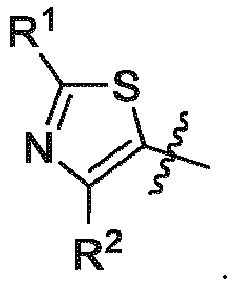
- In some embodiments, the optionally substituted ring A is

- In some embodiments, the optionally substituted ring A is

- In some embodiments, the optionally substituted ring A is

- In some embodiments, the optionally substituted ring A is

- In some embodiments, the optionally substituted ring A is

- In some embodiments, the optionally substituted ring A is

- In some embodiments, the optionally substituted ring A is

- In some embodiments, the optionally substituted ring A is

- In some embodiments, the optionally substituted ring A is

- In some embodiments, the optionally substituted ring A is

- In some embodiments, the optionally substituted ring A is

- In some embodiments, the optionally substituted ring A is

- In some embodiments, the optionally substituted ring A is

- In some embodiments, the optionally substituted ring A is

- In some embodiments, the optionally substituted ring A is

- In some embodiments, the optionally substituted ring A is

- In some embodiments, the optionally substituted ring A is

- In some embodiments, the optionally substituted ring A is

- In some embodiments, the optionally substituted ring A is

- In some embodiments, the optionally substituted ring A is

- In some embodiments, the optionally substituted ring A is

- In some embodiments, the optionally substituted ring A is
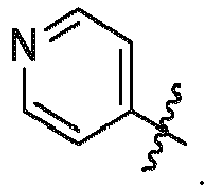
- In some embodiments, the optionally substituted ring A is
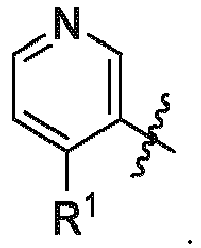
- In some embodiments, the optionally substituted ring A is

- In some embodiments, the optionally substituted ring A is

- In some embodiments, the optionally substituted ring A is

- In some embodiments, the optionally substituted ring A is

- In some embodiments, the optionally substituted ring A is

- In some embodiments, the optionally substituted ring A is

- In some embodiments, the optionally substituted ring A is

- In some embodiments, the optionally substituted ring A is

- In some embodiments, the optionally substituted ring A is

- In some embodiments, the optionally substituted ring A is

- In some embodiments, the optionally substituted ring A is

- In some embodiments, the optionally substituted ring A is

- In some embodiments, the optionally substituted ring A is

- In some embodiments, the optionally substituted ring A is

- In some embodiments, the optionally substituted ring A is

- In some embodiments, the optionally substituted ring A is

- In some embodiments, the optionally substituted ring A is

- In some embodiments, the optionally substituted ring A is

- In some embodiments, the optionally substituted ring A is

- In some embodiments, the optionally substituted ring A is

- In some embodiments, the optionally substituted ring A is

- In some embodiments, the optionally substituted ring A is

- In some embodiments, the optionally substituted ring A is

- In some embodiments, the optionally substituted ring A is

- In some embodiments, the optionally substituted ring A is

- In some embodiments, the optionally substituted ring A is

- In some embodiments, the optionally substituted ring A is

- In some embodiments, the optionally substituted ring A is

- In some embodiments, the optionally substituted ring A is

- In some embodiments, the optionally substituted ring A is

- In some embodiments, the optionally substituted ring A is

- In some embodiments, the optionally substituted ring A is

- In some embodiments, the optionally substituted ring A is

- In some embodiments, the optionally substituted ring A is

- In some embodiments, the optionally substituted ring A is

- In some embodiments, the optionally substituted ring A is
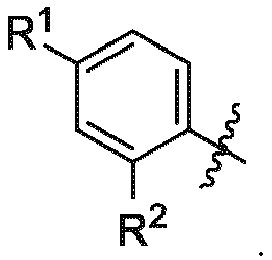
- In some embodiments, the optionally substituted ring A is

- In some embodiments, the optionally substituted ring A is

- In some embodiments, the optionally substituted ring A is

- In some embodiments, the optionally substituted ring A is

- In some embodiments, the optionally substituted ring A is

- In some embodiments, the optionally substituted ring A is
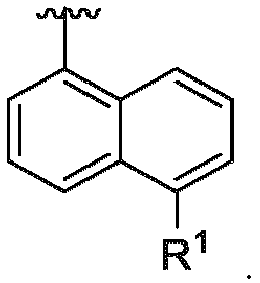
- In some embodiments,
- R1 and R2 are each independently selected from C1-C6 alkyl, C1-C6 haloalkyl, C1-C6 alkoxy, C1-C6 haloalkoxy, halo, CN, NO2, COC1-C6 alkyl, CO-C6-C10 aryl, CO(5- to 10-membered heteroaryl), CO2C1-C6 alkyl, CO2C3-C8 cycloalkyl, OCOC1-C6 alkyl, OCOC6-C10 aryl, OCO(5-to 10-membered heteroaryl), OCO(3- to 7-membered heterocycloalkyl), C6-C10 aryl, 5- to 10-membered heteroaryl, NH2, NHC1-C6 alkyl, N(C1-C6 alkyl)2, CONR8R9, SF5, SC1-C6 alkyl, S(O2)C1-C6 alkyl, S(O2)NR11R12, S(O)C1-C6 alkyl, C3-C7 cycloalkyl and 3- to 7-membered heterocycloalkyl,
- wherein the C1-C6 alkyl, C1-C6 haloalkyl, C3-C7 cycloalkyl and 3- to 7-membered heterocycloalkyl is optionally substituted with one or more substituents each independently selected from hydroxy, halo, CN, oxo, C1-C6 alkyl, C1-C6 alkoxy, NR8R9, =NR10, COOC1-C6 alkyl, CONR8R9, 3- to 7-membered heterocycloalkyl, C6-C10 aryl, 5- to 10-membered heteroaryl, OCOC1-C6 alkyl, OCOC6-C10 aryl, OCO(5- to 10-membered heteroaryl), and OCO(3- to 7-membered heterocycloalkyl);
- wherein each C1-C6 alkyl substituent and each C1-C6 alkoxy substituent of the R1 or R2 C3-C7 cycloalkyl or of the R1 or R2 3- to 7-membered heterocycloalkyl is further optionally independently substituted with one to three hydroxy, halo, NR8R9, or oxo;
- wherein the 3- to 7-membered heterocycloalkyl, C6-C10 aryl, and 5- to 10-membered heteroaryl are optionally substituted with one or more substituents independently selected from halo, C1-C6 alkyl, and OC1-C6 alkyl;
- or at least one pair of R1 and R2 on adjacent atoms, taken together with the atoms connecting them, independently form at least one C4-C8 carbocyclic ring or at least one 5- to-8-membered heterocyclic ring containing 1 or 2 heteroatoms independently selected from O, N, and S, wherein the carbocyclic ring or heterocyclic ring is optionally independently substituted with one or more substituents independently selected from hydroxy, halo, oxo, C1-C6 alkyl, C1-C6 alkoxy, NR8R9, =NR10, COOC1-C6 alkyl, C6-C10 aryl, and CONR8R9;
- In some embodiments,
- R1 and R2 are each independently selected from C1-C6 alkyl, C1-C6 haloalkyl, C1-C6 alkoxy, C1-C6 haloalkoxy, halo, CN, NO2, COC1-C6 alkyl, CO-C6-C10 aryl; CO(5- to 10-membered heteroaryl); CO2C1-C6 alkyl, CO2C3-C8 cycloalkyl, OCOC1-C6 alkyl, OCOC6-C10 aryl, OCO(5-to 10-membered heteroaryl), OCO(3- to 7-membered heterocycloalkyl), C6-C10 aryl, 5- to 10-membered heteroaryl, NH2, NHC1-C6 alkyl, N(C1-C6 alkyl)2, CONR8R9, SF5, SC1-C6 alkyl, S(O2)C1-C6 alkyl, S(O2)NR11R12, S(O)C1-C6 alkyl, C3-C7 cycloalkyl and 3- to 7-membered heterocycloalkyl,
- wherein the C1-C6 alkyl, C1-C6 haloalkyl, C3-C7 cycloalkyl and 3- to 7-membered heterocycloalkyl is optionally substituted with one or more substituents each independently selected from hydroxy, halo, CN, oxo, C1-C6 alkyl, C1-C6 alkoxy, NR8R9, =NR10, COOC1-C6 alkyl, CONR8R9, 3- to 7-membered heterocycloalkyl, C6-C10 aryl, 5- to 10-membered heteroaryl, OCOC1-C6 alkyl, OCOC6-C10 aryl, OCO(5- to 10-membered heteroaryl), OCO(3- to 7-membered heterocycloalkyl), NHCOC1-C6 alkyl, NHCOC6-C10 aryl, NHCO(5- to 10-membered heteroaryl), NHCO(3- to 7-membered heterocycloalkyl), and NHCOC2-C6 alkynyl;
- wherein each C1-C6 alkyl substituent and each C1-C6 alkoxy substituent of the R1 or R2 C3-C7 cycloalkyl or of the R1 or R2 3- to 7-membered heterocycloalkyl is further optionally independently substituted with one to three hydroxy, halo, NR8R9, or oxo;
- wherein the 3- to 7-membered heterocycloalkyl, C6-C10 aryl, 5- to 10-membered heteroaryl, NHCOC6-C10 aryl, NHCO(5- to 10-membered heteroaryl) and NHCO(3- to 7-membered heterocycloalkyl) are optionally substituted with one or more substituents independently selected from halo, C1-C6 alkyl, and OC1-C6 alkyl;
- or at least one pair of R1 and R2 on adjacent atoms, taken together with the atoms connecting them, independently form at least one C4-C8 carbocyclic ring or at least one 5- to 8-membered heterocyclic ring containing 1 or 2 heteroatoms independently selected from O, N, and S, wherein the carbocyclic ring or heterocyclic ring is optionally independently substituted with one or more substituents independently selected from hydroxy, halo, oxo, C1-C6 alkyl, C1-C6 alkoxy, NR8R9, =NR10, COOC1-C6 alkyl, C6-C10 aryl, and CONR8R9;
- In some embodiments,
- R1 and R2 are each independently selected from C1-C6 haloalkyl, C1-C6 alkoxy, C1-C6 haloalkoxy, halo, CN, NO2, COC1-C6 alkyl, CO-C6-C10 aryl, CO(5- to 10-membered heteroaryl), CO2C1-C6 alkyl, CO2C3-C8 cycloalkyl, OCOC1-C6 alkyl, OCOC6-C10 aryl, OCO(5- to 10-membered heteroaryl), OCO(3- to 7-membered heterocycloalkyl), C6-C10 aryl, 5- to 10-membered heteroaryl, NH2, NHC1-C6 alkyl, N(C1-C6 alkyl)2, CONR8R9, SF5, SC1-C6 alkyl, S(O2)C1-C6 alkyl, S(O2)NR11R12, S(O)C1-C6 alkyl, C3-C7 cycloalkyl and 3- to 7-membered heterocycloalkyl,
- wherein the C3-C7 cycloalkyl, C1-C6 haloalkyl, and 3- to 7-membered heterocycloalkyl is optionally substituted with one or more substituents each independently selected from hydroxy, halo, CN, oxo, C1-C6 alkyl, C1-C6 alkoxy, NR8R9, =NR10, COOC1-C6 alkyl, CONR8R9, 3- to 7-membered heterocycloalkyl, C6-C10 aryl, 5- to 10-membered heteroaryl, OCOC1-C6 alkyl, OCOC6-C10 aryl, OCO(5- to 10-membered heteroaryl), OCO(3- to 7-membered heterocycloalkyl), NHCOC1-C6 alkyl, NHCOC6-C10 aryl, NHCO(5- to 10-membered heteroaryl), NHCO(3- to 7-membered heterocycloalkyl), and NHCOC2-C6 alkynyl;
- wherein each C1-C6 alkyl substituent and each C1-C6 alkoxy substituent of the R1 or R2 C3-C7 cycloalkyl or of the R1 or R2 3- to 7-membered heterocycloalkyl is further optionally independently substituted with one to three hydroxy, halo, NR8R9, or oxo;
- wherein the 3- to 7-membered heterocycloalkyl, C6-C10 aryl, 5- to 10-membered heteroaryl, NHCOC6-C10 aryl, NHCO(5- to 10-membered heteroaryl) and NHCO(3- to 7-membered heterocycloalkyl) are optionally substituted with one or more substituents independently selected from halo, C1-C6 alkyl, and OC1-C6 alkyl;
- or at least one pair of R1 and R2 on adjacent atoms, taken together with the atoms connecting them, independently form at least one C4-C8 carbocyclic ring or at least one 5- to 8-membered heterocyclic ring containing 1 or 2 heteroatoms independently selected from O, N, and S, wherein the carbocyclic ring or heterocyclic ring is optionally independently substituted with one or more substituents independently selected from hydroxy, halo, oxo, C1-C6 alkyl, C1-C6 alkoxy, NR8R9, =NR10, COOC1-C6 alkyl, C6-C10 aryl, and CONR8R9.
- In some embodiments,
- R1 and R2 are each independently selected from C1-C6 alkyl, halo, CN, NO2, COC1-C6 alkyl, CO-C6-C10 aryl, CO(5- to 10-membered heteroaryl), CO2C1-C6 alkyl, OCOC1-C6 alkyl, OCOC6-C10 aryl, OCO(5- to 10-membered heteroaryl), OCO(3- to 7-membered heterocycloalkyl), C6-C10 aryl, 5- to 10-membered heteroaryl, NH2, NHC1-C6 alkyl, N(C1-C6 alkyl)2, CONR8R9, SF5, SC1-C6 alkyl, S(O2)C1-C6 alkyl, S(O2)NR11R12, S(O)C1-C6 alkyl, C3-C7 cycloalkyl and 3- to 7-membered heterocycloalkyl,
- wherein the C1-C6 alkyl, C1-C6 haloalkyl, C3-C7 cycloalkyl and 3- to 7-membered heterocycloalkyl is optionally substituted with one or more substituents each independently selected from hydroxy, halo, CN, oxo, C1-C6 alkyl, C1-C6 alkoxy, NR8R9, =NR10, COOC1-C6 alkyl, CONR8R9, 3- to 7-membered heterocycloalkyl, C6-C10 aryl, 5- to 10-membered heteroaryl, OCOC1-C6 alkyl, OCOC6-C10 aryl, OCO(5- to 10-membered heteroaryl), OCO(3- to 7-membered heterocycloalkyl), NHCOC1-C6 alkyl, NHCOC6-C10 aryl, NHCO(5- to 10-membered heteroaryl), NHCO(3- to 7-membered heterocycloalkyl), and NHCOC2-C6 alkynyl;
- wherein each C1-C6 alkyl substituent and each C1-C6 alkoxy substituent of the R1 or R2 C3-C7 cycloalkyl or of the R1 or R2 3- to 7-membered heterocycloalkyl is further optionally independently substituted with one to three hydroxy, halo, NR8R9, or oxo;
- wherein the 3- to 7-membered heterocycloalkyl, C6-C10 aryl, 5- to 10-membered heteroaryl, NHCOC6-C10 aryl, NHCO(5- to 10-membered heteroaryl) and NHCO(3- to 7-membered heterocycloalkyl) are optionally substituted with one or more substituents independently selected from halo, C1-C6 alkyl, and OC1-C6 alkyl;
- or at least one pair of R1 and R2 on adjacent atoms, taken together with the atoms connecting them, independently form at least one C4-C8 carbocyclic ring or at least one 5- to 8-membered heterocyclic ring containing 1 or 2 heteroatoms independently selected from O, N, and S, wherein the carbocyclic ring or heterocyclic ring is optionally independently substituted with one or more substituents independently selected from hydroxy, halo, oxo, C1-C6 alkyl, C1-C6 alkoxy, NR8R9, =NR10, COOC1-C6 alkyl, C6-C10 aryl, and CONR8R9.
- In some embodiments,
- R1 and R2 are each independently selected from C1-C6 alkyl, C1-C6 haloalkyl, C1-C6 alkoxy, C1-C6 haloalkoxy, halo, CN, NO2, COC1-C6 alkyl, CO-C6-C10 aryl, CO(5- to 10-membered heteroaryl), CO2C1-C6 alkyl, CO2C3-C8 cycloalkyl, OCOC1-C6 alkyl, OCOC6-C10 aryl, OCO(5-to 10-membered heteroaryl), OCO(3- to 7-membered heterocycloalkyl), C6-C10 aryl, 5- to 10-membered heteroaryl, NH2, NHC1-C6 alkyl, N(C1-C6 alkyl)2, CONR8R9, SF5, SC1-C6 alkyl, S(O2)C1-C6 alkyl, S(O2)NR11R12, S(O)C1-C6 alkyl, C3-C7 cycloalkyl and 3- to 7-membered heterocycloalkyl,
- wherein the C1-C6 alkyl, C1-C6 haloalkyl, C3-C7 cycloalkyl and 3- to 7-membered heterocycloalkyl is optionally substituted with one or more substituents each independently selected from hydroxy, halo, CN, oxo, C1-C6 alkyl, C1-C6 alkoxy, NR8R9, =NR10, COOC1-C6 alkyl, CONR8R9, 3- to 7-membered heterocycloalkyl, C6-C10 aryl, 5- to 10-membered heteroaryl, OCOC1-C6 alkyl, OCOC6-C10 aryl, OCO(5- to 10-membered heteroaryl), OCO(3- to 7-membered heterocycloalkyl), NHCOC1-C6 alkyl, NHCOC6-C10 aryl, NHCO(5- to 10-membered heteroaryl), NHCO(3- to 7-membered heterocycloalkyl), and NHCOC2-C6 alkynyl;
- wherein each C1-C6 alkyl substituent and each C1-C6 alkoxy substituent of the R1 or R2 C3-C7 cycloalkyl or of the R1 or R2 3- to 7-membered heterocycloalkyl is further optionally independently substituted with one to three hydroxy, halo, or oxo;
- wherein the 3- to 7-membered heterocycloalkyl, C6-C10 aryl, 5- to 10-membered heteroaryl, NHCOC6-C10 aryl, NHCO(5- to 10-membered heteroaryl) and NHCO(3- to 7-membered heterocycloalkyl) are optionally substituted with one or more substituents independently selected from halo, C1-C6 alkyl, and OC1-C6 alkyl;
- or at least one pair of R1 and R2 on adjacent atoms, taken together with the atoms connecting them, independently form at least one C4-C8 carbocyclic ring or at least one 5- to-8-membered heterocyclic ring containing 1 or 2 heteroatoms independently selected from O, N, and S, wherein the carbocyclic ring or heterocyclic ring is optionally independently substituted with one or more substituents independently selected from hydroxy, halo, oxo, C1-C6 alkyl, C1-C6 alkoxy, NR8R9, =NR10, COOC1-C6 alkyl, C6-C10 aryl, and CONR8R9.
- In some embodiments,
- R1 and R2 are each independently selected from C1-C6 alkyl, C1-C6 haloalkyl, C1-C6 alkoxy, C1-C6 haloalkoxy, halo, CN, NO2, COC1-C6 alkyl, CO-C6-C10 aryl, CO(5- to 10-membered heteroaryl), CO2C1-C6 alkyl, CO2C3-C8 cycloalkyl, OCOC1-C6 alkyl, OCOC6-C10 aryl, OCO(5-to 10-membered heteroaryl), OCO(3- to 7-membered heterocycloalkyl), C6-C10 aryl, 5- to 10-membered heteroaryl, NH2, NHC1-C6 alkyl, N(C1-C6 alkyl)2, CONR8R9, SF5, SC1-C6 alkyl, S(O2)C1-C6 alkyl, S(O2)NR11R12, S(O)C1-C6 alkyl, C3-C7 cycloalkyl and 3- to 7-membered heterocycloalkyl,
- wherein the C1-C6 alkyl, C1-C6 haloalkyl, C3-C7 cycloalkyl and 3- to 7-membered heterocycloalkyl is optionally substituted with one or more substituents each independently selected from hydroxy, halo, CN, oxo, C1-C6 alkyl, C1-C6 alkoxy, NR8R9, =NR10, COOC1-C6 alkyl, CONR8R9, 3- to 7-membered heterocycloalkyl, C6-C10 aryl, 5- to 10-membered heteroaryl, OCOC1-C6 alkyl, OCOC6-C10 aryl, OCO(5- to 10-membered heteroaryl), OCO(3- to 7-membered heterocycloalkyl), NHCOC1-C6 alkyl, NHCOC6-C10 aryl, NHCO(5- to 10-membered heteroaryl), NHCO(3- to 7-membered heterocycloalkyl), and NHCOC2-C6 alkynyl;
wherein the 3- to 7-membered heterocycloalkyl, C6-C10 aryl, 5- to 10-membered heteroaryl, NHCOC6-C10 aryl, NHCO(5- to 10-membered heteroaryl) and NHCO(3- to 7-membered heterocycloalkyl) are optionally substituted with one or more substituents independently selected from halo, C1-C6 alkyl, and OC1-C6 alkyl. - In some embodiments,
- R1 and R2 are each independently selected from C1-C6 alkyl, C1-C6 haloalkyl, C1-C6 alkoxy, C1-C6 haloalkoxy, halo, CN, NO2, COC1-C6 alkyl, CO-C6-C10 aryl, CO(5- to 10-membered heteroaryl), CO2C1-C6 alkyl, CO2C3-C8 cycloalkyl, OCOC1-C6 alkyl, OCOC6-C10 aryl, OCO(5-to 10-membered heteroaryl), OCO(3- to 7-membered heterocycloalkyl), C6-C10 aryl, 5- to 10-membered heteroaryl, NH2, NHC1-C6 alkyl, N(C1-C6 alkyl)2, CONR8R9, SF5, SC1-C6 alkyl, S(O2)C1-C6 alkyl, S(O2)NR11R12, S(O)C1-C6 alkyl, C3-C7 cycloalkyl and 3- to 7-membered heterocycloalkyl,
- wherein the C1-C6 alkyl, C1-C6 haloalkyl, C3-C7 cycloalkyl and 3- to 7-membered heterocycloalkyl are each unsubstituted;
- or at least one pair of R1 and R2 on adjacent atoms, taken together with the atoms connecting them, independently form at least one C4-C8 carbocyclic ring or at least one 5- to-8-membered heterocyclic ring containing 1 or 2 heteroatoms independently selected from O, N, and S, wherein the carbocyclic ring or heterocyclic ring is optionally independently substituted with one or more substituents independently selected from hydroxy, halo, oxo, C1-C6 alkyl, C1-C6 alkoxy, NR8R9, =NR10, COOC1-C6 alkyl, C6-C10 aryl, and CONR8R9;
- In some embodiments,
- R1 and R2 are each independently selected from C1-C6 alkyl, halo, CN, COC1-C6 alkyl, CO2C1-C6 alkyl, C6-C10 aryl, S(O)C1-C6 alkyl, 5- to 10-membered heteroaryl, and 3- to 7-membered heterocycloalkyl,
- wherein the C1-C6 alkyl and 3- to 7-membered heterocycloalkyl is optionally substituted with one or more substituents each independently selected from hydroxy and oxo.
- In some embodiments, m=1; n=0; and
- R1 is selected from C1-C6 alkyl, C1-C6 haloalkyl, C1-C6 alkoxy, C1-C6 haloalkoxy, halo, CN, NO2, COC1-C6 alkyl, CO-C6-C10 aryl, CO(5- to 10-membered heteroaryl), CO2C1-C6 alkyl, CO2C3-C8 cycloalkyl, OCOC1-C6 alkyl, OCOC6-C10 aryl, OCO(5- to 10-membered heteroaryl), OCO(3- to 7-membered heterocycloalkyl), C6-C10 aryl, 5- to 10-membered heteroaryl, NH2, NHC1-C6 alkyl, N(C1-C6 alkyl)2, CONR8R9, SF5, SC1-C6 alkyl, S(O2)C1-C6 alkyl, S(O2)NR11R12, S(O)C1-C6 alkyl, C3-C7 cycloalkyl and 3- to 7-membered heterocycloalkyl,
- wherein the C1-C6 alkyl, C1-C6 haloalkyl, C3-C7 cycloalkyl and 3- to 7-membered heterocycloalkyl is optionally substituted with one or more substituents each independently selected from hydroxy, halo, CN, oxo, C1-C6 alkyl, C1-C6 alkoxy, NR8R9, =NR10, COOC1-C6 alkyl, CONR8R9, 3- to 7-membered heterocycloalkyl, C6-C10 aryl, 5- to 10-membered heteroaryl, OCOC1-C6 alkyl, OCOC6-C10 aryl, OCO(5- to 10-membered heteroaryl), OCO(3- to 7-membered heterocycloalkyl), NHCOC1-C6 alkyl, NHCOC6-C10 aryl, NHCO(5- to 10-membered heteroaryl), NHCO(3- to 7-membered heterocycloalkyl), and NHCOC2-C6 alkynyl;
wherein the 3- to 7-membered heterocycloalkyl, C6-C10 aryl, 5- to 10-membered heteroaryl, NHCOC6-C10 aryl, NHCO(5- to 10-membered heteroaryl) and NHCO(3- to 7-membered heterocycloalkyl) are optionally substituted with one or more substituents independently selected from halo, C1-C6 alkyl, and OC1-C6 alkyl. - In some embodiments , m=1; n=0; and,
- R1 is selected from C1-C6 alkyl, halo, CN, COC1-C6 alkyl, CO2C1-C6 alkyl, C6-C10 aryl, 5- to 10-membered heteroaryl, S(O)C1-C6 alkyl, and 3- to 7-membered heterocycloalkyl,
- wherein the C1-C6 alkyl and 3- to 7-membered heterocycloalkyl is optionally substituted with one or more substituents each independently selected from hydroxy and oxo.
- In some embodiments, m=1; n=1; and
- R1 and R 2 are each independently selected from C1-C6 alkyl, C1-C6 haloalkyl, C1-C6 alkoxy, C1-C6 haloalkoxy, halo, CN, NO2, COC1-C6 alkyl, CO-C6-C10 aryl, CO(5- to 10-membered heteroaryl), CO2C1-C6 alkyl, CO2C3-C8 cycloalkyl, OCOC1-C6 alkyl, OCOC6-C10 aryl, OCO(5-to 10-membered heteroaryl), OCO(3- to 7-membered heterocycloalkyl), C6-C10 aryl, 5- to 10-membered heteroaryl, NH2, NHC1-C6 alkyl, N(C1-C6 alkyl)2, CONR8R9, SF5, SC1-C6 alkyl, S(O2)C1-C6 alkyl, S(O2)NR11R12, S(O)C1-C6 alkyl, C3-C7 cycloalkyl and 3- to 7-membered heterocycloalkyl,
- wherein the C1-C6 alkyl, C1-C6 haloalkyl, C3-C7 cycloalkyl and 3- to 7-membered heterocycloalkyl is optionally substituted with one or more substituents each independently selected from hydroxy, halo, CN, oxo, C1-C6 alkyl, C1-C6 alkoxy, NR8R9, =NR10, COOC1-C6 alkyl, CONR8R9, 3- to 7-membered heterocycloalkyl, C6-C10 aryl, 5- to 10-membered heteroaryl, OCOC1-C6 alkyl, OCOC6-C10 aryl, OCO(5- to 10-membered heteroaryl), OCO(3- to 7-membered heterocycloalkyl), NHCOC1-C6 alkyl, NHCOC6-C10 aryl, NHCO(5- to 10-membered heteroaryl), NHCO(3- to 7-membered heterocycloalkyl), and NHCOC2-C6 alkynyl;
- wherein the 3- to 7-membered heterocycloalkyl, C6-C10 aryl, 5- to 10-membered heteroaryl, NHCOC6-C10 aryl, NHCO(5- to 10-membered heteroaryl) and NHCO(3- to 7-membered heterocycloalkyl) are optionally substituted with one or more substituents independently selected from halo, C1-C6 alkyl, and OC1-C6 alkyl;
- In some embodiments , m=1; n=1; and,
- R1 and R2 are each independently selected from C1-C6 alkyl, halo, CN, COC1-C6 alkyl, CO2C1-C6 alkyl, C6-C10 aryl, 5- to 10-membered heteroaryl, S(O)C1-C6 alkyl, and 3- to 7-membered heterocycloalkyl,
- wherein the C1-C6 alkyl and 3- to 7-membered heterocycloalkyl is optionally substituted with one or more substituents each independently selected from hydroxy and oxo.
- In some embodiments, m=1; n=1; and
R1 and R2 are on adjacent atoms, and taken together with the atoms connecting them, form a C4-Cs carbocyclic ring or a 5- to-8-membered heterocyclic ring containing 1 or 2 heteroatoms independently selected from O, N, and S, wherein the carbocyclic ring or heterocyclic ring is optionally independently substituted with one or more substituents independently selected from hydroxy, halo, oxo, C1-C6 alkyl, C1-C6 alkoxy, NR8R9, =NR10, COOC1-C6 alkyl, C6-C10 aryl, and CONR8R9. - In some embodiments, m=1; n=1; and
R1 and R2 are on adjacent atoms, and taken together with the atoms connecting them, form a C6 carbocyclic ring or a 5-to-6-membered heterocyclic ring containing 1 or 2 heteroatoms independently selected from O, N, and S, wherein the carbocyclic ring or heterocyclic ring is optionally independently substituted with one or more substituents independently selected from hydroxy, halo, oxo, C1-C6 alkyl, C1-C6 alkoxy, NR8R9, =NR10, COOC1-C6 alkyl, C6-C10 aryl, and CONR8R9. - In some embodiments, m=1; n=1; and
R1 and R2 are on adjacent atoms, and taken together with the atoms connecting them, form a Cs carbocyclic ring or a 5- to-6-membered heterocyclic ring containing 1 or 2 heteroatoms independently selected from O, N, and S, wherein the carbocyclic ring or heterocyclic ring is optionally independently substituted with one or more substituents independently selected from hydroxy, halo, oxo, C1-C6 alkyl, C1-C6 alkoxy, COOC1-C6 alkyl, C6-C10 aryl, and CONR8R9. - In some embodiments, m=1; n=1; and
R1 and R2 are on adjacent atoms, and taken together with the atoms connecting them, form a C4-Cs carbocyclic ring or a 5- to 8-membered heterocyclic ring containing 1 or 2 heteroatoms independently selected from O, N, and S, wherein the carbocyclic ring or heterocyclic ring is unsubstituted. - In some embodiments, R1 is C1-C6 alkyl optionally substituted with one or more hydroxy.
- In some embodiments, R1 is 1-hydroxy-2-methylpropan-2-yl.
- In some embodiments, R1 is 2-hydroxyethyl.
- In some embodiments, R1 is C1-C6 alkyl.
- In some embodiments, R1 is methyl.
- In some embodiments, R1 is isopropyl.
- In some embodiments, R1 is isopropyl.
- In some embodiments, R1 is C1-C6 alkyl substituted with hydroxy at the carbon directly connected to ring A.
- In some embodiments, R1 is 2-hydroxy-2-propyl.
- In some embodiments, R1 is hydroxymethyl.
- In some embodiments, R1 is 1-hydroxyethyl.
- In some embodiments, R1 is 1-hydroxy-2-propyl.
- In some embodiments, R1 is C1-C6 alkyl substituted with two or more hydroxy groups.
- In some embodiments, R1 is C1-C6 alkyl substituted with two or more hydroxy groups, wherein one of the two or more hydroxy groups is bonded to the carbon directly connected to ring A.
- In some embodiments, R1 is 1,2-dihydroxy-prop-2-yl.
- In some embodiments, R1 is C3-C7 cycloalkyl optionally substituted with one or more hydroxy. In some embodiments, R1 is C3-C7 cycloalkyl.
- In some embodiments, R1 is C3-C7 cycloalkyl substituted with hydroxy at the carbon directly connected to ring A.
- In some embodiments, R1 is 1-hydroxy-1-cyclopropyl.
- In some embodiments, R1 is 1-hydroxy-1-cyclobutyl.
- In some embodiments, R1 is 1-hydroxy-1-cyclopentyl.
- In some embodiments, R1 is 1-hydroxy-1-cyclohexyl.
- In some embodiments, R1 is 3- to 7-membered heterocycloalkyl optionally substituted with one or more hydroxy.
- In some embodiments, R1 is 3- to 7-membered heterocycloalkyl.
- In some embodiments, R1 is morpholinyl (e.g., 1-morpholinyl).
- In some embodiments, R1 is 1,3-dioxolan-2-yl.
- In some embodiments, R1 is 3- to 7-membered heterocycloalkyl optionally substituted with one or more C1-C6 alkyl.
- In some embodiments, R1 is 1-methylpyrrolidin-2-yl.
- In some embodiments, R1 is 3- to 7-membered heterocycloalkyl substituted with hydroxy at the carbon directly connected to ring A.
- In some embodiments, R1 is C1-C6 alkyl optionally substituted with one or more oxo.
- In some embodiments, R1 is COCH3.
- In some embodiments, R1 is COCH2CH3.
- In some embodiments, R1 is C3-C7 cycloalkyl optionally substituted with one or more oxo.
- In some embodiments, R1 is 3- to 7-membered heterocycloalkyl optionally substituted with one or more oxo.
- In some embodiments, R1 is C1-C6 alkyl optionally substituted with one or more C1-C6 alkoxy. In some embodiments, R1 is 2-methoxy-2-propyl.
- In some embodiments, R1 is methoxymethyl.
- In some embodiments, R1 is C3-C7 cycloalkyl optionally substituted with one or more C1-C6 alkoxy.
- In some embodiments, R1 is 3- to 7-membered heterocycloalkyl optionally substituted with one or more C1-C6 alkoxy.
- In some embodiments, R1 is C1-C6 alkyl optionally substituted with one or more NR8R9.
- In some embodiments, R1 is C1-C6 alkyl substituted with NR8R9 at the carbon directly connected to ring A.
- In some embodiments, R1 is (methylamino)methyl.
- In some embodiments, R1 is (dimethylamino)methyl.
- In some embodiments, R1 is aminomethyl.
- In some embodiments, R1 is N-methylacetamidomethyl.
- In some embodiments, R1 is 1-(dimethylamino)eth-1-yl.
- In some embodiments, R1 is 2-(dimethylamino)prop-2-yl.
- In some embodiments, R1 is (2-methoxy-eth-1-yl)(methyl)aminomethyl.
- In some embodiments, R1 is (methyl)(acetyl)aminomethyl.
- In some embodiments, R1 is (methyl)(cyclopropylmethyl)aminomethyl.
- In some embodiments, R1 is (methyl)(2,2-difluoroeth-1-yl)aminomethyl.
- In some embodiments, R1 is C3-C7 cycloalkyl optionally substituted with one or more NR8R9.
- In some embodiments, R1 is 3- to 7-membered heterocycloalkyl optionally substituted with one or more NR8R9.
- In some embodiments, R1 is C1-C6 haloalkyl optionally substituted with one or more hydroxy.
- In some embodiments, R1 is C1-C6 alkoxy.
- In some embodiments, R1 is C1-C6 haloalkoxy.
- In some embodiments, R1 is C1-C6 alkyl optionally substituted with 3- to 7-membered heterocycloalkyl, wherein the 3- to 7-membered heterocycloalkyl is further optionally substituted as defined elsewhere herein.
- In some embodiments, R1 is pyrrolidinylmethyl (e.g., pyrrolidin-1-ylmethyl).
- In some embodiments, R1 is optionally substituted pyrrolidinylmethyl (e.g., 3,3-difluoropyrrolidin-1 -ylmethyl).
- In some embodiments, R1 is azetidinylmethyl (e.g., azetidin-1-ylmethyl).
- In some embodiments, R1 is optionally substituted azetidinylmethyl (e.g., 3-methoxyazetidin-1-ylmethyl).
- In some embodiments, R1 is morpholinylmethyl (e.g., morpholin-4-ylmethyl).
- In some embodiments, R1 is halo.
- In some embodiments, R1 is fluoro.
- In some embodiments, R1 is chloro.
- In some embodiments, R1 is CN.
- In some embodiments, R1 is NO2.
- In some embodiments, R1 is COC1-C6 alkyl.
- In some embodiments, R1 is CO-C6-C10 aryl.
- In some embodiments, R1 is CO(5- to 10-membered heteroaryl).
- In some embodiments, R1 is CO2C1-C6 alkyl.
- In some embodiments, R1 is CO2C3-C8 cycloalkyl.
- In some embodiments, R1 is OCOC1-C6 alkyl.
- In some embodiments, R1 is OCOC6-C10 aryl.
- In some embodiments, R1 is OCO(5- to 10-membered heteroaryl).
- In some embodiments, R1 is OCO(3- to 7-membered heterocycloalkyl).
- In some embodiments, R1 is C6-C10 aryl.
- In some embodiments, R1 is phenyl.
- In some embodiments, R1 is 5- to 10-membered heteroaryl.
- In some embodiments, R1 is pyridyl (e.g., 4-pyridyl).
- In some embodiments, R1 is pyrazolyl (e.g., 1-pyrazolyl).
- In some embodiments, R1 is NH2.
- In some embodiments, R1 is NHC1-C6 alkyl.
- In some embodiments, R1 is N(C1-C6 alkyl)2.
- In some embodiments, R1 is CONR8R9.
- In some embodiments, R1 is SF5.
- In some embodiments, R1 is SC1-C6 alkyl,
- In some embodiments, R1 is S(O2)C1-C6 alkyl.
- In some embodiments, R1 is S(O2)CH3.
- In some embodiments, R1 is S(O2)NR11R12.
- In some embodiments, R1 is S(O2)N(CH3)2.
- In some embodiments, R1 is S(O)C1-C6 alkyl.
- In some embodiments, R1 is S(O)CH3.
- In some embodiments, R1 is attached to a carbon of an aryl ring A.
- In some embodiments, R1 is attached to a carbon of a heteroaryl ring A.
- In some embodiments, R1 is attached to a nitrogen of a heteroaryl ring A.
- In some embodiments, R1 is C1-C6 alkyl optionally substituted with one or more hydroxy, and R2 is C1-C6 alkyl optionally substituted with one or more hydroxy.
- In some embodiments, R1 is 1-hydroxy-2-methylpropan-2-yl, and R2 is methyl.
- In some embodiments, R1 is 2-hydroxy-2-propyl and R2 is methyl.
- In some embodiments, R1 is 2-hydroxy-2-propyl and R2 is isopropyl.
- In some embodiments, R1 is 2-hydroxy-2-propyl and R2 is 2-hydroxy-2-propyl.
- In some embodiments, R1 is 2-hydroxy-2-propyl and R2 is 1-hydroxyethyl.
- In some embodiments, R1 is hydroxymethyl and R2 is methyl.
- In some embodiments, R1 is 1-hydroxyethyl and R2 is methyl.
- In some embodiments, R1 is 2-hydroxyethyl and R2 is methyl.
- In some embodiments, R1 is 1-hydroxy-2-propyl and R2 is methyl.
- In some embodiments, R1 is C1-C6 alkyl optionally substituted with one or more hydroxy, and R2 is C6-C10 aryl.
- In some embodiments, R1 is 2-hydroxy-2-propyl and R2 is phenyl.
- In some embodiments, R1 is C1-C6 alkyl optionally substituted with one or more hydroxy, and R2 is 5- to 10-membered heteroaryl.
- In some embodiments, R1 is 2-hydroxy-2-propyl and R2 is pyridyl.
- In some embodiments, R1 is 2-hydroxy-2-propyl and R2 is pyrazolyl.
- In some embodiments, R1 is C1-C6 alkyl optionally substituted with one or more hydroxy, and R2 is SF5.
- In some embodiments, R1 is C1-C6 alkyl optionally substituted with one or more hydroxy, and R2 is SC1-C6 alkyl,
- In some embodiments, R1 is C1-C6 alkyl optionally substituted with one or more hydroxy, and R2 is S(O2)C1-C6 alkyl.
- In some embodiments, R1 is C1-C6 alkyl optionally substituted with one or more hydroxy, and R2 is S(O2)CH3.
- In some embodiments, R1 is C1-C6 alkyl optionally substituted with one or more hydroxy, and R2 is halo.
- In some embodiments, R1 is 2-hydroxy-2-propyl and R2 is chloro.
- In some embodiments, R1 is 2-hydroxy-2-propyl and R2 is fluoro.
- In some embodiments, R1 is C3-C7 cycloalkyl optionally substituted with one or more hydroxy, and R2 is C1-C6 alkyl.
- In some embodiments, R1 is 1-hydroxy-1-cyclopropyl, and R2 is methyl.
- In some embodiments, R1 is 1-hydroxy-1-cyclobutyl, and R2 is methyl.
- In some embodiments, R1 is 1-hydroxy-1-cyclopentyl, and R2 is methyl.
- In some embodiments, R1 is 1-hydroxy-1-cyclohexyl, and R2 is methyl.
- In some embodiments, R1 is 3- to 7-membered heterocycloalkyl optionally substituted with one or more hydroxy, and R2 is C1-C6 alkyl.
- In some embodiments, R1 is morpholinyl, and R2 is methyl.
- In some embodiments, R1 is 1,3-dioxolan-2-yl, and R2 is methyl.
- In some embodiments, R1 is 3- to 7-membered heterocycloalkyl optionally substituted with one or more hydroxy, and R2 is halo.
- In some embodiments, R1 is 1,3-dioxolan-2-yl, and R2 is fluoro.
- In some embodiments, R1 is 1,3-dioxolan-2-yl, and R2 is chloro.
- In some embodiments, R1 is C1-C6 alkyl optionally substituted with one or more oxo, and R2 is methyl.
- In some embodiments, R1 is COCH3, and R2 is methyl.
- In some embodiments, R1 is C1-C6 alkyl optionally substituted with one or more C1-C6 alkoxy, and R2 is C1-C6 alkyl.
- In some embodiments, R1 is 2-methoxy-2-propyl, and R2 is methyl.
- In some embodiments, R1 is C1-C6 alkyl optionally substituted with one or more NR8R9, and R2 is C1-C6 alkyl.
- In some embodiments, R1 is (dimethylamino)methyl, and R2 is methyl.
- In some embodiments, R1 is C1-C6 alkyl optionally substituted with one or more NR8R9, and R2 is halo.
- In some embodiments, R1 is (dimethylamino)methyl, and R2 is fluoro.
- In some embodiments, R1 is (dimethylamino)methyl, and R2 is fluoro.
- In some embodiments, R1 is (methylamino)methyl, and R2 is fluoro.
- In some embodiments, R1 is aminomethyl, and R2 is fluoro.
- In some embodiments, R1 is C1-C6 alkyl, and R2 is C1-C6 alkyl.
- In some embodiments, R1 is methyl, and R2 is methyl.
- In some embodiments, R2 is 1-hydroxy-2-methylpropan-2-yl, and R1 is methyl.
- In some embodiments, R2 is 2-hydroxy-2-propyl and R1 is methyl.
- In some embodiments, R2 is 2-hydroxy-2-propyl and R1 is isopropyl.
- In some embodiments, R2 is 2-hydroxy-2-propyl and R1 is 1-hydroxyethyl.
- In some embodiments, R2 is hydroxymethyl and R1 is methyl.
- In some embodiments, R2 is 1-hydroxyethyl and R1 is methyl.
- In some embodiments, R2 is 2-hydroxyethyl and R1 is methyl.
- In some embodiments, R2 is 1-hydroxy-2-propyl and R1 is methyl.
- In some embodiments, R2 is C1-C6 alkyl optionally substituted with one or more hydroxy, and R1 is C6-C10 aryl.
- In some embodiments, R2 is 2-hydroxy-2-propyl and R1 is phenyl.
- In some embodiments, R2 is C1-C6 alkyl optionally substituted with one or more hydroxy, and R1 is 5- to 10-membered heteroaryl.
- In some embodiments, R2 is 2-hydroxy-2-propyl and R1 is pyridyl.
- In some embodiments, R2 is 2-hydroxy-2-propyl and R1 is pyrazolyl.
- In some embodiments, R2 is C1-C6 alkyl optionally substituted with one or more hydroxy, and R1 is SF5.
- In some embodiments, R2 is C1-C6 alkyl optionally substituted with one or more hydroxy, and R1 is SC1-C6 alkyl.
- In some embodiments, R2 is C1-C6 alkyl optionally substituted with one or more hydroxy, and R1 is S(O2)C1-C6 alkyl.
- In some embodiments, R2 is C1-C6 alkyl optionally substituted with one or more hydroxy, and R1 is S(O2)CH3.
- In some embodiments, R2 is C1-C6 alkyl optionally substituted with one or more hydroxy, and R1 is halo.
- In some embodiments, R2 is 2-hydroxy-2-propyl and R1 is chloro.
- In some embodiments, R2 is 2-hydroxy-2-propyl and R1 is fluoro.
- In some embodiments, R2 is C3-C7 cycloalkyl optionally substituted with one or more hydroxy, and R1 is C1-C6 alkyl.
- In some embodiments, R2 is 1-hydroxy-1-cyclopropyl, and R1 is methyl.
- In some embodiments, R2 is 1-hydroxy-1-cyclobutyl, and R1 is methyl.
- In some embodiments, R2 is 1-hydroxy-1-cyclopentyl, and R1 is methyl.
- In some embodiments, R2 is 1-hydroxy-1-cyclohexyl, and R1 is methyl.
- In some embodiments, R2 is 3- to 7-membered heterocycloalkyl optionally substituted with one or more hydroxy, and R1 is C1-C6 alkyl.
- In some embodiments, R2 is morpholinyl, and R1 is methyl.
- In some embodiments, R2 is 1,3-dioxolan-2-yl, and R1 is methyl.
- In some embodiments, R2 is 3- to 7-membered heterocycloalkyl optionally substituted with one or more hydroxy, and R1 is halo.
- In some embodiments, R2 is 1,3-dioxolan-2-yl, and R1 is fluoro.
- In some embodiments, R2 is 1,3-dioxolan-2-yl, and R1 is chloro.
- In some embodiments, R2 is C1-C6 alkyl optionally substituted with one or more oxo, and R1 is methyl.
- In some embodiments, R2 is COCH3, and R1 is methyl.
- In some embodiments, R2 is C1-C6 alkyl optionally substituted with one or more C1-C6 alkoxy, and R1 is C1-C6 alkyl.
- In some embodiments, R2 is 2-methoxy-2-propyl, and R1 is methyl.
- In some embodiments, R2 is C1-C6 alkyl optionally substituted with one or more NR8R9, and R1 is C1-C6 alkyl.
- In some embodiments, R2 is (dimethylamino)methyl, and R1 is methyl.
- In some embodiments, R2 is C1-C6 alkyl optionally substituted with one or more NR8R9, and R1 is halo.
- In some embodiments, R2 is (dimethylamino)methyl, and R1 is fluoro.
- In some embodiments, R2 is (methylamino)methyl, and R1 is fluoro.
- In some embodiments, R2 is aminomethyl, and R1 is fluoro.
- In some embodiments, R2 is C1-C6 alkoxy, and R1 is C1-C6 alkyl optionally substituted with one or more NR8R9.
- In some embodiments, R2 is methoxy, and R1 is (dimethylamino)methyl.
- In some embodiments, R1 and R2 are each attached to a carbon of an aryl ring A.
- In some embodiments, R1 and R2 are each attached to a carbon of a heteroaryl ring A.
- In some embodiments, R1 is attached to a carbon and R2 is attached to a nitrogen of a heteroaryl ring A.
- In some embodiments, R2 is attached to a carbon and R1 is attached to a nitrogen of a heteroaryl ring A.
- In some embodiments, R1 and R2 are on adjacent atoms, and taken together with the atoms connecting them, form a C5 carbocyclic ring optionally substituted with one or more substituents independently selected from hydroxy, halo, oxo, C1-C6 alkyl, C1-C6 alkoxy, NR8R9, =NR10, COOC1-C6 alkyl, C6-C10 aryl, and CONR8R9.
- In some embodiments, R1 and R2 are on adjacent atoms, and taken together with the atoms connecting them, form a C5 aliphatic carbocyclic ring.
- In some embodiments, R1 and R2 are on adjacent atoms, and taken together with the atoms connecting them, form a C6 carbocyclic ring optionally substituted with one or more substituents independently selected from hydroxy, halo, oxo, C1-C6 alkyl, C1-C6 alkoxy, NR8R9, =NR10, COOC1-C6 alkyl, C6-C10 aryl, and CONR8R9.
- In some embodiments, R1 and R2 are on adjacent atoms, and taken together with the atoms connecting them, form a C6 aliphatic carbocyclic ring.
- In some embodiments, R1 and R2 are on adjacent atoms, and taken together with the atoms connecting them, form a C6 aromatic carbocyclic ring.
- In some embodiments, R1 and R2 are on adjacent atoms, and taken together with the atoms connecting them, form a 5-membered heterocyclic ring containing 1 or 2 heteroatoms independently selected from O, N, and S, optionally substituted with one or more substituents independently selected from hydroxy, halo, oxo, C1-C6 alkyl, C1-C6 alkoxy, NR8R9, =NR10, COOC1-C6 alkyl, C6-C10 aryl, and CONR8R9.
- In some embodiments, R1 and R2 are on adjacent atoms, and taken together with the atoms connecting them, form a 5-membered aliphatic heterocyclic ring containing 1 or 2 heteroatoms independently selected from O, N, and S.
- In some embodiments, R1 and R2 are on adjacent atoms, and taken together with the atoms connecting them, form a 5-membered heteroaromatic ring containing 1 or 2 heteroatoms independently selected from O, N, and S.
- In some embodiments, R1 and R2 are on adjacent atoms, and taken together with the atoms connecting them, form a 6-membered heterocyclic ring containing 1 or 2 heteroatoms independently selected from O, N, and S, optionally substituted with one or more substituents independently selected from hydroxy, halo, oxo, C1-C6 alkyl, C1-C6 alkoxy, NR8R9, =NR10, COOC1-C6 alkyl, C6-C10 aryl, and CONR8R9.
- In some embodiments, R1 and R2 are on adjacent atoms, and taken together with the atoms connecting them, form a 6-membered aliphatic heterocyclic ring containing 1 or 2 heteroatoms independently selected from O, N, and S.
- In some embodiments, R1 and R2 are on adjacent atoms, and taken together with the atoms connecting them, form a 6-membered heteroaromatic ring containing 1 or 2 heteroatoms independently selected from O, N, and S.
- In some embodiments, R1 and R2 are different.
- In some embodiments, R1 and R2 are different, and R2 comprises a carbonyl group.
- In some embodiments, R1 and R2 are different, and R2 comprises 1 or 2 (e.g., 1) nitrogen atoms. In some embodiments, R1 and R2 are different, and R2 comprises 1 or 2 (e.g., 1) oxygen atoms. In some embodiments, R1 and R2 are different, and R2 comprises a sulfur atom.
- In some embodiments, R2 and R1 are different, and R2 comprises a carbonyl group.
- In some embodiments, R2 and R1 are different, and R2 comprises 1 or 2 (e.g., 1) nitrogen atoms. In some embodiments, R2 and R1 are different, and R2 comprises 1 or 2 (e.g., 1) oxygen atoms. In some embodiments, R2 and R1 are different, and R2 comprises a sulfur atom.
- In some embodiments, R1 and R2 are the same.
- In some embodiments, R1 is para or meta to R2.
- In some embodiments, R1 is para or ortho to R2.
- In some embodiments, R1 is ortho or meta to R2. In some embodiments, R1 is para to R2.
- In some embodiments, R1 is meta to R2.
- In some embodiments, R1 is ortho to R2.
- In some embodiments, o=1 or 2.
- In some embodiments, o=1.
- In some embodiments, o=2.
- In some embodiments, p=0, 1, 2, or 3.
- In some embodiments, p=0.
- In some embodiments, p=1.
- In some embodiments, p=2.
- In some embodiments, o=1 and p=0.
- In some embodiments, o=2 and p=0.
- In some embodiments, o=1 and p=1.
- In some embodiments, o=1 and p=2.
- In some embodiments, o=2 and p=1.
- In some embodiments, o=2 and p=2.
- In some embodiments, o=2 and p=3.
- In some embodiments, B is a 5- to 10-membered monocyclic or bicyclic heteroaryl or a C6-C10 monocyclic or bicyclic aryl, such as phenyl.
- In some embodiments, B is a 5- to 6-membered monocyclic heteroaryl or a C6 monocyclic aryl.
- In some embodiments, B is a 5- to 10-membered monocyclic or bicyclic heteroaryl.
- In some embodiments, B is a C6-C10 monocyclic or bicyclic aryl.
- In some embodiments, B is a 5-membered heteroaryl.
- In some embodiments, B is a 7-10 membered monocyclic or bicyclic heteroaryl.
- In some embodiments, B is phenyl substituted with 1 or 2 R6 and optionally substituted with 1, 2, or 3 R7.
- In some embodiments, B is pyridyl substituted with 1 or 2 R6 and optionally substituted with 1, 2, or 3 R7.
- In some embodiments, B is indazolyl substituted with 1 or 2 R6 and optionally substituted with 1, 2, or 3 R7.
- In some embodiments, B is pyrazolyl substituted with 1 or 2 R6 and optionally substituted with 1 or 2 R7.
- In some embodiments, B is phenyl, o is 1 or 2, and p is 0, 1, 2, or 3.
- In some embodiments, B is phenyl, o is 1, and p is 0, 1, 2, or 3.
- In some embodiments, B is phenyl, o is 2, and p is 0, 1, 2, or 3.
- In some embodiments, B is one of the rings disclosed hereinbelow, substituted as disclosed hereinbelow, wherein in each case the bond that is shown as being broken by the wavy lineconnects B to the NH(CO)group of Formula AA.

- In some embodiments, the substituted ring B


- In some embodiments, the substituted ring B


- In some embodiments, the substituted ring B is

- In some embodiments, the substituted ring B is

- In some embodiments, the substituted ring B is

- In some embodiments, the substituted ring B is

- In some embodiments, the substituted ring B is

- In some embodiments, the substituted ring B is

- In some embodiments, the substituted ring B is

- In some embodiments, the substituted ring B is

- In some embodiments, the substituted ring B is

- In some embodiments, the substituted ring B is

- In some embodiments, the substituted ring B is
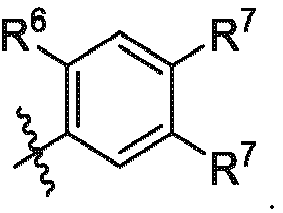
- In some embodiments, the substituted ring B is

- In some embodiments, the substituted ring B is

- In some embodiments, the substituted ring B is

- In some embodiments, the substituted ring B is

- In some embodiments, the substituted ring B is

- In some embodiments, the substituted ring B is

- In some embodiments, the substituted ring B is

- In some embodiments, the substituted ring B is

- In some embodiments, the substituted ring B is

- In some embodiments, the substituted ring B is

- In some embodiments, the substituted ring B is

- In some embodiments, the substituted ring B is
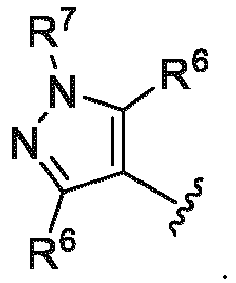
- In some embodiments, the substituted ring B is

- In some embodiments, the substituted ring B is

- In some embodiments, the substituted ring B is

- In some embodiments, the substituted ring B is

- In some embodiments, the substituted ring B is

- In some embodiments, the substituted ring B is

- In some embodiments, the substituted ring B is

- In some embodiments, the substituted ring B is

- In some embodiments, the substituted ring B is

- In some embodiments, the substituted ring B is

- In some embodiments, the substituted ring B is

- In some embodiments, the substituted ring B is

- In some embodiments, the substituted ring B is

- In some embodiments, the substituted ring B is

- In some embodiments, the substituted ring B is

- In some embodiments, the substituted ring B is

- In some embodiments, the substituted ring B is

- In some embodiments, the substituted ring B is

- In some embodiments, the substituted ring B is

- In some embodiments, the substituted ring B is

- In some embodiments, the substituted ring B is

- In some embodiments, the substituted ring B is

- In some embodiments, the substituted ring B is

- In some embodiments, the substituted ring B is

- In some embodiments, the substituted ring B is

- In some embodiments,
- R6 and R 7 are each independently selected from C1-C6 alkyl, C1-C6 haloalkyl, C1-C6 alkoxy, Ci-C6 haloalkoxy, halo, CN, NO2, COC1-C6 alkyl, CO2C1-C6 alkyl, CO2C3-C8 cycloalkyl, OCOC1-C6 alkyl, OCOC6-C10 aryl, OCO(5- to 10-membered heteroaryl), OCO(3- to 7-membered heterocycloalkyl), C6-C10 aryl, 5- to 10-membered heteroaryl, NH2, NHC1-C6 alkyl, N(C1-C6 alkyl)2, CONR8R9, SF5, S(O2)C1-C6 alkyl, C3-C10 cycloalkyl and 3- to 10-membered heterocycloalkyl, and a C2-C6 alkenyl,
- wherein R6 and R7 are each optionally substituted with one or more substituents independently selected from
- hydroxy, halo, CN, oxo, C1-C6 alkyl, C1-C6 alkoxy, NR8R9, =NR10, COOC1-C6 alkyl, CONR8R9, 3- to 7-membered heterocycloalkyl, C6-C10 aryl, 5- to 10-membered heteroaryl, OCOC1-C6 alkyl, OCOC6-C10 aryl, OCO(5- to 10-membered heteroaryl), OCO(3- to 7-membered heterocycloalkyl), NHCOC1-C6 alkyl, NHCOC6-C10 aryl, NHCO(5- to 10-membered heteroaryl), NHCO(3- to 7-membered heterocycloalkyl), NHCOC2-C6 alkynyl,
- C6-C10 aryloxy, and S(O2)C1-C6 alkyl; and wherein the C1-C6 alkyl or C1-C6 alkoxy that R6 or R7 is substituted with is optionally substituted with one or more hydroxyl, C6-C10 aryl or NR8R9, or wherein R6 or R7 is optionally fused to a five- to -seven-membered carbocyclic ring or heterocyclic ring containing one or two heteroatoms independently selected from oxygen, sulfur and nitrogen;
wherein the 3- to 7-membered heterocycloalkyl, C6-C10 aryl, 5- to 10-membered heteroaryl, NHCOC6-C10 aryl, NHCO(5- to 10-membered heteroaryl) and NHCO(3- to 7-membered heterocycloalkyl) are optionally substituted with one or more substituents independently selected from halo, C1-C6 alkyl, and OC1-C6 alkyl; - or at least one pair of R6 and R7 on adjacent atoms, taken together with the atoms connecting them, independently form at least one C4-C8 carbocyclic ring or at least one 5-to 8-membered heterocyclic ring containing 1 or 2 heteroatoms independently selected from O, N, and S, wherein the carbocyclic ring or heterocyclic ring is optionally independently substituted with one or more substituents independently selected from hydroxy, hydroxymethyl, halo, oxo, C1-C6 alkyl, C1-C6 alkoxy, NR8R9, CH2NR8R9, =NR10, COOC1-C6 alkyl, C6-C10 aryl, and CONR8R9.
- In some embodiments,
- R6 and R7 are each independently selected from C1-C6 alkyl, C1-C6 haloalkyl, C1-C6 alkoxy, Ci-C6 haloalkoxy, halo, CN, NO2, COC1-C6 alkyl, CO2C1-C6 alkyl, CO2C3-C8 cycloalkyl, OCOC1-C6 alkyl, OCOC6-C10 aryl, OCO(5- to 10-membered heteroaryl), OCO(3- to 7-membered heterocycloalkyl), C6-C10 aryl, 5- to 10-membered heteroaryl, NH2, NHC1-C6 alkyl, N(C1-C6 alkyl)2, CONR8R9, SF5, S(O2)C1-C6 alkyl, C3-C10 cycloalkyl and 3- to 10-membered heterocycloalkyl, and a C2-C6 alkenyl,
- wherein R6 and R7 are each optionally substituted with one or more substituents independently selected from
- hydroxy, halo, CN, oxo, C1-C6 alkyl, C1-C6 alkoxy, NR8R9, =NR10, COOC1-C6 alkyl, CONR8R9, 3- to 7-membered heterocycloalkyl, C6-C10 aryl, 5- to 10-membered heteroaryl, OCOC1-C6 alkyl, OCOC6-C10 aryl, OCO(5- to 10-membered heteroaryl), OCO(3- to 7-membered heterocycloalkyl), NHCOC1-C6 alkyl, NHCOC6-C10 aryl, NHCO(5- to 10-membered heteroaryl), NHCO(3- to 7-membered heterocycloalkyl), NHCOC2-C6 alkynyl,
- C6-C10 aryloxy, and S(O2)C1-C6 alkyl; and wherein the C1-C6 alkyl or C1-C6 alkoxy that R6 or R7 is substituted with is optionally substituted with one or more hydroxyl, C6-C10 aryl or NR8R9, or wherein R6 or R7 is optionally fused to a five- to -seven-membered carbocyclic ring or heterocyclic ring containing one or two heteroatoms independently selected from oxygen, sulfur and nitrogen;
wherein the 3- to 7-membered heterocycloalkyl, C6-C10 aryl, 5- to 10-membered heteroaryl, NHCOC6-C10 aryl, NHCO(5- to 10-membered heteroaryl) and NHCO(3- to 7-membered heterocycloalkyl) are optionally substituted with one or more substituents independently selected from halo, C1-C6 alkyl, and OC1-C6 alkyl; - or at least one pair of R6 and R7 on adjacent atoms, taken together with the atoms connecting them, independently form at least one C4-C6 aliphatic carbocyclic ring or at least one 5-to 6-membered heterocyclic ring containing 1 or 2 heteroatoms independently selected from O, N, and S, wherein the carbocyclic ring or heterocyclic ring is optionally independently substituted with one or more substituents independently selected from hydroxy, hydroxymethyl, halo, oxo, C1-C6 alkyl, C1-C6 alkoxy, NR8R9, CH2NR8R9, =NR10, COOC1-C6 alkyl, C6-C10 aryl, and CONR8R9.
- In some embodiments,
- R6 and R7 are each independently selected from C1-C6 alkyl, C1-C6 haloalkyl, C1-C6 alkoxy, Ci-C6 haloalkoxy, halo, CN, NO2, COC1-C6 alkyl, CO2C1-C6 alkyl, CO2C3-C8 cycloalkyl, OCOC1-C6 alkyl, OCOC6-C10 aryl, OCO(5- to 10-membered heteroaryl), OCO(3- to 7-membered heterocycloalkyl), C6-C10 aryl, 5- to 10-membered heteroaryl, NH2, NHC1-C6 alkyl, N(C1-C6 alkyl)2, CONR8R9, SF5, SC1-C6 alkyl, S(O2)C1-C6 alkyl, C3-C7 cycloalkyl and 3- to 7-membered heterocycloalkyl,
- wherein the C1-C6 alkyl, C1-C6 haloalkyl, C3-C7 cycloalkyl and 3- to 7-membered heterocycloalkyl is optionally substituted with one or more substituents each independently selected from hydroxy, halo, CN, oxo, C1-C6 alkyl, C1-C6 alkoxy, NR8R9, =NR10, COOC1-C6 alkyl, CONR8R9, 3- to 7-membered heterocycloalkyl, C6-C10 aryl, 5- to 10-membered heteroaryl, OCOC1-C6 alkyl, OCOC6-C10 aryl, OCO(5- to 10-membered heteroaryl), OCO(3- to 7-membered heterocycloalkyl), NHCOC1-C6 alkyl, NHCOC6-C10 aryl, NHCO(5- to 10-membered heteroaryl), NHCO(3- to 7-membered heterocycloalkyl), and NHCOC2-C6 alkynyl;
wherein the 3- to 7-membered heterocycloalkyl, C6-C10 aryl, 5- to 10-membered heteroaryl, NHCOC6-C10 aryl, NHCO(5- to 10-membered heteroaryl) and NHCO(3- to 7-membered heterocycloalkyl) are optionally substituted with one or more substituents independently selected from halo, C1-C6 alkyl, and OC1-C6 alkyl; - or at least one pair of R6 and R7 on adjacent atoms, taken together with the atoms connecting them, independently form at least one C4-C8 carbocyclic ring or at least one 5- to 8-membered heterocyclic ring containing 1 or 2 heteroatoms independently selected from O, N, and S, wherein the carbocyclic ring or heterocyclic ring is optionally independently substituted with one or more substituents independently selected from hydroxy, hydroxymethyl, halo, oxo, C1-C6 alkyl, C1-C6 alkoxy, NR8R9, CH2NR8R9, =NR10, COOC1-C6 alkyl, C6-C10 aryl, and CONR8R9.
- In some embodiments,
- R6 and R7 are each independently selected from C1-C6 haloalkyl, C1-C6 alkoxy, C1-C6 haloalkoxy, halo, CN, NO2, COC1-C6 alkyl, CO2C1-C6 alkyl, CO2C3-C8 cycloalkyl, OCOC1-C6 alkyl, OCOC6-C10 aryl, OCO(5- to 10-membered heteroaryl), OCO(3- to 7-membered heterocycloalkyl), C6-C10 aryl, 5- to 10-membered heteroaryl, NH2, NHC1-C6 alkyl, N(C1-C6 alkyl)2, CONR8R9, SF5, SC1-C6 alkyl, S(O2)C1-C6 alkyl, C3-C7 cycloalkyl and 3- to 7-membered heterocycloalkyl,
- wherein the C3-C7 cycloalkyl, C1-C6 haloalkyl, and 3- to 7-membered heterocycloalkyl is optionally substituted with one or more substituents each independently selected from hydroxy, halo, CN, oxo, C1-C6 alkyl, C1-C6 alkoxy, NR8R9, =NR10, COOC1-C6 alkyl, CONR8R9, 3- to 7-membered heterocycloalkyl, C6-C10 aryl, 5- to 10-membered heteroaryl, OCOC1-C6 alkyl, OCOC6-C10 aryl, OCO(5- to 10-membered heteroaryl), OCO(3- to 7-membered heterocycloalkyl), NHCOC1-C6 alkyl, NHCOC6-C10 aryl, NHCO(5- to 10-membered heteroaryl), NHCO(3- to 7-membered heterocycloalkyl), and NHCOC2-C6 alkynyl;
wherein the 3- to 7-membered heterocycloalkyl, C6-C10 aryl, 5- to 10-membered heteroaryl, NHCOC6-C10 aryl, NHCO(5- to 10-membered heteroaryl) and NHCO(3- to 7-membered heterocycloalkyl) are optionally substituted with one or more substituents independently selected from halo, C1-C6 alkyl, and OC1-C6 alkyl; - or at least one pair of R6 and R7 on adjacent atoms, taken together with the atoms connecting them, independently form at least one C4-C8 carbocyclic ring or at least one 5- to 8-membered heterocyclic ring containing 1 or 2 heteroatoms independently selected from O, N, and S, wherein the carbocyclic ring or heterocyclic ring is optionally independently substituted with one or more substituents independently selected from hydroxy, hydroxymethyl, halo, oxo, C1-C6 alkyl, C1-C6 alkoxy, NR8R9, CH2NR8R9, =NR10, COOC1-C6 alkyl, C6-C10 aryl, and CONR8R9.
- In some embodiments,
- R6 and R7 are each independently selected from C1-C6 alkyl, halo, CN, NO2, COC1-C6 alkyl, CO2C1-C6 alkyl, OCOC1-C6 alkyl, OCOC6-C10 aryl, OCO(5- to 10-membered heteroaryl), OCO(3- to 7-membered heterocycloalkyl), C6-C10 aryl, 5- to 10-membered heteroaryl, NH2, NHC1-C6 alkyl, N(C1-C6 alkyl)2, CONR8R9, SF5, SC1-C6 alkyl, S(O2)C1-C6 alkyl, C3-C7 cycloalkyl and 3- to 7-membered heterocycloalkyl,
- wherein the C1-C6 alkyl, C3-C7 cycloalkyl and 3- to 7-membered heterocycloalkyl is optionally substituted with one or more substituents each independently selected from hydroxy, halo, CN, oxo, C1-C6 alkyl, C1-C6 alkoxy, NR8R9, =NR10, COOC1-C6 alkyl, CONR8R9, 3- to 7-membered heterocycloalkyl, C6-C10 aryl, 5- to 10-membered heteroaryl, OCOC1-C6 alkyl, OCOC6-C10 aryl, OCO(5- to 10-membered heteroaryl), OCO(3- to 7-membered heterocycloalkyl), NHCOC1-C6 alkyl, NHCOC6-C10 aryl, NHCO(5- to 10-membered heteroaryl), NHCO(3- to 7-membered heterocycloalkyl), and NHCOC2-C6 alkynyl;
wherein the 3- to 7-membered heterocycloalkyl, C6-C10 aryl, 5- to 10-membered heteroaryl, NHCOC6-C10 aryl, NHCO(5- to 10-membered heteroaryl) and NHCO(3- to 7-membered heterocycloalkyl) are optionally substituted with one or more substituents independently selected from halo, C1-C6 alkyl, and OC1-C6 alkyl; - or at least one pair of R6 and R7 on adjacent atoms, taken together with the atoms connecting them, independently form at least one C4-C8 carbocyclic ring or at least one 5- to 8-membered heterocyclic ring containing 1 or 2 heteroatoms independently selected from O, N, and S, wherein the carbocyclic ring or heterocyclic ring is optionally independently substituted with one or more substituents independently selected from hydroxy, hydroxymethyl, halo, oxo, C1-C6 alkyl, C1-C6 alkoxy, NR8R9, CH2NR8R9, =NR10, COOC1-C6 alkyl, C6-C10 aryl, and CONR8R9.
- In some embodiments,
- R6 and R7 are each independently selected from C1-C6 alkyl, C1-C6 haloalkyl, C1-C6 alkoxy, Ci-C6 haloalkoxy, halo, CN, NO2, COC1-C6 alkyl, CO2C1-C6 alkyl, CO2C3-C8 cycloalkyl, OCOC1-C6 alkyl, OCOC6-C10 aryl, OCO(5- to 10-membered heteroaryl), OCO(3- to 7-membered heterocycloalkyl), C6-C10 aryl, 5- to 10-membered heteroaryl, NH2, NHC1-C6 alkyl, N(C1-C6 alkyl)2, CONR8R9, SF5, SC1-C6 alkyl, S(O2)C1-C6 alkyl, C3-C7 cycloalkyl and 3- to 7-membered heterocycloalkyl,
- wherein the C1-C6 alkyl, C1-C6 haloalkyl, C3-C7 cycloalkyl, and 3- to 7-membered heterocycloalkyl is optionally substituted with one or more substituents each independently selected from hydroxy, halo, CN, oxo, C1-C6 alkyl, C1-C6 alkoxy, NR8R9, =NR10, COOC1-C6 alkyl, CONR8R9, 3- to 7-membered heterocycloalkyl, C6-C10 aryl, 5- to 10-membered heteroaryl, OCOC1-C6 alkyl, OCOC6-C10 aryl, OCO(5- to 10-membered heteroaryl), OCO(3- to 7-membered heterocycloalkyl), NHCOC1-C6 alkyl, NHCOC6-C10 aryl, NHCO(5- to 10-membered heteroaryl), NHCO(3- to 7-membered heterocycloalkyl), and NHCOC2-C6 alkynyl;
wherein the 3- to 7-membered heterocycloalkyl, C6-C10 aryl, 5- to 10-membered heteroaryl, NHCOC6-C10 aryl, NHCO(5- to 10-membered heteroaryl) and NHCO(3- to 7-membered heterocycloalkyl) are unsubstituted; - or at least one pair of R6 and R7 on adjacent atoms, taken together with the atoms connecting them, independently form at least one C4-C8 carbocyclic ring or at least one 5- to 8-membered heterocyclic ring containing 1 or 2 heteroatoms independently selected from O, N, and S, wherein the carbocyclic ring or heterocyclic ring is optionally independently substituted with one or more substituents independently selected from hydroxy, hydroxymethyl, halo, oxo, C1-C6 alkyl, C1-C6 alkoxy, NR8R9, CH2NR8R9, =NR10, COOC1-C6 alkyl, C6-C10 aryl, and CONR8R9.
- In some embodiments,
- R6 and R7 are each independently selected from C1-C6 alkyl, C1-C6 haloalkyl, C1-C6 alkoxy, Ci-C6 haloalkoxy, halo, CN, NO2, COC1-C6 alkyl, CO2C1-C6 alkyl, CO2C3-C8 cycloalkyl, OCOC1-C6 alkyl, OCOC6-C10 aryl, OCO(5- to 10-membered heteroaryl), OCO(3- to 7-membered heterocycloalkyl), C6-C10 aryl, 5- to 10-membered heteroaryl, NH2, NHC1-C6 alkyl, N(C1-C6 alkyl)2, CONR8R9, SF5, SC1-C6 alkyl, S(O2)C1-C6 alkyl, C3-C7 cycloalkyl and 3- to 7-membered heterocycloalkyl,
- wherein the C1-C6 alkyl, C3-C7 cycloalkyl and 3- to 7-membered heterocycloalkyl are each unsub stituted;
- or at least one pair of R6 and R7 on adjacent atoms, taken together with the atoms connecting them, independently form at least one C4-C8 carbocyclic ring or at least one 5- to 8-membered heterocyclic ring containing 1 or 2 heteroatoms independently selected from O, N, and S, wherein the carbocyclic ring or heterocyclic ring is optionally independently substituted with one or more substituents independently selected from hydroxy, hydroxymethyl, halo, oxo, C1-C6 alkyl, C1-C6 alkoxy, NR8R9, CH2NR8R9, =NR10, COOC1-C6 alkyl, C6-C10 aryl, and CONR8R9.
- In some embodiments,
- R6 is independently selected from C1-C6 alkyl, C3-C7 cycloalkyl, C1-C6 haloalkyl, C1-C6 alkoxy, C1-C6 haloalkoxy, halo, CN, C6-C10 aryl, 5- to 10-membered heteroaryl, CO-C1-C6 alkyl; CONR8R9, and 4- to 6-membered heterocycloalkyl,
- wherein the C1-C6 alkyl, C1-C6 haloalkyl, C3-C7 cycloalkyl and 4- to 6-membered heterocycloalkyl is optionally substituted with one or more substituents each independently selected from hydroxy, halo, CN, oxo, C1-C6 alkyl, C1-C6 alkoxy, NR8R9, =NR10, COOC1-C6 alkyl, CONR8R9, 4- to 6-membered heterocycloalkyl, C6-C10 aryl, 5- to 10-membered heteroaryl, OCOC1-C6 alkyl, OCOC6-C10 aryl, OCO(5- to 10-membered heteroaryl), OCO(4- to 6-membered heterocycloalkyl), NHCOC1-C6 alkyl, NHCOC6-C10 aryl, NHCO(5- to 10-membered heteroaryl), NHCO(4- to 6-membered heterocycloalkyl), and NHCOC2-C6 alkynyl;
and R7 is independently selected from C1-C6 alkyl, C1-C6 haloalkyl, C1-C6 alkoxy, C1-C6 haloalkoxy, halo, CN, COC1-C6 alkyl, CO2C1-C6 alkyl, CO2C3-C6 cycloalkyl, OCOC1-C6 alkyl, OCOC6-C10 aryl, OCO(5- to 10-membered heteroaryl), OCO(3- to 7-membered heterocycloalkyl), C6-C10 aryl, 5- to 10-membered heteroaryl, CONR8R9, SF5, S(O2)C1-C6 alkyl, C3-C7 cycloalkyl and 4- to 6-membered heterocycloalkyl, wherein the C1-C6 alkyl is optionally substituted with one to two C1-C6 alkoxy; - or R6 and R7, taken together with the atoms connecting them, independently form C4-C7 carbocyclic ring or at least one 5-to-7-membered heterocyclic ring containing 1 or 2 heteroatoms independently selected from O, N, and S, wherein the carbocyclic ring or heterocyclic ring is optionally independently substituted with one or more substituents independently selected from hydroxy, halo, oxo, C1-C6 alkyl, C1-C6 alkoxy, NR8R9, =NR10, COOC1-C6 alkyl, C6-C10 aryl, and CONR8R9.
- In some embodiments,
- R6 and R7 are each independently selected from C1-C6 alkyl, C1-C6 alkoxy, halo, CN, NO2, COC1-C6 alkyl, CO2C1-C6 alkyl, C6-C10 aryl, 5- to 10-membered heteroaryl, CONR8R9, and 3- to 7-membered heterocycloalkyl,
- wherein the C1-C6 alkyl and 3- to 7-membered heterocycloalkyl is optionally substituted with one or more substituents each independently selected from hydroxy or oxo,
- or at least one pair of R6 and R7 on adjacent atoms, taken together with the atoms connecting them, independently form at least one C4-C8 carbocyclic ring, wherein the carbocyclic ring is optionally independently substituted with one or more hydroxy or oxo.
- In some embodiments,
- R6 and R7 are each independently selected from C1-C6 alkyl, C1-C6 alkoxy, halo, CN, NO2, COC1-C6 alkyl, CO2C1-C6 alkyl, C6-C10 aryl, 5- to 10-membered heteroaryl, CONR8R9, and 3- to 7-membered heterocycloalkyl,
- wherein the C1-C6 alkyl and 3- to 7-membered heterocycloalkyl is optionally substituted with one or more substituents each independently selected from hydroxy or oxo,
- or at least one pair of R6 and R7 on adjacent atoms, taken together with the atoms connecting them, independently form at least one C4-C6 aliphatic carbocyclic ring, wherein the carbocyclic ring is optionally independently substituted with one or more hydroxy or oxo.
- In some embodiments,
- R6 and R7 are each independently selected from C1-C6 alkyl, C1-C6 alkoxy, halo, CN, NO2, COC1-C6 alkyl, CO2C1-C6 alkyl, C6-C10 aryl, 5- to 10-membered heteroaryl, CONR8R9, and 3- to 7-membered heterocycloalkyl,
- wherein the C1-C6 alkyl and 3- to 7-membered heterocycloalkyl is optionally substituted with one or more substituents each independently selected from hydroxy or oxo,
- or at least one pair of R6 and R7 on adjacent atoms, taken together with the atoms connecting them, independently form at least one 5-to 8-membered heterocyclic ring containing 1 or 2 heteroatoms independently selected from O, N, and S, wherein the heterocyclic ring is optionally independently substituted with one or more hydroxy or oxo.
- In some embodiments,
- R6 and R7 are each independently selected from C1-C6 alkyl, C1-C6 alkoxy, halo, CN, NO2, COC1-C6 alkyl, CO2C1-C6 alkyl, C6-C10 aryl, 5- to 10-membered heteroaryl, CONR8R9, and 3- to 7-membered heterocycloalkyl,
- wherein the C1-C6 alkyl and 3- to 7-membered heterocycloalkyl is optionally substituted with one or more substituents each independently selected from hydroxy or oxo,
- or at least one pair of R6 and R7 on adjacent atoms, taken together with the atoms connecting them, independently form at least one C4-C8 carbocyclic ring, wherein the carbocyclic ring is optionally independently substituted with one or more hydroxy or oxo.
- In some embodiments,
at least one pair of R6 and R7 on adjacent atoms, taken together with the atoms connecting them, independently form at least one C4-C6 aliphatic carbocyclic ring, wherein the carbocyclic ring is optionally independently substituted with one or more hydroxy or oxo. - In some embodiments,
at least one pair of R6 and R7 on adjacent atoms, taken together with the atoms connecting them, independently form at least one C4 aliphatic carbocyclic ring, wherein the carbocyclic ring is optionally independently substituted with one or more hydroxy or oxo. - In some embodiments,
at least one pair of R6 and R7 on adjacent atoms, taken together with the atoms connecting them, independently form at least one C5 aliphatic carbocyclic ring, wherein the carbocyclic ring is optionally independently substituted with one or more hydroxy or oxo. - In some embodiments,
at least one pair of R6 and R7 on adjacent atoms, taken together with the atoms connecting them, independently form at least one C6 aliphatic carbocyclic ring, wherein the carbocyclic ring is optionally independently substituted with one or more hydroxy or oxo. - In some embodiments,
at least one pair of R6 and R7 on adjacent atoms, taken together with the atoms connecting them, independently form at least one 5-to 6-membered heterocyclic ring containing 1 heteroatom independently selected from O, N, and S, wherein the heterocyclic ring is optionally independently substituted with one or more hydroxy or oxo. - In some embodiments,
at least one pair of R6 and R7 on adjacent atoms, taken together with the atoms connecting them, independently form at least one 5-membered heterocyclic ring containing 1 heteroatom independently selected from O, N, and S, wherein the heterocyclic ring is optionally independently substituted with one or more hydroxy or oxo. - In some embodiments,
at least one pair of R6 and R7 on adjacent atoms, taken together with the atoms connecting them, independently form at least one 6-membered heterocyclic ring containing 1 heteroatom independently selected from O, N, and S, wherein the heterocyclic ring is optionally independently substituted with one or more hydroxy or oxo. - In some embodiments,
at least one pair of R6 and R7 on adjacent atoms, taken together with the atoms connecting them, independently form at least one C4 aliphatic carbocyclic ring, wherein the carbocyclic ring is optionally independently substituted with one or more C1-C6 alkyl. - In some embodiments,
at least one pair of R6 and R7 on adjacent atoms, taken together with the atoms connecting them, independently form at least one C5 aliphatic carbocyclic ring, wherein the carbocyclic ring is optionally independently substituted with one or more C1-C6 alkyl. - In some embodiments,
at least one pair of R6 and R7 on adjacent atoms, taken together with the atoms connecting them, independently form at least one C6 aliphatic carbocyclic ring, wherein the carbocyclic ring is optionally independently substituted with one or more C1-C6 alkyl. - In some embodiments,
at least one pair of R6 and R7 on adjacent atoms, taken together with the atoms connecting them, independently form at least one 5-to 6-membered heterocyclic ring containing 1 heteroatom independently selected from O, N, and S, wherein the heterocyclic ring is optionally independently substituted with one or more C1-C6 alkyl. - In some embodiments,
at least one pair of R6 and R7 on adjacent atoms, taken together with the atoms connecting them, independently form at least one 5-membered heterocyclic ring containing 1 heteroatom independently selected from O, N, and S, wherein the heterocyclic ring is optionally independently substituted with one or more C1-C6 alkyl. - In some embodiments,
at least one pair of R6 and R7 on adjacent atoms, taken together with the atoms connecting them, independently form at least one 6-membered heterocyclic ring containing 1 heteroatom independently selected from O, N, and S, wherein the heterocyclic ring is optionally independently substituted with one or more C1-C6 alkyl. - In some embodiments, o=1; p=0; and
- R6 is selected from C1-C6 alkyl, C1-C6 haloalkyl, C1-C6 alkoxy, C1-C6 haloalkoxy, halo, CN, NO2, COC1-C6 alkyl, CO2C1-C6 alkyl, CO2C3-C8 cycloalkyl, OCOC1-C6 alkyl, OCOC6-C10 aryl, OCO(5- to 10-membered heteroaryl), OCO(3- to 7-membered heterocycloalkyl), C6-C10 aryl, 5-to 10-membered heteroaryl, NH2, NHC1-C6 alkyl, N(C1-C6 alkyl)2, CONR8R9, SF5, SC1-C6 alkyl, S(O2)C1-C6 alkyl, C3-C7 cycloalkyl and 3- to 7-membered heterocycloalkyl,
- wherein the C1-C6 alkyl, C1-C6 haloalkyl, C3-C7 cycloalkyl and 3- to 7-membered heterocycloalkyl is optionally substituted with one or more substituents each independently selected from hydroxy, halo, CN, oxo, C1-C6 alkyl, C1-C6 alkoxy, NR8R9, =NR10, COOC1-C6 alkyl, CONR8R9, 3- to 7-membered heterocycloalkyl, C6-C10 aryl, 5- to 10-membered heteroaryl, OCOC1-C6 alkyl, OCOC6-C10 aryl, OCO(5- to 10-membered heteroaryl), OCO(3- to 7-membered heterocycloalkyl), NHCOC1-C6 alkyl, NHCOC6-C10 aryl, NHCO(5- to 10-membered heteroaryl), NHCO(3- to 7-membered heterocycloalkyl), and NHCOC2-C6 alkynyl;
wherein the 3- to 7-membered heterocycloalkyl, C6-C10 aryl, 5- to 10-membered heteroaryl, NHCOC6-C10 aryl, NHCO(5- to 10-membered heteroaryl) and NHCO(3- to 7-membered heterocycloalkyl) are optionally substituted with one or more substituents independently selected from halo, C1-C6 alkyl, and OC1-C6 alkyl. - In some embodiments, o=1; p=1; and
- R6 and R7 are each independently selected from C1-C6 alkyl, C1-C6 alkoxy, halo, CN, NO2, COC1-C6 alkyl, CO2C1-C6 alkyl, C6-C10 aryl, 5- to 10-membered heteroaryl, CONR8R9, and 3- to 7-membered heterocycloalkyl,
- wherein the C1-C6 alkyl and 3- to 7-membered heterocycloalkyl is optionally substituted with one or more substituents each independently selected from hydroxy or oxo,
- or at least one pair of R6 and R7 on adjacent atoms, taken together with the atoms connecting them, independently form at least one C4-C8 carbocyclic ring, wherein the carbocyclic ring is optionally independently substituted with one or more hydroxy or oxo.
- In some embodiments, o=1 or 2; p=1, 2, or 3; and
- R6 and R7 are each independently selected from C1-C6 alkyl, C1-C6 haloalkyl, C1-C6 alkoxy, Ci-C6 haloalkoxy, halo, CN, NO2, COC1-C6 alkyl, CO2C1-C6 alkyl, CO2C3-C8 cycloalkyl, OCOC1-C6 alkyl, OCOC6-C10 aryl, OCO(5- to 10-membered heteroaryl), OCO(3- to 7-membered heterocycloalkyl), C6-C10 aryl, 5- to 10-membered heteroaryl, NH2, NHC1-C6 alkyl, N(C1-C6 alkyl)2, CONR8R9, SF5, SC1-C6 alkyl, S(O2)C1-C6 alkyl, C3-C7 cycloalkyl and 3- to 7-membered heterocycloalkyl,
- wherein the C1-C6 alkyl, C1-C6 haloalkyl, C3-C7 cycloalkyl, and 3- to 7-membered heterocycloalkyl is optionally substituted with one or more substituents each independently selected from hydroxy, halo, CN, oxo, C1-C6 alkyl, C1-C6 alkoxy, NR8R9, =NR10, COOC1-C6 alkyl, CONR8R9, 3- to 7-membered heterocycloalkyl, C6-C10 aryl, 5- to 10-membered heteroaryl, OCOC1-C6 alkyl, OCOC6-C10 aryl, OCO(5- to 10-membered heteroaryl), OCO(3- to 7-membered heterocycloalkyl), NHCOC1-C6 alkyl, NHCOC6-C10 aryl, NHCO(5- to 10-membered heteroaryl), NHCO(3- to 7-membered heterocycloalkyl), and NHCOC2-C6 alkynyl;
wherein the 3- to 7-membered heterocycloalkyl, C6-C10 aryl, 5- to 10-membered heteroaryl, NHCOC6-C10 aryl, NHCO(5- to 10-membered heteroaryl) and NHCO(3- to 7-membered heterocycloalkyl) are optionally substituted with one or more substituents independently selected from halo, C1-C6 alkyl, and OC1-C6 alkyl. - In some embodiments, o=2; p=1; and
- each R6 is independently selected from C1-C6 alkyl, C3-C7 cycloalkyl, C1-C6 haloalkyl, C1-C6 alkoxy, C1-C6 haloalkoxy, halo, CN, C6-C10 aryl, 5- to 10-membered heteroaryl, CO-C1-C6 alkyl; CONR8R9, and 4- to 6-membered heterocycloalkyl,
- wherein the C1-C6 alkyl, C1-C6 haloalkyl, C3-C7 cycloalkyl and 4- to 6-membered heterocycloalkyl is optionally substituted with one or more substituents each independently selected from hydroxy, halo, CN, oxo, C1-C6 alkyl, C1-C6 alkoxy, NR8R9, =NR10, COOC1-C6 alkyl, CONR8R9, 4- to 6-membered heterocycloalkyl, C6-C10 aryl, 5- to 10-membered heteroaryl, OCOC1-C6 alkyl, OCOC6-C10 aryl, OCO(5- to 10-membered heteroaryl), OCO(4- to 6-membered heterocycloalkyl), NHCOC1-C6 alkyl, NHCOC6-C10 aryl, NHCO(5- to 10-membered heteroaryl), NHCO(4- to 6-membered heterocycloalkyl), and NHCOC2-C6 alkynyl;
and R7 is independently selected from C1-C6 alkyl, C1-C6 haloalkyl, C1-C6 alkoxy, C1-C6 haloalkoxy, halo, CN, COC1-C6 alkyl, CO2C1-C6 alkyl, CO2C3-C6 cycloalkyl, OCOC1-C6 alkyl, OCOC6-C10 aryl, OCO(5- to 10-membered heteroaryl), OCO(3- to 7-membered heterocycloalkyl), C6-C10 aryl, 5- to 10-membered heteroaryl, CONR8R9, SF5, S(O2)C1-C6 alkyl, C3-C7 cycloalkyl and 4- to 6-membered heterocycloalkyl, wherein the C1-C6 alkyl is optionally substituted with one to two C1-C6 alkoxy; - or R6 and R7, taken together with the atoms connecting them, independently form C4-C7 carbocyclic ring or at least one 5-to-7-membered heterocyclic ring containing 1 or 2 heteroatoms independently selected from O, N, and S, wherein the carbocyclic ring or heterocyclic ring is optionally independently substituted with one or more substituents independently selected from hydroxy, halo, oxo, C1-C6 alkyl, C1-C6 alkoxy, NR8R9, =NR10, COOC1-C6 alkyl, C6-C10 aryl, and CONR8R9.
- In some embodiments, o=2; p=2 or 3; and
- each R6 is independently selected from C1-C6 alkyl, C3-C7 cycloalkyl, C1-C6 haloalkyl, C1-C6 alkoxy, C1-C6 haloalkoxy, halo, CN, C6-C10 aryl, 5- to 10-membered heteroaryl, CO-C1-C6 alkyl; CONR8R9, and 4- to 6-membered heterocycloalkyl,
- wherein the C1-C6 alkyl, C1-C6 haloalkyl, C3-C7 cycloalkyl and 4- to 6-membered heterocycloalkyl is optionally substituted with one or more substituents each independently selected from hydroxy, halo, CN, oxo, C1-C6 alkyl, C1-C6 alkoxy, NR8R9, =NR10, COOC1-C6 alkyl, CONR8R9, 4- to 6-membered heterocycloalkyl, C6-C10 aryl, 5- to 10-membered heteroaryl, OCOC1-C6 alkyl, OCOC6-C10 aryl, OCO(5- to 10-membered heteroaryl), OCO(4- to 6-membered heterocycloalkyl), NHCOC1-C6 alkyl, NHCOC6-C10 aryl, NHCO(5- to 10-membered heteroaryl), NHCO(4- to 6-membered heterocycloalkyl), and NHCOC2-C6 alkynyl;
wherein each R7 is independently selected from C1-C6 alkyl, C1-C6 haloalkyl, C1-C6 alkoxy, C1-C6 haloalkoxy, halo, CN, COC1-C6 alkyl, CO2C1-C6 alkyl, CO2C3-C6 cycloalkyl, OCOC1-C6 alkyl, OCOC6-C10 aryl, OCO(5- to 10-membered heteroaryl), OCO(3- to 7-membered heterocycloalkyl), C6-C10 aryl, 5- to 10-membered heteroaryl, CONR8R9, SF5, S(O2)C1-C6 alkyl, C3-C7 cycloalkyl and 4- to 6-membered heterocycloalkyl, wherein the C1-C6 alkyl is optionally substituted with one to two C1-C6 alkoxy; - or at least one pair of R6 and R7 on adjacent atoms, taken together with the atoms connecting them, independently form at least one C4-C7 (e.g., C4-C6) carbocyclic ring (e.g., aliphatic carbocyclic ring) or at least one 5-to-7-membered (e.g., 5-to-6-membered) heterocyclic ring containing 1 or 2 heteroatoms independently selected from O, N, and S, wherein the carbocyclic ring or heterocyclic ring is optionally independently substituted with one or more substituents independently selected from hydroxy, hydroxymethyl, halo, oxo, C1-C6 alkyl, C1-C6 alkoxy, NR8R9, CH2NR8R9, =NR10, COOC1-C6 alkyl, C6-C10 aryl, and CONR8R9.
- In some embodiments, o=1 or 2; p=1, 2, or 3; and
- R6 and R7 are each independently selected from C1-C6 alkyl, C1-C6 alkoxy, halo, CN, NO2, COC1-C6 alkyl, CO2C1-C6 alkyl, C6-C10 aryl, 5- to 10-membered heteroaryl, CONR8R9, and 3- to 7-membered heterocycloalkyl,
- wherein the C1-C6 alkyl and 3- to 7-membered heterocycloalkyl is optionally substituted with one or more substituents each independently selected from hydroxy or oxo,
- or at least one pair of R6 and R7 on adjacent atoms, taken together with the atoms connecting them, independently form at least one C4-C8 carbocyclic ring, wherein the carbocyclic ring is optionally independently substituted with one or more hydroxy or oxo.
- In some embodiments, o=1 or 2; p=1, 2, or 3; and
- R6 and R7 are each independently selected from C1-C6 alkyl, C1-C6 alkoxy, halo, CN, NO2, COC1-C6 alkyl, CO2C1-C6 alkyl, C6-C10 aryl, 5- to 10-membered heteroaryl, CONR8R9, and 3- to 7-membered heterocycloalkyl,
- wherein the C1-C6 alkyl and 3- to 7-membered heterocycloalkyl is optionally substituted with one or more substituents each independently selected from hydroxy or oxo.
- In some embodiments, o=1 or 2; p=1, 2, or 3; and
one R6 and one R7 are on adjacent atoms, and taken together with the atoms connecting them, form a C4-C8 carbocyclic ring or a 5- to 8-membered heterocyclic ring containing 1 or 2 heteroatoms independently selected from O, N, and S, wherein the carbocyclic ring or heterocyclic ring is optionally independently substituted with one or more substituents independently selected from hydroxy, halo, oxo, C1-C6 alkyl, C1-C6 alkoxy, NR8R9, =NR10, COOC1-C6 alkyl, C6-C10 aryl, and CONR8R9. - In some embodiments, o=1 or 2; p=1, 2, or 3; and
one R6 and one R7 are on adjacent atoms, and taken together with the atoms connecting them, form a C6 carbocyclic ring or a 5-to-6-membered heterocyclic ring containing 1 or 2 heteroatoms independently selected from O, N, and S, wherein the carbocyclic ring or heterocyclic ring is optionally independently substituted with one or more substituents independently selected from hydroxy, halo, oxo, C1-C6 alkyl, C1-C6 alkoxy, NR8R9, =NR10, COOC1-C6 alkyl, C6-C10 aryl, and CONR8R9. - In some embodiments, o=1 or 2; p=1, 2, or 3; and
one R6 and one R7 are on adjacent atoms, and taken together with the atoms connecting them, form a C4-C8 carbocyclic ring or a 5- to 8-membered heterocyclic ring containing 1 or 2 heteroatoms independently selected from O, N, and S, wherein the carbocyclic ring or heterocyclic ring is unsubstituted. - In some embodiments, o=2; p=2 or 3; and
two pairs, each of one R6 and one R7, are on adjacent atoms, and each pair of one R6 and one R7 taken together with the atoms connecting them independently form a C4-C8 carbocyclic ring or a 5- to 8-membered heterocyclic ring containing 1 or 2 heteroatoms independently selected from O, N, and S, wherein each carbocyclic ring or heterocyclic ring is optionally independently substituted with one or more substituents independently selected from hydroxy, halo, oxo, C1-C6 alkyl, C1-C6 alkoxy, NR8R9, =NR10, COOC1-C6 alkyl, C6-C10 aryl, and CONR8R9. - In some embodiments, o=2; p=2 or 3; and
two pairs, each of one R6 and one R7, are on adjacent atoms, and each pair of one R6 and one R7 taken together with the atoms connecting them independently form a C6 carbocyclic ring or a 5-to-6-membered heterocyclic ring containing 1 or 2 heteroatoms independently selected from O, N, and S, wherein the carbocyclic ring or heterocyclic ring is optionally independently substituted with one or more substituents independently selected from hydroxy, halo, oxo, C1-C6 alkyl, C1-C6 alkoxy, NR8R9, =NR10, COOC1-C6 alkyl, C6-C10 aryl, and CONR8R9. - In some embodiments, o=2; p=2 or 3; and
two pairs, each of one R6 and one R7, are on adjacent atoms, and each pair of one R6 and one R7 taken together with the atoms connecting them independently form a C5 carbocyclic ring, wherein the carbocyclic ring is optionally independently substituted with one or more substituents independently selected from hydroxy, halo, oxo, C1-C6 alkyl, C1-C6 alkoxy, NR8R9, =NR10, COOC1-C6 alkyl, C6-C10 aryl, and CONR8R9. - In some embodiments, o=2; p=2 or 3; and
- two pairs, each of one R6 and one R7, are on adjacent atoms, and each pair of one R6 and one R7 taken together with the atoms connecting them independently form a C4 carbocyclic ring,
- wherein the carbocyclic ring is optionally independently substituted with one or more substituents independently selected from hydroxy, halo, oxo, C1-C6 alkyl, C1-C6 alkoxy, NR8R9, =NR10, COOC1-C6 alkyl, C6-C10 aryl, and CONR8R9.
- In some embodiments, o=2; p=2 or 3; and
two pairs, each of one R6 and one R7, are on adjacent atoms, one pair of one R6 and one R7 taken together with the atoms connecting them independently form a C4 carbocyclic ring, and the other pair of one R6 and one R7 taken together with the atoms connecting them independently form a C5 carbocyclic ring, wherein each of C4 and C5 carbocyclic ring is optionally independently substituted with one or more substituents independently selected from hydroxy, halo, oxo, C1-C6 alkyl, C1-C6 alkoxy, NR8R9, =NR10, COOC1-C6 alkyl, C6-C10 aryl, and CONR8R9. - In some embodiments, o=2; p=2 or 3; and
two pairs, each of one R6 and one R7, are on adjacent atoms, one pair of one R6 and one R7 taken together with the atoms connecting them independently form a C5 carbocyclic ring, and the other pair of one R6 and one R7 taken together with the atoms connecting them independently form a 5- to 8-membered heterocyclic ring containing 1 or 2 heteroatoms independently selected from O, N, and S (e.g., a 5-membered heteorocyclic ring, e.g., 5-membered heterocyclic ring containing 1 heteroatom), wherein each of carbocyclic and heterocyclic ring is optionally independently substituted with one or more substituents independently selected from hydroxy, halo, oxo, C1-C6 alkyl, C1-C6 alkoxy, NR8R9, =NR10, COOC1-C6 alkyl, C6-C10 aryl, and CONR8R9. - In some embodiments, o=2; p=2 or 3; and
two pairs, each of one R6 and one R7, are on adjacent atoms, and each pair of one R6 and one R7 taken together with the atoms connecting them independently form a C4-C8 carbocyclic ring or a 5- to 8-membered heterocyclic ring containing 1 or 2 heteroatoms independently selected from O, N, and S, wherein the carbocyclic ring or heterocyclic ring is unsubstituted. - In some embodiments, R6 is C1-C6 alkyl.
- In some embodiments, R6 is isopropyl.
- In some embodiments, R6 is ethyl.
- In some embodiments, R6 is methyl.
- In some embodiments, R6 is C1-C6 alkyl substituted with one or more halo.
- In some embodiments, R6 is trifluoromethyl.
- In some embodiments, R6 is trifluoromethoxy.
- In some embodiments, R6 is C3-C7 cycloalkyl.
- In some embodiments, R6 is cyclopropyl.
- In some embodiments, R6 is halo.
- In some embodiments, R6 is chloro.
- In some embodiments, R6 is fluoro.
- In some embodiments, R6 is cyano.
- In some embodiments, R6 is attached to a carbon of an aryl ring B.
- In some embodiments, R6 is attached to a carbon of a heteroaryl ring B.
- In some embodiments, R6 is attached to a nitrogen of a heteroaryl ring B.
- In some embodiments, at least one R6 is C1-C6 alkyl, and at least one R7 is C1-C6 alkyl optionally substituted with one or more halo.
- In some embodiments, at least one R6 is C1-C6 alkyl and at least one R7 is C1-C6 alkyl.
- In some embodiments, at least one R6 is isopropyl and at least one R' is methyl.
- In some embodiments, at least one R6 is isopropyl and at least one R7 is isopropyl.
- In some embodiments, o=1; p=1; R6 is isopropyl; and R7 is isopropyl.
- In some embodiments, at least one R6 is C1-C6 alkyl, and at least one R7 is C1-C6 alkyl substituted with one or more halo.
- In some embodiments, at least one R6 is isopropyl and at least one R' is trifluoromethyl.
- In some embodiments, at least one R6 is C1-C6 alkyl, and at least one R7 is C3-C7 cycloalkyl.
- In some embodiments, at least one R6 is isopropyl and at least one R7 is cyclopropyl.
- In some embodiments, o=1; p=1; R6 is isopropyl; and R7 is cyclopropyl.
- In some embodiments, at least one R6 is C1-C6 alkyl, and at least one R7 is halo.
- In some embodiments, at least one R6 is isopropyl and at least one R7 is halo.
- In some embodiments, at least one R6 is isopropyl and at least one R7 is chloro.
- In some embodiments, at least one R6 is isopropyl and at least one R7 is fluoro.
- In some embodiments, o=1; p=1; R6 is isopropyl; and R7 is chloro.
- In some embodiments, o=2; p=1; at least one R6 is isopropyl; and R7 is chloro.
- In some embodiments, o=1; p=1; R6 is isopropyl; and R7 is fluoro.
- In some embodiments, o=2; p=1; at least one R6 is isopropyl; and R7 is fluoro.
- In some embodiments, o=2; p=2; at least one R6 is isopropyl; and at least one R7 is fluoro.
- In some embodiments, o=2; p=2; at least one R6 is isopropyl; one R7 is fluoro; and the other R7 is cyano.
- In some embodiments, o=2; p=3; at least one R6 is isopropyl; two R7 are fluoro; and one R7 is chloro.
- In some embodiments, o=2; p=1; at least one R6 is ethyl; and R7 is fluoro.
- In some embodiments, o=2; p=1; one R6 is isopropyl; the other R6 is trifluoromethyl; and R7 is chloro.
- In some embodiments, at least one R6 is C1-C6 alkyl, and at least one R7 is cyano.
- In some embodiments, at least one R6 is isopropyl and at least one R7 is cyano.
- In some embodiments, o=1; p=1; R6 is isopropyl; and R7 is cyano.
- In some embodiments, o=2; p=1; at least one R6 is isopropyl; and R7 is cyano.
- In some embodiments, at least one R6 is C3-C7 cycloalkyl, and at least one R7 is C3-C7 cycloalkyl.
- In some embodiments, at least one R6 is cyclopropyl, and at least one R7 is cyclopropyl.
- In some embodiments, at least one R6 is C3-C7 cycloalkyl, and at least one R7 is halo.
- In some embodiments, at least one R6 is cyclopropyl and at least one R7 is halo.
- In some embodiments, at least one R6 is cyclopropyl and at least one R7 is chloro.
- In some embodiments, at least one R6 is cyclopropyl and at least one R7 is fluoro.
- In some embodiments, o=1; p=1; R6 is cyclopropyl; and R7 is chloro.
- In some embodiments, o=1; p=1; R6 is cyclopropyl; and R7 is fluoro.
- In some embodiments, at least one R6 is C1-C6 alkyl, and at least one R7 is C1-C6 alkoxy optionally substituted with one or more halo.
- In some embodiments, at least one R6 is isopropyl, and at least one R7 is C1-C6 alkoxy.
- In some embodiments, at least one R6 is isopropyl, and at least one R7 is methoxy.
- In some embodiments, o=1; p=1; R6 is isopropyl, and R7 is methoxy.
- In some embodiments, o=2; p=1; at least one R6 is isopropyl, and R7 is methoxy.
- In some embodiments, at least one R6 is C1-C6 alkyl, and at least one R7 is C1-C6 alkoxy substituted with one or more halo.
- In some embodiments, at least one R6 is isopropyl, and at least one R7 is trifluoromethoxy.
- In some embodiments, at least one R6 is isopropyl, and at least one R7 is difluoromethoxy.
- In some embodiments, at least one R6 is halo, and at least one R7 is C1-C6 haloalkyl optionally substituted with hydroxy.
- In some embodiments, o=1; p=1; R6 is chloro, and R7 is trifluoromethyl.
- In some embodiments, at least one R6 is halo, and at least one R7 is C1-C6 haloalkoxy.
- In some embodiments, at least one R6 is chloro, and at least one R7 is trifluoromethoxy.
- In some embodiments, o=1; p=1; R6 is chloro, and R7 is trifluoromethoxy.
- In some embodiments, at least one R6 is C1-C6 alkoxy; and at least one R7 is halo.
- In some embodiments, o=1; p=2; R6 is C1-C6 alkoxy; and at least one R7 is chloro.
- In some embodiments, at least one R7 is C1-C6 alkyl, and at least one R6 is C1-C6 alkyl optionally substituted with one or more halo.
- In some embodiments, at least one R7 is isopropyl and at least one R6 is methyl.
- In some embodiments, at least one R7 is C1-C6 alkyl, and at least one R6 is C1-C6 alkyl substituted with one or more halo.
- In some embodiments, at least one R7 is isopropyl and at least one R6 is trifluoromethyl.
- In some embodiments, at least one R7 is C1-C6 alkyl, and at least one R6 is C3-C7 cycloalkyl.
- In some embodiments, at least one R7 is isopropyl and at least one R6 is cyclopropyl.
- In some embodiments, o=1; p=1; R7 is isopropyl; and R6 is cyclopropyl.
- In some embodiments, at least one R7 is C1-C6 alkyl, and at least one R6 is halo.
- In some embodiments, at least one R7 is isopropyl and at least one R6 is halo.
- In some embodiments, at least one R7 is isopropyl and at least one R6 is chloro.
- In some embodiments, at least one R7 is isopropyl and at least one R6 is fluoro.
- In some embodiments, o=1; p=1; R7 is isopropyl; and R6 is chloro.
- In some embodiments, o=2; p=1; R7 is isopropyl; and at least one R6 is chloro.
- In some embodiments, o=1; p=1; R7 is isopropyl; and R6 is fluoro.
- In some embodiments, o=2; p=1; R7 is isopropyl; and at least one R6 is fluoro.
- In some embodiments, o=2; p=2; R7 is isopropyl; and at least one R6 is fluoro.
- In some embodiments, o=2; p=2; at least one R7 is isopropyl; one R6 is fluoro; and the other R6 is cyano.
- In some embodiments, o=2; p=1; R7 is ethyl; and at least one R6 is fluoro.
- In some embodiments, o=1; p=2; one R7 is isopropyl; the other R7 is trifluoromethyl; and R6 is chloro.
- In some embodiments, at least one R7 is C1-C6 alkyl, and at least one R6 is cyano.
- In some embodiments, at least one R7 is isopropyl and at least one R6 is cyano.
- In some embodiments, o=1; p=1; R7 is isopropyl; and R6 is cyano.
- In some embodiments, o=2; p=1; R7 is isopropyl; and at least one R6 is cyano.
- In some embodiments, at least one R7 is C3-C7 cycloalkyl, and at least one R6 is C3-C7 cycloalkyl.
- In some embodiments, at least one R7 is cyclopropyl, and at least one R6 is cyclopropyl.
- In some embodiments, at least one R7 is C3-C7 cycloalkyl, and at least one R6 is halo.
- In some embodiments, at least one R7 is cyclopropyl and at least one R6 is halo.
- In some embodiments, at least one R7 is cyclopropyl and at least one R6 is chloro.
- In some embodiments, at least one R7 is cyclopropyl and at least one R6 is fluoro.
- In some embodiments, o=1; p=1; R7 is cyclopropyl; and R6 is chloro.
- In some embodiments, o=1; p=1; R7 is cyclopropyl; and R6 is fluoro.
- In some embodiments, at least one R7 is C1-C6 alkyl, and at least one R6 is C1-C6 alkoxy optionally substituted with one or more halo.
- In some embodiments, at least one R7 is isopropyl, and at least one R6 is C1-C6 alkoxy.
- In some embodiments, at least one R7 is isopropyl, and at least one R6 is methoxy.
- In some embodiments, o=1; p=1; R7 is isopropyl, and R6 is methoxy.
- In some embodiments, o=2; p=1; R7 is isopropyl, and at least one R6 is methoxy.
- In some embodiments, at least one R7 is C1-C6 alkyl, and at least one R6 is C1-C6 alkoxy substituted with one or more halo.
- In some embodiments, at least one R7 is isopropyl, and at least one R6 is trifluoromethoxy.
- In some embodiments, at least one R7 is halo, and at least one R6 is C1-C6 haloalkyl optionally substituted with one or more hydroxy.
- In some embodiments, o=1; p=1; R7 is chloro, and R6 is trifluoromethyl.
- In some embodiments, at least one R7 is halo, and at least one R6 is C1-C6 haloalkoxy.
- In some embodiments, at least one R7 is chloro, and at least one R6 is trifluoromethoxy.
- In some embodiments, o=1; p=1; R7 is chloro, and R6 is trifluoromethoxy.
- In some embodiments, at least one R7 is C1-C6 alkoxy; and at least one R6 is halo.
- In some embodiments, o=1; p=2; at least one R7 is C1-C6 alkoxy; and R6 is chloro.
- In some embodiments, R6 and R7 are each attached to a carbon of an aryl ring B.
- In some embodiments, R6 and R7 are each attached to a carbon of a heteroaryl ring B.
- In some embodiments, R6 is attached to a carbon and R7 is attached to a nitrogen of a heteroaryl ring B.
- In some embodiments, R7 is attached to a carbon and R6 is attached to a nitrogen of a heteroaryl ring B.
- In some embodiments, one R6 and one R7 are on adjacent atoms, and taken together with the atoms connecting them, form a Cs carbocyclic ring optionally substituted with one or more substituents independently selected from hydroxy, halo, oxo, C1-C6 alkyl, C1-C6 alkoxy, NR8R9, =NR10, COOC1-C6 alkyl, C6-C10 aryl, and CONR8R9.
- In some embodiments, R6 and R7 are on adjacent atoms, and taken together with the atoms connecting them, form a C5 aliphatic carbocyclic ring.
- In some embodiments, R6 and R7 are on adjacent atoms, and taken together with the atoms connecting them, form a C6 carbocyclic ring optionally substituted with one or more substituents independently selected from hydroxy, halo, oxo, C1-C6 alkyl, C1-C6 alkoxy, NR8R9, =NR10, COOC1-C6 alkyl, C6-C10 aryl, and CONR8R9.
- In some embodiments, R6 and R7 are on adjacent atoms, and taken together with the atoms connecting them, form a C6 aliphatic carbocyclic ring.
- In some embodiments, R6 and R7 are on adjacent atoms, and taken together with the atoms connecting them, form a C6 aromatic carbocyclic ring.
- In some embodiments, R6 and R7 are on adjacent atoms, and taken together with the atoms connecting them, form a 5-membered heterocyclic ring containing 1 or 2 heteroatoms independently selected from O, N, and S, optionally substituted with one or more substituents independently selected from hydroxy, halo, oxo, C1-C6 alkyl, C1-C6 alkoxy, NR8R9, =NR10, COOC1-C6 alkyl, C6-C10 aryl, and CONR8R9.
- In some embodiments, R6 and R7 are on adjacent atoms, and taken together with the atoms connecting them, form a 5-membered aliphatic heterocyclic ring containing 1 or 2 heteroatoms independently selected from O, N, and S.
- In some embodiments, R6 and R7 are on adjacent atoms, and taken together with the atoms connecting them, form a 5-membered heteroaromatic ring containing 1 or 2 heteroatoms independently selected from O, N, and S.
- In some embodiments, R6 and R7 are on adjacent atoms, and taken together with the atoms connecting them, form a 6-membered heterocyclic ring containing 1 or 2 heteroatoms independently selected from O, N, and S, optionally substituted with one or more substituents independently selected from hydroxy, halo, oxo, C1-C6 alkyl, C1-C6 alkoxy, NR8R9, =NR10, COOC1-C6 alkyl, C6-C10 aryl, and CONR8R9.
- In some embodiments, R6 and R7 are on adjacent atoms, and taken together with the atoms connecting them, form a 6-membered aliphatic heterocyclic ring containing 1 or 2 heteroatoms independently selected from O, N, and S.
- In some embodiments, R6 and R7 are on adjacent atoms, and taken together with the atoms connecting them, form a 6-membered heteroaromatic ring containing 1 or 2 heteroatoms independently selected from O, N, and S.
- In some embodiments, one R6 and one R7 are on adjacent atoms, and taken together with the atoms connecting them, form a C4-C8 carbocyclic ring or a 5- to 8-membered heterocyclic ring containing 1 or 2 heteroatoms independently selected from O, N, and S,
wherein the ring is fused to the B ring at the 2- and 3- positions relative to the bond connecting the B ring to the NH(CO)group. - In some embodiments, o=1; p=2; and
- one pair of one R6 and one R7, are on adjacent atoms; and said pair of one R6 and one R7 taken together with the atoms connecting them form form a C4-C8 carbocyclic ring or a 5- to 8-membered heterocyclic ring containing 1 or 2 heteroatoms independently selected from O, N, and S,
- wherein the ring is fused to the B ring at the 2- and 3- positions relative to the bond connecting the B ring to the NR3(CO) group.
- In some embodiments, o=1; p=2; and
one pair of one R6 and one R7, are on adjacent atoms; and said pair of one R6 and one R7 taken together with the atoms connecting them form form a C4-C8 carbocyclic ring optionally independently substituted with one or more substituents independently selected from hydroxy, halo, oxo, C1-C6 alkyl, C1-C6 alkoxy, NR8R9, =NR10, COOC1-C6 alkyl, C6-C10 aryl, and CONR8R9. - In some embodiments, o=1; p=2; and
one pair of one R6 and one R7, are on adjacent atoms; and said pair of one R6 and one R7 taken together with the atoms connecting them form form a C5 carbocyclic ring optionally independently substituted with one or more substituents independently selected from hydroxy, halo, oxo, C1-C6 alkyl, C1-C6 alkoxy, NR8R9, =NR10, COOC1-C6 alkyl, C6-C10 aryl, and CONR8R9. - In some embodiments, o=1; p=2; and
one pair of one R6 and one R7, are on adjacent atoms; and said pair of one R6 and one R7 taken together with the atoms connecting them form form a C5 aliphatic carbocyclic ring. - In some embodiments, o=2; p=2; and
one pair of one R6 and one R7, are on adjacent atoms; and said pair of one R6 and one R7 taken together with the atoms connecting them form form a C4-C8 carbocyclic ring optionally independently substituted with one or more substituents independently selected from hydroxy, halo, oxo, C1-C6 alkyl, C1-C6 alkoxy, NR8R9, =NR10, COOC1-C6 alkyl, C6-C10 aryl, and CONR8R9. - In some embodiments, o=2; p=2; and
one pair of one R6 and one R7, are on adjacent atoms; and said pair of one R6 and one R7 taken together with the atoms connecting them form form a C5 carbocyclic ring optionally independently substituted with one or more substituents independently selected from hydroxy, halo, oxo, C1-C6 alkyl, C1-C6 alkoxy, NR8R9, =NR10, COOC1-C6 alkyl, C6-C10 aryl, and CONR8R9. - In some embodiments, o=1; p=2; and
one pair of one R6 and one R7, are on adjacent atoms; and said pair of one R6 and one R7 taken together with the atoms connecting them form form a C5 aliphatic carbocyclic ring. - In some embodiments, o=2; p=2 or 3; and
two pairs, each of one R6 and one R7, are on adjacent atoms; one pair of one R6 and one R7 taken together with the atoms connecting them form a C4 carbocyclic ring optionally independently substituted with one or more substituents independently selected from hydroxy, halo, oxo, C1-C6 alkyl, C1-C6 alkoxy, NR8R9, =NR10, COOC1-C6 alkyl, C6-C10 aryl, and CONR8R9; and the other pair of one R6 and one R7 taken together with the atoms connecting them form a C5 carbocyclic ring optionally independently substituted with one or more substituents independently selected from hydroxy, halo, oxo, C1-C6 alkyl, C1-C6 alkoxy, NR8R9, =NR10, COOC1-C6 alkyl, C6-C10 aryl, and CONR8R9. - In some embodiments, o=2; p=2 or 3; and
two pairs, each of one R6 and one R7, are on adjacent atoms; one pair of one R6 and one R7 taken together with the atoms connecting them form a C4 aliphatic carbocyclic ring and the other pair of one R6 and one R7 taken together with the atoms connecting them form a C5 aliphatic carbocyclic ring. - In some embodiments, o=2; p=2 or 3; and
two pairs, each of one R6 and one R7, are on adjacent atoms, and each pair of one R6 and one R7 taken together with the atoms connecting them form a C5 carbocyclic ring optionally independently substituted with one or more substituents independently selected from hydroxy, halo, oxo, C1-C6 alkyl, C1-C6 alkoxy, NR8R9, =NR10, COOC1-C6 alkyl, C6-C10 aryl, and CONR8R9. - In some embodiments, o=2; p=2 or 3; and
two pairs, each of one R6 and one R7, are on adjacent atoms, and each pair of one R6 and one R7 taken together with the atoms connecting them form a C5 aliphatic carbocyclic ring. - In some embodiments, o=2; p=2 or 3; and
two pairs, each of one R6 and one R7, are on adjacent atoms, and each pair of one R6 and one R7 taken together with the atoms connecting them form a C6 carbocyclic ring optionally independently substituted with one or more substituents independently selected from hydroxy, halo, oxo, C1-C6 alkyl, C1-C6 alkoxy, NR8R9, =NR10, COOC1-C6 alkyl, C6-C10 aryl, and CONR8R9. - In some embodiments, o=2; p=2 or 3; and
two pairs, each of one R6 and one R7, are on adjacent atoms, and each pair of one R6 and one R7 taken together with the atoms connecting them form a C6 aliphatic carbocyclic ring. - In some embodiments, o=2; p=2 or 3; and
two pairs, each of one R6 and one R7, are on adjacent atoms, and each pair of one R6 and one R7 taken together with the atoms connecting them form a C6 aromatic carbocyclic ring. - In some embodiments, o=2; p=2 or 3; and
two pairs, each of one R6 and one R7, are on adjacent atoms, and each pair of one R6 and one R7 taken together with the atoms connecting them form a 5-membered heterocyclic ring containing 1 or 2 heteroatoms independently selected from O, N, and S, optionally substituted with one or more substituents independently selected from hydroxy, halo, oxo, C1-C6 alkyl, C1-C6 alkoxy, NR8R9, =NR10, COOC1-C6 alkyl, C6-C10 aryl, and CONR8R9. - In some embodiments, o=2; p=2 or 3; and
two pairs, each of one R6 and one R7, are on adjacent atoms, and each pair of one R6 and one R7 taken together with the atoms connecting them form a 5-membered aliphatic heterocyclic ring containing 1 or 2 heteroatoms independently selected from O, N, and S. - In some embodiments, o=2; p=2 or 3; and
two pairs, each of one R6 and one R7, are on adjacent atoms, and each pair of one R6 and one R7 taken together with the atoms connecting them form a 5-membered heteroaromatic ring containing 1 or 2 heteroatoms independently selected from O, N, and S. - In some embodiments, o=2; p=2 or 3; and
two pairs, each of one R6 and one R7, are on adjacent atoms, and each pair of one R6 and one R7 taken together with the atoms connecting them form a 6-membered heterocyclic ring containing 1 or 2 heteroatoms independently selected from O, N, and S, optionally substituted with one or more substituents independently selected from hydroxy, halo, oxo, C1-C6 alkyl, C1-C6 alkoxy, NR8R9, =NR10, COOC1-C6 alkyl, C6-C10 aryl, and CONR8R9. - In some embodiments, o=2; p=2 or 3; and
two pairs, each of one R6 and one R7, are on adjacent atoms, and each pair of one R6 and one R7 taken together with the atoms connecting them form a 6-membered aliphatic heterocyclic ring containing 1 or 2 heteroatoms independently selected from O, N, and S. - In some embodiments, o=2; p=2 or 3; and
two pairs, each of one R6 and one R7, are on adjacent atoms, and each pair of one R6 and one R7 taken together with the atoms connecting them form a 6-membered heteroaromatic ring containing 1 or 2 heteroatoms independently selected from O, N, and S. - In some embodiments, o=2; p=2 or 3; and
two pairs, each of one R6 and one R7, are on adjacent atoms; one pair of one R6 and one R7 taken together with the atoms connecting them form a C4-8 carbocyclic ring optionally independently substituted with one or more substituents independently selected from hydroxy, halo, oxo, C1-C6 alkyl, C1-C6 alkoxy, NR8R9, =NR10, COOC1-C6 alkyl, C6-C10 aryl, and CONR8R9; and the other pair of one R6 and one R7 taken together with the atoms connecting them form a 5- to 8-mebered heterocyclic ring containing 1 or 2 heteroatoms independently selected from O, N, and S, optionally substituted with one or more substituents independently selected from hydroxy, halo, oxo, C1-C6 alkyl, C1-C6 alkoxy, NR8R9, =NR10, COOC1-C6 alkyl, C6-C10 aryl, and CONR8R9. - In some embodiments, o=2; p=2 or 3; and
two pairs, each of one R6 and one R7, are on adjacent atoms; one pair of one R6 and one R7 taken together with the atoms connecting them form a C5 aliphatic carbocyclic ring and the other pair of one R6 and one R7 taken together with the atoms connecting them form a 5-membered aliphatic heterocyclic ring containing 1 or 2 heteroatoms independently selected from O, N, and S. - In some embodiments, o=2; p=2 or 3; and
two pairs, each of one R6 and one R7, are on adjacent atoms; one pair of one R6 and one R7 taken together with the atoms connecting them form a C5 carbocyclic ring optionally independently substituted with one or more substituents independently selected from hydroxy, halo, oxo, C1-C6 alkyl, C1-C6 alkoxy, NR8R9, =NR10, COOC1-C6 alkyl, C6-C10 aryl, and CONR8R9; and the other pair of one R6 and one R7 taken together with the atoms connecting them form a 6-mebered heterocyclic ring containing 1 or 2 heteroatoms independently selected from O, N, and S, optionally substituted with one or more substituents independently selected from hydroxy, halo, oxo, C1-C6 alkyl, C1-C6 alkoxy, NR8R9, =NR10, COOC1-C6 alkyl, C6-C10 aryl, and CONR8R9. - In some embodiments, o=2; p=2 or 3; and
two pairs, each of one R6 and one R7, are on adjacent atoms; one pair of one R6 and one R7 taken together with the atoms connecting them form a C5 aliphatic carbocyclic ring and the other pair of one R6 and one R7 taken together with the atoms connecting them form a 5-membered aliphatic heterocyclic ring containing 1 or 2 heteroatoms independently selected from O, N, and S. - In some embodiments, o=2; p=2 or 3; and
- two pairs, each of one R6 and one R7, are on adjacent atoms, and each pair of one R6 and one R7 taken together with the atoms connecting them independently form a C4-C8 carbocyclic ring or a 5- to 8-membered heterocyclic ring containing 1 or 2 heteroatoms independently selected from O, N, and S,
- wherein one of the two rings is fused to the B ring at the 2- and 3- positions relative to the bond connecting the B ring to the NR3(CO) group, and the other of the two rings is fused to the B ring at the 5- and 6- positions relative to the bond connecting the B ring to the NH(CO) group.
- In some embodiments, o=2; p=2 or 3; and
- two pairs, each of one R6 and one R7, are on adjacent atoms, and each pair of one R6 and one R7 taken together with the atoms connecting them independently form a C4-C8 carbocyclic ring or a 5- to 8-membered heterocyclic ring containing 1 or 2 heteroatoms independently selected from O, N, and S,
- wherein one of the two rings is fused to the B ring at the 2- and 3- positions relative to the bond connecting the B ring to the NR3(CO) group, and the other of the two rings is fused to the B ring at the 4- and 5- positions relative to the bond connecting the B ring to the NH(CO) group.
- In some embodiments, o=2; p=2; and
two pairs, each of one R6 and one R7, are on adjacent atoms, and each pair of one R6 and one R7 taken together with the atoms connecting them form a C5 aliphatic carbocyclic ring. - In some embodiments, o=2; p=2; and
two pairs, each of one R6 and one R7, are on adjacent atoms, one pair of one R6 and one R7 taken together with the atoms connecting them form a C4 aliphatic carbocyclic ring, and the other pair of one R6 and one R7 taken together with the atoms connecting them form a C5 aliphatic carbocyclic ring. - In some embodiments, o=2; p=2; and
two pairs, each of one R6 and one R7, are on adjacent atoms, and each pair of one R6 and one R7 taken together with the atoms connecting them form a C4 aliphatic carbocyclic ring. - In some embodiments, o=2; p=2; and
two pairs, each of one R6 and one R7, are on adjacent atoms, one pair of one R6 and one R7 taken together with the atoms connecting them form a C5 aliphatic carbocyclic ring, and the other pair of one R6 and one R7 taken together with the atoms connecting them form a 5-membered heterocyclic ring containing 1 or 2 heteroatoms independently selected from O, N, and S. - In some embodiments, o=2; p=3; and
two pairs, each of one R6 and one R7, are on adjacent atoms, and each pair of one R6 and one R7 taken together with the atoms connecting them form a C5 aliphatic carbocyclic ring; and one R7 is halo (e.g., Cl or F). - In some embodiments, o=2; p=3; and
two pairs, each of one R6 and one R7, are on adjacent atoms, and each pair of one R6 and one R7 taken together with the atoms connecting them form a C5 aliphatic carbocyclic ring; and one R7 is CN. - In some embodiments, one R7 is pyrazolyl and is para to the bond connecting the B ring to the NH(CO) group of Formula AA.
- In some embodiments, one R7 is 3-pyrazolyl and is para to the bond connecting the B ring to the NH(CO) group of Formula AA.
- In some embodiments, one R7 is 4-pyrazolyl and is para to the bond connecting the B ring to the NH(CO) group of Formula AA.
- In some embodiments, one R7 is 5-pyrazolyl and is para to the bond connecting the B ring to the NH(CO) group of Formula AA.
- In some embodiments, one R7 is thiazolyl and is para to the bond connecting the B ring to the NH(CO) group of Formula AA.
- In some embodiments, one R7 is 4-thiazolyl and is para to the bond connecting the B ring to the NH(CO) group of Formula AA.
- In some embodiments, one R7 is 5-thiazolyl and is para to the bond connecting the B ring to the NH(CO) group of Formula AA.
- In some embodiments, one R7 is furyl and is para to the bond connecting the B ring to the NH(CO) group of Formula AA.
- In some embodiments, one R7 is 2-furyl and is para to the bond connecting the B ring to the NH(CO) group of Formula AA.
- In some embodiments, one R7 is thiophenyl and is para to the bond connecting the B ring to the NH(CO) group of Formula AA.
- In some embodiments, one R7 is 2-thiophenyl and is para to the bond connecting the B ring to the NH(CO) group of Formula AA.
- In some embodiments, one R7 is phenyl and is para to the bond connecting the B ring to the NH(CO) group of Formula AA.
- In some embodiments, one R7 is cycloalkenyl (e.g., cyclopentenyl, e.g., 1-cyclopentenyl) and is para to the bond connecting the B ring to the NR3(CO) group of Formula AA.
- In some embodiments, one R7 is phenyl optionally substituted with one or more C1-C6 alkyl (e.g., methyl or propyl, e.g., 2-propyl) optionally substituted with one or more hydroxyl, NR8R9 (e.g., dimethylamino), or C6-C10 aryl (e.g., phenyl, naphthyl, or methylenedioxyphenyl and is para to the bond connecting the B ring to the NH(CO) group of Formula AA.
- In some embodiments, one R7 is phenyl optionally substituted with one or more C1-C6 alkoxy (e.g., methoxy) optionally substituted with one or more hydroxyl, NR8R9 (e.g., dimethylamino), or C6-C10 aryl (e.g., phenyl, naphthyl, or methylenedioxyphenyl and is para to the bond connecting the B ring to the NH(CO) group of Formula AA.
- In some embodiments, one R7 is phenyl optionally substituted with one or more C6-C10 aryloxy (e.g., phenoxy) and is para to the bond connecting the B ring to the NH(CO) group of Formula AA.
- In some embodiments, one R7 is phenyl optionally substituted with one or more CN and is para to the bond connecting the B ring to the NH(CO) group of Formula AA.
- In some embodiments, one R7 is phenyl optionally substituted with one or more halo (e.g., F, Cl) and is para to the bond connecting the B ring to the NH(CO) group of Formula AA and is para to the bond connecting the B ring to the NH(CO) group of Formula AA.
- In some embodiments, one R7 is phenyl optionally substituted with one or more COOC1-C6 alkyl (e.g., CO2 t-Bu) and is para to the bond connecting the B ring to the NH(CO) group of Formula AA.
- In some embodiments, one R7 is phenyl optionally substituted with one or more S(O2)C1-C6 alkyl (e.g., S(O2)methyl) and is para to the bond connecting the B ring to the NH(CO) group of Formula AA.
- In some embodiments, one R7 is phenyl optionally substituted with one or more 3- to 7-membered heterocycloalkyl (e.g., morpholinyl) and is para to the bond connecting the B ring to the NH(CO) group of Formula AA.
- In some embodiments, one R7 is phenyl optionally substituted with one or more CONR8R9 (e.g., unsubstituted amido) and is para to the bond connecting the B ring to the NH(CO) groupof Formula AA.
- In some embodiments, one R7 is phenyl optionally substituted with one or more C1-C6 alkyl (e.g., methyl or propyl, e.g., 2-propyl) and with one or more halo (e.g., F, Cl) and is para to the bond connecting the B ring to the NH(CO) groupof Formula AA and is para to the bond connecting the B ring to the NH(CO) groupof Formula AA.
- In some embodiments, R6 and R7 are each attached to a carbon of an aryl ring B.
- In some embodiments, R6 and R7 are each attached to a carbon of a heteroaryl ring B.
- In some embodiments, R6 is attached to a carbon and R7 is attached to a nitrogen of a heteroaryl ring B.
- In some embodiments, R7 is attached to a carbon and R6 is attached to a nitrogen of a heteroaryl ring B.
- In some embodiments of any of the formulae herein, each of R1 and R2 is independently selected from the group consisting of C1-C6 alkyl optionally substituted with one or more hydroxy, halo, oxo, or C1-C6 alkoxy; C3-C7 cycloalkyl optionally substituted with one or more hydroxy, halo, oxo, C1-C6 alkoxy, or C1-C6 alkyl; wherein the C1-C6 alkoxy or C1-C6 alkyl is further optionally substituted with one to three hydroxy, halo, NR8R9, or oxo; 3- to 7-membered heterocycloalkyl optionally substituted with one or more hydroxy, halo, oxo, or C1-C6 alkyl wherein the C1-C6 alkoxy or C1-C6 alkyl is further optionally substituted with one to three hydroxy, halo, or oxo; C1-C6 haloalkyl; C1-C6 alkoxy; C1-C6 haloalkoxy; halo; CN; CO-C1-C6 alkyl; CO-C6-C10 aryl; CO(5- to 10-membered heteroaryl); CO2C1-C6 alkyl; CO2C3-C8 cycloalkyl; OCOC1-C6 alkyl; OCOC6-C10 aryl; OCO(5- to 10-membered heteroaryl); OCO(3- to 7-membered heterocycloalkyl); C6-C10 aryl; 5- to 10-membered heteroaryl; NH2; NHC1-C6 alkyl; N(C1-C6 alkyl)2; CONR8R9; SF5; S(O2)NR11R12; S(O)C1-C6 alkyl; and S(O2)C1-C6 alkyl.
- In some embodiments of any of the formulae herein, R1 is selected from the group consisting of 1-hydroxy-2-methylpropan-2-yl; methyl; isopropyl; 2-hydroxy-2-propyl; hydroxymethyl; 1-hydroxyethyl; 2-hydroxyethyl; 1-hydroxy-2-propyl; 1-hydroxy-1-cyclopropyl; 1-hydroxy-1-cyclobutyl; 1-hydroxy-1-cyclopentyl; 1-hydroxy-1-cyclohexyl; morpholinyl; 1,3-dioxolan-2-yl; COCH3; COCH2CH3; 2-methoxy-2-propyl; fluoro; chloro; phenyl; pyridyl; pyrazolyl; S(O2)CH3; and S(O2)NR11R12.
- In some embodiments, R2 is selected from the group consisting of fluoro, chloro, cyano, methyl; methoxy; ethoxy; isopropyl; 1-hydroxy-2-methylpropan-2-yl; 2-hydroxy-2-propyl; hydroxymethyl; 1-hydroxyethyl; 2-hydroxyethyl; 1-hydroxy-2-propyl; 1-hydroxy-1-cyclopropyl; COCH3; COPh; 2-methoxy-2-propyl; S(O2)CH3; and S(O2)NR11R12.
- In some embodiments, the substituted ring B is

- In some embodiments, the substituted ring B is

- In some embodiments, the substituted ring B is

- wherein the C1-C6 alkyl, C1-C6 haloalkyl, C3-C7 cycloalkyl and 4- to 6-membered heterocycloalkyl is optionally substituted with one or more substituents each independently selected from hydroxy, halo, CN, oxo, C1-C6 alkyl, C1-C6 alkoxy, NR8R9, =NR10, COOC1-C6 alkyl, CONR8R9, 4- to 6-membered heterocycloalkyl, C6-C10 aryl, 5- to 10-membered heteroaryl, OCOC1-C6 alkyl, OCOC6-C10 aryl, OCO(5- to 10-membered heteroaryl), OCO(4- to 6-membered heterocycloalkyl), NHCOC1-C6 alkyl, NHCOC6-C10 aryl, NHCO(5- to 10-membered heteroaryl), NHCO(4- to 6-membered heterocycloalkyl), and NHCOC2-C6 alkynyl;
wherein R7 is independently selected from C1-C6 alkyl, C1-C6 haloalkyl, C1-C6 alkoxy, C1-C6 haloalkoxy, halo, CN, COC1-C6 alkyl, CO2C1-C6 alkyl, CO2C3-C6 cycloalkyl, OCOC1-C6 alkyl, OCOC6-C10 aryl, OCO(5- to 10-membered heteroaryl), OCO(3- to 7-membered heterocycloalkyl), C6-C10 aryl, 5- to 10-membered heteroaryl, CONR8R9, SF5, S(O2)C1-C6 alkyl, C3-C7 cycloalkyl and 4- to 6-membered heterocycloalkyl, wherein the C1-C6 alkyl is optionally substituted with one to two C1-C6 alkoxy; - or R6 and R7, taken together with the atoms connecting them, independently form C4-C7 carbocyclic ring or at least one 5-to-7-membered heterocyclic ring containing 1 or 2 heteroatoms independently selected from O, N, and S, wherein the carbocyclic ring or heterocyclic ring is optionally independently substituted with one or more substituents independently selected from hydroxy, halo, oxo, C1-C6 alkyl, C1-C6 alkoxy, NR8R9, =NR10, COOC1-C6 alkyl, C6-C10 aryl, and CONR8R9.
- In some embodiments, the substituted ring B is

- wherein the C1-C6 alkyl, C1-C6 haloalkyl, C3-C7 cycloalkyl and 4- to 6-membered heterocycloalkyl is optionally substituted with one or more substituents each independently selected from hydroxy, halo, CN, oxo, C1-C6 alkyl, C1-C6 alkoxy, NR8R9, =NR10, COOC1-C6 alkyl, CONR8R9, 4- to 6-membered heterocycloalkyl, C6-C10 aryl, 5- to 10-membered heteroaryl, OCOC1-C6 alkyl, OCOC6-C10 aryl, OCO(5- to 10-membered heteroaryl), OCO(4- to 6-membered heterocycloalkyl), NHCOC1-C6 alkyl, NHCOC6-C10 aryl, NHCO(5- to 10-membered heteroaryl), NHCO(4- to 6-membered heterocycloalkyl), and NHCOC2-C6 alkynyl;
wherein R7 is independently selected from C1-C6 alkyl, C1-C6 haloalkyl, C1-C6 alkoxy, C1-C6 haloalkoxy, halo, CN, COC1-C6 alkyl, CO2C1-C6 alkyl, CO2C3-C6 cycloalkyl, OCOC1-C6 alkyl, OCOC6-C10 aryl, OCO(5- to 10-membered heteroaryl), OCO(3- to 7-membered heterocycloalkyl), C6-C10 aryl, 5- to 10-membered heteroaryl, CONR8R9, SF5, S(O2)C1-C6 alkyl, C3-C7 cycloalkyl and 4- to 6-membered heterocycloalkyl, wherein the C1-C6 alkyl is optionally substituted with one to two C1-C6 alkoxy; - or R6 and R7, taken together with the atoms connecting them, independently form C4-C7 carbocyclic ring or at least one 5-to-7-membered heterocyclic ring containing 1 or 2 heteroatoms independently selected from O, N, and S, wherein the carbocyclic ring or heterocyclic ring is optionally independently substituted with one or more substituents independently selected from hydroxy, halo, oxo, C1-C6 alkyl, C1-C6 alkoxy, NR8R9, =NR10, COOC1-C6 alkyl, C6-C10 aryl, and CONR8R9.
- In some embodiments, the substituted ring B is

wherein the C1-C6 alkyl, C1-C6 haloalkyl, C3-C7 cycloalkyl and 4- to 6-membered heterocycloalkyl is optionally substituted with one or more substituents each independently selected from hydroxy, halo, CN, oxo, C1-C6 alkyl, C1-C6 alkoxy, NR8R9, =NR10, COOC1-C6 alkyl, CONR8R9, 4- to 6-membered heterocycloalkyl, C6-C10 aryl, 5- to 10-membered heteroaryl, OCOC1-C6 alkyl, OCOC6-C10 aryl, OCO(5- to 10-membered heteroaryl), OCO(4- to 6-membered heterocycloalkyl), NHCOC1-C6 alkyl, NHCOC6-C10 aryl, NHCO(5- to 10-membered heteroaryl), NHCO(4- to 6-membered heterocycloalkyl), and NHCOC2-C6 alkynyl;
wherein R7 is independently selected from C1-C6 alkyl, C1-C6 haloalkyl, C1-C6 alkoxy, C1-C6 haloalkoxy, halo, CN, COC1-C6 alkyl, CO2C1-C6 alkyl, CO2C3-C6 cycloalkyl, OCOC1-C6 alkyl, OCOC6-C10 aryl, OCO(5- to 10-membered heteroaryl), OCO(3- to 7-membered heterocycloalkyl), C6-C10 aryl, 5- to 10-membered heteroaryl, CONR8R9, SF5, S(O2)C1-C6 alkyl, C3-C7 cycloalkyl and 4- to 6-membered heterocycloalkyl, wherein the C1-C6 alkyl is optionally substituted with one to two C1-C6 alkoxy. - In some embodiments, the substituted ring B is
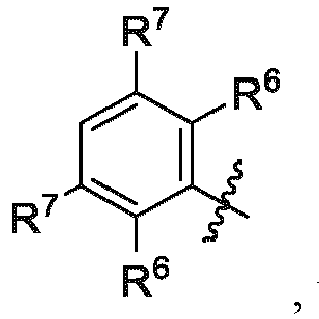
- wherein the C1-C6 alkyl, C1-C6 haloalkyl, C3-C7 cycloalkyl and 4- to 6-membered heterocycloalkyl is optionally substituted with one or more substituents each independently selected from hydroxy, halo, CN, oxo, C1-C6 alkyl, C1-C6 alkoxy, NR8R9, =NR10, COOC1-C6 alkyl, CONR8R9, 4- to 6-membered heterocycloalkyl, C6-C10 aryl, 5- to 10-membered heteroaryl, OCOC1-C6 alkyl, OCOC6-C10 aryl, OCO(5- to 10-membered heteroaryl), OCO(4- to 6-membered heterocycloalkyl), NHCOC1-C6 alkyl, NHCOC6-C10 aryl, NHCO(5- to 10-membered heteroaryl), NHCO(4- to 6-membered heterocycloalkyl), and NHCOC2-C6 alkynyl;
wherein each R7 is independently selected from C1-C6 alkyl, C1-C6 haloalkyl, C1-C6 alkoxy, C1-C6 haloalkoxy, halo, CN, COC1-C6 alkyl, CO2C1-C6 alkyl, CO2C3-C6 cycloalkyl, OCOC1-C6 alkyl, OCOC6-C10 aryl, OCO(5- to 10-membered heteroaryl), OCO(3- to 7-membered heterocycloalkyl), C6-C10 aryl, 5- to 10-membered heteroaryl, CONR8R9, SF5, S(O2)C1-C6 alkyl, C3-C7 cycloalkyl and 4- to 6-membered heterocycloalkyl, wherein the C1-C6 alkyl is optionally substituted with one to two C1-C6 alkoxy; - or at least one pair of R6 and R7 on adjacent atoms, taken together with the atoms connecting them, independently form at least one C4-C7 carbocyclic ring or at least one 5-to-7-membered heterocyclic ring containing 1 or 2 heteroatoms independently selected from O, N, and S, wherein the carbocyclic ring or heterocyclic ring is optionally independently substituted with one or more substituents independently selected from hydroxy, halo, oxo, C1-C6 alkyl, C1-C6 alkoxy, NR8R9, =NR10, COOC1-C6 alkyl, C6-C10 aryl, and CONR8R9.
- In some embodiments, the substituted ring B is

- wherein the C1-C6 alkyl, C1-C6 haloalkyl, C3-C7 cycloalkyl and 4- to 6-membered heterocycloalkyl is optionally substituted with one or more substituents each independently selected from hydroxy, halo, CN, oxo, C1-C6 alkyl, C1-C6 alkoxy, NR8R9, =NR10, COOC1-C6 alkyl, CONR8R9, 4- to 6-membered heterocycloalkyl, C6-C10 aryl, 5- to 10-membered heteroaryl, OCOC1-C6 alkyl, OCOC6-C10 aryl, OCO(5- to 10-membered heteroaryl), OCO(4- to 6-membered heterocycloalkyl), NHCOC1-C6 alkyl, NHCOC6-C10 aryl, NHCO(5- to 10-membered heteroaryl), NHCO(4- to 6-membered heterocycloalkyl), and NHCOC2-C6 alkynyl;
wherein each R' is independently selected from C1-C6 alkyl, C1-C6 haloalkyl, C1-C6 alkoxy, C1-C6 haloalkoxy, halo, CN, COC1-C6 alkyl, CO2C1-C6 alkyl, CO2C3-C6 cycloalkyl, OCOC1-C6 alkyl, OCOC6-C10 aryl, OCO(5- to 10-membered heteroaryl), OCO(3- to 7-membered heterocycloalkyl), C6-C10 aryl, 5- to 10-membered heteroaryl, CONR8R9, SF5, S(O2)C1-C6 alkyl, C3-C7 cycloalkyl and 4- to 6-membered heterocycloalkyl, wherein the C1-C6alkyl is optionally substituted with one to two C1-C6 alkoxy; - or at least one pair of R6 and R' on adjacent atoms, taken together with the atoms connecting them, independently form at least one C4-C7 carbocyclic ring or at least one 5-to-7-membered heterocyclic ring containing 1 or 2 heteroatoms independently selected from O, N, and S, wherein the carbocyclic ring or heterocyclic ring is optionally independently substituted with one or more substituents independently selected from hydroxy, halo, oxo, C1-C6 alkyl, C1-C6 alkoxy, NR8R9, =NR10, COOC1-C6 alkyl, C6-C10 aryl, and CONR8R9.
- In some embodiments, the substituted ring B is
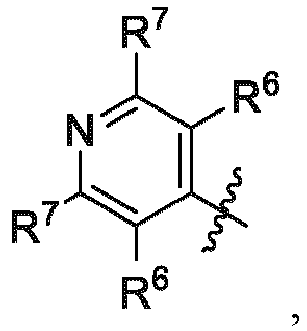
- wherein the C1-C6 alkyl, C1-C6 haloalkyl, C3-C7 cycloalkyl and 4- to 6-membered heterocycloalkyl is optionally substituted with one or more substituents each independently selected from hydroxy, halo, CN, oxo, C1-C6 alkyl, C1-C6 alkoxy, NR8R9, =NR10, COOC1-C6 alkyl, CONR8R9, 4- to 6-membered heterocycloalkyl, C6-C10 aryl, 5- to 10-membered heteroaryl, OCOC1-C6 alkyl, OCOC6-C10 aryl, OCO(5- to 10-membered heteroaryl), OCO(4- to 6-membered heterocycloalkyl), NHCOC1-C6 alkyl, NHCOC6-C10 aryl, NHCO(5- to 10-membered heteroaryl), NHCO(4- to 6-membered heterocycloalkyl), and NHCOC2-C6 alkynyl;
wherein each R7 is independently selected from C1-C6 alkyl, C1-C6 haloalkyl, C1-C6 alkoxy, C1-C6 haloalkoxy, halo, CN, COC1-C6 alkyl, CO2C1-C6 alkyl, CO2C3-C6 cycloalkyl, OCOC1-C6 alkyl, OCOC6-C10 aryl, OCO(5- to 10-membered heteroaryl), OCO(3- to 7-membered heterocycloalkyl), C6-C10 aryl, 5- to 10-membered heteroaryl, CONR8R9, SFs, S(O2)C1-C6 alkyl, C3-C7 cycloalkyl and 4- to 6-membered heterocycloalkyl, wherein the C1-C6 alkyl is optionally substituted with one to two C1-C6 alkoxy; - or at least one pair of R6 and R7 on adjacent atoms, taken together with the atoms connecting them, independently form at least one C4-C7 carbocyclic ring or at least one 5-to-7-membered heterocyclic ring containing 1 or 2 heteroatoms independently selected from O, N, and S, wherein the carbocyclic ring or heterocyclic ring is optionally independently substituted with one or more substituents independently selected from hydroxy, halo, oxo, C1-C6 alkyl, C1-C6 alkoxy, NR8R9, =NR10, COOC1-C6 alkyl, C6-C10 aryl, and CONR8R9.
- In some embodiments, the substituted ring B is

wherein the C1-C6 alkyl, C1-C6 haloalkyl, C3-C7 cycloalkyl and 4- to 6-membered heterocycloalkyl is optionally substituted with one or more substituents each independently selected from hydroxy, halo, CN, oxo, C1-C6 alkyl, C1-C6 alkoxy, NR8R9, =NR10, COOC1-C6 alkyl, CONR8R9, 4- to 6-membered heterocycloalkyl, C6-C10 aryl, 5- to 10-membered heteroaryl, OCOC1-C6 alkyl, OCOC6-C10 aryl, OCO(5- to 10-membered heteroaryl), OCO(4- to 6-membered heterocycloalkyl), NHCOC1-C6 alkyl, NHCOC6-C10 aryl, NHCO(5- to 10-membered heteroaryl), NHCO(4- to 6-membered heterocycloalkyl), and NHCOC2-C6 alkynyl; - wherein each R7 is independently selected from C1-C6 alkyl, C1-C6 haloalkyl, C1-C6 alkoxy, C1-C6 haloalkoxy, halo, CN, COC1-C6 alkyl, CO2C1-C6 alkyl, CO2C3-C6 cycloalkyl, OCOC1-C6 alkyl, OCOC6-C10 aryl, OCO(5- to 10-membered heteroaryl), OCO(3- to 7-membered heterocycloalkyl), C6-C10 aryl, 5- to 10-membered heteroaryl, CONR8R9, SFs, S(O2)C1-C6 alkyl, C3-C7 cycloalkyl and 4- to 6-membered heterocycloalkyl, wherein the C1-C6 alkyl is optionally substituted with one to two C1-C6 alkoxy;
- or R6 and R7, taken together with the atoms connecting them, independently form a C4-C7 carbocyclic ring or at least one 5-to-7-membered heterocyclic ring containing 1 or 2 heteroatoms independently selected from O, N, and S, wherein the carbocyclic ring or heterocyclic ring is optionally independently substituted with one or more substituents independently selected from hydroxy, halo, oxo, C1-C6 alkyl, C1-C6 alkoxy, NR8R9, =NR10, COOC1-C6 alkyl, C6-C10 aryl, and CONR8R9.
- In some embodiments, the substituted ring B is

wherein the C1-C6 alkyl, C1-C6 haloalkyl, C3-C7 cycloalkyl and 4- to 6-membered heterocycloalkyl is optionally substituted with one or more substituents each independently selected from hydroxy, halo, CN, oxo, C1-C6 alkyl, C1-C6 alkoxy, NR8R9, =NR10, COOC1-C6 alkyl, CONR8R9, 4- to 6-membered heterocycloalkyl, C6-C10 aryl, 5- to 10-membered heteroaryl, OCOC1-C6 alkyl, OCOC6-C10 aryl, OCO(5- to 10-membered heteroaryl), OCO(4- to 6-membered heterocycloalkyl), NHCOC1-C6 alkyl, NHCOC6-C10 aryl, NHCO(5- to 10-membered heteroaryl), NHCO(4- to 6-membered heterocycloalkyl), and NHCOC2-C6 alkynyl; - wherein each R7 is independently selected from C1-C6 alkyl, C1-C6 haloalkyl, C1-C6 alkoxy, C1-C6 haloalkoxy, halo, CN, COC1-C6 alkyl, CO2C1-C6 alkyl, CO2C3-C6 cycloalkyl, OCOC1-C6 alkyl, OCOC6-C10 aryl, OCO(5- to 10-membered heteroaryl), OCO(3- to 7-membered heterocycloalkyl), C6-C10 aryl, 5- to 10-membered heteroaryl, CONR8R9, SF5, S(O2)C1-C6 alkyl, C3-C7 cycloalkyl and 4- to 6-membered heterocycloalkyl, wherein the C1-C6 alkyl is optionally substituted with one to two C1-C6 alkoxy;
- or at least one pair of R6 and R7 on adjacent atoms, taken together with the atoms connecting them, independently form at least one C4-C7 carbocyclic ring or at least one 5-to-7-membered heterocyclic ring containing 1 or 2 heteroatoms independently selected from O, N, and S, wherein the carbocyclic ring or heterocyclic ring is optionally independently substituted with one or more substituents independently selected from hydroxy, hydroxymethyl, halo, oxo, C1-C6 alkyl, C1-C6 alkoxy, NR8R9, CH2NR8R9, =NR10, COOC1-C6 alkyl, C6-C10 aryl, and CONR8R9;
- In some embodiments, R3 is selected from hydrogen, C1-C6 alkyl, and

- In some embodiments, R3 is hydrogen.
- In some embodiments, R3 is cyano.
- In some embodiments, R3 is hydroxy.
- In some embodiments, R3 is C1-C6 alkoxy.In some embodiments, R3 is C1-C6 alkyl.
- In some embodiments, R3 is methyl.
- In some embodiments, R3 is

- In some embodiments, R3 is -CH2R14.
- In some embodiments, R3 is -C(O)R14.
- In some embodiments, R3 is -CH2CH2R14.
- In some embodiments, R3 is -CHR14CH3.
- In some embodiments, R3 is -CH2C(O)R14.
- In some embodiments, R3 is -C(O)CH2R14.
- In some embodiments, R3 is CO2C1-C6 alkyl.
- In some embodiments, R14 is hydrogen, C1-C6 alkyl, 5- to 10-membered monocyclic or bicyclic heteroaryl or C6-C10 monocyclic or bicyclic aryl, wherein each C1-C6 alkyl, aryl or heteroaryl is optionally independently substituted with 1 or 2 R6.
- In some embodiments, R14 is hydrogen or C1-C6 alkyl.
- In some embodiments, R14 is hydrogen, 5- to 10-membered monocyclic or bicyclic heteroaryl or C6-C10 monocyclic or bicyclic aryl, wherein each C1-C6 alkyl, aryl or heteroaryl is optionally independently substituted with 1 or 2 R6.
- In some embodiments, R14 is hydrogen.
- In some embodiments, R14 is C1-C6 alkyl.
- In some embodiments, R14 is methyl.
- In some embodiments, R14 is 5- to 10-membered monocyclic or bicyclic heteroaryl optionally independently substituted with 1 or 2 R6.
- In some embodiments, R14 is C6-C10 monocyclic or bicyclic aryl optionally independently substituted with 1 or 2 R6.
- In some embodiments, the sulfur in the moiety S(=O)(NHR3)=N- has (S) stereochemistry.
- In some embodiments, the sulfur in the moiety S(=O)(NHR3)=N- has (R) stereochemistry.
- In some embodiments, R10 is C1-C6 alkyl.
- In some embodiments, R10 is methyl.
- In some embodiments, R10 is ethyl.
- In some embodiments, each of R8 and R9 at each occurrence is independently selected from hydrogen, C1-C6 alkyl, (C=NR13)NR11R12, S(O2)C1-C6 alkyl, S(O2)NR11R12, COR13, CO2R13 and CONR11R12; wherein the C1-C6 alkyl is optionally substituted with one or more hydroxy, halo, C1-C6 alkoxy, C6-C10 aryl, 5- to 10-membered heteroaryl, C3-C7 cycloalkyl or 3- to 7-membered heterocycloalkyl; or R8 and R9 taken together with the nitrogen they are attached to form a 3- to 7-membered ring optionally containing one or more heteroatoms in addition to the nitrogen they are attached to.
- In some embodiments, each of R8 and R9 at each occurrence is independently selected from hydrogen, C1-C6 alkyl, (C=NR13)NR11R12, S(O2)C1-C6 alkyl, S(O2)NR11R12, COR13, CO2R13 and CONR11R12; wherein the C1-C6 alkyl is optionally substituted with one or more hydroxy, halo, C1-C6 alkoxy, C6-C10 aryl, 5- to 10-membered heteroaryl, C3-C7 cycloalkyl or 3- to 7-membered heterocycloalkyl; or R8 and R9 taken together with the nitrogen they are attached to form a 3- to 7-membered ring optionally containing one or more heteroatoms in addition to the nitrogen they are attached to.
- In some embodiments, each of R8 and R9 at each occurrence is hydrogen,
- In some embodiments, each R8 at each occurrence is hydrogen and each R9 at each occurrence is C1-C6 alkyl.
- In some embodiments, each R8 at each occurrence is hydrogen and each R9 at each occurrence is methyl.
- In some embodiments, each R8 at each occurrence is hydrogen and each R9 at each occurrence is ethyl.
- In some embodiments, each of R8 and R9 at each occurrence is methyl.
- In some embodiments, each of R8 and R9 at each occurrence is ethyl.
- In some embodiments, R8 and R9 taken together with the nitrogen they are attached to form a 3-membered ring.
- In some embodiments, R8 and R9 taken together with the nitrogen they are attached to form a 4-membered ring.
- In some embodiments, R8 and R9 taken together with the nitrogen they are attached to form a 5-membered ring.
- In some embodiments, R8 and R9 taken together with the nitrogen they are attached to form a 6-membered ring optionally containing one or more oxygen atoms in addition to the nitrogen they are attached to.
- In some embodiments, R8 and R9 taken together with the nitrogen they are attached to form a 6-membered ring optionally containing one or more nitrogen atoms in addition to the nitrogen they are attached to.
- In some embodiments, R8 and R9 taken together with the nitrogen they are attached to form a 7-membered ring.
- In some embodiments, R13 is C1-C6 alkyl.
- In some embodiments, R13 is methyl.
- In some embodiments, R13 is ethyl.
- In some embodiments, R13 is C6-C10 aryl.
- In some embodiments, R13 is phenyl.
- In some embodiments, R13 is 5- to 10-membered heteroaryl.
- In some embodiments, each of R11 and R12 at each occurrence is independently selected from hydrogen and C1-C6 alkyl.
- In some embodiments, each of R11 and R12 at each occurrence is hydrogen,
- In some embodiments, each R11 at each occurrence is hydrogen and each R12 at each occurrence is C1-C6 alkyl.
- In some embodiments, each R11 at each occurrence is hydrogen and each R12 at each occurrence is methyl.
- In some embodiments, each R11 at each occurrence is hydrogen and each R12 at each occurrence is ethyl.
- In some embodiments, each of R11 and R12 at each occurrence is methyl.
- In some embodiments, each of R11 and R12 at each occurrence is ethyl.
- In some embodiments of the compound of formula AA,
the substituted ring A is
C1-C6 alkyl optionally substituted with one or more hydroxy; C3-C7 cycloalkyl optionally substituted with one or more hydroxy; 3- to 7-membered heterocycloalkyl optionally substituted with one or more hydroxy; C1-C6 alkyl substituted with one or more oxo; C3-C7 cycloalkyl substituted with one or more oxo; C1-C6 alkyl substituted with one or more C1-C6 alkoxy; C3-C7 cycloalkyl substituted with one or more C1-C6 alkoxy; C1-C6 haloalkyl; C1-C6 alkoxy; C1-C6 haloalkoxy; halo; CN; NO2; COC1-C6 alkyl; CO-C6-C10 aryl; CO(5- to 10-membered heteroaryl); CO2C1-C6 alkyl; CO2C3-C8 cycloalkyl; OCOC1-C6 alkyl; OCOC6-C10 aryl; OCO(5- to 10-membered heteroaryl); OCO(3- to 7-membered heterocycloalkyl); C6-C10 aryl; 5- to 10-membered heteroaryl; NH2; NHC1-C6 alkyl; N(C1-C6 alkyl)2; CONR8R9; SF5; and S(O2)C1-C6 alkyl. - In some embodiments of the compound of formula AA,
the substituted ring A is
1-hydroxy-2-methylpropan-2-yl; methyl; isopropyl; 2-hydroxy-2-propyl; hydroxymethyl; 1-hydroxyethyl; 2-hydroxyethyl; 1-hydroxy-2-propyl; 1-hydroxy-1-cyclopropyl; 1-hydroxy-1-cyclobutyl; 1-hydroxy-1-cyclopentyl; 1-hydroxy-1-cyclohexyl; morpholinyl; 1,3-dioxolan-2-yl; COCH3; COCH2CH3; 2-methoxy-2-propyl; (dimethylamino)methyl; 1-(dimethylamino)ethyl; fluoro; chloro; phenyl; pyridyl; pyrazolyl; and S(O2)CH3. - In some embodiments of the compound of formula AA,
the substituted ring A is
C1-C6 alkyl optionally substituted with one or more hydroxy; C3-C7 cycloalkyl optionally substituted with one or more hydroxy; 3- to 7-membered heterocycloalkyl optionally substituted with one or more hydroxy; C1-C6 alkyl substituted with one or more oxo; C3-C7 cycloalkyl substituted with one or more oxo; C1-C6 alkyl substituted with one or more C1-C6 alkoxy; C3-C7 cycloalkyl substituted with one or more C1-C6 alkoxy; C1-C6 alkyl substituted with one or more NR8R9; 3- to 7-membered heterocycloalkyl substituted with one or more NR8R9; C1-C6 haloalkyl; C1-C6 alkoxy; C1-C6 haloalkoxy; halo; CN; NO2; COC1-C6 alkyl; CO-C6-C10 aryl; CO(5- to 10-membered heteroaryl); CO2C1-C6 alkyl; CO2C3-C8 cycloalkyl; OCOC1-C6 alkyl; OCOC6-C10 aryl; OCO(5- to 10-membered heteroaryl); OCO(3- to 7-membered heterocycloalkyl); C6-C10 aryl; 5- to 10-membered heteroaryl; NH2; NHC1-C6 alkyl; N(C1-C6 alkyl)2; CONR8R9; SFs; and S(O2)C1-C6 alkyl. - In some embodiments of the compound of formula AA,
the substituted ring A is
1-hydroxy-2-methylpropan-2-yl; methyl; isopropyl; 2-hydroxy-2-propyl; hydroxymethyl; 1-hydroxyethyl; 2-hydroxyethyl; 1-hydroxy-2-propyl; 1-hydroxy-1-cyclopropyl; 1-hydroxy-1-cyclobutyl; 1-hydroxy-1-cyclopentyl; 1-hydroxy-1-cyclohexyl; morpholinyl; 1,3-dioxolan-2-yl; COCH3; COCH2CH3; 2-methoxy-2-propyl; (dimethylamino)methyl; 1-(dimethylamino)ethyl; fluoro; chloro; phenyl; pyridyl; pyrazolyl; and S(O2)CH3. - In some embodiments of the compound of formula AA,
the substituted ring A is
C1-C6 alkyl optionally substituted with one or more hydroxy; C3-C7 cycloalkyl optionally substituted with one or more hydroxy; 3- to 7-membered heterocycloalkyl optionally substituted with one or more hydroxy; C1-C6 alkyl substituted with one or more oxo; C3-C7 cycloalkyl substituted with one or more oxo; C1-C6 alkyl substituted with one or more C1-C6 alkoxy; C3-C7 cycloalkyl substituted with one or more C1-C6 alkoxy; C1-C6 alkyl substituted with one or more NR8R9; 3- to 7-membered heterocycloalkyl substituted with one or more NR8R9; C1-C6 haloalkyl; C1-C6 alkoxy; C1-C6 haloalkoxy; halo; CN; NO2; COC1-C6 alkyl; CO-C6-C10 aryl; CO(5- to 10-membered heteroaryl); CO2C1-C6 alkyl; CO2C3-C8 cycloalkyl; OCOC1-C6 alkyl; OCOC6-C10 aryl; OCO(5- to 10-membered heteroaryl); OCO(3- to 7-membered heterocycloalkyl); C6-C10 aryl; 5- to 10-membered heteroaryl; NH2; NHC1-C6 alkyl; N(C1-C6 alkyl)2; CONR8R9; SF5; and S(O2)C1-C6 alkyl. - In some embodiments of the compound of formula AA,
the substituted ring A is
1-hydroxy-2-methylpropan-2-yl; methyl; isopropyl; 2-hydroxy-2-propyl; hydroxymethyl; 1-hydroxyethyl; 2-hydroxyethyl; 1-hydroxy-2-propyl; 1-hydroxy-1-cyclopropyl; 1-hydroxy-1-cyclobutyl; 1-hydroxy-1-cyclopentyl; 1-hydroxy-1-cyclohexyl; morpholinyl; 1,3-dioxolan-2-yl; COCH3; COCH2CH3; 2-methoxy-2-propyl; (dimethylamino)methyl; 1-(dimethylamino)ethyl; fluoro; chloro; phenyl; pyridyl; pyrazolyl; and S(O2)CH3. - In some embodiments of the compound of formula AA,
the substituted ring A is
C1-C6 alkyl optionally substituted with one or more hydroxy; C3-C7 cycloalkyl optionally substituted with one or more hydroxy; 3- to 7-membered heterocycloalkyl optionally substituted with one or more hydroxy; C1-C6 alkyl substituted with one or more oxo; C3-C7 cycloalkyl substituted with one or more oxo; C1-C6 alkyl substituted with one or more C1-C6 alkoxy; C3-C7 cycloalkyl substituted with one or more C1-C6 alkoxy; C1-C6 alkyl substituted with one or more NR8R9; 3- to 7-membered heterocycloalkyl substituted with one or more NR8R9; C1-C6 haloalkyl; C1-C6 alkoxy; C1-C6 haloalkoxy; halo; CN; NO2; COC1-C6 alkyl; CO-C6-C10 aryl; CO(5- to 10-membered heteroaryl); CO2C1-C6 alkyl; CO2C3-C8 cycloalkyl; OCOC1-C6 alkyl; OCOC6-C10 aryl; OCO(5- to 10-membered heteroaryl); OCO(3- to 7-membered heterocycloalkyl); C6-C10 aryl; 5- to 10-membered heteroaryl; NH2; NHC1-C6 alkyl; N(C1-C6 alkyl)2; CONR8R9; SF5; and S(O2)C1-C6 alkyl. - In some embodiments of the compound of formula AA,
the substituted ring A is
1-hydroxy-2-methylpropan-2-yl; methyl; isopropyl; 2-hydroxy-2-propyl; hydroxymethyl; 1-hydroxyethyl; 2-hydroxyethyl; 1-hydroxy-2-propyl; 1-hydroxy-1-cyclopropyl; 1-hydroxy-1-cyclobutyl; 1-hydroxy-1-cyclopentyl; 1-hydroxy-1-cyclohexyl; morpholinyl; 1,3-dioxolan-2-yl; COCH3; COCH2CH3; 2-methoxy-2-propyl; (dimethylamino)methyl; 1-(dimethylamino)ethyl; fluoro; chloro; phenyl; pyridyl; pyrazolyl; and S(O2)CH3. - In some embodiments of the compound of formula AA,
the substituted ring A is
C1-C6 alkyl optionally substituted with one or more hydroxy; C3-C7 cycloalkyl optionally substituted with one or more hydroxy; 3- to 7-membered heterocycloalkyl optionally substituted with one or more hydroxy; C1-C6 alkyl substituted with one or more oxo; C3-C7 cycloalkyl substituted with one or more oxo; C1-C6 alkyl substituted with one or more C1-C6 alkoxy; C3-C7 cycloalkyl substituted with one or more C1-C6 alkoxy; C1-C6 alkyl substituted with one or more NR8R9; 3- to 7-membered heterocycloalkyl substituted with one or more NR8R9; C1-C6 haloalkyl; C1-C6 alkoxy; C1-C6 haloalkoxy; halo; CN; NO2; COC1-C6 alkyl; CO-C6-C10 aryl; CO(5- to 10-membered heteroaryl); CO2C1-C6 alkyl; CO2C3-C8 cycloalkyl; OCOC1-C6 alkyl; OCOC6-C10 aryl; OCO(5- to 10-membered heteroaryl); OCO(3- to 7-membered heterocycloalkyl); C6-C10 aryl; 5- to 10-membered heteroaryl; NH2; NHC1-C6 alkyl; N(C1-C6 alkyl)2; CONR8R9; SF5; and S(O2)C1-C6 alkyl. - In some embodiments of the compound of formula AA,
the substituted ring A is
1-hydroxy-2-methylpropan-2-yl; methyl; isopropyl; 2-hydroxy-2-propyl; hydroxymethyl; 1-hydroxyethyl; 2-hydroxyethyl; 1-hydroxy-2-propyl; 1-hydroxy-1-cyclopropyl; 1-hydroxy-1-cyclobutyl; 1-hydroxy-1-cyclopentyl; 1-hydroxy-1-cyclohexyl; morpholinyl; 1,3-dioxolan-2-yl; COCH3; COCH2CH3; 2-methoxy-2-propyl; (dimethylamino)methyl; 1-(dimethylamino)ethyl; fluoro; chloro; phenyl; pyridyl; pyrazolyl; and S(O2)CH3. - In some embodiments of the compound of formula AA,
the substituted ring A is
C1-C6 alkyl optionally substituted with one or more hydroxy; C3-C7 cycloalkyl optionally substituted with one or more hydroxy; 3- to 7-membered heterocycloalkyl optionally substituted with one or more hydroxy; C1-C6 alkyl substituted with one or more oxo; C3-C7 cycloalkyl substituted with one or more oxo; C1-C6 alkyl substituted with one or more C1-C6 alkoxy; C3-C7 cycloalkyl substituted with one or more C1-C6 alkoxy; C1-C6 alkyl substituted with one or more NR8R9; 3- to 7-membered heterocycloalkyl substituted with one or more NR8R9; C1-C6 haloalkyl; C1-C6 alkoxy; C1-C6 haloalkoxy; halo; CN; NO2; COC1-C6 alkyl; CO-C6-C10 aryl; CO(5- to 10-membered heteroaryl); CO2C1-C6 alkyl; CO2C3-C8 cycloalkyl; OCOC1-C6 alkyl; OCOC6-C10 aryl; OCO(5- to 10-membered heteroaryl); OCO(3- to 7-membered heterocycloalkyl); C6-C10 aryl; 5- to 10-membered heteroaryl; NH2; NHC1-C6 alkyl; N(C1-C6 alkyl)2; CONR8R9; SF5; and S(O2)C1-C6 alkyl. - In some embodiments of the compound of formula AA,
the substituted ring A is
1-hydroxy-2-methylpropan-2-yl; methyl; isopropyl; 2-hydroxy-2-propyl; hydroxymethyl; 1-hydroxyethyl; 2-hydroxyethyl; 1-hydroxy-2-propyl; 1-hydroxy-1-cyclopropyl; 1-hydroxy-1-cyclobutyl; 1-hydroxy-1-cyclopentyl; 1-hydroxy-1-cyclohexyl; morpholinyl; 1,3-dioxolan-2-yl; COCH3; COCH2CH3; 2-methoxy-2-propyl; (dimethylamino)methyl; 1-(dimethylamino)ethyl; fluoro; chloro; phenyl; pyridyl; pyrazolyl; and S(O2)CH3. - In some embodiments of the compound of formula AA,
the substituted ring A is
C1-C6 alkyl optionally substituted with one or more hydroxy; C3-C7 cycloalkyl optionally substituted with one or more hydroxy; 3- to 7-membered heterocycloalkyl optionally substituted with one or more hydroxy; C1-C6 alkyl substituted with one or more oxo; C3-C7 cycloalkyl substituted with one or more oxo; C1-C6 alkyl substituted with one or more C1-C6 alkoxy; C3-C7 cycloalkyl substituted with one or more C1-C6 alkoxy; C1-C6 alkyl substituted with one or more NR8R9; 3- to 7-membered heterocycloalkyl substituted with one or more NR8R9; C1-C6 haloalkyl; C1-C6 alkoxy; C1-C6 haloalkoxy; halo; CN; NO2; COC1-C6 alkyl; CO-C6-C10 aryl; CO(5- to 10-membered heteroaryl); CO2C1-C6 alkyl; CO2C3-C8 cycloalkyl; OCOC1-C6 alkyl; OCOC6-C10 aryl; OCO(5- to 10-membered heteroaryl); OCO(3- to 7-membered heterocycloalkyl); C6-C10 aryl; 5- to 10-membered heteroaryl; NH2; NHC1-C6 alkyl; N(C1-C6 alkyl)2; CONR8R9; SF5; and S(O2)C1-C6 alkyl. - In some embodiments of the compound of formula AA,
the substituted ring A is
1-hydroxy-2-methylpropan-2-yl; methyl; isopropyl; 2-hydroxy-2-propyl; hydroxymethyl; 1-hydroxyethyl; 2-hydroxyethyl; 1-hydroxy-2-propyl; 1-hydroxy-1-cyclopropyl; 1-hydroxy-1-cyclobutyl; 1-hydroxy-1-cyclopentyl; 1-hydroxy-1-cyclohexyl; morpholinyl; 1,3-dioxolan-2-yl; COCH3; COCH2CH3; 2-methoxy-2-propyl; (dimethylamino)methyl; 1-(dimethylamino)ethyl; fluoro; chloro; phenyl; pyridyl; pyrazolyl; and S(O2)CH3. - In some embodiments of the compound of formula AA,
the substituted ring A is
C1-C6 alkyl optionally substituted with one or more hydroxy; C3-C7 cycloalkyl optionally substituted with one or more hydroxy; 3- to 7-membered heterocycloalkyl optionally substituted with one or more hydroxy; C1-C6 alkyl substituted with one or more oxo; C3-C7 cycloalkyl substituted with one or more oxo; C1-C6 alkyl substituted with one or more C1-C6 alkoxy; C3-C7 cycloalkyl substituted with one or more C1-C6 alkoxy; C1-C6 alkyl substituted with one or more NR8R9; 3- to 7-membered heterocycloalkyl substituted with one or more NR8R9; C1-C6 haloalkyl; C1-C6 alkoxy; C1-C6 haloalkoxy; halo; CN; NO2; COC1-C6 alkyl; CO-C6-C10 aryl; CO(5- to 10-membered heteroaryl); CO2C1-C6 alkyl; CO2C3-C8 cycloalkyl; OCOC1-C6 alkyl; OCOC6-C10 aryl; OCO(5- to 10-membered heteroaryl); OCO(3- to 7-membered heterocycloalkyl); C6-C10 aryl; 5- to 10-membered heteroaryl; NH2; NHC1-C6 alkyl; N(C1-C6 alkyl)2; CONR8R9; SF5; and S(O2)C1-C6 alkyl. - In some embodiments of the compound of formula AA,
the substituted ring A is
1-hydroxy-2-methylpropan-2-yl; methyl; isopropyl; 2-hydroxy-2-propyl; hydroxymethyl; 1-hydroxyethyl; 2-hydroxyethyl; 1-hydroxy-2-propyl; 1-hydroxy-1-cyclopropyl; 1-hydroxy-1-cyclobutyl; 1-hydroxy-1-cyclopentyl; 1-hydroxy-1-cyclohexyl; morpholinyl; 1,3-dioxolan-2-yl; COCH3; COCH2CH3; 2-methoxy-2-propyl; (dimethylamino)methyl; 1-(dimethylamino)ethyl; fluoro; chloro; phenyl; pyridyl; pyrazolyl; and S(O2)CH3. - In some embodiments of the compound of formula AA,
the substituted ring A is
C1-C6 alkyl optionally substituted with one or more hydroxy; C3-C7 cycloalkyl optionally substituted with one or more hydroxy; 3- to 7-membered heterocycloalkyl optionally substituted with one or more hydroxy; C1-C6 alkyl substituted with one or more oxo; C3-C7 cycloalkyl substituted with one or more oxo; C1-C6 alkyl substituted with one or more C1-C6 alkoxy; C3-C7 cycloalkyl substituted with one or more C1-C6 alkoxy; C1-C6 alkyl substituted with one or more NR8R9; 3- to 7-membered heterocycloalkyl substituted with one or more NR8R9; C1-C6 haloalkyl; C1-C6 alkoxy; C1-C6 haloalkoxy; halo; CN; NO2; COC1-C6 alkyl; CO-C6-C10 aryl; CO(5- to 10-membered heteroaryl); CO2C1-C6 alkyl; CO2C3-C8 cycloalkyl; OCOC1-C6 alkyl; OCOC6-C10 aryl; OCO(5- to 10-membered heteroaryl); OCO(3- to 7-membered heterocycloalkyl); C6-C10 aryl; 5- to 10-membered heteroaryl; NH2; NHC1-C6 alkyl; N(C1-C6 alkyl)2; CONR8R9; SF5; and S(O2)C1-C6 alkyl. - In some embodiments of the compound of formula AA,
the substituted ring A is
1-hydroxy-2-methylpropan-2-yl; methyl; isopropyl; 2-hydroxy-2-propyl; hydroxymethyl; 1-hydroxyethyl; 2-hydroxyethyl; 1-hydroxy-2-propyl; 1-hydroxy-1-cyclopropyl; 1-hydroxy-1-cyclobutyl; 1-hydroxy-1-cyclopentyl; 1-hydroxy-1-cyclohexyl; morpholinyl; 1,3-dioxolan-2-yl; COCH3; COCH2CH3; 2-methoxy-2-propyl; (dimethylamino)methyl; 1-(dimethylamino)ethyl; fluoro; chloro; phenyl; pyridyl; pyrazolyl; and S(O2)CH3. - In some embodiments of the compound of formula AA,
the substituted ring A is
C1-C6 alkyl optionally substituted with one or more hydroxy; C3-C7 cycloalkyl optionally substituted with one or more hydroxy; 3- to 7-membered heterocycloalkyl optionally substituted with one or more hydroxy; C1-C6 alkyl substituted with one or more oxo; C3-C7 cycloalkyl substituted with one or more oxo; C1-C6 alkyl substituted with one or more C1-C6 alkoxy; C3-C7 cycloalkyl substituted with one or more C1-C6 alkoxy; C1-C6 alkyl substituted with one or more NR8R9; 3- to 7-membered heterocycloalkyl substituted with one or more NR8R9; C1-C6 haloalkyl; C1-C6 alkoxy; C1-C6 haloalkoxy; halo; CN; NO2; COC1-C6 alkyl; CO-C6-C10 aryl; CO(5- to 10-membered heteroaryl); CO2C1-C6 alkyl; CO2C3-C8 cycloalkyl; OCOC1-C6 alkyl; OCOC6-C10 aryl; OCO(5- to 10-membered heteroaryl); OCO(3- to 7-membered heterocycloalkyl); C6-C10 aryl; 5- to 10-membered heteroaryl; NH2; NHC1-C6 alkyl; N(C1-C6 alkyl)2; CONR8R9; SF5; and S(O2)C1-C6 alkyl. - In some embodiments of the compound of formula AA,
the substituted ring A is
1-hydroxy-2-methylpropan-2-yl; methyl; isopropyl; 2-hydroxy-2-propyl; hydroxymethyl; 1-hydroxyethyl; 2-hydroxyethyl; 1-hydroxy-2-propyl; 1-hydroxy-1-cyclopropyl; 1-hydroxy-1-cyclobutyl; 1-hydroxy-1-cyclopentyl; 1-hydroxy-1-cyclohexyl; morpholinyl; 1,3-dioxolan-2-yl; COCH3; COCH2CH3; 2-methoxy-2-propyl; (dimethylamino)methyl; 1-(dimethylamino)ethyl; fluoro; chloro; phenyl; pyridyl; pyrazolyl; and S(O2)CH3. - In some embodiments of the compound of formula AA,
the substituted ring A is
C1-C6 alkyl optionally substituted with one or more hydroxy; C3-C7 cycloalkyl optionally substituted with one or more hydroxy; 3- to 7-membered heterocycloalkyl optionally substituted with one or more hydroxy; C1-C6 alkyl substituted with one or more oxo; C3-C7 cycloalkyl substituted with one or more oxo; C1-C6 alkyl substituted with one or more C1-C6 alkoxy; C3-C7 cycloalkyl substituted with one or more C1-C6 alkoxy; C1-C6 alkyl substituted with one or more NR8R9; 3- to 7-membered heterocycloalkyl substituted with one or more NR8R9; C1-C6 haloalkyl; C1-C6 alkoxy; C1-C6 haloalkoxy; halo; CN; NO2; COC1-C6 alkyl; CO-C6-C10 aryl; CO(5- to 10-membered heteroaryl); CO2C1-C6 alkyl; CO2C3-C8 cycloalkyl; OCOC1-C6 alkyl; OCOC6-C10 aryl; OCO(5- to 10-membered heteroaryl); OCO(3- to 7-membered heterocycloalkyl); C6-C10 aryl; 5- to 10-membered heteroaryl; NH2; NHC1-C6 alkyl; N(C1-C6 alkyl)2; CONR8R9; SF5; and S(O2)C1-C6 alkyl. - In some embodiments of the compound of formula AA,
the substituted ring A is
1-hydroxy-2-methylpropan-2-yl; methyl; isopropyl; 2-hydroxy-2-propyl; hydroxymethyl; 1-hydroxyethyl; 2-hydroxyethyl; 1-hydroxy-2-propyl; 1-hydroxy-1-cyclopropyl; 1-hydroxy-1-cyclobutyl; 1-hydroxy-1-cyclopentyl; 1-hydroxy-1-cyclohexyl; morpholinyl; 1,3-dioxolan-2-yl; COCH3; COCH2CH3; 2-methoxy-2-propyl; (dimethylamino)methyl; 1-(dimethylamino)ethyl; fluoro; chloro; phenyl; pyridyl; pyrazolyl; and S(O2)CH3. - In some embodiments of the compound of formula AA,
the substituted ring A is
C1-C6 alkyl optionally substituted with one or more hydroxy; C3-C7 cycloalkyl optionally substituted with one or more hydroxy; 3- to 7-membered heterocycloalkyl optionally substituted with one or more hydroxy; C1-C6 alkyl substituted with one or more oxo; C3-C7 cycloalkyl substituted with one or more oxo; C1-C6 alkyl substituted with one or more C1-C6 alkoxy; C3-C7 cycloalkyl substituted with one or more C1-C6 alkoxy; C1-C6 alkyl substituted with one or more NR8R9; 3- to 7-membered heterocycloalkyl substituted with one or more NR8R9; C1-C6 haloalkyl; C1-C6 alkoxy; C1-C6 haloalkoxy; halo; CN; NO2; COC1-C6 alkyl; CO-C6-C10 aryl; CO(5- to 10-membered heteroaryl); CO2C1-C6 alkyl; CO2C3-C8 cycloalkyl; OCOC1-C6 alkyl; OCOC6-C10 aryl; OCO(5- to 10-membered heteroaryl); OCO(3- to 7-membered heterocycloalkyl); C6-C10 aryl; 5- to 10-membered heteroaryl; NH2; NHC1-C6 alkyl; N(C1-C6 alkyl)2; CONR8R9; SF5; and S(O2)C1-C6 alkyl. - In some embodiments of the compound of formula AA,
the substituted ring A is
1-hydroxy-2-methylpropan-2-yl; methyl; isopropyl; 2-hydroxy-2-propyl; hydroxymethyl; 1-hydroxyethyl; 2-hydroxyethyl; 1-hydroxy-2-propyl; 1-hydroxy-1-cyclopropyl; 1-hydroxy-1-cyclobutyl; 1-hydroxy-1-cyclopentyl; 1-hydroxy-1-cyclohexyl; morpholinyl; 1,3-dioxolan-2-yl; COCH3; COCH2CH3; 2-methoxy-2-propyl; (dimethylamino)methyl; 1-(dimethylamino)ethyl; fluoro; chloro; phenyl; pyridyl; pyrazolyl; and S(O2)CH3. - In some embodiments of the compound of formula AA,
the substituted ring A is
C1-C6 alkyl optionally substituted with one or more hydroxy; C3-C7 cycloalkyl optionally substituted with one or more hydroxy; 3- to 7-membered heterocycloalkyl optionally substituted with one or more hydroxy; C1-C6 alkyl substituted with one or more oxo; C3-C7 cycloalkyl substituted with one or more oxo; C1-C6 alkyl substituted with one or more C1-C6 alkoxy; C3-C7 cycloalkyl substituted with one or more C1-C6 alkoxy; C1-C6 alkyl substituted with one or more NR8R9; 3- to 7-membered heterocycloalkyl substituted with one or more NR8R9; C1-C6 haloalkyl; C1-C6 alkoxy; C1-C6 haloalkoxy; halo; CN; NO2; COC1-C6 alkyl; CO-C6-C10 aryl; CO(5- to 10-membered heteroaryl); CO2C1-C6 alkyl; CO2C3-C8 cycloalkyl; OCOC1-C6 alkyl; OCOC6-C10 aryl; OCO(5- to 10-membered heteroaryl); OCO(3- to 7-membered heterocycloalkyl); C6-C10 aryl; 5- to 10-membered heteroaryl; NH2; NHC1-C6 alkyl; N(C1-C6 alkyl)2; CONR8R9; SF5; and S(O2)C1-C6 alkyl. - In some embodiments of the compound of formula AA,
the substituted ring A is
1-hydroxy-2-methylpropan-2-yl; methyl; isopropyl; 2-hydroxy-2-propyl; hydroxymethyl; 1-hydroxyethyl; 2-hydroxyethyl; 1-hydroxy-2-propyl; 1-hydroxy-1-cyclopropyl; 1-hydroxy-1-cyclobutyl; 1-hydroxy-1-cyclopentyl; 1-hydroxy-1-cyclohexyl; morpholinyl; 1,3-dioxolan-2-yl; COCH3; COCH2CH3; 2-methoxy-2-propyl; (dimethylamino)methyl; 1-(dimethylamino)ethyl; fluoro; chloro; phenyl; pyridyl; pyrazolyl; and S(O2)CH3. - In some embodiments of the compound of formula AA,
the substituted ring A is
C1-C6 alkyl optionally substituted with one or more hydroxy; C3-C7 cycloalkyl optionally substituted with one or more hydroxy; 3- to 7-membered heterocycloalkyl optionally substituted with one or more hydroxy; C1-C6 alkyl substituted with one or more oxo; C3-C7 cycloalkyl substituted with one or more oxo; C1-C6 alkyl substituted with one or more C1-C6 alkoxy; C3-C7 cycloalkyl substituted with one or more C1-C6 alkoxy; C1-C6 alkyl substituted with one or more NR8R9; 3- to 7-membered heterocycloalkyl substituted with one or more NR8R9; C1-C6 haloalkyl; C1-C6 alkoxy; C1-C6 haloalkoxy; halo; CN; NO2; COC1-C6 alkyl; CO-C6-C10 aryl; CO(5- to 10-membered heteroaryl); CO2C1-C6 alkyl; CO2C3-C8 cycloalkyl; OCOC1-C6 alkyl; OCOC6-C10 aryl; OCO(5- to 10-membered heteroaryl); OCO(3- to 7-membered heterocycloalkyl); C6-C10 aryl; 5- to 10-membered heteroaryl; NH2; NHC1-C6 alkyl; N(C1-C6 alkyl)2; CONR8R9; SF5; and S(O2)C1-C6 alkyl. - In some embodiments of the compound of formula AA,
the substituted ring A is
1-hydroxy-2-methylpropan-2-yl; methyl; isopropyl; 2-hydroxy-2-propyl; hydroxymethyl; 1-hydroxyethyl; 2-hydroxyethyl; 1-hydroxy-2-propyl; 1-hydroxy-1-cyclopropyl; 1-hydroxy-1-cyclobutyl; 1-hydroxy-1-cyclopentyl; 1-hydroxy-1-cyclohexyl; morpholinyl; 1,3-dioxolan-2-yl; COCH3; COCH2CH3; 2-methoxy-2-propyl; (dimethylamino)methyl; 1-(dimethylamino)ethyl; fluoro; chloro; phenyl; pyridyl; pyrazolyl; and S(O2)CH3. - In some embodiments of the compound of formula AA,
the substituted ring A is
C1-C6 alkyl optionally substituted with one or more hydroxy; C3-C7 cycloalkyl optionally substituted with one or more hydroxy; 3- to 7-membered heterocycloalkyl optionally substituted with one or more hydroxy; C1-C6 alkyl substituted with one or more oxo; C3-C7 cycloalkyl substituted with one or more oxo; C1-C6 alkyl substituted with one or more C1-C6 alkoxy; C3-C7 cycloalkyl substituted with one or more C1-C6 alkoxy; C1-C6 alkyl substituted with one or more NR8R9; 3- to 7-membered heterocycloalkyl substituted with one or more NR8R9; C1-C6 haloalkyl; C1-C6 alkoxy; C1-C6 haloalkoxy; halo; CN; NO2; COC1-C6 alkyl; CO-C6-C10 aryl; CO(5- to 10-membered heteroaryl); CO2C1-C6 alkyl; CO2C3-C8 cycloalkyl; OCOC1-C6 alkyl; OCOC6-C10 aryl; OCO(5- to 10-membered heteroaryl); OCO(3- to 7-membered heterocycloalkyl); C6-C10 aryl; 5- to 10-membered heteroaryl; NH2; NHC1-C6 alkyl; N(C1-C6 alkyl)2; CONR8R9; SF5; and S(O2)C1-C6 alkyl. - In some embodiments of the compound of formula AA,
- the substituted ring A is

1-hydroxy-2-methylpropan-2-yl; methyl; isopropyl; 2-hydroxy-2-propyl; hydroxymethyl; 1-hydroxyethyl; 2-hydroxyethyl; 1-hydroxy-2-propyl; 1-hydroxy-1-cyclopropyl; 1-hydroxy-1-cyclobutyl; 1-hydroxy-1-cyclopentyl; 1-hydroxy-1-cyclohexyl; morpholinyl; 1,3-dioxolan-2-yl; COCH3; COCH2CH3; 2-methoxy-2-propyl; (dimethylamino)methyl; 1-(dimethylamino)ethyl; fluoro; chloro; phenyl; pyridyl; pyrazolyl; and S(O2)CH3. - the substituted ring A is

C1-C6 alkyl optionally substituted with one or more hydroxy; C3-C7 cycloalkyl optionally substituted with one or more hydroxy; 3- to 7-membered heterocycloalkyl optionally substituted with one or more hydroxy; C1-C6 alkyl substituted with one or more oxo; C3-C7 cycloalkyl substituted with one or more oxo; C1-C6 alkyl substituted with one or more C1-C6 alkoxy; C3-C7 cycloalkyl substituted with one or more C1-C6 alkoxy; C1-C6 alkyl substituted with one or more NR8R9; 3- to 7-membered heterocycloalkyl substituted with one or more NR8R9; C1-C6 haloalkyl; C1-C6 alkoxy; C1-C6 haloalkoxy; halo; CN; NO2; COC1-C6 alkyl; CO-C6-C10 aryl; CO(5- to 10-membered heteroaryl); CO2C1-C6 alkyl; CO2C3-C8 cycloalkyl; OCOC1-C6 alkyl; OCOC6-C10 aryl; OCO(5- to 10-membered heteroaryl); OCO(3- to 7-membered heterocycloalkyl); C6-C10 aryl; 5- to 10-membered heteroaryl; NH2; NHC1-C6 alkyl; N(C1-C6 alkyl)2; CONR8R9; SF5; and S(O2)C1-C6 alkyl. - In some embodiments of the compound of formula AA,
the substituted ring A is
1-hydroxy-2-methylpropan-2-yl; methyl; isopropyl; 2-hydroxy-2-propyl; hydroxymethyl; 1-hydroxyethyl; 2-hydroxyethyl; 1-hydroxy-2-propyl; 1-hydroxy-1-cyclopropyl; 1-hydroxy-1-cyclobutyl; 1-hydroxy-1-cyclopentyl; 1-hydroxy-1-cyclohexyl; morpholinyl; 1,3-dioxolan-2-yl; COCH3; COCH2CH3; 2-methoxy-2-propyl; (dimethylamino)methyl; 1-(dimethylamino)ethyl; fluoro; chloro; phenyl; pyridyl; pyrazolyl; and S(O2)CH3. - In some embodiments of the compound of formula AA,
the substituted ring A is
C1-C6 alkyl optionally substituted with one or more hydroxy; C3-C7 cycloalkyl optionally substituted with one or more hydroxy; 3- to 7-membered heterocycloalkyl optionally substituted with one or more hydroxy; C1-C6 alkyl substituted with one or more oxo; C3-C7 cycloalkyl substituted with one or more oxo; C1-C6 alkyl substituted with one or more C1-C6 alkoxy; C3-C7 cycloalkyl substituted with one or more C1-C6 alkoxy; C1-C6 alkyl substituted with one or more NR8R9; 3- to 7-membered heterocycloalkyl substituted with one or more NR8R9; C1-C6 haloalkyl; C1-C6 alkoxy; C1-C6 haloalkoxy; halo; CN; NO2; COC1-C6 alkyl; CO-C6-C10 aryl; CO-5- to 10-membered heteroaryl; CO2C1-C6 alkyl; CO2C3-C8 cycloalkyl; OCOC1-C6 alkyl; OCOC6-C10 aryl; OCO(5- to 10-membered heteroaryl); OCO(3- to 7-membered heterocycloalkyl); C6-C10 aryl; 5- to 10-membered heteroaryl; NH2; NHC1-C6 alkyl; N(C1-C6 alkyl)2; CONR8R9; SF5; and S(O2)C1-C6 alkyl. - In some embodiments of the compound of formula AA,
the substituted ring A is
1-hydroxy-2-methylpropan-2-yl; methyl; isopropyl; 2-hydroxy-2-propyl; hydroxymethyl; 1-hydroxyethyl; 2-hydroxyethyl; 1-hydroxy-2-propyl; 1-hydroxy-1-cyclopropyl; 1-hydroxy-1-cyclobutyl; 1-hydroxy-1-cyclopentyl; 1-hydroxy-1-cyclohexyl; morpholinyl; 1,3-dioxolan-2-yl; COCH3; COCH2CH3; 2-methoxy-2-propyl; (dimethylamino)methyl; 1-(dimethylamino)ethyl; fluoro; chloro; phenyl; pyridyl; pyrazolyl; and S(O2)CH3. - In some embodiments of the compound of formula AA,
the substituted ring A is
C1-C6 alkyl optionally substituted with one or more hydroxy; C3-C7 cycloalkyl optionally substituted with one or more hydroxy; 3- to 7-membered heterocycloalkyl optionally substituted with one or more hydroxy; C1-C6 alkyl substituted with one or more oxo; C3-C7 cycloalkyl substituted with one or more oxo; C1-C6 alkyl substituted with one or more C1-C6 alkoxy; C3-C7 cycloalkyl substituted with one or more C1-C6 alkoxy; C1-C6 alkyl substituted with one or more NR8R9; 3- to 7-membered heterocycloalkyl substituted with one or more NR8R9; C1-C6 haloalkyl; C1-C6 alkoxy; C1-C6 haloalkoxy; halo; CN; NO2; COC1-C6 alkyl; CO-C6-C10 aryl; CO(5- to 10-membered heteroaryl); CO2C1-C6 alkyl; CO2C3-C8 cycloalkyl; OCOC1-C6 alkyl; OCOC6-C10 aryl; OCO(5- to 10-membered heteroaryl); OCO(3- to 7-membered heterocycloalkyl); C6-C10 aryl; 5- to 10-membered heteroaryl; NH2; NHC1-C6 alkyl; N(C1-C6 alkyl)2; CONR8R9; SF5; and S(O2)C1-C6 alkyl. - In some embodiments of the compound of formula AA,
the substituted ring A is
1-hydroxy-2-methylpropan-2-yl; methyl; isopropyl; 2-hydroxy-2-propyl; hydroxymethyl; 1-hydroxyethyl; 2-hydroxyethyl; 1-hydroxy-2-propyl; 1-hydroxy-1-cyclopropyl; 1-hydroxy-1-cyclobutyl; 1-hydroxy-1-cyclopentyl; 1-hydroxy-1-cyclohexyl; morpholinyl; 1,3-dioxolan-2-yl; COCH3; COCH2CH3; 2-methoxy-2-propyl; (dimethylamino)methyl; 1-(dimethylamino)ethyl; fluoro; chloro; phenyl; pyridyl; pyrazolyl; and S(O2)CH3. - In some embodiments of the compound of formula AA,
- the substituted ring A is

C1-C6 alkyl optionally substituted with one or more hydroxy; C3-C7 cycloalkyl optionally substituted with one or more hydroxy; 3- to 7-membered heterocycloalkyl optionally substituted with one or more hydroxy; C1-C6 alkyl substituted with one or more oxo; C3-C7 cycloalkyl substituted with one or more oxo; C1-C6 alkyl substituted with one or more C1-C6 alkoxy; C3-C7 cycloalkyl substituted with one or more C1-C6 alkoxy; C1-C6 haloalkyl; C1-C6 alkoxy; C1-C6 haloalkoxy; halo; CN; NO2; COC1-C6 alkyl; CO-C6-C10 aryl; CO(5- to 10-membered heteroaryl); CO2C1-C6 alkyl; CO2C3-C8 cycloalkyl; OCOC1-C6 alkyl; OCOC6-C10 aryl; OCO(5- to 10-membered heteroaryl); OCO(3- to 7-membered heterocycloalkyl); C6-C10 aryl; 5- to 10-membered heteroaryl; NH2; NHC1-C6 alkyl; N(C1-C6 alkyl)2; CONR8R9; SF5; C1-C6 alkyl substituted with one or more NR8R9; and S(O2)C1-C6 alkyl. - the substituted ring A is

1-hydroxy-2-methylpropan-2-yl; methyl; isopropyl; 2-hydroxy-2-propyl; hydroxymethyl; 1-hydroxyethyl; 2-hydroxyethyl; 1-hydroxy-2-propyl; 1-hydroxy-1-cyclopropyl; 1-hydroxy-1-cyclobutyl; 1-hydroxy-1-cyclopentyl; 1-hydroxy-1-cyclohexyl; morpholinyl; (dimethylamino)methyl; 1,3-dioxolan-2-yl; COCH3; COCH2CH3; 2-methoxy-2-propyl; fluoro; chloro; phenyl; pyridyl; pyrazolyl; and S(O2)CH3. - the substituted ring A is

C1-C6 alkyl optionally substituted with one or more hydroxy; C3-C7 cycloalkyl optionally substituted with one or more hydroxy; 3- to 7-membered heterocycloalkyl optionally substituted with one or more hydroxy; C1-C6 alkyl substituted with one or more oxo; C3-C7 cycloalkyl substituted with one or more oxo; C1-C6 alkyl substituted with one or more C1-C6 alkoxy; C3-C7 cycloalkyl substituted with one or more C1-C6 alkoxy; C1-C6 haloalkyl; C1-C6 alkoxy; C1-C6 haloalkoxy; halo; CN; NO2; COC1-C6 alkyl; CO-C6-CIO aryl; CO(5- to 10-membered heteroaryl); CO2C1-C6 alkyl; CO2C3-C8 cycloalkyl; OCOC1-C6 alkyl; OCOC6-C10 aryl; OCO(5- to 10-membered heteroaryl); OCO(3- to 7-membered heterocycloalkyl); C6-C10 aryl; 5- to 10-membered heteroaryl; NH2; NHC1-C6 alkyl; N(C1-C6 alkyl)2; CONR8R9; SF5; C1-C6 alkyl substituted with one or more NR8R9; and S(O2)C1-C6 alkyl. - the substituted ring A is

1-hydroxy-2-methylpropan-2-yl; methyl; isopropyl; 2-hydroxy-2-propyl; hydroxymethyl; 1-hydroxyethyl; 2-hydroxyethyl; 1-hydroxy-2-propyl; 1-hydroxy-1-cyclopropyl; 1-hydroxy-1-cyclobutyl; 1-hydroxy-1-cyclopentyl; 1-hydroxy-1-cyclohexyl; morpholinyl; 1,3-dioxolan-2-yl; COCH3; COCH2CH3; 2-methoxy-2-propyl; fluoro; chloro; phenyl; pyridyl; pyrazolyl; (dimethylamino)methyl; and S(O2)CH3. - In some embodiments of the compound of formula AA,
the substituted ring A is
- R1 is C1-C6 alkyl optionally substituted with one or more hydroxy, and R2 is C1-C6 alkyl optionally substituted with one or more hydroxy;
- R1 is C1-C6 alkyl optionally substituted with one or more hydroxy, and R2 is C6-C10 aryl;
- R1 is C1-C6 alkyl optionally substituted with one or more hydroxy, and R2 is 5- to 10-membered heteroaryl;
- R1 is C1-C6 alkyl optionally substituted with one or more hydroxy, and R2 is SF5;
- R1 is C1-C6 alkyl optionally substituted with one or more hydroxy, and R2 is S(O2)C1-C6 alkyl;
- R1 is C1-C6 alkyl optionally substituted with one or more hydroxy, and R2 is halo;
- R1 is C3-C7 cycloalkyl optionally substituted with one or more hydroxy, and R2 is C1-C6 alkyl;
- R1 is 3- to 7-membered heterocycloalkyl optionally substituted with one or more hydroxy, and R2 is C1-C6 alkyl;
- R1 is 3- to 7-membered heterocycloalkyl optionally substituted with one or more hydroxy, and R2 is halo;
- R1 is C1-C6 alkyl optionally substituted with one or more oxo, and R2 is methyl;
- R1 is C1-C6 alkyl optionally substituted with one or more C1-C6 alkoxy, and R2 is C1-C6 alkyl;
- R1 is C1-C6 alkyl optionally substituted with one or more NR8R9, and R2 is C1-C6 alkyl;
- R1 is C1-C6 alkyl optionally substituted with one or more NR8R9, and R2 is halo;
- R2 is C1-C6 alkyl optionally substituted with one or more hydroxy, and R1 is C6-C10 aryl;
- R2 is C1-C6 alkyl optionally substituted with one or more hydroxy, and R1 is 5- to 10-membered heteroaryl;
- R2 is C1-C6 alkyl optionally substituted with one or more hydroxy, and R1 is SF5.
- R2 is C1-C6 alkyl optionally substituted with one or more hydroxy, and R1 is S(O2)C1-C6 alkyl;
- R2 is C1-C6 alkyl optionally substituted with one or more hydroxy, and R1 is halo;
- R2 is C3-C7 cycloalkyl optionally substituted with one or more hydroxy, and R1 is C1-C6 alkyl;
- R2 is 3- to 7-membered heterocycloalkyl optionally substituted with one or more hydroxy, and R1 is C1-C6 alkyl;
- R2 is 3- to 7-membered heterocycloalkyl optionally substituted with one or more hydroxy, and R1 is halo;
- R2 is C1-C6 alkyl optionally substituted with one or more oxo, and R1 is methyl;
- R2 is C1-C6 alkyl optionally substituted with one or more C1-C6 alkoxy, and R1 is C1-C6 alkyl;
- R2 is C1-C6 alkyl optionally substituted with one or more NR8R9, and R1 is C1-C6 alkyl;
- R2 is C1-C6 alkyl optionally substituted with one or more NR8R9, and R1 is halo.
- In some embodiments of the compound of formula AA,
the substituted ring A is
- R1 is 1-hydroxy-2-methylpropan-2-yl, and R2 is methyl;
- R1 is 2-hydroxy-2-propyl and R2 is methyl;
- R1 is 2-hydroxy-2-propyl and R2 is isopropyl;
- R1 is 2-hydroxy-2-propyl and R2 is 2-hydroxy-2-propyl;
- R1 is 2-hydroxy-2-propyl and R2 is 1-hydroxyethyl;
- R1 is hydroxymethyl and R2 is methyl;
- R1 is 1-hydroxyethyl and R2 is methyl;
- R1 is 2-hydroxyethyl and R2 is methyl;
- R1 is 1-hydroxy-2-propyl and R2 is methyl;
- R1 is 2-hydroxy-2-propyl and R2 is phenyl;
- R1 is 2-hydroxy-2-propyl and R2 is pyridyl;
- R1 is 2-hydroxy-2-propyl and R2 is pyrazolyl;
- R1 is 2-hydroxy-2-propyl, and R2 is S(O2)CH3;
- R1 is 2-hydroxy-2-propyl and R2 is chloro;
- R1 is 2-hydroxy-2-propyl and R2 is fluoro;
- R1 is 1-hydroxy-1-cyclopropyl, and R2 is methyl;
- R1 is 1-hydroxy-1-cyclobutyl, and R2 is methyl;
- R1 is 1-hydroxy-1-cyclopentyl, and R2 is methyl;
- R1 is 1-hydroxy-1-cyclohexyl, and R2 is methyl;
- R1 is morpholinyl, and R2 is methyl;
- R1 is 1,3-dioxolan-2-yl, and R2 is methyl;
- R1 is 1,3-dioxolan-2-yl, and R2 is fluoro;
- R1 is 1,3-dioxolan-2-yl, and R2 is chloro;
- R1 is COCH3, and R2 is methyl;
- R1 is 2-methoxy-2-propyl, and R2 is methyl;
- R2 is (dimethylamino)methyl, and R1 is methyl.
- R2 is 1-hydroxy-2-methylpropan-2-yl, and R1 is methyl;
- R2 is 2-hydroxy-2-propyl and R1 is methyl;
- R2 is 2-hydroxy-2-propyl and R1 is isopropyl;
- R2 is 2-hydroxy-2-propyl and R1 is 1-hydroxyethyl;
- R2 is hydroxymethyl and R1 is methyl;
- R2 is 1-hydroxyethyl and R1 is methyl;
- R2 is 2-hydroxyethyl and R1 is methyl;
- R2 is 1-hydroxy-2-propyl and R1 is methyl;
- R2 is 2-hydroxy-2-propyl and R1 is phenyl;
- R2 is C1-C6 alkyl optionally substituted with one or more hydroxy, and R1 is 5- to 10-membered heteroaryl;
- R2 is 2-hydroxy-2-propyl and R1 is pyridyl;
- R2 is 2-hydroxy-2-propyl and R1 is pyrazolyl;
- R2 is C1-C6 alkyl optionally substituted with one or more hydroxy, and R1 is S(OZ)CH3;
- R2 is 2-hydroxy-2-propyl and R1 is chloro;
- R2 is 2-hydroxy-2-propyl and R1 is fluoro;
- R2 is C3-C7 cycloalkyl optionally substituted with one or more hydroxy, and R1 is C1-C6 alkyl;
- R2 is 1-hydroxy-1-cyclopropyl, and R1 is methyl;
- R2 is 1-hydroxy-1-cyclobutyl, and R1 is methyl;
- R2 is 1-hydroxy-1-cyclopentyl, and R1 is methyl;
- R2 is 1-hydroxy-1-cyclohexyl, and R1 is methyl;
- R2 is morpholinyl, and R1 is methyl;
- R2 is 1,3-dioxolan-2-yl, and R1 is methyl;
- R2 is 1,3-dioxolan-2-yl, and R1 is fluoro;
- R2 is 1,3-dioxolan-2-yl, and R1 is chloro;
- R2 is C1-C6 alkyl optionally substituted with one or more oxo, and R1 is methyl;
- R2 is COCH3, and R1 is methyl; or
- R2 is 2-methoxy-2-propyl, and R1 is methyl.
- In some embodiments, of the compound of formula AA,
the substituted ring A is
- R1 is C1-C6 alkyl optionally substituted with one or more hydroxy, and R2 is C1-C6 alkyl optionally substituted with one or more hydroxy;
- R1 is C1-C6 alkyl optionally substituted with one or more hydroxy, and R2 is C6-C10 aryl;
- R1 is C1-C6 alkyl optionally substituted with one or more hydroxy, and R2 is 5- to 10-membered heteroaryl;
- R1 is C1-C6 alkyl optionally substituted with one or more hydroxy, and R2 is SFs;
- R1 is C1-C6 alkyl optionally substituted with one or more hydroxy, and R2 is S(O2)C1-C6 alkyl;
- R1 is C1-C6 alkyl optionally substituted with one or more hydroxy, and R2 is halo;
- R1 is C3-C7 cycloalkyl optionally substituted with one or more hydroxy, and R2 is C1-C6 alkyl;
- R1 is 3- to 7-membered heterocycloalkyl optionally substituted with one or more hydroxy, and R2 is C1-C6 alkyl;
- R1 is 3- to 7-membered heterocycloalkyl optionally substituted with one or more hydroxy, and R2 is halo;
- R1 is C1-C6 alkyl optionally substituted with one or more oxo, and R2 is methyl;
- R1 is C1-C6 alkyl optionally substituted with one or more C1-C6 alkoxy, and R2 is C1-C6 alkyl;
- R1 is C1-C6 alkyl optionally substituted with one or more NR8R9, and R2 is C1-C6 alkyl;
- R1 is C1-C6 alkyl optionally substituted with one or more NR8R9, and R2 is halo;
- R2 is C1-C6 alkyl optionally substituted with one or more hydroxy, and R1 is C6-C10 aryl;
- R2 is C1-C6 alkyl optionally substituted with one or more hydroxy, and R1 is 5- to 10-membered heteroaryl;
- R2 is C1-C6 alkyl optionally substituted with one or more hydroxy, and R1 is SF5.
- R2 is C1-C6 alkyl optionally substituted with one or more hydroxy, and R1 is S(O2)C1-C6 alkyl;
- R2 is C1-C6 alkyl optionally substituted with one or more hydroxy, and R1 is halo;
- R2 is C3-C7 cycloalkyl optionally substituted with one or more hydroxy, and R1 is C1-C6 alkyl;
- R2 is 3- to 7-membered heterocycloalkyl optionally substituted with one or more hydroxy, and R1 is C1-C6 alkyl;
- R2 is 3- to 7-membered heterocycloalkyl optionally substituted with one or more hydroxy, and R1 is halo;
- R2 is C1-C6 alkyl optionally substituted with one or more oxo, and R1 is methyl;
or - R2 is C1-C6 alkyl optionally substituted with one or more C1-C6 alkoxy, and R1 is C1-C6 alkyl.
- R2 is C1-C6 alkyl optionally substituted with one or more NR8R9, and R1 is C1-C6 alkyl;
or - R2 is C1-C6 alkyl optionally substituted with one or more NR8R9, and R1 is halo.
- In some embodiments, of the compound of formula AA,
the substituted ring A is
- R1 is 1-hydroxy-2-methylpropan-2-yl, and R2 is methyl;
- R1 is 2-hydroxy-2-propyl and R2 is methyl;
- R1 is 2-hydroxy-2-propyl and R2 is isopropyl;
- R1 is 2-hydroxy-2-propyl and R2 is 2-hydroxy-2-propyl;
- R1 is 2-hydroxy-2-propyl and R2 is 1-hydroxyethyl;
- R1 is hydroxymethyl and R2 is methyl;
- R1 is 1-hydroxyethyl and R2 is methyl;
- R1 is 2-hydroxyethyl and R2 is methyl;
- R1 is 1-hydroxy-2-propyl and R2 is methyl;
- R1 is 2-hydroxy-2-propyl and R2 is phenyl;
- R1 is 2-hydroxy-2-propyl and R2 is pyridyl;
- R1 is 2-hydroxy-2-propyl and R2 is pyrazolyl;
- R1 is 2-hydroxy-2-propyl, and R2 is S(O2)CH3;
- R1 is 2-hydroxy-2-propyl and R2 is chloro;
- R1 is 2-hydroxy-2-propyl and R2 is fluoro;
- R1 is 1-hydroxy-1-cyclopropyl, and R2 is methyl;
- R1 is 1-hydroxy-1-cyclobutyl, and R2 is methyl;
- R1 is 1-hydroxy-1-cyclopentyl, and R2 is methyl;
- R1 is 1-hydroxy-1-cyclohexyl, and R2 is methyl;
- R1 is morpholinyl, and R2 is methyl;
- R1 is 1,3-dioxolan-2-yl, and R2 is methyl;
- R1 is 1,3-dioxolan-2-yl, and R2 is fluoro;
- R1 is 1,3-dioxolan-2-yl, and R2 is chloro;
- R1 is COCH3, and R2 is methyl;
- R1 is 2-methoxy-2-propyl, and R2 is methyl;
- R1 is (dimethylamino)methyl, and R2 is methyl.
- R2 is 1-hydroxy-2-methylpropan-2-yl, and R1 is methyl;
- R2 is 2-hydroxy-2-propyl and R1 is methyl;
- R2 is 2-hydroxy-2-propyl and R1 is isopropyl;
- R2 is 2-hydroxy-2-propyl and R1 is 1-hydroxyethyl;
- R2 is hydroxymethyl and R1 is methyl;
- R2 is 1-hydroxyethyl and R1 is methyl;
- R2 is 2-hydroxyethyl and R1 is methyl;
- R2 is 1-hydroxy-2-propyl and R1 is methyl;
- R2 is 2-hydroxy-2-propyl and R1 is phenyl;
- R2 is C1-C6 alkyl optionally substituted with one or more hydroxy, and R1 is 5- to 10-membered heteroaryl;
- R2 is 2-hydroxy-2-propyl and R1 is pyridyl;
- R2 is 2-hydroxy-2-propyl and R1 is pyrazolyl;
- R2 is C1-C6 alkyl optionally substituted with one or more hydroxy, and R1 is S(OZ)CH3;
- R2 is 2-hydroxy-2-propyl and R1 is chloro;
- R2 is 2-hydroxy-2-propyl and R1 is fluoro;
- R2 is C3-C7 cycloalkyl optionally substituted with one or more hydroxy, and R1 is C1-C6 alkyl;
- R2 is 1-hydroxy-1-cyclopropyl, and R1 is methyl;
- R2 is 1-hydroxy-1-cyclobutyl, and R1 is methyl;
- R2 is 1-hydroxy-1-cyclopentyl, and R1 is methyl;
- R2 is 1-hydroxy-1-cyclohexyl, and R1 is methyl;
- R2 is morpholinyl, and R1 is methyl;
- R2 is 1,3-dioxolan-2-yl, and R1 is methyl;
- R2 is 1,3-dioxolan-2-yl, and R1 is fluoro;
- R2 is 1,3-dioxolan-2-yl, and R1 is chloro;
- R2 is C1-C6 alkyl optionally substituted with one or more oxo, and R1 is methyl;
- R2 is (dimethylamino)methyl, and R1 is methyl;
- R2 is COCH3, and R1 is methyl; or
- R2 is 2-methoxy-2-propyl, and R1 is methyl.
- In some embodiments, of the compound of formula AA,
the substituted ring A is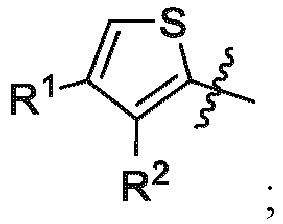
- R1 is C1-C6 alkyl optionally substituted with one or more hydroxy, and R2 is C1-C6 alkyl optionally substituted with one or more hydroxy;
- R1 is C1-C6 alkyl optionally substituted with one or more hydroxy, and R2 is C6-C10 aryl;
- R1 is C1-C6 alkyl optionally substituted with one or more hydroxy, and R2 is 5- to 10-membered heteroaryl;
- R1 is C1-C6 alkyl optionally substituted with one or more hydroxy, and R2 is SF5;
- R1 is C1-C6 alkyl optionally substituted with one or more hydroxy, and R2 is S(O2)C1-C6 alkyl;
- R1 is C1-C6 alkyl optionally substituted with one or more hydroxy, and R2 is halo;
- R1 is C3-C7 cycloalkyl optionally substituted with one or more hydroxy, and R2 is C1-C6 alkyl;
- R1 is 3- to 7-membered heterocycloalkyl optionally substituted with one or more hydroxy, and R2 is C1-C6 alkyl;
- R1 is 3- to 7-membered heterocycloalkyl optionally substituted with one or more hydroxy, and R2 is halo;
- R1 is C1-C6 alkyl optionally substituted with one or more oxo, and R2 is methyl;
- R1 is C1-C6 alkyl optionally substituted with one or more C1-C6 alkoxy, and R2 is C1-C6 alkyl;
- R1 is C1-C6 alkyl optionally substituted with one or more NR8R9, and R2 is C1-C6 alkyl;
- R1 is C1-C6 alkyl optionally substituted with one or more NR8R9, and R2 is halo;
- R2 is C1-C6 alkyl optionally substituted with one or more hydroxy, and R1 is C6-C10 aryl;
- R2 is C1-C6 alkyl optionally substituted with one or more hydroxy, and R1 is 5- to 10-membered heteroaryl;
- R2 is C1-C6 alkyl optionally substituted with one or more hydroxy, and R1 is SF5.
- R2 is C1-C6 alkyl optionally substituted with one or more hydroxy, and R1 is S(O2)C1-C6 alkyl;
- R2 is C1-C6 alkyl optionally substituted with one or more hydroxy, and R1 is halo;
- R2 is C3-C7 cycloalkyl optionally substituted with one or more hydroxy, and R1 is C1-C6 alkyl;
- R2 is 3- to 7-membered heterocycloalkyl optionally substituted with one or more hydroxy, and R1 is C1-C6 alkyl;
- R2 is 3- to 7-membered heterocycloalkyl optionally substituted with one or more hydroxy, and R1 is halo;
- R2 is C1-C6 alkyl optionally substituted with one or more NR8R9, and R1 is C1-C6 alkyl;
- R2 is C1-C6 alkyl optionally substituted with one or more NR8R9, and R1 is halo;
- R2 is C1-C6 alkyl optionally substituted with one or more oxo, and R1 is methyl; or
- R2 is C1-C6 alkyl optionally substituted with one or more C1-C6 alkoxy, and R1 is C1-C6 alkyl.
- In some embodiments, of the compound of formula AA,
the substituted ring A is
- R1 is 1-hydroxy-2-methylpropan-2-yl, and R2 is methyl;
- R1 is 2-hydroxy-2-propyl and R2 is methyl;
- R1 is 2-hydroxy-2-propyl and R2 is isopropyl;
- R1 is 2-hydroxy-2-propyl and R2 is 2-hydroxy-2-propyl;
- R1 is 2-hydroxy-2-propyl and R2 is 1-hydroxyethyl;
- R1 is hydroxymethyl and R2 is methyl;
- R1 is 1-hydroxyethyl and R2 is methyl;
- R1 is 2-hydroxyethyl and R2 is methyl;
- R1 is 1-hydroxy-2-propyl and R2 is methyl;
- R1 is 2-hydroxy-2-propyl and R2 is phenyl;
- R1 is 2-hydroxy-2-propyl and R2 is pyridyl;
- R1 is 2-hydroxy-2-propyl and R2 is pyrazolyl;
- R1 is 2-hydroxy-2-propyl, and R2 is S(OZ)CH3;
- R1 is 2-hydroxy-2-propyl and R2 is chloro;
- R1 is 2-hydroxy-2-propyl and R2 is fluoro;
- R1 is 1-hydroxy-1-cyclopropyl, and R2 is methyl;
- R1 is 1-hydroxy-1-cyclobutyl, and R2 is methyl;
- R1 is 1-hydroxy-1-cyclopentyl, and R2 is methyl;
- R1 is 1-hydroxy-1-cyclohexyl, and R2 is methyl;
- R1 is morpholinyl, and R2 is methyl;
- R1 is 1,3-dioxolan-2-yl, and R2 is methyl;
- R1 is 1,3-dioxolan-2-yl, and R2 is fluoro;
- R1 is 1,3-dioxolan-2-yl, and R2 is chloro;
- R1 is COCH3, and R2 is methyl;
- R1 is 2-methoxy-2-propyl, and R2 is methyl;
- R1 is (dimethylamino)methyl, and R2 is methyl;
- R2 is 1-hydroxy-2-methylpropan-2-yl, and R1 is methyl;
- R2 is 2-hydroxy-2-propyl and R1 is methyl;
- R2 is 2-hydroxy-2-propyl and R1 is isopropyl;
- R2 is 2-hydroxy-2-propyl and R1 is 1-hydroxyethyl;
- R2 is hydroxymethyl and R1 is methyl;
- R2 is 1-hydroxyethyl and R1 is methyl;
- R2 is 2-hydroxyethyl and R1 is methyl;
- R2 is 1-hydroxy-2-propyl and R1 is methyl;
- R2 is 2-hydroxy-2-propyl and R1 is phenyl;
- R2 is C1-C6 alkyl optionally substituted with one or more hydroxy, and R1 is 5- to 10-membered heteroaryl;
- R2 is 2-hydroxy-2-propyl and R1 is pyridyl;
- R2 is 2-hydroxy-2-propyl and R1 is pyrazolyl;
- R2 is C1-C6 alkyl optionally substituted with one or more hydroxy, and R1 is S(OZ)CH3;
- R2 is 2-hydroxy-2-propyl and R1 is chloro;
- R2 is 2-hydroxy-2-propyl and R1 is fluoro;
- R2 is C3-C7 cycloalkyl optionally substituted with one or more hydroxy, and R1 is C1-C6 alkyl;
- R2 is 1-hydroxy-1-cyclopropyl, and R1 is methyl;
- R2 is 1-hydroxy-1-cyclobutyl, and R1 is methyl;
- R2 is 1-hydroxy-1-cyclopentyl, and R1 is methyl;
- R2 is 1-hydroxy-1-cyclohexyl, and R1 is methyl;
- R2 is morpholinyl, and R1 is methyl;
- R2 is 1,3-dioxolan-2-yl, and R1 is methyl;
- R2 is 1,3-dioxolan-2-yl, and R1 is fluoro;
- R2 is 1,3-dioxolan-2-yl, and R1 is chloro;
- R2 is C1-C6 alkyl optionally substituted with one or more oxo, and R1 is methyl;
- R2 is (dimethylamino)methyl, and R1 is methyl;
- R2 is COCH3, and R1 is methyl; or
- R2 is 2-methoxy-2-propyl, and R1 is methyl.
- In some embodiments, of the compound of formula AA,
the substituted ring A is
- R1 is C1-C6 alkyl optionally substituted with one or more hydroxy, and R2 is C1-C6 alkyl optionally substituted with one or more hydroxy;
- R1 is C1-C6 alkyl optionally substituted with one or more hydroxy, and R2 is C6-C10 aryl;
- R1 is C1-C6 alkyl optionally substituted with one or more hydroxy, and R2 is 5- to 10-membered heteroaryl;
- R1 is C1-C6 alkyl optionally substituted with one or more hydroxy, and R2 is SFs;
- R1 is C1-C6 alkyl optionally substituted with one or more hydroxy, and R2 is S(O2)C1-C6 alkyl;
- R1 is C1-C6 alkyl optionally substituted with one or more hydroxy, and R2 is halo;
- R1 is C3-C7 cycloalkyl optionally substituted with one or more hydroxy, and R2 is C1-C6 alkyl;
- R1 is 3- to 7-membered heterocycloalkyl optionally substituted with one or more hydroxy, and R2 is C1-C6 alkyl;
- R1 is 3- to 7-membered heterocycloalkyl optionally substituted with one or more hydroxy, and R2 is halo;
- R1 is C1-C6 alkyl optionally substituted with one or more oxo, and R2 is methyl;
- R1 is C1-C6 alkyl optionally substituted with one or more C1-C6 alkoxy, and R2 is C1-C6 alkyl;
- R1 is C1-C6 alkyl optionally substituted with one or more NR8R9, and R2 is C1-C6 alkyl;
- R1 is C1-C6 alkyl optionally substituted with one or more NR8R9, and R2 is halo;
- R2 is C1-C6 alkyl optionally substituted with one or more hydroxy, and R1 is C6-C10 aryl;
- R2 is C1-C6 alkyl optionally substituted with one or more hydroxy, and R1 is 5- to 10-membered heteroaryl;
- R2 is C1-C6 alkyl optionally substituted with one or more hydroxy, and R1 is SF5.
- R2 is C1-C6 alkyl optionally substituted with one or more hydroxy, and R1 is S(O2)C1-C6 alkyl;
- R2 is C1-C6 alkyl optionally substituted with one or more hydroxy, and R1 is halo;
- R2 is C3-C7 cycloalkyl optionally substituted with one or more hydroxy, and R1 is C1-C6 alkyl;
- R2 is 3- to 7-membered heterocycloalkyl optionally substituted with one or more hydroxy, and R1 is C1-C6 alkyl;
- R2 is 3- to 7-membered heterocycloalkyl optionally substituted with one or more hydroxy, and R1 is halo;
- R2 is C1-C6 alkyl optionally substituted with one or more NR8R9, and R1 is C1-C6 alkyl;
- R2 is C1-C6 alkyl optionally substituted with one or more NR8R9, and R1 is halo;
- R2 is C1-C6 alkyl optionally substituted with one or more oxo, and R1 is methyl; or
- R2 is C1-C6 alkyl optionally substituted with one or more C1-C6 alkoxy, and R1 is C1-C6 alkyl.
- In some embodiments, of the compound of formula AA,
the substituted ring A is
- R1 is 1-hydroxy-2-methylpropan-2-yl, and R2 is methyl;
- R1 is 2-hydroxy-2-propyl and R2 is methyl;
- R1 is 2-hydroxy-2-propyl and R2 is isopropyl;
- R1 is 2-hydroxy-2-propyl and R2 is 2-hydroxy-2-propyl;
- R1 is 2-hydroxy-2-propyl and R2 is 1-hydroxyethyl;
- R1 is hydroxymethyl and R2 is methyl;
- R1 is 1-hydroxyethyl and R2 is methyl;
- R1 is 2-hydroxyethyl and R2 is methyl;
- R1 is 1-hydroxy-2-propyl and R2 is methyl;
- R1 is 2-hydroxy-2-propyl and R2 is phenyl;
- R1 is 2-hydroxy-2-propyl and R2 is pyridyl;
- R1 is 2-hydroxy-2-propyl and R2 is pyrazolyl;
- R1 is 2-hydroxy-2-propyl, and R2 is S(OZ)CH3;
- R1 is 2-hydroxy-2-propyl and R2 is chloro;
- R1 is 2-hydroxy-2-propyl and R2 is fluoro;
- R1 is 1-hydroxy-1-cyclopropyl, and R2 is methyl;
- R1 is 1-hydroxy-1-cyclobutyl, and R2 is methyl;
- R1 is 1-hydroxy-1-cyclopentyl, and R2 is methyl;
- R1 is 1-hydroxy-1-cyclohexyl, and R2 is methyl;
- R1 is morpholinyl, and R2 is methyl;
- R1 is 1,3-dioxolan-2-yl, and R2 is methyl;
- R1 is 1,3-dioxolan-2-yl, and R2 is fluoro;
- R1 is 1,3-dioxolan-2-yl, and R2 is chloro;
- R1 is COCH3, and R2 is methyl;
- R1 is 2-methoxy-2-propyl, and R2 is methyl;
- R1 is (dimethylamino)methyl, and R2 is methyl.
- R2 is 1-hydroxy-2-methylpropan-2-yl, and R1 is methyl;
- R2 is 2-hydroxy-2-propyl and R1 is methyl;
- R2 is 2-hydroxy-2-propyl and R1 is isopropyl;
- R2 is 2-hydroxy-2-propyl and R1 is 1-hydroxyethyl;
- R2 is hydroxymethyl and R1 is methyl;
- R2 is 1-hydroxyethyl and R1 is methyl;
- R2 is 2-hydroxyethyl and R1 is methyl;
- R2 is 1-hydroxy-2-propyl and R1 is methyl;
- R2 is 2-hydroxy-2-propyl and R1 is phenyl;
- R2 is C1-C6 alkyl optionally substituted with one or more hydroxy, and R1 is 5- to 10-membered heteroaryl;
- R2 is 2-hydroxy-2-propyl and R1 is pyridyl;
- R2 is 2-hydroxy-2-propyl and R1 is pyrazolyl;
- R2 is C1-C6 alkyl optionally substituted with one or more hydroxy, and R1 is S(OZ)CH3; R2 is 2-hydroxy-2-propyl and R1 is chloro;
- R2 is 2-hydroxy-2-propyl and R1 is fluoro;
- R2 is C3-C7 cycloalkyl optionally substituted with one or more hydroxy, and R1 is C1-C6 alkyl;
- R2 is 1-hydroxy-1-cyclopropyl, and R1 is methyl;
- R2 is 1-hydroxy-1-cyclobutyl, and R1 is methyl;
- R2 is 1-hydroxy-1-cyclopentyl, and R1 is methyl;
- R2 is 1-hydroxy-1-cyclohexyl, and R1 is methyl;
- R2 is morpholinyl, and R1 is methyl;
- R2 is 1,3-dioxolan-2-yl, and R1 is methyl;
- R2 is 1,3-dioxolan-2-yl, and R1 is fluoro;
- R2 is 1,3-dioxolan-2-yl, and R1 is chloro;
- R2 is C1-C6 alkyl optionally substituted with one or more oxo, and R1 is methyl;
- R2 is (dimethylamino)methyl, and R1 is methyl;
- R2 is COCH3, and R1 is methyl; or
- R2 is 2-methoxy-2-propyl, and R1 is methyl.
- In some embodiments, of the compound of formula AA,
the substituted ring A is
- R1 is C1-C6 alkyl optionally substituted with one or more hydroxy, and R2 is C1-C6 alkyl optionally substituted with one or more hydroxy;
- R1 is C1-C6 alkyl optionally substituted with one or more hydroxy, and R2 is C6-C10 aryl;
- R1 is C1-C6 alkyl optionally substituted with one or more hydroxy, and R2 is 5- to 10-membered heteroaryl;
- R1 is C1-C6 alkyl optionally substituted with one or more hydroxy, and R2 is SF5;
- R1 is C1-C6 alkyl optionally substituted with one or more hydroxy, and R2 is S(O2)C1-C6 alkyl;
- R1 is C1-C6 alkyl optionally substituted with one or more hydroxy, and R2 is halo;
- R1 is C3-C7 cycloalkyl optionally substituted with one or more hydroxy, and R2 is C1-C6 alkyl;
- R1 is 3- to 7-membered heterocycloalkyl optionally substituted with one or more hydroxy, and R2 is C1-C6 alkyl;
- R1 is 3- to 7-membered heterocycloalkyl optionally substituted with one or more hydroxy, and R2 is halo;
- R1 is C1-C6 alkyl optionally substituted with one or more oxo, and R2 is methyl;
- R1 is C1-C6 alkyl optionally substituted with one or more C1-C6 alkoxy, and R2 is C1-C6 alkyl;
- R1 is C1-C6 alkyl optionally substituted with one or more NR8R9, and R2 is C1-C6 alkyl;
- R1 is C1-C6 alkyl optionally substituted with one or more NR8R9, and R2 is halo;
- R2 is C1-C6 alkyl optionally substituted with one or more hydroxy, and R1 is C6-C10 aryl;
- R2 is C1-C6 alkyl optionally substituted with one or more hydroxy, and R1 is 5- to 10-membered heteroaryl;
- R2 is C1-C6 alkyl optionally substituted with one or more hydroxy, and R1 is SF5.
- R2 is C1-C6 alkyl optionally substituted with one or more hydroxy, and R1 is S(O2)C1-C6 alkyl;
- R2 is C1-C6 alkyl optionally substituted with one or more hydroxy, and R1 is halo;
- R2 is C3-C7 cycloalkyl optionally substituted with one or more hydroxy, and R1 is C1-C6 alkyl;
- R2 is 3- to 7-membered heterocycloalkyl optionally substituted with one or more hydroxy, and R1 is C1-C6 alkyl;
- R2 is 3- to 7-membered heterocycloalkyl optionally substituted with one or more hydroxy, and R1 is halo;
- R2 is C1-C6 alkyl optionally substituted with one or more NR8R9, and R1 is C1-C6 alkyl;
- R2 is C1-C6 alkyl optionally substituted with one or more NR8R9, and R1 is halo;
- R2 is C1-C6 alkyl optionally substituted with one or more oxo, and R1 is methyl; or
- R2 is C1-C6 alkyl optionally substituted with one or more C1-C6 alkoxy, and R1 is C1-C6 alkyl.
- In some embodiments, of the compound of formula AA,
the substituted ring A is
- R1 is 1-hydroxy-2-methylpropan-2-yl, and R2 is methyl;
- R1 is 2-hydroxy-2-propyl and R2 is methyl;
- R1 is 2-hydroxy-2-propyl and R2 is isopropyl;
- R1 is 2-hydroxy-2-propyl and R2 is 2-hydroxy-2-propyl;
- R1 is 2-hydroxy-2-propyl and R2 is 1-hydroxyethyl;
- R1 is hydroxymethyl and R2 is methyl;
- R1 is 1-hydroxyethyl and R2 is methyl;
- R1 is 2-hydroxyethyl and R2 is methyl;
- R1 is 1-hydroxy-2-propyl and R2 is methyl;
- R1 is 2-hydroxy-2-propyl and R2 is phenyl;
- R1 is 2-hydroxy-2-propyl and R2 is pyridyl;
- R1 is 2-hydroxy-2-propyl and R2 is pyrazolyl;
- R1 is 2-hydroxy-2-propyl, and R2 is S(OZ)CH3;
- R1 is 2-hydroxy-2-propyl and R2 is chloro;
- R1 is 2-hydroxy-2-propyl and R2 is fluoro;
- R1 is 1-hydroxy-1-cyclopropyl, and R2 is methyl;
- R1 is 1-hydroxy-1-cyclobutyl, and R2 is methyl;
- R1 is 1-hydroxy-1-cyclopentyl, and R2 is methyl;
- R1 is 1-hydroxy-1-cyclohexyl, and R2 is methyl;
- R1 is morpholinyl, and R2 is methyl;
- R1 is 1,3-dioxolan-2-yl, and R2 is methyl;
- R1 is 1,3-dioxolan-2-yl, and R2 is fluoro;
- R1 is 1,3-dioxolan-2-yl, and R2 is chloro;
- R1 is COCH3, and R2 is methyl;
- R1 is 2-methoxy-2-propyl, and R2 is methyl;
- R1 is (dimethylamino)methyl, and R2 is methyl.
- R2 is 1-hydroxy-2-methylpropan-2-yl, and R1 is methyl;
- R2 is 2-hydroxy-2-propyl and R1 is methyl;
- R2 is 2-hydroxy-2-propyl and R1 is isopropyl;
- R2 is 2-hydroxy-2-propyl and R1 is 1-hydroxyethyl;
- R2 is hydroxymethyl and R1 is methyl;
- R2 is 1-hydroxyethyl and R1 is methyl;
- R2 is 2-hydroxyethyl and R1 is methyl;
- R2 is 1-hydroxy-2-propyl and R1 is methyl;
- R2 is 2-hydroxy-2-propyl and R1 is phenyl;
- R2 is C1-C6 alkyl optionally substituted with one or more hydroxy, and R1 is 5- to 10-membered heteroaryl;
- R2 is 2-hydroxy-2-propyl and R1 is pyridyl;
- R2 is 2-hydroxy-2-propyl and R1 is pyrazolyl;
- R2 is C1-C6 alkyl optionally substituted with one or more hydroxy, and R1 is S(OZ)CH3;
- R2 is 2-hydroxy-2-propyl and R1 is chloro;
- R2 is 2-hydroxy-2-propyl and R1 is fluoro;
- R2 is C3-C7 cycloalkyl optionally substituted with one or more hydroxy, and R1 is C1-C6 alkyl;
- R2 is 1-hydroxy-1-cyclopropyl, and R1 is methyl;
- R2 is 1-hydroxy-1-cyclobutyl, and R1 is methyl;
- R2 is 1-hydroxy-1-cyclopentyl, and R1 is methyl;
- R2 is 1-hydroxy-1-cyclohexyl, and R1 is methyl;
- R2 is morpholinyl, and R1 is methyl;
- R2 is 1,3-dioxolan-2-yl, and R1 is methyl;
- R2 is 1,3-dioxolan-2-yl, and R1 is fluoro;
- R2 is 1,3-dioxolan-2-yl, and R1 is chloro;
- R2 is C1-C6 alkyl optionally substituted with one or more oxo, and R1 is methyl;
- R2 is (dimethylamino)methyl, and R1 is methyl;
- R2 is COCH3, and R1 is methyl; or
- R2 is 2-methoxy-2-propyl, and R1 is methyl.
- In some embodiments, of the compound of formula AA,
the substituted ring A is
- R1 is C1-C6 alkyl optionally substituted with one or more hydroxy, and R2 is C1-C6 alkyl optionally substituted with one or more hydroxy;
- R1 is C1-C6 alkyl optionally substituted with one or more hydroxy, and R2 is C6-C10 aryl;
- R1 is C1-C6 alkyl optionally substituted with one or more hydroxy, and R2 is 5- to 10-membered heteroaryl;
- R1 is C1-C6 alkyl optionally substituted with one or more hydroxy, and R2 is SFs;
- R1 is C1-C6 alkyl optionally substituted with one or more hydroxy, and R2 is S(O2)C1-C6 alkyl;
- R1 is C1-C6 alkyl optionally substituted with one or more hydroxy, and R2 is halo;
- R1 is C3-C7 cycloalkyl optionally substituted with one or more hydroxy, and R2 is C1-C6 alkyl;
- R1 is 3- to 7-membered heterocycloalkyl optionally substituted with one or more hydroxy, and R2 is C1-C6 alkyl;
- R1 is 3- to 7-membered heterocycloalkyl optionally substituted with one or more hydroxy, and R2 is halo;
- R1 is C1-C6 alkyl optionally substituted with one or more oxo, and R2 is methyl;
- R1 is C1-C6 alkyl optionally substituted with one or more C1-C6 alkoxy, and R2 is C1-C6 alkyl;
- R1 is C1-C6 alkyl optionally substituted with one or more NR8R9, and R2 is C1-C6 alkyl;
- R1 is C1-C6 alkyl optionally substituted with one or more NR8R9, and R2 is halo;
- R2 is C1-C6 alkyl optionally substituted with one or more hydroxy, and R1 is C6-C10 aryl;
- R2 is C1-C6 alkyl optionally substituted with one or more hydroxy, and R1 is 5- to 10-membered heteroaryl;
- R2 is C1-C6 alkyl optionally substituted with one or more hydroxy, and R1 is SF5.
- R2 is C1-C6 alkyl optionally substituted with one or more hydroxy, and R1 is S(O2)C1-C6 alkyl;
- R2 is C1-C6 alkyl optionally substituted with one or more hydroxy, and R1 is halo;
- R2 is C3-C7 cycloalkyl optionally substituted with one or more hydroxy, and R1 is C1-C6 alkyl;
- R2 is 3- to 7-membered heterocycloalkyl optionally substituted with one or more hydroxy, and R1 is C1-C6 alkyl;
- R2 is 3- to 7-membered heterocycloalkyl optionally substituted with one or more hydroxy, and R1 is halo;
- R2 is C1-C6 alkyl optionally substituted with one or more NR8R9, and R1 is C1-C6 alkyl;
- R2 is C1-C6 alkyl optionally substituted with one or more NR8R9, and R1 is halo;
- R2 is C1-C6 alkyl optionally substituted with one or more oxo, and R1 is methyl; or
- R2 is C1-C6 alkyl optionally substituted with one or more C1-C6 alkoxy, and R1 is C1-C6 alkyl.
- In some embodiments, of the compound of formula AA,
the substituted ring A is
- R1 is 1-hydroxy-2-methylpropan-2-yl, and R2 is methyl;
- R1 is 2-hydroxy-2-propyl and R2 is methyl;
- R1 is 2-hydroxy-2-propyl and R2 is isopropyl;
- R1 is 2-hydroxy-2-propyl and R2 is 2-hydroxy-2-propyl;
- R1 is 2-hydroxy-2-propyl and R2 is 1-hydroxyethyl;
- R1 is hydroxymethyl and R2 is methyl;
- R1 is 1-hydroxyethyl and R2 is methyl;
- R1 is 2-hydroxyethyl and R2 is methyl;
- R1 is 1-hydroxy-2-propyl and R2 is methyl;
- R1 is 2-hydroxy-2-propyl and R2 is phenyl;
- R1 is 2-hydroxy-2-propyl and R2 is pyridyl;
- R1 is 2-hydroxy-2-propyl and R2 is pyrazolyl;
- R1 is 2-hydroxy-2-propyl, and R2 is S(OZ)CH3;
- R1 is 2-hydroxy-2-propyl and R2 is chloro;
- R1 is 2-hydroxy-2-propyl and R2 is fluoro;
- R1 is 1-hydroxy-1-cyclopropyl, and R2 is methyl;
- R1 is 1-hydroxy-1-cyclobutyl, and R2 is methyl;
- R1 is 1-hydroxy-1-cyclopentyl, and R2 is methyl;
- R1 is 1-hydroxy-1-cyclohexyl, and R2 is methyl;
- R1 is morpholinyl, and R2 is methyl;
- R1 is 1,3-dioxolan-2-yl, and R2 is methyl;
- R1 is 1,3-dioxolan-2-yl, and R2 is fluoro;
- R1 is 1,3-dioxolan-2-yl, and R2 is chloro;
- R1 is COCH3, and R2 is methyl;
- R1 is 2-methoxy-2-propyl, and R2 is methyl;
- R1 is (dimethylamino)methyl, and R2 is methyl.
- R2 is 1-hydroxy-2-methylpropan-2-yl, and R1 is methyl;
- R2 is 2-hydroxy-2-propyl and R1 is methyl;
- R2 is 2-hydroxy-2-propyl and R1 is isopropyl;
- R2 is 2-hydroxy-2-propyl and R1 is 1-hydroxyethyl;
- R2 is hydroxymethyl and R1 is methyl;
- R2 is 1-hydroxyethyl and R1 is methyl;
- R2 is 2-hydroxyethyl and R1 is methyl;
- R2 is 1-hydroxy-2-propyl and R1 is methyl;
- R2 is 2-hydroxy-2-propyl and R1 is phenyl;
- R2 is C1-C6 alkyl optionally substituted with one or more hydroxy, and R1 is 5- to 10-membered heteroaryl;
- R2 is 2-hydroxy-2-propyl and R1 is pyridyl;
- R2 is 2-hydroxy-2-propyl and R1 is pyrazolyl;
- R2 is C1-C6 alkyl optionally substituted with one or more hydroxy, and R1 is S(O2)CH3;
- R2 is 2-hydroxy-2-propyl and R1 is chloro;
- R2 is 2-hydroxy-2-propyl and R1 is fluoro;
- R2 is C3-C7 cycloalkyl optionally substituted with one or more hydroxy, and R1 is C1-C6 alkyl;
- R2 is 1-hydroxy-1-cyclopropyl, and R1 is methyl;
- R2 is 1-hydroxy-1-cyclobutyl, and R1 is methyl;
- R2 is 1-hydroxy-1-cyclopentyl, and R1 is methyl;
- R2 is 1-hydroxy-1-cyclohexyl, and R1 is methyl;
- R2 is morpholinyl, and R1 is methyl;
- R2 is 1,3-dioxolan-2-yl, and R1 is methyl;
- R2 is 1,3-dioxolan-2-yl, and R1 is fluoro;
- R2 is 1,3-dioxolan-2-yl, and R1 is chloro;
- R2 is C1-C6 alkyl optionally substituted with one or more oxo, and R1 is methyl;
- R2 is (dimethylamino)methyl, and R1 is methyl;
- R2 is COCH3, and R1 is methyl; or
- R2 is 2-methoxy-2-propyl, and R1 is methyl.
- In some embodiments, of the compound of formula AA,
the substituted ring A is
- R1 is C1-C6 alkyl optionally substituted with one or more hydroxy, and R2 is C1-C6 alkyl optionally substituted with one or more hydroxy;
- R1 is C1-C6 alkyl optionally substituted with one or more hydroxy, and R2 is C6-C10 aryl;
- R1 is C1-C6 alkyl optionally substituted with one or more hydroxy, and R2 is 5- to 10-membered heteroaryl;
- R1 is C1-C6 alkyl optionally substituted with one or more hydroxy, and R2 is SF5;
- R1 is C1-C6 alkyl optionally substituted with one or more hydroxy, and R2 is S(O2)C1-C6 alkyl;
- R1 is C1-C6 alkyl optionally substituted with one or more hydroxy, and R2 is halo;
- R1 is C3-C7 cycloalkyl optionally substituted with one or more hydroxy, and R2 is C1-C6 alkyl;
- R1 is 3- to 7-membered heterocycloalkyl optionally substituted with one or more hydroxy, and R2 is C1-C6 alkyl;
- R1 is 3- to 7-membered heterocycloalkyl optionally substituted with one or more hydroxy, and R2 is halo;
- R1 is C1-C6 alkyl optionally substituted with one or more oxo, and R2 is methyl;
- R1 is C1-C6 alkyl optionally substituted with one or more C1-C6 alkoxy, and R2 is C1-C6 alkyl;
- R1 is C1-C6 alkyl optionally substituted with one or more NR8R9, and R2 is C1-C6 alkyl;
- R1 is C1-C6 alkyl optionally substituted with one or more NR8R9, and R2 is halo;
- R2 is C1-C6 alkyl optionally substituted with one or more hydroxy, and R1 is C6-C10 aryl;
- R2 is C1-C6 alkyl optionally substituted with one or more hydroxy, and R1 is 5- to 10-membered heteroaryl;
- R2 is C1-C6 alkyl optionally substituted with one or more hydroxy, and R1 is SFs.
- R2 is C1-C6 alkyl optionally substituted with one or more hydroxy, and R1 is S(O2)C1-C6 alkyl;
- R2 is C1-C6 alkyl optionally substituted with one or more hydroxy, and R1 is halo;
- R2 is C3-C7 cycloalkyl optionally substituted with one or more hydroxy, and R1 is C1-C6 alkyl;
- R2 is 3- to 7-membered heterocycloalkyl optionally substituted with one or more hydroxy, and R1 is C1-C6 alkyl;
- R2 is 3- to 7-membered heterocycloalkyl optionally substituted with one or more hydroxy, and R1 is halo;
- R2 is C1-C6 alkyl optionally substituted with one or more NR8R9, and R1 is C1-C6 alkyl;
- R2 is C1-C6 alkyl optionally substituted with one or more NR8R9, and R1 is halo;
- R2 is C1-C6 alkyl optionally substituted with one or more oxo, and R1 is methyl; or
- R2 is C1-C6 alkyl optionally substituted with one or more C1-C6 alkoxy, and R1 is C1-C6 alkyl.
- In some embodiments, of the compound of formula AA,
the substituted ring A is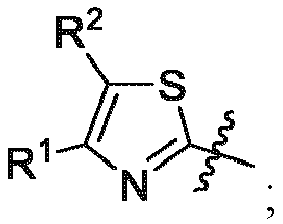
- R1 is 1-hydroxy-2-methylpropan-2-yl, and R2 is methyl;
- R1 is 2-hydroxy-2-propyl and R2 is methyl;
- R1 is 2-hydroxy-2-propyl and R2 is isopropyl;
- R1 is 2-hydroxy-2-propyl and R2 is 2-hydroxy-2-propyl;
- R1 is 2-hydroxy-2-propyl and R2 is 1-hydroxyethyl;
- R1 is hydroxymethyl and R2 is methyl;
- R1 is 1-hydroxyethyl and R2 is methyl;
- R1 is 2-hydroxyethyl and R2 is methyl;
- R1 is 1-hydroxy-2-propyl and R2 is methyl;
- R1 is 2-hydroxy-2-propyl and R2 is phenyl;
- R1 is 2-hydroxy-2-propyl and R2 is pyridyl;
- R1 is 2-hydroxy-2-propyl and R2 is pyrazolyl;
- R1 is 2-hydroxy-2-propyl, and R2 is S(O2)CH3;
- R1 is 2-hydroxy-2-propyl and R2 is chloro;
- R1 is 2-hydroxy-2-propyl and R2 is fluoro;
- R1 is 1-hydroxy-1-cyclopropyl, and R2 is methyl;
- R1 is 1-hydroxy-1-cyclobutyl, and R2 is methyl;
- R1 is 1-hydroxy-1-cyclopentyl, and R2 is methyl;
- R1 is 1-hydroxy-1-cyclohexyl, and R2 is methyl;
- R1 is morpholinyl, and R2 is methyl;
- R1 is 1,3-dioxolan-2-yl, and R2 is methyl;
- R1 is 1,3-dioxolan-2-yl, and R2 is fluoro;
- R1 is 1,3-dioxolan-2-yl, and R2 is chloro;
- R1 is COCH3, and R2 is methyl;
- R1 is 2-methoxy-2-propyl, and R2 is methyl;
- R1 is (dimethylamino)methyl, and R2 is methyl.
- R2 is 1-hydroxy-2-methylpropan-2-yl, and R1 is methyl;
- R2 is 2-hydroxy-2-propyl and R1 is methyl;
- R2 is 2-hydroxy-2-propyl and R1 is isopropyl;
- R2 is 2-hydroxy-2-propyl and R1 is 1-hydroxyethyl;
- R2 is hydroxymethyl and R1 is methyl;
- R2 is 1-hydroxyethyl and R1 is methyl;
- R2 is 2-hydroxyethyl and R1 is methyl;
- R2 is 1-hydroxy-2-propyl and R1 is methyl;
- R2 is 2-hydroxy-2-propyl and R1 is phenyl;
- R2 is C1-C6 alkyl optionally substituted with one or more hydroxy, and R1 is 5- to 10-membered heteroaryl;
- R2 is 2-hydroxy-2-propyl and R1 is pyridyl;
- R2 is 2-hydroxy-2-propyl and R1 is pyrazolyl;
- R2 is C1-C6 alkyl optionally substituted with one or more hydroxy, and R1 is S(O2)CH3;
- R2 is 2-hydroxy-2-propyl and R1 is chloro;
- R2 is 2-hydroxy-2-propyl and R1 is fluoro;
- R2 is C3-C7 cycloalkyl optionally substituted with one or more hydroxy, and R1 is C1-C6 alkyl;
- R2 is 1-hydroxy-1-cyclopropyl, and R1 is methyl;
- R2 is 1-hydroxy-1-cyclobutyl, and R1 is methyl;
- R2 is 1-hydroxy-1-cyclopentyl, and R1 is methyl;
- R2 is 1-hydroxy-1-cyclohexyl, and R1 is methyl;
- R2 is morpholinyl, and R1 is methyl;
- R2 is 1,3-dioxolan-2-yl, and R1 is methyl;
- R2 is 1,3-dioxolan-2-yl, and R1 is fluoro;
- R2 is 1,3-dioxolan-2-yl, and R1 is chloro;
- R2 is C1-C6 alkyl optionally substituted with one or more oxo, and R1 is methyl;
- R2 is (dimethylamino)methyl, and R1 is methyl;
- R2 is COCH3, and R1 is methyl; or
- R2 is 2-methoxy-2-propyl, and R1 is methyl.
- In some embodiments, of the compound of formula AA,
the substituted ring A is
- R1 is C1-C6 alkyl optionally substituted with one or more hydroxy, and R2 is C1-C6 alkyl optionally substituted with one or more hydroxy;
- R1 is C1-C6 alkyl optionally substituted with one or more hydroxy, and R2 is C6-C10 aryl;
- R1 is C1-C6 alkyl optionally substituted with one or more hydroxy, and R2 is 5- to 10-membered heteroaryl;
- R1 is C1-C6 alkyl optionally substituted with one or more hydroxy, and R2 is SF5;
- R1 is C1-C6 alkyl optionally substituted with one or more hydroxy, and R2 is S(O2)C1-C6 alkyl;
- R1 is C1-C6 alkyl optionally substituted with one or more hydroxy, and R2 is halo;
- R1 is C3-C7 cycloalkyl optionally substituted with one or more hydroxy, and R2 is C1-C6 alkyl;
- R1 is 3- to 7-membered heterocycloalkyl optionally substituted with one or more hydroxy, and R2 is C1-C6 alkyl;
- R1 is 3- to 7-membered heterocycloalkyl optionally substituted with one or more hydroxy, and R2 is halo;
- R1 is C1-C6 alkyl optionally substituted with one or more oxo, and R2 is methyl;
- R1 is C1-C6 alkyl optionally substituted with one or more C1-C6 alkoxy, and R2 is C1-C6 alkyl;
- R1 is C1-C6 alkyl optionally substituted with one or more NR8R9, and R2 is C1-C6 alkyl;
- R1 is C1-C6 alkyl optionally substituted with one or more NR8R9, and R2 is halo;
- R2 is C1-C6 alkyl optionally substituted with one or more hydroxy, and R1 is C6-C10 aryl;
- R2 is C1-C6 alkyl optionally substituted with one or more hydroxy, and R1 is 5- to 10-membered heteroaryl;
- R2 is C1-C6 alkyl optionally substituted with one or more hydroxy, and R1 is SF5.
- R2 is C1-C6 alkyl optionally substituted with one or more hydroxy, and R1 is S(O2)C1-C6 alkyl;
- R2 is C1-C6 alkyl optionally substituted with one or more hydroxy, and R1 is halo;
- R2 is C3-C7 cycloalkyl optionally substituted with one or more hydroxy, and R1 is C1-C6 alkyl;
- R2 is 3- to 7-membered heterocycloalkyl optionally substituted with one or more hydroxy, and R1 is C1-C6 alkyl;
- R2 is 3- to 7-membered heterocycloalkyl optionally substituted with one or more hydroxy, and R1 is halo;
- R2 is C1-C6 alkyl optionally substituted with one or more NR8R9, and R1 is C1-C6 alkyl;
- R2 is C1-C6 alkyl optionally substituted with one or more NR8R9, and R1 is halo;
- R2 is C1-C6 alkyl optionally substituted with one or more oxo, and R1 is methyl; or
- R2 is C1-C6 alkyl optionally substituted with one or more C1-C6 alkoxy, and R1 is C1-C6 alkyl.
- In some embodiments, of the compound of formula AA,
the substituted ring A is
- R1 is 1-hydroxy-2-methylpropan-2-yl, and R2 is methyl;
- R1 is 2-hydroxy-2-propyl and R2 is methyl;
- R1 is 2-hydroxy-2-propyl and R2 is isopropyl;
- R1 is 2-hydroxy-2-propyl and R2 is 2-hydroxy-2-propyl;
- R1 is 2-hydroxy-2-propyl and R2 is 1-hydroxyethyl;
- R1 is hydroxymethyl and R2 is methyl;
- R1 is 1-hydroxyethyl and R2 is methyl;
- R1 is 2-hydroxyethyl and R2 is methyl;
- R1 is 1-hydroxy-2-propyl and R2 is methyl;
- R1 is 2-hydroxy-2-propyl and R2 is phenyl;
- R1 is 2-hydroxy-2-propyl and R2 is pyridyl;
- R1 is 2-hydroxy-2-propyl and R2 is pyrazolyl;
- R1 is 2-hydroxy-2-propyl, and R2 is S(O2)CH3;
- R1 is 2-hydroxy-2-propyl and R2 is chloro;
- R1 is 2-hydroxy-2-propyl and R2 is fluoro;
- R1 is 1-hydroxy-1-cyclopropyl, and R2 is methyl;
- R1 is 1-hydroxy-1-cyclobutyl, and R2 is methyl;
- R1 is 1-hydroxy-1-cyclopentyl, and R2 is methyl;
- R1 is 1-hydroxy-1-cyclohexyl, and R2 is methyl;
- R1 is morpholinyl, and R2 is methyl;
- R1 is 1,3-dioxolan-2-yl, and R2 is methyl;
- R1 is 1,3-dioxolan-2-yl, and R2 is fluoro;
- R1 is 1,3-dioxolan-2-yl, and R2 is chloro;
- R1 is COCH3, and R2 is methyl;
- R1 is 2-methoxy-2-propyl, and R2 is methyl;
- R1 is (dimethylamino)methyl, and R2 is methyl.
- R2 is 1-hydroxy-2-methylpropan-2-yl, and R1 is methyl;
- R2 is 2-hydroxy-2-propyl and R1 is methyl;
- R2 is 2-hydroxy-2-propyl and R1 is isopropyl;
- R2 is 2-hydroxy-2-propyl and R1 is 1-hydroxyethyl;
- R2 is hydroxymethyl and R1 is methyl;
- R2 is 1-hydroxyethyl and R1 is methyl;
- R2 is 2-hydroxyethyl and R1 is methyl;
- R2 is 1-hydroxy-2-propyl and R1 is methyl;
- R2 is 2-hydroxy-2-propyl and R1 is phenyl;
- R2 is C1-C6 alkyl optionally substituted with one or more hydroxy, and R1 is 5- to 10-membered heteroaryl;
- R2 is 2-hydroxy-2-propyl and R1 is pyridyl;
- R2 is 2-hydroxy-2-propyl and R1 is pyrazolyl;
- R2 is C1-C6 alkyl optionally substituted with one or more hydroxy, and R1 is S(O2)CH3;
- R2 is 2-hydroxy-2-propyl and R1 is chloro;
- R2 is 2-hydroxy-2-propyl and R1 is fluoro;
- R2 is C3-C7 cycloalkyl optionally substituted with one or more hydroxy, and R1 is C1-C6 alkyl;
- R2 is 1-hydroxy-1-cyclopropyl, and R1 is methyl;
- R2 is 1-hydroxy-1-cyclobutyl, and R1 is methyl;
- R2 is 1-hydroxy-1-cyclopentyl, and R1 is methyl;
- R2 is 1-hydroxy-1-cyclohexyl, and R1 is methyl;
- R2 is morpholinyl, and R1 is methyl;
- R2 is 1,3-dioxolan-2-yl, and R1 is methyl;
- R2 is 1,3-dioxolan-2-yl, and R1 is fluoro;
- R2 is 1,3-dioxolan-2-yl, and R1 is chloro;
- R2 is C1-C6 alkyl optionally substituted with one or more oxo, and R1 is methyl;
- R2 is (dimethylamino)methyl, and R1 is methyl;
- R2 is COCH3, and R1 is methyl; or
- R2 is 2-methoxy-2-propyl, and R1 is methyl.
- In some embodiments, of the compound of formula AA,
the substituted ring A is
- R1 is 1-hydroxy-2-methylpropan-2-yl, and R2 is methyl;
- R1 is 2-hydroxy-2-propyl and R2 is methyl;
- R1 is 2-hydroxy-2-propyl and R2 is isopropyl;
- R1 is 2-hydroxy-2-propyl and R2 is 2-hydroxy-2-propyl;
- R1 is 2-hydroxy-2-propyl and R2 is 1-hydroxyethyl;
- R1 is hydroxymethyl and R2 is methyl;
- R1 is 1-hydroxyethyl and R2 is methyl;
- R1 is 2-hydroxyethyl and R2 is methyl;
- R1 is 1-hydroxy-2-propyl and R2 is methyl;
- R1 is 2-hydroxy-2-propyl and R2 is phenyl;
- R1 is 2-hydroxy-2-propyl and R2 is pyridyl;
- R1 is 2-hydroxy-2-propyl and R2 is pyrazolyl;
- R1 is 2-hydroxy-2-propyl, and R2 is S(O2)CH3;
- R1 is 2-hydroxy-2-propyl and R2 is chloro;
- R1 is 2-hydroxy-2-propyl and R2 is fluoro;
- R1 is 1-hydroxy-1-cyclopropyl, and R2 is methyl;
- R1 is 1-hydroxy-1-cyclobutyl, and R2 is methyl;
- R1 is 1-hydroxy-1-cyclopentyl, and R2 is methyl;
- R1 is 1-hydroxy-1-cyclohexyl, and R2 is methyl;
- R1 is morpholinyl, and R2 is methyl;
- R1 is 1,3-dioxolan-2-yl, and R2 is methyl;
- R1 is 1,3-dioxolan-2-yl, and R2 is fluoro;
- R1 is 1,3-dioxolan-2-yl, and R2 is chloro;
- R1 is COCH3, and R2 is methyl;
- R1 is 2-methoxy-2-propyl, and R2 is methyl;
- R1 is (dimethylamino)methyl, and R2 is methyl.
- R2 is 1-hydroxy-2-methylpropan-2-yl, and R1 is methyl;
- R2 is 2-hydroxy-2-propyl and R1 is methyl;
- R2 is 2-hydroxy-2-propyl and R1 is isopropyl;
- R2 is 2-hydroxy-2-propyl and R1 is 1-hydroxyethyl;
- R2 is hydroxymethyl and R1 is methyl;
- R2 is 1-hydroxyethyl and R1 is methyl;
- R2 is 2-hydroxyethyl and R1 is methyl;
- R2 is 1-hydroxy-2-propyl and R1 is methyl;
- R2 is 2-hydroxy-2-propyl and R1 is phenyl;
- R2 is C1-C6 alkyl optionally substituted with one or more hydroxy, and R1 is 5- to 10-membered heteroaryl;
- R2 is 2-hydroxy-2-propyl and R1 is pyridyl;
- R2 is 2-hydroxy-2-propyl and R1 is pyrazolyl;
- R2 is C1-C6 alkyl optionally substituted with one or more hydroxy, and R1 is S(O2)CH3;
- R2 is 2-hydroxy-2-propyl and R1 is chloro;
- R2 is 2-hydroxy-2-propyl and R1 is fluoro;
- R2 is C3-C7 cycloalkyl optionally substituted with one or more hydroxy, and R1 is C1-C6 alkyl;
- R2 is 1-hydroxy-1-cyclopropyl, and R1 is methyl;
- R2 is 1-hydroxy-1-cyclobutyl, and R1 is methyl;
- R2 is 1-hydroxy-1-cyclopentyl, and R1 is methyl;
- R2 is 1-hydroxy-1-cyclohexyl, and R1 is methyl;
- R2 is morpholinyl, and R1 is methyl;
- R2 is 1,3-dioxolan-2-yl, and R1 is methyl;
- R2 is 1,3-dioxolan-2-yl, and R1 is fluoro;
- R2 is 1,3-dioxolan-2-yl, and R1 is chloro;
- R2 is C1-C6 alkyl optionally substituted with one or more oxo, and R1 is methyl;
- R2 is (dimethylamino)methyl, and R1 is methyl;
- R2 is COCH3, and R1 is methyl; or
- R2 is 2-methoxy-2-propyl, and R1 is methyl.
- In some embodiments, of the compound of formula AA,
the substituted ring A is
- R1 is C1-C6 alkyl optionally substituted with one or more hydroxy, and R2 is C1-C6 alkyl optionally substituted with one or more hydroxy;
- R1 is C1-C6 alkyl optionally substituted with one or more hydroxy, and R2 is C6-C10 aryl;
- R1 is C1-C6 alkyl optionally substituted with one or more hydroxy, and R2 is 5- to 10-membered heteroaryl;
- R1 is C1-C6 alkyl optionally substituted with one or more hydroxy, and R2 is SF5;
- R1 is C1-C6 alkyl optionally substituted with one or more hydroxy, and R2 is S(O2)C1-C6 alkyl;
- R1 is C1-C6 alkyl optionally substituted with one or more hydroxy, and R2 is halo;
- R1 is C3-C7 cycloalkyl optionally substituted with one or more hydroxy, and R2 is C1-C6 alkyl;
- R1 is 3- to 7-membered heterocycloalkyl optionally substituted with one or more hydroxy, and R2 is C1-C6 alkyl;
- R1 is 3- to 7-membered heterocycloalkyl optionally substituted with one or more hydroxy, and R2 is halo;
- R1 is C1-C6 alkyl optionally substituted with one or more oxo, and R2 is methyl;
- R1 is C1-C6 alkyl optionally substituted with one or more C1-C6 alkoxy, and R2 is C1-C6 alkyl;
- R1 is C1-C6 alkyl optionally substituted with one or more NR8R9, and R2 is C1-C6 alkyl;
- R1 is C1-C6 alkyl optionally substituted with one or more NR8R9, and R2 is halo;
- R2 is C1-C6 alkyl optionally substituted with one or more hydroxy, and R1 is C6-C10 aryl;
- R2 is C1-C6 alkyl optionally substituted with one or more hydroxy, and R1 is 5- to 10-membered heteroaryl;
- R2 is C1-C6 alkyl optionally substituted with one or more hydroxy, and R1 is SF5.
- R2 is C1-C6 alkyl optionally substituted with one or more hydroxy, and R1 is S(O2)C1-C6 alkyl;
- R2 is C1-C6 alkyl optionally substituted with one or more hydroxy, and R1 is halo;
- R2 is C3-C7 cycloalkyl optionally substituted with one or more hydroxy, and R1 is C1-C6 alkyl;
- R2 is 3- to 7-membered heterocycloalkyl optionally substituted with one or more hydroxy, and R1 is C1-C6 alkyl;
- R2 is 3- to 7-membered heterocycloalkyl optionally substituted with one or more hydroxy, and R1 is halo;
- R2 is C1-C6 alkyl optionally substituted with one or more NR8R9, and R1 is C1-C6 alkyl;
- R2 is C1-C6 alkyl optionally substituted with one or more NR8R9, and R1 is halo;
- R2 is C1-C6 alkyl optionally substituted with one or more oxo, and R1 is methyl; or
- R2 is C1-C6 alkyl optionally substituted with one or more C1-C6 alkoxy, and R1 is C1-C6 alkyl.
- In some embodiments, of the compound of formula AA,
the substituted ring A is
- R1 is 1-hydroxy-2-methylpropan-2-yl, and R2 is methyl;
- R1 is 2-hydroxy-2-propyl and R2 is methyl;
- R1 is 2-hydroxy-2-propyl and R2 is isopropyl;
- R1 is 2-hydroxy-2-propyl and R2 is 2-hydroxy-2-propyl;
- R1 is 2-hydroxy-2-propyl and R2 is 1-hydroxyethyl;
- R1 is hydroxymethyl and R2 is methyl;
- R1 is 1-hydroxyethyl and R2 is methyl;
- R1 is 2-hydroxyethyl and R2 is methyl;
- R1 is 1-hydroxy-2-propyl and R2 is methyl;
- R1 is 2-hydroxy-2-propyl and R2 is phenyl;
- R1 is 2-hydroxy-2-propyl and R2 is pyridyl;
- R1 is 2-hydroxy-2-propyl and R2 is pyrazolyl;
- R1 is 2-hydroxy-2-propyl, and R2 is S(O2)CH3;
- R1 is 2-hydroxy-2-propyl and R2 is chloro;
- R1 is 2-hydroxy-2-propyl and R2 is fluoro;
- R1 is 1-hydroxy-1-cyclopropyl, and R2 is methyl;
- R1 is 1-hydroxy-1-cyclobutyl, and R2 is methyl;
- R1 is 1-hydroxy-1-cyclopentyl, and R2 is methyl;
- R1 is 1-hydroxy-1-cyclohexyl, and R2 is methyl;
- R1 is morpholinyl, and R2 is methyl;
- R1 is 1,3-dioxolan-2-yl, and R2 is methyl;
- R1 is 1,3-dioxolan-2-yl, and R2 is fluoro;
- R1 is 1,3-dioxolan-2-yl, and R2 is chloro;
- R1 is COCH3, and R2 is methyl;
- R1 is 2-methoxy-2-propyl, and R2 is methyl;
- R1 is (dimethylamino)methyl, and R2 is methyl.
- R2 is 1-hydroxy-2-methylpropan-2-yl, and R1 is methyl;
- R2 is 2-hydroxy-2-propyl and R1 is methyl;
- R2 is 2-hydroxy-2-propyl and R1 is isopropyl;
- R2 is 2-hydroxy-2-propyl and R1 is 1-hydroxyethyl;
- R2 is hydroxymethyl and R1 is methyl;
- R2 is 1-hydroxyethyl and R1 is methyl;
- R2 is 2-hydroxyethyl and R1 is methyl;
- R2 is 1-hydroxy-2-propyl and R1 is methyl;
- R2 is 2-hydroxy-2-propyl and R1 is phenyl;
- R2 is C1-C6 alkyl optionally substituted with one or more hydroxy, and R1 is 5- to 10-membered heteroaryl;
- R2 is 2-hydroxy-2-propyl and R1 is pyridyl;
- R2 is 2-hydroxy-2-propyl and R1 is pyrazolyl;
- R2 is C1-C6 alkyl optionally substituted with one or more hydroxy, and R1 is S(O2)CH3; R2 is 2-hydroxy-2-propyl and R1 is chloro;
- R2 is 2-hydroxy-2-propyl and R1 is fluoro;
- R2 is C3-C7 cycloalkyl optionally substituted with one or more hydroxy, and R1 is C1-C6 alkyl;
- R2 is 1-hydroxy-1-cyclopropyl, and R1 is methyl;
- R2 is 1-hydroxy-1-cyclobutyl, and R1 is methyl;
- R2 is 1-hydroxy-1-cyclopentyl, and R1 is methyl;
- R2 is 1-hydroxy-1-cyclohexyl, and R1 is methyl;
- R2 is morpholinyl, and R1 is methyl;
- R2 is 1,3-dioxolan-2-yl, and R1 is methyl;
- R2 is 1,3-dioxolan-2-yl, and R1 is fluoro;
- R2 is 1,3-dioxolan-2-yl, and R1 is chloro;
- R2 is C1-C6 alkyl optionally substituted with one or more oxo, and R1 is methyl;
- R2 is (dimethylamino)methyl, and R1 is methyl;
- R2 is COCH3, and R1 is methyl; or
- R2 is 2-methoxy-2-propyl, and R1 is methyl.
- In some embodiments, of the compound of formula AA,
the substituted ring A is
- R1 is C1-C6 alkyl optionally substituted with one or more hydroxy, and R2 is C1-C6 alkyl optionally substituted with one or more hydroxy;
- R1 is C1-C6 alkyl optionally substituted with one or more hydroxy, and R2 is C6-C10 aryl;
- R1 is C1-C6 alkyl optionally substituted with one or more hydroxy, and R2 is 5- to 10-membered heteroaryl;
- R1 is C1-C6 alkyl optionally substituted with one or more hydroxy, and R2 is SF5;
- R1 is C1-C6 alkyl optionally substituted with one or more hydroxy, and R2 is S(O2)C1-C6 alkyl;
- R1 is C1-C6 alkyl optionally substituted with one or more hydroxy, and R2 is halo;
- R1 is C3-C7 cycloalkyl optionally substituted with one or more hydroxy, and R2 is C1-C6 alkyl;
- R1 is 3- to 7-membered heterocycloalkyl optionally substituted with one or more hydroxy, and R2 is C1-C6 alkyl;
- R1 is 3- to 7-membered heterocycloalkyl optionally substituted with one or more hydroxy, and R2 is halo;
- R1 is C1-C6 alkyl optionally substituted with one or more oxo, and R2 is methyl;
- R1 is C1-C6 alkyl optionally substituted with one or more C1-C6 alkoxy, and R2 is C1-C6 alkyl;
- R1 is C1-C6 alkyl optionally substituted with one or more NR8R9, and R2 is C1-C6 alkyl;
- R1 is C1-C6 alkyl optionally substituted with one or more NR8R9, and R2 is halo;
- R2 is C1-C6 alkyl optionally substituted with one or more hydroxy, and R1 is C6-C10 aryl;
- R2 is C1-C6 alkyl optionally substituted with one or more hydroxy, and R1 is 5- to 10-membered heteroaryl;
- R2 is C1-C6 alkyl optionally substituted with one or more hydroxy, and R1 is SFs.
- R2 is C1-C6 alkyl optionally substituted with one or more hydroxy, and R1 is S(O2)C1-C6 alkyl;
- R2 is C1-C6 alkyl optionally substituted with one or more hydroxy, and R1 is halo;
- R2 is C3-C7 cycloalkyl optionally substituted with one or more hydroxy, and R1 is C1-C6 alkyl;
- R2 is 3- to 7-membered heterocycloalkyl optionally substituted with one or more hydroxy, and R1 is C1-C6 alkyl;
- R2 is 3- to 7-membered heterocycloalkyl optionally substituted with one or more hydroxy, and R1 is halo;
- R2 is C1-C6 alkyl optionally substituted with one or more NR8R9, and R1 is C1-C6 alkyl;
- R2 is C1-C6 alkyl optionally substituted with one or more NR8R9, and R1 is halo;
- R2 is C1-C6 alkyl optionally substituted with one or more oxo, and R1 is methyl; or
- R2 is C1-C6 alkyl optionally substituted with one or more C1-C6 alkoxy, and R1 is C1-C6 alkyl.
- In some embodiments, of the compound of formula AA,
the substituted ring A is
- R1 is 1-hydroxy-2-methylpropan-2-yl, and R2 is methyl;
- R1 is 2-hydroxy-2-propyl and R2 is methyl;
- R1 is 2-hydroxy-2-propyl and R2 is isopropyl;
- R1 is 2-hydroxy-2-propyl and R2 is 2-hydroxy-2-propyl;
- R1 is 2-hydroxy-2-propyl and R2 is 1-hydroxyethyl;
- R1 is hydroxymethyl and R2 is methyl;
- R1 is 1-hydroxyethyl and R2 is methyl;
- R1 is 2-hydroxyethyl and R2 is methyl;
- R1 is 1-hydroxy-2-propyl and R2 is methyl;
- R1 is 2-hydroxy-2-propyl and R2 is phenyl;
- R1 is 2-hydroxy-2-propyl and R2 is pyridyl;
- R1 is 2-hydroxy-2-propyl and R2 is pyrazolyl;
- R1 is 2-hydroxy-2-propyl, and R2 is S(O2)CH3;
- R1 is 2-hydroxy-2-propyl and R2 is chloro;
- R1 is 2-hydroxy-2-propyl and R2 is fluoro;
- R1 is 1-hydroxy-1-cyclopropyl, and R2 is methyl;
- R1 is 1-hydroxy-1-cyclobutyl, and R2 is methyl;
- R1 is 1-hydroxy-1-cyclopentyl, and R2 is methyl;
- R1 is 1-hydroxy-1-cyclohexyl, and R2 is methyl;
- R1 is morpholinyl, and R2 is methyl;
- R1 is 1,3-dioxolan-2-yl, and R2 is methyl;
- R1 is 1,3-dioxolan-2-yl, and R2 is fluoro;
- R1 is 1,3-dioxolan-2-yl, and R2 is chloro;
- R1 is COCH3, and R2 is methyl;
- R1 is 2-methoxy-2-propyl, and R2 is methyl;
- R1 is (dimethylamino)methyl, and R2 is methyl.
- R2 is 1-hydroxy-2-methylpropan-2-yl, and R1 is methyl;
- R2 is 2-hydroxy-2-propyl and R1 is methyl;
- R2 is 2-hydroxy-2-propyl and R1 is isopropyl;
- R2 is 2-hydroxy-2-propyl and R1 is 1-hydroxyethyl;
- R2 is hydroxymethyl and R1 is methyl;
- R2 is 1-hydroxyethyl and R1 is methyl;
- R2 is 2-hydroxyethyl and R1 is methyl;
- R2 is 1-hydroxy-2-propyl and R1 is methyl;
- R2 is 2-hydroxy-2-propyl and R1 is phenyl;
- R2 is C1-C6 alkyl optionally substituted with one or more hydroxy, and R1 is 5- to 10-membered heteroaryl;
- R2 is 2-hydroxy-2-propyl and R1 is pyridyl;
- R2 is 2-hydroxy-2-propyl and R1 is pyrazolyl;
- R2 is C1-C6 alkyl optionally substituted with one or more hydroxy, and R1 is S(O2)CH3;
- R2 is 2-hydroxy-2-propyl and R1 is chloro;
- R2 is 2-hydroxy-2-propyl and R1 is fluoro;
- R2 is C3-C7 cycloalkyl optionally substituted with one or more hydroxy, and R1 is C1-C6 alkyl;
- R2 is 1-hydroxy-1-cyclopropyl, and R1 is methyl;
- R2 is 1-hydroxy-1-cyclobutyl, and R1 is methyl;
- R2 is 1-hydroxy-1-cyclopentyl, and R1 is methyl;
- R2 is 1-hydroxy-1-cyclohexyl, and R1 is methyl;
- R2 is morpholinyl, and R1 is methyl;
- R2 is 1,3-dioxolan-2-yl, and R1 is methyl;
- R2 is 1,3-dioxolan-2-yl, and R1 is fluoro;
- R2 is 1,3-dioxolan-2-yl, and R1 is chloro;
- R2 is C1-C6 alkyl optionally substituted with one or more oxo, and R1 is methyl;
- R2 is (dimethylamino)methyl, and R1 is methyl;
- R2 is COCH3, and R1 is methyl; or
- R2 is 2-methoxy-2-propyl, and R1 is methyl.
- In some embodiments, of the compound of formula AA,
the substituted ring A is
- R1 is C1-C6 alkyl optionally substituted with one or more hydroxy, and R2 is C1-C6 alkyl optionally substituted with one or more hydroxy;
- R1 is C1-C6 alkyl optionally substituted with one or more hydroxy, and R2 is C6-C10 aryl;
- R1 is C1-C6 alkyl optionally substituted with one or more hydroxy, and R2 is 5- to 10-membered heteroaryl;
- R1 is C1-C6 alkyl optionally substituted with one or more hydroxy, and R2 is SFs;
- R1 is C1-C6 alkyl optionally substituted with one or more hydroxy, and R2 is S(O2)C1-C6 alkyl;
- R1 is C1-C6 alkyl optionally substituted with one or more hydroxy, and R2 is halo;
- R1 is C3-C7 cycloalkyl optionally substituted with one or more hydroxy, and R2 is C1-C6 alkyl;
- R1 is 3- to 7-membered heterocycloalkyl optionally substituted with one or more hydroxy, and R2 is C1-C6 alkyl;
- R1 is 3- to 7-membered heterocycloalkyl optionally substituted with one or more hydroxy, and R2 is halo;
- R1 is C1-C6 alkyl optionally substituted with one or more oxo, and R2 is methyl;
- R1 is C1-C6 alkyl optionally substituted with one or more C1-C6 alkoxy, and R2 is C1-C6 alkyl;
- R1 is C1-C6 alkyl optionally substituted with one or more NR8R9, and R2 is C1-C6 alkyl;
- R1 is C1-C6 alkyl optionally substituted with one or more NR8R9, and R2 is halo;
- R2 is C1-C6 alkyl optionally substituted with one or more hydroxy, and R1 is C6-C10 aryl;
- R2 is C1-C6 alkyl optionally substituted with one or more hydroxy, and R1 is 5- to 10-membered heteroaryl;
- R2 is C1-C6 alkyl optionally substituted with one or more hydroxy, and R1 is SF5.
- R2 is C1-C6 alkyl optionally substituted with one or more hydroxy, and R1 is S(O2)C1-C6 alkyl;
- R2 is C1-C6 alkyl optionally substituted with one or more hydroxy, and R1 is halo;
- R2 is C3-C7 cycloalkyl optionally substituted with one or more hydroxy, and R1 is C1-C6 alkyl;
- R2 is 3- to 7-membered heterocycloalkyl optionally substituted with one or more hydroxy, and R1 is C1-C6 alkyl;
- R2 is 3- to 7-membered heterocycloalkyl optionally substituted with one or more hydroxy, and R1 is halo;
- R2 is C1-C6 alkyl optionally substituted with one or more NR8R9, and R1 is C1-C6 alkyl;
- R2 is C1-C6 alkyl optionally substituted with one or more NR8R9, and R1 is halo;
- R2 is C1-C6 alkyl optionally substituted with one or more oxo, and R1 is methyl; or
- R2 is C1-C6 alkyl optionally substituted with one or more C1-C6 alkoxy, and R1 is C1-C6 alkyl.
- In some embodiments, of the compound of formula AA,
the substituted ring A is
- R1 is 1-hydroxy-2-methylpropan-2-yl, and R2 is methyl;
- R1 is 2-hydroxy-2-propyl and R2 is methyl;
- R1 is 2-hydroxy-2-propyl and R2 is isopropyl;
- R1 is 2-hydroxy-2-propyl and R2 is 2-hydroxy-2-propyl;
- R1 is 2-hydroxy-2-propyl and R2 is 1-hydroxyethyl;
- R1 is hydroxymethyl and R2 is methyl;
- R1 is 1-hydroxyethyl and R2 is methyl;
- R1 is 2-hydroxyethyl and R2 is methyl;
- R1 is 1-hydroxy-2-propyl and R2 is methyl;
- R1 is 2-hydroxy-2-propyl and R2 is phenyl;
- R1 is 2-hydroxy-2-propyl and R2 is pyridyl;
- R1 is 2-hydroxy-2-propyl and R2 is pyrazolyl;
- R1 is 2-hydroxy-2-propyl, and R2 is S(O2)CH3;
- R1 is 2-hydroxy-2-propyl and R2 is chloro;
- R1 is 2-hydroxy-2-propyl and R2 is fluoro;
- R1 is 1-hydroxy-1-cyclopropyl, and R2 is methyl;
- R1 is 1-hydroxy-1-cyclobutyl, and R2 is methyl;
- R1 is 1-hydroxy-1-cyclopentyl, and R2 is methyl;
- R1 is 1-hydroxy-1-cyclohexyl, and R2 is methyl;
- R1 is morpholinyl, and R2 is methyl;
- R1 is 1,3-dioxolan-2-yl, and R2 is methyl;
- R1 is 1,3-dioxolan-2-yl, and R2 is fluoro;
- R1 is 1,3-dioxolan-2-yl, and R2 is chloro;
- R1 is COCH3, and R2 is methyl;
- R1 is 2-methoxy-2-propyl, and R2 is methyl;
- R1 is (dimethylamino)methyl, and R2 is methyl.
- R2 is 1-hydroxy-2-methylpropan-2-yl, and R1 is methyl;
- R2 is 2-hydroxy-2-propyl and R1 is methyl;
- R2 is 2-hydroxy-2-propyl and R1 is isopropyl;
- R2 is 2-hydroxy-2-propyl and R1 is 1-hydroxyethyl;
- R2 is hydroxymethyl and R1 is methyl;
- R2 is 1-hydroxyethyl and R1 is methyl;
- R2 is 2-hydroxyethyl and R1 is methyl;
- R2 is 1-hydroxy-2-propyl and R1 is methyl;
- R2 is 2-hydroxy-2-propyl and R1 is phenyl;
- R2 is C1-C6 alkyl optionally substituted with one or more hydroxy, and R1 is 5- to 10-membered heteroaryl;
- R2 is 2-hydroxy-2-propyl and R1 is pyridyl;
- R2 is 2-hydroxy-2-propyl and R1 is pyrazolyl;
- R2 is C1-C6 alkyl optionally substituted with one or more hydroxy, and R1 is S(O2)CH3;
- R2 is 2-hydroxy-2-propyl and R1 is chloro;
- R2 is 2-hydroxy-2-propyl and R1 is fluoro;
- R2 is C3-C7 cycloalkyl optionally substituted with one or more hydroxy, and R1 is C1-C6 alkyl;
- R2 is 1-hydroxy-1-cyclopropyl, and R1 is methyl;
- R2 is 1-hydroxy-1-cyclobutyl, and R1 is methyl;
- R2 is 1-hydroxy-1-cyclopentyl, and R1 is methyl;
- R2 is 1-hydroxy-1-cyclohexyl, and R1 is methyl;
- R2 is morpholinyl, and R1 is methyl;
- R2 is 1,3-dioxolan-2-yl, and R1 is methyl;
- R2 is 1,3-dioxolan-2-yl, and R1 is fluoro;
- R2 is 1,3-dioxolan-2-yl, and R1 is chloro;
- R2 is C1-C6 alkyl optionally substituted with one or more oxo, and R1 is methyl;
- R2 is (dimethylamino)methyl, and R1 is methyl;
- R2 is COCH3, and R1 is methyl; or
- R2 is 2-methoxy-2-propyl, and R1 is methyl.
- In some embodiments, of the compound of formula AA,
the substituted ring A is
- R1 is C1-C6 alkyl optionally substituted with one or more hydroxy, and R2 is C1-C6 alkyl optionally substituted with one or more hydroxy;
- R1 is C1-C6 alkyl optionally substituted with one or more hydroxy, and R2 is C6-C10 aryl;
- R1 is C1-C6 alkyl optionally substituted with one or more hydroxy, and R2 is 5- to 10-membered heteroaryl;
- R1 is C1-C6 alkyl optionally substituted with one or more hydroxy, and R2 is SF5;
- R1 is C1-C6 alkyl optionally substituted with one or more hydroxy, and R2 is S(O2)C1-C6 alkyl;
- R1 is C1-C6 alkyl optionally substituted with one or more hydroxy, and R2 is halo;
- R1 is C3-C7 cycloalkyl optionally substituted with one or more hydroxy, and R2 is C1-C6 alkyl;
- R1 is 3- to 7-membered heterocycloalkyl optionally substituted with one or more hydroxy, and R2 is C1-C6 alkyl;
- R1 is 3- to 7-membered heterocycloalkyl optionally substituted with one or more hydroxy, and R2 is halo;
- R1 is C1-C6 alkyl optionally substituted with one or more oxo, and R2 is methyl;
- R1 is C1-C6 alkyl optionally substituted with one or more C1-C6 alkoxy, and R2 is C1-C6 alkyl;
- R1 is C1-C6 alkyl optionally substituted with one or more NR8R9, and R2 is C1-C6 alkyl;
- R1 is C1-C6 alkyl optionally substituted with one or more NR8R9, and R2 is halo;
- R2 is C1-C6 alkyl optionally substituted with one or more hydroxy, and R1 is C6-C10 aryl;
- R2 is C1-C6 alkyl optionally substituted with one or more hydroxy, and R1 is 5- to 10-membered heteroaryl;
- R2 is C1-C6 alkyl optionally substituted with one or more hydroxy, and R1 is SFs.
- R2 is C1-C6 alkyl optionally substituted with one or more hydroxy, and R1 is S(O2)C1-C6 alkyl;
- R2 is C1-C6 alkyl optionally substituted with one or more hydroxy, and R1 is halo;
- R2 is C3-C7 cycloalkyl optionally substituted with one or more hydroxy, and R1 is C1-C6 alkyl;
- R2 is 3- to 7-membered heterocycloalkyl optionally substituted with one or more hydroxy, and R1 is C1-C6 alkyl;
- R2 is 3- to 7-membered heterocycloalkyl optionally substituted with one or more hydroxy, and R1 is halo;
- R2 is C1-C6 alkyl optionally substituted with one or more NR8R9, and R1 is C1-C6 alkyl;
- R2 is C1-C6 alkyl optionally substituted with one or more NR8R9, and R1 is halo;
- R2 is C1-C6 alkyl optionally substituted with one or more oxo, and R1 is methyl; or
- R2 is C1-C6 alkyl optionally substituted with one or more C1-C6 alkoxy, and R1 is C1-C6 alkyl.
- In some embodiments, of the compound of formula AA,
the substituted ring A is
- R1 is 1-hydroxy-2-methylpropan-2-yl, and R2 is methyl;
- R1 is 2-hydroxy-2-propyl and R2 is methyl;
- R1 is 2-hydroxy-2-propyl and R2 is isopropyl;
- R1 is 2-hydroxy-2-propyl and R2 is 2-hydroxy-2-propyl;
- R1 is 2-hydroxy-2-propyl and R2 is 1-hydroxyethyl;
- R1 is hydroxymethyl and R2 is methyl;
- R1 is 1-hydroxyethyl and R2 is methyl;
- R1 is 2-hydroxyethyl and R2 is methyl;
- R1 is 1-hydroxy-2-propyl and R2 is methyl;
- R1 is 2-hydroxy-2-propyl and R2 is phenyl;
- R1 is 2-hydroxy-2-propyl and R2 is pyridyl;
- R1 is 2-hydroxy-2-propyl and R2 is pyrazolyl;
- R1 is 2-hydroxy-2-propyl, and R2 is S(O2)CH3;
- R1 is 2-hydroxy-2-propyl and R2 is chloro;
- R1 is 2-hydroxy-2-propyl and R2 is fluoro;
- R1 is 1-hydroxy-1-cyclopropyl, and R2 is methyl;
- R1 is 1-hydroxy-1-cyclobutyl, and R2 is methyl;
- R1 is 1-hydroxy-1-cyclopentyl, and R2 is methyl;
- R1 is 1-hydroxy-1-cyclohexyl, and R2 is methyl;
- R1 is morpholinyl, and R2 is methyl;
- R1 is 1,3-dioxolan-2-yl, and R2 is methyl;
- R1 is 1,3-dioxolan-2-yl, and R2 is fluoro;
- R1 is 1,3-dioxolan-2-yl, and R2 is chloro;
- R1 is COCH3, and R2 is methyl;
- R1 is 2-methoxy-2-propyl, and R2 is methyl;
- R1 is (dimethylamino)methyl, and R2 is methyl.
- R2 is 1-hydroxy-2-methylpropan-2-yl, and R1 is methyl;
- R2 is 2-hydroxy-2-propyl and R1 is methyl;
- R2 is 2-hydroxy-2-propyl and R1 is isopropyl;
- R2 is 2-hydroxy-2-propyl and R1 is 1-hydroxyethyl;
- R2 is hydroxymethyl and R1 is methyl;
- R2 is 1-hydroxyethyl and R1 is methyl;
- R2 is 2-hydroxyethyl and R1 is methyl;
- R2 is 1-hydroxy-2-propyl and R1 is methyl;
- R2 is 2-hydroxy-2-propyl and R1 is phenyl;
- R2 is C1-C6 alkyl optionally substituted with one or more hydroxy, and R1 is 5- to 10-membered heteroaryl;
- R2 is 2-hydroxy-2-propyl and R1 is pyridyl;
- R2 is 2-hydroxy-2-propyl and R1 is pyrazolyl;
- R2 is C1-C6 alkyl optionally substituted with one or more hydroxy, and R1 is S(O2)CH3;
- R2 is 2-hydroxy-2-propyl and R1 is chloro;
- R2 is 2-hydroxy-2-propyl and R1 is fluoro;
- R2 is C3-C7 cycloalkyl optionally substituted with one or more hydroxy, and R1 is C1-C6 alkyl;
- R2 is 1-hydroxy-1-cyclopropyl, and R1 is methyl;
- R2 is 1-hydroxy-1-cyclobutyl, and R1 is methyl;
- R2 is 1-hydroxy-1-cyclopentyl, and R1 is methyl;
- R2 is 1-hydroxy-1-cyclohexyl, and R1 is methyl;
- R2 is morpholinyl, and R1 is methyl;
- R2 is 1,3-dioxolan-2-yl, and R1 is methyl;
- R2 is 1,3-dioxolan-2-yl, and R1 is fluoro;
- R2 is 1,3-dioxolan-2-yl, and R1 is chloro;
- R2 is (dimethylamino)methyl, and R1 is methyl;
- R2 is C1-C6 alkyl optionally substituted with one or more oxo, and R1 is methyl; or
- R2 is COCH3, and R1 is methyl.
- In some embodiments, of the compound of formula AA,
the substituted ring A is
- R1 is C1-C6 alkyl optionally substituted with one or more hydroxy, and R2 is C1-C6 alkyl optionally substituted with one or more hydroxy;
- R1 is C1-C6 alkyl optionally substituted with one or more hydroxy, and R2 is C6-C10 aryl;
- R1 is C1-C6 alkyl optionally substituted with one or more hydroxy, and R2 is 5- to 10-membered heteroaryl;
- R1 is C1-C6 alkyl optionally substituted with one or more hydroxy, and R2 is SF5;
- R1 is C1-C6 alkyl optionally substituted with one or more hydroxy, and R2 is S(O2)C1-C6 alkyl;
- R1 is C1-C6 alkyl optionally substituted with one or more hydroxy, and R2 is halo;
- R1 is C3-C7 cycloalkyl optionally substituted with one or more hydroxy, and R2 is C1-C6 alkyl;
- R1 is 3- to 7-membered heterocycloalkyl optionally substituted with one or more hydroxy, and R2 is C1-C6 alkyl;
- R1 is 3- to 7-membered heterocycloalkyl optionally substituted with one or more hydroxy, and R2 is halo;
- R1 is C1-C6 alkyl optionally substituted with one or more oxo, and R2 is methyl;
- R1 is C1-C6 alkyl optionally substituted with one or more C1-C6 alkoxy, and R2 is C1-C6 alkyl;
- R1 is C1-C6 alkyl optionally substituted with one or more NR8R9, and R2 is C1-C6 alkyl;
- R1 is C1-C6 alkyl optionally substituted with one or more NR8R9, and R2 is halo;
- R2 is C1-C6 alkyl optionally substituted with one or more hydroxy, and R1 is C6-C10 aryl;
- R2 is C1-C6 alkyl optionally substituted with one or more hydroxy, and R1 is 5- to 10-membered heteroaryl;
- R2 is C1-C6 alkyl optionally substituted with one or more hydroxy, and R1 is SF5.
- R2 is C1-C6 alkyl optionally substituted with one or more hydroxy, and R1 is S(O2)C1-C6 alkyl;
- R2 is C1-C6 alkyl optionally substituted with one or more hydroxy, and R1 is halo;
- R2 is C3-C7 cycloalkyl optionally substituted with one or more hydroxy, and R1 is C1-C6 alkyl;
- R2 is 3- to 7-membered heterocycloalkyl optionally substituted with one or more hydroxy, and R1 is C1-C6 alkyl;
- R2 is 3- to 7-membered heterocycloalkyl optionally substituted with one or more hydroxy, and R1 is halo;
- R2 is C1-C6 alkyl optionally substituted with one or more NR8R9, and R1 is C1-C6 alkyl;
- R2 is C1-C6 alkyl optionally substituted with one or more NR8R9, and R1 is halo;
- R2 is C1-C6 alkyl optionally substituted with one or more oxo, and R1 is methyl; or
- R2 is C1-C6 alkyl optionally substituted with one or more C1-C6 alkoxy, and R1 is C1-C6 alkyl.
- In some embodiments, of the compound of formula AA,
the substituted ring A is
- R1 is 1-hydroxy-2-methylpropan-2-yl, and R2 is methyl;
- R1 is 2-hydroxy-2-propyl and R2 is methyl;
- R1 is 2-hydroxy-2-propyl and R2 is isopropyl;
- R1 is 2-hydroxy-2-propyl and R2 is 2-hydroxy-2-propyl;
- R1 is 2-hydroxy-2-propyl and R2 is 1-hydroxyethyl;
- R1 is hydroxymethyl and R2 is methyl;
- R1 is 1-hydroxyethyl and R2 is methyl;
- R1 is 2-hydroxyethyl and R2 is methyl;
- R1 is 1-hydroxy-2-propyl and R2 is methyl;
- R1 is 2-hydroxy-2-propyl and R2 is phenyl;
- R1 is 2-hydroxy-2-propyl and R2 is pyridyl;
- R1 is 2-hydroxy-2-propyl and R2 is pyrazolyl;
- R1 is 2-hydroxy-2-propyl, and R2 is S(O2)CH3;
- R1 is 2-hydroxy-2-propyl and R2 is chloro;
- R1 is 2-hydroxy-2-propyl and R2 is fluoro;
- R1 is 1-hydroxy-1-cyclopropyl, and R2 is methyl;
- R1 is 1-hydroxy-1-cyclobutyl, and R2 is methyl;
- R1 is 1-hydroxy-1-cyclopentyl, and R2 is methyl;
- R1 is 1-hydroxy-1-cyclohexyl, and R2 is methyl;
- R1 is morpholinyl, and R2 is methyl;
- R1 is 1,3-dioxolan-2-yl, and R2 is methyl;
- R1 is 1,3-dioxolan-2-yl, and R2 is fluoro;
- R1 is 1,3-dioxolan-2-yl, and R2 is chloro;
- R1 is COCH3, and R2 is methyl;
- R1 is 2-methoxy-2-propyl, and R2 is methyl;
- R1 is C1-C6 alkyl optionally substituted with one or more NR8R9, and R2 is C1-C6 alkyl;
- R1 is C1-C6 alkyl optionally substituted with one or more NR8R9, and R2 is halo;
- R2 is 1-hydroxy-2-methylpropan-2-yl, and R1 is methyl;
- R2 is 2-hydroxy-2-propyl and R1 is methyl;
- R2 is 2-hydroxy-2-propyl and R1 is isopropyl;
- R2 is 2-hydroxy-2-propyl and R1 is 1-hydroxyethyl;
- R2 is hydroxymethyl and R1 is methyl;
- R2 is 1-hydroxyethyl and R1 is methyl;
- R2 is 2-hydroxyethyl and R1 is methyl;
- R2 is 1-hydroxy-2-propyl and R1 is methyl;
- R2 is 2-hydroxy-2-propyl and R1 is phenyl;
- R2 is C1-C6 alkyl optionally substituted with one or more hydroxy, and R1 is 5- to 10-membered heteroaryl;
- R2 is 2-hydroxy-2-propyl and R1 is pyridyl;
- R2 is 2-hydroxy-2-propyl and R1 is pyrazolyl;
- R2 is C1-C6 alkyl optionally substituted with one or more hydroxy, and R1 is S(O2)CH3;
- R2 is 2-hydroxy-2-propyl and R1 is chloro;
- R2 is 2-hydroxy-2-propyl and R1 is fluoro;
- R2 is C3-C7 cycloalkyl optionally substituted with one or more hydroxy, and R1 is C1-C6 alkyl;
- R2 is 1-hydroxy-1-cyclopropyl, and R1 is methyl;
- R2 is 1-hydroxy-1-cyclobutyl, and R1 is methyl;
- R2 is 1-hydroxy-1-cyclopentyl, and R1 is methyl;
- R2 is 1-hydroxy-1-cyclohexyl, and R1 is methyl;
- R2 is morpholinyl, and R1 is methyl;
- R2 is 1,3-dioxolan-2-yl, and R1 is methyl;
- R2 is 1,3-dioxolan-2-yl, and R1 is fluoro;
- R2 is 1,3-dioxolan-2-yl, and R1 is chloro;
- R2 is C1-C6 alkyl optionally substituted with one or more oxo, and R1 is methyl;
- R2 is C1-C6 alkyl optionally substituted with one or more NR8R9, and R1 is C1-C6 alkyl;
- R2 is C1-C6 alkyl optionally substituted with one or more NR8R9, and R1 is halo;
- R2 is COCH3, and R1 is methyl; or
- R2 is 2-methoxy-2-propyl, and R1 is methyl.
- In some embodiments, of the compound of formula AA,
the substituted ring A is
- R1 is C1-C6 alkyl optionally substituted with one or more hydroxy, and R2 is C1-C6 alkyl optionally substituted with one or more hydroxy;
- R1 is C1-C6 alkyl optionally substituted with one or more hydroxy, and R2 is C6-C10 aryl;
- R1 is C1-C6 alkyl optionally substituted with one or more hydroxy, and R2 is 5- to 10-membered heteroaryl;
- R1 is C1-C6 alkyl optionally substituted with one or more hydroxy, and R2 is SFs;
- R1 is C1-C6 alkyl optionally substituted with one or more hydroxy, and R2 is S(O2)C1-C6 alkyl;
- R1 is C1-C6 alkyl optionally substituted with one or more hydroxy, and R2 is halo;
- R1 is C3-C7 cycloalkyl optionally substituted with one or more hydroxy, and R2 is C1-C6 alkyl;
- R1 is 3- to 7-membered heterocycloalkyl optionally substituted with one or more hydroxy, and R2 is C1-C6 alkyl;
- R1 is 3- to 7-membered heterocycloalkyl optionally substituted with one or more hydroxy, and R2 is halo;
- R1 is C1-C6 alkyl optionally substituted with one or more oxo, and R2 is methyl;
- R1 is C1-C6 alkyl optionally substituted with one or more C1-C6 alkoxy, and R2 is C1-C6 alkyl;
- R1 is C1-C6 alkyl optionally substituted with one or more NR8R9, and R2 is C1-C6 alkyl;
- R1 is C1-C6 alkyl optionally substituted with one or more NR8R9, and R2 is halo;
- R2 is C1-C6 alkyl optionally substituted with one or more hydroxy, and R1 is C6-C10 aryl;
- R2 is C1-C6 alkyl optionally substituted with one or more hydroxy, and R1 is 5- to 10-membered heteroaryl;
- R2 is C1-C6 alkyl optionally substituted with one or more hydroxy, and R1 is SFs.
- R2 is C1-C6 alkyl optionally substituted with one or more hydroxy, and R1 is S(O2)C1-C6 alkyl;
- R2 is C1-C6 alkyl optionally substituted with one or more hydroxy, and R1 is halo;
- R2 is C3-C7 cycloalkyl optionally substituted with one or more hydroxy, and R1 is C1-C6 alkyl;
- R2 is 3- to 7-membered heterocycloalkyl optionally substituted with one or more hydroxy, and R1 is C1-C6 alkyl;
- R2 is 3- to 7-membered heterocycloalkyl optionally substituted with one or more hydroxy, and R1 is halo;
- R2 is C1-C6 alkyl optionally substituted with one or more NR8R9, and R1 is C1-C6 alkyl;
- R2 is C1-C6 alkyl optionally substituted with one or more NR8R9, and R1 is halo;
- R2 is C1-C6 alkyl optionally substituted with one or more oxo, and R1 is methyl; or
- R2 is C1-C6 alkyl optionally substituted with one or more C1-C6 alkoxy, and R1 is C1-C6 alkyl.
- In some embodiments, of the compound of formula AA,
the substituted ring A is
- R1 is 1-hydroxy-2-methylpropan-2-yl, and R2 is methyl;
- R1 is 2-hydroxy-2-propyl and R2 is methyl;
- R1 is 2-hydroxy-2-propyl and R2 is isopropyl;
- R1 is 2-hydroxy-2-propyl and R2 is 2-hydroxy-2-propyl;
- R1 is 2-hydroxy-2-propyl and R2 is 1-hydroxyethyl;
- R1 is hydroxymethyl and R2 is methyl;
- R1 is 1-hydroxyethyl and R2 is methyl;
- R1 is 2-hydroxyethyl and R2 is methyl;
- R1 is 1-hydroxy-2-propyl and R2 is methyl;
- R1 is 2-hydroxy-2-propyl and R2 is phenyl;
- R1 is 2-hydroxy-2-propyl and R2 is pyridyl;
- R1 is 2-hydroxy-2-propyl and R2 is pyrazolyl;
- R1 is 2-hydroxy-2-propyl, and R2 is S(O2)CH3;
- R1 is 2-hydroxy-2-propyl and R2 is chloro;
- R1 is 2-hydroxy-2-propyl and R2 is fluoro;
- R1 is 1-hydroxy-1-cyclopropyl, and R2 is methyl;
- R1 is 1-hydroxy-1-cyclobutyl, and R2 is methyl;
- R1 is 1-hydroxy-1-cyclopentyl, and R2 is methyl;
- R1 is 1-hydroxy-1-cyclohexyl, and R2 is methyl;
- R1 is morpholinyl, and R2 is methyl;
- R1 is 1,3-dioxolan-2-yl, and R2 is methyl;
- R1 is 1,3-dioxolan-2-yl, and R2 is fluoro;
- R1 is 1,3-dioxolan-2-yl, and R2 is chloro;
- R1 is COCH3, and R2 is methyl;
- R1 is 2-methoxy-2-propyl, and R2 is methyl;
- R1 is (dimethylamino)methyl, and R2 is methyl.
- R2 is 1-hydroxy-2-methylpropan-2-yl, and R1 is methyl;
- R2 is 2-hydroxy-2-propyl and R1 is methyl;
- R2 is 2-hydroxy-2-propyl and R1 is isopropyl;
- R2 is 2-hydroxy-2-propyl and R1 is 1-hydroxyethyl;
- R2 is hydroxymethyl and R1 is methyl;
- R2 is 1-hydroxyethyl and R1 is methyl;
- R2 is 2-hydroxyethyl and R1 is methyl;
- R2 is 1-hydroxy-2-propyl and R1 is methyl;
- R2 is 2-hydroxy-2-propyl and R1 is phenyl;
- R2 is C1-C6 alkyl optionally substituted with one or more hydroxy, and R1 is 5- to 10-membered heteroaryl;
- R2 is 2-hydroxy-2-propyl and R1 is pyridyl;
- R2 is 2-hydroxy-2-propyl and R1 is pyrazolyl;
- R2 is C1-C6 alkyl optionally substituted with one or more hydroxy, and R1 is S(O2)CH3;
- R2 is 2-hydroxy-2-propyl and R1 is chloro;
- R2 is 2-hydroxy-2-propyl and R1 is fluoro;
- R2 is C3-C7 cycloalkyl optionally substituted with one or more hydroxy, and R1 is C1-C6 alkyl;
- R2 is 1-hydroxy-1-cyclopropyl, and R1 is methyl;
- R2 is 1-hydroxy-1-cyclobutyl, and R1 is methyl;
- R2 is 1-hydroxy-1-cyclopentyl, and R1 is methyl;
- R2 is 1-hydroxy-1-cyclohexyl, and R1 is methyl;
- R2 is morpholinyl, and R1 is methyl;
- R2 is 1,3-dioxolan-2-yl, and R1 is methyl;
- R2 is 1,3-dioxolan-2-yl, and R1 is fluoro;
- R2 is 1,3-dioxolan-2-yl, and R1 is chloro;
- R2 is C1-C6 alkyl optionally substituted with one or more oxo, and R1 is methyl;
- R2 is (dimethylamino)methyl, and R1 is methyl;
- R2 is COCH3, and R1 is methyl; or
- R2 is 2-methoxy-2-propyl, and R1 is methyl.
- In some embodiments of the compound of formula AA,
the substituted ring B is
C1-C6 alkyl, C1-C6 alkyl substituted with one or more halo, C1-C6 alkoxy, C1-C6 alkoxy substituted with one or more halo, C3-C7 cycloalkyl, halo, and cyano. - In some embodiments of the compound of formula AA,
the substituted ring B is
isopropyl, ethyl, methyl, trifluoromethyl, trifluoromethoxy, cyclopropyl, halo, chloro, and fluoro. - In some embodiments of the compound of formula AA,
the substituted ring B is
C1-C6 alkyl, C1-C6 alkyl substituted with one or more halo, C1-C6 alkoxy, C1-C6 alkoxy substituted with one or more halo, C3-C7 cycloalkyl, halo, and cyano. - In some embodiments of the compound of formula AA,
the substituted ring B is
isopropyl, ethyl, methyl, trifluoromethyl, trifluoromethoxy, cyclopropyl, halo, chloro, and fluoro. - In some embodiments of the compound of formula AA,
the substituted ring B is
C1-C6 alkyl, C1-C6 alkyl substituted with one or more halo, C1-C6 alkoxy, C1-C6 alkoxy substituted with one or more halo, C3-C7 cycloalkyl, halo, and cyano. - In some embodiments of the compound of formula AA,
the substituted ring B is
isopropyl, ethyl, methyl, trifluoromethyl, trifluoromethoxy, cyclopropyl, halo, chloro, and fluoro. - In some embodiments of the compound of formula AA,
the substituted ring B is
C1-C6 alkyl, C1-C6 alkyl substituted with one or more halo, C1-C6 alkoxy, C1-C6 alkoxy substituted with one or more halo, C3-C7 cycloalkyl, halo, and cyano. - In some embodiments of the compound of formula AA,
the substituted ring B is
isopropyl, ethyl, methyl, trifluoromethyl, trifluoromethoxy, cyclopropyl, halo, chloro, and fluoro. - In some embodiments of the compound of formula AA,
the substituted ring B is
C1-C6 alkyl, C1-C6 alkyl substituted with one or more halo, C1-C6 alkoxy, C1-C6 alkoxy substituted with one or more halo, C3-C7 cycloalkyl, halo, and cyano. - In some embodiments of the compound of formula AA,
the substituted ring B is
isopropyl, ethyl, methyl, trifluoromethyl, trifluoromethoxy, cyclopropyl, halo, chloro, and fluoro. - In some embodiments, of the compound of formula AA,
the substituted ring B is
- (i) One R6 is C1-C6 alkyl, and the other R6 is C1-C6 alkyl optionally substituted with one or more halo;
- (ii) One R6 is C1-C6 alkyl and the other R6 is C1-C6 alkyl;
- (iii) One R6 is C1-C6 alkyl, and the other R6 is C1-C6 alkyl substituted with one or more halo;
- (iv) One R6 is C1-C6 alkyl, and the other R6 is C3-C7 cycloalkyl;
- (v) One R6 is C1-C6 alkyl, and the other R6 is halo;
- (vi) One R6 is C1-C6 alkyl, and the other R6 is cyano;
- (vii) One R6 is C3-C7 cycloalkyl, and the other R6 is C3-C7 cycloalkyl;
- (viii) One R6 is C3-C7 cycloalkyl, and the other R6 is halo;
- (ix) One R6 is cyclopropyl and the other R6 is halo;
- (x) One R6 is C1-C6 alkyl, and the other R6 is C1-C6 alkoxy optionally substituted with one or more halo;
- (xi) One R6 is C1-C6 alkyl, and the other R6 is C1-C6 alkoxy;
- (xii) One R6 is C1-C6 alkyl, and the other R6 is C1-C6 alkoxy substituted with one or more halo;
- (xiii) One R6 is halo, and the other R6 is C1-C6 haloalkyl;
- (xiv) One R6 is halo, and the other R6 is C1-C6 haloalkoxy;
- (xv) One R6 is C1-C6 alkoxy; and the other R6 is halo;
- (xvi) One R6 is C1-C6 alkoxy; and the other R6 is chloro.
- In some embodiments, of the compound of formula AA,
the substituted ring B is
- (i) One R6 is isopropyl; and the other R6 is methyl;
- (ii) One R6 is isopropyl; and the other R6 is n-propyl;
- (iii) One R6 is isopropyl; and the other R6 is isopropyl;
- (iv) One R6 is isopropyl; and the other R6 is trifluoromethyl;
- (v) One R6 is isopropyl; and the other R6 is cyclopropyl;
- (vi) One R6 is isopropyl; and the other R6 is chloro;
- (vii) One R6 is isopropyl; and the other R6 is fluoro;
- (viii) One R6 is ethyl; and the other R6 is fluoro;
- (ix)One R6 is isopropyl; and the other R6 is cyano;
- (x) One R6 is cyclopropyl; and the other R6 is cyclopropyl;
- (xi) One R6 is cyclopropyl; and the other R6 is chloro;
- (xii) One R6 is cyclopropyl; and the other R6 is fluoro;
- (xiii) One R6 is isopropyl; and the other R6 is methoxy;
- (xiv) One R6 is isopropyl; and the other R6 is methoxy; or
- (xv) One R6 is isopropyl; and the other R6 is trifluoromethoxy.
- In some embodiments, of the compound of formula AA,
the substituted ring B is
- (i) R6 is C1-C6 alkyl, and R7 is C1-C6 alkyl optionally substituted with one or more halo;
- (ii) R6 is C1-C6 alkyl and R7 is C1-C6 alkyl;
- (iii)R6 is C1-C6 alkyl, and R7 is C1-C6 alkyl substituted with one or more halo;
- (iv)R6 is C1-C6 alkyl, and R7 is C3-C7 cycloalkyl;
- (v) R6 is C1-C6 alkyl, and R7 is halo;
- (vi)R6 is C1-C6 alkyl, and R7 is cyano;
- (vii) R6 is C3-C7 cycloalkyl, and R7 is C3-C7 cycloalkyl;
- (viii) R6 is C3-C7 cycloalkyl, and R7 is halo;
- (ix)R6 is cyclopropyl and R7 is halo;
- (x) R6 is C1-C6 alkyl, and R7 is C1-C6 alkoxy optionally substituted with one or more halo;
- (xi)R6 is C1-C6 alkyl, and R7 is C1-C6 alkoxy;
- (xii) R6 is C1-C6 alkyl, and R7 is C1-C6 alkoxy substituted with one or more halo;
- (xiii) R6 is halo, and R7 is C1-C6 haloalkyl;
- (xiv) R6 is halo, and R7 is C1-C6 haloalkoxy;
- (xv) R6 is C1-C6 alkoxy; and R7 is halo;
- (xvi) R6 is C1-C6 alkoxy; and R7 is chloro;
- (xvii) R7 is C1-C6 alkyl, and R6 is C1-C6 alkyl optionally substituted with one or more halo;
- (xviii) R7 is C1-C6 alkyl, and R6 is C1-C6 alkyl substituted with one or more halo;
- (xix) R7 is C1-C6 alkyl, and R6 is C3-C7 cycloalkyl;
- (xx) R7 is C1-C6 alkyl, and R6 is halo;
- (xxi) R7 is C1-C6 alkyl and R6 is halo;
- (xxii) R7 is C1-C6 alkyl, and R6 is cyano;
- (xxiii) R7 is C3-C7 cycloalkyl, and R6 is C3-C7 cycloalkyl;
- (xxiv) R7 is C3-C7 cycloalkyl, and R6 is halo;
- (xxv) R7 is C3-C7 cycloalkyl and R6 is halo;
- (xxvi) R7 is C1-C6 alkyl, and R6 is C1-C6 alkoxy optionally substituted with one or more halo;
- (xxvii) R7 is C1-C6 alkyl, and R6 is C1-C6 alkoxy;
- (xxviii) R7 is C1-C6 alkyl, and R6 is C1-C6 alkoxy substituted with one or more halo;
- (xxix) R7 is halo, and R6 is C1-C6 haloalkyl;
- (xxx) R7 is halo, and R6 is C1-C6 haloalkoxy;
- (xxxi) R7 is C1-C6 alkoxy; and R6 is halo; or
- (xxxii) R7 is C1-C6 alkoxy; and R6 is chloro.
- In some embodiments, of the compound of formula AA,
the substituted ring B is
- (i) R6 is isopropyl; and R7 is methyl;
- (ii) R6 is isopropyl; and R7 is isopropyl;
- (iii)R6 is isopropyl; and R7 is trifluoromethyl;
- (iv)R6 is isopropyl; and R7 is cyclopropyl;
- (v) R6 is isopropyl; and R7 is chloro;
- (vi)R6 is isopropyl; and R7 is fluoro;
- (vii) R6 is ethyl; and R7 is fluoro;
- (viii) R6 is isopropyl; and R7 is cyano;
- (ix)R6 is cyclopropyl; and R7 is cyclopropyl;
- (x) R6 is cyclopropyl; and R7 is chloro;
- (xi)R6 is cyclopropyl; and R7 is fluoro; R6 is isopropyl; and R7 is methoxy;
- (xii) R6 is isopropyl; and R7 is trifluoromethoxy;
- (xiii) R6 is chloro; and R7 is trifluoromethyl;
- (xiv) R6 is chloro; and R7 is trifluoromethoxy;
- (xv) R7 is isopropyl; and R6 is methyl;
- (xvi) R7 is isopropyl; and R6 is trifluoromethyl;
- (xvii) R7 is isopropyl; and R6 is cyclopropyl;
- (xviii) R7 is isopropyl; and R6 is chloro;
- (xix) R7 is ethyl; and R6 is fluoro;
- (xx) R7 is isopropyl; and R6 is cyano;
- (xxi) R7 is cyclopropyl; and R6 is cyclopropyl;
- (xxii) R7 is cyclopropyl; and R6 is chloro;
- (xxiii) R7 is cyclopropyl; and R6 is fluoro;
- (xxiv) R7 is isopropyl; and R6 is methoxy;
- (xxv) R7 is isopropyl; and R6 is trifluoromethoxy;
- (xxvi) R7 is chloro; and R6 is trifluoromethyl; or
- (xxvii) R7 is chloro; and R6 is trifluoromethoxy.
- In some embodiments, of the compound of formula AA,
the substituted ring B is
- (i) R6 is C1-C6 alkyl, and R7 is C1-C6 alkyl optionally substituted with one or more halo;
- (ii) R6 is C1-C6 alkyl and R7 is C1-C6 alkyl;
- (iii)R6 is C1-C6 alkyl, and R7 is C1-C6 alkyl substituted with one or more halo;
- (iv)R6 is C1-C6 alkyl, and R7 is C3-C7 cycloalkyl;
- (v) R6 is C1-C6 alkyl, and R7 is halo;
- (vi)R6 is C1-C6 alkyl, and R' is cyano;
- (vii) R6 is C3-C7 cycloalkyl, and R7 is C3-C7 cycloalkyl;
- (viii) R6 is C3-C7 cycloalkyl, and R7 is halo;
- (ix)R6 is cyclopropyl and R7 is halo;
- (x) R6 is C1-C6 alkyl, and R7 is C1-C6 alkoxy optionally substituted with one or more halo;
- (xi)R6 is C1-C6 alkyl, and R7 is C1-C6 alkoxy;
- (xii) R6 is C1-C6 alkyl, and R7 is C1-C6 alkoxy substituted with one or more halo;
- (xiii) R6 is halo, and R7 is C1-C6 haloalkyl;
- (xiv) R6 is halo, and R7 is C1-C6 haloalkoxy;
- (xv) R6 is C1-C6 alkoxy; and R7 is halo;
- (xvi) R6 is C1-C6 alkoxy; and R7 is chloro;
- (xvii) R7 is C1-C6 alkyl, and R6 is C1-C6 alkyl optionally substituted with one or more halo;
- (xviii) R7 is C1-C6 alkyl, and R6 is C1-C6 alkyl substituted with one or more halo;
- (xix) R7 is C1-C6 alkyl, and R6 is C3-C7 cycloalkyl;
- (xx) R7 is C1-C6 alkyl, and R6 is halo;
- (xxi) R7 is C1-C6 alkyl and R6 is halo;
- (xxii) R7 is C1-C6 alkyl, and R6 is cyano;
- (xxiii) R7 is C3-C7 cycloalkyl, and R6 is C3-C7 cycloalkyl;
- (xxiv) R7 is C3-C7 cycloalkyl, and R6 is halo;
- (xxv) R7 is C3-C7 cycloalkyl and R6 is halo;
- (xxvi) R7 is C1-C6 alkyl, and R6 is C1-C6 alkoxy optionally substituted with one or more halo;
- (xxvii) R7 is C1-C6 alkyl, and R6 is C1-C6 alkoxy;
- (xxviii) R7 is C1-C6 alkyl, and R6 is C1-C6 alkoxy substituted with one or more halo;
- (xxix) R7 is halo, and R6 is C1-C6 haloalkyl;
- (xxx) R7 is halo, and R6 is C1-C6 haloalkoxy;
- (xxxi) R7 is C1-C6 alkoxy; and R6 is halo; or
- (xxxii) R7 is C1-C6 alkoxy; and R6 is chloro.
- In some embodiments, of the compound of formula AA,
the substituted ring B is
- (i) R6 is isopropyl; and R7 is methyl;
- (ii) R6 is isopropyl; and R7 is isopropyl;
- (iii)R6 is isopropyl; and R7 is trifluoromethyl;
- (iv)R6 is isopropyl; and R7 is cyclopropyl;
- (v) R6 is isopropyl; and R7 is chloro;
- (vi)R6 is isopropyl; and R7 is fluoro;
- (vii) R6 is ethyl; and R7 is fluoro;
- (viii) R6 is isopropyl; and R7 is cyano;
- (ix)R6 is cyclopropyl; and R7 is cyclopropyl;
- (x) R6 is cyclopropyl; and R7 is chloro;
- (xi)R6 is cyclopropyl; and R7 is fluoro;
- (xii) R6 is isopropyl; and R7 is methoxy;
- (xiii) R6 is isopropyl; and R7 is trifluoromethoxy;
- (xiv) R6 is chloro; and R7 is trifluoromethyl;
- (xv) R6 is chloro; and R7 is trifluoromethoxy;
- (xvi) R7 is isopropyl; and R6 is methyl;
- (xvii) R7 is isopropyl; and R6 is trifluoromethyl;
- (xviii) R7 is isopropyl; and R6 is cyclopropyl;
- (xix) R7 is isopropyl; and R6 is chloro;
- (xx) R7 is ethyl; and R6 is fluoro;
- (xxi) R7 is isopropyl; and R6 is cyano;
- (xxii) R7 is cyclopropyl; and R6 is cyclopropyl;
- (xxiii) R7 is cyclopropyl; and R6 is chloro;
- (xxiv) R7 is cyclopropyl; and R6 is fluoro;
- (xxv) R7 is isopropyl; and R6 is methoxy;
- (xxvi) R7 is isopropyl; and R6 is trifluoromethoxy;
- (xxvii) R7 is chloro; and R6 is trifluoromethyl; or
- (xxviii) R7 is chloro; and R6 is trifluoromethoxy.
- In some embodiments, of the compound of formula AA,
the substituted ring B is
- (i) R6 is C1-C6 alkyl, and R7 is C1-C6 alkyl optionally substituted with one or more halo;
- (ii) R6 is C1-C6 alkyl and R7 is C1-C6 alkyl;
- (iii)R6 is C1-C6 alkyl, and R7 is C1-C6 alkyl substituted with one or more halo;
- (iv)R6 is C1-C6 alkyl, and R7 is C3-C7 cycloalkyl;
- (v) R6 is C1-C6 alkyl, and R7 is halo;
- (vi)R6 is C1-C6 alkyl, and R7 is cyano;
- (vii) R6 is C3-C7 cycloalkyl, and R7 is C3-C7 cycloalkyl;
- (viii) R6 is C3-C7 cycloalkyl, and R7 is halo;
- (ix)R6 is cyclopropyl and R7 is halo;
- (x) R6 is C1-C6 alkyl, and R7 is C1-C6 alkoxy optionally substituted with one or more halo;
- (xi)R6 is C1-C6 alkyl, and R7 is C1-C6 alkoxy;
- (xii) R6 is C1-C6 alkyl, and R7 is C1-C6 alkoxy substituted with one or more halo;
- (xiii) R6 is halo, and R7 is C1-C6 haloalkyl;
- (xiv) R6 is halo, and R7 is C1-C6 haloalkoxy;
- (xv) R6 is C1-C6 alkoxy; and R7 is halo;
- (xvi) R6 is C1-C6 alkoxy; and R7 is chloro;
- (xvii) R7 is C1-C6 alkyl, and R6 is C1-C6 alkyl optionally substituted with one or more halo;
- (xviii) R7 is C1-C6 alkyl, and R6 is C1-C6 alkyl substituted with one or more halo;
- (xix) R7 is C1-C6 alkyl, and R6 is C3-C7 cycloalkyl;
- (xx) R7 is C1-C6 alkyl, and R6 is halo;
- (xxi) R7 is C1-C6 alkyl and R6 is halo;
- (xxii) R7 is C1-C6 alkyl, and R6 is cyano;
- (xxiii) R7 is C3-C7 cycloalkyl, and R6 is C3-C7 cycloalkyl;
- (xxiv) R7 is C3-C7 cycloalkyl, and R6 is halo;
- (xxv) R7 is C3-C7 cycloalkyl and R6 is halo;
- (xxvi) R7 is C1-C6 alkyl, and R6 is C1-C6 alkoxy optionally substituted with one or more halo;
- (xxvii) R7 is C1-C6 alkyl, and R6 is C1-C6 alkoxy;
- (xxviii) R7 is C1-C6 alkyl, and R6 is C1-C6 alkoxy substituted with one or more halo;
- (xxix) R7 is halo, and R6 is C1-C6 haloalkyl;
- (xxx) R7 is halo, and R6 is C1-C6 haloalkoxy;
- (xxxi) R7 is C1-C6 alkoxy; and R6 is halo; or
- (xxxii) R7 is C1-C6 alkoxy; and R6 is chloro;
- (xxxiii) R6 and R7 on adjacent atoms taken together with the atoms connecting them form a C4-C6 aliphatic carbocyclic ring optionally substituted with one or more hydroxy, oxo, or C1-C6 alkyl; or
- (xxxiv) R6 and R7 on adjacent atoms taken together with the atoms connecting them form a 5-to-6-membered heterocyclic ring containing 1 heteroatom independently selected from O, N, and S, wherein the heterocyclic ring optionally substituted with one or more hydroxy, oxo, or C1-C6 alkyl..
- In some embodiments, of the compound of formula AA,
the substituted ring B is
- (i) R6 is isopropyl; and R7 is methyl;
- (ii) R6 is isopropyl; and R7 is isopropyl;
- (iii)R6 is isopropyl; and R7 is trifluoromethyl;
- (iv)R6 is isopropyl; and R7 is cyclopropyl;
- (v) R6 is isopropyl; and R7 is chloro;
- (vi)R6 is isopropyl; and R7 is fluoro;
- (vii) R6 is ethyl; and R7 is fluoro;
- (viii) R6 is isopropyl; and R7 is cyano;
- (ix)R6 is cyclopropyl; and R7 is cyclopropyl;
- (x) R6 is cyclopropyl; and R7 is chloro;
- (xi)R6 is cyclopropyl; and R7 is fluoro;
- (xii) R6 is isopropyl; and R7 is methoxy;
- (xiii) R6 is isopropyl; and R7 is trifluoromethoxy;
- (xiv) R6 is chloro; and R7 is trifluoromethyl;
- (xv) R6 is chloro; and R7 is trifluoromethoxy;
- (xvi) R7 is isopropyl; and R6 is methyl;
- (xvii) R7 is isopropyl; and R6 is trifluoromethyl;
- (xviii) R7 is isopropyl; and R6 is cyclopropyl;
- (xix) R7 is isopropyl; and R6 is chloro;
- (xx) R7 is ethyl; and R6 is fluoro;
- (xxi) R7 is isopropyl; and R6 is cyano;
- (xxii) R7 is cyclopropyl; and R6 is cyclopropyl;
- (xxiii) R7 is cyclopropyl; and R6 is chloro;
- (xxiv) R7 is cyclopropyl; and R6 is fluoro;
- (xxv) R7 is isopropyl; and R6 is methoxy;
- (xxvi) R7 is isopropyl; and R6 is trifluoromethoxy;
- (xxvii) R7 is chloro; and R6 is trifluoromethyl;
- (xxviii) R7 is chloro; and R6 is trifluoromethoxy;
- (xxix) R6 and R7 on adjacent atoms taken together with the atoms connecting them form a C4 aliphatic carbocyclic ring;
- (xxx) R6 and R7 on adjacent atoms taken together with the atoms connecting them form a Cs aliphatic carbocyclic ring;
- (xxxi) R6 and R7 on adjacent atoms taken together with the atoms connecting them form a C6 aliphatic carbocyclic ring;
- (xxxii) R6 and R7 on adjacent atoms taken together with the atoms connecting them form a 5-membered heterocyclic ring containing 1 heteroatoms independently selected from O, N, and S;
- (xxxiii) R6 and R7 on adjacent atoms taken together with the atoms connecting them form a 6-membered heterocyclic ring containing 1 heteroatoms independently selected from O, N, and S; or
- (xxxiv) R6 and R7 on adjacent atoms taken together with the atoms connecting them form a Cs aliphatic carbocyclic ring.
- In some embodiments, of the compound of formula AA,
the substituted ring B is
- (i) R6 is C1-C6 alkyl, and R7 is C1-C6 alkyl optionally substituted with one or more halo;
- (ii) R6 is C1-C6 alkyl and R7 is C1-C6 alkyl;
- (iii)R6 is C1-C6 alkyl, and R7 is C1-C6 alkyl substituted with one or more halo;
- (iv)R6 is C1-C6 alkyl, and R7 is C3-C7 cycloalkyl;
- (v) R6 is C1-C6 alkyl, and R7 is halo;
- (vi)R6 is C1-C6 alkyl, and R' is cyano;
- (vii) R6 is C3-C7 cycloalkyl, and R7 is C3-C7 cycloalkyl;
- (viii) R6 is C3-C7 cycloalkyl, and R7 is halo;
- (ix)R6 is cyclopropyl and R7 is halo;
- (x) R6 is C1-C6 alkyl, and R7 is C1-C6 alkoxy optionally substituted with one or more halo;
- (xi)R6 is C1-C6 alkyl, and R7 is C1-C6 alkoxy;
- (xii) R6 is C1-C6 alkyl, and R7 is C1-C6 alkoxy substituted with one or more halo;
- (xiii) R6 is halo, and R7 is C1-C6 haloalkyl;
- (xiv) R6 is halo, and R7 is C1-C6 haloalkoxy;
- (xv) R6 is C1-C6 alkoxy; and R7 is halo;
- (xvi) R6 is C1-C6 alkoxy; and R7 is chloro;
- (xvii) R7 is C1-C6 alkyl, and R6 is C1-C6 alkyl optionally substituted with one or more halo;
- (xviii) R7 is C1-C6 alkyl, and R6 is C1-C6 alkyl substituted with one or more halo;
- (xix) R7 is C1-C6 alkyl, and R6 is C3-C7 cycloalkyl;
- (xx) R7 is C1-C6 alkyl, and R6 is halo;
- (xxi) R7 is C1-C6 alkyl and R6 is halo;
- (xxii) R7 is C1-C6 alkyl, and R6 is cyano;
- (xxiii) R7 is C3-C7 cycloalkyl, and R6 is C3-C7 cycloalkyl;
- (xxiv) R7 is C3-C7 cycloalkyl, and R6 is halo;
- (xxv) R7 is C3-C7 cycloalkyl and R6 is halo;
- (xxvi) R7 is C1-C6 alkyl, and R6 is C1-C6 alkoxy optionally substituted with one or more halo;
- (xxvii) R7 is C1-C6 alkyl, and R6 is C1-C6 alkoxy;
- (xxviii) R7 is C1-C6 alkyl, and R6 is C1-C6 alkoxy substituted with one or more halo;
- (xxix) R7 is halo, and R6 is C1-C6 haloalkyl;
- (xxx) R7 is halo, and R6 is C1-C6 haloalkoxy;
- (xxxi) R7 is C1-C6 alkoxy; and R6 is halo; or
- (xxxii) R7 is C1-C6 alkoxy; and R6 is chloro.
- In some embodiments, of the compound of formula AA,
the substituted ring B is
- (i) R6 is C1-C6 alkyl, and R7 is C1-C6 alkyl optionally substituted with one or more halo;
- (ii) R6 is C1-C6 alkyl and R7 is C1-C6 alkyl;
- (iii)R6 is C1-C6 alkyl, and R7 is C1-C6 alkyl substituted with one or more halo;
- (iv)R6 is C1-C6 alkyl, and R7 is C3-C7 cycloalkyl;
- (v) R6 is C1-C6 alkyl, and R7 is halo;
- (vi)R6 is C1-C6 alkyl, and R7 is cyano;
- (vii) R6 is C3-C7 cycloalkyl, and R7 is C3-C7 cycloalkyl;
- (viii) R6 is C3-C7 cycloalkyl, and R7 is halo;
- (ix)R6 is cyclopropyl and R7 is halo;
- (x) R6 is C1-C6 alkyl, and R7 is C1-C6 alkoxy optionally substituted with one or more halo;
- (xi)R6 is C1-C6 alkyl, and R7 is C1-C6 alkoxy;
- (xii) R6 is C1-C6 alkyl, and R7 is C1-C6 alkoxy substituted with one or more halo;
- (xiii) R6 is halo, and R7 is C1-C6 haloalkyl;
- (xiv) R6 is halo, and R7 is C1-C6 haloalkoxy;
- (xv) R6 is C1-C6 alkoxy; and R7 is halo;
- (xvi) R6 is C1-C6 alkoxy; and R7 is chloro;
- (xvii) R7 is C1-C6 alkyl, and R6 is C1-C6 alkyl optionally substituted with one or more halo;
- (xviii) R7 is C1-C6 alkyl, and R6 is C1-C6 alkyl substituted with one or more halo;
- (xix) R7 is C1-C6 alkyl, and R6 is C3-C7 cycloalkyl;
- (xx) R7 is C1-C6 alkyl, and R6 is halo;
- (xxi) R7 is C1-C6 alkyl and R6 is halo;
- (xxii) R7 is C1-C6 alkyl, and R6 is cyano;
- (xxiii) R7 is C3-C7 cycloalkyl, and R6 is C3-C7 cycloalkyl;
- (xxiv) R7 is C3-C7 cycloalkyl, and R6 is halo;
- (xxv) R7 is C3-C7 cycloalkyl and R6 is halo;
- (xxvi) R7 is C1-C6 alkyl, and R6 is C1-C6 alkoxy optionally substituted with one or more halo;
- (xxvii) R7 is C1-C6 alkyl, and R6 is C1-C6 alkoxy;
- (xxviii)R7 is C1-C6 alkyl, and R6 is C1-C6 alkoxy substituted with one or more halo;
- (xxix) R7 is halo, and R6 is C1-C6 haloalkyl;
- (xxx) R7 is halo, and R6 is C1-C6 haloalkoxy;
- (xxxi) R7 is C1-C6 alkoxy; and R6 is halo;
- (xxxii) R7 is C1-C6 alkoxy; and R6 is chloro;
- (xxxiii)R6 and R' on adjacent atoms taken together with the atoms connecting them form a C4-C6 aliphatic carbocyclic ring optionally substituted with one or more hydroxy, oxo, or C1-C6 alkyl; or
- (xxxiv)R6 and R7 on adjacent atoms taken together with the atoms connecting them form a 5-to-6-membered heterocyclic ring containing 1 heteroatom independently selected from O, N, and S, wherein the heterocyclic ring optionally substituted with one or more hydroxy, oxo, or C1-C6 alkyl.
- In some embodiments, of the compound of formula AA,
the substituted ring B is
- (i) R6 is isopropyl; and R7 is methyl;
- (ii) R6 is isopropyl; and R7 is isopropyl;
- (iii)R6 is isopropyl; and R7 is trifluoromethyl;
- (iv)R6 is isopropyl; and R7 is cyclopropyl;
- (v) R6 is isopropyl; and R7 is chloro;
- (vi)R6 is isopropyl; and R7 is fluoro;
- (vii) R6 is ethyl; and R7 is fluoro;
- (viii) R6 is isopropyl; and R7 is cyano;
- (ix)R6 is cyclopropyl; and R7 is cyclopropyl;
- (x) R6 is cyclopropyl; and R7 is chloro;
- (xi)R6 is cyclopropyl; and R7 is fluoro;
- (xii) R6 is isopropyl; and R7 is methoxy;
- (xiii) R6 is isopropyl; and R7 is trifluoromethoxy;
- (xiv) R6 is chloro; and R7 is trifluoromethyl;
- (xv) R6 is chloro; and R7 is trifluoromethoxy;
- (xvi) R7 is isopropyl; and R6 is methyl;
- (xvii) R7 is isopropyl; and R6 is trifluoromethyl;
- (xviii) R7 is isopropyl; and R6 is cyclopropyl;
- (xix) R7 is isopropyl; and R6 is chloro;
- (xx) R7 is ethyl; and R6 is fluoro;
- (xxi) R7 is isopropyl; and R6 is cyano;
- (xxii) R7 is cyclopropyl; and R6 is cyclopropyl;
- (xxiii) R7 is cyclopropyl; and R6 is chloro;
- (xxiv) R7 is cyclopropyl; and R6 is fluoro;
- (xxv) R7 is isopropyl; and R6 is methoxy;
- (xxvi) R7 is isopropyl; and R6 is trifluoromethoxy;
- (xxvii) R7 is chloro; and R6 is trifluoromethyl;
- (xxviii)R7 is chloro; and R6 is trifluoromethoxy;
- (xxix) R6 and R7 on adjacent atoms taken together with the atoms connecting them form a C4 aliphatic carbocyclic ring;
- (xxx) R6 and R7 on adjacent atoms taken together with the atoms connecting them form a C5 aliphatic carbocyclic ring;
- (xxxi) R6 and R7 on adjacent atoms taken together with the atoms connecting them form a C6 aliphatic carbocyclic ring;
- (xxxii) R6 and R7 on adjacent atoms taken together with the atoms connecting them form a 5-membered heterocyclic ring containing 1 heteroatoms independently selected from O, N, and S;
- (xxxiii)R6 and R7 on adjacent atoms taken together with the atoms connecting them form a 6-membered heterocyclic ring containing 1 heteroatoms independently selected from O, N, and S; or
- (xxxiv)R6 and R7 on adjacent atoms taken together with the atoms connecting them form a C5 aliphatic carbocyclic ring.
- In some embodiments, of the compound of formula AA,
the substituted ring B is
- (i) R6 is isopropyl; and R7 is methyl;
- (ii) R6 is isopropyl; and R7 is isopropyl;
- (iii)R6 is isopropyl; and R7 is trifluoromethyl;
- (iv)R6 is isopropyl; and R7 is cyclopropyl;
- (v) R6 is isopropyl; and R7 is chloro;
- (vi)R6 is isopropyl; and R7 is fluoro;
- (vii) R6 is ethyl; and R7 is fluoro;
- (viii) R6 is isopropyl; and R7 is cyano;
- (ix)R6 is cyclopropyl; and R7 is cyclopropyl;
- (x) R6 is cyclopropyl; and R7 is chloro;
- (xi)R6 is cyclopropyl; and R7 is fluoro;
- (xii) R6 is isopropyl; and R7 is methoxy;
- (xiii) R6 is isopropyl; and R7 is trifluoromethoxy;
- (xiv) R6 is chloro; and R7 is trifluoromethyl;
- (xv) R6 is chloro; and R7 is trifluoromethoxy;
- (xvi) R7 is isopropyl; and R6 is methyl;
- (xvii) R7 is isopropyl; and R6 is trifluoromethyl;
- (xviii) R7 is isopropyl; and R6 is cyclopropyl;
- (xix) R7 is isopropyl; and R6 is chloro;
- (xx) R7 is ethyl; and R6 is fluoro;
- (xxi) R7 is isopropyl; and R6 is cyano;
- (xxii) R7 is cyclopropyl; and R6 is cyclopropyl;
- (xxiii) R7 is cyclopropyl; and R6 is chloro;
- (xxiv) R7 is cyclopropyl; and R6 is fluoro;
- (xxv) R7 is isopropyl; and R6 is methoxy;
- (xxvi) R7 is isopropyl; and R6 is trifluoromethoxy;
- (xxvii) R7 is chloro; and R6 is trifluoromethyl; or
- (xxviii) R7 is chloro; and R6 is trifluoromethoxy.
- In some embodiments, of the compound of formula AA,
the substituted ring B is
- (i) each R6 is independently C1-C6 alkyl, and R7 is C1-C6 alkyl optionally substituted with one or more halo;
- (ii) each R6 is independently C1-C6 alkyl and R7 is C1-C6 alkyl;
- (iii)each R6 is independently C1-C6 alkyl, and R7 is C1-C6 alkyl substituted with one or more halo;
- (iv)each R6 is independently C1-C6 alkyl, and R7 is C3-C7 cycloalkyl;
- (v) each R6 is independently C1-C6 alkyl, and R7 is halo;
- (vi)each R6 is independently C1-C6 alkyl, and R7 is cyano;
- (vii) each R6 is independently C3-C7 cycloalkyl, and R7 is C3-C7 cycloalkyl;
- (viii) each R6 is independently C3-C7 cycloalkyl, and R7 is halo;
- (ix)each R6 is independently cyclopropyl and R7 is halo;
- (x) each R6 is independently C1-C6 alkyl, and R7 is C1-C6 alkoxy optionally substituted with one or more halo;
- (xi)each R6 is independently C1-C6 alkyl, and R7 is C1-C6 alkoxy;
- (xii) each R6 is independently C1-C6 alkyl, and R7 is C1-C6 alkoxy substituted with one or more halo;
- (xiii) each R6 is independently halo, and R7 is C1-C6 haloalkyl;
- (xiv) each R6 is independently halo, and R7 is C1-C6 haloalkoxy;
- (xv) each R6 is independently C1-C6 alkoxy; and R7 is halo;
- (xvi) each R6 is independently C1-C6 alkoxy; and R7 is chloro;
- (xvii) R7 is C1-C6 alkyl, and each R6 is independently C1-C6 alkyl optionally substituted with one or more halo;
- (xviii) R7 is C1-C6 alkyl, and each R6 is independently C1-C6 alkyl substituted with one or more halo;
- (xix) R7 is C1-C6 alkyl, and each R6 is independently C3-C7 cycloalkyl;
- (xx) R7 is C1-C6 alkyl, and each R6 is independently halo;
- (xxi) R7 is C1-C6 alkyl and each R6 is independently halo;
- (xxii) R7 is C1-C6 alkyl, and R6 is cyano;
- (xxiii) R7 is C3-C7 cycloalkyl, and each R6 is independently C3-C7 cycloalkyl;
- (xxiv) R7 is C3-C7 cycloalkyl, and each R6 is independently halo;
- (xxv) R7 is C3-C7 cycloalkyl and each R6 is independently halo;
- (xxvi) R7 is C1-C6 alkyl, and each R6 is independently C1-C6 alkoxy optionally substituted with one or more halo;
- (xxvii) R7 is C1-C6 alkyl, and each R6 is independently C1-C6 alkoxy;
- (xxviii) R7 is C1-C6 alkyl, and each R6 is independently C1-C6 alkoxy substituted with one or more halo;
- (xxix) R7 is halo, and each R6 is independently C1-C6 haloalkyl;
- (xxx) R7 is halo, and each R6 is independently C1-C6 haloalkoxy;
- (xxxi) R7 is C1-C6 alkoxy; and each R6 is independently halo;
- (xxxii) R7 is C1-C6 alkoxy; and R6 is chloro;
- (xxxiii) R6 and R7 on adjacent atoms taken together with the atoms connecting them form a C5 aliphatic carbocyclic ring;
- (xxxiv) R6 and R7 on adjacent atoms taken together with the atoms connecting them form a C4-C6 aliphatic carbocyclic ring optionally substituted with one or more hydroxy, oxo, or C1-C6 alkyl; and one R6 is halo or cyano; or
- (xxxv) R6 and R7 on adjacent atoms taken together with the atoms connecting them form a 5-to-6-membered heterocyclic ring containing 1 heteroatom independently selected from O, N, and S, wherein the heterocyclic ring optionally substituted with one or more hydroxy, oxo, or C1-C6 alkyl; and one R6 is halo or cyano.
- In some embodiments, of the compound of formula AA,
the substituted ring B is
- (i) each R6 is isopropyl; and R7 is methyl;
- (ii) each R6 is isopropyl; and R7 is isopropyl;
- (iii)each R6 is isopropyl; and R7 is trifluoromethyl;
- (iv)each R6 is isopropyl; and R7 is cyclopropyl;
- (v) each R6 is isopropyl; and R7 is chloro;
- (vi)each R6 is isopropyl; and R7 is fluoro;
- (vii) each R6 is ethyl; and R7 is fluoro;
- (viii) each R6 is isopropyl; and R7 is cyano;
- (ix)each R6 is cyclopropyl; and R7 is cyclopropyl;
- (x) each R6 is cyclopropyl; and R7 is chloro;
- (xi)each R6 is cyclopropyl; and R7 is fluoro;
- (xii) each R6 is isopropyl; and R7 is methoxy;
- (xiii) each R6 is isopropyl; and R7 is trifluoromethoxy;
- (xiv) each R6 is chloro; and R7 is trifluoromethyl;
- (xv) each R6 is chloro; and R7 is trifluoromethoxy;
- (xvi) R7 is isopropyl; and each R6 is methyl;
- (xvii) R7 is isopropyl; and each R6 is trifluoromethyl;
- (xviii) R7 is isopropyl; and each R6 is cyclopropyl;
- (xix) R7 is isopropyl; and each R6 is chloro;
- (xx) R7 is ethyl; and each R6 is fluoro;
- (xxi) R7 is isopropyl; and each R6 is cyano;
- (xxii) R7 is cyclopropyl; and each R6 is cyclopropyl;
- (xxiii) R7 is cyclopropyl; and each R6 is chloro;
- (xxiv) R7 is cyclopropyl; and each R6 is fluoro;
- (xxv) R7 is isopropyl; and each R6 is methoxy;
- (xxvi) R7 is isopropyl; and each R6 is trifluoromethoxy;
- (xxvii) R7 is chloro; and each R6 is trifluoromethyl;
- (xxviii) R7 is chloro; and each R6 is trifluoromethoxy;
- (xxix) one R6 is isopropyl; the other R6 is trifluoromethyl; and R7 is chloro;
- (xxx) R6 and R7 on adjacent atoms taken together with the atoms connecting them form a C4 aliphatic carbocyclic ring; and one R6 is fluoro, chloro, or cyano;
- (xxxi) R6 and R7 on adjacent atoms taken together with the atoms connecting them form a C5 aliphatic carbocyclic ring; and one R6 is fluoro, chloro, or cyano;
- (xxxii) R6 and R7 on adjacent atoms taken together with the atoms connecting them form a C6 aliphatic carbocyclic ring; and one R6 is fluoro, chloro, or cyano;
- (xxxiii) R6 and R7 on adjacent atoms taken together with the atoms connecting them form a 5-membered heterocyclic ring containing 1 heteroatoms independently selected from O, N, and S; and one R6 is fluoro, chloro, or cyano; or
- (xxxiv) R6 and R7 on adjacent atoms taken together with the atoms connecting them form a 6-membered heterocyclic ring containing 1 heteroatoms independently selected from O, N, and S; and one R6 is fluoro, chloro, or cyano.
- In some embodiments, of the compound of formula AA,
the substituted ring B is
- (i) each R6 is independently C1-C6 alkyl, and R7 is C1-C6 alkyl optionally substituted with one or more halo;
- (ii) each R6 is independently C1-C6 alkyl and R7 is C1-C6 alkyl;
- (iii)each R6 is independently C1-C6 alkyl, and R7 is C1-C6 alkyl substituted with one or more halo;
- (iv)each R6 is independently C1-C6 alkyl, and R7 is C3-C7 cycloalkyl;
- (v) each R6 is independently C1-C6 alkyl, and R7 is halo;
- (vi)each R6 is independently C1-C6 alkyl, and R7 is cyano;
- (vii) each R6 is independently C3-C7 cycloalkyl, and R7 is C3-C7 cycloalkyl;
- (viii) each R6 is independently C3-C7 cycloalkyl, and R7 is halo;
- (ix) each R6 is independently cyclopropyl and R7 is halo;
- (x) each R6 is independently C1-C6 alkyl, and R7 is C1-C6 alkoxy optionally substituted with one or more halo;
- (xi)each R6 is independently C1-C6 alkyl, and R7 is C1-C6 alkoxy;
- (xii) each R6 is independently C1-C6 alkyl, and R7 is C1-C6 alkoxy substituted with one or more halo;
- (xiii) each R6 is independently halo, and R7 is C1-C6 haloalkyl;
- (xiv) each R6 is independently halo, and R7 is C1-C6 haloalkoxy;
- (xv) each R6 is independently C1-C6 alkoxy; and R7 is halo;
- (xvi) each R6 is independently C1-C6 alkoxy; and R7 is chloro;
- (xvii) R7 is C1-C6 alkyl, and each R6 is independently C1-C6 alkyl optionally substituted with one or more halo;
- (xviii) R7 is C1-C6 alkyl, and each R6 is independently C1-C6 alkyl substituted with one or more halo;
- (xix) R7 is C1-C6 alkyl, and each R6 is independently C3-C7 cycloalkyl;
- (xx) R7 is C1-C6 alkyl, and each R6 is independently halo;
- (xxi) R7 is C1-C6 alkyl and each R6 is independently halo;
- (xxii) R7 is C1-C6 alkyl, and R6 is cyano;
- (xxiii) R7 is C3-C7 cycloalkyl, and each R6 is independently C3-C7 cycloalkyl;
- (xxiv) R7 is C3-C7 cycloalkyl, and each R6 is independently halo;
- (xxv) R7 is C3-C7 cycloalkyl and each R6 is independently halo;
- (xxvi) R7 is C1-C6 alkyl, and each R6 is independently C1-C6 alkoxy optionally substituted with one or more halo;
- (xxvii) R7 is C1-C6 alkyl, and each R6 is independently C1-C6 alkoxy;
- (xxviii) R7 is C1-C6 alkyl, and each R6 is independently C1-C6 alkoxy substituted with one or more halo;
- (xxix) R7 is halo, and each R6 is independently C1-C6 haloalkyl;
- (xxx) R7 is halo, and each R6 is independently C1-C6 haloalkoxy;
- (xxxi) R7 is C1-C6 alkoxy; and each R6 is independently halo; or
- (xxxii) R7 is C1-C6 alkoxy; and R6 is chloro.
- In some embodiments, of the compound of formula AA,
the substituted ring B is
- (i) each R6 is isopropyl; and R7 is methyl;
- (ii) each R6 is isopropyl; and R7 is isopropyl;
- (iii)each R6 is isopropyl; and R7 is trifluoromethyl;
- (iv)each R6 is isopropyl; and R7 is cyclopropyl;
- (v) each R6 is isopropyl; and R7 is chloro;
- (vi)each R6 is isopropyl; and R7 is fluoro;
- (vii) each R6 is ethyl; and R7 is fluoro;
- (viii) each R6 is isopropyl; and R7 is cyano;
- (ix)each R6 is cyclopropyl; and R7 is cyclopropyl;
- (x) each R6 is cyclopropyl; and R7 is chloro;
- (xi)each R6 is cyclopropyl; and R7 is fluoro;
- (xii) each R6 is isopropyl; and R7 is methoxy;
- (xiii) each R6 is isopropyl; and R7 is trifluoromethoxy;
- (xiv) each R6 is chloro; and R7 is trifluoromethyl;
- (xv) each R6 is chloro; and R7 is trifluoromethoxy;
- (xvi) R7 is isopropyl; and each R6 is methyl;
- (xvii) R7 is isopropyl; and each R6 is trifluoromethyl;
- (xviii) R7 is isopropyl; and each R6 is cyclopropyl;
- (xix) R7 is isopropyl; and each R6 is chloro;
- (xx) R7 is ethyl; and each R6 is fluoro;
- (xxi) R7 is isopropyl; and each R6 is cyano;
- (xxii) R7 is cyclopropyl; and each R6 is cyclopropyl;
- (xxiii) R7 is cyclopropyl; and each R6 is chloro;
- (xxiv) R7 is cyclopropyl; and each R6 is fluoro;
- (xxv) R7 is isopropyl; and each R6 is methoxy;
- (xxvi) R7 is isopropyl; and each R6 is trifluoromethoxy;
- (xxvii) R7 is chloro; and each R6 is trifluoromethyl;
- (xxviii) R7 is chloro; and each R6 is trifluoromethoxy; or
- (xxix) one R6 is isopropyl; the other R6 is trifluoromethyl; and R7 is chloro.
- In some embodiments, of the compound of formula AA,
the substituted ring B is
- (i) R6 is C1-C6 alkyl, and each R7 is independently C1-C6 alkyl optionally substituted with one or more halo;
- (ii) R6 is C1-C6 alkyl and each R7 is independently C1-C6 alkyl;
- (iii)R6 is C1-C6 alkyl, and each R7 is independently C1-C6 alkyl substituted with one or more halo;
- (iv)R6 is C1-C6 alkyl, and each R7 is independently C3-C7 cycloalkyl;
- (v) R6 is C1-C6 alkyl, and each R7 is independently halo;
- (vi)R6 is C1-C6 alkyl, and R7 is cyano;
- (vii) R6 is C3-C7 cycloalkyl, and each R7 is independently C3-C7 cycloalkyl;
- (viii) R6 is C3-C7 cycloalkyl, and each R7 is independently halo;
- (ix)R6 is cyclopropyl and each R7 is independently halo;
- (x) R6 is C1-C6 alkyl, and each R7 is independently C1-C6 alkoxy optionally substituted with one or more halo;
- (xi)R6 is C1-C6 alkyl, and each R7 is independently C1-C6 alkoxy;
- (xii) R6 is C1-C6 alkyl, and each R7 is independently C1-C6 alkoxy substituted with one or more halo;
- (xiii) R6 is halo, and each R7 is independently C1-C6 haloalkyl;
- (xiv) R6 is halo, and each R7 is independently C1-C6 haloalkoxy;
- (xv) R6 is C1-C6 alkoxy; and each R7 is independently halo;
- (xvi) R6 is C1-C6 alkoxy; and R7 is chloro;
- (xvii) each R7 is independently C1-C6 alkyl, and R6 is C1-C6 alkyl optionally substituted with one or more halo;
- (xviii) each R7 is independently C1-C6 alkyl, and R6 is C1-C6 alkyl substituted with one or more halo;
- (xix) each R7 is independently C1-C6 alkyl, and R6 is C3-C7 cycloalkyl;
- (xx) each R7 is independently C1-C6 alkyl, and R6 is halo;
- (xxi) each R7 is independently C1-C6 alkyl and R6 is halo;
- (xxii) each R7 is independently C1-C6 alkyl, and R6 is cyano;
- (xxiii) each R7 is independently C3-C7 cycloalkyl, and R6 is C3-C7 cycloalkyl.
- (xxiv) each R7 is independently C3-C7 cycloalkyl, and R6 is halo;
- (xxv) each R7 is independently C3-C7 cycloalkyl and R6 is halo;
- (xxvi) each R7 is independently C1-C6 alkyl, and R6 is C1-C6 alkoxy optionally substituted with one or more halo;
- (xxvii) each R7 is independently C1-C6 alkyl, and R6 is C1-C6 alkoxy;
- (xxviii) each R7 is independently C1-C6 alkyl, and R6 is C1-C6 alkoxy substituted with one or more halo;
- (xxix) each R7 is independently halo, and R6 is C1-C6 haloalkyl;
- (xxx) each R7 is independently halo, and R6 is C1-C6 haloalkoxy;
- (xxxi) each R7 is independently C1-C6 alkoxy; and R6 is halo;
- (xxxii) each R7 is independently C1-C6 alkoxy; and R6 is chloro;
- (xxxiii) R6 and R7 on adjacent atoms taken together with the atoms connecting them form a C5 aliphatic carbocyclic ring;
- (xxxiv) R6 and R7 on adjacent atoms taken together with the atoms connecting them form a C4-C6 aliphatic carbocyclic ring optionally substituted with one or more hydroxy, oxo, or C1-C6 alkyl; or
- (xxxv) R6 and R7 on adjacent atoms taken together with the atoms connecting them form a 5-to-6-membered heterocyclic ring containing 1 heteroatom independently selected from O, N, and S, wherein the heterocyclic ring optionally substituted with one or more hydroxy, oxo, or C1-C6 alkyl.
- In some embodiments, of the compound of formula AA,
the substituted ring B is
- (i) R6 is isopropyl; and each R7 is methyl;
- (ii) R6 is isopropyl; and each R7 is isopropyl;
- (iii)R6 is isopropyl; and each R7 is trifluoromethyl;
- (iv)R6 is isopropyl; and each R7 is cyclopropyl;
- (v) R6 is isopropyl; and each R7 is chloro;
- (vi)R6 is isopropyl; and each R7 is fluoro;
- (vii) R6 is ethyl; and each R7 is fluoro;
- (viii) R6 is isopropyl; and each R7 is cyano;
- (ix)R6 is cyclopropyl; and each R7 is cyclopropyl;
- (x) R6 is cyclopropyl; and each R7 is chloro;
- (xi)R6 is cyclopropyl; and each R7 is fluoro;
- (xii) R6 is isopropyl; and R7 is methoxy;
- (xiii) R6 is isopropyl; and each R7 is trifluoromethoxy;
- (xiv) R6 is chloro; and each R7 is trifluoromethyl;
- (xv) R6 is chloro; and each R7 is trifluoromethoxy;
- (xvi) each R7 is isopropyl; and R6 is methyl;
- (xvii) each R7 is isopropyl; and R6 is trifluoromethyl;
- (xviii) each R7 is isopropyl; and R6 is cyclopropyl;
- (xix) each R7 is isopropyl; and R6 is chloro;
- (xx) each R7 is ethyl; and R6 is fluoro;
- (xxi) each R7 is isopropyl; and R6 is cyano;
- (xxii) each R7 is cyclopropyl; and R6 is cyclopropyl;
- (xxiii) each R7 is cyclopropyl; and R6 is chloro;
- (xxiv) each R7 is cyclopropyl; and R6 is fluoro;
- (xxv) each R7 is isopropyl; and R6 is methoxy;
- (xxvi) each R7 is isopropyl; and R6 is trifluoromethoxy;
- (xxvii) each R7 is chloro; and R6 is trifluoromethyl;
- (xxviii) each R7 is chloro; and R6 is trifluoromethoxy;
- (xxix) R6 and R7 on adjacent atoms taken together with the atoms connecting them form a Cs aliphatic carbocyclic ring; and one R7 is fluoro, chloro, or cyano;
- (xxx) R6 and R7 on adjacent atoms taken together with the atoms connecting them form a C4 aliphatic carbocyclic ring; and one R7 is fluoro, chloro, or cyano;
- (xxxi) R6 and R7 on adjacent atoms taken together with the atoms connecting them form a C6 aliphatic carbocyclic ring; and one R7 is fluoro, chloro, or cyano;
- (xxxii) R6 and R7 on adjacent atoms taken together with the atoms connecting them form a 5-membered heterocyclic ring containing 1 heteroatoms independently selected from O, N, and S; and one R7 is fluoro, chloro, or cyano; or
- (xxxiii) R6 and R7 on adjacent atoms taken together with the atoms connecting them form a 6-membered heterocyclic ring containing 1 heteroatoms independently selected from O, N, and S; and one R7 is fluoro, chloro, or cyano.
- In some embodiments, of the compound of formula AA,
the substituted ring B is
- (i) R6 is C1-C6 alkyl, and each R7 is independently C1-C6 alkyl optionally substituted with one or more halo;
- (ii) R6 is C1-C6 alkyl and each R7 is independently C1-C6 alkyl;
- (iii) R6 is C1-C6 alkyl, and each R7 is independently C1-C6 alkyl substituted with one or more halo;
- (iv) R6 is C1-C6 alkyl, and each R7 is independently C3-C7 cycloalkyl;
- (v) R6 is C1-C6 alkyl, and each R7 is independently halo;
- (vi) R6 is C1-C6 alkyl, and R7 is cyano;
- (vii) R6 is C3-C7 cycloalkyl, and each R7 is independently C3-C7 cycloalkyl;
- (viii) R6 is C3-C7 cycloalkyl, and each R7 is independently halo;
- (ix) R6 is cyclopropyl and each R7 is independently halo;
- (x) R6 is C1-C6 alkyl, and each R7 is independently C1-C6 alkoxy optionally substituted with one or more halo;
- (xi) R6 is C1-C6 alkyl, and each R7 is independently C1-C6 alkoxy;
- (xii) R6 is C1-C6 alkyl, and each R7 is independently C1-C6 alkoxy substituted with one or more halo;
- (xiii) R6 is halo, and each R7 is independently C1-C6 haloalkyl;
- (xiv) R6 is halo, and each R7 is independently C1-C6 haloalkoxy;
- (xv) R6 is C1-C6 alkoxy; and each R7 is independently halo;
- (xvi) R6 is C1-C6 alkoxy; and R7 is chloro;
- (xvii) each R7 is independently C1-C6 alkyl, and R6 is C1-C6 alkyl optionally substituted with one or more halo;
- (xviii) each R7 is independently C1-C6 alkyl, and R6 is C1-C6 alkyl substituted with one or more halo;
- (xix) each R7 is independently C1-C6 alkyl, and R6 is C3-C7 cycloalkyl;
- (xx) each R7 is independently C1-C6 alkyl, and R6 is halo;
- (xxi) each R7 is independently C1-C6 alkyl and R6 is halo;
- (xxii) each R7 is independently C1-C6 alkyl, and R6 is cyano;
- (xxiii) each R7 is independently C3-C7 cycloalkyl, and R6 is C3-C7 cycloalkyl;
- (xxiv) each R7 is independently C3-C7 cycloalkyl, and R6 is halo;
- (xxv) each R7 is independently C3-C7 cycloalkyl and R6 is halo;
- (xxvi) each R7 is independently C1-C6 alkyl, and R6 is C1-C6 alkoxy optionally substituted with one or more halo;
- (xxvii) each R7 is independently C1-C6 alkyl, and R6 is C1-C6 alkoxy;
- (xxviii)each R7 is independently C1-C6 alkyl, and R6 is C1-C6 alkoxy substituted with one or more halo;
- (xxix) each R7 is independently halo, and R6 is C1-C6 haloalkyl;
- (xxx) each R7 is independently halo, and R6 is C1-C6 haloalkoxy;
- (xxxi) each R7 is independently C1-C6 alkoxy; and R6 is halo;
- (xxxii) each R6 is independently C1-C6 alkoxy; and R6 is chloro;
- (xxxiii)R6 and R7 on adjacent atoms taken together with the atoms connecting them form a C5 aliphatic carbocyclic ring;
- (xxxiv)R6 and R7 on adjacent atoms taken together with the atoms connecting them form a C4-C6 aliphatic carbocyclic ring optionally substituted with one or more hydroxy, oxo, or C1-C6 alkyl; or
- (xxxiv) R6 and R7 on adjacent atoms taken together with the atoms connecting them form a 5-to-6-membered heterocyclic ring containing 1 heteroatom independently selected from O, N, and S, wherein the heterocyclic ring optionally substituted with one or more hydroxy, oxo, or C1-C6 alkyl.
- In some embodiments, of the compound of formula AA,
the substituted ring B is
- (i) R6 is isopropyl; and each R7 is methyl;
- (ii) R6 is isopropyl; and each R7 is isopropyl;
- (iii) R6 is isopropyl; and each R7 is trifluoromethyl;
- (iv) R6 is isopropyl; and each R7 is cyclopropyl;
- (v) R6 is isopropyl; and each R7 is chloro;
- (vi) R6 is isopropyl; and each R7 is fluoro;
- (vii) R6 is ethyl; and each R7 is fluoro;
- (viii) R6 is isopropyl; and each R7 is cyano;
- (ix) R6 is cyclopropyl; and each R7 is cyclopropyl;
- (x) R6 is cyclopropyl; and each R7 is chloro;
- (xi) R6 is cyclopropyl; and each R7 is fluoro;
- (xii) R6 is isopropyl; and each R7 is methoxy;
- (xiii) R6 is isopropyl; and each R7 is trifluoromethoxy;
- (xiv) R6 is chloro; and each R7 is trifluoromethyl;
- (xv) R6 is chloro; and each R7 is trifluoromethoxy;
- (xvi) each R7 is isopropyl; and R6 is methyl;
- (xvii) each R7 is isopropyl; and R6 is trifluoromethyl;
- (xviii) each R7 is isopropyl; and R6 is cyclopropyl;
- (xix) each R7 is isopropyl; and R6 is chloro;
- (xx) each R7 is ethyl; and R6 is fluoro;
- (xxi) each R7 is isopropyl; and R6 is cyano;
- (xxii) each R7 is cyclopropyl; and R6 is cyclopropyl;
- (xxiii) each R7 is cyclopropyl; and R6 is chloro;
- (xxiv) each R7 is cyclopropyl; and R6 is fluoro;
- (xxv) each R7 is isopropyl; and R6 is methoxy;
- (xxvi) each R7 is isopropyl; and R6 is trifluoromethoxy;
- (xxvii) each R7 is chloro; and R6 is trifluoromethyl;
- (xxviii)each R7 is chloro; and R6 is trifluoromethoxy;
- (xxix) R6 and R7 on adjacent atoms taken together with the atoms connecting them form a C5 aliphatic carbocyclic ring; and one R7 is fluoro, chloro, or cyano;
- (xxx) R6 and R7 on adjacent atoms taken together with the atoms connecting them form a C4 aliphatic carbocyclic ring; and one R7 is fluoro, chloro, or cyano;
- (xxxi) R6 and R7 on adjacent atoms taken together with the atoms connecting them form a C6 aliphatic carbocyclic ring; and one R7 is fluoro, chloro, or cyano;
- (xxxii) R6 and R7 on adjacent atoms taken together with the atoms connecting them form a 5-membered heterocyclic ring containing 1 heteroatoms independently selected from O, N, and S; and one R7 is fluoro, chloro, or cyano; or
- (xxxiii)R6 and R7 on adjacent atoms taken together with the atoms connecting them form a 6-membered heterocyclic ring containing 1 heteroatoms independently selected from O, N, and S; and one R7 is fluoro, chloro, or cyano.
- In some embodiments, of the compound of formula AA,
the substituted ring B is
- (i) each R6 is independently C1-C6 alkyl, and R7 is C1-C6 alkyl optionally substituted with one or more halo;
- (ii) each R6 is independently C1-C6 alkyl and R7 is C1-C6 alkyl;
- (iii)each R6 is independently C1-C6 alkyl, and R7 is C1-C6 alkyl substituted with one or more halo;
- (iv)each R6 is independently C1-C6 alkyl, and R7 is C3-C7 cycloalkyl;
- (v) each R6 is independently C1-C6 alkyl, and R7 is halo;
- (vi)each R6 is independently C1-C6 alkyl, and R7 is cyano;
- (vii) each R6 is independently C3-C7 cycloalkyl, and R7 is C3-C7 cycloalkyl;
- (viii) each R6 is independently C3-C7 cycloalkyl, and R7 is halo;
- (ix)each R6 is independently cyclopropyl and R7 is halo;
- (x) each R6 is independently C1-C6 alkyl, and R7 is C1-C6 alkoxy optionally substituted with one or more halo;
- (xi)each R6 is independently C1-C6 alkyl, and R7 is C1-C6 alkoxy;
- (xii) each R6 is independently C1-C6 alkyl, and R7 is C1-C6 alkoxy substituted with one or more halo;
- (xiii) each R6 is independently halo, and R7 is C1-C6 haloalkyl;
- (xiv) each R6 is independently halo, and R7 is C1-C6 haloalkoxy;
- (xv) each R6 is independently C1-C6 alkoxy; and R7 is halo;
- (xvi) each R6 is independently C1-C6 alkoxy; and R7 is chloro;
- (xvii) R7 is C1-C6 alkyl, and each R6 is independently C1-C6 alkyl optionally substituted with one or more halo;
- (xviii) R7 is C1-C6 alkyl, and each R6 is independently C1-C6 alkyl substituted with one or more halo;
- (xix) R7 is C1-C6 alkyl, and each R6 is independently C3-C7 cycloalkyl;
- (xx) R7 is C1-C6 alkyl, and each R6 is independently halo;
- (xxi) R7 is C1-C6 alkyl and each R6 is independently halo;
- (xxii) R7 is C1-C6 alkyl, and R6 is cyano;
- (xxiii) R7 is C3-C7 cycloalkyl, and each R6 is independently C3-C7 cycloalkyl;
- (xxiv) R7 is C3-C7 cycloalkyl, and each R6 is independently halo;
- (xxv) R7 is C3-C7 cycloalkyl and each R6 is independently halo;
- (xxvi) R7 is C1-C6 alkyl, and each R6 is independently C1-C6 alkoxy optionally substituted with one or more halo;
- (xxvii) R7 is C1-C6 alkyl, and each R6 is independently C1-C6 alkoxy;
- (xxviii) R7 is C1-C6 alkyl, and each R6 is independently C1-C6 alkoxy substituted with one or more halo;
- (xxix) R7 is halo, and each R6 is independently C1-C6 haloalkyl;
- (xxx) R7 is halo, and each R6 is independently C1-C6 haloalkoxy;
- (xxxi) R7 is C1-C6 alkoxy; and each R6 is independently halo; or
- (xxxii) R7 is C1-C6 alkoxy; and R6 is chloro.
- In some embodiments, of the compound of formula AA,
the substituted ring B is
- (i) each R6 is isopropyl; and R7 is methyl;
- (ii) each R6 is isopropyl; and R7 is isopropyl;
- (iii)each R6 is isopropyl; and R7 is trifluoromethyl;
- (iv)each R6 is isopropyl; and R7 is cyclopropyl;
- (v) each R6 is isopropyl; and R7 is chloro;
- (vi)each R6 is isopropyl; and R7 is fluoro;
- (vii) each R6 is ethyl; and R7 is fluoro;
- (viii) each R6 is isopropyl; and R7 is cyano;
- (ix)each R6 is cyclopropyl; and R7 is cyclopropyl;
- (x) each R6 is cyclopropyl; and R7 is chloro;
- (xi)each R6 is cyclopropyl; and R7 is fluoro;
- (xii) each R6 is isopropyl; and R7 is methoxy;
- (xiii) each R6 is isopropyl; and R7 is trifluoromethoxy;
- (xiv) each R6 is chloro; and R7 is trifluoromethyl;
- (xv) each R6 is chloro; and R7 is trifluoromethoxy;
- (xvi) R7 is isopropyl; and each R6 is methyl;
- (xvii) R7 is isopropyl; and each R6 is trifluoromethyl;
- (xviii) R7 is isopropyl; and each R6 is cyclopropyl;
- (xix) R7 is isopropyl; and each R6 is chloro;
- (xx) R7 is ethyl; and each R6 is fluoro;
- (xxi) R7 is isopropyl; and each R6 is cyano;
- (xxii) R7 is cyclopropyl; and each R6 is cyclopropyl;
- (xxiii) R7 is cyclopropyl; and each R6 is chloro;
- (xxiv) R7 is cyclopropyl; and each R6 is fluoro;
- (xxv) R7 is isopropyl; and each R6 is methoxy;
- (xxvi) R7 is isopropyl; and each R6 is trifluoromethoxy;
- (xxvii) R7 is chloro; and each R6 is trifluoromethyl;
- (xxviii) R7 is chloro; and each R6 is trifluoromethoxy; or
- (xxix) one R6 is isopropyl; the other R6 is trifluoromethyl; and R7 is chloro.
- In some embodiments, of the compound of formula AA,
the substituted ring B is
- (i) R6 is C1-C6 alkyl, and each R7 is independently C1-C6 alkyl optionally substituted with one or more halo;
- (ii) R6 is C1-C6 alkyl and each R7 is independently C1-C6 alkyl;
- (iii)R6 is C1-C6 alkyl, and each R7 is independently C1-C6 alkyl substituted with one or more halo;
- (iv)R6 is C1-C6 alkyl, and each R7 is independently C3-C7 cycloalkyl;
- (v) R6 is C1-C6 alkyl, and each R7 is independently halo;
- (vi)R6 is C1-C6 alkyl, and R7 is cyano;
- (vii) R6 is C3-C7 cycloalkyl, and each R7 is independently C3-C7 cycloalkyl;
- (viii) R6 is C3-C7 cycloalkyl, and each R7 is independently halo;
- (ix)R6 is cyclopropyl and each R7 is independently halo;
- (x) R6 is C1-C6 alkyl, and each R7 is independently C1-C6 alkoxy optionally substituted with one or more halo;
- (xi)R6 is C1-C6 alkyl, and each R7 is independently C1-C6 alkoxy;
- (xii) R6 is C1-C6 alkyl, and each R7 is independently C1-C6 alkoxy substituted with one or more halo;
- (xiii) R6 is halo, and each R7 is independently C1-C6 haloalkyl;
- (xiv) R6 is halo, and each R7 is independently C1-C6 haloalkoxy;
- (xv) R6 is C1-C6 alkoxy; and each R7 is independently halo;
- (xvi) R6 is C1-C6 alkoxy; and R7 is chloro;
- (xvii) each R7 is independently C1-C6 alkyl, and R6 is C1-C6 alkyl optionally substituted with one or more halo;
- (xviii) each R7 is independently C1-C6 alkyl, and R6 is C1-C6 alkyl substituted with one or more halo;
- (xix) each R7 is independently C1-C6 alkyl, and R6 is C3-C7 cycloalkyl;
- (xx) each R7 is independently C1-C6 alkyl, and R6 is halo;
- (xxi) each R7 is independently C1-C6 alkyl and R6 is halo;
- (xxii) each R7 is independently C1-C6 alkyl, and R6 is cyano;
- (xxiii) each R7 is independently C3-C7 cycloalkyl, and R6 is C3-C7 cycloalkyl;
- (xxiv) each R7 is independently C3-C7 cycloalkyl, and R6 is halo;
- (xxv) each R7 is independently C3-C7 cycloalkyl and R6 is halo;
- (xxvi) each R7 is independently C1-C6 alkyl, and R6 is C1-C6 alkoxy optionally substituted with one or more halo;
- (xxvii) each R7 is independently C1-C6 alkyl, and R6 is C1-C6 alkoxy;
- (xxviii) each R7 is independently C1-C6 alkyl, and R6 is C1-C6 alkoxy substituted with one or more halo;
- (xxix) each R7 is independently halo, and R6 is C1-C6 haloalkyl;
- (xxx) each R7 is independently halo, and R6 is C1-C6 haloalkoxy;
- (xxxi) each R7 is independently C1-C6 alkoxy; and R6 is halo; or
- (xxxii) each R7 is independently C1-C6 alkoxy; and R6 is chloro.
- In some embodiments, of the compound of formula AA,
the substituted ring B is
- (i) R6 is isopropyl; and each R7 is methyl;
- (ii) R6 is isopropyl; and each R7 is isopropyl;
- (iii)R6 is isopropyl; and each R7 is trifluoromethyl;
- (iv)R6 is isopropyl; and each R7 is cyclopropyl;
- (v) R6 is isopropyl; and each R7 is chloro;
- (vi)R6 is isopropyl; and each R7 is fluoro;
- (vii) R6 is ethyl; and each R7 is fluoro;
- (viii) R6 is isopropyl; and each R7 is cyano;
- (ix)R6 is cyclopropyl; and each R7 is cyclopropyl;
- (x) R6 is cyclopropyl; and each R7 is chloro;
- (xi)R6 is cyclopropyl; and each R7 is fluoro;
- (xii) R6 is isopropyl; and each R7 is methoxy;
- (xiii) ;R6 is isopropyl; and each R7 is trifluoromethoxy;
- (xiv) R6 is chloro; and each R7 is trifluoromethyl;
- (xv) R6 is chloro; and each R7 is trifluoromethoxy;
- (xvi) each R7 is isopropyl; and R6 is methyl;
- (xvii) each R7 is isopropyl; and R6 is trifluoromethyl;
- (xviii) each R7 is isopropyl; and R6 is cyclopropyl;
- (xix) each R7 is isopropyl; and R6 is chloro;
- (xx) each R7 is ethyl; and R6 is fluoro;
- (xxi) each R7 is isopropyl; and R6 is cyano;
- (xxii) each R7 is cyclopropyl; and R6 is cyclopropyl;
- (xxiii) each R7 is cyclopropyl; and R6 is chloro;
- (xxiv) each R7 is cyclopropyl; and R6 is fluoro;
- (xxv) each R7 is isopropyl; and R6 is methoxy;
- (xxvi) each R7 is isopropyl; and R6 is trifluoromethoxy;
- (xxvii) each R7 is chloro; and R6 is trifluoromethyl; or
- (xxviii) each R7 is chloro; and R6 is trifluoromethoxy.
- In some embodiments, of the compound of formula AA,
the substituted ring B is
- (i) each R6 is independently C1-C6 alkyl, and each R7 is independently C1-C6 alkyl optionally substituted with one or more halo;
- (ii) each R6 is independently C1-C6 alkyl and each R7 is independently C1-C6 alkyl;;
- (iii)each R6 is independently C1-C6 alkyl, and each R7 is independently C1-C6 alkyl substituted with one or more halo;
- (iv)each R6 is independently C1-C6 alkyl, and each R7 is independently C3-C7 cycloalkyl;
- (v) each R6 is independently C1-C6 alkyl, and each R7 is independently halo;
- (vi)each R6 is independently C1-C6 alkyl, and R7 is cyano;
- (vii) each R6 is independently C3-C7 cycloalkyl, and each R7 is independently C3-C7 cycloalkyl;
- (viii) each R6 is independently C3-C7 cycloalkyl, and each R7 is independently halo;
- (ix)each R6 is independently cyclopropyl and each R7 is independently halo;
- (x) each R6 is independently C1-C6 alkyl, and each R7 is independently C1-C6 alkoxy optionally substituted with one or more halo;
- (xi)each R6 is independently C1-C6 alkyl, and each R7 is independently C1-C6 alkoxy;
- (xii) each R6 is independently C1-C6 alkyl, and each R7 is independently C1-C6 alkoxy substituted with one or more halo;
- (xiii) each R6 is independently halo, and each R7 is independently C1-C6 haloalkyl;
- (xiv) each R6 is independently halo, and each R7 is independently C1-C6 haloalkoxy;
- (xv) each R6 is independently C1-C6 alkoxy; and each R7 is independently halo;
- (xvi) each R6 is independently C1-C6 alkoxy; and R7 is chloro;
- (xvii) each R7 is independently C1-C6 alkyl, and each R6 is independently C1-C6 alkyl optionally substituted with one or more halo;
- (xviii) each R7 is independently C1-C6 alkyl, and each R6 is independently C1-C6 alkyl substituted with one or more halo;
- (xix) each R7 is independently C1-C6 alkyl, and each R6 is independently C3-C7 cycloalkyl;
- (xx) each R7 is independently C1-C6 alkyl, and each R6 is independently halo;
- (xxi) each R7 is independently C1-C6 alkyl and each R6 is independently halo;
- (xxii) each R7 is independently C1-C6 alkyl, and R6 is cyano;
- (xxiii) each R7 is independently C3-C7 cycloalkyl, and each R6 is independently C3-C7 cycloalkyl
- (xxiv) each R7 is independently C3-C7 cycloalkyl, and each R6 is independently halo;
- (xxv) each R7 is independently C3-C7 cycloalkyl and each R6 is independently halo;
- (xxvi) each R7 is independently C1-C6 alkyl, and each R6 is independently C1-C6 alkoxy optionally substituted with one or more halo;
- (xxvii) each R7 is independently C1-C6 alkyl, and each R6 is independently C1-C6 alkoxy;
- (xxviii) each R7 is independently C1-C6 alkyl, and each R6 is independently C1-C6 alkoxy substituted with one or more halo;
- (xxix) each R7 is independently halo, and each R6 is independently C1-C6 haloalkyl;
- (xxx) each R7 is independently halo, and each R6 is independently C1-C6 haloalkoxy;
- (xxxi) each R7 is independently C1-C6 alkoxy; and each R6 is independently halo;
- (xxxii) each R7 is independently C1-C6 alkoxy; and R6 is chloro;
- (xxxiii) two pairs, each of one R6 and one R7, are on adjacent atoms, and each pair of one R6 and one R7 taken together with the atoms connecting them form a C4-C8 aliphatic carbocyclic ring;
- (xxxiv) two pairs, each of one R6 and one R7, are on adjacent atoms, and each pair of one R6 and one R7 taken together with the atoms connecting them form a C4-C6 aliphatic carbocyclic ring optionally substituted with one or more hydroxy, oxo, or C1-C6 alkyl;
- (xxxv) two pairs, each of one R6 and one R7, are on adjacent atoms, and one pair of one R6 and one R7 taken together with the atoms connecting them form a C4-C6 aliphatic carbocyclic ring optionally substituted with one or more hydroxy, oxo, or C1-C6 alkyl, and the other pair of one R6 and one R7 taken together with the atoms connecting them form a 5-to-6-membered heterocyclic ring containing 1 heteroatom independently selected from O, N, and S, wherein the heterocyclic ring is optionally substituted with one or more hydroxy, oxo, or C1-C6 alkyl; or
- (xxxvi) two pairs, each of one R6 and one R7, are on adjacent atoms, and each pair of one R6 and one R7 taken together with the atoms connecting them form a 5-to-6-membered heterocyclic ring containing 1 heteroatom independently selected from O, N, and S, wherein the heterocyclic ring optionally substituted with one or more hydroxy, oxo, or C1-C6 alkyl.
- In some embodiments, of the compound of formula AA,
the substituted ring B is
- (i) each R6 is isopropyl; and each R7 is methyl;
- (ii) each R6 is isopropyl; and each R7 is isopropyl;
- (iii)each R6 is isopropyl; and each R7 is trifluoromethyl;
- (iv)each R6 is isopropyl; and each R7 is cyclopropyl;
- (v) each R6 is isopropyl; and each R7 is chloro;
- (vi)each R6 is isopropyl; and each R7 is fluoro;
- (vii) each R6 is ethyl; and each R7 is fluoro;
- (viii) each R6 is isopropyl; and each R7 is cyano;
- (ix)each R6 is cyclopropyl; and each R7 is cyclopropyl;
- (x) each R6 is cyclopropyl; and each R7 is chloro;
- (xi)each R6 is cyclopropyl; and each R7 is fluoro;
- (xii) each R6 is isopropyl; and each R7 is methoxy;
- (xiii) each R6 is isopropyl; and each R7 is trifluoromethoxy;
- (xiv) each R6 is chloro; and each R7 is trifluoromethyl;
- (xv) each R6 is chloro; and each R7 is trifluoromethoxy;
- (xvi) each R7 is isopropyl; and each R6 is methyl;
- (xvii) each R7 is isopropyl; and each R6 is trifluoromethyl;
- (xviii) each R7 is isopropyl; and each R6 is cyclopropyl;
- (xix) each R7 is isopropyl; and each R6 is chloro;
- (xx) each R7 is ethyl; and each R6 is fluoro;
- (xxi) each R7 is isopropyl; and each R6 is cyano;
- (xxii) each R7 is cyclopropyl; and each R6 is cyclopropyl;
- (xxiii) each R7 is cyclopropyl; and each R6 is chloro;
- (xxiv) each R7 is cyclopropyl; and each R6 is fluoro;
- (xxv) each R7 is isopropyl; and each R6 is methoxy;
- (xxvi) each R7 is isopropyl; and each R6 is trifluoromethoxy;
- (xxvii) each R7 is chloro; and each R6 is trifluoromethyl;
- (xxviii) each R7 is chloro; and each R6 is trifluoromethoxy;
- (xxix) one R6 is isopropyl; the other R6 is trifluoromethyl; and each R7 is chloro;
- (xxx) each R6 is isopropyl; one R7 is fluoro; and the other R7 is cyano;
- (xxxi) two pairs, each of one R6 and one R7, are on adjacent atoms, and each pair of one R6 and one R7 taken together with the atoms connecting them form a C5 aliphatic carbocyclic ring;
- (xxxii) two pairs, each of one R6 and one R7, are on adjacent atoms, and each pair of one R6 and one R7 taken together with the atoms connecting them form a C4 aliphatic carbocyclic ring optionally substituted with one or more hydroxy, oxo, or methyl;
- (xxxiii) two pairs, each of one R6 and one R7, are on adjacent atoms, and each pair of one R6 and one R7 taken together with the atoms connecting them form a C5 aliphatic carbocyclic ring optionally substituted with one or more hydroxy, oxo, or methyl;
- (xxxiv) two pairs, each of one R6 and one R7, are on adjacent atoms, and each pair of one R6 and one R7 taken together with the atoms connecting them form a C6 aliphatic carbocyclic ring optionally substituted with one or more hydroxy, oxo, or methyl;
- (xxxv) two pairs, each of one R6 and one R7, are on adjacent atoms, and each pair of one R6 and one R7 taken together with the atoms connecting them form a 5-membered heterocyclic ring containing 1 heteroatom independently selected from O, N, and S, wherein the heterocyclic ring is optionally substituted with one or more hydroxy, oxo, or methyl;
- (xxxvi) two pairs, each of one R6 and one R7, are on adjacent atoms, and each pair of one R6 and one R7 taken together with the atoms connecting them form a 6-membered heterocyclic ring containing 1 heteroatom independently selected from O, N, and S, wherein the heterocyclic ring is optionally substituted with one or more hydroxy, oxo, or methyl; or
- (xxxvii) two pairs, each of one R6 and one R7, are on adjacent atoms, one pair of one R6 and one R7 taken together with the atoms connecting them form a 5-membered heterocyclic ring containing 1 heteroatom independently selected from O, N, and S, wherein the heterocyclic ring is optionally substituted with one or more hydroxy, oxo, or methyl, and the other pair of one R6 and one R7 taken together with the atoms connecting them form a C5 aliphatic carbocyclic ring optionally substituted with one or more hydroxy, oxo, or methyl.
- In some embodiments, of the compound of formula AA,
the substituted ring B is
- (i) each R6 is independently C1-C6 alkyl, and each R7 is independently C1-C6 alkyl optionally substituted with one or more halo;
- (ii) each R6 is independently C1-C6 alkyl and each R7 is independently C1-C6 alkyl;
- (iii) each R6 is independently C1-C6 alkyl, and each R7 is independently C1-C6 alkyl substituted with one or more halo;
- (iv) each R6 is independently C1-C6 alkyl, and each R7 is independently C3-C7 cycloalkyl;
- (v) each R6 is independently C1-C6 alkyl, and each R7 is independently halo;
- (vi) each R6 is independently C1-C6 alkyl, and R7 is cyano;
- (vii) each R6 is independently C3-C7 cycloalkyl, and each R7 is independently C3-C7 cycloalkyl;
- (viii) each R6 is independently C3-C7 cycloalkyl, and each R7 is independently halo;
- (ix) each R6 is independently cyclopropyl and each R7 is independently halo;
- (x) each R6 is independently C1-C6 alkyl, and each R7 is independently C1-C6 alkoxy optionally substituted with one or more halo;
- (xi) each R6 is independently C1-C6 alkyl, and each R7 is independently C1-C6 alkoxy;
- (xii) each R6 is independently C1-C6 alkyl, and each R7 is independently C1-C6 alkoxy substituted with one or more halo;
- (xiii) each R6 is independently halo, and each R7 is independently C1-C6 haloalkyl;
- (xiv) each R6 is independently halo, and each R7 is independently C1-C6 haloalkoxy;
- (xv) each R6 is independently C1-C6 alkoxy; and each R7 is independently halo;
- (xvi) each R6 is independently C1-C6 alkoxy; and R7 is chloro;
- (xvii) each R7 is independently C1-C6 alkyl, and each R6 is independently C1-C6 alkyl optionally substituted with one or more halo;
- (xviii) each R7 is independently C1-C6 alkyl, and each R6 is independently C1-C6 alkyl substituted with one or more halo;
- (xix) each R7 is independently C1-C6 alkyl, and each R6 is independently C3-C7 cycloalkyl;
- (xx) each R7 is independently C1-C6 alkyl, and each R6 is independently halo;
- (xxi) each R7 is independently C1-C6 alkyl and each R6 is independently halo;
- (xxii) each R7 is independently C1-C6 alkyl, and R6 is cyano;
- (xxiii) each R7 is independently C3-C7 cycloalkyl, and each R6 is independently C3-C7 cycloalkyl;
- (xxiv) each R7 is independently C3-C7 cycloalkyl, and each R6 is independently halo;
- (xxv) each R7 is independently C3-C7 cycloalkyl and each R6 is independently halo;
- (xxvi) each R7 is independently C1-C6 alkyl, and each R6 is independently C1-C6 alkoxy optionally substituted with one or more halo;
- (xxvii) each R7 is independently C1-C6 alkyl, and each R6 is independently C1-C6 alkoxy;
- (xxviii)each R7 is independently C1-C6 alkyl, and each R6 is independently C1-C6 alkoxy substituted with one or more halo;
- (xxix) each R7 is independently halo, and each R6 is independently C1-C6 haloalkyl;
- (xxx) each R7 is independently halo, and each R6 is independently C1-C6 haloalkoxy;
- (xxxi) each R7 is independently C1-C6 alkoxy; and each R6 is independently halo;
- (xxxii) each R7 is independently C1-C6 alkoxy; and R6 is chloro;
- (xxxiii) two pairs, each of one R6 and one R7, are on adjacent atoms, and each pair of one R6 and one R7 taken together with the atoms connecting them form a C4-C8 aliphatic carbocyclic ring;
- (xxxiv)two pairs, each of one R6 and one R7 on adjacent atoms taken together with the atoms connecting them form a C4-C6 aliphatic carbocyclic ring optionally substituted with one or more hydroxy, oxo, or C1-C6 alkyl; or
- (xxxv) two pairs, each of one R6 and one R7 on adjacent atoms taken together with the atoms connecting them form a 5-to-6-membered heterocyclic ring containing 1 heteroatom independently selected from O, N, and S, wherein the heterocyclic ring optionally substituted with one or more hydroxy, oxo, or C1-C6 alkyl.
- In some embodiments, of the compound of formula AA,
the substituted ring B is
- (i) each R6 is isopropyl; and each R7 is methyl;
- (ii) each R6 is isopropyl; and each R7 is isopropyl;
- (iii) each R6 is isopropyl; and each R7 is trifluoromethyl;
- (iv) each R6 is isopropyl; and each R7 is cyclopropyl;
- (v) each R6 is isopropyl; and each R7 is chloro;
- (vi) each R6 is isopropyl; and each R7 is fluoro;
- (vii) each R6 is ethyl; and each R7 is fluoro;
- (viii) each R6 is isopropyl; and each R7 is cyano;
- (ix) each R6 is cyclopropyl; and each R7 is cyclopropyl;
- (x) each R6 is cyclopropyl; and each R7 is chloro;
- (xi) each R6 is cyclopropyl; and each R7 is fluoro;
- (xii) each R6 is isopropyl; and each R7 is methoxy;
- (xiii) each R6 is isopropyl; and each R7 is trifluoromethoxy;
- (xiv) each R6 is chloro; and each R7 is trifluoromethyl;
- (xv) each R6 is chloro; and each R7 is trifluoromethoxy;
- (xvi) each R7 is isopropyl; and each R6 is methyl;
- (xvii) each R7 is isopropyl; and each R6 is trifluoromethyl;
- (xviii) each R7 is isopropyl; and each R6 is cyclopropyl;
- (xix) each R7 is isopropyl; and each R6 is chloro;
- (xx) each R7 is ethyl; and each R6 is fluoro;
- (xxi) each R7 is isopropyl; and each R6 is cyano;
- (xxii) each R7 is cyclopropyl; and each R6 is cyclopropyl;
- (xxiii) each R7 is cyclopropyl; and each R6 is chloro;
- (xxiv) each R7 is cyclopropyl; and each R6 is fluoro;
- (xxv) each R7 is isopropyl; and each R6 is methoxy;
- (xxvi) each R7 is isopropyl; and each R6 is trifluoromethoxy;
- (xxvii) each R7 is chloro; and each R6 is trifluoromethyl;
- (xxviii)each R7 is chloro; and each R6 is trifluoromethoxy;
- (xxix) one R6 is isopropyl; the other R6 is trifluoromethyl; and each R7 is chloro;
- (xxx) each R6 is isopropyl; one R7 is fluoro; and the other R7 is cyano; or
- (xxxi) two pairs, each of one R6 and one R7 on adjacent atoms taken together with the atoms connecting them form a C4 aliphatic carbocyclic ring optionally substituted with one or more hydroxy, oxo, or methyl;
- (xxxii) two pairs, each of one R6 and one R7 on adjacent atoms taken together with the atoms connecting them form a C5 aliphatic carbocyclic ring optionally substituted with one or more hydroxy, oxo, or methyl;
- (xxxiii)two pairs, each of one R6 and one R7 on adjacent atoms taken together with the atoms connecting them form a C6 aliphatic carbocyclic ring optionally substituted with one or more hydroxy, oxo, or methyl;
- (xxxiv)two pairs, each of one R6 and one R7 on adjacent atoms taken together with the atoms connecting them form a 5-membered heterocyclic ring containing 1 heteroatom independently selected from O, N, and S, wherein the heterocyclic ring is optionally substituted with one or more hydroxy, oxo, or methyl;
- (xxxv) two pairs, each of one R6 and one R7 on adjacent atoms taken together with the atoms connecting them form a 6-membered heterocyclic ring containing 1 heteroatom independently selected from O, N, and S, wherein the heterocyclic ring is optionally substituted with one or more hydroxy, oxo, or methyl; or
- (xxxvi)two pairs, each of one R6 and one R7, are on adjacent atoms, and each pair of one R6 and one R7 taken together with the atoms connecting them form a C5 aliphatic carbocyclic ring.
- In some embodiments, of the compound of formula AA,
the substituted ring B is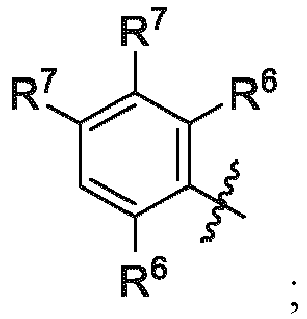
- (i) each R6 is independently C1-C6 alkyl, and each R7 is independently C1-C6 alkyl optionally substituted with one or more halo;
- (ii) each R6 is independently C1-C6 alkyl and each R7 is independently C1-C6 alkyl;
- (iii)each R6 is independently C1-C6 alkyl, and each R7 is independently C1-C6 alkyl substituted with one or more halo;
- (iv)each R6 is independently C1-C6 alkyl, and each R7 is independently C3-C7 cycloalkyl;
- (v) each R6 is independently C1-C6 alkyl, and each R' is independently halo;
- (vi)each R6 is independently C1-C6 alkyl, and R7 is cyano;
- (vii) each R6 is independently C3-C7 cycloalkyl, and each R7 is independently C3-C7 cycloalkyl;
- (viii) each R6 is independently C3-C7 cycloalkyl, and each R7 is independently halo;
- (ix)each R6 is independently cyclopropyl and each R7 is independently halo;
- (x) each R6 is independently C1-C6 alkyl, and each R7 is independently C1-C6 alkoxy optionally substituted with one or more halo;
- (xi)each R6 is independently C1-C6 alkyl, and each R7 is independently C1-C6 alkoxy;
- (xii) each R6 is independently C1-C6 alkyl, and each R7 is independently C1-C6 alkoxy substituted with one or more halo;
- (xiii) each R6 is independently halo, and each R7 is independently C1-C6 haloalkyl;
- (xiv) each R6 is independently halo, and each R7 is independently C1-C6 haloalkoxy;
- (xv) each R6 is independently C1-C6 alkoxy; and each R7 is independently halo;
- (xvi) each R6 is independently C1-C6 alkoxy; and R7 is chloro;
- (xvii) each R7 is independently C1-C6 alkyl, and each R6 is independently C1-C6 alkyl optionally substituted with one or more halo;
- (xviii) each R7 is independently C1-C6 alkyl, and each R6 is independently C1-C6 alkyl substituted with one or more halo;
- (xix) each R7 is independently C1-C6 alkyl, and each R6 is independently C3-C7 cycloalkyl;
- (xx) each R7 is independently C1-C6 alkyl, and each R6 is independently halo;
- (xxi) each R7 is independently C1-C6 alkyl and each R6 is independently halo;
- (xxii) each R7 is independently C1-C6 alkyl, and R6 is cyano;
- (xxiii) each R7 is independently C3-C7 cycloalkyl, and each R6 is independently C3-C7 cycloalkyl;
- (xxiv) each R7 is independently C3-C7 cycloalkyl, and each R6 is independently halo;
- (xxv) each R7 is independently C3-C7 cycloalkyl and each R6 is independently halo;
- (xxvi) each R7 is independently C1-C6 alkyl, and each R6 is independently C1-C6 alkoxy optionally substituted with one or more halo;
- (xxvii) each R7 is independently C1-C6 alkyl, and each R6 is independently C1-C6 alkoxy;
- (xxviii) each R7 is independently C1-C6 alkyl, and each R6 is independently C1-C6 alkoxy substituted with one or more halo;
- (xxix) each R7 is independently halo, and each R6 is independently C1-C6 haloalkyl;
- (xxx) each R7 is independently halo, and each R6 is independently C1-C6 haloalkoxy;
- (xxxi) each R7 is independently C1-C6 alkoxy; and each R6 is independently halo; or
- (xxxii) each R7 is independently C1-C6 alkoxy; and R6 is chloro.
- In some embodiments of the compound of formula AA,
the substituted ring B is
- (i) each R6 is isopropyl; and each R7 is methyl;
- (ii) each R6 is isopropyl; and each R7 is isopropyl;
- (iii)each R6 is isopropyl; and each R7 is trifluoromethyl;
- (iv)each R6 is isopropyl; and each R7 is cyclopropyl;
- (v) each R6 is isopropyl; and each R7 is chloro;
- (vi)each R6 is isopropyl; and each R7 is fluoro;
- (vii) each R6 is ethyl; and each R7 is fluoro;
- (viii) each R6 is isopropyl; and each R7 is cyano;
- (ix)each R6 is cyclopropyl; and each R7 is cyclopropyl;
- (x) each R6 is cyclopropyl; and each R7 is chloro;
- (xi)each R6 is cyclopropyl; and each R7 is fluoro;
- (xii) each R6 is isopropyl; and each R7 is methoxy;
- (xiii) each R6 is isopropyl; and each R7 is trifluoromethoxy;
- (xiv) each R6 is chloro; and each R7 is trifluoromethyl;
- (xv) each R6 is chloro; and each R7 is trifluoromethoxy;
- (xvi) each R7 is isopropyl; and each R6 is methyl;
- (xvii) each R7 is isopropyl; and each R6 is trifluoromethyl;
- (xviii) each R7 is isopropyl; and each R6 is cyclopropyl;
- (xix) each R7 is isopropyl; and each R6 is chloro;
- (xx) each R7 is ethyl; and each R6 is fluoro;
- (xxi) each R7 is isopropyl; and each R6 is cyano;
- (xxii) each R7 is cyclopropyl; and each R6 is cyclopropyl;
- (xxiii) each R7 is cyclopropyl; and each R6 is chloro;
- (xxiv) each R7 is cyclopropyl; and each R6 is fluoro;
- (xxv) each R7 is isopropyl; and each R6 is methoxy;
- (xxvi) each R7 is isopropyl; and each R6 is trifluoromethoxy;
- (xxvii) each R7 is chloro; and each R6 is trifluoromethyl;
- (xxviii) each R7 is chloro; and each R6 is trifluoromethoxy;
- (xxix) one R6 is isopropyl; the other R6 is trifluoromethyl; and R7 is chloro; or
- (xxx) R6 is isopropyl; one R7 is fluoro; and the other R7 is cyano.
- In some embodiments, of the compound of formula AA,
the substituted ring B is
- each R6 is independently C1-C6 alkyl, and each R7 is independently C1-C6 alkyl optionally substituted with one or more halo;
- each R6 is independently C1-C6 alkyl and each R7 is independently C1-C6 alkyl;
- each R6 is independently C1-C6 alkyl, and each R7 is independently C1-C6 alkyl substituted with one or more halo;
- each R6 is independently C1-C6 alkyl, and each R7 is independently C3-C7 cycloalkyl;
- each R6 is independently C1-C6 alkyl, and each R7 is independently halo;
- each R6 is independently C1-C6 alkyl, and each R7 is cyano;
- each R6 is independently C3-C7 cycloalkyl, and each R7 is independently C3-C7 cycloalkyl;
- each R6 is independently C3-C7 cycloalkyl, and each R7 is independently halo;
- each R6 is independently cyclopropyl and each R7 is independently halo;
- each R6 is independently C1-C6 alkyl, and each R7 is independently C1-C6 alkoxy optionally substituted with one or more halo;
- each R6 is independently C1-C6 alkyl, and each R7 is independently C1-C6 alkoxy;
- each R6 is independently C1-C6 alkyl, and each R7 is independently C1-C6 alkoxy substituted with one or more halo;
- each R6 is independently halo, and each R7 is independently C1-C6 haloalkyl;
- each R6 is independently halo, and each R7 is independently C1-C6 haloalkoxy;
- each R6 is independently C1-C6 alkoxy; and each R7 is independently halo;
- each R6 is independently C1-C6 alkoxy; and each R7 is chloro;
- each R7 is independently C1-C6 alkyl, and each R6 is independently C1-C6 alkyl optionally substituted with one or more halo;
- each R7 is independently C1-C6 alkyl, and each R6 is independently C1-C6 alkyl substituted with one or more halo;
- each R7 is independently C1-C6 alkyl, and each R6 is independently C3-C7 cycloalkyl;
- each R7 is independently C1-C6 alkyl, and each R6 is independently halo;
- each R7 is independently C1-C6 alkyl and each R6 is independently halo;
- each R7 is independently C1-C6 alkyl, and each R6 is cyano;
- each R7 is independently C3-C7 cycloalkyl, and each R6 is independently C3-C7 cycloalkyl;
- each R7 is independently C3-C7 cycloalkyl, and each R6 is independently halo;
- each R7 is independently C3-C7 cycloalkyl and each R6 is independently halo;
- each R7 is independently C1-C6 alkyl, and each R6 is independently C1-C6 alkoxy optionally substituted with one or more halo;
- each R7 is independently C1-C6 alkyl, and each R6 is independently C1-C6 alkoxy;
- each R7 is independently C1-C6 alkyl, and each R6 is independently C1-C6 alkoxy substituted with one or more halo;
- each R7 is independently halo, and each R6 is independently C1-C6 haloalkyl;
- each R7 is independently halo, and each R6 is independently C1-C6 haloalkoxy;
- each R7 is independently C1-C6 alkoxy; and each R6 is independently halo;
- each R7 is independently C1-C6 alkoxy; and each R6 is chloro;
- R6 and R7 on adjacent atoms taken together with the atoms connecting them form a C4-C6 aliphatic carbocyclic ring optionally substituted with one or more hydroxy, oxo, or C1-C6 alkyl; and one R6 is halo or cyano; or
- R6 and R7 on adjacent atoms taken together with the atoms connecting them form a 5-to-6-membered heterocyclic ring containing 1 heteroatom independently selected from O, N, and S, wherein the heterocyclic ring optionally substituted with one or more hydroxy, oxo, or Ci-C6 alkyl; and one R6 is halo or cyano.
- In some embodiments, of the compound of formula AA,
the substituted ring B is
- each R6 is isopropyl; and each R7 is methyl;
- each R6 is isopropyl; and each R7 is isopropyl;
- each R6 is isopropyl; and each R7 is trifluoromethyl;
- each R6 is isopropyl; and each R7 is cyclopropyl;
- each R6 is isopropyl; and each R7 is chloro;
- each R6 is isopropyl; and each R7 is fluoro;
- each R6 is ethyl; and each R7 is fluoro;
- each R6 is isopropyl; and each R7 is cyano;
- each R6 is cyclopropyl; and each R7 is cyclopropyl;
- each R6 is cyclopropyl; and each R7 is chloro;
- each R6 is cyclopropyl; and each R7 is fluoro;
- each R6 is isopropyl; and each R7 is methoxy;
- each R6 is isopropyl; and each R7 is trifluoromethoxy;
- each R6 is chloro; and each R7 is trifluoromethyl;
- each R6 is chloro; and each R7 is trifluoromethoxy;
- each R7 is isopropyl; and each R6 is methyl;
- each R7 is isopropyl; and each R6 is trifluoromethyl;
- each R7 is isopropyl; and each R6 is cyclopropyl;
- each R7 is isopropyl; and each R6 is chloro;
- each R7 is ethyl; and each R6 is fluoro;
- each R7 is isopropyl; and each R6 is cyano;
- each R7 is cyclopropyl; and each R6 is cyclopropyl;
- each R7 is cyclopropyl; and each R6 is chloro;
- each R7 is cyclopropyl; and each R6 is fluoro;
- each R7 is isopropyl; and each R6 is methoxy;
- each R7 is isopropyl; and each R6 is trifluoromethoxy;
- each R7 is chloro; and each R6 is trifluoromethyl;
- each R7 is chloro; and each R6 is trifluoromethoxy;
- one R6 is isopropyl; the other R6 is trifluoromethyl; and each R7 is chloro;
- each R6 is isopropyl; one R7 is fluoro; and the other R7 is cyano;
- R6 and R7 on adjacent atoms taken together with the atoms connecting them form a C4 aliphatic carbocyclic ring; and one R6 is chloro, fluoro, or cyano;
- R6 and R7 on adjacent atoms taken together with the atoms connecting them form a Cs aliphatic carbocyclic ring; and one R6 is chloro, fluoro, or cyano;
- R6 and R7 on adjacent atoms taken together with the atoms connecting them form a C6 aliphatic carbocyclic ring; and one R6 is chloro, fluoro, or cyano;
- R6 and R7 on adjacent atoms taken together with the atoms connecting them form a 5-membered heterocyclic ring containing 1 heteroatoms independently selected from O, N, and S; and one R6 is chloro, fluoro, or cyano;
- R6 and R7 on adjacent atoms taken together with the atoms connecting them form a 6-membered heterocyclic ring containing 1 heteroatoms independently selected from O, N, and S; and one R6 is chloro, fluoro, or cyano; or
- R6 and R7 on adjacent atoms taken together with the atoms connecting them form a C5 aliphatic carbocyclic ring; and one R6 is chloro, fluoro, or cyano.
- In some embodiments, of the compound of formula AA,
the substituted ring B is
- (i) each R6 is independently C1-C6 alkyl, and each R7 is independently C1-C6 alkyl optionally substituted with one or more halo;
- (ii) each R6 is independently C1-C6 alkyl and each R7 is independently C1-C6 alkyl;
- (iii)each R6 is independently C1-C6 alkyl, and each R7 is independently C1-C6 alkyl substituted with one or more halo;
- (iv)each R6 is independently C1-C6 alkyl, and each R7 is independently C3-C7 cycloalkyl;
- (v) each R6 is independently C1-C6 alkyl, and each R7 is independently halo;
- (vi)each R6 is independently C1-C6 alkyl, and R7 is cyano;
- (vii) each R6 is independently C3-C7 cycloalkyl, and each R7 is independently C3-C7 cycloalkyl;
- (viii) each R6 is independently C3-C7 cycloalkyl, and each R7 is independently halo;
- (ix)each R6 is independently cyclopropyl and each R7 is independently halo;
- (x) each R6 is independently C1-C6 alkyl, and each R7 is independently C1-C6 alkoxy optionally substituted with one or more halo;
- (xi)each R6 is independently C1-C6 alkyl, and each R7 is independently C1-C6 alkoxy;
- (xii) each R6 is independently C1-C6 alkyl, and each R7 is independently C1-C6 alkoxy substituted with one or more halo;
- (xiii) each R6 is independently halo, and each R7 is independently C1-C6 haloalkyl;
- (xiv) each R6 is independently halo, and each R7 is independently C1-C6 haloalkoxy;
- (xv) each R6 is independently C1-C6 alkoxy; and each R7 is independently halo;
- (xvi) each R6 is independently C1-C6 alkoxy; and R7 is chloro;
- (xvii) each R7 is independently C1-C6 alkyl, and each R6 is independently C1-C6 alkyl optionally substituted with one or more halo;
- (xviii) each R7 is independently C1-C6 alkyl, and each R6 is independently C1-C6 alkyl substituted with one or more halo;
- (xix) each R7 is independently C1-C6 alkyl, and each R6 is independently C3-C7 cycloalkyl;
- (xx) each R7 is independently C1-C6 alkyl, and each R6 is independently halo;
- (xxi) each R7 is independently C1-C6 alkyl and each R6 is independently halo;
- (xxii) each R7 is independently C1-C6 alkyl, and R6 is cyano;
- (xxiii) each R7 is independently C3-C7 cycloalkyl, and each R6 is independently C3-C7 cycloalkyl;
- (xxiv) each R7 is independently C3-C7 cycloalkyl, and each R6 is independently halo;
- (xxv) each R7 is independently C3-C7 cycloalkyl and each R6 is independently halo;
- (xxvi) each R7 is independently C1-C6 alkyl, and each R6 is independently C1-C6 alkoxy optionally substituted with one or more halo;
- (xxvii) each R7 is independently C1-C6 alkyl, and each R6 is independently C1-C6 alkoxy;
- (xxviii) each R7 is independently C1-C6 alkyl, and each R6 is independently C1-C6 alkoxy substituted with one or more halo;
- (xxix) each R7 is independently halo, and each R6 is independently C1-C6 haloalkyl;
- (xxx) each R7 is independently halo, and each R6 is independently C1-C6 haloalkoxy;
- (xxxi) each R7 is independently C1-C6 alkoxy; and each R6 is independently halo; or
- (xxxii) each R7 is independently C1-C6 alkoxy; and R6 is chloro.
- In some embodiments, of the compound of formula AA,
the substituted ring B is
- (i) each R6 is isopropyl; and each R7 is methyl;
- (ii) each R6 is isopropyl; and each R7 is isopropyl;
- (iii)each R6 is isopropyl; and each R7 is trifluoromethyl;
- (iv)each R6 is isopropyl; and each R7 is cyclopropyl;
- (v) each R6 is isopropyl; and each R7 is chloro;
- (vi)each R6 is isopropyl; and each R7 is fluoro;
- (vii) each R6 is ethyl; and each R7 is fluoro;
- (viii) each R6 is isopropyl; and each R7 is cyano;
- (ix)each R6 is cyclopropyl; and each R7 is cyclopropyl;
- (x) each R6 is cyclopropyl; and each R7 is chloro;
- (xi)each R6 is cyclopropyl; and each R7 is fluoro;
- (xii) each R6 is isopropyl; and each R7 is methoxy;
- (xiii) each R6 is isopropyl; and each R7 is trifluoromethoxy;
- (xiv) each R6 is chloro; and each R7 is trifluoromethyl;
- (xv) each R6 is chloro; and each R7 is trifluoromethoxy;
- (xvi) each R7 is isopropyl; and each R6 is methyl;
- (xvii) each R7 is isopropyl; and each R6 is trifluoromethyl;
- (xviii) each R7 is isopropyl; and each R6 is cyclopropyl;
- (xix) each R7 is isopropyl; and each R6 is chloro;
- (xx) each R7 is ethyl; and each R6 is fluoro;
- (xxi) each R7 is isopropyl; and each R6 is cyano;
- (xxii) each R7 is cyclopropyl; and each R6 is cyclopropyl;
- (xxiii) each R7 is cyclopropyl; and each R6 is chloro;
- (xxiv) each R7 is cyclopropyl; and each R6 is fluoro;
- (xxv) each R7 is isopropyl; and each R6 is methoxy;
- (xxvi) each R7 is isopropyl; and each R6 is trifluoromethoxy;
- (xxvii) each R7 is chloro; and each R6 is trifluoromethyl;
- (xxviii) each R7 is chloro; and each R6 is trifluoromethoxy;
- (xxix) one R6 is isopropyl; the other R6 is trifluoromethyl; and each R7 is chloro; or
- (xxx) each R6 is isopropyl; one R7 is fluoro; and the other R7 is cyano.
- In some embodiments, of the compound of formula AA,
the substituted ring B is
- (i) each R6 is independently C1-C6 alkyl, and each R7 is independently C1-C6 alkyl optionally substituted with one or more halo;
- (ii) each R6 is independently C1-C6 alkyl and each R7 is independently C1-C6 alkyl;
- (iii)each R6 is independently C1-C6 alkyl, and each R7 is independently C1-C6 alkyl substituted with one or more halo;
- (iv)each R6 is independently C1-C6 alkyl, and each R7 is independently C3-C7 cycloalkyl;
- (v) each R6 is independently C1-C6 alkyl, and each R7 is independently halo;
- (vi)each R6 is independently C1-C6 alkyl, and R7 is cyano;
- (vii) each R6 is independently C3-C7 cycloalkyl, and each R7 is independently C3-C7 cycloalkyl;
- (viii) each R6 is independently C3-C7 cycloalkyl, and each R7 is independently halo;
- (ix)each R6 is independently cyclopropyl and each R7 is independently halo;
- (x) each R6 is independently C1-C6 alkyl, and each R7 is independently C1-C6 alkoxy optionally substituted with one or more halo;
- (xi)each R6 is independently C1-C6 alkyl, and each R7 is independently C1-C6 alkoxy;
- (xii) each R6 is independently C1-C6 alkyl, and each R7 is independently C1-C6 alkoxy substituted with one or more halo;
- (xiii) each R6 is independently halo, and each R7 is independently C1-C6 haloalkyl;
- (xiv) each R6 is independently halo, and each R7 is independently C1-C6 haloalkoxy;
- (xv) each R6 is independently C1-C6 alkoxy; and each R7 is independently halo;
- (xvi) each R6 is independently C1-C6 alkoxy; and R7 is chloro;
- (xvii) each R7 is independently C1-C6 alkyl, and each R6 is independently C1-C6 alkyl optionally substituted with one or more halo;
- (xviii) each R7 is independently C1-C6 alkyl, and each R6 is independently C1-C6 alkyl substituted with one or more halo;
- (xix) each R7 is independently C1-C6 alkyl, and each R6 is independently C3-C7 cycloalkyl;
- (xx) each R7 is independently C1-C6 alkyl, and each R6 is independently halo;
- (xxi) each R7 is independently C1-C6 alkyl and each R6 is independently halo;
- (xxii) each R7 is independently C1-C6 alkyl, and R6 is cyano;
- (xxiii) each R7 is independently C3-C7 cycloalkyl, and each R6 is independently C3-C7 cycloalkyl;
- (xxiv) each R7 is independently C3-C7 cycloalkyl, and each R6 is independently halo;
- (xxv) each R7 is independently C3-C7 cycloalkyl and each R6 is independently halo;
- (xxvi) each R7 is independently C1-C6 alkyl, and each R6 is independently C1-C6 alkoxy optionally substituted with one or more halo;
- (xxvii) each R7 is independently C1-C6 alkyl, and each R6 is independently C1-C6 alkoxy;
- (xxviii) each R7 is independently C1-C6 alkyl, and each R6 is independently C1-C6 alkoxy substituted with one or more halo;
- (xxix) each R7 is independently halo, and each R6 is independently C1-C6 haloalkyl;
- (xxx) each R7 is independently halo, and each R6 is independently C1-C6 haloalkoxy;
- (xxxi) each R7 is independently C1-C6 alkoxy; and each R6 is independently halo;
- (xxxvi)each R7 is independently C1-C6 alkoxy; and R6 is chloro;
- (xxxvii) two pairs, each of one R6 and one R7, are on adjacent atoms, and each pair of one R6 and one R7 taken together with the atoms connecting them form a C4-C6 aliphatic carbocyclic ring optionally substituted with one or more hydroxy, oxo, or C1-C6 alkyl;
- (xxxii) two pairs, each of one R6 and one R7, are on adjacent atoms, and each pair of one R6 and one R7 taken together with the atoms connecting them form a 5-to-6-membered heterocyclic ring containing 1 heteroatom independently selected from O, N, and S, wherein the heterocyclic ring optionally substituted with one or more hydroxy, oxo, or C1-C6 alkyl; or
- (xxxiii) two pairs, each of one R6 and one R7, are on adjacent atoms, one pair of one R6 and one R7 taken together with the atoms connecting them form a C4-C6 aliphatic carbocyclic ring optionally substituted with one or more hydroxy, oxo, or C1-C6 alkyl, and the other pair of one R6 and one R7 taken together with the atoms connecting them form a 5-to-6-membered heterocyclic ring containing 1 heteroatom independently selected from O, N, and S, wherein the heterocyclic ring optionally substituted with one or more hydroxy, oxo, or C1-C6 alkyl.
- In some embodiments, of the compound of formula AA,
the substituted ring B is
- (i) each R6 is isopropyl; and each R7 is methyl;
- (ii) each R6 is isopropyl; and each R7 is isopropyl;
- (iii)each R6 is isopropyl; and each R7 is trifluoromethyl;
- (iv)each R6 is isopropyl; and each R7 is cyclopropyl;
- (v) each R6 is isopropyl; and each R7 is chloro;
- (vi)each R6 is isopropyl; and each R7 is fluoro;
- (vii) each R6 is ethyl; and each R7 is fluoro;
- (viii) each R6 is isopropyl; and each R7 is cyano;
- (ix)each R6 is cyclopropyl; and each R7 is cyclopropyl;
- (x) each R6 is cyclopropyl; and each R7 is chloro;
- (xi)each R6 is cyclopropyl; and each R7 is fluoro;
- (xii) each R6 is isopropyl; and each R7 is methoxy;
- (xiii) each R6 is isopropyl; and each R7 is trifluoromethoxy;
- (xiv) each R6 is chloro; and each R7 is trifluoromethyl;
- (xv) each R6 is chloro; and each R7 is trifluoromethoxy;
- (xvi) each R7 is isopropyl; and each R6 is methyl;
- (xvii) each R7 is isopropyl; and each R6 is trifluoromethyl;
- (xviii) each R7 is isopropyl; and each R6 is cyclopropyl;
- (xix) each R7 is isopropyl; and each R6 is chloro;
- (xx) each R7 is ethyl; and each R6 is fluoro;
- (xxi) each R7 is isopropyl; and each R6 is cyano;
- (xxii) each R7 is cyclopropyl; and each R6 is cyclopropyl;
- (xxiii) each R7 is cyclopropyl; and each R6 is chloro;
- (xxiv) each R7 is cyclopropyl; and each R6 is fluoro;
- (xxv) each R7 is isopropyl; and each R6 is methoxy;
- (xxvi) each R7 is isopropyl; and each R6 is trifluoromethoxy;
- (xxvii) R7 is chloro; and each R6 is trifluoromethyl;
- (xxviii) R7 is chloro; and each R6 is trifluoromethoxy;
- (xxix) one R6 is isopropyl; the other R6 is trifluoromethyl; and R7 is chloro;
- (xxx) R6 is isopropyl; one R7 is fluoro; and the other R7 is cyano; two pairs, each of one R6 and one R7, are on adjacent atoms, and each pair of one R6 and one R7 taken together with the atoms connecting them form a C5 aliphatic carbocyclic ring;
- (xxxi) two pairs, each of one R6 and one R7, are on adjacent atoms, and each pair of one R6 and one R7 taken together with the atoms connecting them form a C4 aliphatic carbocyclic ring optionally substituted with one or more hydroxy, oxo, or methyl;
- (xxxii) two pairs, each of one R6 and one R7, are on adjacent atoms, and each pair of one R6 and one R7 taken together with the atoms connecting them form a C5 aliphatic carbocyclic ring optionally substituted with one or more hydroxy, oxo, or methyl;
- (xxxiii) two pairs, each of one R6 and one R7, are on adjacent atoms, and each pair of one R6 and one R7 taken together with the atoms connecting them form a C6 aliphatic carbocyclic ring optionally substituted with one or more hydroxy, oxo, or methyl;
- (xxxiv) two pairs, each of one R6 and one R7, are on adjacent atoms, and each pair of one R6 and one R7 taken together with the atoms connecting them form a 5-membered heterocyclic ring containing 1 heteroatom independently selected from O, N, and S, wherein the heterocyclic ring is optionally substituted with one or more hydroxy, oxo, or methyl
- (xxxv) two pairs, each of one R6 and one R7, are on adjacent atoms, and each pair of one R6 and one R7 taken together with the atoms connecting them form a 6-membered heterocyclic ring containing 1 heteroatom independently selected from O, N, and S, wherein the heterocyclic ring is optionally substituted with one or more hydroxy, oxo, or methyl; or
- (xxxvi) two pairs, each of one R6 and one R7, are on adjacent atoms, one pair of one R6 and one R7 taken together with the atoms connecting them form a 5-membered heterocyclic ring containing 1 heteroatom independently selected from O, N, and S, wherein the heterocyclic ring is optionally substituted with one or more hydroxy, oxo, or methyl, and the other pair of one R6 and one R7 taken together with the atoms connecting them form a Cs aliphatic carbocyclic ring optionally substituted with one or more hydroxy, oxo, or methyl.
- In some embodiments, of the compound of formula AA,
the substituted ring B is
- (i) each R6 is independently C1-C6 alkyl, and R7 is C1-C6 alkyl optionally substituted with one or more halo;
- (ii) each R6 is independently C1-C6 alkyl and R7 is C1-C6 alkyl;
- (iii)each R6 is independently C1-C6 alkyl, and R7 is C1-C6 alkyl substituted with one or more halo;
- (iv)each R6 is independently C1-C6 alkyl, and R7 is C3-C7 cycloalkyl;
- (v) each R6 is independently C1-C6 alkyl, and R7 is halo;
- (vi)each R6 is independently C1-C6 alkyl, and R7 is cyano;
- (vii) each R6 is independently C3-C7 cycloalkyl, and R7 is C3-C7 cycloalkyl;
- (viii) each R6 is independently C3-C7 cycloalkyl, and R7 is halo;
- (ix)each R6 is independently cyclopropyl and R7 is halo;
- (x) each R6 is independently C1-C6 alkyl, and R7 is C1-C6 alkoxy optionally substituted with one or more halo;
- (xi)each R6 is independently C1-C6 alkyl, and R7 is C1-C6 alkoxy;
- (xii) each R6 is independently C1-C6 alkyl, and R7 is C1-C6 alkoxy substituted with one or more halo;
- (xiii) each R6 is independently halo, and R7 is C1-C6 haloalkyl;
- (xiv) each R6 is independently halo, and R7 is C1-C6 haloalkoxy;
- (xv) each R6 is independently C1-C6 alkoxy; and R7 is halo;
- (xvi) each R6 is independently C1-C6 alkoxy; and R7 is chloro;
- (xvii) R7 is C1-C6 alkyl, and each R6 is independently C1-C6 alkyl optionally substituted with one or more halo;
- (xviii) R7 is C1-C6 alkyl, and each R6 is independently C1-C6 alkyl substituted with one or more halo;
- (xix) R7 is C1-C6 alkyl, and each R6 is independently C3-C7 cycloalkyl;
- (xx) R7 is C1-C6 alkyl, and each R6 is independently halo;
- (xxi) R7 is C1-C6 alkyl and each R6 is independently halo;
- (xxii) R7 is C1-C6 alkyl, and R6 is cyano;
- (xxiii) R7 is C3-C7 cycloalkyl, and each R6 is independently C3-C7 cycloalkyl;
- (xxiv) R7 is C3-C7 cycloalkyl, and each R6 is independently halo;
- (xxv) R7 is C3-C7 cycloalkyl and each R6 is independently halo;
- (xxvi) R7 is C1-C6 alkyl, and each R6 is independently C1-C6 alkoxy optionally substituted with one or more halo;
- (xxvii) R7 is C1-C6 alkyl, and each R6 is independently C1-C6 alkoxy;
- (xxviii) R7 is C1-C6 alkyl, and each R6 is independently C1-C6 alkoxy substituted with one or more halo;
- (xxix) R7 is halo, and each R6 is independently C1-C6 haloalkyl;
- (xxx) R7 is halo, and each R6 is independently C1-C6 haloalkoxy;
- (xxxi) R7 is C1-C6 alkoxy; and each R6 is independently halo;
- (xxxii) R7 is C1-C6 alkoxy; and R6 is chloro;
- (xxxiii) two pairs, each of one R6 and one R7, are on adjacent atoms, and each pair of one R6 and one R7 taken together with the atoms connecting them form a C4-C8 aliphatic carbocyclic ring; and one R7 is halo;
- (xxxiv) two pairs, each of one R6 and one R7, are on adjacent atoms, and each pair of one R6 and one R7 taken together with the atoms connecting them form a C4-C8 aliphatic carbocyclic ring; and one R7 is cyano;
- (xxxv) two pairs, each of one R6 and one R7, are on adjacent atoms, and each pair of one R6 and one R7 taken together with the atoms connecting them form a C4-C6 aliphatic carbocyclic ring optionally substituted with one or more hydroxy, oxo, or C1-C6 alkyl; and one R7 is halo or cyano;
- (xxxvi) two pairs, each of one R6 and one R7, are on adjacent atoms, and each pair of one R6 and one R7 taken together with the atoms connecting them form a 5-to-6-membered heterocyclic ring containing 1 heteroatom independently selected from O, N, and S, wherein the heterocyclic ring optionally substituted with one or more hydroxy, oxo, or C1-C6 alkyl; and one R7 is halo or cyano; or
- (xxxvii) two pairs, each of one R6 and one R7, are on adjacent atoms, one pair of one R6 and one R7 taken together with the atoms connecting them form a C4-C6 aliphatic carbocyclic ring optionally substituted with one or more hydroxy, oxo, or C1-C6 alkyl, and the other pair of one R6 and one R7 taken together with the atoms connecting them form a 5-to-6-membered heterocyclic ring containing 1 heteroatom independently selected from O, N, and S, wherein the heterocyclic ring optionally substituted with one or more hydroxy, oxo, or C1-C6 alkyl; and one R7 is halo or cyano.
- In some embodiments, of the compound of formula AA,
the substituted ring B is
- (i) each R6 is isopropyl; and each R7 is methyl;
- (ii) each R6 is isopropyl; and each R7 is isopropyl;
- (iii)each R6 is isopropyl; and each R7 is trifluoromethyl;
- (iv)each R6 is isopropyl; and each R7 is cyclopropyl;
- (v) each R6 is isopropyl; and each R7 is chloro;
- (vi)each R6 is isopropyl; and each R7 is fluoro;
- (vii) each R6 is ethyl; and each R7 is fluoro;
- (viii) each R6 is isopropyl; and each R7 is cyano;
- (ix)each R6 is cyclopropyl; and each R7 is cyclopropyl;
- (x) each R6 is cyclopropyl; and each R7 is chloro;
- (xi)each R6 is cyclopropyl; and each R7 is fluoro;
- (xii) each R6 is isopropyl; and each R7 is methoxy;
- (xiii) each R6 is isopropyl; and each R7 is trifluoromethoxy;
- (xiv) each R6 is chloro; and each R7 is trifluoromethyl;
- (xv) each R6 is chloro; and each R7 is trifluoromethoxy;
- (xvi) each R7 is isopropyl; and each R6 is methyl;
- (xvii) each R7 is isopropyl; and each R6 is trifluoromethyl;
- (xviii) each R7 is isopropyl; and each R6 is cyclopropyl;
- (xix) each R7 is isopropyl; and each R6 is chloro;
- (xx) each R7 is ethyl; and each R6 is fluoro;
- (xxi) each R7 is isopropyl; and each R6 is cyano;
- (xxii) each R7 is cyclopropyl; and each R6 is cyclopropyl;
- (xxiii) each R7 is cyclopropyl; and each R6 is chloro;
- (xxiv) each R7 is cyclopropyl; and each R6 is fluoro;
- (xxv) each R7 is isopropyl; and each R6 is methoxy;
- (xxvi) each R7 is isopropyl; and each R6 is trifluoromethoxy;
- (xxvii) each R7 is chloro; and each R6 is trifluoromethyl;
- (xxviii) each R7 is chloro; and each R6 is trifluoromethoxy;
- (xxix) each R6 is isopropyl; two R7 are fluoro; and one R7 is chloro;
- (xxx) two pairs, each of one R6 and one R7, are on adjacent atoms, and each pair of one R6 and one R7 taken together with the atoms connecting them form a Cs aliphatic carbocyclic ring; and one R7 is chloro;
- (xxxi) two pairs, each of one R6 and one R7, are on adjacent atoms, and each pair of one R6 and one R7 taken together with the atoms connecting them form a Cs aliphatic carbocyclic ring; and one R7 is fluoro;
- (xxxii) two pairs, each of one R6 and one R7, are on adjacent atoms, and each pair of one R6 and one R7 taken together with the atoms connecting them form a C4 aliphatic carbocyclic ring optionally substituted with one or more hydroxy, oxo, or methyl; and one R7 is fluoro or chloro;
- (xxxiii) two pairs, each of one R6 and one R7, are on adjacent atoms, and each pair of one R6 and one R7 taken together with the atoms connecting them form a C5 aliphatic carbocyclic ring optionally substituted with one or more hydroxy, oxo, or methyl; and one R7 is fluoro or chloro;
- (xxxiv) two pairs, each of one R6 and one R7, are on adjacent atoms, and each pair of one R6 and one R7 taken together with the atoms connecting them form a C6 aliphatic carbocyclic ring optionally substituted with one or more hydroxy, oxo, or methyl; and one R7 is fluoro or chloro;
- (xxxv) two pairs, each of one R6 and one R7, are on adjacent atoms, and each pair of one R6 and one R7 taken together with the atoms connecting them form a 5-membered heterocyclic ring containing 1 heteroatom independently selected from O, N, and S, wherein the heterocyclic ring is optionally substituted with one or more hydroxy, oxo, or methyl; and one R7 is fluoro or chloro;
- (xxxvi) two pairs, each of one R6 and one R7, are on adjacent atoms, and each pair of one R6 and one R7 taken together with the atoms connecting them form a 6-membered heterocyclic ring containing 1 heteroatom independently selected from O, N, and S, wherein the heterocyclic ring is optionally substituted with one or more hydroxy, oxo, or methyl; and one R7 is fluoro or chloro; or
- (xxxvii) two pairs, each of one R6 and one R7, are on adjacent atoms, one pair of one R6 and one R7 taken together with the atoms connecting them form a 5-membered heterocyclic ring containing 1 heteroatom independently selected from O, N, and S, wherein the heterocyclic ring is optionally substituted with one or more hydroxy, oxo, or methyl, and the other pair of one R6 and one R7 taken together with the atoms connecting them form a Cs aliphatic carbocyclic ring optionally substituted with one or more hydroxy, oxo, or methyl; and one R7 is fluoro or chloro.
- In some embodiments of the compound of Formula AA (e.g., Formula AA-1, Formula AA-2, Formula AA-3, Formula AA-4, or Formula AA-5), R6 is not CN.
- In some embodiments, the compound of Formula AA is not a compound selected from the group consisting of:


- In some embodiments, the compound of Formula AA is not a compound selected from the group consisting of:

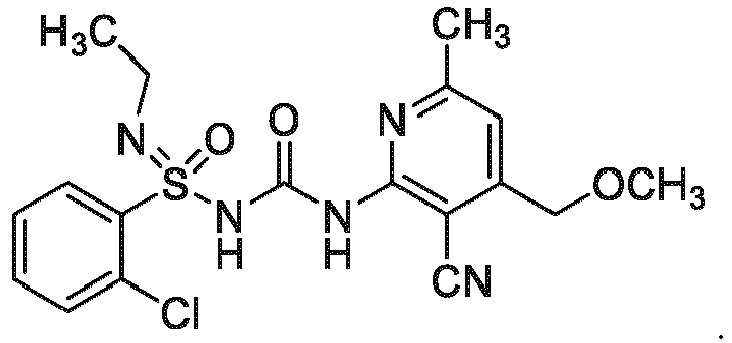
- In some embodiments the compound of any of the formulae herein is not a compound disclosed in
EP 0173498 , which is incorporated herein by reference in its entirety. - In some embodiments the compound of any of the formulae herein is not a compound disclosed in
US 4666506 , which is incorporated herein by reference in its entirety. - It is understood that the combination of variables in the formulae herein is such that the compounds are stable.
- In some embodiments, provided herein is a compound that is selected from the group consisting of the compounds in Table 1:
Table 1. Compound Structure 101' 
101 
102 
103' 
103 
104 
105 
105a 
105b 
106 
106a 
106b 
107 
107a 
107b 
108 
108a 
108b 
109 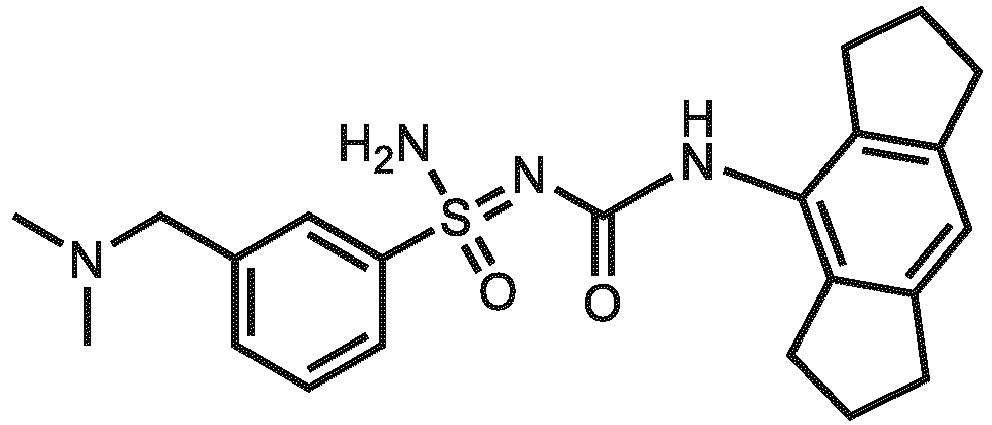
109a 
109b 
110 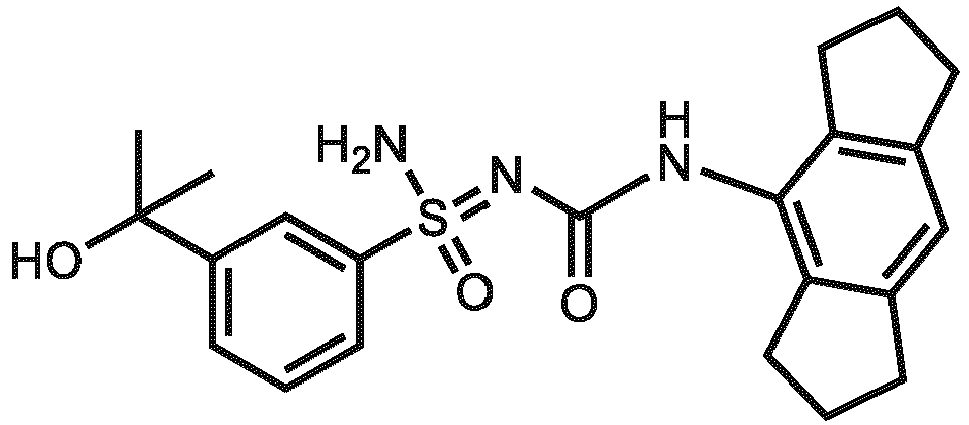
110a 
110b 
111 
112 
112a 
112b 
113 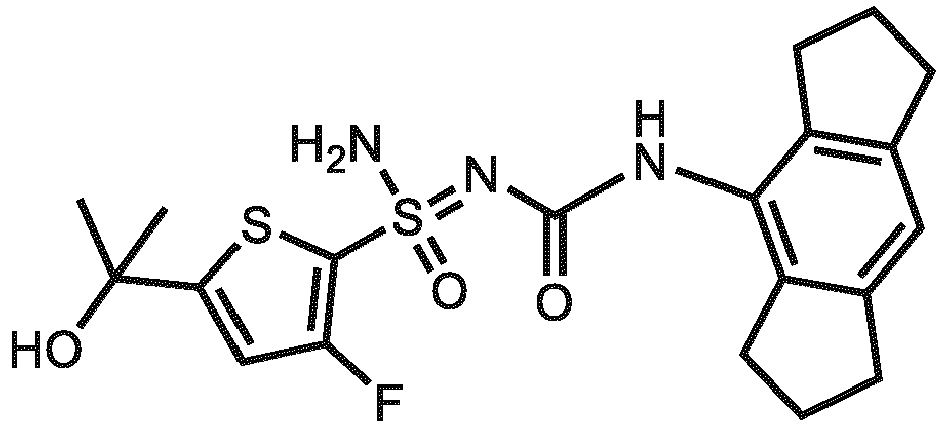
113a 
113b 
114 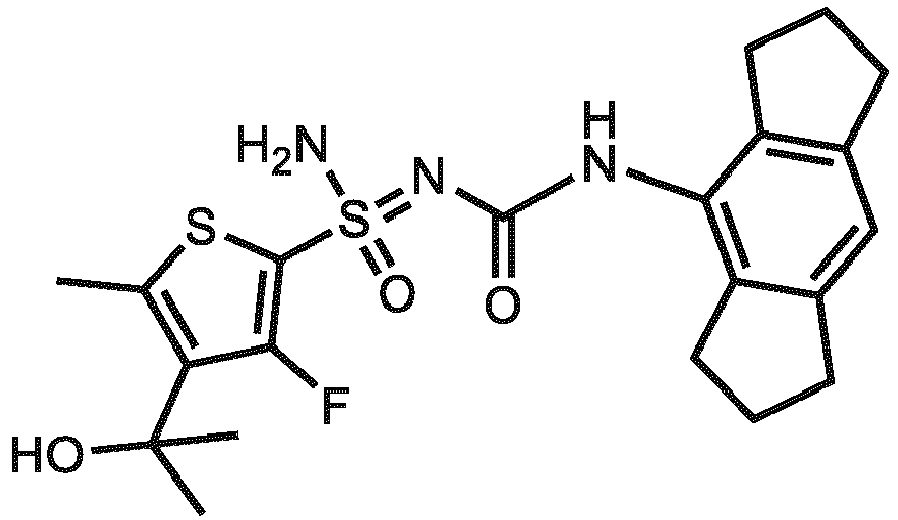
115 
116 
116a 
116b 
117 
118 
119 
120 
120a 
120b 
121 
121a 
121b 
122 
122a 
122b 
123 
124 
125 
125a 
125b 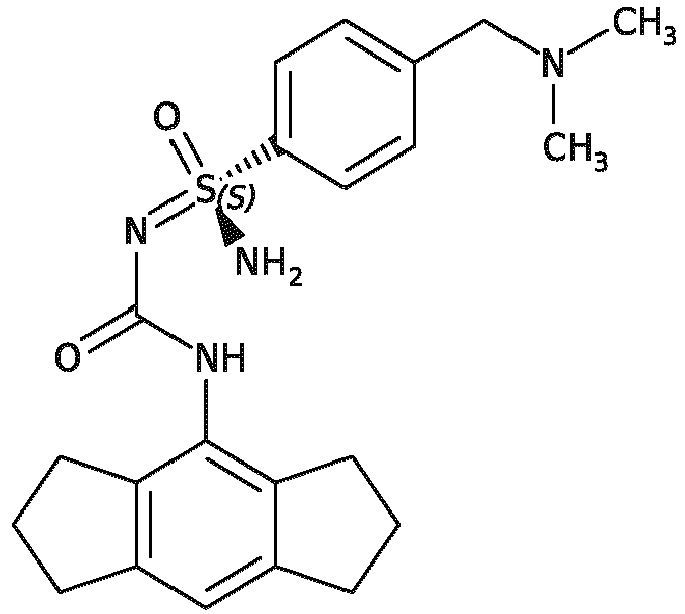
126 
127 
128 
129 
129a 
129b 
130 
130a 
130b 
131 
131a 
131b 
132 
133 
134 
134a 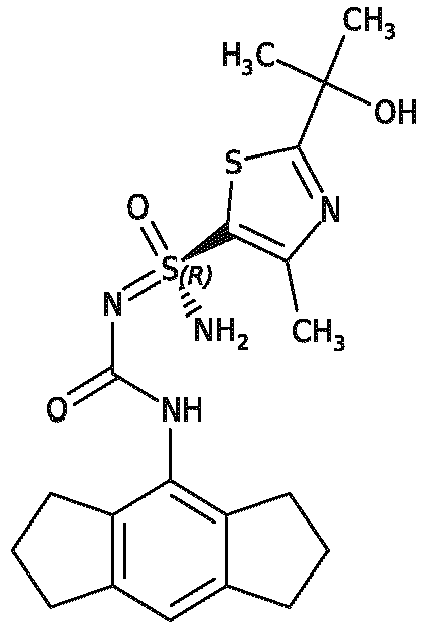
134b 
135 
135a 
135b 
136 
136a 
136b 
137 
137a 
137b 
138 
138a 
138b 
139 
139a 
139b 
140 
141 
142 
143 
143a 
143b 
144 
144a 
144b 
145 
145a 
145b 
146 
147 
148 
148a 
148b 
149 
149a 
149b 
150 
151a' 
151b' 
151 
151a 
151b 
152 
152a 
152b 
153 
153a 
153b 
154 
154a 
154b 
155 
156 
157 
157a 
157b 
158 
158a 
158b 
159 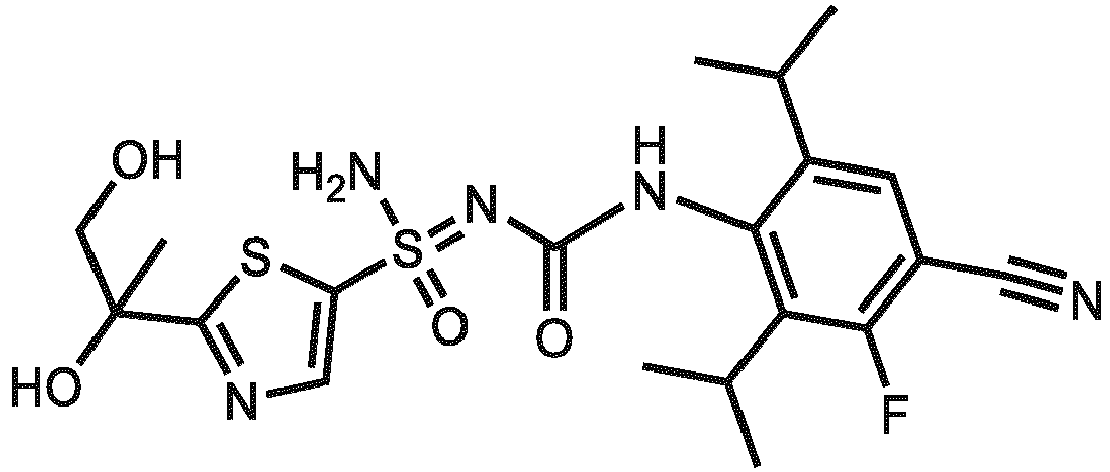
159a 
159ba 
159ab 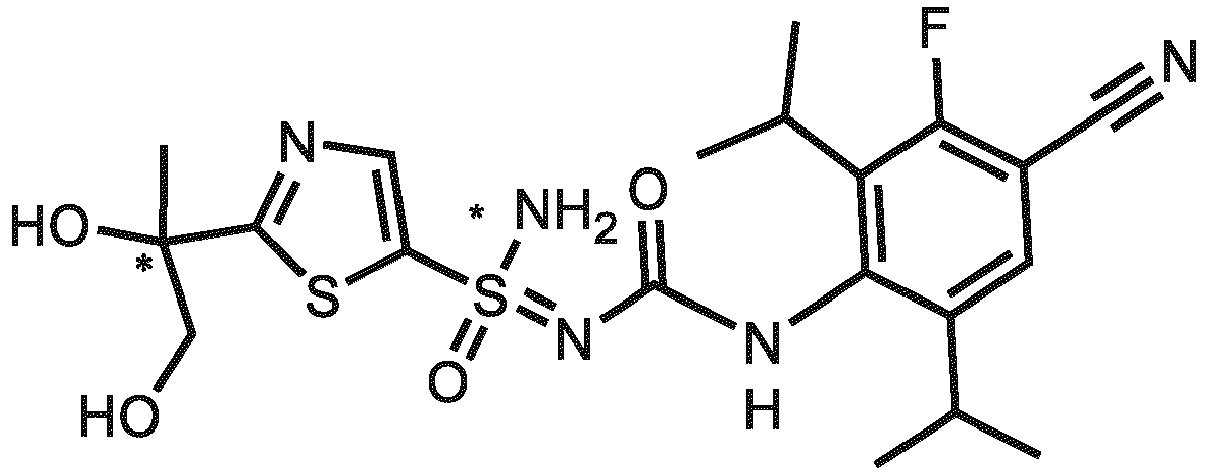
160 
161 
161a 
161b 
162 
163 
164 
165 
165a 
165b 
166 
167 
167a 
167b 
168 
168a 
168b 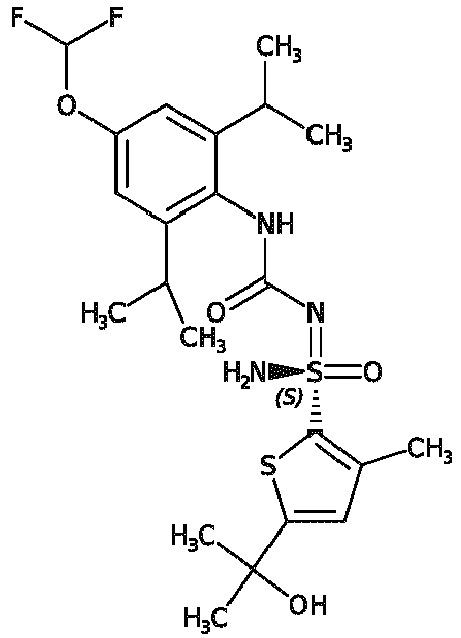
170 
170a 
170b 
171 
171a 
171b 
172 
172a 
172b 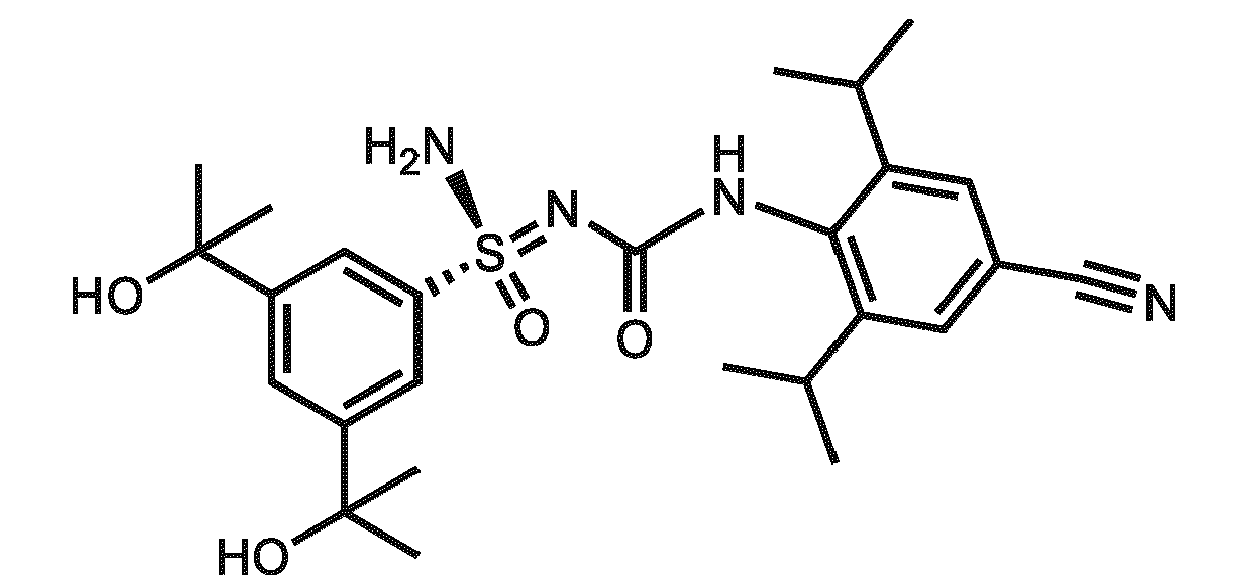
173 
173a 
173b 
174 
174a 
174b 
176 
176a 
176b 
177 
177a 
177b 
178 
178a 
178b 
179 
179a 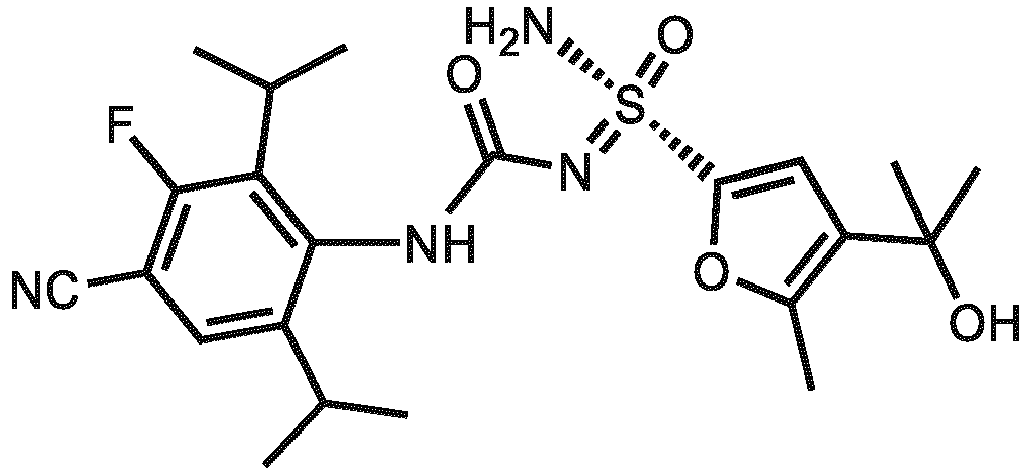
179b 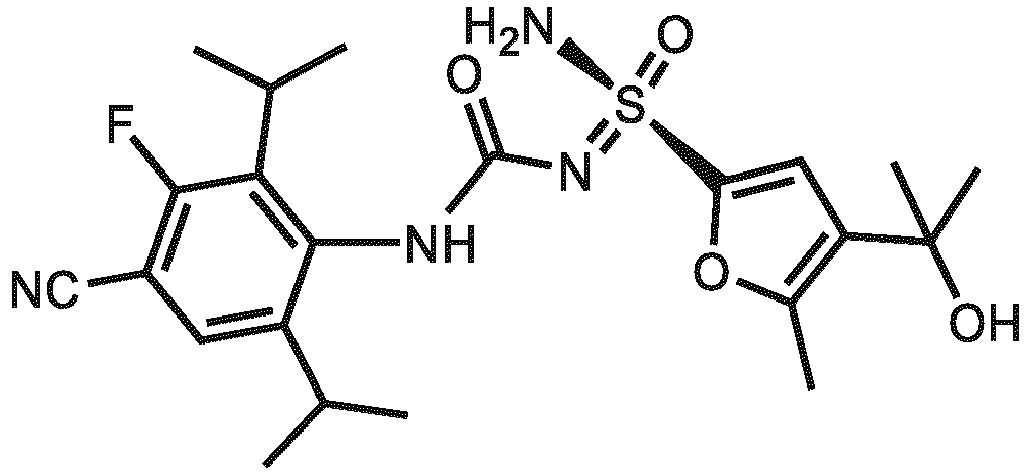
180 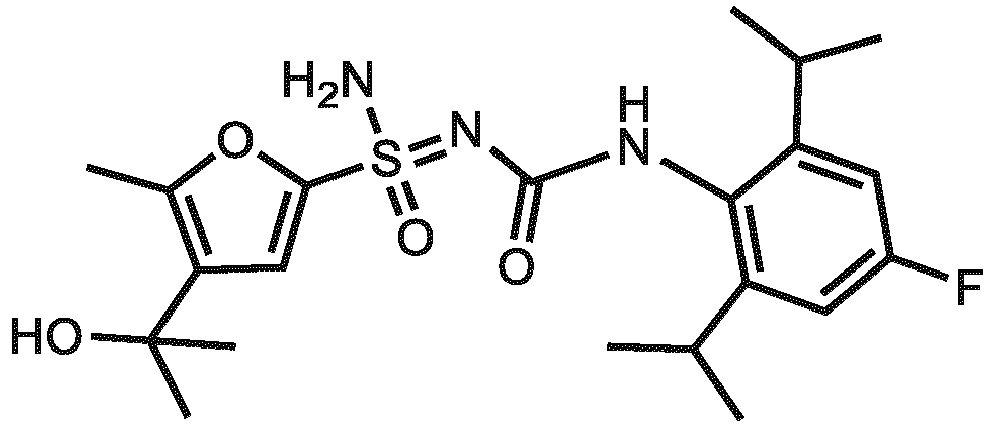
180a 
180b 
181 
181a 
181b 
182 
182a 
182b 
183 
183a 
183b 
184 
185 
185a 
185b 
186 
186a 
186b 
187 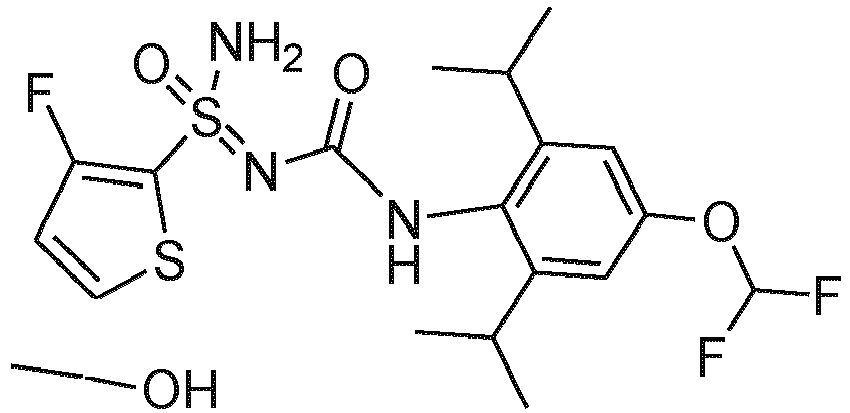
187a 
187b 
188 
188a 
188b 
189 
189a 
189b 
190 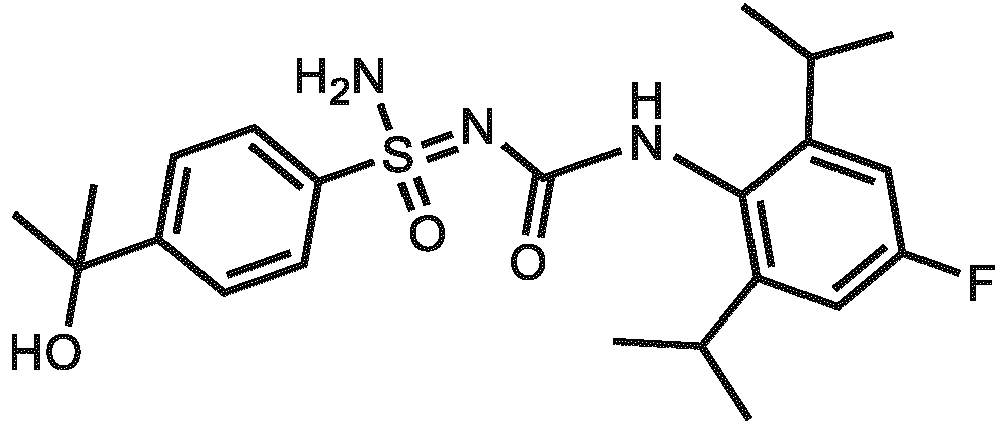
190a 
190b 
191 
191a 
191b 
192 
192a 
192b 
193 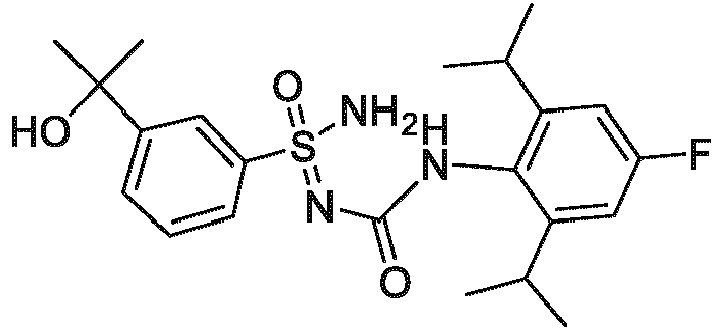
193a 
193b 
194 
195 
195a 
195ba 
195bb 
195e 
196 
197 
198 
199 
200 
201 
202 
202a 
202b 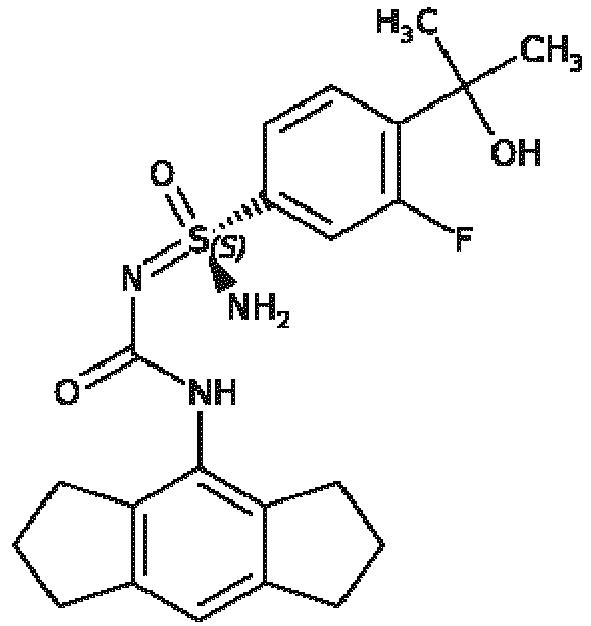
203 
204 
205 
205a 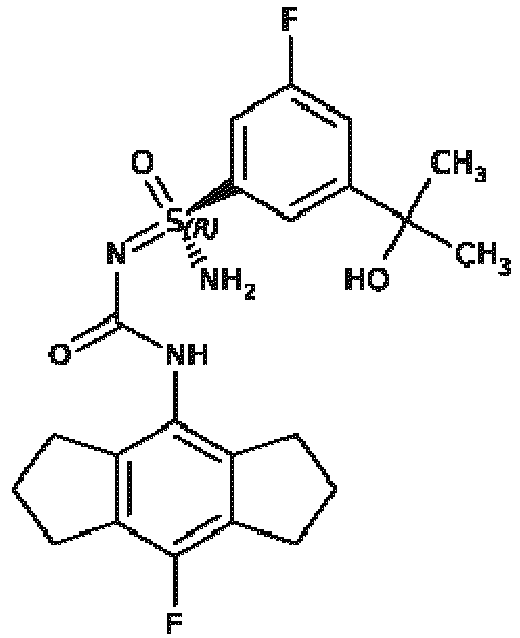
205b 
206 
206a 
206b 
207 
207a 
207b 
207bb 
207aa 
207c 
208 
209 
210 
211 
212 
212a 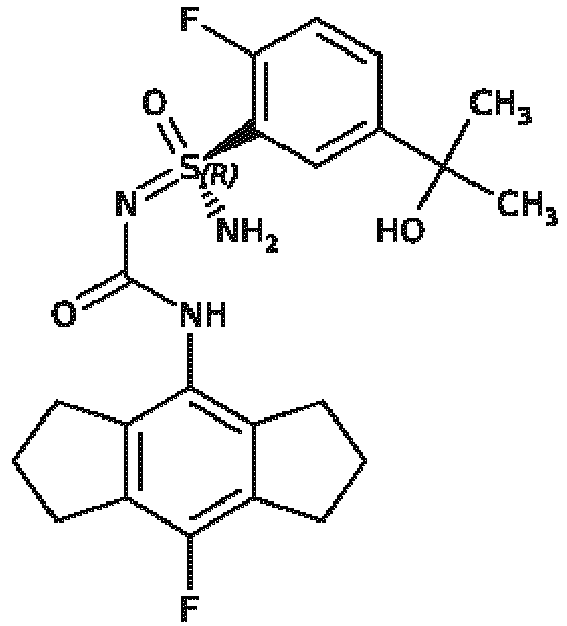
212b 
213 
214 
215 
216 
217 
218 
219 
220 
220a 
220b 
221 
223 
223a 
223b 
225 
225a 
225b 
226 
227 
228 
229 
230 
231 
232 
233 
234 
235 
236 
237 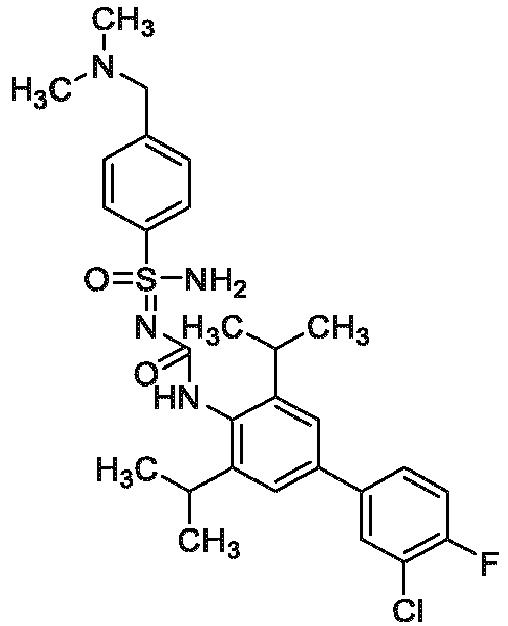
238 
239 
240 
241 
242 
243 
244 
245 
246 
247 
248 
249 
250 
251 
252 
253 
254 
255 
256 
257 
258 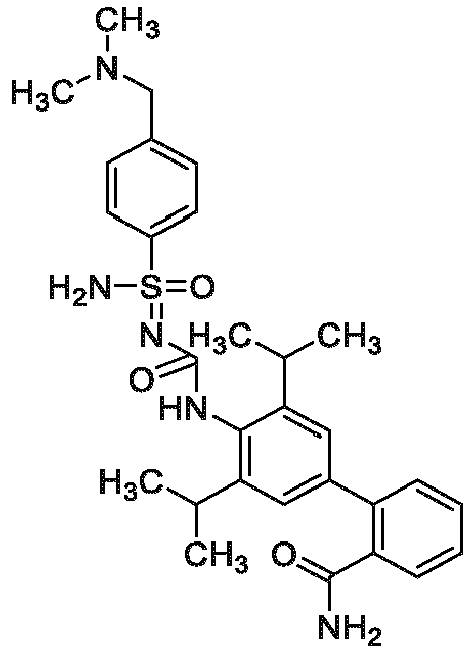
259 
260 
261 
262 
263 
264 
265 
266 
267 
268 
269 
270 
- In some embodiments, provided herein is a compound that is selected from the group consisting of the compounds in the following table:
303 
303a 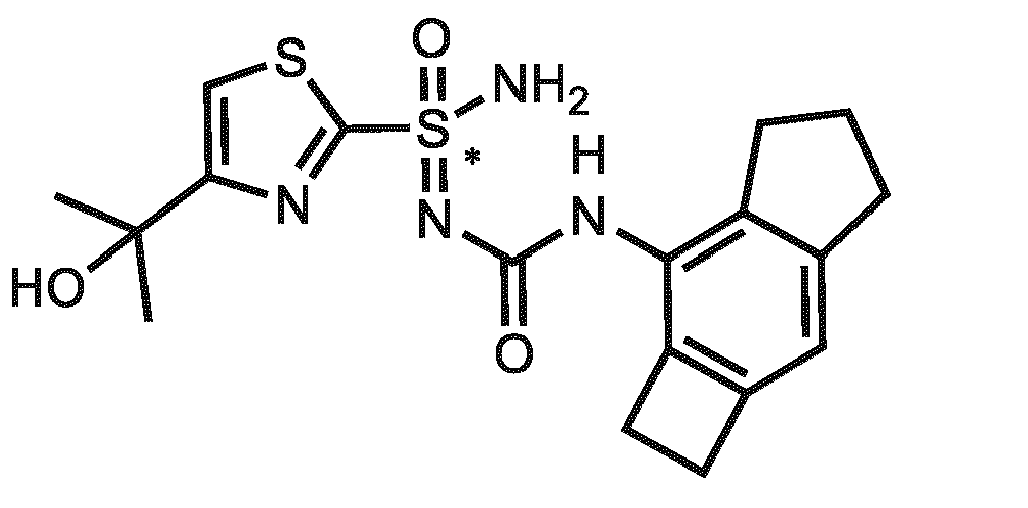
303b 
306 
307 
308 
308a 
308b 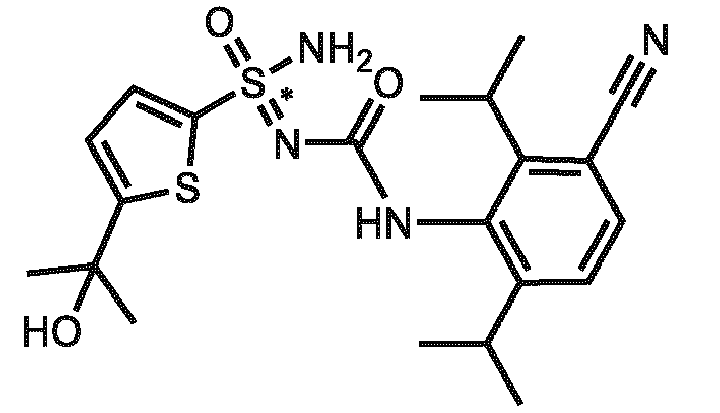
309 
310 
311 
312 
313 
314 
315 
315b 
315a 
316 
316a 
316b 
317 
317ab 
317aa 
317bb 
317ba 
318 
318a 
318b 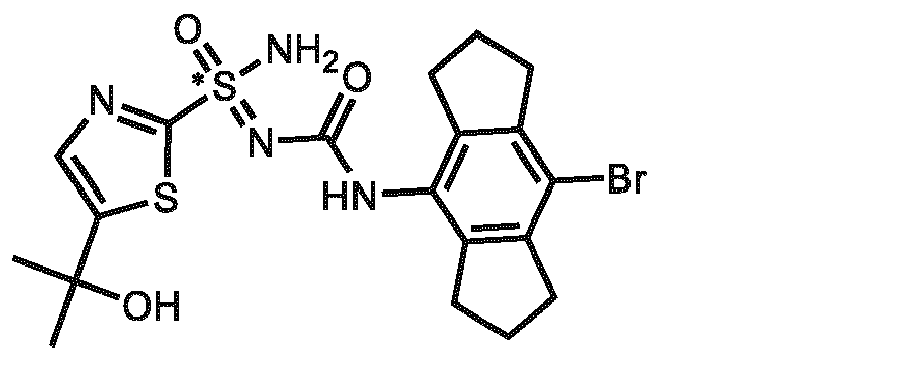
319 
319ab 
319ba 
319aa 
319bb 
320 
320a 
320b 
321 
321b 
321a 
322 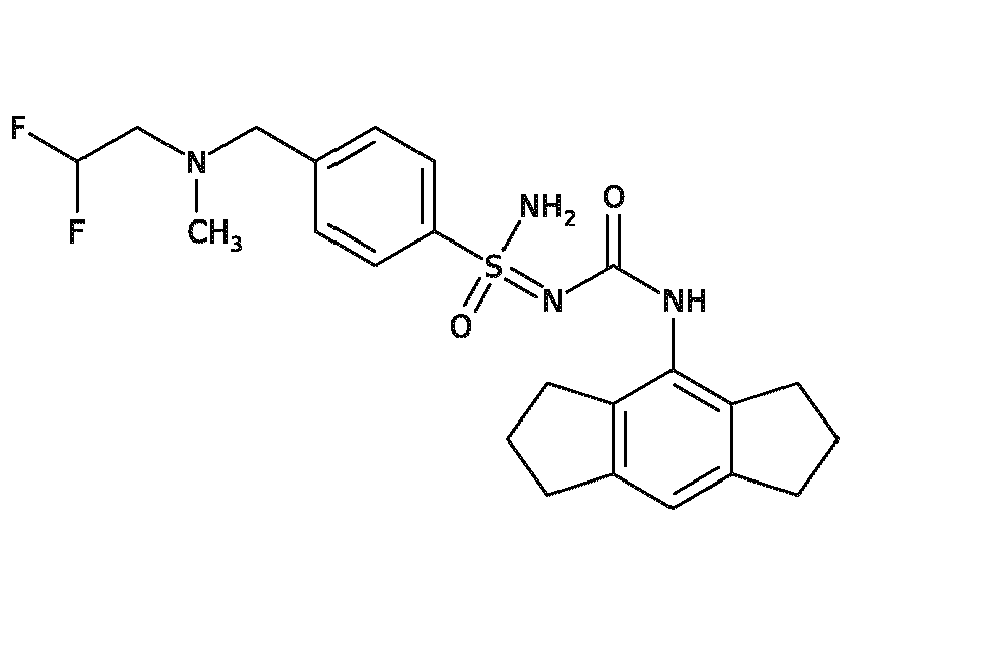
323 
323ab 
323aa 
323bb 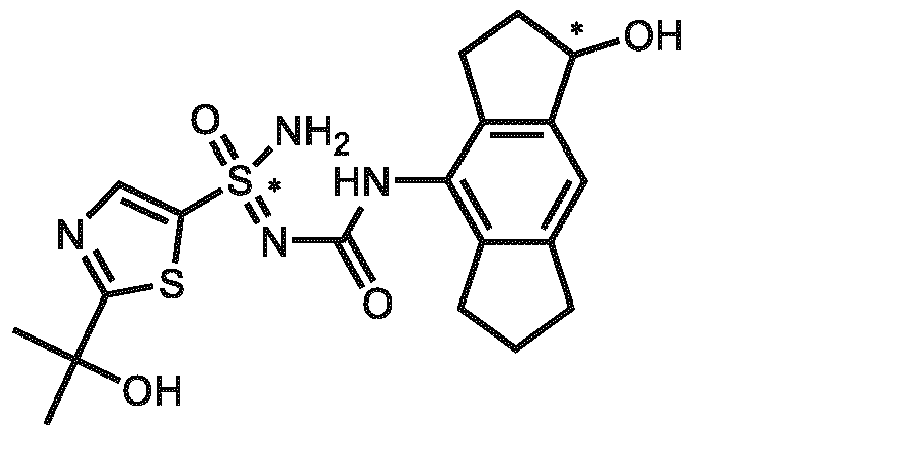
323ba 
324 
325 
325a 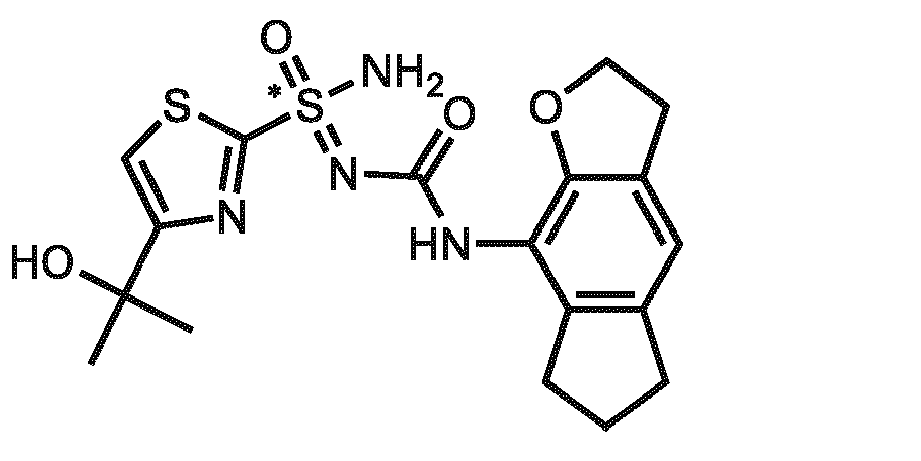
325b 
326 
326b 
326a 
327 
328b 
328a 
329 
329a 
329b 
330 
330a 
330b 
331 
332 
332a 
332b 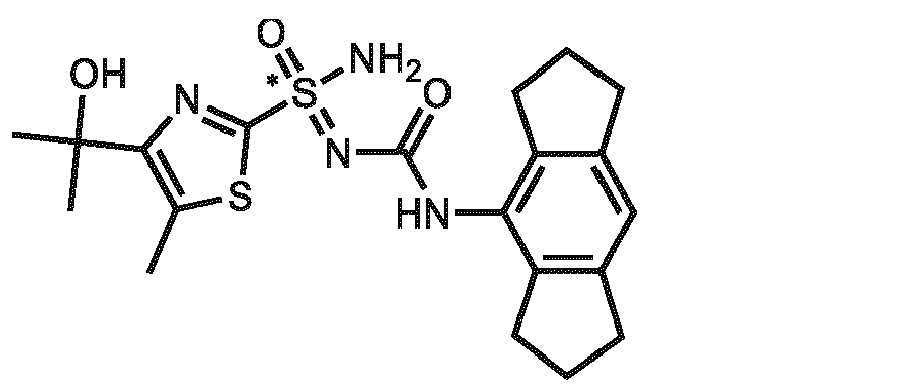
333 
333a 
333b 
334 
334ba 
334bb 
334aa 
334ab 
334b 
334a 
335 
335b 
335a 
336 
336a 
336b 
337 
337a 
337b 
338 
338a 
338b 
339 
339a 
339b 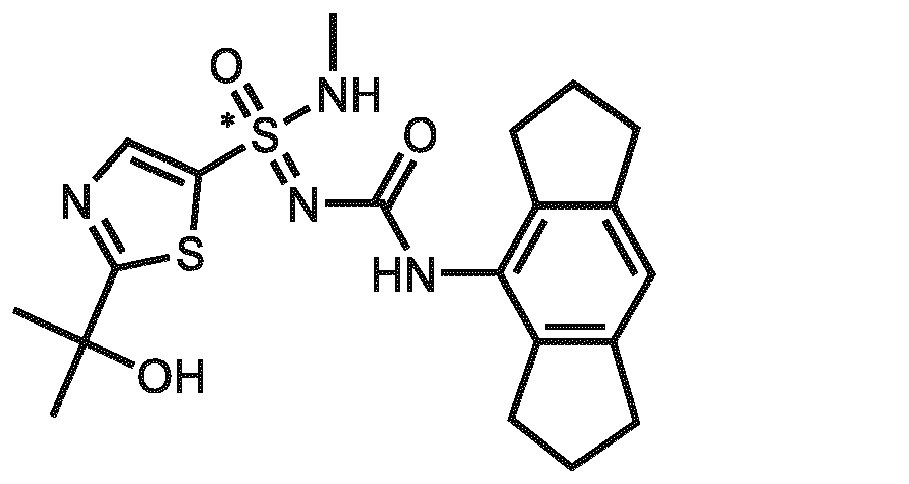
340 
340a 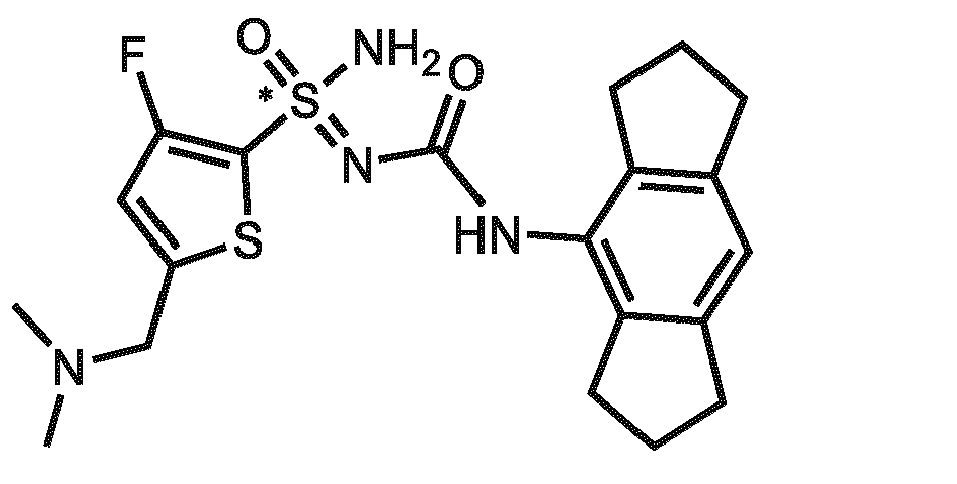
340b 
341 
341b 
341a 
342 
343 
343a 
343b 
344 
345 
346 
347 
348 
349 
350 
351 
352 
352b 
352a 
353 
354 
354a 
354b 
355 
356 
357 
357a 
357b 
358 
359 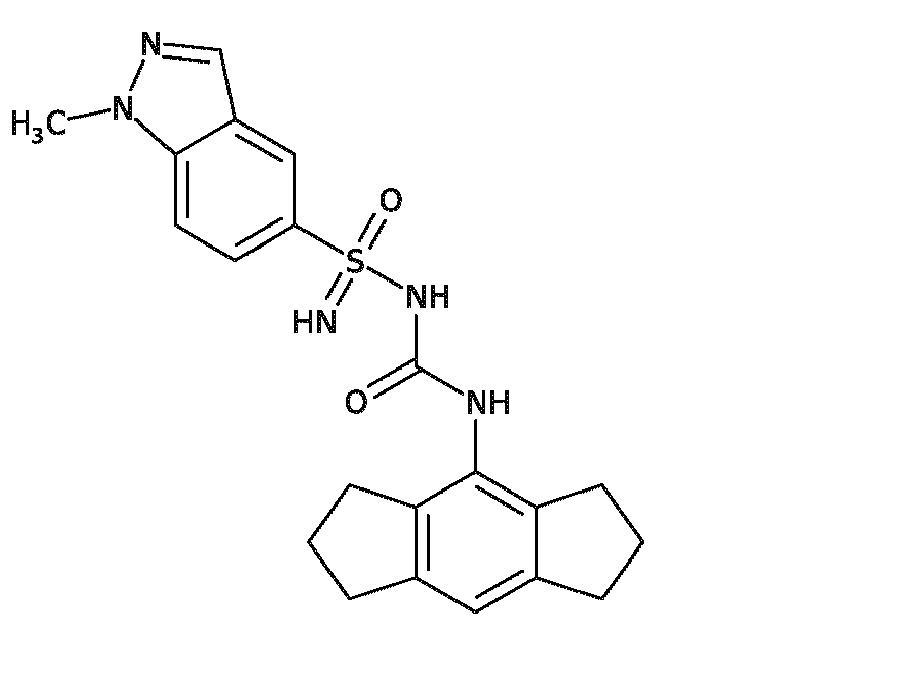
359a 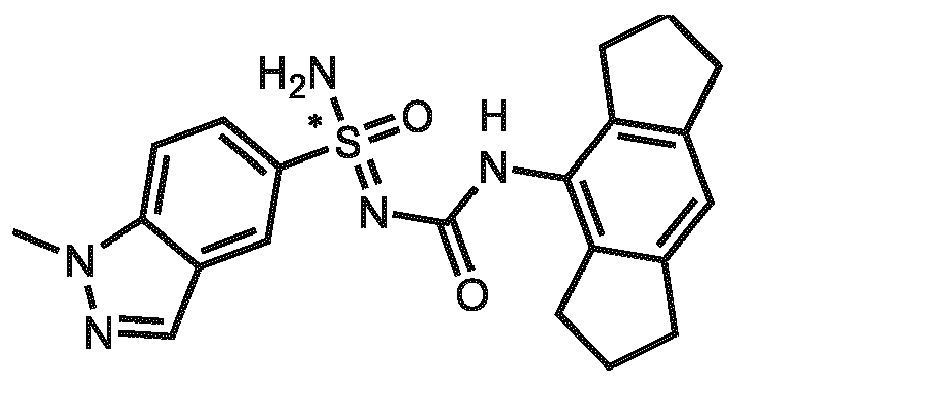
359b 
360ba 
360bb 
361b 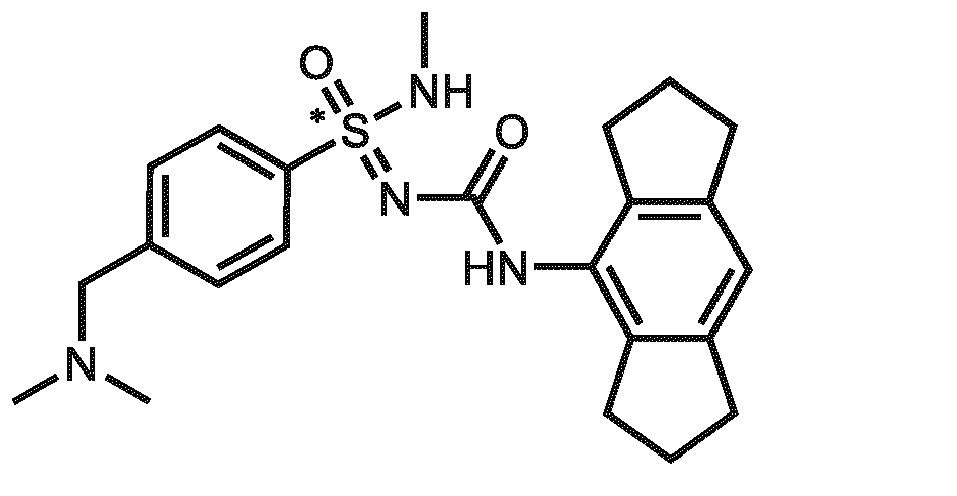
361a 
363b 
363a 
364a 
364b 
365a 
365b 
366a 
366b 
367a 
367b 
369a 
369b 
371a 
371b 
372a 
372b 
373a 
373b 
374a 
374b 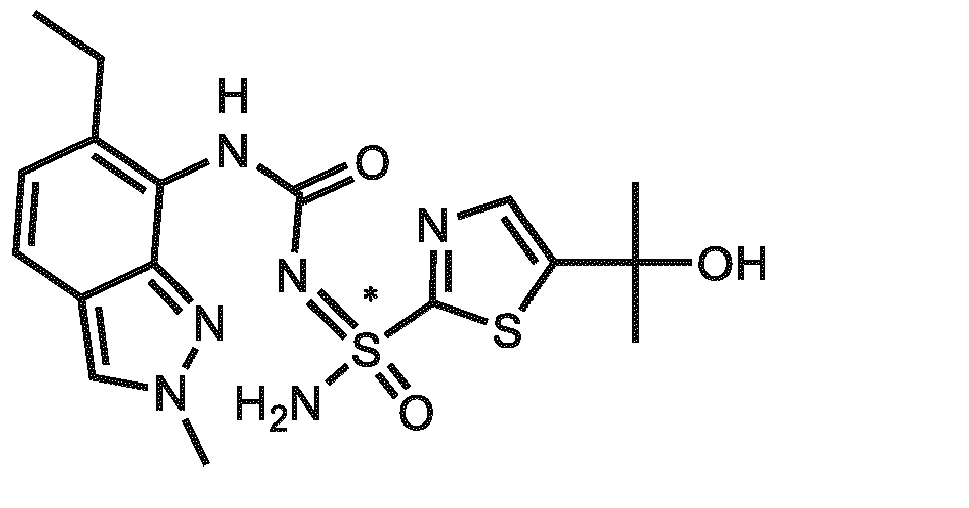
375 
375a 
375b 
376 
376a 
376b 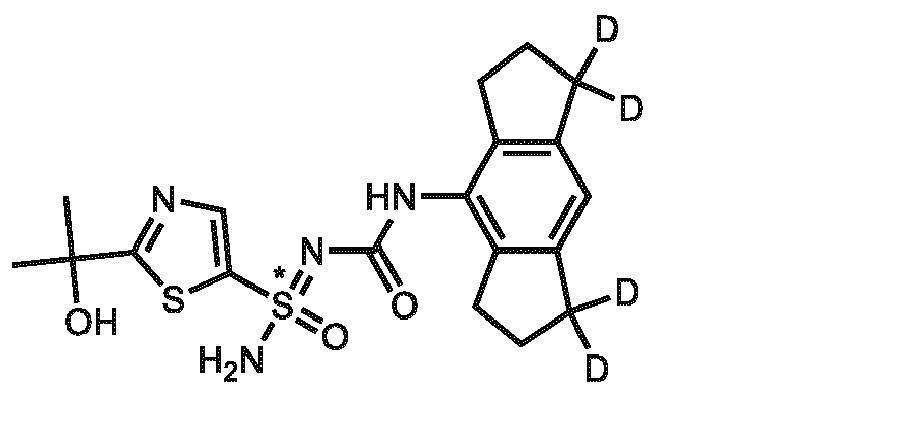
377 
378 
379 
379a 
379b 
380 
380a 
380b 
380c 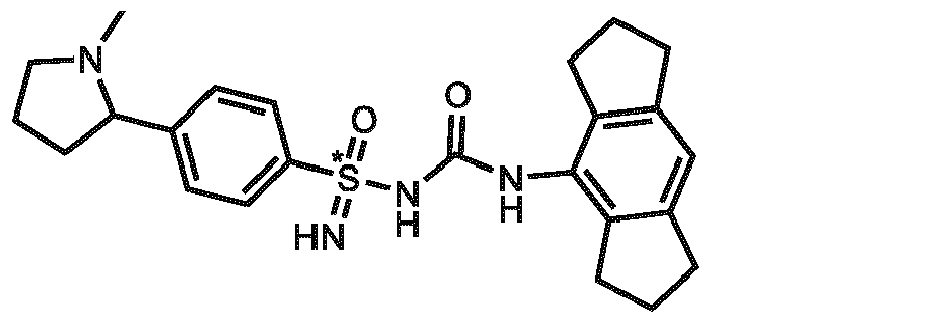
380d 
382 
382a 
382b 
383 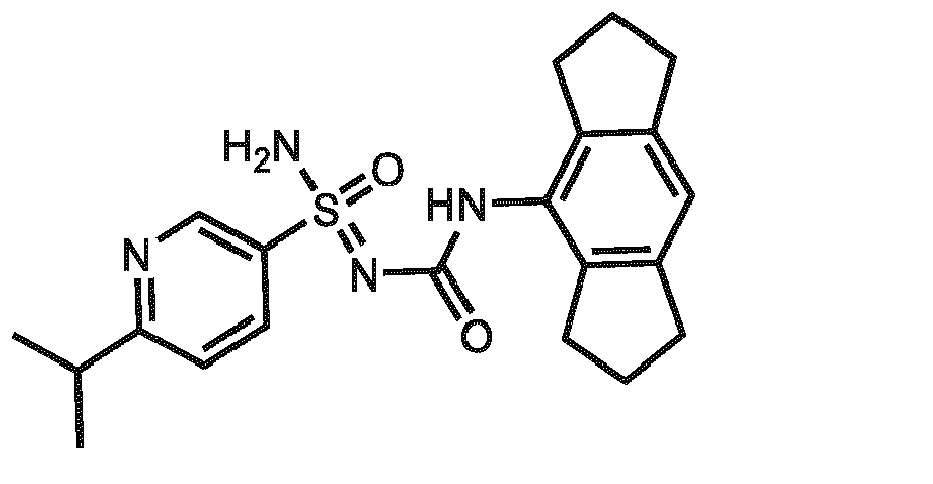
383a 
383b 
384a 
384b 
387a 
387b 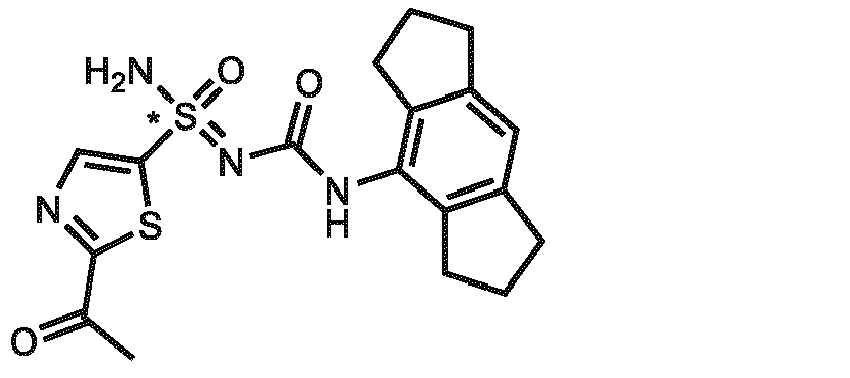
- In some embodiments, provided herein is a compound that is selected from the group consisting of the compounds in the following table:
401 
402 
403 
404 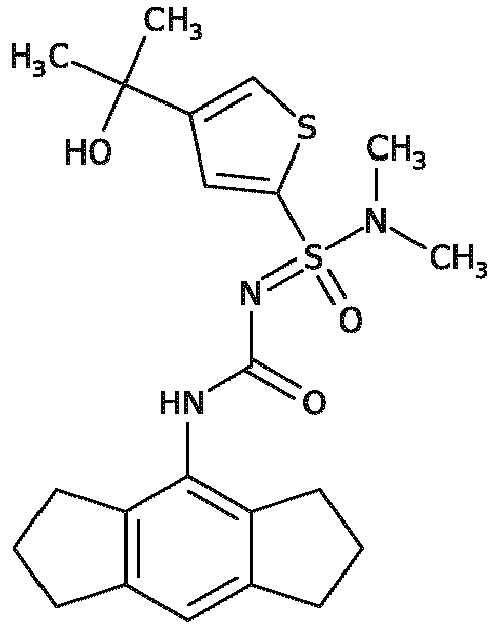
404a 
404b 
405 
406 
407 
408 
409 
409a 
409b 
410 
- In some embodiments, a chemical entity (e.g., a compound that modulates (e.g., antagonizes) NLRP3, or a pharmaceutically acceptable salt, and/or hydrate, and/or cocrystal, and/or drug combination thereof) is administered as a pharmaceutical composition that includes the chemical entity and one or more pharmaceutically acceptable excipients, and optionally one or more additional therapeutic agents as described herein.
- In some embodiments, the chemical entities can be administered in combination with one or more conventional pharmaceutical excipients. Pharmaceutically acceptable excipients include, but are not limited to, ion exchangers, alumina, aluminum stearate, lecithin, self-emulsifying drug delivery systems (SEDDS) such as d-α-tocopherol polyethylene glycol 1000 succinate, surfactants used in pharmaceutical dosage forms such as Tweens, poloxamers or other similar polymeric delivery matrices, serum proteins, such as human serum albumin, buffer substances such as phosphates, tris, glycine, sorbic acid, potassium sorbate, partial glyceride mixtures of saturated vegetable fatty acids, water, salts or electrolytes, such as protamine sulfate, disodium hydrogen phosphate, potassium hydrogen phosphate, sodium-chloride, zinc salts, colloidal silica, magnesium trisilicate, polyvinyl pyrrolidone, cellulose-based substances, polyethylene glycol, sodium carboxymethyl cellulose, polyacrylates, waxes, polyethylene-polyoxypropylene-block polymers, and wool fat. Cyclodextrins such as α-, β, and γ-cyclodextrin, or chemically modified derivatives such as hydroxyalkylcyclodextrins, including 2- and 3-hydroxypropyl-β-cyclodextrins, or other solubilized derivatives can also be used to enhance delivery of compounds described herein. Dosage forms or compositions containing a chemical entity as described herein in the range of 0.005% to 100% with the balance made up from non-toxic excipient may be prepared. The contemplated compositions may contain 0.001%-100% of a chemical entity provided herein, in one embodiment 0.1-95%, in another embodiment 75-85%, in a further embodiment 20-80%. Actual methods of preparing such dosage forms are known, or will be apparent, to those skilled in this art; for example, see Remington: The Science and Practice of Pharmacy, 22nd Edition (Pharmaceutical Press, London, UK. 2012).
- In some embodiments, the chemical entities described herein or a pharmaceutical composition thereof can be administered to subject in need thereof by any accepted route of administration. Acceptable routes of administration include, but are not limited to, buccal, cutaneous, endocervical, endosinusial, endotracheal, enteral, epidural, interstitial, intra-abdominal, intra-arterial, intrabronchial, intrabursal, intracerebral, intracisternal, intracoronary, intradermal, intraductal, intraduodenal, intradural, intraepidermal, intraesophageal, intragastric, intragingival, intraileal, intralymphatic, intramedullary, intrameningeal, intramuscular, intraovarian, intraperitoneal, intraprostatic, intrapulmonary, intrasinal, intraspinal, intrasynovial, intratesticular, intrathecal, intratubular, intratumoral, intrauterine, intravascular, intravenous, nasal, nasogastric, oral, parenteral, percutaneous, peridural, rectal, respiratory (inhalation), subcutaneous, sublingual, submucosal, topical, transdermal, transmucosal, transtracheal, ureteral, urethral and vaginal. In certain embodiments, a preferred route of administration is parenteral (e.g., intratumoral).
- Compositions can be formulated for parenteral administration, e.g., formulated for injection via the intravenous, intramuscular, sub-cutaneous, or even intraperitoneal routes. Typically, such compositions can be prepared as injectables, either as liquid solutions or suspensions; solid forms suitable for use to prepare solutions or suspensions upon the addition of a liquid prior to injection can also be prepared; and the preparations can also be emulsified. The preparation of such formulations will be known to those of skill in the art in light of the present disclosure.
- The pharmaceutical forms suitable for injectable use include sterile aqueous solutions or dispersions; formulations including sesame oil, peanut oil, or aqueous propylene glycol; and sterile powders for the extemporaneous preparation of sterile injectable solutions or dispersions. In all cases the form must be sterile and must be fluid to the extent that it may be easily injected. It also should be stable under the conditions of manufacture and storage and must be preserved against the contaminating action of microorganisms, such as bacteria and fungi.
- The carrier also can be a solvent or dispersion medium containing, for example, water, ethanol, polyol (for example, glycerol, propylene glycol, and liquid polyethylene glycol, and the like), suitable mixtures thereof, and vegetable oils. The proper fluidity can be maintained, for example, by the use of a coating, such as lecithin, by the maintenance of the required particle size in the case of dispersion, and by the use of surfactants. The prevention of the action of microorganisms can be brought about by various antibacterial and antifungal agents, for example, parabens, chlorobutanol, phenol, sorbic acid, thimerosal, and the like. In many cases, it will be preferable to include isotonic agents, for example, sugars or sodium chloride. Prolonged absorption of the injectable compositions can be brought about by the use in the compositions of agents delaying absorption, for example, aluminum monostearate and gelatin.
- Sterile injectable solutions are prepared by incorporating the active compounds in the required amount in the appropriate solvent with various of the other ingredients enumerated above, as required, followed by filtered sterilization. Generally, dispersions are prepared by incorporating the various sterilized active ingredients into a sterile vehicle which contains the basic dispersion medium and the required other ingredients from those enumerated above. In the case of sterile powders for the preparation of sterile injectable solutions, the preferred methods of preparation are vacuum-drying and freeze-drying techniques, which yield a powder of the active ingredient, plus any additional desired ingredient from a previously sterile-filtered solution thereof.
- Intratumoral injections are discussed, e.g., in Lammers, et al., "Effect of Intratumoral Injection on the Biodistribution and the Therapeutic Potential of HPMA Copolymer-Based Drug Delivery Systems" Neoplasia. 2006, 10, 788-795.
- In certain embodiments, the chemical entities described herein or a pharmaceutical composition thereof are suitable for local, topical administration to the digestive or GI tract, e.g., rectal administration. Rectal compositions include, without limitation, enemas, rectal gels, rectal foams, rectal aerosols, suppositories, jelly suppositories, and enemas (e.g., retention enemas).
- Pharmacologically acceptable excipients usable in the rectal composition as a gel, cream, enema, or rectal suppository, include, without limitation, any one or more of cocoa butter glycerides, synthetic polymers such as polyvinylpyrrolidone, PEG (like PEG ointments), glycerine, glycerinated gelatin, hydrogenated vegetable oils, poloxamers, mixtures of polyethylene glycols of various molecular weights and fatty acid esters of polyethylene glycol Vaseline, anhydrous lanolin, shark liver oil, sodium saccharinate, menthol, sweet almond oil, sorbitol, sodium benzoate, anoxid SBN, vanilla essential oil, aerosol, parabens in phenoxyethanol, sodium methyl p-oxybenzoate, sodium propyl p-oxybenzoate, diethylamine, carbomers, carbopol, methyloxybenzoate, macrogol cetostearyl ether, cocoyl caprylocaprate, isopropyl alcohol, propylene glycol, liquid paraffin, xanthan gum, carboxy-metabisulfite, sodium edetate, sodium benzoate, potassium metabisulfite, grapefruit seed extract, methyl sulfonyl methane (MSM), lactic acid, glycine, vitamins, such as vitamin A and E and potassium acetate.
- In certain embodiments, suppositories can be prepared by mixing the chemical entities described herein with suitable non-irritating excipients or carriers such as cocoa butter, polyethylene glycol or a suppository wax which are solid at ambient temperature but liquid at body temperature and therefore melt in the rectum and release the active compound. In other embodiments, compositions for rectal administration are in the form of an enema.
- In other embodiments, the compounds described herein or a pharmaceutical composition thereof are suitable for local delivery to the digestive or GI tract by way of oral administration (e.g., solid or liquid dosage forms.).
- Solid dosage forms for oral administration include capsules, tablets, pills, powders, and granules. In such solid dosage forms, the chemical entity is mixed with one or more pharmaceutically acceptable excipients, such as sodium citrate or dicalcium phosphate and/or: a) fillers or extenders such as starches, lactose, sucrose, glucose, mannitol, and silicic acid, b) binders such as, for example, carboxymethylcellulose, alginates, gelatin, polyvinylpyrrolidinone, sucrose, and acacia, c) humectants such as glycerol, d) disintegrating agents such as agar-agar, calcium carbonate, potato or tapioca starch, alginic acid, certain silicates, and sodium carbonate, e) solution retarding agents such as paraffin, f) absorption accelerators such as quaternary ammonium compounds, g) wetting agents such as, for example, cetyl alcohol and glycerol monostearate, h) absorbents such as kaolin and bentonite clay, and i) lubricants such as talc, calcium stearate, magnesium stearate, solid polyethylene glycols, sodium lauryl sulfate, and mixtures thereof. In the case of capsules, tablets and pills, the dosage form may also comprise buffering agents. Solid compositions of a similar type may also be employed as fillers in soft and hard-filled gelatin capsules using such excipients as lactose or milk sugar as well as high molecular weight polyethylene glycols and the like.
- In one embodiment, the compositions will take the form of a unit dosage form such as a pill or tablet and thus the composition may contain, along with a chemical entity provided herein, a diluent such as lactose, sucrose, dicalcium phosphate, or the like; a lubricant such as magnesium stearate or the like; and a binder such as starch, gum acacia, polyvinylpyrrolidine, gelatin, cellulose, cellulose derivatives or the like. In another solid dosage form, a powder, marume, solution or suspension (e.g., in propylene carbonate, vegetable oils, PEG's, poloxamer 124 or triglycerides) is encapsulated in a capsule (gelatin or cellulose base capsule). Unit dosage forms in which one or more chemical entities provided herein or additional active agents are physically separated are also contemplated; e.g., capsules with granules (or tablets in a capsule) of each drug; two-layer tablets; two-compartment gel caps, etc. Enteric coated or delayed release oral dosage forms are also contemplated.
- Other physiologically acceptable compounds include wetting agents, emulsifying agents, dispersing agents or preservatives that are particularly useful for preventing the growth or action of microorganisms. Various preservatives are well known and include, for example, phenol and ascorbic acid.
- In certain embodiments the excipients are sterile and generally free of undesirable matter. These compositions can be sterilized by conventional, well-known sterilization techniques. For various oral dosage form excipients such as tablets and capsules sterility is not required. The USP/NF standard is usually sufficient.
- In certain embodiments, solid oral dosage forms can further include one or more components that chemically and/or structurally predispose the composition for delivery of the chemical entity to the stomach or the lower GI; e.g., the ascending colon and/or transverse colon and/or distal colon and/or small bowel. Exemplary formulation techniques are described in, e.g., Filipski, K.J., et al., Current Topics in Medicinal Chemistry, 2013, 13, 776-802, which is incorporated herein by reference in its entirety.
- Examples include upper-GI targeting techniques, e.g., Accordion Pill (Intec Pharma), floating capsules, and materials capable of adhering to mucosal walls.
- Other examples include lower-GI targeting techniques. For targeting various regions in the intestinal tract, several enteric/pH-responsive coatings and excipients are available. These materials are typically polymers that are designed to dissolve or erode at specific pH ranges, selected based upon the GI region of desired drug release. These materials also function to protect acid labile drugs from gastric fluid or limit exposure in cases where the active ingredient may be irritating to the upper GI (e.g., hydroxypropyl methylcellulose phthalate series, Coateric (polyvinyl acetate phthalate), cellulose acetate phthalate, hydroxypropyl methylcellulose acetate succinate, Eudragit series (methacrylic acid-methyl methacrylate copolymers), and Marcoat). Other techniques include dosage forms that respond to local flora in the GI tract, Pressure-controlled colon delivery capsule, and Pulsincap.
- Ocular compositions can include, without limitation, one or more of any of the following: viscogens (e.g., Carboxymethylcellulose, Glycerin, Polyvinylpyrrolidone, Polyethylene glycol); Stabilizers (e.g., Pluronic (triblock copolymers), Cyclodextrins); Preservatives (e.g., Benzalkonium chloride, ETDA, SofZia (boric acid, propylene glycol, sorbitol, and zinc chloride; Alcon Laboratories, Inc.), Purite (stabilized oxychloro complex; Allergan, Inc.)).
- Topical compositions can include ointments and creams. Ointments are semisolid preparations that are typically based on petrolatum or other petroleum derivatives. Creams containing the selected active agent are typically viscous liquid or semisolid emulsions, often either oil-in-water or water-in-oil. Cream bases are typically water-washable, and contain an oil phase, an emulsifier and an aqueous phase. The oil phase, also sometimes called the "internal" phase, is generally comprised of petrolatum and a fatty alcohol such as cetyl or stearyl alcohol; the aqueous phase usually, although not necessarily, exceeds the oil phase in volume, and generally contains a humectant. The emulsifier in a cream formulation is generally a nonionic, anionic, cationic or amphoteric surfactant. As with other carriers or vehicles, an ointment base should be inert, stable, nonirritating and non-sensitizing.
- In any of the foregoing embodiments, pharmaceutical compositions described herein can include one or more one or more of the following: lipids, interbilayer crosslinked multilamellar vesicles, biodegradeable poly(D,L-lactic-co-glycolic acid) [PLGA]-based or poly anhydride-based nanoparticles or microparticles, and nanoporous particle-supported lipid bilayers.
- In some embodiments, enema formulations containing the chemical entities described herein are provided in "ready-to-use" form.
- In some embodiments, enema formulations containing the chemical entities described herein are provided in one or more kits or packs. In certain embodiments, the kit or pack includes two or more separately contained/packaged components, e.g. two components, which when mixed together, provide the desired formulation (e.g., as a suspension). In certain of these embodiments, the two component system includes a first component and a second component, in which: (i) the first component (e.g., contained in a sachet) includes the chemical entity (as described anywhere herein) and optionally one or more pharmaceutically acceptable excipients (e.g., together formulated as a solid preparation, e.g., together formulated as a wet granulated solid preparation); and (ii) the second component (e.g., contained in a vial or bottle) includes one or more liquids and optionally one or more other pharmaceutically acceptable excipients together forming a liquid carrier. Prior to use (e.g., immediately prior to use), the contents of (i) and (ii) are combined to form the desired enema formulation, e.g., as a suspension. In other embodiments, each of component (i) and (ii) is provided in its own separate kit or pack.
- In some embodiments, each of the one or more liquids is water, or a physiologically acceptable solvent, or a mixture of water and one or more physiologically acceptable solvents. Typical such solvents include, without limitation, glycerol, ethylene glycol, propylene glycol, polyethylene glycol and polypropylene glycol. In certain embodiments, each of the one or more liquids is water. In other embodiments, each of the one or more liquids is an oil, e.g. natural and/or synthetic oils that are commonly used in pharmaceutical preparations.
- Further pharmaceutical excipients and carriers that may be used in the pharmaceutical products herein described are listed in various handbooks (e.g. D. E. Bugay and W. P. Findlay (Eds) Pharmaceutical excipients (Marcel Dekker, New York, 1999), E-M Hoepfner, A. Reng and P. C. Schmidt (Eds) Fiedler Encyclopedia of Excipients for Pharmaceuticals, Cosmetics and Related Areas (Edition Cantor, Munich, 2002) and H. P. Fielder (Ed) Lexikon der Hilfsstoffe für Pharmazie, Kosmetik and angrenzende Gebiete (Edition Cantor Aulendorf, 1989)).
- In some embodiments, each of the one or more pharmaceutically acceptable excipients can be independently selelcted from thickeners, viscosity enhancing agents, bulking agents, mucoadhesive agents, penetration enhanceers, buffers, preservatives, diluents, binders, lubricants, glidants, disintegrants, fillers, solubilizing agents, pH modifying agents, preservatives, stabilizing agents, anti-oxidants, wetting or emulsifying agents, suspending agents, pigments, colorants, isotonic agents, chelating agents, emulsifiers, and diagnostic agents.
- In certain embodiments, each of the one or more pharmaceutically acceptable excipients can be independently selelcted from thickeners, viscosity enhancing agents, mucoadhesive agents, buffers, preservatives, diluents, binders, lubricants, glidants, disintegrants, and fillers.
- In certain embodiments, each of the one or more pharmaceutically acceptable excipients can be independently selelcted from thickeners, viscosity enhancing agents, bulking agents, mucoadhesive agents, buffers, preservatives, and fillers.
- In certain embodiments, each of the one or more pharmaceutically acceptable excipients can be independently selelcted from diluents, binders, lubricants, glidants, and disintegrants.
- Examples of thickeners, viscosity enhancing agents, and mucoadhesive agents include without limitation: gums, e.g. xanthan gum, guar gum, locust bean gum, tragacanth gums, karaya gum, ghatti gum, cholla gum, psyllium seed gum and gum arabic; poly(carboxylic acid-containing) based polymers, such as poly (acrylic, maleic, itaconic, citraconic, hydroxyethyl methacrylic or methacrylic) acid which have strong hydrogen-bonding groups, or derivatives thereof such as salts and esters; cellulose derivatives, such as methyl cellulose, ethyl cellulose, methylethyl cellulose, hydroxymethyl cellulose, hydroxyethyl cellulose, hydroxypropyl cellulose, hydroxyethyl ethyl cellulose, carboxymethyl cellulose, hydroxypropylmethyl cellulose or cellulose esters or ethers or derivatives or salts thereof; clays such as manomorillonite clays, e.g. Veegun, attapulgite clay; polysaccharides such as dextran, pectin, amylopectin, agar, mannan or polygalactonic acid or starches such as hydroxypropyl starch or carboxymethyl starch; polypeptides such as casein, gluten, gelatin, fibrin glue; chitosan, e.g. lactate or glutamate or carboxymethyl chitin; glycosaminoglycans such as hyaluronic acid; metals or water soluble salts of alginic acid such as sodium alginate or magnesium alginate; schleroglucan; adhesives containing bismuth oxide or aluminium oxide; atherocollagen; polyvinyl polymers such as carboxyvinyl polymers; polyvinylpyrrolidone (povidone); polyvinyl alcohol; polyvinyl acetates, polyvinylmethyl ethers, polyvinyl chlorides, polyvinylidenes, and/or the like; polycarboxylated vinyl polymers such as polyacrylic acid as mentioned above; polysiloxanes; polyethers; polyethylene oxides and glycols; polyalkoxys and polyacrylamides and derivatives and salts thereof. Preferred examples can include cellulose derivatives, such as methyl cellulose, ethyl cellulose, methylethyl cellulose, hydroxymethyl cellulose, hydroxyethyl cellulose, hydroxypropyl cellulose, hydroxyethyl ethyl cellulose, carboxymethyl cellulose, hydroxypropylmethyl cellulose or cellulose esters or ethers or derivatives or salts thereof (e.g., methyl cellulose); and polyvinyl polymers such as polyvinylpyrrolidone (povidone).
- Examples of preservatives include without limitation: benzalkonium chloride, benzoxonium chloride, benzethonium chloride, cetrimide, sepazonium chloride, cetylpyridinium chloride, domiphen bromide (Bradosol®), thiomersal, phenylmercuric nitrate, phenylmercuric acetate, phenylmercuric borate, methylparaben, propylparaben, chlorobutanol, benzyl alcohol, phenyl ethyl alcohol, chlorohexidine, polyhexamethylene biguanide, sodium perborate, imidazolidinyl urea, sorbic acid, Purite®), Polyquart®), and sodium perborate tetrahydrate and the like.
- In certain embodiments, the preservative is a paraben, or a pharmaceutically acceptable salt thereof. In some embodiments, the paraben is an alkyl substituted 4-hydroxybenzoate, or a pharmaceutically acceptable salt or ester thereof. In certain embodiments, the alkyl is a C1-C4 alkyl. In certain embodiments, the preservative is methyl 4-hydroxybenzoate (methylparaben), or a pharmaceutically acceptable salt or ester thereof, propyl 4-hydroxybenzoate (propylparaben), or a pharmaceutically acceptable salt or ester thereof, or a combination thereof.
- Examples of buffers include without limitation: phosphate buffer system (sodium dihydrogen phospahate dehydrate, disodium phosphate dodecahydrate, bibasic sodium phosphate, anhydrous monobasic sodium phosphate), bicarbonate buffer system, and bisulfate buffer system.
- Examples of disintegrants include, without limitation: carmellose calcium, low substituted hydroxypropyl cellulose (L-HPC), carmellose, croscarmellose sodium, partially pregelatinized starch, dry starch, carboxymethyl starch sodium, crospovidone, polysorbate 80 (polyoxyethylenesorbitan oleate), starch, sodium starch glycolate, hydroxypropyl cellulose pregelatinized starch, clays, cellulose, alginine, gums or cross linked polymers, such as crosslinked PVP (Polyplasdone XL from GAF Chemical Corp). In certain embodiments, the disintegrant is crospovidone.
- Examples of glidants and lubricants (aggregation inhibitors) include without limitation: talc, magnesium stearate, calcium stearate, colloidal silica, stearic acid, aqueous silicon dioxide, synthetic magnesium silicate, fine granulated silicon oxide, starch, sodium lauryl sulfate, boric acid, magnesium oxide, waxes, hydrogenated oil, polyethylene glycol, sodium benzoate, stearic acid glycerol behenate, polyethylene glycol, and mineral oil. In certain embodiments, the glidant/lubricant is magnesium stearate, talc, and/or colloidal silica; e.g., magnesium stearate and/or talc.
- Examples of diluents, also referred to as "fillers" or "bulking agents" include without limitation: dicalcium phosphate dihydrate, calcium sulfate, lactose (e.g., lactose monohydrate), sucrose, mannitol, sorbitol, cellulose, microcrystalline cellulose, kaolin, sodium chloride, dry starch, hydrolyzed starches, pregelatinized starch, silicone dioxide, titanium oxide, magnesium aluminum silicate and powdered sugar. In certain embodiments, the diluent is lactose (e.g., lactose monohydrate).
- Examples of binders include without limitation: starch, pregelatinized starch, gelatin, sugars (including sucrose, glucose, dxtrose, lactose and sorbitol), polyethylene glycol, waxes, natural and synthetic gums such as acacia tragacanth, sodium alginate cellulose, including hydroxypropylmethylcellulose, hydroxypropylcellulose, ethylcellulose, and veegum, and synthetic polymers such as acrylic acid and methacrylic acid copolymers, methacrylic acid copolymers, methyl methacrylate copolymers, aminoalkyl methacrylate copolymers, polyacrylic acid/polymethacrylic acid and polyvinylpyrrolidone (povidone). In certain embodiments, the binder is polyvinylpyrrolidone (povidone).
- In some embodiments, enema formulations containing the chemical entities described herein include water and one or more (e.g., all) of the following excipients:
- One or more (e.g., one, two, or three) thickeners, viscosity enhancing agents, binders, and/or mucoadhesive agents (e.g., cellulose or cellulose esters or ethers or derivatives or salts thereof (e.g., methyl cellulose); and polyvinyl polymers such as polyvinylpyrrolidone (povidone);
- One or more (e.g., one or two; e.g., two) preservatives, such as a paraben, e.g., methyl 4-hydroxybenzoate (methylparaben), or a pharmaceutically acceptable salt or ester thereof, propyl 4-hydroxybenzoate (propylparaben), or a pharmaceutically acceptable salt or ester thereof, or a combination thereof;
- One or more (e.g., one or two; e.g., two) buffers, such as phosphate buffer system (e.g., sodium dihydrogen phospahate dehydrate, disodium phosphate dodecahydrate);
- One or more (e.g., one or two, e.g., two) glidants and/or lubricants, such as magnesium stearate and/or talc;
- One or more (e.g., one or two; e.g., one) disintegrants, such as crospovidone; and
- One or more (e.g., one or two; e.g., one) diluents, such as lactose (e.g., lactose monohydrate).
- In certain of these embodiments, the chemical entity is a compound of Formula AA, or a pharmaceutically acceptable salt and/or hydrate and/or cocrystal thereof.
- In certain embodiments, enema formulations containing the chemical entities described herein include water, methyl cellulose, povidone, methylparaben, propylparaben, sodium dihydrogen phospahate dehydrate, disodium phosphate dodecahydrate, crospovidone, lactose monohydrate, magnesium stearate, and talc. In certain of these embodiments, the chemical entity is a compound of Formula AA, or a pharmaceutically acceptable salt and/or hydrate and/or cocrystal thereof.
- In certain embodiments, enema formulations containing the chemical entities described herein are provided in one or more kits or packs. In certain embodiments, the kit or pack includes two separately contained/packaged components, which when mixed together, provide the desired formulation (e.g., as a suspension). In certain of these embodiments, the two component system includes a first component and a second component, in which: (i) the first component (e.g., contained in a sachet) includes the chemical entity (as described anywhere herein) and one or more pharmaceutically acceptable excipients (e.g., together formulated as a solid preparation, e.g., together formulated as a wet granulated solid preparation); and (ii) the second component (e.g., contained in a vial or bottle) includes one or more liquids and one or more one or more other pharmaceutically acceptable excipients together forming a liquid carrier. In other embodiments, each of component (i) and (ii) is provided in its own separate kit or pack.
- In certain of these embodiments, component (i) includes the chemical entitiy (e.g., a compound of Formula AA, or a pharmaceutically acceptable salt and/or hydrate and/or cocrystal thereof; e.g., a compound of Formula AA) and one or more (e.g., all) of the following excipients:
- (a) One or more (e.g., one) binders (e.g., a polyvinyl polymer, such as polyvinylpyrrolidone (povidone);
- (b) One or more (e.g., one or two, e.g., two) glidants and/or lubricants, such as magnesium stearate and/or talc;
- (c) One or more (e.g., one or two; e.g., one) disintegrants, such as crospovidone; and
- (d) One or more (e.g., one or two; e.g., one) diluents, such as lactose (e.g., lactose monohydrate).
- In certain embodiments, component (i) includes from about 40 weight percent to about 80 weight percent (e.g., from about 50 weight percent to about 70 weight percent, from about 55 weight percent to about 70 weight percent; from about 60 weight percent to about 65 weight percent; e.g., about 62.1 weight percent) of the chemical entity (e.g., a compound of Formula AA, or a pharmaceutically acceptable salt and/or hydrate and/or cocrystal thereof).
- In certain embodiments, component (i) includes from about 0.5 weight percent to about 5 weight percent (e.g., from about 1.5 weight percent to about 4.5 weight percent, from about 2 weight percent to about 3.5 weight percent; e.g., about 2.76 weight percent) of the binder (e.g., povidone).
- In certain embodiments, component (i) includes from about 0.5 weight percent to about 5 weight percent (e.g., from about 0.5 weight percent to about 3 weight percent, from about 1 weight percent to about 3 weight percent; about 2 weight percent e.g., about 1.9 weight percent) of the disintegrant (e.g., crospovidone).
- In certain embodiments, component (i) includes from about 10 weight percent to about 50 weight percent (e.g., from about 20 weight percent to about 40 weight percent, from about 25 weight percent to about 35 weight percent; e.g., about 31.03 weight percent) of the diluent (e.g., lactose, e.g., lactose monohydrate).
- In certain embodiments, component (i) includes from about 0.05 weight percent to about 5 weight percent (e.g., from about 0.05 weight percent to about 3 weight percent) of the glidants and/or lubricants.
- In certain embodiments (e.g., when component (i) includes one or more lubricants, such as magnesium stearate), component (i) includes from about 0.05 weight percent to about 1 weight percent (e.g., from about 0.05 weight percent to about 1 weight percent; from about 0.1 weight percent to about 1 weight percent; from about 0.1 weight percent to about 0.5 weight percent; e.g., about 0.27 weight percent) of the lubricant (e.g., magnesium stearate).
- In certain embodiments (when component (i) includes one or more lubricants, such as talc), component (i) includesfrom about 0.5 weight percent to about 5 weight percent (e.g., from about 0.5 weight percent to about 3 weight percent, from about 1 weight percent to about 3 weight percent; from about 1.5 weight percent to about 2.5 weight percent; from about 1.8 weight percent to about 2.2 weight percent; about 1.93 weight percent) of the lubricant (e.g., talc).
- In certain of these embodiments, each of (a), (b), (c), and (d) above is present.
- In certain embodiments, component (i) includes the ingredients and amounts as shown in Table A.
Table A Ingredient Weight Percent A compound of Formula AA 40 weight percent to about 80 weight percent (e.g., from about 50 weight percent to about 70 weight percent, from about 55 weight percent to about 70 weight percent; from about 60 weight percent to about 65 weight percent; e.g., about 62.1 weight percent) Crospovidone (Kollidon CL) 0.5 weight percent to about 5 weight percent (e.g., from about 0.5 weight percent to about 3 weight percent, from about 1 weight percent to about 3 weight percent; about 1.93 weight percent lactose monohydrate (Pharmatose 200M) about 10 weight percent to about 50 weight percent (e.g., from about 20 weight percent to about 40 weight percent, from about 25 weight percent to about 35 weight percent; e.g., about 31.03 weight percent Povidone (Kollidon K30) about 0.5 weight percent to about 5 weight percent (e.g., from about 1.5 weight percent to about 4.5 weight percent, from about 2 weight percent to about 3.5 weight percent; e.g., about 2.76 weight percent talc 0.5 weight percent to about 5 weight percent (e.g., from about 0.5 weight percent to about 3 weight percent, from about 1 weight percent to about 3 weight percent; from about 1.5 weight percent to about 2.5 weight percent; from about 1.8 weight percent to about 2.2 weight percent;e.g., about 1.93 weight percent Magnesium stearate about 0.05 weight percent to about 1 weight percent (e.g., from about 0.05 weight percent to about 1 weight percent; from about 0.1 weight percent to about 1 weight percent; from about 0.1 weight percent to about 0.5 weight percent; e.g., about 0.27 weight percent - In certain embodiments, component (i) includes the ingredients and amounts as shown in Table B.
Table B Ingredient Weight Percent A compound of Formula AA About 62.1 weight percent) Crospovidone (Kollidon CL) About 1.93 weight percent lactose monohydrate (Pharmatose 200M) About 31.03 weight percent Povidone (Kollidon K30) About 2.76 weight percent talc About 1.93 weight percent Magnesium stearate About 0.27 weight percent - In certain embodiments, component (i) is formulated as a wet granulated solid preparation. In certain of these embodiments an internal phase of ingredients (the chemical entity, disintegrant, and diluent) are combined and mixed in a high-shear granulator. A binder (e.g., povidone) is dissolved in water to form a granulating solution. This solution is added to the Inner Phase mixture resulting in the development of granules. While not wishing to be bound by theory, granule development is believed to be facilitated by the interaction of the polymeric binder with the materials of the internal phase. Once the granulation is formed and dried, an external phase (e.g., one or more lubricants - not an intrinsic component of the dried granulation), is added to the dry granulation. It is believed that lubrication of the granulation is important to the flowability of the granulation, in particular for packaging.
- In certain of the foregoing embodiments, component (ii) includes water and one or more (e.g., all) of the following excipients:
- (a') One or more (e.g., one, two; e.g., two) thickeners, viscosity enhancing agents, binders, and/or mucoadhesive agents (e.g., cellulose or cellulose esters or ethers or derivatives or salts thereof (e.g., methyl cellulose); and polyvinyl polymers such as polyvinylpyrrolidone (povidone);
- (b') One or more (e.g., one or two; e.g., two) preservatives, such as a paraben, e.g., methyl 4-hydroxybenzoate (methylparaben), or a pharmaceutically acceptable salt or ester thereof, propyl 4-hydroxybenzoate (propylparaben), or a pharmaceutically acceptable salt or ester thereof, or a combination thereof; and
- (c') One or more (e.g., one or two; e.g., two) buffers, such as phosphate buffer system (e.g., sodium dihydrogen phospahate dihydrate, disodium phosphate dodecahydrate);
- In certain of the foregoing embodiments, component (ii) includes water and one or more (e.g., all) of the following excipients:
- (a") a first thickener, viscosity enhancing agent, binder, and/or mucoadhesive agent (e.g., a cellulose or cellulose ester or ether or derivative or salt thereof (e.g., methyl cellulose));
- (a‴) a second thickener, viscosity enhancing agent, binder, and/or mucoadhesive agent (e.g., a polyvinyl polymer, such as polyvinylpyrrolidone (povidone));
- (b") a first preservative, such as a paraben, e.g., propyl 4-hydroxybenzoate (propylparaben), or a pharmaceutically acceptable salt or ester thereof;
- (b") a second preservative, such as a paraben, e.g., methyl 4-hydroxybenzoate (methylparaben), or a pharmaceutically acceptable salt or ester thereof,
- (c") a first buffer, such as phosphate buffer system (e.g., disodium phosphate dodecahydrate);
- (c‴) a second buffer, such as phosphate buffer system (e.g., sodium dihydrogen phospahate dehydrate),
- In certain embodiments, component (ii) includes from about 0.05 weight percent to about 5 weight percent (e.g., from about 0.05 weight percent to about 3 weight percent, from about 0.1 weight percent to about 3 weight percent; e.g., about 1.4 weight percent) of (a").
- In certain embodiments, component (ii) includes from about 0.05 weight percent to about 5 weight percent (e.g., from about 0.05 weight percent to about 3 weight percent, from about 0.1 weight percent to about 2 weight percent; e.g., about 1.0 weight percent) of (a‴).
- In certain embodiments, component (ii) includes from about 0.005 weight percent to about 0.1 weight percent (e.g., from about 0.005 weight percent to about 0.05 weight percent; e.g., about 0.02 weight percent) of (b").
- In certain embodiments, component (ii) includes from about 0.05 weight percent to about 1 weight percent (e.g., from about 0.05 weight percent to about 0.5 weight percent; e.g., about 0.20 weight percent) of (b"').
- In certain embodiments, component (ii) includes from about 0.05 weight percent to about 1 weight percent (e.g., from about 0.05 weight percent to about 0.5 weight percent; e.g., about 0.15 weight percent) of (c").
- In certain embodiments, component (ii) includes from about 0.005 weight percent to about 0.5 weight percent (e.g., from about 0.005 weight percent to about 0.3 weight percent; e.g., about 0.15 weight percent) of (c‴).
- In certain of these embodiments, each of (a") - (c‴) is present.
- In certain embodiments, component (ii) includes water (up to 100%) and the ingredients and amounts as shown in Table C.
Table C Ingredient Weight Percent methyl cellulose (Methocel A15C premium) 0.05 weight percent to about 5 weight percent (e.g., from about 0.05 weight percent to about 3 weight percent, from about 0.1 weight percent to about 3 weight percent; e.g., about 1.4 weight percent Povidone (Kollidon K30) 0.05 weight percent to about 5 weight percent (e.g., from about 0.05 weight percent to about 3 weight percent, from about 0.1 weight percent to about 2 weight percent; e.g., about 1.0 weight percent propyl 4-hydroxybenzoate about 0.005 weight percent to about 0.1 weight percent (e.g., from about 0.005 weight percent to about 0.05 weight percent; e.g., about 0.02 weight percent) methyl 4-hydroxybenzoate about 0.05 weight percent to about 1 weight percent (e.g., from about 0.05 weight percent to about 0.5 weight percent; e.g., about 0.20 weight percent) disodium phosphate dodecahydrate about 0.05 weight percent to about 1 weight percent (e.g., from about 0.05 weight percent to about 0.5 weight percent; e.g., about 0.15 weight percent) sodium dihydrogen phospahate dihydrate about 0.005 weight percent to about 0.5 weight percent (e.g., from about 0.005 weight percent to about 0.3 weight percent; e.g., about 0.15 weight percent) - In certain embodiments, component (ii) includes water (up to 100%) and the ingredients and amounts as shown in Table D.
Table D Ingredient Weight Percent methyl cellulose (Methocel A15C premium) about 1.4 weight percent Povidone (Kollidon K30) about 1.0 weight percent propyl 4-hydroxybenzoate about 0.02 weight percent methyl 4-hydroxybenzoate about 0.20 weight percent disodium phosphate dodecahydrate about 0.15 weight percent sodium dihydrogen phospahate dihydrate about 0.15 weight percent - Ready-to-use" enemas are generally be provided in a "single-use" sealed disposable container of plastic or glass. Those formed of a polymeric material preferably have sufficient flexibility for ease of use by an unassisted patient. Typical plastic containers can be made of polyethylene. These containers may comprise a tip for direct introduction into the rectum. Such containers may also comprise a tube between the container and the tip. The tip is preferably provided with a protective shield which is removed before use. Optionally the tip has a lubricant to improve patient compliance.
- In some embodiments, the enema formulation (e.g., suspension) is poured into a bottle for delivery after it has been prepared in a separate container. In certain embodiments, the bottle is a plastic bottle (e.g., flexible to allow for delivery by squeezing the bottle), which can be a polyethylene bottle (e.g., white in color). In some embodiments, the bottle is a single chamber bottle, which contains the suspension or solution. In other embodiments, the bottle is a multichamber bottle, where each chamber contains a separate mixture or solution. In still other embodiments, the bottle can further include a tip or rectal cannula for direct introduction into the rectum. In some embodiments, the enema formulation can be delivered in the device shown in FIGS. 3A-3C, which includes a plastic bottle, a breakable capsule, and a rectal cannula and single flow pack.
- The dosages may be varied depending on the requirement of the patient, the severity of the condition being treating and the particular compound being employed. Determination of the proper dosage for a particular situation can be determined by one skilled in the medical arts. The total daily dosage may be divided and administered in portions throughout the day or by means providing continuous delivery.
- In some embodiments, the compounds described herein are administered at a dosage of from about 0.001 mg/Kg to about 500 mg/Kg (e.g., from about 0.001 mg/Kg to about 200 mg/Kg; from about 0.01 mg/Kg to about 200 mg/Kg; from about 0.01 mg/Kg to about 150 mg/Kg; from about 0.01 mg/Kg to about 100 mg/Kg; from about 0.01 mg/Kg to about 50 mg/Kg; from about 0.01 mg/Kg to about 10 mg/Kg; from about 0.01 mg/Kg to about 5 mg/Kg; from about 0.01 mg/Kg to about 1 mg/Kg; from about 0.01 mg/Kg to about 0.5 mg/Kg; from about 0.01 mg/Kg to about 0.1 mg/Kg; from about 0. 1 mg/Kg to about 200 mg/Kg; from about 0. 1 mg/Kg to about 150 mg/Kg; from about 0. 1 mg/Kg to about 100 mg/Kg; from about 0.1 mg/Kg to about 50 mg/Kg; from about 0. 1 mg/Kg to about 10 mg/Kg; from about 0. 1 mg/Kg to about 5 mg/Kg; from about 0. 1 mg/Kg to about 1 mg/Kg; from about 0. 1 mg/Kg to about 0.5 mg/Kg).
- In some embodiments, enema formulations include from about 0.5 mg to about 2500 mg (e.g., from about 0.5 mg to about 2000 mg, from about 0.5 mg to about 1000 mg, from about 0.5 mg to about 750 mg, from about 0.5 mg to about 600 mg, from about 0.5 mg to about 500 mg, from about 0.5 mg to about 400 mg, from about 0.5 mg to about 300 mg, from about 0.5 mg to about 200 mg; e.g., from about 5 mg to about 2500 mg, from about 5 mg to about 2000 mg, from about 5 mg to about 1000 mg; from about 5 mg to about 750 mg; from about 5 mg to about 600 mg; from about 5 mg to about 500 mg; from about 5 mg to about 400 mg; from about 5 mg to about 300 mg; from about 5 mg to about 200 mg; e.g., from about 50 mg to about 2000 mg, from about 50 mg to about 1000 mg, from about 50 mg to about 750 mg, from about 50 mg to about 600 mg, from about 50 mg to about 500 mg, from about 50 mg to about 400 mg, from about 50 mg to about 300 mg, from about 50 mg to about 200 mg; e.g., from about 100 mg to about 2500 mg, from about 100 mg to about 2000 mg, from about 100 mg to about 1000 mg, from about 100 mg to about 750 mg, from about 100 mg to about 700 mg, from about 100 mg to about 600 mg, from about 100 mg to about 500 mg, from about 100 mg to about 400 mg, from about 100 mg to about 300 mg, from about 100 mg to about 200 mg; e.g., from about 150 mg to about 2500 mg, from about 150 mg to about 2000 mg, from about 150 mg to about 1000 mg, from about 150 mg to about 750 mg, from about 150 mg to about 700 mg, from about 150 mg to about 600 mg, from about 150 mg to about 500 mg, from about 150 mg to about 400 mg, from about 150 mg to about 300 mg, from about 150 mg to about 200 mg; e.g., from about 150 mg to about 500 mg; e.g., from about 300 mg to about 2500 mg, from about 300 mg to about 2000 mg, from about 300 mg to about 1000 mg, from about 300 mg to about 750 mg, from about 300 mg to about 700 mg, from about 300 mg to about 600 mg; e.g., from about 400 mg to about 2500 mg, from about 400 mg to about 2000 mg, from about 400 mg to about 1000 mg, from about 400 mg to about 750 mg, from about 400 mg to about 700 mg, from about 400 mg to about 600 from about 400 mg to about 500 mg; e.g., 150 mg or 450 mg) of the chemical entity in from about 1 mL to about 3000 mL (e.g., from about 1 mL to about 2000 mL, from about 1 mL to about 1000 mL, from about 1 mL to about 500 mL, from about 1 mL to about 250 mL, from about 1 mL to about 100 mL, from about 10 mL to about 1000 mL, from about 10 mL to about 500 mL, from about 10 mL to about 250 mL, from about 10 mL to about 100 mL, from about 30 mL to about 90 mL, from about 40 mL to about 80 mL; from about 50 mL to about 70 mL; e.g., about 1 mL, about 5 mL, about 10 mL, about 15 mL, about 20 mL, about 25 mL, about 30 mL, about 35 mL, about 40 mL, about 45 mL,about 50 mL, about 55 mL, about 60 mL, about 65 mL, about 70 mL, about 75 mL, about 100 mL, about 250 mL, or about 500 mL, or about 1000 mL, or about 2000mL, or about 3000 mL; e.g., 60 mL) of liquid carrier.
- In certain embodiments, enema formulations include from about 50 mg to about 250 mg (e.g., from about 100 mg to about 200; e.g., about 150 mg) of the chemical entity in from about 10 mL to about 100 mL (e.g., from about 20 mL to about 100 mL, from about 30 mL to about 90 mL, from about 40 mL to about 80 mL; from about 50 mL to about 70 mL) of liquid carrier. In certain embodiments, enema formulations include about 150 mg of the chemical entity in about 60 mL of the liquid carrier. In certain of these embodiments, the chemical entity is a compound of Formula AA, or a pharmaceutically acceptable salt and/or hydrate and/or cocrystal thereof. For example, enema formulations can include about 150 mg of a compound of Formula AA in about 60 mL of the liquid carrier.
- In certain embodiments, enema formulations include from about 350 mg to about 550 mg (e.g., from about 400 mg to about 500; e.g., about 450 mg) of the chemical entity in from about 10 mL to about 100 mL (e.g., from about 20 mL to about 100 mL, from about 30 mL to about 90 mL, from about 40 mL to about 80 mL; from about 50 mL to about 70 mL) of liquid carrier. In certain embodiments, enema formulations include about 450 mg of the chemical entity in about 60 mL of the liquid carrier. In certain of these embodiments, the chemical entity is a compound of Formula AA, or a pharmaceutically acceptable salt and/or hydrate and/or cocrystal thereof. For example, enema formulations can include about 450 mg of a compound of Formula AA in about 60 mL of the liquid carrier.
- In some embodiments, enema formulations include from about from about 0.01 mg/mL to about 50 mg/mL (e.g., from about 0.01 mg/mL to about 25 mg/mL; from about 0.01 mg/mL to about 10 mg/mL; from about 0.01 mg/mL to about 5 mg/mL; from about 0.1 mg/mL to about 50 mg/mL; from about 0.01 mg/mL to about 25 mg/mL; from about 0.1 mg/mL to about 10 mg/mL; from about 0.1 mg/mL to about 5 mg/mL; from about 1 mg/mL to about 10 mg/mL; from about 1 mg/mL to about 5 mg/mL; from about 5 mg/mL to about 10 mg/mL; e.g., about 2.5 mg/mL or about 7.5 mg/mL) of the chemical entity in liquid carrier. In certain of these embodiments, the chemical entity is a compound of Formula AA, or a pharmaceutically acceptable salt and/or hydrate and/or cocrystal thereof. For example, enema formulations can include about 2.5 mg/mL or about 7.5 mg/mL of a compound of Formula AA in liquid carrier.
- The foregoing dosages can be administered on a daily basis (e.g., as a single dose or as two or more divided doses) or non-daily basis (e.g., every other day, every two days, every three days, once weekly, twice weeks, once every two weeks, once a month).
- In some embodiments, the period of administration of a compound described herein is for 1 day, 2 days, 3 days, 4 days, 5 days, 6 days, 7 days, 8 days, 9 days, 10 days, 1 1 days, 12 days, 13 days, 14 days, 3 weeks, 4 weeks, 5 weeks, 6 weeks, 7 weeks, 8 weeks, 9 weeks, 10 weeks, 11 weeks, 12 weeks, 4 months, 5 months, 6 months, 7 months, 8 months, 9 months, 10 months, 1 1 months, 12 months, or more. In a further embodiment, a period of during which administration is stopped is for 1 day, 2 days, 3 days, 4 days, 5 days, 6 days, 7 days, 8 days, 9 days, 10 days, 1 1 days, 12 days, 13 days, 14 days, 3 weeks, 4 weeks, 5 weeks, 6 weeks, 7 weeks, 8 weeks, 9 weeks, 10 weeks, 1 1 weeks, 12 weeks, 4 months, 5 months, 6 months, 7 months, 8 months, 9 months, 10 months, 1 1 months, 12 months, or more. In an embodiment, a therapeutic compound is administered to an individual for a period of time followed by a separate period of time. In another embodiment, a therapeutic compound is administered for a first period and a second period following the first period, with administration stopped during the second period, followed by a third period where administration of the therapeutic compound is started and then a fourth period following the third period where administration is stopped. In an aspect of this embodiment, the period of administration of a therapeutic compound followed by a period where administration is stopped is repeated for a determined or undetermined period of time. In a further embodiment, a period of administration is for 1 day, 2 days, 3 days, 4 days, 5 days, 6 days, 7 days, 8 days, 9 days, 10 days, 11 days, 12 days, 13 days, 14 days, 3 weeks, 4 weeks, 5 weeks, 6 weeks, 7 weeks, 8 weeks, 9 weeks, 10 weeks, 11 weeks, 12 weeks, 4 months, 5 months, 6 months, 7 months, 8 months, 9 months, 10 months, 11 months, 12 months, or more. In a further embodiment, a period of during which administration is stopped is for 1 day, 2 days, 3 days, 4 days, 5 days, 6 days, 7 days, 8 days, 9 days, 10 days, 11 days, 12 days, 13 days, 14 days, 3 weeks, 4 weeks, 5 weeks, 6 weeks, 7 weeks, 8 weeks, 9 weeks, 10 weeks, 11 weeks, 12 weeks, 4 months, 5 months, 6 months, 7 months, 8 months, 9 months, 10 months, 11 months, 12 months, or more.
- In some embodiments, methods for treating a subject having condition, disease or disorder in which a decrease or increase in NLRP3 activity (e.g., an increase, e.g., NLRP3 signaling) contributes to the pathology and/or symptoms and/or progression of the condition, disease or disorder are provided, comprising administering to a subject an effective amount of a chemical entity described herein (e.g., a compound described generically or specifically herein or a pharmaceutically acceptable salt thereof or compositions containing the same).
- In some embodiments, the condition, disease or disorder is selected from: inappropriate host responses to infectious diseases where active infection exists at any body site, such as septic shock, disseminated intravascular coagulation, and/or adult respiratory distress syndrome; acute or chronic inflammation due to antigen, antibody and/or complement deposition; inflammatory conditions including arthritis, cholangitis, colitis, encephalitis, endocarditis, glomerulonephritis, hepatitis, myocarditis, pancreatitis, pericarditis, reperfusion injury and vasculitis, immune-based diseases such as acute and delayed hypersensitivity, graft rejection, and graft-versus-host disease; auto-immune
diseases including Type 1 diabetes mellitus and multiple sclerosis. For example, the condition, disease or disorder may be an inflammatory disorder such as rheumatoid arthritis, osteoarthritis, septic shock, COPD and periodontal disease. - In some embodiments, the condition, disease or disorder is an autoimmune diseases. Non-limiting examples include rheumatoid arthritis, systemic lupus erythematosus, multiple sclerosis, inflammatory bowel diseases (IBDs) comprising Crohn disease (CD) and ulcerative colitis (UC), which are chronic inflammatory conditions with polygenic susceptibility. In certain embodiments, the condition is an inflammatory bowel disease. In certain embodiments, the condition is Crohn's disease, autoimmune colitis, iatrogenic autoimmune colitis, ulcerative colitis, colitis induced by one or more chemotherapeutic agents, colitis induced by treatment with adoptive cell therapy, colitis associated by one or more alloimmune diseases (such as graft-vs-host disease, e.g., acute graft vs. host disease and chronic graft vs. host disease), radiation enteritis, collagenous colitis, lymphocytic colitis, microscopic colitis, and radiation enteritis. In certain of these embodiments, the condition is alloimmune disease (such as graft-vs-host disease, e.g., acute graft vs. host disease and chronic graft vs. host disease), celiac disease, irritable bowel syndrome, rheumatoid arthritis, lupus, scleroderma, psoriasis, cutaneous T-cell lymphoma, uveitis, and mucositis (e.g., oral mucositis, esophageal mucositis or intestinal mucositis).
- In some embodiments, the condition, disease or disorder is selected from major adverse cardiovascular events such as carbiovascular death, non-fatal myocardial infarction and non-fatal stroke in patients with a prior hear attack and inflammatory atherosclerosis (see for example, NCT01327846).
- In some embodiments, the condition, disease or disorder is selected from metabolic disorders such as
type 2 diabetes, atherosclerosis, obesity and gout, as well as diseases of the central nervous system, such as Alzheimer's disease and multiple sclerosis and Amyotrophic Lateral Sclerosis and Parkinson disease, lung disease, such as asthma and COPD and pulmonary idiopathic fibrosis, liver disease, such as NASH syndrome, viral hepatitis and cirrhosis, pancreatic disease, such as acute and chronic pancreatitis, kidney disease, such as acute and chronic kidney injury, intestinal disease such as Crohn's disease and Ulcerative Colitis, skin disease such as psoriasis, musculoskeletal disease such as scleroderma, vessel disorders, such as giant cell arteritis, disorders of the bones, such as Osteoarthritis , osteoporosis and osteopetrosis disorders eye disease, such as glaucoma and macular degeneration, diseased caused by viral infection such as HIV and AIDS, autoimmune disease such as Rheumatoid Arthritis, Systemic Lupus Erythematosus, Autoimmune Thyroiditis, Addison's disease, pernicious anemia, cancer and aging. - In some embodiments, the condition, disease or disorder is a cardiovascular indication. In some embodiments, the condition, disease or disorder is myocardial infraction. In some embodiments, the condition, disease or disorder is stroke.
- In some embodiments, the condition, disease or disorder is obesity.
- In some embodiments, the condition, disease or disorder is
Type 2 Diabetes. - In some embodiments, the condition, disease or disorder is NASH.
- In some embodiments, the condition, disease or disorder is Alzheimer's disease.
- In some embodiments, the condition, disease or disorder is gout.
- In some embodiments, the condition, disease or disorder is SLE.
- In some embodiments, the condition, disease or disorder is rheumatoid arthritis.
- In some embodiments, the condition, disease or disorder is IBD.
- In some embodiments, the condition, disease or disorder is multiple sclerosis.
- In some embodiments, the condition, disease or disorder is COPD.
- In some embodiments, the condition, disease or disorder is asthma.
- In some embodiments, the condition, disease or disorder is scleroderma.
- In some embodiments, the condition, disease or disorder is pulmonary fibrosis.
- In some embodiments, the condition, disease or disorder is age related macular degeneration (AMD).
- In some embodiments, the condition, disease or disorder is cystic fibrosis.
- In some embodiments, the condition, disease or disorder is Muckle Wells syndrome.
- In some embodiments, the condition, disease or disorder is familial cold autoinflammatory syndrome (FCAS).
- In some embodiments, the condition, disease or disorder is chronic neurologic cutaneous and articular syndrome.
- In some embodiments, the condition, disease or disorder is selected from: myelodysplastic syndromes (MDS); non-small cell lung cancer, such as non-small cell lung cancer in patients carrying mutation or overexpression of NLRP3; acute lymphoblastic leukemia (ALL), such as ALL in patients resistant to glucocorticoids treatment; Langerhan's cell histiocytosis (LCH); multiple myeloma; promyelocytic leukemia; acute myeloid leukemia (AML) chronic myeloid leukemia (CML); gastric cancer; and lung cancer metastasis.
- In some embodiments, the condition, disease or disorder is selected from: myelodysplastic syndromes (MDS); non-small cell lung cancer, such as non-small cell lung cancer in patients carrying mutation or overexpression of NLRP3; acute lymphoblastic leukemia (ALL), such as ALL in patients resistant to glucocorticoids treatment; Langerhan's cell histiocytosis (LCH); multiple myeloma; promyelocytic leukemia; gastric cancer; and lung cancer metastasis.
- In some embodiments, the indication is MDS.
- In some embodiments, the indication is non-small lung cancer in patients carrying mutation or overexpression of NLRP3.
- In some embodiments, the indication is ALL in patients resistant to glucocorticoids treatment.
- In some embodiments, the indication is LCH.
- In some embodiments, the indication is multiple myeloma.
- In some embodiments, the indication is promyelocytic leukemia.
- In some embodiments, the indication is gastric cancer.
- In some embodiments, the indication is lung cancer metastasis.
- This disclosure contemplates both monotherapy regimens as well as combination therapy regimens.
- In some embodiments, the methods described herein can further include administering one or more additional therapies (e.g., one or more additional therapeutic agents and/or one or more therapeutic regimens) in combination with administration of the compounds described herein.
- In certain embodiments, the second therapeutic agent or regimen is administered to the subject prior to contacting with or administering the chemical entity (e.g., about one hour prior, or about 6 hours prior, or about 12 hours prior, or about 24 hours prior, or about 48 hours prior, or about 1 week prior, or about 1 month prior).
- In other embodiments, the second therapeutic agent or regimen is administered to the subject at about the same time as contacting with or administering the chemical entity. By way of example, the second therapeutic agent or regimen and the chemical entity are provided to the subject simultaneously in the same dosage form. As another example, the second therapeutic agent or regimen and the chemical entity are provided to the subject concurrently in separate dosage forms.
- In still other embodiments, the second therapeutic agent or regimen is administered to the subject after contacting with or administering the chemical entity (e.g., about one hour after, or about 6 hours after, or about 12 hours after, or about 24 hours after, or about 48 hours after, or about 1 week after, or about 1 month after).
- In some embodiments, the methods described herein further include the step of identifying a subject (e.g., a patient) in need of treatment for an indication related to NLRP3 activity, such as an indication related to NLRP3 polymorphism.
- In some embodiments, the methods described herein further include the step of identifying a subject (e.g., a patient) in need of treatment for an indication related to NLRP3 activity, such as an indication related to NLRP3 where polymorphism is a gain of function
- In some embodiments, the methods described herein further include the step of identifying a subject (e.g., a patient) in need of treatment for an indication related to NLRP3 activity, such as an indication related to NLRP3 polymorphism found in CAPS syndromes.
- In some embodiments, the methods described herein further include the step of identifying a subject (e.g., a patient) in need of treatment for an indication related to NLRP3 activity, such as an indication related NLRP3 polymorphism where the polymorphism is VAR_014104 (R262W)
- In some embodiments, the methods described herein further include the step of identifying a subject (e.g., a patient) in need of treatment for an indication related to NLRP3 activity, such as an indication related NLRP3 polymorphism where the polymorphism is a natural variant reported in http://www.uniprot.org/uniprot/Q96P20.
- In some embodiments, the methods described herein further include the step of identifying a subject (e.g., a patient) in need of treatment for an indication related to NLRP3 activity, such as an indication related to point mutation of NLRP3 signaling.
- The term "anti-TNFα agent" refers to an agent which directly or indirectly blocks, down-regulates, impairs, inhibits, impairs, or reduces TNFα activity and/or expression. In some embodiments, an anti-TNFα agent is an antibody or an antigen-binding fragment thereof, a fusion protein, a soluble TNFα receptor (a soluble tumor necrosis factor receptor superfamily member 1A (TNFR1) or a soluble tumor necrosis factor receptor superfamily 1B (TNFR2)), an inhibitory nucleic acid, or a small molecule TNFα antagonist. In some embodiments, the inhibitory nucleic acid is a ribozyme, small hairpin RNA, a small interfering RNA, an antisense nucleic acid, or an aptamer.
- Exemplary anti-TNFα agents that directly block, down-regulate, impair, inhibit, or reduce TNFα activity and/or expression can, e.g., inhibit or decrease the expression level of TNFα or a receptor of TNFα (TNFR1 or TNFR2) in a cell (e.g., a cell obtained from a subject, a mammalian cell), or inhibit or reduce binding of TNFα to its receptor (TNFR1 and/or TNFR2) and/or. Non-limiting examples of anti-TNFα agents that directly block, down-regulate, impair, inhibit, or reduce TNFα activity and/or expression include an antibody or fragment thereof, a fusion protein, a soluble TNFα receptor (e.g., a soluble TNFR1 or soluble TNFR2), inhibitory nucleic acids (e.g., any of the examples of inhibitory nucleic acids described herein), and a small molecule TNFα antagonist.
- Exemplary anti-TNFα agents that can indirectly block, down-regulate, impair, inhibitreduce TNFα activity and/or expression can, e.g., inhibit or decrease the level of downstream signaling of a TNFα receptor (e.g., TNFR1 or TNFR2) in a mammalian cell (e.g., decrease the level and/or activity of one or more of the following signaling proteins: AP-1, mitogen-activated protein kinase kinase kinase 5 (ASK1), inhibitor of nuclear factor kappa B (IKK), mitogen-activated protein kinase 8 (JNK), mitogen-activated protein kinase (MAPK),
MEKK 1/4,MEKK 4/7,MEKK 3/6, nuclear factor kappa B (NF-κB), mitogen-activated protein kinase kinase kinase 14 (NIK), receptor interacting serine/threonine kinase 1 (RIP), TNFRSF1A associated via death domain (TRADD), and TNF receptor associated factor 2 (TRAF2), in a cell), and/or decrease the level of TNFα-induced gene expression in a mammalian cell (e.g., decrease the transcription of genes regulated by, e.g., one or more transcription factors selected from the group of activating transcription factor 2 (ATF2), c-Jun, and NF-κB). A description of downstream signaling of a TNFα receptor is provided in Wajant et al., Cell Death Differentiation 10:45-65, 2003 (incorporated herein by reference). For example, such indirect anti-TNFα agents can be an inhibitory nucleic acid that targets (decreases the expression) a signaling component downstream of a TNFα-induced gene (e.g., any TNFα-induced gene known in the art), a TNFα receptor (e.g., any one or more of the signaling components downstream of a TNFα receptor described herein or known in the art), or a transcription factor selected from the group of NF-κB, c-Jun, and ATF2. - In other examples, such indirect anti-TNFα agents can be a small molecule inhibitor of a protein encoded by a TNFα-induced gene (e.g., any protein encoded by a TNFα-induced gene known in the art), a small molecule inhibitor of a signaling component downstream of a TNFα receptor (e.g., any of the signaling components downstream of a TNFα receptor described herein or known in the art), and a small molecule inhibitor of a transcription factor selected from the group of ATF2, c-Jun, and NF-κB.
- In other embodiments, anti-TNFα agents that can indirectly block, down-regulate, impair, or reduce one or more components in a cell (e.g., acell obtained from a subject, a mammalian cell) that are involved in the signaling pathway that results in TNFα mRNA transcription, TNFα mRNA stabilization, and TNFα mRNA translation (e.g., one or more components selected from the group of CD14, c-Jun, ERK1/2, IKK, IκB,
interleukin 1 receptor associated kinase 1 (IRAK), JNK, lipopolysaccharide binding protein (LBP), MEK1/2, MEK3/6, MEK4/7, MK2, MyD88, NF-κB, NIK, PKR, p38, AKT serine/threonine kinase 1 (rac), raf kinase (raf), ras, TRAF6, TTP). For example, such indirect anti-TNFα agents can be an inhibitory nucleic acid that targets (decreases the expression) of a component in a mammalian cell that is involved in the signaling pathway that results in TNFα mRNA transcription, TNFα mRNA stabilization, and TNFα mRNA translation (e.g., a component selected from the group of CD14, c-Jun, ERK1/2, IKK, IκB, IRAK, JNK, LBP, MEK1/2, MEK3/6, MEK4/7, MK2, MyD88, NF-κB, NIK, IRAK, lipopolysaccharide binding protein (LBP), PKR, p38, rac, raf, ras, TRAF6, TTP). In other examples, an indirect anti-TNFα agents is a small molecule inhibitor of a component in a mammalian cell that is involved in the signaling pathway that results in TNFα mRNA transcription, TNFα mRNA stabilization, and TNFα mRNA translation (e.g., a component selected from the group of CD14, c-Jun, ERK1/2, IKK, IκB, IRAK, JNK, lipopolysaccharide binding protein (LBP), MEK1/2, MEK3/6, MEK4/7, MK2, MyD88, NF-κB, NIK, IRAK, lipopolysaccharide binding protein (LBP), PKR, p38, rac, raf, ras, TRAF6, TTP). - In some embodiments, the anti-TNFα agent is an antibody or an antigen-binding fragment thereof (e.g., a Fab or a scFv). In some embodiments, an antibody or antigen-binding fragment of an antibody described herein can bind specifically to TNFα. In some embodiments, an antibody or antigen-binding fragment described herein binds specifically to any one of TNFα, TNFR1, or TNFR2. In some embodiments, an antibody or antigen-binding fragment of an antibody described herein can bind specifically to a TNFα receptor (TNFR1 or TNFR2).
- In some embodiments, the antibody can be a humanized antibody, a chimeric antibody, a multivalent antibody, or a fragment thereof. In some embodiments, an antibody can be a scFv-Fc, a VHH domain, a VNAR domain, a (scFv)2, a minibody, or a BiTE.
- In some embodiments, an antibody can be a crossmab, a diabody, a scDiabody, a scDiabody-CH3, a Diabody-CH3, a DutaMab, a DT-IgG, a diabody-Fc, a scDiabody-HAS, a charge pair antibody, a Fab-arm exchange antibody, a SEEDbody, a Triomab, a LUZ-Y, a Fcab, a kλ-body, an orthogonal Fab, a DVD-IgG, an IgG(H)-scFv, a scFv-(H)IgG, an IgG(L)-scFv, a scFv-(L)-IgG, an IgG (L,H)-Fc, an IgG(H)-V, a V(H)-IgG, an IgG(L)-V, a V(L)-IgG, an KIH IgG-scFab, a 2scFv-IgG, an IgG-2scFv, a scFv4-Ig, a Zybody, a DVI-IgG, a nanobody, a nanobody-HSA, a DVD-Ig, a dual-affinity re-targeting antibody (DART), a triomab, a kih IgG with a common LC, an ortho-Fab IgG, a 2-in-1-IgG, IgG-ScFv, scFv2-Fc, a bi-nanobody, tanden antibody, a DART-Fc, a scFv-HAS-scFv, a DAF (two-in-one or four-in-one), a DNL-Fab3, knobs-in-holes common LC, knobs-in-holes assembly, a TandAb, a Triple Body, a miniantibody, a minibody, a TriBi minibody, a scFv-CH3 KIH, a Fab-scFv, a scFv-CH-CL-scFv, a F(ab')2-scFV2, a scFv-KIH, a Fab-scFv-Fc, a tetravalent HCAb, a scDiabody-Fc, a tandem scFv-Fc, an intrabody, a dock and lock bispecific antibody, an ImmTAC, a HSAbody, a tandem scFv, an IgG-IgG, a Cov-X-Body, and a scFv1-PEG-scFv2.
- Non-limiting examples of an antigen-binding fragment of an antibody include an Fv fragment, a Fab fragment, a F(ab')2 fragment, and a Fab' fragment. Additional examples of an antigen-binding fragment of an antibody is an antigen-binding fragment of an antigen-binding fragment of an IgA (e.g., an antigen-binding fragment of IgA1 or IgA2) (e.g., an antigen-binding fragment of a human or humanized IgA, e.g., a human or humanized IgA1 or IgA2); an antigen-binding fragment of an IgD (e.g., an antigen-binding fragment of a human or humanized IgD); an antigen-binding fragment of an IgE (e.g., an antigen-binding fragment of a human or humanized IgE); an IgG (e.g., an antigen-binding fragment of IgG1, IgG2, IgG3, or IgG4) (e.g., an antigen-binding fragment of a human or humanized IgG, e.g., human or humanized IgG1, IgG2, IgG3, or IgG4); or an antigen-binding fragment of an IgM (e.g., an antigen-binding fragment of a human or humanized IgM).
- Non-limiting examples of anti-TNFα agents that are antibodies that specifically bind to TNFα are described in Ben-Horin et al., Autoimmunity Rev. 13(1):24-30, 2014; Bongartz et al., JAMA 295(19):2275-2285, 2006; Butler et al., Eur. Cytokine Network 6(4):225-230, 1994; Cohen et al., Canadian J. Gastroenterol. Hepatol. 15(6):376-384, 2001; Elliott et al., Lancet 1994; 344: 1125-1127, 1994; Feldmann et al., Ann. Rev. Immunol. 19(1):163-196, 2001; Rankin et al., Br. J. Rheumatol. 2:334-342, 1995; Knight et al., Molecular Immunol. 30(16):1443-1453, 1993; Lorenz et al., J. Immunol. 156(4):1646-1653, 1996; Hinshaw et al., Circulatory Shock 30(3):279-292, 1990; Ordas et al., Clin. Pharmacol. Therapeutics 91(4):635-646, 2012; Feldman, Nature Reviews Immunol. 2(5):364-371, 2002; Taylor et al., Nature Reviews Rheumatol. 5(10):578-582, 2009; Garces et al., Annals Rheumatic Dis. 72(12):1947-1955, 2013; Palladino et al., Nature Rev. Drug Discovery 2(9):736-746, 2003; Sandborn et al., Inflammatory Bowel Diseases 5(2): 119-133, 1999; Atzeni et al., Autoimmunity Reviews 12(7):703-708, 2013; Maini et al., Immunol. Rev. 144(1):195-223, 1995; Wanner et al., Shock 11(6):391-395, 1999; and
U.S. Patent Nos. 6,090,382 ;6,258,562 ; and6,509,015 ). - In certain embodiments, the anti-TNFα agent can include or is golimumab (golimumabTM), adalimumab (Humira™), infliximab (Remicade™), CDP571, CDP 870, or certolizumab pegol (Cimzia™). In certain embodiments, the anti-TNFα agent can be a TNFα inhibitor biosimilar. Examples of approved and late-phase TNFα inhibitor biosimilars include, but are not limited to, infliximab biosimilars such as Flixabi™ (SB2) from Samsung Bioepis, Inflectra® (CT-P13) from Celltrion/Pfizer, GS071 from Aprogen, Remsima™, PF-06438179 from Pfizer/Sandoz, NI-071 from Nichi-Iko Pharmaceutical Co., and ABP 710 from Amgen; adalimumab biosimilars such as Amgevita® (ABP 501) from Amgen and Exemptia™ from Zydus Cadila, BMO-2 or MYL-1401-A from Biocon/Mylan, CHS-1420 from Coherus, FKB327 from Kyowa Kirin, and BI 695501 from Boehringer Ingelheim;Solymbic®, SB5 from Samsung Bioepis, GP-2017 from Sandoz, ONS-3010 from Oncobiologics, M923 from Momenta, PF-06410293 from Pfizer, and etanercept biosimilars such as Erelzi™ from Sandoz/Novartis, Brenzys™ (SB4) from Samsung Bioepis, GP2015 from Sandoz, TuNEX® from Mycenax, LBEC0101 from LG Life, and CHS-0214 from Coherus.
- In some embodiments of any of the methods described herein, the anti-TNFα agent is selected from the group consisting of: adalimumab, certolizumab, etanercept, golimumab, infliximabm, CDP571, and CDP 870.
- In some embodiments, any of the antibodies or antigen-binding fragments described herein has a dissociation constant (KD) of less than 1 × 10⁻⁵ M (e.g., less than 0.5 × 10⁻⁵ M, less than 1 × 10⁻⁶ M, less than 0.5 × 10⁻⁶ M, less than 1 × 10⁻⁷ M, less than 0.5 × 10⁻⁷ M, less than 1 × 10⁻⁸ M, less than 0.5 × 10⁻⁸ M, less than 1 × 10⁻⁹ M, less than 0.5 × 10⁻⁹ M, less than 1 × 10⁻¹⁰ M, less than 0.5 × 10⁻¹⁰ M, less than 1 × 10-11 M, less than 0.5 × 10⁻¹¹ M, or less than 1 × 10-12 M), e.g., as measured in phosphate buffered saline using surface plasmon resonance (SPR).
- In some embodiments, any of the antibodies or antigen-binding fragments described herein has a KD of about 1 × 10-12 M to about 1 × 10⁻⁵ M, about 0.5 × 10⁻⁵ M, about 1 × 10⁻⁶ M, about 0.5 × 10⁻⁶ M, about 1 × 10⁻⁷ M, about 0.5 × 10⁻⁷ M, about 1 × 10⁻⁸ M, about 0.5 × 10⁻⁸ M, about 1 × 10⁻⁹ M, about 0.5 × 10⁻⁹ M, about 1 × 10⁻¹⁰ M, about 0.5 × 10⁻¹⁰ M, about 1 × 10-11 M, or about 0.5 × 10⁻¹¹ M (inclusive); about 0.5 × 10⁻¹¹ M to about 1 × 10⁻⁵ M, about 0.5 × 10⁻⁵ M, about 1 × 10⁻⁶ M, about 0.5 × 10⁻⁶ M, about 1 × 10⁻⁷ M, about 0.5 × 10⁻⁷ M, about 1 × 10⁻⁸ M, about 0.5 × 10⁻⁸ M, about 1 × 10⁻⁹ M, about 0.5 × 10⁻⁹ M, about 1 × 10⁻¹⁰ M, about 0.5 × 10⁻¹⁰ M, or about 1 × 10-11 M (inclusive); about 1 × 10-11 M to about 1 × 10⁻⁵ M, about 0.5 × 10⁻⁵ M, about 1 × 10⁻⁶ M, about 0.5 × 10⁻⁶ M, about 1 × 10⁻⁷ M, about 0.5 × 10⁻⁷ M, about 1 × 10⁻⁸ M, about 0.5 × 10⁻⁸ M, about 1 × 10⁻⁹ M, about 0.5 × 10⁻⁹ M, about 1 × 10⁻¹⁰ M, or about 0.5 × 10⁻¹⁰ M (inclusive); about 0.5 × 10⁻¹⁰ M to about 1 × 10⁻⁵ M, about 0.5 × 10⁻⁵ M, about 1 × 10⁻⁶ M, about 0.5 × 10⁻⁶ M, about 1 × 10⁻⁷ M, about 0.5 × 10⁻⁷ M, about 1 × 10⁻⁸ M, about 0.5 × 10⁻⁸ M, about 1 × 10⁻⁹ M, about 0.5 × 10⁻⁹ M, or about 1 × 10⁻¹⁰ M (inclusive); about 1 × 10⁻¹⁰ M to about 1 × 10⁻⁵ M, about 0.5 × 10⁻⁵ M, about 1 × 10⁻⁶ M, about 0.5 × 10⁻⁶ M, about 1 × 10⁻⁷ M, about 0.5 × 10⁻⁷ M, about 1 × 10⁻⁸ M, about 0.5 × 10⁻⁸ M, about 1 × 10⁻⁹ M, or about 0.5 × 10⁻⁹ M (inclusive); about 0.5 × 10⁻⁹ M to about 1 × 10⁻⁵ M, about 0.5 × 10⁻⁵ M, about 1 × 10⁻⁶ M, about 0.5 × 10⁻⁶ M, about 1 × 10⁻⁷ M, about 0.5 × 10⁻⁷ M, about 1 × 10⁻⁸ M, about 0.5 × 10⁻⁸ M, or about 1 × 10⁻⁹ M (inclusive); about 1 × 10⁻⁹ M to about 1 × 10⁻⁵ M, about 0.5 × 10⁻⁵ M, about 1 × 10⁻⁶ M, about 0.5 × 10⁻⁶ M, about 1 × 10⁻⁷ M, about 0.5 × 10⁻⁷ M, about 1 × 10⁻⁸ M, or about 0.5 × 10⁻⁸ M (inclusive); about 0.5 × 10⁻⁸ M to about 1 × 10⁻⁵ M, about 0.5 × 10⁻⁵ M, about 1 × 10⁻⁶ M, about 0.5 × 10⁻⁶ M, about 1 × 10⁻⁷ M, about 0.5 × 10⁻⁷ M, or about 1 × 10⁻⁸ M (inclusive); about 1 × 10⁻⁸ M to about 1 × 10⁻⁵ M, about 0.5 × 10⁻⁵ M, about 1 × 10⁻⁶ M, about 0.5 × 10⁻⁶ M, about 1 × 10⁻⁷ M, or about 0.5 × 10⁻⁷ M (inclusive); about 0.5 × 10⁻⁷ M to about 1 × 10⁻⁵ M, about 0.5 × 10⁻⁵ M, about 1 × 10⁻⁶ M, about 0.5 × 10⁻⁶ M, or about 1 × 10⁻⁷ M (inclusive); about 1 × 10⁻⁷ M to about 1 × 10⁻⁵ M, about 0.5 × 10⁻⁵ M, about 1 × 10⁻⁶ M, or about 0.5 × 10⁻⁶ M (inclusive); about 0.5 × 10⁻⁶ M to about 1 × 10⁻⁵ M, about 0.5 × 10⁻⁵ M, or about 1 × 10⁻⁶ M (inclusive); about 1 × 10⁻⁶ M to about 1 × 10⁻⁵ M or about 0.5 × 10⁻⁵ M (inclusive); or about 0.5 × 10⁻⁵ M to about 1 × 10⁻⁵ M (inclusive), e.g., as measured in phosphate buffered saline using surface plasmon resonance (SPR).
- In some embodiments, any of the antibodies or antigen-binding fragments described herein has a Koff of about 1 × 10⁻⁶ s-1 to about 1 × 10⁻³ s-1, about 0.5 × 10⁻³ s-1, about 1 × 10⁻⁴ s-1, about 0.5 × 10⁻⁴ s-1, about 1 × 10⁻⁵ s-1, or about 0.5 × 10⁻⁵ s-1 (inclusive); about 0.5 × 10⁻⁵ s-1 to about 1 × 10⁻³ s-1, about 0.5 × 10⁻³ s-1, about 1 × 10⁻⁴ s-1, about 0.5 × 10⁻⁴ s-1, or about 1 × 10⁻⁵ s-1 (inclusive); about 1 × 10⁻⁵ s-1 to about 1 × 10⁻³ s-1, about 0.5 × 10⁻³ s-1, about 1 × 10⁻⁴ s-1, or about 0.5 × 10⁻⁴ s-1 (inclusive); about 0.5 × 10⁻⁴ s-1 to about 1 × 10⁻³ s-1, about 0.5 × 10⁻³ s-1, or about 1 × 10⁻⁴ s-1 (inclusive); about 1 × 10⁻⁴ s-1 to about 1 × 10⁻³ s-1, or about 0.5 × 10⁻³ s-1 (inclusive); or about 0.5 × 10⁻⁵ s-1 to about 1 × 10⁻³ s-1 (inclusive), e.g., as measured in phosphate buffered saline using surface plasmon resonance (SPR).
- In some embodiments, any of the antibodies or antigen-binding fragments described herein has a Kon of about 1 × 10² M-1s-1 to about 1 × 10⁶ M-1s-1, about 0.5 × 10⁶ M-1s-1, about 1 × 10⁵ M-1s-1, about 0.5 × 10⁵ M-1s-1, about 1 × 10⁴ M-1s-1, about 0.5 × 10⁴ M-1s-1, about 1 × 10³ M-1s-1, or about 0.5 × 10³ M-1s-1 (inclusive); about 0.5 × 10³ M-1s-1 to about 1 × 10⁶ M-1s-1, about 0.5 × 10⁶ M-1s-1, about 1 × 10⁵ M-1s-1, about 0.5 × 10⁵ M-1s-1, about 1 × 10⁴ M-1s-1, about 0.5 × 10⁴ M-1s-1, or about 1 × 10³ M-1s-1 (inclusive); about 1 × 10³ M-1s-1 to about 1 × 10⁶ M-1s-1, about 0.5 × 10⁶ M-1s-1, about 1 × 10⁵ M-1s-1, about 0.5 × 10⁵ M-1s-1, about 1 × 10⁴ M-1s-1, or about 0.5 × 10⁴ M-1s-1 (inclusive); about 0.5 × 10⁴ M-1s-1 to about 1 × 10⁶ M-1s-1, about 0.5 × 10⁶ M-1s-1, about 1 × 10⁵ M-1s-1, about 0.5 × 10⁵ M-1s-1, or about 1 × 10⁴ M-1s-1 (inclusive); about 1 × 10⁴ M-1s-1 to about 1 × 10⁶ M-1s-1, about 0.5 × 10⁶ M-1s-1, about 1 × 10⁵ M-1s-1, or about 0.5 × 10⁵ M-1s-1 (inclusive); about 0.5 × 10⁵ M-1s-1 to about 1 × 10⁶ M-1s-1, about 0.5 × 10⁶ M-1s-1, or about 1 × 10⁵ M-1s-1 (inclusive); about 1 × 10⁵ M-1s-1 to about 1 × 10⁶ M-1s-1, or about 0.5 × 10⁶ M-1s-1 (inclusive); or about 0.5 × 10⁶ M-1s-1 to about 1 × 10⁶M-1s-1 (inclusive), e.g., as measured in phosphate buffered saline using surface plasmon resonance (SPR).
- In some embodiments, the anti-TNFα agent is a fusion protein (e.g., an extracellular domain of a TNFR fused to a partner peptide, e.g., an Fc region of an immunoglobulin, e.g., human IgG) (see, e.g., Deeg et al., Leukemia 16(2):162, 2002; Peppel et al., J. Exp. Med. 174(6):1483-1489, 1991) or a soluble TNFR (e.g., TNFR1 or TNFR2) that binds specifically to TNFα. In some embodiments, the anti-TNFα agent includes or is a soluble TNFα receptor (e.g., Bjornberg et al., Lymphokine Cytokine Res. 13(3):203-211, 1994; Kozak et al., Am. J. Physiol. Reg. Integrative Comparative Physiol. 269(1):R23-R29, 1995; Tsao et al., Eur Respir J. 14(3):490-495, 1999; Watt et al., JLeukoc Biol. 66(6):1005-1013, 1999; Mohler et al., J. Immunol. 151(3):1548-1561, 1993; Nophar et al., EMBO J. 9(10):3269, 1990; Piguet et al., Eur. Respiratory J 7(3):515-518, 1994; and Gray et al., Proc. Natl. Acad. Sci. U.S.A. 87(19):7380-7384, 1990). In some embodiments, the anti-TNFα agent includes or is etanercept (Enbrel™) (see, e.g.,
WO 91/03553 WO 09/406,476 - Inhibitory nucleic acids that can decrease the expression of AP-1, ASK1, CD14, c-jun, ERK1/2, IκB, IKK, IRAK, JNK, LBP, MAPK, MEK1/2, MEKK1/4, MEKK4/7,
MEKK 3/6, MK2, MyD88, NF-κB, NIK, p38, PKR, rac, ras, raf, RIP, TNFα, TNFR1, TNFR2, TRADD, TRAF2, TRAF6, or TTP mRNA expression in a mammalian cell include antisense nucleic acid molecules, i.e., nucleic acid molecules whose nucleotide sequence is complementary to all or part of a AP-1, ASK1, CD14, c-jun, ERK1/2, IκB, IKK, IRAK, JNK, LBP, MAPK, MEK1/2, MEKK1/4, MEKK4/7,MEKK 3/6, MK2, MyD88, NF-κB, NIK, p38, PKR, rac, ras, raf, RIP, TNFα, TNFR1, TNFR2, TRADD, TRAF2, TRAF6, or TTP mRNA (e.g., complementary to all or a part of any one of SEQ ID NOs: 1-37). - Human TNFα CDS (SEQ ID NO: 1)

- Human TNFR1 CDS (SEQ ID NO: 2)

- Human TNFR2 CDS (SEQ ID NO: 3)

- Human TRADD CDS (SEQ ID NO: 4)

- Human TRAF2 CDS (SEQ ID NO: 5)
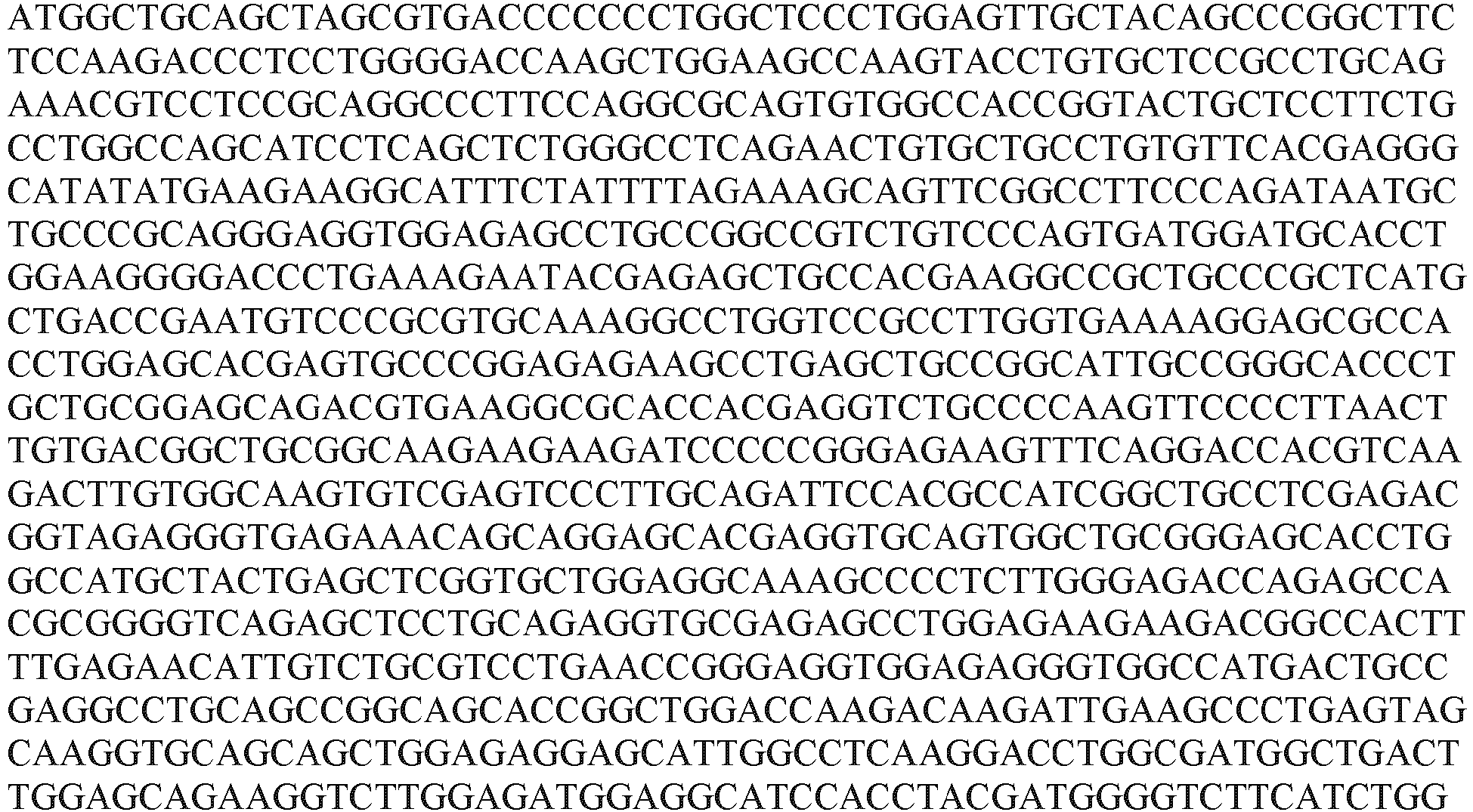
- Human AP-1 CDS (SEQ ID NO: 6)

- Human ASK1 CDS (SEQ ID NO: 7)


- Human CD14 CDS (SEQ ID NO: 8)

- Human ERK1 CDS (SEQ ID NO: 9)

- Human ERK2 CDS (SEQ ID NO: 10)

- Human IKK CDS (SEQ ID NO: 11)


- Human IκB CDS (SEQ ID NO: 12)


- Human IRAK CDS (SEQ ID NO: 13)


- Human JNK CDS (SEQ ID NO: 14)

- Human LBP CDS (SEQ ID NO: 15)

- Human MEK1 CDS (SEQ ID NO: 16)

- Human MEK2 CDS (SEQ ID NO: 17)


- Human MEK3 CDS (SEQ ID NO: 18)

- Human MEK6 CDS (SEQ ID NO: 19)

- Human MEKK1 CDS (SEQ ID NO: 20)


-
Human MEKK 3 CDS (SEQ ID NO: 21)
- Human MEKK4 CDS (SEQ ID NO: 22)


-
Human MEKK 6 CDS (SEQ ID NO: 23)


- Human MEKK7 CDS (SEQ ID NO: 24)


- Human MK2 CDS (SEQ ID NO: 25)

- Human MyD88 CDS (SEQ ID NO: 26)

- Human NF-κB CDS (SEQ ID NO: 27)


- Human NIK CDS (SEQ ID NO: 28)


- Human p38 CDS (SEQ ID NO: 29)

- Human PKR CDS (SEQ ID NO: 30)


- Human Rac CDS (SEQ ID NO: 31)


- Human Raf CDS (SEQ ID NO: 32)


- Human K-Ras CDS (SEQ ID NO: 33)

- Human N-Ras CDS (SEQ ID NO: 34)

- Human RIP CDS (SEQ ID NO: 35)


- Human TRAF6 CDS (SEQ ID NO: 36)


- Human TTP CDS (SEQ ID NO: 37)

- An antisense nucleic acid molecule can be complementary to all or part of a non-coding region of the coding strand of a nucleotide sequence encoding an AP-1, ASK1, CD14, c-jun, ERK1/2, IxB, IKK, IRAK, JNK, LBP, MAPK, MEK1/2, MEKK1/4, MEKK4/7,
MEKK 3/6, MK2, MyD88, NF-κB, NIK, p38, PKR, rac, ras, raf, RIP, TNFα, TNFR1, TNFR2, TRADD, TRAF2, TRAF6, or TTPMEKK1 protein. Non-coding regions (5' and 3' untranslated regions) are the 5' and 3' sequences that flank the coding region in a gene and are not translated into amino acids. - Based upon the sequences disclosed herein, one of skill in the art can easily choose and synthesize any of a number of appropriate antisense nucleic acids to target a nucleic acid encoding an AP-1, ASK1, CD14, c-jun, ERK1/2, IκB, IKK, IRAK, JNK, LBP, MAPK, MEK1/2, MEKK1/4, MEKK4/7,
MEKK 3/6, MK2, MyD88, NF-κB, NIK, p38, PKR, rac, ras, raf, RIP, TNFα, TNFR1, TNFR2, TRADD, TRAF2, TRAF6, or TTP protein described herein. Antisense nucleic acids targeting a nucleic acid encoding an AP-1, ASK1, CD14, c-jun, ERK1/2, IκB, IKK, IRAK, JNK, LBP, MAPK, MEK1/2, MEKK1/4, MEKK4/7,MEKK 3/6, MK2, MyD88, NF-κB, NIK, p38, PKR, rac, ras, raf, RIP, TNFα, TNFR1, TNFR2, TRADD, TRAF2, TRAF6, or TTPMEKK1 protein can be designed using the software available at the Integrated DNA Technologies website. - An antisense nucleic acid can be, for example, about 5, 10, 15, 18, 20, 22, 24, 25, 26, 28, 30, 32, 35, 36, 38, 40, 42, 44, 45, 46, 48, or 50 nucleotides or more in length. An antisense oligonucleotide can be constructed using enzymatic ligation reactions and chemical synthesis using procedures known in the art. For example, an antisense nucleic acid can be chemically synthesized using variously modified nucleotides or naturally occurring nucleotides designed to increase the physical stability of the duplex formed between the antisense and sense nucleic acids, e.g., phosphorothioate derivatives and acridine substituted nucleotides or to increase the biological stability of the molecules.
- Examples of modified nucleotides which can be used to generate an antisense nucleic acid include 1-methylguanine, 1-methylinosine, 2,2-dimethylguanine, 2-methyladenine, 2-methylguanine, 3-methylcytosine, 2-methylthio-N6-isopentenyladenine, uracil-5-oxyacetic acid (v), wybutoxosine, pseudouracil, queosine, 2-thiocytosine, 5-fluorouracil, 5-bromouracil, 5-chlorouracil, 5-iodouracil, hypoxanthine, xanthine, 4-acetylcytosine, 5-(carboxyhydroxylmethyl) uracil, 5-carboxymethylaminomethyl-2-thiouridine, 5-carboxymethylaminomethyluracil, dihydrouracil, beta-D-galactosylqueosine, inosine, N6-isopentenyladenine, 5-methylcytosine, N6-adenine, 7-methylguanine, 5-methylaminomethyluracil, 5-methoxyaminomethyl-2-thiouracil, beta-D-mannosylqueosine, 5'-methoxycarboxymethyluracil, 5-methoxyuracil, 5-methyl-2-thiouracil, 2-thiouracil, 4-thiouracil, 5-methyluracil, uracil-5-oxyacetic acid methylester, uracil-5-oxyacetic acid (v), 5-methyl-2-thiouracil, 3-(3-amino-3-N-2-carboxypropyl) uracil, (acp3)w, and 2,6-diaminopurine. Alternatively, the antisense nucleic acid can be produced biologically using an expression vector into which a nucleic acid has been subcloned in an antisense orientation (i.e., RNA transcribed from the inserted nucleic acid will be of an antisense orientation to a target nucleic acid of interest).
- The antisense nucleic acid molecules described herein can be prepared in vitro and administered to a subject, e.g., a human subject. Alternatively, they can be generated in situ such that they hybridize with or bind to cellular mRNA and/or genomic DNA encoding an AP-1, ASK1, CD14, c-jun, ERK1/2, IxB, IKK, IRAK, JNK, LBP, MAPK, MEK1/2, MEKK1/4, MEKK4/7,
MEKK 3/6, MK2, MyD88, NF-κB, NIK, p38, PKR, rac, ras, raf, RIP, TNFα, TNFR1, TNFR2, TRADD, TRAF2, TRAF6, or TTP protein to thereby inhibit expression, e.g., by inhibiting transcription and/or translation. The hybridization can be by conventional nucleotide complementarities to form a stable duplex, or, for example, in the case of an antisense nucleic acid molecule that binds to DNA duplexes, through specific interactions in the major groove of the double helix. The antisense nucleic acid molecules can be delivered to a mammalian cell using a vector (e.g., an adenovirus vector, a lentivirus, or a retrovirus). - An antisense nucleic acid can be an α-anomeric nucleic acid molecule. An α-anomeric nucleic acid molecule forms specific double-stranded hybrids with complementary RNA in which, contrary to the usual, β-units, the strands run parallel to each other (Gaultier et al., Nucleic Acids Res. 15:6625-6641, 1987). The antisense nucleic acid can also comprise a chimeric RNA-DNA analog (Inoue et al., FEES Lett. 215:327-330, 1987) or a 2'-O-methylribonucleotide (Inoue et al., Nucleic Acids Res. 15:6131-6148, 1987).
- Another example of an inhibitory nucleic acid is a ribozyme that has specificity for a nucleic acid encoding an AP-1, ASK1, CD14, c-jun, ERK1/2, IκB, IKK, IRAK, JNK, LBP, MAPK, MEK1/2, MEKK1/4, MEKK4/7,
MEKK 3/6, MK2, MyD88, NF-κB, NIK, p38, PKR, rac, ras, raf, RIP, TNFα, TNFR1, TNFR2, TRADD, TRAF2, TRAF6, or TTP mRNA, e.g., specificity for any one of SEQ ID NOs: 1-37). Ribozymes are catalytic RNA molecules with ribonuclease activity that are capable of cleaving a single-stranded nucleic acid, such as an mRNA, to which they have a complementary region. Thus, ribozymes (e.g., hammerhead ribozymes (described in Haselhoff and Gerlach, Nature 334:585-591, 1988)) can be used to catalytically cleave mRNA transcripts to thereby inhibit translation of the protein encoded by the mRNA. An AP-1, ASK1, CD14, c-jun, ERK1/2, IκB, IKK, IRAK, JNK, LBP, MAPK, MEK1/2, MEKK1/4, MEKK4/7,MEKK 3/6, MK2, MyD88, NF-κB, NIK, p38, PKR, rac, ras, raf, RIP, TNFα, TNFR1, TNFR2, TRADD, TRAF2, TRAF6, or TTP mRNA can be used to select a catalytic RNA having a specific ribonuclease activity from a pool of RNA molecules. See, e.g., Bartel et al., Science 261:1411-1418, 1993. - Alternatively, a ribozyme having specificity for an AP-1, ASK1, CD14, c-jun, ERK1/2, IκB, IKK, IRAK, JNK, LBP, MAPK, MEK1/2, MEKK1/4, MEKK4/7,
MEKK 3/6, MK2, MyD88, NF-xB, NIK, p38, PKR, rac, ras, raf, RIP, TNFα, TNFR1, TNFR2, TRADD, TRAF2, TRAF6, or TTP mRNA can be designed based upon the nucleotide sequence of any of the AP-1, ASK1, CD14, c-jun, ERK1/2, IxB, IKK, IRAK, JNK, LBP, MAPK, MEK1/2, MEKK1/4, MEKK4/7,MEKK 3/6, MK2, MyD88, NF-κB, NIK, p38, PKR, rac, ras, raf, RIP, TNFα, TNFR1, TNFR2, TRADD, TRAF2, TRAF6, or TTP mRNA sequences disclosed herein. For example, a derivative of a Tetrahymena L-19 IVS RNA can be constructed in which the nucleotide sequence of the active site is complementary to the nucleotide sequence to be cleaved in an AP-1, ASK1, CD14, c-jun, ERK1/2, IκB, IKK, IRAK, JNK, LBP, MAPK, MEK1/2, MEKK1/4, MEKK4/7,MEKK 3/6, MK2, MyD88, NF-κB, NIK, p38, PKR, rac, ras, raf, RIP, TNFα, TNFR1, TNFR2, TRADD, TRAF2, TRAF6, or TTP mRNA (see, e.g.,U.S. Patent. Nos. 4,987,071 and5,116,742 ). - An inhibitory nucleic acid can also be a nucleic acid molecule that forms triple helical structures. For example, expression of an AP-1, ASK1, CD14, c-jun, ERK1/2, IκB, IKK, IRAK, JNK, LBP, MAPK, MEK1/2, MEKK1/4, MEKK4/7,
MEKK 3/6, MK2, MyD88, NF-κB, NIK, p38, PKR, rac, ras, raf, RIP, TNFα, TNFR1, TNFR2, TRADD, TRAF2, TRAF6, or TTP polypeptide can be inhibited by targeting nucleotide sequences complementary to the regulatory region of the gene encoding the AP-1, ASK1, CD14, c-jun, ERK1/2, IκB, IKK, IRAK, JNK, LBP, MAPK, MEK1/2, MEKK1/4, MEKK4/7,MEKK 3/6, MK2, MyD88, NF-κB, NIK, p38, PKR, rac, ras, raf, RIP, TNFα, TNFR1, TNFR2, TRADD, TRAF2, TRAF6, or TTP polypeptide (e.g., the promoter and/or enhancer, e.g., a sequence that is at least 1 kb, 2 kb, 3 kb, 4 kb, or 5 kb upstream of the transcription initiation start state) to form triple helical structures that prevent transcription of the gene in target cells. See generally Maher, Bioassays 14(12):807-15, 1992; Helene, Anticancer DrugDes. 6(6):569-84, 1991; and Helene, Ann. N.Y. Acad. Sci. 660:27-36, 1992. - In various embodiments, inhibitory nucleic acids can be modified at the sugar moiety, the base moiety, or phosphate backbone to improve, e.g., the solubility, stability, or hybridization, of the molecule. For example, the deoxyribose phosphate backbone of the nucleic acids can be modified to generate peptide nucleic acids (see, e.g., Hyrup et al., Bioorganic Medicinal Chem. 4(1):5-23, 1996). Peptide nucleic acids (PNAs) are nucleic acid mimics, e.g., DNA mimics, in which the deoxyribose phosphate backbone is replaced by a pseudopeptide backbone and only the four natural nucleobases are retained. The neutral backbone of PNAs allows for specific hybridization to RNA and DNA under conditions of low ionic strength. PNA oligomers can be synthesized using standard solid phase peptide synthesis protocols (see, e.g., Perry-O'Keefe et al., Proc. Natl. Acad. Sci. U.S.A. 93:14670-675, 1996). PNAs can be used as antisense or antigene agents for sequence-specific modulation of gene expression by, e.g., inducing transcription or translation arrest or inhibiting replication.
- In some embodiments, the anti-TNFα agent is a small molecule. In some embodiments, the small molecule is a tumor necrosis factor-converting enzyme (TACE) inhibitor (e.g., Moss et al., Nature Clinical Practice Rheumatology 4: 300-309, 2008). In some embodiments, the anti-TNFα agent is C87 (Ma et al., J. Biol. Chem. 289(18):12457-66, 2014). In some embodiments, the small molecule is LMP-420 (e.g., Haraguchi et al., AIDS Res. Ther. 3:8, 2006). In some embodiments, the TACE inhibitor is TMI-005 and BMS-561392. Additional examples of small molecule inhibitors are described in, e.g., He et al., Science 310(5750):1022-1025, 2005.
- In some examples, the anti-TNFα agent is a small molecule that inhibits the activity of one of AP-1, ASK1, IKK, JNK, MAPK,
MEKK 1/4, MEKK4/7,MEKK 3/6, NIK, TRADD, RIP, NF-κB, and TRADD in a cell (e.g., in a cell obtained from a subject, a mammalian cell). - In some examples, the anti-TNFα agent is a small molecule that inhibits the activity of one of CD14, MyD88 (see, e.g., Olson et al., Scientific Reports 5:14246, 2015), ras (e.g., Baker et al., Nature 497:577-578, 2013), raf (e.g., vemurafenib (PLX4032, RG7204), sorafenib tosylate, PLX-4720, dabrafenib (GSK2118436), GDC-0879, RAF265 (CHIR-265), AZ 628, NVP-BHG712, SB590885, ZM 336372, sorafenib, GW5074, TAK-632, CEP-32496, encorafenib (LGX818), CCT196969, LY3009120, RO5126766 (CH5126766), PLX7904, and MLN2480).
- In some examples, the anti-TNFα agent TNFα inhibitor is a small molecule that inhibits the activity of one of MK2 (PF 3644022 and PHA 767491), JNK (e.g., AEG 3482, BI 78D3, CEP 1347, c-JUN peptide, IQ 1S, JIP-1 (153-163), SP600125, SU 3327, and TCS JNK6o), c-jun (e.g., AEG 3482, BI 78D3, CEP 1347, c-JUN peptide, IQ 1S, JIP-1 (153-163), SP600125, SU 3327, and TCS JNK6o), MEK3/6 (e.g., Akinleye et al., J. Hematol. Oncol. 6:27, 2013), p38 (e.g., AL 8697, AMG 548, BIRB 796, CMPD-1, DBM 1285 dihydrochloride, EO 1428, JX 401, ML 3403, Org 48762-0, PH 797804, RWJ 67657, SB 202190, SB 203580, SB 239063, SB 706504, SCIO 469, SKF 86002, SX 011, TA 01, TA 02, TAK 715, VX 702, and VX 745), PKR (e.g., 2-aminopurine or CAS 608512-97-6), TTP (e.g., CAS 329907-28-0), MEK1/2 (e.g., Facciorusso et al., Expert Review Gastroentrol. Hepatol. 9:993-1003, 2015), ERK1/2 (e.g., Mandal et al., Oncogene 35:2547-2561, 2016), NIK (e.g., Mortier et al., Bioorg. Med. Chem. Lett. 20:4515-4520, 2010), IKK (e.g., Reilly et al., Nature Med. 19:313-321, 2013), IκB (e.g., Suzuki et al., Expert. Opin. Invest. Drugs 20:395-405, 2011), NF-κB (e.g., Gupta et al., Biochim. Biophys. Acta 1799(10-12):775-787, 2010), rac (e.g.,
U.S. Patent No. 9,278,956 U.S. Patent No. 5,705,398 ), and TRAF6 (e.g., 3-(2,5-Dimethylphenyl)amino]-1-phenyl-2-propen-1-one). - In some embodiments of any of the methods described herein, the inhibitory nucleic acid can be about 10 nucleotides to about 50 nucleotides (e.g., about 10 nucleotides to about 45 nucleotides, about 10 nucleotides to about 40 nucleotides, about 10 nucleotides to about 35 nucleotides, about 10 nucleotides to about 30 nucleotides, about 10 nucleotides to about 28 nucleotides, about 10 nucleotides to about 26 nucleotides, about 10 nucleotides to about 25 nucleotides, about 10 nucleotides to about 24 nucleotides, about 10 nucleotides to about 22 nucleotides, about 10 nucleotides to about 20 nucleotides, about 10 nucleotides to about 18 nucleotides, about 10 nucleotides to about 16 nucleotides, about 10 nucleotides to about 14 nucleotides, about 10 nucleotides to about 12 nucleotides, about 12 nucleotides to about 50 nucleotides, about 12 nucleotides to about 45 nucleotides, about 12 nucleotides to about 40 nucleotides, about 12 nucleotides to about 35 nucleotides, about 12 nucleotides to about 30 nucleotides, about 12 nucleotides to about 28 nucleotides, about 12 nucleotides to about 26 nucleotides, about 12 nucleotides to about 25 nucleotides, about 12 nucleotides to about 24 nucleotides, about 12 nucleotides to about 22 nucleotides, about 12 nucleotides to about 20 nucleotides, about 12 nucleotides to about 18 nucleotides, about 12 nucleotides to about 16 nucleotides, about 12 nucleotides to about 14 nucleotides, about 15 nucleotides to about 50 nucleotides, about 15nucleotides to about 45 nucleotides, about 15nucleotides to about 40 nucleotides, about 15nucleotides to about 35 nucleotides, about 15 nucleotides to about 30 nucleotides, about 15nucleotides to about 28 nucleotides, about 15nucleotides to about 26 nucleotides, about 15nucleotides to about 25 nucleotides, about 15nucleotides to about 24 nucleotides, about 15nucleotides to about 22 nucleotides, about 15nucleotides to about 20 nucleotides, about 15nucleotides to about 18 nucleotides, about 15nucleotides to about 16 nucleotides, about 16 nucleotides to about 50 nucleotides, about 16 nucleotides to about 45 nucleotides, about 16 nucleotides to about 40 nucleotides, about 16 nucleotides to about 35 nucleotides, about 16 nucleotides to about 30 nucleotides, about 16 nucleotides to about 28 nucleotides, about 16 nucleotides to about 26 nucleotides, about 16 nucleotides to about 25 nucleotides, about 16 nucleotides to about 24 nucleotides, about 16 nucleotides to about 22 nucleotides, about 16 nucleotides to about 20 nucleotides, about 16 nucleotides to about 18 nucleotides, about 18 nucleotides to about 20 nucleotides, about 20 nucleotides to about 50 nucleotides, about 20 nucleotides to about 45 nucleotides, about 20 nucleotides to about 40 nucleotides, about 20 nucleotides to about 35 nucleotides, about 20 nucleotides to about 30 nucleotides, about 20 nucleotides to about 28 nucleotides, about 20 nucleotides to about 26 nucleotides, about 20 nucleotides to about 25 nucleotides, about 20 nucleotides to about 24 nucleotides, about 20 nucleotides to about 22 nucleotides, about 24 nucleotides to about 50 nucleotides, about 24 nucleotides to about 45 nucleotides, about 24 nucleotides to about 40 nucleotides, about 24 nucleotides to about 35 nucleotides, about 24 nucleotides to about 30 nucleotides, about 24 nucleotides to about 28 nucleotides, about 24 nucleotides to about 26 nucleotides, about 24 nucleotides to about 25 nucleotides, about 26 nucleotides to about 50 nucleotides, about 26 nucleotides to about 45 nucleotides, about 26 nucleotides to about 40 nucleotides, about 26 nucleotides to about 35 nucleotides, about 26 nucleotides to about 30 nucleotides, about 26 nucleotides to about 28 nucleotides, about 28 nucleotides to about 50 nucleotides, about 28 nucleotides to about 45 nucleotides, about 28 nucleotides to about 40 nucleotides, about 28 nucleotides to about 35 nucleotides, about 28 nucleotides to about 30 nucleotides, about 30 nucleotides to about 50 nucleotides, about 30 nucleotides to about 45 nucleotides, about 30 nucleotides to about 40 nucleotides, about 30 nucleotides to about 38 nucleotides, about 30 nucleotides to about 36 nucleotides, about 30 nucleotides to about 34 nucleotides, about 30 nucleotides to about 32 nucleotides, about 32 nucleotides to about 50 nucleotides, about 32 nucleotides to about 45 nucleotides, about 32 nucleotides to about 40 nucleotides, about 32 nucleotides to about 35 nucleotides, about 35 nucleotides to about 50 nucleotides, about 35 nucleotides to about 45 nucleotides, about 35 nucleotides to about 40 nucleotides, about 40 nucleotides to about 50 nucleotides, about 40 nucleotides to about 45 nucleotides, about 42 nucleotides to about 50 nucleotides, about 42 nucleotides to about 45 nucleotides, or about 45 nucleotides to about 50 nucleotides) in length. One skilled in the art will appreciate that inhibitory nucleic acids may comprises at least one modified nucleic acid at either the 5' or 3' end of DNA or RNA.
- In some embodiments, the inhibitory nucleic acid can be formulated in a liposome, a micelle (e.g., a mixed micelle), a nanoemulsion, or a microemulsion, a solid nanoparticle, or a nanoparticle (e.g., a nanoparticle including one or more synthetic polymers). Additional exemplary structural features of inhibitory nucleic acids and formulations of inhibitory nucleic acids are described in
US 2016/0090598 . - In some embodiments, the inhibitory nucleic acid (e.g., any of the inhibitory nucleic acid described herein) can include a sterile saline solution (e.g., phosphate-buffered saline (PBS)). In some embodiments, the inhibitory nucleic acid (e.g., any of the inhibitory nucleic acid described herein) can include a tissue-specific delivery molecule (e.g., a tissue-specific antibody).
- As can be appreciated by the skilled artisan, methods of synthesizing the compounds of the formulae herein will be evident to those of ordinary skill in the art. Synthetic chemistry transformations and protecting group methodologies (protection and deprotection) useful in synthesizing the compounds described herein are known in the art and include, for example, those such as described in R. Larock, Comprehensive Organic Transformations, VCH Publishers (1989); T. W. Greene and RGM. Wuts, Protective Groups in Organic Synthesis, 2d. Ed., John Wiley and Sons (1991); L. Fieser and M. Fieser, Fieser and Fieser's Reagents for Organic Synthesis, John Wiley and Sons (1994); and L. Paquette, ed., Encyclopedia of Reagents for Organic Synthesis, John Wiley and Sons (1995), and subsequent editions thereof.
- The following abbreviations have the indicated meanings:
- ACN = acetonitrile
- BTC = trichloromethyl chloroformate
- Boc = t-butyloxy carbonyl
- Davephos = 2-Dicyclohexylphosphino-2'-(N,N-dimethylamino)biphenyl
- DCM = dichloromethane
- DEA = diethylamine
- DMF = N,N-dimethylformamide
- DMSO = dimethyl sulfoxide
- DIEA = N,N-diisopropylethylamine
- DPPA = diphenylphosphoryl azide
- dppf = 1,1'-Bis(diphenylphosphino)ferrocene
- EtOH = ethanol
- HATU = 1-[Bis(dimethylamino)methylene]-1H-1,2,3-triazolo[4,5-b]pyridinium 3-oxid
- hexafluorophosphate
- Hex = hexane
- HPLC = high performance liquid chromatography
- LC-MS = liquid chromatography - mass spectrometry
- LiHMDS = lithium bis(trimethylsilyl)amide
- LDA = lithium diisopropylamide
- M = mol/L
- Me = methyl
- MeOH = methanol
- MSA = methanesulfonic acid
- NBS = N-bromosuccinimide
- NCS = N-chlorosuccinimide
- NMR = nuclear magnetic resonance
- Pd(dppf)Cl2 = dichloro[1,1'-bis(diphenylphosphino)ferrocene]palladium
- Ph = phenyl
- PPh3Cl2 = dichlorotriphenylphosphorane
- Py = pyridine
- RT = room temperature
- Rt = Retention time
- Rr = Retardation factor
- Sat. = saturated
- TBAF = tetrabutylammonium fluoride
- TBS = tert-butyldimethylsilyl
- TBSCI = tert-butyldimethylsilyl chloride
- TBDPSCl = tert-butyldiphenylsilyl chloride
- TEA = triethylamine
- TFA = trifluoroacetic acid
- THF = tetrahydrofuran
- TLC = thin layer chromatography
- TsOH = 4-methylbenzenesulfonic acid
- UV = ultraviolet
- The progress of reactions was often monitored by TLC or LC-MS. The identity of the products was often confirmed by LC-MS. The LC-MS was recorded using one of the following methods.
- Method A: Shim-pack XR-ODS, C18, 3x50 mm, 2.5 um column, 1.0 uL injection, 1.5 mL/min flow rate, 90-900 amu scan range, 190-400 nm UV range, 5-100% (1.1 min), 100% (0.6 min) gradient with ACN (0.05% TFA) and water (0.05% TFA), 2 minute total run time.
- Method B: Kinetex EVO, C18, 3x50 mm, 2.2 um column, 1.0 uL injection, 1.5 mL/min flow rate, 90-900 amu scan range, 190-400 nm UV range, 10-95% (1.1 min), 95% (0.6 min) gradient with ACN and water (0.5% NH4HCO3 ), 2 minute total run time.
- Method C: Shim-pack XR-ODS, C18, 3x50 mm, 2.5 um column, 1.0 uL injection, 1.5 mL/min flow rate, 90-900 amu scan range, 190-400 nm UV range, 5-100% (2.1 min), 100% (0.6 min) gradient with ACN (0.05% TFA) and water (0.05% TFA), 3 minute total run time.
- Method D: Kinetex EVO, C18, 3x50 mm, 2.2 um column, 1.0 uL injection, 1.5 mL/min flow rate, 90-900 amu scan range, 190-400 nm UV range, 10-95% (2.1 min), 95% (0.6 min) gradient with ACN and water (0.5% NH4HCO3 ), 3 minute total run time.
- Method F: Phenomenex, CH0-7644, Onyx Monolithic C18, 50 x 4.6 mm, 10.0 uL injection, 1.5 mL/min flow rate, 100-1500 amu scan range, 220 and 254 nm UV detection, 5% with ACN (0.1% TFA) to 100% water (0.1% TFA) over 9.5 min, with a stay at 100% (ACN, 0.1% TFA) for 1 min, then equilibration to 5% (ACN, 0.1% TFA) over 1.5 min.
- The final targets were purified by Prep-HPLC. The Prep-HPLC was carried out using the following method.
- Method E: Prep-HPLC: Column, XBridge Shield RP18 OBD (19x250 mm, 10 um); mobile phase, Water (10mmol/L NH4HCO3) and ACN, UV detection 254/210 nm.
- Method G: Prep-HPLC: Higgins Analytical Proto 200, C18 Column, 250 x 20 mm, 10 um; mobile phase, Water (0.1% TFA) and ACN (0.1% TFA), UV detection 254/210 nm.
- NMR was recorded on BRUKER NMR 300.03 MHz, DUL-C-H, ULTRASHIELD™300, AVANCE II 300 B-ACS™120 or BRUKER NMR 400.13 MHz, BBFO, ULTRASHIELD™400, AVANCE III 400, B-ACS™120 or BRUKER AC 250 NMR instrument with TMS as reference measured in ppm (part per million).
- Racemic compounds of this invention can be resolved to give individual enantiomers using a variety of known methods. For example, chiral stationary phases can used and the elution conditions can include normal phase or super-critical fluid with or without acidic or basic additives. Enantiomerically pure acids or bases can be used to form diatereomeric salts with the racemic compounds whereby pure enantiomers can be obtained by fractional crystallization. The racemates can also be derivatized with enantiomerically pure auxiliary reagents to form diastereomeric mixtures that can be separated. The auxiliary is then removed to give pure enantiomers.
- Schemes 1-3 below illustrate several conditions used for coupling of
sulfonimidamide isocyanate 2 to afford aminocarbonyl sulfonimidamide 4 via 3 or 6 after deprotection. As used in the schemes, rings "A" and "B" may be substituted as disclosed herein.


-
Scheme 4 below illustrates the coupling betweensulfonimidamide 7 andisocyanate 2 to providesulfonimidamide 8.

-
Scheme 5 below illustrates the conversion ofcarboxylic acid 9 through Curtius rearrangement toisocyanate 2 viaacyl azide 10, whereupon coupling between 2 andsulfonimidamide 5 affordsaminocarbonyl sulfonimidamide 4.
- Schemes below illustrate the preparation of sulfonamide intermediates.

- Into a 500-mL 3-necked round-bottom flask was placed methyl 2-methylfuran-3-carboxylate (7 g, 50 mmol) in CHCl3 (200 mL). This was followed by the addition of chlorosulfonic acid (11.6 g, 100 mmol) dropwise with stirring at -10°C. The reaction mixture was stirred for 48 h at RT, after which the system was cooled to -10°C. Then to the above was added phosphorus pentachloride (22.9 g, 110 mmol). The resulting solution was stirred for 0.5 h at 50°C and then was quenched by pouring onto 200 mL of water/ice. The resulting mixture was extracted with 3x200 mL of DCM. The organic layers were combined and dried over anhydrous Na2SO4, and then concentrated under vacuum. This resulted in 7.5 g (crude, 63%) of the title compound as light brown oil. The crude product was used in the next step.
- Into a 250-mL round-bottom flask was placed a solution of methyl 5-(chlorosulfonyl)-2-methylfuran-3-carboxylate (7.5 g, crude) in DCM (75 mL). To the above was added a saturated solution of ammonia in DCM (50 mL). The resulting solution was stirred for 3 h at RT and then was concentrated under vacuum. The residue was applied onto a silica gel column and eluted with a gradient of ethyl acetate/petroleum ether (1:4 to 1:2). This resulted in 5.0 g (46% over two steps) of the title compound as a light yellow solid. MS-ESI: 218.0 (M-1).
- Into a 250-mL 3-necked round-bottom flask purged with and maintained under nitrogen was placed a solution of methyl 2-methyl-5-sulfamoylfuran-3-carboxylate (3.7 g, 16.9 mmol) in THF (100 mL). This was followed by the addition of MeMgBr (3 M in THF, 25 mL) dropwise with stirring at -10°C. The resulting mixture was stirred for 10 h at RT and then was quenched by the addition of 50 mL of NH4Cl (sat.). The resulting solution was extracted with 3x50 mL of ethyl acetate. The organic layers were combined and dried over anhydrous Na2SO4, then concentrated under vacuum. The residue was applied onto a silica gel column and eluted with a gradient of ethyl acetate/petroleum ether (1:3 to 1:1). This resulted in 2.6 g (75%) of the title compound as a light yellow solid. MS-ESI: 218.0 (M-1).
- Into a 250-mL round-bottom flask purged with and maintained under nitrogen was placed 4-(2-hydroxypropan-2-yl)-5-methylfuran-2-sulfonamide (1.0 g, 4.56 mmol), DCM (100 mL), 1H-imidazole (612 mg, 9.12 mmol), and TBSCl (3.4 g, 22.6 mmol). The resulting solution was stirred for 14 h at RT and then was diluted with 100 mL of water. The resulting mixture was extracted with 3x50 mL of DCM and the organic layers were combined and concentrated under vacuum. The residue was applied onto a silica gel column and eluted with a gradient of ethyl acetate/petroleum ether (1:10 to 1:3). This resulted in 1.4 g (92%) of the title compound as a white solid. MS-ESI: 332.0 (M-1).
- Into a 250-mL 3-necked round-bottom flask purged with and maintained under nitrogen was placed PPh3Cl2 (3.0 g, 10.2 mmol) in CHCl3 (100 mL). This was followed by the addition of TEA (2.06 g, 20.4 mmol) dropwise with stirring at RT. After stirred at 0°C for 10 min, to the above was added a solution of N-(tert-butyldimethylsilyl)-4-(2-hydroxypropan-2-yl)-5-methylfuran-2-sulfonamide (2.3 g, 6.8 mmol) in CHCl3 (10 mL) dropwise with stirring at 0°C. The resulting solution was allowed to react for 30 min at 0°C. To the mixture was added a saturated solution of ammonia in DCM (10 mL) at 0°C. The resulting solution was stirred for 2 h at RT. The reaction was then quenched by the addition of 100 mL of water. The resulting solution was extracted with 3x50 mL of DCM and the organic layers combined and concentrated under vacuum. The residue was applied onto a silica gel column and eluted with a gradient of ethyl acetate/petroleum ether (1:10 to 1:3). This resulted in 0.80 g (52.8%) of the title compound as a light yellow solid. MS-ESI: 333.0 (M+1).


- Into a 250-mL round-bottom flask was placed methyl 2-bromothiazole-5-carboxylate (10 g, 45 mmol), EtOH (100 mL), and sodium hydrogensulfide (5 g, 89 mmol). The resulting solution was stirred for 2 h at 80°C and then was cooled to 0°C with a water/ice bath. The pH value of the solution was adjusted to 3 with aq. HCl (1 N). The solids were collected by filtration. This resulted in 6 g (76%) of the title compound as a light yellow solid. MS-ESI: 176.0 (M+1).
- Into a 250-mL round-bottom flask was placed methyl 2-mercaptothiazole-5-carboxylate (6 g, 34 mmol) and acetic acid (60 mL). This was followed by the addition of sodium hypochlorite (60 mL, 8%-10% wt.) in portions at 0°C. The resulting solution was stirred for 1 h at RT and then was diluted with 100 mL of water. The solution was extracted with 3x50 mL of DCM. The organic layers were combined and dried over anhydrous Na2SO4, then concentrated under vacuum. This resulted in 5 g (crude, 60%) of the title compound as yellow oil. The crude product was used in the next step.
- Step 3-6 used similar procedure for converting
compound 12 toIntermediate 1 shown inScheme 6 to affordIntermediate 2. MS-ESI: 336.1 (M+1).

- Into a 2-L round-bottom flask was placed methyl 2-bromothiazole-5-carboxylate (100 g, 450 mmol), EtOH (1000 mL), sodium hydrogensulfide (50 g, 890 mmol). The resulting solution was stirred for 2 h at 80°C and then was cooled to 0°C with a water/ice bath. The pH value of the solution was adjusted to 3 with hydrogen chloride (1 N). The solids were collected by filtration. This resulted in 63.2 g (80%) of the title compound as a light yellow solid. MS-ESI: 176.0 (M+1).
- Into a 1-L round-bottom flask was placed methyl 2-mercaptothiazole-5-carboxylate (30 g, 170 mmol) and acetic acid (300 mL). This was followed by the addition of sodium hypochlorite (300 mL, 8%-10% wt.) in portions at 0°C. The resulting solution was stirred for 2 h at RT and then was diluted with 500 mL of water. The solution was extracted with 3x300 mL of DCM and the combined organic layers were washed with 2x300 mL of brine and dried over anhydrous Na2SO4. The crude product as a yellow solution in DCM was used in the next step.
- Into a 2-L round-bottom flask was placed methyl 2-(chlorosulfonyl)thiazole-5-carboxylate as a crude solution in DCM (900 mL). To the solution was introduced NH3 (g) below 0°C for 20 minutes. The resulting solution was stirred for 1 h at RT and then concentrated under vacuum. The residue was applied onto a silica gel column and eluted with ethyl acetate/petroleum ether (1:5 to 1:3). This resulted in 23 g (75%, 2 steps) of the title compound as a white solid. MS-ESI: 223.0 (M+1).
- Into a 500-mL round-bottom flask purged with and maintained under nitrogen was placed a solution of methyl 2-sulfamoylthiazole-5-carboxylate (15 g, 67.5 mmol) in THF (150 mL). This was followed by the addition of MeMgBr/THF (3 M, 90 mL) dropwise with stirring at 0°C. The resulting solution was stirred for 14 h at RT and then was quenched by the addition of 100 mL of NH4Cl (sat.). The resulting solution was extracted with 3x150 mL of DCM. The organic layers were combined and dried over anhydrous Na2SO4, then concentrated under vacuum. The residue was applied onto a silica gel column and eluted with ethyl acetate/petroleum ether (1:5 to 1:3). This resulted in 11.5 g (78%) of the title compound as a white solid. MS-ESI: 223.0 (M+1), 221.0 (M-1) in positive and negative ion mode, respectively.
- Into a 250-mL 3-necked round-bottom flask purged with and maintained under nitrogen was placed a solution of 5-(2-hydroxypropan-2-yl)thiazole-2-sulfonamide (5 g, 22.5 mmol) in THF (100 mL). Then to the above was added NaH (60% wt, 1.8 g, 45.0 mmol) in portions in an ice/water bath. After stirring for 20 minutes in a water/ice bath, this was followed by the addition of a solution of TBSCl (4.1 g, 27.2 mmol) in THF (10 mL) dropwise with stirring at 0°C. The resulting solution was stirred for 4 h at RT. The reaction was quenched with sat. NH4Cl (100 mL). The resulting solution was extracted with 3 x 100 mL of ethyl acetate and the combined organic layers were dried over Na2SO4 and concentrated under vacuum. The crude solid was washed with ethyl acetate/hexane (1:5) (2x100 mL). This resulted in 6.81 g (90%) of the title compound as a yellow solid. MS-ESI: 337.1 (M+1), 335.1 (M-1) in positive and negative ion mode, respectively.
- Into a 100-mL 3-necked round-bottom flask purged with and maintained under nitrogen was placed a solution of PPh3Cl2 (3 g, 9.0 mmol) in CHCl3 (100 mL). This was followed by the addition of DIEA (1.54 g, 11.9 mmol) dropwise with stirring at RT. The resulting solution was stirred for 10 min at RT. This was followed by the addition of a solution of N-(tert-butyldimethylsilyl)-5-(2-hydroxypropan-2-yl)thiazole-2-sulfonamide (2.0 g, 5.9 mmol) in CHCl3 (30 mL) dropwise with stirring in an ice/water bath. The resulting solution was stirred for 30 min in an ice/water bath. To the above was introduced NH3 (g) below 0°C for 15 minutes. The resulting solution was stirred for 20 minutes at RT. The solids were filtered out and the filtrate was concentrated and the residue was dissolved in 300 mL of ethyl acetate. The solution was washed with brine (2x100 mL), dried over Na2SO4 and concentrated under vacuum. The crude solid was washed with CHCl3 (100 mL). Then the filtrate was concentrated under vacuum and the residue was further purified by a silica gel column with ethyl acetate/petroleum ether (1:10 to 1:3). The original washed solid and solid from silica gel purification were combined. This resulted in 1.2 g (60%) of the title compound as a white solid. MS-ESI: 336.1 (M+1). 1H-NMR (300 MHz, DMSO-d 6) 6 7.66 (s, 1H), 7.12 (s, 2H), 5.78 (s, 1H), 1.51 (s, 6H), 0.86 (s, 9H), 0.02 (s, 3H), 0.01 (s, 3H).
Table 2. The Intermediate in the following Table was prepared using the similar procedures for converting compound 16 toIntermediate 2 shown in Scheme 7B starting from ethyl 5-bromo-4-methylthiazole-2-carboxylate.Intermediate # Structure IUPAC Name Exact Mass[M+H] + Intermediate 3 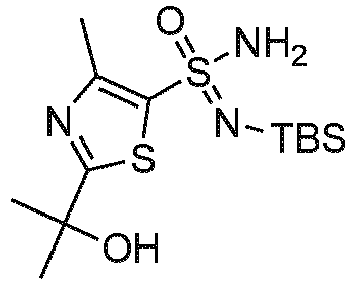
N'-(tert-butyldimethylsilyl)-2-(2-hydroxypropan-2-yl)-4-methylthiazole-5-sulfonimidamide 350.2 
- Steps 1-3 used similar procedures for converting
compound 11 to compound 14 shown inScheme 6 to afford compound 25 fromcompound 22. MS-ESI: 234.0 (M-1). - Steps 4-5 used similar procedure for converting
compound 20 toIntermediate 2 shown in Scheme 7B to affordIntermediate 4 from compound 25. MS-ESI: 349.1 (M+1).Table 3. The Intermediate in the following Table was prepared using similar procedure as shown in Scheme 8 above for convertingcompound 22 toIntermediate 4 starting from the appropriate materials.Intermediate # Structure IUPAC Name Exact Mass [M+H]+ Intermediate 5 
N'-(tert-butyldimethylsilyl)-5-(2-hydroxypropan-2-yl)thiophene-2-sulfonimidamide 335.1 Intermediate 6 
N'-(tert-butyldimethylsilyl)-4-(2-hydroxypropan-2-yl)thiophene-2-sulfonimidamide 335.1 Intermediate 7 
N'-(tert-butyldimethylsilyl)-5-(2-hydroxypropan-2-yl)-3-methylthiophene-2-sulfonimidamide 349.1 Intermediate 8 
N'-(tert-butyldimethylsilyl)-5-(2-hydroxypropan-2-yl)-4-methylthiophene-2-sulfonimidamide 349.1 Intermediate 9 
N'-(tert-butyldimethylsilyl)-3-fluoro-5-(2-hydroxypropan-2-yl)thiophene-2-sulfonimidamide 353.1 Intermediate 10 
N'-(tert-butyldimethylsilyl)-4-(2-hydroxypropan-2-yl)furan-2-sulfonimidamide 319.1 
- Into a 1 L round-bottom flask was placed a solution of methyl 4-amino-3-fluorobenzoate (10 g, 59.1 mmol) in aq. HCl (6 N, 200 mL). This was followed by the addition of a solution of NaNO2 (6.1 g, 88.8 mmol) in water (20 mL) dropwise with stirring at 0°C. The resulting solution was stirred for 30 min at 0°C. The above mixture was added to a saturated solution of SO2 in AcOH (200 mL) dropwise with stirring at 0°C. Then to the above was added CuCl2 (8.0 g, 59.6 mmol). The resulting solution was stirred for 1 h at RT and was then quenched by the addition of 200 mL of water. The resulting solution was extracted with 3x200 mL of DCM. The organic layers were combined, dried over anhydrous Na2SO4 and concentrated under vacuum. This resulted in 10 g (67%) of the title compound as yellow oil. The product was used in the next step without further purification.
- Into a 1000 mL round bottom flask was placed a solution of methyl 4-(chlorosulfonyl)-3-fluorobenzoate solution (10 g, 39.5 mmol) in DCM (50 mL). This was followed by the addition of a saturated solution of ammonia in DCM (500 mL) in portions with stirring at 0°C. The resulting solution was stirred for 1 h at 0°C. The resulting solution was concentrated and the residue was purified with SiO2-gel column and diluted with ethyl acetate/ petroleum ether (1:2 to 1:1). This resulted in 8.28 g (90%) of the title compound as yellow solid. MS-ESI: 232.1 (M-1).
- Into a 1 L 3-necked round-bottom flask was placed a solution of methyl 3-fluoro-4-sulfamoylbenzoate (8.28 g 35.5 mmol) in THF (500 mL). This was followed by the addition of MeMgBr/THF (3 M, 60 mL) dropwise with stirring at 0°C. The resulting solution was stirred overnight at RT and then was quenched by the addition of 100 mL of sat. NH4Cl. The resulting solution was extracted with 3x200 mL of ethyl acetate and the combined organic layers were concentrated under vacuum. The residue was applied onto a silica gel column and eluted with ethyl acetate/petroleum ether (1:2 to 1:1). This resulted 7.45 g (89.9%) of the title compound as a white solid. MS-ESI: 233.1 (M+1).
- Into a 500 mL round bottom flask was placed a solution of 2-fluoro-4-(2-hydroxypropan-2-yl)benzenesulfonamide (7.45 g 31.9 mmol) in THF (200 mL). This was followed by the addition of NaH (60% wt, 1.91 g, 79.6 mmol). The mixture was stirred at 0°C for 0.5 h. This was followed by the addition of the solution of TBSCl (7.19 g, 47.9 mmol) in THF (50 mL) dropwise. The resulting solution was stirred at RT overnight. The reaction was quenched with ice-water (100 mL); the resulting solution was extracted with EtOAc (3x200 mL). The combined organic layers were dried over anhydrous Na2SO4 and concentrated under vacuum. The residue was purified with SiO2-gel column and eluted with ethyl acetate/petroleum ether (1:5 to 1:2). This resulted 10 g (90%)of the title compound as a white solid. MS-ESI: 348.1 (M+1).
- Into a 1 L 3-necked round-bottom flask purged with and maintained under nitrogen was placed a solution of PPh3Cl2 (19.2 g, 57.6 mmol) in CHCl3 (100 mL). This was followed by the addition of DIEA (7.4 g, 57.6 mmol) dropwise with stirring at 0°C. After stirred at 0°C for 10 min, to the above was added a solution of N'-(tert-butyldimethylsilyl)-2-fluoro-4-(2-hydroxypropan-2-yl)benzenesulfonimidamide (10 g, 28.8 mmol) in CHCl3 (100 mL) dropwise with stirring at 0°C. The resulting solution was allowed to react for 30 min at 0°C. To the mixture was added a saturated solution of ammonia in DCM (500 mL) at 0°C. The resulting solution was stirred for 2 h at RT. The solids were filtered out, and the filtrate was dilute with 100 mL of water. The resulting solution was extracted with 3x200 mL of DCM and the combined organic layers were dried over anhydrous Na2SO4 concentrated under vacuum. The residue was applied onto a silica gel column and eluted with a gradient of ethyl acetate/petroleum ether (1:10 to 1:3). This resulted in 5 g (50%) of the title compound as a light yellow solid. MS-ESI: 347.2 (M+1).
Table 4. The Intermediates in the following Table were prepared using similar procedure as shown in Scheme 9 above for converting compound 27 toIntermediate 11 starting from the appropriate materials.Intermediate # Structure IUPAC Name Exact Mass [M+H]+ Intermediate 12 
N'-(tert-butyldimethylsilyl)-4-(2-hydroxypropan-2-yl)-2-methylbenzenesulfonimidamide 343.2 Intermediate 13 
N'-(tert-butyldimethylsilyl)-3-(2-hydroxypropan-2-yl)benzenesulfonimidamide 329.1 Intermediate 14 
N'-(tert-butyldimethylsilyl)-4-(2-hydroxypropan-2-yl)-3 - methylbenzenesulfonimidamide 343.2 Intermediate 15 
N'-(tert-butyldimethylsilyl)-4-fluoro-3-(2-hydroxypropan-2-yl)benzenesulfonimidamide 347.2 Intermediate 16 
N'-(tert-butyldimethylsilyl)-3-fluoro-5-(2-hydroxypropan-2-yl)benzenesulfonimidamide 347.2 Intermediate 17 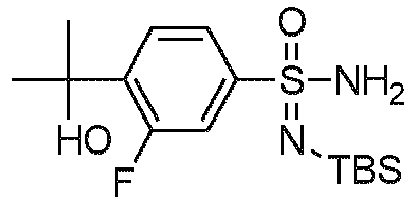
N'-(tert-butyldimethylsilyl)-3-fluoro-4-(2-hydroxypropan-2-yl)benzenesulfonimidamide 347.2 Intermediate 18 
N'-(tert-butyldimethylsilyl)-2-chloro-4-(2-hydroxypropan-2-yl)benzenesulfonimidamide 363.1 Table 5. The Intermediate in the following Table was prepared using similar procedure as shown in Scheme 9 above for converting compound 28 toIntermediate 11 starting from methyl 4-(chlorosulfonyl)benzoate.Intermediate # Structure IUPAC Name Exact Mass [M+H]+ Intermediate 19 
N'-(tert-butyldimethylsilyl)-4-(2-hydroxypropan-2-yl)benzenesulfonimidamide 329.2 

- Into a 250-mL round-bottom flask was placed a solution of 3-nitro-1H-pyrazole (10 g, 88.4 mmol) in DMF (100 mL). This was followed by the addition of NaH (60% wt., 3.9 g, 97.5 mmol) in portions at 0°C. The resulting solution was stirred for 0.5 h at 0°C. This was followed by the addition of 2-bromopropane (14.1 g, 114.6 mmol) dropwise with stirring at 0°C in 10 min. The resulting solution was stirred for 16 h at RT and then was quenched by the addition of 100 mL of water. The resulting solution was extracted with 3x100 mL of ethyl acetate. The organic layers were combined and dried over anhydrous Na2SO4, then concentrated under vacuum. The residue was applied onto a silica gel column and eluted with a gradient of ethyl acetate/petroleum ether (1:5 to 1:3). This resulted in 11.8 g (86%) of the title compound as yellow oil. MS-ESI: 156.1 (M+1).
- Into a 250-mL round-bottom flask was placed a solution of 1-isopropyl-3-nitro-1H-pyrazole (10.8 g, 69.6 mmol) in MeOH (100 mL). Then Pd/C (10% wt., 1.5 g) was added. The flask was evacuated and flushed three times with hydrogen. The mixture was stirred for 24 h at RT under an atmosphere of hydrogen. The solids were filtered out. The resulting filtrate was concentrated under vacuum. This resulted in 7.27 g (83%) of the title compound as yellow oil. MS-ESI: 126.1 (M+1).
- Steps 3-4 used similar procedures for converting compound 27 to compound 29 shown in
Scheme 9 to afford compound 50 from compound 48. MS-ESI: 188.0 (M-1). - Steps 5-6 were using the similar procedures for converting compound 30 to
Intermediate 11 shown inScheme 9 to affordIntermediate 18 from compound 50. MS-ESI: 303.2 (M+1).Table 6. The Intermediate in the following Table was prepared using similar procedure as shown in Scheme 10 above for converting compound 48 toIntermediate 18 starting from the appropriate materials.Intermediate # Structure IUPAC Name Exact Mass [M+H]+ Intermediate 21 
N'-(tert-butyldimethylsilyl)-4-(methylsulfonyl)benzenesulfonimidamide 349.1 Intermediate 22 
N'-(tert-butyldimethylsilyl)-3-(methylsulfonyl)benzenesulfonimidamide 349.1 

- Into a 500-mL round-bottom flask was placed 4-nitrobenzoic acid (20 g, 120 mmol), DCM (200 mL), and DMF (0.2 mL). This was followed by the addition of oxalyl chloride (15 mL, 177.1 mmol) dropwise with stirring at 0°C. The resulting solution was stirred for 4 h at RT and then was concentrated under vacuum. This resulted in 22 g (crude) of the title compound as yellow oil. The crude product was used in the next step.
- Into a 500-mL round-bottom flask was placed dimethylamine hydrochloride (6.5 g, 79.7 mmol), DCM (200 mL), and TEA (50 mL). This was followed by the addition of 4-nitrobenzoyl chloride (22 g, 119 mmol) dropwise with stirring at 0°C. The resulting solution was stirred for 6 h at RT and then was concentrated under vacuum. The resulting mixture was washed with 2x50 mL of water. The solids were collected by filtration. This resulted in 16 g (69% over two steps) of the title compound as a white solid. MS-ESI: 195.1 (M+1).
- Into a 250-mL round-bottom flask was placed N,N-dimethyl-4-nitrobenzamide (16 g, 82.4 mmol), MeOH (100 mL). Then Pd/C (10% wt., 1 g) was added. The flask was evacuated and flushed three times with hydrogen. The resulting solution was stirred for 12 h at RT under an atmosphere of hydrogen. The solids were filtered out. The resulting filtrate was concentrated under vacuum. This resulted in 13 g (96%) of the title compound as a white solid. MS-ESI: 165.1 (M+1).
- Steps 4-5 used similar procedures for converting compound 27 to compound 29 shown in
Scheme 9 to afford compound 43 from compound 41. MS-ESI: 229.1 (M+1). - Into a 100-mL round-bottom flask purged with and maintained under nitrogen was placed a solution of N,N-dimethyl-4-sulfamoylbenzamide (1.8 g, 7.9 mmol) in THF (50 mL). This was followed by the addition of 9-BBN (5.8 g) in portions at 0°C. The resulting solution was stirred for 12 h at 70°C and then was quenched by the addition of 20 mL of water/ice. The resulting solution was extracted with 3x100 mL of ethyl acetate and the organic layers were combined. The resulting mixture was washed with 200 mL of water and then the organic layer was concentrated under vacuum. The residue was applied onto a silica gel column and eluted with a gradient of DCM/MeOH (20:1 to 15:1). This resulted in 1 g (59%) of the title compound as a white solid. MS-ESI: 215.1 (M+1).
- Steps 7-8 were using the similar procedures for converting compound 30 to
Intermediate 11 shown inScheme 9 to affordIntermediate 23 from compound 44. MS-ESI: 328.2 (M+1).

- Into a 1000-mL round-bottom flask was placed dimethylamine as a hydrochloride salt (16.3 g, 200 mmol) in DCM (500 mL), DIEA (25.83 mg, 200 mmol). To the above was added 3-aminobenzoic acid (13.7 g, 100 mmol), HATU (57 g, 150 mmol). The resulting solution was stirred for 1 h at RT. The reaction was then quenched by the addition of 500 mL of NH4Cl (aq.). The resulting solution was extracted with 3x500 ml of ethyl acetate and the organic layers combined and dried over anhydrous sodium sulfate and concentrated. The residue was applied onto a silica gel column and eluted with a gradient of DCM/methanol (50:1 to 20:1). This resulted in 13.14 g (80%) of the title compound as a yellow solid. MS-ESI: 165.1 (M+1).
- Steps 2-6 used the similar procedures for converting compound 41 to
Intermediate 23 shown inScheme 11 to affordIntermediate 24 from compound 47. MS-ESI: 328.2 (M+1).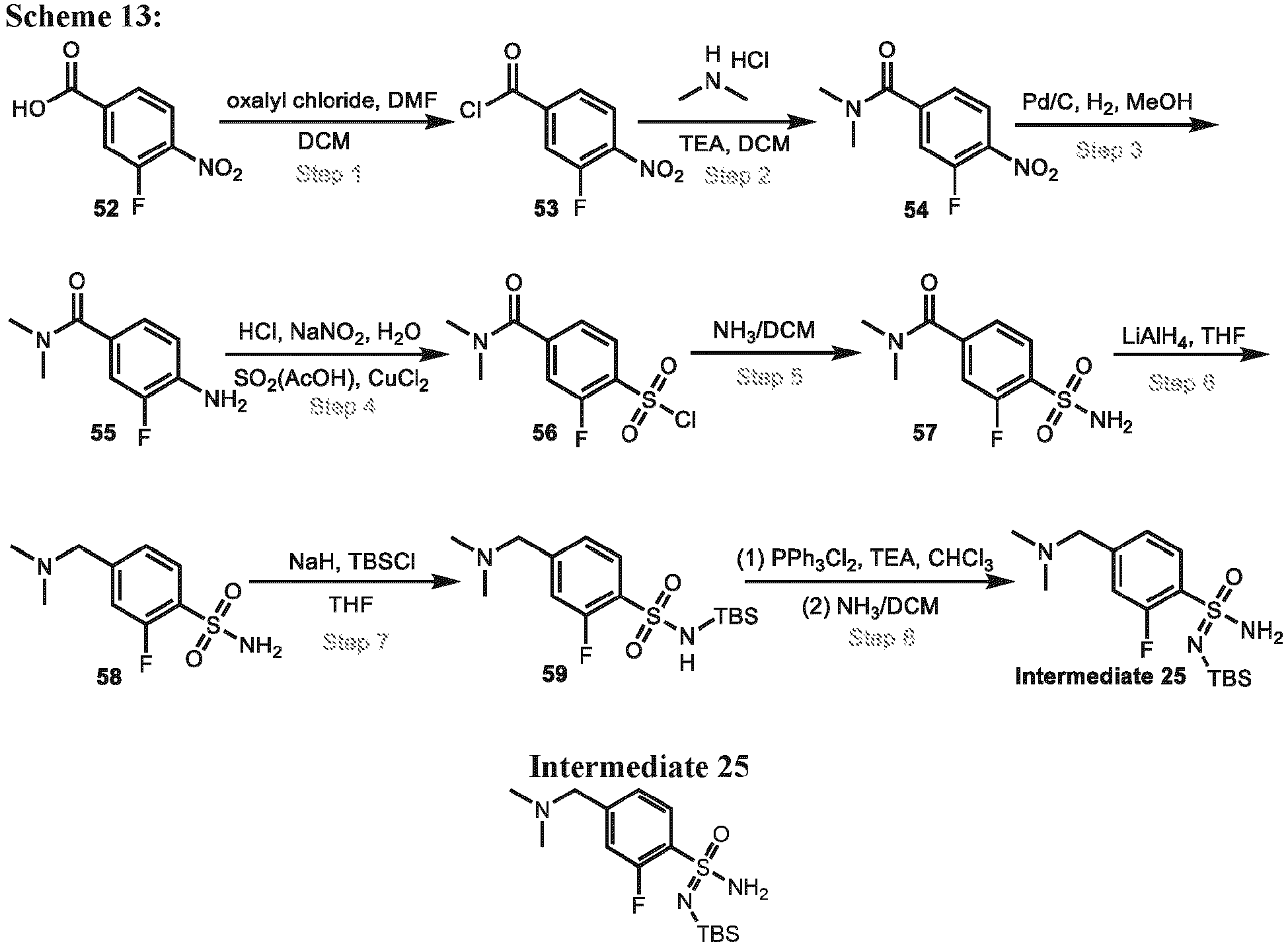
- Steps 1-5 used similar procedures for converting compound 38 to compound 43 shown in
Scheme 11 to afford compound 57. MS-ESI: 247.0 (M+1). - Into a 1-L round-bottom flask was placed a solution of 3-fluoro-N,N-dimethyl-4-sulfamoylbenzamide (19.3 g, 78.4 mmol) in THF (200 mL). This was followed by the addition of LiAlH4 (8.8 g, 231.9 mmol) in portions at 0°C. The resulting solution was stirred for 12 h at RT and then was quenched by the addition of 10 mL of water. The resulting mixture was concentrated under vacuum. The residue was applied onto a silica gel column and eluted with a gradient of ethyl acetate/petroleum ether (6:1 to 8:1). This resulted in 7.0 g (38%) of the title compound as a white solid. MS-ESI: 233.1 (M+1).
- Steps 7-8 used similar procedures for converting compound 44 to
Intermediate 23 shown inScheme 11 to afford Intermediate 25. MS-ESI: 346.2 (M+1).
- Into a 500-mL round-bottom flask was placed a solution of ethyl 2-bromothiazole-4-carboxylate (14 g, 59.3 mmol), EtOH (200 mL). This was followed by the addition of NaBH4 (2.3 g, 60.5 mmol) in portions at 0°C. The resulting solution was stirred for 3 h at RT and then was quenched by the addition of 100 mL of water. The resulting solution was extracted with 2x200 mL of DCM. The organic layers were combined, dried over anhydrous Na2SO4 and then concentrated under vacuum. This resulted in 10.0 g (87%) of the title compound as colorless oil. MS-ESI: 195.9, 193.9 (M+1).
- Into a 250-mL round-bottom flask was placed a solution of (2-bromothiazol-4-yl)methanol (10.0 g, 51.5 mmol) in DCM (100 mL). To the solution was added Dess-Martin reagent (24.0 g, 56.6 mmol). The resulting solution was stirred for 2 h at RT and then was concentrated under vacuum. The residue was applied onto a silica gel column and eluted with a gradient of ethyl acetate/petroleum ether (1:50 to 1 :20). This resulted in 8.0 g (81%) of the title compound as yellow oil. MS-ESI: 193.9, 191.9 (M+1).
- Into a 250-mL 3-necked round-bottom flask purged with and maintained under nitrogen was placed a solution of 2-bromothiazole-4-carbaldehyde (8 g, 41.7 mmol) in THF (100 mL). This was followed by the addition of MeMgBr (3 M in THF, 15 mL) dropwise with stirring at 0°C. The resulting solution was stirred for 2 h at RT and then was quenched by the addition of 100 mL of NH4Cl (sat.). The resulting solution was extracted with 3x100 mL of DCM and the combined organic layers were concentrated under vacuum. The residue was applied onto a silica gel column and eluted with a gradient of ethyl acetate/petroleum ether (1:10 to 1:5). This resulted in 6.0 g (69%) of the title compound as brown oil. MS-ESI: 209.9, 207.9 (M+1).
- Into a 250-mL round-bottom flask was placed a solution of 1-(2-bromothiazol-4-yl)ethanol (6.0 g, 28.8 mmol) and 1H-imidazole (4.0 g, 58.8 mmol) in DMF (50 mL). To the solution was added TBDPSCl (8.7 g, 31.6 mmol). The resulting solution was stirred for 12 h at RT and then was diluted with 100 mL of water. The resulting solution was extracted with 3x100 mL of DCM and the combined organic layers were concentrated under vacuum. The residue was applied onto a silica gel column and eluted with a gradient of ethyl acetate/petroleum ether (1:100 to 1:50). This resulted in 10.0 g (78%) of the title compound as light yellow oil. MS-ESI: 448.1, 446.1 (M+1).
- Into a 250-mL 3-necked round-bottom flask purged with and maintained under nitrogen was placed a solution of 2-bromo-4-(1-(tert-butyldiphenylsilyloxy)ethyl)thiazole (10.0 g, 22.4 mmol) in THF (100 mL). This was followed by the addition of n-BuLi (2.5 M in THF, 11 mL) dropwise with stirring at -78°C. The resulting solution was stirred for 30 min at -78°C. To the above SO2 gas was introduced. The reaction was warmed to RT and stirred for 30 min and then was concentrated under vacuum. The residue was dissolved in DCM (100 mL) and then NCS (3.6 g, 26.9 mmol) was added. The resulting solution was stirred for 30 min at RT and then was concentrated under vacuum. This resulted in 8.0 g (crude, 77%) of the title compound as a white solid. The crude product was used in the next step.
- Into a 100-mL round-bottom flask purged with and maintained under nitrogen was placed a solution of 4-(1-(tert-butyldiphenylsilyloxy)ethyl)thiazole-2-sulfonyl chloride (8.0 g, 17.2 mmol) in DCM (50 mL). To the solution were added TEA (3.5 g, 34.6 mmol) and 2-methylpropan-2-amine (1.9 g, 26.0 mmol). The resulting solution was stirred for 2 h at RT and then was concentrated under vacuum. The residue was applied onto a silica gel column and eluted with a gradient of ethyl acetate/petroleum ether (1:15 to 1:5). This resulted in 8.0 g (71%, 2 steps) of the title compound as brown oil. MS-ESI: 503.2 (M+1).
- Into a 250-mL round-bottom flask was placed a solution of N-tert-butyl-4-(1-(tert-butyldiphenylsilyloxy)ethyl)thiazole-2-sulfonamide (8.0 g, 15.9 mmol) in THF (100 mL). To the solution was added TBAF (9.6 g, 292.5 mmol). The resulting solution was stirred for 2 h at RT and then was diluted with 100 mL of water. The resulting solution was extracted with 3x100 mL of DCM and the combined organic layers were concentrated under vacuum. The residue was applied onto a silica gel column and eluted with a gradient of ethyl acetate/petroleum ether (1:10 to 1:3). This resulted in 4.0 g (95%) of the title compound as light yellow oil. MS-ESI: 265.1 (M+1).
- Into a 100-mL round-bottom flask was placed a solution of N-tert-butyl-4-(1-hydroxyethyl)thiazole-2-sulfonamide (4.0 g, 15.1 mmol) in DCM (50 mL). To the solution was added Dess-Martin reagent (7.1 g, 16.6 mmol). The resulting solution was stirred for 2 h at RT and then was concentrated under vacuum. The residue was applied onto a silica gel column and eluted with a gradient of ethyl acetate/petroleum ether (1:10 to 1:3). This resulted in 3.5 g (88%) of the title compound as light yellow oil. MS-ESI: 363.0 (M+1).
- Into a 100-mL round-bottom flask was placed a solution of 4-acetyl-N-tert-butylthiazole-2-sulfonamide (3.5 g, 13.3 mmol) in DCM (5 mL). To the solution was added TFA (20 mL). The resulting solution was stirred for 14 h at 40°C and then was concentrated under vacuum. The residue was applied onto a silica gel column and eluted with a gradient of ethyl acetate/petroleum ether (1:10 to 1:3). This resulted in 2.5 g (91%) of the title compound as a gray solid. MS-ESI: 207.0 (M+1).
- Steps 10-12 used similar procedures for converting compound 29 to
Intermediate 11 shown inScheme 9 to afford Intermediate 26 from compound 69. MS-ESI: 336.1 (M+1).
- Into a 500-mL round-bottom flask was placed 1-(thiazol-2-yl)ethanone (20 g, 157 mmol), EtOH (200 mL). This was followed by the addition of NaBH4 (3 g, 81.3 mmol) in portions at 0°C. The resulting solution was stirred for 2 h at RT and then was quenched by the addition of 10 mL of NH4Cl (sat.). The resulting solution was diluted with 200 mL of water and extracted with 2x200 mL of DCM. The organic layers were combined and dried over anhydrous Na2SO4, then concentrated under vacuum. This resulted in 20 g (98%) of the title compound as light yellow oil. MS-ESI: 130.0 (M+1).
- Into a 500-mL round-bottom flask was placed 1-(thiazol-2-yl)ethanol (20 g, 154.8 mmol), DMF (150 mL), 1H-imidazole (20.5 g, 301 mmol). This was followed by the addition of TBDPSCl (46 g, 167 mmol) dropwise with stirring at 0°C. The resulting solution was stirred for 2 h at RT and then was diluted with 300 mL of water. The resulting solution was extracted with 3x200 mL of DCM. The organic layers were combined and concentrated under vacuum. The residue was applied onto a silica gel column and eluted with a gradient of ethyl acetate/petroleum ether (1:100 to 1:80). This resulted in 55 g (97%) of the title compound as colorless oil. MS-ESI: 368.1 (M+1).
- Into a 500-mL 3-necked round-bottom flask purged with and maintained under nitrogen was placed a solution of 2-(1-(tert-butyldiphenylsilyloxy)ethyl)thiazole (30 g, 81.6 mmol) in THF (200 mL). This was followed by the addition of n-BuLi (2.5 M in THF, 35.2 mL) dropwise with stirring at -78°C. The resulting solution was stirred for 0.5 h at -78°C and then SO2 was introduced into the above reaction mixture. The reaction was slowly warmed to RT and then NCS (12.8 g, 95.86 mmol) was added. The resulting solution was stirred for 1 h at RT. The solids were filtered out. The resulting filtrate was concentrated under vacuum. This resulted in 30 g (crude, 79%) of the title compound as brown oil. The crude product was used in the next step.
- Into a 500-mL round-bottom flask was placed 2-(1-(tert-butyldiphenylsilyloxy)ethyl)thiazole-5-sulfonyl chloride (crude, 30 g, 64.37 mmol), DCM (200 mL), TEA (13 g, 128.47 mmol). This was followed by the addition of 2-methylpropan-2-amine (5.6 g, 76.6 mmol) dropwise with stirring at 0°C. The resulting solution was stirred for 2 h at RT and then was concentrated under vacuum. The residue was applied onto a silica gel column and eluted with a gradient of ethyl acetate/petroleum ether (1:30 to 1:20). This resulted in 25 g (61% over two steps) of the title compound as brown oil. MS-ESI: 503.2 (M+1).
- Into a 500-mL round-bottom flask was placed N-tert-butyl-2-(1-(tert-butyldiphenylsilyloxy)ethyl)thiazole- 5-sulfonamide (25 g, 49.7 mmol), THF (200 mL), TBAF (30 g, 99.67 mmol). The resulting solution was stirred for 2 h at RT and then was diluted with 200 mL of water. The resulting solution was extracted with 3x200 mL of DCM. The organic layers were combined and concentrated under vacuum. The residue was applied onto a silica gel column and eluted with a gradient of ethyl acetate/petroleum ether (1:20 to 1:10). This resulted in 12 g (91%) of the title compound as light yellow oil. MS-ESI: 265.1 (M+1).
- Into a 500-mL round-bottom flask was placed N-tert-butyl-2-(1-hydroxyethyl)thiazole-5-sulfonamide (12 g, 45.4 mmol), DCM (200 mL). To this solution was added Dess-Martin reagent (20 g, 47.2 mmol) in portions at RT. The resulting solution was stirred for 2 h at RT and then was concentrated under vacuum. The residue was applied onto a silica gel column and eluted with a gradient of ethyl acetate/petroleum ether (1:20 to 1:10). This resulted in 9 g (76%) of the title compound as a light yellow solid. MS-ESI: 263.0 (M+1).
- Into a 100-mL round-bottom flask was placed 2-acetyl-N-tert-butylthiazole-5-sulfonamide (7 g, 26.7 mmol), TFA (20 mL). The resulting solution was stirred for 14 h at 70°C and then was concentrated under vacuum. The residue was applied onto a silica gel column and eluted with a gradient of ethyl acetate/petroleum ether (1:5 to 1:3). This resulted in 5 g (91%) of the title compound as a yellow solid. MS-ESI: 207.0 (M+1).
- Into a 500-mL 3-necked round-bottom flask purged with and maintained under nitrogen was placed 2-acetylthiazole-5-sulfonamide (5 g, 24.3 mmol), THF (100 mL). This was followed by the addition of MeMgBr (3 M in THF, 8.1 mL, 24.3 mmol) dropwise with stirring at 0°C. The resulting solution was stirred for 14 h at RT and then was quenched by the addition of 100 mL of NH4Cl (sat.). The resulting solution was extracted with 2x150 mL of DCM. The organic layers were combined and concentrated under vacuum. The residue was applied onto a silica gel column and eluted with a gradient of ethyl acetate/petroleum ether (1:5 to 1:3). This resulted in 2.9 g (54%) of the title compound as a light yellow solid. MS-ESI: 223.0 (M+1).
- Steps 9-10 used similar procedures for converting
compound 14 toIntermediate 1 shown inScheme 6 to afford Intermediate 27 from compound 80. MS-ESI: 336.1 (M+1).

- Into a 500-mL round-bottom flask was placed a solution of 1-(thiazol-2-yl)ethanone (20 g, 157.0 mmol) in toluene (300 mL) and ethane-1,2-diol (19.5 g, 314 mmol). To the solution was added TsOH (2.7 g, 15.7 mmol). The resulting solution was refluxed overnight and water was separated from the solution during the reflux. The resulting solution was diluted with 200 mL of water and extracted with 2x100 mL of ethyl acetate. The organic layers were combined, dried over anhydrous Na2SO4, and then concentrated under vacuum. This resulted in 26.6 g (99%) of the title compound as light yellow oil. MS-ESI: 172.0 (M+1).
- Into a 500-mL 3-necked round-bottom flask purged with and maintained under nitrogen was placed a solution of 2-(2-methyl-1,3-dioxolan-2-yl)thiazole (14 g, 81.6 mmol) in THF (200 mL). This was followed by the addition of n-BuLi (2.5 M in THF, 35.2 mL, 88.0 mmol) dropwise with stirring at -78°C. The resulting solution was stirred for 0.5 h at -78°C and then SO2 was introduced into the above reaction mixture. The reaction was slowly warmed to RT and then NCS (12.8 g, 95.86 mmol) was added. The resulting solution was stirred for 1 h at RT. The solids were filtered out. The resulting filtrate was concentrated under vacuum and then was diluted in DCM (160 mL). To the above was added a saturated solution of ammonia in DCM (300 mL). The resulting solution was stirred for 3 h at RT and then was concentrated under vacuum. The residue was applied onto a silica gel column and eluted with a gradient of ethyl acetate/petroleum ether (1:20 to 1:5). This resulted in 12.5 g (61%) of the title compound as a yellow solid. MS-ESI: 251.0 (M+1).
- Into a 250-mL round-bottom flask was placed a solution of 2-(2-methyl-1,3-dioxolan-2-yl)thiazole-5-sulfonamide (12.5 g, 50.0 mmol) in THF (125 mL). To the above was added aq. HCl (4 N, 50.0 mL). The resulting solution was stirred for 6 h at 70°C. The resulting solution was diluted with 100 mL of water and extracted with 2x200 mL of ethyl acetate. The organic layers were combined, dried over anhydrous Na2SO4, then concentrated under vacuum. The residue was applied onto a silica gel column and eluted with a gradient of ethyl acetate/petroleum ether (1:2 to 1:1). This resulted in 9.3 g (90%) of the title compound as a yellow solid. MS-ESI: 207.0 (M+1). Steps 4-6 used the same procedures for converting
compound 19 toIntermediate 2 shown in Scheme 7B to afford Intermediate 27 from compound 84. MS-ESI: 336.1 (M+1).
- Into a 10-L 4-necked round-bottom flask purged with and maintained under nitrogen was placed a solution of 1-(thiazol-2-yl)ethanone (200 g, 1.6 mol) in THF (4 L). This was followed by the addition of MeMgBr (3 M in THF, 942 mL) dropwise with stirring at 0°C. The mixture was stirred at 0°C for 2 h. After warmed the mixture to RT, the solution was stirred for an additional 16 h. Then the reaction was quenched by the addition of 3 L of NH4Cl (sat.). The resulting solution was extracted with 3x1 L of ethyl acetate. The organic layers were combined, dried over anhydrous Na2SO4, then concentrated under vacuum. The residue was applied onto a silica gel column and eluted with a gradient of ethyl acetate/petroleum ether (1:3 to 1:1). This resulted in 210 g (93%) of the title compound as a brown oil. MS-ESI: 144.0 (M+1).
- Into a 10-L 4-necked round-bottom flask purged with and maintained under nitrogen was placed a solution of 2-(thiazol-2-yl)propan-2-ol (50 g, 349.0 mmol) in THF (1.5 L). This was followed by the addition of n-BuLi (2.5 M in hexane, 350 mL) dropwise with stirring at -78°C. The mixture was stirred at -78°C for 1 h. Then SO2 was bubbled into the mixture for 15 min below -30°C. The mixture was stirred for an additional 1 h at RT and then was concentrated under vacuum. This resulted in 87 g (crude) of the title compound as a light yellow solid. The crude product was used directly in the next step.
- Into a 2-L 3-necked round-bottom flask, lithium 2-(2-hydroxypropan-2-yl)thiazole-5-sulfinate (87 g, crude) was dissolved in anhydrous MeOH (500 mL). Then SOCl2 (43 g, 360 mmol) was added to the mixture dropwise with stirring at 0°C. The mixture was stirred overnight at RT and then was concentrated under vacuum. The residue was diluted with 500 mL of ethyl acetate. The resulting solution was washed with 2x200 mL of water and 2x200 mL of brine. The solution was dried over anhydrous Na2SO4, then concentrated under vacuum. This resulted in 72 g (crude) of the title compound as light yellow oil. The crude product was used directly in the next step.
- Into a 10-L 4-necked round-bottom flask purged with and maintained under nitrogen was placed a solution of methyl 2-(2-hydroxypropan-2-yl)thiazole-5-sulfinate (72 g, 326 mmol) in THF (500 mL). Then to the above NH3 (0.5 M in THF, 2.0 L) was added. After cooling to -78°C, LiHMDS (1 M in THF, 2.0 L) was added to the mixture dropwise with stirring. Then the mixture was stirred at -78°C for 2 h. The reaction was quenched by the addition of 500 mL of NH4Cl (sat.). The resulting solution was extracted with 3x300 mL of ethyl acetate. The organic layers were combined, dried over anhydrous Na2SO4, then concentrated under vacuum. This resulted in 32 g (crude) of the title compound as brown oil. The crude product was used directly in the next step.
- Into a 1-L 3-necked round-bottom flask purged with and maintained under nitrogen was placed a solution of 2-(2-hydroxypropan-2-yl)thiazole-5-sulfinamide (32 g, crude) in THF (300 mL). This was followed by the addition of LDA (2 M in THF, 116 mL) dropwise with string at 0°C. The mixture was stirred at 0°C for 1 h, then (Boc)2O (33.8 g, 155 mmol) was added in portions at 0°C. The mixture was warmed to RT and stirred for an additional 2 h. The reaction was quenched with 200 mL of ice-water (200 mL), and the pH value of the solution was adjusted to 6 with HCOOH. The resulting solution was extracted with 3x200 mL of ethyl acetate. The organic layers were combined, dried over anhydrous Na2SO4, then concentrated under vacuum. The residue was applied onto a silica gel column and eluted with a gradient of ethyl acetate/petroleum ether (1:2 to 1:1). This resulted in 19 g (18%, 4 steps) of the title compound as a white solid.
- Into a 1-L 3-necked round-bottom flask purged with and maintained under nitrogen, tert-butyl 2-(2-hydroxypropan-2-yl)thiazol-5-ylsulfinylcarbamate (19 g, 62 mmol) was dissolved in fresh distilled ACN (200 mL). Then to the above solution was added NCS (9.8 g, 74 mmol) in portions. The mixture was stirred for 1 h at RT and then NH3 was bubbled in the mixture for 15 min. The mixture was stirred at RT for 2 h and then was concentrated under vacuum. The residue was applied onto a silica gel column and eluted with a gradient of ethyl acetate/petroleum ether (1:2 to 1:1). This resulted in 13 g (65%) of the title compound as a white solid.

-
Step 1 used the procedures for convertingcompound 15 toIntermediate 1 shown inScheme 6 to afford compound 93 by substituting ammonia with methylamine. MS-ESI: 349.1 (M+1). - Into a 25-mL round-bottom flask purged with under nitrogen was placed a solution of N'-(tert-butyldimethylsilyl)-4-(2-hydroxypropan-2-yl)-N-methylthiophene-2-sulfonimidamide (500 mg, 1.43 mmol) in DCM (10 mL). To the solution was added HF/Py (70% wt., 200 mg). The resulting solution was stirred for 2 h at RT. The pH value of the solution was adjusted to 8 with aq. Na2CO3 (5 % wt.). The resulting solution was extracted with 3x10 mL of ethyl acetate. The organic layers were combined, dried over anhydrous Na2SO4, then concentrated under vacuum. This resulted in 300 mg (89%) of the title compound as brown oil. MS-ESI: 235.0 (M+1).
- Schemes below illustrate the synthesis of isocyanates.

- Into a 500-mL round-bottom flask purged with and maintained under nitrogen was placed 2,6-dibromo-4-fluoroaniline (15 g, 55.8 mmol), dioxane (150 mL), water (15 mL), Cs2CO3 (55 g, 169 mmol), 4,4,5,5-tetramethyl-2-(prop-1-en-2-yl)-1,3,2-dioxaborolane (25 g, 149 mmol), and Pd(dppf)Cl2 (4 g, 5.47 mmol). The resulting solution was stirred for 15 h at 100°C and then was concentrated under vacuum. The residue was applied onto a silica gel column and eluted with a gradient of ethyl acetate/petroleum ether (1: 10 to 1:8). This resulted in 9.2 g (86%) of the title compound as brown oil. MS-ESI: 192.1 (M+1).
- Into a 500-mL round-bottom flask was placed 4-fluoro-2,6-bis(prop-1-en-2-yl)aniline (9.2 g, 48.1 mmol), and MeOH (200 mL). Then Pd/C (10% wt., 900 mg) was added. The flask was evacuated and flushed three times with hydrogen. The resulting solution was stirred for 12 h at RT under an atmosphere of hydrogen. The solids were filtered out. The resulting filtrate was concentrated under vacuum. The residue was applied onto a silica gel column and eluted with a gradient of ethyl acetate/petroleum ether (1:10 to 1:8). This resulted in 7.2 g (77%) of the title compound as brown oil. MS-ESI: 196.1 (M+1).
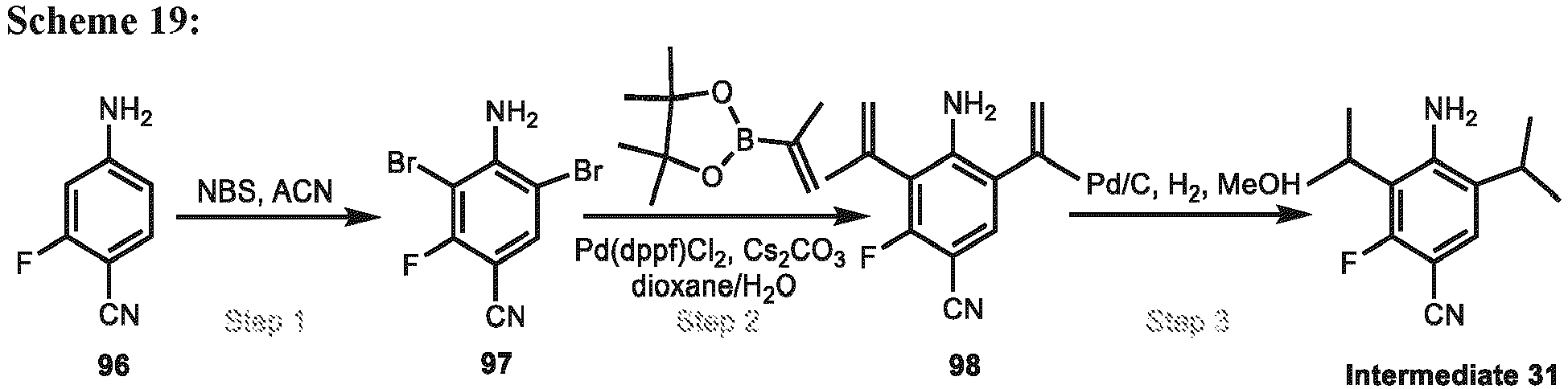

- Into a 1-L round-bottom flask was placed 4-amino-2-fluorobenzonitrile (25 g, 184 mmol), ACN (500 mL), and NBS (81.7 g, 459 mmol). The resulting solution was stirred overnight at 75°C and then was concentrated under vacuum. The residue was applied onto a silica gel column and eluted with a gradient of ethyl acetate/petroleum ether (1:100 to 1 :98). This resulted in 50 g (93%) of the title compound as brown oil. MS-ESI: 294.9/292.9/296.9 (M+1).
- Steps 2-3 used similar procedures for converting compound 94 to Intermediate 30 shown in
Scheme 18 to afford Intermediate 31 from compound 97. MS-ESI: 221.1 (M+1).

- Into a 100-mL round-bottom flask was placed 4-(difluoromethoxy)benzenamine (3 g, 18.9 mmol), ACN (30 mL), and NBS (7.7 g, 43.3 mmol). The resulting solution was stirred overnight at RT and then was concentrated under vacuum. The residue was applied onto a silica gel column and eluted with a gradient of ethyl acetate/petroleum ether (1:30 to 1:20). This resulted in 2.9 g (48%) of the title compound as brown oil. MS-ESI: 317.9/315.9/319.9 (M+1).
- Steps 2-3 used similar procedures for converting compound 94 to Intermediate 30 shown in
Scheme 18 to afford Intermediate 32 from compound 100". MS-ESI: 244.1 (M+1).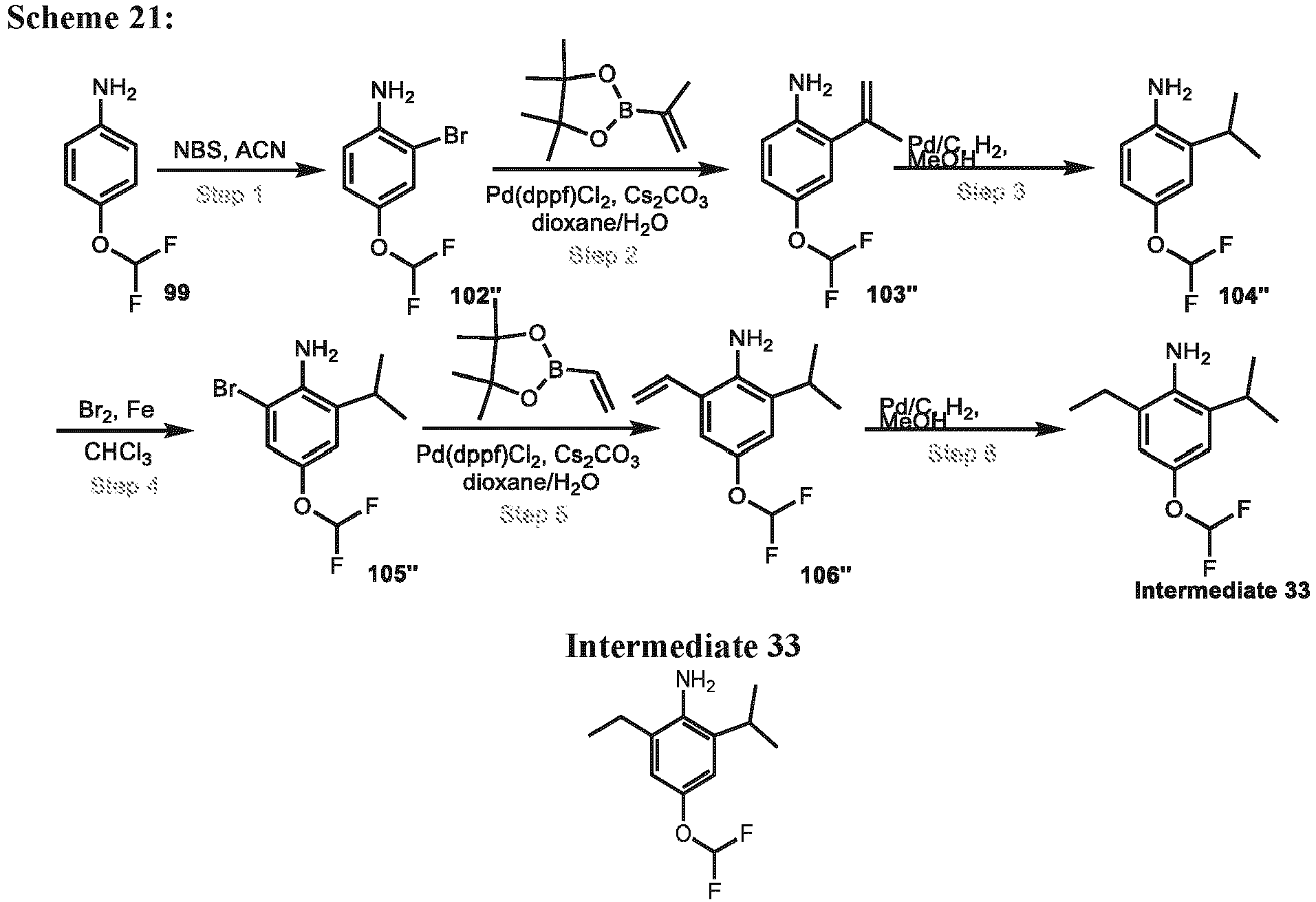
- Into a 250-mL round-bottom flask purged with and maintained under nitrogen was placed 4-(difluoromethoxy)benzenamine (10 g, 62.8 mmol), ACN (100 mL), and NBS (5.59 g, 31.4 mmol). The resulting solution was stirred for 1 h RT and then was concentrated under vacuum. The residue was applied onto a silica gel column and eluted with a gradient of ethyl acetate/petroleum ether (1:20 to 1:10). This resulted in 7.9 g (53%) of the title compound as red oil. MS-ESI: 238.0/240.0 (M+1).
- Into a 250-mL round-bottom flask purged with and maintained under nitrogen was placed 2-bromo-4-(difluoromethoxy)benzenamine (7.9 g, 33.2 mmol), dioxane (100 mL), water (10 mL), Cs2CO3 (32.46 g, 99.63 mmol), 4,4,5,5-tetramethyl-2-(prop-1-en-2-yl)-1,3,2-dioxaborolane (8.36 g, 49.8 mmol), and Pd(dppf)Cl2 (1.21 g, 1.65 mmol). The resulting solution was stirred overnight at 90°C. The solids were filtered out. The filtrate was concentrated under vacuum. The residue was applied onto a silica gel column and eluted with a gradient of ethyl acetate/petroleum ether (1:30 to 1:20). This resulted in 5.3 g (80%) of the title compound as a yellow solid. MS-ESI: 200.1 (M+1).
- Into a 250-mL round-bottom flask was placed 4-(difluoromethoxy)-2-(prop-1-en-2-yl)benzenamine (5.3 g, 26.6 mmol) in MeOH (100 mL). Then Pd/C (10% wt., 500 mg) was added. The flask was evacuated and filled three times with hydrogen. The resulting solution was stirred for 3 h at RT under hydrogen. The solids were filtered out. The resulting filtrate was concentrated under vacuum. This resulted in 5.15 g (96%) of the title compound as red oil. MS-ESI: 202.1 (M+1).
- Into a 500-mL round-bottom flask was placed 4-(difluoromethoxy)-2-isopropylbenzenamine (5.15 g, 25.6 mmol), CHCl3 (200 mL), Fe turnings (500 mg), and Br2 (4.45 g, 27.9 mmol). The resulting mixture was stirred overnight at 70°C and then was quenched by the addition of 200 mL of water. The resulting solution was extracted with 3x100 mL of DCM and the organic layers combined and concentrated under vacuum. The residue was applied onto a silica gel column and eluted with a gradient of ethyl acetate/petroleum ether (1:30 to 1:20). This resulted in 6.98 g (97%) of the title compound as dark red oil. MS-ESI: 280.0/282.0 (M+1).
- Into a 250-mL round-bottom flask purged with and maintained under nitrogen was placed 2-bromo-4-(difluoromethoxy)-6-isopropylbenzenamine (3 g, 10.7 mmol), dioxane (100 mL), water (10 mL), Cs2CO3 (10.47 g, 32.13 mmol), 4,4,5,5-tetramethyl-2-vinyl-1,3,2-dioxaborolane (2.47 g, 16.0 mmol), and Pd(dppf)Cl2 (784 mg, 1.07 mmol). The resulting solution was stirred overnight at 90°C and then was concentrated under vacuum. The residue was applied onto a silica gel column and eluted with a gradient of ethyl acetate/petroleum ether (1:30 to 1:20). This resulted in 2.3 g (94%) of the title compound as dark green oil. MS-ESI: 228.1 (M+1).
- Into a 250-mL round-bottom flask was placed 4-(difluoromethoxy)-2-isopropyl-6-vinylbenzenamine (2.3 g, 10.1 mmol), MeOH (100 mL). Then Pd/C (10% wt., 200 mg) was added. The flask was evacuated and filled three times with hydrogen. The resulting solution was stirred overnight at RT under hydrogen. The solids were filtered out. The filtrate was concentrated under vacuum. This resulted in 2.2 g (95%) of the title compound as red oil. MS-ESI: 230.1 (M+1).
Table 7. The Intermediate 34 in the following Table was prepared from compound 105" using similar procedure as shown in Scheme 21 above for converting compound 105" to 106".Intermediate # Structure IUPAC Name Exact Mass [M+H]+ Intermediate 34 
2-Cyclopropyl-4-(difluoromethoxy)-6-isopropylbenzenamine 242.1 

- Into a 250-mL round-bottom flask was placed a solution of 4-amino-2-fluorobenzonitrile (9 g, 66.1 mmol) in ACN (120 mL). Then NBS (12.4 g, 69.7 mmol) was added. The resulting solution was stirred overnight at 80°C and then was concentrated under vacuum. The residue was applied onto a silica gel column and eluted with a gradient of ethyl acetate/petroleum ether (1:20 to 1:10). This resulted in 10.9 g (77%) of the title compound as a yellow solid. MS-ESI: 215.0/217.0 (M+1). 1H NMR (300 MHz, DMSO-d 6) δ 7.89 (d, J = 6.0 Hz, 1H), 6.69 (br s, 2H), 6.63 (d, J = 12.0 Hz, 1H).
- Into a 250-mL round-bottom flask purged with and maintained under nitrogen was placed a solution of 4-amino-5-bromo-2-fluorobenzonitrile (6.37 g, 29.6 mmol) in dioxane (70 mL) and water (10 mL). To the solution were added Cs2CO3 (9.7 g, 29.8 mmol), cyclopropylboronic acid (3.8 g, 44.2 mmol) and Pd(dppf)Cl2 (1.08 g, 1.48 mmol). The resulting solution was stirred overnight at 90°C and then was concentrated under vacuum. The residue was applied onto a silica gel column and eluted with a gradient of ethyl acetate/petroleum ether (1:10 to 1:5). This resulted in 5.03 g (96%) of the title compound as a yellow solid. MS-ESI: 177.1 (M+1).
- Into a 250-mL round-bottom flask was placed a solution of 4-amino-5-cyclopropyl-2-fluorobenzonitrile (5.03 g, 28.7 mmol) in ACN (50 mL). To the solution was added NBS (5.6 g, 31.5 mmol). The resulting solution was stirred overnight at 80°C and then was concentrated under vacuum. The residue was applied onto a silica gel column and eluted with a gradient of ethyl acetate/petroleum ether (1:10 to 1:5). This resulted in 6.972 g (96%) of the title compound as a yellow solid. MS-ESI: 255.0/257.0 (M+1).
- Into a 250-mL round-bottom flask purged with and maintained under nitrogen was placed a solution of 4-amino-3-bromo-5-cyclopropyl-2-fluorobenzonitrile (6.972 g, 27.33 mmol) in dioxane (120 mL) and water (20 mL). To the solution were added 4,4,5,5-tetramethyl-2-(prop-1-en-2-yl)-1,3,2-dioxaborolane (6.9 g, 41.00 mmol), Cs2CO3 (13.4 g, 41.00 mmol) and Pd(dppf)Cl2 (0.4 g, 0.55 mmol). The resulting solution was stirred overnight at 80°C and then was concentrated under vacuum. The residue was applied onto a silica gel column and eluted with a gradient of ethyl acetate/petroleum ether (1:10 to 1:5). This resulted in 4.73 g (80%) of the title compound as a yellow solid. MS-ESI: 217.1 (M+1).
- Into a 250-mL round-bottom flask was placed a solution of 4-amino-5-cyclopropyl-2-fluoro-3-(prop-1-en-2-yl)benzonitrile (4.73 g, 21.97 mmol), MeOH (100 mL). To the solution was added AcOH (0.5 mL). Then Pd/C (10% wt., 500 mg) was added. The flask was evacuated and filled three times with hydrogen. The resulting solution was stirred for 4 h at 40°C under an atmosphere of hydrogen. The solids were filtered out. The filtrate was concentrated under vacuum. This resulted in 4.71 g (99%) of the title compound as a light yellow solid. MS-ESI: 219.1 (M+1).

- Into a 3-L round-bottom flask was placed a solution of AlCl3 (111 g, 834 mmol) in DCM (1200 mL). This was followed by the addition of a solution of 2,3-dihydro-1H-indene (90 g, 762 mmol) and 3-chloropropanoyl chloride (96.3 g, 759 mmol) in DCM (300 mL) dropwise with stirring at - 10°C in 30 min. The resulting solution was stirred for 16 h at RT. Then the reaction mixture was added dropwise to cold HCl (3 N, 1200 mL) over 45 min at -10°C. The resulting solution was extracted with 3x600 mL of DCM and the organic layers were combined, dried over anhydrous Na2SO4, then concentrated under vacuum. This resulted in 160.5 g (crude) of the title compound as a yellow solid. The crude product was used in the next step.
- Into a 1-L round-bottom flask was placed a solution of 3-chloro-1-(2,3-dihydro-1H-inden-5-yl)propan-1-one (160.5 g, 759 mmol) in conc. H2SO4 (900 mL). The resulting solution was stirred for 16 h at 55°C and then was quenched by adding the reaction mixture carefully to 4500 mL of water/ice. The solids were collected by filtration and dried over infrared lamp for 24 h. The crude mixture was purified by chromatography and eluted with ethyl acetate/petroleum ether (1:100). This resulted in 10 g (7.6%) of 1,6,7,8-tetrahydro-as-indacen-3(2H)-one (compound 113"a) and 112.2 g (85%) of the title compound (compound 113") as a yellow solid. 1H NMR (400 MHz, DMSO-d 6) δ 7.44 (s, 1H), 7.39 (s, 1H), 3.13 - 2.79 (m, 8H), 2.70 - 2.55 (m, 2H), 2.20 - 1.90 (m, 2H). 1H NMR (400 MHz, DMSO-d 6) δ 7.49 (d, J = 7.7 Hz, 1H), 7.31 (d, J = 7.7 Hz, 1H), 3.19 - 2.98 (m, 4H), 2.93 - 2.80 (m, 3H), 2.68 - 2.54 (m, 2H), 2.15 - 1.95 (m, 2H).
- Into a 1-L round-bottom flask was placed a solution of 1,2,3,5,6,7-hexahydro-s-indacen-1-one (80 g, 464.5 mmol) in H2SO4 (500 mL). Then HNO3 (58.5 g, 929 mmol) was added dropwise over 1h at 0°C. The resulting solution was stirred for 1 hr at 0°C. The reaction mixture was slowly added to a mixture of water/ice (1000 mL) and DCM (500 mL) with ice bath cooling. The organic layer was collected, dried over Na2SO4 and concentrated under vacuum. This resulted in 90 g (90%) of the mixture of 4-nitro-2,3,6,7-hexahydro-s-indacen-1-one and 8-nitro-2,3,6,7-tetrahydro-s-indacen-1(5H)-one as a yellow solid.
- Into a 1-L round-bottom flask was placed a solution of the mixture of 4-nitro-1,2,3,5,6,7-hexahydro-s-indacen-1-one and 8-nitro-2,3,6,7-tetrahydro-s-indacen-1(5H)-one (21.7 g, 100 mmol) in MeOH (300 mL). To the solution was added MSA (11.5 g, 120 mmol). Then Pd(OH)2/C (20% wt, 5.5 g) was added. The flask was evacuated and filled three times with hydrogen. The resulting mixture was stirred for 16 h at RT under hydrogen (50 psi). The solids were filtered out and washed with methanol. The methanol filtrate and wash was diluted with water (500 mL) and the pH was adjusted to 10.6 with 2N NaOH. The resulting slurry was filtered and the crude solids were recrystallized from methanol/water (9:1) with heating. This resulted in 13.7 g (79%) of the title compound as an off-white solid.
- Into a 500-mL round-bottom flask was placed 1,2,3,5,6,7-hexahydro-s-indacen-4-amine (8 g, 46.2 mmol), EtOH (200 mL), and 2,3,5,6-tetrabromo-4-methyl-4-nitrocyclohexa-2,5-dienone (21.6 g, 46.1 mmol). The resulting solution was stirred for 12 h at RT and then was concentrated under vacuum. The residue was applied onto a silica gel column and eluted with a gradient of ethyl acetate/petroleum ether (1:50 to 1 :30). This resulted in 5 g (50%) of the title compound as a yellow solid. MS-ESI: 219.1 (M+1).
- Into a 100-mL round-bottom flask was placed 8-nitro-1,2,3,5,6,7-hexahydro-s-indacen-4-amine (5 g, 22.9 mmol) and HF/Py (70% wt., 20 mL). This was followed by the addition of 3-methylbutyl nitrite (3 g, 25.6 mmol) dropwise with stirring at 0°C. The resulting solution was stirred for 2 h at RT and then was diluted with 50 mL of water. The resulting solution was extracted with 3x50 mL of DCM. The organic layers were combined and dried over anhydrous Na2SO4, then concentrated under vacuum. This resulted in 4 g (crude, 79%) of the title compound as brown oil.
- Into a 100-mL round-bottom flask was placed 4-fluoro-8-nitro-1,2,3,5,6,7-hexahydro-s-indacene (4 g, 18.1 mmol) in MeOH (50 mL). Then Pd/C (10% wt., 0.5 g) was added. The flask was evacuated and filled three times with hydrogen. The resulting mixture was stirred for 12 h at RT under an atmosphere of hydrogen. The solids were filtered out and the filtrate was concentrated under vacuum. The residue was applied onto a silica gel column and eluted with a gradient of ethyl acetate/petroleum ether (1:10 to 1:5). This resulted in 2 g (46%, 2 steps) of the title compound as a white solid. MS-ESI: 192.1 (M+1).


- Into a 1-L round-bottom flask was placed a solution of 1,2,3,5,6,7-hexahydro-s-indacen-1-one (40 g, 232 mmol) in H2SO4 (250 mL). Then HNO3 (29 g, 464 mmol) was added dropwise over 1 h at 0°C. The resulting solution was stirred for 1 hr at 0°C. The reaction mixture was slowly added to a mixture of water/ice (500 mL) and DCM (250 mL) with ice bath cooling. The organic layer was collected, dried over anhydrous Na2SO4 and concentrated under vacuum. The crude product was purified by silica gel column with a gradient of ethyl acetate and petroleum ether (1:50 to 1:1). This resulted in minor product 5 g (10%) of the title compound and major product 30 g (60%) of 8-nitro-2,3,6,7-tetrahydro-s-indacen-1(5H)-one both as a yellow solid.
- Into a 250-mL round-bottom flask was placed a solution of methyltriphenylphosphanium bromide (16.4 g, 46.04 mmol) and t-BuOK (5.2 g, 46.0 mmol) in THF (150 mL) at 0°C. The resulting solution was stirred for 30 min at 0°C. Then the solution of 4-nitro-1,2,3,5,6,7-hexahydro-s-indacen-1-one (5 g, 23.0 mmol) in THF (10 mL) was added dropwise to the reaction mixture at 0°C. The resulting solution was stirred overnight at RT. The resulting mixture was concentrated. The residue was applied onto a silica gel column with ethyl acetate/petroleum ether (1:10). This resulted in 2.6 g (52%) of the title compound as a green solid.
- Into a 100-mL round-bottom flask was placed a solution of 1-methylidene-4-nitro-1,2,3,5,6,7-hexahydro-s-indacene (2.6 g, 12.1 mmol) in MeOH (20 mL), Pd/C (10% wt, 300 mg) was added. The flask was evacuated and filled three times with hydrogen. then H2 (g) was introduced in with a balloon. The resulting solution was stirred for 2 h at RT. The Pd/C catalyst was filtered out. The filtrate was concentrated. This resulted in 2 g of the title compound as red oil.
Table 8. Intermediate 38 in the following Table was prepared from Compound 114" using similar procedure as shown in Scheme 24 above for converting compound 115" to intermediate 37.Intermediate # Structure IUPAC Name Exact Mass [M+H]+ Intermediate 38 
3-methyl-1,2,3,5,6,7-hexahydro-s-indacen-4-amine 188.1 
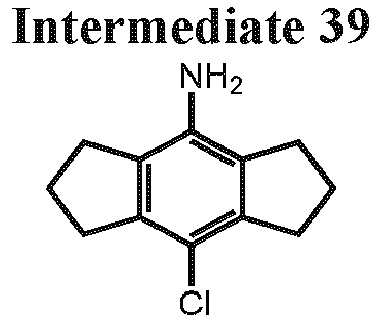
- Into a 50-mL round-bottom flask was placed a solution of 1,2,3,5,6,7-hexahydro-s-indacen-4-amine (1.73 g, 9.99 mmol) in DMF (10 mL). To the solution was added NCS (1.47 g, 11.0 mmol). The resulting solution was stirred overnight at RT and then was diluted with 30 mL of DCM. The resulting mixture was washed with 3×10 mL of water and the organic layer was concentrated under vacuum. The residue was applied onto a silica gel column and eluted with a gradient of ethyl acetate/petroleum ether (1:20 to 1:10). This resulted in 1.88 g (91%) of the title compound as a yellow solid. MS-ESI: 208.1/210.1 (M+1).


- Into a 100-mL round-bottom flask was placed a solution of 1,2,3,5,6,7-hexahydro-s-indacen-4-amine (2.6 g, 15.0 mmol) in DMF (30 mL). To the solution was added NBS (2.9 g, 16.3 mmol). The resulting solution was stirred for 12 h at RT and then was diluted with 80 mL of ethyl acetate. The resulting mixture was washed with 3x20 mL of water and concentrated under vacuum. The residue was applied onto a silica gel column and eluted with a gradient of ethyl acetate/petroleum ether (1:30 to 1 :20). This resulted in 3.0 g (79%) of the title compound as a brown solid. MS-ESI: 252.0, 254.0 (M+1).
- Into a 50-mL round-bottom flask purged with and maintained under nitrogen was placed a solution of 8-bromo-1,2,3,5,6,7-hexahydro-s-indacen-4-amine (725 mg, 2.88 mmol) in DMF (10 mL). To the solution were added t-BuOK (330 mg, 2.90 mmol), CuCN (386 mg, 4.32 mmol), and Pd(dppf)Cl2 (424 mg, 0.58 mmol). The resulting solution was stirred for 12 h at 120°C and then was diluted with 20 mL of water. The resulting solution was extracted with 3x20 mL ethyl acetate. The organic layers were combined, dried over anhydrous Na2SO4, then concentrated under vacuum. The residue was applied onto a silica gel column and eluted with a gradient of ethyl acetate/petroleum ether (1:60 to 1 :40). This resulted in 192 mg (34%) of the title compound as a yellow solid. MS-ESI: 199.1 (M+1).


- Into a 100-mL round-bottom flask purged with and maintained under nitrogen was placed a solution of 4-bromo-2,6-diisopropylbenzenamine (5.1 g, 19.9 mmol) in DMF (30 mL). To the solution were added Zn(CN)2 (2.80 g, 23.9 mmol), Pd(dppf)Cl2 (732 mg, 1.00 mmol) and t-BuOK (3.36 g, 29.9 mmol). The resulting mixture was stirred for 16 h at 120°C and then was diluted with 30 mL of water. The solution was extracted with 3x30 mL of ethyl acetate and the combined organic layers were concentrated under vacuum. The residue was applied onto a silica gel column and eluted with a gradiente of ethyl acetate/petroleum ether (1:30 to 1:20). This resulted in 3.2 g (80%) of the title compound as a yellow solid. MS-ESI: 203.1 (M+1).


- Into a 1-L round-bottom flask was placed a solution of 1,2,3,5,6,7-hexahydro-s-indacen-1-one (37.2 g, 216 mmol) and MSA (42 g, 437.5 mmol) in MeOH (300 mL). Then Pd(OH)2/C (20% wt, 8 g) was added. The flask was evacuated and filled three times with hydrogen. The resulting solution was stirred for 16 h at RT under an atmosphere of hydrogen. The solids were filtered out. The resulting mixture was concentrated under vacuum. The residue was applied onto a silica gel column and eluted with a gradient of ethyl acetate/petroleum ether (1:150 to 1:100). This resulted in 27.1 g (79%) of the title compound as a white solid.
- Into a 500-mL 3-necked round-bottom flask purged with and maintained under nitrogen was placed a solution of 1,2,3,5,6,7-hexahydro-s-indacene (15 g, 94.8 mmol) in CCl4 (200 mL). Then I2 (1.2 g, 4.72 mmol) was added. This was followed by the addition of a solution of Br2 (16 g, 100 mmol) in CCl4 (50 mL) dropwise with stirring at 0°C in 10 min. The resulting solution was stirred for 2 h at 0°C. The reaction was then quenched by the addition of 150 mL of NH4Cl (sat.). The resulting solution was extracted with 3x150 mL of DCM and the combined organic layers were dried over anhydrous Na2SO4 and concentrated under vacuum. The crude product was purified by silica gel column with a gradient of ethyl acetate/hexane (1:500 to 1:100). This resulted in 19 g (85%) of the title compound as yellow oil. 1H NMR (300 MHz, DMSO-d 6) δ 7.02 (s, 1H), 2.95-2.75 (m, 8H), 2.03-2.01 (m, 4H)
- Into a 500-mL 3-necked round-bottom flask purged with and maintained under nitrogen was placed a solution of 4-bromo-1,2,3,5,6,7-hexahydro-s-indacene (5 g, 21.08 mmol) in THF (150 mL). This was followed by the addition of n-BuLi (2.5 M in hexane, 10 mL) dropwise with stirring at -78°C. The resulting solution was stirred for 30 min at -78°C. Then to the above was added trimethyl borate (2.6 g, 25.30 mmol) dropwise with stirring at -78°C. The reaction was warmed to RT slowly and then was stirred for 1 h at RT. Then to the mixture was added AcOH (2.0 mL, 33.20 mmol) and H2O2 (1.0 mL, 28.88 mmol) dropwise with stirring at RT. The resulting solution was stirred for 2 h at RT and then was quenched by the addition of 200 mL of NH4Cl (sat.). The resulting solution was extracted with 3x200 mL of DCM. The organic layers were combined and dried over anhydrous Na2SO4, then concentrated under vacuum. The residue was applied onto a silica gel column and eluted with a gradient of ethyl acetate/petroleum ether (1:7 to 1:5). This resulted in 1.9 g (52%) of the title compound as an off-white solid. MS-ESI: 175.1 (M+1).
- Into a 250-mL round-bottom flask purged with and maintained under nitrogen was placed a solution of 1,2,3,5,6,7-hexahydro-s-indacen-4-ol (1.9 g, 10.9 mmol) in EtOH (100 mL). To the solution was added 2,3,5,6-tetrabromo-4-methyl-4-nitrocyclohexa-2,5-dienone (6.1 g, 13.1 mmol). The resulting solution was stirred overnight at RT and then was concentrated under vacuum. The residue was applied onto a silica gel column and eluted with a gradient of ethyl acetate/petroleum ether (1:5 to 1:3). This resulted in 1.1 g (46%) of the title compound as a light yellow solid. MS-ESI: 218.1 (M-1).
- Into a 100-mL round-bottom flask purged with and maintained under nitrogen was placed a solution of 8-nitro-1,2,3,5,6,7-hexahydro-s-indacen-4-ol (1.1 g, 5.0 mmol) in DMF (20 mL) and water (2 mL). To the solution were added K2CO3 (1.4 g, 10.0 mmol) and sodium 2-chloro-2,2-difluoroacetate (1.5 g, 10.0 mmol). The resulting solution was stirred for 1 h at 120°C and then was diluted with 20 mL of water. The pH value of the solution was adjusted to 7 with aq. HCl (1 N). The resulting solution was extracted with 3x20 mL of DCM. The organic layers were combined and dried over anhydrous Na2SO4, then concentrated under vacuum. The residue was applied onto a silica gel column and eluted with a gradient of ethyl acetate/petroleum ether (1:2 to 1:3). This resulted in 0.55 g (41%) of the title compound as a light yellow solid. MS-ESI: 270.1 (M+1).
- Into a 100-mL round-bottom flask was placed a solution of 4-(difluoromethoxy)-8-nitro-1,2,3,5,6,7-hexahydro-s-indacene (550 mg, 2.0 mmol) in MeOH (10 mL). Then Pd/C (10% wt., 100 mg) was added. The flask was evacuated and filled three times with hydrogen. The resulting solution was stirred for 12 h at RT under an atmosphere of hydrogen. The solids were filtered out. The resulting filtrate was concentrated under vacuum. This resulted in 460 mg (94%) of the title compound as a light yellow solid. MS-ESI: 240.1 (M+1).


- Into a 500-mL round-bottom flask was placed 4-chloro-3-fluoroaniline (5.08 g, 34.9 mmol), ACN (200 mL), and NBS (18.69 g, 105.0 mmol). The resulting solution was stirred for 12 h at RT and then was concentrated under vacuum. The residue was applied onto a silica gel column and eluted with a gradient of ethyl acetate/petroleum ether (1:200 to 1:100). This resulted in 9.7 g (92%) of the title compound as a light yellow solid. MS-ESI: 303.8/305.8/301.8 (M+1).
- Into a 500-mL round-bottom flask purged with and maintained under nitrogen was placed a solution of 2,6-dibromo-4-chloro-3-fluoroaniline (9.03 g, 29.8 mmol) in 1,4-dioxane (200 mL) and water (20 mL). To the solution were added 4,4,5,5-tetramethyl-2-(prop-1-en-2-yl)-1,3,2-dioxaborolane (15.12 g, 89.98 mmol), Cs2CO3 (29.34 g, 90.1 mmol) and Pd(dppf)Cl2 (2.20 g, 3.0 mmol). The resulting solution was stirred for 12 h at 90°C and then was concentrated under vacuum. The residue was applied onto a silica gel column and eluted with a gradient of ethyl acetate/petroleum ether (1:30 to 1 :20). This resulted in 4.3 g (64%) of the title compound as yellow oil. MS-ESI: 226.1, 228.1 (M+1).
- Into a 100-mL round-bottom flask was placed a solution of 4-chloro-3-fluoro-2,6-bis(prop-1-en-2-yl)aniline (1 g, 4.4 mmol) in MeOH (15 mL). Then Pd/C(10% wt., 100 mg) was added. The flask was evacuated and filled three times with hydrogen. The resulting solution was stirred for 3 h at RT under an atmosphere of hydrogen. The solids were filtered out. The resulting filtrate was concentrated under vacuum. The residue was applied onto a silica gel column and eluted with a gradient of ethyl acetate/petroleum ether (1:5 to 1:3). This resulted in 700 mg (81%) of the title compound as light yellow oil. MS-ESI: 196.1 (M+1).


- Into a 50-mL round-bottom flask purged with and maintained under nitrogen was placed 1,2,3,5,6,7-hexahydro-s-indacen-4-amine (64 mg, 0.4 mmol), THF (5 mL) and BTC (37 mg, 0.1 mmol). The resulting solution was stirred for 2 h at 65°C and then was concentrated under vacuum. This resulted in 75 mg (crude) of the title compound as light brown oil. The crude product was used directly in the next step.
Table 9. The Intermediates in the following Table were prepared using similar procedure as shown in Scheme 30 above for converting compound 130" to Intermediate 44. Intermediate # Structure IUPAC Name Intermediate 45 
5-Fluoro-2-isocyanato-1,3-diisopropylbenzene Intermediate 46 
2-Fluoro-4-isocyanato-3,5-diisopropylbenzonitrile Intermediate 47 
5-(Difluoromethoxy)-2-isocyanato-1,3-diisopropylbenzene Intermediate 48 
5-(Difluoromethoxy)-1-ethyl-2-isocyanato-3-isopropylbenzene Intermediate 49 
1-Cyclopropyl-5-(difluoromethoxy)-2-isocyanato-3-isopropylbenzene Intermediate 50 
4-Chloro-8-isocyanato-1,2,3,5,6,7-hexahydro-s-indacene Intermediate 51 
4-Fluoro-8-isocyanato-1,2,3,5,6,7-hexahydro-s-indacene Intermediate 52 
5-Cyclopropyl-2-fluoro-4-isocyanato-3-isopropylbenzonitrile Intermediate 53 
4-Isocyanato-3,5-diisopropylbenzonitrile Intermediate 54 
1,2,3,5,6,7-Hexahydro-8-isocyanato-s-indacene-4-carbonitrile Intermediate 55 
4-(Difluoromethoxy)-1,2,3,5,6,7-hexahydro-8-isocyanato-s-indacene Intermediate 56 
1-Fluoro-3-isocyanato-2,4-diisopropylbenzene Intermediate 57 
1,2,3,5,6,7-Hexahydro-8-isocyanato-1-methyl-s-indacene Intermediate 58 
1,2,3,5,6,7-Hexahydro-4-isocyanato-1-methyl-s-indacene - The following schemes illustrate additional general methods for the synthesis of compounds of Formula AA:


- Scheme for the preparation of Sulfonimidamide Intermediates: Schemes below illustrate the preparation of sulfonimidamide intermediates 59-88 and 112-113.


- Into a 250-mL round-bottom flask purged and maintained with an inert atmosphere of nitrogen, was placed ethyl 3-nitro-1H-pyrazole-5-carboxylate (5.0 g, 27.0 mmol), THF (150 mL), phenylboronic acid (6.6 g, 54.1 mmol), Cu(OAc)2 (7.38 g, 40.6 mmol), and pyridine (8.54 g, 108 mmol). The resulting solution was stirred overnight at RT. The resulting mixture was concentrated under vacuum. The residue was eluted from a silica gel column with ethyl acetate/petroleum ether (1:1). This resulted in 3.1 g (44%) of the title compound as an off-white solid. MS-ESI: 262 (M+1).
- Into a 100-mL round-bottom flask, was placed ethyl 3-nitro-1-phenyl-1H-pyrazole-5-carboxylate (3.92 g, 15.0 mmol), MeOH (50 mL), and Pd/C (wet 10%wt., 400 mg). The flask was evacuated and filled three times with hydrogen. The resulting solution was stirred overnight at RT. The solids were filtered out. The resulting mixture was concentrated under vacuum. This resulted in 2.8 g (81%) of the title compound as a light yellow solid. MS-ESI: 232 (M+1).
- Into a 100-mL round-bottom flask, was placed ethyl 3-amino-1-phenyl-1H-pyrazole-5-carboxylate (1.8 g, 7.78 mmol), HCl (cc. 6.0 mol/L, 15 mL). This was followed by the addition of a solution of NaNO2 (646 mg, 9.36 mmol) in water (2.0 mL) dropwise with stirring at -10 °C. The resulting solution was stirred for 30 min at -10 °C. The above mixture was added to a saturated solution of SO2 in AcOH (20 mL) dropwise with stirring at 0 °C. Then to the above was added CuCl2 (1.05 g, 7.81 mmol). The resulting solution was stirred for 1 h at RT. The reaction was then quenched by the addition of 30 mL of water. The resulting solution was extracted with 3x30 mL of DCM and the organic layers combined and dried over anhydrous sodium sulfate and concentrated under vacuum. This resulted in 2.2 g (90%) of the title compound as a light yellow solid.
- Into a 100-mL round-bottom flask, was placed a solution of ethyl 3-(chlorosulfonyl)-1-phenyl-1H-pyrazole-5-carboxylate (2.2 g, 6.99 mmol) in DCM (10 mL). Then to the above was introduced NH3 gas bubbled at 0 °C for 10 min. The resulting solution was stirred for 2 h at RT. The resulting mixture was concentrated under vacuum. The residue was eluted from a silica gel column with ethyl acetate/petroleum ether (1:1). This resulted in 1.07 g (52%) of the title compound as a light yellow solid. MS-ESI: 296 (M+1).
- Into a 100-mL 3-necked round-bottom flask purged and maintained with an inert atmosphere of nitrogen, was placed a solution of ethyl 1-phenyl-3-sulfamoyl-1H-pyrazole-5-carboxylate (1.65 g, 5.59 mmol) in THF (30 mL). This was followed by the addition of MeMgBr/THF (3.0 M, 18.6 mL) dropwise with stirring at 0 °C. The resulting solution was stirred overnight at RT. The reaction was then quenched by the addition of 30 mL of NH4Cl (sat.). The resulting solution was extracted with 3x30 mL of DCM and the organic layers combined and dried over anhydrous sodium sulfate and concentrated under vacuum. The residue was eluted from a silica gel column with ethyl acetate/petroleum ether (2:1). This resulted in 1.35 g (86%) of the title compound as a yellow solid. MS-ESI: 282 (M+1).
- Into a 100-mL round-bottom flask, was placed 5-(2-hydroxypropan-2-yl)-1-phenyl-1H-pyrazole-3- sulfonamide (500 mg, 1.78 mmol), THF (10 mL). This was followed by the addition of sodium hydride (60% wt. oil dispersion, 86 mg, 3.58 mmol) in portions at 0 °C. Then to the above was added TBSCl (538 mg, 3.57 mmol). The resulting solution was stirred for 2 h at RT. The reaction was then quenched by the addition of 10 mL of water. The resulting solution was extracted with 3x10 mL of DCM. The organic layers were combined, dried over anhydrous sodium sulfate, and concentrated under vacuum. The residue was eluted from a silica gel column with ethyl acetate/petroleum ether (1:2). This resulted in 660 mg (94%) of the title compound as a light yellow solid. MS-ESI: 396 (M+1).
- Into a 100-mL 3-necked round-bottom flask purged and maintained with an inert atmosphere of nitrogen, was placed the solution of PPh3Cl2 (1.67 g, 5.01 mmol) in chloroform (30 mL). This was followed by the addition of DIEA (1.29 g, 9.98 mmol) dropwise with stirring at RT. The resulting solution was stirred for 10 min at RT and the reaction system was cooled to 0 °C. To this was added a solution of N-(tert-butyldimethylsilyl)-5-(2-hydroxypropan-2-yl)-1-phenyl-1H-pyrazole-3-sulfonamide (660 mg, 1.67 mmol) in chloroform (3.0 mL) dropwise with stirring at 0 °C. The resulting solution was stirred for 30 min at 0 °C. To the mixture was added introduced NH3 gas bubble for 15 min at 0 °C. The resulting solution was stirred for 2 h at RT. The resulting solution was diluted with 30 mL of water. The resulting solution was extracted with 3x30 mL of DCM and the organic layers combined and dried over anhydrous sodium sulfate and concentrated under vacuum. The residue was eluted from a silica gel column with ethyl acetate/petroleum ether (1:1). This resulted in 530 mg (81%) of the title compound as a light yellow solid. MS-ESI: 395 (M+1).


- Steps 1-6 used similar procedures for converting
compound 16 to intermediate 2 shown in Scheme 7B to afford intermediate 60 from compound 151". MS-ESI: 350 (M+1).

-

- Into a 1.0 L round-bottom flask were added benzyl(methyl)amine (10 g, 82.5 mmol) and DCM (500 mL) at 0 °C. To this stirred solution were added DIEA (21.3 g, 165 mmol) and acetyl chloride (9.72 g, 124 mmol) in portions at 0 °C. The resulting mixture was stirred for 4 h at RT. The resulting mixture was concentrated under reduced pressure. The residue was eluted from a silica gel column with ethyl acetate/petroleum ether (1:1) to afford the title compound (13 g, 96.5%) as a yellow oil. MS-ESI: 164 (M+1).
- Into a 250 mL round-bottom flask were added N-benzyl-N-methylacetamide (3.0 g, 18.4 mmol,) and DCM (6.0 mL) at 0 °C. To this stirred solution were added ClSO2OH (6.0 mL) in one portion at 0 °C. The resulting mixture was stirred for 3 h at RT. The reaction was quenched by the addition of water/ice (150 mL) at 0 °C. The resulting solution was extracted with 3x150 mL of DCM and the organic layers combined and dried over anhydrous sodium sulfate and concentrated under vacuum. The crude product of the title compound (2.2 g, 45.7%)) was used in the next step directly without further purification.
- Into a 250 mL round-bottom flask were added 4-[(N-methylacetamido)methyl]benzene-1-sulfonyl chloride (2.2 g, 8.41 mmol) and DCM (3.0 mL) at 0 °C. To this stirred solution were added NH3(g) in DCM (40 mL) dropwise at 0 °C. The resulting mixture was stirred overnight at RT. The resulting mixture was concentrated under reduced pressure. The residue was eluted from a silica gel column with ethyl acetate/petroleum ether (1:1) to afford the minor compound 159B (122 mg, 6.1%) and the title compound (1.9 g, 93.3%) both as white solids. MS-ESI: 243 (M+1).
- Step 4-6 used similar procedures for converting compound 148" to intermediate 59 shown in Scheme 36 to afford intermediate 62 from intermediate 61. MS-ESI: 356 (M+1).
Table 10. Intermediate 62B in the following Table was prepared using the similar procedures for converting compound 157" to Intermediate 62 shown in Scheme 38 from compound 159"B which was separated from step 3 in Scheme 38. The Intermediate 63 was prepared using similar procedures for converting compound 157" to Intermediate 62 shown in Scheme 38 from appropriate starting materials.Intermediate # Structure IUPAC Name Exact Mass[M+H]+ Intermediate 62B 
N-(3-(N'-(tertbutyldimethylsilyl)sulfamimidoyl)b enzyl)-N-methylacetamide 356 Intermediate 63 
N'-(tert-butyldimethylsilyl)-2-fluoro-4-methoxybenzenesulfonimidamide 319 

-
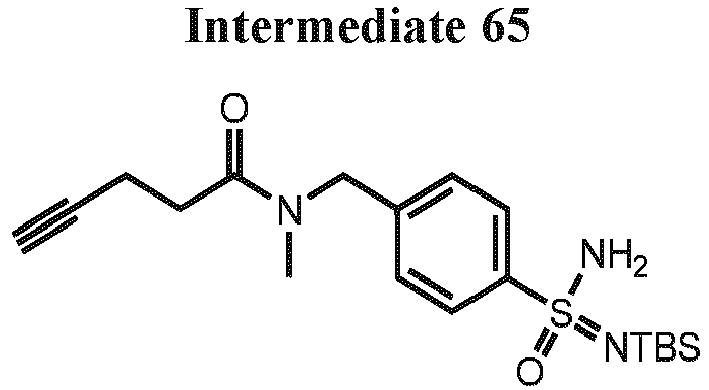
- Into a 500-mL sealed tube, was placed N-methyl-N-[(4-sulfamoylphenyl)methyl]acetamide (5.0 g), hydrogen chloride (200 mL, 12 M). The resulting solution was stirred for 16 h at 100 °C in an oil bath. The resulting mixture was concentrated. This resulted in 5.0 g of the title compound as an off-white crude solid. MS-ESI: 201 (M+1)
- Into a 250 mL round-bottom flask was placed 4-((methylamino)methyl)benzenesulfonamide (4.0 g, 20 mmol) in DMF (40 mL ). To this stirred solution was added HATU (6.33 g,16.7 mmol), DIEA (5.16 g, 40 mmol) and pent-4-ynoic acid (2.16 g, 22 mmol). Then the mixture was stirred overnight RT. The resulting solution was diluted with 40 mL of water. The resulting solution was extracted with 3x50 mL of ethyl acetate and the organic layers combined and dried over anhydrous sodium sulfate and concentrated under vacuum. The residue was eluted from a silica gel column with ethyl acetate/petroleum ether (1:1). This resulted in 2.97 g (53%) of the title compound as a light yellow solid. MS-ESI: 281 (M+1).
- Steps 3-5 used similar procedures for converting Intermediate 61 to Intermediate 62 shown in Scheme 38 to afford Intermediate 65 from compound 163". MS-ESI: 394 (M+1).


-

- Into a 250-mL round-bottom flask, was placed 4-[(methylamino)methyl]benzene-1-sulfonamide (5.0 g, 25 mmol) in DCM (100 mL). To this stirred solution was added di-tert-butyl dicarbonate (6.0 g, 27.5 mmol). The resulting solution was stirred for 5 h at RT. The resulting mixture was concentrated. The residue was eluted from a silica gel column with ethyl acetate/petroleum ether (1:1). This resulted in 5.0 g (66.7 %) of the title compound as a light yellow solid. MS-ESI: 301 (M+1).
- Steps 2-4 used similar procedures for converting compound 148" to intermediate 59 shown in Scheme 36 to afford Intermediate 66 from compound 166". MS-ESI: 414 (M+1).
- Into a 50-mL round-bottom flask, was placed tert-butyl (4-(N'-(tertbutyldimethylsilyl)sulfamidimidoyl)benzyl)(methyl)carbamate (500 mg, 1.21 mmol) in THF (15 mL). To this stirred solution was added 4-isocyanato-1,2,3,5,6,7-hexahydro-s-indacene (343 mg, 1.81 mmol) and NaH (60%wt. oil dispersion, 96.8 mg, 2.42 mmol). The resulting solution was stirred for 3 h at RT. The reaction was quenched by the addition of MeOH (10 mL). This resulted in 500 mg (67.5%) of the title compound as a white crude solid. MS-ESI: 613 (M+1).
- Into a 50-mL round-bottom flask was placed tert-butyl N-[(4-[[(tert-butyldimethylsilyl)amino] ([[(1,2,3,5,6,7-hexahydro-s-indacen-4-yl)carbamoyl]imino])oxo-λ6-sulfanyl]phenyl)methyl]-N-methylcarbamate (90 mg) and HCl in dioxane (4 M, 5.0 mL). The resulting solution was stirred for 16 h at RT. The resulting mixture was concentrated. The crude product was purified by Prep-HPLC with the following conditions: Column, Sunfire Prep C18 OBD, 10 um,19*250 mm; mobile phase A: water (0.05% TFA) and B: ACN (20% to 50% gradient of B over 17 min); Detector, UV 220/254 nm. This resulted in 30 mg of the title compound as a white solid. MS-ESI: 399 (M+1).


- Into a 50-mL seal tube was placed methyl 6-bromo-2-methylpyridin-3-amine (500 mg, 2.67 mmol) in MeOH (15 mL) and Pd(OAc)2 (120 mg, 0.53 mmol), dppf(444 mg, 0.80 mmol), TEA (809 mg, 8.01 mmol). The seal tube was evacuated and flushed three times with CO. The resulting solution was stirred for 5 h at 100 °C under 10 atm of CO. Then the solution was concentrated under vacuum. The residue was eluted from a silica gel column with ethyl acetate/petroleum ether (1:1). This resulted in 351 mg (79.2 %) of the title compound as a light yellow solid. MS-ESI: 167 (M+1). Steps 2-4 used similar procedures for converting compound 27 to Intermediate 30 shown in
Scheme 9 to afford compound 176" from compound 173". MS-ESI: 231 (M+1). - Steps 5-6 used similar procedures for converting compound 148" to intermediate 59 shown in Scheme 36 to afford Intermediate 70 from compound 176". MS-ESI: 344 (M+1).
Table 11. The Intermediates in the following Table were prepared using the similar procedures for converting compound 172" to Intermediate 70 shown in Scheme 42 from appropriate starting materials. Intermediate # Structure IUPAC Name Exact Mass[M+H]+ Intermediate 71 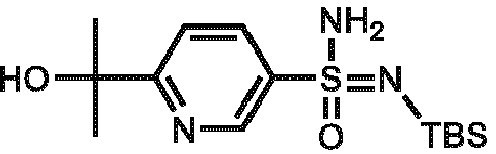
N'-(tert-butyldimethylsilyl)-6-(2-hydroxypropan-2-yl)pyridine-3-sulfonimidamide 330 

- Into a 250-mL round-bottom flask, was placed a solution of 2-(4-bromophenyl)propan-2-ol (10 g, 46.5 mmol) in THF (50 mL). To this stirred solution was added NaH (60% wt. oil dispersion, 5.19 g, 93 mmol) at 0 °C. The resulting solution was stirred for 30 min at 0 °C. To this stirred solution was added MeI (6.60 g, 46.5 mmol) dropwise with stirring at 0 °C. The resulting solution was allowed to react for an additional 15 h at RT. The resulting solution was quenched with 40 mL of water. The resulting solution was extracted with 3x50 mL of ethyl acetate and the organic layers combined and dried over anhydrous sodium sulfate and concentrated under vacuum. The residue was eluted from a silica gel column with ethyl acetate/petroleum ether (15/85). This resulted in 8.5 g (50.3%) of the title compound as a yellow solid.
- Into a 250-mL 3-necked round-bottom flask purged and maintained with an inert atmosphere of nitrogen, was placed a solution of 1-bromo-4-(2-methoxypropan-2-yl)benzene (5.0 g, 21.8 mmol) in THF (50 mL). To this stirred solution was added n-BuLi (13 mL, 32.7 mmol, 2.5 M) dropwise with stirring at -78 °C. The resulting solution was stirred for 30 min at -78 °C. SO2(g) was introduced into the stirring solution at -78 °C. The resulting solution was allowed to react for an additional 60 min at RT. The resulting mixture was concentrated. This resulted in 6.0 g (crude) of the title compound as a yellow solid. MS-ESI: 213 (M-1)
- Into a 50-mL round-bottom flask, was placed 4-(2-methoxypropan-2-yl)benzene-1-sulfinic acid (4.9 g, 22.9 mmol) in THF (50 mL). To this stirred solution was added NCS (4.58 g, 34.3 mmol).
- The resulting solution was stirred for 30 min at 0 °C. The mixture was allowed to react for an additional 60 min at RT. NH3 (g) was introduced into the reaction solution. The resulting solution was allowed to react for an additional 120 min at RT. The resulting mixture was concentrated. The residue was eluted from a silica gel column with ethyl acetate/petroleum ether (1/4). This resulted in 4.3 g (82 %) of the title compound as a yellow solid.
- Into a 250-mL round-bottom flask was placed 4-(2-methoxypropan-2-yl)benzene-1-sulfonyl chloride (4.3 g, 17.3 mmol) in DCM (50 mL). NH3 (g) was introduced into the reaction solution at 0 °C. The resulting solution was stirred for 180 min at RT. The resulting mixture was concentrated. The residue was eluted from a silica gel column with ethyl acetate/petroleum ether (1/3). This resulted in 3.9 g (98.5%) of the title compound as a yellow solid. MS-ESI: 230 (M+1).
- Into a 100-mL round-bottom flask, was placed a solution of 4-(2-methoxypropan-2-yl)benzene-1-sulfonamide (4.0 g, 17.5 mmol) in THF (40 mL). To this stirred solution was added NaH (1.4 g, 34.9 mmol, 60%wt. oil dispersion) and TBSCl (3.16 g, 21 mmol) at 0 °C. The resulting solution was allowed to react with stirring for 15 h at RT. The resulting solution was quenched with 40 mL of water. The resulting solution was extracted with 3x50 mL of ethyl acetate and the organic layers combined and dried over anhydrous sodium sulfate and concentrated under vacuum. The residue was eluted from a silica gel column with ethyl acetate/petroleum ether (30/70). This resulted in 2.3 g (38.4%) of the title compound as a yellow solid. MS-ESI: 344 (M+1)
- Into a 500-mL 3-necked round-bottom flask purged and maintained with an inert atmosphere of nitrogen, was placed the solution of PPh3Cl2 (12.4 g, 37.3 mmol) in chloroform (150 mL). This was followed by the addition of DIEA (9.63 g, 74.5 mmol) dropwise with stirring at RT. The resulting solution was stirred for 10 min at RT and the reaction system was cooled to 0 °C. To this was added a solution of N-(tert-butyldimethylsilyl)-4-(2-methoxypropan-2-yl)benzene-1-sulfonamide (3.2 g, 9.31 mmol) in chloroform (30 mL) dropwise with stirring at 0 °C. The resulting solution was stirred for 30 min at 0 °C. To the mixture was introduced NH3 gas bubble for 15 min at 0 °C. The resulting solution was stirred for 2 h at RT. The resulting solution was diluted with 100 mL of water. The resulting solution was extracted with 3x200 mL of DCM and the organic layers combined and dried over anhydrous sodium sulfate and concentrated under vacuum. The residue was eluted from a silica gel column with ethyl acetate/petroleum ether (36/64). This resulted in 1.4 g (36.5%) of the title compound as a yellow solid. MS-ESI: 343 (M+1)


- Into a 500-mL 3-necked round-bottom flask purged and maintained with an inert atmosphere of n itrogen, were placed Ti(OEt)4 (12.3 g, 53.8 mmol) and dimethylamine (4.85 g, 108 mmol) in Me OH (50 mL) at RT. To a stirred solutionwas added 6-bromopyridine-3-carbaldehyde (5.0 g, 26. 9 mmol) in MeOH (30 mL) dropwise at 0 °C. Then the reaction solution was stirred at RT for 3h. NaBH4 (1.02 g, 26.9 mmol) was added to the mixture and the resulting solution was stirred over night at RT. The reaction was quenched by the addition of water/ice (30mL) at 0 °C. The resultin g mixture was concentrated under reduced pressure. Then the resulting mixture extracted with et hyl acetate (3 × 50mL) and the organic layers combined and dried over anhydrous sodium sulfate and concentrated under vacuum. The residue was eluted from a silica gel column with ethyl aceta te/petroleum ether (5: 1) to afford the title compound (3.5 g, 60.5%) as a yellow oil. MS-ESI: 216 /218 (M+1).
- Steps 2-6 used similar procedures for converting compound 179" to Intermediate 72 shown in Scheme 43 to afford Intermediate 73 from compound 185. MS-ESI: 329 (M+1).
Table 12. The Intermediates in the following Table were prepared using the similar procedures for converting compound 184" to Intermediate 73 shown in Scheme 44 from appropriate starting materials. Intermediate # Structure IUPAC Name Exact Mass[M+H]+ Intermediate 74 
N'-(tert-butyldimethylsilyl)-6-((dimethylamino)methyl)pyridine-3-sulfonimidamide 329 

- Steps 1-6 used similar procedures for converting compound 179" to Intermediate 72 shown in Scheme 43 to afford Intermediate 75 from compound 190". MS-ESI: 325 (M+1).


- Into a 250-mL round-bottom flask purged and maintained with an inert atmosphere of nitrogen, was placed 4-bromobenzene-1-sulfonamide (5.0 g, 21.2 mmol) in dioxane (100 mL) and H2O (15 mL). To this stirred solution was added 4,4,5,5-tetramethyl-2-(prop-1-en-2-yl)-1,3,2-dioxaborolane (14.2 g, 84.7 mmol), Pd(dppf)Cl2 (4.65 g, 6.35 mmol) and Cs2CO3 (13.8 g, 42.4 mmol). The resulting solution was stirred for 15 h at 100 °C. The resulting mixture was concentrated under reduced pressure. The residue was eluted from a silica gel column with ethyl acetate/petroleum ether (40/60). This resulted in 3.6 g (86.2%) of the title compound as a yellow solid. MS-ESI: 198 (M+1).
- Into a 1.0-L round-bottom flask, was placed 4-(prop-1-en-2-yl)benzene-1-sulfonamide (5.0 g, 25.4 mmol) in H2SO4 (50 mL) and AcOH (250 mL). To the stirred solution was added 2-chloroacetonitrile (38.3 g, 507 mmol). The resulting solution was stirred for 30 min at 0 °C. The resulting solution was allowed to react for an additional 15 h at RT. The pH value of the solution was adjusted to 7 with Na2CO3 (5.0 M). Then the resulting mixture was extracted with ethyl acetate (3 × 200mL) and the organic layers combined and dried over anhydrous sodium sulfate and concentrated under vacuum. The residue was eluted from a silica gel column with ethyl acetate/petroleum ether (2/3). This resulted in 4.2 g (57%) of the title compound as yellow oil. MS-ESI: 291 (M+1).
- Into a 250-mL round-bottom flask, was placed 2-chloro-N-[2-(4-sulfamoylphenyl)propan-2-yl]acetamide (4.2 g, 14.5 mmol) in CH3COOH (15 mL) and ethanol (75 mL). To this stirred solution was added thiourea (1.32 g, 17.3mmol). The resulting solution was stirred for 16 h at 85 °C. The resulting mixture was washed with 100 ml of H2O and extracted with 3x250 mL of ethyl acetate and the organic layers combined and dried over anhydrous sodium sulfate and concentrated under vacuum. This resulted in 2.3 g (54.3%) of the title compound as a yellow solid. MS-ESI: 215 (M+1).
- Into a 250-mL round-bottom flask, was placed 4-(2-aminopropan-2-yl)benzene-1-sulfonamide (2.14 g, 9.99 mmol) in MeOH (50 mL). To this stirred solution was added HCHO (37%wt., 599 mg, 20 mmol) and NaBH3CN (1.86 g, 30 mmol). The resulting solution was stirred for 120 min at RT. The resulting mixture was diluted with 100 mL of water and extracted with 3x250 mL of ethyl acetate and the organic layers combined and dried over anhydrous sodium sulfate and concentrated under vacuum The residue was eluted from a silica gel column with ethyl acetate/petroleum ether (30/70). This resulted in 1.0 g (41.3%) of the title compound as a yellow solid. MS-ESI: 243 (M+1).
- Steps 5-7 used similar procedures for converting compound 148" to intermediate 59 shown in Scheme 36 to afford Intermediate 76 from compound 200. MS-ESI: 356 (M+1).


- Into a 250-mL 3-necked round-bottom flask purged and maintained with an inert atmosphere of nitrogen was added 2-methylpropane-2-sulfinamide (3.04g, 25.1 mmol) in THF (50 mL). To this stirred solution was added Ti(OEt)4 (11.5 g, 50.2 mmol) and 4-acetylbenzene-1-sulfonamide (5.0 g, 25.1 mmol) in portions at RT. The resulting mixture was stirred for overnight at 70 °C under nitrogen atmosphere. The reaction was quenched with Water (20 mL) at 0 °C. The resulting mixture was extracted with ethyl acetate (3 × 30 mL). The combined organic layers were dried over anhydrous Na2SO4. After filtration, the filtrate was concentrated under reduced pressure. The residue was purified by silica gel column chromatography, eluted with ethyl acetate/petroleum ether (1:1) to afford the title compound (5.0 g,75.8%) as a yellow solid. MS-ESI: 303 (M+1).
- Into a 500 mL round-bottom flask were added 4-[(1E)-1-[(2-methylpropane-2-sulfinyl)imino]ethyl]benzene -1-sulfonamide (4.65 g, 15.4 mmol) in THF (200 mL) at RT. To this stirred solution was added NaBH4 (1.16 g, 30.8 mmol) in portions at 0 °C under nitrogen atmosphere. The resulting mixture was stirred for 4 h at RT under nitrogen atmosphere. The reaction was quenched by the addition of HCl (2M, 50 mL) at 0 °C. The resulting mixture was extracted with ethyl acetate (3 × 50mL). The combined organic layers were dried over anhydrous Na2SO4. After filtration, the filtrate was concentrated under reduced pressure to afford the title compound (4.5 g, 96.1%) as a white solid. MS-ESI: 305 (M+1).
- Into a 250 mL round-bottom flask were added 4-[1-[(2-methylpropane-2-sulfinyl)amino]ethyl]benzene-1 -sulfonamide (4.4 g, 14.5 mmol) and MeOH (50 mL) at room temperature. To this stirred solution was added HCl (gas) in 1,4-dioxane (8.0 mL, 26.3 mmol) in one portions at RT. The resulting mixture was stirred overnight at RT. The resulting mixture was concentrated under reduced pressure. The residue was purified by reverse flash chromatography with the following conditions (column, C18 silica gel; mobile phase, MeCN in water, 10% to 50% gradient in 10 min; detector, UV 254 nm.) to afford the title compound (2.6 g, 89.7%) as a white solid. MS-ESI: 201 (M+1).
- Into a 250 mL round-bottom flask was added 4-(1-aminoethyl)benzene-1-sulfonamide (2.0 g, 9.99 mmol) and MeOH (60 mL) at RT. To this stirred solution was added HCHO (37%wt., 1.61 g, 53.6 mmol) and NaBH3CN (1.25 g, 20 mmol) in portions at RT. The resulting mixture was stirred overnight at RT. The reaction solution was diluted with 100 mL of water and extracted with 3x100 mL of ethyl acetate and the organic layers combined and dried over anhydrous sodium sulfate and concentrated under vacuum. The residue was eluted from a silica gel column with ethyl acetate/petroleum ether. The residue was purified by silica gel column chromatography, eluted with ethyl acetate/petroleum ether (1:2) to afford the title compound (1.5 g, 65.8%) as a white solid. MS-ESI: 229 (M+1).
- Steps 5-7 used similar procedures for converting compound 148" to intermediate 59 shown in Scheme 36 to afford Intermediate 77 from compound 207". MS-ESI: 342 (M+1).


- Into a 50-mL 3-necked round-bottom flask, was placed N-(tert-butyldimethylsilyl)-4-(2-hydroxypropan-2-yl) thiophene-2-sulfonoimidamide (300 mg, 0.90 mmol) in THF (3.0 mL). To the solution were added NaH (60%wt. oil dispersion, 53.8 mg, 1.35 mmol)at-10 °C in ethanol/ice bath. To the solution were added iodomethane (0.50 mL) dropwise with stirring at 0 °C in 30 min. The resulting solution was stirred for 30 min at RT. The reaction was then quenched by the addition of NH4Cl(aq.). The resulting solution was extracted with 3x20 mL of ethyl acetate and the organic layers combined, dried over anhydrous sodium sulfate and concentrated under vacuum. The residue was eluted from a silica gel column with ethyl acetate/petroleum ether (1:5). This resulted in 252 mg (77.5%) of the title compound as a white solid. MS-ESI: 363 (M+1).
- Into a 50-mL round-bottom flask, was placed N-(tert-butyldimethylsilyl)-4-(2-hydroxypropan-2-yl)-N,N -dimethylthiophene-2-sulfonoimidamide (200 mg, 0.55 mmol) in THF (10 mL). To the solution was added HF/Py (70%wt., 0.10 mL) dropwise with stirring at RT. The resulting solution was stirred for 60 min at RT. The resulting mixture was concentrated under vacuum. The resulting solution was extracted with ethyl acetate (3x10mL), the organic layers combined and dried over anhydrous sodium sulfate. The residue was eluted from a silica gel column with ethyl acetate. This resulted in 127 mg (92.7%) of the title compound as a white solid. MS-ESI: 249 (M+1).


- Into a 1.0-L round-bottom flask, was placed tert-butyl N-[[2-(2-hydroxypropan-2-yl)-1,3-thiazol-5-yl] sulfinyl]carbamate (100 g, 326 mmol) in ACN (500 mL). To the stirred solution was added NCS (65.4 g, 490 mmol). The resulting solution was stirred for 2 h at RT. The resulted solution was concentrated. This resulted in 120 g (crude) of the title compound as yellow oil. MS-ESI: 341/343 (M+1).
- Into a 250-mL round-bottom flask, was placed tert-butyl (chloro(2-(2-hydroxypropan-2-yl)thiazol-5-yl)(oxo)-λ6-sulfaneylidene)carbamate (10 g, 29.3 mmol) in THF (100 mL). To the stirred solution was added CH3NH2 (1.82 g, 58.6 mmol). The resulting solution was stirred for 2 h at RT. The resulted solution was concentrated. The residue was eluted from a silica gel column with ethyl acetate/ petroleum ether (1:1). This resulted in 6.1 g (62%) of the title compound as a yellow solid. MS-ESI: 336 (M+1).
- Into a 100-mL round-bottom flask, was placed tert-butyl((2-(2-hydroxypropan-2-yl)thiazol-5-yl)(methylamino)(oxo)-λ6-sulfaneylidene) carbamate (3.0 g, 8.94 mmol) in HCl (gas) in 1,4-dioxane (8 mL, 26.3 mmol) in one portion at RT. The resulting solution was stirred for 60 min at RT. The resulting mixture was concentrated under vacuum. This resulted in 2.10 g (crude) of the title compound as a yellow solid. MS-ESI: 236 (M+1).


- Into a 1-L round-bottom flask, was placed a solution of methyl 2-(2-hydroxypropan-2-yl)-1,3-thiazole-5-sulfinate (40 g, 181 mmol) in THF (500 mL). To this stirred solution was added NaH (60% wt. oil dispersion, 7.95 g, 199 mmol) in three portions at 0 °C in an ice/ethanol bath. To this reaction solution was added MeI (51.3 g, 362 mmol) dropwise with stirring at 0 °C in an ice/ethanol bath. The resulting solution was stirred for 3 h at RT. The reaction was then quenched by the addition of water (50 mL ) at 0 °C. The resulting solution was extracted with 3x300 mL of ethyl acetate and the organic layers combined and dried over anhydrous sodium sulfate and concentrated under vacuum. This resulted in 32 g (75.3%) of the title compound as a white solid. MS-ESI: 236 (M+1).
- Into a 1-L 3-necked round-bottom flask purged and maintained with an inert atmosphere of nitrogen, was placed a solution of methyl 2-(2-methoxypropan-2-yl)-1,3-thiazole-5-sulfinate (20 g, 85 mmol) in THF (500 mL). This was followed by the addition of KHMDS (500 mL, 1.0 mole, 2 M) dropwise with stirring at -78 °C in a liquid nitrogen/ethanol bath. The resulting solution was stirred for 3 h at -78 °C in a liquid nitrogen/ethanol bath. The reaction was quenched by the addition of water (50 mL). The resulting solution was extracted with 3x300 mL of ethyl acetate dried over anhydrous sodium sulfate and concentrated under vacuum. The residue was eluted from a silica gel column with ethyl acetate/petroleum ether (1:3). This resulted in 14 g (74.8%) of the title compound as a white solid. MS-ESI: 221.0 (M+1).
- Into a 500-mL round-bottom flask purged and maintained with an inert atmosphere of nitrogen, was placed a solution of 2-(2-methoxypropan-2-yl)-1,3-thiazole-5-sulfinamide (10 g, 45.4 mmol) in THF (250 mL). To this stirred solution was added NaH (60%wt. oil dispersion, 3.63 g, 90.8 mmol) in three times at 0 °C in an ice/ethanol bath. To this solution was added Boc2O (9.91 g, 45.4 mmol) in portions at 0 °C in an ice/ethanol bath. The resulting solution was stirred for 3 h at RT. The reaction was then quenched by the addition of water (50 mL). The resulting solution was extracted with 3x300 mL of ethyl acetate concentrated under vacuum. This resulted in 12 g (82.5%) of the title compound as a white solid. MS-ESI: 321.1 (M+1).
- Into a 500-mL round-bottom flask purged and maintained with an inert atmosphere of nitrogen, was placed a solution of tert-butyl N-[[2-(2-methoxypropan-2-yl)-1,3-thiazol-5-yl]sulfinyl]carbamate (11 g, 34.3 mmol) in THF (200 mL). NCS (13.8 g, 103 mmol) was added to the reaction solution in one portion at RT. The resulting solution was stirred for 3 h at RT. This reaction solution was used to the next step directly without further purification.
- Into a 500-mL round-bottom flask purged and maintained with an inert atmosphere of nitrogen, was placed a solution of tert-butyl N [[2-(2-methoxypropan-2-yl)-1,3-thiazol-5-yl]sulfinyl]carbamate (9.0 g, 28.9mmol) in THF (200 mL). To the mixture was added introduced NH3 gas bubble for 15 min at 0 °C. The resulting solution was stirred for 1 h at RT. The resulting mixture was concentrated. The residue was eluted from a silica gel column with ethyl acetate/petroleum ether (1:1). This resulted in 7g (72.3%) of the title compound as a white solid. MS-ESI: 336.1 (M+1).


- Steps 1-2 used similar procedures for converting compound 27 to Intermediate 29 shown in
Scheme 9 to afford compound 219" from compound 217". MS-ESI: 238 (M+1). - Into a 500 mL round-bottom flash were added 6-bromopyridine-3-sulfonamide (5.5 g, 23.2 mmol) and dioxane (150 mL) and water (15 mL) at RT. To this solution was added Pd(dppf)Cl2 (1.7 g, 2.32 mmol), Cs2CO3 (15.1 g, 46.4 mmol) and 4,4,5,5-tetramethyl-2-(2-methylprop-1-en-1-yl)-1,3,2-dioxaborolane (8.45 g, 46.4mmol) in one portion at RT under nitrogen atmosphere. The resulting mixture was stirred overnight at 100 °C under nitrogen atmosphere. The resulting mixture was concentrated under reduced pressure. The residue was purified by silica gel column chromatography with ethyl acetate/petroleum ether (1:1) to afford title compound (4.0 g, 81.2%) as a light yellow oil. MS-ESI: 213 (M+1).
- Into a 250mL 3-necked round-bottom flask was added 6-(2-methylprop-1-en-1-yl)pyridine-3-sulfonamide (4 g, 18.8 mmol) and MeOH (100 mL) at RT under nitrogen atmosphere. To this stirred solution was added Pd/C (wet 10% wt., 900 mg). The flask was evacuated and filled three times with hydrogen. The resulting mixture was stirred overnight at RT under hydrogen atmosphere. The resulting mixture was filtered; the filter cake was washed with MeOH (3x20 mL). The filtrate was concentrated under reduced pressure. The crude product of the title compound (3.8 g) was used to the next step directly without further purification. MS-ESI: 215 (M+1).
- Steps 5-7 used similar procedures for converting compound 148" to intermediate 59 shown in Scheme 36 to afford intermediate 81 from compound 221". MS-ESI: 328 (M+1).
Table 13. The Intermediates in the following Table were prepared using the similar procedures for converting compound 217" to Intermediate 81 shown in Scheme 51 from appropriate starting materials. Intermediate # Structure IUPAC Name Exact Mass [M+H]+ Intermediate 82 
N'-(tert-butyldimethylsilyl)-4-isobutylbenzenesulfonimidamide 327 

-

- Into a 100-mL round-bottom flask, was placed 4-sulfamoylbenzoic acid (1.0 g, 4.97 mmol) in THF (15 mL). This was followed by the addition of BH3-THF (14.3 mL, 149 mmol) dropwise with stirring at 0 °C in an ice/ethanol bath. The resulting solution was stirred for 12 h at RT. The reaction was then quenched by the addition of HCl (50 mL, 2 M) dropwise in an ice bath and stirred for 1h at RT. The mixture was extracted with 8x50 mL of ethyl acetate. The organic layers were combined and concentrated. This resulted in 800 mg (86%) of the title compound as a yellow solid. MS-ESI: 188 (M+1).
- Steps 2-3 used similar procedures for converting compound 148" to Intermediate 59 shown in Scheme 36 to afford Intermediate 83 from compound 225". MS-ESI: 415 (M+ 1). Steps 4-5 used similar procedures for converting compound 166" to Intermediate 67 shown in Scheme 40A to afford compound Example 233 from Intermediate 83. MS-ESI: 386 (M+1).
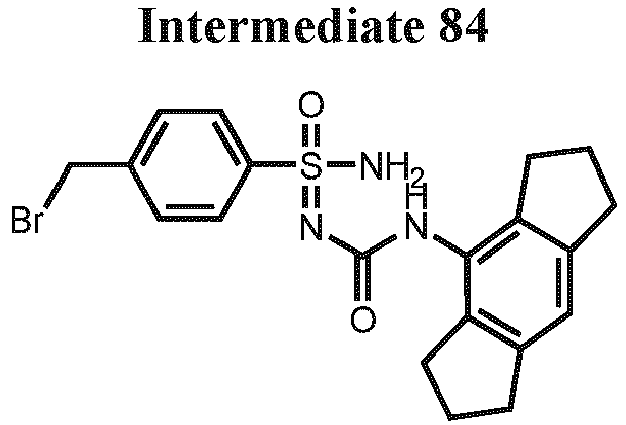
- Into a 250-mL round-bottom flask purged and maintained with an inert atmosphere of nitrogen, was placed 1-[amino[4-(hydroxymethyl)phenyl]oxo-λ6-sulfanylidene]-3-(1,2,3,5,6,7-hexahydro-s-indacen-4-yl)urea (1.0 g, 2.59 mmol) in THF (50 mL). To the stirred solution was added PBr3 (702 mg, 2.59 mmol) in portions. The resulting solution was stirred for 3 h at RT. The solids were collected by filtration. This resulted in 500 mg (43%) of the title compound as a white solid. MS-ESI: 449/411 (M+1).


- Into a 250-mL round-bottom flask, was placed 6-bromo-1,2,3,4-tetrahydroisoquinoline (6.0 g, 28.3 mmol) in MeOH (100 mL) under N2. To the stirred solution was added HCHO (1.02 g, 34 mmol) in portions at RT. The resulting solution was stirred for 4 h, then NaBH3CN (3.56 g, 56.6 mmol) was added in portions at RT. The resulting solution was stirred overnight at RT. The reaction was then quenched by the addition of water (100 mL) and extracted with 3x150 mL ethyl acetate. The organic layers were combined and dried over anhydrous sodium sulfate and concentrated under vacuum. The crude product was eluted from a silica gel column with acetate/petroleum ether (1:1). This resulted in 5 g (78.2%) of the title compound as a white solid. MS-ESI: 226/228 (M+1).
- teps 2-5 used similar procedures for converting compound 185" to Intermediate 173" shown in Scheme 44 to afford Intermediate 85 from compound 229. MS-ESI: 238 (M+1).

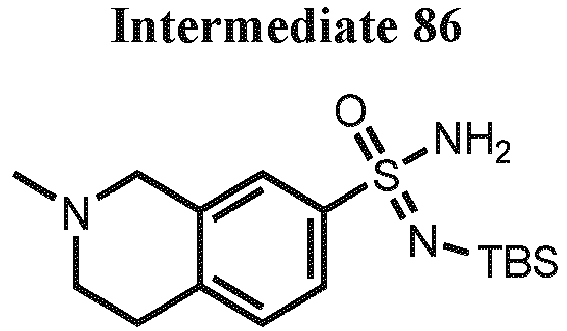
- Into a 250-mL round-bottom flask purged and maintained with an inert atmosphere of nitrogen, was placed 1,2,3,4-tetrahydroisoquinoline (8.0 g, 60.1 mmol) and 2,2,2-trifluoroacetic anhydride (25.2 g, 120mmol). The resulting solution was stirred for 12 h at RT. The reaction was then quenched by the addition of 100 mL of water/ice. The resulting solution was extracted with 3x100 mL of ethyl acetate and the organic layers were combined and dried over anhydrous sodium sulfate and concentrated under vacuum. This resulted in 10 g (72.6%) of the title compound as a yellow solid. MS-ESI: 230 (M+1).
- Steps 2-3 used similar procedures for converting compound 158" to Intermediate 61 shown in Scheme 38 to afford compound 236" from compound 234". MS-ESI: 309 (M+1).
- Into a 100-mL round-bottom flask, was placed 2-(2,2,2-trifluoroacetyl)-1,2,3,4-tetrahydroisoquinoline -7-sulfonamide (8.0 g, 26 mmol) in ethanol (12 mL) and H2O (60 mL). To the stirred solution was added KOH (7.28 g, 123 mmol) in one portion at RT. The resulting solution was stirred for 12 h at RT. The resulting mixture was concentrated. The crude product was applied onto a silica gel column with DCM/MeOH (10:1). This resulted in 5.0 g (90.8%) of the title compound as a light yellow solid.
-
Step 5 used similar procedures for converting compound 228" to compound 229" shown in Scheme 53 to afford compound 238" from compound 237". MS-ESI: 227 (M+1). - Steps 6-7 used similar procedures for converting compound 148" to intermediate 59 shown in Scheme 36 to afford intermediate 86 from compound 238". MS-ESI: 340 (M+1).


- Into a 50-mL round-bottom flask, was placed 4-[(dimethylamino)methyl]-2-fluorobenzene-1-sulfonamide (1 g, 4.31 mmol) and DMF (10 mL, 0.14 mmol). Then to the above was added sodium methoxide (2.16 g, 40 mmol). The resulting solution was stirred for 12 h at RT. The reaction was then quenched by the addition of 5.0 mL of water. The residue was eluted from a C18 column with ACN:H2O (3:7). This resulted in 800 mg (76.1%) of the title compound as a yellow solid. MS-ESI: 245 (M+1).
- Steps 2-3 used similar procedures for converting compound 148" to intermediate 59 shown in Scheme 36 to afford intermediate 87 from compound 240". MS-ESI: 358 (M+1).


- Into a 1000-mL round-bottom flask, was placed methyl 4-fluorothiophene-2-carboxylate (10 g, 62.4 mmol) in ethanol (300 mL). Then to the above solution was added NaBH4 (4.62 g, 125 mmol) in portions at 0 °C in an ice/ethanol bath. The resulting solution was stirred for 30 min at 0 °C and then the reaction solution was allowed to react for an additional 16 h at RT. The reaction was then quenched by the addition of 50 mL of water. Then the mixture was concentrated and extracted with 3x100mL of ethyl acetate and the organic layers were combined and dried over anhydrous sodium sulfate and concentrated under vacuum. This resulted in 6.4 g (77.6%) of the title compound as white oil. MS-ESI: 133 (M+1)
- Into a 250-mL round-bottom flask, was placed (4-fluorothiophen-2-yl)methanol (8.5 g, 64.3 mmol) in DCM (70 mL). To the stirred solution was added PBr3 (19.2 g, 70.8 mmol) dropwise at 0 °C in an ice/ethanol bath. The resulting solution was stirred for 30 min at 0 °C. The resulting solution was allowed to react for an additional 12 h at RT. The reaction was then quenched by the addition of 50 mL of water. Then the mixture was concentrated and extracted with 3x100mL of ethyl acetate and the organic layers were combined and dried over anhydrous sodium sulfate and concentrated under vacuum. The residue was eluted from a silica gel column with ethyl acetate/petroleum ether (15/85). This resulted in 7.0 g (55.8%) of the title compound as yellow oil. MS-ESI: 194/196 (M+1).
- Into a 250-mL round-bottom flask, was placed 2-(bromomethyl)-4-fluorothiophene (7.4 g, 37.9 mmol) in CHCl3 (50 mL). To the above solution was added butoxytributyl-l4-azane sulfate (6.76 g, 19 mmol) and DMA (37 mL, 425 mmol) with stirring at RT. The resulting solution was stirred for 2h at 60 °C. The reaction was then quenched by the addition of 50 mL of water. Then the mixture was concentrated and extracted with 3x100mL of ethyl acetate and the organic layers were combined and dried over anhydrous sodium sulfate and concentrated under vacuum. The residue was eluted from a silica gel column with ethyl acetate/petroleum ether (17/83). This resulted in 6.0 g (99.5%) of the title compound as a yellow solid. MS-ESI: 160 (M+1).
- Into a 500-mL 3-necked round-bottom flask purged with and maintained under nitrogen, was placed a solution of [(4-fluorothiophen-2-yl)methyl]dimethylamine (6.2 g, 38.9 mmol) in THF (60 mL). This was followed by the addition of n-BuLi/THF (18.7 mL, 2.5 M) dropwise with stirring at -78 °C in a liquid nitrogen/ethanol bath. The resulting solution was stirred for 30 min at -78 °C. To the above SO2(g) was introduced into the reaction solution at -78 °C. The resulting solution was allowed to react for an additional 2 h at RT. The resulting mixture was concentrated. This resulted in 10 g (crude) of the title compound as a yellow solid. MS-ESI: 222 (M-1).
- Into a 500-mL round-bottom flask, was placed a solution of 5-[(dimethylamino)methyl]-3-fluorothiophene -2-sulfinic acid (10 g, 44.8 mmol) in THF (100 mL). To the above solution was added NCS (7.18 g, 53.8 mmol). The resulting solution was stirred for 30 min at 0 °C and then allowed to react for an additional 2h at RT. This reaction was used for next step without purification.
- Into a 500-mL round-bottom flask, was placed a solution of 5-[(dimethylamino)methyl]-3-fluorothiophene -2-sulfonyl chloride (10 g, 38.8 mmol) in THF (100 mL). To the above NH3 (g) was introduced at RT. The resulting solution was stirred for 30 min at RT. The resulting mixture was concentrated. The residue was eluted from a silica gel column with ethyl acetate/petroleum ether (60/40). This resulted in 2.1 g (22.7%) of the title compound as yellow oil. MS-ESI: 239 (M+1).
- Into a 100-mL round-bottom flask, was placed a solution of 5-[(dimethylamino)methyl]-3-fluorothiophene -2-sulfonamide (1.8 g, 7.55 mmol) in THF (30 mL) under N2. To the above solution was added NaH (60%wt. oil dispersion, 640mg, 15 mmol) with stirring at 0 °C. The resulting solution was stirred for 5 min at 0 °C. This was followed by the addition of TBSCl (1.37 g, 9.09 mmol) at 0 °C. The resulting solution was allowed to react for an additional 15 h at RT. The reaction was then quenched by the addition of 20 mL of water. Then the mixture was concentrated and extracted with 3x100mL of ethyl acetate and the organic layers were combined and dried over anhydrous sodium sulfate and concentrated under vacuum. The residue was eluted from a silica gel column with ethyl acetate/petroleum ether (1:1). This resulted in 2.0 g (75.2%) of the title compound as yellow oil. MS-ESI: 353 (M+1).
- Into a 500-mL round-bottom flask purged and maintained with an inert atmosphere of nitrogen was placed a solution of PPh3Cl2 (29.5 g, 88.7 mmol) in CHCl3 (50 mL). To the above solution was added DIEA (17.2 g, 133 mmol) dropwise in an ice/water bath. The solution was stirred at RT for 20 minutes. This was followed by the addition of N-(tert-butyldimethylsilyl)-5-[(dimethylamino)methyl]-3-fluorothiophene- 2-sulfonamide (15.7 g, 44.4 mmol) in CHCl3 (30 mL) at 0 °C. The resulting solution was allowed to react for an additional 30 min at 0 °C. Then the reaction solution was used for next step without purification.
- Into a 500-mL round-bottom flask purged and maintained with an inert atmosphere of nitrogen, was placed [(tert-butyldimethylsilyl)imino](chloro)[5-[(dimethylamino)methyl]-3-fluorothiophen-2-yl]-λ6-sulfanone (16.5 g, 44.4 mmol) in CHCl3 (80 mL). To the above NH3(g) was introduced at 0 °C for 15min. The resulting solution was stirred for 15 min at 0 °C and then allowed to react for an additional 15 h at RT. The resulting mixture was concentrated. The residue was eluted from a silica gel column with ethyl acetate/ petroleum ether (60/40). This resulted in 5.8 g (37.2 %) of the title compound as a yellow solid. MS-ESI: 352(M+1).

- Into a 250-mL round-bottom flask, was placed a solution of tert-butyl 2-(2-hydroxypropan-2-yl)thiazole-5-sulfonimidoylcarbamate (3.21 g, 10 mmol) in HCl/dioxane (4 M, 50 mL). The resulting solution was stirred for 1 h at RT. The solution was concentrated to give the title compound (3.2 g, crude, yellow oil). MS-ESI: 222 (M+1).
- Into a 250-mL round-bottom flask, was placed 2-(2-hydroxypropan-2-yl)thiazole-5-sulfonimidamide (3.2 g crude, 10 mmol) in THF (100 mL), DIEA (3.87 g, 30 mmol) was added in at RT. Then TBSCl (3.0 g, 20 mmol) was added to the solution in portions. The resulting solution was stirred for 16 h at RT. The solution was concentrated and the crude product was purified by silica gel column with ethyl acetate/ petroleum ether (1: 1) to give the title compound (2.3 g, yield 70%, yellow solid). MS-ESI: 336 (M+1).


- Into a 1-L round-bottom flask, was placed tert-butyl N-[[2-(2-hydroxypropan-2-yl)-1,3-thiazol-5-yl]sulfinyl]carbamate (100 g, 326 mmol) in ACN (500 mL). To the stirred solution was added NCS (65.4 g, 49 mmol). The resulting solution was stirred for 2 h at RT. The resulted solution was concentrated. This resulted in 120 g crude title compound as yellow oil.
- Into a 250-mL round-bottom flask, was placed tert-butyl N-[chloro[2-(2-hydroxypropan-2-yl)-1,3-thiazol-5-yl]oxo-λ6-sulfanylidene]carbamate (10 g, 29.3 mmol) in THF (100 mL). To the stirred solution was added CH3NH2 (1.82 g, 58.6 mmol). The resulting solution was stirred for 2 h at RT. The resulted solution was concentrated. The residue was eluted from silica gel with ethyl acetate/ petroleum ether (1:1). This resulted in 6.1 g (62%) of the title compound as a yellow solid. MS-ESI: 336 (M+1).
- Into a 100-mL round-bottom flask, was placed tert-butyl((2-(2-hydroxypropan-2-yl)thiazol-5-yl) (methylamino)(oxo)-λ6-sulfaneylidene)carbamate (3.0 g, 8.94 mmol) in HCl (gas) in 1,4-dioxane (8.0 mL, 26.3 mmol) in one portion at RT. The resulting solution was stirred for 60 min at RT. The resulting mixture was concentrated under vacuum. This resulted in 2.10 g crude title compound as a yellow solid. MS-ESI: 236 (M+1).
- The schemes below illustrate the synthesis of Intermediates 89-96, 101-104, 114-117A, and 118"-126", which are isocyanate and precursors thereof as well as other intermediates:


- Into a 25-mL round-bottom flask, was placed 1H-indazol-6-ol (500 mg, 3.73 mmol). This was followed by the addition of H2SO4 (5.0 mL) in several batches at 0 °C. To this was added KNO3 (377 mg, 3.73 mmol) in portions at 0 °C. The resulting solution was stirred for 30 min at 0 °C in a water/ice bath. The reaction was then quenched by the addition of 50 mL of water/ice. The solids were collected by filtration. This resulted in 350 mg (52.4%) of the title compound as a brown solid. MS-ESI: 180 (M+1).
- Into a 50-mL round-bottom flask, was placed 7-nitro-1H-indazol-6-ol (350 mg, 1.95 mmol) in DCM (10 mL), TEA (593 mg, 5.86 mmol), Tf2O (717 mg, 2.54 mmol). The resulting solution was stirred for 16 h at RT. The resulting solution was diluted with 20 mL of H2O. The resulting solution was extracted with 3x20 mL of ethyl acetate dried over anhydrous sodium sulfate and concentrated. The residue was eluted from a silica gel column with ethyl acetate/petroleum ether (1:3). This resulted in 80 mg (13.2%) of the title compound as a yellow solid. MS-ESI: 312 (M+1).
- Into a 50-mL round-bottom flask purged and maintained with an inert atmosphere of nitrogen, was placed 7-nitro-1H-indazol-6-yl trifluoromethanesulfonate (100 mg, 0.32 mmol) in dioxane (10 mL) and H2O (2.0 mL), Cs2CO3 (209 mg, 0.64 mmol), 2-ethenyl-4,4,5,5-tetramethyl-1,3,2-dioxaborolane (59.4 mg, 0.39 mmol), Pd(dppf)Cl2 (23.5 mg, 0.030 mmol). The resulting solution was stirred for 16 h at 90 °C. in an oil bath. Then the mixture was concentrated under vacuum. The residue was eluted from a silica gel column with ethyl acetate/petroleum ether (1:3). This resulted in 50 mg (82.6%) of the title compound as a yellow solid. MS-ESI: 190 (M+1).

- Into a 50-mL round-bottom flask, was placed 6-ethenyl-7-nitro-1H-indazole (50 mg) in MeOH (10 mL), and Pd/C (10% wt., 5.0 mg). The flask was evacuated and flushed three times with hydrogen. The resulting solution was stirred for 12 h at RT under an atmosphere of hydrogen. The Pd/C catalysts were filtered out, the filtrate was concentrated under vacuum. This resulted in 44 mg of the title compound as a yellow solid. MS-ESI: 162 (M+1).


- Into a 50-mL round-bottom flask, was placed 6-ethenyl-7-nitro-1H-indazole (380 mg, 2.01 mmol) in acetone (20 mL), KOH (225 mg, 4.02 mmol). This was followed by the addition of MeI (342 mg, 2.41 mmol) dropwise with stirring. The resulting solution was stirred for 1 h at 0°C in a water/ice bath. The resulting solution was diluted with 20 mL of H2O. The resulting solution was extracted with 3x30 ml of ethyl acetate dried over anhydrous sodium sulfate and concentrated. The residue was eluted from a silica gel column with ethyl acetate/petroleum ether (1:1). This resulted in 210 mg (51.5%) of 254" as a yellow solid and 180 mg (44%) of 255" as a yellow solid. MS-ESI: 208 (M+1).
- Into a 50-mL round-bottom flask purged and maintained with an inert atmosphere of N2, was placed 6-ethenyl-1-methyl-7-nitro-1H-indazole (210 mg, 1.03 mmol) in MeOH (15 mL) and Pd/C (10% wt., 50 mg). The flask was evacuated and flushed three times with hydrogen. The resulting solution was stirred for 12 h at RT under an atmosphere of hydrogen. The Pd/C catalysts were filtered out, and the filtrate was concentrated under vacuum. This resulted in 160 mg (88.4%) of the title compound as a yellow solid. MS-ESI: 176 (M+1).
Table 14. The Intermediates in the following Table were prepared using the similar procedures for converting compound 254" to Intermediate 91 shown in Scheme 58 from 255". Intermediate # Structure IUPAC Name Exact Mass [M+H]+ Intermediate 92 
6-Ethyl-1-methyl-1H-indazol-7-amine 176 

- Into a 500-mL round-bottom flask purged and maintained with an inert atmosphere of nitrogen, was placed 3-bromobicyclo[4.2.0]octa-1(6),2,4-triene (70 g, 382 mmol) in THF (300 mL). This was followed by the addition of n-BuLi (184 mL, 459 mmol) dropwise with stirring at about -70 °C. After addition, the reaction mixture was stirred at this temperature for 30 min. To this solution was added DMF (36.3 g, 497 mmol) dropwise with stirring at -70 °C. The resulting solution was stirred for 30 min at -70 °C in a liquid nitrogen bath. The reaction was slowly warmed to RT and then quenched by the addition of 100 mL of water. The resulting solution was extracted with 3x200 ml of DCM. The organic layers combined and dried over anhydrous Na2SO4, and then the organic layers was concentrated. This resulted in 50 g (98.9%) of the title compound as light yellow oil. MS-ESI: 133 (M+1).
- Into a 250-mL round-bottom flask purged and maintained with an inert atmosphere of nitrogen, was placed bicyclo[4.2.0]octa-1(6),2,4-triene-3-carbaldehyde (1.7 g, 12.9 mmol) in pyridine (20 mL), propanedioic acid (1.99 g, 19.2 mmol) and piperidine (110 mg, 1.29 mmol). The resulting solution was stirred for overnight at 90 °C. in an oil bath. The resulting mixture was concentrated. This resulted in 2.1 g (93.7%) of the title compound as a solid. MS-ESI: 173 (M-1).
- Into a 250-mL round-bottom flask, was placed 2-(Z or E)-3-[bicyclo[4.2.0]octa-1(6),2,4-trien-3-yl]prop -2-enoic acid (2.1 g, 12.1 mmol) and Pd/C (10% wt., 200 mg). The flask was evacuated and flushed three times with hydrogen. The resulting solution was stirred for 12 h at RT under an atmosphere of hydrogen. The Pd/C catalysts were filtered out, the filtrate was concentrated under vacuum. This resulted in 2.1 g (98.9%) of the title compound as a solid. MS-ESI: 175 (M-1).
- Into a 250-mL round-bottom flask purged and maintained with an inert atmosphere of nitrogen, was placed 3-[bicyclo[4.2.0]octa-1(6),2,4-trien-3-yl]propanoic acid (10 g, 56.8 mmol) in DCM (100 mL). This was followed by the addition of oxalyl chloride (7.2 g, 56.8 mmol) dropwise with stirring at 0 °C. The resulting solution was stirred for 2 h at 0 °C in a water/ice bath. The resulting mixture was concentrated. This resulted in 10 g (90.5%) of the title compound as light yellow oil.
- Into a 100-mL round-bottom flask, was placed 3-[bicyclo[4.2.0]octa-1(6),2,4-trien-3-yl]propanoyl chloride (5.0 g, 25.7 mmol) in DCM (50 mL). This was followed by the addition of AlCl3 (3.4 g, 25.7 mmol) in portions at 0 °C. for 10 min. The resulting solution was stirred for 1 h at 0 °C in a water/ice bath. The reaction was then quenched by the addition of 100 mL of water. The resulting solution was extracted with 2x50 mL of DCM. The organic layers combined and dried over anhydrous Na2SO4, then concentrated. The residue was eluted from a silica gel column with ethyl acetate/petroleum ether (1:20 to 1:15). This resulted in 3.5 g (86.1%) of the title compound as a white solid. 1H NMR (300 MHz, CDCl3) δ 7.45 (s, 1H), 7.17 (s, 1H), 3.22 (m, 4H), 3.18 - 3.00 (m, 2H), 2.73 - 2.63 (m, 2H).
- Into a 500-mL round-bottom flask purged and maintained with an inert atmosphere of nitrogen, was placed 1,2,5,6-tetrahydrocyclobuta[flinden-4-one (20 g, 126 mmol) in THF (200 mL). This was followed by the addition of BH3-Me2S (25.3 mL, 253 mmol, 10 M) dropwise at 0 °C in an ice bath. The resulting solution was stirred for 14 h at 70 °C in an oil bath. The reaction was then quenched by the addition of 20 mL of MeOH. The resulting mixture was concentrated. The residue was eluted from a silica gel column with ethyl acetate/petroleum ether (1:100 to 1:50). This resulted in 15 g (82.3%) of the title compound as colorless oil. 1H NMR (300 MHz, CDCl3) δ 6.95 (s, 2H), 3.10 (s, 4H), 2.88 (t, J = 7.4 Hz, 4H), 2.03 (p, J = 7.4 Hz, 2H).
- Into a 500-mL round-bottom flask, was placed acetic acid (100 mL), 2,4,5,6-tetrahydro-1H-cyclobuta[f]indene (15 g, 104 mmol) and NIS (35.1 g, 156 mmol). The resulting solution was stirred for 3 h at 50 °C in an oil bath. The resulting solution was diluted with 200 mL of water. The mixture was extracted with 3x100 mL of DCM. The organic layers combined and dried over anhydrous Na2SO4, then concentrated. The residue was eluted from a silica gel column with ethyl acetate/petroleum ether (1:100 to 1:80). This resulted in 5.0 g (17.8%) of the title compound as yellow oil.
- Into a 250-mL round-bottom flask purged and maintained with an inert atmosphere of nitrogen, was placed 3-iodo-2,4,5,6-tetrahydro-1H-cyclobuta[f]indene (5.0 g, 18.5 mmol) in toluene (100 mL), tert-butyl carbamate (6.5 g, 55.5 mmol), X-phos (900 mg, 1.85 mmol), Pd2(dba)3 (800 mg, 0.93 mmol), t-BuOK (6.2 g, 55.5 mmol). The resulting solution was stirred for 14 h at 100 °C in an oil bath. The resulting mixture was concentrated. The residue was eluted from a silica gel column with ethyl acetate/petroleum ether (1:50 to 1:20). This resulted in 3.0 g (83.3%) of the title compound as a white solid. MS-ESI: 260 (M+1).
- 1H NMR (300 MHz, CDCl3) δ 6.72 (s, 1H), 6.13 (br, 1H), 3.26 (d, J = 4.5 Hz, 2H), 3.01 (d, J = 4.5 Hz, 2H), 2.90 (t, J = 7.4 Hz, 2H), 2.75 (t, J = 7.4 Hz, 2H), 2.06 (p, J = 7.4 Hz, 2H), 1.52 (s, 9H).
- Into a 100-mL round-bottom flask, was placed tert-butyl2,4,5,6-tetrahydro-1H-cyclobuta[f]inden-3-ylcarbamate (3.0 g, 11.6 mmol) in DCM (20 mL), 2,2,2-trifluoroacetic acid (5.0 mL). The resulting solution was stirred for 2 h at RT. The resulting solution was diluted with 50 mL of water. The pH value of the solution was adjusted to 10 with sat. aqueous Na2CO3. The resulting solution was extracted with 3x20 mL of DCM. The organic layers combined and dried over anhydrous Na2SO4, then concentrated. This resulted in 1.5 g (81.4%) of the title compound as a yellow solid. MS-ESI: 160 (M+1).


- Into a 100-mL round-bottom flask, was placed 2H,3H,5H,6H,7H-indeno[5,6-b]furan-7-one (4 g, 23 mmol,) in H2SO4 (20 mL). This was followed by the addition of HNO3 (2.13 g, 23 mmol, 68%) dropwise with stirring at 0 °C in an ice/ethanol bath. The resulting solution was stirred for 1 h at 0 °C. The reaction was then quenched by the addition of 200 mL of water/ice. The solids were collected by filtration. This resulted in 4.0 g (79.5%) of the title compound as a light brown solid. MS-ESI: 220 (M+1).
- Into a 100-mL round-bottom flask purged and maintained with an inert atmosphere of nitrogen, was placed 8-nitro-2H,3H,5H,6H,7H-indeno[5,6-b]furan-7-one (4.0 g, 18.3 mmol) in MeOH (50 mL), TsOH (1.0 mL), Pd(OH)2/C (20%wt., 1 g). The flask was evacuated and flushed three times with hydrogen. The resulting solution was stirred for 16 h at RT under an atmosphere of hydrogen. The solids were filtered out. The resulting mixture was concentrated. The residue was dissolved in 50 mL of EA. The resulting mixture was washed with 2x50 ml of NaHCO3 and 3 x40 ml of H2O. The mixture was dried over anhydrous sodium sulfate. The residue was eluted from a silica gel column with ethyl acetate/petroleum ether (1:9). This resulted in 1.1 g (34.4%) of the title compound as a yellow solid. MS-ESI: 176 (M+1).
- Into a 50-mL round-bottom flask, was placed 2H,3H,5H,6H,7H-indeno[5,6-b]furan-8-amine (1.1 g, 6.28 mmol) in ACN (30 mL) and NBS (1.34 g , 7.53 mmol). The resulting solution was stirred for 2 h at RT. The resulting mixture was concentrated. The residue was eluted from a silica gel column with ethyl acetate/petroleum ether (1:8). This resulted in 83 mg (52 %) of the title compound as a yellow solid. MS-ESI: 254 (M+1).
- Into a 50-mL round-bottom flask, was placed 4-bromo-2H,3H,5H,6H,7H-indeno[5,6-b]furan-8-amine (500 mg, 1.97 mmol) in ethanol (15 mL) and acetic acid (3.0 mL, 0.050 mmol). To the above solution was added NaNO2 (1.36 g, 19.7 mmol) in H2O (3 mL) dropwise at 0 °C. The resulting solution was stirred for 2 h at RT. The resulting solution was diluted with 30 mL of H2O. The resulting solution was extracted with 3x30 ml of ethyl acetate dried over anhydrous sodium sulfate and concentrated. The residue was eluted from a silica gel column with ethyl acetate/petroleum ether (1:10). This resulted in 100 mg (21.3%) of the title compound as a yellow solid. MS-ESI: 239 (M+1).
- Into a 50-mL round-bottom flask purged and maintained with an inert atmosphere of nitrogen, was placed 4-bromo-2H,3H,5H,6H,7H-indeno[5,6-b]furan (120 mg, 0.50 mmol) in toluene (15 mL), t-BuOK (282 mg, 2.51 mmol), tert-butyl carbamate (588 mg, 5.02 mmol), Xphos (47.8 mg, 0.10 mmol), and Pd2(dba)3CHCl3 (104 mg, 0.10 mmol). The resulting solution was stirred for 16 h at 100 °C in an oil bath. The resulting mixture was concentrated. The residue was eluted from a silica gel column with ethyl acetate/petroleum ether (1:5). This resulted in 80 mg (57.9%) of the title compound as a yellow solid. MS-ESI: 276 (M+1).
- Into a 50-mL round-bottom flask, was placed tert-butyl N-[2H,3H,5H,6H,7H-indeno[5,6-b]furan-4-yl] carbamate (80 mg, 0.29 mmol) in DCM (8 mL) and TFA (3.0 mL, 0.030 mmol). The resulting solution was stirred for 2 h at room temperature. The resulting mixture was concentrated. The residue was dissolved in 15 mL of DCM. The resulting mixture was washed with 2 x15 ml of NaOH (aq.). The organic layer was dried with Na2SO4 and then concentrated. This resulted in 50 mg (98.2%) of the title compound as a yellow solid. MS-ESI: 176(M+1).


- Into a 1.0-L round-bottom flask purged and maintained with an inert atmosphere of nitrogen, was placed 2-[4-(carboxymethyl)phenyl]acetic acid (40 g, 200 mmol) in THF (500 mL). This was followed by the addition of BH3-Me2S (60 mL, 600 mmol, 10 M) dropwise with stirring at 0 °C. The resulting solution was stirred for 24 h at RT. The reaction was then quenched by the addition of 200 mL of water. The resulting solution was extracted with 2x150 mL of ethyl acetate. The organic layers combined and dried over anhydrous Na2SO4, then concentrated. The residue was eluted from a silica gel column with ethyl acetate/petroleum ether (1:10 to 1:3). This resulted in 28 g (81.8%) of the title compound as brown oil. MS-ESI: 167 (M+1).
- Into a 50-mL round-bottom flask purged and maintained with an inert atmosphere of nitrogen, was placed 2-[4-(2-hydroxyethyl)phenyl]ethan-1-ol (28 g, 168 mmol) in aq. HBr (300 mL, 40%wt.). The resulting solution was stirred for 5 h at 100 °C in an oil bath. The resulting solution was diluted with 500 mL of water. The resulting solution was extracted with 3x200 mL of DCM. The organic layers combined, then concentrated. This resulted in 40 g (81.4%) of the title compound as a white solid. MS-ESI: 291, 293, 295 (M+1).
- Into a 500-mL round-bottom flask, was placed 1,4-bis(2-bromoethyl)benzene (30 g, 103 mmol) in trichloromethane (200 mL). To the above solution was added I2 (0.78 g, 3.08 mmol), iron powder (0.75 g, 13.4 mmol), Br2 (41 g, 257 mmol). The resulting solution was stirred for 24 h at RT. The reaction was then quenched by the addition of aqueous Na2SO3. The resulting solution was extracted with 3x200 mL DCM and the organic layers was combined and dried over anhydrous Na2SO4 then concentrated. This resulted in 40 g (86.6%) of the title compound as a white solid. MS-ESI: 449/451/453 (M+1).
- Into a 1000-mL round-bottom flask purged and maintained with an inert atmosphere of nitrogen, was placed 1,4-dibromo-2,5-bis(2-bromoethyl)benzene (40 g, 88.9 mmol) in THF (400 mL). This was followed by the addition of n-BuLi (74.7 mL, 187 mmol, 2.5 M) dropwise with stirring at - 78 °C in a liquid nitrogen bath. The resulting solution was stirred for 30 min at -78 °C. The reaction was then quenched by the addition of aqueous NH4Cl (300 ml) and extracted with 2x200 mL of DCMDCM and the organic layers was combined and dried over anhydrous Na2SO4 then concentrated. This resulted in 8.0 g (69.1%) of the title compound as a light yellow solid.
- Into a 250-mL round-bottom flask purged and maintained with an inert atmosphere of nitrogen, was placed tricyclo[6.2.0.03,6]deca-1,3(6),7-triene (8 g, 61.45 mmol) in acetic acid (50 mL) and NIS (20.7 g, 92.2 mmol). The resulting solution was stirred for 3 h at 50 °C in an oil bath. The resulting solution was diluted with 100 mL of water. The reaction was then quenched by the addition of aqueous Na2SO3. The resulting solution was extracted with 3x50 mL of DCM and the organic layers was combined and dried over anhydrous Na2SO4 then concentrated. The residue was eluted from a silica gel column with ethyl acetate/petroleum ether (1: 100). This resulted in 2.5 g (18.2%) of the title compound as a white solid.
- Into a 250-mL round-bottom flask purged and maintained with an inert atmosphere of nitrogen, was placed 2-iodotricyclo[6.2.0.03,6]deca-1,3(6),7-triene (2.5 g, 9.76 mmol) in toluene (50 mL). To the stirred solution was added tert-butyl carbamate (3.43 g, 29.3 mmol), Pd2(dba)3 (447 mg, 0.49 mmol), Xphos (466 mg, 0.98 mmol), and t-BuOK (3.29g, 29.3 mmol). The resulting solution was stirred for 14 h at 100 °C in an oil bath. The resulting mixture was concentrated. The residue was eluted from a silica gel column with ethyl acetate/petroleum ether (1:50 to 1:30). This resulted in 1.5 g (62.6%) of the title compound as a light yellow solid. MS-ESI: 246 (M+1).
- Into a 50-mL round-bottom flask purged and maintained with an inert atmosphere of nitrogen, was placed tert-butyl N-[tricyclo[6.2.0.03,6]deca-1,3(6),7-trien-2-yl]carbamate (1.5 g, 6.1 mmol) in DCM (20 mL) and 2,2,2-trifluoroacetic acid (4.0 mL). The resulting solution was stirred for 2 h at RT. The resulting mixture was concentrated. This resulted in 800 mg (90.1%) of the title compound as a brown solid. MS-ESI: 146 (M+1).


- Into a 500-mL round-bottom flask, was placed 5-amino-2-chlorobenzonitrile (10 g, 65.8 mmol), ACN (200 mL) and NBS (17.6 g, 98.7 mmol). The resulting solution was stirred for 14 h at RT. The resulting mixture was concentrated. The residue was eluted from a silica gel column with ethyl acetate/petroleum ether (1:15 to 1:5). This resulted in 18 g of the title compound as a yellow solid. MS-ESI: 310, 312 (M+1).
- Into a 500-mL round-bottom flask purged and maintained with an inert atmosphere of nitrogen, was placed 3-amino-2,4-dibromo-6-chlorobenzonitrile (15 g, 48 mmol) in dioxane (200 mL) and H2O (20 mL), 2-(tetramethyl-1,3,2-dioxaborolan-2-yl)prop-2-en-1-ylium (17.6 g, 106 mmol), Cs2CO3 (47 g, 144 mmol), and Pd(dppf)Cl2 (1.5 g, 4.8 mmol). The resulting solution was stirred for 14 h at 100 °C in an oil bath. The resulting mixture was concentrated. The residue was eluted from a silica gel column with ethyl acetate/ petroleum ether (1:0 to 1:25). This resulted in 10 g of the title compound as brown oil. MS-ESI: 233 (M+1).
- Into a 500-mL round-bottom flask purged and maintained with an inert atmosphere of nitrogen, was placed 3-amino-6-chloro-2,4-bis(prop-1-en-2-yl)benzonitrile (10 g, 43 mmol) in MeOH (50 mL). Then Pd/C (10% wt., 2.0 g) was added. The flask was evacuated and flushed three times with hydrogen. The resulting solution was stirred for 16 h at RT under an atmosphere of hydrogen. The solids were filtered out. The resulting filtrate was concentrated under vacuum. This resulted in 8.0 g of the title compound as brown oil. MS-ESI: 203 (M+1).


- Into a 250-mL round-bottom flask purged and maintained with an inert atmosphere of hydrogen, was placed a solution of 8-nitro-1,2,3,5,6,7-hexahydro-s-indacen-1-one (700 mg, 3.22 mmol) in MeOH (10 mL), and Pd/C (10% wt., 100 mg). The flask was evacuated and flushed three times with hydrogen. The resulting solution was stirred for 2 h at RT under an atmosphere of hydrogen. The Pd/C catalysts were filtered out, and the filtrate was concentrated under vacuum. This resulted in 550 mg (91.2%) of the title compound as a yellow oil. MS-ESI: 188 (M+1).
- Into a 100 mL round-bottom flask, was placed a solution of 8-amino-3,5,6,7-tetrahydro-s-indacen-1 (2H)-one (2.0 g, 10.7 mmol ) in ethanol. To this solution was added NaBH4(1.9 g, 50 mmol) with stirring in portions at 0 °C in an ice bath. The resulting solution was stirred for 16 h at RT. The reaction was quenched by water (10 mL). The resulting solution was extracted with 3x50 mL of ethyl acetate and the organic layers combined and dried over anhydrous sodium sulfate, and then concentrated under vacuum. This resulted in 1.5 g of the title compound as a yellow solid. MS-ESI: 189 (M+1).
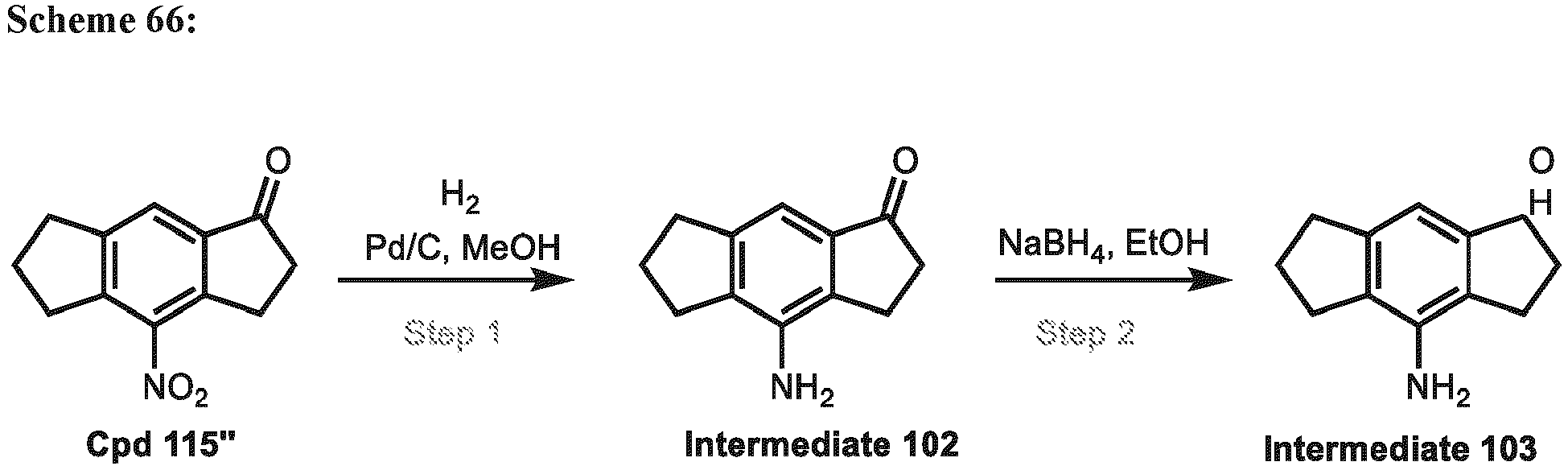

- Into a 250-mL round-bottom flask purged and maintained with an inert atmosphere of hydrogen, was placed a solution of 4-nitro-1,2,3,5,6,7-hexahydro-s-indacen-1-one (3.0 g, 13.8 mmol) in MeOH (30 mL), and Pd/C (10% wt., 500 mg). The flask was evacuated and flushed three times with hydrogen. The resulting solution was stirred for 4 h at RT under an atmosphere of hydrogen. The Pd/C catalysts were filtered out, the filtrate was concentrated under vacuum. The residue was eluted from a silica gel column with DCM/MeOH (10:1). This resulted in 2.2 g (85.1%) of the title compound as a white solid. MS-ESI: 187 (M+1).
- Into a 100-mL round-bottom flask, was placed a solution of 8-amino-3,5,6,7-tetrahydro-s-indacen-1(2H)-one (2.0 g, 10.7 mmol) in ethanol (20 mL) and NaBH4 (1.9 g, 50 mmol). The resulting solution was stirred for 16h at RT. The reaction was quenched with water. The resulting solution was extracted with 3x50 mL of ethyl acetate and the organic layers combined and dried over anhydrous sodium sulfate. The mixture was concentrated under vacuum. This resulted in 1.36 g of the title compound as a yellow solid. MS-ESI: 190 (M+1).
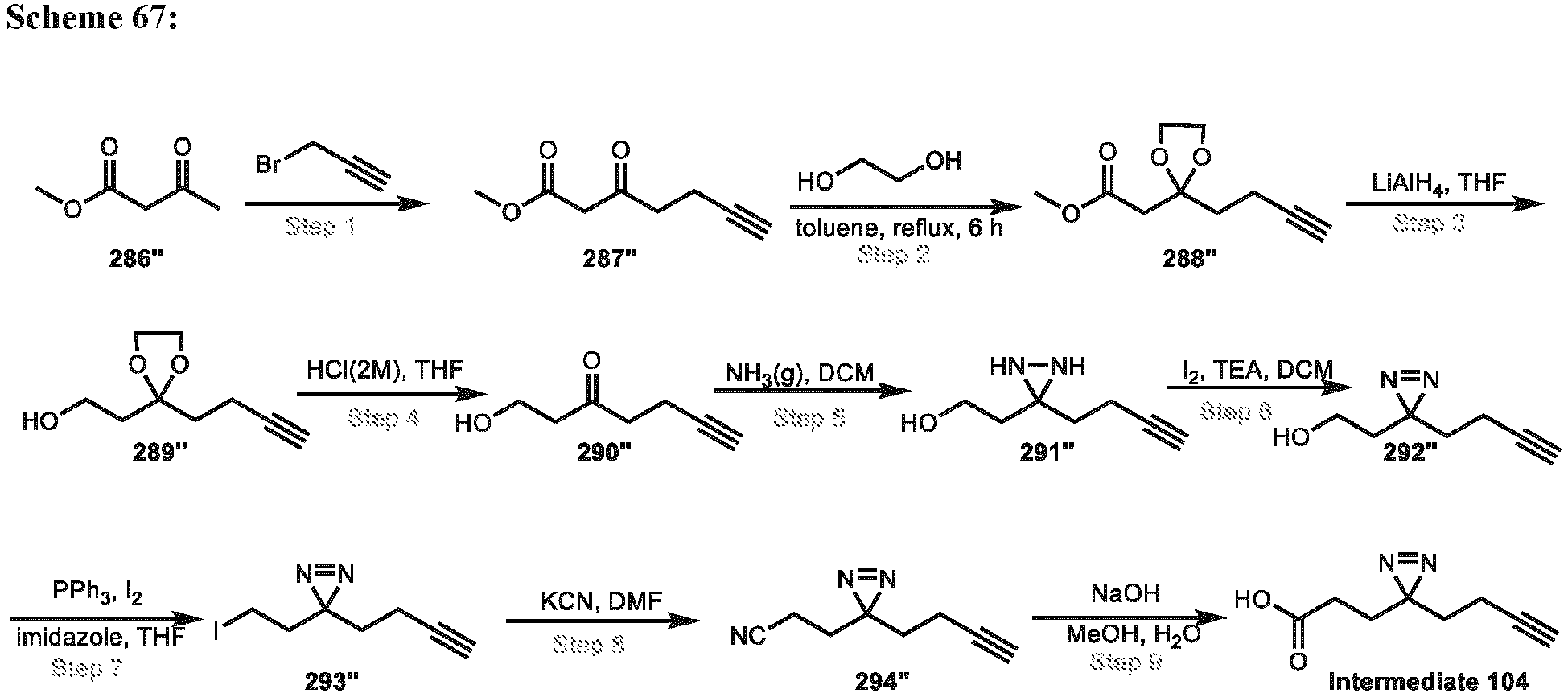

- Into a 2000-mL 3-neck round-bottom flask purged with and maintained under nitrogen, was placed methyl 3-oxobutanoate (20 g, 172 mmol) in THF (200 mL). To the above solution was added LDA (200 mL, 400 mmol, 2 M) dropwise at -20°C in a dry ice bath. Then reaction was allowed to react at -20 °C for 30 min. Then 3-bromoprop-1-yne (20.5 g, 172 mmol) was added to the reaction solution in portions at -20 °C. The resulting solution was stirred for 3 h at -20 °C in a dry ice bath. The reaction was then quenched by the addition of 500 mL of NH4Cl solution. The pH value of the solution was adjusted to 3 with HCl (aq). The resulting solution was extracted with 3x200 ml of ethyl acetate and the organic layers was combined and dried over anhydrous Na2SO4, then concentrated. This resulted in the title compound (2.0 g, 7.53%) as white oil.
- Into a 500-mL round-bottom flask, was placed methyl 3-oxohept-6-ynoate (20 g, 130 mmol) in toluene (200 mL), ethane-1,2-diol (40.2 g, 649 mmol) and TsOH (2.23 g, 13 mmol). The resulting solution was stirred for 6 h at 120 °C in an oil bath. The resulting solution was diluted with 200 mL of Et2O. The resulting mixture was washed with 3 x100 ml of NaHCO3 and 3x100 ml of saturated NaCl solution. The mixture was dried over anhydrous sodium sulfate and concentrated. This resulted in the title compound (20 g, 77.9%) as yellow oil.
- Into a 1.0-L 3-necked round-bottom flask purged and maintained with an inert atmosphere of nitrogen, was placed methyl 2-[2-(but-3-yn-1-yl)-1,3-dioxolan-2-yl]acetate (90 g, 454 mmol) in THF (300mL). To this above solution was added LiAlH4 (17.9 g, 472 mmol) in portions with stirring at 0 °C in an ice/ethanol bath. The resulting solution was stirred for 6 h at RT. The reaction was then quenched by the addition of water/ice. The solids were filtered out. The resulting filtrate was concentrated under vacuum. This resulted in the title compound (80 g crude) and used in the next step directly. MS-ESI: 169 (M-1).
- Into a 3.0-L 3-necked round-bottom flask purged and maintained with an inert atmosphere of nitrogen, was placed 2-[2-(but-3-yn-1-yl)-1,3-dioxolan-2-yl]ethan-1-ol (80 g, 470 mmol) in THF (1.0L) and HCl (500 mL). The resulting solution was stirred for 16 h at RT. The resulting solution was diluted with 1.0L of water. The mixture was extracted with 3 x1.0L of ethyl acetate and the organic layer was combined and dried over anhydrous sodium sulfate. The solids were filtered out. The resulting filtrate was concentrated under vacuum. The residue was eluted from a silica gel column with DCM/petroleum ether (1:1). This resulted in 20 g of the title compound as a white solid. MS-ESI: 125 (M-1).
- Into a 500-mL round-bottom flask purged and maintained with an inert atmosphere of nitrogen, was placed 1-hydroxyhept-6-yn-3-one (20 g, 159 mmol) in DCM (250 mL). To the above solution was introduced NH3 (g) for 15 min at -40°C in a liquid nitrogen/ethanol bath. The resulting solution was stirred for 1 h at -40°C and then allowed to react for 16h at RT. The resulting mixture was concentrated. This resulted in 18 g (crude) of the title compound as a white solid. MS-ESI: 141 (M+1).
- Into a 500-mL 3-necked round-bottom flask purged and maintained with an inert atmosphere of nitrogen, was placed 2-[3-(but-3-yn-1-yl)diaziridin-3-yl]ethan-1-ol (14.4 g, 114 mmol) in DCM (200 mL), TEA (34.6g, 342 mmol), I2 (58 g, 228 mmol). The resulting solution was stirred for 4 h at RT. The reaction was then quenched by the addition of Na2S2O3. The resulting mixture was quenched with 100 mL of water. The resulting solution was extracted with 3x300 mL of DCM and the organic layers combined and dried over anhydrous sodium sulfate. The solids were filtered out. The resulting mixture was concentrated. This resulted in 6.0 g (38%) of the title compound as a white solid. MS-ESI: 139 (M+1).
- Into a 250-mL round-bottom flask purged and maintained with an inert atmosphere of nitrogen, was placed 2-[3-(but-3-yn-1-yl)-3H-diazirin-3-yl]ethan-1-ol (5.0 g, 36.2 mmol) in THF (20 mL), imidazole (3.7 g, 54.3 mmol), I2 (9.18 g, 36.2 mmol), PPh3 (14.2 g, 54.3 mmol). The resulting solution was stirred for 16 h at RT. The reaction was then quenched by the addition of 20 mL of saturated Na2S2O3 solution. The resulting solution was extracted with 3x50 mL of DCM dried over anhydrous sodium sulfate. The solids were filtered out. The resulting mixture was concentrated. This resulted in 5.0 g (crude) of the title compound as a yellow solid. MS-ESI: 248 (M+1).
- Into a 500-mL round-bottom flask purged and maintained with an inert atmosphere of nitrogen, was placed 3-(but-3-yn-1-yl)-3-(2-iodoethyl)-3H-diazirine (5.0 g, 20.2 mmol) in DMF (250 mL), KCN (2.62 g, 40.3mmol). The resulting solution was stirred for 16 h at 60 °C in an oil bath. The reaction was then quenched by the addition of 20 mL of FeSO4 solution. The resulting solution was extracted with 3x50 ml of ethyl acetate dried over anhydrous sodium sulfate. The solids were filtered out. The resulting mixture was concentrated. This resulted in 2.0 g (crude) of the title compound as a solid. MS-ESI: 148 (M+1).
- Into a 100-mL round-bottom flask purged and maintained with an inert atmosphere of nitrogen, was placed 3-[3-(but-3-yn-1-yl)-3H-diazirin-3-yl]propanenitrile (1.0 g, 3.40 mmol) in MeOH (40 mL), NaOH (272 mg, 6.79 mmol). The resulting solution was stirred for 16 h at 90 °C in an oil bath. The resulting solution was concentrated. The residue was eluted from a silica gel column with ethyl acetate/ petroleum ether (1:1). This resulted in 400 mg crude (26.6%) of the title compound as yellow oil. MS-ESI: 167 (M+1).


- Into a 100-mL round-bottom flask, was placed 2-propanol (50 mL), phenylhydrazine (3.81 g, 35.2 mmol) and 2,6-dimethylheptane-3,5-dione (5.0 g, 32.0 mmol). The resulting solution was stirred overnight at 85 °C in an oil bath. The resulting mixture was concentrated. The residue was dissolved in 100 mL of ethyl acetate. The resulting mixture was washed with 50 mL of H2O. The mixture was dried over anhydrous sodium sulfate and then concentrated. This resulted in 6.9 g (94%) of the title compound as a light yellow oil. MS-ESI: 229 (M+1).
- Into a 100-mL round-bottom flask, was placed 1-phenyl-3,5-bis(propan-2-yl)-1H-pyrazole (6.9 g, 30 mmol) in Ac2O (50 mL). This was followed by the addition of HNO3 (4.07 mL, 91 mmol) dropwise with stirring at 0 °C in 10 min. The resulting solution was stirred for overnight at RT. The residue was dissolved in 150 mL of ethyl acetate. The resulting mixture was washed with 2x100 mL of H2O. The mixture was dried over anhydrous sodium sulfate and then concentrated. This resulted in 3.7 g (44.8%) of the title compound as yellow oil. MS-ESI: 274 (M+1).
- Into a 250-mL round-bottom flask, was placed 4-nitro-1-phenyl-3,5-bis(propan-2-yl)-1H-pyrazole (3.7 g, 13.5 mmol) in MeOH (100 mL), to the stirred solution was added Pd/C (10%wt., 400 mg). The flask was evacuated and flushed three times with hydrogen. The resulting solution was stirred overnight at RT under an atmosphere of hydrogen. The Pd/C catalysts were filtered out, the filtrate was concentrated under vacuum. This resulted in 2.7 g (82%) of the title compound as a light yellow oil. MS-ESI: 244 (M+1).


- Into a 250-mL round-bottom flask was placed a solution of 1,6,7,8-tetrahydro-as-indacen-3(2H)-one (Cpd 307" was isolated from 113" in
Scheme 23 by chromatography) (9.8 g, 46.5 mmol) in H2SO4 (50 mL). Then HNO3 (5.85 g, 92.9 mmol) was added dropwise over 10 min at 0 °C. The resulting solution was stirred for 1 h at 0 °C. The reaction mixture was slowly added to a mixture of water/ice (100 mL) and DCM (50 mL) with ice bath cooling. The organic layer was collected, dried over Na2SO4 and concentrated under vacuum. This resulted in 11 g (89%) of a mixture of cpd 308" and cpd 309" as a yellow solid. The mixture was monitored by TLC (ethyl acetate/ petroleum ether = 1/10, Rf= 0.4), - Into a 100-mL round-bottom flask was placed a solution of the mixture of 4-nitro-1,6,7,8-tetrahydro-as-indacen-3(2H)-one and 5-nitro-1,6,7,8-tetrahydro-as-indacen-3(2H)-one (2.17 g, 10 mmol) in MeOH (30 mL). To the solution was added MSA (1.15 g, 12 mmol). Then Pd(OH)2/C (20%wt., 550 mg) was added. The flask was evacuated and filled three times with hydrogen. The resulting mixture was stirred for 16 h at RT under hydrogen (50 psi). The solids were filtered out and washed with MeOH. The MeOH filtrate and wash was diluted with water (50 mL) and the pH was adjusted to 10.6 with 2 N NaOH. The resulting mixture was filtered and the crude solids were recrystallized from MeOH/water (9:1) with heating. This resulted in 1.38 g (80%) of the title compound as an off-white solid. MS-ESI: 174 (M+1).


- Into a 250-mL 3-necked round-bottom flask purged and maintained with an inert atmosphere of nitrogen, was placed a solution of LiAlD4 (1.57 g, 37 mmol) in Et2O (150 mL). This was followed by the addition of AlCl3 (10.1 g, 76 mmol) in portions at 0 °C in 5 min. To this was added 5-bromo-2,3-dihydro-1H-inden-1-one (4.0 g, 19 mmol) in portions at 0 °C in 5 min. The resulting solution was stirred for 4 h at RT. The reaction mixture was cooled to 0 °C with a water/ice bath.
- The reaction was then quenched by careful addition of 10 mL of water. The solids were filtered out. The resulting solution was extracted with 3x100 mL of ethyl acetate and concentrated under vacuum. This resulted in 3.5 g (93%) of the title compound as brown oil. MS-ESI: 199/201 (M+1).
- Into a 250-mL round-bottom flask purged and maintained with an inert atmosphere of nitrogen, was placed a solution of 5-bromo-2,3-dihydro-1H-indene-1,1-d2 (7.0 g, 35 mmol) in DMF (80 mL), to the stirred solution was added tris(4-methylphenyl)phosphane (1.07 g, 3.52 mmol), tert-butyl prop-2-enoate (4.0 mL), triethylamine (5.0 mL) and Pd(OAc)2 (395 mg, 1.76 mmol). The resulting solution was stirred overnight at 100 °C in an oil bath. The resulting mixture was concentrated under vacuum. The resulting solution was extracted with 3x50 mL of ethyl acetate and the organic layers combined and dried over anhydrous sodium sulfate. The residue was eluted from a silica gel column with DCM/petroleum ether (1:1). This resulted in 5.7 g (66%) of the title compound as light yellow oil. MS-ESI: 247 (M+1).
- Into a 100-mL round-bottom flask purged and maintained with an inert atmosphere of nitrogen, was placed a solution of tert-butyl (E)-3-(2,3-dihydro-1H-inden-5-yl-1,1-d2 )acrylate (5.8 g, 24 mmol) in MeOH (40 mL), to the stirred solution was added Pd/C (580 mg, 10% wt.). The flask was evacuated and flushed three times with hydrogen. The resulting solution was stirred for 1h at RT under an atmosphere of hydrogen. The Pd/C catalysts were filtered out, the filtrate was concentrated under vacuum. This resulted in 5.7 g (98%) of the title compound as colorless oil. MS-ESI: 249 (M+1).
- Into a 100-mL round-bottom flask, was placed a solution of tert-butyl 3-(2,3-dihydro-1H-inden-5-yl-1,1-d2)propanoate (4.3 g, 17.3 mmol) in DCM (50 mL), to the stirred solution was added CF3COOH (5.5 mL, 74 mmol). The resulting solution was stirred for overnight at RT. The resulting mixture was concentrated under vacuum. This resulted in 3.1 g (93%) of the title compound as an off-white solid. MS-ESI: 191 (M-1).
- Into a 100-mL round-bottom flask purged and maintained with an inert atmosphere of nitrogen, was placed a solution of 3-(2,3-dihydro-1H-inden-5-yl-1,1-d2 )propanoic acid (9.0 g, 41.7 mmol) in DCM (40 mL). This was followed by the addition of oxalic dichloride (8.0 mL) at 0 °C. To this was added DMF (0.5 mL) at 0 °C. The resulting solution was stirred for 3 h at RT. The resulting mixture was concentrated under vacuum. This resulted in 4.0 g (41%) of the title compound as brown oil.
- Into a 100-mL round-bottom flask purged and maintained with an inert atmosphere of nitrogen, was placed a solution of 3-(2,3-dihydro-1H-inden-5-yl-1,1-d2)propanoyl chloride (3.9 g, 18 mmol) in DCE (40 mL). This was followed by the addition of AlCl3 (3.3 g, 25 mmol) in portions at 0 °C in 2 min. The resulting solution was stirred for 1 h at RT. The reaction was then quenched by the addition of 200 mL of water/ice. The resulting solution was extracted with 3x50 mL of DCM and the organic layers combined and dried over anhydrous sodium sulfate. The residue was eluted from a silica gel column with ethyl acetate/petroleum ether (2:100). This resulted in 1.5 g (46%) of the title compound as an off-white solid. MS-ESI: 175 (M+1).
- Into a 25-mL round-bottom flask, was placed 3,5,6,7-tetrahydro-s-indacen-1(2H)-one-7,7-d2 (120 g). This was followed by the addition of H2SO4 (8.0 mL) at 0 °C. To this was added HNO3 (2.0 mL) at 0 °C in 2 min. To the mixture was added H2SO4 (2.0 mL) at 0 °C in 2 min. The resulting solution was stirred for 1 h at 0 °C. The reaction was then quenched by the addition of water/ice. The resulting solution was extracted with 3x50 mL of ethyl acetate dried in an oven under reduced pressure. The residue was separated on silica gel eluted with ethyl acetate/petroleum ether (3:100). This resulted in 870 mg of cpd 318" and 290 mg of cpd 317", both as yellow solids. Cpd 317": 1H NMR (300 MHz, CDCl3) δ 7.83 (s, 1H), 3.55 - 3.45 (m, 2H), 3.42 (t, J = 7.6 Hz, 2H), 2.84 - 2.74 (m, 2H), 2.22 (t, J = 7.6 Hz, 2H). Cpd 318": 1H NMR (300 MHz, CDCl3) δ 7.46 (s, 1H), 3.20 - 3.00 (m, 4H), 2.83 - 2.73 (m, 2H), 2.20 (t, J = 7.5 Hz, 2H).
- Into a 250-mL round-bottom flask purged and maintained with an inert atmosphere of nitrogen, was placed a solution of 8-nitro-3,5,6,7-tetrahydro-s-indacen-1(2H)-one-7,7-d2 (870 mg) in MeOH (100 mL), to the stirred solution was added Pd/C (87 mg, 10%wt.). The flask was evacuated and flushed three times with hydrogen. The resulting solution was stirred for 1h at RT under an atmosphere of hydrogen. The Pd/C catalysts were filtered out, the filtrate was concentrated under vacuum. This resulted in 700 mg of the title compound as a yellow solid. MS-ESI: 190 (M+1).
- Into a 250-mL round-bottom flask purged and maintained with an inert atmosphere of nitrogen, was placed a solution of LiAlD4 (160 mg, 3.8 mmol) in Et2O (40 mL). This was followed by the addition of AlCl3 (634 mg, 4.8 mmol) in portions at 0 °C in 2 min. To this solution was added 8-amino-3,5,6,7-tetrahydro-s-indacen-1(2H)-one-7,7-d2 (600 mg, 3.17 mmol) at 0 °C. The resulting solution was stirred for 4 h at RT. The reaction was then quenched by the addition of 10 mL of water. The resulting solution was diluted with 20 mL of EtOAc. The solids were filtered out. The resulting solution was extracted with 3x50 mL of ethyl acetate dried over anhydrous sodium sulfate and concentrated under vacuum. The residue was eluted from a silica gel column with ethyl acetate/petroleum ether (5:1). This resulted in 470 mg (78%) of the Intermediate 117 as a yellow solid. MS-ESI: 178 (M+1).

- Intermediate 117A was prepared starting from compound 317" and using the same procedure as shown in scheme 73 above for converting compound 318" to intermediate 117. MS-ESI: 178 (M+1).
Table 15. The Intermediates in the following Table were prepared using similar procedure as shown in Scheme 30 above for converting compound 130" to Intermediate 44. Intermediate # Structure IUPAC Name Intermediate 118" 
6-Ethyl-7-isocyanato-1H-indazole Intermediate 119" 
6-Ethyl-7-isocyanato-1-methyl-1H-indazole Intermediate 120" 
3-Isocyanato-2,4,5,6-tetrahydro-1H-cyclobuta[f]indene Intermediate 121" 
4-Isocyanato-3,5,6,7-tetrahydro-2H-indeno[5,6-b]furan Intermediate 122" 
2-Isocyanatotricyclo[6.2.0.03,6]deca-1,3(6),7-triene Intermediate 123" 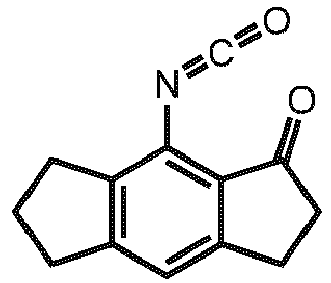
8-Isocyanato-2,3,6,7-tetrahydros-indacen-1(5H)-one Intermediate 124" 
4-Isocyanato-2,3,6,7-tetrahydros-indacen-1(5H)-one Intermediate 125" 
4-isocyanato-1,2,3,5,6,7-hexahydro-s-indacene-3,3,5,5-d4 Intermediate 126" 
4-isocyanato-1,2,3,5,6,7-hexahydro-s-indacene-1,1,7,7-d4 - Schemes below the synthesis of sulfonimidamide Intermediates 118-123.


- Steps 1-4 used similar procedures for converting compound 245" to Intermediate 88 shown in Scheme 56 to afford Intermediate 118 from compound 322". MS-ESI: 314 (M+1).


- Into a 500 mL round-bottom flask were added 4-amino-3-fluorobenzoic acid (15 g, 97 mmol) and DMF (100 mL) at RT. To the stirred solution was added HATU (74 mg, 0.19 mmol) and DIEA (25 mg, 0.19 mmol) at 0 °C. To the above mixture was added MeNH2/THF (2M, 97 mL, 194 mmol) in one portion at 0 °C. The resulting mixture was stirred for additional 2 h at RT. The resulting mixture was extracted with EtOAc (3x100 mL). The combined organic layers were dried over anhydrous Na2SO4. After filtration, the filtrate was concentrated under reduced pressure. The residue was eluted from silica gel column with petroleum ether /EtOAc (1:1) to afford the title compound (16 g, 98%) as yellow oil. MS-ESI: 169 (M+1).
- Steps 2-3 used similar procedures for converting compound 27 to Intermediate 29 shown in
Scheme 9 to afford compound 329" from compound 327". MS-ESI: 233 (M+1). - Into a 250-mL round-bottom flask were placed 3-fluoro-N-methyl-4-sulfamoylbenzamide (1.2 g) in THF (40 mL) at 0 °C. To the stirred solution was added LiAlH4 (543 mg, 14 mmol) in portions at 0 °C under nitrogen atmosphere. The resulting mixture was stirred overnight at 70 °C. The reaction was quenched with water (2 mL). The resulting mixture was filtered, the filter cake was washed with EtOAc (3x10 mL). The filtrate was concentrated under reduced pressure. The residue was purified by Prep-TLC (EtOAc/MeOH = 25:1) to afford the title compound (800 mg, 77%) as a white solid. MS-ESI: 219 (M+1).
- Into a 100-mL round-bottom flask were placed 2-fluoro-4-[(methylamino)methyl]benzene-1-sulfonamide (800 mg, 3.7 mmol) in THF (20 mL) at 0 °C. To a stirred solution was added (Boc)2O (1.5 g, 6.89 mmol) in portions at 0 °C. The resulting mixture was stirred for 2 h at RT and concentrated under reduced pressure. The residue was purified by Prep-TLC (PE/EtOAc 1:1) to afford the title compound (900 mg, 77%) as a white solid. MS-ESI: 319 (M+1).
- Steps 6-7 used similar procedures for converting compound 248" to Intermediate 88 shown in Scheme 56 to afford Intermediate 119 from compound 331". MS-ESI: 432 (M+1).


- Into a 250-mL round-bottom flask, was placed a solution of 1-(bromomethyl)-2-fluoro-4-nitrobenzene (8.0 g, 34 mmol) in MeOH (50 mL). This was followed by the addition of dimethylamine (2 M, 21 mL) dropwise with stirring at 0 °C in 5 min. The resulting solution was stirred for 4 h at RT. The resulting mixture was concentrated under vacuum. This resulted in 7.0 g crude title compound as yellow oil. MS-ESI: 199 (M+1).
- Into a 100-mL round-bottom flask, was placed the solution of [(2-fluoro-4-nitrophenyl)methyl]dimethylamine (7.0 g, 35 mmol) in AcOH (20 mL), to the stirred solution was added iron powder (10 g, 179 mmol). The resulting solution was stirred for 16 h at RT. The solids were filtered out. The resulting filtrate was concentrated under vacuum. The residue was eluted from a silica gel column with DCM/MeOH (9:1). This resulted in 6.5 g crude title compound as yellow oil. MS-ESI: 169 (M+1).
- Steps 3-4 used similar procedures for converting compound 145" to compound 147" shown in Scheme 36 to afford compound 337" from compound 335". MS-ESI: 233 (M+1).
- Steps 5-6 used similar procedures for converting compound 148" to Intermediate 59 shown in Scheme 36 to afford Intermediate 120 from compound 337". MS-ESI: 233 (M+1).


- Steps 1-2 used similar procedures for converting compound 158" to intermediate 61 shown in Scheme 38 to afford compound 341" from compound 339". MS-ESI: 221 (M+1).
-
Step 3 used similar procedures for converting compound 147" to compound 148" shown in Scheme 36 to afford compound 342" from compound 341". MS-ESI: 221 (M+1). - Into a 250-mL round-bottom flask, was placed the solution of 4-(2-hydroxypropan-2-yl)thiophene-2-sulfonamide (1.5 g, 6.79 mmol) in DCM (20 mL). To the stirred solution was added TFA (3.9 g, 34 mmol) and Et3SiH (2.32 g, 20 mmol). The result solution was stirred overnight at RT. The mixture was concentrated under vacuum. The residue was eluted from silica gel column with a gradient of ethyl acetate/petroleum ether (1:5 to 1:3). This resulted in 1.1 g (79%) of the title compound as a light yellow solid. MS-ESI: 206 (M+1).
- Steps 5-6 used similar procedures for converting compound 148" to Intermediate 59 shown in Scheme 36 to afford Intermediate 121 from compound 344". MS-ESI: 319 (M+1).


- Into a 100-mL round-bottom flask, was placed 2-(4-bromophenyl)pyrrolidine (3.0 g, 13.3 mmol) in HCHO (3.23 g, 37% wt.), to the stirred solution was added NaBH3CN (2.5 g, 40 mmol). The resulting solution was stirred for 12 h at RT and concentrated under vacuum. The residue was eluted from a silica gel column with ethyl acetate/petroleum ether (1:1). This resulted in 2.8 g (88%) of the title compound as a light yellow solid. MS-ESI: 240/242 (M+1).
- Steps 2-6 used similar procedures for converting compound 245" to Intermediate 88 shown in Scheme 56 to afford Intermediate 122" from compound 347". MS-ESI: 354 (M+1).


- Into a 50-mL round-bottom flask purged and maintained with an inert atmosphere of nitrogen, was placed 1-(1,3-thiazol-2-yl)ethan-1-one (27 g, 212 mmol) in toluene (300 mL), to the stirred solution was added TsOH (2.0 g, 11.6 mmol) and ethane-1,2-diol (40 g, 644 mmol). The resulting solution was stirred for 14 h at 110 °C in an oil bath. The resulting mixture was concentrated under vacuum. The residue was eluted from a silica gel column with ethyl acetate/petroleum ether (1:20 to 1:10). This resulted in 36 g (99%) of the title compound as brown oil. MS-ESI: 172 (M+1).
- Steps 2-5 used similar procedures for converting compound 245" to Intermediate 88 shown in Scheme 56 to afford Intermediate 123 from compound 353". MS-ESI: 363 (M+1).
- This reagent was either purchased or prepared using the following procedure:

- An oven dried 40 mL vial equipped with a stir bar was capped with a rubber septum and flushed with nitrogen. At room temperature, a solution of PPh3 (0.85 g, 3.2 mmol) in
anhydrous 1,2-dichloroethane (5 mL) was introduced via syringe. The reaction vessel was immersed in an ice / water bath and cooled for 5 min. A solution of hexachloroethane (0.76 g, 3.2 mmol) inanhydrous 1,2-dichloroethane (5 mL) was introduced dropwise via syringe. After the addition was complete the reaction mixture was stirred at the same temperature for an additional 5 min and then placed into a preheated block set at 80 °C. Heating was continued for 4.5 h, at which time the reaction was assumed to be complete. The light golden clear solution was cooled to ambient temperature. The reagent thus prepared was transferred via syringe in subsequent reactions without any work up or purification. The total volume of the reaction mixture was 11 mL for the molar calculations for next steps. This solution containing PPh3Cl2 was stored under nitrogen at room temperature until used. -

- Polystyrene bound PPh3 (0.32 g, 0.32 mmol) was suspended in anhydrous dichloroethane (6 mL) and shaked on a shaker for 5 mins. It was then filtered and the process was repeated again to swell the polymer. Filtered resin was suspended in anhydrous dichloroethane (6 mL) a third time and the whole suspension was transferred into an oven dried 40 mL vial with a stir bar via pipette. The vial was capped with a rubber septum and connected to a steady flow of nitrogen. The reaction vessel was immersed in an ice/water bath and cooled down for 10 min. A solution of hexachloroethane (0.076 g, 0.32 mmol) in
anhydrous 1,2-dichloroethane (2 mL) was introduced drop wise via syringe. After the addition was complete the reaction mixture was placed in an already heated block set at 82 °C for 5 h. At this point the reaction is assumed to be completed. It was gradually brought to room temperature and used in the next step as is. This reagent was used at 1.5 equiv. with respect to sulfonamide in the next step. -
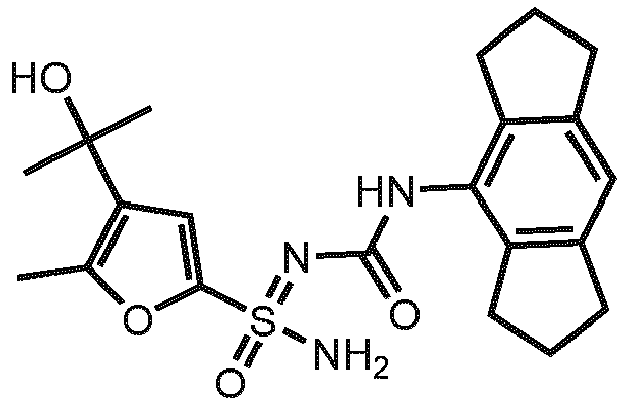
- Example 1 was synthesized according to the general method shown in
Scheme 1, as illustrated below. -

- Examples 2 and 3 were prepared through chiral separation of Example 1 as illustrated below.

- Into a 50-mL round-bottom flask was placed N'-(tert-butyldimethylsilyl)-4-(2-hydroxypropan-2-yl)-5-methylfuran-2-sulfonimidamide (200 mg, 0.6 mmol), THF (10 mL), NaH (60% wt, 48 mg, 1.2 mmol). This was followed by the addition of a solution of 4-isocyanato-1,2,3,5,6,7-hexahydro-s-indacene (120 mg, 0.6 mmol) in THF (1 mL) dropwise with stirring at RT. The resulting solution was stirred for 12 h at RT. The reaction was then quenched by the addition of 10 mL of NH4Cl (sat.). The resulting solution was extracted with 3x10 mL of DCM and the organic layers combined and concentrated under vacuum. The residue was applied onto a silica gel column and eluted with ethyl acetate/petroleum ether (1:10 to 1:3). This resulted in 140 mg (43.8%) of the title compound as brown oil. MS-ESI: 532.0 (M-1).
- Into a 50-mL round-bottom flask was placed N'-(tert-butyldimethylsilyl)-N-(1,2,3,5,6,7-hexahydro-s-indacen-4-ylcarbamoyl)-4-(2-hydroxypropan-2-yl)-5-methylfuran-2-sulfonimidamide (130 g, 0.2 mmol), THF (10 mL), and TBAF (300 mg, 0.5 mmol). The resulting solution was stirred for 2 h at RT and then concentrated under vacuum. The crude product was purified by Prep-HPLC using method E eluted with a gradient of 30~60% ACN. This resulted in 82 mg (80.3%) of Example 1 as a white solid.
- Example 1: MS-ESI: 418.0 (M+1). 1H NMR (400 MHz, DMSO-d 6) δ 8.39 (s, 1H), 7.57 (s, 2H), 6.87 (s, 1H), 6.85 (s, 1H), 5.04 (s, 1H), 2.79 (t, J = 7.4 Hz, 4H), 2.71 - 2.63 (m, 4H), 2.42 (s, 3H), 1.94 (tt, J = 7.4 and 7.4 Hz, 4H), 1.40 (s, 6H).
- The product obtained as described in the previous step (70 mg) was resolved by Chiral-Prep-HPLC using the following conditions: Column, ChiralPak ID, 2*25 cm, 5 um; mobile phase, Hex and EtOH (hold 20% EtOH over 18 min); Flow rate, 20 mL/min; Detector, UV 254/220 nm. This resulted in 26.8 mg of Example 2 (front peak, 99% ee) as a white solid and 27.7 mg (second peak, 99.3% ee) of Example 3 as a white solid.
- Example 2: MS-ESI: 418.0 (M+1). 1H NMR (400 MHz, DMSO-d 6) δ 8.36 (s, 1H), 7.57 (s, 2H), 6.87 (s, 1H), 6.85 (s, 1H), 5.03 (s, 1H), 2.78 (t, J = 7.2 Hz, 4H), 2.73 - 2.60 (m, 4H), 2.41 (s, 3H), 1.93 (tt, J = 7.2 and 7.2 Hz, 4H), 1.39 (s, 6H).
- Example 3: MS-ESI: 418.0 (M+1). 1H NMR (400 MHz, DMSO-d 6) δ 8.39 (s, 1H), 7.58 (s, 2H), 6.87 (s, 1H), 6.85 (s, 1H), 5.03 (s, 1H), 2.78 (t, J = 7.2 Hz, 4H), 2.73 - 2.60 (m, 4H), 2.41 (s, 3H), 1.93 (tt, J = 7.2 and 7.2 Hz, 4H), 1.39 (s, 6H).
- Single crystal X-ray crystallographic analysis was performed on compound 181a.
FIG 1 shows ball and stick models of the asymmetrical unit containing two crystallographically independent molecules of compound 181a, with hydrogen atoms omitted for clarity. Table M below shows fractional atomic coordinates of compound 181a.Table M. Fractional Atomic Coordinates (×104) and Equivalent Isotropic Displacement Parameters (Å2×10³) for Example 2. Ueq is defined as 1/3 of the trace of the orthogonalised UIJ tensor. Atom x y z U(eq) S1 722.5(7) 5368.3(5) 6903.3(4) 14.52(18) S2 4304.8(7) 505.4(5) 3262.9(4) 16.15(18) O1 2143(2) 6680.8(16) 8220.2(13) 16.1(4) O2 -195(2) 4624.4(17) 6478.0(14) 21.9(5) O5 2874(2) 1624.4(17) 1805.2(15) 22.8(5) O6 5238(2) -141.6(18) 3795.4(15) 25.6(5) O3 1492(3) 5769.7(18) 5397.8(14) 25.5(5) O7 2974(2) 2151.0(17) 3638.1(14) 24.6(5) N1 51(2) 7218.5(19) 8513.8(16) 14.6(5) N2 59(3) 5986.0(18) 7536.5(16) 15.3(5) O4 2422(3) 8513(2) 4297.8(17) 34.3(6) N4 4956(2) 2247(2) 1576.1(16) 16.9(5) O8 2771(3) 3430(2) 6070.3(18) 36.7(6) N5 4980(3) 1071.7(19) 2602.6(17) 16.6(5) N3 2120(3) 4817(2) 7347.5(17) 16.3(5) C13 854(3) 6633(2) 8105.0(18) 12.9(6) C1 605(3) 7947(2) 9133.7(19) 14.4(6) N6 2978(3) -121(2) 2801.8(19) 20.2(6) C22 4388(3) 2952(2) 936.5(19) 16.2(6) C24 5733(3) 2203(2) -207(2) 18.3(6) C34 4164(3) 1656(2) 1979(2) 16.6(6) C11 -695(3) 7200(2) 10304.5(19) 17.2(6) C12 267(3) 7915(2) 9953.6(19) 14.2(6) C23 4754(3) 2918(2) 127(2) 17.0(6) C27 4221(3) 3614(2) -494(2) 18.1(6) C8 800(3) 8626(2) 10566(2) 17.0(6) C28 3315(3) 4357(2) -324(2) 18.6(6) C4 2436(4) 10034(2) 8218(2) 23.3(7) C7 1688(3) 9377(2) 10382(2) 16.9(6) C29 2969(3) 4399(2) 492(2) 18.0(6) C9 237(3) 8445(2) 11388(2) 20.4(6) C38 2557(3) 2633(3) 4320(2) 24.9(7) C2 1458(3) 8717(2) 8931.9(19) 15.1(6) C6 2005(3) 9409(2) 9557(2) 17.2(6) C26 4804(3) 3424(2) -1310(2) 21.8(7) C31 2476(4) 5023(2) 1822(2) 24.4(7) C5 2927(3) 10137(2) 9193(2) 19.6(6) C16 2044(3) 7389(3) 5427(2) 22.4(7) C25 5416(4) 2367(3) -1181(2) 24.1(7) C15 1514(3) 7144(2) 6188(2) 21.6(6) C33 3503(3) 3713(2) 1124(2) 16.9(6) C37 3005(3) 2117(3) 5067(2) 23.8(7) C30 2028(3) 5128(2) 844(2) 20.5(6) C10 -360(4) 7379(2) 11275(2) 23.9(7) C36 3748(3) 1285(3) 4821(2) 24.5(7) C17 2020(4) 6535(3) 4974(2) 28.3(7) C14 1181(3) 6178(2) 6137.8(19) 19.0(6) C35 3710(3) 1326(2) 3973(2) 23.7(7) C19 2583(3) 8401(3) 5214(2) 26.0(7) C3 1902(3) 8960(2) 8090(2) 19.0(6) C32 3002(3) 3944(2) 1954(2) 21.0(6) C40 2768(4) 2390(3) 5955(2) 33.7(8) C20 1804(4) 9231(3) 5566(3) 34.6(8) C39 1810(4) 3575(3) 4092(3) 35.7(8) C42 1313(4) 2062(3) 6087(3) 40.3(9) C21 4139(4) 8447(3) 5541(3) 40.0(9) C18 2406(5) 6256(3) 4130(3) 44.7(10) C41 3893(5) 1934(4) 6622(3) 54.3(12) - Single crystal X-ray crystallographic analysis was performed on compound 181b.
FIG 2 shows ball and stick models of the asymmetrical unit containing two crystallographically independent molecules of compound 181b, with hydrogen atoms omitted for clarity. Table N below shows fractional atomic coordinates of compound 181b.Table N. Fractional Atomic Coordinates (×104) and Equivalent Isotropic Displacement Parameters (Å2×10³) for Example 3. Ueq is defined as 1/3 of the trace of the orthogonalised UIJ tensor. Atom x y z U(eq) S1 9264.0(7) 4621.3(5) 3094.0(4) 16.15(17) S2 5705.1(7) 9485.8(5) 6733.7(4) 19.00(17) O1 7853(2) 3305.2(16) 1778.9(13) 18.6(4) O7 7027(2) 7842.4(18) 6357.2(15) 26.4(5) O2 10182(2) 5364.5(17) 3520.0(14) 23.6(5) O5 7131(2) 8368.0(19) 8192.5(15) 25.5(5) O3 8512(3) 4220.7(18) 4605.0(14) 26.6(5) O6 4770(2) 10133.7(19) 6200.8(15) 28.4(5) O8 7211(3) 6563(2) 3921.7(19) 38.6(7) O4 7597(3) 1484(2) 5713.0(18) 37.3(6) N2 9933(3) 4006.4(19) 2465.8(16) 17.8(5) N1 9943(2) 2773(2) 1482.7(16) 16.3(5) N4 5051(3) 7745(2) 8421.8(17) 20.2(5) N3 7870(3) 5173(2) 2653.4(17) 18.4(5) N5 5031(3) 8923(2) 7390.2(17) 19.9(5) C14 9136(3) 3353(2) 1894.3(18) 15.8(6) C1 9391(3) 2043(2) 864.7(19) 17.4(6) N6 7031(3) 10109(2) 7191.6(19) 23.0(6) C30 5618(3) 7045(2) 9058(2) 19.3(6) C6 9205(3) 1370(2) -570(2) 20.1(6) C53 7446(4) 7363(3) 5675(2) 26.1(7) C32 4273(3) 7792(2) 10199(2) 20.6(6) C2 9731(3) 2078(2) 44.2(19) 16.8(6) C43 5846(3) 8333(2) 8016(2) 20.2(6) C3 10685(3) 2795(2) -304(2) 20.3(6) C37 7028(3) 5597(2) 9506(2) 21.2(6) C7 8316(3) 620(2) -386(2) 20.2(6) C35 5773(3) 6383(2) 10493(2) 20.7(6) C10 7573(4) -36(3) 1780(2) 27.4(7) C36 6681(3) 5639(2) 10322(2) 21.2(6) C22 8481(3) 2845(3) 3816(2) 23.0(6) C8 8002(3) 584(2) 440(2) 20.3(6) C39 7525(4) 4977(3) 8177(2) 28.0(7) C31 5248(3) 7078(2) 9867(2) 19.6(6) C52 6981(3) 7875(3) 4927(2) 24.2(7) C12 8541(3) 1280(2) 1066.4(19) 18.0(6) C34 5191(4) 6574(3) 11302(2) 24.8(7) C51 6252(4) 8707(3) 5170(2) 26.7(7) C33 4585(4) 7630(3) 11175(2) 27.6(7) C24 7990(4) 3461(3) 5032(2) 30.5(8) C23 7962(3) 2603(3) 4580(2) 24.0(7) C50 6302(4) 8662(3) 6020(2) 25.4(7) C9 7077(3) -142(2) 804(2) 23.6(7) C38 7972(3) 4873(2) 9155(2) 23.5(7) C5 9763(4) 1551(3) -1391(2) 24.9(7) C41 6502(3) 6286(2) 8872(2) 20.5(6) C21 8811(3) 3816(2) 3866.6(19) 20.4(6) C4 10356(4) 2619(3) -1277(2) 28.3(7) C11 8099(3) 1036(2) 1909(2) 22.6(6) C40 7006(3) 6055(3) 8044(2) 24.5(6) C25 7419(4) 1599(3) 4793(2) 26.8(7) C58 8189(4) 6425(3) 5905(3) 37.6(9) C54 7221(4) 7601(3) 4036(2) 34.1(8) C27 8195(4) 774(3) 4438(3) 38.1(9) C29 7607(6) 3737(3) 5874(3) 46.7(10) C56 8674(4) 7924(3) 3907(3) 42.4(10) C28 5872(4) 1551(3) 4471(3) 44.2(10) C57 6101(6) 8060(4) 3369(3) 58.9(14) -

- Example 4 (above) was synthesized according to the general methods in
Schemes Route 1 andRoute 2 below. -

- Examples 5 and 6 (above) were synthesized according to general methods shown in
Schemes Route 1 andRoute 2 below. -

- Example 7 was synthesized according to general method shown in
Scheme 3, as illustrated inRoute 2 below.
- Into a 50-mL round-bottom flask was placed a solution of N'-(tert-butyldimethylsilyl)-2-(2-hydroxypropan-2-yl)thiazole-5-sulfonimidamide (336 mg, 1.0 mmol) in THF (10 mL). To this solution was added NaH (60% wt, 80 mg, 2.0 mmol) in portions at 0°C. The solution was stirred at 0°C for 15 minutes, and this was followed by the addition of a solution of 4-isocyanato-1,2,3,5,6,7-hexahydro-s-indacene (209 mg, 1.1 mmol) in THF (5 mL) dropwise with stirring at RT. The resulting solution was stirred for 12 h at RT. The reaction was then quenched by the addition of 10 mL of NH4Cl (sat.). The resulting solution was extracted with 3x10 mL of DCM and the combined organic layers were concentrated under vacuum. This resulted in 535 mg (crude) of the title compound as a brown oil. MS-ESI: 535.0 (M+1).
- Into a 50-mL round-bottom flask was placed a solution of N-(tert-butyldimethylsilyl)-N'-(1,2,3,5,6,7-hexahydro-s-indacen-4-ylcarbamoyl)-2-(2-hydroxypropan-2-yl)thiazole-5-sulfonimidamide (535 mg, crude, 1.0 mmol) in THF (10 mL). To this solution was added HF/Py (70% wt, 143 mg, 5.0 mmol) dropwise at 0°C. The solution was stirred at RT for 4 h. The reaction was then quenched by the addition of 10 mL of water. The resulting solution was extracted with 3x10 mL of ethyl acetate and the combined organic layers were concentrated under vacuum. The crude product was purified by Prep-HPLC using Method E with ACN/water (20% to 60% in 10 minutes). This resulted in 189 mg (45%, 2 steps) of Example 4 as a white solid.
- Example 4: MS-ESI: 421.0 (M+1). 1H NMR (400 MHz, DMSO-d 6) δ 8.46 (br s, 1H), 8.04 (s, 1H), 7.80 (br s, 2H), 6.86 (s, 1H) 6.28 (s, 1H), 2.88 - 2.71 (m, 4H), 2.71 - 2.56 (m, 4H), 2.02 - 1.80 (m, 4H), 1.49 (s, 6H).
- The product obtained as described in the previous step (189 mg) was resolved by Chiral-Prep-HPLC using the following conditions: Column, CHIRAL Cellulose-SB, 2*25 cm, 5 um; mobile phase, Hex (0.1%DEA) and EtOH (hold 20% EtOH over 16 min); Flow rate, 20 mL/min; Detector, UV 254/220 nm. This resulted in 70 mg of Example 5 (front peak, 99% ee 101) as a white solid and 65 mg of Example 6 (second peak, 97.5% ee 102) as a white solid. Absolute stereochemistry of these two isomers has not been assigned.
- Example 5: MS-ESI: 421.0 (M+1). 1H NMR (400 MHz, DMSO-d 6) δ 8.43 (br s, 1H), 8.05 (s, 1H), 7.83 (br s, 2H), 6.87 (s, 1H) 6.29 (s, 1H), 2.82 - 2.71 (m, 4H), 2.71 - 2.56 (m, 4H), 2.02 - 1.80 (m, 4H), 1.50 (s, 6H).
- Example 6: MS-ESI: 421.0 (M+1). 1H NMR (400 MHz, DMSO-d 6) δ 8.41 (br s, 1H), 8.05 (s, 1H), 7.83 (s, 2H), 6.87 (s, 1H) 6.27 (s, 1H), 2.82 - 2.71 (m, 4H), 2.71 - 2.56 (m, 4H), 2.02 - 1.80 (m, 4H), 1.50 (s, 6H).

- Tert-butyl (amino(2-(2-hydroxypropan-2-yl)thiazol-5-yl)(oxo)-λ6-sulfaneylidene)carbamate (12 g, 37 mmol) was dissolved in dried THF (200 mL). To the solution was added NaH (17.7 g, 60%, 44 mmol) in portions at 0°C under nitrogen atmosphere, and then the mixture was stirred at 0°C for 0.5 h. Freshly prepared 4-isocyanato-1,2,3,5,6,7-hexahydro-s-indacene (7.4 g, 37 mmol) was dissolved in dried THF (50 mL) and the solution was added to the front mixture dropwise at 0°C. The mixture was stirred at RT for 1 h. The reaction was quenched with ice-water (100 mL), and the pH value of the resulting solution was adjusted to 6 with HCO2H. The solution was extracted with EtOAc (3x200 mL) and the combined organic layers were dried over anhydrous Na2SO4 and concentrated to give 17.5 g of Example 7 as a crude grey solid.
- Example 7: MS-ESI: 521.0 (M+1). 1H NMR (300 MHz, MeOD-d 4) δ 8.14 (s, 1H), 6.89 (s, 1H), 3.00 - 2.60 (m, 8H), 2.20 - 1.90 (m, 4H), 1.51 (s, 6H), 1.37 (s, 9H).
- The crude tert-butyl (N-((1,2,3,5,6,7-hexahydro-s-indacen-4-yl)carbamoyl)-2-(2-hydroxypropan-2-yl)-thiazole-5-sulfonimidoyl)carbamate (crude 17.5 g) was dissolved in THF (200 mL). To the solution was added HCl (200 mL, 4M in 1,4-dioxane) at RT. The mixture was stirred at RT overnight and concentrated. The residue was purified with SiO2-gel column and eluted with MeOH/DCM (5%) and further purified by reverse column with MeOH/water (50% to 80% in 50 minutes) to give 12 g of Example 4 (51%, 2 steps) as a white solid.
- Example 4: MS-ESI: 421.0 (M+1). 1H NMR (400 MHz, DMSO-d 6) δ 8.46 (br s, 1H), 8.04 (s, 1H), 7.80 (br s, 2H), 6.86 (s, 1H) 6.28 (s, 1H), 2.88 - 2.71 (m, 4H), 2.71 - 2.56 (m, 4H), 2.02 - 1.80 (m, 4H), 1.49 (s, 6H).
- The product obtained as described in the previous step (12 g) was resolved by Chiral-Prep-SFC using the following conditions: Column, CHIRALPAK IF, 2*25cm, 5um; Mobile Phase A: CO2: 60, Mobile Phase B: MeOH (2mM NH3-MeOH): 40; Flow rate: 40 mL/min; Detector, UV 220 nm. This resulted in 3.8 g of Example 6 (front peak, 99% ee 102) as a white solid and 4.6 g of Example 5 (second peak, 97.5% ee 101) as a white solid. Absolute stereochemistry of these two isomers has not been assigned.
- Example 5: MS-ESI: 421.0 (M+1). 1H NMR (400 MHz, DMSO-d 6) δ 8.43 (br s, 1H), 8.05 (s, 1H), 7.83 (br s, 2H), 6.87 (s, 1H) 6.29 (s, 1H), 2.82 - 2.71 (m, 4H), 2.71 - 2.56 (m, 4H), 2.02 - 1.80 (m, 4H), 1.50 (s, 6H).
- Example 6: MS-ESI: 421.0 (M+1). 1H NMR (400 MHz, DMSO-d 6) δ 8.41 (br s, 1H), 8.05 (s, 1H), 7.83 (s, 2H), 6.87 (s, 1H) 6.27 (s, 1H), 2.82 - 2.71 (m, 4H), 2.71 - 2.56 (m, 4H), 2.02 - 1.80 (m, 4H), 1.50 (s, 6H).
-

- Example 8 was synthesized according to the general method shown in
Scheme 4. - Into a 50-mL round-bottom flask purged with and maintained under nitrogen was placed a solution of 4-fluoro-8-isocyanato-1,2,3,5,6,7-hexahydro-s-indacene (110 mg, 0.51 mmol) in DCM (5 mL). To the solution were added TEA (153 mg, 1.51 mmol) and 4-(2-hydroxypropan-2-yl)-N'-methylthiophene-2-sulfonimidamide (120 mg, 0.51 mmol). The resulting solution was stirred for 14 h at RT and then was concentrated under vacuum. The crude product was purified by Prep-HPLC using method E eluted with a gradient of 30~74% ACN. This resulted in 80 mg (35%) of Example 8 as a white solid.
-

-

- To the solution of 2,6-dimethylpyridine-4-carboxylic acid (151 mg, 1.0 mmol) in dried toluene (15 mL). To the solution was added DPPA (825 mg, 3.0 mmol) and TEA (303 mg, 3.0 mmol). The mixture was stirred at 60°C for 4 h. The solution was concentrated under vacuum. This gave 900 mg (crude) of the title compound as yellow oil.
- The 4-azido-2,6-dimethylpyridine (900 mg, crude) was dissolved in THF (20 mL). To the solution was added N'-(tert-butyldimethylsilyl)-5-(2-hydroxypropan-2-yl)-3-methylthiophene-2-sulfonimidamide (349 mg, 1.0 mmol) and NaOH (120 mg, 3.0 mmol). The mixture was stirred at 50°C for 12 h. The solution was diluted with
water 20 mL, then the resulting solution was extracted with 3x20 mL of ethyl acetate. The organic layers were combined, dried over anhydrous Na2SO4, then concentrated under vacuum. This gave 500 mg (crude) of the title compound as a yellow solid. MS-ESI: 497.0 (M+1). - Into a 50-mL round-bottom flask was placed a solution of N-(tert-butyldimethylsilyl)-N'-((2,6-dimethylpyridin-4-yl)carbamoyl)-4-methyl-5-(2-hydroxypropan-2-yl)thiophene-2-sulfonimidamide (500 mg, crude) in THF (10 mL), to this solution was added HF/Py (70% wt, 143 mg, 5.0 mmol) dropwise at 0°C. The solution was stirred at RT for 4 h. The reaction was then quenched by the addition of 10 mL of water. The resulting solution was extracted with 3x10 mL of ethyl acetate and the combined organic layers were concentrated under vacuum. The crude product was purified by Prep-HPLC using method E eluted with a gradient of ACN/water (10% to 30% in 10 minutes). This resulted in 15 mg (4%, 4 steps) of Example 9 as a white solid. MS-ESI: 383.0 (M+1). 1H NMR (300 MHz, DMSO-d 6) δ 9.31 (s, 1H), 7.53 (br s, 2H), 7.31 (s, 1H), 7.14 (s, 2H), 5.81 (s, 1H), 2.28 (s, 6H), 2.23 (s, 3H), 1.50 (s, 6H).
Table 16. Examples in the following table were prepared using similar conditions as described in Example 1 and Scheme 1 from appropriate starting materials.Example # Final Target Number Structure IUPAC Name Exact Mass [M+H]+ 10 180 
N'-(4-fluoro-2, 6-diisopropylphenylcarbamoyl)-4-(2-hydroxypropan-2-yl)-5-methylfuran-2-sulfonimidamide 440.2 11 190 
N'-(4-fluoro-2, 6-diisopropylphenylcarbamoyl)-4-(2-hydroxypropan-2-yl)benzenesulfonimidamide 436.2 12 182 
N'-(1,2,3,5,6,7-hexahydro-s-indacen-4-ylcarbamoyl)-4-(2-hydroxypropan-2-yl)-5-methylthiophene-2-sulfonimidamide 434.1 13 191 
2-fluoro-N'-(1,2,3,5,6,7-hexahydro-s-indacen-4-ylcarbamoyl)-4-(2-hydroxypropan-2-yl)benzenesulfonimidamide 432.2 14 177 
N'-(8-chloro-1,2,3,5,6,7-hexahydro-s-indacen-4-ylcarbamoyl)-4-(2-hydroxypropan-2-yl)thiophene-2-sulfonimidamide 452.0(M-1) 15 185 
N'-(4-cyano-3-fluoro-2,6-diisopropylphenylcarbamoyl)-2-(2-hydroxypropan-2-yl)thiazole-5-sulfonimidamide 468.2 16 186 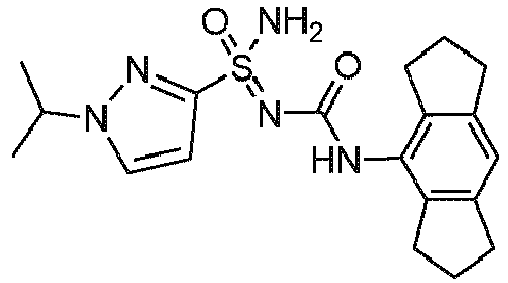
N'-(1,2,3,5,6,7-hexahydro-s-indacen-4-ylcarbamoyl)-1-isopropyl-1H-pyrazole-3-sulfonimidamide 388.1 17 187 
N'-(4-(difluoromethoxy)-2,6-diisopropylphenylcarbamoyl)-3-fluoro-5-(2-hydroxypropan-2-yl)thiophene-2-sulfonimidamide 508.2 18 188 
N'-(4-(difluoromethoxy)-2-ethyl-6-isopropylphenylcarbamoyl)-2-(2-hydroxypropan-2-yl)thiazole-5-sulfonimidamide 477.1 19 192 
N'-(1,2,3,5,6,7-hexahydro-s-indacen-4-ylcarbamoyl)-4-(2-hydroxypropan-2-yl)-2-methylbenzenesulfonimidamide 426.2(M-1) 20 189 
N'-(2-cyclopropyl-4-(difluoromethoxy)-6-isopropylphenylcarbamoyl)-2-(2-hydroxypropan-2-yl)thiazole-5-sulfonimidamide 487.1(M-1) 21 178 
N'-(4-fluoro-2, 6-diisopropylphenylcarbamoyl)-2-(2-hydroxypropan-2-yl)thiazole-5-sulfonimidamide 441.1(M-1) 22 193 
N'-(4-fluoro-2, 6-diisopropylphenylcarbamoyl)-3-(2-hydroxypropan-2-yl)benzenesulfonimidamide 436.1 23 170 
N'-(4-cyano-6-cyclopropyl-3 -fluoro-2-isopropylphenylcarbamoyl)-2-(2-hydroxypropan-2-yl)thiazole-5-sulfonimidamide 466.1 24 168 
N'-(4-(difluoromethoxy)-2,6-diisopropylphenylcarbamoyl)-5-(2-hydroxypropan-2-yl)-3 - methylthiophene-2-sulfonimidamide 504.3 25 171 
N'-(4-(difluoromethoxy)-2,6-diisopropylphenylcarbamoyl)-2-(2-hydroxypropan-2-yl)thiazole-5-sulfonimidamide 491.1 26 122 
N'-(8-cyano-1,2,3, 5,6,7-hexahydro-s-indacen-4-ylcarbamoyl)-4-(2-hydroxypropan-2-yl)thiophene-2-sulfonimidamide 443.1 (M-1) 27 120 
N'-(8-(difluoromethoxy)-1,2,3,5,6,7-hexahydro-s-indacen-4-ylcarbamoyl)-2-(2-hydroxypropan-2-yl)thiazole-5-sulfonimidamide 487.1 28 125 
4-((dimethylamino)methyl)-N'-(1,2,3,5,6,7-hexahydro-s-indacen-4-ylcarbamoyl)benzenesulfonimidamid e 413.3 29 129 
N'-(2-cyclopropyl-4-(difluoromethoxy)-6-isopropylphenylcarbamoyl)-4-(2-hydroxypropan-2-yl)-2-methylbenzenesulfonimidamide 496.2 30 213 
3-fluoro-N'-(8-fluoro-1,2,3,5,6,7-hexahydro-s-indacen-4-ylcarbamoyl)-5-(2-hydroxypropan-2-yl)thiophene-2-sulfonimidamide 456.1 31 207 
4-(2-hydroxypropan-2-yl)-5-methyl-N'-((3-methyl-1,2,3,5,6,7-hexahydros-indacen-4-yl)carbamoyl)furan-2-sulfonimidamide 432.2 32 195 
4-(2-hydroxypropan-2-yl)-5-methyl-N'-((1-methyl-1,2,3,5,6,7-hexahydros-indacen-4-yl)carbamoyl)furan-2-sulfonimidamide 432.2 Table 17. Examples in the following table were prepared using similar conditions as described in Example 4 - route 1 andScheme 2 from appropriate starting materials.Exampl e # Final Target Number Structure IUPAC Name Exact Mass [M+H]+ 33 179 
N'-(4-cyano-3-fluoro-2,6-diisopropylphenylcarbamoyl)-4-(2-hydroxypropan-2-yl)-5-methylfuran-2-sulfonimidamide 465.2 34 105 
N'-(8-fluoro-1,2,3,5,6,7-hexahydro-s-indacen-4-ylcarbamoyl)-3-(2-hydroxypropan-2-yl)benzenesulfonimidamide 432.2 35 121 
N'-(4-cyano-2,6-diisopropylphenylcarbamoyl)-5-(2-hydroxypropan-2-yl)thiazole-2-sulfonimidamide 448.1 (M-1) 36 145 
4-((dimethylamino)methyl)-N'-(4-fluoro-2, 6-diisopropylphenylcarbamoyl)ben zenesulfonimidamide 435.2 37 131 
N'-(2-cyclopropyl-4-(difluoromethoxy)-6-isopropylphenylcarbamoyl)-4-((dimethylamino)methyl)benzene sulfonimidamide 481.3 38 132 
N'-(4-(difluoromethoxy)-2,6-diisopropylphenylcarbamoyl)-5-(2-hydroxypropan-2-yl)thiazole-2-sulfonimidamide 489.1 (M-1) 39 144 
N'-(4-fluoro-2, 6-diisopropylphenylcarbamoyl)-5-(2-hydroxypropan-2-yl)thiazole-2-sulfonimidamide 441.1 (M-1) 40 149 
N'-(4-fluoro-2, 6-diisopropylphenylcarbamoyl)-4-(2-hydroxypropan-2-yl)thiophene-2-sulfonimidamide 440.1 (M-1) 41 152 
N'-(8-chloro-1,2,3,5,6,7-hexahydro-s-indacen-4-ylcarbamoyl)-2-fluoro-4-(2-hydroxypropan-2-yl)benzenesulfonimidamide 466.2 42 150 
N'-(4-fluoro-2, 6-diisopropylphenylcarbamoyl)-4-(methylsulfonyl)benzenesulfonim idamide 454.1 (M-1) 43 167 
N'-(8-cyano-1,2,3,5,6,7-hexahydro-s-indacen-4-ylcarbamoyl)-2-(2-hydroxypropan-2-yl)thiazole-5-sulfonimidamide 444.2 (M-1) 44 106 
N'-(8-fluoro-1,2,3,5,6,7-hexahydro-s-indacen-4-ylcarbamoyl)-2-(2-hydroxypropan-2-yl)thiazole-5-sulfonimidamide 437.1 (M-1) 45 107 
N'-(8-fluoro-1,2,3,5,6,7-hexahydro-s-indacen-4-ylcarbamoyl)-4-(2-hydroxypropan-2-yl)-5-methylfuran-2-sulfonimidamide 436.2 46 110 
N'-(1,2,3,5,6,7-hexahydro-s-indacen-4-ylcarbamoyl)-3-(2-hydroxypropan-2-yl)benzenesulfonimidamide 414.2 47 151 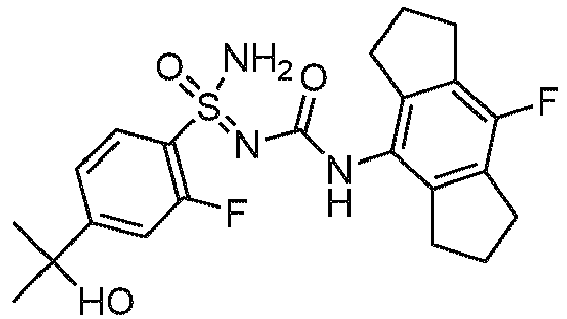
2-fluoro-N'-(8-fluoro-1,2,3,5,6,7-hexahydro-s-indacen-4-ylcarbamoyl)-4-(2-hydroxypropan-2-yl)benzenesulfonimidamide 448.1 (M-1) 48 154 
4-((dimethylamino)methyl)-2-fluoro-N'-(1,2,3,5,6,7-hexahydro-s-indacen-4-ylcarbamoyl)benzenesulfonimida mide 431.2 49 148 
N'-(4-fluoro-2, 6-diisopropylphenylcarbamoyl)-5-(2-hydroxypropan-2-yl)thiophene-2-sulfonimidamide 442.2 50 153 
2-chloro-N'-(8-fluoro-1,2,3,5,6,7-hexahydro-s-indacen-4-ylcarbamoyl)-4-(2-hydroxypropan-2-yl)benzenesulfonimidamide 464.1 (M-1) 51 109 
3-((dimethylamino)methyl)-N'-(1,2,3,5,6,7-hexahydro-s-indacen-4-ylcarbamoyl)benzenesulfonimida mide 411.1 (M-1) 52 135 
N'-((1,2,3,5,6,7-hexahydro-s-indacen-4-yl)carbamoyl)-4-(2-hydroxypropan-2-yl)-3 - methylbenzenesulfonimidamide 428.2 53 134 
N'-((1,2,3,5,6,7-hexahydro-s-indacen-4-yl)carbamoyl)-2-(2-hydroxypropan-2-yl)-4-methylthiazole-5-sulfonimidamide 435.1 54 130 
N'-((2-cyclopropyl-4-(difluoromethoxy)-6-isopropylphenyl)carbamoyl)-2-fluoro-4-(2-hydroxypropan-2-yl)benzenesulfonimidamide 500.2 55 212 
2-fluoro-N'-((8-fluoro-1,2,3,5,6,7-hexahydro-s-indacen-4-yl)carbamoyl)-5-(2-hydroxypropan-2-yl)benzenesulfonimidamide 450.2 56 205 
3-fluoro-N'-((8-fluoro-1,2,3,5,6,7-hexahydro-s-indacen-4-yl)carbamoyl)-5-(2-hydroxypropan-2-yl)benzenesulfonimidamide 450.2 57 143 
N'-((4-(difluoromethoxy)-2,6-diisopropylphenyl)carbamoyl)-5-(2-hydroxypropan-2-yl)-4-methylthiophene-2-sulfonimidamide 504.2 58 206 
4-fluoro-N'-((8-fluoro-1,2,3,5,6,7-hexahydro-s-indacen-4-yl)carbamoyl)-3 -(2-hydroxypropan-2-yl)benzenesulfonimidamide 450.2 59 108 
N'-((8-fluoro-1,2,3,5,6,7-hexahydro-s-indacen-4-yl)carbamoyl)-2-(2-hydroxypropan-2-yl)-4-methylthiazole-5-sulfonimidamide 453.1 60 202 
3-fluoro-N'-((1,2,3,5,6,7-hexahydro-s-indacen-4-yl)carbamoyl)-4-(2-hydroxypropan-2-yl)benzenesulfonimidamide 432.2 61 208 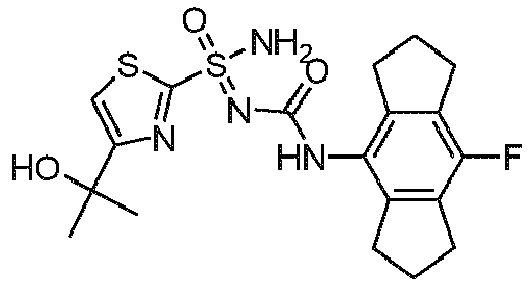
N'-((8-fluoro-1,2,3,5,6,7-hexahydro-s-indacen-4-yl)carbamoyl)-4-(2-hydroxypropan-2-yl)thiazole-2-sulfonimidamide 439.1 62 197 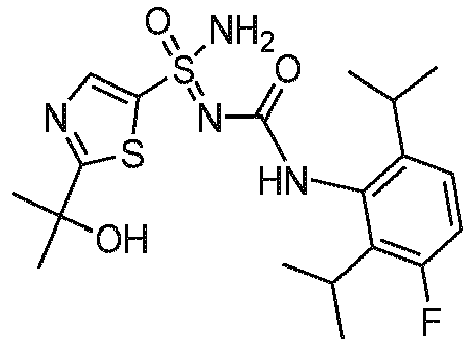
N'-((3-fluoro-2,6-diisopropylphenyl)carbamoyl)-2-(2-hydroxypropan-2-yl)thiazole-5-sulfonimidamide 443.2 63 196 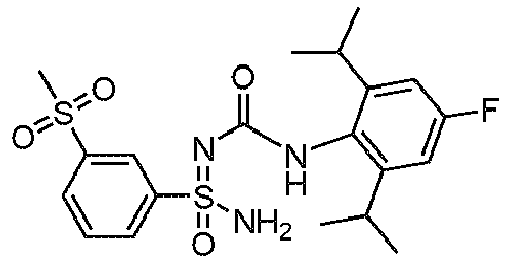
N'-((4-fluoro-2,6-diisopropylphenyl)carbamoyl)-3- (methylsulfonyl)benzenesulfonim idamide 456.1 64 124 
N'-((1,2,3,5,6,7-hexahydro-s-indacen-4-yl)carbamoyl)-5-(2-hydroxypropan-2-yl)thiazole-2-sulfonimidamide 421.1 65 173 
N'-((4-cyano-2,6-dii sopropylphenyl)carbamoyl)-3- fluoro-5-(2-hydroxypropan-2-yl)thiophene-2-sulfonimidamide 467.2 66 172 
N'-((4-cyano-2,6-diisopropylphenyl)carbamoyl)-3,5-bis(2-hydroxypropan-2-yl)benzenesulfonimidamide 501.2 67 174 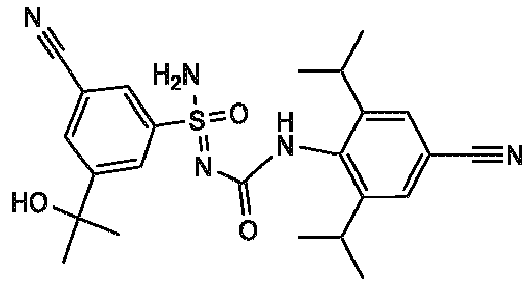
3-cyano-N'-((4-cyano-2,6-diisopropylphenyl)carbamoyl)-5-(2-hydroxypropan-2-yl)benzenesulfonimidamide 468.2 68 158 
N'-((4-cyano-2,6-dii sopropylphenyl)carbamoyl)-3- (hydroxymethyl)-4-(2-hydroxypropan-2-yl)benzenesulfonimidamide 473.2 69 220 
N'-((8-cyano-1,2,3,5,6,7-hexahydro-s-indacen-4-yl)carbamoyl)-4-(hydroxymethyl)-2-(2-hydroxypropan-2-yl)thiazole-5-sulfonimidamide 476.1 70 157 
N-((4-cyano-2,6-diisopropylphenyl)carbamoyl)-4-(hydroxymethyl)-2-(2-hydroxypropan-2-yl)thiazole-5-sulfonimidamide 480.2 71 161 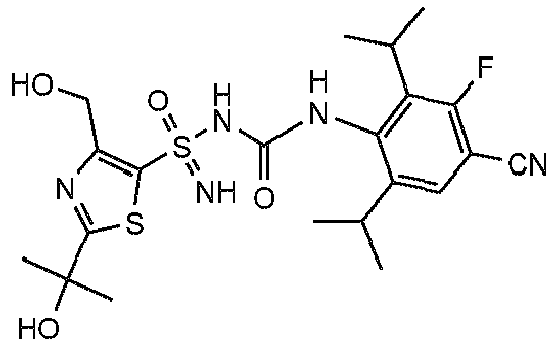
N-((4-cyano-3-fluoro-2,6-diisopropylphenyl)carbamoyl)-4-(hydroxymethyl)-2-(2-hydroxypropan-2-yl)thiazole-5-sulfonimidamide 498.2 72 159 
N'-((4-cyano-3-fluoro-2,6-diisopropylphenyl)carbamoyl)-2-(1,2-dihydroxypropan-2-yl)thiazole-5-sulfonimidamide 484.1 73 165 
N'-((4-cyano-2,6-diisopropylphenyl)carbamoyl)-4-(methylsulfonyl)benzenesulfonim idamide 463.1 74 183 
N'-(1,2,3,5,6,7-hexahydro-s-indacen-4-ylcarbamoyl)-4-(2-hydroxypropan-2-yl)thiophene-2-sulfonimidamide 418.1(M-1) 75 176 
N'-(8-fluoro-1,2,3,5,6,7-hexahydro-s-indacen-4-ylcarbamoyl)-4-(2-hydroxypropan-2-yl)thiophene-2-sulfonimidamide 438.0 76 136 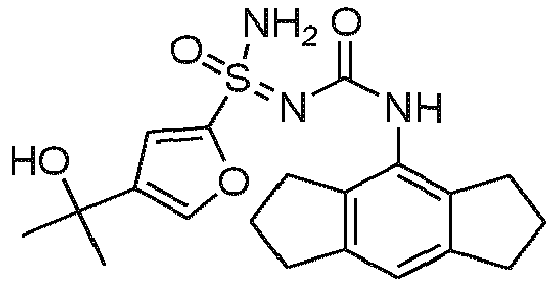
N'-(1,2,3,5,6,7-hexahydro-s-indacen-4-ylcarbamoyl)-4-(2-hydroxypropan-2-yl)furan-2-sulfonimidamide 404.2 77 209 
N'-(1,2,3,5,6,7-hexahydro-s-indacen-4-ylcarbamoyl)-4-(2-hydroxypropan-2-yl)thiazole-2-sulfonimidamide 421.1 Table 18. Examples in the following table were prepared using similar conditions as described in Example 9 and Scheme 5 from appropriate materials.Example # Final Target Number Structure IUPAC Name Exact Mass [M+H]+ 78 203 
N-((2,6-dimethylpyridin-4-yl)carbamoyl)-5-(2-hydroxypropan-2-yl)thiophene-2-sulfonimidamide 369.1 Table 19. Examples in the following table were obtained from chiral HPLC resolutions of racemic examples described above. The chiral column and eluents are listed in the table. As a convention, the faster-eluting enantiomer is always listed first in the table followed by the slower-eluting enantiomer of the pair. The symbol * at a chiral center denotes that this chiral center has been resolved and the absolute stereochemistry at that center has not been determined. Ex. # Final Target Number Structure IUPAC Name Column Eluents LC-MS [M+H]+ 79 180a or 180b 
(S)-or (R)-N'-(4-fluoro-2,6-diisopropylphenylcarbamoyl)-4-(2-hydroxypropan-2-yl)-5-methylfuran-2-sulfonimidamide ChiralPak ID, 2*25cm, 5um 20% EtOH in Hex 440.3 80 180b or 180a 
(R)-or (S)-N'-(4-fluoro-2,6-diisopropylphenylcarbamoyl)-4-(2-hydroxypropan-2-yl)-5-methylfuran-2-sulfonimidamide ChiralPak ID, 2*25cm, 5um 20% EtOH in Hex 440.3 81 179a or 179b 
(S)-or (R)-N'-(4-cyano-3-fluoro-2,6-diisopropylphenylcarbamoyl)-4-(2-hydroxypropan-2-yl)-5-methylfuran-2-sulfonimidamide ChiralPak ID, 2*25cm, 5um 23% EtOH in Hex 465.3 82 179b or 179a 
(R)-or (S)-N'-(4-cyano-3-fluoro-2,6-diisopropylphenylcarbamoyl)-4-(2-hydroxypropan-2-yl)-5-methylfuran-2-sulfonimidamide ChiralPak ID, 2*25cm, 5um 23% EtOH in Hex 465.3 83 190a or 190b 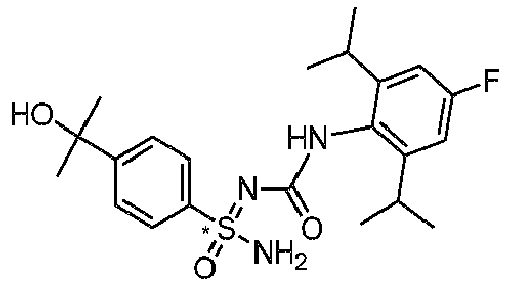
(S)-or (R)-N'-(4-fluoro-2,6-diisopropylphenylcarbamoyl)-4-(2-hydroxypropan-2-yl)benzenesulfonimidamide ChiralPak ID, 2*25cm, 5um 20% EtOH in Hex 436.2 84 190b or 190a 
(R)-or (S)-N'-(4-fluoro-2,6-diisopropylphenylcarbamoyl)-4-(2-hydroxypropan-2-yl)benzenesulfonimidamide ChiralPak ID, 2*25cm, 5um 20% EtOH in Hex 436.2 85 182a or 182b 
(S)-or (R)-N'-(1,2,3,5,6,7-hexahydro-s-indacen-4-ylcarbamoyl)-4-(2-hydroxypropan-2-yl)-5-methylthiophene-2-sulfonimidamide ChiralPak IC, 2*25cm, 5um 20% EtOH in Hex 434.1 86 182b or 182a 
(R)-or (S)-N'-(1,2,3,5,6,7-hexahydro-s-indacen-4-ylcarbamoyl)-4-(2-hydroxypropan-2-yl)-5-methylthiophene-2-sulfonimidamide ChiralPak IC, 2*25cm, 5um 20% EtOH in Hex 434.1 87 191a or 191b 
(S)-or (R)-2-fluoro-N'-(1,2,3,5,6,7-hexahydro-s-indacen-4-ylcarbamoyl)-4-(2-hydroxypropan-2-yl)benzenesulfonimidamide ChiralPak IG, 2*25cm, 5um 30% IPA in Hex(0.1 %DEA) 430.1 (M-1) 88 191b or 191a 
(R)-or (S)-2-fluoro-N'-(1,2,3,5,6,7-hexahydro-s-indacen-4-ylcarbamoyl)-4-(2-hydroxypropan-2-yl)benzenesulfonimidamide ChiralPak IG, 2*25cm, Sum 30% IPA in Hex(0.1 %DEA) 430.1 (M-1) 89 177a or 177b 
(S)-or (R)-N'-(8-chloro-1,2,3,5,6,7-hexahydro-s-indacen-4-ylcarbamoyl)-4-(2-hydroxypropan-2-yl)thiophene-2-sulfonimidamide ChiralPak ID, 2*25cm, 5um 20% EtOH in Hex(0.1 %DEA) 452.0 (M-1) 90 177b or 177a 
(R)-or (S)-N'-(8-chloro-1,2,3,5,6,7-hexahydro-s-indacen-4-ylcarbamoyl)-4-(2-hydroxypropan-2-yl)thiophene-2-sulfonimidamide ChiralPak ID, 2*25cm, 5um 20% EtOH in Hex(0.1 %DEA) 452.0 (M-1) 91 185a or 185b 
(S)-or (R)-N'-(4-cyano-3-fluoro-2,6-diisopropylphenylcarbamoyl)-2-(2-hydroxypropan-2-yl)thiazole-5-sulfonimidamide ChiralPak ID, 2*25cm, 5um 30% EtOH in Hex(0.1 %DEA) 466.1 (M-1) 92 185b or 185a 
(R)-or (S)-N'-(4-cyano-3-fluoro-2,6-diisopropylphenylcarbamoyl)-2-(2-hydroxypropan-2-yl)thiazole-5-sulfonimidamide ChiralPak ID, 2*25cm, 5um 30% EtOH in Hex(0.1 %DEA) 466.1 (M-1) 93 186a or 186b 
(S)-or (R)-N'-(1,2,3,5,6,7-hexahydro-s-indacen-4-ylcarbamoyl)-1-isopropyl-1H-pyrazole-3-sulfonimidamide ChiralPak IG, 2*25cm, 5um 30% EtOH in Hex(0.1 %DEA) 388.1 94 186b or 186a 
(R)-or (S)-N'-(1,2,3,5,6,7-hexahydro-s-indacen-4-ylcarbamoyl)-1 - isopropyl-1H-pyrazole-3-sulfonimidamide ChiralPak IG, 2*25cm, 5um 30% EtOH in Hex(0.1 %DEA) 388.1 95 187a or 187b 
(S)-or (R)-N'-(4-(difluoromethoxy)-2,6-diisopropylphenylcarbamoyl)-3-fluoro-5-(2-hydroxypropan-2-yl)thiophene-2-sulfonimidamide ChiralPak ID, 2*25cm, 5um 20% EtOH in Hex(0.1 %DEA) 508.2 96 187b or 187a 
(R)-or (S)-N'-(4-(difluoromethoxy)-2,6-diisopropylphenylcarbamoyl)-3-fluoro-5-(2-hydroxypropan-2-yl)thiophene-2-sulfonimidamide ChiralPak ID, 2*25cm, 5um 20% EtOH in Hex(0.1 %DEA) 508.2 97 188a or 188b 
(S)-or (R)-N'-(4-(difluoromethoxy)-2-ethyl-6-isopropylphenylcarbamoyl)-2-(2-hydroxypropan-2-yl)thiazole-5-sulfonimidamide ChiralPak ID, 2*25cm, 5um 30% IPA in Hex(0.1 %DEA) 477.2 98 188b or 188a 
(R)-or (S)-N'-(4-(difluoromethoxy)-2-ethyl-6-isopropylphenylcarbamoyl)-2-(2-hydroxypropan-2-yl)thiazole-5-sulfonimidamide ChiralPak ID, 2*25cm, 5um 30% IPA in Hex(0.1 %DEA) 477.2 99 192a or 192b 
(S)-or (R)-N'-(1,2,3,5,6,7-hexahydro-s-indacen-4-ylcarbamoyl)-4-(2-hydroxypropan-2-yl)-2-methylbenzenesulfonimidamide ChiralPak ID, 2*25cm, 5um 30% EtOH in Hex(0.1 %DEA) 428.2 100 192b or 192a 
(R)-or (S)-N'-(1,2,3,5,6,7-hexahydro-s-indacen-4-ylcarbamoyl)-4-(2-hydroxypropan-2-yl)-2-methylbenzenesulfonimidamide ChiralPak ID, 2*25cm, 5um 30% EtOH in Hex(0.1 %DEA) 428.2 101 189a or 189b 
(S)-or(R)-N'-(2-cyclopropyl-4-(difluoromethoxy)-6-isopropylphenylcarbamoyl)-2-(2-hydroxypropan-2-yl)thiazole-5-sulfonimidamide ChiralPak ID, 2*25cm, 5um 50% IPA in Hex(0.1 %DEA) 489.3 102 189b or 189a 
(R)-or (S)-N'-(2-cyclopropyl-4-(difluoromethoxy)-6-isopropylphenylcarbamoyl)-2-(2-hydroxypropan-2-yl)thiazole-5-sulfonimidamide ChiralPak ID, 2*25cm, 5um 50% IPA in Hex(0.1 %DEA) 489.2 103 178a or 178b 
(S)-or (R)-N'-(4-fluoro-2,6-diisopropylphenylcarbamoyl)-2-(2-hydroxypropan-2-yl)thiazole-5-sulfonimidamide ChiralPak ID, 2*25cm, 5um 30% IPA(0.1 %DEA) in Hex:DC M=3:1 443.2 104 178b or 178a 
(R)-or (S)-N'-(4-fluoro-2,6-diisopropylphenylcarbamoyl)-2-(2-hydroxypropan-2-yl)thiazole-5-sulfonimidamide ChiralPak ID, 2*25cm, 5um 30% IPA(0.1 %DEA) in Hex:DC M=3:1 443.1 105 193a or 193b 
(S)-or (R)-N'-(4-fluoro-2,6-diisopropylphenylcarbamoyl)-3-(2-hydroxypropan-2-yl)benzenesulfonimidamide ChiralPak IG, 2*25cm, 5um 20% IPA in Hex(0.1 %DEA) 436.2 106 193b or 193a 
(R)-or (S)-N'-(4-fluoro-2,6-diisopropylphenylcarbamoyl)-3-(2-hydroxypropan-2-yl)benzenesulfonimidamide ChiralPak IG, 2*25cm, 5um 20% IPA in Hex(0.1 %DEA) 436.2 107 170a or 170b 
(S)-or (R)-N'-(4-cyano-6-cyclopropyl-3-fluoro-2-isopropylphenylcarbamoyl)-2-(2-hydroxypropan-2-yl)thiazole-5-sulfonimidamide ChiralPak IG, 2*25cm, 5um 15% EtOH in Hex(0.1 %DEA) 466.1 108 170b or 170a 
(R)-or (S)-N'-(4-cyano-6-cyclopropyl-3-fluoro-2-isopropylphenylcarbamoyl)-2-(2-hydroxypropan-2-yl)thiazole-5-sulfonimidamide ChiralPak IG, 2*25cm, 5um 15% EtOH in Hex(0.1 %DEA) 466.1 109 168a or 168b 
(S)-or (R)-N'-(4-(difluoromethoxy)-2,6-diisopropylphenylcarbamoyl)-5-(2-hydroxypropan-2-yl)-3 - methylthiophene-2-sulfonimidamide ChiralPak ID, 2*25cm, 5um 30% IPA in Hex(0.1 %DEA) 504.2 110 168b or 168a 
(R)-or (S)-N'-(4-(difluoromethoxy)-2,6-diisopropylphenylcarbamoyl)-5-(2-hydroxypropan-2-yl)-3-methylthiophene-2-sulfonimidamide ChiralPak ID, 2*25cm, 5um 30% IPA in Hex(0.1 %DEA) 504.2 111 171a or 171b 
(S)-or (R)-N'-(4-(difluoromethoxy)-2,6-diisopropylphenylcarbamoyl)-2-(2-hydroxypropan-2-yl)thiazole-5-sulfonimidamide ChiralPak ID, 2*25cm, 5um 50% IPA in Hex:DC M=1:1 489.1 (M-1) 112 171b or 171a 
(R)-or (S)-N'-(4-(difluoromethoxy)-2,6-diisopropylphenylcarbamoyl)-2-(2-hydroxypropan-2-yl)thiazole-5-sulfonimidamide ChiralPak ID, 2*25cm, 5um 50% IPA in Hex:DC M=1:1 489.1 (M-1) 113 122a or 122b 
(S)-or (R)-N'-(8-cyano-1,2,3,5,6,7-hexahydro-s-indacen-4-ylcarbamoyl)-4-(2-hydroxypropan-2-yl)thiophene-2-sulfonimidamide ChiralPak ID, 2*25cm, 5um 30% IPA in Hex 443.1 (M-1) 114 122b or 122a 
(R)-or (S)-N'-(8-cyano-1,2,3,5,6,7-hexahydro-s-indacen-4-ylcarbamoyl)-4-(2-hydroxypropan-2-yl)thiophene-2-sulfonimidamide ChiralPak ID, 2*25cm, 5um 30% IPA in Hex 443.1 (M-1) 115 120a or 120b 
(S)-or (R)-N'-(8-(difluoromethoxy)-1,2,3,5,6,7-hexahydro-s-indacen-4-ylcarbamoyl)-2-(2-hydroxypropan-2-yl)thiazole-5-sulfonimidamide Chiral ART Cellulose-SB 2*25cm, 5um 20% EtOH in Hex(0.1 %DEA) 485.1 (M-1) 116 120b or 120a 
(R)-or (S)-N'-(8-(difluoromethoxy)-1,2,3,5,6,7-hexahydro-s-indacen-4-ylcarbamoyl)-2-(2-hydroxypropan-2-yl)thiazole-5-sulfonimidamide Chiral ART Cellulose-SB 2*25cm, 5um 20% EtOH in Hex(0.1 %DEA) 485.1 (M-1) 117 125a or 125b 
(S)-or (R)-4-((dimethylamino)methyl)-N'-(1,2,3,5,6,7-hexahydro-s-indacen-4-ylcarbamoyl)benzenesulfonimidamid e ChiralPak ID, 2*25cm, 5um 50% IPA in Hex:DC M=3:1 413.2 118 125b or 125a 
(R)-or (S)-4-((dimethylamino)methyl)-N'-(1,2,3,5,6,7-hexahydro-s-indacen-4-ylcarbamoyl)benzenesulfonimidamid e ChiralPak ID, 2*25cm, 5um 50% IPA in Hex:DC M=3:1 413.2 119 129a or 129b 
(S)-or (R)-N'-(2-cyclopropyl-4-(difluoromethoxy)-6-isopropylphenylcarbamoyl)-4-(2-hydroxypropan-2-yl)-2-methylbenzenesulfonimidamide ChiralPak ID, 2*25cm, 5um 50% IPA in Hex:DC M=3:1 496.2 120 129b or 129a 
(R)-or (S)-N'-(2-cyclopropyl-4-(difluoromethoxy)-6-isopropylphenylcarbamoyl)-4-(2-hydroxypropan-2-yl)-2-methylbenzenesulfonimidamide ChiralPak ID, 2*25cm, 5um 50% IPA in Hex:DC M=3:1 496.2 121 112a or 112b 
(S)-or (R)-3-fluoro-N'-(8-fluoro-1,2,3,5,6,7-hexahydro-s-indacen-4-ylcarbamoyl)-5-(2-hydroxypropan-2-yl)thiophene-2-sulfonimidamide ChiralPak IG, 2*25cm, 5um 15% EtOH in Hex(0.1 %DEA) 456.1 122 112b or 112a 
(R)-or (S)-3-fluoro-N'-(8-fluoro-1,2,3,5,6,7-hexahydro-s-indacen-4-ylcarbamoyl)-5-(2-hydroxypropan-2-yl)thiophene-2-sulfonimidamide ChiralPak IG, 2*25cm, 5um 15% EtOH in Hex(0.1 %DEA) 456.1 128 105a or 105b 
(S)-or (R)-N'-(8-fluoro-1,2,3,5,6,7-hexahydro-s-indacen-4-ylcarbamoyl)-3-(2-hydroxypropan-2-yl)benzenesulfonimidamide ChiralPak ID, 2*25cm, Sum 40% EtOH in Hex 432.1 129 105b or 105a 
(R)-or (S)-N'-(8-fluoro-1,2,3,5,6,7-hexahydro-s-indacen-4-ylcarbamoyl)-3-(2-hydroxypropan-2-yl)benzenesulfonimidamide ChiralPak ID, 2*25cm, 5um 40% EtOH in Hex 432.1 130 121a or 121b 
(S)-or (R)-N'-(4-cyano-2,6-diisopropylphenylcarbamoyl)-5-(2-hydroxypropan-2-yl)thiazole-2-sulfonimidamide ChiralPak ID, 2*25cm, 5um 40% EtOH in Hex 448.1 (M-1) 131 121b or 121a 
(R)-or (S)-N'-(4-cyano-2,6-diisopropylphenylcarbamoyl)-5-(2-hydroxypropan-2-yl)thiazole-2-sulfonimidamide ChiralPak ID, 2*25cm, 5um 40% EtOH in Hex 448.1 (M-1) 132 145a or 145b 
(S)-or (R)-4-((dimethylamino)methyl)-N'-(4-fluoro-2,6-diisopropylphenylcarbamoyl)benzen esulfonimidamide ChiralPak IG, 2*25cm, 5um 30% EtOH in Hex 435.2 133 145b or 145a 
(R)-or (S)-4-((dimethylamino)methyl)-N'-(4-fluoro-2,6-diisopropylphenylcarbamoyl)benzen esulfonimidamide ChiralPak IG, 2*25cm, 5um 30% EtOH in Hex 435.2 134 131a or 131b 
(S)-or (R)-N'-(2-cyclopropyl-4-(difluoromethoxy)-6-isopropylphenylcarbamoyl)-4-((dimethylamino)methyl)benzenesulf onimidamide ChiralPak IG, 2*25cm, 5um 50% EtOH in Hex 481.2 135 131b or 131a 
(R)-or (S)-N'-(2-cyclopropyl-4-(difluoromethoxy)-6-isopropylphenylcarbamoyl)-4-((dimethylamino)methyl)benzenesulf onimidamide ChiralPak IG, 2*25cm, 5um 50% EtOH in Hex 481.2 136 225a or 225b 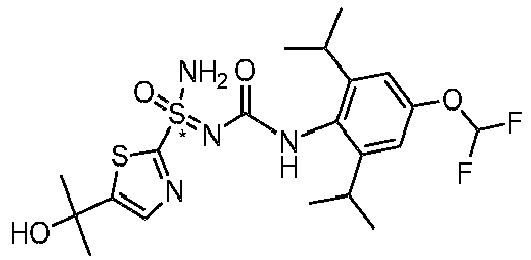
(S)-or (R)-N'-(4-(difluoromethoxy)-2,6-diisopropylphenylcarbamoyl)-5-(2-hydroxypropan-2-yl)thiazole-2-sulfonimidamide ChiralPak IF, 2*25cm, 5um 20% MeOH (0.1%T FA) in CO2 489.1 (M-1) 137 225b or 225a 
(R)-or (S)-N'-(4-(difluoromethoxy)-2,6-diisopropylphenylcarbamoyl)-5-(2-hydroxypropan-2-yl)thiazole-2-sulfonimidamide ChiralPak IF, 2*25cm, 5um 20% MeOH (0.1%T FA) in CO2 489.1 (M-1) 138 144a or 144b 
(S)-or (R)-N'-(4-fluoro-2,6-diisopropylphenylcarbamoyl)-5-(2-hydroxypropan-2-yl)thiazole-2-sulfonimidamide ChiralPak IF, 2*25cm, 5um 20% MeOH (0.1%T FA) in CO2 443.2 139 144b or 144a 
(R)-or (S)-N'-(4-fluoro-2,6-diisopropylphenylcarbamoyl)-5-(2-hydroxypropan-2-yl)thiazole-2-sulfonimidamide ChiralPak IF, 2*25cm, 5um 20% MeOH (0.1%T FA) in CO2 443.1 140 149a or 149b 
(S)-or (R)-N'-(4-fluoro-2,6-diisopropylphenylcarbamoyl)-4-(2-hydroxypropan-2-yl)thiophene-2-sulfonimidamide ChiralPak ID, 2*25cm, 5um 30% EtOH in Hex 440.1 (M-1) 141 149b or 149a 
(R)-or (S)-N'-(4-fluoro-2,6-diisopropylphenylcarbamoyl)-4-(2-hydroxypropan-2-yl)thiophene-2-sulfonimidamide ChiralPak ID, 2*25cm, 5um 30% EtOH in Hex 440.1 (M-1) 142 152a or 152b 
(S)-or (R)-N'-(4-fluoro-2,6-diisopropylphenylcarbamoyl)-4-(2-hydroxypropan-2-yl)thiophene-2-sulfonimidamide ChiralPak IG, 2*25cm, 5um 30% IPA in Hex 466.2 143 152b or 152a 
(R)-or (S)-N'-(4-fluoro-2,6-diisopropylphenylcarbamoyl)-4-(2-hydroxypropan-2-yl)thiophene-2-sulfonimidamide ChiralPak IG, 2*25cm, 5um 30% IPA in Hex 466.2 144 151a' or 151b' 
(S)-or (R)-N'-(4-fluoro-2,6-diisopropylphenylcarbamoyl)-4-(methylsulfonyl)benzenesulfonimida mide Lux 5u Cellulose-4, AXIA Packed, 2.12*25c m, 5um 35% MeOH( 2mM NH3) in CO2 454.1 (M-1) 145 151b' or 151a' 
(R)-or (S)-N'-(4-fluoro-2,6-diisopropylphenylcarbamoyl)-4-(methylsulfonyl)benzenesulfonimida mide Lux 5u Cellulose-4, AXIA Packed, 2.12*25c m, 5um 35% MeOH( 2mM NH3) in CO2 454.1 (M-1) 146 167a or 167b 
(S)-or (R)-N'-(8-cyano-1,2,3,5,6,7-hexahydro-s-indacen-4-ylcarbamoyl)-2-(2-hydroxypropan-2-yl)thiazole-5-sulfonimidamide ChiralPak IC, 2*25cm, 5um 30% EtOH in Hex(0.1 %DEA) 444.1 (M-1) 147 167b or 167a 
(R)-or (S)-N'-(8-cyano-1,2,3,5,6,7-hexahydro-s-indacen-4-ylcarbamoyl)-2-(2-hydroxypropan-2-yl)thiazole-5-sulfonimidamide ChiralPak IC, 2*25cm, 5um 30% EtOH in Hex(0.1 %DEA) 444.1 (M-1) 148 107a or 107b 
(S)-or (R)-N'-(8-fluoro-1,2,3,5,6,7-hexahydro-s-indacen-4-ylcarbamoyl)-4-(2-hydroxypropan-2-yl)-5-methylfuran-2-sulfonimidamide ChiralPak ID, 2*25cm, 5um 50% IPA in Hex 434.1 (M-1) 149 107b or 107a 
(R)-or (S)-N'-(8-fluoro-1,2,3,5,6,7-hexahydro-s-indacen-4-ylcarbamoyl)-4-(2-hydroxypropan-2-yl)-5-methylfuran-2-sulfonimidamide ChiralPak ID, 2*25cm, 5um 50% IPA in Hex 434.1 (M-1) 150 110a or 110b 
(S)-or (R)-N'-(1,2,3,5,6,7-hexahydro-s-indacen-4-ylcarbamoyl)-3-(2-hydroxypropan-2-yl)benzenesulfonimidamide ChiralPak IF, 2*25cm, 5um 30% EtOH in Hex 412.1 (M-1) 151 110b or 110a 
(R)-or (S)-N'-(1,2,3,5,6,7-hexahydro-s-indacen-4-ylcarbamoyl)-3-(2-hydroxypropan-2-yl)benzenesulfonimidamide ChiralPak IF, 2*25cm, 5um 30% EtOH in Hex 412.1 (M-1) 152 151a or 151b 
(S)-or (R)-2-fluoro-N'-(8-fluoro-1,2,3,5,6,7-hexahydro-s-indacen-4-ylcarbamoyl)-4-(2-hydroxypropan-2-yl)benzenesulfonimidamide ChiralPak IG, 2*25cm, 5um 30% IPA in Hex 448.1 (M-1) 153 151b or 151a 
(R)-or (S)-2-fluoro-N'-(8-fluoro-1,2,3,5,6,7-hexahydro-s-indacen-4-ylcarbamoyl)-4-(2-hydroxypropan-2-yl)benzenesulfonimidamide ChiralPak IG, 2*25cm, 5um 30% IPA in Hex 448.1 (M-1) 154 154a or 154b 
(S)-or (R)-4-((dimethylamino)methyl)-2-fluoro-N'-(1,2,3,5,6,7-hexahydro-s-indacen-4-ylcarbamoyl)benzenesulfonimidamid e ChiralPak IG, 2*25cm, 5um 30% EtOH in Hex 431.2 155 154b or 154a 
(R)-or (S)-4-((dimethylamino)methyl)-2-fluoro-N'-(1,2,3,5,6,7-hexahydro-s-indacen-4-ylcarbamoyl)benzenesulfonimidamid e ChiralPak IG, 2*25cm, 5um 30% EtOH in Hex 431.2 156 148a or 148b 
(S)-or (R)-N'-(4-fluoro-2,6-diisopropylphenylcarbamoyl)-5-(2-hydroxypropan-2-yl)thiophene-2-sulfonimidamide ChiralPak ID, 2*25cm, 5um 30% EtOH in Hex 442.1 157 148b or 148a 
(R)-or (S)-N'-(4-fluoro-2,6-diisopropylphenylcarbamoyl)-5-(2-hydroxypropan-2-yl)thiophene-2-sulfonimidamide ChiralPak ID, 2*25cm, 5um 30% EtOH in Hex 442.1 158 153a or 153b 
(S)-or (R)-2-chloro-N'-(8-fluoro-1,2,3,5,6,7-hexahydro-s-indacen-4-ylcarbamoyl)-4-(2-hydroxypropan-2-yl)benzenesulfonimidamide ChiralPak IF, 2*25cm, 5um 30% EtOH in Hex 464.1 (M-1) 159 153a or 153b 
(R)-or (S)-2-chloro-N'-(8-fluoro-1,2,3,5,6,7-hexahydro-s-indacen-4-ylcarbamoyl)-4-(2-hydroxypropan-2-yl)benzenesulfonimidamide ChiralPak IF, 2*25cm, 5um 30% EtOH in Hex 464.1 (M-1) 160 109a or 109b 
(S)-or (R)-3-((dimethylamino)methyl)-N'-(1,2,3,5,6,7-hexahydro-s-indacen-4-ylcarbamoyl)benzenesulfonimidamid e ChiralPak ID, 2*25cm, 5um 50% EtOH in Hex(0.1 %DEA) 413.1 161 109b or 109a 
(R)-or (S)-3-((dimethylamino)methyl)-N'-(1,2,3,5,6,7-hexahydro-s-indacen-4-ylcarbamoyl)benzenesulfonimidamide ChiralPak ID, 2*25cm, 5um 50% EtOH in Hex(0.1 %DEA) 413.1 162 135a or 135b 
(S)-or (R)-N'-((1,2,3,5,6,7-hexahydro-s-indacen-4-yl)carbamoyl)-4-(2-hydroxypropan-2-yl)-3- methylbenzenesulfonimidamide ChiralPak ID, 2*25cm, 5um 30% IPA in Hex 428.2 163 135b or 135a 
(R)-or (S)-N'-((1,2,3,5,6,7-hexahydro-s-indacen-4-yl)carbamoyl)-4-(2-hydroxypropan-2-yl)-3 - methylbenzenesulfonimidamide ChiralPak ID, 2*25cm, 5um 30% IPA in Hex 428.2 164 134a or 134b 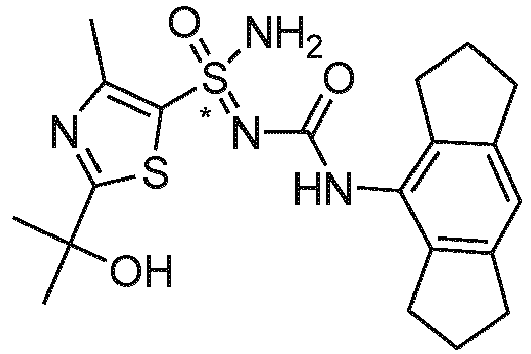
(S)-or (R)-N'-((1,2,3,5,6,7-hexahydro-s-indacen-4-yl)carbamoyl)-2-(2-hydroxypropan-2-yl)-4-methylthiazole-5-sulfonimidamide ChiralPak ID, 2*25cm, 5um 30% IPA in Hex 435.1 165 134b or 134a 
(R)-or (S)-N'-((1,2,3,5,6,7-hexahydro-s-indacen-4-yl)carbamoyl)-2-(2-hydroxypropan-2-yl)-4-methylthiazole-5-sulfonimidamide ChiralPak ID, 2*25cm, 5um 30% IPA in Hex 435.1 166 130a or 130b 
(S)-or (R)-N'-((2-cyclopropyl-4-(difluoromethoxy)-6-isopropylphenyl)carbamoyl)-2-fluoro-4-(2-hydroxypropan-2-yl)benzenesulfonimidamide ChiralPak ID, 2*25cm, 5um 40% IPA in Hex 500.2 167 130b or 130a 
(R)-or (S)-N'-((2-cyclopropyl-4-(difluoromethoxy)-6-isopropylphenyl)carbamoyl)-2-fluoro-4-(2-hydroxypropan-2-yl)benzenesulfonimidamide ChiralPak ID, 2*25cm, 5um 40% IPA in Hex 500.2 168 212a or 212b 
(S)-or (R)-2-fluoro-N'-((8-fluoro-1,2,3,5,6,7-hexahydro-s-indacen-4-yl)carbamoyl)-5-(2-hydroxypropan-2-yl)benzenesulfonimidamide ChiralPak ID, 2*25cm, 5um 40% EtOH in Hex 450.2 169 212b or 212a 
(S)-or (R)-2-fluoro-N'-((8-fluoro-1,2,3,5,6,7-hexahydro-s-indacen-4-yl)carbamoyl)-5-(2-hydroxypropan-2-yl)benzenesulfonimidamide ChiralPak ID, 2*25cm, 5um 40% EtOH in Hex 450.2 170 205a or 205b 
(R)-or (S)-3-fluoro-N'-((8-fluoro-1,2,3,5,6,7-hexahydro-s-indacen-4-yl)carbamoyl)-5-(2-hydroxypropan-2-yl)benzenesulfonimidamide Chiral ART Cellulose-SB, 2*25cm, 5um 30% EtOH in Hex 450.2 171 205a or 205b 
(S)-or (R)-3-fluoro-N'-((8-fluoro-1,2,3,5,6,7-hexahydro-s-indacen-4-yl)carbamoyl)-5-(2-hydroxypropan-2-yl)benzenesulfonimidamide Chiral ART Cellulose-SB, 2*25cm, 5um 40% EtOH in Hex 450.2 172 143a or 143b 
(S)-or (R)-N'-((4-(difluoromethoxy)-2,6-diisopropylphenyl)carbamoyl)-5-(2-hydroxypropan-2-yl)-4-methylthiophene-2-sulfonimidamide ChiralPak ID, 2*25cm, 5um 30% EtOH in Hex 504.2 173 143b or 143a 
(R)-or (S)-N'-((4-(difluoromethoxy)-2,6-diisopropylphenyl)carbamoyl)-5-(2-hydroxypropan-2-yl)-4-methylthiophene-2-sulfonimidamide ChiralPak ID, 2*25cm, 5um 30% EtOH in Hex 504.2 174 206a or 206b 
(S)-or (R)-4-fluoro-N'-((8-fluoro-1,2,3,5,6,7-hexahydro-s-indacen-4-yl)carbamoyl)-3-(2-hydroxypropan-2-yl)benzenesulfonimidamide ChiralPak ID, 2*25cm, 5um 30% EtOH in Hex(8m M NH3. MeOH) 450.2 175 206b or 206a 
(R)-or (S)-4-fluoro-N'-((8-fluoro-1,2,3,5,6,7-hexahydro-s-indacen-4-yl)carbamoyl)-3-(2-hydroxypropan-2-yl)benzenesulfonimidamide ChiralPak ID, 2*25cm, 5um 30% EtOH in Hex(8m M NH3. MeOH) 450.2 176 108a or 108b 
(S)-or (R)-N'-((8-fluoro-1,2,3,5,6,7-hexahydro-s-indacen-4-yl)carbamoyl)-2-(2-hydroxypropan-2-yl)-4-methylthiazole-5-sulfonimidamide ChiralPak IG, 2*25cm, 5um 30% IPA in Hex 453.1 177 108b or 108a 
(R)-or (S)-N'-((8-fluoro-1,2,3,5,6,7-hexahydro-s-indacen-4-yl)carbamoyl)-2-(2-hydroxypropan-2-yl)-4-methylthiazole-5-sulfonimidamide ChiralPak IG, 2*25cm, 5um 30% IPA in Hex 453.1 178 202a or 202b 
(S)-or (R)-3-fluoro-N'-((1,2,3,5,6,7-hexahydro-s-indacen-4-yl)carbamoyl)-4-(2-hydroxypropan-2-yl)benzenesulfonimidamide Chiral ART Cellulose-SB, 2*25cm, 5um 50% EtOH in Hex(8m M NH3. MeOH) 432.2 179 202b or 202a 
(R)-or (S)-3-fluoro-N'-((1,2,3,5,6,7-hexahydro-s-indacen-4-yl)carbamoyl)-4-(2-hydroxypropan-2-yl)benzenesulfonimidamide Chiral ART Cellulose-SB, 2*25cm, 5um 50% EtOH in Hex(8m M NH3. MeOH) 432.2 180 116a or 116b 
(S)-or (R)-N'-((8-fluoro-1,2,3,5,6,7-hexahydro-s-indacen-4-yl)carbamoyl)-4-(2-hydroxypropan-2-yl)-N-methylthiophene-2-sulfonimidamide ChiralPak IG, 2*25cm, 5um 30% EtOH in Hex 452.1 181 116b or 116a 
(R)-or (S)-N'-((8-fluoro-1,2,3,5,6,7-hexahydro-s-indacen-4-yl)carbamoyl)-4-(2-hydroxypropan-2-yl)-N-methylthiophene-2-sulfonimidamide ChiralPak IG, 2*25cm, 5um 30% EtOH in Hex 452.1 182 173a or 173b 
(S)-or (R)-N'-((4-cyano-2,6-diisopropylphenyl)carbamoyl)-3-fluoro-5-(2-hydroxypropan-2-yl)thiophene-2-sulfonimidamide ChiralPak ID, 2*25cm, 5um 15% EtOH in Hex(0.1 %DEA) 467.2 183 173b or 173a 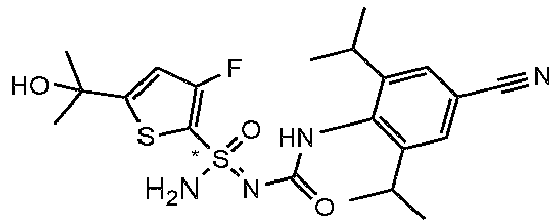
(R)-or (S)-N'-((4-cyano-2,6-diisopropylphenyl)carbamoyl)-3-fluoro-5-(2-hydroxypropan-2-yl)thiophene-2-sulfonimidamide ChiralPak ID, 2*25cm, 5um 15% EtOH in Hex(0.1 %DEA) 467.2 184 174a or 174b 
(S)-or (R)-3-cyano-N'-((4-cyano-2,6-diisopropylphenyl)carbamoyl)-5-(2-hydroxypropan-2-yl)benzenesulfonimidamide ChiralPak IG, 2*25cm, 5um 15% EtOH in Hex(0.1 %DEA) 468.2 185 174b or 174a 
(R)-or (S)-3-cyano-N'-((4-cyano-2,6-diisopropylphenyl)carbamoyl)-5-(2-hydroxypropan-2-yl)benzenesulfonimidamide ChiralPak IG, 2*25cm, 5um 15% EtOH in Hex(0.1 %DEA) 468.2 186 223a or 223b 
(S)-or (R)-N'-((4-cyano-2,6-diisopropylphenyl)carbamoyl)-5-(2-hydroxypropan-2-yl)thiophene-2-sulfonimidamide ChiralPak ID, 2*25cm, 5um 30% EtOH in Hex(0.1 %DEA) 449.2 187 223b or 223a 
(R)-or (S)-N'-((4-cyano-2,6-diisopropylphenyl)carbamoyl)-5-(2-hydroxypropan-2-yl)thiophene-2-sulfonimidamide ChiralPak ID, 2*25cm, 5um 30% EtOH in Hex(0.1 %DEA) 449.2 188 158a or 158b 
(S)-or (R)-N'-((4-cyano-2,6-diisopropylphenyl)carbamoyl)-3-(hydroxymethyl)-4-(2-hydroxypropan-2-yl)benzenesulfonimidamide ChiralPak ID, 2*25cm, 5um 30% EtOH in Hex(0.1 %DEA) 473.2 189 158b or 158a 
(R)-or (S)-N'-((4-cyano-2,6-diisopropylphenyl)carbamoyl)-3-(hydroxymethyl)-4-(2-hydroxypropan-2-yl)benzenesulfonimidamide ChiralPak ID, 2*25cm, 5um 30% EtOH in Hex(0.1 %DEA) 473.2 190 220a or 220b 
(S)-or (R)-N'-((8-cyano-1,2,3,5,6,7-hexahydro-s-indacen-4-yl)carbamoyl)-4-(hydroxymethyl)-2-(2-hydroxypropan-2-yl)thiazole-5-sulfonimidamide ChiralPak IF, 2*25cm, 5um MeOH (0.1%D EA) 476.1 191 220b or 220a 
(R)-or (S)-N'-((8-cyano-1,2,3,5,6,7-hexahydro-s-indacen-4-yl)carbamoyl)-4-(hydroxymethyl)-2-(2-hydroxypropan-2-yl)thiazole-5-sulfonimidamide ChiralPak IF, 2*25cm, 5um MeOH (0.1%D EA) 476.1 192 157a or 157b 
(S)-or (R)-N'-((4-cyano-2,6-diisopropylphenyl)carbamoyl)-4-(hydroxymethyl)-2-(2-hydroxypropan-2-yl)thiazole-5-sulfonimidamide ChiralPak IC, 2*25cm, 5um 15% EtOH in Hex 480.2 193 157b or 157a 
(R)-or (S)-N'-((4-cyano-2,6-diisopropylphenyl)carbamoyl)-4-(hydroxymethyl)-2-(2-hydroxypropan-2-yl)thiazole-5-sulfonimidamide ChiralPak IC, 2*25cm, 5um 15% EtOH in Hex 480.2 194 161a or 161b 
(S)-or (R)-N'-((4-cyano-3-fluoro-2,6-diisopropylphenyl)carbamoyl)-4-(hydroxymethyl)-2-(2-hydroxypropan-2-yl)thiazole-5-sulfonimidamide ChiralPak IC, 2*25cm, 5um 15% EtOH in Hex 498.2 195 161b or 161a 
(R)-or (S)-N'-((4-cyano-3-fluoro-2,6-diisopropylphenyl)carbamoyl)-4-(hydroxymethyl)-2-(2-hydroxypropan-2-yl)thiazole-5-sulfonimidamide ChiralPak IC, 2*25cm, 5um 15% EtOH in Hex 498.2 196 165a or 165b 
(S)-or (R)-N'-((4-cyano-2,6-diisopropylphenyl)carbamoyl)-4-(methylsulfonyl)benzenesulfonimida mide ChiralPak IG, 2*25cm, 5um 30% EtOH in Hex(0.1 %DEA) 463.1 197 165b or 165a 
(R)-or (S)-N'-((4-cyano-2,6-diisopropylphenyl)carbamoyl)-4-(methylsulfonyl)benzenesulfonimida mide ChiralPak IG, 2*25cm, 5um 30% EtOH in Hex(0.1 %DEA) 463.1 198 172a or 172b 
N'-((4-cyano-2,6-dii sopropylphenyl)carbamoyl)-3,5- bis(2-hydroxypropan-2-yl)benzenesulfonimidamide ChiralPak IC, 2*25cm, 5um 15% EtOH in Hex(0.1 %DEA) 501.2 199 172b or 172a 
N'-((4-cyano-2,6-dii sopropylphenyl)carbamoyl)-3,5- bis(2-hydroxypropan-2-yl)benzenesulfonimidamide ChiralPak IC, 2*25cm, 5um 15% EtOH in Hex(0.1 %DEA) 501.2 200 106a or 106b 
(R)-or (S)-N'-(8-fluoro-1,2,3,5,6,7-hexahydro-s-indacen-4-ylcarbamoyl)-2-(2-hydroxypropan-2-yl)thiazole-5-sulfonimidamide ChiralPak AD-H, 2*25cm, 5um 25% EtOH in CO2 439.2 201 106b or 106a 
(S)-or (R)-N'-(8-fluoro-1,2,3,5,6,7-hexahydro-s-indacen-4-ylcarbamoyl)-2-(2-hydroxypropan-2-yl)thiazole-5-sulfonimidamide ChiralPak AD-H, 2*25cm, 5um 25% EtOH in CO2 439.2 202 136a or 136b 
(S)-or (R)-N'-(1,2,3,5,6,7-hexahydro-s-indacen-4-ylcarbamoyl)-4-(2-hydroxypropan-2-yl)furan-2-sulfonimidamide Chiral ART Cellulose-SB, 2*25cm, 5um 20% EtOH in Hex(0.2 %DEA) 404.2 203 136b or 136a 
(R)-or (S)-N'-(1,2,3,5,6,7-hexahydro-s-indacen-4-ylcarbamoyl)-4-(2-hydroxypropan-2-yl)furan-2-sulfonimidamide Chiral ART Cellulose-SB, 2*25cm, 5um 20% EtOH in Hex(0.2 %DEA) 404.2 204 183a or 183b 
(R)-or (S)-N'-(1,2,3,5,6,7-hexahydro-s-indacen-4-ylcarbamoyl)-4-(2-hydroxypropan-2-yl)thiophene-2-sulfonimidamide ChiralPak ID, 2*25cm, 5um 20% EtOH in Hex(0.1 %DEA) 418.1 (M-1) 205 183a or 183b 
(S)-or (R)-N'-(1,2,3,5,6,7-hexahydro-s-indacen-4-ylcarbamoyl)-4-(2-hydroxypropan-2-yl)thiophene-2-sulfonimidamide ChiralPak ID, 2*25cm, 5um 20% EtOH in Hex(0.1 %DEA) 418.1 (M-1) 206 176a or 176b 
(S)-or (R)-N'-(8-fluoro-1,2,3,5,6,7-hexahydro-s-indacen-4-ylcarbamoyl)-4-(2-hydroxypropan-2-yl)thiophene-2-sulfonimidamide ChiralPak IG, 2*25cm, 5um 30% EtOH in Hex 438.2 207 176b or 176a 
(R)-or (S)-N'-(8-fluoro-1,2,3,5,6,7-hexahydro-s-indacen-4-ylcarbamoyl)-4-(2-hydroxypropan-2-yl)thiophene-2-sulfonimidamide ChiralPak IG, 2*25cm, 5um 30% EtOH in Hex 438.2 - Example 77: MS-ESI: 421.1 (M+1). 1H NMR (400 MHz, DMSO-d 6) δ 8.41 (br s, 1H), 7.74 (br s, 2H), 7.68 (s, 1H), 6.87 (s, 1H), 5.36 (s, 1H), 3.02 - 2.50 (m, 8H), 2.10 - 1.80 (m, 4H), 1.48 (s, 6H).
- Example 200: MS-ESI: 439.2 (M+1). 1H NMR (400 MHz, DMSO-d 6) δ 8.38 (br, 1H), 8.02 (s, 1H), 7.75 (br, 1H), 6.27 (s, 1H), 2.81 (t, J= 7.6 Hz, 4H), 2.70 (t, J= 6.8 Hz, 4H), 2.02-1.95 (m, 4H), 1.50 (s, 6H).
- Example 203: MS-ESI: 404.2 (M+1). 1H NMR (300 MHz, DMSO-d 6) δ 8.42 (br s, 1H), 7.76 (s, 1H), 7.72 (s, 2H), 7.01 (s, 1H), 6.88 (s, 1H), 5.11 (s, 1H), 2.90 - 2.72 (m, 4H), 2.72 - 2.60 (m, 4H), 2.10 - 1.80 (m, 4H), 1.46 (s, 6H).
- Example 205: MS-ESI: 418.1 (M-1). 1H NMR (400 MHz, DMSO-d 6) δ 8.39 (br s, 1H), 7.68 (s, 2H), 7.63 (s, 1H), 7.59 (s, 1H), 6.88 (s, 1H), 5.23 (s, 1H), 2.95 - 2.75 (m, 4H), 2.75 - 2.60 (m, 4H), 2.05 - 1.80 (m, 4H), 1.43 (s, 6H).
- Example 206: MS-ESI: 438.2 (M+1). 1H NMR (300 MHz, DMSO-d 6) δ 8.41 (br s, 1H), 7.65 (s, 2H), 7.59 (s, 1H), 7.55 (s, 1H), 5.20 (s, 1H), 2.90 - 2.60 (m, 8H), 2.10 - 1.80 (m, 4H), 1.39 (s, 6H).
-

-

- 4,5-Dichlorothiophene-2-sulfonamide (50 mg, 0.22 mmol) was dissolved in anhydrous CH2Cl2 (2 mL). Triethylamine (0.090 mL, 0.65 mmol) and TBSCl (38 mg, 0.25 mmol) were added and the resulting mixture was stirred overnight at room temperature, or until the reaction was complete as indicated by LCMS(Method F: m/Z=424.1 [M+DMSO+H]+, retention time = 3.70 min). The reaction mixture was used in the next step as is.
- In an oven-dried vial under nitrogen, a solution of PPh3Cl2 (143 mg, 0.44 mmol) was prepared in dichloroethane (1.5 mL). Triethylamine (0.120 mL, 0.86 mmol) was introduced in a steady stream via syringe at 0 °C. The reaction mixture was stirred at room temperature for 10 min. The reaction mixture was then cooled in an ice / water bath for 2 min and the reaction mixture of TBS protected sulfonamide (prepared in 2 mL DCM) from
step 1 was introduced via syringe rapidly drop by drop (addition time < 30 seconds). The resulting mixture was stirred at 0 °C for 30 min, at which time anhydrous ammonia was bubbled into the reaction mixture for 45 seconds. The suspension thus formed was stirred in an ice / water bath for 30 min and then warmed to room temperature and centrifuged to remove solids. The supernatant was concentrated in vacuo and dried under high vacuum for 30 min. - To the crude reaction mixture from
step 2 was added anhydrous THF (1.5 mL) and the resulting solution was stirred in an ice / water bath for 5 min, at which time NaH (17 mg, 0.44 mmol) was added. After 2 min stirring, a solution of 5-fluoro-2-isocyanato-1,3-diisopropylbenzene (36.5 mg, 0.165 mmol) in THF (3 ml) was added dropwise at 0 °C. The resulting mixture was brought to room temperature and stirred for 30 min to give a mixture of crude products. LC-MS (Method F): m/Z=451.8 [M+H]+, retention time = 6.18 min; for TBS-protected product, 566.4 [M+H]+, retention time = 9.25 min. - To the reaction mixture from
step 3 was carefully added 4N HCl in dioxane (0.3 mL) and the resulting mixture was stirred at room temperature for approximately 30 min until the completion of reaction, as determined by LCMS analysis (Method F: 451.8 [M+H]+, retention time = 6.18 min). The reaction mixture was then concentrated in vacuo. DMSO (0.5 mL) was added to the residue and the resulting solution was purified on a prep-HPLC to afford the title compound. LC-MS: 451 [M+H]+.Table 20. Examples in the following table were prepared using similar procedures as described in Example 208 above starting from appropriate sulfonamides. Example # Final Target Number Structure IUPAC Name Exact Mass [M+H]+ 209 219 
N'-((4-fluoro-2,6-diisopropylphenyl)carbamoyl)-1,3 -dimethyl- 1H-pyrazole-4-sulfonimidamide 396.05 210 217 
N'-((4-fluoro-2,6-diisopropylphenyl)carbamoyl) naphthalene-2-sulfonimidamide 428.17 211 216 
N'-((4-fluoro-2,6-diisopropylphenyl)carbamoyl)-2,3-dihydrobenzofuran-5-sulfonimidamide 420.07 212 215 
N'-((4-fluoro-2,6-diisopropylphenyl)carbamoyl)-[1,1'-biphenyl]-2-sulfonimidamide 454.28 213 218 
N'-((4-fluoro-2,6-diisopropylphenyl)carbamoyl)-2-(methoxymethyl)benzenesulfonimi damide 422.17 214 214 
2,5-dichloro-N'-((4-fluoro-2,6-diisopropylphenyl) carbamoyl)thiophene-3-sulfonimidamide 452.18 215 211 
N'-((4-fluoro-2,6-diisopropylphenyl) carbamoyl)pyridine-3-sulfonimidamide 379.24 216 210 
N'-((4-fluoro-2,6-diisopropylphenyl)carbamoyl) benzo[d][1,3]dioxole-5-sulfonimidamide 422.17 217 201 
N'-((4-fluoro-2,6-diisopropylphenyl) carbamoyl)-2,5-dimethylfuran-3-sulfonimidamide 396.40 218 200 
N'-((4-fluoro-2,6-diisopropylphenyl) carbamoyl)quinoline-3-sulfonimidamide 429.40 219 199 
N'-((4-fluoro-2,6-diisopropylphenyl)carbamoyl)-6,7-dihydro-5H-pyrrolo[1,2-a]imidazole-3-sulfonimidamide 408.40 220 198 
N'-((4-fluoro-2,6-diisopropylphenyl)carbamoyl)-5-methylpyridine-2-sulfonimidamide 393.40 -

-

- Into a 50-mL 3-necked round-bottom flask purged and maintained with nitrogen, was placed 1,2,3,5,6,7-hexahydrodicyclopenta[b,e]pyridin-8-amine (50 mg, 0.29 mmol) in THF (10 mL), to this was added NaH (60%wt. oil dispersion, 22.8 mg, 0.57 mmol) at 0 °C; and then phenyl chloroformate (67.4 mg, 0.43 mmol,) in THF (2.0 mL) was added dropwise at 0 °C. The resulting solution was stirred for 2 h at RT. This reaction solution was used for next step directly without any purification.
- Into a 50-mL 3-necked round-bottom flask purged and maintained with nitrogen, was placed N-(tert-butyldimethylsilyl)-4-(2-hydroxypropan-2-yl)-5-methylfuran-2-sulfonoimidamide (96 mg, 0.29 mmol) in THF (10 mL). To this was added NaH (60%wt. oil dispersion, 23.2 mg, 0.58 mmol) at 0 °C, followed by phenyl (1,2,3,5,6,7-hexahydrodicyclopenta[b,e]pyridin-8-yl)carbamate (127 mg, 0.43 mmol) crude in THF from via syringe rapidly drop by drop. The resulting mixture was stirred for 16 h at RT. The reaction was then quenched by the addition of 5.0 mL of water. The resulting solution was extracted with 4x10 ml of ethyl acetate. The combined organic layers were dried over anhydrous sodium sulfate and concentrated under vacuum. The residue was eluted from a silica gel column with ethyl acetate/petroleum ether (1;1). This resulted in 50 mg (38.4%) of the title compound as an off-white solid. MS-ESI: 533(M+1).
- Into a 50-mL round-bottom flask, was placed N-(tert-butyldimethylsilyl)-N'-((1,2,3,5,6,7 -hexahydrodicyclopenta[b,e]pyridin-8-yl)carbamoyl)-4-(2-hydroxypropan-2-yl)-5-methylfuran-2-sulfonimidamide (58 mg, 0.11 mmol) in THF (10 mL), to this was added TBAF (28.8 mg, 0.11 mmol). The resulting solution was stirred for 1 h at RT. The resulting mixture was concentrated under vacuum. The residue was eluted from a silica gel column with DCM/MeOH (10:1). The crude product was further purified by Prep-HPLC with the following conditions: Column: XBridge Prep
OBD C18 Column 19*250 mm, 5um; Mobile Phase A: water (10 mM NH4HCO3), Mobile Phase B: ACN; Flow rate: 25 mL/min; Gradient: 11% B to 40% B in 7 min; UV 254/210 nm; Rt: 6 min. This resulted in 25 mg (54.87%) of Example 221 as a white solid. MS-ESI: 419 (M+1). 1H NMR (400 MHz, DMSO-d 6, ppm) δ: 8.82 (s, 1H), 7.65 (s, 2H), 6.90 (s, 1H), 5.03 (s, 1H), 2.82-2.78 (m, 4H), 2.76-2.67 (m, 4H), 2.41 (s, 3H), 2.00-1.92 (m, 4H), 1.39 (s, 6H).Table 21. Examples in the following table were prepared using similar conditions as described in Example 221 and Scheme 31 from appropriate starting materials. Example # Final Target Number Structure IUPAC Name Exact Mass [M+H]+ 222 140 
N'-((3,5-diisopropylpyridin-4-yl)carbamoyl)-4-(2-hydroxypropan-2-yl)-5-methylfuran-2-sulfonimidamide 423 -

-

-

- Into a 100-mL round-bottom flask purged and maintained with an inert atmosphere of nitrogen, was placed tert-butyl N-[amino[2-(2-hydroxypropan-2-yl)-1,3-thiazol-5-yl]oxo-λ6-sulfanylidene]carbamate (1.39g, 4.32 mmol) in THF (50 mL). To this solution was added NaH (60%wt. oil dispersion, 518 mg, 13mmol) at 0 °C, followed by the addition of 3-isocyanato-2,4,5,6-tetrahydro-1H-cyclobuta[f]indene (800 mg, 4.32 mmol) in THF (5.0 mL) dropwise at 0 °C. The resulting solution was stirred for 14 h at RT. The reaction was then quenched by the addition of 100 mL of water. The resulting solution was extracted with 3x50 mL of DCM. The organic layers combined and dried over anhydrous Na2SO4, then concentrated. The residue was eluted from a silica gel column with ethyl acetate/petroleum ether (1:5 to 1:1). This resulted in 2.0 g (91%) of title compound as a light yellow solid. MS-ESI: 507 (M+1).
- Into a 100-mL round-bottom flask purged and maintained with an inert atmosphere of nitrogen, was placed tert-butyl(2-(2-hydroxypropan-2-yl)-N-((2,4,5,6-tetrahydro-1H-cyclobuta[f]inden-3-yl)carbamoyl) thiazole-5-sulfonimidoyl)carbamate (2.2 g, 4.34 mmol) in dioxane (40 mL). To this was added conc. HCl (8 mL,12 M) dropwise at 0 °C. The resulting solution was stirred for 14 h at RT. The resulting solution was diluted with 100 mL of water. The resulting solution was extracted with 3x50 mL of DCM. The organic layers combined and dried over anhydrous Na2SO4, then concentrated. The crude product was purified by HP-Flash with the following conditions: Column, C18 silica gel; mobile phase, ACN:H2O=25:75 increasing to ACN:H2O=55:45 within 25 ; Detector, UV 254 nm. This resulted in 1.5 g (85%) of Example 223. MS-ESI: 407 (M+1). 1H NMR (300 MHz, DMSO-d 6) δ 8.35 (s, 1H), 8.05 (s, 1H), 7.74 (s, 2H), 6.66 (s, 1H), 6.25 (s, 1H), 3.06 - 2.94 (m, 2H), 2.93 - 2.84 (m, 2H), 2.82 - 2.60 (m, 4H), 2.03 - 1.79 (m, 2H), 1.50 (s, 6H).
- Example 223 (1.5 g) was separated with the followed condition: Column: CHIRALPAK IG, 20*250 mm, 5 um; Mobile Phase A: CO2: 60, Mobile Phase B: MeOH-----Preparative: 40; Flow rate: 50 mL/min; 220 nm. The resulting solution was stirred for 20 min at 10 °C. This resulted in 546 mg (99%ee, 36.4%) of Example 224 (RTi: 3.47 min) as a white solid and 595 mg (99%ee, 39.6%) of Example 225 (RT2: 5.35 min) as a white solid. The absolute stereochemistry was tentatively assigned.
- Example 224: MS-ESI: 407.1 (M+1). 1H NMR (300 MHz, DMSO-d 6) δ 8.35 (s, 1H), 8.05 (s, 1H), 7.74 (s, 2H), 6.66 (s, 1H), 6.25 (s, 1H), 3.06 - 2.94 (m, 2H), 2.93 - 2.84 (m, 2H), 2.82 - 2.60 (m, 4H), 2.03 - 1.79 (m, 2H), 1.50 (s, 6H).
- Example 225: MS-ESI: 407.1 (M+1). 1H NMR (300 MHz, DMSO-d 6) δ 8.35 (s, 1H), 8.05 (s, 1H), 7.74 (s, 2H), 6.66 (s, 1H), 6.25 (s, 1H), 3.06 - 2.94 (m, 2H), 2.93 - 2.84 (m, 2H), 2.82 - 2.60 (m, 4H), 2.03 - 1.79 (m, 2H), 1.50 (s, 6H).

- The product10 g of Intermediate 28 was separated with the followed condition: Column: CHIRALPAK IC, 5*25 cm,5 um; Mobile Phase A:CO2 :55, Mobile Phase B: EtOH:HeX=1:1:45; Flow rate: 150 mL/min; UV 220 nm; Rti: 5.13 (Intermediate 28A); Rt2: 5.65 (Intermediate 28B). This resulted in 3 g (99.5% ee, 60%) of 28A, and 3 g (99.0 % ee, 60%) of 28B.
- Into a 100-mL round-bottom flask purged and maintained with an inert atmosphere of nitrogen, was placed intermediate 28A (>99% ee, 1.67 g, 5.20 mmol) in THF (50 mL), NaH (60% wt. oil dispersion, 624 mg, 15.6 mmol) was added at 0 °C, this was followed by the addition of 3-isocyanato-2,4,5,6-tetrahydro-1H-cyclobuta[f]indene (850 mg, crude) in THF (5 mL) dropwise at 0 °C. The resulting solution was stirred for 14 h at RT. The reaction was then quenched by the addition of 100 mL of water. The resulting solution was extracted with 3x100 mL of DCM. The organic layers combined and dried over anhydrous Na2SO4, then concentrated. This resulted in 2.2 g (83.5%) of title compound as a light yellow solid. MS-ESI: 507 (M+1).
- Into a 100-mL round-bottom flask purged and maintained with an inert atmosphere of nitrogen, was placed tert-butyl (S)-(2-(2-hydroxypropan-2-yl)-N-((2,4,5,6-tetrahydro-1H-cyclobuta[f] inden-3-yl)carbamoyl) thiazole-5-sulfonimidoyl)carbamate (2.2 g, 4.34 mmol) in dioxane (40 mL), to this was added conc. HCl (8 mL, 12M) dropwise at 0 °C. The resulting solution was stirred for 8 h below 10 °C. The resulting solution was diluted with 100 mL of water. The resulting solution was extracted with 3x100 mL of DCM. The organic layers combined and dried over anhydrous Na2SO4, then concentrated. The crude product was purified by HP-Flash with the following conditions: Column, C18 silica gel; mobile phase, MeCN:water=25:75 increasing to MeCN:water=55:45 within 30 min; Detector, UV 210 nm. This resulted in 1.37 g (77.3%) of Example 224 (99.4% ee) as a white solid. MS-ESI: 407 (M+1).
- 1H NMR (300 MHz, DMSO-d 6) δ 8.43 (s, 1H), 8.09 (s, 1H), 7.90 (s, 2H), 6.67 (s, 1H), 6.29 (s, 1H), 2.92 (d, J = 3.9 Hz, 2H), 2.89 (d, J = 3.9 Hz, 2H), 2.90 - 2.55 (m, 4H), 2.00 - 1.75 (m, 6H), 1.50 (s, 6H).
Table 22. Examples in the following table were prepared using similar conditions as described in Example 223- Route 1 and Scheme 3A from appropriate starting materials.Example # Final Target # Structure IUPAC Name Exact Mass [M+H]+ 226 329 
2-(2-Hydroxypropan-2-yl)-N'-(tricyclo[6.2.0.03,6]deca-1,3(6),7-trien-2-ylcarbamoyl)thiazole-5-sulfonimidamide 393 227 375 
N'-((1,2,3,5,6,7-hexahydro-s-indacen-4-yl-3,3,5,5-d4)carbamoyl)-2-(2-hydroxypropan-2-yl)thiazole-5-sulfonimidamide 425 228 376 
N'-((1,2,3,5,6,7-hexahydro-s-indacen-4-yl-1, 1,7,7-d4 )carbamoyl)-2-(2-hydroxypropan-2-yl)thiazole-5-sulfonimidamide 425 -

-

- Into a 50-mL round-bottom flask, was placed a solution of N-(tert-butyldimethylsilyl)-2-fluoro-4-methoxybenzene-1-sulfonoimidamide (139 mg, 0.44 mmol) in THF (5.0 mL). To this solution was added NaH (60%wt. oil dispersion, 35.2 mg, 0.44 mmol) at 0 °C.This was followed by the addition of 4-fluoro-8-isocyanato-1,2,3,5,6,7-hexahydro-s-indacene (95 mg, 0.44 mmol) in THF (5 mL) dropwise at RT. The resulting solution was stirred for 1 h at RT. The reaction was then quenched by the addition of 100 mL of water. The resulting solution was extracted with 3x50 mL of ethyl acetate. The organic layers combined and dried over anhydrous Na2SO4, and then concentrated. The residue was eluted from a silica gel column with ethyl acetate/petroleum ether (1:5 to 1:1). This resulted in 120 mg (51.2%) of the title compound as yellow oil. MS-ESI: 536 (M+1).
- Into a 50-mL round-bottom flask, was placed a solution of 1-[[(tert-butyldimethylsilyl)imino](2-fluoro-4- methoxybenzene)sulfinyl]-3-(8-fluoro-1,2,3,5,6,7-hexahydro-s-indacen-4-yl)urea (120 mg, 0.22 mmol) in ACN (5.0 mL), to this solution was added BBr3 (561 mg, 2.24 mmol) dropwise at 0 °C. The resulting solution was stirred for 2 h at RT. The reaction was then quenched by the addition of 5 mL of MeOH. The resulting mixture was concentrated. The crude product (100 mg) was purified by Prep-HPLC under the following conditions: Column, XBridge Prep OBD C18, 19*250 mm, 5 um; mobile phase: water (10 mM NH4HCO3) and ACN (25% to 43% ACN gradient in 7 min); Detector, UV. This resulted in 17.7 mg (19.4%) of Example 229 as a white solid. MS-ESI: 408 (M+1).
-

-

- Into a 50-mL round-bottom flask, was placed 2-(2-hydroxypropan-2-yl)-N'-((1-oxo-1,2,3,5,6,7-hexahydro-s-indacen-4-yl)carbamoyl)thiazole-5-sulfonimidamide (100 mg, 0.23 mmol) in ethanol (10 mL). To this solution was added NaBH4 (17.4 mg, 0.46 mmol) in portions at 0 °C. The resulting solution was stirred for 2 h at RT. The crude product (5 mL) was purified by Flash-Prep-HPLC with the following conditions: Column: XBridge Prep OBD C18 Column 30×150mm 5um; Mobile Phase A: water (10 mM NH4HCO3), Mobile Phase B: ACN; Flow rate: 60 mL/min; Gradient: 10% to 28% B in 7 min; 210/254 nm; Rt: 6.00 min. This resulted in 180 mg of the title compound (Example 230) as a solid. MS-ESI: 437.1 (M+1).
- 1H NMR (400 MHz, DMSO-d 6) δ 8.51 (br s, 1H), 8.04 (s, 1H), 7.82 (br s, 2H), 6.97 (s, 1H), 6.28 (s, 1H), 5.07 (d, J = 5.6 Hz, 1H), 5.05-4.85 (m, 1H),2.95-2.75 (m, 2H), 2.75-50 (m, 4H), 2.35-2.15 (m, 1H), 2.00-1.80 (m, 2H), 1.80-1.60 (m, 1H), 1.51 (s, 6H).
-

-

- Into a 50-mL round-bottom flask purged and maintained with an inert atmosphere of nitrogen, was placed 1-[amino[4-(bromomethyl)phenyl]oxo-λ6-sulfanylidene]-3-(1,2,3,5,6,7-hexahydro-s-indacen-4-yl)urea(50 mg, 0.11 mmol) in THF(5 mL). To this solution was added DIEA (28.4 mg, 0.22mmol) and 3-methoxyazetidine(10.5 mg, 0.12 mmol) atRT. The resulting solution was stirred for 1 h at 65 °C. The resulting mixture was concentrated. The crude product was purified by Prep-HPLC with the following conditions: Column: XBridge Prep
C18 OBD Column 19×100mm Sum 13nm; Mobile Phase A: water (10 mM NH4HCO3mM+0.1%NH3H2O), Mobile Phase B: ACN; Flow rate: 25 mL/min; Gradient: 30% to 37% B in 9.5 min; 254/210 nm; Rt: 9.62 min This resulted in 5 mg of Example 231 as a white solid. MS-ESI: 455 (M+1). 1H NMR (300MHz , DMSO-d 6) δ: 8.27 (br s, 1H), 7.81 (d, J = 8.4 Hz, 2H), 7.45 (d, J = 8.4 Hz, 2H), 7.34 (s, 2H), 6.85 (s, 1H), 4.02-3.94 (m, 1H), 3.67 (s, 2H), 3.51-3.46 (m, 2H), 3.14(s, 3H), 2.95-2.80 (m, 2H), 2.78-2.73 (m, 4H), 2.69-2.63 (m, 4H), 1.96-1.88 (m, 4H).Table 23. Examples in the following table were prepared using similar conditions as described in Example 231 and Scheme 33A from appropriate starting materials. Example # Final Target # Structure IUPAC Name Exact Mass [M+H]+ 232 341 
N'-(1,2,3,5,6,7-hexahydro-s-indacen-4-ylcarbamoyl)-4-(((2-methoxyethyl)(methyl)amino)methyl) benzenesulfonimidamide 457 233 342 
N'-(1,2,3,5,6,7-hexahydro-s-indacen-4-ylcarbamoyl)-4-(hydroxymethyl)benzenesulfonimidam ide 386 234 345 
N'-(1,2,3,5,6,7-hexahydro-s-indacen-4-ylcarbamoyl)-4-(morpholinomethyl)benzenesulfonimi damide 455 235 346 
4-((3,3-Difluoropyrrolidin-1- yl)methyl)-N'-(1,2,3,5,6,7-hexahydro-s-indacen-4-ylcarbamoyl)benzenesulfonimidamide 475 236 347 
N'-(1,2,3,5,6,7-hexahydro-s-indacen-4-ylcarbamoyl)-4-(pyrrolidin-1- ylmethyl)benzenesulfonimidamide 439 237 348 
4-(Azetidin-1-ylmethyl)-N'-(1,2,3,5,6,7-hexahydro-s-indacen-4-ylcarbamoyl)benzenesulfonimidamide 425 238 403 
4-((Allyl(methyl)amino)methyl)-N'-(1,2,3,5,6,7-hexahydro-s-indacen-4-ylcarbamoyl)benzenesulfonimidamide 439 239 402 
N'-(1,2,3,5,6,7-hexahydro-s-indacen-4-ylcarbamoyl)-4-((methyl(prop-2-ynyl)amino)methyl)benzenesulfonimid amide 437 240 350 
4-(((Cyclopropylmethyl)(methyl)amino) methyl)-N'-(1,2,3,5,6,7-hexahydro-s-indacen-4-ylcarbamoyl)benzenesulfonimidamide 453 241 322 
4-(((2,2-Difluoroethyl)(methyl)amino)methyl)-N'-(1,2,3,5,6,7-hexahydro-s-indacen-4-ylcarbamoyl)benzenesulfonimidamide 463 242 351 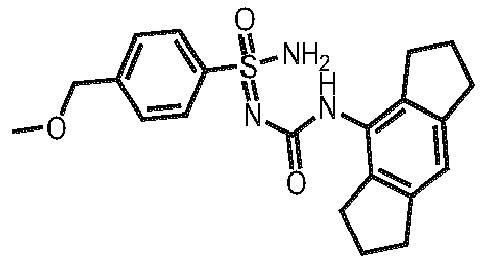
N'-(1,2,3,5,6,7-hexahydro-s-indacen-4-ylcarbamoyl)-4-(methoxymethyl)benzenesulfonimida mide 400 243 358 
4-(Aminomethyl)-N'-(1,2,3,5,6,7-hexahydro-s-indacen-4-ylcarbamoyl)benzenesulfonimidamide 385 -

-

- Into a 40-mL sealed tube purged and maintained with an inert atmosphere of nitrogen, was placed 1-[amino[4-(bromomethyl)phenyl]oxo-λ6-sulfanylidene]-3-(1,2,3,5,6,7-hexahydro-s-indacen-4-yl)urea (200 mg, 0.45 mmol) in THF (10 mL), to this stirred solution was added DIEA (173 mg, 1.34 mmol) and pyrrolidin-2-one (114 mg, 1.34 mmol) at RT. The resulting solution was stirred for 3 h at 60 °C. The resulting mixture was concentrated. The crude product was purified by Prep-HPLC with the following conditions: Column, XBridge Prep OBD C18, 30x150 mm 5 um; mobile phase, water (10 mM NH4HCO3) and ACN (25% to 44% ACN gradient in 7 min); Detector, UV. This resulted in 10 mg (4.95%) of Example 244 as a white solid. MS-ESI: 453 (M+1).
- 1H NMR (400 MHz, DMSO-d 6 ) δ: 8.26 (br s, 1H), 7.83 (d, J = 8.0 Hz, 2H), 7.40 (d, J = 8.0 Hz, 2H), 7.27 (br s, 2H), 6.85 (s, 1H), 4.43 (s, 2H), 3.26-3.22 (m, 2H), 2.78-2.74 (m, 4H), 2.65-2.61 (m, 4H), 2.30 (t, J = 8.20 Hz, 2H), 1.98-1.89 (m, 6H).
-
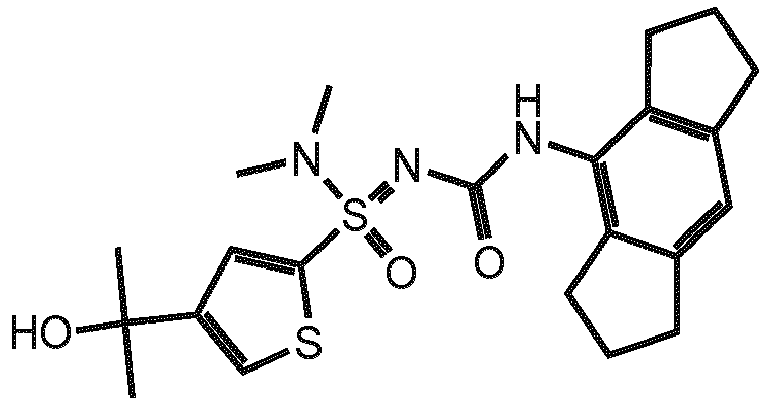
-

- Into a 50-mL 3-necked round-bottom flask, was placed a solution of 4-(2-hydroxypropan-2-yl)-N,N- dimethylthiophene-2-sulfonoimidamide (125 mg, 0.50 mmol) in THF (2.0 mL). To this was added NaH (60%wt. oil dispersion, 30.2 mg, 0.75 mmol) in several batches at 0 °C in an ice/water bath. To the mixture was added 4-isocyanato-1,2,3,5,6,7-hexahydro-s-indacene (110 mg, 0.55 mmol) at 0 °C in an ice/water bath. The resulting solution was stirred for 30 min at 0 °C in a water/ice bath. The reaction was then quenched by the addition of NH4Cl (aq.). The resulting solution was extracted with ethyl acetate and the organic layers combined, the organic layer was dried over anhydrous sodium sulfate and concentrated under vacuum. The crude product was purified by Prep-HPLC with the following conditions: X Bridge Prep CisOBD, 19*
150mm 5 um; mobile phase, water (10 mM NH4HCO3) and ACN (10% to 80% in 6 min); Detector, UV 254 nm. This resulted in 90 mg (39.9%) of Example 245 as a white powder. MS-ESI: 448.2 (M+1). 1H NMR (DMSO-d6 , 300 MHz): δ 8.60 (br s, 1H), 7.71 (s, 1H), 7.58 (br s, 1H), 6.88 (s, 1H), 5.21 (s, 1H), 2.86-2.70 (m, 8H), 2.70 (s, 6H), 1.98-1.90 (m, 4H), 1.3 (s, 6H). -

-

- Into a 50-mL 3-necked round-bottom flask purged and maintained with an inert atmosphere of nitrogen, was placed 4-(2-hydroxypropan-2-yl)-N-methylthiophene-2-sulfonoimidamide (106 mg, 0.45 mmol) in THF (4.0 mL). This was followed by the addition of NaH (60%wt. oil dispersion, 23.5 mg, 0.59 mmol) in several batches at 0 °C in a water/ice bath. To this was added a solution of 4-isocyanato-1,2,3,5,6,7-hexahydro-s-indacene (99.1 mg, 0.50 mmol) in THF (2.0 mL) dropwise with stirring at 0 °C. The resulting solution was stirred for 30 min at 0 °C in a water/ice bath. The reaction was then quenched by the addition of water/ice. The resulting solution was extracted with ethyl acetate and the organic layers combined, the organic layer was dried over anhydrous sodium sulfate and concentrated under vacuum. The crude product was purified by Prep-HPLC with the following conditions: Column, X Bridge Shield RP18 OBD, 19x250 mm, 10 um; mobile phase, water (10 mM NH4HCO3+0.1%NH3.H2O) and ACN (43% to 67% ACN gradient in 6 min); Detector, UV 254 nm. This resulted in 80 mg (40.79%) of Example 246 as a white solid. MS-ESI: 434.15 (M+1). 1H NMR (DMSO-d6 , 300 MHz): δ 8.55 (br s, 1H) 7.65 (s, 1H), 7.59 (s, 1H), 7.53 (s, 1H), 6.89 (s, 1H), 5.22 (s, 1H) 2.63-2.85 (m, 8H) 2.49 (s, 3H) 2.00-1.80 (m, 4H) 1.31 (s, 6H).
Table 24. Examples in the following table were prepared using similar conditions as described in Example 246 and Scheme 4 from appropriate starting materials.Example # Final Target Number Structure IUPAC Name Exact Mass [M+H]+ 247 339 
N'-((1,2,3,5,6,7-hexahydro-s-indacen-4-yl)carbamoyl)-2-(2-hydroxypropan-2-yl)-N-methylthiazole-5-sulfonimidamide 435 -

-

- Into a 50-mL round-bottom flask, was placed tert-butyl N-([[(1,2,3,5,6,7-hexahydro-s-indacen-4-yl) carbamoyl]imino][2-(2-hydroxypropan-2-yl)-1,3-thiazol-5-yl]oxo-λ6-sulfanyl)carbamate (200 mg, 0.38 mmol) in THF (10 mL), to this stirred solution was added CH3I (60 mg, 0.42 mmol) dropwise at 0 °C. The resulting solution was stirred for 1 d at RT. The resulting mixture was concentrated. This resulted in 100 mg (49%) of the title compound as a solid. MS-ESI: 535 (M+1).
- Into a 25-mL round-bottom flask, was placed tert-butyl N-([[(1,2,3,5,6,7-hexahydro-s-indacen-4-yl) (methyl)carbamoyl]imino][2-(2-hydroxypropan-2-yl)-1,3-thiazol-5-yl]oxo-λ6-sulfanyl)carbamate (100 mg) in HCl (4M, 10 mL). The resulting solution was stirred for 5 h at RT. The crude product was purified by Prep-HPLC with the following conditions: Column, XBridge Prep C18 OBD, 5um, 19*150 mm; mobile phase, water (10 mM NH4HCO3mM) and ACN (22% to 53% ACN gradient in 7 min); Detector, UV. This resulted in 15.7 mg of Example 248 as a solid. MS-ESI: 435 (M+1).
Table 25. Example 249 was isolated as a side product from the preparation of Example 248. Example # Final Target Number Structure IUPAC Name Exact Mass [M+H]+ 249 406 
N'-((1,2,3,5,6,7-hexahydro-s-indacen-4-yl)(methyl)carbamoyl)-2-(2-hydroxypropan-2-yl)-N-methylthiazole-5-sulfonimidamide 449 -

-

- Into a 50-mL round-bottom flask purged and maintained with an inert atmosphere of nitrogen, was placed a mixture of N'-((1,2,3,5,6,7-hexahydro-s-indacen-4-yl)carbamoyl)-2-(2-hydroxypropan-2-yl)thiazole-5- sulfonimidamide (200 mg, 0.48 mmol) and TEA (96 mg, 0.96 mmol) in DCM (20 mL). To the stirred solution, Ac2O (74 mg, 0.72 mmol) was added dropwise at 0°C. The resulting solution was stirred overnight. Then 80 mg of the product was obtained by Prep-HPLC with the following conditions: Column: XBridge Prep
C18 OBD Column 19×150 mm 5um; Mobile Phase A: water (10 mM NH4HCO3), Mobile Phase B: ACN; Flow rate: 25 mL/min; Gradient: 18% B to 41% B in 7 min; 254/210 nm; Rt: 5.05 min, this resulted in 100 mg of the Example 250 as a white solid. MS-ESI: 462.14 (M+1). 1H NMR (300 MHz, CD3OD-d4 ) δ: 8.11 (s, 1H), 6.89 (s, 1H), 2.92 - 2.69 (m, 8H), 2.09 - 2.01 (m, 4H), 1.99 (s, 3H), 1.60 (d, J = 2.3 Hz, 6H). -

-

- Into a 8-mL round-bottom flask, was placed a solution of 1-[amino([4-[(methylamino)methyl]-phenyl])oxo-λ6-sulfanylidene]-3-(1,2,3,5,6,7-hexahydro-s-indacen-4-yl)urea (100 mg, 0.25 mmol), methyl 4-chloro-4-oxobutanoate (37.8 mg, 0.25 mmol) in DMF (10 mL), to this stirred solution was added HATU (191 mg, 0.50 mmol) and DIEA (64.9 mg, 0.50 mmol). The resulting solution was stirred for 20 min at RT. The crude product was purified by Prep-HPLC with the following conditions: Column, XBridge Shield RP18 OBD, 19*250 mm,10 um; mobile phase, water (10 mM NH4HCO3) and ACN (15% to 75% ACN gradient in 7 min); Detector, UV 250 nm. This resulted in 4.2 mg (3.27%) of Example 251 as a white solid. MS-ESI: 513 (M+1). 1H NMR (300MHz, CD3OD-d 4 ) δ: 8.02-7.94 (m, 2H), 7.49-7.41 (m, 2H), 6.89 (s, 1H), 4.68 (s, 2H), 3.68 (s, 3H), 3.04 (s, 3H), 2.85-2.80 (m, 4H), 2.75-2.60 (m, 8H), 2.03-1.97 (m, 4H).
-

-

- Into a 50-mL round-bottom flask, was placed a solution of methyl 3-[([4-[amino([[(1,2,3,5,6,7-hexahydro-s-indacen-4-yl)carbamoyl]imino])oxo-λ6-sulfanyl]phenyl]methyl)(methyl)-carbamoyl]propanoate (80 mg, 0.16 mmol) in THF (3.0 mL) and H2O (3.0 mL), to the stirred solution was added KOH (17.5 mg, 0.31 mmol). The resulting solution was stirred for 120 min at RT. The crude product was purified by Prep-HPLC with the following conditions: Column, XBridge Shield RP18 OBD, 19*250 mm,10 um; mobile phase, water (10 mM NH4HCO3) and ACN (15% to 75% gradient in 7 min); Detector, UV250 nm. This resulted in 39 mg (50%) of Example 252 as a white solid. MS-ESI: 499 (M+1). 1H-NMR (300 MHz, CD3OD-d 4 ) δ: 8.10-7.80 (m, 2H), 7.55-7.30 (m, 2H), 6.89 (s, 1H), 4.68 (s, 2H), 3.04 (s, 3H), 2.90-2.60 (m, 12H), 2.10-1.80 (m, 4H).
-

-

-
Table 26. Examples in the following table were prepared using similar conditions as described in Example 4 - route 1 andScheme 2 from appropriate starting materials.Example # Final Target Number Structure IUPAC Name Exact Mass [M+H]+ 254 308 
N'-((3-cyano-2,6-diisopropylphenyl)carbamoyl)-5-(2-hydroxypropan-2-yl)thiophene-2-sulfonimidamide 449 255 311 
N'-((6-ethyl-1-methyl-1H-indazol-7-yl)carbamoyl)-5-(2-hydroxypropan-2-yl)thiazole-2-sulfonimidamide 423 256 312 
N'-((6-ethyl-2-methyl-2H-indazol-7-yl)carbamoyl)-5-(2-hydroxypropan-2-yl)thiazole-2-sulfonimidamide 423 257 327 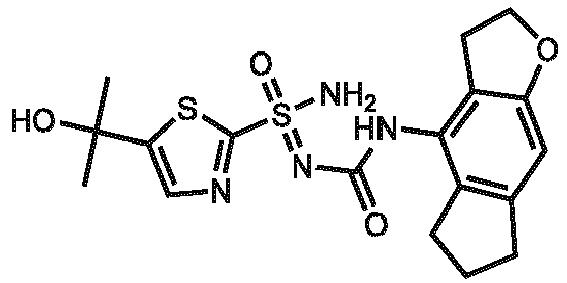
5-(2-hydroxypropan-2-yl)-N'-((3,5,6,7-tetrahydro-2H-indeno[5,6-b]furan-4-yl)carbamoyl)thiazole-2-sulfonimidamide 423 258 326 
5-(2-Hydroxypropan-2-yl)-N'-((3,5,6,7-tetrahydro-2H-indeno[5,6-b]furan-8-yl)carbamoyl)thiazole-2-sulfonimidamide 423 259 139 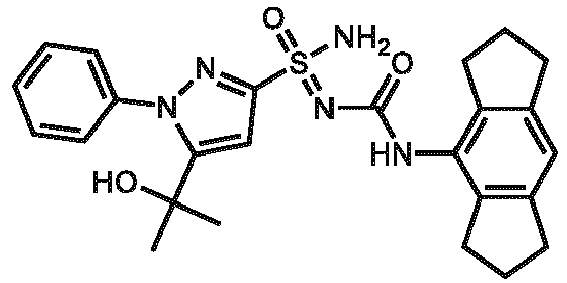
N'-((1,2,3,5,6,7-hexahydro-s-indacen-4-yl)carbamoyl)-5-(2-hydroxypropan-2-yl)-1-phenyl-1H-pyrazole-3-sulfonimidamide 480 260 137 
N'-((1,2,3,5,6,7-hexahydro-s-indacen-4-yl)carbamoyl)-6-(2-hydroxypropan-2-yl)pyridine-3-sulfonimidamide 415 261 409 
N-(4-(N'-((1,2,3,5,6,7-hexahydro-s-indacen-4-yl)carbamoyl)sulfamidimidoyl)benzyl)-N-methylpent-4-ynamide 479 262 303 
4-(2-Hydroxypropan-2-yl)-N'-((2,4,5,6-tetrahydro-1H-cyclobuta[f]inden-3-yl)carbamoyl)thiazole-2-sulfonimidamide 407 263 325 
4-(2-Hydroxypropan-2-yl)-N'-((3,5,6,7-tetrahydro-2H-indeno[5,6-b]furan-8-yl)carbamoyl)thiazole-2-sulfonimidamide 423 264 138 
N'-((1,2,3,5,6,7-hexahydro-s-indacen-4-yl)carbamoyl)-6-(2-hydroxypropan-2-yl)-2-methylpyridine-3-sulfonimidamide 429 265 332 
N'-(1,2,3,5,6,7-hexahydro-s-indacen-4-ylcarbamoyl)-4-(2-hydroxypropan-2-yl)-5-methylt hiazole-2-sulfonimidamide 435 266 334 
4-(1-(Dimethylamino)ethyl)-N'-(1,2,3,5,6,7-hexahydro-s-indacen-4-ylcarbamoyl)benzenesulfonimidamide 427 267 335 
4-(2-(Dimethylamino)propan-2-yl)-N'-(1,2,3, 5,6,7-hexahydro-s-indacen-4-ylcarbamoyl)benzenesulfonimidamide 441 268 337 
N-(4-(N'-(1,2,3,5,6,7-hexahydro-s-indacen-4-ylcarbamoyl)sulfamimidoyl)benzyl)-N-methylacetamide 441 269 113 
3-Fluoro-N'-(1,2,3,5,6,7-hexahydro-s-indacen-4-ylcarbamoyl)-5-(2-hydroxypropan-2-yl)thiophene-2-sulfonimidamide 438 270 343 
N'-((1,2,3,5,6,7-hexahydro-s-indacen-4-yl)carbamoyl)-2-methyl-1,2,3,4-tetrahydroisoquinoline-6-sulfonimidamide 425 271 349 
N-(1,2,3,5,6,7-hexahydro-s-indacen-4-ylcarbamoyl)-2-methyl-1,2,3,4-tetrahydroisoquinoline-7-sulfonimidamide 425 272 344 
4-((Dimethylamino)methyl)-N'-((1,2,3,5,6,7-hexahydro-s-indacen-4-yl)carbamoyl)-2-methoxybenzenesulfonimidamide 443 273 359 
N'-(1,2,3,5,6,7-hexahydro-s-indacen-4-ylcarbamoyl)-1-methyl-1H-indazole-5-sulfonimidamide 410 274 352 
N'-(1,2,3,5,6,7-hexahydro-s-indacen-4-ylcarbamoyl)-4-(2-methoxypropan-2-yl)benzenesulfonimidamide 428 275 354 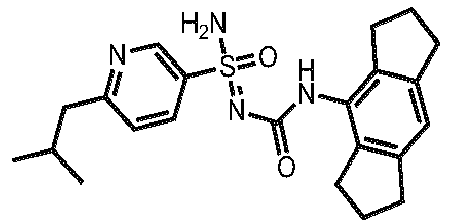
N'-(1,2,3,5,6,7-hexahydro-s-indacen-4-ylcarbamoyl)-6-isobutylpyridine-3-sulfonimidamide 413 276 355 
6-((Dimethylamino)methyl)-N'-(1,2,3,5,6,7-hexahydro-s-indacen-4-ylcarbamoyl)pyridine-3-sulfonimidamide 414 277 356 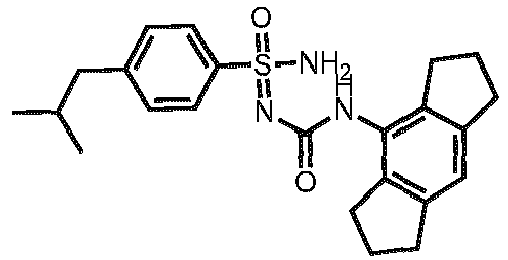
N'-(1,2,3,5,6,7-hexahydro-s-indacen-4-ylcarbamoyl)-4-isobutylbenzenesulfonimidamide 412 278 357 
5-((Dimethylamino)methyl)-N'-(1,2,3, 5,6,7-hexahydro-s-indacen-4-ylcarbamoyl)pyridine-2-sulfonimidamide 414 279 340 
5-((Dimethylamino)methyl)-3-fluoro-N'-(1,2,3,5,6,7-hexahydro-s-indacen-4-ylcarbamoyl)thiophene-2-sulfonimidamide 437 280 377 
4-((dimethylamino)methyl)-3-fluoro-N'-((1,2,3,5,6,7-hexahydro-s-indacen-4-yl)carbamoyl)benzenesulfonimidamide 431 281 378 
3-fluoro-5-(2-hydroxypropan-2-yl)-N'-((2,4,5,6-tetrahydro-1H-cyclobuta[f]inden-3-yl)carbamoyl)thiophene-2-sulfonimidamide 424 282 379 
N'-((1,2,3,5,6,7-hexahydro-s-indacen-4-yl)carbamoyl)-4-isopropylthiophene-2-sulfonimidamide 404 283 380 
N-((1,2,3,5,6,7-hexahydro-s-indacen-4-yl)carbamoyl)-4-(1-methylpyrrolidin-2-yl)benzenesulfonimidamide 439 284 353 
N'-((3,5-diisopropyl-1-phenyl-1H-pyrazol-4-yl)carbamoyl)-4-(2-hydroxypropan-2-yl)thiophene-2-sulfonimidamide 490 285 333 
N'-((1,2,3,6,7,8-hexahydro-as-indacen-4-yl)carbamoyl)-2-(2-hydroxypropan-2-yl)thiazole-5-sulfonimidamide 421 287 382 
2-fluoro-N'-((1,2,3,5,6,7-hexahydro-s-indacen-4-yl)carbamoyl)-4-((methylamino)methyl)benzenesulfonimi damide 417 288 383 
N'-((1,2,3,5,6,7-hexahydro-s-indacen-4-yl)carbamoyl)-6-isopropylpyridine-3-sulfonimidamide 399 Table 27. Examples in the following table were prepared using similar conditions as described in Example 4 - route 2 andScheme 3 from appropriate starting materials.Example # Final Target Number Structure IUPAC Name Exact Mass [M+H]+ 289 315 
2-(2-Hydroxypropan-2-yl)-N'-((3,5,6,7-tetrahydro-2H-indeno[5,6-b]furan-8-yl)carbamoyl)thiazole-5-sulfonimidamide 423 290 316 
N'-((6-ethyl-1H-indazol-7-yl)carbamoyl)-2-(2-hydroxypropan-2-yl)thiazole-5-sulfonimidamide 409 291 317 
2-(2-Hydroxypropan-2-yl)-N'-((1-methyl-1,2,3,5,6,7-hexahydro-s-indacen-4-yl)carbamoyl)thiazole-5-sulfonimidamide 435 292 319 
2-(2-Hydroxypropan-2-yl)-N'-((3-methyl-1,2,3,5,6,7-hexahydro-s-indacen-4-yl)carbamoyl)thiazole-5-sulfonimidamide 435 293 320 
2-(2-Hydroxypropan-2-yl)-N'-((1-oxo-1,2,3,5,6,7-hexahydro-s-indacen-4-yl)carbamoyl)thiazole-5-sulfonimidamide 435 294 336 
2-(2-Hydroxypropan-2-yl)-N'-((3-oxo-1,2,3,5,6,7-hexahydro-s-indacen-4-yl)carbamoyl)thiazole-5-sulfonimidamide 435 295 330 
N'-((1,2,3,5,6,7-hexahydro-s-indacen-4-yl)carbamoyl)-2-(2-methoxypropan-2-yl)thiazole-5-sulfonimidamide 435 Table 28. Examples in the following table were obtained from chiral HPLC resolutions of racemic examples described above. The chiral column and eluents are listed in the table. As a convention, the faster-eluting enantiomer is always listed first in the table followed by the slower-eluting enantiomer of the pair. The symbol * at a chiral center denotes that this chiral center has been resolved and the absolute stereochemistry at that center has not been determined. For mixtures contained two chiral centers and if two columns are used for separating the four diastereomers, the individual isomers are listed in the order of faster column 1/faster column 2;faster column 1/slower column 2;slower column 1/faster column 2; followed byslower column 1/slower column 2.Ex. # Final Target Number Structure IUPAC Name Column Eluents LC-MS [M+H]+ 296 364a 
(R) or (S) -N'-((1,2,3,5,6,7-hexahydro-s-indacen-4-yl)carbamoyl)-5-(2-hydroxypropan-2-yl)thiazole-2-sulfonimidamide CHIRALP AK IG 2 *25 cm (5 um) 50% MeOH (8 mM NH3-MeOH) in CO2 # 421 297 364b 
(S) or (R)-N'-((1,2,3,5,6,7-hexahydro-s-indacen-4-yl)carbamoyl)-5-(2-hydroxypropan-2-yl)thiazole-2-sulfonimidamide CHIRALP AK IG 2 *25 cm (5 um) 50% MeOH (8 mM NH3.MeO H) in CO2 421 298 365a 
(R) or (S) - N'-((3-fluoro-2,6-diisopropylphenyl)carbamoyl) -2-(2-hydroxypropan-2-yl)thiazole-5-sulfonimidamide Chiralpak ID, 2*25 cm, 5 um IPA in Hex:DCM =5:1 443 299 365b 
(S) or (R) - N'-((3-fluoro-2,6-diisopropylphenyl)carbamoyl) -2-(2-hydroxypropan-2-yl)thiazole-5-sulfonimidamide Chiralpak ID, 2*25 cm, 5 um IPA in Hex:DCM =5:1 443 300 308a 
(R) or (S) - N'-((3-cyano-2,6-diisopropylphenyl)carbamoyl) -5-(2-hydroxypropan-2-yl)thiophene-2-sulfonimidamide CHIRALP AKIG, 20*250 mm, 5 um 30% EtOH in Hex (0.1% DEA) 449 301 308b 
(S) or (R) -N'-((3-fluoro-2,6-diisopropylphenyl)carbamoyl) -2-(2-hydroxypropan-2-yl)thiazole-5-sulfonimidamide CHIRALP AKIG, 20*250 mm, 5 um 30% EtOH in Hex (0.1% DEA) 449 126 195a 
Two isomers of (S, S)-and (S, R)-or (R, S)-and (R, R) 4-(2-hydroxypropan-2-yl)-5-methyl-N'-((3-methyl-1,2,3,5,6,7-hexahydro-s-indacen-4-yl)carbamoyl)furan-2-sulfonimidamide CHIRALA RT Cellulose-SB, 2*25 cm, 5 um MeOH (0.1% DEA); 1st and 2nd peaks 432 127 195e 
Two isomers of (R, S)-and (R, R)-or (S, S)-and (S, R) 4-(2-hydroxypropan-2-yl)-5-methyl-N'-((3-methyl-1,2,3,5,6,7-hexahydro-s-indacen-4-yl)carbamoyl)furan-2-sulfonimidamide MeOH (0.1%DEA ); 3rd peak 432 302 195ba 
(R, R) or (R, S) or (S, S) or (S, R)-4-(2-hydroxypropan-2-yl)-5-methyl-N'-((3-methyl-1,2,3,5,6,7-hexahydro-s-indacen-4-yl)carbamoyl)furan-2-sulfonimidamide resolved from example 127 Phenomene x Lux 5u Cellulose-4 , AXIA Packed 2.12*25 cm, 5 um 40%MeOH in CO2 432 303 195bb 
(R, S) or (R, R) or (S, R) or (S, S)- 4-(2-hydroxypropan-2-yl)-5-methyl-N'-((3-methyl-1,2,3,5,6,7-hexahydro-s-indacen-4-yl)carbamoyl)furan-2-sulfonimidamide resolved from example 127 Phenomene x Lux 5u Cellulose-4 , AXIA Packed 2.12*25 cm, 5 um 40%MeOH in CO2 432 123 207c 
Two isomers of (R, S)-and (R, R) 4-(2-hydroxypropan-2-yl)-5-methyl-N'-(1-methyl-1,2,3,5,6,7-hexahydrosindacen-4-ylcarbamoyl)furan-2-sulfonimidamide ChiralPak IC, 2*25cm, 5um 50% EtOH in MTBE; 1st and 2nd peaks 432.2 124 207aa 
(S, S)-or (S, R)-4-(2-hydroxypropan-2-yl)-5-methyl-N'-(1-methyl-1,2,3,5,6,7-hexahydrosindacen-4-ylcarbamoyl)furan-2-sulfonimidamide 50% EtOH in MTBE; 3rd peak 432.2 125 207b 
(S, R)-or (S, S)-4-(2-hydroxypropan-2-yl)-5-methyl-N'-(1-methyl-1,2,3,5,6,7-hexahydrosindacen-4-ylcarbamoyl)furan-2-sulfonimidamide 50% EtOH in MTBE; 4th peak 432.2 304 207a 
(R, R) or (R, S) -4-(2-hydroxypropan-2-yl)-5-methyl-N'-((3-methyl-1,2,3,5,6,7-hexahydro-s-indacen-4-yl)carbamoyl)furan-2-sulfonimidamide; resolved from example 123 CHIRALP AK IG, 20*250 mm, 5 um EtOH in Hex (0.1% FA) 432 305 207bb 
(R, S) or (R, R)-4-(2-hydroxypropan-2-yl)-5-methyl-N'-((3-methyl-1,2,3,5,6,7-hexahydro-s-indacen-4-yl)carbamoyl)furan-2-sulfonimidamide; resolved from example 123 CHIRALP AK IG, 20*250 mm, 5 um EtOH in Hex (0.1% FA) 432 306 366a 
(R) or (S) -N'-((1,2,3,5,6,7-hexahydro-s-indacen-4-yl)carbamoyl)-4-(2-hydroxypropan-2-yl)thiazole-2-sulfonimidamide CHIRALP AK AS-H, 2*25 cm (5 um) 35% IPA (2 mM NH3-MeOH) in CO2 421 307 366b 
(S) or (R) -N'-((1,2,3,5,6,7-hexahydro-s-indacen-4-yl)carbamoyl)-4-(2-hydroxypropan-2-yl)thiazole-2-sulfonimidamide CHIRALP AK AS-H, 2*25 cm (5 um) 35% IPA (2 mM NH3-MeOH) in CO2 421 308 139a 
(S) or (R)-N'-((1,2,3,5,6,7-hexahydro-s-indacen-4-yl)carbamoyl)-5-(2-hydroxypropan-2-yl)-1-phenyl-1H-pyrazole-3-sulfonimidamide CHIRALP AK AS-H, 2*25 cm (5 um) EtOH in Hex (0.1% DEA) 480 309 139b 
(R) or (S)-N'-((1,2,3,5,6,7-hexahydro-s-indacen-4-yl)carbamoyl)-5-(2-hydroxypropan-2-yl)-1-phenyl-1H-pyrazole-3-sulfonimidamide CHIRALP AK AS-H, 2*25 cm (5 um) EtOH in Hex (0.1% DEA) 480 310 367a 
(R) or (S) -N'-((8-fluoro-1,2,3,5,6,7-hexahydro-s-indacen-4-yl)carbamoyl)-4-(2-hydroxypropan-2-yl)thiazole-2-sulfonimidamide Chiralpak AS-H 2*25 cm (5 um) 35% IPA in CO2 439 311 367b 
(S) or (R) -N'-((8-fluoro-1,2,3,5,6,7-hexahydro-s-indacen-4-yl)carbamoyl)-4-(2-hydroxypropan-2-yl)thiazole-2-sulfonimidamide Chiralpak ASH2*25cm( 5um) 35% IPA in CO2 439 312 409b 
(S) or (R)-N-(4-(N'-((1,2,3,5,6,7-hexahydro-s-indacen-4-yl)carbamoyl)sulfamidimidoy 1)benzyl)-N-methylpent-4-ynamide CHIRAL ART Cellulose-SB, 2*25 cm, 5 um EtOH in Hex (8 mM NH3-MeOH) 479 313 409a 
(R) or (S)-N-(4-(N'-((1,2,3,5,6,7-hexahydro-s-indacen-4-yl)carbamoyl)sulfamidimidoy 1)benzyl)-N-methylpent-4-ynamide CHIRAL ART Cellulose-SB, 2*25 cm, 5 um EtOH in Hex (8 mM NH3.MeO H) 479 314 369a 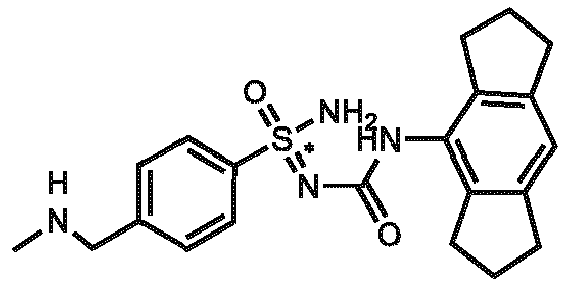
(S) or (R)-N'-((1,2,3,5,6,7-hexahydro-s-indacen-4-yl)carbamoyl)-4-((methylamino)methyl)benze nesulfonimidamide Chiralpak ID-2, 2*25cm, Sum EtOH in Hex (8 mM NH3.MeO H) 399 315 369b 
(R) or (S)-N'-((1,2,3,5,6,7-hexahydro-s-indacen-4-yl)carbamoyl)-4-((methylamino)methyl)benze nesulfonimidamide Chiralpak ID-2, 2*25 cm, 5 um EtOH in Hex (8 mM NH3.MeO H) 399 316 159a 
Two isomers of (R, R) or (R, S) or (S, S) or (S, R)-N'-((4-cyano-3-fluoro-2,6-diisopropylphenyl)carbamoyl) -2-(1,2-dihydroxypropan-2-yl)thiazole-5-sulfonimidamide CHIRAL ART Cellulose-SB, 2*25 cm, 5 um EtOH in Hex (0.1% FA) 1st and 2nd peak 484 317 159ab 
(R, R) or (R, S) or (S, S) or (S, R)-N-((4-cyano-3-fluoro-2,6-diisopropylphenyl)carbamoyl) -2-(1,2-dihydroxypropan-2-yl)thiazole-5-sulfonimidamide CHIRAL ART Cellulose-SB, 2*25 cm, 5 um EtOH in Hex (0.1% FA) 3rd peak 484 318 159ba 
(S, S) or (S, R) or (R, R) or (R, S)-N-((4-cyano-3-fluoro-2,6-diisopropylphenyl)carbamoyl)-2-(1,2-dihydroxypropan-2-yl)thiazole-5-sulfonimidamide CHIRAL ART Cellulose-SB, 2*25 cm, 5 um EtOH in Hex (0.1% FA) 4th peak 484 319 137a 
(S) or (R)-N'-((1,2,3,5,6,7-hexahydro-s-indacen-4-yl)carbamoyl)-6-(2-hydroxypropan-2-yl)pyridine-3-sulfonimidamide CHIRAL ART Cellulose-SB, 2*25 cm, 5 um EtOH in Hex (0.1%F A) 415 320 137b 
(R) or (S)-N'-((1,2,3,5,6,7-hexahydro-s-indacen-4-yl)carbamoyl)-6-(2-hydroxypropan-2-yl)pyridine-3 -sulfonimidamide CHIRAL ART Cellulose-SB, 2*25 cm, 5 um EtOH in Hex (0.1% FA) 415 321 317ab 
(S, S) or (S, R)-2-(2-hydroxypropan-2-yl)-N'-((1-methyl-1,2,3,5,6,7-hexahydro-s-indacen-4-yl)carbamoyl)thiazole-5-sulfonimidamide (from Example 291) 1st and 2nd peak (two isomers) Faster-eluting on column 1: CHIRAL ART Cellulose-SB, 2*25 cm, 5 um, IPA in Hex (0.1% FA). Separated further on column 2: CHIRALPAK IE, EtOH in MTBE (0.1% FA) to obtain single isomers. 435 322 317aa 
(S, R) or (S, S)-2-(2-hydroxypropan-2-yl)-N'-((1-methyl-1,2,3,5,6,7-hexahydro-s-indacen-4-yl)carbamoyl)thiazole-5-sulfonimidamide (from Example 291) 435 323 317bb 
(R, R) or (R, S) -2-(2-hydroxypropan-2-yl)-N'-((1-methyl-1,2,3,5,6,7-hexahydro-s-indacen-4-yl)carbamoyl)thiazole-5-sulfonimidamide (from Example 291) CHIRAL ART Cellulose-SB, 2*25 cm, 5 um IPA in Hex (0.1% FA) 3nd peak 435 324 317ba 
(R, S) or (R, R)-2-(2-hydroxypropan-2-yl)-N'-((1-methyl-1,2,3,5,6,7-hexahydro-s-indacen-4-yl)carbamoyl)thiazole-5-sulfonimidamide (from Example 291) IPA in Hex (0.1% FA) 4th peak 435 325 316a 
(S) or (R)-N'-((6-ethyl-1H-indazol-7-yl)carbamoyl)-2-(2-hydroxypropan-2-yl)thiazole-5-sulfonimidamide Chiralpak ID, 2*25 cm, 5 um EtOH in Hex (0.1% FA) 409 326 316b 
(R) or (S)-N'-((6-ethyl-1H-indazol-7-yl)carbamoyl)-2-(2-hydroxypropan-2-yl)thiazole-5-sulfonimidamide Chiralpak ID, 2*25 cm, 5 um EtOH in Hex (0.1% FA) 409 327 373a 
(S) or (R)-N'-((6-ethyl-1-methyl-1H-indazol-7-yl)carbamoyl)-5-(2-hydroxypropan-2-yl)thiazole-2-sulfonimidamide CHIRALP AKIG, 20*250 mm, 5 um EtOH in Hex (0.1% FA) 423 328 373b 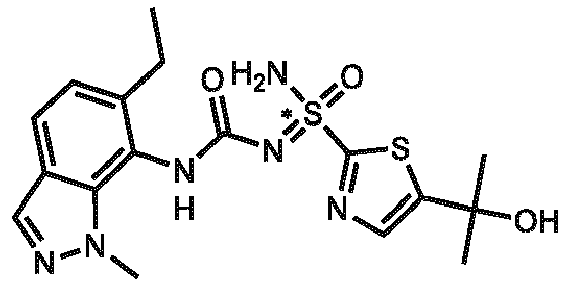
(R) or (S)-N'-((6-ethyl-1-methyl-1H-indazol-7-yl)carbamoyl)-5-(2-hydroxypropan-2-yl)thiazole-2-sulfonimidamide CHIRALP AKIG, 20*250 mm, 5 um EtOH in Hex (0.1% FA) 423 329 374a 
(S) or (R)-N'-((6-ethyl-2-methyl-2H-indazol-7-yl)carbamoyl)-5-(2-hydroxypropan-2-yl)thiazole-2-sulfonimidamide CHIRAL ART Cellulose-SB S-5um, 250*20 mm EtOH in Hex (0.1% FA) 423 330 374b 
(R) or (S)-N'-((6-ethyl-2-methyl-2H-indazol-7-yl)carbamoyl)-5-(2-hydroxypropan-2-yl)thiazole-2-sulfonimidamide CHIRAL ART Cellulose-SB S-5um, 250*20 mm EtOH in Hex (0.1% FA) 423 331 319ab 
(S, S) or (S, R)-2-(2-hydroxypropan-2-yl)-N'-((3-methyl-1,2,3,5,6,7-hexahydro-s-indacen-4-yl)carbamoyl)thiazole-5-sulfonimidamide 1st peak CHIRAL ART Cellulose-SB, 2*25 cm, 5 um EtOH in Hex (0.1% FA) 435 332 319aa 
(R, R) or (R, S)-2-(2-hydroxypropan-2-yl)-N'-((3-methyl-1,2,3,5,6,7-hexahydro-s-indacen-4-yl)carbamoyl)thiazole-5-sulfonimidamide 2nd peak CHIRAL ART Cellulose-SB, 2*25 cm, 5 um EtOH in Hex (0.1% FA) 435 333 319bb 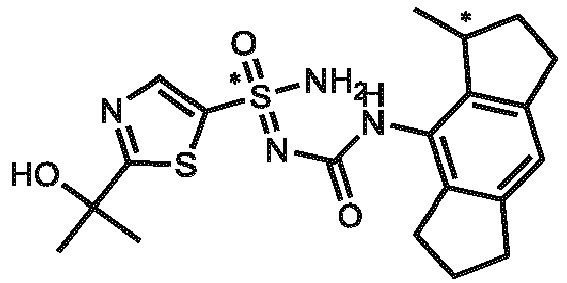
(S, R) or (S, S)-2-(2-hydroxypropan-2-yl)-N'-((3-methyl-1,2,3,5,6,7-hexahydro-s-indacen-4-yl)carbamoyl)thiazole-5-sulfonimidamide 3rd peak CHIRAL ART Cellulose-SB, 2*25 cm, 5 um EtOH in Hex (0.1% FA) 435 334 319ba 
(R, S) or (R, R)-2-(2-hydroxypropan-2-yl)-N'-((3-methyl-1,2,3,5,6,7-hexahydro-s-indacen-4-yl)carbamoyl)thiazole-5-sulfonimidamide 4th peak CHIRAL ART Cellulose-SB, 2*25 cm, 5 um EtOH in Hex (0.1% FA) 435 335 320a 
(S) or (R)- 2-(2-Hydroxypropan-2-yl)-N'-((1-oxo-1,2,3,5,6,7-hexahydro-s-indacen-4-yl)carbamoyl)thiazole-5-sulfonimidamide from Example 293 Chiralpak IA, 2*25 cm, 5 um EtOH in Hex (0.1% FA) 435 336 320b 
(R) or (S)- 2-(2-Hydroxypropan-2-yl)-N'-((1-oxo-1,2,3,5,6,7-hexahydro-s-indacen-4-yl)carbamoyl)thiazole-5-sulfonimidamide from Example 293 Chiralpak IA, 2*25 cm, 5 um EtOH in Hex (0.1% FA) 435 337 323ab 
(R, R) or (R, S)- N'-((1-hydroxy-1,2,3,5,6,7-hexahydro-s-indacen-4-yl)carbamoyl)-2-(2-hydroxypropan-2-yl)thiazole-5-sulfonimidamide (from example 336) CHIRALP AK AD, 2*25 cm, 5 um EtOH (0.1% DEA) in CO2, 1st peak 437 338 323bb 
(R, S) or (R, R)- N'-((1-hydroxy-1,2,3,5,6,7-hexahydro-s-indacen-4-yl)carbamoyl)-2-(2-hydroxypropan-2-yl)thiazole-5-sulfonimidamide (from example 336) EtOH (0.1% DEA) in CO2, 2nd peak 437 339 323aa 
(S, S) or (S, R)- N'-((1-hydroxy-1,2,3,5,6,7-hexahydro-s-indacen-4-yl)carbamoyl)-2-(2-hydroxypropan-2-yl)thiazole-5-sulfonimidamide (from example 335) CHIRALP AKAD, 2*25 cm, 5 um EtOH (0.1% DEA) in CO2, 1st peak 437 340 323ba 
(S, R) or (S, S)- N'-((1-hydroxy-1,2,3,5,6,7-hexahydro-s-indacen-4-yl)carbamoyl)-2-(2-hydroxypropan-2-yl)thiazole-5-sulfonimidamide (from example 335) EtOH (0.1% DEA) in CO2, 2nd peak 437 341 303a 
(R) or (S)-4-(2-hydroxypropan-2-yl)-N'-((2,4,5,6-tetrahydro-1H-cyclobuta[f]inden-3-yl)carbamoyl)thiazole-2-sulfonimidamide Chiralpak ID, 2*25cm, Sum EtOH in Hex (0.1% FA) 407 342 303b 
(R) or (S)-4-(2-hydroxypropan-2-yl)-N'-((2,4,5,6-tetrahydro-1H-cyclobuta[f]inden-3-yl)carbamoyl)thiazole-2-sulfonimidamide Chiralpak ID, 2*25cm, Sum EtOH in Hex (0.1% FA) 407 343 315a 
(R) or (S)-2-(2-hydroxypropan-2-yl)-N'-((3,5,6,7-tetrahydro-2H-indeno[5,6-b]furan-8-yl)carbamoyl)thiazole-5-sulfonimidamide Chiralpak ID, 2*25 cm, 5 um EtOH in Hex (0.1% FA) 423 344 315b 
(R) or (S)-2-(2-hydroxypropan-2-yl)-N'-((3,5,6,7-tetrahydro-2H-indeno[5,6-b]furan-8-yl)carbamoyl)thiazole-5-sulfonimidamide Chiralpak ID, 2*25 cm, 5 um EtOH in Hex (0.1% FA) 423 345 138a 
(R) or (S)-N'-((1,2,3,5,6,7-hexahydro-s-indacen-4-yl)carbamoyl)-6-(2-hydroxypropan-2-yl)-2-methylpyridine-3-sulfonimidamide CHIRALP AK IF, 2*25 cm, 5 um EtOH in Hex (8 mM NH3-MeOH) 429 346 138b 
(R) or (S)-N'-((1,2,3,5,6,7-hexahydro-s-indacen-4-yl)carbamoyl)-6-(2-hydroxypropan-2-yl)-2-methylpyridine-3-sulfonimidamide CHIRALP AK IF, 2*25 cm, 5 um EtOH in Hex (8 mM NH3.MeO H) 429 347 328a 
(R) or (S)-5-(2-hydroxypropan-2-yl)-N'-((3,5,6,7-tetrahydro-2H-indeno[5,6-b]furan-4-yl)carbamoyl)thiazole-2-sulfonimidamide CHIRALP AKIC, 2*25 cm, 5 um EtOH in Hex (0.1% FA) 423 348 328b 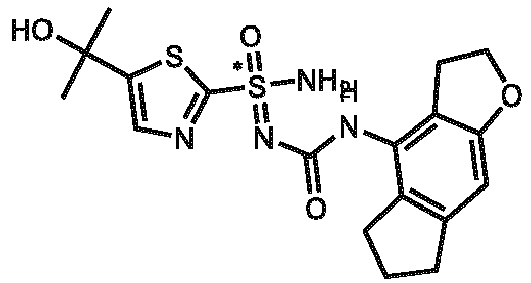
(S) or (R)-5-(2-hydroxypropan-2-yl)-N'-((3,5,6,7-tetrahydro-2H-indeno[5,6-b]furan-4-yl)carbamoyl)thiazole-2-sulfonimidamide CHIRALP AKIC, 2*25 cm, 5 um EtOH in Hex (0.1% FA) 423 349 326b 
(S) or (R)-5-(2-hydroxypropan-2-yl)-N'-((3,5,6,7-tetrahydro-2H-indeno[5,6-b]furan-8-yl)carbamoyl)thiazole-2-sulfonimidamide CHIRALP AK IG, 20*250 mm, 5 um IPA in Hex:DCM =5:1 (0.1% FA) 423 350 326a 
(R) or (S)-5-(2-hydroxypropan-2-yl)-N'-((3,5,6,7-tetrahydro-2H-indeno[5,6-b]furan-8-yl)carbamoyl)thiazole-2-sulfonimidamide CHIRALP AK IG, 20*250 mm, 5 um IPA in Hex:DCM =5:1 (0.1% FA) 423 351 318a 
(S) or (R)-N'-((8-bromo-1,2,3,5,6,7-hexahydro-s-indacen-4-yl)carbamoyl)-5-(2-hydroxypropan-2-yl)thiazole-2-sulfonimidamide CHIRAL ART Cellulose-SB S-5um, 2*25 cm, 5 um EtOH in Hex (8 mM NH3.MeO H) 499 352 318b 
(R) or (S)-N'-((8-bromo-1,2,3,5,6,7-hexahydro-s-indacen-4-yl)carbamoyl)-5-(2-hydroxypropan-2-yl)thiazole-2-sulfonimidamide CHIRAL ART Cellulose-SB S-5um, 2*25 cm, 5 um EtOH in Hex (8 mM NH3.MeO H) 499 353 325a 
(S) or (R)-4-(2-hydroxypropan-2-yl)-N'-((3,5,6,7-tetrahydro-2H-indeno[5,6-b]furan-8-yl)carbamoyl)thiazole-2-sulfonimidamide CHIRAL ART Cellulose-SB, 2*25 cm, 5 um EtOH in Hex (0.1% FA) 423 354 325b 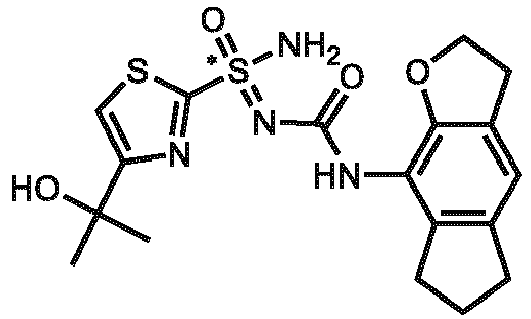
(R) or (S)-4-(2-hydroxypropan-2-yl)-N'-((3,5,6,7-tetrahydro-2H-indeno[5,6-b]furan-8-yl)carbamoyl)thiazole-2-sulfonimidamide CHIRAL ART Cellulose-SB, 2*25 cm, 5 um EtOH in Hex (0.1% FA) 423 355 329a 
(R) or (S) -2-(2-hydroxypropan-2-yl)-N'-(tricyclo[6.2.0.03,6]deca-1,3(6),7-trien-2-ylcarbamoyl)thiazole-5-sulfonimidamide Chiralpak ID, 2*25 cm, 5 um IPA in Hex (0.1% FA) 393 356 329b 
(S) or (R) -2-(2-hydroxypropan-2-yl)-N'-(tricyclo [6.2.0.03,6]deca-1,3(6),7-trien-2-ylcarbamoyl)thiazole-5-sulfonimidamide Chiralpak ID, 2*25 cm, 5 um IPA in Hex (0.1% FA) 393 357 404b 
(R) or (S) -N'-((1,2,3,5,6,7-hexahydro-s-indacen-4-yl)carbamoyl)-4-(2-hydroxypropan-2-yl)-N,N-dimethylthiophene-2-sulfonimidamide CHIRALP AKIG, 20*250 mm, 5 um IPA in Hex:DCM =3:1 (10 mM NH3-MeOH) 448 358 404a 
(S) or (R) -N'-((1,2,3,5,6,7-hexahydro-s-indacen-4-yl)carbamoyl)-4-(2-hydroxypropan-2-yl)-N,N-dimethylthiophene-2-sulfonimidamide CHIRALP AKIG, 20*250 mm, 5 um IPA in Hex:DCM =3:1 (10 mM NH3-MeOH) 448 359 332a 
(R) or (S) -N'-((1,2,3,5,6,7-hexahydro-s-indacen-4-yl)carbamoyl)-4-(2-hydroxypropan-2-yl)-5-methylthiazole-2-sulfonimidamide Chiralpak ID, 2*25 cm, 5 um IPA in Hex (0.1% FA) 435 360 332b 
(S) or (R) -N'-((1,2,3,5,6,7-hexahydro-s-indacen-4-yl)carbamoyl)-4-(2-hydroxypropan-2-yl)-5-methylthiazole-2-sulfonimidamide Chiralpak ID, 2*25 cm, 5 um IPA in Hex (0.1% FA) 435 361 335a 
(R) or (S) -4-(2-(dimethylamino)propan-2-yl)-N'-((1,2,3,5,6,7-hexahydro-s-indacen-4-yl)carbamoyl)benzenesulfoni midamide CHIRALP AK IG, 2.0*25 cm (5 um) IPA in Hex (8 mM NH3-MeOH) 441 362 335b 
(S) or (R) -4-(2-(dimethylamino)propan-2-yl)-N'-((1,2,3,5,6,7-hexahydro-s-indacen-4-yl)carbamoyl)benzenesulfoni midamide CHIRALP AKIG, 2.0*25 cm (5 um) IPA in Hex (8 mM NH3-MeOH 441 363 336a 
(S) or (R)- 2-(2-Hydroxypropan-2-yl)-N'-((3-oxo-1,2,3,5,6,7-hexahydro-s-indacen-4-yl)carbamoyl)thiazole-5-sulfonimidamide CHIRAL ART Cellulose-SB, 2*25 cm, 5 um EtOH in MTBE (10 mM NH3-MeOH) 435 364 336b 
(R) or (S)- 2-(2-Hydroxypropan-2-yl)-N'-((3-oxo-1,2,3,5,6,7-hexahydro-s-indacen-4-yl)carbamoyl)thiazole-5-sulfonimidamide CHIRAL ART Cellulose-SB, 2*25 cm, 5 um EtOH in MTBE (10 mM NH3-MeOH) 435 365 337a 
(S) or (R)-N-(4-(N'-((1,2,3,5,6,7-hexahydro-s-indacen-4-yl)carbamoyl)sulfamidimidoy 1)benzyl)-N-methylacetamide CHIRAL ART Cellulose-SB, 2*25 cm, 5 um EtOH in Hex (8 mM NH3-MeOH) 441 366 337b 
(R) or (S)-N-(4-(N'-((1,2,3,5,6,7-hexahydro-s-indacen-4-yl)carbamoyl)sulfamidimidoy 1)benzyl)-N-methylacetamide CHIRAL ART Cellulose-SB, 2*25 cm, 5 um EtOH in Hex (8 mM NH3-MeOH) 441 367 371a 
(S) or (R)-N-(3-(N'-((1,2,3,5,6,7-hexahydro-s-indacen-4-yl)carbamoyl)sulfamidimidoy 1)benzyl)-N-methylacetamide CHIRAL ART Cellulose-SB, 2*25 cm, 5 um EtOH in Hex (8 mM NH3-MeOH) 441 368 371b 
(R) or (S)-N-(3-(N'-((1,2,3,5,6,7-hexahydro-s-indacen-4-yl)carbamoyl)sulfamidimidoy 1)benzyl)-N-methylacetamide CHIRAL ART Cellulose-SB, 2*25 cm, 5 um EtOH in Hex (8 mM NH3-MeOH) 441 369 372a 
(S, R/S) or (R, R/S)- N'-((3-hydroxy-1,2,3,5,6,7-hexahydro-s-indacen-4-yl)carbamoyl)-2-(2-hydroxypropan-2-yl)thiazole-5-sulfonimidamide Obtained from Example 363 N/A 435 (M-1) 370 372b 
(R, R/S) or (S, R/S)- N'-((3-hydroxy-1,2,3,5,6,7-hexahydro-s-indacen-4-yl)carbamoyl)-2-(2-hydroxypropan-2-yl)thiazole-5-sulfonimidamide Obtained from Example 364 N/A 435 (M-1) 371 334a 
(S) or (R)-4-(1-(dimethylamino)ethyl)-N'-((1,2,3,5,6,7-hexahydro-s-indacen-4-yl)carbamoyl)benzenesulfonimidamide CHIRAL ART Cellulose-SB, 2*25 cm, 5 um IPA in Hex (8 mM NH3-MeOH) 427 372 334b 
(R) or (S)-4-(1-(dimethylamino)ethyl)-N'-((1,2,3,5,6,7-hexahydro-s-indacen-4-yl)carbamoyl)benzenesulfoni midamide CHIRAL ART Cellulose-SB, 2*25 cm, 5 um IPA in Hex (8 mM NH3-MeOH) 427 373 339a 
(R) or (S) -N'-((1,2,3,5,6,7-hexahydro-s-indacen-4-yl)carbamoyl)-2-(2-hydroxypropan-2-yl)-N-methylthiazole-5-sulfonimidamide CHIRALP AK IE, 2*25 cm, 5 um IPA in Hex (8 mM NH3-MeOH) 435 374 339b 
(S) or (R)-N'-((1,2,3,5,6,7-hexahydro-s-indacen-4-yl)carbamoyl)-2-(2-hydroxypropan-2-yl)-N-methylthiazole-5-sulfonimidamide CHIRALP AK IE, 2*25 cm, 5 um IPA in Hex (8 mM NH3-MeOH) 435 375 334ab 
(S, R) or (S, S) or (R, S) or (R, R)-4-(1-(dimethylamino)ethyl)-N'-((1,2,3,5,6,7-hexahydro-s-indacen-4-yl)carbamoyl)benzenesulfoni midamide CHIRALP AKIG, 20*250 mm, 5 um EtOH in Hex (8 mM NH3-MeOH) 427 376 334aa 
(S, S) or (S, R) or (R, R) or (R, S)-4-(1-(dimethylamino)ethyl)-N'-((1,2,3,5,6,7-hexahydro-s-indacen-4-yl)carbamoyl)benzenesulfoni midamide CHIRALP AKIG, 20*250 mm, 5 um EtOH in Hex (8 mM NH3-MeOH) 427 377 334bb 
(R, R) or (R, S) or (S, S) or (S, R)-4-(1-(dimethylamino)ethyl)-N'-((1,2,3,5,6,7-hexahydro-s-indacen-4-yl)carbamoyl)benzenesulfoni midamide CHIRALP AKIG, 20*250 mm, 5 um EtOH in Hex (8 mM NH3-MeOH) 427 378 334ba 
(R, S) or (R, R) or (S, R) or (S, S)-4-(1-(dimethylamino)ethyl)-N'-((1,2,3,5,6,7-hexahydro-s-indacen-4-yl)carbamoyl)benzenesulfoni midamide CHIRALP AKIG, 20*250 mm, 5 um EtOH in Hex (8 mM NH3-MeOH) 427 379 338a 
(R) or (S) -N'-((1,2,3,5,6,7-hexahydro-s-indacen-4-yl)carbamoyl)-4-((3-methoxyazetidin-1-yl)methyl)benzenesulfonimid amide CHIRALP AK IF, 2*25 cm, 5 um EtOH in Hex (8 mM NH3-MeOH) 455 380 338b 
(S) or (R) -N'-((1,2,3,5,6,7-hexahydro-s-indacen-4-yl)carbamoyl)-4-((3-methoxyazetidin-1-yl)methyl)benzenesulfonimid amide CHIRALP AK IF, 2*25 cm, 5 um EtOH in Hex (8 mM NH3-MeOH) 455 381 340a 
(R) or (S) -5-((dimethylamino)methyl)-3- fluoro-N'-((1,2,3,5,6,7-hexahydro-s-indacen-4-yl)carbamoyl)thiophene-2-sulfonimidamide CHIRALP AK IG, 20*250 mm, 5 um Hex (0.1% DEA):EtO H=50:50 437 382 340b 
(S) or (R) -5-((dimethylamino)methyl)-3- fluoro-N'-((1,2,3,5,6,7-hexahydro-s-indacen-4-yl)carbamoyl)thiophene-2-sulfonimidamide CHIRALP AKIG, 20*250 mm, 5 um Hex (0.1% DEA):EtO H=50:50 437 383 361b 
(R) or (S) -4-((dimethylamino)methyl)-N'-((1,2,3,5,6,7-hexahydro-s-indacen-4-yl)carbamoyl)-N-methylbenzenesulfonimidami de CHIRALP AK IE, 2*25 cm, 5 um EtOH in Hex (8 mM NH3-MeOH) 427 384 361a 
(S) or (R) -4-((dimethylamino)methyl)-N'-((1,2,3,5,6,7-hexahydro-s-indacen-4-yl)carbamoyl)-N-methylbenzenesulfonimidami de CHIRALP AK IE, 2*25 cm, 5 um EtOH in Hex (8 mM NH3-MeOH) 427 385 113a 
(R) or (S)-3-fluoro-N'-((1,2,3,5,6,7-hexahydro-s-indacen-4-yl)carbamoyl)-5-(2-hydroxypropan-2-yl)thiophene-2-sulfonimidamide CHIRALP AK IG, 20*250 mm, 5 um IPA in Hex (8 mM NH3-MeOH) 438 386 113b 
(S) or (R) -3-fluoro-N'-((1,2,3,5,6,7-hexahydro-s-indacen-4-yl)carbamoyl)-5-(2-hydroxypropan-2-yl)thiophene-2-sulfonimidamide CHIRALP AK IG, 20*250 mm, 5 um IPA in Hex (8 mM NH3-MeOH) 438 387 330a 
(S) or (R)-N'-((1,2,3,5,6,7-hexahydro-s-indacen-4-yl)carbamoyl)-2-(2-methoxypropan-2-yl)thiazole-5-sulfonimidamide CHIRAL ART Cellulose-SB, 2*25 cm, 5 um EtOH in Hex (8 mM NH3-MeOH) 435 388 330b 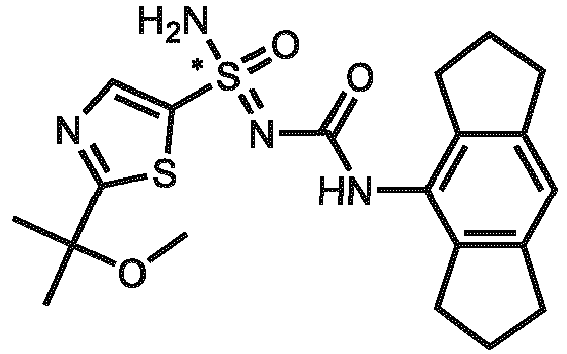
(R) or (S)-N'-((1,2,3,5,6,7-hexahydro-s-indacen-4-yl)carbamoyl)-2-(2-methoxypropan-2-yl)thiazole-5-sulfonimidamide CHIRAL ART Cellulose-SB, 2*25 cm, 5 um EtOH in Hex (8 mM NH3-MeOH) 435 389 341a 
(S) or (R)-N'-((1,2,3,5,6,7-hexahydro-s-indacen-4-yl)carbamoyl)-4-(((2-methoxyethyl)(methyl)amino) methyl)benzenesulfonimidam ide CHIRALC ellulose-SB 4.6*100 mm 3 um Hex (0.1% DEA):EtO H=70:30 457 390 341b 
(R) or (S)-N'-((1,2,3,5,6,7-hexahydro-s-indacen-4-yl)carbamoyl)-4-(((2-methoxyethyl)(methyl)amino) methyl)benzenesulfonimidam ide CHIRALC ellulose-SB 4.6*100 mm 3 um Hex (0.1% DEA):EtO H=70:30 457 391 360ba 
(R, R) or (R, S) or (S, S) or (S, R)-N'-((3-hydroxy-1,2,3,5,6,7-hexahydro-s-indacen-4-yl)carbamoyl)-2-(2-hydroxypropan-2-yl)thiazole-5-sulfonimidamide (from Example 370) CHIRALP AK IG, 20*250 mm, 5 um EtOH in MTBE (10 mM NH3-MeOH) 437 392 360bb 
(R, S) or (R, R) or (S, R) or (S, S)-N'-((3-hydroxy-1,2,3,5,6,7-hexahydro-s-indacen-4-yl)carbamoyl)-2-(2-hydroxypropan-2-yl)thiazole-5-sulfonimidamide (from Example 370) CHIRALP AK IG, 20*250 mm, 5 um EtOH in MTBE (10 mM NH3-MeOH) 437 393 363b 
(R)-N'-((1,2,3,5,6,7-hexahydro-s-indacen-4-yl)carbamoyl)-2-(2-hydroxypropan-2-yl-1,1,1,3,3,3-d6)thiazole-5-sulfonimidamide CHIRALP AKIF, 2*25 cm, 5 um 40% MeOH in CO2 427 394 363a 
(S)- N'-((1,2,3,5,6,7-hexahydro-s-indacen-4-yl)carbamoyl)-2-(2-hydroxypropan-2-yl-1,1,1,3,3,3-d6)thiazole-5-sulfonimidamide CHIRALP AKIF, 2*25 cm, 5 um 40% MeOH in CO2 427 395 343a 
(R) or (S)-N'-((1,2,3,5,6,7-hexahydro-s-indacen-4-yl)carbamoyl)-2-methyl-1,2,3,4-tetrahydroisoquinoline-6-sulfonimidamide CHIRALP AKIG, 20*250mm ,5 um EtOH in Hex (8 mM NH3-MeOH 425 396 343b 
(S) or (R)-N'-((1,2,3,5,6,7-hexahydro-s-indacen-4-yl)carbamoyl)-2-methyl-1,2,3,4-tetrahydroisoquinoline-6-sulfonimidamide CHIRALP AKIG, 20*250mm ,5 um EtOH in Hex (8 mM NH3-MeOH 425 397 359a 
(R) or (S)-N'-((1,2,3,5,6,7-hexahydro-s-indacen-4-yl)carbamoyl)-1-methyl-1H-indazole-5-sulfonimidamide ChiralpakI D, 2*25 cm, 5 um IPA in Hex:DCM =3:1 (10 mM NH3-MeOH) 410 398 359b 
(S) or (R)-N'-((1,2,3,5,6,7-hexahydro-s-indacen-4-yl)carbamoyl)-1-methyl-1H-indazole-5-sulfonimidamide Chiralpak ID, 2*25cm, 5 um IPA in Hex:DCM =3:1 (10 mM NH3-MeOH) 410 399 352a 
(R) or (S) -N'-((1,2,3,5,6,7-hexahydro-s-indacen-4-yl)carbamoyl)-4-(2-methoxypropan-2-yl)benzenesulfonimidamide CHIRALP AKIG, 2.0*25 cm (5 um) Hex (0.1% DEA):IPA =70:30 428 400 352b 
(S) or (R) -N'-((1,2,3,5,6,7-hexahydro-s-indacen-4-yl)carbamoyl)-4-(2-methoxypropan-2-yl)benzenesulfonimidamide CHIRALP AKIG, 2.0*25 cm (5 um) Hex (0.1% DE A):IPA=70 :30 428 401 383a 
(R) or (S) -N'-((1,2,3,5,6,7-hexahydro-s-indacen-4-yl)carbamoyl)-6-isopropylpyridine-3 - sulfonimidamide CHIRALP AK IG, 2*25 cm, 5 um EtOH in Hex (8 mM NH3-MeOH) 399 402 383b 
(S) or (R) -N'-((1,2,3,5,6,7-hexahydro-s-indacen-4-yl)carbamoyl)-6-isopropylpyridine-3 - sulfonimidamide CHIRALP AK IG, 2*25 cm, 5 um EtOH in Hex (8 mM NH3-MeOH) 399 403 382a 
(R) or (S) -2-fluoro-N'-((1,2,3,5,6,7-hexahydro-s-indacen-4-yl)carbamoyl)-4-((methylamino)methyl)benze nesulfonimidamide CHIRALP AK IG, 2*25 cm, 5 um EtOH in Hex (8 mM NH3-MeOH) 417 404 382b 
(S) or (R) -2-fluoro-N'-((1,2,3,5,6,7-hexahydro-s-indacen-4-yl)carbamoyl)-4-((methylamino)methyl)benze nesulfonimidamide CHIRALP AK IG, 2*25 cm, 5 um EtOH in Hex (8 mM NH3.MeO H) 417 405 379a 
(R) or (S) -N'-((1,2,3,5,6,7-hexahydro-s-indacen-4-yl)carbamoyl)-4-isopropylthiophene-2-sulfonimidamide CHIRALP AKIG, 2.0*25 cm (5 um) EtOH in Hex (8 mM NH3-MeOH) 404 406 379b 
(S) or (R) -N'-((1,2,3,5,6,7-hexahydro-s-indacen-4-yl)carbamoyl)-4-isopropylthiophene-2-sulfonimidamide CHIRALP AKIG, 2.0*25 cm (5 um) EtOH in Hex (8 mM NH3-MeOH) 404 407 380a 
(R, R) or (R, S) or (S, S) or (S, R)-N-((1,2,3,5,6,7-hexahydro-s-indacen-4-yl)carbamoyl)-4-(1-methylpyrrolidin-2-yl)benzenesulfonimidamide CHIRALP AKIG, 20*250 mm, 5 um IPA in Hex:DCM =5:1 (10 mM NH3-MeOH) 439 408 380b 
(S, R) or (S, S) or (R, S) or (R, R)-N-((1,2,3,5,6,7-hexahydro-s-indacen-4-yl)carbamoyl)-4-(1-methylpyrrolidin-2-yl)benzenesulfonimidamide CHIRALP AKIG, 20*250 mm, 5 um IPA in Hex:DCM =5:1 (10 mM NH3-MeOH) 439 409 380c 
(R, S) or (S, R) or (S, R) or (R, R)-N-((1,2,3,5,6,7-hexahydro-s-indacen-4-yl)carbamoyl)-4-(1-methylpyrrolidin-2-yl)benzenesulfonimidamide CHIRALP AKIG, 20*250 mm, 5 um IPA in Hex:DCM =5:1 (10 mM NH3-MeOH) 439 410 380d 
(R, S) or (S, R) or (R,S or (S, S)-N-((1,2,3,5,6,7-hexahydro-s-indacen-4-yl)carbamoyl)-4-(1-methylpyrrolidin-2-yl)benzenesulfonimidamide CHIRALP AKIG, 20*250 mm, 5 um IPA in Hex:DCM =5:1 (10 mM NH3-MeOH) 439 411 384a 
(R) or (S) -4-(aminomethyl)-N'-((1,2,3,5,6,7-hexahydro-s-indacen-4-yl)carbamoyl)benzenesulfoni midamide CHIRALP AK IG, 2*25 cm, 5 um EtOH in Hex (8 mM NH3-MeOH) 385 412 384b 
(S) or (R) -4-(aminomethyl)-N'-((1,2,3,5,6,7-hexahydro-s-indacen-4-yl)carbamoyl)benzenesulfoni midamide CHIRALP AK IG, 2*25 cm, 5 um EtOH in Hex (8 mM NH3-MeOH) 385 413 357a 
(R) or (S) -5-((dimethylamino)methyl)-N'-((1,2,3,5,6,7-hexahydro-s-indacen-4-yl)carbamoyl)pyridine-2-sulfonimidamide CHIRALP AK AD-H, 2.0.*25 cm EtOH in Hex (8 mM NH3-MeOH) 414 414 357b 
(S) or (R) -5-((dimethylamino)methyl)-N'-((1,2,3,5,6,7-hexahydro-s-indacen-4-yl)carbamoyl)pyridine-2-sulfonimidamide CHIRALP AK AD-H, 2.0.*25 cm EtOH in Hex (8 mM NH3-MeOH) 414 415 354a 
(R) or (S) -N'-((1,2,3,5,6,7-hexahydro-s-indacen-4-yl)carbamoyl)-6-isobutylpyridine-3-sulfonimidamide CHIRAL ART Cellulose-SB, 2*25 cm, 5 um EtOH in Hex ( 0.1% DEA ) 413 416 354b 
(S) or (R) -N'-((1,2,3,5,6,7-hexahydro-s-indacen-4-yl)carbamoyl)-6-isobutylpyridine-3-sulfonimidamide CHIRAL ART Cellulose-SB, 2*25 cm, 5 um EtOH in Hex ( 0.1% DEA ) 413 417 387a 
(R) or (S) -2-acetyl-N'-((1,2,3,5,6,7-hexahydro-s-indacen-4-yl)carbamoyl)thiazole-5-sulfonimidamide CHIRAL ART Cellulose-SB, 2*25 cm, 5 um IPA in CO2 405 418 387b 
(S) or (R) -2-acetyl-N'-((1,2,3,5,6,7-hexahydro-s-indacen-4-yl)carbamoyl)thiazole-5-sulfonimidamide CHIRAL ART Cellulose-SB, 2*25 cm, 5 um IPA in CO2 405 419 333a 
(R) or (S) -N'-((1,2,3,6,7,8-hexahydro-as-indacen-4-yl)carbamoyl)-2-(2-hydroxypropan-2-yl)thiazole-5-sulfonimidamide CHIRALP AK IF, 5*25 cm, 5 um EtOH in Hex (8 mM NH3-MeOH) 421 420 333b 
(S) or (R) -N'-((1,2,3,6,7,8-hexahydro-as-indacen-4-yl)carbamoyl)-2-(2-hydroxypropan-2-yl)thiazole-5-sulfonimidamide CHIRALP AK IF, 5*25 cm, 5 um EtOH in Hex (8 mM NH3-MeOH) 421 421 375a 
(R) or (S) -N'-((1,2,3,5,6,7-hexahydro-s-indacen-4-yl-3,3,5,5-d4 )carbamoyl)-2-(2-hydroxypropan-2-yl)thiazole-5-sulfonimidamide CHIRALP AKIF, 2*25 cm, 5 um MeOH (2 mM NH3-MeOH) in CO2 425 422 375b 
(S) or (R) -N'-((1,2,3,5,6,7-hexahydro-s-indacen-4-yl-3,3,5,5-d4 )carbamoyl)-2-(2-hydroxypropan-2-yl)thiazole-5-sulfonimidamide CHIRALP AK IF, 2*25 cm, 5 um MeOH (2 mM NH3-MeOH) in CO2 425 423 376a 
(R) or (S) -N'-((1,2,3,5,6,7-hexahydro-s-indacen-4-yl-1,1,7,7-d4 )carbamoyl)-2-(2-hydroxypropan-2-yl)thiazole-5 -sulfonimidamide CHIRALP AK ID, 2*25 cm (5 um) MeOH (2 mM NH3-MeOH) in CO2 425 424 376b 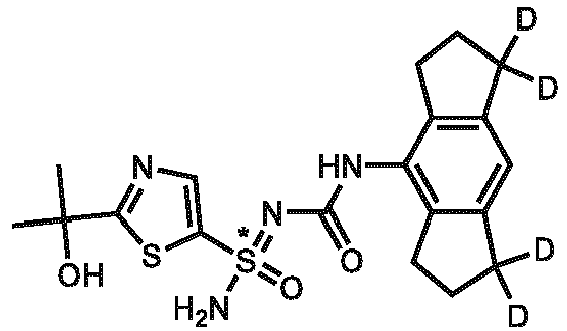
(S) or (R) -N'-((1,2,3,5,6,7-hexahydro-s-indacen-4-yl-1,1,7,7-d4 )carbamoyl)-2-(2-hydroxypropan-2-yl)thiazole-5 -sulfonimidamide CHIRALP AK ID, 2*25 cm (5 um) MeOH (2 mM NH3-MeOH) in CO2 425 # The amount of NH3 in this chiral chromatographic solvent and similar solvents were adjusted by adding 2 M NH3 in methanol to the desired NH3 concentration. In this case, the resulting concentration of NH3 in methanol is 8 mM. -

- To a solution of 8-bromo-1,2,3,5,6,7-hexahydros-indacen-4-amine (1.5 g, 5.94 mmol) in anhydrous THF (50 mL) was added triethylamine (1.07 mL, 7.73 mmol) and triphosgene (882 mg, 2.97 mmol) at room temperature. The resulting mixture was then stirred at 60 °C for 4h. Reaction mixture was then brought to room temperature and used directly in the next step.
- To a solution of N-(tert-butyldimethylsilyl)-5-(2-hydroxypropan-2-yl)-1,3-thiazole-2-sulfonoimidamide (400 mg, 1.2 mmol) in anhydrous THF (10 mL) was added NaH (60% wt. oil dispersioin, 96 mg, 2.4 mmol) at room temperature. After 5 min, a solution of 4-bromo-1,2,3,5,6,7-hexahydro-8-isocyanato-s-indacene (2 mL, 2 mmol, from Step 1) was added drop wise. The resulting mixture was stirred at room temperature for 20 min before quenching carefully with 4 M HCl solution in dioxane (3 mL). Saturated aqueous ammonium chloride was added and the mixture was extracted with dichloromethane (15 mL x 3). The combined organic layers were washed with brine, dried over MgSO4, filtered, and concentrated in vacuo. The crude product was purified by prep-HPLC to obtain the titled compound (280 mg, 47%). LCMS: [M+H]+= 499.3.
-

- To a solution of 2,3-dihydro-1H-inden-4-amine (3.4 g, 26 mmol) in ethanol (45 mL) was added a solution of acetic anhydride (4.9 mL, 52 mmol) in ethanol (15 mL) dropwise at 0 °C. The resulting mixture was gradually warmed up to RT and stirred for 15 h. Solvent was removed under reduced pressure and the residue was triturated with diethyl ether to afford titled compound as off white solid (3 g, 66%). LCMS [M+H]+= 176.3.
- Into a 250-mL round-bottom flask was added N-(2,3-dihydro-1H-inden-4-yl)acetamide (3 g, 17.1 mmol) and acetic acid (45 mL). The resulting solution was cooled to 0 °C and then a solution of bromine (5.4 g, 34.2 mmol) in acetic acid (12 mL) was added dropwise with stirring over 10 min. The cooling bath was removed and the reaction mixture was stirred at RT for 1h. Water was added and the resulting precipitates of product were collected by filtration and dried under vacuum to afford titled compound as off white solid (3.9 g, 90%). LCMS [M+H]+= 254.4.
- A mixture of N-(4-bromo-2,3-dihydro-1H-inden-7-yl)acetamide (1 g, 3.9 mmol), 3,4-dimethylphenylboronic acid (700 mg, 4.68 mmol), Pd(dppf)Cl2.DCM (160 mg, 0.19 mmol), sodium carbonate (900 mg, 8.58 mmol as 2 M aqueous solution) in dioxane (12 mL) was stirred at 100 °C in an oil bath for 72 h. The reaction mixture was brought to RT, water (20 mL) was added and extracted with EtOAc (15 mL × 3). The combined organic layers were washed with brine, dried over MgSO4, filtered, and concentrated in vacuo. The crude product was purified by silica gel flash chromatography using 0- 30% gradient of EtOAc in hexanes to afford titled compound (880 mg, 81%). LCMS [M+H]+= 280.6.
- A solution of N-(2,3-dihydro-4-(3,4-dimethylphenyl)-1H-inden-7-yl)acetamide (880 mg, 3.15 mmol) in 6 N HCl (20 mL) was stirred at 100 °C for 40 h. After consumption of the starting material, the reaction mixture was cooled to 0 °C and adjusted to pH = 8 with 10 M aqueous sodium hydroxide solution. The precipitates formed were collected, washed with water and dried under vacuum to afford the titled compound (81 mg, 67%) as tan colored powder. LCMS [M+H]+ = 238.3.
- To a solution of N-(tert-butyldimethylsilyl)-5-(2-hydroxypropan-2-yl)-1,3-thiazole-2-sulfonoimidamide (42 mg, 0.13 mmol) in DMF (1 mL) was added Et3N (35 uL, 0.25 mmol) and the resulting mixture was stirred at room temperature for 10 min, followed by the addition of CDI (41 mg, 0.25 mmol). The reaction mixture was further stirred at RT for 1 h, and then 2,3-dihydro-7-(3,4-dimethylphenyl)-1H-inden-4-amine (30 mg, 0.13 mmol) was added. The resulting reaction mixture was stirred overnight at room temperature. The presence of desired product was then confirmed by LC-MS. The reaction mixture was quenched with 4 M HCl in dioxane (1 mL) and stirred for 30 min to de-protect the TBS group which indicated the formation of desired product on LCMS. The crude product was purified by preparative HPLC to provide titled compound (16.4 mg, 27%). LCMS [M+H]+= 485.49.
-

- 8-Bromo-1,2,3,5,6,7-hexahydro-s-indacen-4-amine (105 mg, 0.42 mmol), 3,4-dimethylphenyl-boronic acid (187 mg, 1.25 mmol), Pd(dppf)Cl2 (30.4 mg, 0.04 mmol) and dioxane (1.5 mL) were added to a reaction vial. Cesium carbonate (1.24 mL, 1 M in H2O) was then added and the reaction mixture was stirred at 80 °C for 16 h. Reaction mixture was brought to RT and filtered through a small bed of Celite and rinsed with dioxane (5 mL). Water (5 mL) was added to the filtrates and extracted with diethyl ether (5 mL × 3). The combined organic layers were washed with brine, dried over anhydrous MgSO4, filtered, and concentrated in vacuo to provide titled compound which was used in the next step without any purification. LCMS [M+H]+= 278.4.
-

- The title product was obtained using similar procedure as in
Step 5 Example 426. LCMS: [M+H]+ = 525.42. -

- Dimethyl-1,3-thiazole-5-sulfonamide (41.4 mg, 0.22 mmol) was dissolved in anhydrous CH2Cl2 (2 mL). Triethylamine (0.090 mL, 0.65 mmol) and TBSCl (38 mg, 0.25 mol) were added and the resulting mixture was stirred at 50 °C for 18 h. Reaction mixture was brought to RT and used directly in the next step. LCMS: [M+H]+= 307.2.
- Polymer bound dichlorotriphenylphosphorane reaction mixture (described for Reagent 2) was cooled in an ice/water bath under nitrogen. Triethylamine (0.1 mL, 0.72 mmol, 2.25 equiv.) was added slowly via syringe. Resulting mixture was stirred at 0 °C for 10 min and then the reaction mixture from
Step 1 above was added dropwise via syringe. This reaction mixture was further stirred at 0 °C for 30 min and then a steady stream of anhydrous ammonia was bubbled into the reaction mixture for 3 min. Reaction vial was screw capped and stirred in ice/water bath for 2h. Reaction mixture was warmed up to room temperature, carefully opened and filtered to remove resin. The cloudy filtrate was centrifuged to remove any solids. Supernatant was concentrated in vacuo and dried under high vacuum for 1 h and used directly in the next step. LCMS: [M+H]+= 306.8. - To the crude reaction mixture from
Step 2 was added anhydrous THF (1.5 mL) and the resulting mixture was stirred in an ice/water bath for 5 min. NaH (17 mg, 0.44 mmol) was added and after 2 min of stirring a solution of isocyanate (0.165 mmol) in THF (3 ml) was added dropwise at 0 °C. The resulting mixture was brought to RT and stirred for 15 min to give a mixture of crude products. LCMS: [M+H]+= 527.5; for de-protected product, [M+H]+= 413.5. - To the reaction from
Step 3 was carefully added 4N HCl in dioxane (0.3 mL) and the resulting mixture was stirred at RT for 30 min or till the completion of reaction as determined by the LCMS analysis ([M+H]+= 413.5). Reaction mix was then concentrated in vacuo. DMSO (0.8 mL) was added to the residue and purified by prep-HPLC to afford titled compound (10 mg). - Examples in the following table were prepared using similar procedures described in Example 428.
Table 29. Example # Final Target # IUPAC Name Structure LCMS: [M+H]+ 428 309 3-[amino(dimethyl-1,3-thiazol-5-yl)oxo-λ6-sulfanylidene]-1-[4-fluoro-2,6-bis(propan-2-yl)phenyl]urea 
413.16 430 310 3-[amino({1-methyl-1H-pyrazolo[3,4-b]pyridin-5-yl})oxo-λ6-sulfanylidene]-1-[4-fluoro-2,6-bis(propan-2-yl)phenyl]urea 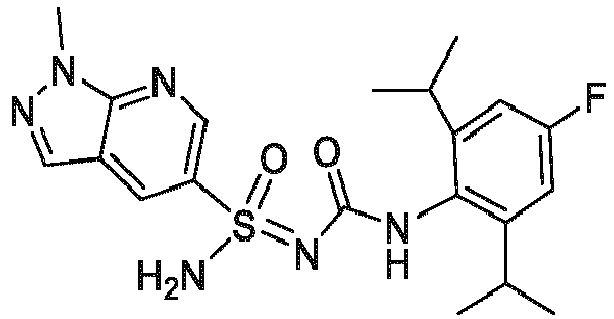
433.27 431 306 1-{amino[5-(dimethylamino)naphthale n-1-yl]oxo-λ6-sulfanylidene}-3-[4-fluoro-2,6-bis(propan-2-yl)phenyl]urea 
471.70 - The following protocol is suitable for testing the activity of the compounds disclosed herein.
- THP-1 cells were purchased from the American Type Culture Collection and subcultured according to instructions from the supplier. Cells were cultured in complete RPMI 1640 (containing 10% heat inactivated FBS, penicillin (100 units/ml) and streptomycin (100 µg/ml)), and maintained in log phase prior to experimental setup. Prior to the experiment, compounds were dissolved in dimethyl sulfoxide (DMSO) to generate a 30mM stock. The compound stock was first pre-diluted in DMSO to 3, 0.34, 0.042 and 0.0083 mM intermediate concentrations and subsequently spotted using Echo550 liquid handler into an empty 384-well assay plate to achieve desired final concentration (e.g. 100, 33, 11, 3.7, 1.2, 0.41, 0.14, 0.046, 0.015, 0.0051, 0.0017 µM). DMSO was backfilled in the plate to achieve a final DMSO assay concentration of 0.37%. The plate was then sealed and stored at room temperature until required.
- THP-1 cells were treated with PMA (Phorbol 12-myristate 13-acetate) (20 ng/ml) for 16-18 hours. On the day of the experiment the media was removed and adherent cells were detached with trypsin for 5 minutes. Cells were then harvested, washed with complete RPMI 1640, spun down, and resuspended in RPMI 1640 (containing 2% heat inactivated FBS, penicillin (100 units/ml) and streptomycin (100 µg/ml). The cells were plated in the 384-well assay plate containing the spotted compounds at a density of 50,000 cells/well (final assay volume 50 µl). Cells were incubated with compounds for 1 hour and then stimulated with gramicidin (5µM) (Enzo) for 2 hours. Plates were then centrifuged at 340g for 5 min. Cell free supernatant (40µL) was collected using a 96-channel PlateMaster (Gilson) and the production of IL-1β was evaluated by HTRF (cisbio). The plates were incubated for 18 h at 4°C and read using the preset HTRF program (donor emission at 620 nm, acceptor emission at 668 nm) of the SpectraMax i3x spectrophotometer (Molecular Devices, software SoftMax 6). A vehicle only control and a dose titration of CRID3 (100 - 0.0017 µM) were run concurrently with each experiment. Data was normalized to vehicle-treated samples (equivalent to 0% inhibition) and CRID3 at 100 µM (equivalent to 100% inhibition). Compounds exhibited a concentration-dependent inhibition of IL-1β production in PMA-differentiated THP-1 cells.
- THP-1 cells were purchased from the American Type Culture Collection and subcultured according to instructions from the supplier. Prior to experiments, cells were cultured in complete RPMI 1640 (containing 10% heat inactivated FBS, penicillin (100 units/ml) and streptomycin (100 µg/ml)), and maintained in log phase prior to experimental setup. Prior to the experiment THP-1 were treated with PMA (Phorbol 12-myristate 13-acetate) (20 ng/ml) for 16-18 hours. Compounds were dissolved in dimethyl sulfoxide (DMSO) to generate a 30mM stock. On the day of the experiment the media was removed and adherent cells were detached with trypsin for 5 minutes. Cells were then harvested, washed with complete RPMI 1640, spun down, resuspended in RPMI 1640 (containing 2% heat inactivated FBS, penicillin (100 units/ml) and streptomycin (100 µg/ml). The cells were plated in a 384-well plate at a density of 50,000 cells/well (final assay volume 50 µl). Compounds were first dissolved in assay medium to obtain a 5x top concentration of 500µM. 10 step dilutions (1:3) were then undertaken in assay medium containing 1.67% DMSO. 5x compound solutions were added to the culture medium to achieve desired final concentration (e.g. 100, 33, 11, 3.7, 1.2, 0.41, 0.14, 0.046, 0.015, 0.0051, 0.0017 µM). Final DMSO concentration was at 0.37%. Cells were incubated with compounds for 1 hour and then stimulated with gramicidin (5µM) (Enzo) for 2 hours. Plates were then centrifuged at 340g for 5 min. Cell free supernatant (40µL) was collected using a 96-channel PlateMaster (Gilson) and the production of IL-1β was evaluated by HTRF (cisbio). A vehicle only control and a dose titration of CRID3 (100 - 0.0017 µM) were run concurrently with each experiment. Data was normalized to vehicle-treated samples (equivalent to 0% inhibition) and CRID3 at 100 µM (equivalent to 100% inhibition). Compounds exhibited a concentration-dependent inhibition of IL-1β production in PMA-differentiated THP-1 cells.
-
-
1. Experimental procedure
-
1.1 Cell Culture
- 1) Culture THP-1 cells in the complete RPMI-1640 medium with 10% FBS at 37°C, 5% CO2.
- 2) Passage the cells every 3 days by inoculating 3×10⁵ cells per ml.
- 1.2 Compound Preparation
Prepare the 3-fold serial dilution of the compounds with DMSO in a 384-well LDV Microplate using TECAN EVO system to generate the compound source plate with 10 concentrations. Top concentration is 30 mM.FIG. 3 depicts the layout of the microplate. -
1.3 Cell preparation
- 1) Centrifuge THP-1 cells at 350g for 5 min.
- 2) Re-suspend cells with complete RMPI-1640 medium, and count cells.
- 3) Seed cells in T225 flask, about 2.5×10⁷ per flask, treat cells with 20ng/ml PMA (final DMSO concentration< 1%).
- 4) Incubate overnight.
-
1.4 THP-1 Stimulation
- 1) Wash adherent THP-1 cells with PBS, and detach cells with 4ml trypsin for T225 flask.
- 2) Centrifuge cells at 350g for 5 min, re-suspend cells with RPMI-1640 containing 2% FBS and count cells with trypan blue.
- 3) Transfer 50 nl/well the serial dilution of test compound to 384-well plate by Echo; For the high control and first point of CRID3 (MCC950), transfer 165 nl, then backfill to make the DMSO concentration is consistent in all wells, the plate layout is as below.
- 4) Seed 50k cells in 40ul RPMI-1640 with 2% FBS per well in 384-well plate.
- 5) Incubate for 1h at 37°C, 5% CO2.
- 6) Prepare 5x gramicidin, add 10 µl per well, the final concentration is 5 µM, incubate for 2hrs at 37°C, 5% CO2.
- 7) Centrifuge at 350 g for 1 min.
- 8) Pipet 16µl supernatant by apricot, and transfer into white 384 proxiplate.
FIG. 3 depicts the layout of the plates: HC: 100 µM CRID3 (MCC950) + 5 µM gramicidin LC : 5 µM Gramicidin.
-
1.5 IL-1β detection
- 1) Homogenize the 5x
diluent # 5 with a vortex and add 1 volume of stock solution in 4 volumes of distilled water. - 2) Thaw 20x stock solution of anti-IL1β-Cryptate-antibody and anti-IL1β XL-antibody. Dilute these two antibodies to 1x with
detection buffer # 3. - 3) Pre-mix the two ready-to-use antibody solutions just prior to use.
- 4) Dispense 4ul of pre-mixed Anti-IL1β antibodies working solution into all wells.
- 5) Seal the plate and incubate overnight at 4 °C.
- 6) Read the cell plate using EnVison and plot Readout vs. the test compound concentration to calculate the IC50.
- 1) Homogenize the 5x
-
1.1 Cell Culture
- 2. Data Analysis:
- 1. IC50 of compounds can be calculated using the following formulas
Formula for IC50
- 2. Fit the normalized data in a dose-response manner using XLfit, and calculate the compound concentration.
- 1. IC50 of compounds can be calculated using the following formulas
- Table 30 shows the biological activity of compounds in hTHP-1 assay containing 2% fetal bovine serum: <0.008 µM = "++++++"; ≥0.008 and <0.04 µM = "+++++"; ≥0.04 and <0.2 µM = "++++"; ≥0.2 and <1 µM = "+++"; ≥1 and <5 µM = "++"; ≥5 and <30 µM = "+".
Table 30. Average IC50 of compounds in hTHP-1 assay Example # Compound Number hTHP-1 IC50 1 181 +++++ 2 181a +++++ 3 181b +++ 4 101' ++++ 5 101 or 102 +++ 6 102 or 101 +++++ 7 194 +++ 8 270 + 9 204 >30 µM 10 180 ++++ 11 190 + 12 182 ++++ 13 191 ++++ 14 177 +++++ 15 185 ++++ 16 186 ++++ 17 187 +++++ 18 188 +++ 19 192 ++ 20 189 ++++ 21 178 ++++ 22 193 ++ 23 170 ++++ 24 168 ++ 25 171 ++++ 26 122 ++++ 27 120 +++ 28 125 ++++ 29 129 + 30 213 +++++ 31 207 ++++ 32 195 +++++ 33 179 ++++ 34 105 ++ 35 121 +++ 36 145 ++ 37 131 ++ 38 132 ++++ 39 144 +++ 40 149 ++++ 41 152 ++++ 42 150 + 43 167 ++++ 44 106 +++++ 45 107 ++++++ 46 110 ++ 47 151 +++ 48 154 ++++ 49 148 +++ 50 153 ++ 51 109 ++ 52 135 +++ 53 134 +++++ 54 130 ++ 55 212 +++ 56 205 +++ 57 143 +++ 58 206 ++ 59 108 +++++ 60 202 ++ 61 208 +++++ 62 197 ++++ 63 196 ++ 64 124 ++++ 65 173 ++++ 66 172 + 67 174 +++ 68 158 ++ 69 220 ++ 70 157 ++ 71 161 ++ 72 159 +++ 73 165 ++ 74 183 +++++ 75 176 +++++ 76 136 +++++ 77 209 ++++ 78 203 >30 µM 79 180b or 180a +++++ 80 180a or 180b +++ 81 179b +++++ 82 179a +++ 83 190a or 190b ++ 84 190b or 190a >30 µM 85 182a or 182b +++++ 86 182b or 182a +++ 87 191b or 191a ++++ 88 191a or 191b ++ 89 177b or 177a +++++ 90 177a or 177b +++ 91 185b or 185a ++++ 92 185a or 185b ++ 93 186a or 186b ++++ 94 186b or 186a ++ 95 187a or 187b ++++++ 96 187b or 187a +++ 97 188b or 188a ++++ 98 188a or 188b + 99 192b or 192a +++ 100 192a or 192b + 101 189b or 189a ++++ 102 189a or 189b ++ 103 178b or 178a ++++ 104 178a or 178b ++ 105 193b or 193a +++ 106 193a or 193b + 107 170b or 170a + 108 170a or 170b ++++ 109 168b or 168a +++ 110 168a or 168b >30 µM 111 171b or 171a ++++ 112 171a or 171b + 113 122b or 122a +++++ 114 122a or 122b ++ 115 120b or 120a ++ 116 120a or 120b ++++ 117 125b or 125a ++++ 118 125a or 125b ++ 119 129b or 129a + 120 129a or 129b >30 µM 121 112b or 112a +++++ 122 112a or 112b +++ 123 207c ++++ 124 207aa ++ 125 207b ++++ 126 195a or 195e ++ 127 195e or 195a ++++ 128 105b or 105a +++ 129 105a or 105b + 130 121b or 121a ++++ 131 121a or 121b ++ 132 145b or 145a ++ 133 145a or 145b >30 µM 134 131b or 131a >30 µM 135 131a or 131b ++ 136 225b or 225a ++ 137 225a or 225b ++++ 138 144b or 144a ++ 139 144a or 144b ++++ 140 149b or 149a +++++ 141 149a or 149b ++ 142 152b or 152a ++++ 143 152a or 152b + 144 151b' or 151a' >30 µM 145 151a' or 151b' + 146 167b or 167a ++ 147 167a or 167b +++ 148 107b or 107a ++++++ 149 107a or 107b +++ 150 110b or 110a + 151 110a or 110b +++ 152 151b or 151a ++++ 153 151a or 151b ++ 154 154b or 154a ++++ 155 154a or 154b ++ 156 148b or 148a +++ 157 148a or 148b + 158 153b or 153a ++ 159 153a or 153b + 160 109b or 109a +++ 161 109a or 109b + 162 135b or 135a +++ 163 135a or 135b + 164 134b or 134a +++++ 165 134a or 134b ++ 166 130b or 130a +++ 167 130a or 130b > 11.2150 168 212b or 212a +++ 169 212a or 212b > 5.5915 170 205b or 205a ++ 171 205a or 205b +++ 172 143b or 143a +++ 173 143a or 143b ++ 174 206b or 206a +++ 175 206a or 206b ++ 176 108b or 108a +++++ 177 108a or 108b ++ 178 202b or 202a + 179 202a or 202b ++ 180 116b or 116a ++ 181 116a or 116b + 182 173a or 173b +++++ 183 173b or 173a +++ 184 174b or 174a +++ 185 174a or 174b + 186 223b or 223a ++++ 187 223a or 223b + 188 158b or 158a ++ 189 158a or 158b >30 µM 190 220b or 220a +++ 191 220a or 220b + 192 157a or 157b +++ 193 157b or 157a >30 µM 194 161b or 161a ++ 195 161a or 161b + 196 165b or 165a + 197 165a or 165b >30 µM 198 172b or 172a + 199 172a or 172b >30 µM 200 106a or 106b +++++ 201 106b or 106a +++ 202 136b or 136a ++ 203 136a or 136b ++++++ 204 183a or 183b +++ 205 183b or 183a +++++ 206 176b or 176a +++++ 207 176a or 176b +++ 208 221 + 209 219 >30 µM 210 217 >30 µM 211 216 + 212 215 >30 µM 213 218 >30 µM 214 214 >30 µM 215 211 + 216 210 >30 µM 217 201 + 218 200 ++ 219 199 >30 µM 220 198 + 221 141 ++++ 222 140 +++ 223 321 +++++ 224 321b or 321a +++++ 225 321a or 321b ++ 226 329 +++++ 227 375 ++++ 228 376 ++++ 229 307 ++ 230 323 ++ 231 338 ++ 232 341 ++ 233 342 ++ 234 345 ++ 235 346 ++ 236 347 ++ 237 348 ++ 238 403 ++ 239 402 ++ 240 350 ++ 241 322 ++ 242 351 ++ 243 358 ++ 244 401 + 245 404 + 246 331 + 247 339 + 248 405 + 249 406 >30 µM 250 324 + 251 407 ++ 252 410 >30 µM 253 408 254 308 ++ 255 311 + 256 312 >30 µM 257 327 ++++ 258 326 ++++ 259 139 +++ 260 137 +++ 261 409 ++ 262 303 +++++ 263 325 +++++ 264 138 ++ 265 332 ++++ 266 334 ++++ 267 335 ++++ 268 337 ++ 269 113 +++++ 270 343 ++ 271 349 ++ 272 344 +++ 273 359 + 274 352 +++ 275 354 ++ 276 355 +++ 277 356 >30 µM 278 357 +++ 279 340 +++++ 280 377 +++ 281 378 +++++ 282 379 +++ 283 380 +++ 284 353 + 285 333 ++++ 287 382 ++ 288 383 ++ 289 315 ++++ 290 316 ++ 291 317 ++++ 292 319 ++++ 293 320 +++ 294 336 ++++ 295 330 ++++ 296 364a ++++++ 297 364b +++ 298 365a ++++ 299 365b ++ 300 308a +++ 301 308b + 302 195ba or 195bb +++ 303 195bb or 195ba +++++ 304 207a or 207bb ++++ 305 207bb or 207a +++++ 306 366a ++++++ 307 366b ++++ 308 139a ++ 309 139b ++++ 310 367a +++++ 311 367b +++ 312 409b ++ 313 409a ++ 314 369a +++ 315 369b + 316 159a +++ 317 159ab ++ 318 159ba +++ 319 137a ++ 320 137b ++++ 321 317ab ++ 322 317aa +++ 323 317bb ++++ 324 317ba +++++ 325 316a > 28.4352 326 316b + 327 373a >30 µM 328 373b ++ 329 374a >30 µM 330 374b >30 µM 331 319ab + 332 319aa +++ 333 319bb ++ 334 319ba +++++ 335 320a ++ 336 320b +++ 337 323ab ++ 338 323bb ++ 339 323aa ++ 340 323ba ++ 341 303a ++++++ 342 303b +++ 343 315a ++++ 344 315b ++ 345 138a +++ 346 138b + 347 328a +++++ 348 328b ++ 349 326b ++ 350 326a ++++ 351 318a +++ 352 318b ++++ 353 325a ++ 354 325b +++++ 355 329a ++++++ 356 329b +++ 357 404b + 358 404a >30 µM 359 332a +++++ 360 332b +++ 361 335a ++++ 362 335b ++ 363 336a ++ 364 336b ++++ 365 337a >30 µM 366 337b ++ 367 371a >30 µM 368 371b ++ 369 372a >30 µM 370 372b +++ 371 334a + 372 334b ++++ 373 339a + 374 339b +++++ 375 334ab + 376 334aa + 377 334bb ++++ 378 334ba +++ 379 338a ++ 380 338b >30 µM 381 340a +++++ 382 340b ++ 383 361b >30 µM 384 361a >30 µM 385 113a +++++ 386 113b +++ 387 330a ++ 388 330b ++++ 389 341a >30 µM 390 341b ++ 391 360ba +++ 392 360bb +++ 393 363b +++++ 394 363a +++ 395 343a ++ 396 343b >30 µM 397 359a ++ 398 359b >30 µM 399 352a +++ 400 352b + 401 383a >30 µM 402 383b ++ 403 382a +++ 404 382b + 405 379a 406 379b >30 µM 407 380a + 408 380b ++ 409 380c +++ 410 380d ++++ 411 384a ++ 412 384b >30 µM 413 357a +++ 414 357b + 415 354a >30 µM 416 354b +++ 417 387a ++ 418 387b ++++ 419 333a ++++ 420 333b ++ 421 375a +++++ 422 375b 423 376a +++++ 424 376b 425 318 +++ 426 313 + 427 314 + 428 309 + 430 310 + 431 306 + - A number of embodiments of the invention have been described. Nevertheless, it will be understood that various modifications may be made without departing from the spirit and scope of the invention. Accordingly, other embodiments are within the scope of the following claims.
Claims (3)
- A compound selected from the group consisting of:
 wherein TBS is tert-butyldimethylsilyl and Boc is tert-butyloxy carbonyl,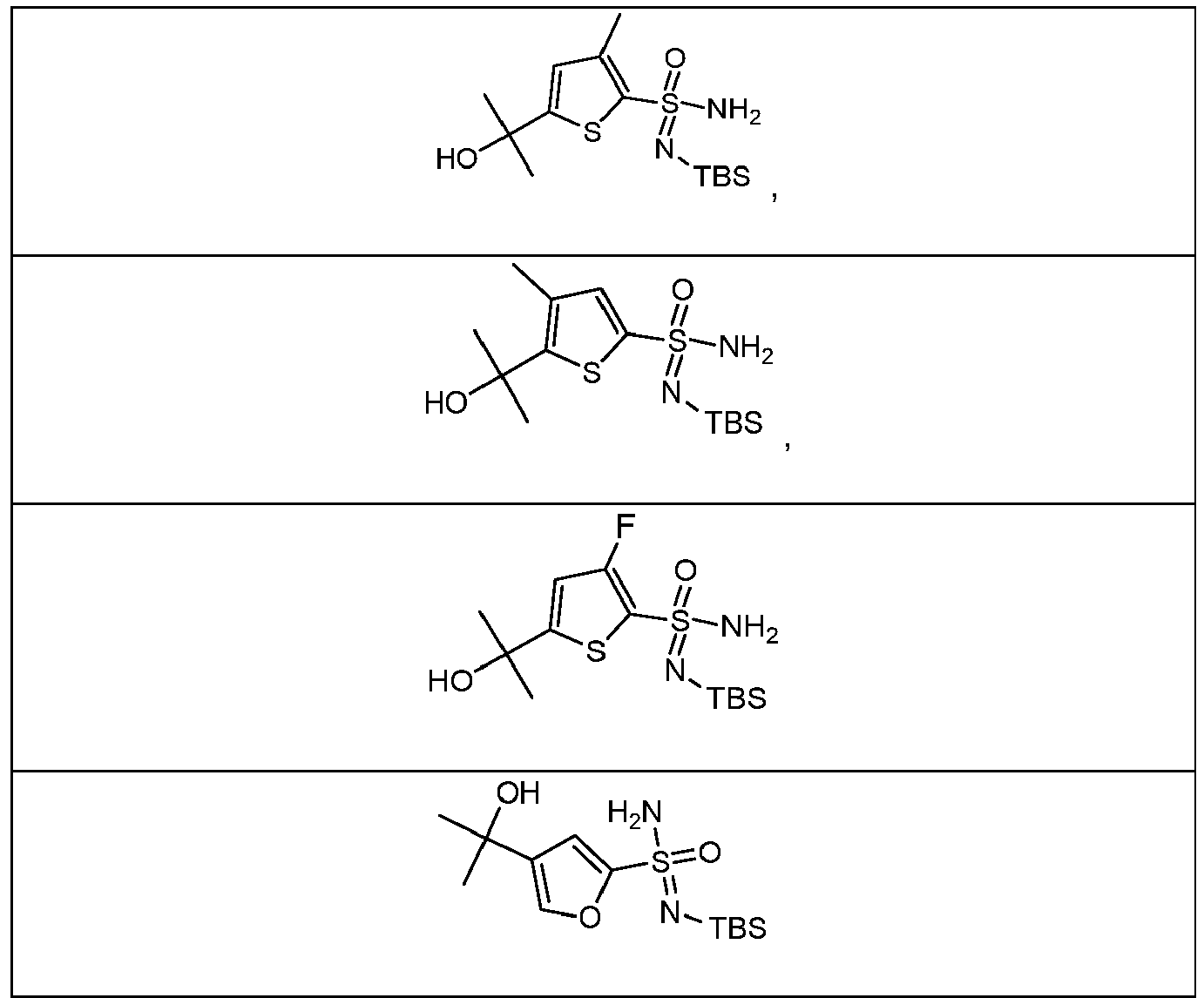
or a pharmaceutically acceptable salt thereof. - The compound of claim 1, selected from the group consisting of:
 or a pharmaceutically acceptable salt thereof.
- The compound of claim 1 or 2, selected from the group consisting of:or a pharmaceutically acceptable salt thereof.

Applications Claiming Priority (4)
| Application Number | Priority Date | Filing Date | Title |
|---|---|---|---|
| US201762536271P | 2017-07-24 | 2017-07-24 | |
| US201762573894P | 2017-10-18 | 2017-10-18 | |
| PCT/US2018/043338 WO2019023147A1 (en) | 2017-07-24 | 2018-07-23 | Compounds and compositions for treating conditions associated with nlrp activity |
| EP18752376.6A EP3658539B1 (en) | 2017-07-24 | 2018-07-23 | Compounds and compositions for treating conditions associated with nlrp activity |
Related Parent Applications (2)
| Application Number | Title | Priority Date | Filing Date |
|---|---|---|---|
| EP18752376.6A Division EP3658539B1 (en) | 2017-07-24 | 2018-07-23 | Compounds and compositions for treating conditions associated with nlrp activity |
| EP18752376.6A Division-Into EP3658539B1 (en) | 2017-07-24 | 2018-07-23 | Compounds and compositions for treating conditions associated with nlrp activity |
Publications (2)
| Publication Number | Publication Date |
|---|---|
| EP4349820A2 true EP4349820A2 (en) | 2024-04-10 |
| EP4349820A3 EP4349820A3 (en) | 2024-07-10 |
Family
ID=63143410
Family Applications (2)
| Application Number | Title | Priority Date | Filing Date |
|---|---|---|---|
| EP18752376.6A Active EP3658539B1 (en) | 2017-07-24 | 2018-07-23 | Compounds and compositions for treating conditions associated with nlrp activity |
| EP24151235.9A Pending EP4349820A3 (en) | 2017-07-24 | 2018-07-23 | Compounds and compositions for treating conditions associated with nlrp activity |
Family Applications Before (1)
| Application Number | Title | Priority Date | Filing Date |
|---|---|---|---|
| EP18752376.6A Active EP3658539B1 (en) | 2017-07-24 | 2018-07-23 | Compounds and compositions for treating conditions associated with nlrp activity |
Country Status (34)
| Country | Link |
|---|---|
| US (4) | US11203579B2 (en) |
| EP (2) | EP3658539B1 (en) |
| JP (3) | JP7412328B2 (en) |
| KR (1) | KR102565167B1 (en) |
| CN (3) | CN111094243B (en) |
| AU (1) | AU2018307743C1 (en) |
| BR (1) | BR112020001476A2 (en) |
| CA (1) | CA3068836A1 (en) |
| CL (1) | CL2020000215A1 (en) |
| CO (1) | CO2020000527A2 (en) |
| CR (1) | CR20200037A (en) |
| CU (1) | CU24615B1 (en) |
| DK (1) | DK3658539T3 (en) |
| DO (1) | DOP2020000012A (en) |
| EC (1) | ECSP20005581A (en) |
| ES (1) | ES2988798T3 (en) |
| FI (1) | FI3658539T3 (en) |
| HR (1) | HRP20240521T1 (en) |
| HU (1) | HUE066566T2 (en) |
| IL (1) | IL271259B2 (en) |
| JO (1) | JOP20200011B1 (en) |
| LT (1) | LT3658539T (en) |
| MX (1) | MX2020000911A (en) |
| NZ (1) | NZ761026A (en) |
| PE (1) | PE20200723A1 (en) |
| PH (1) | PH12020500127A1 (en) |
| PL (1) | PL3658539T3 (en) |
| PT (1) | PT3658539T (en) |
| RS (1) | RS65492B1 (en) |
| SA (1) | SA520411125B1 (en) |
| SG (1) | SG11201912166XA (en) |
| SI (1) | SI3658539T1 (en) |
| WO (1) | WO2019023147A1 (en) |
| ZA (1) | ZA201908154B (en) |
Families Citing this family (69)
| Publication number | Priority date | Publication date | Assignee | Title |
|---|---|---|---|---|
| US11236045B2 (en) | 2017-06-09 | 2022-02-01 | Cadila Healthcare Limited | Substituted sulfoximine compounds |
| HUE066566T2 (en) | 2017-07-24 | 2024-08-28 | Novartis Ag | Compounds and compositions for treating conditions associated with nlrp activity |
| TW201910316A (en) | 2017-08-15 | 2019-03-16 | 愛爾蘭商英弗雷佐姆有限公司 | Novel compound |
| TW201910317A (en) | 2017-08-15 | 2019-03-16 | 愛爾蘭商英弗雷佐姆有限公司 | Novel compound |
| EP3668843A1 (en) | 2017-08-15 | 2020-06-24 | Inflazome Limited | Sulfonylureas and sulfonylthioureas as nlrp3 inhibitors |
| US11623922B2 (en) | 2017-10-03 | 2023-04-11 | Inflazome Limited | Compounds |
| AU2018350980C1 (en) | 2017-10-18 | 2024-12-12 | Incyte Corporation | Condensed imidazole derivatives substituted by tertiary hydroxy groups as pi3k-y gamma inhibitors |
| PE20210050A1 (en) | 2017-11-09 | 2021-01-08 | Inflazome Ltd | NEW SULFONAMIDE CARBOXAMIDE COMPOUNDS |
| EP3707137A1 (en) | 2017-11-09 | 2020-09-16 | Inflazome Limited | Novel sulfonamide carboxamide compounds |
| GB201721185D0 (en) | 2017-12-18 | 2018-01-31 | Nodthera Ltd | Sulphonyl urea derivatives |
| WO2019166619A1 (en) | 2018-03-02 | 2019-09-06 | Inflazome Limited | Novel compounds |
| CA3103664A1 (en) * | 2018-07-03 | 2020-01-09 | Novartis Ag | Methods of treating or selecting a treatment for a subject resistant to tnf inhibitor using a nlrp3 antagonist |
| BR112021001044A2 (en) * | 2018-07-20 | 2021-04-13 | F. Hoffmann-La Roche Ag | SULPHONIMIDAMIDE COMPOUNDS AS INHIBITORS OF INTERLEUKIN-1 ACTIVITY |
| GB201902327D0 (en) | 2019-02-20 | 2019-04-03 | Inflazome Ltd | Novel compounds |
| CN112672995A (en) | 2018-08-15 | 2021-04-16 | 英夫拉索姆有限公司 | Novel sulfonamide urea compounds |
| CR20250050A (en) | 2018-09-05 | 2025-03-19 | Incyte Corp | Crystalline forms of a phosphoinositide 3-kinase (pi3k) inhibitor |
| ES2957692T3 (en) | 2018-11-13 | 2024-01-24 | Novartis Ag | Compounds and compositions for the treatment of conditions associated with NLRP activity |
| ES2974842T3 (en) | 2018-11-13 | 2024-07-01 | Novartis Ag | Compounds and compositions for the treatment of conditions associated with nlrp activity |
| PL3880660T3 (en) * | 2018-11-13 | 2025-11-12 | Novartis Ag | Compounds and compositions for treating conditions associated with nlrp activity |
| US20230051589A1 (en) * | 2018-11-16 | 2023-02-16 | Novartis Ag | Compounds and compositions for treating conditions associated with nlrp activity |
| GB201819083D0 (en) | 2018-11-23 | 2019-01-09 | Inflazome Ltd | Novel compounds |
| FI3911631T3 (en) | 2019-01-14 | 2025-02-03 | Zydus Lifesciences Ltd | Novel substituted sulfonylurea derivatives |
| US20230063462A1 (en) * | 2019-01-23 | 2023-03-02 | Novartis Ag | Sulfonimidamide compounds and compositions for treating conditions associated with nlrp activity |
| GB201905265D0 (en) | 2019-04-12 | 2019-05-29 | Inflazome Ltd | Inflammasome inhibition |
| GB201908219D0 (en) | 2019-06-10 | 2019-07-24 | Axalbion Sa | Therapeutic use of a compound |
| SI3983387T1 (en) | 2019-06-12 | 2024-09-30 | NodThera Limited | Sulfonylurea derivatives and uses thereof |
| ES3056339T3 (en) | 2019-06-12 | 2026-02-19 | Nodthera Ltd | Sulfonylurea derivatives and uses thereof |
| EP3986879B1 (en) | 2019-06-21 | 2024-10-02 | AC Immune SA | Fused 1,2-thiazoles and 1,2-thiazines which act as nlrp3 modulators |
| WO2021002887A1 (en) | 2019-07-02 | 2021-01-07 | Novartis Inflammasome Research, Inc. | Gut-targeted nlrp3 antagonists and their use in therapy |
| CN110590576A (en) * | 2019-08-15 | 2019-12-20 | 安徽金禾实业股份有限公司 | Preparation method of 4-polyfluoro methoxy o-phenylenediamine |
| TW202115095A (en) | 2019-08-16 | 2021-04-16 | 愛爾蘭商英弗雷佐姆有限公司 | Novel compounds |
| EP4013761A1 (en) | 2019-08-16 | 2022-06-22 | Inflazome Limited | Macrocyclic sulfonylurea derivatives useful as nlrp3 inhibitors |
| JP2022547882A (en) | 2019-09-06 | 2022-11-16 | インフレイゾーム リミテッド | NLRP3 inhibitor |
| CA3158123A1 (en) * | 2019-11-12 | 2021-05-20 | Yonggang Wei | Amide derivative and preparation method therefore and use thereof in medicine |
| KR102333562B1 (en) * | 2019-12-03 | 2021-12-01 | 전남대학교 산학협력단 | Composition comprising NLRP3 inflammasome inhibitor for prevention, improvement or treatment of age-related periodontal diseases, and method thereof |
| JP7843705B2 (en) * | 2020-01-22 | 2026-04-10 | エフ・ホフマン-ラ・ロシュ・アクチェンゲゼルシャフト | Sulfonimidoamide compounds as NLRP3 modulators |
| US20230121952A1 (en) | 2020-02-18 | 2023-04-20 | Inflazome Limited | Compounds |
| JP7504234B2 (en) * | 2020-06-11 | 2024-06-21 | シーセン ファーマシューティカル カンパニー リミテッド | Dimethylsulfoximine derivatives |
| IL299084A (en) | 2020-06-19 | 2023-02-01 | Ac Immune Sa | Dihydrooxazole and thiourea or urea derivatives modulating the nlrp3 inflammasome pathway |
| WO2022023907A1 (en) | 2020-07-31 | 2022-02-03 | Novartis Ag | Methods of selecting and treating patients at elevated risk of major adverse cardiac events |
| IL301055A (en) | 2020-09-04 | 2023-05-01 | Nodthera Ltd | Sulfamoylurea derivatives including an alkyl-oxycycloalkyl unit and their uses |
| KR102409344B1 (en) * | 2020-09-22 | 2022-06-15 | 가톨릭대학교 산학협력단 | Nlrp3 inflammasome inhibitor and uses thereof |
| KR102409345B1 (en) * | 2020-09-22 | 2022-06-16 | 가톨릭대학교 산학협력단 | Nlrp3 inflammasome inhibitor and uses thereof |
| CN116323598B (en) | 2020-11-20 | 2024-11-15 | 江苏恒瑞医药股份有限公司 | Triazinedione derivatives, preparation method thereof and medical application thereof |
| CN116507608A (en) * | 2020-11-20 | 2023-07-28 | 戴纳立制药公司 | Compounds, compositions and methods |
| CN113061111A (en) * | 2021-03-16 | 2021-07-02 | 无锡海伦生物科技有限公司 | Method for preparing amino acid compound with photocrosslinking activity |
| US11932630B2 (en) | 2021-04-16 | 2024-03-19 | Novartis Ag | Heteroaryl aminopropanol derivatives |
| CN116917282A (en) * | 2021-05-10 | 2023-10-20 | 成都百裕制药股份有限公司 | Amide derivatives and their applications |
| CN116635374B (en) * | 2021-05-10 | 2025-05-06 | 康百达(四川)生物医药科技有限公司 | Amide derivatives and use thereof |
| TW202246230A (en) * | 2021-05-10 | 2022-12-01 | 大陸商成都百裕製藥股份有限公司 | Amide derivatives and the application thereof |
| CN115616216B (en) * | 2021-07-15 | 2025-08-12 | 华南理工大学 | Use of agents that inhibit or block interactions between FAAH and NLRP3 |
| US20250082611A1 (en) | 2021-07-23 | 2025-03-13 | Novartis Ag | Dosing regimen for an nlrp3 inhibitor in the treatment of osteoarthritis |
| WO2023098613A1 (en) * | 2021-12-03 | 2023-06-08 | 南京明德新药研发有限公司 | Method for preparing dimethyl sulfinyl imine derivative |
| WO2023098612A1 (en) * | 2021-12-03 | 2023-06-08 | 南京明德新药研发有限公司 | Salt form and crystal form of dimethyl sulfoximine derivative |
| US20250109126A1 (en) | 2021-12-22 | 2025-04-03 | Ac Immune Sa | Dihydro-oxazol derivative compounds |
| CN114436851B (en) * | 2022-01-17 | 2023-08-22 | 常州大学 | Preparation method of N, N-dimethylbenzylamine and derivatives thereof |
| CN114989058B (en) * | 2022-06-02 | 2024-04-16 | 中国科学院成都生物研究所 | Preparation method of chiral chlorosulfonyl imine compound and derivative thereof |
| EP4554945A1 (en) | 2022-07-14 | 2025-05-21 | AC Immune SA | Pyrrolotriazine and imidazotriazine derivatives as modulators of the nlrp3 inflammasome pathway |
| CN115227712A (en) * | 2022-07-26 | 2022-10-25 | 上海市第五人民医院 | Application of NaHS in Preparation of Osteoporosis Drugs |
| JP2025527188A (en) | 2022-07-27 | 2025-08-20 | ノバルティス アーゲー | Dosage regimen for NLRP3 inhibitors |
| CA3261365A1 (en) | 2022-07-28 | 2024-02-01 | Ac Immune Sa | Novel compounds |
| EP4719599A1 (en) | 2023-06-02 | 2026-04-08 | Merck Sharp & Dohme LLC | 5,6 unsaturated bicyclic heterocyles useful as inhibitors of nod-like receptor protein 3 |
| WO2025068958A1 (en) | 2023-09-29 | 2025-04-03 | Novartis Ag | Nlrp3 inhibitor for use in lowering the risk of cardiovascular diseases |
| WO2025133307A1 (en) | 2023-12-22 | 2025-06-26 | Ac Immune Sa | Heterocyclic modulators of the nlrp3 inflammasome pathway |
| WO2025153532A1 (en) | 2024-01-16 | 2025-07-24 | NodThera Limited | Nlrp3 inhibitors and glp-1 agonists combination therapies |
| WO2025153624A1 (en) | 2024-01-17 | 2025-07-24 | Ac Immune Sa | Imidazo[1,2-d][1,2,4]triazine derivatives for use as inhibitors of the nlrp3 inflammasome pathway |
| WO2025153625A1 (en) | 2024-01-17 | 2025-07-24 | Ac Immune Sa | Imidazo[1,2-d][1,2,4]triazine derivatives for use as inhibitors of the nlrp3 inflammasome pathway |
| WO2025163069A1 (en) | 2024-01-31 | 2025-08-07 | Ac Immune Sa | Novel compounds |
| WO2026057747A1 (en) | 2024-09-11 | 2026-03-19 | Ac Immune Sa | Therapeutic use of nlrp3 inflammasome pathway inhibitor compounds |
Citations (1)
| Publication number | Priority date | Publication date | Assignee | Title |
|---|---|---|---|---|
| EP0173498A1 (en) | 1984-08-08 | 1986-03-05 | E.I. Du Pont De Nemours And Company | Herbicidal sulphonimidamide compounds |
Family Cites Families (26)
| Publication number | Priority date | Publication date | Assignee | Title |
|---|---|---|---|---|
| IL104088A0 (en) * | 1991-12-20 | 1993-05-13 | Lilly Co Eli | Sulfonimidamides |
| US5258406A (en) | 1991-12-20 | 1993-11-02 | Eli Lilly And Company | Sulfonimidamides |
| US5169860A (en) | 1992-03-13 | 1992-12-08 | Eli Lilly And Company | Antitumor compositions and methods of treatment |
| JP3573757B2 (en) | 1997-01-29 | 2004-10-06 | ファイザー・インク | Sulfonylurea derivatives and use of the sulfonylurea derivatives in controlling interleukin-1 activity |
| EP1214087A1 (en) | 1999-09-14 | 2002-06-19 | Pfizer Products Inc. | Combination treatment with il-1ra and compounds that inhibit il-1 processing and release |
| US6906063B2 (en) | 2000-02-04 | 2005-06-14 | Portola Pharmaceuticals, Inc. | Platelet ADP receptor inhibitors |
| CA2369967A1 (en) | 2001-02-12 | 2002-08-12 | Joseph Anthony Cornicelli | Methods of treating nuclear factor-kappa b mediated diseases and disorders |
| BRPI1006380B1 (en) | 2009-04-16 | 2021-04-06 | Koninklijke Philips N.V. | METHOD FOR COMMUNICATION IN A NETWORK FROM A FIRST STATION TO A SECOND STATION AND RADIO STATION |
| EP2927214B1 (en) | 2012-11-30 | 2018-03-21 | Kyowa Hakko Kirin Co., Ltd. | Nitrogen-containing heterocyclic compound |
| HUE055755T2 (en) * | 2015-02-16 | 2021-12-28 | Univ Queensland | Sulphonol carbabids and related compounds and their use |
| EP3854782A1 (en) | 2016-03-30 | 2021-07-28 | Genentech, Inc. | Substituted benzamides and methods of use thereof |
| WO2017184604A1 (en) | 2016-04-18 | 2017-10-26 | Ifm Therapeutics, Inc | Compounds and compositions for treating conditions associated with nlrp activity |
| US11339136B2 (en) * | 2016-04-18 | 2022-05-24 | Novartis Ag | Compounds and compositions for treating conditions associated with NLRP activity |
| BR112018071347A2 (en) | 2016-04-19 | 2019-02-05 | Innate Tumor Immunity Inc | nlrp3 modulators |
| CA3047336A1 (en) | 2017-01-23 | 2018-07-26 | Jecure Therapeutics, Inc. | Chemical compounds as inhibitors of interleukin-1 activity |
| TWI674261B (en) | 2017-02-17 | 2019-10-11 | 美商英能腫瘤免疫股份有限公司 | Nlrp3 modulators |
| US11236045B2 (en) * | 2017-06-09 | 2022-02-01 | Cadila Healthcare Limited | Substituted sulfoximine compounds |
| KR102669722B1 (en) | 2017-07-07 | 2024-05-29 | 인플라좀 리미티드 | Novel sulfonamide carboxamide compounds |
| EP3658538B1 (en) | 2017-07-24 | 2023-04-19 | Novartis AG | Compounds and compositions for treating conditions associated with nlrp activity |
| HUE066566T2 (en) | 2017-07-24 | 2024-08-28 | Novartis Ag | Compounds and compositions for treating conditions associated with nlrp activity |
| EP3668840A1 (en) | 2017-08-15 | 2020-06-24 | Inflazome Limited | Novel sulfonamide carboxamide compounds |
| US11623922B2 (en) | 2017-10-03 | 2023-04-11 | Inflazome Limited | Compounds |
| BR112021001044A2 (en) | 2018-07-20 | 2021-04-13 | F. Hoffmann-La Roche Ag | SULPHONIMIDAMIDE COMPOUNDS AS INHIBITORS OF INTERLEUKIN-1 ACTIVITY |
| GB201902327D0 (en) | 2019-02-20 | 2019-04-03 | Inflazome Ltd | Novel compounds |
| JP2022500412A (en) | 2018-09-13 | 2022-01-04 | バイエル・アクチエンゲゼルシヤフト | Heterocyclic derivative as a pest control agent |
| BR112021013936A2 (en) | 2019-01-18 | 2021-09-21 | Nuvation Bio Inc. | HETEROCYCLIC COMPOUNDS AS ADENOSINE ANTAGONISTS |
-
2018
- 2018-07-23 HU HUE18752376A patent/HUE066566T2/en unknown
- 2018-07-23 LT LTEPPCT/US2018/043338T patent/LT3658539T/en unknown
- 2018-07-23 SI SI201831090T patent/SI3658539T1/en unknown
- 2018-07-23 MX MX2020000911A patent/MX2020000911A/en unknown
- 2018-07-23 IL IL271259A patent/IL271259B2/en unknown
- 2018-07-23 CN CN201880050915.XA patent/CN111094243B/en active Active
- 2018-07-23 AU AU2018307743A patent/AU2018307743C1/en active Active
- 2018-07-23 ES ES18752376T patent/ES2988798T3/en active Active
- 2018-07-23 RS RS20240513A patent/RS65492B1/en unknown
- 2018-07-23 JP JP2020503754A patent/JP7412328B2/en active Active
- 2018-07-23 CN CN202310765173.1A patent/CN117143042A/en active Pending
- 2018-07-23 PE PE2020000150A patent/PE20200723A1/en unknown
- 2018-07-23 PL PL18752376.6T patent/PL3658539T3/en unknown
- 2018-07-23 FI FIEP18752376.6T patent/FI3658539T3/en active
- 2018-07-23 BR BR112020001476-1A patent/BR112020001476A2/en unknown
- 2018-07-23 CR CR20200037A patent/CR20200037A/en unknown
- 2018-07-23 WO PCT/US2018/043338 patent/WO2019023147A1/en not_active Ceased
- 2018-07-23 US US16/632,849 patent/US11203579B2/en active Active
- 2018-07-23 CU CU2020000004A patent/CU24615B1/en unknown
- 2018-07-23 EP EP18752376.6A patent/EP3658539B1/en active Active
- 2018-07-23 KR KR1020207004803A patent/KR102565167B1/en active Active
- 2018-07-23 HR HRP20240521TT patent/HRP20240521T1/en unknown
- 2018-07-23 EP EP24151235.9A patent/EP4349820A3/en active Pending
- 2018-07-23 SG SG11201912166XA patent/SG11201912166XA/en unknown
- 2018-07-23 CN CN202311185119.6A patent/CN117209447A/en active Pending
- 2018-07-23 CA CA3068836A patent/CA3068836A1/en active Pending
- 2018-07-23 PT PT187523766T patent/PT3658539T/en unknown
- 2018-07-23 NZ NZ761026A patent/NZ761026A/en unknown
- 2018-07-23 DK DK18752376.6T patent/DK3658539T3/en active
-
2019
- 2019-09-16 US US16/572,528 patent/US10654816B2/en active Active
- 2019-12-09 ZA ZA2019/08154A patent/ZA201908154B/en unknown
-
2020
- 2020-01-17 CO CONC2020/0000527A patent/CO2020000527A2/en unknown
- 2020-01-17 PH PH12020500127A patent/PH12020500127A1/en unknown
- 2020-01-23 DO DO2020000012A patent/DOP2020000012A/en unknown
- 2020-01-23 SA SA520411125A patent/SA520411125B1/en unknown
- 2020-01-24 EC ECSENADI20205581A patent/ECSP20005581A/en unknown
- 2020-01-24 CL CL2020000215A patent/CL2020000215A1/en unknown
- 2020-01-26 JO JOJO/P/2020/0011A patent/JOP20200011B1/en active
-
2021
- 2021-10-07 US US17/496,375 patent/US11724992B2/en active Active
-
2023
- 2023-05-18 US US18/319,630 patent/US12084424B2/en active Active
- 2023-12-26 JP JP2023218835A patent/JP7654767B2/en active Active
-
2025
- 2025-03-18 JP JP2025044149A patent/JP7813931B2/en active Active
Patent Citations (2)
| Publication number | Priority date | Publication date | Assignee | Title |
|---|---|---|---|---|
| EP0173498A1 (en) | 1984-08-08 | 1986-03-05 | E.I. Du Pont De Nemours And Company | Herbicidal sulphonimidamide compounds |
| US4666506A (en) | 1984-08-08 | 1987-05-19 | E. I. Du Pont De Nemours And Company | Herbicidal pyrimidines |
Non-Patent Citations (3)
| Title |
|---|
| "Handbook of Pharmaceutical Additives", 2007, GOWER PUBLISHING COMPANY |
| "Pharmaceutical Preformulation and Formulation", 2009, THE PHARMACEUTICAL PRESS AND THE AMERICAN PHARMACEUTICAL ASSOCIATION |
| "Remington: The Science and Practice of Pharmacy", 2005, LIPPINCOTT WILLIAMS & WILKINS |
Also Published As
Similar Documents
| Publication | Publication Date | Title |
|---|---|---|
| US12084424B2 (en) | Compounds and compositions for treating conditions associated with NLRP activity | |
| US20240391884A1 (en) | Compounds and compositions for treating conditions associated with nlrp activity | |
| US20220267276A1 (en) | Nlrp modulators | |
| EP3880666B1 (en) | Compounds and compositions for treating conditions associated with nlrp activity | |
| US20230063462A1 (en) | Sulfonimidamide compounds and compositions for treating conditions associated with nlrp activity | |
| US20220227707A1 (en) | Compounds and compositions for treating conditions associated with nlrp activity | |
| US20210395241A1 (en) | Nlrp modulators | |
| HK40103462A (en) | Compounds and compositions for treating conditions associated with nlrp activity | |
| US20230079631A1 (en) | Compounds and compositions for treating conditions associated with nlrp activity | |
| HK40024570A (en) | Compounds and compositions for treating conditions associated with nlrp activity | |
| HK40024570B (en) | Compounds and compositions for treating conditions associated with nlrp activity | |
| EA042417B1 (en) | COMPOUNDS AND COMPOSITIONS FOR THE TREATMENT OF CONDITIONS ASSOCIATED WITH NLRP ACTIVITY |
Legal Events
| Date | Code | Title | Description |
|---|---|---|---|
| PUAI | Public reference made under article 153(3) epc to a published international application that has entered the european phase |
Free format text: ORIGINAL CODE: 0009012 |
|
| STAA | Information on the status of an ep patent application or granted ep patent |
Free format text: STATUS: THE APPLICATION HAS BEEN PUBLISHED |
|
| AC | Divisional application: reference to earlier application |
Ref document number: 3658539 Country of ref document: EP Kind code of ref document: P |
|
| AK | Designated contracting states |
Kind code of ref document: A2 Designated state(s): AL AT BE BG CH CY CZ DE DK EE ES FI FR GB GR HR HU IE IS IT LI LT LU LV MC MK MT NL NO PL PT RO RS SE SI SK SM TR |
|
| REG | Reference to a national code |
Ref country code: DE Ref legal event code: R079 Free format text: PREVIOUS MAIN CLASS: C07D0307640000 Ipc: C07D0277360000 |
|
| PUAL | Search report despatched |
Free format text: ORIGINAL CODE: 0009013 |
|
| REG | Reference to a national code |
Ref country code: HK Ref legal event code: DE Ref document number: 40103462 Country of ref document: HK |
|
| AK | Designated contracting states |
Kind code of ref document: A3 Designated state(s): AL AT BE BG CH CY CZ DE DK EE ES FI FR GB GR HR HU IE IS IT LI LT LU LV MC MK MT NL NO PL PT RO RS SE SI SK SM TR |
|
| RIC1 | Information provided on ipc code assigned before grant |
Ipc: C07D 333/34 20060101ALI20240605BHEP Ipc: C07D 307/64 20060101ALI20240605BHEP Ipc: C07D 277/36 20060101AFI20240605BHEP |
|
| STAA | Information on the status of an ep patent application or granted ep patent |
Free format text: STATUS: REQUEST FOR EXAMINATION WAS MADE |
|
| 17P | Request for examination filed |
Effective date: 20250110 |
|
| RAV | Requested validation state of the european patent: fee paid |
Extension state: MA Effective date: 20250110 |
|
| RAX | Requested extension states of the european patent have changed |
Extension state: ME Payment date: 20250110 Extension state: BA Payment date: 20250110 |
|
| STAA | Information on the status of an ep patent application or granted ep patent |
Free format text: STATUS: EXAMINATION IS IN PROGRESS |