EP4349237B1 - Battery-powered surface cleaning apparatus - Google Patents
Battery-powered surface cleaning apparatus Download PDFInfo
- Publication number
- EP4349237B1 EP4349237B1 EP23201490.2A EP23201490A EP4349237B1 EP 4349237 B1 EP4349237 B1 EP 4349237B1 EP 23201490 A EP23201490 A EP 23201490A EP 4349237 B1 EP4349237 B1 EP 4349237B1
- Authority
- EP
- European Patent Office
- Prior art keywords
- connector part
- battery pack
- electrical connector
- cleaning apparatus
- battery
- Prior art date
- Legal status (The legal status is an assumption and is not a legal conclusion. Google has not performed a legal analysis and makes no representation as to the accuracy of the status listed.)
- Active
Links
Images




Classifications
-
- A—HUMAN NECESSITIES
- A47—FURNITURE; DOMESTIC ARTICLES OR APPLIANCES; COFFEE MILLS; SPICE MILLS; SUCTION CLEANERS IN GENERAL
- A47L—DOMESTIC WASHING OR CLEANING; SUCTION CLEANERS IN GENERAL
- A47L11/00—Machines for cleaning floors, carpets, furniture, walls, or wall coverings
- A47L11/29—Floor-scrubbing machines characterised by means for taking-up dirty liquid
- A47L11/30—Floor-scrubbing machines characterised by means for taking-up dirty liquid by suction
- A47L11/302—Floor-scrubbing machines characterised by means for taking-up dirty liquid by suction having rotary tools
-
- A—HUMAN NECESSITIES
- A47—FURNITURE; DOMESTIC ARTICLES OR APPLIANCES; COFFEE MILLS; SPICE MILLS; SUCTION CLEANERS IN GENERAL
- A47L—DOMESTIC WASHING OR CLEANING; SUCTION CLEANERS IN GENERAL
- A47L11/00—Machines for cleaning floors, carpets, furniture, walls, or wall coverings
- A47L11/32—Carpet-sweepers
-
- A—HUMAN NECESSITIES
- A47—FURNITURE; DOMESTIC ARTICLES OR APPLIANCES; COFFEE MILLS; SPICE MILLS; SUCTION CLEANERS IN GENERAL
- A47L—DOMESTIC WASHING OR CLEANING; SUCTION CLEANERS IN GENERAL
- A47L11/00—Machines for cleaning floors, carpets, furniture, walls, or wall coverings
- A47L11/32—Carpet-sweepers
- A47L11/325—Shampoo devices for carpet-sweepers
-
- A—HUMAN NECESSITIES
- A47—FURNITURE; DOMESTIC ARTICLES OR APPLIANCES; COFFEE MILLS; SPICE MILLS; SUCTION CLEANERS IN GENERAL
- A47L—DOMESTIC WASHING OR CLEANING; SUCTION CLEANERS IN GENERAL
- A47L11/00—Machines for cleaning floors, carpets, furniture, walls, or wall coverings
- A47L11/32—Carpet-sweepers
- A47L11/33—Carpet-sweepers having means for storing dirt
-
- A—HUMAN NECESSITIES
- A47—FURNITURE; DOMESTIC ARTICLES OR APPLIANCES; COFFEE MILLS; SPICE MILLS; SUCTION CLEANERS IN GENERAL
- A47L—DOMESTIC WASHING OR CLEANING; SUCTION CLEANERS IN GENERAL
- A47L11/00—Machines for cleaning floors, carpets, furniture, walls, or wall coverings
- A47L11/40—Parts or details of machines not provided for in groups A47L11/02 - A47L11/38, or not restricted to one of these groups, e.g. handles, arrangements of switches, skirts, buffers, levers
- A47L11/4002—Installations of electric equipment
- A47L11/4005—Arrangements of batteries or cells; Electric power supply arrangements
-
- A—HUMAN NECESSITIES
- A47—FURNITURE; DOMESTIC ARTICLES OR APPLIANCES; COFFEE MILLS; SPICE MILLS; SUCTION CLEANERS IN GENERAL
- A47L—DOMESTIC WASHING OR CLEANING; SUCTION CLEANERS IN GENERAL
- A47L11/00—Machines for cleaning floors, carpets, furniture, walls, or wall coverings
- A47L11/40—Parts or details of machines not provided for in groups A47L11/02 - A47L11/38, or not restricted to one of these groups, e.g. handles, arrangements of switches, skirts, buffers, levers
- A47L11/4011—Regulation of the cleaning machine by electric means; Control systems and remote control systems therefor
-
- A—HUMAN NECESSITIES
- A47—FURNITURE; DOMESTIC ARTICLES OR APPLIANCES; COFFEE MILLS; SPICE MILLS; SUCTION CLEANERS IN GENERAL
- A47L—DOMESTIC WASHING OR CLEANING; SUCTION CLEANERS IN GENERAL
- A47L11/00—Machines for cleaning floors, carpets, furniture, walls, or wall coverings
- A47L11/40—Parts or details of machines not provided for in groups A47L11/02 - A47L11/38, or not restricted to one of these groups, e.g. handles, arrangements of switches, skirts, buffers, levers
- A47L11/4013—Contaminants collecting devices, i.e. hoppers, tanks or the like
- A47L11/4016—Contaminants collecting devices, i.e. hoppers, tanks or the like specially adapted for collecting fluids
-
- A—HUMAN NECESSITIES
- A47—FURNITURE; DOMESTIC ARTICLES OR APPLIANCES; COFFEE MILLS; SPICE MILLS; SUCTION CLEANERS IN GENERAL
- A47L—DOMESTIC WASHING OR CLEANING; SUCTION CLEANERS IN GENERAL
- A47L11/00—Machines for cleaning floors, carpets, furniture, walls, or wall coverings
- A47L11/40—Parts or details of machines not provided for in groups A47L11/02 - A47L11/38, or not restricted to one of these groups, e.g. handles, arrangements of switches, skirts, buffers, levers
- A47L11/408—Means for supplying cleaning or surface treating agents
-
- A—HUMAN NECESSITIES
- A47—FURNITURE; DOMESTIC ARTICLES OR APPLIANCES; COFFEE MILLS; SPICE MILLS; SUCTION CLEANERS IN GENERAL
- A47L—DOMESTIC WASHING OR CLEANING; SUCTION CLEANERS IN GENERAL
- A47L9/00—Details or accessories of suction cleaners, e.g. mechanical means for controlling the suction or for effecting pulsating action; Storing devices specially adapted to suction cleaners or parts thereof; Carrying-vehicles specially adapted for suction cleaners
- A47L9/28—Installation of the electric equipment, e.g. adaptation or attachment to the suction cleaner; Controlling suction cleaners by electric means
- A47L9/2836—Installation of the electric equipment, e.g. adaptation or attachment to the suction cleaner; Controlling suction cleaners by electric means characterised by the parts which are controlled
-
- A—HUMAN NECESSITIES
- A47—FURNITURE; DOMESTIC ARTICLES OR APPLIANCES; COFFEE MILLS; SPICE MILLS; SUCTION CLEANERS IN GENERAL
- A47L—DOMESTIC WASHING OR CLEANING; SUCTION CLEANERS IN GENERAL
- A47L9/00—Details or accessories of suction cleaners, e.g. mechanical means for controlling the suction or for effecting pulsating action; Storing devices specially adapted to suction cleaners or parts thereof; Carrying-vehicles specially adapted for suction cleaners
- A47L9/28—Installation of the electric equipment, e.g. adaptation or attachment to the suction cleaner; Controlling suction cleaners by electric means
- A47L9/2868—Arrangements for power supply of vacuum cleaners or the accessories thereof
- A47L9/2884—Details of arrangements of batteries or their installation
-
- H—ELECTRICITY
- H01—ELECTRIC ELEMENTS
- H01M—PROCESSES OR MEANS, e.g. BATTERIES, FOR THE DIRECT CONVERSION OF CHEMICAL ENERGY INTO ELECTRICAL ENERGY
- H01M10/00—Secondary cells; Manufacture thereof
- H01M10/42—Methods or arrangements for servicing or maintenance of secondary cells or secondary half-cells
- H01M10/425—Structural combination with electronic components, e.g. electronic circuits integrated to the outside of the casing
-
- H—ELECTRICITY
- H01—ELECTRIC ELEMENTS
- H01M—PROCESSES OR MEANS, e.g. BATTERIES, FOR THE DIRECT CONVERSION OF CHEMICAL ENERGY INTO ELECTRICAL ENERGY
- H01M10/00—Secondary cells; Manufacture thereof
- H01M10/42—Methods or arrangements for servicing or maintenance of secondary cells or secondary half-cells
- H01M10/44—Methods for charging or discharging
-
- H—ELECTRICITY
- H01—ELECTRIC ELEMENTS
- H01M—PROCESSES OR MEANS, e.g. BATTERIES, FOR THE DIRECT CONVERSION OF CHEMICAL ENERGY INTO ELECTRICAL ENERGY
- H01M50/00—Constructional details or processes of manufacture of the non-active parts of electrochemical cells other than fuel cells, e.g. hybrid cells
- H01M50/20—Mountings; Secondary casings or frames; Racks, modules or packs; Suspension devices; Shock absorbers; Transport or carrying devices; Holders
- H01M50/247—Mountings; Secondary casings or frames; Racks, modules or packs; Suspension devices; Shock absorbers; Transport or carrying devices; Holders specially adapted for portable devices, e.g. mobile phones, computers, hand tools or pacemakers
-
- H—ELECTRICITY
- H01—ELECTRIC ELEMENTS
- H01M—PROCESSES OR MEANS, e.g. BATTERIES, FOR THE DIRECT CONVERSION OF CHEMICAL ENERGY INTO ELECTRICAL ENERGY
- H01M50/00—Constructional details or processes of manufacture of the non-active parts of electrochemical cells other than fuel cells, e.g. hybrid cells
- H01M50/20—Mountings; Secondary casings or frames; Racks, modules or packs; Suspension devices; Shock absorbers; Transport or carrying devices; Holders
- H01M50/262—Mountings; Secondary casings or frames; Racks, modules or packs; Suspension devices; Shock absorbers; Transport or carrying devices; Holders with fastening means, e.g. locks
-
- H—ELECTRICITY
- H01—ELECTRIC ELEMENTS
- H01M—PROCESSES OR MEANS, e.g. BATTERIES, FOR THE DIRECT CONVERSION OF CHEMICAL ENERGY INTO ELECTRICAL ENERGY
- H01M50/00—Constructional details or processes of manufacture of the non-active parts of electrochemical cells other than fuel cells, e.g. hybrid cells
- H01M50/50—Current conducting connections for cells or batteries
- H01M50/543—Terminals
-
- A—HUMAN NECESSITIES
- A47—FURNITURE; DOMESTIC ARTICLES OR APPLIANCES; COFFEE MILLS; SPICE MILLS; SUCTION CLEANERS IN GENERAL
- A47L—DOMESTIC WASHING OR CLEANING; SUCTION CLEANERS IN GENERAL
- A47L11/00—Machines for cleaning floors, carpets, furniture, walls, or wall coverings
- A47L11/40—Parts or details of machines not provided for in groups A47L11/02 - A47L11/38, or not restricted to one of these groups, e.g. handles, arrangements of switches, skirts, buffers, levers
- A47L11/4002—Installations of electric equipment
- A47L11/4008—Arrangements of switches, indicators or the like
-
- H—ELECTRICITY
- H01—ELECTRIC ELEMENTS
- H01M—PROCESSES OR MEANS, e.g. BATTERIES, FOR THE DIRECT CONVERSION OF CHEMICAL ENERGY INTO ELECTRICAL ENERGY
- H01M10/00—Secondary cells; Manufacture thereof
- H01M10/42—Methods or arrangements for servicing or maintenance of secondary cells or secondary half-cells
- H01M10/425—Structural combination with electronic components, e.g. electronic circuits integrated to the outside of the casing
- H01M2010/4278—Systems for data transfer from batteries, e.g. transfer of battery parameters to a controller, data transferred between battery controller and main controller
Definitions
- Cordless surface cleaning apparatus such as cordless wet/dry cleaners, vacuum cleaners, mops, and other floor cleaners are popular with many users because they are lightweight, easy to maneuver, and require less storage space.
- battery-powered floor cleaners are that they often have a short runtime before requiring recharging. Providing a longer runtime is particularly challenging for high-powered floor cleaners, such as those offering greater suction power or liquid dispensing, as these features consume more power, thereby depleting the battery quicker.
- Floor cleaners that dispense liquid face the further challenge of protecting the battery and its connection from liquid ingress, particularly for those floor cleaners with a removable battery, as the user necessarily must have access the battery for removal.
- One prior art solution to prevent liquid ingress for a removable battery is providing the battery and the electrical connection between the battery and other electrical components of the floor cleaner within a sealed compartment with an access door or other closure that a user can open to remove the battery.
- a drawback of this solution is that the sealed compartment increases the size and the weight of the floor cleaner.
- the sealed compartment introduces complex design features and can reduce the reliability or service life of the floor cleaner. Providing floor cleaners with a removable battery remains a challenge in the floor cleaning industry.
- EP3686950 and WO2022031612 provide examples of such prior cleaners.
- the battery-powered surface cleaning apparatus also referred to herein as the "surface cleaning apparatus” or the "floor cleaner” has a cleaning system, or multiple cleaning systems, for cleaning a surface, including floor surfaces like carpet, rugs, wood, tile, and the like, or above-floor surfaces like countertops, furniture, and the like.
- the battery powers at least one electrical component of the cleaning system.
- the electrical connector has myriad use applications, but is generally used to electrically couple a battery to electrical components of the floor cleaner.
- the electrical connector can provide connection between a battery pack system and electrical components in order to supply high current electrical power and/or data to the electrical components.
- At least some aspects of the electrical connector provided herein function through the various elements thereof, as described below, to resist entry of water and other liquids, thereby offering a water- and/or liquid-resistant coupling. At least some aspects of the electrical connector provided herein function through the various elements thereof, as described below, to prevent water/liquid ingress for the battery connector without an additional sealed compartment around the connector. By avoiding an additional sealed compartment, the size and the weight of the floor cleaner is reduced. Furthermore, removal of the battery is more user-friendly since a user can easily engage and disengage the battery from the floor cleaner. As such, certain features of the electrical connector may be considered functional, but may also be implemented in different aesthetic configurations.
- a surface cleaning apparatus is illustrated and generally designated at 10.
- the surface cleaning apparatus also referred to herein as floor cleaner 10
- the surface cleaning apparatus is provided with various features and improvements, including a removable battery 30, an electrical connector for the battery, and a mounting arrangement for the battery.
- the floor cleaner 10 can be a wet/dry vacuum cleaner or wet/dry multi-surface cleaner that can be used to clean hard floor surfaces such as tile and hardwood and soft floor surfaces such as area rugs and carpet.
- the floor cleaner 10 can include multiple cleaning systems, including a fluid delivery system and a recovery system. With both fluid delivery and recovery systems, the apparatus 10 can deliver cleaning fluid to the surface to be cleaned and can recover fluid and debris (which may include dirt, dust, stains, soil, hair, and other debris) from the surface to be cleaned.
- the floor cleaner 10 includes an upright handle assembly or body 12 and a cleaning foot or base 14 mounted to or coupled with the upright body 12 and adapted for movement across a surface to be cleaned.
- the various cleaning systems and components thereof can be supported by either or both the base 14 and the upright body 12.
- the apparatus 10 can have a moveable joint assembly 26 that connects the base 14 to the upright body 12 for movement of the body 12 about at least one axis, alternative about at least two axes of rotation.
- the terms "upper,” “lower,” “right,” “left,” “rear,” “front,” “vertical,” “horizontal,” “inner,” “outer,” and derivatives thereof shall relate to the embodiment as oriented in FIG. 1 from the perspective of a user behind the apparatus 10, which defines the rear of the apparatus 10.
- the invention may assume various alternative orientations, except where expressly specified to the contrary.
- the upright body 12 can comprise a handle 16 and a frame 18.
- the frame 18 can comprise a main support section at least partially supporting a supply tank 20 and a recovery tank 22, and may further support additional components of the body 12, including, but not limited to, a battery pack 30.
- the apparatus 10 can include a fluid delivery or supply pathway, including and at least partially defined by the supply tank 20, for storing cleaning fluid, e.g. cleaning liquid, and delivering the cleaning fluid to the surface to be cleaned and a recovery pathway, including and at least partially defined by the recovery tank 22, for removing liquid and debris from the surface to be cleaned and storing the liquid and debris until emptied by the user.
- the handle 16 can include a hand grip 24 at an upper end thereof.
- the apparatus 10 can include at least one user interface ("UI") through which a user can interact with the apparatus 10 to accomplish one or more functions, and such UI(s) can be disposed on the hand grip 24 and/or on the frame 18.
- UI user interface
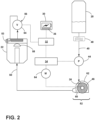
- FIG. 2 is a schematic view of various functional systems of the apparatus 10.
- the delivery system includes at least one supply tank 20 configured to hold a cleaning fluid, at least one fluid dispenser 38 supplied with cleaning fluid from the supply tank 20, and a fluid supply path 40 from the supply tank 20 to the fluid dispenser 38.
- the supply tank 20 can store cleaning fluid in liquid form.
- the cleaning fluid can comprise one or more of any suitable cleaning fluids, including, but not limited to, water, compositions, concentrated detergent, diluted detergent, other surface cleaning and/or treatment agents, and mixtures thereof.
- the cleaning fluid can comprise water.
- the cleaning fluid can comprise a mixture of water and concentrated detergent.
- cleaning fluid may encompass liquid, steam, or both, unless otherwise noted.
- the delivery system can include a flow controller for controlling the flow of fluid from the supply tank 20 to the fluid dispenser 38.
- the flow controller can comprise a pump 44, which pressurizes the supply path 40 and controls the delivery of cleaning fluid to the fluid dispenser 38.
- the pump 44 can be a centrifugal pump.
- the pump 44 can be a solenoid pump having a single, dual, or variable speed.
- the release of cleaning fluid from the dispenser 38 can be controlled manually by the user, e.g. via a trigger (not shown) on the hand grip 24, or automatically by selection of a cleaning mode via a UI (not shown).
- the dispenser 38 can comprise various structures, such as a nozzle, a spray tip, or a manifold, and can comprise at least one fluid outlet for dispensing cleaning fluid to the surface to be cleaned.
- the dispenser 38 can be positioned to deliver cleaning fluid directly to the surface to be cleaned, or indirectly by delivering cleaning fluid onto an agitator, such as, but not limited to, at least one brushroll 46.
- the dispenser 38 delivers cleaning fluid onto a horizontally-rotatable brushroll 46.
- the delivery system can include other conduits, ducts, tubing, hoses, connectors, valves, etc. fluidly coupling the components of the delivery system together and providing the supply path 40.
- a heater 48 can be provided for heating the cleaning fluid prior to delivering the cleaning fluid to the surface to be cleaned.
- an in-line heater 48 can be located downstream of the supply tank 20, and upstream or downstream of the pump 44. Other types of heaters can also be used.
- the cleaning fluid can be heated using exhaust air from a motor cooling air path for a suction source of the recovery system.
- the cleaning fluid is unheated.
- the recovery system can include a recovery path 50 through the apparatus 10 having a path inlet 52 and a path outlet 53, a suction source 54 including a vacuum motor 56 in fluid communication with the path inlet and configured to generate a working stream through a recovery path 50, and the recovery tank 22 for separating and collecting liquid and debris from a working stream for later disposal.
- a separator 58 can be formed in a portion of the recovery tank 22 for separating liquid and entrained debris from the working stream.
- the path inlet 52 is disposed on the base 14 and can be defined by a suction inlet port 60 and/or a brush chamber 62 disposed on the cleaning head or base 14.
- a suction inlet port 60 and brush chamber 62 can be formed at least in part by a suction nozzle, a brush cover, or a combination thereof.
- the path outlet 53 is disposed on the recovery tank 22, and can be defined by an exhaust vent in the recovery tank 22. In another embodiment, the path outlet 53 is disposed elsewhere on the apparatus 10.
- the apparatus 10 can include at least one agitator to agitate the surface to be cleaned.
- the agitator is a rotating brushroll 46.
- the suction inlet port 60 is positioned in close proximity to the brushroll 46 to collect liquid and debris directly from the brushroll 46.
- Other examples of agitators include, but are not limited to, dual horizontally-rotating brushrolls, one or more vertically-rotating brushes, a stationary brush, or a cleaning pad.
- a drive assembly including a brushroll motor 64 can drive the brushroll 46.
- a drive transmission (not shown) operably connects the motor 64 with the brushroll 46 for transmitting rotational motion of the motor 64 to the brushroll 46.
- a drive transmission can operably connect the brushroll 46 with the vacuum motor 56 to transmit rotational motion of the motor 56 to the brushroll 46.
- the battery 30 which can comprise a battery pack, for cordless operation, and is preferably rechargeable.
- the rechargeable battery pack 30 is a lithium ion battery.
- the apparatus 10 can include a main controller 32 operably coupled with the various systems and components of the apparatus 10.
- the main controller 32 can comprise a printed circuit board ("PCB").
- PCB includes a printed circuit board having a plurality of electrical and electronic components that provide operational control to the apparatus 10.
- the PCB includes, for example, a processing unit (e.g., a microprocessor, a microcontroller, or another suitable programmable device) and a memory (e.g., a read-only memory (“ROM”), a random access memory (“RAM”), an electrically erasable programmable read-only memory (“EEPROM”), a flash memory, or another suitable magnetic, optical, physical, or electronic memory device).
- ROM read-only memory
- RAM random access memory
- EEPROM electrically erasable programmable read-only memory
- flash memory or another suitable magnetic, optical, physical, or electronic memory device.
- the processing unit is connected to the memory and executes instructions (e.g., software) that is capable of being stored in the RAM (e.g., during execution), the ROM (e.g., on a generally permanent basis), or another non-transitory computer readable medium such as another memory or a disc. Additionally or alternatively, the memory is included in the processing unit (e.g., as part of a microcontroller).
- Software stored in memory includes, for example, firmware, program data, one or more program modules, and other executable instructions.
- the processing unit is configured to retrieve from memory and execute, among other things, instructions related to the control processes and methods described herein.
- the PCB can also include, among other things, a plurality of additional passive and active components such as resistors, capacitors, inductors, integrated circuits, and amplifiers. These components are arranged and connected to provide a plurality of electrical functions to the PCB including, among other things, signal conditioning or voltage regulation.
- a PCB and the electrical components populated on the PCB are collectively referred to as a controller.
- the main PCB and the electrical components populated on the main PCB may be referred to as main controller 32.
- a base controller 34 can operably couple the main controller 32 with electrical components within the base 14 of the apparatus 10, such as the pump 44 and brush motor 64.
- a separate base PCB is not included with the apparatus 10.
- the battery pack 30 comprises a battery controller 36, alternatively referred to herein as battery PCB 36, that controls charging and discharging of the battery pack 30 and can communicate with the main controller 32.
- battery controller 36 alternatively referred to herein as battery PCB 36, that controls charging and discharging of the battery pack 30 and can communicate with the main controller 32.
- FIG. 1 an architectural layout for the apparatus 10 according to one aspect of the invention is shown, including locations and relative positions for the battery pack 30 and other components.
- Components including the supply tank 20, recovery tank 22, and battery pack 30 are included on the upright body 12.
- the components of the upright body 12 are arranged with relative positioning that is well-balanced, comfortable for the user to operate, and provides protection for electrical components.
- the tanks 20, 22 are disposed in a lower end of the frame 18 and the battery pack 30 is disposed in an upper end of the frame 18 to arrange these components in a generally linear, stacked orientation to provide a compact spatial arrangement for the upright body 12 that is comfortable to hold in a reclined use position.
- the recovery tank 22 is disposed on a lower forward side of the frame 18 and the supply tank 20 is disposed on a rearward side of the frame 18.
- the battery pack 30 is disposed above the supply tank 20, generally on the rearward side on the frame 18. With the battery pack 30 disposed above the tanks 20, 22, the battery pack 30 is isolated from potential exposure to liquids, such as from leaks from the tanks 20, 22 or other components of the delivery and recovery systems.
- the battery pack 30 is provided within the frame 18 of the upright body 12, on a rear side thereof.
- the supply tank 20, and one or more conduits coupling the tank 20 to components of the delivery system in the base 14, can be disposed below the battery pack 30.
- a liquid-resistant sealing structure can be provided to protect the electrical connection for the battery pack 30.
- FIG. 3 is a sectional view showing the battery pack 30 on the upright body 12.
- the battery pack 30 can be removed from the frame 18, and can be mounted to the frame 18 for removal therefrom in any configuration.
- the battery is removable from an upper, rear side of the frame 18.
- the battery pack 30 includes a casing 66 and one or more batteries 68 enclosed within the casing 66.
- the battery PCB 36 is also enclosed with the casing 66.
- the battery pack 30 is accessible for removal without opening any doors, covers, or other closures.
- the battery pack 30 is on an exterior of the apparatus 10, and may define one or more exterior surfaces of the upright body 12 when installed.
- An outer side 70 of the battery pack 30 is visible and forms a rear external surface of the apparatus 10 when the battery pack 30 is installed. With this configuration, a user can easily remove or install the battery pack 30 from a typical operating position behind the apparatus 10.
- the upright body 12 comprises battery socket or receiver 72 for mounting the battery pack 30 thereto.
- the battery pack 30 can mate with the receiver 72 so that the battery pack 30 can be detachably mounted to the body 12 along an installation direction D.
- the battery receiver 72 can be defined by portions of the frame 18, and can include spaced rails 74 provided on the frame 18, and more particularly on rear side of the frame 18.
- the rails 74 can be elongated along the installation direction D.
- Corresponding tracks are provided on the battery pack 30 and can slide along the rails 74. To install the battery pack 30, the tracks are aligned with the rails 74 and the battery pack 30 is slid downwardly in the installation direction D.
- a stopping feature such as a ledge 78 provided on the frame 18, and more particularly on the rear side of the frame 18, arrests downward movement of the battery pack 30.
- the ledge 78 may partially support the battery pack 30, with a bottom 80 of the battery pack 30 resting on the ledge 78 when installed. Other mounting arrangements for the battery pack 30 are possible.
- the battery pack 30 can be mounted to the apparatus 10 by a latch 82.
- the latch 82 can include a latch button 84 is slidably mounted to the battery casing 66 for enabling removal of the battery pack 30 from the apparatus 10.
- the button 84 is spaced apart relative to the frame 18 by a recess 86 in which a user can insert at least one finger to actuate the latch 82.
- the button 84 is pressable to unlatch the battery pack 30 from the apparatus 10 by withdrawing a latching end 88 from a latch receiver 90 on the apparatus 10, on the upright body 12, or more specifically on the rear side of the frame 18.
- the recess 86 is appropriately sized to receive a user's finger for pressing the button 84.
- a spring (not shown) can bias the latch 82 to a latched position, an example of which is shown in FIG. 3 , in which the latching end 88 projects toward an into the latch receiver 90.
- Other latching arrangements for the battery pack 30 are possible.
- One end 92 of the button 84 can be formed as a raised portion adjacent the recess 86, and, in one exemplary removal action, a user can brace a finger against the raised formation of the end 92 while pressing the button 84 and while bracing a thumb of the same hand against outer side 70 to lift of the battery pack 30 away from the apparatus 10.
- the battery pack 30 can single-handedly be unlatched and removed from the apparatus 10.
- the latch 82 may carry multiple latching ends 88.
- the apparatus 10 may have multiple latch receivers 90 for engagement by multiple latching ends 88 of the latch 82.
- the battery pack 30 can include a first connector part 94 for electrically connecting the battery pack 30, and specifically the one or more batteries 68 thereof, to suitable electrical components of the apparatus 10.
- the apparatus 10 can have a second connector part 96 couplable with the first connector part 94 on the battery pack 30.
- the battery pack 30 and connector parts 94, 96 are configured to provide high current electrical power and/or data to electrical components of the apparatus 10.
- the first connector part 94 can be disposed on an inner side 98 of the battery pack casing 66.
- the inner side 98 may be a side opposite the outer side 70 forming a rear external surface of the apparatus 10 when the battery pack 30 is installed.
- the second connector part 96 can be disposed on a rear side 100 of the frame 18.
- the rear side 100 of the frame 18 may confront the inner side 98 of the battery pack 30 when the battery pack 30 is installed.
- the second connector part 96 can be recessed within the rear side 100 of the frame 18, and is thereby structurally protected and/or supported.
- the rear side 100 of the frame 18 on which the connector part 96 is disposed may itself be recessed with respect to at least one other exterior rear surface 102 of the frame 18 to further protect the connector part 96 when the battery pack 30 is not installed.
- the second connector part 96 is disposed between the rails 74, and above the ledge 78.
- the first connector part 94 on the battery pack 30 is a female connector part and the second connector part 96 on the upright body 12 is a male connector part.
- the first or female connector part 94 is configured to at least partially receive the second or male connector part 96.
- the first connector part 94 can be configured as a male part and the second connector part 96 configured as a female part.
- the first connector part 94 can include a plurality of terminal connectors or ports 104, which can be disposed in a supporting structure 106 of the connector part 94 for providing structural protection to the terminal ports 104.
- the terminal ports 104 can be provided through an interface 108 that is slightly recessed within the supporting structure 106 and are thereby structurally protected and/or supported.
- the second connector part 96 can include a plurality of terminal connectors or pins 110, which can be disposed in a supporting structure 112 of the connector part 96 for providing structural protection to the terminal pins 110.
- the terminal pins 110 can be provided through an interface 114 that is slightly raised upon the supporting structure 112, and which can thereby be received within the recessed interface 108 of the first connector part 94.
- the connector parts 94, 96 can be configured supply high current electrical power and/or data between the battery pack 30 and the electrical components of the apparatus 10.
- the terminal set of first connector part 94 can include at least one high current power terminal port (e.g., > 45 amp) and at least one high current data terminal port (e.g., > 10 amp).
- the second connector part 96 includes two power pins 110P, three data pins 110D, and one charging pin 110C.
- the first connector part 94 accordingly has six ports 104 configured to receive the aforementioned pins 110.
- the first connector part 94 can be mounted on the battery PCB 36, and can project generally orthogonally from the battery PCB 36, and also generally perpendicular to the installation direction D, where "generally" includes deviations of up to 5 degrees, alternatively up to 10 degrees.
- the PCB 36 can generally define a planar surface 116 and the first connector part 94 projects normally from the planar surface 116.
- the terminal connectors or ports 104 are L-shaped, and have a base portion that projects normally from the planar surface 116 and a slot section that projects optionally from the base portion. The L-shaped terminal ports 104 allow direct surface mount of the first connector part 94 on the PCB 36.
- a base 117 can be used to mount the ports 104 within the support structure 106.
- the ports 104 can be inserted into the support structure 106 through a bottom opening thereof, and the base 117 is thereafter inserted, formed, or otherwise attached to secure the ports 104 in place and close the bottom opening of the support structure 106.
- hermetic (i.e., airtight) seals 118 are disposed between the base 117 and the ports 104.
- the connector parts 94, 96 are each oriented along the installation direction D of the battery pack 30 so that when the battery pack 30 is installed on the housing of the apparatus 10, the first connector part 94 connects with the second connector part 96.
- mating portions of the connector parts 94, 96 are provided in the installation direction D, i.e., the direction in which the battery pack 30 is able to be mounted to the receiver 72.
- Such mating portions can include, for example, the terminal ports 104 and the terminal pins 110, both of which can be parallel to and elongated along the installation direction D.
- the first connector part 94 can be oriented downwardly in the installation direction D, e.g., with the terminal ports 104 facing downwardly in the installation direction D, and the second connector part 96 can be oriented upwardly in the installation direction D, e.g., with the terminal pins 110 extending upwardly in the installation direction D.
- the connector parts 94, 96 being oriented along the installation direction D, the action of sliding the battery pack 30 downwardly in the installation direction D to mate with the receiver 72 couples the connector parts 94, 96.
- the battery pack 30 drops down into the battery pack receiver 72 to make the connection.
- the battery connector has a sealing structure that resists ingress of liquid.
- the sealing structure can include a first seal 120 at the interface between the first and second connector parts 94, 96, a second seal 122 at the interface between the first connector part 94 and the battery pack 30, and a third seal 124 at the interface between the second connector part 96 and the apparatus 10.
- the seals 120, 122, 124 can be disposed on one or more different surfaces and/or in one or more different planes or orientations to protect against the ingress of liquid.
- the first seal 120 can be a watertight dynamic seal on the support structure 112 of the second or male connector part 96.
- the face seal can be disposed on a front or pin-side of the support structure 112. The seal 120 is compressed by contact with the battery pack 30 when mating the male connector part 96 with the female connector part 94.
- the male connector part 96 has a T-shaped support structure 112, and the first seal 120 sits on the T-shaped support structure 112.
- the support structure 106 of the female connector part 94 can have a recessed portion 134, in which the slot interface 108 is disposed, and which receives a portion of the dynamic seal 120 on the raised interface 114 of the male connector part 96.
- the second seal 122 can a watertight face seal on the first connector part 94.
- the face seal 122 is compressed between a flange 126 of the support structure 106 of the first connector part 94, and the casing 66 of the battery pack 30 to resist the ingress of liquid at this interface.
- the third seal 124 can be a watertight back face seal on the second connector part 96.
- the face seal 124 is compressed between a back side of the support structure 112 and the frame 18 of the apparatus 10 to resist the ingress of liquid at this interface.
- the second connector part 96 can be connected to a wiring harness 128 inside the apparatus 10, schematically denoted by a dashed line in FIGS. 3 and 7 .
- the wiring harness supplies power and/or data between the battery pack 30, via the second connector part 96, and electrical components of the apparatus 10 that can include, but are not limited to, the main PCB 32, base PCB 34, pump 44, suction source 54, vacuum motor 56, heater 48, and/or brush motor 64 (see FIG. 2 ). It is noted that, in some embodiments, wiring supplying power and/or data between the second connector part 96 and electrical components in the base 14, which can include, but are not limited to, the base PCB 34, pump 44, and/or brush motor 64, can extend though the joint assembly 26 ( FIG. 1 ).
- the battery pack 30 can by recharged in place on the apparatus 10, or can be removed from the apparatus 10 for recharging.
- a charging port 130 can be provided on the upright body 12 and can be electrically coupled with the battery pack 30 ( FIG. 1 ).
- the charging port 130 is provided on a rear side of the apparatus 10.
- a tray 132 can dock the apparatus 10 and recharge the battery pack 30.
- the tray 132 can be configured to receive the base 14 of the floor cleaner 10 in an upright, stored position.
- the tray 132 can further be configured for further functionality, such as to store the apparatus 10 when not in use and/or to self-clean the apparatus 10.
- a battery charger (not shown) can be provided for recharging the battery pack 30 when removed from the apparatus 10.
- the battery charger can have a connector part substantially similar to the second or male connector part 96 described herein, and can mate with the first or female connector part 94 on the battery pack 30 for recharging.
- the battery/charger electrical connection may therefore have one or more aspects of the battery/apparatus electrical connection described herein.
- the battery charger can have a sealing structure that resists ingress of liquid, including having a seals substantially similar to the first seal 120 and the third seal 124 at its connector part.
- a battery charger allows a depleted battery pack to be swapped out for a charged battery pack, thereby extending the effective runtime of the apparatus 10. Accordingly, in some applications, multiple interchangeable battery packs 30 are provided for the apparatus 10. In still other applications, one battery pack 30 can be swapped between different surface cleaning apparatus.
- the floor cleaner 10 is illustrated as an upright device.
- the functional systems of the floor cleaner 10 can be arranged into any desired configuration, such as an upright device having a base and an upright body for directing the base across the surface to be cleaned, a portable device adapted to be hand carried by a user, a canister device having a cleaning implement connected to a wheeled base by a vacuum hose, an autonomous or robotic device having an autonomous drive system and an autonomously moveable housing, or a commercial device.
- Any of the aforementioned cleaners can be adapted to include a flexible vacuum hose, which can form a portion of a conduit between a nozzle and a suction source.
- aspects of the present invention may be used on other types of surface cleaning apparatus, including, but not limited to, "dry” vacuum cleaners that does not deliver or extract liquid, but rather is used for collecting relatively dry debris, extraction cleaners that deliver a greater amount of liquid for deep cleaning a soft floor surface, and steam cleaners that generates steam by heating liquid to boiling for delivery to the surface to be cleaned.
Landscapes
- Engineering & Computer Science (AREA)
- Chemical & Material Sciences (AREA)
- Chemical Kinetics & Catalysis (AREA)
- Electrochemistry (AREA)
- General Chemical & Material Sciences (AREA)
- Mechanical Engineering (AREA)
- Manufacturing & Machinery (AREA)
- Life Sciences & Earth Sciences (AREA)
- Biophysics (AREA)
- Computer Hardware Design (AREA)
- Microelectronics & Electronic Packaging (AREA)
- Battery Mounting, Suspending (AREA)
Description
- Cordless surface cleaning apparatus such as cordless wet/dry cleaners, vacuum cleaners, mops, and other floor cleaners are popular with many users because they are lightweight, easy to maneuver, and require less storage space. However, one drawback of battery-powered floor cleaners is that they often have a short runtime before requiring recharging. Providing a longer runtime is particularly challenging for high-powered floor cleaners, such as those offering greater suction power or liquid dispensing, as these features consume more power, thereby depleting the battery quicker. Floor cleaners that dispense liquid face the further challenge of protecting the battery and its connection from liquid ingress, particularly for those floor cleaners with a removable battery, as the user necessarily must have access the battery for removal.
- One prior art solution to prevent liquid ingress for a removable battery is providing the battery and the electrical connection between the battery and other electrical components of the floor cleaner within a sealed compartment with an access door or other closure that a user can open to remove the battery. A drawback of this solution is that the sealed compartment increases the size and the weight of the floor cleaner. Furthermore, the sealed compartment introduces complex design features and can reduce the reliability or service life of the floor cleaner. Providing floor cleaners with a removable battery remains a challenge in the floor cleaning industry.
-
EP3686950 andWO2022031612 provide examples of such prior cleaners. - The invention is set out in the appended set of claims
-
-
FIG. 1 is a rear perspective view of a surface cleaning apparatus, or floor cleaner, according to one embodiment of the invention; -
FIG. 2 is a schematic view of various functional systems of the floor cleaner; -
FIG. 3 is a close-up, sectional view showing a battery, or battery pack, coupled to the floor cleaner; -
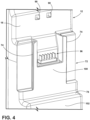
FIG. 4 is a close-up, rear perspective view of the floor cleaner with the battery pack removed to show a battery receiver; -
FIG. 5 is a perspective view of a first connector part of the battery pack; -
FIG. 6 is a perspective view of a second connector part of the floor cleaner; -
FIG. 7 is a schematic sectional view of the first connector part ofFIG. 5 ; -
FIG. 8 is an exploded view of the first connector part ofFIG. 5 ; -
FIG. 9 is a close-up, sectional view showing the connection between the first and second connector parts; and -
FIG. 10 is a sectional view showing the floor cleaner docked on a tray for recharging. - A battery-powered surface cleaning apparatus having an improved electrical connector is described below. The battery-powered surface cleaning apparatus, also referred to herein as the "surface cleaning apparatus" or the "floor cleaner" has a cleaning system, or multiple cleaning systems, for cleaning a surface, including floor surfaces like carpet, rugs, wood, tile, and the like, or above-floor surfaces like countertops, furniture, and the like. The battery powers at least one electrical component of the cleaning system. As will be appreciated from the description herein, the electrical connector has myriad use applications, but is generally used to electrically couple a battery to electrical components of the floor cleaner. As but one example, the electrical connector can provide connection between a battery pack system and electrical components in order to supply high current electrical power and/or data to the electrical components. At least some aspects of the electrical connector provided herein function through the various elements thereof, as described below, to resist entry of water and other liquids, thereby offering a water- and/or liquid-resistant coupling. At least some aspects of the electrical connector provided herein function through the various elements thereof, as described below, to prevent water/liquid ingress for the battery connector without an additional sealed compartment around the connector. By avoiding an additional sealed compartment, the size and the weight of the floor cleaner is reduced. Furthermore, removal of the battery is more user-friendly since a user can easily engage and disengage the battery from the floor cleaner. As such, certain features of the electrical connector may be considered functional, but may also be implemented in different aesthetic configurations.
- In an exemplary embodiment shown in
Figures 1-2 , wherein like numerals indicate corresponding parts throughout the several views, a surface cleaning apparatus is illustrated and generally designated at 10. As discussed in further detail below, the surface cleaning apparatus, also referred to herein asfloor cleaner 10, is provided with various features and improvements, including aremovable battery 30, an electrical connector for the battery, and a mounting arrangement for the battery. - The
floor cleaner 10 can be a wet/dry vacuum cleaner or wet/dry multi-surface cleaner that can be used to clean hard floor surfaces such as tile and hardwood and soft floor surfaces such as area rugs and carpet. Thefloor cleaner 10 can include multiple cleaning systems, including a fluid delivery system and a recovery system. With both fluid delivery and recovery systems, theapparatus 10 can deliver cleaning fluid to the surface to be cleaned and can recover fluid and debris (which may include dirt, dust, stains, soil, hair, and other debris) from the surface to be cleaned. - The
floor cleaner 10 includes an upright handle assembly orbody 12 and a cleaning foot orbase 14 mounted to or coupled with theupright body 12 and adapted for movement across a surface to be cleaned. The various cleaning systems and components thereof can be supported by either or both thebase 14 and theupright body 12. Theapparatus 10 can have amoveable joint assembly 26 that connects thebase 14 to theupright body 12 for movement of thebody 12 about at least one axis, alternative about at least two axes of rotation. - For purposes of description related to the figures, the terms "upper," "lower," "right," "left," "rear," "front," "vertical," "horizontal," "inner," "outer," and derivatives thereof shall relate to the embodiment as oriented in
FIG. 1 from the perspective of a user behind theapparatus 10, which defines the rear of theapparatus 10. However, it is to be understood that the invention may assume various alternative orientations, except where expressly specified to the contrary. - The
upright body 12 can comprise ahandle 16 and aframe 18. Theframe 18 can comprise a main support section at least partially supporting asupply tank 20 and arecovery tank 22, and may further support additional components of thebody 12, including, but not limited to, abattery pack 30. Theapparatus 10 can include a fluid delivery or supply pathway, including and at least partially defined by thesupply tank 20, for storing cleaning fluid, e.g. cleaning liquid, and delivering the cleaning fluid to the surface to be cleaned and a recovery pathway, including and at least partially defined by therecovery tank 22, for removing liquid and debris from the surface to be cleaned and storing the liquid and debris until emptied by the user. - The
handle 16 can include ahand grip 24 at an upper end thereof. Theapparatus 10 can include at least one user interface ("UI") through which a user can interact with theapparatus 10 to accomplish one or more functions, and such UI(s) can be disposed on thehand grip 24 and/or on theframe 18. -
FIG. 2 is a schematic view of various functional systems of theapparatus 10. The delivery system includes at least onesupply tank 20 configured to hold a cleaning fluid, at least onefluid dispenser 38 supplied with cleaning fluid from thesupply tank 20, and afluid supply path 40 from thesupply tank 20 to thefluid dispenser 38. - The
supply tank 20 can store cleaning fluid in liquid form. The cleaning fluid can comprise one or more of any suitable cleaning fluids, including, but not limited to, water, compositions, concentrated detergent, diluted detergent, other surface cleaning and/or treatment agents, and mixtures thereof. For example, the cleaning fluid can comprise water. In another example, the cleaning fluid can comprise a mixture of water and concentrated detergent. - It is noted that while the
apparatus 10 described herein is configured to deliver a cleaning liquid, aspects of the invention may be applicable to surface cleaning apparatus that deliver steam. Thus, the term "cleaning fluid" may encompass liquid, steam, or both, unless otherwise noted. - The delivery system can include a flow controller for controlling the flow of fluid from the
supply tank 20 to thefluid dispenser 38. In one configuration, the flow controller can comprise apump 44, which pressurizes thesupply path 40 and controls the delivery of cleaning fluid to thefluid dispenser 38. In one example, thepump 44 can be a centrifugal pump. In another example, thepump 44 can be a solenoid pump having a single, dual, or variable speed. The release of cleaning fluid from thedispenser 38 can be controlled manually by the user, e.g. via a trigger (not shown) on thehand grip 24, or automatically by selection of a cleaning mode via a UI (not shown). - The
dispenser 38 can comprise various structures, such as a nozzle, a spray tip, or a manifold, and can comprise at least one fluid outlet for dispensing cleaning fluid to the surface to be cleaned. Thedispenser 38 can be positioned to deliver cleaning fluid directly to the surface to be cleaned, or indirectly by delivering cleaning fluid onto an agitator, such as, but not limited to, at least onebrushroll 46. In one non-limiting example, thedispenser 38 delivers cleaning fluid onto a horizontally-rotatable brushroll 46. - The delivery system can include other conduits, ducts, tubing, hoses, connectors, valves, etc. fluidly coupling the components of the delivery system together and providing the
supply path 40. - Optionally, a
heater 48 can be provided for heating the cleaning fluid prior to delivering the cleaning fluid to the surface to be cleaned. In one example, an in-line heater 48 can be located downstream of thesupply tank 20, and upstream or downstream of thepump 44. Other types of heaters can also be used. In yet another example, the cleaning fluid can be heated using exhaust air from a motor cooling air path for a suction source of the recovery system. In yet another example, the cleaning fluid is unheated. - The recovery system can include a
recovery path 50 through theapparatus 10 having apath inlet 52 and apath outlet 53, asuction source 54 including avacuum motor 56 in fluid communication with the path inlet and configured to generate a working stream through arecovery path 50, and therecovery tank 22 for separating and collecting liquid and debris from a working stream for later disposal. Aseparator 58 can be formed in a portion of therecovery tank 22 for separating liquid and entrained debris from the working stream. - In one embodiment, the
path inlet 52 is disposed on thebase 14 and can be defined by asuction inlet port 60 and/or abrush chamber 62 disposed on the cleaning head orbase 14. One or both of thesuction inlet port 60 andbrush chamber 62 can be formed at least in part by a suction nozzle, a brush cover, or a combination thereof. - In one embodiment, the
path outlet 53 is disposed on therecovery tank 22, and can be defined by an exhaust vent in therecovery tank 22. In another embodiment, thepath outlet 53 is disposed elsewhere on theapparatus 10. - The
apparatus 10 can include at least one agitator to agitate the surface to be cleaned. In one embodiment, the agitator is arotating brushroll 46. In one non-limiting example, thesuction inlet port 60 is positioned in close proximity to thebrushroll 46 to collect liquid and debris directly from thebrushroll 46. Other examples of agitators include, but are not limited to, dual horizontally-rotating brushrolls, one or more vertically-rotating brushes, a stationary brush, or a cleaning pad. - A drive assembly including a
brushroll motor 64 can drive thebrushroll 46. A drive transmission (not shown) operably connects themotor 64 with thebrushroll 46 for transmitting rotational motion of themotor 64 to thebrushroll 46. In other embodiment, a drive transmission can operably connect thebrushroll 46 with thevacuum motor 56 to transmit rotational motion of themotor 56 to thebrushroll 46. - Electrical components of the
apparatus 10, including thepump 44,vacuum motor 56,brushroll motor 64, or any combination thereof, are electrically coupled to thebattery 30, which can comprise a battery pack, for cordless operation, and is preferably rechargeable. In one example, therechargeable battery pack 30 is a lithium ion battery. - The
apparatus 10 can include amain controller 32 operably coupled with the various systems and components of theapparatus 10. In one embodiment themain controller 32 can comprise a printed circuit board ("PCB"). As used herein, unless otherwise noted, the term "PCB" includes a printed circuit board having a plurality of electrical and electronic components that provide operational control to theapparatus 10. The PCB includes, for example, a processing unit (e.g., a microprocessor, a microcontroller, or another suitable programmable device) and a memory (e.g., a read-only memory ("ROM"), a random access memory ("RAM"), an electrically erasable programmable read-only memory ("EEPROM"), a flash memory, or another suitable magnetic, optical, physical, or electronic memory device). The processing unit is connected to the memory and executes instructions (e.g., software) that is capable of being stored in the RAM (e.g., during execution), the ROM (e.g., on a generally permanent basis), or another non-transitory computer readable medium such as another memory or a disc. Additionally or alternatively, the memory is included in the processing unit (e.g., as part of a microcontroller). Software stored in memory includes, for example, firmware, program data, one or more program modules, and other executable instructions. The processing unit is configured to retrieve from memory and execute, among other things, instructions related to the control processes and methods described herein. The PCB can also include, among other things, a plurality of additional passive and active components such as resistors, capacitors, inductors, integrated circuits, and amplifiers. These components are arranged and connected to provide a plurality of electrical functions to the PCB including, among other things, signal conditioning or voltage regulation. For descriptive purposes, a PCB and the electrical components populated on the PCB are collectively referred to as a controller. Thus, the main PCB and the electrical components populated on the main PCB may be referred to asmain controller 32. - Optionally, a
base controller 34, alternatively referred to herein as base PCB, can operably couple themain controller 32 with electrical components within thebase 14 of theapparatus 10, such as thepump 44 andbrush motor 64. In other embodiments, a separate base PCB is not included with theapparatus 10. - The
battery pack 30 comprises abattery controller 36, alternatively referred to herein asbattery PCB 36, that controls charging and discharging of thebattery pack 30 and can communicate with themain controller 32. - Returning to
FIG. 1 , an architectural layout for theapparatus 10 according to one aspect of the invention is shown, including locations and relative positions for thebattery pack 30 and other components. Components including thesupply tank 20,recovery tank 22, andbattery pack 30 are included on theupright body 12. The components of theupright body 12 are arranged with relative positioning that is well-balanced, comfortable for the user to operate, and provides protection for electrical components. For example, thetanks frame 18 and thebattery pack 30 is disposed in an upper end of theframe 18 to arrange these components in a generally linear, stacked orientation to provide a compact spatial arrangement for theupright body 12 that is comfortable to hold in a reclined use position. Therecovery tank 22 is disposed on a lower forward side of theframe 18 and thesupply tank 20 is disposed on a rearward side of theframe 18. Thebattery pack 30 is disposed above thesupply tank 20, generally on the rearward side on theframe 18. With thebattery pack 30 disposed above thetanks battery pack 30 is isolated from potential exposure to liquids, such as from leaks from thetanks battery pack 30 is provided within theframe 18 of theupright body 12, on a rear side thereof. Thesupply tank 20, and one or more conduits coupling thetank 20 to components of the delivery system in thebase 14, can be disposed below thebattery pack 30. Other arrangements of the components of theapparatus 10 are possible, while maintaining a well-balanced and comfortablyoperable apparatus 10, and isolated electrical components. As will be described in further detail below, in addition to the position of thebattery pack 30 relative to thetanks battery pack 30. -
FIG. 3 is a sectional view showing thebattery pack 30 on theupright body 12. Thebattery pack 30 can be removed from theframe 18, and can be mounted to theframe 18 for removal therefrom in any configuration. In the present embodiment, the battery is removable from an upper, rear side of theframe 18. - In one aspect of the invention, the
battery pack 30 includes acasing 66 and one ormore batteries 68 enclosed within thecasing 66. Thebattery PCB 36 is also enclosed with thecasing 66. - In one aspect of the invention, the
battery pack 30 is accessible for removal without opening any doors, covers, or other closures. In other words, thebattery pack 30 is on an exterior of theapparatus 10, and may define one or more exterior surfaces of theupright body 12 when installed. Anouter side 70 of thebattery pack 30 is visible and forms a rear external surface of theapparatus 10 when thebattery pack 30 is installed. With this configuration, a user can easily remove or install thebattery pack 30 from a typical operating position behind theapparatus 10. - Referring to
FIGS. 3-4 , theupright body 12 comprises battery socket orreceiver 72 for mounting thebattery pack 30 thereto. Thebattery pack 30 can mate with thereceiver 72 so that thebattery pack 30 can be detachably mounted to thebody 12 along an installation direction D. As shown herein, in one embodiment thebattery receiver 72 can be defined by portions of theframe 18, and can include spacedrails 74 provided on theframe 18, and more particularly on rear side of theframe 18. Therails 74 can be elongated along the installation direction D. Corresponding tracks (not shown) are provided on thebattery pack 30 and can slide along therails 74. To install thebattery pack 30, the tracks are aligned with therails 74 and thebattery pack 30 is slid downwardly in the installation direction D. A stopping feature, such as aledge 78 provided on theframe 18, and more particularly on the rear side of theframe 18, arrests downward movement of thebattery pack 30. In some embodiments, theledge 78 may partially support thebattery pack 30, with a bottom 80 of thebattery pack 30 resting on theledge 78 when installed. Other mounting arrangements for thebattery pack 30 are possible. - The
battery pack 30 can be mounted to theapparatus 10 by alatch 82. Thelatch 82 can include alatch button 84 is slidably mounted to thebattery casing 66 for enabling removal of thebattery pack 30 from theapparatus 10. Thebutton 84 is spaced apart relative to theframe 18 by arecess 86 in which a user can insert at least one finger to actuate thelatch 82. Thebutton 84 is pressable to unlatch thebattery pack 30 from theapparatus 10 by withdrawing a latchingend 88 from alatch receiver 90 on theapparatus 10, on theupright body 12, or more specifically on the rear side of theframe 18. As illustrated, therecess 86 is appropriately sized to receive a user's finger for pressing thebutton 84. A spring (not shown) can bias thelatch 82 to a latched position, an example of which is shown inFIG. 3 , in which the latchingend 88 projects toward an into thelatch receiver 90. Other latching arrangements for thebattery pack 30 are possible. - One
end 92 of thebutton 84 can be formed as a raised portion adjacent therecess 86, and, in one exemplary removal action, a user can brace a finger against the raised formation of theend 92 while pressing thebutton 84 and while bracing a thumb of the same hand againstouter side 70 to lift of thebattery pack 30 away from theapparatus 10. Thus, thebattery pack 30 can single-handedly be unlatched and removed from theapparatus 10. - While only one latching
end 88 is visible inFIG. 3 , thelatch 82 may carry multiple latching ends 88. For example, as can be seen inFIG. 4 , theapparatus 10 may havemultiple latch receivers 90 for engagement by multiple latching ends 88 of thelatch 82. - The
battery pack 30 can include afirst connector part 94 for electrically connecting thebattery pack 30, and specifically the one ormore batteries 68 thereof, to suitable electrical components of theapparatus 10. Theapparatus 10 can have asecond connector part 96 couplable with thefirst connector part 94 on thebattery pack 30. In one embodiment, thebattery pack 30 andconnector parts apparatus 10. - In one arrangement, as illustrated in
FIG. 3 , thefirst connector part 94 can be disposed on aninner side 98 of thebattery pack casing 66. Theinner side 98 may be a side opposite theouter side 70 forming a rear external surface of theapparatus 10 when thebattery pack 30 is installed. - Referring to
FIG. 4 , in one arrangement, thesecond connector part 96 can be disposed on arear side 100 of theframe 18. Therear side 100 of theframe 18 may confront theinner side 98 of thebattery pack 30 when thebattery pack 30 is installed. Thesecond connector part 96 can be recessed within therear side 100 of theframe 18, and is thereby structurally protected and/or supported. Therear side 100 of theframe 18 on which theconnector part 96 is disposed may itself be recessed with respect to at least one other exteriorrear surface 102 of theframe 18 to further protect theconnector part 96 when thebattery pack 30 is not installed. In the embodiment shown herein, thesecond connector part 96 is disposed between therails 74, and above theledge 78. - Referring to
FIG. 3 , in one aspect of the invention, thefirst connector part 94 on thebattery pack 30 is a female connector part and thesecond connector part 96 on theupright body 12 is a male connector part. The first orfemale connector part 94 is configured to at least partially receive the second ormale connector part 96. In another embodiment, thefirst connector part 94 can be configured as a male part and thesecond connector part 96 configured as a female part. - Referring to
FIG. 5 , in one embodiment, thefirst connector part 94 can include a plurality of terminal connectors orports 104, which can be disposed in a supportingstructure 106 of theconnector part 94 for providing structural protection to theterminal ports 104. Theterminal ports 104 can be provided through aninterface 108 that is slightly recessed within the supportingstructure 106 and are thereby structurally protected and/or supported. - Referring to
FIG. 6 , thesecond connector part 96 can include a plurality of terminal connectors or pins 110, which can be disposed in a supportingstructure 112 of theconnector part 96 for providing structural protection to the terminal pins 110. The terminal pins 110 can be provided through aninterface 114 that is slightly raised upon the supportingstructure 112, and which can thereby be received within the recessedinterface 108 of thefirst connector part 94. - The
connector parts battery pack 30 and the electrical components of theapparatus 10. In one embodiment, the terminal set offirst connector part 94 can include at least one high current power terminal port (e.g., > 45 amp) and at least one high current data terminal port (e.g., > 10 amp). - Various terminal sets, including number and type of terminal connectors, are possible. In one embodiment, the
second connector part 96 includes twopower pins 110P, threedata pins 110D, and onecharging pin 110C. Thefirst connector part 94 accordingly has sixports 104 configured to receive the aforementioned pins 110. - Returning to
FIGS. 7-8 , thefirst connector part 94 can be mounted on thebattery PCB 36, and can project generally orthogonally from thebattery PCB 36, and also generally perpendicular to the installation direction D, where "generally" includes deviations of up to 5 degrees, alternatively up to 10 degrees. For example, thePCB 36 can generally define aplanar surface 116 and thefirst connector part 94 projects normally from theplanar surface 116. In one aspect of the invention, the terminal connectors orports 104 are L-shaped, and have a base portion that projects normally from theplanar surface 116 and a slot section that projects optionally from the base portion. The L-shapedterminal ports 104 allow direct surface mount of thefirst connector part 94 on thePCB 36. - A base 117 can be used to mount the
ports 104 within thesupport structure 106. During assembly, theports 104 can be inserted into thesupport structure 106 through a bottom opening thereof, and thebase 117 is thereafter inserted, formed, or otherwise attached to secure theports 104 in place and close the bottom opening of thesupport structure 106. Optionally, hermetic (i.e., airtight) seals 118 are disposed between the base 117 and theports 104. - Referring to
FIG. 9 , in some examples, theconnector parts battery pack 30 so that when thebattery pack 30 is installed on the housing of theapparatus 10, thefirst connector part 94 connects with thesecond connector part 96. In one aspect, mating portions of theconnector parts battery pack 30 is able to be mounted to thereceiver 72. Such mating portions can include, for example, theterminal ports 104 and the terminal pins 110, both of which can be parallel to and elongated along the installation direction D. Thefirst connector part 94 can be oriented downwardly in the installation direction D, e.g., with theterminal ports 104 facing downwardly in the installation direction D, and thesecond connector part 96 can be oriented upwardly in the installation direction D, e.g., with theterminal pins 110 extending upwardly in the installation direction D. With theconnector parts battery pack 30 downwardly in the installation direction D to mate with thereceiver 72 couples theconnector parts battery pack 30 drops down into thebattery pack receiver 72 to make the connection. - Referring to
FIG. 9 , in one aspect of the invention, the battery connector has a sealing structure that resists ingress of liquid. The sealing structure can include afirst seal 120 at the interface between the first andsecond connector parts second seal 122 at the interface between thefirst connector part 94 and thebattery pack 30, and athird seal 124 at the interface between thesecond connector part 96 and theapparatus 10. - The
seals - The
first seal 120 can be a watertight dynamic seal on thesupport structure 112 of the second ormale connector part 96. The face seal can be disposed on a front or pin-side of thesupport structure 112. Theseal 120 is compressed by contact with thebattery pack 30 when mating themale connector part 96 with thefemale connector part 94. - In embodiment, the
male connector part 96 has a T-shapedsupport structure 112, and thefirst seal 120 sits on the T-shapedsupport structure 112. Thesupport structure 106 of thefemale connector part 94 can have a recessedportion 134, in which theslot interface 108 is disposed, and which receives a portion of thedynamic seal 120 on the raisedinterface 114 of themale connector part 96. - The
second seal 122 can a watertight face seal on thefirst connector part 94. Theface seal 122 is compressed between aflange 126 of thesupport structure 106 of thefirst connector part 94, and thecasing 66 of thebattery pack 30 to resist the ingress of liquid at this interface. - The
third seal 124 can be a watertight back face seal on thesecond connector part 96. Theface seal 124 is compressed between a back side of thesupport structure 112 and theframe 18 of theapparatus 10 to resist the ingress of liquid at this interface. - The
second connector part 96 can be connected to awiring harness 128 inside theapparatus 10, schematically denoted by a dashed line inFIGS. 3 and7 . The wiring harness supplies power and/or data between thebattery pack 30, via thesecond connector part 96, and electrical components of theapparatus 10 that can include, but are not limited to, themain PCB 32,base PCB 34, pump 44,suction source 54,vacuum motor 56,heater 48, and/or brush motor 64 (seeFIG. 2 ). It is noted that, in some embodiments, wiring supplying power and/or data between thesecond connector part 96 and electrical components in thebase 14, which can include, but are not limited to, thebase PCB 34, pump 44, and/orbrush motor 64, can extend though the joint assembly 26 (FIG. 1 ). - The
battery pack 30 can by recharged in place on theapparatus 10, or can be removed from theapparatus 10 for recharging. Referring toFIG. 10 , for regarding in place on theapparatus 10, a chargingport 130 can be provided on theupright body 12 and can be electrically coupled with the battery pack 30 (FIG. 1 ). In the illustrated embodiment, the chargingport 130 is provided on a rear side of theapparatus 10. Atray 132 can dock theapparatus 10 and recharge thebattery pack 30. Thetray 132 can be configured to receive thebase 14 of thefloor cleaner 10 in an upright, stored position. Thetray 132 can further be configured for further functionality, such as to store theapparatus 10 when not in use and/or to self-clean theapparatus 10. - Alternatively or additionally to the
tray 132, a battery charger (not shown) can be provided for recharging thebattery pack 30 when removed from theapparatus 10. The battery charger can have a connector part substantially similar to the second ormale connector part 96 described herein, and can mate with the first orfemale connector part 94 on thebattery pack 30 for recharging. The battery/charger electrical connection may therefore have one or more aspects of the battery/apparatus electrical connection described herein. In one aspect of the invention, the battery charger can have a sealing structure that resists ingress of liquid, including having a seals substantially similar to thefirst seal 120 and thethird seal 124 at its connector part. - The provision of a battery charger allows a depleted battery pack to be swapped out for a charged battery pack, thereby extending the effective runtime of the
apparatus 10. Accordingly, in some applications, multiple interchangeable battery packs 30 are provided for theapparatus 10. In still other applications, onebattery pack 30 can be swapped between different surface cleaning apparatus. - It is noted that throughout the figures, the
floor cleaner 10 is illustrated as an upright device. However, it is understood that the functional systems of thefloor cleaner 10 can be arranged into any desired configuration, such as an upright device having a base and an upright body for directing the base across the surface to be cleaned, a portable device adapted to be hand carried by a user, a canister device having a cleaning implement connected to a wheeled base by a vacuum hose, an autonomous or robotic device having an autonomous drive system and an autonomously moveable housing, or a commercial device. Any of the aforementioned cleaners can be adapted to include a flexible vacuum hose, which can form a portion of a conduit between a nozzle and a suction source. - While various aspects illustrated herein are shown on a multi-surface wet/dry vacuum cleaner, aspects of the present invention may be used on other types of surface cleaning apparatus, including, but not limited to, "dry" vacuum cleaners that does not deliver or extract liquid, but rather is used for collecting relatively dry debris, extraction cleaners that deliver a greater amount of liquid for deep cleaning a soft floor surface, and steam cleaners that generates steam by heating liquid to boiling for delivery to the surface to be cleaned. As used herein, the terms "wet/dry vacuum cleaner" or "wet/dry multi-surface cleaner "includes a vacuum cleaner that can be used to clean hard floor surfaces such as tile and hardwood and soft floor surfaces such as carpet.
- The terms "comprising" or "comprise" are used herein in their broadest sense to mean and encompass the notions of "including," "include," "consist(ing) essentially of," and "consist(ing) of. The use of "for example," "e.g.," "such as," and "including" to list illustrative examples does not limit to only the listed examples. Thus, "for example" or "such as" means "for example, but not limited to" or "such as, but not limited to" and encompasses other similar or equivalent examples.
- The above description relates to general and specific embodiments of the invention. As such, this disclosure is presented for illustrative purposes and should not be interpreted as an exhaustive description of all embodiments of the invention or to limit the scope of the claims to the specific elements illustrated or described in connection with these embodiments. Any reference to elements in the singular, for example, using the articles "a," "an," "the," or "said," is not to be construed as limiting the element to the singular.
- Likewise, it is also to be understood that the appended claims are not limited to express and particular compounds, compositions, or methods described in the detailed description, which may vary between particular embodiments that fall within the scope of the appended claims. With respect to any Markush groups relied upon herein for describing particular features or aspects of various embodiments, different, special, and/or unexpected results may be obtained from each member of the respective Markush group independent from all other Markush members. Each member of a Markush group may be relied upon individually and or in combination and provides adequate support for specific embodiments within the scope of the appended claims.
Claims (10)
- A surface cleaning apparatus (10), comprising:a cleaning system comprising at least one electric component, wherein the cleaning system is a cleaning fluid delivery system configured to deliver cleaning fluid to a surface to be cleaned and/or a cleaning fluid recovery system configured to recover fluid and debris from the surface to be cleaned;a housing (12, 14) comprising a battery pack receiver (72);a removable battery pack (30) powering the at least one electric component, the battery pack (30) comprising a casing (66), a least one battery (68) in the casing (66), and a first electrical connector part (94), wherein the battery pack (30) is detachably mounted to the battery pack receiver (72) along an installation direction (D);a second electrical connector part (96) on the housing (12, 14) electrically coupled with the at least one electrical component to supply electrical power and/or data to the at least one electrical component;a first seal (120) at an interface between the first and second electrical connector parts (94, 96);a second seal (122) at an interface between the first electrical connector part (96) and the battery pack (30); anda third seal (124) at an interface between the second electrical connector part (96) and the housing (12,14);wherein the first electrical connector part (94) comprises a plurality of terminal ports (104) and a supporting structure (106) providing structural protection to the plurality of terminal ports (104);wherein the second electrical connector part (96) comprises a plurality of terminal pins (110) insertable into the terminal ports (104);wherein the second electrical connector part (96) faces upwardly in the installation direction (D) and the first electrical connector part (94) faces downwardly in the installation direction (D);characterized in that:the first electrical connector part (94) has a slot interface (108) and a recessed portion (134) in which the slot interface (108) is disposed, wherein the plurality of terminal ports (104) are provided through the slot interface (108);the second electrical connector part (96) has a T-shaped support structure (112) providing structural protection to the plurality of terminal pins (110), wherein the plurality of terminal pins (110) are provided through a raised interface (114) of the T-shaped supporting structure (112), wherein the raised interface (114) is receivable by the slot interface (108) of the first electrical connector part (94); andthe first seal (120) sits on the T-shaped support structure (112) of the second electrical connector part (96) and the recessed portion (134) of the first electrical connector part (94) receives a portion of the first seal (120) on the raised interface (114) of the second electrical connector part (96).
- The surface cleaning apparatus (10) of claim 1, comprising a main controller (32) configured to control the cleaning system, wherein the battery pack (30) comprises a battery controller (36) configured to control charging and discharging of the battery pack (30) and communicate with the main controller (32).
- The surface cleaning apparatus (10) of claim 2, wherein the battery controller (36) is enclosed with the casing (66).
- The surface cleaning apparatus (10) of any one of claims 1-3, wherein the casing (66) defines an exterior surface of the housing (12, 14) when installed, with an outer side (70) of the battery pack (30) being visible and forms an external surface of the surface cleaning apparatus (10) when the battery pack (30) is installed on the housing (12,14).
- The surface cleaning apparatus (10) of any one of claims 1-4, wherein the battery pack receiver (72) comprises a pair of spaced rails (74) elongated along the installation direction (D), wherein the battery pack (30) slides along the rails (74) to install the battery pack (30) and connect the first electrical connector part (94) with the second electrical connector part (96).
- The surface cleaning apparatus (10) of any one of claims 1-5, wherein the surface cleaning apparatus (10) is a wet/dry vacuum cleaner including the cleaning fluid delivery system and the cleaning fluid recovery system, and wherein the at least one electrical component comprises at least one of a pump (44), a heater (48), a vacuum motor (56), and an agitator motor (64).
- The surface cleaning apparatus (10) of any one of claims 1-6, wherein the housing (12,14) comprises:an upright body (12) comprising a tank (20, 22) of the cleaning system; anda base (14) coupled with the upright body (12) and adapted for movement across a surface to be cleaned;wherein the battery pack (30) is disposed on an upper rear side of the upright body (12), above the tank (20, 22) of the cleaning system.
- The surface cleaning apparatus (10) of claim 1, wherein:the second seal (122) is on the supporting structure (106) of the first electrical connector part (94) and is compressed by the casing (66) of the battery pack (30); and/orthe third seal (124) is on the supporting structure (112) of the second electrical connector part (96) and is compressed by a portion of the housing (12, 14).
- The surface cleaning apparatus (10) of any one of claims 1-8, wherein the battery pack (30) comprises a printed circuit board (36) within the casing (66), and the first electrical connector part (94) projects orthogonally from the printed circuit board (36) and generally perpendicular to the installation direction (D).
- The surface cleaning apparatus (10) of any one of claims 1-9, wherein the first electrical connector part (94) is a female connector and the second electrical connector part (96) is a male connector.
Applications Claiming Priority (1)
| Application Number | Priority Date | Filing Date | Title |
|---|---|---|---|
| US202263412715P | 2022-10-03 | 2022-10-03 |
Publications (2)
| Publication Number | Publication Date |
|---|---|
| EP4349237A1 EP4349237A1 (en) | 2024-04-10 |
| EP4349237B1 true EP4349237B1 (en) | 2025-04-30 |
Family
ID=88287333
Family Applications (1)
| Application Number | Title | Priority Date | Filing Date |
|---|---|---|---|
| EP23201490.2A Active EP4349237B1 (en) | 2022-10-03 | 2023-10-03 | Battery-powered surface cleaning apparatus |
Country Status (3)
| Country | Link |
|---|---|
| US (1) | US20240108188A1 (en) |
| EP (1) | EP4349237B1 (en) |
| CN (1) | CN117814697A (en) |
Family Cites Families (12)
| Publication number | Priority date | Publication date | Assignee | Title |
|---|---|---|---|---|
| JP4096951B2 (en) * | 2005-03-28 | 2008-06-04 | 松下電工株式会社 | Electrical equipment |
| JP4216898B1 (en) * | 2008-03-28 | 2009-01-28 | 和征 榊原 | Battery pack |
| US9172115B2 (en) * | 2012-06-12 | 2015-10-27 | Milwaukee Electric Tool Corporation | Battery pack with multiple water discharge pathways |
| US11368029B2 (en) * | 2014-03-06 | 2022-06-21 | Koki Holdings Co., Ltd. | Portable power supply |
| EP3686950B1 (en) * | 2017-09-22 | 2024-11-06 | Positec Power Tools (Suzhou) Co., Ltd | Battery pack and electric tool assembly with such battery pack |
| TWM591713U (en) * | 2018-08-21 | 2020-03-01 | 澳門商創科(澳門離岸商業服務)有限公司 | Rechargeable battery pack |
| CA3072142C (en) * | 2019-02-12 | 2023-01-10 | Bissell Inc. | Floor cleaning apparatus with cleaning fluid delivery system |
| US11411278B2 (en) * | 2019-03-01 | 2022-08-09 | Milwaukee Electric Tool Corporation | Power tool and battery pack for use with the same |
| KR102262153B1 (en) * | 2019-11-21 | 2021-06-09 | (주)에이텍티앤 | Smart lock with emergency battery |
| WO2021138159A1 (en) * | 2020-01-03 | 2021-07-08 | Techtronic Cordless Gp | Vacuum cleaner assembly |
| CN116209381A (en) * | 2020-08-03 | 2023-06-02 | 创科无线普通合伙 | Floor cleaner with low power mode |
| CN113471610A (en) * | 2021-07-30 | 2021-10-01 | 格力博(江苏)股份有限公司 | Battery pack plug-in device and electric tool |
-
2023
- 2023-10-03 US US18/376,027 patent/US20240108188A1/en active Pending
- 2023-10-03 EP EP23201490.2A patent/EP4349237B1/en active Active
- 2023-10-08 CN CN202311294043.0A patent/CN117814697A/en active Pending
Also Published As
| Publication number | Publication date |
|---|---|
| CN117814697A (en) | 2024-04-05 |
| EP4349237A1 (en) | 2024-04-10 |
| US20240108188A1 (en) | 2024-04-04 |
Similar Documents
| Publication | Publication Date | Title |
|---|---|---|
| US11844476B2 (en) | Extraction cleaner | |
| US20220354331A1 (en) | Handheld extraction cleaner | |
| US11445875B2 (en) | Handheld surface cleaning apparatus | |
| EP4417102B1 (en) | Handheld extraction cleaner | |
| EP4144271B1 (en) | Surface cleaning apparatus | |
| CN105979839B (en) | Vacuum cleaner with removable canister assembly | |
| CN110831472A (en) | Hand-held surface cleaning device | |
| WO2007126236A1 (en) | Vacuum cleaner | |
| US20220287528A1 (en) | Vacuum cleaner docking station | |
| EP4523591A2 (en) | Surface cleaning apparatus | |
| CN116981386A (en) | Cleaner | |
| EP4349237B1 (en) | Battery-powered surface cleaning apparatus | |
| EP4364629B1 (en) | Cleaning apparatus | |
| CN220557908U (en) | Dust collector | |
| WO2021171661A1 (en) | Suction port body for electric vacuum cleaner and electric vacuum cleaner provided with same | |
| EP4656110A1 (en) | Floor cleaning nozzle for surface cleaning apparatus | |
| KR20230017095A (en) | Cleaner |
Legal Events
| Date | Code | Title | Description |
|---|---|---|---|
| PUAI | Public reference made under article 153(3) epc to a published international application that has entered the european phase |
Free format text: ORIGINAL CODE: 0009012 |
|
| STAA | Information on the status of an ep patent application or granted ep patent |
Free format text: STATUS: THE APPLICATION HAS BEEN PUBLISHED |
|
| AK | Designated contracting states |
Kind code of ref document: A1 Designated state(s): AL AT BE BG CH CY CZ DE DK EE ES FI FR GB GR HR HU IE IS IT LI LT LU LV MC ME MK MT NL NO PL PT RO RS SE SI SK SM TR |
|
| STAA | Information on the status of an ep patent application or granted ep patent |
Free format text: STATUS: REQUEST FOR EXAMINATION WAS MADE |
|
| 17P | Request for examination filed |
Effective date: 20241009 |
|
| RBV | Designated contracting states (corrected) |
Designated state(s): AL AT BE BG CH CY CZ DE DK EE ES FI FR GB GR HR HU IE IS IT LI LT LU LV MC ME MK MT NL NO PL PT RO RS SE SI SK SM TR |
|
| REG | Reference to a national code |
Ref country code: DE Ref legal event code: R079 Free format text: PREVIOUS MAIN CLASS: A47L0011400000 Ipc: H01M0010420000 Ref country code: DE Ref legal event code: R079 Ref document number: 602023003191 Country of ref document: DE Free format text: PREVIOUS MAIN CLASS: A47L0011400000 Ipc: H01M0010420000 |
|
| GRAP | Despatch of communication of intention to grant a patent |
Free format text: ORIGINAL CODE: EPIDOSNIGR1 |
|
| STAA | Information on the status of an ep patent application or granted ep patent |
Free format text: STATUS: GRANT OF PATENT IS INTENDED |
|
| GRAS | Grant fee paid |
Free format text: ORIGINAL CODE: EPIDOSNIGR3 |
|
| RIC1 | Information provided on ipc code assigned before grant |
Ipc: A47L 11/30 20060101ALI20250219BHEP Ipc: H01M 50/247 20210101ALI20250219BHEP Ipc: A47L 11/40 20060101ALI20250219BHEP Ipc: H01M 50/543 20210101ALI20250219BHEP Ipc: H01M 50/262 20210101ALI20250219BHEP Ipc: H01M 10/44 20060101ALI20250219BHEP Ipc: H01M 10/42 20060101AFI20250219BHEP |
|
| GRAA | (expected) grant |
Free format text: ORIGINAL CODE: 0009210 |
|
| STAA | Information on the status of an ep patent application or granted ep patent |
Free format text: STATUS: THE PATENT HAS BEEN GRANTED |
|
| INTG | Intention to grant announced |
Effective date: 20250304 |
|
| AK | Designated contracting states |
Kind code of ref document: B1 Designated state(s): AL AT BE BG CH CY CZ DE DK EE ES FI FR GB GR HR HU IE IS IT LI LT LU LV MC ME MK MT NL NO PL PT RO RS SE SI SK SM TR |
|
| P01 | Opt-out of the competence of the unified patent court (upc) registered |
Free format text: CASE NUMBER: APP_14744/2025 Effective date: 20250326 |
|
| REG | Reference to a national code |
Ref country code: CH Ref legal event code: EP Ref country code: GB Ref legal event code: FG4D |
|
| REG | Reference to a national code |
Ref country code: IE Ref legal event code: FG4D |
|
| REG | Reference to a national code |
Ref country code: DE Ref legal event code: R096 Ref document number: 602023003191 Country of ref document: DE |
|
| REG | Reference to a national code |
Ref country code: NL Ref legal event code: FP |
|
| REG | Reference to a national code |
Ref country code: AT Ref legal event code: MK05 Ref document number: 1790948 Country of ref document: AT Kind code of ref document: T Effective date: 20250430 |
|
| PG25 | Lapsed in a contracting state [announced via postgrant information from national office to epo] |
Ref country code: FI Free format text: LAPSE BECAUSE OF FAILURE TO SUBMIT A TRANSLATION OF THE DESCRIPTION OR TO PAY THE FEE WITHIN THE PRESCRIBED TIME-LIMIT Effective date: 20250430 Ref country code: PT Free format text: LAPSE BECAUSE OF FAILURE TO SUBMIT A TRANSLATION OF THE DESCRIPTION OR TO PAY THE FEE WITHIN THE PRESCRIBED TIME-LIMIT Effective date: 20250901 Ref country code: ES Free format text: LAPSE BECAUSE OF FAILURE TO SUBMIT A TRANSLATION OF THE DESCRIPTION OR TO PAY THE FEE WITHIN THE PRESCRIBED TIME-LIMIT Effective date: 20250430 |
|
| REG | Reference to a national code |
Ref country code: LT Ref legal event code: MG9D |
|
| PG25 | Lapsed in a contracting state [announced via postgrant information from national office to epo] |
Ref country code: GR Free format text: LAPSE BECAUSE OF FAILURE TO SUBMIT A TRANSLATION OF THE DESCRIPTION OR TO PAY THE FEE WITHIN THE PRESCRIBED TIME-LIMIT Effective date: 20250731 Ref country code: NO Free format text: LAPSE BECAUSE OF FAILURE TO SUBMIT A TRANSLATION OF THE DESCRIPTION OR TO PAY THE FEE WITHIN THE PRESCRIBED TIME-LIMIT Effective date: 20250730 |
|
| PG25 | Lapsed in a contracting state [announced via postgrant information from national office to epo] |
Ref country code: PL Free format text: LAPSE BECAUSE OF FAILURE TO SUBMIT A TRANSLATION OF THE DESCRIPTION OR TO PAY THE FEE WITHIN THE PRESCRIBED TIME-LIMIT Effective date: 20250430 |
|
| PG25 | Lapsed in a contracting state [announced via postgrant information from national office to epo] |
Ref country code: BG Free format text: LAPSE BECAUSE OF FAILURE TO SUBMIT A TRANSLATION OF THE DESCRIPTION OR TO PAY THE FEE WITHIN THE PRESCRIBED TIME-LIMIT Effective date: 20250430 |
|
| PG25 | Lapsed in a contracting state [announced via postgrant information from national office to epo] |
Ref country code: HR Free format text: LAPSE BECAUSE OF FAILURE TO SUBMIT A TRANSLATION OF THE DESCRIPTION OR TO PAY THE FEE WITHIN THE PRESCRIBED TIME-LIMIT Effective date: 20250430 |
|
| PG25 | Lapsed in a contracting state [announced via postgrant information from national office to epo] |
Ref country code: AT Free format text: LAPSE BECAUSE OF FAILURE TO SUBMIT A TRANSLATION OF THE DESCRIPTION OR TO PAY THE FEE WITHIN THE PRESCRIBED TIME-LIMIT Effective date: 20250430 |
|
| PGFP | Annual fee paid to national office [announced via postgrant information from national office to epo] |
Ref country code: FR Payment date: 20250924 Year of fee payment: 3 |
|
| PG25 | Lapsed in a contracting state [announced via postgrant information from national office to epo] |
Ref country code: RS Free format text: LAPSE BECAUSE OF FAILURE TO SUBMIT A TRANSLATION OF THE DESCRIPTION OR TO PAY THE FEE WITHIN THE PRESCRIBED TIME-LIMIT Effective date: 20250731 |
|
| PG25 | Lapsed in a contracting state [announced via postgrant information from national office to epo] |
Ref country code: IS Free format text: LAPSE BECAUSE OF FAILURE TO SUBMIT A TRANSLATION OF THE DESCRIPTION OR TO PAY THE FEE WITHIN THE PRESCRIBED TIME-LIMIT Effective date: 20250830 |
|
| PG25 | Lapsed in a contracting state [announced via postgrant information from national office to epo] |
Ref country code: LV Free format text: LAPSE BECAUSE OF FAILURE TO SUBMIT A TRANSLATION OF THE DESCRIPTION OR TO PAY THE FEE WITHIN THE PRESCRIBED TIME-LIMIT Effective date: 20250430 |
|
| PGFP | Annual fee paid to national office [announced via postgrant information from national office to epo] |
Ref country code: DE Payment date: 20250923 Year of fee payment: 3 |
|
| PG25 | Lapsed in a contracting state [announced via postgrant information from national office to epo] |
Ref country code: DK Free format text: LAPSE BECAUSE OF FAILURE TO SUBMIT A TRANSLATION OF THE DESCRIPTION OR TO PAY THE FEE WITHIN THE PRESCRIBED TIME-LIMIT Effective date: 20250430 Ref country code: SM Free format text: LAPSE BECAUSE OF FAILURE TO SUBMIT A TRANSLATION OF THE DESCRIPTION OR TO PAY THE FEE WITHIN THE PRESCRIBED TIME-LIMIT Effective date: 20250430 |
|
| PG25 | Lapsed in a contracting state [announced via postgrant information from national office to epo] |
Ref country code: CZ Free format text: LAPSE BECAUSE OF FAILURE TO SUBMIT A TRANSLATION OF THE DESCRIPTION OR TO PAY THE FEE WITHIN THE PRESCRIBED TIME-LIMIT Effective date: 20250430 |
|
| PG25 | Lapsed in a contracting state [announced via postgrant information from national office to epo] |
Ref country code: EE Free format text: LAPSE BECAUSE OF FAILURE TO SUBMIT A TRANSLATION OF THE DESCRIPTION OR TO PAY THE FEE WITHIN THE PRESCRIBED TIME-LIMIT Effective date: 20250430 |
|
| PG25 | Lapsed in a contracting state [announced via postgrant information from national office to epo] |
Ref country code: SK Free format text: LAPSE BECAUSE OF FAILURE TO SUBMIT A TRANSLATION OF THE DESCRIPTION OR TO PAY THE FEE WITHIN THE PRESCRIBED TIME-LIMIT Effective date: 20250430 |
|
| PG25 | Lapsed in a contracting state [announced via postgrant information from national office to epo] |
Ref country code: IT Free format text: LAPSE BECAUSE OF FAILURE TO SUBMIT A TRANSLATION OF THE DESCRIPTION OR TO PAY THE FEE WITHIN THE PRESCRIBED TIME-LIMIT Effective date: 20250430 |
|
| REG | Reference to a national code |
Ref country code: DE Ref legal event code: R097 Ref document number: 602023003191 Country of ref document: DE |
|
| PG25 | Lapsed in a contracting state [announced via postgrant information from national office to epo] |
Ref country code: RO Free format text: LAPSE BECAUSE OF FAILURE TO SUBMIT A TRANSLATION OF THE DESCRIPTION OR TO PAY THE FEE WITHIN THE PRESCRIBED TIME-LIMIT Effective date: 20250430 |
|
| PLBE | No opposition filed within time limit |
Free format text: ORIGINAL CODE: 0009261 |
|
| STAA | Information on the status of an ep patent application or granted ep patent |
Free format text: STATUS: NO OPPOSITION FILED WITHIN TIME LIMIT |
|
| REG | Reference to a national code |
Ref country code: CH Ref legal event code: L10 Free format text: ST27 STATUS EVENT CODE: U-0-0-L10-L00 (AS PROVIDED BY THE NATIONAL OFFICE) Effective date: 20260311 |
|
| 26N | No opposition filed |
Effective date: 20260202 |