EP4346569B1 - Device and method for measuring parameters of a patient - Google Patents
Device and method for measuring parameters of a patient Download PDFInfo
- Publication number
- EP4346569B1 EP4346569B1 EP22730542.2A EP22730542A EP4346569B1 EP 4346569 B1 EP4346569 B1 EP 4346569B1 EP 22730542 A EP22730542 A EP 22730542A EP 4346569 B1 EP4346569 B1 EP 4346569B1
- Authority
- EP
- European Patent Office
- Prior art keywords
- patient
- sensor
- sound
- oximeter
- control unit
- Prior art date
- Legal status (The legal status is an assumption and is not a legal conclusion. Google has not performed a legal analysis and makes no representation as to the accuracy of the status listed.)
- Active
Links
Images



Classifications
-
- A—HUMAN NECESSITIES
- A61—MEDICAL OR VETERINARY SCIENCE; HYGIENE
- A61B—DIAGNOSIS; SURGERY; IDENTIFICATION
- A61B5/00—Measuring for diagnostic purposes; Identification of persons
- A61B5/01—Measuring temperature of body parts ; Diagnostic temperature sensing, e.g. for malignant or inflamed tissue
-
- A—HUMAN NECESSITIES
- A61—MEDICAL OR VETERINARY SCIENCE; HYGIENE
- A61B—DIAGNOSIS; SURGERY; IDENTIFICATION
- A61B5/00—Measuring for diagnostic purposes; Identification of persons
- A61B5/02—Detecting, measuring or recording for evaluating the cardiovascular system, e.g. pulse, heart rate, blood pressure or blood flow
- A61B5/0205—Simultaneously evaluating both cardiovascular conditions and different types of body conditions, e.g. heart and respiratory condition
- A61B5/02055—Simultaneously evaluating both cardiovascular condition and temperature
-
- A—HUMAN NECESSITIES
- A61—MEDICAL OR VETERINARY SCIENCE; HYGIENE
- A61B—DIAGNOSIS; SURGERY; IDENTIFICATION
- A61B5/00—Measuring for diagnostic purposes; Identification of persons
- A61B5/145—Measuring characteristics of blood in vivo, e.g. gas concentration or pH-value ; Measuring characteristics of body fluids or tissues, e.g. interstitial fluid or cerebral tissue
- A61B5/1455—Measuring characteristics of blood in vivo, e.g. gas concentration or pH-value ; Measuring characteristics of body fluids or tissues, e.g. interstitial fluid or cerebral tissue using optical sensors, e.g. spectral photometrical oximeters
- A61B5/14551—Measuring characteristics of blood in vivo, e.g. gas concentration or pH-value ; Measuring characteristics of body fluids or tissues, e.g. interstitial fluid or cerebral tissue using optical sensors, e.g. spectral photometrical oximeters for measuring blood gases
-
- A—HUMAN NECESSITIES
- A61—MEDICAL OR VETERINARY SCIENCE; HYGIENE
- A61B—DIAGNOSIS; SURGERY; IDENTIFICATION
- A61B5/00—Measuring for diagnostic purposes; Identification of persons
- A61B5/68—Arrangements of detecting, measuring or recording means, e.g. sensors, in relation to patient
- A61B5/6801—Arrangements of detecting, measuring or recording means, e.g. sensors, in relation to patient specially adapted to be attached to or worn on the body surface
- A61B5/6813—Specially adapted to be attached to a specific body part
- A61B5/6823—Trunk, e.g., chest, back, abdomen, hip
-
- A—HUMAN NECESSITIES
- A61—MEDICAL OR VETERINARY SCIENCE; HYGIENE
- A61B—DIAGNOSIS; SURGERY; IDENTIFICATION
- A61B5/00—Measuring for diagnostic purposes; Identification of persons
- A61B5/68—Arrangements of detecting, measuring or recording means, e.g. sensors, in relation to patient
- A61B5/6801—Arrangements of detecting, measuring or recording means, e.g. sensors, in relation to patient specially adapted to be attached to or worn on the body surface
- A61B5/6813—Specially adapted to be attached to a specific body part
- A61B5/6825—Hand
- A61B5/6826—Finger
-
- A—HUMAN NECESSITIES
- A61—MEDICAL OR VETERINARY SCIENCE; HYGIENE
- A61B—DIAGNOSIS; SURGERY; IDENTIFICATION
- A61B7/00—Instruments for auscultation
- A61B7/003—Detecting lung or respiration noise
-
- A—HUMAN NECESSITIES
- A61—MEDICAL OR VETERINARY SCIENCE; HYGIENE
- A61B—DIAGNOSIS; SURGERY; IDENTIFICATION
- A61B7/00—Instruments for auscultation
- A61B7/02—Stethoscopes
-
- A—HUMAN NECESSITIES
- A61—MEDICAL OR VETERINARY SCIENCE; HYGIENE
- A61B—DIAGNOSIS; SURGERY; IDENTIFICATION
- A61B7/00—Instruments for auscultation
- A61B7/02—Stethoscopes
- A61B7/04—Electric stethoscopes
-
- A—HUMAN NECESSITIES
- A61—MEDICAL OR VETERINARY SCIENCE; HYGIENE
- A61B—DIAGNOSIS; SURGERY; IDENTIFICATION
- A61B5/00—Measuring for diagnostic purposes; Identification of persons
- A61B5/02—Detecting, measuring or recording for evaluating the cardiovascular system, e.g. pulse, heart rate, blood pressure or blood flow
- A61B5/024—Measuring pulse rate or heart rate
Definitions
- the present invention relates to a device for measuring at least one parameter of a patient according to claim 1 and to a computer implemented method for remotely operating said device according to claim 13.
- the invention also concerns a method for measuring at least three parameters of a patient by using said device according to claim 12.
- the diagnosis of respiratory diseases is done by pulmonary auscultation using a stethoscope and functional tests.
- the tool that is most frequently used by physicians to perform auscultation is a traditional stethoscope, invented by Dr. Laennec 200 years ago.
- Respiratory diseases are often characterized by multiple clinical signs or symptoms, for instance abnormal chest sound associated with increased respiratory rate and fever. It is known that the screening of respiratory disease is improved if several physiological parameters such as blood oxygen saturation are taken into account to diagnose the disease and determine its severity. During auscultation, physician generally uses a specific tool to evaluate each symptom separately which could be time consuming and could significantly negatively impact the efficiency of the diagnosis.
- the existing stethoscopes do not provide satisfying solutions.
- One of the reasons is that the existing stethoscopes do not allow to record or monitor several parameters in a reliable and time efficient manner.
- the invention concerns a device for measuring at least one parameter of a patient, the device comprising a casing equipped with at least three sensors, each sensor being configured for measuring one distinct parameter of the patient, said three sensors are a temperature sensor to measure a temperature of the patient, a sound sensor to record a body sound of the patient, preferably pulmonary sound and/or heart sound, and an oximeter sensor to measure an oxygen blood level of the patient and/or the patient's heart rate, said three sensors being mounted in the casing so that when the device is in contact with the skin of the patient, at least the three sensor are able to measure three distinct parameters simultaneously.
- the casing comprises two opposite externals faces namely a first main face and a second face, the first main face comprising at least the oximeter sensor, and the second main face comprising at least the temperature sensor and the sound sensor.
- the invention concerns a method for measuring at least three parameters of a patient by using a device according to the present invention, the method comprising :
- the invention relates to a computer implemented method for remotely operating a device according to the present invention, the method comprising:
- the invention relates to the use of an apparatus, for instance computer device such as a smartphone or another mobile device, comprising means for carrying out the computer implemented method according to the present invention.
- an apparatus for instance computer device such as a smartphone or another mobile device, comprising means for carrying out the computer implemented method according to the present invention.
- the invention concerns a computer program, for instance a software executed on a smartphone or mobile device, comprising instructions which, when the program is executed by a computer, cause the computer to carry out the computer implemented method according to the present invention.
- the invention concerns a device for measuring at least one parameter of a patient, the device comprising a casing equipped with at least three sensors, each sensor being configured for measuring one distinct parameter of the patient.
- Said three sensors are a temperature sensor to measure a temperature of the patient, a sound sensor to record a body sound of the patient, preferably pulmonary sound and/or heart sound, and an oximeter sensor to measure an oxygen blood level of the patient and/or the patient's heart rate, said three sensors being mounted in the casing so that when the device is in contact with the skin of the patient, at least the three sensors are able to measure three distinct parameters simultaneously.
- a plurality of parameters is acquired simultaneously in the patient. This allows to reduce the steps needed to measure several parameters in a patient and to improve diagnostic reliability and disease severity grading.
- the present invention addresses the time or duration required to diagnose a disease, in particular a respiratory disease, by reducing the duration required to acquire relevant parameter's measurements.
- measuring simultaneously the body sound, for instance lung and heart sound, the blood oxygen saturation, patient the patient heart rate and/or respiratory rate, and the body temperature will greatly improve the classification and the severity of diseases.
- Computing all these parameters simultaneously offer a diagnostic advantage over multiple parameters measured at different time points
- a disease is rarely characterised by only one feature like fever or increased respiratory rate or lung sound. Combining several features allows the distinction between different diseases, thus improves the precision of the diagnosis and the quality of care.
- the casing comprises two opposite externals faces namely a first main face and a second face, the first face comprising at least the oximeter sensor, and the second face comprising at least the temperature sensor and the sound sensor
- three sensors are mounted in the casing so that when the device is in contact with the skin of the patient, the temperature sensor, the sound sensor and the oximeter sensor operate simultaneously so that at least the temperature of the patient, the body sound of the patient and the oxygen blood level of the patient and/or the patient's heart rate are measured simultaneously.
- the three sensors are mounted in the casing to allow a simultaneous measurements of three distinct parameters, each acquired by one sensor.
- the oximeter sensor is a reflection pulse oximeter. Contrary to transmission pulse oximeter which must be adapted to the morphology of the finger, reflection pulse oximeter it can be adapted to all finger morphologies. Thus, it is not necessary to change the measuring head of the oximeter. This allows to have a more compact and ergonomic device.
- the oximeter is configured for contacting the patient finger. This allows to place the oximeter on a face of the device which is not in contact with the patient's chest.
- the oximeter is a reflection pulse oximeter placed on one main face of the device while the temperature sensor and the sound sensor are placed on the opposite main face of the device preferably configured for contacting the patient's chest, for instance circular main faces.
- this particular design allows to measure oximetry with the fingertip and measuring the breath sounds with the sensor placed on the chest at the same time, preferably these simultaneous measurements of the three parameters is done by the patient him/herself. This allows to measure three parameters in one step and to save time during the parameters acquisition.
- the sound sensor comprises body sensor, for instance a pulmonary and cardiac sensor, for recording body sound, for instance lung and heart sound, of the patient.
- the sound sensor further comprises an ambient sensor for recording ambient sound, or in other words cancelling ambient noise.
- the body sensor and the ambient sensor being configured for recording data simultaneously. The presence of the ambient sensor allows to filter or sort out the recorded pulmonary sound to discard noise or sound unrelated to the patient or not relevant for monitoring body sound.
- the ambient sensor measurement is correlated with the body sound measurement to improve the quality of the body sound, for instance pulmonary and cardiac sound, and thus their reading and interpretation.
- the pulmonary sensor comprises a resonance chamber designed for being coupled to a microphone, said chamber comprising a membrane configured for contacting the patient's skin.
- a resonance chamber designed for being coupled to a microphone, said chamber comprising a membrane configured for contacting the patient's skin.
- the casing is a cylinder volume extending between the first main circular face and the second main circular face, the first face comprising at least one sensor, preferably the oximeter sensor, and the second face comprising at least two sensors, preferably the temperature sensor and the sound sensor.
- the overall cylinder shaped provides a device that is easy to handle for the user. The cylinder casing can be handled in secure manner in the hand of the user.
- the oximeter sensor comprises an optical sensor configured for measuring oximetry upon contact with the patient's skin, preferably the patient's finger.
- the oximeter sensor is received in an opening, preferably a blind hole, arranged in the first main face of the device so that when a finger of the patient is inserted or placed in front the opening, said finger contacts the oximeter sensor to allow an oximetry measurement.
- an opening preferably a blind hole, arranged in the first main face of the device so that when a finger of the patient is inserted or placed in front the opening, said finger contacts the oximeter sensor to allow an oximetry measurement.
- the device comprises at least five sensors, said sensors comprising
- the combination of these five sensors makes allows to optimize the parameters which are acquired on the patient compared to a device comprising three sensors. This allows to improve the reliability and the quality of the data acquired.
- the microphone recording lung sounds is integrated into a sound box equipped with a membrane. This configuration improves acoustic transmission between the patient's skin and the microphone.
- the sensors are preferably located on the face of the device comprising the sound sensor (s), which makes it possible to record body sounds and measure the temperature simultaneously upon contacting the patient's skin.
- the device further comprises a memory for saving at least one measure of each parameter.
- the body sound comprises sound measurements recorded at various locations on the patient skin, for instance from two to ten locations, in particular from four to ten locations, for example from six to eight locations. Recording sound at multiple locations allow to better localize a disease in a specific location, for instance specific location of the lung or the heart, or inform if the disease involves the entire organ.
- the device is a stethoscope.
- the invention concerns a method for measuring at least three parameters of a patient by using a device according to the invention, the method comprising :
- the invention relates to a computer implemented method for remotely operating a device according to the invention, the method comprising:
- the device according to the present invention can be controlled or operated in a remote manner by a control unit.
- the control unit comprises electronic component to execute a program to control the device.
- the control unit is connected on the one hand with the device and on the other hand with a server or another storage component.
- the signals emitted by the control unit allow to control the device notably to ensure the transfer of the parameter's measurements from the device to the server.
- the invention relates to the use of an apparatus, for instance computer device such as a smartphone, comprising means for carrying out the computer implemented method according to the invention.
- the invention in another aspect, relates to a computer program comprising instructions which, when the program is executed by a computer, cause the computer to carry out the computer implemented method of the invention.
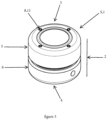
- Figures 1 to 4 represent a device 1 according to a first embodiment of the present invention but the invention is not limited to this first embodiment.
- the device 1 represented on the figures comprises is a stethoscope S comprising a casing 2 shaped as a cylinder volume extending between a first main circular face 3 and a second main circular face 4 opposite the first main circular face 3.
- the casing 2 is divided in two parts namely a cover 5 and body 6, the being fitted or embedded in the cover 5.
- the body 6 could be considered as the lower part of the casing 2 comprising the first main circular face 3
- the cover 5 is the upper part of the casing 2 comprising the second main circular face 4.
- the cover 5 is fixed to the body 6 by using a bayonet locking system.
- the casing has the following dimensions:
- the device 1 comprises three sensors, namely a temperature sensor 8, a sound sensor 9 and an oximeter sensor 10.
- the temperature sensor 8 comprises four thermocouples 11 placed on the first main circular face 3. Each thermocouple 11 is coupled with a thermal insulation 12 as shown in figure 4 .
- the sound sensor 9 comprises a body sensor 13 for recording body sound of the patient and an ambient sensor 14 for recording ambient noise, the body sensor 13 and the ambient sensor 14 being configured for recording data simultaneously.
- the body sensor 13 in the present embodiment is configured for recording pulmonary sound but in other embodiment (not shown here), the body sensor 13 is configured for recording pulmonary sound and cardiac sound.
- the body sensor 13 comprises an ensemble of circular elements 15 embedded one another toward the first main circular face 3, said ensemble comprising :
- the ensemble of circular element 15 is further coupled to a first microphone 20 whereas the ambient sensor comprises a second microphone 21 for recording ambient noise.
- the oximeter sensor 10 the oximeter sensor is received in an opening 22, here a blind hole 23, arranged in the first main face 3 of the device 1.
- An optical sensor 24 is placed in the bottom of the blind hole 23 (not shown in figure 4 ) so that when a finger of the patient is inserted in the opening 22 and reaches the bottom of the blind hole 23, the finger contacts the optical sensor 24 to allow an oximetry measurement.
- the three sensors of the device 1 are mounted in the casing 1 so that when the device 1 is in contact with the skin of the patient, two distinct parameters namely the body sound and the temperature are measured simultaneously :
- the design of the device 1 has been developed so that the user can hold it in one hand to perform the measurement of body sound and temperature simultaneously.
- the oximetry measurement is carried out in a second step by placing the finger in the housing provided for this purpose.
- Figure 5 illustrates the computer implemented method according to the invention where the device 1 is connected to a control unit 25, for instance a smartphone 26 that is further connected to a computation unit 27 located for instance on a sever 28.
- the smartphone 28 may comprised a computer program, for instance an application or another software, and the software, when executed, is configured for controlling in a remote manner the device 1
- the output provided by the method according to the present invention allows to or are taken into account to diagnose a disease.
- it allows to or is taken into account to determine the severity of the disease.
Landscapes
- Health & Medical Sciences (AREA)
- Life Sciences & Earth Sciences (AREA)
- Physics & Mathematics (AREA)
- Animal Behavior & Ethology (AREA)
- Public Health (AREA)
- Biomedical Technology (AREA)
- Heart & Thoracic Surgery (AREA)
- Medical Informatics (AREA)
- Molecular Biology (AREA)
- Surgery (AREA)
- Veterinary Medicine (AREA)
- General Health & Medical Sciences (AREA)
- Engineering & Computer Science (AREA)
- Biophysics (AREA)
- Pathology (AREA)
- Cardiology (AREA)
- Physiology (AREA)
- Acoustics & Sound (AREA)
- Pulmonology (AREA)
- Spectroscopy & Molecular Physics (AREA)
- Optics & Photonics (AREA)
- Measurement Of The Respiration, Hearing Ability, Form, And Blood Characteristics Of Living Organisms (AREA)
Description
- The present invention relates to a device for measuring at least one parameter of a patient according to
claim 1 and to a computer implemented method for remotely operating said device according toclaim 13. - The invention also concerns a method for measuring at least three parameters of a patient by using said device according to
claim 12. - The diagnosis of respiratory diseases is done by pulmonary auscultation using a stethoscope and functional tests. Currently, the tool that is most frequently used by physicians to perform auscultation is a traditional stethoscope, invented by Dr. Laennec 200 years ago.
- However, these examinations require significant expertise and can only be conducted by a physician. It requires strong medical expertise and long training to detect clinical sound by ear.
- Various approaches exist to improve the existing auscultation tools and facilitating the acquisition of patient parameters such as chest sound.
- One of the most promising and popular approach concerns digital or electronic stethoscopes that allow viewing and recording chest sound.
- In this respect, the document Kraman et al., Measurement of Respiratory Acoustic Signals, Chest, October 1995 illustrates that a key element of any electronic stethoscopes stands in the microphone. This document describes the effect of the microphone air cavity, notably the width, shape and venting in the acquisition of sound spectra and the use of a single electret with a variety of plastic coupler.
- Respiratory diseases are often characterized by multiple clinical signs or symptoms, for instance abnormal chest sound associated with increased respiratory rate and fever. It is known that the screening of respiratory disease is improved if several physiological parameters such as blood oxygen saturation are taken into account to diagnose the disease and determine its severity. During auscultation, physician generally uses a specific tool to evaluate each symptom separately which could be time consuming and could significantly negatively impact the efficiency of the diagnosis.
- Overall, when it comes to acquire multiple parameters in a patient in an efficient manner, notably time efficient manner, and reliable manner, the existing stethoscopes do not provide satisfying solutions. One of the reasons is that the existing stethoscopes do not allow to record or monitor several parameters in a reliable and time efficient manner.
- Prior art documents
US2020/015774 A1 ,WO2020/252317 A1 andUS2019/090814 A1 disclose stethoscopes that acquire multiple parameters in a patient. - The above problems are solved by the device and the method according to the present invention as defined in
independent claims - In a first aspect, the invention concerns a device for measuring at least one parameter of a patient, the device comprising a casing equipped with at least three sensors, each sensor being configured for measuring one distinct parameter of the patient, said three sensors are a temperature sensor to measure a temperature of the patient, a sound sensor to record a body sound of the patient, preferably pulmonary sound and/or heart sound, and an oximeter sensor to measure an oxygen blood level of the patient and/or the patient's heart rate,
said three sensors being mounted in the casing so that when the device is in contact with the skin of the patient, at least the three sensor are able to measure three distinct parameters simultaneously. The casing comprises two opposite externals faces namely a first main face and a second face, the first main face comprising at least the oximeter sensor, and the second main face comprising at least the temperature sensor and the sound sensor. - In a second aspect, the invention concerns a method for measuring at least three parameters of a patient by using a device according to the present invention, the method comprising :
- i) Contacting the device with the patient's chest skin;
- ii) measuring the temperature of the patient and simultaneously recording the body sound of the patient;
- iii) measuring the oximetry of the patient,
- In a third aspect, the invention relates to a computer implemented method for remotely operating a device according to the present invention, the method comprising:
- i) Connecting the device to a control unit arranged for controlling said device;
- ii) Sending an activation signal from the control unit to the device to activate the sensors of the device and measure at least two distinct parameters of the patient, preferably three distinct parameters when the device is contacting the patient's skin;
- iii) Connecting the control unit to a computation unit configured to process said parameters by applying mathematical tools;
- iv) Sending a transfer signal from the control unit to the device to transfer the measured parameter from the device to the server via the computation unit;
- v) Sending a processing signal from the control unit to the computation unit to process the transferred measured parameters to provide an output;
- vi) Upon completion of the parameter's processing by the computation unit, sending a feedback request to transfer the output from the computation unit to the control unit;
- In a fourth aspect the invention relates to the use of an apparatus, for instance computer device such as a smartphone or another mobile device, comprising means for carrying out the computer implemented method according to the present invention.
- In a fifth aspect the invention concerns a computer program, for instance a software executed on a smartphone or mobile device, comprising instructions which, when the program is executed by a computer, cause the computer to carry out the computer implemented method according to the present invention.
- The invention concerns a device for measuring at least one parameter of a patient, the device comprising a casing equipped with at least three sensors, each sensor being configured for measuring one distinct parameter of the patient.
- Said three sensors are a temperature sensor to measure a temperature of the patient, a sound sensor to record a body sound of the patient, preferably pulmonary sound and/or heart sound, and an oximeter sensor to measure an oxygen blood level of the patient and/or the patient's heart rate, said three sensors being mounted in the casing so that when the device is in contact with the skin of the patient, at least the three sensors are able to measure three distinct parameters simultaneously.
- Advantageously, in the present invention, a plurality of parameters is acquired simultaneously in the patient. This allows to reduce the steps needed to measure several parameters in a patient and to improve diagnostic reliability and disease severity grading.
- Overall, the present invention addresses the time or duration required to diagnose a disease, in particular a respiratory disease, by reducing the duration required to acquire relevant parameter's measurements.
- Advantageously, measuring simultaneously the body sound, for instance lung and heart sound, the blood oxygen saturation, patient the patient heart rate and/or respiratory rate, and the body temperature will greatly improve the classification and the severity of diseases. Computing all these parameters simultaneously offer a diagnostic advantage over multiple parameters measured at different time points
- A disease is rarely characterised by only one feature like fever or increased respiratory rate or lung sound. Combining several features allows the distinction between different diseases, thus improves the precision of the diagnosis and the quality of care.
- According to the invention, the casing comprises two opposite externals faces namely a first main face and a second face, the first face comprising at least the oximeter sensor, and the second face comprising at least the temperature sensor and the sound sensor
- According to the invention, three sensors are mounted in the casing so that when the device is in contact with the skin of the patient, the temperature sensor, the sound sensor and the oximeter sensor operate simultaneously so that at least the temperature of the patient, the body sound of the patient and the oxygen blood level of the patient and/or the patient's heart rate are measured simultaneously. Thus, the three sensors are mounted in the casing to allow a simultaneous measurements of three distinct parameters, each acquired by one sensor.
- In a preferred embodiment, the oximeter sensor is a reflection pulse oximeter. Contrary to transmission pulse oximeter which must be adapted to the morphology of the finger, reflection pulse oximeter it can be adapted to all finger morphologies. Thus, it is not necessary to change the measuring head of the oximeter. This allows to have a more compact and ergonomic device.
- Preferably, the oximeter is configured for contacting the patient finger. This allows to place the oximeter on a face of the device which is not in contact with the patient's chest.
- In a preferred embodiment, the oximeter is a reflection pulse oximeter placed on one main face of the device while the temperature sensor and the sound sensor are placed on the opposite main face of the device preferably configured for contacting the patient's chest, for instance circular main faces. Thus, this particular design allows to measure oximetry with the fingertip and measuring the breath sounds with the sensor placed on the chest at the same time, preferably these simultaneous measurements of the three parameters is done by the patient him/herself. This allows to measure three parameters in one step and to save time during the parameters acquisition.
- Preferably, the sound sensor comprises body sensor, for instance a pulmonary and cardiac sensor, for recording body sound, for instance lung and heart sound, of the patient. The sound sensor further comprises an ambient sensor for recording ambient sound, or in other words cancelling ambient noise. The body sensor and the ambient sensor being configured for recording data simultaneously. The presence of the ambient sensor allows to filter or sort out the recorded pulmonary sound to discard noise or sound unrelated to the patient or not relevant for monitoring body sound. The ambient sensor measurement is correlated with the body sound measurement to improve the quality of the body sound, for instance pulmonary and cardiac sound, and thus their reading and interpretation.
- Preferably, the pulmonary sensor comprises a resonance chamber designed for being coupled to a microphone, said chamber comprising a membrane configured for contacting the patient's skin. This configuration allows to optimize the acoustic transmission and to amplify the sound level in the desired frequency ranges.
- Preferably, the casing is a cylinder volume extending between the first main circular face and the second main circular face, the first face comprising at least one sensor, preferably the oximeter sensor, and the second face comprising at least two sensors, preferably the temperature sensor and the sound sensor. The overall cylinder shaped provides a device that is easy to handle for the user. The cylinder casing can be handled in secure manner in the hand of the user.
- Preferably, the oximeter sensor comprises an optical sensor configured for measuring oximetry upon contact with the patient's skin, preferably the patient's finger.
- In a preferred embodiment, the oximeter sensor is received in an opening, preferably a blind hole, arranged in the first main face of the device so that when a finger of the patient is inserted or placed in front the opening, said finger contacts the oximeter sensor to allow an oximetry measurement. This configuration allows to adapt to all the morphologies of fingers and facilitates its use by the patient.
- In a preferred embodiment, the device comprises at least five sensors, said sensors comprising
- a body sensor for recording body sound of the patient and an ambient sensor for recording ambient noise; and
- a first temperature sensor and second temperature sensor,
- an oximeter sensor, preferably a reflection pulse oximeter.
- The combination of these five sensors makes allows to optimize the parameters which are acquired on the patient compared to a device comprising three sensors. This allows to improve the reliability and the quality of the data acquired.
- Using two sound sensors, for instance two microphones, allows to make an active noise reduction and thus improves the quality of the audio signal. For instance, the microphone recording lung sounds is integrated into a sound box equipped with a membrane. This configuration improves acoustic transmission between the patient's skin and the microphone.
- Using two temperature sensors allows a differential temperature measurement of the patient. In other words, measuring the temperature in two points of contact allows a more precise and reliable measurement. The sensors are preferably located on the face of the device comprising the sound sensor (s), which makes it possible to record body sounds and measure the temperature simultaneously upon contacting the patient's skin.
- Preferably, the device further comprises a memory for saving at least one measure of each parameter.
- Preferably, the body sound comprises sound measurements recorded at various locations on the patient skin, for instance from two to ten locations, in particular from four to ten locations, for example from six to eight locations. Recording sound at multiple locations allow to better localize a disease in a specific location, for instance specific location of the lung or the heart, or inform if the disease involves the entire organ.
- In a preferred embodiment, the device is a stethoscope.
- In another aspect, the invention concerns a method for measuring at least three parameters of a patient by using a device according to the invention, the method comprising :
- i) Contacting the device with the patient's chest skin;
- ii) measuring the temperature of the patient and simultaneously recording the body sound of the patient;
- iii) measuring the oximetry of the patient, and preferably the heart rate,
- The particular advantages of the method are similar to the ones of the device according to the invention and will thus not be repeated here.
- In another aspect, the invention relates to a computer implemented method for remotely operating a device according to the invention, the method comprising:
- i) Connecting the device to a control unit arranged for controlling said device;
- ii) Sending an activation signal from the control unit to the device to activate the sensors of the device and measure at least two distinct parameters of the patient, preferably three distinct parameters when the device is contacting the patient's skin;
- iii) Connecting the control unit to a computation unit configured to process said parameters by applying mathematical tools;
- iv) Sending a transfer signal from the control unit to the device to transfer the measured parameter from the device to the computation unit via the control unit;
- v) Sending a processing signal from the control unit to the computation unit to process the transferred measured parameters to provide an output;
- vi) Upon completion of the parameter's processing by the computation unit, sending a feedback request to transfer the output from the computation unit to the control unit.
- Advantageously, the device according to the present invention can be controlled or operated in a remote manner by a control unit. For instance, the control unit comprises electronic component to execute a program to control the device.
- The control unit is connected on the one hand with the device and on the other hand with a server or another storage component. The signals emitted by the control unit allow to control the device notably to ensure the transfer of the parameter's measurements from the device to the server.
- In another aspect, the invention relates to the use of an apparatus, for instance computer device such as a smartphone, comprising means for carrying out the computer implemented method according to the invention.
- In another aspect, the invention relates to a computer program comprising instructions which, when the program is executed by a computer, cause the computer to carry out the computer implemented method of the invention.
- The embodiments describe for the device also apply to the methods and program according to the present invention mutatis mutandis and vice versa.
- Further particular advantages and features of the invention will become more apparent from the following non-limitative description of at least one embodiment of the invention which will refer to the accompanying drawings, wherein
-
Figures 1 to 3 are a general overview of a device according to a first embodiment; -
Figure 4 is a detailed view of the device offigures 1 to 3 ; -
Figure 5 is a scheme representing an embodiment of the computer implemented method according to the present invention. - The present detailed description is intended to illustrate the invention in a non-limitative manner since any feature of an embodiment may be combined with any other feature of a different embodiment in an advantageous manner.
-
Figures 1 to 4 represent adevice 1 according to a first embodiment of the present invention but the invention is not limited to this first embodiment. - The
device 1 represented on the figures comprises is a stethoscope S comprising acasing 2 shaped as a cylinder volume extending between a first maincircular face 3 and a second maincircular face 4 opposite the first maincircular face 3. Thecasing 2 is divided in two parts namely acover 5 andbody 6, the being fitted or embedded in thecover 5. In other words, thebody 6 could be considered as the lower part of thecasing 2 comprising the first maincircular face 3 whereas thecover 5 is the upper part of thecasing 2 comprising the second maincircular face 4. For instance, thecover 5 is fixed to thebody 6 by using a bayonet locking system. - In the embodiment represented on
figures 1 to 4 , the casing has the following dimensions: - Height (between the first main
circular face 3 and the second main circular face 4) : 40 mm - Width (as the diameter of the first main
circular face 3 and the second main circular face 4) = 54 mm - The
device 1 comprises three sensors, namely a temperature sensor 8, a sound sensor 9 and anoximeter sensor 10. - The temperature sensor 8 comprises four
thermocouples 11 placed on the first maincircular face 3. Eachthermocouple 11 is coupled with athermal insulation 12 as shown infigure 4 . - The sound sensor 9 comprises a
body sensor 13 for recording body sound of the patient and anambient sensor 14 for recording ambient noise, thebody sensor 13 and theambient sensor 14 being configured for recording data simultaneously. - the
body sensor 13 in the present embodiment is configured for recording pulmonary sound but in other embodiment (not shown here), thebody sensor 13 is configured for recording pulmonary sound and cardiac sound. - The
body sensor 13 comprises an ensemble of circular elements 15 embedded one another toward the first maincircular face 3, said ensemble comprising : - A
diaphragm holder 16; - A diaphragm (or a membrane) 17;
- A
resonance chamber 18 - An
acoustic insulation 19; - The ensemble of circular element 15 is further coupled to a
first microphone 20 whereas the ambient sensor comprises a second microphone 21 for recording ambient noise. - The
oximeter sensor 10 the oximeter sensor is received in an opening 22, here a blind hole 23, arranged in the firstmain face 3 of thedevice 1. An optical sensor 24 is placed in the bottom of the blind hole 23 (not shown infigure 4 ) so that when a finger of the patient is inserted in the opening 22 and reaches the bottom of the blind hole 23, the finger contacts the optical sensor 24 to allow an oximetry measurement. - The three sensors of the
device 1 are mounted in thecasing 1 so that when thedevice 1 is in contact with the skin of the patient, two distinct parameters namely the body sound and the temperature are measured simultaneously : - The temperature sensor 8 and the sound sensor 9 (via the diaphragm 17) are placed on the first main
circular face 3 of the device and are contacting the skin of the patient simultaneously; - The
oximeter sensor 10 is placed on the second maincircular face 4. - In this embodiment, the design of the
device 1 has been developed so that the user can hold it in one hand to perform the measurement of body sound and temperature simultaneously. The oximetry measurement is carried out in a second step by placing the finger in the housing provided for this purpose. -
Figure 5 illustrates the computer implemented method according to the invention where thedevice 1 is connected to a control unit 25, for instance a smartphone 26 that is further connected to a computation unit 27 located for instance on a sever 28. The smartphone 28 may comprised a computer program, for instance an application or another software, and the software, when executed, is configured for controlling in a remote manner thedevice 1 - An example of the computer implemented method is described below and represented in
figure 5 : - Connecting the
device 1 to the smartphone 26 arranged for controlling said device, for instance by pairing the smartphone with the device notably via Bluetooth communication protocol; - Executing the application on the smartphone to send an activation signal to the device to activate the sensors of the
device 1 and measure at least two distinct parameters of the patient, preferably three distinct parameters when thedevice 1 is contacting the patient's skin; for instance, activating the temperature sensor 8 and the sound sensor 9; - Storing the measured parameters on the internal memory of the smartphone 26;
- Connecting the smartphone 26 to the computation unit 27 located on the server 28 and configured to process said parameters by applying mathematical tools;
- Sending a transfer signal from the application executed on the smartphone 26 to the
device 1 to transfer the measured parameter from thedevice 1 to the server 28 via the smartphone 26; - Sending a processing signal from the application executed on the smartphone 26 to the computation unit 28 to process the transferred measured parameters to provide an output;
- Upon completion of the parameter's processing by the computation unit 28, sending a feedback request from the application executed on the smartphone 26 to the computation unit 27 to transfer the output from the computation unit 28 to the smartphone.
- The output provided by the method according to the present invention allows to or are taken into account to diagnose a disease. Advantageously, it allows to or is taken into account to determine the severity of the disease.
- While the embodiments have been described in conjunction with a number of embodiments, it is evident that many alternatives, modifications and variations would be or are apparent to those of ordinary skill in the applicable arts. Accordingly, this disclosure is intended to embrace all such alternatives, modifications, equivalents and variations that are within the scope of this disclosure. This for example particularly the case regarding the different apparatuses which can be used.
-
- 1
- Device according to a first embodiment
- S
- Stethoscope
- 2
- Cylinder casing
- 3
- First main circular face
- 4
- Second main circular face
- 5
- Cover
- 6
- Body
- 7
- Bayonet locking system
- 8
- Temperature sensor
- 9
- Sound sensor
- 10
- Oximeter sensor
- 11
- Thermocouple
- 12
- Thermal insulation
- 13
- Body sensor
- 14
- Ambient sensor
- 15
- Ensemble of circular elements
- 16
- Diaphragm holder
- 17
- Diaphragm
- 18
- Resonance chamber
- 19
- Acoustic insulation
- 20
- First microphone
- 21
- Second microphone
- 22
- Opening
- 23
- Blind hole
- 24
- Optical sensor
- 25
- Control unit
- 26
- Smartphone
- 27
- Computation unit
- 28
- Server
Claims (15)
- Device (1) for measuring at least one parameter of a patient, the device (1) comprising a casing (2) equipped with at least three sensors, each sensor being configured for measuring one distinct parameter of the patient, said three sensors are a temperature sensor (8) to measure a temperature of the patient, a sound sensor (9) to record a body sound of the patient, and an oximeter sensor (10) to measure an oxygen blood level of the patient and/or the patient's heart rate, said three sensors being mounted in the casing (2) so that when the device (1) is in contact with the skin of the patient, at least the three sensors are able to measure three distinct parameters simultaneously, each parameter acquired by one sensor, characterized in that the casing (2) comprises two opposite externals faces namely a first main face (3) and a second face (4), the first main face (3) comprising at least the oximeter sensor (10), and the second main face (4) comprising at least the temperature sensor (8) and the sound sensor (9).
- Device (1) according to claim 1, wherein the sound sensor (9) comprises a body sensor (13) for recording body sound of the patient and an ambient sensor (14) for recording ambient noise, the body sensor (13) and the ambient sensor (14) being configured for recording data simultaneously.
- Device (1) according to the preceding claim, wherein the body sensor (13) comprises a resonance chamber (18) designed for being coupled to a microphone (20), said chamber (18) comprising a membrane (17) configured for contacting the patient's skin.
- Device (1) according to any one of claims 1 to 3, wherein the casing (2) is a cylinder volume extending between the first main circular face (3) and the second main circular face (4).
- Device (1) according to any one of claims 1 to 4, wherein the oximeter sensor (10) comprises an optical sensor (24) configured for measuring oximetry upon contact with the patient's finger.
- Device (1) according to claims 4 and 5, wherein the oximeter sensor (10) is received in an opening (22), preferably a blind hole (23), arranged in the first main face (3) of the device (1) so that when a finger of the patient is inserted in the opening (22), said finger contacts the oximeter sensor (10) to allow an oximetry measurement.
- Device (1) according to any one of claims 4 to 6, wherein the oximeter is a reflection pulse oximeter placed on one the main circular face of the device while the temperature sensor and the sound sensor are placed on the opposite circular main face of the device.
- Device (1) according to any one of claims 1 to 7, wherein the device comprises at least five sensors, said sensors comprising- a body sensor (13) for recording body sound of the patient and an ambient sensor (14) for recording ambient noise; and- a first temperature sensor and second temperature sensor,- an oximeter sensor, preferably a reflection pulse oximeter.
- Device (1) according to any one of claims 1 to 8, wherein the device (1) further comprises a memory for saving at least one measure of each parameter.
- Device (1) according to any one of claims 1 to 9, wherein the body sound comprises sound measurements recorded at various locations on the patient skin.
- Device (1) according to any one of claims 1 to 10, wherein the device is a stethoscope S.
- Method for measuring at least three parameters of a patient by using a device (1) according to any one of claims 1 to 11, the method comprising :i. contacting the device (1) with the patient's chest skin;ii. measuring the temperature of the patient and simultaneously recording the body sound of the patient;iii. measuring the oximetry of the patient, characterized in that step i) to iii) are performed simultaneously.
- Computer implemented method for remotely operating a device (1) according to any one of claims 1 to 11 when said device is in connection with a control unit (25) for controlling said device, the method comprising:i. Connecting the device (1) to a control unit (25) arranged for controlling said device (1);ii. Sending an activation signal from the control unit (25) to the device (1) to activate the sensors of the device (1) and measure at least two distinct parameters of the patient, preferably three distinct parameters when the device is contacting the patient's skin;iii. Connecting the control unit (25) to a computation unit (27) configured to process said parameters by applying mathematical tools; andiv. Sending a transfer signal from the control unit (25) to the device (1) to transfer the measured parameter from the device (1) to the computation unit (27) via the control unit (25);v. Sending a processing signal from the control unit (25) to the computation unit (27) to process the transferred measured parameters to provide an output;vi. Upon completion of the parameter's processing by the computation unit (27), sending a feedback request to transfer the output from the computation unit (27) to the control unit (25).
- Use of an apparatus, for instance computer device such as a smartphone (26), comprising means for carrying out the computer implemented method according to claim 13.
- Computer program comprising instructions which, when the program is executed by a computer, cause the computer to carry out the computer implemented method according to claim 13.
Applications Claiming Priority (2)
| Application Number | Priority Date | Filing Date | Title |
|---|---|---|---|
| EP21177615.8A EP4098179A1 (en) | 2021-06-03 | 2021-06-03 | Device and method for measuring parameters of a patient |
| PCT/EP2022/064524 WO2022253723A1 (en) | 2021-06-03 | 2022-05-30 | Device and method for measuring parameters of a patient |
Publications (2)
| Publication Number | Publication Date |
|---|---|
| EP4346569A1 EP4346569A1 (en) | 2024-04-10 |
| EP4346569B1 true EP4346569B1 (en) | 2025-01-29 |
Family
ID=76269659
Family Applications (2)
| Application Number | Title | Priority Date | Filing Date |
|---|---|---|---|
| EP21177615.8A Withdrawn EP4098179A1 (en) | 2021-06-03 | 2021-06-03 | Device and method for measuring parameters of a patient |
| EP22730542.2A Active EP4346569B1 (en) | 2021-06-03 | 2022-05-30 | Device and method for measuring parameters of a patient |
Family Applications Before (1)
| Application Number | Title | Priority Date | Filing Date |
|---|---|---|---|
| EP21177615.8A Withdrawn EP4098179A1 (en) | 2021-06-03 | 2021-06-03 | Device and method for measuring parameters of a patient |
Country Status (6)
| Country | Link |
|---|---|
| US (1) | US20240366093A1 (en) |
| EP (2) | EP4098179A1 (en) |
| DK (1) | DK4346569T3 (en) |
| ES (1) | ES3025033T3 (en) |
| PL (1) | PL4346569T3 (en) |
| WO (1) | WO2022253723A1 (en) |
Families Citing this family (4)
| Publication number | Priority date | Publication date | Assignee | Title |
|---|---|---|---|---|
| CN114208206A (en) * | 2019-08-04 | 2022-03-18 | 卫保数码有限公司 | Earpiece capable of interacting with the tragus and method of providing continuous physiological detection |
| EP4467074A4 (en) * | 2022-01-21 | 2025-12-03 | Sekisui Chemical Co Ltd | INFORMATION PROCESSING SYSTEM, DETECTION DEVICE, SERVER DEVICE, INFORMATION PROCESSING DEVICE, CONTROL METHOD AND PROGRAM |
| FR3156027B1 (en) | 2023-12-05 | 2025-12-05 | Withings | Portable physiological measurement device |
| FR3156028B1 (en) | 2023-12-05 | 2025-12-05 | Withings | Electronic stethoscope |
Family Cites Families (3)
| Publication number | Priority date | Publication date | Assignee | Title |
|---|---|---|---|---|
| US10265043B2 (en) * | 2014-10-14 | 2019-04-23 | M3Dicine Ip Pty Ltd | Systems, devices, and methods for capturing and outputting data regarding a bodily characteristic |
| US10172556B2 (en) * | 2016-09-23 | 2019-01-08 | International Business Machines Corporation | Combined wearable electrocardiogram and electronic stethoscope |
| WO2020252317A1 (en) * | 2019-06-12 | 2020-12-17 | Kadidal Sushir | Portable health monitoring apparatus, system, and method |
-
2021
- 2021-06-03 EP EP21177615.8A patent/EP4098179A1/en not_active Withdrawn
-
2022
- 2022-05-30 US US18/565,748 patent/US20240366093A1/en active Pending
- 2022-05-30 ES ES22730542T patent/ES3025033T3/en active Active
- 2022-05-30 WO PCT/EP2022/064524 patent/WO2022253723A1/en not_active Ceased
- 2022-05-30 EP EP22730542.2A patent/EP4346569B1/en active Active
- 2022-05-30 DK DK22730542.2T patent/DK4346569T3/en active
- 2022-05-30 PL PL22730542.2T patent/PL4346569T3/en unknown
Also Published As
| Publication number | Publication date |
|---|---|
| PL4346569T3 (en) | 2025-07-28 |
| ES3025033T3 (en) | 2025-06-05 |
| WO2022253723A1 (en) | 2022-12-08 |
| EP4346569A1 (en) | 2024-04-10 |
| DK4346569T3 (en) | 2025-05-05 |
| US20240366093A1 (en) | 2024-11-07 |
| EP4098179A1 (en) | 2022-12-07 |
Similar Documents
| Publication | Publication Date | Title |
|---|---|---|
| US20240366093A1 (en) | Device and method for measuring parameters of a patient | |
| US12138106B2 (en) | Acquiring and processing acoustic energy emitted by at least one organ in a biological system | |
| AU2019357278B2 (en) | An intelligent cardio-pulmonary screening device for telemedicine applications | |
| KR101178867B1 (en) | Telemedical stethoscope | |
| US9973847B2 (en) | Mobile device-based stethoscope system | |
| US8548174B2 (en) | Modular electronic biosensor with interface for receiving disparate modules | |
| TWI533845B (en) | Wireless electronic stethoscope | |
| US20090312638A1 (en) | medical diagnostic device | |
| US11375976B2 (en) | Wireless stethoscope for transmitting, recording, storing and diagnostic capabilities including an earpiece | |
| CN208582430U (en) | Multifunctional Medical Care Stethoscope | |
| HK1215662A1 (en) | Systems and methods for predicting gastrointestinal impairment | |
| CN111820937A (en) | a wireless stethoscope | |
| US20090171221A1 (en) | System apparatus for monitoring heart and lung functions | |
| KR20140146782A (en) | Animal wiress stethoscope diagnosis system | |
| US12257100B2 (en) | Oral device for measuring respiratory sounds | |
| CN106137245A (en) | A kind of auscultation method with reference to multiple cardiographic detector signal analysis | |
| US20250311999A1 (en) | Electronic stethoscope | |
| CN206414285U (en) | A kind of wireless auscultation system for being gathered based on double frequency and vibrating reduction | |
| KR20200002297U (en) | Smart health care device | |
| TWI822508B (en) | Multi-dimensional artificial intelligence auscultation device | |
| EP3793445B1 (en) | System for digitizing the sound of a stethoscope and for sending it to an electronic instrument | |
| KR100486463B1 (en) | An electronic stethoscope | |
| CN120501450A (en) | Intelligent auscultation equipment for auscultation of arteriovenous fistula | |
| CN210472166U (en) | Stethoscope-based screening for congenital heart disease | |
| CN205107654U (en) | Electronic sphygmomanometer with auscultation function |
Legal Events
| Date | Code | Title | Description |
|---|---|---|---|
| STAA | Information on the status of an ep patent application or granted ep patent |
Free format text: STATUS: UNKNOWN |
|
| STAA | Information on the status of an ep patent application or granted ep patent |
Free format text: STATUS: THE INTERNATIONAL PUBLICATION HAS BEEN MADE |
|
| PUAI | Public reference made under article 153(3) epc to a published international application that has entered the european phase |
Free format text: ORIGINAL CODE: 0009012 |
|
| STAA | Information on the status of an ep patent application or granted ep patent |
Free format text: STATUS: REQUEST FOR EXAMINATION WAS MADE |
|
| 17P | Request for examination filed |
Effective date: 20231213 |
|
| AK | Designated contracting states |
Kind code of ref document: A1 Designated state(s): AL AT BE BG CH CY CZ DE DK EE ES FI FR GB GR HR HU IE IS IT LI LT LU LV MC MK MT NL NO PL PT RO RS SE SI SK SM TR |
|
| DAV | Request for validation of the european patent (deleted) | ||
| DAX | Request for extension of the european patent (deleted) | ||
| GRAP | Despatch of communication of intention to grant a patent |
Free format text: ORIGINAL CODE: EPIDOSNIGR1 |
|
| STAA | Information on the status of an ep patent application or granted ep patent |
Free format text: STATUS: GRANT OF PATENT IS INTENDED |
|
| INTG | Intention to grant announced |
Effective date: 20240919 |
|
| GRAJ | Information related to disapproval of communication of intention to grant by the applicant or resumption of examination proceedings by the epo deleted |
Free format text: ORIGINAL CODE: EPIDOSDIGR1 |
|
| STAA | Information on the status of an ep patent application or granted ep patent |
Free format text: STATUS: REQUEST FOR EXAMINATION WAS MADE |
|
| GRAS | Grant fee paid |
Free format text: ORIGINAL CODE: EPIDOSNIGR3 |
|
| STAA | Information on the status of an ep patent application or granted ep patent |
Free format text: STATUS: GRANT OF PATENT IS INTENDED |
|
| GRAP | Despatch of communication of intention to grant a patent |
Free format text: ORIGINAL CODE: EPIDOSNIGR1 |
|
| INTC | Intention to grant announced (deleted) | ||
| GRAA | (expected) grant |
Free format text: ORIGINAL CODE: 0009210 |
|
| STAA | Information on the status of an ep patent application or granted ep patent |
Free format text: STATUS: THE PATENT HAS BEEN GRANTED |
|
| INTG | Intention to grant announced |
Effective date: 20241213 |
|
| AK | Designated contracting states |
Kind code of ref document: B1 Designated state(s): AL AT BE BG CH CY CZ DE DK EE ES FI FR GB GR HR HU IE IS IT LI LT LU LV MC MK MT NL NO PL PT RO RS SE SI SK SM TR |
|
| REG | Reference to a national code |
Ref country code: GB Ref legal event code: FG4D |
|
| REG | Reference to a national code |
Ref country code: CH Ref legal event code: EP |
|
| REG | Reference to a national code |
Ref country code: DE Ref legal event code: R096 Ref document number: 602022010229 Country of ref document: DE |
|
| REG | Reference to a national code |
Ref country code: IE Ref legal event code: FG4D |
|
| REG | Reference to a national code |
Ref country code: DK Ref legal event code: T3 Effective date: 20250428 |
|
| REG | Reference to a national code |
Ref country code: NL Ref legal event code: FP |
|
| REG | Reference to a national code |
Ref country code: SE Ref legal event code: TRGR |
|
| PGFP | Annual fee paid to national office [announced via postgrant information from national office to epo] |
Ref country code: NL Payment date: 20250429 Year of fee payment: 4 |
|
| PGFP | Annual fee paid to national office [announced via postgrant information from national office to epo] |
Ref country code: LU Payment date: 20250415 Year of fee payment: 4 |
|
| P01 | Opt-out of the competence of the unified patent court (upc) registered |
Free format text: CASE NUMBER: APP_18908/2025 Effective date: 20250417 |
|
| REG | Reference to a national code |
Ref country code: ES Ref legal event code: FG2A Ref document number: 3025033 Country of ref document: ES Kind code of ref document: T3 Effective date: 20250605 |
|
| PG25 | Lapsed in a contracting state [announced via postgrant information from national office to epo] |
Ref country code: RS Free format text: LAPSE BECAUSE OF FAILURE TO SUBMIT A TRANSLATION OF THE DESCRIPTION OR TO PAY THE FEE WITHIN THE PRESCRIBED TIME-LIMIT Effective date: 20250429 |
|
| PG25 | Lapsed in a contracting state [announced via postgrant information from national office to epo] |
Ref country code: FI Free format text: LAPSE BECAUSE OF FAILURE TO SUBMIT A TRANSLATION OF THE DESCRIPTION OR TO PAY THE FEE WITHIN THE PRESCRIBED TIME-LIMIT Effective date: 20250129 |
|
| PGFP | Annual fee paid to national office [announced via postgrant information from national office to epo] |
Ref country code: DE Payment date: 20250415 Year of fee payment: 4 |
|
| PGFP | Annual fee paid to national office [announced via postgrant information from national office to epo] |
Ref country code: DK Payment date: 20250428 Year of fee payment: 4 Ref country code: ES Payment date: 20250602 Year of fee payment: 4 |
|
| REG | Reference to a national code |
Ref country code: LT Ref legal event code: MG9D |
|
| PG25 | Lapsed in a contracting state [announced via postgrant information from national office to epo] |
Ref country code: IS Free format text: LAPSE BECAUSE OF FAILURE TO SUBMIT A TRANSLATION OF THE DESCRIPTION OR TO PAY THE FEE WITHIN THE PRESCRIBED TIME-LIMIT Effective date: 20250529 |
|
| PGFP | Annual fee paid to national office [announced via postgrant information from national office to epo] |
Ref country code: NO Payment date: 20250424 Year of fee payment: 4 |
|
| PGFP | Annual fee paid to national office [announced via postgrant information from national office to epo] |
Ref country code: BE Payment date: 20250429 Year of fee payment: 4 Ref country code: IT Payment date: 20250531 Year of fee payment: 4 |
|
| PG25 | Lapsed in a contracting state [announced via postgrant information from national office to epo] |
Ref country code: HR Free format text: LAPSE BECAUSE OF FAILURE TO SUBMIT A TRANSLATION OF THE DESCRIPTION OR TO PAY THE FEE WITHIN THE PRESCRIBED TIME-LIMIT Effective date: 20250129 |
|
| PG25 | Lapsed in a contracting state [announced via postgrant information from national office to epo] |
Ref country code: LV Free format text: LAPSE BECAUSE OF FAILURE TO SUBMIT A TRANSLATION OF THE DESCRIPTION OR TO PAY THE FEE WITHIN THE PRESCRIBED TIME-LIMIT Effective date: 20250129 Ref country code: PT Free format text: LAPSE BECAUSE OF FAILURE TO SUBMIT A TRANSLATION OF THE DESCRIPTION OR TO PAY THE FEE WITHIN THE PRESCRIBED TIME-LIMIT Effective date: 20250529 |
|
| PGFP | Annual fee paid to national office [announced via postgrant information from national office to epo] |
Ref country code: FR Payment date: 20250414 Year of fee payment: 4 |
|
| PG25 | Lapsed in a contracting state [announced via postgrant information from national office to epo] |
Ref country code: BG Free format text: LAPSE BECAUSE OF FAILURE TO SUBMIT A TRANSLATION OF THE DESCRIPTION OR TO PAY THE FEE WITHIN THE PRESCRIBED TIME-LIMIT Effective date: 20250129 Ref country code: GR Free format text: LAPSE BECAUSE OF FAILURE TO SUBMIT A TRANSLATION OF THE DESCRIPTION OR TO PAY THE FEE WITHIN THE PRESCRIBED TIME-LIMIT Effective date: 20250430 |
|
| PGFP | Annual fee paid to national office [announced via postgrant information from national office to epo] |
Ref country code: CH Payment date: 20250601 Year of fee payment: 4 |
|
| PGFP | Annual fee paid to national office [announced via postgrant information from national office to epo] |
Ref country code: AT Payment date: 20250721 Year of fee payment: 4 |
|
| PGFP | Annual fee paid to national office [announced via postgrant information from national office to epo] |
Ref country code: SE Payment date: 20250422 Year of fee payment: 4 |
|
| PG25 | Lapsed in a contracting state [announced via postgrant information from national office to epo] |
Ref country code: SM Free format text: LAPSE BECAUSE OF FAILURE TO SUBMIT A TRANSLATION OF THE DESCRIPTION OR TO PAY THE FEE WITHIN THE PRESCRIBED TIME-LIMIT Effective date: 20250129 |
|
| PGFP | Annual fee paid to national office [announced via postgrant information from national office to epo] |
Ref country code: PL Payment date: 20250415 Year of fee payment: 4 |
|
| PG25 | Lapsed in a contracting state [announced via postgrant information from national office to epo] |
Ref country code: EE Free format text: LAPSE BECAUSE OF FAILURE TO SUBMIT A TRANSLATION OF THE DESCRIPTION OR TO PAY THE FEE WITHIN THE PRESCRIBED TIME-LIMIT Effective date: 20250129 Ref country code: CZ Free format text: LAPSE BECAUSE OF FAILURE TO SUBMIT A TRANSLATION OF THE DESCRIPTION OR TO PAY THE FEE WITHIN THE PRESCRIBED TIME-LIMIT Effective date: 20250129 |
|
| PG25 | Lapsed in a contracting state [announced via postgrant information from national office to epo] |
Ref country code: RO Free format text: LAPSE BECAUSE OF FAILURE TO SUBMIT A TRANSLATION OF THE DESCRIPTION OR TO PAY THE FEE WITHIN THE PRESCRIBED TIME-LIMIT Effective date: 20250129 |
|
| PG25 | Lapsed in a contracting state [announced via postgrant information from national office to epo] |
Ref country code: SK Free format text: LAPSE BECAUSE OF FAILURE TO SUBMIT A TRANSLATION OF THE DESCRIPTION OR TO PAY THE FEE WITHIN THE PRESCRIBED TIME-LIMIT Effective date: 20250129 |
|
| REG | Reference to a national code |
Ref country code: DE Ref legal event code: R097 Ref document number: 602022010229 Country of ref document: DE |
|
| PLBE | No opposition filed within time limit |
Free format text: ORIGINAL CODE: 0009261 |
|
| STAA | Information on the status of an ep patent application or granted ep patent |
Free format text: STATUS: NO OPPOSITION FILED WITHIN TIME LIMIT |
|
| 26N | No opposition filed |
Effective date: 20251030 |
|
| PG25 | Lapsed in a contracting state [announced via postgrant information from national office to epo] |
Ref country code: MC Free format text: LAPSE BECAUSE OF FAILURE TO SUBMIT A TRANSLATION OF THE DESCRIPTION OR TO PAY THE FEE WITHIN THE PRESCRIBED TIME-LIMIT Effective date: 20250129 |
|
| PG25 | Lapsed in a contracting state [announced via postgrant information from national office to epo] |
Ref country code: IE Free format text: LAPSE BECAUSE OF NON-PAYMENT OF DUE FEES Effective date: 20250530 |