EP4345973A1 - Lithium metal battery electrolyte and lithium metal battery - Google Patents
Lithium metal battery electrolyte and lithium metal battery Download PDFInfo
- Publication number
- EP4345973A1 EP4345973A1 EP23193121.3A EP23193121A EP4345973A1 EP 4345973 A1 EP4345973 A1 EP 4345973A1 EP 23193121 A EP23193121 A EP 23193121A EP 4345973 A1 EP4345973 A1 EP 4345973A1
- Authority
- EP
- European Patent Office
- Prior art keywords
- lithium
- lithium metal
- electrolyte
- metal battery
- imidazole
- Prior art date
- Legal status (The legal status is an assumption and is not a legal conclusion. Google has not performed a legal analysis and makes no representation as to the accuracy of the status listed.)
- Withdrawn
Links
- 229910052744 lithium Inorganic materials 0.000 title claims abstract description 102
- 239000003792 electrolyte Substances 0.000 title claims abstract description 61
- RAXXELZNTBOGNW-UHFFFAOYSA-N imidazole Natural products C1=CNC=N1 RAXXELZNTBOGNW-UHFFFAOYSA-N 0.000 claims abstract description 111
- 239000002608 ionic liquid Substances 0.000 claims abstract description 35
- 150000001768 cations Chemical class 0.000 claims abstract description 22
- -1 bis((trifluoromethyl)sulfonyl)imide anion Chemical class 0.000 claims abstract description 16
- 229910003002 lithium salt Inorganic materials 0.000 claims abstract description 14
- 159000000002 lithium salts Chemical class 0.000 claims abstract description 14
- WHXSMMKQMYFTQS-UHFFFAOYSA-N Lithium Chemical compound [Li] WHXSMMKQMYFTQS-UHFFFAOYSA-N 0.000 claims abstract description 13
- 239000000010 aprotic solvent Substances 0.000 claims abstract description 13
- JDZCKJOXGCMJGS-UHFFFAOYSA-N [Li].[S] Chemical compound [Li].[S] JDZCKJOXGCMJGS-UHFFFAOYSA-N 0.000 claims description 21
- QTJOIXXDCCFVFV-UHFFFAOYSA-N [Li].[O] Chemical compound [Li].[O] QTJOIXXDCCFVFV-UHFFFAOYSA-N 0.000 claims description 18
- NINIDFKCEFEMDL-UHFFFAOYSA-N Sulfur Chemical compound [S] NINIDFKCEFEMDL-UHFFFAOYSA-N 0.000 claims description 16
- IIPYXGDZVMZOAP-UHFFFAOYSA-N lithium nitrate Chemical compound [Li+].[O-][N+]([O-])=O IIPYXGDZVMZOAP-UHFFFAOYSA-N 0.000 claims description 14
- QVGXLLKOCUKJST-UHFFFAOYSA-N atomic oxygen Chemical compound [O] QVGXLLKOCUKJST-UHFFFAOYSA-N 0.000 claims description 10
- 229910052760 oxygen Inorganic materials 0.000 claims description 10
- 239000001301 oxygen Substances 0.000 claims description 10
- 239000011593 sulfur Substances 0.000 claims description 10
- 229910052717 sulfur Inorganic materials 0.000 claims description 10
- 239000011888 foil Substances 0.000 claims description 9
- QSZMZKBZAYQGRS-UHFFFAOYSA-N lithium;bis(trifluoromethylsulfonyl)azanide Chemical compound [Li+].FC(F)(F)S(=O)(=O)[N-]S(=O)(=O)C(F)(F)F QSZMZKBZAYQGRS-UHFFFAOYSA-N 0.000 claims description 9
- 229910052751 metal Inorganic materials 0.000 claims description 8
- 239000002184 metal Substances 0.000 claims description 8
- ZUHZGEOKBKGPSW-UHFFFAOYSA-N tetraglyme Chemical compound COCCOCCOCCOCCOC ZUHZGEOKBKGPSW-UHFFFAOYSA-N 0.000 claims description 8
- WNXJIVFYUVYPPR-UHFFFAOYSA-N 1,3-dioxolane Chemical compound C1COCO1 WNXJIVFYUVYPPR-UHFFFAOYSA-N 0.000 claims description 7
- SBZXBUIDTXKZTM-UHFFFAOYSA-N diglyme Chemical compound COCCOCCOC SBZXBUIDTXKZTM-UHFFFAOYSA-N 0.000 claims description 7
- XTHFKEDIFFGKHM-UHFFFAOYSA-N Dimethoxyethane Chemical compound COCCOC XTHFKEDIFFGKHM-UHFFFAOYSA-N 0.000 claims description 6
- IAZDPXIOMUYVGZ-UHFFFAOYSA-N Dimethylsulphoxide Chemical compound CS(C)=O IAZDPXIOMUYVGZ-UHFFFAOYSA-N 0.000 claims description 6
- HSZCZNFXUDYRKD-UHFFFAOYSA-M lithium iodide Chemical compound [Li+].[I-] HSZCZNFXUDYRKD-UHFFFAOYSA-M 0.000 claims description 6
- KMTRUDSVKNLOMY-UHFFFAOYSA-N Ethylene carbonate Chemical compound O=C1OCCO1 KMTRUDSVKNLOMY-UHFFFAOYSA-N 0.000 claims description 5
- IEJIGPNLZYLLBP-UHFFFAOYSA-N dimethyl carbonate Chemical compound COC(=O)OC IEJIGPNLZYLLBP-UHFFFAOYSA-N 0.000 claims description 5
- 239000000463 material Substances 0.000 claims description 4
- 229910000733 Li alloy Inorganic materials 0.000 claims description 3
- FXHOOIRPVKKKFG-UHFFFAOYSA-N N,N-Dimethylacetamide Chemical compound CN(C)C(C)=O FXHOOIRPVKKKFG-UHFFFAOYSA-N 0.000 claims description 3
- 239000001989 lithium alloy Substances 0.000 claims description 3
- 229910021450 lithium metal oxide Inorganic materials 0.000 claims description 3
- MHCFAGZWMAWTNR-UHFFFAOYSA-M lithium perchlorate Chemical compound [Li+].[O-]Cl(=O)(=O)=O MHCFAGZWMAWTNR-UHFFFAOYSA-M 0.000 claims description 3
- 229910001486 lithium perchlorate Inorganic materials 0.000 claims description 3
- MCVFFRWZNYZUIJ-UHFFFAOYSA-M lithium;trifluoromethanesulfonate Chemical compound [Li+].[O-]S(=O)(=O)C(F)(F)F MCVFFRWZNYZUIJ-UHFFFAOYSA-M 0.000 claims description 3
- BHZCMUVGYXEBMY-UHFFFAOYSA-N trilithium;azanide Chemical compound [Li+].[Li+].[Li+].[NH2-] BHZCMUVGYXEBMY-UHFFFAOYSA-N 0.000 claims description 3
- 210000001787 dendrite Anatomy 0.000 abstract description 4
- 238000011065 in-situ storage Methods 0.000 abstract description 3
- 238000000034 method Methods 0.000 description 17
- 230000000052 comparative effect Effects 0.000 description 16
- OKTJSMMVPCPJKN-UHFFFAOYSA-N Carbon Chemical compound [C] OKTJSMMVPCPJKN-UHFFFAOYSA-N 0.000 description 15
- 238000002156 mixing Methods 0.000 description 13
- XKRFYHLGVUSROY-UHFFFAOYSA-N Argon Chemical compound [Ar] XKRFYHLGVUSROY-UHFFFAOYSA-N 0.000 description 10
- 239000002002 slurry Substances 0.000 description 10
- 239000000758 substrate Substances 0.000 description 10
- 239000002033 PVDF binder Substances 0.000 description 8
- 238000001035 drying Methods 0.000 description 8
- 229920002981 polyvinylidene fluoride Polymers 0.000 description 8
- 239000003575 carbonaceous material Substances 0.000 description 7
- 239000006230 acetylene black Substances 0.000 description 6
- 239000011230 binding agent Substances 0.000 description 6
- 239000003960 organic solvent Substances 0.000 description 6
- 239000007774 positive electrode material Substances 0.000 description 6
- 239000004743 Polypropylene Substances 0.000 description 5
- 229910052786 argon Inorganic materials 0.000 description 5
- 229910052799 carbon Inorganic materials 0.000 description 5
- 229910001416 lithium ion Inorganic materials 0.000 description 5
- 238000011068 loading method Methods 0.000 description 5
- 229920001155 polypropylene Polymers 0.000 description 5
- 238000001179 sorption measurement Methods 0.000 description 5
- CSCPPACGZOOCGX-UHFFFAOYSA-N Acetone Chemical compound CC(C)=O CSCPPACGZOOCGX-UHFFFAOYSA-N 0.000 description 4
- LFQSCWFLJHTTHZ-UHFFFAOYSA-N Ethanol Chemical compound CCO LFQSCWFLJHTTHZ-UHFFFAOYSA-N 0.000 description 4
- 238000000089 atomic force micrograph Methods 0.000 description 4
- SMBQBQBNOXIFSF-UHFFFAOYSA-N dilithium Chemical compound [Li][Li] SMBQBQBNOXIFSF-UHFFFAOYSA-N 0.000 description 4
- 239000007789 gas Substances 0.000 description 4
- 239000000203 mixture Substances 0.000 description 4
- SECXISVLQFMRJM-UHFFFAOYSA-N N-Methylpyrrolidone Chemical compound CN1CCCC1=O SECXISVLQFMRJM-UHFFFAOYSA-N 0.000 description 3
- 238000005260 corrosion Methods 0.000 description 3
- 230000007797 corrosion Effects 0.000 description 3
- 239000012046 mixed solvent Substances 0.000 description 3
- 238000002791 soaking Methods 0.000 description 3
- 239000000243 solution Substances 0.000 description 3
- 229920002134 Carboxymethyl cellulose Polymers 0.000 description 2
- HBBGRARXTFLTSG-UHFFFAOYSA-N Lithium ion Chemical compound [Li+] HBBGRARXTFLTSG-UHFFFAOYSA-N 0.000 description 2
- 239000004698 Polyethylene Substances 0.000 description 2
- 239000006229 carbon black Substances 0.000 description 2
- 229910021393 carbon nanotube Inorganic materials 0.000 description 2
- 239000002041 carbon nanotube Substances 0.000 description 2
- 239000001768 carboxy methyl cellulose Substances 0.000 description 2
- 235000010948 carboxy methyl cellulose Nutrition 0.000 description 2
- 239000008112 carboxymethyl-cellulose Substances 0.000 description 2
- 239000003365 glass fiber Substances 0.000 description 2
- 229910021389 graphene Inorganic materials 0.000 description 2
- 239000011259 mixed solution Substances 0.000 description 2
- 239000007773 negative electrode material Substances 0.000 description 2
- 229920000573 polyethylene Polymers 0.000 description 2
- 238000003756 stirring Methods 0.000 description 2
- 229920003048 styrene butadiene rubber Polymers 0.000 description 2
- BFKJFAAPBSQJPD-UHFFFAOYSA-N tetrafluoroethene Chemical group FC(F)=C(F)F BFKJFAAPBSQJPD-UHFFFAOYSA-N 0.000 description 2
- 238000001291 vacuum drying Methods 0.000 description 2
- XLYOFNOQVPJJNP-UHFFFAOYSA-N water Substances O XLYOFNOQVPJJNP-UHFFFAOYSA-N 0.000 description 2
- 229920000049 Carbon (fiber) Polymers 0.000 description 1
- RYGMFSIKBFXOCR-UHFFFAOYSA-N Copper Chemical compound [Cu] RYGMFSIKBFXOCR-UHFFFAOYSA-N 0.000 description 1
- 229920000557 Nafion® Polymers 0.000 description 1
- 125000003342 alkenyl group Chemical group 0.000 description 1
- 229910052782 aluminium Inorganic materials 0.000 description 1
- XAGFODPZIPBFFR-UHFFFAOYSA-N aluminium Chemical compound [Al] XAGFODPZIPBFFR-UHFFFAOYSA-N 0.000 description 1
- 229910003481 amorphous carbon Inorganic materials 0.000 description 1
- 239000004917 carbon fiber Substances 0.000 description 1
- 239000011889 copper foil Substances 0.000 description 1
- 230000008021 deposition Effects 0.000 description 1
- 239000007772 electrode material Substances 0.000 description 1
- 239000004744 fabric Substances 0.000 description 1
- 230000016507 interphase Effects 0.000 description 1
- 239000003273 ketjen black Substances 0.000 description 1
- VNWKTOKETHGBQD-UHFFFAOYSA-N methane Chemical compound C VNWKTOKETHGBQD-UHFFFAOYSA-N 0.000 description 1
- 238000011056 performance test Methods 0.000 description 1
- 238000006116 polymerization reaction Methods 0.000 description 1
- 238000002360 preparation method Methods 0.000 description 1
- 239000011241 protective layer Substances 0.000 description 1
- 239000007784 solid electrolyte Substances 0.000 description 1
- 239000010935 stainless steel Substances 0.000 description 1
- 229910001220 stainless steel Inorganic materials 0.000 description 1
- 239000000126 substance Substances 0.000 description 1
Images


Classifications
-
- H—ELECTRICITY
- H01—ELECTRIC ELEMENTS
- H01M—PROCESSES OR MEANS, e.g. BATTERIES, FOR THE DIRECT CONVERSION OF CHEMICAL ENERGY INTO ELECTRICAL ENERGY
- H01M4/00—Electrodes
- H01M4/02—Electrodes composed of, or comprising, active material
- H01M4/36—Selection of substances as active materials, active masses, active liquids
- H01M4/38—Selection of substances as active materials, active masses, active liquids of elements or alloys
- H01M4/381—Alkaline or alkaline earth metals elements
- H01M4/382—Lithium
-
- H—ELECTRICITY
- H01—ELECTRIC ELEMENTS
- H01M—PROCESSES OR MEANS, e.g. BATTERIES, FOR THE DIRECT CONVERSION OF CHEMICAL ENERGY INTO ELECTRICAL ENERGY
- H01M10/00—Secondary cells; Manufacture thereof
- H01M10/05—Accumulators with non-aqueous electrolyte
- H01M10/056—Accumulators with non-aqueous electrolyte characterised by the materials used as electrolytes, e.g. mixed inorganic/organic electrolytes
- H01M10/0564—Accumulators with non-aqueous electrolyte characterised by the materials used as electrolytes, e.g. mixed inorganic/organic electrolytes the electrolyte being constituted of organic materials only
- H01M10/0566—Liquid materials
- H01M10/0567—Liquid materials characterised by the additives
-
- H—ELECTRICITY
- H01—ELECTRIC ELEMENTS
- H01M—PROCESSES OR MEANS, e.g. BATTERIES, FOR THE DIRECT CONVERSION OF CHEMICAL ENERGY INTO ELECTRICAL ENERGY
- H01M10/00—Secondary cells; Manufacture thereof
- H01M10/05—Accumulators with non-aqueous electrolyte
- H01M10/052—Li-accumulators
-
- H—ELECTRICITY
- H01—ELECTRIC ELEMENTS
- H01M—PROCESSES OR MEANS, e.g. BATTERIES, FOR THE DIRECT CONVERSION OF CHEMICAL ENERGY INTO ELECTRICAL ENERGY
- H01M12/00—Hybrid cells; Manufacture thereof
- H01M12/08—Hybrid cells; Manufacture thereof composed of a half-cell of a fuel-cell type and a half-cell of the secondary-cell type
-
- H—ELECTRICITY
- H01—ELECTRIC ELEMENTS
- H01M—PROCESSES OR MEANS, e.g. BATTERIES, FOR THE DIRECT CONVERSION OF CHEMICAL ENERGY INTO ELECTRICAL ENERGY
- H01M10/00—Secondary cells; Manufacture thereof
- H01M10/05—Accumulators with non-aqueous electrolyte
- H01M10/056—Accumulators with non-aqueous electrolyte characterised by the materials used as electrolytes, e.g. mixed inorganic/organic electrolytes
- H01M10/0564—Accumulators with non-aqueous electrolyte characterised by the materials used as electrolytes, e.g. mixed inorganic/organic electrolytes the electrolyte being constituted of organic materials only
- H01M10/0566—Liquid materials
- H01M10/0568—Liquid materials characterised by the solutes
-
- H—ELECTRICITY
- H01—ELECTRIC ELEMENTS
- H01M—PROCESSES OR MEANS, e.g. BATTERIES, FOR THE DIRECT CONVERSION OF CHEMICAL ENERGY INTO ELECTRICAL ENERGY
- H01M10/00—Secondary cells; Manufacture thereof
- H01M10/05—Accumulators with non-aqueous electrolyte
- H01M10/056—Accumulators with non-aqueous electrolyte characterised by the materials used as electrolytes, e.g. mixed inorganic/organic electrolytes
- H01M10/0564—Accumulators with non-aqueous electrolyte characterised by the materials used as electrolytes, e.g. mixed inorganic/organic electrolytes the electrolyte being constituted of organic materials only
- H01M10/0566—Liquid materials
- H01M10/0569—Liquid materials characterised by the solvents
-
- H—ELECTRICITY
- H01—ELECTRIC ELEMENTS
- H01M—PROCESSES OR MEANS, e.g. BATTERIES, FOR THE DIRECT CONVERSION OF CHEMICAL ENERGY INTO ELECTRICAL ENERGY
- H01M2300/00—Electrolytes
- H01M2300/0017—Non-aqueous electrolytes
- H01M2300/0025—Organic electrolyte
-
- H—ELECTRICITY
- H01—ELECTRIC ELEMENTS
- H01M—PROCESSES OR MEANS, e.g. BATTERIES, FOR THE DIRECT CONVERSION OF CHEMICAL ENERGY INTO ELECTRICAL ENERGY
- H01M2300/00—Electrolytes
- H01M2300/0017—Non-aqueous electrolytes
- H01M2300/0025—Organic electrolyte
- H01M2300/0045—Room temperature molten salts comprising at least one organic ion
-
- H—ELECTRICITY
- H01—ELECTRIC ELEMENTS
- H01M—PROCESSES OR MEANS, e.g. BATTERIES, FOR THE DIRECT CONVERSION OF CHEMICAL ENERGY INTO ELECTRICAL ENERGY
- H01M4/00—Electrodes
- H01M4/02—Electrodes composed of, or comprising, active material
- H01M4/36—Selection of substances as active materials, active masses, active liquids
- H01M4/38—Selection of substances as active materials, active masses, active liquids of elements or alloys
-
- H—ELECTRICITY
- H01—ELECTRIC ELEMENTS
- H01M—PROCESSES OR MEANS, e.g. BATTERIES, FOR THE DIRECT CONVERSION OF CHEMICAL ENERGY INTO ELECTRICAL ENERGY
- H01M4/00—Electrodes
- H01M4/86—Inert electrodes with catalytic activity, e.g. for fuel cells
- H01M4/8605—Porous electrodes
- H01M4/8615—Bifunctional electrodes for rechargeable cells
-
- Y—GENERAL TAGGING OF NEW TECHNOLOGICAL DEVELOPMENTS; GENERAL TAGGING OF CROSS-SECTIONAL TECHNOLOGIES SPANNING OVER SEVERAL SECTIONS OF THE IPC; TECHNICAL SUBJECTS COVERED BY FORMER USPC CROSS-REFERENCE ART COLLECTIONS [XRACs] AND DIGESTS
- Y02—TECHNOLOGIES OR APPLICATIONS FOR MITIGATION OR ADAPTATION AGAINST CLIMATE CHANGE
- Y02E—REDUCTION OF GREENHOUSE GAS [GHG] EMISSIONS, RELATED TO ENERGY GENERATION, TRANSMISSION OR DISTRIBUTION
- Y02E60/00—Enabling technologies; Technologies with a potential or indirect contribution to GHG emissions mitigation
- Y02E60/10—Energy storage using batteries
Definitions
- the present disclosure relates to the technical field of lithium metal batteries, and particularly relates to a lithium metal battery electrolyte and a lithium metal battery.
- lithium-ion batteries are limited by the energy density of battery materials used therein, which have substantially reached a theoretical limit. It is urgent to develop new electrode materials to improve the energy density.
- lithium metal negative electrodes have a theoretical energy density of 3860 mAh/g and a low electrode potential (-3.04 V), which have attracted extensive attention of researchers and achieved a series of application results, such as lithium-sulfur batteries and lithium-air batteries.
- lithium metal as a negative electrode material of battery, is active in chemical properties, and easily reacts with electrolyte, oxygen and water, which results in a corrosion of surfaces of the lithium metal and a consumption of electrolytes, thereby eventually leading to a decrease of battery coulombic efficiency and cycle stability.
- lithium dendrites due to uneven deposition of lithium ions on surfaces of the negative electrode during battery cycles, lithium dendrites are easy to form, which may eventually pierce the separator and cause the battery to explode because of short circuit, thus posing a safety hazard.
- an object of the present disclosure is to provide a lithium metal battery electrolyte and a lithium metal battery.
- the lithium metal battery containing the lithium metal battery electrolyte makes it possible to inhibit the growth of lithium dendrites, and improve the cycle stability and coulombic efficiency of the lithium metal battery.
- the imidazole-base cation has a structure shown in any one of Formula I-1 to Formula 1-9:
- the aprotic solvent includes one or more selected from the group consisting of dimethyl sulfoxide, ethylene glycol dimethyl ether, diethylene glycol dimethyl ether, tetraethylene glycol dimethyl ether, N,N-dimethylacetamide, 1,3-dioxolane, ethylene carbonate and dimethyl carbonate.
- the lithium salt includes one or more selected from the group consisting of lithium bis((trifluoromethyl)sulfonyl)imide, lithium hexafluorophosphate, lithium nitrate, lithium perchlorate, lithium iodide and lithium trifluoromethanesulfonate.
- a mass concentration of the imidazole-based poly(ionic liquid) in the lithium metal battery electrolyte is in a range of 0.398-1,452.5 g/L.
- a molarity of the lithium salt in the lithium metal battery electrolyte is in a range of 0.01-4.8 mol/L.
- a lithium metal battery including a lithium metal negative electrode, a separator, an electrolyte and a positive electrode; where the electrolyte is the lithium metal battery electrolyte described in the above technical solutions.
- the lithium metal battery includes a lithium-oxygen battery or a lithium-sulfur battery.
- the positive electrode under the condition that the lithium metal battery is the lithium-oxygen battery, the positive electrode is a porous oxygen positive electrode; and under the condition that the lithium metal battery is the lithium-sulfur battery, the positive electrode is a sulfur positive electrode.
- the lithium metal negative electrode is made of a material including one selected from the group consisting of pure metal lithium foil, a lithium alloy, a lithium metal oxide and lithium nitride.
- the present disclosure provides a lithium metal battery electrolyte, including an imidazole-based poly(ionic liquid), an aprotic solvent and a lithium salt, wherein the imidazole-based poly(ionic liquid) is consisted of an imidazole-base cation and a bis((trifluoromethyl)sulfonyl)imide anion; and the imidazole-base cation has a structure shown in Formula I.
- the imidazole-based poly(ionic liquid) is contained in the lithium metal battery electrolyte, wherein a polymerization of alkenyl chains and a combination of an imidazole-base cation group and bis((trifluoromethyl)sulfonyl)imide anion group make it possible to improve the reduction stability of the lithium metal battery electrolyte, thereby improving the compatibility of the lithium metal battery electrolyte with the negative electrode material.
- a stable solid electrolyte interphase (SEI) film is formed in situ on surfaces of the lithium metal negative electrode, which could improve the interface stability between the lithium metal negative electrode and the lithium metal battery electrolyte, protect the lithium metal negative electrode and inhibit the growth of lithium dendrites, thus improving the cycle performance and coulombic efficiency of the battery.
- SEI solid electrolyte interphase
- the present disclosure provides a lithium metal battery electrolyte, including an imidazole-based poly(ionic liquid), an aprotic solvent and a lithium salt; wherein
- the imidazole-base cation has a structure shown in any one of Formula I-1 to Formula I-9:
- n is in a range of 3-12. In some embodiments, n is in a range of 4-11, and preferably 5-10.
- the aprotic solvent includes one or more selected from the group consisting of dimethyl sulfoxide, ethylene glycol dimethyl ether, diethylene glycol dimethyl ether, tetraethylene glycol dimethyl ether, N,N-dimethylacetamide, 1,3-dioxolane, ethylene carbonate and dimethyl carbonate.
- a volume ratio of the any two aprotic solvents is 1: 1; and under the condition that the aprotic solvent is any three or more of the above choices, there is no special limitation on the volume ratio of the any three or more of the above choices, and any volume ratio may be used.
- the lithium salt includes one or more selected from the group consisting of lithium bis((trifluoromethyl)sulfonyl)imide, lithium hexafluorophosphate, lithium nitrate, lithium perchlorate, lithium iodide and lithium trifluoromethanesulfonate.
- the lithium salts under the condition that the lithium salts are any two or more of the above choices, there is no special limitation on the ratio of the any two or more of the above choices, and any ratio could be used.
- a molarity of the lithium salt in the lithium metal battery electrolyte is in a range of 0.01-4.8 mol/L, preferably 0.05-4.5 mol/L, and more preferably 0.1-4.0 mol/L.
- a mass concentration of the imidazole-based poly(ionic liquid) in the lithium metal battery electrolyte is in a range of 0.398-1,452.5 g/L, preferably 3.98-1,162 g/L, and more preferably 19.9-1,045.8 g/L.
- the lithium metal battery electrolyte is prepared by a method including the following steps: mixing the imidazole-based poly(ionic liquid), the aprotic solvent and the lithium salt to obtain the lithium metal battery electrolyte.
- the mixing is carried out under stirring with a rotation speed of 200-2,000 r/min for 2-72 h.
- the mixing is performed as follows:
- both the first mixing and the second mixing are carried out under stirring with a rotation speed the same as described above, which will not repeated herein.
- the present disclosure also provides a lithium metal battery, including a lithium metal negative electrode, a separator, an electrolyte and a positive electrode; where the electrolyte is the lithium metal battery electrolyte described in the above technical solutions.
- the lithium metal negative electrode is made of a material including one selected from the group consisting of pure metal lithium foil, a lithium alloy, a lithium metal oxide and lithium nitride.
- the lithium metal battery includes a lithium-oxygen battery or a lithium-sulfur battery.
- the positive electrode of the lithium-oxygen battery is a porous oxygen positive electrode.
- the positive electrode of the lithium-sulfur battery is a sulfur positive electrode.
- the positive electrode is obtained by preparation.
- the positive electrode is the porous oxygen positive electrode, which is prepared by a method including the following steps:
- the substrate includes a stainless steel mesh or a carbon fiber cloth.
- the conductive carbon material is selected from the group consisting of carbon black, porous carbon, graphene, amorphous carbon and carbon nanotubes.
- the carbon black is selected from the group consisting of Super P, acetylene black and Ketjen Black.
- the binder is selected from the group consisting of polyvinylidene fluoride, tetrafluoroethylene, styrene-butadiene rubber, carboxymethyl cellulose and lithium metallized nafion.
- the organic solvent is selected from the group consisting ofN-methylpyrrolidone, acetone and ethanol.
- a mass ratio of the conductive carbon material to the binder is 9: 1.
- the amount of the organic solvent and an amount that is well known to those skilled in the art could be used.
- the process of mixing and a process of mixing that is well known to those skilled in the art could be used.
- the drying is performed at a temperature of 120 °C. In some embodiments, the drying is performed for 12 h. In some embodiments, the drying is performed by vacuum drying. In some embodiments, a loading amount of the positive electrode material on the substrate is 0.5 mg/cm 2 .
- the positive electrode is the sulfur positive electrode
- the sulfur positive electrode is prepared by a method including the following steps:
- the substrate includes aluminum foil or copper foil.
- the conductive carbon material is selected from the group consisting of acetylene black, graphene, carbon nanotubes and porous carbon.
- the binder is selected from the group consisting of polyvinylidene fluoride, tetrafluoroethylene, styrene-butadiene rubber and carboxymethyl cellulose.
- the organic solvent is selected from the group consisting of N-methylpyrrolidone, acetone and ethanol.
- a mass ratio of the sublimed sulfur, the conductive carbon material, and the binder is 8: 1: 1.
- the amount of the organic solvent There is no limitation to the amount of the organic solvent, and an amount that is well known to those skilled in the art could be used.
- the process of mixing There is no limitation to the process of mixing, and a process of mixing that is well known to those skilled in the art could be used.
- the drying is performed at a temperature of 60 °C. In some embodiments, the drying is performed for 12 h. In some embodiments, the drying is performed by vacuum drying. In some embodiments, a loading amount of the positive electrode material on the substrate is 1.2 mg/cm 2 .
- the separator is selected from the group consisting of a glass fiber separator, a polypropylene (PP) separator and a polyethylene (PE) separator.
- the lithium metal battery is obtained by a method, including the following steps:
- the separator has a diameter of 16 mm. In some embodiments, an adsorption amount of the electrolyte on the electrolyte-adsorbed separator is in a range of 20-240 ⁇ L.
- the assembling is carried out in a glove box filled with argon.
- the imidazole-based poly(ionic liquid) consisted of an imidazole-base cation and a bis((trifluoromethyl)sulfonyl)imide anion (TFSI-); and the imidazole-base cation had a structure shown in Formula I-7: where n was 4-8.
- a glass fiber separator with a diameter of 16 mm was soaked in the electrolyte obtained above to obtain an electrolyte-adsorbed separator (an adsorption amount of the electrolyte is 140 ⁇ L).
- a pure metal lithium foil, the electrolyte-adsorbed separator, and the porous oxygen positive electrode were assembled in order in a glove box filled with argon gas, to obtain a lithium-oxygen battery.
- the imidazole-based poly(ionic liquid) consisted of an imidazole-base cation and a bis((trifluoromethyl)sulfonyl)imide anion (TFSI-); and the imidazole-base cation had a structure shown in Formula I-2: where n was 4-8.
- the resulting mixture was stirred at a rotation speed of 350 r/min for 72 h to obtain an electrolyte (in which, a molarity of lithium bis((trifluoromethyl)sulfonyl)imide was 1 mol/L, a molarity of lithium nitrate was 0.1 mol/L, and a mass concentration of the imidazole-based poly(ionic liquid) was 33.36 g/L).
- a PP separator with a diameter of 16 mm was soaked in the electrolyte obtained above to obtain an electrolyte-adsorbed separator (an adsorption amount of the electrolyte was 80 ⁇ L).
- a pure metal lithium foil, the electrolyte-adsorbed separator and the sulfur positive electrode were assembled in order in a glove box filled with argon gas, to obtain a lithium-sulfur battery.
- the imidazole-based poly(ionic liquid) consisted of an imidazole-base cation and a bis((trifluoromethyl)sulfonyl)imide anion (TFSI-); and the imidazole-base cation had a structure shown in Formula I-4: where n was 4-8.
- the resulting mixture was stirred at a rotation speed of 350 r/min for 72 h to obtain an electrolyte (in which, a molarity of lithium bis((trifluoromethyl)sulfonyl)imide was 1 mol/L, a molarity of lithium nitrate was 0.1 mol/L, and a mass concentration of the imidazole-based poly(ionic liquid) was 41.7 g/L).
- a PP separator with a diameter of 16 mm was soaked in the electrolyte obtained above to obtain an electrolyte-adsorbed separator (an adsorption amount of the electrolyte was 80 ⁇ L).
- a pure metal lithium foil, the electrolyte-adsorbed separator and the sulfur positive electrode were assembled in order in a glove box filled with argon gas, to obtain a lithium-sulfur battery.
- the imidazole-based poly(ionic liquid) consisted of an imidazole-base cation and a bis((trifluoromethyl)sulfonyl)imide anion (TFSI-); and the imidazole-base cation had a structure shown in Formula I-5: where n was 4-8.
- a lithium-oxygen battery was prepared according to the process of Example 1, except that the imidazole-based poly(ionic liquid) was not added.
- a lithium-sulfur battery was prepared according to the process of Example 2, except that the imidazole-based poly(ionic liquid) was not added.
- a lithium-sulfur battery was prepared according to the process of Example 3, except that the imidazole-based poly(ionic liquid) was not added.
- Example 1 and Comparative Example 1 were tested for constant current charge-discharge by using Land battery test system.
- the test was performed at a constant temperature of 25 °C, a current density of 200 mA/g, a specific capacity limit of 500 mAh/g (calculated based on the mass of conductive carbon materials in the oxygen positive electrode), and a potential of 2.3-4.2 V vs. Li/Li + .
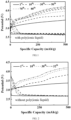
- the test results of cycle performance are shown in FIG. 1 and FIG. 2 , in which FIG. 1 shows the cycle performance of Example 1, and FIG. 2 shows the cycle performance of Comparative Example 1.
- the lithium-oxygen battery according to the present disclosure has higher cycle stability.
- FIG. 3 shows test results of coulombic efficiency of the lithium-oxygen battery obtained in Example 1. From FIG. 3 , it can be seen that the coulombic efficiency of the lithium-oxygen battery of the present disclosure is close to 100%, indicating that the capacity attenuation is small during charge-discharge process.
- Example 1 The lithium-oxygen batteries obtained in Example 1 and Comparative Example 1 were tested for constant current full discharge. The test was performed at a constant temperature of 25 °C and a current density of 200 mA/g. The test result of a full discharge is shown in FIG. 4 . From FIG. 4 , it can be seen that the lithium-oxygen battery according to the present disclosure has higher discharge capacity.
- Example 2 and Comparative Example 2 were tested for constant current charge-discharge cycle by using Land battery test system. The tests were performed at a constant temperature of 25 °C, a current density of 0.2 C and a voltage of 1.6-2.8 V vs. Li/Li + . After five cycles, the lithium-sulfur batteries were disassembled, and the lithium metal negative electrodes were stripped out. Cross sections of the lithium metal negative electrodes were tested by scanning electron microscope respectively. The test results are shown in FIG. 5 , in which a corresponds to Example 2, b corresponds to Comparative Example 2. From FIG.
- the surface of the lithium metal negative electrode of Example 2 is more compact and smooth with no cavities, indicating that the corrosion of electrolyte, oxygen and water on the surface of the lithium metal negative electrode can be effectively inhibited after adding imidazole-based poly(ionic liquid).
- Example 3 The lithium metal negative electrode obtained in Example 3 was tested by atomic force microscope, and the test result of an atomic force microscope image is shown in FIG. 6a (before cycle).
- Example 3 and Comparative Example 3 were tested for constant current charge-discharge cycle by using Land battery test system. The tests were performed at a constant temperature of 25 °C, a current density of 0.2 C, and a voltage of 1.6-2.8 V vs. Li/Li + . After 10 cycles, the lithium-sulfur batteries were disassembled, and the lithium metal negative electrodes were stripped out and tested by atomic force microscope respectively. The test results of atomic force microscope images are shown in FIG. 6 , in which b corresponds to Comparative Example 3 and c corresponds to Example 3. From FIG.
- the surface of the lithium metal negative electrode without imidazole-based poly(ionic liquid) is rough and uneven after charge-discharge cycles, and corrosion occurs to a certain extent.
- the surface of the lithium metal negative electrode with imidazole-based poly(ionic liquid) is smooth and complete after charge-discharge cycles, and a SEI protective layer is generated in situ which covers the lithium metal surface compactly and evenly.
- a PP separator with a diameter of 16 mm was soaked in the electrolyte obtained in Example 4, to obtain an electrolyte-adsorbed separator (the adsorption amount of the electrolyte was 80 ⁇ L).
- a pure metal lithium foil, the electrolyte-adsorbed separator, and a pure metal lithium foil were assembled in order in a glove box filled with argon gas, to obtain a lithium-lithium battery.
- the lithium-lithium battery was tested for constant current charge-discharge cycle by using Land battery test system. The test was performed at a constant temperature of 25 °C and a current density of 0.25 mA/cm 2 (1/1 h). The test results are shown in FIG. 7 . From FIG.
- the lithium-lithium battery prepared from the electrolyte of the present disclosure can stably cycle for 550 h, and the interface stability between the lithium metal surface and the electrolyte can be effectively improved by adding imidazole-based poly(ionic liquid) to the surface.
Landscapes
- Chemical & Material Sciences (AREA)
- Engineering & Computer Science (AREA)
- Chemical Kinetics & Catalysis (AREA)
- Electrochemistry (AREA)
- General Chemical & Material Sciences (AREA)
- Manufacturing & Machinery (AREA)
- Physics & Mathematics (AREA)
- Condensed Matter Physics & Semiconductors (AREA)
- General Physics & Mathematics (AREA)
- Inorganic Chemistry (AREA)
- Materials Engineering (AREA)
- Secondary Cells (AREA)
Abstract
The disclosure relates to the technical field of lithium metal batteries, and particularly relates to a lithium metal battery electrolyte and a lithium metal battery. Provided is a lithium metal battery electrolyte, including an imidazole-based poly(ionic liquid), an aprotic solvent and a lithium salt, wherein the imidazole-based poly(ionic liquid) is consisted of an imidazole-base cation and a bis((trifluoromethyl)sulfonyl)imide anion; and the imidazole-base cation has a structure shown in Formula I. The electrolyte lithium metal battery could form a stable SEI film on a surface of the lithium metal anode in situ during charge-discharge cycles of the battery. The SEI film could improve the interface stability between the lithium metal anode and the lithium metal battery electrolyte, protect the lithium metal anode and inhibit the growth of lithium dendrites, thereby improving the cycle performance and coulombic efficiency of the battery.
Description
- The present disclosure relates to the technical field of lithium metal batteries, and particularly relates to a lithium metal battery electrolyte and a lithium metal battery.
- At present, commercial lithium-ion batteries are limited by the energy density of battery materials used therein, which have substantially reached a theoretical limit. It is urgent to develop new electrode materials to improve the energy density. Among others, lithium metal negative electrodes have a theoretical energy density of 3860 mAh/g and a low electrode potential (-3.04 V), which have attracted extensive attention of researchers and achieved a series of application results, such as lithium-sulfur batteries and lithium-air batteries.
- However, lithium metal, as a negative electrode material of battery, is active in chemical properties, and easily reacts with electrolyte, oxygen and water, which results in a corrosion of surfaces of the lithium metal and a consumption of electrolytes, thereby eventually leading to a decrease of battery coulombic efficiency and cycle stability. Also, due to uneven deposition of lithium ions on surfaces of the negative electrode during battery cycles, lithium dendrites are easy to form, which may eventually pierce the separator and cause the battery to explode because of short circuit, thus posing a safety hazard.
- In view of this, an object of the present disclosure is to provide a lithium metal battery electrolyte and a lithium metal battery. In the present disclosure, the lithium metal battery containing the lithium metal battery electrolyte makes it possible to inhibit the growth of lithium dendrites, and improve the cycle stability and coulombic efficiency of the lithium metal battery.
- In order to achieve the above object, the present disclosure provides the following technical solutions:
- Provided is a lithium metal battery electrolyte, including an imidazole-based poly(ionic liquid), an aprotic solvent and a lithium salt; wherein
- the imidazole-based poly(ionic liquid) is consisted of an imidazole-base cation and a bis((trifluoromethyl)sulfonyl)imide anion; and
- the imidazole-base cation has a structure shown in Formula I:

- wherein in Formula I,
- R1 includes one selected from the group consisting of


- In some embodiments, the imidazole-base cation has a structure shown in any one of Formula I-1 to Formula 1-9:


- In some embodiments, the aprotic solvent includes one or more selected from the group consisting of dimethyl sulfoxide, ethylene glycol dimethyl ether, diethylene glycol dimethyl ether, tetraethylene glycol dimethyl ether, N,N-dimethylacetamide, 1,3-dioxolane, ethylene carbonate and dimethyl carbonate.
- In some embodiments, the lithium salt includes one or more selected from the group consisting of lithium bis((trifluoromethyl)sulfonyl)imide, lithium hexafluorophosphate, lithium nitrate, lithium perchlorate, lithium iodide and lithium trifluoromethanesulfonate.
- In some embodiments, a mass concentration of the imidazole-based poly(ionic liquid) in the lithium metal battery electrolyte is in a range of 0.398-1,452.5 g/L.
- In some embodiments, a molarity of the lithium salt in the lithium metal battery electrolyte is in a range of 0.01-4.8 mol/L.
- Also provided is a lithium metal battery, including a lithium metal negative electrode, a separator, an electrolyte and a positive electrode;
where the electrolyte is the lithium metal battery electrolyte described in the above technical solutions. - In some embodiments, the lithium metal battery includes a lithium-oxygen battery or a lithium-sulfur battery.
- In some embodiments, under the condition that the lithium metal battery is the lithium-oxygen battery, the positive electrode is a porous oxygen positive electrode; and
under the condition that the lithium metal battery is the lithium-sulfur battery, the positive electrode is a sulfur positive electrode. - In some embodiments, the lithium metal negative electrode is made of a material including one selected from the group consisting of pure metal lithium foil, a lithium alloy, a lithium metal oxide and lithium nitride.
- The present disclosure provides a lithium metal battery electrolyte, including an imidazole-based poly(ionic liquid), an aprotic solvent and a lithium salt, wherein the imidazole-based poly(ionic liquid) is consisted of an imidazole-base cation and a bis((trifluoromethyl)sulfonyl)imide anion; and the imidazole-base cation has a structure shown in Formula I. In the present disclosure, the imidazole-based poly(ionic liquid) is contained in the lithium metal battery electrolyte, wherein a polymerization of alkenyl chains and a combination of an imidazole-base cation group and bis((trifluoromethyl)sulfonyl)imide anion group make it possible to improve the reduction stability of the lithium metal battery electrolyte, thereby improving the compatibility of the lithium metal battery electrolyte with the negative electrode material. During battery cycles, a stable solid electrolyte interphase (SEI) film is formed in situ on surfaces of the lithium metal negative electrode, which could improve the interface stability between the lithium metal negative electrode and the lithium metal battery electrolyte, protect the lithium metal negative electrode and inhibit the growth of lithium dendrites, thus improving the cycle performance and coulombic efficiency of the battery.
-
-
FIG. 1 shows test results of cycle performance of the lithium-oxygen battery as prepared in Example 1. -
FIG. 2 shows test results of cycle performance of the lithium-oxygen battery as prepared in Comparative Example 1. -
FIG. 3 shows coulombic efficiency of the lithium-oxygen battery as prepared in Example 1. -
FIG. 4 shows complete discharge tests of the lithium-oxygen batteries as prepared in Example 1 and Comparative Example 1. -
FIG. 5 shows cross-sectional scanning electron microscope (SEM) images of lithium metal negative electrode of the lithium-sulfur batteries as prepared in Example 2 and Comparative Example 2 after five charge-discharge cycles, in which a corresponds to Example 2 and b corresponds to Comparative Example 2. -
FIG. 6 shows atomic force microscope (AFM) images of the lithium metal negative electrode of the lithium-sulfur battery as prepared in Example 3 before and after 10 charge-discharge cycles and of the lithium metal anode of the lithium-sulfur battery as prepared in Comparative Example 3 after 10 charge-discharge cycles, in which a corresponds to the lithium metal anode of the lithium-sulfur battery as prepared in Example 3 before charge-discharge cycles, b corresponds to the lithium metal anode of the lithium-sulfur battery as prepared in Comparative Example 3 after 10 charge-discharge cycles, and c corresponds to the lithium metal anode of the lithium-sulfur battery as prepared in Example 3 after 10 charge-discharge cycles. -
FIG. 7 shows test results of cycle performance of a lithium-lithium battery made from the electrolyte as prepared in Example 4. - The present disclosure provides a lithium metal battery electrolyte, including an imidazole-based poly(ionic liquid), an aprotic solvent and a lithium salt; wherein
- the imidazole-based poly(ionic liquid) is consisted of an imidazole-base cation and a bis((trifluoromethyl)sulfonyl)imide anion; and
- the imidazole-base cation has a structure shown in Formula I:

- wherein in Formula I,
- R1 includes one selected from the group consisting of


- R2 includes one selected from the group consisting of


- In the present disclosure, unless otherwise specified, all components are commercially available products well known to those skilled in the art.
- In some embodiments, the imidazole-base cation has a structure shown in any one of Formula I-1 to Formula I-9:


- In the present disclosure, n is in a range of 3-12. In some embodiments, n is in a range of 4-11, and preferably 5-10.
- In some embodiments, the aprotic solvent includes one or more selected from the group consisting of dimethyl sulfoxide, ethylene glycol dimethyl ether, diethylene glycol dimethyl ether, tetraethylene glycol dimethyl ether, N,N-dimethylacetamide, 1,3-dioxolane, ethylene carbonate and dimethyl carbonate. In some embodiments, under the condition that the aprotic solvent is any two of the above choices, a volume ratio of the any two aprotic solvents is 1: 1; and under the condition that the aprotic solvent is any three or more of the above choices, there is no special limitation on the volume ratio of the any three or more of the above choices, and any volume ratio may be used.
- In some embodiments, the lithium salt includes one or more selected from the group consisting of lithium bis((trifluoromethyl)sulfonyl)imide, lithium hexafluorophosphate, lithium nitrate, lithium perchlorate, lithium iodide and lithium trifluoromethanesulfonate. In some embodiments, under the condition that the lithium salts are any two or more of the above choices, there is no special limitation on the ratio of the any two or more of the above choices, and any ratio could be used. In some embodiments, a molarity of the lithium salt in the lithium metal battery electrolyte is in a range of 0.01-4.8 mol/L, preferably 0.05-4.5 mol/L, and more preferably 0.1-4.0 mol/L.
- In some embodiments, a mass concentration of the imidazole-based poly(ionic liquid) in the lithium metal battery electrolyte is in a range of 0.398-1,452.5 g/L, preferably 3.98-1,162 g/L, and more preferably 19.9-1,045.8 g/L.
- In some embodiments, the lithium metal battery electrolyte is prepared by a method including the following steps:
mixing the imidazole-based poly(ionic liquid), the aprotic solvent and the lithium salt to obtain the lithium metal battery electrolyte. - In some embodiments, the mixing is carried out under stirring with a rotation speed of 200-2,000 r/min for 2-72 h.
- In some embodiments of the present disclosure, the mixing is performed as follows:
- subjecting the aprotic solvent and the lithium salt to first mixing to obtain a first mixed solution; and
- subjecting the first mixed solution and the imidazole-based poly(ionic liquid) to second mixing.
- In some embodiments, both the first mixing and the second mixing are carried out under stirring with a rotation speed the same as described above, which will not repeated herein.
- The present disclosure also provides a lithium metal battery, including a lithium metal negative electrode, a separator, an electrolyte and a positive electrode;
where the electrolyte is the lithium metal battery electrolyte described in the above technical solutions. - In some embodiments, the lithium metal negative electrode is made of a material including one selected from the group consisting of pure metal lithium foil, a lithium alloy, a lithium metal oxide and lithium nitride.
- In some embodiments, the lithium metal battery includes a lithium-oxygen battery or a lithium-sulfur battery. In some embodiments, the positive electrode of the lithium-oxygen battery is a porous oxygen positive electrode. In some embodiments, the positive electrode of the lithium-sulfur battery is a sulfur positive electrode.
- In some embodiments, the positive electrode is obtained by preparation.
- In some embodiments, the positive electrode is the porous oxygen positive electrode, which is prepared by a method including the following steps:
- mixing a positive electrode material with an organic solvent to obtain a slurry, the positive electrode materials including a conductive carbon material and a binder; and
- applying the slurry onto a surface of a substrate to obtain a coated substrate, and drying the coated substrate to obtain the porous oxygen positive electrode.
- In some embodiments, the substrate includes a stainless steel mesh or a carbon fiber cloth.
- In some embodiments, the conductive carbon material is selected from the group consisting of carbon black, porous carbon, graphene, amorphous carbon and carbon nanotubes. In some embodiments, the carbon black is selected from the group consisting of Super P, acetylene black and Ketjen Black. In some embodiments, the binder is selected from the group consisting of polyvinylidene fluoride, tetrafluoroethylene, styrene-butadiene rubber, carboxymethyl cellulose and lithium metallized nafion. In some embodiments, the organic solvent is selected from the group consisting ofN-methylpyrrolidone, acetone and ethanol.
- In some embodiments, a mass ratio of the conductive carbon material to the binder is 9: 1. There is no limitation to the amount of the organic solvent, and an amount that is well known to those skilled in the art could be used. There is no limitation to the process of mixing, and a process of mixing that is well known to those skilled in the art could be used.
- In the present disclosure, there is no limitation to the process of applying and the applying amount, and a means for applying and an applying amount that are well known to those skilled in the art may be used. In some embodiments, the drying is performed at a temperature of 120 °C. In some embodiments, the drying is performed for 12 h. In some embodiments, the drying is performed by vacuum drying. In some embodiments, a loading amount of the positive electrode material on the substrate is 0.5 mg/cm2.
- In some embodiments, the positive electrode is the sulfur positive electrode, and the sulfur positive electrode is prepared by a method including the following steps:
- mixing positive electrode materials with an organic solvent to obtain a slurry, the positive electrode materials including sublimed sulfur, a conductive carbon material and a binder; and
- applying the slurry onto a surface of a substrate to obtain a coated substrate, and drying the coated substrate to obtain the sulfur positive electrode.
- In some embodiments, the substrate includes aluminum foil or copper foil.
- In some embodiments, the conductive carbon material is selected from the group consisting of acetylene black, graphene, carbon nanotubes and porous carbon. In some embodiments, the binder is selected from the group consisting of polyvinylidene fluoride, tetrafluoroethylene, styrene-butadiene rubber and carboxymethyl cellulose. In some embodiments, the organic solvent is selected from the group consisting of N-methylpyrrolidone, acetone and ethanol.
- In some embodiments, a mass ratio of the sublimed sulfur, the conductive carbon material, and the binder is 8: 1: 1. There is no limitation to the amount of the organic solvent, and an amount that is well known to those skilled in the art could be used. There is no limitation to the process of mixing, and a process of mixing that is well known to those skilled in the art could be used.
- In the present disclosure, there is no limitation to the process of applying and the applying amount, and a process of applying and an applying amount that are well known to those skilled in the art may be used. In some embodiments, the drying is performed at a temperature of 60 °C. In some embodiments, the drying is performed for 12 h. In some embodiments, the drying is performed by vacuum drying. In some embodiments, a loading amount of the positive electrode material on the substrate is 1.2 mg/cm2.
- In some embodiments, the separator is selected from the group consisting of a glass fiber separator, a polypropylene (PP) separator and a polyethylene (PE) separator.
- In some embodiments, the lithium metal battery is obtained by a method, including the following steps:
- soaking the separator in the electrolyte to obtain a separator adsorbed with the electrolyte;
- assembling the lithium metal negative electrode, the separator adsorbed with the electrolyte and the positive electrode in order to obtain the lithium metal battery.
- In the present disclosure, there is no special limitation to the soaking, and a process of soaking that is well known to those skilled in the art could be used.
- In some embodiments, the separator has a diameter of 16 mm. In some embodiments, an adsorption amount of the electrolyte on the electrolyte-adsorbed separator is in a range of 20-240 µL.
- In the present disclosure, there is no special limitation to the assembling, and a process of assembling that is well known to those skilled in the art may be used. In some embodiments, the assembling is carried out in a glove box filled with argon.
- In order to further illustrate the present disclosure, the lithium metal battery electrolyte and the lithium metal battery according to the present disclosure will be described in detail below in conjunction with the attached drawings and examples, which could not be understood as limiting the scope of the present disclosure.
- In this example, the imidazole-based poly(ionic liquid) consisted of an imidazole-base cation and a bis((trifluoromethyl)sulfonyl)imide anion (TFSI-); and the imidazole-base cation had a structure shown in Formula I-7:

- 5.46 g of lithium bis((trifluoromethyl)sulfonyl)imide and 20 mL of tetraethylene glycol dimethyl ether were mixed, and then 0.429 g of an imidazole-based poly(ionic liquid) was added thereto. The resulting mixture was stirred at a rotation speed of 350 r/min for 72 h to obtain an electrolyte (in which, a molarity of lithium bis((trifluoromethyl)sulfonyl)imide was 1 mol/L, and a mass concentration of the imidazole-based poly(ionic liquid) was 21.45 g/L).
- 0.9 g of Super P, 0.1 g of polyvinylidene fluoride and 2 mL ofN-methylpyrrolidone were mixed to obtain a slurry. A proper amount of the slurry was applied onto conductive carbon paper, and vacuum dried at 120 °C for 12 h to obtain a porous oxygen positive electrode (a total loading amount of Super P and polyvinylidene fluoride was 0.5 mg/cm2).
- A glass fiber separator with a diameter of 16 mm was soaked in the electrolyte obtained above to obtain an electrolyte-adsorbed separator (an adsorption amount of the electrolyte is 140 µL).
- A pure metal lithium foil, the electrolyte-adsorbed separator, and the porous oxygen positive electrode were assembled in order in a glove box filled with argon gas, to obtain a lithium-oxygen battery.
- In this example, the imidazole-based poly(ionic liquid) consisted of an imidazole-base cation and a bis((trifluoromethyl)sulfonyl)imide anion (TFSI-); and the imidazole-base cation had a structure shown in Formula I-2:

- 5.46 g of lithium bis((trifluoromethyl)sulfonyl)imide, 0.138 g of lithium nitrate and 20 mL of a mixed solvent of diethylene glycol dimethyl ether and 1,3-dioxolane (in which a volume ratio of diethylene glycol dimethyl ether to 1,3-dioxolane was 1: 1) were mixed, and then 0.672 g of imidazole-based poly(ionic liquid) was added thereto. The resulting mixture was stirred at a rotation speed of 350 r/min for 72 h to obtain an electrolyte (in which, a molarity of lithium bis((trifluoromethyl)sulfonyl)imide was 1 mol/L, a molarity of lithium nitrate was 0.1 mol/L, and a mass concentration of the imidazole-based poly(ionic liquid) was 33.36 g/L).
- 0.8 g of sublimed sulfur, 0.1 g of acetylene black, 0.1 g of polyvinylidene fluoride and 2 mL of N-methylpyrrolidone were mixed to obtain a slurry. A proper amount of the slurry was applied onto carbon paper, and vacuum dried at 60 °C for 12 h to obtain a sulfur positive electrode (a total loading amount of sublimed sulfur, acetylene black and polyvinylidene fluoride was 1.2 mg/cm2).
- A PP separator with a diameter of 16 mm was soaked in the electrolyte obtained above to obtain an electrolyte-adsorbed separator (an adsorption amount of the electrolyte was 80 µL).
- A pure metal lithium foil, the electrolyte-adsorbed separator and the sulfur positive electrode were assembled in order in a glove box filled with argon gas, to obtain a lithium-sulfur battery.
- In this example, the imidazole-based poly(ionic liquid) consisted of an imidazole-base cation and a bis((trifluoromethyl)sulfonyl)imide anion (TFSI-); and the imidazole-base cation had a structure shown in Formula I-4:

- 5.46 g of lithium bis((trifluoromethyl)sulfonyl)imide, 0.138 g of lithium nitrate and 20 mL of a mixed solvent of diethylene glycol dimethyl ether and 1,3-dioxolane (in which a volume ratio of diethylene glycol dimethyl ether to 1,3-dioxolane was 1: 1) were mixed, and then 0.834 g of imidazole-based poly(ionic liquid) was added thereto. The resulting mixture was stirred at a rotation speed of 350 r/min for 72 h to obtain an electrolyte (in which, a molarity of lithium bis((trifluoromethyl)sulfonyl)imide was 1 mol/L, a molarity of lithium nitrate was 0.1 mol/L, and a mass concentration of the imidazole-based poly(ionic liquid) was 41.7 g/L).
- 0.8 g of sublimed sulfur, 0.1 g of acetylene black, 0.1 g of polyvinylidene fluoride and 2 mL of N-methylpyrrolidone were mixed to obtain a slurry. A proper amount of the slurry was applied onto carbon paper, and vacuum dried at 60 °C for 12 h to obtain a sulfur positive electrode (a total loading amount of sublimed sulfur, acetylene black and polyvinylidene fluoride was 1.2 mg/cm2).
- A PP separator with a diameter of 16 mm was soaked in the electrolyte obtained above to obtain an electrolyte-adsorbed separator (an adsorption amount of the electrolyte was 80 µL).
- A pure metal lithium foil, the electrolyte-adsorbed separator and the sulfur positive electrode were assembled in order in a glove box filled with argon gas, to obtain a lithium-sulfur battery.
- In this example, the imidazole-based poly(ionic liquid) consisted of an imidazole-base cation and a bis((trifluoromethyl)sulfonyl)imide anion (TFSI-); and the imidazole-base cation had a structure shown in Formula I-5:

- 3.04 g of lithium hexafluorophosphate and 20 mL of a mixed solvent of ethylene carbonate and dimethyl carbonate (in which a volume ratio of ethylene carbonate to dimethyl carbonate is 1: 1) were mixed, and then 0.415 g of imidazole-based poly(ionic liquid) was added thereto. The resulting mixture was stirred at a rotation speed of 350 r/min for 72 h to obtain an electrolyte (in which, a molarity of lithium hexafluorophosphate was 1 mol/L, and a mass concentration of the imidazole-based poly(ionic liquid) was 20.75 g/L).
- A lithium-oxygen battery was prepared according to the process of Example 1, except that the imidazole-based poly(ionic liquid) was not added.
- A lithium-sulfur battery was prepared according to the process of Example 2, except that the imidazole-based poly(ionic liquid) was not added.
- A lithium-sulfur battery was prepared according to the process of Example 3, except that the imidazole-based poly(ionic liquid) was not added.
- The lithium-oxygen batteries obtained in Example 1 and Comparative Example 1 were tested for constant current charge-discharge by using Land battery test system. The test was performed at a constant temperature of 25 °C, a current density of 200 mA/g, a specific capacity limit of 500 mAh/g (calculated based on the mass of conductive carbon materials in the oxygen positive electrode), and a potential of 2.3-4.2 V vs. Li/Li+. The test results of cycle performance are shown in
FIG. 1 and FIG. 2 , in whichFIG. 1 shows the cycle performance of Example 1, andFIG. 2 shows the cycle performance of Comparative Example 1. As can be seen fromFIG. 1 and FIG. 2 , the lithium-oxygen battery according to the present disclosure has higher cycle stability. -
FIG. 3 shows test results of coulombic efficiency of the lithium-oxygen battery obtained in Example 1. FromFIG. 3 , it can be seen that the coulombic efficiency of the lithium-oxygen battery of the present disclosure is close to 100%, indicating that the capacity attenuation is small during charge-discharge process. - The lithium-oxygen batteries obtained in Example 1 and Comparative Example 1 were tested for constant current full discharge. The test was performed at a constant temperature of 25 °C and a current density of 200 mA/g. The test result of a full discharge is shown in
FIG. 4 . FromFIG. 4 , it can be seen that the lithium-oxygen battery according to the present disclosure has higher discharge capacity. - The lithium-sulfur batteries obtained in Example 2 and Comparative Example 2 were tested for constant current charge-discharge cycle by using Land battery test system. The tests were performed at a constant temperature of 25 °C, a current density of 0.2 C and a voltage of 1.6-2.8 V vs. Li/Li+. After five cycles, the lithium-sulfur batteries were disassembled, and the lithium metal negative electrodes were stripped out. Cross sections of the lithium metal negative electrodes were tested by scanning electron microscope respectively. The test results are shown in
FIG. 5 , in which a corresponds to Example 2, b corresponds to Comparative Example 2. FromFIG. 5 , it can be seen that, the surface of the lithium metal negative electrode of Example 2 is more compact and smooth with no cavities, indicating that the corrosion of electrolyte, oxygen and water on the surface of the lithium metal negative electrode can be effectively inhibited after adding imidazole-based poly(ionic liquid). - The lithium metal negative electrode obtained in Example 3 was tested by atomic force microscope, and the test result of an atomic force microscope image is shown in
FIG. 6a (before cycle). - The lithium-sulfur batteries obtained in Example 3 and Comparative Example 3 were tested for constant current charge-discharge cycle by using Land battery test system. The tests were performed at a constant temperature of 25 °C, a current density of 0.2 C, and a voltage of 1.6-2.8 V vs. Li/Li+. After 10 cycles, the lithium-sulfur batteries were disassembled, and the lithium metal negative electrodes were stripped out and tested by atomic force microscope respectively. The test results of atomic force microscope images are shown in
FIG. 6 , in which b corresponds to Comparative Example 3 and c corresponds to Example 3. FromFIG. 6 , it can be seen that compared with the atomic force microscope image before cycle, the surface of the lithium metal negative electrode without imidazole-based poly(ionic liquid) is rough and uneven after charge-discharge cycles, and corrosion occurs to a certain extent. However, the surface of the lithium metal negative electrode with imidazole-based poly(ionic liquid) is smooth and complete after charge-discharge cycles, and a SEI protective layer is generated in situ which covers the lithium metal surface compactly and evenly. - A PP separator with a diameter of 16 mm was soaked in the electrolyte obtained in Example 4, to obtain an electrolyte-adsorbed separator (the adsorption amount of the electrolyte was 80 µL).
- A pure metal lithium foil, the electrolyte-adsorbed separator, and a pure metal lithium foil were assembled in order in a glove box filled with argon gas, to obtain a lithium-lithium battery. The lithium-lithium battery was tested for constant current charge-discharge cycle by using Land battery test system. The test was performed at a constant temperature of 25 °C and a current density of 0.25 mA/cm2 (1/1 h). The test results are shown in
FIG. 7 . FromFIG. 7 , it can be seen that the lithium-lithium battery prepared from the electrolyte of the present disclosure can stably cycle for 550 h, and the interface stability between the lithium metal surface and the electrolyte can be effectively improved by adding imidazole-based poly(ionic liquid) to the surface. - Although the above-mentioned embodiments have described the present disclosure in detail, it is only a part of the embodiments of the present disclosure, not the whole embodiments. Those skilled in the art could make other embodiments without creative labor on the basis of the above embodiments, and all these embodiments should fall within the scope of the present disclosure.
Claims (10)
- A lithium metal battery electrolyte, comprising an imidazole-based poly(ionic liquid), an aprotic solvent and a lithium salt; whereinthe imidazole-based poly(ionic liquid) is consisted of an imidazole-based cation and a bis((trifluoromethyl)sulfonyl)imide anion; andthe imidazole-based cation has a structure shown in Formula I:
 wherein in Formula I,R1 comprises one selected from the group consisting of
 R2 comprises one selected from the group consisting of


- The lithium metal battery electrolyte of claim 1, wherein the imidazole-base cation has a structure shown in any one of Formulas I-1 to I-9:


- The lithium metal battery electrolyte of claim 1, wherein the aprotic solvent comprise one or more selected from the group consisting of dimethyl sulfoxide, ethylene glycol dimethyl ether, diethylene glycol dimethyl ether, tetraethylene glycol dimethyl ether, N,N-dimethylacetamide, 1,3-dioxolane, ethylene carbonate and dimethyl carbonate.
- The lithium metal battery electrolyte of claim 1, wherein the lithium salt comprises one or more selected from the group consisting of lithium bis((trifluoromethyl)sulfonyl)imide, lithium hexafluorophosphate, lithium nitrate, lithium perchlorate, lithium iodide and lithium trifluoromethanesulfonate.
- The lithium metal battery electrolyte of claim 1 or 2, wherein a mass concentration of the imidazole-based poly(ionic liquid) in the lithium metal battery electrolyte is in a range of 0.398-1,452.5 g/L.
- The lithium metal battery electrolyte of claim 1 or 4, wherein a molarity of the lithium salt in the lithium metal battery electrolyte is in a range of 0.01-4.8 mol/L.
- A lithium metal battery comprising a lithium metal negative electrode, a separator, an electrolyte and a positive electrode, wherein the electrolyte is the lithium metal battery electrolyte of any one of claims 1 to 6.
- The lithium metal battery of claim 7, wherein the lithium metal battery comprises a lithium-oxygen battery or a lithium-sulfur battery.
- The lithium metal battery of claim 8, wherein under the condition that the lithium metal battery is the lithium-oxygen battery, the positive electrode is a porous oxygen positive electrode; and
under the condition that the lithium metal battery is the lithium-sulfur battery, the positive electrode is a sulfur positive electrode. - The lithium metal battery of claim 7, wherein the lithium metal negative electrode is made of a material comprising one selected from the group consisting of pure metal lithium foil, a lithium alloy, a lithium metal oxide and lithium nitride.
Applications Claiming Priority (1)
| Application Number | Priority Date | Filing Date | Title |
|---|---|---|---|
| CN202211207552.0A CN115498264B (en) | 2022-09-30 | 2022-09-30 | Lithium metal battery electrolyte and lithium metal battery |
Publications (1)
| Publication Number | Publication Date |
|---|---|
| EP4345973A1 true EP4345973A1 (en) | 2024-04-03 |
Family
ID=84472181
Family Applications (1)
| Application Number | Title | Priority Date | Filing Date |
|---|---|---|---|
| EP23193121.3A Withdrawn EP4345973A1 (en) | 2022-09-30 | 2023-08-24 | Lithium metal battery electrolyte and lithium metal battery |
Country Status (2)
| Country | Link |
|---|---|
| EP (1) | EP4345973A1 (en) |
| CN (1) | CN115498264B (en) |
Cited By (1)
| Publication number | Priority date | Publication date | Assignee | Title |
|---|---|---|---|---|
| CN118173879A (en) * | 2024-04-25 | 2024-06-11 | 浙江蓝德能源科技发展有限公司 | A phase-change solid electrolyte and preparation method thereof |
Families Citing this family (3)
| Publication number | Priority date | Publication date | Assignee | Title |
|---|---|---|---|---|
| CN116072825B (en) * | 2023-01-16 | 2025-03-07 | 中国铁塔股份有限公司 | A method for preparing negative electrode protective film and battery |
| CN118136959A (en) * | 2024-03-19 | 2024-06-04 | 吉林省东驰新能源科技有限公司 | Application of a thiadiazole compound as an electrolyte additive for lithium-sulfur batteries |
| CN121307162B (en) * | 2025-12-11 | 2026-03-24 | 湖南金阳烯碳新材料股份有限公司 | A solid electrolyte with high ionic conductivity and its preparation method |
Citations (7)
| Publication number | Priority date | Publication date | Assignee | Title |
|---|---|---|---|---|
| US20160181658A1 (en) * | 2014-12-19 | 2016-06-23 | Samsung Electronics Co., Ltd. | Composite electrolyte and lithium battery including the electrolyte |
| US20170346137A1 (en) * | 2016-05-27 | 2017-11-30 | Samsung Electronics Co., Ltd. | Electrolyte for lithium metal battery, lithium metal battery including the electrolyte, and method of manufacturing the lithium metal battery |
| EP3279973A1 (en) * | 2016-08-02 | 2018-02-07 | Samsung Electronics Co., Ltd | Composite membrane, method of preparing the composite membrane, and lithium air battery including the composite membrane |
| CN109608592B (en) * | 2018-11-27 | 2020-06-02 | 西安交通大学 | Cross-linking polymerization preparation method of polyion liquid solid electrolyte |
| CN110444807B (en) * | 2018-05-03 | 2020-11-17 | 华中科技大学 | Composite gel polymer electrolyte, preparation method and application thereof |
| CN113871705A (en) * | 2021-09-27 | 2021-12-31 | 四川大学 | A self-healing polyionic liquid-based electrolyte and its preparation and application |
| CN114765272A (en) * | 2021-01-15 | 2022-07-19 | 中国科学院苏州纳米技术与纳米仿生研究所 | Semi-solid lithium-sulfur battery and preparation method thereof |
Family Cites Families (4)
| Publication number | Priority date | Publication date | Assignee | Title |
|---|---|---|---|---|
| US10573933B2 (en) * | 2015-05-15 | 2020-02-25 | Samsung Electronics Co., Ltd. | Lithium metal battery |
| KR102407139B1 (en) * | 2015-05-20 | 2022-06-10 | 삼성전자주식회사 | Lithium metal battery |
| KR102314039B1 (en) * | 2016-07-28 | 2021-10-18 | 삼성에스디아이 주식회사 | Electrolyte for lithium metal battery and lithium metal battery comprising the same |
| CN113429504B (en) * | 2021-06-25 | 2022-08-02 | 浙大宁波理工学院 | Preparation method of semi-solid polyion liquid electrolyte for lithium battery |
-
2022
- 2022-09-30 CN CN202211207552.0A patent/CN115498264B/en active Active
-
2023
- 2023-08-24 EP EP23193121.3A patent/EP4345973A1/en not_active Withdrawn
Patent Citations (7)
| Publication number | Priority date | Publication date | Assignee | Title |
|---|---|---|---|---|
| US20160181658A1 (en) * | 2014-12-19 | 2016-06-23 | Samsung Electronics Co., Ltd. | Composite electrolyte and lithium battery including the electrolyte |
| US20170346137A1 (en) * | 2016-05-27 | 2017-11-30 | Samsung Electronics Co., Ltd. | Electrolyte for lithium metal battery, lithium metal battery including the electrolyte, and method of manufacturing the lithium metal battery |
| EP3279973A1 (en) * | 2016-08-02 | 2018-02-07 | Samsung Electronics Co., Ltd | Composite membrane, method of preparing the composite membrane, and lithium air battery including the composite membrane |
| CN110444807B (en) * | 2018-05-03 | 2020-11-17 | 华中科技大学 | Composite gel polymer electrolyte, preparation method and application thereof |
| CN109608592B (en) * | 2018-11-27 | 2020-06-02 | 西安交通大学 | Cross-linking polymerization preparation method of polyion liquid solid electrolyte |
| CN114765272A (en) * | 2021-01-15 | 2022-07-19 | 中国科学院苏州纳米技术与纳米仿生研究所 | Semi-solid lithium-sulfur battery and preparation method thereof |
| CN113871705A (en) * | 2021-09-27 | 2021-12-31 | 四川大学 | A self-healing polyionic liquid-based electrolyte and its preparation and application |
Cited By (1)
| Publication number | Priority date | Publication date | Assignee | Title |
|---|---|---|---|---|
| CN118173879A (en) * | 2024-04-25 | 2024-06-11 | 浙江蓝德能源科技发展有限公司 | A phase-change solid electrolyte and preparation method thereof |
Also Published As
| Publication number | Publication date |
|---|---|
| CN115498264B (en) | 2023-12-01 |
| CN115498264A (en) | 2022-12-20 |
Similar Documents
| Publication | Publication Date | Title |
|---|---|---|
| Huang et al. | Enhancing metallic lithium battery performance by tuning the electrolyte solution structure | |
| US9985326B2 (en) | Method for manufacturing a lithiated metal-carbon composite electrode, lithiated metal-carbon composite electrode manufactured thereby, and electrochemical device including the electrode | |
| JP5410277B2 (en) | Nonaqueous electrolyte additive having cyano group and electrochemical device using the same | |
| Gu et al. | Suppressing the dissolution of polysulfides with cosolvent fluorinated diether towards high-performance lithium sulfur batteries | |
| CN115498264B (en) | Lithium metal battery electrolyte and lithium metal battery | |
| CN100395905C (en) | Non-aqueous electrolyte secondary battery | |
| JP2014524120A (en) | Composite protective layer for lithium metal anode and method of manufacturing the same | |
| JP2001043895A (en) | Non-aqueous electrolyte and lithium secondary battery using the same | |
| EP2720307A2 (en) | Non-aqueous electrolyte and lithium secondary battery using same | |
| WO2022262230A1 (en) | Non-aqueous electrolyte and secondary battery thereof | |
| Jin et al. | Scaffold-structured polymer binders for long-term cycle performance of stabilized lithium-powder electrodes | |
| US20150086878A1 (en) | Non-aqueous electrolyte and lithium secondary battery using the same | |
| Li et al. | Electrolyte design weakens lithium-ion solvation for a fast-charging and long-cycling Si anode | |
| Dong et al. | A novel strategy for improving performance of lithium-oxygen batteries | |
| Pohl et al. | Nitrile functionalized silyl ether with dissolved LiTFSI as new electrolyte solvent for lithium-ion batteries | |
| KR20030072765A (en) | Negative active material slurry composition for rechargeable lithium battery and method of preparing negative electrode for rechargeable lithium battery prepared using same | |
| CN117013085A (en) | A weak solvating electrolyte and lithium-sulfur battery and lithium-ion battery containing the same | |
| CN113328144A (en) | Lithium ion battery electrolyte and lithium ion battery using same | |
| Chen et al. | Enhanced electrochemical performance of high-energy lithium-sulfur batteries using an electrolyte with 1, 1, 2, 2-tetrafluoro-3-(1, 1, 2, 2-tetrafluoroethoxy) propane | |
| CN103413972A (en) | Alkoxy silane electrolyte material containing oligopolyethylene glycol chain and application of electrolyte material in lithium battery propylene carbonate based electrolyte | |
| Swiderska-Mocek | Properties of LiMn2O4 cathode in electrolyte based on ionic liquid with and without gamma-butyrolactone | |
| KR20050039231A (en) | Organic electrolytic solution and lithium battery using the same | |
| JP2015062154A (en) | Lithium ion secondary battery | |
| CN117153999B (en) | Sodium ion battery negative plate containing inorganic and organic sodium salt layers, preparation method and sodium ion battery | |
| Takeuchi et al. | Carbonate-modified siloxanes as solvents of electrolyte solutions for rechargeable lithium cells |
Legal Events
| Date | Code | Title | Description |
|---|---|---|---|
| PUAI | Public reference made under article 153(3) epc to a published international application that has entered the european phase |
Free format text: ORIGINAL CODE: 0009012 |
|
| STAA | Information on the status of an ep patent application or granted ep patent |
Free format text: STATUS: REQUEST FOR EXAMINATION WAS MADE |
|
| 17P | Request for examination filed |
Effective date: 20230824 |
|
| AK | Designated contracting states |
Kind code of ref document: A1 Designated state(s): AL AT BE BG CH CY CZ DE DK EE ES FI FR GB GR HR HU IE IS IT LI LT LU LV MC ME MK MT NL NO PL PT RO RS SE SI SK SM TR |
|
| STAA | Information on the status of an ep patent application or granted ep patent |
Free format text: STATUS: THE APPLICATION IS DEEMED TO BE WITHDRAWN |
|
| 18D | Application deemed to be withdrawn |
Effective date: 20241005 |